From the FasterSkier archive — posts syndicated from athletes’ and coaches’ own blogs between 2004 and 2012, kept online as published. Current coverage is at fasterskier.com.
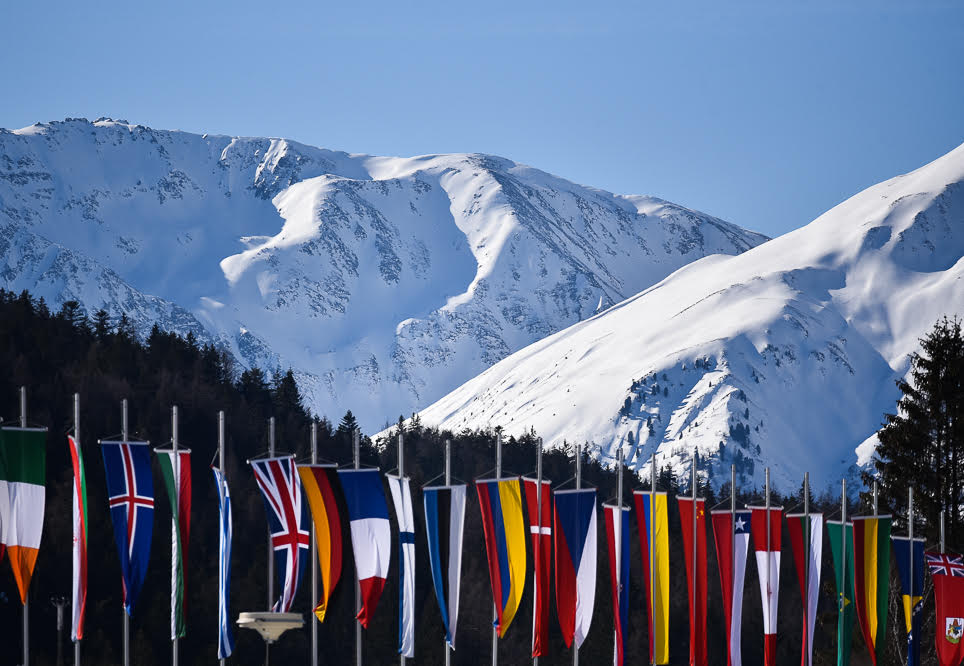
Flags from each nation fly over the stadium in Seefeld, Austria for the 2019 World Championships. (Photo: John Lazenby/lazenbyphoto.com).
As the Seefeld World Championships faded as of Sunday with the conclusion of the men’s 50-kilometer freestyle, here are some news gaps related to the recent arrest last week of five cross-country skiers.
Here are the basics. Several cross-country athletes were arrested in Seefeld as part of a German and Austrian effort to curb doping in sport. Austrian athletes Dominik Baldauf and Maz Hauke, Kazakhstan’s Alexey Poltoranin, and Estonia’s Karel Tammjärv and Andreas Veerpalu were the cross-country athletes arrested. Several other arrest were made including Dr. Mark Schmidt, a German doctor considered to be the leader of the doping efforts. Doping and enabling doping activity is criminalized by law in both Germany and Austria.
Estonian public broadcaster ERR news reported that during a press conference given by Tammjärv on March 1, upon his release from the Austrian authorities, he had admitted to doping in sport. Tammjärve stated he had begun doping in 2016 and was initially put in touch with Dr. Schmidt by Mati Alaver, the former director of the Estonian ski team.
Tammjärv also confirmed that Andreas Veerpalu and his father Andrus Veerpalu were aware of the doping program. Andrus Veerpalu is a former Estonian cross-country athlete who in the past has been implicated with doping. He has been a coaching consultant to the two Estonian athletes involved and is also an adviser to Poltoranin. The older Veerpalu is a three-time Olympic medalist.
Anti Saarepuu, the official Estonian cross-country ski coach for both Tammjärv and Veerpalu, denies knowing that athletes under his watch had been involved with doping.
Thus far, Poltoranin has not commented publicly about his involvement.
Velonews reported this morning that Austrian cyclist and three-time national time trial champion, Georg Preidler, admitted to illegal doping activity. Preidler, had been a member of the French WorldTour team Groupana-FDJ, but is no longer with the team. Over the weekend, Austria’s ex-pro cyclist Stefan Denifl is reported to have admitted to doping.
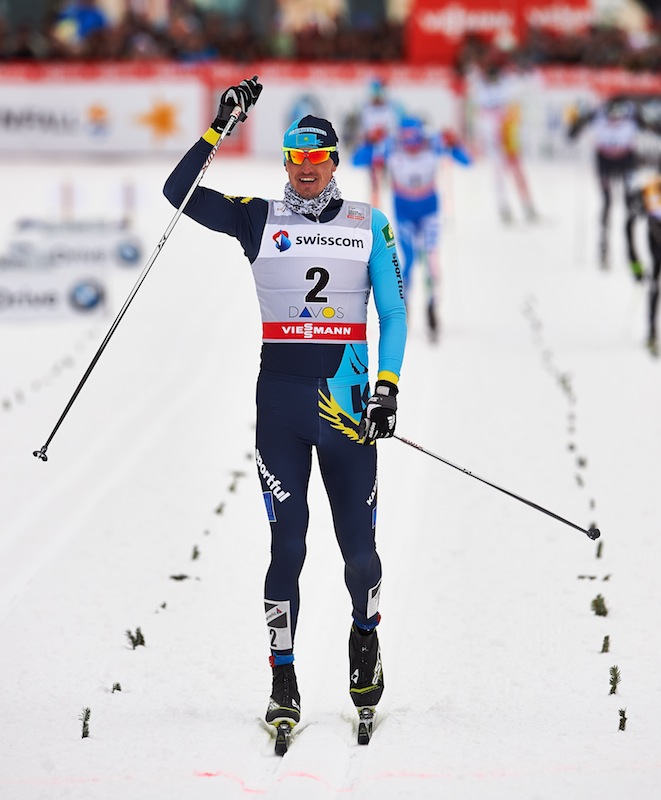
Alexey Poltoranin (KAZ) winning a classic sprint with room to spare in Davos, Switzerland, in 2013. Photo: Fischer/Nordic Focus.
One year ago, Kazakh ski star Alexey Poltoranin began working with Andrus Veerpalu, a Estonian skier who held the title of oldest skier ever to become a World Champion but was later disgraced in an human growth hormone doping scandal.
“He is a good guy and I’m happy with his work,” Poltoranin told Estonian sports outlet ERR last fall. “It’s a really good thing that he’s working with the team.”
Veerpalu was not a team coach, but more an advisor. During his time racing, he was recognized as a classic technique specialist, which made him a good match for Poltoranin.
“He is definitely a really strong skier and a great classic skier, perhaps one of the best classic skiers last year, so this is an especially attractive job offer,” Veerpalu said when he was hired. “I will be responsible for his skis, helping him choose his skis, testing the skis. My position might change later as well, maybe concerning technique and those kinds of things, but that will become clear in the course of our cooperation.”
Poltoranin finished fourth in the overall World Cup standings in 2013, but slumped in 2014, falling out of the top ten. A major medal hope for Kazakhstan, Poltoranin finished ninth in the 15 k classic at the Olympics and 15th in the skiathlon.
Despite this disappointment, he is strengthening his ties to the Estonians and this summer, moved to the country to be closer to his support staff.
He is also formalizing a relationship with Mati Alaver, the famous Estonian coach who built the program up after the country left the Soviet Union. Alaver coached both Veerpalu and two-time Olympic gold medalist Kristina Smigun. Poltoranin’s longtime coach Alexey Nakonechniyn will stay onboard as well. Veerpalu is reportedly now working primarily on ski preparation (although there is speculation and discussion that he will eventually coach the Estonian team), along with Finland’s Jari Nieminen.
This spring, Poltoranin explained that he was splitting from his federation, who he did not feel adequately supported him. He wanted to plan an individualized training group with Alaver, but the federation disagreed. Poltoranin claimed that in the future he may even switch his citizenship if the Kazakh ski team’s preparations remained inadequate.
“I did not feel comfortable with the organization, flights, accommodation, meals, inadequate coaches, challenges surrounding medical supervision and that the best equipment is not used,” Poltoranin said according to a translation. “ I have not been happy with ski service and lubrication.In order to compete on an even higher level, I need strengthened medical attention, I must have a sports physician and a good wax team… I have sponsors who are willing to assist me in preparing for this new Olympic period (the next Winter Olympics in 2018).”
For their part, some Estonians hope that adding Poltoranin to their ranks could help restore their once-great team to glory – even if he never dons an Estonian suit. Alaver is still coaching three Estonian men. Among them, current World Cup team members Raido Ränkel and Algo Kärp said that having one of the world’s top skiers train with them would surely help their preparations.
“So far I’ve only been training for Estonian men who are not as strong as Poltoranin,” Ränkel said.
Poltoranin had nothing but positive things to say about Otepää after his first training camp there.
“Previously, I had been Otepääl winter, and now for the first time in the summer,” he told EKV news. “I liked it very much. There are all conditions for training, and life is calm. I have good impressions of Otepää. I looked for rental apartments for the first year… the main thing is that the apartment has a sauna. As an athlete it’s not at all insignificant. This is a big plus.”
Alaver, 58, is credited with building his country’s cross-country ski program from scratch following Estonia’s independence in 1991. Over the last two decades, its athletes have won more than 15 major medals at World Championships and Olympic Games—not bad for a country with a population of 1.3 million.
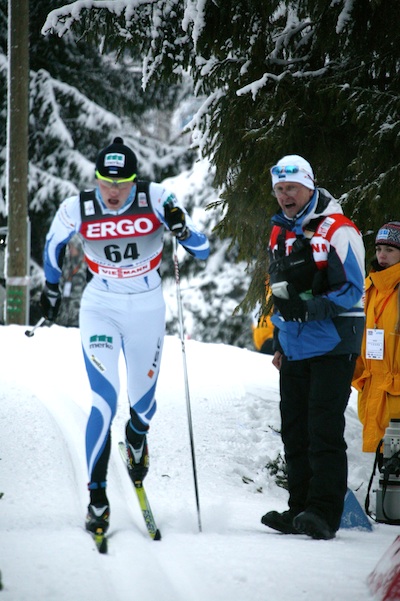
Mati Alaver (R), trailside at a race in Estonia in 2011.
Alaver is known not just as a knowledgeable and successful coach, but also as a pitchman who found the sponsor money to turn the Estonian Ski Federation into a powerhouse. “He’s a great public speaker,” an Estonian ski official told FasterSkier last year. “One day he will go to politics.”
Over the past year, however, Alaver has been tested—first, by the retirement of Jaak Mae, Andrus Veerpalu, and Kristina Smigun, who were Estonia’s core cross-country skiers over the last 15 years, and second, by Veerpalu’s positive drug test in the spring of 2011 for the use of human growth hormone.
The Estonian team—whose athletes formerly competed for the USSR—has always operated under a cloud of suspicion, and Veerpalu’s test only confirmed what many suspected. After an International Ski Federation panel convicted Veerpalu, the case moved on appeal to the Court of Arbitration for Sport (CAS), where it should be resolved in a manner of weeks.
Alaver’s current position with the Estonian Ski Team is unclear; he said that if Veerpalu was found guilty, he would step down, but according to the Estonian media, Alaver is on administrative leave pending the CAS decision—and he continued to travel with the Estonian team through last winter.
During the Tour de Ski in Italy in January, FasterSkier caught up with Alaver to discuss his work with the Estonian ski team, and the future of the program. Alaver speaks German, but not English; our questions and his answers were translated by Christian Flury, a Swiss coach.
The interview has been edited, and condensed.
FasterSkier:What’s your coaching role now? Are you doing less administrative work and working more directly with athletes?
Mati Alaver: Estonia is a small country, so you need to be multifunctional, working with sponsors, working with organizations, working with organizing committees, and working with athletes. You have to do everything, because there’s no way to build up huge infrastructure with the team.
FS:It’s not like the Norwegian team, where you have a head of the wax staff, etc.?
MA: Completely different.
FS:What are your goals for the team?
MA: After the big names retired, it’s time to build up a new team of young athletes, and also a new service staff, new trainers, new coaches, everything. For sure, it’s a three- or four-year project, at least. The goal is, for the future, that Estonia comes back into the nations that win medals. That’s our long-term coaching goal.
FS:Following the retirement of Veerpalu and Mae, which athletes are you working closely with now? Has this given you an
Andrus Veerpalu racing in Estonia, three months before news broke of his positive doping test.
opportunity to work with younger athletes?
MA: I’m personally coaching Algo Kärp and Karel Tammjärv.
FS:How did you get started in the sport? I’ve heard you’re from an out of the way village that was described to me as the Wyoming of Estonia.
MA: When I was 13, I started skiing. I had a really good coach when I was young. He was the reason I went to Tartu University and started working as a ski teacher and ski coach.
I finished university in 1976. I worked for 20 years as a lecturer in science and research. In ’76, I also started working as a coach for small kids, and in ’83 I was first hired as assistant coach for the national team. I started working with Andrus and Jaak in ’92.
FS:Did you have mentors as a coach? Who did you learn the most from?
MA: When I started working at the university, it was back in the Soviet era, and there were some coaches [that I learned from]—Victor Ivanov, Alexander Gruschin, Nikolai Lophukov. When Estonia was free in 1992, I started to go to a lot of conferences and seminars in Finland. On the World Cup, I met [former Norwegian coach] Inge Bråten.
I’ll never forget his speech about the Olympics, because the Norwegians had been so strong in Albertville in 1992. In Albertville, in the top five [in the men’s 30 k], there was one other guy, and that was bad for Norway.
Inge said the next goal is that the top four or five must be Norwegian. They need to be one, two, three, four, five. I thought, ‘that must be a crazy man who would say something like that.’
I learned from Inge that if you want to reach top results, you need to have top goals. In every sector, you need to improve one percent, or even zero-point something, to get better and better, because you start on the same line.
FS:So, you have influences from Norway, from the Soviet system and from Finland—how did you take those and turn them into an Estonian system, with Mae and Veerpalu?
MA: I realize now I was lucky to learn about being methodical and systematic from the Soviets; from Finland, the endurance and the physiology; and from Norway, how to build up structures, in terms of how to organize a team.
As a junior, Jaak Mae was in Norway at a ski school for one year, and he learned a lot from them about how the Norwegian system worked, and he brought that back. Then from ’95 until ’02 or so, we collected all the scientific articles from Norway and worked with them.
Jaak Mae racing in Estonia in 2011.
In the end, you have to take something from the Soviet system, from Finland and from Norway and then put them together and make the best out of them, because there are not that many athletes, not that much money or anything [in Estonia]. So, take the best of what you can, because there are only a few top athletes. Then focus on the development of them.
FS:Now for the hard question: A lot of Western athletes, coaches, and spectators have been skeptical of the Eastern European and Estonian training methods. And since Veerpalu tested positive for human growth hormone, some people have taken that as confirmation of their beliefs. What would you say to them?
MA: We all live in a free world, so everybody’s free to think what they want. It’s a myth to say that Eastern Europeans are the dopers. There’s Ben Johnson, Marion Jones, Taylor Hamilton—it’s not the right way to look at it, to say East and West is different.
I believe it’s a false-positive test, and we’re going to the CAS.
FS:Building your Estonian team back up was already going to be a challenge, once Veerpalu and Mae retired. Has this made it more difficult, and will you be able to bounce back?
MA: Sure—it’s difficult.
FS:The approach and the system for Veerpalu and Mae was very successful; with other athletes, it’s been more mixed. Do you think there have to be changes in the Estonian system to produce more successful athletes? What would those be?
MA: For sure, we have to come up with another system, because cross-country skiing is still endurance, but you also have to be fast now, with the mass start and sprinting. Jaak had no chance in mass start, no chance in sprint. Individual races—that was his best. So, you have to adapt, and now you have some athletes that can do that. We have to go with the times.
The legendary, needs-no-introduction Andrus Veerpalu was poised to go out on top, as the greatest male Estonian skier ever, and one of the all-time best big-race performeres of Nordic skiing – until an injury forced him to sit out of his final World Championships, and call it a career. The Estonian strong-man was feted, celebrated, patted on the back, and given rounds of applause – until he tested positive for human growth hormone.
Instead, he went out on the bottom, as it emerged that he tested positive for growth hormone (or did he? The lawyers are still battling it out) and opted to retire before World Championships. This created a not-insignificant amount of outrage both pro and con-Veerpalu, but Odd-Bjorn Hjelmset was clear on his opinion of the Olympic and World Championship medalist.
Peeter Kummel (left).
On course, the Estonian men were quite good, but not outstanding. While Veerpalu’s points are invalid, 13 other Estonian skiers scored World Cup points, however none of them cracked 100.
The best of the bunch were Timo Simonlatser and Peeter Kummel, both very talented sprinters. Kummel had a strong World Championships, where he qualified 17th in the sprint before battling his way through to the final to finish 6th in the Petter Northug – Marcus Hellner dominated event.
In most countries, as sixth-place result at World Championships would be cause for at least a little celebration – but the Estonians demand more.
What You Need To Know for This Season
The hurricane that is the Veerpalu doping controversy has become a massive sideshow, and the fall-out has just begun – it is extremely unclear how the Estonian distance team and skiers will shake out this season.
Mati Alaver, who coached Veerpalu as well as recently retired Jaak Mae, has been suspended as Head Coach of the National Team, and the head of the Estonian Ski Association Juri Jarv has resigned, while sprint coach Bjorn Kristianson has quit outright in protest over the Federations handling of the incident – he found out about Veerpalu’s case from the paper.
In the past, Alaver has said that he will resign if Veerpalu is not cleared of all charges, but seeing as FIS has stiffened the penalty against the Estonian legend, to a three-year barn, that seems unlikely.
Mati Alaver, currently suspended Estonian cross-country ski coach
While Estonia has never been known for having a deep womens’ team, the retirement of Kristina Smigun-Vaehi at the end of the 2009-2010 season highlighted just how little depth exists, as just two women scored World Cup points. And neither Piret Pormeister or Triin Ojaste are prepared to step up to the level that the Estonian public demands of their skiers, at least this season, as is evidenced by their lack of inclusion on the World Cup team.
If you’re looking to understand more of Estonia as a country, look to FasterSkier’s own Nat Herz who spent time in Estonia this past winter, and wrote an excellent piece on the countries’ development as a ski power.
And if there is one bright spot left in Estonia, it’s their sprint squad. A tightly-knit group of guys who have some top tier skills, and judging from their website, seem to have at least as much fun as the vaunted Norwegian Sprintgutta.
Estonian words and names are awesome – in just a short sample size, skiing in Estonian is ‘suusk’, while ski websites such as FasterSkier are ‘suusaportals’; finally, they have a ski club named ‘suusahullud’, which roughly translates to ‘ski crazy’ or ‘skier freaks’.
Who You Should Watch
Kein Einaste is a 26 year old sprinter poised on the edge of big things. He can really only classic sprint – he failed to qualify on skate skis this past winter, but went three-for-three in classic. He also seems to have some terrible luck. One Estonian newspaper headline even called out a higher power, in a story entitled “Why Does God Hate Einaste?” after the unlucky Estonian broke a pole in his semi-final during the sprint at the Otepaa World Cup.
Earlier this month, the Russian Ski Federation made public that current men’s sprint team coach, Yuri Kaminsky, was poised to become the next head coach of the entire Russian National Team. With the Sochi Olympics coming up in 2014, the depth of Russia’s 100-plus athlete program, and the team’s fight to clean up its skiers and its image, much depends on the appointment.
If Kaminsky and the Federation can come to an agreement on the nature of their working relationship at a final meeting in the next few weeks, he is ready to accept the position. Speaking through Alexei Sotskov as a translator, Kaminsky told FasterSkier in a phone interview that he must be able to operate with a certain level of autonomy in the head coaching position, which despite its name is more administrator than coach.
Kaminsky became the front-runner for the job after Mati Alaver’s candidacy became tarnished by his involvement in the Andrus Veerpalu doping scandal. Russian Ski Federation President Elena Vyalbe offered Kaminsky the position while he was in New Zealand with the sprint team at the end of August. After thinking on the offer for two weeks, Kaminsky gave Vyalbe a conditional ‘yes.’
In an interview with Moscow News, Vyalbe laid out what she was looking for in a head coach. The position requires someone who is respected by the team coaches he oversees, can be objective and take responsibility for his decisions, and will to listen to and understand where the athletes are coming from, she said. With Alaver out of the picture, the only legitimate candidates in her mind were Kaminsky and Yuri Charkovsky, who held the position prior to Vancouver.
According to Sotskov, a former Nordic Combined coach for Russia and a longtime friend of Kaminsky’s, the sprint coach was hesitant in accepting the offer.
“At first he was all excited,” said Sotskov, who was at the Snow Farm with Kaminsky and his team in August. “But then he said, ‘In a way, I’m betraying my team. There’s no way I’ll be able to continue working with all these great guys who trust me, and who I’ve been working with for so long.’” If he accepts the promotion, the helm of the sprint team will likely be taken by current assistant coach Mikhail Deviatiarov, Sr., whose son, Mikhail Jr., is on the Russian team.
Kaminsky ascended to the senior sprint team coach in 2008, after building a strong reputation as one of the most successful junior coaches in Russia. According to Sotskov, Kaminsky consulted his team on whether he should accept the promotion, which would remove him from any position of working directly with athletes. The team, too, was split—half were supportive, half wanted him to stay.
“I felt bad for him,” said Sotskov. “He was torn.”
With the pressure to perform well on home turf in 2014 mounting, the decision to take the head coaching job is all the more daunting. The Russian government directly funds the National Team, so expectations for results come all the way from the president of the country, explained Sotskov.
While the head coach feels that pressure more acutely, there is no doubt that it filters down to the individual athletes. In the past, this has perhaps manifested itself in attempts to get ahead with performance enhancers. In the last five years alone, 20 Russian skiers received bans from competition for doping violations.
With Vyalbe’s ascent to President of the Russian Ski Federation in June of 2010, however, the Federation cracked down on doping—after being fined for past violations and strongly encouraged to clean up its act by the International Ski Federation (FIS), eight tainted coaches were banned from working with athletes on the national team. When FasterSkier interviewed Vyalbe in February, she expressed confidence that no skiers under her jurisdiction were cheating.
When asked about his level of faith in the federation’s anti-doping policy, Kaminsky said that coaches and athletes are clear that there will be no mercy if they are caught, and was convinced that the testing policy is in place to catch anyone cheating on the national team.
If Kaminsky accepts the position as head coach, he will be offering guidance to all senior and development teams to ensure that everyone is working towards the same goals, and will be responsible for administrative decisions regarding which athletes get to compete in certain races. Because Russia has such an enormous pool of athletes, Sotskov explained, it’s often very difficult to select teams for specific races.
Beyond regular administrative duties, Kaminsky is waiting until he decides to take the job to start thinking about what initiatives he will tackle first.
Before the end of his interview, Kaminsky took a moment to express part of his inspiration as he moves forward in whatever capacity in the development of Russian skiing.
“I want you to know that I am totally impressed with the American Nordic Combined performance in Vancouver,” he said. “It is motivating me to work harder. I’m puzzled as to how such a small field of athletes could have performed so well. If you can do it with your resources, how on earth can [Russia] not achieve that success with the resources we have? I honestly want to wish the Americans even more luck; they inspire me and my work.”
Regardless of the decision he comes to in the next few weeks, Kaminsky says he is only sure of his continued involvement at the national level through the Olympics in 2014. After Sochi, he said he would reevaluate his relationship with the sport.
Andrus Veerpalu in the Otepaa World Cup in January, one of his last races on home soil in Estonia.
Before flying to Estonia last January, I didn’t know much about that nation’s cross-country skiers aside from their names—and their medal records.
Jaak Mae, Andrus Veerpalu, and Kristina Smigun-Vaehi—between the three of them, seven Olympic and 10 World Championship medals. Not a bad record for a country with a population of 1.3 million, or the same as the state of Maine.
But while Scandinavian stars like Petter Northug and Marit Björgen blend a certain appeal, accessibility, and charisma, there was nothing that seemed to distinguish the Estonians, save a propensity for finding their peak fitness at just the right moments. The Russians had their Vladimirs and their Olgas; the Estonians had their Kristinas and Jaaks. Every few years, they’d come out of the woodwork, win their medals, and then travel back into the darkness of Eastern Europe, with Westerners’ doubts about doping chasing them to the border and bouncing off the tatters of the Iron Curtain.
Through the beginning of last winter, I knew as much as I needed to know about the Estonians to do my job as a cross-country skiing beat reporter. Smigun was retired, while Mae and Veerpalu were both in their late thirties, but remained among the best in the business—especially in the classical technique, in which they were generally considered to be among the most graceful skiers in the world.
But come January 20, it was time for me to visit Estonia in the flesh to report on a series of races, and I decided that I should do a little bit more research. So the day I flew out of Boston, I spent some time in a bookstore reading a guidebook to the Baltics and perusing press clippings. Among other things, I learned that Estonia’s people had been denied independence for much of the 20th century, up until the 1990s,and that the country was noted for its folksinging traditions.
And, oh yeah—a press release from the organizers said that some 15,000 people show up for the annual cross-country ski races in Otepaa. Assuming those numbers were accurate, that’s just over one out of every hundred Estonian citizens—proportionally, the same as three million Americans showing up for a football game.
I left Boston for Estonia on a redeye on a Thursday night. The closer I got to the start of the World Cup races on Saturday morning, the more I sensed a strange passion among Estonians for the sport of cross-country skiing.
After landing in Tallinn, the capital of the country on its northern coast, I caught a two-hour ride to Tartu, another city in the interior that’s 45 minutes from Otepaa, where the races would take place.
For my first few nights, I stayed with the family of Vahur Teppan, an Estonian who had skied for the University of Alaska-Fairbanks. Vahur lived in Otepaa, where I’d be based for the last week of my visit. But because he was racing in the World Cup himself, I was spending the weekend in Tartu, in his mom’s apartment.
Tuuli, Vahur’s sister, picked me up at the bus station on Friday night. After a quick stop at McDonald’s for dinner, we drove back to her family’s flat. Their building, a large complex with the typical, northern-European gabled roof, was imposing from the outside. But the interior was welcoming: a cozy kitchen; a den with a big couch and a television;and my own room, complete with a wall mural depicting a pair of cross-country skiers. Tuuli left me in the den with my McDonald’s, and as I nursed my first Sprite in two years, I watched preview coverage of the World Cup races on two different Estonian television stations before going to bed.
The TV reports, though, were just the hors d’oeuvres. I got my real introduction to Estonian skiing culture the next morning, when I got up before dawn and bought a bus ticket for the 25-mile ride from Tartu to Otepaa. It was still dark when we arrived, but even as the bus rolled through the outskirts of town, I could see the floodlights in the ski stadium brightening the sky in all directions. As I walked up to the entrance to the Tehvandi Spordikeskus, I was met with a spectacle unlike anything I’d ever
The stadium in Otepaa.
seen at races in North America: tents set up for vendors to hawk flags and trinkets; a “Park of Estonian Skiing Heroes,” which was a large plaza with giant, glassed-in posters of star athletes; and, once I’d gone inside the stadium, stands with rows upon rows of seats, concessions with beer and Jagermeister, and a gleaming, four-story race headquarters that housed a cafeteria, a media center, and even a winter sports museum.
Before I’d flown across the Atlantic, I thought I’d known cross-country skiing. But I was beginning to realize that there were still some huge gaps in my knowledge. What were the roots of this fervor? What had it sprung up in Estonia? By the time the weekend was over, it was clear to me that there was a story about Estonian skiing that needed writing. As it turns out, that story is one of cross-country skiing’s most compelling—and there’s an epilogue that has yet to play out.
—————
After the weekend World Cup races, I moved my base of operations to Vahur’s apartment in Otepaa, where I’d be covering the World Junior Ski Championships. I also set about trying to unravel the mysteries of Estonian skiing. One of the first things I did was to set up a meeting with Tiit Pekk, the smiling, gregarious chief of competition for the Championships and a former student-athlete at the University of Colorado-Boulder.
At 40, Pekk is still well-muscled, handsome, and athletic. Tall, with close-cropped blond hair,his cheerfulness prompted a former teammate to describe him to me as “Mr. Estonia.” But Pekk’s charm belies a feverish intensity. His day job is working as an IT project manager for Swedbank; his dedication to cross-country skiing is so complete that one worries for his wife and kids. In addition to working the races in Otepaa, he’s the chairman of the International Ski Federation (FIS) committee in charge of running the entire World Cup circuit. And last February and March, he served as one of the chief officials at the 2011 World Ski Championships in Oslo. Pekk is “a little bit better balanced” today than he was in 2005, when he took 56 vacation days for skiing. (That was “quite mad,” he said.) But the guy still lives for the sport. The first time I got a chance to chat with him was when Vahur and I crashed an evening sauna with Pekk and a few of the members of the Estonian sprint team. When we arrived, the topic of discussion, over beers, was how many start spots the team was likely to earn for its quota for World Cup races next winter.
During a subsequent hour-long interview in an Otepaa hotel, Pekk took me on a tour of his country’s ski history. Later, I filled in some holes thanks to a conversation with Jaan Martinson, a bearded, bifocaled, chain-smoking reporter for the Estonian newspaper Ohtuleht. Martinson has been covering cross-country skiing for almost 15 years; he said that he has seen every single Estonian World Championship and Olympic medal-winning performance in person.
—————
According to the two men, the history of Estonian skiing is divided into two phases: the Soviet era, and the one that followed.
After a brief 20-year period of independence, Estonia was annexed by Russia in 1940 as part of World War II, and incorporated into the USSR. For the next half-century, it remained a part of the Soviet Republic, and its skiers did, too, wearing Russian uniforms and competing as part of Soviet teams.
The early period of Russian occupation was harsh, with campaigns of killings and deportations. A guerrilla movement was stamped out by the mid-1950’s, but Estonians still held on to some of their cultural traditions, like folksinging, as means of indirect resistance.
According to Martinson, skiing was another form of national expression. While the sport hadn’t exactly been on the fringe—he said that it’s a required activity at public schools during the winter—its popularity blossomed in the 1970’s, when an Estonian television station found a way to televise its own feed of the World Championships, with Estonian commentators—an anomaly, Martinson said, when most sports coverage came from Moscow. When the races were shown on TV, he continued, the Estonians would watch, and cheer for anyone not wearing a Soviet suit. Schools even brought televisions into the classroom to show morning races.
“All Estonians watched the TV, and everybody was against the Russians,” Martinson said. “We screamed for Swedes and Norwegians, the Finns.”
Estonia may not have had any of its own medal-winners during the Soviet era, but all along, Martinson said, the country was waiting for them. Pekk was one of the skiers who came up through the Soviet system, competing for the Estonian Soviet Republic team, which counted as his mandatory military service. His achievements included winning a Soviet Land Force championship in skiing, early in his career.
According to both Pekk and Martinson, the Soviet system provided good support for its athletes—a salary, food, housing, early-season on-snow training camps in Siberia. There were some Estonian athletes who showed glimmers of greatness. But few of them made it out of the Soviet machine in one piece, because the system was essentially training by brute force. Rather than tailoring training programs to each individual, the Soviets simply put large numbers of athletes—“meat,” Pekk called them—through various brutal regimes.
“They brought 100 [of the] best juniors, and everyone has [the] same training. Very, very hard training,” Martinson said. “If you’re still alive, you become a great skier.”
But many Estonians ended up overtrained and burned out. As an example, Pekk recounted the career of Urmas Vyalbe, the ex-husband of Russian Ski Federation President Elena Vyalbe, who destroyed his immune system in a special Soviet altitude training program. Martinson described the fall of Rutt Rehemaa, Kristina Smigun’s mother, who had a medal-winning junior career, then went through the Soviet regimen, skiing 70 kilometers a day in her teens, and burned out.
“We [had] many, many good juniors, but the Soviet Union system killed them all,” Martinson said.
One who survived, though, was Allar Levandi, a nordic combined skier with a mane of brown hair who won a bronze medal at the 1988 Winter Olympics in Calgary, at the tender age of 22. Technically, Levandi’s medal was awarded to the USSR, but coming as it did just after the first inklings of an independence movement were bubbling up in the late 80’s,the bronze was also claimed by Estonians, along with other medals won later that year by an Estonian track cyclist and basketball player who were competing in the Summer Games for the Soviet Union.
“These were very much taken as our medals, although they were representing the Soviet system,” Pekk said.
When the Soviet Union collapsed in the early 1990’s,Estonians finally got the chance to compete for their own country. But while the country’s athletes had gained their independence from Russia, they were now left without the support system that had sustained them throughout the previous decades. Pekk saw the writing on the wall and got out, heading to the U.S. to continue his career, and to study. Meanwhile, the athletes and coaches that remained were left to build a program from the ground up.
—————
As part of my job, I read about a dozen foreign websites every day, to stay in touch with skiing news from around the world. During the last off-season, in 2010, the Russians were abuzz with what to me seemed like a relatively inconsequential development: Elena Vyalbe, the president of the Russian Ski Federation, was trying to lure longtime Estonian head coach Mati Alaver to her country.
There are a lot of Russians in Russia, and, I’m sure, plenty of ski coaches. I couldn’t understand why Vyalbe wanted Alaver so badly, but I still didn’t give it much thought, and the news was filed into the same corner of my brain occupied by other curiosities like the net worth of the Norwegian legend Björn Daehlie. For months, it remained there, until I finally arrived in Estonia and learned how Alaver had presided over the meteoric rise of his country’s ski program.
If Estonian ski culture lacked its own organizing principles after the collapse of the Soviet Union, then Alaver was its Lenin, formulating an ideology and a structure that would help propel the sport to its great accomplishments of the last 12 years.
His tenure, however, did not begin auspiciously. The Estonian Ski Federation was starved for cash in the early 1990s, when Alaver got to work, and according to Martinson, the operation was running on a shoestring. The athletes, Martinson said, had no money for a car, and at one point they even resorted to carrying bags of food, on foot, to a train that would take them
Mati Alaver (R), trailside in Otepaa.
to a training camp in Finland. Veerpalu, who was supporting a wife and child, actually borrowed money from Alaver to put food on the table. At the 1992 Olympic Games in France, Veerpalu raced on cheap skis from Visu, an Estonian ski company, with Alaver himself doing the waxing.Martinson described Estonia at that point as the “poorest ski nation in the world.”
For the first half of the decade, there was no indication that Veerpalu and Mae, Alaver’s chosen pupils, were on track to challenge the world’s best—let alone win eight Olympic and World Championship medals over the course of their careers.Their results in skate technique were abysmal, but even in their favored, classic technique, even on good days, they rarely climbed higher than 30th place.
Alaver, though, had a plan. Not just a series of workouts, or an altitude training protocol, but a comprehensive blueprint for a program that would take the Estonians to another level. According to Pekk, after the Lillehammer Olympics, in 1994, Alaver wrote a thesis detailing his systematic approach.
“The foundation of what they are doing, he laid down in ’94, and he has been pursuing this ever since,” Pekk said.
Physiologically, Pekk said, Alaver’s design was largely based on what he had learned from the Russians—his teachers are “a list of Soviet great coaches.” According to Martinson, when the Soviets came to Estonia for training camps, Alaver would watch them for hours, taking notes. There were Scandinavian influences, too—Finnish coaches, and the Norwegian journeyman Inge Bråten, according to Pekk.
Another key ingredient was Alaver’s own research. A graduate of Tartu University, Alaver is constantly in pursuit of knowledge, science, and data on topics ranging from strength training to nutrition. Martinson called him the best-read coach in all of Estonia—his mind is legendary.
“He’s so phenomenal with numbers,” Björn Kristiansen, a Norwegian who coached the Estonian sprint team for the last five years, told me in a phone interview. “Places, times, VO2 max results or other results—he just knows…I would say he has been one of the strongest coaches I’ve ever worked with, because he’s a bank of information.”
Coaching, though, was only half of Alaver’s job. The rest was money—doing the fundraising required to turn Estonia’s ski team into a more muscular, legitimate operation. That meant, essentially, going door-to-door to entreat various businesses.
“He still has files, how many hundreds of letters he has sent to companies for fundraising,” Pekk said.
Alaver, a lean man with a stern, chiseled face, has a natural charisma, and as the skiers’ results improved, he was ultimately able to bring large companies on board, like Saku—the Estonian equivalent of Budweiser—and Swedbank.
“He’s a great public speaker. One day he will go to politics—there’s no question,” Pekk said.
According to Martinson, physiological testing showed Alaver that both Veerpalu and Mae had potential. But before they could start peaking to win big races, Alaver put them through years of hard training. During one camp, Martinson said,
Andrus Veerpalu racing in Estonia.
Veerpalu called Alaver, who had stayed behind to save money.
“We are practicing more than all [the] others,” Veerpalu said, according to Martinson. “But they beat us by minutes.”
“Wait—wait a couple more years,” Alaver told him. Then, he said, the two men could start a different kind of training—“to be winners.”
On February 28, 1999, in Ramsau, Germany—more than six years after his first World Cup competition—Veerpalu climbed onto the podium of an international race for the first time. He had just won the silver medal in the 50 k classic at the World Ski Championships.
Over the next 12 years of his career, Veerpalu would go on to win five more major medals, with Mae pitching in two of his own. Early in the post-Soviet era, some had derided the Estonian ski program, and even suggested that it was not worth funding. But by the time I arrived, Alaver and his two pupils had become beloved. The front-page photos and double-page spreads in the national newspaper during the World Cup were one example. But the adulation wasn’t limited to the one weekend a year that the circuit stopped in Otepaa—the skiers’ economic success was testament to that. In 2004, for example, Veerpalu became an investor in one of the hotels in Otepaa. All the major athletes, and even some of the minor ones, now have their own car sponsorships. (Mae drives a personalized Mercedes Benz.) And the country’s ski association, Martinson said, is now the “biggest, best federation in Estonia.”
“They have a lot of money,” he said.
Why, and how, had the skiers become so popular? And what made them so appealing? I couldn’t get clear answers to those questions while I was in Estonia. The results were obviously one factor, but results alone aren’t enough to sustain an entire country’s passion. One explanation, Pekk surmised, was that the athletes had worked to improve their public personas—an area in which he said they had not always been “gifted.”
“They have changed a lot. Their mindset—what they are explaining, how much they can express,” he said. “With this media attention that they have got, their coaches, their advisors…have put quite a bit of effort into this.”
There’s also charisma. I never spoke with either Alaver or Veerpalu—neither speaks English, and my visit was too brief to organize an interview with a translator—but my colleague, Chelsea Little, talked with both of them in Finland last fall (with the help of her Russian-speaking coach), and the two men made a big impression. Alaver, she said, was a natural, compelling speaker, even in Estonian.
“He was very outgoing, very personable, very willing to talk,” she said. “He just acts, and looks, and personifies somebody who knows what’s up—he’s like a really athletic, attractive grandfather.”
Tall, with blue eyes, Veerpalu was much more reserved—he was not one to rattle off his accomplishments. But Chelsea said that there was still something quietly powerful about him, a kind of sincerity. When Veerpalu opens his mouth, “you want to hear what he has to say.”
Veerpalu conducting an interview.
“He just wasn’t really that interested in self-promotion, or even discussing himself,” she said. “He seemed very focused, and content on the life he had made for himself.”
One final factor might be that as the Estonians reeled off medal after medal over the last decade, they gave the country’s citizens an outlet for the nationalistic feelings that had been silenced up until the very end of the Soviet era. There’s no easy way to measure that. But if the number of flags toted by spectators to the Otepaa races serves as quantification, the dozens in the stands and along the trailside certainly make that case.
“Relative success at different international competitions has prompted Estonians to put more money and effort into the national past-time itself, since Estonia can’t compete in all of the major fields,” Vello Pettai, a political scientist and an expert on Estonia, wrote me in an e-mail. “When this kind of investment pays off with a real medal, it raises pride in the nation, and naturally prompts even more investment and enthusiasm.”
—————
Veerpalu and Mae, between them, have won eight major medals on behalf of their country. But that total actually represents less than half the total hardware brought home by Estonian skiers since the country’s independence. The rest of the medals, all nine of them, belong to a woman who eschewed Alaver’s methods: Kristina Smigun.
The most decorated athlete in the history of Estonian skiing, Smigun has an unrivaled athletic pedigree, as the daughter of two elite skiers in their own rights. That was clear from when she was in her teens, as she racked up six medals over three years at the World Junior Championships—including one race in Canada that she won by nearly half a minute over her sister, Katrin.
Smigun ended her career in 2010, after winning her third Olympic medal; up until then, she was coached by her father, Anatoli. Anatoli Smigun is a Russian-born, former Soviet ski team member with an education from a sport institute in Moscow, according to Martinson, who recently finished co-authoring Kristina’s autobiography.
For the most part, Kristina Smigun didn’t work with Alaver or his two male stars, instead relying on her own support crew known as “Team Smigun.”That split highlights something that took me quite a while to discover: Despite all of his success, not everybody thinks that Mati Alaver is the greatest thing since sliced rye bread.
In the first few interviews I did with Estonians, people spoke about the coach in reverential, hushed tones. He seemed to be a mythic figure in the skiing community, with his reputation as a physiological genius. But I got a very different perspective from Oleg Ragilo, an Estonian wax technician who was working for the American team throughout the World Junior Championships.
Martinson told me that Ragilo had been Smigun’s chief ski waxer for much of her career, and at the tail end of the races in
Kristina Smigun (in white and blue) on the way to gold at the 2006 Olympics.
Otepaa, I cornered him for an interview for a profile. We also discussed Estonian skiing more generally, and almost immediately, Ragilo’s feelings about Alaver were clear: he didn’t like the guy.
At first, the criticisms were vague—Ragilo complained how the Estonian Ski Association treated Alaver “like a god.” But then, he got more specific, saying that Alaver’s training system is formulaic, with a predictable seven-day cycle, and that it only works for Veerpalu and Mae, Alaver’s two stars. While that pair had obviously prospered, Ragilo recounted a story about the former World Junior Champion Aivar Rehemaa that ended differently. After joining the Estonian national team, Rehemaa promptly saw his results go downhill, but when he went back to work with Anatoli Smigun, they recovered.
Ragilo has spent most of his career working with the Smiguns, so it’s possible his beef could be as much political or personal as anything else. It was obvious that Ragilo had problems with Alaver’s style as much as his substance: he said that the coach operates like a “psychologist,” and treats people as though they are “below him.”
But a closer look at Estonian results—past the heroics of Veerpalu and Mae—shows that Ragilo might actually have a point.
Estonian juniors have had their share of successes over the past few years, and there’s some talent in the pipeline. But with Smigun’s retirement after the 2010 season, and with Veerpalu and Mae departing last spring, the Estonian media—and to a certain extent, its citizens—have been hotly debating the future of their nation’s ski program. The podium performances by their stars have come fast and thick over the past decade, but at least when it comes to distance racing, there’s no one that appears to be immediately poised to fill the void left by their retirements. Things are especially bad on the women’s side: at this year’s World Ski Championships in Oslo, the Estonians didn’t even field a female relay team. And at the distance race at their home World Cup, the one I attended in January, they had just a single women’s starter: 25-year-old Laura Rohtla, who finished 38th out of 49 starters.
“We could have entered 13 [women], maybe,” Pekk said. “But we had one. So this is hard—this is the chance to promote your sport, and you have the one athlete.”
As for the men, things are slightly better. There’s a small handful of non-Veerpalu and non-Mae Estonians who have crept into the top 20 places in distance World Cup races in the last few years. Algo Karp, 26, finished 23rd in the 15 k at World Championships in March, and his teammate Karel Tammjarv, an up-and-comer at 22, was just three places farther back. And at the World U-23 Championships in January, Tammjarv made it into the top 10 two separate times.
For non-nordic powerhouse nations, those results would be enough to keep people optimistic—especially when you also remember that the country’s sprint team has two men, in Peeter Kummel and Kein Einaste, who each came close to podium
Peeter Kummel (left).
finishes in the last year. Both are still under 30, and have room for improvement. But in the mean time, the Estonian public, which has celebrated 17 Olympic and World Championship medals in the past 12 years,isn’t content with top-10’s. After Kummel finished sixth in the World Championships sprint in Oslo, Martinson told me that the result was “very good—but not enough for us.”
There are all kinds of questions about the future. Should the country be shifting its focus to sprinting, because that’s where it’s closest to a breakthrough? Or should it leave that focus on distance racing, where its heritage is stronger? What about putting more of an emphasis on skating—the technique that has historically been its weakness? Estonian skiing also needs to make more of an investment in training its coaches, Pekk said, though finding the funding to do so remains a challenge.
“The standard of living is still so low in Estonia that having so many volunteers working with kids—it’s a long shot before that will take,” he said.
As far as the current predicament, how much of the blame—if that’s the right word—to place on Alaver is unclear. On the one hand, in coaching Mae and Veerpalu, he has accomplished more than anyone could have imagined back in the thrifty post-Soviet days of the early 1990’s. Eight Olympic and World Championship medals is enough to merit a bit of laurel-resting.
On the other hand, Alaver is also the architect of the whole Estonian ski program, and the head coach of the country’s national team. One could argue he should be held responsible for its fate—even after the retirement of its big stars. Pekk seemed inclined to do so, at least in part, acknowledging that as far as the Estonian women were concerned, Alaver’s ideology “has not held.”
“The attention has been with the older guys,” he said. “Kristina’s had her separate team, lived her separate life, but overall, the ladies’ part has not been the focus.”
“This is a really tough time at the moment,” Pekk continued. Mae, Veerpalu, and Smigun have given the Estonians “so many moments. But what is after that?”
In March, with the departure of Veerpalu and Mae, the Estonian Ski Association suffered through several spasms of upheaval. A number of key support staff departed the program for greener pastures, like Urmas Vyalbe, a wax technician who worked closely with Jaak Mae, and Lauri Rannamaa, a physiotherapist. In total, according to Kristiansen, the sprint coach, four out of five of the team’s wax staff went to go work for Russia. Money was a problem: in a report in his newspaper, Ohtuleht, Martinson quoted Alaver as saying that lackluster results at the World Championships cost the Estonians crucial funding from the country’s Olympic committee.
But still, it didn’t appear to be a full-on crisis. Alaver’s rumored departure for Russia was never confirmed; Kristiansen, the sprint coach, wasn’t going anywhere. The up-and-coming athletes were still on board, as well as Kummel and Einaste, the two sprinters who are closest to a breakthrough. The key pieces of the program seemed intact. At least, that is, until early April, when the Estonian media began reporting that Veerpalu had tested positive for human growth hormone.
—————
The news wasn’t exactly out of the blue: when the Norwegian coach Björn Kristiansen first traveled to Estonia to head the country’s sprint team, in 2006, he had heard all the rumors.
“I thought I was going to Russia. I thought, ‘oh, okay, they’re doing some fake and illegal stuff,’” Kristiansen said. “But I was promised free hands to deal with the sprinting when we made the contract, so I thought, ‘okay, let’s try.’”
Suspicions had always abounded around Veerpalu and Mae for their uncanny ability to peak perfectly for important events—racing sparingly and slowly early in the season only to come on strong and sudden when it counted. In 2009, Veerpalu won
Veerpalu.
a World Championship gold medal in late February; up until that point in the year, he hadn’t cracked the podium a single time.
There were other questions, too. Smigun had had an A-sample test positive for steroids in 2001, only to have the B-sample come back negative. (A World Anti-Doping Agency official later said that that was because the lab that did the first test thought Smigun was male, according to a report in the British newspaper The Guardian.) And when a Norwegian reporter claimed to have obtained leaked results from tests looking at fluctuations in blood values among athletes participating at the 2001 World Championships in Lahti, Finland, Veerpalu was among a group whose numbers were considered “abnormal.”(Dr. Jim Stray-Gundersen, the author of a study that was widely suspected as being the source of the test results, would not confirm the reporter’s claims in an e-mail to me, citing the confidentiality of his findings.)
Estonia was also a former Soviet Republic, and the USSR’s record on performance-enhancing drugs is dubious, to put it mildly. According to a paper that appeared in 2003 in Perspectives in Biology and Medicine, a scholarly journal published by Johns Hopkins University Press, the Soviets conducted studies on the effects of blood doping on swimmers and runners, then used the technique on skiers and biathletes at the 1976 and 1980 Olympic Games. The author of the article, citing a Russian PhD dissertation report, said that the practice was “pervasive” during the 1970s and 1980s.
While I couldn’t find any irrefutable evidence linking Estonian skiers to drugs during this period, Levandi, the medal-winning nordic combined skier, was tied to a minor scandal in the late ’80s. A 1989 report in the British newspaper The Independent cited a Soviet magazine, Smena, as claiming it had evidence that an East German anti-doping lab providing tip-offs to Levandi and two other athletes that they had traces of performance-enhancing drugs still in their bodies in “pre-departure tests”—which in turn enabled them to withdraw from major championships before they could test positive.
But when Kristiansen arrived in Estonia, and throughout his ensuing five-year tenure as the sprint coach, he didn’t see any of that. Instead, to his surprise, the key components of the Estonian training plan appeared to be physical, not chemical.
“The way they have worked in these five years, it’s what I’m used to when I see Norwegian elite, or [what] top-level athletes are doing,” he told me. “What they were doing—it was just pure, hard work, as I’ve been used to in my life as a skier, and also, after that, as a coach. I didn’t suspect anything, actually…. After a while, my Russian imagination was just gone.”
There would always be rumors, but by the time I arrived in Estonia in January, it appeared that all three of its greats—Veerpalu, Mae, and Smigun—would be able to close the doors on their careers without any hard evidence of cheating.
Still, it was a topic that Pekk seemed reticent to address during our conversation in Otepaa. When I first asked him about doping allegations, he abruptly changed the subject to the next day’s weather. When I pushed him, he acknowledged that the rumors were something that the Estonians had to stomach if they were going to rely on Alaver’s training philosophy, which was itself largely based on Soviet methods. Coming into the 2002 Salt Lake City Olympics, Pekk said, he was warned by Estonian journalists that the Scandinavians would not accept Veerpalu, Mae, and Smigun waltzing into major championships and collecting medals that had typically gone to the Norwegians and Swedes.
“The journalists actually said, before it happened, that you will be attacked because you are there, [in] what they perceive as their playground,” Pekk said. “One month later, it was there.”
The more time that I spent in Estonia—and the more that I learned from Pekk, Martinson, and others about the country’s ski program—the more that I was inclined to believe that its skiers were clean. Pekk’s analysis made perfect sense. When I traveled to Norway later in the winter, I witnessed the exact same air of superiority that he had described—a refusal to see as credible any performance that bested a Scandinavian’s. When I mentioned to one of my Norwegian hosts that I had traveled to Estonia and developed a greater respect for the accomplishments of Veerpalu and the others, she sniffed, and immediately said something about artificial enhancements.
As the winter wound down, I grew more and more determined to show people the remarkable backstory of the Estonian program—which, perhaps, would make them pause a little bit longer before dismissing the country’s skiers as just another bunch of dopers.
But then, in the final days leading up to the World Championships in Oslo in late February, word came out of Estonia that Veerpalu was injured. First, he skipped the championship tune-up races; then, as attention and tension mounted, he made the abrupt announcement a few days later that he’d have to miss the Oslo races, too.
Just like that, Veerpalu’s career was over: with the news that he would miss World Championships came the decision that he would be retiring. For Estonians, who had hoped for perhaps one last medal, it was a huge disappointment. But the reaction paled in comparison to what came next. In late March, anonymously-sourced reports began appearing that said Veerpalu had failed a drug test. Initially, no one would confirm them, but after a few days, as a media frenzy began building, Veerpalu acknowledged in a tearful press conference that one of his samples had indeed tested positive.
The story-book tale of the Estonian achievements—20 years in the making, and just months from its conclusion—had just been punctured like a balloon. Even if Veerpalu is ultimately acquitted, the stain of a positive drug test will never be fully rinsed from his career, and among non-Estonians, it will likely forever obscure both his fairy-tale successes, and his intriguing cultural significance at home. It’s not just Veerpalu’s accomplishments that will be called into question, either. Fairly or not, the doping positive raises doubts over the whole Estonian program—over Alaver’s regime, and perhaps even Smigun’s career, as well. If Alaver was coaching Veerpalu, and Veerpalu was doping, would Mae, his counterpart, have been doing anything different? And Smigun may have worked in a separate program, but she comes from the same country, and from the same ski culture, too.
To a large extent, Estonia’s skiing future is staked on the outcome of the case—Alaver and the entire board of the country’s ski association have said that they will resign if Veerpalu is found guilty. There has already been significant fallout: after the announcement of the positive test, Kristiansen resigned from his position as sprint coach. In an interview a few months later, he told me that he was “furious” that he’d had to learn of the positive test through the press—not directly from the Estonian Ski Association—and that he refused to work with people who doped their athletes. Still, he said, the decision was one of the hardest he’s ever had to make, since the sprinters weren’t involved in the scandal.
“One day, you’re really motivated to continue, and the next day you just feel that someone has trampled you, down in the mud,” he said. “It’s unfair, I would say, because [the sprinters] are harmed by me stepping aside, ending my coaching there.”
“Whether they like it or not, they’re struck by people turning their back to them. That means sponsors, and the skiing community—and especially the Norwegian skiing community,” Kristiansen said.
Kristiansen had commuted between Norway and Estonia during his time as the country’s sprint coach; now, he’s living at home outside of Oslo, where he’s coaching at a local high school, and still mentoring some of the Estonians.He said his association with the teamhas damaged his prospects of getting a job at the national team level. But when I asked Kristiansen if he thought that the Estonians were capable of pulling off a doping regimen, he was still skeptical.
“I haven’t been there 24/7, or year-round, so everything would be possible,” he said, emphasizing that he was speculating. “I haven’t even been 24/7, full year-round with my athletes in the sprint group. So it could even have been possible to be [doping] there. But I’d say that they’re not doing any systematic doping—nope. That’s my impression, but it might be that I’m stupid, and perhaps I’m even used for this cause—that I was hired in five years ago, to just make a blur over what they’re doing.”
—————
Veerpalu’s arguments were heard in June by FIS’s Doping Panel, the federation’s internal body charged with judging the case.
After the positive test was made public in April, Veerpalu and the Estonian Ski Federation assembled a muscular defense team. Participants in the FIS hearing included Veerpalu himself, two lawyers from a prominent Estonian firm, and two scientific experts.Other scientists have also been consulted in the case, according to Ilmar-Erik Aavakivi, one of the two lawyers.
In an e-mail, Aavakivi laid out his team’s assault on Veerpalu’s positive test, starting with the definitive statement that “Mr. Veerpalu has not used growth hormone or any other type of doping. He has to be found NOT GUILTY.”
Aavakivi said that the problems with Veerpalu’s case began with the sample itself, which he claimed was collected under “exceptional circumstances,” though he refused to go into the details of those circumstances. But he didn’t stop there—the defense team, Aavakivi said, has had “a lot to say” against the positive test.
Among their lines of argument, he continued, are that the defense team found problems with the reliability and accuracy of the HGH test itself, as well as problems with the handling of the sample by the World Anti-Doping Agency (WADA), which accredited the lab in Cologne, Germany, where Aavakivi said that the analysis was conducted. One of the facts highlighted by the Veerpalu’s scientific team, Aavakivi said, was that the values measuring HGH in the A- and B-samples differed by 34 percent. And after citing a 2010 article in which a WADA official was quoted emphasizing the need for “rigorous” policies for the collection and storage of blood samples drawn for HGH tests, Aavakivi said that “we can say and have said that WADA has not followed its own procedures. Definitely, WADA’s diligence shown in this case has been far from ‘rigorous.’”
A WADA spokesman declined to respond to Aavakivi’s allegations; Sarah Lewis, the FIS secretary general, was similarly mum. It’s hard to tell how much credence to give Aavakivi’s arguments, given his own refusal to go into the details. To get some more information, I contacted Richard Holt, a Britain-based endocrinology professor who has worked to develop an alternative HGH test to the one currently in use.He wouldn’t speak to the specifics of Veerpalu’s case, but he did send me a review article he’d written about HGH doping. The piece suggested that if there’s any criticism that could be made of the current test, it’s that it doesn’t do a good enough job of ensnaring dopers—not that it has a tendency to produce false-positives. The window for catching an HGH doper is short, Holt wrote—the hormone is “frequently undetectable in a blood sample taken the morning after an injection.” He also noted that the HGH test was performed more than 1000 times before identifying its first culprit in 2010—six years after the procedure had been introduced.
As for the 34 percent difference between the A- and B-samples? In his e-mail, Holt said that “analytical variation” can cause swings of up to 10 percent in lab measurements. Since the test looks at a ratio of two different values, those swings could be present in each, leading to a divergence that could be, roughly, as high as 20 percent. But that still doesn’t account for the Aavakivi’s claim of a 34 percent gulf.
Complexities aside, the case is, most likely, still a long way from resolution. The Estonian media has reported that FIS will likely release a verdict by the end of the summer, but Veerpalu’s team can appeal a guilty ruling; the case would then be considered in another hearing by the Court of Arbitration for Sport, which has the final say on the matter. Conversely, if Veerpalu is found innocent by FIS, WADA could appeal that ruling, though its spokesman declined to comment on the likelihood it would do so.
—————
The outcome of the Veerpalu proceedings will undoubtedly have huge ramifications for the Estonian ski program’s reputation, and its
The poster of Veerpalu in Otepaa's Park of Estonian Skiing Heroes.
future. There’s no question that it’s in for some hard times, with the departure of some staff members already announced, as well as the potential for losses in sponsorship after the retirements and the doping scandal. But it’s now, with some doubts raised about his legacy, that Alaver will have to show that he can succeed with skiers other than Veerpalu and Mae, Kristianson said. If Alaver had wrapped up his coaching career after Veerpalu’s gold medal in the 2009 World Championships, “he had nothing more to prove.”
“Now, perhaps, it’s the other way around,” Kristiansen said. “Now it’s important to prove something.”
Martinson, though, thinks that some leaner times might not hurt the Estonians. Thanks to the success of the country’s ski association, all the Estonian athletes—even juniors—receive plenty of perks, like the car sponsorships. In a conversation with Alaver, Martinson said he told the coach that perhaps the reason that Estonia was having a hard time producing a second generation of star athletes was because they had it too easy. Perhaps, he said, the new skiers need to be doing what Smigun and Veerpalu did during those Spartan post-Soviet days: “take [their] own food, and [go] by train to Finland.”
“Maybe,” Martinson said, “they have to start from nothing.”
Estonian Andrus Veerpalu has competed in every Olympic Games since Albertville in 1992. In Vancouver, at 39 years of age, he contested only the 50 k classic mass start, finishing sixth. Many assumed that it would be one of his last races.
They were wrong.
This year, Veerpalu will be focusing on the World Championships in Oslo, Norway; in particular, he plans to peak for the classic distance races. There is no reason to believe that he won’t be in top form, so the competition should take note.
He will also be contesting general World Cup races and the Tour de Ski. Veerpalu is slated to begin his season in Muonio, Finland next week, where FasterSkier sat down with him to talk.
Who Is Andrus Veerpalu?
Veerpalu is an intensely private man, and it took some work to convince him to grant FasterSkier an interview. We posit that this reluctance to become a media personality is the reason that many fans don’t know much about him, especially compared to his more colorful competitors who have embraced the spotlight. Veerpalu is shy, gracious, and earnest, and takes his training very seriously. In our observations, his reticence is clearly a deeply-ingrained part of his personality, and should not be misunderstood.
Veerpalu may be quiet in public, but he definitely has a playful side and enjoys the finer things in life. After the interview was complete, FasterSkier watched him take the wheel of the Estonians’ Mercedes-Benz team car and rally it around a snowy parking lot before zipping off down the driveway.
Veerpalu’s career has been not just long, but also illustrious. He has two Olympic gold medals from the 15 k classical events in Torino and Salt Lake City, and a silver from the 50 k classic in Salt Lake, as well as two golds and a silver from World Championship races. All of his medals come from competitions in the classic technique, and if you see him ski, you’ll understand why: His technique is flawless, and it has made him one of the best classical skiers of the last decade.
Not surprisingly, Veerpalu holds a number of records. His six Olympic appearances tie him for the most ever by a cross-country skier. His two gold medals tie him for the title of most successful Estonian Olympian, and his three medals overall are only matched by recently retired teammate Kristina Smigun-Vahi. In addition, his gold medal in the 15 k classic race at 2009 World Championships in Liberec made him the oldest world champion in the history of the sport.
Because he does not speak either English or Russian confidently, the interview was conducted with two translators. First, Veerpalu would reply in Estonian to his coach, Mati Alaver. Alaver would then translate into Russian for Craftsbury Nordic Ski Club coach Pepa Miloucheva, who would translate the responses into English.
Veerpalu was reserved and didn’t speak at length on most issues. However, the gaps were easily filled by Alaver, and in many cases, the two would converse back and forth as they answered the questions. As a result, it wasn’t always entirely clear which part of the responses came from Veerpalu, and which came from Alaver.
FasterSkier is grateful to Veerpalu for agreeing to the interview, and to Miloucheva for making it possible.
Beginnings
Veerpalu began his athletic career as a swimmer, and competed in that sport until he was 13. At that point he picked up competitive skiing – Veerpalu had been on skis with his parents since the age of four, but he had never taken it seriously. Throughout his teenage years, he maintained and interest in other sports.
At the age of 18, Veerpalu was training for running marathons. He was also an excellent triathlete, but because Estonia didn’t have a sports federation at that time, he could not compete at World Championships.
Veerpalu said that when he was young, there wasn’t much of a skiing culture in Estonia. However, the World Championships would be broadcast on TV from Falun, Sweden, and he watched Gunde Svan closely and emulated his technique.
After Estonia broke off from the U.S.S.R., there was no ski federation and no support for skiers. The Finnish Ski Council took pity on Estonian athletes and funded a camp for them in the town of Levi before the Albertville Olympics, and it was there that Veerpalu met Alaver. The two have worked together ever since, and Alaver is now the head coach of the Estonian national team.
Albertville was Veerpalu’s first Olympics. The Estonian team consisted of him and three other skiers, with Alaver as the only coach. Alaver waxed skis and provided all the race support, and the athletes were on Visu skis, which are cheap skis made in Estonia. Alaver said Veerpalu had an excellent performance in the 10 k, one of his best, but because of the lack of resources for waxing and skis, the result was lackluster and Veerpalu’s achievement was not recognized (he finished 21st).
Many might consider Veerpalu a late bloomer, but his stories indicate that this is not exactly true. He was only twenty-one years old at Albertville, and skied a strong race. He had unimpressive performances in Lillehammer in 1994, but in Nagano in 1998, he finished 8th in the 10 k classic race, foreshadowing his future Olympic success.
Veerpalu said that part of the reason that he developed into such a strong skier is that his coaches were very smart when he was young, and didn’t push him to develop too fast. He said that he had an excellent situation with coaching from the start.
When asked whether Alaver and Veerpalu would ever work separately, the answer was a definitive “no.”
Training
Veerpalu attends all of the Estonian team camps, and because he lives near Otepaa, the Estonian winter sports capital, he can stay longer and train at the ski center there. He says that the setting is ideal for training.
Here in Muonio, Veerpalu can be seen out on the trails even after his teammates have finished their workouts and gone inside. I asked him about his training volume, expecting to hear some gargantuan number.
What I heard instead was about what I would expect for an athlete at this level: roughly 850 hours each year. Veerpalu and his coach have determined that between 830 and 870 hours is ideal; they have never crossed the 900 hour mark, because every time Veerpalu gets close, he “doesn’t feel good.” The magic number, they said, was 850 hours, which translates to 11,500 kilometers – Europeans don’t use hours to measure training.
What makes this number really impressive, though, is that he estimates that his training load has been constant since 1991. That means that since his first Olympics, Veerpalu has trained more than 15,000 hours, or 218,000 kilometers – enough to circle the globe five times. That’s some serious volume.
To avoid injuries, Veerpalu does cross-training. However, he also notes that as skiing is not an impact sport, the incidence of injury is much lower than if he had been training a similar number of hours in another sport. Some of Veerpalu’s cross-training activities include mountain biking and canoeing. In April and May, these make up a large part of his training schedule, because those sports can maintain fitness while resting specific muscles and joints. By June, he cross-trains twice a week, and after that he is only allowed to cross-train once per week, so that he develops efficiency on skis.
Despite his best efforts, Veerpalu sustained a knee injury in 2006 and had to have arthroscopic surgery. He headed to Ramsau for a training camp before he had fully recovered, and ultimately re-injured the knee. As a result, Veerpalu lost almost a full year of training, and didn’t return to competition until late 2007.
Family
Veerpalu is married and has four children, all of whom ski at some level. His family comes to visit him during long training camps likes the ones here in Muonio, or during the fall in Ramsau. If there are serious competitions, only his wife will make the trip.
When asked whether his children would become skiers as well, Veerpalu laughed. Because they have been exposed to skiing from a young age, and because it is what their parents do, they will, he said. Estonia has a good system for developing young athletes, which is based out of Otepaa, funded by the government, and organized by a good trainer.
Veerpalu said that it was unfortunate that his children couldn’t have been brought up in other sports, like tennis, in which they could earn more money. But he did say that his youngest daughter does figure skating as well as skiing.
His oldest son is currently in Norway training at a ski academy. When asked why he was there instead of in Estonia, Veerpalu pointed out that Norway is the best country in the world at developing young men from the late teenage years to the Olympic level. Veerpalu’s friend from the World Cup circuit, Frode Estil, runs a club and invited the son to come live and train there. This way, the younger Veerpalu will be exposed to a higher level of competition and will learn Norwegian.
Also, Veerpalu added, his son is a big fan of Petter Northug.
The Future
Veerpalu is one of only four skiers to have competed in six Olympics. I asked him whether he thought he would try for seven. “That’s not the plan,” he said. “For now, I would like to go to the seventh as a journalist or something like that.”
However, there is a push from the Estonian media for a relay team in Sochi that would include both Veerpalu and his son. The elder Veerpalu’s return to racing in such an event would serve as a fund-raiser for the Estonian team.
But while he was excited about the fundraising potential, Veerpalu didn’t seem as enthusiastic about training seriously for another Olympic cycle. It would be better to go as a spectator, he said.