From the FasterSkier archive — posts syndicated from athletes’ and coaches’ own blogs between 2004 and 2012, kept online as published. Current coverage is at fasterskier.com.
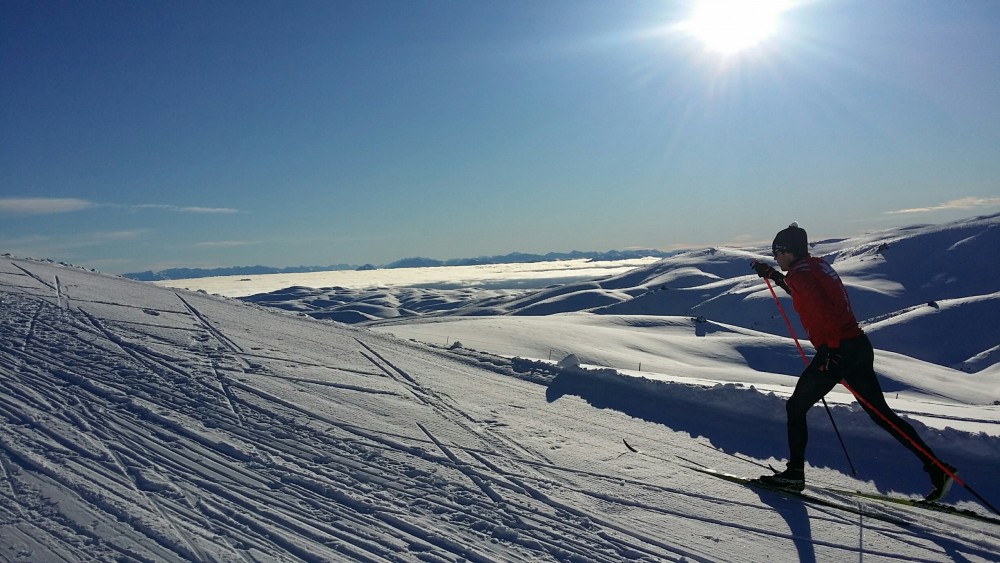
Nathan Smith, of Biathlon Canada, skiing during a national-team training camp this August at the Snow Farm in Wanaka, New Zealand. (Courtesy photo)
Wake up: 7:30 a.m. Coffee: 7:45 a.m. Commute to work: 8:15 a.m.. Punch in at 9. Punch out at 5. While this may describe the daily routine of an average North American’s work week, it’s not the case for Biathlon Canada’s Nathan Smith. And to the 3o-year-old Calgary native, there’s nothing wrong with that.
While he maintains that putting his education on hold has been one of his biggest sacrifices by choosing biathlon as a career, Smith also sees his decision to take a few years and be his own boss as better than a bachelor’s degree — not only to make himself more marketable in the future, but more unique in his life experience.
“I guess my reasoning [for choosing this path] was, I could go to school and get my bachelor’s degree and then go and work,” Smith said recently on the phone. “But that’s kind of like, I guess I’ll put it as, that’s a normal career trajectory. That’s what everyone does.
“When I’m training, I’m like my own boss, kind of an entrepreneur,” added Smith, who has been taking a few college courses (mostly science) on-and-off since he graduated high school in 2004. “And I think it’s probably similar in the States, but unfortunately here in Canada, getting a bachelor’s degree isn’t even all that great. It just makes everyone overqualified.”
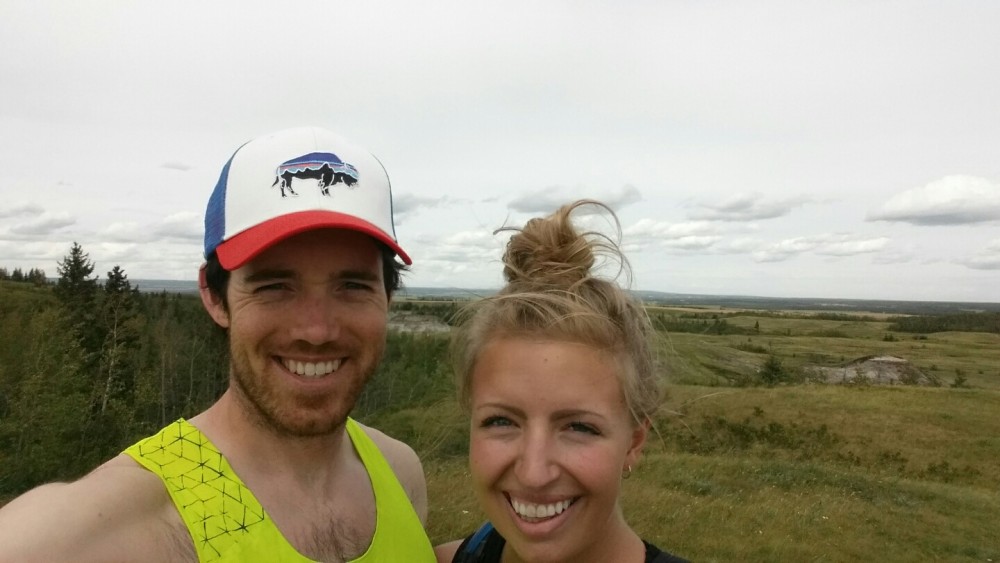
Nathan Smith with his girlfriend, Caroline. (Courtesy photo)
Instead, Smith has spent the past nine years (excluding the 2008/2009 season when he wasn’t named to the national team) sporting the red maple leaf of Canada. He’s also known to cruise the streets of Canmore, Alberta (where Biathlon Canada is based), on his 2007 Kawasaki ZZR 250 (at least when there’s no snow).
However, being a full-time biathlete was not always what Smith planned to do after high school. Before Biathlon Canada, he competed alongside his brother on Calgary’s local club biathlon team. And before that, he belonged to Calgary’s youth cross-country skiing program.
“I didn’t really know anything about the sport until I was doing Racing Rabbits which is [a program] for really young kids who [want to] cross-country ski in Calgary,” he said. “My brother and I were doing that and my mother was like, ‘Well, do you guys want to try biathlon?’ and we were like ‘Well, what’s that?’ and she was like, ‘Well, you shoot guns with skiing.’ I was 1o years old [at the time], so I was pretty excited about that … but I never really saw myself as staying in it past high school until I started to go to World Championships.”
Smith made his debut Junior World Championships appearance his sophomore of high school in 2002, and qualified again the following year, as well as in 2005 and 2006. From then on, he continued to build competition on competition, qualifying for his first World Championships in 2008, the Vancouver Olympics in 2010, five more World Championship events, and the Sochi Olympics in 2014.
During the 2014/2015 season, he had a breakthrough performance when he raced to a first place in the men’s 10-kilometer pursuit in Khanty-Mansiysk, Russia. While he hopes to once again medal this season, he indicated that this year, doing so will take even more accurate shooting on his part, as many athletes continue to improve the speed of the shots they take.
“There’s definitely been some big changes in the way athletes approach the shooting range psychologically,” Smith explained. “It used to be a lot more cautious, [but] because skiing is getting tighter and tighter you really have to set yourself apart by shooting as fast as you can on the range.
“I’ve always been a fairly fast shooter,” he added. “So I’ve been focusing a little bit more on trying to improve accuracy while maintaining the speed I’m at.”
“There’s definitely been some big changes in the way athletes approach the shooting range psychologically. It used to be a lot more cautious … you really have to set yourself apart by shooting as fast as you can on the range.” –Nathan Smith on recent changes in biathlon
With a solid summer of volume training behind him, a fall full of intensity, and a few sessions on snow at the Snow Farm in New Zealand, Smith is excited about the start of a new season, but especially the fact that his job for another year will take place on skis.
“Obviously you go out there sometimes and there’s tough training days or times where you’re super tired or you’re having bad races and you’re like, ugh, why do I do this?” Smith said. “But if you have a normal 9-5 job, you’d have a lot more of those days I think.”
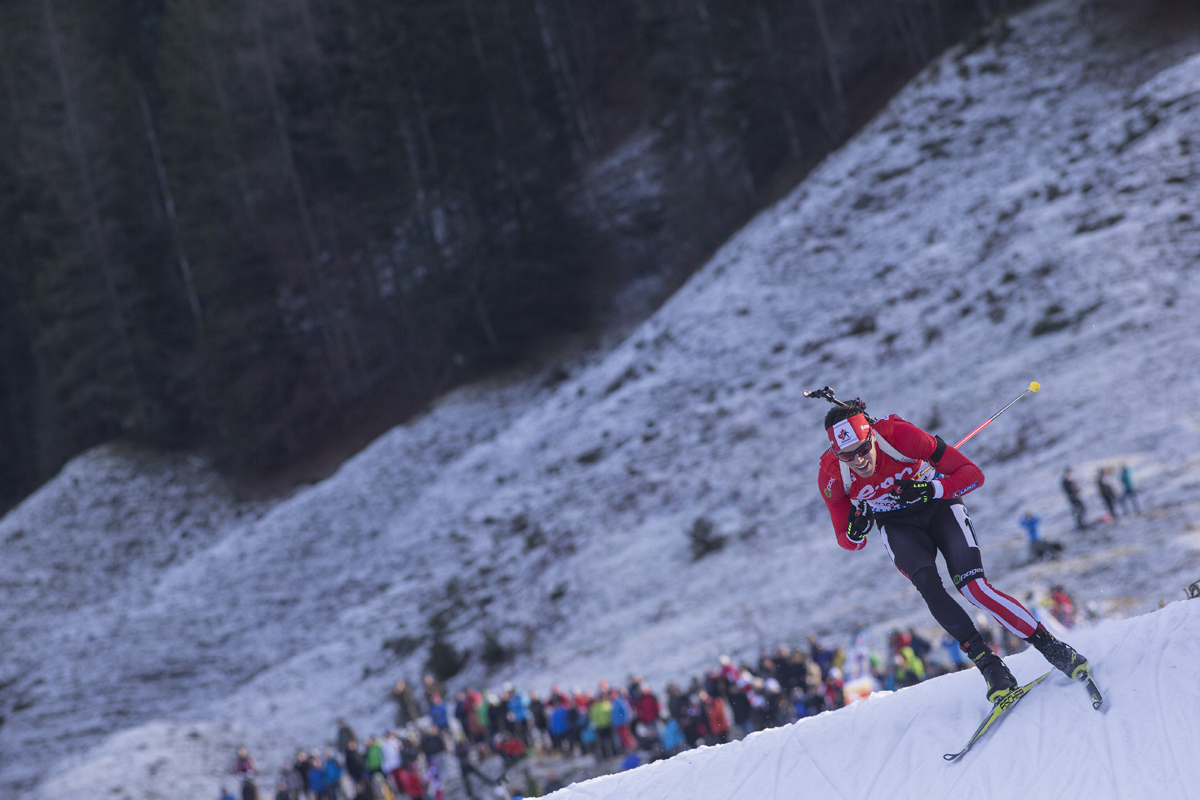
Nathan Smith skating his way to 18th at the 2015 IBU World Cup pursuit in Hochfilzen, Austria, last December. (Photo: Fischer/NordicFocus)
***
We asked Smith to give our ’17 Questions for 2017′ a go. Here are his responses:
1. Biggest change in your life in the last five or so months since the ski season ended?
I’ve been making trips up to Grande Prairie to visit my girlfriend (and her kitten). It’s nice to get away from Canmore on rest weeks, decompress, and experience regular town life sometimes.
2. Biggest change in your training?
I haven’t had too many changes in over all training philosophy. The team was reorganized this spring so Matthias [Ahrens] is now my personal coach instead of Roddy [Ward]. They work closely together though so aside from feedback it hasn’t changed too much in day-to-day training.
3. Major areas of improvement you’ve seen so far?
I’ve made some good gains in lower body strength and double pole work.
4. Whom you’ve been working closest with this offseason (coaches or training partners)?
Aside from Matthias and Roddy, we also have technique coaching at some camps from Mats Larsson. Former athlete Andrew Chrisholm has also been helping out our team on the range so we can get more individualized attention.
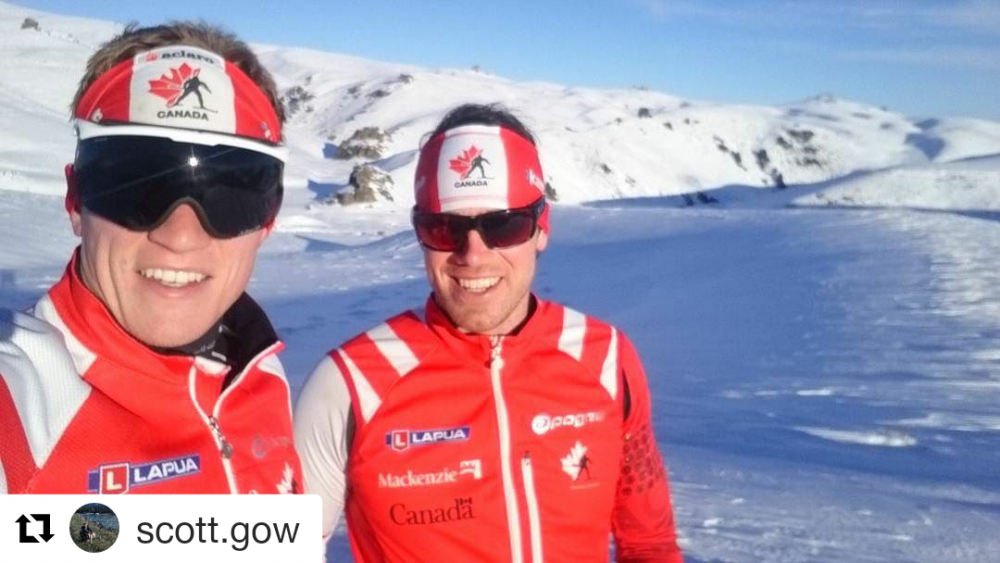
Biathlon Canada’s Nathan Smith (r) and Scott Gow during a ski. (Photo: Nathan Smith)
5. Best trip in the last five months (and why)?
Even though its not far, I always enjoy going to Jasper [Alberta] for “ManCamp”. It’s an amazing roller ski and drive up the Icefields Parkway, and the options for varied training once we get there are awesome. We also get to stay in rustic cabins on the river and practice slammo.
6. Favorite cross-training?
Mountain Biking
7. Favorite non-athletic activity or pastime this summer?
Motorcycling, and trying to fly fish.
8. Song that was your jam this summer?
That would definitely be Justin Bieber – I’ll Show You
9. All time favorite race moment?
Winning the pursuit at the world cup final in Khanty-Mansiysk in 2015
10. First thing you pack in your bag when you leave for Europe?
Armband. Never forget it!
11. Venue/event you’re most excited to visit this season?
Tyumen. I’ve never been there and I’m sure its going to be impressive
12. Who will win the men’s and women’s World Cup titles this year?
Martin Fourcade and Laura Dahlmeier
13. Biggest sacrifice you feel you’ve made choosing this career path?
Putting my education on hold.
14. If you could change one thing about your sport, what would it be?
Can it be -3, hard packed, calm, and sunny every day?
15. What did you have for breakfast this morning?
I desperately needed to go grocery shopping, so 3 bowls of granola with milk and a banana.
Marcus Hellner leading the men's pack, World Championships Oslo 2011
What You May Have Missed Last Season
The Swedes continued to churn out some of the best sprinters on the circuit, headlined by two massive performances at World Championships.
While most of the Swedish sprint buzz usually surrounds Emil Joensson, it was Markus Hellner’s lung-busting, thigh-tearing, man-on-a-mission dethronement of Petter Northug on the Norwegian superstars home turf in Oslo which was unforgettable.
Not to be out-done, Charlotte Kalla laid a beat-down of her own, dominating the final leg of the Team Sprint at World Championships in Oslo. Best known for her outstanding skate abilities, Kalla cranked out some massive double-pole power to leave Finland and Norway eating Swedish dust.
It goes without saying that Emil Joensson is the greatest pure sprinter on the circuit at the moment. His detractors will claim that his lack of Olympic or World Championship titles point to his inability to perform on the big stage, but FasterSkier is willing to cut him a little slack.
Mostly because the Swede has won back-to-back Sprint Cup titles, as well as winning ten World Cups (Stage or otherwise) in that span, some of which in incredibly dramatic (or heart-breaking if you’re Canadian) fashion.
While their sprinters are great, FasterSkier would be remiss if we failed to mention the distance skiing ability the Swedes displayed.
Daniel Rickardsson led the men’s squad, finishing third in the World Cup Overall, skyrocketing up from his previous-best of 17th. The late-blooming Rickardsson (he is 29 years old) is something of a middle-distance classic-skiing specialist, picking up three World Cup medals in either 10 or 15 k classic races.
Meanwhile, Anna Haag continued her quiet ascent of the standings, finishing 11th in the Overall standings in just her fourth season on the circuit.
What You Need To Know for This Season
Emil Joensson, sprint master and one speedy bugger, has suffered a costly thigh injury, taking him out of training for “weeks” – it’s unclear as to how extensively the injury will affect his race season, but the reigning Sprint Cup Champion might start out a tad slower than normal.
Luckily for him, he’s still dating Anna Haag, and the two Swedes hosted Kikkan Randall and Liz Stephen this summer for some top-notch training and fun. And if FIS ever introduces the power-couple Team Sprint, Haag isn’t surewhether she and Joensson could take Canadians Devon Kershaw and Chandra Crawford.
Charlotte Kalla anchoring the Swedish women's relay team at 2011 World Championships.
Jesper Modin went to seven sprint finals this year, but failed to produce a single World Cup medal – instead, he finished last five times. If he can stretch out his endurance to include that final heat, he could become almost as unstoppable as Joensson. He is also the most imposing man on the circuit, standing at 6’7, and just over 200 lbs. He also enjoys racing Volkswagen Beetles – seriously, that’s not a joke.
Sweden also had two notable retirements, as former sprint standout Mats Larsson stepped away, as did Lina Andersson on the women’s side. Both retirements were slightly surprising – Andersson is just 30 years old, and still has an incredible amount of talent, but health problems have limited her success since winning a gold medal at the 2006 Olympics in Torino. Larsson, a 2006 Olympic bronze-medal winner, and 32 years old hasn’t seen a massive drop in his abilities, but just felt it was time to call it a career.
Who You Should Watch
Jennie Oeberg is the next big thing. The 22 year old sprinter saw limited World Cup action last year, and qualified for three sprints, including a top 10 finish in Liberec, Czech Republic. Her focus was on Under-23 World Championships, where she managed to finish third in the sprint, ahead of team mate Hanna Brodin.
Most importantly, Sweden has a track record of producing talented young sprinters (see: both Hanna’s, Falk and Brodin) and Oeberg will be the given the chance to break out in 2011-2012.
The World Cup sprint weekend in Liberec, Czech Republic concluded with a classic team competition.
The Norwegian men’s team of Johan Kjoelstad and Ola Vigen Hattestad were unable to match the margin of victory of their female counterparts, but claimed the top spot nonetheless.
Less than an hour after Marit Bjoergen led the Norwegian women to a crushing 30-second victory, Hattestad used a powerful move on the last climb to pull away from Mats Larsson, the Swedish anchor.
Kjoelstad and Hattestad paired up in this event on the same course two years ago to win World Championship gold.
Kjoelstad has not had much of a presence on the World Cup this season, with only one start prior to this weekend. With the usual highly competitive Norwegian men’s field, Kjoelstad is still looking to punch a ticket to this year’s World Championships.
“Ola did a great job on the last round and took the victory home for us,” Kjoelstad said after the race. “Now I have to be strong next week to qualified for the World Championships in Oslo.”
Hattestad, the former Sprint Cup champion, paired with Anders Gloersen to win the only other World Cup team sprint competition – a skate affair in Dusseldorf, and with a victory in Friday’s skate sprint, he should be in position to defend his double gold from the 2009 World Champs.
The Swedish team of Jesper Modin and Larsson remained in the fight until the last hill, foiling Kjoelstad’s efforts to get away on the second-to-last lap.
Larsson attacked hard on the last leg, and was able to open a gap on the first climb. Few can match Hattestad in the finish stretch of a classic sprint, so Larsson knew he had to get clear early.
“I attacked on the first uphill to get a good gap to the others,” Larsson said. “It worked out but I was very tired on the last uphill and Ola closed the gap.”
Larsson’s attack was pre-meditated. “I had chosen this strategy because I knew that I would not be able to follow Ola on the last uphill,” he explained.
Overall the Swede was pleased with his race, and should have another shot at the Norwegians in Oslo.
Norway had an impressive day as John Kristian Dahl led the second team to a third place finish. Dahl and teammate Eirik Brandsdal bested the French duo of Jean Marc Gaillard and Cyril Miranda.
As is usually the case in men’s team sprint events, the field remained tightly packed for the majority of the race, with skiers merely jockeying to be in position for the final lap. But it was all for naught as Hattestad played his cards perfectly, and would not be beat.
No North American participated in the men’s event. The Americans have all returned to the US, while Len Valjas is currently the only Canadian man in Europe.
The World Cup continues next weekend in Estonia with a 15km classic individual start and a classic sprint.
Valjas is currently schedule to compete for Canada.
Dario Cologna (SUI) celebrating a victory earlier this year
The distance of the first race of the World Cup finals may have been unfamiliar, but the pair of names atop the results sheet on Friday were anything but.
Though rarely raced on the World Cup, the 3.3/2.5k prologue was just right for Poland’s Justyna Kowalczyk and Switzerland’s Dario Cologna, as each skied to a convincing victory in the first of three races held in Falun, Sweden.
Men
Cologna finished five seconds ahead of Mats Larsson (SWE) and Maxim Vylegzhanin (RUS), and the key to his win was the pacing.
The defining feature of the course was its brutal climb, known as the Mordarbacken (which translates to “murder hill”)—some 500 meters long and cresting just after the one kilometer mark.
On it, Cologna said that he stayed in control, saving enough to “push hard on the downhill and the last part of the race.”
“I think that was the key to win today,” he said.
By no means was Cologna dogging it, though: At the checkpoint at the top of the climb, he was sixth, just three seconds out of the lead.
But 3.3 kilometers is a tricky distance, and some skiers held too much back going up the Mordarbacken.
Devon Kershaw (CAN) struggled with pacing today
Canadian Devon Kershaw tweeted after his race that he started “WAY TOO SLOW,” and the splits confirmed that. He was already 17 seconds out at the time check just one kilometer in, which left him 47th in the field of 53. He moved up to 29th by the finish, but clearly wouldn’t have minded if the race had been twice as long.
Petter Northug, who has already wrapped up the World Cup overall, was fourth, ten seconds behind Cologna. He told Norwegian newspapers before the race that he was worried about his arms after double poling all three of his heats in the sprint in Stockholm on Wednesday, but the result from today still leaves Northug in the hunt. After the prologue, he is positioned second in the finals standings, seven seconds behind Larsson.
Andy Newell led the way for the American men in 48th, 45 seconds behind Cologna and just a half second behind the Norwegian sprinter Ola Vigen Hattestad. Alex Harvey (CAN), Ivan Babikov (CAN), and Brian Gregg (USA), the three other North American competitors, were 21st, 46th, and 53rd, respectively.
The top three in Friday’s race were awarded bonus seconds in the overall World Cup finals standings: Cologna got 15, Larsson ten, and Vylegzhanin five.
Tomorrow, racers will start the 20 k pursuit based on those standings, which means that Larsson will go first, seven seconds ahead of Northug. Emil Joensson (SWE) and Cologna follow, 20 and 26 seconds behind, respectively, while all but two skiers in the rest of the field are within two minutes. Harvey is the closest North American in 27th, 1:21 back.
Larsson, a sprinter, will have a hard time to hold off Northug, Cologna, and the rest of the pack. Most likely, it will be Northug stretching things out from the gun, with Cologna and Marcus Hellner (SWE) the only strong distance skiers within striking distance.
With those latter two fighting it out for the third position of the World Cup overall, tomorrow’s race is especially important, and the competition between the two could reduce their incentive to keep Northug under wraps.
Women
The Mordarbacken was all but built to Kowalczyk’s specifications, as her lithe and wiry is suited to steep climbs. Indeed, she said that she had made the prologue her goal for the finals.
Strong in both sprinting and in longer races, Kowalczyk said that 2.5 kilometers is her best distance. On Friday, she showed why, putting on a clinic to win over Marit Bjoergen (NOR) and Charlotte Kalla (SWE).
Bjoergen was the only woman to stay within ten seconds of Kowalczyk, and Olga Savialova (RUS), in fourth, was way back, nearly thirty seconds behind.
Justyna Kowalczyk (POL) racing at the Olympics.
Over eight minutes, that’s a staggering margin. To put it in perspective, if the race had been a 30 k, the proportional gap to fourth place would have been more than five minutes.
With the 15 bonus seconds she earns for the win, Kowalczyk will begin tomorrow’s 10 k pursuit with a 16 second advantage over Bjoergen, and nearly 40 over Sweden’s Anna Olsson.
Bjoergen and Kowalczyk have dominated the distance races over the last month, and the other women in the pursuit will be hard pressed to keep the pair close. Kalla has the best chance of catching the two, but even she starts thirty seconds behind Bjoergen and 47 after Kowalczyk, so it looks to be another Norway-Poland duel for the win.
Kikkan Randall (USA) was the top North American finisher in the women’s race, finishing 36th, 1:08 back, and Canada’s Dasha Gaiazova was 45th. With her 15th place in the sprint in Stockholm, Randall will be starting 30th in the pursuit, just over two minutes behind Kowalczyk.