From the FasterSkier archive — posts syndicated from athletes’ and coaches’ own blogs between 2004 and 2012, kept online as published. Current coverage is at fasterskier.com.

Tag: Matt Gelso

  • From the Archives: Performance, not college, was reason for USST cuts (June 2009)

    From the Archives: Performance, not college, was reason for USST cuts (June 2009)

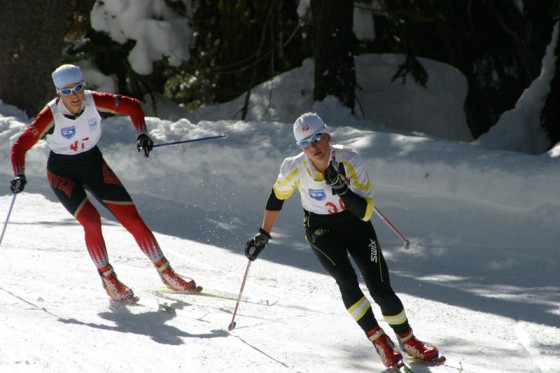
    Alexa Turzian, right, races for the University of Colorado Boulder in a 15km skate RMISA race in 2009. (Photo: Mike Turzian)

    The following article was first published on FasterSkier in June 2009. It is reprinted now in advance of the upcoming announcement of athlete nominations for the 2022/2023 U.S. Ski Team, a subject of perennial interest for American ski fans. Based on the published objective criteria for team naming and athletes’ current world ranking, it appears that multiple athletes who are current or recent NCAA skiers will be named to next year’s national team.

    Like many archival stories shared over the past few months, this article is simultaneously both dated and timeless. On the one hand, it discusses then-current college athletes Matt Gelso and Alexa Turzian, both of whom graduated from college in the early 2010s and have been retired from pro skiing for years; this was a long time ago. On the other hand, the article was written by an obscure FasterSkier reporter named Nat Herz, and the third collegiate athlete it discusses is one Rosie Brennan. Brennan said that she “felt that the USST had not given her enough time to fulfill her potential” as a college athlete, Herz wrote in 2009.

    Well over a decade later, Herz was of course interviewing Brennan in Zhangjiakou at the 2022 Winter Olympics, Brennan’s second Games as an athlete and Herz’s third as a reporter. As famed nordic ski analyst William Faulkner once wrote, “The past is never dead. It’s not even past.”

    At the Beijing Games, Herz wrote an article on Brennan’s career path entitled, “Rosie Brennan won’t take home medals from Beijing. She still helped change U.S. cross-country skiing.”

    As Herz noted in the recent Brennan article, surveying some of this history, “At the start of Brennan’s career, the U.S. Ski Team was pushing athletes, hard, to skip conventional four-year college and commit full-time to skiing for the American program. [Jessie] Diggins, 30, did that. Brennan went to Dartmouth University and raced on the collegiate circuit When she started at school, she was also supported by the U.S. Ski Team. But then, after her sophomore year, she was cut.”

    Contrasting this with the present day, Herz wrote, “the U.S. coaches now concede that the cold shoulder they gave to collegiate athletes was the wrong approach. At the Beijing Games, more than half of the American team finished or is enrolled in a traditional college program.” (This does not include athletes skiing for and taking classes at Alaska Pacific University; APU does not have an NCAA-affiliated ski team.)

    Herz quoted 2022 Matt Whitcomb on these dynamics: “Being social in college, and being a kid a little bit, for a little bit longer, is what we now understand helps us get longer careers. You could almost look at Jessie Diggins as an anomaly.”

    The simple takeaway, after reading these two articles against each other, is roughly, “The U.S. Ski Team opinion has changed; college is now recognized as having an important place in longterm athlete development; NCAA skiing is now a good avenue for many U.S. skiers.”
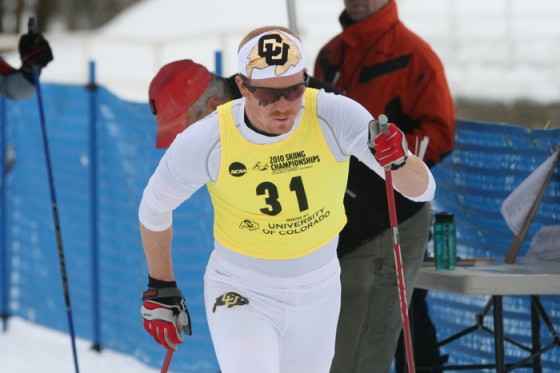
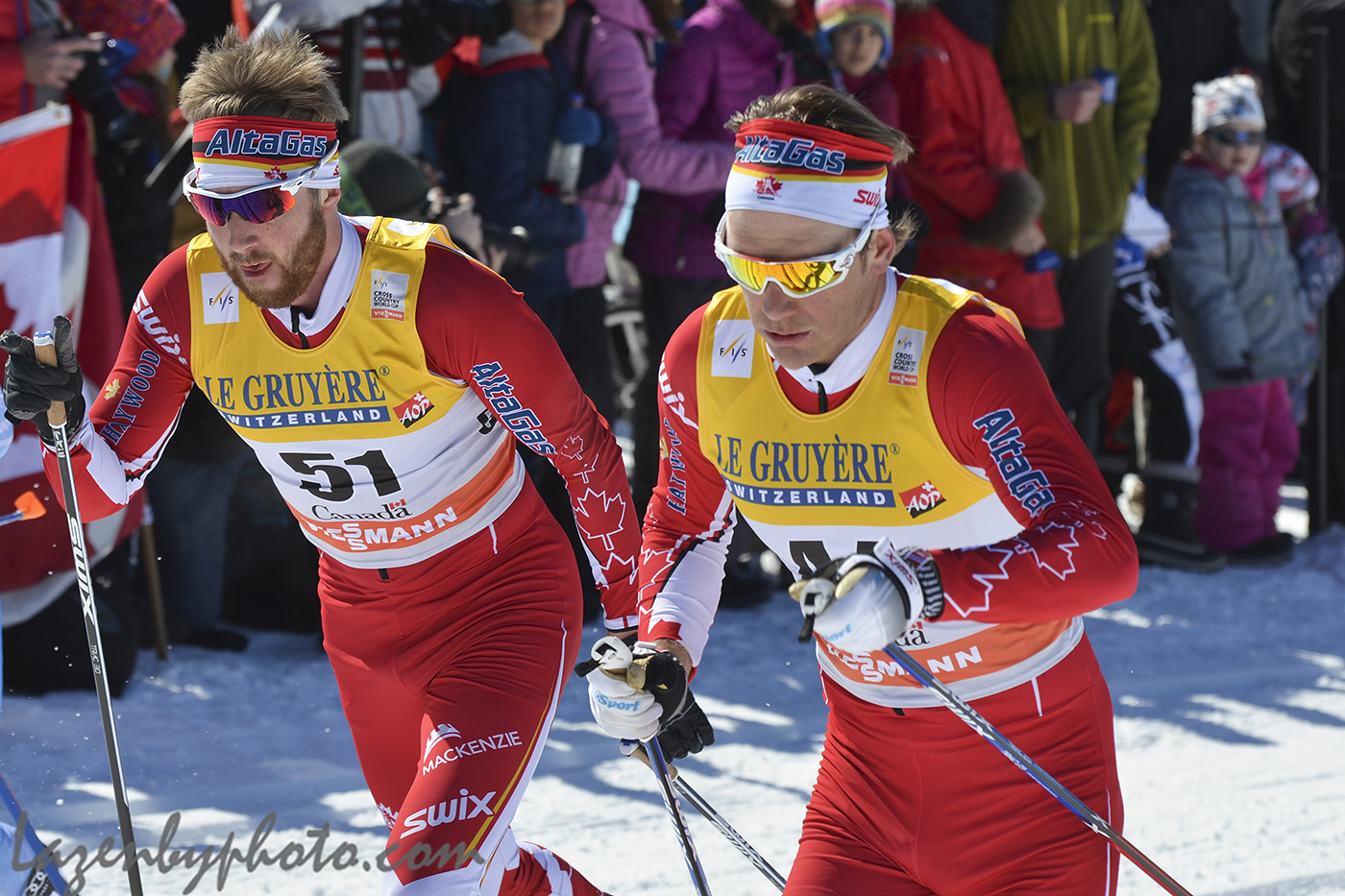
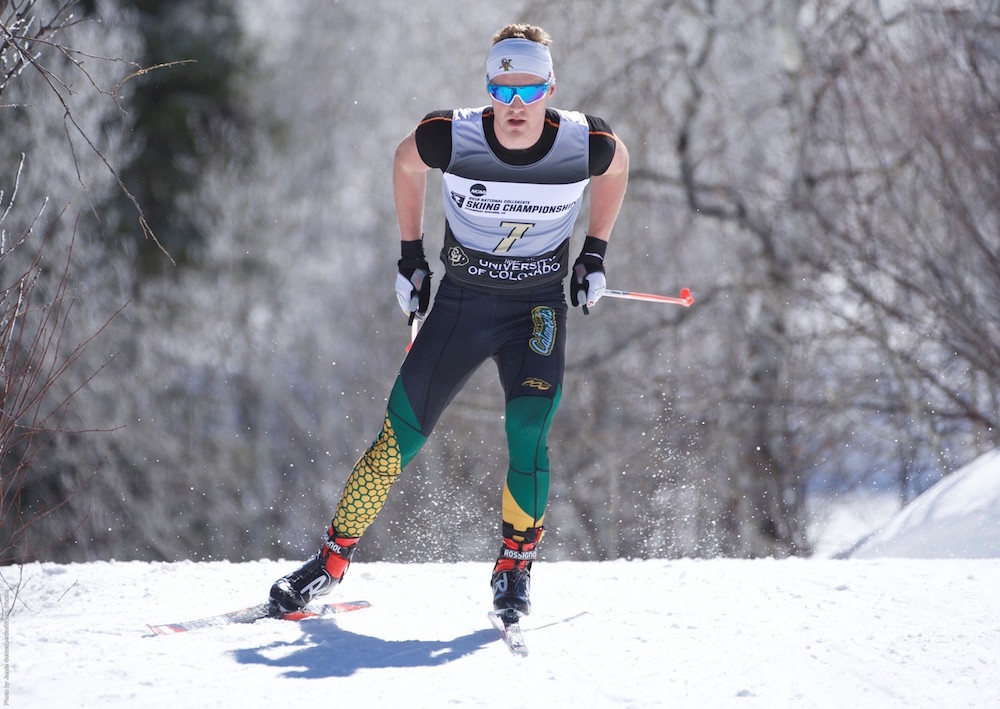
    Colorado's Matt Gelso (photo: Curtis C. Snyder)
    Matt Gelso races to the 2010 NCAA title in the 10 k classic in Steamboat Springs, CO. (photo: Curtis C. Snyder)

    There’s correlation and then there’s causation, and while this article is not making bold claims about either, this newer line of thinking does prompt reflection on the ski-career trajectories of past NCAA champions. Keep in mind, the American development system, the staffing, coach education, and training philosophies of NCAA programs, and the ability of NCAA athletes to race both collegiate and international race circuits, etc., have all evolved over the last decade, along with the thinking of the U.S. Ski Team. There are also a myriad of reasons why an athlete may step away from sport before achieving top results. There’s no control group, and a lot of confounding variables in considering this (very small) data set.

    That said, here’s a quick look back at American athletes who won an individual NCAA championship in the first two decades of this century: Chris Cook, Glenn Randall, Matt Gelso, Sam Tarling, Reid Pletcher, Miles Havlick, Paddy Caldwell, and Ian Torchia, for the men; Lindsey Williams, Lindsey Weier, Amy Glen, Joanne Firesteel Reid, Anika Miller, and Katharine Ogden, for the women.

    To paint in broad strokes, you could reasonably conclude that, historically speaking, winning NCAAs as a young American skier has generally not been associated with longterm World Cup–level success, with Cook, Reid (biathlon), and Katharine Ogden being exceptions that disprove the rule.

    But if you shift your focus from 2000–2019 to 2020–2022 and consider American NCAA champions over just the last three years – Ben Ogden (x3), Sydney Palmer-Leger (x2), Sophia Laukli, and Novie McCabe, all of whom save Palmer-Leger raced in Beijing and already have multiple World Cup top-30s – you may conclude that this is another area that is now changing. NCAA skiing could have a very different status in this country another 13 years from now.
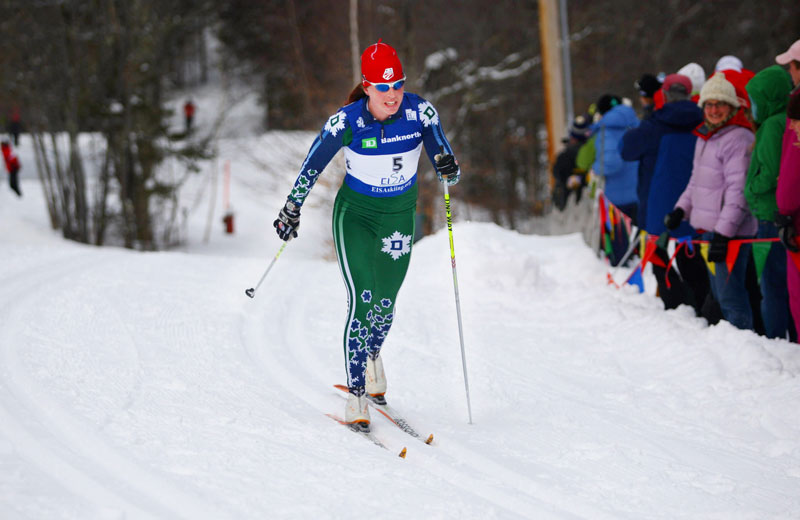
    Rossie Brennan races for Dartmouth on the EISA circuit, Feb. 2009. (Photo: Ruff Patterson)
    Performance, not college, was reason for USST cuts

    Nat Herz, June 24, 2009

    In the middle of May, the U.S. Ski Team (USST) dropped seven of the 18 skiers that were on the team. Three of those seven skiers are currently attending college: Matt Gelso and Alexa Turzian at Colorado University (CU), and Rosie Brennan at Dartmouth.

    Following those skiers’ dismissals, the USST released a new set of recommendations that called for elite high school skiers to take time off to train before starting college. That announcement spawned abundant discussion on this web site and within the cross-country community, centered on the role of college programs in the development of the nation’s best skiers. Over the last few weeks, FasterSkier spoke with the dismissed collegiate skiers, as well as the staff of the USST, about how these decisions were made, and about collegiate skiing in general.

    According to USST staff, these three skiers — and the other four that were dismissed from the team—were not dropped because they were attending college, per se. Instead, they were dropped due to a simple lack of improvement, and a lack of integration into an international-caliber development pipeline.

    According to the athletes, the sacrifices they make to participate in a college skiing program are more than offset by the other benefits that their schools have to offer: financial support, opportunities for intellectual development, and—with a social life—a distraction and respite from the rigors of a full-time program. And, some still argue, it can provide a platform for international success.
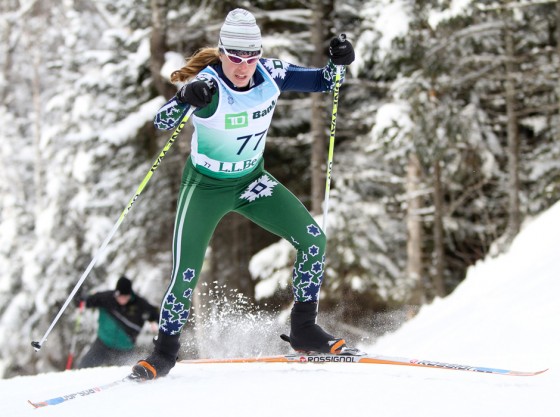
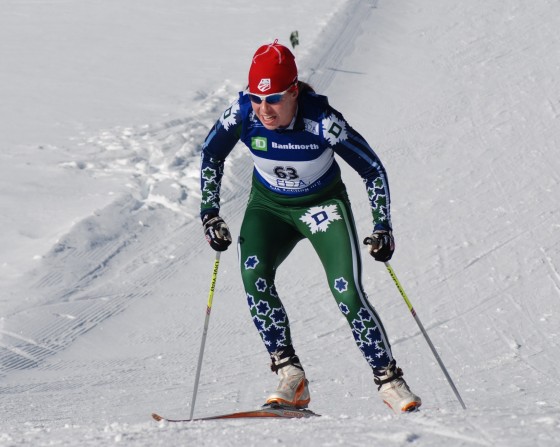
    Rosie Brennan (DAR) races the Lake Placid SuperTour, 2011.

    Toward International Success

    According to USST Head Coach Pete Vordenberg, for the nation’s best high school skiers, the college route just hasn’t worked as it is currently structured.

    In an e-mail to FasterSkier, Vordenberg wrote that most young American skiers start out behind their international counterparts in terms of fitness. In order to catch up, these athletes need the highest possible level of training and racing—at “the closest level to the best that we can design and carry out,” he wrote.

    The closest level to the best, Vordenberg continued, means year-round training on an individually-designed plan; closely monitored and coached training and recovery; and racing as much as possible at the highest level.
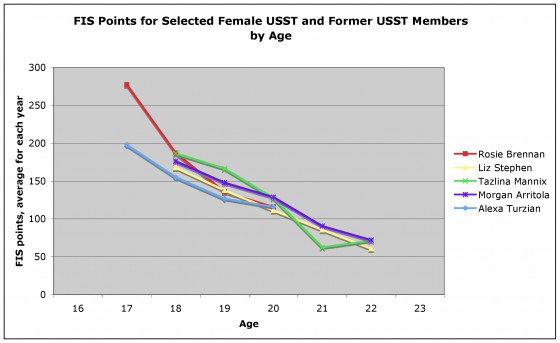
    Turzian and Brennan were dropped from the USST this year, while Stephen, Mannix, and Arritola were retained

    Potentially, Vordenberg wrote, college programs could provide this level of training and development necessary for international success, but that recently, this has not been the case.

    “Can a college program provide [the type of support] described above? I don’t see why not,” he wrote. “Can college programs bring skiers toward international success? Again, why not? Have the skiers we have had on the USST and on NCAA teams progressed at the same rate as our non-college athletes? No. And this is where the discussions started.”

    “We have had college skiers on the USST for many years, and over the past three years there was a concerted effort to build stronger partnerships with college teams by being sure to work with college skiers and post-collegiate skiers who showed promise and commitment,” Vordenberg wrote. However, he continued, “the way this partnership was working has not been good enough for the athletes.”
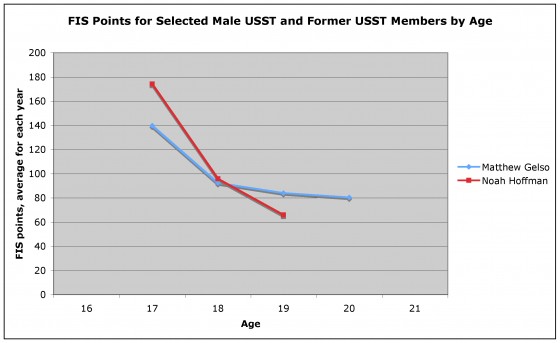
    Gelso was dropped from the USST, while Hoffman was retained

    However, Vordenberg added, the three college skiers were not cut specifically because they were in school.

    “This was not college driven,” he wrote. “This was performance and pathway driven…We cut athletes whose results were not showing that they were on track to international success.”

    College’s Draw

    According to the three collegiate skiers dropped from the USST, there were other considerations in their decisions to attend school aside from support for skiing. First, there’s economics. According to Gelso, CU offers him a scholarship, as well as financial support for training and racing.

    “On top of…paying for all the trips and training, if you’re on a scholarship you have tuition and books, which is huge,” he said. Referring to his decision to attend and remain in college, he said that he thought he was “a little too economic, but I was thinking, ‘this huge package of benefits and funding—I don’t want to let that go.”

    Then, there’s the academic stimulation that academics provide, which Gelso and Turzian said helps them to function better as skiers.

    “I kind of need that second thing—I go crazy with just training and I get overloaded with it,” Turzian said. “I think maybe later in life, right before the [2014] Olympics, definitely I’m going to put my full focus into skiing, but really, [college] keeps a good balance. When I was skiing my best in my senior year of high school, I was still playing soccer and taking AP classes.”
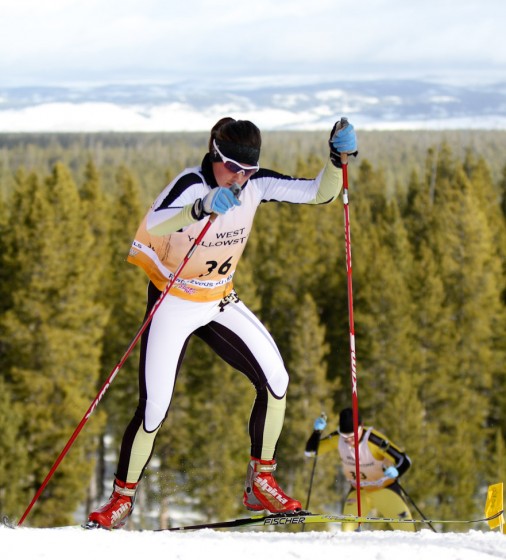
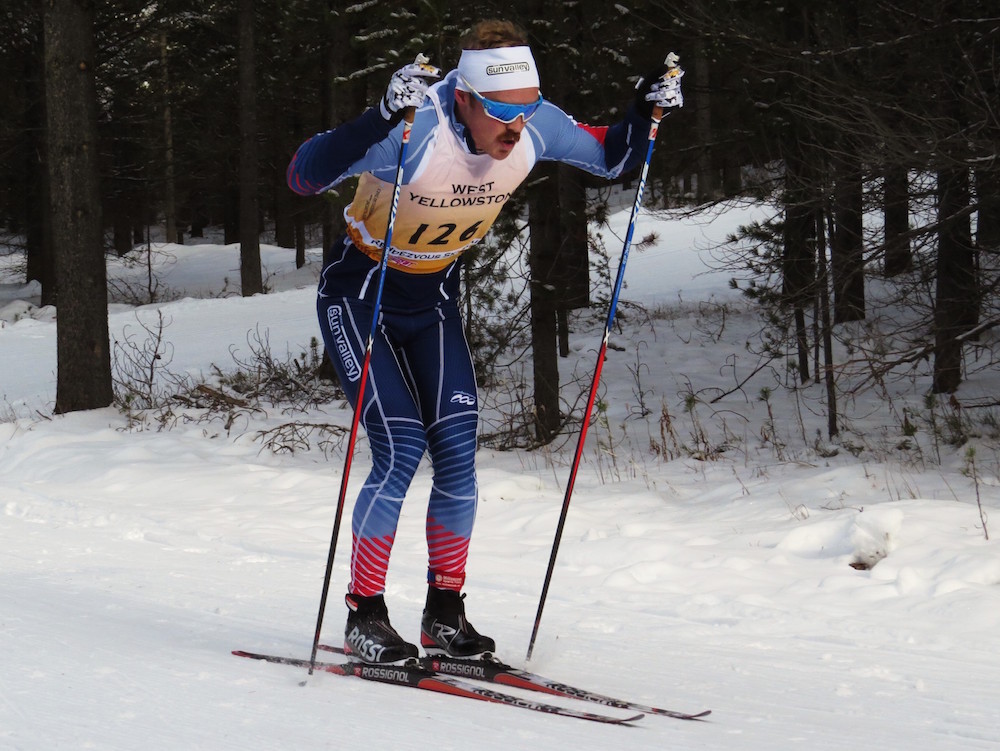
    Alexa Turzian (CU) racing at West Yellowstone, Nov. 2011.

    Finally, Gelso said, college provides a social scene.

    “I know what training camp is like—it’s mind numbing,” he said. “I think time is better spent going training in the morning, going to class, training in the afternoon, hanging out with some friends later—I think school provides a good balance.”

    The collegiate skiers interviewed by FasterSkier acknowledged that attending college resulted in moderate limitations on their training and racing, but they also said that they did not feel they were sacrificing their potential for international success.

    Gelso said that while college skiers can only feasibly train about 600 hours a year, simply opting to attend school did not necessarily limit your potential.

    “I think racing at NCAAs and getting the experience at college—I don’t think that limits your ability to ski fast,” he said. “I think some of the college races have better FIS points than a lot of the SuperTours. They’re competitive races, and they’re every weekend.”

    Brennan said that having experienced college, she would still have made the same decision to go to school rather than ski full-time.

    “The opportunities in terms of training that I have at Dartmouth are much better than I could have gotten anywhere else,” she said. “I have a great coach, and great teammates.”
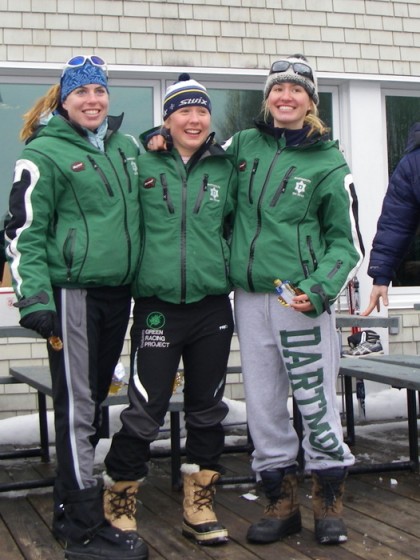
    Brennan with Dartmouth teammates (from left, Rosie Brennan, Ida Sargent, and Sophie Caldwell), March 2010.

    Brennan added that she probably would be able to do more hours if she were training full-time, but that she had still been able to increase her training load every year that she’d been at Dartmouth. She also said that she felt that the USST had not given her enough time to fulfill her potential.

    “It was my understanding…that Alexa [Turzian] and I were guinea pigs at that point, to see if we could make this work,” she said. “To really make that a good test project we would need to complete college, so I felt kind of short-handed in that regard…Freshman year of college is a little iffy; I’m only a sophomore, so I felt like I didn’t have enough time to see if it was going to work.”

    With regard to Brennan and Turzian’s situation, Vordenberg wrote that the USST has a policy to not discuss team issues publicly, but he did write that “the general guideline for being on the team is two years minimum.”

    “We try to look closely at the athletes all the way along the way and make changes and adjustments,” he continued. “But at some point, even with injury, we have to say ‘look, something isn’t working here.’ And if something isn’t working, we have to make a change.”
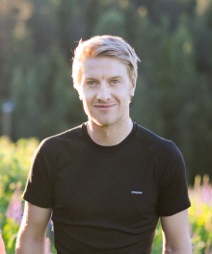
    Kevin Cutts, shown here in a 2014 file photo.

    According to Kevin Cutts, who attends Northern Michigan University, colleges can train skiers at an internationally competitive level—it just depends on the commitment of the coaches and the skiers.

    One of the problems, he said, is that “half the coaches at these programs don’t know what the hell they’re doing.”

    Cutts said that he knew of a number of programs where coaches did little more than drive vans, or import European skiers who already have been training and racing at a high level and require little actual coaching. At NMU, he said, both of his coaches have masters’ degrees in exercise physiology, and their system has produced four skiers in the past few years that have been on the USST.

    “College skiers just need to get more education about training,” he said. “They need to realize how hard they actually have to train, and define for themselves whether they’re going to commit to this.”

    College, Cutts said, is the closest thing the United States will ever have to a club system.

    “Our culture isn’t going to support the actual regional club system like they have in Europe, because our focus is on major, mass media sports like football and basketball,” he said. The problem right now, he said, is “a lack of communication between the college programs and the USST. If they decided they wanted to work together more, you’d see a lot more progress.”

    Other Paths

    One thing that the dropped athletes said they had realized was that the USST was not the only path to international success.

    “My ultimate goal is just to make the Olympics,” Turzian said, “and I now realize that it’s not a part of the USST.”

    Brennan said that while she also thought there were other pathways to success, “sometimes, you’re fighting a political battle as well, if you’re not on the [USST].”

    According to Farra, the Nordic program director for USSA, qualification for the Olympics and World Championships is based on objective criteria, and “anybody can make that.”

    However, for those who are not members of the USST, coming up with the funding to train and race can be difficult.
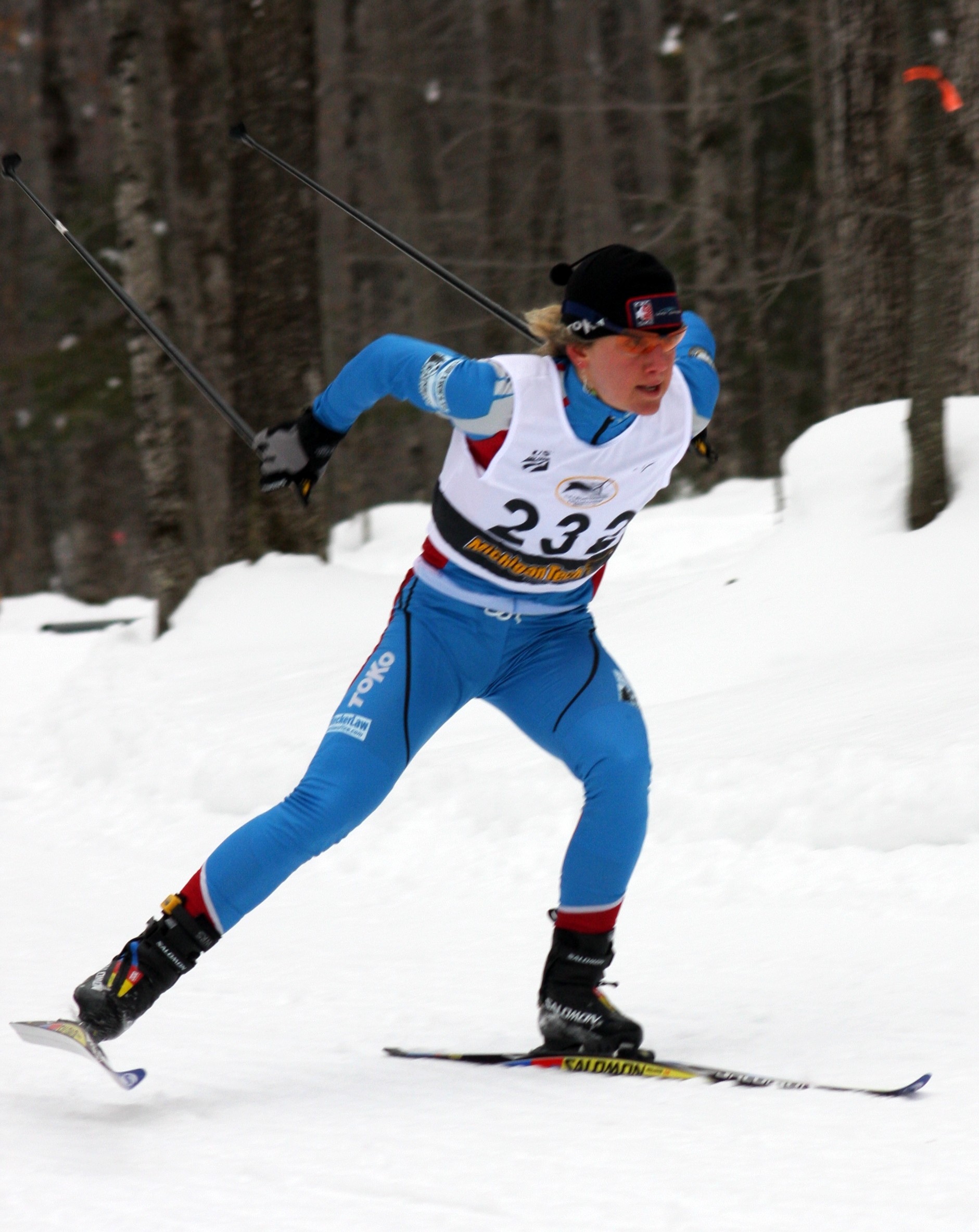
    Catilin Compton sprinting at US Nationals in 2008 in Houghton, Michigan.

    Caitlin Compton, who attended NMU and was passed over by the USST, has managed to ski full-time for the last four years, but said that she sometimes struggles supporting her training and racing.

    “The door is wide open—they say that and they mean that,” she said, referring to qualification for international competition. “The one thing that does become tricky is that without the national team title…you do miss the opportunities sometimes.”

    Compton said that while she was able to attend the recent USST camp in Bend, she had missed out on other training camps, trips to New Zealand, and funding.

    “You get these opportunities, but you only get one shot, or you get a very small window,” she said. “If you want to be on the international circuit on an ongoing basis, you have to nail those big races.”

    Farra said that for the USST and USSA, with their limited resources, “it’s about looking at our imperative: our job is to medal at the Olympics in 2014.”

    “How we’re going to do that with limited money is by investing in people we believe are going to be the ones that are going to get it done with us,” he said. “If we had more money, we’d widen the scope.”

    Related reading & listening:

    Rosie Brennan won’t take home medals from Beijing. She still helped change U.S. cross-country skiing. (Fasterskier, February 2022)

    Ben Ogden: Balancing Olympic and NCAA Skiing Ambitions Alongside a New Wave of Top US Skiers (Fasterskier, April 2022)

    Nordic Nation: Transitioning to the World Cup with Ben Ogden, JC Schoonmaker, and Gus Schumacher

    Nordic Nation: Getting to Know the Future of the U.S. Ski Team — A Conversation with Sophia Laukli, Novie McCabe, and Sydney Palmer-Leger

    The comments on the original version of this article (June 2009): scroll to the bottom, click on the WordPress icon () to load the comments, and read down. Featuring thoughtful perspectives from Marty Hall, Chad Salmela, Ben Husaby, Morgan Arritola, Eric Strabel, Adam St. Pierre, and several other recognizable names in American skiing.

    USST Nominates 11 for 2010 Season, Focus is on International Success (FasterSkier, May 2009)

    Team Nominations 2010, Controversial Topic (statement by Pete Vordenberg, May 2009)
  • The mountainFLOW Eco Wax team takes on the Birkie: Part 2

    The mountainFLOW Eco Wax team takes on the Birkie: Part 2

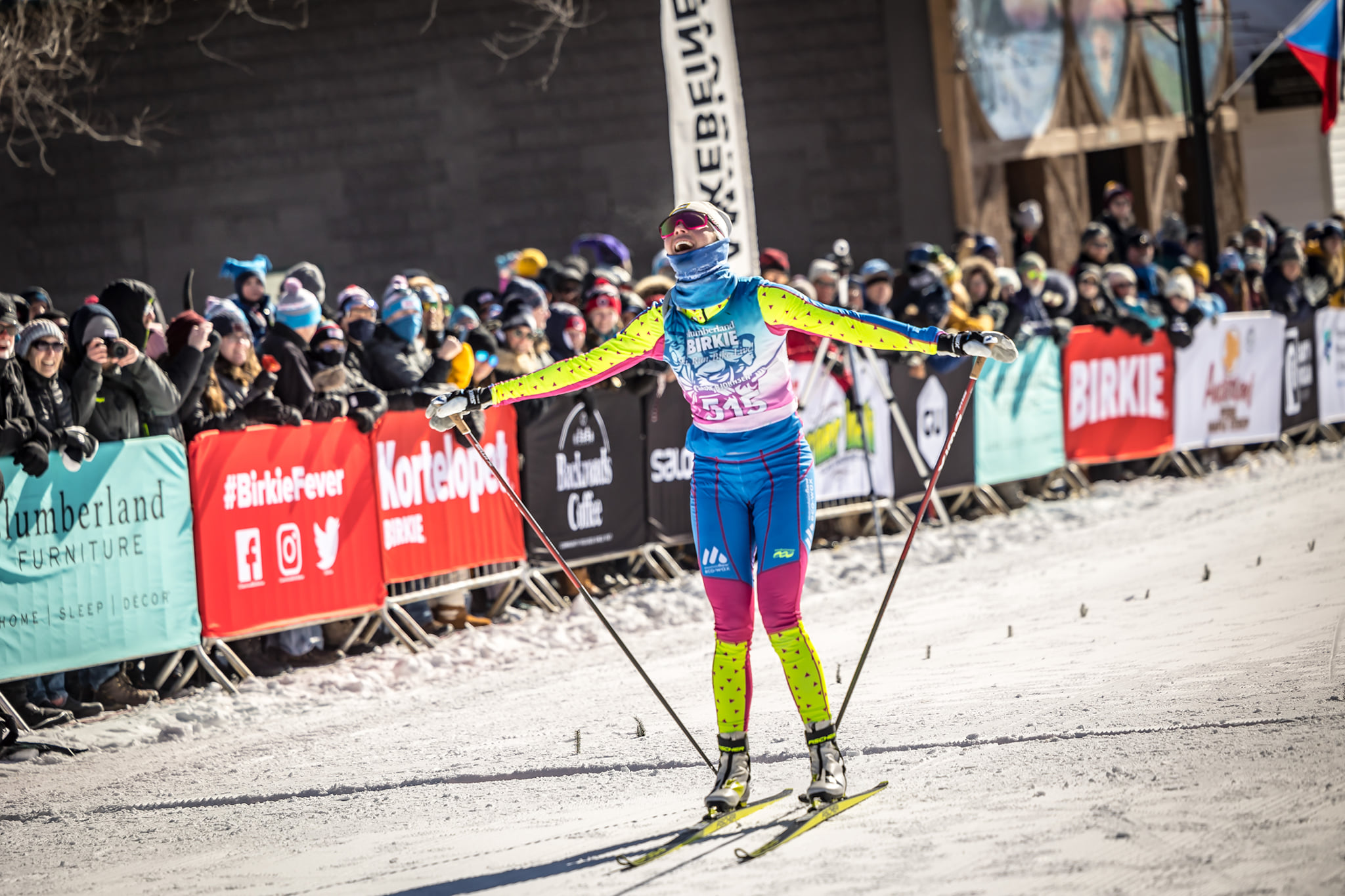
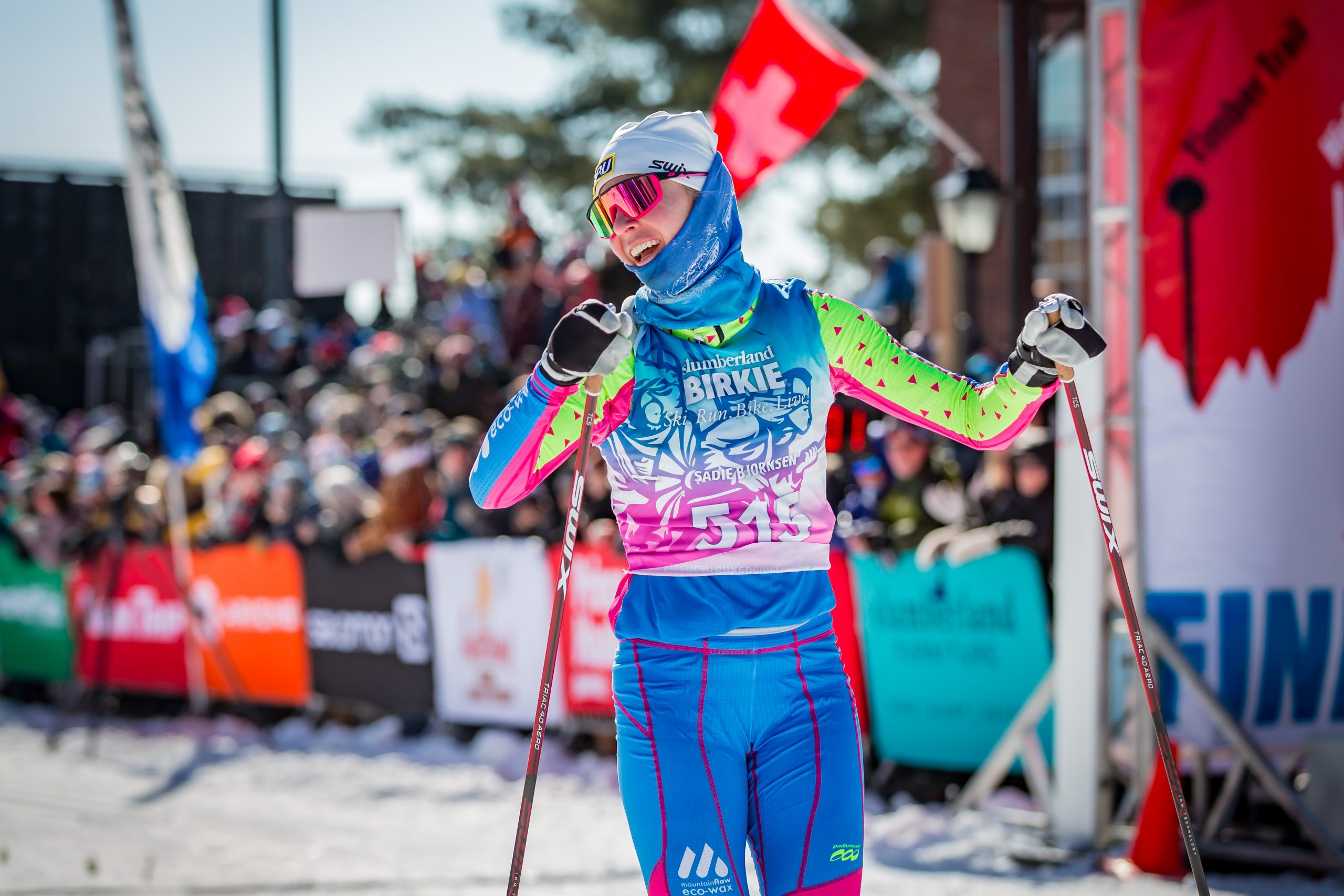
    Sadie Maubet Bjornsen takes fifth at the 2022 American Birkie. (Photo: ©2022 American Birkebeiner Ski Foundation)

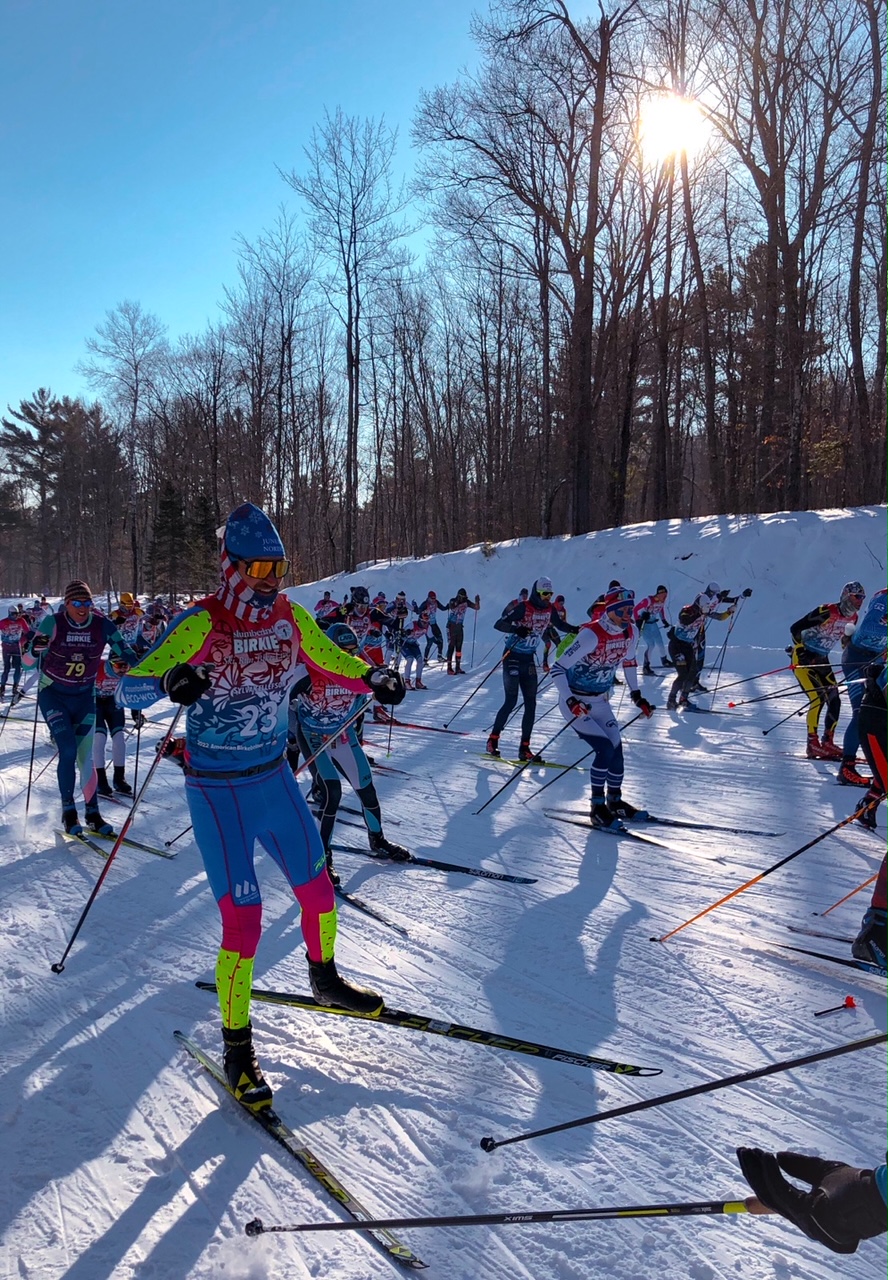
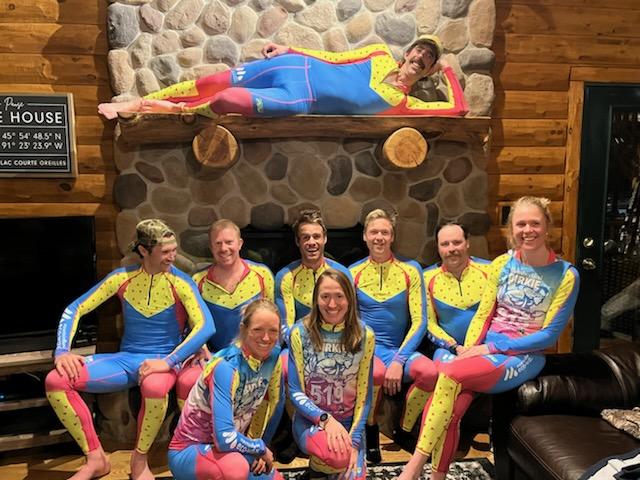
    Just over a month ago, the American cross country ski community descended upon the small town of Hayward, Wisconsin. Skies were clear, the snow was cold and firm, and lycra was everywhere. But one set of race suits stood out, both because of the noteworthy athletes wearing them and for their bold neon colors. It was the MountainFLOW Eco Wax race team of Simi and Sophie Hamilton, Sylvan Ellefson, Sadie Maubet Bjornsen, Erik Bjornsen, Matt Gelso, and Liz Stephen. 

    While most reading FasterSkier will recognize these names without introduction, this is a “band” of retirees who have each, at minimum, raced on the World Cup. Five are Olympians, and one has a collection of top-10 results in World Championship and Olympic sprint results. In short, they’re good skiers who also happen to be good friends. 

    Racing the Birkie wasn’t about stacking a fast team; leading into the event, mountainFLOW founder Peter Arlein said it would be “super fun, and maybe not super serious.” As the photos suggest, a lot of fun was had, but some fast racing – on skis waxed with mountainFLOW products – happened too.

    The mountainFLOW eco wax team was “all business” at the Birkie. (Courtesy photo)

    “A trip down memory lane,” wrote Erik Bjornsen after the race. “Super fun to get a crew together and pretend to be athletes again. We are all at different fitness levels, one thing in common though: far from our best. It was fun to try and forget that for a weekend, and go live the athlete lifestyle. It’s been a busy winter in the retail industry, so it was nice to have a little break from work and hang out with friends. No beers were consumed… nothing but business at the mountainFlow house.”

    (Side note: they may have been spotted at the Moccasin Bar post race.)

    Erik Bjornsen crosses the line in 9th at the 2022 American Birkie. (Photo: ©2022 American Birkebeiner Ski Foundation)

    As he alluded, there was a range of fitness levels and race objectives, but the prominent theme seemed to be that becoming some of the best American cross country skiers of their generation correlates strongly with good technique and a high level of residual fitness.

    Taking the top result was Sadie Maubet-Bjornsen, who finished fifth in the women’s race, just over two minutes behind winner Alayna Sonnesyn. Erik Bjornsen was the top male racer in 9th (+2:59.05), with Simi Hamilton finishing roughly four minutes behind in 16th. The remaining skiers finished in pairs, with Sylvan Ellefson crossing with Matt Gelso in 121st in the men’s division, and Sophie Hamilton finishing alongside Liz Stephen in 123rd and 124th.

    “It was amazing to get the band back together!” wrote Maubet-Bjornsen. “My husband’s family is from Hayward, so after visiting them this summer, we were already committed to doing the Birkie simply to be considered valid members of the Berrard family. When Simi mentioned he was forming a fun team with some of my favorite previous teammates, I was all in. Having jumped full force into this new life, preparing for a 50k couldn’t have been more different than it would have looked in the past. My new way of exercising is waking up at 5:30AM, and hitting the ski trails from my doorstep from 6-7AM. 

    Sadie Maubet Bjornsen takes fifth at the 2022 American Birkie. (Photo: ©2022 American Birkebeiner Ski Foundation)

    “Two weeks [before the race], I called in Rosie Brennan to give me some last minute interval workouts to train my brain to accept physical pain again. Four interval sessions later, I showed up and joined the dance. It was pretty fun to ski with the girls, and just witness the gift of fitness that comes out of all those years of hard work. As the top ladies skied away about 35 k in, I no longer could fake the fitness anymore, but still enjoyed every second of skiing it home.”

    Adding to the message that more so than lingering fitness, these athletes have maintained a love of the sport and the friendships made through their time immersed in it, Maubet-Bjornsen continued, “I look forward to many more years ahead of joining various classic American races throughout the country that I never had the chance to participate in [while racing on the World Cup]. I feel lucky that my ‘band’ and family that I created in the past ten years is just as excited to jump into a 50 k race, despite the fact we are no longer the pro athletes we were before.” 

    Sylvan Ellefson in the wild, wearing his neon mountainFLOW race suit. (Courtesy photo)

    “For me, cross country ski racing transcends so much more than competition,” wrote Ellefson post-race. “I’ve formed my family and life around the experiences I’ve had and the friends I’ve made along the way. To me the Birkebeiner is an event that encapsulates this cross country ski culture in the US. The people racing at the Birkebeiner are truly the backbone of the ski community and I think for them to see former World Cup and Olympic level skiers helps affirm that in the US, this sport is one giant family.” 

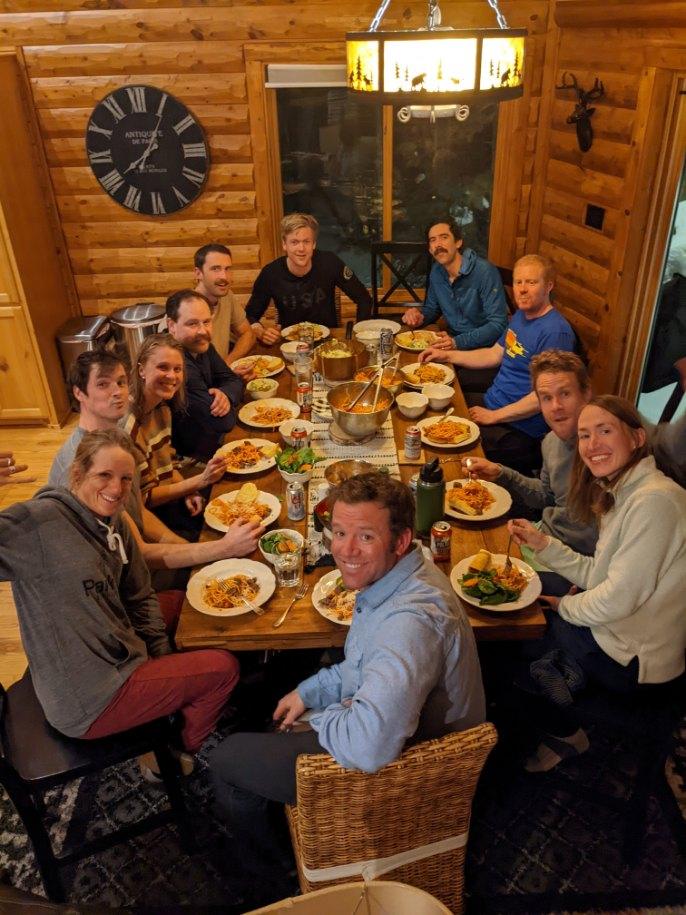
    The mountainFLOW Eco Wax team carboloads for the Birkie. (Courtesy photo)

    Commenting on the mountainFLOW products and ethos, Ellefson added, “Our waxes were fantastic and I’ve loved using something other than what we’ve been accustomed to using for so long. I’ve tested a couple out now and they truly are not just a great wax, but also a great brand. Getting to spend time with Peter and Brian showed me the culture mountainFlow is trying to create in a space in the industry that is much needed.” 

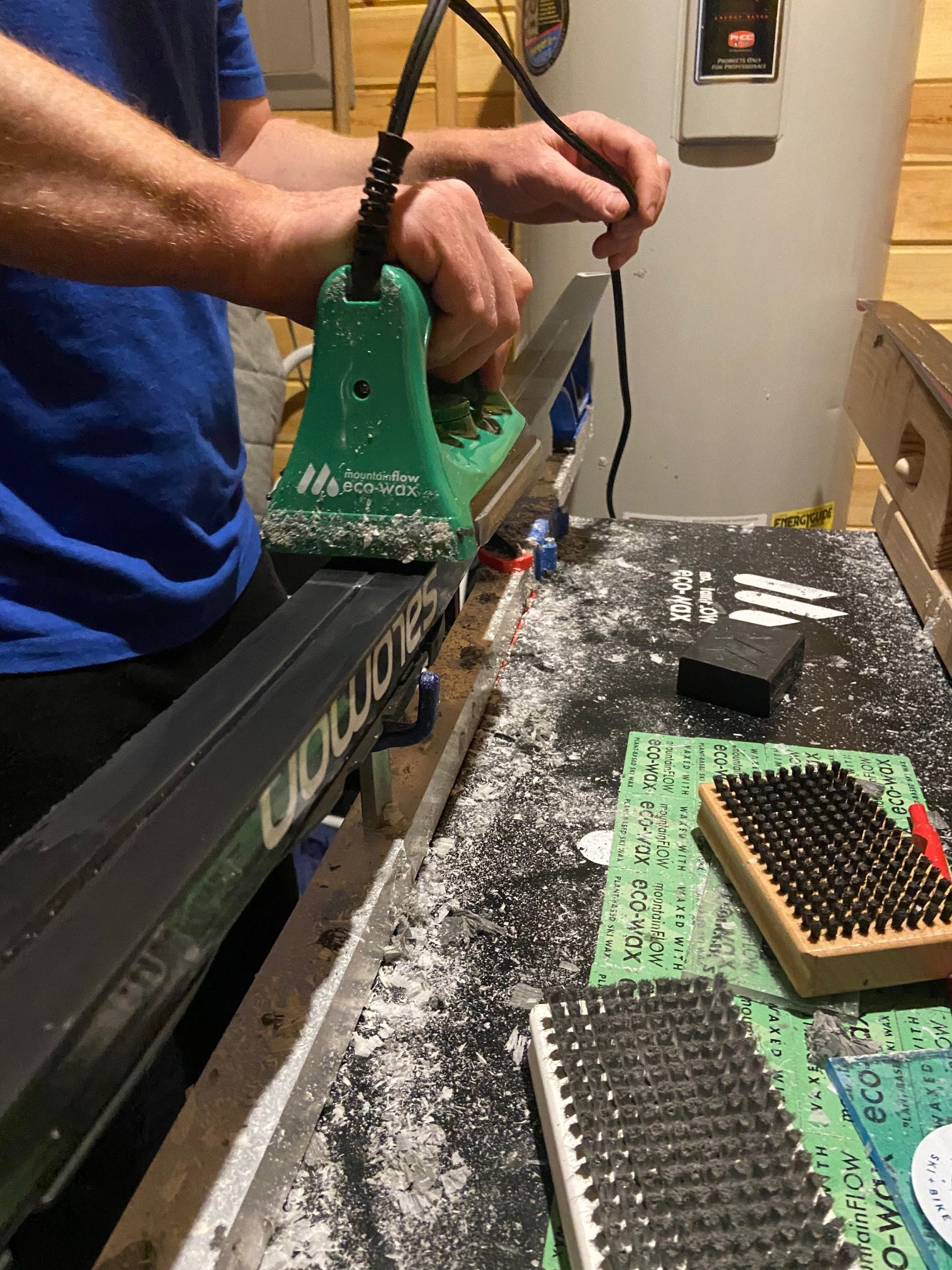
    Matt Gelso prepares his skis with mountainFLOW cold wax at the 2022 American Birkie. (Courtesy photo)

    More to come, as the coach of non-affiliated French athlete Celine Chopard-Lallier, who took sixth in the women’s race, shares his review of mountainFLOW products, on which Chopard-Lallier also raced at the Birkie. Note that this content is not sponsored by mountainFLOW. 

  • Lustgarten, Diggins Double Up on Wins at Winter Games NZ

    Lustgarten, Diggins Double Up on Wins at Winter Games NZ

    Jessie Diggins of U.S. Ski Team and Stratton Mountain School Elite Team on her way to win the women’s 5-kilometer freestyle at the 2017 Winter Games NZ hosted by the Snow Farm in Wananka, New Zealand. (Photo: Winter Games NZ Facebook/Neil Kerr)

    What if getting to snow-covered groomed trails came in three steps — those literally being from the front door to the trailhead. While recent winters may make this seem like a melting dream for many, a number of Americans made it their reality these past two weeks while staying at the Snow Farm in Wanaka, New Zealand.

    U.S. Ski Team (USST) members, as well as American skiers representing the Craftsbury Green Racing Project (CGRP), Sun Valley Ski Education Foundation (SVSEF), Stratton Mountain School (SMS), and Team Gregg, flew more than 24 hours to take full advantage of the Snow Farm’s accommodations and 55 kilometers of groomed track for several weeks in late August/early September. While each program held its own respective training camp, the coinciding times made for an American medley of skiers on the farm. Jessie Diggins, Sophie Caldwell, Ida Sargent, Simi Hamilton, and development-team member Julia Kern all made the trip for the USST’s camp, which ran from Aug. 22 to Sept. 11. 

    According to USST Women’s Coach Matt Whitcomb, the New Zealand camp is not mandatory for all team members.

    “Being an Olympic year we want to individually tailor each plan [for each athlete],” he explained in an email.

    Liz Stephen and Kikkan Randall opted to train in Sweden with the Swedish national team earlier this summer, and Andy Newell prioritized summer rollerski racing in Norway.

    “The travel didn’t make sense to do both,” Whitcomb continued. “For snow, Kikkan has glacier time in Alaska and Liz will do Foret Montmorency in early November. The same was true for Andy … [who] wanted to try Norway instead of New Zealand. While Kikkan has come down to the Southern Hemisphere with us, it makes sense for the Alaskans [including Sadie Bjornsen, Erik Bjornsen, Scott Patterson, Rosie Brennan, and Hannah Halvorsen, who train with Randall with Alaska Pacific University] to use the excellent facility on Eagle Glacier.”

    For those that made this year’s New Zealand trip, he said it’s certainly worth it.

    “While the trip to New Zealand means airfare that can cost around $1200-1300, the Snow Farm cooks exceptional food, grooms around 30k daily, and provides cozy lodging,” Whitcomb wrote.

    “We had a strong group of Americans at the Snow Farm this year, which made for entertaining dinners and competitive ping pong matches,” he continued. “[SVSEF head coach] Chris Mallory is very good.  We partnered up with Craftsbury Green Racing Project, SMS Elite Team, and Team Gregg for a bunch of sessions, and that made for some really effective days.”

    Whitcomb further explained that for those USST athletes returning to the New Zealand training camp, a few things were done differently in terms of lodging.

    “We tried something new this year,” Whitcomb wrote. “We live and train at the Snow Farm, which is situated at 5,000 [feet].  This year we trained for 7 days, and then rented a house in a hip little town called Wanaka where we recovered near sea-level for two nights, and cooked our own food.  I think this played an important role in most athletes having strong second and third weeks up on the rock. If week three is too much of a struggle, the training doesn’t get absorbed effectively, and it dampens the benefits of the camp.”

    The opportunity to get on snow, as well as the convenience of its location with regards to lodging, were reasons enough for many non-USST members to also travel to the Southern Hemisphere.

    “Not having to commute to skiing saves a lot of time and energy that we can put into training and effective recovery,” Ben Lustgarten of the CGRP wrote in an email to FasterSkier. “It is also really nice being at 5000 feet instead of 9500 feet like it would be on a glacier in Europe, and the skiing terrain here is much more conducive to a variety of workouts: intervals, specific technique work, races, easy distance, flats, hills, etc. I loved our training camp last year on the Dachstein glacier, but a 3km loop at 9000ft that takes 45 minutes to get to is really hard and doesn’t offer the variety of training that we can do here.”

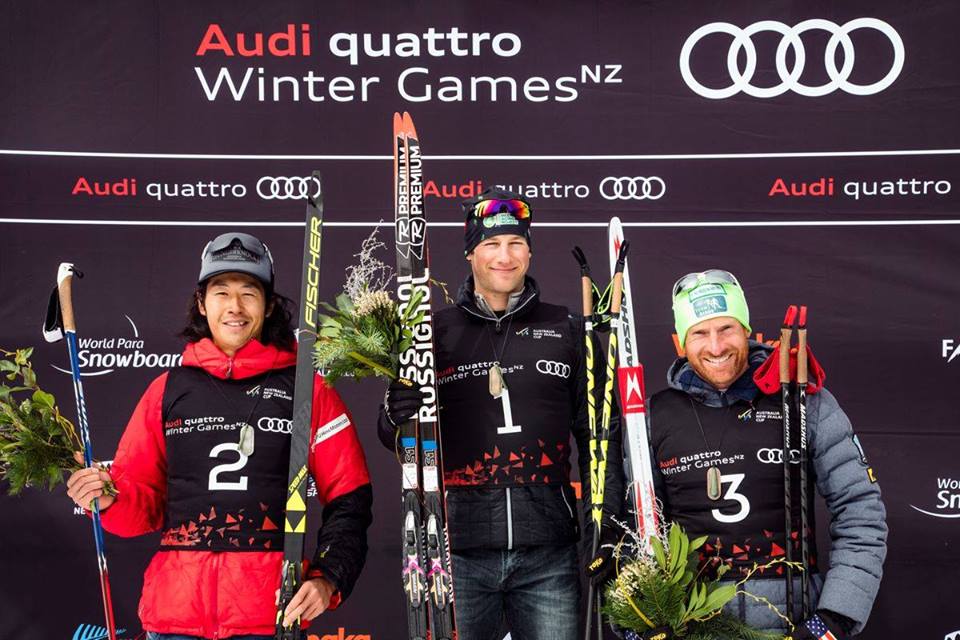
    (Left to right) Japan’s Kaichi Naruse in second place, American Ben Lustgarten (Craftsbury Green Racing Project) in first and American Brian Gregg (Team Gregg) in third after the men’s 10 k freestyle, part of the Australia/New Zealand Cup, at the 2017 Winter Games NZ at the Snow Farm in Wananka, New Zealand. (Photo: Winter Games NZ Facebook/Neil Kerr)

    Several Americans also competed in the Snow Farm’s Winter Games NZ races, which featured a men’s and women’s 1.6 k classic sprint, 5/10 k freestyle races and a 10/15 k classic mass starts, all part of the Australia/New Zealand Cup.

    Some of them had already raced a Worldloppet marathon earlier in their stay, and Whitcomb explained each athlete’s race schedule in New Zealand varied depending on how they absorbed the training load. USST athletes were encouraged to do two to four races, choosing between the 42 k or 21 k Merino Muster Worldloppet and three Winter Games NZ races.

    “When it goes well, we stack it high,” he wrote.

    Racing kicked off on Thursday, Sept. 6, with the men’s 10 k and women’s 5 k individual starts. A light dusting of fresh snow covered the 2.5 k race loop, which challenged racers to a series of short steep uphills and two twisty downhills.

    That didn’t slow Lustgarten, who won the men’s 10 k in 27 minutes, 35.5 seconds. After pacing his first two laps and slowing a bit in his third, the 25-year-old Burlington, Vt., native heard his time was not too far from the win and went for it.

    “I got a split that I was 2 seconds from the lead with a lap to go, which made the last few minutes really painful, but I managed to get the win which was really exciting!” Lustgarten wrote. “I haven’t won a skate race in a really long time, so I was happy about that.”

    Finishing 8.9 seconds back from Lustgarten’s time was Japan’s Kaichi Naruse in second. American Brian Gregg of Team Gregg/Loppet Nordic Racing rounded out the podium in third (+49.7). Also making the top five were Americans Adam Martin (CGRP) in fourth (+51.9) and Matt Gelso (SVSEF) in fifth (+2:02).
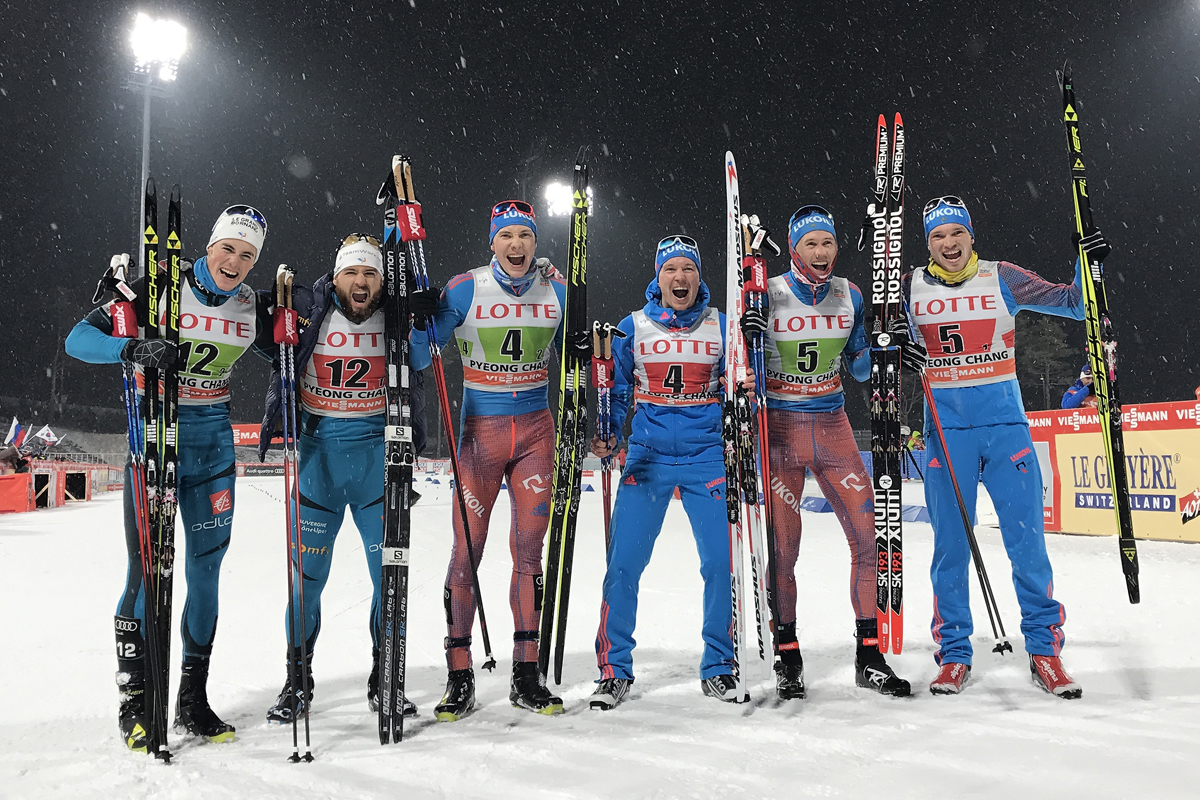
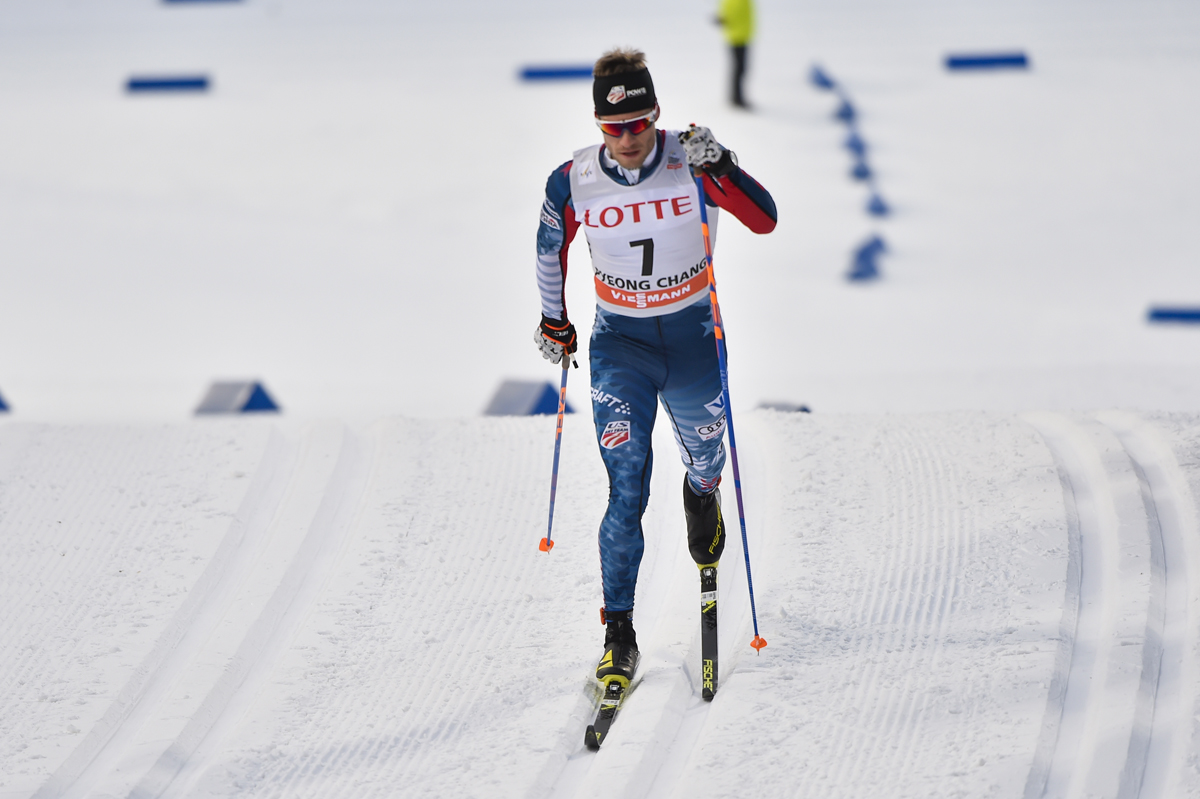
    In the women’s 5 k, Diggins (USST/SMS Elite Team) came away with the win, covering the course in 14:53.8. Australian Barbara Jezersek followed 9.9 seconds back in second place, and Caldwell (USST/SMS Elite Team) reached the podium in third (+10.5). Rounding out the women’s top five were Caitlin Patterson (CGRP) in fourth (+34.7) and Caitlin Gregg (Team Gregg/Loppet Nordic Racing) in fifth (+42.8).

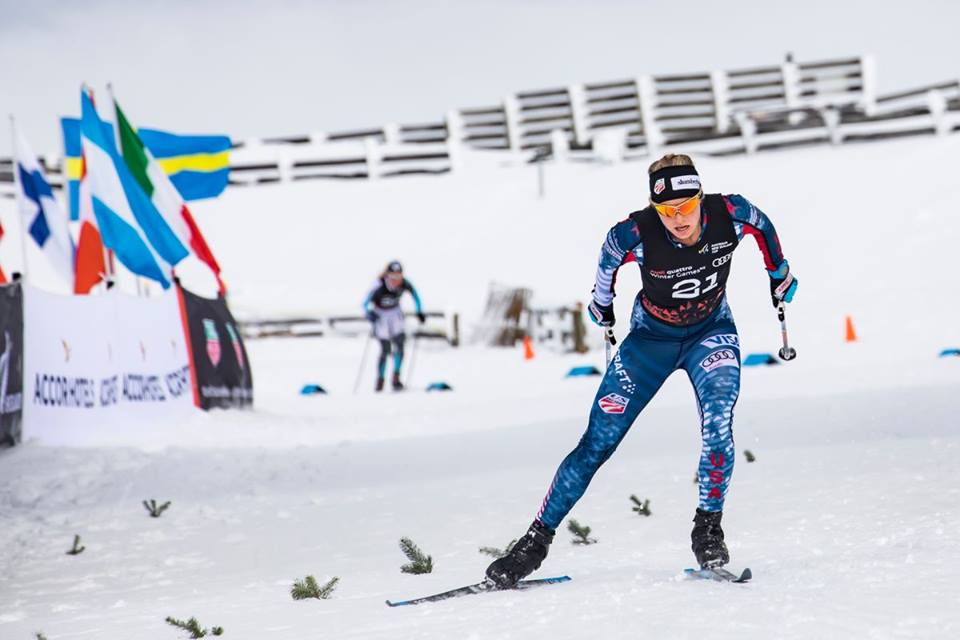
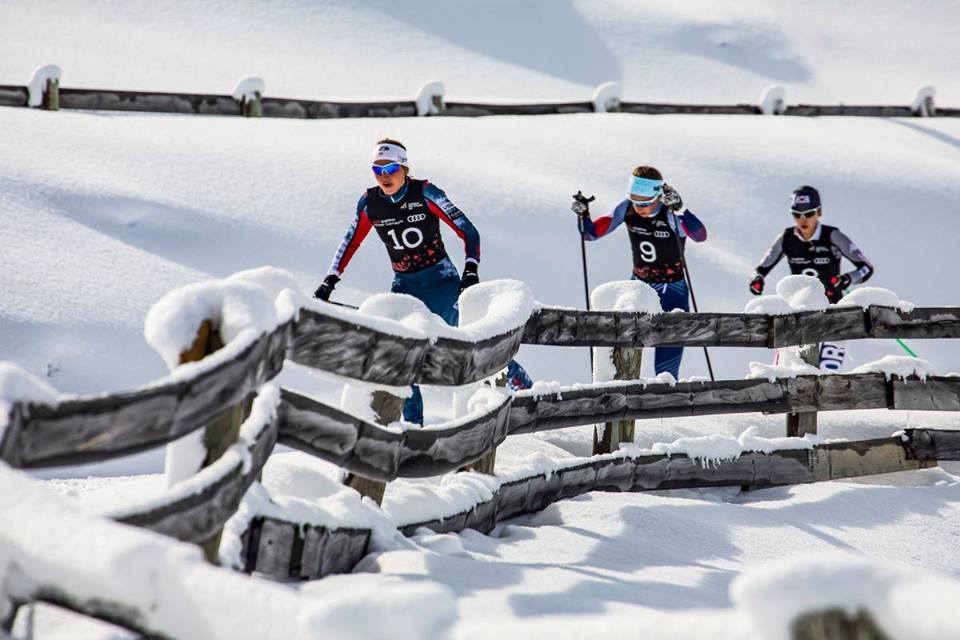
    Sophie Caldwell (10) of U.S. Ski Team and SMS Elite Team racing to third in the women’s 5 k freestyle at the 2017 Winter Games NZ at the Snow Farm in Wananka, New Zealand. (Photo: Winter Games NZ Facebook/Neil Kerr)

    “It was phenomenal!” Diggins said, according to a U.S. Ski & Snowboard press release. “They did so well to find all those hills—I like hills—and it was impressively hard.”

    Skiers returned Friday for the men’s and women’s 1.6 k classic sprints. Caldwell returned to the podium, this time in first, besting her USST teammate, Ida Sargent (USST/CGRP) in second and Patterson in third.

    “It’s only September and we still have two months before we head to Europe, but it’s always nice to have some encouraging races that confirm the training is paying off,” Caldwell told U.S. Ski & Snowboard. “I’ve had a really productive camp and was happy to end it with a win in the sprint and a third in the 5k, which was probably one of my best-ever distance skate results!”

    In the men’s sprint, Ben Saxton of the SMS Elite Team took the win, ahead of Lustgarten in second and Naruse in third. Saxton chose to double pole through the rounds, which were run in four heats of four, seeing the race as an opportunity to try different race tactics. 

    “I just love double poling, and getting a chance to stress and test that technique in a racing situation is always a valuable learning experience,” Saxton wrote in an email to FasterSkier.

    “I thought the trip was a really special opportunity to work on some technical aspects of skiing that don’t totally translate from snow to asphalt,” he continued. “Additionally, the diverse crowd of skiers at the Snow Farm ensured that the quality of training stayed high for all 3 weeks which always leads to big gains.”

    After using classic skis in the qualifier, Lustgarten also opted to double pole the heats, due to what he described as “slick” conditions.

    “Double poling the heats was a good idea with the downhill finish, but I felt incredibly awkward on the herring bone because I was so scared I would accidentally glide using my skate boots and skate skis, so I lost a few seconds on the climb but kept within the rules,” Lustgarten wrote. “Races this early in the season are good to point out what I need to work on, and I definitely need to add herring bone to the list.

    “I managed to make it to the A-Final and was right behind Saxton when he took off over the first long climb, and when he made a gap of 2 seconds or so he secured the win,” he continued. “I was happy to double pole past Japanese racer Kaichi for second place.”

    Lustgarten once again returned to the podium on Saturday, Sept. 9, the third consecutive day of racing, in the men’s 15 k classic mass start. With wind blowing snow into nearly white-out conditions, Lustgarten indicated that half of the battle was simply staying on course. He and his new CGRP teammate, Martin forged to the front joined only by Naruse after lap 1 of 4.

    “I had to snowplow a lot of the downhills and just look for the edges of the track,” Lustgarten wrote.  “It was hard to make any moves because every downhill we hit the leader would have to slow down a bit to see where the trail was, and those following would just rest and catch up.”

    Heading into his final lap, Lustgarten surged during one of the herringbone hills in an attempt to separate himself from Martin and Naruse.

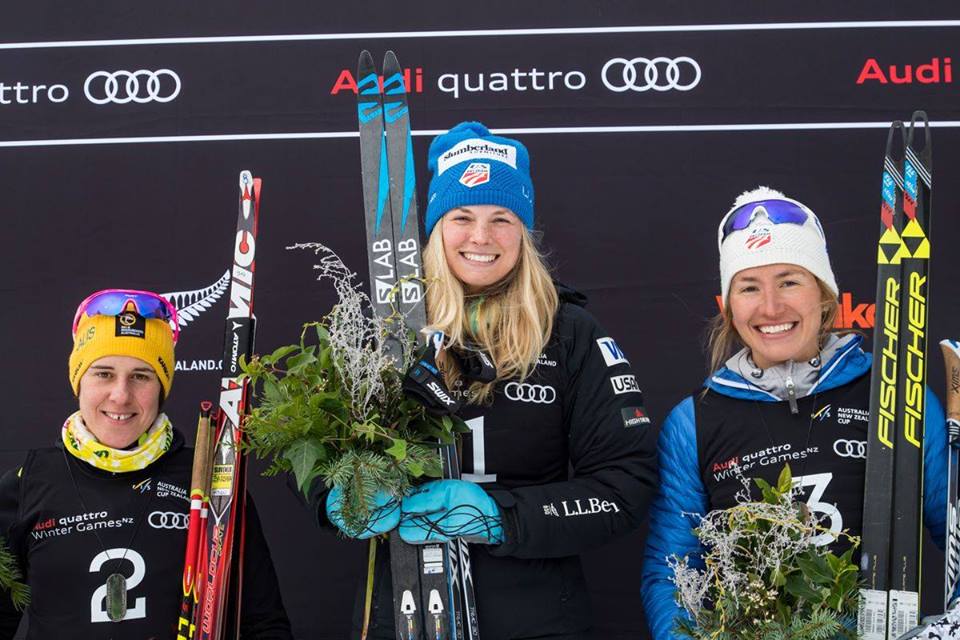
    (Left to right) Australia’s Barbara Jezersek in second place, American Jessie Diggins (USST/SMS Elite Team) in first and American Caitlin Gregg (Team Gregg) in third after the women’s 5 k freestyle at the 2017 Winter Games NZ at the Snow Farm in Wananka, New Zealand. (Photo: Winter Games NZ Facebook/Neil Kerr)

    “I got about 1-2 seconds on Adam and Kaichi, and realized that I had to use that gap to try and win the race,” Lustgarten wrote. “I really did not feel like I had the energy to outkick anyone, so I wanted to see if I could get a gap. I burned all of my matches on the first 75% of the last lap cresting hills hard and climbing hard and making sure to double pole really well on the flats. I was completely exhausted by the last climb but had enough of a lead to secure the win! And I was so excited to see Adam come in second!”

    Lustgarten finished first in 47:50.8, while Martin crossed 23.3 seconds later in second. Naruse claimed third, 32.8 seconds back from Lustgarten.

    In the women’s 10 k, Diggins won in 34:49.9, besting Patterson in second by 26.6 seconds. Sargent snagged third, 1:00.3 back from Diggins.

    After returning to the U.S., USST members are currently training individually or with their clubs, Whitcomb explained. They’ll reunite Sept. 28 to Oct. 13 for a final dryland camp in Park City, Utah, where they’ll have a guest athlete from the German women’s team.

    Results:

    Men’s 10 k freestyle | Women’s 5 k freestyle

    Men’s classic sprint | Women’s classic sprint  

    Men’s 15 k classic mass start | Women’s 10 k classic mass start

  • Havlick Wins 2017 Australian Hoppet; Rose Repeats in Second

    Havlick Wins 2017 Australian Hoppet; Rose Repeats in Second

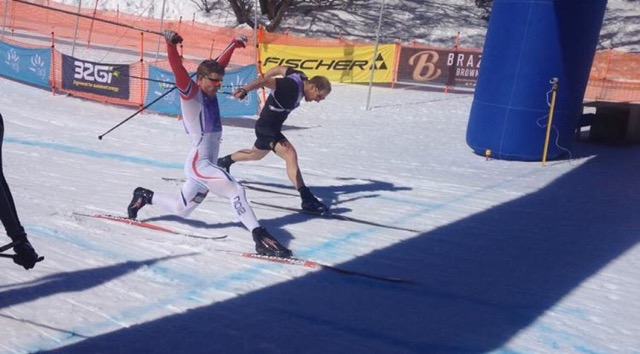
    Miles Havlick (l) outlunges Australian national team member Phillip Bellingham for the win in the 42-kilometer 2017 Kangaroo Hoppet on Aug. 26 at Falls Creek in Victoria, Australia. (Photo: AUSXC)

    When Australian Phillip Bellingham lunged for the finish line in the men’s 2017 Kangaroo Hoppet a week ago on Saturday, Aug. 26, in Falls Creek, Victoria, it wasn’t his fellow national team member Callum Watson he had to worry about. Nor was it anyone sporting a suit with the Australian flag. It was a skier wearing the colors of Norway.  

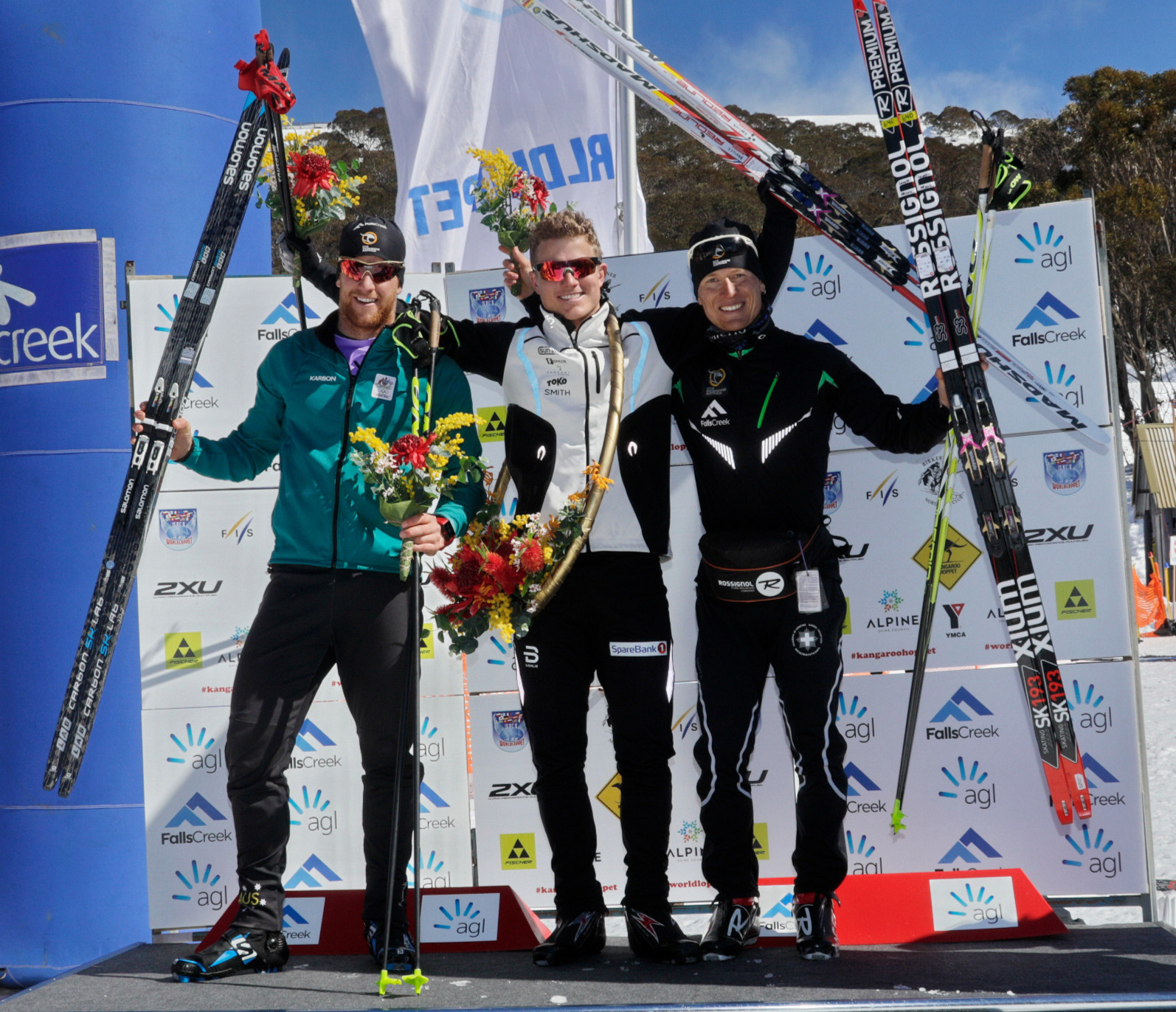
    The men’s 2017 Kangaroo Hoppet podium, with American Miles Havlick (c) in first, Australian Phillip Bellingham (l) in second, and Switzerland’s Valerio Leccadi in third. (Photo: Hoppet.com.au)

    The winner, however, was not Norwegian. It was American Miles Havlick, a 27-year-old Boulder, Colo., native. Why was he sporting a Scandinavian suit while racing in the Southern Hemisphere? School.

    After retiring from professional skiing and leaving the Sun Valley Ski Education Foundation (SVSEF) Gold Team in 2016, Havlick enrolled at the Norwegian University of Science and Technology (NTNU) in Trondheim, Norway, to obtain a master’s degree in exercise physiology (he received an undergraduate degree in exercise physiology from the University of Utah in 2013) through NTNU’s two-year program.

    When the Norwegian university went on summer “holiday”, Havlick spent it the way any diehard skier might: on snow. From the beginning of July until the end of August, Havlick worked as the international guest coach for the Birkebeiner Ski Club in Mount Beauty, a small town in Victoria, Australia. Along with leading adult ski clinics, Havlick worked with local primary school and high schoolers as well.

    https://www.instagram.com/p/BYUjuD5go_5/?taken-by=mhavlick

    “They have a very welcoming and passionate ski community down there and it was great to experience the skiing culture in the Southern Hemisphere,” Havlick wrote in an email to FasterSkier. “Obviously, I spent a lot of time on snow over the past few months which provided a good opportunity to try to burn off some Tim Tams in between coaching sessions.”

    That appeared to be enough for Havlick’s Hoppet performance, which came at the end of his two-month break from school. He, Bellingham, Watson, and Switzerland’s Valerio Leccardi broke away from the pack by 1o k on the course’s infamous “Paralyzer Climb”. From there, the four exchanged the lead until the final push to the finish.

    “The last kilometer was pretty hectic with finishers from the Joey and Birkie events clogging up the trail which made weaving around other competitors pretty tactical,” Havlick wrote of the busy race day. “Going into the race, I knew I probably wasn’t in as great of shape as the others but if I could just manage to hang on until the end I would have a shot in the final kick. The race organizers and volunteers did an amazing job with this event and I will certainly be back!”

    Havlick outlunged Bellingham by two-tenths of a second for the win in a time of 1:37:24.2 hours. Bellingham claimed second, just one second ahead of Leccardi in third (+1.2).

    Missing the podium by 2.8 seconds was Watson in fourth, four seconds back from Havlick’s winning time. A second American and Havlick’s former teammate, Matt Gelso (SVSEF) finished fifth, 4 minutes and 36.2 seconds after Havlick. Gelso won last year’s Kangaroo Hoppet, and returned this year, arriving in Australia a week prior to the event.

    “My race played out much differently with me getting dropped relatively early but that wasn’t entirely unexpected,” Gelso, 29, wrote in an email. “I of course was going for the win again this year but it was not to be. Mainly I was happy to be out racing and training after a very frustrating and challenging last 2 months.”

    Gelso and his SVSEF teammate Mary Rose spent seven days in Australia before joining their other Gold Team teammates and head coach Chris Mallory in New Zealand.

    “Now I am in New Zealand to put in some good specific volume training and do some more racing,” Gelso wrote. “As for more marathons, I am not totally sure. I will possibly race in the Merino Muster down here at Snow Farm but other than that I have not planned out next race season beyond US Nationals.”

    Also finishing in the men’s top 10 was American Andre Lovett in seventh (+7:56.2). American Jeremy Hecker placed 14th (+13:25.5), Canadian Caelan Pangman McLean was 15th (+13:30.0), American Jeffery Clarke 68th (+44:04.2), Canadian Dayle Gilliatt 109th (+1:03:04.0), American Aris Apostolou 111th (+1:03:30.5), Canadian Robert Palliser 114th (+1:04:38.3), Canadian Pierre Ethier 126th (+1:09:52.0), Canadian John Wragg 153rd (+1:22:44.5), American Charlie Dee 157th (+1:27:51.9), American Jay Wiener 202nd (+2:13:32.4), and American Robert Saalfeld 205th (+2:22:06.4).

    Rose’s Podium Repeat

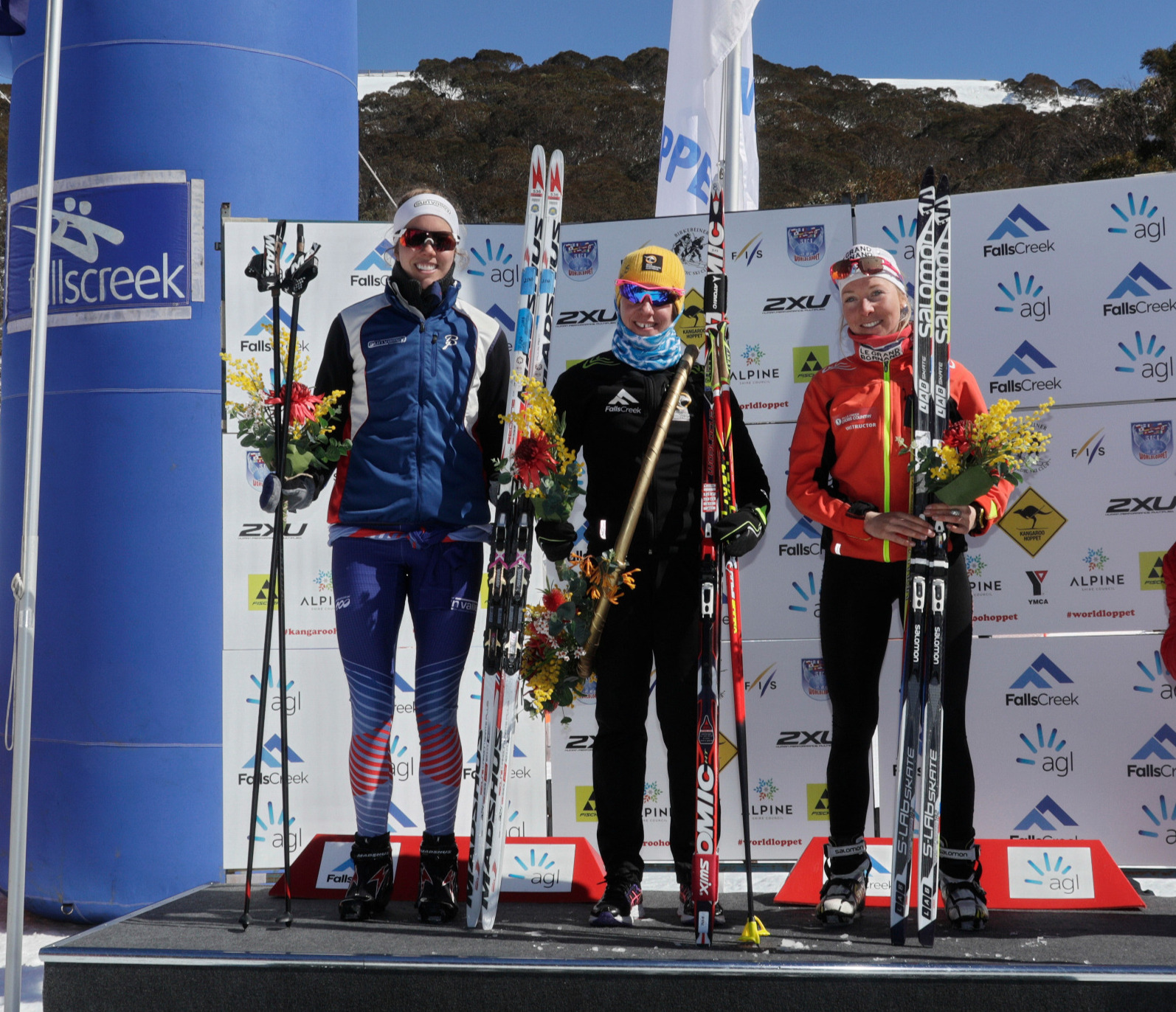
    The women’s 2017 Kangaroo Hoppet podium, with Australia’s Barbara Jezersek (c) in first, American Mary Rose (l) in second, and France’s Iris Pessey in third. (Photo: Hoppet.com.au)

    In the women’s 42 k race, Australian Barbara Jezersek won in a time of 1:46:59.8. Rose placed second, 5 minutes, 42.8 seconds later. It was Rose’s second straight year as the Hoppet runner-up, having been edged by her SVSEF teammate Deedra Irwin last year.

    “I competed in the Hoppet last year and absolutely loved the event!” Rose wrote in an email. “It is exciting to be racing in August and surrounded by over 1,000 cross-country skiing enthusiasts. It is a unique event and one that I plan on attending well after I am done skiing at the elite level.”

    Rose’s week in Australia was intended to be used as a chance to adjust to the time zone prior to her club team’s on-snow camp in New Zealand and to get a longer race effort in.

    “Like any race, I wanted to win,” Rose wrote of the Hoppet. “I knew that was a lofty goal but one that I thought was achievable.”

    The pace set by Jezersek, however, held off Rose from the win and gave the 26-year-old Steamboat Springs, Colo., native a second Hoppet place finish for the second year in a row.

    “Barbara Jezersek is a very strong skier and has some notable finishes on the World Cup and at the Olympics,” Rose wrote. “From the start Barbara was skiing very strong and aggressively weaving in and out of all the elite-wave racers. It was difficult to follow her and hold her pace while navigating everyone around us. Once she broke away I skied with 3 other guys until the last 15km and then had to push it in solo. It was an awesome event this year with perfect weather and lots of snow!”

    Following Rose was France’s Iris Pessey in third (+8:40.6). The only other North American senior woman to participate in the event, American Kayla Billett, raced to 16th (+47:34.5).

    Close to 230 men and 62 women raced the 2017 Hoppet, Australia’s international ski marathon and a Worldloppet. Though Havlick, this year’s male winner, indicated that racing is no longer his priority, he does have a few more marathons he’s keeping in mind.

    “At the moment, I hope to compete in the China Tour de Ski during the first week of January which includes the Chinese Vasa and then maybe a marathon or two this spring if it works with my school schedule,” Havlick wrote. “For the most part, my ski racing days are behind me but it was pretty fun to jump into the mix for the Hoppet and come out on top!”

    2017 Kangaroo Hoppet results

  • World Cup Finals Chatter: U.S.A.

    World Cup Finals Chatter: U.S.A.

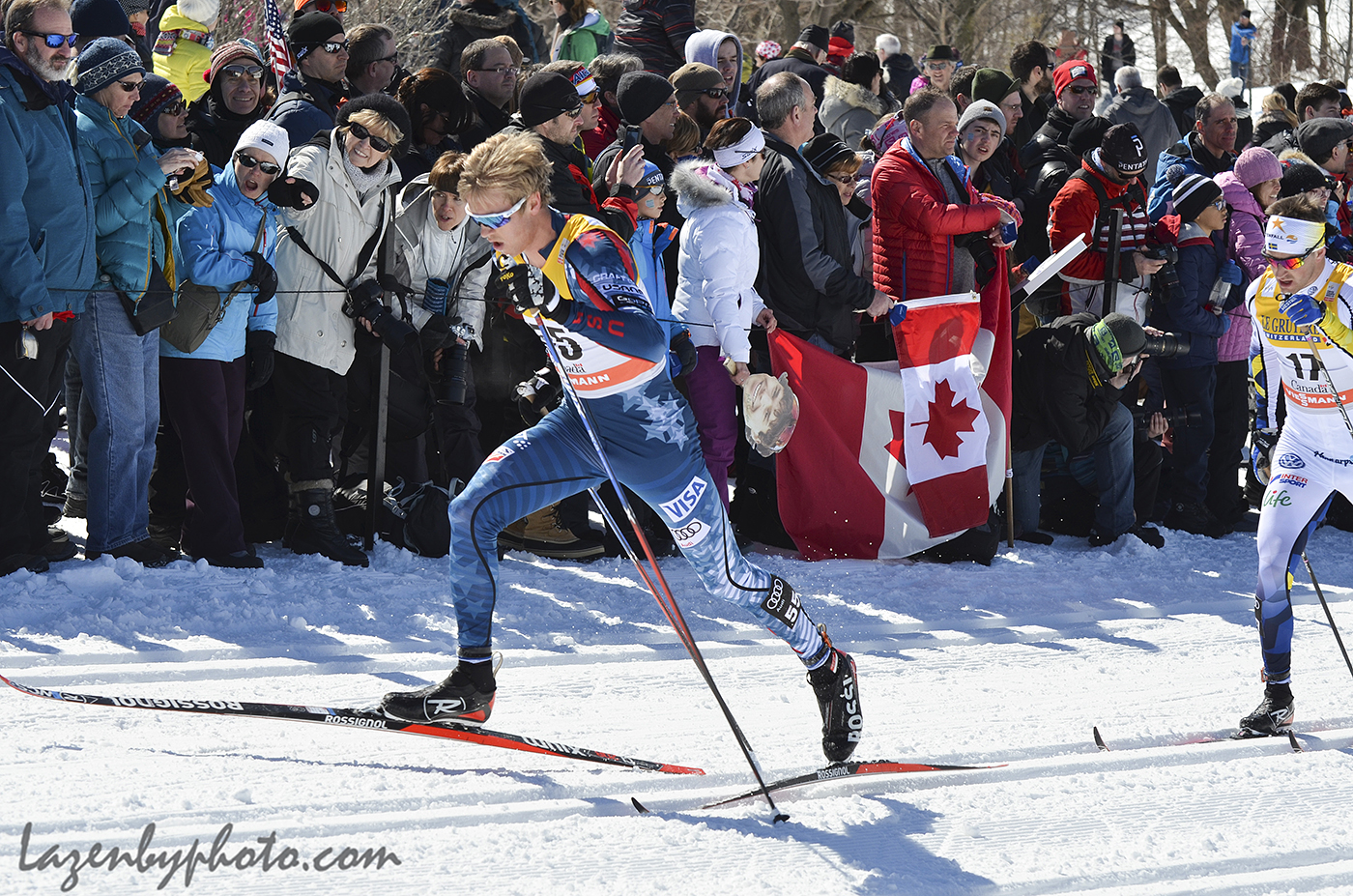
    Andy Newell (44) skiing with fellow American David Norris (55) during the men’s 15 k freestyle pursuit at World Cup Finals on Sunday in Quebec City. Norris finished the World Cup Finals mini tour in 43rd overall, but placed 27th for time of day, while Newell held his starting position in 44th. (Photo: John Lazenby/Lazenbyphoto.com)

    After the 2017 World Cup Finals mini tour drew nearly 60 North American competitors and tens of thousands of spectators to Quebec City two weekends ago, it’s only fitting that we share the quotes from some of the athletes you haven’t heard from yet (and some you have). Here is a collection of some of the most interesting comments from the U.S. World Cup and Nation’s Group skiers at World Cup Finals. There were 27 in total, although two women — Kikkan Randall and Liz Stephen — did not race due to feeling under the weather.

    And here are our race reports (with links to results at the bottom of each) from March 17-19:

    Day 1 freestyle sprints: Men | Women

    Day 2 classic mass starts: Women | Men

    Day 3 freestyle pursuits: Men | Women

    ***

    On being selected:

    “It’s actually like a dream come true. It’s so so much fun. I wish I could do this every day because it’s the best experience I have ever had.” — Erika Flowers (Stratton Mountain School Elite Team)

    “I was a little bummed out last year. I was pretty close but didn’t get to come [to the Ski Tour Canada], but it feels good to be here. Last time I came to be Quebec it was super awesome, mind-blowing awesome, so it’s nice.” — Becca Rorabaugh (Alaska Pacific University), who last raced World Cups in 2012 in Quebec and Canmore

    On making the jump to the World Cup:

    “This is my first World Cup weekend, feels awesome. It was a great experience to be in front of the home crowd of familiar faces, and now for next time I have goals and expectations and it will be really fun.” — Julia Kern (USST D-team/SMS Elite), after the pursuit

    On racing close(r) to home:

    “It’s so awesome to be back here in North America. I feel like every fourth person here knows my name and it’s an incredible atmosphere. This season hasn’t been what I was hoping for, but it’s just fun to finish it off in a place like this.” — Noah Hoffman (USST/Ski Club Vail)

    “It’s really awesome. We only live, like, four hours away from here so we drove up, and it’s really nice to have people cheer for you on course people who that know your name.” — Liz Guiney (Craftsbury Green Racing Project)

    “Certainly any time I was struggling I could tune into some American voices shouting my name or coaches and various fans. It’s really great. A good atmosphere our here.” — Caitlin Patterson (CGRP)

    “I think I might be closer to Europe than home still. Still have a long ways to go, but I am really excited to head home tomorrow.” — Rosie Brennan (USST/APU)

    On goals for World Cup Finals:

    “I wanted to ski with confidence because I think it is really easy to get intimated out here, so kind of just went into it with, ‘Today is my race. I am going to ski my race and enjoy the day.’ And I was trying to really good technique and not put myself out of it from the get-go. So it was good. I felt great.” — Flowers, after the mass start

    “I’m just trying to finish my season strong, but I feel like I haven’t really recovered from Europe at all, still pretty tired, but I thought I skied well. I almost crashed here but I managed to stay on my feet. I don’t feel like I am skiing super fast right now so I am just trying to do everyhting I can to do as well as I can.” — Ben Lustgarten (CGRP), after the sprint

    “Try to hang in there, see what I can do. I haven’t done a World Cup distance race in quite a long time.” — Rorabaugh

    “My goal is to improve on where I was last year.” — Kaitlynn Miller (CGRP), who finished last year’s Ski Tour Canada in 41st overall (she placed 52nd in this year’s World Cup Finals mini tour)

    On mini-tour formats:

    “Yesterday was just really bad, and when there are only three days in a tour, it’s hard to make up for one really bad day. But I am really happy with getting in the sprint heats, and today was a little better.” — Brennan, after the pursuit

    “My only goal today was not get lapped, so went out hot for three laps and kind of puttered it in, but finished, and that was the goal. I’m more of a sprinter so it was good to just get through this tour.” — Cole Morgan (Sun Valley Ski Education Foundation), after the pursuit

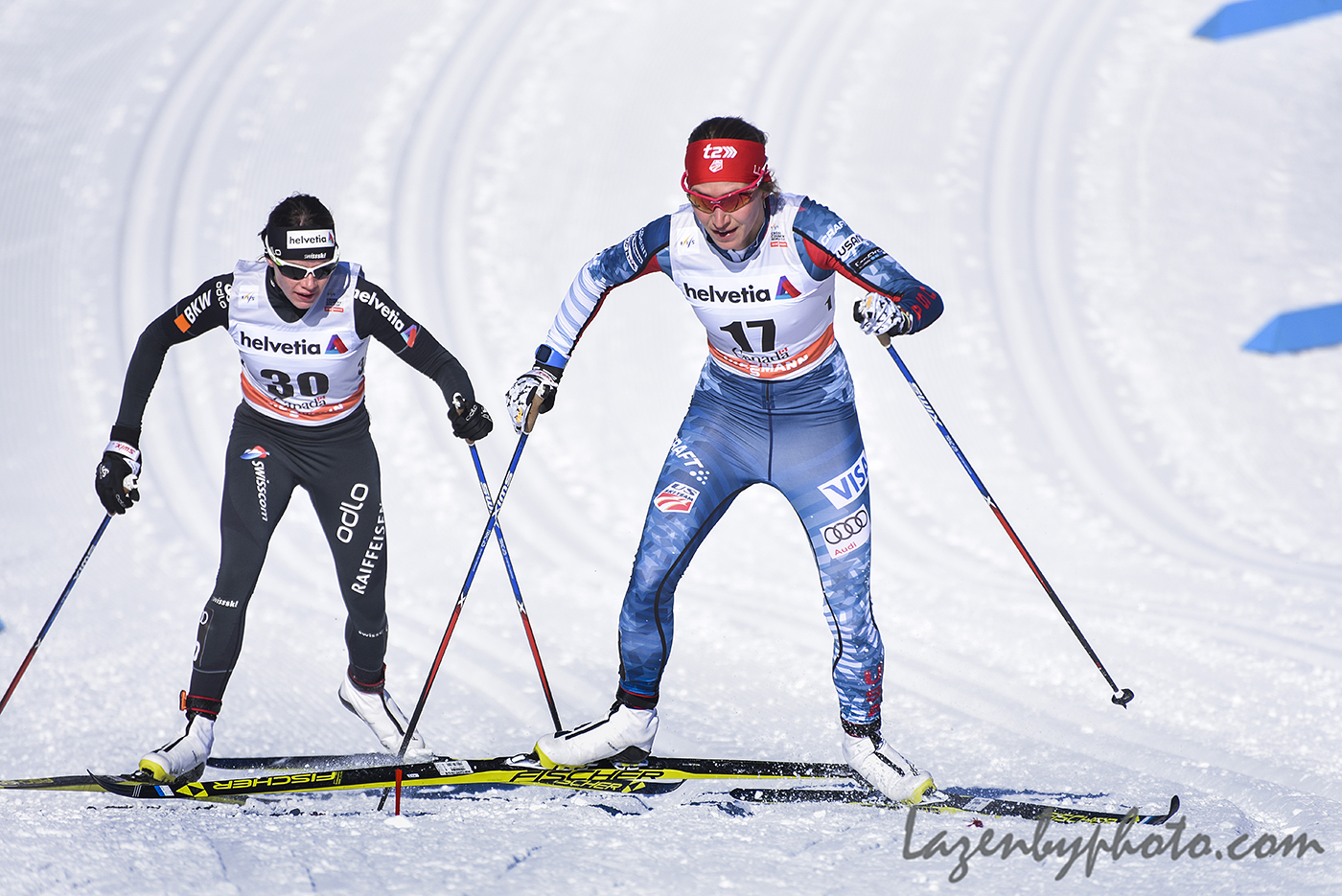
    Sophie Caldwell (17), of the U.S. Ski Team and SMS Elite Team, racing to 38th in the 10 k classic mass start on March 18 at World Cup Finals in Quebec City. Switzerland’s Nathalie von Siebenthal (30) went on to finish 35th.(Photo: John Lazenby/Lazenbyphoto.com)

    On mass starts:

    “Dude, that’s what I am excited for. … We’ve got a lot of fast distance skiers [on the U.S. team], and hopefully we can work together and push each other.” — Lustgarten, after the sprint

    “I tend to prefer classic races and I think a mass start is going to be really exciting.” — Kaitlynn Miller (CGRP), after the sprint

    “We knew to expect the accordions and it still caught me completely off guard when we were going into that little bump up there and we came to a complete stop. I think that might’ve been one of the first times in a race that I’ve really come to a complete stop. I know it happens in the guys’ field a lot when they’re all together, but somehow usually the women spread out. So that was a little dicey.” — Caitlin Patterson, after the mass start

    “Honestly, I made a rookie mistake and thought that we had four laps, so we turned into the finish and I was like, ‘What? We’re done?’ But it was a good experience and it is good to practice that because in a big fast field like this. it starts hot and you just have to be ready to go and hopefully we can bring that back to the SuperTour and practice that a bit more often.” — Flowers

    “It was fun to mix it up. It was pretty hard with the mass start, starting toward the back. There were definitely a couple times where I came to a complete stop, but it was a good experience.” — Jack Hegman (SVSEF)

    On pursuits:

    “This was definitely one of my favorite events. Really fun to have a cool format with the pursuit and chasing people down.” — Paddy Caldwell (USST D-team/SMS Elite)

    “[This was] probably the worst race I’ve had all year, but that’s what happens sometimes. … I had a good race yesterday and today it just wasn’t going.” — Matt Gelso (SVSEF)

    On starting in a pursuit wave:

    “It was fun. For how small the wave was it was still rather hectic. The course is narrow in parts, which makes it really hard, and I probably expended more energy than I needed to. Maybe I went a little too frantic in that. But it was good though, it’s a really beautiful day here, and they have done a really good job, and I am super pumped. Our techs worked super hard. Yeah, everything was great.” — Chelsea Holmes (APU)

    “I wanted to basically think of it as a mass start race from the wave and it was good. I felt like I was able to make the breaks where I wanted to.” — Brian Gregg (Team Gregg/Loppet Nordic Racing)

    On skiing with teammates:

    “I was working with David [Norris] and Scott [Patterson] for most of the race, and two other guys so that was really fun, and fun to work as group and try to put down a fast time.” — Paddy Caldwell, after the pursuit

    “I started three people in front of the wave, so I knew they were going to catch me, but that was fun because we got to ski a pretty fun 15 k with a lot of U.S. competitors. Me and Simi skied a lot together and Brian Gregg and it was fun to finish it off in the sun with some teammates skiing 15 k.” — Andy Newell (USST/SMS Elite), after the pursuit

    “I was actually skiing with my teammates, Simi and Andy, for a while. We were rotating through and trying to catch some of the guys ahead of us and make sure the big pack right behind us wasn’t going to catch us.” — Gregg, after the pursuit

    “It was super fun skiing with all the U.S. girls in a pack together.” — Kern, after the pursuit

    On idols:

    “The highlight was definitely being in a sprint heat with Jessie, ’cause I really look up to her and growing up she was my idol. To race with her in my first Wold Cup was really fun.” — Kern, after the pursuit

    On falling down and getting back up:

    “I fell twice … I fell right out of the start and caught up on someone’s pole, and then on one of the downhills slid out on someone’s ski. The first time I was like, ‘Oh, I can come back from this?’ The second time was like, ‘You’ve got to be kidding me!’ Ugh. But overall this weekend has been pretty fun. It’s so fun to race in Canada, and the conditions could not be better. So I kind of have to get over my own poor race and enjoy the process.” — Jennie Bender (Bridger Ski Foundation), after the pursuit

    Sadie Bjornsen (U.S. Ski Team) leads Sweden’s Charlotte Kalla and the rest of a chase pack during the women’s 10 k freestyle pursuit on the last day of 2017 World Cup Finals, where she placed 10th overall with the fifth-fastest time of day. (Photo: John Lazenby/Lazenbyphoto.com)

    On the course:

    “The course is really different than what we are used to skiing. These are not World Cup-designed trails. There are not the huge hills that we are used to. [They’re] really punchy, short, steep hills. It probably doesn’t suit my strengths super well, but it is the type of skiing I need to be able to do and its such a great atmosphere right here in the city and I wouldn’t want to be anywhere else.” — Hoffman, after the mass start

    “I like that there were short, punchy climbs where you had to put your head down and hammer, and then fun downhills.” — Guiney, after the mass start

    “The course was really great. It’s kind of a technical course, so you have to think about how you’re going to ski each area and between this headwind, tailwind, all the corners, crests of hills, and I think I skied it fairly well. Smoothly. I felt like I was missing a little bit of power out there, so it wasn’t the best of sprint qualifiers, but it was OK.” — Caitlin Patterson, after the sprint

    “The course is awesome, and it’s really fast out right now so it skis really smooth. It’s a really fun qualifier, so I am sure it would be really fun heats. The course for the distances races look good, too. They’re going to be nice with 3 k laps.” — Rorabaugh, after the sprint

    “It was pretty flat, lots of double pole and it was a good course.” — Hegman, after the mass start

    On conditions: 

    “These really firm tracks made it harder to track-hop, especially on the fast downhills because you’re just kind of wobbly and it’s a little bit sketchy, so you’re always looking for the fastest line but also having to keep in the tracks. It was a little tricky. Always a mental game and a physical game out there.” — Caitlin Patterson, after the classic mass start

    “I think it was hard to nail the kick yesterday as it was warming up quickly. Today I had really fast skis, they were like stupid-fast, which was awesome. Just great conditions to ski in.” — Sophie Caldwell (USST/SMS Elite), after the skate pursuit

    “They have been great all weekend. Pretty consistent, fast, and the snow is transforming a bit today. A little different than yesterday … but overall it has been really good.” — Flowers, after the pursuit

    “It did the same thing it did yesterday, got a little wetter and a little slower throughout, but I had good skis so it was nice. Just had to get up those tough climbs and glide out the downhills.” — Morgan

    “It was all right, felt pretty slow, especially finishing, you’re like, ‘Man, someone’s gonna come by me,’ but it was just slow for everyone. It was hard work out there. Not too many hills, but snow made you work.” — Scott Patterson

    On finishing out the season:

    “No great results this weekend, but last year at this time and previous year, I was just totally dying off, so one of my goals this year was to try to build through the season, and my fitness is definitely not dropping, if anything it is still building right now. So I am happy. Even though I am not skiing where I want to right now, it gives me a good platform for next year, and that’s kind of what I wanted for this year.” — Newell, after the pursuit

    “It’s hard to complain when your racing in blue-bird skies and it’s fast snow and there’s 10,000 North American fans out here so it was really cool. I just focused on catching some good rides and ski hard where I could and having fun.” — Simi Hamilton (USST/SMS Elite), after the pursuit

    On season highlights:

    “Toblach, for sure, that was the highlight of the year for me. I love racing there and I felt great that weekend. I felt great going into Worlds, but that was obviously really frustrating with falling in that corner … that was for sure a bummer, but it was still a great experience being at Worlds at Lahti. Every season, there’s always bumps and ups and downs, but … I have had seasons in the past by the end of the year I am ready to take a serious period kind of away from training and racing and right now I feel a little bit different. I am ready for a break but also ready for the training season, and I know some really specific, concrete things I need to work on, so I am psyched to start tackling those and just get back to it.” — Hamilton, who placed second in the World Cup freestyle sprint on Jan. 14 in Toblach, Italy, for his fourth-career individual podium

    On their season overall:

    “I am really satisfied with it. It was really solid. I don’t think there was that one standout result that can sometimes make a season, but I think I had very consistently good results and that’s something I’m proud of, and I look forward to building up off that.” — Sophie Caldwell

    “Overall I actually had a really good season. In February I got a concussion so the last month has been a bit rough, but I am trying to finish out strong.” — Bender, who had a non-skiing related injury when a hockey puck struck the back of her head

    “It’s been up and down. I think I had some great results and that’s really fun, and then definitely some days where I’d like to improve off for next year.” — Flowers

  • Klæbo Rockets to First Distance Win in Quebec Mass Start; Harvey 4th

    Klæbo Rockets to First Distance Win in Quebec Mass Start; Harvey 4th

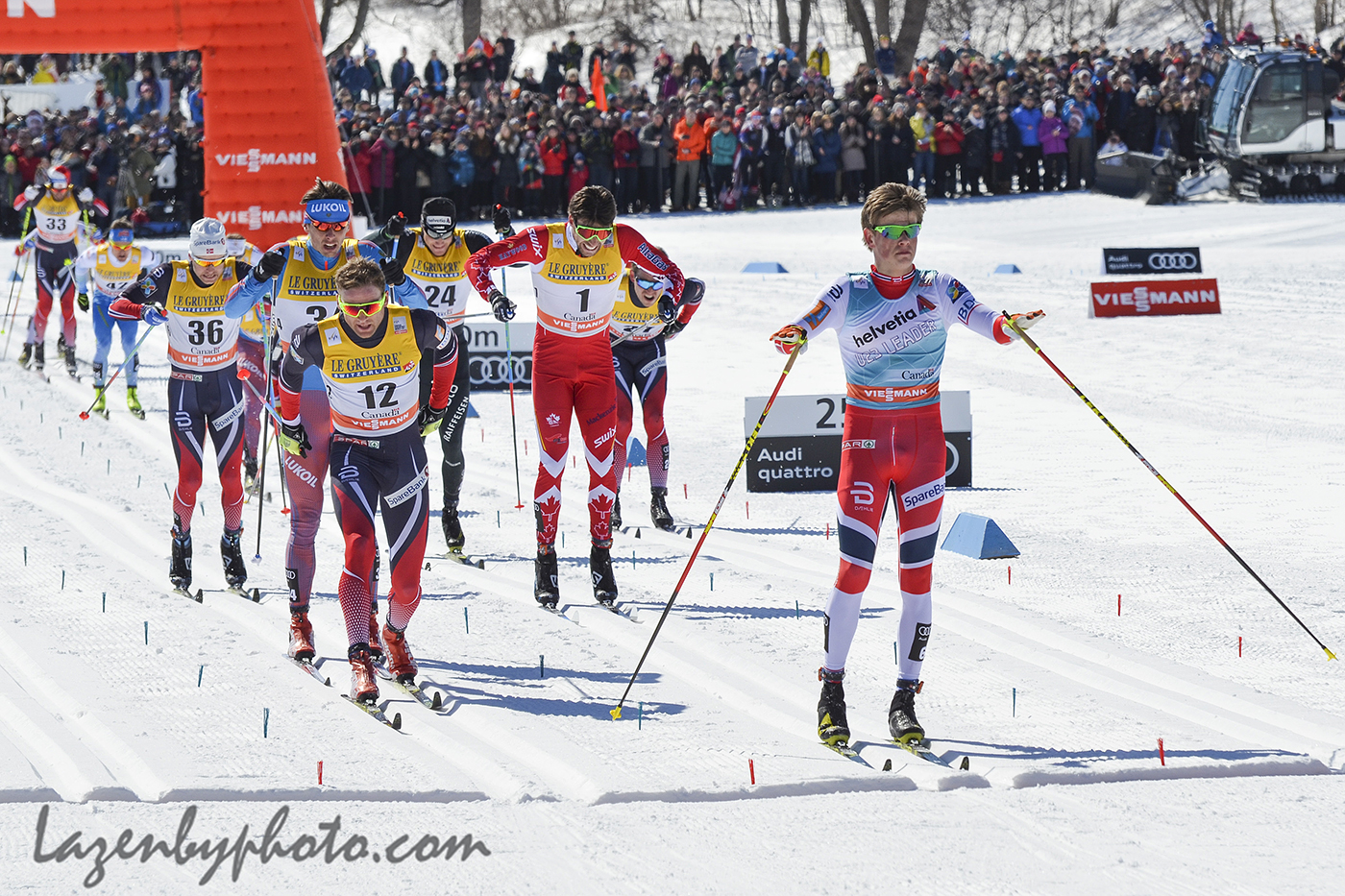
    Norway’s Johannes Høsflot Klæbo (r) crossing the line first in the men’s 15 k classic mass start on Saturday at World Cup Finals in Quebec City, 0.5 seconds ahead of fellow Norwegian Niklas Dyrhaug (12), who placed second. Russia’s Alexander Bessmertnykh (behind Dyrhaug) followed in third, just ahead of Canada’s Alex Harvey (1) in fourth. (Photo: John Lazenby/Lazenbyphoto.com)

    QUEBEC CITY — As 75 men jogged out into the center of the World Cup area assembled on the Plains of Abraham for the men’s 15-kilometer classic mass start on Saturday, one man in particular stood out. Alex Harvey, wearing the red suit of the Canadian national team, led the group out. He wore bib No. 1, but if you couldn’t see that from a distance, it didn’t matter. Essentially everyone knew who he was.

    The official hashtag of World Cup Finals in Quebec City this Friday through Sunday has been #GOALEX2017. He is a celebrity in Quebec, a hero to its locals, and someone even non-skiers know quite a bit about.

    And so far, the 28 year old appears to be soaking up every minute of his homecoming. One day after winning the freestyle sprint to start the finals, Harvey was seeded first in Saturday’s classic mass start. He led racers into the stadium, waved to spectators, started on the front line, and led the pack out of the stadium.

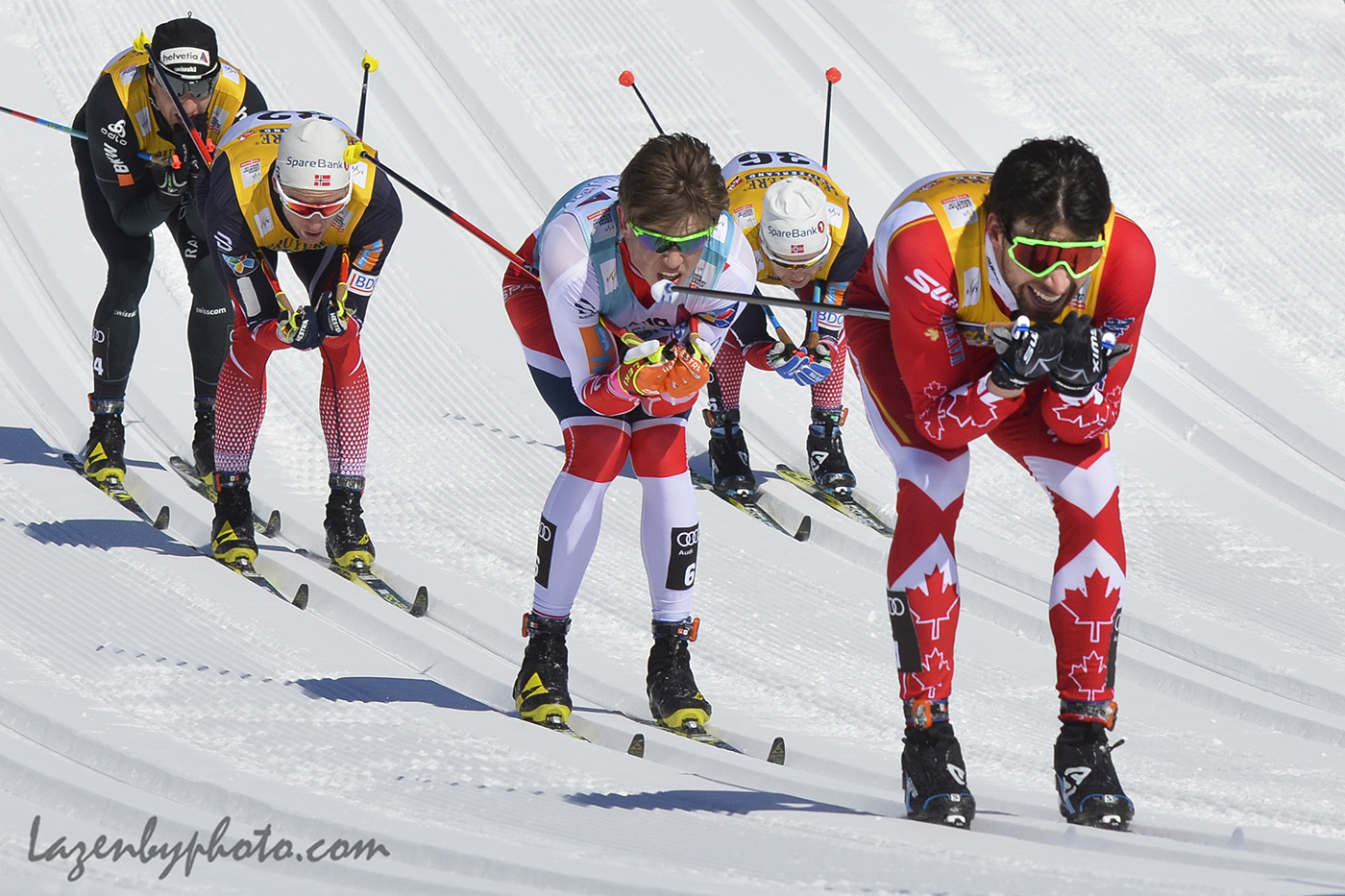
    Canada’s Alex Harvey leading Norway’s Johannes Høsflot Klæbo and two other Norwegians and Switzerland’s Dario Cologna (far left) during the men’s 15 k classic mass start on Saturday at World Cup Finals in Quebec City. (Photo: John Lazenby/Lazenbyphoto.com)

    Even when others took turns leading, with Norway’s Niklas Dyrhaug, Emil Iversen and Johannes Høsflot Klæbo setting the pace on the first of four laps, the possibility of Harvey winning never seemed in doubt. He consistently positioned himself within reach of the lead, skiing around sixth for much of the first lap.

    On Lap 2, the lead group remained about 30 strong. Harvey skied within two seconds of the Norwegians up front, with Pål Golberg, Didrik Tønseth, Finn Hågen Krogh, Dyrhaug, and even Klæbo — the 20-year-old Sprint World Cup champion — all still in contention. By the end of Lap 3, Harvey was into second, right behind Tønseth.

    With 3.75 k to go and the crowd’s ability to see the racers on most of the exposed course, the excitement among Harvey fans began to exceed its already high point from the start. Bells, horns, “Gooo Alex!”

    Russia’s Alexander Bessmertnykh attacked on an uphill and Harvey stuck behind him in second. On the second to last climb, a short and steep pitch that ascends up from the Old City’s historic wall, Dyrhaug surged into first, Bessmertnykh followed him in second and Harvey in third.

    Behind them, Klæbo was sizing them all up in fourth, waiting for the perfect time to strike. He did so by moving to the outside lane on the last long downhill and glided into second behind Dyrhaug. They ascended the final pitch together and rounded the final corner before the 100-meter stretch to the finish, where Klæbo continued to accelerate past Dyrhaug and double poled to his first World Cup distance win in 35:23.7 minutes. Dyrhaug finished 0.5 seconds later for second place, Bessmertnykh 0.8 seconds back in third, and Harvey 1.2 seconds behind Klæbo in fourth.

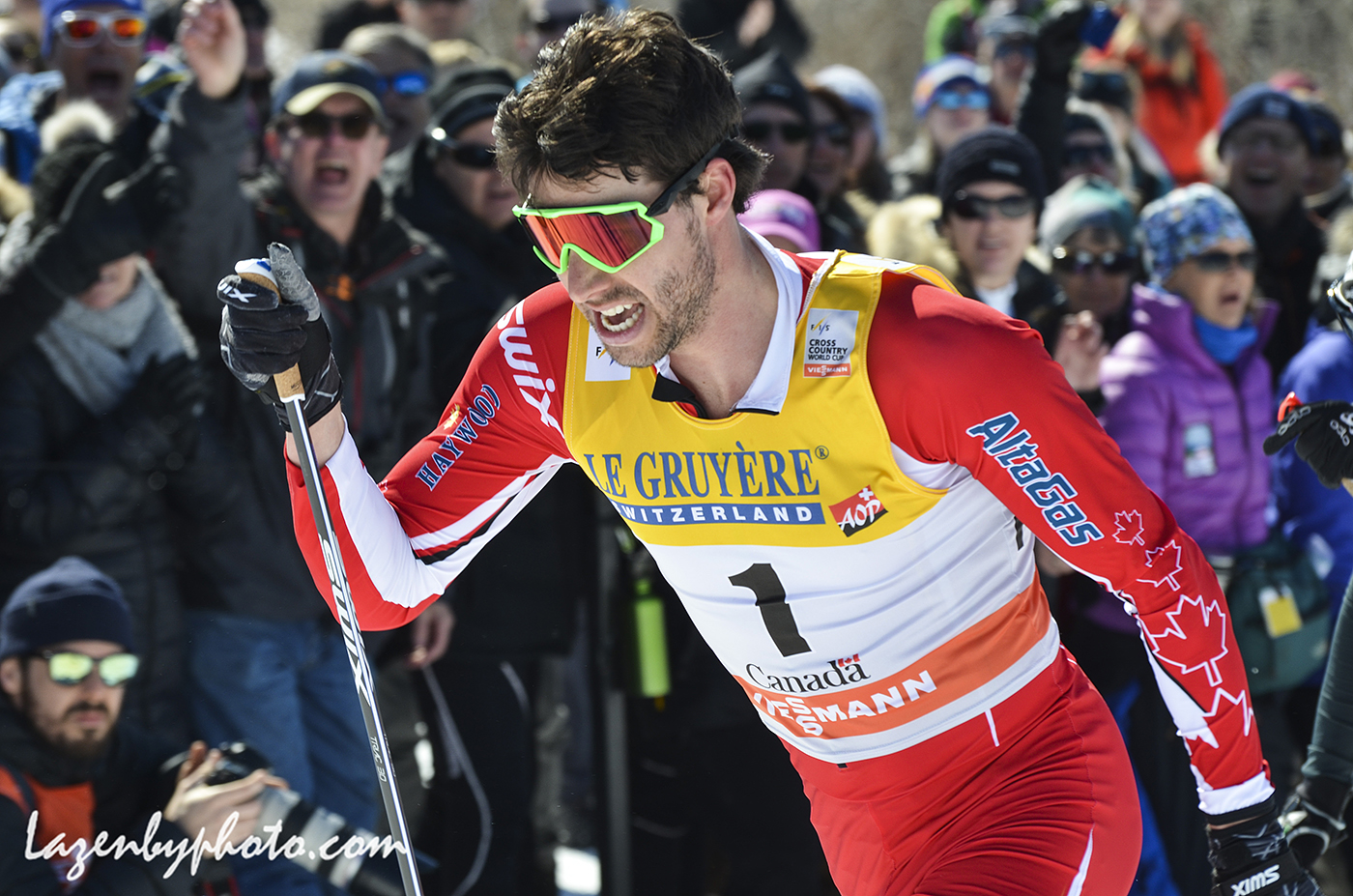
    Canada’s Alex Harvey racing to fourth in the men’s 15 k classic mass start at World Cup Finals in Quebec City. With one race left, the 15 k freestyle pursuit, he is third in the mini tour and third in the Overall World Cup as well. (Photo: John Lazenby/Lazenbyphoto.com)

    While it wasn’t a podium for Harvey, it was a result he was proud of.

    “I’m very satisfied,” he told reporters afterward in French. “Making the top 10 is always a big deal. Today was another step towards securing a third spot in the overall [World Cup]. That was my big goal coming in. So I’m satisfied … You can’t make the podium every time. I felt very good physically.”

    With one World Cup race remaining, Harvey, who’s ranked third in the world, extended his lead on Finland’s Matti Heikkinen in fourth to 92 points. Heikkinen finished 26th on Saturday, 1:04.9 minutes out of first, and will start Sunday’s 15 k freestyle pursuit 27th, 2:15 behind Klæbo as the World Cup Finals mini-tour leader. Dyrhaug will start 22 seconds back in second, followed by Harvey 1 second later in third, and Krogh another 11 seconds back in fourth.

    “Every pursuit is a manhunt so I’ll be hunting the young Norwegian in front,” Harvey said. “It was Klæbo’s first victory in a distance event. We saw him come in second behind Sundby in this year’s first mini tour. So of course, he’s strong. I mean, the guy won five or six gold medals at the Junior Worlds. He’s a complete skier…”

    Asked if he thought he could work with Dyrhaug to reel Klæbo in, Harvey wasn’t counting on one Norwegian helping him bridge the gap to another.

    “I don’t think Dyrhaug will chase, but I will,” Harvey said.

    Dyrhaug told reporters that might not be the case.

    “Tomorrow is going to be an exciting day,” he said in English. “I saw that me and Alex are going out together, so it is in both of our interests to cooperate and do good teamwork, and hopefully we can catch Johannes and then we’ll have to see…

    “We ought to talk together with team staff, hear what Johannes says, too,” he added. “But it is in both interests to have a big gap behind [us]. So if I’m strong, I’m thinking maybe I’m going to help Alex to … yeah, and we’re going to cooperate.”

    In the last year that Klæbo’s been racing World Cups, the three-time 2016 junior world champion (in the freestyle sprint, 10 k classic and freestyle relay) has reached the podium six times in individual World Cups and claimed bronze in the freestyle sprint at this year’s World Championships. But before Saturday, all of his podiums (with the exception of one mini tour) had been in sprints.

    “I hadn’t dreamed about doing a distance race in the World Cup … and cross the finish line in first,” Klæbo said after. “It’s unbelievable.”

    Johannes Høsflot Klæbo leading three other Norwegians, Emil Iversen (l), Finn Hågen Krogh (second from l) and Niklas Dyrhaug (r) during the men’s 15 k classic mass start at World Cup Finals in Quebec City. Klæbo went on to win, Dyrhaug placed second, Krogh 16th, and Iversen 25th. (Photo: John Lazenby/Lazenbyphoto.com)

    He was the most consistent race leader on Saturday, winning one of sprint preems and crossing in second behind his teammate Iversen for the other. In all, he accumulated 27 bonus seconds, which were deducted from his overall time in the mini tour — putting him first by 22 seconds over Dyrhaug.

    “I just tried to be in the front for the bonus seconds to be able to get some seconds,” he explained of his race tactic. “So that was my plan.”

    Despite trying to lead for most of it, he noticed others trying to do the same on the third and fourth laps. In the final stretch of the race, coming off the long downhill toward the finish, Klæbo focused on moving up from fourth.

    “Niklas gapped our group in the last downhill there so we had push really hard on the last uphill to get to him,” he explained. “At the finish, it was just all out.”

    Bessmertnykh, who will start the pursuit in 13th, 1:08 back, after placing 59th in Friday’s sprint, described Saturday’s mass start as “a fun race,” in a post-race interview with the International Ski Federation (FIS). “There was a lot of things happening all the time. I followed Niklas and Johannes on the last climb. We gained a small gap. I managed to ski well the last curve before the homestretch and carried in good speed.”

    Dyrhaug was also satisfied with his race.

    “The only thing was, I was one meter behind in the end,” he said. “I tried my best. I went all in for a long sprint, when it was one half k left, and it was almost.”

    Under blue skies and a beating sun, Dyrhaug described Saturday afternoon in Quebec as “amazing.”

    “We have been competing for like 40 races this year, but this is the most pretty day, and most pretty conditions for the whole year, so thank you, Quebec,” he said.

    Waxing was a challenge, with temperatures warming quickly to about 2 degrees Celsius (mid-30s Fahrenheit) by midday.

    Canada’s Devon Kershaw (r) and Graeme Killick (l) skied together for most of Saturday’s 15 k classic mass start after Kershaw broke a pole early. They went on to place 28th and 32nd, respectively. (Photo: John Lazenby/Lazenbyphoto.com)

    Devon Kershaw was the second Canadian in the top 30, finishing 28th (+1:08.4) after breaking a pole early on.

    “It was pretty chaotic and broke a pole there pretty early in the start and went all the way back into the 60’s, so made for a lot of work to try to get back in,” he said after. “I am proud of the fact that I was able to ski back into the points, but I had a better body than that today for sure and just had a bit of bad luck there.”

    He finished 9.3 seconds ahead of his Canadian World Cup teammate Graeme Killick, who placed 32nd (+1:17.7), and the two essentially skied together from 5.25 k on.

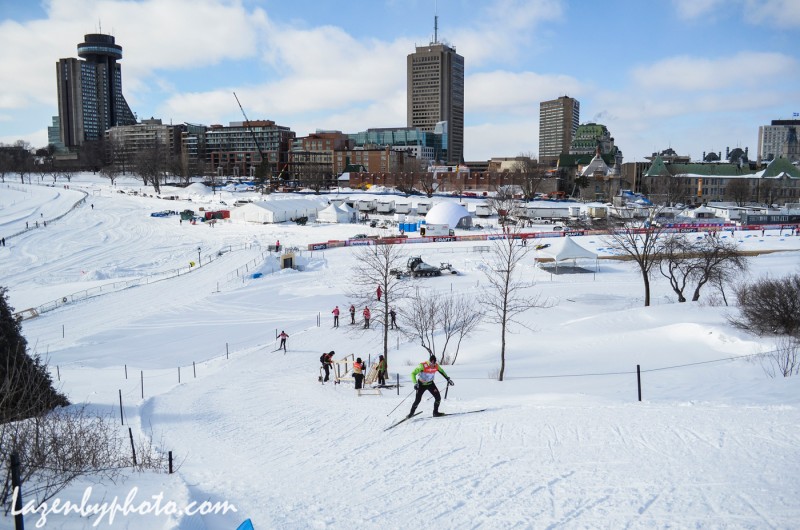
    While Kershaw said he thought the 3.7 k course would be better suited to skating, he was impressed with the atmosphere and the race organization.

    “I think for a classic, there are a lot of corners and it’s pretty tight … [but] to bring the skiing to the people like they did and to use the terrain they have available, I tip my hat, its a great event,” he said. “It is the most crowds I have ever skied with in Canada, the sun is shining, the venue is fantastic, the organizers did a great job, the tracks are in perfect condition. What a great place to race.”

    Erik Bjornsen led the U.S. men in 31st (+1:16.8) and two seconds behind Switzerland’s Roman Furger in 30th. After losing contact with the lead group of 29 on one of the bigger climbs at the end of the second lap, Bjornsen found himself skiing in “no-man’s land” with Sweden’s Teodor Peterson.

    Erik Bjornsen (U.S. Ski Team) leads Sweden’s Teodor Peterson (r) up a climb during the men’s 15 k classic mass start at World Cup Finals in Quebec City. They went on to place 31st and 29th, respectively. (Photo: John Lazenby/Lazenbyphoto.com)

    “It was a bummer to lose that front pack,” Bjornsen said. “I was struggling on the hills out there; I was a little light on kick. I think a lot of the guys were, but I wasn’t doing much striding. It was pretty much from double pole, to having to run outside the track. I felt pretty good, but I was losing time.”

    While skiing with Peterson, Bjornsen said he led at times and wanted Peterson to help drive the chase as well. Peterson ended up just ahead of him in 29th (+1:14.3).

    “I was like, ‘Come on, dude.’ I could see that there was a group behind, chasing us, and we were kind of right in that no-man’s land, which is always a bad spot to be,” he said. “But it was fun. It’s fun to be racing in North America, and have people cheering my name. It’s so unique, and I love it. I wish we could race over here more often.”

    Matt Gelso was the second American in 37th (+1:32.6), Andy Newell finished 45th, Scott Patterson 46th, Noah Hoffman 48th, Ben Lustgarten 49th, David Norris 50th, Simi Hamilton 54th, Paddy Caldwell 59th, Jack Hegman 62nd, Cole Morgan 64th, and Brian Gregg 69th.

    While the U.S. started 12 men, Canada had 15 in Saturday’s mass start with Bob Thompson finishing 55th, Knute Johnsgaard 57th, Len Valjas 61st, Russell Kennedy 63rd, Evan Palmer-Charrette 65th, Andy Shields 66th, Jess Cockney 67th, Brian McKeever 68th, Joey Foster 70th, Gareth Williams 72nd, Ricardo Izquierdo-Bernier 74th, and Julien Locke 75th.

    Results | World Cup Finals standings | Pursuit start list

    Overall World Cup standings

    — Gerry Furseth, François Léger Dionne, Jake Ellis, and Ian Tovell contributed

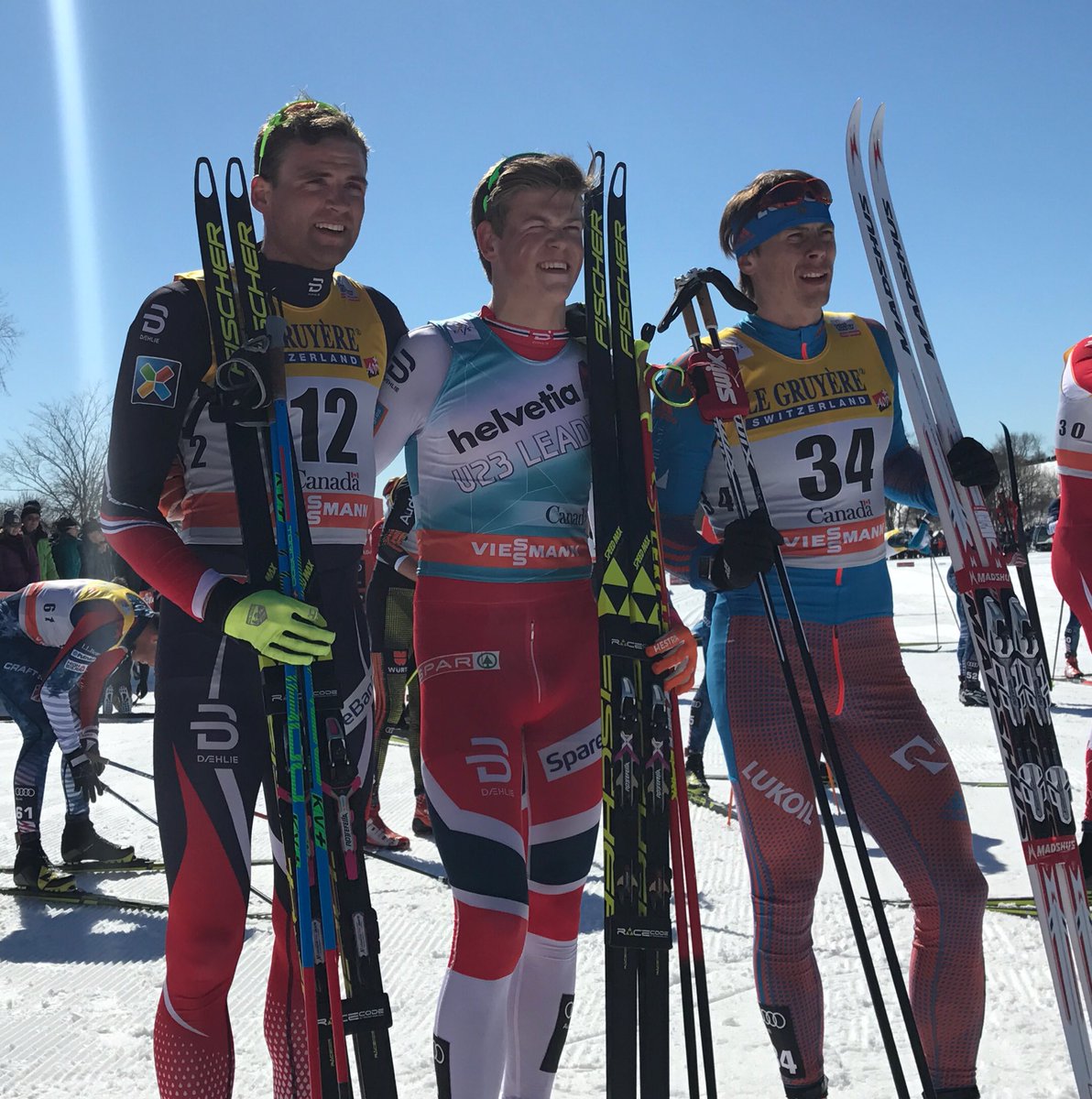
    The men’s 15 k classic mass start podium on Day 2 of World Cup Finals in Quebec City, with Norway’s Johannes Høsflot Klæbo (c) in first, Norway’s Niklas Dyrhaug (l) in second and Russia’s Alexander Bessmertnykh (r) in third. (Photo: John Lazenby/Lazenbyphoto.com)
  • Saturday Rundown: Quebec City, Oslo and Lillehammer (Updated x4)

    Saturday Rundown: Quebec City, Oslo and Lillehammer (Updated x4)

    The men’s 15 k classic mass start podium on Saturday at World Cup Finals in Quebec City, with Norway’s Johannes Høsflot Klæbo (c) in first and Niklas Dyrhaug (l) in second, and Russia’s Alexander Bessmertnykh (r) in third. (Photo: FIS Cross-Country/Twitter)

    FIS Cross-Country World Cup Finals (Quebec City): 10/15 k classic mass starts

    During Saturday’s 15-kilometer classic mass start at World Cup Finals, Canada’s Alex Harvey was in it until the end. But so were Norway’s Johannes Høsflot Klæbo and Niklas Dyrhaug, and Russia’s Alexander Bessmertnykh, to name a few.

    Sitting in second with a few hundred meters to go, Harvey was primed to make his move on Dyrhaug, who was leading at the time. But then came 20-year-old Klæbo, the season-long Sprint World Cup champion, who proved to have more left in the tank than anyone else and passed them both to lead into the finishing straight.

    Klæbo took the victory — his first in a World Cup distance race — on a bluebird day under a beating sun in 35:23.7 minutes, 0.6 seconds ahead of Dyrhaug. Bessmertnykh followed another 0.2 seconds back in third (+0.8) just ahead of Harvey in fourth (+1.2).

    Norway’s Sjur Røthe took fifth (+1.7), Switzerland’s Dario Cologna placed sixth (+1.9), and Norway’s Pål Golberg was seventh (+2.5), half a second ahead of another Norwegian Didrik Tønseth in eighth (+3.0). The top nine were within 3.7 seconds of first, with Russia’s Andrey Larkov in ninth.

    Devon Kershaw was the second Canadian in the points on Saturday in 28th (+1:08.4), after breaking a pole and working his way back up from outside the top 60.

    Erik Bjornsen led the U.S. men in 31st (+1:16.8), about a second ahead of Canada’s Graeme Killick in 32nd (+1:17.7).

    Also for the U.S., Matt Gelso finished 37th, Andy Newell 45th, Scott Patterson 46th, Noah Hoffman 48th, Ben Lustgarten 49th, David Norris 50th, Simi Hamilton 54th, Paddy Caldwell 59th, Jack Hegman 62nd, Cole Morgan 64th, and Brian Gregg 69th.

    For Canada, Bob Thompson finished 55th, Knute Johnsgaard 57th, Len Valjas 61st, Russell Kennedy 63rd, Evan Palmer-Charrette 65th, Andy Shields 66th, Jess Cockney 67th, Brian McKeever 68th, Joey Foster 70th, Gareth Williams 72nd, Ricardo Izquierdo-Bernier 74th, and Julien Locke 75th.

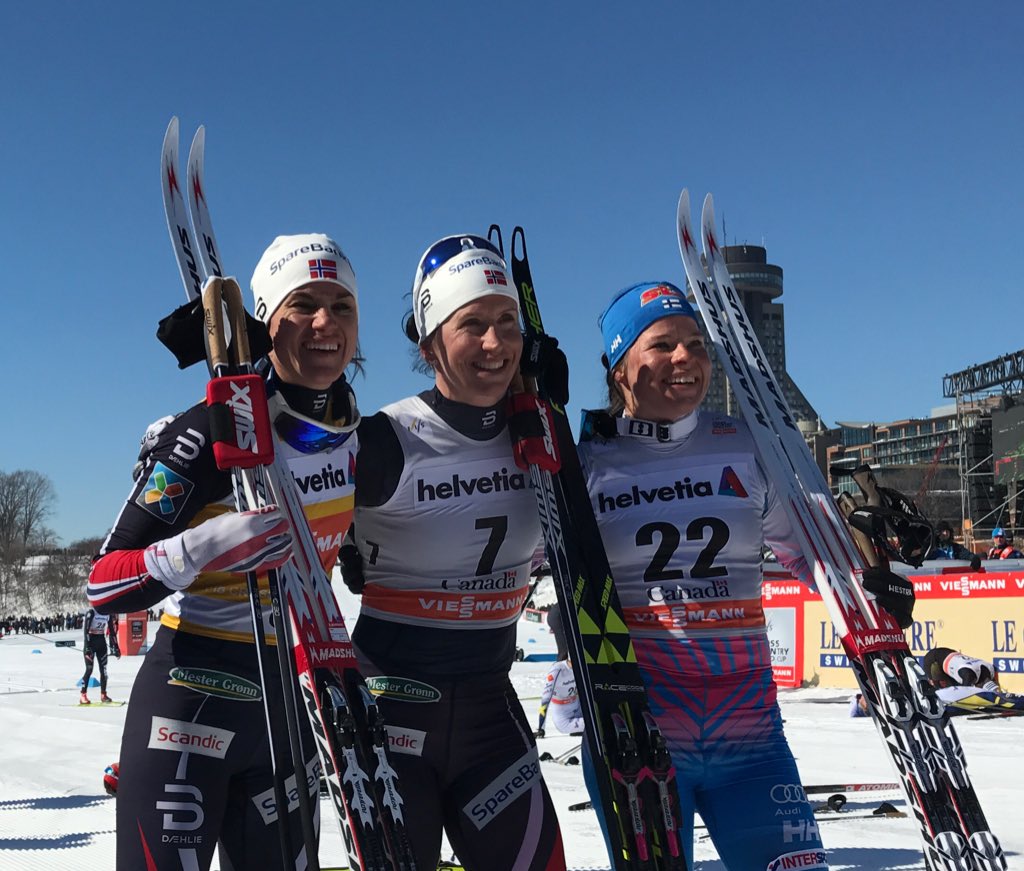
    The women’s 10 k classic mass start podium on Saturday at World Cup Finals in Quebec City, with Norway’s Marit Bjørgen (c) in first, Norway’s Heidi Weng (l) in second and Finland’s Krista Parmakoski (r) in third. (Photo: FIS Cross-Country/Twitter)

    In the women’s 10 k classic mass start earlier in the day, Norway’s Marit Bjørgen racked up her seventh victory of the season after leading a pack of two other Norwegians and Finland’s Krista Pärmäkoski and holding them off to the finish.

    Bjørgen put a few meters into the foursome as she entered the finishing stretch and held her lead across the line in 24:23.6 minutes. Norway’s Heidi Weng finished 0.6 seconds back in second to lock up the Distance World Cup title, in addition to the Overall World Cup title she secured on Friday.

    Pärmäkoski finished 2.9 seconds after Bjørgen in third, and Norway’s Ingvild Flugstad Østberg missed the podium in fourth (+7.8).

    Behind them, Germany’s Nicole Fessel outlasted a large chase pack to place fifth (+18.6), just ahead of Sweden’s Charlotte Kalla in sixth (+19.9) and Anna Haag in seventh (+19.1).

    Sadie Bjornsen of the U.S. Ski Team led the North American women in 15th (+29.9) after skiing at the back of that chase pack in the final stretches of the race. Also for the U.S., Jessie Diggins placed 27th (+1:06.9) and Sophie Caldwell 38th (+1:56.0).

    Canada was led by Emily Nishikawa in 37th (+1:51.7). Behind her, Cendrine Browne finished 41st (+2:28.2), Dahria Beatty was 53rd, Annika Richardson 54th, Katherine Stewart-Jones 56th, Frederique Vezina 59th, Annika Hicks 60th, Sophie Carrier-Laforte 61st, Andrea Dupont 62nd, Katherine Weaver 63rd, Alannah MacLean 64th, Sadie White 66th, Lisle Compton 67th, Mia Serratore 68th, and Laura Leclair 69th.

    For the U.S. Caitlin Patterson finished 44th, Liz Guiney 45th, Kaitlynn Miller 47th, Chelsea Holmes 48th, Rosie Brennan 50th, Julia Kern 52nd, Erika Flowers 55th, Becca Rorabaugh 57th, and Jennie Bender 58th.

    One day left in the 2016/2017 World Cup season remains, with the women’s and men’s 10/15 k freestyle pursuits on Sunday in Quebec City.

    Results: Men | Women

    World Cup Finals standings (Day 2 of 3): Men | Women

    ***

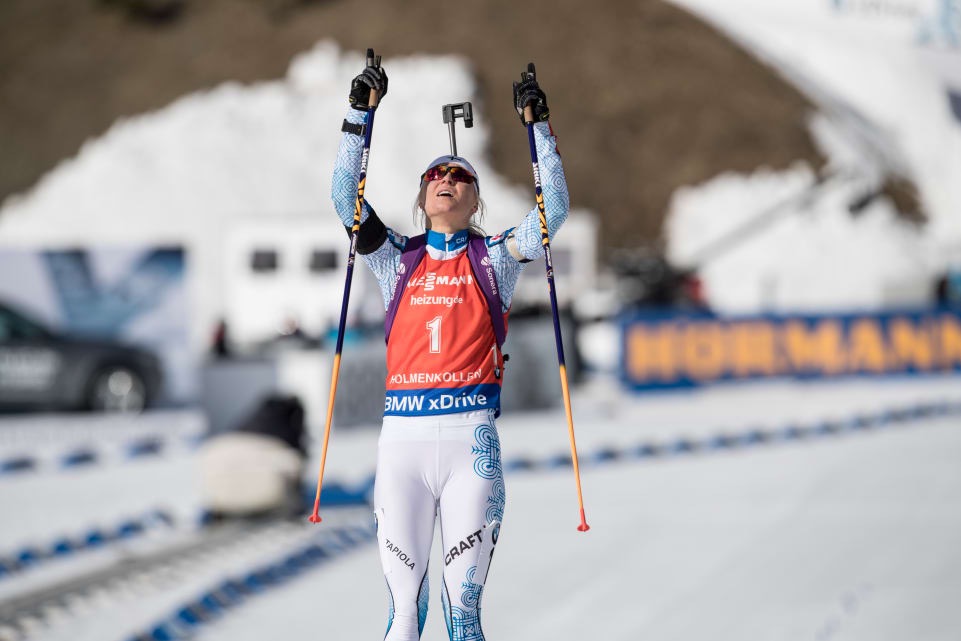
    Finland’s Mari Laukkanen pointing to the sky in honor of her late shooting coach, after she won the women’s 10-kilometer pursuit on Saturday at the 2017 IBU World Cup in Oslo, Norway. (Photo: IBU)

    IBU World Cup (Oslo, Norway): Women’s and men’s pursuits

    Less than 24 hours after winning her first IBU World Cup on Friday in the women’s 7.5 k sprint, Finland’s Mari Laukkanen immediately capitalized on her ideal position with a start-to-finish victory in Saturday’s 10 k pursuit that was never in doubt, cleaning the first three shooting stages before incurring one penalty in her final standing shooting (0+0+0+1) to cross the line in a time of 29:33.3 minutes.

    In addition to experiencing the most successful weekend of her biathlon career by far, it was an emotional day for the 29-year-old Finn due to a personal reason. Laukkanen spread her arms like wings skiing down the homestretch with a commanding lead, pointing repeatedly to the sky and a black ribbon she wore around her right upper arm, before kneeling in the snow in the finish for a few seconds. With those gestures, she reportedly wanted to commemorate her shooting coach Asko Nuutinen, who passed away Friday after suffering a heart attack during the World Cup in Kontiolahti, Finland, a week ago. He was 60 years old.

    “It’s been a really emotional day for me. We have heard really really sad news that last night we lost our longtime shooting coach,” Laukkanen told reporters with a trembling voice in the press conference. “After this it was more or less only about working for him. Working as he has asked me to do for years and years. So I wasn’t thinking about losing or winning today, I was only thinking about him. And I feel really big pleasure that I was able to come to the finish like this, that I can own the victory for him.”

    “I knew it will be difficult after the first victory in my career took me so long,” she added. “And to do it again immediately with good shooting. But as I said I didn’t think about winning or losing today, just doing my work.”

    Finishing 26.5 seconds after her, the Czech Republic’s Gabriela Koukalová reached the finish, moving up from her fourth place starting position with a clean shooting performance (0+0+0+0).

    “I wanted to miss all targets yesterday because I was so tired I didn’t even want to race,” Koukalová confided in the press conference. “It’s difficult to concentrate, three World Cups after the main goal of the season [the World Championships] is too much. Last year it was many times easier… I tried to catch her, but about one kilometer before the finish I saw her far away so I was happy I didn’t have to fight with anyone and was just enjoying the last meters.”

    Despite four penalties (1+1+0+2), France’s Justine Braisaz defended the third place on the podium against a three-person chase group on the last loop (+1:01.4), falling back only one position after having finished the sprint in second.

    “I did not expect such a good place today during the race,” Braisaz commented in the press conference. “Because in the last shooting I completely [failed]. I really wanted to have a clean shooting today, and I did not succeed. So I am happy and surprised, too.”

    Her teammate Anais Bescond who had started the pursuit in third place fell back to 22nd position (+2:53.5) with seven penalties.

    Slovenia’s Teja Gregorin finished fourth with one penalty (+1:08.2), Austria’s Lisa Theresa Hauser shot clean as the only athlete aside from Koukalova on her way to move up from 22nd to fifth place (+1:12.5), while Norway’s Marte Olsbu finished sixth like in the sprint despite three penalties (+1:15.9).

    Unlike in Friday’s sprint race where Germany’s Laura Dahlmeier had still given up a seemingly commanding lead in the sprint World Cup discipline standings to Koukalova, she held onto her lead in the pursuit standings on Saturday, moving up from the 31st starting position to ninth place with a penalty in each of her standing shootings (0+0+1+1, +1:53.8). A 22nd place would have been sufficient to win the “small crystal globe” award in the pursuit. Laukkanen’s teammate Kaisa Mäkäräinen finished 8th  with two penalties in the standing stages (+1:51.2), and thereby claimed the third place in the World Cup pursuit ranking.

    “I knew that I didn’t need to have a perfect race today, just a good one, but that’s always easier said than done,” Dahlmeier told broadcaster ARD after the race. “I am incredibly happy that it worked out and that I could secure myself another small globe… It’s a bit of a weird feeling, standing at the start gate in the middle of the field and the clock ticks and ticks as one athlete after another skis out on the course. And you can only observe how far they have gone and have to wait and be patient, and not make a false start. But then the snow burns, then the chase begins!”

    US Biathlon’s Susan Dunklee experienced an uncharacteristically problematic day on the shooting range and fell back to 37th place (+4:00.2), after starting seventh and less than a minute behind Laukkanen. Dunklee had three misses between two prone stages and seven more in her standing shootings (2+1+4+3) therefore having to ski more than an additional kilometer in the penalty lap.

    “It is a testament to her fighting spirit that she notched the fourth-fastest ski time — one of her best ranks of the season — and never gave up despite suffering a biathlon blowout on the range,” teammate Clare Egan said of Dunklee, according to a US Biathlon press release. “Bad races happen to the best and Susan is no exception, but not everyone fights through till the end no matter what.”

    Egan herself started the pursuit in 34th position and initally was able to make up ground, but then fell back slightly to 41st place (+4:13.9) with four penalties (0+2+0+2).

    “I am satisfied with my race even though the result was not what I was hoping for, and that’s how I would summarize my entire season as well,” Egan said after the final race of her season. “I’ve made a good step forward but my competitors also work hard all summer and we seem to improve at a similar rate.”

    Canada Biathlon’s Julia Ransom moved up to 47th place (+5:04.8) with three penalties (1+0+1+1), after starting in 52nd position.

    [UPDATED] Later on Saturday in the last men’s 12.5 k pursuit of the season, the three best athletes of the season fought throughout the race exchanging in the lead, before they stood next to each other on the range for the final shooting to decide the winner.

    Russia’s Anton Shipulin managed to shoot clean with his elaborate rifle stock in the design of a red dragon, proudly waving to the cameras as he left the arena while his two competitors had to ski into the penalty lap. France’s Martin Fourcade – who had already secured himself the overall World Cup Total Score title as well as the award for the pursuit discipline – was left to duke it out against Norway’s Johannes Thingnes Bø, the winner of Friday’s sprint.

    On the last big climb before the Holmenkollen arena, Fourcade accelerated with a series of explosive jump-skate steps to decisively gap Bø. He even got fairly close to Shipulin on the finish stretch, who had slowed down a bit to grab a Russian flag before skiing over the line in a time of 32:11.9 minutes with one penalty (0+0+1+0), 5.7 seconds ahead of Fourcade who had incurred two penalties (1+0+0+1). While Fourcade shook hands with Shipulin, Bø came into the finish in third place, 21.6 seconds back and also with two penalties (1+0+0+1).

    “It was a crazy race, but I am happy that I managed to finish first,” Shipulin said in the press conference through a translator. “Tough conditions on the shooting range, I had to really work to concentrate on my shooting. On the last loop I was all alone until I saw Martin chasing me, then I got a little bit scared but I managed to [keep him behind].”

    It was Shipulin’s second win of the season, for which he credited his recently improved shooting performance.

    “It was a really exciting competition with Johannes and Anton,” Fourcade agreed with his rival. “I expected to fight with them for the victory on the last loop, but then Anton was simply stronger in the last shooting. My strategy was to be focused on my technique and skills and not on the results, like I did too often in the past few weeks focusing on records and not the victory.”

    Asked about his blazing attack on the final climb, Fourcade added: “Of course I train for that, but I think a lot of athletes do. I talked to Johannes, it was my revenge for the [2016] World Champs where he did exactly the same to me on the last uphill. But I know how it is, it can be different already tomorrow.”

    “I am happy with a new podium of course,” Bø said in the press conference. “I was not at my best in the skiing today. But I still managed to shoot 18 out of 20. As Martin said it was [annoying] that we did not shoot zero [misses] and could not fight with Anton in the finish, but it was quite interesting and fun to stand there in the last shooting … I expected Martin’s attack the second he did it, but I had no energy to fight with him. That was quite strong.”

    Sweden’s Fredrik Lindström placed fourth with no penalties (+44.7), and was the only man in the field who managed to shoot clean in all four stages.

    “For the podium, I was never really close“, Lindström told the IBU in a post-race interview. “But it was a great day anyway. Four times zero [misses], and especially in the standing stages that makes you climb a lot in the standings. Super happy with my performance.”

    US Biathlon’s Lowell Bailey, who had to start closer to the back of the field in 44th position, almost two minutes behind the leaders based on his sprint result, managed to move up 21 spots in the race despite three penalties (2+0+1+0).

    “I’m happy with the race, considering it started out pretty rough with the first two misses,” Bailey told US Biathlon after placing 23rd (+2:23.3). “I just read the wind wrong and didn’t correct enough. After that, I tried to keep my head in the race and make the best of it. I was happy with my skiing and glad to clean the last stage; this brought me up nine spots and I was able to gain another in the last loop. Now, it’s just one race to go. I’m looking forward to tomorrow.”

    Shooting quickly, Bailey recorded the ninth-ranked range time of the day and the ninth-fastest last loop.

    His teammate Sean Doherty started 35th but fell back after having to ski six times through the penalty lap (1+3+1+1) to finish 46th (+4:05.6).

    For Sunday’s mass starts as the final races of the 2016/2017 IBU World Cup season, the only qualified North American starters will be Dunklee (currently in 10th position in the World Cup Total Score standings) and Bailey (currently in eighth).

    The women’s season award in the mass start discipline once more will be decided between Germany’s Dahlmeier and Czech Republic’s Koukalova, while Germany’s Simon Schempp will try to defend his narrow lead on Fourcade. But during Saturday’s final loop, the French star did consider saving energy for the final competition.

    “No,” he simply quipped when asked about this in the press conference. “Of course the mass start is important tomorrow because it will decide about the [mass start] crystal globe. But I think today the pursuit was also really important, and you fight for victory and being one of the best athletes. You can’t be satisfied with only a third place when you can claim a second, and I think all athletes in my position would do the same.”

    Results: Women | Men

    ***

    Norway’s Martin Johnsrud Sundby after winning the Norwegian 54 k classic Birkebeinerrennet, part of the Ski Classics series, on Saturday in Lillehammer, Norway. (Photo: Ski Classics)

    54 k Birkebeinerrennet (Rena to Lillehammer, Norway): Part of the Ski Classics series

    [UPDATED] Not even a snowmobile clipping him and sending him tumbling 20 k before the finish could keep Norway’s Martin Johnsrud Sundby from winning the Birkebeinerrennet on Saturday in Norway. Representing Team United Bakeries, Sundby set a high pace from the start and broke the group down to three by 9 k, with Petter Eliassen of Team LeasePlan and Simen Østensen of Team BN Bank sticking with him until about 30 k in the 54 k marathon.

    With about 20 k to go, Sundby collided with a Ski Classics TV production crew snowmobile while trying to double pole in the snowmobile’s tracks. He was OK and went on to win by 48 seconds over Eliassen in second, and smiled about the incident after the finish.

    “It came in with tremendous speed and mowed me down,” Sundby told NRK, according to a loose translation.

    Ski Classics CEO David Nilsson told NRK he didn’t know exactly how that happened and emphasized that it was unacceptable.

    “We always put safety first, but it is a difficult balancing act with the snowmobile at high speed to get TV pictures,” he said, according to a loose translation. “The skiers often ski in the [snowmobile] track and here it happened and somehow the driver missed it.”

    While Sundby pulled out the win in 2:20:53.5 hours, Eliassen took second and Østensen followed another 3.5 seconds later for third place.

    In the women’s race, Poland’s Justyna Kowalczyk (Team Santander) pulled out a 4 minute and 15 second win over Sweden’s Britta Johansson Norgren (Lager 157 Ski Team). Japan’s Masako Ishida (Team United Bakeries) was another 48.6 seconds back in third.

    “I’m really happy to win this race,” Kowalczyk said, according to a Ski Classics press release. “Everything went well and the cheering on the course was amazing. I will do the rest of the races in Visma Ski Classics, but this victory was the most important for me. Of course, I want to win again in Årefjällsloppet like I did last year, but to win here in front of this audience means so much to me.”

    Tord Asle Gjerdalen, who finished fourth in the men’s race, and Johansson Norgren continue to lead the overall Ski Classics standings with three races to go. The next stop is the Årefjällsloppet in Sweden on March 25.

    “It was a great race and we kept a high tempo up all the way,” Sundby said, according to the press release. “I was able to use uphills for my advantage and get a gap. I had good skis, the conditions were perfect, and to win here was one of my goals for the season. I have the Norwegian Championships in two weeks, and I haven’t counted out the option of going to Finland for the Visma Ski Classics finale.”

    Results

  • Canada Enters 30, U.S. 27 at World Cup Finals in Quebec (Updated x3)

    Alex Harvey racing in the men’s 15 k freestyle pursuit at Stage 4 of the Ski Tour Canada last year in Quebec City. (Photo: FlyingPointRoad.com/NNF)

    For the second-straight year, the World Cup’s season-ending races will be held in Canada, with Québec City hosting 2017 World Cup Finals, this Friday through Sunday. Canada initially announced a roster of 30 (15 women, 15 men) for the three-day mini tour, and the U.S. selected 27 (15 women and 12 men), with both countries maximizing their Nation’s Group “home” quota for the event in downtown Québec City.

    Note: On Tuesday, Cross Country Canada (CCC) announced it would be releasing a revised roster “due to some CPL points errors in calculations,” according to a press release. On Thursday, FasterSkier confirmed that the list included the same 15 women and 15 men that were originally published on FasterSkier.

    And on Wednesday, Quebec organizers announced that the times of each race would be moved back an hour “upon FIS recommendation” to satisfy international broadcast schedules. The updated times are listed below.

    2017 World Cup Finals race schedule (updated Wednesday):

    (All times Eastern Daylight Time)

    • Friday, March 17: Freestyle sprint (qualifier starts at 11:45 a.m.; heats at 2:15 p.m.)
    • Saturday, March 18: 10/15 k classic mass starts (women’s race at 10:40 a.m.; men at 1 p.m.)
    • Sunday, March 19: 10/15 k freestyle pursuits (women’s race at 11:20 a.m.; men at 12:45 p.m.)

    Here are the North American lineups, as well as info on the U.S. selection criteria, and Canadian selection criteria.

    Canada

    Women:

    1. Dahria Beatty (National U25 Team/AWCA)
    2. Emily Nishikawa (World Cup B-team)
    3. Cendrine Browne (NST U25 Team/CNEPH)
    4. Katherine Stewart-Jones (NST U25 Team/NTDC Thunder Bay)
    5. Sophie Carrier-Laforte (CNEPH)
    6. Katie Weaver (Junior National Ski Team/Hollyburn)
    7. Annika Richardson (Junior NST/NTDC Thunder Bay)
    8. Lisle Compton (NTDC Thunder Bay)
    9. Annika Hicks (AWCA)
    10. Sadie White (NTDC Thunder Bay)
    11. Andrea Dupont (RMR)
    12. Frédérique Vézina (CNEPH)
    13. Alannah MacLean (NTDC Thunder Bay)
    14. Mia Serratore (NTDC Thunder Bay)
    15. Laura Leclair (Junior NST/Chelsea Nordiq)

    (Note: Jenn Jackson of Lappe Nordic declined her spot)

    Men: 

    1. Alex Harvey (World Cup A-team)
    2. Devon Kershaw (World Cup A-team)
    3. Len Valjas (World Cup A-team)
    4. Jess Cockney (World Cup B-team)
    5. Graeme Killick (World Cup B-team)
    6. Knute Johnsgaard (NST U25 Team/AWCA)
    7. Russell Kennedy (Canmore Nordic/Team R.A.D.)
    8. Gareth Williams (Junior NST/Telemark)
    9. Andy Shields (Lappe Nordic)
    10. Bob Thompson (NTDC Thunder Bay)
    11. Joey Foster (Team Hardwood)
    12. Julien Locke (NST U25 Team/AWCA)
    13. Evan Palmer-Charrette (NTDC Thunder Bay)
    14. Brian McKeever (Canadian Para-Nordic Ski Team)
    15. Ricardo Izquierdo-Bernier (CNEPH)

    USA

    Women: 

    1. Kikkan Randall (U.S. Ski Team A-team/APU)
    2. Sadie Bjornsen (USST A-team/APU)
    3. Liz Stephen (USST A-team)
    4. Caitlin Patterson (CGRP)
    5. Rosie Brennan (USST B-team/APU)
    6. Erika Flowers (SMS Elite)
    7. Jennie Bender (BSF)
    8. Julia Kern (USST D-team/SMS Elite)
    9. Liz Guiney (CGRP)
    10. Kaitlynn Miller (CGRP)
    11. Chelsea Holmes (APU)
    12. Becca Rorabaugh (APU)
    13. Jessie Diggins (USST A-team/SMS Elite)
    14. Sophie Caldwell (USST A-team/SMS Elite)
    15. Ida Sargent (USST A-team/CGRP)

    (Note: Katharine Ogden, of the SMS Elite Team and U.S. Ski Team D-team, declined her spot due to “ongoing stomach issues,” according to U.S. head coach Chris Grover. Guiney was the first alternate as she was next on the SuperTour list.)

    Men:

    1. Andy Newell (USST A-team/SMS Elite)
    2. Noah Hoffman (USST B-team/Ski Club Vail)
    3. Erik Bjornsen (USST B-team/APU)
    4. Matt Gelso (SVSEF)
    5. David Norris (APU)
    6. Ben Lustgarten (CGRP)
    7. Cole Morgan (SVSEF)
    8. Patrick Caldwell (USST D-team/SMS Elite)
    9. Jack Hegman (SVSEF)
    10. Brian Gregg (Team Gregg/Loppet Nordic Racing)
    11. Scott Patterson (APU)
    12. Simi Hamilton (USST A-team/SMS Elite)
    A view from the steep hill on the sprint course with the stadium area in background, as seen during training last year in Quebec City, one day before the third stage of the 2016 Ski Tour Canada. (Photo: John Lazenby/Lazenbyphoto.com)
  • Retivykh Wins Again in PyeongChang; Newell & Hamilton 4th in Team Sprint

    Retivykh Wins Again in PyeongChang; Newell & Hamilton 4th in Team Sprint

    The men's freestyle team sprint podium at the PyeongChang World Cup on Sunday in South Korea, with France's Lucas Chanavat and Baptiste Gros in second (l), Russia's winning team of Gleb Retivykh and Andrey Parfenov (c) in first, and teammates Nikita Kriukov and Artem Maltsev (r) in third. (Photo: Fischer/NordicFocus)
    The men’s freestyle team sprint podium at the PyeongChang World Cup on Sunday in South Korea, with France’s Lucas Chanavat and Baptiste Gros in second (l), Russia’s winning team of Gleb Retivykh and Andrey Parfenov (c) in first, and teammates Nikita Kriukov and Artem Maltsev (r) in third. (Photo: Fischer/NordicFocus)

    France has never won a World Cup team sprint, neither for men nor women, classic nor freestyle.

    And its team will have to wait a bit longer for that time to come. But France was oh-so-close on Sunday, with Baptiste Gros and Lucas Chanavat racing against the Russian duo of Andrey Parfenov and Gleb Retivykh in the men’s 6 x 1.5-kilometer freestyle team sprint in PyeongChang, South Korea.

    Chanavat, last year’s U23 world champion in the freestyle sprint, tried to attack on the last steep climb but could not gap Retivykh decisively. Then he positioned himself behind the Russian on the downhill into the arena that will host next year’s Olympic Winter Games, shaking out his arms before tucking into the draft. Coming out of the final left turn, he managed to push up next to him on the finishing stretch, but Retivykh lunged over the line a ski boot ahead for the victory in a time of 19:34.11, with Chanavat just 0.03 seconds behind.

    “I did not know in the finish if we won until Andrey told me,” Retivykh told the International Ski Federation (FIS), according to a press release. “It was just as hard skating as it was in classic the other day.”

    But the French duo was not too disappointed after narrowly missing the victory.

    “Romantic meal to celebrate this first podium of the year! We will bring back a good memory of Korea and be strong for next year,” Gros posted on his Facebook page, according to a translation, at 4 a.m. local time with a picture of him and Chanavat wolfing down two cups of noodles.

    “Second in the Team Sprint World Cup in Pyeongchang with my teammate Baptiste Gros (Showing his last drop of rage sinking in his beard)!” Chanavat commented on his Instagram account with a picture of both men smiling. “Next step: be prepared for the world championships in Lahti!”

    Russia’s second team of Artem Maltsev and Nikita Kriukov secured the third position on the podium (+5.52).

    “It feels absolutely great to be back on the podium,” Kriukov told FIS. “For me it’s a very important step on the way back to the top.”

    It was Retivykh’s second victory of the weekend after also winning the men’s invidual classic sprint on Friday, and Russia improved their statistic to become the most successful nation in this event with seven victories in World Cup freestyle team sprints, which have only been contested 25 times so far.

    The U.S. Ski Team’s first team, with Andy Newell and Simi Hamilton, finished fourth, 24.23 seconds behind, after being unable to challenge for the podium on the last leg.

    The Norwegian team of Daniel Stock and Mathias Rundgreen initially crossed the line before the Americans, but was disqualified for an error on the penultimate exchange only tagging off at least a meter behind the allowed zone. Perhaps hoping a later protest might be successful, they kept skiing and finished the race, with no coach or event official stopping them.

    Earlier in the day, Newell and Hamilton had won their semifinal, half a second ahead of the Swedish team of Robin Norum and Gustav Erikson, while Russian’s Parfenov and Retivykh advanced in third (+0.53).

    “For me, I felt great in the semifinal, and in the final,“ Newell said on the phone after. “The semifinal was a lot more enjoyable, because it’s a very challenging course with a lot of climbing, and the pace was just relaxed enough that I was able to make moves when I wanted, and control when I wanted to control. I was able to come in and tag Simi in second to start his final leg, we were able to win that semi, and that was great.”

    In the men’s race, 14 teams advanced to the final round: the top-four teams from each semifinal heat, plus six more teams with the best times.

    Simi Hamilton (U.S. Ski Team) racing to 12th in the men's classic sprint qualifier on Friday at the PyeongChang World Cup in South Korea. He went on to finish 17th overall after crashing in his quarterfinal and finishing fourth in that heat. (Photo: Fischer/NordicFocus)
    Simi Hamilton (U.S. Ski Team) racing to 12th in the men’s classic sprint qualifier on Friday at the PyeongChang World Cup in South Korea. He went on to finish 17th overall after crashing in his quarterfinal and finishing fourth in that heat. (Photo: Fischer/NordicFocus)

    In the final, Newell and Hamilton initially stuck with the leaders on the first legs, with each racer having to ski a total of three 1.5 k loops, tagging off repeatedly.

    They were only 2.4 seconds back heading into the fifth leg, before Newell lost contact with the top four, which included Norway.

    “It was interesting, because there were so many quality distance skiers,” Hamilton said on the phone. “It definitely became evident what their strategy was, especially in the final, they kept the pace really high the whole time. That was tough.”

    “In the final it was pretty intense from the get-go,“ Newell agreed. “I know Norway and one of the Russian teams were really trying to push the pace in the first leg. It was pretty challenging, really tough. I felt pretty solid until the last lap, and then I lost contact coming over the hill, and it was kind of windy and snowy out there, so as soon as you lost contact, it was hard to regain it. It was a real leg burner. Unfortunately, that took us out of podium contention, we did end up finishing fifth, and then the Norwegian team was disqualified, so we got fourth. It was a fun day, a great workout, and a great way to practice that event on the Olympic trails.“

    Not helping matters was that Hamilton had to race with an upset stomach.

    “I don’t know if it’s something I ate or drank, so my energy wasn’t 100 percent, but I still really wanted to race hard,” he said. “It was a good opportunity to get a good result here with diminished fields. I definitely felt better racing than I thought I was going to, but it was for sure a pretty tough day. The course is really hard, it’s long, it’s got a couple of really big climbs, but it skied really well and we had great skis. Andy and I are pretty proud having put in a solid effort, maybe not one of our very best, but a good one for sure. We’re both encouraged by good fitness right now, leading into this little training block before World Champs.”

    The team-sprint discipline, which is the newest on the World Cup circuit, is still rarely on the competition schedule. And only two freestyle team sprint races had been held in Asia previously, both in Sapporo, Japan, for a 2006 World Cup and for the 2007 World Championships. But it seems to be a popular format to test new venues.

    “I don’t know why they are doing this, but every pre-Olympic weekend at least since Vancouver [for the 2009 World Cup respectively the 2010 Olympics] has always been sprint, skiathlon, team sprint”, U.S. Ski Team distance skier Noah Hoffman said on the phone last week, before his trip to Korea.

    Now it was PyeongChang’s turn in the test weekend for the 2018 Olympics. Hoffman did not race on Sunday, but the U.S. was able to start a second squad with Matt Gelso (Sun Valley Ski Education Foundation) and Scott Patterson (Alaska Pacific University).

    American Matt Gelso (24) racing to 19th in Saturday's 30 k skiathlon at the PyeongChang World Cup in South Korea. (Photo: Salomon/Nordic Focus)
    American Matt Gelso (24) racing to 19th in Saturday’s 30 k skiathlon at the PyeongChang World Cup in South Korea. (Photo: Salomon/Nordic Focus)

    In their first World Cup team sprint, the duo managed to advance through the semifinal finishing fifth, 13.86 seconds behind the French team that won the heat.

    “In the semi, our goal was to simply get in the top four for an automatic advance into the finals,” Patterson wrote in an email. “The pace went out moderate for the early laps and there were enough weak teams later in that it was somewhat easy to secure a high finish. Things spread out a little on the last lap for both Matt and I and we were able to advance even with a close finish for fifth.”

    “Scott and I had a hard semifinal,” Gelso wrote. “The pace was very fast from the start so it was very tiring by the end. I felt completely exhausted on the final lap and was concerned with how bad my legs felt that the final would be very bad.”

    But despite feeling tired, the duo managed to hang on in the final and improved by two positions on the last two legs to finish ninth (+54.85),

    “The final broke apart really early,” Patterson explained. “I think for both of us it was kind of survival mode and see if we could get any last drops out of our muscles. Norway and Russia pushed it hard from the gun. I’m not the fastest starter and got caught up behind a Belarusian [Michail Semenov] so I could not chase quite as much as I wished. By the top of the first hill I was bleeding time. From there it was mostly finding our own battles. The Canadians were in it for a bit, but eventually it was between the Germans [Thomas Wick and Andy Kühne] and us. It was a good fight for both legs and happily we took it in the end.”

    Germany placed 10th (+55.13) after Gelso won the finish sprint against Kühne, pushing out of the draft on the finish stretch and raising his left arm in a small celebration as he crossed the line.

    “The team sprint today was very fun as Scott and I were able to be in the mix, get into the final, and ski solid through the race,” Gelso wrote. “Not an outstanding result but a good, solid, fun day on the race course with ample opportunities to make things happen.”

    Canada’s Len Valjas had the chance to become the first athlete in a long time to win two consecutive  team sprints, after winning last month’s freestyle team sprint in Toblach, Italy, with teammate Alex Harvey.

    Teaming up with Jess Cockney for Sunday’s race (who had placed 10th in the sprint on Friday while Valjas finished fourth), the duo placed sixth (+4.1) despite a broken pole in the second semifinal, which Newell and Hamilton won.

    In the final, Cockney and Valjas were initially able to keep in sight of the leaders, tagging off in ninth in the first exchange, only five seconds back. By the race’s halfway point, they were 10th (+21.0), before falling to the back of the field and losing significant time. They went on to finish in 13th position, 1:38.2 behind the winners.

    Valjas and Cockney could not be reached by press time to determine if they had fallen back due to a crash, more broken poles, or were simply running out of energy after racing on a very demanding sprint course all weekend.

    The World Cup goes on break for a week before resuming Feb. 18-19 in Otepää, Estonia, with freestyle sprints and 10/15 k classic races, in the last World Cup before 2017 World Championships in Lahti, Finland.

    — Gabby Naranja and Jake Ellis contributed

    Results

  • Sunday Rundown: PyeongChang, Soldier Hollow & Eastern Canadian Champs (Updated x3)

    The women's 4 x 3.3 k relay podium on the final day of 2017 Junior World Championships at Soldier Hollow in Midway, Utah, with Russia (c) in first, Italy (l) in second, and the U.S. (with Hailey Swirbul, Julia Kern, Hannah Halvorsen, and Katharine Ogden) in third. (Photo: FlyingPointRoad.com)
    The women’s 4 x 3.3 k relay podium on the final day of 2017 Junior World Championships at Soldier Hollow in Midway, Utah, with Russia (c) in first, Italy (l) in second, and the U.S. (with Hailey Swirbul, Julia Kern, Hannah Halvorsen, and Katharine Ogden) in third. (Photo: FlyingPointRoad.com)

    FIS Nordic Junior World Championships (Midway, Utah): Junior relays

    Hailey Swirbul, Julia Kern, Hannah Halvorsen, and Katharine Ogden on the podium. That’s right. Two days after Ogden became the first American to earn an individual medal at Junior World Championships, those four U.S. junior women listed above did the same, placing third in the 4 x 3.3-kilometer relay on the last day of 2017 Junior World Championships at Soldier Hollow in Midway, Utah.

    The team credited their lucky socks, similar to the red-white-and-blue striped socks the U.S. women’s World Cup team wears for relays and team events.

    “We gave everything we got,” Kern said in a televised post-race interview.

    “It’s the dream,” Ogden said.

    In fourth at the last exchange, Ogden anchored the team to third, 25.8 seconds behind Russia, which won in 34:45.3 minutes with Polina Nekrasova, Lidia Durkina, Anna Zherebyateva, and Mariya Istomina.

    Italy placed second (+20.6) with Martina Bellini, Anna Comarella, Francesca Franchi, and Christina Pittin.

    Canada finished 12th (+4:41.3) with Natalie Hynes, Lisle Compton, India McIsaac, and Annika Richardson.

    [UPDATED] In the junior men’s 4 x 5 k relay that followed, Norway’s Thomas Helland Larsen outlasted Russia’s Vladislav Vechkanov by 0.4 seconds for the team win in 49:36.1.

    Norway’s gold-medal team included Herman Martens Meyer, Jon Rolf Skamo Hope, Harald Østberg Amundsen, and Larsen, while Russia took silver with Egor Kazarinov, Kirill Kilivnyuk, Yaroslav Rybochkin, and Vechkanov.

    France rounded out the podium in third (+1:05), with Martin Collet, Camille Laude, Hugo Lapels, and Arnaud Chautemps.

    The U.S. finished ninth (+4:28.8) with Bill Harmeyer, Kam Husain, Wyatt Gebhardt, and Hunter Wonders, and Canada followed in 10th (+5:21.6) with Antoine Blais, Ryan Jackson, Philippe Boucher, and Gareth Williams. Twelve teams finished the men’s relay, the final race of 2017 Junior World Championships.

    Results: Women | Men

    ***

    FIS Cross-Country World Cup (PyeongChang, South Korea): Freestyle team sprint

    The women's freestyle team sprint podium at the PyeongChang World Cup on Sunday in South Korea, with Sweden's Elin Mohlin and Maria Nordström (c) in first, Norway's Anna Svensen and Silje Øyre Slind (l) in second, and USA I's Ida Sargent and Sophie Caldwell (r) in third. (Photo: FIS Cross Country/Twitter)
    The women’s freestyle team sprint podium at the PyeongChang World Cup on Sunday in South Korea, with Sweden’s Elin Mohlin and Maria Nordström (c) in first, Norway’s Anna Svensen and Silje Øyre Slind (l) in second, and USA I’s Ida Sargent and Sophie Caldwell (r) in third. (Photo: FIS Cross Country/Twitter)

    The U.S. women had one team on the podium and one just 0.35 seconds off of it on Sunday in the World Cup 6 x 1.4-kilometer freestyle team sprint in PyeongChang, South Korea.

    USA I, with Sophie Caldwell and Ida Sargent, skied in third for most of the race and ultimately finished third, 6.11 seconds behind Sweden’s Elin Mohlin and Maria Nordström in first (in 20:37.11 minutes). Norway took second, 1.71 seconds back, with Anna Svensen and Silje Øyre Slind, while USA I edged USA II, with Caitlin Patterson and Liz Stephen for third. Patterson and Stephen ended up fourth (+6.46), ahead of Slovenia’s Katja Visnar and Anamarija Lampic in fifth (+14.46).

    Fifteen women’s teams competed on Sunday, with 10 of them reaching the final. Canada placed 14th overall with Annika Hicks and Sadie White.

    In the men’s 6 x 1.5 k freestyle team sprint, Russia’s Gleb Retivykh picked up his second win in in PyeongChang, after winning Friday’s classic sprint. He teamed up with Andrey Parfenov for the victory in 19:34.11, beating France (Baptiste Gros/Lucas Chanavat) by 0.03 seconds in a photo finish.

    Russia had two teams on the podium with Russia II’s Artem Maltsev and Nikita Kriukov in third (+5.52). Andy Newell and Simi Hamilton (USA I) fell off the leaders’ pace to finish fourth (+24.23), 18.71 seconds off the podium.

    USA II, with Scott Patterson and Matt Gelso, finished ninth (+54.85) in the final, and Canada’s Jess Cockney and Len Valjas placed 13th of 14 teams.

    Results: Women | Men 

    ***

    NorAm Eastern Canadian Championships (Cantley, Quebec): 15/20 k freestyle pursuits

    SMS Elite's Anne Hart catching Nakkertok's Zoe Williams in the interval start classic, day two of Eastern Championships. (Photo: Ian Austen)
    SMS Elite’s Anne Hart catching Nakkertok’s Zoe Williams in the interval start classic, day two of Eastern Championships. (Photo: Ian Austen)

    The NorAm mini tour at the Nakkertok Nordic Centre wrapped up with freestyle pursuits.

    In the men’s 20 k, AWCA’s Russell Kennedy posted the fastest time of 53:42.68 to move up from third to take the overall victory in 1:33.22.  Lappe Nordic’s Andy Shields started first but couldn’t hold off Kennedy, finishing 36 seconds behind with a 6th best time, 1:01.46 slower. AWCA’s Dominique Moncion-Groulx wrapped up a strong weekend with the fourth best time of day, 37.92 back, to take third overall, 58.53 behind Kennedy.

    SMS Elite’s Anne Hart won the women’s 15 k pursuit in dominant style, starting first and winning time of day in 47:36.10 for an overall time of 1:17:39. AWCA’s Maya MacIsaac-Jones started third and finished second with the second best time of day, 31.36 seconds back for a combined deficit of 51.39 seconds. CNEPH’s Sophie Carrier-Laforte started second and ended third, 2:14.81 down after a sixth best time of day 2:05.47 back.

    Results: Pursuit | Full Weekend

  • Russia’s Sedov Tops PyeongChang Skiathlon; Hoffman 8th, Patterson 9th

    Russia’s Sedov Tops PyeongChang Skiathlon; Hoffman 8th, Patterson 9th

    Russia's Petr Sedov en route to his first World Cup win on Saturday in the PyeongChang World Cup 30 k skiathlon in South Korea. (Photo: Fischer/Nordic Focus)
    Russia’s Petr Sedov en route to his first non-stage World Cup win on Saturday in the PyeongChang World Cup 30 k skiathlon in South Korea. (Photo: Fischer/NordicFocus)

    The rough translation of the Korean word “기회” or “gihoe” into English is “opportunity”. And it’s the best way to describe what was on offer Saturday afternoon in PyeongChang, South Korea during the men’s World Cup 30-kilometer skiathlon.

    No seeded men on the World Cup contested the race. No Sundby. No Ustiugov. No Harvey. No Hellner. Lot’s of 기회.

    For the three skiers finishing in positions 1, 2, and 3, it was a career-first World Cup podium. Russia’s Petr Sedov placed first in 1:18:49.6. Norwegian Daniel Stock finished second 22.5 seconds back with his teammate Mathias Rundgreen third (+42.1).

    “I felt very strong today,” Sedov told the International Ski Federation (FIS) after the race. “I have to thank to my coach, service staff and to my family. I am very glad that my first ever World Cup podium is a win.”

    To be clear, It was Sedov’s first individual non-relay and non-tour stage World Cup podium. He’s placed second twice in 2010 and first once in 2011 as part of Russian relay teams. Sedov also won a 2012 World Cup stage 15 k skate pursuit in Falun, Sweden.

    And to discount the World Cup strength of some others would have been foolish. This was Stock’s sixth World Cup start. Yet he, too, like Sedov, came with realistic podium-hunting background: as recently as Jan. 21, he skied to fifth in the World Cup 15 k skate in Ulricehamn, Sweden. Canada’s Alex Harvey, Norway’s Martin Johnsrud Sundby, Sweden’s Marcus Hellner, and Switzerland’s Dario Cologna were the only athletes ahead of Stock that day.

    For Rundgreen, it’s the same: not a World Cup brand name, but bringing with him plenty of real-deal horsepower to shatter the race. He boasts three top-10 World Cup performances, including a first and second as part of Norwegian relay teams.

    Rundgreen held off three others for third place, including Sweden’s Gustav Eriksson in fifth (+46.8), Japan’s Keishin Yoshida in sixth (+47.1), and Russia’s Alexander Utkin in seventh (+49.0).

    The U.S. had two top 10’s, with the U.S. Ski Team’s Noah Hoffman in eighth (+1:06.2) and Scott Patterson (Alaska Pacific University) a spot behind in ninth (+1:28.4). Matt Gelso (Sun Valley Ski Education Foundation), the only other American starter, placed 19th (+5:00.8).

    Canada’s Brian McKeever (Canadian Para-Nordic Ski Team) finished 29th (+8:48.9) for his first regular-season World Cup top 30. (McKeever placed 21st in the 15 k skate at 2007 Sapporo World Championships.)

    The Classic Leg

    “At the beginning of the race the pace was a little bit subdued,” U.S. Ski Team Head Coach Chris Grover said on the phone. “Early on, no one was really charging too much.”

    Americans Matt Gelso (bib 24) and Scott Patterson (bib 10) striding in the pack during Saturday's 30 k skiathlon in PyeongChang, South Korea. Gelso went on to finish 19th overall while Paterson placed ninth. (Photo: Salomon/Nordic Focus)
    Norway’s Mathias Rundgreen (6) and Americans Matt Gelso (24) and Scott Patterson (10) striding in the pack during Saturday’s 30 k skiathlon in PyeongChang, South Korea. Gelso went on to finish 19th overall while Paterson placed ninth. (Photo: Salomon/Nordic Focus)

    Rundgreen controlled the tempo, leading the pack through the 5 k split at 14:16.

    “They were going so slow at one point that Noah just took off to the front and made a little surge,” Grover noted.

    That came at 6.15 k, and Hoffman won the first of two preems, or bonuses, in the race. Patterson came through in ninth, six seconds later.

    At 7.5 k, a line of 21 skiers lapped through the stadium —  Hoffman in third, Patterson ninth, four seconds out. Gelso trailed at the tail of that group, nine seconds off.

    At 9.9 k, it was a repeat; Hoffman took the second bonus, controlling the pace up front surging and slowing. (Both bonuses amounted to 30 extra World Cup points for Hoffman.) Gelso and Patterson came through about eight seconds later in 14th and 18th, respectively.

    “I was feeling pretty good on the classic,” Hoffman explained on the phone.

    American Noah Hoffman (r) racing alongside Norway's Daniel Stock during Saturday's 30 k skiathlon at the World Cup in PyeongChang, South Korea. (Photo: Fischer/Nordic Focus)
    American Noah Hoffman (r) racing alongside Norway’s Daniel Stock during Saturday’s 30 k skiathlon at the World Cup in PyeongChang, South Korea. (Photo: Fischer/NordicFocus)

    It was also an opportune time for U.S. Ski Team sponsors as Hoffman captured the majority of camera time. There was nothing about his skiing that didn’t appear confident. Solid striding, focused effort, and a will to position himself in the lead, or one or two spots back.

    But that was his bluff.

    “If I had been confident in my ability to win the race I probably would have really chilled on the classic —  which I didn’t do,” Hoffman said of his front-of-the-pack classic leg effort. “I was skiing up near the front a lot. I was snagging some of the preems. … I was kind of playing games a little bit, having fun with the pack a little bit which was really fun to do. And maybe you could mistake that for confidence, but I think it was probably the opposite.”

    Part of sport is gamesmanship. And part of opportunity is taking bold chances to seize it. The best athletes are not afraid of failure.

    “I got stretched a little bit on the last classic lap to the tune of maybe five seconds plus or minus,” Hoffman added.

    “My classic leg went pretty well for 2.5 loops,” Patterson wrote in an email. (Each loop was 3.75 k.) “I was hovering around 10th until we hit the longest down hill on the course. There were some surges for bonus points right before and I had a slight gap in front of me in my lane … I also ended up in a lane that had not glazed nearly as much as the primary center track. I probably went from 10th to around 25th. After that the rest of the classic I was spending too much energy to get back up close to the front and I ended coming through a bit off the lead group.”

    15 k of Skating

    Eleven skiers entered the classic to skate exchange with approximately 10 seconds separating the first from last. Hoffman had a seamless changeover, the second fastest, and left on his skate skis in fourth. Behind him, Patterson left the exchange 16th (+24.0).

    Initially Rundgreen led the line of 11 skaters that increasingly spread out. One by one, another dropped, losing a meter or two, then they’d up the tempo to catch back on. Then Sedov would pull with the same effect.

    But right there glued on at 17 k was Hoffman. He was in third at 19 k, but had bled nine seconds to Sedov and Stock now in the lead.

    At that mark, Patterson had ceded 39 seconds to the Sedov-Stock combo. Gelso had fallen a bit over two minutes behind.

    For the remaining distance, Sedov was the skier to beat as he slowly put a gap on Stock.

    Hoffman’s group, five skiers deep, could sniff the third podium spot and it became an every-skier-for-themselves effort.

    Norway's Mathias Rundgreen (6) outlunging Russia’s Konstantin Glavatskikh (l) for third in the men's 30 k skiathlon on Saturday at the PyeongChang World Cup in South Korea. (Photo: Fischer/NordicFocus)
    Norway’s Mathias Rundgreen (6) outlunging Russia’s Konstantin Glavatskikh (l) for third in the men’s 30 k skiathlon on Saturday at the PyeongChang World Cup in South Korea. (Photo: Fischer/NordicFocus)

    Rundgreen outlunged Russia’s Konstantin Glavatskikh for the final podium spot in a photo finish — they were given the same finishing time of 1:19:31.7.

    “It was fun, it was nice to ski back up front,” Hoffman said. “I was doing that a lot in 2012, 2013, 2014 … I was just being involved in the race. So I wanted to do a little bit of that. From that perspective, I think it was good, I was definitely involved in the race throughout.”

    Hoffman’s eighth place (+1:06.2) was his best result in a non-stage World Cup since placing eighth in a 2012 skiathlon in Canmore, Alberta. (Hoffman won the time of day in the 15 k pursuit four years ago in Kuusamo, Finland.)

    For Patterson, the skate leg competition analysis reveals his strong skiing —  most of his skate leg sector times rank in the top 10, with several top-five splits.

    “My skate leg was quite good,” Patterson wrote after finishing ninth, one spot behind Hoffman. “Unfortunately I had a bit to move up from the classic. I spent most of the skate chasing the pack that Noah was in. They would accelerate going into some of the bonus points and then I would gain back on the rest of the course. I think I could have been quite good if I was able to latch onto the pack but I never quite made it. Instead I just cruised past everyone who fell off.”

    Matt Gelso (SVSEF) racing to 19th in Saturday's World Cup 30 k skiathlon in PyeongChang, South Korea, for his first World Cup top 20. (Photo: Salomon/Nordic Focus)
    Matt Gelso (SVSEF) racing to 19th in Saturday’s World Cup 30 k skiathlon in PyeongChang, South Korea, for his first World Cup top 20. (Photo: Salomon/Nordic Focus)

    Saturday marked the first career World Cup points for Patterson. Gelso, who scored his first points during Friday’s sprints, fell back on the skate leg to finish 19th — still his first World Cup top 20.

    McKeever, a visually impaired skier who races without a guide in FIS World Cups, finished 29th to lead Canada, which started three men.

    “The strategy was simply to follow,” McKeever emailed. “No point in deluding myself that I’m at the same level as the top guys. They dictate how the race is run. I just try to react.  I just try to find decent wheels to follow and a rhythm that suits my style. … It was a tough day given recent shape. I was very sick after US nationals and spent a pretty uncomfortable week in bed. Given that, I’m quite happy with the effort being that it was really all I had.”

    Also for Canada, Bob Thompson (NTDC Thunder Bay) placed 32nd (lapped), and Simon Lapointe (CNEPH) did not finish.

    Results | Competition analysis

  • Saturday Rundown: PyeongChang, Soldier Hollow & Eastern Canadian Champs (Updated x3)

    The Russian men finishing in unison to take first, second and third in the men's 30 k skiathlon, the final race of 2017 U23 World Championships at Soldier Hollow in Midway, Utah. Alexander Bolshunov (8) was deemed the winner, Alexey Chervotkin (1) was second, and Denis Spitsov (11) third. (Photo: FlyingPointRoad.com)
    The Russian men finishing in unison to take first, second and third in the men’s 30 k skiathlon, the final race of 2017 U23 World Championships at Soldier Hollow in Midway, Utah. Alexander Bolshunov (8) was deemed the winner, Alexey Chervotkin (1) was second, and Denis Spitsov (11) third. (Photo: FlyingPointRoad.com)

    FIS Nordic Combined Junior World Championships (Park City and Midway, Utah): Normal hill/5 k

    American Ben Loomis (6) leads Norway's Lars Ivar Skaarset (7) during the third leg of the nordic-combined 4 x 5 k team event on Thursday at 2017 Nordic Junior Worlds at Soldier Hollow in Midway, Utah. Loomis brought the U.S. from ninth to seventh, and his team ultimately finished seventh. (Photo: FlyingPointRoad.com)
    American Ben Loomis (6) leads Norway’s Lars Ivar Skaarset (7) during the third leg of the nordic-combined 4 x 5 k team event on Thursday at 2017 Nordic Junior Worlds at Soldier Hollow in Midway, Utah. Loomis brought the U.S. from ninth to seventh, and his team ultimately finished seventh. (Photo: FlyingPointRoad.com)

    [UPDATED] In the individual normal hill/5-kilometer Gundersen on Saturday, the last nordic-combined competition of 2017 Nordic Junior World Championships, American Ben Loomis captured his first top 10 in his third Junior Worlds in ninth place.

    Eighteen-year-old Loomis jumped to 10th then picked off one place in the 5 k to finish ninth, 1:22.3 minutes behind the winner, Germany’s Vinzenz Geiger.

    Geiger led after the jump and started the ski race 4 seconds ahead of Japan’s Yuto Nakamura in second. Geiger was able to hold off Finland’s hard-charging Arttu Mäkiaho, who raced from ninth to second, by 22.6 seconds. France’s Laurent Muhlethaler raced from fifth to third (+23.9) for the final spot on the podium, while Nakamura slipped to fourth (+42.8).

    The U.S. had two in the top 15 with Stephen Schumann in 15th (+1:44.3), up from 20th after the jump. Grant Andrews placed 33rd (+2:40.0) and Tucker Hoefler finished 46th (+3:56.9).

    Results

    ***

    FIS Nordic U23 World Championships (Midway, Utah): 15/30 k skiathlon

    It was a Russian affair and a head scratcher for the photo-finish crew at U23 World Championships on Saturday, with three Russians putting enough time on the rest of the field in the men’s 30-kilometer skiathlon that they had time to slow to a stop and inch across the line in unison.

    The jury ultimately had to decide who won, awarding it to Alexander Bolshunov in 1:15:31.5 hours, 0.2 seconds ahead of Alexey Chervotkin in second. Denis Spitsov was listed as third (+0.5). France’s Jules Lapierre came closest to the Russians in fourth, finishing 11 seconds later.

    The field was considerably strung out by the end of the race, with Switzerland’s Jason Rueesh finishing 14.3 seconds out of first in fifth and Norway’s Gaute Kvaale crossing the line in sixth (+33.0), ahead of France’s Valentin Chauvin in seventh (+49.1), and Andorra’s Irineu Esteve Altimiras in eighth (+56.8).

    American Paddy Caldwell (SMS/USST) placed ninth for the second-straight race at U23s, finishing 1:24.4 behind the winner.

    The U.S. men had three in the top 15 for their best day of the championships, with John Hegman (SVSEF) placing a 11th (+1:53.5) and Adam Martin (NMU) 15th (+2:23.3) for their best results at U23 Worlds.

    Evan Palmer-Charrette (NTDC Thunder Bay) led the Canadian men in 26th (+5:44.6). Alexis Dumas (CNEPH) finished 33rd (+9:02.7) out of 36 finishers. Several North Americans did not finish, including Canada’s Julien Lamoureux and Julien Smith, and American Cal Deline.

    In the women’s 15 k skiathlon, Lotta Udnes Weng achieved her first gold of U23 Worlds, holding off Finland’s Johanna Matintalo by 3.8 seconds and crossing the line in 40:50.9 minutes. Russia’s Yana Kirpichenko reached the podium in third (+13.9), fewer than two seconds ahead of Weng’s twin sister, Tiril Udnes Weng in fourth (+15.6).

    Dahria Beatty, of the Alberta World Cup Academy and Canadian National U25 Team, led the North Americans in 19th (+2:18.1), and teammate Katherine Stewart-Jones (NTDC Thunder Bay/NST U25 Team) was 21st (+2:29.3) for her best U23 Worlds result.

    The Czech Republic’s Petra Hyncicova (University of Colorado-Boulder) followed in 22nd (+2:30.7), and three Canadian women finished in the top 30 with Frederique Vezina (CNEPH) in 29th (+3:36.2). Jenn Jackson did not finish.

    Jesse Knori (University of Colorado-Boulder) was the top American in 30th (+3:40.1), Alayna Sonnesyn followed in 31st (+3:42.5), Nichole Bathe (University of Alaska Fairbanks) in 33rd (+4:36.9), and Corey Stock (Bridger Ski Foundation) in 36th (+5:42.1).

    Mathilde Petitjean, who races for her native Togo but trains with the Quebec-based CNEPH, finished 38th (+6:04.8) of 38 finishers.

    Results: Men | Women

    ***

    FIS Cross-Country World Cup (PyeongChang, South Korea): 15/30 k skiathlon

    The women's 15 k skiathlon podium at the PyeongChang World Cup in South Korea, with Poland's Justyna Kowalczyk (c) in first, American Liz Stephen (l) in second, and Japan's Masako Ishida in third. (Photo: FIS Cross Country/Twitter)
    The women’s 15 k skiathlon podium at the PyeongChang World Cup in South Korea, with Poland’s Justyna Kowalczyk (c) in first, American Liz Stephen (l) in second, and Japan’s Masako Ishida in third. (Photo: FIS Cross Country/Twitter)

    The second day of World Cup racing in PyeongChang, South Korea, took place this Saturday, with a skiathlon event for both genders. The women raced a total of 15 kilometers, the first 7.5 k leg classic and the second 7.5 k leg freestyle. Poland’s Justyna Kowalczyk came away with the women’s win (her first in three years), getting back to her old ways of breaking away from the pack to finish first in 43:54.7 minutes. Liz Stephen of the U.S. Ski Team (USST) claimed second place (+56.0), while Japan’s Masako Ishida took third (+1:14.8).

    For Stephen, second matched her best individual result in a from two years ago, when she placed second in a 10 k freestyle in Rybinsk, Russia. This year at the Tour de Ski, Stephen posted the second-fastest time up the final climb in Val di Fiemme, Italy. For Ishida, it was her first podium since 2009.

    Caitlin Patterson, racing for the U.S., finished just off the podium with a career-best fourth (+1:21.4) for her first top 20 on the World Cup,  and American Liz Guiney placed 13th (2:21.7) for her first top 20 as well. Jessica Yeaton, who trains with Alaska Pacific University and races for Australia, came in 24th (4:58.6).

    Two Canadian women competed with Annika Hicks leading the team in 26th (+5:17.8) followed by Sadie White in 29th (+6:54.7) for their first World Cup top 30s.

    In the men’s 30 k skiathlon that followed, Russia’s Petr Sedov broke away during the skate leg to take a decisive victory over Norway’s Daniel Stock and Mathias Rundgreen, finishing in 1:18:49.6 hours, 22.5 seconds clear of second place. It was Sedov’s first World Cup win and podium, and the first individual podiums for Stock and Rundgreen as well.

    Rundgreen edged Russia’s Konstantin Glavatskikh for the final spot on the podium, with both being listed as 42.1 seconds behind Sedov.

    While Rundgreen held off three others for third place, including Sweden’s Gustav Eriksson in fifth (+46.8), Japan’s Keishin Yoshida in sixth (+47.1), and Russia’s Alexander Utkin in seventh (+49.0), American Noah Hoffman kept his distance ahead of the second chase group to finish eighth (+1:06.2) for his best result in a non-World Cup stage since placing eighth in a 2012 skiathlon in Canmore, Alberta. (Hoffman won the time of day in the 15 k pursuit four years ago in Kuusamo, Finland.)

    Also for the U.S., Scott Patterson was next across the line in ninth (+1:28.4) for his first World Cup points, and Matt Gelso finished 19th (+5:00.8) for his first top 20.

    Brian McKeever of Canada’s Para-Nordic Ski Team was the lone Canadian finisher in 29th (+8:48.9). Bob Thompson was listed as placing 32nd of 37 after being lapped, and Simon Lapointe did not finish.

    Results: Women | Men

    ***

    NorAm Eastern Canadian Championships (Cantley, Quebec): Classic interval start

    The NorAm mini tour at the Nakkertok Nordic Centre continued on Saturday with Eastern Canadian Championships with classic individual start races.

    In the men’s 15 kilometre, Lappe Nordic’s Andy Shields took a lead in the first lap and held on to win in 39:14.7, just 0.7 seconds ahead of CNEPH’s Ricardo Izquierdo-Bernier.  Team R.A.D.’s Russell Kennedy collected his second bronze of the weekend, 24.7 seconds back.

    SMS Elite’s Anne Hart won the women’s 10 k in a reversal of Friday’s sprint podium.  Hart’s 30:03.3 finish gave her a 9.3 second edge on CNEPH’s Sophie Carrier-Laforte and 20.0 seconds on AWCA’s Maya MacIsaac-Jones.

    For the 123 men and 77 women doing the full distance, the weekend is a mini tour.  For the younger categories, it is three separate events allowing the kids who couldn’t skip school on Friday to race Saturday and Sunday.

    There should be over 700 finishers today with 768 on the start list. The volunteers will have more hours of work even after the open categories have finished.

    Results will update continuously as more categories start.

  • Under 23 Questions with Jack Hegman

    American Jack Hegman (SVSEF) racing to 24th in the men's 15 k freestyle on Thursday at 2017 U23 World Championships at Soldier Hollow in Midway, Utah. (Photo: FlyingPointRoad.com)
    American Jack Hegman (SVSEF) racing to 24th in the men’s 15 k freestyle on Thursday at 2017 U23 World Championships at Soldier Hollow in Midway, Utah. (Photo: FlyingPointRoad.com)

    In an effort to showcase the North Americans competing at this week’s International Ski Federation (FIS) 2017 USANA Nordic Junior World Championships and U23 Cross Country World Championships at Soldier Hollow in Midway, Utah, we asked those qualifying athletes several questions about themselves — actually, we had them fill in the blanks. Here we have 22-year-old Jack Hegman, of the Sun Valley Ski Education Foundation (SVSEF) Gold Team, who’s representing the U.S. at his first U23 Worlds.

    On Saturday, Hegman raced to 11th in the men’s 30 k skiathlon on the final day of U23 World Championships at Soldier Hollow. Earlier this week, he placed 24th in the men’s 15 k freestyle and 28th in the classic sprint. 

    ***

    “My full name is John, but you can call me Jack. I was born in Randolph, Vt., raised in Huntington, Vt., and one thing you should know about my hometown is that it is home to the 3rd tallest mountain in VT.

    I started cross-country skiing when I was ten, thanks to my older brother. I currently train in Sun Valley, Idaho, with SVSEF Gold Team.

    If I’m not skiing, you might find me beating Cole Morgan at squash. If I had to pick a favorite book, it would be ‘Into Thin Air‘.

    American Jack Hegman (23) mixing it up in the rounds of the men's classic sprint at 2017 U23 World Championships on Jan. 31 at Soldier Hollow in Midway, Utah. He took sixth in his quarterfinal to place 28th on the day. (Photo: FlyingPointRoad.com)
    American Jack Hegman (23) mixing it up in the rounds of the men’s classic sprint at 2017 U23 World Championships on Jan. 31 at Soldier Hollow in Midway, Utah. He took sixth in his quarterfinal to place 28th on the day. (Photo: FlyingPointRoad.com)

    One of the things I’m most excited about for U23/Junior Worlds at Soldier Hollow is the sunshine. One race I’m especially targeting there is the 15 k skate.

    The best advice anyone ever gave me about skiing or racing was ‘Go in’. One of the best race memories I have is 2012 Stratton Equalizer.

    If I could meet one World Cup skier, it would be Matthew Gelso.

    If I don’t end up being a professional skier, I’ll probably be a professional squash player.”

  • Valjas 4th, Newell 6th in PyeongChang Sprint Final

    Valjas 4th, Newell 6th in PyeongChang Sprint Final

    Russia's Gleb Retivykh (l) racing to his first World Cup victory and podium on Friday in the World Cup classic sprint in PyeongChang, South Korea, ahead of Norway's Sondre Turvoll Fossli (second from l), Canada's Len Valjas (behind Fossli), and Russia's Andrey Parfenov and Alexander Panzhinskiy. (Photo: Fischer/NordicFocus)
    Russia’s Gleb Retivykh (l) racing to his first World Cup victory and podium on Friday in the World Cup classic sprint in PyeongChang, South Korea, ahead of Norway’s Sondre Turvoll Fossli (second from l), Canada’s Len Valjas (behind Fossli), and Russia’s Andrey Parfenov (second from r) and Alexander Panzhinskiy (r). (Photo: Fischer/NordicFocus)

    As a sphere, the Earth is a tidy shape and can be divided into equal segments. It takes roughly 24 hours for the planet to rotate on its axis once, constituting a single day. So there’s 24 time zones, one for each hour of rotation. On Friday, the tidiness was disrupted a bit for European-based World Cup skiers. PyeongChang, South Korea, host of the 2018 Winter Olympics, was site of the men’s World Cup 1.5-kilometer classic sprint.

    PyeongChang sits a full eight hours ahead of Central European Time, a time zone most World Cup skiers are adjusted to. To accommodate the time shift, the sprints were run at night, under the lights.

    “It’s been tough. We knew the races were going to be really late here in Korea so that the T.V. time works in Europe,” U.S. Ski Team (USST) member Andy Newell said on the phone. “But as far as adjusting, you go in and out and definitely feel pretty tired at times, like when you’re trying to fire it up and get ready to race. But once you’re racing, it seems like it’s OK. You don’t notice the jet lag once you’re out there on the track.”

    In a field of 55 skiers, Newell was one of two North Americans to make the men’s final; the other was Canada’s Lenny Valjas. Newell placed sixth in the final (+17.1), Valjas fourth (+0.74) in a photo finish with Russia’s Andrey Parfenov (+0.73), who skied to third overall.

    “It was really close between me and Lenny,” Parfenov told the International Ski Federation (FIS), according to a press release. “I know he was next to me. I was lucky have a better lunge. It was a good track for classic. There is not so much double poling sections, more uphills and that was good for me. I am really happy for my second podium of my career.”

    Russia’s 26-year-old Gleb Retivykh won the final in 3:30.79, ahead of Norway’s Sondre Turvoll Fossli in second (+0.30). It was Retivykh’s first career World Cup win and first time on the podium, despite finishing in the top 10 in World Cup sprints on 10 other occasions. And despite his comments to FIS, the Russian’s speediness may just have allowed him to momentarily outrun the jet lag.

    “I arrived here yesterday so I am still jet lagged,” Retivykh said. “I knew Sondre is very strong. I did not think I could win. I was hoping for a good result. I had to wait six years for my first victory and it is great.”

    Valjas Leads Canada in 4th

    Time zones and new food be damned. For seasoned athletes like Valjas and Newell, planes, shuttle buses, and exploratory cuisine are all part of the international skiing life. Despite the time-zone-shift-wormhole, both skiers delivered.

    For Valjas, of Canada’s World Cup A-team, the vagaries of food prep in South Korea flummoxed him.

    “Adjusting to the time change went fairly well, but I ran into some trouble with the food here,” Valjas wrote in an email. He is allergic to peanuts and fish; two ingredients in the form of peanut and fish oil that’s ubiquitous in Korean meals.

    “The last two dinners I have not been able to eat because I had reactions,” Valjas added. “Even the ‘safe’ boiled potatoes ended up having peanut oil dribbled all over them. The language barrier makes it very hard to understand which foods may or may not kill me. I could feel my energy getting lower and lower today, could have been my inability to eat well or the jet lag after flying here two days ago.”

    Canada's Lenny Valjas racing to second in the men's classic sprint qualifier on Friday at the World Cup in PyeongChang, South Korea. (Photo: Fischer/Nordic Focus)
    Canada’s Lenny Valjas racing to second in the men’s classic sprint qualifier on Friday at the World Cup in PyeongChang, South Korea. (Photo: Fischer/Nordic Focus)

    Despite the lack of food intake, Valjas qualified in second place, 1.97 seconds back from fifth-place overall finisher and first-place qualifier Alexander Panzhinskiy of Russia.

    Valjas’s progression looked like this: second in his quarterfinal then advancing to the finals as the second lucky loser from the first semifinal. And ultimately his fourth place in the final — where he missed his eighth-career World Cup podium and his third of the season, by 0.01 seconds.

    “I have mixed feelings about today,” Valjas wrote about his PyeongChang classic sprint experience. “It’s tough to be that close and come up short.”

    Mindful that the day was also about gaining pre-Olympic beta, Valjas noted his time in South Korea was well spent.

    “On the bright side, I learned so much skiing the Olympic course today. It’s a very tough course, but it is built amazingly well,” he wrote. “The climbs are the perfect grade for striding, and racing at night with all the lights was really cool. … I hope I can use the valuable info I learned tonight to my advantage when I race here next winter in the Olympic sprint.”

    Jess Cockney (Canadian World Cup B-team) racing to 16th in the men's classic sprint qualifier on Friday at the World Cup in PyeongChang, South Korea. He went on to place 10th overall for a season best. (Photo: Fischer/NordicFocus)
    Jess Cockney (Canadian World Cup B-team) racing to 16th in the men’s classic sprint qualifier on Friday at the World Cup in PyeongChang, South Korea. He went on to place 10th overall for a season best. (Photo: Fischer/NordicFocus)

    Jess Cockney, of Canada’s World Cup B-team, placed 10th after qualifying 16th. Cockney skied to first in his quarterfinal after avoiding several skiers involved in crashes, including one involving U.S. Ski Team member Simi Hamilton.

    “I felt that I could ski relaxed and work my way through some positions in the second half of the course and it ended up being really good to also avoid the crashes in my heat,” Cockney wrote in an email.

    In his semifinal, Cockney was on fumes and finished fifth.

    “He gave it all on the quarterfinal so he lost a lot of energy there, but still making it to the semi is very good,” Charles Castonguay, Canada’s lead coach in PyeongChang, said on the phone. “But at the end, I think he did really well, too. Top 10 for him is really really good and he is pretty confident that he can repeat that for Lahti in two weeks [at World Championships]. We had a little chat after and he said he was pretty happy; he said he gave it his all. … It’s his best result since [last] year in Quebec [where he placed 10th in the freestyle sprint]. So yeah, it’s promising for him for the Otepää World Cup and the Worlds at Lahti.”

    The next best Canadian was Simon Lapointe, of the Pierre-Harvey National Training Centre (CNEPH), who qualified 25th and finished 27th overall. Friday marked his first international World Cup and his previous personal best was 70th in a Ski Tour Canada stage last year.

    Bob Thompson (NTDC Thunder Bay) missed qualifying by one-hundredth of a second in 31st (for his best World Cup result by 21 places), and Julien Locke (Alberta World Cup Academy/Canadian National U25 Team), in his first World Cup, placed 36th.

    Newell Sixth in Final

    The 1.5 k men’s course was a no-rest affair. Thirty seconds of initial double poling brought skiers into a roller coaster of a course — two big ups, quick downs, and a straight away finish all under the brights lights. 

    Leading the U.S. was veteran USST skier Newell in sixth overall. He qualified seventh (+5.18).

    “For me in the qualifier, how I gauge a good or bad qualifier, usually it doesn’t even necessarily depend on what place I finish, a lot of it is seconds back and a lot of it is how I feel if I nailed the course or not,” Newell said on the phone Friday night.

    A thorough student of the classic-skiing sprint scene, Newell adjusted after sensing he hadn’t skied the second major hill effectively.

    “I know my strengths and weaknesses on a course like this,” Newell said. “I know I can be as good as anyone on those hills and so that was kind of the goal, was to make sure I was in a good position.”

    American Andy Newell chasing Russia's Alexander Panzhinskiy during their quarterfinal of the men's classic sprint at the PyeongChang World Cup in South Korea. (Photo: Fischer/Nordic Focus)
    American Andy Newell (7) chasing Russia’s Alexander Panzhinskiy during their quarterfinal of the men’s classic sprint at the PyeongChang World Cup in South Korea. (Photo: Fischer/Nordic Focus)

    Newell was matched with top-qualifier Panzhinskiy in his quarter and semifinal. Panzhinskiy and Newell placed first and second in both, respectively, with Newell 0.63 seconds back in the quarter and 0.34 seconds back in the semi.

    “[Panzhinskiy] was the top qualifier so I knew he was going to be fast and so we were kind of really able to kind of get away from anyone in our heats in both the quarterfinal and the semifinal up that [second] hill,” Newell said.

    As a made-for-television production, the heats run on a tight schedule. And due to clearing the course after several crashes, organizers were running behind schedule. The time after the Newell’s semifinal to the final was reduced, hampering both Panzhinskiy’s and Newell’s normal pre-final recovery period.

    “Maybe we pushed each other a little too hard in the semifinal because I think we were both a little tired,” Newell reflected. “It just so happened that the schedule they were running behind with the heats today, which means the semifinal went off five to ten minutes late, but they have to keep the final on time. … That kind of took us by surprise because I think we both pushed each other pretty hard in that semi and then to have a short ten-minute recovery as opposed to one that’s fifteen or twenty, that was definitely a tough turnaround.”

    Newell skied from the back in the final. According to the Vermont-based skier, he changed skis in the final, and that decision compounded with his less-than-normal, pre-finals recovery period impacted his overall placing.

    “I swapped out for a different pair of skis and was using a different pair of skis in the final,” Newell said. “It was an easier-kicking pair of skis, which probably worked out great for the first few heats, but in the final I think one of the things that came to bite us was the fact that [my wax tech] Mark and I kept adding a layer of wax to make sure we had good grip up that big climb because it was such decisive part of the race. But by the final I think we were dragging a little bit too much wax, which really played a big role in me getting shelled off after about half way through because yeah, kick was dragging considerably in the final, but you know that’s all part of the game.”

    Newell ultimately finished 17.19 seconds back in sixth after realizing his efforts were in vain. But being present and racing well in PyeongChang remained important for Newell.

    “This race in particular was kind of one of the races I wanted to make sure I was at,” Newell said of how he planned out his current World Cup campaign. “My goals are really quite focused towards the Olympics next year. For me, the excitement was there today just because it’s a new venue and it’s the place where the Olympics are going to be taking place next year and I know I can be competitive in these classic sprints.”

    Newell will skip Saturday’s skiathlon to prep for Sunday’s freestyle team sprint. He’ll be racing the team sprint with Hamilton.

    “I was not feeling great all day, and it’s been kind of a tough week for me in general,” Hamilton wrote of his adjustment to South Korea. “I was definitely struggling with how my body was responding to big travel and a pretty significant time shift, but still, I think it is extremely valuable to be able to be here experiencing the courses and the layout of the land before 2018.”

    Simi Hamilton (U.S. Ski Team) racing to 12th in the men's classic sprint qualifier on Friday at the PyeongChang World Cup in South Korea. He went on to finish 17th overall after crashing in his quarterfinal and finishing fourth in that heat. (Photo: Fischer/NordicFocus)
    Simi Hamilton (U.S. Ski Team) racing to 12th in the men’s classic sprint qualifier on Friday at the PyeongChang World Cup in South Korea. He went on to finish 17th overall after crashing in his quarterfinal and finishing fourth in that heat. (Photo: Fischer/NordicFocus)

    Hamilton qualified 12th, which he was dissatisfied with.

    “I felt like I had a pretty weak qualifier, and was struggling to find big power and big glide on the two big climbs,” he wrote.

    Hamilton’s focus this year has been on skate sprinting: a traditionally strong technique for him.

    “But with so many skate sprints this year and the fact that the sprint in Lahti is skate, I haven’t really been thinking too much about classic sprinting or gearing my training towards classic sprinting,” he explained. “So I think with some focused training I’ll be able to dial in my preparations for this course specifically and hopefully feel much better in qualification the next time we are racing here.”

    In his quarterfinal, Hamilton was well positioned for the second climb — sitting back a few meters from the leaders.

    “Coming down the fast descent into the bottom of that hill, I made a slingshot move to the outside, open track on the far left, and was carrying some really good momentum past the two Norwegians in my heat,” he recalled.

    With his momentum carrying him up to the leaders, Norwegian Daniel Stock swerved into Hamilton’s tracks. (Stock was eventually relegated to 30th overall due to his obstructing Hamilton.)

    “I think he skied right over both of my bindings with his left ski as he was skating into that track. My feet were basically stopped dead in their tracks as the rest of my body was hurling up the hill.”

    A broken pole and stopped dead, Hamilton’s chances of advancing had been squelched.

    “As I got to my feet, the pack was already about 10 meters ahead of me and I realized that my night was over,” Hamilton added. He finished 17th overall.

    Another American, Matt Gelso (Sun Valley Ski Education Foundation) scored his first career World Cup points. Gelso had earned the World Cup starts as the Period 1 SuperTour leader.

    “It’s great to score my first ever World Cup points in my second-ever sprint,” Gelso wrote in an email. “Never thought my first points would come in a sprint. I skied the transitions well in my qualifier and accelerated through the course. I probably could have started harder but overall pacing was pretty good.”

    Gelso qualified 29th and placed 29th overall after finishing sixth in his heat.

    Also for the U.S., Scott Patterson (Alaska Pacific University) finished 44th and Noah Hoffman 48th in the qualifier.

    Results: Qualifier | Final

  • Friday Rundown: PyeongChang, Soldier Hollow & Eastern Canadian Champs (Updated x3)

    Katharine Ogden (SMS/USST) finishing third for bronze in the women's 10 k skiathlon on Friday at 2017 Junior World Championships at Soldier Hollow in Midway, Utah. She is the first American to reach the podium in a Junior World Championships. (Photo: FlyingPointRoad.com)
    Katharine Ogden (SMS/USST) finishing third for bronze in the women’s 10 k skiathlon on Friday at 2017 Junior World Championships at Soldier Hollow in Midway, Utah. She is the first American to reach the podium in a Junior World Championships. (Photo: FlyingPointRoad.com)

    FIS Nordic Junior World Championships (Midway, Utah): 10/20 k skiathlon

    A Junior World Championships medal has been on Katharine Ogden’s mind for some time — two years, to be exact.

    “Every day in training, it’s kind of something that I think about. It’s the little thing that helps me push myself,” Ogden, a 19-year-old member of the Stratton Mountain School and U.S. Ski Team D-team, said in a post-race interview with the U.S. Ski Team on Friday. “Even in the middle of June, I’ll be like, ‘You know what I want to be? On the podium at World Juniors.’ ”

    She did just that on Friday, racing to third in the women’s 10-kilometer skiathlon at 2017 Junior World Championships at Soldier Hollow in Midway, Utah. In doing so, she became the most successful American at World Juniors, surpassing Lindsey Williams’s previous best of fourth place in 2003.

    Ogden finished 10.4 seconds behind the winner, Norway’s Marte Mæhlum Johansen, who finished first in 27:17.3 minutes. Sweden’s Ebba Andersson took second, 6.6 seconds back. Behind Ogden, Italy’s Anna Comarella placed fourth (+51.6) ahead of Finland’s Eveliina Piippo in fifth (+58.7).

    Hailey Swirbul (University of Alaska Anchorage) was the second U.S. woman in 24th (+2:21.0), while Natalie Hynes (Whitehorse) led Canada in 28th (+3:11.3).

    Also for Canada, India McIsaac (Rocky Mountain Racers) finished 30th (+3:13.8), Lisle Compton (NTDC Thunder Bay) was 33rd (+3:45.5) and Annika Richardson (NTDC Thunder Bay) 41st (+4:49.3).

    Also for the U.S., Lauren Jortberg (Dartmouth) finished 37th (+4:04.5) and Taeler McCrerey (University of Denver) 38th (+4:07.5).

    [UPDATED] In the men’s 20 k skiathlon that followed, Russia’s Vladislav Vechkanov notched his second gold of the week in 49:40.5, outlasting Norway’s Thomas Helland Larsen by 1.9 seconds. Norway had two on the podium with Harald Østberg Amundsen in third (+2.2).

    Canada’s Gareth Williams (Telemark Race Team) was the top North American in 11th (+1:24.0) for his best result at his first Junior Worlds.

    American Wyatt Gebhardt (Steamboat Springs WSC) followed in 12th (+1:42.7) for his second-straight top 20 and Hunter Wonders (Alaska Pacific University) also finished in the top 20 for the second-straight race in 18th (+1:57.9).

    Canada’s Philippe Boucher (CNEPH) was 22nd (+3:15.7), Ryan Jackson (Team Hardwood) 31st (+3:52.5), and Remi Drolet (Black Jack) 49th (+6:57.3).

    Also for the U.S., Kam Husain (SMS) placed 50th (+6:59), and Logan Diekmann (University of Utah) was 53rd (+7:47.3).

    Results: Women | Men 

    ***

    NorAm Eastern Canadian Championships (Cantley, Quebec): Classic sprint

    The NorAm series resumed at the Nakkertok Nordic Centre on Friday with Eastern Canadian Championships with classic technique sprints.

    Alberta World Cup Academy’s Maya MacIsaac-Jones returned from U23s in time to win the 1.3 k A-final in 3:42.06, after qualifying sixth. Top qualifier Sophie Carrier-Laforte was second for CNEPH at her home event, 0.66 seconds behind. SMS Elite’s Anne Hart rounded out the podium at 3.40 seconds back.

    On the men’s side, AWCA’s Dominique Moncion-Groulx qualified first before winning every heat on his way to victory in 3:14.84 on a slightly longer 1.4 k course. NTDC Thunder Bay’s Angus Foster was a close second, 0.09 seconds behind. Team R.A.D.’s Russell Kennedy was a comfortable third, 2.75 seconds back, on a day marked by some surprising eliminations.

    The elite field is slightly smaller than usual with some athletes away in Soldier Hollow and PyeongChang. As many younger racers were stuck in school for the day, there are only about 500 starters for what is usually the largest FIS event in Canada.

    Results: Qualifier | Heats

    ***

    FIS Cross-Country World Cup (PyeongChang, South Korea): Classic sprint

    The women's 1.4 k classic sprint podium on Friday at the pre-Olympic PyeongChang World Cup in South Korea, with Slovenia's Anamarija Lampič (c) in first, Norway’s Silje Øyre Slind (l) in second, and American Ida Sargent (r) in third. It was the first time on the World Cup podium for all three athletes. (Photo: FIS Cross-Country/Twitter)
    The women’s 1.4 k classic sprint podium on Friday at the pre-Olympic PyeongChang World Cup in South Korea, with Slovenia’s Anamarija Lampič (c) in first, Norway’s Silje Øyre Slind (l) in second, and American Ida Sargent (r) in third. It was the first time on the World Cup podium for all three athletes. (Photo: FIS Cross-Country/Twitter)

    In the last month, we’ve seen two U.S. Ski Team members — Jessie Diggins and Sadie Bjornsen — on the World Cup podium. Add Ida Sargent to that list.

    On Friday, the Vermont native raced to third in the women’s 1.4-kilometer classic sprint at the first-ever World Cup in PyeongChang, South Korea. It was the first of three days of racing in PyeongChang, which will host the 2018 Winter Olympics next season.

    Sargent qualified fifth (4.76 seconds behind her teammate Sophie Caldwell, who won the qualifier in 3:40.89 minutes) and went on to win her quarterfinal in a photo finish, then placed second her semifinal (also in a photo finish), edging Russia’s Alisa Zhambalova in third by less than 0.01 seconds.

    Both advanced to the final, where Sargent ultimately finished third, 1.79 seconds behind Slovenia’s Anamarija Lampič, who won in 3:41.97. Norway’s Silje Øyre Slind took second (+1.6), just 0.19 seconds ahead of Sargent. For all three women, it was their first time on a World Cup podium.

    Sargent beat out Poland’s Justyna Kowalczyk for third by 0.56 seconds. Zhambalova finished fifth and Slovenia’s Katja Visnar was sixth (+17.1).

    “I’m really excited about the podium and it hasn’t really set in yet,” Sargent wrote in an email on Friday. “It has been a goal of mine for a long time to be on the podium so it was a very special day! I’ve been inspired by so many fast teammates so happy to follow in their footsteps!”

    All five U.S. women racing on Friday finished in the top 30 to qualify for the heats. Caldwell won the qualifier by 1.84 seconds over Kowalczyk, Caitlin Patterson qualified 22nd, Liz Guiney 25th and Liz Stephen 29th (Stephen’s first time making the heats in three years).

    Jessica Yeaton, who races for Australia but trains with Alaska Pacific University, took the last qualifying spot in 30th (+26.29).

    Canada’s Annika Hicks and Sadie White missed qualifying in 32nd (+32.96) and 34th (+38.96), respectively, out of 36 women.

    Caldwell won her quarterfinal but finished fourth in her semifinal (behind Slind, Kowalczyk, and Sweden’s Maria Nordström, respectively) to miss advancing to the final. She placed eighth overall.

    Guiney placed 24th overall after finishing fifth in her quarterfinal, Stephen was 25th after taking fifth in the same quarterfinal as Sargent (where Yeaton finished sixth for 30th overall), and Patterson was 27th after finishing sixth in her quarterfinal.

    ***

    Both Canada’s Len Valjas and American Andy Newell reached the final in the men’s 1.5 k classic sprint on Friday, where they raced to fourth and sixth, respectively.

    Valjas started the day by qualifying in second, 1.97 seconds behind Russia’s Alexander Panzhinskiy, who topped the qualifier in 3:26.78. The Canadian went on to advance in second from his quarterfinal and fourth as a lucky loser from the first semifinal. In the final, he missed out on the podium in a photo finish with Russia’s Andrey Parfenov, who took third, 0.01 seconds ahead of him.

    Meanwhile, Newell qualified seventh (+5.18) and took second in both his quarterfinal and semifinal (finishing the second semifinal 0.34 seconds behind Panzhinskiy in first).

    In the final, Russia’s 25-year-old Gleb Retivykh pulled off his first World Cup victory and podium with a 0.3-second win over Norway’s Sondre Turvoll Fossli in 3:30.79. Retivykh qualified sixth (+4.53) then won his quarterfinal and placed third in the same semifinal as Valjas, advancing as the other lucky loser.

    “I had wait six years for my first victory and it is great,” Retivykh said, according to an International Ski Federation (FIS) press release.

    Russia had two on the podium with Parfenov in third (+0.73), just ahead of Valjas. The third Russian in the final, Panzhinsky ended up fifth (+1.49), ahead of Newell in sixth (+17.19)

    Three Canadian men qualified for the heats, with Jess Cockney in 16th (+10.24) and Simon Lapointe in 25th (+14.15). Bob Thompson missed 30th by one-hundredth of a second in 31st (+16.95), and Julien Locke was 36th (+17.9).

    Three Americans qualified as well, with Simi Hamilton in 12th (+8.26) and Matt Gelso in 29th (+16.66). Distance skiers Scott Patterson and Noah Hoffman finished 44th (+24.21) and 48th (+25.28) out of 55.

    Cockney reached the semifinals after winning his quarterfinal. In the second semifinal with Newell, he placed fifth, 5.44 seconds behind Panzhinskiy, for 10th overall.

    In Cockney’s quarterfinal, Hamilton crashed and finished fourth (+41.9) for 17th overall.

    Canada’s 23-year-old Lapointe finished sixth in his quarterfinal to place 27th, besting his previous World Cup best by 43 places. Gelso took 29th for his first-ever World Cup points after placing sixth in his quarterfinal.

    Results:

    Women’s qualifier | Women’s brackets

    Men’s qualifier | Men’s brackets 

  • PyeongChang Pre-Olympic World Cup: Logistics of Racing in South Korea

    PyeongChang Pre-Olympic World Cup: Logistics of Racing in South Korea

    https://www.instagram.com/p/BP7QjWEgYnI/?taken-by=sophiecaldwell&hl=en

    “We are 7 hours behind you in Pacific time (and a day ahead),” U.S. Ski Team Head Coach Chris Grover wrote in an email from South Korea on Monday. But as his email hints, tracking time and day when criss-crossing time zones and arranging a phone call can be befuddling. So another way of stating what Grover wrote is that KST, or Korea Standard Time, is 17 hours ahead of the time at this reporter’s location in Bend, Ore.

    The call went down on Monday at 5 p.m. Pacific Standard Time. Just so we’re all straight, that was Tuesday, 10 a.m. KST.

    With all that travel, staying rested, staying fast and staying healthy are primary concerns for athletes and coaches traveling on the usually Eurocentric World Cup.

    “When you look at the U.S. team it is primarily a European-based team,” Grover said on the phone. Many U.S. athletes have been in Central Europe since mid-November. Maybe there’s a +1 hour difference from Central European Time (CET) when a race is hosted in, say, Finland. Most athletes haven’t had to deal with constant time-change jolts.

    As a pre-Olympic World Cup (the 2018 Winter Games will be held in PyeongChang, South Korea), organizers wanted athletes and team support to have an easy transition upon arrival. The races — a classic sprint on Friday, skiathlon on Saturday and freestyle team sprint on Sunday — are being held in the late afternoon or evening; at times compatible with Europe’s television market.

    Although the Korean times are atypical for Euro-based World Cups, they do correspond to the “physiological” times dictating when skiers are primed for racing. A 6 p.m. KST race is the equivalent of a 10 a.m. race in France.

    “It actually plays well for athletes coming from Europe because they can acclimate less because they can sleep in,” Grover said of how the time-zone change shouldn’t be a dramatic shift for the U.S. team. “They can sleep in for quite a while, get up late, have a late lunch, race, and then have a late dinner and shift their whole normal schedule further back in the day. So I’d say the primary strategy we are employing, but not every athlete can do it, or do it super effectively, but we are trying basically to keep these guys on a European time zone as much as possible while they are over here.”

    Yet remaining healthy while traveling and living abroad has been a puzzle for many skiers. On the flight over and while staying in hotels, Grover preaches good hygiene: wash hands and use hand sanitizer when hand washing isn’t convenient. The U.S. also asks that hosting hotels take precautions like disinfecting rooms prior to team’s arrival to help minimize germ exposure. In addition to these precautions, Grover had athletes consult face to face with a U.S. Ski Team (USST) nutritionist when the athletes were in Ulricehamn, Sweden, in mid-February. It was another aspect of monitoring athlete health.

    “[The nutritionist was] making sure everybody was doing OK nutritionally, making sure they are doing OK with their body composition,” Grover said. “It is one thing to monitor those things in the U.S. when everybody is in the training mode, it is another things when you move to Europe and all of sudden you are on a different diet pretty much every week and you are competing full time. … So everybody had a good check in there. If people needed a supplement of vitamin D or iron, or what have you, or to improve part of their nutritional program, then we addressed that a couple weeks ago. That’s one way that we are trying to stay healthy.”

    Another aspect of the quick-turnaround PyeongChang trip is transporting gear and making good and efficient use of the USST ski techs’ time while on the ground at the future Olympic venue.

    “We brought all of our own equipment; we had nothing here,” Grover explained. “This is the first time we have been here during the winter. That was of course one of the challenges is the logistics and the expense of moving all of our necessary gear over here. And all teams are obviously in that same boat.”

    (Story continues below)

    https://www.instagram.com/p/BP7EbKzDuWS/?taken-by=hoffnoah&hl=en

    The three U.S. coaches (Grover, Matt Whitcomb and Jason Cork) and four techs that made the trip to PyeongChang are there first to prepare athletes and skis for the three-race stop. But it’s also double duty in terms of Olympic prep. The USST staff will remain an extra day, the athletes depart for Europe next Monday, to further advance their venue-specific data set. Grover said this trip will remain the only USST testing trip prior to the 2018 Games.

    “We have definitely taken lessons that we have learned from Vancouver [and] from Sochi,” Grover said of the team’s de-emphasis on longer term, on-site testing. “You can definitely over test a bit in a place and kind of get heading in wrong directions that are not so applicable a year later when you have a different composition on the track between, say, manmade and natural snow, for example. … So the testing that we really want to do is important, but it is more on the fundamentals of structure of grinds, of base layers, that sort of thing.”

    The U.S. brought six current USST athletes to South Korea: Sophie Caldwell, Ida Sargent, Liz Stephen, Andy Newell, Simi Hamilton, and Noah Hoffman. Grover stated the remaining national-team members opted for a different schedule and did not make the trip.

    Matt Gelso and Liz Guiney earned start rights as Period 1 SuperTour leaders. According to Grover, the U.S. team invited two additional athletes as well, Caitlin Patterson (Craftsbury Green Racing Project) and her brother Scott Patterson (Alaska Pacific University).

    Neither of the Patterson siblings were selected for the upcoming World Championships in Lahti, Finland. Yet Grover stated he believed both deserved PyeongChang starts — specifically in the skiathlon.

    “They both had been sick immediately prior to the nationals and then actually the first part of the nationals as well. Especially in Scott’s particular case,” Grover explained. “But both had been skiing well not only in the early season this year, but also in the late season last year. Caitlin was taking World Cup points distance at the end of last year and at the beginning of this year in Kuusamo as well.”

    In Scott’s case, Grover mentioned he remained one of the top U.S. distance skiers behind USST members Erik Bjornsen and Hoffman.

    “The next guy that was getting close to perhaps breaking through to the top 30,” Grover said. “We wanted to find an opportunity to give them a distance start and to see what they could do.”

    The Canadians have also arrived in Asia. Coach Charles Castonguay, of the Pierre-Harvey National Training Centre, will be leading the team in South Korea, assisted by five Canadian team World Cup techs and Tom Holland, Cross Country Canada’s high-performance director.

    Representing Canada in the women’s races will be Annika Hicks (Alberta World Cup Academy) and Sadie White (NTDC Thunder Bay).

    On the men’s side, national-team members Len Valjas and Jess Cockney, Para-Nordic Ski Team member Brian McKeever, Bob Thompson (NTDC Thunder Bay), Julian Locke (Alberta World Cup Academy/National U25 Team), and Simon Lapointe (CNEPH) were slated to start Friday’s sprint in South Korea.

    In an email, Castonguay explained that team selection was premised on two criteria: 1. World Cup results (such as a top 30, which Len Valjas achieved), and 2. Classic sprint results and distance results from U.S. nationals last month (excluding athletes who were selected for Junior and U23 World Championships).

    “Some athletes, who were also selected for senior [World Championships] in Lahti declined PyeongChang, like Knute [Johnsgaard], to get a better preparation for Lahti,” Castonguay wrote. “So we went down the rank list to select people for Korea.”

    Racing begins on Friday with the men’s and women’s classic sprints.

    Start lists: Women | Men

  • Falun Extras: Bonus Quotes

    Falun Extras: Bonus Quotes

    The start of the men's 30 k classic mass start on Sunday, Jan. 29, at the World Cup in Falun, Sweden. (Photo: Fischer/NordicFocus)
    The start of the men’s 30 k classic mass start on Sunday, Jan. 29, at the World Cup in Falun, Sweden, with (front, left to right) Russia’s Sergey Ustiugov (4), Finland’s Matti Heikkinen (2), Norway’s Martin Johnsrud Sundby (yellow bib), Canada’s Alex Harvey (3), and Switzerland’s Dario Cologna leading out of the gate. (Photo: Fischer/NordicFocus)

    We’re a couple days out from last weekend’s World Cup in Falun, Sweden, with several top racers taking a two-week breather now to prepare for World Championships, but several more are headed to PyeongChang, South Korea, to preview the 2018 Olympic course at this coming weekend’s three-day World Cup, Friday through Sunday. Here is a final wrap of some of the North American comments from Falun that didn’t make it into the race reports.

    Saturday’s freestyle sprints

    (Women’s report | Men’s report)

    On the sprint course:

    “I think it is a great sprint course. I think they could maybe do a little reconstruction on the fast righthand downhill corner to bank it a little, because that was getting pretty icy today, but everything else skis really well. It’s a little frustrating because it seemed like most of the racing comes down to the last 45 seconds or minute, and who can get the best draft coming into the stadium. It is such a fast finish there … but that’s part of racing, it’s not going to be a totally fair thing all the time. It just takes some really good positioning for that downhill and then kind of launching your move as you come into that bump, and carrying that momentum through the finish.”

    — Simi Hamilton (U.S. Ski Team), 18th overall

    “It was a fast sprint today. The perfect event for an athlete like Erik Bjornsen is the team sprint, where you link together multiple very hard efforts. He’s an athlete that can recover and maintain a high pace. But these really short, really fast sprints, that he’s still working on. He needed another minute for his strength to really show, and he only missed by a little over a second.”

    — Matt Whitcomb (U.S. Ski Team coach), on Erik Bjornsen, who finished 43rd in the qualifier

    On organizing-committee snafus:

    “They had a little bit of a grooming mistake where they set a [classic] track in the qualification lane. Normally for qualification [in a skate sprint] you are behind the wand, pole in front of it, and then you skate right out. Today they had a five-meter track. All of the girls double poled out of it. Simi was bib 11, and right before he started we told him, ‘You gotta skate.’ We were watching the ten guys who started before him double pole, and it just didn’t look very fast, so he skated out of the gate, and Emil Iversson behind him did that too. The next handful of guys double poled, and then the rest of the field started to catch on to that, and everybody else skated the qualification after that.”

    — Whitcomb

    On qualifying:

    “I was really psyched with how my qualifier went today. It was funny, because when I finished I wasn’t sure how it went because it didn’t feel like a typical sprint. Even though the time on course is only about 3 minutes, it is a really hard course, with a lot more uphill than we are used to skiing in skate sprints. I knew it would be easy to blow up on this course, so out of the start I focused on big pushes with a lot of glide and on the two big uphills, I didn’t allow myself to hop skate and instead did a hard and fast V1 where I tried not to waste too much energy being springy. I felt like I skied the technical downhills well and had a semi strong finish, but mostly was happy with how I had paced it. I was thrilled to see I had qualified in 3rd.”

    — Sophie Caldwell (U.S. Ski Team), on qualifying in 3rd

    On finding her sprinting groove:

    “Everybody has such a different tactic, like today I saw Kikkan [Randall] go right before me and she was aggressive from the back so I tried that method, and I think that maybe that is the problem I keep falling into. I am trying to do what my teammates are doing and forgetting to use my specific strengths and remembering that everyone is different.”

    — Sadie Bjornsen (U.S. Ski Team), 19th overall

    On measurable progress:

    “It is my first final in about two years, so that was pretty fun to be back in the final. I have been getting progressively better every sprint race this season, so this was just another good step forward. Never having come back from a baby before I don’t really have anything to gauge against or a way to expect it was going to go. I have been just trying to build strength this season, and I like the trajectory I am on, so another month and hopefully I can be ready to contend for that podium.”

    — Kikkan Randall (U.S. Ski Team), 5th overall

    ***

    Sunday’s 15/30 k classic mass starts

    (Women’s report | Men’s report)

    On the conditions:

    “It was my least favorite conditions today with the tracks really hard to find kick in and getting really sugary as they broke down, so it was good to have another chance to work on my striding and improve my classic racing! But like yesterday, I was so impressed with our service team and my skis were great!”

    — Jessie Diggins (U.S. Ski Team), 10th

    “It was challenging conditions today with sugary tracks that were a little beat up from the boys. I actually really enjoy skiing in this kind of condition so I was optimistic about today’s race.”

    — Rosie Brennan (U.S. Ski Team), 24th

    “I remembered TERRIBLE snow conditions [from 2015 World Championships] and a major climb that was going to entail a lot of herringbone. Fortunately, the snow was much better (Icy at the beginning and then sugary) although still not easy to kick skiing and the steepest part of the climb I was thinking about was changed. The course used much of the terrain from World Champs but the courses were a fair bit different and as such skied very differently.”

    — Matt Gelso (Sun Valley Ski Education Foundation), 44th

    On the course:

    “I like skiing here in Falun, I think the courses suit me well. There is a long relatively flat section that comes out of the stadium, and in almost every distance race we lap though it multiple times. I tend to feel stronger in double pole and V2 so I really like this section.”

    — Erik Bjornsen (U.S. Ski Team), 35th

    On the race format:

    “We don’t get to race 15 k very often so it’s hard to know what to expect out there.”

    — Brennan

    On the weeks to come:

    “I am looking forward to some rest and recovery to rebuild for a big and important block of racing to come!”

    — Sadie Bjornsen, 21st

    On keeping up the momentum while during a two-week break from racing:

    “When things are going good you just want to keep racing, so I am looking forward to it, more to be able to really put in a good block of training and doing what I have done in the past before championships. But I really enjoy racing, I love training, and I love most of the things we do in the summer pretty much other than maybe strength workouts, like, it’s not like labor for me or anything, but racing is really why I do all of that. I am never saying, ‘Oh, I need a break. Now it would be nice to not be putting a bib on for three weeks,’ I have never really had that feeling. … I guess it’s the opposite. By World Cup Finals, if things are going well I am just kind of sad to leave the circuit, but it might be different for others. You are never going to find me saying it’s time to stop racing ’cause I actually really, really enjoy everything about it, the adrenaline and everything around racing.”

    — Alex Harvey (Canadian World Cup Team), 15th

    On the decision to race next weekend in South Korea:

    “Liz [Stephen] and I are the only [U.S.] distance skiers going, and we both decided on that last minute, not until after the Tour de Ski, to go. And my decision was based on looking back at the 2012/13 season and the 2013/14 season, both years that I had pretty successful championships, and looking at the schedule between the Tour and the championship in those seasons. I was racing almost every weekend and we were traveling a lot, and I remember it being so much fun. I was just enjoying myself and so psyched to be over here [in Europe], and I was sitting in Val di Fiemme at the end of the Tour de Ski and looking at this year’s schedule, and it was a week off and then two weekends in Sweden and then two more weeks off before Otepää and Worlds, and that’s not exciting and that’s not fun! I don’t want to just sit around in Europe, and I didn’t feel like I needed a bunch of training time at that point. I thought, if anything, I needed to just chill and then race. … Korea sounded like fun. It was a cool opportunity. I handle travel super-well, and it’s fun to race World Cups with weak fields because you do better [laughs]. Not that I don’t believe I can do well in a World Cup with a full field, but you know, next week is a great opportunity.”

    — Noah Hoffman (U.S. Ski Team), 37th

    On Erik Bjornsen and Hoffman coming within striking distance of World Cup points on Sunday:

    “Noah and Erik didn’t end up with the results they are capable of, but each athlete came very close to putting together a good one. Erik spent most of his race fighting up to 23rd or 24th, and was skiing phenomenally, but did so working alone. It came with a price. With 7 k to go, a pack that had been trading leads came charging through. Noah’s race was moving in the right direction in the final 10 k, but a crash in the stadium lost his contact with the points. His energy looked good today, so I think he’ll be strong in Korea.”

    — Whitcomb

    Thinking ahead to World Cup Finals, on ending the season at home in Quebec City:

    “I think motivation at the end of the season is a huge factor because pretty much everybody, at least everybody that is in the top 10 overall, we are kind of all running a bit on fumes, like physically, especially on a championship year where everybody’s going to try to really work up a peak for the end of February. So then by mid-March, everybody will be kind of sliding out their peak. I really think motivation will be one of the most important factors, and the fact that I will be able to be at home will surely help the motivation. If I find myself in the spot that I am close to, like a similar spot that when I am in right now [fourth overall in the World Cup], that could be the difference between third and fourth in the overall. So that is, for sure, I think for me, a good advantage.”

    — Harvey

  • Under 23 Questions with Cole Morgan

    Under 23 Questions with Cole Morgan

    Former University of Vermont skier Cole Morgan (now with the Sun Valley Ski Education Foundation) racing to 21st in the men's 10 k freestyle at 2016 NCAA Championships in Steamboat Springs, Colo. (Photo: UVM Athletics)
    Former University of Vermont skier Cole Morgan (now with the Sun Valley Ski Education Foundation) racing to 21st in the men’s 10 k freestyle at 2016 NCAA Championships in Steamboat Springs, Colo. (Photo: UVM Athletics)

    In an effort to showcase the North Americans competing at this week’s International Ski Federation (FIS) 2017 USANA Nordic Junior World Championships and U23 Cross Country World Championships at Soldier Hollow in Midway, Utah, we asked those qualifying athletes several questions about themselves — actually, we had them fill in the blanks. Here we have 22-year-old Cole Morgan, of the Sun Valley Ski Education Foundation (SVSEF) Gold Team, who’s representing the U.S. at his first U23 World Championships after competing at two Junior Worlds in 2012 and 2014. Earlier this month, Morgan was named to the U.S. team for senior World Championships, which will be held in late February in Lahti, Finland. 

    ***

    “My full name is Cole, but you can call me Pierre. I was born in Seattle, Wash., raised in Bozeman, Mont., and one thing you should know about my hometown is that it’s a place where I lived.

    I started cross-country skiing when I was eight?, thanks to my mom. I currently train in Sun Valley with Sun Valley Ski Education Foundation.

    Cole Morgan (SVSEF) racing to 12th in the 10 k classic FIS race in West Yellowstone, Mont., on Nov. 26, 2016. (Photo: Toko)
    Cole Morgan (SVSEF) racing to 12th in the 10 k classic FIS race in West Yellowstone, Mont., on Nov. 26, 2016. (Photo: Toko)

    If I’m not skiing, you might find me beating Jack Hegman at squash. If I had to pick a favorite book, it would be ‘The Martian’.

    One of the things I’m most excited about for U23/Junior Worlds at Soldier Hollow is racing where I’ve raced since I was 12 years old. One race I’m especially targeting there is the classic sprint.

    The best advice anyone ever gave me about skiing or racing is anything out of Matt Gelso’s mouth. One of the best race memories I have is beating Jack Hegman by 0.6 seconds for the J2 national championship.

    If I could meet one World Cup skier, it would be Stina Nilsson.

    If I don’t end up being a professional skier, I’ll probably be gainfully employed.

  • Iversen Redeemed in Falun 30 k Classic; Harvey 15th on Tough Wax Day

    Iversen Redeemed in Falun 30 k Classic; Harvey 15th on Tough Wax Day

    Norway's 25-year-old Emil Iversen celebrates his first win of the season on Sunday in the men's 30 k classic mass start, which he won by 3.7 seconds over fellow Norwegian Martin Johnsrud Sundby. (Photo: Fischer/NordicFocus)
    Norway’s 25-year-old Emil Iversen celebrates his first win of the season on Sunday in the men’s 30 k classic mass start, which he won by 3.7 seconds over fellow Norwegian Martin Johnsrud Sundby (yellow bib). (Photo: Fischer/NordicFocus)

    $33,500: the base salary for a Norwegian ski team member in 2014, a year after Norway’s Emil Iversen made his World Cup debut in December 2013.

    $75,400: the yearly amount top Norwegian national-team members reportedly make, not counting sponsorships — closer to the amount someone like Iversen, 25, is now making.

    The look on Iversen’s face on Sunday after crossing the finish line first on Sunday for his first World Cup win of the season? Priceless.

    “I thought, f-, I am good at skiing,” Iversen put it ever-so-delicately in a post-race interview with VG.

    The victory, which he secured by 3.7 seconds over his team’s superstar Martin Johnsrud Sundby in the men’s 30-kilometer classic mass start in Falun, Sweden, was his second in a World Cup distance race and fourth of his career.

    But the way Iversen talks, he should’ve been winning every race this season.

    “My performance says a lot; I’m pretty good at skiing and I master several things,” he told VG.

    Iversen’s World Cup win on Sunday was redemption for what he deemed a sub-par performance on Saturday. Second place by 0.06 seconds was unacceptable, and the look on his face and the pole he snapped in two after the men’s freestyle sprint final said it all.

    “I’ve been pretty mad at my little brothers, but I don’t think I’ve been this angry in years,” Iversen told NRK.

    For the sake of reflection, let’s rewind to a year ago, when Iversen credited training with the best, Norway’s Petter Northug.

    “I have trained too much with him now I think,” Northug said at a February 2016 post-race press conference in Lahti, Finland.

    Iversen, then 24 with his second sprint World Cup victory, jested that he knew Northug’s weakness, but there was no way he was disclosing it.

    “I know what that is, so I’m going to use it also next year,” he said.

    It’s now next year, and Northug’s nowhere in sight — at least not until Sunday, when he returned to the World Cup for the first time in over a month to finish 31st as the seventh-best Norwegian (out of nine) in the 30 k mass start.

    Northug finished a whopping 3 minutes and 10.6 seconds behind Iversen, who’s proven himself one of Norway’s strongest starters in any given race.

    “The plan is sprint, team sprint, classic distance and the relay,” Iversen said of 2017 World Championships, slightly less than a month away in Lahti, Finland.

    At the same time, he explained he hadn’t heard anything definitive about Norway’s World Championships team.

    “I haven’t heard sh*t, so maybe they don’t have faith in me. But I’ve handed in some good applications,” he said. “I think I was born to do a team sprint. The distance suits me incredibly well.”

    Asked who he’d pick as his teammate, Iversen was uncertain.

    “It would have been fun to do it with Petter, but if you’re gonna do the team sprint you need to have performed well in the distance,” he said.

    How the tables have turned…

    Emil Iversen leading fellow Norwegian Martin Johnsrud Sundby in the men's 30 k classic mass start on Sunday at the World Cup in Falun, Sweden. (Photo: Fischer/NordicFocus)
    Emil Iversen (11) leading fellow Norwegian Martin Johnsrud Sundby (yellow bib) in the men’s 30 k classic mass start on Sunday at the World Cup in Falun, Sweden. (Photo: Fischer/NordicFocus)

    On Sunday, Iversen hung in where he needed to, within striking distance of the leaders in the six-lap 30 k.

    Conditions weren’t easy, with temperatures around -4 degrees Celsius (25 Fahrenheit) and snow that was described as “sugary” in Falun. Iversen scored bonus points at three out of the four intermediate sprints on the course, racing through the 6.5 k checkpoint in fourth, 16.5 k in fifth, and 21.5 k in fifth.

    Meanwhile, his teammates Sundby and Sjur Røthe mostly drove the pace up front. With 10 k to go, Røthe made a move and put five seconds into the field. One and a half kilometers later, at the final bonus sprint, Røthe had built that lead to 8.5 seconds. Skiing alone and having to herringbone outside the tracks, however, isn’t easy, and Røthe was swallowed by the pack as he entered the stadium for the final lap at 25 k.

    Sweden’s Daniel Rickardsson was one of several different men to take the lead after that point, before Iversen moved into first halfway around the loop at 27.5 k. Finland’s Iivo Niskanen followed, along with Sundby, both within a second of first. By 28.2 k, Sundby was again leading Iversen and Niskanen, with a 1.4-second gap to Russia’s Alexander Bessmertnykh and Røthe in fourth.

    With less than a kilometer remaining, Sundby began his final push. Iversen caught up to him, ultimately challenging Sundby for the win. With about 200 meters to go, Iversen made it clear he was going take it all on Sunday — not second to Sundby or anyone else. He crossed the line first in 1:15:46.7 minutes, 3.7 seconds ahead of Sundby.

    Norway's Emil Iversen double poling to a decisive victory on Sunday, ahead of Norway's Martin Johnsrud Sundby (yellow bib) and Sweden's Calle Halfvarsson (in white) in the World Cup men's 30 k classic mass start in Falun, Sweden. (Photo: Fischer/NordicFocus)
    Norway’s Emil Iversen double poling to a decisive victory on Sunday, ahead of Norway’s Martin Johnsrud Sundby (yellow bib) and Sweden’s Calle Halfvarsson (in white) in the World Cup men’s 30 k classic mass start in Falun, Sweden. (Photo: Fischer/NordicFocus)

    “It felt good when I realized there was no Italian in the final stretch like yesterday,” Iversen told NRK, referring to his photo-finish loss in the sprint to Italy’s Federico Pellegrino.

    “There was a war between me and Martin,” he said of Sunday’s distance race. “It turned out a little like I wanted it to, and then it’s all about attacking.”

    The overall World Cup leader by more than 300 points, Sundby settled for second and Sweden’s Calle Halfvarsson locked up third, 5.6 seconds behind Iversen. Just 0.1 seconds off the podium, Røthe placed fourth. Norway had four in the top five with Niklas Dyrhaug in fifth (+8.2), while Niskanen finished sixth (+9.8), Rickardsson was seventh (+10.3), and Bessmertnykh eighth (+10.9).

    Iversen currently ranks seventh in the overall World Cup standings, behind Russia’s Sergey Ustiugov (who placed 12th on Sunday) in second, Finland’s Matti Heikkinen (14th on Sunday) in third, Canada’s Alex Harvey (15th) in fourth, Sweden’s Marcus Hellner (didn’t race on Sunday) in fifth, and Switzerland’s Dario Cologna (16th) in sixth.

    ‘Double Whammy’ for Canada’s Harvey

    For most of the first two laps of Sunday’s 30 k, Harvey skied in the top three. By 10 k, he had dropped to ninth, but was still within 3 seconds of Ustiugov up front. One lap later, he remained in the top 10 and 2.3 seconds out of first, before dropping back to 16th and 7 seconds behind Iversen in first at 20 k.

    “The first lap the kick was still, it was not locker kick, but I honestly don’t think anybody had locker kick today, it was  hard to get good grip,” Harvey explained on the phone after. “So the first two laps, till 10 k was fairly comfortable, I was not fighting the skis too much, but then from 10 k to 20, I started fighting the skis a lot. I would kind of drift on the uphills, but my skis were really fast so I could kind of come back with the group. Even being at the tail of the group I could still use the draft and everything, but then at one point, the elastic just popped and I couldn’t come back anymore.”

    Canada's Alex Harvey (3) during the World Cup men's 30 k classic mass start in Falun, Sweden. He finished 15th. (Photo: Salomon/NordicFocus)
    Canada’s Alex Harvey (3) skiing behind Sweden’s Calle Halfvarsson (17) and ahead of Russia’s Dmitriy Japarov (r) during the World Cup men’s 30 k classic mass start in Falun, Sweden. Harvey finished 15th. (Photo: Salomon/NordicFocus)

    For the last 10 k, Harvey held on, skiing with Cologna (among others) while fighting to stay within reach of the podium. Just 6.8 seconds out of first in 16th at 25 k, Harvey slipped to 55 seconds back in 15th just over 3 k later. He finished 1:17.5 back in 15th (13.8 seconds behind Heikkinen in 14th and 4.7 seconds ahead of Cologna in 16th).

    “I was just losing a bit more kick every lap and getting more and more tired,” Harvey explained. “So it’s harder to compensate and yet you have less energy to compensate so it was just kind of a double whammy.”

    According to Canadian World Cup coach Ivan Babikov, he told the team’s two racers on Sunday — Harvey and Cendrine Browne (who competed in the women’s 15 k classic mass start) — that no one would have perfect kick because of the soft conditions.

    “It’s more like a running, double poling [race],” Babikov said on the phone after. “The uphills, especially Mördarbacken, got pretty mashed-potatoey. It was really sugary, super soft and really hard to get kick for many nations, and we struggled with the kick wax today. That’s a bit disappointing to all of us … but it’s one of those days that we did our best…

    “We tried actually changing it for Cendrine, but it actually got even worse somehow and she struggled even more,” he said of Browne, who finished 46th in the women’s race.

    “Not the proudest day of the season so far on the waxing side, but we’re just moving forward and learning from our mistakes,” Babikov continued.

    The day before, Harvey missed qualifying for the skate-sprint heats in 46th. It was only his second time time not qualifying in a sprint this season and first time outside the top 40.

    “Falun being arguably the best stop for me on the World Cup, I really had quite high expectations,” Harvey said on Sunday. “I think I went to the start line [of the skate sprint] a bit too excited and with too much adrenaline and I just really skied really bad. I didn’t ski like myself yesterday. I skied all tempo and no tempo and no glide, and for me, that’s not a good way to ski.”

    Canada's Alex Harvey finishing 15th in the World Cup men's 30 k classic mass start on Sunday in Falun, Sweden. (Photo: Salomon/NordicFocus)
    Canada’s Alex Harvey finishing 15th in the World Cup men’s 30 k classic mass start on Sunday in Falun, Sweden, ahead of Switzerland’s Dario Cologna (in black) in 16th. (Photo: Salomon/NordicFocus)

    As for the conditions on Sunday and how they affected his race, he blamed his choice in skis.

    “[The conditions were] kind of a bit abrasive, but we think the binder didn’t hold up enough,” he explained. “I made a bit of a risky pick because I had a pair [of skis] that was way faster, but the kick was a bit limited on them in the beginning so I for sure paid for it when I started losing a bit of kick.”

    He started to lose it after 10 k, he said.

    “Then I could kind of fake it for 10 more k’s, but then that was it,” Harvey explained. “Coming 15th is a bit of a disappointment after the previous two weekends, but I know that the shape is still really good. I think that with the mistake I made, with picking a bit of a too slick of a ski, I could’ve been out of the top 30 today in those conditions, so it was still kind of a good sign even though it was a bit disappointing.”

    The Canadian team in Falun was a lean one, not by design but rather because of circumstance, especially on the men’s side. Babikov explained that Knute Johnsgaard had been recovering from a stomach bug he picked up last week, which prompted an overnight hospital stay in Falun. He was on the mend, Babikov said, but had a “rough couple days.”

    Graeme Killick had returned to Canmore, Alberta, after the Tour de Ski earlier this month and originally planned to be back on the circuit in Falun.

    “But unfortunately he got sick as well so that kind of postponed all of it,” Babikov said. “We made the decision that it would be best to get ready for the World Champs … so he’s doing some good training at home and we’ll see him in a week in Davos [Switzerland, at the team’s training camp].”

    Until then, Harvey will go to Livigno, Italy, with coach Louis Bouchard, Johnsgaard, and Browne, Babikov will return to Canmore, Len Valjas will race at next weekend’s World Cup in PyeongChang, South Korea, and Devon Kershaw will continue to await the birth of his first child with his wife, Kristin Størmer Steira.

    Among the Americans in Sunday’s 30 k classic, a race that has only been held three times in the last 10 years, according to an International Ski Federation (FIS) press release, Erik Bjornsen and Noah Hoffman finished 35th (+3:30.8) and 37th (+3:59.8), respectfully, followed by Matt Gelso in 44th (+5:23.6) and Andy Newell in 53rd (+7:45.3).

    For Bjornsen, who finished about 20 seconds behind Northug in 31st, he reflected that he was happy with the majority of his race.

    “Most of the race I was skiing in a position I would have been very happy to finished in,” Bjornsen wrote in an email, after hovering in 25th to 30th throughout it. “I skied alone for about 10km near the end of the race and that was enough to put me over. I really needed some help to stay away from a pack of 10 guys that were hunting me down. I could see a them chasing me down for about 10km. They finally caught me with 4km to go. I didn’t have much fuel left in the tank. It was really disappointing to finish in 35th when at 25km I was in 24th.”

    On Monday, he planned to head to France, where he’ll spend two weeks training before racing the pre-World Championships World Cup in Otepää, Estonia.

    Meanwhile, FasterSkier caught up with Hoffman while he was packing his bags for South Korea.

    “I had not a great start for the first k and a half, and then kind of made a good move on the first time up the big hill and was able to run by a bunch of people and move up into the top 30, which is where I wanted to be skiing,” Hoffman reflected of his race on Sunday. “And I noticed that I had the fastest split of the whole race for that section [from around 0.5 to 2 k].

    “But then I paid the price for that a little bit and faded pretty quickly,” Hoffman added. “And really Laps 2 and 3 were a bit of a struggle, and I ended up in no-man’s land off the back of the group all by myself.”

    He regrouped for the third and fourth laps, catching back up to a sub-group of skiers that had been dropped from the main group, skiing between 30th and 40th place.

    “I skied with that group for a while and was feeling pretty good, and I was actually helping lead the charge up to another group that was falling off the main pack, and that represented all the way up to 24th place,” Hoffman said. “And right as we made contact with them, with about 5 k to go, I crashed on the same corner that I crashed on three years ago when I was having a good race in the mass start skate race here. And it’s just a terrible place to crash, right on the sprint course as you are coming into the stadium with a lot of speed.”

    In an instant, he had lost an estimated 13 places and skied alone for the final 5 k, out of reach of that group.

    “All of a sudden, I was like ‘OK, six or seven people out of this group are gonna get points … and that could have been me.’ I felt good, and so I let points today go with that crash,” he said. “There were some good signs today, and it’s a frustrating result. It’s a result where I felt I was better than the result shows. But it’s kind of been a frustrating season.

    “I still feel good, and I think today was a positive sign, and there are still some really good races [coming up for me],” Hoffman added.

    Among those were next weekend’s races in PyeongChang, with a classic sprint, 15/30 k skiathlons, and a freestyle team sprint from Feb. 3-5. (Hoffman planned to race the skiathlon.)

    “Next weekend [in Korea] it’s gonna be a light field. And then we go back to Otepää, where I scored my first-ever World Cup points on a course that I really love,” he said. “And then with the World Championships, which obviously if you are successful at World Championships then nobody remembers the rest of the season. And I feel like I can have a really good championship. Those courses suit me really well, and I am particularly psyched for the 50 k skate there…”

    American Matt Gelso racing to 59th in his first-ever World Cup sprint on Saturday in Falun, Sweden. (Photo: Salomon/NordicFocus)
    American Matt Gelso racing to 59th in his first-ever World Cup sprint on Saturday in Falun, Sweden. (Photo: Salomon/NordicFocus)

    He’ll be joined in PyeongChang by a few other U.S. Ski Team members (mostly sprinters, as well as distance skier Liz Stephen). Gelso, the Period 1 SuperTour leader from the Sun Valley Ski Education Foundation, also planned to be there.

    “Today was a solid race, not great, but solid,” Gelso, who previously raced in Falun at 2015 World Championships, wrote in an email on Sunday. “World Cups in Scandinavia are very competitive so I am relatively happy with my result although it leaves MUCH room for improvement. My body also felt MUCH better than it has since I have been here. The sprint yesterday was my first World Cup sprint and was also a decent result for me [in 59th], however it was easy to identify a few costly mistakes.

    “The overarching goal  on the World Cup is to score World Cup points/have a top 30 result,” Gelso explained. “As far as a non-result goal it is hard to get over to Europe and acclimate to sea level, European courses, wetter snow, different food, very stout competition, timezone changes, long travel, etc. It is easy to come over here and feel pretty bad racing, always feeling like you are blowing up and hanging on and never really racing. My goal today was to not feel like that and actually be able to get a race feeling going in my body.”

    Looking ahead, he was focused on next weekend’s World Cup in South Korea. While an individual top 30 remains his goal, Gelso explained he also wanted to “nail my travel and acclimatization there so that I can feel good racing, and race well.”

    He planned to return to the U.S. after to race the SuperTour in Ishpeming, Mich., and the American Birkebeiner in Wisconsin. Ultimately, he hoped to qualify for the World Cup Finals in mid-March in Quebec City.

    Results | World Cup overall standings

  • Sunday Rundown: Falun, Duszniki-Zdrój, & The Marcialonga (Updated x4)

    Sunday Rundown: Falun, Duszniki-Zdrój, & The Marcialonga (Updated x4)

    Emil Iversen celebrates his win in the 30 k classic mass start in Falun, Sweden, on Sunday. Norwegian teammate Martin Johnsrud Sundby finished second and Sweden's Calle Halfvarsson third.
    Emil Iversen celebrates his win in the 30 k classic mass start in Falun, Sweden, on Sunday. Norwegian teammate Martin Johnsrud Sundby finished second and Sweden’s Calle Halfvarsson third.

    FIS Cross-Country World Cup (Falun, Sweden): 15 / 30 k classic mass start

    Women’s report | Men’s report

    In the women’s 15-kilometer classic mass start on Sunday, Norway swept the podium with Marit Bjørgen taking the win in a time of 41:28.8 in Falun, Sweden. Crossing just half a second behind her was her teammate, Ingvild Flugstad Østberg in second place. Rounding out the podium was Heidi Weng in third (+8.1).

    American Jessie Diggins was the first to cross the line for the U.S. in 10th (+1:37.5). Three other U.S. women finished in the top 30, with Sadie Bjornsen finishing 21st (+2:43.6), Rosie Brennan 24th (+2:57.0), and Liz Stephen in 29th (+3:24.5).

    Just outside of scoring World Cup points was American Caitlin Patterson in 32nd (+3:47.6) and Ida Sargent in 34th (+4:02.8). Canada’s Cendrine Browne finished 46th (+5:41.4) and American Liz Guiney 49th (+6:22.6).

    After losing the skate sprint yesterday in a photo finish to Italy’s Federico Pellegrino, Emil Iversen ascended to the top step of the podium in the men’s 30 k classic mass start on Sunday in Falun.

    The Norwegian was often near the front, but hadn’t tried to lead a breakaway like his teammates Martin Johnsrud Sundby and Sjur Røthe did earlier in the race. In the final two kilometers, Sundby – the overall World Cup leader – put in a sprint to try to drop the field. But Iversen caught up, drafting his veteran teammate into the stadium. In the final up-and-over before the finish line, Iversen made a pass and then accelerated down the finishing stretch to beat Sundby by 1.14 seconds.

    “I got motivation from yesterday’s last 20 meters,” Iversen told FIS in a finish-line interview. “So today I fought all the way, and I was really stronger. It is amazing for me to be second yesterday and first today. I’m really proud of that.”

    Calle Halfvarsson, who had been falling off the back of the lead pack just a few kilometers earlier, managed to get back to the front and claim third place for Sweden (+1.72 seconds) in a photo finish with Røthe (+1.76 seconds). Niklas Dyrhaug was next (+2.52 seconds) to give the Norwegian men’s team four in the top five.

    In his return to the World Cup stage, Norway’s Petter Northug finished 31st (+3:10.6).

    Alex Harvey was the lone Canadian on the start line. After skiing near the front of the field for the early part of the race he was dropped by the lead pack in the final kilometers, finishing 15th (+1:17.5).

    Erik Bjornsen and Noah Hoffman took 35th and 37th places for the United States, finishing +3:30.8 and +3:59.8, respectively. SuperTour leader Matthew Gelso — familiar with the Falun course after competing in 2015 World Championships — finished 44th (+5:23.6), and Andy Newell placed 53rd (+7:45.3).

    Results: Men | Women

    ***

    IBU Open European Championships (Duszniki-Zdrój, Poland): Single mixed & mixed relay

    Russia’s Alexander Loginov (center) is greeted at the finish by his teammates Irina Starykh, Svetlana Sleptsova and Alexey Volkov after anchoring his team to the gold medal in the mixed relay at the 2017 IBU Open European Championships in Duszniki-Zdrój, Poland. (Photo: IBU)
    Russia’s Alexander Loginov (center) is greeted at the finish by his teammates Irina Starykh, Svetlana Sleptsova and Alexey Volkov after anchoring his team to the gold medal in the mixed relay at the 2017 IBU Open European Championships in Duszniki-Zdrój, Poland. (Photo: IBU)

    [UPDATED] The Russian victory in the final 2 x 6 + 2 x 7.5-kilometer mixed relay event of the 2017 International Biathlon Union (IBU) Open European Championships in Duszniki-Zdrój, Poland, was only briefly in doubt, when Alexander Loginov skiing the anchor leg required all spares in his prone shooting stage. But with his final shot he managed to also hit that target to avoid the penalty lap, leaving the range with a lead of more than 30 seconds.

    Loginov then did not need any spares in the last standing stage, and could take his time on the final loop. Unlike Russia’s Evgeniy Garanichev earlier in the day during the single mixed relay, he also managed to pick up a flag for the final meters of the race, crossing the line in a time of 1:12:26.0 hours.

    The Russian team with Irina Starykh, Svetlana Sleptsova, Alexey Volkov and Loginov led from the first exchange and required only six spares with zero penalties.

    With this medal, the 28-year-old Volkov became the most successful athlete in history at European Championships, according to an IBU press release, surpassing the retired Polish biathlete Tomasz Sikora. Russia was the most successful team of the 2017 Open European Championships with six gold, four silver, and three bronze medals.

    Behind them, a number of teams vied for the positions on the podium. Sweden initially looked like a strong contender exchanging in second place after the women, but fell back with three penalty laps to only finish 10th.

    Still six seconds back after the final shooting, Norway’s Fredrik Gjesbakk caught up to and outsprinted Ukraine’s Ruslan Tkalenko in the finishing stretch to claim the silver medal (+36.4) with the bronze left for Ukraine (+37.1).

    “I thought that I made sufficient gap to win silver,” Tkalenko told the IBU. “But in the end, on the final downhill before the finish, I was very surprised when the Norwegian guy passed me, I truly did not expect that.”

    The Norwegian team with Karoline Erdal, Marion Rønning Huber, Erlend Bjøntegaard, and Gjesbakk needed nine spares and had no penalties.

    Ukraine with Anastasiya Merkushina, Yulia Dhzyma, Oleksander Zhyrnyi (who originally started for Russia before making the switch in 2014) and Tkalenko required six spares, and Dhzyma had to ski a penalty lap only temporarily setting the team back.

    Bulgaria finished fourth (+1:16.4), with its anchor Vladimir Iliev narrowly beating Czech Republic’s Lukas Kristejn (+1:17.4) in the finishing stretch. Both teams needed 11 spares and had no penalties.

    Jakob Ellingson skiing the anchor leg for the U.S. mixed relay at the 2017 IBU Open European Championships in Duszniki-Zdrój, Poland. The U.S. team finished 14th. (Photo: IBU/Eurovisionsports.tv screenshot)
    Jakob Ellingson skiing the anchor leg for the U.S. mixed relay at the 2017 IBU Open European Championships in Duszniki-Zdrój, Poland. The U.S. team finished 14th.
    (Photo: IBU/Eurovisionsports.tv screenshot)

    Starting at the back of the field in bib 20, US Biathlon’s Emily Dreissigacker got her team off to a strong start with a clean prone shooting and one spare round in standing, exchanging in 10th, a minute behind the leaders. Hallie Grossman needed one spare in each of her stages, tagging off to the men in 14th position and now 2:39 behind. Max Durtschi also had one miss each in prone and standing, coming into the last exchange still in 14th position, but another minute back. Jakob Ellingson required all three of his spares in his prone shooting stage narrowly avoiding the penalty lap, and one more in his final shooting stage. As the team from Finland was racing over a minute behind the Americans, he was able to keep the 14th position into the finish (+4:47.4), with a team total of nine spares and no penalties overall.

    For Biathlon Canada, Erin Yungblut starting in bib 19 shot clean in her prone stage and required two spares in her standing shooting, tagging off in 18th position and more than two minutes back from first. Leilani Tam von Burg stayed clean in her prone shooting stage and needed one spare in standing, moving up two positions to exchange in 16th place, yet more than four minutes behind the leaders. After the exchange to the men, both Matthew Neumann and anchor Carsen Campbell managed to shoot clean in all of their stages, but lost additional time on the course to finish 16th (+6:39.9) ahead of four lapped teams.

    Canada had the best shooting result of all 20 teams starting the relay, with just three spares and no penalty.

    Russia’s Daria Virolaynen (l) and Evgeniy Garanichev after winning Sunday's single mixed relay at the 2017 Open European Championships in Duszniki-Zdrój, Poland. (Photo: IBU)
    Russia’s Daria Virolaynen (l) and Evgeniy Garanichev after winning Sunday’s single mixed relay at the 2017 Open European Championships in Duszniki-Zdrój, Poland. (Photo: IBU)

    Earlier on Sunday, pretty much the only thing that went wrong for Russia’s Daria Virolaynen and Evgeniy Garanichev in the single mixed relay happened on the last meters of the finishing stretch, with Garanichev gesturing for a Russian flag he wanted to cross the line with. But the handoff was too short and the flag dropped past his outstretched hand to the snow. He glanced back, weighing if his lead was big enough to ski back, but decided it was not worth the risk, instead skiing into the arms of his partner waiting for him behind the line in a time of 37:10.2 minutes.

    Russia needed seven spare rounds and incurred zero penalties. Garanichev secured the victory in the final shooting, when he only needed one spare – albeit fumbling a few seconds to insert it – while his direct opponents standing next to him required more time to hit their targets.

    “Probably, I took some risk at the last standing,” Garanichev said, according to an IBU press release. “I wanted to shoot fast and clean, but missed with the last shot. But in general, I felt very comfortable; came and worked at the range in my rhythm.”

    6.3 seconds behind, Norway with the team of Ingrid Landmark Tandrevold and Vetle Sjåstad Christiansen placed second, with seven spares and zero penalties.

    “These are very short loops,” Christiansen commented on the fairly new, single mixed relay format. “You feel the pressure from the crowd and to shoot fast every time.”

    The 20-year-old Tandrevold previously earned three bronze medals, including one in the single mixed relay, also with Christiansen, at last year’s Open European Championships in Tyumen, Russia.

    To big cheers from their home crowd fans who had come out to the Duszniki Arena in beautiful but cold weather, the Polish husband-and-wife team of Krystyna Guzik and Grzegorz Guzik placed third with just five spares and zero penalties (+13.9), not quite able to keep up with Christiansen on the final loop after leaving the range together within a second.

    “It is so nice to win a medal here in Poland,” Krystyna Guzik said. “We were both very disappointed with all of our mistakes in the other competitions. So today, we were relaxed and laughing before the competition, hoping not to have those mistakes again. We did not … and now have a medal.”

    It was the first medal for Poland at these championships.

    Ukraine with Iryna Varvynets and Andriy Dotsenko finished fourth, also with five spares and zero penalties (+20.9).

    Biathlon Canada’s Aidan Millar skiing the final loop of the single mixed relay at the 2017 IBU Open European Championships in Duszniki-Zdrój, Poland. With teammate Sarah Beaudry, Canada finished 13th (Photo: IBU/Eurovisionsports.tv screenshot)
    Biathlon Canada’s Aidan Millar skiing the final loop of the single mixed relay at the 2017 IBU Open European Championships in Duszniki-Zdrój, Poland. With teammate Sarah Beaudry, Canada finished 13th (Photo: IBU/Eurovisionsports.tv screenshot)

    For Biathlon Canada, Sarah Beaudry and Aidan Millar required seven spares during their race and had no penalty, just like the winning Russians and Norwegians, but could not quite keep up with the best teams on the course in the fast-paced race format with short loops somewhat comparable to a team sprint in cross-country.

    Beaudry cleaned her first shooting stage and then needed one spare to hit all targets in standing. At the first exchange Canada was 10th, 35.8 seconds behind the then leading team from Poland.

    Millar missed one shot in his first prone stage, leaving the range again in ninth position. Then he needed two spares in his standing shooting on the way to exchanging back to Beaudry in 11th (+56.4).

    On her second leg, Beaudry had one miss in prone and required two spares in standing, falling back a bit to exchange in 13th (+2:12.0).

    On his final leg, Millar was able to shoot clean in both stages, reducing the time gap to the top but not able to make up another position, and finished in 13th place (+1:56.1).

    US Biathlon is only represented with two women at the Open European Championships in Poland, and decided to forgo a start in the single mixed relay, instead entering a team in the mixed relay later on Sunday.

    — Harald Zimmer

    Results: Mixed relay |  Single mixed relay 

    ***

    Marcialonga (Val di Fiemme, Italy)

    Katerina Smutna (left) and Tord Asle Gjerdalen (right) of Team Santander won the 2017 Marcialonga. (Photo: Visma Ski Classics)
    Katerina Smutna (left) and Tord Asle Gjerdalen (right) of Team Santander won the 2017 Marcialonga. (Photo: Visma Ski Classics)

    Tord Asle Gjerdalen won the Marcialonga, a Worldloppet and Swix Ski Classics marathon for the third time – in a row. This year was on a shortened course, “just” 57 rather than the traditional 70 kilometers.

    The Team Santander athlete finished in two hours, eight minutes, and 36 seconds, edging Johan Kjølstad (Team United Bakeries) and Morten Eide Pedersen (Team BN Bank) in a sprint finish by 2.6 and 2.9 seconds, respectively.

    Tyler Kornfield and David Norris of Alaska Pacific University finished 43rd (+5:03.8) and 66th (+10:43.1). Canadian Paralympian Brian McKeever finished 57th (+9:13.5) and guide Graham Nishikawa 81st (+12:56.5), followed by Ian Murray in 85th (+13:37.5) and Erik Carleton in 111th (+17:50.2).

    In the women’s competition, Katerina Smutna, also of Team Santander, won her third straight Ski Classics competition. She crossed the line in two hours, 22 minutes, and 46.4 seconds. Britta Norgren of Team Lager 157 was second by just 0.8 seconds, and Sara Lindborg (Team Serneke) third, +4:22.2. University of Utah alum Maria Graefnings was tenth, +10:35.8.