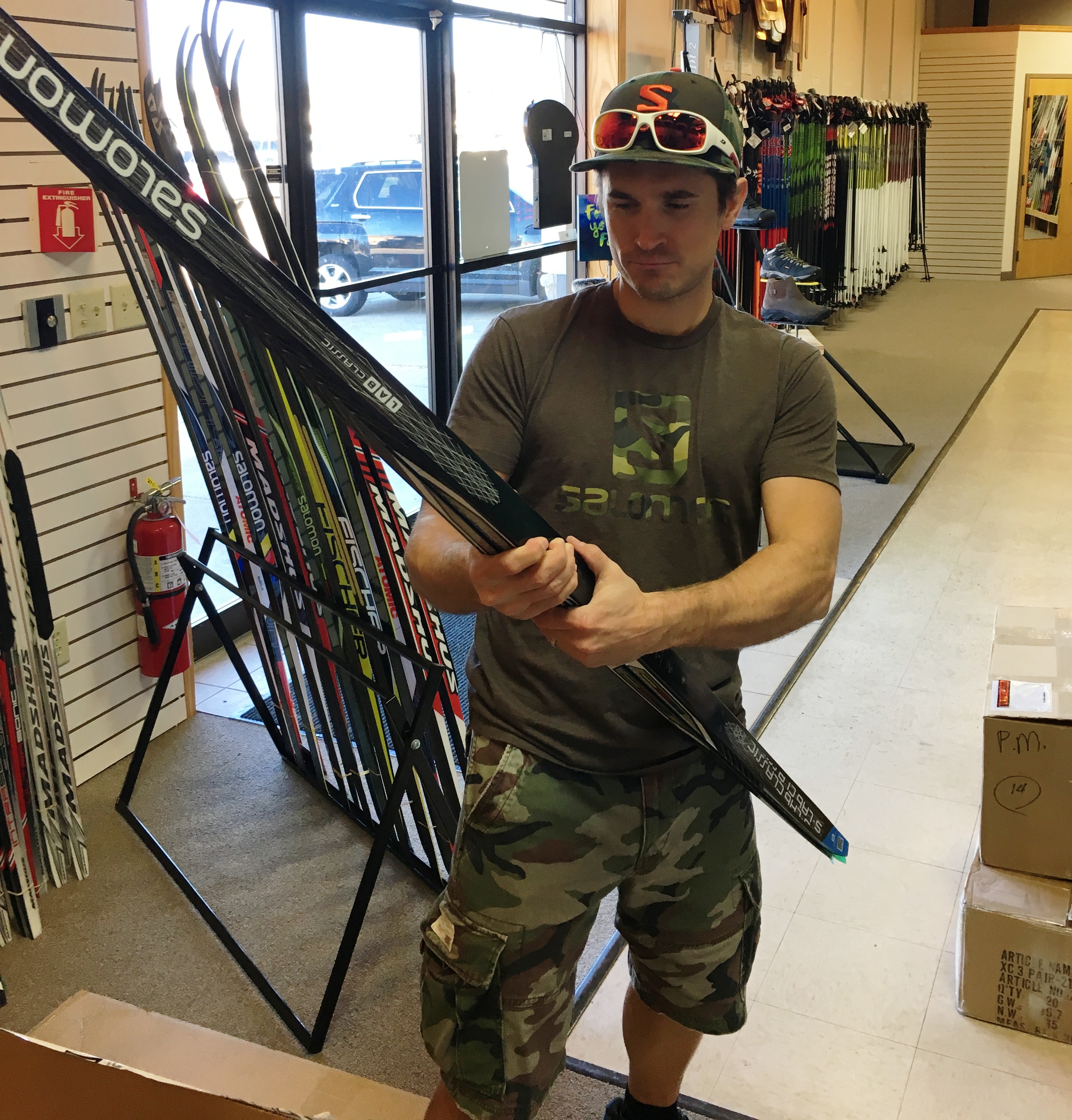
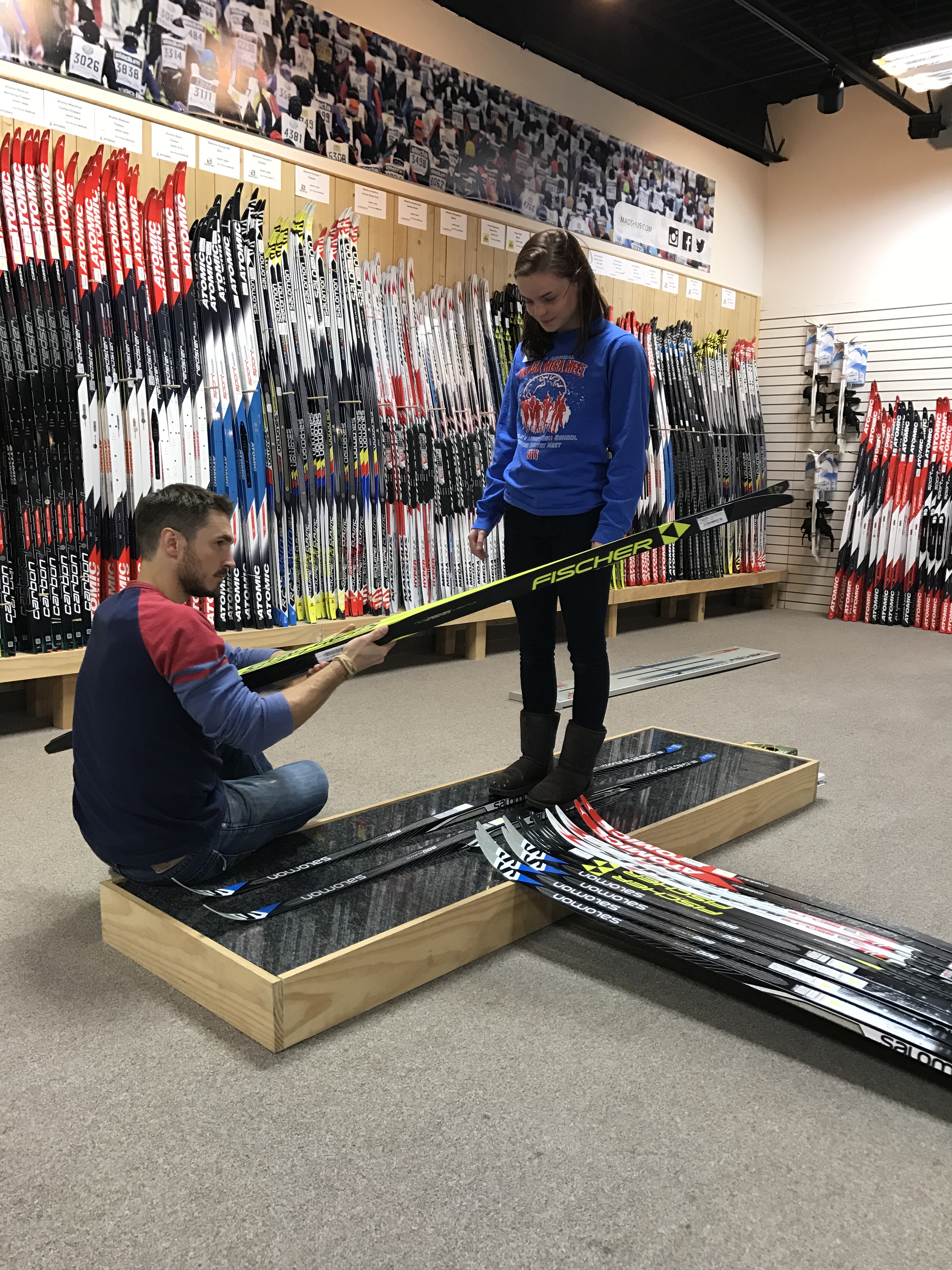
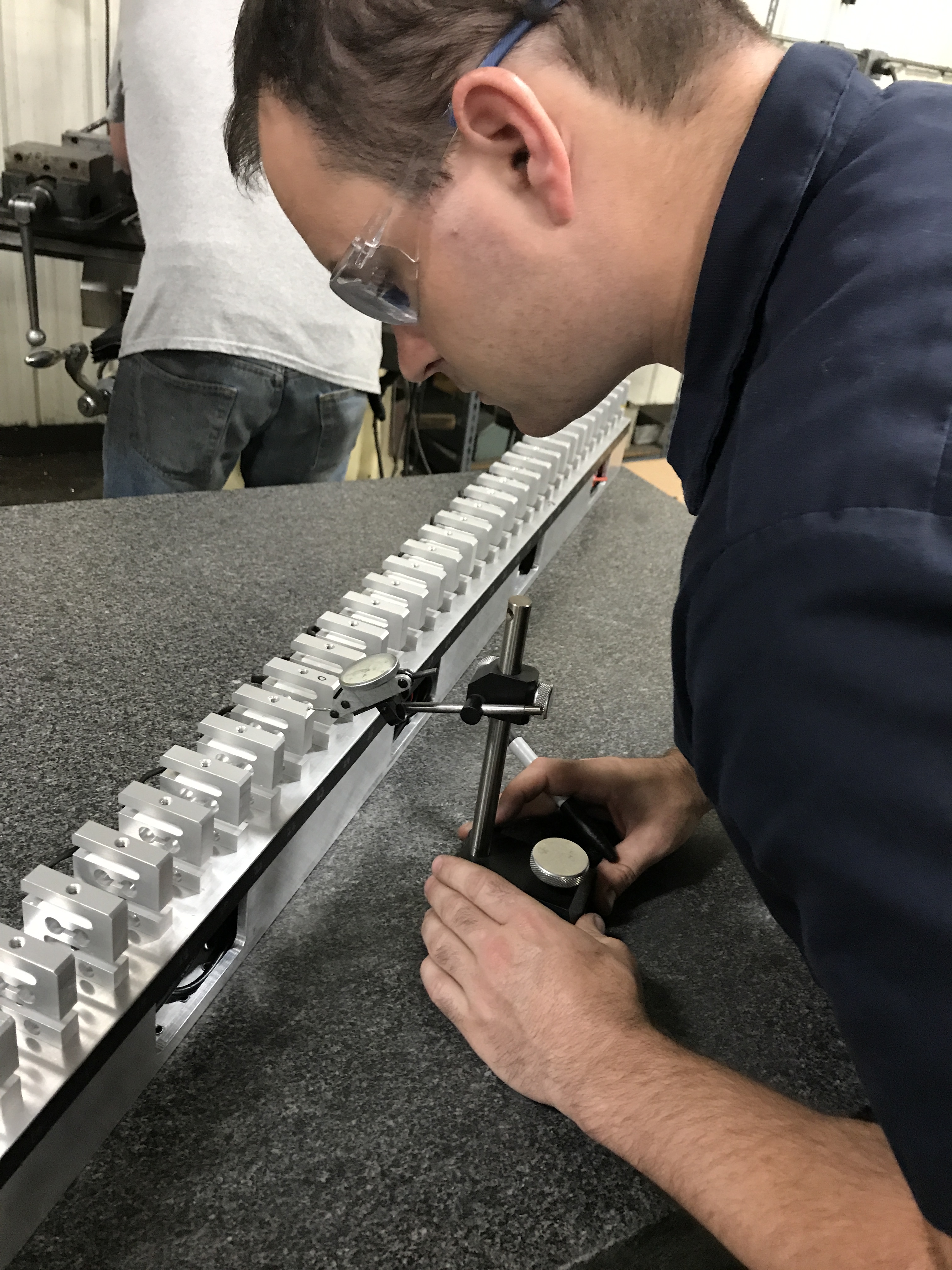
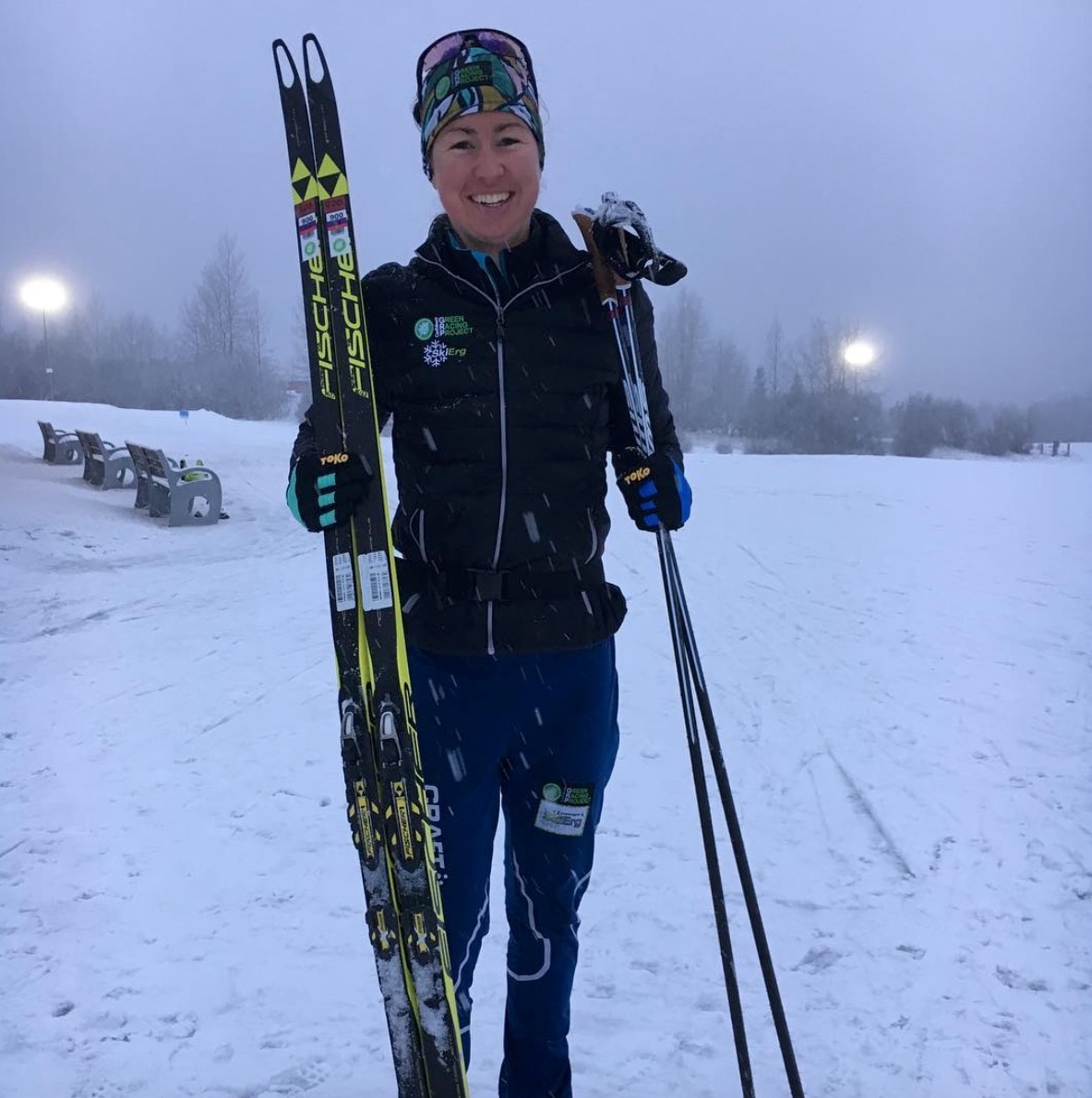
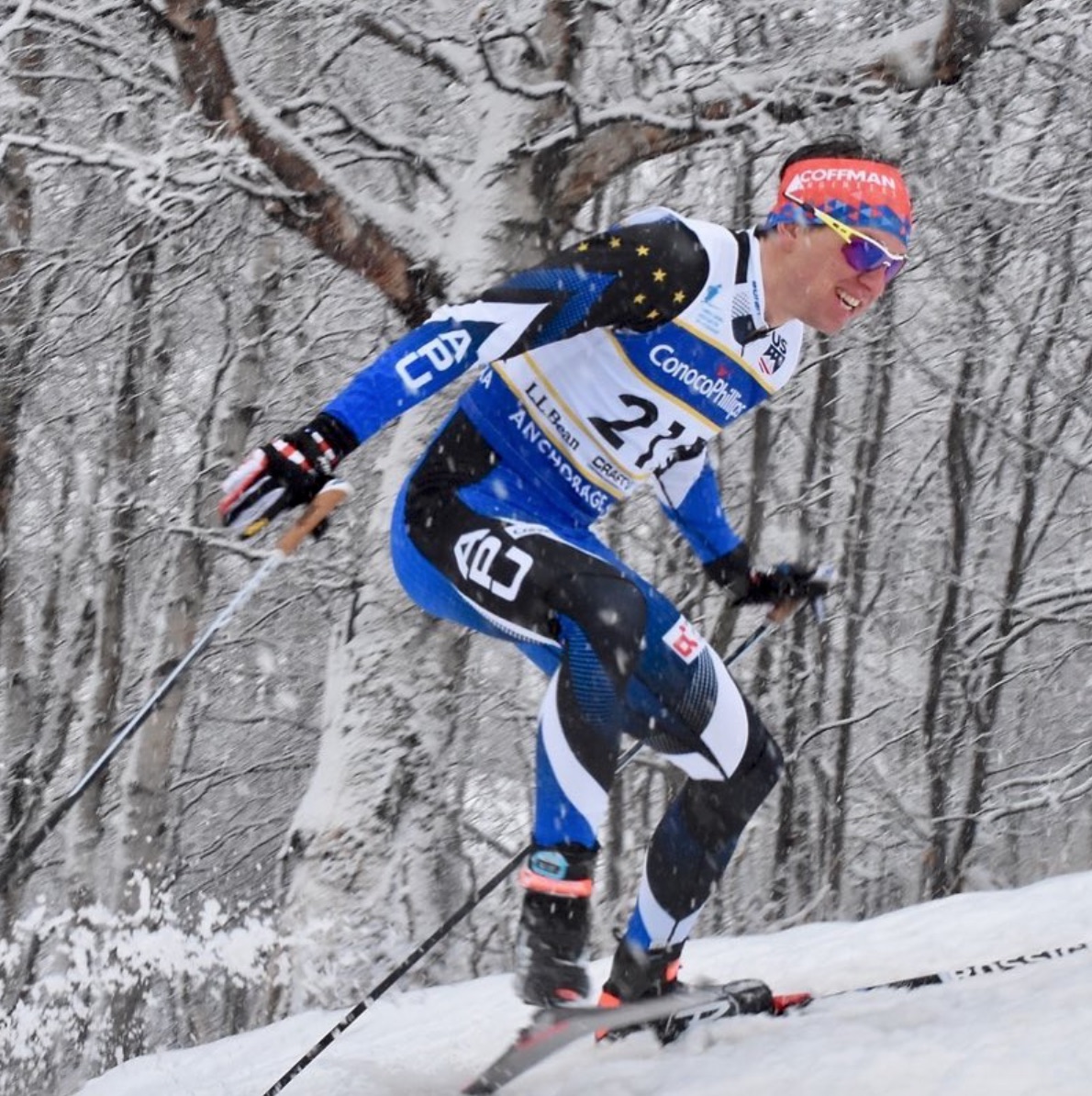
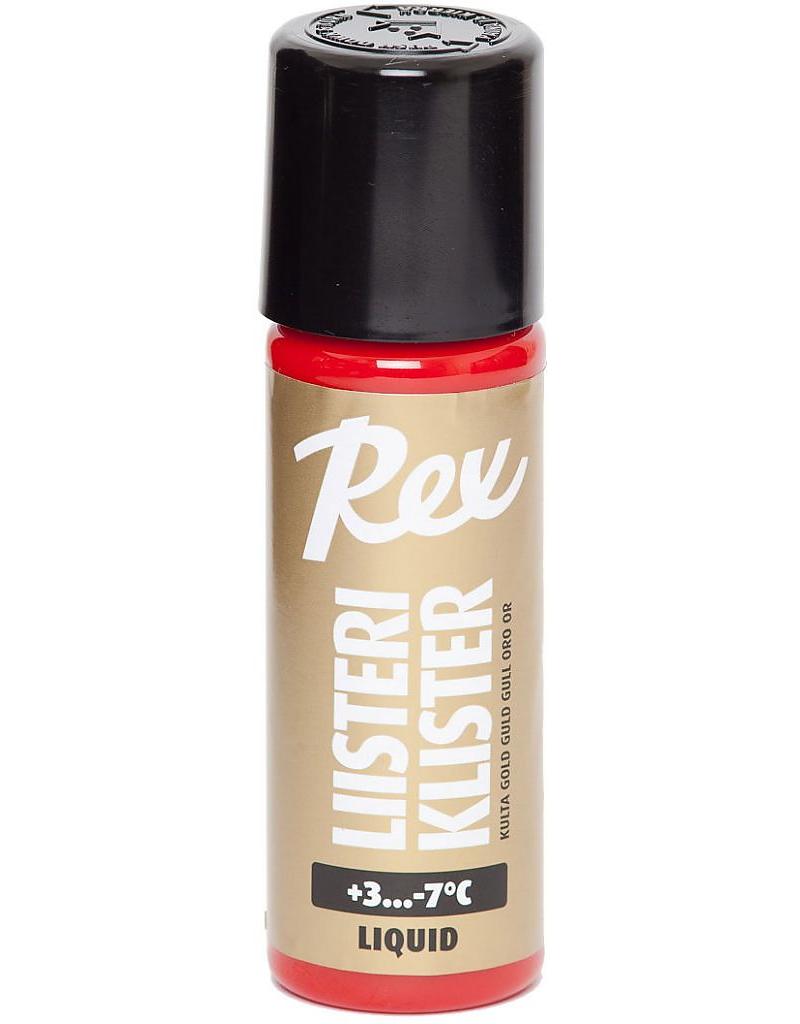
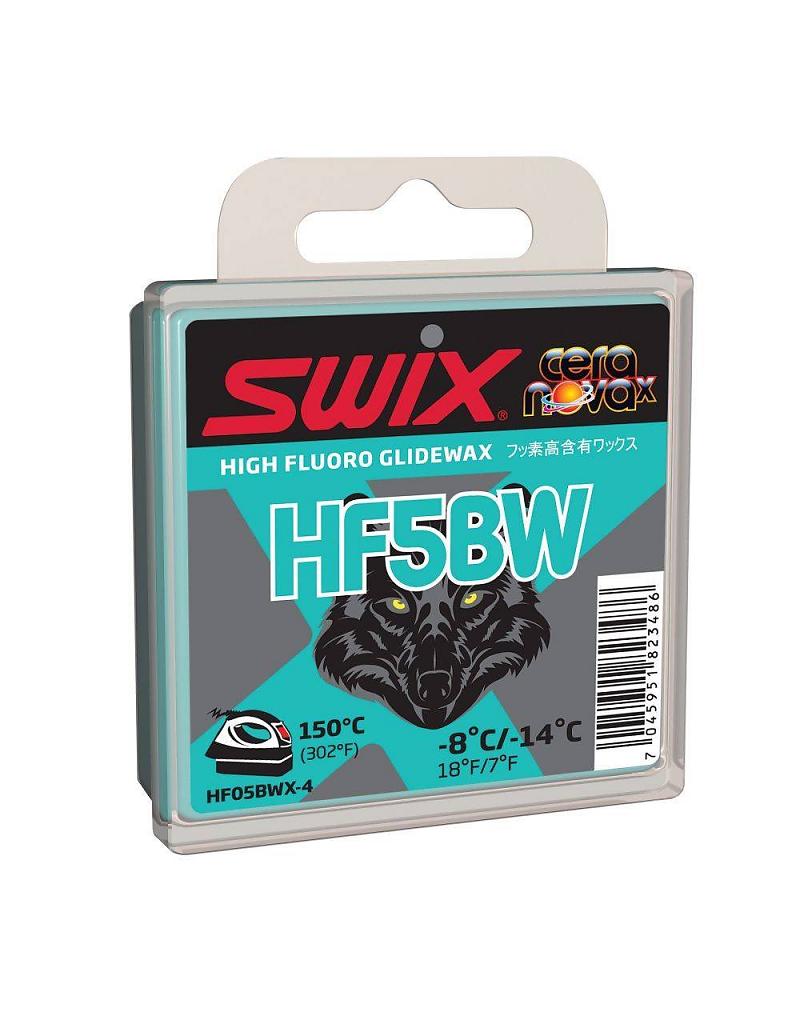
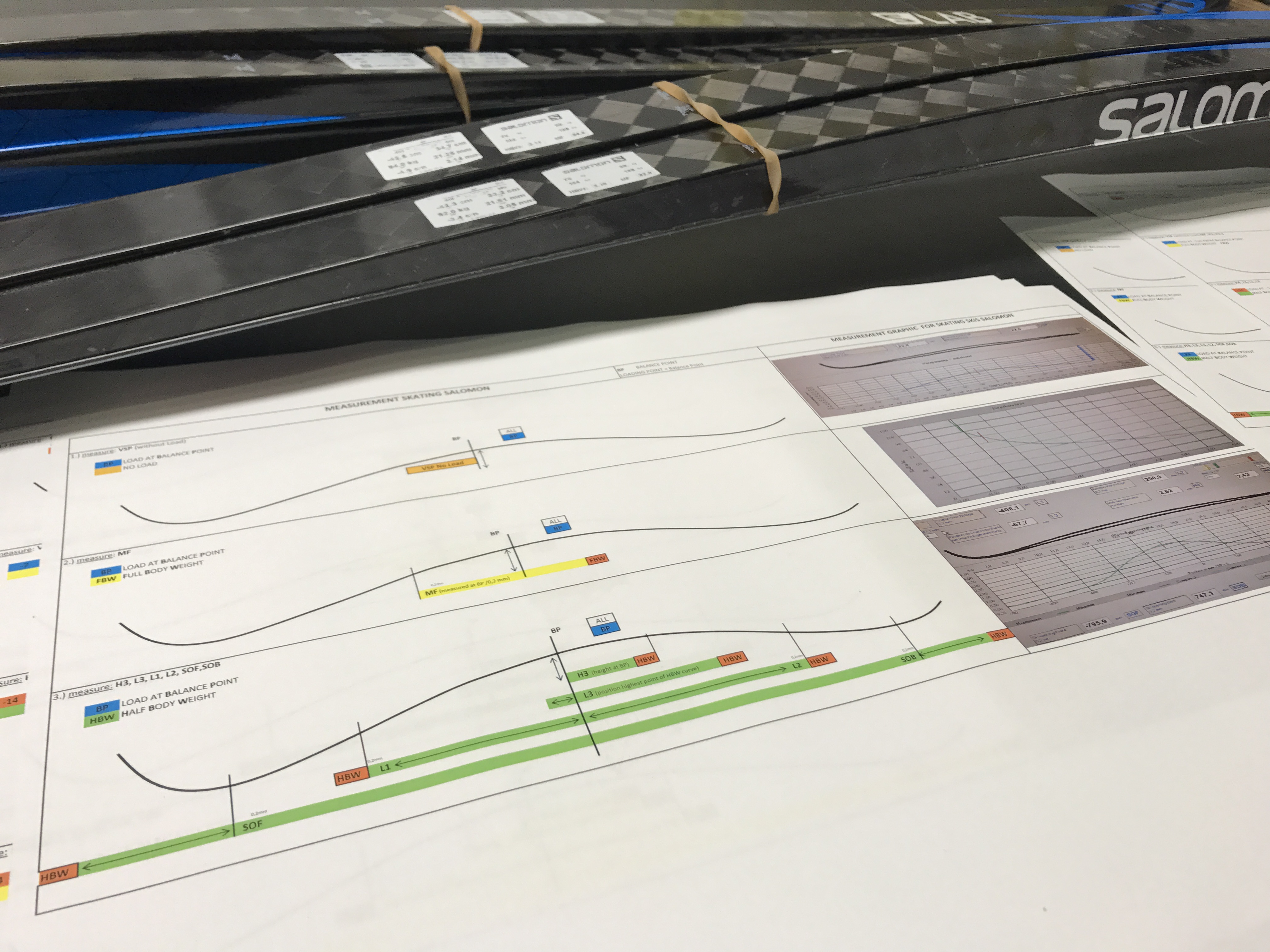
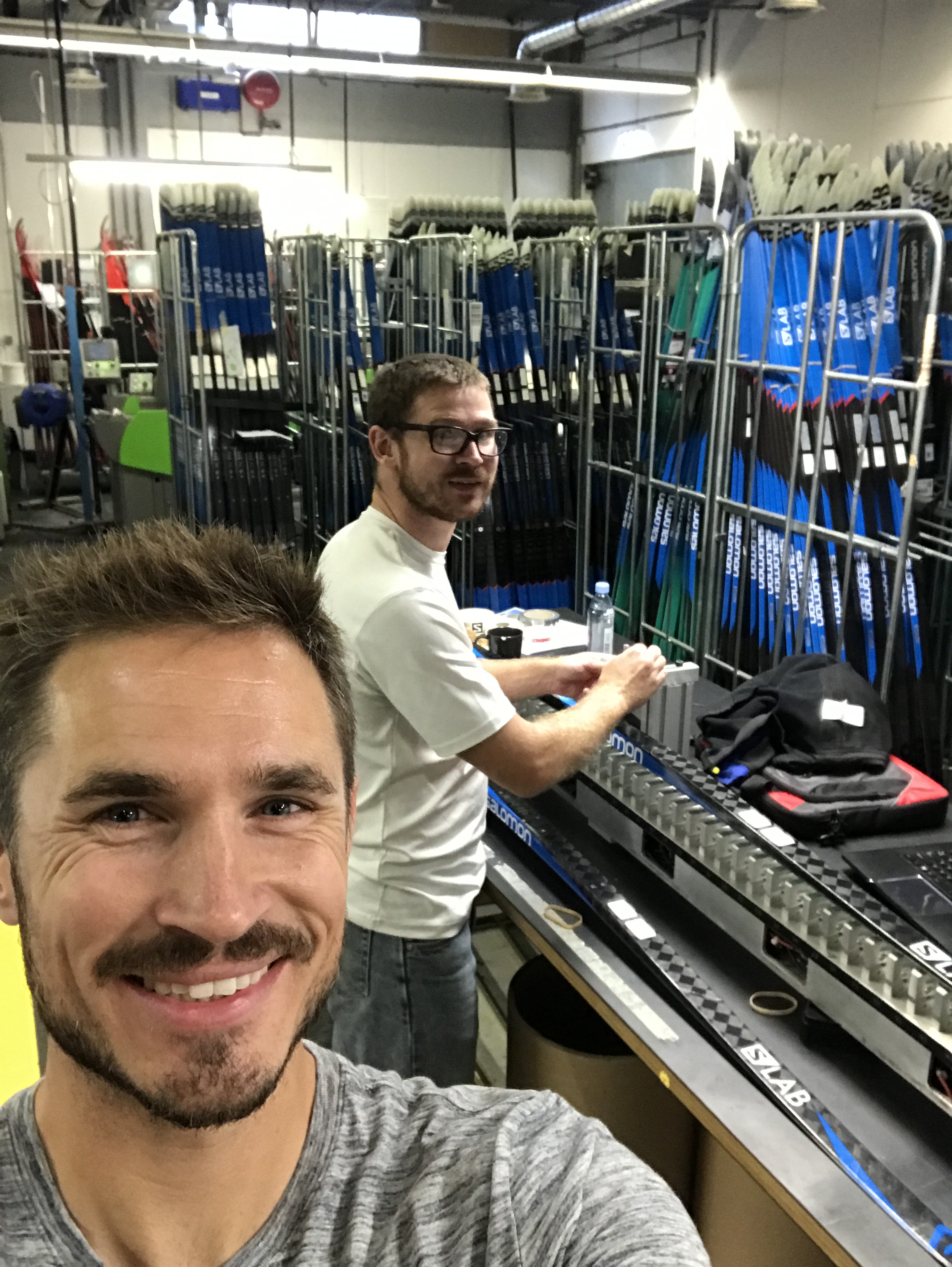
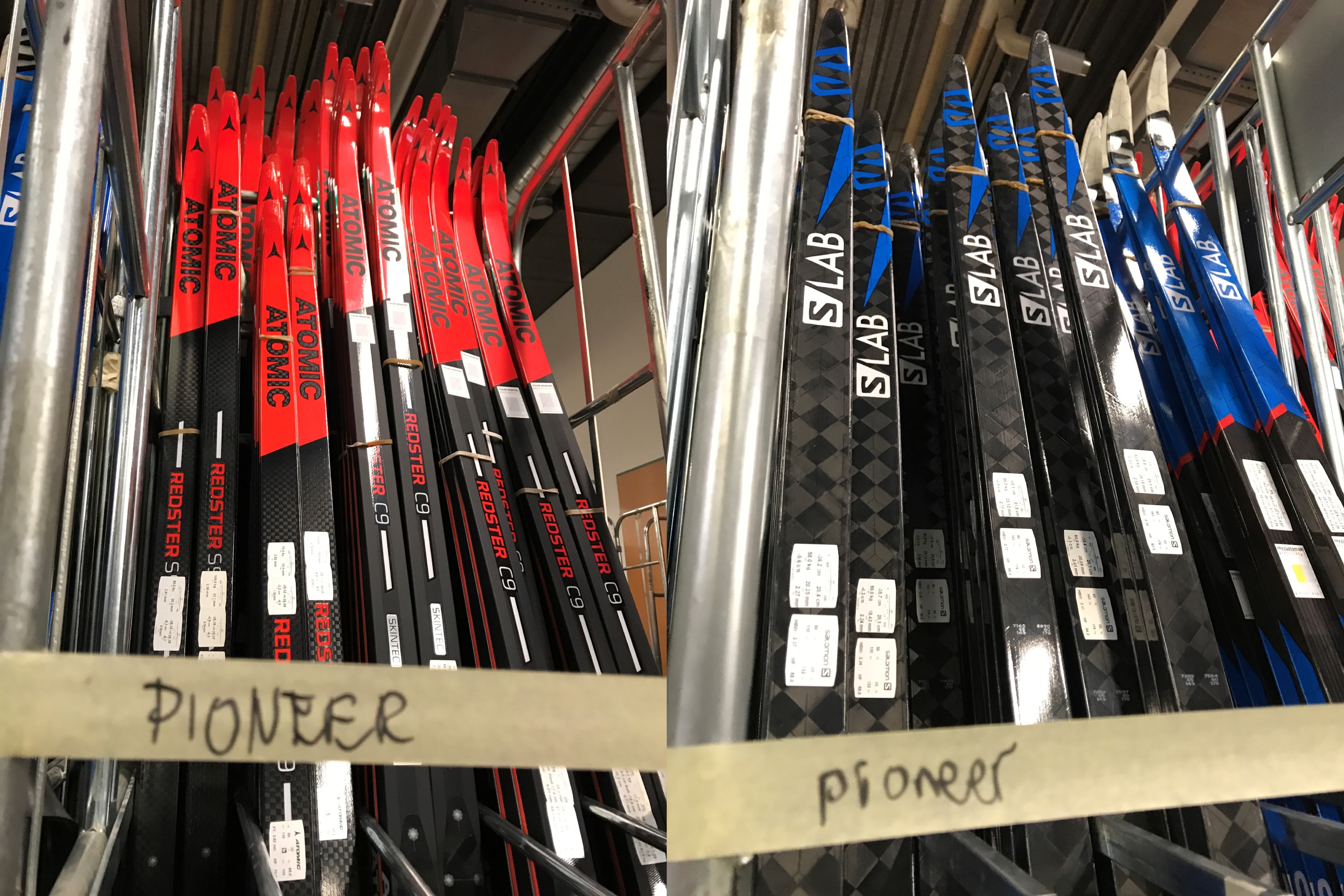
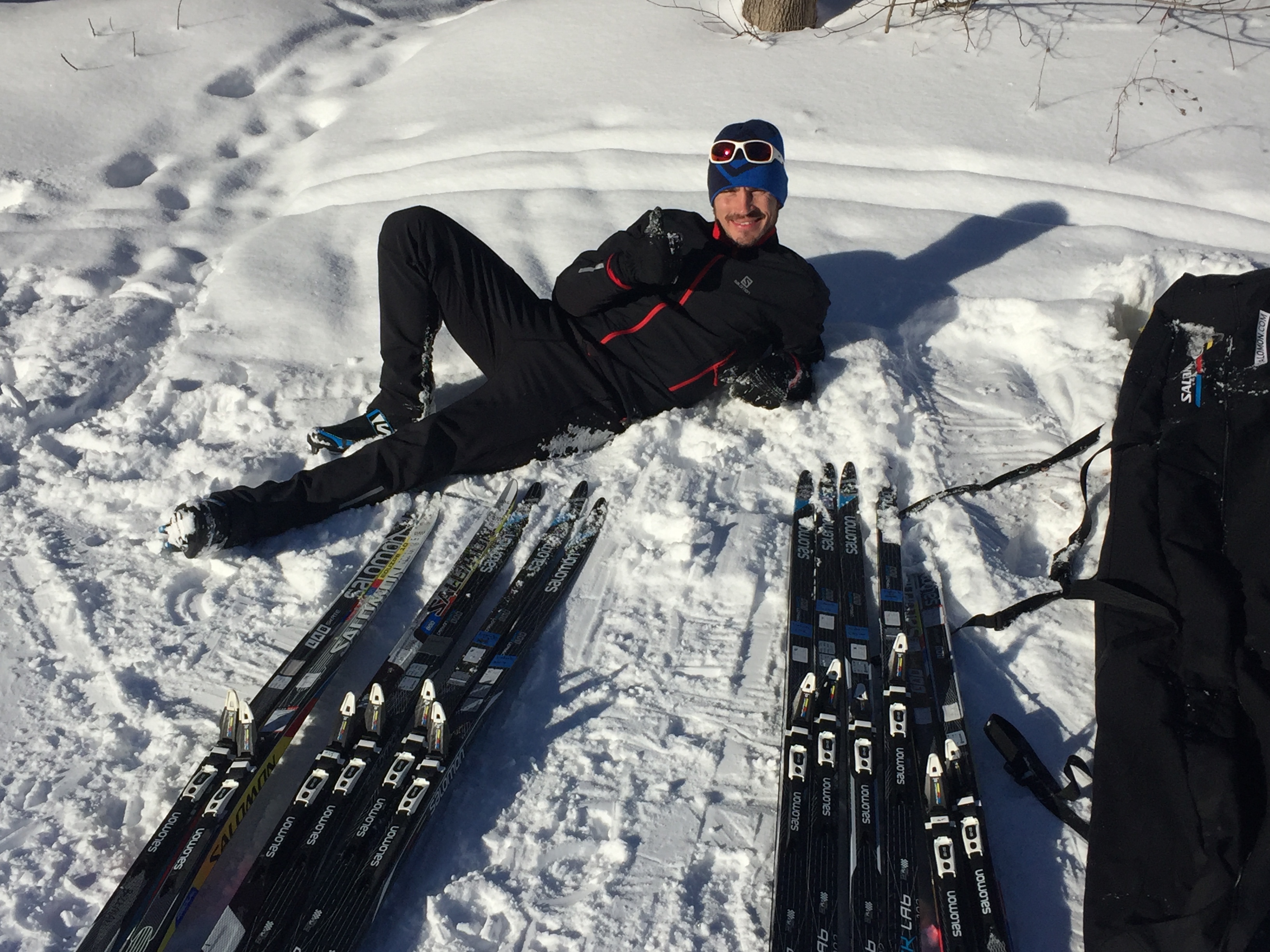
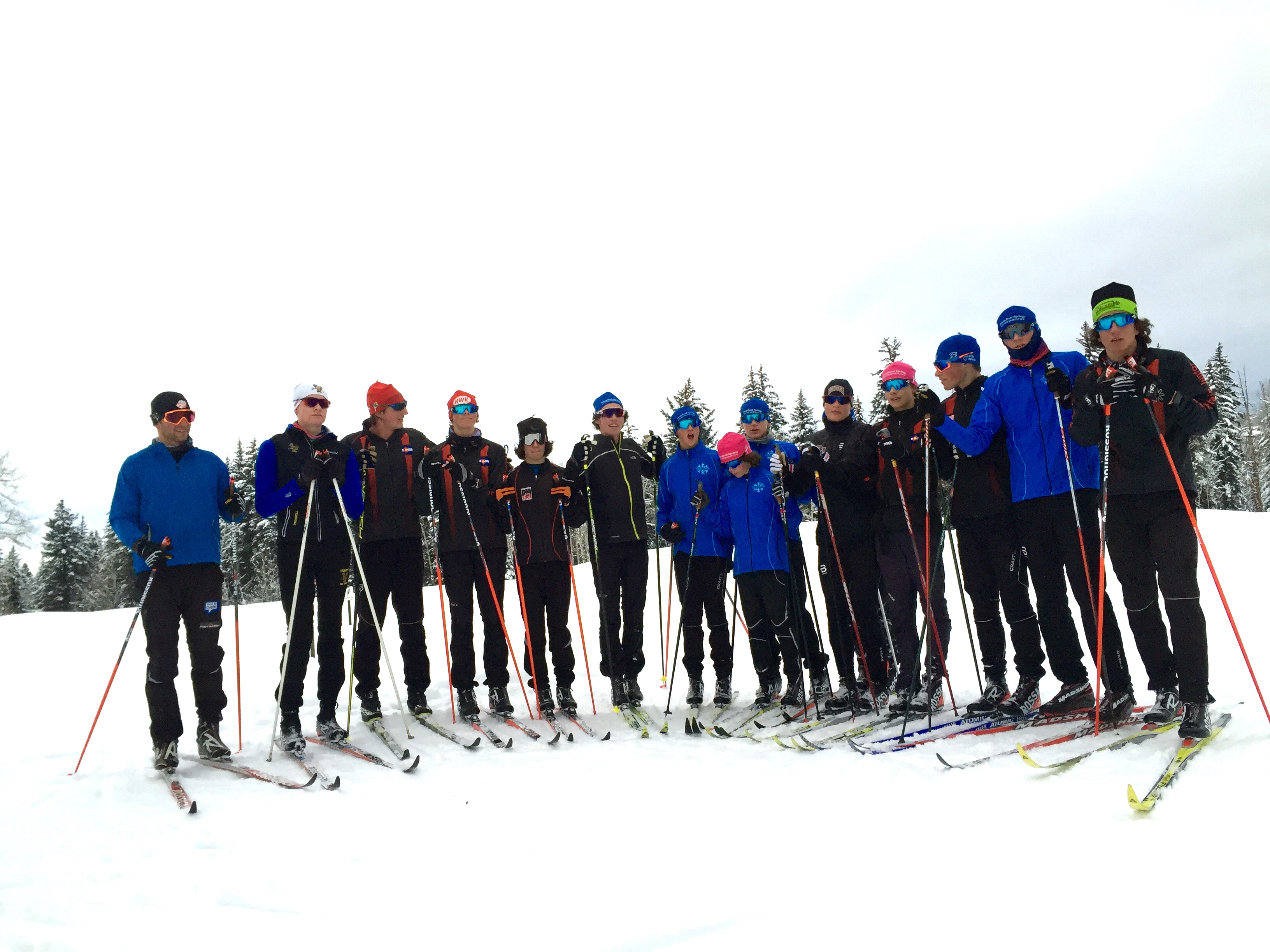
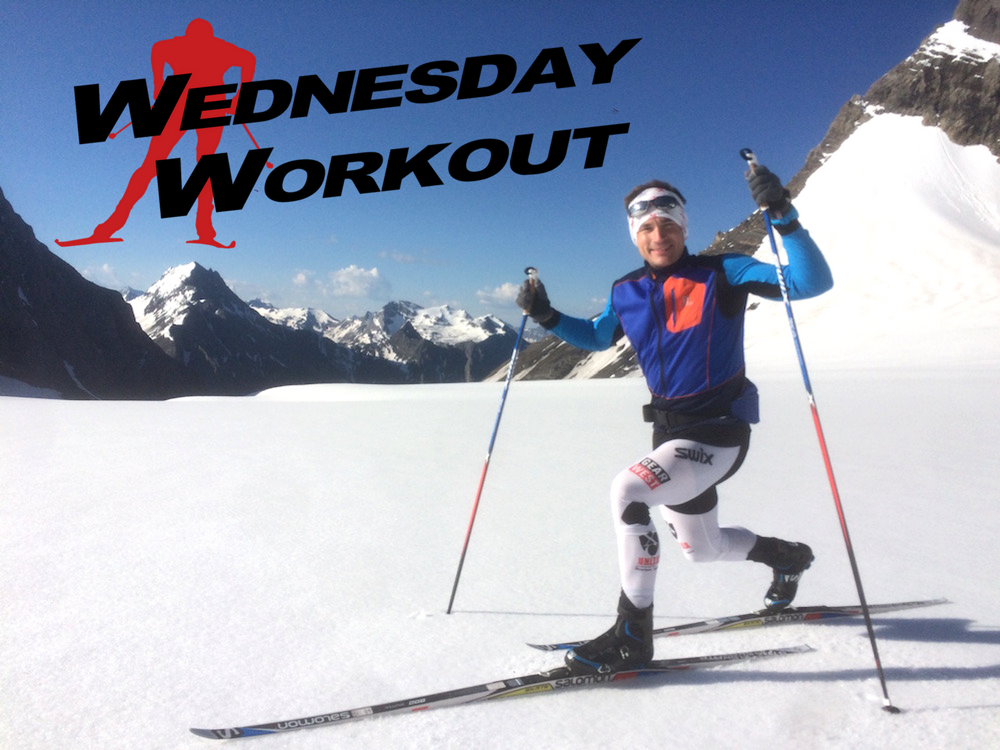
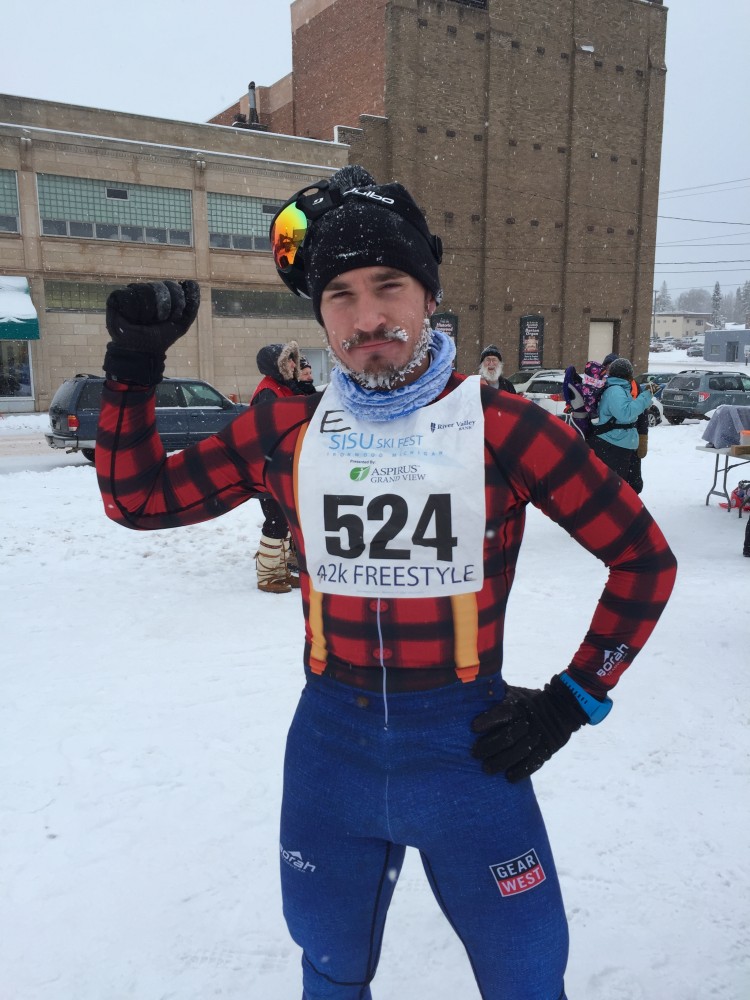
Jeremy Hecker leads a waxing clinic ahead of our 2022 marathon racing season!
Tag: Matt Liebsch
-

From the Archives: CXC Lake Placid Training Camp Report, October 2008
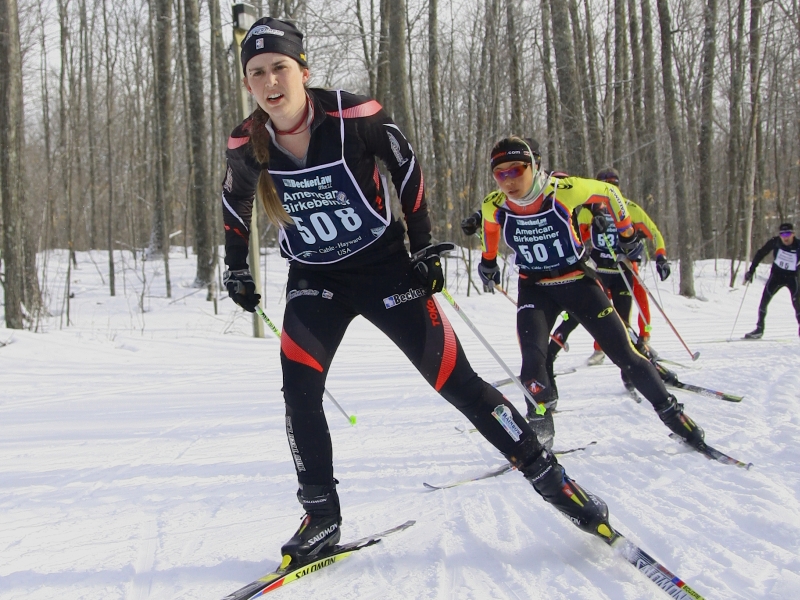
Author Kristina Owen races in the 2009 American Birkebeiner ahead of Evelyn Dong. The following article was originally published on FasterSkier on October 15, 2008. It was written by CXC (Central Cross Country Skiing) athletes Kristina Owen and Heather Zimmerman. Roughly contemporary photos have been added for this reprinting; the pictures that originally appeared with this article are no longer available.
The piece is simultaneously from very much another era, yet also completely timeless. On the one hand, “Caitlin Compton” now has a different last name; Jessie Diggins, who had recently turned 17, would go on to do things even more impressive than win the junior division of the Climb to the Castle rollerski race; the article’s authors last competed in FIS races in 2011 (Owen) and 2009 (Zimmerman). On the other hand, in October 2008 skiers enjoyed the fall foliage, did hard doublepole efforts, and benefited from having athletes from multiple clubs together in one place for head-to-head competition. A quick perusal of social media shows that New England fall colors are still a thing, and that athletes from multiple clubs (including that obscure junior, Jessie Diggins) still come together in Lake Placid for fall training. 13 years later, some seasonal rhythms of American skiing remain very much the same.
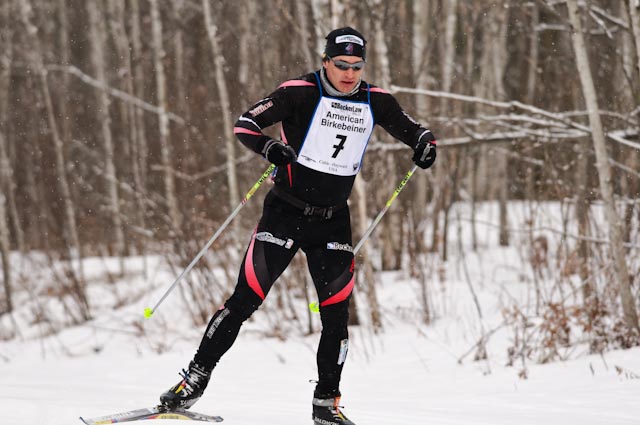
Matt Liebsch coming up the final hill on his way to victory in the 2009 American Birkebeiner. CXC Elite Team – Lake Placid Training Camp Report
The CXC Elite Team recently completed a two week monthly camp in Lake Placid, NY. We stayed and trained at the Olympic Training Center, which provided an ideal environment to make huge gains in both fitness and technique.
The weather was excellent for the first couple days: chilly, but clear skies. “The only problem with the weather was that is was cool enough that none of the boys took off their shirts,” Caitlin Compton mentioned with a smile. After a few days of such perfect training weather, the team’s luck broke and it started raining; beautiful miserable cold rain. The training continued as planned, but between workouts the hallways were filled with the smells of damp and drying athletic apparel.
One of the team’s favorite workouts at this annual camp is an over-distance run in Adirondack Park. We are able to take advantage of great trails up mountains with gorgeous panoramic views. This year the men’s team made it to the summit of Mt. Colden, but disaster struck on the way down. Matt Liebsch, Midwest born and bred, was unused to the speed on the steep rocky descent. He went down hard with a nasty ankle sprain. His teammates carried him out, but the injury was camp ending and he returned to the Midwest for recovery.
Leaves in the Lake Placid region were in their peak foliage and so was the CXC Elite Team’s performance during the second week. The highlight came at the culmination of the camp, with the Whiteface rollerski race. However, there was a lot of work to be done, both intensity and volume, before the race arrived.
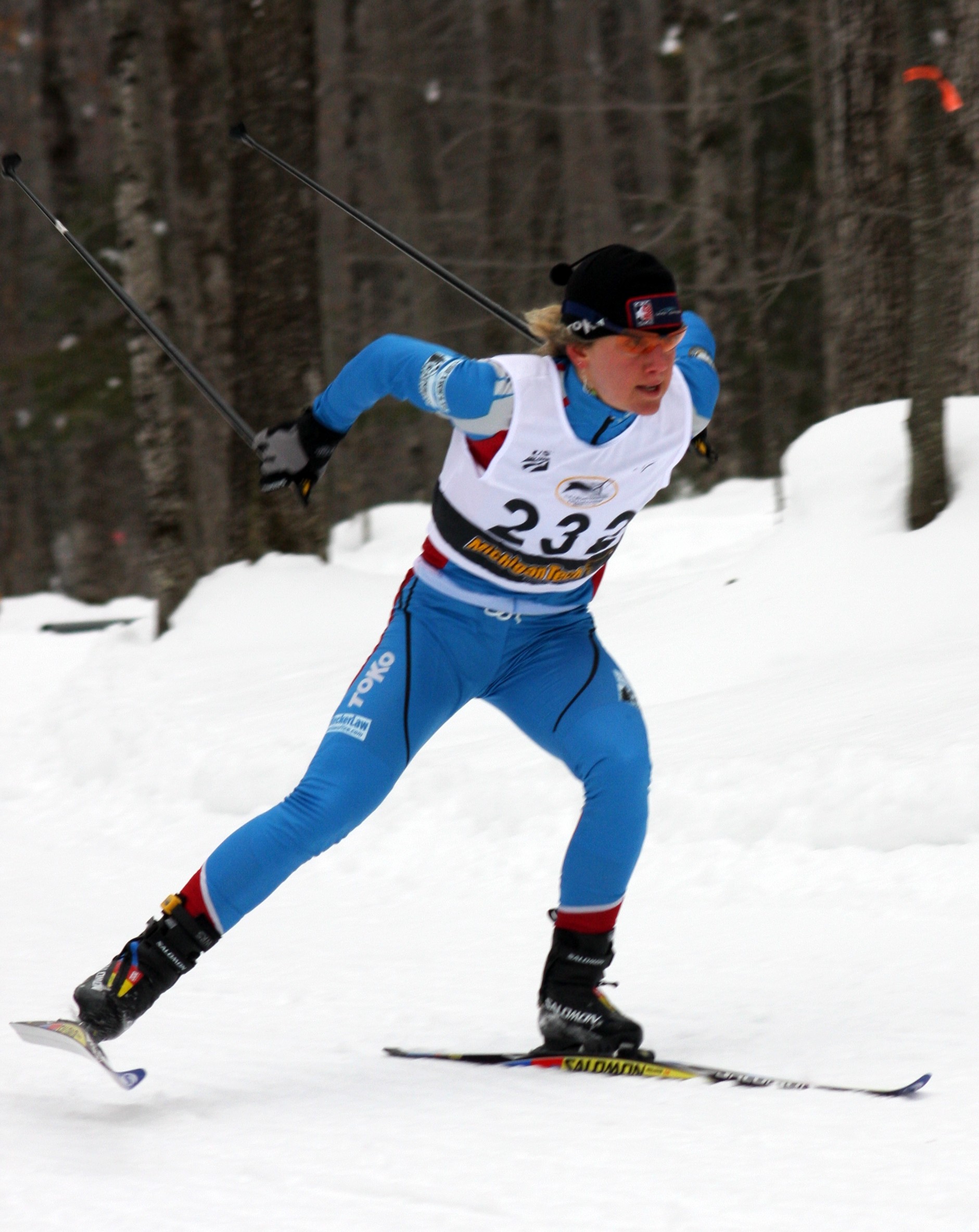
Caitlin Compton sprinting at US Nationals in 2008 in Houghton, Michigan. The workload wasn’t the only thing increasing during the second week of camp. The Olympic Training Center was overtaken by Nordic athletes. CXC Elite was joined by their Junior Development Program athletes and coaches, as well as the Sun Valley team, the USST, various NENSA athletes, and some of the region’s collegiate racers. CXC Elite Team was able to frequently take advantage of the large athlete gathering, as all the groups came together for some of the workouts. The best example of this was a hard double pole workout up a long gradual hill. The men did two sets of 3×4 minutes, with a ten minute break between sets, while the women concentrated their efforts to 3 1/2 minutes. It was a great workout and the added numbers definitely helped in ramping up the intensity!
The camp was also notably included the first competition of the year between CXC and their friendly rivals, Sun Valley. Last year Sun Valley pulled out a narrow victory in overall points. This year CXC was off to a good lead, with a win in an inter-team soccer match. The competition was fierce, but CXC’s greater numbers this year gave them the edge to pull off the victory.
CXC Team continued to utilize the hilly terrain in the area, traveling to Whiteface Mountain for a ski walking workout on the lower trails. Some of the team returned to the mountain later in the week for an evening hike, lured in by the fresh snow that covered the top.
Our second week contained not only some good intensity efforts but also a lot of volume. By Sunday most of the team had completed at least three ODs. All the mileage made us feel as though we had really gotten to know the Lake Placid area!
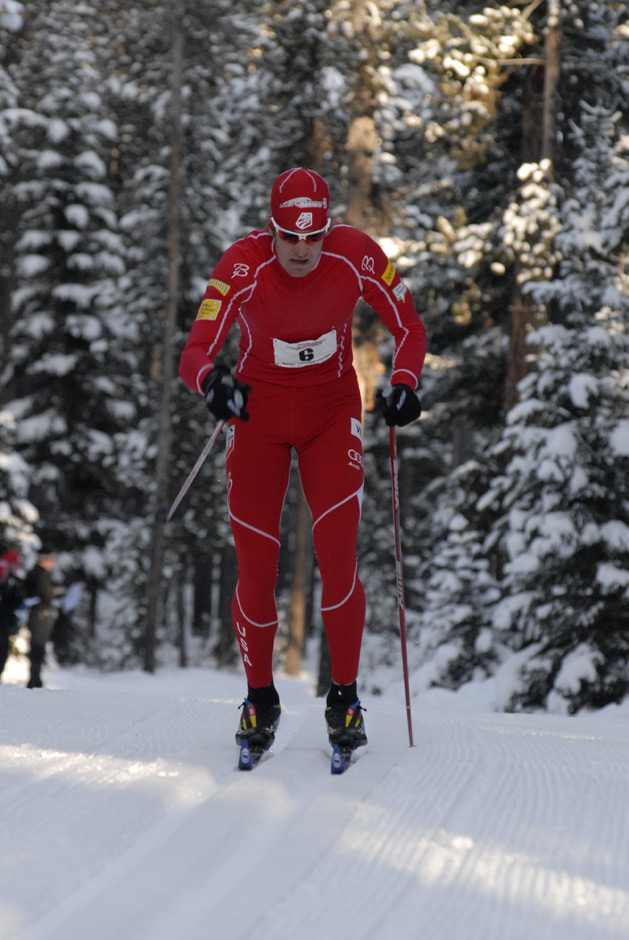
Garrott Kuzzy (CXC Team Vertical Limit/US Ski Team) races the sprint in West Yellowstone, November 2009. (Photo: Win Goodbody) The camp ended with a grand finale, the Whiteface Mountain rollerski race! After testing ourselves on the area’s hills for the previous two weeks, what better way to finish up than a five mile, steep uphill race. Of coarse, mother nature decided to throw a few additional hurdles in our path before we began. The top of the toll road was too icy for skiing so the race was moved slightly down the hill. However, despite the alterations, the course still proved to be plenty challenging! Despite being tired, CXC athletes turned in some impressive results. Caitlin Compton led the way, winning the women’s race. CXC Junior Devo Program Jessie Diggins had a very impressive showing as well, placing 5th overall and winning the junior category. On the men’s side Garrott Kuzzy led the charge with a notable 4th place finish, followed closely by Brian Gregg in 6th.
Sufficiently exhausted by this final effort the team departed Lake Placid. This was the team’s final two week dryland training camp. Athletes will now have the next four weeks at home before leaving for West Yellowstone, early snow, and the beginning of the Supertour circuit!
We will be ready!!
Related reading:
“Central Cross Country Skiing Announces CXC Elite Team For The 2008-2009 Season,” FasterSkier, June 2008
-

Pivot Point: Imagining Skiing During the Pandemic

Stadium in Ruka, Finland. (Photo: Nordic Focus) Over two days in March, the North American World Cup races were cancelled. Amid rising health concerns, NCAA Championships also shut down after one race; Junior Nationals after two races. Canadian National Championships never got off the ground. After the abrupt end of winter, people are trying to assess how the pandemic will affect the coming winter.
In The Atlantic, Juliette Kayyem posits that “From a public health perspective, the pandemic will not end for another 18 months.” She speculates that it may take 18 months to develop a suitable vaccine, which must then be distributed. How will this affect ski racing as we have come to know it?
While this metric pertains to alpine resorts, it’s stark any way you slice it: with spring break looming or in full swing, alpine lodging occupancy dropped 54% from March 2019 when alpine resorts began closing.
“The timing of it couldn’t be better for the ski industry,” said Zach Caldwell, proprietor of Caldwell Sport. “We lost the tail end of the season. That was a big bummer. We had most of the season and it was a good one. We in the industry have the luxury of being able to sit back, observe, and see what happens, and wait to finalize plans.”
If one can extrapolate from one retailer’s experience, sales cratered in March after a strong start to the year. Matt Liebsch, a co-owner of Pioneer Midwest in Minnesota, concurs. Pioneer did very well at the beginning of the year, but saw March sales fall off as social distancing set in.
“We had really good growth in January and February,” Liebsch said. Pioneer finished March down thirty percent in revenue compared to last year. Prior to coronavirus, Liebsch said, Pioneer would sell two to six pairs of race skis each day. “We’re at zero right now. When you shelter in place, I think that means you park your money in place. The virus has thrown things off.”
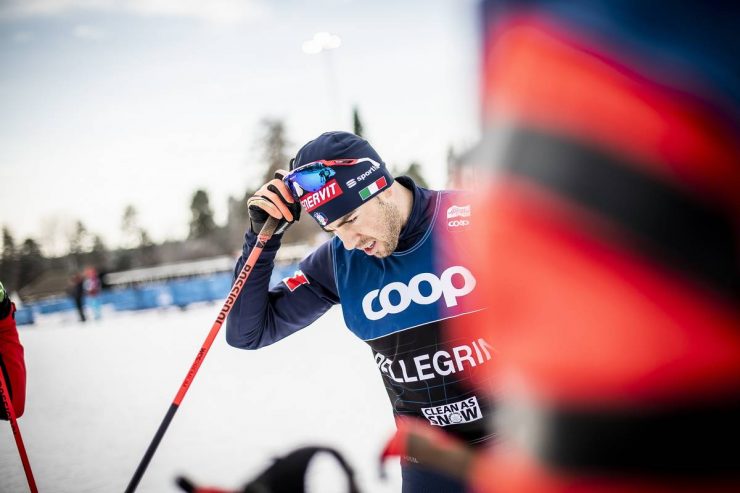
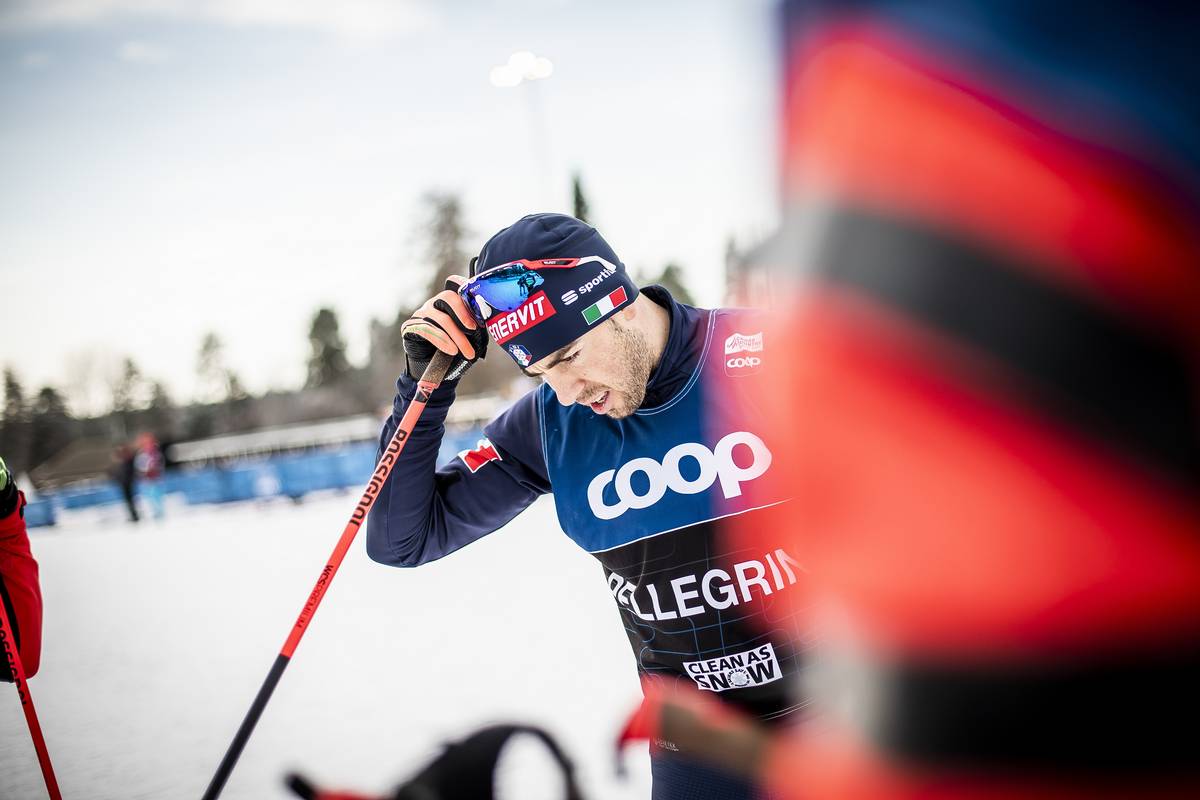
Federico Pellegrino of Italy testing skis in Falun, Sweden. (Photo: NordicFocus) According to Jeff Courter, Rossignol North America’s nordic category manager, the bulk of its sales to retailers were complete by the time social distancing became the new normal.
“For any major ski brand industry-wide, [the pandemic] hit at a time where the majority of sales had really happened already. We missed out on a lot of opportunities to capitalize on spring sales and spring break. We’re trying to help our retailers in North America to try and get through the times,” Courter said. He added that spring break sales can help retailers clear out inventory so they can prepare for the coming year.
Typically, Liebsch makes two trips a year to Europe for custom ski picking as well as pre-ordering skis to sell off the rack. He said that bulk pre-season orders from manufacturers were generally due to vendors between late February and late March. They’re shipped to arrive in the U.S. between mid August and mid October. “That’s all in the books. It’s kind of a shot in the dark.”
“We try to [work with] our discerning, race-oriented customers that want a wet ski or a better ski than what they have in September, October,” said Liebsch. “That clears my plate for [recreational skiers] and the start of [Minnesota’s] high school race season in November and December. I don’t get to talk about grinds, race wax, or camber construction. I’m explaining to mom and dad the difference between a classic ski and a skate ski.”
“The majority of our orders [for the coming year] have already come in by mid-March,” Rossignol’s Courter said. “But anyone – not just us – any ski company in general, once we get a little farther into this, and kind of see how things lay out for the fall, some of the smaller retailers may have to make some adjustments to what they thought about bringing in.”
While most retailers have ordered skis for the coming season, it’s not known how the pandemic will affect manufacturing schedules. Citing the safety of its staff and their families, Courter said that one of Rossignol’s main factories, located in Spain, had closed down for safety reasons in early April. It’s scheduled to reopen on May 4.
Looking for ways to get back on schedule, Courter said that Rossi facilities would be running three shifts. Normally, their ski production is done by July. At present, this year they plan on making skis through August.
“The majority of the factories that we work with have been able to stay open,” Courter said. He added that one factory had experienced a slowdown as some raw materials haven’t been delivered.
Bryan Cook, Madshus USA sales manager, wrote in an email, “Generally, we are constantly producing skis with the majority happening between the months of December and April. This means that we are just about wrapping up all of our preseason orders for the coming season. We then look to ship the skis, via ocean, between the months of June and September, as most dealers request their product to be in store between September and November.”
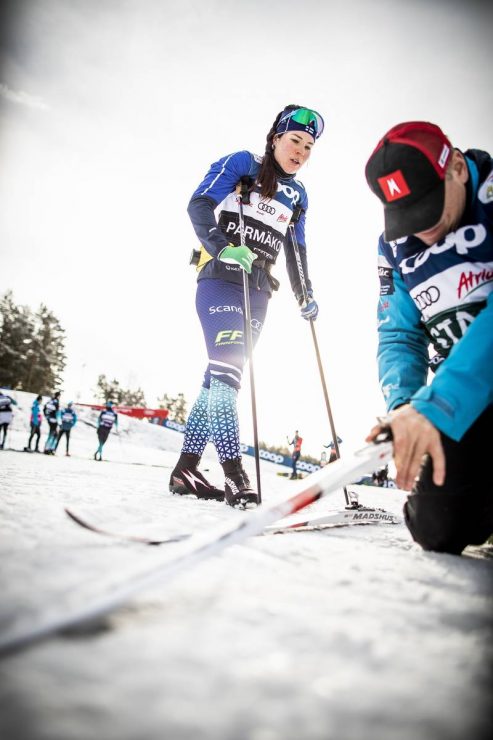
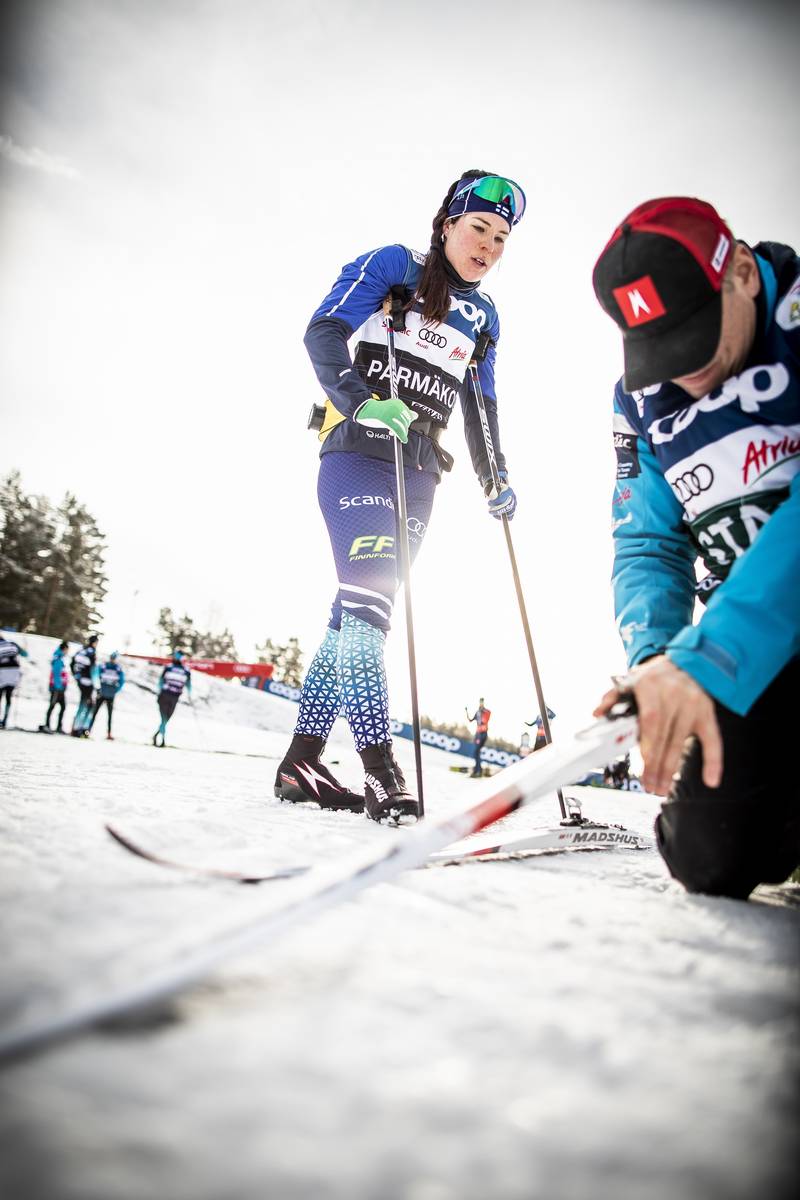
Krista Pärmäkoski of Finland testing skis in Falun, Sweden. (Photo: Nordic Focus) Zach Caldwell, proprietor of Vermont’s Caldwell Sport, also travels to Europe to pick skis. Speaking on April 13, he said the Austrian companies he works with underwent a mandatory shutdown, but are opening back up. According to Caldwell, they’re ready to schedule ski picking. While the ski companies seemed optimistic, Caldwell is waiting to see what happens when social distancing is relaxed.
“I can get to a ski factory and interact with about three people and pick the skis I need. What I do need to be able to do is travel. And that’s not something I’m willing to do right now, even if it was wide open. Once the international travel piece looks OK, there’s nothing standing between me and picking skis for people,” Caldwell said.
For both Caldwell and Liebsch, races next winter pose a bigger question than shipping schedules. How will the possibility, even the likelihood, of continued social distancing affect racing next winter?
“But both the competitive aspect and social aspect of competition is what drives a lot of our sport,” Caldwell said. “We’re going to lose a lot of people if we shut that off for a year. I think there are ways to prepare for a season of distancing measures, and that’s a bigger story from my perspective than what does the industry look like.”
“The biggest issue that I have is the prospect for racing next season,” he added. He’s concerned about the feasibility of having several hundred competitors, plus coaches and family, at Eastern Cups. [The Eastern Cup races are the New England qualifying races for Junior Nationals.]
Concerned about the impact social distancing may have on racing, Caldwell wrote to the New England Nordic Ski Association [NENSA], urging them to consider alternatives to traditional races.
“We should be making plans to ensure that there are competitive and social outlets for racers absent the ability to run [traditional race formats],” Caldwell said. “NENSA could put together a combination between Strava and NASTAR where they put standardized courses at touring centers and drop off chip timing. Develop an app that people can subscribe to and pay an entry fee with a head tax to check out a chip and go ski a course. Have the touring center handicap the snow speed with a ski trap and generate a score, generate a region wide points list and share it on social media.”
“There are a lot of models that can perpetuate that, absent an Eastern Cup circuit or a Craftsbury Marathon or whatever,” he added. “We as a sport need to be thinking about this because we’ve got a lot of lead time to prepare for this. We need to be thinking about that. One thing we can’t do is Zwift. We don’t have that technology in skiing.”
The wheels have been turning in New England when it comes to developing contingency plans. “This year is not going to look like anything we’ve ever had.” Amie Smith, Executive Director of NENSA, told FasterSkier.
“We’re saying, ‘what can it look like? What opportunities can we give our membership? How can we keep everyone connected during this time of sheltering at home?’” Smith acknowledged Caldwell’s email to NENSA, but didn’t touch on it directly.
Normally, NENSA conducts a regional elite group (REG) camp for juniors at Stratton Mountain School at the end of June. That’s been postponed to the end of August. Meanwhile, NENSA is devising ways to have a virtual camp instead. They are also planning virtual coaching clinics.
As for the coming winter, Smith asked, “Can we even gather? If crowds are limited to 50, we are going to have to totally change how we do Eastern Cups. It won’t be business as usual.”
Insofar as recreational skiing goes, Smith posited, “Would ski centers be able to open their lodges? How could they safely collect trail fees?” (Faster Skier contacted several ski centers for this article, but none responded.)

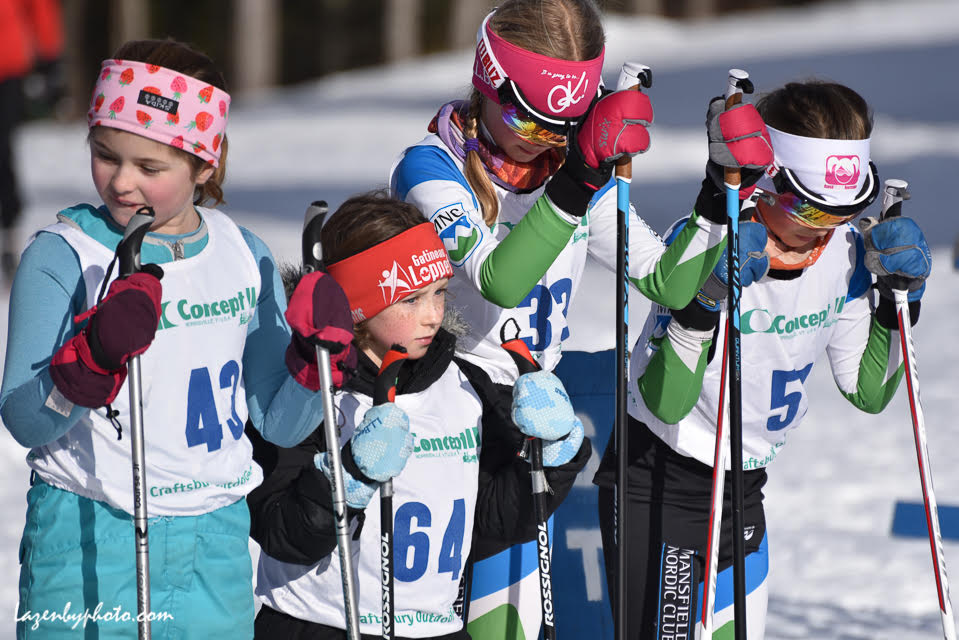
Some of the young skiers at the NENSA Eastern Cup in Craftsbury, Vermont. Young and old are welcome at the NENSA Eastern Cups. (Photo: John Lazenby) “It’s not going to look like our normal race season, but hopefully we can have some great training, coaching education, race opportunities,” she said. “But we totally don’t know what that will look like. We need to have alternatives and ideas of how that would look. Will race starts be a minute apart? Will they be two minutes?
“Our staff is in a good place, we’re excited to see what we can put together and keep everyone engaged and feeling like there’s still a community,” Smith said. “Because I do hope we come out the other side, and that there will be a day when we don’t have to keep 6 or 9 or 15 feet apart, and that we can go back to doing our normal racing. But I don’t think that’s going to be next season.”
For the near term, it appears that business as usual on the race front and storefront is over.
The investment of early-season dollars and time as it relates to inventory will have to wait a bit longer to determine how the pandemic evolves and the gradual release of social distancing requirements. “I’m thinking we can still rebound and have a great winter next year, if we’ve got snow,” Liebsch said. “I’m confident that I’ll be ski picking in September,” Liebsch concluded. “If I’m not, the whole world has big issues.”
-
Nordic Nation: Brian Gregg and Matt Liebsch-Faster Together

Independent of one another, Brian Gregg and Matt Liebsch are always to be feared as they line up for a ski race. Now in their mid-thirties, their lives have transitioned to other responsibilities that include partners, children, and full-time work. Yet, in the highly competitive world of elite-level ski racing, these two have maintained a healthy friendship and are fast and furious training partners.
We could spend time noting their accomplishments on the ski tracks – but that would be another story. They are accomplished. But when speaking to them both, it is clear that each wants the other to succeed and in fact, they understand their friendship and training have made them both faster. Although defining themselves as ‘master-blasters’, Gregg was second overall and Liebsch third in last season’s American Birkebeiner. Gregg lost out by a toe to Akeo Maifeld-Carucci, while Liebsch faded slightly down Main Street in Hayward to place third, 8.5 seconds back. So ‘master-blaster’ or not, these two are still fast and competitive.
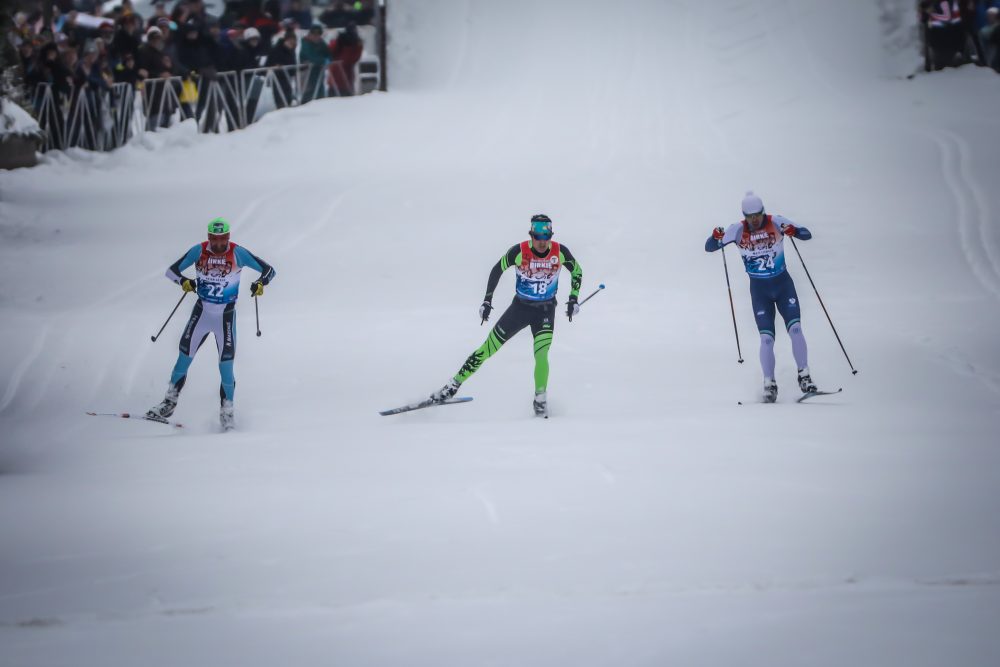
Akeo Maifeld-Carucci in green, Brian Gregg (left), and Matt Liebsch (right) down Main Street in Hayward, WI. (Photo: James Netz) So maybe get inspired, find your own best bud, become a better person and get faster together too.
-
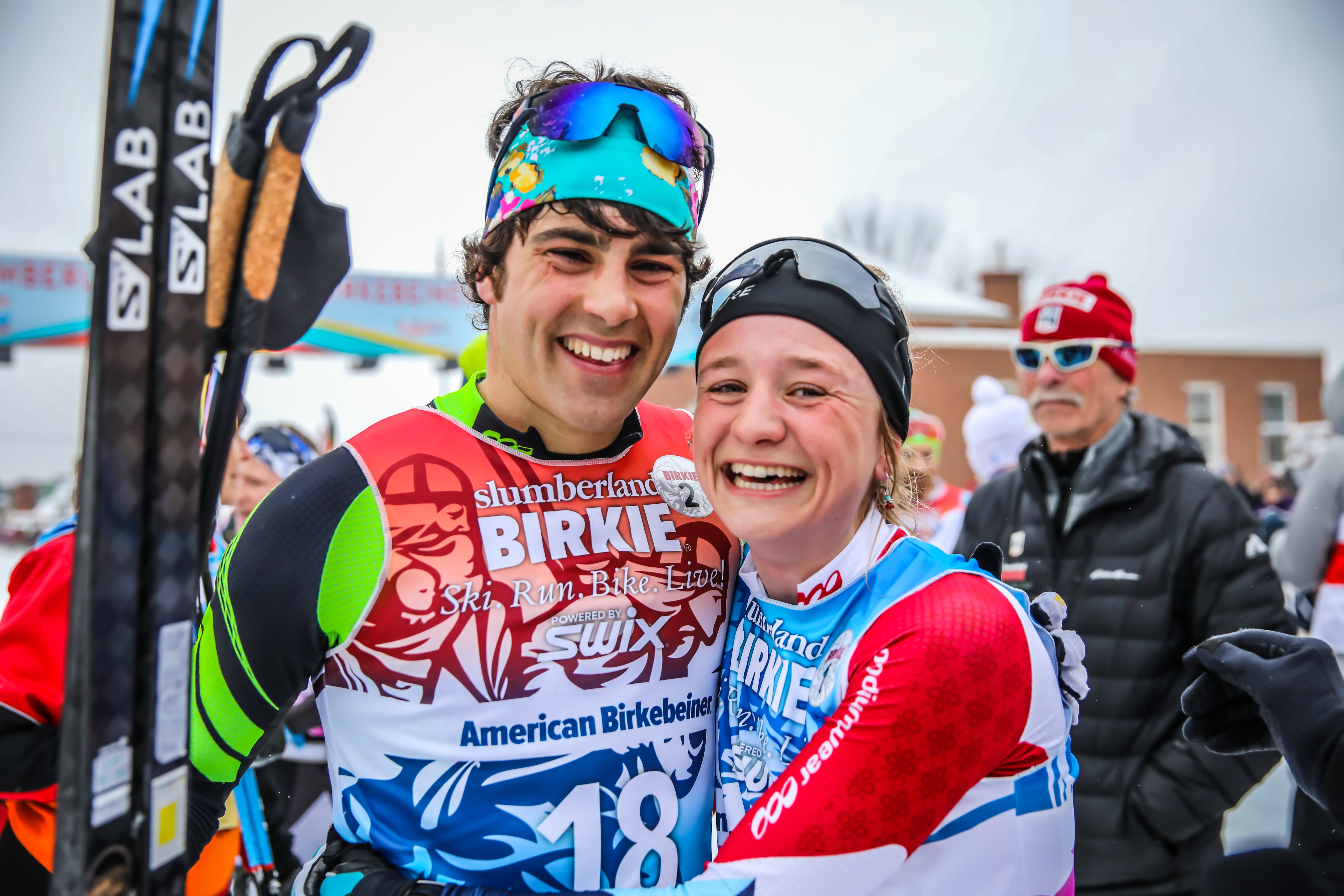
First Time American Birkebeiner Winners: Alayna Sonnesyn and Akeo Maifeld-Carucci
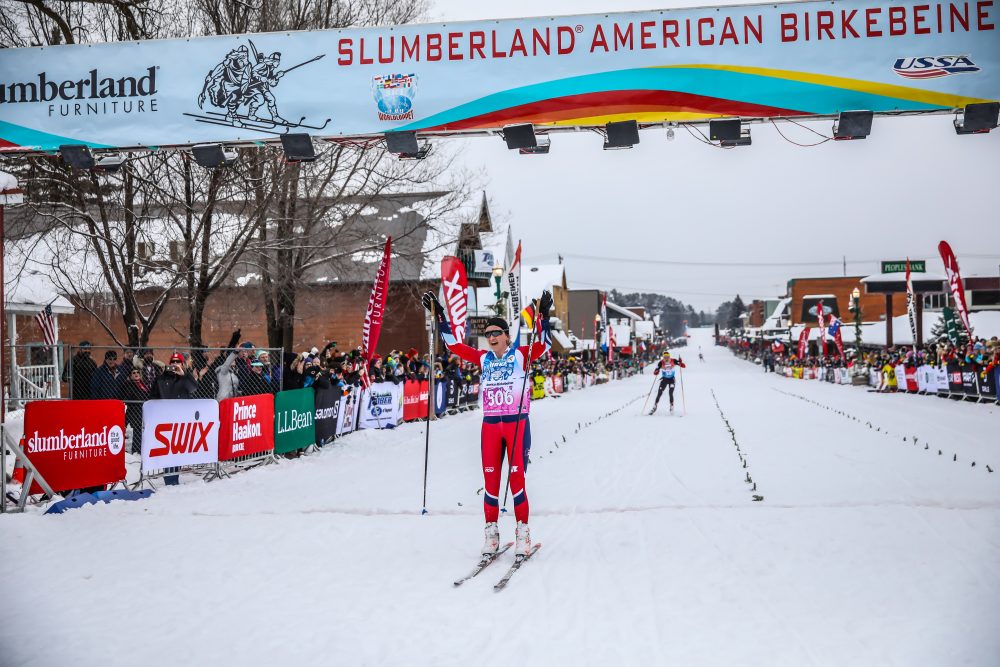
SMS T2 skier Alayna Sonnesyn with the 2019 American Birkebeiner win. (Photo: James Netz) FasterSkier’s American Birkebeiner coverage is made possible through the generous support of New Moon Ski & Bike in Hayward, Wisconsin. While you are at the Birkie be sure to visit New Moon Ski & Bike for all your local expertise.
Falling snow. Not too frigid temps. And a layer of fresh snow overlaying the 50 kilometers of undulating terrain for the 2019 American Birkebeiner. Perhaps no matter the conditions, it is cross-country ski racing paradise. The event marks a gathering of nordic skiers from across the continent there to partake in an event boasting serious on-the-verge-of-leg-cramp racing and a double dose of Wisconsin culture. Norwegian sweaters and Birkebeiner chotschi aside, the famed point to point race defines head to head tactics and fitness.
Amidst the infamous trail lined with deciduous trees that eventually opens up onto Lake Hayward in the event’s closing kilometers – the 50 k skate saw a new winner in the elite men’s and women’s categories.
In her first year training full time after graduating from the University of Vermont last spring, twenty-two-year-old Alayna Sonnesyn took the overall win in the women’s race. Sonnesyn now trains fulltime with the SMS T2 based at the Stratton Mountain School in Vermont.
But she is to the bone Midwest and understands the import of the win.
“There is definitely so much excitement and enthusiasm in the state of Wisconsin right now for this race and so it is pretty cool to be a part of it,” Sonnesyn said in call after her win. “This was my first time racing up Main Street and to hear those thousands of people cheering was pretty unforgettable and my whole body kind of went numb when I heard that. It is amazing to be part of an event that has so much passion and love for this sport. It was pretty fun.”
For those not partaking in the event but wanting to know how each k went down for the winner. Where the screws were turned. Where the skis felt silky. Where they felt like the wax tech corked in a top coat of 40 grit sandpaper.
In Sonnesyn’s exuberant retelling, the 10 k to go mark was the ah-hah. Until then, a foursome of skiers had broken away to make the elite selection of the elite wave: APU’s Becca Rorabaugh, Katie Feldman (SVSEF Gold Team), Anja Gruber (Salomon), and Sonnesyn. In the midst of the 10 k and 9 k markers, Rorabaugh began to peel little by little off the back. The three remaining skiers kept the strong pull going to separate themselves.
“Anja, Katie and I were definitely picking up the pace and really working hard,” Sonnesyn said. “And I had been taking plenty of feeds the entire race and I still felt really energetic. My muscles were definitely getting pretty tired. but I still felt like I had a lot in me.”
As the k’s began to click past, Sonnesyn passed over route 77 where she took another feed.
“As soon as I crossed 77 I just felt this jolt of energy,” said Sonnesyn. “I think from a coke feed that I got or from some of the cheering there and also just realizing that I have got 5 K left. If I want to go I have got to go.”
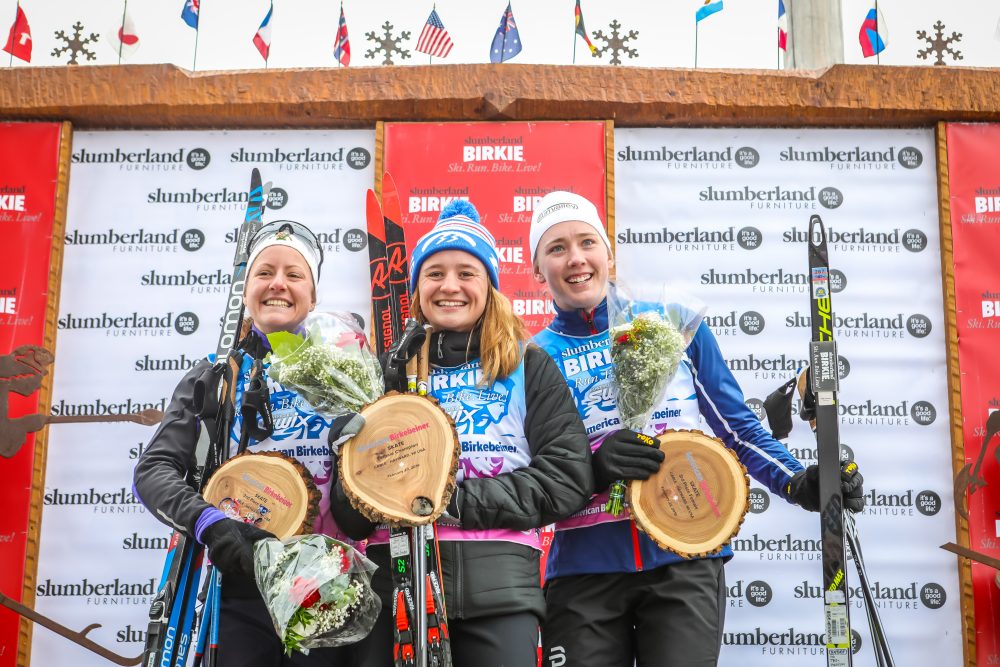
2019 American Birkebeiner women’s podium from left to right: Anja Gruber in second, Alayna Sonnesyn in first, and Katie Feldman third. (Photo: Sally Krueger) In a race like the American Birkie, the mental stamina to stay in it can rattle some and embolden others. With so many K’s to ski, it always seems safe to wait. Wait until a bit closer to the finish to make a move. With 50,000 meters to race, late can never seem too late. That is until the opportunity is abruptly snagged away.
“I thought in the back of my mind, ‘you know I could go for it here and win or I could just be patient and maybe not even make the podium,’” she said. “To me, I thought it was worth it to go for it and take that risk and take the chance to break away.”
The moment was for real. A groomed Hayward main street. A cacophony of cheers. And Sonnesyn, alone amongst her elite wave peers, won in a time of 2:34:01 hours.
“I did keep looking across my shoulder but once I got onto Main Street up and over that bridge it was surreal. All the cheering just hit like my entire body went numb. I was overcome with emotion and definitely by the time I crossed the finish line and realized I had actually done it I broke down.”
Akeo Maifeld-Carucci in green, Brian Gregg (left), and Matt Liebsch (right) down Main Street in Hayward, WI. (Photo: James Netz) Phonetically, it is a unique name, but a simple one. Say it: “Ahh-key-oh” … Akeo. The first name has Marshall Island roots, the last name possess a Euro core. It’s Akeo Maifeld-Carucci.
The twenty-ski-year Maifeld-Carucci can ski.
But let’s dial the time machine back a bit and be a bit less formal and go with the first name. Akeo skied at Harvard, then spent stints training in Bozeman (his hometown) and Bend before settling in with the Craftsbury Green Racing Project last June.
He is a mechanical engineer. As much as he is an endurance junkie, he is a fastidious analyzer. Not a bad trait in the world of design and build, but on the race course, analyzing can help only to a point. On some occasions, the over-analysis can see the make-your-move-moment lost.
“We were at Double OO, which is 28 k from the finish or so is when Brian Gregg really put in a move,” Maifeld-Carucci said in a phone call. “There is a prime there and he went for the prime. And there is this hard gradual uphill section right after the prime and he maintained, he put a gap on us. No one really chased him and he maintained that gap for a little bit and I was like, ‘Brian is really strong we should probably try and close down on that’. So I just went to the front. Closed down. Then I looked back and saw that Matt Liebsch was on me. So it was the three of us and we had maybe a twenty-meter gap back to the rest of the pack.”
Closing the gap right then and there was the first of several clinching moves. The analysis worked. It was Maifeld-Carucci and two of the American Birkebeiner’s most knowledgeable elders in Liebsch and Gregg. As the trio raced on, according to Maifeld-Carucci, Liebsch went to the front and stated this was the time to separate from the chase.
“And I was sitting there and thinking ‘well, there is a little downhill after this and usually, it is really early to go and usually the pack can close on that downhill stretch because they move faster,’” Maifeld-Carucci said as he reflected on a moment of doubt. “I had heard a couple of guys before the start saying, ‘oh a break at OO never lasts, people always close it on the k-and-a-half of rolling downhill after that. The pack moves faster on that downhill stretch so the gap never lasts at OO.’”
The real-time analysis at OO made Maifeld-Carucci hesitate.
“I was nervous but then when they said, ‘I think we can make it’ and I knew Matt and Gregg are strong and they know the course really well, so I was considering that,” said Maifeld-Carucci.
Considering. Computing. Sensing the energy reserves and the stamina left in his legs. Again, like closing down Gregg’s pulse, Maifeld-Carucci’s endurance calculus told him to trust in Gregg, Liebsch, and himself.

SMS T2 skier Alayna Sonnesyn with the 2019 American Birkebeiner win. (Photo: James Netz) “It was nerve-wracking,” said Maifeld-Carucci. “I felt my legs starting to tighten up maybe on the edge of cramping even from 20 k out. So I was a little nervous about that, because you know that is a lot of race left. I was trying to flirt with the line of how fast I can go without pushing too hard and using too much power and making the legs cramp. I was dealing with that and it only got worse.”
But not bad enough. Across the lake, and over the American Birkebeiner International Bridge with 400 meters to go the sprint was almost on. Not before the path to victory was thoroughly analyzed did his motor truly rev.
“We dropped into the finishing stretch, 400 meters of just straight away gradual uphill and I kept telling myself, ‘’you don’t want to lead and you don’t want to go too early.’ I was trying to wait. But the crowd was so loud and so explosive I just couldn’t wait any longer I saw the finish line, felt the noise and I was like ‘screw that, we have got to go.’”
As precise a win as can be over 50 k, Maifeld -Carucci won by 0.9 seconds over Gregg in second. Liebsch placed third (+8.5). The winning time was 2:12:34.9 hours.
-

Saturday Rundown Starting with Seefeld and Ending in Hayward, WI. (Updated)
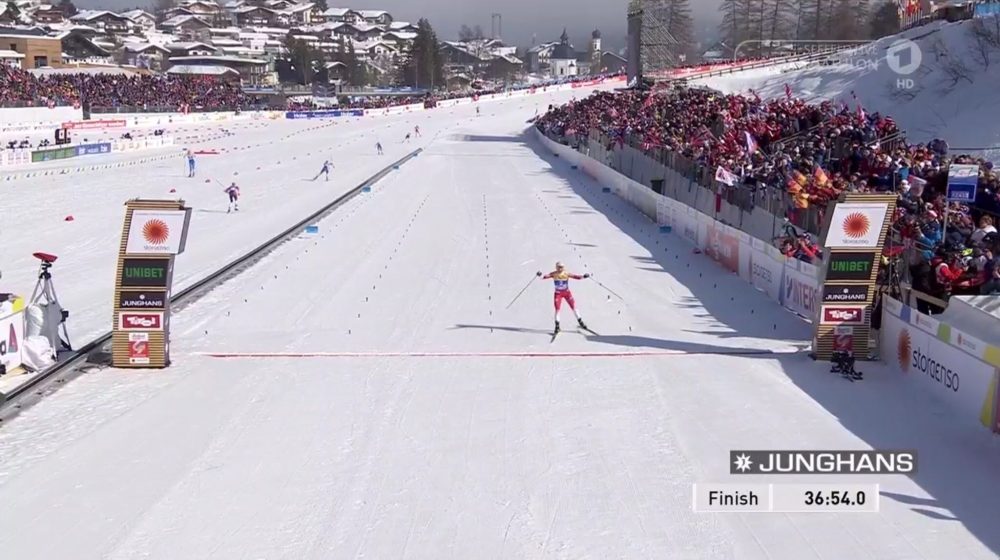
Therese Johaug of Norway crossing the line solo as she won Saturday’s World Championship 15 k skiathlon in Seefeld, Austria. (Photo: ARD screenshot) FIS Nordic World Ski Championships Seefeld, Austria 15 k/30 k Skiathlon
Men’s Race Report | Women’s Race Report
Between 3.75-kilometers and 4.85 k on Saturday, Norway’s Therese Johaug began to pull away in earnest during the women’s World Championship 15 k skiathlon — by then she had built a near 15 second lead.
The time back to the Norwegian would only grow. Johaug powered into the classic to skate transition zone in control with a lead padded by 26.2 seconds. At the finish, Johaug crossed the line with no other skiers in sight and a winning time of 36:54.5 minutes. It was Johaug’s fourth World Championship medal in the skiathlon.
Ingvild Flugstad Østberg, also of Norway, placed second (+57.6), with Russia’s Natalia Nepryaeva third (+58.7).
Rosie Brennan of the U.S. was the top North American in tenth (+2:01.8). Also for the U.S., Julia Kern placed 19th (+2:55.5), Rosie Frankowski 24th (+3:00.6), and Caitlin Patterson 34th (+3:54.5).
Canada’s Katherine Stewart-Jones skied to 39th (+4:19.8), Cendrine Browne 40th (+4:25.2), and Maya Macisaac-Jones 54th (+8:53.4).
The men’s 30 k skiathlon featured no off the front winner like Johaug. As the pace setting screws tightened well into the men’s race, with Russia’s Alexander Bolshunov often taking charge, the pack was winnowed to five skiers at the 26 k mark. Along with Bolshunov, France’s Clement Parisse, Norway’s Sjur Røthe and Martin Johnsrud Sundby, and Iivo Niskanen of Finland were the skiers vying for the win.
By the final half-k, only Sundby, Bolshunov, and Røthe remained up front. Down the final straight Røthe possessed the strongest reserves as he won in a time of 1:10:21.3 hours. Bolshunov placed second (+0.1), and Sundby third (+0.7).
Canada’s Alex Harvey paced himself to sixth overall (+58.9). Evan Palmer-Charrette placed 45th (+6:12.4), and Scott James Hill 56th (+9:58.8).
For the U.S., Scott Patterson raced to 32nd (+4:40.6), David Norris 38th (+4:54.4), Kyle Bratrud 49th (+6:19.6), and Adam Martin 54th (+7:47.4).
***
SuperTour/American Birkebeiner Hayward, WI. 50 k Freestyle
The plotline thickened on Saturday in the elite men’s freestyle 50 k at the American Birkebeiner when Akeo Maifeld-Carucci (CGRP), Brian Gregg (Team Gregg), and Matt Liebsch separated themselves from the field. The three skiers fended off any chasers and charged onto main street three across in their final effort towards the finish line.
Maifeld-Carucci took the win in 2:12:35 hours, with Gregg second (+0.93), and Liebsch third (+8.50).
Alayna Sonnesyn (SMS T2) won the overall women’s 50 k skate in 2:34:01. By the time Sonnesyn passed the time check on Lake Hayward, she had gapped Anja Gruber (Salomon) in second by 29.60 seconds. Gruber took second overall finishing 54.60 seconds back from the winning time. Third place went to Katie Feldman (SVSEF Gold Team) crossing 1:08.63 minutes back.
FasterSkier will be posting race reports on the 2019 American Birkebeiner later today.
Men’s Overall Skate Results | Women’s Overall Skate Results
***
(Friday) FIS Nordic World Ski Championships Seefeld, Austria Individual Gundersen 10 k

U.S. athlete Taylor Fletcher on his way to placing 35th overall during Friday’s individual Gundersen 10 k at the Seefeld, Austria World Championships. (Photo: John Lazenby/lazenbyphoto.com) On Friday in Seefeld, the first nordic combined event, an individual Gundersen 10 k was won by Germany’s Eric Frenzel. The German was the best ranked jumper and won the ski in a time of 24:43 minutes. Jan Schmid of Norway, the day’s third ranked racer after the jump, placed second (+4.3). Austria’s Franz-Josef Rehrl placed third overall (+8.7).
Americans Taylor Fletcher skied to 35th (+4:05.5), Ben Loomis 44th (+5:29.7), Jasper Good 47th (+6:25.1), and Grant Andrews 48th (+6:52.8).
Nathaniel Mah of Canada was 50th (+7:12.3).
-
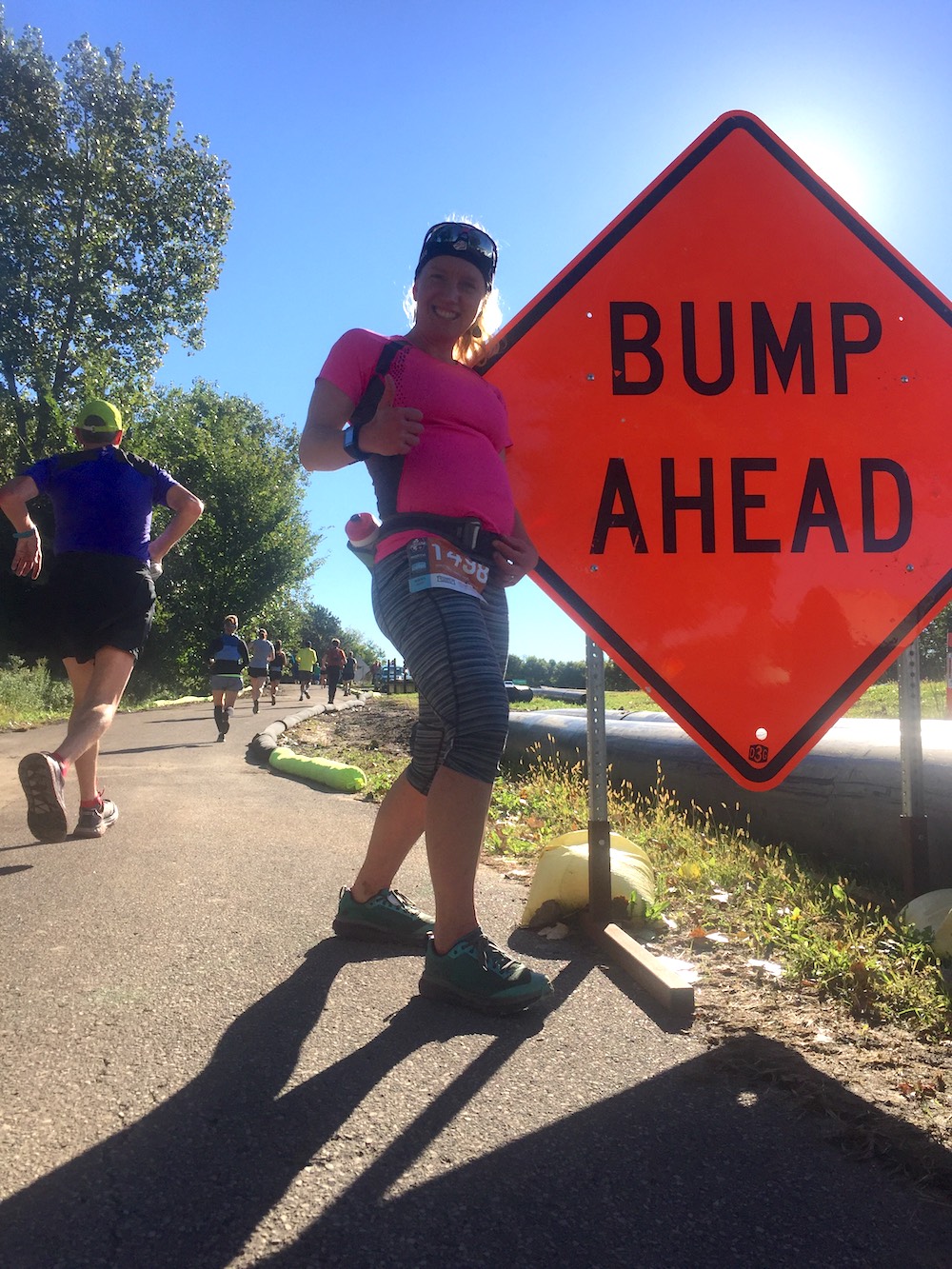
Soon-To-Be Parents, Caitlin and Brian Gregg on the Winter Ahead
Caitlin Gregg rocking her baby “bump” while 20 weeks pregnant at the Loppet Foundation’s Trail Loppet, an “urban trail run”, on Sept. 21 in Minneapolis, Minnesota. She and her husband Brian are expecting their first child in early February. (Courtesy photo) The questions started rolling in this spring. How’s training going? Are you going for 2019 World Championships? What’s the plan for next winter?
When you’re Caitlin and Brian Gregg, Olympians and local superstars in the Midwest, it’s hard to keep your athletic profile on the DL. Since buying a house on Theodore Wirth Park seven years ago, the couple has immersed themselves in the greater Minneapolis community — both in and out of skiing. They’ve raced, coached and worked out alongside skiers of all levels. They’ve bolstered the Loppet Foundation and its Loppet Nordic Racing program while chasing their own athletic dreams. And for the most part, they’ve achieved everything they set out for.
But not making the Olympics last winter was a blow for both Caitlin and Brian. They had both been on the edge — the infamous bubble — but didn’t make the 20-person cut for PyeongChang.
And by Brian’s calculations, at least one of them should have.
“The naming of the 2018 Olympic Team was a surprise to me,” Brian wrote in an email to FasterSkier in late September. “After Caitlin made the team in 2010 and myself in 2014 it was our dream to both be competing in 2018. I did not expect to see so many discretionary selections and I had expected to see Eric Packer on the Olympic Team, and I thought I would be as well if they took as many as 20 athletes. I am happy to see that we took a full team of athletes, although it was hard to see us not fill all of our distance men’s starts. I believe the criteria and the selection committee failed our athletes. I still believe we have room to improve our team selection and this year is better than last year, although we still have improvements to make.”
Despite feeling that he and Packer ranked high enough on the U.S. Ski Team’s 2018 Olympic points list to make the cut, Brian wasn’t bitter. And he’s still planning to race this winter. But life for the Greggs is different this year.
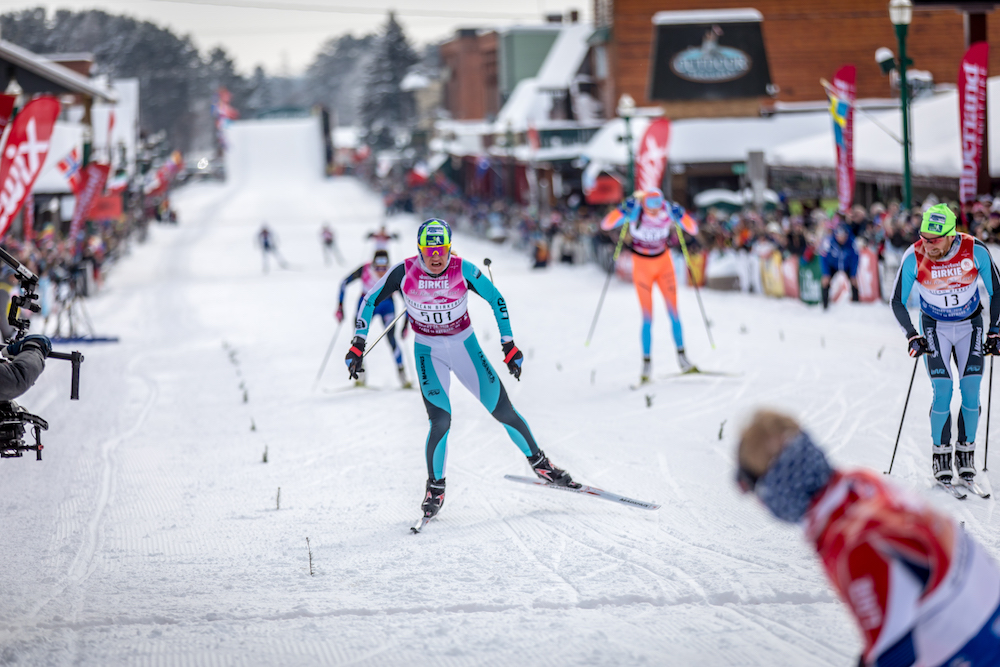
Caitlin Gregg (501) winning her fifth American Birkebeiner last February in Hayward, Wisconsin, while skiing alongside her husband Brian Gregg (13), who placed 22nd in the elite men’s skate race. (Photo: ABSF/James Netz) For one, Brian has been working full time in financial services and taking night classes to become a certified financial planner. In a major step toward that, he passed the six-hour Series 7 exam two weeks ago.
That has meant less training, which he didn’t necessarily see as a detriment. In various running races this spring, summer and fall, Brian won the City Trails Loppet (a 10-mile urban trail run in St. Paul Park, Minnesota), finishing just ahead of his good friend Matt Liebsch, then ran a 1:12:43-hour road half marathon (Grandma’s Marathon) in June in Duluth, Minnesota, won the Loppet Foundation’s Trail Loppet half marathon (in 1:20:34) on Sept. 21, and placed seventh in the Birkie Trail Run Festival’s half marathon (1:24:00) on Sept. 28.
“Now that I’m training a little less on the days where I don’t get out to do a workout, one of my big inspirations is my friend, Matt Liebsch,” Brian said on the phone in late August. “Seeing him not make the [Olympic] team in 2014, that was disappointing, but seeing how much fun he has in the sport, and we still train together four some-odd days a week. … Not all of our times are getting slower; you keep chipping away and pushing yourself.
“It’s good for your general mental health,” Brian added, referring to skiing as a lifestyle more than a job. “I just like it and I think the more people we can get into this sport and doing it, the world’s a better place that way.”
Caitlin agreed.
“We both love the sport and we’re in a really fortunate scenario; it’s pretty neat to have a husband-wife Olympic duo,” she said on the phone while sitting with Brian at his office. “It definitely happens, but the fact that we’ve been able to support each other through that is pretty cool.”
“It’s good for your general mental health. … I think the more people we can get into this sport and doing it, the world’s a better place that way.” — Brian Gregg on cross-country skiing
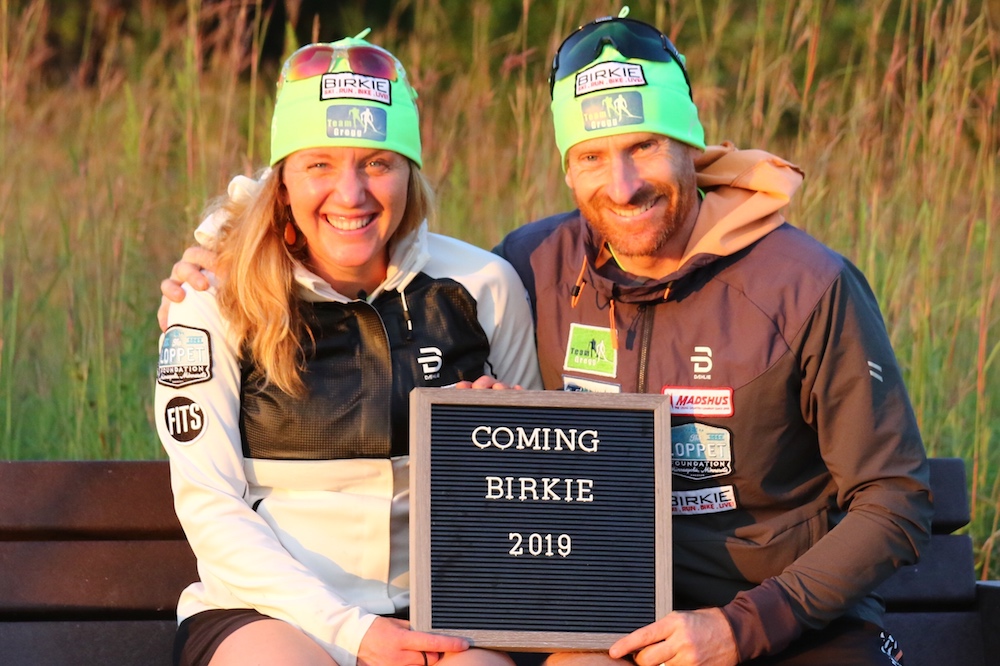
Caitlin and Brian Gregg are expecting their first child on Feb. 9, two weeks before the 2019 American Birkebeiner. (Courtesy photo) While the two halves of Team Gregg are used to supporting each other at North American ski races — including an annual assortment of SuperTours and U.S. nationals — Caitlin has been doing more coaching and sideline cheering so far this year. While she had originally planned to keep her pregnancy a secret early on, Caitlin said that it became tough to dodge the training questions.
On Aug. 10, they posted an “expansion of Team Gregg” baby announcement on their Facebook page. During their Aug. 22 interview with FasterSkier, Caitlin was 16 weeks pregnant. And as of this week, now 22 weeks along, she’s past the halfway point. They’re expecting their first child — a girl — on Feb. 9, exactly two weeks before the 2019 American Birkebeiner (a ski marathon Caitlin has won a record-setting five times).
“I told her she has two weeks to get ready and in shape,” Brian jested.
“I was like, ‘Uh, yeah,’ ” Caitlin replied.
***

It’s a girl! Brian (r) and Caitlin Gregg (beneath pink confetti/candy) discovered the gender of their baby, due Feb. 9, 2019, at a gender-reveal party in August. (Courtesy photo) The gender-reveal party (with a piñata filled with pink candy), a baby shower her high-school athletes threw her (with diapers filled with melted chocolate bars), it was all new to Caitlin.
So was the news of a blood clot in her leg in early July. During their six-hour drive home from Thunder Bay, Ontario, where Brian had competed in Canada Day rollerski races while Caitlin cheered him on, Caitlin started feeling pain in her left calf. It worsened and she went to see her doctor, which revealed she had two blood clots in her calf. She was immediately put on blood thinners and instructed not to bike, rollerski or do anything with a heightened risk of falling.
“That was super scary,” she reflected. “… The doctors were like, ‘That’s really weird, you’re the last person we thought this would happen to; you’re so young and active.’ So we haven’t gotten any answers yet as to whether it’s an underlying [condition]. … There are a couple other genetic disorders you can have, inherited blood-clotting disorders that I just never knew about, potentially, [for] my entire career. I’ll get tested for those after the pregnancy, but one of the big bummers is that I have to be on blood thinners for the remainder of the pregnancy.”
She immediately remembered Kikkan Randall’s blood clot scare in 2008 and decided to call her former U.S. teammate, a 2018 Olympic gold medalist.
“She took a good 45 minutes and just talked to me and told me about her scenario and how it was for her and what she had to go through and all of the kind of different aspects of blood clots and the pregnancy and how everything turned out great, so that was super reassuring,” Caitlin said.
While their experiences were different (Randall had two surgeries to remove a recurring blood clot in her leg well before she became pregnant in 2015), Caitlin was comforted by their conversation. Two days after they spoke, Randall announced her breast-cancer diagnosis on July 11 on social media. She had never mentioned it to Caitlin.
“To me, that was the epitome of a class act,” Caitlin said. “She didn’t once change the subject and say, ‘Don’t worry, that’s nothing,’ or belittle my fears or anxieties. She just listened and was super awesome and great mentor and very much present in what I was dealing with, so I immediately wrote her and said that was amazing, thank you so much, and I wished her the best.”
For the duration of her pregnancy, Caitlin will take two shots of blood thinners each day. In addition to her exercise limitations, she’s also been advised not to fly or take long road trips for the time being.
“For me, because the dose is so high … [the doctors are] more worried about internal bleeding and almost not knowing it, is the bigger thing,” she said. “I can still ride a stationary bike, and I can do a lot of exercises. I just have to make sure the risk of that falling — so mountain biking, riding a bike outside, rollerskiing — are kind of the big no-nos. … But I’m really looking forward to skiing on snow, especially on super-soft, powdery stuff. … Honestly other than that, pregnancy has been awesome.”
In June, Caitlin, about six weeks pregnant, ran the same Grandma’s half marathon as Brian, finishing 19 minutes behind him in 1:31:38. In an effort to qualify for the 2019 New York City Marathon, the two had registered for the 13.1-mile road race before discovering that Caitlin was pregnant. Caitlin decided to run in what she called “Level 3” while being mindful of her heart rate and feeds during the race. She said she felt “awesome,” and their finishing times did the trick, qualifying them for next year’s NYC Marathon.
Since then, she’s scaled back the racing, instead entering running races with a goal of “jogging/ walking/ pole hiking them”.
Meanwhile, Brian has been getting out for workouts whenever he has time and plans to race at least the first period of the SuperTour circuit this coming season. In an effort to qualify for his first World Championships, he is focusing on strong performances in the 15-kilometer freestyle at the Sovereign Lake SuperTour/NorAm in December in British Columbia, and the U.S. nationals distance races in early January in Craftsbury, Vermont.
“My training volume is hugely reduced this year, but I have been hitting all of my intensity sessions,” Brian wrote in an email. “My primary focus is on preparing to support my family and my baby girl, but my passion for ski training and racing will never go away.
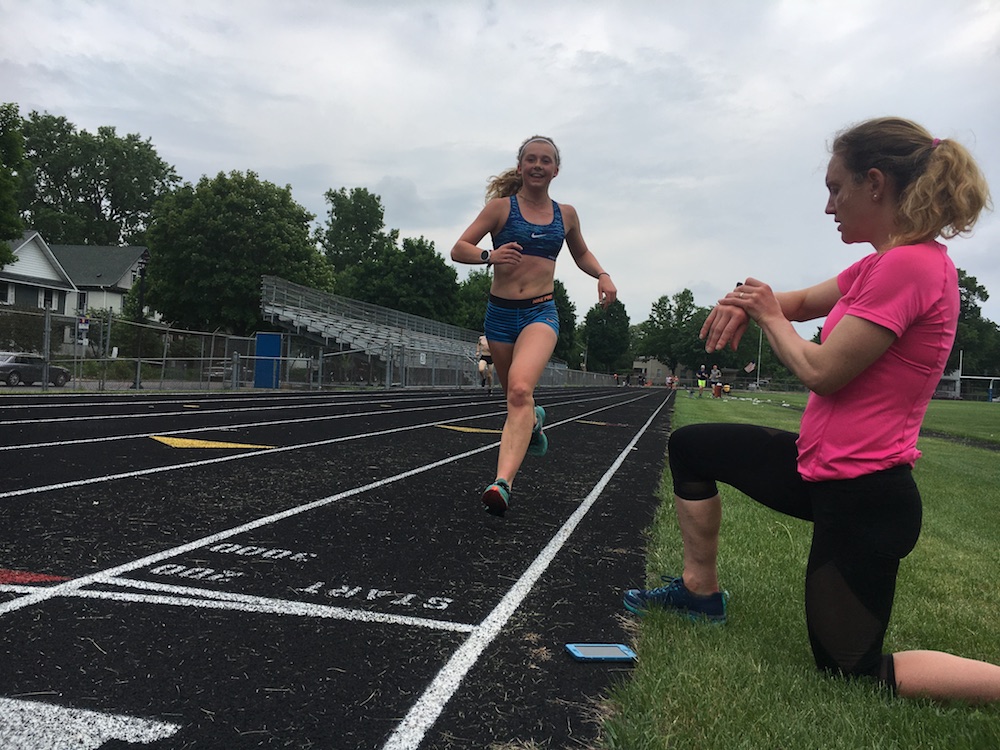
Coach Caitlin Gregg (r) timing Sarah Olsen, a Loppet Nordic Racing junior skier, during a time trial this past spring. (Courtesy photo) While Caitlin won’t likely be able to travel to Canada and New England to support Brian at those races, she expects to stay busy at home while working with sponsors, like Madshus, as well as the Loppet Foundation. In addition to coaching 12 college skiers this summer, Caitlin was hired as the Loppet Foundation’s director of adult programming. She’s also an assistant coach with the foundation’s year-round Trail Kids program.
“We’re both staying super busy, which I think is exhausting in a lot of ways, but it’s also really fun because it brings a lot of balance,” she said.
“Sometimes it’s good to not have a lot of time to analyze your training session,” Brian said. “You’re sort of like, ‘I’ve got an hour and a half. I’m going to just try to get everything done in this hour and a half, and then I’m going right to class or school or working with this kids.’ ”
The two are also adjusting to spending less time together. While they didn’t necessarily work out alongside each other, the Greggs frequently start and finish at the same place, which Caitlin described as “trailheading”.
“Basically you drive to the same location and say, ‘All right, I’ll see you in two hours,’ ” she said. “There are some times when [we would] play around with rollerski speed wheels … or Brian uses a weight vest and that works pretty well.”
During a summer hike on the Birkie Trail, Brian wore a backpack with a watermelon inside. Caitlin guessed it weighed 40 pounds.
“It wasn’t that big of a watermelon,” Brian quipped.
But when they’re not exercising, they’re working — which has become more full time for both of them.
“We went from spending 24 hours a day together, 360 days a year or whatever — there was maybe a couple days or weeks where one of us would be somewhere else. Now Brian’s at the office all day or I’m out coaching,” Caitlin said.
“I feel like I haven’t seen her for weeks,” Brian added.
Yet they’re still having fun, and they’re still loving their ski-driven lives in the Twin Cities. Late last month, news broke that Minneapolis will host a 2020 World Cup race at Theodore Wirth Park, right outside their door.
“Caitlin moved to North Minneapolis 10 years ago and the bulk of her training leading up to the 2010 Olympics and her 2015 World Championship medal were on the trails at Wirth,” Brian explained, referring to Caitlin’s bronze medal in the 10 k freestyle at 2015 World Championships. “I won my first Super Tour at Wirth and we strategically purchased our house 7 years ago next to Wirth because of the great training opportunities.
“It has been incredible to be a part of the amazing Midwest ski community and the growth of the Loppet Foundation,” he added. “One of the major goals of the Loppet Foundation is to promote health and wellness with underprivileged youth and families. We share this passion and it is just amazing to see our small community based organization grow … We have a large group of junior skiers and I would love to see those kids representing our home club in the World Cup, but you better believe we will be keeping those kids honest and going for a spot ourselves.”

Brian and Caitlin Gregg with their baby’s first “singlet”. According to Caitlin, TNC Endurance stands for Team Nichole Coaching. “I worked with Nicole Porath for my training plan for Grandma’s marathon (which was going awesome) and then she helped guide me with the switch to the half-marathon and how to run it once I found out I was pregnant! She is an Olympic Marathon Trials competitor and mother of two. It was/ has been really fun working with her on some running training. I am excited to work with her after the baby is born too!” (Courtesy photo) As of last month, the Greggs are living debt-free in their home. They literally jogged to the bank before work one morning to sign the final paperwork.
In another “Team Gregg style” exercise session, they ran three miles for ice cream, then ran home. They’ve been known to run to farmer’s markets as well.
Brian vouched for Caitlin’s “intense food cravings” in the first trimester, like the ramen noodles she wanted for breakfast one morning.
“I don’t think I’ve ever seen her have a bowl of ramen in her life,” he said.
“A couple days later I was like, ‘Please take it out of the house, I can’t look at it,’ ” Caitlin said with a laugh.
While life is busy as usual for the Greggs, they’ve both welcomed the transition from “full-time athlete status” to additional work and soon-to-be parenting responsibilities.
“We’re super psyched, we’re having a lot of fun,” Caitlin said. “It helps when you don’t have so much time to think about where you were this time last year or overanalyze your training and just get out and do what you can and be thankful.”
“I’m excited the ski trail comes by the office so I’ll be able ski to work on a good snow day,” Brian said.
Asked what’s kept them in the sport this long, both were quick to answer. They absolutely love it.
“We both are very goal-oriented, but the bottom line is we have an awesome community here and we have so much fun getting out and having such great company, no matter what the level of the company is,” Caitlin said of skiing with people of all ages and abilities. “We get excited having people to push us and push other people and really kind of show that you can make it a lifestyle and make it fun and continue no matter what you’re doing.”
-
Matt Liebsch Going Ski Picking
Matt Liebsch is flying to Europe THIS weekend to start hand picking Nordic (classic and skate) skis. (Click here to get on his pick list.)
Skis are all different, even within a pair there are differences since skis are made in single quantities, one at a time. The manufacturing process to produce a ski is still variable and the materials can change. The guts of most skis are still made of wood and there is variability in wood. In addition variability is introduced by pressing and molding cores into varying shapes for different conditions, weights, etc. Ski producers would like you, the consumer, to believe that every pair is good but that is simply not true. This is why Pioneer Midwest takes the time and expense to travel to ski manufacturers and warehouses around the country and world to pick the best skis for our customers and inventory. I pick skis based on 3 methods:
1) My hands and eyes. Rule of deliberate practice. I have touched tens of thousands of skis and I can quickly pick out the qualities and traits of a ski by sighting cambers and hand squeezing.
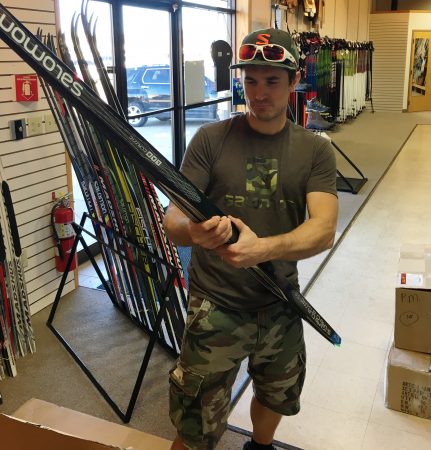
2) Flex board. This is a traditional ski picking method based on pocket and glide contact length. This is a tried and true method, although using secondary flex characteristics (pocket length) does not always give the most accurate indicator of performance.

3) Flex pressure mapping. This direct measurement of flex with a flex tester is our newest tool. Load cells and computers don’t lie. This is a black and white measurement when it comes to quantifying quality and profile.

Feel free to contact me if you have any questions, or paste this link in your browser and fill out the ski request form.
http://www.pioneermidwest.com/services-125806/ski-request/
The cost for skis is no different than the normal retail cost; $400- $750 depending on brand and model. Stone-Grinding and hot box treatment is $70. Fast skis are expensive but worth every penny of enjoyment 🙂
-
Wednesday Workout: Killer Ski-Specific Strength with the HardCore Training Center
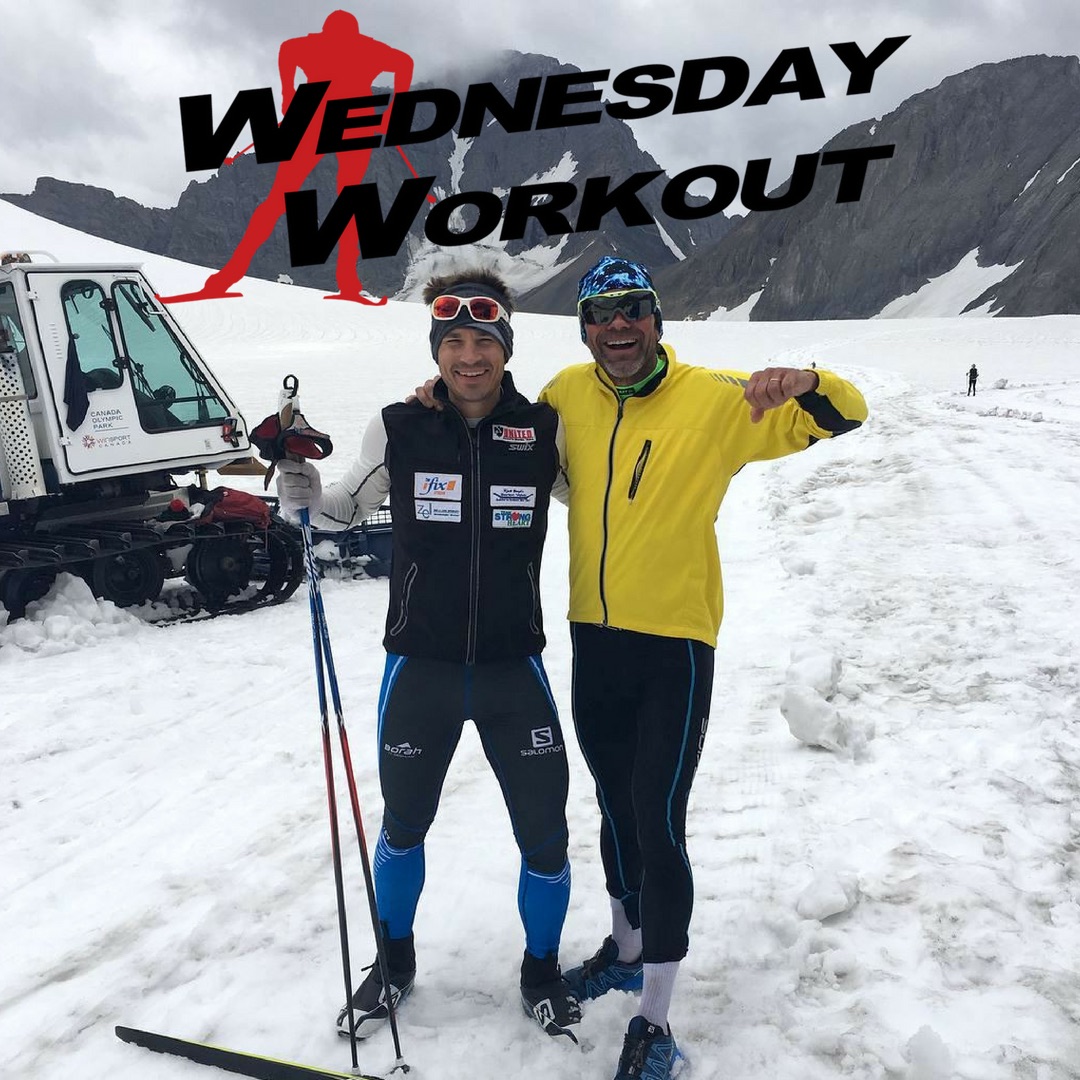
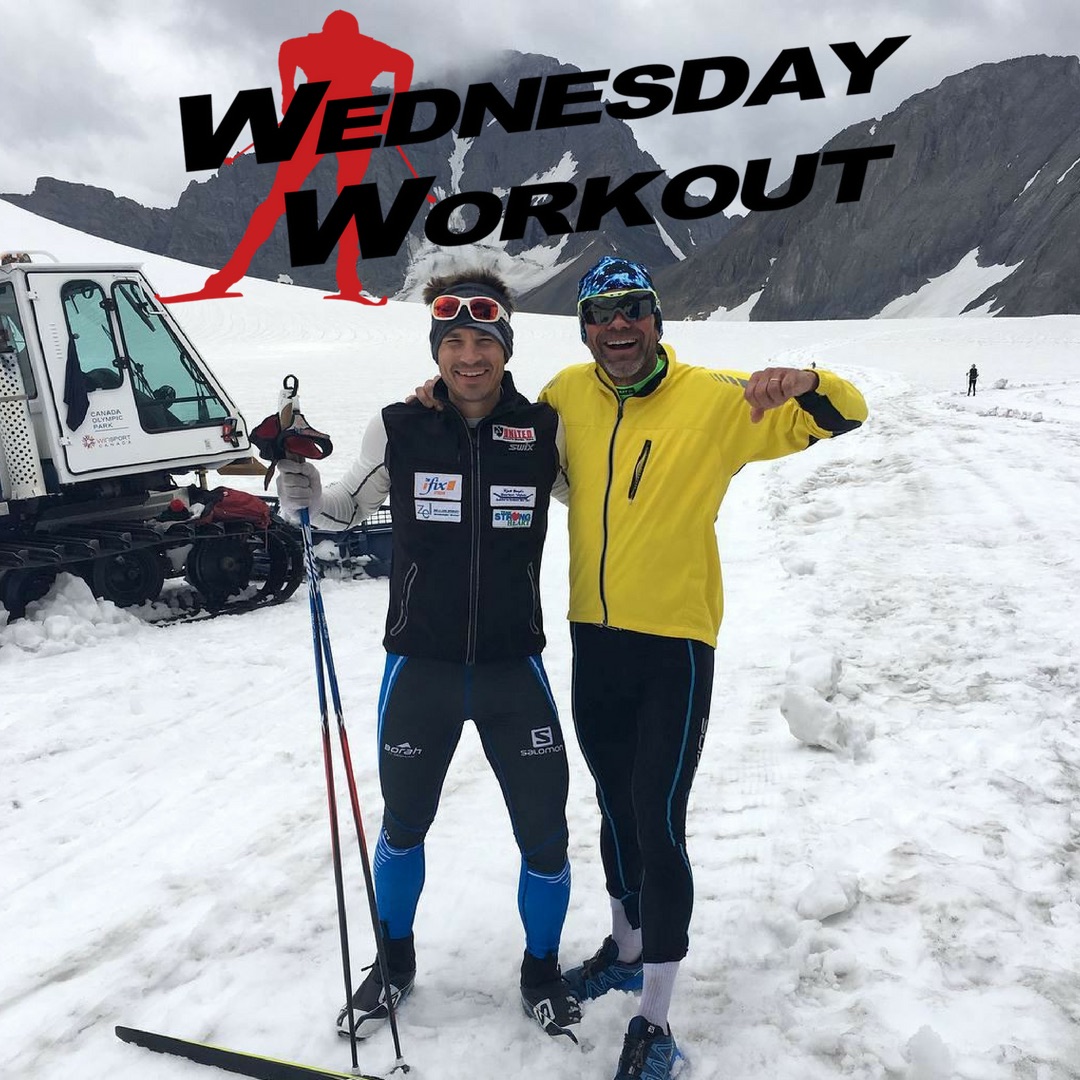
Author Bill Nurge and Matt Liebsch (l) on the Haig Glacier near Canmore, Alberta, last August. (All photos: Bill Nurge) This week’s workout comes from Bill Nurge, head coach and owner of the HardCore Training Center in Ketchum, Idaho, who has a master’s degree in exercise physiology. Starting July 28, Nurge and Matt Liebsch will be serving up a week of nordic-specific fitness training and technique work at the Sun Valley Nordic Fitness Academy. With a maximum of only 12 participants, they recommend signing up early. Click on this link for more information.
***
You can blame Matt Liebsch for this workout … and for making me a better skier!
Last August, my wife and I joined Coach Matt, and 25 other nordic tribe-mates, on the Haig Glacier for what turned out to be a bucket-list topper in every regard. One of the biggest takeaways from skating a dozen hours behind the terminally affable Birkie winner and World Cup skier was how annoyingly powerful and stable he is on one ski. Whether he was single-ski double poling up a hill, or gliding effortlessly on a long descent, he was always solid and skilled while perched atop a single Salomon S/Lab skate ski. As much as I’d like to blame the fact that I didn’t start skiing until I was almost 30, and my equipment wasn’t as good (Matt promptly set me up with shorter poles, better boots, and hand-picked stable skis), the stark reality was simple: Matt possessed more power, greater dynamic stability, and better balance than I did.
So once my 56-year-old brain got over being tweaked by my body’s inability to match his single-ski prowess, I set to work on developing a program to take my balance, core stability and functional power to a higher level. And the best part is that it worked! Prior to consistently performing the workout I’m about to share with you, my posture, balance, and power output would predictably spiral downward halfway into a 50k skate race. But this past March, I was able to string together two of my best back to back 50 k’s (10th overall at the West Yellowstone Rendezvous; 4th overall at the Cascade Crest Marathon) with no appreciable diminution in performance.
It’s no secret that nordic skiing — particularly skating — is a single-leg sport. Unless you’re double poling or flying downhill in a tuck, the vast majority of time is spent balancing and producing “ground force” with one ski, and one or two poles. This is why single-leg power, core stability, and balance play such major roles in sustainable speed. Every powerful stride must be accompanied by a dynamic, and sometimes high-speed balancing act requiring huge amounts of stabilization at the hip, knee and ankle joints. In the 2 hours and 15 minutes — of mostly single-leg Pain Cave time — it took me to complete the relatively flat Cascade Crest 50 k in Bend, Oregon, I ended up doing roughly 4,000 V2 strokes on each leg. That’s a lot of time performing single-leg squats with hip abduction and balancing and repeating every second!
So here’s the deal, most nordic athletes do a great job of cranking out lots of cardio hours, weighted pullups, dips, box jumps, and heavy squats. The problem is that some of the hard-earned endurance and strength will be squandered unless it’s matched with equal amounts of balance and stability training. With regard to function, the muscles of the hip can be separated into two groups: movers and stabilizers. Though they all technically perform both, it’s easier to think of them in these two distinct categories. Because strength and stability are two sides of the same coin, having strong “movers” (lats and glutes) and weak “stabilizers” not only compromises performance, but may contribute to shoulder, lower-back, knee, and ankle injuries. Bottom line: nordic skiers are only as “strong” as their weakest stabilizers. Just like their big-brother primary movers, the myriad behind-the-scenes stabilizer muscles need strength, stamina, power, AND intelligence to do their “balancing act” effectively. No stability, no balance, no fun.
Here are five pairs of exercises you can add to your existing program to help improve single-leg balance and functional power (with links to demo videos):
The Workout: Nordic-specific exercises to improve balance, core stability and functional power
Warmup: About 20 minutes
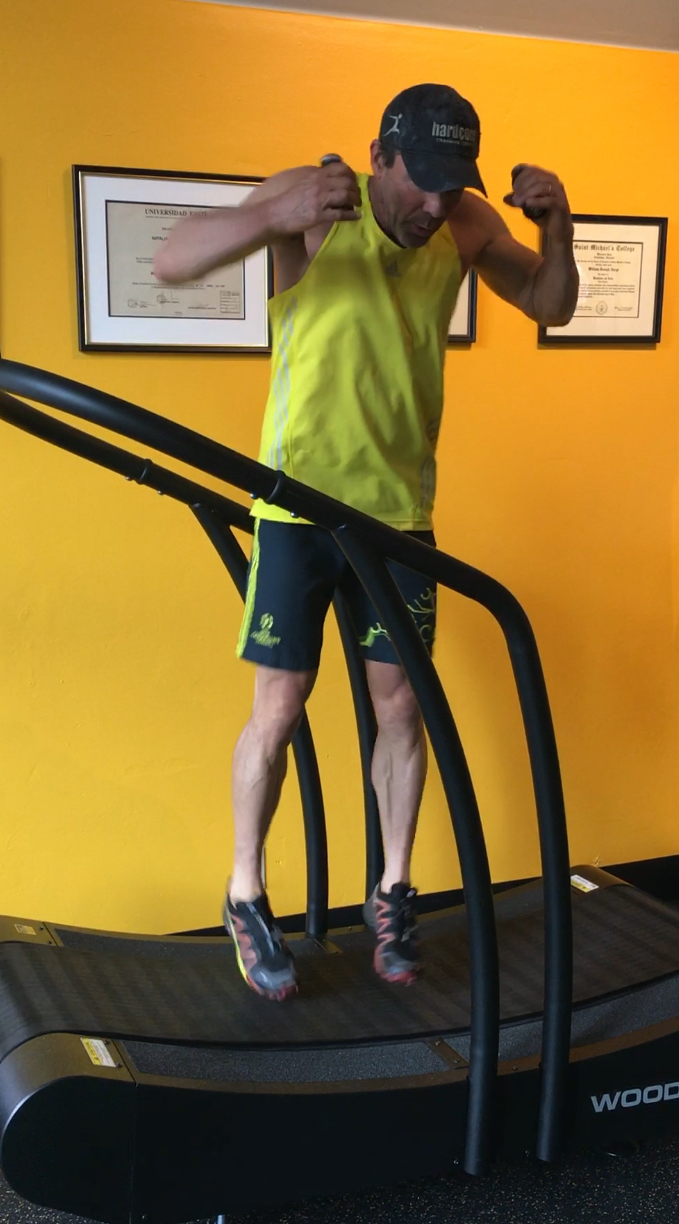
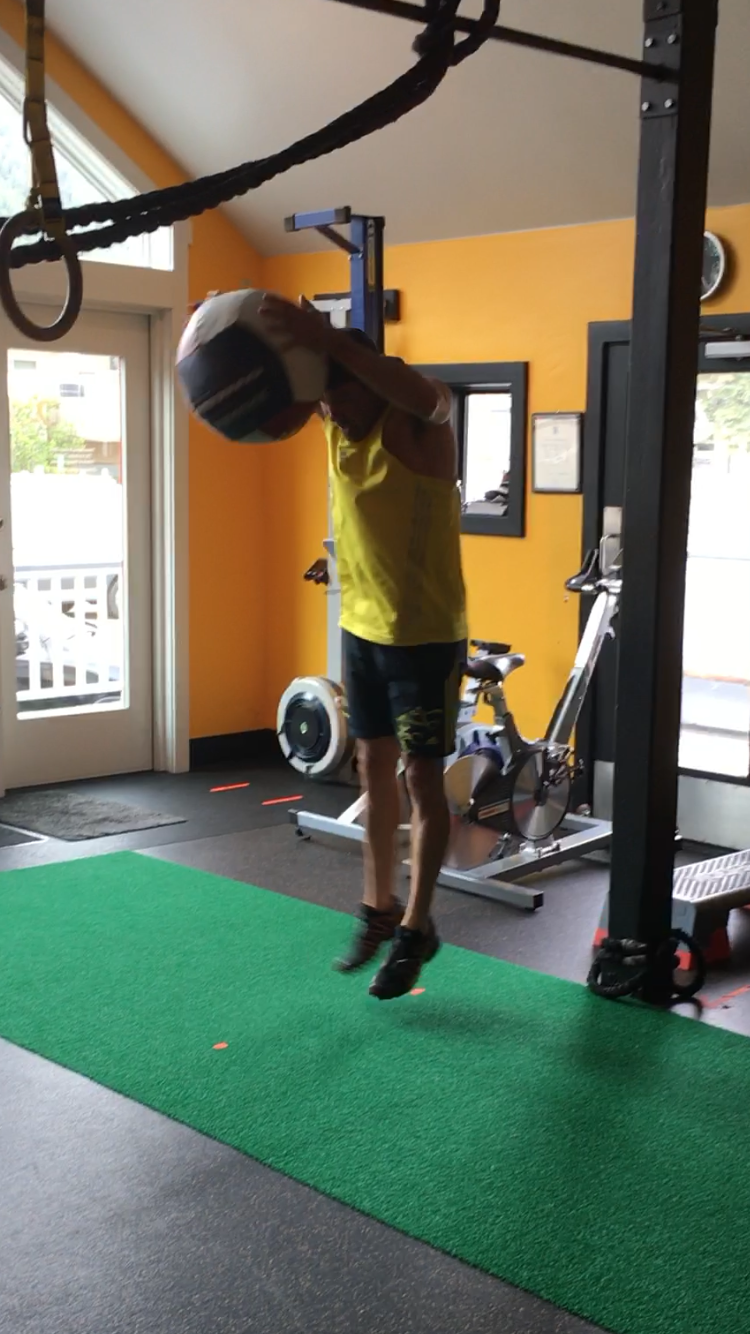
Before getting into high-intensity unilateral exercises, it’s always best to do a progressive and comprehensive warmup. I like to start with 2 minutes of Level 1-2 cardio on the AirDyne standing, treadmill forward run with pulsers, and SkiErg double-poling. I would then recommend doing 60 seconds of alternating single-leg squat dips, alternating side-skip med-ball slams, and alternating split-squat rope pulls.
Then do a second set of 2 minutes of Level 2 cardio standing on the AirDyne, all directions on treadmill, and V2 on the SkiErg. Follow this up with 80 seconds of alternating dips, side-skip slams, and lateral skip rope pulls.
Finally, a third set of 2 minutes alternating 10 seconds easy/10 seconds “harder” on AirDyne (hands on rings pulsing up and down), treadmill (forward only), and SkiErg V2 with jump, followed up by 90 seconds of tuck-jump dips, single-leg BOSU hop rope pulls, and side-skip slams.

Side-skip on the treadmill with pulsers 
Side-skip slams Paired Exercises: About 25 minutes for one set of each
For each of the paired exercises, I would recommend starting with a medium-hard 60-second first set with 30 seconds rest between each leg, and no rest between pairs. Note that on all but the first set you will be performing each of the paired exercises on the dominant leg first (left leg for most right handers), and then the non-dominant leg. I like to have the less coordinated/“weaker” leg follow the lead and learn from the smarter/stronger leg.
So for example you would do (#2a) left-leg inverted SkiErg step ups, immediately followed by (#2b) left-leg single-leg slideboard double pole. After 30 seconds of rest, switch to the right leg of the same exercises. Then move on immediately to the next (#3) set. Try to build into each set and maintain form as you get fatigued. The demo videos are very helpful in showing proper form and body position.
Performing one set of the 5 pairs equals 8 minutes (not counting the first pair which alternates legs) of total time-under-tension for each leg: roughly a hilly 10 k’s worth of single-leg balance for an elite skate-skier. After several weeks of this twice-weekly regimen you can add a second, more aggressive 75-second set of each exercise. This would amount to about 18 minutes of overload on each leg plus up to about 4 minutes of sandbag push and hip bridge swings. Total workout time (including 20 minute warmup) is approximately 1 hour.
1) a. Sandbag Push: The key on this brutally effective, anterior-core exercise is to push the bag — or something heavy that slides — with your body, not your arm. Use your legs and side-flexion muscles to “shove” the bag forward. It should be heavy enough that you can’t push it with your arm alone. If you have a strong core you can do this exercise for two minutes alternating arms and directions. Make sure your push arm is on the same side as your lead leg.
b. Hip Bridge Monkey Swings: This is essentially a dynamic hip bridge with isometric abduction, and posterior chain muscle tension. Keep the hips up, knees pushing “out” against the rubber band, and arms bent at 90 degrees. This can also be done — without the swinging — on a single TRX strap in single-handle mode walking your feet forward and backward. This exercise can be performed for up to two minutes.
2) a. Inverted SkiErg Step Ups: The flywheel resistance provides a uniquely effective eccentric overload to the quads, hip extensors and lower back. This can also be done with weights or a heavy rubber band. The key is to use only the upper/loaded leg to pulse aggressively out of the bottom position. Use a cadence of about 60 strokes/minute and pause/glide for half a second at the top of each rep.

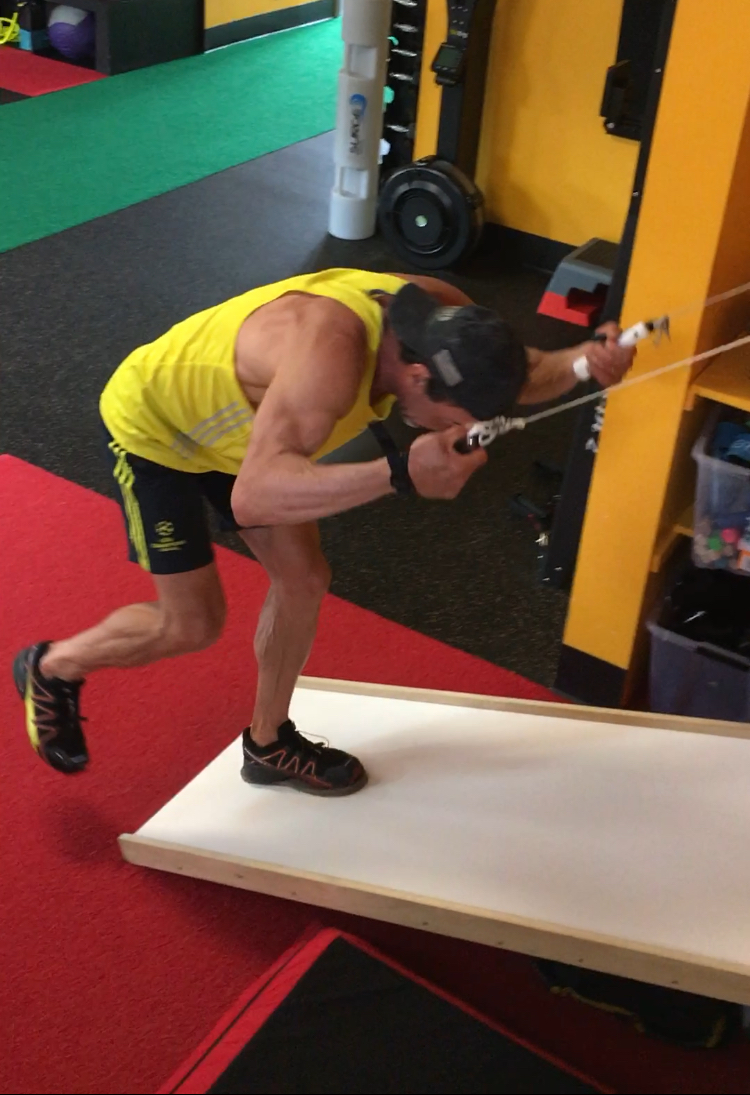
Single-leg step ups with flywheel resistance b. Single-leg slideboard double-pole hops: Your primary hip-and-knee movers — quad and glute — should feel like they just did a breakaway on a big climb, but you still need your stabilizers to negotiate the technical downhill to the finish! While maintaining constant tension on the poling muscles you can hop or pull yourself up the slideboard and then allow yourself to glide backwards resulting in a big eccentric hit on the double-pole initiators. This can also be done using a TRX strap and performing partial pistol-squat pull-ups; although it’s not as intense on the balance muscles.
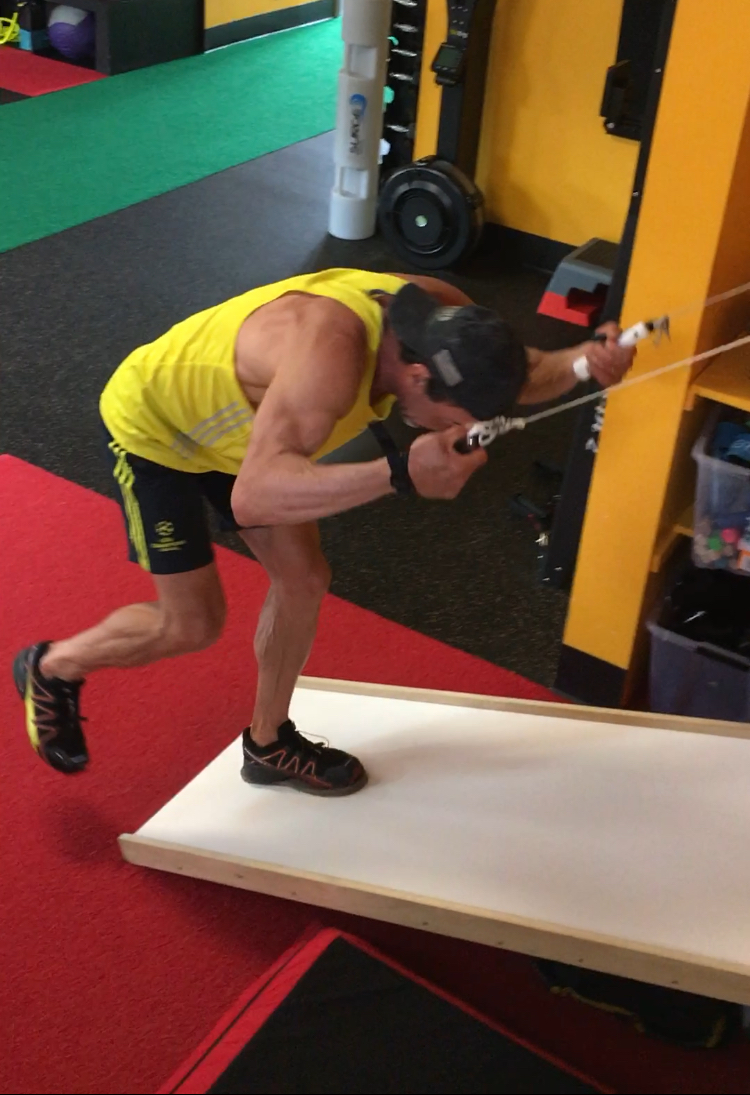
Single-leg double-pole on sideboard 3) a. Single-leg squat jump double pullup: The key on this exercise is start with a 90-degree knee-angle and no countermovement. Explode up and do one pullup while touching foot to bar, and then as quickly as possible do a halfway down pullup and repeat as quickly as possible. High-tempo partial range of motion/upper-half pullups are more nordic-specific because of the shoulder-joint angle and eccentric loading.
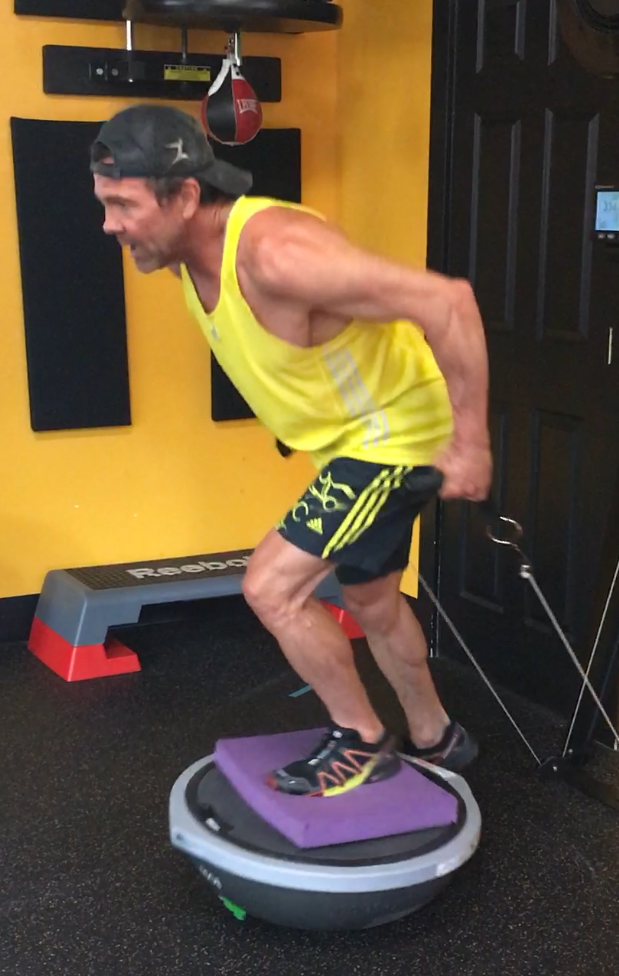
b. Single-leg stomps on BOSU with high-tempo SkiErg double pole: Now that your big primary poling and leg muscles are hammered, similar to the end or a race, you have to sprint and produce lots of “ground force” with the tired arms and leg. Keep the cadence high (80-90 spm), stomp your foot on the BOSU, and sprint for the finish!

Single-leg stomps on Bosu with SkiErg double-pole 4) a. Single-leg TRX squats with arm extensions: Get in a position where you’re maximally dorsi-flexed at the ankle and the triceps are loaded. Perform about 1 rep per second with the arms extending only two-thirds of the way out (just like most of your V2 poling strokes). Make sure your hands go fully behind your head on every rep and you’ve got heavy tension on your triceps.
b. Single-leg BOSU squats holding front-plank on slideboard: With your triceps dynamically fatigued this exercise will take them even deeper isometrically and help build integrity at the “bottom” of their functional range of motion. Maintain anterior core and tricep tension the entire time you’re single-leg squatting and pulling yourself backwards with the hip flexors. This can also be performed on the floor with sliders.
5) a. Single-leg ball bounce on Slackline: Having the slack line inclined simulates an uphill ski and forces more pressure on the ball of the foot resulting in ankle flexion. Hold off on actually throwing the balls until your able to balance for at least 30 seconds without falling. You want to get to the point where you can get 20-30 ball tosses in a minute without tipping over. This exercise can also be done on a balance disc; but it doesn’t feel the same as a skinny ski.
b. Single-leg push and slide on zipline TRX strap: With your stabilizers statically fatigued, now it’s time to see how they perform dynamically … Pushing and gliding in a forward-leaning, front-plank position simulates the start position of most nordic strokes. Make sure you have vertical-hip displacement and are head over foot on every rep. This can also be done without the “zipline” (a ceiling-mounted track with a chain hanging down from it and a Core Flyte Dynamic Stability Trainer under your foot) but it’s not as FUNctional 🙂
So there you have it … Try to hit the unilateral balance work 1-2 times/week and you should find yourself feeling significantly more solid and confident in your ability to powerfully push, and effortlessly glide!
***
-

Wednesday Rundown: Masters World Cup; Open European Champs
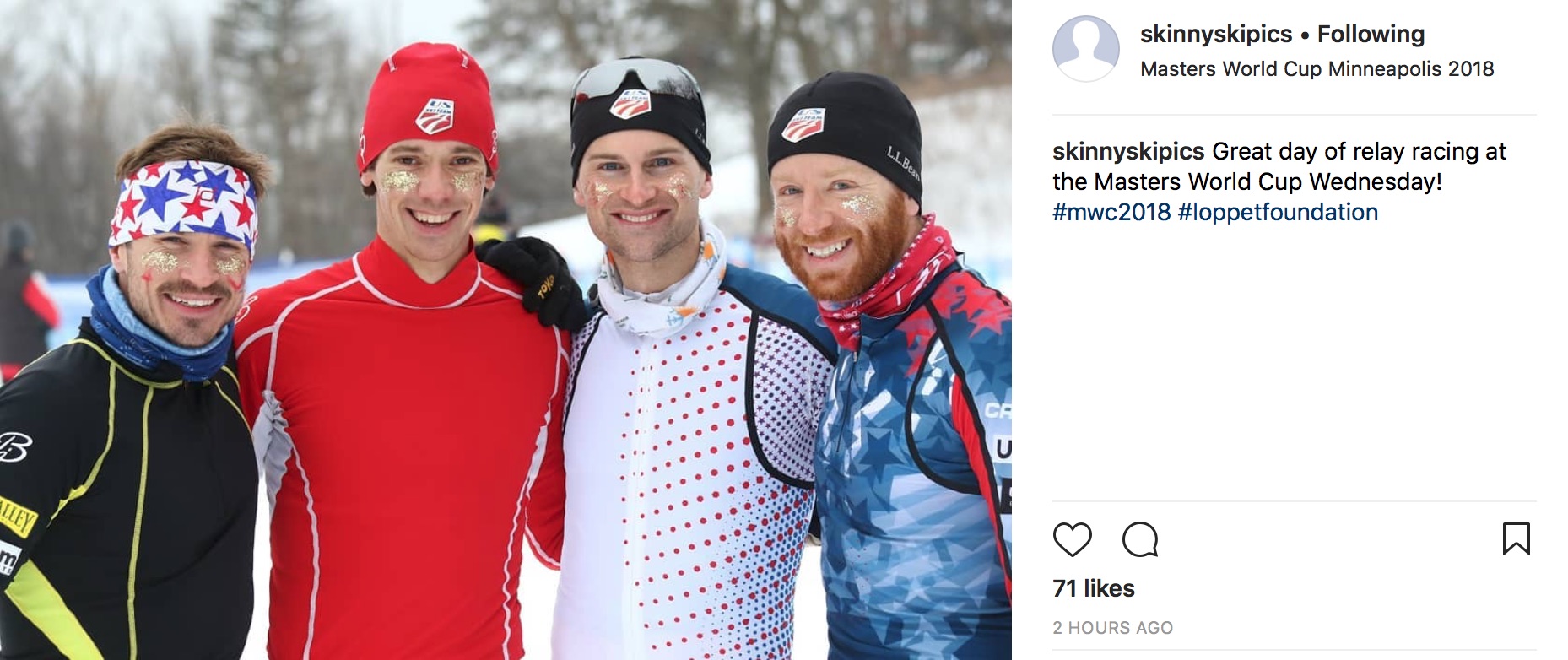
Matt Liebsch (l) and his men’s age-group “1” 4 x 5 k winning relay team on Wednesday at 2018 Masters World Cup in Minneapolis, Minnesota. (Photo: SkinnySki/Instagram) 2018 Masters World Cup (Minneapolis, Minnesota): 4 x 5 k relays
Matt Liebsch, 34, anchored the winning relay of the youngest men’s age group (AG 1) at 2018 Masters World Cup on Wednesday, crossing the line in 45:57.2 minutes (the fastest relay time of the day) and teaming up with fellow Americans Christopher Harvey, Mark Johnson and Zach Varty. Two teams competed in that age group’s 4 x 5 k relay, with Italy finishing second, 1:22.6 minutes back.
The U.S. won all five women’s 4 x 5 k relays on Wednesday, and eight total between the men’s and women’s age groups. Finland had the second-most relay victories with five in the men’s categories.
Canada won the men’s AG 4, beating out four other teams with Gabriel Babin, Bruce Macneil, Luc Tremblay, and Michel Labrie, who finished the 4 x 5 k in 49:41.9. Germany placed second (+36.4), and the U.S. third (+54.1).
Piotr Bednarski, head coach of Loppet Nordic Racing, which is based out of Theodore Wirth Park, anchored the men’s AG 5 to a win in 49:39.1, with teammates Rune Harkestad, Dennis Paul and David Sjogren.
Masters World Cup continues with 15/30/45 k classic distance races on Thursday at Wirth Park.
Day 4 Age Group (AG) 4 x 5 k Relay Winners
Men:
- AG 1: USA (Christopher Harvey, Mark Johnson, Zach Varty, Matt Liebsch) 45:57.2
- AG 2: Finland (Jouni Leinonen, Mika Kilpeläinen, Johan Gustafsson, Joachim Gustafsson) 47:53.4
- AG 3: Russia (Ivan Batyutenko, Andrey Lushnikov, Sergey Degtyarev, Aleksandr Pushkarev) 46:43.3
- AG 4: Canada (Gabriel Babin, Bruce Macneil, Luc Trembley, Michel Labrie) 49:41.9
- AG 5: USA (Rune Harkestad, Dennis Paul, David Sjogren, Piotr Bednarski) 49:39.1
- AG 6: USA (Milan Baic, Odd Bersvendsen, Kent Murdoch, Barry Makarewicz) 48:48.3
- AG 7: Finland (Heikki Ruokonen, Tapio Tikkanen, Timo Pullinen, Aito Pennanen) 51:56.3
- AG 8: Finland (Leino Nisula, Pauli Halonen, Yrjo Teravainen, Harri Makela) 54:58.4
- AG 9: Finland (Veikko Piirainen, Tapio Ikaheimonen, Paavo Raisanen, Vaino Paakko) 58:18.9
- AG 10: Finland (Alpo Virtanen, Tapio Wallenius, Jouko Laiho, Riku Kyllonen) 1:02:39.7
Women:
- AG 1: USA (Kathleen Dewahl, Tamra Kornfield, Davya Flaharty, Gina Chythlook) 56:49.3
- AG 2: USA (Bonnie Weiskopf, Kim Rudd, Mary Mckelvey, Mary Wellington) 56:23.9
- AG 3: USA (Elizabeth Youngman, Kelly Milligan, Jan Guenther, Kelly Skillicorn) 56:23.6
- AG 4: USA (Kate Ellis, Magdenla Bowen, Joann Hanowski, Muffy Ritz) 1:00:33.6
- AG 5: USA (Gabriele Andersen, Constance Meek, Dagmar Eriksson, Kati Campbell) 1:14:23.4
***
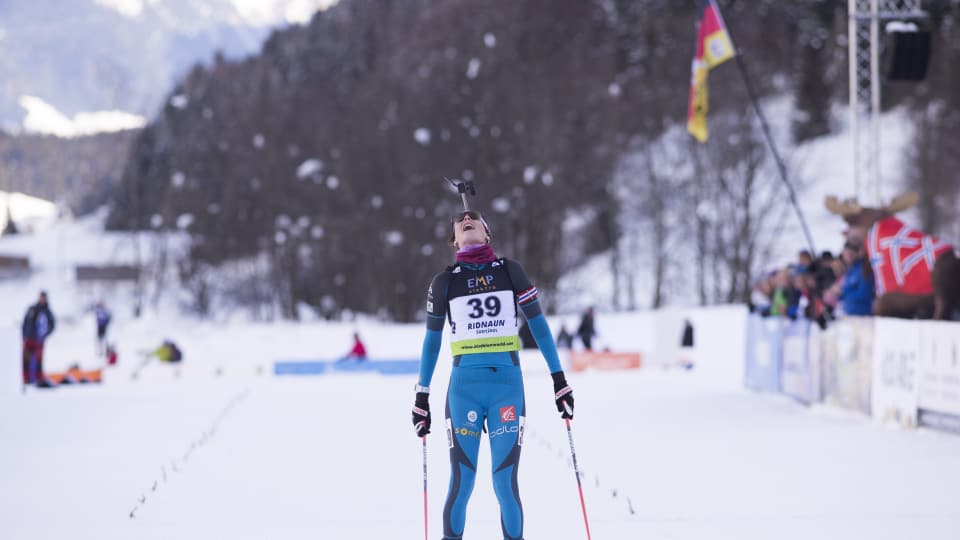
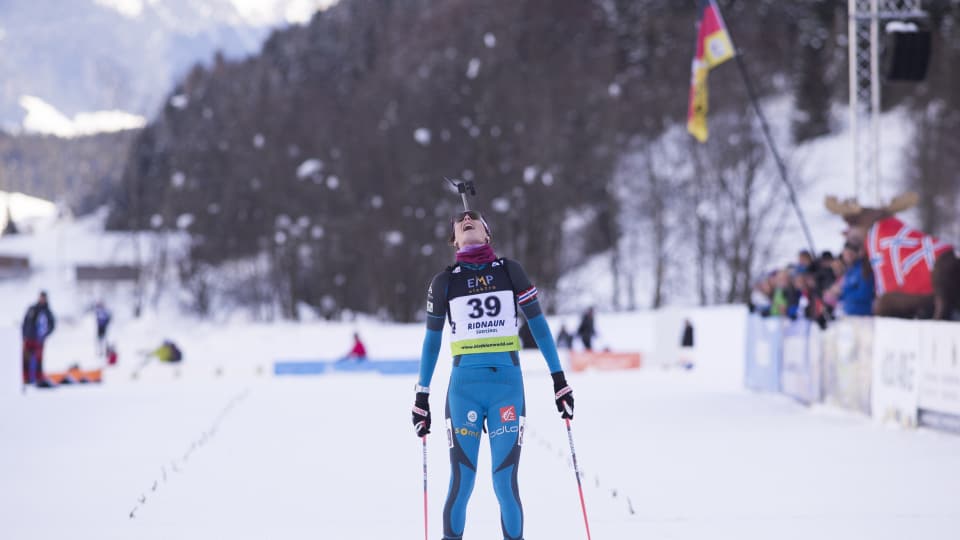
France’s Chloe Chevalier after winning the women’s 15 k individual on Day 1 of IBU Open European Championships in Ridnaun, Italy. (Photo: IBU/Biathlonworld) IBU Open European Championships (Ridnaun-Val Ridanna, Italy): 15/20 k individual
The International Biathlon Union (IBU) Open European Championships opened Wednesday in Ridnaun (Val Ridanna), Italy, with several North Americans competing in the women’s 15- and men’s 20-kilometer individual races.
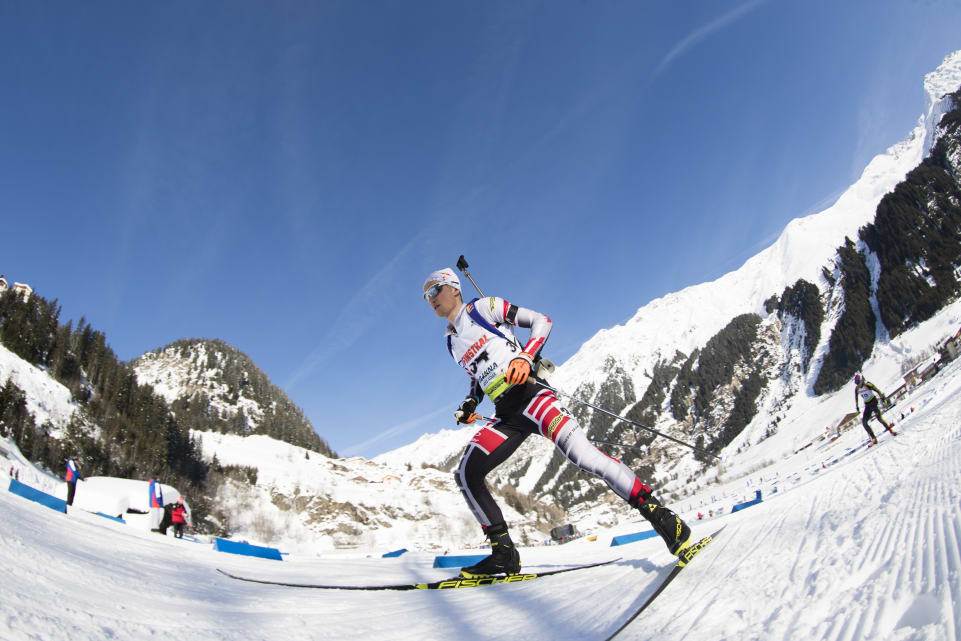
Austria’s Felix Leitner racing to the win in the first race of 2018 IBU Open European Championships, the men’s 20 k individual, on Wednesday in Ridnaun, Italy. (Photo: IBU/Biathlonworld) Canada’s 23-year-old Carsen Campbell raced to 19th in the men’s 20 k, shooting 19-for-20 (1+0+0+0) and finishing 3:18.5 minutes behind the winner, Austria’s Felix Leitner, who clocked the fastest time in 53:32.8 — also with one penalty (0+0+0+1).
Leitner, 21, won by 43 seconds over Tomas Krupcik of the Czech Republic, who also had a single penalty in the last standing stage (0+0+0+1) and placed second.
Germany’s Philipp Horn reached the podium in third (+56.6), with 19-for-20 shooting as well (1+0+0+0).
According to an IBU press release, Leitner is one of the youngest athletes to win the 20 k, the longest race on the circuit.
“I had many problems with my shooting lately, but today it was probably the best in the last two seasons,” Leitner said, according to the release. “I believed in myself and knew that I have to run fast from the beginning, and if the shooting would be as good as during the training, I could be in the top.”
Campbell, of Biathlon Canada’s National “Z” Team, was the top North American in 19th in his second trip to Open European Championships. Previously, his best individual result was 64th last year.
Paul Schommer led the U.S. men in 46th (+5:22.6) with three penalties (0+1+1+1). Max Durtschi also shot 17-for-20 (1+0+1+1) and ended up 56th (+6:18.5), Jakob Ellingson followed in 58th (+6:23.5) with two penalties (0+0+1+1), and Jake Brown finished 74th (+8:06.7) with seven penalties (1+1+3+2). Alex Howe did not start.
For Canada, Macx Davies, a senior national team member who is headed to the Olympics, placed 67th (+7:32.7) with five penalties (2+2+1+0). Matt Hudec was 96th (+12:00.5) with six penalties (0+2+1+3), and Aidan Miller 105th (+14:49.0) with nine penalties (2+1+1+5).
In the women’s 15 k that followed, Sarah Beaudry, of Biathlon Canada’s Senior National Team as well as Olympic team, was the top North American in 23rd, 4:55.6 out of first. Beaudry, 23, shot 18-for-20, with her two misses coming in the first prone (2+0+0+0).
France’s Chloe Chevalier won the women’s race, with spring-like temperatures around 6 degrees Celsius, in 46:32.9 with a single penalty, also in the first stage (1+0+0+0). The second- through fourth-place finishers all shot clean, with Italy’s Alexa Runggaldier placing second (+47.7), Russia’s Victoria Slivko taking third (+55.9) and Ukraine’s Yuliia Zhuravok missing the podium by half a second in fourth place (+56.4).
“After that penalty in the first prone, I relaxed and did not worry about the result,” Chevalier said after, according to an IBU press release. “I just enjoyed being out on the tracks on a beautiful sunny. Maybe the key to success is relaxing and not worrying about the result.”
Two Canadian women entered the event, with Erin Yungblut finishing 83rd (+13.19.9) with eight penalties (2+3+1+2).
Chloe Levins was the top American woman in 60th (+7:18.6) with four penalties (1+2+1+0), and Maddie Phaneuf, who made US Biathlon’s Olympic team, followed in 65th (+8:10.8) with four misses as well (1+2+0+1). Deedra Irwin finished 82nd (+13:15.8) and Jennie Bender was 87th (+15:05.0), both with 10 penalties apiece.
Open European Championships continue Friday with the men’s and women’s sprints, followed by pursuits on Saturday and relays on Sunday.
-

Scott Patterson Wins Home U.S. Nationals 15 k by Nearly a Minute
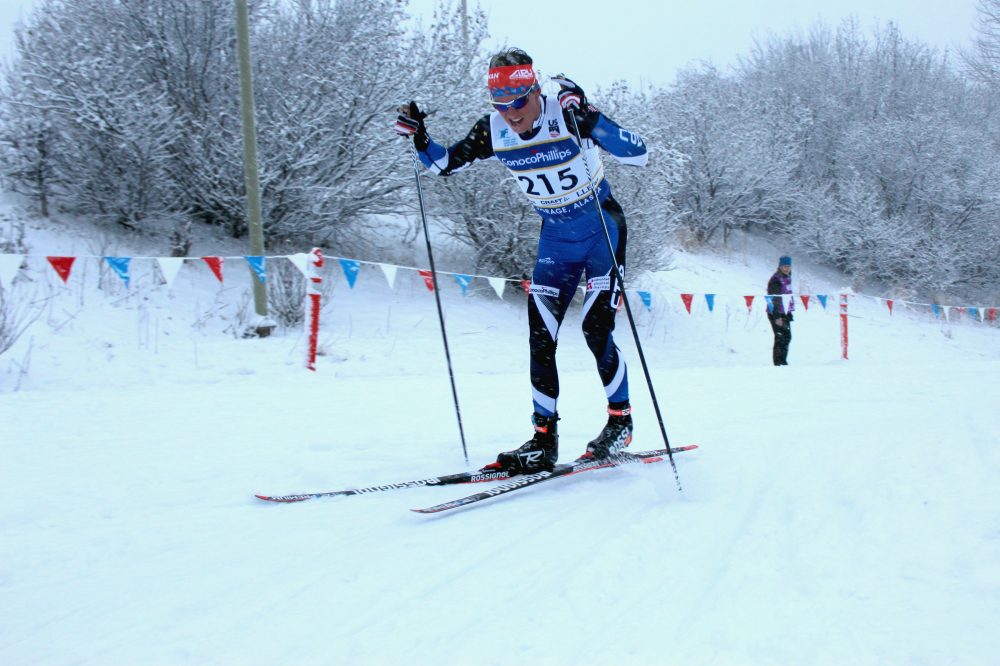
Scott Patterson (Alaska Pacific University/U.S. Ski Team) racing to first in the men’s 15-kilometer freestyle individual start on Wednesday at 2018 U.S. Cross Country Championships in Anchorage, Alaska. (Note: This article has been updated to include comments from Noah Hoffman.)
ANCHORAGE, Alaska — It was a day of homecomings and returns at snowy Kincaid Park for the first day of the 2018 U.S. Cross Country Championships. Scott Patterson returned to his childhood training grounds with a convincing victory, Noah Hoffman returned to racing at U.S. nationals with second, and Matt Liebsch returned to the nationals podium with third in the men’s 15-kilometer freestyle individual start on Wednesday afternoon. All of them overcame notably difficult conditions to do so.
While there were several strong contenders in the field of 181 starters, many had tabbed Patterson, of Alaska Pacific University (APU), and Hoffman, affiliated with Ski & Snowboard Club Vail (SSCV), among the favorites coming in. They weren’t wrong, given both the pair’s recent World Cup experience and their domestic history at this distance.
For both athletes in the top echelon of U.S. men’s distance skiing, the 15 k race has long been their bailiwick. Coming into this week’s races, Patterson, of the U.S. Ski Team B-team, had reached the podium in six of his last eight 15 k races at the SuperTour or national championships level (plus wins in two competitive Alaskan 15 k FIS races in that time). While Hoffman, a former U.S. Ski Team member, has raced in this country less frequently over the past several years, he had achieved that mark in three of his last four domestic 15 k races. For a pair of high-training volume athletes with remarkable aerobic capacity, there is clearly something about this distance that lets them do well.
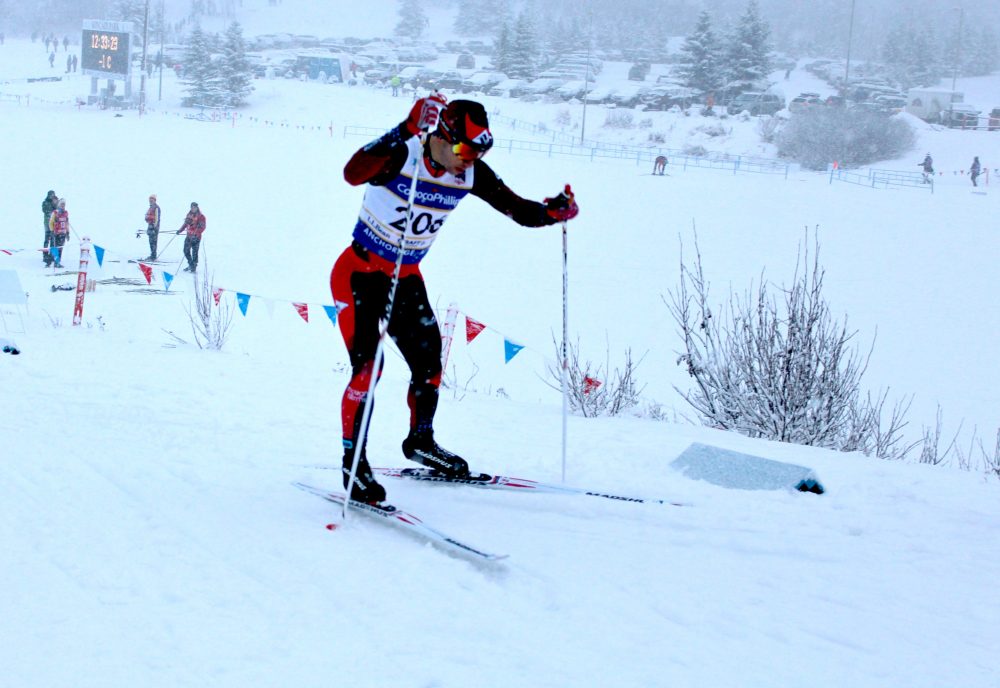
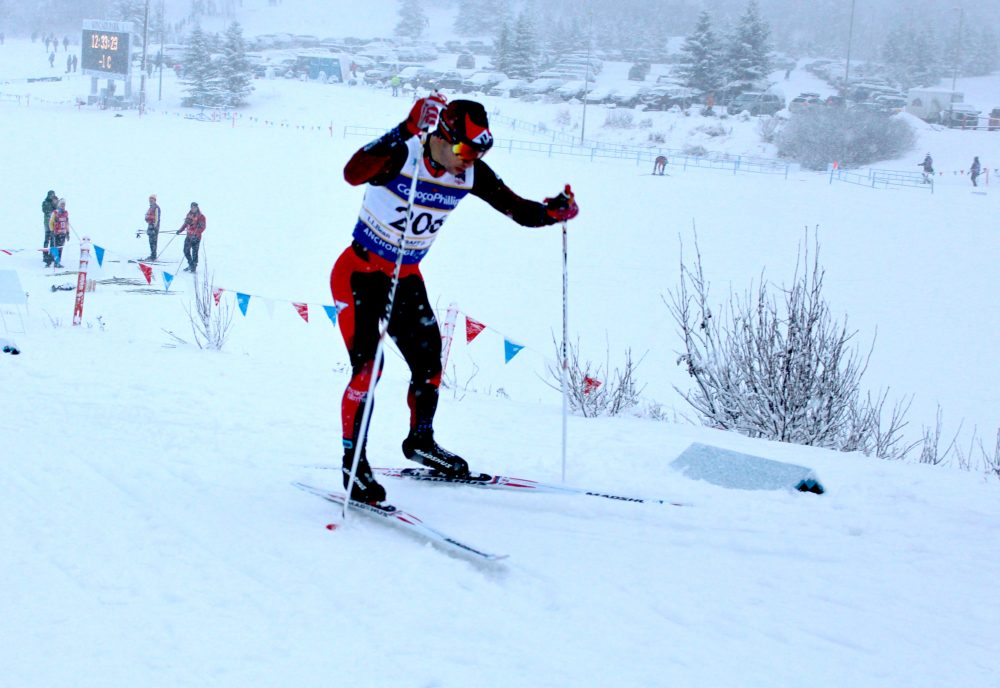
Noah Hoffman racing to second in the men’s 15-kilometer freestyle individual start on Wednesday at 2018 U.S. Cross Country Championships in Anchorage, Alaska. It was his first January nationals appearance since 2012. On Wednesday, Hoffman did well, but Patterson did better.
“I was impressed by him and happy to see him skiing so well, I mean he handled the condition and that course really well and…he has trained a bunch, but you know I also think that I can ski at that level and I didn’t do that yesterday,” Hoffman said on the phone on Thursday. “In that sense there is more out there, but I am definitely satisfied with second place, I think it sets me up well for going into Sunday in terms of like qualifying for the Olympic team or just having a good week in general.”
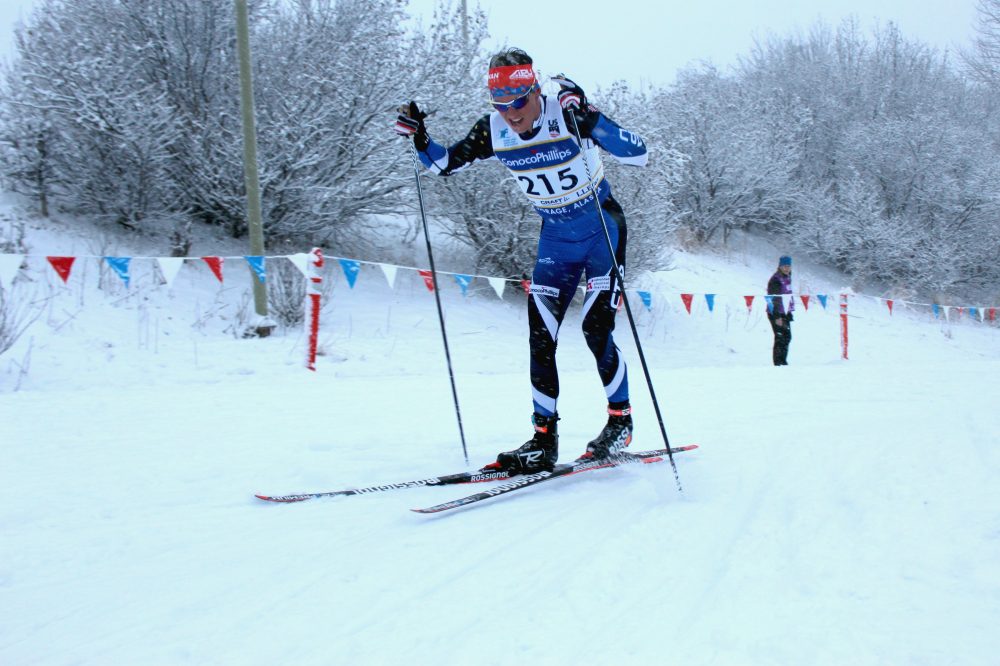
Starting in bib 215 in the middle of the A-seed group, nine spots after Hoffman in bib 206, Patterson led wire-to-wire throughout the six-lap race. After one lap, his time advantage over Hoffman was 7.9 seconds. After two laps, it was up to 11.8 seconds. Patterson’s edge grew steadily from there – 24.1 seconds at three laps, then 41.4 seconds at four laps, then 52.2 seconds through five laps.
Patterson received an early clue he was having a good day when he passed Kyle Bratrud, of Central Cross Country (CXC), during the first lap.
“The full confirmation came from my coach, Erik Flora, just after the first lap when he gave me a split that I was leading,” Patterson wrote in a post-race email to FasterSkier. “From there it was mostly just building time against the clock rather than any competitor specifically.”
Patterson finished in 36:33.7. Hoffman was 55.2 seconds back in second.
Hoffman was similarly in second each time he came through the stadium on the 2.69-kilometer lap course. (The race may therefore have been closer to 16.1 k than 15 k, according to the map published on the U.S. nationals website.)
The first lap saw more variability for several skiers, with some eventual top-10 finishers ranking as low as 28th after their first time around the course. Liebsch, representing Pioneer Midwest, was in seventh after Lap 1. But by the end of Lap 2, Liebsch was up to third overall, and he held that position all the way to the finish.

Matt Liebsch (Pioneer Midwest) racing to third in the men’s 15 k freestyle on Wednesday at the 2018 U.S. Cross Country Championships in Anchorage, Alaska. It was his first U.S. nationals appearance in two years and his first national podium since placing second in 2012 in a 15 k freestyle in Rumford, Maine. Liebsch finished 21.3 seconds back from Hoffman in second, and 1:16.5 behind Patterson in first. Liebsch nipped fourth-place finisher Rogan Brown (Sun Valley Ski Education Foundation) by 3.7 seconds for the final podium spot.
The rest of the top 10 went to Tad Elliott (SSCV) in fifth (+1:24.4, Gus Schumacher (Alaska Winter Stars) in sixth (+1:27.7), Brian Gregg (CXC/LNR/Team Gregg) in seventh (+1:31.3), Jack Hegman (SVSEF) in eighth (+1:36.0), Benjamin Ogden (Stratton Mountain School) in ninth (+1:42.1), and Adam Martin (Craftsbury Green Racing Project) in 10th (+1:44.2).
Conditions for Wednesday’s race were markedly different from the “firm and fast” courses observed last week. Temperatures above 40 degrees Fahrenheit during the day on Tuesday softened the top few inches of manmade snow on the snowmaking loop and left two to three inches of soft slush on the course’s first main uphill. Above-freezing temperatures Tuesday night, some light rain and a steady snowfall at temperatures hovering around 31.5 degrees all day Wednesday, made for a challenging race.
For the men, that came after 147 women did four laps each in the day’s first race. Then the men skied a cumulative thousand-plus laps in the day’s second race. By the end of the day on Wednesday, the day’s final starters pushed to glide through four to five inches of slush on the first climb, Gong Hill.
Despite the conditions, or maybe even because of them, U.S. Ski Development Coach Bryan Fish said that Wednesday’s race courses were a worthy test for American athletes being chosen for international championship teams.
“I think it was actually good that it snowed,” Fish told FasterSkier in person after the race. “Not only for the long-term of the whole week, but also the fact that the course – just due to the fact that the limited amount of snow, they weren’t able to run it on a fully homologated course. So what I think this did, at least from my perspective, is that it was much harder because of the snow conditions. And I think that creates a better environment to pick the right athletes to go onto these championship courses that they’ll be racing in Europe and in PyeongChang.”
“The conditions were definitely tricky,” Patterson observed. “Yesterday for our prerace training we had crazy ice and wind in classic Anchorage Chinook style, but even then the forecasts were calling for something different today. Looking out the window in the morning, I knew it was going to be interesting with snow rapidly accumulating and a temperature around 35 degrees.”
“There were definitely some rough patches with soft deep snow,” Patterson wrote, referring to Wednesday’s race. “Also in many places, maintaining speed meant staying in the skied-in lane. Thus passing was difficult in some areas. Overall, racing fast was about getting through the tough areas quickly but not burning too much energy. Then really focus on the other areas where I could ski hard and put time into people. These conditions didn’t make the skis feel super fast, but I think the APU techs did a great job with the conditions out there to give me some of the fastest skis in the race.”
Patterson was the only athlete in the men’s race whose overall pace exceeded that of the fastest woman’s lap in the day’s first race, as continued snowfall made the course ski harder for everyone.
Despite the weather, Patterson wrote to FasterSkier, he felt confident going into Wednesday’s race.
“But I was also expecting a tight battle with Noah Hoffman and maybe some others,” he wrote. “We had been racing at quite a similar level on the World Cup, but I think the combination of home course advantage and a bit of rough travel for Noah tipped the scale in my favor.”
(Hoffman recently posted, in a series of Instagram video updates chronicling his travel misadventures, that it took him over 24 hours to successfully leave Hartford as he attempted to fly to Alaska, and that it ultimately took him 56 hours to travel to Anchorage from Putney, Vermont, by plane. “16 hours short of the drive time,” Hoffman wrote.)
“Scott was world-class today,” Hoffman said, according to a U.S. nationals press release. “I hope he can bring that back to Europe and I hope to be there with him.”
“You know I continue to feel that I am really looking for my skiing to click,” Hoffman later said during a phone conversation with FasterSkier. “I am really looking to figure out how to ski as well as I had in the past and as I know how… if I am skiing the way that I can, I am going to have all the opportunities I want…everything else really falls into place if that goal does.”
Hoffman hopes to qualify for PyeongChang, but still remains most concerned with his skiing, believing that performances will follow once he clicks in.
“I am just focused on trying to put together a representative effort of my fitness because I continue to believe that I am one of the fittest athletes in the world, and that the skiing that I did in 2013-14 wasn’t some miracle or some fluke, I want to give myself more opportunities to prove that, but that’s the goal,” Hoffman continued. :So making teams, and the politics of all of it, is really not, not what I am caught up in. I am focused on trying to ski as well as I can and as I have. I skied best in the world I know I can do that, its been a long time, and its been extremely frustrating, but that continues to be the focus. You got to focus on skiing fast and that’s all you can control.”
“Overall I felt quite good,” Patterson wrote. “I was getting a lot of good information and splits from my coaches so I had a good understanding of the race the whole time. I kept the pace steady throughout and made sure to work with the conditions instead of fighting against the tricky snow.”
Patterson had more support out there than just his coaches, on a day when the large parking lots at Kincaid filled to capacity and parked vehicles lined the road up the hill from the stadium at some points.
“Racing at home is always special,” the 25-year-old Patterson wrote, “both in terms of fans and having the home-course advantage. I have raced at Kincaid more than any other place in the world and I feel like I know how to ski well there. It does have its tricks that take some time to learn. In addition to that, there are the fans. The first time up to the course high point or the Gong Hill, I felt like every person on the sidelines was cheering for me. There were several instances where I would recognize someone’s voice and start to try and figure out who it was before going back to focusing on the race. It’s even more special with all the Olympic hype today.”
It was his second national title after winning the 15 k classic two years ago in Houghton, Michigan. Patterson, who attended high school in Anchorage, had more experience at Kincaid than anyone else on the podium, but Liebsch is also a fan of the city’s biggest cross-country ski area.
“I’ve always raced really well here,” Liebsch, 34, told FasterSkier on the phone Wednesday evening. “This is my third time up here, and I’ve had a third, a fourth, and a third. So I like racing at sea level; Kincaid seems to be good to me. So when I saw that Nationals was here this year, I was like, ‘Oh, I gotta go to that for sure.’ ”
Liebsch most recently made a U.S. nationals podium in 2012 at Rumford. This was also the last time, before Wednesday, that Hoffman raced at the full-fledged U.S. nationals in January; he has competed at U.S. Distance Nationals (an annual 50 k mass start) in the spring several times since then. (This season, Hoffman raced Period 1 of the World Cup. After not being offered a start spot in the Tour de Ski, he chose to come to U.S. nationals instead. Patterson was offered a Tour de Ski start spot, but declined that in favor of coming to nationals.)
These days, Liebsch works full time at Pioneer Midwest.
“When I saw that [nationals were in Anchorage] I got really excited to try to train well this summer,” he said. “I never really stopped training. Sometimes I’m exercising, sometimes I’m training. I actually trained this year. Last year I exercised.”
(He later mused, “I’m less than 20 months removed from World Cup racing, so everyone thinks that I just rolled over and died. But I kept training, and I kind of had it in the back of my mind that I may take another swing, see what happens.”)
Liebsch came to Anchorage “with the expectation to win today,” he said. But he was quick to credit Patterson for his dominant performance: “Obviously Scott just sent it,” Liebsch said. “Scott was on his own planet today.”
For “everyone else” in the race, Liebsch said of the challenging and variable conditions, “it was kind of like you had to ski relaxed, and just kind of let the ski scoot along on the snow. Because there were like trenches, and then there was like mashed potatoes, and then there was like new snow. It was kind of weird.”
So what happens next? Short-term, Liebsch does not plan to contest Friday’s sprint, so he’s going to go skiing at Hatcher Pass instead.
He also has big technique plans, with an eye to qualifying for the upcoming Olympics in PyeongChang.
“I have a chance to probably go ski in Korea, potentially, after the points reshuffle from today,” Liebsch said. “They’re going to have to take a bunch of domestic guys, I think, and … I think I’m in the mix. If I can figure out how to classic ski between now and Sunday, it could be real exciting.”
Patterson has comparable goals in advance of Sunday’s 30 k classic mass start.
“For PyeongChang, today’s race feel like it puts me in the driver’s seat for the distance spots. Through the early season SuperTour, no one really stood out above the rest for distance races. Today, Noah Hoffman and I showed that we might not have scored many World Cup points, but we are still forces domestically. The 30k classic on Sunday will be my other big focus to get an Olympic spot.”
Two Juniors in the Top 10
https://www.instagram.com/p/BdgdIgbB92S/
While there was a separate podium ceremony on Wednesday for the top-three junior boys (after athletes of all ages raced together), you don’t have to go too far down the results sheet to find the top-three finishers under age 20: Gus Schumacher (Alaska Winter Stars) was sixth overall, Ben Ogden (Stratton Mountain School) was ninth, and Hunter Wonders (APU) was 21st. Schumacher and Ogden are still U18 skiers; Wonders is a U20.
Schumacher’s sixth overall is a quantum leap from his previous best finish at a U.S. nationals: he was 43rd in the 15 k classic at Houghton in Jan. 2016.
“I guess I wasn’t expecting this specific result,” Schumacher, 17, wrote to FasterSkier, “but I knew that on home snow I could possibly put up a pretty fast time and be competitive with the seniors.”
As for his mindset in conditions like those found on Wednesday, Schumacher wrote, “I guess my approach is that it’s the same for everyone and as long as I don’t get freaked out I can race as well as normal. So the goal is really to stay calm and try to adjust my technique in warmup to be more efficient.
“I was super stoked about today’s race,” he continued. “I think it is a great sign for the future, hopefully I can keep this pace up!”
Count Fish, the development coach, among those also stoked about Wednesday’s race. Fish is attending U.S. nationals for a number of reasons, he explained, including to help support the naming of various international championship teams (Junior Worlds team, U23 team, and the U18 Nations Trip team). And while he looks at results, to be sure, it’s more than just that.
“We’re also looking at results versus age as well,” Fish said. “And not only the result itself, but what were the times, and what were the time gaps. … Really exciting to see a couple of young men, like Gus Schumacher and Ben Ogden, sixth and ninth. And those two were back and forth. And I had Ben as high as eighth, and Gus in 10th, and Gus had an incredibly fast last lap, to put time not only into the other juniors but into the whole field, to finish sixth overall. So that was really exciting to see, to have two young athletes like that finish that high.”
-

U.S. Nationals Rundown: Pattersons Rule 10/15 k Skate

Caitlin Patterson of the Craftsbury Green Racing Project (CGRP) earned a national title on Wednesday with a win in the women’s 10 k freestyle at 2018 U.S. Cross Country Championships in Anchorage, Alaska. (Photo: Instagram/US Nationals 2018) 2018 U.S. Cross Country Championships (Anchorage, Alaska): 10/15 k freestyle
The Patterson siblings are crushing it on Day 1 of the U.S. Cross Country Championships at Kincaid Park in Anchorage, Alaska.

Scott Patterson (APU/USST) racing to a 55-second win in the men’s 15 k freestyle on Wednesday at U.S. Cross Country Championships in Anchorage, Alaska. (Photo: Jim Jager/US Nationals 2018 Instagram) Scott Patterson raced to a 55.2-second victory over Noah Hoffman in the men’s 15-kilometer freestyle individual start on Wednesday. Patterson is an Anchorage-based U.S. Ski Team (USST) member who trains with Alaska Pacific University (APU). Hoffman is a former USST member who raced Period 1 of the World Cup with Patterson. Matt Liebsch, of Pioneer Midwest, placed third, 1:16.5 minutes off of Patterson’s winning time of 36:33.7.
Patterson’s older sister, Caitlin Patterson, of the Craftsbury Green Racing Project (CRGP) won the women’s 10 k freestyle earlier on Wednesday by 19.7 seconds over Caitlin Gregg, who’s affiliated with Central Cross Country (CXC), Loppet Nordic Racing (LNR) and Team Gregg. APU’s Chelsea Holmes, who raced World Cup Period 1, placed third, 24.4 seconds off Patterson’s winning time of 27:09.1.
Also in the top 10 in the women’s race were Rosie Frankowski (APU) in fourth, University of Colorado Boulder (CU) skiers Petra Hyncicova and Christina Rolandsen in fifth and sixth, respectively, Erika Flowers of the Stratton Mountain School (SMS) Elite Team in seventh, Hailey Swirbul (University of Alaska Anchorage) in eighth, Becca Rorabaugh (APU) in ninth, and Hedda Bångman (CU) in 10th.
In the men’s top 10 were Rogan Brown of the Sun Valley Ski Education Foundation (SVSEF) in fourth, Tad Elliott (Ski & Snowboard Club Vail) in fifth, Gus Schumacher (Alaska Winter Stars) in sixth, Brian Gregg (CXC/LNR/Team Greg) in seventh, Jack Hegman (SVSEF) in eighth, Benjamin Ogden (SMS) in ninth, and Adam Martin (CGRP) in 10th.
-

FasterSkier’s 12 Days of FBD Christmas: Day 12

Editor’s note: This is it — the final installment of the 12-day holiday gift guide, authored by the one and only “FBD”, our gear-review guru. See also: Day 1 | Day 2 | Day 3 | Day 4 | Day 5 | Day 6 | Day 7 | Day 8 | Day 9 | Day 10 | Day 11
***
Day 12: Masters World Cup Total World Domination Package
Day Twelve. We made it. Wow. Sure, we lost a few along the way, good men (and women, though most women were likely smart enough to not set foot on this sinking ship in the first place)

Taking a journey with 12 Days of FBD writing is like going on a poorly captained cruise ship (though thankfully with much, much less diarrhea and WAY fewer fat people). Come aboard, we’ve been expecting you. As a quick aside, I bartended at Smullin’s rehearsal dinner, so I naturally wore a name tag that read, “Isaac,” and YES, I sure as hell did the “double gun” finger point all night. I am frickin’ awesome.
So as we are pulling into port, thanks to the steady hand of Captain Stubing, the compassion of Julie McCoy, and the vision and brilliance of yours truly, I am pleased to report that all of your relationship issues have been solved and life is good. That’s what happened every week on The Love Boat and it’s what is going to happen here. We’re going to end this wonderful series but going back to where we started, racing.
In Day 1 (yes, I know, that seems like a long, long time ago, doesn’t it?), we focused on recovery. Why? (Let’s all say it together) You don’t get fast from doing hard workouts, you get fast by recovering from hard workouts. What is probably the hardest of all workouts? Racing. So we’re going to come full circle and finish up by talking about racing, more specifically, Master Blaster Worlds (MBW). I know, I know, they have some super-serious, long, fancy name, but to all of us “in the know,” they are Master Blaster Worlds. And this year they just so happen to be in the good ol’ U.S. of A.
So one of my many goodbye gifts to you (there have been so many, as I view each of my written words as a gift to you. I told you I was a ‘giver.’), is that I (with the help of my latest Cracker Jack crew) am going to get you styled out for MBWs. If you don’t have all of the race gear, race clothing, casual clothing, recovery tools, and every other piece of equipment, software, or soft goods that you could even possibly need by now, well then God help you, as I don’t know if it would have been possible for me to write any more on any of these topics. At one point a few days ago I even got a call from the Internet, asking me to delete some of my earlier columns, because the Internet had run out of room.
This means that you can’t possibly need anything else to wear, so what else could you need? Wax, that’s what. Wait a minute, wait a minute FBD, didn’t you that kook Caldwell yell at you about wax a few days ago? Yes, he did, and all of that yelling is still as applicable today as the day it was yelled, and I’m going to call that ‘good general ski wax knowledge,’ but since no one loves you like I do, I also going to go one step further and also bring in another panel of experts to talk about their years of experience training on racing on the exact MBW course.
Take it from someone who has spent a lot of time in World Cup wax cabins, nothing beats local knowledge. There’s a reason why we send techs to World Championship and Olympic venues a year or two or THREE in advance, to start testing waxes. Can you imagine if you had over 40 years of experience testing in one particular venue under your belt? Well, you don’t need to imagine it, because that’s what I’m bringing to you here today, along with a few hard good recommendations as well.
As I did was Zach and Nathan in Day 7, I am stepping back a bit and letting Matt Liebsch and the crew at Pioneer Midwest take the controls here, so full disclosure, I have not tested all of these products. These are the recommendations of Pioneer Midwest, written by Pioneer Midwest, not me, so if you have crappy skis at MBW and U R so PO’d that it’s a BFD, HU ML at PM ASAP 2 say FU.
I also feel compelled to give credit where credit is due — the phrase, “Total World Domination, (TWD)” or at least in the context that it is used here, was created by Duncan Douglas, a.k.a., Jacked Up Old Man. If you don’t know Duncan, well, you are missing out. “TWD” is Duncan’s approach to each and every workout, from his early days as an Olympic biathlete, to whatever the hell insane 9 hours of activity he did last night, that’s just how JUOM rolls. He is my hero.
Recommendations from Matt Liebsch/Pioneer Midwest below:
***
Under $29

Rex RCF Pink: Pioneer Midwest pick for under $29 This pink block of wax is hard and medium-fluorinated, which is great for all the manmade snow at Wirth Park. Your waxing strategy needs to be built upon a solid base that will resist abrasion from granular snow, which is exactly the type of conditions present at Wirth Park the past few years. RCF Pink is a go to wax for World Cup technicians because World Cup races are regularly held on courses with manmade snow. This is a great wax for Wirth as long as the snow is not brand new. Patrick Moore is an awesome dude and one of the best techs on the World Cup… he shows how to apply this hard stuff in this video.

Rex Liquid Klister (Gold): Pioneer Midwest pick for under $29 Thin to win right?! Well that is easier said when working with klister. Rex has some new liquid klisters that apply easily with a sponge applicator. They are incredibly easy to use while keeping the layer of klister thin and mess free. No more klister running off the tails of your skis. We have found Rex Base Klister a workable solution in many conditions at Wirth as a base-kick option and the Rex Gold… that stuff is just the best on artificial snow.
***
$30 – $99

Rex Hydrex Gel: Pioneer Midwest pick for $30-$99 Whenever I have great success classic skiing at Wirth Park it seems to involve me using Rex Hydrex.
This is a gliding wax used to cover kicking waxes. If you are on klister, it generally speeds things up without sacrificing kick, but make sure to always test it on your warmup skis before shot-gunning it. It works awesome as a treatment for skin skis or zero skis. Also, in warm temps it can be used on the gliding zones as well and I know for a fact it has seen high-level success at the World Cup both as a covering wax for kick and as a glide top coat.

HF5BWX Black Wolf: Pioneer Midwest pick for $30-$99 This is a go-to race paraffin for Wirth Park when they don’t have natural snow (most of the time). The workable temp range is huge for this wax at Wirth: 10 F to 35 F+. Most years they have mixed dirty artificial snow and HF5BW is near unbeatable in standard (unfortunately standard) Wirth snow conditions. If there is no new snow in sight, use this. The other standby that shines under these conditions is Rex RCF Pink.

Start Medium Fluor Glider MF10 Green: Pioneer Midwest pick for $30-$99 Natural snow in Minneapolis in January means only one thing … it is freakin’ cold. My #1 tested cold natural snow race base wax for the Twin Cities is Start MF10. I have tried to beat it for years; Start HF10 comes close as do a lot of things, but if you are looking for something that works all the time and does not cost a fortune, you cannot miss with this wax in super-cold squeaky natural snow conditions. Make sure you have a cold profile ski and a super-cold grind…. I like our SC0. Check out our stone-grinding services.
World Cup Waxing Service

Masters World Cup Waxing Service: Pioneer Midwest pick for $30-$99 Want to leave the waxing supplies at home for World Masters and have us take care of it all for you? We have been skiing at Wirth Park for over 20 years. We know what works and more importantly we know what does not work. Whenever I have traveled the country and world I have had great success getting wax support and grind support from the locals because they know what works the best. Pioneer Midwest will be and are your local experts. Let us take care of your skis for you and we will prepare them for whatever the weather and Wirth Park throws at us for World Masters.
Editor’s note: Also offered by other retailers, like Boulder Nordic Sport (1 pair of skis | 2 pair of skis)
***
$100 – $299
Swix HVC Cold: Pioneer Midwest pick for $100-$299 Speed without having to think about it. The Swix HVC liquids are super easy and extraordinarily fast on the artificial snow at Wirth Park. Again, I have tested a boatload of liquid waxes at Wirth and these are always near the top. I qualified top 6 in a SuperTour sprint qualifier a few years ago at Wirth on HVC and that is outstanding considering my history of sprinting. When the conditions are below 25 F and artificial snow, we use the cold version, and when warmer than 25 F, we use the warm version. This stuff is super easy to use, wipe on, let dry 3 minutes or longer, go race. An application of Swix HVC can last upwards of 15 km. But careful in mixed new snow as they can be a liability, but when skiing on old snow grab the appropriate Swix HVC and go for it. The other staple liquid to try if the snow gets a little dirtier from heavy use is Rex Ruka.

Rex TK-245 Fluoro Powder: Pioneer Midwest pick for $100-$299 If I had to shotgun one powder for warm weather racing above 20 F, this would be it. This wax has a Birkie win under its belt and it has been a no-brainer choice on the World Cup for years. It runs very well at Wirth Park. The other powder that always seems to be in the mix at Wirth in the artificial snow is Toko Red 2.0.
HWK Fluor Stick 9Mo50: Pioneer Midwest pick for $100-$299 Wet and dirty snow at Wirth Park seems to happen more often than we would like. The HWK guys are always testing on the WC biathlon circuit and they race and test on wet, dirty, artificial snow all the time. This was my top coat at the Birkie 2 years ago and I have won a few SuperTour races at Wirth Park on this wax. It is easy to apply and a no-brainer in wet/dirty Minneapolis city snow if we get those conditions.

Swix Triac 2.5 Poles: Pioneer Midwest pick for $100-$299 Want a top level pole without having to spend $500? This is your ticket. We have a lot of Triac 2.5 poles on closeout and it is the same shaft as the new $500 Triac 3.0. The difference is the strap and if you are keen on watching a lot of World Cup racing you may have noticed many of the best skiers in the world were using the 2.5 pole even after the 3.0 was released. Why? Well the traditional strap/grip with some real estate to rest your thumb is very nice at a cost of only a few grams. Plus we think the graphics on the 2.5 are better.
***
Over $300
Fischer Twin Skin Carbon skis: Pioneer Midwest pick for over $300 Panic waxing, no more. Yes, a perfectly waxed classic ski with the perfect application will outperform a no-wax ski most of the time. But how often does that happen?! Even Norway screws up the kick wax — look what happened at Ruka this year. Klæbo won the men’s World Cup distance classic race on no-wax skis. Wouldn’t it be nice to have a backup race classic ski for when you or your wax tech miss the kick wax and you have no kick or too much kick and you start panic-mode 15 minutes before your race start? Think about how great it could be if you have a rocket-fast skin ski with bomber kick, covered in Rex Hydrex waiting in case of panic. We stock every major brand of racing skins, just drop us a line if you want to order some anti-panic skis. Check out our Ski Request services.
Skin skis starting at $149.95 at Pioneer Midwest
***
Conclusion
This is me again, FBD.
As we are winding this down, questions continue to roll in as to how I managed to get all of these amazing reviews done, not only so amazingly well, but also so amazingly fast. Part of my secret I shared the other day with this very insightful video, and part of it derives from my scrupulous attention to detail and a work ethic that I learned from Hunter S. Thompson.
For anyone unfamiliar with his legendary schedule, I strong encourage you to carefully review this and adapt to your life, as necessary.

In reality, my own schedule is quite similar. First off, I applaud Mr. Thompson for getting a full 8 hours of sleep each “night,” as every good athlete knows that recovery is the key to success. Well done, Hunter. I choose to follow this lead wherever possible, with only a slight 14-hour shift in the prescribed bedtime (Wow, Hunter and I sure used the word ‘prescribed’ in a very different sense, huh?).
Regarding diet, this is also another key pillar to success to all athletes and one small area in which Mr. Thompson and I deviate slightly. My food profile is a little more centered around fresh fruits and vegetables and a little less centered around cocaine and cigarettes, but I think we’re really splitting hairs here. Can starting the day with three lines of blow and a Marlboro Red really be all that different than a kale smoothie and a quinoa/egg white omlette? I think most doctors will tell you no.
Apparently he and I also share a love for pasta, orange juice and Dove bars, so I have to believe that I am well on my way. To where? Who knows, but I do know one thing, it’s not here.
Wait, perhaps that a bit too dramatic — I am neither quitting, nor being fired (at least not to the best of my knowledge, but I suppose that could change at any moment), but this does mark the end of 12 Days of FBD and what a ride it has been.
I hope everyone has enjoyed reading this work as much as I have enjoyed writing it and I would most certainly be amiss if I didn’t pay a huge thanks to my evil, corporate overlords at FasterSkier who give me a TREMENDOUS amount of room to run and support me completely in what assuredly is the most “colorful” gear review out there.
In particular, I want to say an extra special thanks to my editor, Alex Kochon. Despite the fact that the word “cochon” is French for pig, Alex is anything but that. This may come as a huge surprise to all of you, but I can be exceedingly difficult to work with — I submit 7,000 word reviews on even the simplest of topics and I have a deep emotional attachment to each and every one of those words. From my perspective, the removal of even one of my carefully chosen locutions results is such a devastating seismic shift that the newly butchered text takes on a completely different dimension, one with potentially earth-destroying consequences. In addition to this unbreakable ionic bond I have to each and every carefully chosen and very precise phase, I also have a flair for the melodramatic. And I am also quite needy. No, really, it’s true. I’m not sure, but I think I also complain a lot. However, I do know that a lot of people complain about me, so in my mind, those two kind of balance out.
Combine all of this with the fact that I regularly submit work at well past midnight and hopefully it is evident how key a role Alex played in this process. She is a smart, calm, caring person and truly a joy to work with each day, as always manages to quickly and efficiently format and post my work, thankfully usually only with a minimum of edits. Her professionalism is unrivaled, as are her talents (this is the case for most of the FS staff, with the notable exceptions of Albert and Kentch, who are terrible, terrible hacks). This team has some of my biggest fans and the feeling is most certainly mutual.
We do need to teach Alex a lesson though, so when you see her on the tracks, the street, or in the grocery store, please ask her to tell you the third fictional name that she removed from my rant about the oh-so-annoying trends in child naming. Not only is it “family friendly”, but it is also hilarious. And she took this from you. You have been robbed. Now she must pay. So ask. And ask. And ask. If she says no, ask her again.
So as I prepare to sign off, I sincerely hope that these columns were of some assistance, albeit minor. Whether I somehow managed to provide you a good holiday gift idea idea or even if these rambling diatribes just helped you kill a few minutes at work and stick it to The Man, it doesn’t really matter. It’s not important if you read each and every column, hanging on every work, skimmed a few when you were stuck in an airport with absolutely nothing else to do, or just looked at it for the funny pictures, if you got even one things out of all of this, that’s all that matters.
Hopefully the biggest thing that you did get out of the columns is my hope that everyone realizes that we’re all in this life together. Clean air and clean water shouldn’t be a partisan issue. It just should not. Everyone on the planet deserves access to land not choked with pollution and a safe place to raise their families. We’re at a cross-roads in this country on many of these issues and hopefully enough people will realize the seriousness of these problems and get involved before it is too late.

Science! So get involved. Pay attention (not just to the signs for baggage claim, but everything in the world around you. Even if a problem isn’t in your backyard, you should still care). Vote. Demand more of your politicians and yourself. We created all of these problems and it is up to us to fix them. But let’s not just fix them, let’s also fix our approach: thoughtful, rational discourse is our only way out, so let’s all hope we can find this, as soon. Facts are nothing to be feared, they are our salvation. Science isn’t always perfect, but it’s the best tool that we have, so it should not be feared, scorned, suppressed, or redacted, it should be embraced.
Finally, even though I took a lot of cheap shots at people, places, and institutions in the past 12 days, it was all done in good fun and with nothing but the best of intentions, (except for you, American Airlines, you truly suck, that was a legal carry-on bag that you made me check it. And I haven’t forgotten about it.) This is a wonderful sport and a wonderful community, so on behalf of the entire FasterSkier team, I’d like to wish everyone a very happy, sexy and snowy holiday. Be kind. Be aware. Be awesome.
See you out there.
FBD, Over and Out.
-
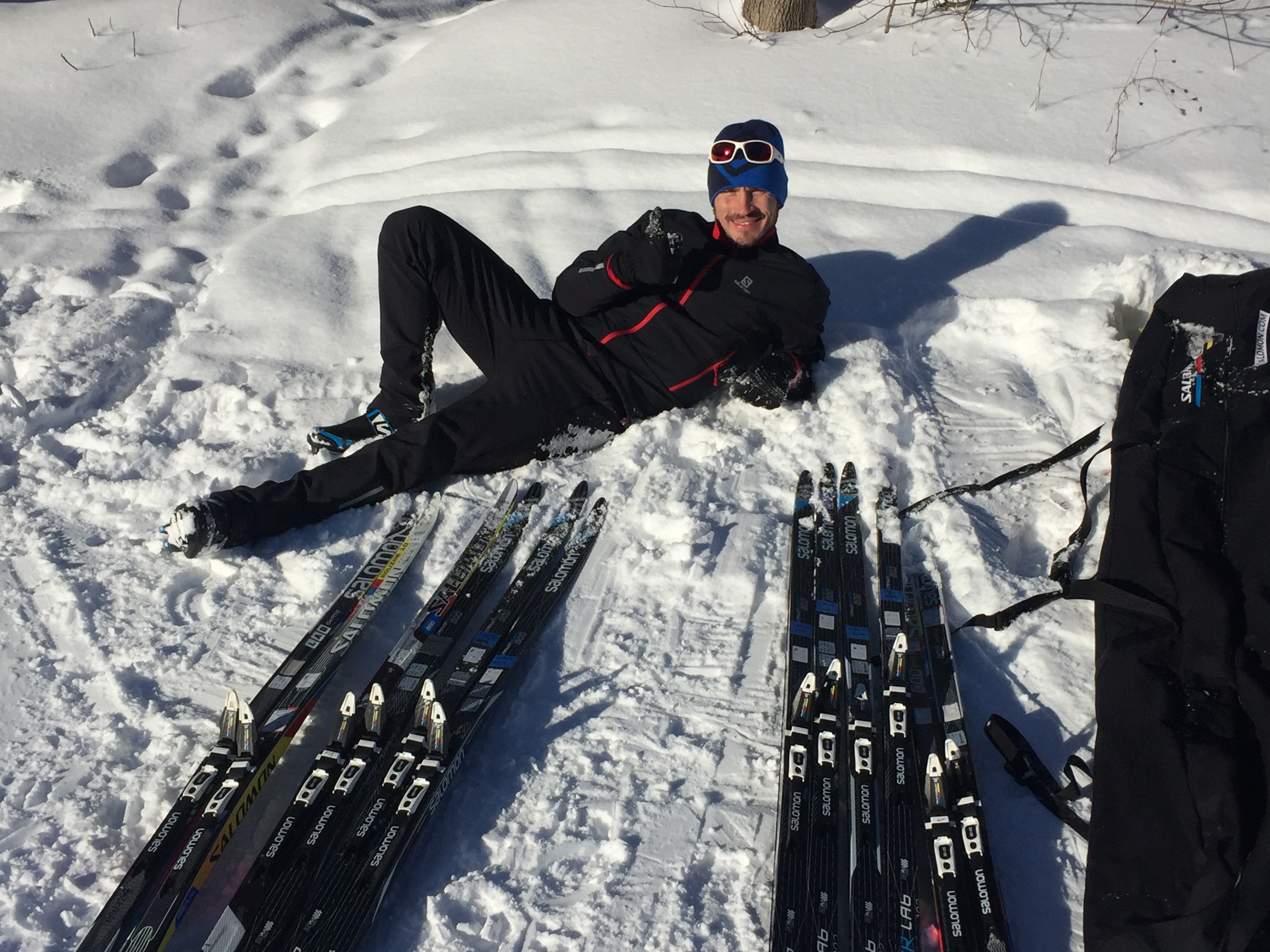
Salomon / Atomic Ski Picking Recap
Just a few weeks ago, I was fortunate enough to make a quick trip across the pond to pick skis at the Amer Sports ski factor. Salomon and Atomic both fall under the Amer Sports umbrella and their race skis are manufactured in Altenmarkt, Austria. Since flights into Salzburg were super expensive, we flew into Munich, Germany. When I say we, I am referring to my good friend Josh Doebbert. Josh is one of the engineers on my technical team that helped me build a new ski flex tester and he is very experienced at working quickly and efficiently when picking through thousands of skis. We decided during the design phase of this tester to make the total weight including custom case, less than 50lbs. This would allow us to easily travel with our flex tester on airlines. Picking skis by hands and eyes is great but having a tool to quantify your hands and eyes after hours of ski picking is very useful. Additionally, using pressure instead of pocket length measurements (pretty much everyone uses pocket length to try to quantify skis) is arguably a better measure of ski performance; more on this in a future article.
Josh and I drove from Germany to Austria on the autobahn and I loved it. Josh was a little worried with the no speed limit thing and me driving but we made it no problem.
We met Jean-Marc Draeyer and Martin Rohrmoser bright and early on Monday morning (11pm CST) to start our 12hour picking day. Jean-Marc and Martin are in charge of the “kilo” programs for Salomon and Atomic. Skis in the Kilo area are the cream-of-the-production-crop. These skis are the most closely paired and exhibit the quantities that Jean-Marc and Martin deem desirable… a farmer knows where his best crops come from. This does not mean that production skis are not good. In 2010, I went top 30 on the World Cup in Canmore on a pair of “normal” production Salomon skis in arguably one of my best race results of my career.

Everyone reacted with “wow” you must have been on a super day. Well the truth is, I was having a mediocre day with my body (I had a limited acclimation period), but my skis were absolutely incredible in the cold Canmore snow. (Salomon makes some of the best cold snow skis and now wet snow skis in the world… more on that later).
Once we had some espresso with Jean-Marc and Martin, we went about unpacking the flex tester and discussing goals for the day. The Amer guys were pretty intrigued with the tester and we burned some time showing-and-telling with over a dozen Amer sports employees. We showed them our process and then Jean-Marc showed us how the kilo skis are chosen, paired and measured. It is a pretty intensive process and involves a lot of measurements and numbers.

Being an engineer, I like this approach a lot vs. the squeeze and tell method of picking (not to say a highly trained set of hands and eyes cannot pick world class skis, I picked my 2010 WorldCupTop30 ski with my hands and eyes) After we settled in, Josh and I spent hours going through racks and racks and racks of Salomon and then Atomic skis.

We were picking skis for both specific customers and general inventory for the shop. Josh and I would start sorting kilo skis of a certain model and length with our hands and eyes, picking the best we could find… which were pretty darn good. Then we would flex test our hand chosen pairs and take only the top percent of those skis. Essentially, we were taking the cream (kilo skis) of the cream (hands/eyes) of the cream (flex tester)… that’s the best cream. After more than 12 hours of ski picking, we had a very robust and high quality rack of skis to bring home.

Salomon Ski Models:
S/Lab Carbon Skate Blue (cold): This is the new ski in the Salomon line-up and the one I had the most inquiries about during our preseason. I first heard about this ski a few summers ago when I was training on the Haig glacier INSERT with Scott Perras. Scott is a 2014 Olympic biathlete and sponsored by Salomon. Sometimes the World Cup biathletes get the new cool stuff before the regular World Cup athletes (Biathlon is a big deal in central Europe). Scott shared a tech and skis with fellow athlete Brendon Green. Both of those guys were having great success with the prototype blue carbon skis in both soft cold and firm cold snow. The camber height is lower on these skis vs the old carbon skis and the glide zones were long and amazingly smooth. We had great success finding a ton of great cold skis in the Carbon Blue. Also, I picked more than a few pairs with enough universal camber properties that they could handle cold snow warming to glaze… think perfect Birkie conditions: below zero/single digits over-night warming to teens/twenties in beautiful sunshine by race finish.
S/Lab Carbon Skate Yellow (universal): This is the Carbon Skate Lab from last year. In Salomon lingo, blue is cold and yellow is universal. A few years ago I didn’t win the argument with a bunch of Salomon people that green is cold, universal is blue/violet/red and wet/warm is yellow but again, I am an engineer and not a marketing person. This year’s Yellow/Uni skis are looking great. They are more refined compared to last year’s production. Last year I saw some camber confusion and skis with the bridge too far forward and aggressive front end pressure along with tail pressure that did not match well within pairs. This year all of that seems much tighter and more controlled. Bridge position was appropriate for a universal ski and I was able to find carbon yellow skis that leaned both to the warmer and to the colder side of things. Also, the base material on these skis can take wax very well to be hard enough for green conditions. Disclaimer: I am a Salomon sponsored and my bag is full of Yellow Carbon Lab skate skis that each work in a vast array of conditions. Two years ago I was 2nd place by 5 seconds to my training partner and best friend, Brian Gregg, on a pair of now Yellow Carbon skis with race temps of 0F at the season opening SuperTour at West Yellowstone. Additional, Salomon is now offering this ski in 177cm length and some of my shorter/lighter customers are super excited about that!
S/Lab Carbon Skate Red (wet/ and artificial): “I’m all bout that bass, bout that base, no trouble…” Oh wait, that’s bass and I mean base. Red base, clear base, grey base… whatever you have heard it referred to as… it all is the same Amer sports wet/warm/humid base material. This is very likely the most universal wet snow base material in the industry. A few years ago on that same Haig glacier trip that I had the great pleasure of crossing paths with Scott Perras, I had in my bag an early production pair of Carbon Skate Red skis. Scott filled me with jealously as he talked about his Carbon Blue prototype skis but I had the Carbon Red skis with me. It was by far the fastest ski in wet snow once things started melting down around 10:30 each morning. I let Scott “demo” that pair for a few laps and I didn’t get it back from him until days later. Salomon has had some unbelievable days on the World Cup with their Red base skis. Jessie Diggins, Matti Heikkinen, Maurice Manificat, Alex Harvey have all had days when they have had a distinct advantage with these skis. I am specifically thinking about the 2016 Tour de Canada during the Canmore stages in the 50F+ weather when Heikkinen won the 15km skate, 2nd in the pursuit time of day and 3rd in the 30km skiathlon. His skis were ridiculously fast compared to Sundby and Ustiugov. Matti is a super fit guy but I know skis made a huge difference those days. The one caution with these Red skis is that they need to have a camber profile that matches the conditions. In last years Red skis and some of this years Red skis the camber profile did not match the wet/warm profile. That is OK sometimes because the Red base can be unbelievably fast in frozen corn or artificial snow all the way down to 0F. But if you want the best universal wet snow ski your money can buy, I would make sure you have someone knowledgeable pick these Red skis for you. At Pioneer, we have had too much experience with man-made snow and wetness over the last few years and we are very familiar with picking and preparing these skis. Wax-wise, I could write many more pages about Red bases and preparation. If you are thinking about racing World Masters this year at Wirth Park, a Salomon Red base ski might not be a bad idea to have in the bag.

S/Lab Classic Blue (cold): I tried this ski for the first time in November of 2015. Isaac Wilson, Nordic Commercial Manager and good friend, took me aside and showed me two pairs of the newly re-designed Salomon classic race skis. He said I could ski on them for a few minutes and then would need them back as the official release was not happening until later that winter. I grabbed the best feeling pair of the two after a quick squeeze and skied off. FINALLY is what I thought to myself. Salomon has finally designed and built a classic ski that could compete with the other brands on the World Cup level. I was previously sponsored by Salomon/CXC from 2005-2011. During that timeframe, it was very difficult to find good or robust classic skis from Salomon. With the new design from Salomon, finding great classic skis is much easier. That pair I tried from Isaac is still in my bag (he never got it back) and I had my best nationals’ classic result on that pair in 2016 in cold snow at Houghton. The Blue classic ski has less splay and a very low riding pocket. I have used it with marginal results when going to warmer kick waxes (think Start Oslo) and very limited success in the klister range but for a green and blue and maybe violet hardwax ski… amazing.
S/Lab Classic Yellow (universal): The yellow classic skis from Salomon looked great this year in the kilo department. The production look very excellent and consistent and I was able to find many skis with camber shapes that would allow the use of hardwax and klister. I was able to grab a pair of yellow classic skis for myself last summer and this was my go-to pair of klister covered and warmer kickwax conditions skis. I won the City of Lakes Loppet classic race on this pair and I had amazing kick even with going extremely thin and even with my wax crew of Andy Brown and Tom Carlson dumping liquid fluoros all over my kick zone. INSERT If you are looking for a do everything classic ski, look no further.
S/Lab Classic Red (warm): See my notes above about the Red base. This is a klister ski and it does it very well. I spent almost all of my Haig glacier classic time on this ski. The camber is high and carries klister very well and the flexibility of Salomon’s core allows for easy kicking. Selection is important as I noticed some production skis had camber confusion… the profile did not match up to the base material. Also, some pairs had a bit too much fight in front of the pocket for my liking. But the good pairs we selected were really really excellent and I am going to make some happy customers with these skis.
S/Race Skin: This ski has won over Jessie Diggins and if it is good enough for Jessie it’s good enough for us. I was able to test 3 pairs of these on the Haig glacier this summer and while I preferred my S/Lab Classic Red skis with a beautiful klister mix… these were just easy: no prep time at all. I am a firm believe that classic skiing and learning to classic ski will make you a better skate skier. A large percentage of my customers only skate ski and if they classic skied a few times a week; it would help their balance and let those skate muscles recover a bit. Another interesting development in skin skis is that now over ¼ of the Norwegian Birkie skiers are using skins for the race. There is a huge development in skin ski technology and the argument has been made that skin skis are saving the sport especially the traditional classic technique by avoiding the hurdle of kick waxing. We have skin skis at all price points, the S/Race is the version you want if you plan to ever race on a skin ski or potentially race on a skin ski if the waxing becomes a nightmare scenario… or if you just like a great performing ski.

Atomic Ski Models:
Redster S9 Carbon (universal): This is a new ski from Atomic and we had the chance to ski on it last year. It created a lot of excitement for us as the ski was really fast but had a bit more stability than I would have expected. This stability was affirmed when I was picking and flex testing the skis because the bridge was located a bit more underfoot and the camber was more balanced. Josh Doebbert was so excited during our picking process, he is planning on snagging a pair for himself.
Redster C9 Skintec (skin ski): Our most anticipated new skin for this year. Atomic started the skin ski revolution and now they are bringing the skin technology to market in a race level ski. This has been a long time coming and Adam was able to ski on a pair of these last year. So far, this is the only skin we have been on that performs on the same level as the Nanosonic skin from last year. The pocket is slightly recessed and tapered which really helps improve speed without sacrificing any skin-like kick.
If you need us to pick you a great pair of skis, please use our SKI REQUEST form. We have a few more ski picking trips coming up and the Salomon and Atomic kilo skis we hand-picked are arriving soon from Europe so now is a great time to contact us. Thanks ~ Matt and Adam
-

Inside the 2018 Olympic Selection Criteria with Chris Grover

The PyeongChang venue as seen in February 2017. PyeongChang, South Korea, will host the 2018 Olympic Games this coming February. (Photo: FIS Cross Country/Twitter) Note: This is the first of a multiple-part series on the 2018 Winter Olympic selection criteria for the U.S. cross-country ski team. A parallel piece compares the cross-country team’s criteria with other U.S. winter sports.
***
Friday, July 7, will mark seven months to go until the Opening Ceremony for the 2018 Winter Olympics in PyeongChang, South Korea. As athletes across the country ramp up their commitment in this Olympic year, and #roadtopyeongchang trends across various social media platforms, FasterSkier takes a look at the recently released selection criteria and procedures for nomination to the U.S. Olympic team.
Briefly put, what does it take to get to PyeongChang? And what factors will U.S. Ski Team (USST) coaches and (newly rebranded) U.S. Ski & Snowboard leaders apply in deciding who will be wearing red, white and blue next February?
In this article, FasterSkier first breaks down the criteria themselves, then summarizes a recent interview with USST Head Coach Chris Grover about why these criteria were chosen and how they should work.
Inside the criteria: World Cup performance, discretion and potential domestic picks
The criteria themselves are little changed from the standards used to pick the American team for the last two international championship events, World Champs in Falun in 2015 and Lahti in 2017. First comes objective qualification via performance on the World Cup. Second comes the potential use of discretionary picks. Third, if any spots are left over, the highest-ranking athlete on a domestic points list may, but does not have to, be nominated to the team.
As for the overall size of the U.S. team, a maximum of 12 male or 12 female athletes may be nominated, with a final team quota of probably 17 to 20 athletes to be determined closer to the Olympics themselves. (This is up from a total team quota of 17 in 2014, though ultimately only 14 athletes were named for Sochi, and the extra three American spots were redistributed to other nations.)
The U.S. may enter up to four athletes in a single race at the Olympics. The six cross-country events in PyeongChang will be a skiathlon (15 kilometers for women and 30 k for men), individual classic sprint, freestyle team sprint, 10/15 k skate interval start, 4 x 5 k or 4 x 10 k mixed technique relay (classic, classic, skate, skate), and 30/50 k classic mass start.
As for the criteria themselves for making the U.S. Olympic team: In order:
- Objective qualification via World Cup results
Athletes who have achieved a top-eight finish in one of five specific races, or who have a top-50 ranking on either the World Cup sprint or distance list midway through Period II, will be named to the team.
Most precisely, “Any eligible athlete that posts a top-8 individual final World Cup result during the selection period [Nov. 23, 2017, through Jan. 15, 2018] in the following events will be selected to the Team: Sprint C, individual start 10/15 km F, and 15/30 km Skiathlon.”
Looking to the schedule for the 2017/2018 World Cup season, classic sprints will be held on Nov. 24, in Ruka, Finland; Dec. 2, in Lillehammer, Norway; and Jan. 3 in Oberstdorf, Germany (as part of the Tour de Ski). A 10/15 k freestyle individual start will be held in Davos, Switzerland, on Dec. 10. The only skiathlon on the 2017/2018 World Cup calendar will be held in Lillehammer on Dec. 3. Any athlete posting a top-eight final result in one of those five races will be named to the Olympic team.
(The 10/15 k skate pursuits on the schedule don’t count for top-eight purposes – it’s only Olympic formats that are used for qualification. And the 10/15 k skate race in PyeongChang is an interval-start race, not a pursuit.)
So that’s high finishes in individual races. As for cumulative performance across multiple races, “Athletes ranking in the top-50 in the distance World Cup standings or the top-50 in the Sprint World Cup standings as of January 15, 2018 shall be selected to the team.” Jan. 15 marks roughly the midway point of the World Cup calendar. By that point, 18 World Cup races will have been held.
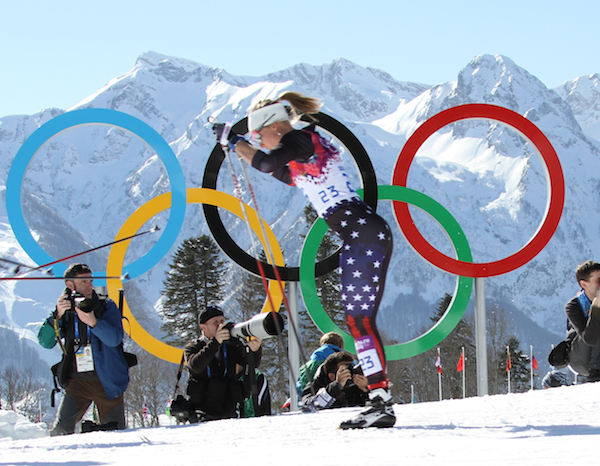
U.S. Ski Team member Sadie Bjornsen racing in the women’s 15 k skiathlon at the 2014 Winter Olympics in Sochi, Russia. Bjornsen is a veteran member of the national team heading into another Olympic year. As of the comparable point in the 2016/2017 season, shortly after the Tour de Ski, USST members Sadie Bjornsen, Rosie Brennan, Sophie Caldwell, Jessie Diggins, Simi Hamilton, Noah Hoffman, Andy Newell, Kikkan Randall, Ida Sargent, and Liz Stephen had top-50 rankings in either or both disciplines.
A maximum of five athletes per gender may be selected based on their Sprint World Cup rankings. Tiebreaking procedures come into play at that point if necessary, generally based on an athlete’s single best finish in a sprint race.
- Discretionary selection
Spots on the U.S. Olympic team will presumably remain open after the application of the objective criterion of World Cup performance. In that case, “the USSA Cross Country Head Coach may use discretion … to determine team nominations” for additional spots on the Olympic team.
Grover would at that point recommend additional athletes to a three-person committee, composed of U.S. Ski & Snowboard President Tiger Shaw, Executive Vice President of Athletics Luke Bodensteiner, and athlete representative Rosie Brennan.
If Brennan stands exposed to a potential conflict of interest from discretionary selection (that is, through no fault of her own, she “stands to benefit privately from a decision made by the Selection Committee,” as would happen if she had not qualified objectively and were being considered for discretionary selection), then she would be directed not to engage in any conduct “meant to unduly influence” the selection committee regarding her potential selection to the Olympic team.
Grover is then directed to consider any of (a) “outstanding competition results” from both this season and last season, (b) “Recent positive direction or trend of competition results indicating a potential for Olympic success,” or (c) “Indication of medal potential in future Olympic or World Championship competition (such as international age group results and rankings) that would be materially enhanced by selection to the team.”
U.S. Ski & Snowboard was not required to make discretion a means of selection to the team. It also has the discretion not to use discretion at all; as the document states, Grover may use discretion to determine additional team nominations, but does not have to.
- Domestic selection. Maybe.
If there are any spots remaining on the team after applying criteria (1) and (2), U.S. Ski & Snowboard may consider the highest-ranked domestic athlete, one per gender. But it technically doesn’t have to.
(There is some ambiguity within the selection document itself as to whether more than one team spot could be filled via a domestic ranking list. On the one hand, selection criterion 3 uses the plural when it talks about “any remaining positions,” and “those positions may be filled.” On the other hand, it also mentions “the athlete with the highest rank on the 2018 Olympic Winter Games Selection List,” and both “athlete” and “rank” are in the singular. In practice, Grover clarified in a recent phone interview that the national team is potentially open to bringing more than one skier per gender, pointing out that four men and two women were brought to Lahti off the domestic rankings list.)
The 2018 Olympic Winter Games Selection List, as with the comparable list for 2017 World Champs in Lahti, is essentially the “normal” 2017/2018 SuperTour points list, plus substantial bonus points for 2018 U.S. National Championships. An athlete’s best two finishes in a single discipline (sprint or distance, not skate or classic) will be counted.
The SuperTour point totals system, and bonus points for podium finishes at 2018 U.S. nationals, appear to be precisely the same as those used last winter for Lahti. That is, first through third at the December SuperTour races will be worth 30, 25, and 21 points, respectively. The addition of nationals-only bonus points means that first through third in the four races in Anchorage count for 45, 35, and 26 points, respectively. When an athlete’s best two finishes are counted, a second and third at U.S. nationals (61 points) would be worth more than two firsts (60 points) at “normal” SuperTour races.
For this reason, in last year’s preview for 2017 U.S. nationals, FasterSkier quoted longtime racer Kris Freeman as stating that “the allocation of bonus points to Nationals essentially makes the remainder of the SuperTours irrelevant. Nationals is now World Champ and Olympic Trials which is fine, but let’s call them what they are.”
The math is the same this season as last season. This season, U.S. nationals start in Anchorage on Jan. 3, 2018. The four races there will be a skate sprint, classic sprint, 10/15 k skate interval start, and 20/30 k classic mass start.
Discretion and selection to international championship events
The appropriate role of discretion when selecting athletes for a World Ski Championships or Olympic team is a subject of recurring interest for fans and supporters of American cross-country skiing, and has frequently arisen on this site.
For example, here’s USST Women’s Coach Matt Whitcomb in an interview with FasterSkier in July 2016, answering the question, “Is it fair to say that making discretionary picks is one of the harder parts of your job as a coach?” Whitcomb replied, “For sure. We love not to do it. But in any criteria, discretion can often be one of the most important pieces. We really envy these Olympic Trials [for the American track and field athletes for the 2016 Rio Olympics] that we’re watching right now, where the top three go and fourth is either an alternate or they don’t go, and it’s just much more objective.”
And here’s Grover in January 2017, slightly ahead of the naming of the U.S. team for Lahti: “The real key thing is that, at the bottom of the selection, we followed the selection criteria. That’s key. Discretion really belongs to be used at the top, for those athletes who have a chance to come over and have big races at World Championships, and by big races I mean someone who can go on the podium, or the top five, top 10, or top 15. Look for some selections from USA, but I wouldn’t look for a lot of discretion at the end of the day.”
Or here’s Grover in January 2014, discussing why he and the rest of U.S. team leadership abjured discretion completely in taking Brian Gregg to Sochi but not Matt Liebsch, when only 0.04 points separated the two on the domestic men’s distance list: “We really tried to apply the selection criteria in the most fair way possible.That becomes, for sure, a challenge, especially on the men’s side when you get down to the sixth, seventh, eighth guys, you’re really splitting hairs because the FIS points are so close at that point. Because they were so close we opted not to use discretion. It really wasn’t a fair way to do it.”
(As things played out in Sochi, USSA selected 14 athletes out of a total possible quota of 17. Grover explained at the time, shortly after selections were made and before the Olympics began, that they had only intended to bring those athletes whom they planned on starting in races. “With seven women and seven men, we have our start positions filled,” Grover told FasterSkier before the Games. “Seven and seven was the magic number for us.” Liebsch is reported to have considered legal action to gain a spot on the U.S. team for Sochi, but found that that it was “too late” for him to do so. In Sochi a few weeks later, U.S. athlete Torin Koos did not start the 50 k skate race, a race format in which Liebsch had previously won at the American Birkebeiner.)
The U.S. Ski Team’s views on discretion
Grover, the longtime USST head coach, is aware that people feel strongly about the substance and application of selection criteria for U.S. championship teams. “I think overall I’d say people get a little bit mired up and tied up with selection criteria, and whether it’s fair or not, or how this potentially sees them falling within that criteria,” Grover told FasterSkier in a recent phone interview.
But Grover has a simple message for domestic athletes hoping to go to PyeongChang: “All you need to do is to ski fast, you need to go out there and win races, or to reach podiums. And if you can do that, your chances of being selected to the team are quite good.”
The current criteria are “better than ever, more fair than ever,” Grover continued. “I think [it] gives athletes the most direct path possible to a major championship team.”
Grover urged domestic athletes not to obsess over the apparent prioritization of discretion over domestic race results as a means of picking the Olympic team. Addressing a hypothetical non-national team member, he said, “As as an athlete domestically, don’t get hung up in the order that those things come down in the selection criteria. Discretion has to be next, because a discretionary athlete that’s picked needs to be picked because they are a top athlete who should be on the team, who has somehow been missed by the selection criteria.
“So that’s the placement it has to be,” he continued. “And that’s consistent with selection criteria across different disciplines, in different sports. So that’s just the way that the procedure needs to work. But it doesn’t mean that a large number of discretionary athletes will necessarily be selected prior to the domestic field.”
The statements that discretion “has” to have this status, and that this is “consistent with … different sports,” are not necessarily correct. As reported today in another article on FasterSkier, discretion plays a less prominent role in every other U.S. Ski & Snowboard sport.
Grover also underscored that the use of discretion within American skiing pales in comparison to its role in Norway or Russia.
“We’re competing against teams that are using 100-percent discretion to name their teams,” Grover emphasized. “So in the U.S., we have kind of the most democratic, objective, fair, I guess you could say – other nations, our Scandinavian peers, might call this an American system that we use for selecting athletes. It’s very cut-and-dried.”
The four countries that Grover mentioned by name in his interview as the Americans’ main competition – Norway, Sweden, Finland, and Russia – all finished ahead of the U.S. in the final Nations Cup standings for the 2016/2017 World Cup season.
Grover also stressed that U.S. Ski & Snowboard used only one discretionary pick for the Lahti roster, taking USST athlete Erik Bjornsen. “And the reason that we used one discretionary spot to select Erik was because he basically fell between the two criteria. He didn’t quite make the top-50 in the world standard because he had gotten sick during the selection process, and he wasn’t home domestically to race in the races domestically, but I think very few people out there would argue that that wasn’t a good use or a smart use of one discretionary spot.”
Grover further stressed that the team had used, as he initially put it, “zero discretion” when selecting athletes for Falun World Championships in 2015. (In a subsequent email to FasterSkier, Grover clarified that “We used zero discretion in the original selection of 16 athletes (8 men and 8 women) to the Falun Team, but we did add Ben [Saxton] at a later date via discretion after he finished 6th in the sprint at U23 Champs.”)
Writing criteria for the top vs. the bottom
Grover cited the decision to bring Erik Bjornsen to Lahti as an exemplary use of discretion, underscoring that Bjornsen was a skilled athlete who “had some of the very best individual results there” among American skiers.
“So that is absolutely our intention,” Grover continued, “it has been our intention, and it will be our intention going forward, is that we use discretion on the rare case where there’s an injury, or an illness, with a top athlete, and/or the criteria fail to select someone that I think most everyone would agree should be there representing the United States.”
At world champs in Lahti in 2017, Bjornsen finished 18th in the 15 k classic and teamed up with Simi Hamilton to finish fifth in the team sprint. At world champs in Falun in 2015, Saxton finished 54th in classic sprint qualifying, roughly nine seconds from making the heats.
While Grover is confident that discretion is most appropriately used for a top-performing U.S. athlete, he acknowledged some issues regarding the final athletes selected (or not selected) to a team.
Summarizing his discussion with domestic senior club coaches about the selection criteria used for Lahti, and any potential changes before PyeongChang, Grover said, “All the responses I got back were positive, people were like, Yeah, it worked well. It’s never perfect at the bottom, but I don’t really see any way to improve it.”
Indeed, he noted, the U.S. Ski & Snowboard working group “struggled with” how to select “athletes at the bottom of the selection, and make it as fair as possible. And what you come up with at the end is, in the end there’s no real perfect way to do it, and there’s going to be challenges to the way that any selection criteria works at the very bottom of the selection.”
Current success vs. preparing for the future
Another issue surrounding selection is the question of current competitiveness vs. taking a young athlete to a “practice” Olympics just for the experience – that is, is the Olympics for development or for podiums. In 2014, for example, regarding the recently named team for Sochi, Grover said, “The Olympics is the pinnacle of the performance or competition pipeline.”
Development occurs at many lower levels, Grover noted (Europa Cups, World Juniors, etc.), but “It does not and should not come at the World Championships or the Olympics. … It’s not a development trip; it’s a competition trip at the very highest level.”
Similarly, earlier this year Grover explained that junior skier Katharine Ogden (a.k.a. “KO”) was not selected for Lahti on the grounds that “athletes should first aim to be successful at – in the age group that they’re competing against. So for KO, that means World Juniors, and being successful at World Juniors.”
The third prong of discretionary selection for the current Olympic team, “Indication of medal potential in future Olympic or World Championship competition (such as international age group results and rankings) that would be materially enhanced by selection to the team,” may be said to go against these principles.
But Grover explained that this “future medal potential” path to discretionary selection is rarely if ever used, even when the Olympic team is selected with an eye to current podium potential.
“We haven’t used it that way,” Grover said. “Obviously the language is there if we were to choose to use it, but in the past we really have not used it that way, and I don’t anticipate using it going forward into this season. … We want … the fastest skiers on the start line in Korea, and those are the ones that we’re gonna be selecting.”
Different standards for men and women?
An additional issue in selecting American skiers is that the women are currently, proportionally speaking, faster than the men – that is, the U.S. women, as a team, have recently tended to achieve better results within the women’s World Cup field than the U.S. men do within the men’s World Cup field.
It is also true that the international men’s field is more top-heavy than the women’s field, across the course of a single World Cup season, meaning that a greater number of World Cup points is needed to crack the top-50 of a discipline ranking.
(As of the end of the 2016/2017 World Cup season, 50th place in the men’s distance ranking had 66 points; in the women’s distance rankings, 42 points. For sprinting, it was 28 points to make the top-50 on the men’s side, 22 points for women.)
Perhaps for these reasons, multiple athletes have confirmed to FasterSkier the substance of a suggestion made at a recent athletes’ meeting at the season-ending 2017 U.S. Distance Nationals in Fairbanks: That the selection criteria should be made more challenging on the women’s side, such as by making the objective cutoff there be a top-40 or even a top-30 discipline ranking rather than top-50.
“I understand where the person who asked that question, where kind of they’re coming from” Grover told FasterSkier, when asked generally if there had ever been discussions about making the objective criteria different between the genders.
“They’re referring to the fact that there’s greater depth on the men’s side … there’s a lot more men ranked – that have FIS points that are say 30 and under, versus the number of women perhaps that have 30 FIS points or less.”
(This is a correct statement about the distribution of FIS points, at least in distance rankings.)
But, Grover continued, “top results are top results at the end of the day. And there’s three medals that are handed out, for men and for women. And if that means that selecting an athlete who ends up to be, say, 46th in the top, in terms of the top 50 in a discipline list by the middle of January, that athlete might be closer to contributing to a top result or a podium than one of the guys.”
For this reason, Grover questioned the aims served by this suggestion. “Is the end objective for that person just to provide more opportunities for men to come over and be 50th place at the Olympics? Because if that is the objective, then I don’t think it’s worthwhile pursuing. What we’re trying to do is have top results … to really compete. And that means selecting those athletes who are the closest to the top placings.”
Unfair advantages to Tour de Ski starters?
Another concern raised about the criteria is the argument that, as Freeman wrote in his recent opinion piece on FasterSkier, “The Tour de Ski ended up being a points feeding frenzy,” given the attrition-ravaged field that saw only 31 women finish the seven-stage Tour. (There were 40 finishers on the men’s side.)
Freeman also argued that it was illogical to use a non-championship event for selection to the USST, “whose primary stated goal is to win medals. … Is racing up a hill at the end of a nine-day tour really a fair way to determine who goes to the World Championships or Olympics?”
Grover’s stance is that it’s more difficult to finish in the overall top 30 of the Tour de Ski than reach the podium at U.S. nationals. Due to recent changes in FIS rules that will allow more pure sprinters to start the 2017/2018 Tour de Ski without counting against their nation’s start quota, he foresees a greater number of finishers in this year’s Tour.
“I would anticipate that this year you’re going to have much better numbers of athletes that are actually finishing the Tour,” he said, “and so the standard there won’t be quite as ‘easy,’ quote-unquote. It’s not necessarily easy, but won’t be as easy as it was this last year.
“Is it easier to score points, even at the end of a Tour de Ski if you can survive it, versus to have a podium at U.S. nationals, given that a bunch of the top USA athletes are doing the Tour de Ski at the same time?” he asked. “I would still guess that it’s easier to reach the podium at U.S. nationals, and thereby that would make it an easier path for an athlete to make the Olympic team.”
FasterSkier has separately addressed Freeman’s argument regarding the “access problem” of obtaining Tour or World Cup start rights in the first place. FasterSkier has also considered the approach used by the US Biathlon Association, which makes it “not a foregone conclusion” that athletes receiving World Cup starts will necessarily make the Olympics.
The bottom line
“At the end of the day,” Grover concluded, “I would anticipate that we’ll be able to bring the athletes that we want to bring so that we can fill every potential start spot at the Games. … We will fill every start at the Olympics.”
Grover and U.S. Ski & Snowboard intend to do so by making sure “that we capture any athlete who can reach the podium, any athlete who can reach the top five, the top 10, the top 15. That’s the absolute critical element, is that we give ourselves the best chance to be successful.”
And Grover believes that the current criteria are “the best way to do that.” We “were trying to create a more equitable, more concrete, easier to understand and visualize path for domestic athletes, racing SuperTour, to qualify for a major championship team,” Grover said. The result, he concludes, is “better than ever, more fair than ever. … So, you know, I feel good, I feel really good about the criteria, I feel like we got the most fair criteria for the Olympic selection that we’ve had, and I’m excited to see how it turns out.”
— Jason Albert and Chelsea Little contributed reporting
***
Stay tuned for more on this topic, including an article on American athletes’ reaction to the Olympic selection criteria and how they feel the exercise of discretion has affected them and U.S. skiing. And be sure to read about the role of discretion across other U.S. Ski & Snowboard sports, particularly biathlon.
-

FasterSkier’s 12 Days of FBD Christmas: Day 12

Editor’s note: This is it. The final day of our spin on the holiday gift guide, brought to you by our gear-review guru, who, over the last 12 “business” days, compiled a 12-day list of gift ideas (in various price ranges) for all the nordies in your life. So if you see him, say thanks. And stop asking about his underwear-washing regimen. He’ll get to it when he gets to it.
***
It is with carpal tunnel-ridden wrists, a rapidly dwindling supply of thinly-veiled sexual references, and a heavy heart, that I must sadly inform you that this is the last installment of the 2016 edition of “12 Days of FBD.” I like to think that every day can be a day with FBD, as hopefully all of you have taken these amazing gift ideas to heart and bought every single thing on each and every one of these lists. To be clear, if you have followed all of my instructions carefully, you should have actually bought TWO of everything on all of the lists, as you’re going to give one away and keep one for yourself — nothing is more pro than that.
As you undoubtedly expect, we’re going to go out with a bang, as I really have saved some of the best for list. These aren’t just gift ideas, these are THE gift ideas.
Day 12: Blast Off
Under $30: Donation to Protect Our Winters nonprofit, $Any Amount

Donation to Protect Our Winters, FBD pick for under $30 (or any amount) Like skiing? Guess what you need to ski? Snow. Thanks to one of the strangest elections perhaps in the history of democracy, we have a president-elect who believes that despite overwhelming scientific evidence, climate change is a myth being perpetrated by the Chinese. This is a problem if you intend to venture out of your house for any reason at some point in the rest of your life. Instead of sitting around complaining about this travesty, DO SOMETHING about it. Most politicians are like sheep — they follow the flock, so make your voice heard and support one of the great organizations out there fighting for not just our winters, but the very survival of our planet. One very good organization leading the fight to save Earth is Protect Our Winters. I put this in the “Under $30” category, but you can most certainly donate any amount. Please also feel free to donate in the names of others, in particular if they also refuse to believe the near unanimous scientific consensus on climate change (Guess what you’re getting for X-mas, this year Rob Magee?). If you breathe air, don’t want your house destroyed by flood, or even remotely care that future generations won’t be able to walk outside for more than 30 seconds without their clothing burning off their bodies if we don’t address this problem right now, you’ll be glad you supported these folks. Donate at ProtectOurWinters.org.
***
$30 – $100: Nebulizer (Pari Trek brand, $73)
Pari Trek Nebulizer, FBD “pick” for $30-$100 Maybe you can’t ski like the Norwegian National Team, but you can share their approach to pharmacology and ethics. No asthma? No problem! Fly to Norway, find a “sympathetic” doctor, and boom, you’re TUE’d and on your way to better splits. Available at JustNebulizers.com.
FBD Pro Tip: Don’t buy sunburn cream in Italy.
***
$100 – $250: Muck Boots, $214.99

Muck Boot Company’s Arctic Pro, FBD pick for $100-$250 What do watching races, retrieving your intransigent Great Dane and getting Christmas trees have in common? Cold feet — remember way back when we started this journey I told you we’d discuss both cold hand and cold feet? (No, not the marriage type of cold feet, you’re on your own with that one) — and while we’re on the topic of cold hands, for the love of God, NO, you DO NOT have Raynaud’s Syndrome, you simply have shitty gloves, so stop it with your hackneyed, amateur, self-diagnosis.
OK, where was I? Oh yeah, cold feet. Buy these. Pair it with the Arc’teryx “mega puffy” from Day 10 and never be cold again. Muck boots: $214.99. Available at MuckBootCompany.com.
***
Over $250: Custom Altius biathlon rifle stock, $1,200
Custom Altius biathlon rifle stock, FBD pick for $250+ I don’t know if there is a more exciting sport anywhere in the world than biathlon: this amazing competition combines all of the coordination, fitness and discipline of cross-country skiing with the laser-like focus of precision shooting, therein adding a mental toughness and focus factor simply not found in most other sports. The extremely narrow margin of error involved in shooting golf ball-sized targets 50 meters away in wildly unpredictable weather at near-max heart rate means that you see frequent lead changes, action all the way down to the wire, and emotion and intensity in its rawest form.
It is for all of these reasons that biathlon is one of the few sports that I will actually watch. I’d much prefer to actually be out doing sports rather than sitting at home watching others do them. I have this crazy notion that controlling my own destiny (and activity) is somehow healthier than attempting to live vicariously through others. I’m not alone either, as there was a landmark study in 1972 by noted behavioral psychologist Martin Seligman, on a phenomena known as “learned helplessness”. The main finding of the study (and subsequent related studies) is that organisms are much happier if they are in environment they can control. This Sunday, you can go for a ski, or you can scream at the TV at the overpaid, steroid-abusing mercenaries, who, contrary to popular belief, DO NOT represent your city, state or personal values. And should your team win, please never forget your role in that whole process.
The choice is yours: watch other people do stuff or go make yourself better. Get out there and work on your technique. Learn how to classic ski. Learn how to classic wax. Then give up on classic waxing and buy these (Rossi skis from Day 3). Or, call Caldwell in hourly intervals if you even have the slightest inkling that your kick wasn’t perfect. Don’t just take my word for this though, test it yourself. See which strategy leads to happiness. I’m not your mother, so I’ll leave it up to you if you want to shape your own future or let your happiness be dictated by events over which you have literally no control. Seems like an easy choice to me, but hey, what do I know, I’m just that guy who only uses the passing lane for passing cars, then immediately returns to the correct driving lane in order to allow faster moving vehicles to safely pass.
Since after that little sermon, you are now no longer watching football, how are you going to spend your Sunday afternoons? Here’s an idea — let’s go back to what we talked about two paragraphs ago — why not try biathlon? Biathlon isn’t just for unkempt French dudes, it is for everyone. There are several excellent programs right here in the good ol’ US of A than can get you started safely, certified and really to rock (including Colorado Biathlon, Minnesota Biathlon, Ethan Allen Biathlon, Casper Mountain Biathlon, Bridger Biathlon, to name just a few).
FBD Pro Tip: If you are going to race in the greatest of all winter sports, biathlon, here’s a shocker, you’re going to need a rifle. As we have already clearly shown over the course of the past 12 days, if something is worth doing, it’s worth doing well, so if you’re going to race, you might as well outfit yourself with the best gear possible: the Custom Altius biathlon stock. Available at AltiusGuns.com.
FBD Bonus Pick: The Smokey Bear Watch, $1,000
The Smokey Bear Watch, FBD pick for $250+ I’m sure it’s not a secret by now that the FBD likes gear, nay, LOVES gear. And it loves him right back. Ask any good craftsman and they’ll tell you success is all about having the right tool for the job. Sure, you can use a screwdriver to pound a nail, but you know who does this? A certain guy by the name of Primative Pete. Following this metaphor, you certainly can wear a digital watch out to dinner, but you know who does this? A certain guy who’s not getting laid that night. Plain and simple, you’re not going to meet any girls (or boys) if you’re wearing a digital watch. Now don’t panic here fellas, the protocol regarding male fashion accessories is ridiculously simple and can be broken down into three simple rules:
1. No jewelry. Ever. (Wedding rings don’t count, as those are more anchors than they are ornamental). Why no jewelry? This should be quite self-explanatory, but in the off-chance that you still have questions, these photos pretty much say it all:

J-Smu puka-shell necklace 
J-Smu frosted tips 2. No cologne. Ever. Don’t be “this guy”.
3. Have a nice watch. If you’re paying attention and following the above guidelines, you’ll realize that this protocol doesn’t leave a lot of wiggle room for dudes to accessorize. This is by design, as while women often excel in this arena, guys usually massively screw it up.

None of these items shown here should ever be on your body at any time, for any reason:
What should always be on your body? A nice watch. We already covered training watches in Day 5, but what about those two hours per day in which you are awake but not training? If you have somehow managed to cloak all of your glaring narcissistic tendencies enough to dupe an unsuspecting female into joining you at a local fine dining establishment, for heaven’s sake, show up with some game. We’ve been over the underwear protocol in excruciating detail, but trust me, underwear selection and hygiene level will not even come into play if you goof up the basic stuff, and having a nice watch is, well, basic stuff. Remember to guys, you only have to follow THREE frickin’ steps here and two of them are just things to NOT do, so everyone out there should be able to handle this.
Here’s what’s awesome about this code of conduct though, not only is it ridiculously simply for even the most fashion inept male to follow, but a nice watch can be a treasured heirloom for literally generations to come. On very special occasions, I still wear a watch my grandfather gave me and it means the world to me. Watches can also be used to mark special occasions, therein giving the gift lifelong significance. If you give (or are given) a good watch for graduation, a birthday, anniversary, etc., you will think about that event and that giver essentially every time it is worn, and isn’t that what holiday giving is really all about?
I am particular fortunate in that the lovely Mrs. FBD (yes, there really is a Mrs. FBD) will occasionally reward a good performance in the bedroom with a watch and I’m proud to say that I’m up to a collection of three beautiful time pieces. Far be it for me to be one to brag, but let’s just say that I can maybe even see another one being added in the next few years.
Now that we’ve proven our theorem on why you need a decent watch, the obvious next question is, “Which one?” As usual, we have you covered here too. FBD loves watches and while an easy pick may be a Rolex, Omega, Bell and Ross, Cartier, or Breitling, none of these brands may really be “you.” This is why one of my new favorite Mickey’s is this:
The Smokey Bear Watch, FBD pick for $250+ Made in Detroit at the Shinola Watch Factory, this watch is a very limited edition and celebrates the history of one of the most iconic and longstanding environmental movements, forest fire prevention. In a time when we need to be doing everything we can to help our environment, it is refreshing to see a company paying tribute to one of the most effective environmental public service campaigns ever and even donating a percentage of the sales to the US Forest Service.
I’ve saved this for the last day because this is honestly one of the best picks of the series. Yes, it is a bit spendy, but of the over 60 products suggested in the past 12 days, this one is the most “Chrismas-tree ready” (this is the Christmas equivalent of a construction project being “shovel ready”). Why? Well, this gift has pretty much everything. For starters, the watch comes packaged beautifully:

Next, included with the watch is a seven-page bound history of the Smokey Bear forest fire prevention campaign, which is quite interesting. Also included are very nice retro Smokey Bear cards, featuring classic iconography:


These elements all make the gift much more interesting and gives the whole thing a very luxurious feel. So while every nordic nerd would most assuredly appreciate unwrapping a double-pole machine that looks like it has been packaged by the loser of a drunken, monkey knife fight…

… with one simple phone call, you can not only have without a doubt one of the most impressive looking gifts, but also one that will carry significance for literally generations to come. So while the watch is indeed a bit pricey, trust me when I say that it is a wonderful gift.
And remember, you’re never going to meet a woman if you’re wearing a digital watch. Church. Available at Filson.com.
We’ve been on quite a journey together these last 12 days and I think we’ve learned a lot about each other along the way. You all have learned that I wear my underwear for 10 days at a stretch (no pun intended) without washings. I’ve learned that people love to read about gear, even if it requires digging through literally pages of weird, cryptic ramblings on a wide variety of often only loosely-related topics. And my editors have learned that it is easy to tell when I’m getting fired up. Like now. I’m getting fired up because everyone is writing in asking for more, so I’m going to miss you people.
As is the case in any good race, succeeding in this series has required excellent pacing. Since this isn’t my first day on the radio, I believe that, as usual, I have paced myself perfectly (this was drilled into my head doing rollerski TT’s at SoHo with the Loppet Nordic Racing Team. If you skied positive splits in the TT, you did the dishes), so I’m “negatively splitting” this mo-fo — not only am I not running out of energy, I seem to only be picking up speed. I’m not going to lie to you, this means that I am struggling a bit to say goodbye. This, combined with my perfectly timed taper and peaking energy levels, means I feel compelled to throw in a few more FBD Bonus Picks.
*FBD Super Bonus Pick: FBD Bonus Pick #2 is also a real peach, and oh golly, I’m hot today. What is it? Or should I say, WHERE is it? The answer to those questions, in order, is that it is a gift certificate to a training camp on Haig Glacier. Led by Matt Liebsch, one of the only two American men to win the U.S. Birkie in the past 15 years, this camp can lay the foundation for one of your best seasons ever.
There’s an old adage in ski racing, “A good winter is built in summer,” so get a head start on next year’s season now by giving the gift of getting the kooky nordic skier in your life the hell out of the house for a week in the summer. Everyone wins in this equation: Haig Glacier camp, approximately $1,500 (2017 pricing is not set yet). More information available by email; send Leaper in hourly intervals at matt@pioneermidwest.com.
**FBD Super Duper Bonus: A week at FBD fantasy camp. Even though you’re a nordic skier, hopefully you have enough of a life that you’ve never considered one of these events, Rock ‘n’ Roll Fantasy Camp, New York Yankees Fantasy Camp, or God forbid, Philadelphia Eagles Fantasy Camp, but what about FBD fantasy camp? Now we’re talking. For just $100,000, you can walk in my shoes for a week (not literally, as I’d never let any of you filthy people wear any of my beautiful footwear). You can experience firsthand the indignity of verbal abuse from East Coast motorists, having your precious belongings destroyed by an unruly and essentially untrainable Great Dane, and if you’re really lucky, perhaps we’ll even let you turn in a rambling, unhinged manifesto about dirty underwear, wax brushes and why you need to be matching your hat, gloves and buff. It’s a once in a lifetime experience that’s happening daily. FBD Fantasy Camp, $100,000. Available at Marketwatch.com (I’m somewhere down on the list with all of the other really expensive, dangerous ones, after all, it IS in Philly, where essentially anything can happen to you at any time).
Finally, thank you all for hanging in there with us to the very end. For many, this has been a crazy, tumultuous year and hopefully these columns have brought some pleasure to all of you in their own right and have also stimulated, encouraged or aided you in some way, shape to form to increase your enjoyment of one of the greatest sports, activities and lifetime pursuits one could ever find, nordic skiing. Have a great holiday everyone and hopefully I’ll see you out there. And please remember on that drive to the tracks, races, or gear store, the left lane is a PASSING lane.
***
-
FasterSkier’s 12 Days of FBD Christmas: Day 11
Editor’s note: This year, we opted for a spin on the holiday gift guide. Rest assured, we tasked the right guy — our gear-review guru — with the job of compiling a 12-day list of gift ideas (in various price ranges) for all the nordies in your life.
***
Day 11: Slopestyle
In 1964, United States Supreme Court Justice Potter Stewart famously wrote in a landmark ruling on obscenity that he didn’t necessarily know how to define pornography, but, “I know it when I see it.” Supreme Court of Style Justice FBD recently somewhat infamously wrote, “Unlike that old dude looking at porn, I DO know how to define style: I just look in the mirror.”
Since sadly, most of you don’t have the wonderful and life-changing opportunity to see me in the mirror each day, I believe I can help you all along by describing how you can each approximate and adapt these daily visions of greatness to your own lives. Ready? Let’s do this.
Under $30: Dead Man’s Reach Coffee, $14.59

Deadman’s Ground Reach Coffee, FBD pick for under $30 One of the secrets to having good style is getting your lazy ass out of bed to actually make it out to ski (I’m looking at you, Rob Magee). We’re all busy, but thankfully God has created this wonderful elixir of life, known as coffee. This magical potion works wonders to right all of the wrongs in the world and a cup of this particular top-secret FBD brew will have you up fixing your doghouse until 2:00 in the morning (true story about FBD’s first cup of coffee).
After that first faithful experience with this miracle compound:

I knew I was on to something. From that day forward, both my life and my training was forever changed — here is actual footage of my current morning routine after just two cups of this coffee. A simple rule I try to live my life by was aptly and succinctly summarized by my 80’s man-crush, Wham front man, George Michael, “If you’re gonna do it, do it right,” (I mean really, does it get any cooler than tambourine gloves? I don’t think so.) So if you’re a coffee drinker, well, hell, do it right, buy the good stuff, and get mother f’n TURNT! Available at Amazon.
***
$30 – $100: Craft Wool Comfort Zip, $79.99
Craft Wool Comfort Zip, FBD pick for $30-$100 You should all know by now that looking good is essential, but you’re never going to look good if you’ve shivering like a Florida resident when the mercury hits 68°F. Your mom is not going to show up to the tracks with grilled cheese sandwiches with the crusts cut off and a thermos of chicken noodle soup. Grow up. Buy a real baselayer and go attack that cold. This baby is the best of both worlds: a synthetic inner layer for comfort and a wicking, wool outer layer for warmth. If it is good enough for Andy Newell, then it’s good enough for you. Buy one and go work on your backflips. Available at CraftSports.us.
***
$100 – $250: Patagonia Men’s Reversible Bivy Down Vest, $189
Patagonia Men’s Reversible Bivy Down Vest, FBD pick for $100-$250 Western gunslinger, riverboat captain, ’80s ski bum: what do all of these colorful characters have in common?
They all rock a vest. So while hopefully you’ll never be in an actual gun fight, pilot a paddlewheel steamboat down the mighty ‘Miss-a-sip,’ or do blow off of a pocket mirror in the gondi, you can exude the best of all of these styles with this warm, chic and bumpin’ apres-ski dealie. Available at Patagonia.com.

FBD Bonus Pick: Baxter State Parka, $249
L.L. Bean’s Women’s Baxter State Parka, FBD bonus pick for $100-$150 Speaking of classic styles, this FBD BP is a good one. Last year during one of our puffy coat reviews, the fine folks at L.L. Bean completely disregarded my extremely simple instructions and sent this.
L.L. Bean Men’s Baxter State Parka To be fair, they actually did follow the instructions and sent what was requested, they simply added a few other pieces, which in the end turned out to be quite clever, as I’m writing about it now. The point here (and trust me, there is a point) is that this is a very different piece: it’s not for everyone, but for the right person, it is awesome. Our whole test team has grown to love it. As I wrote in the review, this thing folds to the approximate size of my Great Dane, weighs more than me after a plate of nachos and 10 beers, and has an outer layer that feels like it can stop a bullet. This is not necessarily a bad thing though, for after some of these reviews, I now seem to have a lot of enemies. It is currently residing in the closet of Josh Smullin, which is good, for while I may have some enemies, this pales in comparison to the number of people Smullin has alienated over the years. Available at L.L. Bean.
***
Over $250: Oakley Wind Jacket 2.0 Prizm Snow Goggle ($150) + Oakley Turbine ($160)
Oakley Wind Jacket 2.0 Prizm Snow Goggle (top) and Oakley Turbine (bottom) combo, FBD pick for $250+ We’ve had a few “twofers” along the way in our magically little journey here together and get ready for another: I suppose I’m a teeny, tiny bit conflicted over this concept, as technically any one of these suggestions could be purchased individually, therein violating the carefully allocated price range guidelines, but being a glass half-full (of bourbon) guy, I look at these scenarios as being very Candide-esque, in that they are the best of all possible worlds. Sure, you can buy any one of these individual gifts, but like pairing a good wine with an excellent meal, finding that perfect hat/buff/glove combo, or exquisitely matching your entire cycling kit, these twofer offerings compliment each other beautifully, therein making the entire ensemble that much more stylish and exquisite.
In this case the twofer in question are glasses. Not just any glasses though, sun glasses. Fun glasses. Kick-ass, you’ve gotta have’em glasses: you know, shades, specs, blinkers, sunnies (for all of my friends down under), nippers, cheaters, or as my Swiss buddies call them, sonnenbrille. For anyone who knows me even a little bit, I’m sure that you’re stunned that it took us to Day 11 before sonnenbrille came up, but hey, it’s because Days 1 – 10 were just that good. This says a lot, too, as FBD loves sunglasses. And the official FBD brand of choice? Oakleys. Sure, there are some other good brands out there, but the FBD is an OG…

… Oakley G from BITD. Plus,if you grew up watching this guy, you pretty much HAD to be a fan of the brand:
So sure, one pair of Oaks is good and it obviously stands to reason that two pairs are twice as nice, but there’s more to it than that — there is an exponential increase in steez with two pairs and here’s why — people wearing sport shades in a leisure setting should immediately be put to death. This is a HUGE FBD pet peeve. Nothing screams maniac like driving to work in sport glasses.Why don’t you just go blow up an orphanage? Show some goddamn self respect and wear sport glasses while training and rep some “lifestyle” shades everyplace else. I don’t care if you’re sporting top of the line model from any brand, if you’re driving around in your sport glasses, you look like that meathead cop that pulls you over in the BluBlockers that he got at the gas station. Don’t be “that guy.”
FYI, the converse is also true — busting out a ski in “fashion glasses,” conjures images of Tyler and Ryder and we all know what happened to them.
Tyler Hamilton (top) in Prada and Ryder Hesjedal (bottom) in POC sunglasses Was it the bad shades that led them down to road to dope or the dope that took them down the path of truly tragic eyewear? I suppose it doesn’t really matter, as either way it’s a lose-lose. Or loser-loser. Don’t risk it. Save your babysitting money so you can a good pair of each.
Now that we’re straight on all of that, do yourself right with a pair of each of these dope shades (get it?) Why? Because the 1.0 is for suckers. Are you a sucker? I didn’t think so, so stop asking stupid questions and go get’em. For sport, Oakley Wind Jacket 2.0. Available at Oakley.com.For street, the Turbine. Look like you’re getting ready to hang with De Niro in Vegas (except for the fact that your wife won’t let you go to Vegas, you would be terrified at all of the germs in that filthy town, and you’re in the middle of an intensity block so there’s no way in hell you’re disrupting your training now, but work with me here people). Available at Oakley.com.

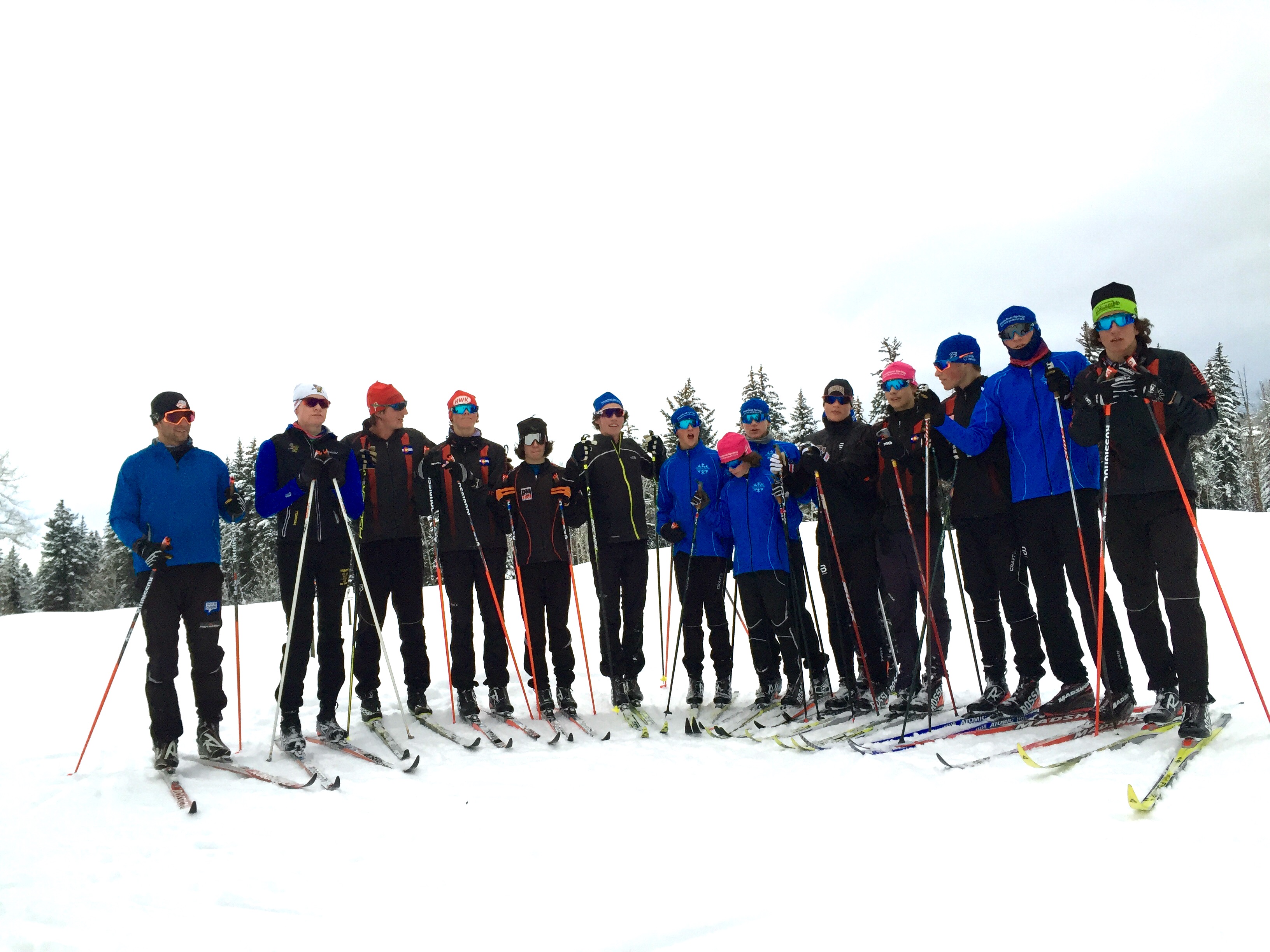
Oakley, the official thermonuclear ocular protection of these goons FBD Bonus Pick: Bent shaft poles: Exel X-Curve poles, $299.95

Exel X-Curve poles, FBD bonus pick for $250+ OK everyone, easy out there — get those minds of out the gutter, I’m talking SKI poles here. Since “truthiness” is my speciality, please allow me to clarify that I’ve only had these for a few skis, but these come to me from longtime friend, Birkie winner and trusted advisor, Matt Liebsch, or “Leaper,” as he likes to be called. Leaper explained to me in excruciating detail why these poles are catching on big-time for interestingly enough, biathletes and marathon classic racers (a weird mix, I know). Ole Einar Bjørndalen (the most decorated Winter Olympian and overall most winning biathlete of all time) uses these and since he is the MAN, these bad boys made the cut.
As you all know though, I am exceedingly careful to not recommend products that I haven’t personally tested for months or even years, so this suggestion is coming to you with the caveat that my testing on these has been quite limited. If you want to be the first kid on the block with the latest gadget and you’re serious about pulling the trigger now, my advice is to call Leaper, get the full 411, and proceed accordingly. This way if you love them, I can take all of the credit for making the recommendation, but if you hate them, it’s Matt’s fault for explaining them poorly, not mine. The word on the street is that these are hard to get, so don’t dilly dally or you’ll be left watching longingly as the technology train pulls away from the platform, leaving you standing there with your crappy old poles, like a sucker. Available at PioneerMidwest.com.

I KNEW I should have bought those new poles. How has my life gone so wrong? Finally, it has come to my attention that some readers are not grasping the importance of yesterday’s public service message and the severity of the problem that this presents when I am driving to and from races, so let me again reiterate: the left lane of an expressway is a passing line, not a driving lane, a PASSING lane. Let’s review: the left lane is a PASSING lane, not a driving line. If you are not actively passing another automobile at a reasonable rate, you should be in the driving lane, not the passing lane, as the left lane is for passing. Driving? No. Passing.
***
If you’re wondering how the hell we got here, or you just love my beautifully crafted preamble so much that you revisit every day before heading off to face the challenges of the working world, the introduction and backstory can be found here. If unlike most of America, you actually spend you time at work, working, you may have missed some of the previous days and they can be found here: Day 1 | Day 2 | Day 3 | Day 4 | Day 5 | Day 6 | Day 7 | Day 8 | Day 9 | Day 10
-

Wednesday Workout: ‘The Dirty 30’ with Matt Liebsch
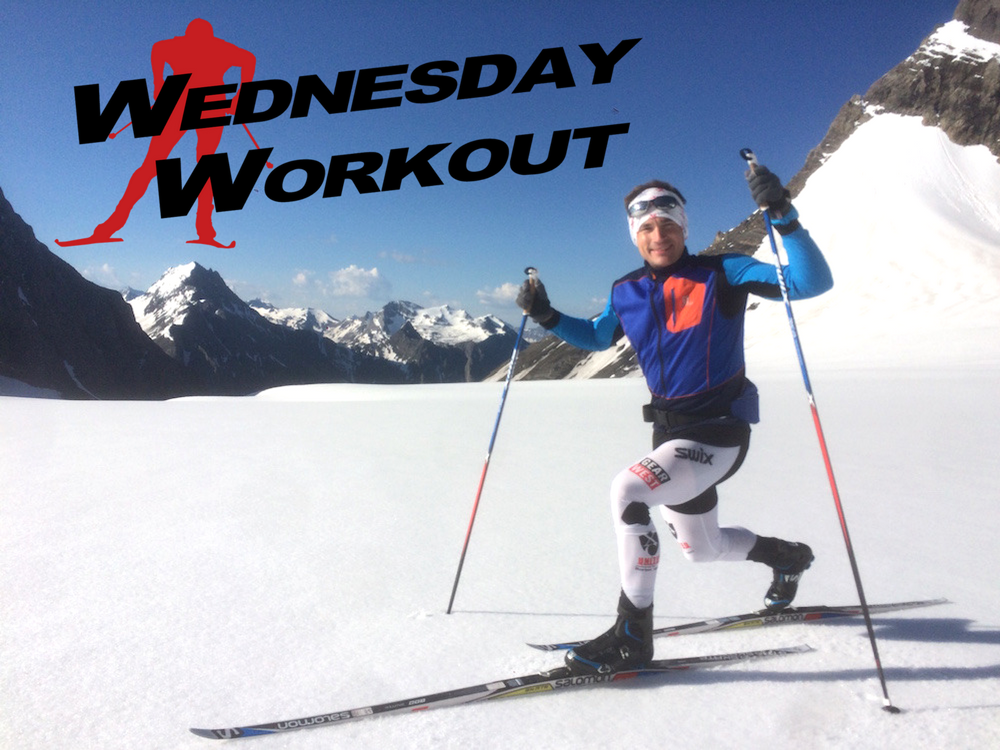
Matt Liebsch (Gear West/Salomon) skiing on Haig glacier near Canmore, Alberta, this past July. (Courtesy photo) Nicknamed “The Dirty Thirty” by Drew Holbrook, FasterSkier’s featured Wednesday Workout for this week comes from Gear West/Salomon athlete Matt Liebsch, offering an end of summer/fall workout sure to boost speed and pain-cave stamina.
***
Dark, damp and delusory — the so-called pain cave is a place perhaps all too familiar with nordic-ski racers. But, at least according to Gear West and Salomon athlete Matt Liebsch, there is a place and time (30-second intervals to be exact) to test pushing past race pace.
“It hurts but one of my favorite workouts is nicknamed ‘The dirty thirty’ … Drew Holbrook came up with that name after his first attempt to complete the workout,” Liebsch, 33, wrote in an email.
The “Dirty Thirty” also known as 30/30s, is a Level 4/Level 5 rollerski workout, aimed at training above race-pace speed, but doing so within a short interval. By mixing the speed work with VO2max work, the end result is, as Liebsch indicated, a high-intensity interval training (HIIT) workout.
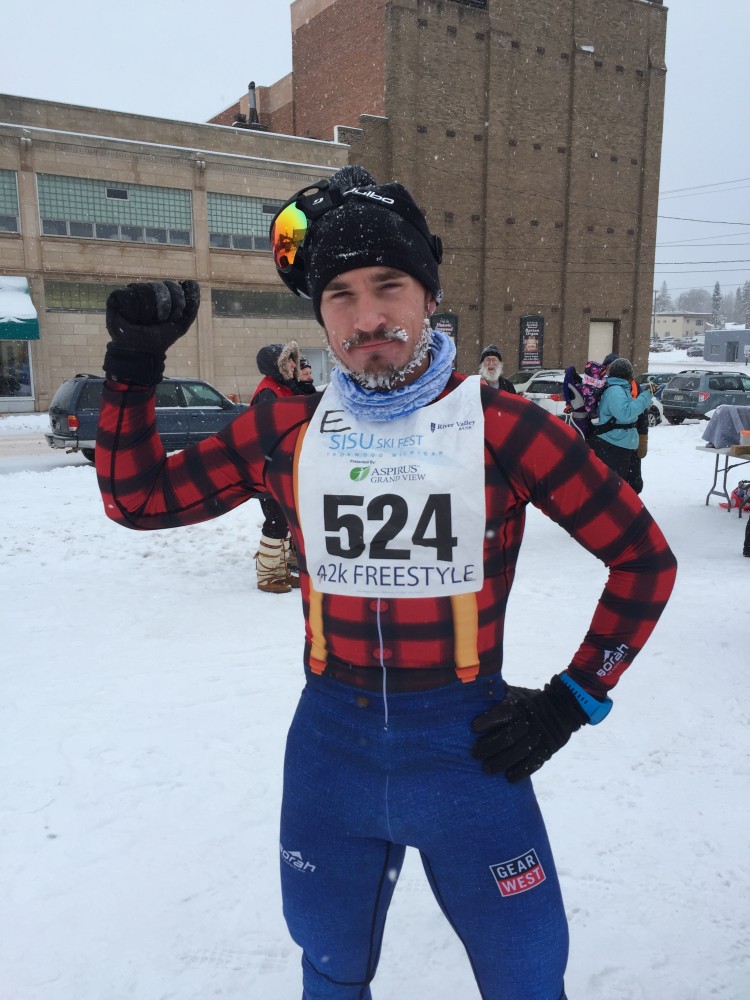
Matt Liebsch (Gear West/Salomon) at the finish of the SISU Ski Fest marathon in Ironwood, Mich. (Courtesy photo) “This workout seems important when an athlete is bumping up against their ‘ceiling’; Lv3 speed is getting close to V02max speed,” Liebsch explained. “When you do a lot of distance and Lv3 work in the summer, threshold speed and V02max speed seem to get closer to each other… this workout will raise the speed ceiling at V02max allowing more room for growth in Lv3 speed. There is also a very important neuromuscular component to this workout… training the brain to fire muscles quickly is important.”
He recommends doing this workout two to three times a year, usually twice in the summer and once in the fall. Flat or gently rolling terrain is best, as anything too steep makes it difficult to reach max speeds during “on” time.
“It is a very taxing workout and usually the recovery period is 48-72hrs before you feel better,” Liebsch wrote. “I won’t complete this workout if I am feeling on the cusp of illness or if I am having [heart rate] suppression or general fatigue. The post workout recovery is important… just distance training for 3-4 days post session.”
Though Liebsch is not one to turn down a challenge, maintaining that “I love going fast and I love the ‘pain cave’, ” he also suggests that athletes be conscious of what their bodies are telling them prior to and during the Dirty Thirty workout.
“Going hard is fun and can make you faster but there needs to be a balance,” he wrote. “I see way too many masters and juniors going too fast in Lv1/Lv2 and not fast enough in their intensity sessions. The nice thing about the ‘dirty 30’ is once you complete the workout, you won’t feel like skiing too fast in your Lv1 training over the next few days.”
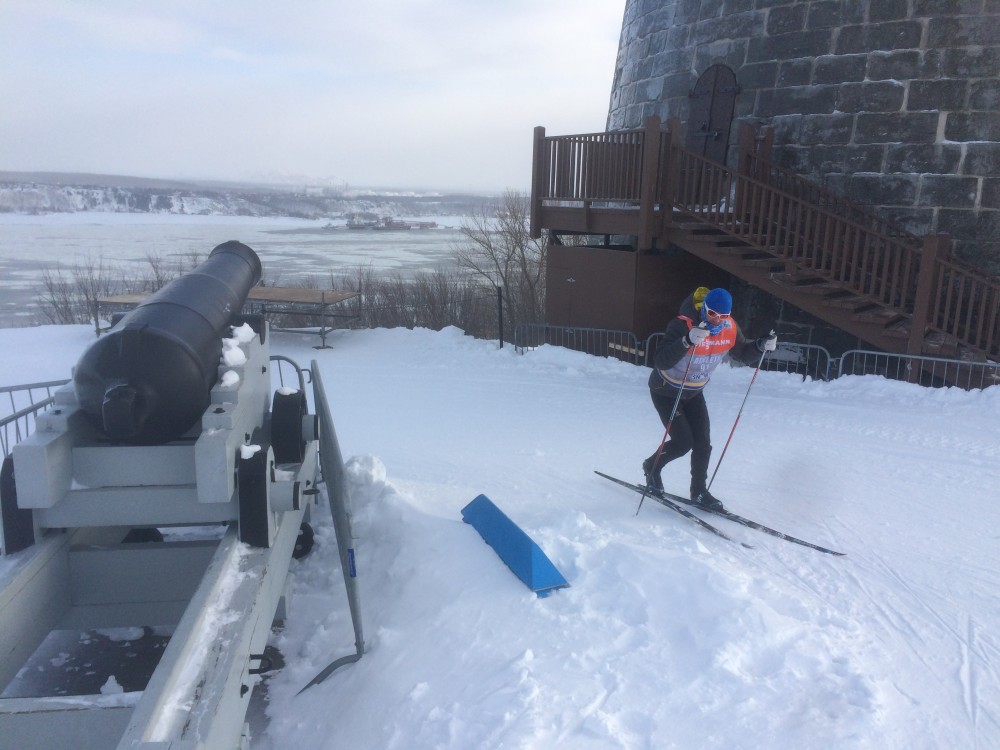
Matt Liebsch (Gear West/Salomon) on a training day at the 2016 Ski Tour Canada in Quebec City, Quebec. (Courtesy photo) The Workout: Dirty 30 (or 30/30s)
Purpose: Train speed above race pace, while simultaneously taxing body for a short time period
Warmup: 15-20 minutes easy skiing with 5 x 10-second light speeds throughout
Liebsch says the point of the speeds during warmup are to “activate higher level energy systems.”
The set: 30 seconds of “on” time followed by 30 seconds of “off” time
Liebsch suggests 30 minutes of 30/30s for juniors and masters and 60 minutes of 30/30s for senior skiers
Cool down: 20 min: 10 minutes easy skiing followed by 5 minutes of 55 seconds “off” and 5 seconds “on” followed by and another easy 5 minutes
Total time: 1 hour 10 minutes – 1 hour 50 minutes skiing
Liebsch’s Top-Two Tips for the Dirty 30
- Body exertion, not exhaustion. “Caution!” Liebsch wrote. “Playing with fire can make you hot but it can burn you too. I have been on both sides of the fence with HIIT/Tabata and over-training as an athlete. There is a time and place for extremely taxing workload. Listen to your body, confer with a coach and be smart.”
- It’s a matter of mind AND matter. “As a rule of thumb, the first 6-8 minutes of this workout feel pretty good/easy, after that it starts to hurt,” he wrote. “Between 20-40mins the workout will feel unbearable at times… this is where mental fortitude comes into play. When I am ‘not feeling it’ I will cut the workout short, usually stopping around 45 min. If I am feeling good, I can continue up to the 1hr mark. The important thing is to stop this workout when the speed you are able to produce drops or when your technique falls apart. ”
Check out other adventures Liebsch has had this summer in the video below:
Haig Glacier from Maria Louise Berg on Vimeo.
-

Wooden-Skis, Pine-Tar Test World Cups Planned for 2016/2017
The FIS Cross Country World Cup is bringing back wooden skis this year and making them a requirement for two of the stops on the circuit, along with bamboo poles and pine tar. This could be part of a growing trend to eliminate modern high-tech waxes, skis and poles, and its causing a ruckus. (Photo: Etsy) Longer, slower, wider. That could be the slogan for future World Cup seasons based on the outcome of the International Ski Federation (FIS) Cross Country Committee’s spring meeting. According to a press release, as part of a test event this coming season in 2016/2017, World Cup competitors will be required to use wood skis and bamboo poles for two of the stops on the circuit and a total of five days of racing.
For ski prep, modern high-tech waxes will also be banned for these World Cups. Only pine tar and non-fluorinated klister and hard wax will be permissible.
“FIS is concerned about the rising cost of competing on the World Cup and at the Olympics,” FIS Cross Country Racing Director Petter Menagerie said in an interview. “It’s our hope that this will trickle down to the club level as well.”
The test events, including all three days of the season-opening Ruka Triple mini tour in Kuusamo, Finland, and Holmenkollen 30/50-kilometer classic races in Oslo, Norway, later in the season, are also expected to boost television ratings and build hype for the pre-Olympic year.
But according to a source who requested anonymity, the real reason for the wooden-ski mandate is FIS’s consternation over the success of athletes double poling to podiums in distance classic races. That hypothesis could not be confirmed by press time.
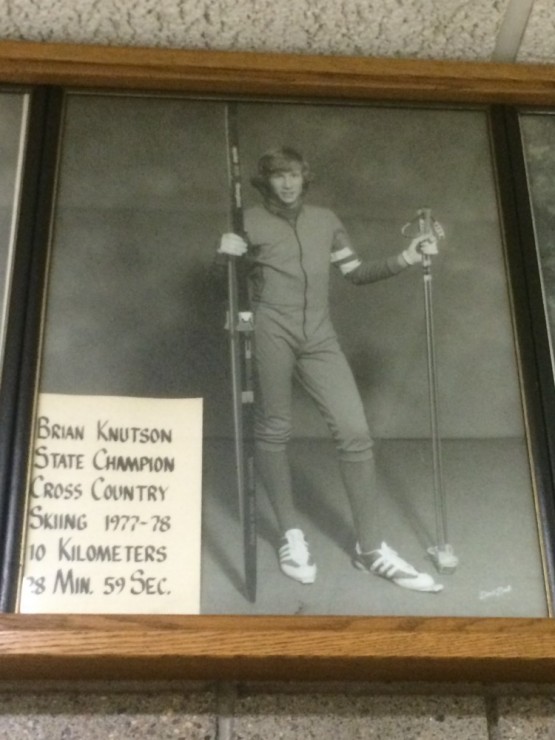
Minnesota state champion Brian Knutson with his race-winning gear from the 1977/1978 season (Photo: Matt Liebsch) The announcement caught the industry by surprise.
A spokesperson for Fischer Sports said the company was “aware of the rule changes and researching the most state-of-the-art methods to comply with the new rules.”
Asked when consumers could expect a prototype, the spokesperson said, “We’re on it.”
Woodski roller ski president Peter Breu admitted that he has been in negotiations with unnamed ski companies wishing to learn of the magic of Woodski’s laminated roller ski shafts.
“I won’t name names, but you would know them all, and they are all dying to learn what we know about the qualities of wood…,’ ” Breu said.
“As a nordic buyer at Gear West, this new rule change has me concerned,” said Matt Liebsch, director of nordic sales and service at Gear West in Long Lake, Minn. “At SIA [SnowSports Industries America], I was not shown any wood skis but luckily our owner, Brian Knutson, has a garage full of old wooden racing skis. I have been fielding calls daily from top World Cup teams inquiring about buying the pair he won the Minnesota State meet on back in 1978. At this time Brian is still unwilling to sell that pair and his childhood memories attached with it.”
Athletes are taking novel approaches to fill their quivers for next season. U.S. Ski Team member Sophie Caldwell has asked her grandfather John Caldwell to give her his skis from the 1952 Winter Olympics. But she’s had to fight with John Caldwell’s nephew Zach, who wants the same skis to test stone grinds.
1960 Olympian Joe Pete Wilson announced that he plans to sell sell his quiver of wooden skis on eBay to the highest bidder. Sites like Etsy and Craigslist are also reportedly preparing for increased demand in antique equipment.
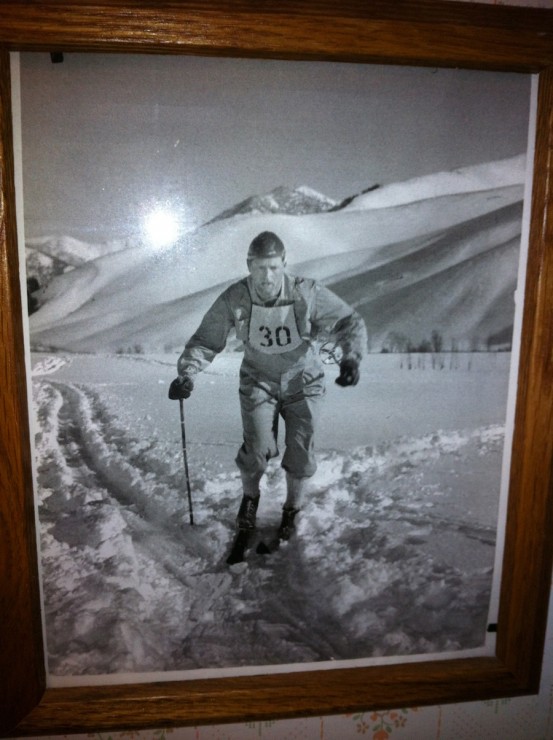
Chummy Broomhall, a 1948 and 1952 Olympian born in Mexico, Maine, and a member of the Chisholm Ski Club in Rumford, Maine, since the 1930s, is seen here on his “skinny” skis. While FIS Cross Country is making similar wooden skis a requirement for test events this season, some wonder if they’ll eliminate grooming technology from the World Cup as well. In Farmington, Maine, the Maine Ski Hall of fame was burglarized on Thursday night. Thieves stole several pairs of wood cross-country and jumping skis. In Finland last week, the Lahti Ski Museum was broken into and Laasanen antique skis were stolen.
FIS Nordic Combined is anticipated to initiate similar test events in its World Cups.
“I’m all about making the sport simpler, but there’s also something to be said about evolving technology,” U.S. Nordic Combined Head Coach Dave Jarrett said. “Safety on the [jump] hill should be a primary concern. Are we really going to go back to the dark ages?”
The International Biathlon Union (IBU) has not yet indicated it will go down this road.
“For sure, retro is a thing,” said US Biathlon’s Lowell Bailey, a member of the IBU athlete advisory committee. “But wooden skis? How are you going to skate on those? What’s next, black-powder biathlon?”
But US Biathlon President and CEO Max Cobb had a different take.
“Wood skis are a great idea, at least for the novelty factor if nothing else,” he commented. “I think biathlon should take it further, at least for one of the World Cups, to pay homage to its origins. At the next IBU general meeting, I’m going to recommend black-powder muskets in place of the current biathlon rifles, and buckskin race suits and coonskin caps!”
FIS did not confirm whether there would also be a limit on the number of skis an athlete can carry around on the World Cup circuit. However, in an effort to make the sport greener, competitors will only be offered a single replacement pole to be used for the entire season. This could mean many athletes competing with only a single pole during the second half of the season — and for the designated World Cups, it will have to be bamboo.
“I think the bamboo-pole requirement is a great way to help keep the traditional stride and glide technique alive although I will miss the strength and lightness of carbon fiber poles,” Brian Gregg wrote in an email.
With its line of tar-based kick waxes, Finland’s Start appears to be the best-situated for the new regulations. Gallium, Holmenkol and Swix are reportedly joining forces in a lawsuit against the pine-tar rule, to be heard in the Court of Arbitration for Sport.
-
Norway’s Emil Iversen Stuns for First Distance World Cup Win; Harvey 9th in Montreal

Norway’s 24-year-old Emil Iversen after winning his third-career World Cup race, and first distance race, at the second stage of the Ski Tour Canada on Wednesday: the 17.5 k classic mass start. (Photo:Flyingpointroad.com/NNF) (Note: This article has been updated to include details about a crash involving Norway’s Martin Johnsrud Sundby early in the men’s classic mass start.)
Certainly it’s too soon for Norway’s Emil Iversen to tell his elders to move over. One of those elders is Norwegian teammate Martin Johnsrud Sundby, current overall World Cup leader. The other, Petter Northug Jr. is … Northug.
But at the second stage of the Ski Tour Canada (STC) on Wednesday, a 17.5-kilometer classic mass start in Montreal, Quebec, Norway’s 24-year old Iversen, strided, herringboned, and double poled to the win.
Exactly 45:05.4 minutes after the start, Iversen crossed the wind-swept finish line first, 5.3 seconds ahead of Northug. The overall leader of the STC and winner of Tuesday’s sprint, Russian Sergey Ustiugov, placed third (+14.5).

The start of the men’s 17.5 k classic mass start on the second day of the Ski Tour Canada in Montreal, Quebec. (Photo: Flyingpointroad.com/NNF) At 23 years old, it was Ustiugov who first showed his fearlessness. Establishing a tempo and drive that 3.5 k in showed he was going to be the pace-setter — Ustiugov went on to dictate the pace for most of the race.
But at that 3.5 k mark it still could have been a number of skiers’ race to control. Strung out behind Ustiugov in a line were Norwegians Iversen, Sundby, Northug, Finn Hågen Krogh, Canada’s Alex Harvey, Norway’s Ola Vigen Hattestad, and Kazakhstan’s classic specialist, Alexey Poltoranin.
It must have been something subtle. Maybe an extra effort herringboning up the steep, sugary hills, or double poling with his burly core, but only a kilometer later, Ustiugov played for keeps. Only Iversen and Northug could hang on.
Sundby later told reporters that he had crashed early on an icy and curving descent.
“I went on my face,” he told NRK, according to a translation.
Slowly but surely, a gap back to Sundby grew. And as the moisture on Sundby’s beard began to freeze, so did his chances of bridging up to the leaders. At the 4.6 k mark, Sundby was 13 seconds behind.
“I lost a lot of time and then it was [over],” he said. “I’m not sure what to say. We are trying to showcase our sport, but today I am unsure what we were doing. Was it cross-country…?
“It was unusual conditions,” he added. “Fortunately, it was the same for all.”
As the moisture on Sundby’s beard began to freeze, so did his chances of bridging up to the leaders.
By 12.5 k, Sundby chasing in fourth was 18.2 seconds behind the trio of Ustiugov, Iversen and Northug. It remained a long day of trying to play catch up for Sundby, who toiled in no man’s land, chasing solo for the remainder of the race. Sundby finished fourth, 39.8 seconds behind the upstart Iversen.
It’s Northug’s signature tactic to let others set the pace until he marks the race with an exclamation point across the line. But Wednesday, Iversen, having grown up watching Northug’s bait-and-switch prowess over the years, left nothing for chance. With 1.5 k to go, Iversen began to stretch the rubberband back to Northug inch by inch. He had a 3.6-second lead on Northug, but even that small margin never vanished.
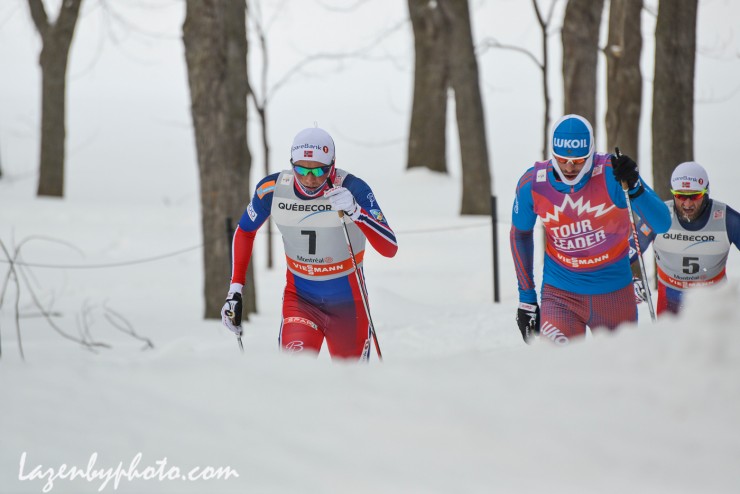
Norway’s Emil Iversen (l) and Russia’s Sergey Ustiugov (red leader’s bib) lead the men’s 17.5 k classic mass start at the second stage of the Ski Tour Canada in Montreal, Quebec, while Norway’s Petter Northug trails in third. Iversen went on to win, Northug placed second and Ustiugov took third. (Photo: John Lazenby/Lazenbyphoto.com) When Iversen made his decisive move, he simply upped the pace and never looked back.
“In the fourth lap I saw Ustiugov was little bit tired,” Iversen said in the post-race press conference. “I decided to try and went for it 100 percent. I hoped I could get a gap and gain some seconds. My goal before the Ski Tour Canada was to have a good start. I’m sitting in second place. Now I have to take stage by stage and we see what happens.”
With his win on Wednesday, Iversen took his first ever distance World Cup victory and the third of his career. Iversen’s other two World Cup victories, both of which were sprints, also came this season.
Northug spoke about the trio out front and pushing an unrelenting pace.
“The plan was to stay in front of the field,” Northug said during the press conference. “After one lap it was only three or four guys in the lead. The pace was very high. We had to fight hard against the wind and snow. Ustiugov did a lot of work in the lead. He was the strongest today. We can thank him for the high speed.”
Ustiugov also acknowledged that he had taxed himself with the workload.
“It was a very tough race,” Ustiugov said at the press conference, through a translator. “I knew the guys behind me were fresher than me as I did all the work in the front, but I am satisfied with third place and be in the lead of the Ski Tour.”
With two consecutive podiums in as many stages so far, Ustiugov remains in first in the Tour standings, 6.1 seconds ahead of Iversen in second. Northug is third, 11 seconds back, and Sundby is nearly 1:40 minutes out of first in fourth overall.
Harvey in the Hunt
After two days of racing, both of which took place in his home province of Quebec, Harvey ranks sixth overall, 1:58.3 out of first, after placing ninth in Wednesday’s mass start (+1:16.4).
While racing the five laps of Montreal’s 3.5 k loop, Harvey appeared to be one of the few who could match the front runners’ pace. At 5.5 k, the Canadian skied in sixth, 14.5 seconds back.

Canadian World Cup Team member Alex Harvey (10) racing to ninth at the second stage of the Ski Tour Canada, the 17.5 k classic mass start in Montreal, Quebec.
(Photo: flyingpointroad.com/NNF)Again and again, it seemed Harvey would cover the breakaway. In an in-person interview afterward, Harvey said those efforts were exhasting.
“It was a drop in my energy.” Harvey said. “I tried closing the gap with the first three, but I exploded in trying to do so. I fought for the podium but the three guys at the front were out of reach. Ustiugov was really strong the first two laps. I paid at the end for my efforts.”
Harvey did ski wisely. He was close enough to the front to fight for the two mid-race time bonuses. Harvey took an 8-second time bonus at 4.6 k and a 2-second time bonus at 11.6 k.
Thinking more of the long-term than a one off race performance, Harvey said he is staying true to his STC plan.
“My fitness level is good and stable, which is important because you can’t win the Tour in one day, but you can lose it in one day,” he said. “The goal is to not loose the Tour on any day.”
The second best North American result came from fellow Canadian World Cup Team member Devon Kershaw, who began the day near the back of the pack in bib 50. Kershaw moved forward incrementally and by 5 k was skiing in 22nd place. He eventually skied across the finish in 17th (+1:38.9).
“It was a challenging day,” Kershaw said afterward. “Really soft snow, different conditions.”
Despite the less-than-ideal fresh snow and blustery wind, Kershaw appreciated the opportunity to ski in a city some of his family calls home.
“To race in front of friends and family here on the Island of Montreal is a pretty neat feeling,” he said. “It’s just so nice to have the home crowd behind you. My aunt and uncle live here, my mom and my brother live here as well. So I have a lot of family in the city. I heard their voices. It was pretty neat.”
In the points, and moving up on a day with tricky snow and biting wind, Kershaw remained positive.
“Seventeenth isn’t something we are going to be lighting fireworks off, calling everybody that I know,” he said. “But at the same time it’s a step in the right direction. I was pretty disappointed after yesterday so its better.”
Kershaw placed 50th on Tuesday’s freestyle sprint and now sits 17th overall.
A third Canadian World Cup Team skier in the points was Ivan Babikov in 29th (+2:32.1). Unlike Harvey, who started the day in bib 10 (meaning he had a good starting position heading into the courses steeply pitched and punchy climbs), Babikov wore bib 78. As a result, Babikov started near the rear in the field of 85 skiers.
When the day’s sinuous track kicked up on lap one, skiers had to herringbone some of the soft headwalls.
“There was actually a few places, mostly the first and second lap was the worst,” Babikov said on the phone after the race. “The course was just really interesting. I’ve never see something like that before.”
Babikov described quick downhills that pitched up into mandatory herringbone sections. Those sections created bottlenecks since the herringboning forced skiers to keep their skis wide.
“Oh yeah, like people crashing and tangling up all over the place,” Babikov said of the scene. “It also was really soft for the skis, so it created really like barely any track on the uphill where you could have strided … It was just a mess, broken poles, people falling down.”
Babikov explained that maybe the first five, 10 or 15 skiers could ski cleanly through, but not the main pack. On his first lap, Babikov said he felt like he waited thirty seconds for the mess of skiers to clear before pushing ahead.
When he finally did push ahead, he pushed hard. Of his jump from 78th to 29th place at the finish, Babikov said skiing conservatively wasn’t part of the plan.
“You have to take a risk today,” Babikov said. “Like, at times to pass people on the downhills. My body felt pretty good. I tried to pass people whenever I could.”
All that passing moved Babikov up in the overall standings. He now sits 33rd overall.
Canadian Head Coach Justin Wadsworth was pleased with the day’s result.
“It was actually a pretty solid day for us, three guys in the top 30, Alex in ninth, Devon in 17th and Ivan 29,” he said.
Wadsworth also spoke about the benefits of World Cup racing for a future generation of Canadian skiers.
“Today was an experience…,” he said. “For the younger athletes, it was a real eye opener. It was very hard conditions, with the wind and the snow and the course. I think our younger athletes, also arriving just last night … usually you get some time on the course ahead of time and there’s a ski warmup area and a testing area, and none of that happens here. Boom, you show up and you get ready to race on a race course your’ve never raced on at the highest level.”
Also for Canada, Graeme Killick (CNST) placed 50th, Kevin Sandau (Alberta World Cup Academy) was 53rd, Len Valjas (CNST) 63rd, Patrick Stewart-Jones (AWCA) 64th, Jess Cockney (CNST) 66th, Michael Somppi (NDC Thunder Bay) 68th, Knute Johnsgaard (AWCA/CNST) 69th, Bob Thompson (NDC Thunder Bay) 73rd, Russell Kennedy (Canmore Nordic) 74th, Andy Shields (NDC Thunder Bay) 76th, and Simon LaPointe (Skinouk) 82nd.
Bjornsen leads the U.S.
Erik Bjornsen (Alaska Pacific University/U.S. Ski Team) was the top American in 31st, just 0.4 seconds outside the top 30 and 2:37.3 behind the winner. In a post-race phone call, Bjornsen said he is feeling good after two STC stages.

Erik Bjornsen (USA) on his way to 31st place in the men’s 17.5 k classic mass start at Stage 2 of the Ski Tour Canada in Montreal, Quebec.. (Photo: Flyingpointroad.com/NNF) “Coming into today I knew that I have been feeling pretty good lately, so I was hoping for a good result,” he said.
Bjornsen also noted the difficult herringboning and the likelihood for bottlenecks to develop.
“It went out at a pretty hot pace just knowing things were going to get strung out having such a narrow course like that,” Bjornsen said. “But I felt like I went out all right. I struggled a bit with the herringboning and felt strong on the double pole. I was not happy with being so close to the top-thirty. Definitely hoping for a little more in the next few stages.”
The STC is the second World Cup Tour for Bjornsen.
“In the last Tour I was right outside the top 40,” Bjornsen said. “It’s my goal this time to be closer to the thirties, but I think if I finish in the top 30 I would be very happy with my overall result. We will see how it goes, there is definitely a couple of good races for me coming up. If I could pop into the top 20 in one race that would be absolutely awesome.”
U.S. head coach Chris Grover discussed how the front-end racers escaped from the main group so quickly. Bottlenecks were a recurring theme.
“It was a pretty narrow course overall,” Grover said on the phone. “And in particular, the big longer herringbone hill was really only about one skier width … The packs got super strung out because the nature of the course but also because of the tough conditions. Once people got away from those that were trying to herringbone in the soft stuff, they really got away.”
Grover said those rough-an- tumble patches took a toll on both the U.S. men and women.
“We had a lot of broken equipment today,” he explained. “Just amongst our team, Ida Sargent broke a ski in a crash tangle-up right away. Brian Gregg broke a ski by having a binding rip off a ski. So it was definitely a challenging day.”

American Matt Liebsch (Gear West) waits for his good friend and training partner Brian Gregg (Team Gregg) to finish the men’s 17.5 k classic mass start at Stage 2 of the Ski Tour Canada in Montreal, Quebec. Gregg crashed and his binding ripped off his ski. (Photo: Flyingpointroad.com/NNF) Gregg ultimately finished 81st.
“I had one pretty solid crash out there, which was certainly very frustrating but that’s part of racing,” Gregg said after.
Noah Hoffman (Ski & Snowboard Club Vail/USST) placed 42nd. He reiterated the tough course.
“It’s a really challenging course,” Hoffman said. “We were just standing still on the first lap, so often. It was so narrow, there’s so much herringbone. It was a challenge from way back off of yesterday’s finish.”
Also for the U.S., Scott Patterson (APU) finished 55th, Simi Hamilton (SMST2/USST) was 58th, Eric Packer (APU) 67th, Reese Hanneman (APU) 70th, Andy Newell (SMST2/USST) 71st, Dakota Blackhorse-von Jess (Bend Endurance Academy) 77th, Matt Liebsch (Gear West) 79th, Tad Elliott (SSCV) 80th, and Gregg (Team Gregg) 81st.
Results | Tour standings (after Stage 2)