Tag: Matt Smider

  • Nordiq Canada Rolls Into 2023

    Nordiq Canada Rolls Into 2023

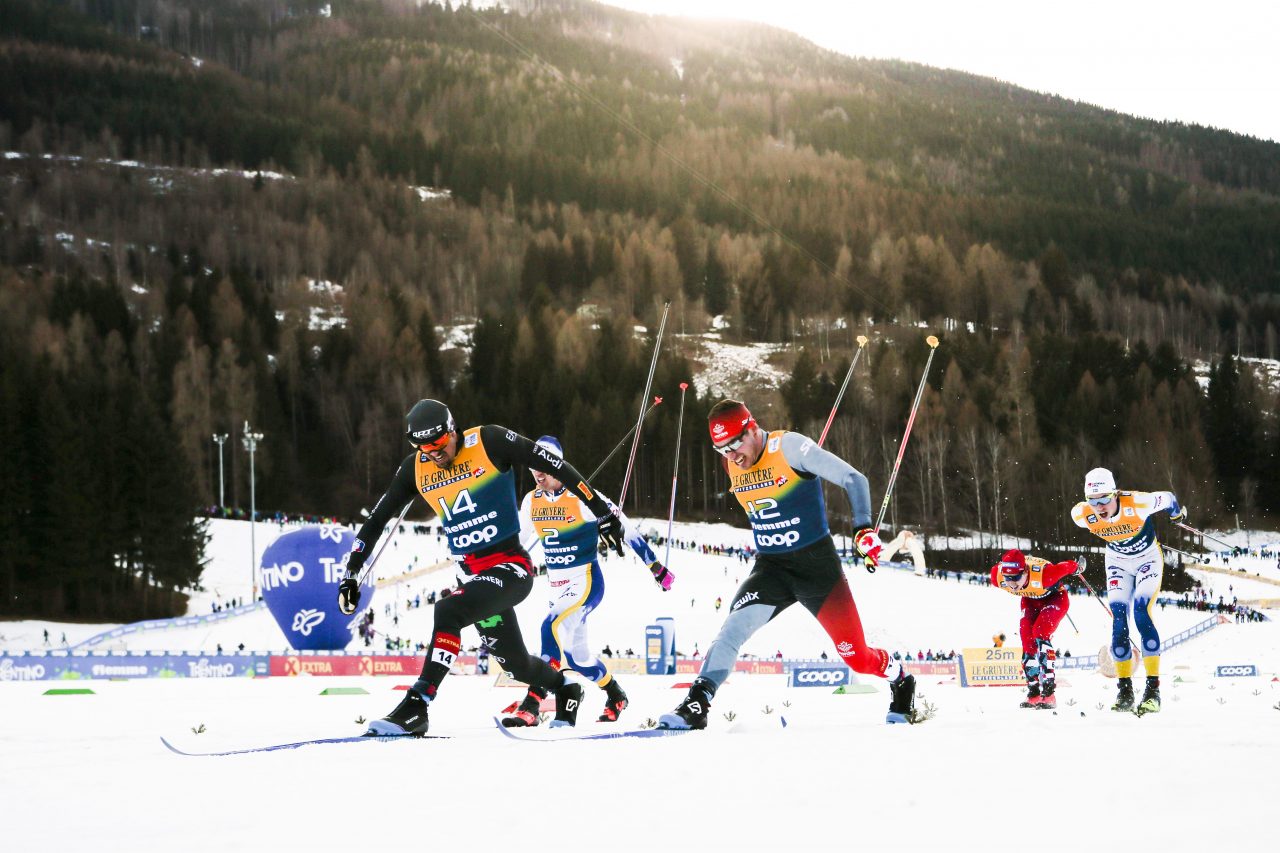
    Francesco de Fabiano (14) edges Tony Cyr (12) in stage 6’s 15km classic at Val di Femme. (Photo: Modica/NordicFocus)

    Canada is in the rebuilding part of the success rollercoaster, with many changes to the High Performance team and the development programs.

    Since May 1st, Chris Jeffries has joined Nordiq Canada (NC) full time as the High Performance Director, Robin McKeever has transitioned from the extremely successful Para program to become the Olympic Stream Head Coach. NextGen coach Eric de Nys and Dev coach Matt Smider are in their first full year in those roles and have shifted modes from planning to delivering.

    This season, Canada returned to the Tour de Ski with three top ten finishes and is hosting the World Junior/U23 Championships.

    The Tour de Ski was an obvious highlight, with all of the nine athletes and six of eight support staff experiencing the Tour for the first time.

    “Yves Bilodeau has obviously has done a few Tour de Ski’s and Simon Boisvert was on the trip with us as a wax tech,” McKeever told FasterSkier, “but yeah, everybody else was pretty much rookies there, I think just the tech, so we were following the tech’s lead to learn from them as much as anything.” For non-Canadians, Bilodeau represented Canada at two Olympics before becoming a wax tech and VW bus driver for the Beckie Scott generation.

    Asked to pick just one highlight, McKeever chose one result and one process goal: “My personal highlight from the Tour has to be Tony’s fourth place and coming ever so close,” he said, referencing Antoine Cyr losing a photo finish for a podium spot in Val di Femme the day after finishing 6th in the sprint. “That’s I think beyond some of our expectations through this year, but at the same time, it is belief in the system and belief for the younger up and coming athletes and others around him that it is possible. We need to get that back in the system. We’ve lost it since you know that Beckie, Chandra [Crawford], Sarah [Renner] years of Olympic medals, and with Alex Harvey’s retirement, things were kind of frayed. So it’s time to rebuild that and get positive focus forward and making sure that we’re looking at growth mindset and looking for positive solutions, rather than always complaining about the issues.”
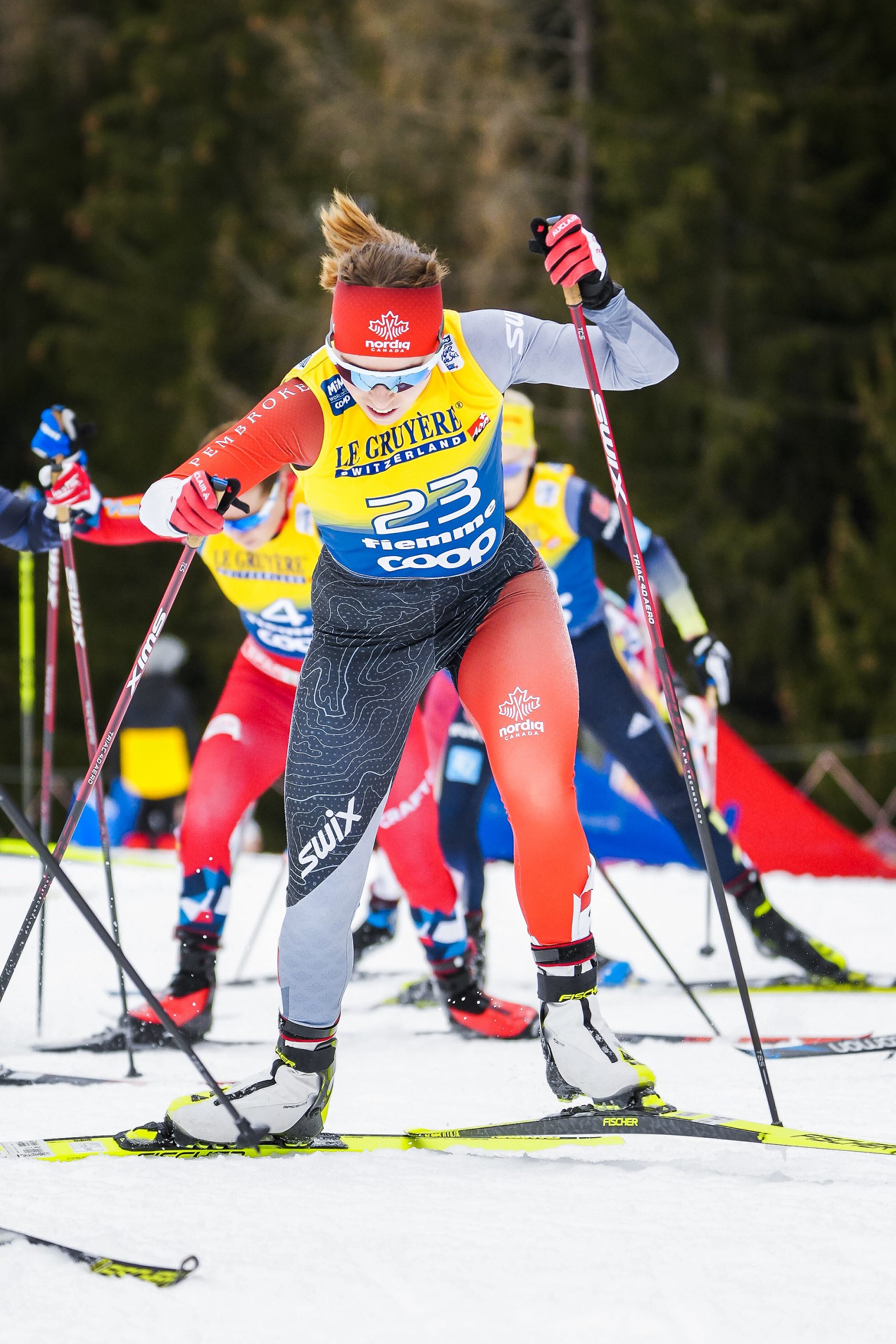
    Katherine Stewart-Jones (CAN) racing up the Alpe di Cermis in the final stage of the 2023 Tour de Ski. (Photo: Barbieri/NordicFocus)

    Katherine Stewart-Jones, who has this season scored her first top 10 plus six top 20’s, and joined the red group as the 15th ranked distance skier, is another obvious highlight for Canada.

    Canada will select athletes for U20/U23 Championships in Whistler and World Championships in Planica at the Trials event at Caledonia Nordic this week, with many younger skiers expecting to qualify. There is also a good field of older skiers planning to hand out some learning experiences on their way to Planica, which should result in exciting racing. Live timing and full results will be here.

    For Planica, three athletes were pre-selected: Katherine Stewart-Jones and Tony Cyr met the standard of two top 20s on the World Cup this season, and Graham Ritchie earned a discretion pick with a 17th, a 21st, and two top 20 sprint qualifiers. Everyone else is at Caledonia.

    When FasterSkier was interviewing NC staff this season during race weekends, the phrases “that’s Julie” and “Julie does” got used a lot. Julie Beaulieu is in her second year at NC as Development Director. What does that role entail? It appears that it is mostly enabling the more visible staff members to succeed. The most visible of those is McKeever.
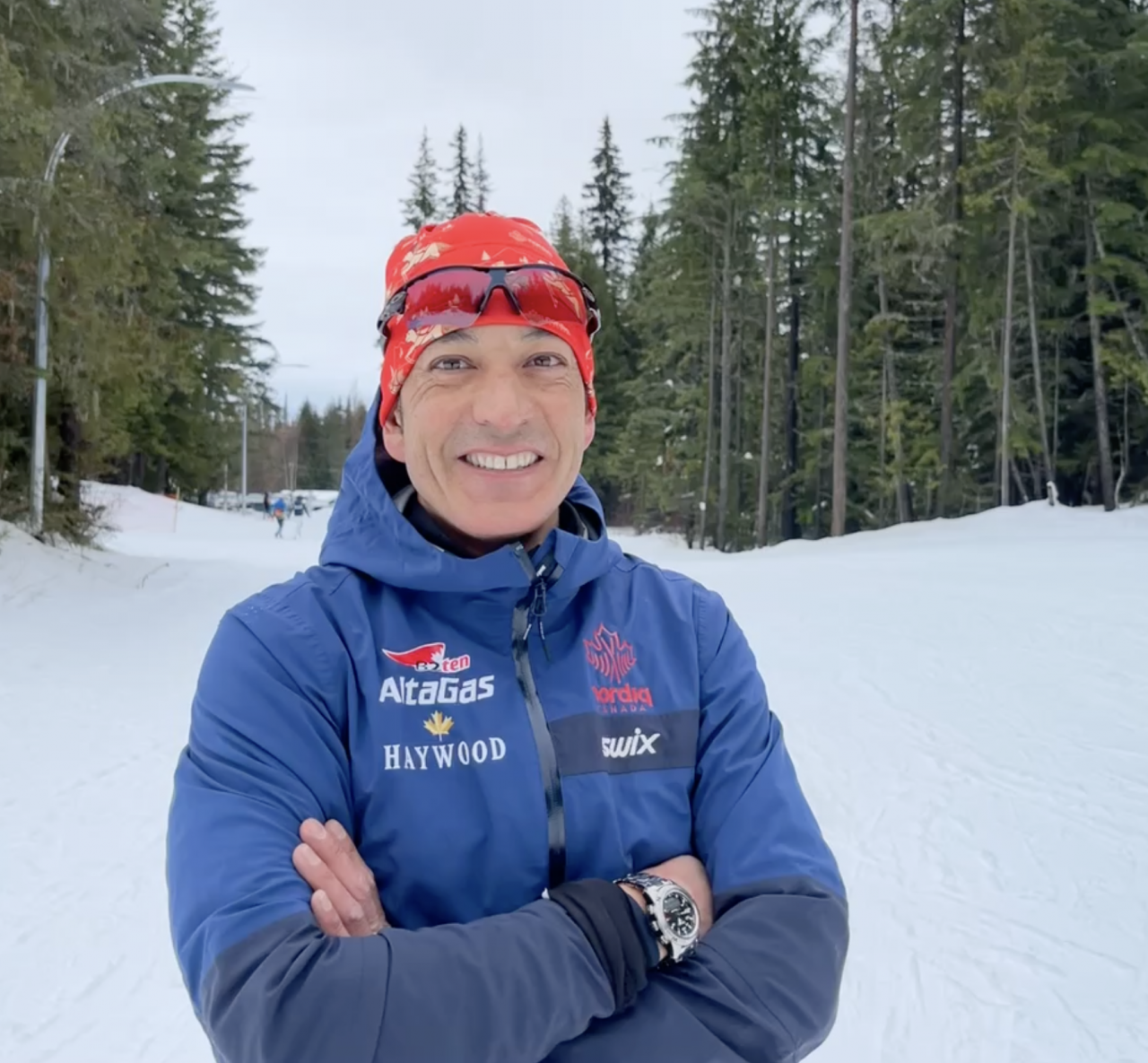
    Robin McKeever stopped in at the Reino Keski Salmi Loppet on the way to Prince George for Trials, providing wax support to his family and answering questions for FasterSkier. (Photo: FasterSkier)

    If asked about McKeever, most ski fans will remember his time guiding his younger brother to Para glory, or his leadership that brought Canada to the elite of the Para-nordic world. This has eclipsed his own history of podiums, multiple national titles, and Olympic experience since he joined the Junior National team in 1990. McKeever has been part of the National team system every year since then: the good, the bad, and the Nagano ugly.

    From the outside view, McKeever never produces inspirational speeches that would make Hollywood proud. If he shouts, it is encouragement to a racer on course, and he is most often seen having a quiet one-on-one conversation. Every conversation loops back to “moving forward” and what can be learned to be better in the future.

    So what makes McKeever a leader? He is surrounded by inspired people. Athletes produce year over year improvement. Retired athletes look back with a smile at their team memories. And there are a lot of “team” moments, among both the athletes and the staff.

    Para athletes often talked about lessons learned from teammates and the support they felt. Asked how to bring the Para success to the rest of the team, McKeever focussed on culture.

    “Para … it’s it’s a small community overall. Tiny,” he said. “So it’s a lot easier to create that team environment and attitude around our culture.”

    “So the funny thing is, we think Nordic or cross country skiing is such a big community overall but compared to the world, it’s actually a fairly small community. I still remember a lot of people [on the World Cup circuit] from when I raced back in the late 90s, early 2000s. So this is a small community overall.”

    And the next step is change.

    “So changing the culture within Canada is about being open to others’ ideas. And we have gone to a decentralized program where athletes are training within their home environments. And then we’re camp-based. So we create our team environment in camps and on the World Cup in the winter. Bit more similar, probably, to what the US system is right now under Matt Whitcomb.”

    While McKeever listens to others, he has a solid core of philosophy.

    “And that culture is about being a positive influence on the program, always forward. No, we’re not always going to have successful days,” he explained. “But to come in and improve on the tough days and look at the positives, but also look at where we can improve every single day. And I think that just that philosophy and the culture that is behind that creates a safe environment where athletes are free to express themselves as they will. And they’re not scared to speak openly. And so when they do that, we can create a space where they can be happy to operate in, so that creates the smiles. Cohesion as a group and a team becomes the number one key focus that I try to look at.

    With the decentralized structure, athletes work primarily with their club/personal coaches with support from the national system. This adds continuity as skiers enter and exit the World Cup and the National Team; it also helps knowledge trickle down into the clubs.

    This fits in with an overall goal of integrating the National Team system more tightly with the clubs.

    Next up in the Canadian series is the NextGen and Development changes, along with an explanation of why the USST’s Bryan Fish and Greta Anderson were using the same phrases as Jeffries and de Nys at the combined Nordiq Cup/SuperTour at Sovereign Lake in December.
  • A 2021 Overview of Developments for Nordiq Canada

    A 2021 Overview of Developments for Nordiq Canada

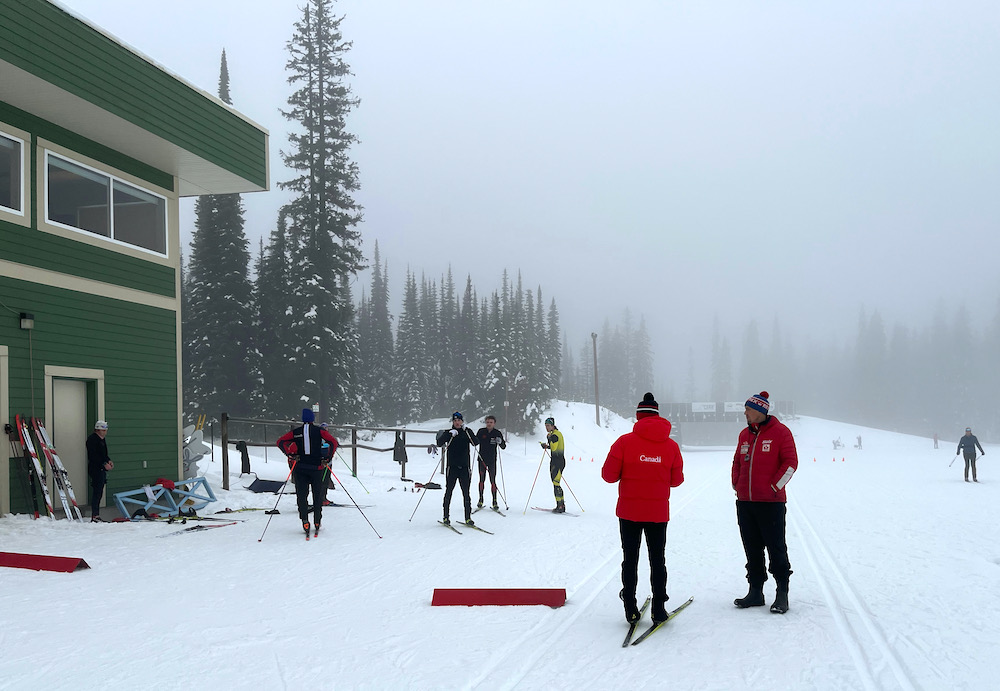
    NextGen coach Eric de Nys and NDC TBay’s Timo Puiras review results from an informal 15km time trial on November 28th. This ‘race’ was the first to feature athletes from multiple regions in twenty months, featuring athletes from CNEPH, TBay, AWCA, and more.

    Last season, Canada held no races, posted no domestic results, and, in general, vanished into the pandemic fog.

    Travel restrictions meant that many Canadian skiers didn’t see any skiers from other regions.

    Which skiers made progress and which regressed over the last 20 months? We finally have hints after the first races last weekend. What is new? Lots. What happens next? Keep reading. 

    Athlete Progress

    Following the opening FIS races, part of the Western Canada Cup series, which happened December 4th and 5th at Sovereign Lake in Vernon, BC, Nordiq Canada and its followers finally had results that could be used to assess athlete progress. 

    Many athletes from Québec, Ontario, Manitoba, Alberta, and BC spent time at Sovereign Lake in November, getting a combination of elevation and snow. Most were confident in their preparation based on summer training with teammates, including the few athletes who race the World Cups last season or were in Europe in November. However, the coaches were still likely to shrug when asked who was fast this year.

    FasterSkier’s research suggests that Sam Hendry was the Canadian with the most races last year. A student athlete at University of Utah, he was able to travel and compete on both the SuperTour and NCAA circuits. The small group of athletes who raced World Cups and U23/U20 Championships in February and March had no warmup races before racing at the top level and ended the season with less race days than Hendry.

    FasterSkier will be sharing more in-depth athletes profiles in the coming weeks.

    Calendar Changes

    Canada has dropped the NorAm name, a leftover from the depths of history when the US and Canadian series merged into one North American series. Since the SuperTour split off some years back, the reversion to the Canada Cup name (as in a Continental Cup race held in Canada) is appropriate, even overdue. A name change, however, is simply symbolic. Real change requires action, and action usually results in anger from the people who were demanding change. 

    As originally planned for last season, the series is now divided into Western and Eastern, which is expected to reduce travel costs and make it easier for skiers to stay in the sport until they are ready to earn a permanent place on the World Cup team. The obvious downside is that the top skiers won’t meet until national team and Olympic trials in Canmore. FasterSkier has been talking to skiers about pros and cons and will follow this shift closely.

    Building a season schedule in Canada doesn’t get much easier with the east/west division. The country spans 5.5 time zones and the geographically larger west division has a much smaller population. Every possible calendar and scenario includes lots of travel.

    Olympic trials need to be held at elevation as Beijing is at 1,800m, and the west has the only three homologated courses above 1,200m (Canmore, Rossland, Sovereign Lake). Ideally, there would have been early trials on snow for the World Cup period 1 starts, but that would also have to be in the west because the east doesn’t have appropriate courses available in October/November. With 2022 Nationals scheduled for Whistler, the obvious solution would be to have all major events in the west. This would (reasonably) be seen as unfair to eastern athletes. The ‘least bad’ answer was not to have trials in October.

    The divided schedule has Sovereign Lake December 4th-5th followed by Rossland, also in BC, on the 11th-12th. In the east,  Nakkertok, just north of Ottawa, will host races on the 11th-12th, followed by Mont Sainte Anne, further east in Quebec, on December 18th-19th. Everyone comes together for the first time at the trials in Canmore January 6th-11th. These competitions will be used for athlete selection for the Beijing Olympics, U23/U20 World Championships, and World Cup period 4, which means pressure to perform for everyone.

    Nordiq Canada Changes

    NC has made a tonne of staff changes since last season. There is now a NextGen coach to bring skiers up to the top level, and a Development Coach to deliver skiers to the NextGen coach. Chris Jeffries, longtime leader of the Alberta World Cup Academy, has been named High Performance Director. Julie Beaulieu is working on the development side. Nathaniel Mah has retired from Nordic Combined competition and is Marketing Engagement Coordinator. Ilona Gyapay has had a role shift, described by one deeply-connected race official as ‘the new Dave Dyer’. (Dyer spent many years with Nordiq Canada, before ending his career as Events Director.)

    Erik Bråten was originally hired in the fall of 2018 as a NextGen coach with a secondary focus on developing the base of the pyramid before having his role changed almost immediately to the “Everything Coach”. After two and a half seasons, he left NC in April, 2021. He later rejoined as a World Cup coach for the 21/22 season.

    Eric de Nys was selected as NextGen coach in June. He started work in August, joining in at the Penticton national team camp organized by Dave Wood, which had been moved to Vancouver Island to escape wildfire smoke.

    De Nys organized the traditional Canadian elevation camp in Mammoth, California. For BC athletes this was out of the smoke and into less smoke, as California was also burning. This camp is important for Canada because it allows a range of elevations that aren’t practical in BC or Alberta and don’t exist in the rest of Canada. 

    “BC has good elevation, but in an Olympic year, good enough won’t be good enough.” — Wood, July 2021.

    Matt Smider was hired as Development Coach in time for Canmore’s Frozen Thunder team camp in October, once again led by de Nys. Smider is known for sparking the growth of small town Revelstoke Nordic into the big leagues; these skills will be useful to fill the development pipeline.

    De Nys lead a mix of NextGen and World Cup athletes to Muonio and Gällivare to race continental cups, with promising results against the top skiers from Finland, Russia, Italy, and Sweden. At this point, the casual observer might think that the NextGen coach role was blurring to fill the gap created by the absence of a national team head coach.

    Future

    With back to back Top-15 finishes, Nordiq Canada’s Antoine Cyr is 12th in the 15k freestyle pursuit in Ruka. (Photo: NordicFocus)

    Racing season is here and most eyes will be focussed on the next race. Some Canadians began their seasons in Europe. Rémi Drolet and Russell Kennedy knocked out good results in Finland and Sweden. McKeever easily won all three junior races in Gällivare against a stacked Swedish field. In the first World Cup weekend in Ruka, Antoine (Toni) Cyr led the way with an 11th in the classic 15km and 12th in the free pursuit. First year senior Olivier Léveille moved up to 17th in the pursuit while Russell Kennedy, Katherine Stewart-Jones and Cendrine Browne all earned World Cup points.

    Jeffries will join full-time in April, the delay allowing him to make sure his current Alberta World Cup Academy athletes don’t have their Beijing preparations interrupted. He was clear that adding a head coach is a priority for next season.

    This writer had two full seasons without seeing any of the athletes race in person, which leaves me feeling blind. The last FIS points race I watched in person was the 2019 WC finals in Québec City. It is hard to go into a new season without a good guess of which athletes to watch, but that challenge is shared by the athletes themselves.

    Canadian racers missed two years of nationals and an entire season. For an athlete having a breakthrough year, nationals is where they get to show that improvement. Nationals is also the one chance for domestic racers to test themselves directly against the WC team.

    For an 18 year old to miss a year and really two years when 2020 Nationals were cancelled, is a huge amount of time,” de Nys said. “For a first year U20 aged athlete, they will have missed racing a Nationals and an entire calendar year as a U20 with another Nationals completely.  In essence, they will go from a Junior to a Senior with no race experience to help them navigate that landscape.”

    With some Canadian skiers doing well in Europe and others waiting to test their progress, it is fair to ask how Nordiq Canada will help them succeed. It is common to hear people in the sport use phrases like ‘those people in Canmore’ or refer to Nordiq Canada as an opaque office that is not connected to the clubs and provinces.

    “A lot of our resources and core operations still get based out of Canmore. So an athlete that lives in Quebec on the National Ski Team still probably feels as though they’re not as engaged in the National Ski Team as an athlete skiing in Canmore, [and] we need to change that,” Jeffries told FasterSkier. “But it’s already changing.”

    Jeffries went on to point out that CEO Stéphane Barrette, HP Manager Joel Jaques, de Nys, Smider, and Jeffries himself do not live in Canmore.

    “One of our number one objectives for the first two years of this next quad is to make inroads on breaking down that perception of those barriers.”

    Watch this space for more detail on NC direction as FasterSkier was able to catch up with Barrette, Jeffries, de Nys, and Smider on the snow at Western Canada Cup #1.