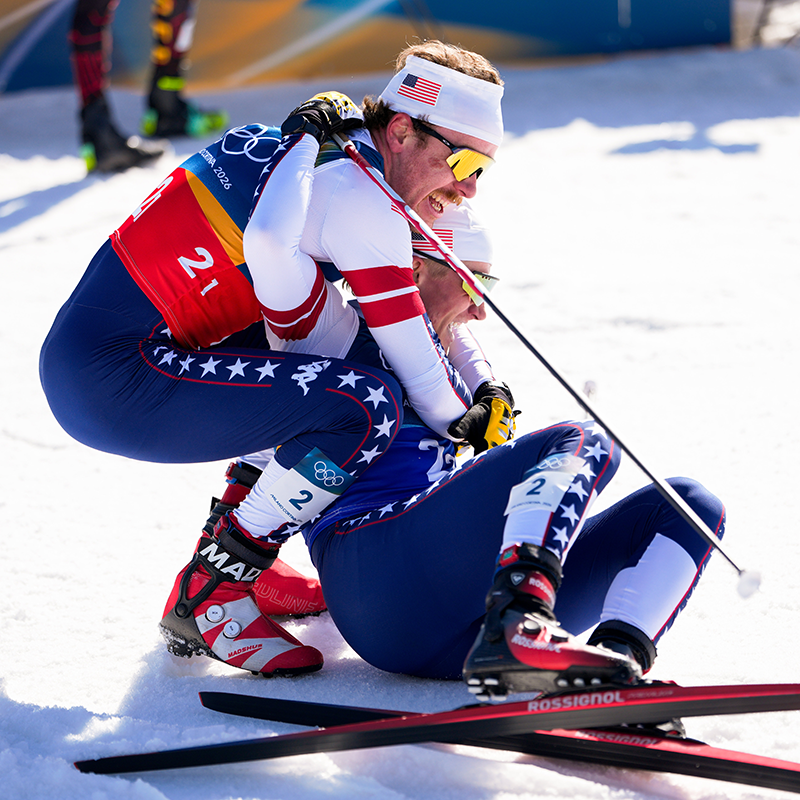
From the FasterSkier archive — posts syndicated from athletes’ and coaches’ own blogs between 2004 and 2012, kept online as published. Current coverage is at fasterskier.com.

Tag: Matt Whitcomb

  • What the U.S. Ski Team Changed After Threshold

    What the U.S. Ski Team Changed After Threshold

    This article was made possible through the generous support of our voluntary subscribers. If you value coverage like this, please support FasterSkier with a voluntary subscription.

    When I asked Matt Whitcomb what surprised him about Threshold, the head coach of the Stifel U.S. Cross-Country Ski Team started by admitting he was tempted to make something up.

    “This is the hardest question for me to answer, … but I haven’t watched it. I know it’s life-changing, but I don’t want to go back to that winter,” Whitcomb said. “I did my best as a coach, we all did, and it wasn’t good enough, and I’ve come to terms with my personal experience with it all.”

    The winter in question is 2023-24, the season Torsten and Lars Brinkema spent inside the American team with two Sony cinema cameras, a drone, and no feature film credits between them. What came out of it is a documentary about Jessie Diggins and her eating disorder that premiered on Peacock in February and, as of last Friday, is available to rent on Apple TV, Amazon Prime Video and YouTube in the United States and Canada. A European release is planned for later this year.

    Whitcomb is the person who let the cameras in. He is also, by his own account, the film’s loudest advocate.

    “I know from the response that the film is excellent, and I know it’s changing people’s lives and is being featured in college curricula. I recommend it to everyone I speak to,” he said. “I’m very proud of Torsten and Lars and am grateful for the film. I support it completely.”

    A filmmaker on cross country skis carries a cinema camera rig on a groomed snow trail while an athlete skis ahead of him.
    Lars Brinkema skiing with a cinema camera at a U.S. Ski Team camp in Bend, Oregon, chasing Jack Young on the trail. The brothers had done these workouts themselves, which is why it never occurred to them to ask an athlete to run one again for a better take. (Photo: Patrick Conroy)

    “A couple of brothers got a camera for Christmas”

    His first answer was no.

    “I figured a couple of brothers got a camera for Christmas, had a couple beers, and then came up with a fun way to spend a year,” Whitcomb said. “I normally would’ve erred on the safe side and told them to take a hike, but Ben doesn’t toss around ideas lightly and so I followed up to hear more.”

    Ben is Ben Ogden, who raced against Torsten in college on the EISA circuit and had watched him work at the World Cup in Norway that spring. Torsten had gotten there on a shoestring, having talked the Loppet Foundation, the Minneapolis club he and Lars grew up in, into sending him to shoot promotional material ahead of the 2024 World Cup at Theodore Wirth Park.

    “I think they were kind of surprised to have an American photographer out there with them,” Torsten said, “just because they aren’t getting much coverage once they leave.”

    Ogden pitched Whitcomb on inviting the brothers to the team’s Bend, Oregon camp that summer. The brothers bought cinema cameras and showed up.

    What they had in mind at that point was not a film about an eating disorder. It was a film about a sport nobody in America watches, made in the shape of the niche-sport documentaries that had broken through elsewhere.

    “We could probably do something like that with skiing,” Torsten said of the pitch they were making to themselves. “Make it look really cool.”

    They had one asset that mattered more than the cameras, which is that they were skiers. Diggins had been through the alternative, brand shoots that treated an interval session as something you could run again for a better take.

    “This is just something that would never even cross Lars and my mind, to alter the workout, because we know how intense they are,” Torsten said. “We know the workouts. We’ve done them before.”

    Two young filmmakers stand side by side on a paved roller ski loop holding cinema cameras, with autumn hills behind them.
    Lars, left, and Torsten Brinkema at the U.S. Ski Team’s Park City camp. On the road the athletes called them Larry and Toasty. (Photo: Willie Maahs)

    Toasty, Larry, and a problem with FIS

    Whitcomb’s worry was culture, which he describes as something you protect rather than something you have.

    The brothers had promised the arrangement would run both ways, that athletes would get usable footage of themselves out of it, and Whitcomb says they delivered. They also collected nicknames. Torsten became Toasty. Lars became Larry, or Lawrence in formal settings.

    “These guys were ghosts at times where they would disappear for the day and nobody would see them,” Whitcomb said. “And then we’d see them at dinner and they’d be showing athletes their incredible footage of the team training or racing together.”

    They washed dishes. They helped with wax testing. Whitcomb says everyone came to regard them as an addition to the team environment rather than a cost of doing business.

    It was not frictionless. At the first race of the season in Finland, Whitcomb watched one of the brothers get chewed out in the finish area by a FIS official for filming in a zone reserved for the television production company. Later, on course in Toblach, he got a text from FIS with a screenshot attached.

    “Larry running through the pines, keeping pace in his flatbrim hat and knit sweater, filming the lead pack. He was prominently within the TV feed,” Whitcomb said. “They asked if I could kindly remove him from the world feed. And you know what happened? Nothing. These guys said they were sorry and got a hand slap in each instance. Everyone likes them. They say things like thank you and sorry.”

    The rights question got more expensive than a hand slap when it came time to actually build the film. The brothers wanted broadcast footage in the race sequences, the kilometer counters and the commentary, partly because they had decided early that they would never narrate the film themselves. That meant negotiating with Infront, which controls FIS media rights.

    “It was an absolute pain in the ass, and that’s kind of all that I’ll say,” Torsten said. “Very expensive.”

    The money came from nowhere institutional. The brothers paid their own way through the season and kept fundraising as they went, working through the list of private donors who already keep the U.S. team on the road. The Emily Program, which sponsors Diggins, came in later during the edit and is now bringing the film into treatment centers and educational screenings.

    The Hollywood end of it started with a question the brothers asked Diggins at a training camp between the Tour de Ski and the next World Cup stop. They had no connections in that world and needed someone who did. Did she know anybody.

    She remembered that Patrick Dempsey had supported the ski team before, and sent him an Instagram message. He answered immediately and told her to send Torsten to his house in Maine, where Dempsey grew up skiing. A couple of months later Torsten showed up at the door and pitched him.

    “We have no films to our name. We have a couple short projects that nobody has seen,” Torsten said. “And so we’re asking someone with the credits that he has to trust us with nothing to see for it.”

    Dempsey signed on as an executive producer and, by the brothers’ account, became a real voice in shaping the cut. Whitcomb offers it as a character reference. “I mean, Patrick Dempsey signed on with these guys. That should tell you something.”

    Two filmmakers set up cameras on a patio to interview a skier seated in a chair with mountains in the background.
    Filming an interview with Johannes Høsflot Klæbo in Park City in October 2023. The brothers came home from the season with roughly 500 hours of footage and interviews across several national teams. (Photo: Daniel Sannum Lauten)

    The pivot happened the following summer

    This is the part Whitcomb wanted on the record, because he thinks people have the sequence backward.

    “From the start, this movie was meant to highlight the entire team, and not just Jessie,” he said. “Months after the winter concluded, I think the Brinkema brothers realized that the film needed to hone in on the topic of mental health to have a clear storyline. I understood and supported that pivot, but the point is that the winter filming was not targeted at just Jessie. That filming happened the next summer.”

    The brothers describe the same thing from inside the edit. They came home with roughly 500 hours of footage and interviews with athletes across several national teams, including Johannes Høsflot Klæbo, Emma Ribom and Federico Pellegrino. Their editor, Yaniv Elani, had never cross-country skied, which they now regard as the reason the film works.

    Elani is also the one who made them cut the northern lights. The brothers had stood out in the Arctic Circle for two hours in the cold to get a time lapse they were proud of.

    “It’s not serving the story. You got to cut it,” Torsten remembers him saying.

    Then came the screenings for film industry people in Los Angeles and New York, where the brothers went in hoping to learn what a non-skiing audience would care about.

    “People just kept saying, Jessie, Jessie, we want more Jessie,” Torsten said.

    A coach stands in green summer woods facing a filmmaker who is holding a camera in the foreground.
    Matt Whitcomb during an interview with the Brinkema brothers in Burke, Vermont. “We missed the mark on supportive team culture as an entire team,” he said of the winter the film covers. (Photo: Brinkema Brothers)

    “Our culture was at a 15 or 20-year low that winter”

    Whitcomb does not soften the season the film covers.

    “For anyone who has seen the movie, I think it’s no secret that our culture was at a 15 or 20-year low that winter. We had major struggles,” he said. He has thought about whether the presence of a film crew contributed to that, and concluded it did not.

    He is also insistent that the winter was not one athlete’s crisis with everyone else watching. “It was one of the hardest times for several other athletes and coaches, too. This wasn’t just a Jessie issue. We missed the mark on supportive team culture as an entire team.”

    Asked how he handled protecting Diggins against letting the story be told honestly, he rejected the premise.

    “I never felt like I had to protect Jessie from the film. She was a part of the team-wide decision to allow the Brinkema brothers into the team for the year, and that was the main gate we kept,” he said. When the brothers asked him whether they could film something sensitive, a one-on-one meeting for instance, he sent them back to the athlete. “I would usually just tell them to ask Jessie what she was comfortable with.”

    He watched her closely all the same, and says that had nothing to do with coaching. “That’s just because she’s a close friend, and friends look out for each other. But I had 100% trust in these guys, which is saying something because Lars was 19.”

    A filmmaker and a team communications manager pose together in a sunny finish area, raising ski poles overhead.
    Torsten Brinkema and Leann Bentley at the World Cup finals in Falun, Sweden, in March 2024. Bentley handles press for the cross-country and Para Nordic teams and appears in the film mostly doing her job in the background of somebody else’s scene. (Photo: Brinkema Brothers)

    The person in the hotel room

    Leann Bentley is the U.S. Ski & Snowboard communications manager who handles press for the cross country and Para Nordic teams, and she is in the film, mostly doing her job in the background of somebody else’s scene.

    She was in the room when the coaching staff decided whether to say yes, and she remembers it being straightforward. Here were two people willing to spend a year telling a story she could not tell herself, and one of them had raced against these athletes in college.

    The question she was asked for this story was how she decided where to draw the line once the film’s center became Diggins’ mental health. Her answer was that the question does not describe what happened.

    “Short answer, no, I never had to tell them no,” Bentley said. “Long answer is I of course will always protect my athletes. But at the same time, they’re protecting themselves. And throughout this entire process, Jessie was protecting herself. She knew what she wanted to give, and she knew maybe what she didn’t, but she was in charge of it from the very start. And so were all the athletes.”

    The scene she keeps coming back to is a hotel room in Ruka before the press conference where Diggins told the assembled media she was dealing with her eating disorder again. Bentley says it was one of the most heavily attended press conferences she has run with her.

    “There was a scene where I told her that it’s okay to be vulnerable. And I don’t remember saying that to her,” she said. “It really goes to show that when I work with these athletes, I’m working with them as people, and I’m really glad that came across in the film.”

    Most of her season is not spent in hotel rooms in Finland. It is spent in Salt Lake City, awake in the middle of the night, watching the same feed as everybody else and then turning it into the clips and quotes that hundreds of thousands of people see, for twelve teams and more than 240 athletes.

    Asked what the film got right about the parts of team life that press coverage never reaches, she was blunt about why the question has an easy answer.

    “It got everything right because it was showing exactly what was happening,” Bentley said. Athletes race for a few minutes at a time, a few times a weekend. The rest of it is chess and cards and laundry and going for a run. “I don’t think a lot of people understand that being a professional athlete, you train so hard mentally and physically for what you do on the weekends during a race. And then that race ends and you have, I don’t know, ten more hours of the day left.”

    Both she and the brothers land in the same place when asked for a favorite corner of that life, which is the wax truck, known on the road as Yolanda. Torsten’s version involves showing up on dark nights with nothing to do, music playing, occasionally a shot of Jägermeister, and a group of technicians who had been living this way for a decade or more and had stories nobody had ever asked them for.

    I interviewed the American wax techs last winter in the lead-up to the Olympics, and they remain the most enjoyable conversations I have had for this site, so I will just agree with him.

    Two filmmakers with cameras stand on a paved loop while a coach talks with two athletes on roller skis.
    Torsten Brinkema, left, and Lars Brinkema, right, filming Jessie Diggins, coach Jason Cork and Renae Anderson during a roller ski session at the Park City camp. (Photo: Willie Maahs)

    What actually changed

    The most concrete thing to come out of that winter is not on screen.

    Whitcomb describes an Athlete Wellness Passport, a monitoring system covering roughly eight health areas for every athlete on the team, men and women, including bone density, blood panels, caloric balance assessment, menstrual health and a mental health questionnaire. The team dietitian tracks each category for each athlete, and a licensed professional is brought in when a category calls for it.

    “It’s a safety net for the whole team,” he said.

    What that system did not have in 2023-24 was a ceiling.

    “What we were missing in the winter of 2023-24 was a plan for what happens when an athlete’s issue, like an eating disorder, advances beyond the qualifications of our professionals,” Whitcomb said. “In this case, we needed an eating disorder specialist MD on call, and we didn’t have one. We’ve debriefed on the experience extensively and have brought in the person we wish we already had in place going into that winter.”

    For coaches who watch the film and want something to do on Monday, his answer starts with an assumption rather than a policy.

    “If you coach a team of athletes, you likely coach some athletes who struggle with disordered eating, and you may never know who they are,” he said. He has had male and female athletes tell him about it years after they finished competing.

    On his team the practical version is a conversation about meals, held once a year, in which everyone agrees to treat mealtime as a place where safety matters more than opinions.

    “Everyone’s plate looks different, and everyone’s dietary needs and goals are different, and many of us are insecure, so the environment is ripe to be judgy and toxic,” Whitcomb said. “Talking it out isn’t perfect, but it helps.”

    He got there by getting it wrong first, and he tells that story without cushioning it.

    “As a young coach I used to think I could talk openly with athletes about their challenges with eating, body image, and weight. Then I learned from a parent that a comment I made to them regarding weight was harmful. Yeah, I know, duh. But I was 23 and some of you are now, too.”

    His correction was to stop talking about any of it and refer everything to professionals, which he now says was better but too absolute. The current version is that he will talk with an athlete who wants to talk, if the trust is there, while being honest about where his expertise ends and activating someone qualified.

    Three people stand in front of a cinema screen taking questions from a seated audience in a darkened theater.
    Lars Brinkema, Torsten Brinkema and Andrew Peterson take questions after a private screening of Threshold in Minneapolis in January. Diggins has asked teams to treat the film as “a visual book club.” (Photo: Sawyer Brice)

    What Diggins wants out of it

    Diggins raced her last World Cup in Lake Placid in March. She did not do a new interview for this piece, but she wrote at length on Instagram when the film went back out on Friday, and the argument she made was that the documentary is not really about her.

    Her request to teams, high school through professional, was that they treat it as “a visual book club.” Watch it, then talk about it. What pressure does this sport put on you. What kind of team do you want to be. And for coaches, find out now where you would send an athlete who comes to you, before one does.

    She also made a point the film cannot make on its own, which is that the recovery in it happened in hundreds of hours of therapy and clinical work that were never filmed and could not have been.

    Two filmmakers in Team USA bibs stand with their arms around a skier wearing the yellow overall World Cup leader bib.
    Torsten Brinkema, left, Jessie Diggins and Lars Brinkema in the finish area in Falun, Sweden, in March 2024, after Diggins wrapped up the overall World Cup title. (Photo: Modica/NordicFocus)

    When the film premiered in February, she put the goal simply in a U.S. Ski & Snowboard release: “I wanted to help others feel less alone.”

    The brothers are working on a scripted film now, set in Minnesota, still as a duo.

    Whitcomb, meanwhile, is not planning to watch. He described where the last two years have left him without much interest in tidying it up.

    “We’ve made improvements to our system because of lessons from that winter, and we became better coaches and teammates. I’m moving forward as an improved coach.”

    And then the part that sounded most like a coaching philosophy: “Your coaches and staff must truly care about the human condition. That’s your foundation. Get rid of the ones who don’t and add more who do.”

    Where to watch: Threshold is available to rent on Apple TV, Amazon Prime Video and YouTube in the United States and Canada. It premiered on Peacock in February, and a European release is planned for later this year.


    Help Support Our Coverage!

    If you value the thoughtful work and access FasterSkier provides, please consider becoming a Voluntary Subscriber. Your support directly fuels our work to cover the people, places, and moments that make our sport special.

    Join the FasterSkier community!
     

  • No One Lives Here,” They Said. Then 10,000 Plus Fans Showed Up in Lake Placid

    No One Lives Here,” They Said. Then 10,000 Plus Fans Showed Up in Lake Placid

    This coverage is made possible through the generous support of Marty and Kathy Hall and A Hall Mark of Excellence Award. To learn more about A Hall Mark of Excellence Award, or to learn how you can support FasterSkier’s coverage, please contact info@fasterskier.com.

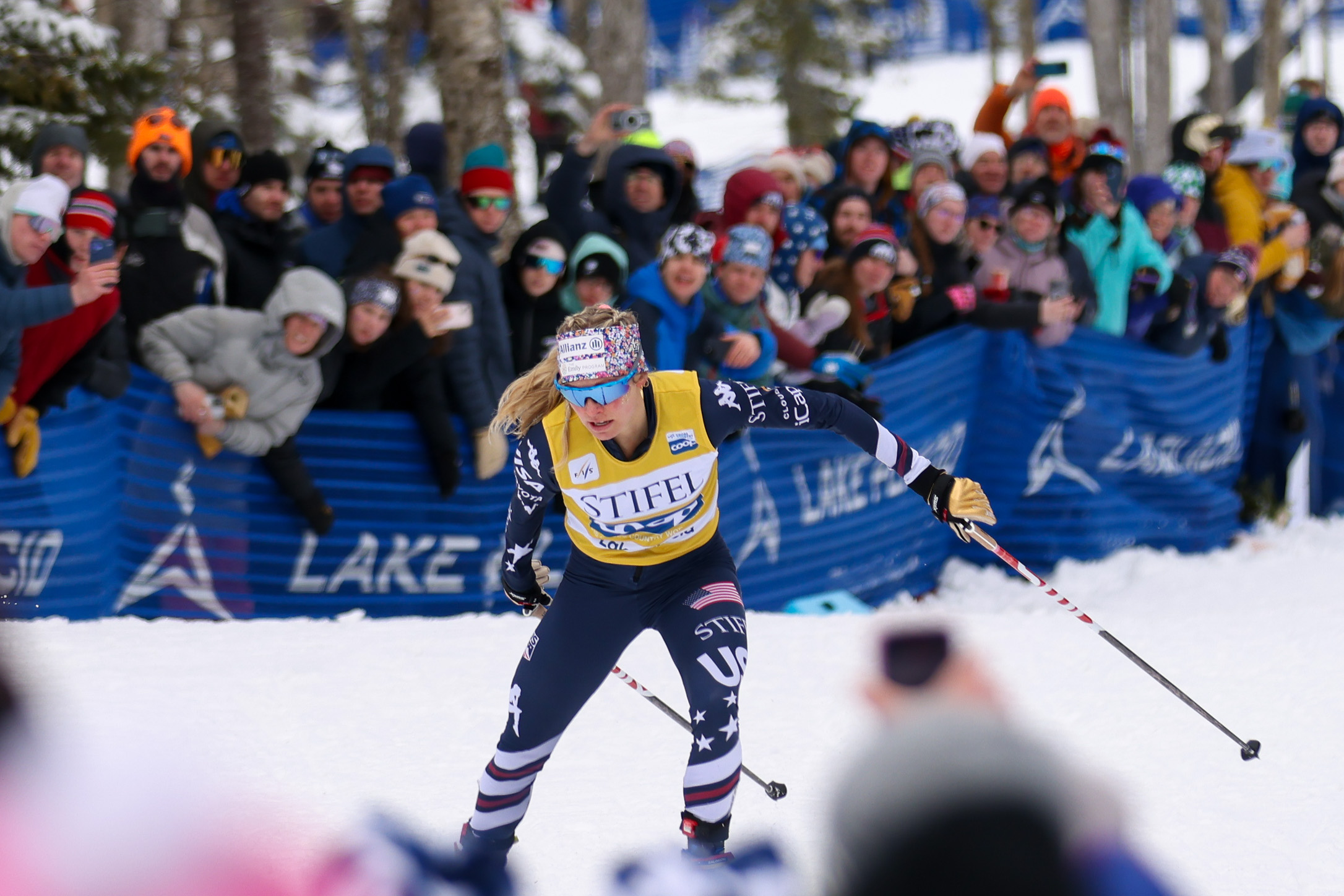
    Jessie Diggins during the quarterfinals of the Freestyle Sprint on Saturday in Lake Placid, New York, USA. (Photo: Voisin / FasterSkier)

    Lake Placid, N.Y. — The French coaches had questions. Two days before racing began at Mount Van Hoevenberg, they were standing in Saranac Lake — 55 degrees, windy, woods in every direction — wondering who exactly was going to show up to watch cross-country skiing in the middle of the Adirondacks.

    By Saturday, an estimated — rumored to be fair — 14,000 people had answered.

    Today, as Jessie Diggins lines up for the 20-kilometer mass start freestyle, the final race of her career, this corner of upstate New York will try to top itself one more time.

    Screaming fans, chainsaws, flags, signs, and glitter all over the course in Lake Placid, New York, USA. (Photo: Voisin / FasterSkier)
    A Weekend That Kept Building

    The first sign that Lake Placid was going to be different came Friday, and it wasn’t entirely smooth. With an initial estimate of 10,000 fans on Friday, the transportation system to and from Van Hoevenberg buckled under the demand. Some fans waited over two hours to get to the venue.

    Diggins finished fifth and clinched her fourth career overall Crystal Globe — her third in a row. She told reporters afterward that the crowd was so loud she couldn’t hear herself breathe. Johannes Høsflot Klæbo returned to win the men’s 10k, leading a Norwegian sweep of the top five.

    ORDA adjusted to the shuttle demand on the fly, pulling in school buses from across the region to shuttle people up the mountain, and by the time Saturday got started, things felt even bigger at the venue. The sprint course was packed — 14,000 fans by some estimates — as Sweden’s Linn Svahn dominated the women’s sprint and Maja Dahlqvist locked up the sprint Crystal Globe. And Federico Pellegrino, in his own final World Cup sprint, scripted the perfect ending with a masterful win — a retirement farewell that carried echoes of what’s coming today for Diggins.

    US Head Coach, Matt Whitcomb, after the races yesterday in Lake Placid was really happy because the standout performance was not one of his athletes, but instead the North American ski community that showed up in droves and created an electric atmosphere. (Photo: Voisin / FasterSkier)
    “Only Holmenkollen and Minneapolis”

    U.S. Ski Team head coach Matt Whitcomb has been on the World Cup circuit for years. He said the only events throughout his career that have ever rivaled the atmosphere here this weekend in Lake Placid are the Holmenkollen in Oslo — the sport’s grand prix if you will — and Minneapolis two years ago.

    That’s the company Lake Placid is keeping. And for those who were in Minneapolis, the comparison lands. Diggins said earlier this week that Minneapolis was the most special day of her career.

    “It was the most I’ve ever cried,” she said at Wednesday’s press conference. “I got to race in front of some of my grandparents who haven’t been able to travel overseas. They got to see me race for the very first time in a World Cup. And having so many friends and family and getting to share the thing that I love doing with them — that is the most incredible thing ever.”

    She paused, then added: “I think this weekend’s probably going to join that.”

    College skiers from all over the Northeast came in force to the trailside in Lake Placid, New York, for the races this weekend. (Photo: Voisin / FasterSkier)
    The Scene on the Ground

    What the numbers don’t capture is the texture. Young kids running around the venue in their NNF fan bibs — the ones with athletes’ faces printed on them — clutching Sharpies, hoping to meet their heroes. Fans who drove and flew from Vermont, from Alaska, from Minnesota, who planned vacations around this weekend months ago. The school buses that became part of the story, ferrying the faithful up the mountain road when the original plan couldn’t hold.

    This is what U.S. cross-country skiing looks like when it gets the stage. Not a packed NFL stadium or a sellout basketball arena — but thousands of people standing in the woods, screaming themselves hoarse for athletes from every country, because they love this sport and they know how rare these weekends are.

    The fans — especial the college skiers — made it sound like the race was happening in Davos, Switzerland with the chainsaws out on course. (Photo: Voisin / FasterSkier)
    One More Race

    Diggins has spent this weekend doing exactly what she said she would — being present, soaking it in, putting on a show. She clinched the Crystal Globe on Friday. She raced the sprint on Saturday. And now there’s one more.

    At Wednesday’s press conference, she talked about the way her mindset around suffering has evolved — how she’s learned to see the pain cave not as something to dread but as confirmation that she’s doing what she came to do.

    “This is what 100 percent feels like,” she said. “And sometimes this is what it looks like, and it’s some ugly scene, but that’s okay. It just has to be all heart and all effort, and that’s what I have to give in that moment.”

    She also made one thing clear about the team she’s leaving behind: “The team is going to be just fine without me. And I feel like that’s how I know I did my job.”

    Then, with a smile: “I’m excited to be a fan on the other side of the fence and get to cheer for them.”

    Today, in just ten minutes, Jessie Diggins will clip into her bindings for the last time as a World Cup racer. The 20-kilometer Mass Start Freestyle.

    And based on everything this weekend has shown us, “no one” will be watching.


    Love Stories Like This? Help Keep Them Coming.

    Feature stories like this one take time, access, and care to produce. If you value thoughtful storytelling and independent ski journalism, please consider becoming a Voluntary Subscriber. Your support directly fuels the work we do to cover the people, places, and moments that make our sport special.

    Join the FasterSkier community!

     

    When the sun finally came out the crowd got especially excited. (Photo: Voisin / FasterSkier)
  • The Case for More American World Cups

    The Case for More American World Cups

    This coverage is made possible through the generous support of Marty and Kathy Hall and A Hall Mark of Excellence Award. To learn more about A Hall Mark of Excellence Award, or to learn how you can support FasterSkier’s coverage, please contact info@fasterskier.com.

    Johannes Hoesflot Klaebo (NOR) back in action and lifted by the roar of American ski fans during the World Cup 10 k Classic in Lake Placid, New York. (Photo: Dils / FasterSkier)

    LAKE PLACID, NEW YORK — Ten kilometers into the second World Cup on American soil in as many decades, and the verdict is already clear: We need more racing in the United States.

    That’s the message panted into my microphone by every athlete in the Mix Zone; shouted over the undulating din by every supporter I spoke with on the ice-lacquered walkways lacing Mt. Van Hoevenberg. And it’s the irresistible outcome of the turnout this afternoon in Lake Placid — with a crowd that came out in droves for Diggins, the Schumacher-Ogden’s Silver Medal Squad, and a host of homegrown heroes; that braved five inches of wet, driving snow; and that stayed to see Jessie clinch the Overall Crystal Globe, a reconstituted Klæbo overtake Amundsen in the Distance standings, and to welcome the world’s best to the conclusion of the 2025-26 season.

    The reaction to racing in the United States in 2023 was overwhelmingly positive – and, it had seemed, sui generis. With four snowmaking venues spread across the Twin Cities, along with the (purportedly) highest concentration of cross-country skiers outside of Oslo, the energy that embraced Jessie Diggins in her home state and buried a generation of “almosts” for the U.S. Men’s Team in the snow and mud at Theodore Wirth could have been lightning in a bottle.

    Jessie Diggins (USA) racing on home soil in Minneapolis and did so again in Lake Placid as she concludes her storied World Cup career. (Photo: Modica/NordicFocus)

    I will admit my own skepticism that Lake Placid could field the fans, or the volume, of spectators to match Minneapolis. Perhaps my flight into Saranac Lake Regional Airport on Wednesday morning was my first evidence of error. Of seven passengers bobbing our way through the cloud-laden Adirondacks, four were here for the World Cup: Charlie, from Seattle; Billy (as in, Demong, the Nordic Combined gold medalist) and his son, from Salt Lake City; and myself, from D.C. Bussing to the venue the next day, I’m seated with a dozen of University of Minnesota alumni – they’ve taken off of work, graduate school, and medical school to spectate. “I’m excited just to see the number of people out cheering,” Alex Gude, who organized the trip, tells me. “I think one of the best parts about Minneapolis is just seeing the community come together, and now, away from home, we’re seeing another whole ski community come out and cheer.”

    And, indeed, they are – from across the United States, from across New England, from across the Canadian border, and from right here in Lake Placid. Once we disembark, I wade through the corn snow and the first of many falling flakes to Mt. Van Hoevenberg’s sprawling Nordic Center, where the racecourse coils around the podium and snakes below the pedestrian bridge. Patricia Damp is herding thirteen might-be-members of the local ski community across the bridge; she’s a third-grade teacher here in Lake Placid, chaperoning a class field trip to the World Cup Finals.

    Are the kids already Diggins die-hards, Ogden acolytes, Gus bus-riders? Not really, Patricia tells me. The class “was out here a couple months ago, cross-country skiing. We get to do the Olympic venues. We were at the museum a month ago. We have a friend who we watched ski jump. So, we’re very Olympic-oriented, and today we’re just out here to support the athletes and get some autographs.” Her students back her up. “We’re excited to get the players’ signatures,” Riley tells me. And while Declan is “excited to see the racers,” there’s no-one in particular he’s cheering for.

    Gus Schumacher (USA) during the Men’s 10 k Classic in Lake Placid, New York. (Photo: Dils / FasterSkier)

    From the mouths of children, our first – and perhaps strongest – argument for future American World Cups. The glitter-dusted kids in fan club bibs, wielding cardboard-cutout faces as large as they are, make for compelling pictures and undeniable evidence of Team USA’s impact on its next generation. But racing in the United States creates opportunities to draw an entirely new cohort of young people into the cross-country skiing community – kids who may have never tried skiing before; who may not have heard of Kikkan or Klæbo ; and whose parents certainly are not waking up before sunrise to livestream Ruka, Falun or Holmenkollen. They will not see themselves in this sport until they see this sport. What better way to do so than on a Friday field trip with Mrs. Damp?

    After bidding them good luck with the signature-hunting, it’s not an easy task to wade against the current of the rest of the Lake Placid Class of 2035. Also threading his way through the third-graders is Niklas Dyrhaug, immediately recognizable even five years into retirement from World Cup racing. He’s on the other side of the v-boards this weekend, broadcasting for Norwegian television. In his first sentence, he tells me: “We are enjoying being back in the U.S. In my opinion, we should be here every year.” He’s not surprised by the number of spectators, either. “Everybody who knows the U.S. crowd knows they are really enthusiastic . . . We know the tradition, the culture, and Lake Placid’s place in that history. So, personally, I’m not that surprised. It’s really cool that we’re back here.”

    That’s the sentiment just after Coaster Hill, some four kilometers into the racecourse, where Norwegian national team coach Eirik Myhr Nossum prowls the striding zone. Being back in the United States is “awesome, it’s amazing. I think we should be here every year, because you guys show up; you guys cheer for everyone, and it’s always fun to be in the U.S. and to be overseas to compete.”

    And it’s the sentiment at the finish line.

    Harald Oestberg Amundsen (NOR) after the 10 k Classic in Lake Placid, New York. (Photo: Thibaut/NordicFocus)

    Harald Amundsen (NOR) tells me, “In the outer part of the track, there were so many people I couldn’t hear my own thinking. That’s a really good thing.” Even before he arrived at the venue, “We had a run this morning in the city. Everyone was screaming at us, ‘Good luck!’ It’s a really nice atmosphere.”

    For Elia Barp (ITA), conditions were “very tough because it was really slow with this new snow, but it was fun racing for me. So I enjoyed it – at least I tried to enjoy it – it was a pack of people screaming my name so that gave me even more motivation, and was fun . . . I loved racing two years ago in Minneapolis, and here it’s packed with people, even with the snowfall, so thank you to everyone for coming. It’s really good to race here.”

    Mika Vermeulen (AUT) admits, “Honestly, this is probably the worst race I’ve done in a long time. But I don’t think I’ve ever had so much fun out on the track . . . on top there, out in the forest, I just heard, ‘MI-KA, MI-KA,’ the whole time. It was insane. I had a bad race and a lot of fun.”

    As for how he feels about returning to the United States: “Great, great, actually—and feeling a bit frustrated, because it just gets me pissed that we race these [bad] courses in Europe all the time, over and over and over again, and we have these freaking jewels out here which we never use. It’s crazy. I want to go to the U.S. every year for at least a whole period. It’s called the World Cup. It’s not called the European Cup, right?”

    Fans all over the course with custom gear showing their fandom. (Photo: Dils / FasterSkier)

    Klæbo’s opinion is a bit more measured – perhaps because he has more microphones hovering around his face. “I heard some rumors that it was supposed to be quite well [attended], and when I searched up Lake Placid and read a little bit about the place, I understood there’s not that many people living [here], but when you see how many people are here, I was pretty shocked.”

    A second argument, then, in favor of World Cup racing in this country: the athletes love it. They embrace not just the energy, but the venues that push the World Cup beyond the geographic and cultural confines of Transalpine Europe.

    Benjamin Dohlby (USA) at the finish of the Men’s 10 k Classic in Lake Placid. (Photo: Thibaut/NordicFocus)

    For the closing statement, Ben Dohlby is among the last athletes I interview. This is Ben’s first World Cup start; a junior at University of Alaska-Fairbanks, he was 3rd in the American Birkebeiner in February. How does it feel to be making his first professional start in the United States?

    “It was crazy. I went out so hard. The fans were so loud that I didn’t feel anything, and then I felt it all and got so tired – but it was awesome; a great atmosphere.” It wasn’t too long ago that Ben was skiing laps around the glazed kilometer of manmade snow at Lapham Peak State Park in Delafied, Wisconsin; now he’s here. To his former teammates, to other up and coming skiers, and to novices across similar ribbons of snow in Wisconsin, Michigan, and Minnesota, his message is simple: “Follow your dreams and you can make it happen.”

    Most of the fans hiked up on the course, but the stadium filled up as the day went on. (Photo: Dils / FasterSkier)

    That, then, is our concluding point: More World Cup starts on American soil means more starting berths for American skiers, and more chances for our most talented young skiers to make it to the starting line. We should savor the privilege of, as a host nation, pitting our athletes against the most accomplished figures in the sport, dreaming that a World Cup podium, an Olympic medal, could be in their future. When a lifetime of discipline and preparation meets the opportunity of a lifetime, the promise of Lake Placid – that miracles can happen – becomes deliverable.

    I will leave the invariable complex problems of bidding, organizing, and logistically managing future events to far wiser pundits. But, in the meantime, the verdict is clear: FIS, U.S. Ski & Snowboard, and the American Nordic community should be eager, and determined, to have them here.


    Love Stories Like This? Help Keep Them Coming.

    Feature stories like this one take time, access, and care to produce. If you value thoughtful storytelling and independent ski journalism, please consider becoming a Voluntary Subscriber. Your support directly fuels the work we do to cover the people, places, and moments that make our sport special.

  • Who’s cross-country skiing the most at the Olympics? It’s not the athletes.

    Who’s cross-country skiing the most at the Olympics? It’s not the athletes.

    Norwegian ski testers Pål Trøan Aune, left, and Mats Iversen carry bags back to the country’s service truck at the Olympic cross-country ski venue in Lago di Tesero, Italy. (Nathaniel Herz/FasterSkier)

    This article was made possible through the generous support of our voluntary subscribers who have helped put our Nat Herz on the ground at the Olympics. If you value coverage like this, please support FasterSkier with a voluntary subscription.

    LAGO DI TESERO, ITALY — A day before Norway’s Johannes Høsflot Klæbo won his fourth straight gold medal in cross-country skiing at the Winter Olympics, a strange sight was unfolding next to the race trails in Northern Italy.

    Two figures, dressed in Norwegian team suits, were skiing loop after loop on a tiny test track — in search of the most infinitesimal edge over rivals from France, Finland, Italy and America.

    Neither figure was Klæbo: The superstar was back at his hotel room playing video games and resting up for the next day’s race.

    Instead, the two men were retired ski racers hired by the Norwegian team for one of the strangest jobs of the Olympics: sprinting for miles over the same small patch of snow to help identify which waxes and other products can be applied to the surface of cross-country skis to make them faster.

    While Klæbo spent much of Saturday in bed, one of the testers, Mats Iversen, skied dozens of laps adding up to more than 15 miles. Earlier in the Games, Iversen was skiing even more: as far as 44 miles a day, and just over 200 miles in his first week in Northern Italy, according to numbers he logs on the Strava tracking app.

    Screenshots from the Strava workout tracking app that show a map of one of Mats Iversen’s testing days, and some of the times he skied on a test loop.

    There’s no question that Iversen is skiing “way more” than the athletes competing at the Olympics, Klæbo said at a news conference Wednesday after winning his fifth straight gold.

    Iversen’s one 44-mile day is “close to what I’ve done the whole week,” said Klæbo, whose race Wednesday totaled just over six kilometers, or some 3.5 miles.

    “They’re amazing, and they are doing an amazing job to help us have the best possible skis,” Klæbo said. Referring to the winners’ podium, he added: “None of us would be able to sit here if it wasn’t for them.”

    In a 45-minute interview after a 22-mile day last week, Iversen, his fellow tester, Pål Trøan Aune and their boss Tord Hegdahl offered a behind-the-scenes glimpse of the huge investment of equipment, technology and manpower that go into preparing the Norwegian team’s skis.

    Aune and Iversen relax on the top floor of Norway’s service truck. (Nathaniel Herz/FasterSkier)

    They spoke in a lounge area on the upper floor of an enormous, customized truck that houses hundreds of pairs of skis, along with work stations for staff members who prepare them for testing and racing. Iversen and Aune are, essentially, the engines of an intricate machine — with others operating the controls.

    “You don’t need a 200 IQ to be a ski tester,” Iversen said. Pointing to the lower floor, where the technicians work, he added: “The brains are in here.”

    ‘Dizzy’ from all the loops

    The Norwegian truck is parked in a big lot beside the competition trails in Italy where other nations like France, Sweden and the Czech Republic have their own vehicles and trailers. 

    The American team truck cost some $750,000 and is named Yolanda — a reference to a line from actor Samuel L. Jackson’s character in the cult classic film Pulp Fiction, according to NPR.

    Inside the trucks, teams of technicians work to identify the skis and products that will slide the fastest given a specific set of snow conditions.

    The work has several layers. Each athlete may have dozens of pairs of skis, and teams have to find the best ones for each day. Then, there’s what’s known as the “stone grind” — a pattern of tiny etchings that a machine can apply on the bottom side of a ski to help it move more easily over different types of snow crystals.

    Finally, there’s wax, which can be applied to the ski base to give athletes even more of an edge. Dozens of products and brands exist in block, powder and liquid form, which can be melted or rubbed into the skis with waxing irons or obscure tools like a rotating wool brush attached to a drill.

    A staff member prepares skis inside the Norwegian service truck. (Nathaniel Herz/FasterSkier)

    Testers like Iversen and Aune help identify which combinations of skis, wax and grind work best in a given set of circumstances.

    Every country does some level of testing. But Norway’s big budget for staff has afforded the team the luxury of an unusual level of specialization at the Olympics, with Iversen and Aune doing very little other than skiing — while other teams’ can mix testing in with other staff responsibilities, like waxing.

    “We are terrible waxers,” Iversen said. Addressing a reporter, he said: “I think you are probably better.” 

    The Americans, by contrast, sometimes lean on coaches to test waxes on the trails, freeing up their specialized technicians to focus on picking skis with the athletes.

    “If you take a look at our skis — we might have three bags and a couple of racks out before the race” for testing, said Matt Whitcomb, one of the U.S. coaches. “Norway will have two or three times that.”

    Australian technicians Leopold Hensler and Toni Escher take a break from testing on the Olympic trails in Italy. (Nathaniel Herz/FasterSkier)

    Canada’s team, meanwhile, employs two Italian “ski pilots” who, like Aune and Iversen, focus on testing at big events during the winter — often skiing upwards of 15 miles in a day. The rest of the year, one of them, Thea Schwingshakl, is a research biologist, while the other, Sara Hutter, markets Tyrolean apples.

    Like Aune and Iversen, they spend their days in the tiny testing area, where Schwingshakl joked that they get “a bit dizzy there, from all the loops.”

    But, she added: “It’s good for the whole team. We can just focus on skiing and testing, and they focus more on the product and on the wax and structures.”

    Canada’s ski pilots, Sara Hutter, left, and Thea Schwingshakl ski upwards of 15 miles a day. (Nathaniel Herz/FasterSkier)

    It’s not so much that the right skis, wax and grind will produce an Olympic medal — though they certainly help — as much as the wrong ones can put an athlete out of contention. After the men’s cross-country relay last weekend, American Johnny Hagenbuch suggested that his inability to keep up with rivals on the downhills had to do with his equipment.

    “I was with everyone at the top of the climb and then — yeah, no longer,” he said. “There was nothing I could do.”

    ‘Simple and boring’ work

    Iversen and Aune are part of a larger Norwegian project aimed at boosting numerous Olympic snow sports — not just cross-country skiing, but also Nordic combined and biathlon, said Hegdahl, their boss.

    The effort includes a stone grinding machine that Norway operates near the cross-country race trails; Iversen and Aune help test patterns that can be used across those sports. 

    Another staff member has the sole task during the Games of driving skis over the mountains to the biathlon venue, said Hegdahl, who leads the Norwegian cross-country service staff.

    One of the essential tasks that Aune and Iversen perform is the “paired glideout.” At the top of a small hill in the test track, the men stand side by side, then push themselves forward. As they start moving, Iversen equalizes their speed by grabbing ahold of a ski pole that Aune holds firm.

    A French team member stands in the testing track at the Olympic trails. (Nathaniel Herz/FasterSkier)

    Then, they let go without accelerating or jostling and see which of the different waxes or structures beneath their feet is faster. 

    Typically, they’re assessing sets of eight pairs of skis that — aside from the products underfoot — have been chosen because they’re perfectly matched. That, in turn, allows the technicians to more precisely measure the impact of the wax and grind patterns on speed.

    The testing is set up like a single-elimination tournament, with quarterfinals, semifinals and a final. Results are transmitted back to technicians in the truck via WhatsApp messages or a GPS watch.

    The matching of the eight pairs is so precise that, after the final test, Aune and Iversen take extra laps on the skis that are knocked out early to equalize them with the top pairs, to make sure the winning skis aren’t getting extra wear. Which also means that a mishap during a test lap requires three extras, to keep the six other pairs even.

    Teams leave skis alongside the race trails for testing. (Nathaniel Herz/FasterSkier)

    The whole process — from the unending right turns down to the bending over to take each pair of skis off and put the next set on — is hard on the body. They can ski 200 or more laps of the test track in a day.

    But Iversen and Aune are both fit, and capable of the workload, according to Hegdahl.

    “Testing is quite simple and boring. But we need guys to do the skiing who have the feeling of the skis,” Hegdahl said. “They’ve done a lot of skiing together with some of the best athletes, as well. So they know a bit.”

    Aune and Iversen have also been friendly for years, and enjoy the camaraderie and the chance to participate at a championship event that neither reached as an athlete.


    Mats Iversen’s brother Emil has had a standout season this winter. (Vianney Thibaut/NordicFocus)

    Iversen’s brother Emil is competing for Norway in Italy, and won a gold medal with the men’s team in the relay.

    “It’s very special — it’s our best friends who are racing,” said Aune. “I think they trust that we will do all we can.”

    The work can get boring, Iversen conceded. “But it’s nice to be with a friend,” he said. 

    They’re “better than most” with their team spirit, Iversen added. But Hegdahl, their boss, acknowledged that the testers might need a little time off after three weeks of rooming and working together through the Olympics, which conclude Feb. 22.

    “I’m not sure Pål will be at Mats’ place for a glass of wine on the 24th,” said Hegdahl. “But maybe the 28th.”

    Help Support Our Olympic Coverage!

    FasterSkier will have our own Nat Herz on the ground at the Olympics, which, to be honest, is a very big financial lift for us. If you value the thoughtful work and access FasterSkier provides at championships like this one, please consider becoming a Voluntary Subscriber. Your support directly fuels the work we do to cover the people, places, and moments that make our sport special.

    Join the FasterSkier community!


  • Schumacher and Ogden claim an Olympic silver built on community

    Schumacher and Ogden claim an Olympic silver built on community

    This article was made possible through the generous support of our voluntary subscribers who have helped put our Nat Herz on the ground at the Olympics. If you value coverage like this, please support FasterSkier with a voluntary subscription.

    Ben Ogden, left, celebrates his Olympic silver medal in the team sprint with Gus Schumacher. (Davide Barbieri/Nordic Focus)

    TESERO, ITALY — After Gus Schumacher and Ben Ogden on Wednesday won only the third-ever U.S. men’s medal in cross-country skiing at the Olympics, one of the biggest grins in the stadium was on the face of their teammate, JC Schoonmaker.

    Schoonmaker, who lives in Anchorage and trains with Schumacher at the Alaska Pacific University Club Program, was basking in his teammates’ silver glow. 

    But he was also already starting to dream about when he and Schumacher return home to Alaska, medal in tow.

    “There’s going to be so many juniors out skiing, just so hyped. And that’s the coolest part, I think,” Schoonmaker said.

    Schoonmaker, 25, had his own standout performance at the Olympics, finishing eighth in the individual sprint last week. He said he was himself inspired by the 2018 gold claimed by Americans Kikkan Randall and Jessie Diggins — underscoring how medals can plant the seeds of future medals. 

    “I liked Nordic skiing,” Schoonmaker said. “But watching that, I was like, ‘I need this.’ That gave me such a drive.”

    Eight years later, Schoonmaker’s teammates will be bringing their own hardware to their homes at far ends of the country — Schumacher to Alaska, and Ogden to Vermont.

    And unlike Diggins, who is retiring at the end of the season, Ogden, 26, and Schumacher are still just getting started — with long careers, and likely more medals, still in front of them. 

    Schumacher has spoken openly about competing through the 2034 Olympics, which will take place on U.S. soil in Utah.

    “You just see these guys, the energy building,” Erik Flora, Schumacher’s coach in Anchorage, said in an interview in Italy after Wednesday’s race. “You have this momentum now.”

    Gus Schumacher and Ben Ogden (USA), (l-r) celebrate finally getting onto the Olympic podium together. (Photo: Barbieri/NordicFocus)

    Both American medal winners were talented juniors, with Schumacher featured in news coverage at age 13. And early in their careers, each man found success in the events where they perhaps had more natural talent — Schumacher in longer distance races, and Ogden in shorter-distance sprints.

    The team sprint event that the Americans medaled in Wednesday is unusual in the way it demands both the speed that’s Ogden’s strength, and the fitness that Schumacher is known for. The two athletes, and their coaches, said that the podium performance was a reflection of focused training that Schumacher and Ogden did in an effort to become more well-rounded.

    The work Ogden and Schumacher did to put themselves in medal contention Wednesday didn’t happen overnight, though. It took years, with strong teammates pushing them and elite coaches to advise them — building on a foundation of years more of junior racing and playing on skis with their local clubs, said Matt Whitcomb, a longtime coach of the U.S. team.

    “It’s just not about this last year’s training plan,” he said. “It’s about the very first coach, the support their parents put in, their siblings, the camaraderie there with their friends.”

    Which is one of the things that Whitcomb and other team members say is great about winning an Olympic medal: the chance to share it with everyone who pitched in along the way.

    Ogden, in an interview after his first medal, described feeling anxious as he worked with a press officer to draft an initial Instagram post: What if he forgot to mention someone?

    “It’s so overwhelming to think of all the people you want to thank,” he said. “When the time comes, you’re just like, ‘Oh, my God. This is too many. It’s too hard.”

    He added: “There were so many people that went into that success.”

    Schumacher described feeling the same kind of gratitude as he crossed the finish line Wednesday — for a chance to share his elation with the many teammates, family members and others who were in Italy to witness it in person. 

    Flora, his coach, said that “maybe the best thing about this Olympics is all the people that it touches.” 

    “Everyone that’s been involved. Everyone that’s a fan of skiing, all the coaches that worked with all these people. All the athletes that are buddies and helped push — it’s just a very collective good feeling,” Flora said.

    The Americans still have a few weeks of racing left on the international circuit after the Olympics close Sunday, capped with a final weekend of World Cup racing on home snow in Lake Placid, New York.

    Then, after a chance to celebrate the medals and a few weeks away from training, it will be back to work — likely alongside newly inspired teammates.

    Gus Schumacher and Ben Ogden (USA), (l-r) on the podium showing their silver medals to their fans after the Olympic Men’s Team Sprint. (Photo: Barbieri/NordicFocus)

     “Everyone’s going to be so pumped and motivated and just firing, ready to go,” said Schoonmaker, the Olympian who trains with Schumacher in Anchorage. “It’s just going to be sick.”

    Fed by that kind of energy, the Americans were eager to talk about how the results might look different, and better, by the next Games. Schumacher’s charge up the final hill, where he largely kept pace with Norwegian superstar Johannes Høsflot Klæbo — who’s undefeated in five races in Italy — had his coach’s head spinning.

    “To see him put his head down and try to chase him, and he was holding his own, was unbelievable,” Flora said. “That he could fight with Klæbo in the future? I think so.”

    Flora added: “I think he’s just going to get better. We’re just starting to see what the potential is.”


    Help Support Our Olympic Coverage!

    FasterSkier will have our own Nat Herz on the ground at the Olympics, which, to be honest, is a very big financial lift for us. If you value the thoughtful work and access FasterSkier provides at championships like this one, please consider becoming a Voluntary Subscriber. Your support directly fuels the work we do to cover the people, places, and moments that make our sport special.

    Join the FasterSkier community!


  • The Devon Kershaw Show: A Tesero team sprint slugfest

    The Devon Kershaw Show: A Tesero team sprint slugfest

    This episode was made possible through the generous support of our voluntary subscribers.  If you value coverage like this, please support FasterSkier with a voluntary subscription.  

    The highs were high and the lows were low in the Olympic team sprint in Italy, with the Ogden-Schumacher men’s team claiming silver and the Diggins-Kern women’s pair finishing out of the medals. Devon and Nat break the whole thing down.

    We’ll be back after Saturday’s men’s 50 k. Reach us at devon[at]fasterskier.com and nat[at]fasterskier.com. We’re really grateful for all the support during the Olympics — thanks for notes and encouragement.

    A reminder: This is a homegrown podcast done by two guys working long hours and late nights. We’re also paying real money to be here in Italy. If you can, support the show and FasterSkier’s ongoing coverage with a voluntary membership. We’re also offering a bonus during the Olympics: a WhatsApp group with notes on Nat’s experiences in Italy, the food he’s eating, interview transcripts and more.

    Send nat[at]northernjournal[dot]com a confirmation of your voluntary membership and the number he should use for WhatsApp and we’ll get you signed up. You can also Venmo him directly at @nat-herz if a membership isn’t for you. We’re suggesting a minimum of $10, but we also won’t turn anyone away who wants to join because of an inability to pay.

    Help Support Our Olympic Coverage!

    FasterSkier will have our own Nat Herz on the ground at the Olympics, which, to be honest, is a very big financial lift for us. If you value the thoughtful work and access FasterSkier provides at championships like this one, please consider becoming a Voluntary Subscriber. Your support directly fuels the work we do to cover the people, places, and moments that make our sport special.

    Join the FasterSkier community!
  • Sweden Wins Gold, America Shows Heart in Exciting Women’s Team Sprint

    Sweden Wins Gold, America Shows Heart in Exciting Women’s Team Sprint

    This article was made possible through the generous support of our voluntary subscribers who have helped us put our Nat Herz on the ground reporting at the Olympics. If you value coverage like this, please support FasterSkier with a voluntary subscription.

    Jonna Sundling (SWE) follows Jessie Diggins (USA) during the Olympic Women’s Team Sprint in Tesero, Italy. (Photo: Vanzetta/NordicFocus)

    PREDAZZO, ITALY — Eight years ago, on a different continent, the words “Here Comes Diggins!” by Chad Salmela vaulted American cross-country skiing into a new era. On Wednesday in Val di Fiemme, the event that changed everything for the United States returned to the Olympic stage.

    The Women’s Freestyle Team Sprint has long been one of the Americans’ signature races. In the PyeongChang 2018 Winter Olympics, Kikkan Randall and Jessie Diggins delivered the nation’s first Olympic gold medal in cross-country skiing. Last March in Trondheim, Diggins and Julia Kern claimed World Championship silver.

    On Wednesday, Diggins started the race in the first leg, handing off to Kern for the anchor leg, as they had in their previous medal run. They hoped for one more shared championship moment.

    It was not to be. The Americans finished fifth, in a race that required not just fitness but flawless execution. Sweden’s Jonna Sundling and Maja Dahlqvist took gold. Switzerland’s Nadja Kaelin and Nadine Faehndrich secured silver. Germany’s Laura Gimmler and Coletta Rydzek won bronze after a late-race crash by Finland opened the door in the final turn.

    For the Americans, the margin was not dramatic. But close, at this level, does not bring home a medal.

    Jessie Diggins (USA) and Jonna Sundling (SWE), (l-r) come through the stadium during the Olympic Women’s Team Sprint.  (Photo: Vanzetta/NordicFocus)
    “Honestly, left it all out there.”

    The Team Sprint is one of the sport’s most punishing formats. Two skiers qualify individually; their times are combined to determine which 15 nations reach the final. In that final, the athletes alternate laps — three each — on a course that offers no reprieve.

    Often, one skier brings distance strength, and the other sprint speed. For the United States, Diggins and Kern blur those categories. Both are capable of driving pace. Both can finish.

    From the gun, Diggins did what she has done throughout her career: she went to the front.

    She and Sundling stretched the field immediately, driving into the Zorzi Climb, the race’s defining ascent. The early order — Sweden, the United States, Norway, Canada — hinted at the nations prepared to dictate terms.

    Jonna Sundling (SWE) stretches her lead. (Photo: Vanzetta/NordicFocus)

    When Sundling surged later in the race, Diggins expected it.

    “I knew she was probably going to do that,” Diggins said afterward. “And I was like, just do the best that you can do. You know, like, you can’t control anything except your effort and your heart. And I was like, skiing out of my body, and I just did everything that I could, and I’m proud of that.”

    That theme — control what you can — carried through her reflections.

    “Honestly, I almost passed out like four different times,” she said. Then, clarifying: “No, from going that hard, no regrets. Honestly, left it all out there. I feel like we did everything we could, and that is the only thing you can control at the end of the day.”

    Julia Kern (USA) and Jessie Diggins (USA), (l-r) gather in the finish area after the race, Diggins racing in the US team’s relay socks for the final time. (Photo: Barbieri/NordicFocus)
    One final lap with ‘Relay Socks’

    By the last exchange, Sweden had carved out daylight. Switzerland began clawing into Finland’s hold on silver. Behind them, Germany, Norway, the United States, and Finland battled for bronze.

    On the final descent, Finland’s anchor, Jasmin Kahara, lost her balance in the sweeping right-hand turn and fell, sliding out on her stomach. Germany and Norway slipped past in their tucks. Kern, just meters behind, fought to the line, but the podium had narrowed to two.

    Coletta Rydzek (GER) brings home the bronze medal for Germany with Norway’s Julie Bjervig Drivenes just off camera. (Photo: Vanzetta/NordicFocus)

    As they drove for the line side by side, aerodynamically no-pole skating with everything they had, it was clear this was going to be close. Germany claimed bronze while Norway left empty-handed in fourth. Just behind, Kern brought the United States to the finish in fifth.

    For Diggins, the moment carried a different weight. It was, by her admission, her last Olympic relay leg.

    “I love racing with this girl. I’m so, so proud of her,” she said of Kern. “And, yeah, it’s emotional to feel like I’m never gonna pull on those relay socks again.”

    When asked whether there was a sense of handing the event forward, she reflected on the arc of her career — from her first team sprint world title in 2013 to the growth of youth programs back home.

    “It’s just really cool to be part of the evolution of American skiing,” she said.

    Julia Kern (USA) and Nadine Faehndrich (SUI), (l-r) find their lines around a tricky corner. (Photo: Vanzetta/NordicFocus)
    Whitcomb knows they can win

    For Head Coach Matt Whitcomb, the analysis was candid and clear-eyed.

    “Yeah, it was a good race,” Whitcomb said. “Of course, this is an event that we know we can win, and we didn’t today.”

    In a format this tight, small imperfections are decisive.

    “For even a bronze medal to happen, both legs have to be firing exquisitely,” he said. “We swung as hard as we could. We did our best. We were prepared to win today, and we just didn’t.”

    Of Kern’s anchor leg, Whitcomb offered both empathy and affirmation.

    “Julia is an incredible performer, and one thing you can always trust from her is that you’re gonna get her absolute best,” he said. “We saw it on the final climb. I was happy with how she climbed. Just didn’t quite have the entire thing today, and that’s okay.”

    Jessie Diggins tags Julia Kern (USA), while Jonna Sundling tags Maja Dahlqvist (SWE), (l-r) in the exchange zone between laps.  (Photo: Vanzetta/NordicFocus)
    Diggins in the best fitness of her life

    Diggins has raced these Games managing injury concerns, including rib pain after a fall in the opening Skiathlon. But when asked whether her fitness was lacking, she pushed back.

    “I feel like I’ve come into this with the best fitness in my life,” she said. “And that’s one of the only things I could control.”

    There is comfort, perhaps, in that certainty — in knowing preparation was not the missing piece.

    “I was skiing out of my body,” she said. “And I just did everything that I could.”

    In Olympic-level team sprinting, that is sometimes enough. On Wednesday, it was not quite.

    But the American women did what Diggins described as the only thing you can in cross-country skiing: you have to leave it all on the course without regret.

    Women’s Team Sprint — Qualification Results
    Women’s Team Sprint — Finals Results


    Help Support Our Olympic Coverage!

    FasterSkier will have our own Nat Herz on the ground at the Olympics, which, to be honest, is a very big financial lift for us. If you value the thoughtful work and access FasterSkier provides at championships like this one, please consider becoming a Voluntary Subscriber. Your support directly fuels the work we do to cover the people, places, and moments that make our sport special.

    Join the FasterSkier community!


    Nadine Faehndrich (SUI), Nadja Kaelin (SUI), Maja Dahlqvist (SWE), Jonna Sundling (SWE), Coletta Rydzek (GER), and Laura Gimmler (GER), (l-r) share the Olympic Women’s Team Sprint podium in Tesero, Italy. (Photo: Vanzetta/NordicFocus)
  • US Head Coach, Matt Whitcomb—Excited, Centered, Prepared

    US Head Coach, Matt Whitcomb—Excited, Centered, Prepared

    This reporting costs money. Please support this coverage with a voluntary subscription (below) so FasterSkier can provide this level of access to the sport we all love year-round.

    06.02.2026, Tesero, Italy (ITA):
    Athlete form USA – XXV. Olympic Winter Games Milano-Cortina 2026, Cross-Country, training, Tesero (ITA). www.nordicfocus.com. © Vanzetta/NordicFocus. For editorial use only.

    On the eve of the opening event of the Olympic cross-country program, U.S. head coach Matt Whitcomb sounded equal parts energized and grounded. Speaking with FasterSkier’s Nat Herz in the mixed zone, Whitcomb touched on everything from ski exchanges and early-Games logistics to the long arc of the U.S. program—and the feeling inside the team right now.

    One technical focus that has drawn attention ahead of the Skiathlon is the ski exchange, especially after Jessie Diggins (USA) and Frida Karlsson (SWE) tangled while lining up for their respective individual exchange boxes in the last World Cup Skiathlon, but Whitcomb emphasized that there’s no single formula.

    “It really varies,” he said. “This is a skill that we’ve practiced over a decade and a half in some cases, but each athlete really takes their own initiative.”

    Some athletes choose to practice exchanges using the same straps on two pairs of poles; others use separate straps for each pair. The calculus, Whitcomb explained, comes down to risk versus reward.

    “The thing that can go wrong in the ski exchange is everything,” he said. “And the thing that can go right is you can gain a second or two. And then the pack’s back together.”

    That balance—between chasing marginal gains and avoiding catastrophic mistakes—often reflects an athlete’s mindset. Whitcomb pointed to Diggins, who had been practicing exchanges at full speed the day before, including simulated interference.

    “She’s somebody who visualizes things, tries to practice them, goes back to visualizing, and then does it again,” he said. “You try a few different scenarios, and those all become part of your visualization. One thing we can guarantee is that there’ll be a lot of people in a small space. If that’s part of your visualization, you won’t be disappointed.”

    Beyond the technical details, Whitcomb acknowledged the peculiar chaos that comes with the opening days of the Olympic Games.

    “The schedules in the first few days are a little bit chaotic,” he said. “You’ve got press conferences, headshots—things that are kind of smack in the middle of a complicated schedule. And then on top of that, you’ve got 16 athletes with 16 different workouts.”

    That congestion, he noted, eases once racing begins. Only four athletes per country race per day, and there’s a single training window on the course—simplifying logistics and allowing the staff to think about getting athletes off-site for training once the championships settle. Whitcomb mentioned options such as skiing the Marcialonga course or heading to Passo Lavazè or Predazzo for quality terrain and sunshine, but wanted to be careful to avoid too much altitude.

    Asked how the team felt in that moment, Whitcomb didn’t hesitate.

    “Really excited,” he said. “Very centered. Prepared. Our team is vibing in a really incredible way.”

    Despite the athletes coming from different clubs and training backgrounds, he said the atmosphere feels unified.

    “It feels like it is Team USA,” Whitcomb said. “It’s not one club versus another club. It’s just this amazing union. And I think the athletes would agree with that.”

    Whitcomb also reflected on how much the program—and the sport in the U.S.—has changed over the course of Jessie Diggins’ career. He recalled the early years, when training camps meant homestays and catered enchiladas from a local Mexican restaurant, and waxing operations ran out of two Conex containers that had to be loaded and unloaded before and after every race.

    “Now we’re renting houses and bringing a chef,” he said. “We’re in two trucks instead of two Conexes. We’re not moving 2,000 pounds of equipment every time.”

    Just as striking, he said, is how expectations have shifted.

    “We used to really celebrate a single top-30 on the whole team,” Whitcomb said. “We had a banner where we’d write those results down—29th in a World Cup, that went on the banner. And just the way the standard has changed across the board…”

    That evolution, he explained, has been the product of steady, incremental growth rather than dramatic leaps. Whitcomb traced it back to the mid-2000s, when Pete Vordenberg secured funding to build a development team and expand the women’s program.

    “I’ve benefited from nearly incremental progress every year with regard to budget,” he said. “And I think more than anything, the stability—not having a huge gap that takes us back five or ten years—has been key.”

    Through all that growth, Whitcomb said the program has retained something essential.

    “As the level of professionalism and resources has climbed, it’s remained fun and enjoyable, and we haven’t lost a human value,” he said. “That’s perhaps the thing I’m most proud of.”

    He credited that culture in part to athletes like Diggins, Rosie Brennan, and Julia Kern—athletes whose long careers have helped define what the team is now.

    As the racing is about to begin, Whitcomb’s message was clear: the work is done, the team is ready, and the foundation beneath it has been years in the making.


    FasterSkier’s Nat Herz reporting from the Mixed Zone.


    Help Support Our Olympic Coverage!

    FasterSkier has our own Nat Herz on the ground at the Olympics, which is a significant financial lift for us. If you value the thoughtful work and access FasterSkier provides at championships like this one, please consider becoming a Voluntary Subscriber. Your support directly fuels our work to cover the people, places, and moments that make our sport special.

    Join the FasterSkier community!


  • Where the Snow Hardens and Decisions Stick

    Where the Snow Hardens and Decisions Stick

    This coverage is made possible through the generous support of Marty and Kathy Hall and A Hall Mark of Excellence Award. To learn more about A Hall Mark of Excellence Award, or to learn how you can support FasterSkier’s coverage, please contact info@fasterskier.com.

    Jonna Sundling (SWE) and Laura Gimmler (GER), (l-r) during the heats of the World Cup Freestyle Sprint in Oberhof (GER). (Photo: Authamayou/NordicFocus)

    By the time the stadium lights fully took over in Oberhof, the snow had begun to change its mind.

    What started as a pliable winter surface—the kind that both softens and creates mistakes—tightened as the temperature dropped, and each pass of a ski left a polished, glistening trail under the lit German night. The Thuringian Forest, quiet by geography but loud by reputation, had settled into one of those evenings that reward certainty. Edges held if you trusted them. Hesitation showed immediately. And in an Olympic season, there was very little room for either.

    Saturday’s women’s Freestyle Sprint marked the World Cup’s return after the Tour de Ski, but the pause had not dulled the stakes. For several nations—and particularly for the United States—Oberhof represented the final sprint in the window that matters most for Olympic selection. That context did not announce itself loudly. It rarely does. Instead, it threaded through the day in subtler ways: in heat selection, in how aggressively athletes protected space, and in the quiet tension between racing for today and building the version of yourself you’ll need in February.

    At the front, the results followed familiar lines. Jonna Sundling (SWE) qualified near the top and then won every round she entered, finishing the job decisively for her 15th individual World Cup victory. Coletta Rydzek (GER), fed by a home crowd that never stopped leaning forward, closed hard for second. Maja Dahlqvist (SWE) completed the podium in third, another entry in Sweden’s sprint abundance—a luxury that, paradoxically, can complicate Olympic selection rather than simplify it.

    But Oberhof was not only about dominance. It was about positioning, intent, and the quieter victories that occur well outside the top three—where a season can tilt not with a trophy, but with a single, well-timed decision in a quarterfinal.

    Hailey Swirbul (USA) take the first corner during her quarterfinal in Oberhof (GER). (Photo: Authamayou/NordicFocus)

    A Course That Punishes Drift

    Oberhof’s sprint course is deceptive in its simplicity: an out-and-back layout, one major climb, a technical descent, and a finishing stretch that arrives already under load. What separates it from more straightforward sprint venues is how early it demands decisions. The opening stretch funnels athletes into a tight corner almost immediately, compressing the field before it has a chance to stretch. The central climb—long, steep, and increasingly rutted and churned as the day progresses—forces skiers to declare themselves sooner than they might like.

    There is little room to hide here. Miss the first corner, and you’re fighting for oxygen before the race has found its rhythm. Drift into the wrong line on the climb, and the surface punishes you. Get boxed entering the final turn, and momentum disappears instantly. Oberhof rewards skiers who are decisive without being reckless, aggressive without being impatient.

    Those dynamics shaped the day for the Americans in distinctly different ways, producing four very different American stories inside the heats—plus one clarifying, unfortunate footnote that mattered for selection math and for morale: Alayna Sonnesyn (USA) did start, but crashed and did not finish.

    Jessie Diggins (USA) during qualification in the World Cup Freestyle Sprint in Oberhof (GER). (Photo: Authamayou/NordicFocus)

    Before the Racing: Compassion, and a Reminder Not to “Try Harder”

    On paper, the Olympic selection criteria reads like a legal document—because, in many ways, it is one. It is also, inevitably, a psychological environment: a room everyone lives in, even when no one speaks about it.

    U.S. Head Coach Matt Whitcomb described the team’s internal emphasis heading into Oberhof in terms that had nothing to do with points or spreadsheets.

    The first message, he said, was simple: have compassion—for yourself and for your teammates.

    “This is a stressful job,” Whitcomb said. Some athletes may feel safely “inside” the team; others may feel perched on the edge; others may already feel disappointment. And the team, he stressed, needs to remember that everyone is absorbing the same pressure in different ways. “Read the room,” he said, especially if you have a great race—take care of each other through a stressful period.

    His second point was the one that, in a sprint weekend like this, can save an athlete from the most common selection-week mistake: mistaking urgency for a new identity.

    Because “this may be one’s last opportunity,” Whitcomb said, it’s tempting to believe you can manufacture something extra—try harder, ski differently, do something dramatic. But that instinct is usually the trap.

    “You can’t try something dramatically different,” he said. “What you have to do… is you ski the way that got you here.”

    In Oberhof, Whitcomb felt the athletes largely did that. The plans were executed; warm-ups and routines stayed intact. “We qualified a bunch of people,” he said. The day simply didn’t convert into the results they wanted.

    That, too, is sprinting: sometimes you do many things right, and the course—plus the speed of the other nations—still asks for more.

    Jessie Diggins (USA) during qualification in the World Cup Freestyle Sprint in Oberhof (GER). (Photo: Authamayou/NordicFocus)

    Racing as Training: Jessie Diggins

    For Jessie Diggins (USA), Oberhof was never meant to stand alone.

    Coming off the Tour de Ski, Diggins framed this weekend not as a test of peak form, but as a carefully placed piece of a longer arc: racing as a training stimulus, not a destination.

    “Essentially, I’m using these races as training stimulus,” Diggins said. “It’s a chance to get more reps—working on the tactics, working on communication, just working on all the little things that you really can’t practice any other way unless you’re racing World Cup.”

    That philosophy has long guided Diggins’ career. She has rarely spoken about “peaking” the way outsiders want athletes to: as a clean line on a calendar, a simple on/off switch. For her, form is something you keep building in public, in the only environment where it truly exists—under the clock, in contact, with consequence.

    “So [I’m] keeping the training load really quite high,” she explained, “but just recovering enough that I can still punch some hard race efforts and have that be part of the training and the lead-up. And for me, that’s always been a really important thing.”

    She added a line that sounds like personal preference until you watch her career and realize it’s closer to a blueprint: “I think I race well when I am racing pretty often. I might not do every single race, but just enough that I feel like I’m using them as a really helpful part of my lead-up.”

    Diggins’ day ended in the quarterfinals—13th overall on the official results sheet. But that early exit doesn’t necessarily conflict with the way she described the weekend. In an Olympic season defined less by accumulation than timing, Diggins tends to measure progress in subtler signals than finish position: how quickly the body responds, how efficiently it recovers, whether the details are sharpening rather than dulling.

    Oberhof, in that sense, fits neatly into the plan. Not every race has to be a verdict. Some are simply data—hard efforts taken at speed, recorded by the body, filed away for February.

    Samantha Smith (USA) during qualification in the World Cup Freestyle Sprint in Oberhof (GER). (Photo: Authamayou/NordicFocus)

    A Wild Arc, Embraced: Samantha Smith

    If Diggins arrived in Oberhof as a veteran calibrating form, Samantha Smith (USA) arrived by a far less conventional route—one that still feels almost implausible when you say it out loud.

    The last couple of months, Smith said, have been “wild.” She helped Stanford reach the NCAA soccer final. She put her skis on for the first time this season in December. She raced into shape at U.S. Nationals. And suddenly, she was back on a World Cup start line—aware of the stakes, but determined not to let the stakes steal the experience.

    “I’m so grateful for the opportunities that I’ve had,” Smith said. “To have a chance to play for Stanford has been such an incredible journey… and now to be back skiing, it feels great to be out here and competing with everyone.”

    Smith kept returning to the same theme: presence. She likes the work itself—the daily process—whether it’s skis or soccer.

    “I really enjoy the process,” she said. “I love to train, I love to race, I love to play soccer games. So [I’ve] just been trying to focus on enjoying every moment… embracing the opportunities that I have and just trying to be very present.”

    That presence mattered on a day when nerves were unavoidable.

    “Coming in today, I was definitely nervous,” Smith said. “I feel like the first World Cup races of the year are a bit nerve-wracking, especially when you haven’t had a ton of time on snow or a ton of opportunities to really gauge fitness.”

    So she narrowed her goals to what she could actually execute: ski clean; work transitions; be diligent in the “working sections” where Oberhof can hand you time or take it away quietly.

    “I didn’t really have an outcome goal,” she said. “It was just to ski hard, do what I could, and if I got into heats, to really compete.”

    And then, in her quarterfinal, came the moment that extended her day—and changed, materially, what this weekend could mean.

    Smith described herself as not being in the position she wanted over the first big hill. She could see the risk: that the heat would compress into a pure sprint finish, where you either have the lane or you don’t. And then—briefly—she did.

    “Into the last climb before the finish, I saw a window on the inside,” Smith said. “I saw the space open up, and I just tried to take it. To be honest, I wasn’t really expecting that it was going to open up.”

    It did. She went. And she made the move that sprint racing requires: the one that looks obvious in replay and feels like a gamble in real time.

    “I was worried it was going to come down to a complete sprint finish at the end,” she said, “but I think I got pretty lucky… There was a bit of open space, and I was able to make my way up.”

    The reward was tangible: Smith advanced to the semifinals and finished 12th overall. Just as important—at least in the language of selection criteria—she also climbed to 42nd on the women’s Sprint World Cup standings after Oberhof.

    In a season where criteria can hinge on ranking thresholds, that is not a small detail. It is the kind that turns a good day into a consequential one.

    Whitcomb’s reaction captured the strange emotional geometry of selection weekends: elation, paired with an awareness that someone else is hurting.

    “We’re absolutely ecstatic with Sammy,” he said—and then, almost immediately, he acknowledged the other side of it: “It’s always bittersweet because on literally every race I’ve ever been to, there have been people that have good races and then people that are really disappointed.”

    In sprinting, the margins are often only a few meters. In Olympic selection, those meters can echo.

    Hailey Swirbul (USA) during qualification in the World Cup Freestyle Sprint in Oberhof (GER). (Photo: Authamayou/NordicFocus)

    Joy Without Illusion: Hailey Swirbul

    For Hailey Swirbul (USA), the day began with something rarer than confidence: uncomplicated joy.

    “I was genuinely excited just to be back racing and to make the rounds today,” Swirbul said. “It felt like a treat. Honestly, I wasn’t expecting it. I was hopeful that I might have that opportunity, but getting to be in the heats was really fun.”

    What stood out wasn’t that she smiled—it was why.

    “My smiles were genuine out there,” she said, “and I felt an excitement and joy to get to be part of it, rather than a fear or pressure… to live up to some expectation that I might set for myself.”

    Swirbul approached qualifying with a clear-eyed strategy built around her own technical history. She identified the steep jump-skating (V1) section that had dominated the day’s conversation and made a choice.

    “There’s a lot of pressure, a lot of expectation around that steep V1 hill in the middle of the course,” she said, “and that’s just historically not my strength… I felt like I was able to do the working sections well.”

    The plan worked. She advanced into the heats and finished 22nd overall.

    In the quarterfinal, the course delivered its blunt lesson: once you lose contact, you often don’t get it back.

    “I maybe tried to ski my own race a little too much,” Swirbul said. “Once you’re off the main pack, it’s really hard to get back on… I was excited to have a strong finish… but it’s just not enough at this level.”

    The sentence contains both honesty and optimism—because Swirbul wasn’t treating Saturday as an endpoint. She was treating it as preparation for what, in her case, may be the weekend’s more natural opportunity: Sunday’s 10-kilometer classic interval start.

    “I’m excited—really looking forward to the classic 10 k tomorrow,” she said. “I’ve had a couple of good ones this year, so [I] hope I can keep the momentum going.”

    And then she said something that explains why so many distance skiers quietly enjoy sprinting before a 10 k: it’s a way to wake the system up.

    “I do actually really like racing a sprint, especially a qualifier plus a quarter right before a 10 k,” she said. “I think that’s kind of ideal race prep for 10 k. So I’m hoping that can help power me through tomorrow’s race.”

    Swirbul’s mindset for Sunday, she said, would be built on a simple distinction: what she can control, and what she can’t.

    “Every course and every day has so many variables… out of my control,” she said. “So I just want to try to control what I can and do my best at those things.”

    It’s a professional skier’s sentence. It’s also, in an Olympic season, a survival skill.

    Lauren Jortberg (USA) during qualification in the World Cup Freestyle Sprint in Oberhof (GER). (Photo: Authamayou/NordicFocus)

    Boldness, Not Regret: Lauren Jortberg

    Lauren Jortberg (USA) did not set out to lead her quarterfinal. It happened anyway, fast and almost accidentally—the kind of start that changes your entire heat because it changes your options.

    “I took control early… wasn’t necessarily on purpose,” Jortberg said. “I just had a really fast start, and there’s a big corner right away, so I wanted to have good positioning there.”

    She connected that early positioning to what she sees as a strength: the major climbs. In Oberhof, you don’t get to drift into those climbs. You arrive either with space or without it.

    “I wanted… good positioning for the major climbs,” she said. “I feel like that’s one of my strengths.”

    Late in the heat, the day turned on a familiar sprint mechanism: contact and congestion at exactly the wrong time.

    “I got a bit of a tangle… into the final turn,” Jortberg said. “I lost all my speed there.”

    Importantly, she rejected the clean narrative that would blame her early assertiveness for the late cost.

    “I don’t necessarily think that leading… came at a cost,” she said. “I just think… I lost all my speed when we got tangled.”

    And then she said what, in an Olympic-selection sprint, many athletes think, but not all athletes will say out loud: she did not come to Oberhof to hide.

    “With the Olympic implications, I don’t really want to sit in the back and just chill,” Jortberg said. “That’s not really how I like to race heats.”

    She described her approach as an attempt to avoid the passive sprint fate: getting boxed in, stuck behind, hoping someone else would make a mistake.

    “I just really want to try to ski well,” she said. “At least [I] tried to move… and try to ski my best out there rather than just… getting boxed.”

    Jortberg finished 29th overall. But what she took from the day was not despair—it was proof of belonging.

    “A lot of my confidence is just knowing that I really can ski with these women who are really strong,” she said. “That’s important for confidence moving forward.”

    Even in a heat that didn’t break her way, she will leave Oberhof with something World Cup weekends can either confirm or erase: the belief that she belongs on this stage.

    Maja Dahlqvist (SWE), Jonna Sundling (SWE) and Iris De Martin Pinter (ITA), get set to start their semifinal in the Freestyle Sprint in Oberhof (GER). (Photo: Authamayou/NordicFocus)

    The Final, and the Moment That Changed It

    The women’s final unfolded at speed—and then, briefly, at the mercy of chance.

    Sundling drove the pace as expected, forcing the field into single-file. Dahlqvist tracked smoothly. Rydzek hovered, patient and dangerous. Behind them, Iris De Martin Pinter (ITA) skied with poise well beyond her years, positioned to contend.

    And then she wasn’t.

    De Martin Pinter fell, fracturing the race at the worst possible moment—the kind of incident sprinting produces with brutal efficiency. Sundling’s growing gap became decisive. In a course that rewards momentum and punishes disruption, the fall functioned like a door closing: abruptly, unfairly, and permanently.

    Sundling closed the remaining distance with authority. Rydzek surged for second. Dahlqvist held on for third.

    Jessie Diggins (USA), Hilla Niemela (FIN), Nicole Monsorno (ITA), Milla Andreassen (NOR), Samantha Smith (USA), Alina Meier (SUI), (l-r) come around the first corner of their quarterfinal. (Photo: Authamayou/NordicFocus)

    Skis, Speed, and the Truth You Can See on a Downhill

    No sprint weekend exists in a vacuum. Equipment matters, and in Oberhof, that reality was visible in the most unforgiving place: the downhills where small gaps become facts.

    Whitcomb, careful about specifics because he had not yet been fully able to review the race video, acknowledged what many observers sensed: the U.S. skis were close, but not quite at the level of the very best nations on the day.

    “I think that’s a safe and fair assessment,” Whitcomb said. He emphasized that the team was competitive—but in sprinting, “competitive” is often not enough.

    “You need the best skis to go up against other teams that have the best skis,” he said, citing nations that, on this day, appeared to have exceptional speed.

    It’s the part of sprinting that can feel cruelest to athletes: you can execute your plan, hit your cues, make good tactical decisions—and still watch a gap open on a downhill you skied correctly. In Oberhof, where the course magnifies drift, ski speed is not a luxury. It is oxygen.

    Samantha Smith (USA) for the first time advanced into the semifinals in the World Cup sprint in Oberhof (GER). (Photo: Authamayou/NordicFocus)

    Selection Without Ceremony

    For the United States, day one in Oberhof didn’t resolve Olympic selection questions. It narrowed them.

    U.S. Ski & Snowboard’s selection language ties nomination, in part, to World Cup standings thresholds, with specific mention of Top 50 (or Top 45 under certain conditions) in the Sprint or Distance World Cup standings on January 18, 2026.

    Inside that structure, Saturday’s most significant American movement belonged to Smith.

    With her semifinal, she, in just one World Cup race, vaulted to 42nd in the Sprint World Cup standings. That is the kind of number that changes the texture of a season, because it moves her into the zone where the objective criteria has been met.

    The other Americans’ days mattered in quieter ways. Diggins stayed on her February-focused arc, treating racing as stimulus and sharpening. Swirbul used the sprint as both a joyful return to the rounds and a deliberate set-up for Sunday’s classic 10k, a race she believes suits her. Jortberg confirmed her willingness to race with intent rather than hide from consequence, even when the margin for error is razor-thin.

    And Sonnesyn’s crash—real, abrupt, and emotionally expensive—served as a reminder that selection seasons do not always give you clean data. Sometimes they give you a fall, a DNF, and the long work of resetting.

    Jonna Sundling (SWE) comes to the line for the win in the finals. (Photo: Authamayou/NordicFocus)

    What Remains

    By nightfall, the snow had hardened completely. The course no longer absorbed uncertainty. It reflected it.

    Some athletes left with podiums. Others left with confirmation, calibration, or unfinished business. In an Olympic winter, not every race is meant to answer questions outright. Some exist to refine them—to strip them down to what actually matters.

    Whitcomb’s framing, in that light, felt less like a coach’s speech and more like a survival manual for the next month: be compassionate; don’t weaponize the criteria against each other; and when the moment arrives, resist the temptation to become someone new out of panic.

    You can’t “try harder” into an Olympic team. You can only ski the way that got you here—cleanly, boldly, and with enough self-trust to hold your line when the window opens.

    In Oberhof, Samantha Smith did exactly that. And for one night in the German cold, that single choice—one inside lane, one late move—was the difference between a good day and a consequential one.

    Women’s Freestyle Sprint Qualification RESULTS

    Women’s Freestyle Sprint Final RESULTS

    Women’s FIS World Cup OVERALL SPRINT STANDINGS


    Love Stories Like This? Help Keep Them Coming.

    Feature stories like this one take time, access, and care to produce. If you value thoughtful storytelling and independent ski journalism, please consider becoming a Voluntary Subscriber. Your support directly fuels the work we do to cover the people, places, and moments that make our sport special.

    Join the FasterSkier community!


    Coletta Rydzek (GER), Jonna Sundling (SWE), and Maja Dahlqvist (SWE), (l-r) share the sprint podium in Oberhof (GER). (Photo: Authamayou/NordicFocus)
  • Schumacher Wins in Toblach as New Four-Heat 5K Format Turns the Race into a Clock-Chasing Puzzle

    Schumacher Wins in Toblach as New Four-Heat 5K Format Turns the Race into a Clock-Chasing Puzzle

    This coverage is made possible through the generous support of Marty and Kathy Hall and A Hall Mark of Excellence Award. To learn more about A Hall Mark of Excellence Award, or to learn how you can support FasterSkier’s coverage, please contact info@fasterskier.com.

    Gus Schumacher (USA) and the rest of Heat 2 climb over Toblach’s iconic feature during the 5 K Freestyle. (Photo: Modica/NordicFocus)

    The Tour de Ski has always asked skiers to live with imperfect information. You race hard when you’re tired. You make decisions based on feelings and instincts, while coaches are screaming ‘splits.’ You tell yourself the only honest thing in a stage race: don’t do anything you can’t recover from tomorrow.

    On Wednesday, the Tour leaned fully into that uncertainty — and then amplified it.

    Stage 3, a 5-kilometer freestyle, arrived with a new wrapper: four separate mass-start heats, each sent off at a different time, with final standings determined only after all heats were complete and all times were combined. The spectacle was real — a small parade of high-speed skating races rather than one long pageant — but the competitive implications were sharper than the format’s novelty suggested. Skiers weren’t simply racing the men next to them. They were racing an invisible standard set by athletes they couldn’t see, in heats that could be slower or faster for reasons that had nothing to do with any one skier’s fitness.

    If that sounds like chaos, it wasn’t. Not for Gus Schumacher.

    Schumacher (USA) didn’t treat the new format as a novelty or a gamble. He treated it like a solvable problem — and in doing so, he won the stage in 9:35.4, claiming the second World Cup victory of his career and stamping his authority on a Tour de Ski day that felt, at times, like a controlled experiment.

    Behind Schumacher, Austria’s Benjamin Moser was second (+0.2), and Norway’s Lars Heggen — the U23 skier who helped turn Schumacher’s heat into a metronome — was third (+0.6).

    And here is the detail that will define how this stage is remembered: the top seven overall finishers all started in the same second heat, the heat that began at 11:48:45. In a race decided on aggregate time, that start time became a kind of gravitational center — the heat where cooperation, pace, and intention converged into the day’s fastest runway.

    Ben Ogden (USA), JC Schoonmaker (USA), Remi Drolet (CAN), and others follow Johannes Hoesflot Klaebo (NOR) during the third heat of the 5 K Freestyle. (Photo: Modica/NordicFocus)

    The Format: Four Races, One Result — and a Quiet Incentive to Collaborate

    The four start times — 11:30:00, 11:48:45, 12:07:30, and 12:26:15 — didn’t just separate the field. They separated narratives. In one heat, the pace would be relentless and communal; in another, it might be cagey, tactical, or simply a touch less urgent. In a normal mass start, you can afford to be patient. In a normal 5K interval start, you can measure yourself against the clock. On this day, you had to do both — without complete visibility into either.

    U.S. head coach Matt Whitcomb framed it simply: the 5K has been absent from the World Cup menu for long enough that today was “unknown territory,” and athletes had to be ready to adapt. “Nobody really knew what to expect,” he said — not because the course was mysterious, but because the format forced a different kind of decision-making.

    Whitcomb also emphasized that heat assignments weren’t random theater. They were determined by overall Tour standings after two stages, via a snake-draw system written into the rules — in other words, the groups were structured, and the group you landed in mattered.

    That mattered most in the heat Schumacher found himself in — and, crucially, in the way he decided to race it.

    Gus Schumacher (USA) leads Heat 2 during Stage 3 of the Tour de Ski in Toblach (ITA). (Photo: Vanzetta/NordicFocus)

    Heat 2 Becomes the Day’s Engine

    By the time Schumacher’s heat went off at 11:48:45, the day already had shape: one race had happened, a set of times had been posted, and the Tour’s new experiment had revealed its first truth — you could win your heat and still lose the stage.

    Schumacher and his heat-mates didn’t merely acknowledge that truth. They embraced it.

    “I think my heat-mates and I realized that having a fast heat was the biggest picture,” Schumacher said afterward. “I was prepared to be 10th in the heat if it meant we were fast.”

    That sentence — prepared to be 10th if it meant we were fast — is the kind of thing athletes say when they’re not racing for ego. It’s what they say when they’re racing for an outcome.

    Schumacher described how the plan became practical: “We were able to trade leads also with Ben Moser’s help and keep the pace fast without too much effort before the hills, then actually continued to work together even better than I thought we would from there into the finish.”

    Whitcomb confirmed the same dynamic from the outside: Schumacher “reached out to Lars Hagen and Ben Moser and came up with a plan,” and the result was “well orchestrated trading off of the lead,” the kind of collaboration you don’t often hear described so plainly in a World Cup race. In a typical mass start, you hide. In a typical interval start, you suffer alone. In this format, the fastest solution was neither — it was to share the work early and arrive at the decisive sections with enough fuel to race, not just survive.

    And the split data makes the story legible.

    At 1.7 km, Schumacher hit 2:54.2. Moser was 2:54.4. Heggen was even quicker at 2:53.5. The heat was not strolling into the race; it was setting terms.

    At 2.7 km, Schumacher reached 4:59.6, and the heat’s front remained dense and alive. By 3.1 km, Schumacher was at 6:16.4 — still close enough to the line that the stage would be won in the last two kilometers, but far enough out that the wrong decision on the climb would show up in the final time like a bruise.

    Schumacher’s last 1.9 km — from 3.1 km to the finish — was the sharpest of the podium trio, and among the best in the field. He closed in 3:19.0, a finish that wasn’t just a sprint, but a controlled acceleration from a high baseline.

    This is what it looked like in practice: a heat that refused to turn into a chess match. A group that made the race fast enough to matter. And a skier — Schumacher — who could do the work and still finish.

    Gus Schumacher (USA) and Benjamin Moser (AUT) lead other Stage 3 top finishers to the line in Toblach (ITA). (Photo: Modica/NordicFocus)

    The Podium: Schumacher Leads, Moser Hangs, Heggen Announces Himself

    Schumacher’s stage win — 9:35.4 — put him at the center of the day’s story, but the day’s podium also revealed how perfectly the format could reward the right combination of collaboration and individual capacity.

    Moser (AUT), second at 9:35.6, was integral to the heat’s pace-making. Heggen (NOR), third at 9:36.0, wasn’t a passenger either — he was part of the mechanism.

    Schumacher was explicit about what the format rewarded him for. “Sometimes I feel like a jack of all trades and a master of none,” he said, “but high-speed skating with an element of required distance capacity is a place where I can excel. I think Minneapolis had that too.”

    It’s the kind of description that links two very different wins — one on home snow in Minneapolis in a 10K Freestyle Interval Start, the other here, in a four-heat 5K puzzle — without pretending they are the same. What connects them, Schumacher suggested, is the ability to ski fast in a way that isn’t fragile: pace you can sustain, not just ignite.

    “I’ve been feeling good, but I’m still building momentum,” he said. “Today definitely helped.”

    Benjamin Moser (AUT), Gus Schumacher (USA), Mattis Stenshagen (NOR), (l-r) worked together to claim the podium of the 5 K Freestyle. (Photo: Vanzetta/NordicFocus)

    Where the Race Was Won: The Climb, the Urge to Go Early, and the Last Kilometer

    If Heat 2 was the engine, the course still demanded decisions — and it punished some of them.

    J.C. Schoonmaker (USA), who would finish 29th, described the mental load of the format in a way that felt honest rather than polished. “The new format just changed the way I thought about things because I felt I needed to be prepared for lots of different scenarios,” he said. “I probably haven’t done a 5K since high school… I was just trying to be ready for whatever came and be ready to react to it.”

    Schoonmaker pinpointed the moment that mattered: “On the big climb, I sensed that things were starting to stretch out a bit, so that was where I decided I needed to make a move. It was a bit early in hindsight because our heat ended up staying together, and I got pretty tired in the very end and lost some positions.”

    That’s the stage’s second truth: in a format like this, you can race aggressively and still end up punished by the math. An early move that might win you your heat can also drain the last 400 meters you need to protect your time — the thing that actually counts.

    Ben Ogden (USA), 20th, offered the same theme from a different angle. He admitted he didn’t dictate his heat’s tempo — and that, in hindsight, he wished he had done more when he felt capable.

    “I didn’t really dictate the pacing in my heat,” Ogden said. “I let Klaebo and Stenshagen really dictate the pacing, and I just held on as best I could.”

    Then the key sentence — the one that tells you how easy it was, in this format, to race the wrong race: “It’s hard to remember that it’s sort of us versus them a little bit in that race format rather than just trying to win your group.”

    Ogden noted that his heat’s final kilometer became a bit of a one-man chore: “Pellegrino led for most of the last K… down through the corners and stuff. I think it would have been better if we’d been trading off leads.”

    In other words, the format quietly rewards heats that turn into rotating pacelines and punishes heats that turn into sprints for pride.

    Schumacher’s heat was a paceline that never forgot the clock.

    Ben Ogden (USA) and Johannes Hoesflot Klaebo (NOR), (l-r) leading Heat 3 of the 5 K Freestyle in Toblach, Italy. (Photo: Vanzetta/NordicFocus)

    The Americans: A Day of Depth Under a Day of Headlines

    Schumacher’s win was the headline, but the U.S. team’s men didn’t only deliver a winner. They delivered a set of performances that made the result feel like something sturdier than a single bright point.

    Here’s where the Americans landed on the day:

    • 1st: Gus Schumacher (USA) — 9:35.4
    • 20th: Ben Ogden (USA) — 9:45.4
    • 29th: J.C. Schoonmaker (USA) — 9:46.2
    • 41st: Zak Ketterson (USA) — 9:48.9
    • 42nd: Jack Young (USA) — 9:49.1
    • 79th: Kevin Bolger (USA) — 10:08.9

    Whitcomb framed the broader men’s story as an execution day — athletes moving up within their heats and carrying out their plans — and in a stage race, that matters. You can’t win a Tour de Ski on one beautiful moment if you give it away everywhere else. You win it by repeatedly doing things that don’t make headlines: staying attached, eating enough, recovering enough, skiing smoothly when you’re cooked.

    Schoonmaker, in particular, gave a clear explanation of how the heat system changed the burden of responsibility. “For someone like me, the group I was in played a big part in my result,” he said. “As someone with not a ton of distance prowess, I didn’t have much responsibility to lead, so I was able to sit in the back and wait.”

    Then, without making excuses, he told the truth about the dependency built into the format: “That basically made it so my overall time was in the hands of the top guys — but with that being said, it also does take fitness to stay with them.”

    It’s a nuanced defense of the format — and also a subtle admission that it can be cruel. It can make your best decision feel like passivity. It can make your best fitness feel like waiting.

    Schoonmaker ended with the line the sport’s decision-makers will want to hear: “It’s a cool balance of tactics and fitness, sprinting and distance, and I hope they keep this format around.”

    Johannes Hoesflot Klaebo (NOR) was the fastest in Heat 3, but that was only good enough for 12th place overall on the day. (Photo: Modica/NordicFocus)

    Norway: The Pressure Cooker Is Always On

    Norway, as ever, arrived in Toblach with depth so thick it looks almost unfair from the outside — and with selection pressure that turns every race into a referendum.

    Johannes Høsflot Klæbo (NOR) finished 12th in 9:44.0, a day when his 12th place looked strange even when the format explained it. Emil Iversen (NOR) was 8th in 9:42.5. Harald Østberg Amundsen (NOR) finished 17th in 9:44.7. Andreas Fjorden Ree (NOR) was 9th in 9:42.6.

    But the real Norwegian story at the sharp end was Heggen — third — and the way his podium was tied to a heat that chose to cooperate rather than conserve. In the Olympic year, Norway’s selection picture isn’t just about who can win on a given day. It’s about who can be trusted to perform across formats, courses, and chaos — and this format delivered chaos with a stopwatch.

    If you are a coach trying to build a roster for Milano-Cortina, you probably liked what you saw from athletes who could do the work and still finish — athletes who could be generous early and ruthless late. That’s not a ski cliché. It’s a trait.

    Antoine Cyr (CAN) led the way for the Canadian men on a strong day in Toblach (ITA). (Photo: Vanzetta/NordicFocus)

    Canada: After Trials, Into the Fire — and Right on the Doorstep of the Top 10

    Canada came into the Tour de Ski after holding Olympic trials at home — a different rhythm than many of their European rivals — and Stage 3 gave the Canadian men a tidy set of results that will matter both psychologically and practically.

    Antoine Cyr (CAN) led the Canadians in 11th (9:43.8), with Xavier McKeever (CAN) 13th (9:44.2) and Max Hollmann (CAN) 14th (9:44.3).

    In a race where the top seven all came from one heat, those placements have extra weight: they suggest Canada wasn’t simply lucky with a draw. They were close enough to the best to make the math uncomfortable. They were within seconds — the kind of seconds that, in a Tour, can turn into minutes if you don’t recover, and can turn into opportunity if you do.

    And because this format was so dependent on heat tempo, these results also reinforce a quieter Canadian strength: the ability to race within a fast-moving group and stay composed enough to cash it in at the end.

    Benjamin Moser (AUT), Gus Schumacher (USA), Lars Heggen (NOR), (l-r) celebrate the podium in Toblach (ITA). (Photo: Modica/NordicFocus)

    A Stage That Felt Like a Debate About the Sport — and a Race That Still Had to Be Won

    The Tour de Ski has always been, in some sense, a referendum. It’s a referendum on endurance. On recovery. On whether your season has enough structure to survive a week of high heart rates and thin margins.

    This stage was something else too: a referendum on presentation. On whether cross-country skiing can be made to feel urgent to people who don’t already love it.

    FIS itself framed Stage 3 as a premiere — the first Heat Mass Start event of its kind at the World Cup level — and pointed directly to fan engagement as a key motivation for the format shift.

    Whitcomb put it less diplomatically in his own way: in his view, whether the format stays should be determined by what fans think, because “what the fans think dictates whether or not the sport survives in some regards.” He described traditional, interval starts as difficult for casual viewers — not because the racing isn’t real, but because it can be hard to feel the tension without context.

    Wednesday’s format was designed to create tension. You could see the effort. You could see the decisions. You could see the finish. And then you had to wait — which is its own kind of tension — to learn what it meant.

    But none of that changes the simplest truth of Stage 3: Schumacher still had to win it.

    He had to be strong enough to take pulls. Smart enough to strategize and invest in cooperation. Calm enough to accept a plan that might have left him “10th in the heat” if the math demanded it. And then, at the end, he had to be fast in the most old-fashioned way — a finish that doesn’t care about format innovation, that doesn’t care about start times, that doesn’t care about how clever you were at 1.7 kilometers.

    It cares only about what you have left when the line is close enough to hurt.

    Three nations working together, one shared podium for Benjamin Moser (AUT), Gus Schumacher (USA), Lars Heggen (NOR), (l-r) in Toblach (ITA). (Photo: Modica/NordicFocus)

    The Tour Moves On — and the Final ‘Hill’ Looms

    Schumacher, already looking forward, kept his gaze where Tour de Ski veterans always keep it: on what the next stage demands.

    “Those time gaps are tight,” he said. “I’ll keep taking it day by day and especially try to ski well tomorrow and keep in mind how important that hill climb will be.”

    That’s the Tour in one sentence: tight gaps, day by day, and a hill that doesn’t care how good you felt yesterday.

    The new 5K heat format gave the Tour a jolt of spectacle, yes — but it also gave us something more interesting: a day that rewarded not only fitness, but the willingness to race in a way that made sense for the structure of the event.

    Schumacher understood it. His heat executed it. The numbers validated it.

    And now the Tour moves on with the usual debts: tired legs, shifting standings, and the knowledge that in a stage race, the best days are never purely celebrations. They are also investments — and the bill always comes due tomorrow.


    Men’s 5 K Mass Start Freestyle RESULTS

    Men’s 2026 Tour de Ski OVERALL STANDINGS


    Love Stories Like This? Help Keep Them Coming.

    Feature stories like this one take time, access, and care to produce. If you value thoughtful storytelling and independent ski journalism, please consider becoming a Voluntary Subscriber. Your support directly fuels the work we do to cover the people, places, and moments that make our sport special.

    Join the FasterSkier community!


    The taste of victory for Gus Schumacher (USA) on the FIS World Cup. (Photo: Vanzetta/NordicFocus)
  • In Davos, the Second Lap Always Tells the Truth

    In Davos, the Second Lap Always Tells the Truth

    This coverage is made possible through the generous support of Marty and Kathy Hall and A Hall Mark of Excellence Award. To learn more about A Hall Mark of Excellence Award, or to learn how you can support FasterSkier’s coverage, please contact info@fasterskier.com.

    Davos doesn’t reward urgency.

    It tolerates it, sometimes — lets it flirt with the clock through the opening kilometers — but it never forgets. Like a mysterious, wispy cloud, the altitude sits quietly above the stadium, thinning the air just enough that the consequences arrive late, not immediately. The first lap can feel generous. The second is where Davos asks what you’ve really brought with you.

    On Sunday, in the men’s 10-kilometer freestyle interval start at the World Cup in Davos, Switzerland, that truth arrived right on schedule. Athletes who attacked early were gradually called back. Athletes who waited found themselves moving forward without ever appearing to accelerate. And one skier — patient, smooth, and increasingly inevitable — turned the second lap into a private demonstration.

    Einar Hedegart of Norway won in 22:40.7, earning his second straight World Cup victory, this one built not on surprise but on control. Behind him came Harald Østberg Amundsen (NOR) at +11.7 seconds, Mattis Stenshagen (NOR) at +18.8, Johannes Høsflot Klæbo (NOR) fourth (+24.1), and Martin Løwstrøm Nyenget (NOR) fifth (+30.6). Andrew Musgrave (GBR) led the non-Norwegians in sixth (+31.1).

    Five Norwegians in the top five — but only one skied the race the way Davos prefers.

    Mattis Stenshagen (NOR) comes to the 10 k Interval Start Freestyle finish in Davos (SUI). (Photo: Modica/NordicFocus)
    The Temptation of the First Lap

    Interval starts strip racing down to decisions. No drafting. No cover. No negotiation. In Davos, those decisions begin almost immediately because the course invites speed from the start. The opening kilometers flow. The snow was hard and fast after an overnight freeze. Skis hummed. Breathing felt manageable.

    Several athletes took the invitation.

    Early time checks were brisk, and for a moment the race appeared to be tilting toward the skiers willing to press from the gun. Harald Østberg Amundsen, the reigning overall World Cup champion, was among them — assertive, controlled, but unmistakably on the front foot. At the first major checkpoint, Amundsen held a small advantage over Hedegart, exactly the kind of margin that feels reassuring on paper.

    Others followed similar scripts. Strong starters carved seconds in the opening loop, skiing as if Davos were simply another mid-altitude venue rather than one of the circuit’s quiet physiological traps. It all looked reasonable — until the course turned upward again.


    Why Davos Punishes Impatience

    At roughly 1,560 meters above sea level, Davos sits just high enough to distort pacing instincts. Red-lining a climb here doesn’t always feel catastrophic in the moment. The cost arrives later, when recovery never quite comes, and the second lap begins to feel longer than the first.

    That dynamic defined the race.

    Athletes who went hard early found themselves defending, not attacking, once the second lap began. Speed leaked away on the longer climbs. Transitions dulled. The ability to change gears — so critical in freestyle skating — started to fade.

    Hedegart, meanwhile, was doing something else entirely.

    Einar Hedegart (NOR) with Vili Crv (SLO) trailing during the 10 k Interval Start Freestyle in Davos (SUI). (Photo: Vanzetta/NordicFocus)
    Hedegart’s Patience — and the Moment it Mattered

    Hedegart did not lead early.

    That point matters.

    He allowed seconds to slip away in the first lap, skiing smoothly but without urgency, keeping his effort under control on the steepest sections. At altitude, that restraint isn’t passive — it’s strategic. Backing off even a few percent on the climbs can preserve a system that stays responsive later.

    When the race entered the second lap, the difference became apparent.

    Hedegart didn’t surge so much as continue. While others plateaued, he maintained tempo. While early leaders fought to hold speed, he quietly increased his advantage, taking time not through dramatic accelerations but through the absence of slowdown.

    By the 7.4-kilometer mark, the race had clarified. The seconds Hedegart had conceded early were gone — and then some. His advantage over Amundsen had grown decisively. The course was no longer offering second chances.

    The finish confirmed what the splits already suggested: Hedegart’s second lap was the fastest in the field, and it wasn’t close.

    Harald Amundsen (NOR) on his way to second place in Davos (SUI). (Photo: Vanzetta/NordicFocus)
    Amundsen, Stenshagen, and the Norwegian Sorting Hat

    Behind Hedegart, the Norwegian internal race unfolded in layers.

    Amundsen’s early aggression kept him close, but the cost was unavoidable. He remained solid — this was not a collapse — yet the final kilometers belonged to Hedegart. What had been a narrow early lead turned into an 11.7-second deficit at the line.

    Mattis Stenshagen, by contrast, skied one of the day’s most even races. Never flashy, never panicked, he moved steadily forward as others drifted back, finishing third and reinforcing his reputation as one of Norway’s most reliable distance technicians.

    Johannes Høsflot Klæbo offered another useful case study. After a frustrating sprint the day before, Klæbo looked sharper and more composed, staying in contention through the middle of the race. But Davos demands distance-specific economy, not just efficiency, and he lost ground late, finishing fourth — competitive, but never truly threatening Hedegart.

    Martin Løwstrøm Nyenget, wearing the red distance bib, rounded out the Norwegian sweep of the top five, steady as ever but unable to match the winning pace in the final lap.

    Five Norwegians, five slightly different races — and one clear template emerging at the top.

    Andrew Musgrave (GBR) was the fastest non-Norwegian skier in Davos (SUI). (Photo: Vanzetta/NordicFocus)
    The International Picture: Holding On vs. Moving Up

    Outside Norway, the same altitude logic applied.

    Andrew Musgrave (GBR) skied a disciplined race, managing his effort well enough to stay competitive throughout. He was rewarded with sixth place — not by attacking late, but by avoiding the fade that claimed others. In Davos, survival is often the first victory.

    France’s Mathis Desloges and Hugo Lapalus hovered near the top ten, their early speed gradually neutralized by the second lap. Italy’s Federico Pellegrino, so dangerous in sprint formats, found the sustained demands of the 10 km Interval Start less forgiving, finishing outside the top 30.

    The pattern repeated down the results list: strong early checkpoints followed by diminishing returns. Davos was collecting its debts.

    On his way to 30th place, John Steel Hagenbuch (USA) follows teammate Ben Ogden (USA). (Photo: Vanzetta/NordicFocus)
    The American View: Learning in Familiar Air

    For the U.S. team, John Steel Hagenbuch finished 30th, the top American on the day — a result that only hints at how complicated his Davos race really was.

    Hagenbuch has never considered himself particularly sensitive to altitude, a fact that quietly shaped both his expectations and his pacing plan.

    “I’m maybe not the best authority to say how altitude feels, as I usually don’t feel affected by it much,” Hagenbuch said. “I typically start slow and then pick up speed through races, and this pacing strategy is typically rewarded at altitude.”

    That approach aligned neatly with what Davos demanded. And while Hagenbuch is quick to downplay any physiological advantage from growing up and training in Sun Valley, Idaho, he did note a different kind of familiarity.

    “I think being from altitude can help with racing at altitude, but it’s certainly not a decisively significant factor — I was still plenty far behind the sea-level Norwegians today,” he said, with a laugh. “Speaking of familiarity, however, I remarked at how much Davos reminded me of home — the trails and the surrounding mountains strongly resemble Galena.”

    The race itself marked his best feeling of the opening World Cup block — even if the result came under less-than-ideal circumstances.

    “This Davos Skate 10 km was the best I’ve felt so far in Period 1,” Hagenbuch said. “But it unfortunately came only a day after I crashed hard on the infamously icy slalom downhill coming down from Flüelapass and subluxed my right shoulder for about the tenth time.”

    By race morning, the pain hadn’t gone away.

    “Even with a few thousand milligrams of acetaminophen down the hatch, every single pole stroke hurt,” he said. “So while it was nice to finally — barely — be top 30, I can’t help but think that without the injury and the stress associated with it, I could have done better. Alas, that’s life, and that’s skiing. I am not the only one to have had some bad luck in important races.”

    Zooming out, Hagenbuch remains confident in his trajectory, even if the opening block didn’t fully reflect it.

    “I feel confident in what I can achieve this winter — even if I didn’t necessarily show it during Period 1,” he said. “With this being an Olympic year, the competition was even higher than normal. For example, Per-Erik Bjornestad, one of our Norwegian wax techs, said that the Trondheim 10 km skate was the highest level of skiing he had ever witnessed.”

    Looking ahead, Hagenbuch’s plans are clear — and pragmatic.

    “Pretty much regardless of how today’s race went, I was going to go home to Sun Valley for Christmas,” he said. “I don’t think it makes sense for me to do the Tour de Ski, given how my health has been this fall and the start of the winter. I’m excited to go home and to compete at U.S. Nationals in Lake Placid.”

    Einar Hedegart (NOR) celebrates with a fist pump to the camera in Davos (SUI). (Photo: Modica/NordicFocus)
    Why this Race Matters More than it Looks

    It’s easy to treat Davos as an outlier — scenic, elevated, a little unique. The athletes don’t.

    The men’s 10 km Freestyle Interval Start is an Olympic format. It’s a race without shelter, without drafting, and without excuses. Davos amplifies all of that. Pacing errors are magnified. Aerobic limits are exposed. The second lap becomes a referendum.

    Hedegart passed that referendum emphatically.

    This was not a perfect-day fluke. It was not a tactical accident. It was the same pattern, repeated under different conditions, at a different altitude, against the deepest field in the sport. Ski patiently. Protect the climbs. Let others make the race hard early — then make it impossible late.

    Einar Hedegart (NOR) remained on the snow for several minutes after crossing the finish line in Davos (SUI). (Photo: Modica/NordicFocus)
    A Quiet Finish, a Louder Message

    There was no spectacle at the finish line. No disbelief. No chaos. Hedegart crossed, collapsed, and recovered — another man undone by thin air, but this time by his own effort.

    Two races. Two wins. Two second laps that separated him from everyone else.

    Davos didn’t raise its voice. It didn’t have to.

    It simply told the truth — the same one it always tells — and this time, Einar Hedegart listened better than anyone else.


    Men’s 10 k Individual Start Freestyle RESULTS


    Harald Amundsen (NOR), Einar Hedegart (NOR), and Mattis Stenshagen (NOR), (l-r) take the 10 k Freestyle podium in Davos (SUI). (Photo: Modica/NordicFocus)

    Love Stories Like This? Help Keep Them Coming.

    Feature stories like this one take time, access, and care to produce. If you value thoughtful storytelling and independent ski journalism, please consider becoming a Voluntary Subscriber. Your support directly fuels the work we do to cover the people, places, and moments that make our sport special.

    Join the FasterSkier community!


    Andrew Musgrave (GBR) gives the race winner Einar Hedegart (NOR) a sleigh ride after the pair had excellent days in the 10 k Freestyle in Davos (SUI). (Photo: Vanzetta/NordicFocus)


  • Klaebo’s 100th: Norwegian Sprint Cauldron Boils Over in Trondheim

    Klaebo’s 100th: Norwegian Sprint Cauldron Boils Over in Trondheim

    This coverage is made possible through the generous support of Marty and Kathy Hall and A Hall Mark of Excellence Award. To learn more about A Hall Mark of Excellence Award, or to learn how you can support FasterSkier’s coverage, please contact info@fasterskier.com.

    Erik Valnes (NOR) and Johannes Hoesflot Klaebo (NOR), (l-r) crest the final climb before descending into the stadium during the World Cup Classic Sprint in Trondheim (NOR). (Photo: Modica/NordicFocus)

    Johannes Høsflot Klaebo’s 100th World Cup win did not arrive with the roar he’d grown used to on this course.

    Granåsen last March had been a cauldron—tens of thousands of fans in plastic ponchos, rain pouring sideways, the World Championships turning Trondheim into a temporary capital of the sport. Eight months later, on the first Friday of December, the same stadium felt smaller. The sky was already dim by early afternoon, the floodlights casting a clean, blue-white glare across sugary tracks. The weather had finally cooperated—no rain, firm snow, kick wax that actually bit—but the crowd was thin enough that you could hear individual cowbells and specific voices when the finalists swung into the stadium.

    Still, the stakes were anything but small. Norway flooded the start list with a full Nations-Group, 12 men in red suits, all chasing the same thing: an Olympic ticket to Milano–Cortina. Russia’s return to the World Cup had been confirmed in principle earlier in the week, adding long-term uncertainty to an already cutthroat season, but there were no Russian suits on the start line in Trondheim.

    And in the middle of it all, on the same course where he’d taken six gold medals at Worlds, Klaebo lined up for a classic sprint with 99 World Cup victories to his name and the chance to round the number off in his own backyard.

    By the end of the afternoon, the number would be 100. The route there was messier—and more revealing—than the record book will show.

    Ben Ogden (USA) on his way to posting the fastest qualification time. (Photo: Modica/NordicFocus)
    A qualifier that flipped the script

    The first jolt of the day came from the American side of the results sheet.

    Ben Ogden, the 25-year-old Vermonter who has been quietly (and sometimes not so quietly) remaking the U.S. men’s sprint profile, didn’t just survive the qualification round—he beat the entire Norwegian armada on their home snow. Ogden set the fastest time of the morning, ahead of Johannes Hoesflot Klaebo in second and a 19-year-old Swede, Alvar Myhlback, in third.

    For U.S. head coach Matt Whitcomb, the signal was as much about skis and process as it was about the scoreboard.

    Norway had sent out its complete Nations-Group—extra men beyond the regular quota—12 in total, and every one of them qualified for the heats. To outski so many Norwegians in a Norwegian sprint, Whitcomb later pointed out, is not an accident. It takes real form and excellent skis.

    Ogden’s own description of the qualifier sounded almost deliberately un-dramatic, as if he were trying to file the moment under “routine” before the day had even finished.

    “They all feel the same for me, for the most part,” he said afterward. “I definitely knew I was having a good one, skiing pretty fast, but you never know till you cross the finish line. In the middle of the race, I don’t think about that too much—I just sort of think about the next hurdle… At the bottom of the hill, I think about getting to the top, at the top, I think about pushing hard into the downhill, and on the downhill, I think about skiing the corner at the bottom of the hill well. That’s kind of the way it goes mentally for me. I definitely felt good, felt strong. I just felt like I could push and push and push and still have some energy, so it’s a good feeling for sure.”

    Behind him, the margins were tight everywhere. Gus Schumacher and Jack Young both hovered just outside the top 30; Kevin Bolger lurked not far behind.

    JC Schoonmaker, representing APU and still the same powerful sprinter who has lived on the brink of significant breakthroughs for several seasons, slid into the heats in 24th.

    If Ogden’s run lit the American side of the results board, Myhlback’s qualification told a different kind of story—a long-distance skier breaking into the sprint world by almost ignoring one of its foundational assumptions.

    Alvar Myhlback (SWE) double poling the qualification (and heats) on skate skis in Trondheim (NOR). (Photo: Modica/NordicFocus)
    The double-poling kid from Bjursås

    On the face of it, a 1.4-kilometer classic sprint in Trondheim is not where you’d expect to see the aftershocks of Vasaloppet.

    Myhlback, a 19-year-old Swede from Bjursås, arrived in Trondheim already something of a legend in a different corner of the sport. In March, he had become the youngest winner in the hundred-year history of the Vasaloppet, staving off the best of the Ski Classics field over 90 kilometers of classic racing and double-poling his way under the blue arch in Mora.

    His recent résumé reads like a long-distance syllabus: victories at Vasaloppet, the Klarälvsloppet, Alliansloppet, and the Blink Classics roller-ski race, all in the three-hour-plus universe of Ski Classics racing.

    Yet in Trondheim, he and the coaches around him made a choice that felt deeply rooted in that marathon background. While almost the entire field stuck to traditional classic setups—grip wax underfoot, long diagonal-stride climbs—Myhlback rolled to the start on skate skis, no kick wax, no plan to stride. His day would be decided on pure upper-body power and glide.

    He stuck with that choice all afternoon. In qualification, he was third, just 0.24 seconds behind Klaebo and less than half a second behind Ogden, double-poling up the long climb where others were striding. In the heats, he doubled down, literally: double-poling on skate skis in a classic sprint, in a World Cup final, on a course where the kicks of Norwegian diagonal stride have defined the past decade.

    That he advanced at all would have been a story. That he finished the day on his first World Cup podium, sandwiched between Oskar Opstad Vike (second place) and Lars Heggen (fourth place) in a final dominated by Norwegians, turned it into something else.

    It also sharpened an old talking point: Norway’s legendary wax trucks versus a kid who effectively opted out of grip wax altogether, trusting that his marathon-honed double-poling engine could hang on a course built for diagonal stride.

    Oskar Opstad Vike (NOR), JC Schoonmaker (USA), Amund August Korsaeth (NOR), Alvar Myhlback (SWE), (l-r) during their quarterfinal. (Photo: Modica/NordicFocus)
    The corner that wouldn’t let go

    If qualification belonged to Ogden and the chemistry of Norwegian wax trucks, the afternoon’s defining feature was a corner—and the way it kept finding Americans.

    Granåsen’s men’s sprint course climbs from the start to a right-hand turn that looks elementary on a map and on television. It’s not an overtly decisive feature: no off-camber sweeping change of direction, no opportunities for bold attacks, just too early on the course to gain a significant advantage. Yet, over and over again, as head coach Matt Whitcomb later put it, “that corner“ has become a problem spot.

    In the men’s quarterfinals, Schoonmaker arrived there in a good spot, charging with what Whitcomb described as “gas to burn.“

    Then he tangled with Italy’s Simone Mocellini at the top of the climb, went down, and his day ended with a broken pole and a replay that U.S. coaches will be watching for years.

    “Today was definitely a step in the right direction,“ Schoonmaker wrote afterward. “It builds some confidence for the next races and for the season. I feel good and feel like I’m skiing pretty well, but it’s just not quite coming together the way I would like. I’m happy with the spot I’m in at the moment.”

    Italy’s Simone Mocellini and JC Schoonmaker (USA) crest the final climb before descending into the stadium, but they were out of contention to advance. (Photo: Modica/NordicFocus)

    In an Olympic year, that kind of tempered optimism reads differently. Under the U.S. selection procedures for Milano–Cortina, an individual top-eight finish in one of the Olympic events—sprint classic, 10 k skate, 20 k skiathlon, 50 k classic—can lock in an athlete’s nomination through objective criteria. For sprinters like Schoonmaker and Ogden, these early-season classics are more than just race days; they’re auditions with permanent consequences.

    Ogden’s quarterfinal, by contrast, looked like the blueprint for surviving that fraught middle of the course. He surged early, stretched his heat into a line, and controlled the race in a way that kept him clear of chaos. He won his quarter almost casually, looking like a man who had solved Granåsen’s puzzle.

    Then the semifinal brought him back to the same corner.

    Ogden selected quarterfinal five—the last men’s heat in the rotation, the one where recovery time before the semifinal is shortest. By the time he lined up again, he could feel the effort in his arms; the plan, he said, was to sit in the pack early and save his move for the big climb.

    Instead, the day tightened around a single moment.

    “In the semifinal, I was kind of feeling the quarterfinal in my arms a little bit,“ he said. “So I thought, all right, I’ll just sort of sit in the pack here and wait until that big climb and try and do what I do on that. But I kind of paid the price early on, getting tangled up in that corner. I don’t think Harald [Østberg Amundsen] obstructed me or anything of the sort—he just happened to step on my tip. And when that happens, people who have ski raced will know that your ski comes to a stop, and you can’t really move it. And then that kind of caused me to get spun around, and we both went down.”

    Harald Oestberg Amundsen (NOR) and Ben Ogden (USA), (l-r) cross the line in their semifinal heat after the two tangled on the courses first corner. (Photo: Modica/NordicFocus)

    “Definitely [a] frustrating way to end the day, especially when I was feeling so good. But these things happen. And there’s always tomorrow.”

    Whitcomb, who has coached through more sprint generations than most of the field has been alive for, sounded almost exasperated with that stretch of trail.

    “This is probably the most competitive sprint we’ll race all year, until Drammen,“ he said, noting that every team—not just Norway—is living with Olympic selection pressure this winter. “For us, that corner is not an important part of the race, but it keeps becoming one… It’s a place where you should be skiing stable, defending your space, not trying to drop into the stadium with maximum speed.“

    The Americans, in other words, left Trondheim with film to study as much as with results to celebrate. Ogden’s ninth-place finish—best in the U.S. men’s camp and agonizingly close to that top-eight Olympic criterion—is both a milestone and a marker.

    Alvar Myhlback (SWE), Lars Heggen (NOR), Johannes Hoesflot Klaebo (NOR), (l-r) battle down the finish stretch of the individual classic World Cup sprint final in Trondheim (NOR). (Photo: Modica/NordicFocus)
    Five Norwegians, one Swede, and a milestone

    By the time the men’s final lined up, the race had distilled into a different kind of pressure.

    Norway had put five men into the last six: Klaebo, Oskar Opstad Vike, Erik Valnes, Lars Heggen, and Ansgar Evensen. The lone non-Norwegian was Myhlback, the kid on skate skis, bib 3 set alongside four pairs of Fischer classic boards and one more pair of Atomics.

    On paper, the stakes were layered. For Klaebo, it was win number 100 and the chance to keep an almost absurd streak alive: seven straight wins in Granåsen sprints, counting Worlds.

    For Vike and Evensen—both already rising up the sprint standings—a podium here, in the hardest sprint of the season and on home snow, would strengthen an Olympic case in front of national coaches who did not have unlimited roster spots to hand out. Under IOC rules, each nation can take a maximum of eight men and eight women in cross-country; FIS allows only four athletes per gender per event.

    From the gun, it was clear this would not be one of Klaebo’s processions.

    Vike drove the pace early, taking the field up the major climb and over the top with a small gap. Heggen, just 20 and already a three-time junior world champion, looked at home in the front half of the pack. Valnes hovered near Klaebo, doing what he has done for seasons now: protecting his status as Norway’s most consistently useful classic sprinter.

    Klaebo, for once, did not look invincible on the climb. He came over the top under pressure, with Vike controlling the line, and Myhlback momentarily buried deeper in the pack.

    Then, on the descent back into the stadium, the familiar pattern snapped back into place.

    Whitcomb described what happened there with a kind of forensic appreciation: “Klaebo’s signature move, popping out of his tuck to give two short, almost invisible pushes, gaining just enough speed to own the entry into the turn.”

    From there, the physics feels pre-written: better speed into the corner means better speed out of it, and better speed out of it means that when the straightaway arrives, the race belongs to him.

    Vike held on for a second. Behind them, Myhlback produced one last, pulsing double-pole assault, hauling himself from sixth off the final corner past Heggen and Valnes to grab third—the lone white and blue Swedish suit in a sea of red, and his first World Cup podium.

    The official result sheet will show a clean column of numbers: Klaebo first in 2:59.89, Vike +0.31, Myhlback +0.34, Heggen, Valnes, and Evensen rounding out the six. The messy part—the decisions that got them there—was already being replayed on screens in wax trucks and team vans before the snow had stopped squeaking.

    Johannes Hoesflot Klaebo (NOR) celebrates his 100th World Cup victory in front of his home crowd in Trondheim (NOR). (Photo: Modica/NordicFocus)
    “Number 100. I’m taking it here.”

    When the stadium interviewer finally put a microphone in front of Johannes Hoesflot Klaebo, the question almost wrote itself: had he, as some had suggested, deliberately eased off in last weekend’s distance race in Ruka to engineer his 100th win on home snow?

    Klaebo, grinning, swatted the idea away.

    “Number 100. I’m taking it here,“ he said. “To take it and to also do it in a sprint—it’s special… I wish I could say that. But no, I didn’t. I just feel like it was a perfect place, and doing this at the start of the weekend is really good. Now we can really just enjoy the weekend and hopefully some more good racing the next couple of days.“

    At 29, he is now the first man to reach 100 World Cup wins and only the second athlete overall, joining fellow Norwegian Marit Bjørgen, who finished her career with 114.

    Whitcomb, who has been on the circuit for the entirety of Klaebo’s rise, sounded as if he were still trying to convince himself the story was real.

    “It almost doesn’t seem like a true story,“ he said. “Given that he won every race at World Championships in his backyard, given that he won his 100th World Cup in his backyard… and yet he does it. And that’s, I guess, the point of this whole thing.“

    Today’s win, he noted, was not a walkover. Klaebo was genuinely under pressure on the climb. He had to make the pass on the descent. For an athlete whose dominance can sometimes feel inevitable, that mattered—it turned the milestone into a race rather than a coronation.

    Johannes Hoesflot Klaebo (NOR) jumps for joy after his 100th career World Cup victory. (Photo: Modica/NordicFocus)
    Norway’s sprint cauldron—and everyone else inside it

    For the Norwegian men’s team, Trondheim’s result sheet reads less like a celebration and more like a spreadsheet.

    The host nation deployed its full quota: twelve athletes, all of whom qualified into the top 30.

    Seven Norwegians made the semifinals. Five made the final. The internal competition for Olympic places—which Norwegian media routinely describe as more cutthroat than the Games themselves—tightened another notch.

    Evensen, who podiumed in Ruka and again came close here, is building what looks suspiciously like a “you can’t leave me home“ dossier. Vike’s second place gives him a marker race in front of home coaches. Heggen, not long removed from the junior ranks, now has “World Cup final in Trondheim“ on his resumé. Valnes remains what he has been for several years: the quiet constant, who makes every relay debate harder.

    All of it plays out under the exact challenging numbers that govern every other nation: eight men, eight women total; four start spots per event. In a year when Russia’s gradual reintroduction will eventually change World Cup standings, and when nations like Sweden are suddenly finding new men’s sprint stars in unlikely places, no Norwegian result feels expendable.

    For the Americans, the lens is different but just as sharp. U.S. selection procedures put heavy weight on top-eight finishes in events that mirror the Olympic schedule; Ogden’s ninth today falls just outside that automatic tier but lands him firmly in the heart of the conversation as the season unfolds. Schoonmaker’s “step in the right direction,“ as he put it, is also a reminder that sometimes the key line on a selection sheet is not a single result but a trend—of qualification, of speed, of that “look in his eyes“ Whitcomb referenced.

    And somewhere beyond the World Cup bubble, Myhlback’s coaches and sponsors in the Ski Classics universe are waking up to a fact they probably already suspected: the kid who won Vasaloppet isn’t only a marathoner. His decision to show up in Trondheim, on skate skis, for a classic sprint, and walk away with a podium is going to complicate every conversation about where he belongs.

    Ben Ogden (USA) although a tangle during the first corner of the semifinals left him wondering what might have been there was a lot of positives today for Ogden in Trondheim (NOR). (Photo: Modica/NordicFocus)
    A quieter Granåsen, and a long season ahead

    As the stadium emptied on Friday evening, Granåsen sounded more like a training venue than a World Championships site: a few kids sliding around on the outrun, the soft hiss of sprinters cooling down, coaches trudging back to wax trucks under a sky already leaning toward night.

    Inside those trucks and team rooms, the day’s big moments were already being analyzed into data points. For Klaebo, the milestone win will sit at the top of his personal mythology, another chapter in the story of a hometown kid who has somehow bent the sport around his own arc. For Norwegians like Vike, Evensen, Heggen, and Valnes, the Trondheim sprint will live on as Exhibit A, B, C, and D in Olympic selection debates that will stretch deep into January.

    For Ogden and Schoonmaker, the corner that took them down will become homework—grainy replay clips, course maps, and, eventually, new lines in the U.S. sprint “playbook“ the team keeps for every World Cup venue.

    And for Alvar Myhlback, who insists he is still a long-distance skier first, Trondheim may end up feeling like an interruption: a single day on a familiar course in Norway when he parked the marathon skis, rolled out on skate boards, and proved that his double-poling engine works just fine in the cramped, chaotic, oxygen-starved world of classic sprinting.

    The World Cup moves on quickly—20k skiathlons on Saturday, 10k skate starts on Sunday, Davos and the Tour de Ski looming just ahead. But for one early-winter afternoon in Trondheim, on a course that is beginning to feel like the sport’s central stage, the story belonged to a corner, a kid on skate skis, and a 29-year-old Norwegian who somehow made history again in his own backyard.


    Complete Results

    Trondheim Men’s Classic Sprint RESULTS

    Trondheim Men’s Classic Sprint QUALIFYING


    Love Stories Like This? Help Keep Them Coming.

    Feature stories like this one take time, access, and care to produce. If you value thoughtful storytelling and independent ski journalism, please consider becoming a Voluntary Subscriber. Your support directly fuels the work we do to cover the people, places, and moments that make our sport special.

    Join the FasterSkier community!
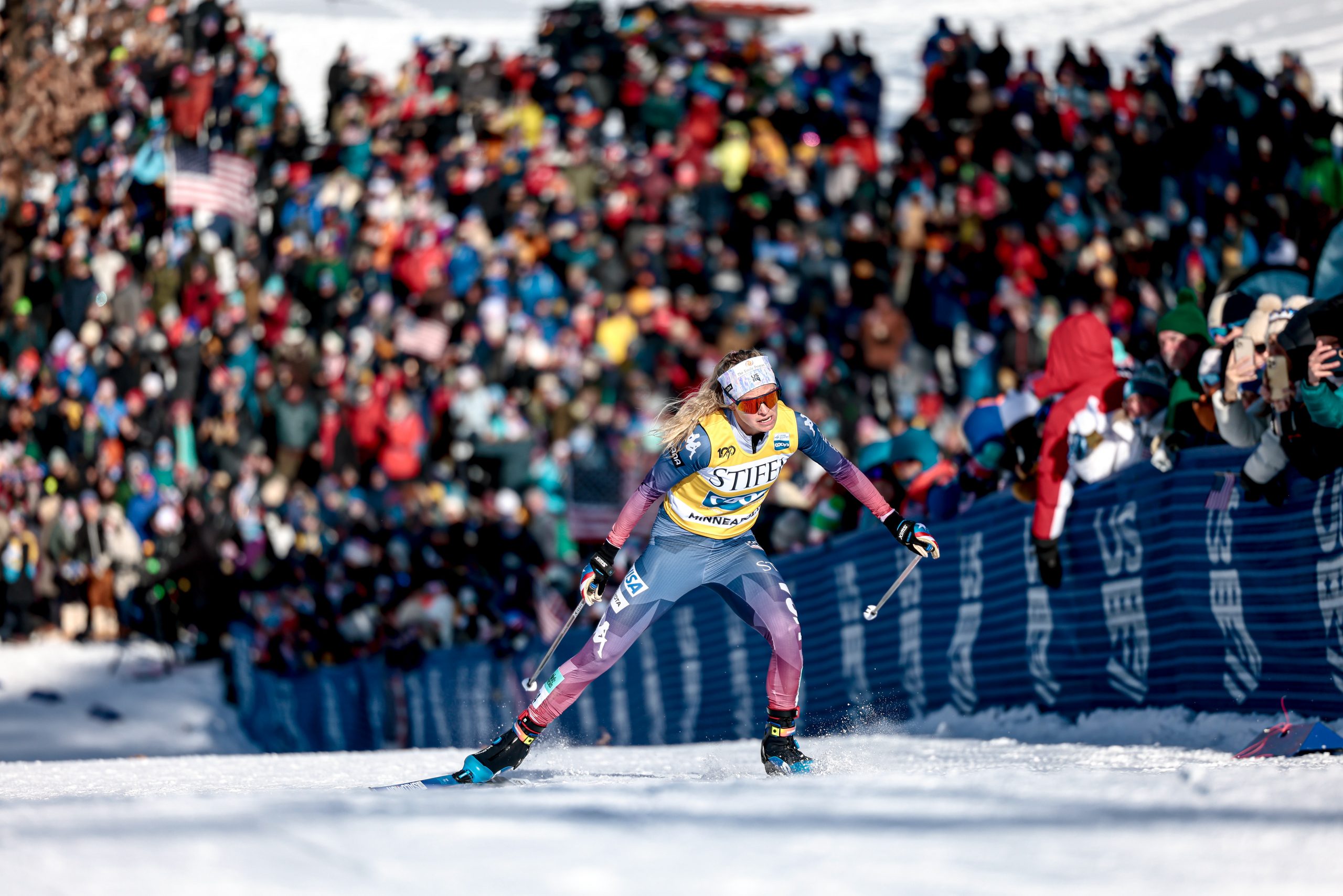
     

    Oskar Opstad Vike (NOR), Johannes Hoesflot Klaebo (NOR), Alvar Myhlback (SWE), (l-r) take the individual classic sprint podium in Trondheim (NOR) – Klaebo’s 100th World Cup victory. (Photo: Modica/NordicFocus)
  • The U.S. Ski Team Star You Won’t See on Snow This Weekend

    The U.S. Ski Team Star You Won’t See on Snow This Weekend

    On Friday afternoon, as World Cup sprinters snap into their skis in Trondheim and the SuperTour fields gather in Fairbanks, one of the United States’ most electrifying young Nordic athletes will step onto an entirely different stage. Stanford University, the No. 1 seed in the NCAA Women’s Soccer Tournament, is marching toward the College Cup—and at the center of it all is a player who, in just a matter of days, will also begin her bid for the U.S. Olympic Cross-Country Ski Team.

    The athlete is Sammy Smith: 20 years old, a national-team skier, an Environmental Systems Engineering major, and a starter for one of the most dominant college soccer programs in the country. The U.S. Ski Team views her as one of the most promising sprinters of her generation. And yet this weekend, instead of warming up on hard-packed snow in Norway or chasing early-season points in Alaska, she’ll be preparing to face Duke with advancing to the NCAA Championship Game on the line.

    “Get ready to cheer for one of the U.S. Ski Team’s top skiers this weekend,” you might tell Nordic fans. “Just… not on skis.”

    From the outside, the collision of seasons looks impossible to manage. For Smith, it is simply the life she has known since childhood.

    Idaho in Two Parts

    Smith grew up in a pattern that almost feels mythic now: winters in Sun Valley, summers and the rest of the year in Boise. Her family built the rhythm—her mom moving the kids north each winter so they could ski full-time and homeschool them in those snowy months.

    “I kind of grew up splitting time between Boise and Sun Valley,” Smith says. “My mom would move up to Sun Valley during the winter with my siblings and me so we could ski, and she would homeschool us up there… I did that all through high school.”

    In Boise, she was a typical public school student. In Sun Valley, she became a multi-sport anomaly. Her childhood was not just active—it was encyclopedic.

    “Growing up, I played about every sport one can imagine,” she says. “I ran track and cross country all through high school… I played hockey for a long time. Played football. Yeah, like, you name it, I pretty much did it.”

    Soccer was the constant. She started as soon as a child could sign up—though the Smiths occasionally bent age rules to make sure she could play with older kids. When her older sister started soccer, she was right behind her.

    “It’s probably like three years old when I started,” Smith says.

    And then there was freestyle skiing—a considerable part of her identity, something she expected to pursue more seriously than Nordic. Until one day, she couldn’t.

    “I ended up fracturing my tibia in my sophomore year,” she says. “And so I focused on Nordic that winter… I ended up having a great season, and then haven’t really looked back since.”

    The transition was abrupt, but the groundwork had already been laid: years of downhill confidence, years of skiing, years of learning to read terrain and push limits.

    “I’ve been on skis my entire life,” she says. “Very comfortable on downhills… I love to ski aggressively.”

    The athlete emerging in those years was already something unusual. The athlete she would become—balancing multiple sports at world-class levels—was still unimaginable.

    Against the Specialization Tide

    From the outside, Smith’s career appears to defy the common wisdom of modern youth sports. Increasingly, top athletes specialize early; by high school, many are all-in on one discipline.

    Smith resisted that. Not because she lacked ambition, but because multiple sports gave her joy—and made her better.

    “I think that’s something I’ve really thought a lot about,” she says. “There’s been more and more pressure to specialize… but growing up and doing so many different sports just kind of added to different components of skiing that I think are really important.”

    Soccer, for example, translates directly into sprint racing.

    “It’s a very high-paced game,” she says. “There’s a lot of change of direction, a lot of accelerating and decelerating. Particularly when you’re looking at heats, a lot of it is reacting to other people’s moves, trying to find little gaps and squeeze through.”

    The skill set becomes a competitive edge: quickness, agility, and decision-making under pressure.

    “That ability to shift gears really quickly and take openings when you can really emulates in soccer,” she says.

    Freestyle skiing contributed something else entirely: creativity and courage on skis, especially in chaotic or technical downhill sections.

    “At World Juniors last year,” she recalls, “everyone was in the track. I hopped out of the track, went far on the inside, and just double poled… It was a risky move, but it was something I saw.”

    She paused for only a moment before going all-in. It worked.

    The blend—soccer fuel, freestyle instinct, Nordic engine—gives her a uniqueness rarely seen in American skiing.

    U.S. Ski Team head coach Matt Whitcomb sees it clearly.

    “She’s a world-class athlete,” Whitcomb says. “She’s already exhibited the early signs of being a World Cup star.”

    That she is doing this while starting for Stanford’s soccer team? To him, it’s not a contradiction. It’s part of the magic.

    Why Stanford — and Why Now

    Choosing Stanford was not simple. Smith had options—many of them. But a few factors stood out.

    “I really value my education,” she says. “Stanford’s a great school. It’s where my mom went. And my sister is also on the soccer team, so the opportunity to get to play college soccer with her is pretty hard to pass up.”

    Her academic path—Environmental Systems Engineering with an energy concentration—fits a pattern among elite U.S. skiers. Many of the top men (Gus Schumacher, Ben Ogden, et al.) have gravitated toward engineering. Smith sees the overlap, too.

    “You look at a skier and the training that they do,” she says. “They’re very self-motivated, very committed. So I’m sure certain aspects translate pretty well.”

    The challenge, of course, is that Stanford is far from snow. It is not close to ski culture. It is not close to the European World Cup circuit. It is very near, however, to one vital piece of equipment:

    “Fortunately, I have a classic roller-ski treadmill… in a little office space,” she says. “That’s been an irreplaceable part of my training.”

    She uses it for high-quality sessions, often squeezed between classes, labs, or soccer obligations. Running remains a central component, helped by the demands of soccer conditioning.

    But she knows her preparation is different—less volume, more precision. Not ideal. Not textbook. Not expected. And yet:

    “I think I’ve tried to accept that,” she says. “I know that I am not at my best, but skiing is a sport you can do for a very long time. I don’t necessarily need to be the best skier I can be at 20 years old.”

    Again, Whitcomb backs the long view.

    “We’re willing to postpone that timeline,” he says. “We’re just happy for Sammy being happy in her current environment. We’ll take what we can get at this moment, but we want more down the road, and we’re excited for it.”

    This, in many ways, is the crux of the story: the U.S. Ski Team is betting on Sammy Smith not despite her dual identity, but because of it.

    Samantha Smith (USA) racing the World Cup individual sprint in Goms (SUI). (Photo: Modica/NordicFocus)

    The Final Four — and Then the Sprint Start Line

    The most astonishing part of Smith’s season is its timing.

    If Stanford beats Duke on Friday in Kansas City, they move directly to the College Cup championship game. The semifinal is December 5th; the final is December 8th, Monday. Smith has already mapped out the days that follow.

    “We’ll get back Tuesday night from Missouri… I have a final at 8 a.m. Wednesday morning,” she says. “I’m going to fly out right after my final, and then I’ll have one day of snow on Thursday in Alaska, and then I’ll be hitting that sprint on Friday.”

    She says this calmly, matter-of-factly, like someone describing a standard weekend trip.

    The Anchorage SuperTour sprint is not just any race—it is her re-entry into skiing, her first day on snow of the season, and a crucial tune-up before U.S. Nationals in Lake Placid, where she hopes to qualify for the Olympic team.

    The Anchorage races, she says, are not performance indicators—they are simply a way to “bust the rust off.”

    “Obviously, a lot of other skiers will have been on snow for well over a month, and I won’t,“ she says. “It’ll just be an opportunity to get on skis, do something fast.”

    Her real focus is the 10-day window between Anchorage and Lake Placid.

    “For me, as more of a sprinter, and the way the criteria is set up, I’ve got to target the qualifiers,“ she says. “So being really deliberate… knowing exactly what I’m going for.”

    The stakes are simple: she must race well at U.S. Nationals to have a shot at Milano-Cortina.

    The stakes are also massive.

    Julia Kern and Sammy Smith paired up for the Team Sprint in Lahti (FIN). (Photo: Nordic Focus)

    The Domestic Gamble

    If Smith had a regular ski season—if she weren’t in the NCAA Tournament—she might have chased World Cup points, fought to crack the top 45, and used international racing to establish selection priority.

    But that route is closed.

    “If you’re only racing a few of the international races, it’s incredibly challenging to get into that top 45,“ she says. “Whereas if you were able to do all of them, it’s a lot more feasible.”

    She knows she has “had some really good World Cup sprints,“ and she wonders—without bitterness—what might be possible in a different academic or athletic setup.

    But this year, it is the domestic route or nothing.

    “That’s what I’m planning on,“ she says. “I need to have some killer races at U.S. Nationals.”

    What sounds like a gamble is, for her, simply the version of the sport she can access this season. And she is okay with that.

    “Just being consistent… being intentional,“ she says. “Doing what I can.”

    Who She Wants to Be

    Ask Smith what success looks like decades from now, and she doesn’t list medals or championships.

    “You look at Jessie’s legacy,“ she says, referencing Jessie Diggins. “The amount of skiers she’s inspired and how much she’s done for the sport… I want people to look back on my career and feel like I’ve done a lot for the sport, inspired the younger generation of skiers, and brought a lot back to my community.“

    It is the kind of answer that feels too mature for her age, but entirely in character.

    She is not racing to avoid mistakes—she is racing toward something: possibility, growth, a long future. Maybe a future on the World Cup. Maybe a future in engineering. Maybe a future doing both.

    But first, she has Duke.

    Samantha Smith (USA) racing the World Cup individual sprint in Minneapolis (USA). (Photo: Modica/NordicFocus)
    Samantha Smith (USA) racing the World Cup individual sprint in Minneapolis (USA). (Photo: Modica/NordicFocus)

    The Athlete You’ll Watch Twice This Month

    When you tune in this Friday—whether you are a Nordic diehard refreshing live timing from Trondheim, or an American fan checking SuperTour results—remember that one of the most important U.S. prospects in cross-country skiing will be competing too. She just happens to be wearing soccer cleats instead of ski boots.

    And next week, she’ll be back on snow, sprinting against the country’s best, staking her claim for a place on the Olympic team.

    The duality is not a distraction for Sammy Smith.

    It is her identity.

    It is what built her.

    And it might be what carries her into the future of American skiing.

    “She’s been playing a ton this year,“ Whitcomb says. “Of course, we want her all to ourselves… but we want more down the road, and we’re excited for it.”

    This weekend, she wants one thing: a berth in the College Cup Final.

    Next weekend, another: a ticket to the Olympics.

    Two worlds.

    Two uniforms.

    One athlete.

    A lot of people will be cheering for Sammy Smith this month. Nordic fans just get to do it twice.


    *You can watch #1-ranked Stanford vs. #2-ranked Duke in the women’s College Cup semifinal tomorrow, Friday, December 5, at 8:45 p.m. EST on ESPNU. The game can also be streamed on the ESPN app, Fubo, or Hulu.


    Love Stories Like This? Help Keep Them Coming.

    Feature interviews like this one take time, access, and care to produce. If you value thoughtful storytelling and independent ski journalism, please consider becoming a Voluntary Subscriber. Your support directly fuels the work we do to cover the people, places, and moments that make our sport special.

    Join the FasterSkier community!


    Sammy Smith (USA) in the World Cup individual sprint in Tallinn (EST). (Photo: Modica/NordicFocus)
  • The Road to Ruka: A Sunset Bus Ride into the World Cup Winter

    The Road to Ruka: A Sunset Bus Ride into the World Cup Winter

    This coverage is made possible through the generous support of Marty and Kathy Hall and A Hall Mark of Excellence Award. To learn more about A Hall Mark of Excellence Award, or to learn how you can support FasterSkier’s coverage, please contact info@fasterskier.com.

    Aerial view of Ruka (FIN) this morning, with the start of the World Cup season less than a day away. (Photo: Modica/NordicFocus)

    For six hours on Tuesday, the U.S. Cross-Country Ski Team watched Finland scroll past the windows of a northbound bus, the day’s thin slice of sunlight slanting low across the snow. The sun in late November never rises entirely above the horizon there—”maybe ten degrees,” Matt Whitcomb noted—and so the world outside was washed in a pastel light that never quite felt like midday. In that part of the Arctic, sunrise and sunset are effectively the same event.

    That is the moment Whitcomb pays attention to every year.

    “As it sets, as you’re driving in those first two hours of the bus ride,” he said, “it sort of feels like it’s the official close of the preparation season.” The athletes may have left Muonio only hours earlier, but that sunset marks a boundary: everything before is training; everything after is racing. “That’s it,” he said. “The prep season’s over. It’s time to race now.”

    The bus carried all seventeen athletes—nine men and eight women—each holding a different version of readiness. Some were energized, some were still finding their legs, some were quietly anxious. An Olympic season magnifies everything. For veterans, this opener in Ruka is familiar and charged; for athletes on the bubble, the weekend marks the start of a two-month test whose outcomes will determine whether they get to ski in Italy in February.

    But for one last window of time, before the waxing trucks and the bib pickup and the official training, the whole team was suspended in this Arctic twilight. It is a soft entry into what quickly becomes a hard world.

    When the bus crested the final kilometers into Ruka, the athletes looked out the left side toward the hill that dominates the course—a climb they will race up and over repeatedly in the coming days. “Every year,” Whitcomb said, “that road goes right up the largest hill on the course… your first trip up that is in the bus.” The hill glowed under floodlights. Below it, the village looked like it had been placed inside a glass ornament. “It’s lit up like a snow globe around here.”

    By the time the athletes stepped off the bus and into the cold, the World Cup season had begun.

    Jessie Diggins (USA) was able to find another gear at the finish which no one could match to take victory in Ruka a year ago in the Mass Start. (Photo: NordicFocus)

    What They Carry From Muonio

    A week earlier, the team was skiing through air so cold it could freeze eyelashes. Muonio is remote even by Finnish standards, a strip of trails and cabins surrounded by deep quiet. The temperatures dropped to –5°F for the high and –10°F for the low, and the athletes masked up, moving carefully to avoid frozen lungs. No one did intensity that day; even the coaches agreed the cost wasn’t worth the risk.

    And yet the camp was a success.

    “It was right on the edge of being too cold,” Whitcomb said, “but we made it work. And nobody has residual coughing, so I think that’s the tangible indicator that we didn’t push too hard.”

    More importantly, Muonio was calm this year. There were no lingering illnesses, no cascade of early-season injury setbacks. “This year has been a better year with regard to preparation,” he said. “We’ve had fewer long-term illnesses, fewer acute injuries.” In an Olympic season, where every missed week feels like a month, that is no small thing.

    Muonio is the last place where the athletes can simply train, ski, nap, and repeat. Once they arrive in Ruka, the season accelerates in a way no one can fully control.

    Zanden Mcmullen (USA) coming to the line in Ruka in 2024. (Photo: Thibaut/NordicFocus.)

    Ruka’s Glow and Ruka’s Pressure

    Ruka is where the World Cup hardens into its proper form. The quiet trails of Muonio are replaced by a carnival of nations: wax trucks pulled side by side, technicians moving in practiced circuits, athletes from every powerhouse country striding around the stadium. For all teams, the opener reveals the truth of the summer: whose fitness is real, whose technique held up, whose body needs another two weeks before coming online.

    “The moment we arrived here in Ruka,” Whitcomb said, “you start to see the waxing vehicles from other nations… the reality of it hits, and you could feel butterflies sort of emerge as a team.” Even the veterans feel it. “Munio last week was all about recovering from jet lag… and you arrive here, and it’s like: official training, then race, race, race. It’s go time now.”

    He emphasized that the stress is not negative. Stress, in his framing, is a sign that something meaningful is at hand. “It’s indicative of the privileged environment that we live in,” he said. “We’re doing something important, something these athletes work really hard for, and something that they’re ready for—and that’s why they feel stressed.”

    In an Olympic year, there is no such thing as a low-pressure opener.

    The U.S. team looks on in Ruka in 2023.  (Photo: NordicFocus)

    The Team Within the Team

    The most striking thing about this group, Whitcomb said, is not its athletic potential—though several athletes are carrying top-10 ambitions into the weekend. It’s the internal energy.

    “It feels as supportive a team as I think we’ve ever had,” he said. “Not better, but certainly as good as any team we’ve ever had.” A year ago, he described a similar feeling, but something about the last month apart has deepened it. “They just vibe together,” he said. “They’ve really missed each other.”

    From outside, the U.S. team can look like a logistical patchwork—athletes based in Vermont, Alaska, Idaho, Colorado, Norway; college skiers who drop in and out; development athletes rotating through Europe. But when they’re together, Whitcomb believes the culture gives them a competitive advantage.

    “One of the privileges our nation has,” he said, “is that we are not as competitive as Norway is.” He doesn’t mean competitive in results—he means internally. In Norway, a single race in Beitostølen can determine whether an athlete gets a World Cup start or disappears back into domestic anonymity. “Literally that one race… has a lot of say in whether your winter is going to be successful,” he said.

    In the U.S., the pressure comes from the Olympics, not from your teammates. “A positive team vibe really does some work for you,” he said. It prevents the “little stresses”—the ones that accumulate in toxic environments—from becoming overwhelming in an Olympic year.

    “When the only stress you have to worry about is the silly one that is racing,” he said, “you can overcome that.”

    Jessie Diggins (USA) keeping it light with her coach, Jason Cork. (Photo: NordicFocus)

    Olympic Stakes, Explained Clearly for Once

    For athletes and coaches, the rules of Olympic selection are a map that everyone has memorized; for the public, they are a maze. Whitcomb walked through the system with the clarity of someone who helped write it.

    There are three primary pathways:

    1. Top-8 in an Olympic event on the World Cup

    If an athlete finishes top-8—but only in a race that exactly matches an Olympic event—they automatically qualify.

    Classic sprint in Trondheim? Yes.

    20k Skiathlon in Trondheim? Yes.

    10k skate in Davos? Yes.

    Team sprint? No.

    Any race similar but not identical (ie, the 15k Skiathlons)? No.


    2. Top-45 on the World Cup ranking list (by Oberhof)

    Any athlete inside the top-45 overall (distance or sprint, depending on discipline) meets the selection criteria. They still need a spot available, but their case becomes strong.


    3. Discretionary selection

    This exists—but is avoided whenever possible.

    “To be candid,” Whitcomb said, “that’s a goat auction in itself.”

    In an Olympic year, the staff prefers not to touch discretion at all.

    Ben Ogden (USA) working on ski selection on Thursday in Ruka (FIN) a year ago. (Photo: NordicFocus)

    Roster limits

    Right now, the U.S. holds seven men’s spots and eight women’s spots, with a realistic chance of earning an eighth men’s spot. It will not exceed 8 + 8.

    Domestic results?

    For someone skiing exceptionally well at Senior Nationals to force their way in, there must be vacancies left by athletes who didn’t meet criteria on the World Cup. In most years, Olympic qualification is won or lost by Christmas.

    This is why every World Cup start in Period 1 matters. Every 12th place, every quarterfinal, every decent distance day contributes to the math.

    But to Whitcomb, that math isn’t the point. It’s how athletes handle pressure that determines whether the season becomes joyful or claustrophobic.

    “Meet Your Body Where It Is”

    On Thursday night, in the team meeting before the weekend races, Whitcomb planned to give a simple message.

    “You start that 10k, and you’re going up the first hill,” he said, “you just meet your body where it is. You do your very best that day.”

    He wants the athletes to tune out the noise:

    • the coaches on the sides of the trail
    • the athletes they pass
    • the athletes who pass them
    • the crowd, the music, the reporting, the points

    “You deal with the one vehicle that you’re driving,” he said. “And you try to enjoy it.”

    Because fitness today doesn’t predict February.

    Because the Olympic Games begin on February 7th, the only date that truly matters.

    Because early-season expectations are a trap: some athletes are ready this weekend; others won’t feel themselves fully until the Tour de Ski.

    “The human body,” he said, “is a wildly unpredictable thing.”

    If there is one truth that governs the first weekend of racing, it is that.

    Julia Kern testing her skis with her longtime tech, Eli Brown a year ago. (Photo: NordicFocus)

    Why Ruka Still Matters

    Still, the weekend is not symbolic. It is competitive, decisive, and formative. Whitcomb believes the team is “positioned well to have a great opener,” but he also knows that Ruka rarely tells the whole story of a winter. The temperatures are often frigid, and the travel is too recent. But it gives athletes one thing they cannot simulate anywhere else: the clarity of racing.

    “Early,” he said, “but it can’t come soon enough. We’re really excited.”

    Ruka is where the starting gun echoes for the first time, but it’s also where the season’s unseen forces begin working: confidence, doubt, momentum, cohesion, luck, health, and perspective. Many Olympic stories begin here without anyone realizing it until months later.

    The First Night in the Snow Globe

    By Tuesday evening, the team had unpacked their bags in the small condos near the stadium. By Wednesday, when we spoke, through Whitcomb’s thin door, we could hear athletes talking after dinner—laughing, telling stories, building team chemistry. “You can hear people probably through my door,” he said, because “they’ve really missed each other.”

    Outside, the northern lights edged across the sky.

    Inside, there were skis to prep, race plans to finalize, nerves to manage.

    And in the morning, the first climb of the season would begin at the bottom of that hill they had ridden over on the bus.

    There are a few actual rituals in a sport defined by travel and unpredictability. But in the U.S. team’s calendar, the bus ride to Ruka is one of them. It marks the line between the world that was and the one that’s about to begin. Between training and racing. Between imagining and knowing.

    The sun had long since set, but the trail lights of Ruka glowed through the fog, warm against the cold.

    The World Cup season officially starts tomorrow.

    And for the U.S. team—healthy, united, a little nervous, and very ready—there is nothing left to do but ski.

    Rosie Brennan (USA) dialing in her skis a year ago. (Photo: Modica/NordicFocus)

    How to Watch

    In the United States:

    Ski and Snowboard Live


    Schedule

    November 28th:  

    10k Interval Start Classic – Women at 4:30 am EST and Men at 7:15 am EST

    November 29th:  

    Classic Sprint – Heats begin at 5:25 am EST

    November 30th:  

    20k Mass Start Freestyle – Men at 4:00 am EST and Women at 5:45 am


    Love Stories Like This? Help Keep Them Coming.

    Feature interviews like this one take time, access, and care to produce. If you value thoughtful storytelling and independent ski journalism, please consider becoming a Voluntary Subscriber. Your support directly fuels the work we do to cover the people, places, and moments that make our sport special.

    Join the FasterSkier community!


    Jessie Diggins (USA) celebrates a hard earned victory in the Ruka 20k Freestyle in 2024. (Photo: NordicFocus)
  • The Hilltop Lesson: How Second Place at the NCAA Championship Became Hagenbuch’s Guiding Philosophy

    The Hilltop Lesson: How Second Place at the NCAA Championship Became Hagenbuch’s Guiding Philosophy

    On a bright March afternoon at Dartmouth’s Oak Hill, with a soft and slow course under his skis and a band he himself had organized blasting in the stadium above, John Steel Hagenbuch approached the final climb where he learned something that would shape the early years of his career far more than any podium ever could.

    He had come into the NCAA Championships with the weight of a thousand private dreams — a home championship crescendo and an entire community behind him. Then, with Utah’s Joe Davies charging to the finish line waving the Utes flag and Peter Graves’ voice echoing through the trees, Hagenbuch realized he was not going to win.

    “I got dropped, and it just wasn’t gonna happen,” he says. “I told myself, you’ve got until the top of this hill to be upset about it.”

    John Steel Hagenbuch was all smiles after crossing the 20k Freestyle finish in second place at the 2025 NCAA Championship where he represented Dartmouth College on their home course at Oak Hill. (Photo: Courtesy Photo)

    What happened next wasn’t the reaction of an athlete who had just been beaten in the race he’d been thinking about, talking about, training for, and dreaming about for three years. It was something quieter. Something older. Something that didn’t look like the scripted champion he’d imagined — but ended up becoming the cornerstone of the athlete he is now.

    “I stopped poling,” he says. “And I just kind of skated through the stadium… smiling, waving, like the Penguins of Madagascar — smile and wave.”

    He remembers the sunshine, the thousands of people lining the stadium, the Stripers — Dartmouth’s biggest student band, coaxed back from post-graduation life because he wanted the place to feel alive — and the thrum of friends, professors, fraternity brothers, and family in the crowd.

    “Did I win the ski race? No. But it actually didn’t matter,” he says. “I was just so grateful… all the amazing things in my life that had led me to that point.”

    Every day since, he thinks about that race. “But not for the reasons you’d expect.”

    John Steel Hagenbuch (USA) racing the World Cup opener in Ruka (FIN) in 2023. (Photo: Modica/NordicFocus)

    Muonio, Finland: The Final Quiet Before the Season Begins

    Eight months later, Hagenbuch is sitting in a small room in Muonio, Finland, speaking over a fickle internet connection. Outside, winter is closing in; inside, the early-season nervous energy is beginning to hum.

    “It’s been a good way to start the season,” he says of the classic sprint and 10k skate he raced the previous weekend. “Hopefully more to come.”

    He will likely stay on the World Cup through the Tour de Ski. His primary goal, stated simply and without ornament, is clear: “Primary goal is to go to the Olympics. Everything else is secondary.”

    He’s 24, still at Dartmouth — technically a senior, though he took this fall off to focus on training. When winter term begins on January 7, he’ll be back in class, shifting between World Cups and essays, navigating the dual life of a college student and a professional skier the way only NCAA athletes truly understand.

    But he is not rushed. Not impatient. Not gripping the rail of his career with white knuckles.

    He learned something on that hill at Oak Hill, something that has become his ballast. “It reminds me why I do this,“ he says. “And why this sport is so special.”

    Before he was an NCAA champion, skiing on the World Cup, and a trying to qualify for the Olympics, John Steel Hagenbuch was just a kid who loved skiing around on the trails of Sun Valley, ID. (Photo: Courtesy Photo)

    The Long View: Three Olympics and a Full-Moon Ski

    Hagenbuch surprises you with the distance of his vision.

    When asked about the future, he doesn’t talk only about Milano-Cortina in 2026. He talks about three Olympics — a decade of life sketched out in calm, confident lines.

    “I would love to go to the next three Olympics,“ he says. “Milano-Cortina, then the French Alps, and then retire at the Salt Lake City 2034 Games.”

    Soldier Hollow, where he has raced “probably 50 times,“ would be the perfect ending. But it’s not the race he imagines most clearly. Not the ceremony. Not the result.

    It’s the lead-up.

    “What will be the crown jewel of my ski career,“ he says, “is having the 2034 Olympic pre-camp in Sun Valley. At my house. With all the fellows.”

    He can picture it already: the team skiing at Prairie Creek under a full moon, crispy tracks at 15 degrees after a sunny day, the quiet of the Sawtooths pressing close.

    “That’s what I’m gonna remember when I’m 75,“ he says. “That Prairie Creek ski.”

    In this way, Hagenbuch does not think like most 24-year-old athletes. He thinks like someone who has already lost something, already gained something, and has made peace with what remains.

    A Training Philosophy Built on Feel (and a Fearless Lack of Overthinking)

    In an era where professional endurance athletes run lactate strips daily and analyze heart-rate drift with the devotion of day traders, Hagenbuch stands apart.

    “Do you do lactate testing?“ I ask him.

    “Maybe like once a year.”

    He trains primarily by feel—not just how his body feels, but what he feels like doing: long backcountry days, ridge runs, mountain biking, skiing deep into the mountains around Sun Valley. There is structure, but only when he believes it should exist.

    “Not taking it too seriously,“ he says, “and kind of just going by what I would like to do and what I think is going to be fun.”

    June and July? “Absolutely not“ analytical. Fall? Yes, that’s when he “locks in a bit.”

    And if it ever stops being fun, he says, “I will not stick around.”

    He has seen athletes grind themselves into dust out of fear of what’s next. “I respect the grit,“ he says, “but… I’m incredibly grateful to have had experiences and opportunities in my life that that’s not the case for me.”

    He isn’t clinging to skiing. He’s choosing it — every day — until it no longer feels right.

    That clarity is rare. Maybe even elite.

    Being cheered up a climb in Soldier Hollow by one of his SVSEF coaches, Rick Kapala, John Steel Hagenbuch proves athletes like him aren’t built by themselves or through the guidance of one coach, they are lifted by a community. (Photo: Tryg Solberg/Courtesy Photo)

    The Consortium: Osgood, Whitcomb, Kapala, and Holmes

    Though he trains by feel, he is not without guidance. His coaching structure is more like a board of advisors — four voices, each offering a different vantage point.

    “I talk with Brayton at Dartmouth, and Matt on the U.S. team, and Rick — my high school coach — and Peter Holmes on the Gold Team,“ he says. “I get input from all of those guys.”

    When deciding to come to Muonio early, he called all four. Not for permission — for perspective.

    “When I’m at Dartmouth, I do Brayton’s plan,“ he says. “But if I feel like I need to do something different, he’s totally cool with that.”

    And contrary to what a young elite athlete might hope to hear, most of what they tell him is not “do more.“

    “Oftentimes,“ he says, “it’s settled down.”

    Dartmouth College’s John Steel Hagenbuch skied to a 15-second victory on his home trails in the 7.5 k Classic at the NCAA Championship. (Photo: Tobias Albrigtsen)

    The Place That Built Him

    If you want to understand why Hagenbuch thinks the way he does — why gratitude flows so naturally through him, and why he measures life through moments rather than medals — you have to understand Dartmouth.

    “NCAA skiing is a really special thing,“ he says. “People are going to roll their eyes… but there aren’t a lot of places that have the components Dartmouth has.”

    The social component is not a distraction — it’s a pillar. “Last year, every single guy on the team was in a fraternity,“ he says. “Different fraternities.”

    He explains the structure: students join Greek life in their sophomore year, after they’ve already found their people, their communities, their balance.

    “Everything acts as a complement,“ he says. “And providing that much balance… makes everything greater than the sum of its parts.”

    The feeling at NCAAs captured this perfectly. “Anyone who was there,“ he says, “left thinking two things: college skiing is [so] sick and Dartmouth is [so] sick.”

    He means it.

    And he knows it won’t come again — not in this form.

    Luke Allen, one of his closest friends, once asked an older alumnus if life ever gets as good as Dartmouth skiing. The man looked him straight in the eye and said, “No.“

    There was lots of great energy at Oak Hill for the final day of the 2025 NCAA Championship. (Photo: Tobias Albrigtsen)

    The Beauty of Losing

    Here is the strange and elegant truth of Hagenbuch’s current career: his most important athletic memory is a loss.

    He doesn’t hide from that. He doesn’t twist it into “motivation“ or pretend it fuels some internal fire for revenge.

    Instead, he carries it like a compass.

    “I think about that race every single day,“ he says. “But not because I lost… It reminds me to be grateful for these amazing people, places, and things in my life.”

    He printed 150 photos at CVS the night before leaving Hanover in August — family, friends, the Haig Glacier, Sun Valley, Dartmouth — and plastered them across his fridge at home.

    “Think how many times a day you walk by your fridge,“ he says. “All my friends are right there.“

    It’s his daily reminder of what matters.

    The Thursday classic race at NCAAs, the unexpected great day, the team’s move from fifth to first — these have become larger in his memory than the race he thought he wanted most.

    “What was the special day at NCAAs?“ he says. “It was Thursday. I wasn’t even thinking about Thursday. I didn’t care how that one went.”

    And yet: “I had probably my best classic race ever… it was such a culmination of a lot of hard work and belief.”

    This is the philosophy he now lives by: you learn more from your losses, and sometimes the thing you didn’t expect becomes the thing you carry forever.

    John Steel Hagenbuch, who won the 7.5k Classic, celebrates with his teammates after the three raced Dartmouth into the NCAA Championship lead. (Photo: Courtesy Photo)

    The Advice Only Someone Who Has Lived It Can Give

    At the Haig Glacier last summer — years after his last high school camp there — Hagenbuch offered a piece of advice that caught the younger kids off guard.

    They were expecting training insight. Intensity zones. Technique tweaks.

    Instead, he told them the thing he wishes someone had told him at 15:

    “Be a kid more.”

    Growing up in Sun Valley, he had an idyllic childhood — but he wishes he’d stayed on the high school soccer team after freshman year. Wishes he’d allowed himself to do more of what felt right, not what looked right.

    “Don’t try to do what you think you should do,“ he says. “Do what you feel you should do.”

    And if your friends are doing something slightly reckless, something that wouldn’t make the parental brochure?

    “Maybe… F-it, do it,“ he says, laughing. “You’ll figure it out for yourself.”

    Because that, too, is how you learn.

    John Steel Hagenbuch (USA) racing the individual sprint at the Minneapolis World Cup. (Photo: Modica/NordicFocus)

    A Career Just Beginning, with the Wisdom of One Already Lived

    Hagenbuch is young — young enough to dream of three Olympic Games, young enough to talk about walking onto the Dartmouth lightweight rowing team or running the 5k or 10k for the track team “as a fun challenge“ in his final spring on campus.

    But he is also old in the ways that matter. Not jaded — never that. But precise in what deserves his attention, and ruthless in discarding what doesn’t.

    He knows what a good race feels like: “When you finish and think, damn, I could have gone a little harder.”

    He knows what a good life feels like: something filled with people and place, community and joy, full-moon skis and carnival tailgates and the band you recruited yourself playing you through the stadium after a loss.

    And he knows — already — that the real currency of this sport isn’t medals, nor money, nor even wins.

    “If you wanted to have glory or make money in sports,“ he says, “we’re all doing the wrong sport.”

    So what is it about?

    “It’s about the things I’ve talked about,“ he says. “It’s the parking lot tailgates. The little antics in the van. The dumb jokes with your boys. The feeling of being part of something bigger.”

    And that’s why the NCAA hilltop moment carries him into this World Cup season — a season he hopes travels through Italy, under Olympic lights, wearing the colors he’s dreamed about.

    Because that hill taught him the thing every great athlete eventually learns:

    Sometimes the race you don’t win becomes the story you never stop telling.

    Sometimes the best version of your career begins the moment you stop being upset… and start taking in the view.


    Love Stories Like This? Help Keep Them Coming.

    Feature interviews like this one take time, access, and care to produce. If you value thoughtful storytelling and independent ski journalism, please consider becoming a Voluntary Subscriber. Your support directly fuels the work we do to cover the people, places, and moments that make our sport special.

    Join the FasterSkier community!


  • The New JC Schoonmaker: Sharper, Calmer, and Ready for the Moment

    The New JC Schoonmaker: Sharper, Calmer, and Ready for the Moment

    When JC Schoonmaker talks about his earliest memories of ski racing, he doesn’t begin with speed or snow conditions, or the particular magic of gliding across winter trails. He starts, instead, with raffles. “I just remember as a kid, there’d be raffles after every race that I would be so stoked for,” he says. “Trying to get a prize, like a new pair of gloves or a hat.” It is an unexpectedly tender snapshot of a skier now known for his explosive starts and the sharp, angular drama of World Cup sprint heats. But it is also revealing. Long before Schoonmaker was on national team radars, long before he was analyzing sprint tactics or refining breathwork, he was simply a boy who loved showing up at races, surrounded by friends, snow, and the possibility of leaving with a hat.

    Schoonmaker grew up in Tahoe, a place where winter sport is woven into the fabric of childhood. Yet unlike many of the region’s rising athletes, he was not funneled into Alpine skiing or a single disciplinary track. Instead, he moved constantly—and in every direction. “Both my parents were super athletic, into sports,” he says. “So from a really early age, I was just doing tons of different stuff: soccer, downhill skiing, and Nordic skiing. I played lacrosse. A little bit of baseball.” The variety shaped him in ways he didn’t appreciate at the time: balance from soccer, strength from downhill, elasticity from lacrosse, and a developing sense of rhythm from all of it.

    Meanwhile, the Nordic community in Tahoe was small enough to feel intimate yet substantial enough to provide him with peers, mentors, and a place to grow without suffocation. “Joining a Nordic team for me was super fun because I got to go out and ski with friends,” he says. “It was kind of my first experience racing.”

    The U16 men’s podium from the 5 k Classic Mass Start at 2015 U.S. Junior Nationals at Auburn Ski Club in Soda Springs, Californial. JC Schoonmaker took home third place. (Photo: Mark Nadell/MacBeth Graphics)

    Early Validation in Soldier Hollow and Truckee

    It wasn’t until he traveled outside his region that Schoonmaker realized how he measured up. On a Far West trip to Soldier Hollow—his first time racing beyond his local bubble—he surprised himself. “I think I got third in the first race… then I won the second one,” he recalls. “I didn’t even really know it was a big deal, but all the older kids on the trip were… really excited for me.” Their reaction revealed something he hadn’t yet recognized: that his potential extended well beyond his local podiums.

    A similar revelation arrived at Junior Nationals in Truckee, where home snow became a proving ground. He had hoped to earn All-American status, although the early races had gone poorly. “All the first races didn’t really go super well,” he says. “I had high expectations.” Yet in the final individual race before the relay, he stepped onto the podium. “Somehow onto the podium and got third,” he says. “That gave me a bunch of confidence… really helped me.” It was not just affirmation but a directional sign. Skiing was becoming more than an activity. It was becoming a path.

    Gus Schumacher (Alaska Winter Stars/Team Alaska), center, won the U20 men’s 15K classic mass start race at the 2019 U.S. Ski & Snowboard Cross Country Junior National Championships at Kincaid Park. J.C. Schoonmaker (UAA-Auburn Ski Club/Far West), left, was second, followed by Cameron Wolfe (Ski and Snowboard Club Vail/Rocky Mountain), right.  (Photo: Michael Dinneen)

    Choosing Anchorage and the Power of the Right Environment

    Despite his junior successes, Schoonmaker’s college recruiting process was sobering. His age cohort was stacked—Gus Schumacher, Luke Jager, Canyon Tobin—and their achievements overshadowed many strong skiers. “My top choice was UVM, and I just didn’t get a spot there,” he says. “I didn’t have a ton of options.” But an unexpected opportunity appeared when a Tahoe friend encouraged him to consider the University of Alaska Anchorage. He visited, and something clicked. “I’d say that’s the best decision I ever made,” he says. “I ended up coming to an excellent team… It’s an awesome place for skiing.”

    Anchorage wasn’t glamorous, but it was grounding: clear air, big terrain, and a training culture built on consistency rather than spectacle. Under coach Trond Flagstad, Schoonmaker’s skiing matured—his engine, his technique, and his confidence—all while laying the foundation for a collaborative coaching story that would shape his rise.


    A Uniquely Collaborative Coaching Path

    Schoonmaker’s development is defined by the unusually harmonious network of coaches who supported him. In Tahoe, he trained with Will Sweetser, whose workout creativity brought nuance to his summer training. At UAA, Flagstad built his fall rhythm with threshold work and bounding. In the winter, U.S. Ski Team coaches—Matt Whitcomb, Kristen Bourne, and Chris Grover—stepped in with race-day craft and a national pipeline. And now, in Anchorage, he works with Eric Flora at APU, whose daily presence has brought structure and clarity.

    “I feel like I didn’t even really have to do much in the way of balancing that,” he says. “Trond, Will, and Matt… kind of just took that on themselves.”

    That kind of multi-coach collaboration is rare. Instead of conflicting philosophies, Schoonmaker received overlapping layers of expertise, each building on the others. He remembers one of Sweetser’s signature interval sets with particular fondness: “Twenty seconds L5… forty seconds rest… forty seconds L5… then six minutes of threshold. A cool blend… essential for getting you ready for doing sprints on the World Cup.” Flagstad brought heavy doses of fall bounding at L4. Whitcomb and Bourne added race sharpness. Flora, finally, aligned everything. “Having him at World Championships last year made it feel like just a practice in Anchorage,” Schoonmaker says.

    JC Schoonmaker (bib #1) at the 2020 Senior Nationals in Houghton Michigan. (Photo: Reese Brown)

    The Unexpected World Cup Start That Changed Everything

    The first moment when Schoonmaker truly understood the trajectory he was on came suddenly. At U.S. Nationals in Houghton, Michigan, in 2020, he won the sprint qualifier. It was exciting, but he didn’t assume it meant anything beyond that day’s result. Then his assistant coach, Marine Dusser Bjornsen, approached him with unexpected news. “She was like, ‘Oh yeah, you’re gonna get World Cup starts from that,’” he recalls. “And I was like, ‘What? No way.’” His passport was expiring, his bags were unprepared, and within days, he was on a plane to Dresden.

    Stepping into the World Cup for the first time felt surreal. “I wasn’t even really worried about those being my first World Cups,” he says. “I was mostly just hoping to get to go over there.” The qualifiers felt manageable; the heats were startling. “Racing against those dudes in the heats… was just a whole other level. A different beast.” Still, he never felt crushed by the moment. “We were just having fun,” he says. “It wasn’t crazy high expectations.” That experience didn’t instantly transform him, but it recalibrated his sense of where he belonged.

    APU: A Training Collective That Became Home

    When Schoonmaker finished college and committed to training full-time in Anchorage, it wasn’t only because of Flora’s coaching. It was because the environment felt like home. “Luke coming back… Gus joining… Zan and Michael… it was such a good team,” he says. “A lot played into it… but mostly that stuff.” APU is one of the few places in the country where the majority of the national team trains together throughout the year, creating a rare sense of continuity on the World Cup.

    Yet even in a group that suits him so well, Schoonmaker knows he needs occasional solitude to stay balanced. “I definitely find times during the summer where I’m pretty excited to do an interval session by myself,” he says. “I grew up training alone in Tahoe.” Winter, of course, is different. “You’re living with this group of people for the entire winter,” he says. “Sometimes it is hard to find time to yourself.” But the team understands him. “Everyone knows whatever’s best for you is what’s best for the team.”

    A New Kind of Training: Mindfulness and Sprint Awareness

    This year, Schoonmaker added something he had never practiced formally: daily mindfulness training. “Some breath holds… super simple, just five minutes of mindfulness,” he says. “Focusing on my breath, trying not to let my thoughts wander.” The shift wasn’t driven by physical shortcomings, but by an honest assessment of where he needed to grow tactically. “In sprint heats… I’ve tended to have my head down, thinking about my technique… rather than, ‘I need to get this position around this corner.’”

    Mindfulness gave him a way to sharpen his presence during races and training. During intervals, he began noticing moments when his focus drifted. “My mind starts thinking about what I’m gonna have for lunch,” he admits. “I’m getting better at bringing myself back… loosen up, ski relaxed.” The work is subtle, internal, and mostly invisible, yet deeply connected to the kind of racer he wants to become.


    Passing It On: What He’d Tell the Next Generation

    If Schoonmaker were speaking to a group of juniors in Tahoe today, he would know exactly what he would emphasize. “I love this puzzle of trying to get better every day,” he says. “Focus on the small things you can control… let the cards fall where they fall.” But he would also add a piece of training wisdom gained from experience. “I almost feel like I got a little too caught up in L1 and L3,” he says. “Walking up hills on classic skis isn’t getting you better at classic skiing. You have to ski fast to get better at skiing fast.” It is the kind of message that cuts through both trends and dogma.


    Life on the Road: Davos, Oslo, and a Simpler Suitcase

    Schoonmaker’s favorite destinations reflect a balance of beauty and familiarity. Davos stands out. “I’d love to go there when I’m not getting ready for the Tour de Ski… explore it a little more,” he says. He also holds a soft spot for Oslo. “That’s a special spot. I always feel like I’m having a really good time there.” On race mornings, he keeps things simple: “Probably a couple eggs and a few pieces of toast with jam.” And he no longer travels with the heaviest item from his early career. “I brought over an Xbox… took up, like, 12 pounds in my bag,” he laughs.

    Schoonmaker and girlfriend, Emma Ribom (SWE). (Photo: Courtesy Photo)

    Olympic Season: Ambition, Clarity, and the Calm Before the Heats

    Despite the stakes of the Olympic year, Schoonmaker hasn’t reinvented his approach. “I honestly haven’t been doing anything different,” he says. “I’m more excited to be healthy and head into Period 1 feeling good.” But his goals are not small. “My goals would be to win a medal,” he says. “That’s what I’m shooting for.” A chance to race the relay again is just as meaningful. “The relay in Trondheim was super fun,” he says. “I would love to get another chance.”

    As for the individual sprint, his ambition is both grounded and bold. “If I could make the final… that would be a solid day,” he says. “But I do feel like I can win a medal.” Few athletes can express that kind of aim with such composure. Schoonmaker delivers it as calmly as if he were describing a morning ski.

    JC Schoonmaker (USA) had a breakout day in Oestersund (SWE) in 2023, reaching the podium for the first time. The American took third place. (Photo: NordicFocus)

    Where He Stands Now

    What stands out most about Schoonmaker at this moment is not bravado, but clarity. He is no longer the boy who raced for raffle prizes, nor the college skier unsure of his place, nor the rookie dragging an Xbox through European airports. He has become something steadier, more self-aware, and more intentional. A sprinter with composure. An athlete with perspective. A competitor capable of holding his ambition lightly without losing its sharpness.

    Presence, for Schoonmaker, is not stillness. It is an ongoing process of tuning himself to the shifting rhythms of a sprint heat, listening to what his mind and body are telling him, and moving through the season with intention rather than urgency. If he keeps his head up—literally and figuratively—this may be the season when the skiing world begins to see not only what he has built, but why it was built this way.


    Love Stories Like This? Help Keep Them Coming.

    Feature interviews like this one take time, access, and care to produce. If you value thoughtful storytelling and independent ski journalism, please consider becoming a Voluntary Subscriber. Your support directly fuels the work we do to cover the people, places, and moments that make our sport special.

    Join the FasterSkier community!


  • Rooted in Vermont: Tabor Greenberg’s Steady Rise from the Mad River Valley to the U.S. Ski Team

    Rooted in Vermont: Tabor Greenberg’s Steady Rise from the Mad River Valley to the U.S. Ski Team

    The hills above Moretown are the kind that teach you to move without thinking about it: long grades through maple and birch, a tangle of dirt roads, a thousand sneaky rollers perfect for running shoes or a classic stride. From the valley floor, you can see Sugarbush and Mad River Glen, their lifts still in October and their trails crisscrossed by hikers who’ll be skiers in a few short weeks. This is the terrain that shaped Tabor Greenberg, and it’s never been far from him. He grew up here, learned to love motion here, and now—a few towns and a handful of highway exits away—wears UVM green while settling into his sophomore year and his first season as a member of the U.S. Cross-Country Ski Team.

    He smiles about the small details—like the tiny airfield that doubles as the local ski area where he first wore Nordic skis—and shrugs at the big ones, the ones that make headlines. He’s Vermont in that way: spare with words, long on work. “I’ve been skiing my whole life,” he says, recalling the first slip-on-your-boots skis and the BKL weekends that threaded winters together.

    Tabor Greenberg at the 2024 Junior Nationals in Lake Placid, New York.  (Photo: courtesy of Olympic Regional Development Authority / Phillip Belena)

    His dad was an alpine racer who transitioned to Nordic skiing after sustaining injuries; the family kept everyone in motion, engaging in hiking and running in the summer, as well as soccer and lacrosse.

    By seventh grade, Greenberg had joined GMVS, stepping into a team culture that combined high standards with a sense of play. Older athletes, such as Brian Bushy and Josh Valentine, became the big brothers who made training feel like a privilege rather than a chore. “Their enthusiasm always made the workouts more fun,” he says. “Seeing them go to U18s in Estonia or Youth Olympics, I didn’t even know what those things were at first. I just saw them going to Europe to do these bigger races and thought, ‘That seems fun.’ I want to do that.”

    That is as close to a “secret formula” as you’ll get from him. There’s no magic threshold session in his story; it’s a years-long accumulation of good days outside with people he liked being around. “Most of my motivation comes from that,” he says of the lifestyle—then adds, almost apologetically, that he’s built the discipline to do the work even when motivation lags.

    A tough first year—and a reset

    College arrived with promise and some hard lessons. Greenberg’s first season at UVM was marred by extended illness. He red-shirted, raced sparingly, and spent too many days horizontal. “I struggled being sick all season,” he says. “So this year it’s mainly been just trying to stay healthy—good recovery, sleeping a lot, staying hydrated, having a good connection to doctors if something does come up.”

    UVM’s Head Coach, Patrick Weaver, doesn’t sugarcoat it. “Tabor’s first year was undoubtedly a tough transition, as he came in dealing with an extended illness that he struggled with throughout the year, so he essentially ended up not racing for UVM at all,” Weaver says. “This year he has come back in great shape and stayed healthy so far, so that’s been great—to see what he can do as a healthy person.”

    Weaver sees something else, too: a young athlete who changes the room simply by how he works. “He works extremely hard, and it’s his work ethic that’s been a valuable asset to the team,” says Weaver. “Leading by example like this helps bring up the overall level of the team.”

    And there’s the local angle that still means something in Burlington. “Having a Vermonter on the team is super important for the program. Having a fast Vermonter on the team is even better,” Weaver says. “We felt very fortunate that Tabor wanted to stay in Vermont and represent UVM and the state. This is something he’s super proud of, which is really fun to see.”

    Engineering the comeback

    Ask Greenberg about academics, and he answers as matter-of-factly as he does about training. He’s a mechanical engineering major, plotting a five-year path that allows the academic load to align with travel and race blocks. “I can do 12 credits a semester instead of 15 or 16 for the most part,” he explains. “It should ease the load a bit… hopefully manageable while traveling.”

    If the men’s U.S. Ski Team has a surprising number of engineers, Greenberg doesn’t read much into it. The field simply makes sense to him, a way to invest time in “quality concepts” while keeping a door open for life after skiing. But it’s easy to see the overlap when he talks technique: leaning farther into the hill in both V1 and V2, getting the arms forward, experimenting with double-pole positions, learning to find “forward without actually getting the feet up,” and keeping his shoulders relaxed while playing with different hip-drive patterns. He’s not obsessing over new lifts in the weight room—”not really,” he says when asked about special gym work—so much as building a better mental model and then holding those shapes during long skis.

    And there’s a plan behind the plan. Greenberg still consults with longtime coach Colin Rogers while working daily with Weaver. “Especially when I’m not at school, my plan is I kind of run it by both Colin and Patrick,” he says. “Going into races, I’ll make a plan that makes sense to both of them.” The dual-mentorship model mirrors the arc of other Vermonters who’ve succeeded after leaving UVM, and it’s part of why Weaver talks about schedules and guardrails. The U.S. Ski Team opens doors—camps, resources, broader input—but also adds travel and volume. “With all the other opportunities available, it is challenging to create a schedule that ensures a student-athlete does not overextend themselves,” Weaver says. “We’re working on it to ensure he can excel academically and still maintain a high level of performance in skiing.”

    The day the D Team call came

    The call confirming his spot on the U.S. Ski Team didn’t arrive with a trumpet solo; it found Greenberg on a beach in Mexico. He was decompressing after a winter that had felt like a dead end. “I was pretty unhappy with skiing at the moment,” he admits. Then teammate Murphy Kimball texted to say his points might have slipped him under the sub-400 distance-racing criterion. “Later, Kristen [Bourne] called me,” Greenberg says. He already knew by then, and his reaction was classic Tabor—pleased but unsentimental. “It’s cool to be on the national team, but it’s not really, like, a game-changer. On the D Team, now you race World Cups and see there is still work to do.”

    That pragmatism tracks with how the spot was earned. Last year, sick more often than healthy, he raced only eight or nine times. But when he did line up healthy, he made it count—most notably at the Cable SuperTour 20k classic mass start, where he finished fifth in a front group on a good points day. Those points, stacked with a handful of other starts, slid him inside the threshold.

    U.S. Head Coach Matt Whitcomb sees a different kind of threshold in Greenberg, one that’s about temperament and fit. “This kid, he’s a really special kid,” Whitcomb says. “He takes a little bit to get to know. He’s a little quiet, but what I learned from his coaches is that he is always listening. You might be having a meeting with him, and he’s kind of looking off to the side a little bit, and you think you’ve lost him. And then there’s this little pause, and he’ll come right back at you with just the most on-point question.” Whitcomb calls that attentiveness a key to belonging on a team where the banter never stops. “Our guys rip on each other all day—in the right way, the loving way—and I see Tabor instantly plugging into the men’s team already.”

    It’s not just the ear; it’s the engine. Whitcomb points to Greenberg’s anchor leg on the 2023 U18 relay—”he came from way behind and caught Norway in the stadium”—as a marker of racecraft and mindset. “Tabor’s that kind of competitor,” Whitcomb says. “He’s a hunter, both literally and figuratively.” The literal part showed up at the team’s Utah camp; the figurative part is the one that matters in March.

    Vermont pride, Vermont places

    Greenberg didn’t choose UVM because he was unaware of other options available. He did the homework, looked West, and still chose home. “Growing up in Vermont, we’d go to an Eastern Cup that overlapped with Carnival, and it was always the UVM guys winning,” he says. “When I was younger, I was like, these guys are the best there is then… I really enjoyed the venues here more than out West. I kind of just had a gut feeling this was the right place.”

    Ask him where he’d send an out-of-state friend to understand his Vermont, and he has a ready list: Trapp Family Lodge when the snow is deep; Mad River Glen on a powder day; the Long Trail from Lincoln Gap to Appalachian Gap and on to Waterbury when the leaves go red and gold. He’s not performing here; this is simply the life that restores him. Between classes and training blocks, he’ll thread in a bit of fishing, the occasional bow-hunting session if the calendar allows. In Utah, he saw a pair of bucks at 250 yards and later walked to within 80 before choosing—wisely—not to take the shot; he hadn’t practiced enough. “It’s definitely peaceful,” he says of being in the woods, then stops short of over-claiming the performance benefits. “I don’t know if there’s that much of a correlation.”

    Maybe he doesn’t have to draw the line. Anyone who’s tried to race well knows that a happy athlete is a better one, and his habits read like a local’s guide to contentment: early bedtimes, long skis, ridge-line hikes, a few casts before dinner.

    Goals, set quietly

    Greenberg’s target list for the season is crisp: Junior Worlds, NCAAs in Bozeman, and—if the form and selection break right—a World Cup start in Lake Placid. “Same game plan no matter what,” he says. “Ski fast.” The sequencing matters: peak well for Nationals and you put your Junior Worlds case on solid footing; hold fitness and you can ride the rhythm into March.

    For now, he trains with the UVM group and will tweak the plan as winter approaches. “Right now it’s pretty similar to everyone else,” he says. “In the winter, I’ll try to work in a few bigger weeks or blocks that’ll help me get ready for that March racing period.” If the path sounds simple, that’s the point. When you’ve just dug yourself out of a year of being sick, you don’t complicate success.

    What coaches see

    Whitcomb’s portrait is of a listener who processes information quickly and competes more intensely. “Thoughtful,” “very funny,” “great technician,” “great competitor”—words that land differently because they’re delivered with the caution of a coach who doesn’t over-praise. Whitcomb is equally quick to underscore the growth curve ahead. Greenberg absorbed a challenging year, he says, and handled the reset maturely. “He was very smart in his buildup this year, and he’s brought himself back to a very high quality level of training,“ Whitcomb says. “It’s going to be a fun career to watch.”

    The thing about top-30s

    The U.S. men’s program now has a new normal—medals and crystal-globe chases—but Whitcomb is adamant that the sport’s middle rungs still matter. A first World Cup top-30 for a young American is still a scene, a bus-wide celebration. “When a guy like Tabor or Lucas Wilmot gets their first top-30, it will be just as exciting for the team as someone, on that same day, on the podium,“ Whitcomb says. That’s the context for Greenberg’s ambitions: real, reachable steps on a ladder that’s higher than it used to be.

    The Vermont through-line

    It’s not nostalgia to suggest that place still matters in American skiing; it’s simply observation. Vermont has sent a steady stream of athletes into the national team pipeline, and UVM is a key contributor to that current. Greenberg is another link in that chain, one who still resembles the kid who ran those ridges, played those pickup games, followed older teammates into bigger arenas, and filled in the knowledge with discipline.

    Then there’s the image that may say more about him than the résumé line: a kid in Utah walking a buck into 80 yards and passing on the shot because the practice wasn’t there yet. It’s not caution; it’s calibration. It’s someone who knows the difference between wanting and being ready.

    If you’re looking for a template, that might be it. A Vermont upbringing that made movement a joyful experience. A high school program that made hard work fun. A first college season that reminded him that things can go sideways. A reset that prioritized health and attention to detail. Two coaches who trade notes and coordinate calendars so a student-athlete can keep a broader life in balance. And an athlete who understands he needs to put in lots of hard work to be ready to take the shot when it presents itself.


    Love Stories Like This? Help Keep Them Coming.

    Feature interviews like this one take time, access, and care to produce. If you value thoughtful storytelling and independent ski journalism, please consider becoming a Voluntary Subscriber. Your support directly fuels the work we do to cover the people, places, and moments that make our sport special.

    Join the FasterSkier community.


  • The Energy Equation: Julia Kern’s Formula for Olympic Success

    The Energy Equation: Julia Kern’s Formula for Olympic Success

    On a late-October morning, Julia Kern sat in San Diego, sunlight spilling through the window after cradling her infant nephew. “He’s a cutie for sure,” she laughed. In a few short weeks, she’ll trade baby giggles for the squeak of ski pole baskets on the cold Finnish snow, but the warmth in her voice already says a lot about where she is mentally this Olympic year: grounded, grateful, and still having fun.

    “It’s been a really good lead-up this year,” Kern said. “I’ve been able to stay healthy. I’ve done a lot of physical therapy on my back from my injury last year, and that’s finally going well. So being able to link consistent training together without major disruptions has been the biggest difference this year. That makes me really excited to see what will happen this season.”

    Cycling gives Julia Kern a place to turn her mental rhythm and flow into motion. (Courtesy Photo)

    The Year of Steady Rhythm

    After an injury-plagued 2024 season, Kern’s return to full health has been both physical and psychological. She’s worked closely with physical therapist Brie Beckwith and coaches Kristen Bourne and Colin Rogers to rebuild her movement patterns and ski technique. “A lot of what I’m doing from my back rehab is retraining movement patterns—learning to actually use my glutes, push through the right way, fully transfer weight,” she explained. “Part of it is having less pain, which lets me move more fluidly. But it’s also about translating that from the gym to skiing.”

    For the first time, she spent a full three-week training block with Bourne in New Zealand, where daily feedback deepened their connection. “That was really cool because I’ve never had that before,” Kern said. “It’s one thing to text once a week; it’s another to work together every single day. We built a real rhythm.”

    That word—rhythm—is perhaps the throughline of Kern’s 2025 Olympic campaign. Rhythm in training, in recovery, in how she manages a long World Cup season without burning out. Her “don’t reinvent the wheel” approach to the Olympic year reflects a maturity hard-won through injury and experience. “You do what’s working well,” she said. “Changing things is always a risk.”

    Jessie Diggins and Julia Kern flank their US Ski Team coaches Jason Cork (kneeling) and Kristen Bourne (standing) at their annual on-snow training camp in New Zealand. (Courtesy Photo)

    Learning the Language of the Body

    If Kern’s early career was marked by her ability to push, her recent evolution is defined by knowing when to pull back. “Recovery is a big one,” she said. “Not just lying in bed—but mental recovery, physical therapy, fueling, hydration. As I get older, I spend more time on that. I’ve learned what works and what doesn’t, and how to read cues—whether I’m ‘good tired‘ or ‘bad tired.’“

    Her typical week includes two or three intensity sessions, distance training, and strength work, but with flexibility to fit around life: weddings, visits home, mountain-bike trips. “Working around the life schedule is what makes it rewarding,“ she said. “You’re excited to go do it, and you also feel like you can do all those fun life things too.”

    That balance shows in how she approaches her mental game. Kern has worked with the same sports psychologist for over five years, meeting weekly or monthly. Together, they’ve developed what she calls a “good energy“ framework: a way to make decisions rooted in joy rather than obligation. “It doesn’t mean bouncing off the walls,“ she explained. “It means asking: What makes me feel good in skiing? If I’m dreading something because I’m missing an important life event, that probably isn’t bringing me good energy. So I make decisions based on that.”

    Patience, she says, has been her greatest teacher. “Everyone has their bumps in the road,“ she said. “Taking those as learning experiences rather than failures is huge. Setbacks force you to approach things differently, and you can actually learn a lot about yourself that way.”

    Spending time being active and relaxing with friends and family is a cornerstone to Julia Kern’s success. (Courtesy Photo)

    A Culture of Team First

    If there’s a single quality that defines Kern, according to U.S. Ski Team Head Coach Matt Whitcomb, it’s her blend of positivity and perseverance. “She’s had a hard road,“ Whitcomb said. “Even as a junior, she battled compartment syndrome, mono, back troubles, shoulder troubles, nerve issues—you name it. That would defeat most athletes. But despite it all, Julia goes on to win World Cup and World Championship podiums.”

    Whitcomb sees her as both a survivor and a student. “She had incredible leaders to follow—Sophie, Liz, Kikkan, Sadie—and she was always listening, always learning,“ he said. “Julia’s a scholar. Her parents are scholars, her sister’s a scholar. She comes from a learning family. And now she’s the sum of all those experiences. She reminds me so much of Kikkan Randall—so driven individually, but without a team to celebrate it with, she’d quit skiing. Julia’s the same way: such a team-oriented person.”

    That team ethos is something Kern now passes along to younger teammates, such as Kate Oldham. “I really appreciated when older athletes just showed by doing,“ Kern said. “Now I try to do the same. When we do race prep, anyone who wants can join. Like at World Champs—Kate, Jessie, Rosie, and I practiced that final corner together. It was so slushy and tricky, and Kate ended up being the best one out of all of us. So we said, ‘Okay, we’re learning from her here.‘ Everyone has value on this team.”

    It’s a culture built not on hierarchy, but on collaboration—crafting beaded bracelets during camps, sharing meals, and creating ways to connect off the snow. “It’s easy to be isolated in hotel rooms,“ Kern said. “We make time for activities that bring us together. Everyone brings something.”

    The American women celebrate after United States I – Rosie Brennan and Julia Kern – finished 3rd in a Team Sprint in 2023. (Photo: Nordic Focus).

    Learning from Leaders, Leading by Example

    When asked what she’s learned from her longtime teammates Rosie Brennan and Jessie Diggins, Kern doesn’t hesitate. “Rosie’s been such a great example of someone who’s had more adversity than maybe anyone I know and still shows up for the team,“ Kern said. “When I was first named to the team and had compartment-syndrome surgery, Rosie—who I didn’t even know—emailed me. She told me it would be tough but that I’d get through it. That stuck with me.”

    From Diggins, Kern learned the art of curiosity. “Jessie never goes around thinking, ‘I’m the fastest in the world, I know everything,‘” she said. “She’s always got a growth mindset—always wanting to follow someone, to learn something. That’s really rare for someone at the top.”

    Whitcomb has noticed the same instinct. “Julia’s evolved from someone who needed guidance into someone others now look to,“ he said. “She embodies that positive feedback loop of mentorship that defines this team.”

    Mental Toughness in the Grind

    On the World Cup circuit, there’s little room for reflection. Races pile up; travel blurs weeks together. Kern’s approach to a long season is both pragmatic and optimistic. “I love to race,“ she said. “The World Cup is part of the bigger plan. Early season, we’re still training on the road. You’re not trying to peak at Ruka. It’s about understanding where you are in the load of the season.”

    She deliberately builds in breaks—two weeks at home after the Tour de Ski, Christmas with her boyfriend, family visiting during the Olympics. “Those resets make all the difference,“ she said. “They help you stay excited.”

    You’re probably already following Kern on Instagram, but if you aren’t, you are missing out on a lot of delicious food inspiration. Cooking has become another activity for her to recover and connect with her friends and family. (Courtesy Photo)

    Her outcome goals are clear: make sprint finals consistently, push into the top-10 in distance races, and—if everything lines up—fight for a team-sprint medal at the Olympics. “That’s what I think about during hard intervals,“ she admitted. “The team sprint is a big goal of mine.”

    But Kern’s definition of success extends well beyond medals. “A successful season for me,“ she said, “is staying healthy, enjoying the process, and feeling good about how I carried myself. Pressure is a privilege. I want to soak up the experience and make it fun again.”

    Beyond the Podium

    For Kern, the sport’s meaning has broadened. As an athlete representative to FIS and an advocate with Protect Our Winters, she’s become a voice for climate responsibility and athlete well-being. During the 2025 World Championships, when environmental protests threatened to disrupt races, Kern helped mediate between activists and organizers. “We agreed that protesting during the race wasn’t the way to send a strong message,“ she said. “Now we have an open dialogue. These things take time, but they’re moving.”

    Her motivation, she said, “is less about results and more about impact.“ She wants younger athletes to know that skiing fast can be both a platform and a privilege. “I feel grateful that I had such an active childhood and want that for the next generation,“ she said. “Clean air affects everyone. Being outside isn’t something we can take for granted anymore.”

    Using her success as a platform to make a lasting impact on children has become a priority for Kern. (Courtesy Photo)

    The Joy of Motion

    Talk to Kern for long enough, and you realize skiing is just one part of her athletic identity. She’s an all-around mover—mountain biking, surfing, beach volleyball. “I’ve always loved doing every sport imaginable,“ she said. “Even as a kid, I just wanted to move. There’s so much value in being active and having fun. You don’t have to specialize too early. Playing lots of sports keeps it fresh and helps you avoid burnout.”

    Cooking has become her creative outlet. “My boyfriend and I love to cook together,“ she said. “We have a CSA, so we get creative with whatever veggies we have. It’s like art—making the food look pretty, connecting with what we eat. It’s a kind of recovery, too.”

    From the Gym to the World Stage

    Whitcomb sees this blend of drive and joy as Kern’s secret strength. “Julia’s positivity isn’t surface-level,“ he said. “It’s a choice she makes every day despite setbacks. That’s what makes her such an anchor on this team.”

    For her part, Kern sees the season ahead not as a culmination, but as another chapter in a long-term process. “Fourteen-year-old me would be surprised I’m still ski racing,“ she said, laughing. “Back then, I thought junior nationals were the pinnacle. I didn’t even know what the World Cup was. I think she’d be proud that I’m still doing this—and still having fun with it.”

    Enjoyment is what keeps Kern chasing perfect rhythm through the snow, trusting that good energy leads to good skiing, and that joy and excellence can, in fact, coexist.

    Kern seems fully ready to send it this season. (Courtesy Photo)

    Love Stories Like This? Help Keep Them Coming.

    Feature interviews like this one take time, access, and care to produce. If you value thoughtful storytelling and independent ski journalism, please consider becoming a Voluntary Subscriber. Your support directly fuels the work we do to cover the people, places, and moments that make our sport special.

    Join the FasterSkier community.


  • Fast Tracks: World Champs—The US Team Has Found Their Flow, According to US Head Coach Matt Whitcomb

    Fast Tracks: World Champs—The US Team Has Found Their Flow, According to US Head Coach Matt Whitcomb

    Reporting by: Nat Herz and Stuart Harden

    This reporting costs money. Please support this coverage with a voluntary subscription (below) so FasterSkier can provide this level of access to the sport we all love year-round.

  • Old skis? No problem for Johannes Høsflot Klæbo at World Championship sprint

    Old skis? No problem for Johannes Høsflot Klæbo at World Championship sprint

    This article was made possible through the generous support of our voluntary subscribers.  If you would like to see more articles like this one, please support FasterSkier with a voluntary subscription.  

    Johannes Høsflot Klæbo won Thursday’s World Championships sprint on an older model of Fischer skis. (Photo: NordicFocus)

    TRONDHEIM, NORWAY — After winning Thursday’s world championships-opening sprint here, Norwegian superstar Johannes Høsflot Klæbo posed for photos with the new model of Speedmax cross-country skis recently unveiled by his sponsor, Fischer, the giant Austrian winter sports company.

    But if you looked carefully at Klæbo’s skis during the race, they were different, and, unusually, they were dated: The pair was several years old, a Fischer official confirmed in an interview Sunday.

    Typically, new skis are more dynamic and give athletes a more stable platform on the snow, said Gerhard Urain, Fischer’s head of nordic racing. But the older pair Klæbo used Thursday are especially good in the wet, sloppy snow conditions that have prevailed in Trondheim for the past week, according to Urain.

    “And then also, when they have good memories with the skis — when they use them in these conditions, they are confident,” he said.

    “It was the right choice for him on this day,” Urain added, noting that Klæbo’s skis appeared to be running fast compared to other athletes’ on Thursday.

    Klæbo celebrates his sprint win while holding a pair of the new Fischer Speedmaxes. (Nordic Focus)

    On the surface, Klæbo’s victory on older skis could complicate Fischer’s marketing pitch for the new Speedmaxes, which, according to the company, are characterized by “extreme lightness.”

    But coaches and ski technicians said it’s increasingly rare for older pairs of skis like Klæbo’s to still perform competitively in tests against newer models.

    Urain noted that, just a few weeks after the introduction of the new Speedmaxes, many other top competitors have been choosing to race on them — suggesting that generally, they’re performing better than the dozens of pairs of skis already in athletes’ quivers.

    In Sunday’s women’s skiathlon, the two top Norwegian finishers, Therese Johaug and Heidi Weng, both used new Speedmaxes.

    Heidi Weng, second from left, and Therese Johaug, right, raced on the new Fischer Speedmax skis in Sunday’s skiathlon. (Nordic Focus)

    “They got the skis three weeks ago, and they’re racing them, using them in the championships,” Urain said.

    The durability of Klæbo’s race-winning skis also is an argument for Fischer’s equipment in and of itself, noted Matt Whitcomb, one of the U.S. Ski Team coaches in Trondheim.

    “A ski that keeps winning stays in the fleet. I know the ski companies love to have the new graphics. But what a great testimony to Toyota when you see a ’91 Corolla in, just, great condition cruising down the road,” Whitcomb said. “There’s no better accolade to receive.”