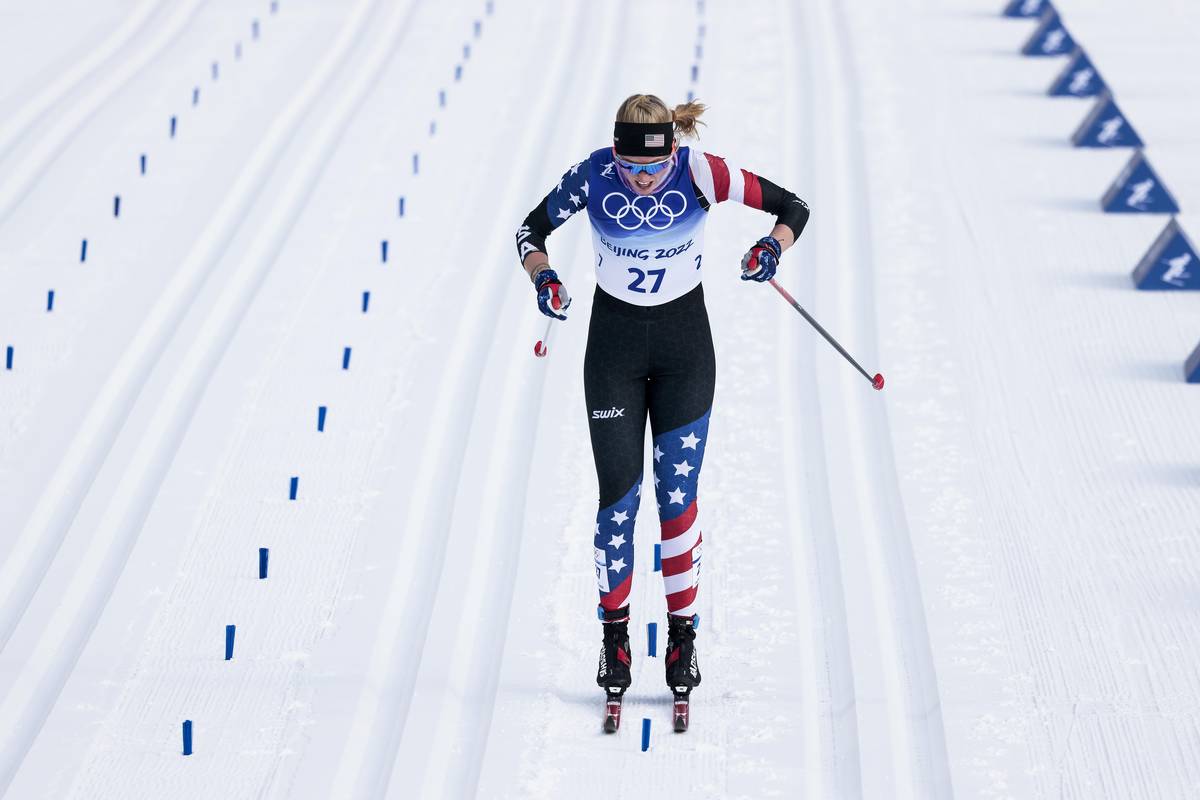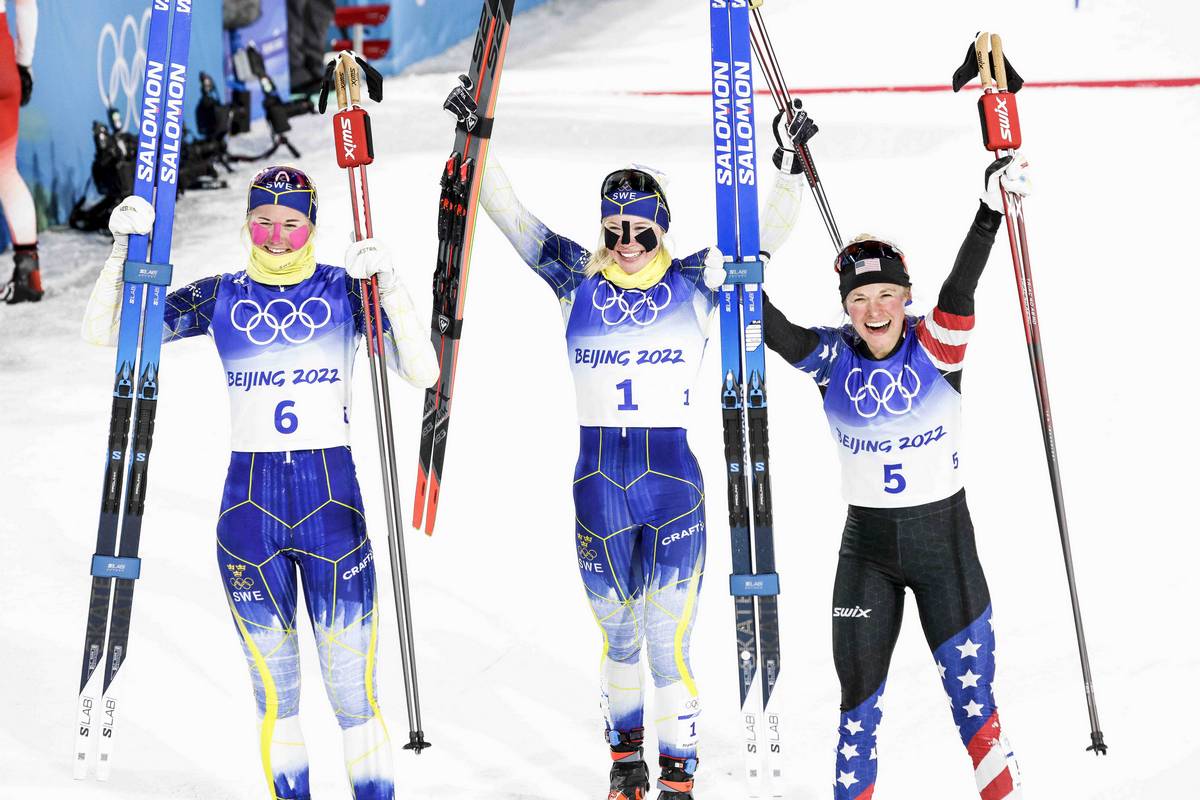
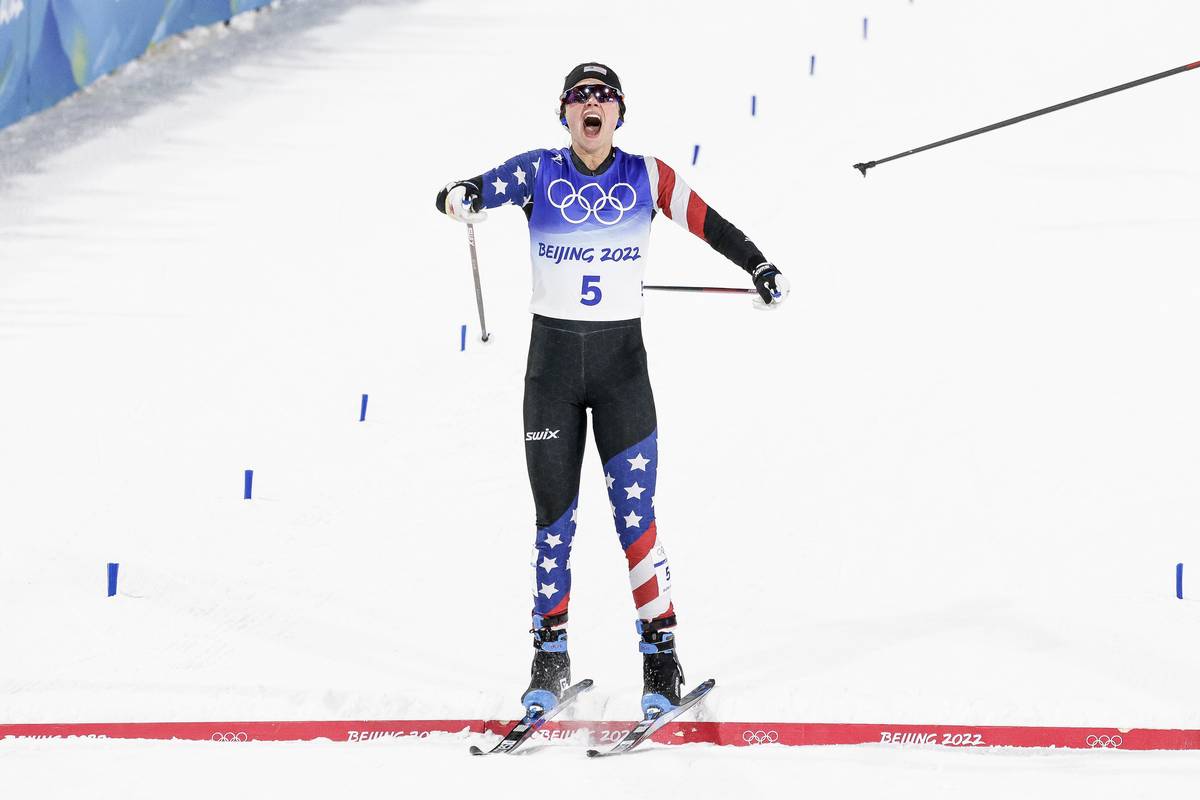
On February 8th, cross country skiing made the New York Times headlines as Jessie Diggins collected an historic bronze medal in the 1.5-kilometer freestyle sprint. No American woman had ever won an individual medal in cross country skiing, and no American cross country skier of either gender had won multiple Olympic medals. Diggins had earned gold in 2018 racing the freestyle team sprint with partner, and current NBC analyst, Kikkan Randall.
Normally, attention given to niche sports by mainstream media is welcome – cross country skiing is a blip on these outlets’ radar roughly once every four years during the Olympics – but a statement included in the report was quickly met with criticism from athletes and coaches in the sport.
Here’s the statement written by veteran sports journalist Matthew Futterman:
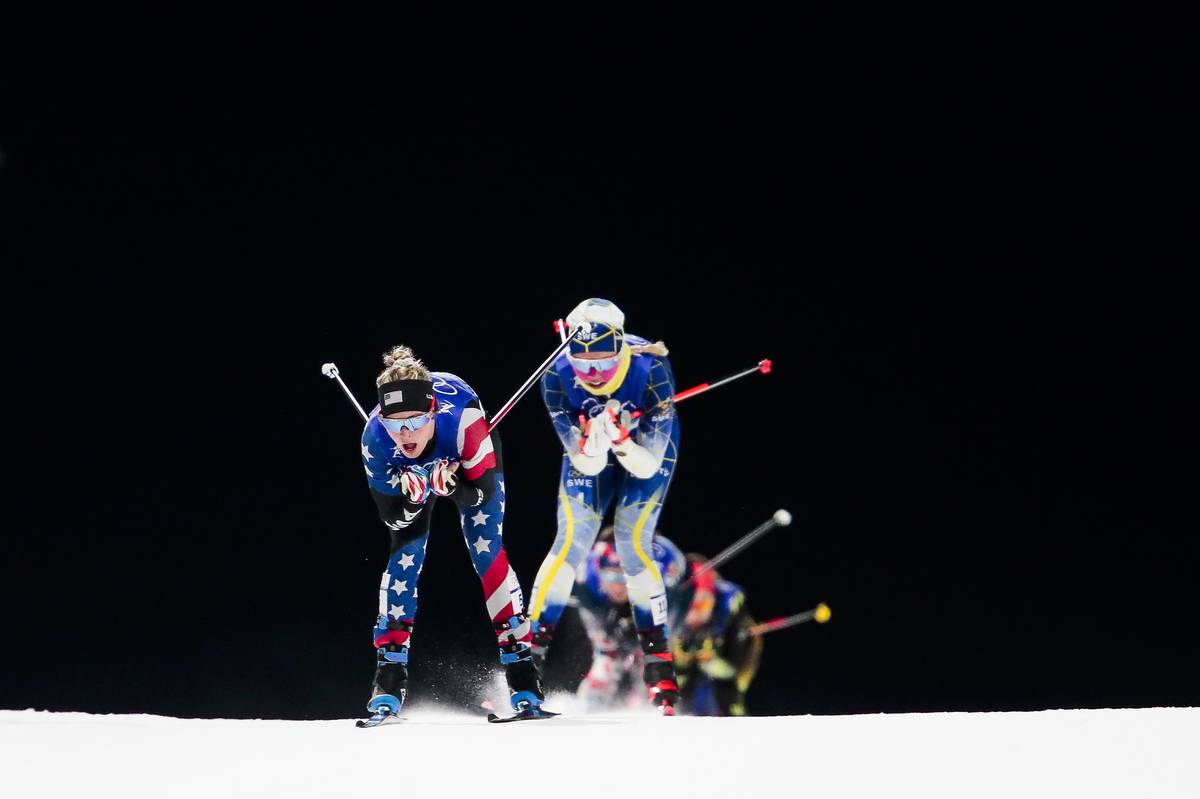
“In a sport that has so many women with massive shoulders and thighs, Diggins looks like a sprite in her racing suit, and it’s not clear exactly where she gets her power. But the power is there, as she flies up hills, and comes off climactic turns with a burst. On the downhills, she tucks low and cuts through the air.”
All-American Colby College ski team alumna turned professional mountain runner for the North Face, Olivia Amber was quick to respond on social media, telling Futterman to “do better” and offering suggested edits to his wording.
Amber proposed: “In a sport that requires a unique combination of upper and lower body strength, Diggins’ ability to apply power is extraordinary, and it’s very clear how she has become one of the best athletes in the world.”
Her instagram story was shared widely amongst her followers. Explaining why this language struck a nerve, Amber wrote the following to FasterSkier.
“The way the media often covers athletics objectifies women and excludes people that don’t conform to the myth of an ideal body type. The language used in the recent NY Times piece is yet another example of this broader issue in women’s sport. It’s a clear oversight that demonstrates a lack of knowledge on the author’s subject. Featuring the size and shape of women’s bodies devalues the lifetime of hard work these athletes put into achieving the pinnacle of their sport.”
FasterSkier contacted Futterman to see whether he had a response to the criticism his statement had received. Futterman explained that he would need clearance from the Times’ communications department in order to respond. FasterSkier later received the following from a spokesperson:
“We aim in our sports coverage to cover male and female athletes accurately, equally and fairly. We believe sometimes their physiques are relevant to their performance. In this case, our description of cross country skier Jessie Diggins’s noticeably different physical attributes in contrast to others in her sport were an important and relevant detail. Her dominance in the sport was also the subject of a lengthy feature on Feb. 4.”
However, many readers continue to find fault with the statements at play.
“I have always held the NY Times in high esteem for their quality reporting, which is why I was absolutely floored to read Matthew Futterman’s comments about my teammate’s body,” writes Holly Brooks, two-time Olympian and licensed professional counselor who offers eating disorder support to athletes through her practice and advocacy. “On a day where Jessie made U.S. history by becoming the first female individual medalist in cross country skiing, Mr. Futterman chose to make inconsiderate comments about her body, questioning the source of her power. Please hear me loud and clear: It is NEVER appropriate to comment on an athlete’s body with regard to their weight, shape or size. Instead, emphasize their power, fight, tenacity and strength. And to the NY Times: Jessie, athletes worldwide, and the entirety of your readership deserve better. Mr. Futterman should apologize for his insensitive words and be sent to sensitivity training.”

It is not the first time Diggins has received comments regarding her body from the media. She was once asked whether her talent on downhills was related to her size, versus her skill. One strategy she has begun to employ to avoid comments that might have a detrimental impact on her mental preparation has been to avoid reading them altogether.
When asked in the mixed zone after the 10 k classic whether she had heard anything regarding Futterman’s story, Diggins said, “To be honest, I don’t read things written about me and I think that’s a very, very healthy thing. But it’s unfortunate with Rule 40 that you can’t see the invisible headgear sponsor that is there at all times for me.”
After sharing a blog post titled “Body Image Issues” in June, 2018 Diggins has openly shared her own challenges with disordered eating, body dysmorphia, and bulimia across many platforms, including her book, Brave Enough. Outside of the Olympic blackout period, described in Rule 40, Diggins wears the logo of the Emily Program, a leader in eating disorder treatment and education, on her hats and headbands, acting as an advocate for the facility she credits with supporting her through her own recovery journey.
She now regularly rejects the narrative that “lighter is faster”, and instead repeats how properly fueling her body and prioritizing her mental and physical health have led her to perform at this level. Diggins aims to be an example for future generations of skiers.
“It’s important that women everywhere know that they’re good enough the way they are,” Diggins said. “You don’t have to be a certain body type to win at the Games; you have to be healthy and happy and have a great support crew.”
Diggins’ advocacy in this space was a focal point in a message penned by Kris Hansen, a former cross country ski coach at Diggins’ alma mater in Stillwater, MN, sent to the Times after reading the piece. Hansen also shared her response publicly on Facebook.
“Eating disorders, or disordered eating, are sadly very common in young women athletes… conditions that are definitely exacerbated by insensitive and inaccurate reporting like Mr. Futterman’s,” she wrote.
Hansen called it “ironic ignorance” that an athlete who raises awareness for body image issues in sport would be described in this way.
“Jessie is no ‘sprite’,” Hansen continued. “She is a powerful woman, an exceptional athlete, a World Champion, a thoughtful and articulate advocate for women athletes, and now a multi-medal Olympian.. I can also tell you from where she gets her power: hundreds of hours of training her body and her mind, on the snow, in the weight room, with her coaches… Further, her competitors are not “women with massive shoulders and thighs”. They are women who, like Jessie, have worked very hard to build bodies that can climb a hundred meters in a matter of seconds and then navigate an icy technical downhill….again and again for 30 kilometers. You have done Jessie, and all women athletes, a disservice with your ignorance and disrespectful characterization.”
College of St. Scholastica head coach and founder of the Women Ski Coaches Association Maria Stuber offered a solution-oriented approach, advocating for awareness and education that might better support and protect athletes of all levels from body-centric messaging.
“What is very obvious here is that if the NY Times reporters and editors do not understand why this language is damaging, and we have a long way to go in education. If a career sports journalist isn’t learning this, certainly parents and youth coaches are not either. We are to the point where prominent athletes, like Naomi Osaka, are refusing to participate in news conferences or talk to journalists because of their ignorance on this topic and the potential damaging effects on mental health of athletes. Maybe the NY Times would be willing to help with the education component? How do we make sure you can’t become a sports journalist (or editor) without some body image/mental health education? Equal representation of women in sports media careers would certainly help.”
Like Diggins, many athletes at the Games are choosing to remain disconnected from the news and are not engaging with topics that might derail their focus. Others, like the Russian Olympic Committee’s Veronika Stepanova, have spoken out about the article. Stepanova shared a video of herself reading the statement on Instagram, sardonically captioning the post “Objectification? Never heard of it.”

FasterSkier had the opportunity to ask Hailey Swirbul and Novie McCabe thoughts on the statement in the mixed zone following their performance in the 10 k individual start classic race Thursday.
“I think that our sport is so unique and so powerful in the sense that every single body type can succeed at this sport,” Swirbul responded. “It doesn’t matter how you look, it matters how you race with your heart, how hard you work, and I know that everyone on our team works so freaking hard, Jessie included. Everyone on that podium deserves that spot, no matter what they look like.”
“I think the older girls have kind of been trying to ignore it a bit,” McCabe explained. “But it was obviously pretty uncalled for and insensitive, and they need to do better… Jessie got a medal because she’s the best out there and not because of anything about her body, so I think just insinuating that there’s something there was not okay.”
Swirbul also stated that response from the community to the Times article has not been a distraction for her as she prepares for Olympic competition.
“It makes me appreciate my own strength and how hard I work to gain fitness and muscle. I think it just really makes me appreciate how diverse our sport is all across the board.”
Speaking more broadly to whether a focus on the appearance of athletes’ bodies from the media is frustrating for her, Swirbul concluded, “I hope that as a culture, we can move away from body types and focus on the hard work and the courage and the bravery that everyone races with every day. I really hope that that’s where we move in the future.”