Tag: Matthew Hudec

  • Biathlon Canada Finalize World Cup Team Following Trials (Updated)

    Biathlon Canada Finalize World Cup Team Following Trials (Updated)

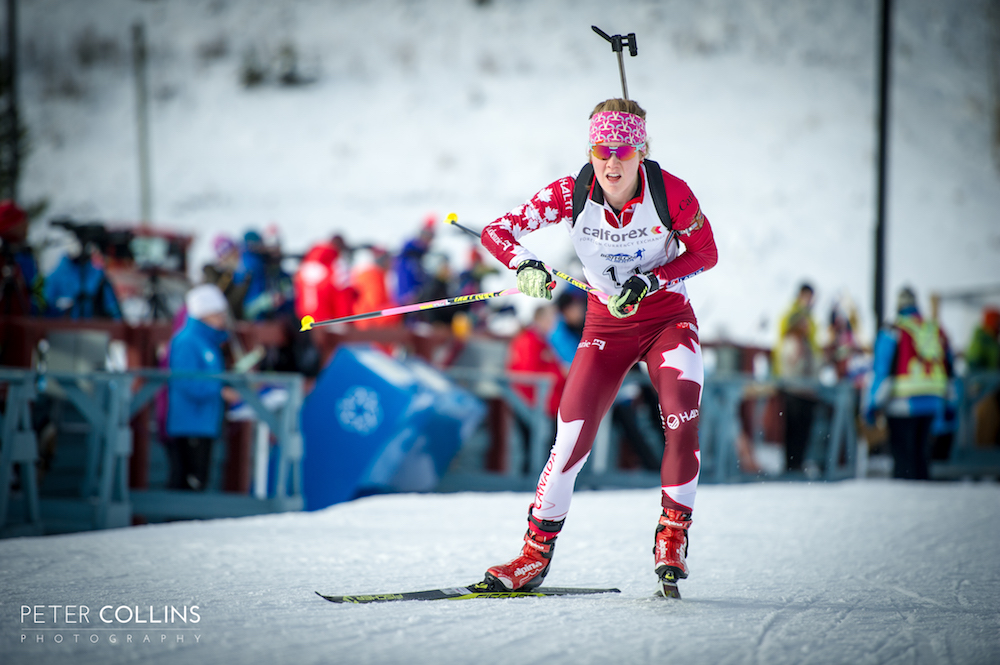
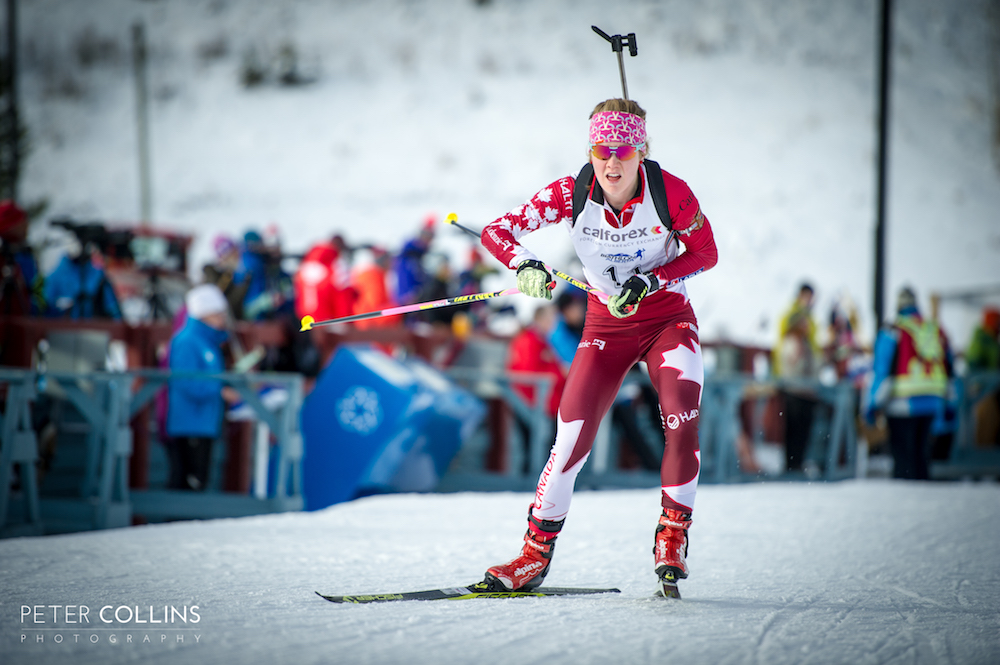
    Emma Lunder, of Biathlon Canada’s Senior National Team, racing to second in the women’s modified sprint on Friday, Nov. 10, the last day of Biathlon Canada’s team trials. After reaching the podium three times in three races, she was selected to the IBU World Cup team for the first trimester. (Photo: Peter Collins/petercollinsphoto.com)

    Note: This article has been updated to include comments and verification from Biathlon Canada High Performance Director Roddy Ward, and explain the modified shooting format used for Friday’s sprint.

    ***

    Almost exactly two weeks before Biathlon Canada sends the rest of its World Cup team to Europe for the first trimeter of International Biathlon Union (IBU) World Cup racing, the national team held trials this past Tuesday through Friday on snow in Canmore, Alberta. Three sets of races in four days (all sprints*) determined which Canadian men and women will start the season at the World Cup opener in Östersund, Sweden, Nov. 26-Dec. 3.

    The national-team trials, also known as the “Tour 1 Selection Trials”, ultimately boil down to what Biathlon Canada calls performance percentages, which measures an athlete’s finishing time in a given race against the average of of the top-three finishers’ times in that race. One bad race isn’t a deal-breaker; they consider the best two out of three. At the end of the trials, an athlete’s top-two results (specifically their performance percentages) are averaged for their overall ranking.

    Going into the trials, two women and one man on Biathlon Canada’s senior team had prequalified for the first World Cup tour (World Cups 1, 2 & 3): Rosanna Crawford, Julia Ransom and Scott Gow, according to a national-team program dated Aug. 30, 2017.

    According to the same document, two additional women’s spots and three men’s openings remained. Those went to the two highest-ranked women at the Nov. 7-10 trials — Megan Bankes and Emma Lunder, respectively — and the top-three ranked men — Nathan Smith, Brendan Green and Christian Gow, respectively.
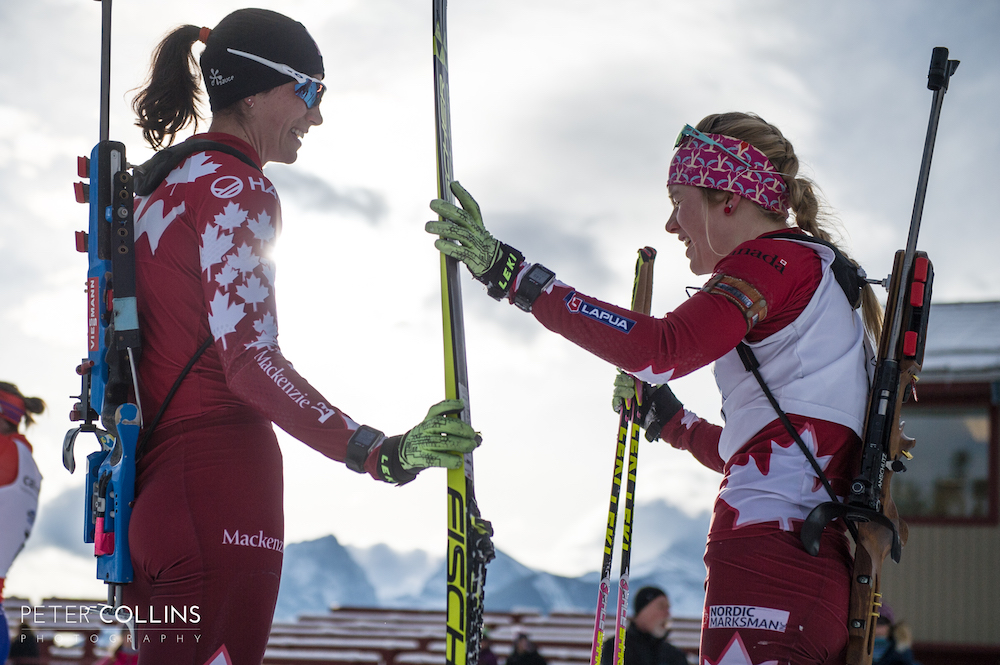
    Emma Lunder (r) with fellow Biathlon Canada national-team member Rosanna Crawford after the women’s modified sprint at Biathlon Canada’s team trials in Canmore, Alberta. Lunder placed second in that race to secure one of the last two spots on Canada’s IBU World Cup Team, while Crawford, who had been pre-selected for the team, placed sixth in that race. (Photo: Peter Collins/petercollinsphoto.com)

    All of the eight aforementioned athletes were nominated to Canada’s 11-member National Senior Team in June. The three remaining biathletes are Sarah Beaudry, who had the third-best overall women’s percentage at trials, Megan Tandy, who ranked fourth and was reportedly coming off an illness after traveling from Germany, and Macx Davies, who ranked seventh in the men’s final percentages after Matthew Hudec of the Biathlon Alberta Training Centre (BATC) in fourth, Carsen Campbell (BATC) in fifth, and Jules Burnotte (Biathlon Estrie) in sixth. (Scott Gow, Crawford and Ransom were not factored into the final percentages.)

    The eight athletes that just missed the World Cup team will start the season on the IBU Cup. Four men and four women earned spots on Canada’s IBU Cup team as a direct result of their performances at trials: Hudec, Campbell, Burnotte, and Davies, and Beaudry, Tandy, Nadia Moser (BATC), and Leilani Tam von Burg (BATC).

    Biathlon Canada’s High Performance Director Roddy Ward described the recent team selections as “straight-up trials”. Based on its published criteria, Biathlon Canada has the option to use discretion in choosing a fourth man and fourth woman for its IBU Cup team, but instead stuck to results, selecting the fifth- through eighth-ranked athletes at trials.

    “We filled the team based on trials,” he explained on the phone on Sunday.

    Ward said he was “feeling really good” about how the World Cup team shook out, with four of their top men returning to the circuit. He mentioned that Smith is healthy and back at full strength, and noted Green’s consistency at trials.

    “On the women’s side, it’s just really good competition … with places changing every day,” he continued.

    Most of the 16 athletes selected to Canada’s World Cup and IBU Cup teams spent much of the offseason together “time-trialling and integrating,” Ward said, which has brought up the level of training as well as made for closer competition among them.

    “My hope is we go to the World Cup and do well and go to the IBU Cup and do well,” he said.

    The Canmore trials began with sprints on Tuesday, which Beaudry and American Lowell Bailey (US Biathlon) won. The only woman to shoot clean, Beaudry topped the women’s 7.5-kilometer sprint by 8.9 seconds over Crawford with a finishing time of 21:57.7 minutes. Crawford missed one in each shooting stage (1+1) for second place and Lunder placed third, 21.1 seconds back, after a single standing miss (0+1). Tandy followed in fourth (+1:05.5) with two penalties (1+1), and Joanne Reid was the top American in fifth (+1:13.9) with one miss (0+1).
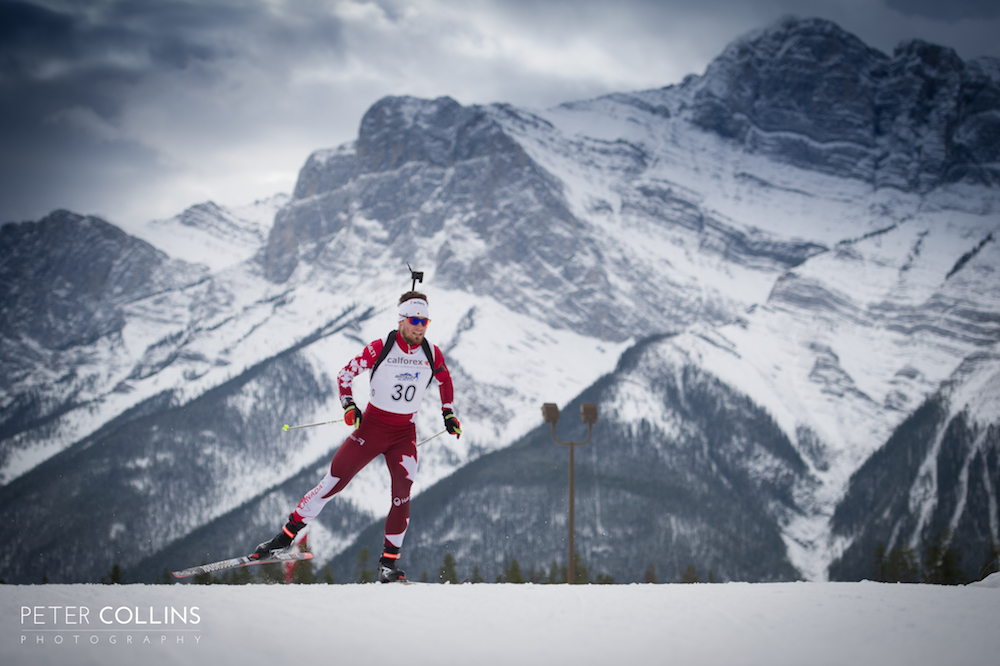
    Christian Gow (Biathlon Canada Senior National Team) racing to ninth in the men’s modified sprint on the last day of Biathlon Canada’s team trials in Canmore, Alberta. With the third-best performance percentage of the trials, Gow was the fourth man named to Canada’s IBU World Cup team for the first trimester of racing. (Photo: Peter Collins/petercollinsphoto.com)

    In the men’s 10 k sprint, Bailey also cleaned to beat out Smith by 13.4 seconds with a finishing time of 25:02.5. Smith had to ski one penalty loop after a prone miss (1+0) and Green placed third (+14.5) after two prone penalties (2+0). Scott Gow and his younger brother Christian finished fourth (+29.4) and fifth (+38.8), respectively, and Tim Burke (US Biathlon) was the second American in sixth overall (+1:11.0).

    On Thursday, Smith won the second sprint of the week outright with a 26.1-second victory in the men’s 10 k with perfect shooting and a finishing time of 24:25.3. Green once again followed in second with clean shooting as well, and Artem Prima of Ukraine took third (+1:09.3) with two misses (2+0). While the Americans didn’t compete on Day 2 of the trials, Team Ukraine did, accounting for nearly the same amount of competitors (40 in the men’s race, 20 in the women’s race, compared to 40 in the men’s race and 26 in the women’s race two days earlier).

    Scott Gow finished fourth in the Day 2 sprint (+1:17.0), followed by Hudec in fifth (+1:29.4).

    In the second women’s 7.5 k sprint, a new winner emerged, but second through fourth place were exact repeats from Day 1. Bankes claimed the win in 22:03.5 with clean shooting, while Crawford followed in second, 26 seconds back with two standing penalties (0+2), Lunder placed third (+1:02.8) with two prone misses (2+0), and Tandy was fourth (+1:16.2) with two prone penalties (2+0) as well. Beaudry placed fifth (+2:16.6) with three penalties (2+1).

    After sitting out the first two days of trials, Ransom won Friday’s modified sprint (6.8 k for the women) by just a tenth of a second over Lunder. Ransom hit all of her targets and posted the win in 20:20.4, and Lunder was just off her mark in second place after “cleaning” as well. Per the modified format, each athlete could use up to three spare bullets per shooting bout, similar to a modified relay.

    “We all know [sprints] are important races; they lead to pursuits they lead to mass starts,” Ward explained. “We want to make sure we’re picking good biathletes, but also favoring on the ski-speed side.”

    In addition to giving an athlete more chances on the shooting range, the relay format showed who could excel in those types of races, Ward said.
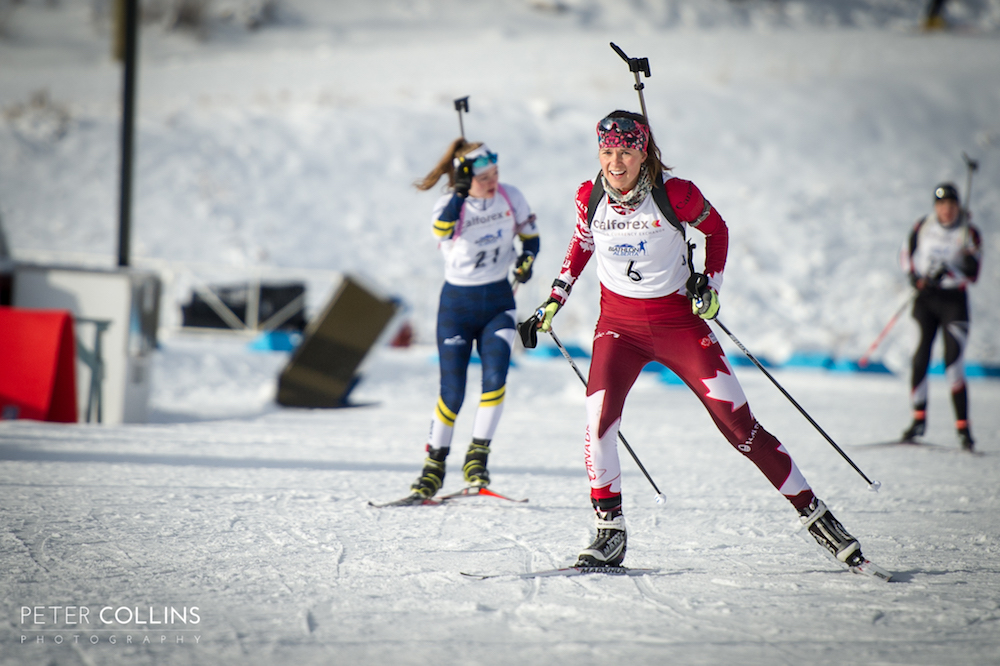
    Julia Ransom (6) racing to the win in the women’s modified sprint on the last day of Biathlon Canada’s team trials on Nov. 10 in Canmore, Alberta. (Photo: Peter Collins/petercollinsphoto.com)

    As a result of the modified-sprint format, the top-five women avoided the penalty loop. Bankes placed third, 6.7 seconds off Ransom’s time. Bankes’s BATC teammate Nadia Moser finished fourth (+8.6), ahead of American Susan Dunklee (US Biathlon) in fifth (+18.6). Crawford finished sixth (+48.0) with two penalties (2+0) and Tandy placed seventh (+1:13.9) with one miss (1+0).

    In the men’s modified 7.5 k sprint on Friday, Smith emerged as the top Canadian for the third-straight race, winning in 18:42.0 with “clean” shooting. The top-eight men hit all their targets. Green finished second (+11.5) once again, and Scott Gow improved to third (+36.4).

    Prima followed in fourth (+41.5), his Ukrainian teammate Sergey Semenov finished fifth (+1:05.9), Campbell and Burnotte tied for sixth (+1:08.2), and Davies placed eighth (+1:20.2). Christian Gow finished ninth (+1:40.9) with one penalty (1+0), Burke was the top American in 10th (+1:47.7), followed by Bailey in 11th (+1:47.9). Both Americans finished without any penalties.

    Both the U.S. and Ukrainian teams raced two out of the three days of trials, contributing to the total field size of 45 men and 26 women on the last day. Ward emphasized that those teams’ presence made for “some really good competition”, and added that having Canadian juniors race alongside seniors (same distances, same races) showed them a clear path to reaching the World Cup level.

    US Biathlon held the last of its own trials last month and planned to finalized its IBU World Cup team after its Canmore training camp.

    For the Canadian World Cup team, Green and the Gow brothers planned to leave Sunday for Sjusjøen, Norway, where they’ll race at Norwegian biathlon trials. According to Ward, Lunder will depart on Thursday for Sjusjøen, where she’ll start her season with the first IBU Cup sprint on Nov. 23 before meeting the rest of the World Cup team in Östersund. Smith, Crawford, Ransom and Bankes planned to leave Canada on Nov. 22.

    Most of the IBU Cup team will depart on Dec. 1, while Campbell and Beaudry will start their seasons earlier at the IBU Cup opener Nov. 23-26 in Sjusjøen.

    ***

    Final ranking (performance percentages)

    Results: 

    Tuesday’s sprint

    Thursday’s sprint

    Friday’s modified sprint

    (*Why were all of these trials sprint races? When it comes to individual events, IBU Cup and IBU World Cup venues typically open with sprints to determine which athletes qualify for the remaining races of the week at each stop. For instance, the top 60 in the sprint qualify for the following pursuit race, and approximately the top 30 in the overall World Cup rankings qualify for mass starts.)

  • Friday Rundown: IBU Open European World Championships (Updated)

    Friday Rundown: IBU Open European World Championships (Updated)

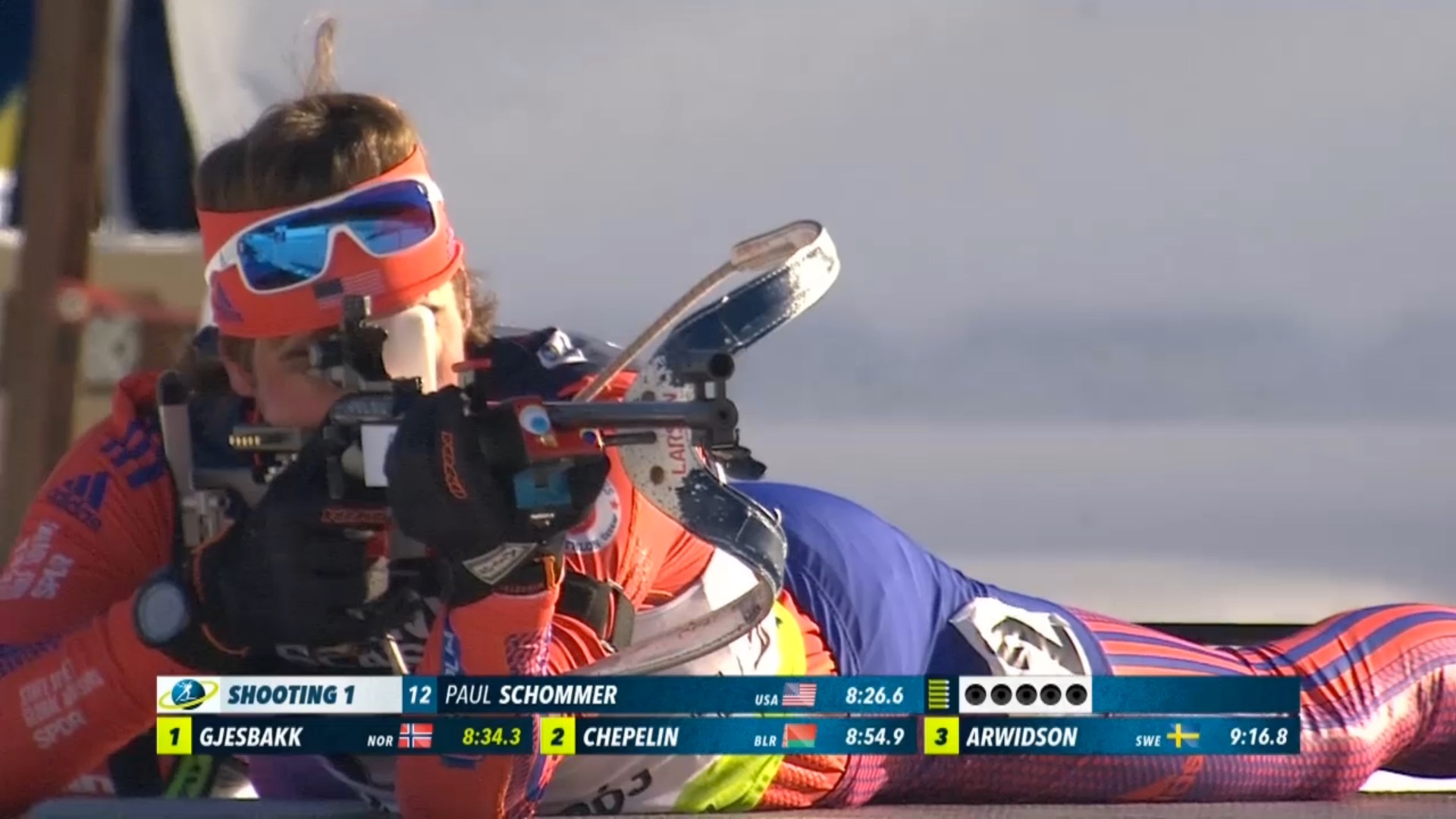
    US Biathlon’s Paul Schommer shooting prone in the men’s 10 k sprint at the 2017 IBU Open European Championships in Duszniki-Zdrój, Poland. He was the top North American on Friday in 58th. (Photo: IBU/Eurovisionsports.tv screenshot)
    US Biathlon’s Paul Schommer shooting prone in the men’s 10 k sprint at the 2017 IBU Open European Championships in Duszniki-Zdrój, Poland. He was the top North American on Friday in 58th. (Photo: IBU/Eurovisionsports.tv screenshot)

    IBU Open European Championships (Duszniki-Zdrój, Poland): Men’s & women’s sprints

    On Friday in the men’s 10-kilometer sprint, two Bulgarian athletes were able to break the Russian dominance at the 2017 International Biathlon Union (IBU) Open European Championships in Duszniki-Zdrój, Poland.

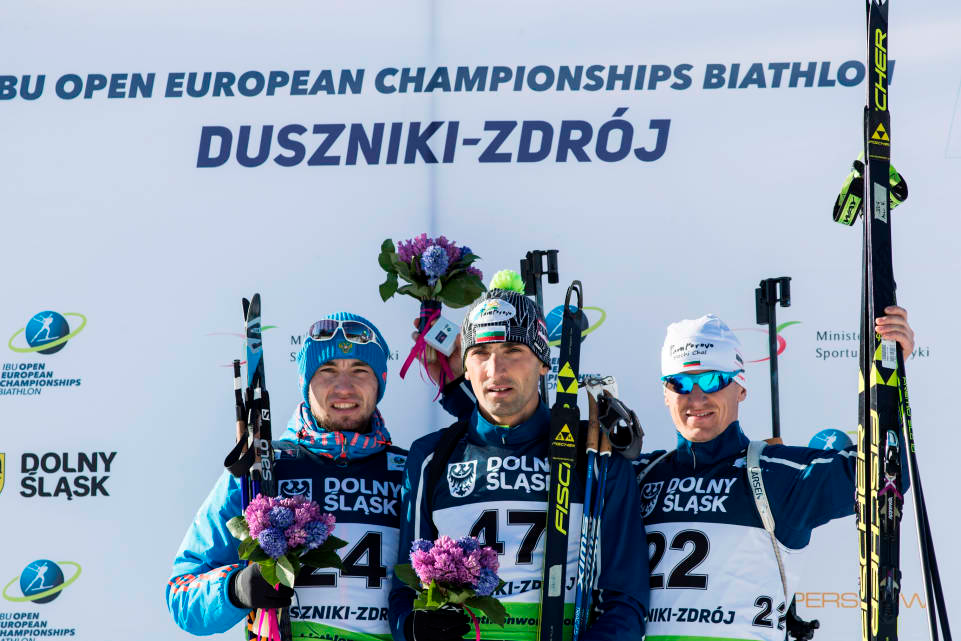
    The men's 10 k sprint podium on Friday, with Bulgaria’s Vladimir Iliev (c) in first, Russia’s Alexander Loginov (l) in second, and Bulgaria’s Krasimir Anev (r) in third at the 2017 IBU Open European Championships in Duszniki-Zdrój, Poland. (Photo: IBU)
    The men’s 10 k sprint podium on Friday, with Bulgaria’s Vladimir Iliev (c) in first, Russia’s Alexander Loginov (l) in second, and Bulgaria’s Krasimir Anev (r) in third at the 2017 IBU Open European Championships in Duszniki-Zdrój, Poland. (Photo: IBU)

    Bulgaria’s 29-year-old Vladimir Iliev, who has competed on the IBU World Cup since 2007 and posted a career-best fifth (which he achieved earlier this season), claimed the win in a time of 24:26.9 minutes despite one penalty in the standing stage (0+1), giving a kiss to his fast skis in the finish. Russia’s Alexander Loginov, who won the men’s 20 k individual race on Wednesday after returning this season from a two-year doping suspension, placed second (+4.9) with clean shooting. Behind them, Iliev’s teammate Krasimir Anev took third (+16.7), also shooting clean, to push Latvia’s Andrejs Rastorgujevs off the podium by just 0.6 seconds (+17.3). Rastorgujevs started early in bib 4 and skied the fastest course time of the day, but incurred two penalties in his standing stage (0+2), which ultimately set him back too far for a podium.

    “It was a long way to this medal and this win,” Iliev said his first career victory, according to an IBU press release. “I was ready for a high result for many years, but many things have happened, so I’m really happy to get a victory today.”

    “I did not expect anything in this race, because yesterday I had health problems so even my coach advised me not to start,” Anev said after winning his second medal of the championships, following up on a second place in the individual. “So [I] went into competition without any expectations.”

    In beautiful weather conditions with little wind and the sun shining on the new arena in Duszniki-Zdrój throughout the race, US Biathlon’s Paul Schommer was the best of 11 North American starters, finishing 58th (+2:14.9) with three penalties (1+2). Schommer was less than a second faster than his U.S. teammate Alex Howe, who finished 59th (+2:15.3), after skiing two penalty laps (1+1). The third American Jakob Ellingson placed 64th (+2:24.6) with one penalty (0+1), Russell Currier was 75th (+2:41.4) with four penalties (2+2), Max Durtschi was 88th (+3:16.1) with three penalties (1+2), and Michael Gibson was 103rd (+4:30.4) with two penalties (1+1).

    Matthew Hudec led the Canadians on Friday in 80th (+2:54.7) with one penalty (1+0). Also for Canada, Aidan Millar finished 86th (+3:13.9) with three penalties (1+2), Carsen Campbell 89th (+3:18.3) with three penalties (2+1), Pearce Hanna 92nd (+3:24.7) with two penalties (1+1), and Matthew Neumann 94th (+3:31.8) with four penalties (1+3).

    In the large field of 125 starters, Schommer and Howe qualified for Saturday’s pursuit race by placing in the top 60.

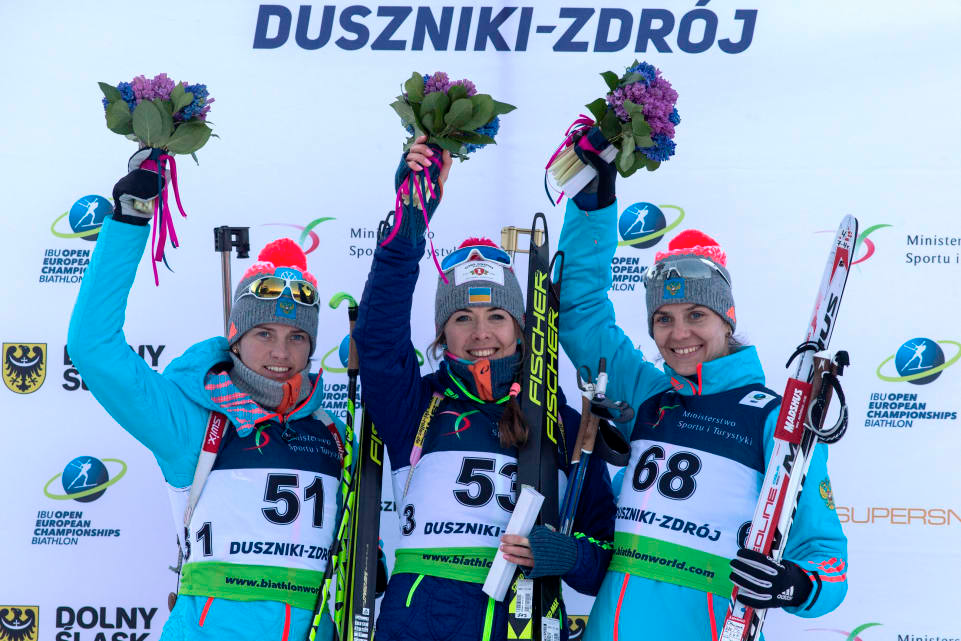
    The women’s 7.5 k sprint podium on Friday, with Ukraine’s Juliya Dzhyma (c) in first, Russia’s Svetlana Sleptsova (l) in second and Russia’s Irina Starykh (r) in third at the 2017 IBU Open European Championships in Duszniki-Zdrój, Poland. (Photo: IBU)
    The women’s 7.5 k sprint podium on Friday, with Ukraine’s Juliya Dzhyma (c) in first, Russia’s Svetlana Sleptsova (l) in second and Russia’s Irina Starykh (r) in third at the 2017 IBU Open European Championships in Duszniki-Zdrój, Poland. (Photo: IBU)

    [UPDATED] In the women’s 7.5 k sprint that followed, Ukraine’s Juliya Dzhyma managed to win in convincing fashion in a time of 21:02.3 minutes, shooting clean and skiing the second-ranked course time. It was the first individual career victory for the 26 year old in either a junior or senior championships, after she won a gold medal with Ukraine’s relay team at the 2014 Olympics in Sochi, Russia.

    “When I saw that everyone was cleaning, I knew that to get in to top three, I have to do the same,” Dzhyma commented on her race, according to an IBU press release. “But honestly, I have no idea how I hit all the targets today; for the whole season, it was my first competition where I had zero.”

    “I was just trying to do my best and to make the gap bigger because tomorrow is the pursuit!” she added, regarding her last loop when she increased her lead by another ten seconds.

    Also shooting clean but 27 seconds off the win was Russia’s 30-year-old Svetlana Sleptsova, who, earlier in her career, won five World Cups and gold medals in the women’s relay at the 2009 World Championship and 2010 Olympics in Vancouver.

    Starting behind Sleptsova, her Russian teammate Irina Starykh, the winner of the women’s individual race on Wednesday, and like Loginov, also coming back from a two-year suspension for EPO use, claimed third (+37.8) with one penalty in her standing stage (0+1). Starykh bumped  Germany’s Karolin Horchler, who had led the race early on after starting in bib 2 to fourth (+42.2, with no penalties). Horchler won her first World Cup a week ago in Antholz, Italy.

    “Before the competition I already felt that it would be very hard for me to shoot today,” Starykh told the IBU. “And in the end it came out that way, it was tough for me to shoot at the prone and at the standing. But just one penalty is a pretty good result, based on how I feel.”

    Horchler’s teammate Denise Herrmann, who made the switch from cross-country skiing to biathlon this season, followed in fifth (+47.7) with the fastest course time of the day, but missed two targets in her standing stage including her very last shot (0+2) to miss the podium.

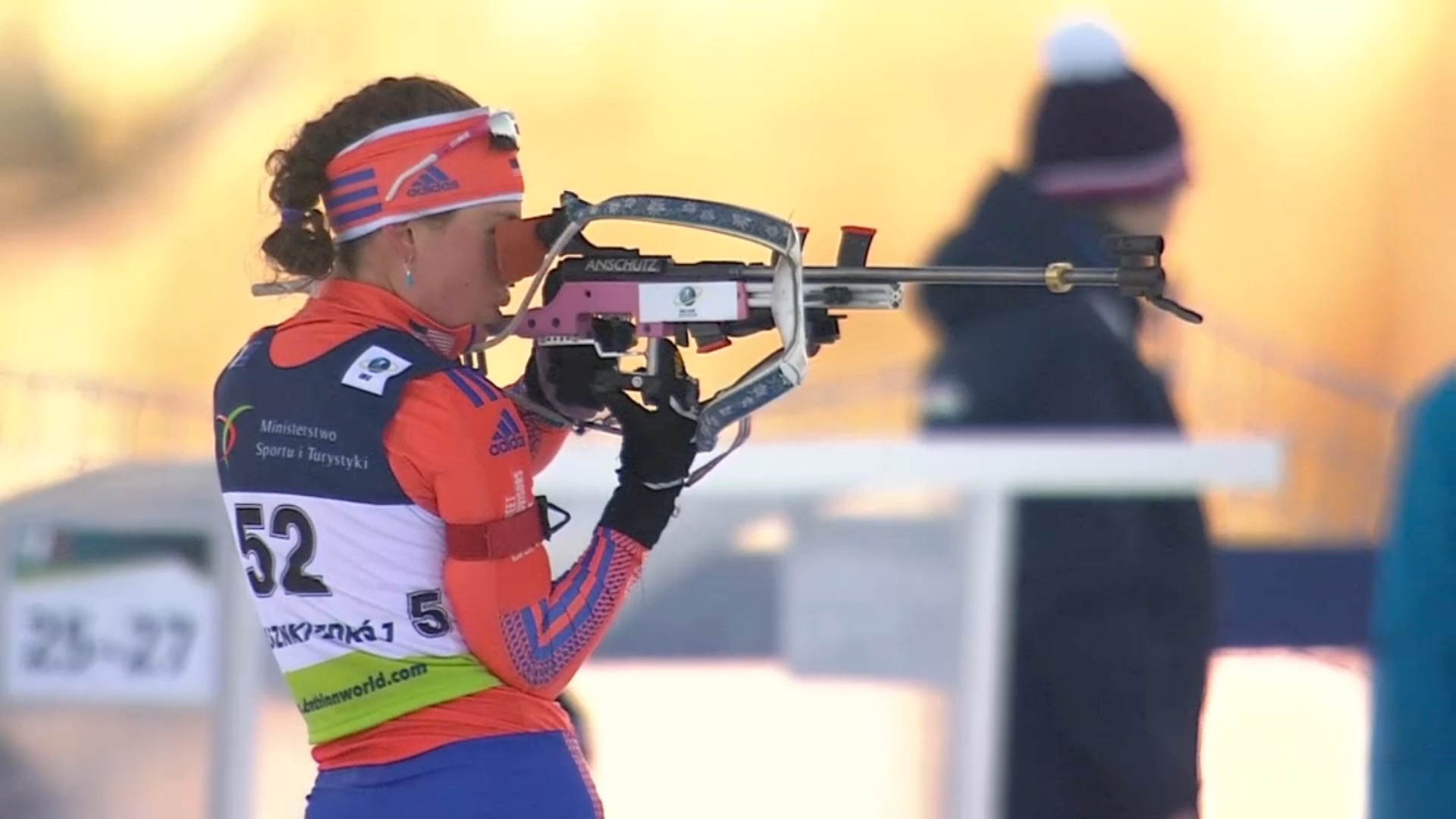
    American Hallie Grossman during her standing stage in the women’s 7.5 k sprint on Friday at the 2017 IBU Open European Championships in Duszniki-Zdrój, Poland. She finished 70th with three penalties as the second-best North American. (Photo: IBU/Eurovisionsports.tv screenshot)
    American Hallie Grossman during her standing stage in the women’s 7.5 k sprint on Friday at the 2017 IBU Open European Championships in Duszniki-Zdrój, Poland. She finished 70th with three penalties as the second-best North American. (Photo: IBU/Eurovisionsports.tv screenshot)

    In stable weather conditions, though not as sunny as during the men’s sprint earlier on Friday, US Biathlon’s Emily Dreissigacker was the top North American woman in 69th (+3:31.1), with three penalties (2+1). Just one position behind her, American Hallie Grossman also missed three (2+1) on her way to a 70th (+3:34.4). For the 23-year-old Grossman it is her first season overseas racing in the IBU Cup.

    Canada’s Erin Yungblut finished 81st (+5:50.0) with four penalties (1+3). Her teammate Leilani Tam von Burg did not finish after incurring two penalties in her prone shooting stage, and the third Canadian, Sarah Beaudry did not start.

    None of the North American woman qualified for Saturday’s pursuit.

    Results: Men | Women

    Start lists: Men’s pursuit | Women’s pursuit

  • Wednesday Rundown: IBU Open European Championships

    Wednesday Rundown: IBU Open European Championships

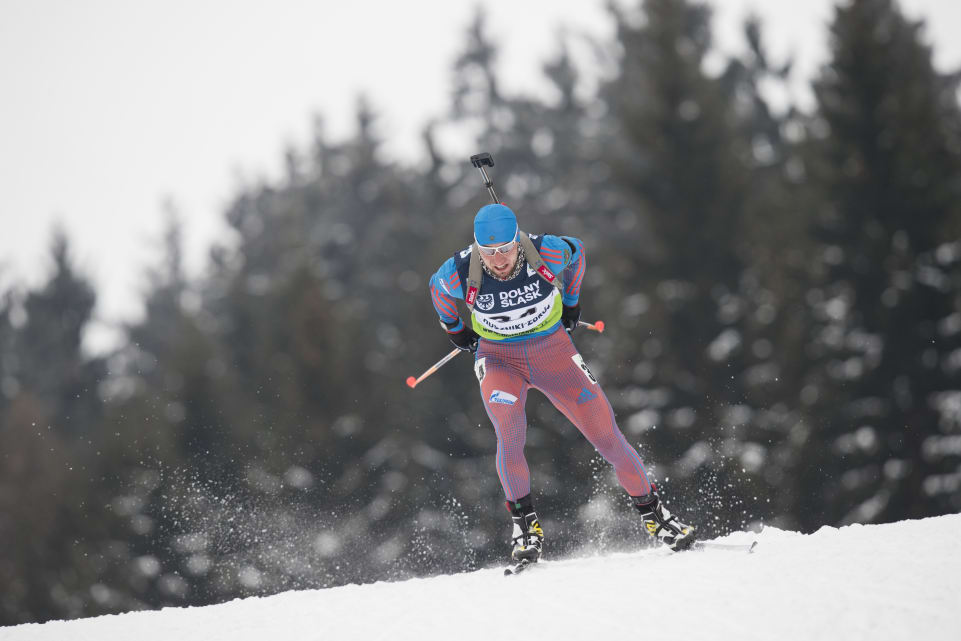
    Russia's Alexander Loginov racing to the win in the men's 20 k individual on Wednesday, the first race of 2017 IBU Open European Championships in Duszniki-Zdrój, Poland. (Photo: IBU)
    Russia’s Alexander Loginov racing to the win in the men’s 20 k individual on Wednesday, the first race of 2017 IBU Open European Championships in Duszniki-Zdrój, Poland. (Photo: IBU)

    IBU Open European Championships (Duszniki-Zdrój, Poland): 15/20 k individual

    The Open European Championships, a five-day International Biathlon Union (IBU) sanctioned event, opened Wednesday with the men’s 20-kilometer and women’s 15 k individual races in Duszniki-Zdrój, Poland.

    Russia took first and second in the women’s race, with 29-year-old Irina Starykh — coming off a two-year ban for EPO use — winning by more than a minute over her teammate Svetlana Sleptsova. Starykh hit all 20 targets en route to the victory 44:24.7 minutes, which was 1:03.8 faster than Sleptsova, who had one penalty (0+1+0+0) in second. Ukraine’s Anastasiya Merkushyna placed third (+1:05.0) with one penalty as well (0+1+0+0).

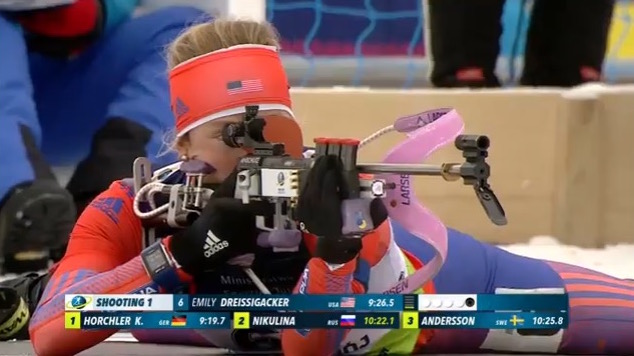
    American Emily Dreissigacker shooting clean during her first prone stage of the women's 15 k individual on Wednesday at 2017 IBU Open European Championships in Duszniki-Zdrój, Poland. She finished 41st.
    American Emily Dreissigacker shooting clean during her first prone stage of the women’s 15 k individual on Wednesday at 2017 IBU Open European Championships in Duszniki-Zdrój, Poland. She finished 41st.

    Emily Dreissigacker led the two U.S. women in the race in 41st (+7:47.6) with four penalties (0+1+1+2). Hallie Grossman finished 52nd (+9:06.1) with four misses as well (1+1+2+0).

    Canada’s Leilani Tam von Burg finished 58th (+9:54.2) with two penalties (0+0+1+1), and Erin Yungblut was 60th (+10:13.4) with three misses (0+2+0+1).

    Russia took first in the men’s 20 k as well, with 24-year-old Alexander Loginov — who also recently served a two-year ban for testing positive for EPO — winning by 11.4 seconds in 44:54.9. He had one penalty in his first prone stage (1+0+0+0) but cleaned the next three stages. Bulgaria’s Krasimir Anew cleaned (0+0+0+0) for second (+11.4), and Russia had two on the podium with Alexey Slepov in third (+53.6), with clean shooting as well.

    Russia swept fourth through six, putting five in the top six.

    Russell Currier led the American men in 51st (+5:42.5) with five penalties (2+2+0+1). Paul Schommer placed 57th (+6:02.5) with five misses as well (2+0+1+2), Max Durtschi was 62nd (+6:44.2) with two misses (1+0+1+0), Alex Howe 79th (+8:46) with three misses (0+1+0+2), Jakob Ellingson 87th (+10:11.3) with seven misses (2+4+1+0), and Michael Gibson 94th (+11:58.3) with six penalties (1+1+1+3).

    Carsen Campbell was the top Canadian in 64th (+6:58.2) with two misses (0+1+1+0). Matthew Neumann finished 68th (+7:26.0) with three misses (0+1+0+2), Aidan Miller was 72nd (+8:07.9) with two miles (0+1+0+1), Matthew Hudec 98th (+12:29.5) with seven misses (1+1+2+3), and Pearce Hanna 101st (+14:07.1) with seven misses (2+2+2+1).

    Racing continues Friday with the men’s 10 k and women’s 7.5 k sprints.

    Results: Women | Men

  • Sunday Rundown: La Clusaz, Nove Mesto, Ramsau, Klingenthal, Obertilliach, & Rossland (Updated x4)

    Sunday Rundown: La Clusaz, Nove Mesto, Ramsau, Klingenthal, Obertilliach, & Rossland (Updated x4)

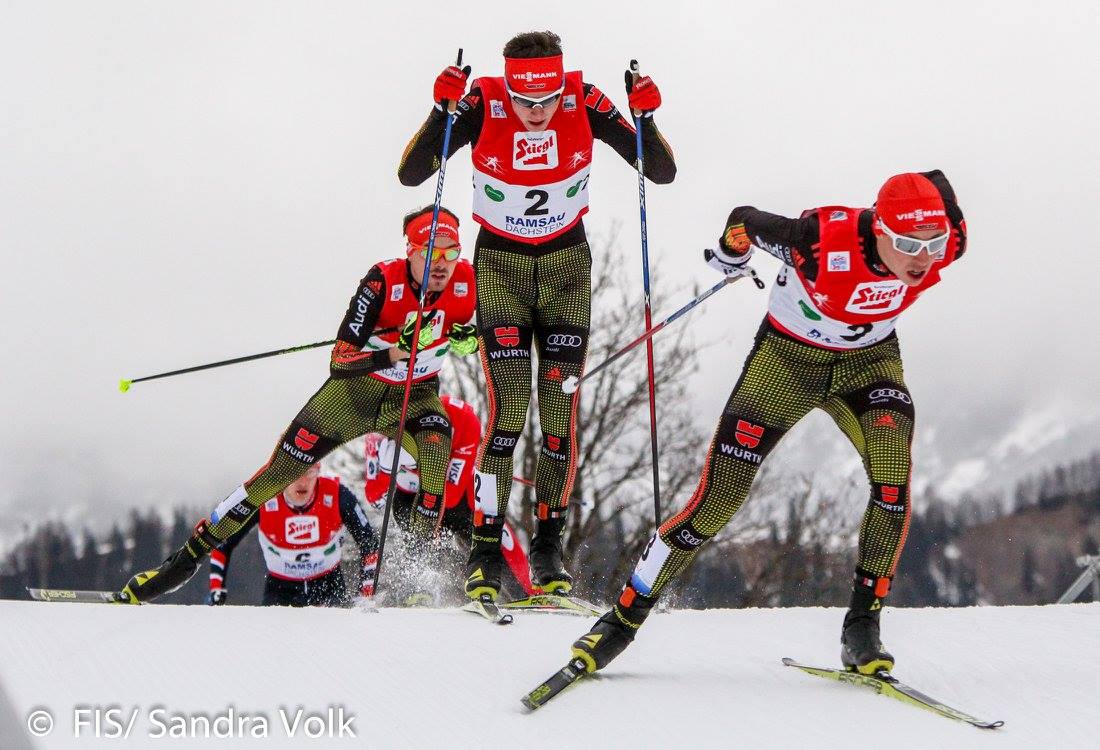
    Eric Frenzel (r) leads German teammates Vinzenz Geiger (c) and Fabian Rießle (l) toward a sweep of the podium in the Nordic Combined World Cup individual normal hill/10 k on Sunday in Ramsau, Austria. (Photo: FIS Nordic Combined/Facebook)
    Eric Frenzel (r) leads German teammates Vinzenz Geiger (c) and Fabian Rießle (l) toward a sweep of the podium in the Nordic Combined World Cup individual normal hill/10 k on Sunday in Ramsau, Austria. (Photo: FIS Nordic Combined/Facebook)

    Welcome to The Rundown, your quick primer of need-to-know information about the day’s racing. We’ll be updating this digest as the day goes on with additional results, photos and quotes. The Rundown is NOT a race report; stay tuned for complete race reports later today with interviews from the day’s top racers.

    ***

    FIS Nordic Combined Continental Cup in Klingenthal

    [UPDATE] Ben Loomis tallied two top 10’s and his U.S. Nordic Combined teammate Ben Berend notched eighth place this past weekend at the Continental Cup in Klingenthal, Germany.

    Loomis ended the three-day series on Sunday by placing fifth in the large hill/10 k for his second-best result at the Continental Cup level (he finished fourth last year in the normal hill/10 k competition in Park City, Utah). Loomis put himself in position by jumping to sixth then racing to fifth, 49.9 seconds behind Japan’s winner Go Yamamoto, who finished in 24:06.4.

    Florian Dagn of Austria placed second (+6.0) after jumping to first. Yamamoto jumped to second and headed out on the course seven seconds behind him.

    Norway’s Sindre Ure Soetvik placed third (+28.8), after starting the 10 k in third. Germany’s David Welde finished fourth (+36.0), moving up after jumping to eighth.

    Also on Sunday, Berend placed 15th (+2:25.3) and Jasper Good was 35th (+3:07).

    Berend started the long weekend out with an eighth-place finish in the large hill/5 k on Friday. He jumped to fourth and finished the ski race in eighth, 1:09.2 minutes behind Germany’s Maximilian Pfordte, who won in 10:58.9.

    Pfordte posted the best jump to start the 5 k first, then held his lead for a 16.4-second victory over Yamamoto in second. Dagn placed third (+18.3) after jumping to second, and Yamamoto’s jump ranked third.

    Also for the U.S., Good finished 21st (+2:05.8) for his best result of the weekend, Loomis was 28th (+2:50.5) and Stephen Schumann 29th (+2:52.1).

    On Saturday, it was Loomis who tallied another eighth place for the U.S. in the large hill/10 k. He jumped to 10th then improved to eighth, finishing 58 seconds behind German winner Tobias Simon. While Simon dominated the jump as well as the race, winning by 10.1 seconds, Yamamoto repeated in second place and Austria’s Thomas Joebstl reached the podium in third (+38.3).

    Berend finished 25th (+1:45.9) and Good 45th (+3:24.9) on Day 2.

    Results: Day 1 | Day 2 | Day 3

    ***

    FIS Nordic Combined World Cup in Ramsau

    The Nordic Combined World Cup resumed this weekend in Ramsau, Austria, with Germany not only topping but sweeping the podium in both individual normal hill/10 k competitions.
    On Saturday, Team Germany swept the top four, with Johannes Rydzek notching his third individual win of the season, ahead of teammates Fabian Rießle (+1.5) and Eric Frenzel (+8.7). Vinzenz Geiger completed the sweep in fourth (+15.0), a career best for the 19 year old after placing seventh earlier this month in Lillehammer, Norway.
    Frenzel led after the jump on the 98-meter hill, which put him 2 seconds ahead of the second-best jumper, Austria’s Mario Seidl, in the 10 k Gundersen start. (Seidl went on to place seventh.)
    Rydzek posted the third-best jump and started 10 seconds back, while Rießle started another 10 seconds later in seventh. Rydzek went on to ski the fifth-fastest course time and Rießle was third fastest en route to first and second at the finish.
    Americans Taylor Fletcher and Bryan Fletcher finished 27th (+1:17.6) and 29th (+1:18.4), respectively, and Adam Loomis was 47th (+3:16.2).
    Taylor started 41st, 1:18 back, and Bryan started five seconds later in 43rd. Bryan posted the seventh-fastest course time and ended with a photo finish with Finland’s Arttu Maekiaho, which Maekiaho took by 0.1 seconds for 28th. Loomis started 50th.
    Day 2 in Ramsau went to Frenzel, who won the normal hill/10 k in 22:49.4. Rießle repeated in second (+0.8) and Geiger improved on his career best for his first podium in third (+23.4). Seidl again jumped to first and this time ended up fourth (+24.3).
    Frenzel started third and raced to first, Rießle moved up from fourth in the jump to second, and Geiger made the most of his second-best jump.
    Taylor Fletcher skied the third-fastest course time to move up from 46th after the jump to 22nd at the finish (+1:20.2). Bryan Fletcher finished 32nd (+1:33.5), losing one place after starting 31st.
    The Nordic Combined World Cup goes on holiday break until resuming Jan. 7-8 in Lahti, Finland.
    Results: Saturday | Sunday 
    ***

    NorAm Mini Tour in Rossland: Classic pursuits

    The NorAm mini tour in Rossland, British Columbia, wrapped up with a classic pursuit race on Sunday.

    In the women’s 10 k classic, APU’s Chelsea Holmes continued her strong form, winning the mini tour with an aggregate time of 1:08:04.4. Holmes finished the 10 k in 35:35.4 minutes, 6.2 seconds behind fastest woman of the day, Katherine Stewart-Jones (NTDC Thunder Bay).

    SMS Elite’s Erika Flowers continued her podium-filled visit to Canada with the third-fastest ski of the day, 48.1 seconds behind Stewart-Jones, to take second overall, 2:23.9 behind Holmes. AWCA’s Olivia Bouffard-Nesbitt was the fifth fastest in the 10 k to hold on to third overall (+3:25.2), while Stewart-Jones was just 0.5 seconds back in fourth overall.

    NTDC Thunder Bay’s Evan Palmer-Charrette used a fourth-fastest ski in the 15 k to keep the overall title, with an aggregate time of 1:28:54.0. Alexis Dumas (CNEPH) skied 1:14.7 faster than Palmer-Charrette to climb from sixth at the start to second overall (+52.2). AWCA’s Jack Carlyle had the second-fastest time of the day, 29.9 seconds behind Dumas, to climb into third overall (+1:10.1).

    National Para-Nordic guide Erik Carleton had the third-fastest 15 k time, 1:01.3 back, but it wasn’t enough to catch Team R.A.D.’s Russell Kennedy, who placed fourth overall (+1:20.8).

    Full results (with tabs for the overall and time of the day)

    ***

    FIS Cross-Country World Cup in La Clusaz: Men’s and women’s relays

    Team Norway I emerged victorious in Sunday’s men’s 4 x 8 k mixed relay event in La Clusaz, France, with Didrik Tønseth leading the winning group’s first classic leg.

    After crossing in seventh, Tønseth handed off to Martin Johnsrud Sundby for a second classic leg. Sundby dropped a spot, finishing his classic leg in eighth. Sundby tagged off to Anders Gløersen for the first freestyle leg.

    Gløersen rocketed the team to first, and held the position straight through his 7.5 k. The final leg for Norway’s winning team went to Finn Hågen Krogh. The Norwegian men’s team completed the relay event in a total time of 1:11:25.7

    Second place overall, two-tenths of a second behind, was team Russia, led by Evgeniy Belov for the first classic leg. Belov handed off to Alexander Legkov for the second classic leg, with Legkov putting down the third fastest time by the time he returned to the exchange zone.

    The third and first freestyle leg for Russia went to Alexey Chervotkin, who maintained the team’s third place position. Anchoring the team was  Sergey Ustiugov, who managed to maneuver the team from third place to second during his final freestyle leg.

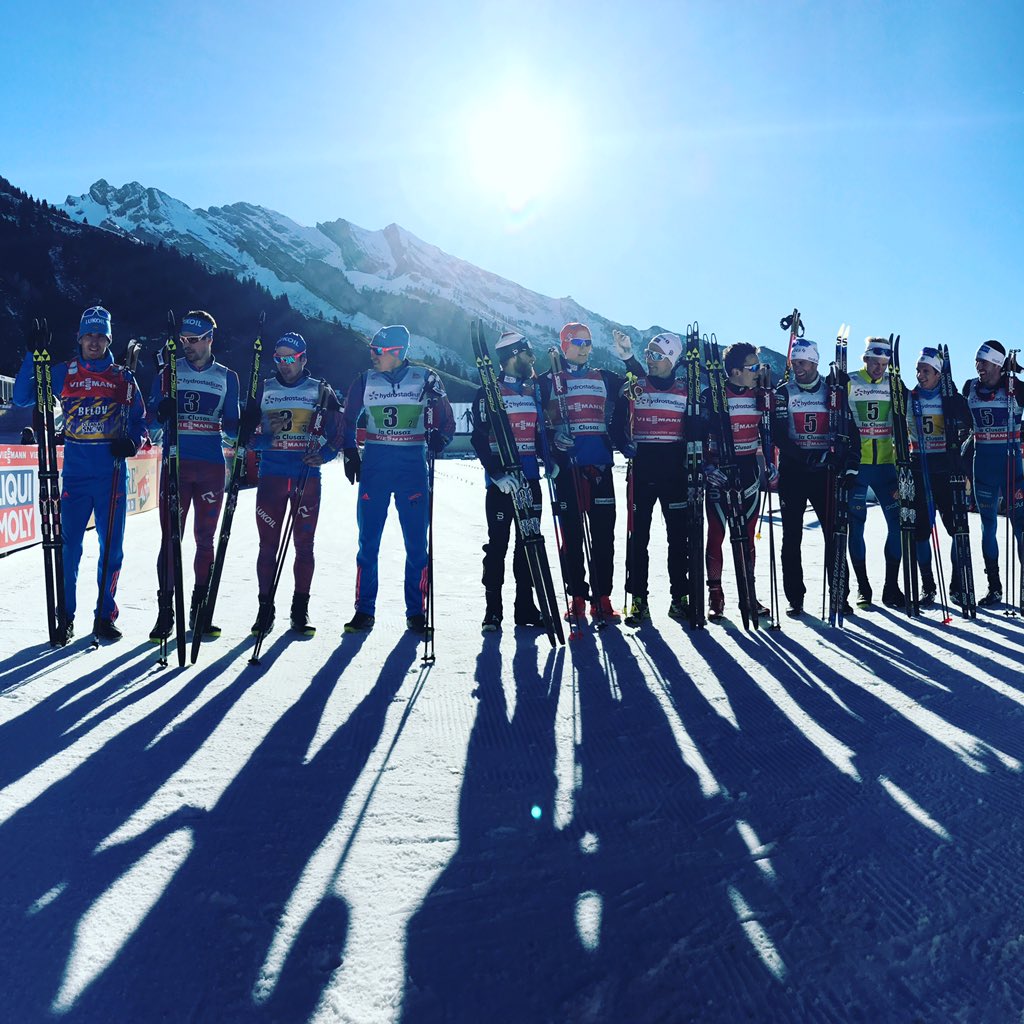
    The men's 4 x 7.5k relay podium on Sunday in La Clusaz, France with Russia in second (left four) Norway first (center four) and France third overall. (Photo: FIS Cross-Country twitter)
    The men’s 4 x 8 k relay podium on Sunday in La Clusaz, France, with Russia in second (left four) Norway first (center four) and France third overall. (Photo: FIS Cross-Country/twitter)

    Rounding out the men’s mixed relay podium on Sunday was France I (+7.7).

    Jean-Marc Gaillard led team France’s first classic leg, racing in a sixth position into the exchange zone. Gaillard handed off to Alexis Jeannerod, who moved up to fifth place by the end of his classic leg.

    Skiing the third and first freestyle leg was Clement Parisse who held onto fifth place and tagged off to Maurice Manificat for the final freestyle leg. Manificat managed to move around Sweden’s Axel Ekstrløm and Germany’s Lucas Bøgl for third place overall.

    Neither Canada or the U.S. entered a men’s relay team due to illness.

    In the women’s 4 x 4 k relay event, it was another Norwegian team who stood atop the podium.

    Ingvild Flugstad Østberg led the women’s first classic leg, skiing in first place until her hand-off to Marit Bjørgen. Bjørgen maintained the first place position during her classic leg, tagging off to Ragnhild Haga.

    Haga completed the first freestyle leg for Norway, handing off to Heidi Weng, who anchored the team’s last freestyle leg. The Norwegian women finished in a total time of 39:23.3.

    In second was team Finland, 50.2 seconds behind Norway’s winning time. Aino-Kaisa Saarinen started the first classic leg for Finland, passing off to Anne Kyllønen.

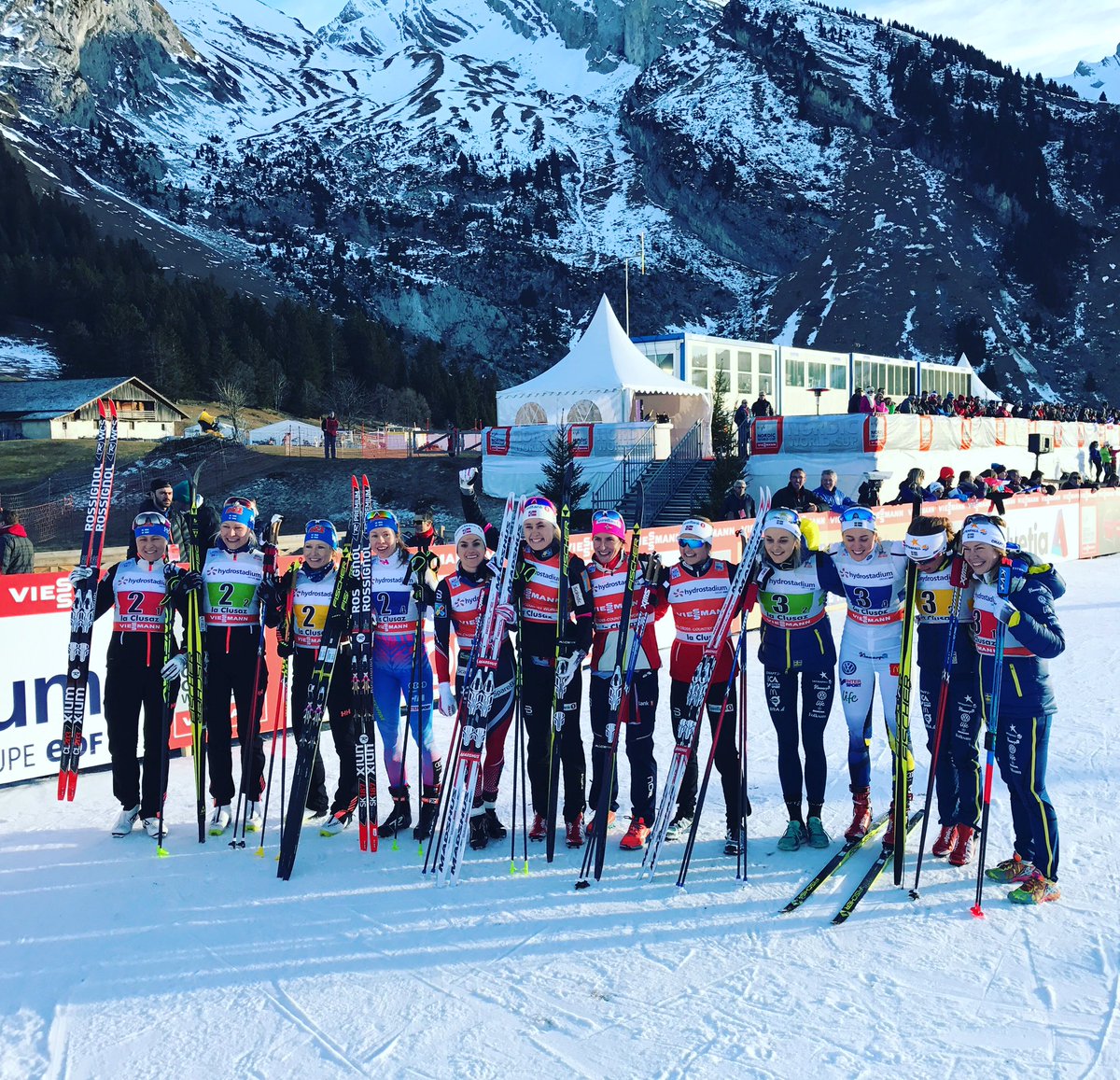
    The women's 4 x 4 k mixed relay podium on Sunday in La Clusaz, France. Norway (c) took the win ahead of team Finland in second (l) and Sweden in third. (Photo: FIC Cross-Country/Twitter)
    The women’s 4 x 4 k mixed relay podium on Sunday in La Clusaz, France. Norway (c) took the win ahead of team Finland in second (l) and Sweden in third. (Photo: FIC Cross-Country/Twitter)

    Taking on the first freestyle leg for Finland was Riitta-Liisa Roponen, who tagged off to Laura Mononen for the final freestyle leg.

    Rounding out the relay podium in third overall was team Sweden (+1:08.9). Emma Wiken raced the first classic leg, who tagged off to Stina Nilsson for the second classic leg. Maria Rydqvist raced the first freestyle leg and handed off to Anna Dyvik, who anchored the team to third.

    Only one U.S. women’s relay team was entered on Sunday, with both Jessie Diggins and Sadie Bjornsen out due to illness. Sophie Caldwell led the U.S.’s first classic leg, followed by Rosie Brennan. Liz Stephen followed Brennan, taking on the first freestyle leg. Anchoring the team was Kikkan Randall in the final freestyle leg. The Americans finished in seventh overall (+2:26.0).

    Canada also entered a women’s team in Sunday’s relay. Emily Nishikawa led the first classic leg, and handed off to Cendrine Browne for the second classic leg. Dahria Beatty raced the first freestyle leg and tagged off to Sophie Carrier-Laforte, who anchored the team to 12th overall (+4:07.9).

    Results: Men | Women

    ***

    IBU World Cup in Nove Mesto: Men’s and women’s mass starts

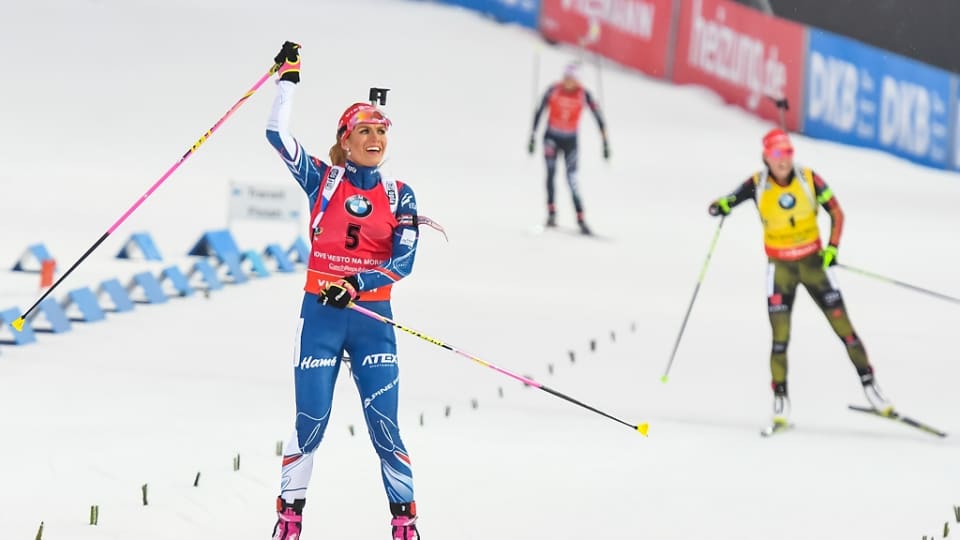
    Gabriela Koukalová of the Czech Republic looks to her home crowd as she wins the women's 12.5 k mass start on Sunday at the IBU World Cup in Nove Mesto, Czech Republic. She fended off Germany's Laura Dahlmeier (r), who took second. (Photo: IBU)
    Gabriela Koukalová of the Czech Republic looks to her home crowd as she wins the women’s 12.5 k mass start on Sunday at the IBU World Cup in Nove Mesto, Czech Republic. She fended off Germany’s Laura Dahlmeier (r), who took second. (Photo: IBU)

    Despite skiing in 14th at one point in the men’s 15 k mass start on Sunday, France’s Martin Fourcade came back to win the International Biathlon Union (IBU) World Cup in Nove Mesto, Czech Republic.

    That makes him seven for eight in individual races so far this season.

    Fourcade started with bib 1 as the overall World Cup leader and finished first in 36:18.9 minutes, despite a penalty on his second prone that put him in 14th and 22 seconds back heading out on his third loop.

    He rebounded with a clean third shooting to move into third, 2.5 seconds behind Ukraine’s Dmytro Pidruchnyi in first and 1.3 seconds behind Russia’s Anton Babikov in second.

    By the final shooting stage, Fourcade was back in first with clean shooting (0+1+0+0), 28 seconds clear of Babikov in second. Babikov had his first penalty of the day on the final stage (0+0+0+1) to drop out of contention.

    Germany’s Simon Schempp (1+1+0+0) came out on top of an eight-way battle for second place on the final loop. Schempp took it, 8.3 seconds after Fourcade and 1.1 seconds ahead of Babikov in third (+9.4).

    The Czech Republic’s Ondrej Moravec was 0.3 seconds off the podium in fourth (+9.7), Pidruchnyi placed fifth (+10.2), Russia’s Matvey Eliseev finished sixth (+11.0), Norway’s Ole Einar Bjørndalen was back in the top 10 in seventh (+11.3), France’s Quentin Fillon Maillet notched his second-straight top 10 in eighth (+13.7), and Norway’s Johannes Thingnes Bø finished at the back of that pack in ninth (+19.8).

    American Lowell Bailey missed the top 20 by 10 seconds in 21st (+1:17.1). He had three penalties, two of which came on the last stage (0+1+0+2) to drop him from ninth to 20th at the start of the final loop.

    Bailey retained his spot in ninth in the overall World Cup standings, while Fourcade continues to lead, 158 points ahead of Shipulin in second.

    In the women’s 12.5 k mass start, Gabriela Koukalová delivered to her home fans in Nove Mesto, Czech Republic, racing to her second win of the season in 34:42.1.

    “I was so nervous before the race so it was amazing,”  Koukalová said, according to an IBU press release. “I have so many emotions; it’s even more emotional than at the Olympics. I would like to say thanks to all the spectators and I hope I was able to make a nice Christmas present to all of them.”

    The defending World Cup champion beat the current World Cup leader, Germany’s Laura Dahlmeier, by 3.1 seconds after shooting a single penalty and cleaning the last two stages (0+1+0+0) to move into first. Dahlmeier missed two on the first stage to drop 23rd, but cleaned her last three stages (2+0+0+0) to capture second at the finish. She passed three athletes on the last lap, including Italy’s Dorothea Wierer, who ended up third (+9.7) with one miss (1+0+0+0).

    “I don’t really know what happened with those two misses,” she told German broadcaster ARD. “But in terms of skiing I had a great day on the course, and I had skis that were the bomb. It’s just a lot of fun when you can make the podium reaching the second place despite a large deficit in the beginning. I am overjoyed.”

    Germany’s Vanessa Hinz rebounded from Friday’s sprint (where she placed 73rd) to end up fourth (+15.5) with a single penalty (0+0+1+0). None of the 29 finishers hit every target, and American Susan Dunklee did not start.

    Dahlmeier leads the overall World Cup standings by 98 points over Finland’s Kaisa Mäkäräinen, and Koukalova is third, just seven points behind Mäkäräinen. Dunklee is 11th.

    The IBU World Cup now goes on holiday break until resuming Jan. 5 in Oberhof, Germany.

    Results: Men | Women

    ***

    IBU Cup in Obertilliach

    The third IBU Cup was held on Dec. 16-17 in Obertilliach, Austria. In the men’s 20 k individual on Friday, the top three finishers were France’s Antonin Guigonnat, with a winning time of 49:58.6, Russia’s Yury Shopin in second (+32.2), and Germany’s Florian Graf in third (+35.6). Each of the top three had one miss, and Canada’s Matthew Hudec was the top North American in 34th (+4:11.3) with two penalties (0+2+0+0). Also for Canada, Carsen Campbell finished 38th with three penalties (1+2+0+0), Matthew Neumann was 53rd with three penalties (0+2+0+1) out of 118 finishers.

    In the women’s 15 k individual on Friday, Germany’s Karolin Horchler took the win with clean shooting (0+0+0+0) in 44:54.7. France’s Coline Varcin was 1.1 seconds back in second with one penalty (1+0+0+0), and third went to Russia’s Daria Virolaynen (+30.2), who had one miss as well (0+1+0+0). Canada’s Nadia Moser was the top North American in 35th (+5:10.8) with two penalties (0+1+1+0). Also for Canada, Erin Yungblut placed 66th with five penalties (0+3+0+2).

    In the men’s 10 k sprint on Saturday, two Norwegians took first and second with Henrik L’Abee-Lund winning in 23:29.9, and Vetle Sjastad Christiansen 13.9 seconds back in second. Third was claimed by Germany’s Phillipp Nawrath (+29.5) and all of the top three shot clean. Neumann led Canada in 47th (+2:20) with one miss (1+0). Campbell missed two (1+1) and finished 59th (+2:47.4), and Hudec was 64th (+2:58.9) with two penalties as well (1+1). Canada’s Pearce Hanna finished 87th, with two misses (2+0), out of 125 finishers.

    In the women’s 7.5 k sprint, Russia swept the podium with Virolaynen winning in 20:31.5, followed closely by Uliana Kaisheva (+3.7), and then Anna Nikulina (+23.1). Virolaynen missed one (0+1), Kaisheva cleaned (0+0) and Nikulina had a standing miss as well (0+1).  The top North American was Canada’s Megan Bankes in 30th (+2:08.1), with one prone penalty (1+0). Also for Canada, Sarah Beaudry finished 34th (+2:18.1), with two standing misses (0+2), Yungblut was 45th (+2:40.6) with clean shooting (0+0), and Moser finished 49th (+2:45.5) with two misses (1+1), out of 85 women.

    Results: Men’s individual | Women’s individual | Men’s sprint | Women’s sprint


  • Numb Fingers and All, J.T. Bø Wins in Presque Isle; Doherty Nabs Career Best 13th

    Numb Fingers and All, J.T. Bø Wins in Presque Isle; Doherty Nabs Career Best 13th

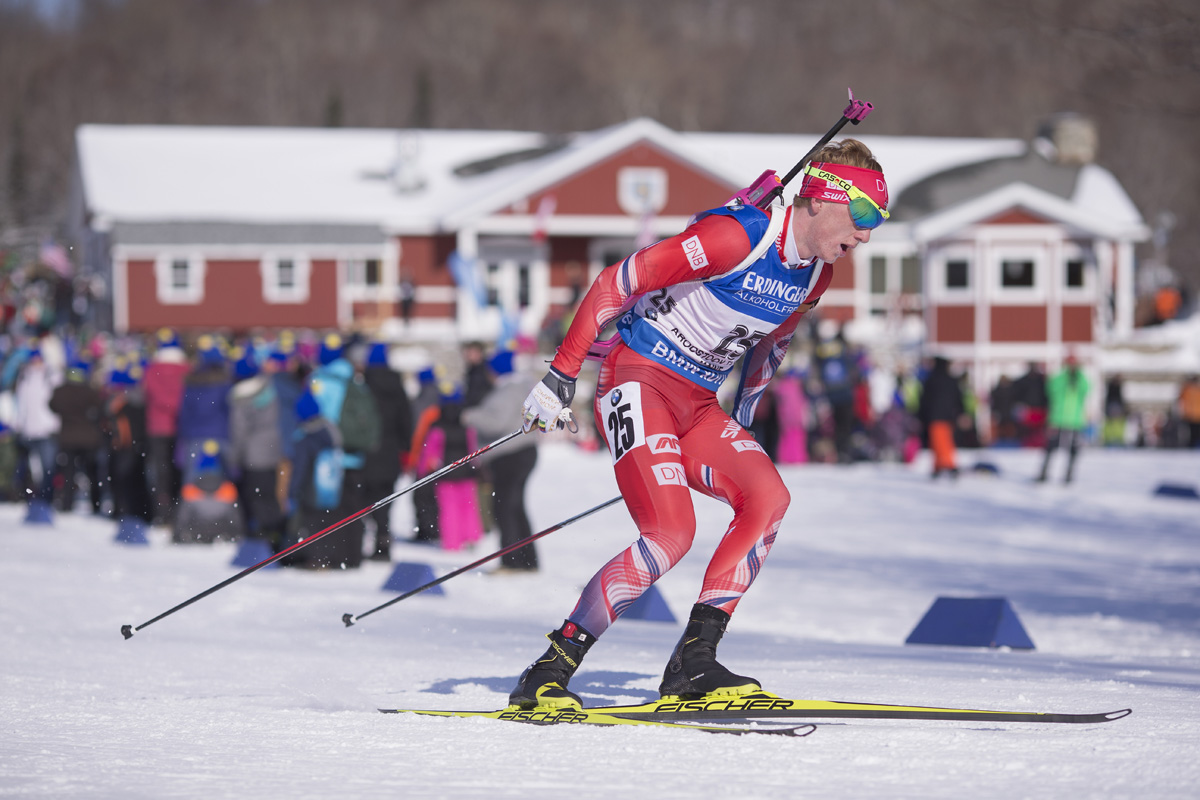
    Norway's Johannes Thingnes Boe racing to a 28-second win in the IBU World Cup men's 10 k sprint on Thursday in Presque Isle, Maine. (Photo: Fischer/NordicFocus)
    Norway’s Johannes Thingnes Bø racing to a 28-second win in the IBU World Cup men’s 10 k sprint on Thursday in Presque Isle, Maine. (Photo: Fischer/NordicFocus)

    After skipping the last tour stop in Canmore, Alberta, Norway’s Johannes Thingnes Bø returned to the International Biathlon Union (IBU) World Cup with a bang, winning the men’s 10-kilometer sprint on Thursday morning in Presque Isle, Maine, in a time of 24:38.8, with no penalties. It was the first World Cup race in the U.S. in five years.

    “It’s never easy, but today I felt I had control,” Bø told the IBU in a post-race interview. “I was calm before the race, and also on the shooting range. I tried to do it like in training.”

    The defending 2015 world champion in the sprint is now heading into the 2016 World Championships at home in Oslo, Norway, with a victory in the same discipline.

    “It looks like it has been good for me, but who knows,” he said at the press conference on his decision to not make the long trip to Canmore, Alberta, last week for the previous World Cup. Instead, he trained for Oslo.

    Asked why eight of his 10 World Cup victories came in sprints, Bø replied, “Maybe it’s because shooting is my weakness, and in the sprint there is only two [stages]. So there is a bigger chance for me to not miss so much.”

    He achieved his clean shooting despite losing feeling in his fingers on the first loop due to the cold weather and his fairly thin gloves, he told Norwegian broadcaster NRK.

    “Without feeling I had to focus extra hard on the innermost black spot, maybe that was the thing that made it go so well,” Bø said according to a translation.

    Starting very early with bib 3, France’s Martin Fourcade had one miss in the standing stage and initially took a 38-second lead at the finish (over Norway’s second starter Erlend Bjøntegaard) thanks to Fourcade’s fast skiing, with the eventual overall fastest course time.

    After changing into dry clothes and waiting in the finish pen for a few minutes, Fourcade was passed by Russia’s Anton Shipulin, who started behind him in bib 16 and had two clean shooting stages. The Russian lost time to Fourcade on the final loop, but by the finish, Shipulin, who ranks second in the overall World Cup, had preserved a 1-second lead over Fourcade — the World Cup leader.

    “I have competed here 10 years ago at the Junior World Championships,” Shipulin said at the press conference through a translator. “So I know the tracks, and they are quite good.”

    Shipulin ended up second when Bø, the 25th starter, barreled through the finish 27.9 seconds faster, with both clean shooting and the second-fastest overall course time. That moved Fourcade into third (+28.9) and the top-three stood through the remainder of the 88-man race.

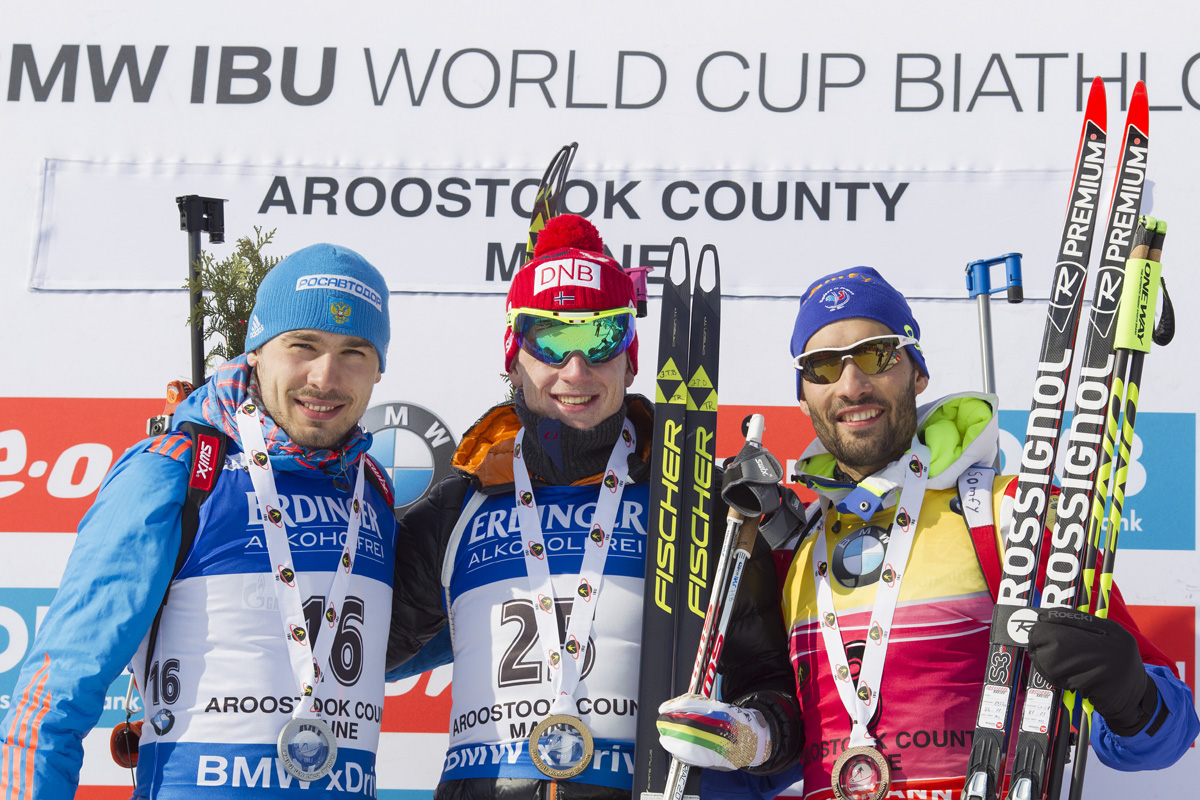
    The men's sprint podium at the IBU World Cup in Presque Isle, Maine, with Norwegian winner Johannes Thingnes Bø (c), Russia's Anthon Shipulin (l) in second, and France's Martin Fourcade (r) in third. (Photo: Fischer/NordicFocus)
    The men’s sprint podium at the IBU World Cup in Presque Isle, Maine, with Norwegian winner Johannes Thingnes Bø (c), Russia’s Anthon Shipulin (l) in second, and France’s Martin Fourcade (r) in third. (Photo: Fischer/NordicFocus)

    “Of course I am happy and satisfied with the race today,” Shipulin said. “I wasn’t as fast as those two guys on the track. But I did clean shooting, and the result was good … I hope I will get better for the World Championships.”

    “My shape was really good today … The shooting range is not as easy as we thought,” Fourcade said at the press conference. “No wind today so that was good.”

    “But I really was surprised by the sun; I think it was too much sunshine for my little blue eyes,” the brown-eyed Fourcade joked. “I had real difficulties on the shooting range. That is why I needed so much time in the standing shooting.”

    Bø posted the best times after the first and second shooting stages, where he hit every target, and extended his lead to the finish over Shipulin. Despite placing third, Fourcade slightly added to his commanding World Cup lead, with 857 points to Shipulin’s 646.

    “Johannes was simply a better biathlete today,” Fourcade said. “He shot clean, he shot fast, and [me and Shipulin] both know he will be one to beat for the World Champs.”

    As the race progressed, Germany’s Erik Lesser in bib 54 had the best chance to reach the podium, thanks to two clean shooting stages.

    He picked up speed throughout his three loops; after losing more than 20 seconds to Bø on each of the first two loops, he only lost 2 additional seconds on the last one. But overall, Lesser could not quite match the skiing performance of the top three and finished fourth, 45.9 behind Bø and 20 seconds off the podium.

    “I was very timid on the first round, somehow insecure,” Lesser told German TV broadcaster ARD. “I felt a little tired, so I wanted to rather push towards the end. … The shooting range is not easy, in standing I had to rebuild my stance. You really have to pay attention. Everything is possible in terms of advancing or falling back.”

    Behind Lesser, two Swiss athletes had their best results of the season, with Serafin Wiestner in fifth (+50.3) and Benjamin Weger (+52.5) in sixth place, both missing one shot in standing.

    For Wiestner, a border police officer, it was a new personal best after previously finishing 24th in a sprint in Ruhpolding, Germany, earlier this year.

    “We are really happy about this result,” Wiestner told the IBU. “The last weeks were not so good for us, for the whole team … It’s a really tricky course, but I like that.”

    I had a really bad season until now,“ Weger added. “Almost [all] just bad races. So I am very happy to be back in top 10 now, the first time this season. I hope to continue like that now.”

    Latvia’s Andrejs Rastorgujevs in seventh (+54.0) and Bø’s older brother, Tarjei, in eighth place (+58.9) also had just one penalty in standing, and stayed within one minute of Bø to achieve a good starting position for the pursuit on Friday.

    Doherty Leads Three Americans in Top 20; Canada’s Perras 48th

    American Sean Doherty returned to the World Cup on Thursday, in his first race since racking up three medals in as many races at Junior World Championships in Cheile Gradistei, Romania. At 20, he become the most decorated athlete in history of Youth/Junior World Championships in his final season as a junior.

    Starting in the middle of the field in bib 42, Doherty was the youngest competitor in the sprint. He shot clean in prone, and then missed one in standing, having to ski a penalty lap. The top North American, he ultimately placed 13th for his career-best World Cup result, 1:16.2 behind Bø.

    “My shooting today felt good, very in control,” Doherty, a New Hampshire native, wrote in an email. “The wind was manageable, it just came and went but was never too extreme. The range approach here is deceptively tough, and the wind conditions can be tricky but overall today was a good day on the range.

    “I am really looking forward to the pursuit,” he added.

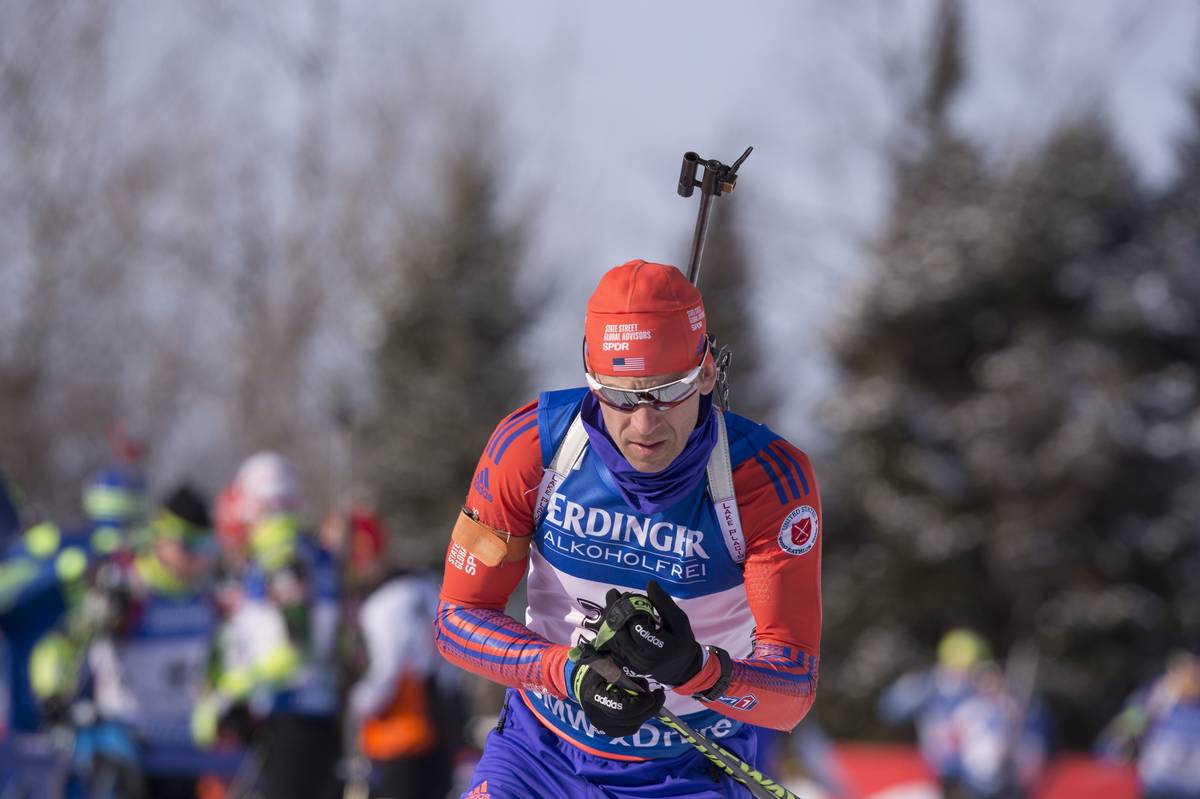
    Lowell Bailey (US Biathlon) racing to 15th in the men's sprint at the IBU World Cup in Presque Isle, Maine. Bailey was one of three U.S. men in the top 20 on Thursday. (Photo: USBA/NordicFocus)
    Lowell Bailey (US Biathlon) racing to 15th in the men’s sprint at the IBU World Cup in Presque Isle, Maine. Bailey was one of three U.S. men in the top 20 on Thursday. (Photo: USBA/NordicFocus)

    Shortly behind, another American Lowell Bailey placed 15th (+1:22.4), also with a clean prone shooting and one penalty in standing.

    “The wind can definitely be a factor here as the venue sits on top of a plateau,” Bailey explained in an email. “But today, I think the biggest factor was the approach. It is one of the more difficult approaches [in the World Cup] and if you aren’t prepared for it, you will be surprised at the fact that you aren’t very recovered when you hit the mat.”

    Earlier this week, Bailey provided a unique view of the Presque Isle courses for the IBU in a first-person video, skiing through the men’s sprint loop, the arena and the penalty lap (coincidentally, Johannes Thingnes Bø passed Bailey in the penalty lap during the video).

    “A lot of transitions from downhills directly into steep uphills,” Bailey commented in the video. “So you have to be changing techniques all the time.”

    “The snow here is very cold,” he said of the conditions. “You can hear it, kind of squeaking like Styrofoam. That makes it interesting for waxing. We’ll be on very hard cold wax. Very fine stone grinds with the ski base.”

    In his email, he explained that the course was challenging, particularly with a “corkscrew” downhill section, with some ice beneath the snow. “You had to stay alert and react when your skis started to slip,” he wrote.

    “I felt like an alpine skier,” winner J.T. Bø joked about the course in an IBU interview. “You had to ski at the very edge of the skis. It was really hard, but it was cool.”

    “The two places are really different,” Fourcade said during the press conference, comparing Canmore with Presque Isle. “Canmore is huge mountains, and here we are more in the forest. I prefer the track here, but it’s hard to compare two sites.”

    Also for the U.S., Tim Burke started early bib 6, missed one target in each of his shooting stages, but finished 20th (+1:32.7) as the second-best athlete with two penalties.

    “I felt solid on the ski course today,” Burke wrote in an email. “It was not one of my best days, but I was able to keep a good pace for the entire race. This is an interesting course in that there are not really any big climbs, but on the other hand there is very little recovery because of the challenging downhills. This was my first time competing on this course and I really liked it.

    “My shooting felt decent today and the two misses were very close,” Burke continued. “But two misses is obviously too much for the sprint competition.”

    Leif Nordgren in bib 76 came in 65th (+3:02.6) with three penalties (2+1). Eleven seconds outside the top 60, he missed qualifying for Friday’s pursuit.

    “The men were just really consistent, everybody close together and just the whole field for the top athletes, so it puts them into a very good place looking ahead for tomorrow’s pursuit race,” US Biathlon coach Jonne Kähkönen said in a phone interview with FasterSkier. “Hopefully Susan’s podium will give them another push.”

    After the men’s race on Thursday, Susan Dunklee raced to second place in the women’s 10 k sprint to tie the best-ever result by a U.S. biathlete, male or female.

    Canada brought some of its developmental team to Presque Isle, with the athletes prequalified for the World Championships in Oslo skipping the races and continuing to train at home in Canmore.

    Originally Nathan Smith had planned to keep competing in Presque Isle, partly in order to defend his top 20 in the overall World Cup (he was 19th after the Canmore World Cup).

    “It was a really last minute decision. I literally had my stuff packed and ready to load into the team van,” Smith told FasterSkier in an email. “I was already somewhat uncertain about going because my skiing has been lackluster the last few weeks. When I saw how potentially cold it could be [in Presque Isle] I decided that perhaps I should stay in Canmore to get some rest and refocus after a very demanding month of racing, travel, and all the extra energy spent at a home world cup. I’ll be cheering the team on from the comfort of my living room.”

    Asked how he thought that might affect his place in the standings, he guessed it would drop him just outside the top 20.

    “I was hoping to be near top 10 by this point but unfortunately I didnt make so many points the last 2 world cups,” Smith wrote. “I think it’s better for me to try and perform my best … at world champs instead of chasing points to try and stay around 15th to 20th.”

    Without the usual starters, Scott Perras achieved the best result for the Canadian men in the sprint on Thursday, finishing 48th (+2:36.0), with one penalty in both prone and standing, and qualified for the pursuit on Friday.

    “Shooting was ok, I was a bit tight for prone but it was fine,” Perras wrote in an email. “Presque Isle can be pretty windy, today was just a slight breeze, almost perfect!

    “Skiing felt ok, I expected to feel a little better for sure,” he added. “[The] course is fun, what makes it difficult is the fact that you climb for a couple minutes before you get to the biggest climb on the course. That and the fact there isn’t much time ever spent in a downhill tuck.”

    In their first World Cup races of the season, Canada’s 21-year-old Carsen Campbell finished 78th (+3:45.9) with one penalty, Matthew Neumann, 26, was 82nd (+4:16.6) with three misses (1+2), and Matthew Hudec, 21, finished 88th (+5:18.6) with two penalties (1+1).

    Every Course is Different

    The World Cup returned to the U.S. and the Nordic Heritage Center in Presque Isle for the first time in five years since February 2011, when the World Cup also included races in Fort Kent, Maine. Back then, Fourcade placed second in the sprint to Germany’s Arnd Peiffer, who finished ninth on Thursday (+1:06.4) with one penalty.

    Most athletes commented positively on the challenging course and arena, though some pointed out a few unusual details, mainly a utility building in the middle of the penalty lap making it difficult to see the competition.

    “It’s pretty far around that little house, at least it feels that way,” Peiffer told German TV broadcaster ARD after the race, when asked about his penalty lap.

    According to ARD’s play-by-play announcer, organizers recently measured the loop out at 155 meters, 5 meters longer than the IBU norm, but still well within the standards.

    “Yes, it does feel long,” Bailey agreed in his email.

    “The penalty loop definitely felt long to me but I’m sure they have measured it,” Tim Burke wrote in his email. “I think it’s just the fact that you can’t see through it, that makes it feel so long. That will be an interesting factor for the pursuit because you won’t be able to judge how many athletes are in the penalty loop.”

    In contrast to that, Perras even observed some positive elements: “I don’t think the penalty loop feels any bigger, it actually skis quite well. Some penalty loops have really tight corners and you can’t really ski through the corners at all, you are almost skidding. And here there are fans in the penalty loop, how do you compete with that.”

    Germany’s Lesser also noted in his interview with ARD that the shooting mats felt uneven, giving him slight problems to find his stance.

    “I also felt that the shooting range mats slope towards the targets,” Burke agreed. “This is very unusual and hopefully they can fix this for the remaining competitions.”

    “The shooting mats do seem to slope awkwardly,” Perras wrote. “Honestly I’ve seen this at a few ranges throughout the world. No two ranges are the same and I try to just focus on the target, besides my legs aren’t even the exact same length so don’t take my word for it.”

    While not featuring quite as many people in attendance as some of the huge venues in Europe who are always on the World Cup competition calendar, there was still a good atmosphere at the Nordic Heritage Center on a weekday and in sunny weather. International athletes such as Germany’s Peiffer appreciated the support they received from the U.S. fans, many of them schoolchildren with rows of classes that had “adopted” different nations such as Germany, Italy, or even the small contingent from Romania, waiving flags and loudly cheering for the athletes.

    “Those kids probably got a day off from school to come here,” Peiffer told ARD with a laugh. “But that at least means there is something going on [in the arena]. And they are cheering very enthusiastically, and the same for everyone. A very fair audience.”

    “There is a lot of school kids here today and I hope they get inspired,” American Susan Dunklee told ARD in an interview after her race. “It’s a really great sport, and I think Americans haven’t fully discovered it yet.”

    The World Cup in Presque Isle continues with pursuits on Friday and the men’s relay on Saturday and women’s relay on Sunday.

    Results | Pursuit start list