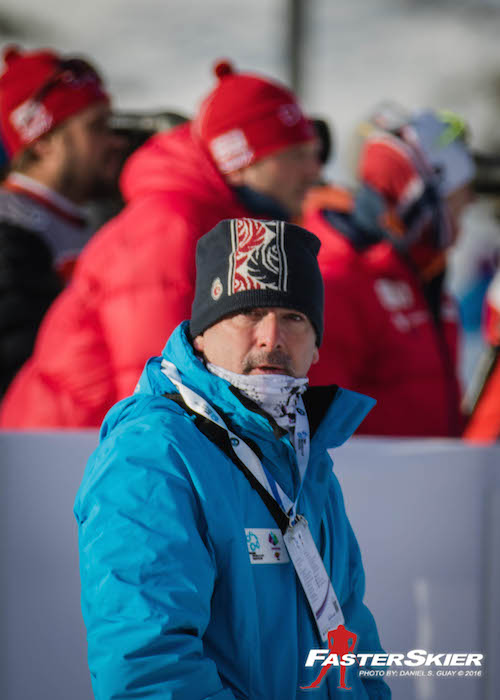
Tag: Matthias Ahrens

  • With ‘Biathlon Family’ Behind Her, Crawford Third in Ruhpolding 15 k

    With ‘Biathlon Family’ Behind Her, Crawford Third in Ruhpolding 15 k

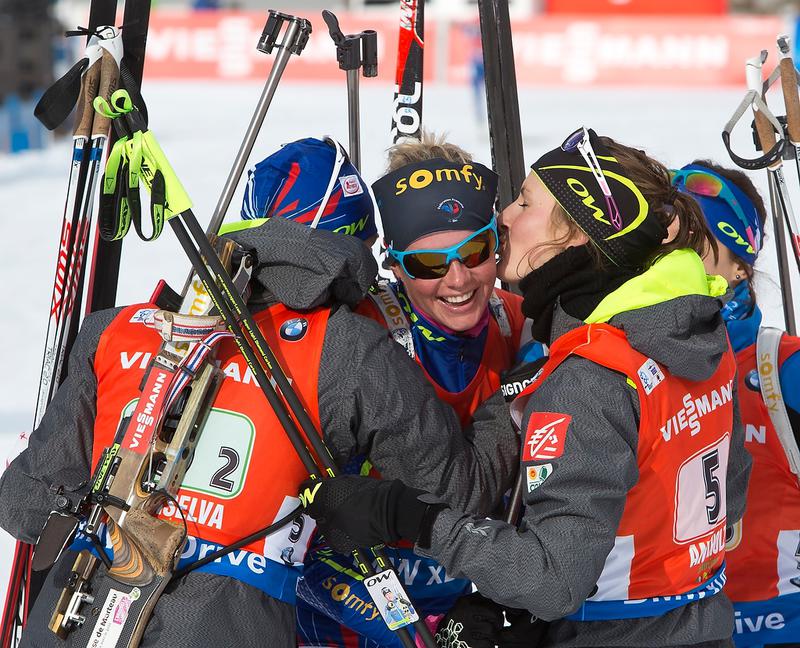
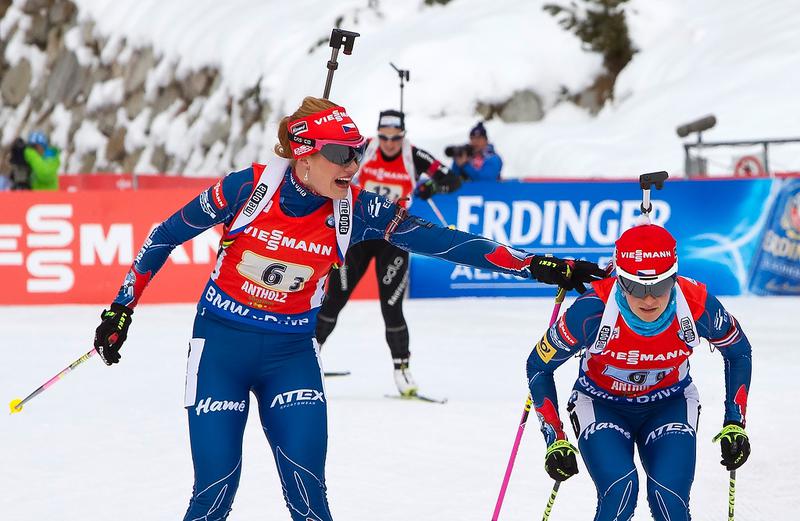
    Rosanna Crawford celebrates with her Biathlon Canada teammates Emma Lunder (l) and Julia Ransom (r) after placing third for her first-career IBU World Cup podium on Thursday in the women’s 15 k individual in Ruhpolding, Germany. (Photo: Salomon/NordicFocus)

    For a while it looked as if the podium in the women’s 15-kilometer individual at the Thursday’s IBU World Cup in Ruhpolding, Germany, had been all but decided with only a few more athletes circling the course. But then the favorites who had already finished had someone to worry about.

    Along with some 13,000 spectators in the stands, they paid close attention to the video walls in the arena, as one late-starting Canadian — Rosanna Crawford — had just set the best split time after the third shooting by hitting every target for the third time in a row. She was even 1.8 seconds ahead of race leader Dorothea Wierer of Italy.

    “I actually didn’t know I was fighting for a podium until the fourth loop,” Crawford told FasterSkier on the phone after the race. That’s where Czech wax technician, Tom Zidek, a former Biathlon Canada wax tech, told her she was is in first place.

    Canada’s Rosanna Crawford (standing) celebrates her first IBU World Cup podium on Thursday after placing third in the women’s 15 k individual in Ruhpolding, Germany, while Sweden’s Emma Nilsson (who placed 36th) unclips. (Photo: Salomon/NordicFocus)

    “I was like, Oh God!” she recalled with a laugh. “But I think that kind of helped as well because then I knew to expect the crowd for the last standing.”

    Could this be Crawford’s big day? Coming into the range for the final standing shooting, the 29-yaer-old Canmore native knew she likely would get a season-best result if she did not totally implode, but needed to shoot clean again to stay in podium contention and not get hit with the individual race’s merciless one-minute penalty per miss.

    “I made sure just to set up properly, and then I took an extra breath before my last shot and was pretty pumped to see it turn to white,” Crawford recalled of her last shooting stage. “I am a person who really likes cue words and I have a few sentences that I repeat over in my head. … I knew the only way I was going to hit the targets is if I only thought about the present moment.”

    After she had cleaned all five targets for the fourth time, bringing her shooting percentage to a perfect 20-for-20 (the first time she had ever done so in a race), Crawford skated off the shooting mat with a smile on her face. She left the range now 7.8 seconds behind Wierer’s time (after the Italian had also hit all 20 targets), but was still more than 20 seconds ahead of Finland’s Kaisa Mäkäräinen (who had incurred one penalty in her first prone shooting but shot clean after that) and Ukraine’s also clean-shooting Yuliia Dhzima.

    “Being one of the last competitors with bib 96 I had a lot of time to wait,” Crawford said at the IBU’s post-race press conference. “I knew all the eyes were on me probably for my last two shootings. That is something I have never experienced before, going from the third loop onwards where everyone was cheering for me around the loop. … It’s a feeling I have never had before to hit all 20, so I was really excited to ski out of the range.”

    With her team staff, including head coach Matthias Ahrens running next to the track cheering her on, Crawford chased around the loop up the steep “Wall of Ruhpolding” climb. Overall she skied the 26th-fastest course time of the day, and on the final loop in softening conditions, her loop time ranked 48th. But she still hung onto the podium.

    “The course had broken down a little bit, with a hundred-and-something starters, so by the time I went around I was really searching for the best line, which I think paid off as well,” Crawford said.

    The women’s 15 k individual podium at the IBU World Cup in Ruhpolding, Germany, on Thursday, with Italy’s Dorothea Wierer (c) in first, Finland’s Kaisa Mäkäräinen (l) in second, and Canada’s Rosanna Crawford (r) in third. (Photo: Salomon/NordicFocus)

    Coming out of the downhill and onto the finishing stretch with the thousands of spectators cheering her on, Crawford fought the clock. She was out of reach of Wierer, but still within striking distance of Mäkäräinen in second. At the finish, Crawford was third, 21.2 seconds behind Wierer and 8.5 seconds behind Mäkäräinen in second place (+12.7). The Canadian was comfortably ahead of Dhzima in fourth (+45.9), while another clean-shooting Ukrainian, Valj Semerenko, placed fifth (+52.6).

    “I am so excited today, it was really special, my first time hitting 20-for-20 as well,” Crawford said at the press conference. “I really love Ruhpolding! It was my first World Juniors, my first World Cup, and my first podium, so it’s a very special place for me.”

    As Crawford skied into the finish she looked up to the nearest video monitor to check if she indeed had managed to hold her position on the podium for the first time. But she didn’t have to wait long for confirmation as her teammates and coaches already rushed out into the finish to hug and congratulate her.

    “Julia [Ransom], Emma [Lunder] and Sarah [Beaudry], they kind of pushed past the IBU guys, which I don’t think they were allowed to do, but Canada’s not on the podium every day so they let them sneak by to give me a hug so that was really special,” Crawford told FasterSkier. “I’ve been with these girls the past couple years now and so to be able to celebrate with them is amazing. Their results have been so inspiring for me … [My coach Roddy Ward] also jumped the fence, which I don’t think was allowed, so that was nice to be able to see him as well.

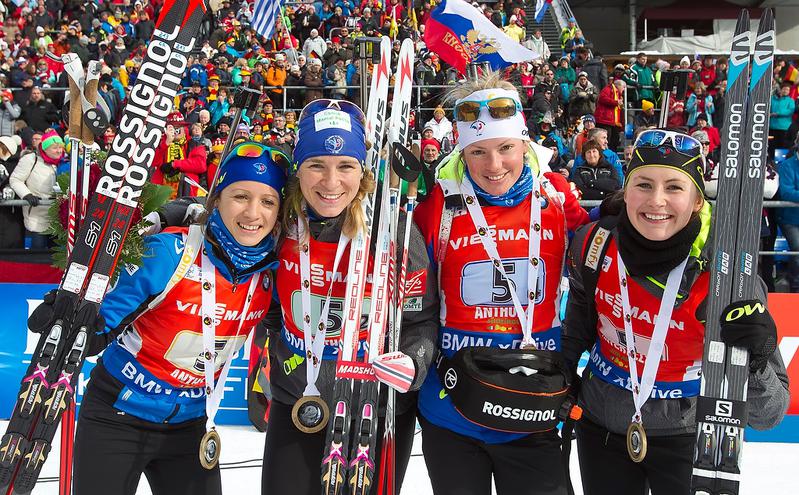
    Biathlon Canada celebrates Rosanna Crawford’s podium on Thursday in the IBU World Cup 15 k individual in Ruhpolding, Germany, with (from left to right) coach Roddy Ward, Crawford, Emma Lunder, Julia Ransom, and Sarah Beaudry. (Photo: Salomon/NordicFocus)

    “It’s just such a team effort to get to the podium,” she continued. “I’m the one out there skiing and shooting, but I couldn’t have done it without the amazing skis on my feet or my coaches behind the scope, so Matthias and Roddy were really important there, and I couldn’t have done it without the girls who I train with all summer. I’m just so grateful for this team that I’m on.”

    “So proud!!!” her longtime boyfriend and teammate Brendan Green wrote on Instagram with a screenshot of Crawford finishing.

    “Brendan is amazing,” Crawford said. “I’m sure he was pretty nervous. He was the first text messages and tweets and Instagrams that I had on my phone. Right now I’m having dinner with him and then we’ll go to the awards ceremony tonight. It’s really special.”

    “It’s incredible for me, not something that I was really expecting this season,” she told German broadcaster ZDF in an interview immediately after the race. “I didn’t have the best summer of training so to be on the podium is really special for me.”

    That was an understatement. Last spring, Crawford and her family dealt with a severe personal tragedy with the loss of her brother Jordan.

    “It was such a hard summer for me, losing my brother in April,” she told FasterSkier. “I really wish he was here today so I could celebrate with him, too. I miss him a lot. Jordan was a huge cheerleader for me. He always believed in me. Whenever I was home, he was always cooking me food and helping me take care of the dogs, and he was always so concerned that he was causing me stress. … Jordan loved the outdoors so whenever I was out in a valley or skiing or mountain biking, he was always in my thoughts, and wishing I could share these things with him. It was really hard on the whole family, but it brought us closer together as well in some ways, to support each other.”

    Asked if she had caught up with her family members yet, including her sister Chandra Crawford, a 2006 Olympic gold medalist in cross-country skiing, she said she had spoken to all of them.

    “Training was always a little bit on the back burner for the first couple months while we were all grieving and then once finally the motivation came around again to start training, it felt right and proper,” she said of her offseason and transition to another race season. “But then again, the results just were not paying off through the first trimester [of the World Cup] and I didn’t know what I was doing wrong and I was really starting to lose hope.”

    Crawford’s previous best non-relay result this season was 39th in the 10 k pursuit in Hochfilzen, Austria. And her last time in the top 10 outside a relay race was back in December 2014, where she placed fourth in a sprint and seventh in a pursuit in Pokljuka, Slovenia.

    Coincidentally, Germany’s ZDF network featured the Canadian women’s team in a preview to the individual race, filming them and coach Ahrens while they attended a one-hour cooking class in Ruhpolding. But they certainly had not intended it as a segment on a likely podium finisher for the very next race.

    “Yes, of course the Bavarian food fueled me around the course,” Crawford said with a laugh when ZDF asked about that.

    “Just thank you so much to the fans. There is no way I would have been able to ski around that last loop without them,” she added.

    “This really describes the biathlon family,” Crawford later explained in the press conference. “That it doesn’t matter which country you are from, people will be cheering for you. And not only the fans but also the techs. Jarko, Kaisa’s head wax tech, who used to wax for Canada, he was giving me splits off of Kaisa telling me, ‘You are ahead of Kaisa, go get her!’ So they might have to have a serious conversation tonight! It was really incredible.”

    Rosanna Crawford (Biathlon Canada) finishing third in the IBU World Cup women’s 15 k individual in Ruhpolding, Germany. (Photo: Salomon/NordicFocus)

    In her interview with FasterSkier, Crawford also spoke of a Ukrainian coach who cheered her on for the final loop. “I think this really describes what the biathlon family actually is,” she said. “It’s not the IBU. It’s the coaches and the athletes and the wax techs and the fans, that is actually the biathlon family.”

    Despite all the support she had felt throughout the year, Crawford had a season she was not satisfied with so far, with two 39th places as her best results (excluding relays). Going into this race, she ranked 79th in the overall World Cup standings. Last weekend, instead of starting at the World Cup in Oberhof, Germany, she raced two sprints on the IBU Cup in Brezno-Osrblie, Slovakia, where she placed 15th and 22nd. More so than a demotion, that was a move Biathlon Canada made to give other women on the team a chance to qualify for the upcoming Olympics.

    “This season has definitively not started out very good for me, and then getting sent to the IBU Cup was really frustrating,” Crawford said on the phone. “But I did really like the course in Osrblie, and it was the best skiing I’d felt all year so I really tried to carry that momentum into today’s race. … I think staying in Europe over Christmas was incredibly beneficial for us.”

    Crawford’s previous career bests in non-relay races have come in sprints, with her fourth place in Pokljuka and a fifth place in Hochfilzen, both during the 2014/2015 season. She’s been on the podium before, placing second with teammate Nathan Smith in the single mixed relay in Östersund, Sweden, to open the 2015/2016 season.

    “There’s just so many lessons you learn over the years, and trying to bring it all together and to have it pay off on one day is exactly what we’re all hunting for out there,” Crawford concluded.

    Fourth Career Victory for Wierer

    Italy’s Wierer, who frequently performs very well in this competition format and also won the individual in Ruhpolding in 2016 (Crawford placed 18th back then as the best North American) set the best time on Thursday, crossing the line after 41:29.0 minutes.

    “I am really happy about this,” Wierer said at the press conference. “I knew that it’s all about the shooting. In the last individual competition I shot really bad, but the last weeks I feel really confident about my shooting. I think the track was really good, and hard conditions are much better for my skiing. The shooting range wasn’t difficult today, there was nearly no wind.”

    Asked about having to wait if her time would ultimately be good enough for first place, she added with a laugh: “I was looking [at] Rosanna, and I was afraid of her. But finally I saw that she was some seconds behind me. I wasn’t sure because on the last round I lost a lot, I was really tired, but at the end she didn’t get me!”

    On her 35th birthday, Mäkäräinen finished second (+12.7). She was the only finisher in the top five with a penalty, incurred during her first prone shooting.

    “It’s a good present,” she said at the press conference when asked about her second place. “I have actually managed to do many good races on my birthday, so this is nice. … 19 out of 20 is really good for me, probably my best shooting this winter, so I am really happy about that and not thinking too much about that one penalty.”

    “It’s an amazing place,” she added when asked about her tendency to do well in Ruhpolding. “I like it a lot here because the crowd is really close to us, and there were a lot of people from Finland here, also my parents and their friends. So it was a nice atmosphere today.”

    She added that she did not intend to extensively celebrate her birthday with her family.

    “I will celebrate by having a massage and good dinner,” Mäkäräinen said. “Just basic things, the athlete’s life goes on, we have more races to come.”

    Dunklee 27th, Ransom 34th

    For US Biathlon, Susan Dunklee finished 27th with three penalties (1+1+1+0), staying ahead of a number of competitors who performed better on the range thanks to her 14th-ranked ski time.

    “Certainly the highlight for me today was watching Rosanna crush it,” Dunklee wrote in an email. “Her whole team, athletes and staff, were overjoyed. It’s inspiring to see and lends positive energy to all the North Americans going forward.”

    “This was the first race that felt normal for me and not an extreme high or low,” she wrote of her own race. “It’s a relief. The skiing felt great today and I have no doubts in it going forward. Shooting is finally rounding into form; 85% is a solid result. My goals going forward are to stay healthy and happy and I believe that’s what I need most to perform well in February.”

    US Biathlon’s Clare Egan in front of the stands in the finish of the women’s individual 15-kilometer race at the IBU World Cup in Ruhpolding, Germany. Initially she was ranked 35th, and ultimately ended the race in 57th. (Screenshot: ZDF broadcast)

    Starting about in the middle of the field in bib 43, her teammate Clare Egan was initially 35th as she came into the finish, waving to the cheering crowd as she was shown on the video wall. As more athletes ended their races ahead of her, she ultimately finished 57th (+4:26.3) with three one-minute penalties (0+1+0+2).

    “Finally a race I can be proud of!” Egan commented in an Instagram post.

    “We will field our first women’s relay this weekend,” Dunklee wrote of their team, which will be joined by athletes who competed at the IBU Cup in Arber, Germany, on Thursday. “It has been a challenging season so far living and traveling with such a small crew, trying to stay upbeat and carry the team with a skeleton group.”

    Starting the race early in bib 5 and thus completing her race before Crawford’s had even begun, Biathlon Canada’s Julia Ransom placed 34th (+3:35.0) with two penalties (1+1+0+0). Sarah Beaudry finished 53rd (+4:18.6) with two penalties (0+1+1+0), and Emma Lunder was 67th (+5:21.7) with four penalties (1+0+2+1).

    After their own races had concluded, they could only wait for Crawford after learning about the great day she was having and excitedly ran out into the finish to greet her.

    “It’s really amazing for our country and for our sport,” Crawford said in the press conference. “Hopefully there will be a few more eyes on biathlon during the Olympics. The last person to get a podium was Zina Kocher in the individual as well [a third place in Östersund during the 2006/2007 season]. So this is becoming a special race for Canada. Julia Ransom had a personal best with a ninth place in Östersund, so we seem to be individual specialists.”

    Skardino Earns Individual Discipline World Cup

    Since the IBU does not count the races at the upcoming Olympics for World Cup points and standings, this second individual race was also the last one on the competition calendar this season.

    Thus Nadezda Skardino of Belarus, who won the first individual race of the season in Östersund, managed to claim the “crystal globe” award in that discipline by finishing seventh in Ruhpolding on Thursday (+1:04.8, with no penalty). It was Skardino’s first World Cup discipline title.

    Despite finishing ahead of her in fourth on Thursday and another third place from the race in Östersund, Ukraine’s Dzhima could not make up enough points and placed second in the standings just five points back, while Mäkäräinen was third. Even without Crawford still finishing ahead of Skardino and Dhzima the outcome would have been the same.

    “It was my dream, and now I’m minus one dream in my life,” a smiling Skardino told the IBU. “I am very happy, because I thought about it after my win in Östersund. … And now I did it! Today I was not very fast on the tracks, I only thought about my clean shooting. I understood that I can win [the discipline title] if I shoot clean. I knew if some more people stay between Yuliia and me I could lose more points and still lose this, but after all people finished I was very happy I did it!”

    Crawford placed 12th in that ranking as the best North American, scoring 2 points for her 39th place in Östersund and 48 for the third place in Ruhpolding.

    The women’s World Cup Total Score leader Anastasia Kuzmina of Slovakia, coming off two victories last weekend in Oberhof, placed eighth on Thursday (+1:32.3, with three penalties) to retain her lead there.

    Races in Ruhpolding continue with a men’s relay on Friday and women’s relay on Saturday, before concluding with mass starts on Sunday. Crawford is now qualified for that race as one of the five best athletes this week not currently in the top 25 of the overall World Cup; she is now ranked 48th in the Total Score standings.

    — Alex Kochon contributed reporting
    Results

  • Sunday Rundown: U.S. Nationals; Tour de Ski Finale; Oberhof Relays

    Sunday Rundown: U.S. Nationals; Tour de Ski Finale; Oberhof Relays

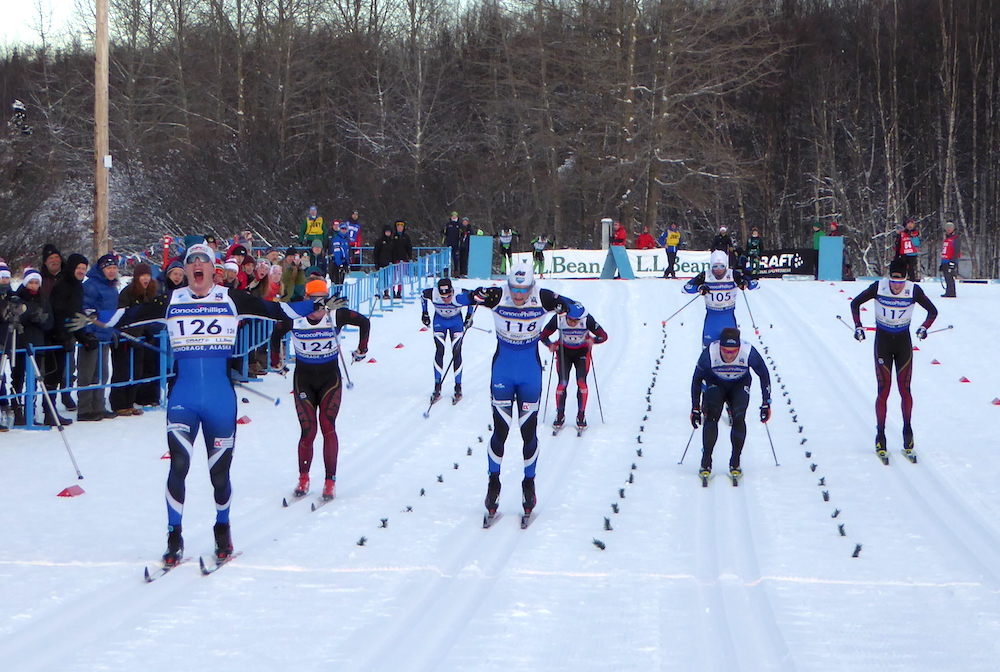
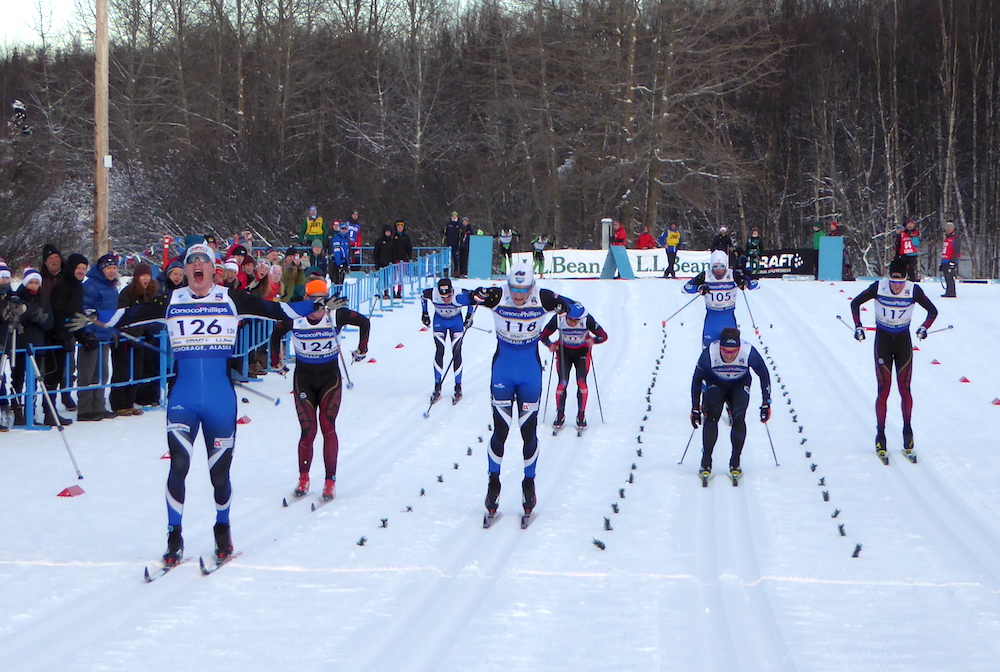
    APU’s Tyler Kornfield (126) leads APU’s Eric Packer (118) and DU’s Eivind Romberg Kvaale (124) to the line in the men’s 30 k classic mass start at 2018 U.S. Cross Country Championships on Sunday in Anchorage, Alaska. Kornfield, Packer, and Kvaale finished first, second and third, respectively. Kris Freeman (10, second from left) was fourth overall and the third American.

    U.S. Cross Country Championships (Anchorage, Alaska): 20/30 k classic mass starts

    Men’s report

    Women’s report

    Sweden’s Hedda Bångman denied Caitlin Patterson of her first outright victory of the week at 2018 U.S. Cross Country Championships, but Patterson as the first American racked up her third-straight national title in the women’s 20-kilometer classic mass start at Kincaid Park on Sunday in Anchorage, Alaska.

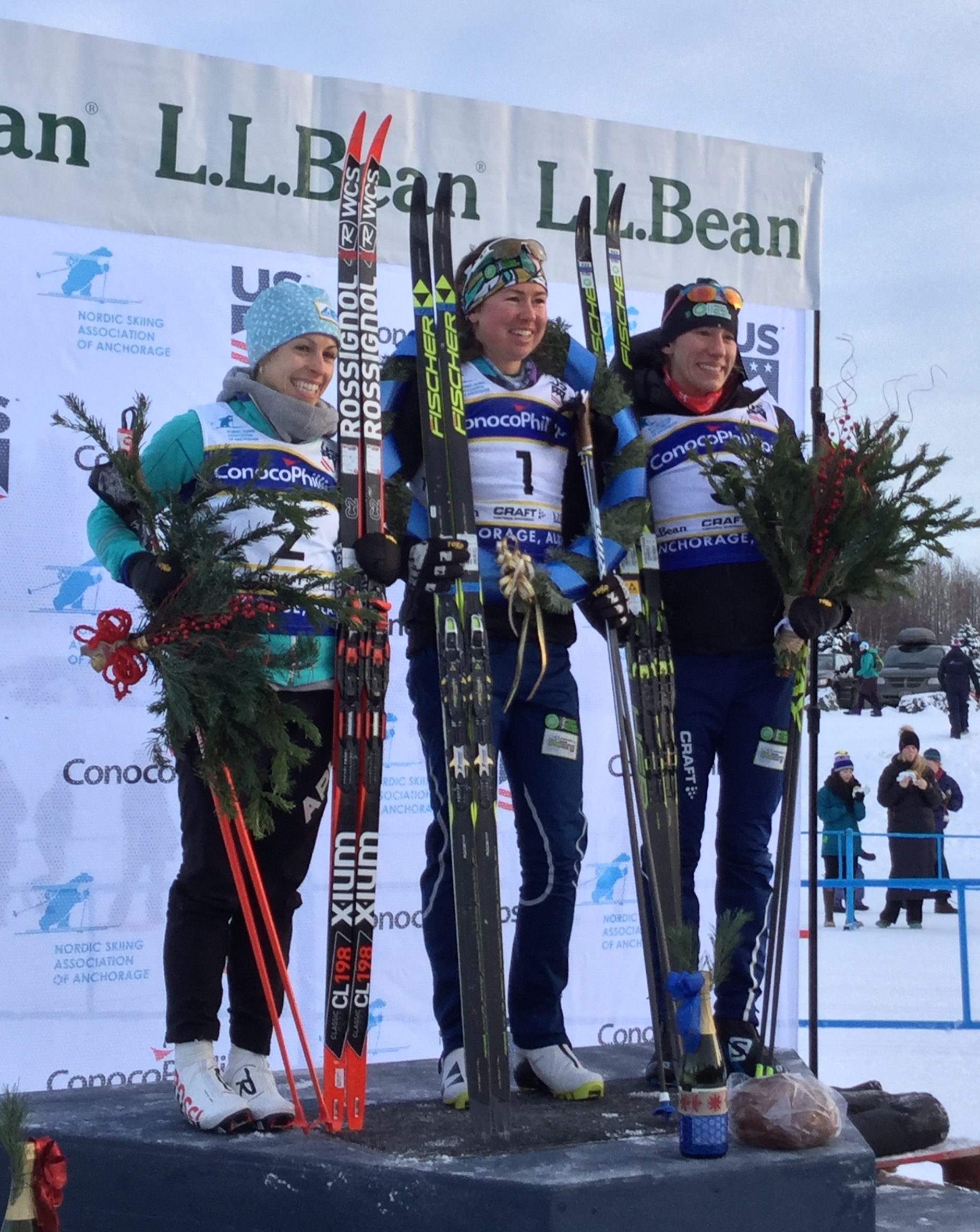
    The top-three Americans in the women’s 20 k classic mass start on Sunday at 2018 U.S. nationals in Anchorage, Alaska, with Caitlin Patterson (1) of the Craftsbury Green Racing Project (CGRP) in first, Rosie Frankowski of APU (l) in second, and Kaitlynn Miller (r) of CRGP in third.

    Bångman, a 22-year-old freshman at the University of Colorado Boulder (CU), pulled off a 15.9-second win in the mass start, crossing the line in 1:00:55.3 hours. Patterson, of the Craftsbury Green Racing Project (CGRP), finished second, but was the top American in the event for the third time this week, and Rosie Frankowski, of Alaska Pacific University (APU), notched third (second American), 19.6 seconds back.

    Rounding out the top 10 was Jessica Yeaton, who trains with APU and races for Australia, in fourth (+44.1), Kaitlynn Miller (CGRP) as the third American in fifth overall (+1:13.5), Alayna Sonnesyn of the University of Vermont (UVM) in sixth (+1:25.3), Chelsea Holmes (APU) in seventh (+1:55.4), Norwegian CU skiers Christina Rolandson and Anne Siri Lervik in eighth (+1:55.7) and ninth (+1:56.1), respectively, and Erika Flowers of the Stratton Mountain School (SMS) Elite Team in 10th (+2:14.6).

    The men’s 30 k classic mass start was incredibly close, with APU’s Tyler Kornfield taking his first-ever distance national title (he was the 2012 classic sprint national champion) in 1:21:43.6. He edged his teammate Eric Packer by 0.7 seconds at the line, and Eivind Romberg Kvaale, a sophomore at the University of Denver (DU), finished 1 seconds back in third.

    Kris Freeman (Caldwell Sport) was just off the overall podium in fourth (+1.6), but was the third American. Another DU skier, Dag Frode Trollebø, also from Norway, finished fifth (+2.0), and APU had three in the top six with David Norris in sixth (+2.5). Noah Hoffman (Ski & Snowboard Club Vail) finished seventh (+2.6), Scott Patterson (APU) eighth (+3.6), and Craftsbury’s Adam Martin and Ben Lustgarten followed in  ninth (+14.7) and 10th (+14.9), respectively. With Brian Gregg (CXC/LNR/Team Gregg) in 11th (+16.1), the men’s top 11 were separated by less than 17 seconds.

    Results: Women | Men

    ***

    IBU World Cup (Oberhof, Germany): Men’s and women’s relays

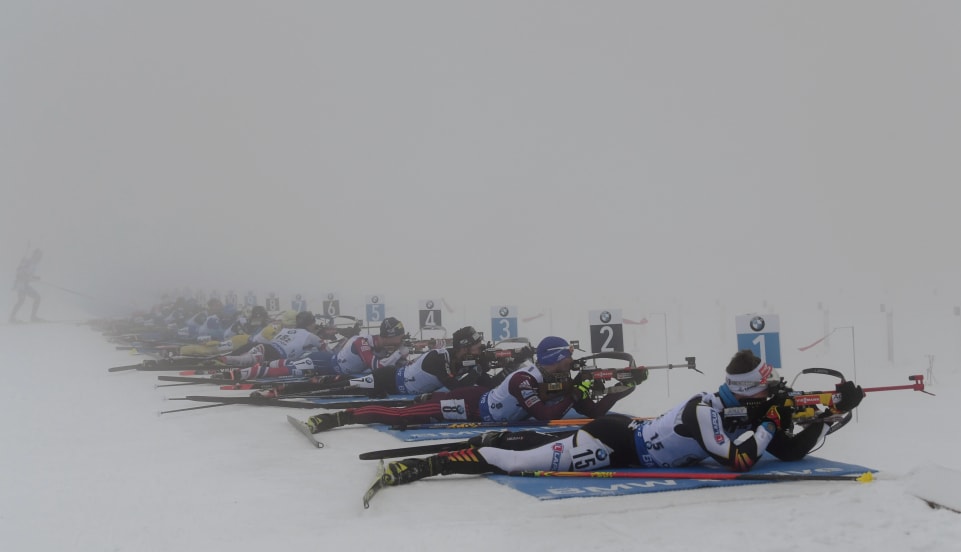
    Racers on the range during the men’s 4 x 7.5 k relay on a foggy Sunday at the IBU World Cup in Oberhof, Germany. (Photo: IBU/Biathlonworld)

    The Swedish men’s team and French women won the second relays of the International Biathlon Union (IBU) World Cup season on Sunday, with Sweden winning the men’s 4 x 7.5 k relay by 1:10.8 over Italy, and France besting Germany by 32.4 seconds.

    Notably, most of the top teams didn’t start all of their “A” teamers.

    In the men’s race, Sweden’s Martin Ponsiluoma, Jesper Nelin, Sebastian Samuelsson, and Fredrik Lindström combined for their first win together — and the first win for most of the members on the team.

    “It is a dream when you are a kid to compete in a World Cup,” Samuelsson said, according to an IBU press release. “To have a win is really amazing!”

    The Swedish women’s team also landed on the podium in third (+48.2).

    “What a race by the whole team,” said Lindström, who also has one non-relay World Cup win (from 2012) to his name. “It could not be better.”

    Conditions could not have been much more difficult for shooting on Sunday, with the fog that had descended early in the day for the women’s race worsening for the men’s race. When there wasn’t fog, there was wind.

    Misses were common throughout the two races, and even with racers being able to use three spares per shooting stage to clean, there were a high number of penalty laps.

    But the Swedish men kept their penalties to a minimum, with just one for the entire team and a total of nine spare rounds used among them. After Ponsiluoma came through the first exchange in sixth, Nelin skied them into third, Samuelsson picked off another place despite skiing a penalty after his standing stage to put them in second, and Lindström anchored them to first.

    “The conditions today were so special. Somehow I felt not so nervous, I was calm and had luck on my side,” Lindström said at a post-race press conference about his nearly flawless shooting (0+0; 0+1).

    “I have never [been first] before,” he added. “Not like this in a relay at least. That’s really fantastic.”

    “I had to look up to see if I was aiming the right way,” Nelin said after cleaning prone (0+0) then using two spares to clean standing (0+2). “I had no idea where I was aiming, so it was really difficult. But I hit, and it was good. Maybe these conditions fit me and I should never see anything.”

    Italy placed second with Thomas Bormolini, Lukas Hofer, Dominik Windisch, and Thierry Chenal combining for two penalties and 11 spares. Hofer had skied them up from eighth to second, and Windisch then took the lead on the third leg to put them in first at the final exchange, 1 minute ahead of Sweden. But Chenal slipped with the seventh-fastest last leg time and a penalty after standing.

    “Being on the podium with the team is always a special feeling,” Hofer said at the press conference. “For Thierry, it’s the first year in the World Cup, and he does a really good job, not just today. I am really happy that he could close out this relay. Second place is like a win for us.”

    Norway placed third (+2:04.6) with Vetle Sjåstad Christiansen, Henrik L’Abée-Lund, Lars Helge Birkeland, and Tarjei Bø. Together, they had three penalties (two from L’Abée-Lund and one from Birkeland) and 14 spares.

    “I grew up on Holmenkollen so I practiced a lot there [in fog],” L’Abée-Lund said. “But today was really really hard, I didn’t see anything in prone. Standing was OK, but prone was really difficult.”

    “It’s great to be on the podium,” Christiansen said. “Of course Norway always wants to win, but today we are very happy for our brothers in our neighbor-country Sweden.”

    The Canadian men placed 10th (+6:23.1) out of 25 teams with Christian Gow, Scott Gow, Brendan Green, and Carsen Campbell having a combined six penalties and 20 spares. Three of those penalties came on Scott Gow’s second leg, two from Campbell’s anchor leg, and one on Christian Gow’s first leg.

    After a penalty on his first prone stage (1+3), Christian cleaned standing with a spare (0+1) and tagged Scott in 11th, 53 seconds out of first. Scott then had two penalties in prone and three in standing, but managed to improve to eighth given how much everyone else was struggling with the shooting as well. Green kept them in eighth with two clean stages (0+2, 0+3), and Campbell, in his first World Cup relay, cleaned prone (0+2) but had two standing penalties (2+3) to put the team in 10th at the finish.

    In an interview with German broadcaster ARD halfway through the race, Canadian coach Matthias Ahrens called the range conditions, which ranged from thick fog to unpredictable wind, “very hard to assess.”

    “… To be honest, the good thing was that conditions were very bad,” he later added. “So regarding visibility, almost everyone was on the range at the same time [with the same irregular conditions]. They had to wait very long, and of course had bad conditions to shoot, but much of the field was there at the same time.”

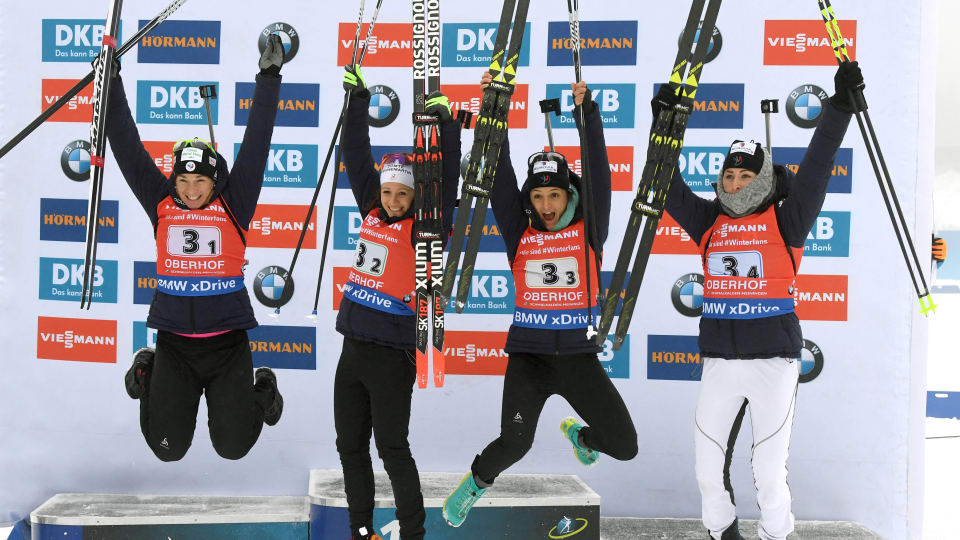
    The French women’s team, of Anais Bescond, Anais Chevalier, Celia Aymonier, and Justine Braisaz, celebrate their relay victory on Sunday at the IBU World Cup in Oberhof, Germany. (Photo: IBU/Biathlonworld)

    In the women’s race, with better shooting visibility, France’s Anais Bescond, Anais Chevalier, Celia Aymonier, and Justine Braisaz took the win in 1:12.42.4, with one penalty and 10 spares. After Bescond put them in first through the first exchange, 6 seconds ahead of Italy in second, Chevalier had to ski a penalty loop after prone but cleaned standings (1+3, 0+0) and tagged off in second, 23 seconds behind Italy, now in first.

    One loop later, France was back in first thanks to Aymonier, who cleaned with just two spares (0+0, 0+2), and they extended their lead from 0.8 seconds at the last exchange to 32 seconds at the finish with Braisaz, who shot 0+1, 0+3, and skied the fastest anchor leg.

    “I know that it’s always good for Justine to start in the first position, so I really wanted to pass the relay to her in that,” Aymonier said in a press conference after.

    “I was nervous, too,” Braisaz said. “That kind of shooting turned my mind upside down, actually. The crowd was very loud, and … I wasn’t very focused on what I did. It was a bit foggy, too, so that made it harder. But finally it was a French day, maybe.”

    “In my mind the whole team is really strong, and really able to get the first place,” Bescond said. “After years and years and years behind Germany’s team we finally did it. So just Oberhof spirit I think.”

    Germany placed second with Vanessa Hinz, Denise Herrmann, Franziska Preuss, and Maren Hammerschmidt. They combined for two penalties and 13 spares; with a penalty on Hinz’s first leg and one more on Hammerschmidt’s last shooting. After being tagged in 14th, Herrmann skied them into fourth, 40 seconds out of first, and Preuss elevated them to second, which Hammerschmidt held onto.

    “I was struggling a little bit in the prone shooting,” Herrmann said. “But the skiing was good today, and also the standing [shooting]. I tried to go fast on the track and catch some girls.”

    Sweden, with Linn Persson, Anna Magnusson, Elisabeth Högberg, and Mona Brorsson, avoided the penalty loop and used eight spares to reach the podium for the first time in six seasons. In sixth place at the first exchange, they slipped one place to seventh on the second leg, but Högberg raced them up to fourth with near-perfect shooting (0+0, 0+1) with one leg to go. Brorsson then anchored them to third with clean shooting (0+2, 0+1) and the third-fastest last leg.

    “It’s just super nice for us! I am super happy,” Magnusson said. “We were very emotional at the finish.”

    When Brorsson was asked if she believe she could fight for the podium, she responded, “Not really. But I said to Linn, ‘Maybe it is our day today. Please let it be our day today.’ ”

    The Canadian women finished 14th (+6:37.5), out of 20 teams, with two penalties and 13 spares. Sarah Beaudry initially put them in 15th after shooting 0+1, 0+2, then Julia Ransom had a standing penalty (0+2, 1+3) to slip one place to 16th. Megan Tandy picked off three places with clean shooting (0+0, 0+2) and tagged Emma Lunder in 13th, and Lunder had a penalty in prone but cleaned standing (1+3, 0+0) to finish in 14th.

    Results: Men | Women

    ***

    Tour de Ski Stage 7 (Alpe Cermis, Val di Fiemme, Italy): 9 k freestyle climb 

    Women’s report

    Men’s report

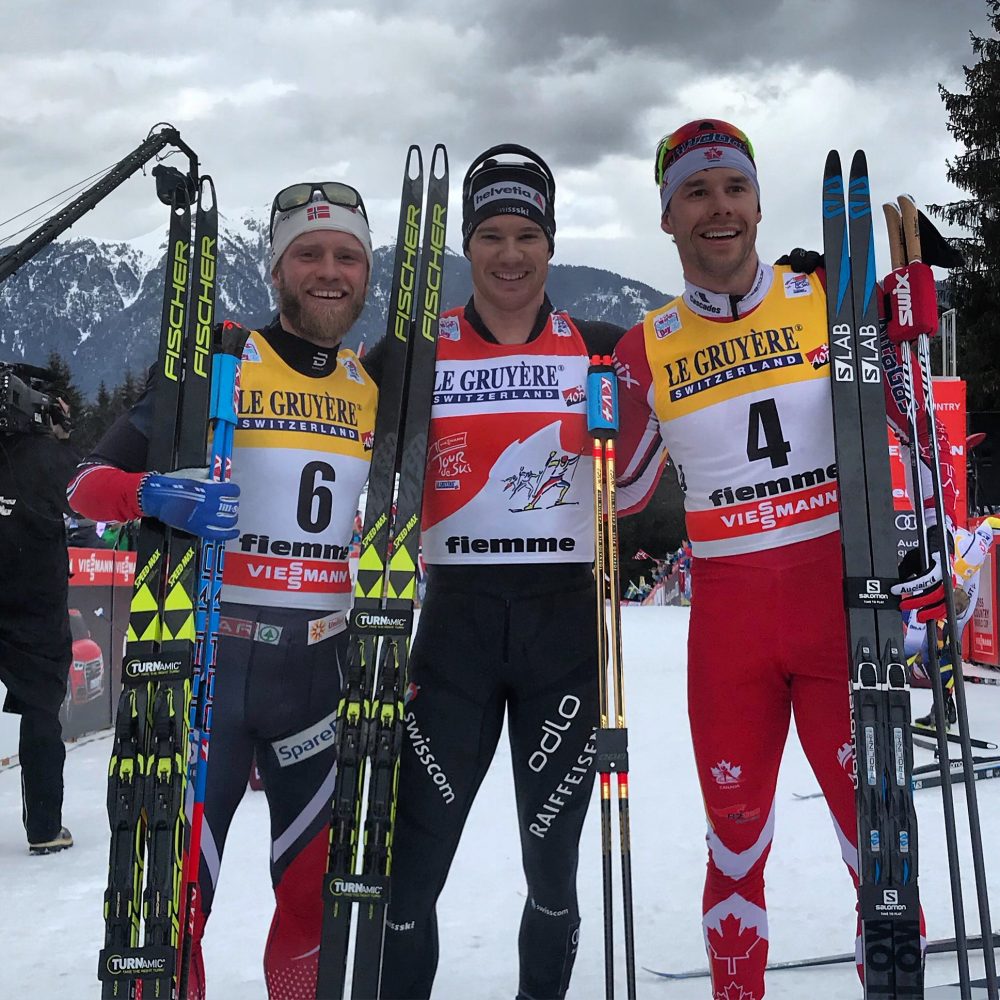
    The men’s overall 2018 Tour de Ski podium atop Alpe Cermis after the final Stage 7 hill climb: with Switzerland’s Dario Cologna (c) in first, Norway’s Martin Johnsrud Sundby (l) in second and Canada’s Alex Harvey (r) in third. (Photo: FIS Cross Country/Twitter)

    Dario Cologna of Switzerland added a fourth Tour de Ski (TdS) title to his list of accolades on Sunday, winning the 2018 edition of the race in dominant fashion, with a 1:26.5-minute win over Norway’s Martin Johnsrud Sundby. And Canada’s Alex Harvey scored his first TdS overall podium in third.

    The 31-year-old Cologna started the 9-kilometer freestyle pursuit up Alpe Cermis 1:15 ahead of Kazakhstan’s Alexey Poltoranin in second. Russia’s Sergey Ustiugov, slated to start third, did not start due to a back injury. Thus Harvey was the third man off the start line, 1:23 behind Cologna.

    (Sweden’s Marcus Hellner, 13th after Saturday’s Stage 6, also did not start the Tour’s final stage.)

    Early on, Cologna started putting time into his competitors, extending his lead on Poltoranin to 1:20.5 and Harvey to 1:24 at 1.8 k.

    By 4 k, however, Harvey had used his speedy skiing on the flatter portions of the race leading up to the climb to catch Poltoranin, and the two clocked through that checkpoint 1:19.4 behind Cologna. Behind them, Russia’s Alexander Bolshunov skied just ahead of Sundby, another 21 seconds and 22 seconds back, respectively, in fifth and sixth.

    While Harvey clawed back a few more seconds on Cologna, he was still 1:17.8 back at 6.2 k, with Poltoranin just 0.7 seconds behind him in third.

    Harvey remained in second until around 8.5 k; with just a half kilometer to go, Sundby had caught both Poltoranin and Harvey, passing them both. Sundby held that position and finished second, 1:26.5 behind Cologna, who won in 28:52.1.

    Harvey stayed strong for third (+1:30.6) while Poltoranin dropped off the Canadian’s pace in the final half kilometer and finished fourth (+1:41.7). Norway’s Hans Christer Holund placed fifth (+2:17.8), Bolshunov lost a spot to finish sixth (+3:09.7), France’s Jean-Marc Gaillard finished seventh (+3:16.7), Sweden’s Daniel Rickardsson eighth (+3:20.8), and Russia’s Alexey Chervotkin and Andrey Larkov took ninth (+3:33.5) and 10th (+3:37.8), respectively.

    France’s Maurice Manificat, known for his strength in freestyle hill climbs and pursuit races, rose from 14th to 11th (+3:45.7) with the second fastest time of day, 12.8 seconds slower than Sundby as the time of day winner in 28:36.4. Cologna’s time was fourth fastest (+15.7), behind Russian U23 skier Denis Spitsov in third (+14.3) (Spitsov started 20th and finished 13th). Holund’s time ranked fifth (+20.6) and Harvey’s time was sixth fastest (+23.6) of the 43 men that finished the race.

    The lone American man to complete this year’s Tour, Paddy Caldwell (U.S. Ski Team) skied the 22nd fastest time of day for 38th overall (+11:54.8).

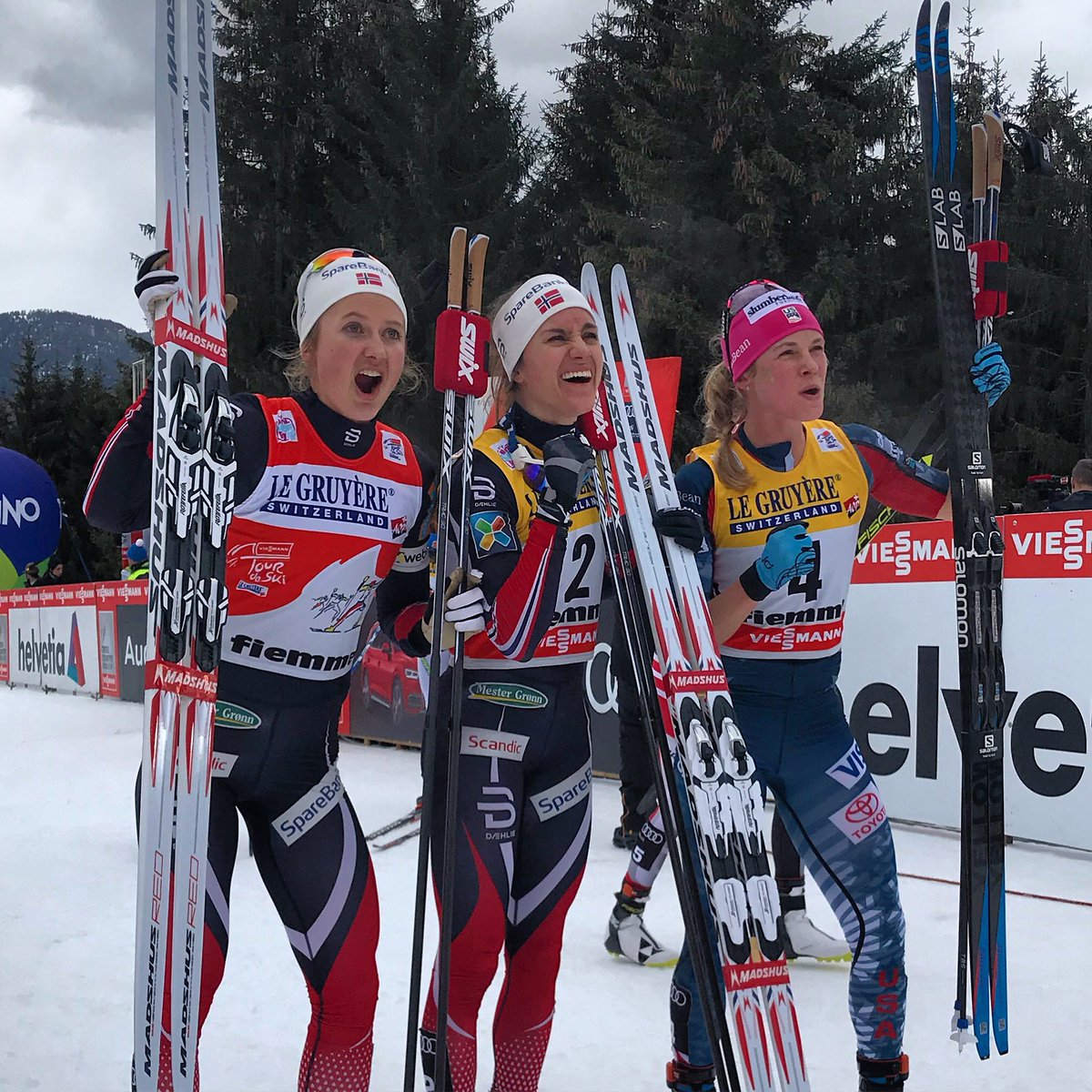
    Heidi Weng (center) celebrates her second Tour de Ski victory, with teammate Ingvild Flugstad Østberg second and the U.S. Ski Team’s Jessie Diggins third. (Photo: FIS Cross Country/Twitter)

    In the women’s hill climb that kicked off the day, Heidi Weng raced to her second consecutive TdS title. The Norwegian started the day within two seconds of teammate Ingvild Flugstad Østberg, and the two skied together for the flat section of the nine-kilometer stage of the competition. But when the climbing got steep on Alpe Cermis, Weng left her teammate behind and eventually racked up a 48.5-second win.

    The battle for third was less predictable. Jessie Diggins of the United States started the day in fourth, but made up the ten seconds to third-place Krista Pärmäkoski of Finland in the first few kilometers. The pair climbed together for a while before Diggins attacked. Pärmäkoski tired on the final sections of the Alpe Cermis and Diggins took the podium in definitive style, 2:23.2 behind Weng and 24 seconds ahead of Pärmäkoski. It’s the first overall Tour de Ski podium for Diggins or any American athlete.

    Teresa Stadlober of Austria finished fifth (+3:09.4), Kerttu Niskanen of Finland sixth (+4:17.0), Russia’s Anastasia Sedova seventh (+4:49.6), and Switzerland’s Nathalie von Siebenthal eighth (+4:56.1).

    Sadie Bjornsen started eighth and slipped one spot to finish ninth (+6:15.0), giving the U.S. two top-ten finishers in the Tour de Ski for the first time. Liz Stephen finished 16th (+8:25.8) and Rosie Brennan 24th (+10:59.6).

    En route to her win, Weng notched the fastest time of the day on the 9 k stage. Stadlober’s time was second, Diggins third, Østberg fourth, and Stephen fifth.

    32 women finished this year’s edition of the Tour de Ski.

    Results:

    Men’s Stage 7 | Men’s time of day | Men’s Tour de Ski overall standings (final)

    Women’s Stage 7 | Women’s time of day | Women’s Tour de Ski overall standings (final)

  • Tarjei Bø Wins First IBU World Cup Since 2013; Scott Gow Tallies Career-Best 16th

    Tarjei Bø Wins First IBU World Cup Since 2013; Scott Gow Tallies Career-Best 16th

    Norway’s Tarjei Bø celebrates his victory in the men’s 10 k sprint at the 2017/2018 IBU World Cup in Östersund, Sweden, his first win in four years. (Photo: IBU/Biathlonworld)

    Biathlon Canada’s World Cup Team at the International Biathlon Union (IBU) World Cup in Östersund, Sweden, had a number of things to be happy about on Saturday afternoon as the first men’s 10-kilometer sprint race of the new season wrapped up.

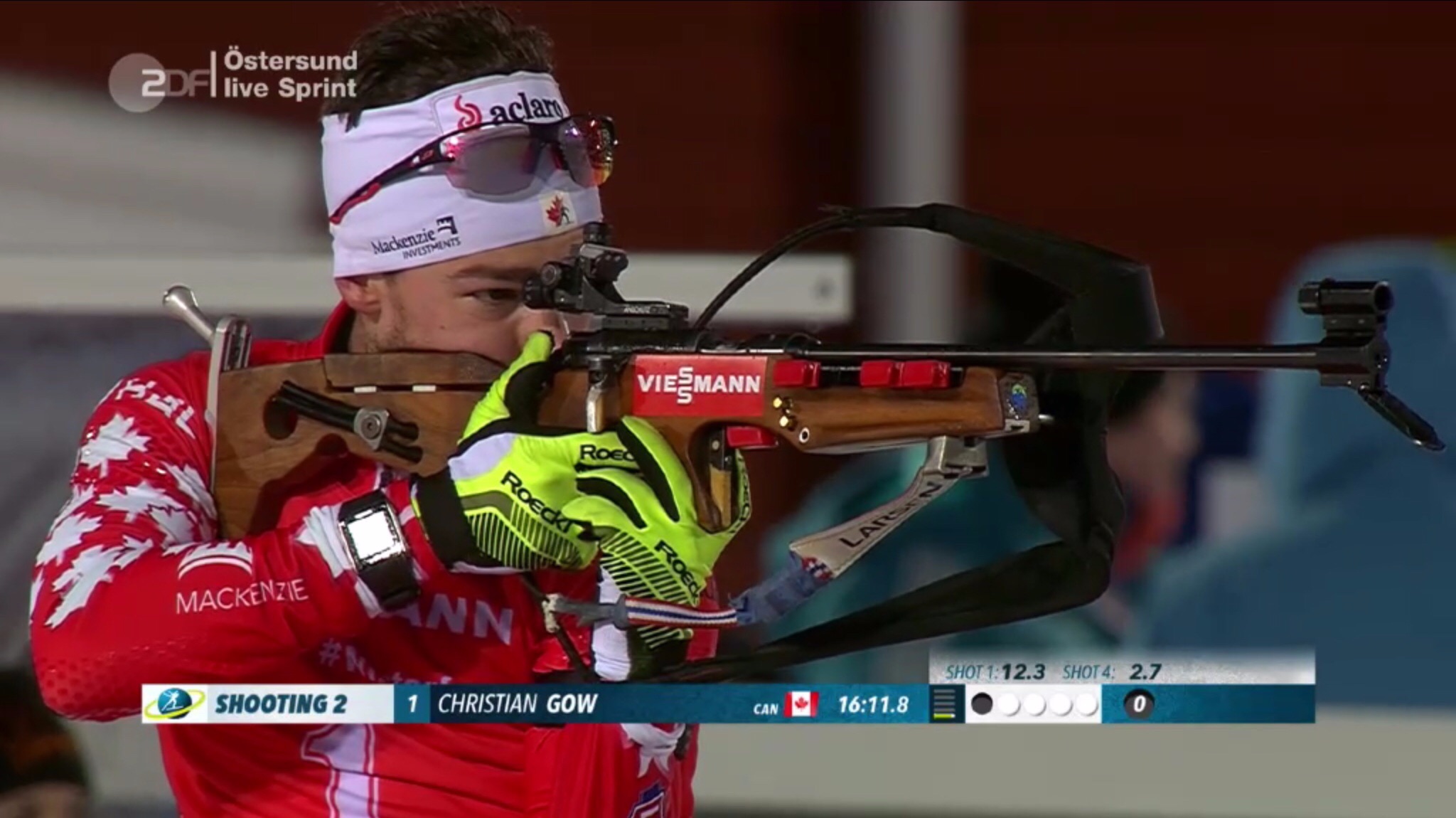
    Christian Gow was already smiling at the cameras as he stood in the starting-gate booth. Beginning the sprint as the very first starter in a large field of 108 athletes from 30 nations, Gow soon would have every reason to smile, as all alone on the range he shot clean in both his prone and standing stages under the watchful eyes of the spectators and his coach Matthias Ahrens, who watched through the lens of his spyglass. Gow kept himself ahead of the field and was the first athlete across the line after avoiding being passed.

    “I enjoyed starting with bib 1 more than I expected,” Gow wrote in an email to FasterSkier. “I found that there are some extra elements that you don’t really consider when you start in the middle of the pack. The biggest differences are not having any information on splits for the first loop and that shooting on the range with no other athletes is kind of eerie. It is normally such a busy place, so to have it all to yourself and the entire crowd focused solely on you can add extra pressure. I am really happy with how I managed that today.”

    Biathlon Canada’s Christian Gow shooting clean in the standing stage of the men’s 10 k sprint at the 2017/2018 IBU World Cup in Östersund, Sweden, on his way to a career-best sprint result. (Screenshot: ZDF)

    He had to wait for a long time for the other starters to finish the race so he could know where his time stood. In the end, it was good enough for 26th place, 58.1 seconds back from the winner, Norway’s Tarjei Bø, in a very tight race at the top.

    “I knew that the entire field was still to come, but that I had done my job so all I needed to do at that point was wait,” Gow wrote. “I am quite happy with my placing. With my time back from the leader being under one minute, I was hoping for a top 20, but am very satisfied anyways. Finishing in the top 30 is awesome, I have been on the cusp a half-dozen times, but only within it once before.”

    Last season, in the World Championships pursuit in Hochfilzen, Austria, Gow finished 23rd.

    Starting a few minutes behind him in bib 24, his older brother Scott also cleaned both stages and skied a little faster, initially crossing the line in fifth..

    “It was almost frustrating having to wait so long to finally see the full results,” Scott Gow wrote in an email. “I knew I had a good day, but I also felt like a lot of skiers were finishing in front me as the race wore on.”

    In the end, a few more athletes finished with better times, and he got pushed back to 16th. Even so, 16th was a personal-best World Cup result for Gow, improving on a 17th place in an individual race in Antholz, Italy, and an 18th place in a sprint in Nove Mesto, Czech Republic, both during the 2016/2017 season.

    “Any finish in the top 30 and especially top 20 is very good for us,” Gow said of his team. “Today’s results helps increase my Olympic qualification which is a nice boost in confidence as the race season gets underway.”

    With a top 16, Gow jumped a rank in Biathlon Canada’s Olympic criteria standards; he’s now halfway to Priority 2 (along with teammate Julia Ransom, who placed ninth earlier this week). Both need another top 16 to fulfill that second priority.

    “It had rained a bit this afternoon and during our zero,” Scott Gow explained of Saturday’s conditions. “The rain made the track very fast and hard-packed, and the downhills were particularly tricky. The course also held up really well from start to finish so definitely fair conditions in that respect.”

    Aside from the eventual winner, another athlete helped by that was teammate Nathan Smith. Starting very late in bib 103, he also managed to hit all 10 targets ultimately finished 24th (+54.3) between the Gow brothers.

    While not close to his career-best results in the top five, most of which he achieved in 2014/2015, it was another step up for Smith, who placed 37th in the 20 k individual race on Thursday and missed most of the last season to illness.

    “I expect to feel better this weekend in the sprint but will have to be realistic considering the cold and being ‘rusty’ after not racing last year, other than a few races,” he had predicted in an email after the individual on Thursday.

    The fourth Canadian, Brendan Green finished 55th with two penalties (1+1), still also qualifying for the pursuit of the best 60 starters on Sunday.

    Bailey Leads Five Americans in 22nd

    US Biathlon’s Lowell Bailey also shot clean on Saturday, finishing 22nd and 49.8 seconds back from the winner, and six seconds ahead of Canada’s Smith.

    ”I’m happy with the race, especially after coming off of a cold this past week,” Bailey wrote in an email. “Our performance goals are to steadily progress with the season. I think this is a good step in the right direction.”

    Last season, Bailey had achieved his career best in a sprint with a second place in the World Cup test event for the Olympic courses in PyeongChang, South Korea. Those races will be his main focus this season.

    “The conditions on the track were MUCH faster than the Individual, which proved one of the slowest conditions I’ve encountered in my career!” Bailey explained. “The range was a bit tricky, with shifting winds, and I had at least one prone shot that was on the edge of the target.”

    The other starters for US Biathlon struggled a bit more on the range today. Tim Burke placed 52nd, 1:42.3 back with three penalties (3+0), joining Bailey in the pursuit on Sunday.

    “As seems to be the case in this race each year, the field is incredibly tight for tomorrow’s pursuit. It will be an exciting race,” Bailey stated in a US Biathlon press release.

    Leif Nordgren finished 66th with two penalties (1+1), Sean Doherty was 82nd with three penalties (2+1), and Paul Schommer was 94th with four penalties (1+3).

    While the three Canadians and Bailey shot clean, the men at the top of the field incurred at least one penalty and thus had to rely on their ski speed in this race.

    Another Day, Another Bø Brother

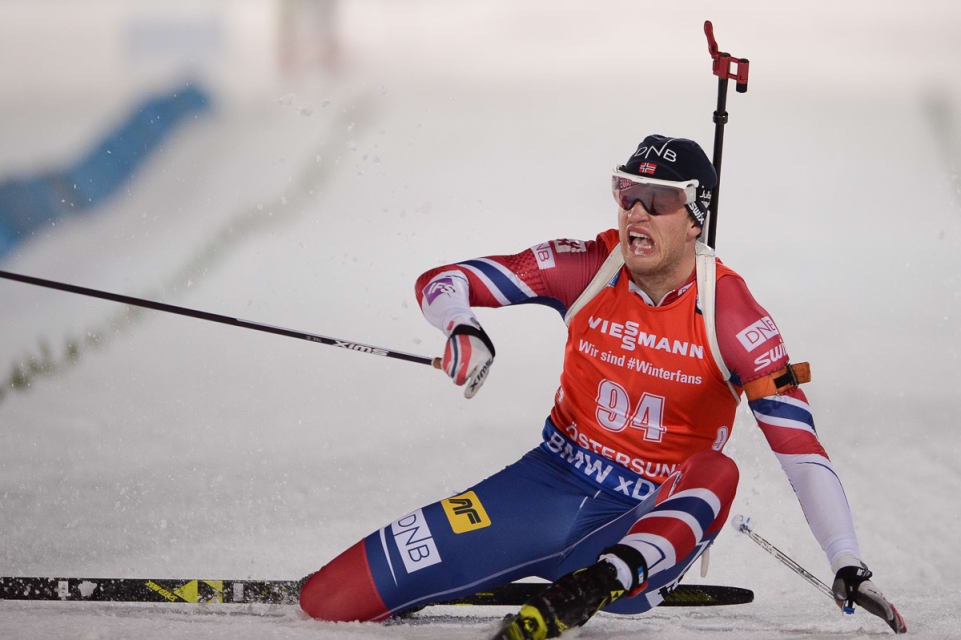
    Norway’s Tarjei Bø lunges across the finish line in the men’s 10 k sprint at the 2017/2018 IBU World Cup in Östersund, Sweden, to claim the victory just 0.7 seconds ahead of France’s Martin Fourcade. (Photo: IBU/Biathlonworld.com)

    On Thursday in the men’s 20 k individual race, France’s Martin Fourcade was beaten by Norway’s Johannes Thingnes Bø, gapped by over two minutes in a dominating performance. On Saturday afternoon, Johannes missed too many targets to challenge Fourcade again, ultimately finishing 11th (+34.4 with three penalties).

    But starting towards the back of the field in bib 94 when Fourcade had already ended his race, Bø’s older brother Tarjei snatched another victory away from Fourcade, who had already looked like the winner of the day after making up a deficit to two other athletes with one of his trademark furious final laps.

    This time he was beaten by mere inches.

    Still 7 seconds ahead of Fourcade when Bø left the range, after he also had to ski once through the penalty loop, Bø’s lead dwindled on the final lap. At the next split time, only a 3.1-second advantage remained, with 400 meters to go it was even down to 0.9 seconds heading into a downhill corkscrew into the arena.

    “You can never trust those guys giving you the times,” Bø later joked about his coaches frantically yelling splits during the press conference. “Because they want to push you, so even if they say it’s one second you can also be behind.”

    Pushing all out on the finish stretch, Bø lunged and crashed across the line in a time of 22:40.6 minutes, which was 0.7 seconds ahead of Fourcade’s time, causing the spectators in the ski arena of Östersund to erupt in a big roar.

    “I was totally blacked out, to be honest,” Bø said at the press conference. “I had this incredible fight with Martin. Already when I warmed up I saw his last 500 meters, so I knew I had to just keep on pushing. It was such a relief after I woke up from the dead there, to see that I was number one… It’s always a mental game when you fight against such great athletes as Martin.”

    It was Tarjei Bø’s first World Cup victory since the 2013 season, a sprint win at home in Oslo, Norway.

    “It was a really tough time,” the 29-year-old Bø recounted the last few seasons of his career. “In 2016 I felt I sort of came back into the top. … I was going somewhere again. But then last season was a new punch in the face … I missed so much training. This season I tried not to push so hard in the summer to keep this flow in the training and not get stopped by all these sickness problems again. This win is definitely a relief after so many years with struggles.”

    “It was quite a good biathlon competition until Tarjei came to the finish,” Fourcade said with a laugh at the press conference. “Of course I am a bit disappointed because I hoped for the victory for a long time … But that’s biathlon, and I am happy for him to be back on the top of the podium … I think I lost many times with less than one second, so I am used to that, but I am used to the opposite as well, so I will not cry.”

    “Finally, I can say that I am equal with [my brother] Johannes again,” Bø added. “Fighting with Martin, who also has a brother [Simon Fourcade]… And when the younger brother becomes better than you, it’s so nice to beat them every once in a while.”

    Germany’s Erik Lesser finished third, just 3.7 seconds back, after he also incurred one penalty lap in his standing stage, in his case with his last shot of the race. Lesser skied the 10th-ranked course time of the day, but was especially buoyed by his blazing-fast speed on the shooting range.

    Lesser triggered the first shot in prone after only about eight seconds, almost twice as fast as some athletes use to take their position, and completed the stage roughly ten seconds faster than the two other podium finishers. His range time overall ranked as the best and shooting time as the second-best of the day, just 0.6 seconds behind Italy’s Dominik Windisch (however, Windisch also missed four targets to finish 62nd).

    “Not 100% satisfied, I didn’t do my job on the final shot,” Lesser told German broadcaster ZDF while the race was still going on. “Though I’d rather miss the final than the first shot… But on the course it was top. In prone everything worked out, and I think the shooting time was again where I’d like it to be.”

    “I am very happy that I won my first podium in a sprint competition, I never was on a podium [in that] before so right now I am very happy about this,” he later added at the press conference.

    Norway’s Emil Hegle Svendsen had to settle for fourth place (+13.3), but could be seen walking out of the mixed zone smiling as Bø approached the finish to push him off the podium, and Lesser’s teammate Simon Schempp placed fifth (+15.0), both of which each had one standing penalty.

    Switzerland’s Mario Dolder with a career-best sixth place (+16.0) and Sweden’s Fredrik Lindström in seventh position (+16.7) shot clean, but could not match the course times of the podium finishers on Saturday. Out of the entire field, nine athletes shot clean. Four of them were North Americans.

    The race week in Östersund concludes on Sunday with pursuits for both the women and men.

    “The level is incredible, I think 30 athletes within one minute,” Fourcade said in the press conference. “I don’t know if I have already seen that in a pursuit, so tomorrow will be a great fight.”

    Results | Pursuit start list

  • A New Season for Biathlon Canada: Ransom Rockets to Career-Best Ninth

    A New Season for Biathlon Canada: Ransom Rockets to Career-Best Ninth

    Julia Ransom (Biathlon Canada) racing to ninth in the women’s 15 k individual on Wednesday at the IBU World Cup opener in Östersund, Sweden. In her first World Cup race of the season, it was Ransom’s career-best result and Biathlon Canada’s best individual result since 2015/2016. (Photo: Biathlon Canada/NordicFocus)

    Entering this season, members of Biathlon Canada had everything to gain and not a whole lot to lose. They had already had their funding reduced to zero by Own The Podium, save for a $50,000-dollar provision that paid for a coach, and its athletes were left to determine their offseason plan: stay home to train or self-fund training camps elsewhere. Many chose to spend most of their summer at the team’s base in Canmore, Alberta, and most started the season on the fly — without any preseason tuneup races in Europe — this week in Östersund, Sweden.

    Julia Ransom was one of those athletes. After prequalifying for Canada’s International Biathlon Union (IBU) World Cup Team for the first trimester of racing, Ransom, 24, jumped into the 2017/2018 season with the Östersund mixed relay this past Sunday — three days after flying over from Canada.

    There, she raced the second leg of the relay and tagged off in 15th, down two spots from where her teammate Emma Lunder tagged her in 13th. The team ultimately finished 15th, with teammates Scott Gow and Brendan Green.

    “Today was a tough day for me. My legs were lead on the course,” Ransom wrote in a post-race email to FasterSkier on Sunday.

    Three days later on Wednesday, it was another ballgame. With little to lose in the women’s 15-kilometer individual in Östersund, Ransom raced to a career-best ninth, which stood as her team’s best non-relay result in two seasons.

    In the first individual race of the season, Ransom is well on her way to securing a spot on Biathlon Canada’s 2018 Olympic team, meeting half of the team’s “Priority 2” Olympic criteria standards. She needs another top 16 to fulfill that second-tier criteria. Priority 1 is one top-eight result in a World Cup (or World Championships, in a championships year like last season) or a top-three in a World Cup relay.

    So far, she is the only one on her team who has cracked the top 16 in two seasons. Last winter, her best result (and her previous personal best) was 18th at 2017 World Championships in the 15 k individual. Canada’s best non-relay result in 2016/2017 was Scott Gow’s 17th place in a 20 k individual World Cup race.

    And again, it’s the first race of the season.

    “I am still in shock with how well today went,” Ransom, a Penticton, British Columbia, native in her fourth World Cup season, wrote in an email to FasterSkier on Wednesday.

    “It is such a relief to start racing again,” she continued. “I wasn’t too nervous today; I had a race plan that I had confidence in and I was excited to give it a go. I also was looking for redemption after my painful relay leg on Sunday.”

    Conditions were chilly, at -12 degrees Celsius (10 degrees Fahrenheit), but calm, accounting for clean shooting for seven out of the top-nine finishers. Ransom was one of them.

    She started 20th (out of 102) and cleaned all four stages in the longest-format women’s race on the circuit. In individual races, shooting is weighed heavily; a minute is added to a competitor’s final time for each missed shot. Fortunately for Ransom, she hit all 20 targets.

    “I was getting some pretty exciting splits during the whole race (top 5, second place, catching the leader etc) so I had an idea this was going to be a good day as long as I kept my shooting together,” she reflected. “I took a sigh of relief after the 20th target went down and just tried to ski as well as I could to the finish. I did take look at the big screen as I left the range, just to make sure I was hearing the techs right!”

    Ransom initially crossed the finish line in third, 28.8 seconds behind Sweden’s Mona Brorsson in first and 9.8 seconds behind Eva Puskarčíková of the Czech Republic in second. Both Brorsson and Puskarčíková also shot clean.

    The 55th starter, Nadezhda Skardino of Belarus, ultimately posted the best shooting and skiing performance of the day, racing to her first World Cup win (and first podium in three years) in 42:57.4 minutes with 20-for-20 shooting. Norway’s Synnøve Solemdal started 75th and shot clean but came up 2.9 seconds short at the finish to place second, bumping Ukraine’s Yuliia Dzhima to third (+12.0). The top-four women all cleaned with another Ukrainian, Valj Semerenko, placing fourth (+30.1).

    Slovakia’s Paulina Fialková finished fifth (+32.2) with a single penalty (0+0+0+1), while Brorsson ultimately placed sixth (+49.6) and Puskarčíková seventh (+1:08.6).

    Ransom ended up ninth for her best World Cup level performance by nine places, ahead of Norway’s Marte Olsbu in 10th and about eight seconds behind France’s Justine Braisaz in eighth.

    “Starting off the season with a top ten has validated the hard work our team has put in and also given me a lot of confidence going forward. It’s a great building block to say the least,” Ransom wrote.

    Asked what she thought made the difference with her training this year, she explained that she’d honed in on increasing her shooting speed.

    “It’s still a work in progress but I am happy where I am so far,” she wrote. “I also did a ton of extra strength work and core stability and it has proven to make a big difference on the skis.”

    On Wednesday, Ransom’s overall shooting and range times ranked in the middle of the pack, around 50th, while her overall course time was slightly faster in 42nd.

    Biathlon Canada Head Coach Matthias Ahrens praised Ransom’s ability to perform under pressure.

    “Especially as the tension mounted, with each clean bout, Julia was closer the podium and she managed the pressure very well,” he said, according to a team press release. “She didn’t get too excited or too nervous, executing clean shooting each time.”

    Four Canadians started Wednesday’s 15 k, with Rosanna Crawford finishing 39th (+3:32.6) with three penalties (0+0+1+2), following her crash in Sunday’s single mixed relay.

    “Rosanna, considering the crash of Sunday, had a really nice race,” Ahrens said in the press release. “It wasn’t certain if she’d race today, and we went in with a strategy not to risk any further injury. She managed a very good race, with a quite good ski time. Her rifle also required repairs from Sunday’s race. Overall, not knowing how she would hold up, particularly on one of the hardest Individual courses on the circuit, it was a nice result for her, in the World Cup points.”

    Megan Bankes finished 75th (+6:28.9) with three misses (2+1+0+0) and Lunder was 83rd (+7:06.3) with five penalties (0+0+2+3).

    US Biathlon started three women, with Susan Dunklee leading the team in 53rd (+4:12.7) with four penalties (1+0+1+2). Clare Egan finished 79th (+6:52.5) with five misses (0+2+1+2) and Emily Dreissigacker was 81st (+7:03.5) with three misses (0+0+1+2).

    The men start their season with a 20 k individual on Thursday at 11:15 a.m. Eastern Standard Time.

    Results

  • Longer, Stronger Frozen Thunder Open in Canmore

    Longer, Stronger Frozen Thunder Open in Canmore

    Macx Davies, Christian Gow, and Scott Gow of Biathlon Canada training at the Canmore Nordic Centre last weekend in Canmore, Alberta. (Photo: Matthias Ahrens)

    Frozen Thunder is back, but it’s not the same Frozen Thunder you knew before.

    Every year, snow is stored all summer at the Canmore Nordic Centre in Canmore, Alberta, and rolled out in October to provide local ski and biathlon teams with on-snow training opportunities. This year, the loop has changed.

    “It feels good to be back on the snow after such a long time away,” Biathlon Canada’s Nathan Smith wrote in an email. “The loop has been lengthened and improved. There is a steeper climb now, which means mandatory offset.”

    “They’ve set a new track compared to previous years which is much better for training,” Cross Country Canada’s Jesse Cockney agreed.

    Biathlon Canada Head Coach Matthias Ahrens explained that the changes were needed to make the loop more comparable to courses used in international competition. National teams for both biathlon and cross-country skiing will be using competitions on Frozen Thunder to pick their World Cup teams, so they wanted the course to be difficult.

    “We were doing intensity Monday,” Ahrens wrote in an email. “The athletes started skiing on Saturday and have not really experienced much challenge to adapt from rollerskiing. We are in the last preparation phase before the first World Cup happens in four weeks, and the training volume is reduced now, but the intensity increased to do the final race sharpening.”

    The Space Dogs Ski Club out in force on Frozen Thunder. (Photo: Bob Truman/www.skierbob.ca)

    Aside from national team athletes and World Cup hopefuls, the loop has been home to high school racers, families and masters teams.

    “The reason you will see a lot of athletes wearing bibs is actually that we have training times for elite athletes from 8-noon, Monday–Friday, since the National and Development Teams have a big stake in funding Frozen Thunder as early season training venue,” Ahrens explained. “Only those who have contributed money to Frozen Thunder get bibs and are allowed to ski in the mornings, just a way to control who is on it. On weekends and afternoons it is open to the public.”

    “It was a quiet start to Frozen Thunder with a lot of teams away, so that was lovely to enjoy the new track (a fun turn and more climbing) and not play Rush Hour,” wrote Erin Yungblut, a Canmore-based biathlete. “I think it’s really exciting to have so many teams and talented athletes out… I love being able to ski behind others and learn from as many as I can.”

    Among that group is the Space Dogs Ski Club masters team.

    Canadian biathletes training on the shooting range in Canmore. (Photo: Matthias Ahrens)

    “For our masters performance group, getting on early snow is probably equal parts technical advantage and motivation/excitement,” wrote Dasha Gaiazova, a Space Dogs coach and former Olympian. “We are grateful that we, and many other skiers of all abilities have an opportunity to train on early snow so close to home. I also believe it makes the Frozen Thunder project more self-sustainable, through sale of general public ski passes, early season ski lessons, and providing great visibility for the sport of cross-country skiing in Canmore.”

    Frozen Thunder is getting busier. The Canadian National Ski Team returned from a training camp in Park City, Utah — Cockney had done a shorter camp, thus returning home and getting some extra time on snow. The Canadian biathlon squad already had its first time trial on the course on Thursday. The U.S. biathlon team is also in town now for an on-snow training camp, and the two teams will have joint competitions on Nov. 7-10. Meanwhile, next Wednesday and Friday the cross-country team will hold a classic sprint and skate distance race.

    Below, a roundup of some more reactions to getting back on snow before the start of the season:

    “It is super fun to be back on snow – rollerskiing is great training, but it simply isn’t the same! I am here in Banff to spend time with my husband before I hit the road for winter racing. I would love to be training with my APU crew in Alaska (there really is no place like Alaska… and yes I am biased as it has and will always be home), but I have been super busy going between Alaska and Banff this summer and I felt it was more important to have this short time with my husband and limit travel these last couple weeks. Not to mention, the Bow Valley is very close to my heart. The terrain in Canmore is great training, lots of transitions and a new stair-stepping climb – they fit a lot into that 2 k loop.”

    — Chelsea Holmes, Alaska Pacific University

    “Getting on snow the day after returning home from Park City camp was an awesome transition, but I’m quite tired after the time at altitude so I’ll take a couple easy days to get energy back now. I wasn’t so much planning my shorter camp around more time on snow, I was just being careful with energy this late in the training season. As it turns out I may have overdone it anyway in Park City, but it was a really good call to come home and try to recover a bit sooner than the rest of the gang.”

    — Jesse Cockney, Canadian National Ski Team

    “It’s so amazing to be back on snow again; I still can’t get over how lucky we are to live and train in Canmore with such an epic facility. The transition back to snow has been pretty quick and easy for me as I did a lot of yo-yo camps up at the Haig Glacier this year, so I’m used to icy starts/soft sugar underfoot. Racing definitely feels closer now, and I couldn’t be more excited. I literally have zero pressure or expectations on myself, as I’ve come to realize I’m pursuing biathlon because I love the challenge of it… and the results will be what they are. I don’t think I’ve ever expanded this much [as a person] so quickly. It sounds corny, but I’m finally starting to figure out how to control the controllable and forget the rest of it.”

    — Erin Yungblut, Rocky Mountain Racers

    “Being on snow as much as possible is one of our priorities for Space Dogs members for a number of reasons:
    1. Master skiers usually have full-time jobs, and families to look after, so their training schedules are compressed, and the workouts have to be as specific as possible.
    2. Many masters have old injuries and accumulated damage to their knees / back / hips, which makes it impossible for some to run, or to do other dryland-type workouts. The more they can ski, the more training is accomplished pain-free.
    3. Training around high-performance athletes allows for learning through watching, and through imitating. Sometimes, seeing someone ski with good technique is a lot more powerful than having it explained in concept terms.
    4. Skiing in crowded spaces is beneficial for loppet racing practice. We purposely arrange some of our workouts around busy trail times, so that our skiers are more comfortable skiing on crowded trails, which is what a loppet race experience usually feels like.”
    — Dasha Gaiazova, coach, Space Dogs Ski Club
    “I’d say the transition had gone smoothly and no different than previous years. I’m careful not to adapt my technique in the summer for rollerski efficiency. I’m feeling pretty strong and have been performing fairly well vs. my team mates in time trials. Of course, that is just a sample of 5 athletes. I think it’s dangerous to proclaim that everyone is fit and crushing it before the reality check of World Cup. I’ve seen that this can build up unrealistic expectations. That being said, I’m feeling confident and have a good feeling that things are going to work out well. I will be in top fitness when the time comes in Europe and Korea.”

    — Nathan Smith, Biathlon Canada National Team

    “With not getting onto the Haig Glacier because of snow melt, our team hasn’t been on snow since May. The transition was easy for me this year and it feels like second nature to be back on snow. I will admit to the first couple of strides feeling like skis are quite long, but that didn’t last long… It was a bit sad while they were pushing out Frozen Thunder, because we had about three days of rain. So far it is holding up nicely and we just have to hope that colder temps are in the forecast.”

  • With New Mindset, Scott Gow Hits Career-Best 18th; Bailey 20th in Nove Mesto Sprint

    With New Mindset, Scott Gow Hits Career-Best 18th; Bailey 20th in Nove Mesto Sprint

    Scott Gow (Biathlon Canada) racing to 34th, one of the best results of his IBU World Cup career, at the men's sprint in Canmore, Alberta. (Photo: Daniel S. Guay)
    Scott Gow (Biathlon Canada) racing to 34th, one of the best results of his IBU World Cup career, last season in the men’s sprint in Canmore, Alberta. On Thursday, Gow tied a career best in 18th in the World Cup sprint in Nove Mesto, Czech Republic. (Photo: Daniel S. Guay)

    For the third time in the last week, Scott Gow hit 100 percent of his targets: 10 in the sprint and 10 in the relay at the last International Biathlon Union (IBU) World Cup in Pokljuka, Slovenia, and another 10 in the 10-kilometer sprint on Thursday in Nove Mesto, Czech Republic.

    And for the second time in his career, Gow, the oldest of two brothers on Biathlon Canada’s World Cup team, finished in the top 20 — tying his career-best of 18th.

    “It feels great to achieve the second top-20 result of my career,” Gow said, according to a Biathlon Canada press release, referring to his 18th place in the 20 k individual at last season’s World Championships.

    “My goal was to try and replicate my performance from last week in Pokljuka. I am very pleased to have shot clean, again, and to have a decent ski time,” he added. “Being in this group with the top 20 means that I’m finishing among the sport’s elite. That feels good knowing that I have the potential to compete with the best when I’m performing well.”

    Gow started 15th of 101 finishers and cleaned the first prone stage with the 10th-fastest shooting and range times before repeating his shooting performance in standing. There, his shooting time slowed to 40th (and range time 34th), but his course time improved on the second loop, and he continued to speed up for the final, third loop. Overall, Gow’s course time ranked 40th.

    “I trained very hard this year to increase my skiing and shooting abilities, and I also worked very hard to improve my consistency across both disciplines,” the 26-year-old Gow wrote in an email to FasterSkier. “I’ve been able to achieve great results in the past, but they always seemed few and far between. The reason I would have a good race one day but then fall into a dry spell was because my mental approach to racing wasn’t ideal, so I changed my mindset away from ‘hoping for the best’ to ‘I’m going to do my best,’ and it has worked very well for me at this point in the season.”

    He added that he applies that mindset of not accepting anything less than a 100-percent effort to every aspect of his training and racing, whether it’s an easy combo or intensity session, or his precision in shooting, for example.

    On Thursday, Dec. 15, France's Martin Fourcade became the first man to win all three IBU World Cup sprints before the holiday break with his eighth win this season (and fifth individual victory) in Nove Mesto, Czech Republic. (Photo: IBU)
    On Thursday, Dec. 15, France’s Martin Fourcade became the first man to win all three IBU World Cup sprints before the holiday break with his eighth win this season (and fifth individual victory) in Nove Mesto, Czech Republic. (Photo: IBU)

    At the end of the day, Gow finished 46.5 seconds behind French winner Martin Fourcade, who racked up his eighth win (of nine races) this season in 23:48 minutes, despite one standing penalty (0+1). He made up more than 13 seconds on the final lap to surpass the race leader at the time, Russia’s Anton Shipulin, and beat him by 1.6 seconds at the finish.

    Shipulin, the 16th starter, shot clean (0+0) and led until Fourcade in bib 31 crossed the line, and Norway’s Emil Hegle Svendsen ended up 6.4 seconds back in third with one miss (0+1).

    Of the top 20, seven men hit all their targets on Thursday. Gow was one of them.

    “The shooting conditions were perfect,” Gow wrote. “There was almost no wind from the start of zero to the end of the race, so the environment wasn’t messing with anyone today.”

    He explained that Nove Mesto features a long stadium approach to the range, which took some consideration.

    “It was important for me to make sure I didn’t ski too hard into the range and lose control of sights and rifle stability,” Gow told Biathlon Canada. “I definitely can’t shoot any better than I did today, so if I want to break into the top 10, I will have to find some time on the ski course. Skiing smarter and utilizing the course to my full advantage will help me do that, but I’ll need to have faster legs and skis in order to keep progressing.”

    Gow led two Canadians in the top 60 required to qualify for Saturday’s pursuit. Brendan Green placed 54th (+1:48.1) with a miss in each stage (1+1). Christian Gow did not start.

    Lowell Bailey racing to 20th, for his sixth-straight individual top 20 this season, on Thursday in the IBU World Cup sprint in Nove Mesto, Czech Republic. (Photo: USBA/NordicFocus)
    Lowell Bailey racing to 20th, for his sixth-straight individual top 20 this season, on Thursday in the IBU World Cup sprint in Nove Mesto, Czech Republic. (Photo: USBA/NordicFocus)

    For the U.S., two men also qualified for the pursuit, with Lowell Bailey in 20th (0+1, +47.5), and Russell Currier in 55th (1+1, +1:52.8). Tim Burke did not start because of illness, according to a US Biathlon press release.

    “I was happy that my ski speed bounced back from last week,” Bailey said, according to the press release. He skied the eighth-fastest course time on the last loop and 17th fastest overall for his sixth-straight top six (in an individual race) this season.

    “This is a challenging course, with some monster extended climbs and challenging downhills,” he said. “It’s also a difficult range in that you have a long approach with little rest before the shooting. I took my time in prone, which definitely cost me a few places, but I knew it was windy and I had to take a little bit of extra time to adjust for that. All in all, I’m happy with the result and looking forward to the pursuit on Saturday.”

    American Russell Currier racing to 55th in the men's 10 k sprint on Thursday at the IBU World in Nove Mesto, Czech Republic (Photo: USBA/NordicFocus)
    American Russell Currier racing to 55th in the men’s 10 k sprint on Thursday at the IBU World in Nove Mesto, Czech Republic (Photo: USBA/NordicFocus)

    For Currier, it was his first top 60 in a World Cup sprint since the 2014 Olympics (where he placed 60th), which meant Saturday’s pursuit would be his first at this level in nearly three years.

    “The coaches and I were all pleased to have me in the top 60. The difference between a 60th and 61st is a lot in the sprint,” Currier wrote in an email. “Conditions were sub perfect, to be honest, The snow was sugary and mashed up. It didn’t get to much worse as the race progressed, but a bib 78 start didn’t help. The wind in the Nove Mesto range is tricky. It was calm when I set up for prone but a slight breeze that didn’t notice picked up on my third shot and landed me a miss.”

    As for the U.S. men’s team, which is down to two so far this week, Currier said that it was “unfortunate … but the staff and coaches stayed positive and organized.”

    He added that the crowd in Nove Mesto was “amazing,” in his first time back since the venue was being constructed four years ago.

    “I’ve been to Nove Mesto a few times, and the fans are always incredible,” Gow explained. “The atmosphere is electric, full of energy and the fans seem to cheer for everyone. They genuinely love watching us race and it’s always fun having 30,000 people screaming while you try to rip around the course. Nove Mesto is definitely in my top 5 world cup venues.”

    Notably absent from the Canadian roster is Nathan Smith, who missed last week’s World Cup in Pokljuka as well and is currently back in Canada.

    “I flew back to Alberta from Slovenia last Tuesday [Dec. 6] to get rest and thorough medical tests,” Smith explained in an email. “It was a tough decision, as obviously I train all year to race and really don’t want to miss any. I also originally had plans to spend Christmas Break with my girlfriend in France, which all had to be changed.

    “I hadn’t been feeling like myself in high intensity and time trials for some time,” he continued. “Perhaps 3-4 months. I thought I might have turned a corner shortly before leaving to Sweden, but evidently by how I performed I had not. Both myself and my coaches agreed that continuing to race wouldn’t be productive, and just delay my recovery from whatever is the root cause.”

    As of this Wednesday, Dec. 14, Smith hadn’t determined what was wrong.

    “Since getting home I haven’t done any training, and went through medical tests to check for mono, virii, hormone imbalances, etc.  So far nothing concrete has surfaced, which could mean a case of over training,” he wrote. “Regardless of what the cause is, rest was needed, and I will ease back into training to aim for a comeback later in the winter.  Whether that be after new year’s, World Champs, or the third trimester of racing.”

    His coach Matthias Ahrens (also head coach of the Canadian team) explained that they were still investigating “the underlying health issues for [Smith’s] loss in performance, certain red flags have shown in last week’s tests and need further investigation and tests,” he wrote on Wednesday.

    “Until then I can not comment on his status but would be very surprised if this was caused by or is overtraining,” Ahrens added.

    He couldn’t say when Smith was expected to return to training or competition, as that was dependent on his next test results.

    “Therefore I am also not able to comment on our team’s plan for whom we send to the [World Cups] after Christmas,” he added.

    Fourcade Calls For Action

    Russia's Anton Shuplin (l) racing to second in the men's 10 k sprint at the IBU World Cup in Nove Mesto, Czech Republic. (Photo: IBU)
    Russia’s Anton Shuplin (l) racing to second in the men’s 10 k sprint at the IBU World Cup in Nove Mesto, Czech Republic. (Photo: IBU)

    For the men’s winner, Fourcade, there was a lot of talk about Russia after the IBU confirmed it received a list of 31 Russian biathletes involved in the doping scandal outlined by the McLaren report.

    Asked specifically how he felt about sharing the podium with a Russian on Thursday, Fourcade told German broadcaster ARD, “I think everyone in Germany and certainly in France knows how hard I fight against doping. … First of all, I want to see the facts. … If that is the truth, I want to be really aggressive against it with sanctions. I think it’s the athletes’ role to do that on their own. Otherwise they have to do something else for their salary. I am very proud of my clean performances.”

    In another interview with Norwegian broadcaster NRK, he emphasized that the numbers involved were staggering.

    “It’s not like it’s only one or two, it’s 31, added to the 12 we had the last few years in biathlon,” Fourcade said. “And I hope if my federation don’t get big balls enough to take [on] the problem, the athletes have to do it on their own.”

    Elaborating on that, he spoke of a strike.

    “If nothing is done in January, I will ask my colleagues in the international teams — I mean Norway, I mean Germany, Czech Republic, all of the nations — to not compete,” he said.

    Results

    (The women’s 7.5 k sprint starts at 11:30 a.m. EST on Friday. Watch it live on Eurovisionsports.tv.)

  • ‘Macx The Man’ Davies Dives into Season with Big Aspirations

    ‘Macx The Man’ Davies Dives into Season with Big Aspirations

    Macx Davies of Canada racing to 10th in the IBU World Cup 10 k sprint in Ostersund, Sweden, last December. It was his career-best result by 30 places. (Photo: Biathlon Canada/NordicFocus)
    Biathlon Canada’s Macx Davies racing to 10th in the IBU World Cup 10 k sprint in Östersund, Sweden, last December. It was his career-best result by 30 places. (Photo: Biathlon Canada/NordicFocus)

    In one of the first races of the 2015/2016 season, Canadian biathlete Macx Davies scored his first World Cup top-10 finish, besting his previous top result by more than 30 places.

    It was a bit of a game-changer for the Calgary native, then just 22 years old.

    “Normally I don’t hit my stride till after Christmas, so to come out of the gate with my first World Cup points and a top 10 was a crazy start to the season,” he wrote in an email last week. “Which also made it hard to try and repeat that performance throughout the season.”

    On that day last December in Östersund, Sweden, Davies became just the third active member of his men’s World Cup team to have a top 10.

    And yet in a topsy turvy season which saw Canada notch a number of first-evers, his place among the team wasn’t so clear.

    A few months later, Davies watched from the sidelines as his four teammates Christian Gow, Nathan Smith, Scott Gow, and Brendan Green locked up a bronze medal in the men’s relay at World Championships. Davies hadn’t been named to start that day.

    Canadian biathlete Macx Davies raced to his second-best IBU World Cup result of 25th in the men's 10 k sprint in Canmore, Alberta. (Photo: Daniel S. Guay)
    Canadian biathlete Macx Davies raced to his second-best IBU World Cup result of 25th in the men’s 10 k sprint in Canmore, Alberta. (Photo: Daniel S. Guay)

    “Watching from the sidelines was one of the most conflicting experiences I have ever had,” Davies wrote. “On one hand I was super excited for the guys and for the whole team to have such an achievement, but on the other I was disappointed that I was on the sidelines watching, not racing.”

    There were a few possible reactions. One would have been to retreat and assume that the four-man team was set in stone going forward. Another would be to try to get onto it.

    “My motivation did waiver after their performance for a while, but now I know I am stronger because for it and I am truly happy for them,” Davies explained. “Also I am determined to be a part of the next record-breaking performance from this team.”

    He’d had other high points of the season — racing the World Cup on home turf in Canmore, Alberta, where he finished 25th in the sprint, for instance.

    That same weekend, he teamed up with Rosanna Crawford, Sarah Beaudry and Brendan Green to finish sixth in the mixed relay, tying the best result a Canadian team has ever had in the event.

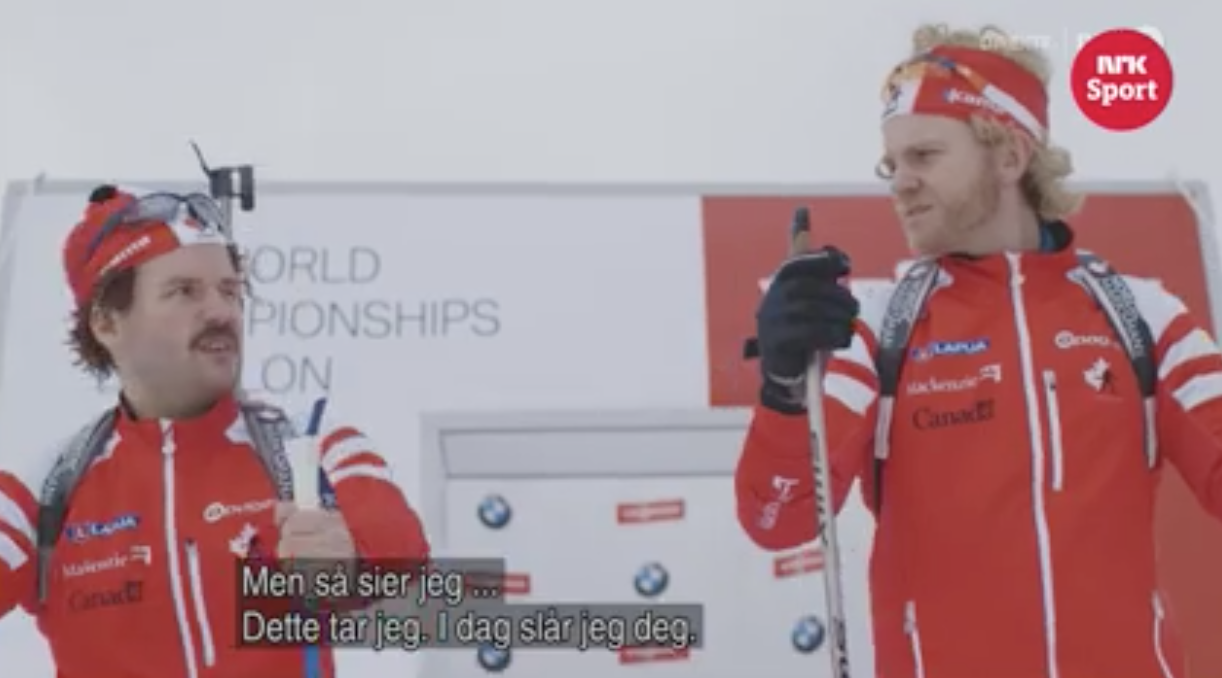
    And Davies became something of a media personality when Norway’s NRK broadcaster produced a mockumentary of him beating teammate Christian Gow to win a World Championships race, based on a finish-line interview in Oslo. (The original segment is available to view only in Norway, but you can find other versions online under the title “Macx The Man”.)

    Macx Davies and Christian Gow trash-talking on the start line, as dramatized by NRK.
    “Macx Davies” and “Christian Gow” trash-talking on the start line, as dramatized by Norwegian comedians on NRK.

    “I did not think I would have this kind of following until I was on the podium a couple times, but it has been fun having people ask for my picture and autograph,” Davies wrote. “I never really thought that I would be the best known Canadian because of my dance moves or my interviews.”

    (He’s also known for his beard.)

    Off-trail hijinks aside, his biathlon chops did notch Davies an A-team nomination this spring (which Biathlon Canada calls its “Eh!” team), and he has continued to train with Smith, Green and the Gow brothers. It was the first time he and Christian Gow — now both 23 years old – were named to the A-squad.

    “We trained together everyday for the last few years anyways, but having all the men on the ‘Eh’ team means we are all closer now,” Davies wrote. “We had always been training with Brendan, Scott and Nathan, but the difference this year was that Christian and I were keeping up with those guys.”

    Davies has already had his first taste of international competition this season, with the Canadian team trials races in Canmore on the Frozen Thunder loop. The American and Ukrainian men’s teams were on hand to beef up the level of competition. While Davies was pre-qualified for the World Cup, putting on a bib still gave him a sense of where he was at.

    Davies finished 14th and fifth in the two sprint races in Canmore, the fifth and third Canadian on the two days, respectively.

    Tim Burke of the United States leads Canada's Macx Davies in the World Championships 10 k sprint in Oslo, Norway. At his first senior World Championships, Davies finished 58th, then moved up to 53rd in the pursuit. (Photo: US Biathlon/NordicFocus)
    Tim Burke of the United States leads Canada’s Macx Davies in the World Championships 10 k sprint in Oslo, Norway. At his first senior World Championships, Davies finished 58th, then moved up to 53rd in the pursuit. (Photo: US Biathlon/NordicFocus)

    “The trials were challenging for me,” he wrote. “I had a hard time shooting both days and was struggling with the hot weather (10+ degrees [Celsius]). But I am happy with my skiing in those races, and I know that my shooting is getting better. I think you can read into those results as a base line from which this season will only improve upon.”

    Davies is dead serious about doing even better this season than he did last year.

    “I am looking at breaking into the top six a couple times as well as trying to stay within the top 25 [overall] for the season,” he wrote. “These goals are not going to be easy, but I think they are within my abilities and will be excited to see them come true.”

    For now, Davies is heading back to Östersund, where he got that first top 10, to start off this World Cup season. When asked how he had gotten that notable result, Davies made it clear that he could do it again.

    “Really I made that big jump by seizing the opportunity of bad weather to leapfrog my best results,” he explained. “Hitting 10 out of 10 that day was like 12 out of 10 on a normal day. What it means is I can use anything to my advantage, so watch out!”

    We asked Davies to give our ’17 Questions for 2017′ a go. Here are his responses:

    1. Biggest change in your life in the last five or so months since the ski season ended?

    Moving in with my girlfriend

    2. Biggest change in your training?

    Going to New Zealand for 3 weeks.

    3. Major areas of improvement you’ve seen so far?

    Ski technique and shooting accuracy

    4. Whom you’ve been working closest with this offseason (coaches or training partners)?

    My coach Matthias Ahrens

    5. Best trip in the last five months (and why)?

    Weekend getaway to Emerald Lake Lodge

    6. Favorite cross-training?

    Mountain Biking

    7. Favorite non-athletic activity or pastime this summer?

    Leather working

    8. Song that was your jam this summer?

    Una Mattina by Ludivico Einaudi

    9. All-time favorite race moment?

    Competing at home in Canmore

    10. First thing you pack in your bag when you leave for Europe?

    A comfy sweater

    11. Venue/event you’re most excited to visit this season?

    PyeongChang

    12. Who will win the World Cup title this year?

    Martin [Fourcade], he just seems in a league of his own.

    13. Biggest sacrifice you feel you’ve made choosing this career path?

    My education

    14. If you could change one thing about your sport, what would it be?

    More Dancing

    15. What did you have for breakfast this morning?

    Eggs and yogurt

    16. In 5 years, I’ll be ____?

    Overall World Cup winner.

    17. In 50 years, I’ll be ____?

    Retired and living in the mountains, in a house that I built.

  • Biathlon Canada Announces World Cup, IBU Cup, Jr. IBU Cup Teams

    Biathlon Canada Announces World Cup, IBU Cup, Jr. IBU Cup Teams

    Biathlon Canada logo

    On Tuesday, Biathlon Canada published its final roster for the first trimester of the International Biathlon Union (IBU) World Cup, IBU Cup and Jr. IBU Cup. Below is the official announcement:

    Team Announcement Trimester #1

    World Cup, IBU Cup, and Jr. IBU Cup

    The following athletes are nominated to the World Cup, IBU Cup and Jr. IBU Cup Teams for Trimester 1 in accordance with the National Team Program:


    World Cups #1,#2, #3

    Ostersund, SWE, Pokljuka, SLO, Nove Mesto, CZE

    Coaches: Matthias Ahrens, Roddy Ward, Joar Himle

    Service Team: Raphael Grosset, Pavel Stolba, Martin Struna


    MEN

    1. Nathan Smith (National Eh! Squad/Foothills Nordic)

    2. Brendan Green (National Eh! Squad/Hay River Nordic)

    3. Scott Gow (National Eh! Squad/Rocky Mountain Racers)

    4. Christian Gow (National Eh! Squad/ Rocky Mountain Racers)

    5. Macx Davies (National Eh! Squad/Canmore Nordic)

    WOMEN

    1. Rosanna Crawford (National Eh! Squad/Canmore Nordic)

    2. Julia Ransom (National Eh! Squad/Telemark Nordic)

    3. Megan Tandy (National Eh! Squad/Caledonia Nordic)

    4. Sarah Beaudry (National B Squad/Caledonia Nordic)

    IBU Cups #2, #3

    Ridnaun, ITA & Obertilliach, AUT

    Coach: Richard Boruta

    Service Team: Andrjez Lesnik

    MEN

    1. Carsen Campbell (National ZED Squad/BATC/Biathlon PEI)

    2. Pearce Hanna (Edmonton Nordic)

    3. Matthew Neumann (Caledonia Nordic)

    4. Matthew Hudec (BATC/Biathlon Saskatchewan)

    WOMEN

    1. Megan Bankes (BATC/Foothills Nordic)

    2. Nadia Moser (BATC/Biathlon Yukon)

    3. Emma Lunder (National B Squad/ Rocky Mountain Racers)

    4. Erin Yungblut (Rocky Mountain Racers )

    Jr. IBU Cups #1, #2

    Lenzerheide, SUI & Hochfilzen, AUT

    Coach: Jacqueline Akerman

    Service Team: Andrew Chisholm

    JUNIOR MEN

    1. Zachari Bolduc (La Poursuite/Biathlon Quebec)

    2. Adam Runnalls (Calgary Biathlon Racers)

    3. Trevor Kiers (BATC/Timmins Biathlon)

    4. Teo Sanchez (BATC/Chelsea Nordiq)

    JUNIOR WOMEN

    1. Charlotte Hamel (Club plein air biathlon Estrie/Biathlon Quebec

    2. Darya Sepandj (BATC/Foothills Nordic)

    3. Emily Dickson (BATC/Caledonia Nordic)

  • Green Focuses on Core to Remedy Back and Rev Up for Another Season

    Green Focuses on Core to Remedy Back and Rev Up for Another Season

    Brendan Green training in Canmore, Alberta, on his birthday, Nov. 4. (Photo: Rosanna Crawford/Instagram)
    Brendan Green training in Canmore, Alberta, on his birthday last Friday, Nov. 4. (Photo: Rosanna Crawford/Instagram)

    Chiropractor appointments, massage sessions, physical therapy, yoga, you name it and Biathlon Canada ‘Eh!’ team member Brendan Green has probably tried it. After suffering from a herniated disc in his lower back five years ago, undergoing surgery, a re-herniation, and a second surgery, post-surgical treatments had almost become part of Green’s training plan.

    However, the past few winters tested his pain tolerance too far and by the end of last season, Green decided to give both his treatments, and his back, a rest.

    “I was at a bit of a crossroads trying to figure out what to do,” Green, who turned 30 last week, said on the phone from Canmore, Alberta. “So come springtime, I took some time off and gave [my back] time to recover.”

    When Green rejoined Biathlon Canada for training this summer, keeping his back feeling better remained part of the plan. But returning to treatments was not the way Green wanted to go. Instead, deriving inspiration from other athletes and social media, he made a slight change to a another training component: his core.

    Biathlon Canada's Brendan Green making friends with some sheep during a road bike in the Rockies this summer. (Photo: Scott Gow)
    Biathlon Canada’s Brendan Green making friends with some sheep during a road bike in the Rockies this summer. (Photo: Scott Gow)

    “I mean, you see [the Norwegian guys] on Instagram and it’s like, holy cow, half that stuff I could probably not even do one rep of,” Green said. “So that got me thinking, if I could really, really strengthen the core, maybe I could strengthen the back.”

    Green began incorporating two extra core circuits a week, each 20-minutes long, relying heavily on physio ball work that targets ski specific motions.

    “My core is exhausted after, but that’s what I want to achieve with this,” Green wrote in an email. “And this summer has actually been one of my better summers in terms of training and not getting sidelined with nerve pain or back problems.”

    Along with more fine-tuned concentration on his core, another novel nuance to Green’s summer training included traveling to the Snow Farm for Biathlon Canada’s first summer training camp in New Zealand.

    “This year, the team decided that one of the goals would be spending more time on snow for the training season,” Green said of the team’s three-week camp in August. “New Zealand is a beautiful country, but also an ideal training set up as well. … [At the Snow Farm] you can eat breakfast and walk out your door and you’re on snow.”

    Earlier in the offseason, Green also attended his men’s team’s second-annual  “ManCamp” in Jasper, Alberta. Green explained that for the past two years, the men’s and women’s national biathlon teams have split training camps in the summer, with the men spending a week in Jasper and the women traveling to Kelowna, British Columbia, for a weeklong “Wine Camp.” 

    “I was at a bit of a crossroads trying to figure out what to do … Come springtime, I took some time off and gave [my back] time to recover… and this summer has actually been one of my better summers in terms of training and not getting sidelined with nerve pain or back problems.” — Brendan Green, Biathlon Canada A (technically, ‘Eh!’) team member

    “Two years ago at World Champs, Nathan [Smith] had a podium, so he had a little more input than normal into some of the early season training camps and Nathan really wanted to go to Jasper, so we thought we’d give it a try,” Green explained. “There’s no shooting range [there], so we leave our rifles at home and we just focus on volume training. There’s lots of good rollerskiing there and it’s fun. Jasper is a good way to start the season.”

    'King' and 'Queen' of the mountains, Brendan Green (r) with his girlfriend and teammate Rosanna Crawford after Biathlon Canada's summer "testival". (Photo: Matthias Ahrens)
    ‘King’ and ‘Queen’ of the mountains, Brendan Green (r) with his girlfriend and teammate Rosanna Crawford after Biathlon Canada’s summer “testival”. (Photo: Matthias Ahrens)

    Currently competing at Biathlon Canada’s World Cup team-selection trial races at Frozen Thunder in Canmore this week (he is already prequalified for the World Cup), Green is excited about the quickly approaching race season and the prospect of more podiums for his team.

    Last season at 2016 World Championships, he anchored his men’s 4 x 7.5 k relay team to bronze for Canada’s first medal in a team event at a major world championships. On Oct. 28 at Frozen Thunder, Green beat out American Matt Gelso in North America’s first unofficial on-snow race of the season: the 12 k freestyle interval start.

    “In the past, the big names have been a little more solidly consistent — [France’s Martin] Fourcade, [Norway’s Ole Einar] Bjørndalen — but now it seems to be changing up a little more,” he said. “I feel like there’s a lot more podium possibilities or potentials on the horizon. You have to have a good day obviously, but I think it’s within reach.”

    ***

    We asked Green to give our ’17 Questions for 2017′ a go. Here are his responses:

    1. Biggest change in your life in the last five or so months since the ski season ended?

    My longtime teammate Scott Perras retired at the end of last season.  He was a machine and I used to do almost all of my training with him.  It was definitely a change not having him around when I started training again this spring.

    2. Biggest change in your training?

    I’ve taken a different approach to my core strength training, but otherwise no significant changes, just sticking to the plan while trying to put in high quality hours.

    3. Major areas of improvement you’ve seen so far?

    It’s so difficult to say until race season rolls around.  I think I’ve put in good work but we will find out for sure in just a few weeks!

    Biathlon Canada's Brendan Green (r) rollerskiing at his team's “ManCamp" in Jasper, Alberta. (Photo: Matthias Ahrens)
    Biathlon Canada’s Brendan Green (r) rollerskiing at his team’s “ManCamp” in Jasper, Alberta. (Photo: Matthias Ahrens)

    4. Whom you’ve been working closest with this offseason (coaches or training partners)?

    This season the Men’s and Women’s team split off into more separate training groups, so the men’s team has been working closer together as a whole.

    5. Best trip in the last five months (and why)?

    This summer the team did a training camp in New Zealand.  It was a fun change of venue for us and New Zealand has a lot to offer.  It’s a beautiful country.

    6. Favorite cross-training?

    I bought a new mountain bike in the spring which has been fun.  There is lots of great riding around Canmore.

    7. Favorite non-athletic activity or pastime this summer?

    A friend gave me some sourdough starter this spring and since then I’ve been making a few loaves of bread a week.  I’m also always trying to up my espresso-making game.

    8. Song that was your jam this summer?

    I’ve really been digging Trevor Hall lately.

    9. All-time favorite race moment?

    There have been a couple, but winning bronze at last years World Championships was amazing.

    10. First thing you pack in your bag when you leave for Europe?

    Ear plugs. Can’t sleep without them!

    11. Venue/event you’re most excited to visit this season?

    Our World Cup in Antholz, Italy, is always my my favourite stop on tour, but I think the World Championships in Hochfillzen, Austria, will also be exciting.

    12. Who will win the men’s and women’s World Cup titles this year?

    Martin Fourcade and Kaisa Makarainen

    13. Biggest sacrifice you feel you’ve made choosing this career path?

    I live a long ways from where I grew up, so for me definitely time spent with family.  And education.

    14. If you could change one thing about your sport, what would it be?

    Doping.

    15. What did you have for breakfast this morning?

    Sourdough pancakes.

    16. In 5 years, I’ll be ____?

    Hopefully still able to call Canmore home.

    17. In 50 years, I’ll be ____?

    In 50 years I’ll be 80, so in all likelihood there is a pretty good chance I’ll be dead?

  • Biathlon Canada Veteran Smith on the Non-Traditional Workday Grind

    Biathlon Canada Veteran Smith on the Non-Traditional Workday Grind

    Nathan Smith skiing during Biathlon Canada's training camp this past August at the Snow Farm in New Zealand. (Courtesy photo)
    Nathan Smith, of Biathlon Canada, skiing during a national-team training camp this August at the Snow Farm in Wanaka, New Zealand. (Courtesy photo)

    Wake up: 7:30 a.m. Coffee: 7:45 a.m. Commute to work: 8:15 a.m.. Punch in at 9. Punch out at 5. While this may describe the daily routine of an average North American’s work week, it’s not the case for Biathlon Canada’s Nathan Smith. And to the 3o-year-old Calgary native, there’s nothing wrong with that.

    While he maintains that putting his education on hold has been one of his biggest sacrifices by choosing biathlon as a career, Smith also sees his decision to take a few years and be his own boss as better than a bachelor’s degree — not only to make himself more marketable in the future, but more unique in his life experience.

    “I guess my reasoning [for choosing this path] was, I could go to school and get my bachelor’s degree and then go and work,” Smith said recently on the phone. “But that’s kind of like, I guess I’ll put it as, that’s a normal career trajectory. That’s what everyone does.

    “When I’m training, I’m like my own boss, kind of an entrepreneur,” added Smith, who has been taking a few college courses (mostly science) on-and-off since he graduated high school in 2004. “And I think it’s probably similar in the States, but unfortunately here in Canada, getting a bachelor’s degree isn’t even all that great. It just makes everyone overqualified.”

    Nathan Smith of Biathlon Canada with his girlfriend Caroline. (Photo: Nathan Smith)
    Nathan Smith with his girlfriend, Caroline. (Courtesy photo)

    Instead, Smith has spent the past nine years (excluding the 2008/2009 season when he wasn’t named to the national team) sporting the red maple leaf of Canada. He’s also known to cruise the streets of Canmore, Alberta (where Biathlon Canada is based), on his 2007 Kawasaki ZZR 250 (at least when there’s no snow).
    However, being a full-time biathlete was not always what Smith planned to do after high school. Before Biathlon Canada, he competed alongside his brother on Calgary’s local club biathlon team. And before that, he belonged to Calgary’s youth cross-country skiing program.  

    “I didn’t really know anything about the sport until I was doing Racing Rabbits which is [a program] for really young kids who [want to] cross-country ski in Calgary,” he said. “My brother and I were doing that and my mother was like, ‘Well, do you guys want to try biathlon?’ and we were like ‘Well, what’s that?’ and she was like, ‘Well, you shoot guns with skiing.’ I was 1o years old [at the time], so I was pretty excited about that … but I never really saw myself as staying in it past high school until I started to go to World Championships.”

    Smith made his debut Junior World Championships appearance his sophomore of high school in 2002, and qualified again the following year, as well as in 2005 and 2006. From then on, he continued to build competition on competition, qualifying for his first World Championships in 2008, the Vancouver Olympics in 2010, five more World Championship events, and the Sochi Olympics in 2014.

    During the 2014/2015 season, he had a breakthrough performance when he raced to a first place in the men’s 10-kilometer pursuit in Khanty-Mansiysk, Russia. While he hopes to once again medal this season, he indicated that this year, doing so will take even more accurate shooting on his part, as many athletes continue to improve the speed of the shots they take. 

    “There’s definitely been some big changes in the way athletes approach the shooting range psychologically,” Smith explained. “It used to be a lot more cautious, [but] because skiing is getting tighter and tighter you really have to set yourself apart by shooting as fast as you can on the range.

    “I’ve always been a fairly fast shooter,” he added. “So I’ve been focusing a little bit more on trying to improve accuracy while maintaining the speed I’m at.”

    “There’s definitely been some big changes in the way athletes approach the shooting range psychologically. It used to be a lot more cautious … you really have to set yourself apart by shooting as fast as you can on the range.” –Nathan Smith on recent changes in biathlon

    With a solid summer of volume training behind him, a fall full of intensity, and a few sessions on snow at the Snow Farm in New Zealand, Smith is excited about the start of a new season, but especially the fact that his job for another year will take place on skis.

    “Obviously you go out there sometimes and there’s tough training days or times where you’re super tired or you’re having bad races and you’re like, ugh, why do I do this?” Smith said. “But if you have a normal 9-5 job, you’d have a lot more of those days I think.”

    Nathan Smith of Canada skates his way to 18th at the IBU World Cup pursuit in Hochfilzen, Austria. (Photo: Fischer/NordicFocus)
    Nathan Smith skating his way to 18th at the 2015 IBU World Cup pursuit in Hochfilzen, Austria, last December. (Photo: Fischer/NordicFocus)

    ***

    We asked Smith to give our ’17 Questions for 2017′ a go. Here are his responses:

    1. Biggest change in your life in the last five or so months since the ski season ended?

    I’ve been making trips up to Grande Prairie to visit my girlfriend (and her kitten).  It’s nice to get away from Canmore on rest weeks, decompress, and experience regular town life sometimes.

    2. Biggest change in your training?

    I haven’t had too many changes in over all training philosophy. The team was reorganized this spring so Matthias [Ahrens] is now my personal coach instead of Roddy [Ward]. They work closely together though so aside from feedback it hasn’t changed too much in day-to-day training.

    3. Major areas of improvement you’ve seen so far?

    I’ve made some good gains in lower body strength and double pole work.

    4. Whom you’ve been working closest with this offseason (coaches or training partners)?

    Aside from Matthias and Roddy, we also have technique coaching at some camps from Mats Larsson. Former athlete Andrew Chrisholm has also been helping out our team on the range so we can get more individualized attention.
    Nathan Smith of Biathlon Canada (r) with Scott Gow  mid ski. (Photo: Nathan Smith)
    Biathlon Canada’s Nathan Smith (r) and Scott Gow during a ski. (Photo: Nathan Smith)

    5. Best trip in the last five months (and why)?

    Even though its not far, I always enjoy going to Jasper [Alberta] for “ManCamp”. It’s an amazing roller ski and drive up the Icefields Parkway, and the options for varied training once we get there are awesome. We also get to stay in rustic cabins on the river and practice slammo.

    6. Favorite cross-training?

    Mountain Biking

    7. Favorite non-athletic activity or pastime this summer?

    Motorcycling, and trying to fly fish.

    8. Song that was your jam this summer?

    That would definitely be Justin Bieber – I’ll Show You

    9. All time favorite race moment?

    Winning the pursuit at the world cup final in Khanty-Mansiysk in 2015

    10. First thing you pack in your bag when you leave for Europe?

    Armband. Never forget it!

    11. Venue/event you’re most excited to visit this season?

    Tyumen. I’ve never been there and I’m sure its going to be impressive

    12. Who will win the men’s and women’s World Cup titles this year?

    Martin Fourcade and Laura Dahlmeier

    13. Biggest sacrifice you feel you’ve made choosing this career path?

    Putting my education on hold.

    14. If you could change one thing about your sport, what would it be?

    Can it be -3, hard packed, calm, and sunny every day?

    15. What did you have for breakfast this morning?

    I desperately needed to go grocery shopping, so 3 bowls of granola with milk and a banana.

    16. In 5 years, I’ll be ____?

    Living the retired athlete life.

    17. In 50 years, I’ll be ____?

    Hopefully well into my second retirement.

  • French Biathlete Anaïs Bescond Takes Summer Training to Canada

    French Biathlete Anaïs Bescond Takes Summer Training to Canada

    Left to Right: Canada's Julia Ransom, Sarah Beaudry, Emma Lunder, France's Anais Bescond, and Canadian Rosanna Crawford  during their first bike session of "Wine Camp" in Kelowna, British Columbia this June. (Courtesy photo)
    Four Canadians Julia Ransom (l), Sarah Beaudry (second from l), Emma Lunder (c), and Rosanna Crawford (r) with France’s Anais Bescond (second from r) during their first bike session of “Wine Camp” in Kelowna, British Columbia this June. (Photo: Rosanna Crawford)

    Along with peeling off the layers, summertime ski training often entails guest-star appearances. Many college athletes depart school and return to club programs, clubs may combine training sessions or camps, and even internationally, skiers from different countries coordinate their training schedules. Given the choice, 2016 two-time World Championships silver medalist Anaïs Bescond of France didn’t need to think twice about her crossover team: Canada.

    Anais Bescond of France racing to fifth in the women's 12.5 k mass start at 2016 IBU World Championships in Oslo, Norway. (Photo: JoJo Baldus)
    France’s Anais Bescond racing to fifth in the women’s 12.5 k mass start at 2016 IBU World Championships in Oslo, Norway. (Photo: JoJo Baldus)

    After discussing the possibility of banding with the Biathlon Canada’s women’s team with Canadian head coach Matthias Ahrens and her friend Rosanna Crawford, Bescond bought a plane ticket to Kelowna, British Columbia, and arrived on June 14.

    “It was just an easy decision,” Bescond, 29, said during a phone interview. “Because when I am coming in February for the World Cup I find Canmore and Canada people really nice … So, I asked to Matthias and Rosanna if it’s possible to plan to coming during the summer to train a little with the team and it was OK, so good for me.”

    Bescond spent the past two weeks training with the Canadian team, taking part in their “Wine Camp” during her first week in Kelowna. With two more weeks of training left alongside her adopted Canadian teammates, Bescond can expect to also partake in the Biathlon Canada’s “Test-ival” — what Crawford described as “the festival of [training] tests” — the crew’s current undertaking this week in Canmore, Alberta.

    “With Anais being from France, where they make delicious wine and Kelowna makes delicious wine, it just felt appropriate,” Crawford explained on the phone, referring to the Kelowna training camp name (she said the women also had to compete with the Canadian men’s camp names: “Beast Camp” and “Man Camp”). “We weren’t consuming as much wine as one might think, but we did have a couple glasses.”

    Left to right: Canadian Sarah Beaudry, Anais Bescond of France with Canada's Julia Ransom, Emma Lunder, and Rosanna Crawford during a rollerski in Kelowna, British Columbia. (Courtesy photo)
    Rosanna Crawford leads her Canadian teammates Emma Lunder (second from r) and Julia Ransom, along with France’s Anais Bescond (l) during a rollerski in Kelowna, British Columbia. (Photo: Rosanna Crawford)

    This summer, Bescond is one of a several international training partners in Canada. A few members of the Swiss men’s biathlon team, including Benjamin Weger, Serafin Wiestner, and his brother Till Wiestner, are also presently rollerskiing, running and biking in Canmore.

    After Wine Camp, the Test-ival and a final week with the Canadian women’s team, Bescond will leave Canada on July 18 and fly to Norway. There, she will train with the Norwegian women’s biathlon team.

    “I think what is really interesting for me is to share our different experience about training,” Bescond said. “Spend[ing] time with different people, it’s really instructive I think. With kind people, it’s always nice.”

    “We weren’t consuming as much wine as one might think, but we did have a couple glasses.” — Rosanna Crawford, Canadian biathlete, on her team’s ‘Wine Camp’ earlier this month

    Crawford, 28, also pointed out that international camaraderie is just as important as international competition. Their training sessions together afforded the two not only a chance for more tête-à-têtes, but also the opportunity to push each other.

    “I speak French and we usually stay at a couple of the same hotels throughout the winter, so we’ll have a couple meals together,” Crawford said. “But this is definitely the most time we’ve spent together and we’ve gotten to know each other’s personal lives a little bit more. … The Canadian’s women team has been growing with Julia [Ransom], Emma [Lunder], Sarah [Beaudry] and myself, so having Anaïs train with us creates a nice opportunity to grow as a team and learn from her.”

    “There’s so much more to sport than just exercising,” she added. “You spend so much time with these people, it’s important to get along with them.”

  • France’s Dorin Habert and Fourcade Dominate Single Mixed Relay; Canada 12th, U.S. 16th

    France’s Dorin Habert and Fourcade Dominate Single Mixed Relay; Canada 12th, U.S. 16th

    Teammates in the single mixed relay on Sunday, France's Martin Fourcade and Marie Dorin Haber after winning the first of two relays on the last day of the IBU World Cup in Canmore, Alberta. (Photo: Daniel S. Guay)
    Teammates in the single mixed relay on Sunday, France’s Martin Fourcade and Marie Dorin Haber after winning the first of two relays on the last day of the IBU World Cup in Canmore, Alberta. (Photo: Daniel S. Guay)

    France was determined to win the International Biathlon Union (IBU) World Cup 13.5-kilometer single mixed relay on Sunday in Canmore, Alberta, using their best athletes with men’s overall World Cup leader Martin Fourcade and Marie Dorin Habert, who ranks third in the women’s standings. And they succeeded in convincing fashion, finishing first in 37:58.0 minutes, with four spares and no penalties.

    The first time the new race format was on the calendar this season at the World Cup in Östersund, Sweden, the French duo of Dorin Habert and Martin’s older brother Simon Fourcade thought they had won the race, but because Fourcade had not fired a shot during the competition the team was slapped with a four-minute penalty, putting them back to 21st place.

    On Sunday morning, France made no such mistakes and didn’t leave the other teams any chance in nearly a start-to-finish victory. Dorin Habert took the lead out of the arena, stayed there for most of her leg and tagged narrowly in first place, before both Fourcade and Dorin Habert expanded their lead on the next three legs with good shooting and fast skiing. Fourcade put an exclamation mark on the victory by sprinting into the finish despite knowing he had a comfortable lead of more than half a minute on the final loop.

    “It was a really exciting race. I like these kind of short races. I tried to be as strong as Martin, it’s an honor to run with him,” Dorin Habert said at the post-race press conference. “It was in our head before the competition to win, but this is biathlon and everything can happen on the [shooting range].

    “I tried to train the finish, I think that was a good opportunity,” Fourcade explained during the press conference. “But I actually didn’t compete the full last loop,” he added with a smile. “I only did for some parts, the ones in front of the TV.”

    “Today I was satisfied even if I needed two extra shots, two too much,” Fourcade later told the IBU in an interview. “It was a good competition for both of us.”

    France's Martin Fourcade (l) tags teammate Marie Dorin  Habert for her the third of four legs in the single mixed relay at the IBU World Cup in Canmore, Alberta. They ended up winning by 45 seconds. (Photo: Daniel S. Guay)
    France’s Martin Fourcade (l) tags teammate Marie Dorin Habert for her the third of four legs in the single mixed relay at the IBU World Cup in Canmore, Alberta. They ended up winning by 45 seconds. (Photo: Daniel S. Guay)

    Second place went to the Austrian duo Lisa Therese Hauser and Simon Eder, 45.2 seconds back, with eight spares and no penalties. It was Hauser’s first World Cup podium.

    Norway’s Hilde Fenne and Lars Helge Birkeland secured the third spot on the podium, 55.3 seconds back, with seven spares and no penalties. Birkeland defended his lead on the final loop, coming into the finish two seconds ahead of Russia’s Olga Podchufarova, who teamed up with Alexey Volkov to finish fourth (+57.3), with no penalties and just two spares.

    New since the 2014/2015 season and only held for the third time at the World Cup level on Sunday, the single mixed format was established by the IBU to have another action-packed event and give “smaller” biathlon nations a shot at the podium. For some countries, it presented an opportunity to start a team event. It is not yet a part of Biathlon World Championships or Olympic Games.

    “The single mixed relay is interesting for smaller nations, because they maybe don’t have five women and five men who can compete with the top, but maybe one or two,” Canadian head coach Matthias Ahrens told German TV broadcaster ZDF in an interview before the race. “Then you can use those in the mixed or single mixed relay, thereby potentially getting a chance to reach the podium, which worked pretty well for us at the season-opening in Östersund [where Canada placed second].”

    On Sunday, some teams, such as France — though not an example for a “small” biathlon nation — Austria and Latvia (in eighth place), made use of that by putting their best racers in the event. Other teams decided to focus on the “normal” mixed relay, with two women and two men on each team, that followed later on Sunday in Canmore.

    The single mixed relay features the shortest loops in biathlon, with the athletes skiing a 1.5-kilometer loop between each shooting stage, then immediately exchanging after the standing shooting. After the female team member starts and shoots one prone and one standing stage, she exchanges to her male teammate, then the woman gets tagged again to ski the third leg (six kilometers total), and the man closes out on the fourth anchor leg racing an additional 1.5 k after the final standing shooting, which adds up to the odd 13.5 k distance. The athletes are allowed to use three spare rounds per shooting like in a normal relay, and the penalty lap is also shortened to 75 meters (usually 150).

    Thus the whole race is extremely fast-paced, and rather resembles a cross-country team sprint than a traditional biathlon or cross-country relay.

    “This was a new start for me in the World Cup, because I never did a single mixed relay before,” Fourcade said at the press conference. “I already did it a lot during the show competitions like Schalke [World Team Challenge in late December] or Moscow or Tyumen [Race of Champions, another invitational at the end of the season]. I really love that. But it was different today … with the pressure of the World Cup… I think the single mixed relay is really good for biathlon.”

    “The single mixed relay is a super fun race format, but you really have to shoot well to have a chance,” U.S. Biathlon’s Annelies Cook wrote in an email.

    “Certain abilities are demanded, especially ‘shooting efficiency,’ ” Ahrens told ZDF. “That means you need athletes who, first of all, can shoot well and hit, but also shoot very fast.”

    Germany's Luise Kummer (2), Norway's Hilde Fenne (1) and Canada's Julia Ransom (3) early in the single mixed relay at the IBU World Cup in Canmore, Alberta. Norway went on to place third, Germany seventh and Canada finished 12th. (Photo: Daniel S. Guay)
    Germany’s Luise Kummer (2), Norway’s Hilde Fenne (1) and Canada’s Julia Ransom (3) early in the single mixed relay at the IBU World Cup in Canmore, Alberta. Norway went on to place third, Germany seventh and Canada finished 12th. (Photo: Daniel S. Guay)

    Conditions on Sunday were good throughout the race, with calm winds and the sun shining in the Canadian Rocky Mountains, after the athletes had struggled with snowfall and strong gales in the previous days.

    “I think we were all satisfied to know that it would be fair and beautiful conditions. It’s the [kind of] biathlon we love,” Fourcade said in an interview with the IBU.

    “Today was the best snow conditions of the week. There was a light wind, but it seemed pretty consistent,” Canada’s Nathan Smith wrote in an email.

    France steadily expanded its lead throughout the race. At the first exchange, Dorin Habert tagged Fourcade in first, just 0.4 seconds ahead of Sweden. Fourcade slightly expanded that lead to 6.5 seconds over Russia in second place by the next exchange, and then Dorin Habert cleaned both shooting stages on her second leg to balloon the gap to 50.1 seconds over Norway in second. Essentially, Fourcade just needed to go through the motions on his last leg to lock up first.

    Before the final shooting, Germany’s Erik Lesser had been in second place behind Fourcade. But unable to clean his targets and running out of spares, Lesser incurred a penalty lap and ended up seventh (+1:29.6), as teams passed him with better shooting. Lesser and teammate Luise Kummer combined for one penalty and eight spares.

    This brought back some painful memories from the first time a single mixed relay was held in a year ago in February 2015  in Nove Mesto, Czech Republic. Lesser and Kummer had been in the lead before the final shooting, then Lesser slipped into fourth with a penalty.

    After Sunday’s race, suffice to say Lesser wasn’t happy.

    “Does anyone still want to see that? I don’t!” Lesser quipped when the interviewer in the mixed zone asked him to take a look at a replay of his targets in the final shooting stage. “It really doesn’t matter where those [shots] went, I just didn’t hit, fired four really poor shots,” he added after taking a glance at the fairly close misses. “If Mark [Kirchner, men’s head coach] wants to chew me out for that, I hard-earned it.”

    “On the first spare I was already thinking, ‘Oh great, this is going the same way as last year,’ ” Lesser continued. “On the second leg I struggled, I tried to keep the others at bay on the course so they would not catch up, but I somehow didn’t move well, got tense on the shooting range, and then the misses happened. I am completely annoyed, mega-disappointed… This is the World Cup level, so you should also be able to hit with tired legs.”

    Kummer used four spares and was also disappointed, but didn’t pin the blame on Lesser.

    “A [single mixed] relay is comprised of two people, everything has to work out, and that mistake can happen to everybody,” she told ZDF. “You are always happy yourself to get through [a relay shooting stage] unscathed, so that shouldn’t be a problem…. I still think it’s a very exciting competition for the spectators, very fast-paced exchanges. It doesn’t have the same standing as a relay or mixed relay yet, but one can see that it is developing.”

    Lesser’s troubles allowed Austria’s quick-shooting Eder to pass him and secure second place, after he and Hauser had been just outside the podium ranks for most of the race.

    “I am really happy about this podium today. It’s my first one. I dreamed about it, and today it worked,” the 22-years-old Hauser told reporters at the press conference. “My shooting was not so good especially in prone. Simon and I are both fast shooters and also good shooters, but today it was not the best.”

    “I felt great on the course, I always could keep up or even close gaps,” Hauser added in an Austrian Ski Federation press release. “On the shooting range I let the stress get to me a little bit, that caused the spares. But of course I am overjoyed by the podium finish.”

    “The first turn did not go according to plan on the shooting range. I had problems with my ski poles and used too many spares,” Eder, 32, said in the press release. “But the second turn went all the better, I could really push the tempo also on the shooting range. Finally we have a place on the podium also in a mixed relay.”

    In the absence of their usual stars that are skipping the North American World Cups in the leadup to 2016 World Championships at home in Oslo, the Norwegians still reached the podium with Fenne and Birkeland, who both improved on their second legs to move from seventh at the first exchange to third at the finish. (Birkeland also won the first single mixed race of the season, though with Kaia Woeien Nicolaisen as his partner.)

    “I am not sure why, we just always try to do good races,” Fenne said during the post-race press conference when asked why Norway seems to do so well in the single mixed relay. She added that the coaching staff picked the lineups for Sunday, so she didn’t know why she was put on the single mixed relay instead of the four-person mixed relay.

    Canada 12th, U.S. 16th 

    Representing Canada at home in Canmore, Julia Ransom, who is competing in her first full World Cup season, teamed up with veteran Nathan Smith, who raced to second in the Östersund single mixed relay with Rosanna Crawford.

    Canada's Nathan Smith (behind) coming through the exchange zone to tag teammate Julia Ransom during single mixed relay at the IBU World Cup in Canmore, Alberta. (Photo: Daniel S. Guay)
    Canada’s Nathan Smith (behind) coming through the exchange zone to tag teammate Julia Ransom during single mixed relay at the IBU World Cup in Canmore, Alberta. (Photo: Daniel S. Guay)

    This time, the Canadians ended up nearly two minutes off the podium in 12th (+1:54.3), with 10 spares and no penalties.

    On her first leg, Ransom used one spare round in her first prone, but then required all three spares in standing to narrowly avoid a penalty lap.

    “It was hard, very hard,” Ransom said in a Biathlon Canada press release. “I haven’t done that format before. I felt that one for sure. This is the first time I’ve done a relay with Nathan so it was lot of fun for me, and a great experience.

    “I was bouncing around at the start and maybe nerves got to me a little bit because I didn’t know what to expect,” she added. “The techs just told me to ‘reel it in.’ ”

    After the first 1.5 k, she tagged Smith 47.0 seconds behind in 19th of 23 teams. On his first leg, Smith cleaned prone without any spares and only required one spare in standing to keep his distance to the top, handing off to Ransom 49.2 seconds back in 11th.

    “We unfortunately fell back pretty early in the race. Julia had some difficulty in the range,” Smith wrote in an email to FasterSkier. “The time lost loading spares is even more penalizing when the loops are so short. The format itself is pretty fun to race, and quite a bit different from traditional races. It’s almost more like two races back to back with a little break. It suits my quick shooting speed really well.”

    Ransom cleaned her next prone stage as she had done repeatedly in recent weeks, but with two more spares in standing, she lost a minute to the top.

    Still in 11th when he received the tag, Smith again hit all targets in his prone stage, but required three spares in his last standing to avoid the penalty lap, approximately holding his gap to the leaders.

    “Other than my last standing my [two relay] legs went really well. Prone felt amazing. Probably almost the best ever. Just fast, easy and accurate,” Smith wrote. “I ended up battling a lot with [Latvia’s] Rastorgujevs. He surprised me by matching my shooting speed. He’s always one of the fastest out there. It was too much for me to hang on to on the last lap.”

    “It was my best race this week. The legs felt a lot better today. Not amazing, but quite good until that last lap,” Smith said in the team press release. “One of the toughest things to do is race at home with the pressure we put on ourselves with our friends and family watching all the volunteers we know out here. I obviously wanted to peak here and do well but there are so many factors that come into play. It was a great experience racing at home that we’ll be able to take with us.”

    For the U.S., Cook teamed up with Leif Nordgren. In Östersund, their teammates, Clare Egan and Sean Doherty finished 15th in the single mixed relay. This time, the Americans finished in the same range in 16th place (+3:20.1), with one penalty and 14 spares.

    Annelies Cook (US Biathlon) during one of her two standing stages in Sunday's single mixed relay at the IBU World Cup in Canmore, Alberta. She teamed up with Leif Nordgren to place 16th. (Photo: Daniel S. Guay)
    Annelies Cook (US Biathlon) during one of her two standing stages in Sunday’s single mixed relay at the IBU World Cup in Canmore, Alberta. She teamed up with Leif Nordgren to place 16th. (Photo: Daniel S. Guay)

    After using just one spare in her first prone stage, Cook incurred a penalty in her first standing stage, quickly disappearing out of the focus of the TV cameras, tagging Nordgren in 20th, about 1:05 behind the leaders.

    “I felt good on skis and was in the mix, but I had a hard time holding back in the skiing and was probably breathing too hard to shoot well in standing,” Cook wrote in an email. Her course time ranked seventh fastest of the first-leg skiers. “My penalty in standing took us too far from the top to have contact.”

    Nordgren needed two spare rounds in prone and another one in standing, losing about another 30 seconds to the top teams on his leg (+1:41.3) as he tagged Cook in 18th.

    “This format is for sure a little different than a typical relay,” Nordgren explained in an email. “The pace is usually fast right from the start, and because the loops are so short it really puts all the focus on the shooting since its hard to really break away on such a short loop. It’s nice to have that difference, but you really have to be on top of your game in the shooting to be competitive.”

    On her second leg, Cook again emerged from prone with just one spare, but needed another three spare rounds to clean her final standing stage and avoid another penalty. When she exchanged back to Nordgren, the U.S. was 3:04.7 out of first in 20th.

    “The race does feel like a cross country sprint. But what makes it hard is knowing that you still have to hit targets, and finding the balance between all out sprinting and going just at the level where you can manage to hit your targets is tricky,” Cook wrote. “I just tried to make up time lost on the range by catching up on skiing as best as I could. There were a few of us together each lap, so it felt like a competition between that group of people.

    “I had a hard time holding back because I really love sprinting, and that probably kept me from hitting in standing,” she added. “That put Leif on a position where he had to try and chase people down. He did a really good job of that and I was proud of him for catching people in the last loop.”

    On the anchor leg, Nordgren mirrored his performance from his first round, again requiring two spares in prone and one in standing, but only lost 15 more seconds to the leaders and leapt to 16th by overtaking Romania, Slovenia, Belarus and Finland.

    “Today neither Annelies nor I really had a great day on the range so we had a hard time to stay with the top teams,” Nordgren concluded. “The tracks were in perfect shape today which is always nice. Our techs did a great job to give us fast material, but we weren’t able to put it to good use.”

    Staying Warm

    In the exchange zone, several teams could be seen using spinning bikes to keep warm and stay loose during their race breaks while their teammate was out on the course, something the Norwegians pioneered for the single mixed relay in Östersund, though the Americans and Canadians opted for a traditional warmup.

    “I just ran around to keep warm,” Cook wrote. “It’s not a big break and we don’t have a team bike. But running was totally fine for me.”

    “During the break both of us just opted to jog around, being that it’s such a short race, it’s more important to stay warm any way possible,” Nordgren wrote. “Today was the first day in a several that the wind was pretty low, so that made staying warm a little easier.”

    “I just jogged around while Julia was doing her second leg,” Smith explained in his email. “I considered using a spin bike but decided it would be best to practice like at World Champs.”

    Moving on to Presque Isle

    Nathan Smith (Biathlon Canada) during Sunday's single mixed relay at the IBU World Cup in Canmore, Alberta. He teamed up with Julia Ransom to place 12th. (Photo: Daniel S. Guay)
    Nathan Smith (Biathlon Canada) during Sunday’s single mixed relay at the IBU World Cup in Canmore, Alberta. He teamed up with Julia Ransom to place 12th. (Photo: Daniel S. Guay)

    The IBU World Cup now moves east to Presque Isle, Maine, with sprints for the women and men on Thursday, followed by pursuit races on Friday, and traditional relays on Saturday (men) and Sunday (women).

    “Today was the best I’ve felt in a couple weeks. I hope my shape continues to return to normal through Presque Isle,” Smith wrote.

    While Smith continues to work to hold his own in the overall World Cup standings (he’s currently 19th), the rest of Canada’s A-team, those pre-qualified for World Championships, will skip the Presque Isle World Cup and train in Canmore until Feb. 22, according to Crawford. That includes Crawford, Ransom, Sarah Beaudry, Brendan Green, Scott Gow, Christian Gow, and Macx Davies.

    Smith and a women’s contingent of Emma Lunder, Zina Kocher, Audrey Vaillancourt, and Erin Yungblut will head to Maine, and after those races, the Canadian team will select its fourth woman for World Championships.

    “I think we’re … looking forward to racing next week on home soil in Presque Isle,” Nordgren wrote on behalf of the U.S. team. “I haven’t raced there for about 5 years, so it will be fun to be back!”

    In the four-person mixed relay that followed Sunday afternoon, the U.S. notched a team-best fourth with Susan Dunklee, Hannah Dreissigacker, Tim Burke, and Lowell Bailey, while Canada tied its previous best of sixth, with Crawford, Beaudry, Davies, and Green. Stay tuned for a separate report.

    Note: Presumably due to a software bug, the IBU’s competition analysis report for the single mixed relay contained erroneous ranks for data such as course and shooting times, with higher numbers than the 23 teams that started in this race, so no such information was used for this article.

    Results

    Photos

  • Canmore World Cup in Photos: Wednesday’s Training

    It was another sunny one at the Canmore Nordic Centre for the final official training day before six competitions take place in a span of four days (Thursday through Sunday) at the International Biathlon Union (IBU) World Cup in Canmore, Alberta.

    Daniel S. Guay caught more of the action on Wednesday. See his complete gallery here.

    To watch the races live, Canadians can tune into CBC (broadcast schedule here) and others can follow on the IBU’s Eurovision website.

    Schedule

    Thursday, Feb. 4: Men’s 10 k Sprint (11:15 a.m. Mountain time)

    Friday, Feb. 5: Women’s 7.5 k Sprint (11:15 a.m.)

    Saturday, Feb. 6:

    10 a.m. – Men’s 15 k Mass Start (top-30 athletes)

    11:30 a.m. – Women’s 12.5km Mass Start (top-30 athletes)

    Sunday, Feb. 7:

    10:10 a.m. – Single Mixed Relay (1 woman, 1 man)

    2:05 p.m. – Mixed Relay (2 women, 2 men)

  • Russia’s Shipulin Prevails Again, Edges Germany for Relay Win; U.S. Ties Season Best

    Russia’s Shipulin Prevails Again, Edges Germany for Relay Win; U.S. Ties Season Best

    Russia's Anton Shipulin (l) celebrates after holding off Germany's Simon Schempp to anchor Russia to the men's relay victory on Sunday at the IBU World Cup in Antholz, Italy. Shipulin outlasted Schempp by 1 second for the win. (Photo: IBU/Rene Miko)
    Russia’s Anton Shipulin (l) celebrates after holding off Germany’s Simon Schempp (r) to anchor Russia to the men’s relay victory on Sunday at the IBU World Cup in Antholz, Italy. Shipulin outlasted Schempp by 1 second for the win. (Photo: IBU/Rene Miko)

    Russia’s Anton Shipulin and Germany’s Simon Schempp have met multiple times on the final loop of an International Biathlon Union (IBU) World Cup race and duked it out for first, both in individual races as well as relays. In fact, they did so in Saturday’s pursuit in Antholz, Italy, where Shipulin prevailed by 10 seconds to claim his first victory of the season.

    On Sunday in the men’s 4 x 7.5-kilometer relay in the same packed arena with over 20,000 biathlon fans, Shipulin did it again to anchor a Russian team — with Maxim Tsvetkov, Evgeny Garanichev and Dmitry Malyshko — to first in 1:12:24.8, with no penalties and seven spare rounds.

    The German team, with Erik Lesser, Benedikt Doll, Arnd Peiffer, and Schempp, finished just 1 second behind, with one penalty but just four spares.

    “It has become sort of a tradition with me and Simon together on the last shooting range and then on the last lap,” Shipulin commented in the post-race press conference through a translator. “Honestly Simon becomes stronger and stronger every time, but today I would say I didn’t beat him physically, it was more about tactics. It is not a very long finish lane here, so I just made it tactically better to not give him a chance.”

    “Being on the podium shows that we are in good shape,” Malyshko said through a translator. “We will try our best at the World Championships [in Oslo in March] to show everybody that we are even stronger than in the World Cups.”

    “We trust in Anton, and Anton believes in the team,” one of Shipulin’s teammates added in an interview with the IBU.

    Schempp was not pleased with a situation that happened when he and Shipulin came into the arena, having to pass a lapped athlete from Japan just before the last turn, with Shipulin overtaking on the right but Schempp getting slightly blocked.

    “The lapped athlete ran in the middle of the track. The whole audience was yelling for him to go to the side. I don’t know, maybe he is deaf on his ears, or whatever he is doing,” Schempp told German broadcaster ARD. “With all the peace of mind he is running right between us, and that must not happen.”

    Asked if he thought a protest with the IBU would be an option, Schempp replied: “Nah, surely that would not go through. That result stands.”

    “I gave everything I had, it was a neat relay, and we were rewarded with the second place,” he added. “The Russians were very, very strong, especially Anton in the finish. We can live with that. It was a clear step forward in the relays [the German men’s first relay podium of the season]. Of course the end is a little annoying, but we can be satisfied.”

    The head coaches for German and Russia, Mark Kirchner and Ricco Gross, respectively, hugged and congratulated each other in the coaching zone after the race. Both 45 years old, they are former German teammates and won gold together in the men’s relay at the 1994 Olympics in Lillehammer, Norway. More recently, they were also colleagues, with Kirchner coaching the German men’s team and Gross being an assistant for the women at the 2014 Olympics, before Gross took an offer last summer to lead the Russian men’s team (after being “demoted” to the IBU Cup by the German Ski Federation).

    “It’s difficult to even pick the six best athletes for the World Cup,” Gross had told German newspaper FAZ in an interview published on Friday, just before Shipulin’s sprint victory. “I was extremely surprised in September when I watched the Russian championships for the first time, with more than 100 athletes. There is a giant talent pool … My target is the Olympic Games in 2018.”

    Norway opted to rest its usual starters Tarjei Bø and Emil Hegle Svendsen for the relay on Sunday, instead starting veteran Ole Einar Bjørndalen, Lars Helge Birkeland, Johannes Thingnes Bø, and Erlend Bjøntegaard.
    “They married and went on vacation,” Johannes Bø joked during the press conference when asked about the absence of his brother Tarjei and Svendsen.

    Thus it fell to the relatively inexperienced Bjøntegaard to anchor the team. Bø tagged  him with a 29.2-second lead over Russia, and 33.5 seconds ahead of Germany, with Shipulin and Schempp chasing after him.

    “Now it’s becoming really exciting. I wouldn’t like to be in the shoes of Bjøntegaard right now,” Germany’s third-leg Arnd Peiffer said during an interview with ARD while the race was still going on. “I think he has a lot of stress now, and I am curious what happens.”

    But facing this big challenge, Bjøntegaard did a good job skiing a fast first loop to return to the range still in first and only needing two spares in his prone shooting. Yet this still reduced his lead to 6.8 seconds over Schempp, who had shot clean, and 14.9 seconds to Shipulin, who required one spare.

    In the final standing shooting, the Norwegian needed two more spare rounds, while Shipulin and Schempp both remained clean and left the range just 0.5 seconds apart. They skied together until the finishing sprint, with Bjøntegaard securing the third place on the podium, 22.9 seconds after Russia, but securely ahead of the rest of the field.

    “With Emil and Tarjei, two of our best athletes were not in the relay,” Johannes Thingnes Bø said during the press conference. “I was hoping that we could make the podium, and we did. A perfect race for everyone on the team. Erlend and Lars Helge were called up last minute, but they were relaxed, and third place is good. It’s not easy for Erlend to go out with Schempp and Shipulin.”

    Behind Norway, Austria, with Sven Grossegger, Julian Eberhard, Simon Eder, and Dominik Landertinger, finished fourth (+1:01.7), with one penalty and 11 spare rounds.

    “Better shooting,” Simon Eder told the IBU in a video interview when questioned what it would have taken to reach the podium. “We always have the extra [penalty] loop. It’s not easy, it happens so fast. But we hope to manage it at the World Champs without it.”

    “The running shape is very good in the Austrian team,” Landertinger added. “And if the shooting is a little bit better we can make the podium.”

    France, starting without World Cup leader Martin Fourcade with a lineup of his older brother Simon Fourcade, Quentin Fillion Maillet, Simon Desthieux, and Jean Guillaume Beatrix, placed fifth (+1:39.3), with no penalties and 11 spares.
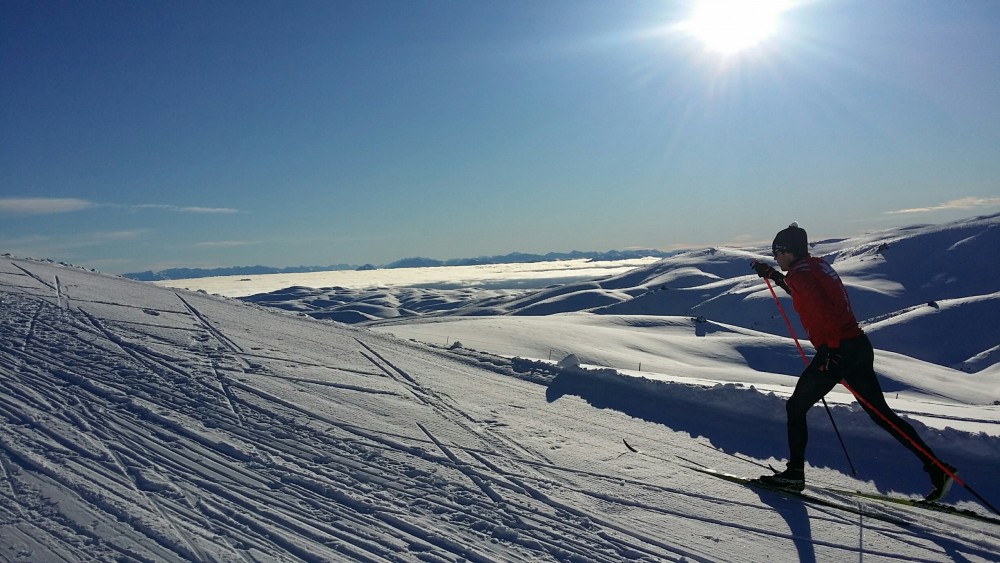
    U.S. Ties Season-Best 6th; Canada 11th

    Lowell Bailey (US Biathlon leads Russia's Maxim Tsvetkov during the first leg of the men's 4 x 7.5 k IBU World Cup relay on Sunday in Antholz, Italy. Russia went on to win and the U.S. finished 1:43.7 minutes back in sixth, tying a season-best team result. (Photo: IBU)
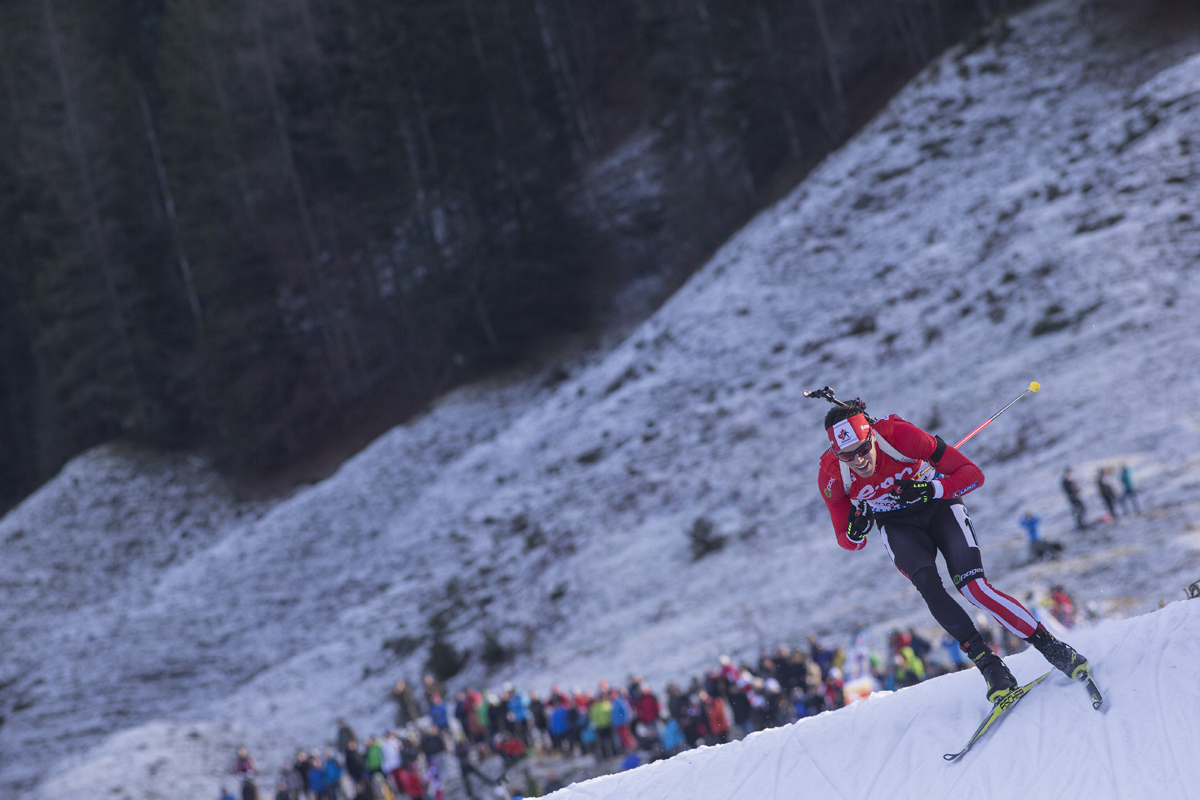
    Lowell Bailey (US Biathlon leads Russia’s Maxim Tsvetkov during the first leg of the men’s 4 x 7.5 k IBU World Cup relay on Sunday in Antholz, Italy. Russia went on to win and the U.S. finished 1:43.7 minutes back in sixth, tying a season-best team result. (Photo: IBU)

    On the last leg, Beatrix narrowly won out a race against American Sean Doherty, who crossed the finish less than five seconds later in sixth place, 1:43.7 behind the winners. The U.S. ended up with one penalty and 13 spares, and tied its season-best result after having achieved sixth in the relay a week ago in Ruhpolding, Germany.

    The Americans started the race in bib 6 with their now-usual lineup of Lowell Bailey, Tim Burke, Leif Nordgren, and Doherty, the same starters they had used at the World Championships in Kontiolahti, Finland, where the U.S. placed 14th in the men’s relay.

    Bailey briefly took the lead on the loop out of the arena, before two misses in his prone shooting stage required spare rounds and set him back to 15th, but still within 15.5 seconds out of the lead. With another spare in his standing stage, he still moved up five positions, and with the second-fastest, first-leg course time on his final loop, he tagged off in seventh, 20.8 seconds behind Germany’s Lesser.

    Burke held that position throughout his first loop, but two misses in the prone stage set him back. In the standing shooting, he used all three spare rounds to avoid the penalty lap, falling back to 14th before he made up ground again with a fast last loop (third-best course time) to tag Nordgren in ninth (+1:04.3).

    “Today proved that last week was not a fluke,” Burke said in a US Biathlon press release. “We are happy to be right in the mix with the ‘big’ biathlon nations but we still know that we are capable of more.”

    “I got the tag from Tim right with the Czech Republic,” Nordgren wrote in an email to FasterSkier. “For all of the first loop I just focused on staying nice and relaxed, trying to conserve as much energy as possible. Prone I wanted to be pretty aggressive and it worked out well.”

    After a clean prone shooting, Nordgren left the range in seventh place, virtually tied with a few other teams.

    “The second loop I left the range with Eder from Austria, again I was just tucked in with him saving energy,” Nordgren recalled. “Although I had super great skis today, so eventually on the downhill I put in a good transition and was pushing towards the French team in front of us.”

    After using two spare rounds in his standing stage, Nordgren still managed to move up to sixth place as some other teams, such as Italy and Switzerland, struggled on this leg, and handed off 1:04.5 minutes behind the leaders — about the same gap he had when he started.

    Russia's Evgeniy Garanichev (l) leads Tim Burke (US Biathlon) during the second leg of the men's 4 x 7.5 k IBU World Cup relay in Antholz, Italy. (Photo: IBU/Rene Miko)
    Russia’s Evgeniy Garanichev (l) leads Tim Burke (US Biathlon) during the second leg of the men’s 4 x 7.5 k IBU World Cup relay in Antholz, Italy. (Photo: IBU/Rene Miko)

    “Standing was the only disappointing part about my race today, it was a bummer to have two mistakes, but I didn’t lose any places and I was quick with the extras,” Nordgren wrote. “I was surprised on the third loop, I actually had some energy to push. Eventually France passed me and got a small gap I couldn’t close.”

    Doherty kept the team in sixth on his first loop and through the first prone shooting, which he cleaned, reducing his gap to first by about ten seconds.

    “The conditions today were ideal,” Doherty wrote in an email. “The course was in great shape and there was no wind. The altitude here adds to the difficulty, but I also pushed hard on the second loop and I did not really hold it together on the range as I wish I could have.”

    By the final standing shooting he had moved to fifth, and was on the range behind Austria, with France nearby and Slovakia further behind. Austria’s Landertinger shot clean and finished first, while Doherty caused a penalty lap. But he only lost one position and still had France’s Beatrix in sight who had needed three spares.

    Doherty skied a fast final loop, almost closing a 20-second gap again, finishing sixth, 4.4 seconds behind France in fifth and 1:43.7 behind Russia.

    “I am a little bummed to have had that penalty because I was excited to fight for 5th. But overall 6th was secure,” Doherty wrote.

    “I am happy with another strong result,” Doherty added in the US Biathlon press release. “We were in the mix the whole time and even though I did not shoot my best the team did well. We are all looking forward to the next relay.”

    “As a team I think we’re happy with this race, but it was nowhere near a perfect race for us,” Nordgren wrote. “We still have more to give and will be looking for more in the relays to come.”

    Canada in bib 7 chose a lineup of Christian Gow, Nathan Smith, Macx Davies, and Scott Gow. Brendan Green had to sit out the relay because of back issues following his collision in Saturday’s pursuit, “which did not improve until race time,” according to Biathlon Canada head coach Matthias Ahrens. “We had to put Scott Gow in his place,” Ahrens wrote in an email.

    Younger brother Christian Gow jumped out to the lead after cleaning the initial prone stage, but on the next loop he lost some ground, crossing the next timing point in 11th, just 10 seconds out of first. After he required two spare rounds in his standing stage, Christian lost additional time to the leaders, but kept his position in the field, tagging off to Smith in 11th (+1:08.3).

    Smith, currently the highest-ranked Canadian in the overall World Cup, cleaned both stages for his first 100-percent shooting in a race this season. Reflecting on his race in an email, he said his ski shape was off — and it has been for the last couple days. Unable to move up in the field, he tagged Davies in 11th (+1:07.7).

    “I wanted to make up some spots and get our team up to the top 10. I knew it would mean some really good shooting,” Smith wrote in an email. “I’m really happy to finally have my first clean of the winter, especially after poor shooting in the other two races this weekend. On the other hand my skiing hasn’t been where it should for the last two weeks. I’m not sure why, I went from my best ski shape to my worst ski shape in literally 3 days. I have been struggling with back pain after a hard downhill crash in the Ruhpolding 20 km.”

    Davies went on to clean his prone stage and move into 10th, reducing the gap to the leaders to 41 seconds. In standing, he needed all three spares, which caused him to lose some time. Overall Davies skied the second-best course time of his leg (only behind Norway’s Bø), and handed off to Scott Gow in 10th place (+1:39.0).

    On the anchor leg, Scott needed two spares in his prone stage and one in standing, with Estonia’s anchor Ermits Kalev still passing him on the final loop. The Canadian crossed the finish in 11th, 5.7 seconds behind Estonia and 2:28.9 minutes behind Russia.

    Combined, the team had no penalty and required just eight spares. But 11th wasn’t exactly close to their season best: the Canadians finished sixth in Hochfilzen, Austria and 10th last week in Ruhpolding.

    “There were some good aspects of our relay: Christian’s first prone was amazing, my shooting, and Macx’s skiing,” Smith wrote. “Overall though I would say unfortunately it was not a good relay. A good race for us is top 6. The potential for a medal is there if everyone can put together their best race on the same day. Easier said than done.”

    The Biathlon World Cup resumes in two weeks on Canada’s home turf in Canmore, Alberta, with sprints on Thursday, Feb. 4 and Friday, Feb. 5, followed by mass starts on Saturday, Feb. 6, and single-mixed (1 woman, 1 man) and mixed (2 women, 2 men) relays on Sunday, Feb. 7.

    “I’m going to North America in a good mood,” Germany’s Peiffer said at the press conference. “The last three weeks were really exhausting. Now I had a good week here in Antholz, and I am looking forward to go to Canmore. I have never been there before. Maybe not as many [spectators] as in Ruhpolding or Antholz, but it’s nice to see a new place for biathlon.”

    “I will be in Romania for my last Junior World Championships,” Sean Doherty, 20, wrote, which will take place in Cheile Gradistei (Brasov, Romania) from Jan. 27 to Feb. 2. “So I will only be attending the Presque Isle World Cup [after Canmore].”

    Results

  • France Dominates Women’s Antholz Relay; Canada 13th; U.S. 17th 

    France Dominates Women’s Antholz Relay; Canada 13th; U.S. 17th 

    The French women's 4 x 6 k relay team, including Justine Braisaz, Anaïs Bescond and Anaïs Chevalier, hugs and kisses anchor Marie Dorin Habert at the finish, after Habert secured their IBU World Cup victory by 17 seconds over the Czech Republic on Sunday in Antholz, Italy. (Photo: IBU)
    The French women’s 4 x 6 k relay team, including Justine Braisaz, Anaïs Bescond and Anaïs Chevalier, hugs and kisses anchor Marie Dorin Habert at the finish, after Habert secured their IBU World Cup victory by 17 seconds over the Czech Republic on Sunday in Antholz, Italy. (Photo: IBU/Rene Miko)

    After Ukraine, Germany and Italy occupied the podium in the first two International Biathlon Union (IBU) World Cup women’s relays of the season, on Sunday it was time for three other nations to shine in front of more than 20,000 fans in a packed arena in Antholz, Italy.

    On a beautiful day with blue skies, almost no wind, and surrounded by the spectacular mountain scenery of the South Tyrolean Alps, the French team with Justine Braisaz, Anaïs Bescond, Anaïs Chevalier, and Marie Dorin Habert shot well and skied fast to stay near the top throughout the 4 x 6-kilometer relay. Habert as the anchor received the tag with a 10.6-second buffer to Russia in second, then closed out the race with clean shooting in both stages, eliminating any chance of other teams challenging her.

    After she crossed the finish line in first for France with a time of 1:07.53.5, her teammates hugged her enthusiastically. Overall the French women shot no penalties and required just eight spare rounds.

    “It was a very nice race for the team,” starter Braisaz said during the post-race press conference. “I was a bit [too] excited on my first shoot. But it was a good experience to start the relay. And I am very happy today.”

    “A very happy end to my week,” her teammate Bescond told the media. “Today I felt very good on my skis. I think all of the team made a very good job.”

    “I am very tired, especially this week,” Habert said, reflecting on her season and the race. “It’s a very good thing to finish in the first position.”

    The French women's relay after winning Sunday's 4 x 6 k IBU World Cup relay in Antholz, Italy. With Justine Braisaz, Anaïs Bescond, Anaïs Chevalier, and anchor Marie Dorin Habert (second from r). (Photo:  IBU/Rene Miko)
    The French women’s relay after winning Sunday’s 4 x 6 k IBU World Cup relay in Antholz, Italy. With Justine Braisaz (l), Anaïs Bescond (second from l), Anaïs Chevalier (r), and anchor Marie Dorin Habert (second from r). (Photo: IBU/Rene Miko)

    “This is the first time we tried our relay for the World Championships [in Oslo], so it’s important to [get] a good position to see that this formation of the relay is functioning,” she later said in another interview with the IBU.

    On the last loop, the Czech Republic, Russia and Italy battled for the positions on the podium, with Veronika Vitková able to create a small gap to secure second place for the Czech team, 17.2 seconds behind France.

    Initially, the outlook didn’t look good for the Czech Republic, after second-leg Lucie Charvátová skied two penalty laps and slipped to 12th at the exchange. Later she could be seen in the finish pen with tears in her eyes, while being consoled by team staff.

    “After my leg I didn’t think [it would be possible to come back], because I was such a bad shooter in each relay I started this year. So I was afraid, afraid all race, all year,” Charvátová, 22, said during the press conference. “I am so under pressure. So I am very happy, because those other girls are the best.”

    Gabriela Soukalová (l) tags Czech teammate Veronika Vitková in fourth during the final exchange in the IBU World Cup women's 4 x 6 k relay. The Czech Republic team went on to finish second with just two spares from Vitkova. (Photo: IBU/Rene Miko)
    Gabriela Soukalová (l) tags Czech teammate Veronika Vitková in fourth during the final exchange in the IBU World Cup women’s 4 x 6 k relay. The Czech Republic team went on to finish second with just two spares from Vitkova. (Photo: IBU/Rene Miko)

    Her veteran teammates, World Cup leader Gabriela Soukalová and Vitková turned the race around with solid shooting and fast skiing, recording the best and fourth-best course times on their legs, respectively, to capture second. Overall, the team incurred two penalties and required seven spare rounds. It was the best performance for the Czech relay team this season, after two sixth-place finishes before.

    “It’s very surprising,” starter Eva Puscarciokova said during the press conference. “I am very happy today, because it was very hard after my race in Ruhpolding [Germany] when I went to the penalty loop.”

    Third place on the podium went to the Russian team with Ekaterina Shumilova, Anastasia Zagoruiko (who replaced Daria Virolaynen from the last relay in Ruhpolding), Ekaterina Yurlova, and Olga Podchufarova, finishing 21.2 seconds back, with no penalties and 10 spare rounds.

    Yurlova, Saturday’s pursuit winner, lifted her team from sixth to second, skiing fast — with the second-best course time of the third-leg skiers — and only needing two spares.

    “I am really happy about my leg, and especially about my standing [shooting],” Yurlova said at the press conference. “Because I am really, really tired after two competitions before. And now I was really afraid about my standing. It was all shaking, but I am really happy that I could do it clean. Overall I am really satisfied about this World Cup.”

    In the finishing stretch, Italy’s anchor, Dorothea Wierer, and Russia’s Podchufarova (who had beaten Wierer in the sprint last Friday) fought for third, as they had done earlier this season at the end of the relay in Ruhpolding, Germany, where Italy came out ahead. But this time, Podchufarova prevailed, to the huge excitement of her teammates who immediately ran into the finish area and piled onto her. Wierer crossed the line just 0.5 seconds behind (+21.7), after having made up nearly 15 seconds after the final shooting.

    “My only thought was to come into the finish in the third position,” Podchufarova said in the press conference. “I didn’t know at first that [Wierer] was behind me, only when I came into the stadium I saw it on the monitor. Then I tried my best to get the third place for the team.”

    “I wanted to go on the podium, but I was too [many] seconds behind,” Wierer said in a post-race interview with the IBU. “On the finish line I couldn’t anymore, because I was flushed pushing from the first loop, and in the final I had no more energy.

    “It was a really nice [weekend], but I am a little disappointed today,” she added with a laugh. “You want always more and more, that is the problem.”

    Norway, with Kaia Wøien Nicolaisen, Fanny Horn Birkeland, Marte Olsbu and Tiril Eckhoff, had been in third position behind France and Russia coming into the last shooting, but Eckhoff — a fast skier who has struggled with her shooting all season, hitting 68 percent of her standing targets — again had problems and ended up skiing a penalty lap. She finished fifth for Norway, 47.1 seconds back from France, with a team total of one penalty and 10 spares.

    “I had the opportunity and screwed it up. This was real sh*t. This was not the way I wanted to end [my] last World Cup race before the World Championships,” Eckhoff told Norwegian broadcaster NRK after the race, noting she and her coaches were aware of some technical corrections she still plans to implement.

    Ahead of the upcoming World Championships on their home turf in Oslo, the Norwegian women have yet to reach the podium since earning bronze in the relay at the 2014 Olympics.

    Arguably the biggest surprise of the day was Sweden, with Emma Nilsson, Mona Brorsson, Ingela Andersson, and Linn Persson, in sixth place (+50.5) just 3.4 seconds behind Norway, with no penalties and seven spare rounds.

    After the race, the Swedish women claimed they knew they were on a very good trajectory this season.
    “We expected it,” Brorsson said during in a group interview with the IBU.

    “We really thought we had a chance to be top six,” Andersson added.

    They credited their coach, Wolfgang Pichler, for their improved performance, after he helped several Swedish biathletes, such as Magdalena Forsberg, Helena Ekholm and Anna Carin Olofsson (now Zidek) reach Olympic and World Championship medals, before returning last summer after a stint with the Russian biathlon team.

    “I think that’s the big difference this year,” said Brorsson. “He always finds a way to motivate you. On the track, he is incredible. He knows what he is doing.”

    Ukraine, winner of the last relay in Ruhpolding and usually a team with very solid shooting performances, had some difficulties on the range on Sunday and finished ninth (+1:45.5). The team with Iryna Varvynets, Valj Semerenko, Olga Abramova (replacing Juliya Dzhyma) and Olena Pidhrushna stayed near the front for most of the race and Semerenko even exchanged in the lead. But Abramova needed five spares, and anchor Pidhrushna had to ski a penalty lap, setting them farther back (12 spares overall).

    Similarly, Germany had been in second place for both relays this season. On Sunday, with their regular anchor Laura Dahlmeier taking a break after a respiratory infection, the team struggled almost right out of the gate. Starter Karolin Horchler required five spare rounds and only narrowly avoided the penalty lap in her prone stage, leaving in last position at that time. She tagged off already a minute behind the best in 15th, before Miriam Gössner and Vanessa Hinz moved up a bit, but each incurred a penalty to slow down the chase. Anchor Franziska Hildebrand still managed to improve her team two positions on her leg, ultimately finishing 10th (+1:51.8).

    “I don’t know why, but my legs felt like a sewing machine today in standing, that hasn’t happened to me in a long time,” Gössner told German TV broadcaster ARD in an interview while the race was still going on. “I stood there, and already from the first shot my legs were shaking so much that I really didn’t have myself under control anymore. Even though I went slowly on the prior loop. I tried to fight and prevent the penalty lap, but unfortunately I did not succeed.”

    “My race was all right. All in all I am satisfied,” Hildebrand told ARD. “We somehow struggled a bit in Antholz. Next time it hopefully will be better again for us. There are weekends where not everything works out, and this was one of those.”

    Switzerland, with Saturday’s pursuit runner-up Selina Gasparin, started the relay very strong, with Gasparin tagging off in the lead, and her younger sister Aita Gasparin keeping the team in contention in fourth. Then two less-experienced skiers closed for Switzerland, with Irene Cadurisch tagging off in fifth place, before anchor Ladina Meier-Ruge faded a bit and lost two minutes to the front. They finished 12th with nine spares, one place ahead of Canada.

    Canada 13th, U.S. 17th

    After achieving her first-career top 20 in Saturday’s pursuit, Canada’s Julia Ransom had said her team was “fired up” for the relay, and that they were eager to reach the top six after feeling they had come close in ninth a week ago in Ruhpolding.

    Unfortunately on Sunday, the performance on the shooting range did not allow that to happen for the Canadian team with Ransom, Rosanna Crawford, Megan Tandy, and Zina Kocher.

    Starting as the scramble leg, Ransom missed two targets in her first prone stage, then required all three spares to clean them, narrowly avoiding the penalty but only leaving the range again in 18th position, already 41 seconds back.
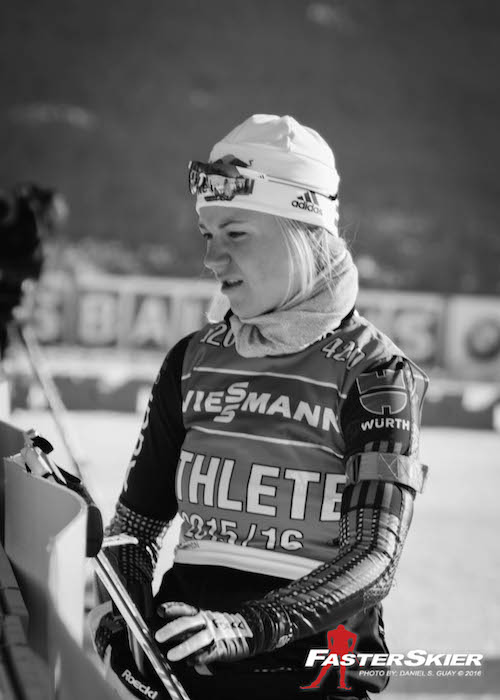
    After skiing a fast second loop (with the third-best course time, seventh-best overall) and a clean standing shooting, she moved the team back up significantly and tagged Crawford in ninth place, 32.2 seconds behind the top.

    Crawford had two solid shooting performances, requiring one spare round in her prone stage and two in standing. Skiing the 11th-fastest second-leg course time, she brought her team close to the top six in seventh place, just 32.5 seconds out of first.
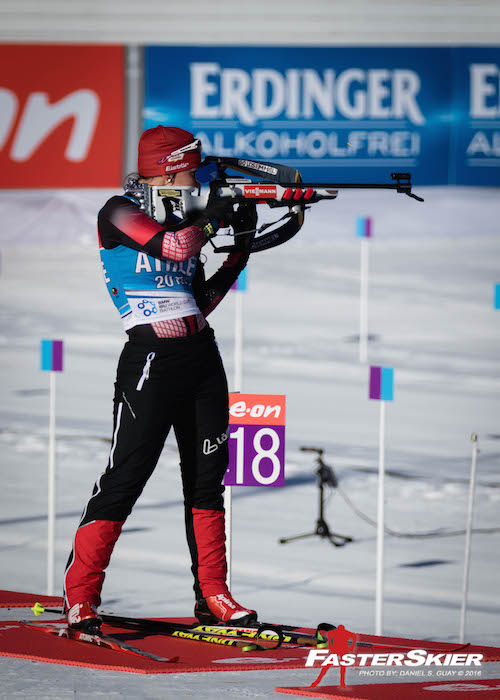
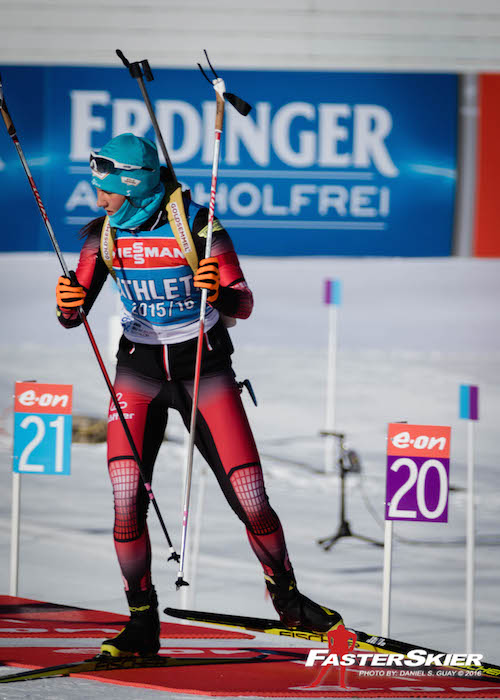
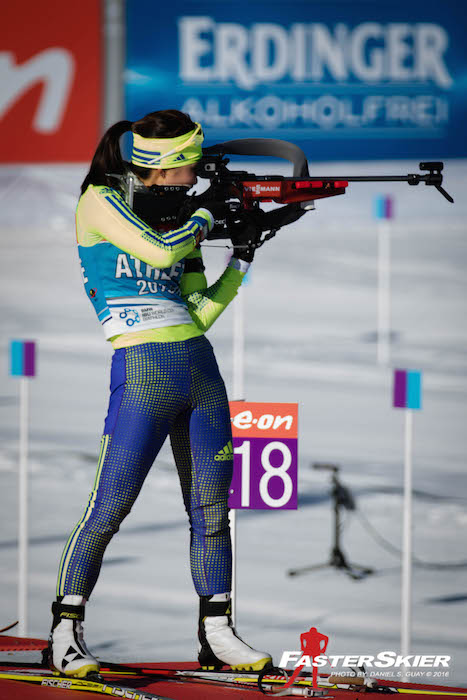
    Tandy skied a very fast first loop (fourth-best), and came through her prone stage with two spare rounds, leaving still in 10th position. After a slower loop, she then struggled in her standing position, and was unable to avoid the penalty lap (0+2, 1+3), losing a minute to the top. She tagged off in 13th place (+1:58.7).

    Kocher as the team’s anchor initially held 13th and had a solid first prone shooting with one spare round, but lost another minute on the next loop. In the final standing, similar to Tandy, she also ran out of spares and had to ski a penalty lap, leaving the range in 14th and more than four minutes behind the leaders. On the final loop she was able to pass Bulgaria’s anchor Daniela Kadeva, finishing 13th for Canada (+4:12.2 minutes) with two penalties and 15 spare rounds.

    In an email, Biathlon Canada’s head coach Matthias Ahrens explained that the team was packing up Sunday afternoon, driving to Munich, Germany, then flying back to Canada early Monday morning. The Canadian athletes could not be reached for immediate comment.

    “Women’s race started excellent with Julia and Rosanna, then unfortunately Megan and Zina could not match that Performance,” Ahrens briefly noted about the women’s result before leaving Antholz.

    Susan Dunklee (US Biathlon) used a total of four spares between two stages in the women's 4 x 6 IBU World Cup relay, handing off in 14th. (Photo: USBA/NordicFocus)
    Susan Dunklee (US Biathlon) used a total of four spares between two stages in the women’s 4 x 6 IBU World Cup relay, handing off in 14th. (Photo: USBA/NordicFocus)

    The U.S., with Clare Egan, Susan Dunklee, Annelies Cook, and Joanne Reid, adapted its lineup order a bit again on Sunday compared to the first two relays, with Egan starting and Cook moving to the third leg.

    “Today I got my first mass-start experience at the World Cup level,” Egan wrote in an email. “It reminded me of how much I thrive on head-to-head racing. The decision was made with the intent of giving me that head-to-head experience, both because it will be useful in the future for pursuits and mass starts, and because I think my coaches thought I would like it.”

    She skied at a steady pace in the middle of the field, and required just one spare in each of her shooting stages.

    “The altitude is a challenge here, for the skiing of course but also for recovering before the shooting,” Egan wrote of the biathlon trails situated some 2,000 meters (6,500 feet) above sea level. “The range approach does not provide rest, so I have been making rest for myself by skiing into the range extra easily.”

    “There was a light wind but it was constant, so with the correct sight adjustments the wind was not a factor,” Egan explained. “I had super fast skis and put them to good use passing people on course, but then despite using only one spare round per stage, I still lost places on the range to faster shooters.”

    On the last loop, Egan sped up her pace and skied the sixth-fastest course time of her leg, catching six other teams in front of her to hand off in 12th place (+53.9)

    “The highlight for me was on the last lap when I passed Team Germany,” she wrote.

    After receiving the tag from Egan, Dunklee set out fast with the best course time on her first loop, but then required three spare rounds in her prone shooting. After skiing her second loop at a slightly lower pace, she managed to miss only one target in standing. She slipped two spots to tag off in 14th (+1:10.1), with the third-best course time overall.

    Cook was initially able to hold that position, despite requiring two spares in her prone. Then in standing, she used all three spares and had to ski a penalty lap. That set her back to 18th place, more than three minutes behind the leaders. She tagged off still in that position (+3:36.7).

    In the second World Cup weekend of her career, Reid, 23, skied as the U.S. anchor for the second time. She posted the ninth-best course time on her first loop and managed to shoot clean in prone, but then was lapped by the top teams after another penalty in her standing. That kept Reid from skiing her last loop and ended the race for the U.S. in 17th place with two penalties and 14 spares. Estonia and Romania behind them were lapped as well.

    Next Stop: Canmore/Canada

    The IBU World Cup picks back up again in two weeks in Canmore, Alberta, with sprints on Thursday, Feb. 4 and Friday, Feb. 5, followed by mass starts on Saturday, Feb. 6, and single-mixed relay (1 woman, 1 man) and mixed relay (2 women, 2 men) relays on Sunday, Feb. 7.

    Several strong athletes will not make the trip overseas, notably several members of the Norwegian team, such as Eckhoff and Synnøve Solemdal, citing a focus on instead preparing for the upcoming World Championships.

    Sitting in second in the overall World Cup standings, Habert plans to be there to fight for more points: “Just five days to recover, and then we will fly to Canmore,” she said at the press conference.

    “We are still in discussion with the coaches about the best approach,” Germany’s Hildebrand told ARD. “In order to stand nicely relaxed and regenerated at the start in Oslo.”

    Note: The U.S. men placed sixth in the men’s 4 x 7.5 k relay to match a season best, despite using 13 spares and skiing a penalty lap, with Lowell Bailey, Tim Burke, Leif Nordgren, and Sean Doherty. Canada’s men, with Christian Gow, Nathan Smith, Macx Davies, and Scott Gow, placed 11th with eight spares and no penalties.

    Stay tuned for a complete report on the men’s race.

    Results

  • Perfect on the Range, Ransom Makes Her Top-20 Breakthrough in Antholz Pursuit

    Perfect on the Range, Ransom Makes Her Top-20 Breakthrough in Antholz Pursuit

    Julia Ransom (in black and red suit) helping the Canadian team to ninth place in the women's relay in Ruhpolding, Germany, last week. (Photo: Biathlon Canada/Matthias Ahrens)
    Julia Ransom (in black and red suit) helping the Canadian team to ninth place in the women’s relay in Ruhpolding, Germany, last week. (Photo: Biathlon Canada/Matthias Ahrens)

    A lot of people on the Canadian biathlon team thought that Julia Ransom was going to have a breakthrough this year.

    But few, including the 22-year-old herself, seemed to have thought that it would be this big, or happen this fast.

    After shooting a perfect 20-for-20 in the 10 k pursuit in Antholz, Italy, Ransom was one of the biggest movers on the day, skiing from 46th up to 19th. She crossed the line 1:30.8 behind race winner Katja Yurlova of Russia.

    “Top 20 is just… that was a pretty big stretch goal for me this year,” she said in an interview after her race. “Going into the season I wanted to get points, wanted to get my first-ever World Cup point [from being in the top 40], and then it happened. And then I thought last week ‘yeah, top 20 would be sweet. We should open some champagne for the top 20. That’s a champagne race.’ So then it happened. Woah that’s crazy.”

    Those World Cup points came early in the year, in the sprints and pursuits in Östersund, Sweden, and then in the sprint in Pokljuka, Slovenia, all before the Christmas break.

    Until Saturday, Ransom hadn’t broken into the top 30, much less the top 20.

    It’s her first full year on the World Cup circuit. World Cup and World Championships starts in 2014-2015 gave her experience, which she’s happy to draw on now.

    Ransom at 2015 World Championships in Kontiolahti, Finland. (Photo: Biathlon Canada/NordicFocus)
    Ransom at 2015 World Championships in Kontiolahti, Finland. (Photo: Biathlon Canada/NordicFocus)

    “I like to just be out there and have fun, and that’s no different than last year,” she said. “But it’s definitely nice to be skiing a little quicker. Making pursuits is also quite nice. So in that sense, yeah, that’s different, but I guess mentality towards racing is the same. Trying to do my best, but also enjoying the mountains, the spectators, and the energy and all of that in all the venues.”

    So what, besides knowing what to expect, allowed Ransom to jump into the top 20?

    In the past few days, she had gotten some good advice from teammates and coaches.

    “In the Ruhpolding relay when it took me three spares to hit one target, I felt kind of shaken up,” Ransom said. “After the sprint when I was cooling down with Rosanna [Crawford], I was just like, ‘what do you do, how do you do it?’ And she kind of helped me out with a few things. She has definitely provided a lot of mentoring.”

    Crawford wasn’t happy with her own race in the Antholz pursuit, where she missed six shots and finished 44th.

    But she was thrilled to see Ransom succeed.

    “It’s been really exciting to watch Julia, she is such a strong athlete and has really impressed me with her ski speed,” Crawford wrote in an email. “I knew that she was capable of a result like this, she just needed the shooting and skiing to come together at the same time and that was today! We had a chat about what I find works for me when I am shooting well and talked about what might help her in the range.”

    The second key to success, apparently, came from a simple suggestion from National Team Coach Roddy Ward.

    She's come a long way:  Ransom and teammate Emma Lodge with their first World Cup bibs back in January 2014. (Photo: Roddy Ward/Eat Sleep Train)
    She’s come a long way: Ransom and teammate Emma Lodge with their first World Cup bibs back in January 2014. (Photo: Roddy Ward/Eat Sleep Train)

    “Julia is a big time coffee fan,” Ward explained in an email. “After a sub-par practice yesterday (not focused enough) I found out she only had one cup of coffee that morning. In our pre-race meeting last night I advised she drink two today, as she did before the Sprint [where she shot 9 out of 10). I think we found the sweet spot for pre-race coffee intake.”

    Ransom confirmed: it was a welcome suggestion.

    With that renewed focus, she was one of only two athletes in the field to shoot a perfect race.

    “It was a little windy, for sure,” Ransom said of conditions on the range. “I made wind corrections in both of my prone bouts. And I mean, I remember Antholz last year was crazy windy. So to just have a few clicks here and there was pretty good. I think a lot of the time the altitude can affect a lot of people because you don’t quite recover as well as soon as you come into the range.”

    It was touch and go: the last shot was a split bullet, meaning that it hit the edge of the target with part of the bullet hitting the target and part the frame around it. But despite that, the target turned white and Ransom could head off to the trails without ever seeing the penalty loop.

    “Cleaning 20/20 takes a great deal of focus and concentration,” Ward wrote. “She has been working on this a lot and its cool to see it pay off for her. I cheered quite loudly after her final shot was a hit… [a split] can go either way but you just need the target to go down! Doesn’t need to hit the middle…”

    With Saturday’s result, the best 10 World Cup results of Ransom’s career have all come this season. She credits her teammates for a lot of the improvements.

    “This year has been going really well, and I think a lot of it has to do training with some of the best guys in the world on this team,” she explained. “With Rosanna of course, and Nathan, and we’ve got a great group of girls, and we are all gelling, and trying to push each other and to create a good atmosphere. So I think that and the summer has really paid off this year.”

    But Ward, who is Ransom’s main coach, said that she should be giving herself some credit too.

    “Julia has worked very hard all training year,” Ward wrote. “I started to feel around August that it was paying off. She made a big jump this fall. I am still surprised by this result. This was beyond any of my expectations. She is a great athlete to coach, she is so driven and has a fantastic worth ethic. She also has a very good head on her shoulders… She has been quite consistent this season, which is impressive for a young athlete.”

    Crawford agreed, saying that Ransom brings more than speed and straight shooting to the team.

    “It’s been great having someone like Julia on the team,” she wrote. “She always looks at the positive side of things, which I have a hard time doing, and it’s been rubbing off on me.”

    Up next for Ransom and her teammates is the 4 x 6 k relay on Sunday. In Ruhpolding they finished ninth and were close to the top six, and they hope to improve on that result.

    “I absolutely love relays,” Ransom said. “It’s a time for all the girls to get together, kind of get fired up about everyone’s performances. It takes the selfishness out of racing a little bit, which I like. I like the team aspect. And we were so close to top six last relay, that I think it’s definitely doable. Definitely doable.”

    “I think this will give our team a boost going into tomorrow’s relay,” Crawford added. “When someone has a [personal best] it really brings an exciting vibe to the team!”

    And after that it’s home to Canmore for World Cups on the team’s home turf.

    Ransom said she doesn’t have any specific results goals to thrill the Canadian crowd with, but she hopes she can get the community pumped up.

    “Oh man, I am so excited to go back home,” she said. “I obviously want to perform at my best, and make the home-crowd excited to cheer for all the Canadians. Of course everyone is doing really well this year. And it’s just exciting to be home, and in your bed, with your friends, and get to see my boyfriend and my family. So that’s really exciting.”

    And about that champagne to celebrate the top 20?

    “We will find out,” Ransom laughed.

    Results

  • Canada’s Smith 9th, Macx Davies Stuns in 10th in Östersund Sprint

    Canada’s Smith 9th, Macx Davies Stuns in 10th in Östersund Sprint

    05.12.2015, Oestersund, Sweden (SWE): Macx Davies (CAN) - IBU world cup biathlon, sprint men, Oestersund (SWE). www.nordicfocus.com. © Manzoni/NordicFocus. Every downloaded picture is fee-liable.
    Macx Davies of Canada racing to 10th in Saturday’s IBU World Cup 10 k sprint in Ostersund, Sweden. It was his career-best result by 30 places. (Photo: Biathlon Canada/NordicFocus)

    Note: This article has been updated to include additional comments from Macx Davies.

    It was a big day for Canadian men in Saturday’s International Biathlon Union (IBU) World Cup sprint in Östersund, Sweden. Two Canadians broke into the top 10, led by Nathan Smith in ninth, with one miss in both standing and prone. He finished 1:22.3 behind France’s Martin Fourcade, who won the 10-kilometer race in 24:02. And 22-year-old Macx Davies had the race of his career so far, finishing 10th, 10.9 seconds after his teammate Smith.

    The up-and-coming Canadian biathlete’s previous best was 40th in a World Cup sprint two seasons ago in Oberhof, Germany.

    Davies’ secret was simple: be the best shooter of the day. It was windy in Östersund, and he was the only man in the field to shoot clean on Saturday.

    How he got to be the best shooter was more complicated. Certainly not by being the fastest — he forgot to load a second clip and had to load each bullet individually in standing.

    “That really allowed me to stop thinking about results and focus on hitting every target,” Davies said, according to a Biathlon Canada press release. “I had to push each bullet in by hand, which slowed down my shooting and again forced me to think of each shot more individually than as a whole. It is funny now, but I think this really slowed me down and made me focus more.”

    It wasn’t until the last lap that he realized how well he was doing.

    “I was the whole Canadian wax crew that was yelling at me on the last lap, and my coach Roddy Ward,” he explained in an email. “I was a little in disbelief at the finish. First of all I was excited to have not lost a position on the last loop. Proving that I can ski with the best guys. And then I just was over the moon after it sunk in that I was 10th!”

    Davies cleaned an IBU Cup sprint last season in Obertilliach, Austria. Saturday’s race marked his fifth World Cup.

    “This result means I am doing something right with my training and that as a whole the Canadian team is ready to show off what we can do this season,” he wrote.

    In an email, Canada’s head coach Matthias Ahrens explained the team aimed to start the season strong “for confidence and also Nation Cup points,” he wrote.

    “The first World Cup is always a big question mark due to North America’s isolation during the training year,” he added.

    While a strong start was ideal, Ahrens wasn’t expecting this from Davies — at least not right now.

    “I did not expect this to happen so early since he had a period of sickness in the last training block, but I know that he is a great skier especially when he switches to snow,” he wrote. “Today everything aligned for him with good skiing and shooting in a challenging race were others had trouble in the shooting range.”

    Meanwhile, Smith placing ninth, after he earned silver at 2015 IBU World Championships, was more on par with expectations, Ahrens explained.

    Perhaps less surprised with Davies’ performance was Canadian National Team Coach, Roddy Ward.

    “Macx can really throw down amazing performances each year. Now he has been given another World Cup opportunity and he has delivered another one of those special performances,” Ward wrote in an email. “He is very dedicated and has belief in himself that he can improve and be among the best. Results like today re-enforce that the effort is paying off.”

    “Everything feels surreal at the moment,” Davies said in the press release. “I keep seeing the result sheet and not believing that I’m actually in the top-10. I knew today that good shooting would make a big difference and I felt good on my skis from the start of the race so I really tried to push myself as far as I could go. This result provides me with the confidence that the big names I have idolized growing up are in fact human, and I am competitive with them.”

    Another standout performance among North American men belonged to another youngster, 20-year-old American Sean Doherty, who posted a career-best 17th on Wednesday in the 20 k, the first individual World Cup of the season. On Saturday, Doherty placed 25th (+2:13.4). for his second-best result to date, with one penalty in standing and two in prone.

    “The sprint today was an interesting race,” Doherty said in a US Biathlon press release. “The wind conditions were very difficult. I felt strong on the course and I am very excited to start the pursuit in the middle of the action. Should be a lot of fun.”

    Perennially atop the podium, Fourcade had a commanding victory, finishing 51.6 seconds ahead of second-place Arnd Peiffer of Germany. Crediting fast skis, Fourcade’s victory came in spite of two penalties — one in each stage. But while his competitors tried to wait out the gusting wind on the course, Fourcade shot quickly in order to get the 150-meter penalty loop over with. Peiffer’s clean shooting in prone gave him what he needed to edge Norway’s Ole Einar Bjørndalen, who took third place (+55.2) with two penalties.

    Also qualifying for Sunday’s pursuit with a top 60 in the sprint, American Tim Burke placed 45th, (+2:45.8) with four penalties (1+3) and Canada’s Brendan Green was 55th (+3:12.2) with five misses (2+3).

    Among the other U.S. finishers, Leif Nordgren placed 64th (+3:39.8) with four penalties (2+2), and Lowell Bailey was 68th (+3:46.7) with six misses (1+6). Canada’s Gow brothers, Scott Gow was 67th  (+3:44.5) with five misses (3+2) and Christian Gow placed 70th (+3:49.5) with five missed targets as well (2+3).

    Men’s 12.5 k and women’s 10 k pursuits are scheduled for Sunday.

    Results

  • Norway Doubles Up with Second Team Win in Östersund; USA and Canada Top 10

    Norway Doubles Up with Second Team Win in Östersund; USA and Canada Top 10

    Leif Nordgren leaving the range in Sunday's mixed relay in Ostersund, Sweden. The United States team finished tenth. (Photo: US Biathlon / NordicFocus)
    Leif Nordgren leaving the range in Sunday’s mixed relay in Ostersund, Sweden. The United States team finished tenth. (Photo: US Biathlon / NordicFocus)

    After winning the single mixed relay earlier in the day, Norway made it a golden start to the World Cup biathlon season by also landing victorious in the four-person mixed relay in Östersund, Sweden, on Sunday.

    Anais Bescond of France was the quickest in the first leg of the relay, but Fanny Horn Birkeland of Norway was just 3.1 seconds behind in second – and after that, her teammates took over the lead and never gave it up.

    Tiril Eckhoff battled with the Czech Republic’s Gabriela Soukalova for six kilometers, tagging off in a dead heat; she had the fastest course time with four spare rounds to two by Soukalova.

    “I tried to go out aggressively today,” Eckhoff told Norwegian broadcaster NRK. “I had some trouble in the beginning. But I’m happy. It bodes well for the rest of the week.”

    Johannes Thingnes Bø used lightning-fast shooting to build and 13-second lead over Germany, and then his older brother Tarjei wrapped things up with two clean shooting bouts.

    Tarjei Bø celebrating as he crossed the finish line to give Norway a second win on the day.
    Tarjei Bø celebrating as he crossed the finish line to give Norway a second win on the day.

    As Simon Schempp of Germany arrived on the range to take his final shots, Bø had finished shooting. Rather than skiing off, he turned around and took a bow to the crowd.

    “I think my prone shooting was faster,” Johannes told Biathlonworld. “But [Tarjei]’s standing was faster and also better. So it’s one-one, but the total score goes to him today.”

    Schempp took Germany home in second (+33.6), with the Czech Republic finishing third (+1:11.5) and France fourth (+1:48.2). Sweden finished fifth after Fredrik Lindström lost a sprint finish with France’s Jean Guillaume Beatrix – but top-five was still one of Sweden’s best relay finishes in several seasons.

    Two North American Teams in Top Ten

    The Canadian team of Julia Ransom, Zina Kocher, Scott Gow, and Brendan Green finished ninth, +3:08.6.

    “This was my first time ever starting off a relay on the World Cup and I had so much fun!” Ransom wrote in an email. “I was definitely nervous but I have always loved mass starts and found it to go pretty smooth… I have good feelings about this year. With the help from the coaches and support staff, I made some big improvements this summer in both my technique and fitness. Those jumps made it only too exciting to get over to Sweden to start racing… That and the anticipation of having waffles every day.”

    “For myself it’s nice to get the season underway,” agreed Green, who anchored the team and had the second-fastest last-loop time. “There are certainly areas I can improve on from today’s race. Typically it takes me a few races to really get going and I think today was no different. I felt better as the race progressed which I hope is a good sign for better form to come… There was wind present but it should have been more manageable for me.”

    That’s the team’s best result in a mixed relay since December 2011, when they finished sixth in Hochfilzen, Austria.

    “I am overall very happy about everybody’s performance today, skiing and shooting, and this should give the whole team confidence going into the individual events next week,” Head Coach Matthias Ahrens wrote in an email.

    The United States finished tenth with Susan Dunklee, Annelies Cook, Leif Nordgren, and Lowell Bailey.

    “We had an okay day but not a great day,” Dunklee wrote in an email. “There are little details that were off- for example we didn’t have a single shooting stage that was clean from the clip.”

    Despite only two spare rounds in her leg, Dunklee tagged off to Cook in ninth place, 37 seconds back from France’s Bescond.

    “I am satisfied with my shooting focus but my skiing isn’t quite there yet,” she wrote. “My highest gears were missing, plus an early tactical error left me boxed in on a downhill with too much speed. I crashed into the person in front of me and lost all my clips.”

    Cook used five spare rounds and Nordgren was stuck with a penalty loop in prone, but the squad was able to climb from a low point of 14th back up to 10th by the finish.

    Bailey agreed that things hadn’t gone perfectly, but that there were bright spots for the team.

    “Although it wasn’t our best performance as a team, I think everyone had some points in their individual legs that they were happy with, while other spots were a bit rough,” he wrote in an email. “I was satisfied with my shooting, not thrilled, but satisfied. On course, I was also happy with how I felt, and the fact that I was able to fight it out on the last lap. At this point in the season, there’s always a little bit of anxiety as you approach the season; everyone has been training in different programs all year long, and it’s always hard to predict how you will react to your own training and how your level will stack up with the rest of the field.”

    Results

  • Canadian Biathletes Pump the Volume with Park City Camp

    Canadian Biathletes Pump the Volume with Park City Camp

    Nathan Smith on a long classic rollerski to Mirror Lake. (Photo: Matthias Ahrens)
    Nathan Smith on a long classic rollerski to Mirror Lake. (Photo: Matthias Ahrens)

    If you already train in the Rockies, taking a 2-hour flight (or a heck of a long drive) to another part of the Rockies might seem a little nuts.

    But the Canadian biathlon team is getting used to doing an autumn camp in Park City, Utah – a jump south from their usual base in Canmore, Alberta.

    “My favourite workouts around Park City have always been the long climbs in the area,” wrote Brendan Green, a longtime national team member. “It’s so easy to get to a high altitude on really good quality roads and climbs which is awesome. This is definitely something we lack around Canmore, so I try to make the most out of every opportunity I have to climb.”

    And in terms of places you can go to get some solid rollerski and running climbing in, Park City is actually pretty convenient for the Canmore-based team.

    Coaches picked a steep hill for a joint ski bounding workout with the cross-country and biathlon teams. (Photo: Matthias Ahrens)
    Coaches picked a steep hill for a joint ski bounding workout with the cross-country and biathlon teams. (Photo: Matthias Ahrens)

    “It’s the same time zone, no jet lag, a 2 hour flight for the athletes, and the last sunny and warm period before winter starts,” Canadian Head Coach Matthias Ahrens wrote in an email.

    With that setup, the goal for the team was to get in a big block of volume training at altitude before heading towards race season.

    “It’s the last volume camp before intensity block in Canmore,” Ahrens explained. “There’s good altitude differentials with long sustained uphill climbs for rollerskiing.”

    They also took advantage of the Canadian cross-country team being in the same spot, and did a ski-bounding workout with the skiers early in the camp.

    “The joint session with XC was an uphill bounding / striding intensity session down in Salt Lake City,” Green wrote in an email. “Every workout we can do with XC I think is really beneficial for us – It’s great for us to be pushed by guys like Alex [Harvey], Devon [Kershaw], and Ivan [Babikov].  I really hope this is something we can do more of in the future.”

    While that was the only joint training session, the cross-country and biathlon coaches also did a mountain bike ride together on the athletes’ off day to chat and consider more joint planning.

    How many coaches does it take to read a map? (Photo: Matthias Ahrens)
    How many coaches does it take to read a map? (Photo: Matthias Ahrens)

    “Last year we had the opportunity to do some sessions with the U.S. biathletes but this year unfortunately they were not there at the same time,” Ahrens wrote.

    Besides the volume focus, Green was working on a few other issues stemming from a disc injury in his back a few years ago.

    “I’m still working through some issues with my back but I have been trying a few different treatments,” he wrote. “I hope that I’ll be able to manage the pain better in the upcoming season and I really hope to avoid another painful season of racing like last year. I have made a few small changes to my program and areas of focus for this season.  I think things are headed in the right direction but of course the real test will come when race season rolls around.”

    Most of all, everyone enjoyed getting some new scenery as they put in hour after hour of training.

    “We had incredible weather for almost the entire two weeks in Park City which always makes for more enjoyable training,” Green wrote. “It is nice to get out of Canmore once in a while to break up the training routine.”

  • Casting a Wider Net: ‘International Biathlon Team’ Shares Shooting Tactics in Sirdal

    Casting a Wider Net: ‘International Biathlon Team’ Shares Shooting Tactics in Sirdal

    The "International Biathlon Team" camp in Sirdal, Norway, with (front left to right) Fanny Well Strand Horn, Tiril Eckhoff, Elise Ringen, and Rosanna Crawford, and (back left to right) Brendan Green, Megan Heinicke, Sinnoeve Solemdal, Ekatarina Yurlova, Kaisa Mäkäräinen, Susan Dunklee, Marte Olsbu, and Nathan Smith. (Photo: Matthias Ahrens)
    The “International Biathlon Team” camp in front of the 30-point range at the sports school in Sirdal, Norway, with (front left to right) Norway’s Fanny Welle-Strand Horn, Tiril Eckhoff, and Elise Ringen, and Canada’s Rosanna Crawford, and (back left to right) Canada’s Brendan Green and Megan Heinicke, Norway’s Sinnøve Solemdal, Russia’s Ekatarina Yurlova, Finland’s Kaisa Mäkäräinen, American Susan Dunklee, Norway’s Marte Olsbu, and Canada’s Nathan Smith. (Photo: Matthias Ahrens)

    It all started two years ago when Biathlon Canada’s head coach Matthias Ahrens struck up a conversation with highland-cow farmer Frode Oftedal at the World Cup in Oslo, Norway. There, Oftedal, also a biathlon enthusiast, invited the Canadians to come to Sirdal, Norway, for a training camp with the French team. The French biathletes had been returning to the sports school there to train since 2002 — because of Oftedal.

    For Canada, the possibility became reality this spring when Ahrens asked Norwegian biathlon coach Arne Idland whether his A-team athletes (Rosanna Crawford, Megan Heinicke, Brendan Green, and Nathan Smith) could participate in the Blink rollerski festival in August. They could, and would, but before that, why not arrange a shooting camp with Norwegian personal shooting coach Joar Himle? Last year, the Canadians held a camp with Himle’s expertise at home in Canmore, Alberta. This time, they’d continue learning from him in Norway.

    Three non-Canadians — Russia’s 2015 world champion Ekaterina “Katja” Yurlova, Finland’s Kaisa Mäkäräinen and American Susan Dunklee — caught wind of the camp and asked Himle if they could join, Ahrens explained in an email.

    Of course they could, and the self-proclaimed International Biathlon Team was born. In the last few months before the nine-day camp in late July, Ahrens contacted the participants from various nations — including Norway and France — to coordinate workouts.

    “At the end of the year World Cup party in Khanty-Mansiysk, I met Joar Himle,” Dunklee explained in an email. “He mentioned that he might put together an international women’s shooting training camp this summer around the Blink Festival. I was immediately interested.”

    The International Biathlon Team enjoys some leisure time during a volleyball match at the sports school in Sirdal, Norway. (Photo: Matthias Ahrens)
    The “International Biathlon Team” enjoys some leisure time during a volleyball match at the sports school in Sirdal, Norway. (Photo: Matthias Ahrens)

    Tonstad, the site of the Sirdal sports school where the athletes would stay and train, was just a short drive from Sandnes, where Blink is held annually. For Dunklee and other Blink participants, such as Crawford, Heinicke, Green, and Smith, that made it an easy choice for a training venue before Blink.

    “Shooting has traditionally been my weaker link as a biathlete and my major focus for this training season,” Dunklee explained. “I spent the spring brainstorming how to speed up my shooting times with the US coaches and sports psychologist and we have taken satisfying steps already.  We decided it might also be beneficial for me to cast the net a little wider too. Joar’s camp worked very well with the timing of the Blink Festival, which I was already planning to race, and our team’s Europe camp. I heard that some top World Cup athletes were planning to attend.  It sounded like an opportunity worth trying out.”

    Meanwhile in late July, the rest of the US Biathlon A-team, except Lowell Bailey, who got married July 11, attended a training camp in Östersund, Sweden.

    “This part of the camp we are focusing on specific biathlon training,” U.S. women’s coach Jonne Kähkönen explained in an email. “There’s a really good roller loop at the stadium and a full range that typically has varying winds — no change this time, so good wind practice. We have already had a couple of sessions with some Swedish athletes joining in to mix it up and provide additional challenge on the head to head stuff at the range.”

    They planned to stay there until Aug. 3, when Dunklee, Bailey and Leif Nordgren would rejoin the team after Blink for a week at the ski tunnel in Torsby, Sweden.

    “Next week in Torsby the biggest focus is on the skiing and technique work,” Kähkönen said of the second part of their European camp.

    The Sirdal training camp crew (from left to right): Biathlon Canada Head Coach Matthias Ahrens, Brendan Green, Nathan Smith, Katja Yurlova, Kaisa Makarainen, Susan Dunklee, Rosanna Crawford, and Norwegian personal shooting coach Joar Himle. (Photo: Matthias Ahrens)
    The Sirdal training camp crew (from left to right): Biathlon Canada Head Coach Matthias Ahrens, Brendan Green, Nathan Smith, Katja Yurlova, Kaisa Makarainen, Susan Dunklee, Rosanna Crawford, and Norwegian personal shooting coach Joar Himle. (Photo: Matthias Ahrens)

    In Sirdal, Canada brought its A-team, including Crawford and Heinicke, to work out with Yurlova, Mäkäräinen and Dunklee. Smith and Green coordinated sessions with some of the French men.

    “We’ve been having discussions together as a group about different aspects of the shooting process,” Dunklee wrote. “Joar believes in the value of athletes taking ownership of their own training and in the value of learning from other people’s approaches.  We have also benefited from sharing the range here with the French and Norwegian women’s teams and collaborating on a few workouts.”

    “It’s been great getting to chat with other athletes at meals and see what they’ve been up to during the summer,” Crawford wrote in an email.

    She explained that all of the morning workouts included everyone —“Kaisa, Katja, Susan, Megan and the boys,” while afternoon training was a bit more individualized. They worked on shooting twice a day with Himle, including some shooting drills with the French team one day and the Norwegian women another afternoon.

    “We also got to go for a great classic ski with some of the Norwegian women,” Crawford wrote. “It’s a pretty impressive group of people with 3 of them having WCH medals!”

    On Wednesday, the group parted ways, with several athletes heading to Sandnes for the Blink races from Thursday to Saturday. Afterward, the Canadian A-team will venture to Oslo for three days to train on the 2016 IBU World Championships course. Then Ahrens and Smith will return to Canmore, and Crawford and Green will venture to Östersund for a few more days of training.

    “Our B-team is in Canmore and will go up to the Haig glacier next week before they leave for [the North American Summer Championships in] Jericho [Vermont] and the races there,” Ahrens explained. “Otherwise we are mainly training in Canmore until we go for a 2 week camp in Park City in the last week of September, first week of October.”