From the FasterSkier archive — posts syndicated from athletes’ and coaches’ own blogs between 2004 and 2012, kept online as published. Current coverage is at fasterskier.com.

Tag: Matthias Ahrens

  • With Two Top-Ten Finishes in Olympic Mass Start, Canadian Biathlon Proves Its Mettle

    Brendan Green (CAN) leading Tim Burke (USA) in the Olympic men's mass start. Green went on to place 9th, the best Olympic result of his career.
    Brendan Green (CAN) leading Tim Burke (USA) in the Olympic men’s mass start. Green went on to place 9th, the best Olympic result of his career.

    FasterSkier’s coverage is made possible through the generous support of Swix.

    KRASNAYA POLYANA, Russia – When three Canadian went to the start line of today’s 15 k mass start, they were already doing something big. Never before had so many Canadian men qualified for the format, which is limited to 30 racers, and definitely not at the Olympics.

    Like much that has happened to the Canadian team this week – Jean Philippe Le Guellec’s crash that broke a ski while he was leading the Olympic pursuit comes to mind – things didn’t work out perfectly. In a strange version of déjà vu, teammate Nathan Smith got tangled up with two other racers and crashed, also ripping a binding off his ski just as Le Guellec had.

    Neither Smith nor Simon Fourcade of France, also in the crash, finished the race. So while Canada may have started three men, they only finished two.

    But what a pair it was: Brendan Green passed Le Guellec on the final loop to finish ninth, while Le Guellec placed tenth (stay tuned for a separate story on Le Guellec later).

    “I think for the men, this is the best result [ever at the Olympics],” said Biathlon Canada Head Coach Matthias Ahrens. “I’m pretty sure.”

    It was particularly gratifying because it was the last individual race at the international level for Le Guellec, who is retiring at the end of this season. To finish in the top ten, along with a teammate, was one the best ways he could end – besides a medal, of course.

    “This is JP’s last hurrah, his last individual race,” Green said, adding that he gave Le Guellec a “big hug” in the finish pen. “So to finish in the top ten together, that’s special. And he has been a great role model for me, an inspiration. I’ve learned a lot from him over the years. It’s a nice way for him to go out.”

    The Canadian men have showed potential for top finishes throughout the Games so far. In the opening race, a sprint, Le Guellec placed fifth and Smith 13th. In the pursuit, Smith moved up to 11th. They knew, they said, that there was the opportunity to place several men in the top ten – or even better.

    “For sure that was our hope,” said Le Guellec’s coach, Jean Paquet. “Once we got in and we saw that we had one in the top five, and the other guys were skiing very well, well enough to finish in the top ten, yes, we were confident.”

    Jean Philippe Le Guellec pushing through "nightmare conditions" in today's mass start to finish 10th.
    Jean Philippe Le Guellec pushing through “nightmare conditions” in today’s mass start to finish 10th.

    Today, though? Maybe not. After having this race delayed for two days straight due to heavy fog that obscured the targets, the men woke up to see snow falling outside – heavy, wet snow. That didn’t make anyone particularly excited. Le Guellec later described them as “nightmare conditions” that don’t suit his technique.

    “After the races last week I knew my form was good,” Green said. “I knew the potential was there to have a better race. To be honest, I didn’t think it would come today with these conditions. I usually have a really tough time when the snow is deep and slushy, and that sort of thing. Usually this isn’t my game.”

    Yet he soon found himself right in the thick of things. Despite starting in bib 28, in the very last row of the mass start, and getting pinched in the first corner, Green started moving up.

    “Just the way the trains worked out, I was able to get in the mid pack early on,” he said. “There was a crash on the first downhill that took out Nathan. I was able to get around that okay. So I just tried to slowly work my way through.”

    With a penalty in each of the first two stages, Green was hovering around 20th. But he cleaned each of his standing stages to move into 17th, then 11th, and finally skied the sixth-fastest last loop to pass Le Guellec and Anton Shipulin of Russia, securing ninth place and the second-best international result of his career.

    Yet for Canada, there is a distinct sense of what might have happened. Just as in the pursuit, Le Guellec was skiing in the top six for a large chunk of the race. He was derailed by a penalty, but also by getting snow stuck in his rifle sight during the third stage, which required some work and gave him a 45-second shooting stage. Fast shooting is usually Le Guellec’s key to success. One stage earlier he had come in with a large pack, and cleaned his targets faster than anyone to move into second place.

    “It’s always a mixed feeling because they knew they were good, but they also knew they were close,” Paquet, a former athlete himself, said of Le Guellec and Green. “So they are disappointed about the small mistakes they did, like missing one shot too many. That’s what they are disappointed about. It’s a mixed feeling because they are so close, and they know they were right there.”

    Biathlon Canada is in serious need of medals, as its funding from Own the Podium is contingent on performance. Today was yet another might-have-been day.

    Brendan Green skied the sixth-fastest last loop to move into ninth place.
    Brendan Green skied the sixth-fastest last loop to move into ninth place.

    “I knew that we needed clean shooting,” Paquet said. “When I heard Brendan missing one and one, no. And I knew JP needed to be clean all four stages, and nice and fast. He had a shooting time of 45 seconds. We knew it needed to be a perfect race. It wasn’t there completely. Top ten is great, but we knew what we needed to have to finish even better.”

    But everyone involved was able to look at the positives of the men’s strong races.

    “Brendan’s performance today was just outstanding,” Biathlon Canada High Performance Director Chris Lindsay said after the race. “His ski speed was fantastic, especially for him with his history of weakness this season in standing shooting in the later part of the races. Seeing him be able to really tighten it up at the end was a clear indicator that the whole team is ready and set for the relay.”

    (Le Guellec and Smith have opted to sit out the mixed relay and rest up the men’s relay, which will be a priority race for Canada. After a time trial among the women today, Canada has selected Megan Imrie and Rosanna Crawford to team up with Green and Scott Perras in tomorrow’s mixed relay.)

    With Le Guellec retiring at the end of this season, it was particularly gratifying for the Canadians to see Green’s performance. He spent almost a year and a half recovering from a serious back injury, but has proved himself on the biggest stage in biathlon. That makes it easier for Green to guess that he’ll stay in the sport a few more years.

    “This season I had a lot of question marks with the back, and how the body would respond and feel, and that sort of thing,” Green said. “But I seem to be back in my old form and racing well. And when you’re racing well it’s a lot of fun. There’s a World Cup in Canmore in 2016. So I think if I’m healthy I’d like to race that, and bring my career full circle and probably end there.”

    And even though Smith didn’t finish the race, the very fact that he made it into the mass start in his first Olympics was a positive sign for Canada’s development pipeline. Smith had never made the top 30 in a World Cup race before this season, but had racked up seven such results before the Olympics even began. From the outside he would not have been a good pick to finish twice in the top 15 in this year’s Games.

    “We were not worried about Nathan’s performance at the end of last year, even though it was not on par compared to the season before with his three wins on the IBU Cup,” Lindsay said. “But everyone’s allowed to have an off year. We look forward to him being one of the role models and leaders for the next two years.”

    In fact, Lindsay said, having a mix of performances at this Olympics both from veterans like Green and Le Guellec and from newcomers like Smith is a strong advertisement for the federation’s development strategy.

    “It shows that the program is working, and that we need to continue putting efforts in the same way that we have been and not radically change what we’re doing,” Lindsay said. “The approach with one unified training center, a lot of focus in what the coaches are doing, and a lot of control given to those coaches, is what’s getting us the results. The longer we do this, the more results we’ll get.”

    Regardless of how the team got to where it is, Green is just happy to be part of a best-ever day.

    “We made some history today I guess,” Green said. “It’s so awesome. It’s a sign that we are strong and have some depth. And hopefully our future is bright.”

    Results

  • After Last-Minute Call, Imrie Represents Canada for First Time in Women’s Mass Start

    After Last-Minute Call, Imrie Represents Canada for First Time in Women’s Mass Start

    Canada's Megan Imrie racing to 28th in the first mass start of her career -- the women's biathlon 12.5 k mass start at the Sochi Olympics.
    Canada’s Megan Imrie racing to 28th in the first mass start of her career — the women’s biathlon 12.5 k mass start at the Sochi Olympics.

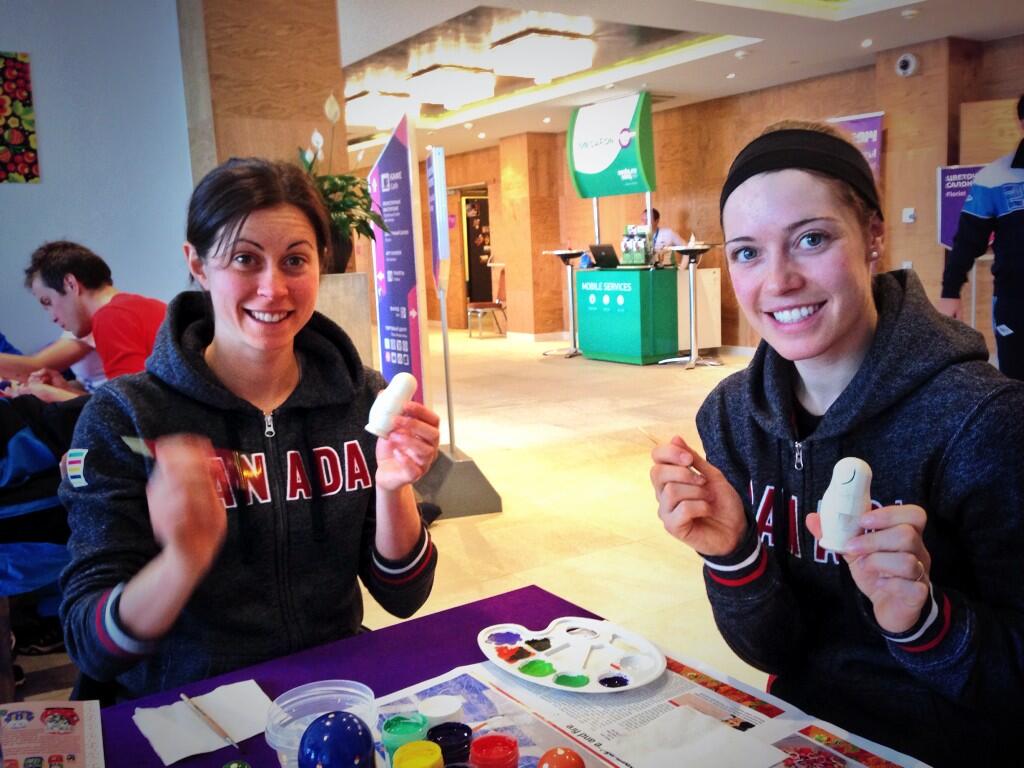
    SOCHI, Russia — Megan Imrie was painting dolls when she got the call.

    To be fair, the photo her Biathlon Canada teammate Rosanna Crawford tweeted at 5:37 p.m. made it look like she just started. Either way, she wasn’t going to finish.

    Her coach, Matthias Ahrens had called Imrie 10 minutes earlier to let her know she could relax. The fourth woman out of the top 30 allowed to start in Monday night’s 12.5-kilometer mass start, Imrie initially heard that two people pulled out. Close, but no cigar.

    Canadian biathletes Megan Imrie (l) and Megan Heinicke show off the Russian dolls they were painting when Imrie received a call from her coach, informing her that she could race the Olympic 12.5 k mass start in just over an hour. (Photo: Rosanna Crawford/Twitter)
    Canadian biathletes Megan Imrie (l) and Megan Heinicke show off the Russian dolls they were painting when Imrie received a call from her coach, informing her that she could race the Olympic 12.5 k mass start in just over an hour. (Photo: Rosanna Crawford/Twitter)

    “I waited here until 5:15 and looked at the start list, and she wasn’t on it,” Ahrens said. “The assumption was that she would not race, so I called her to tell her … and then I started to walk down to the village, and then I got a phone call that she actually could start. So I called back, and from there we went.”

    Meanwhile, Imrie and her teammates started to paint Russian “Matryoshka” dolls, those little wooden dolls that contain smaller wooden dolls. The arts-and-crafts session in the Olympic Endurance Village ended with the second call from Ahrens, informing her that two others were out and she was in.

    “He called again and said, ‘Actually you’re in! Do you want to start?’ ” Imrie recalled. “I said, ‘Of course I want to start!’ so I jumped up and got in my race clothes as fast as I could.”

    Her teammates followed soon after to watch the 7 p.m. race, which went off according to plan despite impenetrable fog throughout the day — a visibility issue that derailed the already postponed men’s mass start from the night before. Originally scheduled to race Sunday night, the men wouldn’t get to start until at least 2:30 p.m. Tuesday, Moscow time.

    Either way, Imrie had to get to the venue, calibrate her rifle, and warm up, all in an hour’s time.

    The 28-year-old, who celebrated her birthday last week, pulled it off and pumped herself up for the first mass start of her career — and Canada’s first for a female biathlete at the Olympics.

    “Because it’s so soft and slushy out there … it’s the kind of day you don’t want to overdo a warmup,” she said.

    Starting in bib 30, Imrie was a little intimidated at first.

    “But then looking around, these girls are my buddies and I have to keep reminding myself that I earned this spot as much as any of them,” she said. “I just kind of chilled out in the back of the pack for a while and did my thing on the range.”

    Her first time in the range, Imrie recorded the eighth-fastest shooting time, missed one and had to ski a penalty lap. She left the range in 27th, and after cleaning the second prone, moved up to 20th.

    Focused on her two key words, just like always (“center and squeeze” for prone; “relax and react” for standing), Imrie tried to relax each time she entered the range. She skied the 16th-fastest time on the third 2.5 k loop, then missed one in the first standing. Leaving the range in 22nd, she skied the 18th fastest on the fourth of five loops.

    Her last time shooting, she missed three standing. The penalties put her back toward the end of the pack, and Imrie had to fight for 28th. The result tied her Olympic best from the preceding pursuit and bested her results in two other races in Sochi: 30th in the 15 k individual and 31st in the 7.5 k sprint.

    “I didn’t want to come across the line last, and I didn’t so that was OK,” she said. “I actually got better and better on my skis. In the individual [race] I just died, absolutely died, so today I felt quite good, but I just didn’t get those last three targets. My sights were just sitting a little bit on the right and I couldn’t get them.”

    All things considered, Imrie was glad to check off another Olympic race — after a season in which she hardly competed — and even waved to stadium spectators just before the finish.

    “Given that it was a last-minute thing for her to jump into it, I’m really happy for her that it worked out,” Ahrens said. “Unfortunately, the last shooting cost her a few places, but up to that point it was really nice, a really excellent race.”

    Imrie finished 3:33.4 behind Belarusian Darya Domracheva, who won in 35:25.6. The lone  Canadian in the mass start, she finished 8.7 seconds behind Slovakia’s Anastasiya Kuzmina in 27th and 10.5 seconds ahead of Franziska Hildebrand in 29th.

    “I was representing our whole team,” Imrie told CBC. “I’m happy to put our stamp on this race and show Canada belongs in this elite group.”

    With soft conditions resulting from moist, tropical-like weather, Imrie said it hasn’t been easy to log the most efficient workouts, but she did some race prep on Sunday in the event that she’d race Monday.

    “It’s usually very unlikely, especially in Olympic Games that it would go as deep as 34 [in a mass start] so I had my fingers crossed,” she said. “I did my training and leadup yesterday as if I would be racing. I wasn’t going out and partying like crazy, but I was definitely surprised.

    “It’s been difficult conditions for the organizers to deal with,” she added. “They’re really doing their best to manage the snow, which has been fantastic, but it doesn’t leave much quality ski training for us. So it’s nice when you can go out there and have some prime conditions for intensity work.”

    On Monday night, she was going to meet with her teammates and boyfriend, who came to the biathlon stadium to cheer her on. Then maybe she’ll finish those dolls.

    “It’ll probably be a gift,” said she with a laugh.

    Results

  • Biathlon Preview with Rosanna Crawford: Olympians Ready for Unique Features, New and Old, of Sochi Courses

    Biathlon Preview with Rosanna Crawford: Olympians Ready for Unique Features, New and Old, of Sochi Courses

    Biathletes ski through the Sochi stadium on the final training day before racing begins.
    Biathletes ski through the Sochi stadium on the final training day before racing begins.

    FasterSkier’s coverage is made possible through the generous support of Rudy Project. 

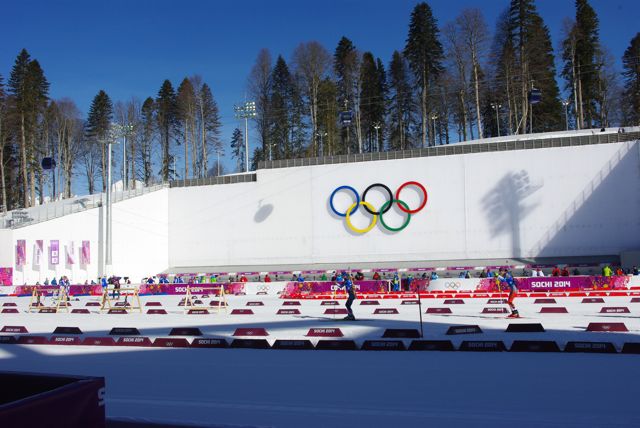
    SOCHI, Russia – It was a gleaming, beautiful day in the Laura Biathlon Stadium as the world’s best biathletes made their final preparations before the Olympics.

    The mood couldn’t have been better on Friday as the sun sparkled on the snow, the mountains rose up in all their glory across the valley, and the unstable weather that has sometimes characterized this venue in the past was nowhere to be seen.

    After arriving this week, some athletes were pushing to restore a sense of normalcy before they have their Games debuts: the men start in a 10 k sprint race on Saturday, while the women compete in a 7.5 k sprint on Sunday.

    “It was a really fast entry with arriving early, early Wednesday morning, and then getting our clothes organized and figuring out the village,” Canada’s Rosanna Crawford told FasterSkier. “Days just kind of flew by. I think it will be nice to get into the competition and have everything calm down and get back into that normal routine.”

    In the last few days, the athletes have had to get used to courses which have been tweaked slightly since the International Biathlon Union hosted the World Cup here for the first time last season. At those opening races athletes complained about dangerous downhills, and a video of a horrendous crash by Russia’s Maxim Tsvetkov went viral.

    Crawford said that the downhill had been cut out of the Olympic courses, but all of the climbs remain the same.

    Another adjustment came just this morning, to the 2.5 k loop which will be used by the women in the sprint race.

    U.S. Biathlon President and CEO Max Cobb is also the technical delegate for the Olympics, and explained what happened in an email to FasterSkier.

    First, there was an easy fix to a basic mistake: “The Organizing Committee set up the start line in the wrong place for the TV test yesterday, so we fixed that today,” Cobb wrote.

    But another problem came when Norwegian coach Per Arne Botnan complained that based on the GPS measurements athletes and coaches took while training, the course seemed to be too short.

    “With the snow on the courses they all measured out shorter than the survey which was made in October by IBU and the Organizing Committee,” Cobb said. “As a normal part of our work we always check the length. It showed that the 2.5 k was too short. Some of this was that the inside radius was again not set up as planned by the Organizing Committee. We were able to reconfigure the course to add 175 m [of length] and 10 m of total climb before the women’s training today.”

    Crawford said that the hardest climb would come directly out of the stadium, where athletes face a huge hill as they ascend to high above the shooting range.

    “The climbing is all at the start of the loop and it’s downhill all the second half,” she said.
    “It’s a gradual downhill to the range, a good entry. I love this range.”

    Besides the downhill range approach, the shooting range in Sochi has an even more unique feature: it is surrounded by tall retaining walls, a feature not replicated in any other World Cup venue. On their tallest side, the walls are several stories high and as a result, wind is cut to a minimum.

    “For sure, I would say overall that it’s quite an easy range,” Canadian head coach Matthias Ahrens said. “It’s quite protected from the wind. The training days we have had very little wind. So for sure here you have to shoot well.”

    That could be a bit of a disadvantage for athletes who tend to triumph over windy conditions. For instance, Ahrens said, his athlete Megan Imrie is “very sharp in reading wind,” and that might not come into play so much in the Olympic races.

    But overall he was positive about how his team would deal with the range.

    “But I’m actually quite happy because the way we trained the previous two weeks, first in Antholz and then in Seefeld, now we feel we have had very similar conditions and we actually had really good shooting,” he said. “Hopefully that gave the athletes confidence that it translates to the same thing here.”

    The large range and its walls translate to an strong echo on the sound of the shots, and a different sensation altogether for athletes gauging their hits and misses by ear.

    “The way it hits the target definitely sounds a little bit different,” Crawford said. “The misses are a little more heartbreaking than in a normal range. It’s just a really big thunk.”

    Other unusual factors are the fact that in Russia, rifles have to be locked up at the venue and athletes cannot take them away. That makes cleaning them, for instance, somewhat inconvenient – either an extra trip to the stadium, or prolonging a training session. Usually, a task like cleaning could be done in a more relaxing manner in an athlete’s hotel room.

    Biathletes also incorporate “dry firing” into their daily routines. This is when they aim their rifle, with no ammunition, at a set of five black dots, usually drawn on a paper taped to the wall. Despite the fact that the gun isn’t shooting anything, the athletes can go through the mechanics of their shooting process and practice their mental focus.

    Now, to do this, they have to actually go to the stadium.

    “You really have to plan out your day if that’s something that you want to do, because it takes a while to get over here,” Crawford said. “We all have keys to our lockers and you have to sign your rifle out, and then sign your rifle back in. Every other World Cup other than Russia you can just have them with you. I haven’t been dry firing every day – the boys definitely dry fire more than the girls do. I’ve been spending more time on the range, rather than dry firing.”

    Despite some changes in routine, Crawford said that she and the Canadians are feeling good for the Games, thanks in part to a good pre-Olympic training camp in Italy and Austria.

    “There was lots of good snow, so we did a ski from Dobbiaco to Cortina which was incredible,” Crawford said. “Then we went to Seefeld, and luckily they had just gotten a big dump of snow so the skiing was just amazing. I had never been there before and there are just so many trails. I skied for two hours one day and didn’t do the same trail twice. It was pretty awesome.”


  • Canadians In The Points, Using Ruhpolding to Ramp Up for Sochi

    Canadians In The Points, Using Ruhpolding to Ramp Up for Sochi

    Rosanna Crawford (bib 26) chasing Anais Bescond of France and Tiril Eckhoff of Norway in the pursuit.
    Rosanna Crawford (bib 26) chasing Anais Bescond of France and Tiril Eckhoff of Norway in the pursuit.


    RUHPOLDING, Germany – Some things on the World Cup this weekend definitely haven’t gone as planned for the Canadian team.

    Let’s start with the conditions. There’s more snow than in Oberhof last week (which the World Cup team skipped anyway, giving the starts to its B squad instead), but the snow here is scarce, icy, and intermittently salted. That wasn’t what Megan Heinicke, for one, was hoping to come back to.

    “I was somewhat disappointed with my skiing in both the relay and today’s race,” she wrote in an e-mail after the 15 k individual. “A part of it is that icy conditions like today are a weakness for me and have always been a challenge.”

    She was feeling “energized and fit”, but wasn’t able to translate that directly into skiing on the course.

    Then, there were struggles on the range. Nathan Smith and Jean Philippe Le Guellec both had four penalties in the 20 k individual on Saturday, too many for a top result (they finished 40th and 52nd).

    Rosanna Crawford and Megan Heinicke had good individual races on Friday, but then had four penalties in the pursuits this morning. That meant that they weren’t able to capitalize on their 26th– and 30th-place starting positions, and were relegated to 37th and 48th.

    But all is not lost: nearly every athlete came away with something to be happy about, including a top-20 finish by Smith (more on that later). It started with the relays: on Wednesday, the women placed 12th, and on Thursday the men had a strong eighth-place showing. Both teams had only just arrived from Canada, and were still dealing with jetlag, leaving them happier with the performances than they might have been otherwise.

    Women

    More positive things came on Friday, after the women’s individual race, starting with Rosanna Crawford.

    “I think it was a pretty good ski time, and 17 is the best I’ve ever shot in an individual,” she said at the finish. “So I have to be happy with that. It’s too bad about my first prone, but, it happens.”

    Megan Imrie skiing with Olga Zaitseva of Russia in the pursuit.
    Megan Imrie skiing with Olga Zaitseva of Russia in the pursuit.

    Crawford was also simply happy to be racing and hitting the points at all. She thought back to last season, when she finished 65th in the sprint here.

    “This is a lot different than last year,” she said. “I remember at these races last year I was feeling reallllly awful. So I’m happy that I didn’t dig myself too deep in December. I think I just wasn’t used to that many races last year. It was 11 races, whereas this year it was 10 for me. I think I am just overall fitter.”

    Heinicke was also feeling good about where she’s at, after a few seasons where she’s been plagued by illness in the middle of the racing season.

    “I have struggled a lot with health over the past few years and this was the first Christmas break since 2008 that I didn’t get sick!” Heinicke wrote of her winter break. “So I was pretty happy about that.”

    Heinicke lives in Altenberg, Germany, with her family. Since the Canadian team skipped Oberhof and the rest of her teammates were back home in Canada, she took the opportunity to compete in the IBU Cup races in Ridnaun, Italy. It was an ideal warm-up for this weekend’s World Cups, although not for the reasons she had expected.

    “The IBU Cups were important for 2 reasons – one was that they were used as some intensity at the end of a training block and the other was race shooting,” she wrote. “I struggled to bring together standing shooting before Christmas and I did a lot of high quality shooting training over the break. I wanted to use the IBU Cups as a chance to boost my confidence a bit!”

    In the pair of sprints, Heinicke placed seventh with two penalties in the first, and 20th with three penalties in the second. Racing on biathlon’s second-tier circuit, she said the goal is to get on the podium, which she thought she could have done with better shooting.

    “The shooting was obviously did not go as planned, but in retrospect I am glad I raced there because I think I learned from the mistakes I made and have shot much better here in Ruhpolding,” she wrote.

    Scott Perras attacking a hill in the pursuit alongside Andi Birnbacher of Germany.
    Scott Perras attacking a hill in the pursuit alongside Andi Birnbacher of Germany.

    Both women were happy that Olympic qualification is over, for various reasons. Crawford knew for a long time that she was already qualified, but was waiting for her boyfriend, Brendan Green, to complete his own criteria. He eventually won a series of trials races just before Christmas to secure his spot.

    “The break was really nice,” Crawford said. “The first week was super stressful with Brendan’s trials, I think I would have been less stressed if I had been racing myself! It’s a weird feeling. I have a lot more sympathy for my parents now.”

    Heinicke completed her criteria in December, which has taken a huge weight off her shoulders.

    “I actually expected myself to feel more relaxed with the Olympic qualification settled and done, but I have realized that a lot of the pressure I feel comes from myself, my own high standards and my own frustration when I do not meet my standards,” Heinicke wrote. “It is definitely good to be in a ‘safe’ position right now where I can choose to take more risk without feeling like I should always play on the safe side.”

    Megan Imrie placed 58th in the individual and used three penalties to ski her way up to 39th in the pursuit, sneaking into the World Cup points.

    Audrey Vaillancourt, racing in place of Zina Kocher who is competing at skiing Olympic trials, placed 62nd in the individual with two penalties, narrowly missing the pursuit.

    Men

    After their successful relay, the Canadian team had a bit of a downer as they had to send Brendan Green back to the IBU Cup. With only three starting spots on the World Cup this season, they aren’t able to carry a full team.

    “Even though they are all qualified for the Olympics, they can’t rest too much,” head coach Matthias Ahrens said. “They have to fight for these three spots a little bit.”

    Scott Perras had the best performance in the 20 k individual, using two penalties to place 36th. His teammates Smith and Le Guellec were saddled with those frustrating four penalties each.

    It was particularly dangerous since for the first time since 2003, the individual was being used as the basis for a pursuit. Usually, pursuits are based off of sprint races. With four minutes of penalty time, it would not have been surprising to miss the pursuit, especially since the field usually shoots very well in Ruhpolding with its downhill range approach and minimal wind.

    Nathan Smith in the pursuit.
    Nathan Smith in the pursuit.

    “The shooting is usually really good for the field,” Smith said after the individual. “So this is a mediocre race [for me], I’d say.”

    Still, he was feeling like his performance was coming together after the team’s travel over to Europe.

    “The relay was the first real race thing I’d done in a few weeks,” he said after the individual. “Other than that I’d just been doing intensity by myself, so it was good to get in shape for today. I’m not surprised that I felt better today.”

    And he wasn’t concerned about his shooting, either.

    “My shooting has been feeling solid, I think,” he said. “There’s nothing wrong with my shooting, it’s just that two bouts didn’t go perfect.”

    That turned out to be a very accurate assessment. In the pursuit this afternoon, both he and Le Guellec shone on the range, surpassing Perras even though he started far in front of them. Le Guellec shot clean to move from 52nd all the way up to 32nd, and into the points; Smith had a single penalty and passed Alexei Volkov, yesterday’s second-place finisher, in the final kilometer to seal 16th place, tying the second-best finish of his career.

    “It was a really good race,” he said at the finish of the pursuit. “One of my best for the year. I think skiing was pretty similar to yesterday, but my shooting was a lot better, so that’s what made the difference.”

    With three penalties, Perras stayed solid and moved into 35th, leaving all three Canadians in the points on the day.

    It wasn’t easy, either – the iciness that Heinicke had complained about on Friday broke down into granular, sometimes deep snow by the time the men raced today.

    “Some spots were kind of deep – well, not deep, but just slow I guess, on the flatter parts,” Smith explained. “And the uphills were icy. But some of the women said it was icy for them too. On the last lap I had to pass the Russian on the last uphill, and he was on the softer part, which was a bit better. I had to go on the icy part, which was tricky.”

    So, with one weekend remaining until the World Cup takes a break until the Olympics, the Canadians are feeling positive for the last three starts.

    “We approach it like any other race, you warm up, you put the rifle on your back, you try to hit the targets,” Crawford said of pre-Olympic racing. “But maybe we have a little bit of load during these races. That could be a little bit different.”

    Results:

    men’s individual & pursuit

    women’s individual & pursuit

  • With New Energy after Olympic Team Finalized, Canadian Men 8th in Ruhpolding Relay

    With New Energy after Olympic Team Finalized, Canadian Men 8th in Ruhpolding Relay

    Jean Philippe Le Guellec shot clean to tag off in sixth place after a strong leadoff leg.
    Jean Philippe Le Guellec shot clean to tag off in sixth place after a strong leadoff leg. Here he leads Alexis Boeuf of France and Michal Slesingr of the Czech Republic.

    RUHPOLDING, Germany – There are a number of things that the Canadian biathlon team has done differently than their competitors coming into this week’s World Cup race series.

    First of all, as usual, the “A” team skipped the last weekend of racing in Oberhof in order to enjoy some more time at home, for both recovery and a training block. On the one hand, that means that they were a little less race-ready for today’s 4 x 7.5 k relay than other teams that already have three races under their belts in the new year.

    “Considering that we only arrived on Sunday and it’s still within our jetlag period, everybody was sort of so-so feeling,” head coach Matthias Ahrens told FasterSkier.

    But a good athlete can take potential negatives and turn them into positives. Scott Perras? Missing last weekend didn’t bother him in the slightest. In fact, he thought it might be an advantage.

    “We’re pretty used to it, and who really wants to go to Oberhof anyway?” he said, hushing his voice so no Germans would get offended. “And I think it gives us an edge, because people start to get run down and tired during the week. Whereas we should feel better, because we’ve only been here for four days.”

    Regardless of how the pros and cons balanced out, the team managed a successful relay, finishing eighth with eight spare rounds and no penalty loops, 1:17 behind the winning Austrian team.

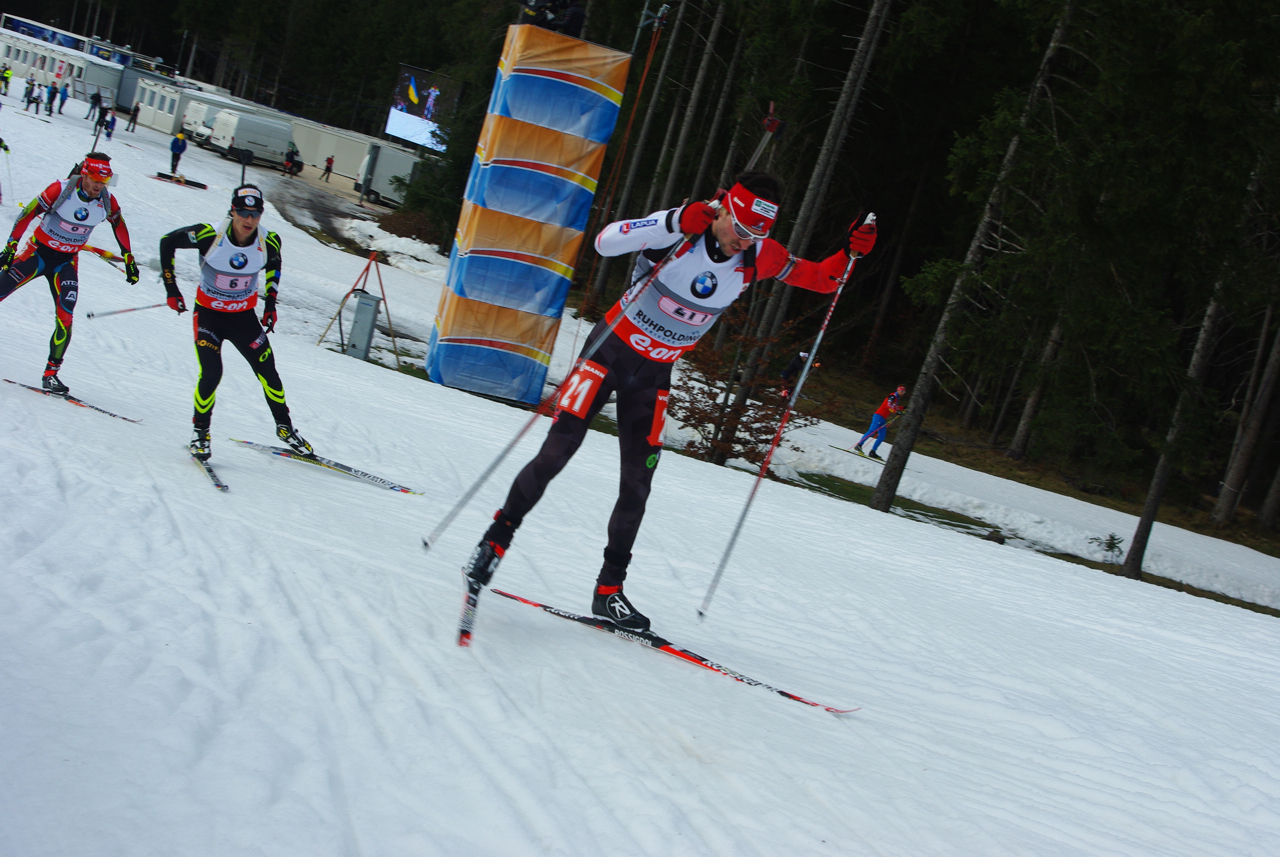
    Scott Perras keeping his feet on one of the course's downhills. The snow was dirty and at times deep.
    Scott Perras keeping his feet on one of the course’s downhills. The snow was dirty and at times deep.

    Le Guellec had a strong first leg, shooting clean and tagging off in sixth, 16 seconds off the pace. Perras thought that he skied well, and he did – he had the fifth-fastest course time of any of the second-leg skiers.

    “But my shooting was, I think I should have shot a little better,” he said.

    With four spare rounds, Perras dropped the team to eighth, but Green was there to pick them back up. He used only a single spare and brought Canada back to sixth position. Smith needed two spares in prone and bounced back down to eighth, a position he maintained for the rest of the race.

    Things didn’t go perfectly. But they went well enough, and the team seemed pleased enough.

    “I’m very happy,” Ahrens said.

    Olympic spirit

    The other thing that is different is that the Canadians have already finalized their Olympic team. They will send four men: Jean Philippe Le Guellec, Brendan Green, Nathan Smith, and Perras. That’s the team that raced today.

    And getting team naming out of the way lifts a huge weight from the athletes’ shoulders – none more so than Green, who had a tough route to qualifying this fall with several races where he was just portions of a percentage point outside of the times he needed to qualify. Failing to do so on the World Cup, he had to fly back to Canada and earn his spot in a series of trials races against the best other Canadians.

    “It’s so sweet, I can’t even describe it in words,” Green said of racing without the specter of qualifying looming over him. “It was such a stressful few months before Christmas. I was pretty deflated after Hochfilzen, being so close to qualifying. I was feeling mentally drained when I got back to Canmore, but I was able to recharge and refocus for trials, and they went, well, they couldn’t have gone much better. It was pretty much perfect. So that’s a huge relief and I’m just really happy to be back racing.”

    Even for Le Guellec and Perras, who were pre-qualified before the start of the World Cup season, having everything official just feels different.

    Brendan Green approaches the range.
    Brendan Green approaches the range.

    “The first tour really wasn’t fun because of it, even though I was done, it just wasn’t fun,” Perras said of all the stress his teammates were going through. “So I’m excited to just be here with the Olympic team and get racing again.”

    Smith and Perras, who will be competing in their first Olympics in Sochi, might be even more excited than the rest of the team, who raced on home turf in Vancouver. Some of the Olympic promotional commitments, like a team naming ceremony last week at the Olympic cauldron in Canada, could seem like they were getting in the way of what was really important: physical preparations for the Games.

    “If anything, it’s just like, what are your priorities in the next 40 days?” Perras asked. “it was pretty cool but I just wanted to get back racing.”

    But he also admitted how cool it was to be at an event like that, and have it sink in.

    “I think that Nathan and I were the only first-time Olympians, so it was more special for us,” he said.

    These may be the same four guys that were on the World Cup in the first period, but now they have a different thing going on: they are a team.

    “It definitely changes the energy a little bit,” Green said. “Now I feel like, now that I’ve earned my spot, it’s just a little different and I can just go about business without any further consequences.”

    Ahrens saw it in his athletes, too.

    “For sure, for feeling as one team now, having that load away makes a difference that they can concentrate more on the team,” he explained. “Especially for the relay.”

    Watching the youngsters

    Nathan Smith heading out on course.
    Nathan Smith heading out on course.

    While the World Cup team was at home training and getting fêted in Calgary, a new generation of Canadian biathletes were gaining some World Cup experience in Oberhof. The IBU Cup squad was used to fill the start quotas, including a few experienced athletes like 2010 Olympian Marc-André Bédard, but a few first-timers as well: Macx Davies, who finished 42nd in his inaugural start, and Julia Ransom and Emma Lodge.

    The World Cup squad was watching the races with bated breath. In a way, it might have inspired them a little bit, too.

    “We all train together,” Perras said. “I mean, I remember my first World Cup, so I was pretty excited, especially for Macx because he trains with us all the time. I was telling him how cool Oberhof was going to be. It was cool to see what he could do. It makes you think how lucky we are to be where we are still at.”

    So does this mean it’s ready for the current Olympic team to step aside? While Le Guellec, at least, has concrete plans to retire after this season, a few others might stick around.

    “I hope to compete,” Perras said. “I think, last Olympics when I didn’t make it I committed to four more years. Now it’s just one year at a time. I’d really like to be at the World Cup in Canmore in 2016, but that would be my last season I think.”

    Maybe some of the newcomers like Davies will be on his team.

    “I hope so!” he laughed. “They’re already nipping at our heels, so hopefully I’m racing with them, not them instead of me!”

    results – international race report

  • Canadian Biathletes Rocket on to IBU Cup Scene with Five Top-10’s in Opening Sprint (updated)

    Canadian Biathletes Rocket on to IBU Cup Scene with Five Top-10’s in Opening Sprint (updated)

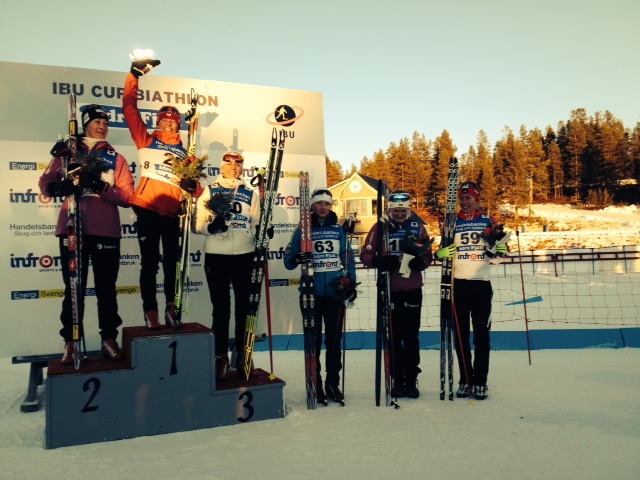
    Megan Imrie (far right) at the podium ceremony for the women's 7.5 k sprint in Idre, Sweden. Imrie placed sixth in the IBU Cup openers. Photo courtesy of Imrie.
    Megan Imrie (far right) at the podium ceremony for the women’s 7.5 k sprint in Idre, Sweden. Imrie placed sixth in the IBU Cup openers. Photo courtesy of Imrie.

    The Canadians had a feeling that their team was improving a lot over the course of the last training year. But by all accounts, even the coaching staff wasn’t quite fully prepared for the results of today’s IBU Cup sprints in Idre, Sweden.

    The headline: Nathan Smith second in the men’s 10 k, just 3.9 seconds away from the win. He was one of three men and two women in the top ten. Two more in the top 20. In total, six athletes shooting clean.

    One day into the 2013-2014 season, Canada is leading the IBU Cup nations standings, ahead of Norway, Russia, and Germany. Sure, it’s not the World Cup, but the second-tier circuit, which is organized in the same way, is nothing to scoff at – there were 140 men and 107 women toeing the start line today. If a country can’t do well where developing athletes typically compete, it doesn’t bode well for the future of the program.

    Plus, there’s the fact that these will be the most competitive races of the year for the circuit, with many teams using them to select World Cup teams. The top twenty was packed with athletes with Olympic and World Championships credentials. Timofey Lapshin, the Russian who edged Smith, has two World Cup podiums; the winner of the women’s race, Weronika Nowakowska-Ziemniak of Poland, is a 2010 Olympian who had a seventh-place World Cup result last season.

    “To your question of whether I was expecting this, from our in training season performance testing and latest trial races we had good indications the we were on the right track, but since we are quite isolated in North America it is quite difficult to put a perspective to this until you race internationally again,” Canadian head coach Matthias Ahrens wrote in an e-mail to FasterSkier. “I am super happy about both races, especially great performances in shooting as a team overall, but also the skiing is showing that we are on the right track.”

    In many ways the top performances came from athletes who have something to prove as they head into the Olympic qualification season. Take Smith. The 28-year-old had made his first World Championships appearance in 2008, and also represented Canada in the 2011, 2012, and 2013 editions. But last year, after lackluster results in the first two weeks of World Cup racing, he was moved back down to the IBU Cup.

    “Last year was extremely frustrating for me,” Smith wrote in an e-mail. “Although I still got to race a few World Cups, I ended up pretty much being the extra relay guy a lot of the time because our team only has three men’s starts. Relays are a nice bonus but ultimately biathlon is mostly an individual sport. Luckily I managed to make some national team criteria at my very last chance (World Championships relay) where I basically had my only great performance of the year.” 

    That leaves him at a major disadvantage for Olympic qualifying. The most surefire way to make Canada’s Olympic team is to have two top-16 or three top-30 World Cup results. Two men have already fulfilled those requirements (Jean Philippe Le Guellec and Scott Perras), while several others (Brendan Green and Scott Gow) are partway through. Athletes have until the Christmas break to get those results on the World Cup, after which point qualifying is kicked back to trials races in Canmore for any remaining spots. Team size will be four men and four women.

    “Nathan has been on fire over the past few weeks, his skiing has been very strong,” Canadian coach Roddy Ward told FasterSkier. “Today he skied like he has been and also put together a clean race. He has been very motivated and focused in his training this year and it has paid off for him.”

    Smith is looking good now, both in the Idre sprint and at previous trials races in Canmore to qualify for this trip. But that leaves him just three weeks to get his two or three results on the World Cup. And there’s a catch: Canada has only three quota spots for men. With Le Guellec and Perras taking two of them, only one more man will have the chance to try to achieve their Olympic qualification on the circuit this fall.

    That seems to have been a powerful force driving the team to go faster and shoot straighter.

    “The remaining Olympic spots that are up for grabs are definitely a big motivator,” Smith wrote. “Judging by our team’s shooting I think the pressure is being handled really well. For myself, I’m managing the pressure a lot better than a year ago.”

    With his second-place finish, Smith nabbed the remaining men’s spot and will try to make the most of it in the next few weeks.

    “In the spring I had time to reflect on what I had done the previous few years and decided that if I wanted a change in results I would also have to have a different approach to training,” he wrote. “I really tried to focus on quality and working on specific skills. Already halfway through the summer I knew that things were going in the right direction through testing, team time trials, and just general training… In the last few team races my skiing has been excellent so I had a lot of confidence in that going to Europe.  But still, you never really know, so theres always some doubt.“

    The next Canadian, Marc-Andre Bedard, tied for seventh; he is another former World Cup and World Championships competitor who did not see World Cup action last season. Just two seconds behind him in ninth was Green, who sat out last season with a back injury. Gow placed 13th with one penalty.

    Yet even though the men are competing against each other – intensely – for World Cup and Olympic spots, they were supportive of one another’s results. Team spirit doesn’t seem to be a casualty of the cutthroat competition, in fact, maybe just the opposite.

    “I’m also really happy for Nathan, he totally deserves those results and I’m excited to see him try to get his Olympic criterias on the World Cup!” Bedard wrote in an e-mail. “(If they let him of course!!!) (they better ;))”

    Bedard also made another comment on the team’s cohesion in explaining why his results seem to be on the upswing this fall.

    “I’m finally feeling supported by my coach and teammates and I was really excited to race against the world with my new dry land season with all the changes is done for the last six months,” he explained. “I’ve always needed a few weeks of racing before I was actually able to turn it on and I think today is a really good sign for what might happen this year. I’m hoping I’m progressing still and will be able to actually hurt myself in the next few weeks. Today felt pretty easy so with a good result on a really strong and deep field, it sounds good!”

    Although the team will also compete in Idre tomorrow, coaches ultimately made the choice of World Cup athletes based off of today’s race, and Smith got the nod. Biathlon Canada High Performance Director Chris Lindsay acknowledged that the men hadn’t made it easy for them to pick just one, but the entire coaching staff pointed out that the increasing competition within the program is a benefit for all.

    “It is clear our men’s team is extremely competitive, which had led to improvements through the training year,” Ward said. “We saw that in the results today.”

    Competing a few hours later, the Canadian women’s team took the momentum and ran with it.

    “The girls and I were really inspired by the guys performances before our race,” Megan Imrie wrote in an e-mail. “They’d all killed it! If they could do it, so could I.”

    Imrie, coming back from her own lackluster season last year that saw her take a midwinter detour home to Manitoba to rest, recover, and decide how to approach biathlon from that point forward, hit the circuit again with a bang. She placed sixth with clean shooting, over a minute behind Nowakowska-Ziemniak but only 23 seconds behind second-place Fanny Welle-Strand Horn of Norway.

    “I committed to working every possible place on the course and was extremely focused on the range,” Imrie said of her race. “I was a bundle of nerves going to the start. But I stuck to the basics. In the words of Simon Whitfield, just chop wood and carry water. I’m relieved I’m coming back okay from last year. I’ve worked hard and stayed healthy. Now I’m feeling privileged to enjoy racing again.”

    Just behind her was 2010 Olympic teammate Megan Heinicke in seventh place. The pair, like Smith, earned the nods for the next period of World Cup racing and will travel to Ostersund, Sweden, with Smith and Rosanna Crawford. Imrie and Heinicke both need a single additional top-30 result on the World Cup to complete their Olympic qualification.

    Crawford is pre-qualified for Sochi, but raced the Idre openers anyway. She finished 35th with three penalties.

    “The girls were also impressive with Megan I, Megan H and Audrey [Vaillancourt, who placed 16th] cleaning,” Ward said. “Rosanna had been dealing with a number of injuries lately so I was just happy to see her ski form was solid. The next few weeks should be good very for her. Megan I has been incredible this training year with self monitoring her training and recovery – she has made some wise decisions that has kept her healthy and progressing.”

    Several younger Canadians also competed, with Macx Davies placing 84th in the men’s race and Julia Ransom 58th in the women’s race. Claude Godbout, a senior, placed 50th ahead of Ransom.

    “Even that it is only one race and the first race of the season, it should give everybody great confidence into the next races, be it on the World Cup or the IBU Cup,” a happy Ahrens concluded.

    results: men / women


  • Le Guellec 10th in Hochfilzen Sprint; Career-Best Breakthroughs by Crawford, Perras Boost Canada

    Le Guellec 10th in Hochfilzen Sprint; Career-Best Breakthroughs by Crawford, Perras Boost Canada

    Jean Philippe Le Guellec of Canada racing in Sweden last weekend.

    When Canadian biathlete Jean Philippe Le Guellec stood on the starting line of the 10 k sprint in Hochfilzen, Austria, today, two things were different than usual.

    For one, he was in the red bib, signifying that he was the World Cup points leader in the discipline. That’s a first for a Canadian man.

    And secondly, he had a bad case of the nerves.

    “It was totally related to last week’s performance,” Le Guellec told FasterSkier in an e-mail. “At any stage, for any athlete, I think it’s safe to say that when you reach personal best performances, you always want to be able to back it up in the following event, thus confirming to yourself it wasn’t just a fluke performance. So my nervousness was definitely in line with: ‘OK, let’s see if I can back that race and repeat something worthy.’”

    Luckily, once he left the starthouse he was able to focus on the race and ditch the nerves. Le Guellec missed a single shot and skied the 18th-fastest course time, good for tenth place on the day.

    So, in response to the question he had been asking himself: “I’m very happy that that was today’s case… I’m totally happy with following up last week with a top 10.”

    Hochfilzen definitely didn’t feel the same as last week’s races in Östersund, Sweden, Le Guellec said; for one thing, there’s snow everywhere, and not of the saved or man-made variety. Despite slower snow, the clear skies made it a perfect day for racing, and Le Guellec reported that he had fast skis. There was only a bit of wind on the range, which he almost mastered. But not quite.

    “It was slightly windy on my standing, so my rifle was being pushed a little,” he wrote. “In an effort to compensate for the wind, I ended up overcompensating and missing in the left quadrant. I’m still happy with 9/10 though. Like [French Olympic champion] Vincent Jay said after the race when we spoke: ‘you can’t clean all the time!’ … although it’s always the goal for sure!”

    It was also a good day for teammate Scott Perras, who missed a single shot in standing and finished 25th, a career-best. Nathan Smith, however, didn’t fare as well, placing 73rd with four penalties. While he missed making the cut for the pursuit, Perras and Le Guellec are fired up.

    “Focus for tomorrow will be the hunt, which will be totally enjoyable once again given such a tight field! To be continued…” wrote Le Guellec.

    For the Americans, Tim Burke placed 22nd, Lowell Bailey 36th, and Russell Currier 56th; Jay Hakkinen and Leif Nordgren missed the pursuit, placing 67th and 81st.

    * * *

    Rosanna Crawford (CAN) on the range in Ostersund last weekend.

    A few hours later in the women’s 7.5 k sprint, Rosanna Crawford not only joined Perras in collecting a career-best finish, but one-upped him by placing 24th.

    “I was hoping for some good shooting because last week was pretty bad, for me, so I knew that was going to be key today,” Crawford told FasterSkier in a skype interview. “My prone had definitely come full circle since Östersund and my training had been really good, shooting-wise.”

    The single penalty, coming in standing, helped her achieve the result, which put her a minute and 19 seconds behind winner Darya Domracheva of Belarus. It was a huge breakthrough for the Canmore-based biathlete, who is a 2010 Olympian but has been bouncing on and off the World Cup.

    “I think my best result before this was a 51st,” she said. “There were the World Cups in Maine where I was 46th, but there were only [ten more] women so I don’t really count those results… It’s pretty exciting to finally crack that. Top 40 had been my goal at the beginning of the summer, and then at the end of the summer after testing I thought maybe I could make my goal the top 30. It’s a pretty big weight off my shoulders to know that hopefully this will become a reoccurrence.”

    After “spending ten years of my life training for biathlon,” as Crawford says, she was due for a breakthrough.

    “Are we surprised?” Biathlon Canada High Performance Director Chris Lindsay wrote in an e-mail. “Not entirely. Rosanna has been on a very impressive upward trend for the past two years. In our regular testing, in the field and the lab, she has been improving very quickly. We are beginning to see her potential. She has always been a fantastic shooter but now the speed is increasing and we see no evidence of her reaching a limit.”

    Matthias Ahrens, the head coach of the national team, agreed.

    “In my opinion the main improvements happened in all her summer training, partially to great commitment to all the training prescribed, being highly motivated and wanting to know how to improve in every aspect,” Ahrens told FasterSkier. “The other reason is great improvements in upper body strength and ski technique. But as she has good biathlon shooting faculties, when everything comes together a performance like today becomes reality.”

    While Crawford has historically been a very strong shooter in IBU Cup and national championships races, she has struggled to put that into practice on the World Cup, which had been the main thing holding her back.

    “It seems to me that I can always shoot really well to make teams, and at trials and the end of the season, but even last season the first three World Cups were awful, I was shooting 60 and 70 percent,” she explained. “I was worried that trend was going to happen again. So maybe it’s just that little bit of more pressure that there is on the World Cup.”

    For this weekend’s competition, she took a page out of Le Guellec’s book and focused on the process, not how she’d stack up a the end of the day.

    “After seeing my ski speed in the individual, I saw that with some good shooting I could have a good result,” Crawford said. “I think I got a little bit ahead of myself last week, and then this week it was a lot more not focusing on results and just focusing on my shooting and my skiing, and that will get the result I want. Not dreaming of the top thirty!”

    For tomorrow’s pursuit race, Crawford admitted that she was nervous; many of the women who will be starting around her had more penalties in the sprint, but skied faster. She knows that she’ll have to try to stay calm on her skis and relay on good, fast shooting to gain spots on the range.

    But with the momentum the Canadian team has going right now, there’s no reason not to be optimistic.

    “When people start doing well, the rest of the team can just sort of build off of each other,” she said. “A lot of us, we train together every day, so if you see them doing well, you know that you’ve done the same training, you’ve shot on the same range, so we should all be able to be up there.

    So it was pretty exciting with JP’s result and Zina’s tenth last week,” she concluded. “And JP getting to start with the red bib today made me start my race with a nice big smile on my face.”

    Megan Imrie and Megan Heinicke will join her in the pursuit after placing 56th and 57th today, while Zina Kocher was undone by shooting errors and wound up 73rd with five penalties.

    For the Americans, Susan Dunklee notched a much-improved 31st place finish, and Sara Studebaker will join her in the pursuit  – and perhaps work with the Canadians – after placing 58th today. Annelies Cook just missed the cut in 63rd, and Lanny Barnes placed 71st.

    International race reports