From the FasterSkier archive — posts syndicated from athletes’ and coaches’ own blogs between 2004 and 2012, kept online as published. Current coverage is at fasterskier.com.
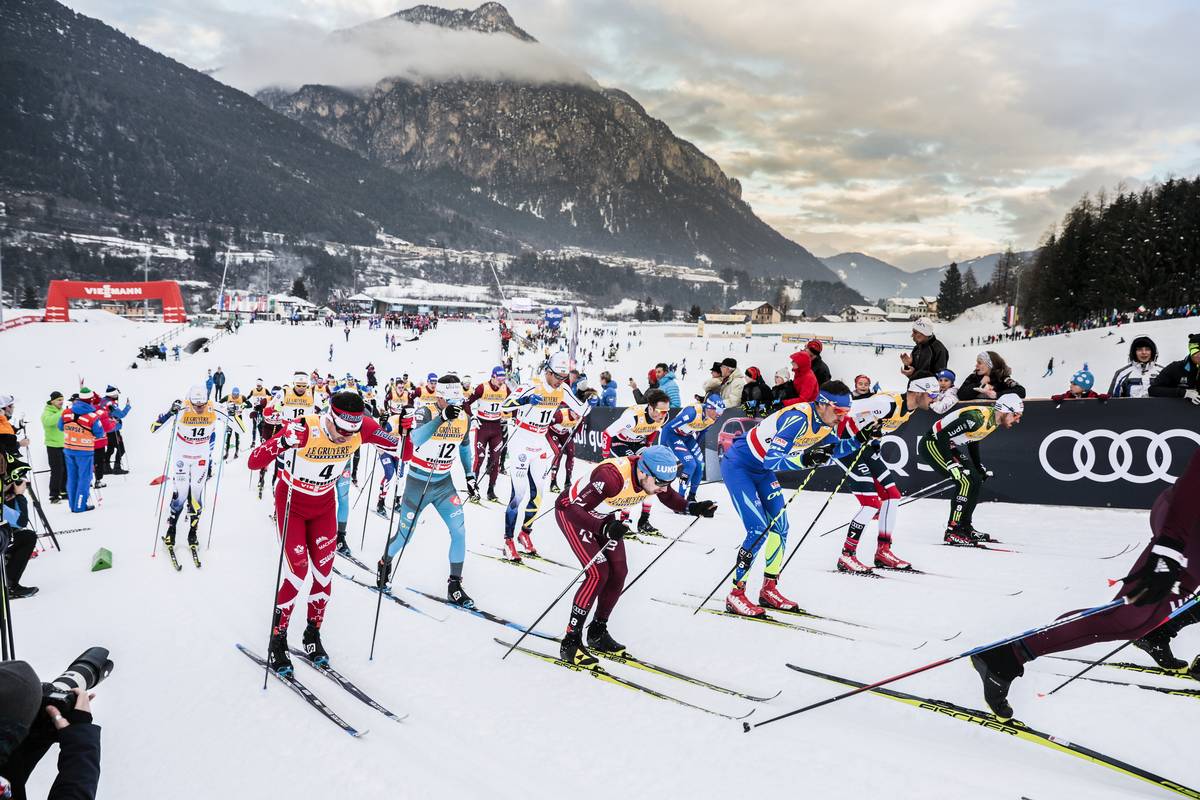
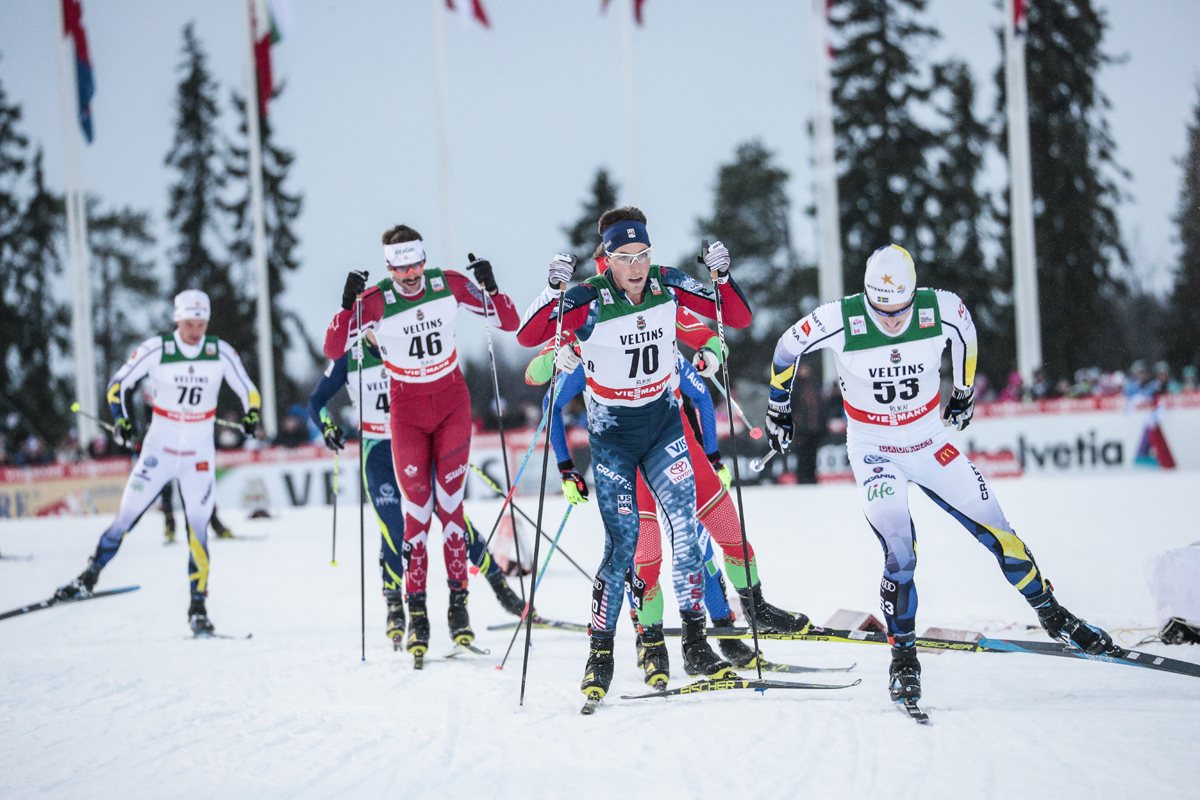
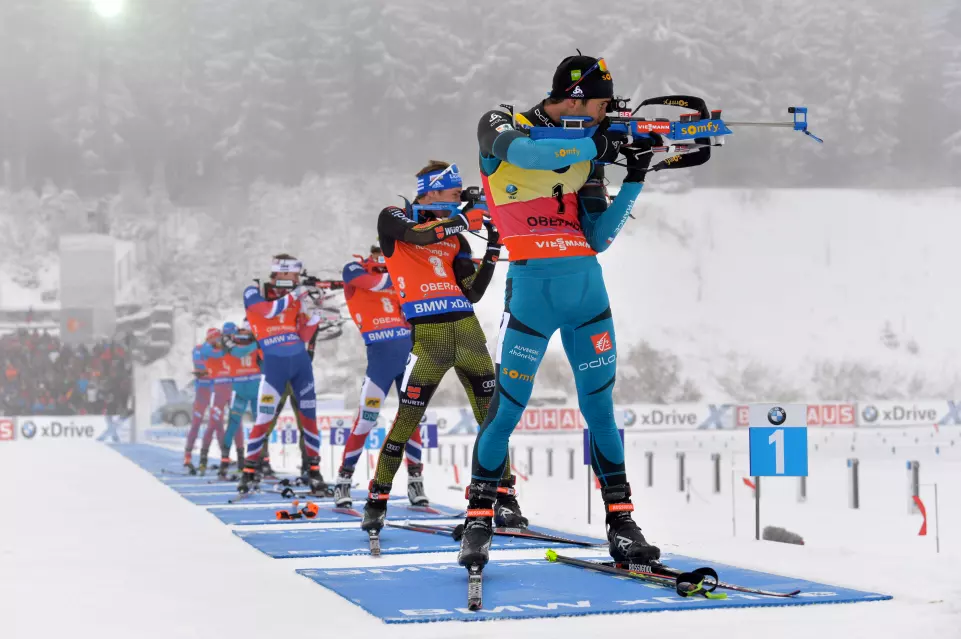
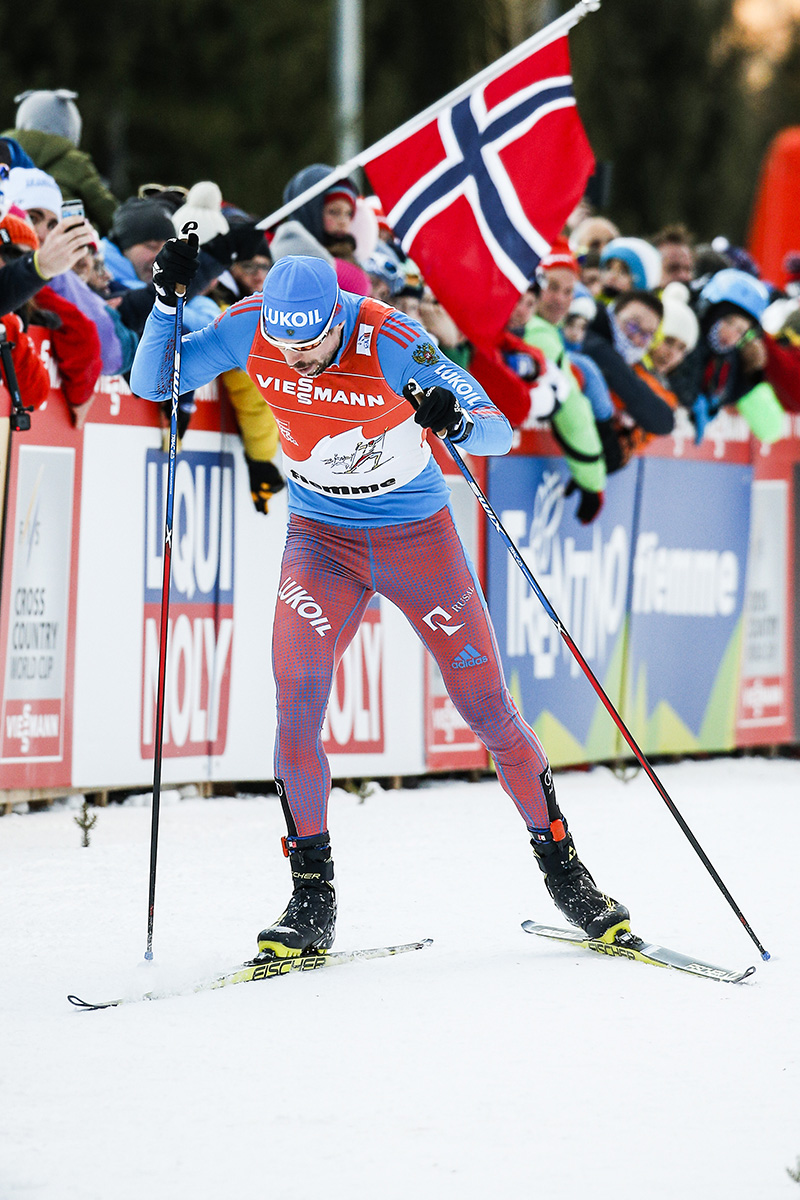
The start of the men’s 15 k classic mass start at Stage 6 of the 2018 Tour de Ski on Saturday in Val di Fiemme, Italy, with (front row, left to right) Canada’s Alex Harvey, Russia’s Sergey Ustiugov, Kazakhstan’s Alexey Poltoranin, Norway’s Martin Johnsrud Sundby, and Switzerland’s Dario Cologna. (Photo: Salomon/NordicFocus)
Beginning this Saturday in Toblach, Italy with a freestyle sprint is the 13th edition of the Tour de Ski (TdS). According to the International Ski Federation (FIS), over the course of seven stages the men will race 80.918 kilometers, the women 60.67 k.
The TdS has become both a staple and a spectacle of the annual World Cup calendar. With a jam-packed series of races primacy is placed on both the ability to recover well and wither less as the TdS transpires.
Prognostication can be tricky in a long-form template like the TdS. So much can go astray during seven races not to mention the travel and dicey germ-avoidance.
Last season’s winner on the women’s side, Heidi Weng of Norway, sits 18th overall in the World Cup standings (14th in distance). She has four top-20’s in the four distance events she’s contested with her best result an eighth in Lillehammer’s 10 k skate. Although featuring two sprints in the first three stages, the TdS remains a distance skier’s paradise.
Weng has skied solidly on the World Cup, but she has yet to show the form that made her a TdS overall winner in 2017 and 2018. Norway has won the last five iterations of the TdS: Marit Bjørgen won once in 2014/2015, Therese Johaug twice (2013/2014, 2015/2016), and Weng the last two years.
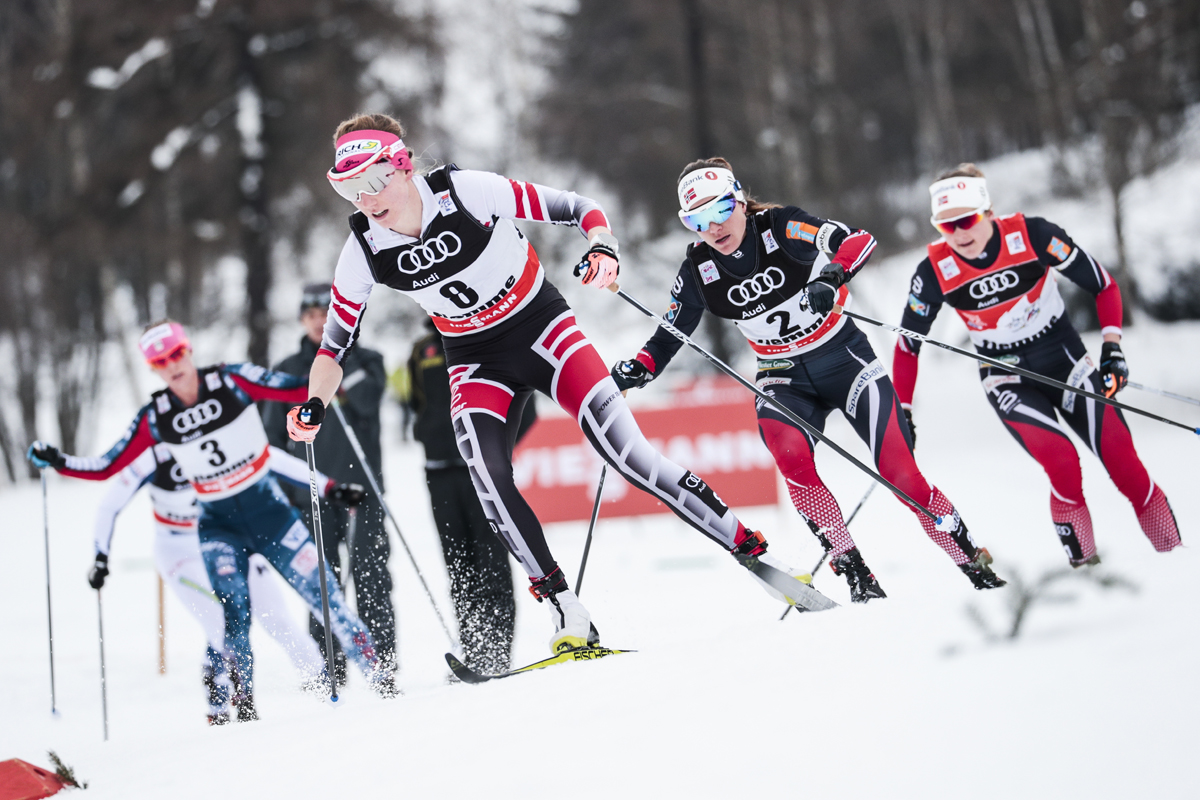
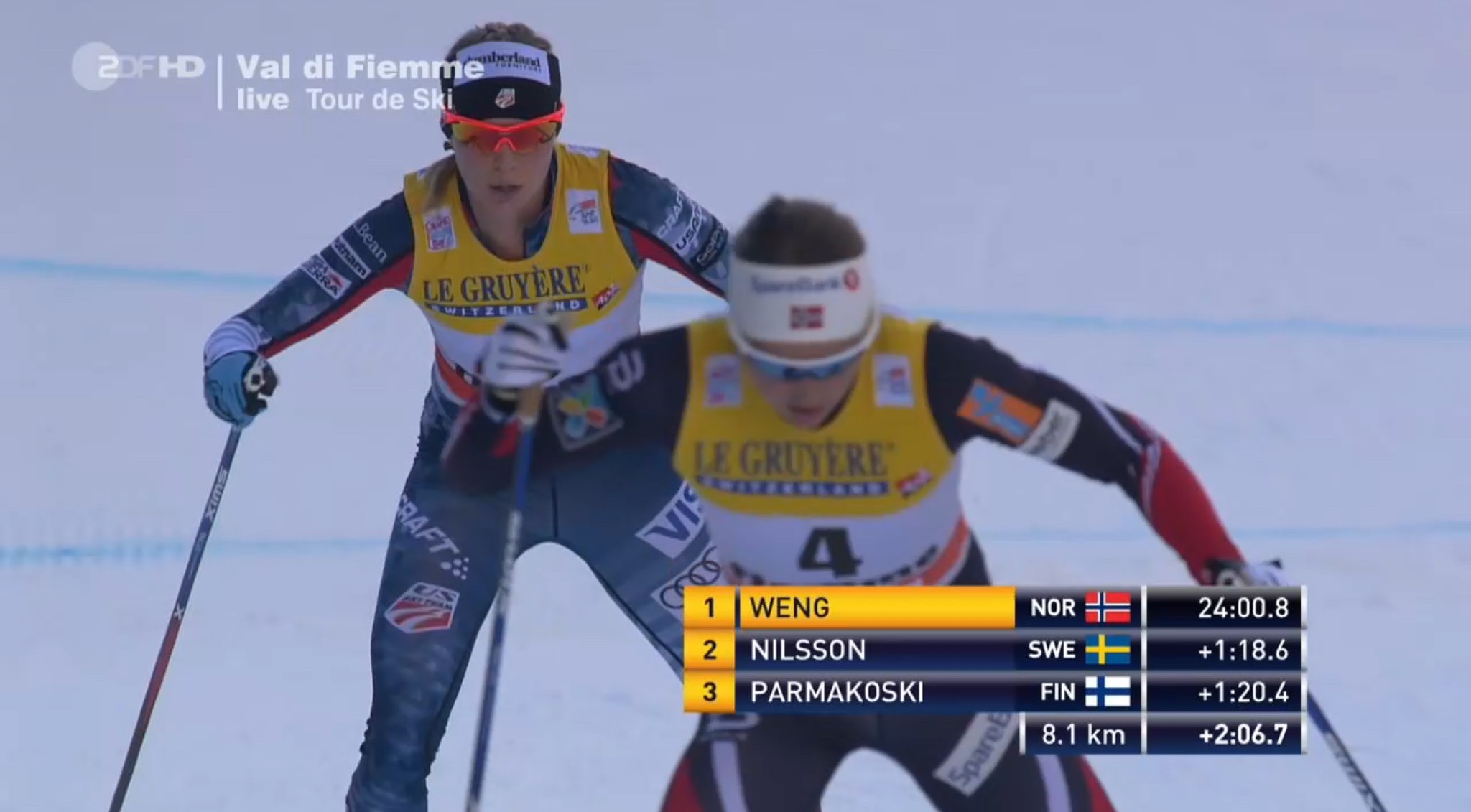
Austria’s Teresa Stadlober leads Norway’s Heidi Weng (2) and Ingvild Flugstad Østberg, American Jessie Diggins (3) and others around a downhill corner during the women’s 10 k classic mass start at Stage 6 of the 2018 Tour de Ski in Val di Fiemme, Italy. (Photo: Fischer/NordicFocus)
If Norway is to keep the streak alive, Ingvild Flugstad Østberg, last year’s TdS runner up, could be the heir apparent. She currently ranks second in the World Cup overall and 15th on the sprint list.
Johaug, having returned from an 18 month doping ban, has been on a distance race tear. She has won all five World Cup distance events this season. Johaug, however, will not be lining up for the TdS.
Only five different women have earned distance podiums this season — Johaug, Østberg, Sweden’s Charlotte Kalla and Ebba Andersson, and Finland’s Krista Pärmäkoski. Along with Johaug, Kalla and Andersson are skipping the TdS. (Andersson sits third overall on the World Cup, Kalla fifth.) With the TdS missing three of the five top ranked World Cup distance skiers, daily stages and the overall podium are up for grabs.
Last season’s third overall finisher, Jessie Diggins of the U.S. Ski Team (USST), often cites the TdS as a point in the season when her form trends towards podium performances. She sits eighth in the current distance standings and could very well have a stout TdS.
Russia’s Natalia Belorukova and Yulia Nepryaeva look strong as does Sadie Bjornsen (USST), and Austria’s Teresa Stadlober.
With less than predictable distance stage podiums for the women, it may simply come down to a drag race on the Alpe Cermis final climb Jan. 6.
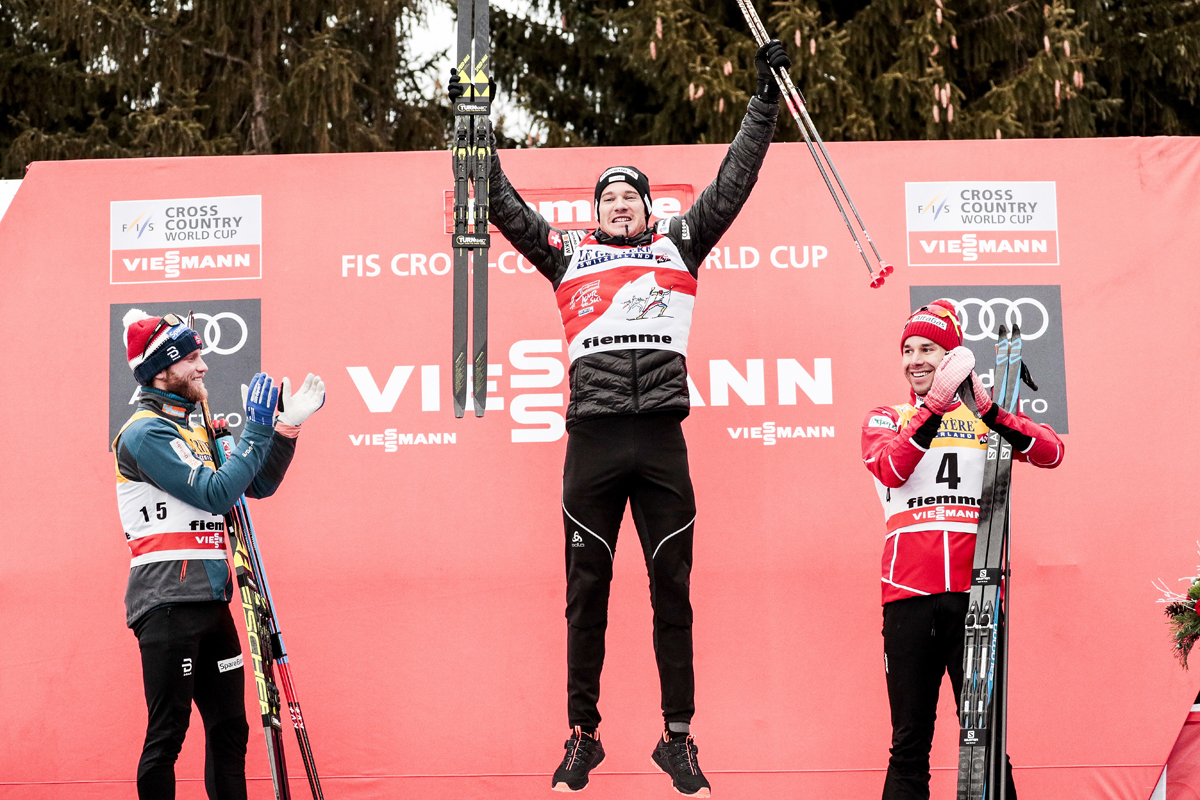
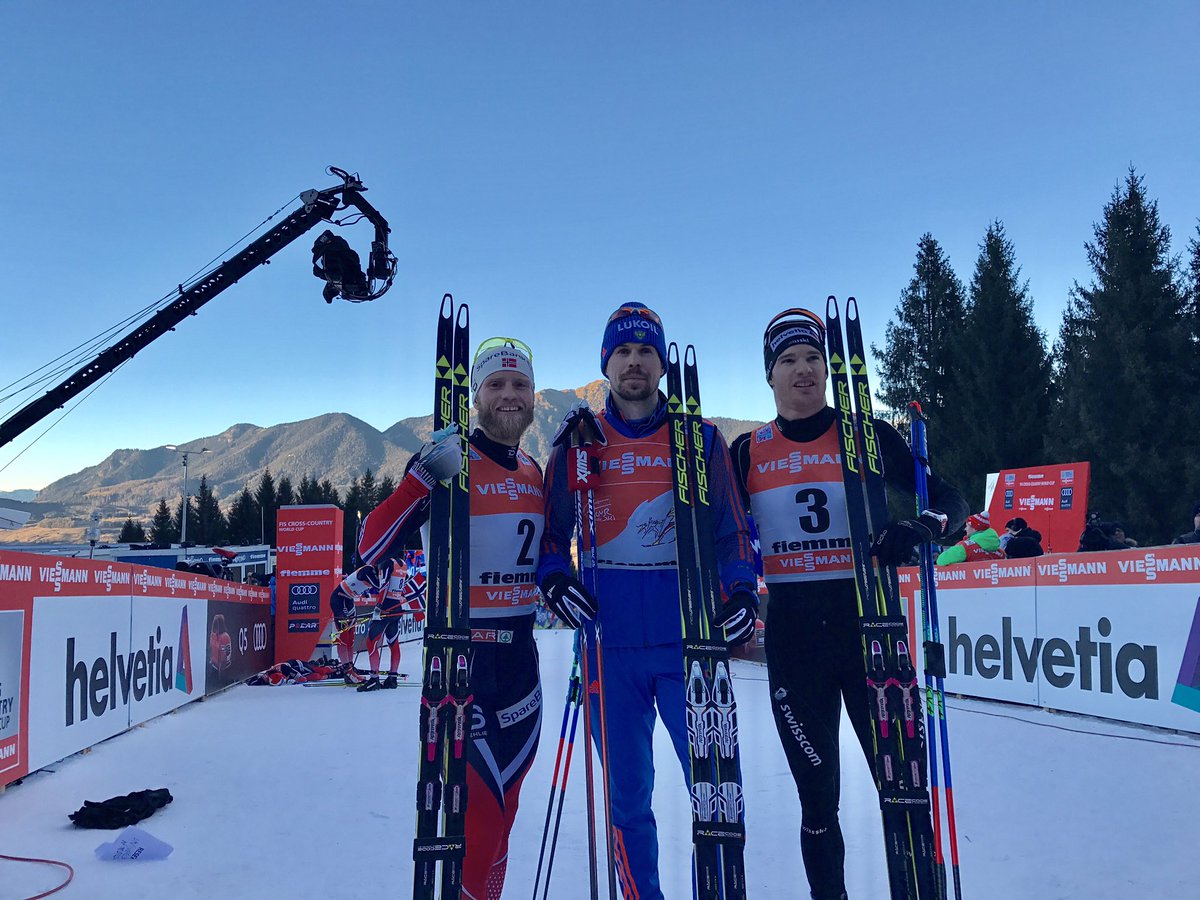
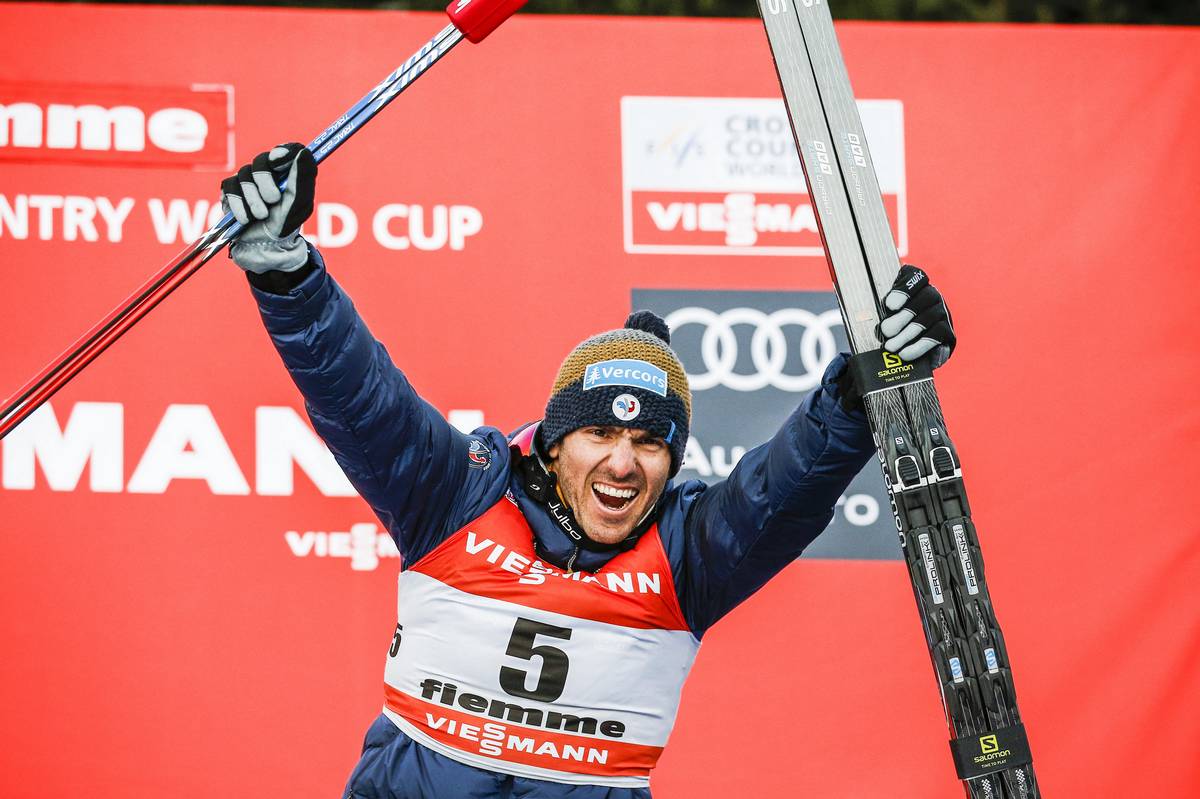
Switzerland’s Dario Cologna (c) celebrates his fourth Tour de Ski overall title. He was joined by Norway’s Martin Johnsrud Sundby (l) and Canada’s Alex Harvey (r) on the podium in second and third, respectively. (Photo: Fischer/NordicFocus)
The men’s scene is also open to interpretation. Last season’s TdS winner, Switzerland’s Dario Cologna, was in fact a surprise victor. Prior to Cologna’s stage two win in last year’s TdS, it had been nearly three years since the four time TdS overall winner had won a World Cup. Cologna sits 21st overall on the World Cup currently. Given last year’s resurgence, anything is possible for the Swiss skier.
Then there’s Martin Johnsrud Sundby form Norway. He finished on the TdS podium the last three years. At thirty-four-years-old, Sundby is ranked first on the distance list, with a second, a third, and a fourth place in distance races this season.
Sundby won the TdS on two occasions – in 2013/2014 and in 2016. His 2015 win was stripped after he tested positive for excessive levels of Salbutamol. He placed second in the past two Tours.
In a field rife with talent, Sundby’s ability to race and rebound and race and rebound will be tested. Sjur Røthe, Emil Iversen, and Didrik Tønseth— all from Norway— look in form. And there’s Norway’s Johannes Høsflot Klæbo. The winner of last season’s overall World Cup has had flashes of his past explosive self. He could be a TdS protagonist.
The men’s field is notably tight. Along with the Norwegians, several Russians could pop a podium, a stage win, and the overall. Russia comes with a loaded team ready to exploit. Alexander Bolshunov leads the overall World Cup – he’ll turn twenty two on Dec. 31st. He’s backed by teammates Evgeniy Belov, Andrey Melnichenko, and Denis Spitsov.
Canada’s Alex Harvey placed third overall last year and he looked stronger as the TdS progressed.
The Stages
Stage 1: Dec. 29, skate sprint in Toblach, Italy.
Stage 2: Dec. 30, 10 k/15 k skate in Toblach, Italy.
Stage 3: Jan. 1, skate sprint in Val Müstair, Switzerland.
Stage 4: Jan. 2, 10 k/15 k classic mass start in Oberstdorf, Germany.
Stage 5: Jan. 3, 10 k/15 k skate pursuit in Oberstdorf, Germany.
Stage 6: Jan. 5th, 10 k/15 k classic mass start in Val di Fiemme, Italy.
Stage 7: Jan 6th, 9 k final climb skate pursuit in Val di Fiemme, Italy.
Teams
United States
Women: Sophie Caldwell, Sadie Bjornsen, Jessie Diggins.
Men: Ben Lustgarten, Simi Hamilton, Erik Bjornsen, Kevin Bolger.
U.S. Ski Team Head Coach Chris Grover noted in a text that Caldwell, Hamilton, and Bolger will likely cease the TdS after the stage three sprint. Additionally, this is a small team for the U.S. at the TdS. Several athletes turned down TdS nominations including Scott Patterson (USST), Andy Newell (SMS T2/Salomon), Kyle Bratrud (SMS T2), Rosie Brennan (APU), Rosie Frankowski (APU), Caitlin Patterson (CGRP), and Julia Kern (SMS T2). These skiers plan on racing U.S. Nationals this January in Craftsbury, Vermont.
Canada
Women: Emily Nishikawa, Dahria Beatty
Men: Alex Harvey, Lenny Valjas, Bob Thompson
Norway
Women: Ingvild Flugstad Østberg, Maiken Caspersen Falla, Astrid Uhrenholdt Jacobsen, Kari Øyre Slind, Kathrine Rolsted Harsem, Heidi Weng, Lotta Udnes Weng, Tiril Udnes Weng Mari Eide, Anna Svendsen
Men: Martin Johnsrud Sundby, Hans Christer Holund, Emil Iversen, Didrik Tønseth, Simen Hegstad, Krüger, Sjur Røthe, Johannes Høsflot Klæbo, Martin Løwstrøm Nyenget, Eirik Brandsdal, Finn Hågen Krogh
Russia
Women: Yulia Belorukova, Lidia Durkina, Anna Zherebyateva, Mariya Istomina, Natalia Nepryaeva, Anna Nechaevskaya, Anastasia Sedova, Elena Soboleva
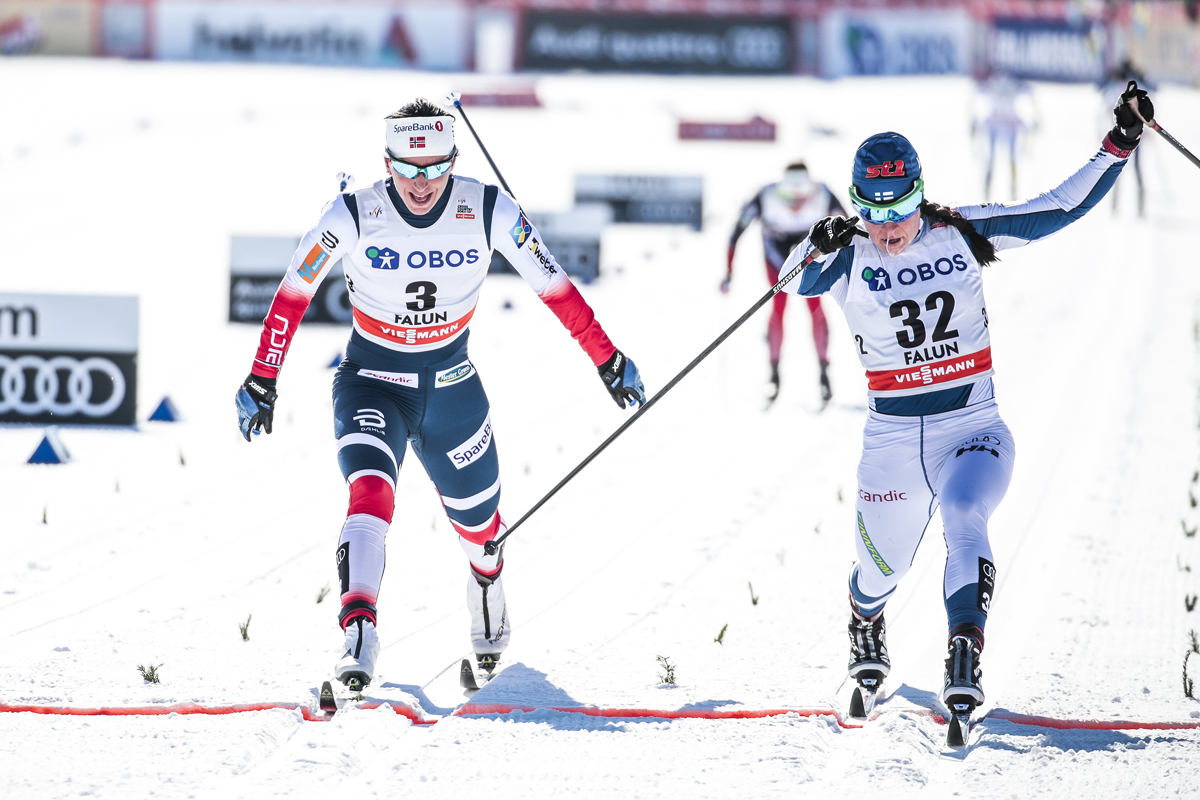
Finland’s Krista Pärmäkoski (32) edges Norway’s Marit Bjørgen for the win in the women’s 10 k classic mass start at 2018 World Cup Finals in Falun, Sweden. (Photo: Fischer/NordicFocus)
Welcome to FasterSkier’s World Cup Preview, where we check in with the top-10 teams from last year’s FIS Cross Country World Cup tour before the season starts with the Ruka weekend in Kuusamo, Finland, on Nov. 24 with a classic sprint.
***
Finland
Overall in Nations Cup Last Year:4th
Women’s Ranking 2017/2018: 4th
Men’s Ranking 2017/2018: 7th
Finnish Skiers to Watch:
If there are two names Finland’s cross-country ski fans loves to cheer–and will be looking to chant again this season–it’s Krista Pärmäkoski and Iivo Niskanen. And with good reason.
Pärmäkoski opened Period II of last season with a win, cruising to first in the 10-kilometer classic race in Planica, Slovenia. Pärmäkoski racked up two more 10 k victories after Planica, winning both the Lahti 10 k and the Falun 10 k. Altogether, Pärmäkoski landed on the World Cup podium seven times last season, capping off the FIS 2017/2018 season ranked fourth, just ahead of Norway’s Marit Bjørgen in fifth.
Outside of the World Cup, Pärmäkoski also came away from the 2018 Pyeongchang Winter Olympic Games with three individual medals, one silver and two bronze.
ComplimentingPärmäkoski on the men’s side, Niskanen, earned two World Cup podiums last season, placing third in the Ruka 15 k and third in the Lahti 15 k. He landed in the top-20 twelve times during last year’s World Cup season, and finished 15th in the FIS overall.
Like Pärmäkoski, he also departed the Winter Games with hardware, a gold medal from the men’s 50 k mass start.
Pärmäkoski and Niskanen aren’t the only Finns capable of pushing into the top tiers of World Cup skiers. With the retirement of Aino-Kaisa Saarinen this past spring, the women’s side will look to Kerttu Niskanen (Iivo’s sister), Riitta-Liisa Roponen, Anne Kyllönen and Laura Mononen–all of whom scored World Cup points more than once last season– to keep the women’s team’s forward momentum.
Following Niskanen, Matti Heikkinen and Ristomatti Hakola are two veteran Finnish names who are not about to let up as the 2018/2019 season prepares to get underway.
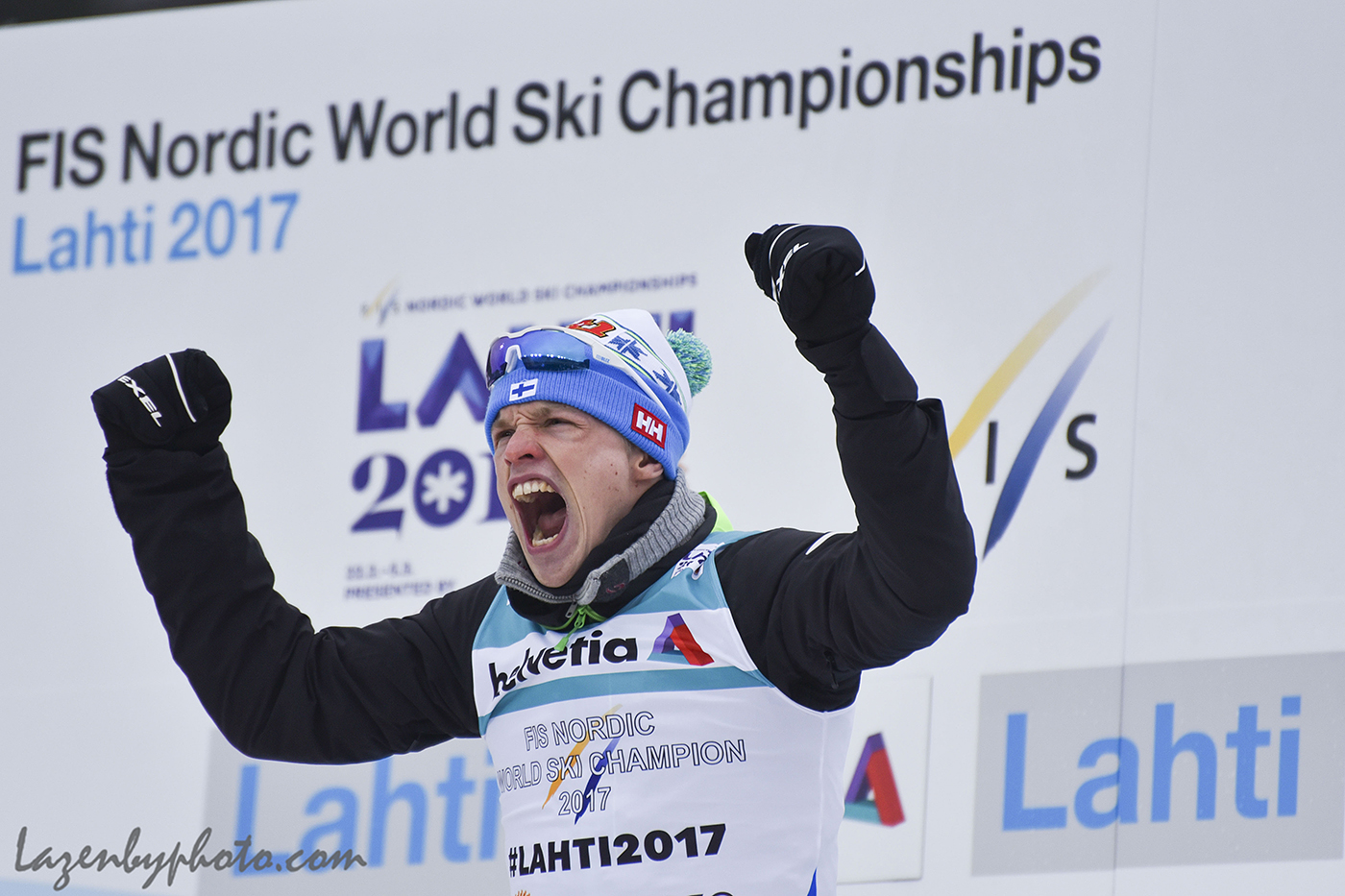
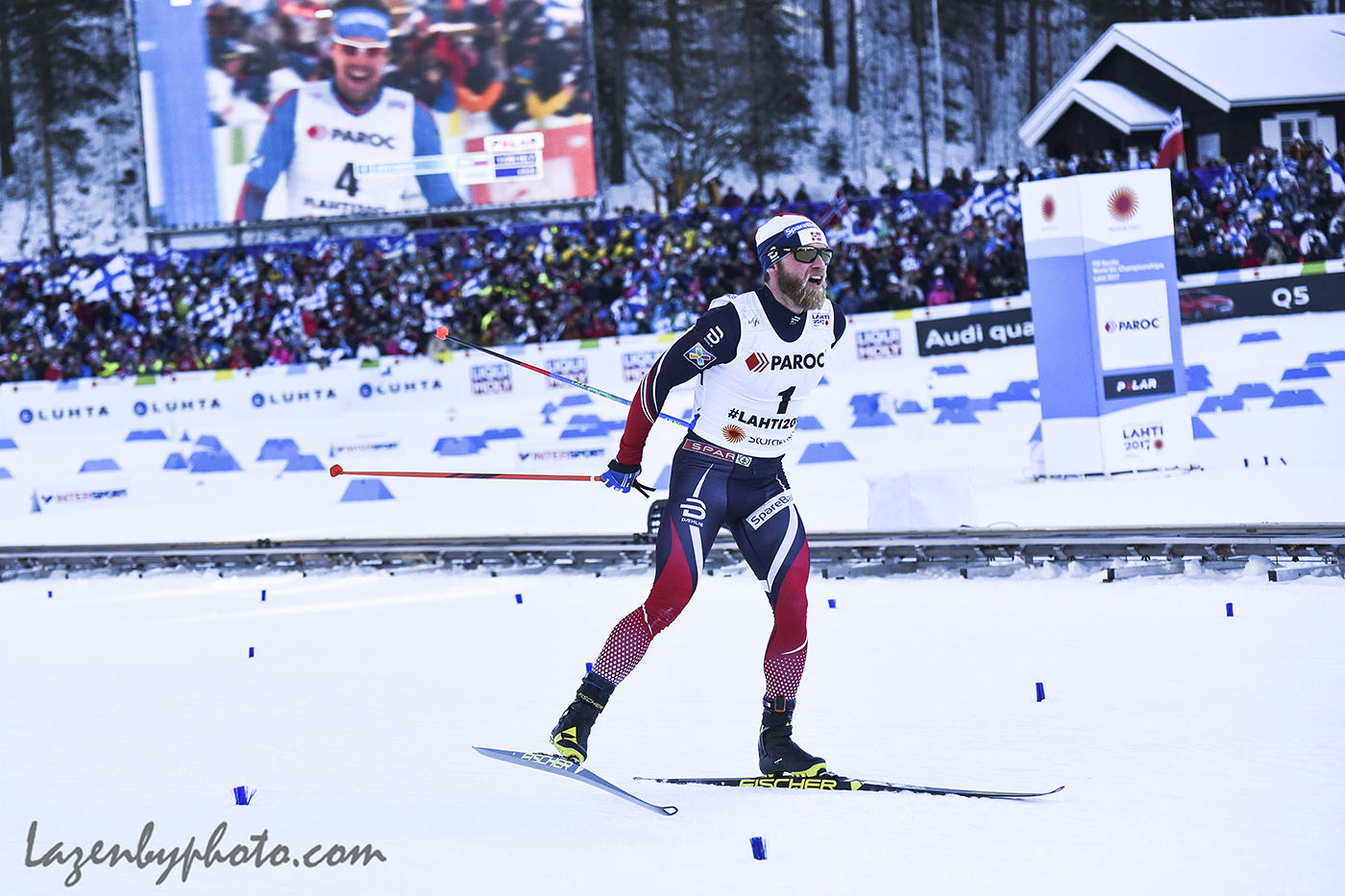
Finland’s Iivo Niskanen celebrating his first World Championships gold in the men’s 15 k classic on March 1, 2017, in Lahti, Finland. (Photo: John Lazenby)
Johannes Høsflot Klæbo anchoring the Norwegian men’s 4 x 10 relay to gold on Sunday at the 2018 Olympics in PyeongChang, South Korea, while Denis Spitsov (background) celebrates silver for the Olympic Athletes for Russia. (Photo: FlyingPointRoad)
For a while in the men’s 4 x 10-kilometer relay on Sunday, it looked like the Russians might run away with the win. But that was just two classic legs and 20 k into the race, with a lot more racing to come.
While Kazakhstan’s Alexey Poltoranin had handed off in first at the first exchange, just ahead of Andrey Larkov of the Olympic Athletes from Russia, Italy, France and Norway skied together behind them, with Norway’s Didrik Tønseth trailing off the back, 18 seconds behind.
On the next classic leg, Russia’s Alexander Bolshunov put a hurt on the field. Within the first 3.3 k lap, he was 25 seconds ahead of Kazakhstan’s Yevgeniy Velichko in second, who was followed closely by Italy, Norway and France in third through fifth. Sweden’s Daniel Rickardsson had fallen farther behind to more than a minute back in sixth place, after his teammate Jens Burman lost contact with the lead group on the first leg.
By the second exchange, Russia was 24.5 seconds clear of second place, while Italy’s Francesco de Fabiani tagged Giandomenico Salvadori in second, France’s Maurice Manificat tagged Clement Parisse in third (+28.0), and Norway’s Martin Johnsrud Sundby tagged Simen Hegstad Krüger in fourth (+32.1). Kazakhstan’s Velichko had fallen off the pace and was another 19 seconds back in fifth.
Over the next 10 k, the first skate leg, Krüger and Parisse reeled in Russia’s Alexey Chervotkin, catching him before the end of their second lap. One lap later, Krüger came through the final exchange in first, tagging Johannes Høsflot Klæbo 0.4 seconds ahead of France in second. Chervotkin tagged Russia’s anchor Denis Spitsov in third, 16.2 seconds back, while Finland’s Matti Heikkinen passed Italy’s Salvadori on the last climb to put Finland in fourth (+58.6).
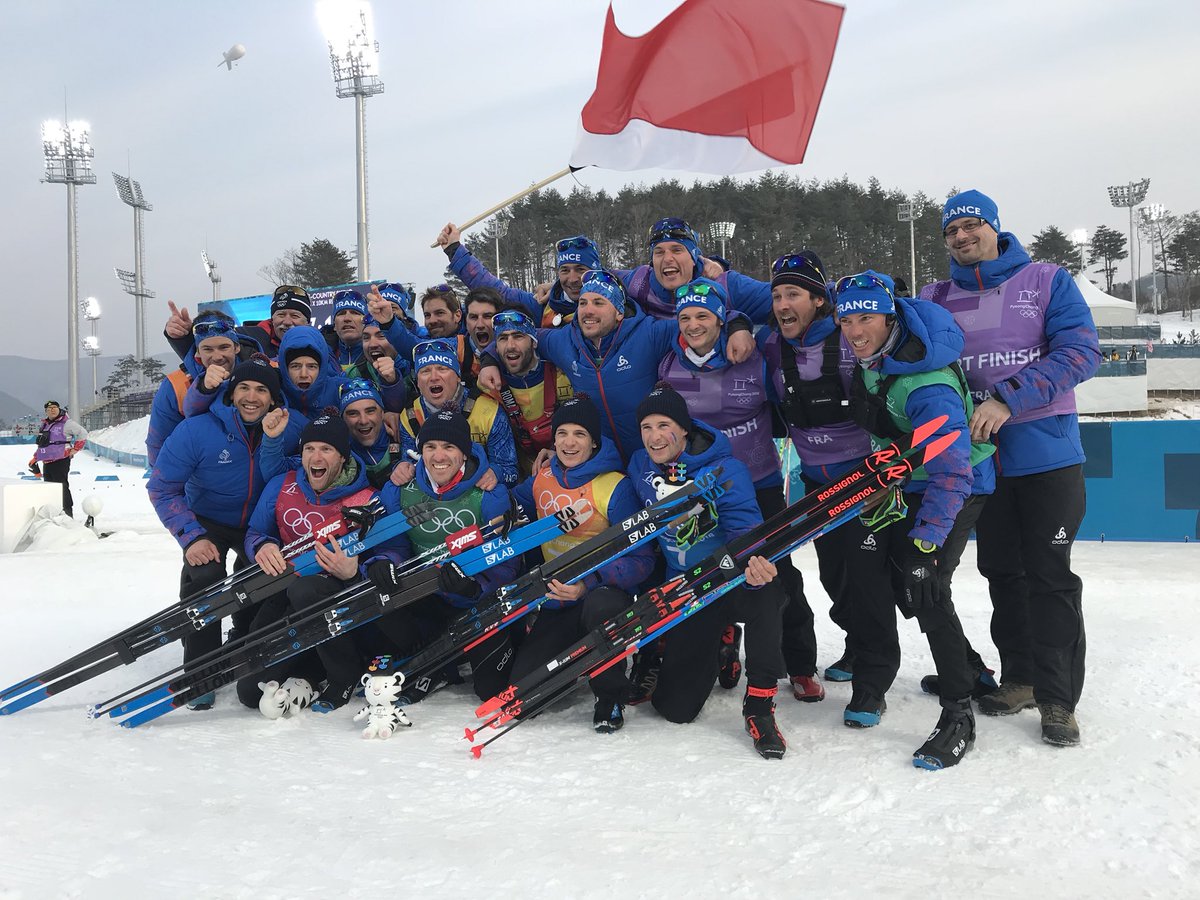
Team France celebrates its bronze-medal finish in the men’s 4 x 10 k relay at the 2018 Olympics on Sunday in PyeongChang, South Korea. (Photo: FIS Cross Country/Twitter)
Early in the final leg, France’s Adrien Backscheider took the lead ahead of Klæbo. The two held Spitsov off until the end of the second lap, where Spitsov came through the stadium first to start the final loop. Spitsov and Klæbo soon upped the pace, dropping Backscheider, and shortly after the 8.27 k checkpoint, Klæbo truly put the jets on to accelerate away from Spitsov. He dropped the Russian on a climb just before the final uphill, where it was clear that the gold was Norway’s.
As he sped down into the stadium, Klæbo relaxed his arms, skied to the sideline and took a flag from the stands. He looked back for a moment and then crossed the finish line first in 1:33:04.9 hours, while Spitsov followed 9.4 seconds later for silver for Russia. Backscheider held on for bronze (+36.9) as his team exuberantly celebrated with him at the finish.
Finland placed fourth (+1:40.5), Sweden fifth (+2:05.6), Germany sixth (+2:08.2), Italy seventh (+2:35.2), and Kazakhstan eighth (+3:31.4). Canada was ninth (+3:41.0) for its second-best Olympic relay result (with Len Valjas, Graeme Killick, Russell Kennedy, and Knute Johnsgaard), and the U.S. finished 14th (+9:24.2), out of 14 teams, with Andy Newell, Reese Hanneman, Scott Patterson, and Noah Hoffman.
France’s Martin Fourcade lunging for his second gold of the 2018 Olympics in PyeongChang, South Korea, winning the men’s 15 k mass start on Sunday. (Photo: FlyingPointRoad)
Martin Fourcade is the champion once again. Six days after he won the 12.5-kilometer pursuit for his first gold in PyeongChang, the 29-year-old Frenchman did it again in the men’s 15 k mass start on Sunday, winning in a photo finish at the line.
He took charge on the first loop, leading the field into the range for the first prone shooting. There, Fourcade shot a penalty and slipped to 19th, but it wasn’t over.
Clean shooting on the second prone brought him up to eighth, 9.4 seconds out of first. Germany’s Benedikt Doll took that lead at that point after his second stage without a miss. Meanwhile Norway’s Johannes Thingnes Bø shot three misses on that second stage and dropped out of contention.
One loop later, Fourcade moved into first with a clean standing. He left the range about 1 second ahead of Germany’s Simon Schempp and 2 seconds ahead of Germany’s Erik Lesser, after both made it through the first three stages without a miss. Doll missed one to slip to seventh, almost 30 seconds behind.
After Fourcade and Schempp exchanged leads over the next loop, Lesser moved into first just before the final shooing, Going head to head, Fourcade and Schempp both missed one while Lesser missed two. Fourcade and Schempp still left the range in first and second, respectively, separated by 0.4 seconds, while Lesser slipped to fifth, 22.5 seconds back.
Doll left the range in third (+19.2) after cleaning and Norway’s Emil Hegle Svendsen moved into fourth (+21.9) with a clean standing stage as well.
In the end, Fourcade outlunged Schempp for the win in 35:47.3 minutes, with Schempp finishing less than a tenth of a second behind for silver, and Svendsen beat out Lesser in the finishing stretch by 0.4 seconds to claim bronze, 11.2 seconds behind, while Lesser settled for fourth (+11.6). Doll followed them in fifth (+18.8), Austria’s Julian Eberhard placed sixth (+30.7) with three penalties, Norway’s Erlend Bjøntegaard seventh (+32.1) with two misses, Norway’s Tarjei Bø eighth (+34.6) with three penalties, Sweden’s Jesper Nelin ninth (+34.6) with two misses, and Slovenia’s Jakov Fak 10th (+36.1), just ahead of the Czech Republic’s Ondřej Moravec in 11th (+36.3), with one miss each.
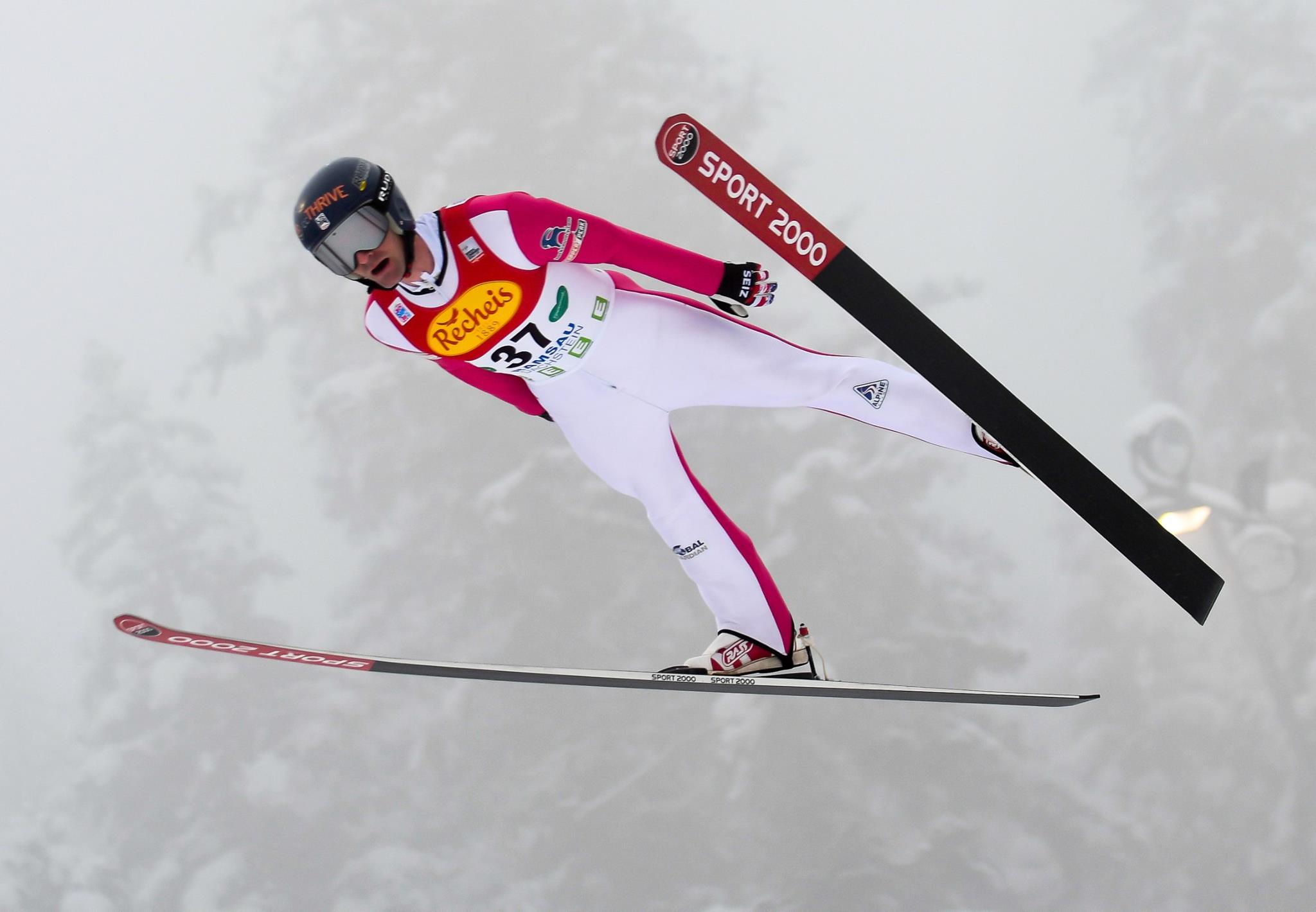
Bryan Fletcher (USA Nordic) jumping to 45th in the Nordic Combined World Cup on Sunday in Ramsau, Austria. In the 10 k that followed, he skied the third-fastest time to finish 14th overall. (Photo: Romina Eggert/USA Nordic Facebook)
NorAm mini tour (Rossland, B.C.): 10/15 k freestyle pursuits
Team Gregg ended the Rossland NorAm mini tour with another double win, with American Caitlin Gregg and her husband Brian Gregg winning the 10- and 15-kilometer freestyle pursuits, respectively, at the Black Jack Ski Club trails.
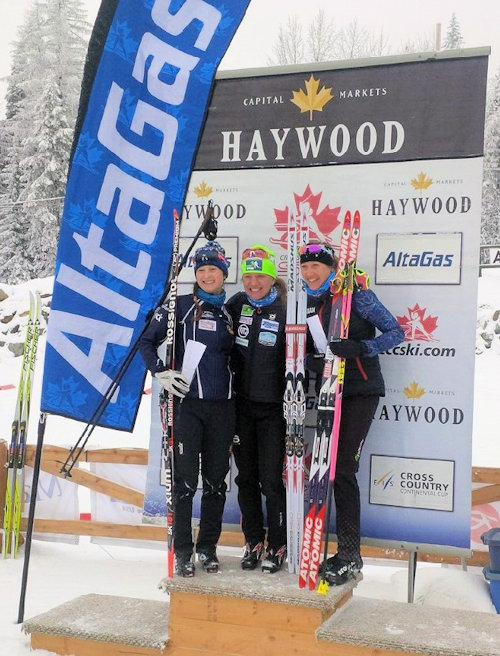
The women’s 10 k freestyle pursuit podium at the NorAm in Rossland, B.C., with American Caitlin Gregg (c) in first, and Canadians Zina Kocher (l) and Andrea Dupont (r), in second and third, respectively. (Photo: Cross Country Canada)
Caitlin capped the long weekend with her third-straight win, a 48.28-second victory over former Canadian biathlete Zina Kocher (Foothills Nordic). Caitlin started first and was first across the finish in 29:02.86, while Kocher started ninth and rose to second place for her second-consecutive podium (after placing third in Saturday’s skate sprint). Andrea Dupont (Rocky Mountain Racers) started fourth and finished third (+1:58.35) for her second-straight podium as well (she was second in the skate sprint behind Gregg).
Lisle Compton of the National Team Development Centre (NTDC) Thunder Bay and Canadian National Junior Team finished fourth overall (+2:07.03), Frederique Vezina of the Pierre-Harvey National Training Centre (CNEPH) was fifth (+2:16.10), and Annika Hicks of the Alberta World Cup Academy (AWCA) sixth (+2:16.51). Laura Leclair (CNEPH) placed seventh, Kaia Andal (Caledonia Nordic) was the top junior in eighth overall, Jaqueline Mourao (Brazil Ski Team) ninth, and Sophie Carrier-Laforte (Skinouk) 10th.
Brian, who won the Rossland men’s 10 k classic on Friday, also started Sunday’s 15 k freestyle pursuit first and finished in that position in 38:43.93. Andy Shields (Lappe Nordic) raced to second overall, 7.65 seconds back, after starting fourth, and Jack Carlyle (AWCA) reached the podium in third (+8.75) after starting 10th.
Evan Palmer-Charrette (NTDC Thunder Bay) ended the weekend in fourth (+17.68), Philippe Boucher (CNEPH) was fifth (+19.02), Brian McKeever (Canadian Para-Nordic Ski Team) sixth (+22.16), Michael Somppi (AWCA) seventh (+34.62), Alexis Dumas (CNEPH) eighth (+52.78), Bob Thompson (NTDC Thunder Bay) ninth (+54.76), and Julien Locke (Black Jack/Canadian U25 Team) 10th (+1:04.46).
FIS Nordic Combined World Cup (Ramsau, Austria): Saturday & Sunday individual competitions
Bryan Fletcher (USA Nordic) notched seventh in the Nordic Combined World Cup this weekend in Ramsau, Austria, for his best result since January 2016. (Photo: USA Nordic/Facebook)
After a bye week, the Nordic Combined World Cup resumed in Ramsau am Dachstein, Austria, with back-to-back individual normal hill/10-kilometer Gundersen starts on Saturday and Sunday.
On Saturday, American Bryan Fletcher posted his best individual result in nearly two years in seventh place, 32.6 seconds behind German winner Eric Frenzel.
Saturday’s individual competition on Ramsau’s 98-meter hill started out with Japan’s Taihei Kato going farthest in the jump portion, the Czech Republic’s Tomas Portyk jumping to second, and Frenzel jumping to third. Fletcher tied Japan’s Yoshito Watabe for 28th and the two started the 10 k race 1:02 minutes back accordingly.
While Frenzel picked off two places to finish first in 24:05.8 minutes, Fletcher moved up 21 spots to seventh place with the second-fastest course time of 23:48.4.
Germany had two on the podium with Fabian Rießle just 0.7 seconds back in second place, and Norway’s Jan Schmid finished third, 8.1 seconds behind Frenzel.
On Sunday, Rießle climbed to the top step on the podium, winning the weekend’s second normal hill/10 k in 26:12.5.
Norway’s Jørgen Graabak led after the jump portion, yet ultimately finished sixth, 9.8 seconds behind Rießle.
Rießle jumped to ninth and started 18 seconds out of first, then took the win on the four-lap course by just 0.3 seconds over Italy’s Alessandro Pittin. The Italian notched second place after starting 36th based on his jump and racing the fastest 10 k time in 25:00.8.
Finland’s Eero Hirvonen finished third (+1.5) after starting 10th, and Schmid was another 2 seconds back in fourth (+3.5) after jumping to seventh. Frenzel did not start.
Three Americans qualified for Sunday’s competition. Fletcher jumped to 45th and started 1:30 back, yet rose to 14th (+43.7) with the third-fastest course time. His younger brother Taylor Fletcher skied the second-fastest course time to finish 34th (+2:01.6), up 24 places after jumping to 58th. Adam Loomis finished 52nd (+4:38.6) after jumping to 59th.
The U.S. Nordic Combined team is headed back to the states to prepare for U.S. Olympic trials later this month, according to the USA Nordic Facebook page.
FIS Cross Country World Cup (Toblach, Italy): 10/15 k classic pursuits
Norway’s Johannes Høsflot Klæbo after winning the men’s 15 k classic pursuit for his seventh World Cup win of the season on Sunday in Toblach, Italy. With win No. 7, he has the most wins before the new year in FIS Cross Country World Cup history. (Photo: FIS Cross Country/Twitter)
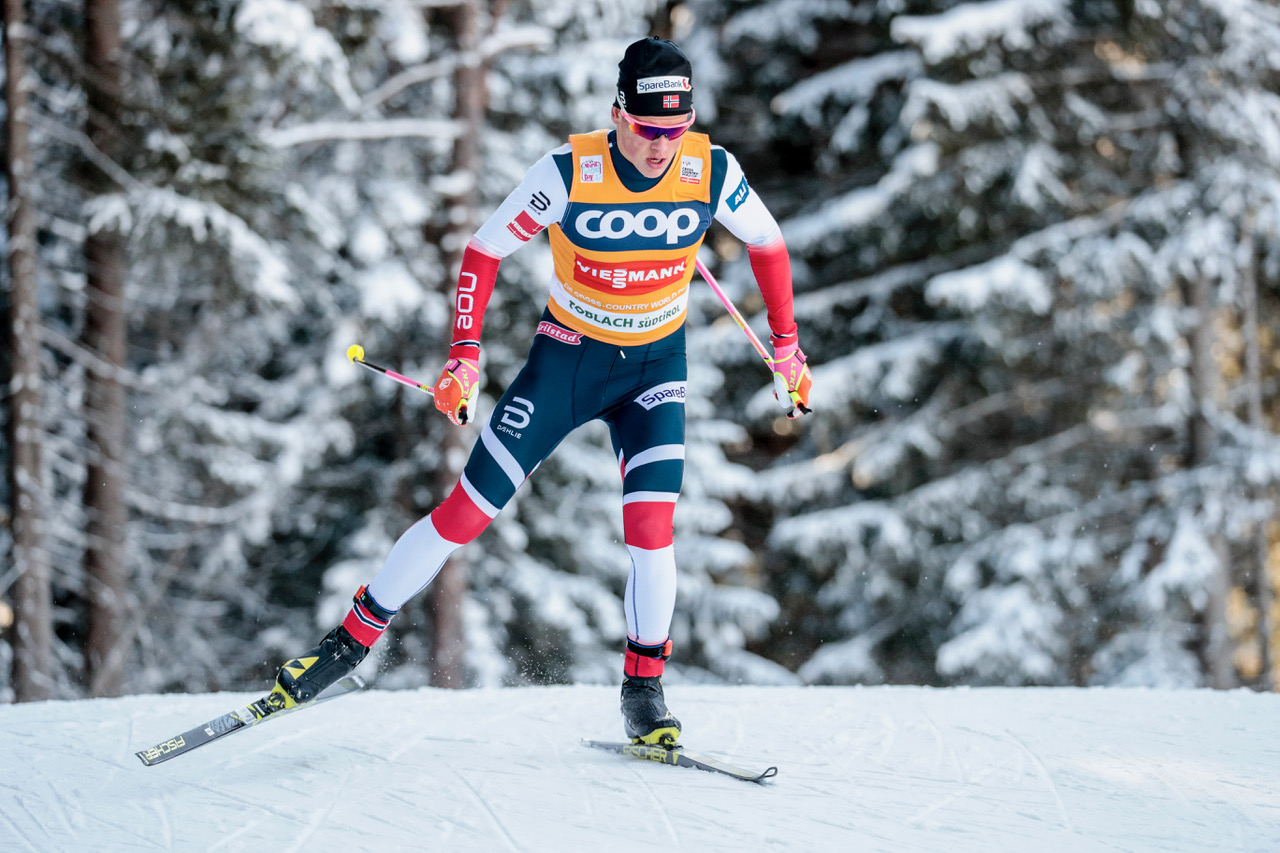
If you thought Johannes Høsflot Klæbo was out, think again. After placing 10th in the men’s 15-kilometer freestyle on Saturday in Toblach, the 21-year-old Norwegian raced to his seventh victory of the season in the men’s 15 k pursuit on Sunday.
In doing so, Klæbo broke the record for the most World Cup wins before the New Year: he’s tallied seven in the last eight races he’s contested.
On Sunday, he started 10th, 36 seconds behind his Norwegian teammate Simen Hegstad Krüger, who won the 15 k freestyle and started first. Klæbo had worked his way up to third by 11.4 k, and at the finish, he edged Russia’s Sergey Ustiugov by 1.9 seconds for the win in 33:31.1 minutes.
Ustiugov, who started fifth, claimed second, and Kazakhstan’s Alexey Poltoranin rose from 14th to third place (+4.5), ahead of Russia’s Alexander Bessmertnykh in fourth (+9.7), Finland’s Matti Heikkinen in fifth (+9.8), France’s Maurice Manificat in sixth (+10.7), Norway’s Hans Christer Holund in seventh (+11.1), Switzerland’s Dario Cologna in eighth (+11.8), Canada’s Alex Harvey in ninth (+16.3), and Krüger in 10th (+24.0). Norway’s defending Overall and Distance World Cup champion, Martin Johnsrud Sundby placed 11th (+34.4) after starting 20th based on his result on Saturday.
Erik Bjornsen once again led the U.S. men, racing from 29th at the start to 26th (+1:43.1). Scott Patterson improved from 42nd to 39th (+2:37.2), Paddy Caldwell moved up from 52nd to 44th (+2:57.7), and Noah Hoffman slipped to 49th (+3:01.7) after starting 40th.
Canada’s Devon Kershaw moved up five places to 33rd (+2:02.8), Graeme Killick finished 50th (+3:42.0), Russell Kennedy 66th (+5:05.8), and Knute Johnsgaard moved up six places to finish 76th (+6:20.8).
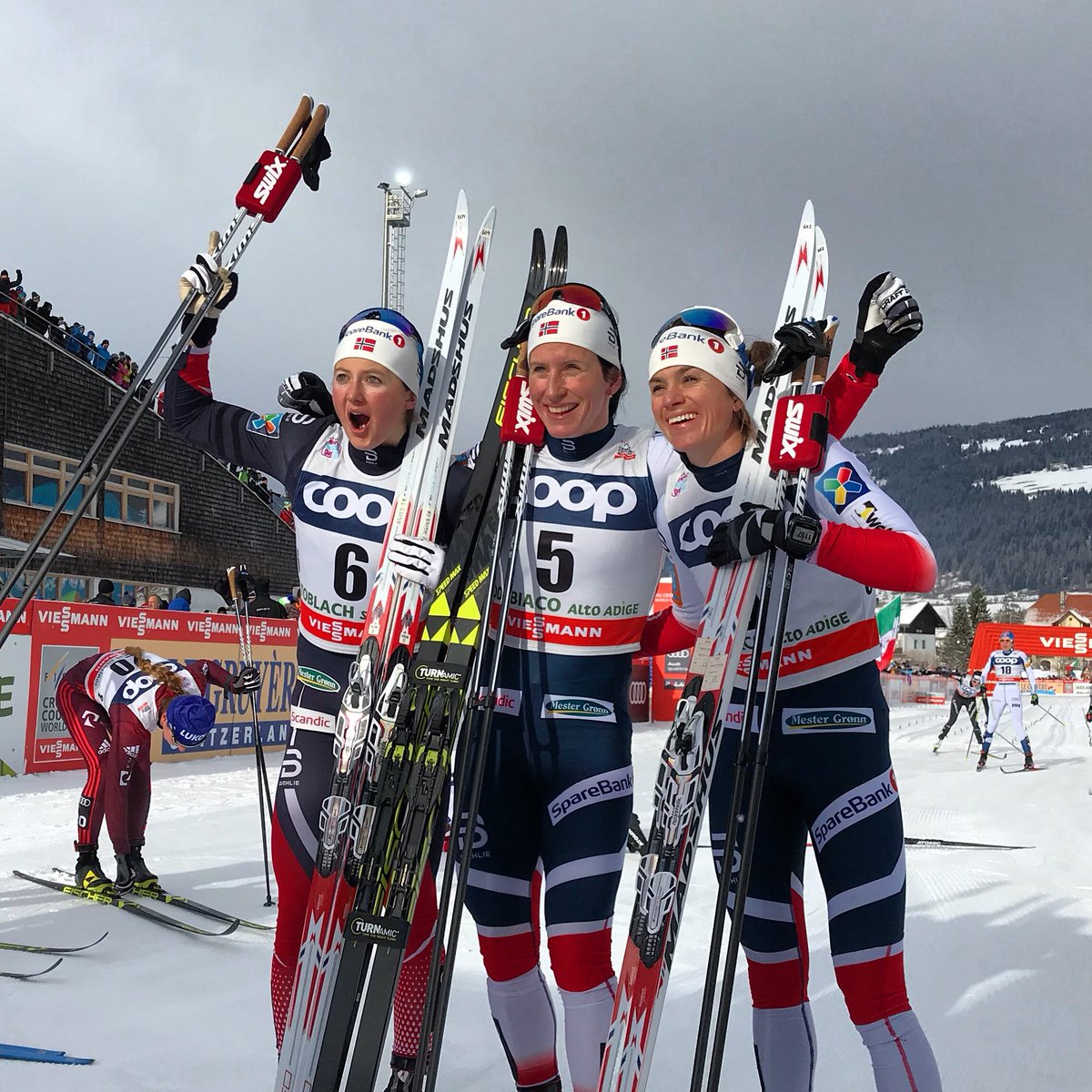
The all-Norwegian women’s 10 k classic pursuit podium on Sunday at the World Cup in Toblach, Italy, with Marit Bjørgen (c) in first, Ingvild Flugstad Østberg (l) in second and Heidi Weng (r) in third. (Photo: FIS Cross Country/Twitter)
In the women’s 10 k classic pursuit earlier in the day in Toblach, Norway’s Marit Bjørgen overcame a 22-second starting deficit to take the win by just 0.3 seconds over her teammates Ingvild Flugstad Østberg in second. It was an all-Norwegian podium with Heidi Weng in third (+0.8).
Bjørgen started fifth, 22 seconds behind Swedish race leader Charlotte Kalla, based on their results in Saturday’s 10 k freestyle individual start. By the 6.4 k checkpoint, Bjørgen led a pack of four other Norwegians and Kalla — all within 1.4 seconds of first. At 8.5 k, Bjørgen led Østberg in second and Weng in third, while another Norwegian Astrid Uhrenholdt Jacobsen skied another eight seconds back with teammate Ragnhild Haga in fourth and fifth, respectively. By that point, Kalla was skiing alone, another 11.7 seconds in sixth, while American Jessie Diggins led a group 25 seconds behind Kalla in sixth.
Ultimately, Bjørgen finished first in 25:19.3 and formed an all-Norwegian podium with Østberg and Weng, Jacobsen placed fourth, 21.5 seconds out of first and 20.7 seconds behind Weng in third.
Haga was fifth (+31.8), Kalla sixth (+41.9), Diggins seventh (+53.7), Russia’s Natalia Nepryaeva eighth (+54.2), American Sadie Bjornsen ninth (+55.2), and Austria’s Teresa Stadlober 10th (+55.6) in a photo finish with Finland’s Kerttu Niskanen, who placed 11th (+55.6).
For the U.S. Ski Team, Diggins and Bjornsen retained their starting positions of seventh and ninth, respectively, while Rosie Brennan started 19th and finished 25th (+2:14.6). Chelsea Holmes (Alaska Pacific University) finished 39th (+3:03.8) and Liz Stephen (USST) finished 48th (+4:05.2).
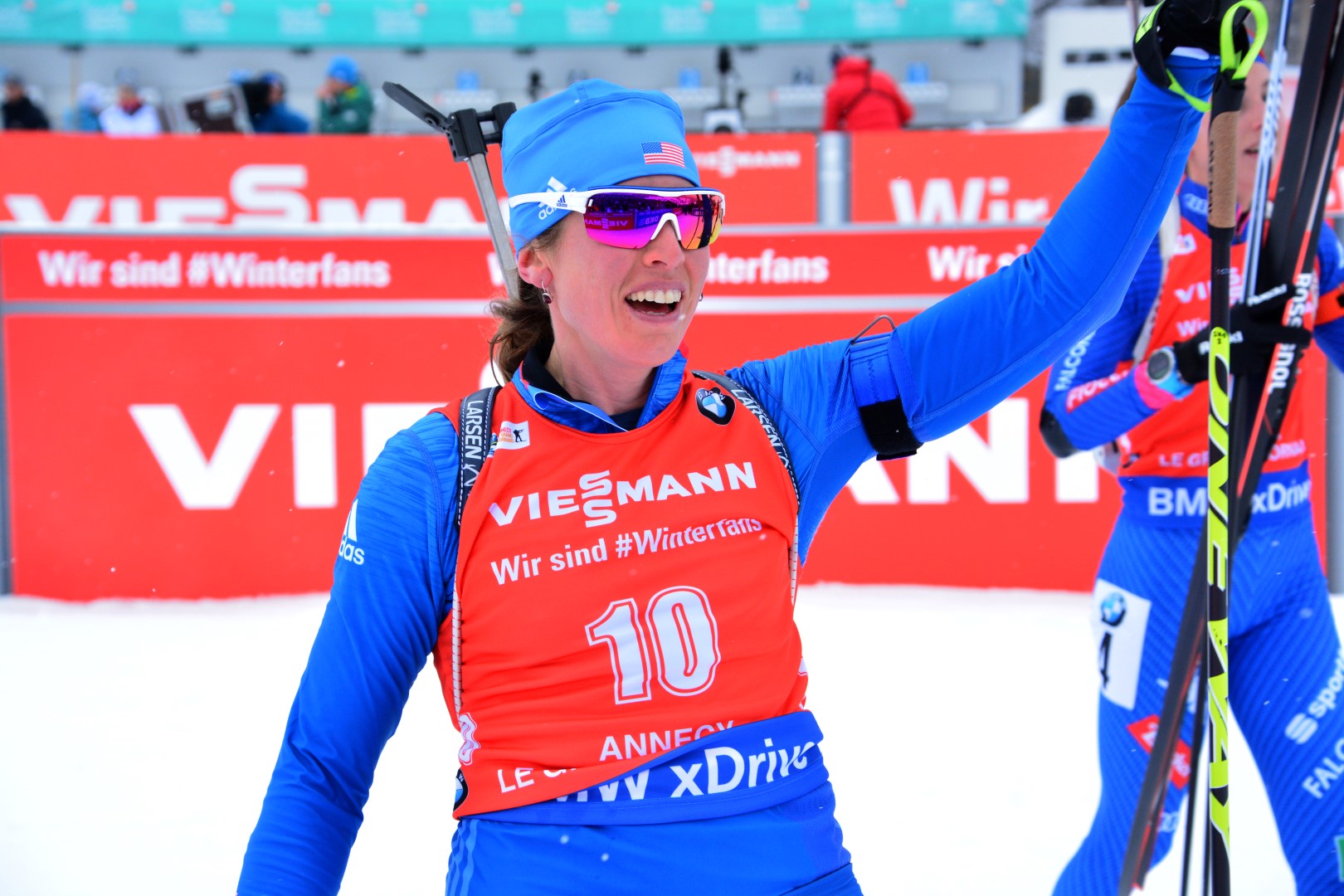
France’s Justine Braisaz won her first International Biathlon Union (IBU) World Cup race of the season on Sunday at home in Annecy, France, topping the women’s 12.5 k mass start by 11.2 seconds in 37:19.4.
While Braisaz shot 19-for-20 (0+0+1+0), Iryna Kryuko of Belarus cleaned the four-stage race for second place, her first World Cup podium. Germany’s Laura Dahlmeier, who won Saturday’s 10 k pursuit, placed third (+19.9) with two penalties (0+1+0+1).
Two North Americans qualified for the selective mass start, with Susan Dunklee (US Biathlon) racing to 20th (+1:16.3) with three misses (1+0+1+1), and Emma Lunder (Biathlon Canada) placing 28th (+2:21.4) with a single penalty (1+0+0+0).
In the men’s 15 k mass start that followed, France’s Martin Fourcade finally got the win he was looking for, shooting clean and beating his main rival Johannes Thingnes Bø of Norway by 3.9 seconds. Fourcade crossed the finish line first in 36:30.3, Bø settled for second after skiing two early penalty loops (2+0+0+0) and Germany’s Erik Lesser tallied his second podium in Annecy (after placing third in the sprint) in third place again (+6.2) with clean shooting.
Two Americans and a Canadian qualified for the mass start, with US Biathlon’s Lowell Bailey leading them in 23rd (+2:22.4) with three penalties, Sean Doherty following in 24th (+2:52.5) with four misses, and Biathlon Canada’s Scott Gow finishing 26th (+4:05.4) with five penalties.
OPA Cup (St. Ulrich, Austria): 10/15 k freestyle pursuits
On the final day of Alpen Cup (a.k.a. OPA Cup) racing in St. Ulrich, Ida Sargent of the U.S. Ski Team (USST) scored her third-straight top five with a fifth place in the women’s 10 k freestyle mass start. She previously placed third in the skate sprint and 5 k classic on Friday and Saturday.
Germany’s Julia Belger won the women’s mass start on Sunday in 28:33.6, while Saturday’s 5 k winner, Elena Soboleva of Russia placed second (+0.7). Russia had two on the podium with Mariya Istomina in third (+6.4). Germany’s Elisabeth Schicho finished fourth (+15.8), just ahead of Sargent in fifth (+15.9).
Germany’s Antonia Fräbel placed sixth (+17.1), followed by American Sophie Caldwell in seventh (+17.9). The USST had three in the top 10 with Julia Kern in 10th (+41.9), out of 60 finishers.
In the men’s 15 k freestyle mass start, Beda Klee of Switzerland took the win in 37:14.6, 2.4 seconds ahead of Germany’s Thomas Bing in second. Six-time Olympian Sergey Dolidovich of Belarus reached the podium in third (+4.5).
The U.S. had two men in the race, with Simi Hamilton finishing 14th, 16 seconds out of first, and Andy Newell finishing 71st (+2:25.2) out of 118.
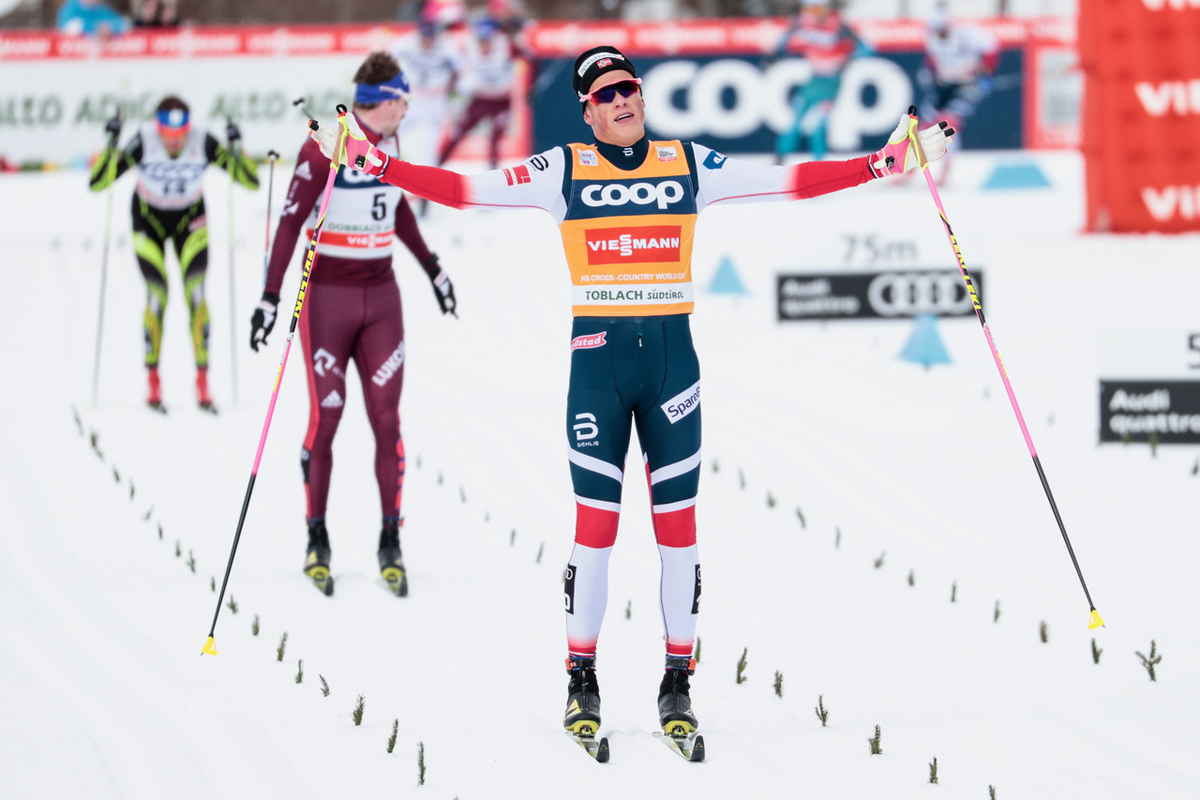
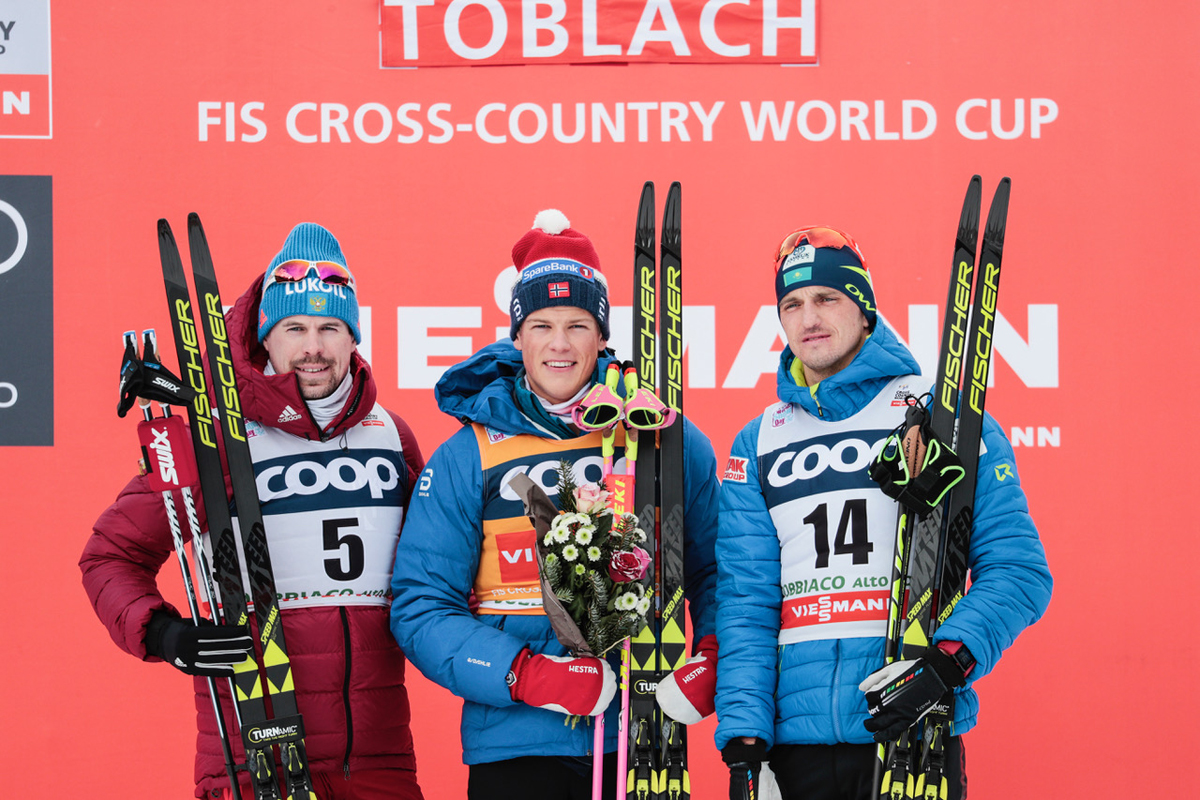
Norway’s Johannes Høsflot Klæbo winning the men’s 15 k classic pursuit on Sunday in Toblach, Italy, ahead of Russia’s Sergey Ustiugov (5) in second and Kazakhstan’s Alexey Poltoranin (l) in third. (Photo: Fischer/NordicFocus)
Johannes Høsflot Klæbo is making a name for himself. The 21-year-old Norwegian broke a record on Sunday, after taking the men’s 15-kilometer classic pursuit title in Toblach, Italy and tallying his seventh World Cup win this season, the most victories ever recorded by a male skier before the new year. In previous seasons, Norwegians Petter Northug and Martin Johnsrud Sundby had topped out at six.
With the win, Klæbo remained the Overall World Cup leader with 752 points, 324 more than France’s Maurice Manificat in second.
“I’m happy to back on the podium,” said Klæbo, who has won every race he’s entered except Saturday’s 15 k skate, according to an International Ski Federation (FIS) press release. He started Sunday’s 15 k classic pursuit in 10th, 36 seconds out of first.
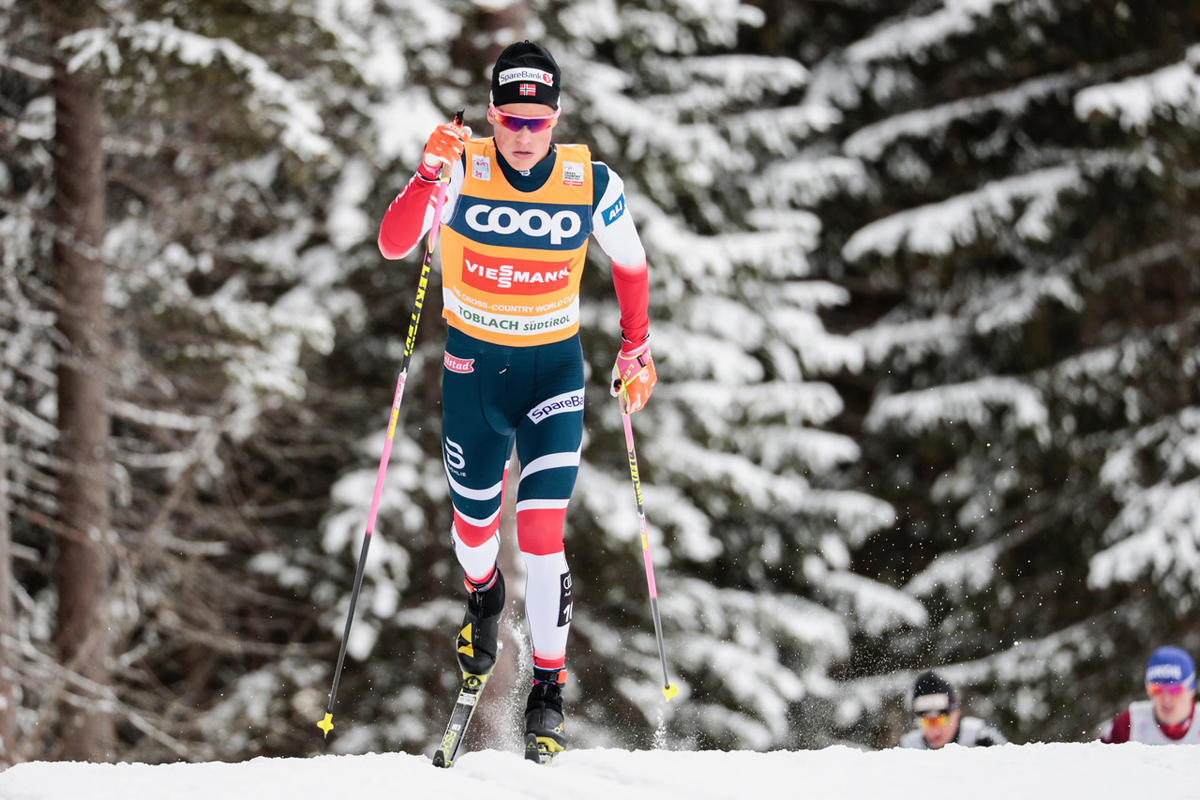
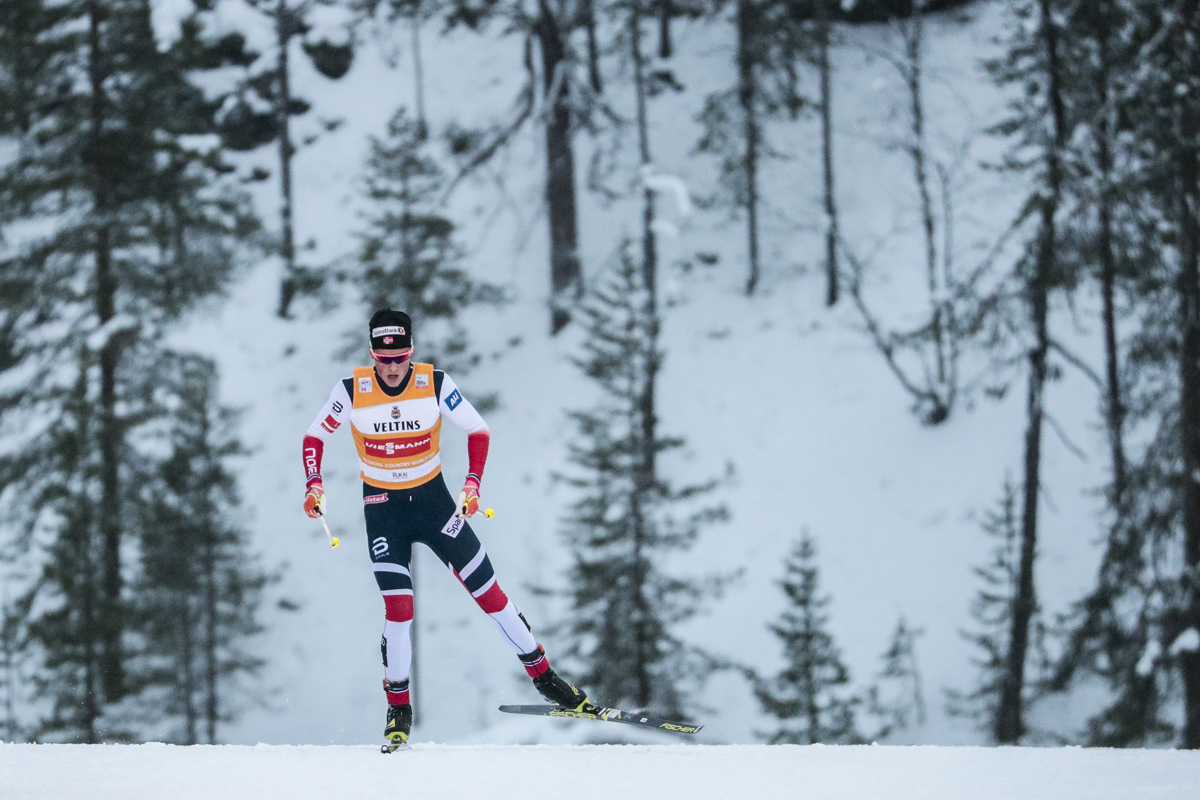
Norway’s Johannes Høsflot Klæbo getting down to business after starting 10th in the World Cup men’s 15 k classic pursuit on Sunday in Toblach, Italy. He raced to first for his seventh win of the season. (Photo: Fischer/NordicFocus)
“My plan was to go out hard from the beginning to close the gap. It worked very well,” he said. “When I was together with the group I was confident I could ski for a podium. I wanted to decide the race little bit before the stadium.”
For the first 3.5 k of Sunday’s pursuit, the top four from Saturday’s race led the way, with Manificat, Norway’s Simen Hegstad Krüger, Great Britain’s Andrew Musgrave, and Canada’s Alex Harvey.
Striding in limbo just over six seconds behind them was Russia’s Sergey Ustiugov.
“I was waiting to see if I am able to close the gap on the leaders or if the group behind me catches me,” Ustiugov said, according to FIS.
For Ustiugov, who started the pursuit in fifth, it was the latter.
Klæbo started 22 seconds behind the Russian and caught him, pulling Ustiugov into contact with the leaders before the climb back to the stadium on the first of three laps.
With Klæbo at the back and Manificat in the front, the six leaders started Lap 2, trailed by Norway’s Hans Christer Holund and Finland’s Matti Heikkinen six seconds back. A second chase pack of four — Switzerland’s Dario Cologna, Sundby, Russia’s Alexander Bessmertnykh, and Kazakhstan’s Alexey Poltoranin — followed 20 seconds later.
“I was working hard with Dario [Cologna] and Alexander [Bessmertnykh]. Dario did a great job in the first two laps.” Poltoranin said, according to FIS.
For the first half of Lap 2, Ustiugov and Musgrave exchanged leads, while Klæbo remained in the rear. Harvey stuck to the middle.
“I had really fast skis,” Harvey told FasterSkier on the phone after. “It was kind of sugary snow on the steep climbs, so I was struggling a bit on the steeper sections … but I had really fast skis, just a little slick.”
Midway through Lap 2, Klæbo began his move toward the front of the lead group. By the time the top six passed by the stadium for their third and final lap, Klæbo was positioned third, Ustiugov first and Manificat second. Harvey sat comfortably in sixth.
“On the last lap, Ustiguov and Klæbo attacked and I was feeling great, but I had to feather it a bit on the climb,” Harvey said, explaining that he lost the most time on the course’s steeper sections.
With less than 3 k to go, Ustiguov and Klæbo began to gap the rest of the field. Meanwhile, Poltoranin made his way to the front of the chase group.
“I was far faster on the last two uphills,” Poltoranin said. “I still have some work to do to be able to beat Sergey and Johannes, but I am getting there.”
Klæbo and Ustiguov remained unmatched for the final kilometer and, with arms outstretched, Klæbo crossed first in a time of 33:31.1 minutes. Ustiugov finished 1.9 seconds later in second place.
“Johannes seems he is never tired. He played with us like with small kids,” Ustiugov said, according to FIS. “He was in impressive shape again.”
The World Cup men’s 15 k classic pursuit podium in Toblach, Italy, with Norway’s Johannes Høsflot Klæbo (c) in first, Russia’s Sergey Ustiugov (l) in second and Kazakhstan’s Alexey Poltoranin (r) in third. (Photo: Fischer/NordicFocus)
Rounding out the podium in third was Poltoranin, 4.5 seconds out of first.
“I’m so happy. It has been two years since I was on the podium last time,” the 30-year-old Poltoranin said.
In fourth was Bessmertnykh (+9.7), followed by Heikkinen in fifth (+9.8) Manificat in sixth (+10.7), Holund in seventh (+11.1) and Cologna in eighth (+11.8).
After crashing in the final 500 meters of the race, Harvey finished ninth (+16.3).
“I was sitting in fifth and Heikkinen was sitting in fourth, and … I was coming around him and his pole tip just hit the front of my ski tip and I just did a straight-up face plant,” Harvey said. “So I ended up last in my group. That was a bit frustrating, but the rest was a good day.”
Rounding out the top 10 was Saturday’s 15 k winner, Krüger, who finished 24 seconds after Klæbo. Sundby, who had placed 20th in the 15 k individual start, raced up to 11th (+34.4) on Sunday, and Musgrave (who was third in the 15 k skate) finished 12th (+54.3).
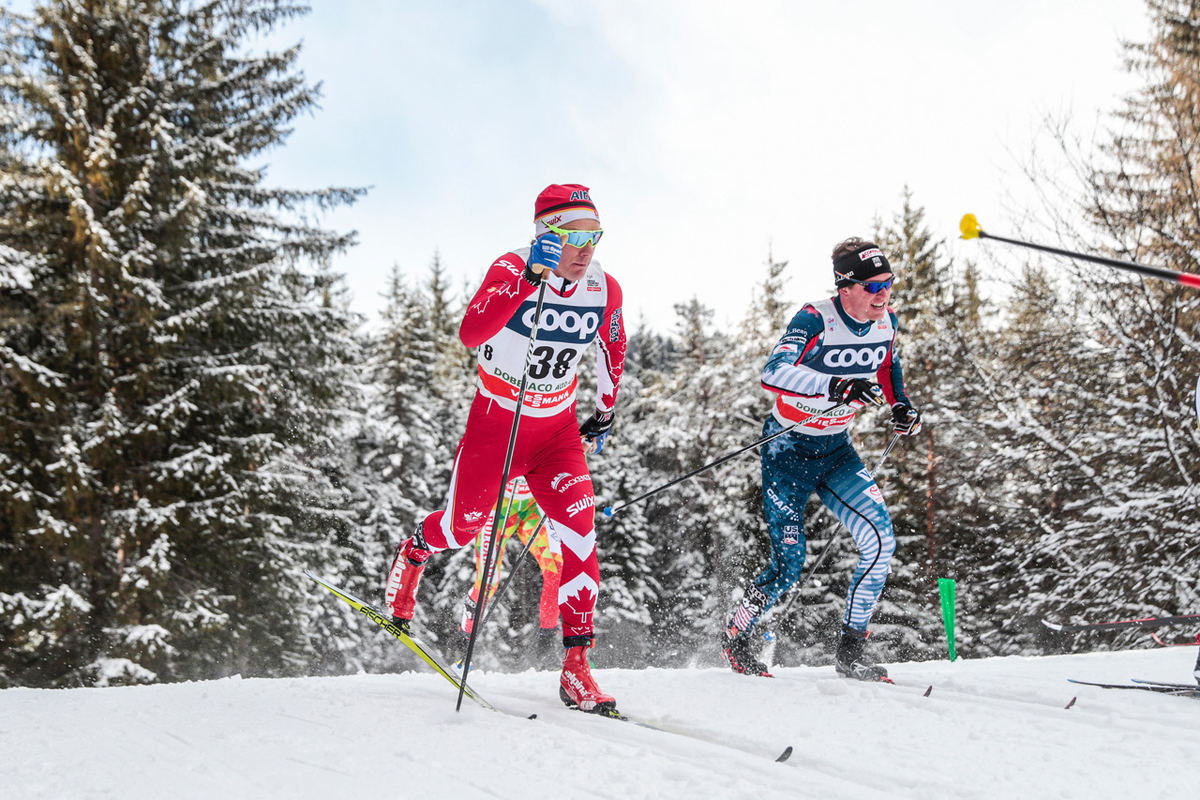
Canada’s Devon Kershaw (38) racing alongside American Scott Patterson in the men’s 15 k classic pursuit on Sunday at the World Cup in Toblach, Italy. They finished 33rd and 42nd, respectively. (Photo: Fischer/NordicFocus)
Leading the U.S. in 26th (+1:43.1) after starting 29th, was Erik Bjornsen. In five distance races this season, Bjornsen has scored World Cup points, placing within the top 30 in each race.
New to the U.S. Ski Team’s B-team this year, Scott Patterson finished 39th (+2:37.2) after starting 42nd, and Paddy Caldwell placed 44th (+2:57.7) after starting 52nd. Noah Hoffman finished 49th (+3:01.7) after starting 40th.
For Canada, Devon Kershaw placed 33rd (+2:02.8), up five spots from starting 38th, Graeme Killick was 50th (+3:42.0), Russell Kennedy 66th (+5:05.8), and Knute Johnsgaard 76th (+6:20.8) after starting 82nd.
Racers will take a break from competitions until the Tour de Ski, which kicks off in Lenzerheide, Switzerland on Dec. 30.
“I started a bit of a training block for the Tour just this week, and kind of continuing next week, so two weeks of a bit more volume, then do a little, do a little break after that, and then I have a few days of normal training to feel good before the tour,” Harvey said. “So I’m excited to see what a bit of a training and then a break does to me, because it will be the first time I have a little break like that since our last camp in October.
“Other than the Olympics is the Tour de Ski, that’s important for me,” Harvey continued. “So hoping to see if I can bring my level up a little bit with that bit of a break after the hard training, to feel a bit more fresh and a little more snappy.”
The photo finish for first in the men’s skate sprint final on Saturday at the NorAm in Rossland, B.C., with Julien Locke (near) outstretching Evan Palmer-Charette for first, and Julian Smith (r) taking third third ahead of Bob Thompson (yellow NorAm leader’s bib). (Photo: CCC/Twitter)
NorAm Mini Tour (Rossland, B.C.): Freestyle sprints
On Day 2 of NorAm racing in Rossland, British Columbia, Julien Locke, of the Black Jack Ski Club and Canadian National U25 Team, won the men’s 1.4-kilometer freestyle sprint final on his home trails by just one-hundredth of a second over Evan Palmer-Charrette, of the National Team Development Centre (NTDC) Thunder Bay, in 2:38.13. NTDC Thunder Bay had two on the podium with Julian Smith in third, 0.4 seconds behind Locke.
Locke started the day by qualifying second, just 0.06 seconds behind Bob Thompson (NTDC Thunder Bay), who won the qualifier in 2:39.49. Locke went on to finish second to Thompson in the first quarterfinal, then won the second semifinal while Thompson won the first semi.
In the final, Locke tallied his first NorAm win of the season, while Thompson, last weekend’s classic-sprint winner at Sovereign Lake, placed fourth (+0.43), missing the podium by three-hundredths of a second. Andy Shields (Lappe Nordic) finished fifth (+1.78) and Sebastien Boehmler-Dandurand (Canmore Nordic/Stefan Kuhn HP Team) sixth (+5.21) in the men’s final.
Also on Saturday, American Caitlin Gregg (Team Gregg/Loppet Nordic Racing) racked up her second-straight win in Rossland (after topping Friday’s 5 k classic), winning the women’s 1.4 k skate-sprint final in 3:03.36. Canada’s Andrea Dupont (Rocky Mountain Racers) finished 2.5 seconds later for second place and Zina Kocher (Foothills Nordic) scored her first podium of the season in third (+3.53).
Dupont won the women’s qualifier in 3:07.68, and Gregg qualified second, 0.87 seconds back. Dupont went on to win the first quarterfinal and first semifinal, while Gregg won her quarterfinal and semifinal as well. (Gregg’s quarterfinal had four racers, compared to five in Dupont’s quarterfinal, as only 21 women competed in the senior women’s heats.)
Also in the final, Laura Leclair, of the Centre National d’Excellence Pierre Harvey/Pierre-Harvey National Training Centre (CNEPH), finished fourth (+6.11), Maya MacIsaac-Jones (U25 Team) was fifth (+6.31) and Sophie Carrier-Laforte (Skinouk) sixth (+8.57).
On the second day of Alpen Cup (a.k.a. OPA Cup) racing in St. Ulrich, Ida Sargent of the U.S. Ski Team (USST) finished third in the women’s 5 k classic behind two Russians, Elena Soboleva and Natalia Matveeva, respectively.
Soboleva took the win in the individual-start race in 14:25.8, and Matveeva was 12.5 seconds back for second place. Just like Matveeva, Sargent reached the podium for the second-straight race in third (+18.1), after placing third in the freestyle sprint on Friday (Matveeva finished second in the sprint).
Germany’s Antonia Fräbel finished fourth (+21.0) and American Sophie Caldwell (USST), who won the sprint the day before, placed fifth (+22.7). The other USST member in the race, Julia Kern finished 15th (+53.5).
The men raced a 15 k classic, with France’s Alexis Jeannerod taking the win in 38:45.6. Germany’s Thomas Wick was 4.7 seconds back in second, and Russia’s Gleb Retivykh placed third (+11.3). The lone American man racing, Andy Newell (USST) finished 36th (+2:07.1) out of 125 finishers.
The three-day OPA Cup weekend in St. Ulrich wraps up Sunday with 10/15 k freestyle mass starts.
IBU World Cup (Annecy, France): Women’s and men’s pursuits
Susan Dunklee (US Biathlon) after placing sixth and reaching the flower ceremony in the women’s 10 k pursuit at the IBU World Cup on Saturday in Annecy, France. After starting 10th, sixth stands as a season-best for Dunklee. (Photo: Glen Crawford)
Germany’s Laura Dalhmeier captured her first win of the season, preventing Slovakia’s Anastasia Kuzmina from her third-straight win, and American Susan Dunklee raced to a season-best sixth in the women’s 10-kilometer pursuit on Saturday in Annecy-Le Grand Bornand, France.
Canada’s Emma Lunder achieved a career-best 18th after starting 34th, and her teammate Julia Ransom placed 27th after starting 39th.
In the men’s 12.5 k pursuit that followed, Norway’s Johannes Thingnes Bø started first, shot clean and fended off his competition to rack up his fourth-straight victory — winning by more than a minute.
And for the second-straight race, France’s Martin Fourcade finished second, this time 1:01.4 minutes behind Bø, who crossed the line first in 32:52.1. Fourcade had to ski two penalty laps later in the race (0+0+1+1), while Russia’s Anton Shipulin, who started sixth and had a single miss (0+0+0+1), rose to third place (+1:10.5).
American Lowell Bailey shot clean to race up to 14th (+2:13.9) after starting 35th. His US Biathlon teammate Tim Burke finished 26th (+3:03.1) with three penalties (1+0+1+1), after starting 10th.
Canada’s Scott Gow finished a second later for 27th (+3:04.1) after starting 16th and skiing four penalty laps (1+0+1+2). His brother Christian Gow moved up one spot to 29th (+3:06.6) after starting 30th and shooting 19-for-20 (1+0+0+0).
The U.S. had four men in the pursuit, with Sean Doherty placing 30th (+3:07.0) with three penalties after starting 17th.
Leif Nordgren improved to 48th (+4:54.9), up from 56th, despite three misses.
***
FIS Cross Country World Cup (Toblach, Italy): 10/15 k freestyle
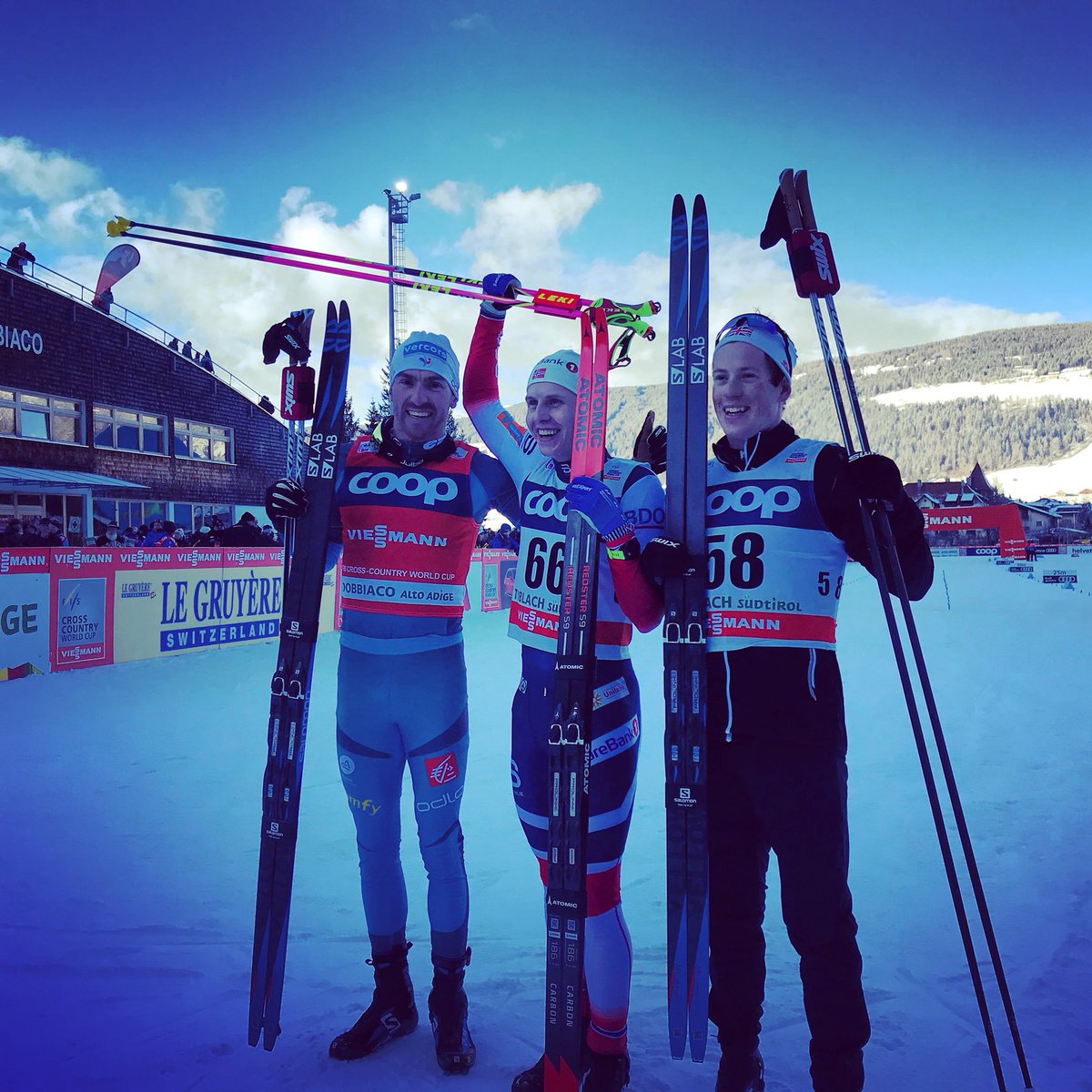
The men’s 15 k freestyle podium at the Toblach World Cup in Italy, with Norway’s Simen Hegstad Krüger (c) scoring his first World Cup victory in first place, last weekend’s winner Maurice Manificat (l) of France in second, and Great Britain’s Andrew Musgrave (r) in third. (Photo: FIS Cross Country/Twitter)
In the men’s 15 k freestyle on Saturday in Toblach, 24-year-old Simen Hegstad Krüger achieved his first individual World Cup victory in 29:58.8 minutes, and was joined on the podium by France’s Maurice Manificat in second (+10.6) and Great Britain’s Andrew Musgrave in third (+11.5).
Canadian World Cup Team member Alex Harvey missed the podium by 2.5 seconds in fourth place (+14.0), tying his best result of the season after finishing Ruka Triple mini tour in fourth place late last month in Kuusamo, Finland.
Russia’s Sergey Ustiugov followed in fifth, Norway’s Finn Hågen Krogh was sixth and Hans Christer Holund seventh, Finland’s Matti Heikkinen eighth, Switzerland’s Toni Livers ninth, and notably, Norway’s Johannes Høsflot Klæbo — who hasn’t lost a race all season (he sat out last weekend’s 15 k skate in Davos, Switzerland) — was 10th.
Erik Bjornsen of the U.S. Ski Team (USST) was the lone American in the points (top 30) in 29th (+1:09.6), Noah Hoffman finished 40th (+1:24.5), Scott Patterson (USST) was 42nd (+1:29.4), and Paddy Caldwell (USST) 53rd (+1:50.0)
For Canada, Devon Kershaw (World Cup Team) placed 38th (+1:22.1), Graeme Killick (World Cup Team) was 49th (+1:47.8), Russell Kennedy (Team R.A.D.) 60th (+2:13.2), and Knute Johnsgaard (World Cup Team) 85th (+3:28.3).
The women’s 10 k freestyle podium on Saturday at the World Cup in Toblach, Italy, with Sweden’s Charlotte Kalla (c) in first, and Norway’s Ragnhild Haga (l) and Heidi Weng (r) in second and third, respectively. (Photo: FIS Cross Country/Twitter)
In the women’s 10 k freestyle individual start in Toblach, Sweden’s Charlotte Kalla tallied her third win of the season in 22:40.1 minutes, ahead of five Norwegians and American Jessie Diggins.
Norway’s Ragnhild Haga was 5.8 seconds shy of Kalla’s time for second place, and her teammate Heidi Weng was another 8 seconds back in third (+13.8).
Norway occupied second through sixth place, with Astrid Uhrenholdt Jacobsen in fourth (+17.9), Marit Bjørgen in fifth (+22.6) and Ingvild Flugstad Østberg in sixth (+29.3). Diggins led the U.S. Ski Team (USST) in seventh (+40.5), with Finland’s Kerttu Niskanen close behind in eighth (+43.5) and the second U.S. woman in the top 10, Sadie Bjornsen, another 0.4 seconds back in ninth (+43.9).
The USST had three in the top 20 with Rosie Brennan placing 19th (+1:15.2) for her second-straight top-20 result (following a 17th place in last weekend’s 10 k freestyle in Davos, Switzerland). Chelsea Holmes (Alaska Pacific University) finished 36th and Liz Stephen (USST) was 47th.
Emily Nishikawa (Canadian World Cup Team) led her team in 51st, Cendrine Browne (Canadian U25 Team) followed in 55th, Dahria Beatty (World Cup Team) was 69th, and Katherine Stewart-Jones (U25 Team) 77th.
The men’s 15 k freestyle podium at the Toblach World Cup in Italy, with Norway’s Simen Hegstad Krüger (c) scoring his first World Cup victory, last weekend’s winner Maurice Manificat (l) of France in second, and Great Britain’s Andrew Musgrave (r) in third. (Photo: FIS Cross Country/Twitter)
The first time Simen Hegstad Krüger stood atop a World Cup podium, it was last season in the company of three teammates, after Team Norway won the men’s relay in Ulricehamn, Sweden.
An individual podium win had remained elusive to the 24-year-old Norwegian for the past four World Cup seasons. Over the course of his professional cross-country career, Krüger had recorded two top-three results: his relay podium and a third place in the 10-kilometer freestyle stage of the 2017 Tour de Ski in Toblach, Italy.
On Saturday, that statistic changed. Once again in Toblach, Krüger raced to his first individual World Cup win with the fastest time in the men’s 15 k freestyle. He covered the three-lap course in 29:58.8 minutes, besting second-place finisher Maurice Manificat of France by 10.6 seconds.
“It’s great to finally win a World Cup race,” Krüger said, according to an International Ski Federation (FIS) press release. “I have been fourth twice this season. I thought my shape was good and I was hoping for a good performance and hopefully a podium, but to be first today, it’s absolutely amazing.”
With 30-second intervals separating racers at the start, the race was a solo affair for most, particularly for the starters in the second half of the field, including Krüger in bib 66 (out of 90).
Manificat, wearing the red bib of the Distance World Cup leader after winning last weekend’s 15 k skate in Davos, Switzerland, started 70th and also skied solo for most of the race, closing in on Krüger, but not enough to take the win.
“I congratulate Simen on the win, it was just great what he delivered today,” Manificat said, according to FIS. “I am very happy with the second place. It is a confirmation of my good shape, which I have had since the beginning of the season.”
In third, 11.5 seconds back from Krüger and 1.1 seconds out of second place, was Great Britain’s Andrew Musgrave, earning what he described as his “first proper World Cup podium.”
“All the previous ones were for the fastest times in pursuit competitions,” Musgrave told FIS, referring to his stage win in a 25 k freestyle pursuit in Toblach in 2015 and his second-fastest time of day in the 15 k freestyle pursuit at 2017 World Cup Finals in Quebec. “I knew I could ski fast here. Today, everything fell in the right place. I am in a good shape and I was skiing well. My classic has not been great this year, but I am in a good position. I hope for another good result.”
Finishing just 2.5 seconds off the podium on Saturday was Canada’s Alex Harvey in fourth. Though happy with his race, Harvey indicated the finish left him hungry for more.
“I thought it was a great race,” Harvey said on the phone after. “For sure coming so close to the podium, sometimes you would rather be in sixth or fifth. Fourth is always a bit frustrating, it leaves you wanting more, but I think it’s good moving forward,”
In Sunday’s pursuit, Harvey will start 2 seconds after Musgrave and 14 seconds after Krüger in first. Russia’s Sergey Ustiugov, who finished fifth on Saturday, will head out of the gate 5 seconds after Harvey.
“I have been the hunter a lot before, so I know these guys are going to be coming hard,” Harvey said, referring to the starters behind him.
Norway’s Johannes Høsflot Klæbo racing to 10th in the men’s 15 k freestyle at the World Cup in Toblach, Italy. (Photo: Fischer/Nordic Focus)
After Ustiugov, who was 18.9 seconds back in fifth, Norway’s Finn Hågen Kroghplaced sixth (+23.8) and Hans Christer Holund finished seventh (+25.9). Finland’s Matti Heikkinen was eighth (+27.3), Switzerland’s Toni Livers ninth (+35.0), and the current overall World Cup leader who hadn’t lost a race until Saturday, Norway’s Johannes Høsflot Klæbo 10th (+35.2).
“I think [Manificat and Ustiugov], those two guys are probably going to be the ones pushing the most early on to try to stay away from Klæbo especially,” Harvey predicted. “[Manificat] has had [the top] time of the day a lot in this type of event, so it will be interesting to see.”
Leading up to Saturday’s race, Klæbo had won every competition he’d entered this season. With his 10th place finish, he maintained his position as the overall World Cup leader by 250 points over Russia’s Alexander Bolshunov in second overall. Bolshunov did not race Saturday in Toblach.
Bjornsen 29th for U.S.
While several U.S. Ski Team (USST) sprinters opted to race this weekend’s OPA Cup in St. Ulrich, Austria, the distance skiers stayed on the World Cup circuit in Toblach. Erik Bjornsen led the latter contingent in 29th, finishing 1:09.6 minutes back from Krüger. Despite the 15 k freestyle individual start being his “least favorite race”, Bjornsen said he was “psyched” to be in the top 30.
“I feel like I had a good start and then was able to hang on for the last 7 k or so. I was pretty happy with that,” Bjornsen said on the phone. “I took the last weekend off hoping to have some more energy for this weekend, and so I was shooting for a top-30 finish to be within a reasonable distance of the top 20 going into my favorite race, the 20 k classic.”
On Sunday, he’ll start 1:10 back and within 12 seconds of 20th.
“I am excited for tomorrow and feel like I am in a decent spot to move up,” Bjornsen said. “There are for sure some skaters in front of me that I think should be pretty easy to pass, but then of course there are some strong guys behind me. So hopefully we can get a good crew of guys that are willing to work hard and move up the field.”
Canada’s Devon Kershaw racing to 38th in the men’s 15 k freestyle at the World Cup in Toblach, Italy.(Photo: Fischer/Nordic Focus)
Also racing for the U.S., Noah Hoffman finished 40th (+1:24.5), Scott Patterson was 42nd (+1:29.4), and Paddy Caldwell was 53rd (+1:50.0).
A total of five Canadians competed, with Devon Kershaw placing 38th (+1:22.1), Graeme Killick in 49th (+1:47.8), Russell Kennedy in 60th (+2:13.2), and Knute Johnsgaard in 85th (+3:28.3).
Norway’s Johannes Høsflot Klæbo en route to his third-straight win in as many days of the World-Cup-opening Ruka Triple in Kuusamo, Finland. He won the 15 k freestyle pursuit for the mini-tour title. (Photo: Fischer/Nordic Focus)
Two previous days of racing, and back-to-back victories no less, had begun to take its toll on Johannes Høsflot Klæbo within the first few laps of the men’s 15-kilometer freestyle pursuit on Sunday in Kuusamo, Finland. The 21-year-old Norwegian could feel it throughout his body; he was tired and 38 seconds of a starting cushion wasn’t going to be enough to hold off the hungry challengers behind him.
Klæbo, who won Friday’s classic sprint and Saturday’s 15 k classic individual start on the World Cup opening weekend, wasn’t invincible and he couldn’t race to another win alone. Halfway through the pursuit, the man who started in second place, 38 seconds after him, Russia’s Alexander Bolshunov (who’s actually younger than Klæbo at age 20), had cut that deficit to 19.8 seconds. After him, Norway’s Martin Johnsrud Sundby, who started 10th and 1:05 minutes behind Klæbo, was up to third and just 25.3 seconds back.
Norway’s Martin Johnsrud Sundby, who started 10th in the 15 k freestyle pursuit on Sunday, picking off the places on the final day of the Ruka Triple World Cup mini tour in Kuusamo, Finland. (Photo: Fischer/Nordic Focus)
On his fourth lap, Klæbo accepted the inevitable as Bolshunov and Sundby, who had linked up in an effort to catch him, in fact caught him on a climb around 8.6 k. A larger group of pursuers, including Canada’s Alex Harvey, locked on to the three leaders as well, and from there, the race truly began to take form. Klæbo had to recover, Sundby had to figure out how to try to drop him, Bolshunov had to see what he was capable of, and Harvey had to see how much he could give in the third race of the season.
The first races of each winter aren’t easy for anyone. Despite spending the summer training for skiing, most North American World Cup skiers don’t get the opportunity to actually race — even on rollerskis — too often during the offseason. Because of the rich ski culture in Europe, rollerski races are a big deal with lots of summer and fall competitions to chose from. And because of Europe’s geography, it’s often easier to get on snow than it is for North Americans.
(“I think this applies to all the North American actually, compared to Europeans we don’t race as much in summer,” Canadian World Cup coach Ivan Babikov said on the phone on Sunday. “They have races every weekend so they come into the season pretty sharp already with some good speed workouts, when we don’t have that opportunity. So that’s why, I think, every race is a step forward. It’s just, you have to remember or remind yourself how hard it is.”)
So while Canadians and American World Cup skiers alike often look at an opening weekend like Finland’s Ruka Triple mini tour as a “chance to blow the cobwebs out” or “shake off the rust”, as some have said, it’s also an opportunity to see where you stand — as was the case for Harvey in the final meters of Sunday’s pursuit.
Later in the fourth of six laps, Klæbo pushed the tempo up a climb, Bolshunov responded, and Harvey went with them. Soon after at 10 k, they lapped through the stadium with 11 men within 2.7 seconds of first. Up front, Bolshunov led Harvey, who had started the race 1:23 back in 12th.
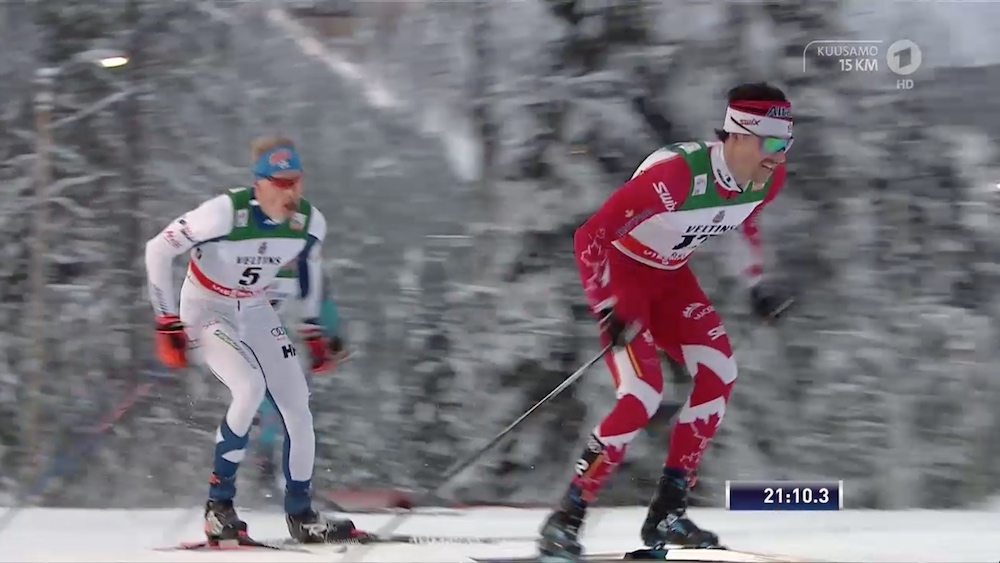
Canadian World Cup Team member Alex Harvey leads Finland’s Iivo Niskanen during the men’s 15 k freestyle pursuit on Sunday, the final day of the Ruka Triple mini tour in Kuusamo, Finland. (Screenshot: ARD)
Harvey had spent the first three laps working up to that lead group, initially with the likes of Russia’s Alexey Chervotkin (*who reportedly thanked Harvey after the race) and Sergey Ustiugov, Norway’s Hans Christer Holund and Sweden’s Marcus Hellner, and later with France’s Maurice Manificat, Sweden’s Calle Halfvarsson, Norway’s Emil Iversen, Chervotkin, and Holund, among others.
“I knew there’d be some fireworks on the last lap so I just wanted to be in the front third of the group, just be ready for a move,” Harvey explained in a post-race phone interview. “I thought Sundby would be the guy making the move, which in the end, that’s what happened. The big uphill in the last lap, that’s where he went. I just wanted to be close to Sundby and ready to respond when Sundby went.”
Sundby attacked as predicted on the second-to-last climb, around 13.6 k, and Harvey slotted behind him to follow him over the top.
“I was just actually there on that last uphill when Sundby attacked,” Babikov recalled. “Klæbo was right there. I think there were just Norwegian tactics … Sundby attacked on the last uphill and Klæbo just cooled down and wasn’t chasing him at all, so for Alex, that was his only chance. … If he didn’t chase him, then Sundby probably would have skied away and it would have been a bigger group at the finish, but at the moment he tried, and they actually created a gap … Alex second and Sundby first.”
With a few meters separating them from Norway’s Didrik Tønseth in third and Klæbo in fourth, Harvey thought he and Sundby had dropped them and that he would fight for first to the finish.
“I kind of went all-in with the Sundby move,” Harvey said. “When I looked in between my legs just before the last downhill I thought we had a big enough gap … so I was feeling pretty good about my chances there, but not good about taking [Sundby] because I was really, really dead.”
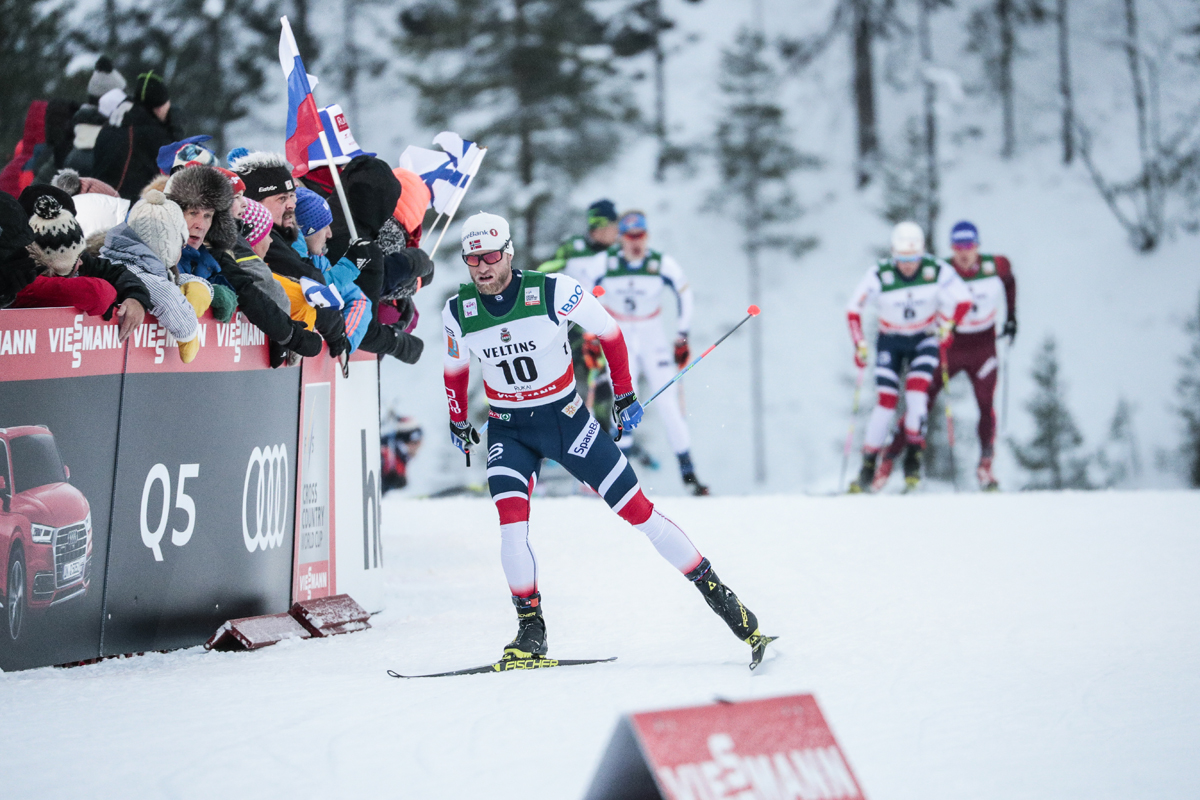
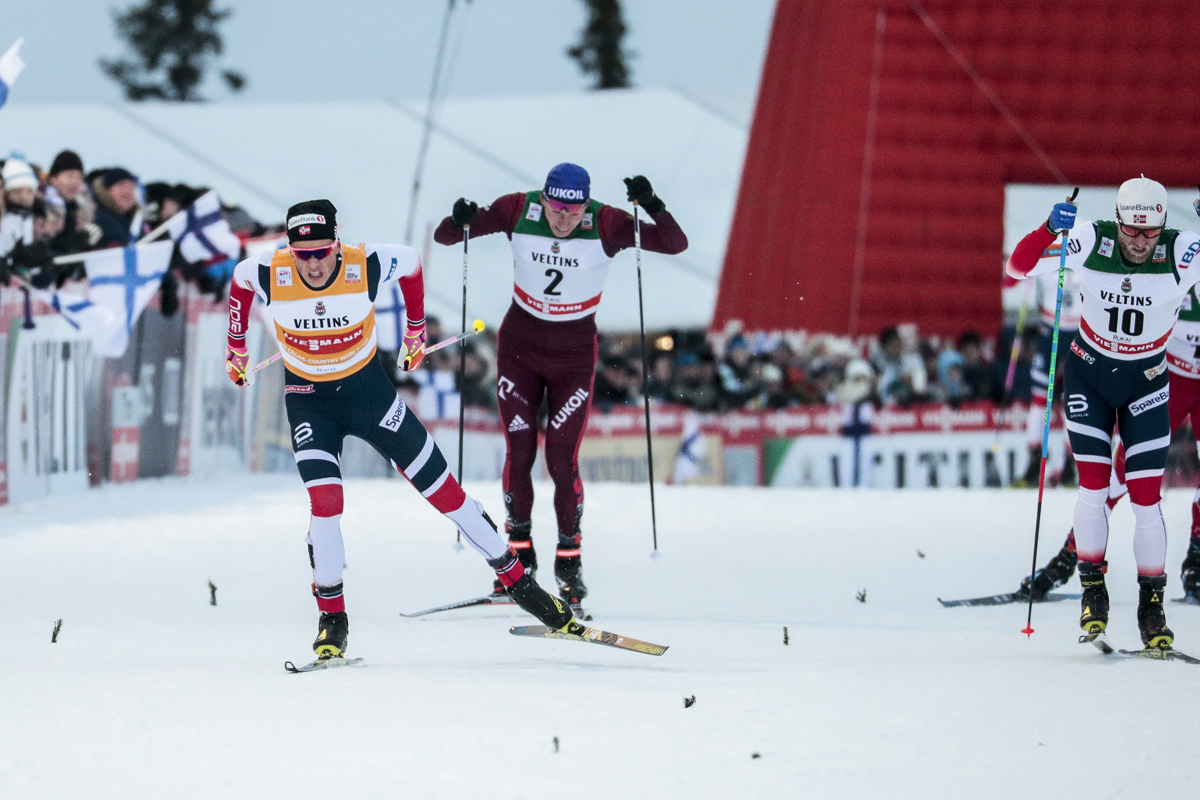
Johannes Høsflot Klæbo (l) passing fellow Norwegian World Cup Team member Martin Johnsrud Sundby (10) for the win in Sunday’s 15 k freestyle pursuit at the Ruka Triple mini tour in Kuusamo, Finland. Russia’s Alexander Bolshunov (2) was 1 second back in third place for his first World Cup podium while Canada’s Alex Harvey (behind Sundby) placed fourth. (Photo: Fischer/Nordic Focus)
After what Harvey estimated to be a 45-second downhill, he realized that wasn’t the case. Klæbo and Bolshunov had slingshot back toward the front, and while Sundby was first to the top of the last climb before the finish, Klæbo and Bolshunov were right behind him while Harvey followed in fourth.
They entered the stadium together in that order, and Klæbo passed Sundby with about 100 meters remaining to take his third-straight win of the weekend.
“Coming out of my tuck there I was just full of lactate, not feeling any fresher … then I just got passed on the hill,” Harvey recalled. “I had nothing left. That was my move. … I’m happy I made that move, but I couldn’t make a second burst after that.”
While Klæbo won the pursuit and with it, the Ruka Triple mini-tour title in 36:23.2 minutes, Sundby placed second, 0.4 seconds back, Bolshunov claimed his first World Cup podium in third (+1.0), and Harvey finished another 0.6 seconds back in fourth (+1.6).
On the day, Harvey’s course time ranked fifth fastest behind Manificat, who was the “winner of the day” in 34:50.9. Finland’s Matti Heikkinen was second fastest (+5.4) after starting 22nd and placing 14th, Holund was third fastest (+7.5) after starting 14th and finishing ninth, and Switzerland’s Dario Cologna, who started 26th and finished 17th, was fourth fastest (+8.7).
Harvey said starting 17 seconds behind Sundby was a tall task on its own, and he had started the race with a goal of breaking into the top 10 overall. All things considered, fourth place was better than he expected at this point in the season.
“… But I knew it was still within reach,” Harvey explained. “I believed in it, but I didn’t put too much hope in, let’s say, a top five or fighting for the podium. It was more like I wanted to be back in the top 10 and just that to me seemed already hard enough.”
Norway’s Johannes Høsflot Klæbo after winning the 15 k freestyle pursuit on Sunday to win the Ruka Triple mini tour in Kuusamo, Finland. (Photo: Fischer/Nordic Focus)
The fact that he was able to hang with Klæbo and Sundby to the finish was a good sign, he added.
“Right now, he’s not just a good sprinter, he’s the best distance skier in the world, too,” Harvey said of Klæbo. “I mean, to win a 15 k individual you have to be in very, very good physical shape, so he’s in really good physical shape and I know I’m not yet. I’m not in my best form and Sundby probably isn’t yet, so you never know what’s going to happen later in the season at the Olympics, but for now it’s hard to drop him when he’s actually just in better shape than everybody else in the world.”
After the race, Klæbo told NRK he was relieved to get the win and have some time to rest before next weekend’s World Cup in Lillehammer, Norway.
“My legs are shaking now,” Klæbo said. “Feels incredible to be the first to cross the finish line. Now I need a few days rest.
“This was brutal,” he added. “I’m actually glad they caught up to me and luckily I had good skis. I’m glad I had a few seconds today.”
Norwegian national-team coach Tor-Arne Hetland told NRK he was “really impressed” with Klæbo. “We have a diamond in the sport of cross country skiing now,” Hetland said.
“That’s very nice of him to say. It’s probably a little too much, but it has been a good start to the season,” Klæbo responded to NRK.
Sundby spoke excitedly about having Klæbo to contest for the overall World Cup lead.
“For the moment, he’s taking international cross-country skiing for men to a whole ’nother level,” Sundby told NRK. “It is a little humiliating for the rest of us, but at the same time it’s extremely inspiring to see what he does in his second year at this level. It’s hell of fun to have a guy like that on the team.”
Bjornsen 26th, Kershaw 29th; Caldwell Posts Top-20 Time of Day
Canada had two in the top 30 on Sunday with Devon Kershaw in 29th (+1:47.8), scoring World Cup points for the second-straight day. He started 28th and 1:59 out of first, just one second behind Cologna in 26th and Russia’s Andrey Larkov in 27th.
“I just wasn’t strong enough to go with Dario,” Kershaw said on the phone. “I had the perfect chance to be able to follow Dario up the field, but he just started so fast, and on the steep terrain, my legs just — I tried up the first steep wall and at the top, I’m like, man, if I keep going like this, after 5 k I’m gonna be dead.
Canada’s Devon Kershaw (28) leads American Erik Bjornsen (23) and others during the World Cup men’s 15 k freestyle pursuit on Sunday in Kuusamo, Finland. (Photo: Fischer/Nordic Focus)
“So I had to manage my energy a little bit and in the end, it turned out that Bjornsen and I’s group just wasn’t strong enough,” Kershaw continued, referring to U.S. Ski Team member Erik Bjornsen, whom he started eight seconds behind and spent most of the race with. “[Our group] had a good 7 1/2 k and then after that, between 7 1/2 kilometers and 12 k, we were skiing really slow. So that’s a bit frustrating in a pursuit because you’re just stuck there in no-man’s land.”
While he felt like he was skiing the flats well, Kershaw said he struggled with the “biting” conditions, which seemed to limit glide, especially on the notoriously steep course’s climbs.
“I had to make the choice to be like, OK, I’ve got to just stay in this group and I’m not strong enough to drive the bus, because my legs just weren’t there today on the terrain” he said. “In the end I made a tactical error in the last 600 meters. I should’ve followed Bjornsen on the outside and I went on the inside and was hoping it would open up for me and it didn’t. So I ended up 29th, but that’s OK.”
Bjornsen started 24th and finished the pursuit in 26th (+1:43.6), after following Larkov in 25th (+1:42.8) across the line and holding off Iceland’s Snorri Einarsson (a former Norwegian skier who raced for the University of Utah) in 27th (+1:46.2), Great Britain’s Andrew Musgrave in 28th (+1:47.2), Kershaw in 29th, and France’s Jean-Marc Gaillard in 30th (+1:49.2).
“I started right around Cologna and [Finland’s Matti] Heikkinen but there was no way I was going to hold their pace, they were flying,” Bjornsen wrote in an email. “I had to settle in with the group around me. It soon became clear our group was not going to catch anyone in front of us or get caught, so it became a tactical game. Some surges, but for the most part nobody wanted to lead.”
Devon Kershaw (Canadian World Cup Team) en route to 29th in the 15 k freestyle pursuit on the last day of the Ruka Triple World Cup mini tour in Kuusamo, Finland. (Photo: Fischer/Nordic Focus)
Kershaw laughed when he talked about some “tips” he gave Bjornsen during the race.
“He had really fast skis so there were a few times that he came by me on the downhill and then would kind of try to hammer for a minute and then get tired and slow down again,” Kershaw said. “I told him, like, ‘Dude, you’ve got great skis. Unless you can stay in the front and really press, then it’s better just to play the game and wait for the end.’ After that, he did that and he torched us all in the end. So that was kind of fun to see for him.”
According to Bjornsen, Kershaw suggested he sit back and wait for the sprint.
“My skis were good but I think my weight is what helped me the most on that last huge downhill,” Bjornsen wrote. “I was fine going for that tactic but at the same time it would have been nice to leave a little more out there today. Stoked to get double points for 26th though!”
Paddy Caldwell (U.S. Ski Team) racing to 70th in the men’s 15 k classic on Saturday, Day of the Ruka Triple World Cup mini tour in Kuusamo, Finland. In Sunday’s 15 k freestyle pursuit, he skied up to 51st with the 19th-fastest time of day. (Photo: Fischer/Nordic Focus)
Paddy Caldwell, new to the U.S. Ski Team B-team this year, posted his best World Cup result with the 19th-fastest time of day, 50.5 seconds back from Manificat. He started with the wave in 70th and finished 51st overall (+3:03.1).
“Going into the race my goal was to move up as much as possible,” the 23-year-old Caldwell wrote in an email. “I wasn’t really thinking about place or time of day – I was just trying to ski fast and put together a good effort.
“It was really hard to move up in the pack,” he added. “I started midway back in the wave and we kept picking up more and more skiers as the race went on. I tried to relax as much as possible on the hills and build in energy to pass where I could on the flats. … I am really excited with the day and psyched to have had a good result here in Ruka. I’m looking forward to the rest of period 1 and learning more from the big dogs!”
“Very exciting race out of Erik today,” U.S. Ski Team coach Matt Whitcomb commented on the phone. “… When he settled to the back of his pack on Lap 6 and headed into the downhill with one climb to go, we just all sort of expressed confidence over the U.S. radio channel, got ready see what he could do. It is so fun to watch him in a stadium when he has to go head to head against five other athletes … he did not disappoint today. Really proud of Erik’s 26th place.”
As for Caldwell, who skied the 25th fastest time of day in the 2017 World Cup Finals freestyle pursuit, Whitcomb said, “this is his race, the skate distance.”
“There were times that he was a little bit road-blocked out there, just the way the pursuit race unfolds in that start … and it looked like today Paddy could keep going, so really great signs out of him,” Whitcomb said.
Whitcomb also highlighted the races of Scott Patterson, who raced up from 78th to 55th (+3:28.4) with the 31st-fastest time, and Noah Hoffman, who improved from 45th to 39th (+2.33.3) with the 35th-fastest time. Also for the U.S., Andy Newell finished the tour out in 75th (+5:39.6).
American Paddy Caldwell (70) racing with Sweden’s Jens Burman (front) and Canada’s Len Valjas (46), among others, during Sunday’s World Cup 15 k freestyle pursuit on the last day of the Ruka Triple in Kuusamo, Finland. (Photo: Fischer/Nordic Focus)
Canada’s Len Valjas moved up two places for 44th overall (+2:47.5), Graeme Killick finished the tour in 68th (+4:39.5), Knute Johnsgaard 81st (+6:43.6), and Julien Locke 83rd (+7:33.6).
Babikov pointed out that Valjas had a shoulder injury that he mostly recovered from, but caused him to struggle with double poling in Friday’s sprint. Despite placing 63rd in that sprint, Valjas was the team’s third-best man in the weekend’s distance races.
“[In] two distance races, he was third best and actually placed higher than he placed in sprint in the distance, 15 k, hardest one with lots of climbing,” Babikov said. “So that shows he has a good shape, but just needs to scrape that rust off and remember how to go fast again. I think physically he is in a good place, just need to do some more races, and it will come.”
***
*Post-race sidenote: According to Harvey, after the race, the Russian team’s massage therapist told Canadian coach Ivan Babikov that Chervotkin wanted to thank Harvey for pulling him in the pursuit. Chervotkin, 22, started 11th and finished fifth, 6.2 seconds out of first and 4.6 seconds after Harvey in fourth.
“There’s a bit of beef with the Russians and me right now,” Harvey said. “I came in wondering if they were just going to punch me in the face. They said they wanted to break my teeth, so this is a good turn of things.”
“I read that in the Norwegian news, actually, that Petukhov wanted to …,” he said with a laugh. “But I knew the media likes that sort of thing. But I think things are good now.”
Harvey noted that Bolshunov and Chervotkin, neither of which have been implicated in the doping scandal, are part of “a new generation” in Russian cross-country skiing. “I saw the results in Bruksvallarna; it looks like the have almost as much depth as Norway does. They’re really strong.”
— Aleks Tangen, Ian Tovell, Jason Albert, and Harald Zimmer contributed
Racers in the Ruka Triple World Cup 15 k freestyle pursuit, including Russia’s Andrey Larkov, Switzerland’s Jonas Baumann, Italy’s Federico Pellegrino, Switzerland’s Dario Cologna, and Norway’s Simen Hegstad Krueger, ascend a climb in Kuusamo, Finland. (Photo: Fischer/Nordic Focus)
Finland’s Iivo Niskanen (c) celebrates his World Championship title as Norwegians Martin Johnsrud Sundby (l) and Niklas Dryhaug hoist him above their shoulders after the men’s 15-kilometer classic race at the 2017 Nordic World Ski Championships in Lahti, Finland. (Photo FIS/FIS twitter)
Welcome to World Cup Windup, where we check in with the top-10 teams from last year’s FIS Cross Country World Cup tour before the season starts with the Ruka Triple in Kuusamo, Finland, on Nov. 24.
FINLAND
Overall in Nations Cup Last Year:Third, by just 106 points over Russia
Women’s Ranking 2016/2017:Third
Men’s Ranking 2016/2017:Fourth
Who’s Back:
World Cup overall title runner-up Krista Parmakoski, fifth-place Matti Heikkinen, and eighth-place Kerttu Niskanen; Iivo Niskanen, fourth in the distance standings (behind Heikkinen in third); and Laura Mononen, ninth in the distance standings. Plus, podium finisher Anne Kylloenen, and Aino-Kaisa Saarinen who returned to World Cup action after maternity leave and scored some top-tens.
Who’s Missing:
Sami Jauhojärvi. The veteran, who raced on the World Cup for 16 seasons and teamed up with Iivo Niskanen for gold in the 2014 Olympic team sprint, called it quits this spring. “I’m not tired of skiing, but at some point it just happens that competitive instincts begin to fade,” Jauhojärvi told InsideTheGames. “By training I could be pushing my limits for a few more years, but my competition mind is done. … I do not think any more about fighting for gold medals at future Olympics.”
Pre-Season Results:
Finland’s Krista Parmakoski skis to silver, her first World Championships medal, in the women’s 15 k skiathlon at 2017 Nordic World Championships in Lahti, Finland. (Photo: John Lazenby/Lazenbyphoto.com)
Only a few of the team’s distance skiers competed so far. KristaParmakoski won a 5 k classic in Muonio, Finland, while Anne Kylloenen won a 10 k skate where Laura Monenen was third and Aino-Kaisa Saarinen fourth, and Iivo Niskanen finished second to Russia’s Alexey Chervotkin in a 15 k skate the same day. Ristomatti Hakola won the sprint in Muonio.
Recent Drama:
According to the Finnish press, this will be the last Olympics for Matti Heikkinen, who will be 34 years old. He is targeting all the long-distance races and possibly the team sprint. Iivo Niskanen, meanwhile, will not to contest the skate races at the Olympics and focus on classic.
Kerttu Niskanen changed trainers this year, and her new choice is controversial. She is working with Pekka Vähäsöyrinki, one of the coaches involved in the 2001 blood-doping scandal which resulted in suspension of the Finnish ski association. The coach was found to have lied in court; there are allegations that when he was the national team director, he gave EPO and growth hormones to the head coach to use for the athletes.
Finland’s Kerttu Niskanen racing in the women’s classic team sprint at 2017 World Championships in Lahti, Finland, where her team (with Aino-Kaisa Saarinen, not shown) ultimately placed fifth.
“For several seasons I have remained at about the same level,” Niskanen told the news agency YLE. “So I want to try something new. “For me [the allegations] are just that. History… People may think what they want. It does not matter to me.”
Meanwhile, Krista Parmakoski is helping to organizing a youth ski racing series in her home district, called the “Krista Cup”. It will be a series of six races open to 7- to 16-year-olds and she will help organize the prizes. “It is important to encourage and inspire young skiers in every way, especially in the Häme district,” she told the local newspaper. “I still remember how much fun we young people had running around, seeing skiers and enjoying the atmosphere. With the Cup, young people can experience fun cross-country races throughout the winter.”
Best Social Media Presence:
On the women’s team, both Krista Parmakoski (Instagram) and Kerttu Niskanen (Instagram) provide consistent posts of training and daily life, as does Laura Mononen (Instagram).
Sprinter Lari Lehtonen has an active Facebook page, posting almost daily, and often includes training videos. Iivo Niskanen is also a consistent Twitter and Instagram poster, where you can see his hobby of horse racing as well.
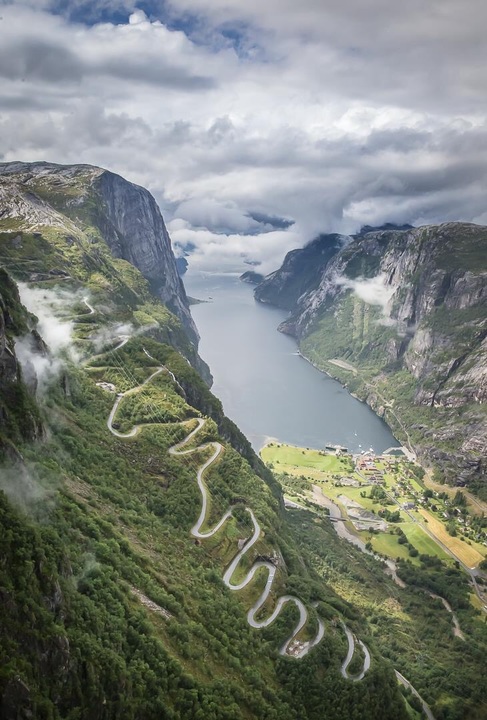
The 7.5-kilometer race course for the Lysebotn Opp, an annual hill climb at the Blink Ski Festival in Lysebotn, Norway. (Photo: Blink Ski Festival/ Facebook)
There’s a little more than six months to go until the opening ceremony of the 2018 PyeongChang Winter Olympics. For the recently turned 30-year-old Charlotte Kalla, a two-time Olympic gold medalist and three-time silver medalist from Sweden, nothing would be sweeter than to capture another gold this winter in South Korea.
Her last individual Olympic win came in 2010 in Vancouver, B.C., when she took first in the women’s 10-kilometer freestyle. A repeat podium in the PyeongChang 10 k skate is not far from her thoughts.
“It is a race that is certainly on my mind,” Kalla told NRK on Thursday, according to a translation.
What better way for Sweden’s 10 k favorite to practice than at the Blink Ski Festival’s Lysebotn Opp, an annual 7.5 k freestyle rollerski hill climb in Lysebotn, Norway? With names sure to contest her at the Olympics –including Norway’s Marit Bjørgen and Heidi Weng, as well as Finland’s Krista Pärmäkoski, Germany’s Stefanie Böhler and American Liz Stephen — on the start list for Thursday’s race, Kalla couldn’t resist entering herself.
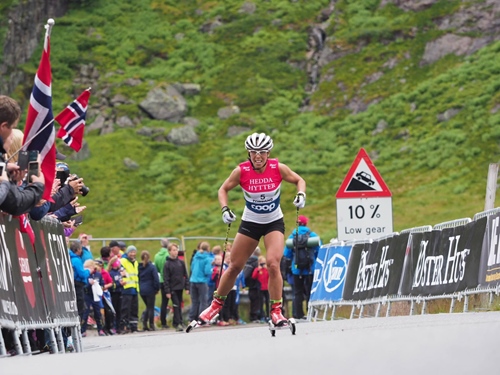
Sweden’s Charlotte Kalla (r) racing to the win in the Lysebotn Opp, a 7.5-kilometer uphill climb, at the 2017 Blink Ski Festival on Thrusday in Lysbotn, Norway. (Photo: Axelar/Arild Aarnes)
If her performance in the rollerski race is any indication of where Kalla is headed this winter, it’s the direction she wants. After breaking away with Bjørgen, Pärmäkoski and Weng early on in the race to form a lead pack of four women, Kalla quickly decided to make the race her own.
Within the next few kilometers, Kalla dropped the two Norwegians and Pärmäkoski and went on to finish first in a time of 33 minutes, 18.3 seconds. Weng followed 40.3 seconds later and Bjørgen crossed in third, 1 minute and 50.5 seconds back.
Notably, Kalla’s time was faster than 57 out of 100 elite men that raced the same 7.5 k course later on Thursday.
“One shouldn’t focus too much on what happens in July, there is a lot left to be done before the season, but it’s been long since I’ve been in this good a shape in July. The last time was probably 2013,” Kalla told NRK.
The Lysebotn Opp’s 2014 champion,Stephen finished sixth overall (+3:35.7) on Thursday, after Norway’s Ragnhild Haga in fourth (+2:43.4) and Pärmäkoski in fifth (+2:47.0). Prior to winning three years ago, Stephen also placed third in the famous rollerski hill climb in 2012 (the Lysebotn Opp was added to the festival in 2010).
In the men’s 7.5 k uphill race that followed, Hans Christer Holund broke away for the win in 27:37.6, besting fellow Norwegian Simen Hegstad Krüger in second (+1:13.9) and Finland’s Matti Heikkinen in third (1:25.6).
Holund took it out strong from the start, holding his lead through the climb’s entirety.
Norway’s Hans Christer Holund after winning the men’s 7.5-kilometer Lysebotn Opp rollerski hill climb on Thursday at the 2017 Blink Ski Festival in Lysebotn, Norway. (Photo: NRK screenshot)
“I am healthy and have done some solid training this summer,” the 28-year-old Holund told NRK after. “It looks promising. There’s still a lot of time Olympics, but it does look promising. It is so competitive in Norway and it’s tough to just be selected. If I am selected for the Olympics when the time comes then I will be good enough and then an Olympic gold-medal is the next task.”
Norway occupied seven of the top eight on Thursday, with Henrik L’Abée-Lund in fourth (+1:59.6), Sjur Røthe in fifth (+2:05.7), Martin Johnsrud Sundby (Wednesday’s 60 k winner) in sixth (+2:11), Simen Andreas Sveen in seventh (+2:12.4), and Gaute Kvåle in eighth (+2:14.7).
Andy Newell of the U.S. Ski Team did not race the hill climb, but he was back for the 15 k mass start on Friday (as was Stephen for the women’s 10 k). Stay tuned for results in a separate report.
Norway’s Johannes Høsflot Klæbo (r) crossing the line first in the men’s 15 k classic mass start on Saturday at World Cup Finals in Quebec City, 0.5 seconds ahead of fellow Norwegian Niklas Dyrhaug (12), who placed second. Russia’s Alexander Bessmertnykh (behind Dyrhaug) followed in third, just ahead of Canada’s Alex Harvey (1) in fourth. (Photo: John Lazenby/Lazenbyphoto.com)
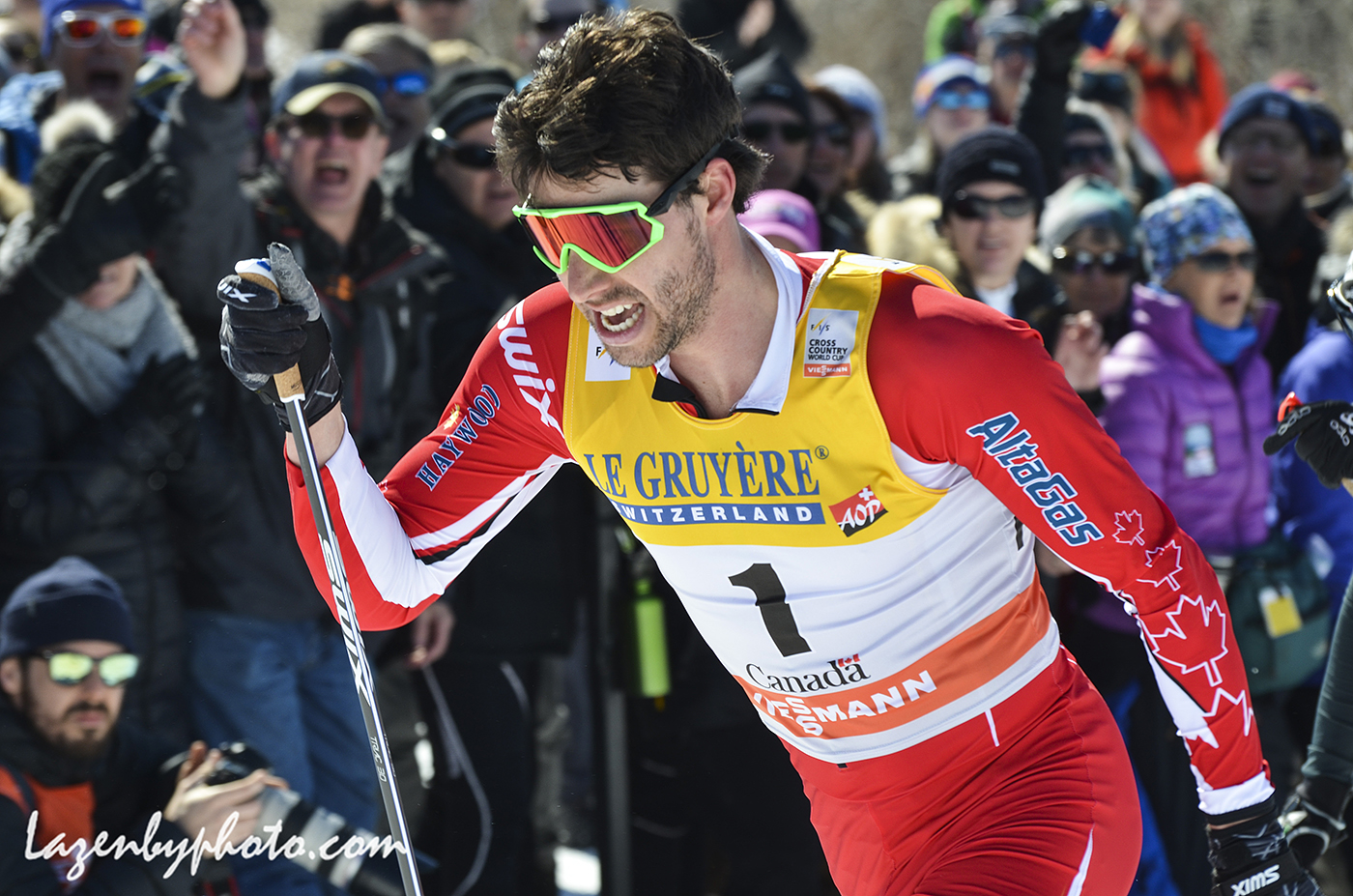
QUEBEC CITY — As 75 men jogged out into the center of the World Cup area assembled on the Plains of Abraham for the men’s 15-kilometer classic mass start on Saturday, one man in particular stood out. Alex Harvey, wearing the red suit of the Canadian national team, led the group out. He wore bib No. 1, but if you couldn’t see that from a distance, it didn’t matter. Essentially everyone knew who he was.
The official hashtag of World Cup Finals in Quebec City this Friday through Sunday has been #GOALEX2017. He is a celebrity in Quebec, a hero to its locals, and someone even non-skiers know quite a bit about.
And so far, the 28 year old appears to be soaking up every minute of his homecoming. One day after winning the freestyle sprint to start the finals, Harvey was seeded first in Saturday’s classic mass start. He led racers into the stadium, waved to spectators, started on the front line, and led the pack out of the stadium.
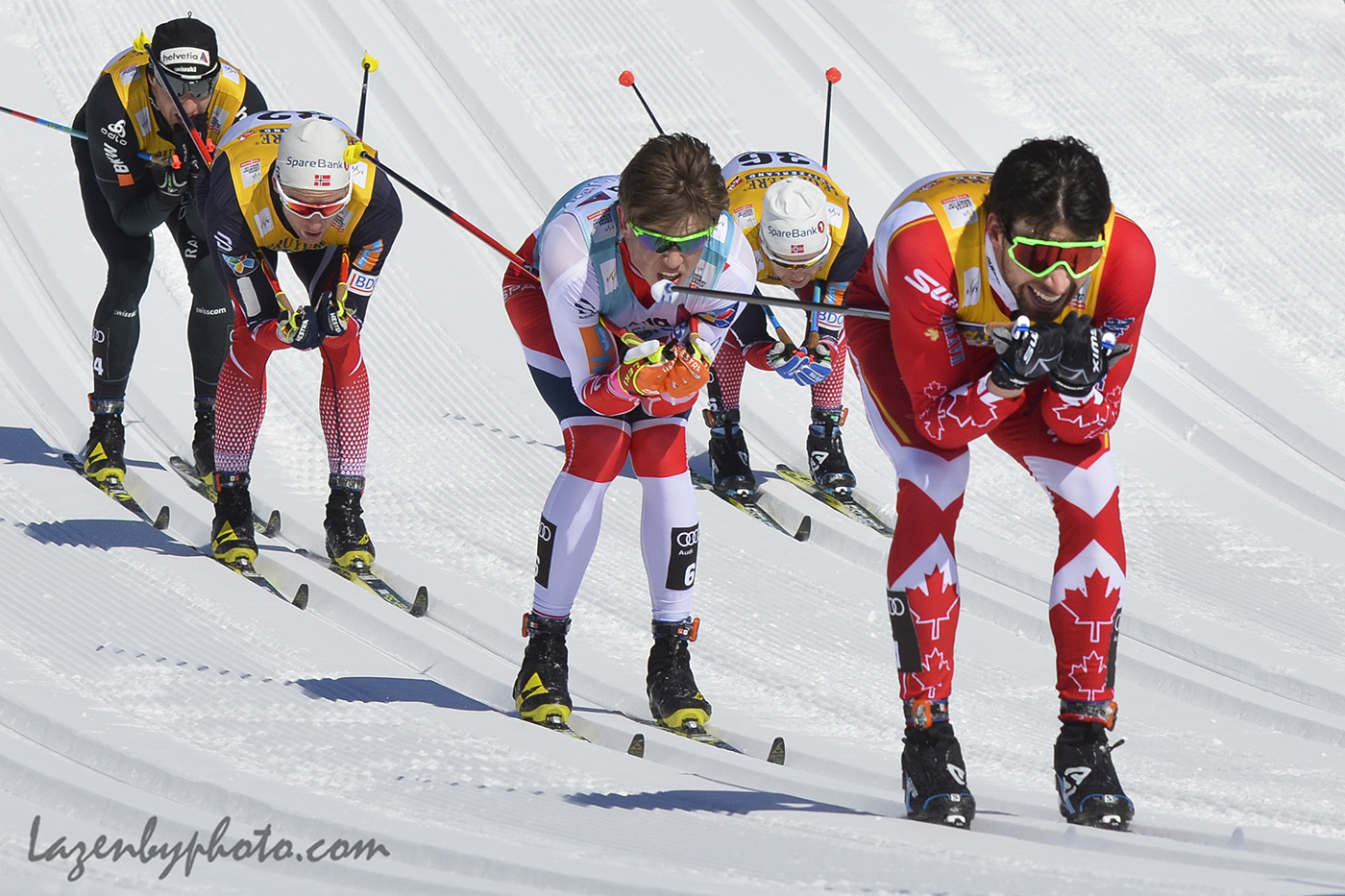
Canada’s Alex Harvey leading Norway’s Johannes Høsflot Klæbo and two other Norwegians and Switzerland’s Dario Cologna (far left) during the men’s 15 k classic mass start on Saturday at World Cup Finals in Quebec City. (Photo: John Lazenby/Lazenbyphoto.com)
Even when others took turns leading, with Norway’s Niklas Dyrhaug, Emil Iversen and Johannes Høsflot Klæbo setting the pace on the first of four laps, the possibility of Harvey winning never seemed in doubt. He consistently positioned himself within reach of the lead, skiing around sixth for much of the first lap.
On Lap 2, the lead group remained about 30 strong. Harvey skied within two seconds of the Norwegians up front, with Pål Golberg, Didrik Tønseth, Finn Hågen Krogh, Dyrhaug, and even Klæbo — the 20-year-old Sprint World Cup champion — all still in contention. By the end of Lap 3, Harvey was into second, right behind Tønseth.
With 3.75 k to go and the crowd’s ability to see the racers on most of the exposed course, the excitement among Harvey fans began to exceed its already high point from the start. Bells, horns, “Gooo Alex!”
Russia’s Alexander Bessmertnykh attacked on an uphill and Harvey stuck behind him in second. On the second to last climb, a short and steep pitch that ascends up from the Old City’s historic wall, Dyrhaug surged into first, Bessmertnykh followed him in second and Harvey in third.
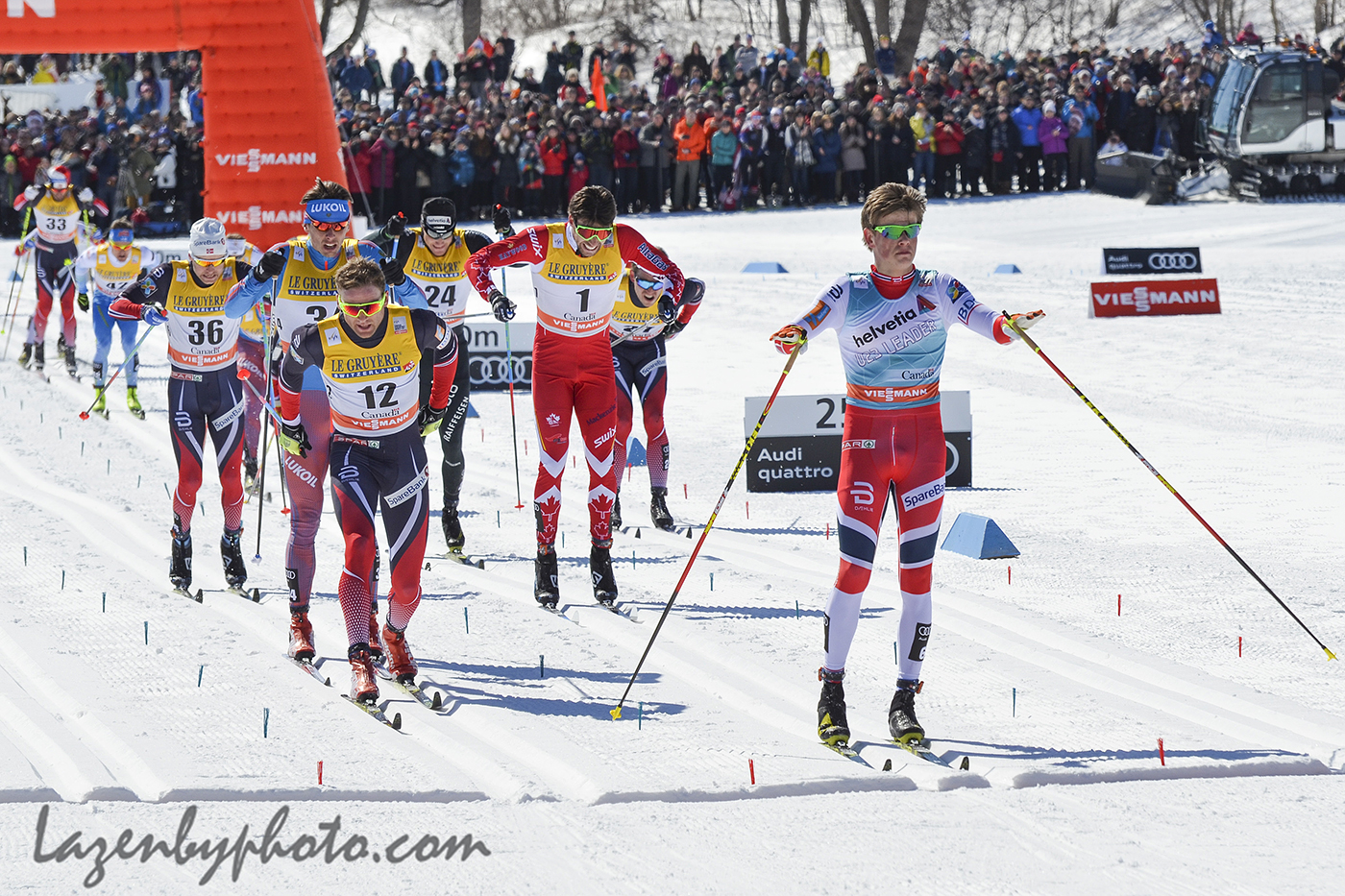
Behind them, Klæbo was sizing them all up in fourth, waiting for the perfect time to strike. He did so by moving to the outside lane on the last long downhill and glided into second behind Dyrhaug. They ascended the final pitch together and rounded the final corner before the 100-meter stretch to the finish, where Klæbo continued to accelerate past Dyrhaug and double poled to his first World Cup distance win in 35:23.7 minutes. Dyrhaug finished 0.5 seconds later for second place, Bessmertnykh 0.8 seconds back in third, and Harvey 1.2 seconds behind Klæbo in fourth.
Canada’s Alex Harvey racing to fourth in the men’s 15 k classic mass start at World Cup Finals in Quebec City. With one race left, the 15 k freestyle pursuit, he is third in the mini tour and third in the Overall World Cup as well. (Photo: John Lazenby/Lazenbyphoto.com)
While it wasn’t a podium for Harvey, it was a result he was proud of.
“I’m very satisfied,” he told reporters afterward in French. “Making the top 10 is always a big deal. Today was another step towards securing a third spot in the overall [World Cup]. That was my big goal coming in. So I’m satisfied … You can’t make the podium every time. I felt very good physically.”
With one World Cup race remaining, Harvey, who’s ranked third in the world, extended his lead on Finland’s Matti Heikkinen in fourth to 92 points. Heikkinen finished 26th on Saturday, 1:04.9 minutes out of first, and will start Sunday’s 15 k freestyle pursuit 27th, 2:15 behind Klæbo as the World Cup Finals mini-tour leader. Dyrhaug will start 22 seconds back in second, followed by Harvey 1 second later in third, and Krogh another 11 seconds back in fourth.
“Every pursuit is a manhunt so I’ll be hunting the young Norwegian in front,” Harvey said. “It was Klæbo’s first victory in a distance event. We saw him come in second behind Sundby in this year’s first mini tour. So of course, he’s strong. I mean, the guy won five or six gold medals at the Junior Worlds. He’s a complete skier…”
Asked if he thought he could work with Dyrhaug to reel Klæbo in, Harvey wasn’t counting on one Norwegian helping him bridge the gap to another.
“I don’t think Dyrhaug will chase, but I will,” Harvey said.
Dyrhaug told reporters that might not be the case.
“Tomorrow is going to be an exciting day,” he said in English. “I saw that me and Alex are going out together, so it is in both of our interests to cooperate and do good teamwork, and hopefully we can catch Johannes and then we’ll have to see…
“We ought to talk together with team staff, hear what Johannes says, too,” he added. “But it is in both interests to have a big gap behind [us]. So if I’m strong, I’m thinking maybe I’m going to help Alex to … yeah, and we’re going to cooperate.”
In the last year that Klæbo’s been racing World Cups, the three-time 2016 junior world champion (in the freestyle sprint, 10 k classic and freestyle relay) has reached the podium six times in individual World Cups and claimed bronze in the freestyle sprint at this year’s World Championships. But before Saturday, all of his podiums (with the exception of one mini tour) had been in sprints.
“I hadn’t dreamed about doing a distance race in the World Cup … and cross the finish line in first,” Klæbo said after. “It’s unbelievable.”
Johannes Høsflot Klæbo leading three other Norwegians, Emil Iversen (l), Finn Hågen Krogh (second from l) and Niklas Dyrhaug (r) during the men’s 15 k classic mass start at World Cup Finals in Quebec City. Klæbo went on to win, Dyrhaug placed second, Krogh 16th, and Iversen 25th. (Photo: John Lazenby/Lazenbyphoto.com)
He was the most consistent race leader on Saturday, winning one of sprint preems and crossing in second behind his teammate Iversen for the other. In all, he accumulated 27 bonus seconds, which were deducted from his overall time in the mini tour — putting him first by 22 seconds over Dyrhaug.
“I just tried to be in the front for the bonus seconds to be able to get some seconds,” he explained of his race tactic. “So that was my plan.”
Despite trying to lead for most of it, he noticed others trying to do the same on the third and fourth laps. In the final stretch of the race, coming off the long downhill toward the finish, Klæbo focused on moving up from fourth.
“Niklas gapped our group in the last downhill there so we had push really hard on the last uphill to get to him,” he explained. “At the finish, it was just all out.”
Bessmertnykh, who will start the pursuit in 13th, 1:08 back, after placing 59th in Friday’s sprint, described Saturday’s mass start as “a fun race,” in a post-race interview with the International Ski Federation (FIS). “There was a lot of things happening all the time. I followed Niklas and Johannes on the last climb. We gained a small gap. I managed to ski well the last curve before the homestretch and carried in good speed.”
Dyrhaug was also satisfied with his race.
“The only thing was, I was one meter behind in the end,” he said. “I tried my best. I went all in for a long sprint, when it was one half k left, and it was almost.”
Under blue skies and a beating sun, Dyrhaug described Saturday afternoon in Quebec as “amazing.”
“We have been competing for like 40 races this year, but this is the most pretty day, and most pretty conditions for the whole year, so thank you, Quebec,” he said.
Waxing was a challenge, with temperatures warming quickly to about 2 degrees Celsius (mid-30s Fahrenheit) by midday.
Canada’s Devon Kershaw (r) and Graeme Killick (l) skied together for most of Saturday’s 15 k classic mass start after Kershaw broke a pole early. They went on to place 28th and 32nd, respectively. (Photo: John Lazenby/Lazenbyphoto.com)
Devon Kershaw was the second Canadian in the top 30, finishing 28th (+1:08.4) after breaking a pole early on.
“It was pretty chaotic and broke a pole there pretty early in the start and went all the way back into the 60’s, so made for a lot of work to try to get back in,” he said after. “I am proud of the fact that I was able to ski back into the points, but I had a better body than that today for sure and just had a bit of bad luck there.”
He finished 9.3 seconds ahead of his Canadian World Cup teammate Graeme Killick, who placed 32nd (+1:17.7), and the two essentially skied together from 5.25 k on.
While Kershaw said he thought the 3.7 k course would be better suited to skating, he was impressed with the atmosphere and the race organization.
“I think for a classic, there are a lot of corners and it’s pretty tight … [but] to bring the skiing to the people like they did and to use the terrain they have available, I tip my hat, its a great event,” he said. “It is the most crowds I have ever skied with in Canada, the sun is shining, the venue is fantastic, the organizers did a great job, the tracks are in perfect condition. What a great place to race.”
Erik Bjornsen led the U.S. men in 31st (+1:16.8) and two seconds behind Switzerland’s Roman Furger in 30th. After losing contact with the lead group of 29 on one of the bigger climbs at the end of the second lap, Bjornsen found himself skiing in “no-man’s land” with Sweden’s Teodor Peterson.
Erik Bjornsen (U.S. Ski Team) leads Sweden’s Teodor Peterson (r) up a climb during the men’s 15 k classic mass start at World Cup Finals in Quebec City. They went on to place 31st and 29th, respectively. (Photo: John Lazenby/Lazenbyphoto.com)
“It was a bummer to lose that front pack,” Bjornsen said. “I was struggling on the hills out there; I was a little light on kick. I think a lot of the guys were, but I wasn’t doing much striding. It was pretty much from double pole, to having to run outside the track. I felt pretty good, but I was losing time.”
While skiing with Peterson, Bjornsen said he led at times and wanted Peterson to help drive the chase as well. Peterson ended up just ahead of him in 29th (+1:14.3).
“I was like, ‘Come on, dude.’ I could see that there was a group behind, chasing us, and we were kind of right in that no-man’s land, which is always a bad spot to be,” he said. “But it was fun. It’s fun to be racing in North America, and have people cheering my name. It’s so unique, and I love it. I wish we could race over here more often.”
Matt Gelso was the second American in 37th (+1:32.6), Andy Newell finished 45th, Scott Patterson 46th, Noah Hoffman 48th, Ben Lustgarten 49th, David Norris 50th, Simi Hamilton 54th, Paddy Caldwell 59th, Jack Hegman 62nd, Cole Morgan 64th, and Brian Gregg 69th.
While the U.S. started 12 men, Canada had 15 in Saturday’s mass start with Bob Thompson finishing 55th, Knute Johnsgaard 57th, Len Valjas 61st, Russell Kennedy 63rd, Evan Palmer-Charrette 65th, Andy Shields 66th, Jess Cockney 67th, Brian McKeever 68th, Joey Foster 70th, Gareth Williams 72nd, Ricardo Izquierdo-Bernier 74th, and Julien Locke 75th.
— Gerry Furseth, François Léger Dionne, Jake Ellis, and Ian Tovell contributed
The men’s 15 k classic mass start podium on Day 2 of World Cup Finals in Quebec City, with Norway’s Johannes Høsflot Klæbo (c) in first, Norway’s Niklas Dyrhaug (l) in second and Russia’s Alexander Bessmertnykh (r) in third. (Photo: John Lazenby/Lazenbyphoto.com)
It’s real. Canada’s Alex Harvey after winning gold in the men’s 50-kilometer freestyle mass start on Sunday at the 2017 Nordic World Championships in Lahti, Finland. (Photo: John Lazenby/Lazenbyphoto.com)
LAHTI, Finland — Here’s the basics: fast and firm tracks, cloudless skies, and once again a stacked field for the final event of the 2017 Nordic World Championships: the men’s 50-kilometer freestyle mass start.
Over the course of the 50 k, Canada’s Harvey had to think about one thing: be up front near the top three in order to shadow Norway’s Martin Johnsrud Sundby’s inevitable gut punch in the last kilometer. What he didn’t have to think about was playing catch up as a skier yo-yoing off the back, or his skis — they were rockets.
In Sunday’s closing race of Lahti World Championships, Harvey was slotted in second, sliding around “Lahti Corner” just centimeters behind Sundby. Drafting off Harvey was 2017 championships legend, Russia’s Sergey Ustiugov, who had already racked up four medals previously in the week (skiathlon gold, team sprint gold, freestyle sprint silver and team relay silver). Pulling not far behind the three was Finland’s Matti Heikkinen and Andrew Musgrave of Great Britain.
Russia’s Alexey Chervotkin (21) leads Canada’s Alex Harvey (3) and Sweden’s Marcus Hellner (5) during the men’s 50 k freestyle mass start on Sunday at 2017 Nordic World Championships in Lahti, Finland. Harvey went on to win, Hellner placed 12th and Chervotkin 13th. (Photo: John Lazenby/Lazenbyphoto.com)
“I saw the women’s race yesterday, and I figured if Marit Bjørgen could not distance herself from the other girls, then there is no way that the men will be able to do that,” Harvey said during Sunday’s post-race press conference. “I knew with the fast conditions, it was going to be a big group, and that leaves the potential for a lot of carnage, a lot of mayhem.”
For the first 10 k, skiers from various nations took pulls up front, including Sundby and Ustiugov, and Norwegians Petter Northug, Hans Christer Holund, and Anders Gløersen. After testing the field and breaking away around 8 k into the race, Gløersen was still skiing alone up front, 20 seconds ahead of anyone else at 15 k.
“Gløersen took off a bit and he was like, ‘What’s the gap? What’s the gap?’ ” Canadian World Cup coach Ivan Babikov said of Harvey. “He was always controlling the race and saving energy for the finish.”
Eventually, the main pack surged to recover the lost time. Gløersen’s off-the-front-flier only earned him camera time. The catch came just before Lahti Corner returning to the stadium around 20 k in, where Russia’s Alexey Chervotkin took over. In another 2 k, Sundby, who had been stalking in the top 10, moved to the front as if the race were all of a sudden for real.
Norway’s Anders Gløersen broke away early to lead the men’s 50 k freestyle mass start, skiing alone off the front for about 12 kilometers, on Sunday at the 2017 Nordic World Championships in Lahti, Finland. (Photo: John Lazenby/Lazenbyphoto.com)
From then on, the size of the pack atrophied with each consecutive lap. At 30 k, the pack streaming through the stadium was 24 skiers long. At 45 k, the group winnowed to a train of 19. And within another 4 k, only 13 remained: Sundby, Ustiugov, Musgrave, Harvey, Heikkinen, Northug, Holund, Gløersen, Chervotkin, Sweden’s Marcus Hellner, Norway’s Sjur Røthe, Switzerland’s Dario Cologna, and France’s Maurice Manificat.
“I wanted to be in the front, top three at least,” Harvey said, reflecting on his skiathlon tactics from last weekend, where he skied around fifth up until the final headwall and finished fifth, outside of the medals.
“I knew that Sundby’s first chance to win gold was to break everybody,” Harvey continued. “I was expecting him to leave from kilometer 1 or 49.”
Harvey guessed Sundby would be the only one who would try to break away. With that in mind he marked the Norwegian.
“He knew it would be hard to break away [and that] it will be all about the finish,” Babikov said. “He was positioning himself perfectly up the last hill and just stayed on Sundby. That was his plan, ‘I’m just gonna stay on Sundby and if he changes skis, I’ll go change skis,’ but today conditions were perfect so he didn’t.”
With ripping conditions and skis to match, Sundby never slowed nor switched skis. Neither did Harvey.
“When he waited until the last lap, I knew exactly where he was going to do it: with a k and a half to go,” Harvey explained. “I was just lucky enough to have the legs to stick on him today and from then on it started playing more into my hands.”
Canada’s Alex Harvey (5) charging to the line ahead of Russia’s Sergey Ustiugov (4), Norway’s Martin Johnsrud Sundby (1), Great Britain’s Andrew Musgrave (10) and Finland’s Matti Heikkinen (behind Harvey) in the men’s 50 k freestyle mass start on Sunday at the 2017 Nordic World Championships in Lahti, Finland. (Photo: John Lazenby/Lazenbyphoto.com)
In the closing moments of nearly every race of these world champs, the fate of winners seem come down to luck, and often someone else’s bad luck. As the leaders came into the stadium, it was as if every observer were about to witness an upset due to a tumble or a tangle.
Harvey was clean around the final turn and unscathed down the stretch.
“I wanted to hit the [Lahti] corner in second, right behind Sundby or whoever was in the lead,” Harvey said. “I knew I needed to do that in the skiathlon, too, and I tried to go around Finn Hågen Krogh there, but he’s a clever sprinter too. He knew he wanted to be second there.
“In the skiathlon it didn’t work, but today it did,” Harvey continued. “I was second the whole time and then out of that corner I did one push more than Sundby. I had really fast skis, but used the draft to slingshot and then hit the final corner in first and from there, I knew it was mine to lose more than anything else.”
Canada’s Alex Harvey (5) celebrates his first individual World Championships gold after winning Sunday’s 50 k freestyle mass start in Lahti, Finland, ahead of Russia’s Sergey Ustiugov (4), Norway’s Martin Johnsrud Sundby (1), and Finland’s Matti Heikkinen (2), respectively. (Photo: John Lazenby/Lazenbyphoto.com)
And so Harvey earned the crown: 50 k world champion in 1:46:28.9 hours.
It’s his first championships gold since winning the classic team sprint with Devon Kershaw at 2011 world champs, and fifth medal in four World Championships.
“He turned around these world champs for all of us,” Babikov said of the Canadian team. “He was solid. We were with no medals so far, and winning 50 k, he’s the king now.
“This is the legit distance and he took it today,” he added.
“It’s a long championship,” said Louis Bouchard, Harvey’s personal coach and Canada’s World Cup co-coach. “He feels every day his energy’s still there, so he knows today, if he’s good tactically, then he can do it.”
Asked how nerve-racking it was watching the final 5 k unfold, Bouchard responded, “I was pretty nervous, too much maybe. But that’s OK.”
Alex Harvey’s Canadian teammates, coaches and support team celebrate his win in the men’s 50 k freestyle mass start on Sunday at the 2017 Nordic World Championships in Lahti, Finland. (Photo: John Lazenby/Lazenbyphoto.com)
For his fifth medal of these championships (and sixth world-champs medal of his career), the 24-year-old Ustiugov crossed second for his third silver of the week, just 0.6 seconds behind Harvey. Finland’s 33-year-old Heikkinen took third (+1.4) for his first medal since 2011 World Championships.
“Today I skied within my own limits and at the end I was fresh enough to attack,” Heikkinen said in a press conference.
Asked about his not-so-characteristic finishing kick on Sunday, Heikkinen said he remembered how he faded to 20th in the 50 k classic mass start at 2015 World Championships.
“After Falun 2015 world champs, I was watching the race after and I was walking in front a mirror and I said, ‘I won’t ever again be like that after a 50 k,’ ” he said. “I’ve been training two years now at a high level [with my team] … and that’s why I’m top three in overall World Cup, so it was possible.”
Behind him in a photo finish for fourth, Musgrave capitalized on Sundby slowing before the finish — probably after the Norwegian realized he had missed out on a medal — to place fourth (+2.9). For Musgrave, who turns 27 on Monday, it was his first World Championships top 10. For Sundby, who had been on a quest all week for his first individual championships goal — it was a bummer. The 2018 Winter Olympics in PyeongChang, South Korea, will be Sundby’s next opportunity.
From a North American and perhaps international standpoint, American Tad Elliott skied the gutsiest of races. Halfway through the race, Elliott, a 28-year-old Colorado native and former U.S. Ski Team member, remained a not-too-far-off the back chaser, 27 seconds behind the lead group. His margin back slowly accrued over the remaining distance.
“At 25 k, man, some guys were really struggling and they balled it up,” Elliott said afterward. “I should have sent it a little harder but that’s how it goes sometimes in that pack. I thought I could get there, but I just missed it.”
Elliott, of Ski Club Vail, finished 27th (+3:16.8) for his best individual result in three World Championships. In recent years, Elliott has struggled with illness, which impacted his ability to train and peak. Those difficulties caused him to question whether or not his best years were behind him. Evidently not.
American Tad Elliott (41) racing to 27th in the men’s 50 k freestyle mass start on Sunday at the 2017 Nordic World Championships in Lahti, Finland.. (Photo: John Lazenby/Lazenbyphoto.com)
“I didn’t know if I wanted to come back [to skiing]. I was so sick. I was so bummed. I was like, ‘Am I ever going to get back? Am I ever going to get back to top-30 form?’ ” Elliott said. “We knew if everything went right, I would qualify for worlds … then to get top 30 here, man, I feel like I’m starting to get greedy. I’m starting to want more, I’m starting to want more opportunities. But I’m proud of this effort, I’m going to savor it a bit.”
In the first few kilometers, Russia’s Petr Sedov skied too wide on a 180-degree corner and stalled out. American Kyle Bratrud, the next skier to round the turn, was unable to avoid the Russian and collided. Soon after, due to the impact, Bratrud was unable to complete the race.
U.S. Ski Team member Noah Hoffman finished the day in 50th (+8:53.1).
Devon Kershaw was Canada’s second skier on Sunday, crossing in 38th (+5:45.5). Also for Canada, Graeme Killick and Knute Johnsgaard finished in 43rd (+7:04.0) and 55th (+12:03.3), respectively.
“[Alex’s performance] was incredible and such a big boost for our entire team,” Babikov said. “You should see all the techs, and Devon and Graeme and Knute, who didn’t really have a great race today, and they’re still so psyched for him.”
— Gerry Furseth, Jake Ellis and Alex Kochon contributed
Canadian air guitar: Alex Harvey performs his team’s signature move after winning the men’s 50 k freestyle mass start on Sunday at the 2017 Nordic World Championships in Lahti, Finland. (Photo: John Lazenby/Lazenbyphoto.com)
Canada’s Alex Harvey (3) celebrates his win in the men’s 50 k freestyle mass start, his first individual gold medal at a World Championships, on Sunday at 2017 Nordic World Championships in Lahti, Finland. He beat Russia’s Sergey Ustiugov (l) by 0.6 seconds while Norway’s Sjur Røthe (9) can be seen coming in for sixth place, behind (not pictured) Finland’s Matti Heikkinen, Great Britain’s Andrew Musgrave and Norway’s Martin Johnsurd Sundby, respectively. (Photo: NBC Sports screenshot)
FIS Nordic World Championships (Lahti, Finland): Men’s 50 k freestyle mass start
After a week of missing out on the medals at 2017 Nordic World Championships, Canada’s Alex Harvey, a four-time World Championships medalist from 2011, 2013 and 2015, achieved his first individual gold medal in the final race of this year’s World Championships in Lahti, Finland.
Harvey, 28, won the men’s 50-kilometer freestyle mass start in a drag race to the finish. Entering the final descent into the stadium with Norway’s Martin Johnsrud Sundby and Russia’s Sergey Ustiugov, Harvey rode his fast skis past both of them then had the most finishing kick in the final straightaway for a 0.6-second victory. He finished in 1:46.28.9 hours, while Ustiugov followed him across the line in second and Finland’s Matti Heikkinen from behind for third (+1.4), after passing Sundby around the outside of the last corner.
Canada’s Alex Harvey (c) celebrates gold in the men’s 50 k freestyle mass start on Sunday at 2017 Nordic World Championships in Lahti, Finland, with Russia’s Sergey Ustiugov (l) and Finland’ Matti Heikkinen (r) joining him on the podium in second and third, respectively. (Photo: Cross Country Canada/Twitter)
Sundby appeared to miss a pole plant soon after Heikkinen passed him and let off the pace a few meters before the finish. That’s where Great Britain’s Andrew Musgrave continued to accelerate and took fourth place, 2.9 seconds behind Harvey and 0.1 seconds ahead of Sundby in fifth. Norway’s Sjur Røthe followed another 0.4 seconds back in sixth, Switzerland’s Dario Cologna was seventh (+8.9), Norway’s Petter Northug eighth (+12.3), France’s Maurice Manificat ninth (+13.4), and Norway’s Hans Christer Holund 10th (+14.3).
“I had really good skis,” Harvey said in a post-race interview with FIS. “I knew if I came into the corner in second place, that was the optimal position. So I was able to fight hard and hit that last corner in second and slingshot by Martin along the flat and then that was good after that.”
“This is the best race of my life, for sure,” he added. “So I’m really happy.”
Tad Elliott (Ski Club Vail) led the Americans in 27th (+3:16.8). Noah Hoffman (U.S. Ski Team) finished 50th (+8:53.1) and Kyle Bratrud (CXC Team) did not finish.
Canada started four men, with Devon Kershaw finishing 38th (+5:45.5), Graeme Killick 43rd (+7:04), and Knute Johnsgaard in 55th (+12:03.3).
For Harvey, the medal is his fifth at three World Championships and his first individual gold after winning the classic team sprint with Kershaw in 2011.
IBU World Cup (PyeongChang, South Korea): Men’s and women’s relays
Between the men’s and women’s relays on Sunday at the International Biathlon Union (IBU) World Cup in PyeongChang, South Korea, Canada had two teams in the top eighth, with its men’s team finishing seventh in the 4 x 7.5 k and women’s team eighth in the 4 x 6 k. Behind them, the U.S. men finished 10th and U.S. women 14th.
France won the men’s relay by 33.8 seconds over Austria, using a total of 10 spare rounds but avoiding the penalty lap. Martin Fourcade anchored France to the win in 1:12:09.5 hours, after Jean-Guillaume Béatrix initially tagged them in first, his older brother Simon Fourcade raced them into second with near-perfect shooting (using just one spare to clean), and Simon Desthieux picked off one more place to give Fourcade a 16-second lead for the final leg.
Austria achieved second place with Lorenz Wäger, Simon Eder, Julian Eberhard, and Dominik Landertinger combining for zero penalties and nine spares.
Norway finished third (+45.4) with Vetle Sjåstad Christiansen, Ole Einar Bjørndalen, Vegard Gjermundshaug, and Henrik L’Abée-Lund. They had one penalty on Gjermundshaug’s third leg, and used a total of eight spares.
Canada’s Christian Gow, Scott Gow, Nathan Smith, and Brendan Green finished seventh (+3:03.1) with zero penalties and nine spares. After Christian tagged his older brother Scott in ninth, Scott raced them into sixth place before Smith slipped four places to 10th at the final exchange. On the final leg, Green raced them into seventh, requiring two spares to clean.
The Americans finished about nine seconds later in 10th (+3:12.8) with Lowell Bailey, Leif Nordgren, Paul Schommer, and Sean Doherty combining for zero penalties and nine spares, just like Canada. Bailey had originally put them in second at the first exchange, Nordgren dropped to seventh, then Schommer to 13th, before Doherty finally brought them back to 10th out of 24 teams.
In the women’s relay, Germany pulled off a 22.8-second win over Norway, with one penalty and eight spares. Nadine Horchler put Germany in third at the first exchange, then Maren Hammerschmidt raced them into first by the race’s halfway point. From there, Denise Herrmann, a former cross-country World Cup regular, had to ski a penalty lap and tagged off in second, 13.5 seconds out of first. With teammate Laura Dahlmeier sitting out the relay, Franziska Hildebrand anchored Germany to the win in 1:07:35.6 after she used just one spare to clean.
Norway placed second with Kaia Wøien Nicolaisen, Hilde Fenne, Tiril Eckhoff, and Marte Olsbu accumulating one penalty and 11 spares. Olsbu beat out the Czech Republic’s Gabriela Koukalová by one-tenth of a second at the finish, as the Czechs placed for third (+22.9), with Jessica Jislová, Eva Puskarčíková, Lucie Charvátová, and Koukalová (with a total of one penalty and nine spares).
Canada took eighth (+1:34) with Rosanna Crawford, Julia Ransom, Megan Tandy, and Emma Lunder. Crawford tagged in second at the first exchange, Ransom slipped one place to third, Tandy lost another place to tag in fourth, and Lunder ultimately anchored them to eighth.
The U.S., with Clare Egan, Susan Dunklee, Joanne Reid, and Maddie Phaneuf, finished 14th (+3:08.3) with one penalty and 10 spares. After Egan had a penalty on the first leg, Dunklee skied the fastest second leg to move the team from 19th to 14th, then Reid put them in 11th by the final exchange. Twenty-one teams competed in the women’s race.
Ski Classics 90 k Vasaloppet (Sälen to Mora, Sweden)
John Kristian Dahl (r) of Team United Bakeries outlunges Ski Classics sprint leader Andreas Nygaard (r) of Team Santander for the win in Sunday’s 90 k Vasaloppet in Mora, Sweden. (Photo: Visma Ski Classics)
[UPDATED] In Sunday’s 93rd annual 90-kilometer Vasaloppet from Sälen to Mora, Sweden, the ninth event of the Ski Classics series, John Kristian Dahl (Team United Bakeries) outlasted Andreas Nygaard (Team Santander) by one-tenth of a second for the win in 3:57:18.1 hours. The race came down to a five-way fight for first, with Stian Hoelgaard (Team Leaseplan) finishing 0.6 seconds back in third. The top 15 men were all within 21.7 seconds of the podium, and Brian McKeever, a member of Canada’s Para Nordic Ski Team, placed 20th (+2:31.1).
“It has been a fight all day,” Dahl said, according to a Ski Classics press release. Three days ago, he had been unsure about starting the Vasaloppet following a back injury. “I was tired already after 30 k and had to let go of the lead group, but I fought my way back taking it step by step and hill by hill.”
In the women’s race, Britta Johansson Norgren (Lager 157 Ski Team) broke away from the field to win by 1:37.9 minutes in 4:19.43.4.
Astrid Øyre Slind (Team United Bakeries) finished second, and Sara Lindborg (Team Serneke) placed third, 9 minutes and 4.2 seconds behind Norgren. Kateřina Smutná (Team Santander) dropped out of the race about halfway through.
“I am very tired but also so happy to win today,” Norgren said, according to the press release. “It felt pretty easy until Oxberg [Sweden] with 30 k to go, but then it got really tough and I had to fight all the way to the finish.”
It was Norgren’s first Vasaloppet win after placing second the last three years. She increased her lead in the overall Ski Classics to 215 points over Smutná, while Tord Asle Gjerdalen continues to lead the men’s overall standings ahead of his Santander teammate Nygaard, who is 349 points behind in second place. Gjerdalen did not race Sunday’s Vasaloppet.
Norway’s Finn Hågen Krogh with the victory stoke as he wins the 4 x 10 k relay at the 2017 Nordic World Championships in Lahti, Finland, by 4.6 seconds over Russia’s Sergey Ustiugov (behind). (Photo: John Lazenby/Lazenbyphoto.com)
LAHTI, Finland — There were three medals up for grabs during Friday’s 4 x 10-kilometer relay at 2017 Nordic World Championships on Friday. Yet after the scramble leg, two distinct races: Norway and Russia’s dance for gold, and what eventually became a four-way tango between Finland, Sweden, Switzerland, and Germany for bronze and silver.
Russia’s Andrey Larkov and Norway’s Didrik Tønseth first strung out and then smoked the field late in their leg. By the tag to their second-leg skiers, Norway and Russia were twenty seconds up.
Russia’s Alexander Bessmertnykh leads Norway’s Niklas Dyrhaug as they sustain the break during the second leg of the 4 x 10 k relay at the 2017 Nordic World Championships in Lahti, Finland. (Photo: John Lazenby/Lazenbyphoto.com)
That margin grew to thirty seconds, as Russia’s Alexander Bessmertnykh and Niklas Dyrhaug finished Leg 2 and the transition to skating began.
Coming in just a half a minute later in third place, was Finland’s Iivo Niskanen, giving the fans a premature taste of the podium.
Racing the third leg was Norwegian Martin Johnsrud Sundby. Russia tried to match the Norway’s trump card with Alexey Chervotkin. The 21-year-old Chervotkin skied the third leg for Russia in both team relays that took place this season: the first in Nove Mesto, Czech Republic, the other in La Clusaz, France, where the team placed second both times to Norway.
However, the World Championship leg was the first time Chervotkin matched up against Sundby this year.
Late in the leg, it was unclear what Sundby’s strategy would be as the young Russian shadowed the 32-year-old Sundby move for move. With Sergey Ustiugov up for the Russians in the anchor leg against Norway’s Finn Hågen Krogh, many armchair-relay strategists would have thought the Norwegian’s line up ploy was a dud.
Not until 1.2 kilometers left in the leg did Sundby make a sufficient gap. At that point, the time spread from silver to gold was only eleven seconds. Not exactly a huge buffer for Krogh.
Norway’s Martin Johnsrud Sundby, marked by Russia’s Alexey Chervotkin (4), during a critical third leg of the 4 x 10 k relay at the 2017 Nordic World Championships in Lahti, Finland. (Photo: John Lazenby/lazenbyphoto.com)
By Sundby’s tag to the anchor skier, he had gifted Krogh a 17.7-second margin for error. The rhetorical question at the start of the fourth leg: when will Ustiugov catch Krogh?
“He’s the worst the worst guy you can have in back of you,” Krogh said during a press conference, referring to Ustiugov. “He made the race tough for me.”
At 1.3 k into that fourth leg, Ustiugov was 8.8 seconds back. In another 1.2 kilometers, it ballooned again to 11.6 seconds, and then it contracted again to 5 seconds with 3.8 k to go. But until the finishing stretch, when Krogh rounded the final turn with a 100-meter lead on the Russian, was Norway a sure win.
Krogh crossed first in a time of 1:37:20.1 hours for the ninth-consecutive Norwegian championship 4 x 10 k relay gold. Finishing 4.6 seconds later in second place was Russia’s Ustiugov.
“It’s not just for us, it’s the whole team,” Sundby said during a press conference of their ninth world-champs relay gold. “It’s for the waxers, it’s for the trainers. When you go the relay for the Norwegian team, you feel you’re going for your country. So it’s a massive victory for us.”
What kept the capacity crowd engaged was not so much the battle for gold and silver, but the fate of the on-again, off-again Finns.
Let’s back up to when Niskanen tagged off to Finnish skier Lari Lehtonen for the first freestyle leg. At that point, the Finns were in third, a solid 15 seconds ahead of France in fourth place, 32 seconds ahead of Switzerland in fifth, roughly 55 seconds ahead of Germany in sixth, and almost a minute ahead of Sweden in seventh.
“We are individual athletes, and you have to focus on your own leg,” Sweden’s Johan Olsson said after the race. “Both me and Daniel [Rickardsson] thought the medal chance was over when we had done two legs.”
The first sign that something was awry for the Finns was a restless home crowd. What may have been perceived as a plush-time cushion for Lehtonen was in fact cardboard thin.
Sweden’s Marcus Hellner (r) leads Germany’s Florian Notz (7), Switzerland’s Dario Cologna (behind Notz), and Finland’s Lari Lehtonen (8) during the men’s 4 x 10 k relay at the 2017 Nordic World Championships on Friday in Lahti, Finland. (Photo: John Lazenby/Lazenbyphoto.com)
Sweden’s Marcus Hellner and Switzerland’s Dario Cologna were on the hunt. Seemingly an afterthought, Hellner skied the fastest third leg, animating the race for bronze by pulling Sweden back into contention.
These four teams — Finland, Germany, Switzerland, and Sweden — stuck together through the exchange into the fourth leg until the last headwall climb, called Indian Hill.
It was then that Finland’s Matti Heikkinen hop-stepped around Germany and Switzerland, bringing Sweden’s Calle Halfvarsson with him.
“I know that Matti will go on the last uphill and it was good game for me to go after him,” Halfvarsson said during the press conference.
The two appeared to have dropped Switzerland’s Curdin Perl, until Perl miraculously slotted behind the Finn-Swede duo. Finland entered the final 100-meter stretch in a sprint for bronze.
One errant pole plant as Heikkinen ramped up his gear, causing him to fall to the ground was Finland’s loss and Sweden’s gain. Halfvarsson crossed third for Sweden (+2:31.8) and Perl fourth for Switzerland (+2:32), and Finland ultimately crossed fifth (+2:42.4).
(Story continues below)
Sweden’s Calle Halfvarsson (2) crossing the line in third place, ahead of Switzerland’s Curdin Perl (5) in fourth at the finish of the men’s 4 x 10 k relay at the 2017 Nordic World Championships in Lahti, Finland. Finland’s Matti Heikkinen (far left) is seen after righting himself due to a errant pole plant. (Photo: John Lazenby/Lazenbyphoto.com)
The U.S. fielded a team comprised of Kyle Bratrud, Erik Bjornsen, Tad Elliott, and Simi Hamilton. Bratrud scrambled the first classic leg for the Americans, handing off to Bjornsen in 11th, 1:28.2 minutes behind the leader.
“I was definitely more nervous for this one because I was starting,” Bratrud said afterward.
While this is the second World Championships for Bratrud, a 24-year-old member of the Central Cross Country (CXC) Team, Friday was the first time he raced the scramble leg in a relay — he raced the third leg for the U.S. in the 2015 world champs 4 x 10 k relay in Falun, Sweden. Though he eventually lost contact with the front group, Bratrud was happy he was able to hold on for as long as he did, even if it caused him a yellow card for a technique violation.
“It was nice to at least see the front before they really picked up the pace,” Bratrud said.
“Props to Kyle on the yellow card,” Elliott wrote in an email. “Scrappy out there.”
Tad Elliott racing the third leg of the U.S. men’s 4 x 10 k relay at the 2017 Nordic World Championships on Friday in Lahti, Finland. (Photo: John Lazenby/Lazenbyphoto.com)
While Bratrud had company for approximately one lap, Bjornsen raced completely alone.
“It’s not the position you necessarily want to be in, but took it for what it was worth and tried to charge up to the group in front of me, which was [the Czech Republic’s Lukas] Bauer and [Germany’s Jonas Dobler],” Bjornsen said.
“But I mean…they were moving fast,” the 25-year-old U.S. Ski Team member added. “I tried to mentally just keep pushing, but it’s tough to be out there by yourself. I felt pretty good, it’s just a different type of race.”
Bjornsen tagged to Elliott, for the Americans’ first freestyle leg. He skied the eighth-fastest third leg, 1:47 behind Hellner.
“I was also getting great splits from the coaches on making ground on the group in front of me,” Elliott wrote.”I wanted to catch them, I just didn’t really get there for Simi to save it all for his sprint. Simi skied one hell of a leg.”
Elliott handed off to Hamilton, the anchor leg for the U.S.
“By the time he tagged off to me, I think I was 10 or 15 seconds from [the Czech Republic, Kazakhstan and Italian teams],” Hamilton recalled. “They fortunately started pretty conservatively, which was nice for me.”
Those three teams were in fact 16 seconds ahead of Hamilton. He eventually closed that distance, putting the U.S. in contention for a top 10.
“I wanted to start fast and see if I could make up some time on them,” Hamilton siad. “And I did, I ended up catching them by the top of the climb after the tunnel. So I was psyched about that.”
However, when Hamilton came through for his fourth and final lap, the hill-laden course had taken a toll on his legs. He finished in 10th (+5:31.3), just half a second ahead of the Czech Republic’s Petr Knop in 11th (+5:31.8).
Canada’s Alex Harvey racing the third leg of the men’s 4 x 10 k relay at the 2017 Nordic World Championships on Friday in Lahti, Finland. (Photo: John Lazenby/Lazenbyphoto.com)
“That last lap my legs were definitely feeling it a little bit and those guys are all really good climbers,” Hamilton said. “I couldn’t quite make the moves that I wanted to in the last kilometer because I was a little whupped by then … but I was still able to pick off Czech Republic at the finish. Maybe not the best day for us, but still a day that we were fighting.”
Canada’s team of Graeme Killick, Devon Kershaw, Alex Harvey and Lenny Valjas finished 12th, after being lapped and thus pulled from the race on Valjas’s final leg.
In January of this year, Canada raced to a historic third place at the Ulricehamn World Cup relay in Sweden.
“It just wasn’t our day,” said a dignified Valjas after Friday’s relay. “We’re all in shape, it’s just none of us were on our A-game today and that’s what it takes to be fighting in this.”
Erik Bjornsen (U.S. Ski Team) racing the second leg of the men’s 4 x 10-kilometer relay at the 2017 Nordic World Championships on Friday in Lahti, Finland. (Photo: John Lazenby/Lazenbyphoto.com)
The men’s 10 k sprint podium at Friday’s IBU World Cup in PyeongChang, South Korea, with Austria’s Julian Eberhard (c) in first, American Lowell Bailey (l) in second, and France’s Martin Fourcade (r) in third. (Photo: IBU)
IBU World Cup (PyeongChang, South Korea): Men’s 10 k sprint
US Biathlon’s Lowell Bailey kept his clean-shooting streak alive with another one of his personal best results on Friday, racing to second in the men’s 10-kilometer sprint at the International Biathlon Union (IBU) World Cup in PyeongChang, South Korea.
Bailey started 81st and hit all 10 targets in the two-stage race to cross the finish line in first, 4.7 seconds ahead of France’s Martin Fourcade, who locked up the 2016/2017 overall World Cup title with an eventual third-place finish on Friday.
An even later starter in bib 90, Austria’s Julian Eberhard rocketed to his third-career World Cup victory (and second win this season), cleaning both stages and topping Bailey’s time by 40.7 seconds. That bumped Bailey to second place and Fourcade to third, for Bailey’s second World Cup podium this season (including his win in the 20 k individual at IBU World Championships).
In the last five non-relay races, including four at World Championships, Bailey has not placed outside the top six. And in all of those races, he’s only had one miss.
Bailey is up to ninth in the World Cup Total Score standings. Fourcade ran away with the season-long title in first, now that he’s 360 points ahead of Russia’s Anton Shipulin in second.
While Eberhard and Bailey shot clean on Friday, Fourcade missed two — one on each stage (1+1) — but made up for it with the fastest course time. Eberhard had the second-fastest course time and fastest shooting time of the 102-man field.
Austria nearly had two on the podium with Dominik Landertinger finishing fourth (+48.1), 2.7 seconds out of third, with clean shooting.
Three Canadians finished in the top 60 to qualify for Saturday’s pursuit, with Scott Gow in 27th (+1:40.3) with two penalties (1+1), Brendan Green following in 28th (+1:42.1) with one miss (0+1) for his first individual top 30 of the season, and Christian Gow in 56th (+2.33.6) with two prone penalties (2+0). Nathan Smith finished 88th (+3:32.5) with two standing misses (0+2) in his first World Cup race since early December, and Macx Davies finished 98th (+4:20.2) with four penalties (3+1).
For the U.S., Leif Nordgren placed 37th (+2:03.7) with two misses (1+1) to qualify for the pursuit, along with Bailey. Sean Doherty was 80th (+3:13.3) with two penalties (1+1) and Paul Schommer 101st (+4:38.1) with five misses (3+2).
FIS Nordic World Championships (Lahti, Finland): Nordic Combined 2 x 7.5 k team sprint
The nordic combined 2 x 7.5 k team sprint podium on Friday at 2017 Nordic World Championships in Lahti, Finland, with Germany’s Johannes Rydzek and Eric Frenzel in first (c), Norway’s Magnus Moan and Magnus Krog in second (l) and Japan’s Yoshito and Akito Watabe in third (r). (Photo: FIS Nordic Combined/Twitter)
[UPDATED] Johannes Rydzek and Team Germany completed the World Championships sweep on Friday, with Rydzek teaming up with Eric Frenzel to win the final nordic-combined competition of 2017 Nordic World Championships in Lahti, Finland: the 2 x 7.5-kilometer team sprint.
Rydzek won all four NoCo competitions over the past week, including two individual events and two team events.
On Friday, he and Frenzel, the defending World Cup champion, jumped to second and started the 2 x 7.5 k cross-country race 16 seconds behind France’s Maxime Laheurte and François Braud, who jumped to first. The Frenchmen both posted jumps of 125 meters for a total of 264.2 points. Frenzel and Rydzek, meanwhile, scored 256.1 points after jumps of 125.5 and 122 meters.
The Germans pulled off a 1-second win over Norway, finishing in 28:45.8 minutes, while Norway’s Magnus Moan and Magnus Krog claimed silver after starting the ski race in fourth, 24 seconds behind France. Together, the Norwegians posted the fastest course time, and Moan skied the fastest 7.5 k (13:53).
“It’s still unbelievable,” Rydzek told German broadcaster ARD. “The race today was so suspenseful again, down to the last curve with the lapped athlete [Russia]. I knew that I am very fast on the homestretch, and had explicitly looked at that section before the race. Eric did a great job today, and despite all circumstances pointing against us we managed to do it again today. Just cool to be back on the top of the podium with Eric.”
Just a couple hundred meters before the finish, Rydzek used the moment when they approached the lapped Russian athlete to slingshot between him and Krog and gained a decisive edge.
“I was scared of that situation with the lapped athlete, because that was really close,” Frenzel told ARD. “I thought, ‘What is he doing out there?’ But in the end you can rely on Johannes to solve that like a world champion, that was top.
“We knew ahead of time that Lahti suits us well, that we can be good here if the conditions work out,” he added. “So we are very happy to be able to go home with so many medals.”
Japan took the final spot on the podium after brothers Yoshito and Akito Watabe jumped to third, started 18 seconds after France, and held their position to finish for third place, 10.2 seconds after Germany.
Austria’s Wilhelm Denifl and Bernhard Gruber missed bronze by half a second in fourth (+10.7) after starting in fifth, and France ended up fifth (+11.5).
Nearly a minute later, Italy placed sixth (+1:10.6) and Finland seventh (+1:10.7). The Czech Republic followed in eighth (+1:26.4), and the U.S. was ninth (+1:48.1) with Bryan and Taylor Fletcher after starting 12th and 2:08 out of first. The Fletcher brothers recorded the second-fastest course time out of 14 teams.
“Taylor did a good job stepping up in competition and it gave me motivation to step up as well,” Bryan said, according to a U.S. Ski Team press release. “Unfortunately I wanted it a little too much and didn’t have the jump I am capable of.
“The races went well but we were just too far back,” he continued. “We had the second fastest time as a team overall, which is solid and continually shows our strength on that side of the sport.”
FIS Nordic World Championships (Lahti, Finland): Men’s 4 x 10 k relay
The men’s 4 x 10 k relay podium at 2017 Nordic World Championships, with Norway (c) in first, Russia (l) in second, and Sweden (r) in third. (Photo: FIS Cross-Country/Twitter)
The men’s 4 x 10-kilometer relay as the last team event of 2017 Nordic World Championships came down to a two-way battle for gold between none other than Norway and Russia on Friday in Lahti, Finland,
The two teams skied in either first or second throughout the four-leg race, with Russia’s Andrey Larkov tagging Alexander Bessmertnykh 2.9 seconds ahead of Norway’s first leg Didrik Tønseth, then Bessmertnykh coming through the second exchange just half a second ahead of Norway’s Niklas Dyrhaug.
Behind them, Finland skied alone in third place at the race’s halfway point, but was ultimately swallowed by the chase pack on the third leg.
On that third leg, Norway’s Martin Johnsrud Sundby worked hard to drop Russia’s Alexey Chervotkin, and eventually did so, coming through the final exchange 17.7 seconds ahead. That gave Norway’s anchor Finn Hågen Krogh just enough of a gap on Russia’s Sergey Ustiugov, and he was able to hold off Ustiugov by 4.6 seconds at the finish to give Norway the gold in 1:37:20.1 hours.
Russia claimed silver and Sweden outlasted Switzerland for bronze after Calle Halfvarsson attacked in the final kilometer to drop Finland’s Matti Heikkinen and Germany’s Lucas Bögl. Halfvarsson finished 2:31.8 minutes out of first, and just 0.2 seconds ahead of Switzerland’s Curdin Perl for third place for Sweden (which included teammates Daniel Rickardsson, Johan Olsson and Marcus Hellner).
Switzerland was fourth (+2:32) with Jason Rueesch, Jonas Baumann, Dario Cologna and Perl, Finland fifth (+2:42.4) with Sami Jauhojärvi, Niskanen, Lari Lehtonen, and Heikkinen, and Germany sixth (+2:42.8) with Thomas Bing, Jonas Dobler, Florian Notz, and Bögl.
France finished seventh (+3:52), Italy eighth (+5:29.8), Kazakhstan ninth (+5:30.6), and the U.S. 10th (+5:31.3). The U.S. team (Kyle Bratrud, Erik Bjornsen, Tad Elliott, Simi Hamilton) skied in 11th for most of the race before Hamilton moved them up to 10th with the sixth-fastest anchor leg.
Canada (Graeme Killick, Devon Kershaw, Alex Harvey, Len Valjas) ended up 12th after being lapped on the last leg. In 14th at the first exchange, Kershaw moved them up to 13th, then Harvey put them in 12th with one leg to go.
Russia’s Sergey Ustiugov (4) leads three Norwegians, including Didrik Tønseth, and the rest of the field during the men’s 30 k skiathlon at 2017 Nordic World Championships on Saturday in Lahti, Finland. (Photo: John Lazenby/Lazenbyphoto.com)
LAHTI, Finland — A collective gasp fell through the stands. Flags bearing Norway’s iconic red, blue and white symbol, previously waving, went limp. With half a kilometer left in the men’s 30 k skiathlon at the 2017 Nordic World Championships in Lahti, Norway’s race favorite Martin Johnsrud Sundby had fallen.
A half a second earlier on Saturday, the Norwegian’s shot at the win was still within sight. He and Russia’s Sergey Ustiugov had broken away from the front pack around the 20 k mark, put close to 10 seconds on the rest of the field with the next k, and almost quadruped that by the bottom of the final climb.
Norway’s Martin Johnsrud Sundby (1) leading his teammates Sjur Røthe (7) and Didrik Tønseth and Canada’s Alex Harvey, among others, including Russia’s Sergey Ustiugov (4), during the men’s 30 k skiathlon at the 2017 Nordic World Championships in Lahti, Finland. (Photo: John Lazenby/Lazenbyphoto.com)
Heading into the hill, there was only one man to worry about — a scene fairly familiar for the Norwegian. In last season’s 30 k skiathlon in Lahti, it was during the same final ascent that Sundby pulled away from his teammate Finn Hågen Krogh to take the win.
Like last year, the Norwegian upped his tempo as he began the final climb. His high turnover surpassed Ustiugov’s, and Sundby glimpsed at gold. But as just as he secured a slight lead over the Russian, Sundby’s pole slipped, sending him off balance and in a forward fall to the ground.
As Sundby stood up, his right pole was broken. While it didn’t take long for a new one to reach him, by the time he had grasped the fresh pole grip, the Russian skier was long gone.
“You have to remember I was skiing side-by-side with the fastest guy in the world, so if I would have one chance, I had to try and make a move,” Sundby said during the post-race press conference. “If there was a possibility to gain a few meters, I had to go for it…Unfortunately it did not work and I made a mistake.”
With no Norwegian to contest his name, Ustiugov descended the final downhill, cornered the final stretch and crossed the finish line first in 1:09:16.7 hours for his first World Championships gold (he took silver in Thursday’s sprint, behind Italy’s Federico Pellegrino). Finishing 6.7 seconds later in second place was Sundby.
Left to right: Norway’s Martin Johnsrud Sundby, Russia’s Sergey Ustiugov, and Norwegian Finn Hågen Krogh on the men’s 30 k skiathlon podium at the 2017 Nordic World Championships in Lahti, Finland. (Photo: John Lazenby/Lazenbyphoto.com)
“It is a great achievement for me,” Ustiugov said the press conference through a translator. “I was disappointed after the sprint so to win the gold medal is amazing. It is not only my success. The whole team did a great job.”
Crossing third for the men was Krogh, 31.8 seconds after Ustiugov. The bronze medal is Krogh’s first in an individual World Championships race. Although Krogh indicated he tried to go with Ustiugov and Sundby when they made their break from the pack, he admitted the two were in a league of their own in terms of the front pace.
“The second lap of skating, I saw these guys make a gap,” Krogh said of Ustiugov and Sundby during a press conference. “I tried to push hard to hold it, but after a couple of kilometers I realized it was going to be too hard to catch them, and then I tried to save a little energy to secure the bronze.”
Harvey Top North American in 5th
The first man out of the exchange for the 30 k skiathlon on Saturday was not from Norway, nor Russia, or even Sweden. It was Canada.
After racing within a front group of nearly 25 skiers for the first 15 k, Canada’s Alex Harvey led the mass during their final classic leg stadium descent and into the ski exchange. And as racers headed back out on course for the freestyle portion, it was once again the red maple leaf in the lead.
Canada’s Alex Harvey racing to fifth in the men’s 30 k skiathlon at the 2017 Nordic World Championships in Lahti, Finland. (Photo: John Lazenby/Lazenbyphoto.com)
While Harvey intended to position himself up front early in the skate leg, he also pointed out that he had the skis to do so, even after one broke in a fall.
“I had really, really fast skis, both in classic and skate,” Harvey said. “Broke my classic ski during the last lap. Ustiugov cut me off and I crashed on the climb and broke my ski, but they were still running really well and I was still able to come to the exchange in the lead.”
For most of the classic portion of the race, Harvey had raced within the top 10, at times the top three, following Sundby and Ustiugov, along with Norwegians Krogh, Sjur Røthe and Didrik Tønseth, as well as Finland’s Matti Heikkinen, Great Britain’s Andrew Musgrave and Sweden’s Calle Halfvarsson.
The large front group remained intact through the exchange, with Harvey in front. Within a few kilometers, however, Sundby and Ustiugov tookover the reins, and Harvey soon got caught behind Heikkinen. By the 20 k mark, Harvey could see his fight for the podium would be for bronze.
“On the second lap of skating I was following Heikkinen and I kind of was in a good position in fourth there able to react,” Harvey said, referring to any moves made by Ustiugov or Sundby. “But [Heikkinen] just completely blew up. That’s the moment I’d like to relive in the race because I feel like I had the legs to go with the first two. But once they had a gap, it’s so windy out there, it’s really hard to come back.”
The battle for third ensued, with Harvey holding on tight to any moves made by Krogh, Røthe or Tønseth. Coming into the final downhill turn, the Canadian was fourth and Krogh in third place, at the front of the chase pack, was making a break. The Norwegian held the lead and Harvey eventually crossed fifth (+33.3), just two tenths of a second behind Røthe in fourth (+33.1).
“It’s disappointing to be so close to the goal,” Harvey said, explaining that Saturday’s skiathlon was one of the championships races he had been targeting a medal in.
“But now I know that I’ll have to ski in the top three, not the top four, for the 50 k skate,” he added, indicating that his next individual target event will be the men’s 50 k freestyle mass start.
Graeme Killick and Knute Johnsgaard also both competed in the skiathlon for Canada, with Killick finishing in 47th (+6:23.5) and Johnsgaard 55th (+8:40.2).
Canadian Devon Kershaw, did not compete in Saturday’s event due to not feeling 100 percent. Though he explained in an email that he has had good results in the skiathlon event over the course of his career, his world champs focus is on other races.
“The 30km [skiathlon] is punishing, and with other races slated later in this World Championships it made the most sense to take another day easy and let myself come back perfectly,” Kershaw wrote in an email. “A bit of bad luck not being able to race this first race (the 30km), since I had planned to do it, and the skiathlon has been kind to me in my career, but ‘delay doesn’t mean denial’ as an old sports psych and good friend Cal Botterill would always say to me – so I won’t be denied of chances to show my fitness later in these Championships.”
Kershaw’s next focus will be the men’s 15 k classic on Wednesday.
Three Americans competed in Saturday’s skiathlon, with Tad Elliott placing 48th (+7:11.2), Kyle Bratrud 49th (+7:16.5) and Noah Hoffman 57th (+9:33.6). Ben Lustgarten did not start.
American Tad Elliott at the arena on Wednesday at 2017 Nordic World Championships in Lahti, Finland. (Photo: John Lazenby/Lazenbyphoto.com)
Elliott explained that while classic skiing may not be his strength, Saturday’s classic segment was one of his better efforts.
“It was quite apparent that those guys were going to charge from the front, at a pace I wasn’t comfortable with,” Elliott said. “My strategy was to try and save something for the skate leg, wherever I was, to really let my skating take over, and try to get in the mix after that. After the first lap I knew I was going to have to dig deep in the classic to have a shot, and that was the hardest I’ve gone all year, the deepest I’ve gone.”
Elliott attributes part of that ability to dig deeper to his growing fitness. Though he had a successful last season and reached the podium at this year’s U.S. nationals, he indicated that his fitness is just now coming around.
“Nationals were great, but I didn’t feel like I had reached my peak form from last year, and I feel like it’s coming together here,” Elliott said. “I felt great in the skate leg. I was with Kyle, and we worked together really well to pick up as many places as we could, but we were out of contact, because of us, not because of the techs. But I think that bodes well of things to come for Kyle and I, in the skate, especially me, in the skate 50 k. To be able to go that deep in the classic and to skate pretty well. I think it’s great for the 50. I’m pretty excited.”
Elliott skied much of the race alongside Bratrud, who finished five seconds behind him. Bratrud is also focused on the 50 k, and he viewed the skiathlon as a good opportunity to get competition experience for his later races during his second World Championships.
Despite also breaking a pole during the first part of his classic race, Bratrud maintained composure and was able to work his way up through the results.
“I’m shooting for the 50 k, but I had really good energy today,” Bratrud said. “I felt like I was at the back of the lead group, moving my way back up from the start in the classic, and then I got my pole stomped on, and broken at about 6 k. I spent the next 5 k exchanging different length poles, until I finally got my pole, and from there I don’t think I lost too much time. I hooked up with Tad, and we were able to skate pretty fast.”
As for the 50 k, Bratrud described it as a “brutal course, but if you have the legs, you can do some damage,” he said. “I’m really excited for it. It’ll be a good way to end it. I’m hoping to do the 15 k classic, and the relays before that, but I’m excited for the next week.”
— Jason Albert, Harald Zimmer and Jake Ellis contributed
Norway’s Martin Johnsrud Sundby finishing second in the men’s 30 k skiathlon while Russia’s Sergey Ustiugov (on the big screen in the background) celebrates gold at Nordic World Championships in Lahti, Finland. (Photo: John Lazenby/Lazenbyphoto.com)
Norway’s Martin Johnsrud Sundby won his first individual race in a little over a month on Sunday with a 37.1-second victory in the men’s 15 k classic at the World Cup in Otepaa, Estonia. (Photo: Fischer/NordicFocus)
If the Otepää World Cup = a World Championships tune-up, consider Martin Johnsrud Sundby primed and ready. On Sunday, the 32-year-old Norwegian put together one of his best races ever from start to finish, by his own assessment, which resulted in at 37.1-second win in the men’s 15-kilometer classic individual start in Otepää.
For the last four years, Sundby (the 2014 and 2016 Overall and Distance World Cup winner, who was stripped of his 2015 overall title for violating asthma-medication rules) has been the man to beat in World Cups. Yet somehow, he hasn’t won a World Championships gold in an individual race (he won with the men’s relay at 2011 World Championships and earned silver in the 30 k skiathlon in 2013). But Sunday was a good sign, he said.
Norway’s Martin Johnsrud Sundby racing to a 37.1-second victory in the men’s 15 k classic on Sunday at the pre-World Championships World Cup in Otepaa, Estonia. (Photo: Fischer/NordicFocus)
It was the first time in years he felt really good and executed his plan for the entire duration of the race, Sundby told NRK.
“I have been in doubt this winter if I was going to get on the same level as last year,” he said, according to a loose translation. “I have not had the same feeling as I had occasionally had last winter. I’ve been looking for it, technically and physically, and today I am there.”
His first target race at World Championships in Lahti, Finland: the 30 k skiathlon on Saturday, Feb. 25.
With his first win in a month and fourth individual victory of the season (compared to 14 total wins last season), Sundby, the overall World Cup leader by 82 points over Russia’s Sergey Ustiugov, is feeling much better about his chances.
“Last month has been really good for me training,” Sundby said, according to an International Ski Federation (FIS) press release. “It was a difficult race. I had amazing skis. I had to look for high speed on the snow and constantly change positions. I was mentally prepared for an 18 k race.”
He started 70th out of 82 men in the 15 k. Through all eight checkpoints on FIS live timing, Sundby not only posted the fastest times, but was leaps and bounds ahead of anyone else on the rainy Otepää afternoon — with one exception.
Between 3.8 k and 5 k, Sundby appeared close to Finland’s Iivo Niskanen in second place, with a 5 k time that was just 0.5 seconds faster than Niskanen’s. But by 7.5 k, Sundby was more than 8 seconds clear of the 25-year-old Finn, who started 3 minutes ahead of him. At the finish, Niskanen, in bib 64, bumped Norway’s Niklas Dyrhaug (bib 56) out of the leader’s chair by 17.9 seconds. Another Norwegian, Hans Christer Holund (bib 66) came up 12 seconds short of Niskanen’s time after starting a minute ahead of him.
The men’s 15 k classic podium at the Otepaa World Cup in Estonia, with Norway’s Martin Johnsrud Sundby (c) in first, Finland’s Iivo Niskanen (l) in second, and Norway’s Hans Christer Holund (r) in in third. (Photo: Fischer/NordicFocus)
Dyrhaug had previously unseated Kazakhstan’s Alexey Poltoranin, who started 21st and held the lead for close to 20 minutes, before Dyrhaug finished 6 seconds faster.
Finland’s Matti Heikkinen, who started 68th, a minute ahead of Sundby and a minute behind Holund, snuck in the mix with a faster time than Poltoranin. Despite crossing the finish line just ahead of Sundby, Heikkinen was still 58.1 seconds off the Norwegian’s winning time of 40:38.2 minutes. Sundby’s time pushed Niskanen to second place (+37.1), Holund to third (+49.1), and Dyrhaug off the podium in fourth (+55.3). Heikkinen ended up fifth (+58.1), and Poltoranin sixth (+1:01.3)
“I still need to improve my level to be ready for the World Championships,” Niskanen said after, according to FIS. “First three kilometers were OK, then it was skiing like on a glue. It was a very tough 15 k.”
Holund, 27, was thrilled with third, which matched his individual career best from two previous World Cups last season.
“The third place means a lot for me,” Holund said, according to FIS. “I had a difficult last year with the injury. In the finish I could not believe I was third. It was probably the hardest 15 k I have ever skied. The course was hard and snow conditions made it even harder.”
Harvey 19th, Bjornsen 36th
Canada’s Alex Harvey racing to 29th in the men’s freestyle sprint qualifier on Saturday at the World Cup in Otepaa, Estonia. He went on to place 15th overall on the day. (Photo: Salomon/NordicFocus)
Canada’s Alex Harvey led the North Americans in 19th, 1:50 behind Sundby. Harvey started 42nd and posted splits that ranked around the top 10 for the first half of the race.
“I felt like I was skiing within myself for the first 6km, then I got caught by Sundby who was starting his first lap,” Harvey wrote in an email to FasterSkier. “I followed him up the biggest hill of the course and it put me in the red, by 7.5km I had moved up from 11th to 5th in about 2km.”
There, Harvey’s time ended up being about 40 seconds slower than Sundby’s at 7.5 k, but within 10 seconds of fourth.
“Following Sundby like that who was on a crazy day and just starting his race proved to be too much for me, after that I blew up and just starting losing too much time,” Harvey wrote.
“I feel like if I played it a bit more conservative, i.e. not trying to get on Sundby, I could have held my position but I wanted a real hard session today since it’s the last one before Worlds so in that perspective it was a great day,” he added.
At World Championships later this week, Harvey, who’s currently fourth in the overall World Cup standings (97 points behind Heikkinen in third), will also be focusing on the skiathlon.
“My favorite race is the skiathlon,” Harvey wrote. “I’m excited for the two team events and of course the 50km. I will skip the 15km [classic].”
While Canada entered six men in Sunday’s race (including Len Valjas, who did not start), four finished outside the top 40, with Graeme Killick in 47th (+3:44.6), Devon Kershaw 49th (+3:51.3), Knute Johnsgaard 58th (+4:50.4), and Jess Cockney 72nd (+7:15).
U.S. Ski Team member Erik Bjornsen chasing Norway’s Martin Johnsrud Sundby at a December 2016 World Cup in Lillehammer, Norway. Sundby went on to finish sixth in the men’s 10 k freestyle and Bjornsen was 45th. (Photo: Fischer/NordicFocus)
Two Americans competed, with Erik Bjornsen placing 36th (+3:12.1) and 24-year-old Ben Lustgarten finishing 66th (+5:34.1) in his second World Cup start.
“I was really hoping for a top 30 result today so when I fell short of that I was disappointed,” Bjornsen wrote in an email.
With split times that consistently ranked in the mid-30’s, his finishing time was about 45 seconds back from 30th place.
“I’m feeling close to being in form. Hopefully in a week it will come around,” Bjornsen continued. “I’m focused on the sprint and the distance races, hard to pick one out. I’ll skip the 50k this year but I’m looking forward to the rest!”
World Championships begin on Wednesday with 5/10 k classic qualifying races for athletes from “non-skiing” nations that don’t have enough FIS points to qualify outright for the championships. Regardless of their result on Wednesday (they need a top 10 to start the distance races in Lahti), every athlete can race the freestyle-sprint qualifier on Thursday — the first medal race of the championships. The women’s 15 k and men’s 30 k skiathlons will take place Saturday, followed by classic team sprints on Sunday, Feb. 26, before six more days of racing the following week.
Susan Dunklee (US Biathlon) celebrating second place in the women’s 12.5 k mass start on the final day of 2017 IBU World Championships in Hochfilzen, Austria. It was her first World Championships medal. (Photo: US Biathlon/Twitter)
IBU World Championships (Hochfilzen, Austria): Women’s & men’s mass starts
Silver medal for Susan Dunklee. That’s the big news coming out of Hochfilzen, Austria, on the final day of the International Biathlon Union (IBU) World Championships after the American finished second, just 4.6 seconds out of first, in the women’s 12.5-kilometer mass start.
Dunklee started in bib 17 in the mass start and cleaned all 20 targets to put herself in the hunt for gold. She finished just behind Germany’s Laura Dahlmeier who took the win in 33:13.8 minutes, also with perfect shooting. Just three out of 30 women cleaned, with the other being Italy’s Alexia Runggaldier in ninth.
“I think my mistake a lot this season has been wanting the results too much,” Dunklee told FasterSkier after. “[I’ve been] slowly been coming to terms these last couple weeks, trying to focus more on the process and not worrying too much if the medal comes or not so that was a big trick today.”
Finland’s Kaisa Mäkäräinen reached the podium with a since miss in the first prone stage in third (+20.1). The U.S. had two women in the mass start, with Clare Egan finishing 24th (+3:04.1) with four penalties (1+0+1+2).
Lowell Bailey (US Biathlon) taking aim during the second prone stage of the men’s 15 k mass start on the last day of IBU World Championships in Hochfilzen, Austria. He cleaned all four stages to fight for the medals until the final loop, and ultimately finished sixth. (Photo: ARD broadcast screenshot)
[UPDATED] In the men’s 15 k mass start that followed, Lowell Bailey was in contention for a medal until the very end, after being one of three athletes to clean the four-stage race.
Bailey left the range for the last time in third, 16.8 seconds behind Austria’s Simon Eder in first and 14.5 seconds behind Germany’s Simon Schempp in second (both Eder and Schempp also cleaned every stage). Behind Bailey, Johannes Thingnes Bø had recovered quickly from a penalty on the last stage, and left the range in fourth, 8.4 seconds behind Bailey.
Early on the final loop, Bø caught Bailey to fight for a medal. Bø didn’t stop there, catching up to Eder as well after Schempp dropped the Austrian around 13.6 k. With about a kilometer remaining, Bø passed Eder and stayed ahead of him for silver, crossing 9 seconds after Schempp in first and 1.1 seconds ahead of Eder — who notched his first World Championships medal — in third.
Schempp hit all of his targets for his first individual World Championships gold in the final race of the championships, finishing in 35:38.3. Bø and Eder shared the podium with him, and Russia’s Anton Shipulin and France’s Martin Fourcade passed Bailey on the last loop for fifth (+25.3) and sixth (+31.3), respectively. Bailey finished sixth (+33.5) for his fourth top six (in as many individual races) at the championships, after notching a gold medal in the 20 k, fourth place in the sprint and sixth in the pursuit.
“I just told myself to hang as long as I could,” Bailey told FasterSkier after. “Unfortunately I only had four laps and the fifth was bru-tal as they say in Germany. But I’m so psyched with this whole world champs. I never cleaned a mass start and I never cleaned an individual and I just did both at world champs.
“I’m so happy for the team, for Susan,” he added. “Our whole team deserves this world champs. We haven’t shown what we’re capable of, there’s always been one setback or another … and the stars aligned for this one. We were waiting for this moment and everything clicked for the team and it’s so great to see, and god am I glad I stuck around to be here.”
FIS Cross-Country World Cup (Otepää, Estonia): 10/15 k classic
The women’s 10 k classic podium at the Otepaa World Cup on Sunday in Estonia, with Norwegian winner Marit Bjørgen (c), Sweden’s Charlotte Kalla (l) in second and Norway’s Heidi Weng (r) in third. (Photo: Gro Eide/FIS Cross Country Twitter)
Remember the days when Marit Bjørgen used to win by 30 seconds or more? Well, the Norwegian multiple-time world champion was nearly there again, racing to first in the women’s 10-kilometer classic individual start with a margin of 26.5 seconds to second on Sunday.
Bjørgen started in the middle of the pack, in bib 38, and bested the time of her teammate Heidi Weng by 57.2 seconds on the two-lap World Cup course in Otepää, Estonia.
That bumped Weng to second, and another Norwegian Ingvild Flugstad Østberg to third (+1:17.4), until Sweden’s late-starting Charlotte Kalla in bib 60 broke up the Norwegian sweep in second. Kalla finished 26.5 seconds shy of Bjørgen, but 30 seconds faster than Weng for the second spot on the podium. Weng ended up third for the second-straight day and Østberg fourth.
Also in the top 10, Poland’s Justyna Kowalczyk placed fifth (+1:19.7), Finland’s Krista Parmakoski was sixth (+1:23.1), Russia’s Anastasia Sedov seventh (+1:29.6), Sweden’s Anna Haag eighth (+1:50.7), Russia’s Yulia Tchekaleva ninth (+1:57.2), and Norway’s Astrid Uhrenholdt Jacobsen 10th (+1:57.8).
American Sadie Bjornsen finished in the top 20 in 19th (+2:30.5). Also in the points for the U.S., Rosie Brennan placed 24th (+2:37.8) and Liz Stephen 29th (+2:53.8). Kikkan Randall was about 10 seconds outside the top 30 in 34th (+3:04.7), Ida Sargent finished 42nd (+3:46.1), and Chelsea Holmes 50th (+4:47.5).
Emily Nishikawa led the Canadian women in 40th (+3:39), Dahria Beatty was 45th (+4:11.9), Cendrine Browne 54th (+5:09.2), and Katherine Stewart-Jones 57th (+5:37.1).
The men’s 15 k classic podium at the Otepaa World Cup on Sunday in Estonia, with Norway’s Martin Johnsrud Sundby (c) in first, Finland’s Iivo Niskanen (l) in second, and Norway’s Hans Christer Holund (r) in third. (Photo: FIS Cross Country/Twitter)
[UPDATED] Norway’s Martin Johnsrud Sundby dominated the men’s 15 k classic from start to finish on Sunday, starting near the back of the nearly 80-man field and clocking the fastest splits throughout the three-lap race.
He topped the previous best time set by Finland’s Iivo Niskanen by 37.1 seconds with a winning time of 40:38.2. Conditions weren’t easy on the rainy afternoon in Otepää, with tracks appearing shallow at best and visibly washed out in places.
Norway had two on the podium with Hans Christer Holund in third (+49.1). Niklas Dyrhaug was 6.2 seconds short of the podium in fourth, Finland’s Matti Heikkinen placed fifth (+58.1), Kazakhstan’s Alexey Poltoranin sixth (+1:01.3), Russia’s Alexander Bessmertnykh seventh (+1:02.5), Norway’s Sjur Røthe eighth (+1:03.5), Norway’s Didrik Tønseth ninth (+1:14.5), and France’s Maurice Manificat 10th (+1:21.3).
Canada’s Alex Harvey led the North Americans in 19th (+1:50). Graeme Killick finished 47th (+3:44.6), Devon Kershaw 49th (+3:51.3), Knute Johnsgaard 58th (+4:50.4), and Jess Cockney 72nd (+7:15).
Erik Bjornsen was the top American in 36th (+3:12.1) and Ben Lustgarten finished 66th (+5:34.1).
The men’s classic sprint podium at 2017 U.S. nationals at Soldier Hollow on Sunday: with winner Kevin Bolger (c) of the University of Utah, runner-up Moritz Madlener (l) of the University of Denver, and Jess Cockney (r) of the Canadian World Cup B-team in third.
U.S. Cross Country Championships (Soldier Hollow): Classic sprints
Jennie Bender of Bridger Ski Foundation and Kevin Bolger of the University of Utah won national titles in the classic sprints at 2017 U.S. Cross Country Championships at Soldier Hollow earlier Sunday afternoon. They each took narrow – but, for sprinting, relatively uncontested – victories, as each was in the lead coming into the stadium and led through the final 180-degree turn into the finishing straight.
The women’s classic sprint podium at 2017 U.S. nationals on Sunday at Soldier Hollow: with winner Jennie Bender (c) of the Bridger Ski Foundation, runner-up Becca Rorabaugh (l) of Alaska Pacific University, and Kaitlynn Miller (r) of the Craftsbury Green Racing Project in third.
In the women’s race, Bender took the victory over Becca Rorabaugh of Alaska Pacific University, who just edged out Kaitlynn Miller of the Craftsbury Green Racing Project for second. Miller had won the qualifier earlier in the day.
Dahria Beatty of Canada’s Alberta World Cup Academy in fourth, Anne Hart of Stratton Mountain School Elite Team in fifth, and Krista Niiranen, originally from Finland and now a sophomore at the University of New Mexico, in sixth made up the rest of the A-final. There was no B-final contested for either gender.
In the men’s race, Bolger’s victory marked his best performance in a national championship by a substantial margin: His previous best before today was 23rd, in the 15 k classic at SoHo in 2014. (His 37th in the sprint that same year marked his previous best finish in a national championship sprint.)
Bolger was followed to the line by Moritz Madlener, of the University of Denver, and Jesse Cockney, of the Canadian World Cup B-team. Cockney had qualified fourth that morning.
The rest of the A–Final was Canadian Bob Thompson, of National Team Development Centre (NTDC) Thunder Bay, in fourth, Petter Reistad of the University of Colorado in fifth, and Fredrik Schwencke of Northern Michigan University in sixth.
Madlener is German. Cockney and Thompson are Canadian. Reistad and Schwencke are Norwegian. The USSA selection criteria for World Championships in Lahti provide that, “For the purposes of the 2017 Championship Selection List, athletes that are not US citizens will not be included in the scoring, and US athletes will move up the results/scoring list as foreign athletes are eliminated.” American racers eliminated in the semifinals included, in no particular order, Ben Lustgarten of Craftsbury Green Racing Project, Cully Brown of the University of Vermont, John Hegman and Cole Morgan of Sun Valley Ski Education Foundation (SVSEF) Gold Team, and Ben Saxton of Stratton Mountain School.
Earlier Sunday, Kaitlynn Miller won the women’s classic sprint qualifier. Starting sixth out of the 200+ woman field, Miller laid down an unbeatable time of 3:24.5 in difficult waxing conditions. She is the defending classic sprint champion from last year’s national championships.
Krista Niiranen, originally from Finland and now a sophomore at the University of New Mexico, was next fastest and tallied a time just 0.2 seconds behind Miller’s. Emily Nishikawa of the Canadian National Ski Team was third, Dahria Beatty of Canada’s Alberta World Cup Academy fourth, and Cendrine Browne from the Centre National d’Entrainement Pierre Harvey in Quebec clocked the fifth-fastest time.
The 30th skier making the cut for quarterfinals — Frederique Vezina, also of the Centre National d’Entrainement Pierre Harvey — was 16.53 seconds behind Miller.
Ben Saxton of the Stratton Mountain School Elite Team won the men’s sprint qualifier, notching the fastest time by 1.27 seconds over Etienne Hebert of Monteriski.
Canadians took the three of the top four spots in the qualifier, with Reed Godfrey of Canmore Nordic clocking the third-fastest time and Canada’s Jesse Cockney finishing fourth.
9.17 seconds separated the top 30 men who moved on to the quarterfinals. That included racers from at least six countries: the U.S. and Canada, but also collegiate skiers from Finland, Germany, France, and Norway. It also included one Under-18 competitor: Ben Ogden from the Stratton Mountain School.
It was a World Championships preview weekend on the Nordic Combined World Cup circuit, with two large hill/10 k individual competitions held in Lahti, Finland.
On Saturday, Germany’s Eric Frenzel took the win in 29:13.7, holding off Finland’s Eero Hirvonen by 4.1 seconds across the line. After posting the second-best jump, Frenzel started the 10 k in second, ahead of Hirvonen in third, but still full 1:06-minutes behind Norway’s Jarl Magnus Riiber, who dominated the jump with 135.2 points. Hirvonen started 1:29 back in third.
Riiber went on to place sixth at the finish with the 38th-ranked course time (out of 43 finishers). Germany had two on the podium with Johannes Rydzek in third (+26.4).
American Bryan Fletcher finished 15th (+1:29.8) after jumping to 22nd and starting the ski race 3:06 minutes back. He skied the sixth-fastest 10 k to end up 1:29.8 behind Frenzel at the finish.
Ben Loomis was the second American competing on Saturday. He finished the day in 40th (+5:18.5) after jumping to 35th.
On Sunday, Germany swept the podium with Fabian Rießle leading the charge, Frenzel in second and Rydzek in third. Rießle jumped to fifth and captured the win in 25:44.2, ahead of Frenzel (+4.2) and Rydzek (+11.6). Frenzel led after the jump and started the 10 k just 6 seconds ahead of Italy’s Samuel Costa, who ended up sixth at the finish (+40.6).
Rießle started 16 seconds after Frenzel and posted the third-fastest course time en route to the win.
Bryan Fletcher raced to 16th (+1:30.7) on Sunday, after jumping to 28th. Loomis did not start.
The NoCo World Cup moves to Val di Fiemme, Italy, for competitions next Friday through Sunday. Lahti World Championships will hold nordic-combined competitions Feb. 24-March 3.
Two North Americans started the International Biathlon Union (IBU) World Cup women’s 12.5 k mass start on Sunday, with one of them finding out at the last minute that they were in for the 30-woman race.
American Susan Dunklee knew she had qualified well ahead of time after ranking 17th in the overall World Cup. She raced to ninth on Sunday, finishing 1:43.5 behind from the winner, Gabriela Koukalová of the Czech Republic, who cleaned the four-stage race to finish first in 37:20.5.
Germany’s Laura Dahlmeier made her first appearance of the week in the final race of the World Cup stop in Oberhof, Germany, placing second in the mass start, 31.5 seconds behind Koukalová, with one standing miss (0+0+1+0). The Czech Republic had two on the podium with Eva Puskarčíková in third (+45.4), with clean shooting.
Dunklee was in contention with the leaders until the last two standing stages, where she missed one target then two more (0+0+1+2) for a total of three penalty laps. Ninth place helped elevate Dunklee to 15th in the overall World Cup standings.
Canada’s Rosanna Crawford jumped into the race being listed as a reserve athlete on standby. Wearing bib 30, she finished 25th (+3:08.6) with two clean stages and two penalties (0+1+1+0).
France’s Martin Fourcade (bib 1) and Germany’s Simon Schempp (bib 3) shooting in the third stage of the men’s 15-kilometer mass start at the 2017 IBU World Cup in Oberhof, Germany. (Photo: IBU)
On Sunday in the men’s 15 k mass start, Germany’s Simon Schempp celebrated his first victory of the season, and it was a special one in front of thousands of cheering fans at home in Oberhof. On the final lap, he desperately tried to hang onto the ski tails of France’s biathlon star Martin Fourcade, who pushed hard on the first climb out of the shooting range unsuccessfully trying to create a gap.
“He started attacking immediately up the Birxsteig [climb],” Schempp told German TV broadcaster ZDF. “And I thought either you blow up or you can stick with him, and I could. Because I was in the draft, I saved a few percent, that probably was the decisive point in the end.“
Schempp kept right behind Fourcade, then started an attack on the last climb himself and outsprinted his rival on the finishing stretch, celebrating across the line with a time of 38:30.9 minutes, with just one penalty (0+0+1+0).
To the joy of the German fans, Schempp’s teammate Erik Lesser managed to overtake France’s Jean Guillaume Beatrix on the final loop closing up to the two athletes in front on the last meters, and outlunged Fourcade in a photo finish sprint (both +0.4 seconds).
“They pushed up the Birxsteig so incredibly hard,” Lesser told ZDF. “I thought I could only fight for position five. Then I saw that Beatrix wasn’t skiing very clean anymore either. So I just tried a full attack… I never would have believed that a second place would come out of that.“
“My father-in-law is probably watching the Tour de Ski today and saying, ‘Finally the guy makes a lunge,’ ” Lesser joked about the finish sprint. “I never would have believed that Fourcade still lets himself get beaten by the little Lesser. Finally all the strength training paid off.“
Fourcade had incurred two penalties in the third shooting stage, having to make up a 44 second gap to the top. In the final shooting he stayed clean, but already had to invest a lot of energy on the prior loop so he could not create a significant lead on the last one.
“I skied as fast as I could, but Simon was just faster and Erik as well,” Fourcade said during the press conference. “I tried my best in the beginning of the lap because we were too [many] people… I gave all I had. I must say I didn’t see Erik until he passed me in the sprint… It was a great competition, a great fight.”
Coming into the last shooting stage Lesser had been leading the race with Norway’s Ole Einar Bjørndalen, but both missed a target and had to a penalty lap while Schempp and Fourcade stayed clean.
Fourcade’s teammate Beatrix finished fourth with one penalty (+13.2), Bjørndalen was fifth (+19.5) also with one penalty.
No North American men competed in the mass start, with US Biathlon’s Lowell Bailey ,who would have been qualified via the overall World Cup standings skipping the race week in Oberhof for a training block. Bailey is currently ranked 19th overall.
American Jessie Diggins chasing Norway’s Ingvild Flugstad Østberg on the final climb of the 2017 Tour de Ski up the Alpe Cermis in Val di Fiemme, Italy. Østberg finished the Tour in fourth and Diggins fifth, tying a best-ever mark for the U.S., set in 2015 by Liz Stephen. (Photo: ZDF screenshot)
FIS Cross-Country Tour de Ski Stage 7 (Val di Fiemme/Alpe Cermis, Italy): 9 k freestyle
Heidi Weng of Norway proved that she was the threat everyone was fearing – despite a few races in the Tour de Ski with bad skis or low energy, Weng had a dominating performance up the Alpe Cermis and took her first ever Tour de Ski title.
At 6.2 k of the 9 k course, Weng passed Stina Nilsson of Sweden, who had started the day in the leader’s bib with a 19.2-second advantage. Weng just stepped on the gas from there, turning in the fastest climb time of the field and winning by 1:37.0.
Further up the hill, Nilsson was also passed by Krista Parmakoski of Finland, who gapped the Swede and earned second place.
And Nilsson had to hold off one more attack, from Norway’s Ingvild Flugstad Østberg near the top of the climb. Østberg had started in fourth place and got close to Nilsson, before the Swede found her second (or third, or fourth) wind and sprinted it in to the finish to secure third place and her first Tour de Ski overall podium.
Weng has three previous Tour de Ski podiums, but never a win. Parmakoski’s previous best overall finish was fourth, in 2014.
Jessie Diggins of the U.S. Ski Team started behind Østberg and almost made contact at one point, before the Norwegian slipped from her grasp. Diggins finished the Tour de Ski fifth (+3:09.0) — where she had started the day — to tie for the best-ever Tour finish with Liz Stephen, who was fifth in 2015.
Today, Stephen clocked the second-fastest time up the climb, behind Weng, and finished 14th (+6:45.6).
Rosie Brennan, the third and final U.S. woman to finish the Tour de Ski this year, landed 28th, +12:59.9. Her time was the 23rd-fastest up the Alpe Cermis.
The overall podium at the end of the 2017 Tour de Ski, with winner Sergey Ustiugov (c) of Russia, Norway’s Martin Johnsrud Sundby (l) in second, and Switzerland’s Dario Cologna (r) in third after finishing in that order in the 9 k freestyle hill-climb pursuit, Stage 7 of the Tour de Ski in Val di Fiemme, Italy. (Photo: FIS Cross Country/Twitter)
In the men’s 9 k freestyle hill climb that followed, 24-year-old Sergey Ustiugov of Russia raced to his first Tour de Ski victory, heading out of the gate with a 1:12-minute head start over Norway’s Martin Johnsrud Sundby and finishing 1:02.9 ahead for the win in 30:27.7.
Sundby put time into Ustiugov over parts of the course, particularly in the first kilometer along a flatter section leading up to the climb and then again between 6 and 8 k on Alpe Cermis itself.
Sundby skied alone throughout the pursuit race, with Switzerland’s Dario Cologna starting 52 seconds behind him. Cologna had a 29-second head start on Finland’s Matti Heikkinen, who entered the race in fourth, and 30 seconds ahead of France’s Maurice Manificat in fifth, but Manificat caught and even passed Cologna with about 0.5 k remaining. Cologna proceeded to pass Manificat back while Heikkinen skied about nine seconds back in fifth.
Canada’s Alex Harvey had started sixth and helped lead Manificat and Heikkinen in chasing down Cologna early in pursuit, but he faded to seventh, behind Sweden’s Marcus Hellner (who started seventh, 12 seconds after Harvey) by 8.5 k. There, Hellner trailed Heikkinen by 14.6 seconds, and Harvey was another 27.9 seconds back in seventh (and nearly a 54 seconds ahead of the man skiing in eighth at the time, Norway’s Simen Hegstad Krüger).
Half a kilometer later, it was all over with Cologna securing third overall in the Tour, 1:19.1 behind Ustiugov and 16.2 seconds behind Sundby.
With the fastest 9 k time of the day, Manificat moved up one place for fourth overall, finishing 1:26.9 after Ustiugov with a time of 29:20 minutes. Heikkinen was the second fastest on course, 6.1 seconds slower than Manificat, for fifth overall in the Tour (+1:31.3). Hellner took sixth at the finish (+2:05.8), ahead of Harvey in seventh (+2:39.7). For Harvey, it was his best overall finish in four competed Tour de Skis (last year, he finished 14th. His best result was 12th in 2012).
Norway swept the next five places with with Krüger in eighth (+3:27.2), Hans Christer Holund in ninth (+3:50.4), Niklas Dyrhaug in 10th (+4:24.9), Sjur Røthe in 11th (+4:56.4), and Didrik Tønseth in 12th (+5:07.7).
Canada had two in the final climb with Devon Kershaw finishing 25th (+9:32.2) after starting 23rd. Graeme Killick did not start after being positioned in 37th overall in the Tour.
Kershaw finished 8.1 seconds ahead of Noah Hoffman, the lone American racing to the top of Alpe Cermis. Hoffman moved up from 30th at the start to finish 26th (+9:40.3) overall, and in doing so, he posted the 15th-fastest time of the day, 1:05.3 back from Manificat.
Harvey’s time ranked 14th (+1:04.9). Norway’s Holund had the third-fastest time after starting 11th and ending up ninth, Hellner was fourth fastest, and Cologna fifth fastest.
Tour de Ski final results (with isolated climb times): Women | Men
Russia’s Sergey Ustiugov celebrates with his supporters after winning the final climb and his first Tour de Ski overall title on Sunday at Alpe Cermis in Val di Fiemme, Italy. (Photo: Fischer/Nordic Focus)
Note: This article has been updated to include comments from Noah Hoffman.
There were moments in Sunday’s 9-kilometer freestyle climb up Alpe Cermis, the seventh and final stage of the 2017 Tour de Ski, that Norway’s Martin Johnsrud Sundby appeared to be putting some serious time into Russia’s Sergey Ustiugov up front.
In the first two kilometers, Sundby as the runner-up entering the day had gained three seconds on Ustiugov, who had won all but one stage so far in the Tour. Norway’s reigning Tour de Ski champion lost about six seconds over the next four kilometers leading up to the climb itself, which began in earnest around 6.2 k, but after that, Sundby regained about 13 seconds on Ustiugov by by 8.1 k.
Despite looking relatively strong on a course that ascends an alpine run with an average grade of 28 percent, with less than a kilometer remaining, Sundby was still 53.8 seconds behind Ustiugov. At one point, an unofficial, TV-generated speedometer estimated Sundby was going 1 k per hour on one of the steepest sections of the course. At that rate, there was no possible way he could catch Ustiugov, unless the Russian stopped before the finish line at the top.
Ustiugov didn’t let off, and actually took back nine seconds on Sundby in the final kilometer. The Russian crossed the line without anyone in sight in 30:27.7 minutes for his first Tour de Ski title at the ripe age of 24. Sundby finished 1:02.9 minutes later — with a net gain over his 1:12-minute starting deficit — to place second overall.
“There is no other venue in the world that makes the best skiers in the world look like amateurs.” — Canada’s Devon Kershaw on the Tour de Ski’s final climb up Alpe Cermis
“He’s a worthy winner,” the 32-year-old Sundby told NRK after. “The gap was too great, and my chances would have been slim either way.”
He noted that his leadup to the race wasn’t ideal.
“I’ve had a stomach problem all night, so the buildup to the race wasn’t that good. It’s frustrating,” Sundby said. “It was brutal.”
Russia’s Sergey Ustiugov racing to the victory in the final climb of the 2017 Tour de Ski on Sunday in Val di Fiemme, Italy. He finished more than a minute ahead of Norway’s Martin Johnsrud Sundby (not shown) in second after starting with a 1:12-minute lead. (Photo: Fischer/Nordic Focus)
Overall, Ustiugov moved into second overall in the World Cup standings, 177 points behind Sundby. Before the Tour, he ranked eighth, and had won one World Cup this season: the freestyle sprint in Davos, Switzerland. This year, Ustiugov became the first man to lead a Tour from start to finish, through every stage. He lost just once, in Saturday’s 15 k classic mass start, and for a grand total of approximately 128,000 Swiss francs (about $125,700 U.S. dollars) during the Tour.
According to an International Ski Federation (FIS) press release, Ustiugov became the first man to win five consecutive stages of a Tour de Ski, surpassing Sundby’s four-straight wins last year. After Switzerland’s Dario Cologna, he is the second-youngest man to win the Tour. (Cologna was 22 when he won it in 2009.) And he’s the second Russian to win it after Alexander Legkov (currently provisionally suspended) won it in 2013. Russia is now the second nation, other than Norway, with two different Tour de Ski winners.
In a televised post-race interview with FIS, an emotional Ustiugov started off by thanking his original coach.
“As for now, I don’t have any emotions, no thoughts,” he said through a translator. “I did it for all my guys, so boys, we did it, and thank all of Russia. I know everyone was watching and they all were supporting me.”
According to FIS, Ustiugov later said it was “like a dream come true. I fought very hard for this. Today was incredibly tough. I thought I was on autopilot, I did not actually realize I crossed the finish line. It is an amazing feeling to be a Tour de Ski champion.”
France’s Maurice Manificat celebrates his “time of day” victory in Stage 7 of the 2017 Tour de Ski, with the fastest time in the 9 k freestyle hill climb in Val di Fiemme, Italy. (Photo: Salomon/Nordic Focus)
Starting behind Ustiugov and Sundby on Sunday, Switzerland’s Dario Cologna ended up posting the fifth-fastest course time (in 29:42.7) to hang onto third overall (+1:19.1). He finished 16.2 seconds after Sundby and 7.8 seconds ahead of France’s Maurice Manificat, the “winner of the day” based on his course time (29:20.0) and fourth overall (+1:26.9).
At the start, Cologna had 52 seconds separating him from second and 29 seconds between him and Finland’s Matti Heikkinen in fourth. Heikkinen started 1 second before Manificat and 9 seconds before Canada’s Alex Harvey, who entered the final stage ranked sixth.
By the 4 k checkpoint, still skiing along a thin ribbon of snow winding through the valley at the base of Alpe Cermis, Harvey was leading Manificat and Heikkinen with Cologna in clear view, about 20 seconds of them. Harvey had previously caught the Frenchman and Finn by 1.8 k.
The three continued to pursue Cologna in a hunt for third, skiing together into the base of the climb, with Manificat leading at 6.2 k, and with Heikkinen sharing the load up front though 7.1 k. Over the next kilometer, Sweden’s Marcus Hellner (who started seventh, 12 seconds behind Harvey) successfully caught the Canadian and was a second ahead of him by the 8.1 k checkpoint.
Switzerland’s Dario Cologna celebrates third in at the top of the final climb in the last stage of the 2017 Tour de Ski on Sunday in Val di Fiemme, Italy. (Photo: Fischer/NordicFocus)
The two were 14 and 15 seconds behind Heikkinen in fourth, while Manificat began to drop Heikkinen in his quest for Cologna. With 0.5 k remaining, Manificat had caught Cologna, even leading him at one point, before Cologna passed him back and held onto his position through the finish.
“I had to fight hard with two of the strongest climbers behind me,” Cologna told Swiss broadcaster SRF. “It was a difficult position, having to push right from the start. I went into the climb with a little gap, and could ski my own tempo, then I noticed they were getting closer. But the moment Manificat came up to me I slowed down a little, saving a little bit for the counterattack, and that worked out great.”
Manificat finished 7.8 seconds off the overall Tour podium in fourth, but outlasted Heikkinen by 6.1 seconds for to win the “time of day” and with it, Stage 7.
Norway’s Hans Christer Holund placed third for course time (+15.8), ahead of Hellner in fourth (+19.0). Harvey’s time ranked 14th (+1:04.9) ahead of American Noah Hoffman in 15th (+1:05.3) and Ustiugov in 16th (+1:07.7).
Harvey ended up seventh across the line, 2:39.7 minutes behind Ustiugov and 33.9 seconds behind Hellner in sixth, for Harvey’s best Tour de Ski result. His previous best was 10th in the 2011 edition. With his seventh-place Tour finish, Harvey improved to fifth in the overall World Cup standings — after entering the seven-stage series ranked ninth in the World Cup.
Canada’s Alex Harvey racing to seventh in the men’s 9 k freestyle hill climb to end the 2017 Tour de Ski in Val di Fiemme, Italy. (Photo: CCC/NordicFocus)
“If it was a one-day race it would be relief when you reach the finish line. Throw in six races before this race and it is absolute relief when you get to the top,” Harvey said, according to a Cross Country Canada press release.
“It was quite good today. That was the best position ever for me up the climb, and I had the 14th best time on the day,” he said. “I was skiing with Manificat and Heikkinen, who had the top-two times on the day. I was with them for a bit, but it was just a bit too fast for me. They crushed everyone on the hill.
“The first part is not so bad, but when you hit that first pitch your legs feel like concrete and then you have to tough it out for the last 15 minutes,” Harvey explained. “Normally you have a downhill, and flats, to recover, but here you don’t flush any lactate. You just keep going and it is a battle against yourself.”
Moving forward, Harvey was positive about his chances in next year’s Tour.
“This gives me a lot of confidence for next year to know that if I’m in the top three, I am fast enough to keep it together on the last day and get on the overall podium,” he said. “It feels great to have my best finish ever. I had a really good start of the season with a number of top 10’s, but sometimes you start to think, is seventh the best I can do? I wanted to take that next step and get on the podium in the Tour and I did that.”
Two Canadians and an American raced the final climb, with Devon Kershaw (Canadian World Cup Team) placing 25th (+9:32.2) after starting 7:19 back in 23rd. Of 40 finishers, the least amount ever in 11 years of the Tour, Kershaw’s course time ranked 39th. (Of note, the 34-year-old Kershaw is one of three athletes to have started all 11 Tours, according to Cross Country Canada.)
“It was a raunch-fest today for me up the hill, I am actually kind of embarrassed,” Kershaw said on the phone after. “I was destroyed after that classic race yesterday so I think I just didn’t recover well enough, and going up the hill, it’s not a ski race, it’s just survival. I mean, there is no other venue in the world that makes the best skiers in the world look like amateurs and when you’re a bit off, like I was today … it was awful, but I am happy to stay 25th in the overall of course. That is not where I want to be, but all things considered 25th is better than I was last year at the Tour de Ski.”
At last year’s Tour, Kershaw placed 32nd, while Harvey placed 14th. In the penultimate stage of this year’s Tour on Saturday, Kershaw finished 27th in the 15 k classic mass start, one of his target races. His best result of the Tour (and best result in nearly three years) came in last week’s Stage 3 in Oberstdorf, Germany, where Kershaw placed 10th in the 20 k skiathlon.
“What I take forward from it is the 10th place and being so close to the podium there. That really meant a lot to me,” he reflected. “… The goal for the season is to have a few great races and I have had one that was that was so close to great that I hope to, at World Championships and beyond, have some more races like that.”
Hoffman of the U.S. Ski Team moved up four spots after starting 30th and 9:32 back to place 26th overall in the Tour. With the 15th-fastest course time, Hoffman crossed the line 8.1 seconds after Kershaw and 9:40.3 behind Ustiugov.
Last year, Hoffman placed 22nd in the Tour, again with the 15th-fastest time of day up Alpe Cermis (to improve from 26th to 22nd). Hoffman said Saturday that his goal was a top 15 for time of day on Sunday.
“I am definitely pleased to have a top 15 time today, and to move up solidly into the top 30 for the Tour,” Hoffman wrote in an email. “I definitely feel like this race can be a stepping stone for me for the rest of the season. I haven’t skied at a world class level yet this year, but I know that I’ve trained at that level and I believe I can show it in the remainder of the season, especially at World Champs.
“This hill climb is really fun for me,” he added. “It plays to my strengths and it’s just a cool unique event. I’m glad I had another opportunity to race it.”
Canadian World Cup Team skier Graeme Killick was slated to start 37th and 11:25 back on Sunday, but did not start.
Killick and Harvey could not be reached for comment.
The Canadians left Val di Fiemme shortly after the final climb and planned to head in different directions. On Saturday, Hoffman said the U.S. team planned to stay there until Tuesday, then venture to Seiser Alm, Italy, to recover.
“Alex [Harvey] is heading to Seefeld … and I am headed home to Oslo tomorrow morning,” Kershaw said. “Graham is heading back to Canada for a couple of weeks to recharge. The midpoint of the season is over and we are all going to go back and regroup and recharge and get ready for the next part here.”
‘It’s Gigantic’
Getting back to Ustiugov’s victory, which is certainly a high point for Russia, after the nation has been embroiled in the revelations of its state-sponsored doping program dating back to before the 2012 London Olympics and marring much of the 2014 Sochi Games.
“It’s gigantic,” Ustiugov’s coach Markus Cramer said to German broadcaster ZDF of his athlete’s overall win on Sunday. “I am incredibly happy for Sergey, and of course for the whole team with how much we recently were shaken up with the whole circumstances. Of course, it’s really beautiful to bring, in the end, a convincing victory home into the finish.”
The circumstances Cranmer was referring to were the provisional suspensions of six Russian cross-country skiers being investigated as a result of the McLaren report. Ustiugov, along with all of the Russians still competing on the circuit, was not reportedly named in that report.
“You’ve got to tip your hat to him, the guy had five wins and then today…,” Canada’s Kershaw said Sunday. “Ustiugov came into this tour, like, ‘I have been around a decently long time.’ … We didn’t know that when he won world juniors and then swept U23 [World Championships] and won some sprints, then now we know. … He won so many different ways this Tour; I have never seen anything quite so dominant…”
“… I will maybe take some heat for this, but you have to be innocent until proven guilty,” Kershaw continued. “FIS did take a position and banned six athletes and Ustiugov wasn’t one of those people. … The only thing that I didn’t really like — but I understand maybe he doesn’t know or maybe none of us really know, it’s pretty murky — is when he said, ‘This is for the boys back home.’ I realize he is a bit pissed [about the suspensions], but he is a young athlete.
“If we cant believe in our winners than it’s probably time to step away from the sport altogether,” Kershaw continued. “I really hope he is clean, and we have seen dominance in skiing before and we will see it again, and this was something pretty special.”