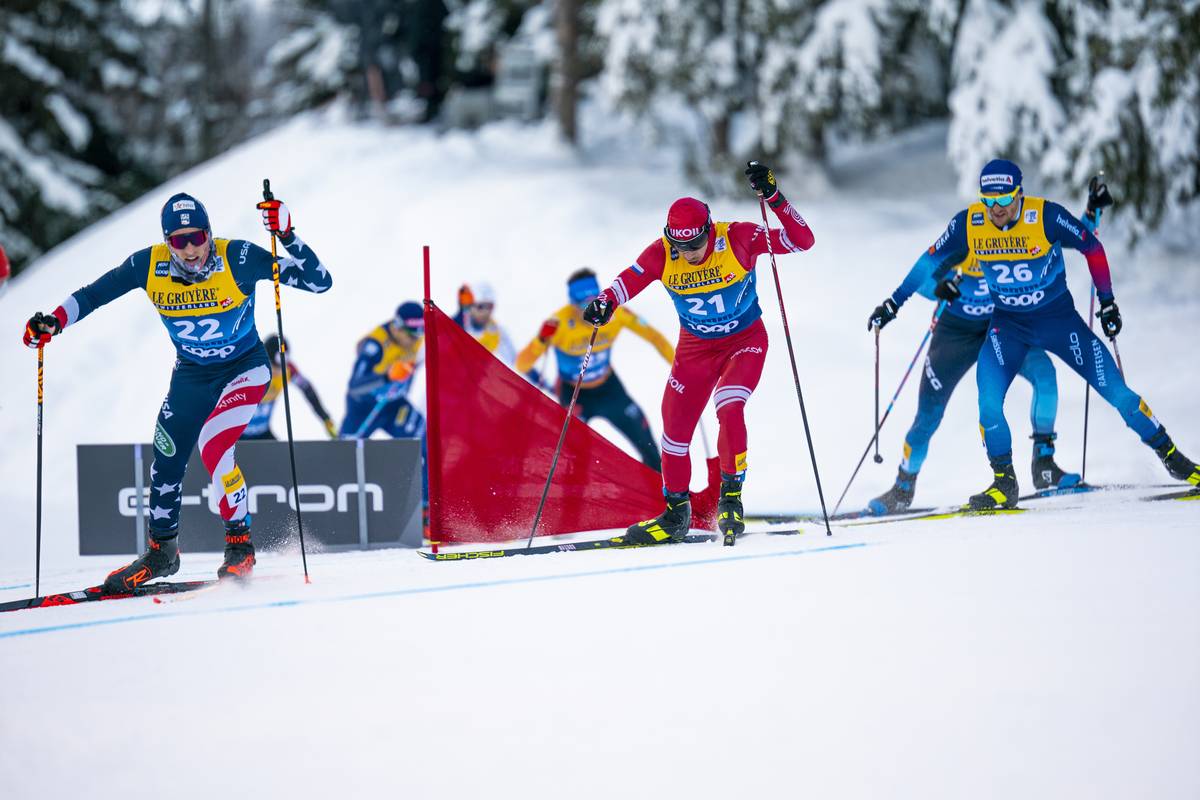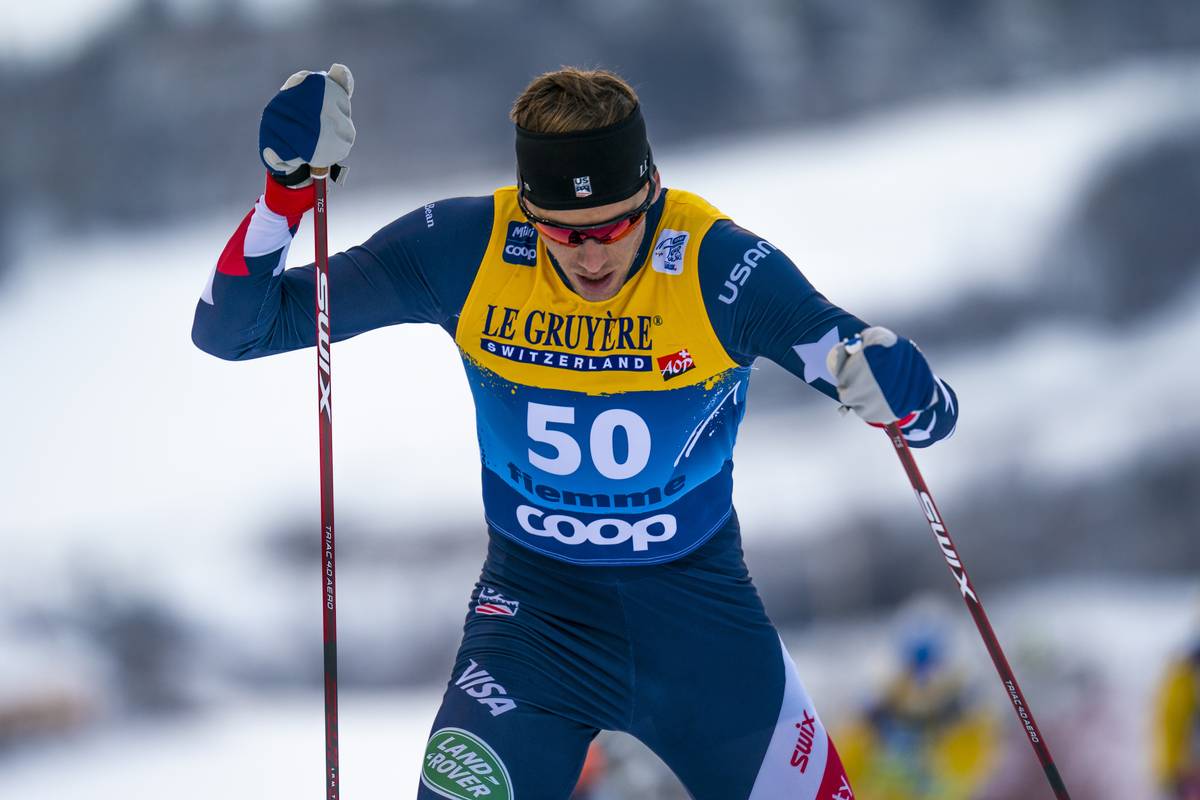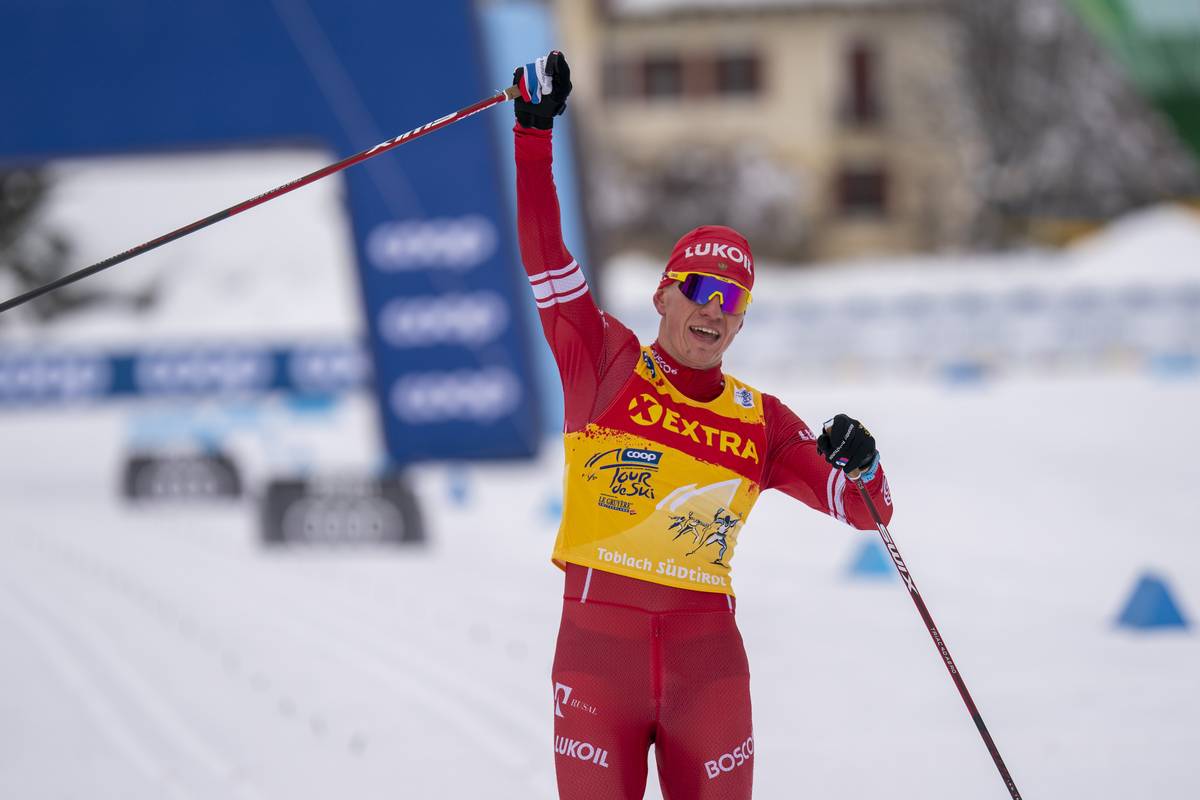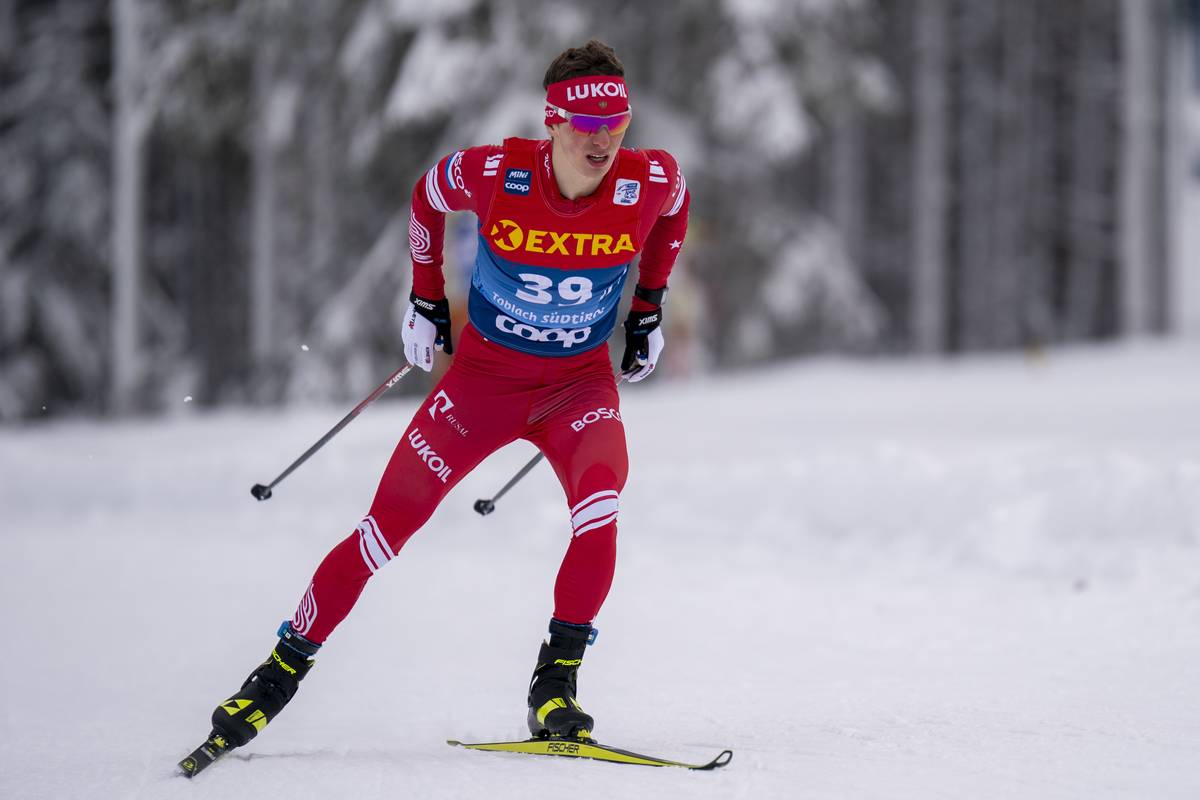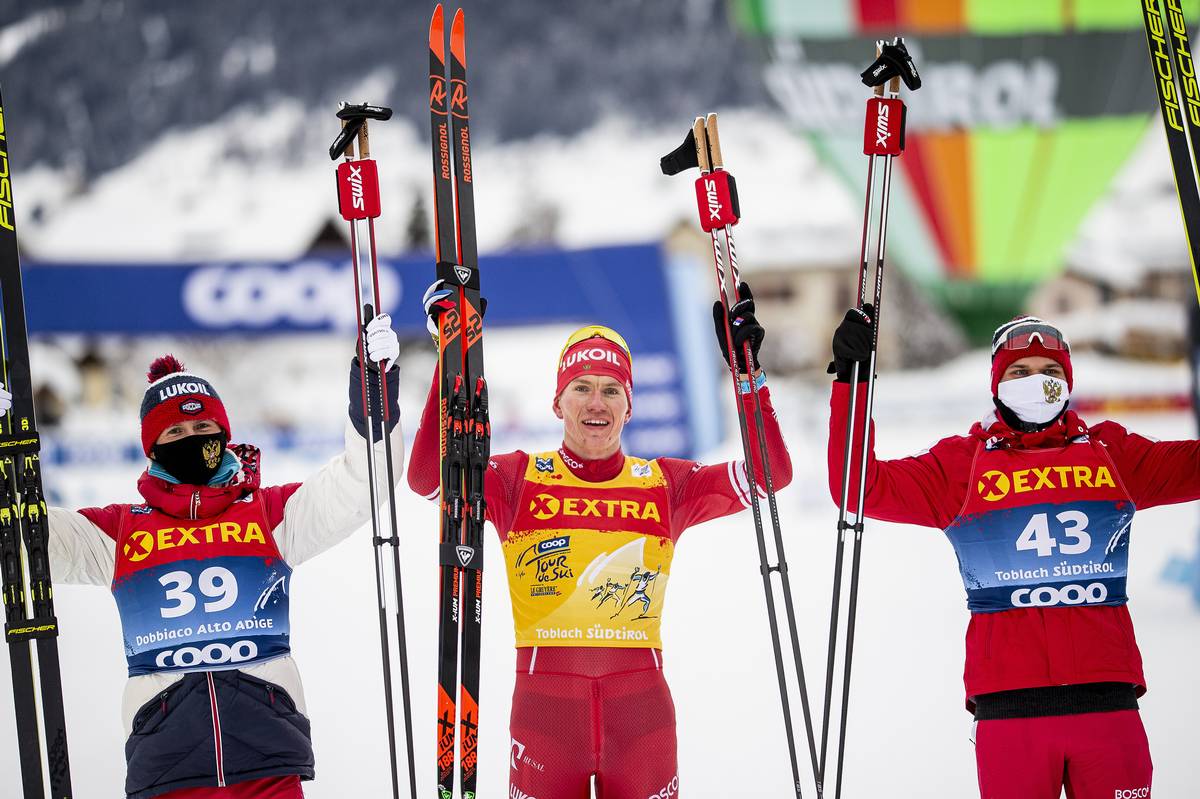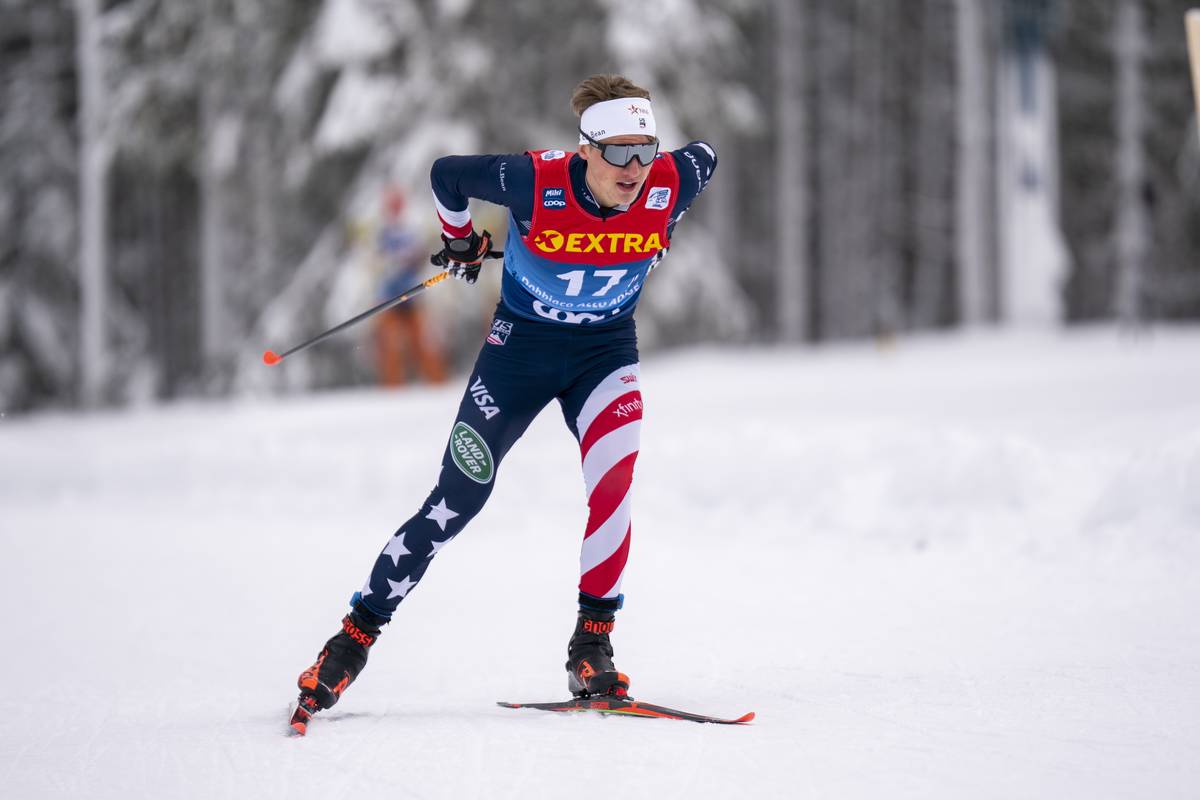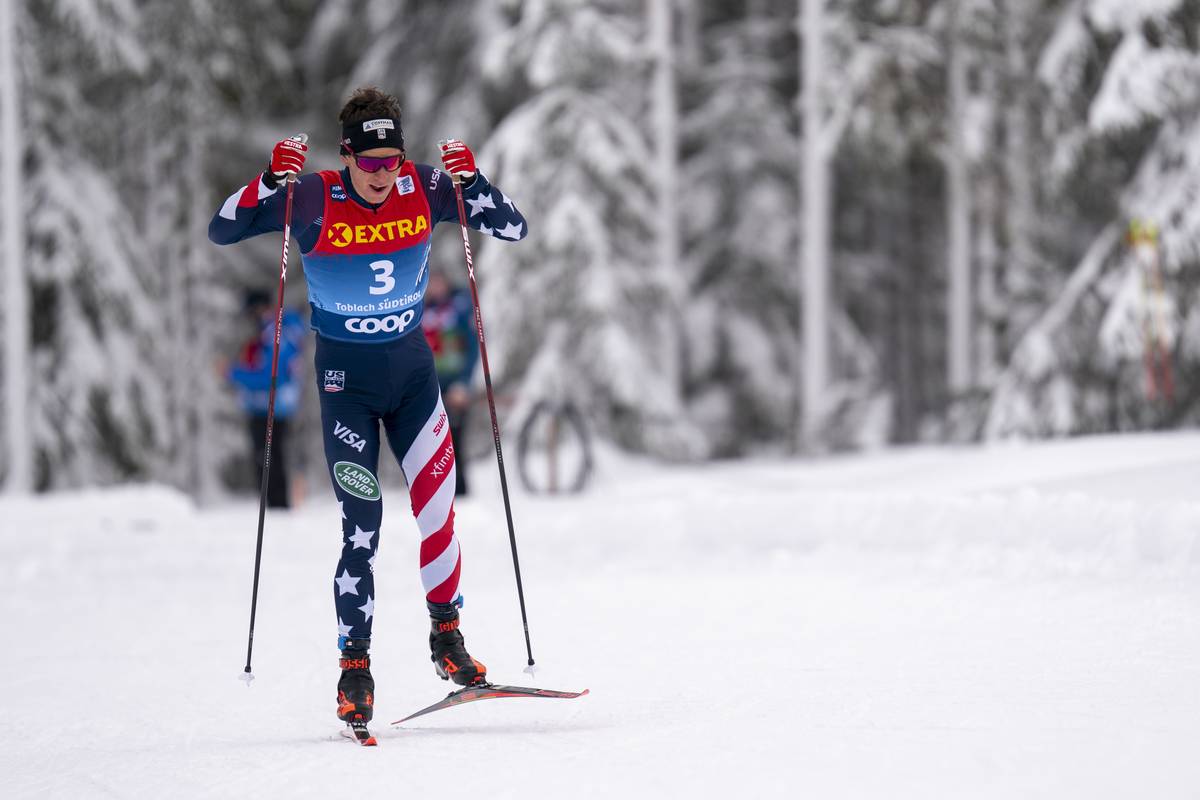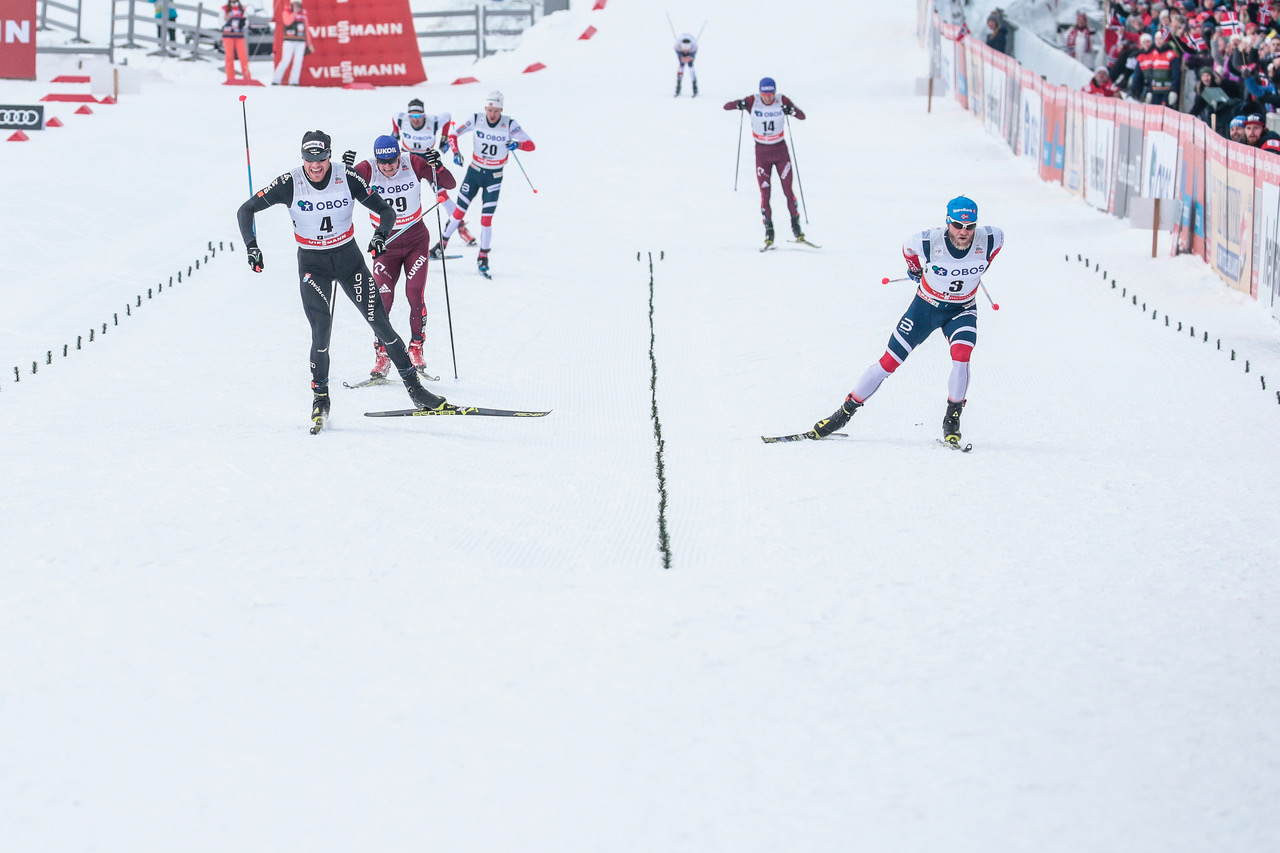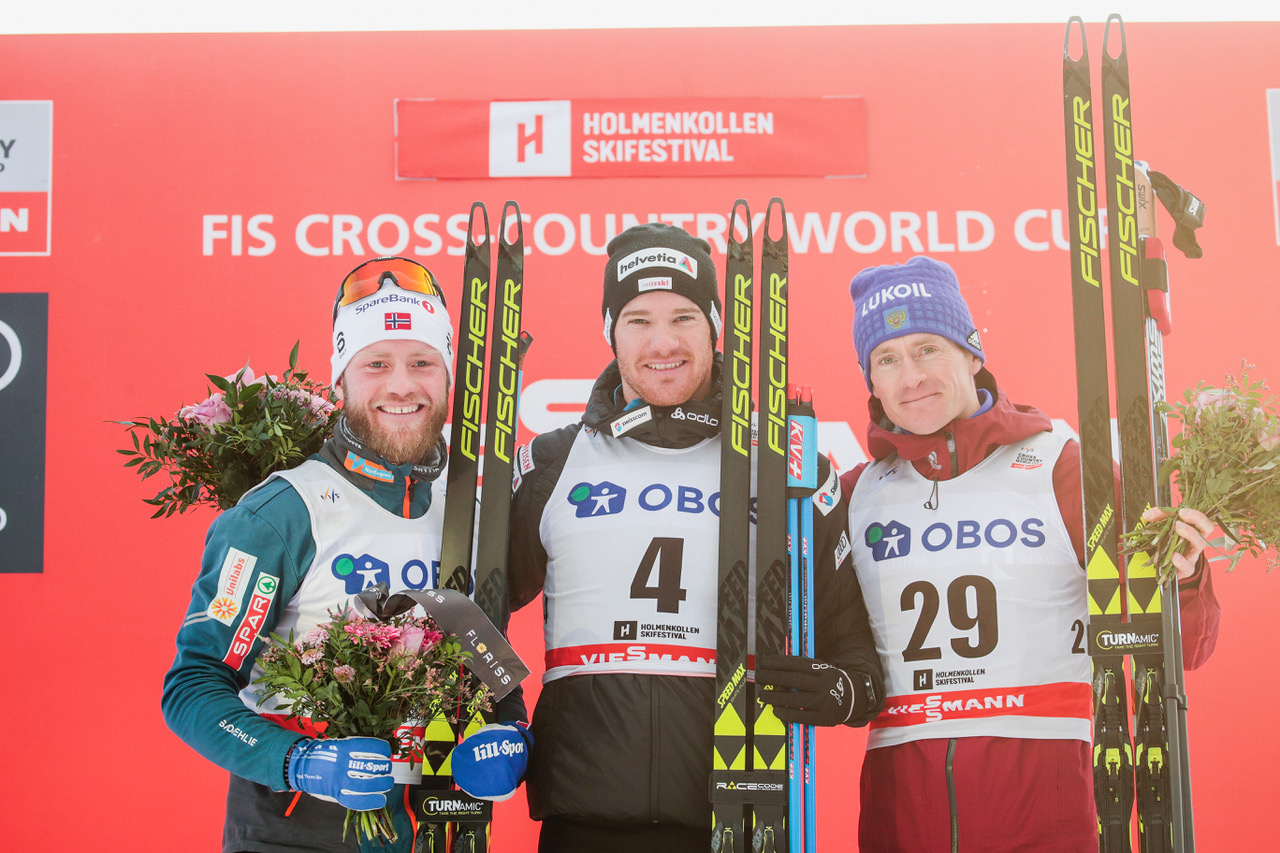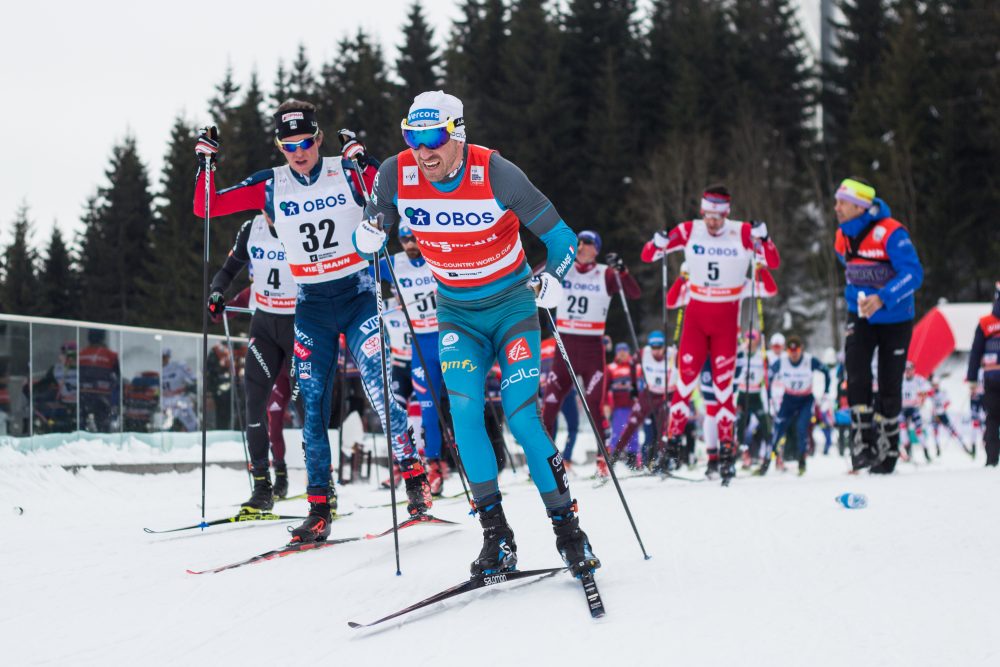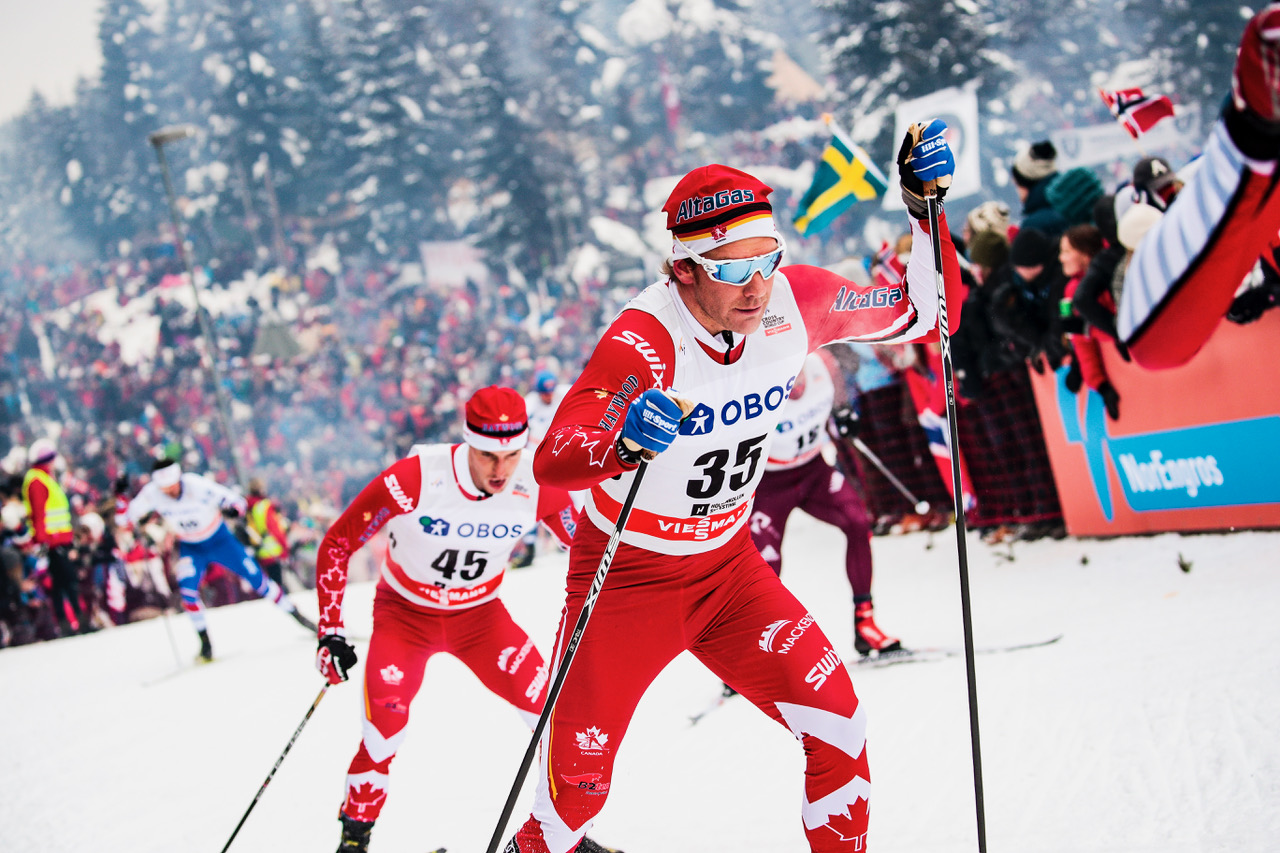
Tag: Maurice Manificat

  • Double Gold: ROC Dominates Men’s 4 x 10 k Relay in Lengthy Race; USA 9th, CAN 11th

    Double Gold: ROC Dominates Men’s 4 x 10 k Relay in Lengthy Race; USA 9th, CAN 11th

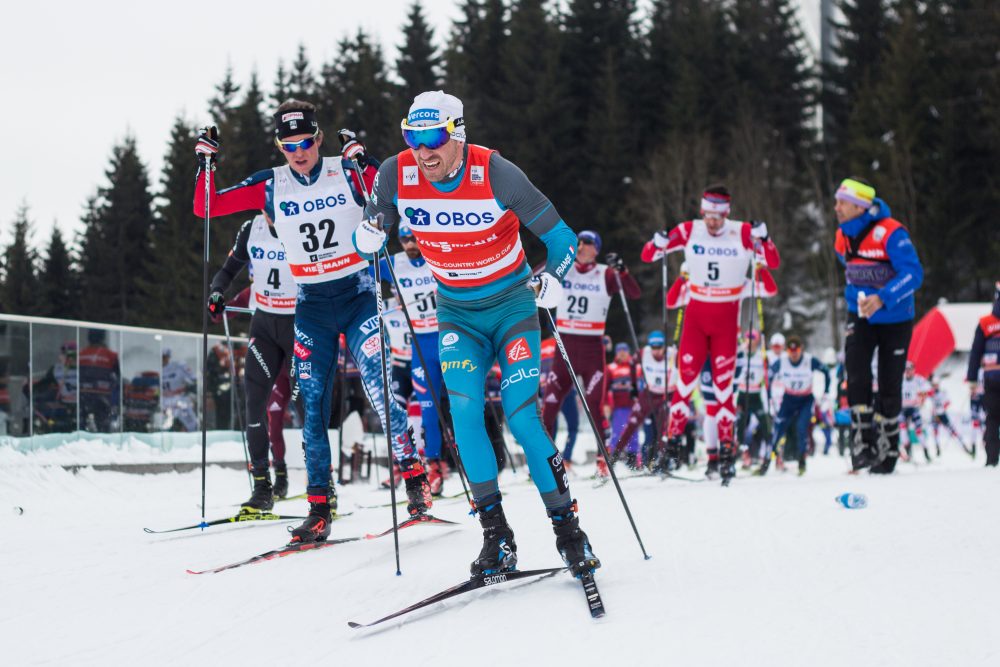
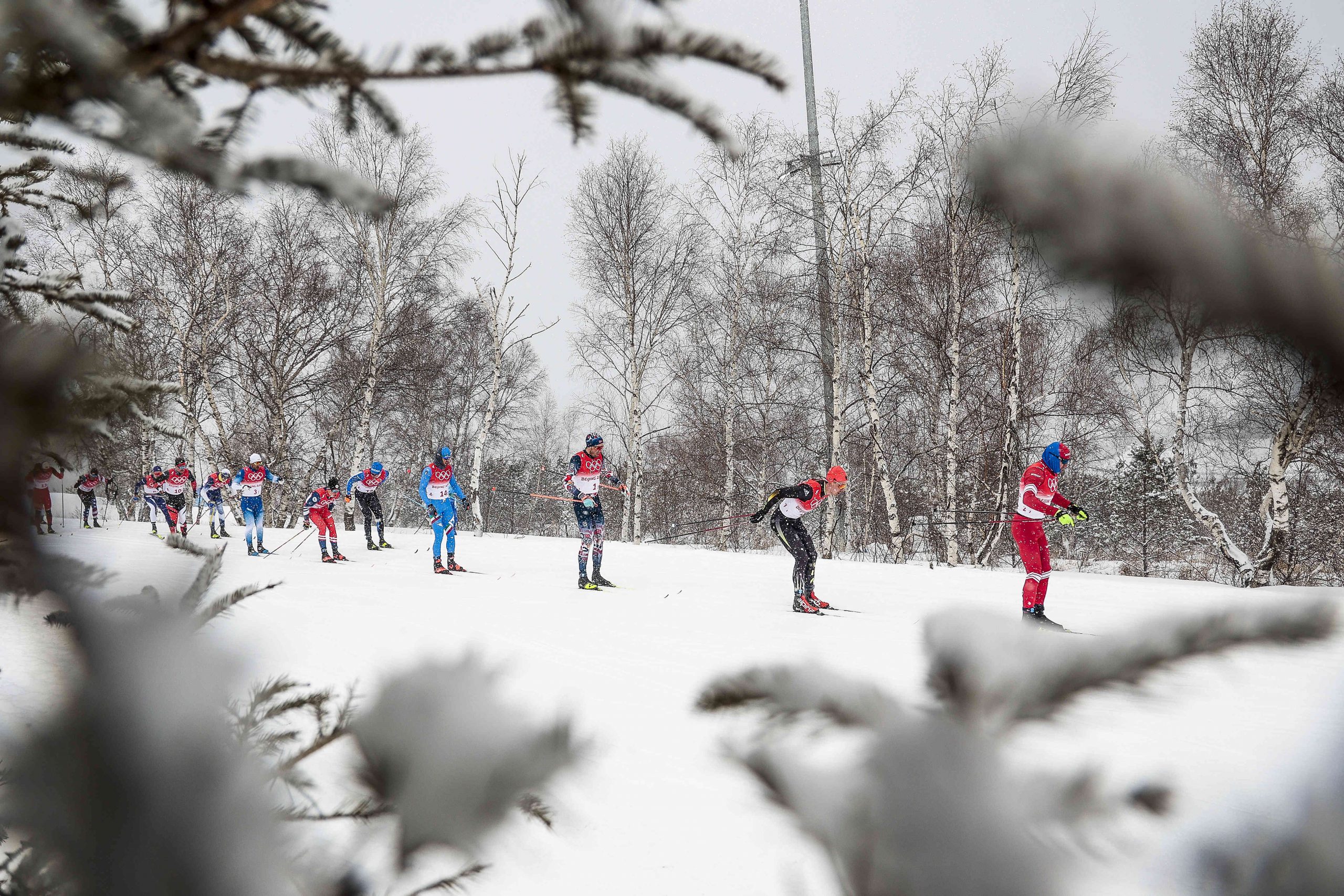
    Early stages, Emil Iversen (NOR), Alexey Chervotkin (ROC), Richard Jouve (FRA), and Oskar Svensson (SWE) (l-r) lead the men’s 4 x 10 k relay. (Photo: NordicFocus)

    This World Cup coverage is made possible through the generous support of Marty and Kathy Hall and the A Hall Mark of Excellence Award.  To learn more about A Hall Mark of Excellence Award or to learn how you can support FasterSkier’s coverage please contact info@fasterskier.com.

    After a thrilling women’s relay event on Saturday, it was the men’s turn to compete, each athlete skiing the laps of 3.3-kilometers for a total of 4 x 10 k. In a surprising turn of events, more snow than has fallen in a decade came down in Zhangjiakou over the last 24 hours, altering the otherwise stable man-made conditions the men have raced to this point. Conditions being what they were, heavy snowfall and 11°F on challenging courses, this made for an especially long race.

    The ROC proved to best handle the conditions, winning gold in 1:54:50.7. Norway skied to silver (+1:07.2), with France taking bronze (+1:16.4), while the American men skied to ninth (+8:05.6), with the Canadians in 11th (+9:10.4).
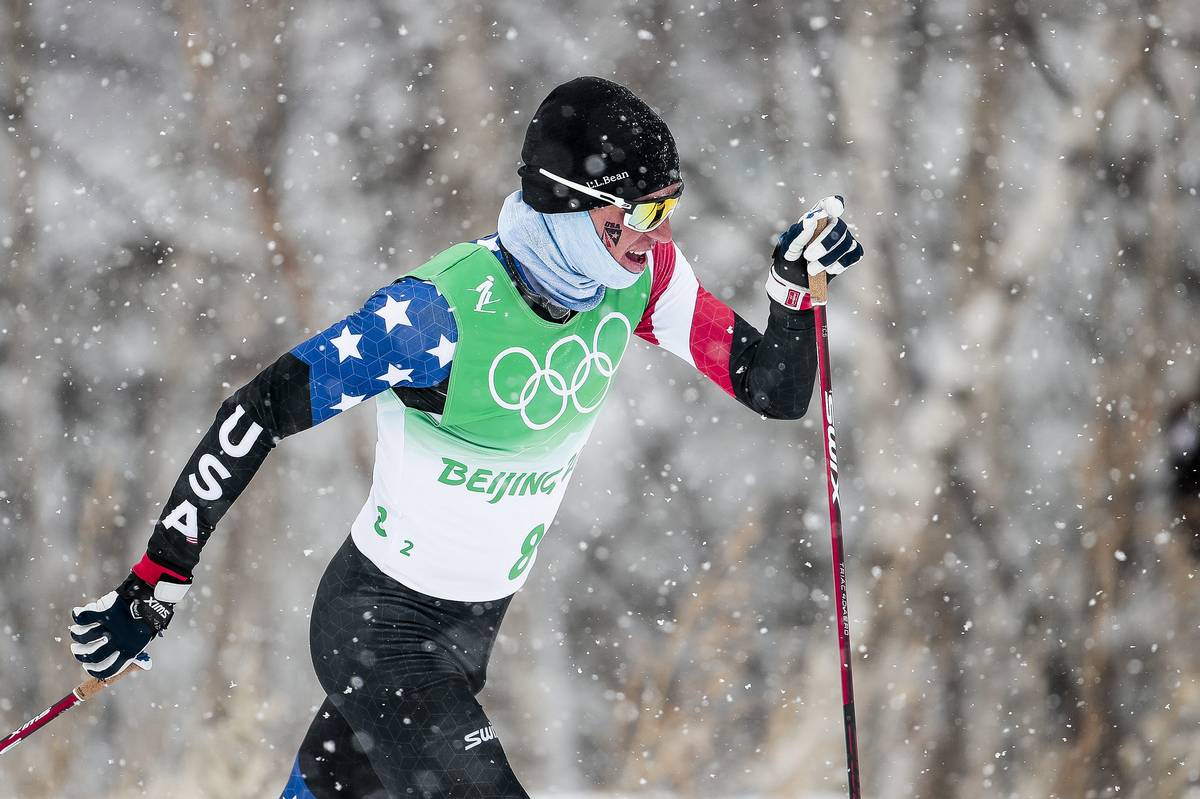
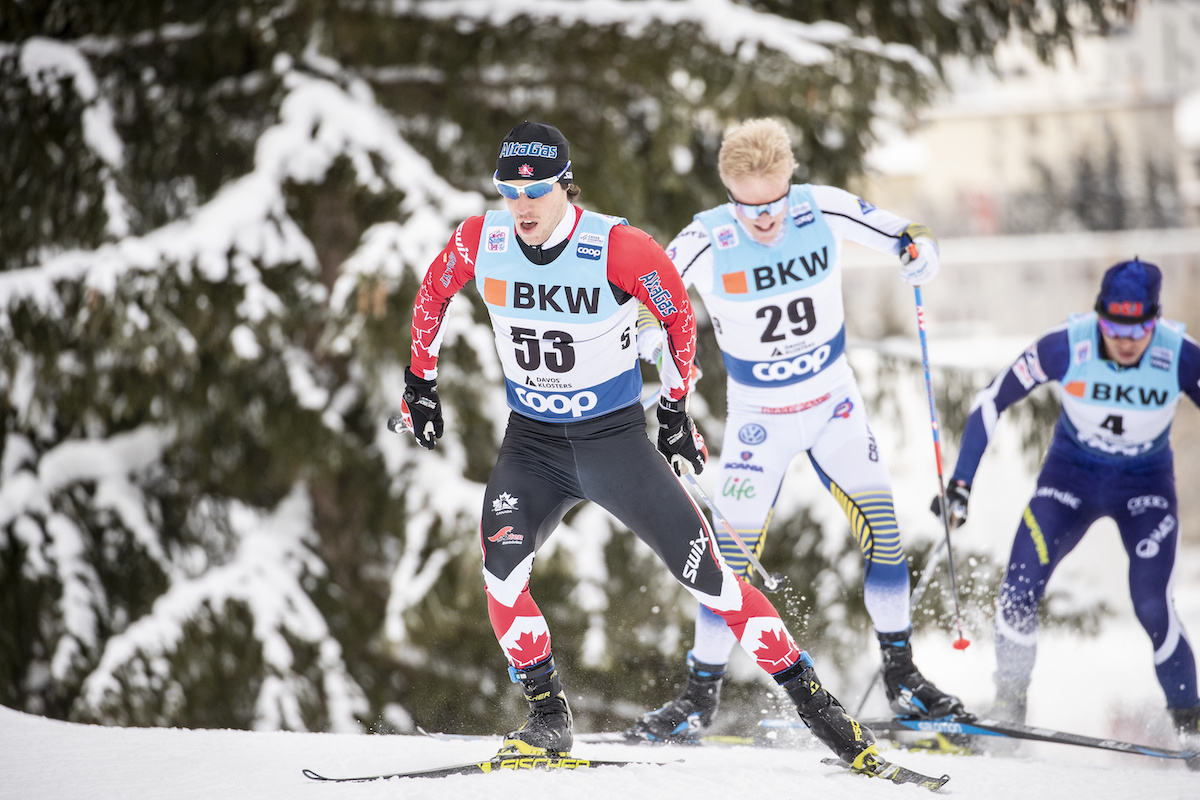
    Scott Patterson skis the second leg of the men’s 4 x 10 k relay through unprecedented conditions. (Photo: NordicFocus)

    Men’s skiing for the past few years has been dominated by two nations, Norway and Russia (or as they are known at these Games, the Russian Olympic Committee (ROC)). When it comes to the men’s 4 x 10 k relay however, Norway has historically been in a class of its own. 
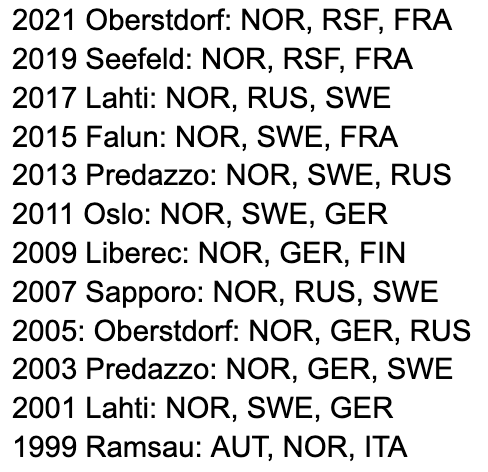
    Results summary for men’s 4 x 10 k relay at World Championships since 1999.

    Since Team Norway’s all-around poor showing at Sochi in 2014, which included the men’s team finishing 4th, they have not lost a championship relay. Indeed, looking at relay results from World Championships, you have to dig all the way back to 1999 to find Norway not winning gold, when Norway finished second to Austria in Ramsau. Their performances at the Olympics have been less dominant but most relevant for today’s race, they won gold in PyeongChang in 2018 with the same man, Johannes Høsflot Klæbo, in the anchor leg. 

    As such, despite the Norwegian men’s struggles thus far at these games, it seemed likely that fans would be seeing another battle between Norway and the ROC for top spot. Fifteen nations were represented on the start line and as the first leg was underway Sunday morning, the race appeared to be playing out remarkably similarly to the World Championships in Oberstdorf last year.

    A brief recap for those who don’t remember, in heavy snowfall, ROC athlete Alexey Chervotkin made an early move and ended his leg with nearly a minute lead on the rest of the field which was later eaten up and the win went to Norway. Today it was a different story.
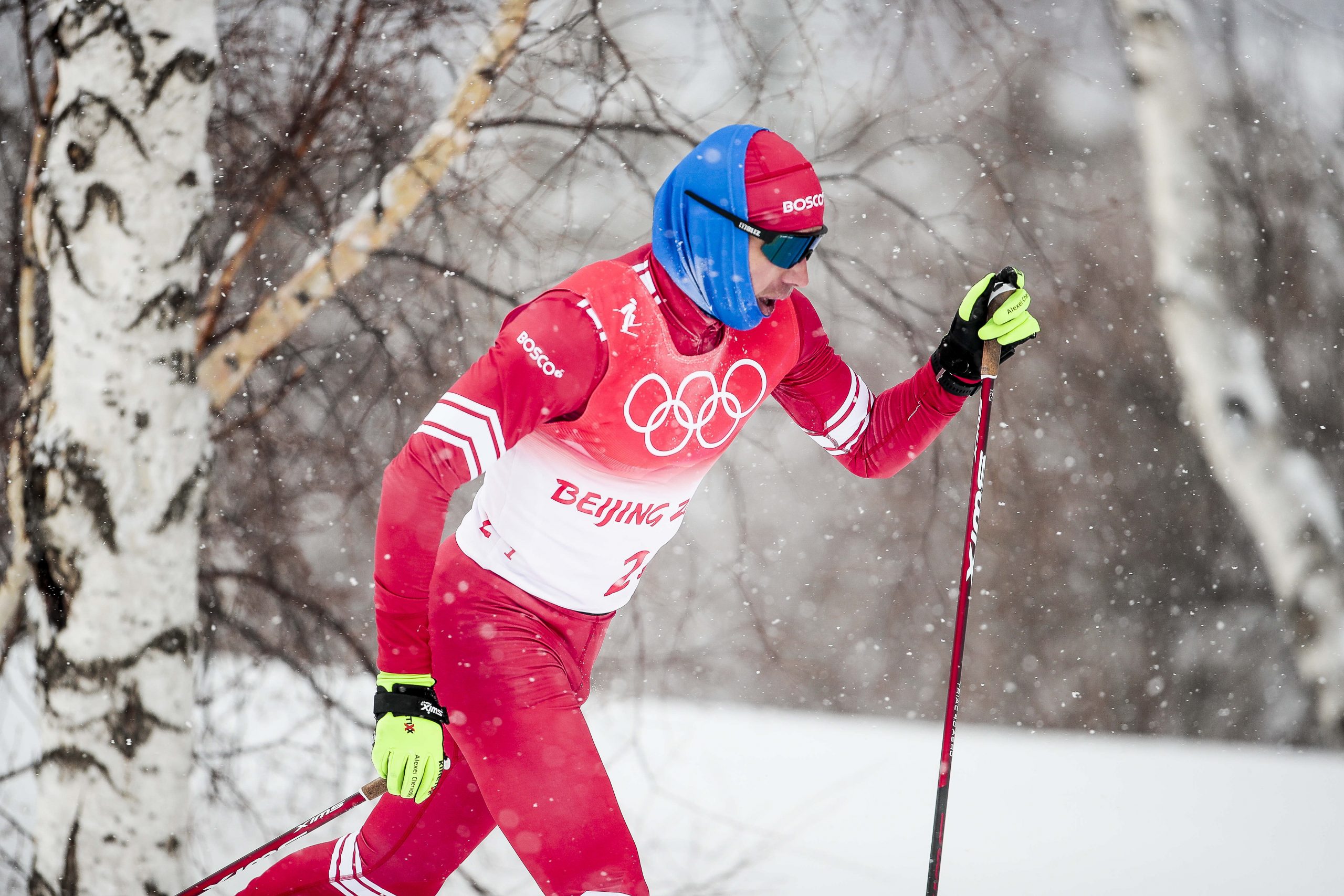
    Alexey Chervotkin (ROC) making a decisive early break (Photo: NordicFocus)

    Chervotkin was once again in the scramble position for the ROC and he put the hammer down right from the start gun. At 4.3 k he had a gap of +12.6 seconds to the rest of the field and that was the closest anyone got to the ROC for the rest of the race. Although it took three more athletes and another hour and forty-one minutes of skiing to seal the deal. 
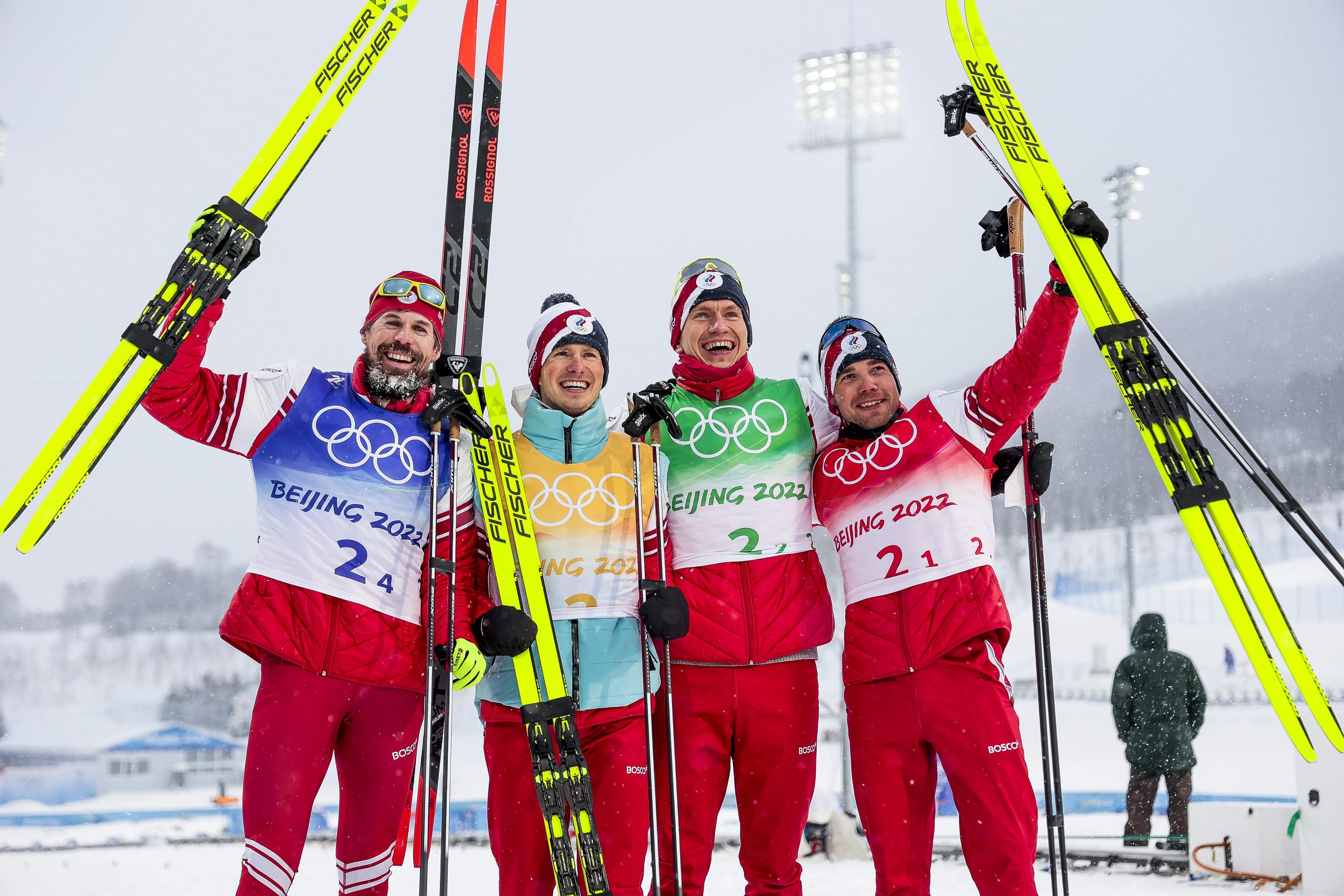
    All smiles for Sergey Ustiugov, Denis Spitsov, Alexander Bolshunov, Alexey Chervotkin, (l-r) after taking Olympic gold for the ROC for the first time in over forty years. (Photo: NordicFocus)

    Making his first appearance at these games after some controversy regarding a start in the 15 k classic, Emil Iversen took the first leg for Norway. For the majority of his leg, Iversen did the work to pull at the front of the chase group, which was composed of teams Italy, Germany, Sweden and France. No doubt inspired by the German women’s relay performance, Janosch Brugger skied a strong leg for Germany, ultimately pulling away with Italy’s Federico Pelligrino in the final kilometers of their leg.
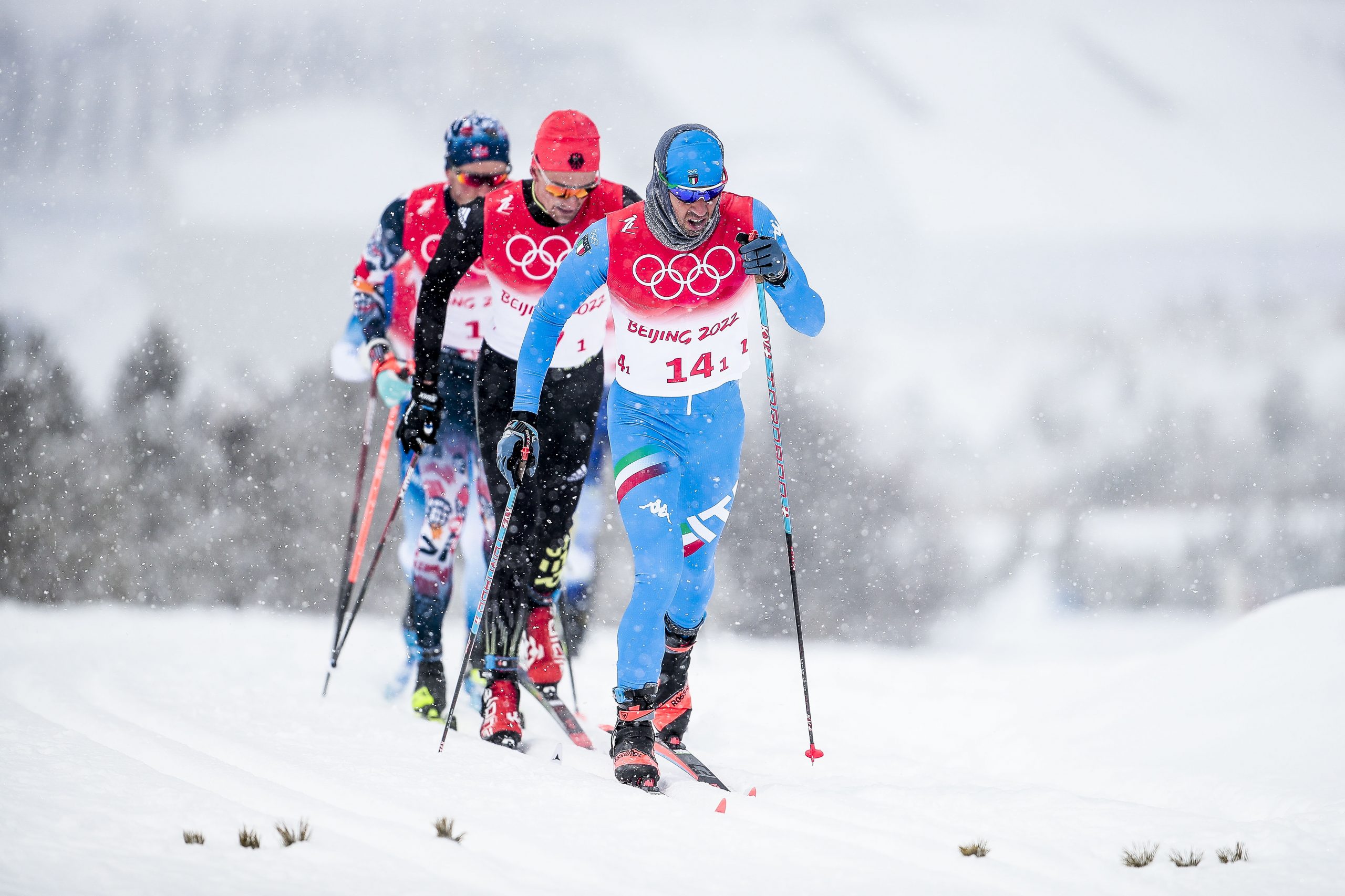
    Federico Pellegrino (ITA) leads Janosch Brugger (GER) and Emil Iversen (NOR) (Photo: NordicFocus)

    With Iversen fading fast on the final lap up the A-climb, Brugger and Pelligrino gapped the Norwegian by 10 seconds, coming into the first exchange +23.5 and +24.1, respectively, behind Chervotkin of the ROC. Next came Iversen, who tagged his teammate, Pål Golberg, with a gap of +34.4 to the ROC.

    Despite the hard work put in by Chervotkin, the conditions were such that it took him 30:14.7 to ski 10 k, which is much slower than we might normally expect. Chervotkin had taken 5th place in the 15 k classic on Friday in 38:51.7 with stable conditions; five additional kilometers in roughly 8.5 minutes longer.
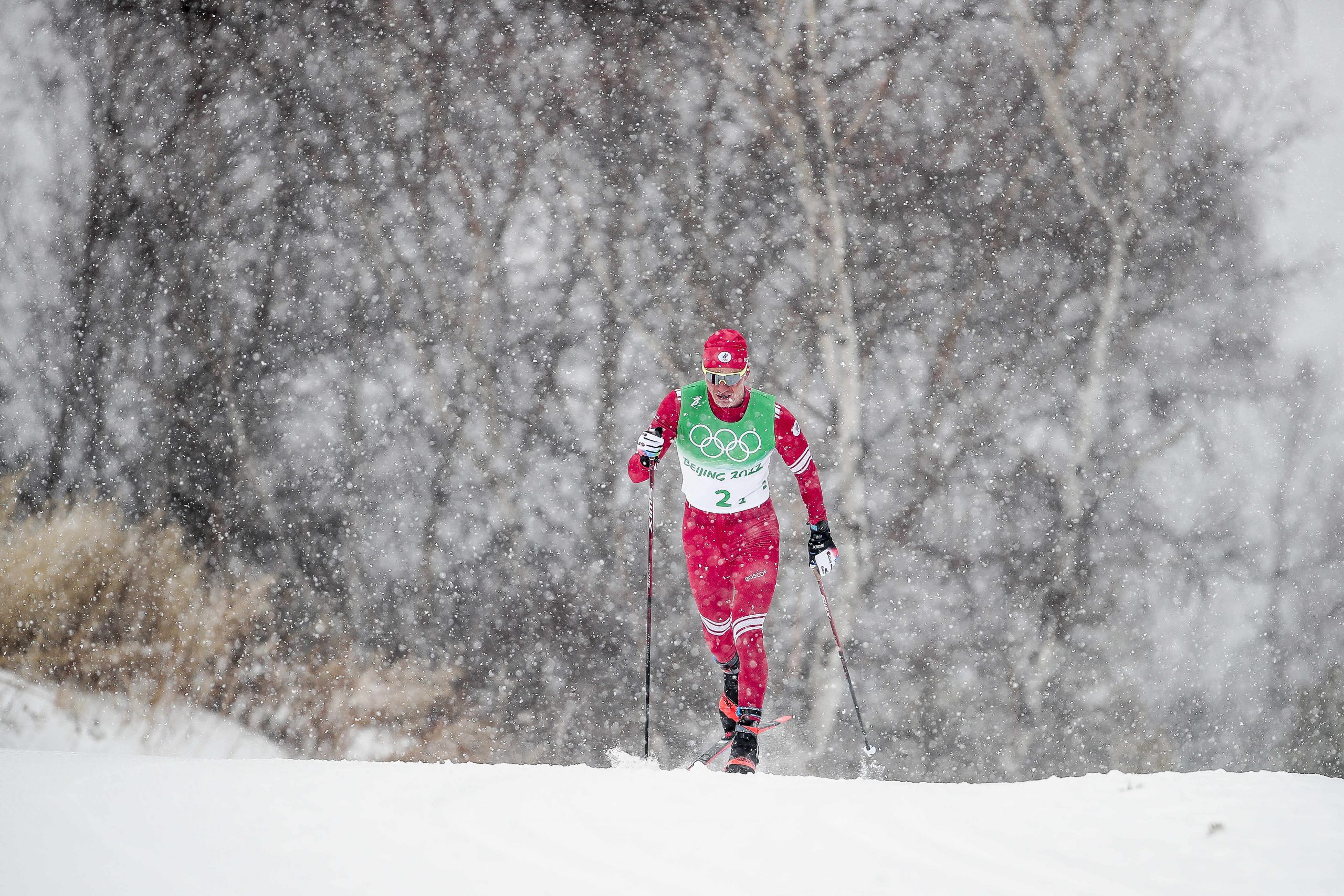
    Gliding on his own through falling snow, Alexander Bolshunov (ROC)(Photo: NordicFocus)

    With the first leg complete, it was skiathlon winner Alexander Bolshunov who took over for the Russian Olympic Committee. Grinding out front on his own, Bolshunov continued to put time into the rest of the field, widening his lead to +37.8 through 13.3 k, up to +44.5 at 16.6 k and +59.5 at the completion of his three laps.

    Behind him, Golberg worked quickly to close the gap to Italy and Germany, legs which were being skied by Francesco de Fabiani and Friedrich Moch. Over the course of his second lap, Golberg began to pull away, creating a ten second gap to the chasers. However, as the skiers completed the third, and their final, 3.3 k lap, things were shaking up. 

    Pål Golberg (NOR) who would later fade and be caught by William Poromaa of Sweden (Photo: NordicFocus)

    Iivo Niskanen, having been tagged in 11th position and +1:47.5 behind, was executing another outstanding classic performance, gaining time on everyone in the field. With the Finn closing quickly, what had been two chase groups merged to one.

    Moch for Germany, William Poromaa for Sweden, Hugo Lapalus for France and Niskanen for Finland were all battling for bronze medal position as de Fabiani of Italy faded off the back. Up the final A-climb that had been the undoing of Iversen one leg earlier, Golberg too began to slow.
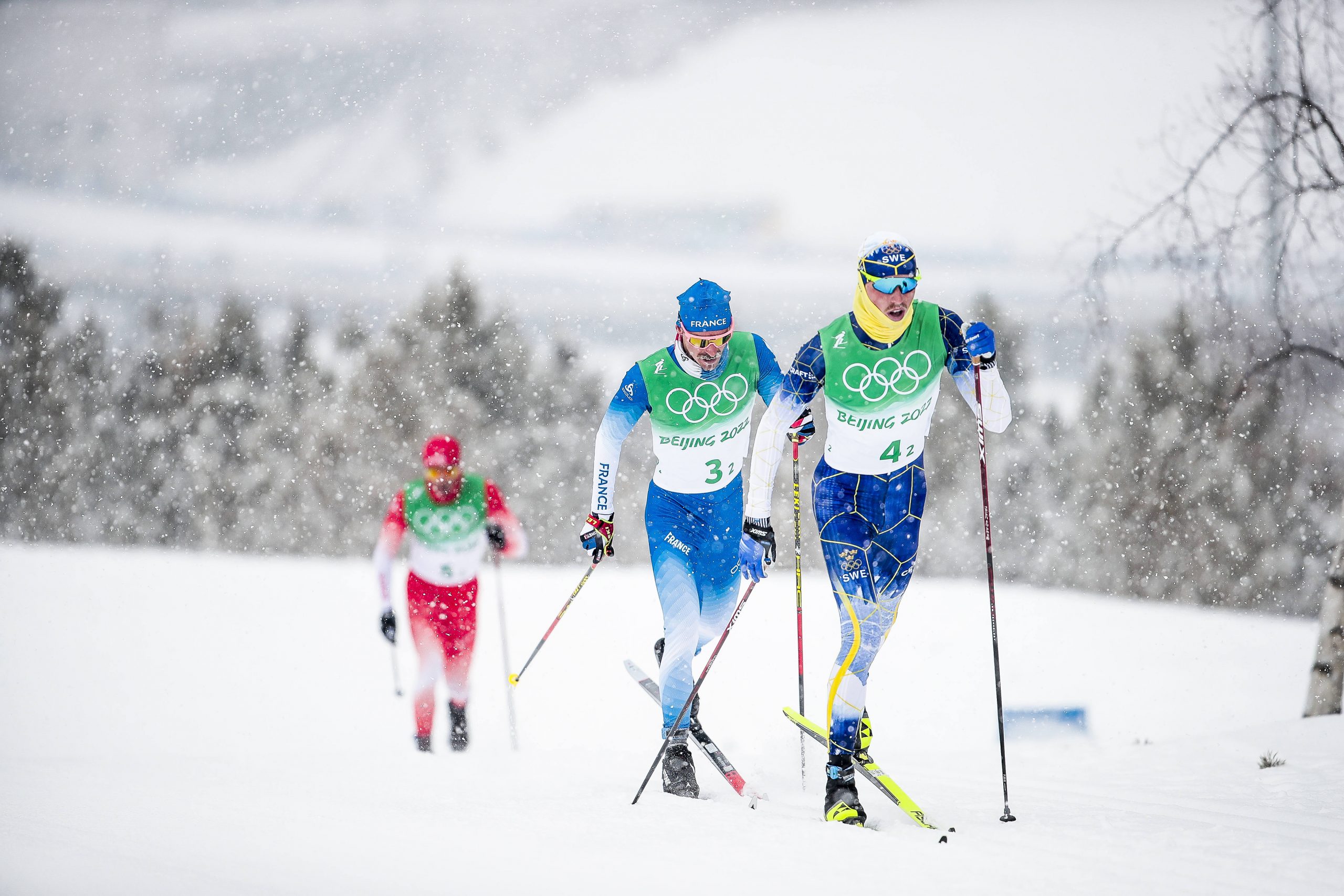
    Hugo Lapalus (FRA) and William Poromaa (SWE) both skiing well (Photo: NordicFocus)

    This show of weakness was all Poromaa needed to up the pace, and by the time they entered the stadium for the second exchange, the Swede had caught the Norwegian.

    Golberg tagged Hans Christer Holund, +59.5 behind Bolshunov who had given way to Denis Spitsov. Poromaa handed over to Jens Burman, +59.7 behind the ROC. Behind them, Niskanen had moved his team from 11th to 4th and gained 36 seconds on the ROC as he tagged Perttu Hyvarinen. Lapalus of France handed off to Clement Parisse, +1:09.7 back. 
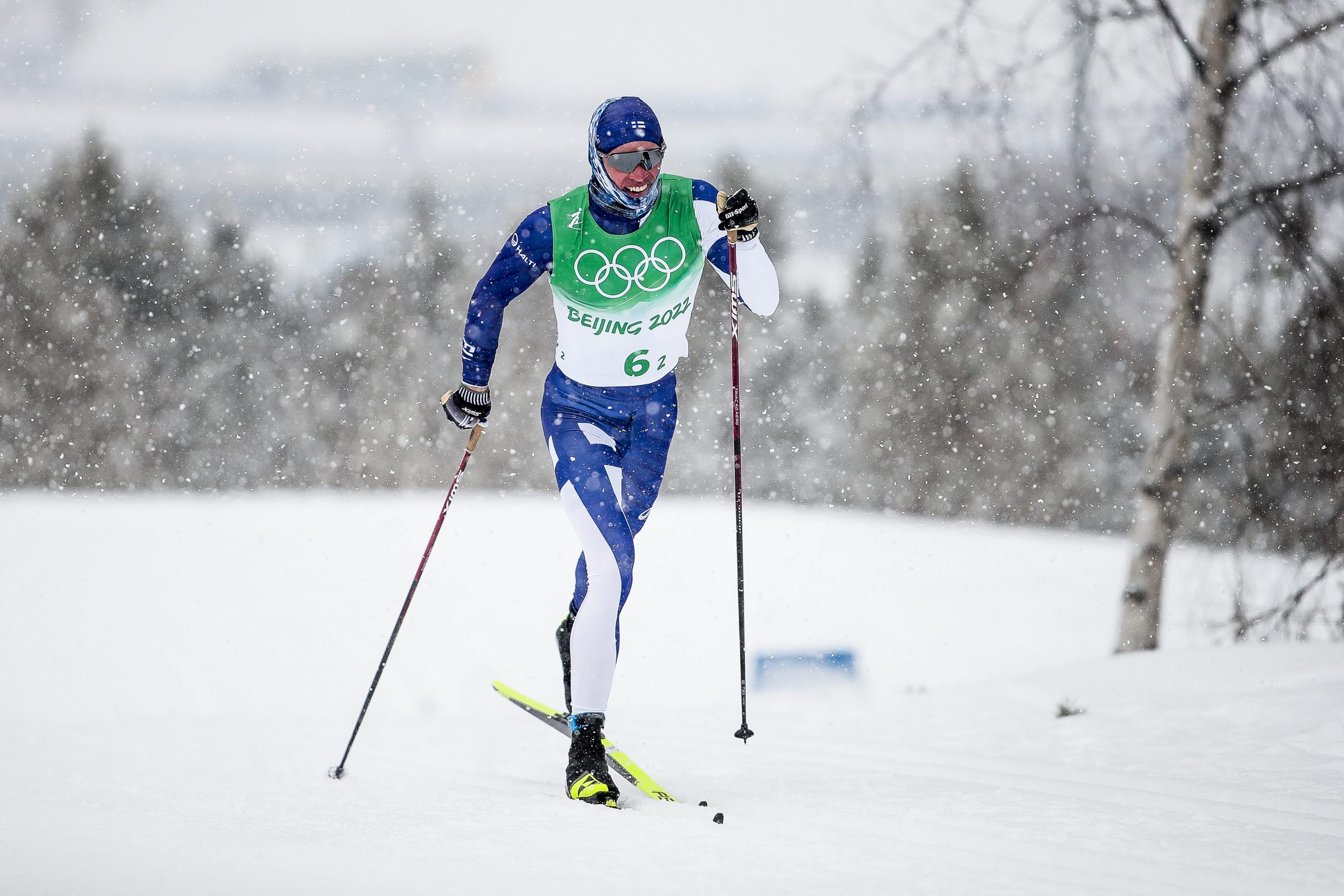
    Showing his classic strength, Iivo Niskanen (FIN) works to close a big deficit (Photo: NordicFocus)

    Having switched to freestyle technique, the third leg was underway and suddenly there was a pack of five nations vying for silver and bronze position, the ROC nearly a minute ahead and all but secured the gold.

    Despite the deep snow, Spitsov (ROC) seemed to have no trouble maintaining his advantage as Holund (NOR) took up the mantle of the chase. Through 23.3 k, Holund led the train, still trailing +51.4 behind the ROC.
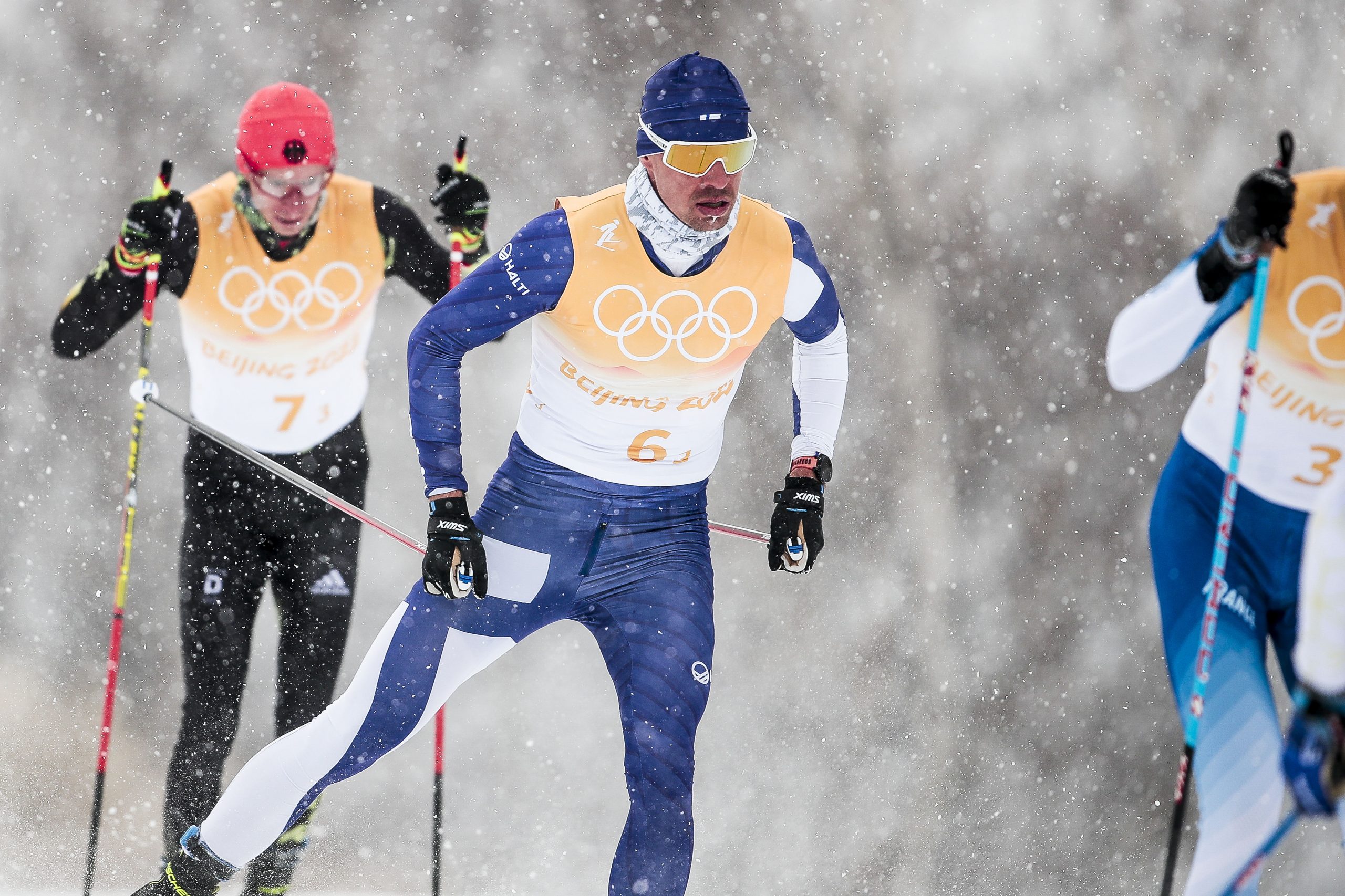
    Perttu Hyvarinen (FIN) fading fast (Photo: NordicFocus)

    After Niskanen’s effort, the Finnish team was dropping quickly with Hyvarinen at the helm and was soon out of contention. Florian Notz, skiing for Germany, was also beginning to fade, seeming to drift off the back on each uphill and regain time on the downhill. Eventually, as the chase group entered the stadium for the final lap of their leg, Notz lost contact, bringing the group down to three nations, Norway, Sweden and France. 
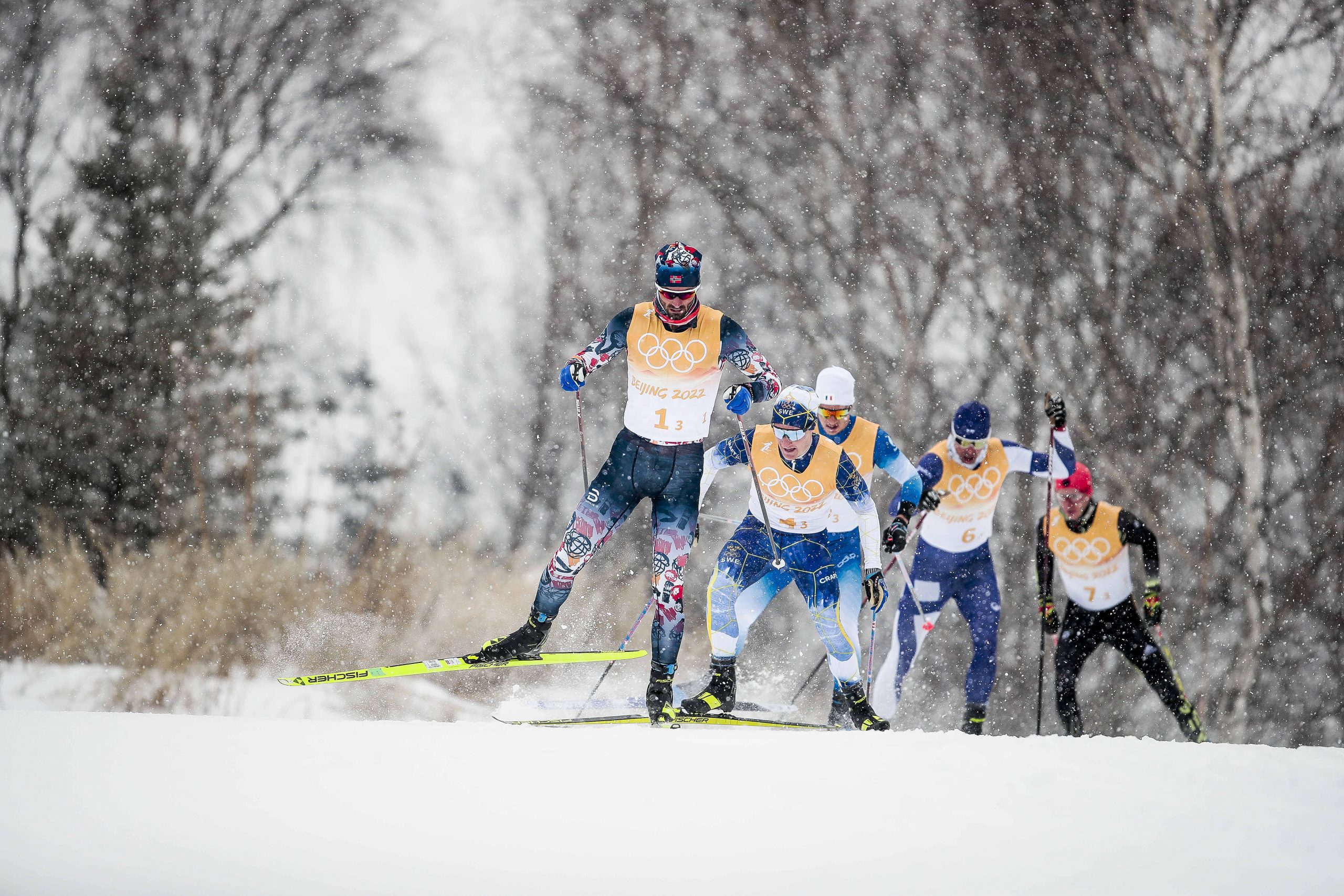
    Hans Christer Holund (NOR) leads a train of chasers (Photo: NordicFocus)

    Spitsov still clear off the front, Holund continued to lead the chase. With each section of downhill it became clear that the skis of Parisse (FRA) were not gliding like those of Burman (SWE) and Holund (NOR). In spite of this, and perhaps thanks to the trailside encouragement of his teammates, Parisse dug deep to stay in contact with the Swede and the Norwegian. 
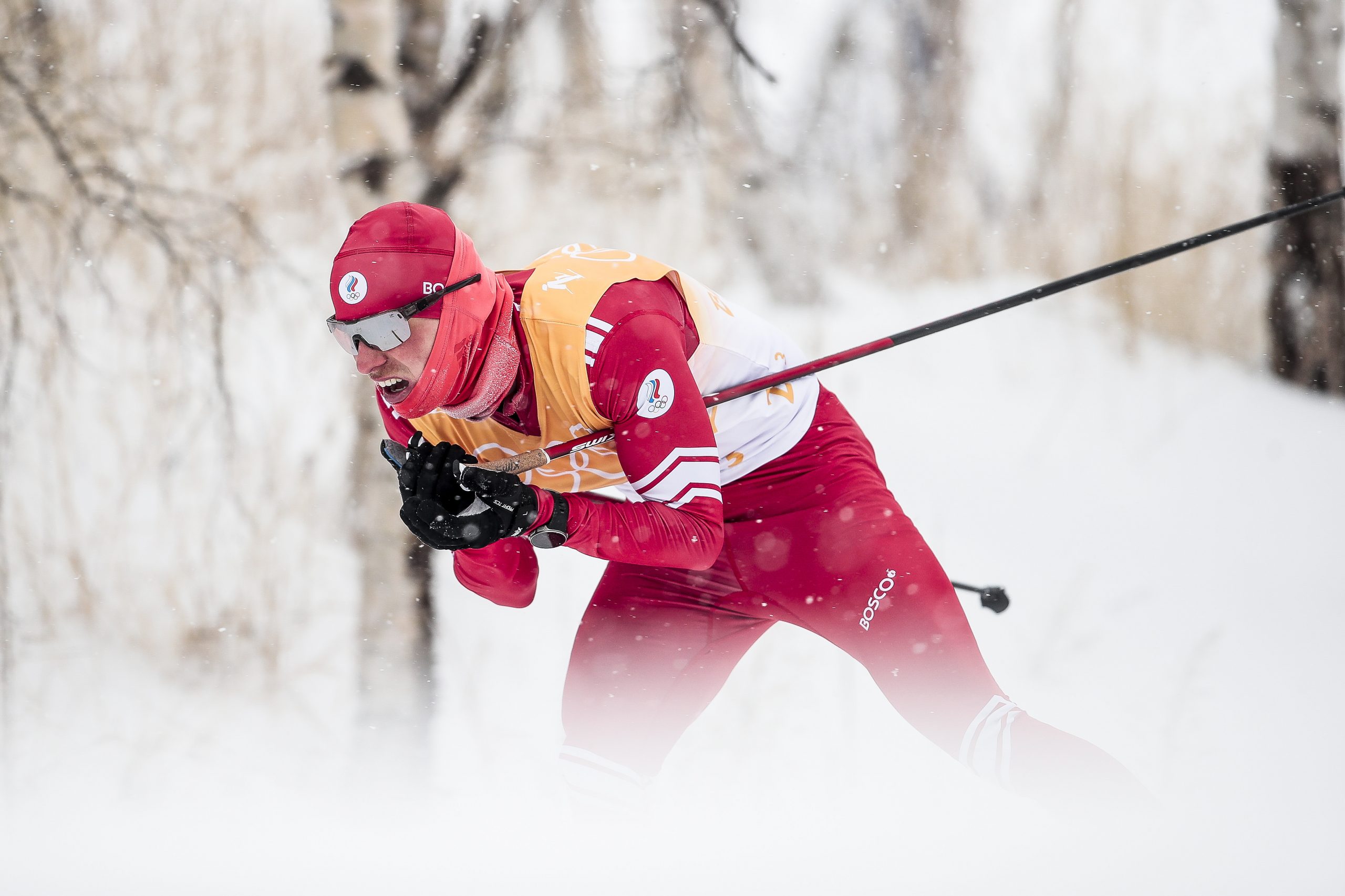
    Denis Spitsov (RUS) holds a tuck, skiing through deep snow on his own (Photo: NordicFocus)

    With 1:27:09.3 on the clock, Spitsov tagged off to Sergey Ustigov, still well clear of the rest of the field. Gaining a few meters on the Frenchman, Holund and Burman tagged their anchor legs with virtually no time between them, +44.9 and +45.4 behind the ROC. A few seconds later, Parisse gave way to the veteran Maurice Manificat, +49.2. 

    Clement Parisse (FRA) who hung tough in the third leg to help secure bronze for France (Photo: NordicFocus)

    This lengthy battle now in its final stages, Manificat worked to close the gap to Sweden and Norway, making the chase pack a group of three once again.

    The skis still looked to be a challenge for France as Norway’s anchor, Klæbo, pulled away from the other two by thirteen seconds on the descent towards the stadium, in a move that appeared to be largely unintentional. Not letting up, Manificat took on the task of closing on Klæbo once again, pulling Sweden’s Johan Häggström with him. The second time up the last A-climb of the 3.3 k loop, Manificat busted away from the Swede, catching Klæbo, who appeared to be out for an easy distance ski. 
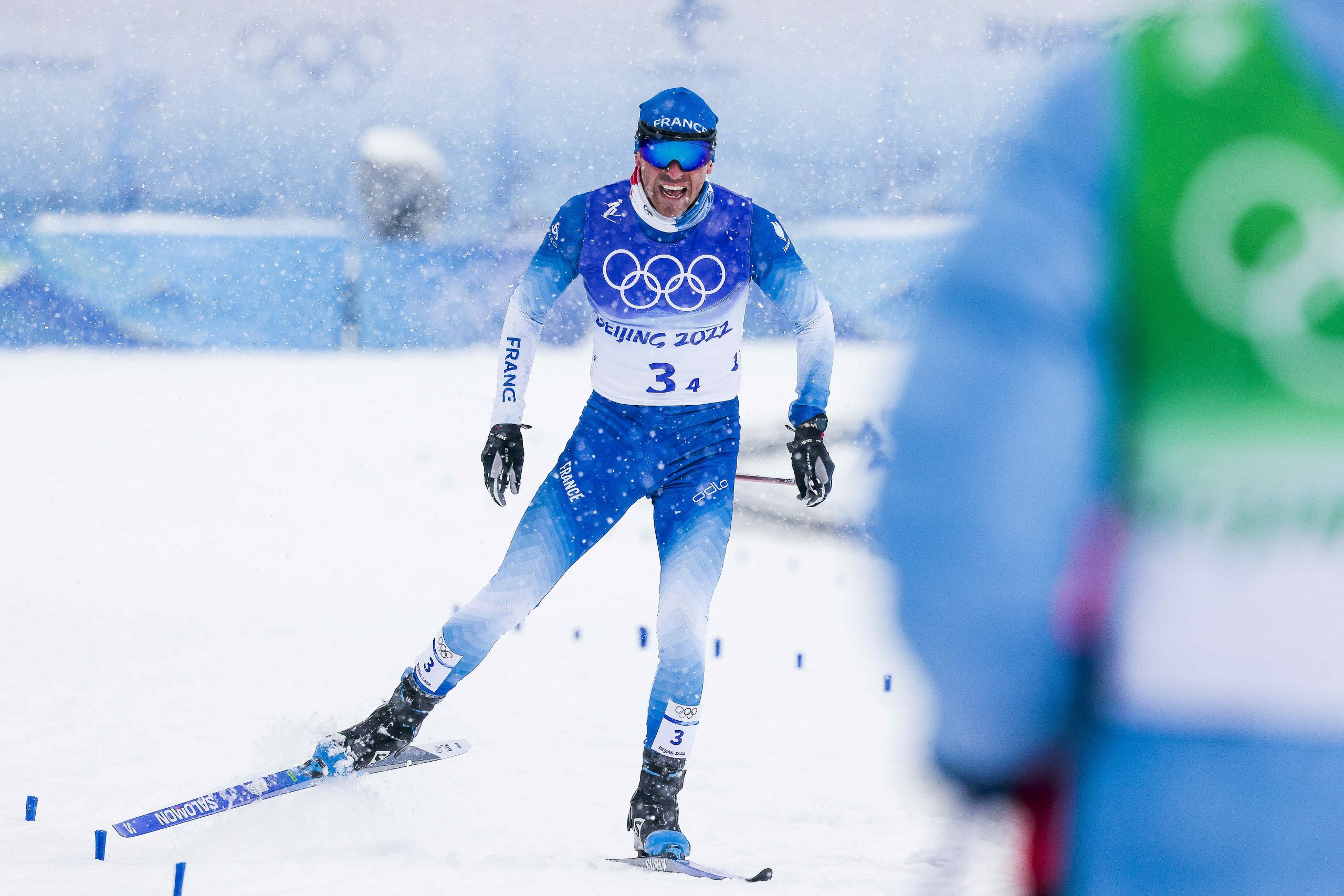
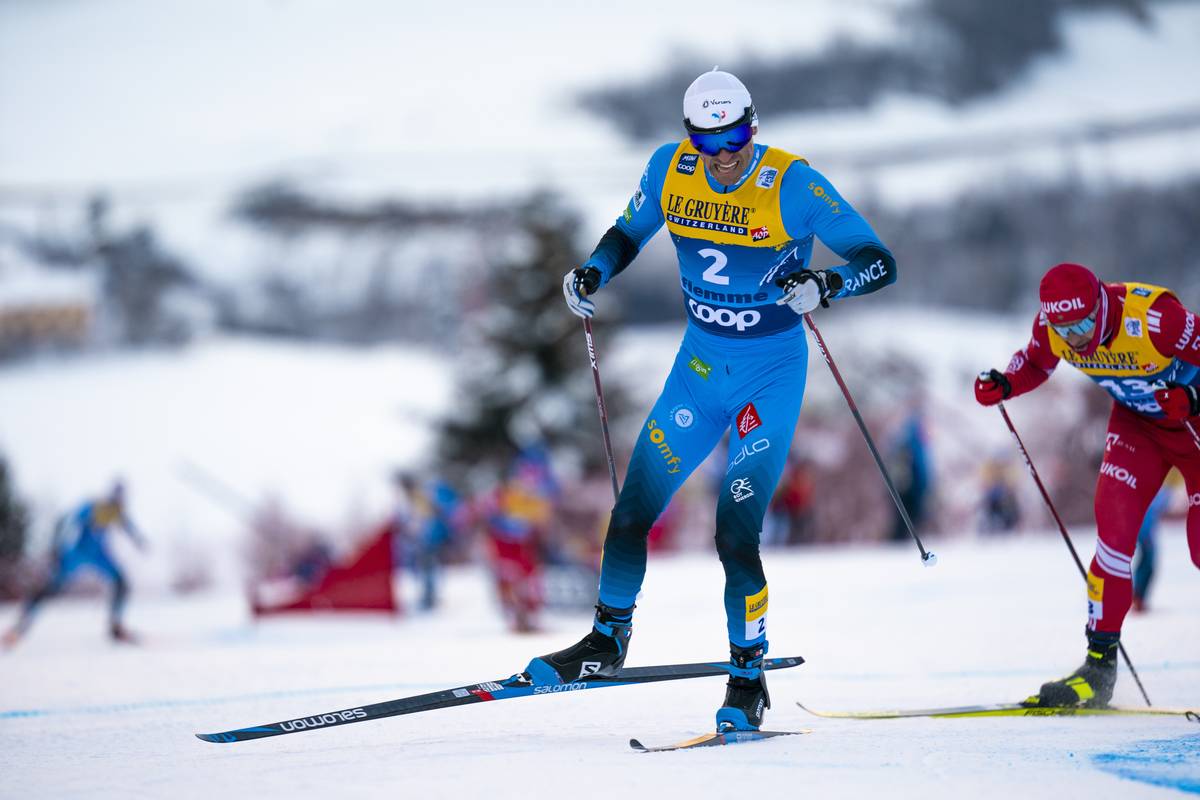
    Maurice Manificat (FRA) in the closing moments of his relay leg (Photo: NordicFocus)

    Through the stadium for the final time with 36.6 k complete, Ustigov and the ROC was +1:04.3 clear of France and Norway.

    To put it bluntly, the last 3.3 k were hard to watch. Knowing he had no chance of beating the Norwegian in a sprint finish, Manificat continued to push to his limit, his ski speed not doing him any favors. Klæbo was all too happy to sit in behind, drafting easily as Manificat tried his best to shake him. In the end, Klæbo did not even have to reach into his bag of tricks, he simply out-glided the Frenchman, who could do nothing about it. 
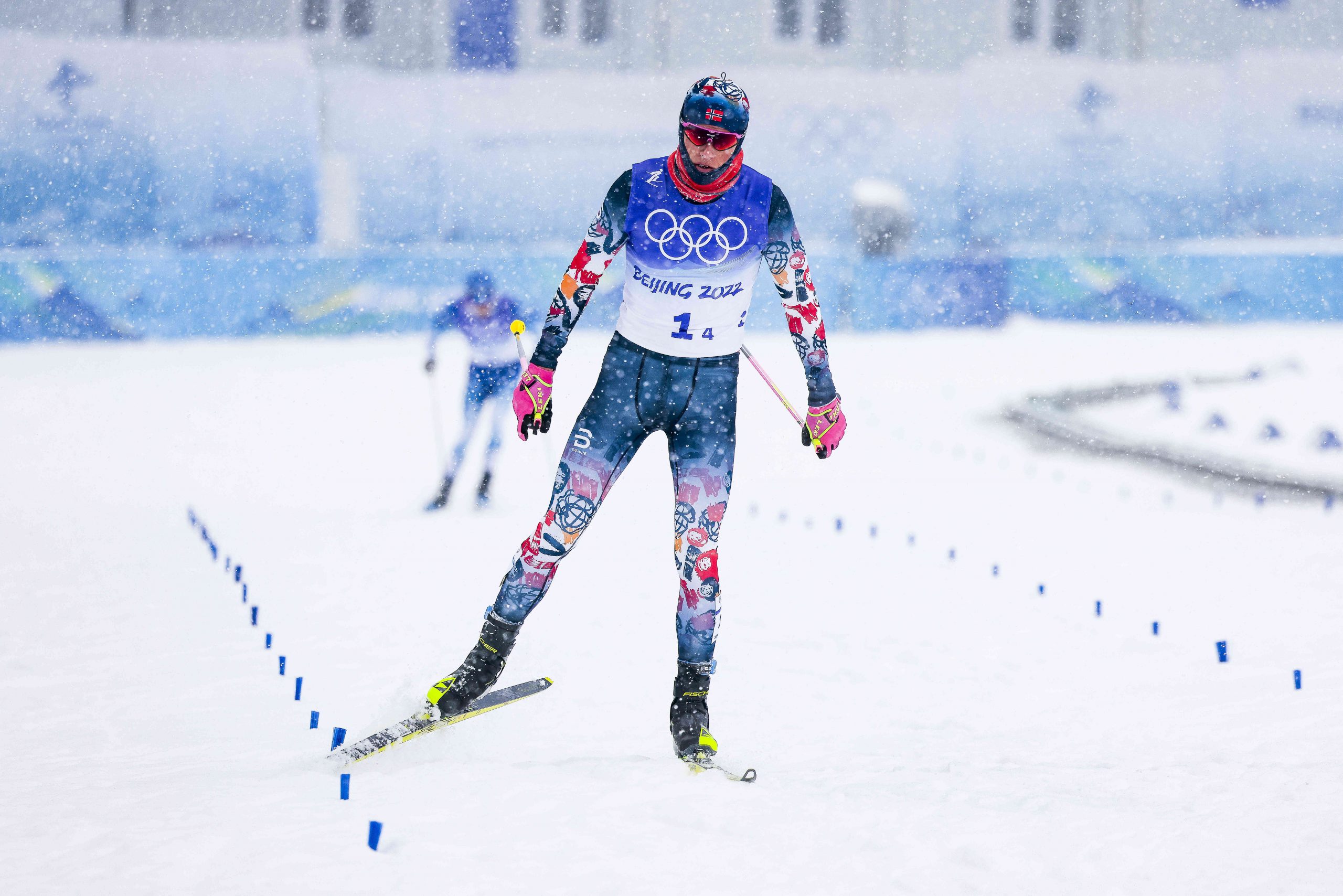
    No big moves from Johannes Høsflot Klæbo (NOR) as he brings home the silver medal for Norway (Photo: NordicFocus)

    Many meters ahead, Ustigov cruised into the stadium, grabbed an ROC flag and waved it triumphantly as he crossed the finish line before any challengers had even entered the stadium. Finishing in a time of 1:54:50.7 the men secured the second relay gold medal of the Games, after the ROC women brought home gold in the 4 x 5 k yesterday.

    Chervotkin, who gave the ROC such a strong start, said of winning gold, “we were aiming for this. We tried to achieve it, and for several years we haven’t been able to. Today everything aligned. Everything was super. The weather seemed to be hard and there was snow but it was in our favor so everything was great.”
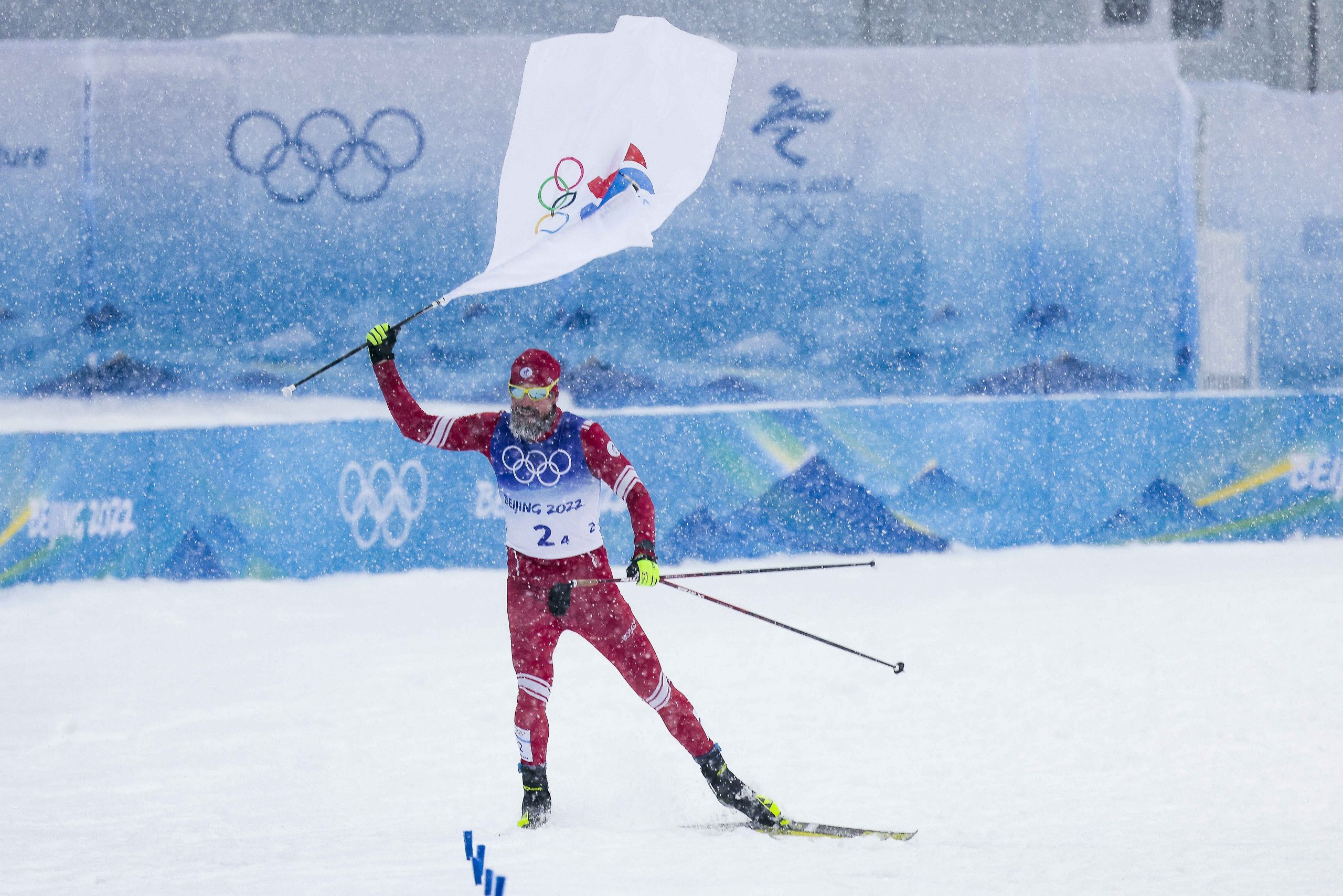
    Alone with a flag, Sergey Ustiugov (ROC) heads for gold (Photo: NordicFocus)

    Despite the consistent strength of the Russian team, they have not won a 4 x 10 k relay in over forty years. The last time they topped the podium in this event it was under yet another name, as the Soviet Union, at Lake Placid in 1980. Of course in recent years, they have consistently been runner-up, earning silver in 2021 Obserstdorf, 2019 Seefeld, 2018 PyeongChang and 2017 Falun. 
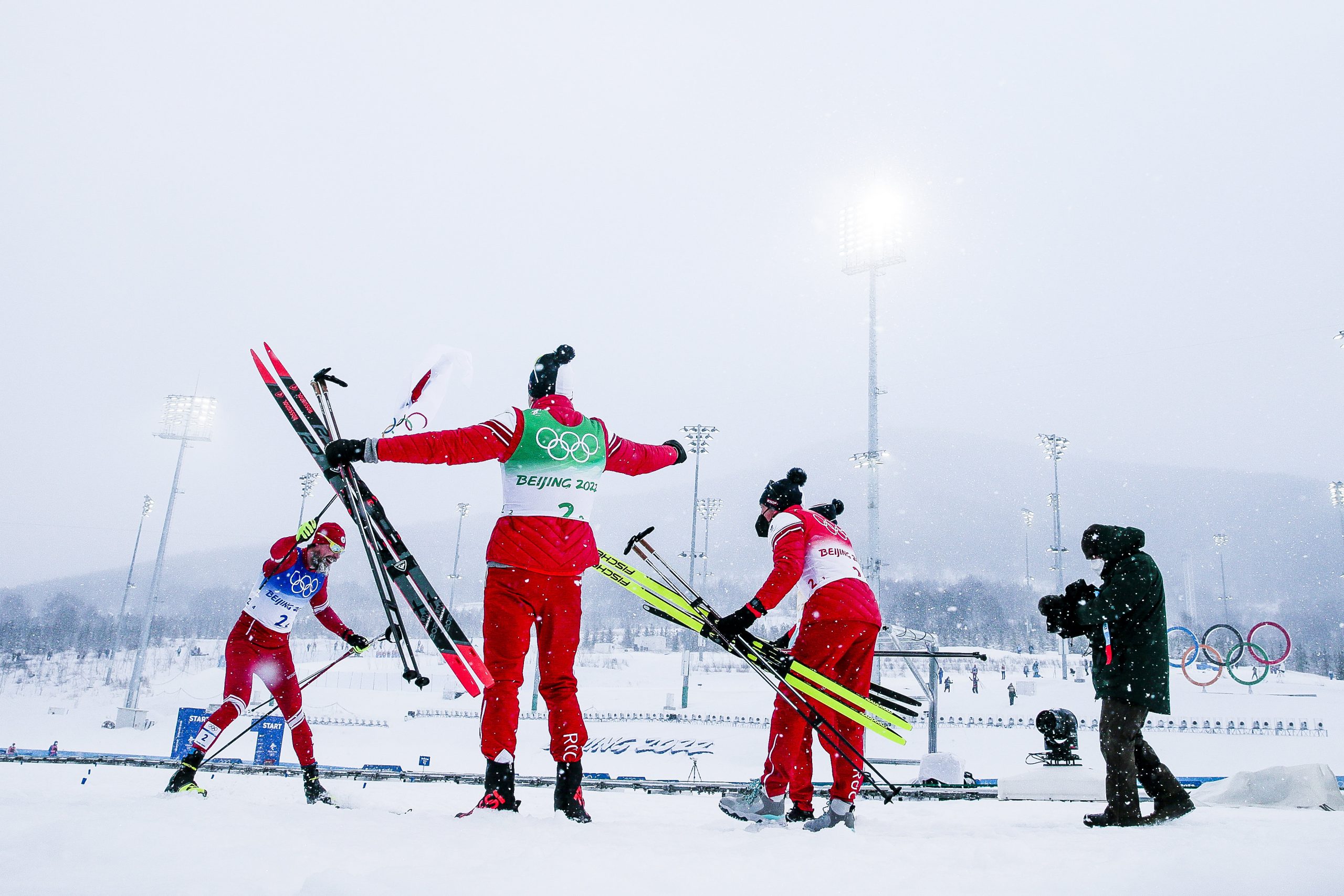
    Ustigov crosses the finish line unchallenged as his teammates wait to congratulate him (Photo: NordicFocus)

    Today the positions were reversed as Klæbo skied slowly across the line for silver, having simply glided away from Manificat in the closing stages. He was met by rather somber congratulations from his teammates, particularly in comparison to the French who celebrated their bronze as if it were gold.
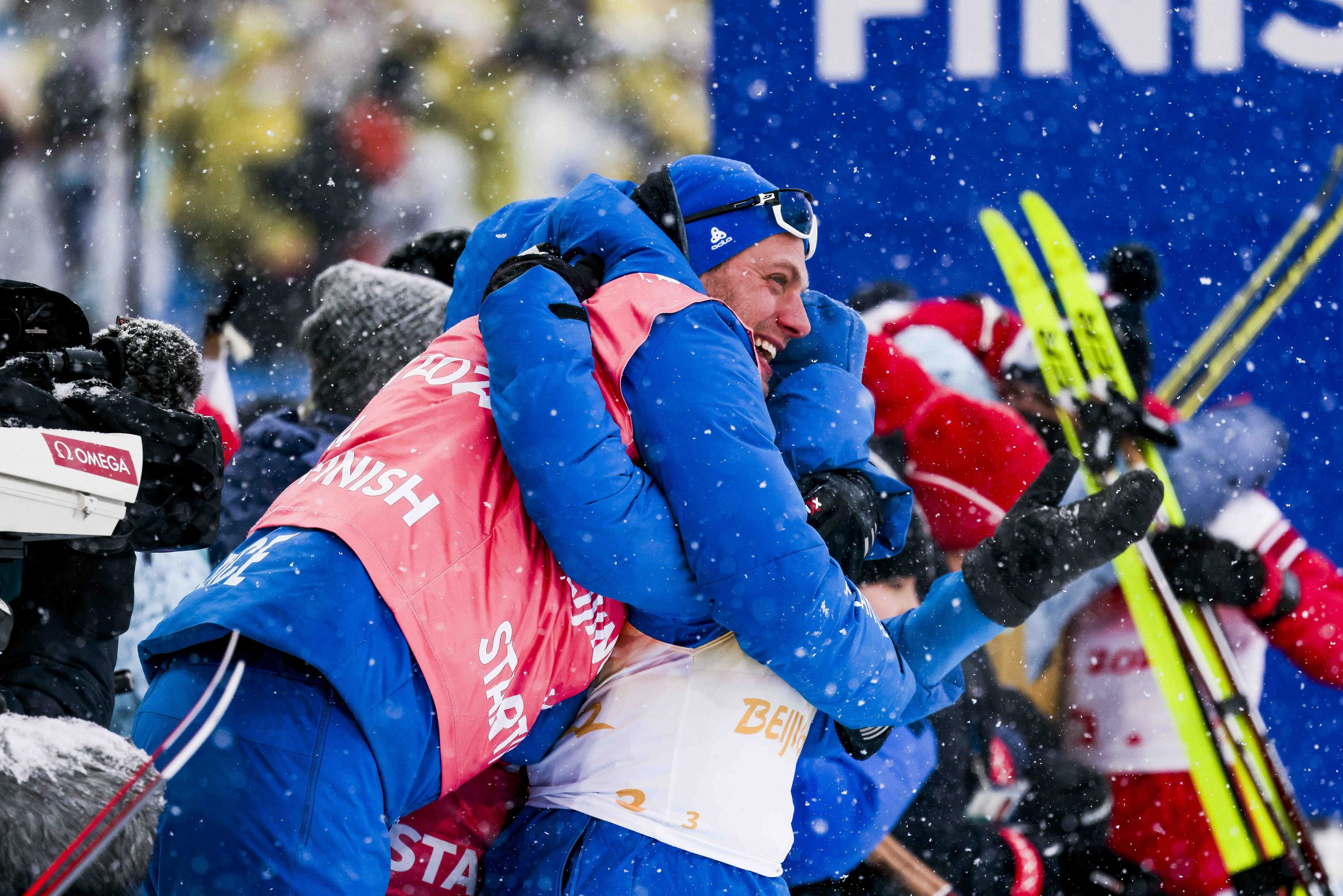
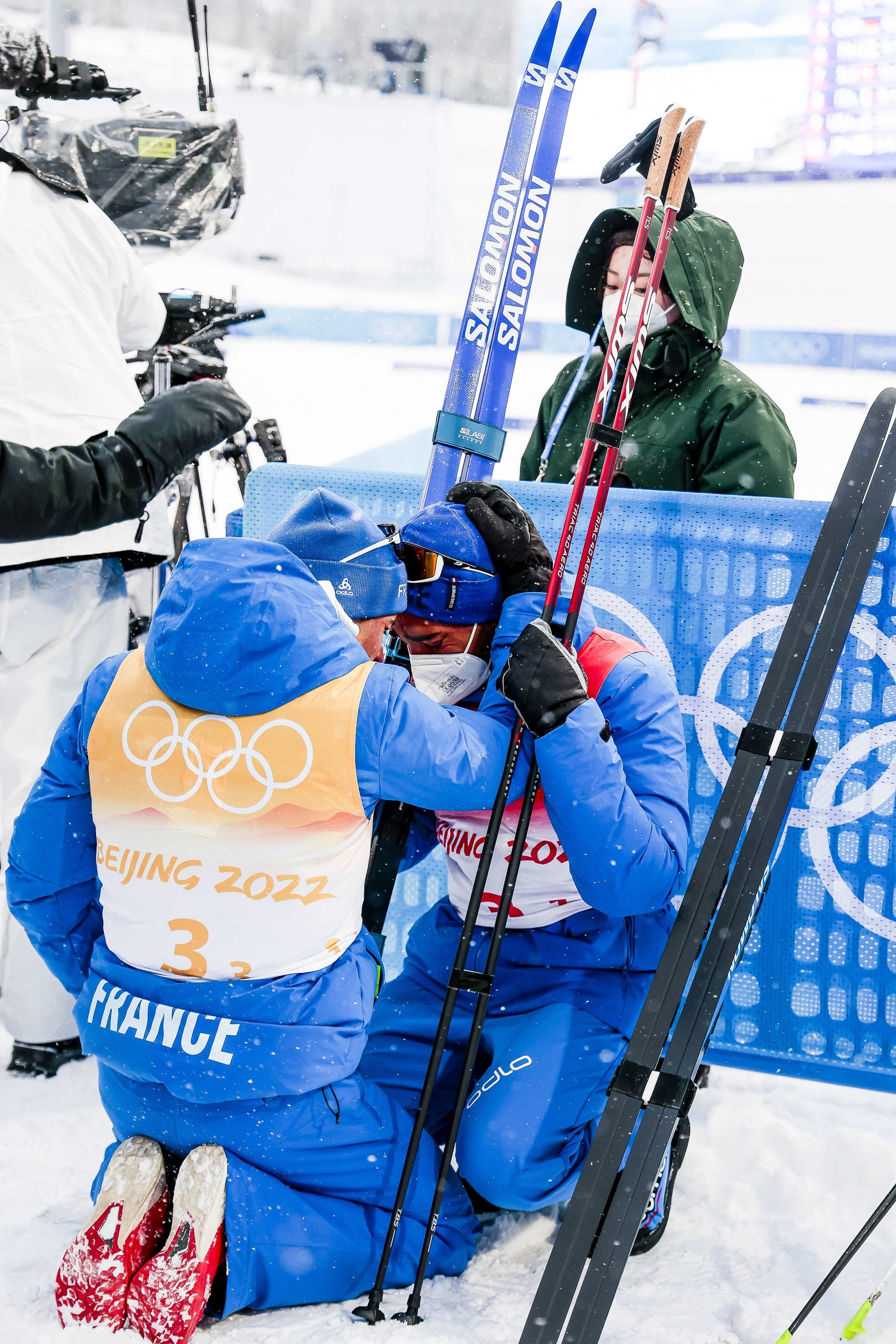
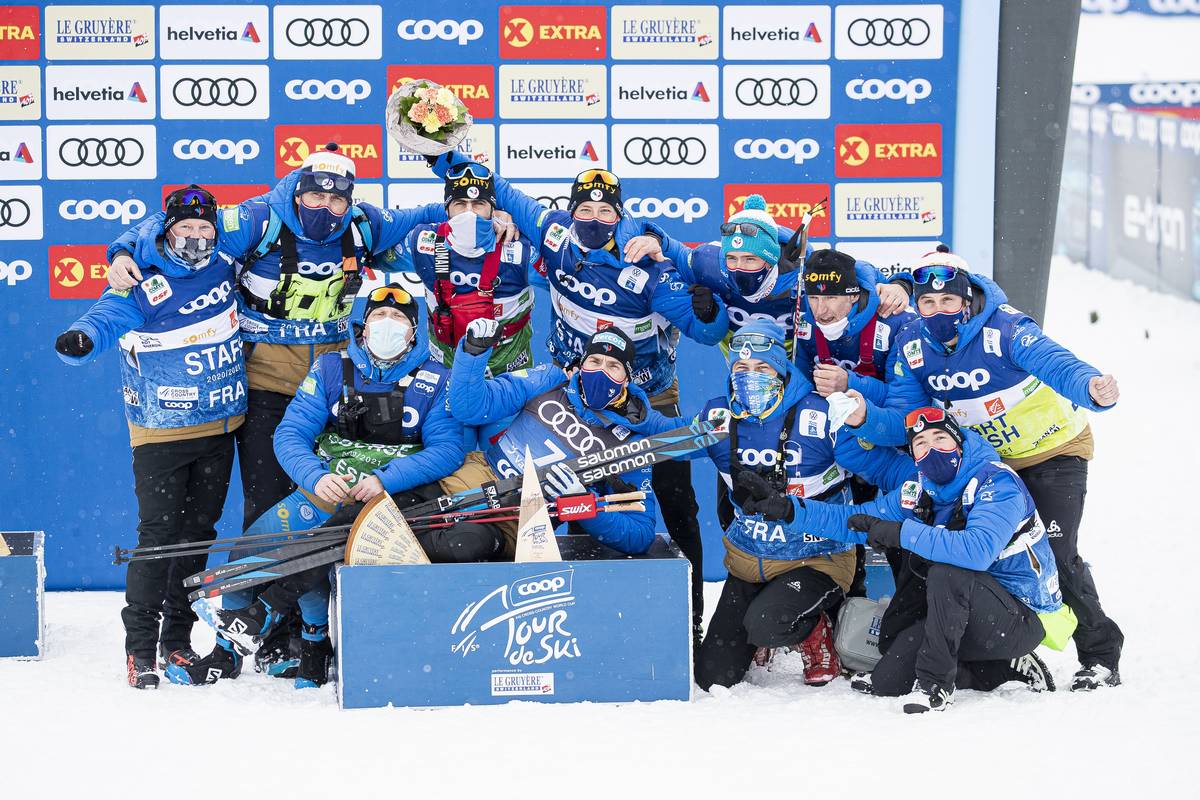
    Elation for the French at having secured another Olympic bronze in the men’s relay (Photo: NordicFocus)

    After the race, Klæbo said, “when you’re doing a relay, you’re doing it as a team and that is the beautiful part of it, so it’s always fun to race the relay and do it together. We all need to be satisfied with today’s result, and I guess we’re going to celebrate it in the evening and then some of us need to start preparing for the next race. But still we’re going to enjoy this evening.”

    His teammate Pål Golberg spoke about the challenging conditions, saying, “The course was tough before and with the snow and wind today, it was even tougher. So I mean, with altitude and everything it’s challenging but we did our best today. The four Russian guys were better so just take the hat off to them and try to be satisfied with the silver.” 
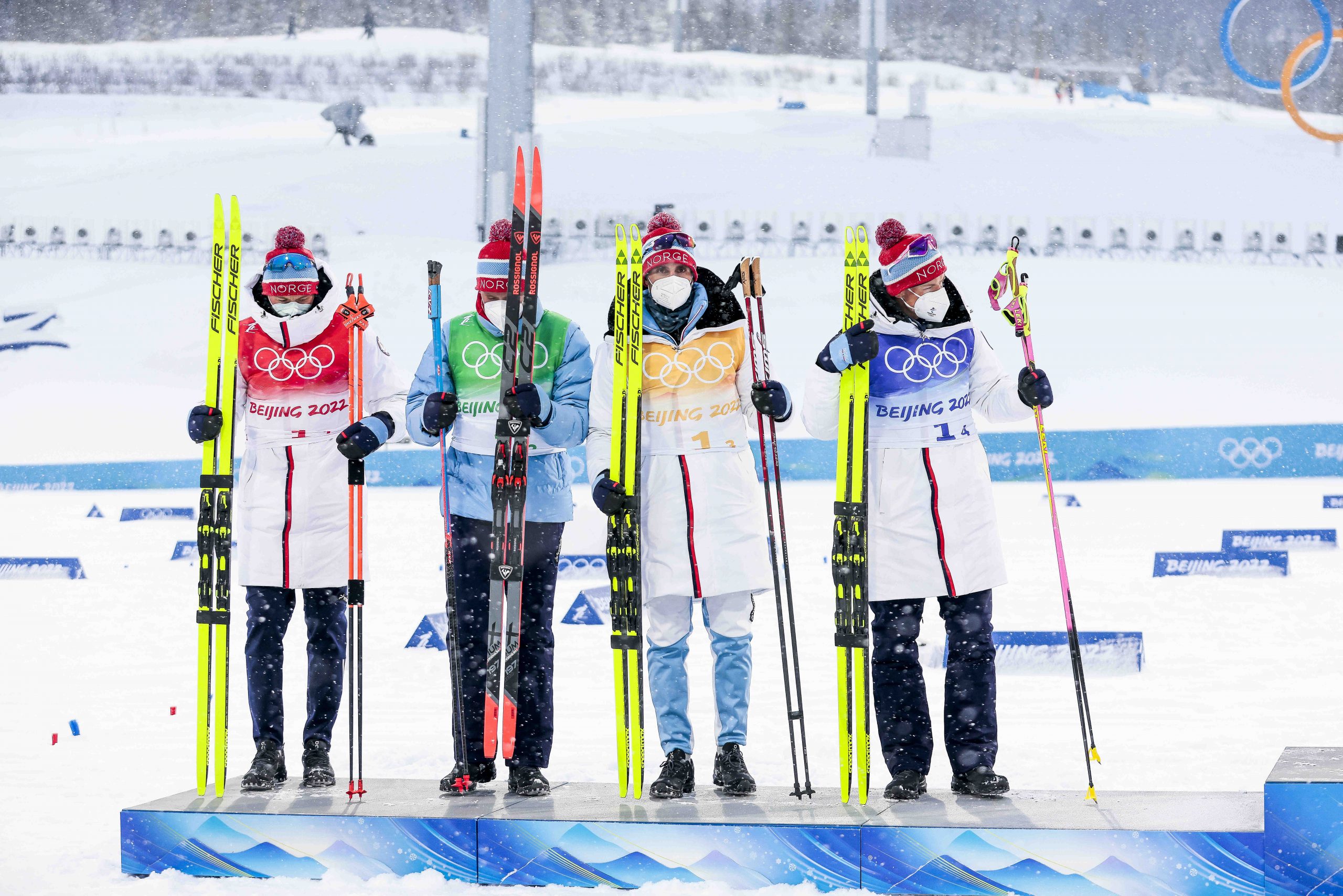
    Emil Iversen (NOR), Pål Golberg (NOR), Hans Christer Holund (NOR), Johannes Høsflot Klæbo (NOR), (l-r) were the only team not celebrating their medal (Photo: NordicFocus)

    If Norway has held a monopoly on gold in the men’s relay, then the same can be said about the French and bronze. This is the third consecutive Olympics that France has earned bronze in the men’s 4 x 10 relay and Maurice Manificat has played a part in all of them. Similarly, in the last four World Championships, France has collected bronze in three of them.

    When asked about winning another medal at the Games, Manificat replied, “four Olympics for me and some medals in the relay since Sochi, so for sure it’s an amazing feeling.”

    Regarding the challenge of trying to drop Klæbo he said, “I tried, in the big uphill and I give my best, I give all I had. Medal in relay is the best medal. Because you share it together. We thought all the year about the relay, it’s our soul.” 
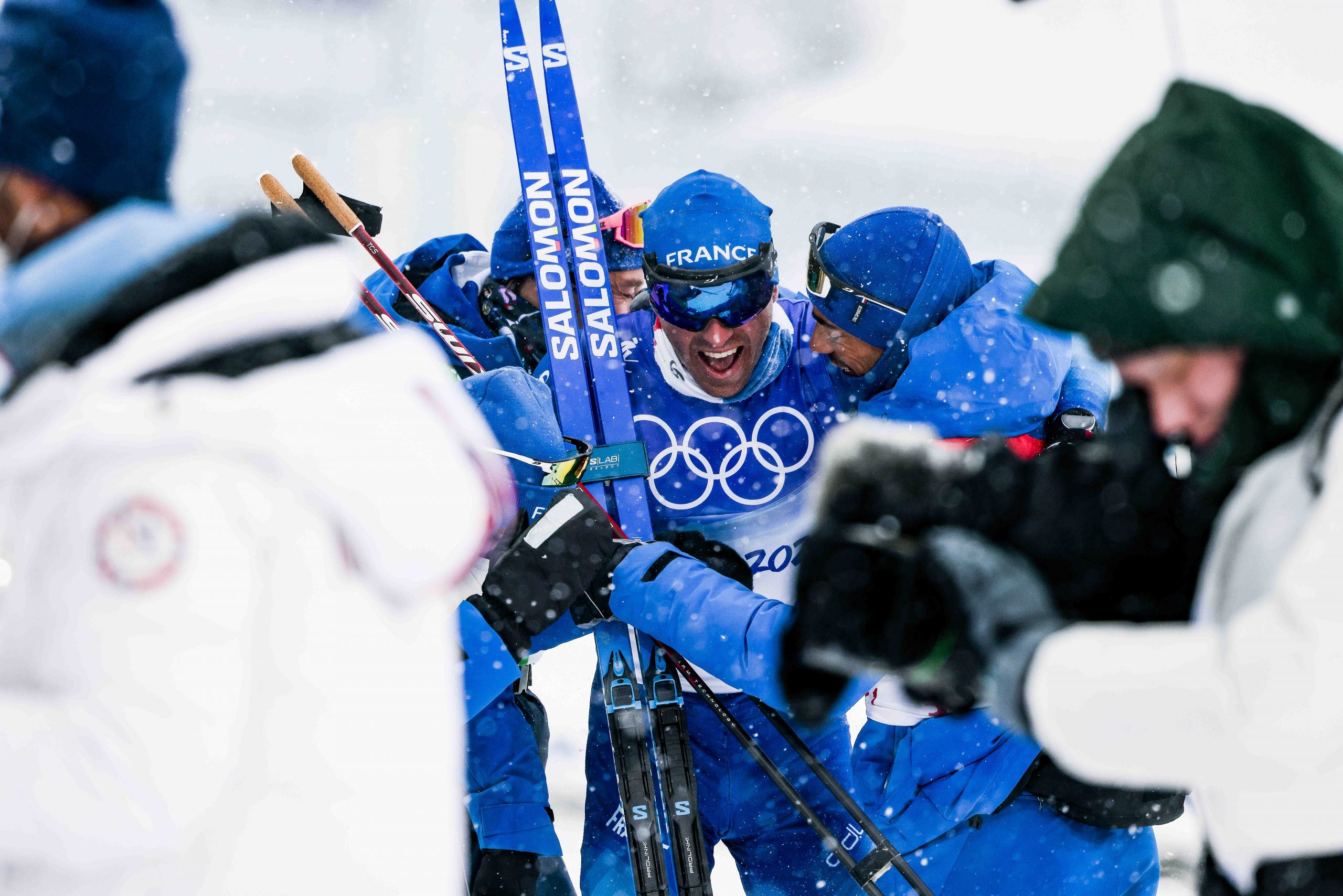
    Teammates congratulate Maurice Manificat (FRA) on a gutsy final leg to bring France the bronze medal (Photo: NordicFocus)
    Clement Parisse (FRA) and Richard Jouve (FRA) share a moment at the finish. (Photo: NordicFocus)

    With three teams lapped out of the race and the spread between the ROC and 12th place finishers, the Czech Republic at +10:07.1, the day was evidently a tough one.

    Improving on an 11th place finish in PyeongChang, the American men skied to 9th place today, +8:05.6 behind. 
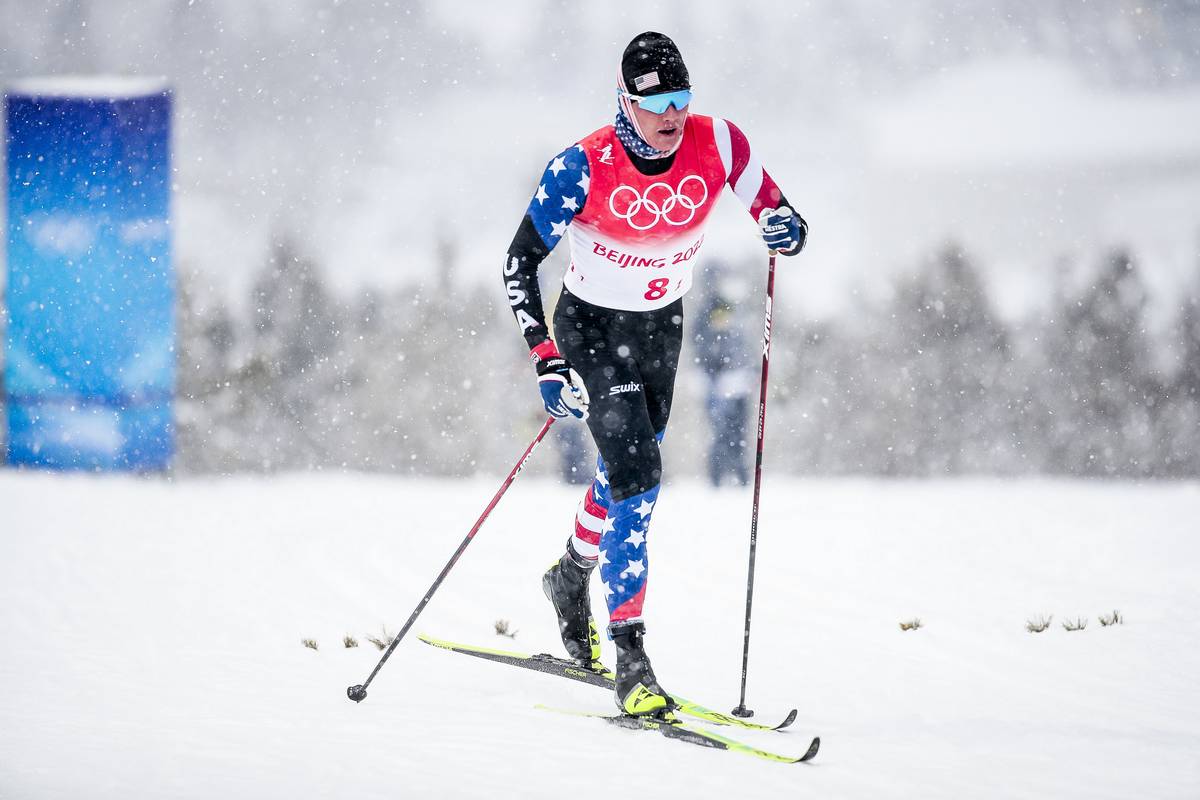
    Luke Jager skis the scramble leg for the Americans during the Olympic 4 x 10 k relay. (Photo: NordicFocus)

    Luke Jager took the scramble leg for Team USA, putting the team in 13th, +2:39 behind at the conclusion of his leg.

    “I felt kind of like I’d become sort of aware of some of the subtleties of how scramble legging in skiing works in the last years, but it was sort of like, all that went out the window,” Jager told FasterSkier from the mixed zone. “For a lot of reasons: the course is really hard, the altitude was really hard, and 10 k versus five or 7.5, was a really big difference. At the end of the day, I just wasn’t fit enough to be where I want to be and there was no hiding to be had. So, I feel like I learned a lot from it, but I just feel like I need to go home and train a lot more.”

    While Jager chalked it up as a disappointment, he contrasted the statement it with: “that’s obviously multifaceted. There’s pros to it all, and I’m really thankful to be here.”

    Up next was Scott Patterson, who started the Games with an impressive 11th place finish in the skiathlon. Patterson bumped the team up into 11th place, though the time gap continued to widen at +4:23.2.

    “I think as we’ve seen in every race this week, those courses are pretty unforgiving,” Patterson explained. “I felt like I had to go out and ski my own race and not really think too much about what everyone else was doing, just go move into the race and try to ski well. It was a little bit interesting place where Luke tagged me off, but I think I picked off some people and put us in a good spot, so I’m happy with that.”

    Gus Schumacher races the third leg of the men’s 4 x 10 k relay. (Photo: NordicFocus)

    Patterson tagged Gus Schumacher who maintained their position in 11th place and finished his leg +6:04 behind. In the anchor position, Kevin Bolger moved past both the Japanese and Czech team to put the team in 9th place. 

    “I’m proud of us for coming together the team,” said Schumacher after the race. “We’ve all had some tough races here… It hasn’t been easy for us. I think it’s a little bit hard especially to have the girls’ success – there’s some pressure there.”

    While the team was seemingly unanimous that this pressure was self-imposed and that it had been a relief to feel they had “nothing to lose and everything to gain,” the Americans also affirmed that they brought hopeful energy to the day, looking to take a step forward as a team, regardless of what that looked like on paper.

    Over the last four Olympic cycles, the Americans have been 11th place in the last two Games, along with 12th in 2006 and 13th in 2010. It might not be a medal, but it was, in fact, a step forward for the program.

    “I think we all really put it out there and yeah, good energy,” Schumacher concluded.
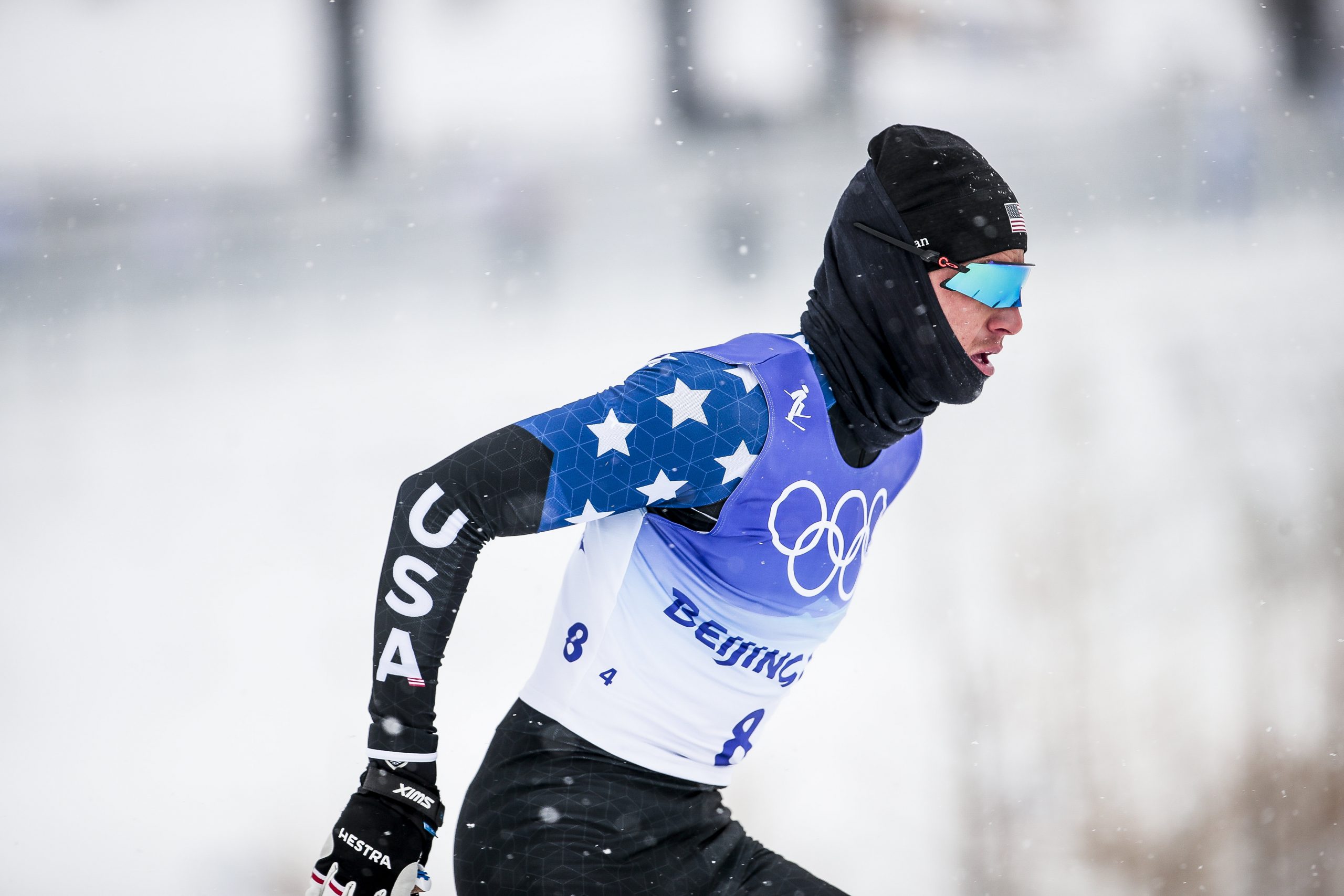
    Kevin Bolger (USA) skiing the anchor leg for Team USA (Photo: NordicFocus)

    The Canadian team was led out by Graham Ritchie who ended his leg in 14th, +2:42 behind. Antoine Cyr took the second classic leg and moved up one position to 13th, +4:23.2.

    In the transition to skate, Olivier Léveillé skied Canada’s third leg, again moving the team up one position to 12th, +6:44.6. Rémi Drolet anchored to bring the team home in 11th position, +9:10.4. 

    Antoine Cyr (CAN) skiing the second leg for Canada (Photo: NordicFocus)
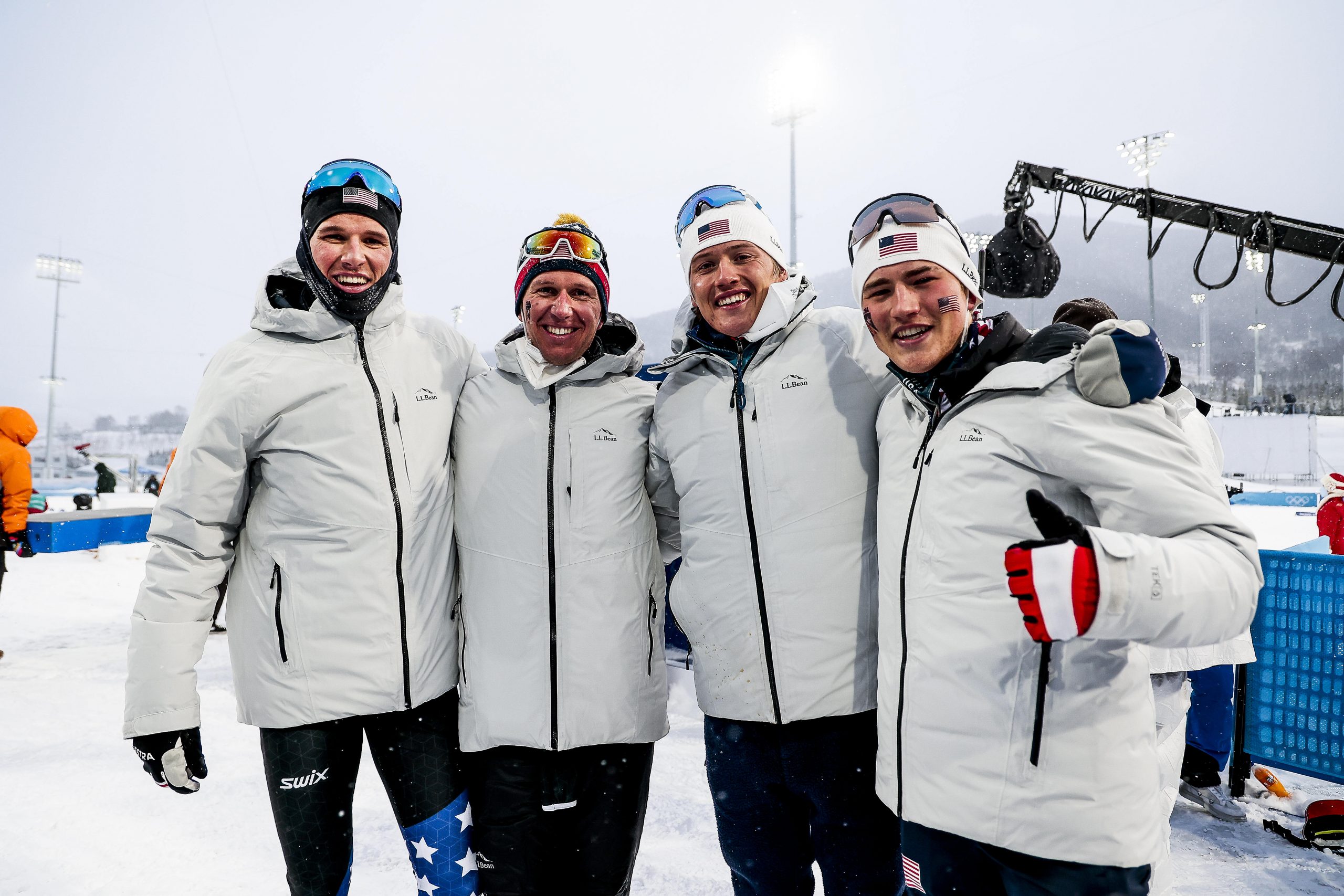
    American men’s 4 x 10 k relay team: Kevin Bolger, Scott Patterson, Luke Jager, and Gus Schumacher (l-r) (Photo: NordicFocus)

    “The relay is really a game of staying in contact,” Matt Whitcomb told FasterSkier in the mixed zone. “When you lose contact, it becomes a different race. Time expands immeasurably. So I’m very proud of the way that these guys tackled the project that they’re handled today. There’s also – and I say it with a Canadian over my shoulder – this is one of our favorite rivalries: our northern friends. And it really is a friendly and very fun rivalry, where we’re always giving each other splits back and forth, and I’m proud of both teams today. And I’m also excited for our guys to come out just a little bit on top.”

    The next Olympic cross country ski event will be the men’s and women’s team sprint, happening on Wednesday, February 16th.

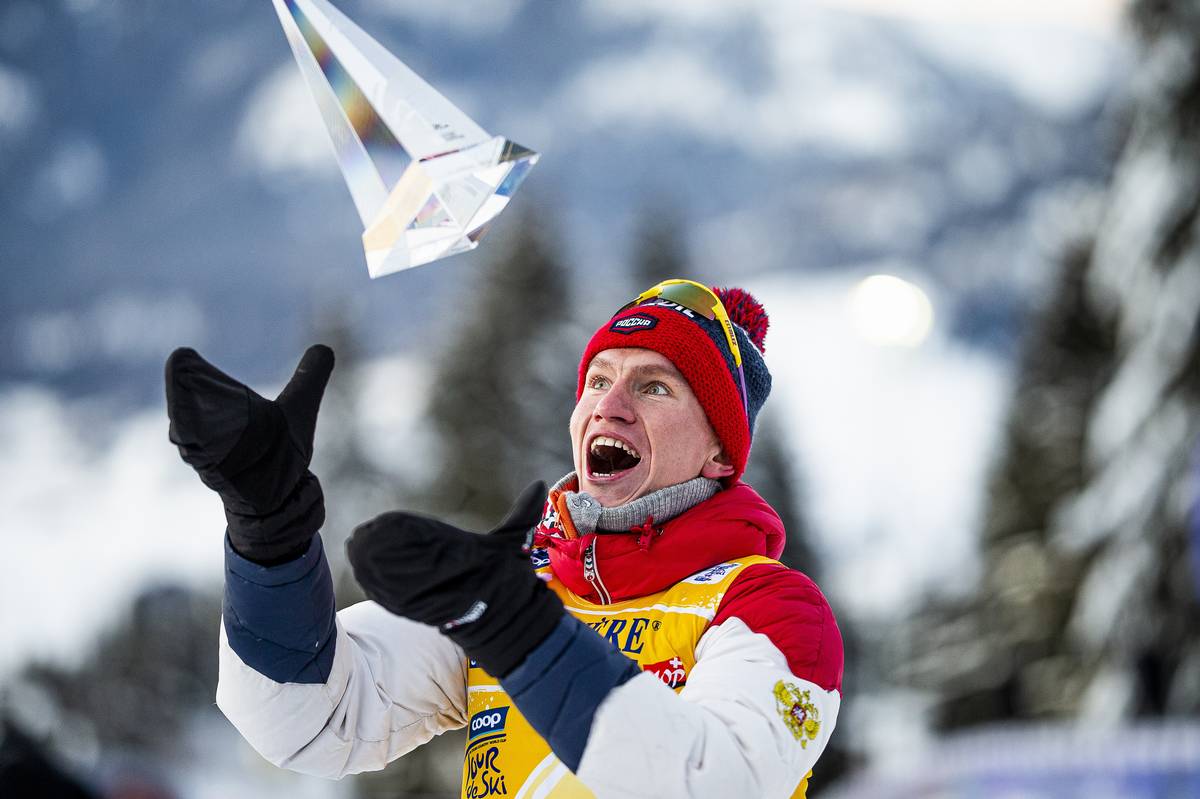
    Results

  • Bolshunov Nails the Door Shut for Tour Win: Schumacher 18th Overall (Updated)

    Bolshunov Nails the Door Shut for Tour Win: Schumacher 18th Overall (Updated)

    Bolshunov was never a toss-up for the overall. (Photo: NordicFocus)

    This World Cup coverage is made possible through the generous support of Marty and Kathy Hall and their A Hall Mark of Excellence Award. To learn more about A Hall Mark of Excellence Award or to learn how you can support FasterSkier’s coverage please contact info@fasterskier.com.

    The inevitable conclusion at the sharp end of the 2021 Tour de Ski came to fruition. The ticks of the clock to second skier overall, France’s Maurice Manificat (34), tell the abridged version of the past seven stages: Russia’s Alexander Bolshunov began the mass start race to the Alpe Cermis hill climb finish with a yawning 3:22 minute lead.

    Beyond simply outperforming his peers, Bolshunov’s 2021 Tour de Ski is simply a highlight reel of a 24-year-old becoming a generational talent on the World Cup. He also had history on his side. In 11 previous 14 editions of the Tour de Ski, the leader coming into the final stage went on to win the overall Tour de Ski title.

    The race for the final overall podium heightened the tension for an otherwise closed-book narrative for first place. Coming into the final stage, Manificat held a five-second lead on Russia’s Ivan Yakimushkin (+3:27) and Artem Maltsev (+3:27), with Denis Spitsov fifth overall (+3:50). Fifty-one starters churned down the Marcialonga course in Val di Fiemme skating towards the awaiting headwall.

    Alexander Bolshunov in front, followed by Evgeniy Belov up the Alpe. (Photo: NordicFocus).
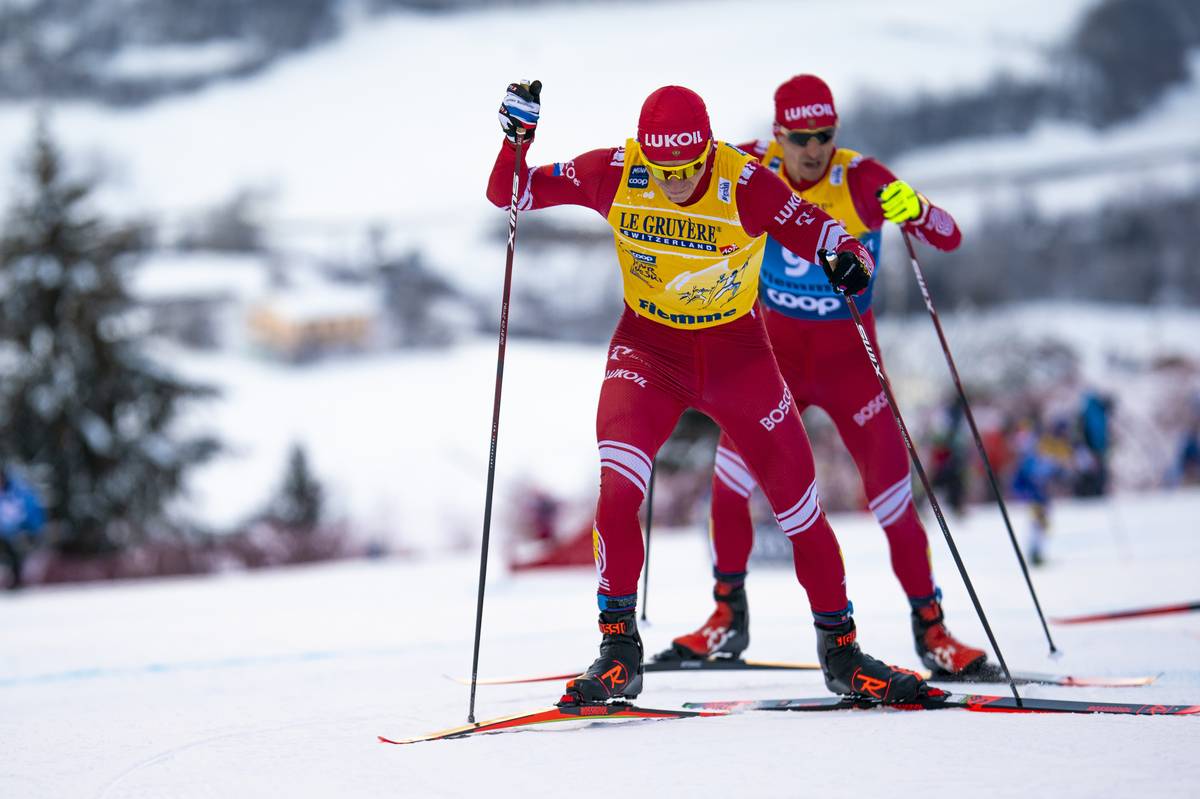
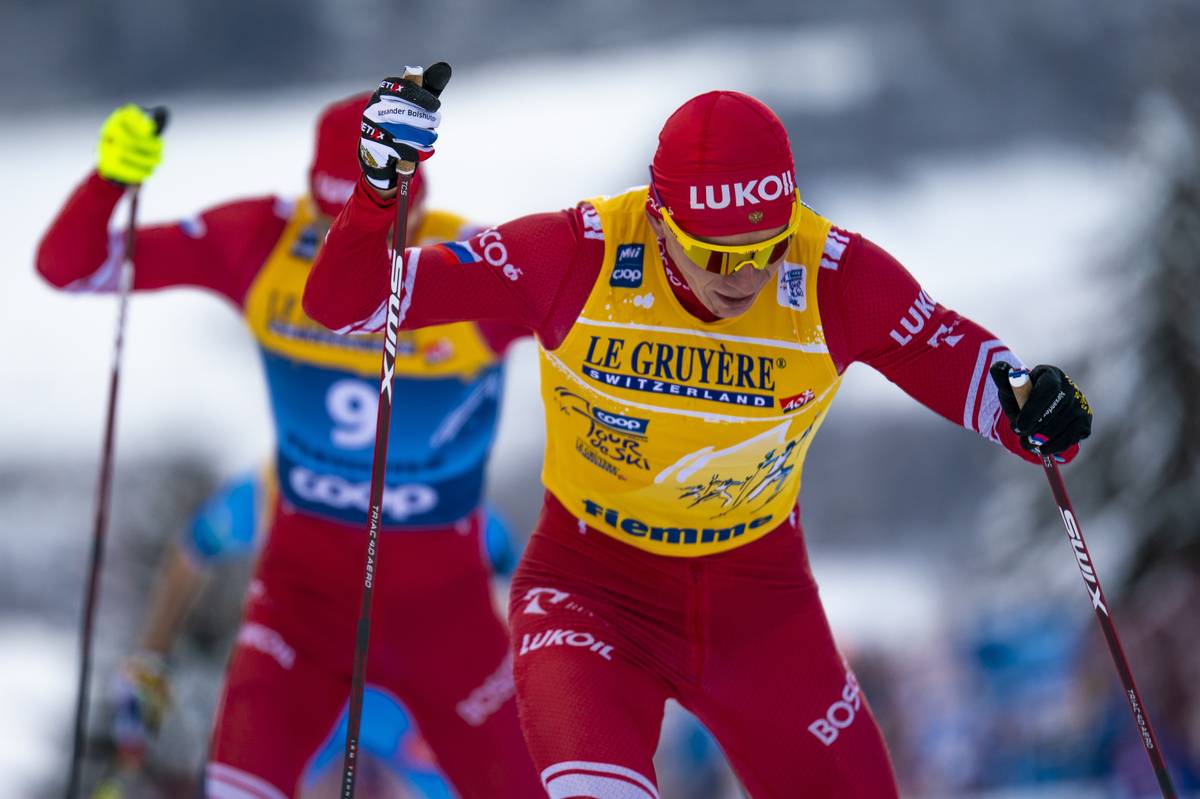
    Alexander Bolshunov in yellow: all core as he ascends the Alpe Cremis for back-to-back overall Tour de Ski victories. (Photo: NordicFocus)

    Up the lower flanks of the Alpe, Bolshunov was initially surrounded by his team in red. A group, by the stage’s end, that would crowd the top-10 with seven skiers.

    The stage accolades went to Spitsov, who began to pull away later in the race. He won in 32:41.0 minutes for his first stage win of the Tour and his second podium – he placed second in Stage 4’s 15 k skate. The yellow-bibbed Bolshunov paced to second (+13.3), with Manificat in third (+15.2)

    With his effort, Spitsov lept over Maltsev and Yakimushkin to take third overall in the Tour. Manificat finished second overall.

    Powered-up: Maurice Manificat of France scores second overall in the Tour. (Photo: NordicFocus)


    Denis Spitsov of Russia skiing himself onto the overall podium and snagging the stage win in the process. (Photo: NordicFocus)

    This was another Bolshunov coronation. Bolshunov won six of eight stages, locking up every distance race in this Tour outside of the Alpe climb, amounting to five stage wins. He placed second and third, respectively, in the two sprint stages. Say what you want about each race being animated differently with the Norwegian men’s team absent and a potentially different outcome for the Russian; he raced against those who showed up and decimated the field.

    With a cumulative time of 3:32:32.3 hours, Bolshunov becomes the second male skier to win back-to-back Tours after Swiss skier Dario Cologna won the 2010/2011 and 2011/2012 iterations. He also becomes the fourth men’s skier to have won the Tour multiple times. (Cologna won four, Norway’s Martin Johnsrud Sundby two, and the Czech Republic’s Lukáš Bauer won two).

    No need to calculate or parse the data – the win and its trove of World Cup points keeps Bolshunov in the lead for the World Cup overall as the race scene takes a break until January 23rd when the World Cup reconvenes, with the Norwegians in attendance, in Lahti, Finland. For those keen on the data, Bolshunov possesses 1297 points, with the next closes skier, Yakimushkin in second, has earned 631.

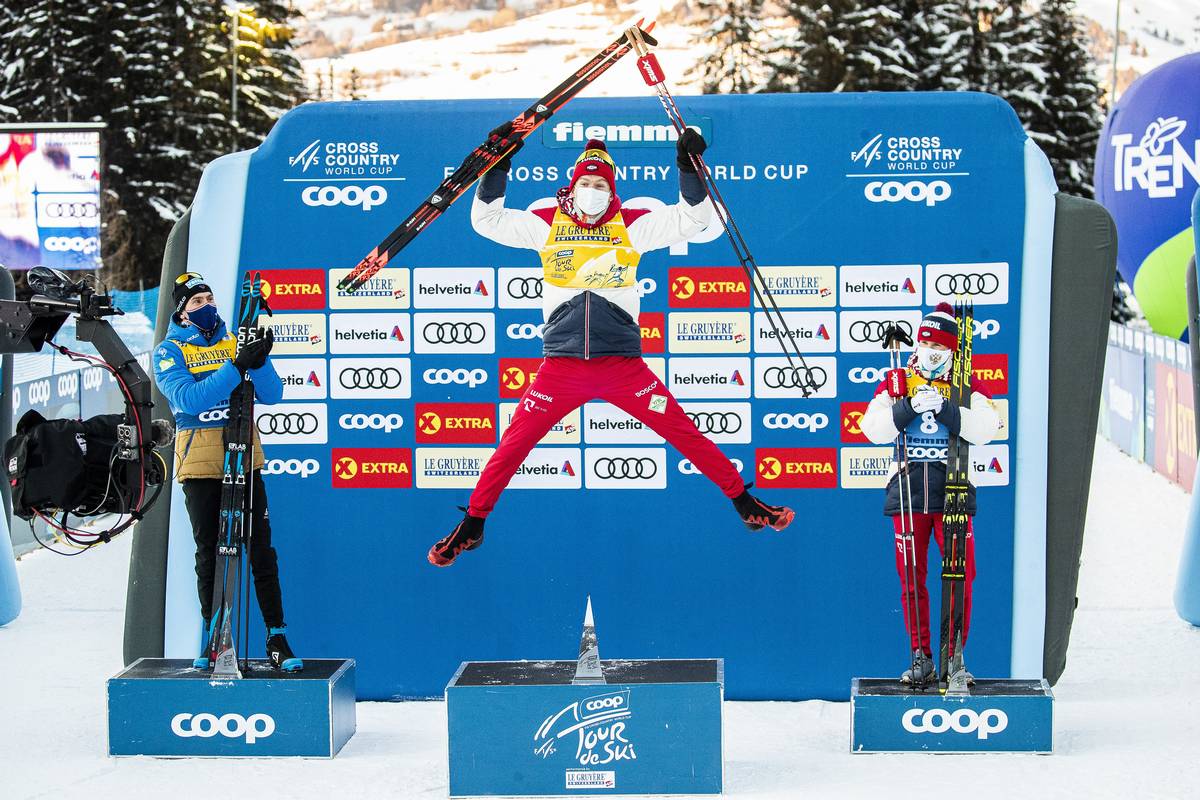
    The Tour’s overall podium: Maurice Manificat (FRA)second, Alexander Bolshunov (RUS) first, Denis Spitsov (RUS) third, (l-r). (Photo: NordicFocus)

    For American skiers, Gus Schumacher catapulted into our imaginations and the results when considering he is a first-year senior skier and this remains his first full-time World Cup stroll.

    Schumacher placed 19th on the final climb +1:14.4 and cemented a top-20 overall finish for 18th (+8:36.1). As noted in yesterday’s men’s race report, this is a career-best for an American male at the Tour. Considering the nature of this eight-stage show, Schumacher gained ground as the kilometers ticked by. He placed 31st, 36th, 32nd, 14th, 15th, 8th, and 24th, and 19th, respectively, on each stage. A progression illustrating gains as energy reserves are depleted — a positive trend for any athlete seeing solid Tour results as part of their yearly goals. In summation: Schumacher nailed his first career Tour de Ski.

    He is currently positioned 27th in the World Cup overall, having scored points (the top-30 earn points each race) in eight of 19 races – he earns 52 points for his 18th in the overall TdS standings.

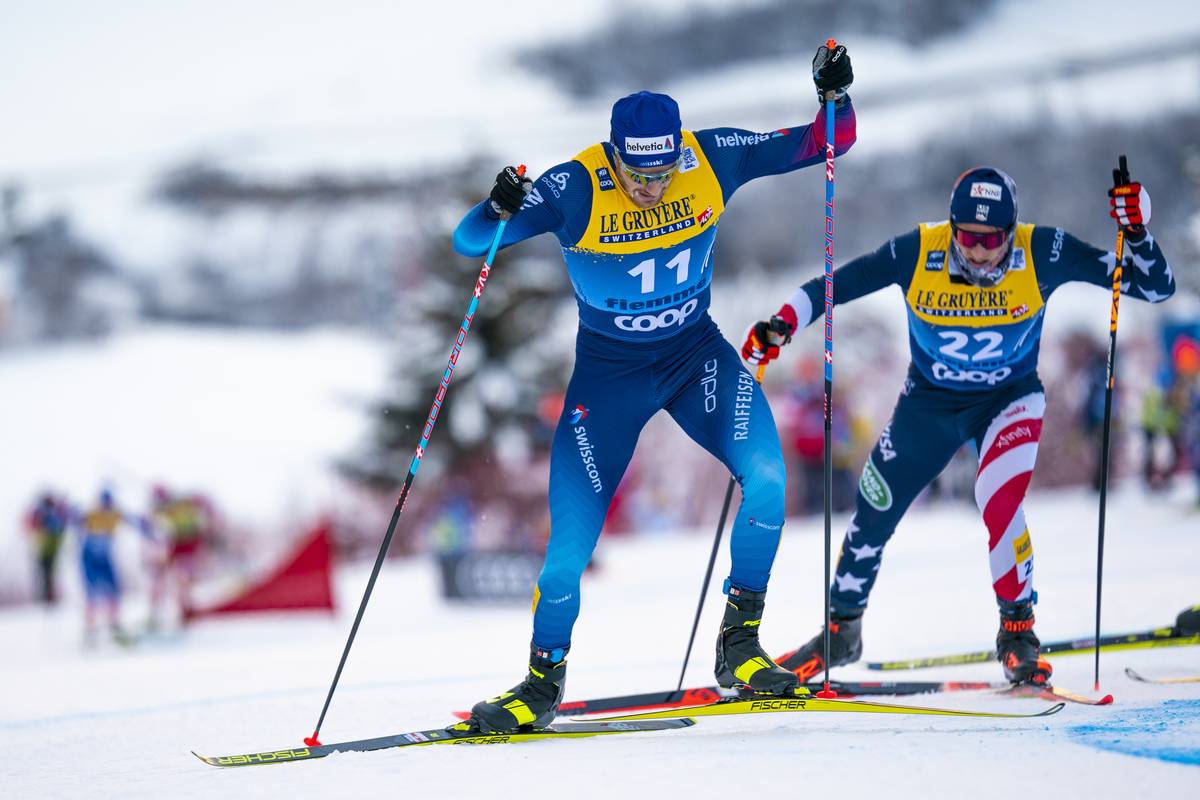
    Paced by a legend, Gus Schumacher (bib 22) follows Swiss star Dario Cologna (bib 11). (Photo: NordicFocus)
    Gus Schumacher (bib 22) followed by Alexey Chervotkin of Russia (bib 22) on the Alpe Cermis. (Photo: NordicFocus)

    The U.S. had two more men’s finishers on Sunday, Scott Patterson placed 38th (+2:23.0) on the stage, with Kevin Bolger in 48th (+3:12.9). In the overall picture, Patterson finished in 37th (+13:57.7), and Bolger 48th (+19:17.6).

    Kevin Bolger during Stage 8 of the Tour de Ski. (NordicFocus)


    Scott Patterson of the U.S. during Stage 8 of the Tour de Ski. (Photo: NordicFocus)

    FasterSkier corresponded with Patterson after the race to learn more about his 2020-2021 season. Below is the Interview conducted via email. 

    FS: Looking for some high points in terms of sensations during this Tour, can you describe a few moments (or more) that are positive takeaways for you and the season moving forward?

    SP: While my results at the tour didn’t line up with where I was hoping, I think there are still several positives coming out of the 8 days of racing.  The result high point was probably the 24th time of day in the skate pursuit in Val Mustair. Although my wheels started coming off at the end of that race, I was pleased with how I skied and felt like I did a good job fighting the whole way. For feeling, I think the Val de Fiemme classic was one of the better.  I have felt like I have been struggling a bit with classic so far this season and finally captured a few better feelings in that classic race, even though I was shelled by the lead pack much earlier than I wanted.  I’m encouraged that things will continue moving in the right direction on that end.

    FS: This is your first Tour de Ski, can you talk about your approach to both trying to seize each opportunity in the distance races, and being mindful that this is an 8 stage event? Sort of the cash your chips in all at once strategy vs. being mindful of the long-term.

    SP: This was my first tour, though I did race the Ski Tour Canada a while back with 8 stages. I was really trying to seize the opportunity for every distance race and hope that my training volume would let me preserve decently through the 8 stages.

    FS: What maybe did you struggle with at the TdS specifically?

    SP: It seemed like each day was a different struggle. Sometimes the altitude was tough and some days it was other things. The races included a lot of mass starts and pursuit starts which can be fun and great, but with my FIS points leaving something to be desired, it was often a fight to get into a good position.  Then when the surges started happening, I had already burned some of my few fast-twitch matches.

    FS: You had a high point result of 16th in Davos – curious what you experienced there that you are hoping to recapture as the season moves forward?

    SP: While I don’t think the tour really showed it, I don’t think the form I had in Davos is far off. Each day was just a little off and that rapidly dropped me down the results.  I’m looking forward to a little time to regroup and set up for the rest of the season.  I think with a few days to recover, I should be coming right back around.

    FS: Again, as your first TdS, what did you learn about yourself physically and mentally (as this is such a long haul)?

    SP: I think there are quite a few takeaways from the Tour. I’m still processing a lot of them. A big obvious one is that I don’t seem to sprint any faster even after everyone has raced 6 times.

    Stage 8 Results | Tour de Ski OverallWorld Cup Overall

  • Bolshunov’s Streak Remains Strong, Schumacher 15th in Stage 5

    Bolshunov’s Streak Remains Strong, Schumacher 15th in Stage 5

    Alexander Bolshunov (RUS) celebrating his fourth victory out of five races in this years’ Tour de Ski. (Photo: Nordic Focus)

    This World Cup coverage is made possible through the generous support of Marty and Kathy Hall and their A Hall Mark of Excellence Award. To learn more about A Hall Mark of Excellence Award or to learn how you can support FasterSkier’s coverage please contact info@fasterskier.com.

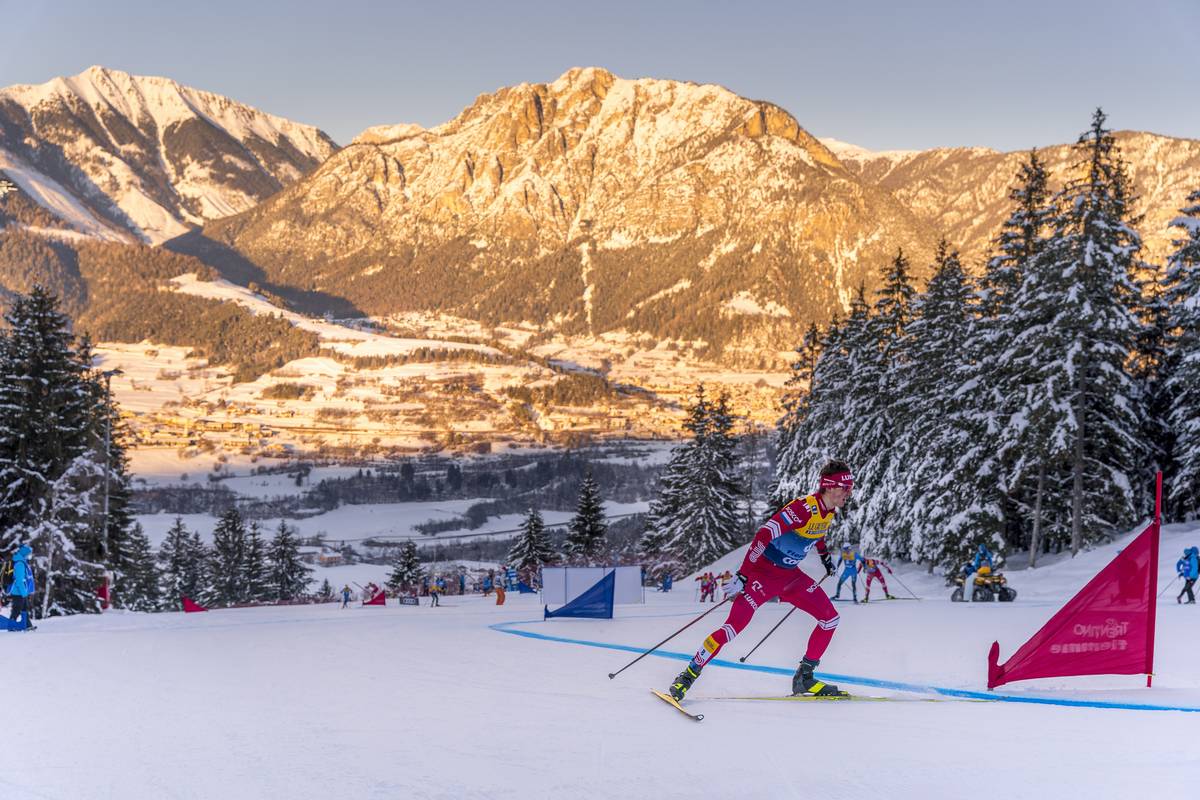
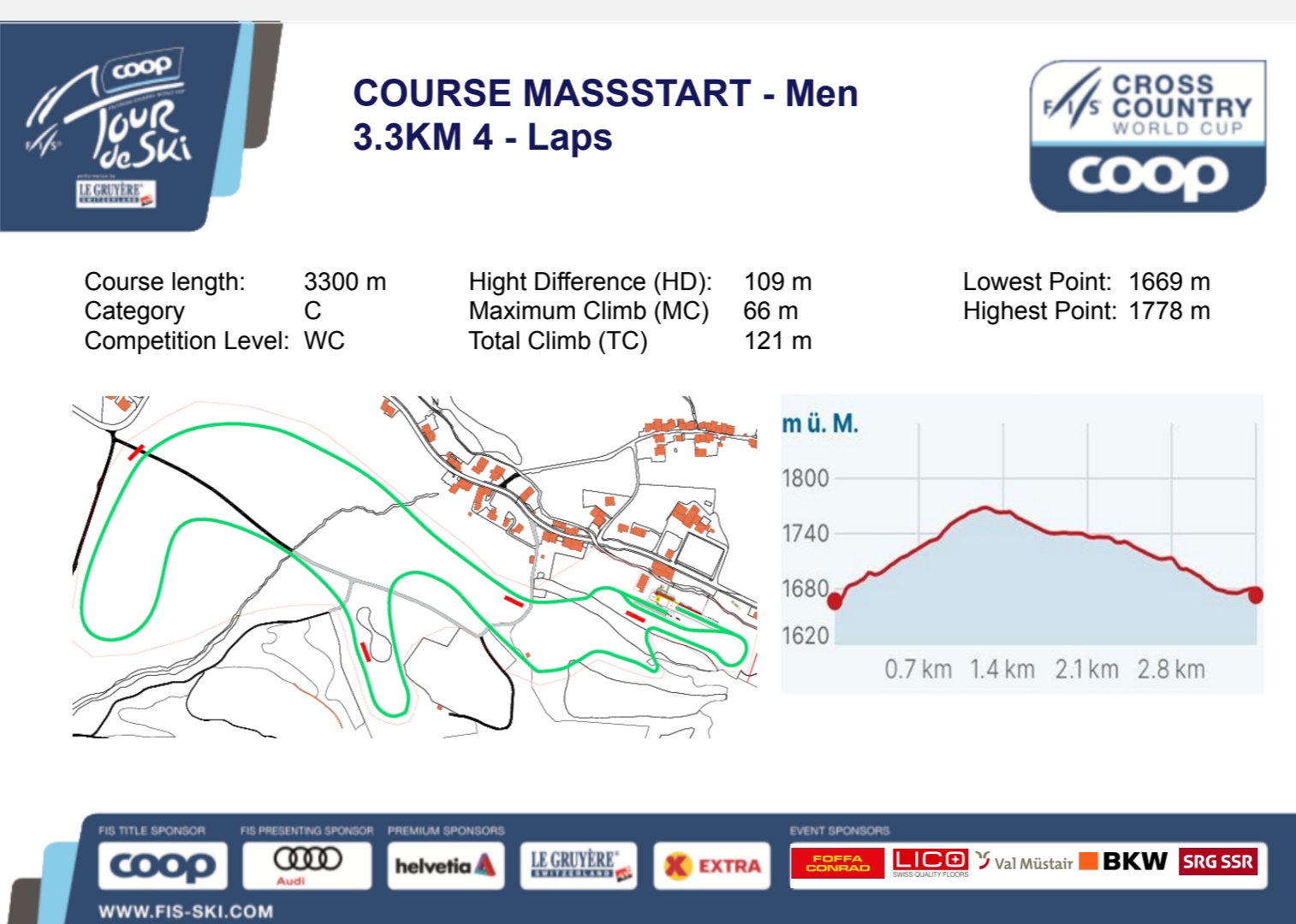
    With Russia landing seven of the top eight positions yesterday, today’s 15 k classic pursuit started with a wave of red. Or as Maurice Manificat of France described it in a pre-race interview, “the Russian armada versus the French mafia.” Manificat (FRA) started in sixth and his teammate, Hugo Lapalus of France began in ninth, otherwise, the first thirty seconds of starters were all Russian. Under a ceiling of clouds, the racers wound up and down the snowy, forested hillsides, completing four laps of the 3.3 k course.

    Bolshunov kicked things off with an eight-second head start over teammate Denis Spitsov of Russia (today’s pursuit start was based on yesterday’s finishes and not overall tour times), and a +1:15 lead in the overall tour standings. He began the day with three wins out of the four races already completed in this year’s edition of the Tour de Ski, and when the race had concluded he had increased that number to four wins. 

    Untouchable and in a class of his own, Bolshunov crossed the finish line in a time of 34:32.9. Only the occasional gasps for air as he passed the camera gave any indication that this was at all challenging for him. With seeming ease he stretched a lead of +8 seconds to +34.5 seconds by 3.3 k, and strode ahead of the first chase pack which coalesced early and was composed of six Russians and Manificat. At 6.6 k Bolshunov’s lead had widened to +45 seconds, and at 10 k the gap was up to +1:03.2.

    On a solo flyer: Russia’s Alexander Bolshunov, Stage 5 of the Tour de Ski. (Photo: Nordic Focus)

    In his post-race interview, Bolshunov explained through a translator, “I had two options, either you wait for the others and go like a mass start or you go as an individual start and since I had a good split to start I decided to go with the individual and it turned out very well.”

    He also took the title of the fastest time of the day, +27.6 seconds ahead of teammate Evgeniy Belov.  If there were lingering questions as to who the men’s winner of the 2021 Tour de Ski would be, today’s results should have cleared them up. Bolshunov now leads the overall by +2:06 ahead of Artem Maltsev of Russia. 

    Another Russian podium sweep,Ivan Yakimushkin, Alexander Bolshunov, Evgeniy Belov, (l-r). (Photo: Nordic Focus)

    The chasing pack, comprised of Ivan Yakimushkin, Belov, Alexey Chervotkin, Andrey Melnichenko, Denis Spitsov, Maltsev (all of Russia) and Manificat, stayed together for most of the race. A stumble, fall, and broken pole near the top of a climb on the final lap took Maltsev out of the running (his second broken pole of the day). Spitsov also dropped, leaving the four remaining Russians and Manificat to battle for second and third position.

    Manificat lost steam through the stadium, as did Melnichenko (RUS), making way for a three-way duel for the last two podium spots. Yakimushkin (RUS) bested his compatriots and took silver, +55.5 seconds behind Bolshunov and 0.01 seconds ahead of Belov (RUS) who took bronze.

    A Russian battle for the remaining podium spots, Alexey Chervotkin (RUS), Ivan Yakimushkin (RUS) and Evgeniy Belov (RUS) (l-r foreground). (Photo: Nordic Focus)

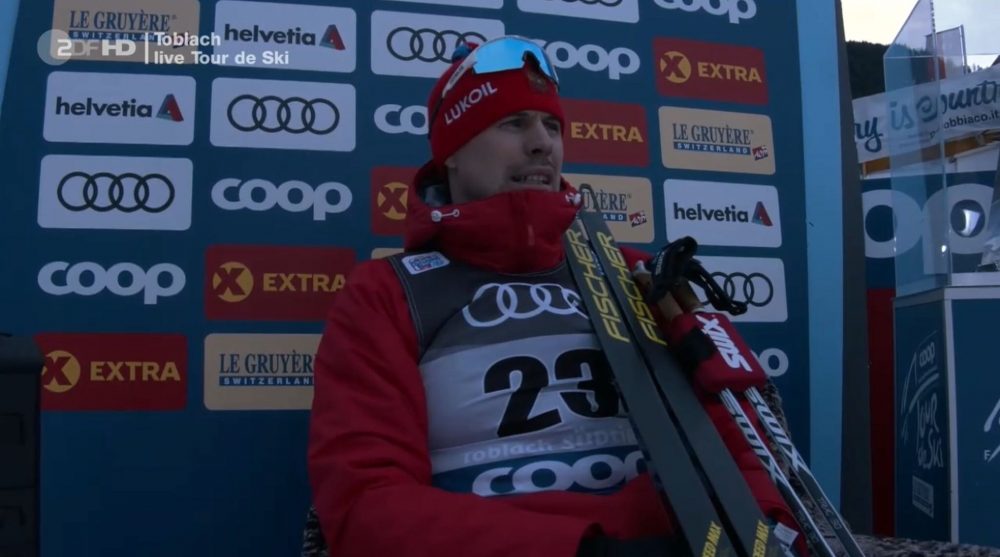
    Chervotkin (RUS) finished fourth. Manificat stayed true to his starting number and finished with another sixth place, putting him third in the overall tour rankings, just three seconds behind Maltsev and six seconds ahead of Spitsov. 

    Manificat- the lone Frenchman amidst the Russians. (Photo: NordicFocus)
    Spent. Maurice Manificat after finishing in 6th place in Stage 5. (Photo: Nordic Focus)

    Following a stand-out performance yesterday, Gus Schumacher of the United States headed out of the start gates +51 seconds behind Bolshunov, wearing bib number 14. As the race got underway he joined the second chasing group which largely stayed constant throughout the duration of the course, absorbing Lapalus around 5 k and then breaking apart on the final lap. Schumacher finished the day with another strong performance in 15th place, +2:13.5 back from Bolshunov, and with the 19th fastest time of the day. This places him in 23rd in the overall tour standings, +6:18 behind Bolshunov. 

    Gus Schumacher, bib 14, on his way to 15th on the stage. (Photo: NordicFocus)
    Lucas Boegl (GER), and Gus Schumacher (USA), (l-r) during Stage 5 of the Tour de Ski. (Photo: NordicFocus)

    As for the other two remaining American men, Scott Patterson who started the day bib 32 ceded a few places to finish 36th, and Kevin Bolger finished 46th, putting them in 36th and 52nd respectively in the overall tour rankings.

    Scott Patterson (USA) finished 36th. (Photo: Nordic Focus)


    Stage 5 Results | Overall

  • Bolshunov and Russia Sweep, Schumacher in 14th: Stage 4 of the Tour de Ski

    Bolshunov and Russia Sweep, Schumacher in 14th: Stage 4 of the Tour de Ski

    Lights out. Alexander Bolshunov takes the Stage 4 15-kilometer individual start freestyle by eight seconds. (Photo: NordicFocus)

    This World Cup coverage is made possible through the generous support of Marty and Kathy Hall and their A Hall Mark of Excellence Award. To learn more about A Hall Mark of Excellence Award or to learn how you can support FasterSkier’s coverage please contact info@fasterskier.com.

    Stage 4 of the Tour de Ski introduced a change of scenery on Tuesday with the flanks of the Dolomites sinking from sky to valley floor in Tobalch, Italy. The day’s 15 k skate pursuit brings the Tour’s traveling circus to a new locale, however, the narrative remains the same: Russia’s Alexander Bolshunov, last season’s overall World Cup winner, has gripped the TdS lead after winning Stages 2 and 3.

    Barring the unforeseen, and citing Bolshunov’s runaway performance in Sunday’s 15k skate pursuit, which he won by a margin of 53.7 seconds over his teammate Artem Maltsev, and with four stages remaining, this TdS appears to be locked up for the twenty-four-year-old Bolshunov. If Bolshunov slam-dunks the remainder of the Tour, he’ll have won back-to-back Tours – the first male skier to do so since Swiss star Dario Cologna won in 2010/2011 and 2011/2012.

    Bolshunov began as the last of 63 starters. As such, he had the gift of knowing the fastest splits at every time check allowing him to notch the pace up, throttle down to conserve energy, or simply sustain an unmatchable combo of power and cardio endurance.

    At 5k, 10k, and the finish, Bolshunov was true to form as the leader. He won in 32:49.6 minutes to capture his third stage win of this Tour and take a 1:15 minute lead into Stage 5, a 15 k classic pursuit.

    “It was a tough race without much help. I had to just listen to splits. I am happy with the result and thanks to the service for good skis.” Bolshunov said post-race through a translator.

    Denis Spitsov (RUS) powers through the 15-kilometer individual start freestyle to take 2nd in Stage 4 of the 2021 Tour de Ski. (Photo: NordicFocus)

    As Devon Kershaw noted through a text mid-race, “It’s the Russian championship out there.”

    Officially, not exactly, but the results illustrate the dominance. Denis Spitsov second (+8.3), Ivan Yakimushkin third (+13.9), Alexey Chervotkin fourth (+19.2), Artem Maltsev fifth (+21.8), Maurice Manificat of France sixth (+22.9), Evgeniy Belov seventh (+27.6), and Andrey Melnichenko eighth (+29.2).

    In other words, seven of the top eight finishers on the day were Russian. Top-heavy and deep. The only Russian outside the top-10 was Alexander Terentev in 15th (+52.5).

    The top three men celebrate their performance after Stage 4 of the 2021 Tour de Ski. Russians Alexander Bolshunov, Denis Spitsov (left), and Ivan Yakimushkin (right) clocked the top three fastest times, respectively. (Photo: NordicFocus)

    One spot ahead of Terentev, at 51.3 seconds back was twenty-year-old Gus Schumacher for the U.S. Starting in Bib 17, the Anchorage, Alaska based skier posted a career-best World Cup result in 14th. Before Tuesday’s race, Schumacher possessed two World Cup top-30s: a 25th in the Davos skate sprint, and the 24th best time of day in the Ruka 15 k skate pursuit. Both races were this season. According to FIS, he has contested 13 World Cup events, including today’s race.
    “In many ways, and it is a bold statement, but in many ways, it is up for consideration for the race of the day,” said U.S. Head Coach Matt Whitcomb. “When an athlete new to the World Cup gets his first t0p-15 that is a really special moment and to do it somewhat early in the Tour, when there are still 63 men starting is just super impressive.”

    Post-race comments from U.S. Head Coach Matt Whitcomb.

    Gus Schumacher skis to a World Cup career-best 14th in Stage 4 of the 2021 Tour de Ski, a 15-kilometer individual start freestyle. (Photo: NordicFocus)

    Starting in bib 17, Schumacher notched the 16th fastest split at 5k.

    “It was definitely kind of a similar approach as always that I have,” said Schumacher about his first 5 k. “I try to focus on the first five to eight minutes being easier than I think it should be. I think my best races come when I feel like I did that. But, my split was still good. So today, I think I got to that first time where I got a split, and there were only 17 people through, they said I was tied for first and I was still feeling pretty comfortable. … When you hear the good split and you also feel good after six minutes, that was when I think I was like, ‘I can do something with this.’”

    On his second go-around, at 10 k, he was positioned further back on the leaderboard at 26th, 56.1 seconds off of Bolshunov’s mark, and 13 seconds off the pace of Swiss skier Dario Cologna, who skied through in 15th (+43.0).

    Eventually, Schumacher locked onto a ride with the 39th starter, Spitsov. Although eventually placing second overall, Spitsov was eighth after 10k. According to Schumacher, the Russian caught Schumacher atop the course before a working descent.

    “I saw [Spitsov] on a 180 corner, and I knew who it was and I was pretty excited, I was like, ‘this is going to be a good ride’. He caught us, I was in a little group, and he caught us right before the downhill, and I just hopped in behind him.

    “It was kind of funny because that downhill felt really easy behind him when I am sure it was about as fast as before just working it, but I was able to not work it that hard. Going into the third lap, [Spitsov] notched it up a lot actually. That little rest was good so I could hang through the third lap.”

    Post-race comments from Gus Schumacher.

    Spitsov gained roughly 10 seconds on Bolshunov on his third lap. For his part, Schumacher gained too. At 12.1 k he was 18th overall, 17th at 13 k, and ultimately sliding across the line 14th. For the overall Tour, Schumacher is 25th (+4:55).
    Placing the race in context for his U23 cohort, which is small on the World Cup, of the seven U23 athletes Schumacher was second fastest. Terentev, the Russian in 15th, is also a U23 and anchored the Russian junior team at the 2018 and 2019 Junior World’s Relay. Both races were won by the Schumacher anchored U.S. team.

    Scott Patterson on his way to a 32nd place finish in Stage 4 of the 2021 Tour de Ski. (Photo: NordicFocus)
    Kevin Bolger on course during Stage 4 of the 2021 Tour de Ski. (Photo: NordicFocus)

    Also for the U.S., Scott Patterson was just outside the points in 32nd (+1:38.1), and Kevin Bolger placed 40th (+1:57.1). Simi Hamilton did not start. 

    Racing continues tomorrow with Stage 5 of the Tour de Ski, a 15 k classic pursuit.

    Stage 4 Results | Overall 


  • Bolshunov Widens his Lead in the Tour de Ski, Manificat Lands Another 15 k Skate Podium in Third (Updated)

    Bolshunov Widens his Lead in the Tour de Ski, Manificat Lands Another 15 k Skate Podium in Third (Updated)

    Alexander Bolshunov (RUS) lunges for the line with no challengers in sight. Photo: Nordic Focus

    This World Cup coverage is made possible through the generous support of Marty and Kathy Hall and their A Hall Mark of Excellence Award. To learn more about A Hall Mark of Excellence Award or to learn how you can support FasterSkier’s coverage please contact info@fasterskier.com.

    Accompanied by the constant soundtrack of distant cowbells, Alexander Bolshunov of Russia steadily worked his way through the fog, four times around the 3.3 k course to maintain a lead that was never threatened, completing the race in a time of 32:11. He started today’s skate pursuit with a margin of one minute ahead of teammate Artem Maltsev (RUS). When the race concluded Bolshunov had ceded only 6.3 seconds, despite skiing alone the entire way. In the winner’s post-race interview with FIS, when asked whether the race felt as easy as it looked, Bolshunov replied (through a translator), “[I] wouldn’t say it was easy, the last laps [I] had to work really hard. But still [I’m] really happy to take the win with good distance.”

    This is the third podium for Bolshunov in this Tour de Ski alone. In ten World Cup races this season, he missed a podium only twice, when he placed fourth in Ruka’s classic sprint and fourth again in Dresden’s skate sprint. With the Norwegians remaining off the World Cup, for now, he remains peerless.


    Payday for Alexander Bolshunov (RUS) after his second victory in two days. Photo: Nordic Focus

    Initially, the followers’ chase was mounted by Russia’s Maltsev and Dario Cologna of Switzerland for the first 7.4 k. Cologna was the third starter today, but he quickly ate up the 11 seconds margin to Maltsev. As the race evolved, Maltsev began to pull away, eventually crossing the finish line in second place, +53.7 seconds behind Bolshunov. According to the FIS database, Sunday’s second place was Maltsev’s second career World Cup podium. He also won a bronze in the 2018 Olympic team sprint. 

    Artem Maltsev (RUS) crosses the line for his second podium of the season, he finished 3rd in the 15 k skate in Davos. Photo: Nordic Focus

    Cologna (SUI), who is the first man to have won three 15 k Olympic gold medals in a row and should consider this distance a specialty, was caught by Maurice Manificat of France, Ivan Yakimushkin of Russia and Denis Spitsov of Russia at 8.9 k. Gradually Manificat (FRA) worked his magic, 15 k skate events being something of a favorite for him, and he finished third +1:10.07 behind Bolshunov. With an elapsed race time of 31:42.1, Manificat also had the second fastest time of the day.

    Maurice Manificat (FRA) with his signature celebration over the finish line. Photo: Nordic Focus

    Spitsov (RUS) followed closely behind in fourth, earning the fastest time of the day with his performance (31:41.8). +23.5 seconds back from Spitsov, Yakimushkin (RUS) outsprinted Cologna (SUI) and they fell into 5th and 6th position. Friday’s sprint winner, Federico Pellegrino of Italy, held his own despite not having a reputation as a distance skier, to finish in 8th. 
    Federico Pellegrino (ITA) on his way to an 8th place finish, ahead of the French trifecta battling behind him. Photo: Nordic Focus

    Gus Schumacher was the first American out of the gates. In bib 35 he started +2:55 behind Bolshunov. When he crossed the line, 36:15 minutes later, he had gained three places to lead the American men and finish in 32nd, with the 28th fastest time of the day, earning him his third World Cup points of the season. “My strategy today was based mostly around consistent pacing,” wrote Schumacher in an email, “I wanted to avoid a big loss of energy, so I tried to make smart decisions regarding whether or not to respond to attacks. Moving forward, I’m mostly focused on recovery and taking each day as a new day, a new race to continue improving. I know that I have 5 more races to try to work up the field.”

    Gus Schumacher (USA) pushes the finishing stretch. Photo: Nordic Focus

    Scott Patterson, who started in the first wave (+3:22) with bib 46, also gained several places and finished 38th. Patterson skied his way to the 24th fastest time of the day in a time of 33:09.9. Simi Hamilton finished 47th and Kevin Bolger rounded out the U.S. men in 55th. 

    Simeon Hamilton (USA) and Kevin Bolger (USA), (l-r) cross the line. Photo: Nordic Focus

    Overall Tour Standings: 

    With his victory today, Bolshunov’s overall lead in the Tour is +0:53 seconds ahead of Maltsev in second. Manificat moved into third position (+1:07) followed by Spitsov (+1:10) and Cologna (+1:34) in fourth and fifth respectively. The Tour now moves to Toblach, Italy where racing continues on Tuesday (January 5th) with a 15 k interval start skate race. 

    A happy group of Frenchmen celebrate Manificat. Photo: Nordic Focus

    Results: 

    Stage 3 Results | Men’s TdS Overall Standings

  • Bolshunov Skis Big and Bold, Dario Cologna Sneaks in for a Podium

    Bolshunov Skis Big and Bold, Dario Cologna Sneaks in for a Podium


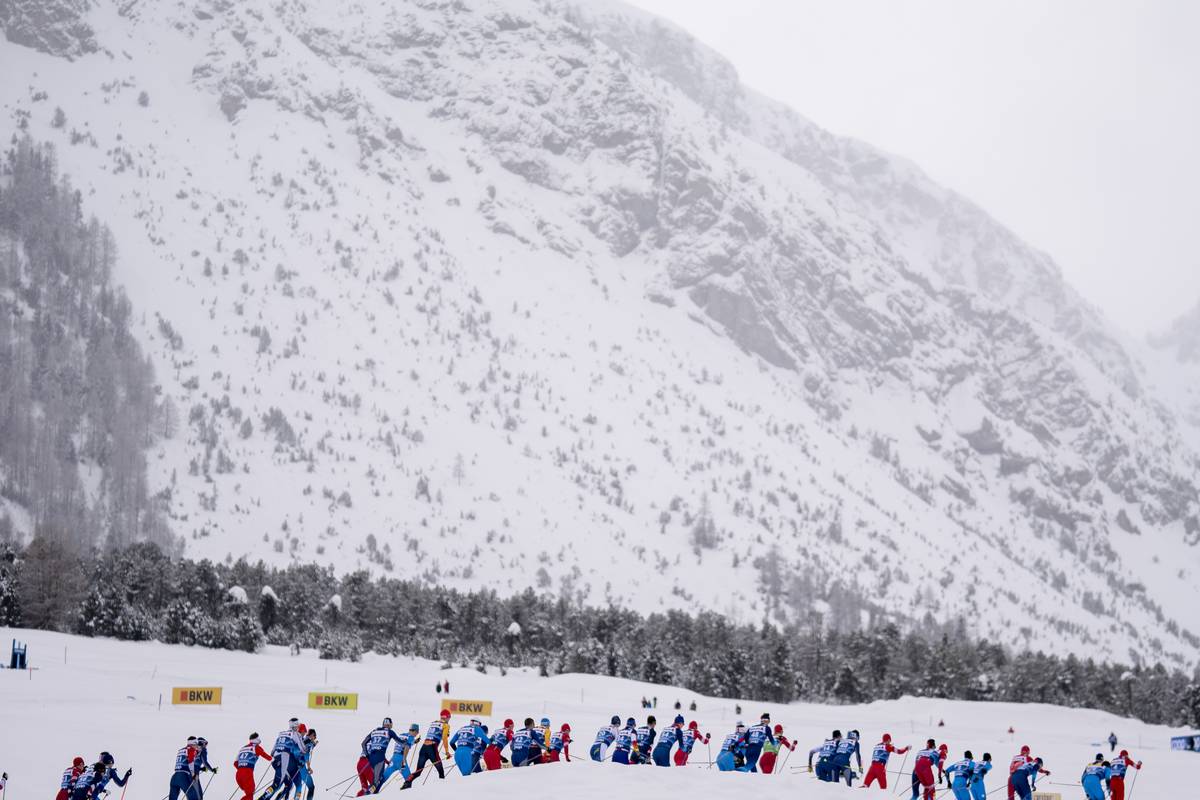
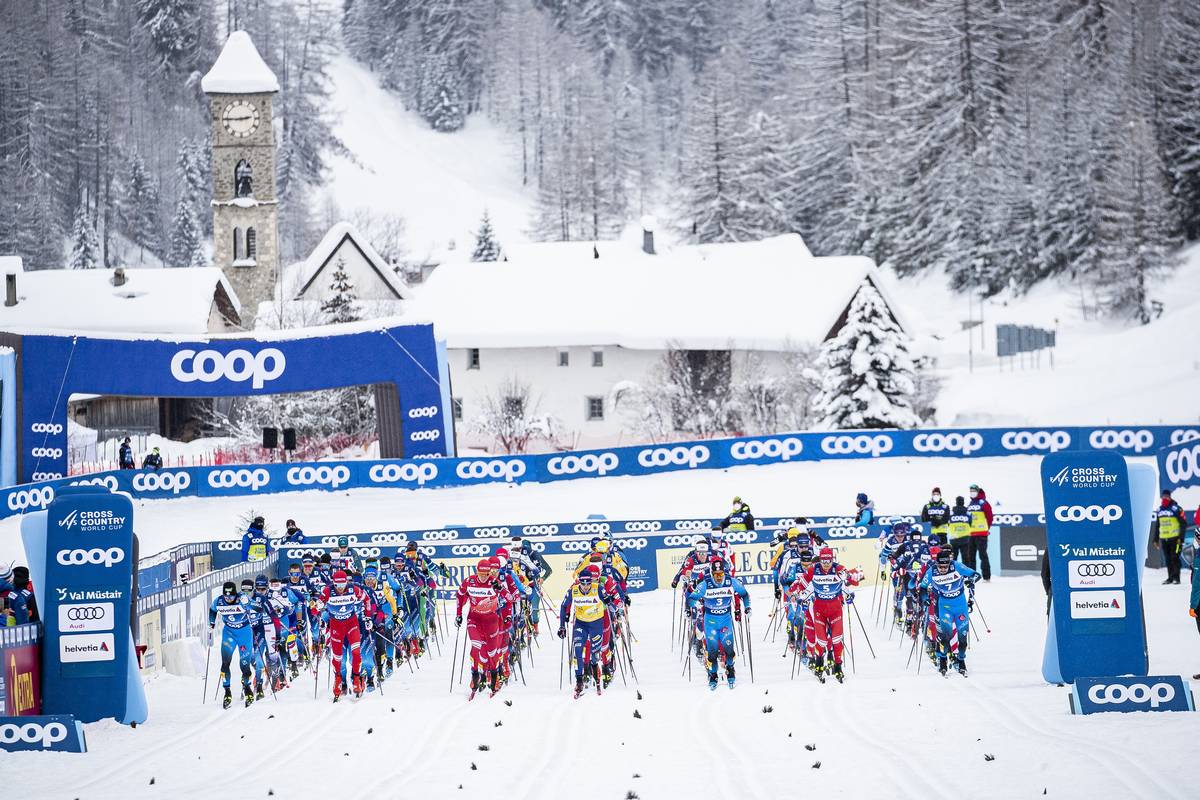
    The start of the men’s 15 k mass start classic in Val Müstair, Switzerland. (Photo: NordicFocus)

    This World Cup coverage is made possible through the generous support of Marty and Kathy Hall and their A Hall Mark of Excellence Award. To learn more about A Hall Mark of Excellence Award or to learn how you can support FasterSkier’s coverage please contact info@fasterskier.com.


    Val Müstair, Switzerland and its snowfall were again the idyllic backdrops for the Tour de Ski (TdS) where the men raced a 15-kilometer classic mass start to kick off the distance stages. After yesterday’s skate sprint in which Russia’s Alexander Bolshunov took second place, it appeared the twenty-four-year-old would iron-fist this fifteenth edition of the TdS.

    No doubt, Bolshunov came into the event as the favorite. The conversation trending towards how much time he wins the overall. As last year’s winner of the TdS, and finishing on five podiums in seven stages, this Russia has been here before.

    Immediately as the 77 starters crowding the start tracks set off, Bolshunov was the skier to watch. No matter who strode alongside him for the first 5 k or so, this was simply a game of when Bolshunov would shatter the pack and make an exclamation point statement that his trend towards generational status skier was for real.

    The TdS includes a points race, which incentivizes some skiers not contending for the overall to remain upfront to snag the prime, and perhaps collect a few more Swiss Francs at the end of the workday. With the points bonus offered at 4.5 k, Italy’s Federico Pellegrino, winner of Friday’s sprint, was right there in the front.

    Italy’s Federico Pellegrino in yellow. (Photo: NordicFocus)
    Stage 2 of the 2021 Tour de Ski. (Photo: NordicFocus)

    With four laps of a 3.3 k course which featured a long climb and sinuous downhills with techy turns, this was primarily a fitness test in the end. And the Russian team collectively appears the fittest. Along with Bolshunov, his teammates including Alexey Chervotkin, Evgeny Belov, Ivan Yakimushkin, Denis Spitsov, and Illia Semikov were a wall of red Lycra upfront.

    No matter how you parse the stats or the visuals presented of the race, it certainly looked like a Russian podium sweep with the only lock Bolshunov on the top-step. At 11.4 k, Bolshunov powered ahead by 5.1 seconds ahead of hometown hero Dario Cologna with Belov, Maurice Manificat of France, Yakimushkin, Sptisov, Semikov, and Sweden’s Oskar Svensson towed through in that order. Svensson was 14.7 seconds off the pace.

    The solo Bolshunov show flew ahead. Eight-tenths of a kilometer later, he secured a 19.7-second cushion. With little action out front beyond anticipating how much time Bolshunov might gain, we’ll send it straight to the finish: Bolshunov won by 23.5 seconds.

    Alexander Bolshunov in front during stage 2 of the 2021 TdS. (Photo: NordicFocus)

    As noted, it appeared late in the race to be a probable all-Russian podium. Yet the cosmos can play tricks. The podium, in a parallel universe, maybe had a decidedly red look.

    Coming into the final downhill, made more complex by a sweeping right-hand corner which had already taken out several skiers in yesterday’s sprint and today’s mass start, Belov dove into the bend first, a hair ahead of Chervotkin. As skiers warped around, Chervotkin tried to cut inside of Belov and clipped his skis. Belov tumbled as did Chervotkin right after. As the two skiers exchanged words and began righting themselves, Yakimushkin went wide left off course and out of the turn to avoid crashing. Twenty meters later, he skied back on course.

    In the meantime, Cologna, remained on his feet, skirted around the tumbled Russians, and made good for his hometown and the army of Cologna supporters who no doubt were clanging oversize cowbells at home as the event did not allow spectators. As the Swiss gift that keeps on giving, Cologna placed second (+23.5) and Yakimushkin third (+25.3). France’s Manificat bypassed the carnage as he was many meters behind the crash, and placed fourth (+27.7).

    Cologna has won the TdS on four occasions – a record for men’s overall titles. His second place on the stage was his best result of the season. Before Saturday, his best 2020-2021 distance result was 14th place in the Davos 15 k skate. His last podium was in the 2019 15 k skate also in Davos.

    Evgeniy Belov (RUS), and Dario Cologna (SUI), (l-r). (Photo: NordicFocus)
    Dario Cologna (SUI)  taking second in stage 2 of the 2021 Tour de Ski. (Photo: NordicFocus)

    Russia locked up five of the top-10 spots, with Belov, who had crashed, missing out on a podium and placing eighth.

    Notably missing from the results was Chervotkin. He was disqualified after the race for violating rule ICR 343.9 which states, “Obstruction: deliberately impeding, blocking (by not following best line), charging or pushing any competitor with any part of the body or ski equipment.”

    Post-race comments about the men’s race from U.S. Head Coach Matt Whitcomb.

    For the U.S., Gus Schumacher was the top finisher in 36th (+1:53.8). New to full-time World Cup skiing, Schumacher has been on the road since mid-November as he begins to learn more about certain World Cup venues, the vagaries of life on the road, and the speed at which skiers like Bolshunov hammer about.

    Today, the twenty-year-old from Anchorage, Alaska was 23rd (+8.2) at the 4.5 k mark skiing in a thick soup of skiers: 30th place was 10.8 seconds back. As the race broke apart due to the surges ahead at 11 k, Schumacher fell back to 33rd amidst a group of skiers including Sweden’s Calle Halfvarsson.

    “It was fun to race a mass start again,” Schumacher emailed. “I thought it would go out fast and then cruise but it went out quite slowly, which was a little frustrating in the belly of the pack. The second lap also seemed pretty relaxed, and as the pace quickened through halfway I was feeling like I was skiing well and moving up. And then near the top of the climb, the wheels fell off and I just flooded hard. Thankfully there was a big downhill to recover, but I really lost my momentum. So not perfect pacing, but it was fun to ski closer to the front for a little while.”

    As his first Tour de Ski, the prospect of an eight-stage slog can be daunting. Decidedly, Schumacher is taking each stage one by one, each a unique opportunity to learn and grow.

    “I definitely approached the day as a singular race, just with the goal of doing as well as I could,” Schumacher wrote. “The risk that I could’ve taken would be double poling on skate skis, but I figured that would not be a good move with the idea of an 8-race tour.”
    He added that the race was a reminder to strategically pace at altitude.
    Gus Schumacher (USA) – FIS world cup cross-country, tour de ski, mass men, Val Mustair (SUI). www.nordicfocus.com. © Vianney THIBAUT/NordicFocus. Every downloaded picture is fee-liable.

    Scott Patterson was the next best American in 43rd (+2:17.6), with teammates Simi Hamilton 46th (+2:38.1), and Kevin Bolger 59th (+3:25.6), respectively.

    “Across the board, it was a disappointing day for the guys, just call it what was,” said U.S. Head Coach Matt Whitcomb after the race. “Gus probably showed the most signs of promise today, he skied within the top-20 for the parts of the race and top-25 before he was kind of running out of gas. He was pretty cached on the fourth lap. We will just make sure he continues to fuel well it is one of those places where if you go a little too hard on any one lap which is my guess as to what happened, you end up having a pretty heavy tax late in the race. It comes back to bite you and sometimes you get away with it. I am not one who likes to see people ski a conservative race I like to see people aiming for the bull’s eye and he did that and that is how to get faster.”

    Scott Patterson for the U.S. placed 43rd in stage 2. (Photo: NordicFocus)
    Simi Hamilton of the U.S. at the start of the men’s 15 k mass start classic. (Photo: NordicFocus)
    The Men’s Overall:

    Tomorrow’s stage for the men, a 15 k skate pursuit, sees Bolshunov starting first, one minute ahead of second starter Maltsev. Svensson begins third (+1:00), and Cologna fourth (+1:11).

    Stage 2 Results | Men’s TdS Overall Standings


    The men’s stage 2 podium: Dario Cologna (SUI) in second, Alexander Bolshunov (RUS) first, and Ivan Yakimushkin (RUS) third, (l-r). (Photo: NordicFocus)

  • Norway Wins 10th Consecutive Gold Medal in Men’s 4 x 10k Relay; Americans Finish 9th

    Norway Wins 10th Consecutive Gold Medal in Men’s 4 x 10k Relay; Americans Finish 9th

    Johannes Høsflot Klæbo of Norway anchoring Norway to the 4 x 10 k relay win at the 2019 World Championships in a Norwegian fan filled Seefeld, Austria. (Photo: John Lazenby/lazenbyphoto.com)

    While a temperature in the upper thirties would not normally classify as cool to a ski racer, it was a welcome break from the blazing sun and upper 50’s that have been ever-present in the 2019 Nordic World Ski Championships in Seefeld, Austria. Light rain peppered the athletes in the 4 x 10-kilometer relay, continuing to keep things challenging for the wax techs.

    The relay is a testament to both a nation’s depth and strategy, a chess match and a horse race. As was seen in the women’s relay, the selection and placement of athletes decide how the race will evolve, but these decisions are made without the knowledge  of an opponent’s line up.

    In their quest for a tenth consecutive gold medal in the event, Norway chose the line up of Emil Iversen, Martin Johnsrud Sundby, Sjur Røthe, and as the closer, their sprint champion, Johannes Høsflot Klæbo. Røthe and Sundby sit in second and third respectively in the World Cup distance rankings, while Iversen has shown that he is an “all-arounder” who can respond to many dynamic racing scenarios. Sundby also brings experience to the team as he was a member of the gold medal team in both 2011 and 2017. After winning the overall Tour de Ski, Klæbo has shown that he can be a force in distance races but is most known for his closing speed and sprint prowess, which would come in handy should the race come down to the final meters.

    Scramble leg of the men’s 4 x 10 k relay at the 2019 World Championships in Seefeld, Austria. (Photo: John Lazenby/lazenbyphoto.com)

    As the race unfolded, it was unclear which nations’ tactics would trump the others. In the first leg, the men slowly began to string out, but the lead exchanged hands several times. Russia’s Andrey Larkov made an early run but was marked by Erik Bjornsen of the US who also spent time at the front. Despite slipping a bit on the climbs, Iversen, who was on harries, skied near the front throughout, entering the stadium first to tag his teammate. At the first exchange, Norway, Russia, and Germany were all within one second of each other, with the US in fourth fading into a chase pack with Sweden and France.

    skelaxin buy online

    As the second leg began, Sweden’s Calle Halfvarsson surged to catch the leaders within the first kilometer, unwilling to lose sight of a possible 29th World Championship relay medal for Sweden. With him was Iivo Niskanen of Finland, Scott Patterson of the US, and Maurice Manificat of France.

    Sweden’s Calle Halfvarsson during the men’s 4 x 10 k relay at the Seefeld, Austria World Championships. (Photo: John Lazenby/lazenbyphoto.com)

    While the rain picked up, Niskanen charged to the front and began to string things out in a fashion reminiscent of his performance in the 30 k skiathlon. Sundby stuck with the Finn, and was closely tailed by Alexander Bessmertnykh of Russia. The three skiers atop the podium after Wednesday’s 15 k reunited on the relay tracks.

    Halfvarsson began slipping on the hills and was unable to hold onto the pace, falling back a few seconds behind the leaders at first, then fading to nearly 30 seconds back by the end of his leg. Likewise, France, Germany and the US began to lose touch, dropping behind by over 30 seconds by the next exchange.

    However, as the first skate leg began, Jens Burman of Sweden followed Halfvarsson’s lead with yet another powerful surge to reconnect with the lead pack, closing the gap from 27 seconds at the exchange, to just two seconds at the 2.5 k checkpoint. Also rapidly making up ground, Clement Parisse of France gained 22 seconds on the leaders within the first lap. Unfortunately for Sweden, Burman seemed to burn a few too many matches in his charge, and in the second half of his leg, he fell back again almost as rapidly as he had advanced. He was overtaken by Parisse who did manage to light a fire for France, drawing to within eight seconds of the bronze medal before his final exchange to French sprinter Richard Jouve.

    At the front, Alexander Bolshunov of Russia and Røthe hammered their final lap, separating themselves from the field in yet another Norway vs. Russia battle for gold. The men entered the stadium together with a gap of more than 20 seconds on the Finn who sat in third. Bolshunov tagged Sergey Ustiugov to face Klæbo for their final World Championship duel, mano a mano.

    Russia’s Sergey Ustiugov leads Norway’s Johannes Høsflot Klæbo of Norway as they race the fourth leg of the 4 x 10 k relay at the 2019 World Championships in Seefeld, Austria. (Photo: John Lazenby/lazenbyphoto.com)

    In their last matchup in the sprint at the onset of the championships, Ustiugov pushed Klæbo after a tangle in the semifinals robbed the Russian of his momentum. After the heat, the men were seen in a heated shouting match where Ustiugov again pushed Klæbo and gave him an antagonizing pat on the cheek. He was issued a yellow card for obstruction and was disqualified for unsportsmanlike conduct, while Klæbo went on to win the gold. The two were also rivals throughout the Tour de Ski, where Ustiugov nearly caught the exhausted Norwegian leader in the final hill climb, but ultimately ran out of time and finished second.

    As they took to the course in the final leg, this much was clear: the Russian did not want to hand the victory over to his opponent. Ustiugov dictated the pace with the Norwegian tucked in behind him. They did not take turns, rather, Ustiugov held fast at the front. But, as they entered their third and final lap of the course, Ustiugov’s fatigue began to become evident, and Klæbo had plenty left in his tank to capitalize on the moment.

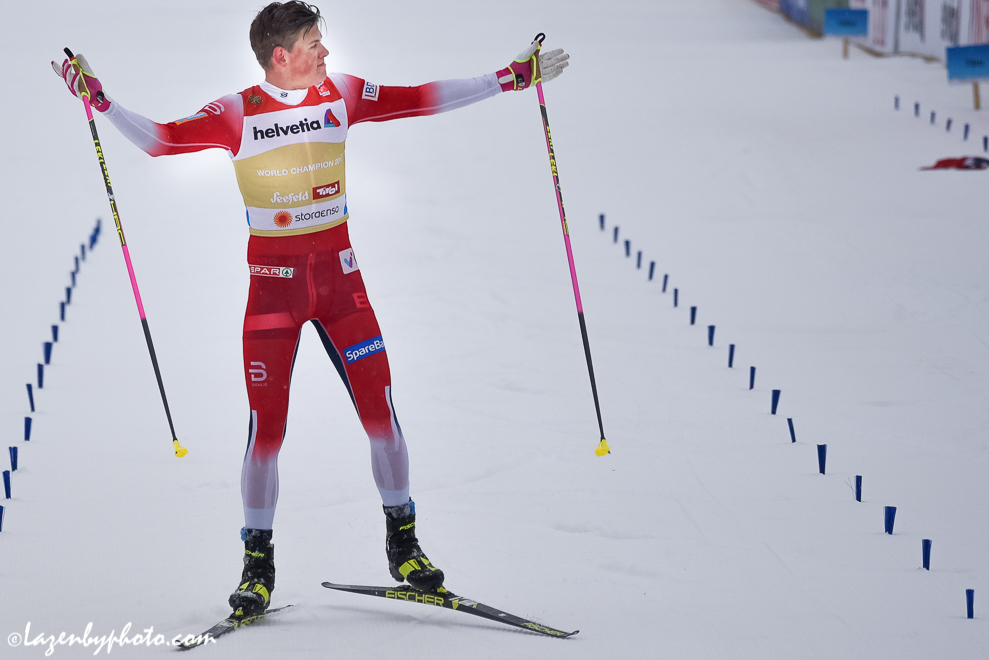
    Johannes Høsflot Klæbo of Norway in what has become his iconic gesture when crossing the line as a winner. Once again it was an opportunity for the arms being outstretched as Klæbo anchored Norway to the 4 x 10 k relay win at the 2019 World Championships. (Photo: John Lazenby/lazenbyphoto.com)

    The Norwegian surged to the front and did not lay off the gas, leaving Russia trailing behind, desperately trying to keep it together for silver. Klæbo cruised through the lap with enough room to begin his celebration well before the finish. He stopped the clock at a time of 1:42:32.1, 38 seconds ahead of Russia.

    “It was a really hard race, and I think the conditions now is really tough, but I think all of us had very good skis today and the waxing team and the guys helping us did a very good job,” Klæbo told the International Ski Federation (FIS) after the race. “So its very cool to stand here with those guys and take the gold medal. It’s unbelievable.”

    For both Klæbo and Sundby, this is the second gold medal of the championships. Sundby earned the long-awaited first individual medal of his career in the 15k classic just two days prior.

    “This is a different kind of emotional,” Sundby told FIS as he compared his wins. “But for the team, this is the most important. This is the race we’ve been thinking about since we started training in May, so for the team and for Norway, I think this is emotional for the nation. And for us, we are such good of a group, so to be able to do this together and of course for Johannes to destroy Russia on the last leg, that was amazing.”

    Sergey Ustiugov of Russia coming in for second overall during the men’s 4 x 10 k relay at the 2019 World Championships in Seefeld, Austria. (Photo: John Lazenby/lazenbyphoto.com)

    Behind the racers in red, a battle for bronze was underway between France and Finland. With a gap ahead and behind, Jouve and Perttu Hyvarinen had duked it out for nearly 8 k. With less than a kilometer to go, the men came to a standstill, neither willing to break the wind for the other in the last descent. Not wanting to be caught by the teams chasing behind, Hyvarinen conceded and took the lead. Rounding the last corner into the stadium, Jouve rocketed around the Finn, no pole skating with lightning fast tempo toward the line to win bronze, 1.8 seconds ahead of Finland.

    After a strong start, the American team fell back in the pack. Patterson tagged David Norris in 7th to ski the first skate leg for the US, and the team was in 9th at the final tag to Kyle Bratrud. The team ended the day in 9th (+4:06.4).

    Canada’s Alex Harvey, Scott James Hill, Evan Palmer-Charrette, and Lenny Valjas placed 12th (+7:05.5).

    “We started off the morning on the wrong foot because Simi, who was going to be our anchor, woke up with a sore throat,” explained Chris Grover in a call. “After that, it went pretty well. Awesome opening leg for Erik… had a really great leg, had really good skis, felt like glide was excellent.”

    “We were excited that Erik was able to put together yet another really strong classic leg, and also another really strong lead off relay leg,” he continued. “He’s almost always our lead off person in the relay, and this time might have been the closest he’s been to the leader coming in. So that was great.”

    Erik Bjornsen of the U.S. during the men’s 4 x 10 k relay at the 2019 World Championships in Seefeld, Austria. (Photo: John Lazenby/lazenbyphoto.com)

    Bjornsen was also pleased with his leg; despite a less than ideal starting position, he was able to advance through the pack into a better position to execute his race plan.

    buy revia online

    “I was trying to make sure to be in position for when the pace kind of turned up,” explained Bjornsen in a call. “And it actually took a little longer than I was expecting, but then on the last lap about halfway through on one of the big hills it started notching up and Russia made a big surge and I was able to jump right behind Larkov and kind of chase him on the big sprint climb. So I felt like I was able to play with the group and ski near the front, didn’t have the attack that I wanted on the last climb, but I saw by the splits that I was 5 seconds off the leader at the end, so I was pretty happy with that. I felt like I was able to compete with the best.”

    While Patterson could not maintain contact with the leaders, he skied his leg with grit

    “Another really solid leg out of Scott [Patterson], to go out and kind of close that gap that was presented to him,” said Grover. “At one point he said ‘Yeah, I got a little bit caught behind when the leaders broke.’ But at the same time, I think we recognize that the guys that broke away, Sundby, Bessmertnykh, and Niskanen, were the three guys that were on the podium in the 15k classic a few days before. So I think Scott recognized it was really hard for him to keep that pace. But he did a really good job when he was at his max really holding technique together and skiing really well.”

    Scott Patterson of the U.S. during the men’s 4 x 10 k relay at the 2019 World Championships in Seefeld, Austria. (Photo: John Lazenby/lazenbyphoto.com)

    Though he lost additional places, Grover also felt that Norris skied a strong leg.

    “For a while, he was catching a ride with Dario Cologna who was skiing up from behind him, and David [Norris] held with him for a little bit, but then that pace was too hard for him. He fell off that and had to regroup a bit.

    David Norris of the U.S. during the men’s 4 x 10 k relay at the 2019 World Championships in Seefeld, Austria. (Photo: John Lazenby/lazenbyphoto.com)

    “By that time, the spread between teams was so big that Kyle started a minute or so behind, and had a minute or so to go to the person that was behind him,” Grover continued. “So, unfortunately, he skied by himself the whole time, which is not that conducive to having a fast leg, but he skied really well. Seemed like he was moving pretty good and skiing with great technique.

    “Overall, it was a really solid day for those guys with some absolute highlight coming at the beginning,” he concluded.

    The 9th place finish marks improvement for the team, as they finished 11th in the event two years ago in Lahti.

    “I think for the most part the relay team is satisfied with our performance today,” wrote Patterson in an email. “Unless we win though, there are also little things that each of us wished had gone a little better. Erik skied a great leg and I am proud of the performances of our whole team. While there were 8 teams in front of us that I would have like to beat, we also did manage to beat some good teams. It is always fun to come together as a group and see what we can do.”

    While the weather might not have been well received by all parties, the Americans didn’t seem to mind. In fact, they felt it may have been a benefit in many ways.

    “Honestly, I’m a little excited about the rain,” Patterson told FIS before the race. “Everyone else gets miserable and you just have to enjoy the other’s misery.”

    After the race, he still had an overall favorable opinion on the weather.

    It was a nice variation from the heat of the 15k,” he wrote. “However, I will also admit that I was pretty cold and miserable myself while hanging out in the rain for the skate legs of the relay.”

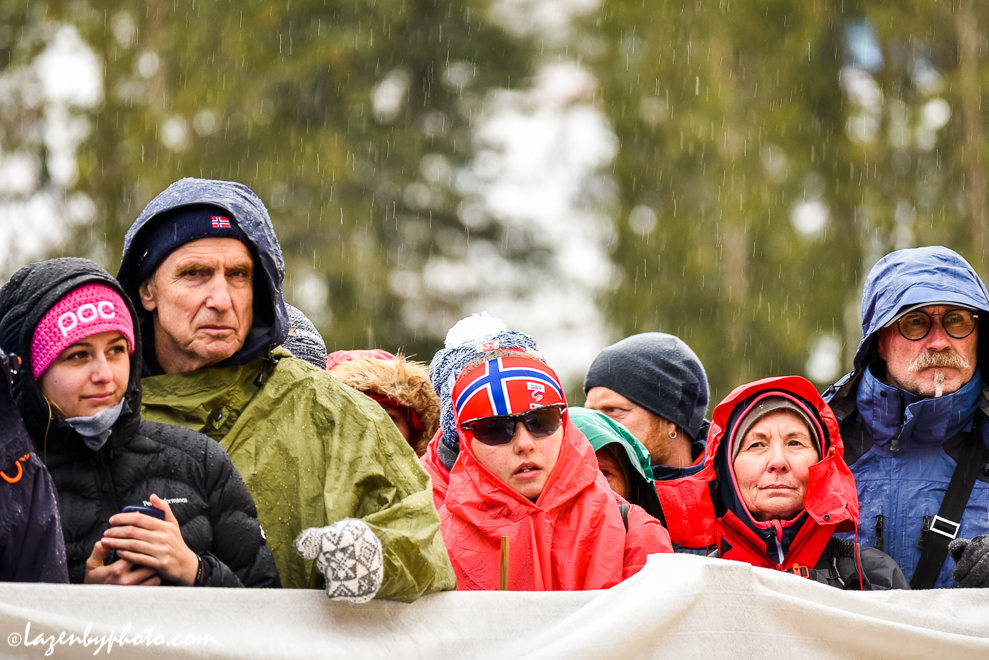
    Wet and looking dour: wet fans during the men’s 4 x 10 k relay at the 2019 World Championships in Seefeld, Austria. (Photo: John Lazenby/lazenbyphoto.com)

    Bjornsen also shared that he enjoyed the rain and thought it helped speed up the tracks.

    “Once you start racing in the rain, you don’t even notice,” he laughed. “It was fun.”

    From a waxing perspective, it was felt that the grey skies and moisture affected the course evenly. So while it was still a challenge for waxers, it was at least consistent conditions throughout the course.

    “It was a bit more uniform than in the past where we had a sunny side and a shady side,” Grover shared. “The cloud cover helped make things more uniform out there, which may have helped some of the teams get closer in the hunt for the right wax. Because, unfortunately, it just seems like a lot of the days we’ve seen some big discrepancies in skis, where some of the bigger nations just have incredible skis and everyone else is trying to figure out how to solve the puzzle with not quite as much manpower.”

    The World Championships in Seefeld conclude with a women’s 30k Saturday, followed by the men’s 50k on Sunday.

    Men’s Results

  • Friday Race Rundown: Men’s 4 x 10 Relay from Seefeld

    Friday Race Rundown: Men’s 4 x 10 Relay from Seefeld

    Johannes Høsflot Klæbo of Norway displaying what has become his iconic gesture when crossing the line as a winner. Once again it was an opportunity for the arms being outstretched as Klæbo anchored Norway to the 4 x 10 k relay win at the 2019 World Championships. (Photo: John Lazenby/lazenbyphoto.com)

    The 4 x 10-kilometer men’s relay was a two-team tango as Russia’s Sergey Ustiugov and Norway’s Johannes Høsflot Klæbo were tagged for their respective anchor legs on Friday. The two teams stuck together until Klæbo moved ahead with less than five k to go and gapped Russia by 22 seconds.

    naltrexone revia

    It was enough final leg surge for Norway’s Emil Iversen, Martin Johnsrud Sundby, Sjur Røthe, and Klæbo to win in 1:42:32.1 hours. Russia’s Andrey Larkov, Alexander Bessmertnykh, Alexander Bolshunov, and Ustiugov placed second (+38.8).

    The final podium spot came down to a final sprint won by France’s Richard Jouve over Finland’s Perttu Hyvarinen.

    Adrien Backscheider, Maurice Manificat, Clement Parisse, and Jouve were 1:01.0 back in their third place statement.

    Finland’s Ristomatti Hakola, Iivo Niskanen, Matti Heikkinen, and Hyvarinen were fourth (+1:02.8).

    The U.S. team of Erik Bjornsen, Scott Patterson, David Norris, and Kyle Bratrud skied to ninth (+4:06.4).

    Canada’s Alex Harvey, Scott James Hill, Evan Palmer-Charrette, and Lenny Valjas placed 12th (+7:05.5).

    Results

  • Manificat Gets his Win; Harvey Returns for Ninth

    Manificat Gets his Win; Harvey Returns for Ninth


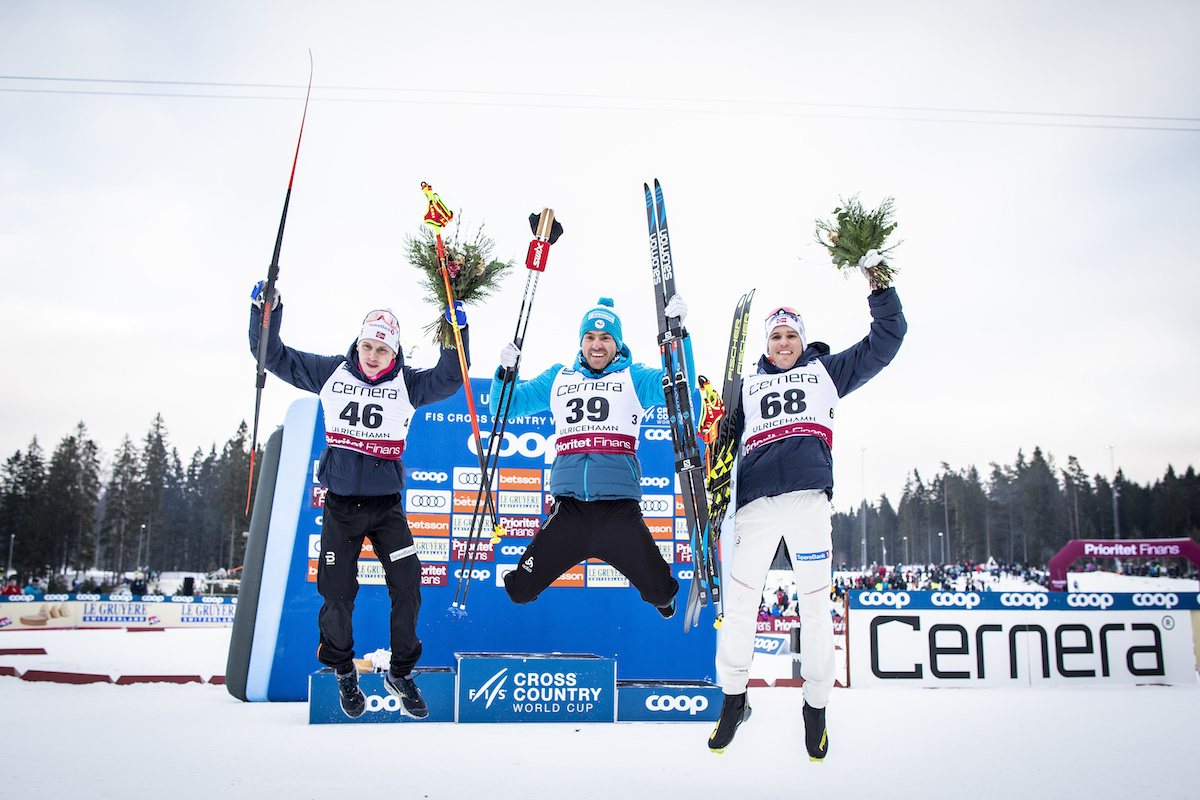
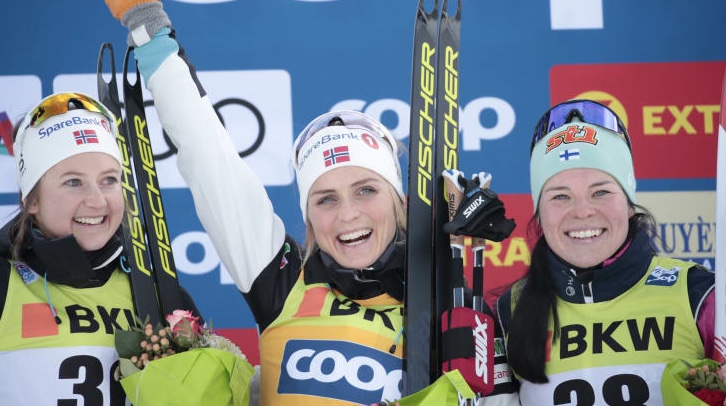
    The men’s podium from the World Cup 15 k skate in Ulricehamn, Sweden. From left to right, Norway’s Simen Hegstad Krüger placed second, France’s Maurice Manificat first, and Didrik Tønseth of Norway was third. (Photo: Fischer/Nordic Focus)

    The tension in the interval start race comes down to watching the clock.

    The seconds tick, the time checks pass, the squirm of the of the skier in the leader’s chair only quelled after the top-prospects slide past the finish — and there’s only a reference to time back.

    On Dec. 12, that was France’s Maurice Manificat, the thirty-two-year-old skate skiing star, residing where he often belongs, sitting in the leader’s chair in Davos, Switzerland during the 15-kilometer skate. In bib 39, Manificat set the fastest time of the earlier starters. As the other would-be-winners came in, Manificat’s lead held.

    Until Russia’s Evgeniy Belov bested Manificat’s time by 0.9 seconds. The Frenchman finished second in what was his first World Cup start of the season.

    Today in Ulricehamn, Sweden in the men’s 15 k skate, it was déjà vu all over again. Manificat in bib 39. Manificat in the leader’s chair waiting for the possible bigger guns on the day to cross the line.

    Manificat’s time of 34:55.4 minutes held, just barely, for the win. Simen Hegstad Krüger, the day’s 46th starter, stopped the clock 1.1 seconds back for second place. Didrik Tønseth, also of Norway, came in third (+8.7).

    “We were waiting to come back to Ulricehamn for 2 years. I was pushed with the atmosphere and the crowd!” Manificat told the International Ski Federation (FIS) after the race. 2017 was the last time the World Cup made a stop in Ulricehamn – a venue known for its boisterous spectators. (FIS reported an estimated 27,000 fans were on hand for today’s World Cup.)


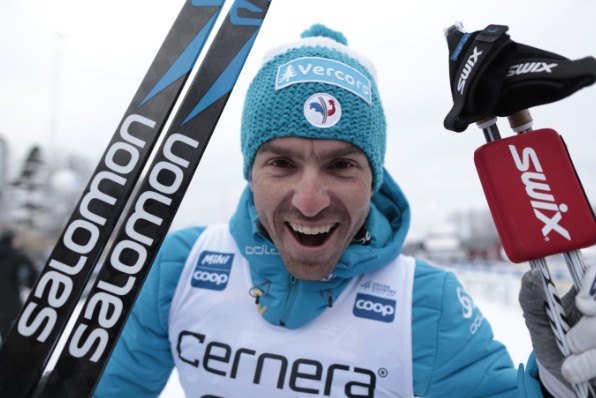
    Maurice Manificat of France after his 15 k skate win in Ulricehamn, Sweden. (Photo: fis-ski.com screenshot)

    2017 in Ulricehamn was also a time when Alex Harvey reigned supreme in the 15 k skate. He won that day’s 15 k skate by six seconds over Norway’s Martin Johnsrud Sundby.

    At thirty-years-old Harvey has been near, but not at the top of his form this season.

    Harvey, who placed third last season in the Tour de Ski (TdS), pulled himself from this season’s TdS after placing 22nd in stage 5. He took an extended break from Europe to train and rest at his home in Quebec.

    Today saw a different Harvey return to the World Cup. He placed ninth in Saturday’s 15 k skate, 31.4 seconds back.

    Harvey explained in a post-race call that he feels rejuvenated and satisfied with the result, despite having flown to Europe on Wednesday.

    “I felt quite good, but I have been in Europe for two days only,” Harvey said. “I flew on Wednesday and arrived here Thursday midday. After the Tour, I felt I needed to go home and reset a little bit. I just wasn’t skiing the way I wanted to. I wasn’t feeling good and especially after races. Of course, you are tired after a ski race but it was like I was really really tired after the races and I didn’t feel like the body could handle the effort much. I needed a bit of a mental break at home. So I went back and was able to make the most of the great conditions we had there in Mont St Anne and I was able to put in a good block of training and just in a more relaxed environment being at home.” Each of Australia’s online pokies has its own payout percentage. The most well-known are Australian the best paying online pokies try this . Most gamers are aware that playing pokies with the greatest payout percentages increases your chances of winning. This is in contrast to casino games with smaller payoff percentages, such as craps, roulette, and video poker machines.

    In the past, Harvey said he had used the TdS as a “launching pad” for the latter part of the season. This year, Harvey sensed the expected performance bump during and after the Tour was in jeopardy.

    It was a feeling he said he had not experienced since 2012, a lifetime ago on the World Cup.

    “I struggled [in 2012] and I had some back issues back then too,” Harvey said. “It was my first season or maybe second spending the whole winter in Europe and that was quite hard for me. I think I was 23 years old. That was the only other time but I was still more of an underdog back then and I wasn’t too worried about it. It was a bit of a drought there for me in the middle of the season, that was the last time, that was 2012. Since then it hasn’t really happened … But this year I didn’t feel like the body was handling racing well enough to benefit from the Tour, from all those hard efforts. That is why I had to pull the plug near the end and go home and reset.”

    Canada’s Alex Harvey during his R & R in Quebec. (Photo: Alexis Turgeon, @alx_rv Instagram screenshot)

    Harvey went on to explain his time in Quebec allowed him to focus on a lovely three letter word, “fun”. The chance to reset was also an opportunity to finetune the training.

    “I am the type of athlete, I cannot just rest my way into shape,” said Harvey. “That never worked for me. I was mentally resting but I was still actually skiing quite a bit back home. Just easy for the first week and then normal doing some intervals and strength and all that normal stuff the other week and a half. The last week at home, in intervals, the last two interval sessions were quite good and I was able to push the body and recover in a day or two. And get ready to push again three days later I knew that I was training up that is good for.”

    With low expectations, Harvey started strong in Ulricehamn on Saturday. At 5 k he was off Manificat’s mark by 10.6 seconds with the ninth fastest split. By 10 k, he ceded 30.7 seconds to the eventual winner. For the remainder of the race, he lost only an additional 0.7 seconds to Manificat’s winning mark.

    “I came here on short notice, so I am really happy with both the effort and the results but most importantly the feeling,” said Harvey. “That was the most important thing for me.”

    As he keeps his eye on Seefeld’s World Championships, starting about a month out, Harvey said he was optimistic.

    “Just about as long as the arrow is pointing in the right direction, which has to be uphill and upwards from now on, I think today is a good result for that,” Harvey expressed. “It is pointing up and so that is what I am just going to focus on and get better every day. And if I am able to do that, I  will be a challenger for top-five top positions in Seefeld. I have to keep believing in the plan and I think so far the last three weeks the adjustments we made were pretty good.”

    Also for Canada, Lenny Valjas skied to 57th (+2:32.1), and Bob Thompson 77th (+4:16.6).

    For the U.S., Scott Patterson finished 35th (+1:26.5), David Norris 53rd (+2:11.3), and Ben Lustgarten 64th (+3:04.7).

    Racing continues tomorrow for the men with a 4 x 7.5 k relay.

    Men’s Results


  • Ustiugov is Back with a Tour de Ski Stage 2 Win; Harvey in 14th

    Ustiugov is Back with a Tour de Ski Stage 2 Win; Harvey in 14th

    The men’s podium from the second stage of the 2018/209 Tour de Ski. From left to right, Simen Hegstad Krüger of Norway was third, Sergey Ustiugov from Russia first, and Alexander Bolshunov, also from Russia, in second. (Photo: Fischer/Nordic Focus)

    For the World Cup seasons 2016-2018, along with Norwegians like Martin Johnsrud Sundby and Johannes Høsflot Klæbo, the name of Russian Sergey Ustiugov was a regular at or near the top of the results sheet. In 2016 Ustiugov marked 11 World Cup podiums. He had another 11 in 2017, and five last season along with the Tour de Ski (TdS) overall title.

    Ustiugov didn’t exactly suffer a shattering fall from grace. His five podiums last season the result of an abrupt cessation from World Cup racing after the 15 k skate mass start in Seefeld, Austria last Jan. 28. He placed eighth in that race. 

    Ustiugov simply disappeared from the World Cup scene as he was associated with doping in Russia. There one day, gone the next, only to be replaced in the Russian pecking order by an upstart Alexander Bolshunov.

    Although considered a pre-Olympic medal favorite, the International Olympic Committee (IOC) included Ustiugov’s name on a list of athletes banned from the Games.

    The Russian Olympic Committee (ROC) stated in response that Ustiugov had not been involved with doping.

    Sergey Ustiugov during the men’s 15 k skate, Stage 2, of the Tour de Ski. (Photo: Fischer/Nordic Focus)

    It has been a perfect calendar year to the day since Ustiugov last won a World Cup event. He won today’s Stage 2 of the TdS, a 15-kilometer skate interval start in a winning time of 30:34.1 minutes. To further highlight his rise from the ashes, Ustiugov had primed his World-Cup-sized engine in a single World Cup race this season prior to yesterday’s TdS start. He placed 25th in the Davos, Switzerland 15 k skate.

    At the 11.75 k time check on Sunday in Toblach, on an uphill where many skiers were forced into a steady V1, there was Ustiugov with a tick-tock metronome-timed massive V2. 

    At that time check, Ustiugov had served notice that his splits would be the marks to beat —   he notched the fastest split at 11.75 k. Norway’s Simen Hegstad Krüger had the second fastest split at 9.7 seconds back. (Krüger, although overshadowed by his Norwegian teammates, was the 2018 Olympic Gold medalist in the 30 k skiathlon and placed second in the Olympic 15 k skate.)


    Rewinding a bit to today’s 5 k time check, the Russian marked the fastest splits at every checkpoint onward. His leads were never mathematically insurmountable, but certainly, by the powerful style with which Ustiugov skied on Sunday, his time gaps would not diminish by the finish. Ustiugov settled into the leader’s chair as the later starters all failed to knock him off the TdS 15 k skate throne.

    Krüger placed second in the race, 12.2 seconds back, while Russian teammate, Alexander Bolshunov was third (+21.9). Another Russian, Andrey Melnichenko was fourth (+27.4).

    Pre-race favorites like Sundby placed 10th (+45.2), Swiss skier Dario Cologna, 11th (+47.6), and Klæbo12th (+48.6).  

    This is the TdS. Seven stages long, where each k, each stage, leads to the next day’s race. Two stages in, the top-10 skiers in the overall are separated by 59.1 seconds.

    Bolshunov is in first, followed by Ustiugov (+6.0), and Klæbo (+10.3) in third. Krüger sits fourth overall (+30.5). In total, the top-11 is crowded with four Russians, six Norwegians, and a single Swede: Calle Halfvarsson in 10th (+59.1).

    Canada’s Alex Harvey skied to a 14th place during Stage 2 of the 2018/2019 Tour de Ski’s 15 k skate in Toblach, Italy. (Photo: @cccski Instagram screenshot)

    Last year’s TdS third place overall skier, Canada’s Alex Harvey, skied to a 14th place (+52.9) tie with France’s Maurice Manificat. Harvey, who did not advance into the heats during Saturday’s TdS Stage 1 sprint, sits 19th in the overall Tour standings, 1:21.8 minutes behind Bolshunov.

    “I think it is a step in the right direction today. The result is good, the body is feeling decent too and that is positive for a distance race,” said Harvey according to a Cross Country Canada press release. “I was looking for a bit better, but I am really happy with that last lap. I emptied the tank and gained about six spots so that was good. I need to make sure I’m a bit further up the ranking (heading into the final lap) so I’m able to fight for the top-five or 10.

    “I was hoping to be a bit further up the rankings right now, but that’s where I’m at and it is trending in the right direction,” added Harvey. “Recovery is key in a stage event. I just have to make sure I continue to eat well, change the clothes quickly, get therapy and massage, go for light jogs at night and flush the legs. There is nothing special that is needed, but it is important to do all the little things right.”

    Harvey’s teammates, Len Valjas placed 70th (+2:28.4) and Bob Thompson finished in 83rd (+3:23.0).

    Simi Hamilton of the U.S. Ski Team (USST) was the highest ranked American in 55th (+1:59.8). Erik Bjornsen (USST) placed 60th (+2:04.2), Kevin Bolger (USST) 71st (+2:36.4), and Ben Lustgarten (CGRP) 74th (+2:52.3).

    Men’s Results | Men’s Tour de Ski Standings After Two Stages

  • Sunday Race Rundown from Toblach, Italy (TdS Stage 2)

    Sunday Race Rundown from Toblach, Italy (TdS Stage 2)

    The women’s podium from the 2018/2019 Tour de Ski’s second stage, a10-kilometer freestyle interval start race. Russia’s Natalia Nepryaeva placed first, Norway’s Ingvild Flugstad Østberg second, and Anastasia Sedova of Russia third (left-right). (Photo: Fis-ski.com screenshot)

    FIS World Cup Tour de Ski Stage 10 k/15 k Freestyle Interval Start

    On Sunday, Stage 2 of the Tour de Ski (TdS) offered a 10-kilometer freestyle interval start for the women in Toblach, Italy. Russia’s Natalia Nepryaeva won the race in a time of 25:12.8 minutes. Norway’s Ingvild Flugstad Østberg skied to a razor-thin second place, clocking in 0.3 seconds behind Nepryaeva. Another Russian, Anastasia Sedova, placed third (+10.9).

    This was Nepryaeva’s first career World Cup win and her second career podium on the circuit. She now leads the TdS by 23.6 seconds over U.S. skier Jessie Diggins.

    Diggins placed sixth (+27.2) in Sunday’s race after earning her first podium in yesterday’s skate sprint. Teammate Sadie Bjornsen finished in 16th (+1:07.3), with Sophie Caldwell in 36th (+1:45.2).

    Two Canadian women are entered in the TdS, with Emily Nishikawa placing 35th (+1:44.6), and Dahria Beatty 56th (+2:24.3).

    Tomorrow is a TdS rest day as athletes transfer to Val Müstair, Switzerland for a skate sprint.

    Women’s Results | Women’s Tour de Ski Standings after Two Stages


    Russia’s Sergey Ustiugov in the leader’s chair. The Russian won Sunday’s 15 k freestyle interval start in Toblach, Italy — the second stage of the 2018/2019 Tour de Ski. (Photo: ZDF screenshot)

    The men’s 15 k skate surprised. The on-paper favorites were high in the standings, but a flash-from-the-recent-past. Russian Sergey Ustiugov stole the show. On a Russian team deep with talent, Ustiugov has remained in the shadows since last season when he won the TdS but was kept from participating in the 2018 Winter Olympics.

    Ustiugov last won a World Cup race exactly one year ago today. He won Sunday’s 15 k skate in 30:34.1 minutes. Norway’s Simen Hegstad Krüger placed second (+12.2), and Alexander Bolshunov, also of Russia, was third (+21.9).

    Alex Harvey of Canada was the best placed North American finishing tied for 14th place (+52.9) with France’s Maurice Manificat. Harvey’s teammates Len Valjas placed 70th (+2:28.4) and Bob Thompson 83rd (+3:23.0).

    Simi Hamilton of the U.S. Ski Team (USST) was the highest ranked American in 55th (+1:59.8). Erik Bjornsen (USST) placed 60th (+2:04.2), Kevin Bolger (USST) 71st (+2:36.4), and Ben Lustgarten (CGRP) 74th (+2:52.3).

    Men’s Results | Men’s Tour de Ski Standings After Two Stages


  • Russia’s Belov Earns First World Cup Win; Sixth Podium in Davos for Manificat

    Russia’s Belov Earns First World Cup Win; Sixth Podium in Davos for Manificat

    The men’s podium from the 2018 World Cup 15 k freestyle individual start in Davos, Switzerland. (Photo: FIS-Ski.com screenshot)

    It seems there is something in the water in Davos for Maurice Manificat, as he earned his sixth podium there today in the 15-kilometer individual skate event, demonstrating his continued prowess on the course. It was the first race start of the season for the Frenchman, but he quickly made it clear that he was on form to be a contender for the win. Manificat was never lower than third place as he clocked in on the course’s checkpoints. He held the lead going into the final 5 k lap at seven seconds ahead of Evgeniy Belov of Russia who held the second position.

    Martin Johnsrud Sundby (NOR) on the course in the15-kilometer men’s race in Davos, Switzerland. (Photo: Fischer/Nordic Focus)

    However, Belov was ready to chase Manificat, skiing powerfully to the top of the 3.3 k climb, closing the gap to within a second. Belov flew through the descent and charged to the finish in a time of 35:52.5 minutes, edging Manificat by 0.9 seconds and earning his first ever individual World Cup victory. He has not earned a podium finish since the 15 k skate in Canmore, Canada in 2016. Martin Johnsrud Sundby of Norway took third (+4.5) .

    I would like to thank my team for the support and the great skis,” Belov told the International Ski Federation (FIS). “In the first lap I did not feel so great but when my team told me that I could go for the podium, I tried to speed up from the second lap. In the last round, I really pushed myself hard but it was totally worth it and I am happy with my result.”

    It was an incredibly close race with only 10.6 seconds separating first from fifth place. Russia’s Denis Spitsov was fourth (+7.5), and Norway’s Chris André Jespersen fifth (+10.6). 

    It was a hard day for North Americans with only one skier finishing in the top 30. Alex Harvey of Canada placed 26th (+1:00.9). His teammates Len Valjas and Andy Shields took 62nd (+2:13.2) and 76th (+2:52.0) respectively.

    Andy Shields (CAN) on the course in the15-kilometer men’s race in Davos, Switzerland. (Photo: Fischer/Nordic Focus)

    The Americans were without their top distance skier, Erik Bjornsen, who left Period 1 after the races in Beitostølen, in order to complete a longer training block in France prior to the upcoming Tour de Ski.

    Earning the top spot for the U.S., David Norris (APU) crossed the line in 61st (2:12.6), followed by Adam Martin (CGRP) in 67th (+2:20.5), Scott Patterson (USST) in 72nd (+2:49.0), and Simi Hamilton (USST) in 77th (+2:54.3).

    The relatively lackluster finishes may be attributable to the accumulated fatigue of the back to back weekend races on the road, coupled with the challenge of racing in Davos, which sits at roughly 5,’100 feet.

    “It was definitely a tougher day out there for the men than it was for the women,” head coach Matt Whitcomb told FasterSkier. “For our team today, we were seeing a bit of end of Period 1 fatigue, certainly a couple of our sprinters who went yesterday, Simi and Kevin, were feeling tired from that effort, and we just simply didn’t really put together any great races out there today.

    fordrinkers

    “It’s a highly competitive environment to be racing on the World Cup,” Whitcomb continued. “And to be anything but very close to perfect really shows up on the result list. But not only that, Davos, racing at altitude, it goes one way or the other, quite dramatically. There’s not a lot of middle ground there, and we unfortunately didn’t have anyone break through the territory they were hoping to see today, so [we’re] leaving unsatisfied, but not discouraged.”

    As the Tour de Ski does not begin until December 29th, the team has the chance to focus on their training without the stress of travel, racing, and recovery.  As Martin and Norris have only been selected to race Period 1, they will be flying back to the States to prepare for U.S. Nationals.

    “We are really looking forward to, after five weeks on the road, a solid training block,” Whitcomb told FasterSkier of the team’s plan. “I know the athletes are looking forward to a weekend without racing. We’ll move into some volume to build up some stability that we’ll tap into later in the season. For most of these athletes they’re [staying] in areas where the snow is quite good, so I think you’re going to see a lot of easy distance training and some good higher volume for our team.”

    Results

    — David Brown contributed


  • Sunday Rundown: Davos, Canmore, Hochfilzen (Updated 2x)

    Sunday Rundown: Davos, Canmore, Hochfilzen (Updated 2x)

    The women’s podium from the 2018 World Cup 10 k freestyle individual start in Davos, Switzerland. Therese Johaug (center) of Norway won, teammate Ingvild Flugstad Østberg (left) was second, and Krista Pärmäkoski (right) of Finland was third. (Photo: Fis-Ski.com screenshot)

    FIS World Cup Davos, Switzerland  10k/15k Freestyle Individual Start

    Women’s Report | Men’s Report

    On Sunday, the final day of racing on the World Cup before a two-week break prior to the start of the Tour de Ski, the early season trend for women’s distance skiing continues. Norway’s Therese Johaug won the 10-kilometer freestyle individual start in Davos in a time of 26:06.9 minutes. She led the race at every intermediate time checkpoint.

    The only difference with Sunday’s distance narrative was Johaug’s margin of victory. Teammate Ingvild Flugstad Østberg placed second 12.1 seconds back. Krista Pärmäkoski of Finland placed third (+19.2).

    The U.S. Ski Team’s Jessie Diggins popped a season-best fifth place, crossing the line 1:01.1 minutes back. Also for the U.S. and posting a career-best World Cup finish was Rosie Brennan in sixth (+1:04.9).

    Also for the U.S., Caitlin Patterson placed 38th (+2:22.5) and Kelsey Phinney 65th (+4:02.1).

    Canada’s Emily Nishikawa stormed into the top-30 in only her second World Cup start of the season to place 23rd (+1:47.6). Cendrine Browne (CNST) was 44th (+2:28.8).

    Women’s Results

    In the men’s 15 k skate, Russia’s Evgeniy Belov won in 35:52.5 minutes. It was the Russian’s first career individual World Cup win.

    Over the duration of three laps on the up and then down 5 k loop, Belov only outdistanced second-place skier Maurice Manificat of France by a meager 0.9 seconds. Third place went to Norway’s Martin Johnsrud Sundby who finished 4.5 seconds back.

    In another tight men’s race, only 10.6 seconds differentiated first from fifth place. Russia’s Denis Spitsov was fourth (+7.5), and Norway’s Chris André Jespersen fifth (+10.6). Only 1:07.7 minutes separated 30th place from first.

    Alex Harvey of Canada was the best placed North American in 26th (+1:00.9). Teammate Len Valjas (CNST) was 62nd (+2:13.2), and Andy Shields 76th (+2:52.0).

    David Norris (APU) was the best placed American in 61st (+2:12.6). Adam Martin (CGRP) finished in 67th (+2:20.5), Scott Patterson of the U.S. Ski Team (USST) 72nd (+2:49.0), Simi Hamilton 77th (+2:54.3), and Kevin Bolger 92nd (+3:55.3).  

    Men’s Results


    ***

    Canmore NorAm and U23/JW Qualifier

    The third day of the Canmore NorAm weekend featured mass start classic racing.

    In the men’s race, NorAm leader Bob Thompson (TBay) emerged the winner of the 30km in 1:18.40.2 hours after beginning the 8th and final lap in a group of four. Jack Carlyle (AWCA) placed second, 0.3 seconds behind. It had been almost two years to the day since his last podium at this level.

    Russell Kennedy (Team R.A.D.) placed third, 8.6 seconds back, after winning the 15km skate individual start race on Saturday.

    In the junior ranks, Samuel Hendry (Team R.A.D.) was dropped on the final lap, finishing 22.0 seconds in back of the day’s winner as the top junior. Antoine Cyr (CNST) fell back on the 7th lap but held on for 5th overall and top U23 at 1:24.7 back. Remi Drolet (Black Jack) was the second junior in 6th, 0.3 seconds behind Cyr.

    Thompson is the COC leader for Period 1, which should qualify him for the Tour de Ski and World Cup period 3.

    Cyr should be automatically to the U23 team for the Lahti, Finland World Juniors when the High Performance committee meets Sunday afternoon to confirm final selections. As both Hendry and Drolet had already qualified, the committee will be interpreting rules to determine the remaining junior men going to Lahti. Team ULLR’s Tom Stephen (14th today, 3:29 behind) and Xavier McKeever (16th at 5:07.4) will be among the athletes considered for the final junior spots.

    In the women’s 15km, national team members Dahria Beatty and Katherine Stewart-Jones gained a gap on the shorter first lap of the race and were never reeled in. Beatty won the sprint for first crossing the finish in 42:55.8 minutes, with Stewart-Jones 1.8 seconds back.

    Beatty has already met the criteria for World Cup period 2 and 3 starts as COC leader, which means a Canadian woman could possibly be racing the Tour de Ski.

    First year senior Hannah Mehain (Telemark) finished alone in third, 1:55.6 minutes back, after dropping the original chasing pack to take the top U23 spot on the day. Frédérique Vézina (CNEPH) started slower but finished strong to take 4th overall, 2:26.7 behind. Sadie White was 5th at 2:29.7 minutes for the second U23 place.

    Jasmine Drolet was 6th overall at 2:38.0 behind to take the top junior position and join her brother Remi on the Lahti trip.

    Live results [https://zone4.ca/race/2018-12-16/f31c8bac/2018-haywood-noram-world-jr/results/]

    Weekend results [https://zone4.ca/event/18b91492-fd6d-11e8-a07c-0afc046f7944/]


    ***

    IBU World Cup Hochfilzen, Austria women’s 4 x 6 k relay / men’s 4 x 7.5 k relay

    In the women’s 4 x 6 k relay on Sunday, Italy won in a time of 1:10:58.7 hours after using three spares. Italy’s team consisted of Lisa Vittozzi, Alexia Runggaldier, Dorothea Wierer, and Federica Sanfilippo.  

    Sweden placed second (+8.4) using eight spares. Linn Persson, Mona Brorsson, Emma Nilsson, and Hanna Öberg raced the four legs.

    Anais Chevalier, Julia Simon, Celia Aymonier, and Anaïs Bescond placed third for France finishing 11.8 seconds back while using nine spares.

    The U.S. team of Joanne Reid, Susan Dunklee, Clare Egan, and Deedra Irwin placed 13th (+3:39.1) using nine spares and skiing one penalty loop.

    Canada’s women’s team of  Megan Tandy, Megan Bankes, Nadia Moser, and Rosanna Crawford placed 16th (+5:19.3) with two penalties and using 13 spares.

    Women’s relay results

    The men’s 4 x 7.5 k relay was won by Sweden’s Peppe Femling, Martin Ponsiluoma, Torstein Stenersen, and Sebastian Samuelsson in 1:16:10.6 hours using five spares.

    Lars Helge Birkeland, Henrik L’Abee-Lund,Tarjei Bø, and Vetle Sjåstad Christiansen of Norway placed second (+3.6) using seven spares. For Germany, Simon Schempp, Johannes Kuehn, Arnd Peiffer, and Doll Benedikt were third (+28.8) with a single penalty and using six spares.

    The U.S. team of Leif Nordgren, Sean Doherty, Travis Cooper, and Jake Brown placed 12th (+2:33.6) using 10 spares.

    Canada’s Scott Gow, Brendan Green, Jules Burnotte, and Nathan Smith placed 20th (+5:13.0) with three penalties and using 14 spares.

    Men’s relay results


  • World Cup Preview: #7 France

    World Cup Preview: #7 France

    France’s Maurice Manificat (r) leads American Scott Patterson (32) and Canada’s Alex Harvey (5), among others, during the 2018 Holmenkollen 50-kilometer freestyle mass start last season in Olso, Norway. (Photo: Logan Hanneman)

    Welcome to FasterSkier’s World Cup Preview, where we check in with the top-10 teams from last year’s FIS Cross Country World Cup tour before the season starts. The World Cup begins with a classic sprint in Ruka, Finland on Nov. 24th.

    ***

    France

    Overall in Nations Cup Last Year: 7th

    Women’s Ranking 2017/2018: 12th

    Men’s Ranking 2017/2018: 3rd

    French to Watch: Subdued, understated, but right there when it counts. That would encapsulate France’s men’s team – a group never demanding your attention, but certainly deserving of it.

    Maurice Manificat, at 32 years old, placed 5th in the distance rankings last season. When the technique was freestyle, Manificat became a top-10 lock. Of his eight distance top-10’s last season, only two involved classic technique: he placed 9th in a 15 k classic pursuit and 5th in a 30 k skiathlon. Otherwise, it was all skate. In particular, if the race format is a 15 k skate, keep Manificat within your sights.

    His Olympics impressed for their consistency and hardware. A fifth place in both the 30 k skiathlon and 15 k skate kept Manificat in the medal hunt. He helped deliver Olympic bronze in the men’s 4 x 10 k relay — he actually skied the second classic leg — and the team sprint which suited his skate skiing endurance.

    Thirty-eight-year-old Jean-Marc Gaillard lends stability to the French distance team. He posted several top-20 results and finished 7th overall in the Tour de Ski. Sitting 18th in the distance cup and 21st overall, Gaillard may not podium, but he takes pressure off Manificat and plays a key role when it comes to championship relays – he was part of France’s bronze performances in the 4 x 10 k relay in PyeongChang and Sochi in 2014 as their scramble leg starter.  

    The speed is also reliable for France’s men. Lucas Chanavat, Baptiste Gros, and Richard Jouve form a reliable trifecta of sprint qualifiers that can move through the heats.

    Chanavat posted four podiums last season all in skate. Gros earned seven top-20’s. Jouve sported five top-10’s including a 4th place in Dresden’s skate sprint. Jouve also earned Olympic hardware with Manificat in the team sprint.

    This season, France does not have an “A” level women’s team according to a team announcement. The “B” team will feature several younger skiers with limited World Cup experience. However, Anouk Faivre-Picon, at thirty years old, was a steady top-30 distance skier for France last season. She notched a season-best 13th place in the Olympic skiathlon. Maybe this year will see an uptick in results and organizational commitment from France which did not bring a women’s team to the 2017 Lahti, Finland Nordic Ski World Championships. 


  • Sunday Rundown: Diggins and Harvey 2nd, Bjornsen 3rd in Falun Pursuit; Dunklee 3rd in Oslo (Updated)

    Sunday Rundown: Diggins and Harvey 2nd, Bjornsen 3rd in Falun Pursuit; Dunklee 3rd in Oslo (Updated)

    Norway’s Marit Bjørgen celebrates her overall win in the last race of 2018 World Cup Finals, the 10 k freestyle pursuit, on Sunday in Falun, Sweden. (Photo: Svenska Skidspelen/Instagram)

    FIS Cross Country World Cup Finals (Falun, Sweden): 10/15 k freestyle pursuits

    Men’s report

    In the last women’s race of the World Cup season, U.S. Ski Team members Jessie Diggins and Sadie Bjornsen made it one they’ll remember for a long, long time as Diggins raced to second in the 10-kilometer freestyle pursuit and Bjornsen outlasted two Norwegians for third. The two finished the World Cup Finals mini tour in second and third, respectively, behind Norway’s Marit Bjørgen who won it in 24:18.9 minutes.

    Bjørgen started with a 36-second cushion to her Norwegian teammate Ingvild Flugstad Østberg in second. Diggins started third, 41 seconds back, just ahead of Finland’s Krista Pärmäkoski in fourth (+43.0), based on their cumulative performances over the last two days of the mini tour (skate sprint and 10 k classic mass start).

    While Østberg, Diggins and Pärmäkoski formed a chase pack, Diggins dropped them in pursuit of Bjørgen on the first lap. The American continued to push the pace throughout the three-lap race, coming within 16.7 seconds of Bjørgen at the finish.

    Meanwhile, during the pursuit, a chase group of five, which included Bjornsen, caught Østberg and Pärmäkoski. The group of seven dwindled to three on the last two climbs, where Bjornsen and Norway’s Astrid Uhrenholdt Jacobsen and Ragnhild Haga broke away in a race for third.

    The three were even entering the finishing stretch, where Bjornsen then beat them in a final 100-meter push to the line. Bjornsen claimed third (+1:11.5) for her fourth podium of the season and first in a distance skate race. Haga followed in fourth (+1:12.0) and Jacobsen fifth (+1:12.8), while Pärmäkoski placed sixth (+1:16.2), Sweden’s Charlotte Kalla seventh (+1:17.9), Østberg eighth (+1:19.0), Sweden’s Jonna Sundling ninth (+1:30.5) and Ebba Andersson 10th (+1:44.7).

    Bjornsen now has five-career individual World Cup podiums to her name, and this is the first in a skate race longer than 5 k.

    Diggins clocked the fastest time of day in 23:54.4, while Haga was second-fastest (+10.7) after starting the race in 17th. Bjørgen’s time ranked third, Jacobsen was fourth-fastest and Bjornsen fifth-fastest.

    Diggins’s performance elevated her to second in the Overall World Cup standings, just 40 points behind Norway’s Heidi Weng (who placed 18th in the pursuit) in first for the second-straight year. Østberg slipped to third overall, 22 points behind Diggins. In the Distance World Cup, Weng took the title by 63 points over Østberg in second, while Diggins was another 32 points back in third.

    Bjornsen ended up sixth in the Overall World Cup and 10th in the distance standings.

    Also for the U.S., Caitlin Patterson raced from 46th at the start to 35th (+3:58.4) with the 22nd-fastest time of day, Sophie Caldwell placed 36th (+4:00.7), Kikkan Randall finished her last World Cup race in 43rd (+4:33.3) with the 29th-fastest time, Rosie Frankowski placed 46th (+4:41.3), Liz Stephen 50th (+4:57.2) in her final World Cup race, Kaitlynn Miller 56th (+6:13.8), and Ida Sargent 57th (+7:06.4).

    For Canada, Cendrine Browne picked off 10 places to finish 39th (+4:14.4) with 27th-fastest time of day, Emily Nishikawa finished 48th (+4:43.7), Dahria Beatty 54th (+6:04.3), and Zina Kocher 60th (+9:28.4).

    The men’s 15 k freestyle and 2018 World Cup Finals podium, with Russia’s Alexander Bolshunov (c) in first, Canada’s Alex Harvey (l) in second and Switzerland’s Dario Cologna (r) in third. (Photo: Svenska Skidspelen/Instagram)

    In the men’s 15 k freestyle pursuit that followed, Russia’s Alexander Bolshunov started 38 seconds clear of Norway’s Johannes Høsflot Klæbo in second, and Sweden’s Calle Halfvarsson and Italy’s Federico Pellegrino headed out together another second later in third and fourth, respectively.

    Norway’s Martin Johnsrud Sundby started the race in seventh (+53.0), and Switzerland’s Dario Cologna followed in ninth (+56.0), while Canada’s Alex Harvey started 1:16 back in 18th.

    While Bolshunov skied the entire race on his own and won the weekend mini tour in 35:03.3, a number of racers battled for second, with Sundby moving into second in the chase pack, ahead of seven others, less than 2 k in. Several skiers found themselves at the front of that group, including Cologna, Halfvarsson, and even Harvey (with Harvey leading the chase at 9.3 k), while the time gap to Bolshunov grew.

    With about 2 k to go, the group was down to six. Harvey attempted an attack, but Cologna matched him. Then, on one of the course’s final climbs, Cologna made his move to get a slight gap, but lost his balance slightly on the downhill, allowing Harvey to catch back up.

    With one last uphill to go, Harvey was in the driver’s seat in second, Cologna in third and Sundby in fourth. That order held to the finish, with Harvey claiming second, 47.1 seconds behind Bolshunov, Cologna placing third (+47.5) and Sundby fourth (+48.7). Just behind them, Russia’s Maxim Vylegzhanin crossed in fifth (+50.3), ahead of Norway’s Hans Christer Holund in sixth (+51.7), Halfvarsson in seventh (+54.1), and Norway’s Sjur Røthe in eighth (+54.9). Nearly 10 seconds later, Norway’s Niklas Dyrhaug outlunged two Russians for ninth (+1:04.1): Denis Spitsov in 10th (+1:04.2) and Andrey Larkov in 11th (+1:04.3).

    Harvey, who finished the season in fourth in both the Overall and Distance World Cup standings, won the time of day in 34:34.3. Holund had the second-fastest course time, 1 second off Harvey’s time, after starting the race in 22nd.

    Harvey’s Canadian teammate Devon Kershaw tallied his fifth-straight distance top 30 in 28th (+2:21.9), after starting 27th, and Graeme Killick finished 56th (+4:33). Julien Locke did not start.

    For the U.S., Erik Bjornsen clocked the 22nd-fastest time en route to 38th (+3:10.4), after he started 51st. Simi Hamilton improved 10 places to finish 49th (+4:07.8), Scott Patterson and Paddy Caldwell worked together to move up from 72nd and 73rd, respectively, to 58th (+4:41.5) and 59th (+4:41.6), respectively, at the finish. Kevin Bolger placed 60th (+4:43.5) and David Norris 64th (+5:09.8).

    While Klæbo slipped from second to 25th in the pursuit (+1:45.8), the Norwegian still won his first Overall World Cup by 119 points over Cologna in second. Sundby placed third, 29 points out of second and 82 points ahead of Harvey.

    Cologna claimed the Distance World Cup Crystal Globe by 41 points over Sundby, and Holund reached the Distance World Cup podium in third, 58 points out of second and just 5 points ahead of Harvey in third. France’s Maurice Manificat had been third heading into the final day of racing, but finished the pursuit in 26th (+2:11.9) and dropped to fifth in the final distance rankings.

    Results: 

    Women: Pursuit Time of day | Final Overall World Cup rankings | Final Distance World Cup rankings

    Men: Pursuit | Time of day | Final Overall World Cup rankings | Finals Distance World Cup rankings

    ***

    IBU World Cup (Oslo, Norway): Women’s pursuit + men’s relay

    Women’s pursuit report | Julia Ransom retires 

    Men’s relay report

    In her last race of the season, Susan Dunklee returned to the podium. The American started fourth in Sunday’s 10-kilometer pursuit at the International Biathlon Union (IBU) World Cup in Oslo, then made her way into third by the final shooting stage. Dunklee shot 18-for-20 (1+0+1+0) and finished 29.5 seconds behind the winner, Darya Domracheva of Belarus, who missed two targets as well (1+0+1+0) and finished first in 30:37.4. Slovakia’s Anastasiya Kuzmina started the race in first (ahead of Domracheva in second) and ended up second (+9.2) with four penalties (0+2+2+0).

    Canada’s Julia Ransom and Rosanna Crawford finished together in 51st and 52nd, respectively, both 4:52.4 out of first. Ransom had four penalties (0+1+1+2) while Crawford missed five (1+3+1+0). Emma Lunder did not finish.

    In the men’s 4 x 7.5 k relay on Sunday, Norway’s team of Lars Helge Birkeland, Henrik L’Abee-Lund, Tarjei Bø, and Johannes Thingnes Bø used just three spare rounds to clean eight shooting stages and took the win in 1:13:13.7 hours. Austria finished 50.3 seconds back in second place, with Dominik Landertinger, Felix Leitner, Simon Eder, and Julian Eberhard, with a total of five spares. Russia’s Maxim Tsvetkov, Anton Babikov, Dmitry Malyshko, and Anton Shipulin raced to third (+56.9) with just four total spares.

    The U.S. men placed seventh (+2:01.5) with eighth spares, after Lowell Bailey put the team in seventh on the first leg. Sean Doherty skied them up to sixth on the second leg, Tim Burke slipped to 10th on the third leg, and Leif Nordgren posted the seventh-fastest anchor leg to put them in seventh at the finish.

    Canada placed 16th (+5:42.4) with Christian Gow, Scott Gow, Brendan Green, and Macx Davies. The team had been in 19th at the final exchange, but Davies skied them up to 16th with the 14th-fastest anchor leg. In all, they used 10 spares.

    Results: Women’s pursuit | Men’s relay

  • Cologna Captures First Holmenkollen 50 k; Harvey 9th, Patterson 16th

    Cologna Captures First Holmenkollen 50 k; Harvey 9th, Patterson 16th

    The start of the Holmenkollen World Cup men’s 50 k freestyle mass start on Saturday in Oslo, Norway. (Photo: Fischer/NordicFocus)

    OSLO, Norway — Thumping house music. Thousands of raucous fans, who, if not waving Norway’s flag, had their faces painted in their national colors of red, blue and white. If the American Super Bowl translated to cross-country skiing and snow, the Norwegian Holmenkollen is as close as it gets.  

    Saturday saw the 116th edition of the annual 50-kilometer men’s event, a race that totals roughly 6,574 feet of climbing for those who complete it in full. Camped along the course fence, spectators adorned in Mariusgenser sweaters, many with koozied Carlsbergs in hand, were not crazy for having hauled coolers and chairs through the snowy trailside. All said and done, racers would pass by six times on their way around the famed 8.3-kilometer loop.

    Leading through the first 8.3 k, Norwegians Didrik Tønseth and Niklas Dyrhaug set the pace, followed by two Frenchmen: Clement Parisse and the World Cup distance leader, Maurice Manificat. Alex Harvey of Canada, who won last year’s World Championships 50 k, skied 2.3 seconds off the lead pace in 17th.

    Eight skiers ahead of Harvey, Switzerland’s Dario Cologna and Norway’s Martin Johnsrud Sundby skied side by side in ninth. With the past two Holmenkollen titles in his name, Sundby was certainly in search of another on Saturday.

    Through the next lap, Norway and France continued to push from the front led by Sjur Røthe and Robin Duvillard, respectively. As they passed the 16.6 k mark, a pack of 51 skiers still remained within 21 seconds of one another.

    France’s Adrien Backscheider leading the Holmenkollen 50-kilometer freestyle mass start on Saturday in Olso, Norway. (Photo: Logan Hanneman)

    France was three-strong in the front on the third lap, with Jules Lapierre, Adrien Backscheider and Manificat taking charge. Sundby and Harvey skied 20 seconds off the Frenchmens’ pace in 17th and 18th, respectively. Seventeen seconds ahead of them was Cologna in 12th. Three laps down, three laps to go and just over an hour of racing complete.

    In another lap, France had faded from the front, while Norway subsumed the the lead. At 33.3 k, six of the top ten skiers were Norwegian, with Hans Christer Holund at the helm. Less than a second behind Holund was Sundby in second.

    Russia’s Maxim Vylegzhanin followed in third, then Harvey in fourth, Norway’s Simen Hegstad Krüger in fifth, Tønseth in sixth, Norway’s Daniel Stock in seventh, Dyrhaug eighth, American Scott Patterson in ninth, and Sweden’s Daniel Rickardsson in 10th. Only 10 seconds separated first from 17th.

    At this point, anyone who had watched the dual-skier showdown in last year’s Holmenkollen — which had broken around the 22 k mark — began to wonder how much longer the 17 skiers in Saturday’s lead pack would stay together.

    The answer came with about five kilometers to go. Patterson, who had been skiing in the top six through the fifth lap, locked up with Manificat. The Frenchman dropped off the pace, along with 10 others.

    “I was skiing right behind Maurice Manificat and one of the steep sections he just died, and that was right when that lead group pulled away so I missed the move,” said Patterson, a U.S. Ski Team member. “I didn’t quite have a strong enough group to pull back up to the leaders.”

    The lead group was reduced to seven by 46 k, with Great Britain’s Andrew Musgrave, Vylegzhanin, Sundby, Cologna, Russia’s Denis Spitsov, Holund, and Røthe all still in the hunt for the podium.

    Harvey was in 11th, about 15 seconds behind the lead group and 10 seconds ahead of Patterson in 14th.

    “I wanted to see how my skis were doing compared to the other guys,” Harvey reflected, “And then after that just try to see who is looking strong and try to think ahead and think of the last lap, whose going to be a good bet to follow when the moves are going down.”

    Norway’s Martin Johnsrud Sundby (r) and Switzerland’s Dario Cologna (4) sprint to the finish of the Holmenkollen 50-kilometer freestyle mass start on Saturday in Olso, Norway. (Photo: Fischer/NordicFocus)

    In the last half lap, Musgrave put in a surge to the front. But he was soon swallowed and spit back into seventh. Rounding into the stadium for the final time, all seven remained together, though Sundby and Cologna now skied in the front. The two cornered back toward the final 100 meters and a head-to-head distance sprint finish ensued.

    In a photo finish, Cologna outlunged Sundby for the win, before a somewhat silent, predominantly Norwegian-filled stadium. Cologna didn’t seem to mind. The 31 year old tossed his poles to the side, all smiles as he accepted his first 50 k Holmenkollen victory — the ultimate distance race of a given season (outside of the Olympics or World Championships) — in a time of 2:01:48.1 hours. 

    “It was a suspenseful race, something was always happening even though a large group stayed together for a long time,” Cologna said in an interview with Swiss broadcaster SRF, according to a translation. “Around the bonus sprints there were the most Norwegians so I was a little afraid to get attacked, but I got back fairly quickly. And in the end I felt very well. Maybe I could have risked something already earlier on the long climb, but I trusted in my finish and knew that I would surely have a good opportunity. But I didn’t expect Sundby would be quite as strong, he made my life hard on the last kilometer and then it really became very close, but thankfully it went well.”

    The Holmenkollen men’s 50 k freestyle mass start podium on Saturday at the World Cup in Oslo, Norway, with Switzerland’s Dario Cologna (c) in first, Norway’s Martin Johnsrud Sundby (l) in second, and Russia’s Maxim Vylegzhanin (r) in third. (Photo: Fischer/Nordic Focus)

    Sundby finished second, one-hundredth of a second behind. The 33 year old has reached the podium in all but one of the Holmenkollen races he’s finished.

    “I dreamt about the third in a row here for sure, but I think Dario has also been a few centimeters behind in this race a couple of times, and I think he deserved this one,” Sundby said at the press conference. “I wasn’t good enough in the sprint and Dario seemed to be the stronger one out there today. … I am not disappointed. I am on the podium here in the 50 for my seventh time in a row, so I think that’s OK.”

    In his first World Cup race since November of last year, Russia’s 35-year-old Vylegzhanin took the final podium spot in third, 1.1 seconds back from Cologna.

    Rounding out the top 10 was Røthe in fourth (+4.2), Spitsov in fifth (+4.4), Holund in sixth (+4.5), Musgrave in seventh (+15.1), Germany’s Florian Notz in eighth (+25.9), Harvey in ninth (+32.4) and Duvillard in 10th (+33.5).

    France’s Maurice Manificat (r) leads American Scott Patterson (32) and Canada’s Alex Harvey (5), among others, during the 2018 Holmenkollen 50-kilometer freestyle mass start on Saturday in Olso, Norway. (Photo: Logan Hanneman)

    “I felt good, I have been really sick in Lahti, I was on antibiotics up until Thursday, so I really didnt know what to expect heading into today,” Harvey said. “I started back with a very bad result in Drammen, very close to last. So yeah I did not know what to expect but it was good, just missed a little bit on the last 500 meters over the top… but overall it was a good race.”

    Following Harvey, Patterson was the second North American across the line, finishing in 16th (+56.3). Saturday was his third time racing at Holmenkollen and first time racing its freestyle format.

    “It’s all just about staying relaxed,” Patterson said. “Kind of felt like five pretty easy laps and then one real hard one out there. … Actually I struggled  a little bit on the third lap, my skis slowed down quite a bit and was able to switch on the fourth [lap] and then really had some rockets out there.

    “I had one quite interesting moment when I was trying to thread the needle and got taken out by a Russian and had a Sweden next to me just somersault over top of me,” Patterson added, referring to a tumble he took in his fourth lap. “But we were able to get up pretty quick and rejoin the group.”

    Devon Kershaw leads his Canadian teammate Andy Shields during Saturday’s Holmenkollen 50 k freestyle mass start in Olso, Norway. (Photo: Fischer/NordicFocus)

    Canada’s Devon Kershaw finished in 28th (+3:43.6). When the Holmenkollen race veteran was asked why he continued to return to the challenging course, Kershaw, who lives with his family near Oslo, was bare bones in his response.

    “After the Olympic 50 k, I promised myself I wouldn’t do a skating 50 k. Two weeks later, here I am. Kershaw said. “But I think the biggest reason for that is that it’s such a magical place to race. And I feel really grateful and honored to be able to race such at such a fabled venue … there is no better place in the world to do a ski race.”

    Two more Canadians competed on Saturday, with Graeme Killick placing 34th (+4:55.1) and Andy Shields finishing 47th (+8:13.6).

    American Noah Hoffman with his dad after finishing the Holmenkollen 50 k freestyle on Saturday for the final race of his pro skiing career. (Black mask and photo courtesy of Liz Stephen)

    Also racing on Saturday for the U.S. was David Norris in 37th (+6:19.7), Paddy Caldwell in 46th (+8:12.3), Noah Hoffman in 51st (+10:27.9), and Kevin Bolger in 52nd (+12:44.2). Simi Hamilton did not finish.

    Before crossing the finish line in what would be his final Holmenkollen race, Hoffman pulled to the side of the course to give his father, who was present at Saturday’s race, a hug. Hoffman has been racing the Holmenkollen since 2011.

    “The last one of my career so it’s a special one for sure,” Hoffman said of his last career race. “Pretty awesome to have my dad here and Zach [Caldwell] here. It was a little emotional on the last lap, but pretty fun.”

    Results

    — Harald Zimmer and Ian Tovell contributed

    American Paddy Caldwell racing to 46th in the Holmenkollen 50 k freestyle mass start on Saturday in Olso, Norway. (Photo: Fischer/NordicFocus)
  • Poltoranin Does It Again with Lahti 15 k Classic Win

    Poltoranin Does It Again with Lahti 15 k Classic Win

    The men’s 15 k classic podium at the World Cup in Lahti, Finland, with Kazakhstan’s Alexey Poltoranin (c) in first, Russia’s Alexander Bolshunov (l) in second and Finland’s Iivo Niskanen (r) in third. (Photo: Fischer/NordicFocus)

    You could call him a specialist. An all-around contender in classic distance races, Alexey Poltoranin of Kazakhstan has proven time and time again that he has the 15-kilometer classic individual start figured out.

    On Sunday in Lahti, Finland, he set a new World Cup record by winning his eighth-career 15 k classic (including both individual and mass-start formats). He had previously tied Swedish legend Gunde Svan’s mark of seven with a win in the last 15 k classic contested in Planica, Slovenia.

    Three of Poltoranin’s 15 k wins have come this season, and all of his 11 career World Cup victories have been in classic races. Two were of shorter distances: a 5 k classic stage race in 2013 and a classic sprint that same year.

    But in the last men’s race of the 2018 Olympics last Saturday in PyeongChang, South Korea — the 50 k classic mass start — the 30-year-old Poltoranin only had about 30 k of full-tilt speed in him. For 29 valiant kilometers, he had stalked Finland’s Iivo Niskanen, who was leading the race.

    But then, the wheels started to come off. In less than a kilometer, Poltoranin was passed by Russia’s Alexander Bolshunov and lost more than 10 seconds to Niskanen. By about 33 k, he was no longer able to keep up with Bolshunov as he continued the race in the dreaded position of no man’s land, skiing alone in third. The chase pack eventually caught him with 5 k to go, and he slipped to seventh. He ultimately finished 15th, more than 5 minutes behind Niskanen in first.

    But that was over a week ago. By Sunday, Poltoranin was back in familiar territory at a venue he had raced at multiple times in the last 13 years, but never placed better than second at in Lahti.

    He started 44th out of 71 in the men’s field and came through each timing point with some of the best, if not the best, splits over the three-lap course. But one man who started behind him was faster at every checkpoint — Bolshunov, wearing bib 64— and as Poltoranin sat in the leader’s seat at the finish, watching the rest of the race unfold, it was the Russian he was likely most nervous about.

    Niskanen was looking strong, too, but as the Finnish Olympic champion skied in bib 60, a couple of minutes ahead of Bolshunov, his times were consistently about 5 seconds slower.

    When Niskanen finished, he was 20.9 seconds shy of Poltoranin’s time. Then Bolshunov, who had led through the 11.1 k checkpoint where he was almost 7 seconds faster than Poltoranin, came into the stadium, yet ended up 9.1 seconds short of the win.

    Poltoranin’s finishing time of 33:11.9 proved unbeatable on Sunday, and he pumped his fist as he realized the win was his.

    “It’s great to win again,” Poltoranin told the International Ski Federation (FIS) after, according to a press release. “I won in Planica before the Olympics and this is a much better feeling than last weekend’s result in the Olympic 50 k.”

    Bolshunov, who finished second to Niskanen in the Olympic 50 k, 18.7 seconds from the gold medal, placed second again on Sunday.

    “I was disappointed after the Olympic 50 k and was a little bit tired but I am happy with how I skied today,” the 21-year-old Bolshunov, who won silver or bronze in all four races he competed in at his first Olympics, told FIS. “Thanks for the service team for great skis. Good to get another podium for Russia.”

    Niskanen, 26, was a clear crowd favorite in Lahti, with several fans holding up gigantic cutout photos of his face. While he was an early race leader, Niskanen’s split times were second to Bolshunov from 3.7 k on.

    “It was an OK race for me,” Niskanen told FIS. “I have had a busy and emotional week after the gold medal in PyeongChang. I think I have not fully recovered yet. I felt my muscles were quite stiff. It was a very hard race for me. I wanted to finish on the podium and it would have been nice to win in front of the home crowd.”

    Note: Poltoranin is currently second in the Distance World Cup standings, 39 points behind France’s Maurice Manificat (who placed 21st on Sunday) in first. Norway’s Martin Johnsrud Sundby (who placed fifth behind teammate Emil Iversen in fourth on Sunday) is just 5 points behind Poltoranin in third in the distance rankings. Sundby is second in the Overall World Cup, 228 points behind his Norwegian teammate Johannes Høsflot Klæbo (who placed seventh on Sunday).

    Kershaw in the Points in 25th

    Devon Kershaw racing to 25th in the men’s 15 k classic at Sunday’s World Cup in Lahti, Finland. (Photo: Fischer/NordicFocus)

    After placing 26th in the Olympic 50 k, Devon Kershaw led four Canadians in Sunday’s 15 k in 25th (+1:43.2). An early starter in bib 24, his split times were relatively consistent throughout the race, ranging from 20th at 1.1 k to 26th with about 4 k to go.

    “I was actually really excited for this race,” Kershaw wrote in an email to FasterSkier. “15km classic is my favourite race we do. Also, Lahti was peaking. It was about -10, sunny (I know?! In Finland) and the track conditions were 10/10. When you love classic skiing like I do, the World Cup rarely offers conditions like we had here. I loved it. Motivation-wise, I have never really struggled too badly with that after championships if the calendar has races I enjoy and know I can be good in. With this 15km classic and then a mass start 15km classic in Falun, it makes it easier to keep motivated.  Also, racing in the Nordic nations to end the year is always awesome. Good, knowledgeable fans and nice venues. I love it.”

    After struggling with “major lung/breathing issues” at the Olympics, Kershaw explained that he felt much better leading into Lahti. He spent a few days after the Olympics at home Norway with his wife Kristin Størmer Steira and their 13-month-old daughter, whom he hadn’t seen in two months.

    “I had some tough days for sure with that mentally,” he wrote of his time away from family before and during the Games. “But when I got home and the first time I saw my daughter in 2 months she crawled right up to me with a big smile on her face and knelt there putting her arms in the air (for me to pick her up) – that was the highlight of my winter right there. It has been great to see them again.”

    While he was pleased with what he called “a solid race” on Sunday, Kershaw added that he was also disappointed that he didn’t have anyone to ski with and finished within 10 seconds of the top 20.

    “But – I skied a very consistent race,” he wrote. “My pace felt like I was moving at the same speed at km 2 as I was at km 14. That’s a nice feeling. And what you strive for if you are alone in an individual start. I was missing that last gear to attack the last lap,  but I didn’t die either, and was able to keep my speed, so I am satisfied. When you pace a race like I did – even if it leaves you wanting more – it shows you did do a good job managing your speed alone for 15km. And that feels good.”

    Kershaw’s best result so far this season was 19th in the 30 k skiathlon in Lillehammer, Norway. At the Olympics, he competed in three events with a best result of 26th in the 50 k.

    “I was massively disappointed with the Olympics,” he continued. “… 25th isn’t anything stellar or fireworks worthy, but it’s in the points and close to a season’s best for me – which is still something I’m looking to accomplish,” Kershaw added.“I have some more chances, mainly in Falun, but I’ll drag my ass around Holmenkollen this coming weekend because I have such a big respect for the race.  I hope I can continue to feel good body-wise and have good energy like I feel now. I hope my lungs can continue to slowly get better and if they are better in Falun then they are now then that won’t hurt!”

    Also for Canada, Graeme Killick placed 39th (+2:22.9), Julien Locke was 69th (+4:56.6) and Andy Shields 70th (+5:42.1).

    Leading the U.S. men was Erik Bjornsen in 32nd (+2:06.6). After clocking the 53rd-ranked split at 1.1 k, Bjornsen sped up throughout the race to come within about eight seconds of the top 30.

    Noah Hoffman finished 40th (+2:24.0), Paddy Caldwell was 45th (+2:40.5), Scott Patterson 50th (+2:58.7), Kevin Bolger 54th (+3:09.5), and David Norris 57th (+3:23.5).

    With three World Cup stops remaining, the circuit continues in Drammen, Norway, this Wednesday with city classic sprints followed by the Holmenkollen 30/50 k freestyle mass starts next weekend. World Cup Finals will take place the following weekend, March 16-18, in Falun, Sweden.

    Results

  • Clutch Klæbo Secures Another Norwegian Gold; U.S. Men 6th, Canada 8th in Team Sprint

    Norway’s Johannes Høsflot Klæbo celebrates his team-sprint win with Martin Johnsrud Sundby (not shown), while Alexander Bolshunov of the Olympic Athletes from Russia (l) pushes for silver on Wednesday at the 2018 Olympics in PyeongChang, South Korea. It was his third-straight gold of the week. (Photo: FlyingPointRoad)

    FasterSkier would like to thank Fischer Sport USA, Madshus USA, Concept2, Boulder Nordic Sport, and Swix Sport US for their generous support, which made this coverage possible.

    ***

    With a gold medal for their team already in the bag on Wednesday, Erik Bjornsen and Simi Hamilton put their heads down for the start of their own race at the 2018 Olympics. The men’s 6 x 1.4-kilometer freestyle team sprint final was scheduled to start just minutes after the women’s team sprint final ended, a race which saw Americans Kikkan Randall and Jessie Diggins capture the first Olympic gold for the U.S. in cross-country skiing.

    It was motivating and inspiring, even confidence-boosting, Bjornsen reflected after his race in an in-person interview with FasterSkier. But he and Hamilton had their own medal hopes to tend to.

    Like most of the men’s finalists, they weren’t able to watch the women’s race beforehand and came out onto the course shortly before the start of their final.

    “I was warming up and kind of focusing on my own race, but I saw that they took the win when I was running to the start,” Bjornsen explained. “ … We were ready to match them.”

    “I did not even see a second and I’m really bummed out that I didn’t,” Canada’s first-leg skier Len Valjas told FasterSkier after. “But so happy for the U.S., that’s amazing, like it actually gave us some positive energy before the race hearing who won. Our techs and coaches ran into our room, like, ‘Did you hear about the girls’ race?’ So it’s a win for North America. It just makes today even sweeter.”

    American Erik Bjornsen (6) skiing with Canada’s Len Valjas (7) during the men’s 6 x 1.4 k freestyle team sprint at the 2018 Olympics in PyeongChang, South Korea. (Photo: FlyingPointRoad)

    Both the American and Canadian men’s teams qualified for the 10-team final on Wednesday evening in PyeongChang, South Korea. Bjornsen and Hamilton had advanced with a fast-enough time after placing third in the second semifinal, while Valjas and his teammate Alex Harvey moved on as well (also as “lucky losers”) after finishing fifth in that semifinal.

    The U.S. had some confidence going into the final after a semifinal performance that saw Bjornsen take the lead on the second-to-last lap, ahead of Norway. Hamilton held onto first for most of the the final lap until Norway’s Johannes Høsflot Klæbo passed him shortly before the finish, and France’s Richard Jouve passed Hamilton in the finishing straight as well, putting the Americans in third.

    For the final, it was all about the medal hunt for Bjornsen and Hamilton, who placed fifth in last year’s World Championships classic team sprint in Lahti, Finland, just ahead of Canada in sixth, for the best U.S. men’s result in a team event.

    Russia had won that 2017 world-champs team sprint with two athletes who were banned from competing at these Olympics, Nikita Kriukov and Sergey Ustiugov, and Italy placed second with Dietmar Nöckler and Federico Pellegrino. After an infamous tangle coming out of the final downhill, Finland ended up third with Sami Jauhojärvi (who retired after last season) and Iivo Niskanen, and Norway finished fourth with Klæbo and Emil Iversen. Norway opted for Klæbo and Sundby for its Olympic team-sprint squad on Wednesday, and Sundby later proved that he was worthy of the pick.

    Ever since World Championships, it’s safe to say this is the race that had been primarily on Bjornsen’s and Hamilton’s minds for the better part of the last year.

    They came out with a mission on Wednesday, putting themselves in the mix early in the final, alongside Canada.

    Sweden’s first-leg skier Marcus Hellner leading during the men’s freestyle team sprint at the 2018 Olympics in PyeongChang, South Korea. (Photo: FlyingPointRoad)

    Sweden set the pace for the first two laps, with Marcus Hellner starting them off and Calle Halfvarsson holding their lead on the second leg. They tagged off in first through the first two exchanges, just ahead of Norway and the Olympic Athletes from Russia after the first lap, then ahead of France, Norway and Russia after Lap 2. By the end of Hellner’s second lap, Sweden was still in first, tagging off in front of Norway, France and Russia, all within 1.3 seconds of first. Germany followed in fourth, 2.9 seconds back, and Bjornsen tagged the U.S. in fifth (+3.2).

    The Americans had been hanging in fifth and sixth throughout the first half of the race, even after Bjornsen crashed at the beginning of his second leg. Heading into the first uphill after the exchange, Bjornsen skated over the tails of Nöckler’s skis ahead of him. He fell down and by the time he got back up, was in 10th — last place — starting back up the hill. Bjornsen recovered to put the U.S. in sixth, 3.2 seconds out of first, with three laps to go.

    “It was super disappointing when I went down, but I mean, it was only halfway through the race and I just got up, and that’s for sure not going to be the end of it for us today,” Bjornsen said. “Unfortunately, I kind felt like I let the team down there a bit. I think that was one mistake that may have made a huge impact on our race today, but you know, that’s ski racing, that’s the way it goes sometimes. Unfortunately it’s at the Olympics.”

    Hamilton was quick to respond to his teammate’s comments.

    “In absolutely no way did Erik let any of us down, especially me,” Hamilton said. “I watched that on the big screen, I have been at a lot of team sprints on the World Cup, World Champs, Olympics, that always happens to someone, and 99 percent of the time, that person, especially if it’s in the finals, just gives up, whether it’s the first leg, second leg, third leg, they just give up. And Erik, he never does that, no matter what happens to him, what happens to us, he just fights ’til the absolute very end.

    “It’s cliché to say that, but that’s what he does,” he continued. “That’s the only way he knows how to operate. … I am incredibly proud to be always be racing with Erik, to be training with him, to be rooming with him.”

    The two Americans, who are rooming together in the Olympic Village, went on to lose a few more seconds and two places during Hamilton’s second leg, after which he tagged Bjornsen in eighth, 8.3 seconds out of first.

    At the front of the pack, Klæbo had made a game-changing attack on the final climb of that leg, following Russia’s Alexander Bolshunov up it then making a few swift strides to get around him several meters from the top. As Klæbo jump-skated up and over and away from them, Bolshunov, Halfvarsson and France’s Jouve almost looked as if they were standing still, leaving them several seconds behind as they chased him toward the exchange.

    Klæbo tagged Sundby 1.7 seconds ahead of Russia in second, 2.2 seconds clear of Sweden in third, 3 seconds ahead of Italy in fourth, and 3.3 seconds ahead of France in fifth. A couple more seconds back, Germany followed in sixth (+5.7), Finland in seventh (+6.0), the U.S. in eighth (+8.3), and Canada in ninth (+11.0), ahead of the Czech Republic in 10th (+12.8).

    Sundby dug deep for his final 1.4 k lap to extend Norway’s lead to 5.1 seconds at the last exchange. For the first time all race, Klæbo took his hat off and prepared for his last time around the PyeongChang sprint course with Sweden, France and Russia about six seconds behind him.

    Simi Hamilton (6) racing with Italy’s Federico Pellegrino (3) and others out of the exchange of the men’s 6 x 1.4 k freestyle team sprint semifinal at the 2018 Olympics in PyeongChang, South Korea. (Photo: FlyingPointRoad)

    Bjornsen had skied the Americans back into sixth, 11.7 seconds back at the last exchange. Valjas tagged Harvey in eighth, 26.6 seconds out of first.

    While Hamilton chased Pellegrino, who started 0.3 seconds ahead of him out of the exchange, over the next lap, the two kept Halfvarsson, Jouve and Bolshunov in their sights. Ultimately, however, they were unable to close the gap to fight for the medals.

    The three-man chase group, led by Bolshunov, didn’t let off as they pursued Klæbo, who appeared untouchable as he rounded the course. As they sped down the final descent toward the finish, Klæbo pushed over the last little rise, looked back and appeared to exhale as he relaxed his shoulders. But it wasn’t over. Bolshunov was charging hard and Klæbo couldn’t let off just yet. The 21-year-old Norwegian took another breath then about a dozen or so more V2 pushes in the finishing straight. A full four seconds before the line, he let off and secured his third gold of his first Olympics in 15:56.26 minutes, 1.71 seconds ahead of Bolshunov (and Denis Spitsov of the Olympic Athletes of Russia) in second. Jouve outsprinted Halfvarsson to give France (with teammate Maurice Manificat) its second-straight bronze (+2.02), after France placed third in the men’s 4 x 10 k relay, and Sweden finished the race in fourth (+3.07).

    About 15 1/2 seconds later, Pellegrino crossed the line in fifth (+18.55) for Italy, 2.17 seconds ahead of Hamilton in sixth (+20.72). The Czech Republic came through in seventh (+28.57) with Martin Jaks and Ales Razym, Harvey anchored Canada to eighth (+35.6), Finland finished ninth (+36.04) with Martti Jylhä and Ristomatti Hakola, and Germany placed 10th (+45.94) with Sebastian Eisenlauer and Thomas Bing.

    “For our race tonight, we’re proud of what we accomplished,” Hamilton reflected. “Obviously, it’s always our goal to be on that podium. I think we both know that we can be up there and maybe someday we will. … If we are going to do that someday, there’s no way were going to do it without trying, so tonight was another one of those attempts, and it was a super-fun race, did everything we could, came up short, but we fought hard.”

    “I guess we will have keep skiing and fight for it,” Bjornsen said, later adding, “We’re coming back for a gold.”

    Canada’s Alex Harvey jets out of the exchange during the men’s 6 x 1.4 k team sprint semifinal at the 2018 Olympics in PyeongChang, South Korea. The Canadians went on to finish eighth. (Photo: FlyingPointRoad)

    For Valjas, who had slipped to 10th on his second leg but brought his team back to eighth after Harvey put them in ninth with two laps to go, a top 10 at the Olympics on any day was a good one. He previously raced on Canada’s 4 x 10 k relay that finished ninth.

    “I actually got a chest cold two days ago so it was kind of a game-time decision,” Valjas said after of Canada’s decision to start him with Harvey. “The team really wanted me to start this even if I’m not 100 percent, and honestly it felt pretty good. I think it was my legs that gave out before my lungs so I’m glad I did start because I felt horrible coming on the bus here. I was like, ‘How am I gonna race against these guys? Like, even healthy I’m gonna suffer.’

    He explained that the course didn’t exactly suit his strengths with its long climbs.

    “The first work section is a minute with no break,” Valjas said. “I was just trying to use the flats and the downhills like what I’m good at and the rest I was just surviving…

    “Honestly for me on this course, at the World Cup last year, I had a terrible team sprint,” he added, reflecting on his 13th-place result last year with teammate Jess Cockney at the pre-Olympic World Cup in PyeongChang. “And I was good shape then. Jess raced great, I was just getting dropped. For me, another top 10 in the Olympics and I’m thrilled how it went and so happy that Alex had some punch in the end there. The 50 k [on Saturday], I’ll be out here cheering. It’s looking great for [Alex] and I’m glad I could help him in his race prep.”

    Norway’s Johannes Høsflot Klæbo and Martin Johnsrud Sundby (1) embrace after Klæbo anchored the two-man team to first in the 6 x 1.4 k freestyle team sprint at the 2018 Olympics in PyeongChang, South Korea. (Photo: FlyingPointRoad)

    For Norway, the gold medal was its fourth in five men’s races so far at these Olympics. Klæbo has won three of them (individual classic sprint, relay and team sprint) and Sundby two (relay and team sprint).

    In a post-race press conference, Sundby, 33, had nothing but praise for his young teammate.

    “I think the whole cross-country world at this point is looking on what Johannes does, how he does it, and why he is so fast,” Sundby said. “… We are close and are able to learn so much from this guy. He’s 21 years old. Today we were both extremely nervous for the competition. … Anything can happen, and these tracks are so tough, this sprint track. It’s a lot of uphill and a really tough downhill, and you don’t get any rest at any point, so we were not looking forward to it, but its really good to finish it.”

    While Russia’s Spitsov said they had been going for gold, he explained through a translator that they were “not very lucky.”

    “We had a small tactical mistake and we lost a few seconds through that when he was basically being blocked, lagging behind the French guy,” he said at the press conference. “We tried to catch up but we couldn’t. Johannes was stronger and faster.”

    France’s Maurice Manificat (r) with teammate Richard Jouve after they earned bronze in the men’s freestyle team sprint final at the 2018 Olympics in PyeongChang, South Korea. (Photo: FlyingPointRoad)

    For France, the bronze medal was a big deal. It was the first for the 23-year-old Jouve in his first Olympics. Manificat previously raced in France’s bronze-medal relay.

    “Second medal and also with Richard, it’s unbelievable,” Manificat said at the press conference. “Three days ago a medal in distance with my teammates on the distance team, and it was a hard choice the last day with our sprinter Lucas Chanavat; he was really sad to not be part of this relay, but I think with this medal, it was for all for the team … and we are so happy together as you could see in the [finish] and to share it with Richard. [He was] unbelievable in the final [lap], it was so crazy, so thanks to him and thanks to all team’s waxers, we had such good skis, so it was perfect.”

    Results

    — Jason Albert, Gabby Naranja, Ian Tovell, and Harald Zimmer contributed

    The men’s 6 x 1.4 k freestyle team sprint podium at the 2018 PyeongChang Olympics, with Norway’s Martin Johnsrud Sundby and Johannes Høsflot Klæbo (c) in first, the Olympic Athletes of Russia’s Denis Spitsov (l) and Alexander Bolshunov (second from l) in second, and France’s Maurice Manificat (second from r) and Richard Jouve (r) in third. (Photo: FlyingPointRoad)
  • Wednesday Olympic Rundown: Diggins, Randall Capture Gold in Olympic Team Sprint (Updated)

    Wednesday Olympic Rundown: Diggins, Randall Capture Gold in Olympic Team Sprint (Updated)

    Team USA after Kikkan Randall and Jessie Diggins (c) won gold in the women’s freestyle team sprint on Wednesday at the 2018 Olympics in PyeongChang, South Korea. (Photo: FlyingPointRoad)

    FasterSkier would like to thank Fischer Sport USAMadshus USAConcept2Boulder Nordic Sport, and Swix Sport US for their generous support, which made this coverage possible.

    ***

    2018 Olympics (PyeongChang, South Korea): Freestyle team sprint

    Women’s report

    Men’s report

    (Note: This rundown has been updated to include comments from Canadians Emily Nishikawa and Dahria Beatty.)

    The medal hunt is over. In the final team event of the 2018 Winter Olympics, the U.S. women got the job done on Wednesday in PyeongChang, winning not just a medal, but the first Olympic gold in the history of U.S. cross-country skiing.

    Jessie Diggins (l) and Kikkan Randall soak up their win in the women’s freestyle team sprint on Wednesday at the 2018 Olympics in PyeongChang, South Korea. (Photo: FIS Cross Country/Twitter)

    Kikkan Randall and Jessie Diggins teamed up in the 6 x 1.25-kilometer event, with Randall tagging Diggins in third at the final exchange, just 0.7 seconds behind Norway’s Marit Bjørgen in first and 0.5 seconds behind Sweden’s Charlotte Kalla in second. With 1.25 k to go, Diggins charged ahead on the first climb, with Norway’s Maiken Caspersen Falla and Sweden’s Stina Nilsson chasing her in second and third, respectively. They were about 10 seconds clear of Switzerland in fourth at the final exchange.

    Falla moved into first at the bottom of the final grueling climb. Halfway up, Diggins and Nilsson jostled to position themselves in second, and over the top, Diggins slotted into third.

    Riding fast skis on the downhill toward the stadium, Diggins stayed out of trouble while Nilsson nearly rode up onto Falla’s skis. While Nilsson used the draft to get into first coming out of that downhill, Diggins eyed a specific line, saw the opening between the two and took it to move into second. As Nilsson entered the finishing straight, Diggins was right there with her, even pulling into first as they came within 50 meters of the line. The gold became a reality, as Diggins outlunged Nilsson by 0.2 seconds at the finish with a time of 15:56.4 minutes, and Falla crossed 3 seconds back in third.

    Jessie Diggins (l) lunging for gold in the women’s freestyle team sprint, 0.2 seconds ahead of Sweden’s Stina Nilsson at the 2018 Olympics in PyeongChang, South Korea. (Screenshot: NBC broadcast)

    Gold for the U.S., silver for Sweden, bronze for Norway. With her 14th Olympic medal, Bjørgen became the most decorated Winter Olympian of all time, while Randall and Diggins earned their country’s first Olympic gold.

    In the men’s 6 x 1.4 k team sprint final that followed, Johannes Høsflot Klæbo once again anchored another Norwegian victory, teaming up with Martin Johnsrud Sundby for Klæbo’s third medal of his first Olympics. With a strong second leg from Klæbo, the Norwegians gapped the field, and Sundby extended that gap to 5 seconds over Sweden by the final exchange. Klæbo rounded the final lap alone, still charging for the win and only letting up a few meters before the line to celebrate as he crossed in first with a time of 15:56.26.

    Kikkan Randall (14) and Jessie Diggins embrace as they celebrate their freestyle team sprint gold on Wednesday at the 2018 Winter Olympics in PyeongChang, South Korea. It is the first U.S. cross-country skiing gold medal in Olympic history, besting Bill Koch’s individual silver medal in the 30 k at the 1976 Winter Olympics. (Screenshot: ARD broadcast)

    Alexander Bolshunov of the Olympic Athletes from Russia pushed to catch Klæbo on the last lap and motored for silver, finishing 1.71 seconds back. He teamed up with Denis Spitsov for their second-straight silver medal of the Games (after placing second in the 4 x 10 k relay) and Spitsov’s third medal (after placing third in the 15 k freestyle).

    France (Maurice Manificat and Richard Jouve) placed third (+2.02) with Jouve edging Sweden’s Calle Halfvarsson by about a second for bronze, while Sweden placed fourth (+3.07) with Marcus Hellner and Halfvarsson. It was the French men’s second-straight bronze medal after placing third in the relay.

    Italy (Dietmar Nöckler and Federico Pellegrino) was next across the line in fifth place, 18.55 seconds out of first, while the U.S. men (Erik Bjornsen and Simi Hamilton) followed in sixth (+20.72). Bjornsen crashed shortly after the start of the third leg (his second leg) after skiing onto the tails of Nöckler’s skis up the first climb out of the stadium. That put the American in last place near the bottom of the hill, but Bjornsen rebounded to tag off in sixth, just 3.2 seconds out of first. Hamilton slipped to eighth and 8.3 seconds back on the next leg, and by the last lap, it was Hamilton chasing Pellegrino for fifth place, which Italy ultimately took about 2 seconds ahead of him at the finish.

    Canada’s Len Valjas and Alex Harvey finished eighth (+35.6), with Harvey holding off Finland in ninth by half a second at the line, after slipping as far back as 10th on Valjas’s second leg.

    Semifinals

    Earlier in the day, the Norwegian men and women, Russian men, and American women each won their semifinal heats as the field was narrowed to ten teams for each final.

    In the first women’s semifinal, Bjørgen and Falla posted an easy win by 6.6 seconds. Switzerland’s Nadine Fähndrich and Laurien van der Graaff bested Slovenia’s Alenka Cebasek and Anamarija Lampic for second place.

    In the second semifinal, Randall and Diggins claimed the win, with Kalla and Nilsson finishing second, just 0.7 seconds back; Diggins and Nilsson didn’t sprint for bragging rights, seemingly saving energy for the final. Russia’s Natalia Nepryaeva and Yulia Belorukova finished third (+2.1).

    Only the top two finishers from each semifinal automatically advance to the final, but Slovenia and Russia qualified as “lucky losers” based on their time. Also qualifying for the final were Finland (Mari Laukkanen and Krista Parmakoski), Poland (Justyna Kowalczyk and Sylvia Jasckowiec),  France (Aurore Jean and Coraline Hugue), and Germany (Nicole Fessel and Sandra Ringwald).

    The Canadian women’s team of Emily Nishikawa and Dahria Beatty finished seventh in the second semifinal, and were two spots out of making the final (the Czech Republic had a faster time than the Canadians but also did not advance).

    “The first four legs we were right in there with the group,” Nishikawa told FasterSkier after their semifinal. “I think our second heat was quite a strong heat, it stayed together until the fifth leg. That’s where I blew up a little bit, but I did everything I could. … Dahria skied amazingly well, she was able to still catch Italy again on the sixth leg.”

    “We knew that the first three, four teams would be quite strong: USA, Sweden, Russia and Finland,” Beatty said. “So we knew everyone else, we could ski with them in the group, so we were trying to stay with that kind of middle group ’cause we knew five or six would probably be qualifying from our heat. … I think we did a really good job of skiing a race where we were right in there. … I think we came something like 11 seconds short of what we needed…

    “Even though we didn’t qualify it was nice to be able to go catch one team on the last lap there and finish strong,” Beatty added. “Our coaches were cheering amazing out there, and had some cheering from the American coaches, too. So there was a lot of motivation on the course to really fight to the line.”

    In the men’s semifinals, Russia’s Spitsov and Bolshunov and Sweden’s Hellner and Halfvarsson at some points appeared to be running away with the first heat, but by the finish Germany (Sebastian Eisenlauer and Thomas Bing) and Finland (Martti Jylhä and Ristomatti Hakola) were within three seconds in third and fourth.

    For the U.S., Bjornsen took charge of the second semifinal on the fifth lap, and Hamilton kept the lead into the final downhill. Klæbo passed him late in the game and claimed the win along with teammate Sundby, and Hamilton appeared unconcerned as Jouve passed him in the finishing straight as well to put France (with Manificat) in second; based on time, the U.S. advanced as a lucky loser.

    Also in the men’s final were Italy (Nöckler and Pellegrino), Canada (Valjas and Alex Harvey) — who finished fifth in the second semifinal — and the Czech Republic (Martin Jaks and Ales Razym).

    Final results: Women | Men

  • Monkey Off Its Back, Norway Wins First Men’s Olympic Relay Since 2002

    Johannes Høsflot Klæbo of Norway moments before crossing the line for Norway’s first Olympic men’s 4 x 10 k relay victory since 2002 in Salt Lake City, Utah. (Photo: FlyingPointRoad)

    FasterSkier would like to thank Fischer Sport USAMadshus USAConcept2Boulder Nordic Sport, and Swix Sport US for their generous support, which made this coverage possible.

    PYEONGCHANG, South Korea — Conversing in the native tongue of the men’s 4 x 10-kilometer relay winner of Olympics past and present requires a world map and an aptitude for language acquisition. 1952 Oslo Games: Finland wins. 1956 in Cortina: the Soviets win. 1968 in Grenoble: France wins. 1984 in Sarajevo: Sweden prevails. 1992 in Albertville: Norway wins.

    The previous two Olympics in Vancouver, British Columbia, and Sochi, Russia, — Norway took a hit. The nation’s simultaneously self-righteous and justifiable claims of cross-country-ski-racing dominance fell hollow on the men’s Olympic relay stage. In a country where it’s win and nothing else, the years between the last two Olympic cycles, 2010-2018, have been fraught with relay angst and foreboding.

    Sweden won the men’s 4 x 10 k relay in Vancouver and Sochi. Norway placed second in Vancouver. Within the Norwegian singularity of win or lose, that’s a Norway loss. In 2014, Norway placed fourth. Fourth place. Can you imagine the Norwegian disgust?

    Start of the scramble leg during the men’s 4 x 10 k Olympic relay on Sunday in PyeongChang, South Korea. (Photo: FlyingPointRoad)

    “I knew some of those teams, like Russia, was going to try to spread it out,” Andy Newell, the Americans’ scramble-leg skier told FasterSkier after his first leg in Sunday’s Olympic 4 x 10 k relay. “I knew Poltarainen was going to try to spread it out because he’s such an amazing classic skier.”

    For the full 10 k on the scramble leg, Kazakhstan’s Alexey Poltoranin monopolized camera time. His killing form dragged Andrey Larkov, of the Olympic Athletes of Russia, close behind as he stuck to Poltoranin’s tails. Unable to keep pace, and bleeding time already were Italy (+10.0) and France (+10.8) in third and fourth. Norway tagged off in fifth (+18.2), Sweden sixth (+36.9), and Finland seventh (+1:02).

    Surely Norwegian social media was rife with eyeroll and poop emojis. And for Norway’s waxing boss, Knut Nystad, most recently featured in a New York Times piece, another debacle like Sochi would cost him.

    With Kazakhstan’s team expected to drop off during the next three legs, Alexander Bolshunov of Russia used Larkov’s Poltoranin-pull as a springboard.

    Norway has a reliable steady — and over the last three years that has been Martin Johnsrud Sundby. Like Poltoranin, Sundby is a kick-and-glide master. On paper at least Sundby would cut Norway’s losses to the steal-the-show Russians.

    Norway’s Martin Johnsrud Sundby (1), Italy’s Francesco de Fabiani (8) and Kazakstan’s Yevgeniy Velichko (9) during Leg 2 of the men’s 4 x 10 k Olympic relay on Sunday in PyeongChang, South Korea. (Photo:FlyingPointRoad)

    Since the 2014 Norwegian relay breakdown in Sochi, there have been six 4 x 10 k relays on the World Cup and World Championships combined — Norway won them all. Sundby was in five of those six Norwegian relay lineups. Through thick and thin, Sundby appeared to be the winning missing link.

    Yet, a little more than halfway through his leg, Sundby’s and all of Norway’s fate resembled the second leg of the women’s Olympic 4 x 5 k relay on Saturday when Norwegian Astrid Uhrenholdt Jacobsen fell adrift of the front skiers. Both were haunting Sochi déjà-vu moments.

    Passing his 6.6 k checkpoint Sundby looked spent. He uncharacteristically let France and Italy take over the pacing. By then, Bolshunov had gapped the chasing trio by a full 41 seconds.

    In the post-race press conference, Bolshunov explained he had been hospitalized in the weeks before the Olympics.

    “I have fever over 40 degrees [104 Fahrenheit] and I spent like a week in a hospital,” Bolshunov said of his illness. “But like two weeks ago I began my preparation for the Olympic games. It was not very easy but I am very glad I got myself in a good shape and that I could compete on the same level as my contenders.”

    Chervotkin took over for Russia on the third leg. Skating away up the first climb alone was Russia, followed by Italy (+24.5), France (+28) and Norway (+32.1) as they tagged off for the first of two skate legs.

    The moment Norway’s Simen Hegstad Krüger, already a two-time medalist here, gold in the 30 k skiathlon and silver in the 15 k skate, glided away on his leg, the Norwegian fans in attendance vigorously waved their once-limp flags.

    Krüger took control by reeling in France, Italy, and eventually Chervotkin of Russia. By the 10 k mark, when Krüger tagged Norway’s now-and-future relay anchor, Johannes Høsflot Klæbo, France hung tight with Norway, while Russia tagged off in third (+16.2).

    Klæbo and France’s anchor, Adrien Backscheider, backed off the pace intermittently as Klæbo appeared reluctant to make a too-early move. Russia’s Denis Spitsov caught Norway and France from behind with less than half the leg remaining.

    Denis Spitsov of the Olympic Athletes from Russia leading Norway’s Johannes Høsflot Klæbo (1) and France’s Adrien Backscheider (7) during the fourth leg of the men’s Olympic 4 x 10 k relay in PyeongChang, South Korea. (Photo: FlyingPointRoad)

    Backscheider faded as Klæbo and Spitsov danced. Klæbo went where he was expected to go: in a flurry of red-white-and-blue lycra up and over the final headwall. With enough time to grab a Norwegian flag and undo eight years of wait, Norway won the day, crossing the line in 1:33.04.9. Of the eight gold medals awarded so far in these Games, Norway has won five. Sunday also marked Sundby’s first Olympic gold in his third Olympics.

    “Today Didrik and I are very happy that we’re on the same team as Simen and Johannes,” Sundby told Eurosport after, according to a translation. “We have a fantastic team and I would at the same time like to send a greeting to all of the other guys on the team. There are a lot of guys who could have skied here today.”

    “I think for all of us it’s an unbelievable feeling to be able to take part of this great team,” Klæbo said at the press conference. “I think that we have people back at the hotel we also could have this relay with us. I think that we have done something right the last couple of years and to be part of this team is quite cool. I think we are all grateful for that.”

    Russia secured silver as Spitsov came through 9.4 seconds after Klæbo, and France’s Backscheider was next across the line for bronze (+36.9).

    Norway’s 2018 Olympic 4 x 10 k relay winners: the country’s first Olympic gold in the event since 2002. From left to right, Didrik Tønseth, Martin Johnsrud Sundby, Simen Hegstad Krüger, and Johannes Høsflot Klæbo. (Photo: FlyingPointRoad)

    “This is a great achievement also for my country,” Spitsov said of his team’s silver at the press conference, through a translator. “We are a young team represented here while a majority of athletes were not able to attend and participate in the Olympic Games. We are very young, but still we proved that we are able to achieve great result and we are happy about that.

    France’s Manificat made it clear the bronze medal was no disappointment. “For sure its a bronze medal, but for us it’s like gold,” Manificat explained. This is France’s second consecutive 4 x 10 k relay bronze after finishing ahead of fourth place Norway in Sochi.  

    “To do it again it’s really important,” Manificat reflected. “We are a lot of generation in this relay — old guys in term of dates and young’ ones. But they are really strong. In all the legs we were really strong and we knew that we could play the game and it was perfect.”

    Finland placed fourth (+1:40.5), Sweden fifth (+2:05.6), Germany sixth (+2:08.2), Italy seventh (+2:35.2), and Kazakhstan eighth (+3:31.4). Canada was ninth (+3:41.0) to tie its second-best Olympic relay result (with Len Valjas, Graeme Killick, Russell Kennedy, and Knute Johnsgaard), and the U.S. finished 14th (+9:24.2), out of 14 teams, with Andy Newell, Reese Hanneman, Scott Patterson, and Noah Hoffman. 

    Racing continues Wednesday with the men’s and women’s team sprint.

    Results