From the FasterSkier archive — posts syndicated from athletes’ and coaches’ own blogs between 2004 and 2012, kept online as published. Current coverage is at fasterskier.com.
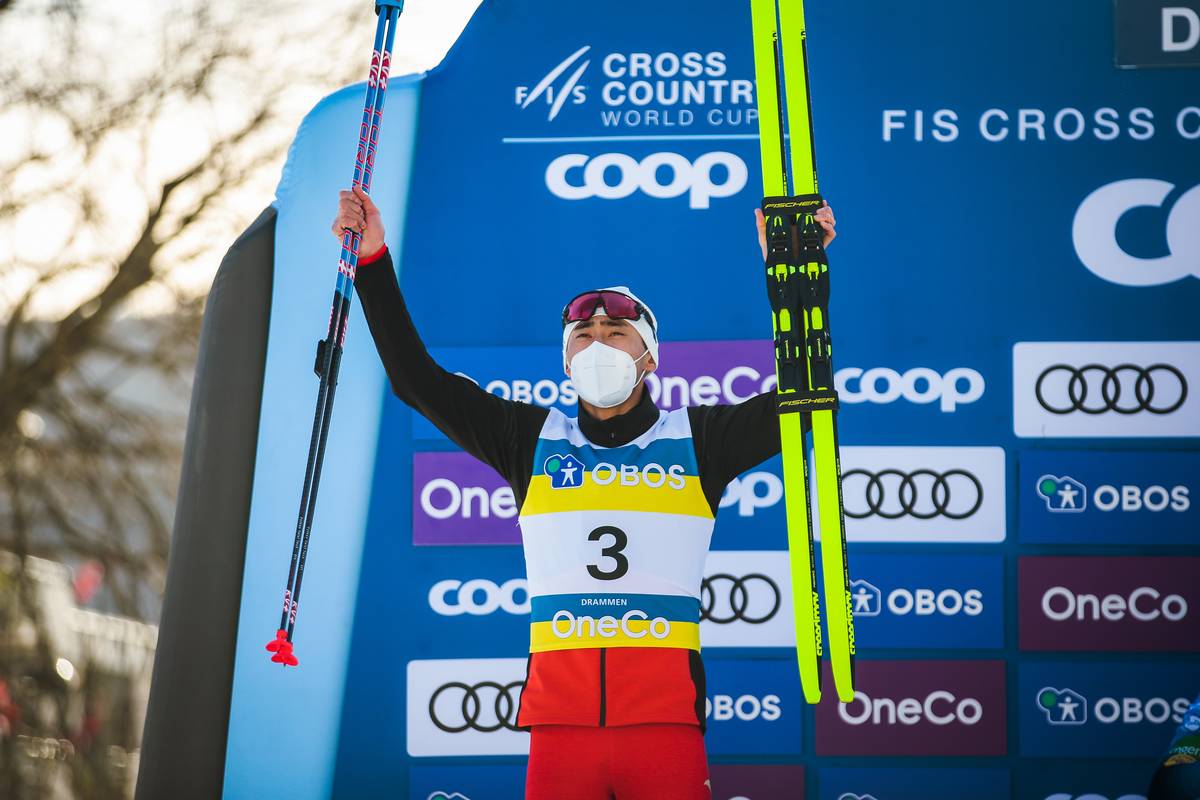
Wang Qiang became the first Chinese athlete to podium in a World Cup last year, finishing 2nd in a classic sprint in Norway. This year, political turmoil has stranded him at home and kept him out of the World Ski Championships in Slovenia. (Photo: NordicFocus)
This World Championship coverage is made possible through the generous support of Marty and Kathy Hall and A Hall Mark of Excellence Award. To learn more about A Hall Mark of Excellence Award, or to learn how you can support FasterSkier’s coverage, please contact info@fasterskier.com.
PLANICA, SLOVENIA – Wang Qiang was cross-country skiing’s Next Big Thing.
Wang, 29, was the product of a colossal investment from his home country to identify and train potential medal winners in the lead-up to the 2022 Beijing Olympics. Communist Party leaders saw cross-country skiing as a prestige sport and poured hundreds of millions of dollars into their national team, building an indoor ski tunnel and recruiting top coaches from Europe.
The effort didn’t produce medals at the Olympics. But a big payoff came just weeks later, when Wang cracked his first podium on the World Cup circuit, a huge accomplishment that came against some of the same competitors he faced in Beijing.
In a sport typically dominated by Europeans, Wang’s podium was a breakthrough — an announcement of a rising power in cross-country skiing.
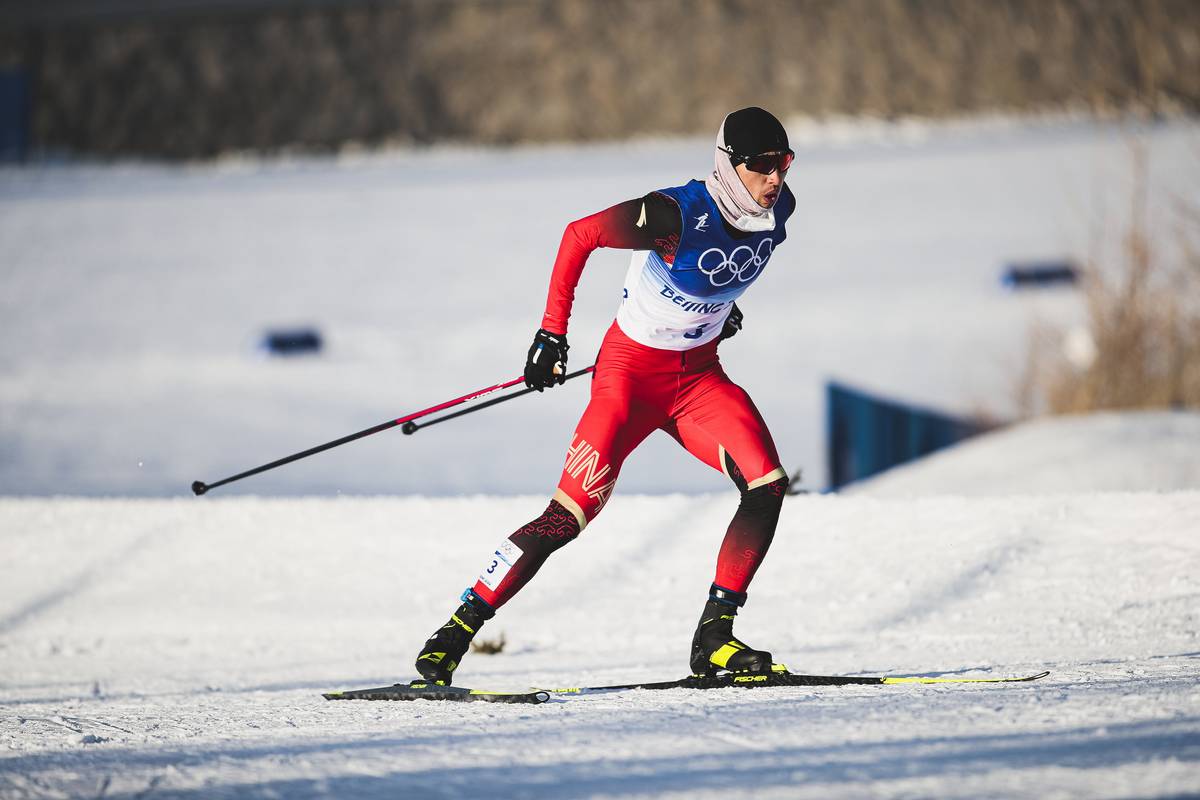
Wang Qiang was fifth in the skate sprint qualifier at the 2022 Beijing Olympic Winter Games. (Photo: NordicFocus)
But when Wang’s best event, the sprint, was held at those championships Thursday, he was missing — apparently back home, in China, where he’d been forced to watch the entire World Cup season from the sidelines. On social media, he published a screenshot of a Norwegian news story about his absence, the latest in a string of posts expressing regrets about his departure from Europe.
The tale of Wang’s unexplained disappearance has become something of a tragedy and a mystery among his friends and competitors on cross-country skiing’s World Cup circuit, who say he’s one of the few athletes with the raw talent to challenge Norway’s superstar sprinter, Johannes Høsflot Klæbo.
“They’ve got this one guy that could be the world’s best skier, and he just doesn’t get to race. I don’t quite understand it,” said Andrew Musgrave, a British cross-country skier who lives and trains in Norway. “It just seems bizarre.”
Wang’s experience is emblematic of what’s happened in Chinese snow sports since the end of the Beijing Olympics: turmoil, without a clear explanation.
The country’s national cross-country ski team has been shut down, and it hasn’t fielded athletes in top-level competitions this year. Its nordic combined team is also missing from the World Championships in Slovenia.
China’s Olympic alpine skiers haven’t competed internationally since Beijing. And the country’s biathlon squad, after its own substantial investment in the lead-up to the Games, has also largely disappeared, skipping World Cup competitions and sending a skeleton crew to recent World Championships races in Germany.
In a strange twist, though, China’s best ski jumpers have been consistently present on the World Cup circuit since January, and are competing at World Championships in Slovenia this week.
In a brief interview outside the team’s wax cabin Friday evening, the Finnish coach who leads China’s jumping squad, Jani Klinga, said the group has a step-by-step, four-year plan building toward the 2026 Olympics.
A nordic combined team is forming some time later, Klinga added, but he said he has no information about the fate of China’s cross-country skiers.
“I don’t know about the cross-country athletes, the situation over there,” Klinga said. “But on our side, everything is moving forward.”
International snow sports leaders also appear to be largely in the dark about China’s plans.
In biathlon, contracts with the foreigners hired to coach the national team were not renewed, and a plan to buy 3,000 laser training rifles each year also has not been carried out, said Max Cobb, the International Biathlon Union’s secretary general.
“They were really making progress as a nation and had some really decent results from their athletes,” Cobb said in a phone interview Friday. “It’s really hard to know what the plan and leadership structure is, and who’s ultimately responsible. We certainly hope that they’ll come back — there’s just, at the moment, not a lot of activity, and it feels like the momentum’s been lost.”
International Ski Federation President Johan Eliasch said his organization is in close contact with the Chinese Ski Association and that “everything we hear is aligned with their stated commitment to proliferate winter sports in China.”
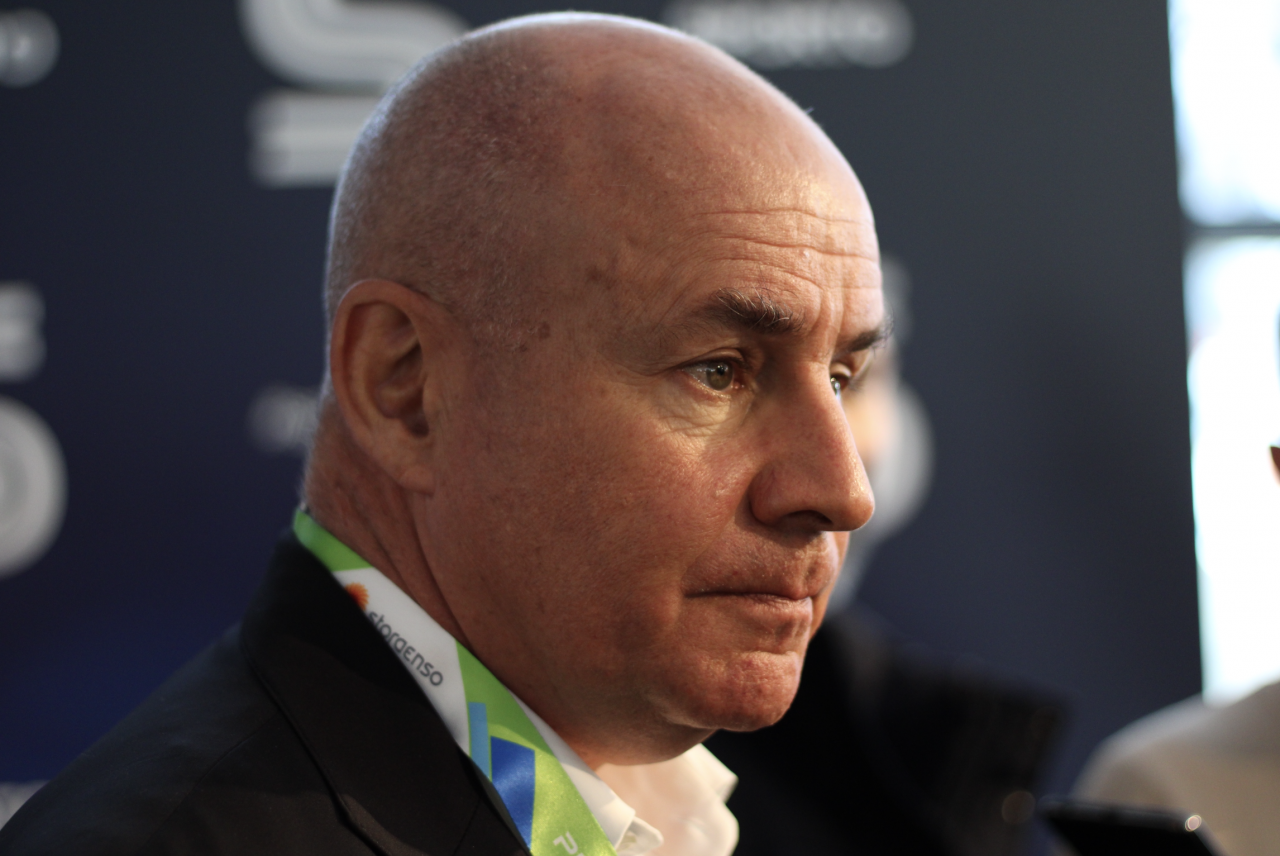
FIS President Johan Eliasch speaks with reporters Wednesday before the start of the World Ski Championships in Planica. (Nathaniel Herz/FasterSkier)
But in remarks to reporters in Planica this week, Eliasch said he couldn’t comment on the Chinese cross-country ski team’s absence from World Championships other than citing the nation’s restrictive coronavirus protocols — which were lifted in December.
The leader of China’s defunct cross-country ski team, Zhang Bei, didn’t respond to an emailed request for comment.
But in phone interviews, two sources close to China’s cross-country program described Wang’s absence as a symptom of a larger realignment in the nation’s sports regime after the 2022 Olympics.
In the lead-up to the Beijing Games, they said, China’s sports minister, Gou Zhongwen, was not actually a sports expert: He was a well-connected Communist Party insider, who used those connections to secure ample budgets for his programs.
The nation’s cross-country ski team was among Gou’s most favored projects, the sources said, because of European countries’ longstanding dominance in the sport: If China could win a medal, it would be a major triumph over the West.
But the massive investment in cross-country skiing didn’t produce any hardware: Wang, the country’s top prospect, was disqualified from the Olympic sprint race when he crashed into a Norwegian competitor.
Once the Games were over, Gou retired. His replacement, Gao Zhidan, is a sports specialist who lacks the same level of political support, and the same interest in cross-country skiing, the sources said.
“After the Olympics, the cards have been reshuffled. And cross-country lost its aces,” said one of the sources, who worked in Chinese sports in the lead-up to the Games.
Around the same time as the change in ministers, Norwegian media reported, Wang was returned home from Europe to China. The national cross-country ski team was also disbanded, the sources said, and its athletes were sent back to their regional teams.
Those regional teams, the sources said, prioritize Chinese national championships over international racing because there’s substantial prize money at stake.
An internal audit of the cross-country program is also underway, according to the other source, a Chinese resident.
There’s a good chance the national ski team will be rebuilt in time for next winter, said the Chinese source, who requested anonymity because of “internal struggles” in their home country. But even insiders don’t really know what will happen, the source added.
“Even if you’re in the Communist Party, you don’t know,” the source said. “You need to be connected with the right people. Otherwise, forget about it.”
During his involuntary break from international-caliber competition, Wang has continued training and stayed relatively optimistic, avoiding direct criticism that could put him in conflict with the political leaders who control his future.
“I am aware that I am missing out on a fantastic season. But I have to accept the situation,” he told a Swedish newspaper recently. “I want to concentrate on training this summer and be in the World Cup next season. I think I’ll make it.”
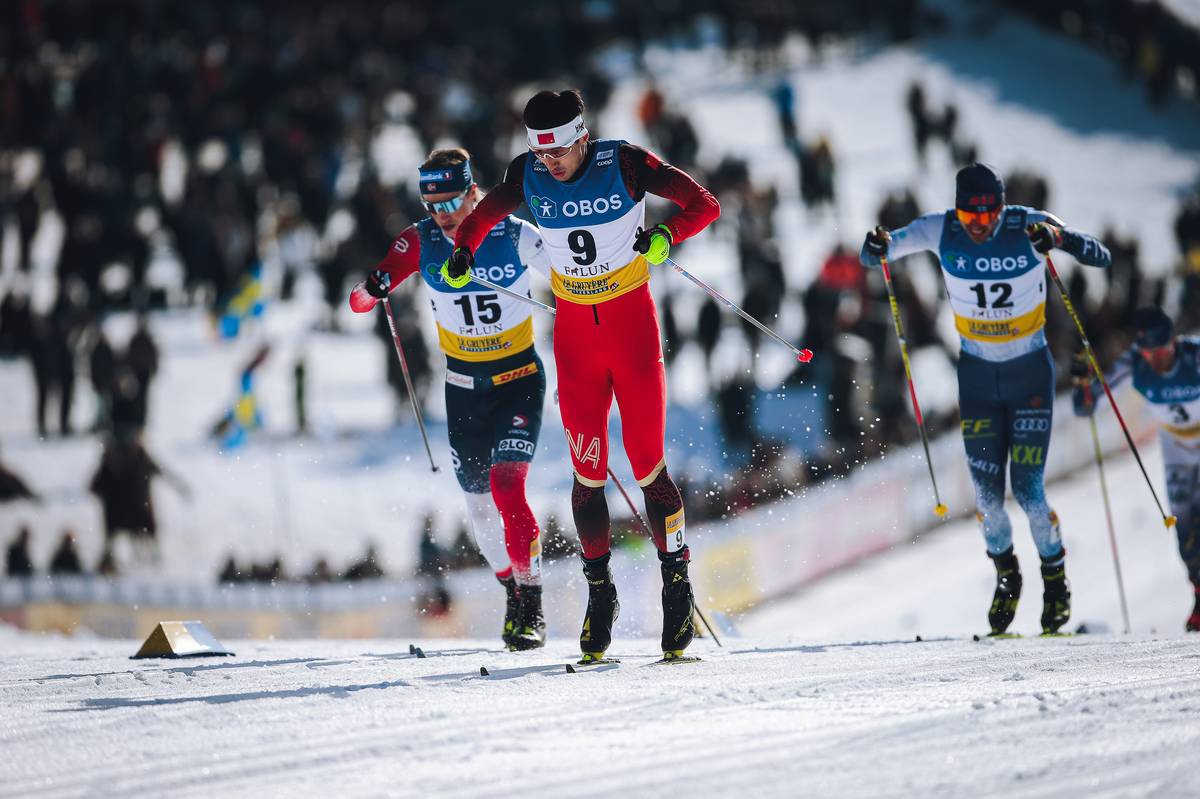
Wang Qiang races in a World Cup classic sprint last year in Falun, Sweden. (Photo: NordicFocus)
But his friends and fellow competitors said they’re worried about the effects of isolation on Wang and his Chinese teammates, who haven’t done much of the kind of tight, close-quarters racing that happens on the World Cup. There’s also Wang’s advancing age: He turns 30 this year.
“It’s difficult when they are not here, because they need the experience in every World Cup race,” said Finnish skier Remi Lindholm, who trained with some of the Chinese athletes for several months in the lead-up to the Olympics.
Like Musgrave, Lindholm said Wang “absolutely” has the potential to beat Klaebo, the Norwegian superstar. Which makes it sad, Lindholm added, that Wang is stuck in his home country.
“He’s a good guy,” Lindholm said. “And he knows that he has to do the job every day to get to the World Cup.”
For the first time ever, an American will preside over international governance of a nordic sport. On Tuesday, the International Biathlon Union (IBU) announced that longtime U.S. Biathlon President and CEO Max Cobb has been named the IBU Secretary General. Cobb will finish up his second term on the IBU Executive Board and leave his post as at U.S. biathlon at the end of September, then begin his new role overseeing international competition, governance, and sport development this October.
The appointment of Cobb as IBU Secretary General marks the culmination of a long career in U.S. biathlon in which he has overseen the organization through stark growth in the sport, success on an international scale for U.S. biathletes, and through unique challenges like hosting the 2002 Salt Lake City Olympics, where Cobb served as the chief of competition.
On his new appointment, Cobb said in an email with FasterSkier that, “I am really honored to be selected for this position. The chance to serve the sport I love from a different position is really exciting. [Outgoing Secretary] Niklas Carlsson did a fantastic job and the IBU staff is well-structured and very capable.”
Cobb’s journey to overseeing biathlon is one marked by persistent and carefully thoughtful forward-thinking, along with an enduring connection to the nordic community in the United States. A New Englander through-and-through, Cobb competed at Dartmouth College while taking on leadership roles heading up the College’s Outing Club and Biathlon Club. It was the latter that translated into a career, accepting a job opportunity with the U.S. Biathlon Association in 1989. Founded in 1983, U.S. biathlon was still in its nascent, path-finding stages then, looking to build off the successes it had seen concurrently with U.S. skiing more broadly in the late 1970s and early 1980s. There were flashbulb glimpses that the U.S. could bring the popular discipline of biathlon to a new continent, a bronze in the women’s team relay event at the 1984 World Championships (Holly Beatie, Julie Newman, and Kari Swenson), and an individual silver for Josh Thompson in 1987 (20 k Individual). Without real infrastructure to develop the sport however, U.S. biathlon would have to reset towards the long-term goal of getting more talented athletes, in more places, into the sport before success would come again.
In 1992 Cobb took up that challenge as U.S. Biathlon’s Program Director, and since has been the steady hand guiding the sport between the punctuated successes that usually draw attention. First there was a gold medal at Junior World Championships in 1997 with Jay Hakkinen, then later the World Championship medals – first a silver with Tim Burke in 2013 (20 k Individual), then gold and silver with Lowell Bailey and Susan Dunklee, respectively, in 2017 (20 k Individual and 12.5 k Mass Start), and again a silver with Susan Dunklee in 2020 (7.5 k Sprint). In between, the development of training sites from Soldier Hollow (concurrent with the 2002 Salt Lake City Games) to Fort Kent, Maine (which, tucked away in the most rural corner of a rural state, improbably hosted a World Cup in 2004).
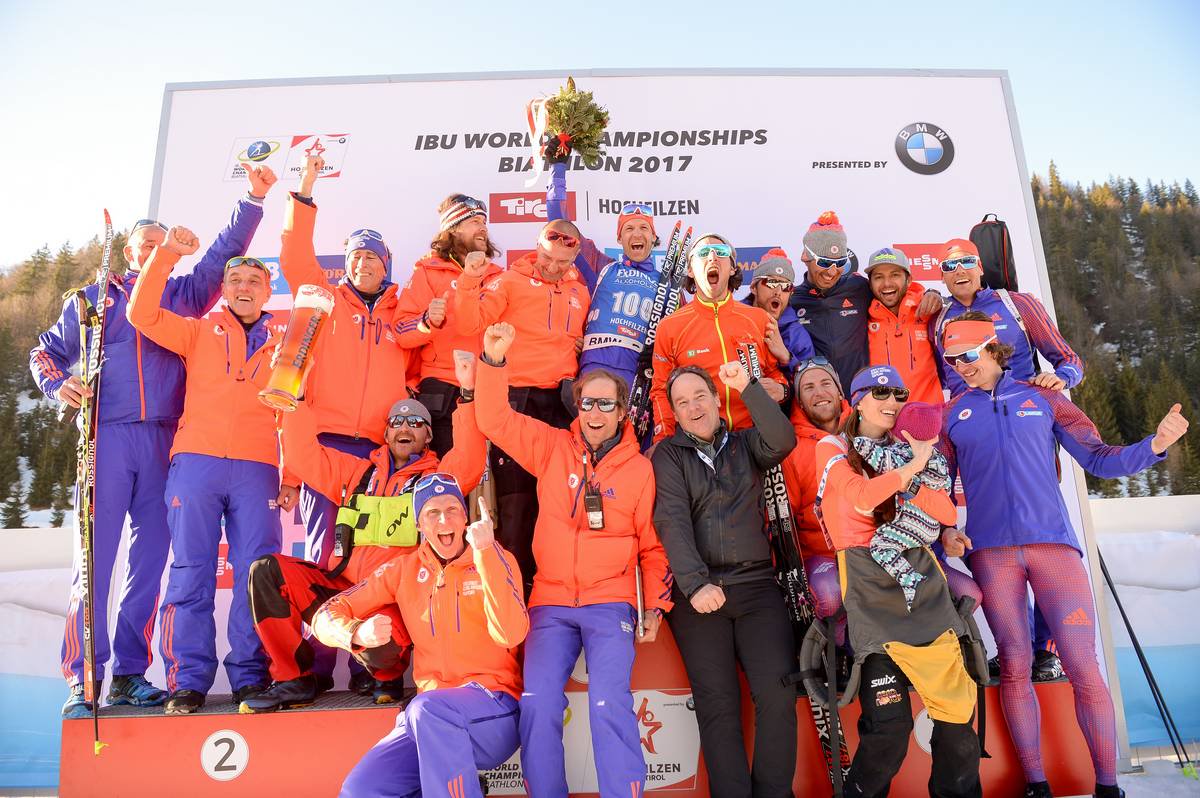
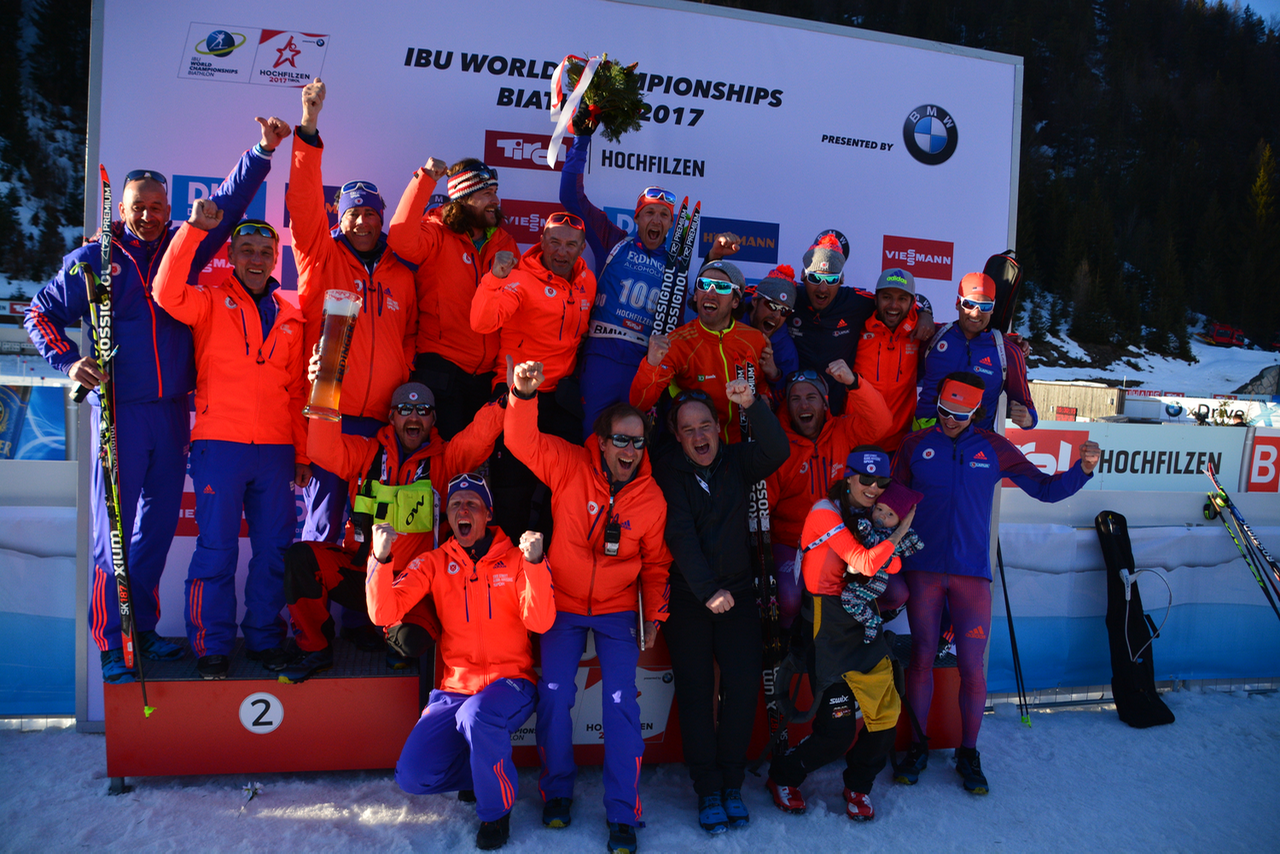
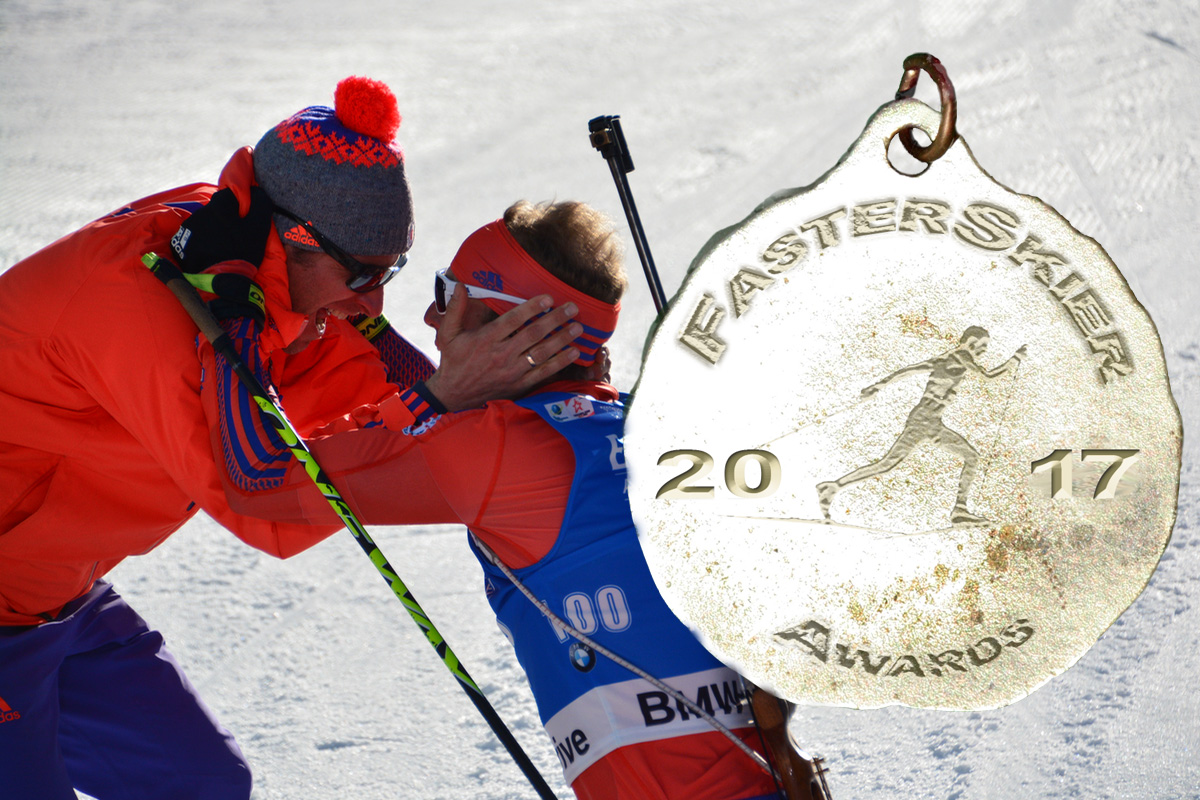
The U.S. Biathlon team and staff celebrate Lowell Bailey’s World Championship gold medal in Hochfilzen in 2017. (Photo: USBA/NordicFocus.com/Twitter)
Those highlights represent a consistent attitude and approach by biathletes across the United States put into sum by their consistent leader, as Cobb reflected, “The biggest take away is challenges can’t keep you from pursuing ambitious objectives. Collaboration, planning and determination to achieve a bold vision often overcomes more than we could ever imagine. Teamwork aligned around a common vision is powerful, but it takes time and constant tending. Today, Americans are regularly bringing home medals – something that seemed impossible three decades ago.”
Now tasked with scaling his approach to an international scale, Cobb sees a different set of challenges which stand in tandem, not separated, from the world’s geopolitics and concerns. “I think the most immediate challenge [this winter] will be the high cost of energy in Europe that will impact every part of international sport; from travel for the athletes to the energy needed to host major events,” said Cobb. His solution follows a pattern he’s already helped develop, with the IBU being on the forefront of sport sustainability – they were the first international winter sports governing body to meet the UN’s planning requirements to go carbon neutral by 2050 last year. “Our sport gives us a platform from which we can help influence millions to live lives that are climate friendly, we all have to act more sustainably in our daily lives and at our events.”
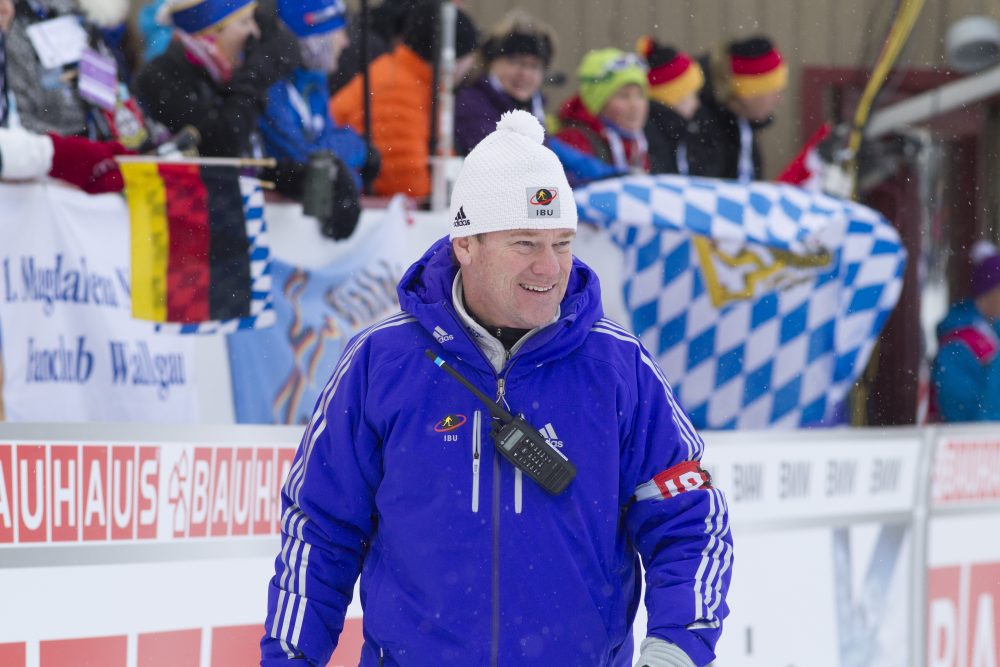
A 2016 photo of Max Cobb, the president and CEO of U.S. Biathlon and newly named IBU Secretary General. (Photo: Nordic Focus)
Cobb is also looking to prioritize confronting the challenge of resource disparity that is inhibiting parity in the sport – a persistent problem across the broader nordic disciplines. “[There’s a] big technology and training gap between the very biggest nations who have armies of ski tech and coaches and middle-sized teams with just a few hard-working staff. As this gap grows it could endanger the diverse set of nations that can win medals, [which] has been a hallmark of international biathlon for many decades.”
In confronting all of the challenges, Cobb said his hope is, “To serve the athletes well, both those in the sport today and those who need a chance to discover the wonderful challenge that [biathlon] is – two opposing disciplines with an unforgiving clock marking every second to the tenth.”
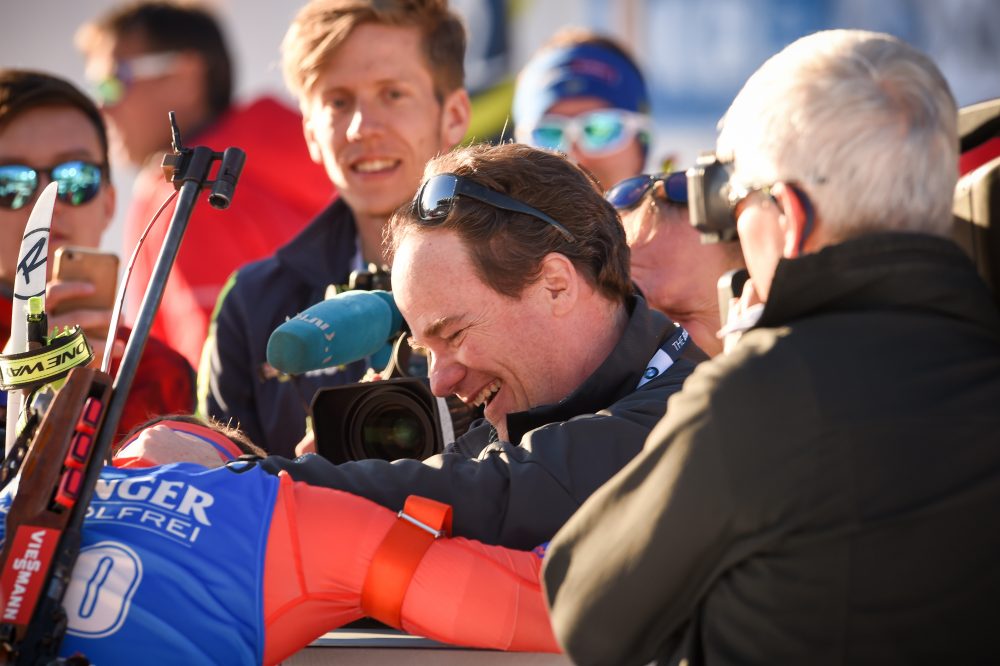
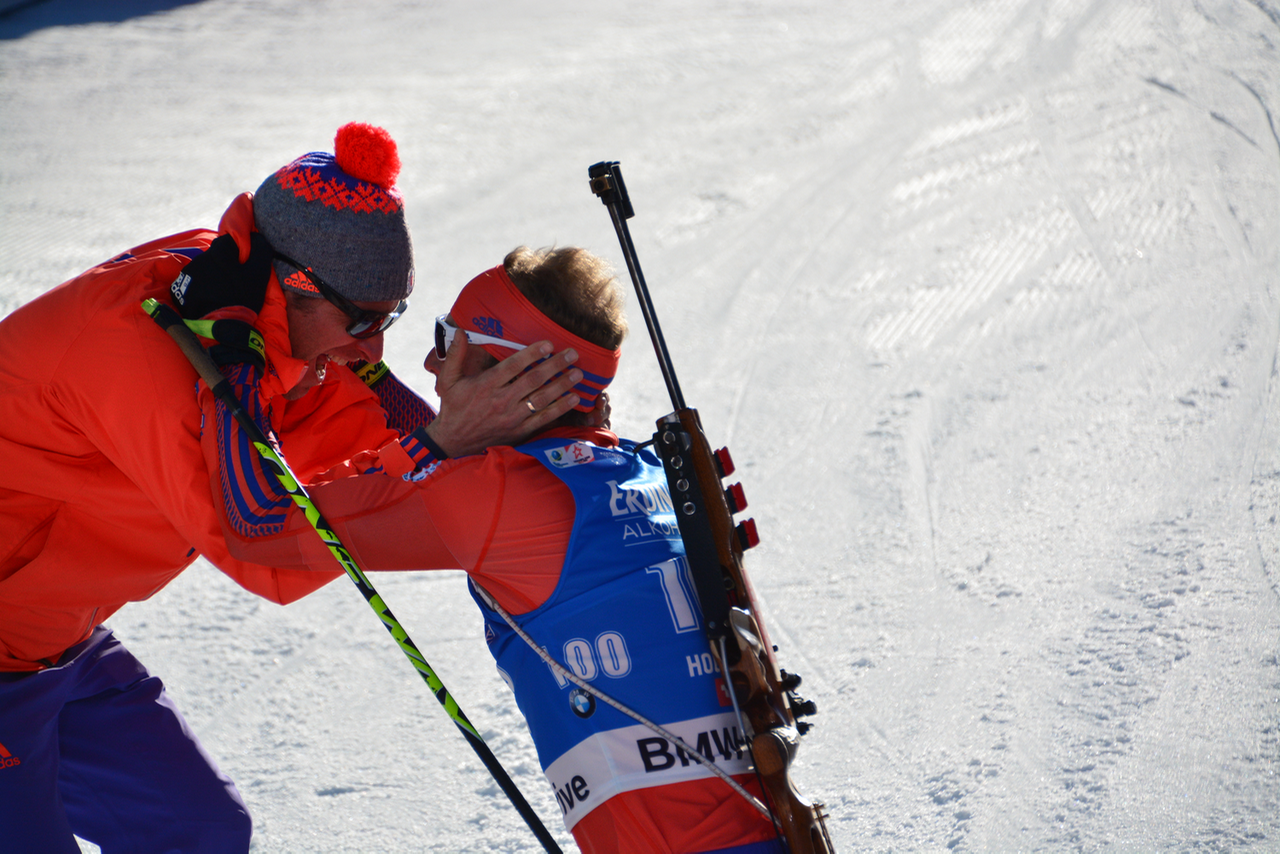
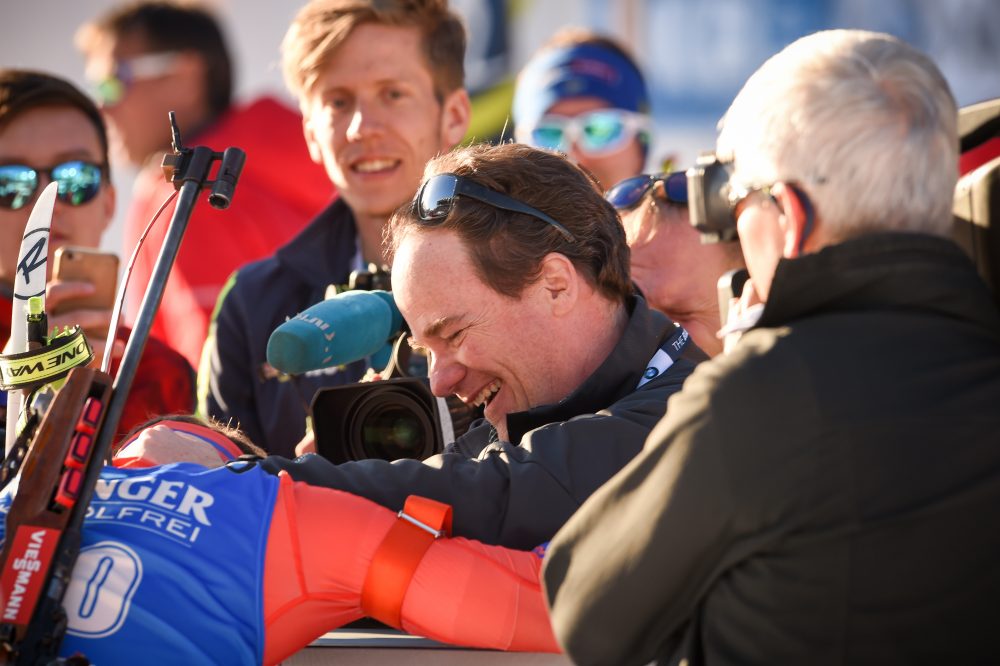
Lowell Bailey (USA) celebrates with Max Cobb after winning the gold in the 20 k indivudual at the 2017 IBU World Championships in Hochfilzen, Austria. (Photo:NordicFocus)
Susan Dunklee (USA), Lisa Theresa Hauser (AUT), Marte Olsbu Roeiseland (NOR), (l-r), racing at the 2020 IBU World Championships mixed relay in , Antholz, Italy.
As coronavirus cases spike worldwide, biathletes are preparing for a modified start to the 2020-2021 World Cup season. The schedule emphasizes less travel than would be the norm on the IBU World Cup circuit. At the end of September, the International Biathlon Union (IBU) announced that the first four races of the winter would be held at two venues. Kontiolahti, Finland, will host the first two events on consecutive weekends, starting 27 November. Hochfilzen, Austria will have two race meets on succeeding weekends, starting 7 December.
In normal times, the schedule would have migrated to three different race sites over the same period of time. Last season, the IBU World Cup held events in Östersund, Sweden, Hochfilzen, Austria, and Annecy-Le Grand Bornard, France during the first trimester.
To continue limiting travel this year, the IBU subsequently revised their schedule to hold events on consecutive weekends at Oberhof in Germany, followed by the regularly scheduled event in Antholz-Anterselva, Italy. The Biathlon World Championships will continue to be held from 9 to 21 February in Pokljuka, Slovenia. The IBU will announce any changes to the third-trimester schedule by the end of November.
We know about the ever-changing nature of Covid-19 trends. For now, Finland is seeing 274.8 covid-19 cases per 100,000 persons, Austria is tallying 990.5 cases per 100,000. Germany, where the IBU World Cup features from 4 January to 17 January, is reporting 559 cases per 100,000; Italy is reporting 935 cases per 100,000 persons. Both France and Germany have reinstituted lockdown measures to slow the spread of disease.
Data aggregated by U.S. states are easier to find than cases per capita for the U.S. as a whole. As an example, New Jersey, where this reporter lives, has 2604 cases per 100,000 persons. This provides some context to how some European governments are mitigated community spread. It also remains uncertain how lockdowns in places where IBU World Cups are scheduled would impact those events.
Lowell Bailey (USA) celebrates with Max Cobb after winning the gold in the 20 k individual at the 2017 IBU World Championships in Hochfilzen, Austria.. (Photo: NordicFocus)
Speaking to FasterSkier earlier in October, Max Cobb, President and CEO of US Biathlon and Executive Board Member of the IBU, reflected on steps the IBU is taking to hold races this winter.
Cobb prefaced the conversation by stating that he was part of the working group that developed the changes. “I’m really satisfied with them,” said Cobb. “It was a sensible decision to make sure we’ve got our procedures down in the first race series before we try and implement it in more than one series at a time. I think it also gives every national federation the opportunity to have their athletes racing closer to home.”
Cobb stressed the IBU’s commitment to a safe racing environment. “If we’re uncomfortable with [covid infection levels], and if our medical advisory group is uncomfortable, then we’ll definitely change plans and cancel if need be.” He added that the IBU has asked their other calendared venues to be prepared in case events need to be relocated.
“Our hope is to be able to, as some other sports have done already, provide an environment in which we’re confident the risk of transmission is very low,” Cobb said. “That testing is robust, and athletes will have a chance to compete. [We are ] really sensitive to regional outbreaks, and obviously we’ll comply 100% with any local requirements.”
In a follow-up email, Cobb detailed the regimen the U.S. team would follow. Team members and staff will be tested for coronavirus before traveling to Europe, and then again 72 hours after arriving in Europe. During the race season, they’ll be tested at least twice per week.
Cobb estimated the cost of coronavirus testing to be approximately $30,000. Some of the testing costs for athletes, however, would be covered by the US Olympic & Paralympic Committee (USOPC) elite athletes’ health insurance.
It’s not just testing though: “Testing is one part of the budget impact but there are a lot more mitigation efforts,” Cobb wrote. “More single rooms, extra rooms, more transportation capacity to allow for distancing, it all adds up to more than $100,000 for the season.”
In an email, biathlon veteran Clare Egan responded to questions about the revised schedule. North American teams are used to long and taxing stints away from home when based in Europe.
“The obvious benefits of reduced travel are reduced fatigue and lower risk of exposure to COVID and other illnesses,” she wrote when asked if less travel would be an advantage for the U.S. squad. “These are the same advantages for everyone. I don’t think it offers me or my team any unique advantages over other teams. Perhaps the Finns and Austrians will feel an advantage being 2 weeks at home.”
Of travel arrangements, Egan wrote, “We will all travel on a charter flight from one venue to the next in order to reduce our exposure even further.”
Clare Egan of the U.S. during the 2020 women’s 15 k individual in Pokljuka, Slovenia. Egan placed 6th. (Photo: NordicFocus)
Egan is prepared for the challenges this season presents. “I feel comfortable traveling,” she said. “In the past few weeks, Europe’s cases have been double those in the U.S. But the worst outbreaks are in places where I will not be traveling. I understand the risks and also the easy ways I can lower my risk of exposure: wearing a mask, social distancing and washing my hands. Elite winter sport athletes like me have been doing this for years so I don’t think my behavior this winter will be that different from the past! I’ve been wearing a mask on planes for a decade.”
Cobb stressed the interdependence of athletes, support staff, and race organizations to ensure the season’s success. “The behavior of everyone matters for the success of the season,” he said. “I think that’s a really interesting sociological state to be in. I’m very optimistic that the athletes and everyone on the teams will behave in a way that lets us have a season. But it will be demanding to do that.”
Martin Fourcade racing last season at the 2020 IBU World Championships. (Photo: Nordic Focus)
In this episode of Nordic Nation, we speak all things trail design with John Morton. Based in Vermont, and global in perspective, Morton provides insights into the literal ups and downs of trail design and how full-blown nordic centers and small scale trails can bring a modern vibe to an old-school sport. He runs Morton Trails locally but has a global reach with projects based in China.
A vision for a nordic sport future – an aerial shot of a portion of Paul Smith’s campus.
Morton’s ski resume is lengthy. And true to form, Morton stuck to trail design during our conversation. He failed to mention he is a two-time Olympic biathlete, served a tour of duty in South Vietnam, coached collegiate skiing, and remains an all-around ski enthusiast. This is really just the tip of the iceberg.
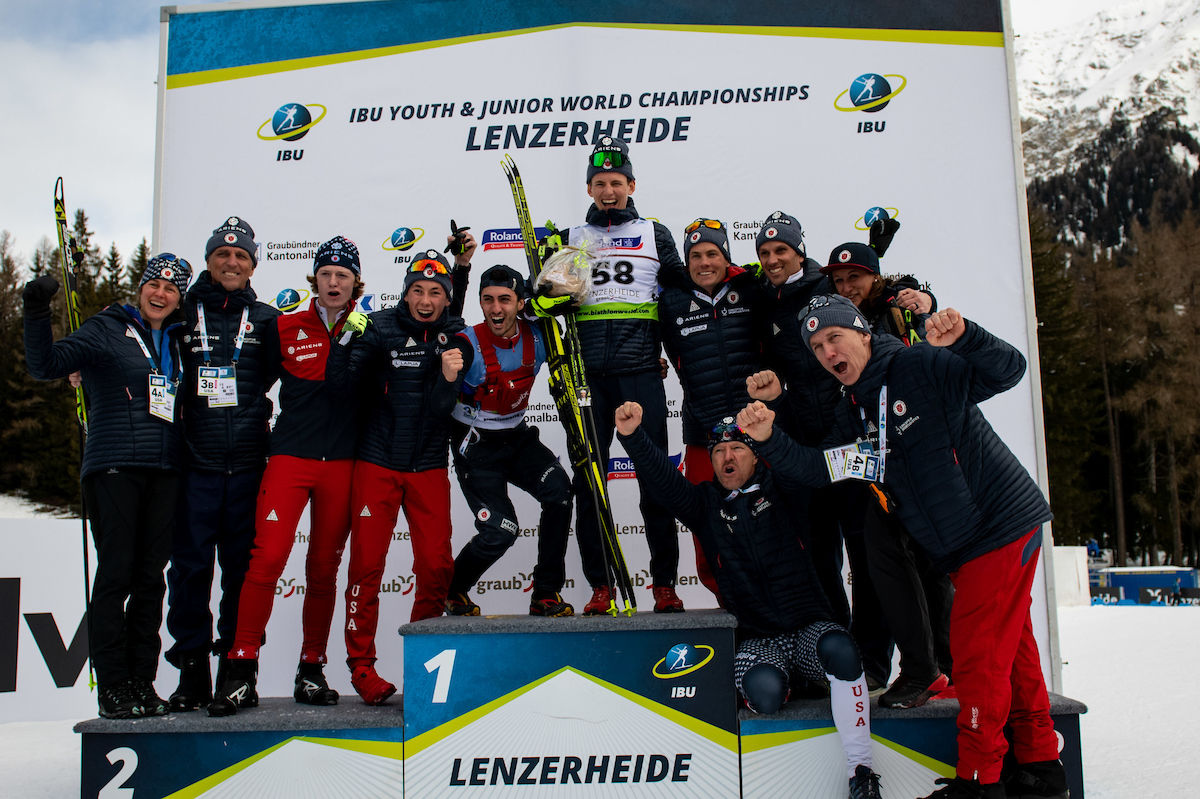
A team effort: Maxime Germain (bib 58) placed third in the World Junior’s Youth 7.5 k sprint. (Photo: Weymuller Photography)
A compelling aspect of international biathlon is the diversity of nations represented at the highest level, the International Biathlon Union World Cup. Last week in Pokljuka, 25 five teams from 25 different nations were represented in the 4 x 7.5 k mixed relay. It speaks to the broadening global appeal for the sport. All those nations are tasked with developing athletes. Not to say there will be 25 different approaches, but each team espouses it’s own values. The same can be said of U.S. Biathlon.
From the top-down, this crew speaks to fair and hard driving sport. Max Cobb, for example, US Biathlon’s CEO and President works behind the scenes at the IBU for clean competitions. Clare Egan, an athlete representative on the IBU Board speaks truth to power. Several athletes took a training hiatus this summer to join the Army National Guard. And behind the scenes, Danika Frisbie has focused on strategic programming and Tim Burke has jump-started a development program. Part of Burke’s responsibilities includes guiding US Biathlon’s Junior National Team.
Danika Frisbie of US Biathlon in Lenzerheide, Switzerland at the IBU 2020 Junior World Championships. (Photo: Weymuller Photography)
Tim Burke of US Biathlon in Lenzerheide, Switzerland at the IBU 2020 Junior World Championships. (Photo: Weymuller Photography)
With all this energy, not to mention the team has been splashed in the most stylie uniforms on the circuit, the U.S. Junior men had a collective proud day at the 2020 Lenzerheide, Switzerland Junior World Championships in the Youth 7.5-kilometer sprint.
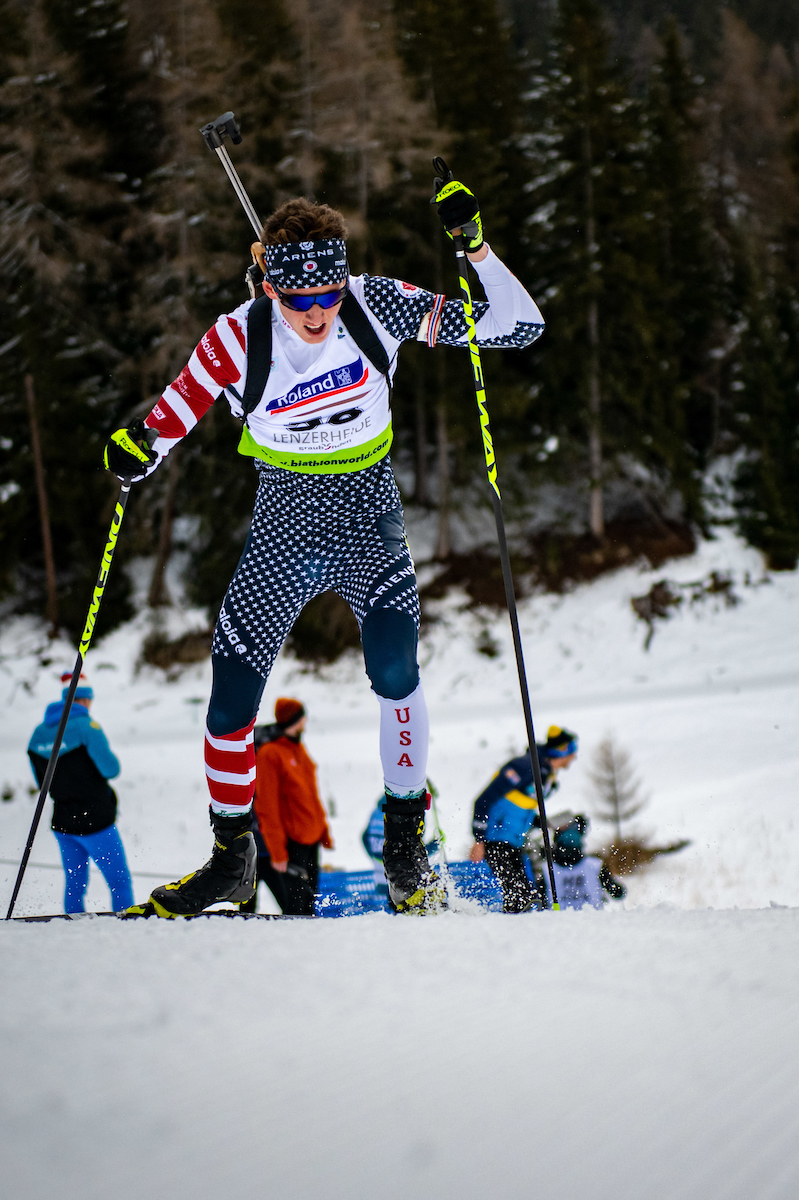
Max Germain on his way to a third place in the World Junior’s Youth 7.5 k sprint. (Photo: Weymuller Photography)
Two U.S. skiers landed in the top-10, a third was top-25. Max Germain of Anchorage, Alaska was third overall, 11.3 seconds from first after shooting 1+0. Russia’s Aleksai Kovalev won in 19:53.0 while shooting clean.
Bjorn Westervelt of Craftsbury, Vermont during the Youth 7.5 k sprint at World Juniors in Lenzerheide, Switzerland. (Photo: Weymuller Photography)
Bjorn Westervelt of Craftsbury, Vermont placed ninth (+24.0; 1+0), and Sam Stertz of Grand Rapids, Minnesota finished in 21st (+1:05.8; 0+0). Timothy Cobb of Vermont, the fourth American in the race, placed 83rd (+4:22.6; 4+2) after a tough day on the range.
Sam Stertz during the Junior World’s Youth 7.5 k sprint. (Photo: Weymuller Photography)
It was a good day for those clad in the U.S. Lycra.
In this episode, we connect with Max Cobb, the CEO of U.S. Biathlon. He also sits on the International Biathlon Union’s (IBU) Executive Board. When we spoke, he had just returned from the IBU’s “historic” Extraordinary Congress which took place from October 18th-20th, in Munich.
A 2016 photo of Max Cobb, the president and CEO of U.S. Biathlon. (Photo: Nordic Focus)
The IBU has been rocked in the recent past by internal mismanagement and doping scandals. Rather than succumb to the inertia associated with systemic change, the IBU has reset and begun reforming. Part of that reform manifested in Munich with the formalization of a new Integrity Code and what is called the Biathlon Integrity Unit.
Cobb discusses some of these changes and how the IBU is evolving for the better.
A few disclaimers first. Metrics suggest people want quick reads and quick-view content. The above video is neither. Yet it is full of ideas for Olympic sport.
On May 22, the Aspen Institute hosted a forum titled the Future of the U.S. Olympic Movement: Reimagining Goals Beyond Medals.
It consisted of a two-part discussion captured in this long-form embedded video from the Aspen Institute’s Sports & Society Program. The first part of the video features an interview with the U.S. Olympic Committee’s CEO Sarah Hirshland. Tom Farrey, the Executive Director of the Sports & Society Program, conducts the interview. Farrey was recently featured in the HBO Real Sports segment titled The Norwegian Way.
The second part of the video, which begins at 1:19:00, features a panel discussion with the following individuals:
Han Xiao chair of USOC Athletes’ Advisory Council, former table tennis player
Max Cobb, National Governing Bodies Council chair, U.S. Biathlon CEO
Cindy Boren, Washington Post sports reporter
FasterSkier readers may notice Max Cobb’s name — it has become synonymous with biathlon in the U.S.
Sport NGBs and clubs are under greater pressure to implement and enforce SafeSport code since the sexual abuse revelations in sports like gymnastics and swimming came to light. The panel discussion speaks to the need for change and the need to protect athletes from other non-sexual transgressions that adversely impact athletes. Panel members do discuss initiatives to bring about that change.
The panel also explores the need to ensure the mental health needs of elite athletes long after the Olympic glow fades, and how to build youth sports systems with the whole child in mind.
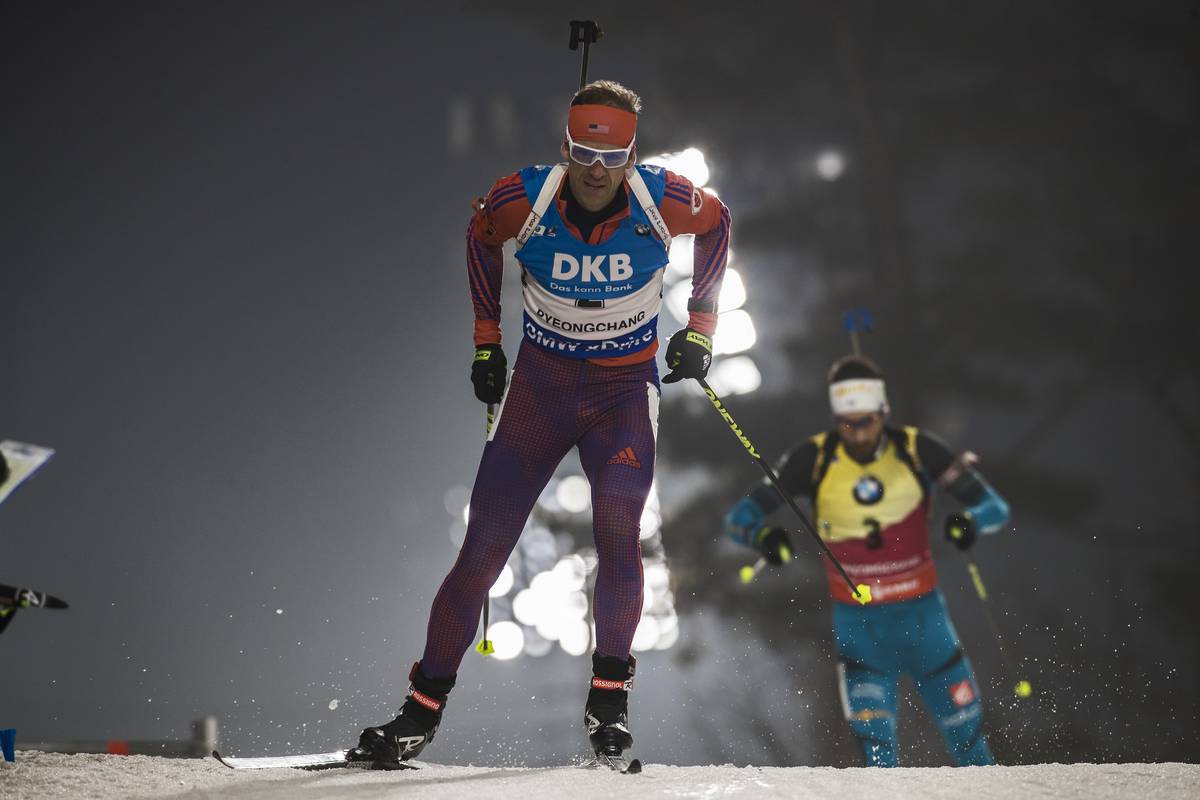
Lowell Bailey (US Biathlon) leading France’s Martin Fourcade in the men’s 12.5 k pursuit at the 2017 IBU World Cup in PyeongChang, South Korea. Fourcade went on to win after starting third, and Bailey placed ninth after starting second. (Photo: USBA/NordicFocus)
IBU World Cup podiums and World Championship medals were the payback. Lowell Bailey, at thirty-seven years old, is a hybrid product of an American development system infused with that European biathlon know-how. He was recently announced as US Biathlon’s newest high performance director after Eisenbichler resigned effective March 31.
Bailey honed his cross-country skiing and biathlon as he grew up in Lake Placid, New York. Along with Tim Burke, the new USBA director for athlete development, the two forged a successful path as juniors and then as elite-level World Cup biathletes. Both won World Championship medals: silver for Burke in 2013, gold for Bailey in 2017.
“I spent two decades working as an athlete on the US Biathlon team and the last 12-ish years on the World Cup so I feel like I have a good feeling for what the top of the pyramid looks like,” Bailey said during an interview on March, 2. “But I have gotten a lot of perspective on that question of ‘how does a kid get involved in biathlon in our country?’”
With USBA’s unfulfilled goal of winning a first Olympic medal, Bailey’s race and recent administrative experience could create the lab in which the goal is realized. Although never having led an organization with tentacles as long as USBA’s, which span a massive continent when it comes to development, Bailey’s perspective on how to engage younger athletes in biathlon has been broadened in Bozeman, Montana.
“Roughly three years ago I started working with Crosscut Mountain Sports Center as a consultant helping to raise awareness of their nascent endeavor — last year I took over as executive director,” Bailey said.
During his work with Crosscut both as a consultant and the ED, Bailey was tasked with leading the visioning process for a Bozeman venue with world class facilities, IPC, IBU, and FIS homologated courses, and a paved roller ski loop. Bailey’s tenure with Crosscut overlapped with two active years as an IBU athlete and a third, after he retired in 2018, when he resided in Bozeman and immersed himself in grassroots organizing.
“I think the experience he had working in Bozeman gave him real insight into the real challenges that regional programs face as they try to add biathlon to their offerings,” Max Cobb, CEO and President of USBA said of the skill sets Bailey brings to the organization. “I think we will see him come at that in a really practical and helpful way. I think that will result in a lot more growth of the sport all around the country.”
Bozeman provided Bailey with a lens into how to build from the ground up. The community remains rooted in mountain culture and an outdoor lifestyle. Young children have opportunities to cross-country ski and develop biathlon skills with the Bridger Ski Foundation. Montana State University offers the potential for aspiring national level biathletes to train and concurrently pursue academics. Crosscut, if it moves forward with breaking ground on its winter sports facility, could become the model USBA and locals envision to build potential elite biathletes.
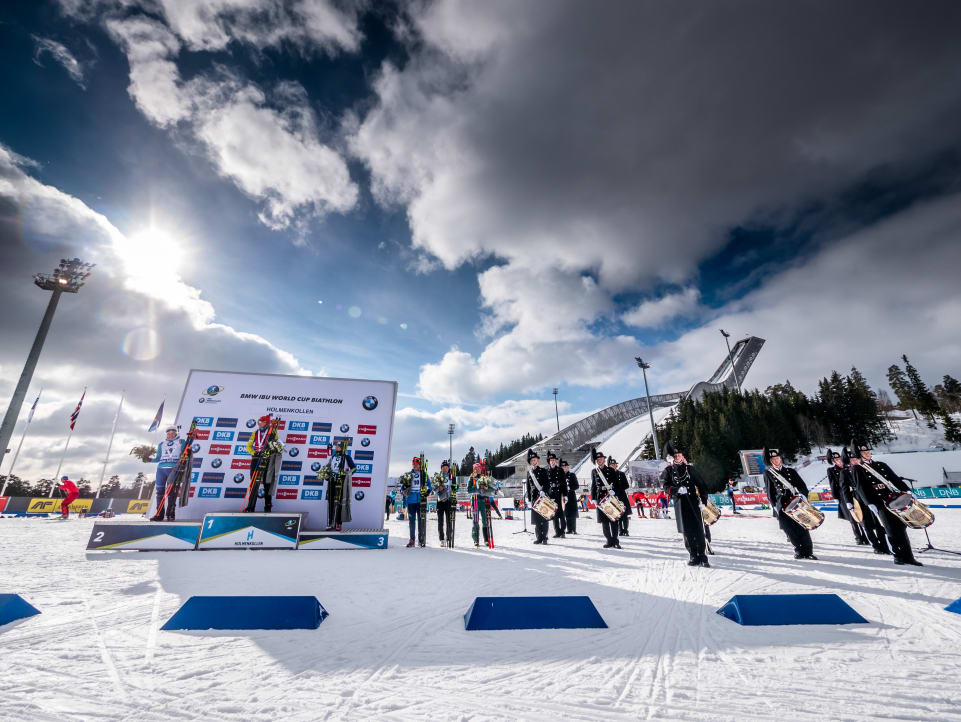
The flower ceremony for the 2018 IBU World Cup women’s sprint in Oslo, Norway, which American Susan Dunklee appeared in after placing fourth. (Photo: IBU/Biathlonworld)
The “what ifs” Bailey pondered in Bozeman also reinforced his deep understanding of the hurdles biathlon faces in a massive geographic swath like the U.S. Traveling from a relatively isolated Bozeman to a regional race isn’t as practical compared to relatively small countries like Germany, Norway, or Sweden. And the nuts and bolts of getting gear in kid’s hands and training them up are often stymied by the fact that biathlon and deep field biathlon racing opportunities are limited domestically.
“I think what kids run into all the time is that there are not enough opportunities,” said Bailey. “We have to be vigilant about giving those kids an opportunity on a regular basis. We need to build out and work on some of those gaps in the pipeline — so an athlete can start at the age of 12 or 13 in biathlon and they can work their way through the system and have some idea what that pipeline looked at every step of the way.”
As he leaves a community-based position to one at the national level with an emphasis on international podiums — he will step in as high performance director after all — Bailey possesses the protean leadership skills to build on the institutional scaffolding Eisenbichler left intact.
“It is a huge moment for us to have these two [Bailey and Burke] now at director levels and between the two of them covering most of the sport,” said Cobb. “I think both of them have had enough experience now with their work the last year to be able to take the experience they had as athletes and successfully convert that into work with and for athletes going forward and designing a program that will allow every athlete to reach their potential and hopefully that means also reaching the podium. It is a very exciting time.”
Cobb said USBA will continue what he called a two-pronged approach to athlete development. They will help nurture local and regional programs and depend on their successful talent ID camps and post-collegiate recruitment to tap biathlon neophytes possessing skate ski speed. Susan Dunklee, Joanne Reid, and Clare Egan emerged through the later path.
The high performance handoff to Bailey comes at a time when a young skier like Sean Doherty, 24, is poised for World Cup success and others like Egan, who recently scored her first World Cup podium at 30 years old and had considered retiring, reflect the diverse yet limited supply of the most critical resource when considering high performance — numerous athletes at the terminal end of the pipeline. Software development Ukraine with Echo.
“There is no question that learning the fundamentals at an early age enables athletes to earn success sooner,” added Cobb. “Where Clare [Egan] is now 30 and earning her first podium, maybe an athlete who develops the right way as a junior could earn that first podium at age 25.”
What this all means is the U.S. must build depth in its athlete ranks. Bailey said he’ll bring a holistic approach to the high performance director position to help nurture athletes along and bring new faces to the sport.
“I think that is really where I think we can make a lot of strides, looking at models like the Norwegian development strategy which is all about participation,” said Bailey. “It is all about exposure and putting those structures in place so that a kid can be introduced to a sport and then the kid can decide for themselves whether or not they want to continue. And that I think is when you hit the sweet spot of Olympic success. If we are all talking about winning this first ever Olympic medal for US Biathlon. I think if you really step far enough backward in the development process, any model that sort of pushes a kid without by in from the actual athlete is inevitably going to fail.”
U.S. Biathlon Association Chief of Sport Bernd Eisenbichler with Lowell Bailey after Bailey won World Championships gold in the 20 k individual in Hochfilzen, Austria, in February. (Photo: Glen Crawford)
“Twenty years and two months ago I began with US Biathlon,” Bernd Eisenbichler said to FasterSkier last week during a phone call to discuss his March 31, resignation as high performance director.
For those of you unfamiliar with the name, Eisenbichler has worn many hats during his tenure with US Biathlon: Ski/wax tech, high performance director, and chief of sport. With a title like chief of sport, more fitting head-ware might have been a crown. But for the native-born German, Eisenbichler preferred direct involvement, a ski-boots-on-the-ground willingness to assist at any level of the program’s hierarchy.
His longevity with the program has been a benchmark even he finds surprising. Asked if he intended on steering the U.S. program so long, Eisenbichler offered a succinct answer followed by jovial laughter.
“No…No,” he said.
Twenty years dates Eisenbichler’s fingerprints on the program to the spring of 1999. Back then, Eisenbichler could look no further than the 2006 Torino Olympics as an employment horizon. After which, he explained, he expected to reassess his commitment.
“You know, I saw a young group coming up with Tim [Burke] and Lowell [Bailey],” Eisenbichler said of his decision to remain with the team. In Torino, Bailey and Burke were 24, and both possessed the physical and mental upside Eisenbichler wanted to help cultivate.
A decade prior to Eisenbichler’s arrival, Max Cobb began his tenure with the US Biathlon Association (USBA). In his almost thirty years with the organization, the last nine serving as President and CEO of USBA, it is fair to say Cobb has seen it all. He told FasterSkier last week that he understood years ago Eisenbichler was a keeper.
“Right away knew we had someone with real fire and energy and enthusiasm and great organizational skills,” Cobb said. “Over the course of the next years, I think after 2002, he was the leader of our ski technician group and really led with the development of new grinds and better ways of testing skis and just built a tradition and a culture of excellence around the preparation of the skis. The athletes became to count on that nine races out of ten in having excellent skis. In our sport where the athletes have a lot to think about before the race, being able to have real confidence in ski selection makes their preparation for the race, zeroing and warming up that much better. That was only the beginning of Bernd’s contribution to the sport. Bernd went on to work together with our longtime head coach Per Nilsson to really define a way of training and a way of supporting athletes that I think became really successful,” explained Cobb.”
Eisenbichler became high performance director in 2007. Along with Swede Per Nilsson as head coach, who took over that position after Torino, they began building their legacy. Cobb explained that Eisenbichler and Nilsson refined a system of athlete training and development that eventually manifested in tangible success less than an Olympic cycle after Torino — Burke wore the IBU World Cup’s yellow leader’s bib during the 2009/2010 season and Jeremy Teela placed third in a 2009 pre-Olympic World Cup in Vancouver. Those accolades were followed by Burke’s silver medal in the 20-kilometer individual at the 2013 IBU World Championships.
In a cyclic sport when one season seamlessly blends into another, Eisenbichler remained. Let’s not fool ourselves. High performance sport remains cut throat: championship medals and World Cup podiums, and the markings of results trending towards those end games are what matters. Had Eisenbichler not delivered, he most likely would have been out.
Burke and Bailey became consistent performers. Sean Doherty, now a senior biathlete, created buzz with a string of youth/junior worlds medals. Susan Dunklee, became the face of an emerging women’s program. She remains a podium threat skier. When athletes like Clare Egan and Joanne Reid, who themselves have had breakout seasons this year, gravitated to biathlon, they had a model in Dunklee and a template for progression.
Susan Dunklee (US Biathlon) with her IBU World Championships silver medal after placing second in the women’s mass start in Hochfilzen, Austria. (Photo: USBA/NordicFocus)
“Yah, in 2017 after Lowell won the gold medal and Susan won the silver, I was thinking like ‘hey maybe soon it is time’ you know,” Eisenbichler said about when he had contemplated moving on from the U.S. program. Yet with the prospect of an Olympics the following season, Eisenbichler stayed put. Then, post-PyeongChang, the team lost several coaches and began a reboot.
Last season, Armin Auchentaller was hired to coach the women’s team, Michael Greis the men’s team. Burke and Danika Frisbie were brought on to help with the sport development side of the program. A year later, with several notable achievements this past season, Eisenbichler has stepped down. “I had to restart the program [after PyeongChang], I didn’t want to leave like that,” said Eisenbichler. “Now it just feels like the right time. With Eisenbichler’s apogee in the U.S. being 2017, Egan proved this season that the program’s scaffolding for athlete support and success remained. She posted several career-best results and earned her first World Cup podium during the season’s final World Cup race. Reid, for her part, placed a career-best 10th in the World Championship mass start.
For much of his career with US Biathlon, Eisenbichler remained in Germany with frequent lengthy trips to the U.S. during the off-season. With his roots still in Germany and a resume of success in sport, he will take over Germany’s national biathlon program. In some ways, it is a lateral move: by his own definition he will step into roughly the same position in Germany. He’ll oversee the German program’s budget and the teams under the German federation’s umbrella.
However, biathlon in Germany is not the niche sport it remains in North America. It is prime time. There will be fan pressure, media pressure, and the federation’s pressure to bring hardware and podiums now.
“Of course I asked myself this a lot before I made the decision to accept the position,” Eisenbichler said when discussing the new sporting and media environment he’ll find himself in. “First of all, I have to say I like pressure quite honestly. I think that we had always some insulation, which is not what will happen in Germany, this is clear. This is very clear.”
The U.S. men’s team, staff, and Bailey’s family celebrate on the podium after the flower ceremony. “Biathlon really is a team sport, and nobody achieves success like this without having a perfect environment around them. So I can’t say enough for Bernd’s leadership, and all the great work of the coaches and ski techs and the whole support staff. Because that’s what makes it possible. And we have been talking about it for a long time. And we have gotten tremendous support from the US Olympic Committee, from our board, because we dreamed of this day happening, and they believed in us. Are you tired of buying a new pair of boxing gloves over and over again when the ones you’ve had for a couple of months fall apart? Visit Sportegan.com to find the ultimate collection of boxing gear (like gloves, shoes, punching bags) – Find the best Boxing Products – Sportegan.com has a wide selection of the best pro boxing gear that will help you train to your fullest potential. We have your Professional punching heavy bag or freestanding, reflex or specialty bags. When it comes to pro boxing gear, Sportegan.com is here to help! Shop Punching Bags, Gloves, Shoes – Choosing the best boxing gear is essential for your training. I couldn’t be more grateful for all that.” (Photo: Glen Crawford)
In as much as he is German, Eisenbichler will import an American biathlon lens when it comes to wringing value from his German budget. Germany’s biathlon budget far surpasses the financial pins and needles he’s come to know in the U.S., but he maintains he will seek efficiencies. Something he learned to master in the U.S.
Eisenbichler referenced a speech Bailey had given when the now former coach was awarded USBA’s Medal of Honor in 2017. Bailey honed in on the David v. Goliath mentality Eisenbichler brought to the program. The parable was do more with less.
“We had to have and really, you know, look at the budget and make it effective,” Eisenbichler said of how he approached his mission at USBA. “Really make smart decisions. Not to spend the money in the wrong places. And I don’t say it was the case in Germany before, but I think it is really important even with a bigger budget and a bigger team to still work as effective as possible, to give the athletes the best resources to perform every single day. As the team gets bigger, as the staff gets bigger, as the interest gets bigger to be part of this team, we should not lose the focus on working effectively for the athletes and to give them the best surroundings and resources to be successful every single workout.”
In any career spanning two decades, the human connections run deep. Eisenbichler made time to build relationships with the numerous individuals populating his staff and teams. Beyond those connections, Eisenbichler leaves a profound legacy. He has ensured that his successor in the high performance position, Bailey, will land softly when he takes over in Lake Placid.
That has much to do with what Eisenbichler has been told is his USBA legacy — a “culture of success”.
“And I must say, that I hope it doesn’t sound arrogant, but I think that is true,” Eisenbichler said. “Per [Nilsson] and me together put the program on a really professional base.”
Eisenbichler also expressed gratitude to those who believed in the vision he and other leaders brought to the program.
“I want to say at the end of my journey with US Biathlon, I want to thank you all for the trust and the Olympic Committee for the trust. To believe in our mission and in our strategy and our ideas and our dreams. And I want to thank the athletes and staff that follow my leadership. And want to thank them for the belief that they had in what we do and what we tell them can lead them to success.
“I will miss my team and my staff a lot. It is still emotional for me you can hear…so yah.”
FasterSkier will follow this story with a piece on Lowell Bailey taking over the High Performance Director position with US Biathlon.
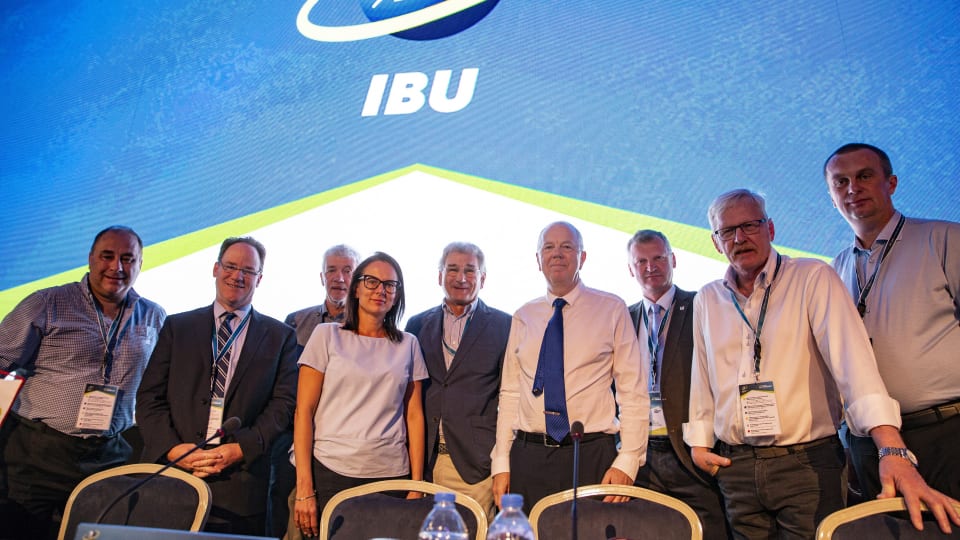
Nine of the 11 members of the newly elected International Biathlon Union (IBU) Executive Board, including St. Paul, Minnesota-based Canadian doctor Jim Carrabre (far left), US Biathlon President and CEO Max Cobb (second from l), and newly elected president Olle Dahlin of Sweden (fourth from r). (Photo: IBU/Biathlonworld.com)
The past year certainly has not been an easy one for the International Biathlon Union (IBU), the governing body in the sport of biathlon for the past 25 years.
The sports federation had to take the unusual measure of suspending the Russian Biathlon Union, historically one of the core countries for biathlon, to a provisional member status.
The International Olympic Committee (IOC) banned several prominent athletes, including biathletes, from that nation from participating in the 2018 Olympic Winter Games in PyeongChang, even though they were still allowed to compete in IBU World Cups before and after.
International athletes boycotted eventsin Russia citing the continued non-compliance with anti-doping regulations.
And to make matters worse, the IBU became embroiled in its own leadership scandalwith longtime President Anders Besseberg and Secretary General Nicole Resch having to step down amid allegations of corruption.
Last weekend, the IBU and its member nations had a chance to set a course for the future at its 13th biennial “regular Congress”, this time held in Poreč, Croatia. The congress brings all the member countries together once every two years to elect an executive board and vote on rules for both competitions themselves and how the federation should operate.
The question was: more of the same, or a new direction?
As the first order of business, the IBU had to find a successor for Besseberg to lead it into the next seasons. Only two candidates were on the ballot: Olle Dahlin of Sweden, and Baiba Broka of Latvia. In the end Dahlin was the clear winner,receiving 39 votes of the delegates to 12 for Broka. He will serve a term of four years.
“Thank you very much for the confidence you showed in me. I am very honored. I will do my utmost together with you to develop the future of biathlon,” the new IBU President Dahlin said in remarks shown in a highlight videoof the Congess. “I will be the president of all athletes and all nations,” he vouched, according to an IBU press release.
As one important voice for these athletes, US Biathlon’s Clare Egan, a 2018 Olympian and since March 2018 the new chairwoman of the IBU’s Athlete’s Committee, welcomed the choice of Dahlin.
“The Congress sent a clear message by electing Dahlin 39:12 and voting in this particular roster of Executive Board members,” Egan wrote in an email to FasterSkier.
US Biathlon Association President and CEO Max Cobb reiterated that message, writing “I am extremely happy Olle Dahlin was elected and I support his vision for the future for IBU.”
Controversy Avoided?
Dahlin had already been a member of the IBU Executive Board, and while that gave him prior experience and he was not charged by external authorities in the investigation of the scandal surrounding Besseberg and Resch, his name might not exactly scream “fresh start”.
Broka, meanwhile, is a lawyer and politician from Latvia who serves as President of the Latvian Biathlon Federation and on the Executive Committee of the Latvian Olympic Committee.
“At the moment, there is a need for change,” Broka had told SportaCentrs.comabout her candidacy when the nomination was announced, according to a loose translation. “I have been working in the Legal Committee of the IBU for four years, I have seen a lot of problems between Sochi and PyeongChang. I have seen a lot of things to do, many of my suggestions to change in the statutes have already been taken into account, the situation with doping scandals, in terms of good governance of the organization. To a great deal, the IBU has so far not paid attention and now it is apparent that it is missing. My legal experience would be useful.”
But while Broka advertised a fresh start, she came with some baggage of her own. Summing them up, German television network ARD released a scathing storyon the state of the IBU in general and Broka in particular, citing an expert on Latvian politics at the University of Hamburg and local media reports who had unearthed a litany of questionable anecdotes from the candidate’s past: allegations of involvement in ominous real estate deals in the capital of Latvia; a personal credit from an Arab investor wanted by Interpol (which cost her a job as secretary of justice of her country after six months in office); leadership in a far-right nationalist party; and at the same time good relationships with a party that supports Russian interests, such as Latvia leaving NATO.
This led some in the biathlon community to fear that she might promote the Russian federation to full membership status again even though four more biathletes from that country were just had doping cases formally opened against them.
According to ARD, Broka roundly denied all of these allegations as fabrications by political opponents and not relevant for her involvement in sports governance, citing a section from the IOC’s charter that forbids political discrimination.
But while it is hard to say how much this story influenced the voting representatives of the member federations at the IBU Congress, elevating her to the presidency hardly would have been a good look for a sports organization keen to “clean house” and win back trust in the international sports community.
Vice Presidents New and Old
Besides the position of President, all other Executive Board positions were also up for election.
The incumbent First Vice President, Viktor Maigourov, was a former Olympic bronze medalist for Russia. The Russian Biathlon Union’s provisional membership meant that he could not run to have that position again, but he circumvented this issue by instead showing up on the ballot as a representative nominated by the Biathlon Federation of Belarus.
But in the week leading up to the Congress Maigurov reconsidered and ultimately withdrew his name from consideration.
Instead, the President of the Czech Biathlon Union Jiří Hamza to be elected as the new First Vice President, beating out German Ski Federation President Franz Steinle with 30-20 votes.
Dr. Klaus Leistner of Austria was re-elected as Vice President Finances, seemingly unaffected by investigationsagainst the former leadership administration.
Besseberg and Resch were alleged to have taken personal payments from Russian interests and not have pursued all positive doping samples. They also are alleged to have potentially been involved in collusion for the awarding of various TV sports broadcasting rights. Both deny having accepted any personal payments and so far do not seem to have been officially charged by authorities.
Regardless, the IBU’s finance minister did not seem to take a hit among the voters for his former bosses’ potential financial misdeed.
As one of the first orders of business, Leistner will also have to deal with the International Olympic Committee (IOC) freezing the payout of funds from the PyeongChang Olympics until certain ‘good governance’ reforms including an external audit of the IBU’s anti-doping policies have been implemented, according to a press release from June.
During the Congress the IBU presented the findings from that audit, but it remains to be seen if all concerns of the IOC have been relieved with the decisions of this Congress and the change in leadership.
“I feel confident that the IBU has addressed all the requirements the IOC requested and have no doubt that the funds will be released,” Cobb commented on that issue.
North America Well Represented on the Executive Board
US Biathlon’s Cobb was re-elected to the Executive Board, receiving the most votes of any candidate with 43.
According to Cobb, Bernd Eisenbichler, USBA Chief of Sport, was also in attendance as the voting delegate for the U.S.
“I am very satisfied with the composition of the newly-elected IBU Executive Board,” Egan wrote in her email. “I have a high degree of confidence that this team can lead the IBU into a new era we can all be proud of. It was great to see that USBA’s CEO, Max Cobb, who has been a consistent and vocal advocate for athletes and for clean sport, was re-elected with the most votes of any board member.”
Canadian Dr. James Carrabre, who has made a name for himself as Chairman of the IBU Medical Committee and as a vocal anti-doping warrior, will also be on the Executive Board after he received 21 votes from the delegates.
“Congress clearly came here to make a clear statement in the favour of clean sport,” Carrabre said, according to an IBU press release.
“I am very happy that Jim Carrabre was reelected,” Cobb commented on the election of his colleague in an email. “Jim has been a true champion of clean sport and as a result IBU is leading the charge on prosecution of doping cases based the information that the World Anti-Doping Agency collected.”
The other new members will be Tore Boygard (Norway, 37 votes), Dagmar Gerasimuk (Poland, 35 votes), Dr. Franz Steinle (Germany, 34 votes) and Ivor Lehotan (Slovakia, 22 votes).
And the Congress took another decision to involve the athletes more directly into the direction the sport is taking, by adding a representative to the Executive Board with full voting rights. As the current chair of the Athlete’s Committee elected by her peers in March 2018, this role fell to Egan.
“The biggest victory for athletes was the approval of the Athletes’ Committee proposal for a full, voting position on the Executive Board,” she wrote. “I am taking on that role. Already yesterday I video-called into our first meeting. Athletes have never been represented within the IBU’s leadership so this is a major step forward.”
“Olle demonstrated his leadership style as he led the newly elected board in our first meeting following our last congress session,” Cobb wrote, providing some insight into the proceedings of that newly elected board. “Perhaps as important as all the progress we made at the congress, he proved his commitment to a collaborative style where every member of the board was encouraged to share their thoughts on setting our policy agenda going forward. It was the most collaborative and empowering moment I have participated in during my two years on the IBU [Executive Board]. Through my years of leading work in sport, I have learned that the best decisions come when a diverse group share their thoughts in an open and respectful forum. Olle has set exactly that tone at our first meeting.”
As part of the new transparency the IBU also decided to admit accredited media members to Congresses. Until now, that had not been possible under the IBU’s Constitution, unlike at IOC General Assemblies.
Russian Biathlon Union Remains Suspended
Addressing another big issue on the agenda, the Congress voted against a petition by the Russian Biathlon Union for reinstatement to full membership status at this point in time, as it announced in a terse press releasewith only three sentences.
“I think the Congress showed good judgement in denying the Russian Biathlon Union’s (RBU) request for reinstatement of full membership,” athlete representative Egan commented on the decision. “The RBU was relegated to ‘provisional membership’ in December 2017 due to their doping scandal. Russia remains noncompliant with the World Anti-Doping Code, the IBU just last week announced that four more Russian athletes have been notified of anti-doping rule violations, and two former IBU leaders are currently under criminal investigation for taking bribes in order to support RBU interests. It would send the wrong message if the IBU were to welcome the RBU back under these circumstances. Under provisional status, Russian athletes are not punished–they can continue to compete normally–but the federation can’t bid on events, vote in elections, or nominate candidates. I think it’s fair. That being said, the new Executive Board needs to work with the RBU to agree on a path for reform and reinstatement.”
Furthermore, the IBU adopted a motion that no country that is not considered compliant with the code of the World Anti-Doping Association (WADA) at both the time a bidding/voting process takes place or later when the event is scheduled will be eligible to host IBU-sanctioned competitions.
Presumably this was a reaction to last season’s controversy when the 2018 World Cup final was hosted by Tyumen as well as the last two stages of the IBU Cup in Khanty-Mansiysk and Uvat, all Russia, while both the RBU and the Russian anti-doping agency were officially suspended by the IBU respectively WADA. The IBU leadership at the time argued that when the events had been awarded and the contract with the organizing committees signed Russia had still been considered in compliance.
On the last day of the Congress, decisions about awarding the venues for future IBU World Championships were made. The list of candidates was very short, but all had extensive experience hosting World Cups and prior World Championships.
For 2021 Pokljuka, Slovenia,was the only candidate and was approved by the Congress delegates uncontested with 49 to 1 votes.
Then after delegations from both venues had presented their event concepts Oberhof, Germany, beat out Nove Mesto na Morave, Czech Republic,to host the 2023 World Championships with 28to 21 votes.
Thus the calendar for upcoming IBU World Championships looks like this:
2019: Östersund, Sweden
2020: Antholz, Italy
2021: Pokljuka, Slovenia
2022: No IBU World Championships due to Olympic Winter Games in Beijing, China
2023: Oberhof, Germany
Cobb stated he expects the Czechs to bid again for the 2024 iteration of the IBU World Championships and “run a great campaign.”
Olympic Quota for Biathlon Reduced
In July the IBU announcedthat to its disappointment it had been informed of an IOC decision with the intention to reduce the biathlon quota by 20 athletes for the 2022 Olympic Winter Games in Beijing (and presumably going forward).
The topic was on the schedule for the IBU Congress, with IOC Sports Director Kit McConnell and IOC Head of Winter Sports Irina Gladkikh attending a special joint workshop to explain the reasoning behind the decision, according to a press release.
But no concrete decision was published, with the IBU representatives stating that more work remains to be done in the appropriate committees later this year. Thus it remains to be seen which type of countries will be most affected by this change and what – if any – effects it could have on future Olympic teams for US Biathlon and Biathlon Canada.
Technical Committee Members and Decisions: More Participants in Mass Starts
Instead of the previously very selective field of only 30 athletes allowed to start in the women’s (12.5km) and men’s (15km) mass start discipline, the IBU Congress adopted a proposal from the Technical Committee to double that number to 60.
The number of World Cup wild cards available has been raised to eight, and restricted to a maximum of two per national federation.
Ten members were voted to the Technical Committeethat makes decisions about the nitty gritty details of biathlon competitions, among them e.g. active coaches such as Germany’s Gerald Hoenig and past World Cup athletes such as Olga Nazarova of Belarus.
For the U.S., Max Saenger was up for re-election to the Technical Committee, and according to Cobb he “only narrowly missed being elected”. Saenger reportedly received 25 votes tied with Tommi-Pekka Riihivuori of Finland, while Tomas Bernatof Poland was the last one making the cut with 27, according to a press release by Italian sports journalist Alex Tabarelli.
Recently retired biathlete Daniel Böhm of Germany also joins the committee as the 11th member, as nominated by the Athlete’s Committee without requiring the approval from the Congress.
According to Egan, Böhm was in attendance at the Congress to keep the athletes informed as well, while she had “really wanted to go” but ultimately decided to follow the decisions from afar to “prioritize my own training”, partly because she would not have had a vote to influence the outcome of decisions anyway. “I have no doubt that it would have been a good learning experience but when it comes down to it, Athletes’ Committee members do not vote”, Egan wrote.
That now changes after the decisions at this Congress, with the athletes having a voice and vote on the Executive Board.
Egan’s fellow Athlete’s Committee members Martin Fourcade (France), Erik Lesser (Germany) and Aita Gasparin (Switzerland) had made the same decision and skipped attending the event in person.
“I would hope that such [negative] headlines will no longer be produced,” Lesser had outlined his expectations in an interview with German network ZDF a week before the IBU Congress. “That [the IBU] works transparent, that one investigates what happened in the past, that athletes know what is happening, that the member federations know what’s going on, and also that – cash is king – the sponsors know where the international federation is heading. And I believe that the IBU noticed that the world is currently looking at the IBU pretty negatively. […] I believe a change of thought is happening, and I hope at the IBU Congress in Croatia that will be executed now.”
Next Steps
The Congress concluded with a gala dinner celebrating the 25 years since the IBU had been founded. The sport is much older even in its competitive form, but previously it had shared an organization with Modern Pentathlon.
During that ceremony recently retired stars Darya Domracheva of Belarus, her husband Ole Einar Bjørndalen of Norway, and Esa Hapaala of Finland (the event manager of the Kontiolahti World Cup) were awarded a special IBU “medal of honor”. Domracheva also hostedthe event.
After a brief look at the past, the federation is now looking to the future.
“We will conduct a total review of our constitution and policies aimed at implementing robust standards for good governance and transparency to be put in place at least by 2020,” Cobb wrote about the outlook for the next years. “We are already getting to work on a first ever long term strategic plan for IBU aimed at developing and empowering our national federations and event organizers […] and making our sport as attractive as possible. The goals are to grow our sport and to increase our sport’s visibility and value to drive further support of our national federations, large and small alike. It is a long term proposition but I believe it will be a very important step in the future of our sport.”
He also explained that the IBU is exploring the creation of a coaching academy, and in particular wants to “encourage the development of female coaches and national federation leaders” beginning in 2019.
“The adoption of a Code of Ethics and the decision to revise the entire IBU Constitution before the 2020 Congress were also really important,” Egan concluded in her email. “There were many, many decisions taken at the Congress, but in my opinion the composition of the leadership team is by far the most important. With good leadership, we can do great things. I’ll do my best to be a good representative for all biathletes!”
“We had a great start but the real work begins now,” Cobb summed up the Congress. “Real progress will take time and we will all be judged on what we accomplish for the sport.”
The International Biathlon Union (IBU) had a busy week at its headquarters in Salzburg, Austria, as evidenced by a number of announcements made through press releases.
First came the news of the IBU Congress’s executive board nominations. Notably, one man and one woman made the final cut for position of IBU president: Olle Dahlin, a current executive board member and chairman of the Swedish Biathlon Federation, and Baiba Broka, president of the Latvian Biathlon Federation.
Anders Besseberg previously served as president of the IBU since its inception in 1993, but stepped down this past April as a result of a police investigation related to accepting Russian bribes in exchange for concealing Russian biathlon doping cases. Secretary General Nicole Resch was suspended as a result of the scandal as well, but both have denied any wrongdoing, according to Inside The Games.
The IBU’s board and committee elections will be conducted Sept. 5-9 at the 13th Regular IBU Congress in Porec, Croatia. Two current North American board members, Dr. Jim Carrabre of Biathlon Canada (who ran for IBU president in 2014) and Max Cobb of US Biathlon, are running for re-election. (Scroll down for complete list of candidates.)
The current IBU vice president for development, Dahlin is considered the favorite for the IBU presidency.
“I have chosen to stand for election because I believe I can make a great contribution to the IBU’s vital development work and, because I have been a member of the IBU board recently,” Dahlin said in late May, according to a press release. “I have a clear image of what needs to be done. This means the start-up phase will be short. I have led different types of change processes throughout my career as a business leader, so I feel certain that I can provide good leadership in this. We will produce and get support for an operating/strategic plan in the IBU’s fields of activity and develop and adapt the organisation to ensure it is implemented.
“Many of the member nations have great confidence in Sweden, and we are represented at different levels within the IBU,” he continued. “The work we have carried out in the Swedish Biathlon Federation over the last few years is also experience that will be beneficial when producing an operating plan for the IBU. I can also see that there is potential to increase the level of transparency and democracy in the IBU’s activities.”
In addition to serving as president of the Latvian Biathlon Federation for the last four years, Broka is a politician and jurist who was Latvia’s minister of justice in 2014. She is also a member of the IBU legal committee.
“At the moment, there is a need for change,” Broka told SportaCentrs.com, according to a loose translation. “I have been working in the Legal Committee of the IBU for four years, I have seen a lot of problems between Sochi and PyeongChang. I have seen a lot of things to do, many of my suggestions to change in the statutes have already been taken into account, the situation with doping scandals, in terms of good governance of the organization. To a great deal, the IBU has so far not paid attention and now it is apparent that it is missing. My legal experience would be useful.
“We have done a lot and there is still a lot to do,” she continued. “The environment must be created around the athlete so that he entrusts the federation, and the Member States want to see what the structure is and how decisions are made about the finances.”
On Wednesday, the IBU publicized that it had been cut off financially by the International Olympic Committee (as a result of the Besseberg/Resch scandal) and was onboard with steps toward reform, including an external audit of its anti-doping program.
“The International Biathlon Union (IBU) was informed by the International Olympic Committee (IOC) that it will not receive any direct financial payments from the IOC until certain requirements concerning IBU’s governance are fulfilled,” a June 13 press release stated. “The IBU regards the decision by the IOC as an encouragement to implement the governance reform steps it has already agreed on in its IBU Executive Board Meetings. These include an external audit of the IBU anti-doping program conducted by the Institute of National Anti-doping Organizations (iNADO) and the establishment of an IBU Ethics Commission (see press release here). The IBU is confident that the requested reports about IBU’s anti-doping programme, its governance reforms and the summary of actions taken by the IBU Independent Working Group, regarding the Moscow LIMS and related data disclosed by WADA, will be to the satisfaction of the IOC.”
Candidates for 2021 and 2023 IBU World Championships were also announced. Only Pokljuka, Slovenia, bid for 2021 World Championships, as opposed to two cities bidding for 2023: Nove Mesto, Czech Republic, and Oberhof, Germany.
Candidates for IBU President (all in alphabetical order):
BROKA, Baiba (LAT), Latvian Biathlon Federation
DAHLIN, Olle (SWE), Swedish Biathlon Federation, current EB Member
Candidates for IBU First Vice-President:
BOYGARD, Tore (NOR), Norwegian Biathlon Association
HAMZA, Jiri (CZE), Czech Biathlon Union
MAYGUROV, Victor (BLR), Biathlon Federation of Belarus, incumbent
LEHOTAN, Ivor (SVK), Slovak Biathlon Association, current EB Member
Dr STEINLE, Franz (GER), German Ski Federation (DSV)
Candidates for IBU Vice-President Finances:
LÄHDESMAKI, Kalle (FIN), Finnish Biathlon Association
Dr LEISTNER, Klaus (AUT), Austrian Ski Federation (ÖSV), incumbent
Candidates for IBU Executive Board (6 seats):
BOYGARD, Tore (NOR), Norwegian Biathlon Association
BROKA, Baiba (LAT), Latvian Biathlon Federation
BUDZISHVILI, Nikoloz (GEO), National Biathlon Federation of Georgia
Dr CARRABRE, James (CAN), Biathlon Canada, current EB member
COBB, Max (USA), United States Biathlon Association, current EB member
FARCNIK, Tim (SLO), Ski Association of Slovenia
Dr FLANAGAN, Grant (AUS), Australian Biathlon Association
GERASIMUK, Dagmara (POL), Polish Biathlon Association
HAMZA, Jiri (CZE), Czech Biathlon Union
Dr KASASHI, Kumiko (JAP), Japan Biathlon Federation
KIM, Nami (KOR), Korea Biathlon Union, current EB Member
LÄHDESMAKI, Kalle (FIN), Finnish Biathlon Association
LEHOTAN, Ivor (SVK), Slovak Biathlon Association, current EB Member
MAYGUROV, Victor (BLR), Biathlon Federation of Belarus, incumbent First Vice-President
PALLHUBER, Erika (ITA), Italian Winter Sport Federation (FISI)
Dr STEINLE, Franz (GER), German Ski Federation (DSV)
VOLODYMYR, Brynzak (UKR), Biathlon Federation of Ukraine
Bid venues for the 2021 IBU World Championships:
POKLJUKA, Slovenia
Bid venues for the 2023 IBU World Championships:
NOVE MESTO, Czech Republic
OBERHOF, Germany
Candidates for the IBU Technical Committee (10 seats):
BERGER, Franz (AUT), current TC Member
BERNAT, Tomas (POL)
HÖNIG, Gerald (GER)
ILIEV, Ventzeslav (BUL)
KORDEZ, Matej (SLO), current TC Member
KORPELA, Kari (SWE), current TC Member
LEE, Keunno (KOR)
LEITGEB, Lorenz (ITA), current TC Member
NAZAROVA, Olga (BLR)
RICARDAS, Griaznovas (LTU)
RIIHIVUORI, Tomi-Pekka (FIN)
SAENGER, Max (USA)
SIMOCKO, Radovan (SVK)
VASSALLO, Christophe (FRA), current TC Chairman
VLASTIMIL, Jakes (CZE), current TC Member
ZAHKNA, Hillar (EST)
Daniel Böhm (GER) has already been confirmed as the athletes’ representative in the IBU Technical Committee.
Bids to host the 14th Regular IBU Congress 2020:
Czech Biathlon Union, Prague
Biathlon Union of Serbia, Zlatibor
The two incumbent elected auditors, Ray Kokkonen (CAN) and Juha Viertola (FIN), are the only two nominations for the 2018-2022 term for this position.
FasterSkier’s Alex Kochon, Nat Herz, and the author (Chelsea Little) at the 2014 Olympics in Sochi, Russia. Little did we know what was going on behind the scenes of those Games. Looking back at our coverage of the 2014 Olympics, I’m very proud of the work we did. But I’m not too proud to say that while we thought we had a realistic understanding of international sports governance, we were still naive to its incredible inertia.
The following is an editorial written by FasterSkier’s Editor-at-Large Chelsea Little, who has been covering doping in sport, specifically cross-country and biathlon, for the better part of the last decade. The opinions expressed are her own and do not necessarily reflect those of other FasterSkier staff.
The athletes had been disqualified from the 2014 Games by an International Olympic Committee (IOC) Commission. This was after more than 18 months of buildup in which the world learnt of systematic manipulation of the anti-doping process by the Russian state security apparatus at those Olympics.
I was both shocked, and not shocked. When all these athletes had been disqualified by the IOC and handed lifetime bans from Olympic competition, I knew in my heart of hearts that it would be undone (I’ll explain why below). But I hadn’t, somehow, put any thought into how exactly that would come to pass. So on one level, I was surprised, even if on another level I wasn’t.
When the news broke, I had written a profanity-laced all-caps message on our company Slack channel. On Twitter, I wrote, “I am so tired. That means that they have won.” That’s about all I could muster.
“I’m sure you are extremely disappointed by the CAS ruling,” one member of my extended family wrote in an email, knowing how many nights and weekends I had spent covering this story, how many hours and days of my personal life I had erased to chase it, because doing so does not pay the bills if you work for a cross-country ski website in America.
And I was disappointed.
I had thought that those nights and weekends would help make a better sporting world, help bring cheating to light, help hold the powers that be in sport accountable and call on them to do a little better.
But it felt like all that work had accomplished nothing, not changed a single thing to make nordic sports more fair.
I can only imagine how the athletes felt. The ones who found out that they would not be receiving medals after all, medals that they felt had been stolen from them by cheaters, medals that they had been slated to finally receive but now would never see.
I can only imagine.
More than anything, I was disappointed because I didn’t understand. I’m an analyst. No analysis I could do would explain to me just what had happened because CAS did not release a reasoned argument for their decision, which, as USADA General Cousel Bill Bock pointed out, is ludicrous. So at the moment we don’t know why these athletes were cleared; we only have speculation and hearsay.
In that decision, an arbitration panel wrote that they trusted the statements of whistleblower Grigory Rodchenkov and investigator Richard McLaren.
That testimony that is widely speculated to have been found untrustworthy by the arbitration panel which more recently cleared the athletes.
There is a difference between provisional suspensions and rule violations, and maybe that’s the root cause (or maybe it’s not; one day we will find out).
But if two different arbitration panels can come to two completely different conclusions about whether evidence is trustworthy, then what is the point of a “high court” of arbitration? That’s disappointing.
On the other hand, maybe the new panel did believe that the whistleblower testimony was true, but that witness statements alone are not enough to prove a doping violation. We’ll set aside for a moment all the forensic evidence [see footnote 1].
If that’s the case, it’s even more disappointing. It means that all of the rhetoric over the last few years about putting more resources into investigations will not actually result in cleaner sport, unless there is a positive test or the presence of drugs or medical equipment (see: Austrian skier Wurm, Russian skier Pankratov).
It would mean that the World Anti-Doping Agency’s new “secure digital platform” for whistleblowing — and statements by athletes and doctors and team staff — are all useless to anti-doping unless they are followed by physical evidence of prohibited substances or methods.
But we don’t know the panel’s reasoning. This is all just speculation.
I was tired and disappointed because my job as a journalist is to take complicated things, and make them make sense to our readers.
Here, there was nothing to work with. There was nothing to explain.
A second suggested storyline is that the IOC set up the cases to fail, so that it would look like they tried to do something heroic, but in the end nothing would change.
To some extent, that is absolutely the case. Lifetime bans for doping have been attempted by the IOC before. Every time, they have been overturned. There was a zero percent chance it would work this time, either.
Did the IOC go further than that in “set up to fail”? Both storylines may be true. Neither may be true. But each of these storylines is far too myopic in their attempts to explain what happened with this CAS decision.
The reason that, in my heart of hearts, I knew that things would turn out just fine for most of these seemingly disqualified athletes, is that far more than CAS is broken [2].
Broken would imply that at some point the system worked. When was that, again?
This scandal has been going on for years. And in both it and other, non-Russia-related doping scandals, organizations have dragged their feet at every turn. There is no political will to keep sport clean. Ensuring clean sport would be hard. Nobody wants to do hard work. Universally, these organizations just want to run sporting events and for fans to be happy.
“We need to stop pretending sport is clean,” International Ski Federation (FIS) President Gian Franco Kasper [3] famously told New York Times reporter Rebecca Ruiz. “It’s a noble principle, but in practice? It’s entertainment. It’s drama.”
People were mad when Kasper said this, but it was an especially revealing comment. Maybe it is a testament to our optimism that we quickly moved on, focusing on how we would try to “solve” the problem of doping.
There have been individuals and groups who have worked passionately to uncover the truth, and done an admirable job. Beckie Scott at WADA [4] is one who comes to mind. But their work is always prevented from reaching its logical conclusion.
Let’s first look at the IOC, which has deservedly gotten a bad rap for dragging its investigations out for as long as seems humanly possible.
The IOC has certainly not put the resources or good-faith effort into looking under every stone, or doing so quickly. That’s how we got the first Sochi disqualifications – like Legkov’s – being announced in November of 2017. Most of the criticism leveled at the organization on this front is absolutely justified.
In all the time between May 2016, when the Sochi scandal was first broken by the New York Times, and November 2017, the IOC did very little. The decision banning Legkov relied mostly on the same evidence that had been in the McLaren Report.
The IOC Commission asked new experts to revisit the issues of scratches on sample bottles and salt content of urine samples. Basically, they repeated a lot of work which had already been done, expanding it to a larger number of samples but taking longer to do so by insisting on using different experts, who nonetheless came to the same conclusions.
For Legkov, all of this resulted in the same evidence that had been in the McLaren Report: that Legkov’s sample bottle from after the 50 k, which he had won, showed signs of being tampered with.
Sure, the IOC Commission got testimony from Rodchenkov. But that only at the last minute, perhaps because they were publicly shamed when it was revealed that they hadn’t contacted him.
It’s fair to criticize the IOC for its anemic investigation, but this is not just an IOC problem, just like the disqualifications being overturned is not really a CAS problem.
Look further. Since the McLaren Report, few other governing bodies have been doing better.
“We like to play coy, like the cat wagging its tail when the mouse runs in front,” IBU Vice President for Medical Issues Jim Carrabre told me back at the 2014 Olympics, in an interview that led to the IBU’s media chief calling me into his office at the press center and dressing me down for talking about things that he would rather journalists didn’t ask his organization’s board members.
“It goes by once or twice, and then the third time it gets bitten,” Carrabre said at the time.
He was referring to blood profiles, a topic that has recently gained prominence.
For years I have been told by various people that the IBU has cases in the works, that soon I will hear about them, that they know some people are doping and are about to catch them.
I don’t doubt that Carrabre is a true believer in the anti-doping fight. He gets pretty fired up about things, as does fellow Executive Board member Max Cobb.
But the cases that I heard rumors of, even promises of, have never materialized.
The Athlete Biological Passport (ABP) was supposed to revolutionize anti-doping and indicate if athletes had been blood doping even when no illicit substance was detected. That sure would have been handy due to the drugs’ short detection windows and athletes’ and doctors’ strategies of “microdosing.”
But there have been no doping bans on the basis of ABP in skiing or biathlon [5]. I don’t think that even the most optimistic of fans really believes that this is because there is no blood doping going on.
What does that mean? That ABP doesn’t work, that it wouldn’t hold up in arbitration? Or that something else is going on?
It would be hard to look at IBU President Anders Besseberg’s behavior in the last two years – for instance, the IBU’s continued insistence that it’s totally fine to hold events in Russia, or his demeanor and statements during meetings with athletes – and conclude anything other than that he is sympathetic to Russia and would even more generally like to simply pretend that there was no scandal in his sport.
Having a few true anti-doping crusaders on a governing board does not clean sport make. I don’t want to put words into their mouths, but probably, it just makes these crusaders even more frustrated.
“When the McLaren Report first came out, I thought that doping was the greatest threat to our sport,” U.S. biathlete Susan Dunklee told FasterSkier in January 2017. “However after watching the last few weeks play out, I believe that the IBU’s reluctance to meaningfully act to prevent doping is the greatest threat to our sport.”
Then there is FIS. As I’ve repeatedly pointed out, there were 46 skiers implicated in the McLaren report. Not all of them, obviously, were at the 2014 Olympics or Paralympics, yet as far as anyone can tell, FIS has done nothing to investigate the other cases, some of which include alleged anti-doping rule violations.
(Which, by the way, how can I get in on that? Hi? I’m over here! I know a lot about doping in skiing and I also how to do statistics!)
The data is interesting, but nothing can really be done with it, as it is old and from the days before ABP was a policy. Without the journalists or their experts explaining how they decided what an “abnormal or highly abnormal” blood profile is, it’s impossible to judge what percentage of the athletes they identify as potentially having doped actually were likely dopers.
But perhaps this indicates that someone within FIS is frustrated with how things are going. If you cared about skiing being clean, cared about doing your job well, and listened to Kasper say things like “sanctioning entire countries is purely political and I do not agree with this,” you might be frustrated too.
And here’s the last thing. In this whole scandal we are talking about one country. That’s Russia, and it has led to a lot of ideological discussion.
But it’s not really about Russia.
Yes, the IOC and the IBU and FIS want to keep Russia happy, because their sports are popular in Russia, the Russian athletes are talented and popular even outside the country, because Russia is great at hosting events, and because Russian fans travel all over to watch competitions. That’s part of it.
And yes, some commentators have complained that athletes are being punished just because they are Russian. They have complained that this is a U.S.-led effort reviving Cold War hostilities. That we are Russophobes. That we are hypocrites because American sports stars dope too, and/or that lots of countries dope but we just haven’t found out about it.
But again, that’s being far too myopic about things, and believing that this scandal is only a thing unto itself, not part of the bigger problem.
If this scandal had taken place with Norway, Sweden, Germany, the United States, or any other country at the center – the outcome or the (lack of) speed of its resolution probably wouldn’t have been much different [6].
I – yes, I’m among those journalists accused of being hypocritical and anti-Russian, I’ve even been compared to Nazis, gee that was fun – I would chase this scandal just as hard if it had arisen in any of these other countries.
In fact, I would have investigated it with even more fervor if these were American or Canadian skiers and biathletes we were talking about. And presumably most of the evidence would have been in English, so I could investigate more effectively, without translating things I was looking for into Russian, searching the internet or evidence documents, and then translating the Russian back into English, in a crappy game of “telephone”.
I think that the North American athletes I routinely interview are aware that if I found out they were cheating, I would have no remorse and they would have nowhere to hide.
Just as I’m not a hypocrite, these sports organizations aren’t, either – well, they are, but not in this way, not when it comes to nationality. The claims that various decisions just come from Russian money and bribes are missing the point.
Whether coming from Russia or elsewere, these organizations don’t want a big scandal. They don’t want to rewrite their results sheets. The athletes who missed out on medals they probably should have taken home? These organizations don’t really care about athletes.
They are just an unfortunate bit of collateral damage, but oh well.
Time will march on. A new race will be held. It will be an exciting race! We will all be caught up in it.
Maybe Pellegrino will upset Klæbo.
Maybe an American will finally win a medal.
Maybe Fourcade will mess up his first stage, but then climb back to gold anyway.
Maybe Makarainen will mess up all her shooting stages, and we will all watch rapt to see whether she can pass 15 people on the final loop. Maybe she can.
Maybe Harvey will finally truly become the Prince of Quebec, crowned with an Olympic medal.
Maybe the breakaway will succeed.
Or maybe the favorite will win, but we will be enthralled until the final moment, watching to see whether they will pull it off.
Soon, we will forget about those athletes whom we were wondering about, the ones who maybe probably should have a medal stashed in their safe deposit box somewhere and a whole lot more sponsor money than they have now.
Those athletes will slip farther and farther to the back of our minds. In the forefront will be the day’s competition – so amazing! – and the big happy family that is sport.
Actual clean sport is not, and never was, these organizations’ goal.
*****
Footnotes:
[1] On the topic of skiers who were cleared by CAS: Maxim Vylegzhanin’s sample from Sochi also had scratches on it and had an incorrectly reported specific gravity; the two other members of the men’s relay team also had marks on their sample bottles, and one had a sample whose specific gravity was too high to be believable; two sprinters had marks on their sample bottles and for one, there as also a foreign fiber inside the bottle. Julia Ivanova, whose ban was not overturned by CAS, had an impossibly high salt value in her urine sample.
[2] I actually think CAS does work. CAS handles far more than doping cases – they handle contract disputes, team selection, trades, anything you can think of that would need arbitration. And as far as I know, they do a good job. This is the first CAS decision that has left me truly baffled.
[3] Term limits, man. We really, really need term limits.
[4] I’m not going to talk in much detail in this piece about WADA, which alternatingly does the right thing and the wrong thing, and often does the wrong thing for a very long time first. But at least in the last year or so, WADA is no worse than any other group, and indeed maybe a bit better.
[5] Blood profiles have certainly led to targeted testing, which caught athletes before the 2014 Olympics. But nobody bothered to try an ABP case, that we know of. Nor, seemingly, did the biathletes that the McLaren Report alleges were doping – Olga Vilukhina and Yana Romanova – fail their ABP’s. Either ABP is not being used, or it is not being successful and the details of the cases are never made public.
[6] If the perpetrator of this scandal hadn’t been Russia, I think the main difference might have been the reaction within that different country. I don’t think the Norwegian public would react the same way the Russian public has. Each place has its own culture around sport and what it means, and government also plays various different roles in supporting and controlling sport. But the reaction from the international organizations? Things would probably be much the same.
In this episode, we speak with the president and CEO of the US Biathlon Association (USBA), Max Cobb. For nearly three decades, Cobb has been part of US Biathlon — first as an organizer of the domestic racing series and eventually as the executive director in March of 2006. Just over a year ago, he was elected Vice President for Sport of the International Biathlon Union (IBU), becoming the first American on the IBU Executive Board.
Lowell Bailey (USA) celebrates with Max Cobb after winning the gold in the 20 k individual at the 2017 IBU World Championships in Hochfilzen, Austria.. (Photo: NordicFocus)
Cobb’s budget is the mighty mouse of the biathlon world, and on many days, the high-performance team (both coaches and athletes) can slay the Goliaths of the sport. It’s a testament to Cobb’s leadership and his ability to hire and retain gurus like German native Bernd Eisenbichler, US Biathlon’s chief of sport.
A 2016 photo of Max Cobb, the president and CEO of U.S. Biathlon. (Photo: Nordic Focus)
Cobb, who spoke with us on Sept. 8, is also a leader when it comes to anti-doping — He’s unafraid to comment on systemic failings and he’s unabashed in calling for reforms.
Raking leaves? Scraping off the storage wax? Then it’s a great time to hear Cobb out.
Bernd Eisenbichler embraces Lowell Bailey after Bailey became the first-ever world champion in the history of US Biathlon. (Photo: Glen Crawford)
With the 2016/2017 season officially in the rearview, FasterSkier is excited to unveil its annual award winners for this past winter. Votes stem from the FS staff, scattered across the U.S., Canada, and Europe, and while not scientific, they are intended to reflect a broader sense of the season in review. This set of honors goes to a coach or team director who has particularly contributed to their team’s success.
Despite the title of this award, Bernd Eisenbichler has never really been a coach.
He has been an athlete (in Germany), a ski technician (for Ricco Gross, Kati Wilhelm, and then the American biathlon team), the high-performance director for the US Biathlon Association (USBA), and now its chief of sport.
Such a title might suggest that as Eisenbichler has risen through the ranks to direct both the national team and now also the development pipeline for the U.S. biathlon community, he has become more distant from the nitty-gritty, the details or the athletes.
Not so much. This season, you could still see the 41 year old zooming around on skis, or running back and forth between different parts of a stadium. Eisenbichler isn’t one who is content to stand around, or to distance himself and watch other people do work.
And when Lowell Bailey crossed the finish line in Hochfilzen, Austria, in February to become a world champion in the 20 k individual, one man ran out to grab him by the shoulders, scream and celebrate. You guessed it, it was Eisenbichler.
“Bernd was the first person who greeted me at the finish line, tears in his eyes,” Bailey wrote in an email this week. “[He is] one of the most passionate, hard-working individuals I’ve ever known!”
Eisenbichler testing skis in 2015. (Photo: Jake Ellingson)
Technically, nobody is allowed in the finish zone except the athletes who just finished the race. But Eisenbichler pushed through the scrum of officials and celebrated with an athlete he had met in the same place, Hochfilzen, back at Junior World Championships in 2000. Back then, he was what Bailey called a “hired hand” to make their skis fast.
At that point, did the German envision himself staying with the U.S. team for nearly 20 years (so far)?
“Along the way, I had different offers from different teams,” Eisenbichler admitted in an interview from his office in the Bavarian town of Frasdorf on Monday. “But I enjoy the freedom I get [from USBA] to create a high-performance program. You learn on the way. You make mistakes on the way. Hopefully you do it better next time. What I always see, though, is the potential to get better… I enjoyed working with Lowell and Tim [Burke] for every day of the 18 years. But every new person who came, they added something to the program. It meant, we are not done here. There are things we can do better, to reach higher.”
Bailey’s gold medal, the first ever by an American, and Susan Dunklee’s silver to make her the first U.S. woman to win an individual World Championships medal – together, they make an argument that this was US Biathlon’s best season ever and that the program is entering a new era.
“We have never, before now, had strong men and strong women at the same time,” USBA CEO Max Cobb said after Dunklee’s silver in Hochfilzen. “This is really exciting for us and a good validation that these opportunities, and the pipeline we have, works.”
The World Championships haul didn’t come out of left field.
Tim Burke gets encouragement from US Biathlon’s High Performance Director Bernd Eisenbichler at the beginning of the 12.5 k pursuit in Hochfilzen, Austria, in 2014.
In 2013, Tim Burke earned World Championships silver. Then at the 2014 Olympics, Bailey and Dunklee set best-ever marks for U.S. men and women, respectively: eighth by Bailey, 11th by Dunklee.
Just weeks after that, Bailey and Dunklee began accumulating World Cup podiums, and they haven’t stopped.
Since 2014, three different athletes – Sean Doherty, Maddie Phaneuf and Chloe Levins – have turned in top-five performances at Youth and Junior World Championships.
And this season, two athletes with college degrees in just their second seasons of biathlon – Paul Schommer and Joanne Reid – turned in individual top-35 performances on the World Cup and then teamed up with Sean Doherty and Clare Egan to finish eighth in a mixed relay. Five different athletes on the team, including Burke, Egan and Leif Nordgren, picked up top-20 World Cup results this season.
We asked Cobb, the USBA President and CEO, whether US biathlon would be where it is today without Eisenbichler.
His answer was simple: “No. Bernd is masterful in his leadership of our program.”
“Bernd is one of most passionate people I know, and for decades he has directed all his energies into building up USBA’s program,” Dunklee agreed.
“What was always interesting with Bernd, even at [the beginning], was that even though he was a German, he was extremely passionate about Team USA’s results,” Bailey wrote. “He got to know all of the athletes and was genuinely interested in seeing our team succeed, even if that meant beating the German team… At first, he was just waxing skis; then, he was in charge of stone-grinding and waxing; then he was put in charge of some team logistics. Eventually he became High Performance Director. Since that time, I’ve seen our team go from a mediocre ‘also-ran’ to one of the strongest teams in the world. That success is largely due to Bernd’s role and his tireless drive to win by out-maneuvering instead of out-spending. He embraced this David-and-Goliath struggle from the start.”
Eisenbichler prefers to call it a puzzle, referring to the complexity of the sport and the intricacy of the management required to win.
“We always knew that our program and our approach works, and we also had results to justify that,” Eisenbichler said. “But this year it really culminated in a perfect way… You always add to the puzzle and you try to have the perfect pieces to complete it. This year we just completed the puzzle. I think we proved that all the additions that we made to the program over the last three or four years, we really benefitted from it this year.”
For North American nordic sports teams, having a European at the helm seems to have worked out about as often as it hasn’t. But for US Biathlon, it sure has, and the consensus seems to be that it’s because of Eisenbichler himself. Having a German guiding your biathlon program doesn’t automatically buy you success. It’s not nationality so much as what the guy does.
The U.S. team and staff — including Cobb (brown jacket) and Eisenbichler (to his left) — celebrate Lowell Bailey’s gold medal at 2017 World Championships in Hochfilzen, Austria. (Photo: USBA/NordicFocus.com/Twitter)
In Eisenbichler’s case, he assembles a coaching team from Sweden, Finland, and Canada, a service team that includes Germans, Czechs, and an Italian, and brings in a shooting advisor from Austria. Plus, of course, Americans.
“We have eight nations represented on our staff, and they all worked so hard towards one goal, over nearly a decade for some of the staff members,” Eisenbichler said. “To see them so happy after Lowell and Susan’s success was just very, very rewarding for me.”
How does it work, gaining buy-in and loyalty from a staff which can be far-flung in the summer months?
“If I was being arrogant, I would say good management,” Eisenbichler laughed. “No, that’s a joke.”
He admits that there have been a few hires which didn’t work out and didn’t fit in with the team. But they have been “actually few.” Part of the staff’s success, Eisenbichler said, was how it fits together.
“We manage pretty well to give everybody a project where they can really identify themselves as being a very important part of the program,” he explained. “As a result they are really giving more than a normal staff member would do, really giving their heart and their energy into these projects. But at the same time they know they are part of the puzzle. There is nobody who is the only one contributing to the success or failure. I really believe it is like a puzzle, and every staff member has — even if at times their role is more important than other times — but they have the feeling that without them, it would not have been possible to be so successful.”
That’s not to say that there have never been cultural differences between Eisenbichler and his team.
“In my early years on the team, we used to have a slight disagreement about the word ‘fun’,” Dunklee wrote, explaining: “I’ve always made it my goal to keep ‘fun’ at the forefront of all my racing and training because the day that I forget to have fun is the day that I burn out. I think Bernd (and many other European coaches I have met) associate the word ‘fun’ with a carefree and unfocused attitude. However, I’ve never thought of fun and hard work or professionalism as mutually exclusive, in fact they can build on each other. I have been most successful and satisfied with the sport when I am directing every effort possible towards a big goal and remembering to savor and enjoy the goofy, spontaneous and joyful moments along the way. On that point, Bernd could agree. We were talking about the same thing, he just preferred to use the term ‘enjoyment’ rather than fun. But he humors me now and sometimes tells me ‘have fun!’ before my race and I always act so surprised to hear that word coming from him. It’s become a running joke.”
In some ways, Eisenbichler is still a ski technician at heart. He works closely with Muck Bauer, the team’s stonegrinder, who is also based in Germany. The pair test skis all year round, and were developing new grinds right up through World Championships. That meant that skis were getting driven from Hochfilzen to Ruhpolding, stoneground, being driven back, and then skied in for 20 k the next morning before being raced on.
“Bernd was excited about some of the new breakthroughs they’d had,” Bailey wrote. “The night before the individual, it was decided that a couple of pairs of my skis should be sent to Germany and re-ground with some of these new grinds. It was one of those pairs that carried me to victory later that day. It’s hard to say what the difference was for me that day, but it’s hard to overlook that fact that, in a race lasting almost one hour, a 3.3-second margin of victory is about as slim as it gets!”
At the end of this year’s U.S. National Championships, Dunklee and Bailey presented Eisenbichler with USBA’s Medal of Honor. The love and appreciation that Eisenbichler has for his athletes, and vice versa, stands out.
“I was meeting with Bernd in the lead-up up to [the 2014 Olympics] in Sochi and one thing he said stuck out to me,” Dunklee wrote. “We were talking about goals and how of course he wants to see someone on the team bring home a medal. He explained how every bit of the high performance budget and staff were being directed towards that main priority. But then he told me, ‘You know, I’ll really gauge my work with the team as successful if 20 years from now, you athletes and staff decide to travel to Munich for an Oktoberfest Reunion together. Then I’ll know I did a good job.’ ”
“I look forward to that reunion some day,” Dunklee concluded.
Lowell Bailey and Bernd Eisenbichler leave the mixed zone after Bailey finished sixth in the mass start at 2017 IBU World Championships in Hochfilzen, Austria. (Photo: USBA/NordicFocus.com)
Chloe Levins (Ethan Allen Biathlon Club) racing at 2016 U.S. biathlon championships last March in Fort Kent, Maine. (Photo: Pete Freeman Photography)
In another 20-something-question, fill-in-the-blanks series, we checked in with the world-class U.S. and Canadian biathletes that will be competing at 2017 International Biathlon Union (IBU) Youth & Junior World Championships Feb. 22-28 in Osrblie (also known as Brezno-Osrblie), Slovakia.
Here’s 18-year-old Chloe Levins, of the Ethan Allen Biathlon Club, who will be representing the U.S. at her third Youth Worlds. On Wednesday, Levins finished 14th in the youth women’s 10-kilometer individual for her best non-relay result at Youth Worlds.
***
“My full name is Chloe, but you can call me Chlo. I was born in Elmira, N.Y., raised in Rutland, Vt., and one thing you should know about my hometown is that the Lincoln Memorial was made from marble that comes from a quarry near my house.
I started cross-country skiing when I was 2 and started biathlon when I was 13, thanks to Algis Shalna, Max Cobb, and my mother. I currently train at Mountain Top and Jericho with Ethan Allen Biathlon Club.
If I’m not skiing, you might find me shooting. If I had to pick a favorite book, it would be ‘Born to Run‘.
One of the things I’m most excited about for Youth/Junior World Championships in Brenzo-Osrblie is the opportunity to compete.
This will be my third Youth/Junior World Championships, and this year, I’m competing as a youth. One race I’m especially targeting there is the next one.
The best advice anyone ever gave me about skiing or racing was to smile.
One of the best race memories I have is from the Youth Olympic Games in Lillehammer, Norway.
If I could meet one World Cup skier, it would be Tarjei Bø.
If I don’t end up being a professional skier, I’ll try to be a professional golfer (she’s on the Middlebury golf team).
I’m missing too many days of school to be here, and my professors are probably thinking, ‘Good thing we have the technology to make this work.’
Lowell Bailey celebrates after crossing the line to win gold in the 20 k individual at IBU World Championships in Hochfilzen, Austria. (Photo: Glen Crawford)
HOCHFILZEN, Austria—Four days ago, Lowell Bailey left the shooting range after cleaning his fourth stage in the pursuit, and was in second place.
Things didn’t go his way and he saw first World Championships silver, then bronze, slip from his grasp as other men were stronger on the Hochfilzen race course’s big hills. He ultimately finished sixth, after placing fourth in the sprint.
Today, the American biathlete again left the range after cleaning his fourth stage. Two key differences: this time he had hit 20 out of 20 targets, rather than missing once. And this time, he was in first place, although he didn’t know it right away.
“I was really happy about it, obviously,’ Bailey said. “There was a surge of adrenaline immediately when I left the mat. Obviously most of the race is finished by that point, but in my mind, that was where the race began, the second I left the mat.”
Bailey was the second-to-last starter out of the 102-man field, and there was no chance of anyone behind him besting his time. When he hit the course, he had a 6.4-second lead on Ondrej Moravec of the Czech Republic.
If he could protect that lead, Bailey would become the first American ever to win a gold medal at biathlon World Championships. The U.S. has also famously never won an Olympic medal in biathlon, the last such winter sport, and Bailey had never won a World Cup before, either.
After watching a medal slip away in the pursuit, he wasn’t going to let it happen again.
“I know that my weakness on the course is the long extended climbs,” Bailey said. “If I look back to the pursuit that’s where things fell apart for me. I was okay on the fast gradual stuff, but at the long extended climbs I lost tons of time there. So today I tried to maximize my strengths… And then just mentally knowing that the last two kilometers are a lot of V1 extended climbing, I was telling myself ‘Don’t lose it on these climbs, you just gotta dig deep and find something there, because I’m not gonna lose it on these climbs’.”
He almost did. With 1,100 meters left to go, Bailey’s lead was down to 0.1 seconds. The crowd held its breath. Moravec, watching on the big screen from the finish area, shook his head, like, can you believe this?
U.S. Biathlon Association Chief of Sport Bernd Eisenbichler with Lowell Bailey after Bailey won World Championships gold in the 20 k individual in Hochfilzen, Austria. (Photo: Glen Crawford)
It was a race for the ages. But some on the U.S. team were sure that with the long swooping downhill to the finishing stretch, Bailey could eke out a win.
“It was closer and closer, and it was a tenth of a second at the last split at the very top,” U.S. teammate Tim Burke said. “But we had phenomenal skis and I knew if he was close there, he would make it. There was no way anyone had better skis than us… He owes a serious tip to the service guys.”
Bailey wasn’t as sure, but he also didn’t have any time or energy to think about it. He just stayed confident and kept fighting.
“I was in such a pain state that you are thinking like a five-year-old at that point,” he said. “But I would say that I was extremely confident in my skis today, and I think having those long downhill stretches before the finish definitely helped.”
Bailey ended up getting passed by Alexey Volkov of Russia, who had started a bib earlier but who Bailey had passed before. At first it seemed like Volkov might be an obstruction, but the Russian kept a high speed. As a result Bailey got a bit of a draft, and had someone to fight with to the finish.
“He was feeling pretty good on the last loop, and I tried to stay with him,” Bailey said of Volkov. “I mean, it’s always an advantage to see someone in front and try to stay with them. I think the battle was mostly going on in my own head. But we were skiing together, and I think that has to help in some way.”
By the time he hit the finish, he had gained a few seconds back from Moravec and crossed the line with 3.3. seconds to spare. Bailey fell to his knees and U.S. Biathlon Chief of Sport Bernd Eisenbichler rushed over to embrace him.
After nearly two decades of working together – back in the day, Bailey was a junior and Eisenbichler a wax tech – the pair had done it: a World Championships medal for Bailey.
And it was gold.
“When I think about when I first met Lowell, he was probably 13 years old, in Lake Placid, and just this good young skier who put his heart into this and worked for this every day, for almost 20 years now,” U.S. Biathlon Association President and CEO Max Cobb said. “I think it is a total validation of Lowell’s career… and how we were able to engineer things. We stripped out everything that we didn’t need to do and made it really focused on developing the athletes and bring them to this level. And now we are one year out from the Olympics.”
Perfection on the Range
Four-stage races have not always been Bailey’s best friend.
“That fourth stage in a pressure situation is definitely, in my opinion, the hardest part of biathlon,” Bailey said. “And it hasn’t always been my strong point. I have lost a lot of medal opportunities in the last stage.”
The U.S. men’s team, staff, and Bailey’s family celebrate on the podium after the flower ceremony. “Biathlon really is a team sport, and nobody achieves success like this without having a perfect environment around them,” U.S. Biathlon Association CEO Max Cobb said. “So I can’t say enough for Bernd [Eisenbichler]’s leadership, and all the great work of the coaches and ski techs and the whole support staff. Because that’s what makes it possible.” (Photo: Glen Crawford)But in the Olympics three years ago, Bailey came back from a disappointing start to the Games by focusing and turning in an eighth-place finish in the 20 k individual, his best Olympic or championship performance ever up to that point. He was one miss away from a medal, and set a new best mark for a U.S. biathlete at the Olympics.
Thinking about this World Championships, Bailey decided months ago that the 20 k would be his best shot.
“I focused on this race starting in May,” Bailey said in the press conference. “What do I need to do in my training to really prepare for this race? And so starting in May with the shooting workouts, I started going through this race in my head, and sort of doing a dress rehearsal during the training. Who is to say that helped or didn’t help, but I felt really composed today on the shooting range. I wouldn’t say I felt anymore nervous than any other day, any other race. That was good.”
Bailey knew that he would have to shoot a perfect 20 for 20. While the wind is tricky in Hochfilzen, it’s not always strong. There are always a few clean sheets and Bailey doubted he could win without one.
So he had to overcome the threat of a last-stage collapse, that pattern that had haunted him so many times in the past.
In Sunday’s pursuit, he had done it. His one missed shot came in the third stage, and then cleaning the final standing put him in that second-place position. So while the last loop of the pursuit didn’t go well, Bailey knew that he could do it on the range.
“One thing that I have learned over the years working with sports psychologists is that you are going to get distracted,” he said, gesturing as his daughter Ophelia cried in the background. “Especially at a World Championships, there are going to be distractions both externally and internally. For me actually the internal distractions are the most detrimental. You are talking to yourself in your head ‘if I do this, if I do that, if I clean then this, if I just hold it together…’ And all that is doing is taking you away from what you have trained for decades to do. The muscle memory is there, hundreds of thousands of rounds fired. So you just have to trust in your training, and also know that those are just distractions.”
In the final stage of the individual, Bailey was focusing on just two things. The crowd and the potential medal didn’t factor in.
“As you get to the competition season, you boil your shooting cues down to a few key principles,” he explained. “For me those are having a good trigger squeeze and follow-through. So it’s like two things. Trigger squeeze. Follow-through. And by the way, when you got to your first biathlon camp, those are two of the three things they teach you. But when you are in that situation, you are fighting for a World Championship medal, you have to keep things simple because that is all your brain is capable of.”
Sprint, pursuit, and individual: 50 targets, and Bailey has hit 49 of them. Fast, too. His shooting time today tied for the fourth-quickest among all the men in the field.
His focus is working, and that accomplishment was something the U.S. staff was particularly proud of. As Bailey started taking his first shots of that last stage, U.S. men’s coach Jonas Johansson breathed a sigh of relief. While watching it was “horrible”, he said, he was also sure Bailey could come through.
“I knew when he started to execute the shooting like planned, that this can go,” Johansson said. “Normally before, he has been a little too cautious in those situations, and stepped back a little bit. But now he went for it. I’m so happy for him that he really pulled it off and he came through clean.”
Four k or 40 k?
While cleaning all 20 targets was a big part of the work, Bailey still had to ski four more kilometers to seal the deal after he finished shooting.
“I didn’t know that I would come out in first place, but I knew that if there was ever a point where every second mattered, it’s directly after you have gone 20 for 20 in an individual,” Bailey said. “So I knew that those four kilometers were going be the deciding factor, and I knew it was going to be a matter of seconds. It was just that rush of adrenaline: ‘I worked so hard to get to this point, I need to do this’.”
Bailey, one of the last men to leave the start house in Hochfilzen. (Photo: Glen Crawford)
He described the four kilometers as agonizing, especially those big climbs that he knew were his weakness. In the press conference, Bailey joked that it felt more like 40 kilometers than just four.
“Fortunately I had great skis, and I had a U.S. staff member seemingly every hundred meters along that track,” he said later. “But every hundred meters it was a sprint. Every hundred meters was ‘go as hard as you can for this hundred meters, and then when you get to the end of that hundred meters, go as hard as you can and just keep doing that.’ I thought the finish line was never going to come. I was just like, I don’t know how much longer I can do this, because the finish line is just not showing up.”
That final loop ended up being one of Bailey’s fastest of the day. And that earned him gold.
As he climbed up onto the top step of the podium after his race, he was joined by his wife, Erika, and their daughter. Martin Fourcade of France, the superstar who took bronze, handed the girl a plush toy he had received as a prize. Everyone seemed happy.
“I think Lowell has a really good mix of biathlon and life with his daughter and his wife,” Johansson said. “I think that’s something really good for him, to have them around to be able to relax. And to also be able to have pure biathlon focus when he’s racing and he’s training. That’s a skill he had today, he did it one-hundred percent.”
Johansson, a Swede, has been working with the U.S. men’s team for three years. Watching the whole men’s team succeed, including this medal for Bailey, has been rewarding, he said.
“It’s a fantastic team in every way and it’s hard workers,” Johansson said. “Most of these athletes are maybe not the most talented on day one, but they are hard workers, and Lowell is one of them. He’s worked hard for many years and now he’s on the top… Lowell and also the other athletes on the team, they have this potential. I mean, they’ve shown before that they can be up on the podium and fighting for the podium, so it’s an unbelievable day.”
Teammate Burke, the last U.S. man to stand on the World Championships podium when he won silver in the 20 k individual in 2013, was thrilled for Bailey.
“He deserves it, especially this week,” Burke said. “He’s been so on, with the fourth place, sixth place, and today he needed the perfect race and he absolutely had, that’s the perfect race. It doesn’t get any better than that.”
Other North American Results
23. Leif Nordgren, USA, 1-0-0-1 (+2:53.6)
36. Tim Burke, USA, 1-1-0-2 (+4:14.4)
42. Macx Davies, Canada, 0-0-0-1 (+4:25.2)
43. Scott Gow, Canada, 0-1-0-1 (+4:29.1)
58. Sean Doherty, USA, 1-1-2-0 (+6:04.4)
86. Brendan Green, Canada, 2-1-0-2 (+9:33.9)
Christian Gow of Canada did not finish.
-Alex Kochon, Jason Albert, and Harald Zimmer contributed
In response to evidence of widespread doping in Russia, the Czech Biathlon Union became the first to discuss a boycott. The Czechs will not attend a World Cup stage to be held in Tyumen, Russia, in March; they have been joined by the British Biathlon Union. Several other countries say they hope that the International Biathlon Union will move the event.
But the Russian Biathlon Union put out a defiant press release denying any involvement in doping.
“It was about time that some federation came and said out loud what we are talking about behind the scenes,” Czech Biathlon Union President Jiří Hamza said in an interview with the news agency iDNES, according to a translation.
The International Biathlon Union (IBU) is being pushed to move the competitions. The dozens of doping biathletes are only part of the equation. Perhaps a bigger issue is that extensive sample manipulation and collusion occurred on Russian soil. That makes some athletes and federations reluctant to compete in Russia.
“I don’t think anybody feels safe about being there, in a country that had this high level of collusion,” U.S. Ski and Snowboard Association President and CEO Tiger Shaw told FasterSkier the day the report came out.
A few months ago, the IBU also controversially voted to award 2021 World Championships to Tyumen. The International Olympic Committee (IOC) had directed that no new competitions should be scheduled in Russia; the IBU interpreted the directive to say that the existing Tyumen bid could remain up for election.
2016 Youth and Junior World Championships, slated for Ostrov, Russia, are also part of the discussion.
If the competitions are not moved, Czech athletes will not attend them, Hamza said.
Also signing on to the boycott is the British Biathlon Union (BBU).
“The Board of the BBU made a unanimous decision over the weekend to boycott World Cup 8 in Tyumen,” BBU Secretary General Mark Goodson wrote in an email to FasterSkier.
Momentum may be building for other federations to sign on as well. A widespread boycott could push the IBU Executive Board to move the event. A similar boycott led to 2016 World Championships for bobsleigh and skeleton being stripped from Sochi, Russia.
The IBU Executive Board is meeting to discuss the McLaren report this week.
“Early this morning Tuesday, we received an Email of thanks from [Czech biathlon] and in mid-morning the Czech Republic issued an ‘Open Letter’ to the IBU and all Federations expressing even more displeasure than we had, and boycotting all events in Russia until WADA and the IOC gave their Anti-Doping Systems a clean bill of health,” Goodson wrote. “The latest news is mid-afternoon with a very supportive (of Czech) Open Letter from Norway demanding that named, proven Russian biathletes be banned with immediate effect, and that the IBU withdraw all competitions from Russia until a clean bill of health. Failure of IBU to do this will result in Norway considering a boycott of all international competitions in Russia.”
North American federations are considering their options.
“We have been discussing the issue and will make a decision Friday after the IBU makes its ruling,” Biathlon Canada High Performance Director Eric De Nys told FasterSkier. “We are of course hoping that the IBU makes the right call and pulls the World Cup from Tyumen.”
The United States is leaving the decision up to individual athletes.
“We have told our athletes that participation is up to them and that there will be no pressure for them one way or the other,” U.S. Biathlon Association President and CEO Max Cobb told FasterSkier in a text message.
Some prominent athletes have been speaking individually about the prospect of a boycott.
“It’s not like it’s only one or two [athletes],” Martin Fourcade said in an interview with Norwegian broadcaster NRK. “It’s 31, added to the 12 we had the last few years in biathlon. And I hope if my federation don’t have big enough balls to take [on] the problem, the athletes do it on their own… If nothing is done in January, I will ask my colleagues in the international teams – I mean Norway, I mean Germany, Czech Republic, all of the nations – to don’t compete.”
“Due to the current atmosphere in the media landscape on the matter of 31 Russian biathletes, suspected of using prohibited substances, RBU considers it necessary to issue the following statement.
In the course of several years, RBU has consistently pursued a policy of zero tolerance for doping. This is confirmed both by strict compliance of all Team Russia biathletes with the requirements of WADA and their due availability for control by WADA and other accredited organizations along with active collaboration of RBU with these organizations in the field of promotion of clean sport. Clear evidence of mentioned above – the official statistics of WADA concerning the number of doping tests taken in biathlon in 2014.
Starting spring’14, after the election of the new top management of the Russian biathlon Union, this cooperation has become even more intense.
Within the idea of zero tolerance for doping RBU held more than 10 seminars for athletes and coaches inviting representatives of national and international anti-doping organizations. All persons who had ever been involved or had been under suspicion of any connection with the use of prohibited substances were banned for life. In the course of internal tests at national competitions all the athletes who didn’t comply with strict requirements of RBU were caught and severely punished.
Another proof of zero tolerance for doping is the fact of cooperation of RBU with the foreign experts, such as Ricco Gross and Wolfgang Pichler, who would never agree to jeopardize their reputation.
We do not know the names of the athletes from the list that will be discussed by our respected colleagues from IBU on Thursday, December 22nd. However, we are ready to provide comprehensive information about any RBU athlete ever to participate in the biathlon Events. We admit that the majority of persons from this list are those who have already been accused of violation of doping rules by the RUSADA and RBU internal doping control and are currently disqualified or finished their career.”
Pichler is a German who came to prominence coaching the Swedish biathlon team and Magdalena Forsberg in particular. An outspoken opponent of doping, Pichler was hired to coach the Russian women’s team from 2012-2014. He has now returned to the Swedish team.
Within the Russian national team there were two training squads, with Pichler heading one of them. He said as early as the Sochi Olympics that he suspected there was doping within the other training group, headed by Vladimir Korolkevich. He had even tried to leave his post early due to concerns about doping.
But Pichler has maintained that his own athletes were clean. The report sheds doubt on that assertion. At least two of Pichler’s athletes – Olga Zaitseva and Yana Romanova – were on the “protected list” in Sochi. One of Romanova’s urine samples also showed signs of being tampered with by anti-doping officials. And more of his athletes may be among the 31 who were referred to only by alpha-numeric code identifiers in the report.
“I know relatively little about what happened there,” he said in an interview with German broadcaster ZDF in early December. “I have only been a coach there for one year. It is being discussed, that much is clear. It does put pressure on the athletes, that they are being pointed at. I believe it’s not only a Russian problem, it is a worldwide problem which has to be tackled… I am experiencing a lot of support, also by [the Russian Biathlon Union], because they also want clean and fair sport. So at that moment it is sad when you are being pointed at again. They are following my line, if someone cheats he’ll be kicked out.”
Max Cobb, President and CEO of the U.S. Biathlon Association, receives a hug from a fellow official after U.S. athlete Susan Dunklee placed fifth in the 2012 World Championships. Juggling duties, Cobb was also the Technical Delegate for those Championships. He was recently elected to the International Biathlon Union’s Executive Board.
On Friday, U.S. Biathlon Association President and CEO Max Cobb was voted in as the Vice President for Sport of the International Biathlon Union (IBU), the first American to be elected to the Executive Board since the governing body came into being in 1993.
Cobb, a 1987 graduate of Dartmouth College, also studied Olympic Sport Leadership at the Kellogg School of Management. He has worked with U.S. Biathlon since 1991, as well as serving as Chief of Competition at the 2002 Olympics in Salt Lake City, Utah. Since 2010 he has been the head of the IBU’s Technical Committee, including serving as the technical delegate at the 2014 Olympics in Sochi, Russia.
“I think people definitely respected me for the work that I’ve been doing over the last twenty years and knew about my work at the Technical Committee,” Cobb said in an interview from the IBU Congress, which was held in Chisinau, Moldova. “Basically being a part of this international family ever since hosting the Olympics in Salt Lake in 2002, I think there were a lot of people saying that is was just the right and natural thing that I should be elected with the experience that I have.”
Throughout the campaign process, which started in June, Cobb has been discussing his ideas and positions with people from all around the biathlon world. Each country which is a full member of the IBU has one vote in the election.
“I really enjoy talking with people about sport and through this campaign,” he said. “I had a chance to talk to a lot of different representatives from different countries, and I really enjoyed hearing about their challenges and seeing what we can do to try to make things better. That’s not just small developing countries, it’s also advanced countries like Germany and Norway where they have so many strong athletes it’s hard for them to decide which seeding group to put them in.”
Here’s what Cobb had to say about his election and the goals he has for his two-year term. The interview has been edited and condensed.
FasterSkier: Were you nervous before the Congress, or were you pretty confident you would be elected?
Max Cobb: I was definitely a little nervous as I made my speech. Both [the other candidates] were women actually, and there’s only 2 women on the Executive Board at the moment, the Secretary General and the Vice President of Special Issues, so there’s a lot of interest in having more women serving on the board so this was a priority just to have more gender equity.
[Gemasimuk] is the president of the Polish federation. She had been the Secretary General and an athlete herself, and I have a ton of respect for her. She got her PhD studying biathlon athlete development. She’s great and I hope she has a big future in biathlon if she wants to keep working. But in the end she had 15 votes and I had 29. It wasn’t that close but I had no idea whether I would be elected or not.
FS: There has never been an American on the Executive Board. Was that an issue?
MC: Now there are two North Americans on the executive board with Dr. Jim Carrabre [a Canadian who serves as Vice President for Medical Issues, and lives in Minnesota], so that was, nobody said to me that was a concern but maybe in the back of some people’s minds it was.
FS:Why would that be concerning?
MC: Biathlon is so highly developed in Europe and not highly developed on any other continent, so I think having people who are non-European on the board– it’s a little bit controversial for some people, but I think in the end there are a lot of non-European nations who think it’s OK. And a lot of non-European nations who know me and know how I work and how independent I am. Fair and independent, I think, is something that people definitely appreciate even within the European group.
FS: Will you continue being a liaison within the Technical Committee and what else is on the docket?
MC: Yeah, I think that’s what’s really exciting for me. I can continue working with all my friends on the Technical Committee and represent their perspective and decisions with the Executive Board. As biathlon develops even further, the marriage of the technical aspects of the sport with further development, whether it’s competition format or quota systems or it’s scheduling around broadcast times, all of those details become more and more important as we further refine the sport.
That rough development has already happened, and further development that we make is going to be relatively detailed-oriented to progress. I think I’m in a really good position with my experience.
FS: One of the benefits of having a small federation is working closely with your athletes, even as CEO. Does that help you think about some of these issues?
MC: Yeah, absolutely. I think the wonderful thing about the position I have with U.S. Biathlon is that I’m so close to our team and our developing athletes. I have time and opportunity to be with them and speak to them and hear their thoughts and ideas and take that into account as I’m thinking about sport development in the United States and now really thinking about sport development on the global scale as well. It’s a big help to have that close connection with the athletes and the trainers.
FS: The points system and qualifying changes — will that continue to be tweaked going forward?
MC: This World Championships was the first time we had it in place and really this was the first full season of having it operating. We’re really pleased with the way everything worked out. At the end of the quad in 2018 we’ll see whether we think it needs some tweaking but I think it’s really fine-tuning rather than wholesale change at this point. I’m really, really proud that the IOC accepted our proposal exactly as we presented it and that included more accreditations for biathletes in order to have a balance of men and women. So now we have 115 men and 115 women so we achieved gender equity.
Through this Congress now I don’t think there will be much of a change. We have on the proposal to increase the points required to remain in the IBU Cup to 250, and I think that will go through. That opens more opportunity to remain on the IBU Cup, but besides that I don’t think we’ll see any changes at this Congress.
FS: Did you think that implementation gave people confidence that you could get things done?
MC: I think so, because at the last Congress I had to present the whole system. We had lots of meetings even before the season with the teams that were most affected. I think they realized that what I said was what ended up happening, being on the ground.
Of course for some of them they recognized the need for their athletes to improve in order to be able to the next level. But I think they understand that the system is fair and it’s open and anytime they have a strong athlete, that athlete can progress to the next level and compete all the way to the Olympic Games. I think I was able to present that at the last Congress, and now after the first season of that being fully implemented, people were seeing that it worked they way we’d hoped. I think that gave them a lot of trust and confidence in me to be able to gain the support.
Evgeniy Ustyugov of Russia celebrates his victory in the 15 k biathlon mass start in the 2010 Olympics in Vancouver, Canada.
As the extent of the doping scandal enveloping Russian sports grows larger, competition at the 2010 Olympic Games in Vancouver, Canada, may also be tarnished.
More questions are also being raised about why the Moscow anti-doping laboratory was accredited to do testing during the 2014 Olympics despite warnings from a whistleblower that the government agencies were interfering with anti-doping work.
And criticism is growing of they way that the World Anti-Doping Agency (WADA) interacted with whistleblowers, and why the organization did not start an official investigation the claims originally brought to them in 2010 until five years later, in 2015.
Vancouver Olympic Results in Peril?
In an article in the Washington Post on Thursday, it was revealed that whistleblower Vitaliy Stepanov – at that time working for the Russian Anti-Doping Agency, RUSADA – initially met with WADA representatives at the 2010 Winter Olympic Games in Vancouver.
Stepanov has been in the news since his evidence was used in a German documentary in December 2014. But there has been little mention until now that he first acted in Vancouver, or that the information he brought was relevant to those Games.
Earlier this spring, another whistleblower had told the New York Times that staff at the anti-doping laboratory at the 2014 Olympics in Sochi, Russia, had manipulated samples belonging to many Russian athletes including 14 cross-country skiers.
That whistleblower, Grigoriy Rodchenkov, was the head of RUSADA’s testing laboratory in Moscow at the time. Because those Games were in Russia, state security officers of the FSB were able to infiltrate the anti-doping laboratory – an allegation which was also mentioned back in November in the WADA Independent Commission’s first report. Rodchenkov said that he colluded with the FSB agents to replace “dirty” samples with “clean” ones and help Russian athletes avoid doping bans.
The 2010 Olympics were not in Russia, and the anti-doping laboratory used at those Games was not, so far, alleged to have been corrupted in the same way.
Instead, with regards to Vancouver, Stepanov had a similar story to that which he presented regarding track and field from the very first German documentary: that star athletes were not tested enough or that their positive tests could be made to disappear.
He said that he had spoken to a colleague about a list of athletes whom RUSADA was forbidden to test in the leadup to the Games, effectively protecting them from anti-doping activities while Russia.
The Washington Post reported that this list had been sent to the laboratory from the government Ministry of Sport.
Vitaly Mutko, the Russian Minister of Sport, is now being personally dragged into the doping scandal. In a new documentary to air on Wednesday evening, ARD will allege that Mutko helped hide the positive test of a top Russian soccer player.
The Ministry of Sport said that it “firmly rejects the allegation that it has failed to take the necessary steps to reform its anti-doping operations”, according to The Guardian.
While a “no-test list” leading up to the 2010 Olympics would have protected athletes who were at home in Russia to a large extent, it would not have necessarily affected testing programs managed by international federations.
Indeed, Russian athletes were caught doping and suspended by the International Ski Federation and the International Biathlon Union in the leadup to the 2010 Olympics. That included Yuliya Tchepalova, a prior three-time Olympic gold medalist skier; 2006 Olympic gold medalist Evgeny Dementiev; biathlon World Champion Ekaterina Iourieva; and Olympic biathlon relay gold medalist Albina Akhatova.
What About Winter Sports?
In a recent press release, the International Olympic Committee (IOC) stated that its Executive Board had pledged more money and resources towards anti-doping investigations before the Summer Olympics take place in Rio de Janerio, Brazil, in August.
A subset of anti-doping samples from the 2012 and 2008 Summer Olympics have already been re-tested using new and improved methods. 31 new positive tests were revealed from the 2008 Olympics, and 23 from the 2012 Olympics.
Samples from the 2014 Olympics are reportedly in the midst of being analyzed, although no results have been reported. On Friday, Time magazine published a story based on a visit to the Moscow laboratory, reporting that the 9,000 or so samples from the Sochi Olympics are still sitting in refrigerators there. This would suggest that re-testing has not yet begun.
In addition, the reporters saw a refrigerator with what acting lab director Marina Dikunets described as 40 positive samples from Sochi. There was a chain around the fridge and a large padlock, the key to which she claimed nobody knew the location.
If true, this certainly suggests that there are more positive tests from the 2014 Games, as only eight athletes were kicked out of the Sochi Olympics for doping.
Neither the IOC nor WADA have mentioned the possibility of re-testing samples from the 2010 Games. Samples from the 2006 Olympics in Torino, Italy, meanwhile have been re-analyzed – but results are not discussed publicly.
There have long been rumors that Estonian cross-country skier Kristina Smigun was snagged by that re-testing program, with the Estonian Olympic Committee telling Norway’s TV2 that they had been notified of a positive test in 2013. However, the International Ski Federation, WADA, the Estonian Ski Federation, and the Estonian Anti-Doping Association all said that the matter was in the hands of the IOC, which has been silent on the issue other than to say that there were many lawyers involved.
Thus while the IOC is hustling to expedite proceedings against athletes who could potentially compete this summer in Rio de Janeiro, progress in finding and prosecuting past dopers is moving much more slowly for winter sports.
People are noticing.
“The IOC last month sped-up their release of results from the Beijing 2008 and London 2012 re-tests in order to detract from negative doping stories surrounding Sochi 2014,” Olympic sports commentator Nick Butler wrote on Inside The Games on Monday.
The Sochi Laboratory
Meanwhile, information from Stepanov is increasingly drawing into question why WADA approved the Sochi anti-doping laboratory – a satellite of the Moscow laboratory – to handle testing at the 2014 Olympics.
In November, 2013, WADA had put the Moscow laboratory (and by association its Sochi satellite) on probation.
WADA leadership instead decided to effectively put the lab on probation, asking them to hire independent quality management experts immediately and to address the Disciplinary Committee’s concerns by April 1, at which point the Sochi Olympics had already happened. Thus the samples from the Olympics were tested by the Sochi laboratory after all.
In an interview in The Guardian last week, WADA Director General David Howman implied that he wanted to have the laboratory suspended, but that a committee decision – likely referring to WADA’s Executive Committee, not the Disciplinary Committee – prevented that.
“We thought the lab would lose its accreditation,” Howman said. “It didn’t.”
However, it’s now certain that even at that time, Stepanov – the whistleblower – had been speaking with WADA directly about shortcomings, government influence, and corruption in the Moscow laboratory.
There were other reasons that WADA likely wanted to keep the laboratory accredited for the Olympics, namely convenience.
“It is logistically a nightmare to think about either bringing in lab equipment from somewhere else to set up at the Games in Russia, or to export the samples,” said Max Cobb, the U.S. Biathlon Association CEO who served as the Technical Delegate for the Olympic biathlon competitions in Sochi. “I can imagine that neither one of those prospects was very appealing for the IOC or WADA. So there definitely was a rationale there.”
Still, Cobb questioned how that decision could have been taken given information that Stepanov had shared in three in-person meetings and hundred of emails to WADA at that point in time.
“Reading the recent media reports on WADA’s response to Stepanov’s whistleblowing, and the Daily Mail’s July 6, 2013 story on systematic doping and cover-ups by the Moscow lab, it’s difficult to understand how WADA’s committee did not decertify the lab at their fall meeting in 2013,” Cobb wrote in an email. “Did WADA inform the committee about Stepanov’s whistleblowing? If they did, it’s hard to understand the decision. If WADA didn’t, why [not]?”
In general, WADA’s dealings with Stepanov and his wife, Yuliya – a former athlete who began recording dealings with coaches, doctors, and officials to help bring light to the doping crisis – are increasingly being brought into question.
After years of sending information to WADA and seeing no progress towards an investigation, Stepanov was beginning to wonder if his efforts had any point.
“I saw that my wife, everyone who was inside the Russian system, they were right,” he told the Washington Post. “There was no doping fighting. It is just politics.”
Eventually, WADA Chief Investigative Officer Jack Robertson referred Stepanov to German journalist Hajo Seppelt in 2014. Seppelt’s work focusing on Russian track and field led WADA to do its first investigative report, issued in November 2015.
Robertson hasn’t commented on the organization’s treatment of whistleblowers. In explaining why there was no investigation in the first five years when Stepanov was in contact with the agency, WADA officials have repeatedly stated that not until a new World Anti-Doping Code was put in place in 2015 did they have investigative powers.
Olivier Niggli will soon take over Director General duties from Howman and recently told Reuters that according to the 2009 Code, which was in place for five years, the agency’s hands were tied in terms of gathering information on their own.
“We could not get more evidence on our own and passing it onto the Russians was not an option,” said Niggli. “We were prudent, we were very careful about moving forward at a pace, that now might seem too slow.”
“In simple terms, it came down to the fact that we, as an organization, didn’t have any investigative powers,” WADA spokesman Ben Nichols told the Washington Post.
However, the 2009 Code does not seem to explicitly prohibit investigations; quite the opposite.
In section 20.7, “Roles and Responsibilies of WADA,” the 2009 Code states that WADA must “conduct Doping Controls as authorized by other Anti-Doping Organizations and to cooperate with relevant national and international organizations and agencies, including but not limited to, facilitating inquiries and investigations.”
That phrase, “not limited to”, suggests that if WADA were to see the need to investigate, it would have the authority to do so.
“WADA’s foot-dragging has raised serious questions about the agency’s willingness to do its job,” U.S. Anti-Doping Agency CEO Travis Tygart wrote in an editorial in the New York Times in May.
So what happens next? The IOC has set aside additional funding for anti-doping efforts leading up to Rio de Janeiro. And WADA as appointed Professor Richard McLaren to head its independent commission looking into the Sochi scandal.
“It’s obviously a good sign that more resources are being put toward ensuring clean and safe sport,” Cobb, the U.S. Biathlon Association CEO, said. “So that is needed. WADA is desperately underfunded. I’m not convinced that the underfunding was the problem when it comes to errors in judgment that were made around the naming of the Sochi lab. But more effort being made is very positive news.”
The day of the men’s 4 x 10 k relay at the Laura Cross-Country Ski Center at the 2014 Winter Olympics in Sochi, Russia. Sweden went on to take gold, Russia silver and France bronze in the event.
Max Cobb’s motivation to voice his disdain for doping dates back to the 1992 Albertville Olympics. Justin Wadsworth’s stems from being an athlete who had suspicions, but moreover, from watching his wife Beckie Scott miss out on her chance atop the Olympic podium after having been beat out by two Russians who were eventually disqualified for using performance-enhancing drugs.
For both, when it comes to Russia, they’re direct.
“The level of fraud and deceit that was allegedly put in place for the Sochi Games around the anti-doping effort is just a complete assault on everything that sport and the Olympic movement stand for,” Cobb, president and CEO of US Biathlon, told FasterSkier this past weekend.
He was reacting to The New York Times report, published Thursday, May 12, that suggested dozens of Russians, including 14 cross-country skiers, participated in a state-run doping program at the 2014 Winter Olympics in Sochi, Russia.
“There’s enough evidence in the past, with how many positive doping cases the Russians have had,” said Wadsworth, who recently left his post as head coach of the Canadian cross-country ski team after five seasons with the team. “I think that alone is enough to have reason to try to put some sanctions on them.”
Russia’s Natalia Matveeva (r), who tested positive for recombinant EPO in 2009 and was suspended until March 2011, joins Norway’s Ingvild Flugstad Østberg (l) and Maiken Caspersen Falla (c) on the podium this past February at the 2016 classic sprint in Drammen, Norway. (Photo: Fischer/NordicFocus)
Wadsworth was referring to a trend leading up to the 2010 Olympics, in which about a dozen Russian cross-country skiers were suspended for failing drug tests between 2001 and 2009.
“When I first came onto the international scene in the late ’80s, I went to ’89 World Championships in Lahti, and during that whole time I was naive…,” Wadsworth, a former U.S. Ski Team member, recalled. “You learn over the years, you see enough stuff that you just know what’s most likely an athlete that’s doping. You can’t come out and say, ‘Yeah, for sure,’ unless you see the needle going in the arm.”
That’s what makes the current case so complex, with the head of the Sochi anti-doping lab, Grigory Rodchenkov, releasing a list of Russian Olympians handpicked to receive illegal drugs at the 2014 Games.
It’s his word — a man whom the World Anti-Doping Agency (WADA) accused of taking bribes and destroying more than 1,400 samples, who was forced to resign and now lives in Los Angeles — against the Russian government’s. The tests were allegedly tampered with, so investigators will have to find evidence elsewhere to convict athletes like Alexander Legkov, who won gold in the final race of the Sochi Olympics, the 50-kilometer freestyle mass start.
The Russian Sports Ministry might even sue The New York Times, according to RT, a Russian government-funded media outlet.
“We are considering a lawsuit,” Russia’s Deputy Minister of Sports Yury Nagornykh told the Russian News Agency TASS. “They asked us to give comments on 66 athletes who are a part of Russia’s ‘doping program’. We said that we don’t have such a program.”
Rodchenkov claimed he concocted a “three-drug cocktail of banned substances” mixed with liquor, with “one milligram of the steroid mixture for every milliliter of alcohol.”
Apparently, he dissolved the drugs in alcohol to speed up the absorption, making Chivas whiskey for men and Martini vermouth for women.
“All athletes are like small children,” Rodchenkov told The New York Times (NYT). “They’ll put anything you give them into their mouths.”
“Athletes drink Chivas before competing? I can’t take it seriously,” Russian cross-country skier Sergey Ustiugov, who was not named in the NYT report but competed at the 2014 Olympics, told RT.
Alexander Legkov (standing) celebrates Russia’s silver in the men’s 4 x 10 k relay, their nation’s first medal in cross-country at the Sochi Olympics. He went on to win gold in the final race of the Sochi Games, the 50 k freestyle mass start, and Russia swept the podium.
“What happened yesterday [the release of NYT article] is totally absurd,” Legkov said at a press conference. “Alcohol with steroids is ridiculous. I didn’t take a sip of alcohol when I was meeting with friends because I was preparing for the Olympic Games. I know nothing about steroids, I don’t know how they look like. I took the article as an April [Fools’] joke.”
Legkov also called Rodchenkov’s comments groundless.
“It is a political game. Everybody is set against our country because it is one of the strongest in the world,” he said.
The NYT pointed out that, according to WADA statistics, Russia had the highest number of athletes caught doping in 2014.
While Russia fights to defend its winter athletes, its sport officials are simultaneously trying to ensure their track-and-field athletes can compete at the 2016 Summer Olympics in August in Rio de Janeiro, Brazil.
“Serious mistakes have been made by the federation management, along with athletes and coaches who have broken anti-doping rules and neglected the principle of fair play,” Russia’s Minister of Sport Vitaly Mutko wrote in a statement to the British newspaper, The Sunday Times, this weekend. “Let us be clear. We are ashamed of them.”
Track and fields’ international governing body, the International Association of Athletics Federations (IAAF), suspended Russia’s athletics team in November following a WADA investigation that found it guilty of state-sponsored cheating.
“We do not deny having a problem in Russia, and we are doing everything possible at state level to eradicate doping, including punishing athletes and coaches,” Mutko wrote.
Russia will find out June 17 whether its track and field team will be allow to compete in Rio.
“We are very sorry that athletes who tried to deceive us, and the world, were not caught sooner,” Mutko added. “We are very sorry because Russia is committed to upholding the highest standards in sport and is opposed to anything that threatens the Olympic values.”
‘The Needle Going in the Arm’
Cobb didn’t witness doping firsthand, but his opinion on the matter goes back to one of his first Olympic experiences, a night or two before the first race in Albertville, France.
“We were up in Les Saisies and one of our coaches who I was in the sauna with was dragged out to go help translate between a Russian coach and the village medical doctor,” Cobb recalled of the 1992 Games. “Because our coach’s English wasn’t that good, I went along to help translate as well. The situation was, the Russian coach said, ‘One of our athletes is very sick and will die if he doesn’t get a cortisone injection.’ So I was helping to translate that to the French doctor, who spoke English pretty well.”
While emphasizing that point over the next few minutes, the Russian coach explained that the athlete was having an allergic reaction to a protein injection he received.
“The French doctor said, ‘Yes, I know. I can see that he’s having an allergic reaction, but cortisone is a controlled and banned substance, and unless I can examine the athlete I can’t give it to him,’ ” Cobb recalled. “ ‘And yes, I know he will die if I don’t give it to him.’
“That was really how my experience at the Olympic Games began,” Cobb continued. “That was the case of [Russian biathlete] Sergei Tarasov, who was given an injection of blood that was either not his own or had been spoiled by not being refrigerated in an effort to blood dope him before the first race in Albertville.”
That story surfaced last year when Tarasov, who went on to win an individual gold at the 1994 Olympics, turned 50 and gave an interview to a Russian magazine.
Cobb recalled that story and compared it to the current accusations against Russian athletes across multiple Olympic sports.
“This is an issue that has been a violation of the basic principles of sport, that has been — because it was, in many cases forced on athletes with the threat of losing their support if they didn’t comply — an issue that needs to change,” he said. “I believe that with whistleblowers, athlete insiders and RUSADA [Russian Anti-Doping Agency] insiders coming forward at this time, taking the immense risk to come forward and tell what’s going on in an effort to change the system, that incredible sacrifice on their part needs to be met with support from sports leaders. If we don’t support that now, I’m sure it will be decades before it would ever happen again.”
Cobb didn’t see the needle going in Tarasov’s arm back then, and he, like everyone but Rodchenkov who has so far come forward about the 2014 Olympics, didn’t witness the Russians cheating in Sochi.
The all-Russian podium in the Sochi Olympics 50 k freestyle mass start, with Alexander Legkov (3) placing first, Maxim Vylegzhanin (7) in second for his third silver medal of the Games, and Ilya Chernousov (8) in third.
But Wadsworth claimed that’s what the Russians were up to immediately after they swept the podium in the 50 k, with Legkov leading fellow countrymen Maxim Vylegzhanin and Ilya Chernousov across the finish, respectively.
“If Rodchenkov knew my story, he would not even mention my name,” Legkov told MatchTV, according to a translation. “Since 2010, I have been working with foreign experts, I am absolutely not with Russian coaches, live all the time in Switzerland in an apartment in Davos. Before the Olympics, I have taken 33 doping tests.”
Meanwhile, Chernousov was another athlete who trained independently of the national team. After the Sochi Olympics in the spring of 2014, Chernousov began working with Vegard Bitnes, a Norwegian coach.
“We were one of the groups from [Russian] Federation, (Reto Burgermeister/Isabelle Knaute was an other),” Bitnes explained in an email to FasterSkier. “I planned all training, and had all control of training … we had our own camps and training.”
In the last two years, Bitnes explained that he and Chernousov only joined the Russian national team for two or three training camps, holding more camps with other national teams, like Sweden.
“We had some camps with Team Northug [Norwegian Petter Northug’s personal team], also with the Canadian team,” Bitnes wrote. “We was in some sport events in Norway, where we had trainings with French team, also US ski team athlete… So, we was almost never with the RUS team.”
Technically, Bitnes was a Russian national-team coach. He recently parted ways with Chernousov to become the head women’s coach of the Austrian biathlon team, effective May 1.
“The end of my work has nothing to do with the latest from RUS team,” he wrote. “I wanted to turn back to the IBU and Biathlon again. I hope for the best for Ilya and his training in the future.”
As for the allegations that 14 of 20 Russian cross-country skiers in Sochi — which may or may not include Chernousov — were doping, Bitnes wrote, “I can not comment so much, because it is from a time before I had anything to do with the RUS team. I can only say that it’s frightening to see/hear about this. Based on a general base. I hope WADA and IOC [the International Olympic Committee] will get to the bottom of those obligations, so we can clean up this mess. If this is true, its a very very sad thing.”
The Russians celebrate their silver medal in the men’s 4 x 10 k relay at the 2014 Sochi Olympics, with (from left to right) Dmitriy Japarov, Maxim Vylegzhanin, Alexander Bessmertnykh, and Alexander Legkov.
Wadsworth is confident it’s true. The former Canadian coach recalled suspecting something fishy was going on with the Russians during the men’s 4 x 10 k relay in Sochi as he watched Legkov put down the fastest time on the third leg.
“What I saw with the rest of his form that year and on that course, when I saw him hop-skating pretty much the whole course, especially the last hill coming into the stadium, the way he was looking on his face after pushing so hard — because the Russians were quite far behind and he really pulled them into medal contention in that race — and I just didn’t believe what I saw,” Wadsworth said. “And then in the 50 k, it was, at the end, the pace and the pushing. In the early part of the race, there were so many guys up toward the front, but in the last few kilometers, again, it just didn’t look right to me. And I always carefully think that through in my head as far as, is this a great performance we’re seeing or is this something else? And what I saw, I just thought it was something else.”
“I always carefully think that through in my head as far as, is this a great performance we’re seeing or is this something else? … I just thought it was something else.” — Justin Wadsworth
So he spoke out about the Russians after the 50 k and accused them of doping in a post-race interview with FasterSkier. FS then asked Legkov what he thought of Wadsworth’s accusation in the post-race press conference. Legkov laughed off the comment.
“I have to always be clear with this, I wasn’t making any excuses for our team, I was simply commenting on something I saw from the athletes on the field of play,” Wadsworth recalled this past Saturday.
“I fully accept our team’s preparation for the Games and our waxing issues … we had our own issues and we debriefed those and learned from those,” he continued. “But I think if I was potentially another coach who had athletes, like [Norway’s Martin Johnsrud] Sundby, who was fourth in that race and missed out on a chance at a medal … I guess I’m always surprised the Norwegians don’t speak out. They have so much power in our sport and they chose to do nothing with it except make things better for themselves on the World Cup.”
An email to Vidar Løfshus, director of the Norwegian Ski Federation, seeking comment on the recent allegations against Russia was not returned by press time.
“It’s just really surprising to me that nobody wants to speak out more. I can understand we all want to focus on our teams and on our own business, but that’s not to the point when there’s something going on like systematic doping,” Wadsworth said.
As for the athletes, “I expect them to focus on their training and themselves, but when it comes down to it, if there’s enough evidence and they’re tired of it, then they should probably speak up,” he added. “The athletes do have a powerful voice and they should use their athlete representatives to push FIS to do a better job and to push the IOC.”
Shocked But Not Surprised
One athlete who carefully crafted his responses in an email to FasterSkier was France’s Robin Duvillard, who placed sixth in the 50 k. Should the Russian cross-country team be disqualified and its results voided in Sochi, Duvillard would move up to third place and technically a bronze medal in that race.
France’s bronze-medal men’s 4 x 10 k relay team at the Sochi Olympics: (from left to right) Ivan Perrillat Boiteux, Jean-Marc Gaillard, Maurice Manificat, and Robin Duvillard.
“I would like to be clear about the fact that what I read in the newspaper yesterday are only suspicions,” Duvillard wrote on Friday. “I don’t want to blame them if some of the information is not true.”
If everything in the reports is true, “I am shocked, sure. But not really surprised,” the 32-year-old continued. “I am shocked about the fact that it was organized by the authorities. Not because some athletes are doped. In the past, we already discovered that athletes were doped, and I know that it can happen again.”
In Sochi, Duvillard stood on the podium with three teammates, earning bronze in the men’s relay behind Sweden in first place and Russia in second.
“The only thing we can do is to trust [WADA] AMA to achieve anti-doping tests,” he wrote. “And what I have read yesterday is that they failed in Sochi, because Russian authorities were more powerful than them. But now I need to keep my faith in AMA’s work if I want to live my sport serenely and not getting paranoiac.”
Considering the news that immediately followed the 2014 Olympics, in which Russian skiers stated they had used xenon gas in training — a controversial but not-yet-banned substance (before WADA banned it in May 2014) — along with the Russian-athletics scandal unveiled last year, Duvillard had his suspicions.
“I suspected that a doping scandal could break out in Sochi, considering the bunch of money they put into it, and because Putin wanted to show the world that Russia is still shining,” he wrote. “But I can’t say I really suspected the cross country athletes being doped in the 50k. Sure, they were way faster than me in the last hill, but they were faster many many times in the past, so why not once again?”
Since the NYT report hit the world wide web last Thursday, Duvillard has received numerous messages congratulating him on the potential bronze medal.
“In a way, I would be glad to get this medal, because that would award all the work I have done to get in shape on that race,” he wrote. “But in another way, the party would be spoiled forever! Because any time I would watch again that 50k, I would find myself crossing the line in 6th place, and any time I would watch the closing ceremony with that amazing podium into the stadium, I wouldn’t see me on it.”
“Sure, they were way faster than me in the last hill, but they were faster many many times in the past, so why not once again?” — Robin Duvillard, sixth in the men’s 50 k at the 2014 Sochi Olympics
The redistribution of medals is a drawn-out process that involves legal battles handled by the Court of Arbitration for Sport, but if you ask Wadsworth, whose wife fought for her medal two years after the fact, it needs to happen.
“If nobody does anything, nothing’s going to change,” Wadsworth said. “… It’s great for [Beckie] to have the gold medal in the house and get recognized for that, but on the day, that’s what you as an athlete, that’s what you dream about, that’s what you work hard towards and when you get that robbed from you, it doesn’t matter what happens in the future.
Alexander Legkov (3) beat out fellow Russians Maxim Vylegzhanin (not shown) and Ilya Chernousov (r) for gold in the Sochi Olympics 50 k freestyle mass start. Vylegzhanin took silver by 0.7 seconds, just a tenth of a second ahead of Chernousov in third, and Norway’s Martin Johnsrud Sundby (1) missed a medal by 0.2 seconds in fourth. Not shown: Sergei Dolidovich of Belarus placed fifth, 14.3 seconds after Legkov, and France’s Robin Duvillard was another 0.6 seconds back in sixth.
“I think what really needs to come out from all this is not the results getting stripped — you know, Robin Duvillard, he might get the medal, but he’s not going to get to feel what it felt like to stand on the podium in the closing ceremonies down in Sochi, to get a medal around his neck, so that whole thing is lost,” Wadsworth continued. “What really needs to happen is things change for the future so that clean athletes have an opportunity.”
Should the entire Russian cross-country team be suspended, some clean Russian athletes will get caught in the aftermath, he noted.
“But those athletes should speak out and say what they know as well because it’s the Russian athletes that’s getting cheated the worst in the very end,” Wadsworth said. “They’re the ones that are going to have the health issues in the future and they’re also the ones that are going to miss out on future opportunities if their team does get allowed to race. And they’re the ones at the end of the day that have to look at themselves in the mirror and know they cheated.”
FIS and the IOC
As for how the International Ski Federation (FIS), the sport governing body for cross-country (as well as several other winter sports), FasterSkier first obtained a statement on the matter via email.
“FIS is deeply disturbed by these allegations and will provide all possible cooperation to WADA and the IOC with the investigation,” the statement noted.
In a follow-up phone interview on Monday, FIS Secretary General Sarah Lewis said, “We also will make sure that we are looking into our processes which we can control, as opposed to the Olympics where we are playing a facilitating role but not directly controlling the testing.
“Certainly for everybody it’s a wake-up call to what may have happened and what therefore has the potential to happen,” she continued. “I’m very sure that there will be a very careful analysis of the situation to make sure that this cannot happen going forward.”
Kikkan Randall (U.S. Ski Team) at the 2014 Olympics in Sochi, Russia. (Photo: Fischer/NordicFocus)
Kikkan Randall, chair of the FIS Athletes’ Commission who competed for the U.S. in Sochi, wrote in an email that the latest news was “definitely disturbing and if it turns out to be true, it is really unfortunate and unfair for those athletes that competed clean in Sochi and missed out on medals.
“The FIS Athlete Commission had previously written a letter to WADA after the news came out about Russian Athletics calling for further investigations into other sports, especially cross country skiing,” Randall added. “We hope WADA can get to the bottom of this and I know FIS will be in full cooperation to help out however they can.”
As for the U.S. cross-country team, head coach Chris Grover said they’ve been following the news closely.
“I guess our initial reaction is that we are disheartened and disappointed, and really disappointed that there might be a tie to cross-country here,” he said on the phone this weekend before convening with the team for its first training camp of the 2016/2017 season.
“It’s something we’ll talk about as a group but we haven’t,” Grover said. “Every time any sort of doping scandal comes up, we definitely talk about it as a group. It reinforces our resolve by lead by competing clean. And the exciting thing that we have talked about before, is that we know that we can win when we are doing it clean, because we’ve done it so many times before. That’s the silver lining for us … We can’t get hung up in what other people may or may not be doing.”
“The exciting thing that we have talked about before, is that we know that we can win when we are doing it clean, because we’ve done it so many times before.” — Chris Grover
Asked if he had suspicions about doping in cross-country skiing, he said, “I’ve never felt 100-percent confident that the sport is 100-percent clean. I’ve felt that it’s clean enough that we can win. I think that all of us feel that it’s a lot cleaner than it was when we first got involved in the sport.
“We’re really interested in how this story unfolds,” he continued. “We are grateful to the media sources that are following this closely and are doing investigations. We will always, from the USSA [U.S. Ski & Snowboard Association] side, take an active role in working with the USOC [US Olympic Committee] and FIS to ensure that proper steps are taken, that we are getting a clean sport and a level playing field.”
Grover is also chairman of the FIS Cross Country World Cup and Continental Cup sub-committees. FIS plans to meet in Cancun, Mexico, for its 50th International Ski Congress from June 5-11.
“To be perfectly honest, the situation was and is on the agenda based on the WADA report on November,” Lewis said of the planned discussion of Russia at those meetings. “It’s on the agenda of the Council. The Congress is not dealing with daily business … The whole WADA report and the situation with the Russians is on the agenda of the Council already, and now obviously there is more information to be able to discuss and address.”
Update: The IOC Executive Board held a special meeting on Tuesday with IOC President Thomas Bach calling for additional anti-doping measures. The IOC retested 454 selected doping samples from the 2008 Summer Games in Beijing, China, and as a result, up to 31 athletes from six sports could be banned from the upcoming Olympics in Rio. The IOC is also planning on retesting 250 samples from the 2012 London Games.
“The aim is to stop any drugs cheats coming to the Olympic Games in Rio de Janeiro,” an IOC press release stated.
“Swift and decisive action will also follow the controversy surrounding the anti-doping laboratory in Sochi,” it continued. “Meeting Tuesday, the EB of the IOC has requested WADA to initiate a fully fledged investigation into allegations that testing at the Sochi Laboratory was subverted. The IOC for its part will instruct the Lausanne Anti-Doping Laboratory, where the Sochi samples are stored for ten years, to proceed in cooperation with WADA with their analysis in the most sophisticated and efficient way possible.”
The IOC has asked the Russian Olympic Committee to ensure the full cooperation of the Russian side in the WADA investigation.
“Based on the result of this investigation the IOC will take swift action,” the release said.