From the FasterSkier archive — posts syndicated from athletes’ and coaches’ own blogs between 2004 and 2012, kept online as published. Current coverage is at fasterskier.com.
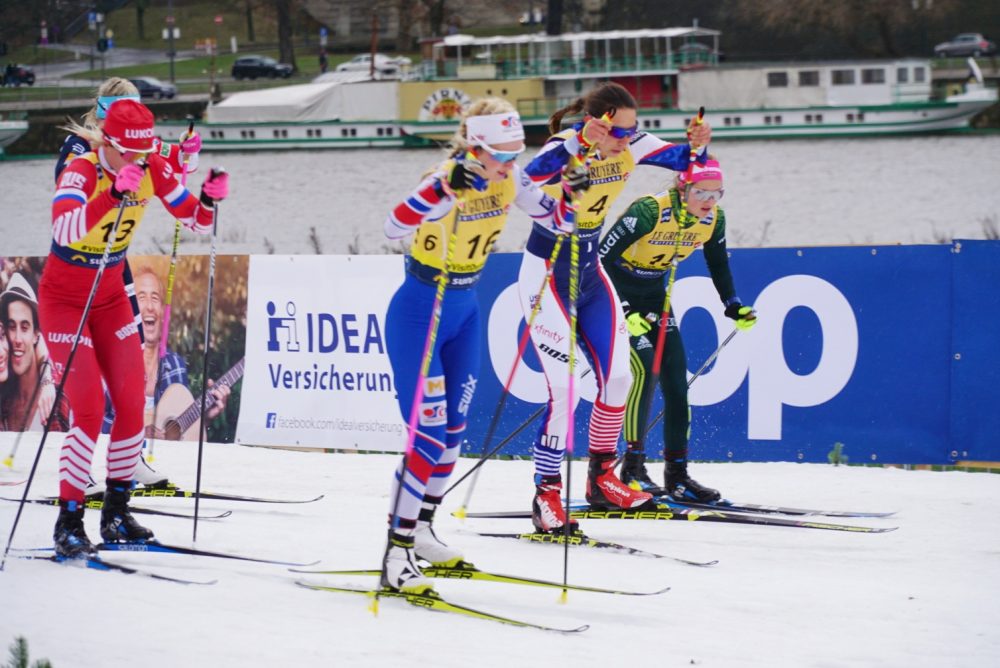
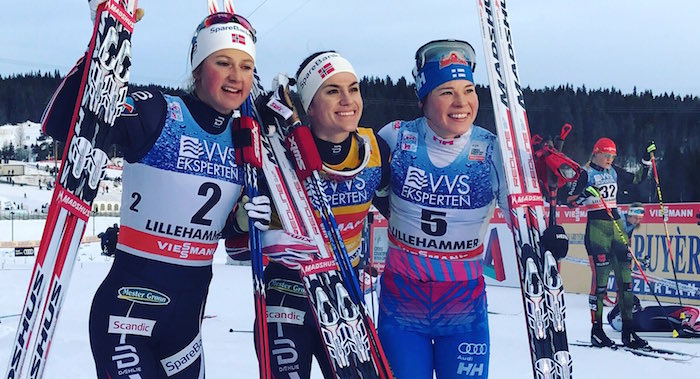
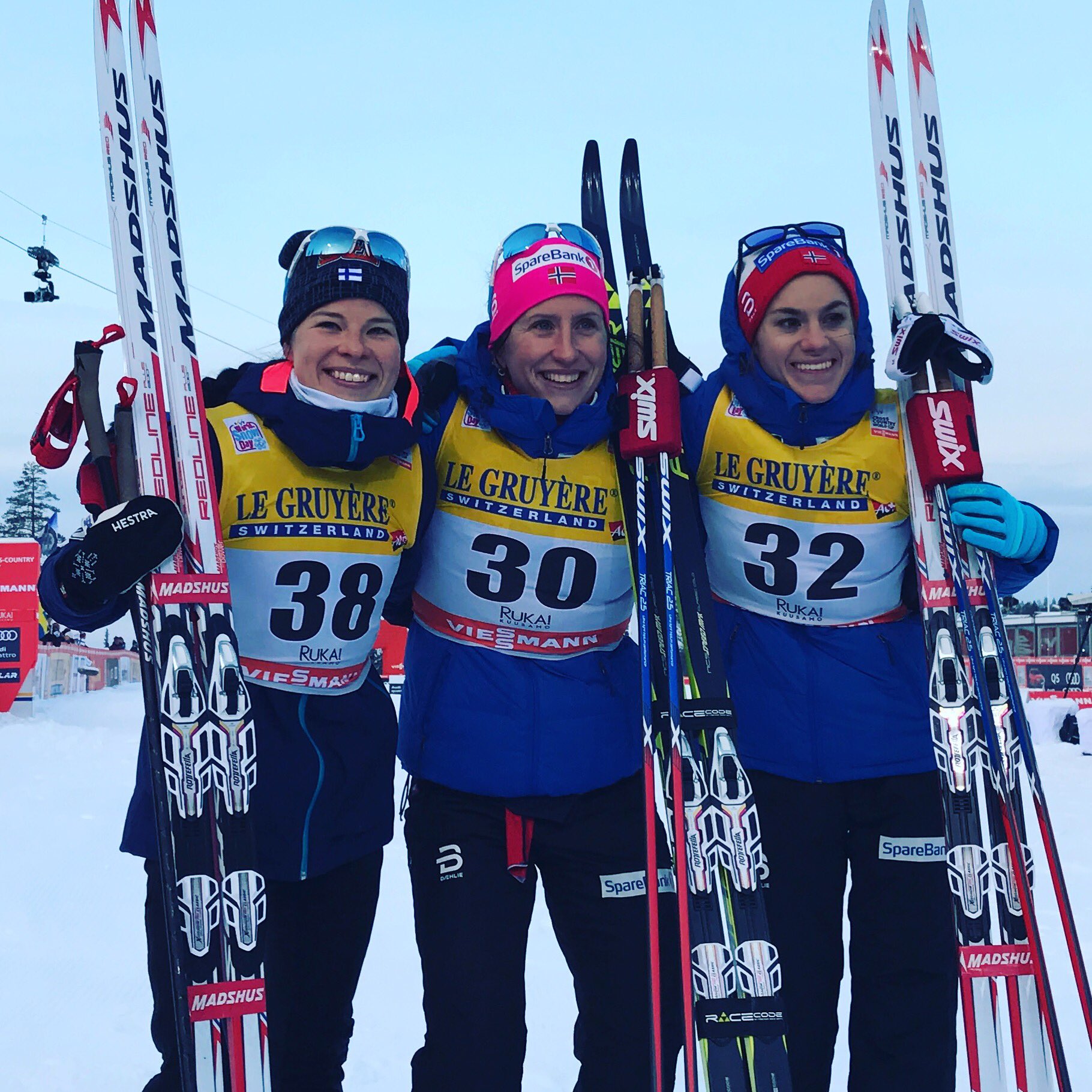
Racing in bib 4 for the U.S., Julia Kern keeps pace in the women’s team sprint during the Dresden, Germany World Cup on Sunday. (Photo: Garrott Kuzzy).
FIS World Cup Dresden, Germany 6 x 1.6 k Freestyle Team Sprint
The first World Cup team sprint of the season was run amidst drizzle and the Dresden, Germany city-scape as the women raced a total of six 1.6-kilometer laps.
Round and round on the looping course, the pace was a mix of tactically subdued speeds with sustained bursts of energy to break the pack.
After all the speed changes and exchanges with one athlete tagging off to the next, it came down to a 1.11 second difference between first place Sweden I and the three closet teams chasing from behind that ended in a photo finish.
Sweden I’s Stina Nilsson and Maja Dahlqvist won in a time of 24:02.5 minutes. Sweden II’s Ida Ingemarsdotter and Jonna Sundling placed second (+1.11), and Norway I, with Eide Mari and Maiken Caspersen Falla in third (+1.11).
U.S. I, featuring Julia Kern and Sophie Caldwell placed fourth (+1.11) after the photo finish was reviewed.
The U.S. entered a second team, consisting of Ida Sargent and Hannah Halvorsen. That duo contested the first semi-final, the same semi as U.S. I, but did not advance after placing fourth (+5.44). The top-three teams from each semi advance to the final, along with the next four fastest teams which are the combined “lucky losers”. Today, the second semi was the faster of the two. The four lucky loser team advancing to the final all originated from the second semi.
In the men’s 6 x 1.6 k skate team sprint race, Norway I and Norway II took the top two podium spots.
In a lunge at the line, Norway I’s Erik Valnes and Sindre Bjørnestad Skar won the final in 22:38.72 minutes. Pål Golberg and Eirik Brandsdal of Norway II placed second (+0.75) and Russia I’s Artem Maltsev and Gleb Retivykh third (+0.80).
Canada’s Bob Thompson and Len Valjas placed seventh (+2.46) in the first semi-final and did not advance to the final. It was the same fate for the only U.S. team entered in the men’s team sprint. Andy Newell and Erik Bjornsen placed 10th (+3.66) in the second semi, and failed to make the finals.
Canada placed 15th in the final standings, the U.S. 19th.
IBU World Cup Oberhof, Germany 4 x 6 k / 4 x 7.5 k Relay
In the women’s 4 x 6 k relay, Russia placed first in a time of 1:18:46.4 hours. Evgeniya Pavlova, Margarita Vasileva, Larisa Kuklina, and Ekaterina Yurlova-Percht made up the team that used eight spares on their way to the win.
Germany placed second (+33.5) with two penalty loops and 10 spare rounds. Karolin Horchler, Franziska Hildebrand, Franziska Preuss, and Denise Hermann comprised Germany’s second place team that had two penalties while using 10 spares. The Czech Republic’s Lucie Charvatova, Veronika Vitkova, Marketa Davidova, and Eva Puskarcikova placed third (+36.7) with 1 penalty loop and six spares.
The top spot for the podium came down to the final leg, when Yurlova-Percht pulled out the win when Hermann skied two penalty loops. The Russian used three spares but escaped with no penalties to take the lead out of the shooting range on the final ski loop.
Susan Dunklee, Clare Egan, Joanne Reid, and Emily Dreissigacker all represented the U.S. and placed 12th (+5:35.8) while skiing five penalty loops and using 16 spares.
Canada’s Sarah Beaudry, Emma Lunder, Megan Bankes, and Rosanna Crawford finished in 13th (+5:58.8) with four penalty loops and 15 spares.
Russian also claimed the men’s relay, winning in a time of 1:20:54.3 hours. The winning team of Maxim Tsvetkov, Evgeniy Garanichev, Dmitry Malyshko, and Alexander Loginov skied no penalty laps and used six spares on their way to victory.
Antonin Guigonnat, Simon Desthieux, Quentin Fillon Maillet, and Martin Fourcade raced for France. The French team placed second (+1:01.1) while skiing a single penalty lap and using eight spares.
Austria’s Tobias Eberhard, Simon Eder, Dominik Landertinger and Julian Eberhard placed third (+2:18.6) with one penalty lap and using seven spares.
Canada’s Scott Gow, Christian Gow, Jules Burnotte, and Brendan Green and the U.S. team of Leif Nordgren, Sean Doherty, Travis Cooper, and Max Durtschi were eventually lapped. Neither team was given an official finishing time.
Canada was ranked 18th in the final standings, the U.S. 19th.
For both relays today, the snowy weather and tough course conditions made for a strenuous day of shooting and skiing.
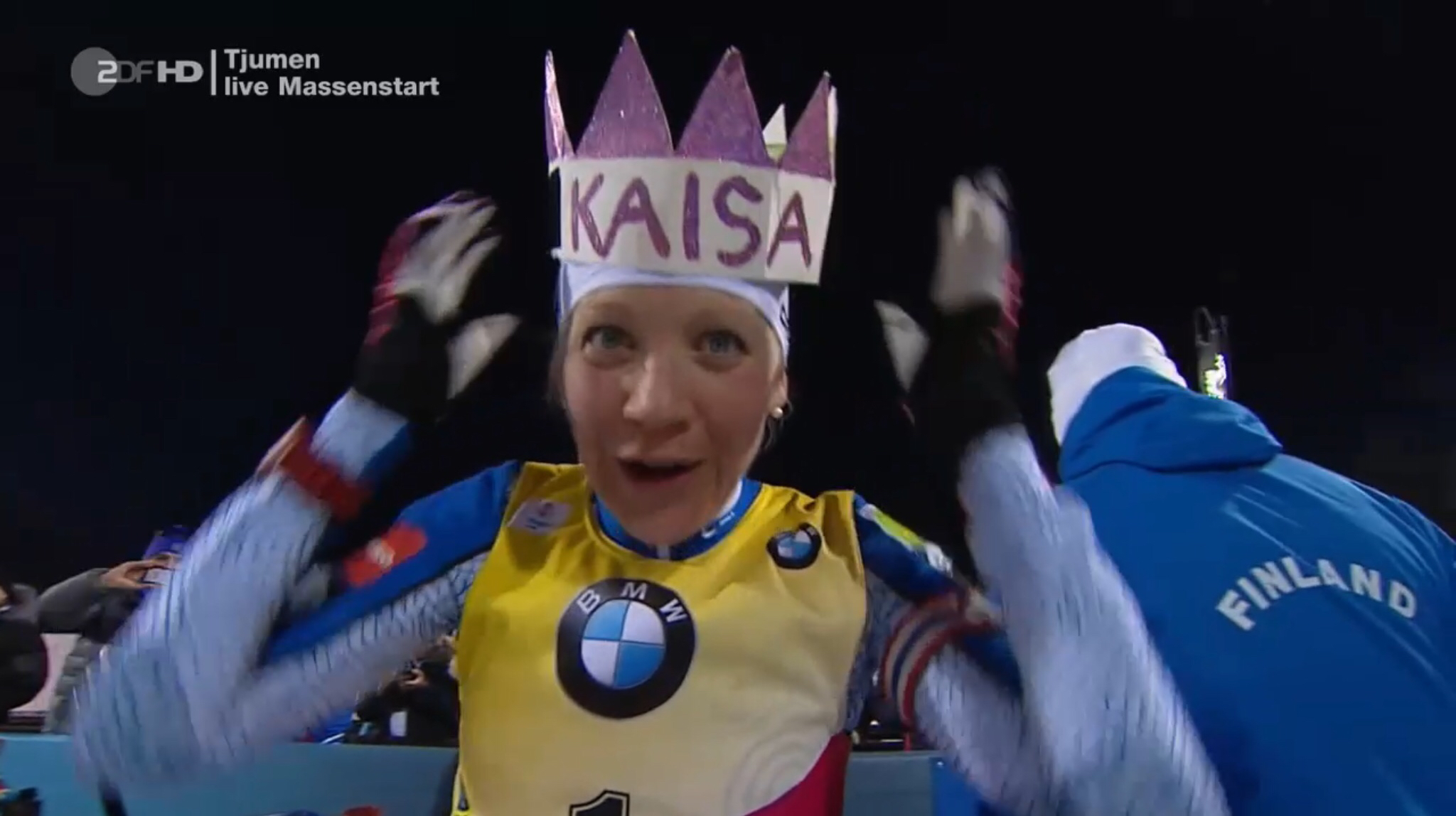
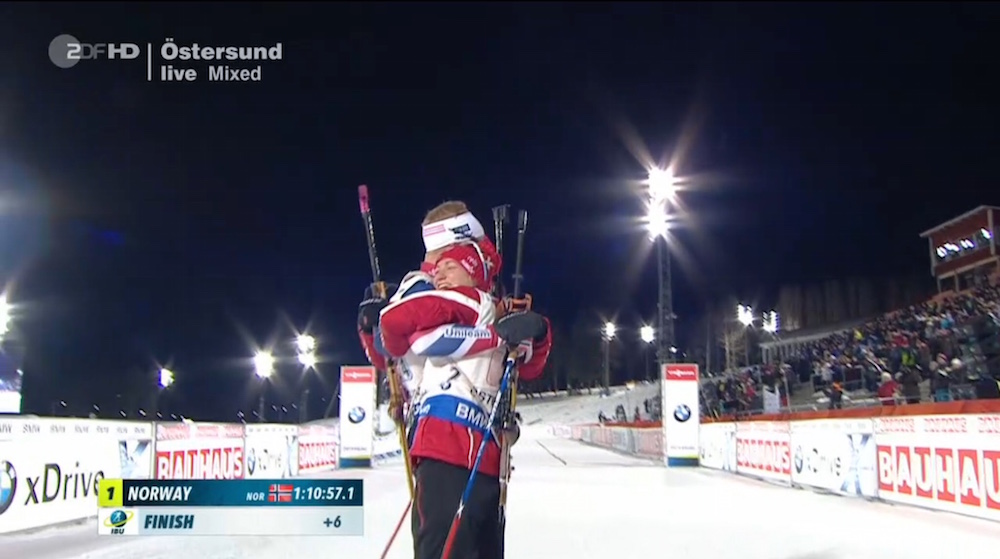
Kaisa Makarainen celebrates her third overall World Cup title after securing it with a sixth-place finish in the last race of the season, a mass start in Tyumen, Russia. (ZDF screencap)
Martin Fourcade didn’t have to do much at the final IBU World Cup weekend in Tyumen, Russia, in order to lock up the overall crystal globe. But the French biathlete came in guns blazing, so to speak, winning Thursday’s sprint by 33.2 seconds and claiming the Total Score title.
His only close(ish) challenger in the overall score, Johannes Thingnes Bø of Norway, had finished just 14th in the sprint. He raced up to second in the pursuit, but by then it was too late to take the globe from Fourcade.
It is the Frenchman’s seventh overall title; the last time anyone else won one was in 2010-2011.
“I am really satisfied with what I did today,” Fourcade told the IBU on Thursday. “It was mentally challenging all these days fighting with Johannes for the Crystal Globe. It seems easy watching on TV, but I can confirm that it is not. I must admit that it was not my main goal back [at the first World Cup weekend] in Östersund; it was the Olympics. But as the season went on, the globe became the most important aim for both of us.”
After that, Fourcade could relax a little.
“You know, before the race I planned to act like usual, be calm on the shooting range and being strategic,” Fourcade told German broadcaster ZDF after winning the pursuit, this time by 47.9 seconds. “But when I came to the zeroing [target practice] I told my coach ‘today I will play a little’. I don’t have many races to enjoy my biathlon [without pressure], to do what I would like to do. I told him ‘do not think (worry?) I will go full attack’, but I wanted to show that the strategy I had all year long is [just] a strategy not a need to shoot slow.”
On Saturday it worked; then came Sunday’s mass start. Fourcade had his worst race of the season, with four penalties and skiing to 19th place, over a minute behind winner Maxim Tsvetkov of Russia. But it didn’t matter – the globe was already decided, and Fourcade had already found his satisfaction.
The fight for the women’s crystal globe had much more drama. Coming into the weekend, Slovakia’s Anastasiya Kuzmina led by 41 points over Finland’s Kaisa Makarainen. But it was Belarus’s Darya Domracheva, in third in the standings, who won Friday’s sprint, by just 1.2 seconds over Makarainen; Kuzmina was 12th.
“Before today’s race I tried to focus only on this race, not think about the overall World Cup so much because I know that I am really [far] behind,” Makarainen told ZDF after the sprint. “But I know that everything is possible. I think that’s also the best tactic for tomorrow: not think about the others or the Total Score, just focus on a good race and enjoy that.”
Makarainen saw her chance and went for the win in the pursuit, edging France’s Anais Bescond by an even smaller margin – 0.2 seconds.
With Domracheva winning the mass start, Makarainen rallying for sixth despite three missed shots, and Kuzmina 11th with the same tally, the title went to the Finn. She edged out Kuzmina by just three points, while Domracheva was only another 15 points back.
Makarainen jumped up and down when she saw the score announced, and her teammates rushed her and placed a pink paper crown on her head. It is her third overall title; she also won in 2011 and in the 2013-2014 season, when she likewise secured the crystal globe in the very last race of the season.
The fields were somewhat reduced in size and depth as the Canadian, U.S., Czech, and Ukrainian teams all skipped the event due to Russia still remaining out of compliance with the World Anti-Doping Code. Other individual athletes skipped the races as well.
Other Notes:
Simon Desthieux of France got his first career World Cup podium, finishing second in the sprint behind teammate Fourcade.
Maxim Tsvetkov of Russia claimed his first career win in the mass start, edging Norway’s Erlend Bjøntegaard by 2.7 seconds as each shot 20-for-20.
In the men’s mass start, Slovakia’s Paulina Fialkova got her first World Cup podium, finishing second, just 1.8 seconds behind Domracheva as each had a single penalty.
The top ranked North American biathletes in the Total Score are Susan Dunklee in 34th in the women’s standings, and Tim Burke in 32nd in the men’s standings, both from the United States. The U.S.’s Lowell Bailey and Sean Doherty ranked 35th and 36th. No Canadians were ranked in the top 40.
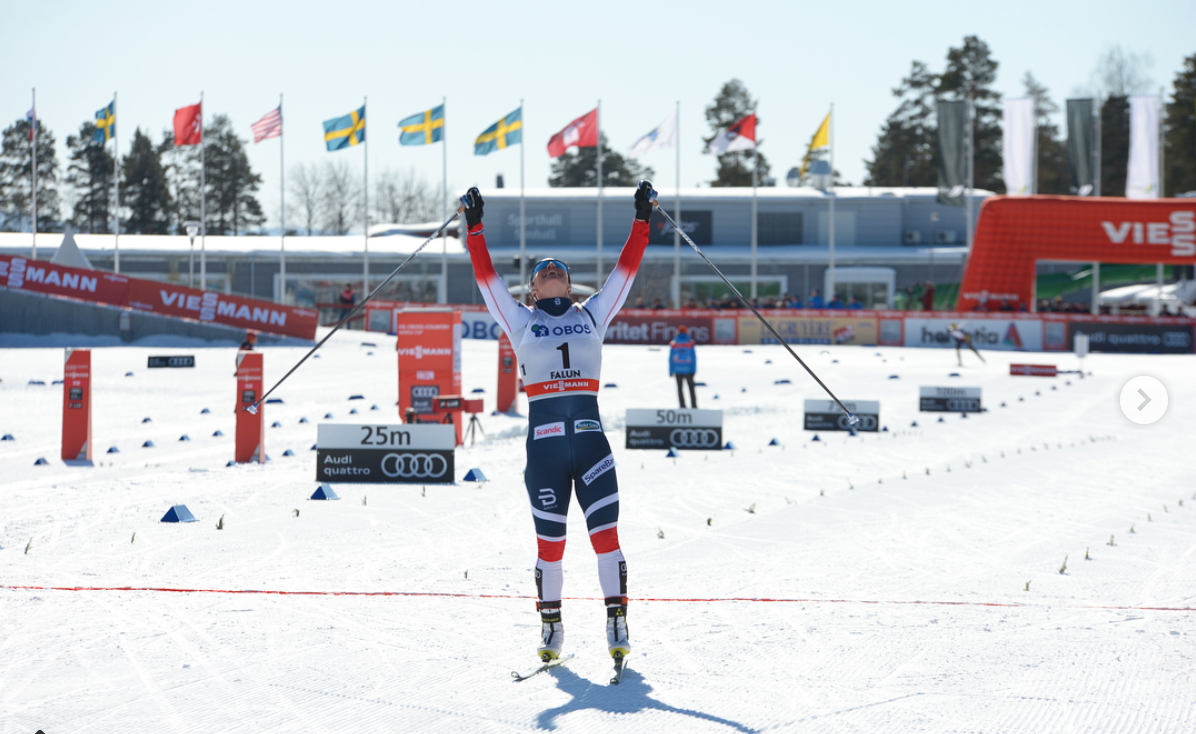
Norway’s Marit Bjørgen celebrates her overall win in the last race of 2018 World Cup Finals, the 10 k freestyle pursuit, on Sunday in Falun, Sweden. (Photo: Svenska Skidspelen/Instagram)
FIS Cross Country World Cup Finals (Falun, Sweden): 10/15 k freestyle pursuits
In the last women’s race of the World Cup season, U.S. Ski Team members Jessie Diggins and Sadie Bjornsen made it one they’ll remember for a long, long time as Diggins raced to second in the 10-kilometer freestyle pursuit and Bjornsen outlasted two Norwegians for third. The two finished the World Cup Finals mini tour in second and third, respectively, behind Norway’s Marit Bjørgen who won it in 24:18.9 minutes.
Bjørgen started with a 36-second cushion to her Norwegian teammate Ingvild Flugstad Østberg in second. Diggins started third, 41 seconds back, just ahead of Finland’s Krista Pärmäkoski in fourth (+43.0), based on their cumulative performances over the last two days of the mini tour (skate sprint and 10 k classic mass start).
While Østberg, Diggins and Pärmäkoski formed a chase pack, Diggins dropped them in pursuit of Bjørgen on the first lap. The American continued to push the pace throughout the three-lap race, coming within 16.7 seconds of Bjørgen at the finish.
Meanwhile, during the pursuit, a chase group of five, which included Bjornsen, caught Østberg and Pärmäkoski. The group of seven dwindled to three on the last two climbs, where Bjornsen and Norway’s Astrid Uhrenholdt Jacobsen and Ragnhild Haga broke away in a race for third.
The three were even entering the finishing stretch, where Bjornsen then beat them in a final 100-meter push to the line. Bjornsen claimed third (+1:11.5) for her fourth podium of the season and first in a distance skate race. Haga followed in fourth (+1:12.0) and Jacobsen fifth (+1:12.8), while Pärmäkoski placed sixth (+1:16.2), Sweden’s Charlotte Kalla seventh (+1:17.9), Østberg eighth (+1:19.0), Sweden’s Jonna Sundling ninth (+1:30.5) and Ebba Andersson 10th (+1:44.7).
Bjornsen now has five-career individual World Cup podiums to her name, and this is the first in a skate race longer than 5 k.
Diggins clocked the fastest time of day in 23:54.4, while Haga was second-fastest (+10.7) after starting the race in 17th. Bjørgen’s time ranked third, Jacobsen was fourth-fastest and Bjornsen fifth-fastest.
Diggins’s performance elevated her to second in the Overall World Cup standings, just 40 points behind Norway’s Heidi Weng (who placed 18th in the pursuit) in first for the second-straight year. Østberg slipped to third overall, 22 points behind Diggins. In the Distance World Cup, Weng took the title by 63 points over Østberg in second, while Diggins was another 32 points back in third.
Bjornsen ended up sixth in the Overall World Cup and 10th in the distance standings.
Also for the U.S., Caitlin Patterson raced from 46th at the start to 35th (+3:58.4) with the 22nd-fastest time of day, Sophie Caldwell placed 36th (+4:00.7), Kikkan Randall finished her last World Cup race in 43rd (+4:33.3) with the 29th-fastest time, Rosie Frankowski placed 46th (+4:41.3), Liz Stephen 50th (+4:57.2) in her final World Cup race, Kaitlynn Miller 56th (+6:13.8), and Ida Sargent 57th (+7:06.4).
For Canada, Cendrine Browne picked off 10 places to finish 39th (+4:14.4) with 27th-fastest time of day, Emily Nishikawa finished 48th (+4:43.7), Dahria Beatty 54th (+6:04.3), and Zina Kocher 60th (+9:28.4).
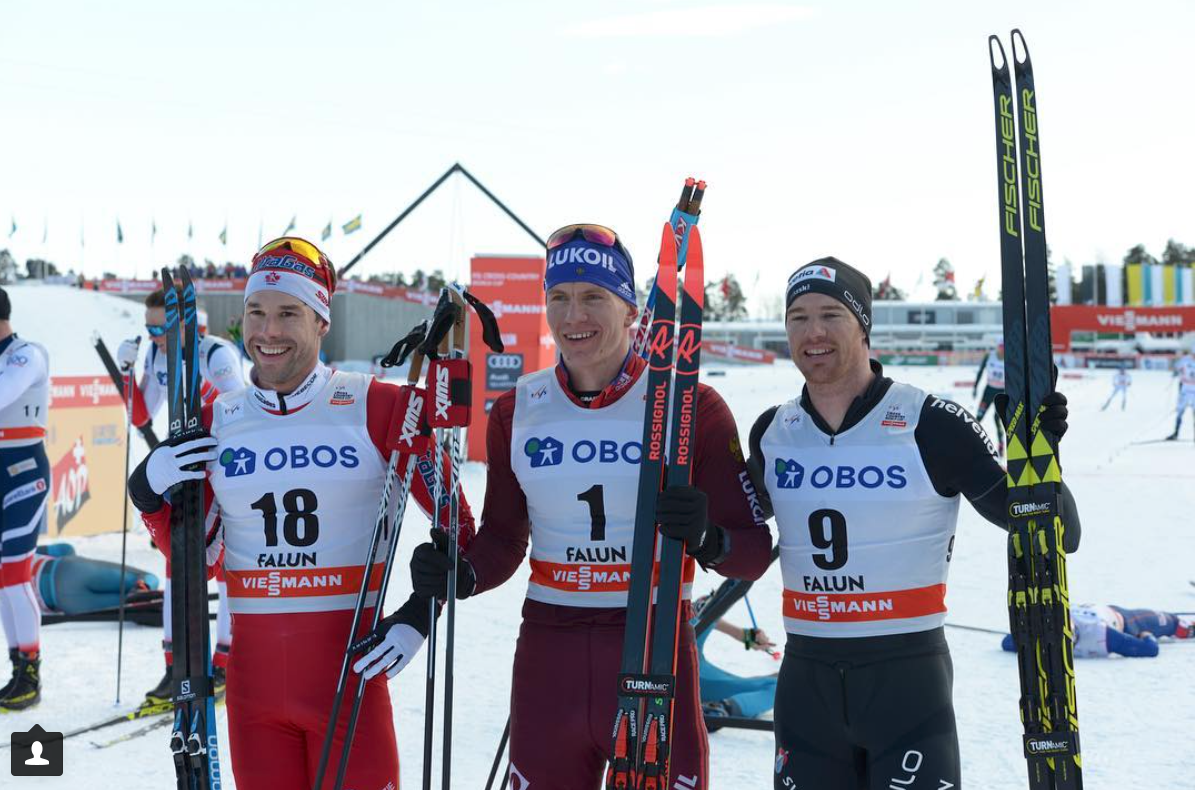
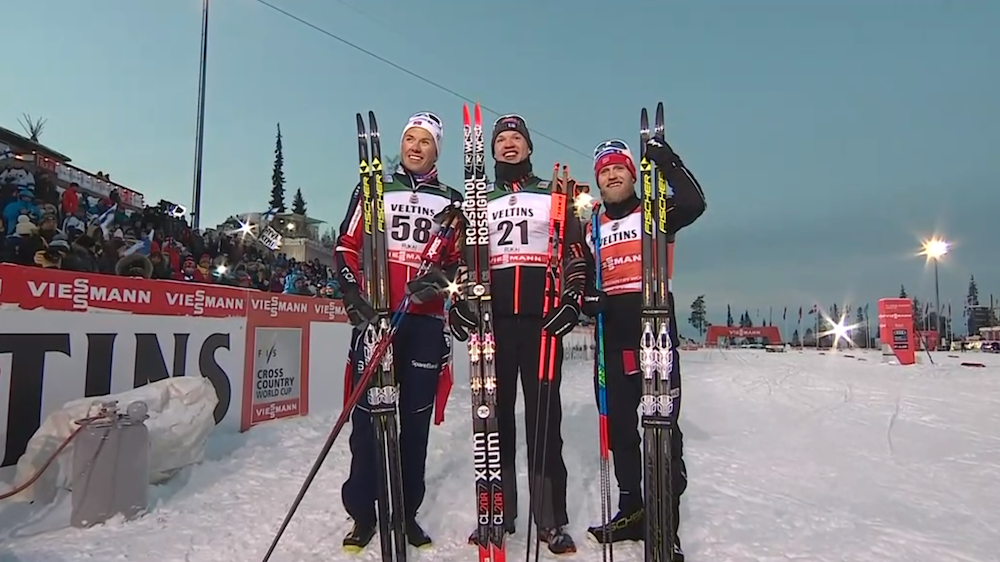
The men’s 15 k freestyle and 2018 World Cup Finals podium, with Russia’s Alexander Bolshunov (c) in first, Canada’s Alex Harvey (l) in second and Switzerland’s Dario Cologna (r) in third. (Photo: Svenska Skidspelen/Instagram)
In the men’s 15 k freestyle pursuit that followed, Russia’s Alexander Bolshunov started 38 seconds clear of Norway’s Johannes Høsflot Klæbo in second, and Sweden’s Calle Halfvarsson and Italy’s Federico Pellegrino headed out together another second later in third and fourth, respectively.
Norway’s Martin Johnsrud Sundby started the race in seventh (+53.0), and Switzerland’s Dario Cologna followed in ninth (+56.0), while Canada’s Alex Harvey started 1:16 back in 18th.
While Bolshunov skied the entire race on his own and won the weekend mini tour in 35:03.3, a number of racers battled for second, with Sundby moving into second in the chase pack, ahead of seven others, less than 2 k in. Several skiers found themselves at the front of that group, including Cologna, Halfvarsson, and even Harvey (with Harvey leading the chase at 9.3 k), while the time gap to Bolshunov grew.
With about 2 k to go, the group was down to six. Harvey attempted an attack, but Cologna matched him. Then, on one of the course’s final climbs, Cologna made his move to get a slight gap, but lost his balance slightly on the downhill, allowing Harvey to catch back up.
With one last uphill to go, Harvey was in the driver’s seat in second, Cologna in third and Sundby in fourth. That order held to the finish, with Harvey claiming second, 47.1 seconds behind Bolshunov, Cologna placing third (+47.5) and Sundby fourth (+48.7). Just behind them, Russia’s Maxim Vylegzhanin crossed in fifth (+50.3), ahead of Norway’s Hans Christer Holund in sixth (+51.7), Halfvarsson in seventh (+54.1), and Norway’s Sjur Røthe in eighth (+54.9). Nearly 10 seconds later, Norway’s Niklas Dyrhaug outlunged two Russians for ninth (+1:04.1): Denis Spitsov in 10th (+1:04.2) and Andrey Larkov in 11th (+1:04.3).
Harvey, who finished the season in fourth in both the Overall and Distance World Cup standings, won the time of day in 34:34.3. Holund had the second-fastest course time, 1 second off Harvey’s time, after starting the race in 22nd.
Harvey’s Canadian teammate Devon Kershaw tallied his fifth-straight distance top 30 in 28th (+2:21.9), after starting 27th, and Graeme Killick finished 56th (+4:33). Julien Locke did not start.
For the U.S., Erik Bjornsen clocked the 22nd-fastest time en route to 38th (+3:10.4), after he started 51st. Simi Hamilton improved 10 places to finish 49th (+4:07.8), Scott Patterson and Paddy Caldwell worked together to move up from 72nd and 73rd, respectively, to 58th (+4:41.5) and 59th (+4:41.6), respectively, at the finish. Kevin Bolger placed 60th (+4:43.5) and David Norris 64th (+5:09.8).
While Klæbo slipped from second to 25th in the pursuit (+1:45.8), the Norwegian still won his first Overall World Cup by 119 points over Cologna in second. Sundby placed third, 29 points out of second and 82 points ahead of Harvey.
Cologna claimed the Distance World Cup Crystal Globe by 41 points over Sundby, and Holund reached the Distance World Cup podium in third, 58 points out of second and just 5 points ahead of Harvey in third. France’s Maurice Manificat had been third heading into the final day of racing, but finished the pursuit in 26th (+2:11.9) and dropped to fifth in the final distance rankings.
In her last race of the season, Susan Dunklee returned to the podium. The American started fourth in Sunday’s 10-kilometer pursuit at the International Biathlon Union (IBU) World Cup in Oslo, then made her way into third by the final shooting stage. Dunklee shot 18-for-20 (1+0+1+0) and finished 29.5 seconds behind the winner, Darya Domracheva of Belarus, who missed two targets as well (1+0+1+0) and finished first in 30:37.4. Slovakia’s Anastasiya Kuzmina started the race in first (ahead of Domracheva in second) and ended up second (+9.2) with four penalties (0+2+2+0).
Canada’s Julia Ransom and Rosanna Crawford finished together in 51st and 52nd, respectively, both 4:52.4 out of first. Ransom had four penalties (0+1+1+2) while Crawford missed five (1+3+1+0). Emma Lunder did not finish.
In the men’s 4 x 7.5 k relay on Sunday, Norway’s team of Lars Helge Birkeland, Henrik L’Abee-Lund, Tarjei Bø, and Johannes Thingnes Bø used just three spare rounds to clean eight shooting stages and took the win in 1:13:13.7 hours. Austria finished 50.3 seconds back in second place, with Dominik Landertinger, Felix Leitner, Simon Eder, and Julian Eberhard, with a total of five spares. Russia’s Maxim Tsvetkov, Anton Babikov, DmitryMalyshko, and Anton Shipulin raced to third (+56.9) with just four total spares.
The U.S. men placed seventh (+2:01.5) with eighth spares, after Lowell Bailey put the team in seventh on the first leg. Sean Doherty skied them up to sixth on the second leg, Tim Burke slipped to 10th on the third leg, and Leif Nordgren posted the seventh-fastest anchor leg to put them in seventh at the finish.
Canada placed 16th (+5:42.4) with Christian Gow, Scott Gow, Brendan Green, and Macx Davies. The team had been in 19th at the final exchange, but Davies skied them up to 16th with the 14th-fastest anchor leg. In all, they used 10 spares.
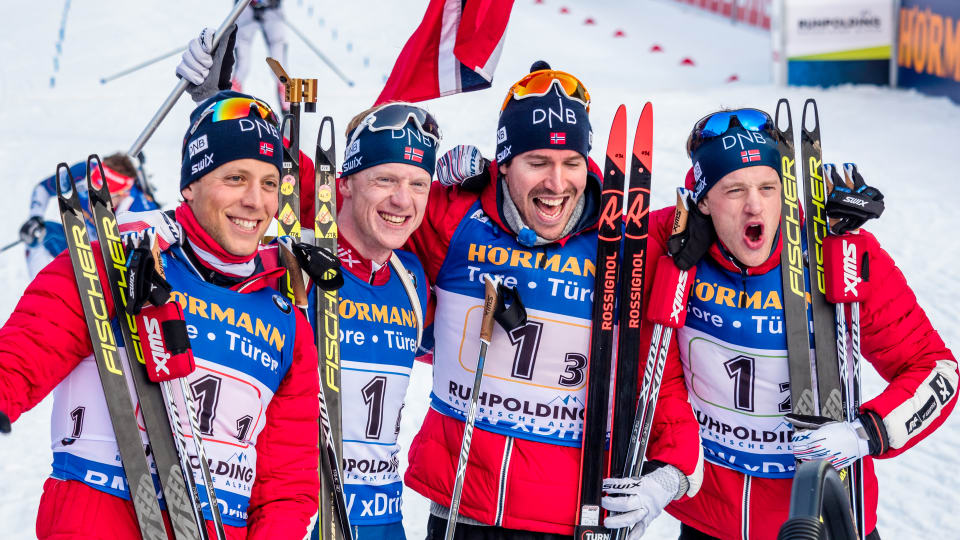
The Norwegian men’s relay after winning the 4 x 7.5 k on Friday at the IBU World Cup in Ruhpolding, Germany, with Lars Helge Birkeland (l), Tarjei Bø (far r), Emil Hegle Svendsen (second from r), and Johannes Thingnes Bø (second from l). It was their second win of the season (after winning with Ole Einar Bjørndalen, Henrik L’Abée-Lund, and Erlend Bjøntegaard, and Birkeland in the first men’s relay of the 2017/2018 season in Hochfilzen, Austria. (Photo: IBU/Biathlonworld)
IBU World Cup (Ruhpolding, Germany): Men’s 4 x 7.5 k relay
Less than a week after Sweden won the men’s 4 x 7.5-kilometer relay in Oberhof, Germany, with an up-and-coming group, Norway posted its second win (in three relays) this season, with an all-star lineup on Friday in Ruhpolding, Germany.
Lars Helge Birkeland, Tarjei Bø, Emil Hegle Svendsen, and Johannes Thingnes Bø took the lead during Johannes Bø’s anchor leg and ultimately the win in 1:13:11.1 hours, 24.9 seconds ahead of France in second and 53.4 seconds ahead of Russia in third.
On a bluebird day with no wind in the range, according to an International Biathlon Union (IBU) press release, the Norwegians avoided the penalty lap and used seven spares to clean. First-leg skier Birkeland put them in second with near-perfect shooting (0+0, 0+1), just 0.4 seconds behind Germany’s Erik Lesser, who cleaned without any spares, in first. (Birkeland was also on the Norwegian team that won the first relay of the season in Hochfilzen, Austria.)
Norway remained in second during Tarjei Bø’s second leg, in which he had to use three spares to clean prone (0+3, 0+0). He tagged Svendsen in second, 0.6 seconds behind Italy, which had risen to first thanks to Lukas Hofer’s fast skiing and solid shooting (0+0, 0+2).
Svendsen slipped slightly to third place by the final exchange despite only needing one spare to clean (0+0, 0+1), but was still just a second out of first at the tag. France had moved into first place with a predictably strong third leg from Martin Fourcade (0+0, 0+0), in which he brought the team from seventh to first place, just ahead of Italy’s Dominik Windisch and Norway’s Svendsen.
Johannes Bø skied the third-fastest anchor leg and cleaned prone and used two spares in standing (0+0, 0+2) to overtake France’s Antonin Guigonnat and Italy’s Thierry Chenal, who slipped to second and seventh, respectively, by the finish.
Guigonnat shot well, requiring just one spare (0+1, 0+0), but finished nearly 25 seconds after Bø for second place. Russia reached the podium with Anton Shipulin picking off two places, after being tagged in fifth.
In all, France had zero penalties and six spares, with Simon Desthieux, Quentin Fillon Maillet, Fourcade, and Guigonnat, and Russia used a total of just four spares and had no penalties with Alexey Volkov, Maxim Tsvetkov, Anton Babikov, and Shipulin.
Germany finished fourth (+1:26.5) with zero penalties and 10 spares, with Lesser, Benedikt Doll, Arnd Peiffer and Simon Schempp. After Doll dropped to fifth on the second leg, they skied in fourth on the last two legs.
Austria took fifth (+1:39.8) with zero penalties and six spares, with David Komatz, Simon Eder, Daniel Mesotitsch, and Dominik Landertinger. Sweden followed in sixth (+1:50.6) with zero penalties, six spares and three of the same men who won last Sunday’s relay (Sebastian Samuelsson, Martin Ponsiluoma and Fredrik Lindström) with new member Torstein Stenersen. Italy finished seventh (+1:58.5) with one penalty and 11 spares.
Of 26 teams in the relay, Canada placed 14th (+3:22.3) with one penalty and 10 spares, and the U.S. finished 24th (+16:21.6) with eight penalties (four of which stemmed from cross-firing) and 13 spares.
Notably, the U.S. had been fourth and just 3 seconds out of first after Lowell Bailey’s first leg, which he cleaned without any spares (0+0, 0+0). Leif Nordgren then dropped to 22nd with a penalty in each of his shooting stages (1+3, 1+3) and the 25th-ranked second-leg time. Tim Burke as the team’s third leg had to ski two penalty laps as well (0+2, 2+3), and anchor Sean Doherty was penalized for cross-firing in his last standing stage (0+1, 4+1), according to a US Biathlon press release, and the team was hit with four additional penalties.
“We have a solid team and I know we didn’t show our true potential today,” Bailey said, according to the release. “But the most important relay is still to come. We’ll just have to wait until then.”
“I was happy to put together a good race on the track and in the range,” he said. “The first lap was a bit of a roller derby with no easy way to get to the front. I was fortunate to clean without extra rounds because this allowed me to leapfrog up to the lead pack exiting the range. I tried to keep an even pace for loop two and I thought I would be able to hang in second or third, but no one wanted to pass so I had to lead for most of the loop.
“I had struggled in standing in the previous race so I wanted to get back to taking good shots in standing,” he added. “Although I didn’t shoot as quickly as some of the other guys, I felt good about the stage and the fact that I didn’t have to use extras. It was a fight to catch the lead group on the last loop, but fortunately I had some help from [Italy’s Thomas] Bormolini (of Italy) and we worked together to get back in contact with the lead group.”
Canada finished 14th with Christian Gow, Scott Gow, Macx Davies, and Brendan Green. On the opening leg, Christian Gow put them in 11th with clean prone shooting and just one spare needed to clean standing (0+0, 0+1), but they slipped one spot to 12th with a penalty on Scott Gow’s second leg (0+0, 1+3). Davies then dropped two more places to 14th despite avoiding the penalty lap (0+3, 0+1), and Green held that position to the finish (0+1, 0+1).
The women’s 4 x 6 k relay will be held Saturday in Ruhpolding, with Canada starting Emma Lunder, Julia Ransom, Sarah Beaudry, and Rosanna Crawford. For the U.S., it will be Susan Dunklee, Clare Egan, Emily Dreissigacker, and Joanne Reid. Watch it live on the Olympic Channel at 8:30 a.m. EST.
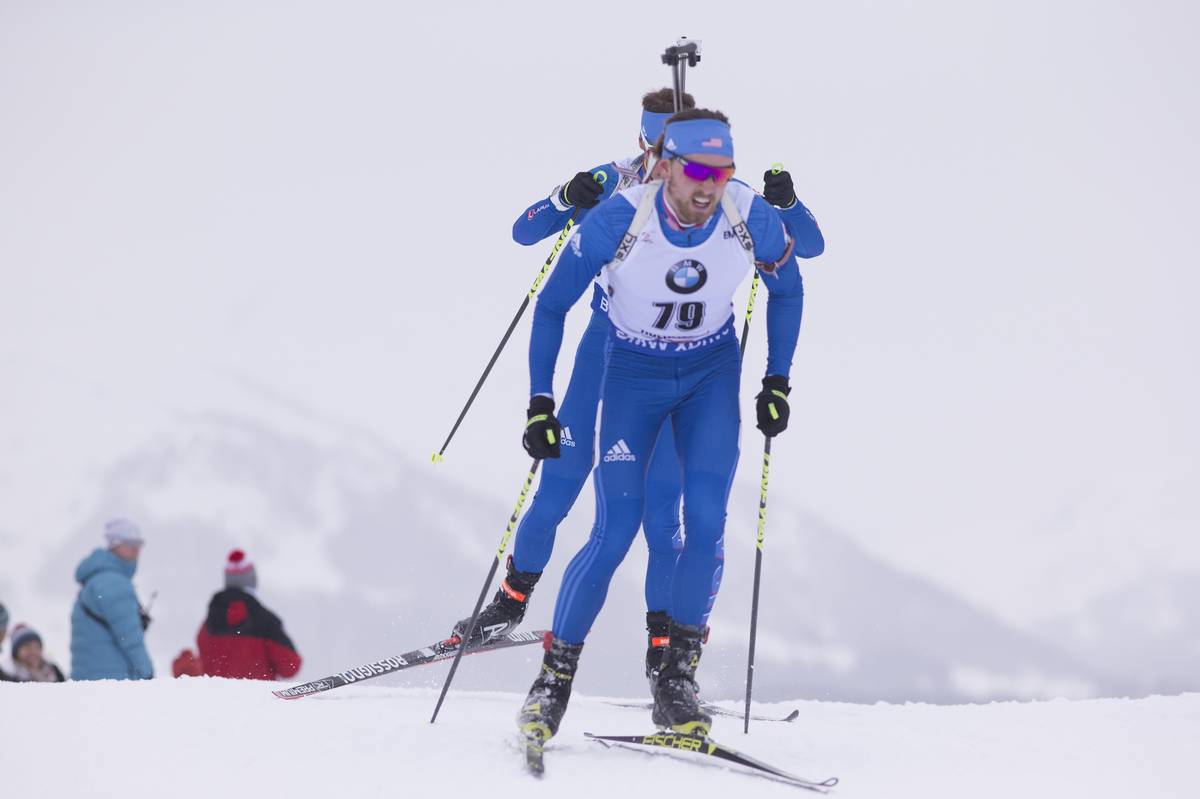
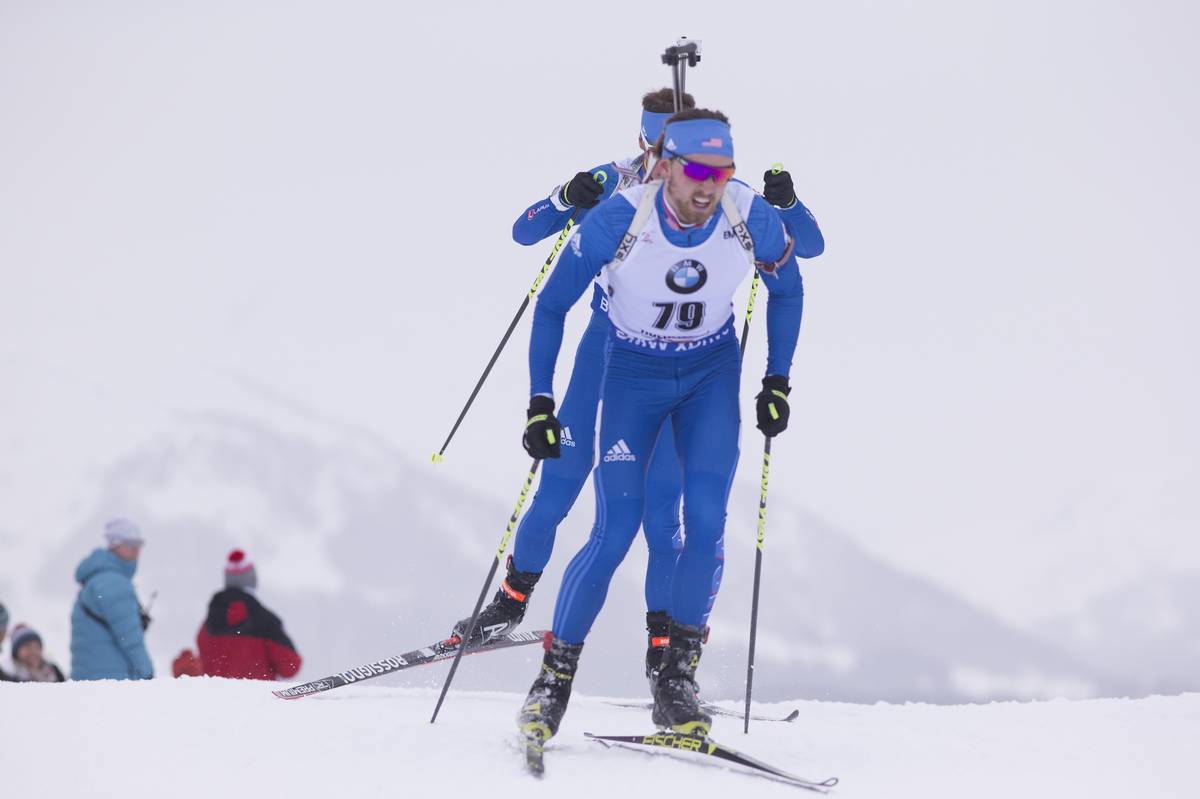
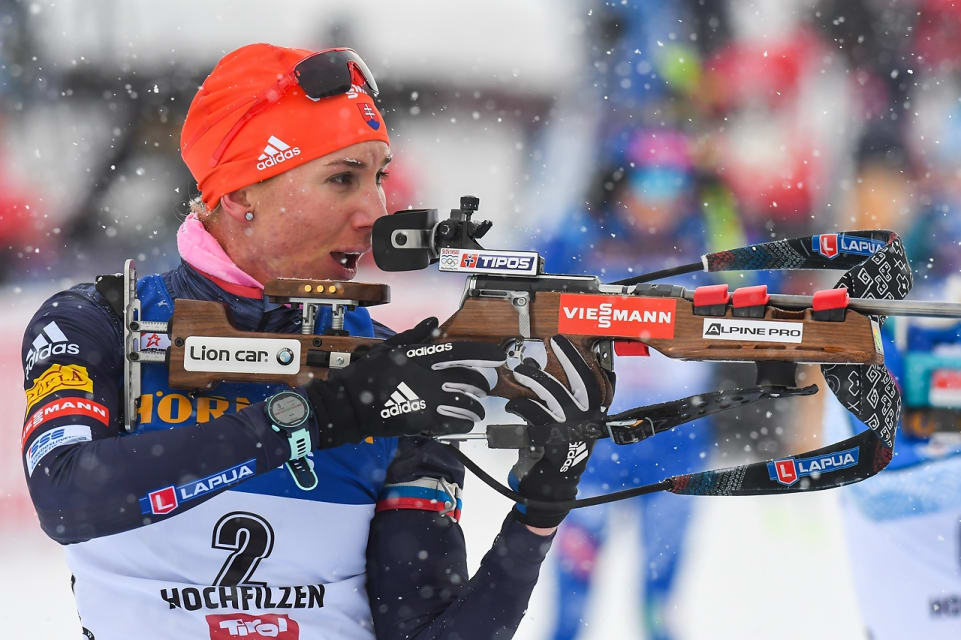
US Biathlon’s Sean Doherty (79) racing to 22nd in the IBU World Cup men’s 10 k sprint on Friday in Hochfilzen, Austria. On Saturday, he raced up to 17th for his best pursuit result on the circuit. (Photo: US Biathlon/NordicFocus)
One day after winning the International Biathlon Union (IBU) World Cup men’s sprint, Johannes Thingnes Bø held onto first place in the men’s 12.5-kilometer pursuit on Saturday in Hochfilzen, Austria. In difficult conditions with heavy snowfall and strong gusts of wind, the Norwegian decided the race when he shot clean in the final standing stage. He reached the finish line uncontested on the last loop in a time of 36:41.1 minutes, almost a minute ahead of Slovenia’s Jakov Fak (+58.8 with one penalty) and last season’s Overall World Cup winner Martin Fourcade (+1:10.0 minutes with five penalties).
“Best start of the season so far in my career,” the 24-year-old Bø said after his third victory of the season in a post-race press conference. “I have to enjoy it, you never know what the next races will bring.”
2:12.8 minutes behind him, US Biathlon’s Sean Doherty finished 17th for his best career result in a World Cup pursuit, improving by on an 18th place from a pursuit last season in Kontiolahti, Finland.
A day after scoring his first points of the new World Cup season in 22nd and shooting a perfect 10-for-10 in Friday’s 10-kilometer sprint, Doherty shot 18-for-20 in the pursuit (1+0+1+0).
“I am very happy with the race today,” Doherty wrote in an email to FasterSkier. “The execution on the range was good in the tough conditions we had today. It’s nice to have a solid back-to-back set of races here. … The ski shape is still a ways off but it’s heading in the right direction.”
In very difficult conditions in the first standing stage, several of the top racers like Norway’s Henrik L’Abee-Lund and Germany’s Arnd Peiffer incurred multiple penalties and to slip out of contention. Meanwhile, Doherty hit all but one of his targets in that stage and moved up to 16th. On the next loop he maintained that position about 1:50 back.
“The course was slow today, although not too soft,” Doherty commented on the conditions. “Fortunately it was not as snowy and windy as yesterday afternoon. There was a steady wind but it was manageable. I am pleased with my work on the range. If you want to compete at this level you have to shoot well.”
After the race up front had been decided in a final duel between Bø and Fourcade in the last stage, Doherty once again shot clean in the last standing stage and moved up to 11th. On the final loop, he could not quite hold that position and a small group passed him, yet coming onto the finishing stretch he was able to keep Ukraine’s Dmytro Pidruchnyi 0.4 seconds behind him in a push for 17th (+2:12.8).
“Unfortunately I didn’t quite have the legs to back up the solid shooting, as was clear on the last lap,” Doherty wrote. “Looking over my shoulder I saw that big pack of guys and I just tried to give it all I had. I wasn’t able to hang on but I was glad to be in that situation nonetheless.”
Starting out in 19th place based on his sprint result, Biathlon Canada’s Nathan Smith finished the day in 31st, 3:02.2 after Bø with three penalties (1+1+0+1).
After the first shooting stage, Smith had moved into 14th despite incurring a penalty.
“The wind was a bit changeable, especially in the first prone where it was blowing quite strongly,” he explained in an email after the race.
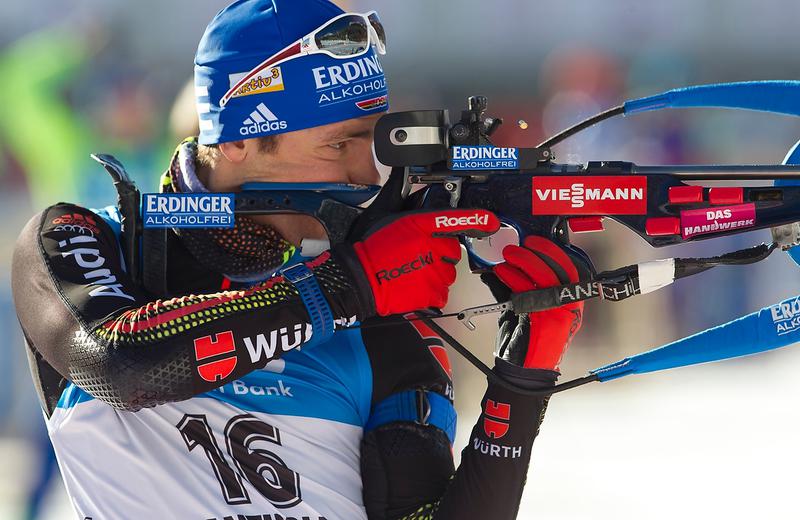
Smith skied the next lap in a group that included Germany’s Simon Schempp, who eventually would finish the race in podium contention, and got into a slight tangle with Schempp in a right-hand turn at the far point of the course, but both remained on their feet.
“I started pretty aggressive on the first lap but wasn’t able to maintain the speed of those around me after that,” Smith wrote. “I didn’t see who was tangling with me on that turn, but it was definitely an odd place to attempt an inside pass. I can’t say yet that things are turning around in the skiing department. I think I will just have to be very very patient.”
In the second prone stage, Smith incurred another penalty and dropped to 29th place, almost two minutes behind the leaders. He cleaned the first standing stage that followed, then had one more miss in the fourth and final stage.
“My shooting was pretty good once again today, given the challenging conditions,” Smith wrote. “It was definitely tougher conditions today, although the temperature was low enough that the falling snow wasn’t sticking to my glasses. The tracks were a little soft, and quite slow, especially out of the track where athletes were skiing.”
He started the final loop in 27th position and “like the previous ones, I was mostly focused on trying to minimize the number of skiers passing me,” Smith wrote. “It’s fun to pass but when you’re not feeling it its important to try and conserve energy.”
On the final meters of the race, he went head to head with Italy’s Thomas Bormolini and finished 0.4 seconds behind him for 31st.
“I thought I could take Bormolini but he got the middle track,” Smith recalled. “I tried my best in the outside and made a little ground, but the snow was just too deep over there. Tactically it would’ve been best to be in front heading through the tunnels [that are leading into the stadium].”
Smith’s teammate Brendan Green finished 33rd (+3:15.7), also with three penalties ( 1+0+1+1), after climbing nearly 20 places from his starting position by using his extensive experience to deal with snowy conditions that he described as “a classic Hochfilzen day”.
“Today was a much better race for me,” Green wrote in an email. “Yesterday felt completely off for some reason, so to be able to put together a solid performance today is reassuring. … I’m quite happy with the shooting considering the conditions. I was really hoping to shoot clean in the last bout, which would have made for a really great day, but all in all I’m happy with how I performed.”
After incurring that third penalty in the last standing stage, Green, who started 52nd, came back on the course in 37th place. He recalled seeing a group ahead of him, which he was able to catch by skiing the 17th-fastest course time on the final loop.
“I attacked early on and skied my way past a train of 5 athletes, and was able to hold them off for the rest of the loop with the exception of [Belgium’s] Michael Roesch. This was my strongest ski of the season which is hopefully a sign that my shape is coming around. It seems that no matter what I do, I struggle to find my form early on in the season.”
Doherty’s teammate, Lowell Bailey, the only other American who qualified for the pursuit, moved up from 53rd to finish 36th (+3:20.6) with three penalties (0+2+1+0).
The two remaining Canadian starters, Scott Gow and Christian Gow, finished 48th (+5:08.4) and 49th (+ 5:13.7), respectively, with Scott ending up with seven penalties (1+1+3+2), while his younger brother Christian had five penalties (2+0+1+2) and improved five places from the sprint.
Bø and Fourcade in Sync… Until Final Shooting
The two dominant athletes of the IBU World Cup season so far swapped the lead out on course and dueled on the range in Saturday’s pursuit. In the end the podium was nearly a repeat of Friday’s sprint, with Bø in first, and Fak and Fourcade flipping positions in second and third, respectively.
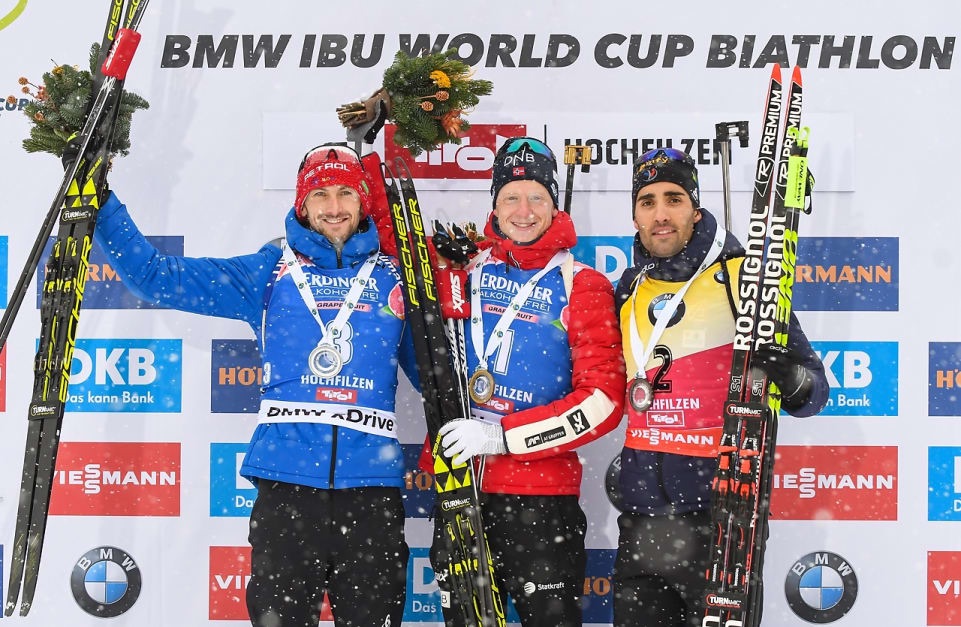
Medal ceremony for the men’s 12.5-kilometer pursuit at the 2017/2018 IBU World Cup in Hochfilzen, Austria, with Norway’s Johannes Thingnes Bø (c) in first place, Slovenia’s Jakov Fak (l) in second place, and France’s Martin Fourcade (r) in third place. (Photo: IBU/biathlonworld)
In the first shooting bout, Bø incurred two penalties to lose his 12-second head start on Fourcade, but he set out on his second loop just a second behind Fourcade. In the second prone stage, the two both shot clean, after shooting alongside each other and almost hitting their targets in a synchronous rhythm, before starting the third loop together.
While not quite able to hold up with Fourcade and Bø on the course with the 35th-ranked overall course time, Fak, who had started the day in third, was able to keep in touch with the leaders due to another solid shooting performance.
The 30-year-old, Croatian-born Fak, who has been racing for Slovenia since the beginning of the 2010/2011 season, is coming back from a slight slump last season, but is looking back on a storied career that includes a third place in the 2014/2015 World Cup Total Score and two gold medals at the 2012 and 2015 IBU World Championships.
By his own account, in preparation for the new season Fak mostly trained with the Ukrainian women’s team, which is coached by one of his old mentors. “They shoot good and I wanted to beat them and I guess that also works in the men’s field,” he said with laugh at the press conference.
In the first standing stage, Bø and Fourcade each incurred a penalty, and while Fourcade shot his sequence slightly faster, Bø was able to easily make up a six-second gap on the next loop, taking the lead again up the first big climb.
“[I] had a perfect race together with Johannes,” Fourcade said at the press conference. “We each did half the [work] in the front and it was a smart move because we wanted to keep the advantage and we knew the answer would be on the final shooting.”
Fak also had his only miss of the day in the third stage, but managed to improve his position as conditions worsened and a number of athletes had several penalties in this stage. Russia’s Maxim Tsvetkov and Germany’s Schempp were the first ones to clean this stage to leap into podium contention. Bø’s older brother Tarjei also cleaned.
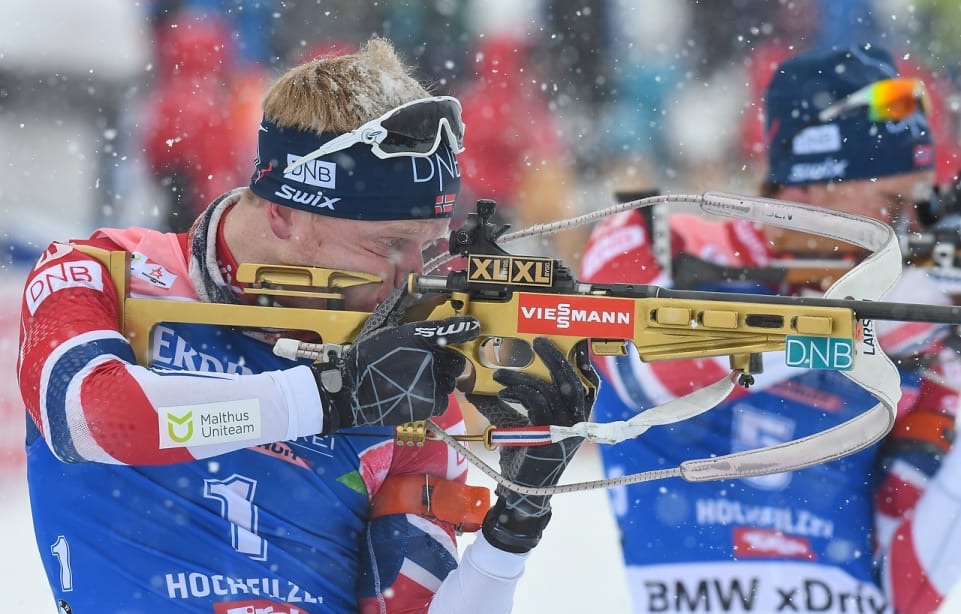
Norway’s Johannes Thingnes Bø shooting in the standing position in difficult weather conditions on his way to the victory in the men’s 12.5-kilometer pursuit at the 2017/2018 IBU World Cup in Hochfilzen, Austria. (Photo: IBU/biathlonworld)
In the final stage Johannes Bø and Fourcade again stood side by side on the range, but this time Fourcade missed three while Bø hit every target to embark on the last loop with nearly a minute lead.
“He got the answer, and I didn’t…,” Fourcade sighed when he tried to explain what had happened in his final shooting. “With the snow conditions I went on my shooting mat a little late, I first had to open my rifle [sights snow cover] and I was simply a bit late compared to Johannes by just one or two seconds. … Then I heard that Johannes had a good shooting and I tried to shoot faster to catch him, and that was totally wrong today.”
“The people are always speaking about a fight of Martin against the Norwegian team,” Bø stated in the press conference. “Of course both me and him think about this, but still we fought together out there, we exchanged in the first position [helping each other], and that was a smart move for us.”
Fak managed to shoot clean again to leave the range for the last time in second, and while he could be relatively sure of second place, a fierce fight for third ensued behind him.
“It was very hard on the track, but I managed to stay calm on the shooting range and tried to shoot as [few] mistakes as I could,” Fak said. “It was only one mistake and so I am pretty happy about that, because if we look at the weather it was not so easy on the shooting range. On the track I used my shooting as an advantage, and it got me in the second position on the last lap, so I just needed to go a little faster in the beginning and then cruise to the finish.”
A group of Schempp, Tsvetkov and Tarjei Bø also came through the final stage with a clean shooting performance, and Fourcade joined them after he had completed his three penalty laps.
Fourcade led that group going into the longest climb of the course, then tried to break away, pushing hard over the crest of the hill with only Schempp able to stay on his tails into a corkscrew downhill section.
Schempp and Fourcade had a minor tangle as they positioned themselves on the slightly uphill finishing stretch, and Fourcade ended up outlasting Schempp in the final meters by half a second
“It was a big fight with Simon but also with Tarjei and Maxim Tsvetkov from Russia,” Fourcade said. “It was a big battle, and then at the finish line we crossed our skis. The advantage of being in the first position is that you can choose your own line, it’s what I did, and when I crossed my skis with Simon because I saw he chose the same line I went to the other line. … I said to Simon that I was sad, because I didn’t want to do it this way, but I fought really hard on the track to get the first position and choose my own track because it’s a big advantage.”
“In the finish sprint I really wanted to take the innermost lane, so wide right, and thought he’d take the middle lane,” Schempp told German broadcaster ARD in a post-race interview, according to a translation. “But then he still pulled onto my side and we tangled up and got a little bit into each other’s way, but everything is all right.”
Tarjei Bø came to the finish a second later in fifth (+1:11.9) with two penalties (1+0+1+0), while Tsvetkov finished sixth (+1:12.3), up from a 20th starting position, with just one penalty (1+0+0+0).
“I am happy I am in the top six, but I am a bit sad that I can’t fight today for a top three,” Tsvetkov told the IBU in an interview, via a translator.
“[Actually] I can’t understand why I missed today,” he added with a laugh when questioned about his lone penalty, which only he, Fak, and two more athletes achieved in this race.
The IBU World Cup in Hochfilzen concludes on Sunday with the first men’s 4 x 7.5 k and women’s 4 x 6 k relays of the season.
Fourcade announced during the press conference that he plans to skip the relay to focus on next week’s races in front of a home crowd in Le Grand Bornand, France.
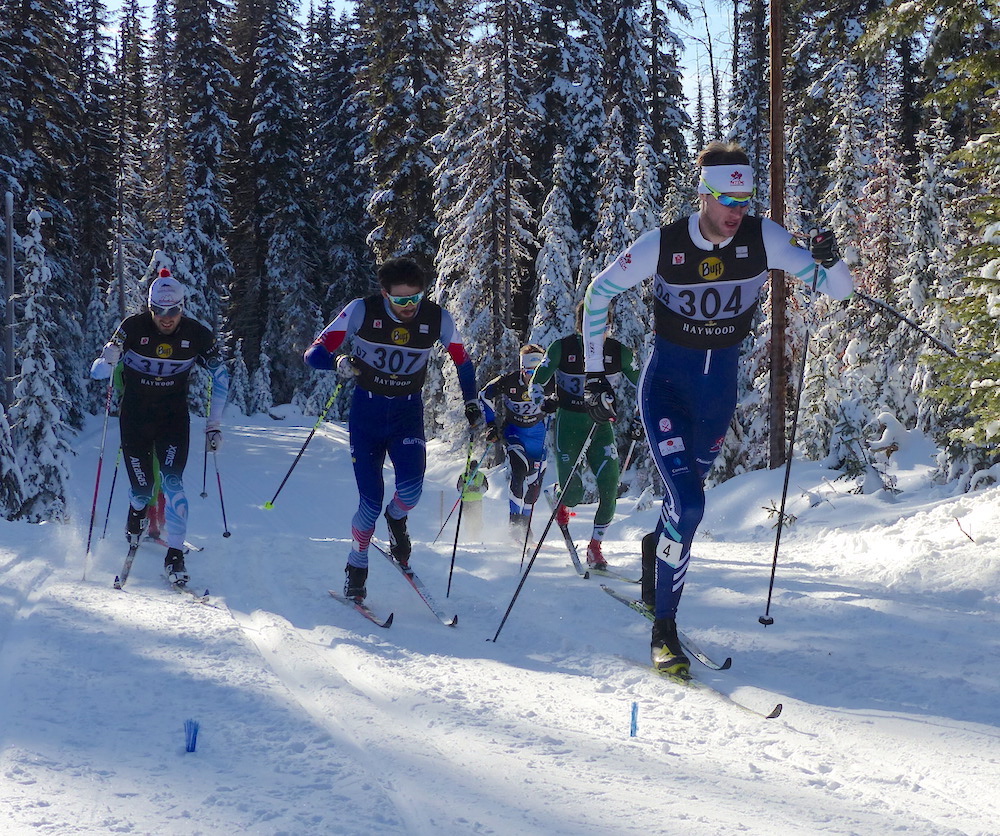
Bob Thompson (304) of NTDC Thunder Bay leading Sun Valley’s Jack Hegman (307) and Patrick Stewart-Jones (317) of the AWCA during their quarterfinal of the NorAm men’s 1.3 k classic sprint on Saturday at Sovereign Lake near Vernon, B.C. (Photo: Peggy Hung)
NorAm/SuperTour (Sovereign Lake near Vernon, British Columbia): Classic sprints
On the opening day of the NorAm Continental Cup series in Canada (which doubled as a U.S. SuperTour), American Kaitlynn Miller of the Craftsbury Green Racing Project (CGRP) started Saturday with a nearly three-second win in the classic-sprint qualifier at the Sovereign Lake Nordic Centre, then went on to win her quarterfinal and semifinal before topping the final as well.
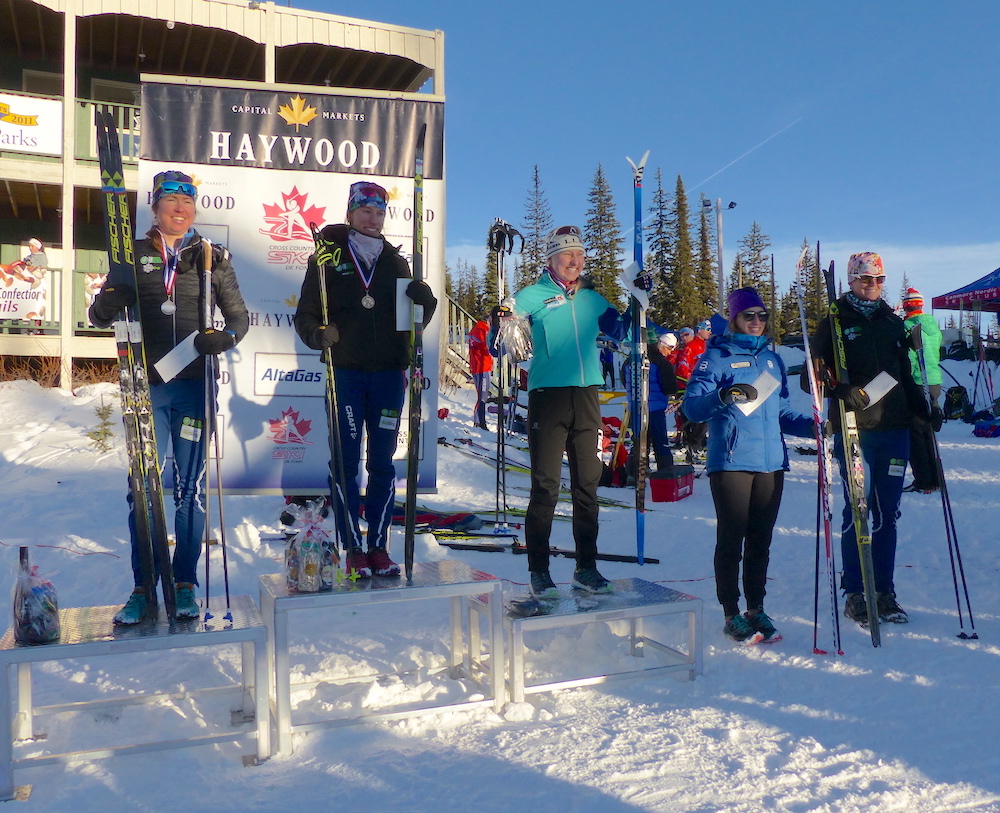
The women’s 1.3 k classic sprint podium and top five at the first NorAm of the season on Saturday at Sovereign Lake near Vernon, B.C., with (from left to right) Caitlin Patterson (CGRP) in second, Kaitlynn Miller (CGRP) in first, Hannah Halvorsen (APU/USST) in third, Kelsey Phinney (SVSEF) in fourth, and Liz Guiney (CGRP) in fifth. (Photo: Peggy Hung)
Miller was the fastest women’s qualifier by 2.87 seconds on the 1.3-kilometer course with a time of 2:59.39. Ultimately, she won the final in 2:57.53, 0.93 seconds ahead of her teammate Caitlin Patterson in second and 2.59 seconds clear of the third American on the podium, Hannah Halvorsen of Alaska Pacific University (APU) and the U.S. Ski Team (USST) D-team, in third place.
Halvorsen previously qualified third behind Kelsey Phinney, of the Sun Valley Ski Education Foundation (SVSEF) in second. Phinney finished fourth in the final (+2.85), while a third Craftsbury skier, Liz Guiney placed fifth (+3.53). The lone Canadian in the six-woman final, Sophie Carrier-Laforte of the Pierre-Harvey National Training Centre (CNEPH) placed sixth (+4.38).
Thompson Fends Off Five Americans
Of the six racers in the men’s 1.3 k freestyle sprint final, five of them were American. Bob Thompson, of the Thunder Bay National Team Development Centre (NTDC), bested them all for the win in 2:29.31, just 0.03 seconds ahead of Ben Saxton, of the Stratton Mountain School (SMS) Elite Team, in second place. Cole Morgan (SVSEF), the qualifying winner who had so far dominated all of his heats, ended up third overall, 0.48 seconds behind Thompson.
Sun Valley and APU each had two athletes reach the men’s final with Jack Hegman (SVSEF) taking fourth (+0.51), and APU’s Reese Hanneman and Tyler Kornfield placing fifth (+7.75) and sixth (+7.9), respectively.
To start the day, Morgan posted the fastest men’s qualifying time in 2:31.00, while last weekend’s SuperTour skate sprint winner Nick Michaud, of the Bridger Ski Foundation (BSF), qualified in second, 0.78 seconds back. Americans took the top-three qualifying spots with Logan Hanneman (APU) in third (+1.59), whileThompsonwas the top Canadian qualifier in fourth (+2.34).
Morgan won both his quarterfinal and the first semifinal to advance to the final, along with Thompson who placed second in that semifinal (and placed second to Hegman in the quarterfinals).Saxtonwon the second semifinal (after finishing second to Logan Hanneman in the quarterfinals) andKornfield was second behind Saxton in that semifinal to automatically advance to the final. Reese Hanneman and Hegman made it to the final as lucky losers after placing third and fourth, respectively, in the first semifinal.
Norway’s Johannes Thingnes Bø notched his second-straight win in Hochfilzen after Martin Fourcade of France missed three on the final shooting stage of the men’s 12.5 k pursuit on Saturday. Bø, who started the race 12 seconds ahead of Fourcade in second, cleaned the final standing stage to leave the range nearly a minute ahead of Slovenia’s Jakov Fak in second. Meanwhile, Fourcade, who had been skiing in first just ahead of Bø before the last stage, dropped 1:19 minutes back to fifth.
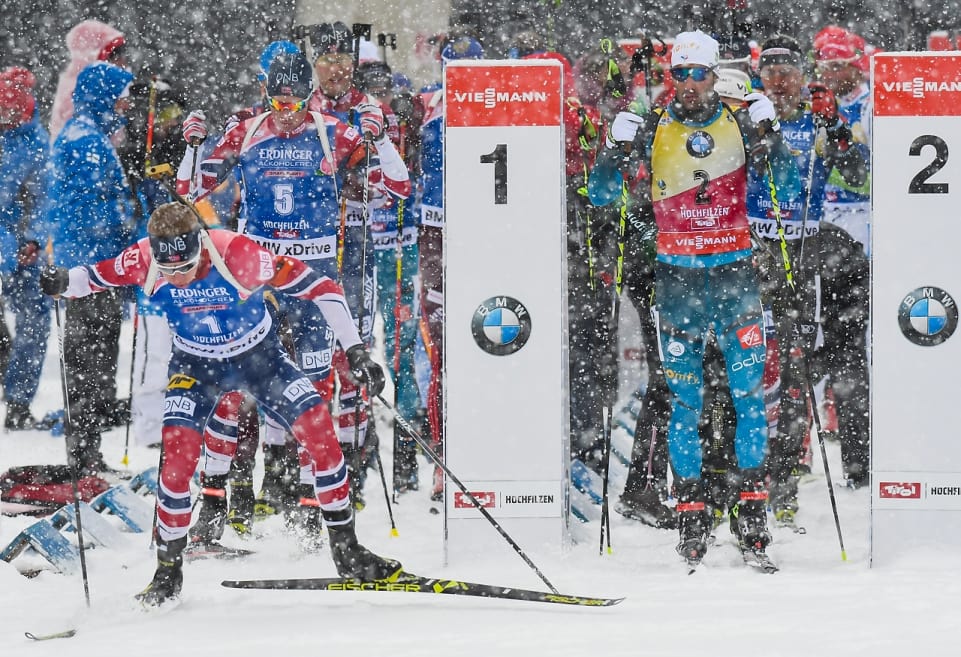
Norway’s Johannes Thingnes Bø (1) heading out of the start, 12 seconds ahead of the second starter, France’s Martin Fourcade (yellow bib), on Saturday in the IBU World Cup men’s 12.5 k pursuit in Hochfilzen, Austria. (Photo: IBU/biathlonworld)
While Bø skied the win in 36:41.1 minutes and Fak, the third starter, finished 58.8 seconds later in second place, Fourcade made up two places on the final loop to place third (+1:10.0) after passing Germany’s Simon Schempp and Russia’s Maxim Tsvetkov.
Schempp settled for fourth (+1:10.5), and Bø’s older brother, Tarjei Bø, passed Tsvetkov as well to claim fifth (+1:11.9), while Tsvetkov finished sixth (+11:12.3).
On another snowy afternoon in Hochfilzen, Johannes Bø had three penalties, two of which came in the first stage (2+0+1+0). Fak was one of four men in the race with just one miss (0+0+1+0) — no one cleaned — while Fourcade missed five (1+0+1+3). Schempp had four penalties (3+1+0+0) but held onto his starting position in fourth, Tarjei Bø improved from 14th at the start to fifth with just two misses (1+0+1+0) and Tsvetkov raced up from 20th to sixth with a single miss (1+0+0+0).
American Sean Doherty tied his second-best World Cup result in 17th (+2:12.8) after starting 23rd and 1:39 out of first. He had two penalties (1+0+1+0).
Canada’s top finisher, Nathan Smith placed 31st (+3:02.2) after starting 19th and missing three shots (1+1+0+1). His teammate Brendan Green rose to 33rd (+3:15.7), up from 52nd at the start, with three penalties as well (1+0+1+1).
Four Canadians qualified for the pursuit, with Scott Gow placing 48th (+5:08.4) with seven penalties (1+1+3+2). His younger brother Christian Gow crossed next in 49th (+5:13.7) after missing five (+5:13.7).
The other American man in the race, Lowell Bailey placed 36th (+3:20.6), up from 53rd, with three misses (0+2+1+0).
Kuzmina Gets First Win in Three Years
Slovakia’s Anastasia Kuzmina cleaning one of two standing stages in the women’s 10 k pursuit at the IBU World Cup in Hochfilzen, Austria, en route to a 10-second win. (Photo: IBU/biathlonworld)
In the women’s 10 k pursuit that followed, Slovakia’s Anastasia Kuzmina overcame a 22-second starting deficit to win her first race in three and a half years, shooting 19-for-20 (1+0+0+0) and finishing in 34:31.2. Kuzmina (the sister of Russia’s Anton Shipulin) started second behind Friday’s sprint winner Darya Domracheva of Belarus. Domracheva had a single miss as well in Saturday’s pursuit (0+0+1+0) but slipped to second after her penalty in the first standing stage, while Kuzmina cleaned the last three stages to take the win.
Domracheva settled for third (+11.8) and Finland’s Kaisa Mäkäräinen rose to second (+10.2) after shooting 18-for-20 (1+0+0+1) and skiing the fastest course time to rise from her starting position in sixth.
Italy’s Dorothea Wierer slipped one place to fourth (+51.6) after starting third and missing two (1+0+0+1), while Norway’s Marte Olsbu raced up from 13th to fifth (+58.2) with a single penalty (1+0+0+0). Ukraine’s Yuliia Dzhima improved from 20th to sixth (+1:08) with one miss as well (0+0+0+1).
Canada’s Emma Lunder achieved her second-best career World Cup result in 27th (+2:31.6) after starting 42nd and cleaning three stages after missing one in the first prone (1+0+0+0). Her teammate Rosanna Crawford improved from 49th at the start to 39th at the finish (+3:44.3) with four penalties, one in each stage (1+1+1+1).
The U.S. had one woman qualify for the race, Clare Egan, who finished 53rd (+5:21.6) with seven penalties (2+2+2+1).
For the third and final day of World Cup racing in Hochfilzen, the men’s and women’s relays will be held Sunday.
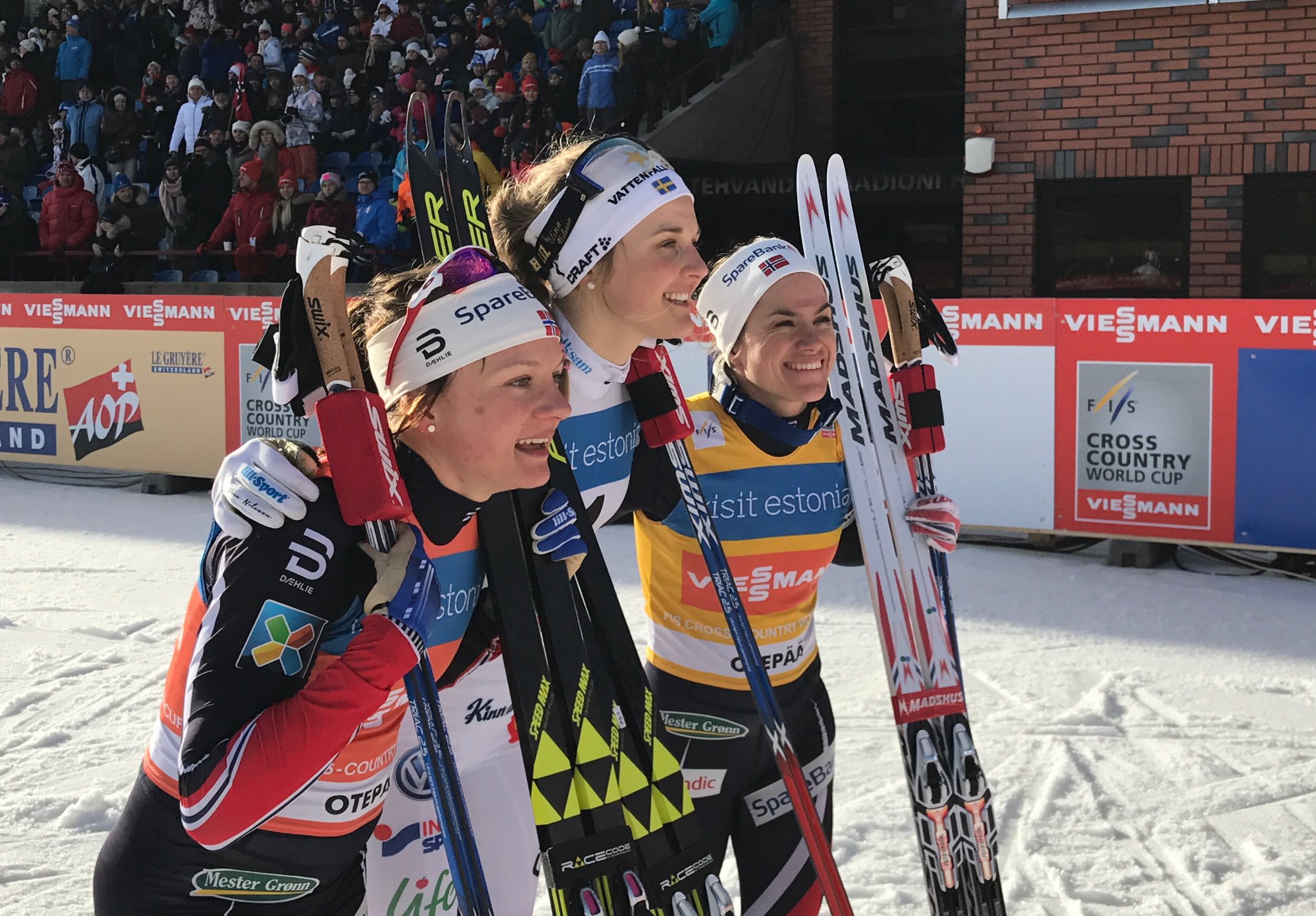
The women’s skate sprint podium at Saturday’s World Cup in Davos, Switzerland, with Kikkan Randall (r) of the U.S. Ski Team in third place, Sweden’s Stina Nilsson (c) in first, and Norway’s Maiken Caspersen Falla (l) in second. (Photo: Reese Brown/US Ski & Snowboard)
Kikkan Randall returned to the podium on Saturday in the first freestyle sprint of the 2017/2018 World Cup season, placing third in the women’s 1.5-kilometer skate sprint behind Sweden’s Stina Nilsson and Norway’s Maiken Caspersen Falla, respectively, in Davos, Switzerland.
Americans made up half of the women’s final, with Jessie Diggins racing to fourth and Ida Sargent sixth, with Norway’s Ingvild Flugstad Østberg between them in fifth.
Nilsson started the day by winning the qualifier in 2:51.71 minutes, while Østberg had the second-fastest qualifing time, 2.57 seconds back. Switzerland’s Nadine Fähndrich posted the third fastest qualifying time (+2.73), and for the U.S., Diggins qualified fourth (+3.37), Sargent fifth (+3.78), Randall sixth (+4.11), Sophie Caldwell ninth (+4.87), and Sadie Bjornsen in 11th (+5.38).
Nilsson then won her quarterfinal and the first semifinal before outlunging Falla by eight-hundredths of a second for the final win in 2:47.99. Randall (who won her quarterfinal and advanced to the final as a lucky loser in third in the first semifinal) finished 2.53 seconds after Nilsson for third overall, and Diggins (who won both her quarterfinal and the second semifinal) was 4.41 seconds back in fourth. Østberg finished 5.62 seconds back in fifth, and Sargent crossed the line 14.49 seconds back in sixth.
Caldwell placed eighth overall after winning her quarterfinal then placing fourth in the second semifinal, behind Diggins, Sargent and Germany’s Sandra Ringwald, respectively. Ringwald did not advance to the final, either, for seventh overall. Bjornsen placed 13th on the day after finishing third in her quarterfinal.
Also for the U.S., Julia Kern (U.S. Ski Team D-team) finished in 57th in the qualifying round, 16.55 seconds out of first.
Dahria Beatty was the top Canadian in 53rd (+15.53), followed by Katherine Stewart-Jonesin 55th (+16.18) and Cendrine Browne in 64th (+18.27).
In the men’s 1.5 k skate sprint, Norway’s Johannes Høsflot Klæbo rocketed to his sixth-straight win in as many World Cup races this season, topping the qualifier in 2:23.10 (by 1.27 seconds over France’s Lucas Chanavat and 1.73 seconds over Italy’s Federico Pellegrino in third) then winning his quarterfinal and semifinal comfortably before capping the day with a victory in the final in 2:28.07. Pellegrino placed second in the final, 1.8 seconds back, and Russia’s Alexander Bolshunov tallied his third podium of the season in third place (+4.64). Finland’s Ristomatti Hakola placed fourth (+5.39), France’s Richard Jouve was fifth (+8.65) and Russia’s Gleb Retivykh was sixth in the final (+18.34).
Americans Andy Newell and Simi Hamilton both qualified for the heats in 10th and 12th, respectively. Hamilton went on to place ninth overall after finishing second in his quarterfinal (behind France’s Renaud Jay) and fifth in the second semifinal (which Hakola won). Newell’s day ended in the quarterfinals, where he placed fifth, 2.44 seconds behind Klæbo, who won that heat. Overall, Newell was 21st.
Canada’s Alex Harvey qualified for the heats in 21st and went on to place 23rd overall after finishing fifth in his quarterfinal, 1.14 seconds behind Retivykh in first.
Also for Canada, Julien Locke missed qualifying in the top 30 by 1.07 seconds in 36th (+7.84). Russell Kennedy placed 48th (+9.39), Knute Johnsgaard was 52nd (+10.35), Jess Cockney 54th (+10.83), Devon Kershaw 63rd (+11.78).
For the U.S., Erik Bjornsen finished 58th (+11.12) and Paddy Caldwell 108th (+24.04) in the qualifier.
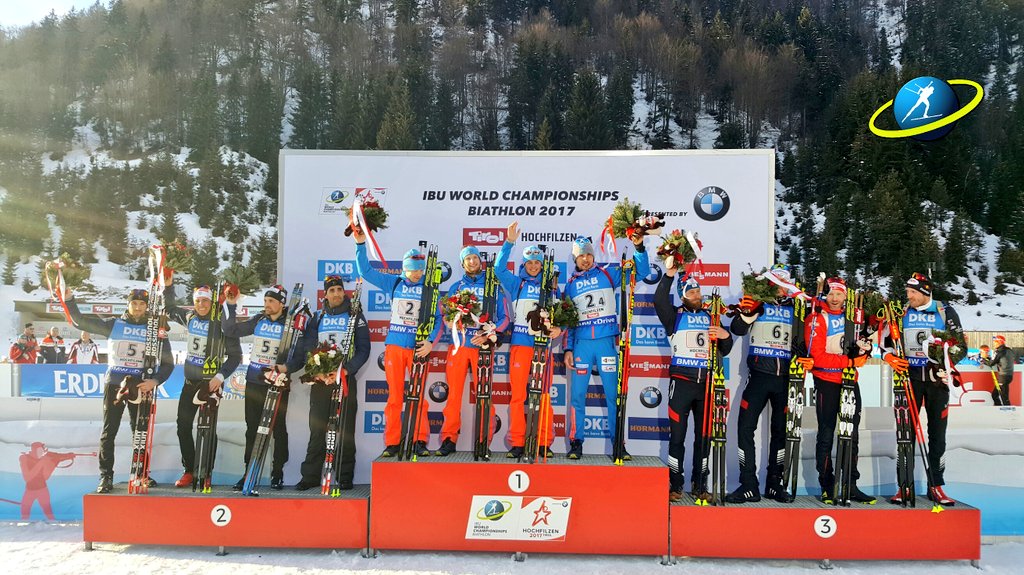
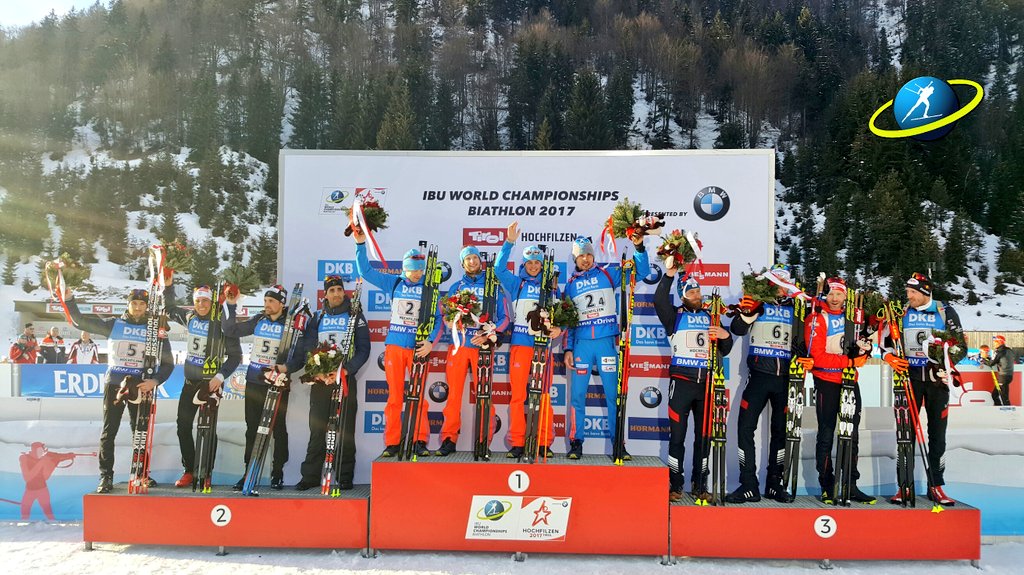
The men’s 4 x 7.5 k relay podium at 2017 IBU World Championships on Saturday in Hochfilzen, Austria, with Russia (c) in first, France (l) in second, and Austria (r) in third. (Photo: IBU World Champs/Twitter)
IBU World Championships (Hochfilzen, Austria): Men’s relay
[UPDATED] Russia’s four-man relay team hit nearly every target on Saturday, using a total of just three spares to clean 40 targets, and stayed out of the penalty loop to capture gold in the men’s 4 x 7.5-kilometer relay at the International Biathlon Union (IBU) World Championships in Hochfilzen, Austria.
It was the last team event and the second-to-last day of the championships, with the men’s and women’s elite mass starts remaining on Sunday. Anton Shipulin anchored the Russians to first, 5.8 seconds ahead of France’s Martin Fourcade, after Shipulin cleaned his prone stage and used one spare in standing to hold onto the lead his team built. Fourcade cleaned both stages to secure silver for his team, and Austria took bronze (+20.1) with anchor Dominik Landertinger.
After Russia’s Alexey Volkov used one spare in each of his shooting stages and came through the exchange in seventh, Maxim Tsvetkov and Anton Babikov both cleaned without any spares to bring the team into fourth, then first, respectively.
France’s first leg Jean-Guillaume Béatrix shot clean as well and tagged Quentin Fillon Maillet in second. Fillon Maillet then needed one spare in prone, but cleaned standing to take the lead, tagging Simon Desthieux in first. Desthieux used three spares in prone, but avoided the penalty lap before tagging Fourcade in third, 12 seconds behind Austria in second. Fourcade closed the gap and clinched second, and France combined for a total of just four spare rounds.
Austria achieved bronze in front of a home crowd with Daniel Mesotitsch, Julian Eberhard, Simon Eder, and Landertinger combining for 10 spares and no penalties.
Finishing 8.5 seconds after Austria, Germany placed fourth. Italy was a minute and a half out of first in fifth, Ukraine took sixth (+1:41.3), and the U.S. placed seventh (+1:50.5) with Lowell Bailey, Leif Nordgren, Tim Burke, and Sean Doherty. Bailey initially put the team in fourth at the first exchange, 12.4 seconds out of first, then Nordgren tagged Burke in sixth, 17 seconds behind. Burke used four spares to clean and tagged Doherty in seventh, about a minute back. The Americans used a total of eight spares but had no penalties.
Canada finished 13th (+3:35.5) with Christian Gow, Scott Gow, Macx Davies, and Brendan Green. They were 39 seconds out of first and in 12th place after Christian Gow’s first leg, then slipped to 14th before Davies moved them back into 12th by the last exchange. Canada had a total of 10 spares and zero penalties.
FIS Cross-Country World Cup (Otepää, Estonia): Freestyle sprint
In the last World Cup before the upcoming 2017 International Ski Federation (FIS) Nordic Ski World Championships next week in Lahti, Finland, five U.S. women qualified in the top 12 of the women’s 1.3-kilometer freestyle sprint, and Jessie Diggins reached the final on Saturday in Otepää, Estonia.
Diggins started the day by placing 12th in the qualifier, 3.93 seconds behind Sweden’s Stina Nilsson in first (and her U.S. teammates Kikkan Randall in third, Sophie Caldwell in fourth, and Ida Sargent in 10th) before winning her quarterfinal and semifinal. In the final, Diggins wad gapped by the leaders on the final climb and finished fifth (+6.82).
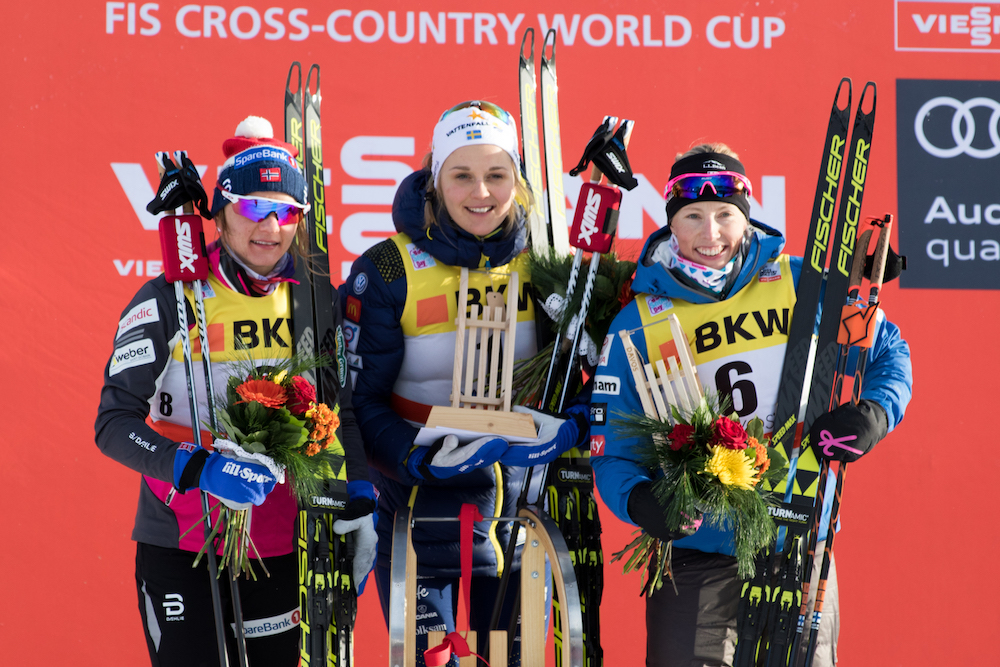
The women’s freestyle sprint podium at the Otepaa World Cup on Saturday in Estonia, with Swedish winner Stina Nilsson (c), Norway’s Maiken Caspersen Falla (l) in second and Heidi Weng (r) in third. (Photo: FIS Cross Country/Twitter)
Nilsson won the final in a time of 2:49.96 minutes, just ahead of Norway’s Maiken Caspersen Falla (+0.27) who lost her balance and her speed with it on the last corner. The two had broken away from third place and Nilsson led into the final straightaway and held Falla off for the win. Norway took second through fourth with Heidi Weng in third place (+3.75) and Astrid Uhrenholdt Jacobsen in fourth (+4.91).
Randall initially finished her quarterfinal in third position and would have been out, but advanced when Russia’s Natalia Matveeva was relegated to last for obstruction. In the same semifinal as Diggins, Randall fell cresting a small hill over a tunnel and finished fifth (+13.30) for ninth overall on the day.
Caldwellplaced second in her quarterfinal heat behind the day’s winner Nilsson, then stumbled halfway up a climb early in her semifinal, but stuck with the pack to finish fifth (+1.83) for 10th overall.
Sargent raced in the same quarterfinal as Falla and narrowly missed advancing to the semifinal in third place, fewer than 0.2 seconds behind Switzerland’s Laurien van der Graaff in second and 0.35 seconds behind Falla, who won that heat. Sargent placed 13th on the day.
Sadie Bjornsen qualified 25th and finished fourth (+2.82) in the same quarterfinal as Randall for the 25th overall.
Canada’s Dahria Beatty also qualified for the sprint heats in 30th place, and finished sixth in her quarterfinal for 29th overall.
Also for Canada, Cendrine Browne finished the qualification in 48th place and Katherine Stewart-Jones was one position behind in 49th.
Also for the U.S., distance specialists Chelsea Holmes and Rosie Brennan placed 58th and 60th, respectively.
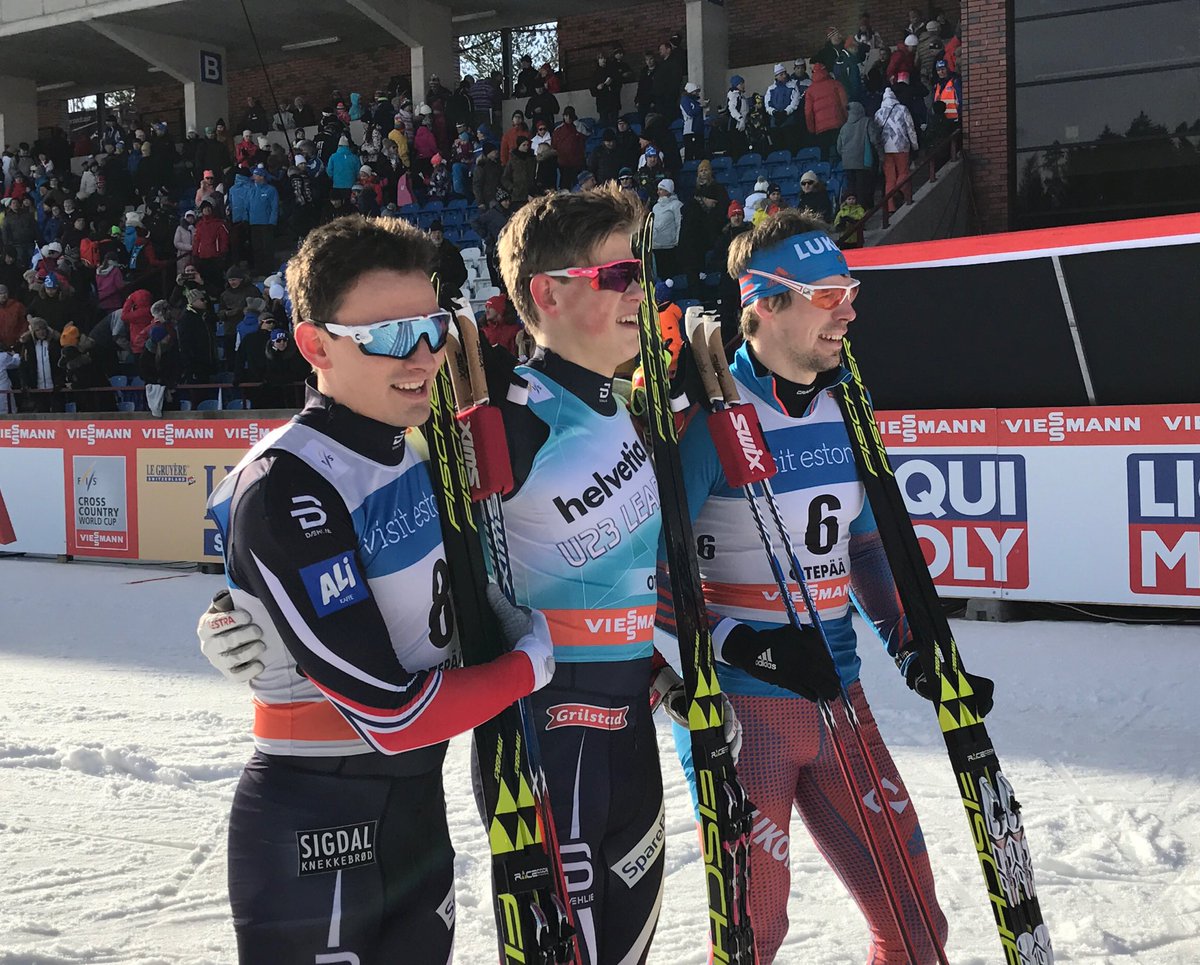
The men’s freestyle sprint podium on Saturday at the World Cup in Otepaa, Estonia, with Norway’s Johannes Høsflot Klæbo (c) taking his first World Cup win, Norway’s Finn Hågen Krogh (l) in second, and Russia’s Sergey Ustiugov (r) in third. (Photo: FIS Cross Country/Twitter)
In the men’s 1.6-kilometer sprint, Norway’s Johannes Høsflot Klæbo achieved the first World Cup victory of his career in a time of 3:06.53 minutes, holding onto a lead he had created with an attack right out of the start gate in the final. His teammate Finn Hågen Krogh placed second (+0.60), taking the inside lane in the last turn to push reigning Tour de Ski winner Sergey Ustiugov of Russia to third (+1.0).
For the North Americans, it was a day of narrow misses.
For the U.S., Simi Hamilton started his race day by qualifying in seventh position, and placed second in his quarterfinal. He then closely missed out on the final after placing fourth in his semifinal in a four-way sprint photo finish (+0.33), just 0.04 seconds behind the third place and lucky loser time of Norway’s Håvard Solås Taugbøl, who advanced. Hamilton ended the day in eighth overall.
Canadian World Cup Team member Alex Harvey snuck into the sprint heats in 29th place in the qualifier, then just missed out on advancing from his quarterfinal in a photo finish for second with Great Britain’s Andrew Young, who took it by 0.04 seconds. Harvey finished third in that heat, 0.6 behind Italy’s Federico Pellegrino, for 15th for the day. Young went on to finish sixth in his semifinal for 12th overall, and Pellegrino advanced as a lucky loser from the same semifinal and was fourth in the final (+4.77).
American Andy Newell qualified 16th and finished sixth (+1.89) in his quarterfinal for 27th overall.
Canada’s Len Valjas missed qualifying for the heats in 40th place, as did his teammate Devon Kershaw in 50th.
American Erik Bjornsen was 53rd, and for Canada, Jesse Cockney 54th and Knute Johnsgaard 56th. In his World Cup debut, Benjamin Lustgarten placed 64th in the qualifier.
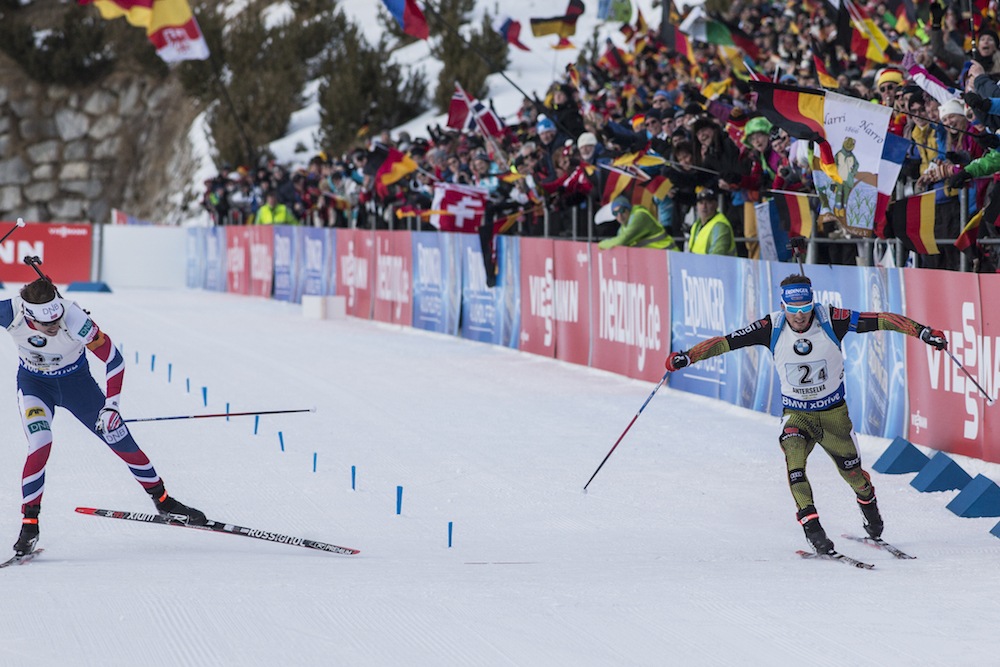
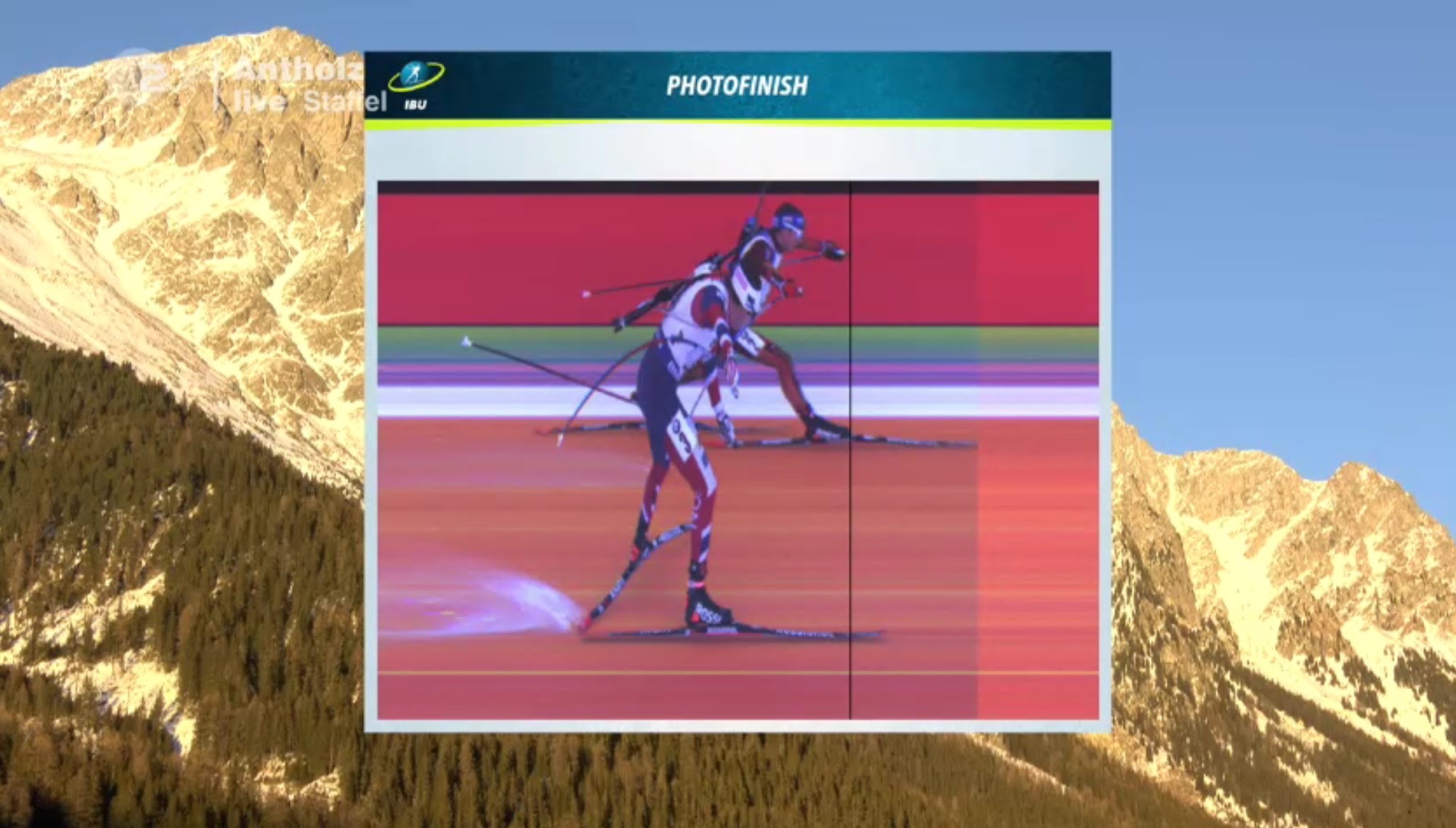
The photo finish for first in the IBU World Cup men’s 4 x 7.5 k relay on Saturday in Antholz, Italy, with Germany’s Simon Schempp (r) edging Norway’s Emil Hegle Svendsen (l) by 0.1 seconds. (Photo: IBU/Christian Manzoni)
For Germany and Norway, it was a two-way battle for first following the final exchange of the men’s 4 x 7.5-kilometer relay on Saturday at the International Biathlon Union (IBU) World Cup in Antholz, Italy.
There, thanks to third-leg Johannes Thingnes Bø, Norway had taken the lead by 17.7 seconds over Germany and built a 38-second gap to Russia in third. Ukraine was another nine seconds back in fourth, skiing just ahead of France and the U.S. in fifth and sixth through the exchange, respectively.
So for the U.S. in Saturday’s relay, the last one before 2017 IBU World Championships in Hochfilzen, Austria, next month, it was a fight for a team-best result — which would have been fourth.
Before we get to where they finished, let’s remember where the U.S. men’s relay started: in bib 24 of 25, at the back of the pack.
Lowell Bailey raced them into sixth at the first exchange and 8.6 seconds out of the lead, with Russia’s Maxim Tsvetkov reaching the exchange first. Bailey had skied the fifth-fastest course time on that leg and shot quickly to clean with one spare in each of his two shooting stages.
Eighth after the first prone stage, he moved into sixth after his standing shooting. One loop later, he tagged his teammate Leif Nordgren in sixth.
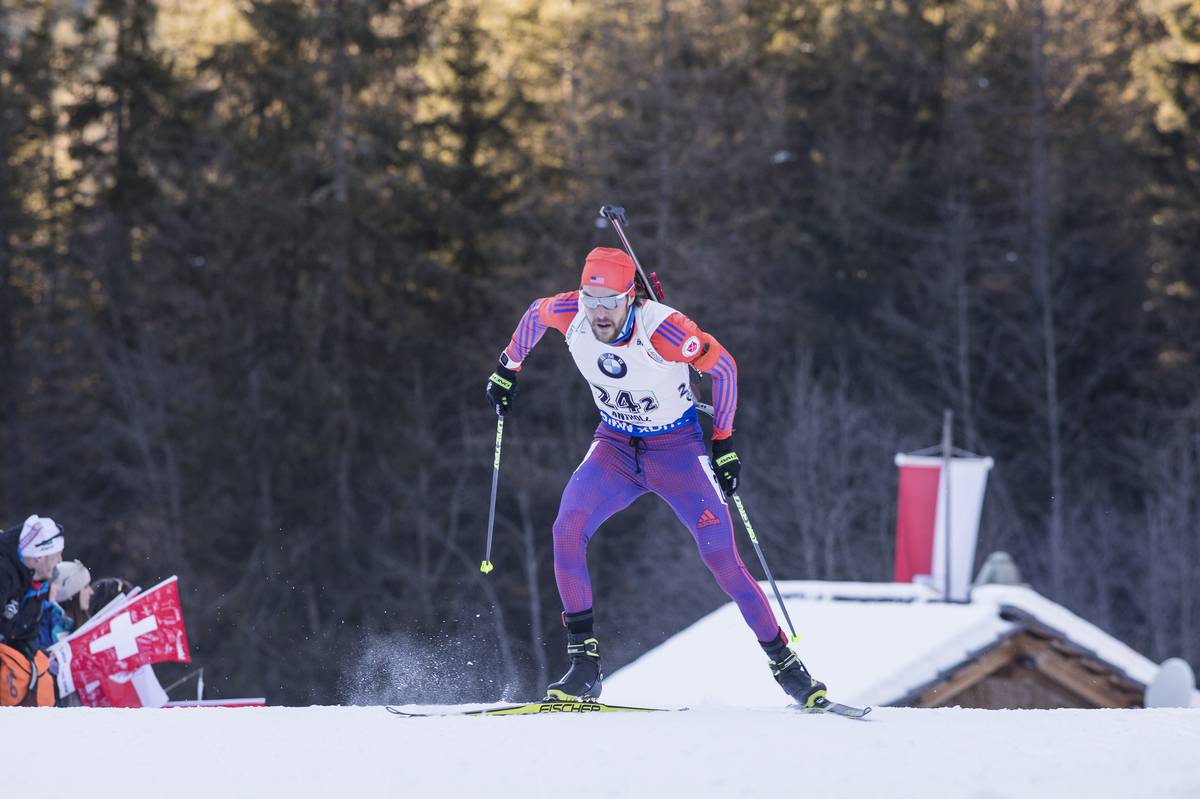
Leif Nordgren (US Biathlon) skiing the second leg of the men’s 4 x 7.5 k relay on Saturday at the IBU World Cup in Antholz, Italy. (Photo: USBA/NordicFocus)
Nordgren proceeded to jet into third after his prone stage, despite using two spares to clean.
“It was a big bummer to miss two in prone, but the rest of the group also missed so I was able to leave towards the front,” Nordgren explained in a US Biathlon press release.
He used one more spare to clean his standing stage and remained in third heading into his final loop. There, Nordgren’s lack of racing this season caught up to him (this was his fifth World Cup race of the season), and he tagged off in ninth, 27.6 seconds behind Russia’s Evgeniy Garanichev in fifth.
“In the last loop I was holding on for dear life,” Nordgren told US Biathlon. “Those other guys have a lot more racing under their belts this year. I have four [races], so that made for a hard loop.”
While Nordgren and teammate Tim Burke had a shaky tag, which Burke described as a “bit of a collision,” Burke was able to emerge from it unscathed. He went on to ski the fourth-fastest third leg to bring the U.S. to sixth.
“I felt solid on course today,” Burke wrote in an email, after posting the third-fastest course time for that leg.
He used three spares to clean prone — any more misses and he would’ve had to ski a penalty loop — and started his second loop in ninth. The next time in the range, Burke cleaned standing without any spares and set out on his last loop in seventh.
“I pushed hard all the way to the shooting point before prone, which, in hindsight, was probably a bit too aggressive,” he reflected. “For standing my goal today was stay aggressive and I was happy with how that worked out.”
Burke started his last loop with France’s Simon Desthieux. “We were able to really push on the last loop and pull the others back,” Burke explained. “I wanted to hand off to Sean with the group that would fight for third place.”
Burke tagged his teammate Sean Doherty in sixth, 11.6 seconds out of third and just 4.3 seconds behind fourth. Meanwhile, Norway had taken the lead after Bø’s standing stage with clean shooting (and after using just one spare to clean prone) while Russia dropped to third with a total of four spares from Dmitry Malyshko.
Germany’s third-leg skier Arnd Peiffer took the lead after a miss-free prone stage, and using one spare in standing, left the range just 6 seconds after Bø to bring Germany into second at the final tag, 17.7 seconds from first.
Over the last three loops and two shooting stages, Norway’s anchor Emil Hegle Svendsen and Germany’s final skier Simon Schempp drew closer, with both cleaning prone without a miss. At the start of the second loop, Schempp was within 12.7 seconds of Svendsen. Back in the range for the last time, Svendsen missed his second and fifth shots, requiring two spares, and Schempp needed one spare to clean, and the two set out on the final loop together, with Svendsen leading by 0.3 seconds.
The two went head to head all the way to the finish, where Schempp ultimately outlunged Svendsen in a photo finish by one-tenth of a second. He secured the win for Germany in 1:13:57.2 hours, and the team — with Erik Lesser, Benedikt Doll, Peiffer and Schemmp — used a total of seven spares to avoid the penalty loop.
“I gave it everything I had in the end, and wanted to attack a little earlier but [Svendsen] attacked incredibly up the bridge,” Schempp recalled in a post-race interview with ZDF. “I had a feeling that we crossed the line pretty much together. Then I had to wait what the computer would show as a result.”
“He was a little stronger,” Svendsen told NRK after. “I have no other explanation than that. I had to make sure I did not ski into him … so I lost a little momentum there.”
At the last World Cup relay in Ruhpolding, Germany, Norway won with Ole Einar Bjørndalen, Vetle Sjåstad Christiansen, Henrik L’Abee-Lund, and Svendsen. Russia finished second, Germany was third, and the U.S. was 12th.
“I think we presented ourselves with top ski speed today, and on the shooting range it clearly went better than in Ruhpolding, especially for me,” Lesser said, referring to his penalty and the team’s total of nine spares in the Ruhpolding relay (compared to Russia, which had two, and Norway with five spares in Ruhpolding).
“We still have those seven spares, I can remember the last time we became World Champions we only had two spares, so we definitely can get down there, but it was a cool final rehearsal,” Lesser said.
Norway took second with Lars Helge Birkeland, L’Abée-Lund (who brought the team from fourth to second at the second exchange), Bø, and Svendsen, after using nine spares.
Russia ended up third (+33.6), with Tsvetkov, Garanichev, Malyshko, and Babikov, with a team total of nine spares as well, and Ukraine pulled off fourth (+46.7) with just five total spares, with Artem Pryma, Sergey Semenov, Vladimir Semakov, and Dmytro Pidruchnyi.
Ukraine embarked on the last leg in fourth, 1:04 minutes out of first and just ahead of France in fifth and the U.S. in sixth.
On their first loop together, Doherty moved into fourth, trailing Russia’s Babikov in third by about eight seconds. With France’s Quentin Fillon Maillet, Doherty bridged the gap to Babikov, passing the Russian but remaining in fourth as the Frenchman skied into third.
In their prone stage, Doherty used one spare and Fillon Maillet cleaned to leave the range just ahead of him in fifth, while Doherty followed in sixth. Five teams continued to fight for the podium, with Ukraine’s Pidruchnyi leading them in third.
Pidruchnyi didn’t miss a shot in either stage to hold that position until his final loop, where Babikov passed him to claim the third spot on the podium, 12.9 seconds ahead of him.
Sean Doherty (US Biathlon) crossing the finish line in sixth for the U.S. men’s 4 x 7.5 k relay on Saturday at the IBU World Cup in Antholz, Italy. (Photo: USBA/NordicFocus)
In the final standing stage, Doherty and Austria’s Dominik Landertinger both used one spare and left the range in fifth and sixth, respectively. France dropped out of contention when Fillon Maillet had to ski a penalty lap.
“It was really exciting,” Doherty said of the last shooting in an interview with IBU TV. “The pace was really high. Came in and just tried really hard to focus on my own work, knowing there were some guys close in front and behind me. Luckily only one spare, and I was able to get out of there with staying out of the [penalty] loop.”
While Doherty left the range about three seconds ahead of Landertinger, the Austrian passed him during the first kilometer of their final loop. Landertinger extended his gap to Doherty to 12 seconds with less than half a kilometer remaining and anchored Austria to fifth (+49.2), 2.5 seconds out of fourth. Doherty finished sixth for the U.S. (+1:04.9), 15.7 seconds out of fifth.
Behind him, France’s Fillon Maillet finished seventh (+1:34.7). In all, Austria used eight spares and the U.S. had 10, but both avoided the penalty lap. France accumulated 14 spares and one penalty.
“Today’s sixth place was a very strong effort for the team,” Doherty told US Biathlon. “I am very happy to be skiing up in the mix and looking at the podium. There is still room to improve for World Championships, but it seems we are headed in the right direction.”
“Today we showed that we are competitive with the best in the world,” Bailey said in the same press release. “With 10 extra rounds, this is far from our best, but it is a big step in the right direction and exactly where we want to be heading into world champs.”
For the U.S., sixth was one place back from its team-best fifth, which it achieved with the same four men last year at the World Cup in Presque Isle, Maine.
“We are very satisfied with the result today,” Burke said. “With the exception of Lowell, it has been a bit of slow start for the rest of us with a mix of injuries and illnesses. This was definitely important for our confidence heading into World Champs.”
For every man on the team except Bailey, Saturday marked the last World Cup race before World Championships, which start Feb. 9.
Burke planned to stay in Antholz for the next two weeks to prepare.
“I feel like I am still not near my best, but at least I have been consistently in the mix the past two weeks,” Burke wrote. “Hopefully with a good training block over the next two weeks, I can still come to a higher level for World Championships.”
Bailey competed in Sunday’s 15 k mass start and finished 16th, 1:33.4 behind Norway’s Bø, who cleaned the four-stage race to win in 37:04.3. Bailey had two penalties in his last two stages (0+0+1+1), and in his first World Cup mass start, Canada’s Scott Gow finished 30th (+4:09.9) with four penalties (1+0+2+1).
The Canadian men’s relay finished 16th on Saturday (+4:13.8), with Christian Gow, Scott Gow, Macx Davies, and Brendan Green combining for two penalties and 11 spares. Both penalties came on Davies’s third leg. While the team was in 15th after Scott Gow’s second leg, they dropped to 18th on the third leg, but Green recovered two places to finish 16th.
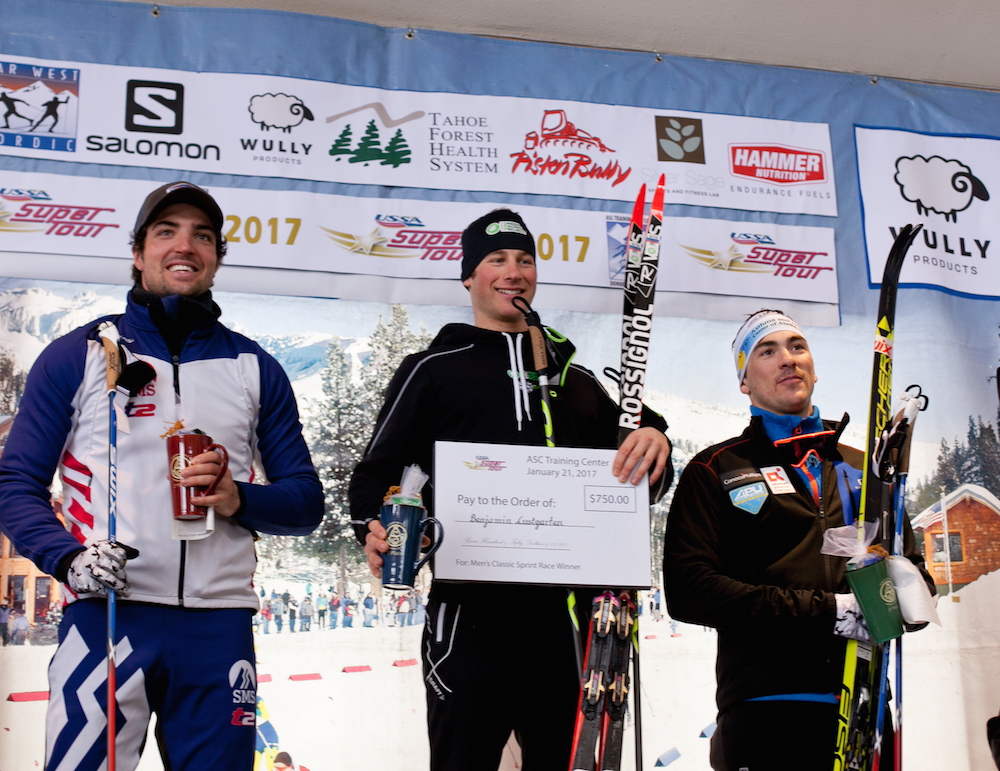
Ben Lustgarten (Craftsbury Green Racing Project) with his $750-dollar check for winning the men’s SuperTour classic sprint on Saturday near Truckee, Calif. Stratton’s Ben Saxton (l) placed second and APU’s Reese Hanneman (r) was third.
Lustgarten, of the Craftsbury Green Racing Project, raced to a 1.58-second victory in the men’s A-final at the Auburn Ski Club in Soda Springs, Calif., finishing in 3:03.4. Ben Saxton, of the Stratton Mountain School (SMS) Elite Team, placed second, and Reese Hanneman, of Alaska Pacific University (APU), was third (+2.77).
Hannenman’s younger brother Logan also reached the final and placed fourth (+4.5), Dakota Blackhorse-von Jess (Bend Endurance Academy) was fifth (+5.86), and the third APU skier in the final, Tyler Kornfield sixth (+18.69).
Blackhorse-von Jess started the day off as the fastest qualifier in 2:58.8. Saxton qualified second, 4.1 seconds back, Logan Hanneman qualified third (+4.2), and Lustgarten fourth (+6.5). Blackhorse-von Jess went on to win his quarterfinal and place second in his semifinal, while Lustgarten and Saxton both won their quarterfinals and semifinals.
Jennie Bender (3) of the Bridger Ski Foundation leading Stratton’s Julia Kern (2) and Sun Valley’s Deedra Irwin (5) during the second women’s classic sprint semifinal at Saturday’s SuperTour near Truckee, Calif. Bender went on to win the semifinal, as well as the final.
In the women’s A-final, Jennie Bender of the Bridger Ski Foundation, coming off a classic sprint win at nationals, scored another victory in 3:29.07. She edged Craftsbury’s Kaitlynn Miller by just seven-hundredths of a second, and Stratton’s Julia Kern placed third (+3.42). Racing at home, Hannah Halvorsen (Sugar Bowl Academy) finished fourth (+3.88). Craftsbury had three in the women’s final with Caitlin Patterson in fifth (+3.93) and Heather Mooney in sixth (+27.35).
Miller proved to be the woman to beat throughout the day, winning the qualifier in 3:30.9, along with her quarterfinal and semifinal. Kern qualified second (+3.2) and Bender third (+4.6). Bender went on to win her quarterfinal and semifinal as well before facing off with Miller in the final.
NorAm Western Canadian Championships (Whistler, B.C.): 10/15 k classic
It was interval-starts day at Western Canadian Championships at Whistler Olympic Park and national-team veteran Emily Nishikawa completed the four laps of the women’s 10 k classic in 30:35.5 to win ahead of teammate Dahria Beatty, 16.5 seconds behind. Maya MacIsaac-Jones completed the national team and Alberta World Cup Academy (AWCA) sweep in third (+1:36.5).
Sovereign Lake’s Hannah Mehain, of the national junior team, was the top junior for the second-straight day in eighth overall (+3:22.1).
In the men’s 15 k, Lappe Nordic’s Andy Shields won the six-lap race in 40:34.2, showing some of the form that won him the NorAm overall last season. National-team member Jess Cockney collected his second-straight podium, finishing second, 4.3 seconds behind Shields. Evan Palmer-Charrette (NTDC Thunder Bay) completed the podium in third (+55.1).
FIS Cross-Country World Cup (Ulricehamn, Sweden): 10/15 k freestyle
The men’s 15 k freestyle podium at Saturday’s World Cup in Ulricehamn, Sweden, with Canadian winner Alex Harvey (c), Norwegian runner-up Martin Johnsrud Sundby (l), and Sweden’s Marcus Hellner (r) in third. (Photo: FIS Cross Country/Twitter)
First individual win of the season (second straight, after winning last weekend’s team sprint), fifth individual victory of his career. That’s the latest news on Canada’s Alex Harvey, who won the World Cup men’s 15-kilometer freestyle individual start on Sunday in Ulricehamn, Sweden, for his first victory in a 15 k skate race and fourth individual podium of 2016/2017.
To say Harvey is on a roll is an understatement. On Saturday, he beat Norway’s Martin Johnsrud Sundby by 6 seconds after starting a minute behind the Norwegian defending World Cup champion. Harvey’s fastest time across the line in 32:46.2 held up through 76 finishers, with Sweden’s Marcus Hellner coming somewhat within range after starting a minute behind him. Hellner ended up 14.3 seconds back from Harvey at the finish for third place, behind Sundby.
Switzerland’s Dario Cologna missed the podium by 0.5 seconds in fourth (+14.7), and Norway’s 24-year-old Daniel Stock broke through in fifth (+16.2) for his first World Cup top 20.
Great Britain’s Andrew Musgrave placed sixth (+18.7), Sweden’s Daniel Rickardsson was seventh (+25.0), Norway’s Finn Hågen Krogh eighth (+32.2), Russia’s Petr Sedov ninth (+33.9), and Japan’s Keishin Yoshida 10th (+34.2).
American Erik Bjornsen landed in the points as he tied Norway’s Simen Andreas Sveen for 28th (+1:09.2), leading fellow U.S. Ski Team members Noah Hoffman, who placed 41st (+1:28.8), and Simi Hamilton in 53rd (+1:56.2). Also for the U.S., Matt Gelso, the Period 1 SuperTour leader from the Sun Valley Ski Education Foundation (SVSEF) Gold Team, finished 68th (+3:00.3).
Harvey’s Canadian World Cup teammates Len Valjas finished 35th (+1:17.7) and Devon Kershaw 38th (+1:22.2). Knute Johnsgaard (Canadian U25 Team) did not start.
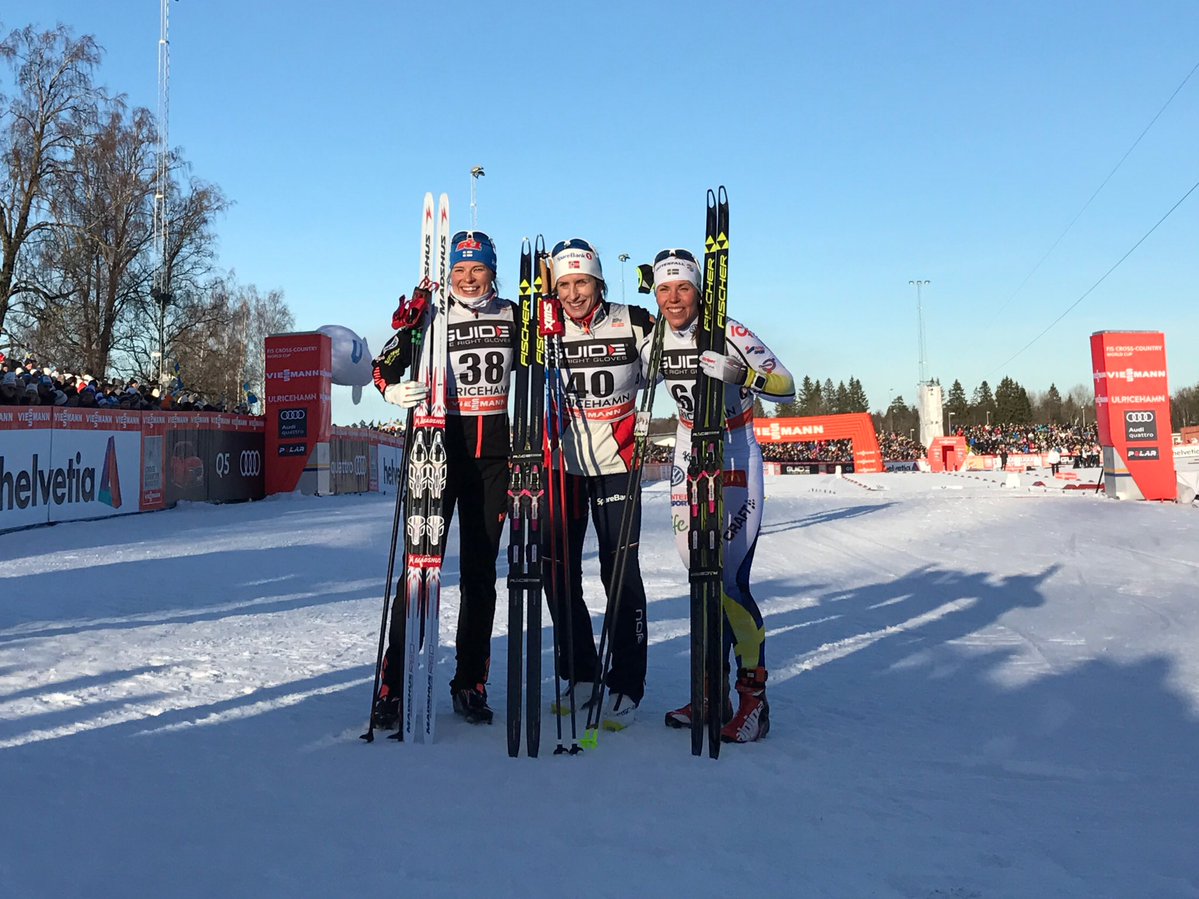
The women’s 10 k freestyle podium on Saturday in Ulricehamn, Sweden, with Norwegian winner Marit Bjørgen (c), Finland’s Krista Parmakoski (l) in second and Sweden’s Charlotte Kalla (r) in third. (Photo: FIS Cross Country/Twitter)
In her first World Cup race in over a month and at a brand-new World Cup venue, Norway’s 36-year-old Marit Bjørgen returned to her winning ways, topping the women’s 10 k freestyle on Saturday in Ulricehamn.
Bjørgen started 40th out of 61 finishers and took the lead from Finland’s Krista Parmakoski at the finish with a time of 23:46.3 minutes. Parmakoski, who started a minute ahead of her in bib 38, ended up second, 10.7 seconds back. Sweden’s Charlotte Kalla reached the podium for the second time this season in third (+24.9).
“It is always great to win,” Bjørgen said, according to an International Ski Federation (FIS) press release. “I stayed at home for five weeks and was training. It is great to come back with a victory. I know that the training I had done was good. It was an amazing atmosphere today by the course. There were people cheering everywhere.”
Norway swept fourth through sixth with Astrid Uhrenholdt Jacobsen in fourth (+25.7), Ragnhild Haga in fifth (+32.3) and Heidi Weng in sixth (+34.0).
American Jessie Diggins raced to seventh (+34.9), ahead of Sweden’s Hanna Falk, who recorded her best distance result in eighth (+36.4). Norway’s Ingvild Flugstad Østberg finished ninth (+44.8), and Germany’s Sandra Ringwald was 10th (+56.6).
“I didn’t have the snappy good feelings I was hoping to have in my body today, but it was a solid race,” Diggins wrote in a post-race email to FasterSkier. “It’s always hard when you know that on your best days you are capable of more, but at the same time we had great skis, and it was really fun for me to be able to ski with my teammates today!”
The U.S. had three in the top 20 and four in the top 30 with Sadie Bjornsen in 12th (+1:00.5), Liz Stephen in 16th (+1:07.3) and Rosie Brennan in 24th (+1:30.7).
Cendrine Browne as Canada’s lone woman in the race achieved 35th (+1:52.0) for her career best in an individual race. Also for the U.S., Kikkan Randall placed 40th (+1:59.6) and Liz Guiney of the Craftsbury Green Racing Project 52nd (+2:33.2).
The photo finish of the men’s 4 x 7.5 k relay on Saturday at the IBU World Cup in Antholz, Italy, with Germany’s Simon Schempp outlunging Norway’s Emil Hegle Svendsen. (Photo: ZDF broadcast screenshot)
For the U.S. men, top six was a target for the 4 x 7.5 k relay on Sunday in Antholz, Italy, according to US Biathlon Men’s Coach Jonas Johansson.
Mission accomplished. In the final team event before 2017 World Championships, Lowell Bailey, Leif Nordgren, Tim Burke, and Sean Doherty combined for sixth, finishing 1:04.9 minutes behind the German winners. The Americans used a total of 10 spares but avoided the penalty loop, as did the Germans who used seven spares to clean the eight-stage race and won it in 1:13.57.2.
Germany’s Simon Schempp narrowly outlasted Norway’s Emil Hegle Svendsen in the finishing stretch to secure the victory for Germany (with teammates Erik Lesser, Benedikt Doll and Arnd Peiffer) by one-tenth of a second. Norway finished second with nine spares and no penalties (with Lars Helge Birkeland, Henrik L’Abee-Lund, Johannes Thingnes Bø, and Svendsen), and Russia secured third (+33.6) with nine spares and zero penalties as well (with Maxim Tsvetkov, Evgeniy Garanichev, Dmitry Malyshko, and Anton Babikov).
Ukraine used a total of just five spares and had zero penalties for fourth (+46.7), and Austria took fifth (+49.2) with eight spares and no penalties, after Austria’s Dominik Landertinger skied away from Doherty on the final loop and finished 6.9 seconds ahead of him for fifth place.
For the U.S. men, sixth was close to their team-best fifth with the same lineup in last year’s World Cup relay in Presque Isle, Maine. The same group also took sixth in Ruhpolding, Germany, last year as well.
With all four making US Biathlon’s World Championships team, announced Saturday, they will likely be aiming for a best championships result early next month in Hochfilzen, Austria.
Canada (Christian Gow, Scott Gow, Macx Davies, and Brendan Green) finished 16th (+4:13.8) on Saturday with two penalties and 11 spares. Scott Gow skied them up to 15th by the second exchange but they dropped to 18th after Davies had two penalties on the third leg. With Green anchoring and using just one spare, they recouped two places before the finish.
In the women’s race, Germany’s Nadine Horchler achieved a lifetime dream with her first World Cup win, after starting in bib 30 and earning her start as a reserve athlete. Germany took first and second with Laura Dahlmeier in second, and the Czech Republic’s Gabriela Koukalova placed third. Susan Dunklee of the U.S. was the lone North American starter and finished 24th after leading at the start of the second loop.
FIS Nordic Combined World Cup (Chaux-Neuve, France): Individual large hill/10 k
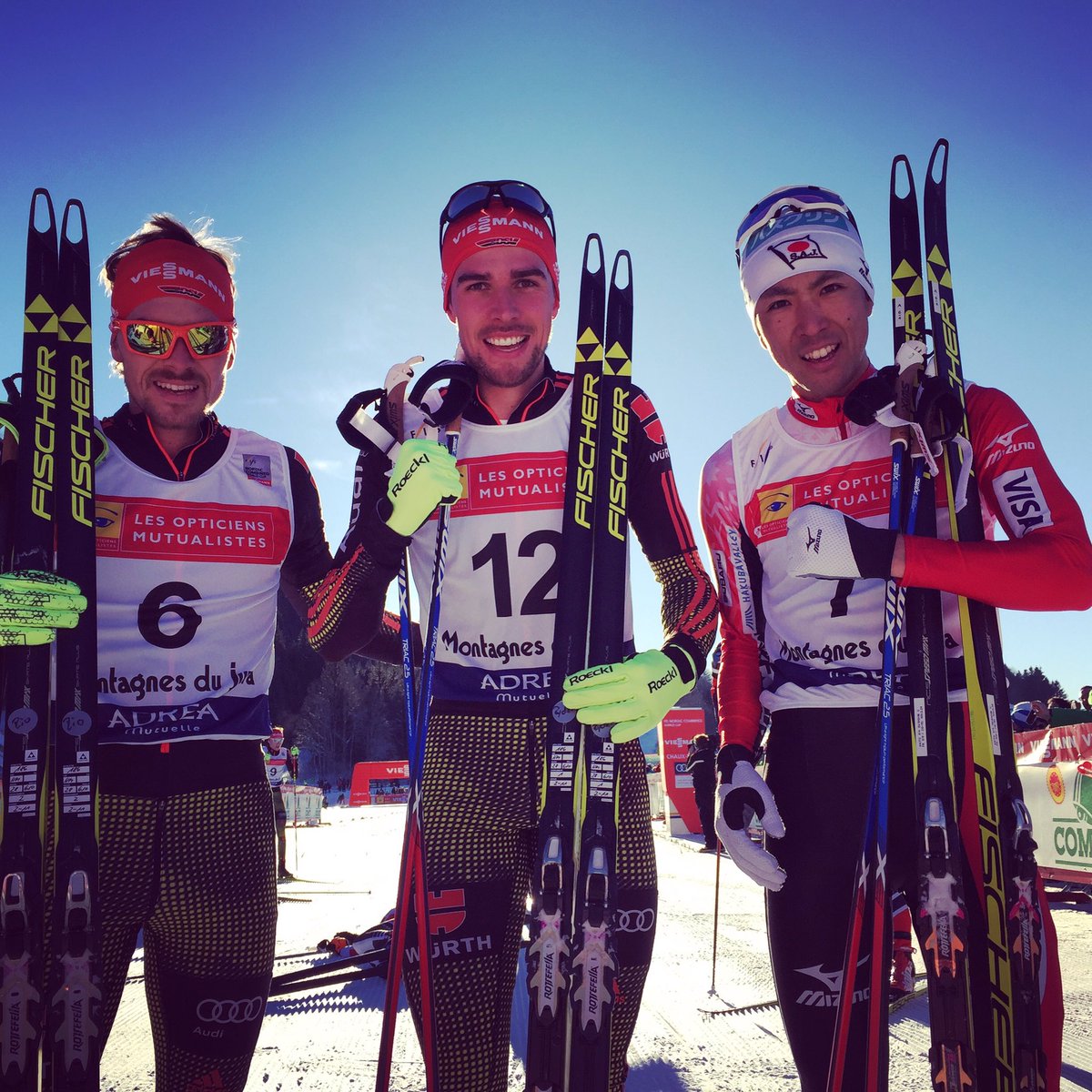
Saturday’s Nordic Combined World Cup podium in Chaux-Neuve, France, with German winner Johannes Rydzek (c), German runner-up Fabian Rießle (l) and Japan’s Akito Watabe (r) in third. (Photo: FIS Nordic Combined/Twitter)
The first part of Saturday’s Nordic Combined World Cup individual large hill/10 k competition was a shining moment for U.S. Nordic Combined skier Ben Berend, who jumped to second for a total of 127.5 points, trailing only Norway’s Jarl Magnus Riiber with 139 points in Chaux-Neuve, France.
Berend flew farther than Germany’s Eric Frenzel, who jumped to third on the Chaux-Neuve large hill.
Later in the day, they started the 10 k Gundersen in that order, with Riiber heading out first, followed by Berend 46 seconds later, then Frenzel 53 seconds back in third.
Germany’s Johannes Rydzek started 1:15 minutes back in 12th and skied the fastest 10 k to take the victory at the finish (in 23:01.7). He held off his German teammate Fabian Rießle by 2.8 seconds for the win, after Rießle started sixth and 1:01 back. Japan’s Akito Watabe reached the podium in third (+5.7) after jumping to seventh and starting the race 1 second behind Rießle.
Frenzel ended up fourth (+8.3), and the fourth German in the top five, Björn Kircheisen improved to fifth (+22.6) after starting 11th.
Riiber dropped to 15th (+54.0), and Berend fell outside the top 30 to end up 32nd (+2:26.0) with the 39th-ranked course time.
Berend finished 12.2 seconds ahead of his U.S. teammate Taylor Fletcher, who placed 34th (+2:38.2) after the jump put him in 48th.
Bryan Fletcher was 49th after the jump but did not start the 10 k.
The Nordic Combined World Cup continues Sunday in Chaux-Neuve with another large hill/10 k.
Ski Classics #5: La Diagonela (Zuoz, Switzerland): 50 k classic
[UPDATED] Under “blue skies, no wind and perfect track conditions” in the Swiss Engadin Valley on Saturday, according to a Ski Classics press release, Russia’s Ilya Chernousov and the Czech Republic’s Kateřina Smutná won the men’s and women’s La Diagonela, respectively, in Zuoz, Switzerland.
Chernousov, of Team Pioneer Investments, and Tord Asle Gjerdalen (Team Santander) led a large pack of men into the final major climb on the 50 k course. There, Gjerdalen attacked and Chernousov matched him, accelerating away from his competitors up the last steep pitch to the finish, according to the press release. He finished in 2:03:39.6 hours, holding off Gjerdalen by 1.5 seconds, while Øystein Pettersen (Team BN Bank) finished third (+3.0).
In the women’s race, Smutná (Team Santander) pushed to break up the field around the halfway point, where the men caught the women. Britta Johansson Norgren (Lager 157 Ski Team) hung with Smutná, but lost contact over the last 5 k. After finishing second in the last two Ski Classics races, Smutná took the win by 1:03.2 minutes in 2:20:49.2. Nordgren finished second, ahead of Sara Lindborg (Team Serneke) in third, who finished more than three minutes later (+4:17.4).
The French men’s relay team after their IBU World Cup win on Sunday in Pokljuka, Slovenia, with (from left to right) Martin Fourcade, Quentin Fillon Maillet, Simon Desthieux, and Jean-Guillaume Béatrix. They beat Russia by 15.7 seconds for the win. (Photo: IBU)
Welcome to The Rundown, your quick primer of need-to-know information about the day’s racing. We’ll be updating this digest as the day goes on with additional results, photos and quotes. The Rundown is NOT a race report; stay tuned for complete race reports later today with interviews from the day’s top racers.
***
Note: This recap has been updated to reflect the correct positions each of the four Canadian women exchanged in during Sunday’s 4 x 6 k IBU World Cup relay.
IBU World Cup in Pokljuka: Men’s & Women’s Relays
Germany and France reached the podium in both the men’s 4 x 7.5-kilometer and women’s 4 x 6 k sprints on Sunday, the final day of the International Biathlon Union (IBU) World Cup in Pokljuka, Slovenia.
France won the men’s race by 15.7 seconds over Russia with a total of seven spare rounds and zero penalties. Jean-Guillaume Béatrix started off by putting the French team in fourth, then Quentin Fillon Maillet elevated them to first, a position both Simon Desthieux and Martin Fourcade held for the victory in 1:11:56.5.
“When we started the relay, we thought that winning was possible,” Béatrix said, according to an IBU press release. “At the same time, the competition was very tough. There were many strong teams today.”
“I was very happy to tag Martin with a 20-second lead,” Desthieux said. “This is good for my confidence.”
Russia placed second with Maxim Tsvetkov, Anton Babikov, Matvey Eliseev, and Anton Shipulin, the four of which combined for one penalty (on Eliseev’s third leg) and six spare rounds.
Germany rounded out the podium in third, 21.5 seconds behind France, with Erik Lesser, Matthias Dorfer, Benedikt Doll, and Simon Schempp. In ninth after Lesser’s first leg, Dorfer brough the team to eighth and Doll raced them into second before Schempp lost one place to end up third. They used a total of 11 spares but avoided the penalty lap.
Canada placed 10th of 22 teams, 1:44.7 out of first with one penalty and seven spares. Christian Gow started the team out with clean shooting and tagged off in sixth at the first exchange, and his older brother Scott Gow also shot clean without any spares to move up to fourth at the second tag. Macx Davies required three spares and had to ski a penalty lap on his prone stage, then used another spare to clean standing and tagged off in 14th place. Brendan Green anchored the Canadians to 10th, using three spares but avoiding a penalty in prone, then cleaning standing without any spares.
“I had a somewhat disappointing pursuit race yesterday, and my goal for today was to refocus on the range and push the ski speed as much as possible,” 28-year-old Scott Gow told Biathlon Canada, according to a press release. “I was happy with the overall performance I was able to put forward for my leg of the relay, and I was especially happy with another clean shooting day.
“Today was an acceptable result for the team,” he added. “Christian and I are very proud of our results so far this season. We worked very hard all year to try and elevate our racing abilities to the next level, and we saw our hard work pay off today with great skiing and perfect shooting for both of us. It’s also a big confidence boost going forward with the season knowing we are capable of competing among the best.”
Germany’s Karen Hammerschmidt (l) tagging her teammate Laura Dahlmeier in second place at the final exchange of the women’s 4 x 6 k relay at the IBU World Cup in Pokljuka, Slovenia. Dahlmeier anchored the team to the win by 10.1 seconds over France. (Photo: IBU)
In the women’s relay on Sunday, Germany took first by 10.1 seconds over France, using nine spares but no penalties.
Vanessa Hinz started the Germans out and tagged off in fifth, and second-leg Franziska Hildebrand moved them up into second by the halfway point. Karen Hammerschmidt held that position, which was enough for Laura Dahlmeier who anchored them to the win in 1:11:31.1.
“This was a brutally beautiful race today,” Dahlmeier told German broadcaster ZDF after her third win in as many races in Pokljuka. “It was very fun, and I was very relaxed because I knew we were competing as a team. Even if you don’t have as much power left there are still three others. I was on top of my game and just enjoyed it. I really looked forward to the race, although yesterday I was knocked out. But on the course I had a good feeling right from the start.”
France in second and Ukraine in third (+37.7) both required just three spare rounds and no penalties per team. France secured second place with Anais Chevalier (who initially tagged off in 11th), Justine Braisaz (who picked off eight places to move into third), Celia Aymonier (who tagged off in first), and Marie Dorin Habert (who cleaned without any spares but came up 10 seconds short of Dahlmeier at the finish).
Ukraine reached the podium with Iryna Varvynets, Yuliia Dzhima, Olena Pidhrushna, and Anastasiya Merkushyna.
Canada placed 11th (+3:33.1) with a total of just four spares and no penalties. Sarah Beaudry initially tagged off in 23rd, Rosanna Crawford skied them into 18th, Megan Tandy shot clean without any spares and tagged off in 14th, and Julia Ransom anchored them to 11th out of 23 teams.
The U.S. did not field a men’s or women’s relay team, with just three men and three women in Pokljuka.
FIS Cross-Country World Cup in Davos: Freestyle Sprints
In the men’s 1.6-kilometer freestyle sprint on Sunday it was Russia’s Sergey Ustiugov who emerged victorious, besting Finn Hågen Krogh of Norway and his Norwegian teammate Sindre Bjørnestad Skar for first.
After qualifying 29th overall, Ustiugov crossed first in his quarterfinal and held the led through his semifinal and into the final, winning in a time of 2:24.65. Krogh crossed 0.59 tenths of a second behind him for second place and Skar took the final podium spot, crossing 3.29 seconds after Ustiugov.
Also in the sprint final was Russia’s Alexey Petukhov, who finished just off the podium in fourth (+3.47), Norwegian Emil Iversen in fifth (+5.52) and France’s Lucas Chanavat —who won the qualifier — ended the day in sixth (+11.48).
Lucas Chanavat of France had the fastest men’s qualifying time in the Davos World Cup freestyle sprint on Sunday.
Canada’s Lenny Valjas was the top North American finisher for the day, qualifying 12th and advancing to the quarterfinals where he finished in 14th overall. No other Canadians made the sprint heats, with Alex Harvey left just outside advancing in 33rd, Devon Kershaw ending the day in 49th, Knute Johnsgaard 60th, Bob Thompson 67th, and Andy Shields 73rd. Jesse Cockney did not finish the race.
Simi Hamilton led the U.S. in 24th (+3.88). Andy Newellwas just outside the heats in 36th, and Eric Packer placed 95th (+21.62).
In the women’s 1.6 k freestyle sprint, Maiken Caspersen Falla of Norway took the overall win, crossing in a time of 2:44.63. Just 0.53 tenths of a second behind Falla was her Norwegian teammate Ingvild Flugstad Østberg in second place overall. The final women’s podium finisher, Hanna Falk of Sweden was 0.60 tenths of second off Falla in third.
U.S. Ski Team member, Jessie Diggins made the final, racing to a fifth place overall (+5.91), behind Sweden’s Jonna Sundling in fourth (+1.04) and ahead of Russia’s Natlalia Matveeva in sixth (+6.80).
The United States put three other women into the heats, including Sophie Caldwell who finished 11th, Sadie Bjornsen 15th, and Ida Sargent 20th.
American Caitlin Patterson ended the day 47th, Kikkan Randall 58th, and Liz Stephen 61st.
Dahria Beatty was the top Canadian on Sunday, finishing in 25th overall. Cendrine Browne ended the day 53rd and Sophie Carrier-Laforte 59th.
NorAm/SuperTour at Sovereign Lake: 10/15 k Freestyle
[UPDATE] It was Americans owning the podium again Sunday at Sovereign Lake, and a little bit more. It was warmer on Sunday, -7 Celsius, and snowed lightly throughout.
The men’s 15 k freestyle was first on the schedule. APU’s Scott Patterson won in 40:00.2, followed by Saturday’s A-finalist Matt Gelso at 13.2 seconds and Vail’s Tad Elliot at +26.6.
The top Canadian was Team R.A.D.’s Russell Kennedy in ninth, at 1:38.8 behind.
In the women’s 10 k freestyle, the podium was owned by APU’s Chelsea Holmes in 30:42.9. SMS Elite’s Katharine Ogden was second at 13.4 seconds, also winning the junior category. Her teammate Erika Flowers was third, 36.4 behind.
AWCA’s Olivia Bouffard-Nesbitt was the top Canadian for the second day, placing 13th at 1:51.8.
Matt Gelso (SVSEF) topping the SuperTour podium for the second-straight day in West Yellowstone, Mont. Joining him on Sunday’s 15 k classic podium: CGRP’s Ben Lustgarten (l) in second and APU’s Scott Patterson (r) in third.
Welcome to The Rundown, your quick primer of need-to-know information about the day’s racing. We’ll be updating this digest as the day goes on with additional results, photos and quotes. The Rundown is NOT a race report; stay tuned for complete race reports later today with interviews from the day’s top racers.
(Note: This Rundown has been updated to include comments from U.S. Nordic Combined’s Bryan Fletcher, who placed ninth on Sunday at the World Cup in Lillehammer, Norway.)
***
U.S. SuperTour opener in West Yellowstone: 10/15 k classic
Matt Gelso made the case that he can win any discipline and format when it comes to cross-country skiing, topping the SuperTour podium for the second-straight day of the circuit’s opening weekend in West Yellowstone, Mont. Gelso, of the Sun Valley Ski Education Foundation (SVSEF) Gold Team, won the men’s 15-kilometer classic individual start in 42:57. He finished 32.2 seconds ahead of Ben Lustgarten of the Craftsbury Green Racing Project (CGRP) in second, and Scott Patterson, of Alaska Pacific University (APU), clocked in 1:16.8 back in third.
In the women’s 10 k classic, Liz Guiney (CGRP) tallied the distance victory in 33:52.8. Katharine Ogden, of the Stratton Mountain School (SMS) and U.S. Ski Team D-team, finished 7.7 seconds back in second place, while Craftsbury put two on the podium with Kaitlynn Miller in third (+28.4).
Nordic Combined World Cup in Lillehammer: Two individual comps and a relay
German winner Eric Frenzel (c) with teammate Björn Kircheisen (l) in second and Norway’s Jørgen Graabak (r) in third on Day 3 of the Nordic Combined World Cup in Lillehammer, Norway. (Photo: FIS Nordic Combined/Twitter)
[UPDATE) Twenty-second in the jump. Ninth at the finish. That’s a bit more like it for U.S. Nordic Combined’s Bryan Fletcher. The American jumped to 22nd on Sunday on the large hill in Lillehammer, Norway, then raced to ninth in the 10 k Gundersen start cross-country race. He finished 1:22 minutes behind race winner Eric Frenzel, who notched his second-straight individual victory and third win (including Friday’s team event) of the Nordic Combined World Cup’s long weekend in 25:13.6.
“Going into the race on Sunday I was confident that with a good race I could move up quite well,” Fletcher wrote in an email. “So I just set out to ski my own race and right from the start I was moving up. Top 10 was the goal and I was happy to accomplish that.”
Germany went 1-2 with Björn Kircheisen in second (+10.8) and Jørgen Graabak of Norway finished third (+23.4) on Day 3 in Lillehammer. Fletcher’s younger brother Taylor Fletcher placed 26th (+2:21.1), moving way up from 48th in the jump (with the fastest overall course time). Also for the U.S., Ben Berend placed 49th (+4:30), and Ben Loomis was 52nd (+5:16).
On Friday, the German teammates started off the three-day series with a victory in the first 4 x 5 k team event of the season. They teamed up with Kircheisen and Fabian Riessle for first, beating Norway by 31.5 seconds with a winning time of 49:34.9.
Norway’s squad, with Mikko Kokslien, Espen Andersen, Håvard Klemetsen, and Graabak, finished second without anyone else in sight. Austria took third (+1:23.7) with David Pommer, Mario Seidl, Wilhelm Denifl, and Phillipp Orter.
Finland placed fourth, Japan was fifth, France sixth, the Czech Republic seventh, Italy eighth, and the U.S. ninth (+4:19.1), ahead of Russia in 10th.
The order for the U.S. team was Bryan Fletcher, Berend, Loomis, and Taylor Fletcher. They rose as high as sixth during Bryan’s first leg, but dropped to eighth and finally ninth.
On Saturday, in the individual normal hill/10 k competition, Frenzel overtook Rydzek for the win in 24:35. Rydzek started the day by winning the jump, and Frenzel ranked fourth heading into the 10 k Gundersen start. Frenzel overcame a 24-second deficit at the start to pass Rydzek and beat him by 15 seconds at the finish. Germany ended up sweeping the podium with Riessle in third (+25.8), after Riessle improved from 11th at the start with the second-fastest course time.
Also on Saturday, Taylor Fletcher led the Americans in 26th (+1:51.2) after jumping to 44th and starting 2:02 minutes back from Rydzek. Fletcher skied the ninth-fastest course time.
Bryan improved from 43rd at the start to 32nd (+2:32.9), Loomis ended up 43rd (+5:02.6) and Berend 44th (+5:33.4).
“Going into this weekend I was feeling good and had some solid jumps in training so I knew that I was capable of a decent performance,” Bryan wrote on Sunday. “However, I struggle to put all the pieces together through the weekend. The team event was a good performance on my part and it was fun to ski with our young guys too. In Saturday’s event, I was close but had a rather unusual race in which I just couldn’t get going and fell off the pace quickly. Sunday however it all came together with a decent jump and race to finish 9th. This is more indicative of my true level at the moment so I was happy to finally fall into form.
“This is definitely a result that I was hoping for in this period,” he continued. “I would like to finish in the top 10 consistently this year and it was a bit of a shaky start but I am starting to find the rhythm now. I hope to continue this momentum in Ramsau.”
Lowell Bailey came oh-so-close to fourth place on Sunday. Just two fewer misses and he could’ve been in the hunt, but that’s how biathlon goes.
US Biathlon’s top man so far this season, Bailey started 13th in the IBU World Cup 12.5 k pursuit on Sunday in Östersund, Sweden, and by the first prone stage, he was up to seventh with clean shooting. Two-and-a-half kilometers later, he was back in the range and shooting without a miss again. Bailey headed out on his third loop in fourth, and more or less held that position through the third shooting — cleaning yet again in standing.
Russia went 1-2 in the men’s 15 k pursuit on Sunday at the IBU World Cup in Ostersund, Sweden, with Anton Babikov (l) winning his first World Cup and Maxim Tsvetkov (r) placing second. (Photo: IBU)
But two misses on the final standing dropped him to ninth, and on the final loop, Bailey slipped six spots to 15th at the finish. With two penalties (0+0+0+2), Bailey finished 1:21.8 behind the winner, Russia’s Anton Babikov, who hit 19-of-20 targets en route to his first World Cup victory and podium. Russia took second place as well with Maxim Tsvetkov shooting clean (0+0+0+0) and finishing 10.5 seconds behind his teammate, and France’s Martin Fourcade pushed through four penalties (2+0+0+2) to place third (+15.2).
Fourcade started the day in first, after winning Saturday’s sprint, and lost the lead on the final stage, with two misses sending him to the penalty lap. On that last shooting, Babikov (the seventh starter) took control, and Tsvetkov (who started 11th) moved up from skiing in third for most of the race to second place.
Also for the U.S., Tim Burke placed 35th (+2:39.2) after starting 29th, with four penalties (0+1+2+1).
Canada’s Scott Gow finished 47th (+3:34.8) with three misses (0+0+2+1), Brendan Green was 50th (+3:45.5) wit five misses (1+3+0+1), and Macx Davies 51st (+3:54.6) with four penalties (0+0+2+2).
Gabriela Koukalová of the Czech Republic with her first-place prize after winning Sunday’s 10 k pursuit at the IBU World Cup in Ostersund, Sweden. (Photo: IBU)
In the women’s race, Gabriela Koukalová (formerly Soukalova, you’ll get used to it, we promise), took her third-place finish in Saturday’s sprint and catapulted herself into first on Sunday in the 10 k pursuit. Koukalova shot 19-for-20, missing just one on the first standing (0+0+1+0) to cross the finish line first, 8.4 seconds ahead of Germany’s Laura Dahlmeier.
While Koukalova, of the Czech Republic, took the win in 31:43.3, Dahlmeier placed second (after starting fourth) with two penalties (0+1+1+0). Italy’s Dorothea Wierer improved from 19th to third (+21.4) at the finish, with perfect shooting (0+0+0+0).
Switzerland’s Lena Häcki also cleaned for fourth (+36.3), after starting 12th.
The first out of the gate (the winner of Saturday’s sprint), France’s Marie Dorin Habert dropped to seventh, more than a minute and 15 seconds back, with six penalties (2+1+2+1).
American Susan Dunklee moved up to 22nd (+2:55.7) after starting 27th, despite five penalties (2+2+0+1).
Also for US Biathlon, Clare Egan improved to 30th (+3:35.4), up from 44th, with three misses (0+0+1+2).
Joanne Reid (US Biathlon) finished 47th (+4:59.6) with four misses (1+1+1+1), and Canada’s Julia Ransom finished 58th (+6:36.8) with eight misses (2+0+4+2).
Martin Johnsrud Sundby is the man to beat once again after winning the men’s 15-kilometer classic pursuit on Sunday in Lillehammer, Norway. The Norwegian started seventh and overcame a 50-second deficit to Sweden’s Calle Halfvarsson, the leader going into the final day of the mini tour. Halfvarsson dropped to fifth, while Sundby rose to first and brought another Norwegian Johannes Høsflot Klæbo to the top with him. Klæbo started sixth, 3 seconds ahead of Sundby, and placed second, 2.3 seconds behind him. Finland’s Matti Heikkinen took the final spot on the podium in third (+2.7), by 0.9 seconds over Norway’s Emil Iversen in fourth. Halfvarsson was 6.3 seconds back in fifth, his Swedish teammate Marcus Hellner sixth (+6.8), Norway’s Pål Golberg and Finn Hågen Krogh seventh (+9.9) and eighth (+15.0), respectively, and Canada’s Alex Harvey ninth (+16.2), ahead of Finland’s Iivo Niskanen in 10th (+52.0)
Canada had two in the points with Devon Kershaw rising from 43rd to 27th (+2:08.5). Len Valjas placed 48th (+3.44), Graeme Killick was 53rd (+3:53.9), Knute Johnsgaard 72nd (+6:20.3), Bob Thompson 81st (+8:16.3), Andy Shields 83rd (+9:57.3).
For the U.S., Noah Hoffman rose to 36th (+2:39.5) after starting 48th, Erik Bjornsen finished 57th (+4:33.3), and Eric Packer finished out his first overseas mini tour in 68th (+5:45.1).
Heidi Weng (c) held onto her lead to win the Lillehammer mini-tour by 16.1 seconds over Norwegian teammate Ingvild Flugstad Østberg (l). Finland’s Krista Parmakoski was third after losing a shot at second thanks to a crash. (Photo: FIS Cross Country/Twitter)
Heidi Weng of Norway started the 10 k pursuit in first place, and that’s where she finished it, 16.1 seconds ahead of teammate Ingvild Flugstad Østberg. Finland’s Krista Parmakoski rounded out the podium in third, after skiing up from a fifth place starting position and passing Østberg near the end of the race but then crashing on a downhill and losing valuable seconds. Nevertheless her effort gave Parmakoski the fastest ski time of the day.
Jessie Diggins, who started the race in third position after winning yesterday’s 5 k skate, made an early bid to ski with Østberg but ultimately lost ground, ending eighth, +1:39.4.
Instead it was Marit Bjørgen who took fourth, +57.5. Stina Nilsson of Sweden was one of the biggest movers of the day, skiing from 27th at the start all the way up to fifth, +1:26.1.
Following Diggins, Sadie Bjornsen finished 11th, +1:51.2. The American had started in a pack of skiers and stayed there for most of the race. Liz Stephen was 38th (+3:31.8), and Rosie Brennan and Caitlin Patterson 41st (+3:50.2) and 42nd (+3:56.8). Ida Sargent rounded out the U.S. results in 57th (+5:39.7).
Emily Nishikawa led the Canadians in 46th (+4:08.5), with Cendrine Browne and Dahria Beatty 52nd (+4:41.5) and 59th (+6:08.2).
Lowell Bailey (US Biathlon) racing in the men’s 12.5 k pursuit on Sunday at the IBU World Cup in Östersund, Sweden. He placed 15th after starting 13th, but skied in fourth for much of the race. (Photo: USBA/NordicFocus)
Starting with just under a minute separating him from first place, Lowell Bailey made sure he didn’t get too caught up on what could be.
A veteran member of US Biathlon’s national team, Bailey started the men’s 12.5-kilometer pursuit on Sunday in 13th, exactly 59 seconds behind the first man out of the gate, Martin Fourcade of France.
Fourcade had won the sprint the day before (and every race so far this season) and started 42 seconds ahead anyone else in the pursuit in Östersund, Sweden, with sprint runner-up Fredrik Lindström of Sweden chasing in second.
Could anyone catch Fourcade? Maybe — but it was going to take some shakeups with Fourcade making errors and others shooting perfectly under pressure.
Bailey was among those given the opportunity to move up significantly in the field. He tried not to overthink it, nor the fact that has led the U.S. in every International Biathlon Union (IBU) World Cup race so far this season.
“I’m trying to approach every race as an isolated event this year; trying to focus on what I can control that day,” Bailey explained in an email on Sunday.
So far this season, he’s finished 13th in the 10 k sprint and 15th in the 20 k individual races held in Östersund, the first World Cup stop on the circuit. Sunday marked the final day of a weeklong race series.
“I just went into today with the goal of executing all of the things I had worked on throughout the training year,” Bailey continued.
On the first of five 2.5 k loops, Bailey found himself fighting for second.
“The first loop was an incredibly fast pace,” he recalled. “The group I was in ended up catching 2nd place, so by the time we hit the range, there was a group of fifteen or so guys from 2nd to 17th. It made for an exciting start to the race.”
Once on the range, Bailey cleaned the first prone stage and left the range in seventh. He moved into fourth with another clean prone, followed by a flawless standing — his third-straight stage without a miss. With two loops to go and one more shooting, Bailey remained in fourth, about 39 seconds behind the leader and five seconds behind third place.
The wind was blowing throughout the race, even gusting at times, but it was “manageable,” according to Bailey.
“I didn’t really think about the fourth place,” he said of his mindset during the race. “I just wanted to execute a quality shooting bout.”
On that standing stage, which he entered in fourth place, Bailey missed his first two shots. He cleaned the remaining three, but had to ski two costly penalty laps.
“There was definitely some wind, but I can’t blame those two misses on wind,” he wrote. “I lost my focus for those two shots and sent them outside the targets.”
Without much left in the tank for the final 2.5 k, Bailey, who left the range in ninth, slipped to 15th at the finish, 1:21.8 seconds behind the winner.
Russia went 1-2 in the men’s 15 k pursuit on Sunday at the IBU World Cup in Ostersund, Sweden, with Anton Babikov (l) winning his first World Cup and Maxim Tsvetkov (r) placing second. (Photo: IBU)
A 25-year-old Russian who spent most of last season on the IBU Cup, Anton Babikov won the pursuit with near-perfect shooting (0+0+1+0) for his first World Cup podium. He finished in 31:22.3, and his 24-year-old teammate Maxim Tsvetkov followed 10.5 seconds later in second, thanks to clean shooting, to tie his career best.
(Babikov started seventh and skied the fourth-fastest overall course time, and Tsvetkov started 11th and was one of just two men to clean all four stages. Michal Krcmar of the Czech Republic was the other. He rocketed from 38th at the start to seventh at the finish.)
Fourcade, the first starter, ended up third (+15.2) with an uncharacteristic four misses (2+0+0+2).
“From the very beginning, I knew that everything could be possible,” Babikov told the IBU, according to a press release. “We were going very close. Before going to Östersund, I was a little worried, it’s always curious to see how well you are prepared for the season.”
Tsvetkov skied in third for most of the race, concentrating on his shooting and capitalizing when Fourcade missed two on the final stage. There, Babikov took the lead for the first time from Fourcade, now 10 seconds back in third, and Tsvetkov left the range four seconds behind in second.
“This is my first medal in pursuit,” Tsvetkov told the IBU. “It was very tough for me, I knew that Martin was very close, I knew that I have to work hard ’til the end.”
While Bailey felt like he was missing some snap, especially on the last loop (which he attributed to a hard first loop), he was pleased with his start to the season and is ranked ninth overall on the World Cup.
“I have been ranked this high in the past coming out of Ostersund, but I am definitely happy with the solid start to the season,” he told US Biathlon, according to a press release. “You train all season in a bit of a vacuum — just you and your teammates — and there is very little for you compare yourself to. Because of this, the start of the season can be a bit of an unknown. I’m happy to see that my ski times are competitive and that I’m able to reach the podium on a great day.”
Of 59 finishers on Sunday, Bailey’s course time ranked 36th.
“I hoped to have competitive ski speed and accurate, fast shooting,” he wrote to FasterSkier. “Mostly, I’m satisfied with my performances so far. As always, there’s plenty of things I need to improve, but I’m happy with this a solid start to the season.”
Tim Burke (US Biathlon) racing to 35th in the men’s 12.5 k pursuit on Sunday at the IBU World Cup in Östersund, Sweden. (Photo: USBA/NordicFocus)
Two American men started the pursuit, with Bailey finishing 15th and Tim Burke placing 35th (+2:39.2). Despite a clean first prone, Burke, who started 29th, tallied four penalties (0+1+2+1), yet still finished in the top 40 required for points. His course time ranked 35th overall.
Scott Gow was Canada’s top finisher in the pursuit in 47th (+3:34.8) and found himself up in 38th after hitting all 10 targets through the first two stages. He then missed two on the third stage and one more in the final standing (0+0+2+1), costing him time in penalty laps.
About 11 seconds later, Brendan Green finished 50th (+3:45.5) with five penalties (2+1+0+2). His teammate Macx Davies finished 51st (+3:54.6). After two clean prone stages, Davies had skied in 35th, but two misses on each standing bout (0+0+2+2) brought him outside the top 50.
Two members of the Norwegian mixed relay, Johannes Bø and Marte Olsbu, celebrate their win in the first IBU World Cup race of the 2016/2017 season on Sunday in Östersund, Sweden. (Photo: ZDF screen shot)
Welcome to The Rundown, your quick primer of need-to-know information about the day’s racing. We’ll be updating this digest as the day goes on with additional results, photos and quotes. The Rundown is NOT a race report; stay tuned for complete race reports later today with interviews from the day’s top racers.
***
IBU Cup in Beitostølen: 7.5/10 k sprints
[UPDATE] With the second set of men’s and women’s sprints canceled Saturday and moved to Sunday in Beitostølen, Norway, the first IBU Cup relays of the season were bumped off the schedule, and no North Americans competed on Sunday. (American Russell Currier placed 44th in the IBU Cup sprint on Friday.)
In the women’s 7.5 k sprint, Marketa Davidova of the Czech Republic pulled out a 3.6-second win over Germany’s Nadine Horchler, and Germany had two on the podium with former cross-country skier Denise Herrmann in third (+29.9). Davidova hit 9 out of 10 targets (1+0) en route to the victory in 24:18.3. Horchler missed just one target as well (0+1) and Herrmann (who won the IBU Cup women’s sprint two days earlier) had three penalties (1+2) but skied fast enough for the podium.
In the men’s 10 k sprint, Russia’s Matvey Eliseev edged his teammate Dmitry Malyshko by just 3.2 seconds for the win in 26:16.8. More than a minute later, Norway’s Henrik L’Abee-Lund placed third (+1:15.9) with four penalties (1+3). Both Eliseev and Malyshko had one miss apiece, with Eliseev missing one in prone (1+0) and Malyshko missing one standing (0+1).
The next IBU Cup is set for Dec. 6-11 in Ridnaun, Italy.
The first race if the International Biathlon Union (IBU) World Cup season went to Norway, which won Sunday’s co-ed mixed relay (2 x 6 k + 2 x 7.5 k) by nearly 34 seconds over Germany in Östersund, Sweden.
The Norwegian team of Marte Olsbu, Fanny Horn Birkeland, Ole Einar Bjørndalen, and Johannes Thingnes Bø used a total of six spare rounds to get to the finish line first in 1:10.57.1.
Germany, with Franziska Hildebrand, Laura Dahlmeier, Benedikt Doll, and Arnd Peiffer, used the same amount of total spares for second place (+33.7), and both teams avoided the penalty loop.
Italy took third (+44.2), with Lisa Vittozzi, Dorothea Wierer, Lukas Hofer, and Dominik Windisch using a combined 12 spares and having one penalty loop during Hofer’s standing stage.
The Italians narrowly held off Russia (Olga Podchufarova, Tatiana Akimova, Maxim Tsvetkov, Anton Shipulin) by 0.3 seconds for the final spot the podium.
France placed fifth (+1:13.3), Sweden was sixth (+1:20.9), the Czech Republic seventh (+1:20.9), and the U.S. eighth (+2:38.5).
Susan Dunklee started first for the Americans using three spares to clean (0+1, 0+2), then tagging off to Clare Egan, who didn’t need any spares for prone, but had to use all three and skied two penalty loops in standing. Lowell Bailey used just two spares (0+1, 0+1), and Tim Burke locked up eighth for the team with a flawless prone and three spares in standing (0+0, 0+3). In all the team used 13 spares and had two penalty loops.
Of 24 teams in the race, Canada (Julia Ransom, Megan Tandy, Scott Gow, and Brendan Green) was among the four that were lapped. In seven out of eight stages, the team combined for 11 spares and two penalties.
FIS Nordic Combined World Cup in Ruka: Individual Large Hill/10 k
Germany’s 24-year-old Johannes Rydzek celebrating his first of two wins on Saturday at the Ruka Nordic Combined World Cup in Kuusamo, Finland. He now has eighth career individual World Cup victories. (Photo: FIS/NordicFocus)
Germany’s Johannes Rydzek can do the Usain-Bolt-victory stance all the way to the next Nordic Combined World Cup after winning the first two competitions of the 2016/2017 season, with another individual large hill/10 k win on Sunday in Kuusamo, Finland.
Rydzek posted the fifth-best jump after Norway’s Jarl Magnus Riiber, Watabe, Denifl, and Austria’s Mario Seidl, respectively. Rydzek started the 10 k Gundersen 1:04 minutes after Riiber and posted the seventh-fastest course time to capture first. Riiber slipped to 10th (+1:07.5) at the finish, with the 37th-ranked course time of 42 in the cross-country race.
Of note, Frenzel improved from 27th in the jump to 17th (+1:32.4) at the finish with the second-fastest course time.
Bryan Fletcher was one of two Americans in the race, finishing 31st (+3:40.7). His jump ranked 40th, but he skied the fourth-fastest course time to pick off nine places. Taylor Fletcher placed 40th (+6:24.4), improving slightly from 43rd in the jump.
The Nordic Combined World Cup now moves to Lillehammer, Norway, for a team and two individual competitions Dec. 2-4.
Visma Ski Classics Prologue in Pontresina: 8 k Classic
Petter Eliassen of Team Leaseplan Go (left) and Katerina Smutna of Team Santander (right) celebrate after winning the Visma Ski Classics 8 k prologue in Pontresina, Switzerland. (Photo: Visma Ski Classics)
The Visma Ski Classics series started off in Pontresina, Switzerland, with 8-kilometer time trials for both men and women.
In the women’s race, an individual interval start seeded last to first, Kristin Antonsen of Team Synnfjell set an early best mark. But as the previous season’s top women hit the course times began to come down, and the race ended as a battle between Britta Johansson Norgren of Team Lager 157 and Katerina Smutna of Team Santander. Smutna ended up with the win by just 0.66 seconds over Johansson Norgren, with Sara Lindborg of Team Serneke third (+20.66).
The men’s race was a team interval start, with the teams separated by five minutes and with skiers at 15 second intervals within that span. Last year’s Visma Ski Classics Champion, Petter Eliassen of Team Leaseplan Go, came out on top with a time of 19:42.66. Bastien Poirrier of Team Gel Interim Rossignol was second (+8.53), leading five members of his new France-based team into the top ten and turning heads along the way. Morten Eide Pedersen of Team BN Bank was third (+15.80).
Twenty-four-year-old Finnish A-teamer Iivo Niskanen notched his second-career World Cup victory the men’s 15-kilometer classic on Sunday, Day 2 of the Ruka World Cup in Kuusamo, Finland.
The men’s podium in Sunday’s 15 k classic at the Ruka World Cup in Kuusamo, Finland: with Finnish winner Iivo Niskanen (c) and Norway’s Emil Iversen (l) in second and Martin Johnsrud Sundby (r) in third. (Photo: NBC Sports screen shot)
Niskanen started 21st of more than 90 in the men’s field and finished in 35:27.6, which stood as the fastest time all day. After the finish, he paced between the leader’s chair and the finishing pen, even jogging around the stadium and course. But every time he looked the Finnish crowd, he was all smiles.
Niskanen held off three Norwegians in the top four, with Emil Iversen 10.2 seconds behind him in second, Martin Johnsrud Sundby 11.2 seconds back in third, and Didrik Tønseth missing the podium by about six seconds and tying Sweden’s Johan Olsson for fourth (+17.0). Norway’s Finn Hågen Krogh placed sixth (+18.3), Sweden’s Calle Halfvarsson was seventh (+21.2), Russia’s Alexander Bessmertnykh was eighth (+24.3), Finland’s Matti Heikkinen ninth (+32.0), and Great Britain’s Andrew Musgrave 10th (+33.8).
Canada’s Alex Harvey was close behind in 11th (+35), and was the lone North American man in the points on Sunday. His teammate Devon Kershaw missed the top 30 by 4.5 seconds in 33rd (+1:23.4).
Erik Bjornsen led the U.S. men in 41st (+1:37.2). Canada’s Graeme Killick was 53rd (+2:12.9), American Noah Hoffman was 64th (+2:42.6). For Canada, Len Valjas was 76th (+3:19.8), Jess Cockney 78th (+3:26), Knute Johnsgaard 85th (+3:53.4), and Andy Shields 91st (+4:26.1), and for the U.S., Eric Packer 87th (+4:01) and Andy Newell 88th (+4:17.4) out of 96.
In the women’s 10 k classic earlier in the day, Marit Bjørgen of Norway picked up her first win of the season, a 4.6-second win over Finland’s Krista Parmakoski.
Marit Bjørgen of Norway (center) collected her first World Cup win of the season in the 10 k classic in Ruka, Finland, ahead of Finland’s Krista Parmakoski (left) and Norway’s Heidi Weng (right). (Photo: FIS Cross Country/Twitter)
It is the 103rd World Cup win for the 36-year-old Bjørgen, who took last season off to have a baby. Norway followed up Bjørgen’s win with third and fourth place finishes by Heidi Weng (+12.7) and Ingvild Flugstad Ørtberg (+36.8).
Parmakoski also led a good day for the Finnish team, with Laura Mononen coming in seventh (+50.0). She was just behind sixth-place Nicole Fessel of Germany (+42.4).
Jessie Diggins led the U.S. women’s team with a 13th-place finish (+1:09.0), one of her best distance classic races ever outside of Tour and mini-tour stages. Sadie Bjornsen followed in 17th (+1.14.9), and 2016 SuperTour champion Caitlin Patterson of the Craftsbury Green Racing Project scored points in 28th (+1:45.4). The U.S. Ski Team rounded out its results with Rosie Brennan 39th (+2:22.2), Kikkan Randall 43rd (+2:29.7), Ida Sargent 44th (+2:30.4), and Sophie Caldwell 61st (+3:13.4)
Cendrine Browne and Emily Nishikawa slotted into 58th and 59th for Canada, +3:04.8 and +3:07.1, respectively. Dahria Beatty finished 74th (+3:54.4).
Russia’s Anton Shipulin (l) celebrates after holding off Germany’s Simon Schempp (r) to anchor Russia to the men’s relay victory on Sunday at the IBU World Cup in Antholz, Italy. Shipulin outlasted Schempp by 1 second for the win. (Photo: IBU/Rene Miko)
Russia’s Anton Shipulin and Germany’s Simon Schempp have met multiple times on the final loop of an International Biathlon Union (IBU) World Cup race and duked it out for first, both in individual races as well as relays. In fact, they did so in Saturday’s pursuit in Antholz, Italy, where Shipulin prevailed by 10 seconds to claim his first victory of the season.
On Sunday in the men’s 4 x 7.5-kilometer relay in the same packed arena with over 20,000 biathlon fans, Shipulin did it again to anchor a Russian team — with Maxim Tsvetkov, Evgeny Garanichev and Dmitry Malyshko — to first in 1:12:24.8, with no penalties and seven spare rounds.
The German team, with Erik Lesser, Benedikt Doll, Arnd Peiffer, and Schempp, finished just 1 second behind, with one penalty but just four spares.
“It has become sort of a tradition with me and Simon together on the last shooting range and then on the last lap,” Shipulin commented in the post-race press conference through a translator. “Honestly Simon becomes stronger and stronger every time, but today I would say I didn’t beat him physically, it was more about tactics. It is not a very long finish lane here, so I just made it tactically better to not give him a chance.”
“Being on the podium shows that we are in good shape,” Malyshko said through a translator. “We will try our best at the World Championships [in Oslo in March] to show everybody that we are even stronger than in the World Cups.”
“We trust in Anton, and Anton believes in the team,” one of Shipulin’s teammates added in an interview with the IBU.
Schempp was not pleased with a situation that happened when he and Shipulin came into the arena, having to pass a lapped athlete from Japan just before the last turn, with Shipulin overtaking on the right but Schempp getting slightly blocked.
“The lapped athlete ran in the middle of the track. The whole audience was yelling for him to go to the side. I don’t know, maybe he is deaf on his ears, or whatever he is doing,” Schempp told German broadcaster ARD. “With all the peace of mind he is running right between us, and that must not happen.”
Asked if he thought a protest with the IBU would be an option, Schempp replied: “Nah, surely that would not go through. That result stands.”
“I gave everything I had, it was a neat relay, and we were rewarded with the second place,” he added. “The Russians were very, very strong, especially Anton in the finish. We can live with that. It was a clear step forward in the relays [the German men’s first relay podium of the season]. Of course the end is a little annoying, but we can be satisfied.”
The head coaches for German and Russia, Mark Kirchner and Ricco Gross, respectively, hugged and congratulated each other in the coaching zone after the race. Both 45 years old, they are former German teammates and won gold together in the men’s relay at the 1994 Olympics in Lillehammer, Norway. More recently, they were also colleagues, with Kirchner coaching the German men’s team and Gross being an assistant for the women at the 2014 Olympics, before Gross took an offer last summer to lead the Russian men’s team (after being “demoted” to the IBU Cup by the German Ski Federation).
“It’s difficult to even pick the six best athletes for the World Cup,” Gross had told German newspaper FAZ in an interview published on Friday, just before Shipulin’s sprint victory. “I was extremely surprised in September when I watched the Russian championships for the first time, with more than 100 athletes. There is a giant talent pool … My target is the Olympic Games in 2018.”
Norway opted to rest its usual starters Tarjei Bø and Emil Hegle Svendsen for the relay on Sunday, instead starting veteran Ole Einar Bjørndalen, Lars Helge Birkeland, Johannes Thingnes Bø, and Erlend Bjøntegaard.
“They married and went on vacation,” Johannes Bø joked during the press conference when asked about the absence of his brother Tarjei and Svendsen.
Thus it fell to the relatively inexperienced Bjøntegaard to anchor the team. Bø tagged him with a 29.2-second lead over Russia, and 33.5 seconds ahead of Germany, with Shipulin and Schempp chasing after him.
“Now it’s becoming really exciting. I wouldn’t like to be in the shoes of Bjøntegaard right now,” Germany’s third-leg Arnd Peiffer said during an interview with ARD while the race was still going on. “I think he has a lot of stress now, and I am curious what happens.”
But facing this big challenge, Bjøntegaard did a good job skiing a fast first loop to return to the range still in first and only needing two spares in his prone shooting. Yet this still reduced his lead to 6.8 seconds over Schempp, who had shot clean, and 14.9 seconds to Shipulin, who required one spare.
In the final standing shooting, the Norwegian needed two more spare rounds, while Shipulin and Schempp both remained clean and left the range just 0.5 seconds apart. They skied together until the finishing sprint, with Bjøntegaard securing the third place on the podium, 22.9 seconds after Russia, but securely ahead of the rest of the field.
“With Emil and Tarjei, two of our best athletes were not in the relay,” Johannes Thingnes Bø said during the press conference. “I was hoping that we could make the podium, and we did. A perfect race for everyone on the team. Erlend and Lars Helge were called up last minute, but they were relaxed, and third place is good. It’s not easy for Erlend to go out with Schempp and Shipulin.”
Behind Norway, Austria, with Sven Grossegger, Julian Eberhard, Simon Eder, and Dominik Landertinger, finished fourth (+1:01.7), with one penalty and 11 spare rounds.
“Better shooting,” Simon Eder told the IBU in a video interview when questioned what it would have taken to reach the podium. “We always have the extra [penalty] loop. It’s not easy, it happens so fast. But we hope to manage it at the World Champs without it.”
“The running shape is very good in the Austrian team,” Landertinger added. “And if the shooting is a little bit better we can make the podium.”
France, starting without World Cup leader Martin Fourcade with a lineup of his older brother Simon Fourcade, Quentin Fillion Maillet, Simon Desthieux, and Jean Guillaume Beatrix, placed fifth (+1:39.3), with no penalties and 11 spares.
U.S. Ties Season-Best 6th; Canada 11th
Lowell Bailey (US Biathlon leads Russia’s Maxim Tsvetkov during the first leg of the men’s 4 x 7.5 k IBU World Cup relay on Sunday in Antholz, Italy. Russia went on to win and the U.S. finished 1:43.7 minutes back in sixth, tying a season-best team result. (Photo: IBU)
On the last leg, Beatrix narrowly won out a race against American Sean Doherty, who crossed the finish less than five seconds later in sixth place, 1:43.7 behind the winners. The U.S. ended up with one penalty and 13 spares, and tied its season-best result after having achieved sixth in the relay a week ago in Ruhpolding, Germany.
The Americans started the race in bib 6 with their now-usual lineup of Lowell Bailey, Tim Burke, Leif Nordgren, and Doherty, the same starters they had used at the World Championships in Kontiolahti, Finland, where the U.S. placed 14th in the men’s relay.
Bailey briefly took the lead on the loop out of the arena, before two misses in his prone shooting stage required spare rounds and set him back to 15th, but still within 15.5 seconds out of the lead. With another spare in his standing stage, he still moved up five positions, and with the second-fastest, first-leg course time on his final loop, he tagged off in seventh, 20.8 seconds behind Germany’s Lesser.
Burke held that position throughout his first loop, but two misses in the prone stage set him back. In the standing shooting, he used all three spare rounds to avoid the penalty lap, falling back to 14th before he made up ground again with a fast last loop (third-best course time) to tag Nordgren in ninth (+1:04.3).
“Today proved that last week was not a fluke,” Burke said in a US Biathlon press release. “We are happy to be right in the mix with the ‘big’ biathlon nations but we still know that we are capable of more.”
“I got the tag from Tim right with the Czech Republic,” Nordgren wrote in an email to FasterSkier. “For all of the first loop I just focused on staying nice and relaxed, trying to conserve as much energy as possible. Prone I wanted to be pretty aggressive and it worked out well.”
After a clean prone shooting, Nordgren left the range in seventh place, virtually tied with a few other teams.
“The second loop I left the range with Eder from Austria, again I was just tucked in with him saving energy,” Nordgren recalled. “Although I had super great skis today, so eventually on the downhill I put in a good transition and was pushing towards the French team in front of us.”
After using two spare rounds in his standing stage, Nordgren still managed to move up to sixth place as some other teams, such as Italy and Switzerland, struggled on this leg, and handed off 1:04.5 minutes behind the leaders — about the same gap he had when he started.
Russia’s Evgeniy Garanichev (l) leads Tim Burke (US Biathlon) during the second leg of the men’s 4 x 7.5 k IBU World Cup relay in Antholz, Italy. (Photo: IBU/Rene Miko)
“Standing was the only disappointing part about my race today, it was a bummer to have two mistakes, but I didn’t lose any places and I was quick with the extras,” Nordgren wrote. “I was surprised on the third loop, I actually had some energy to push. Eventually France passed me and got a small gap I couldn’t close.”
Doherty kept the team in sixth on his first loop and through the first prone shooting, which he cleaned, reducing his gap to first by about ten seconds.
“The conditions today were ideal,” Doherty wrote in an email. “The course was in great shape and there was no wind. The altitude here adds to the difficulty, but I also pushed hard on the second loop and I did not really hold it together on the range as I wish I could have.”
By the final standing shooting he had moved to fifth, and was on the range behind Austria, with France nearby and Slovakia further behind. Austria’s Landertinger shot clean and finished first, while Doherty caused a penalty lap. But he only lost one position and still had France’s Beatrix in sight who had needed three spares.
Doherty skied a fast final loop, almost closing a 20-second gap again, finishing sixth, 4.4 seconds behind France in fifth and 1:43.7 behind Russia.
“I am a little bummed to have had that penalty because I was excited to fight for 5th. But overall 6th was secure,” Doherty wrote.
“I am happy with another strong result,” Doherty added in the US Biathlon press release. “We were in the mix the whole time and even though I did not shoot my best the team did well. We are all looking forward to the next relay.”
“As a team I think we’re happy with this race, but it was nowhere near a perfect race for us,” Nordgren wrote. “We still have more to give and will be looking for more in the relays to come.”
Canada in bib 7 chose a lineup of Christian Gow, Nathan Smith, Macx Davies, and Scott Gow. Brendan Green had to sit out the relay because of back issues following his collision in Saturday’s pursuit, “which did not improve until race time,” according to Biathlon Canada head coach Matthias Ahrens. “We had to put Scott Gow in his place,” Ahrens wrote in an email.
Younger brother Christian Gow jumped out to the lead after cleaning the initial prone stage, but on the next loop he lost some ground, crossing the next timing point in 11th, just 10 seconds out of first. After he required two spare rounds in his standing stage, Christian lost additional time to the leaders, but kept his position in the field, tagging off to Smith in 11th (+1:08.3).
Smith, currently the highest-ranked Canadian in the overall World Cup, cleaned both stages for his first 100-percent shooting in a race this season. Reflecting on his race in an email, he said his ski shape was off — and it has been for the last couple days. Unable to move up in the field, he tagged Davies in 11th (+1:07.7).
“I wanted to make up some spots and get our team up to the top 10. I knew it would mean some really good shooting,” Smith wrote in an email. “I’m really happy to finally have my first clean of the winter, especially after poor shooting in the other two races this weekend. On the other hand my skiing hasn’t been where it should for the last two weeks. I’m not sure why, I went from my best ski shape to my worst ski shape in literally 3 days. I have been struggling with back pain after a hard downhill crash in the Ruhpolding 20 km.”
Davies went on to clean his prone stage and move into 10th, reducing the gap to the leaders to 41 seconds. In standing, he needed all three spares, which caused him to lose some time. Overall Davies skied the second-best course time of his leg (only behind Norway’s Bø), and handed off to Scott Gow in 10th place (+1:39.0).
On the anchor leg, Scott needed two spares in his prone stage and one in standing, with Estonia’s anchor Ermits Kalev still passing him on the final loop. The Canadian crossed the finish in 11th, 5.7 seconds behind Estonia and 2:28.9 minutes behind Russia.
Combined, the team had no penalty and required just eight spares. But 11th wasn’t exactly close to their season best: the Canadians finished sixth in Hochfilzen, Austria and 10th last week in Ruhpolding.
“There were some good aspects of our relay: Christian’s first prone was amazing, my shooting, and Macx’s skiing,” Smith wrote. “Overall though I would say unfortunately it was not a good relay. A good race for us is top 6. The potential for a medal is there if everyone can put together their best race on the same day. Easier said than done.”
The Biathlon World Cup resumes in two weeks on Canada’s home turf in Canmore, Alberta, with sprints on Thursday, Feb. 4 and Friday, Feb. 5, followed by mass starts on Saturday, Feb. 6, and single-mixed (1 woman, 1 man) and mixed (2 women, 2 men) relays on Sunday, Feb. 7.
“I’m going to North America in a good mood,” Germany’s Peiffer said at the press conference. “The last three weeks were really exhausting. Now I had a good week here in Antholz, and I am looking forward to go to Canmore. I have never been there before. Maybe not as many [spectators] as in Ruhpolding or Antholz, but it’s nice to see a new place for biathlon.”
“I will be in Romania for my last Junior World Championships,” Sean Doherty, 20, wrote, which will take place in Cheile Gradistei (Brasov, Romania) from Jan. 27 to Feb. 2. “So I will only be attending the Presque Isle World Cup [after Canmore].”
Simon Schempp of Germany shooting his way to a sprint win in Antholz, Italy, in Friday’s 10 k competition. (Photo: IBU/Rene Miko)
It’s easy to get excited when you’re returning to a place that’s been good to you.
Just ask Simon Schempp, who won his first two biathlon World Cups in Antholz, Italy, in 2014. Then he won two more in 2015, again the sprint and the pursuit.
In Antholz on Friday, the German went for the sprint hat trick, shooting a perfect score and besting Russia’s Maxim Tsvetkov by 5.8 seconds over the 10 kilometer race.
“What more could you want?” Schempp asked in an interview with Germany’s ARD broadcaster. “With such an audience- there are a number of people here who I know, including my parents. Bluebird sky, no wind on the shooting range, absolutely fair conditions on the course from the first to the last starter, that’s as good as it gets.”
A relatively early starter, with bib 16, Schempp endured some scares. In bib 28, Tarjei Bø of Norway left the range clean and with a 12.5 second deficit to make up. He began to close it, but ultimately couldn’t.
Simon Schempp fans out in force in sunny Antholz. (Photo: IBU/Rene Miko)
Tsvetkov left the range with an even smaller gap – just 1.6 seconds behind Schempp in the timing. But he couldn’t cover the ground as quickly and ended up second, bumping Bø to third.
“The level is so big, in every sprint you have to work perfect to get the victory,” Schempp told the IBU.
24-year-old Tsvetkov, a two-time World Youth and two-time World Junior Champion, earned his first individual podium.
“It is really hard to describe the feelings, but in one word: happy,” he said in the post-race press conference. “Actually I felt very good on the first loop and was pretty calm on the shooting range, so it was pretty easy to shoot clean today.”
Tsvetkov made his first flower ceremony the week before in Ruhpolding, Germany, where he finished fifth in the 20 k individual. That earned him a spot on the Russian relay team, a big honor on the competitive Russian team.
But in the relay he used three spare rounds, half of the team’s total, and under his watch the team dropped from third to fourth. Even though they eventually claimed second place, Tsvetkov was criticized in the media and his performance was used to argue that young racers shouldn’t be put on relay teams.
Second place might prove some doubters wrong, and Tsvetkov credits a certain German with turning things around for him.
Tim Burke en route to 17th place; he had a single penalty and was happy with his performance, but was slowed by picking the wrong skis. (Photo: USBA/NordicFocus)
“After Ricco Gross came to the team, there was a different approach to training,” Tsvetkov said in an interview with Sport-Express. “The first half of the season Ricco constantly supported me, soothed me, said that there is no reason to worry, you just need to safely train and prepare for performances. And race like in training. When in Hochfilzen, I showed good results in the pursuit, then it somehow just became fundamentally easier. Still, it’s a big deal when the coach supports you like that.”
After Bø, Jean Guillaume Beatrix of France finished fourth, +12.1, also with clean shooting. Anton Shipulin of Russia made it into the top five despite a penalty, finishing +13.6 with the fourth-fastest ski time of the day.
So the big question for the field is whether Schempp can also win his third Antholz pursuit on Saturday. Tsvetkov and others hope they can stop the streak.
“I just looked at the gaps, and it’s all very close together,” Schempp told ARD. “The spectators can look forward to a really exciting competition.”
Tim Burke of the United States finished 17th with a single penalty and will start the 12.5 k pursuit on Saturday 49.6 seconds behind Schempp.
“I am really happy with my performance today, even though the result was not what I was hoping for,” Burke wrote in an email. “I feel like I had a good race plan and besides the one penalty, I was able to carry it through. This was one of my best performances in a sprint race, although the result does not reflect that. Unfortunately I made a poor choice during my ski test today and I feel like this cost me a lot. With the field so close right now, everything has to be perfect.”
Last week Burke had said that Antholz was one of his favorite venues and he was looking forward to good results. After a large volume of racing for the whole field in Ruhpolding, he’s recharged and ready for the pursuit once he sorts out his ski choice.
“I came out of the Ruhpolding races feeling pretty good,” Burke wrote. “Since I did not get into the Mass Start races there, I was able to recover and get in some good training. I feel like that should benefit me here, now I just need to take advantage of it! I am not starting too far back for the pursuit, so I think this will be a great opportunity for a good result with a solid performance.”
All four American men qualified for the pursuit, with Lowell Bailey finishing 32nd (two penalties, +1:15.4), Leif Nordgren 43rd (one penalty, +1:30.2), and Sean Doherty 49th (one penalty, +1:40.5).
The top Canadian was Brendan Green, who finished 45th (+1:32.2) with two penalties. He will be joined in the pursuit by teammate Nathan Smith, who had three penalties and finished 58th (+1:50.5) to snag one of the last spots.
Macx Davies finished 69th (two penalties, +2:15.1), Christian Gow 86th (one penalty, +2:35.5), and Scott Gow 94th (four penalties, +3:05.1).
The Canadian men’s 4 x 7.5 k relay, which tied a team-best sixth on Saturday at the IBU World Cup in Hochfilzen, Austria. From left to right, Nathan Smith, Scott Perras, Brendan Green, and Marc-Andre Bedard. (Courtesy photo)
Note: This article has been updated to include quotes from Canadian national-team head coach Matthias Ahrens.
Just a couple steps from the podium on Saturday, the Canadian men’s 4 x 7.5-kilometer relay team was pretty psyched to get flowers — and chocolate, and a “sweet medal,” and cash, according to third-leg Marc-André Bédard.
They had been in the hunt for sixth, which tied each of their career bests in the team event and was worthy of the flower ceremony, since the first leg of Saturday’s IBU World Cup relay in Hochfilzen, Austria.
The Hochfilzen World Cup men’s relay awards ceremony on Saturday night, with Canada (far right) in sixth. (Photo: Matthias Ahrens)
Temperatures were colder than Friday’s sprint, their skis seemed to be running great, and by the first exchange, the Canadians were well on their way to the top-eight Nathan Smith thought they were capable of on a given day.
Saturday turned out to be especially impressive, Smith explained.
“After yesterday’s disappointing showing for our team in the sprint I was unsure of what to expect today,” Smith wrote in an email, referring to his 44th-place finish, which led the Canadian men in Friday’s 10 k sprint. Teammate Brendan Green was 49th, Bédard placed 82nd and Scott Perras was 100th.
On Saturday, they tagged off in that order.
Smith started first in the 24-team field and found himself drifting toward the back of the pack — farther than he would have liked. After his first shooting, where he had to use three spare rounds, he was 21st, nearly 37 seconds behind Sweden and Italy in the lead. France and Russia hovered a few seconds behind in third and fourth, and the Americans — with Lowell Bailey leading off — ranked ninth, 14.5 seconds back, after Bailey missed one prone.
In an email, Bailey in bib 20 explained he started six rows back, based on the IBU’s new start rules, which he considered “a significant disadvantage for teams with higher bib numbers.”
“I was able to make it up into the top five during the first loop but it was definitely tough starting with bib 20,” he wrote in an email. “I disagree with the change and I think it gives the lower bib numbers an advantage that they didn’t have with the previous format. That being said, I was able to work my way through the field, but it took a lot of effort and I expended a lot of needless energy trying to pass.”
While Bailey was satisfied with his shooting, using one spare on each stage, Smith was stressing over prone.
“I was pretty worried in prone,” Smith wrote. “I’m not sure exactly what went wrong there, but it felt exactly the same as the prone in [Friday’s] sprint. I knew I was feeling good skiing though so I just tried to ski hard and hopefully catch some teams off guard that were skiing in groups.”
By the second stage, the Canadian was up to 12th with a clean bout. He went on to post the fastest course time of his leg on his third-and-final lap.
“I felt strong and tried to make up time on the second half of the course where all the climbing is,” Smith explained. “My last lap felt amazing. I passed a lot of people and it was actually ranked 1st for that leg. I had hoped to put Brendan in a slightly better position, but given 3 extra, I’m pretty happy that the deficit was only 25 seconds.”
Russia won the men’s relay on Saturday at the IBU World Cup in Hochfilzen, Austria. From left to right: Maxim Tsvetkov, Timofey Lapshin, Dmitry Malyshko, and Anton Shipulin. (Photo: IBU/Ernst Wukits)
Smith tagged Green in seventh, 25.7 behind Friday’s sprint winner, Johannes Thingnes Bø of Norway in first — who missed one in prone. France’s Simon Fourcade cleaned to put his team 12 seconds back in second, and Ukraine tagged in third (+14.4) after 10-for-10 shooting from Dmytro Pidruchnyi.
The U.S. slipped to 15th during Bailey’s leg as a result of less-than-ideal skis, second-leg Tim Burke explained.
“I knew right away when I saw Lowell’s race that he was having a problem with skis,” Burke wrote after his team placed 14th overall. “Unfortunately, I did not have time to change my skis and we were using the same grind. The temperature dropped more than we thought at race time and the snow really dried out. We simply ended up on too big of a grind.”
Heading out 56 seconds behind the leaders, Burke remained hopeful that he could pick a few teams off. He ended up using two spares in prone and another in standing.
“I definitely made a mistake in prone when I tried to push the pace a little too much and ended up pulling the last two shots,” he wrote. “After standing I ways able to pick up a few spots on the last loop but we were still far from where we should have been after two legs.”
Meanwhile, Green cleaned both stages for Canada to improve to sixth. He led Italy’s Dominik Windisch, who started a second behind him, on his first lap. The two entered the range together, and despite Windisch using one spare, they left together as well.
“I was able to work off him for my second lap and relax a little bit more in certain areas before standing,” Green explained. “I knew my skiing should be decent if worked with him so I didn’t try and do anything too heroic on course and more just tried to settle into a solid pace.”
After his standing stage, Green was up to sixth, 39 seconds behind Russia’s Timofey Lapshin up front. Lapshin and Norway’s Emil Hegle Svendsen both cleaned standing to leave the range together, and France’s Jean Guillaume Beatrix used one spare to fall slightly off the pace, eight seconds back in third. Windisch missed three and dropped to ninth.
On the long climb back up to the stadium, Svendsen led Beatrix and Lapshin, while Austria’s Simon Eder tried to close the 12-second gap in fourth. Germany’s Andreas Birnbacher trailed by another 12 seconds in fifth — 14.7 seconds ahead of Green.
“I always feel a ton of pressure during relay races,” Green reflected. “But last year we had multiple strong relay performances where we were contending at the front of the race, so I’m sure those experiences helped me out today…
“When setting up the next teammate for the tag, it’s ideal if you can tag them with other nations close by so they have people to work with skiing,” he added. “If that scenario works out, perfect, but if not that’s fine, and we’re always doing our best to tag as close to the lead as possible.”
Green handed off to Bédard in sixth, 50 seconds behind Norway and France, neck-and-neck for first, and 24 seconds behind Germany in fifth. Russia tagged off 7.8 seconds back in third, and the U.S. came through in 11th, 1:55 behind the leaders.
Upon receiving the tag, Bédard — the team’s newest member and the only one not to experience sixth place in the relay in Antholz, Italy, last January (former national-team member J.P. LeGullec scrambled in that race) — he focused on keeping his cool and trying not to lose too much ground.
“It was a bit lonely during the first 2 laps but I tried to go as hard as I could knowing that it would be super short,” Bédard wrote.
He used one spare in prone and three in standing to slip one place to seventh behind Italy’s Thomas Bormolini after his second stage.
“On the final lap I took extra time on the range to clear my targets and the Italian came back strong cleaning his, so I had to fight back 8-10 seconds,” Bédard explained. “I got to him pretty fast. I felt good so I attacked right away but he kept up to me and we ended up together.”
Bédard and Bormolini entered the final exchange at the same time, 1:56.4 behind Russia. After Dmitry Malyshko cleaned, Russia remained the definitive race leader heading into the final leg, more than 17 seconds ahead of Norway’s Lars Helge Birkeland in second. Birkeland used five spares — two in prone and three standing to account for half of Norway’s 10 total spares at the end of the day.
France’s Simon Desthieux, who missed two standing, trailed Birkeland by 0.7 seconds through the tag zone in third.
Russia’s Anton Shipulin laps several teams en route to a 20-second victory for the Russian men’s team in Saturday’s 4 x 7.5 k relay in Hochfilzen, Austria.
At the front of the race, it was all about chasing Russia with anchor leg Anton Shipulin ultimately cleaning both stages to bring it home. France’s Martin Fourcade and Norway’s Tarjei Bø duked it out for second, with Fourcade missing one prone and Bø missing three standing to drop to third.
Then there was Austria and Germany, some 35 seconds behind Russia after prone and 48 seconds back after standing, racing for fourth.
“The gaps were quite big when I started,” Canada’s anchor, Perras wrote. “My race was all about getting into the prize ceremony. I couldn’t even see 4th or 5th.”
He missed two prone and three standing for five total spares — half of what Canada ended up with.
“In prone I shot a bit slow. I threw my first spare round down range to try and leave the range with Italy,” Perras explained.
Italy’s Christian Martinelli used one spare in prone to exit the range 15 second ahead of him. Perras made up that time on the second lap and entered the range with him, then reclaimed sixth. While Perras missed three that bout and Martinelli missed two, Perras left the range 22 seconds ahead.
Canada’s anchor Scott Perras pushing for sixth in the finishing straight of Saturday’s IBU World Cup 4 x 7.5 k men’s relay in Hochfilzen, Austria.
“I had no idea how close Italy was to me or any team for that matter,” Perras explained of his last lap. “I fought the whole way. I was fighting for my teammates out there.”
He secured sixth to match the team’s best from Antholz, finishing 2:55.4 behind Russia, which won in 1:16:14.8 after using just one spare round. Fourcade cleaned standing and outsprinted Bø by 7.7 seconds to lock up silver for France (0+4), 20.2 seconds behind Russia, and Norway took third (0+10).
Dominik Landertinger cleaned prone and used one spare in standing to finish fourth for Austria (0+7), 30.5 behind Russia, and Germany’s Simon Schempp also cleaned the first stage then missed one standing to finish 0.9 seconds later in fifth for his team (0+9).
“Matching a top finish is always a must, we obviously want to get better and better,” Bédard wrote. “But it was great to be [in] the flower ceremony.”
“I think we are happy to get back there so early in the year,” Perras explained. “It sets the bar for the whole team. It makes everyone want to work harder, coaches, wax techs and athletes to repeat or better days like today.”
In an email, Canada’s national-team head coach Matthias Ahrens called their performance “solid … especially in the shooting range taking the opportunity of other team’s weaknesses,” he wrote in an email. “This was an important result for our team in building confidence towards their individual races. This also applies for our women’s team who had a decent result [11th] with 2 young athletes, one being a junior in her first [World Cup] race.”
While the Canadian men ended the day with zero penalties and 10 spares, the Americans, which were lapped during Russell Currier’s anchor leg, ended up with four penalties and 14 spares.
After Burke tagged Leif Nordgren in 11th, Nordgren used three spares and had to ski a penalty loop on his first stage, then slipped to 12th. In standing, he used all three spares again and had three more penalty loops to leave the range in 17th.
He tagged Currier in 17th, nearly five minutes behind the leaders. Currier went on to use two spares in prone and one in standing before being pulled on his last lap.
“We are not reading too much into this result as a team,” Burke wrote. “We know we are far better than what we showed today. In one way, at least everything went wrong for us on the same day.”
“I think we are capable of a podium,” Bailey noted. “The field is incredibly strong on the men’s side this year and a few small mistakes make a big difference on the results list. If we are perfect, we have a chance at the podium.
“Tomorrow is a new day,” he added. On Sunday, Burke and Bailey will start 13th and 17th, respectively in the pursuit. Nordgren, who also qualified, will head out 51st of 60 men.
Smith and Green will also be hunting for a top 30 after starting in 44th and 49th, respectively.
Martin Fourcade at World Championships in Nove Mesto, Czech Republic, last month.
In the early going of Saturday’s 10 k World Cup sprint in Sochi, Russia, it looked like it might be a close race.
After the first shooting, four of the sport’s big names were all ranked within four seconds of each other. Martin Fourcade of France had the fastest time. But also shooting clean, Evgeniy Ustyugov of Russia was just 1.8 seconds back, followed by Erik Lesser and Arnd Peiffer of Germany. Behind them, Norwegians Henrik L’Abee-Lund and Tarjei Bø hovered within ten seconds of the lead.
On Thursday, Fourcade had put on a dominating show of ski prowess en route to winning the 20 k individual, besting Germany’s Andi Birnbacher despite having an extra minute of penalty time.
And so it was perhaps not surprising that by the time Fourcade, who in bib 50 was the latest starter of the group of six, cleaned his standing stage, it wasn’t a close race at all. He had put 30 seconds into Lesser in the intervening 3.3 kilometers. Ustyugov, meanwhile, had missed a shot, and sat in third just ahead of L’Abee-Lund.
The real question was how much more time Fourcade could pick up by the finish. He turned that lead into a 42.3-second win, solidifying his place as the man to beat when the Olympics hit these trails next year. In good news for the home country, it was Ustyugov who made it into second, as Lesser faded and lost 20 seconds in the last lap of skiing.
L’Abee-Lund took third place for the first podium of his career.
It was Fourcade’s 16th podium of the season, a new record for a male biathlete.
“This is a warning shot to competitors,” NRK commentator and 1998 Olympic gold medalist Halvard Hanevold said of these two days of competitions.
Maybe next time don’t ask him about Svendsen…
Fourcade certainly feels the same way. It’s true that his biggest rival, Norway’s Emil Hegle Svendsen, is sitting these races out. But Fourcade insisted in Thursday’s press conference that Svendsen’s presence wouldn’t have made a difference in his results.
“What I think about Svendsen?” Fourcade asked in response to a question from IBU Communication Director Peer Lang. “He’s a great champion and he had wonderful results at World Championships, but I was better this year. I don’t care if he’s there or not.”
After Thursday’s hard-packed and fast trails, Saturday brought some fresh snow and much softer conditions, taking if anything an extra toll on racers’ legs even though Thursday had already been universally described as brutal.
“It was even harder today, with the soft snow,” L’Abee-Lund said in a press conference. “The uphills were harder and the downhills were slow and hard.”
It took some other tolls, too – Maxim Tsvetkov of Russia went flying off the course, over the snowbank and into the trees on a downhill corner (video here), and had to pull out of the race.
All this is a preview for the Olympics, and Fourcade likes it. In fact, he said that he didn’t feel like these races were anything special; instead, he achieved the wins by just being himself.
“I am just a man with two arms and two legs,” he said in Saturday’s press conference. “I am in really good shape now. This week, my goal was to get a good feeling for the Sochi tracks.”
Mission accomplished: he has picked up good information.
“I don’t care if the track is flat or soft or hard, I want to do everything to win gold next year,” Fourcade told German broadcaster ZDF.
If he skis anything like he has this year, it seems inevitable. Having already locked up the World Cup Total Score, Fourcade is set to take a lot of hardware back to France with him. These two wins gave him both the Sprint and Individual trophies as well, and he had already clinched the Pursuit title.
In the last discipline, the mass start, Fourcade holds a lead going into the final competition in Khanty-Mansiysk, and seems likely to take the title as well.
While Ustyugov was the only Russian to make the podium, the team had plenty to celebrate as his third-best ski time was also bested by Alexey Slepov, who skied the second-fastest time. Dmitry Malyshko had the fifth-best time and junior Alexandr Loginov the ninth-fastest. If the team can get their shooting together, the possibilities in Sochi seem good.
But of all the podium finishers, L’Abee-Lund was perhaps the happiest.
“It has been almost within reach so many times,” the 26-year-old told NRK. “Today it worked out completely, and it feels great. I’m very happy with the race and it was incredibly fun.”
Tim Burke and Lowell Bailey finished 28th and 30th with two and one penalties, respectively, to lead the U.S.; Leif Nordgren finished 40th with one missed shot and Russell Currier 91st with five penalties.
For Canada, both Scott Gow and Jean Philippe Le Guellec shot clean to place 49th and 52nd. Scott Perras had five penalties and just edged Currier in 90th.
Youth individual champion Aristide Begue of France leads a pack, including Canada's Christian Gow, during the pursuit competition. Photo: Judy Geer.
Sunday was the last day of competition at biathlon’s World Youth and Junior Championships in Kontiolahti, Finland – and it was also the busiest. For the first time all week, four races were held on a single day, with participants in both the youth and junior divisions competing in pursuit races.
In the youth men’s race, Norway’s Johannes Thingnes Bø put on a clinic, extending his already 50-second lead from the 7.5 k sprint into an exactly two-minute victory in the 10 k pursuit.
Bø certainly wasn’t perfect, accruing three penalties over the course of his race including two in the final stage. If it weren’t for those late errors, he likely would have finished with close to a three-minute lead.
But the lesson of the day was that with fast skiing, a few mistakes can be overcome. After watching teammate Hilde Fenne blow a lead with shooting mistakes earlier that day, Bø had taken his time on the range.
“I shot controlled and held back on the tracks a bit because I knew that shooting was important,” he told the IBU News service. “On the last lap I then wanted to thank all those that cheered for me, especially the athletes from team America who were in the uphill.”
If Bø was holding back on the trails today, then it’s scary to think how fast he might be when he’s going full-bore. He had the fastest course time of the day, 39 seconds ahead of Maxim Braun of Kazakhstan, who missed 12 shots to finish 39th, and 49 seconds ahead of Aliaksandr Marchanka of Belarus, who missed four shots to place 27th.
Bø’s older brother, Tarjei, used similar ski speed to capture biathlon’s overall World Cup title last season.
Behind Bø, Maksim Ramanouski of Belarus, the silver medalist from the sprint, slipped one spot to third after missing two shots and lagging on the trails. He was passed by Matthias Dorfer of Germany, who turned in one of only two clean sheets on the day.
“I can’t remember ever shooting this well in a competition,” Dofer said after the race. It was his first medal in international competition.
The other competitor to stay perfect on the range was Stuart Harden of Canada, who moved from 26th up to sixth place for the best finish of his career. Harden was not available for comment after the race.
Junior Men: Repeat Performance
The excitement of the junior men’s 12.5 k pursuit, like the youth men’s race, didn’t come at the front. Just as Bø had done, Russia’s Maxim Tsvetkov doubled down and added about a minute of time to his win from Saturday’s sprint. His dominating performance, however, came in a different fashion than the Norwegian’s. Tsvetkov cleaned every target and recorded the fifth-fastest ski time, eventually finishing 1:42 ahead of second-place Vetle Sjastad Christiansen.
Tsvetkov, who also won the sprint and pursuit at last year’s Championships, said that the huge lead gave him confidence on the range.
“I saw on the track that my opponents were far behind, so shooting was a lot easier today,” he told the IBU.
While Tsvetkov was skating through the Finnish woods alone, his competitors engaged in a fierce battle for the final medals. Christiansen emerged at the top of the heap, beating Russia’s Alexandr Loginov to the line by four seconds.
It was a familiar battle, as both are former medalists from other years. In fact, in both the youth sprint and pursuit in Nove Mesto, Czech Republic, last year, Tsvetkov, Christiansen, and Loginov stood on the podium in the same order.
While Loginov had picked up bronze in the individual race in Kontiolahti, the series had been frustrating so far for Christiansen, who had placed 16th in the individual and 13th in the sprint. But on the trails today, he jetted past his familiar foe. Both men, separated at the time by about fifteen seconds, missed one shot in the final shooting stage; it was all Christiansen could do to hang onto his lead.
“These Championships were not the best for me,” Christiansen explained to the IBU. “So today I started really hard on the tracks and made the medal at my last chance… I know that Loginov is about 15 seconds faster than me on the last lap. When I went out I saw that he was 16 seconds behind, so I thought I would win silver by one second.”
He turned out to have a few more seconds of cushion than he thought.
“When the season is so far along, the last lap is always hard, even if my opponents expect me to pass them,” Loginov said.
Canada’s Kurtis Wenzel raced from 23rd up to seventh place.