From the FasterSkier archive — posts syndicated from athletes’ and coaches’ own blogs between 2004 and 2012, kept online as published. Current coverage is at fasterskier.com.
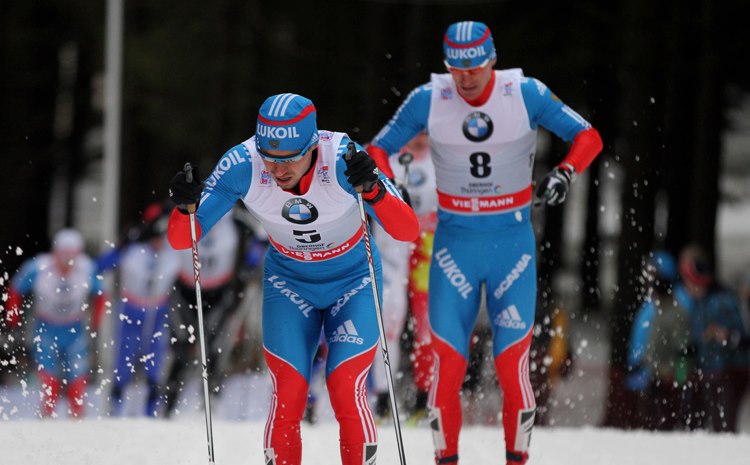
Maxim Vylegzhanin (bib #8), following teammate Ilya Chernousov (bib #5), on his way to 15 k classic pursuit victory in the second stage of the 2012/2013 Tour de Ski. It’s been reported that Vylegzhanin is among those named as an appellant in a suit filed with the Court of Arbitration for Sport. (Photo: Marcel Hilger)
A recently published Langrenn story reported on the possibility that FIS may be forced to reconsider its recent ruling an Russian and Belarusian eligibility for participating in Period 1 of the 2025-2026 World Cup season. According to those reports, Russian athletes and para athletes—and the Russian Ski Federation—filed a law suit with the Court of Arbitration for Sport (CAS) seeking to overturn the recent FIS decision to bar Russian and Belarusian athletes from events this autumn (events that could allow athletes to qualify for the 2026 Winter Olympics). Included in the suit is former World Junior Champion (2022), Saveliy Korostelev. While details remain unfocused as to which other athletes are involved, it’s possible that former Russian stars, Alexander Legkov and Maxim Vylegzhanin, are also included in this law suit. That’s a curious list, since Legkov (who is thought to be retired) has not been a factor on the international stage since his two Olympic medals in 2014 (both of which were subsequently stripped from him following revelations of his involvement in Russian doping at those Sochi Olympic Games). Vylegzhanin’s two silver medals from Sochi were also stripped, but later reinstated. According to current reports, the skier who dominated Nordic events at the Beijing Olympics in 2022, Alexander Bolshunov, is not named as a participant in this suit.
In related news, the International Luge Federation (FIL) was recently sued by Russian athletes and federations under similar circumstances. CAS’ judgment in the case continued to exclude athletes from the Russian Luge Federation (RLF), while overturning FIL’s exclusion of Russian and Belarusian lugers who qualify as Neutral Athletes (AIN) . . . the end result being that FIL will need to set protocols and procedures for identifying AINs in order for any of those athletes to enter Olympic qualifying events this winter.
If the cross-country world is searching for precedent in their own case, this recent CAS/FIL ruling would seem to offer a direct parallel . . . and would seem to imply that it’s not unlikely that we may yet see Russian and Belarusian athletes toeing starting lines for Olympic cross-country events later this winter.
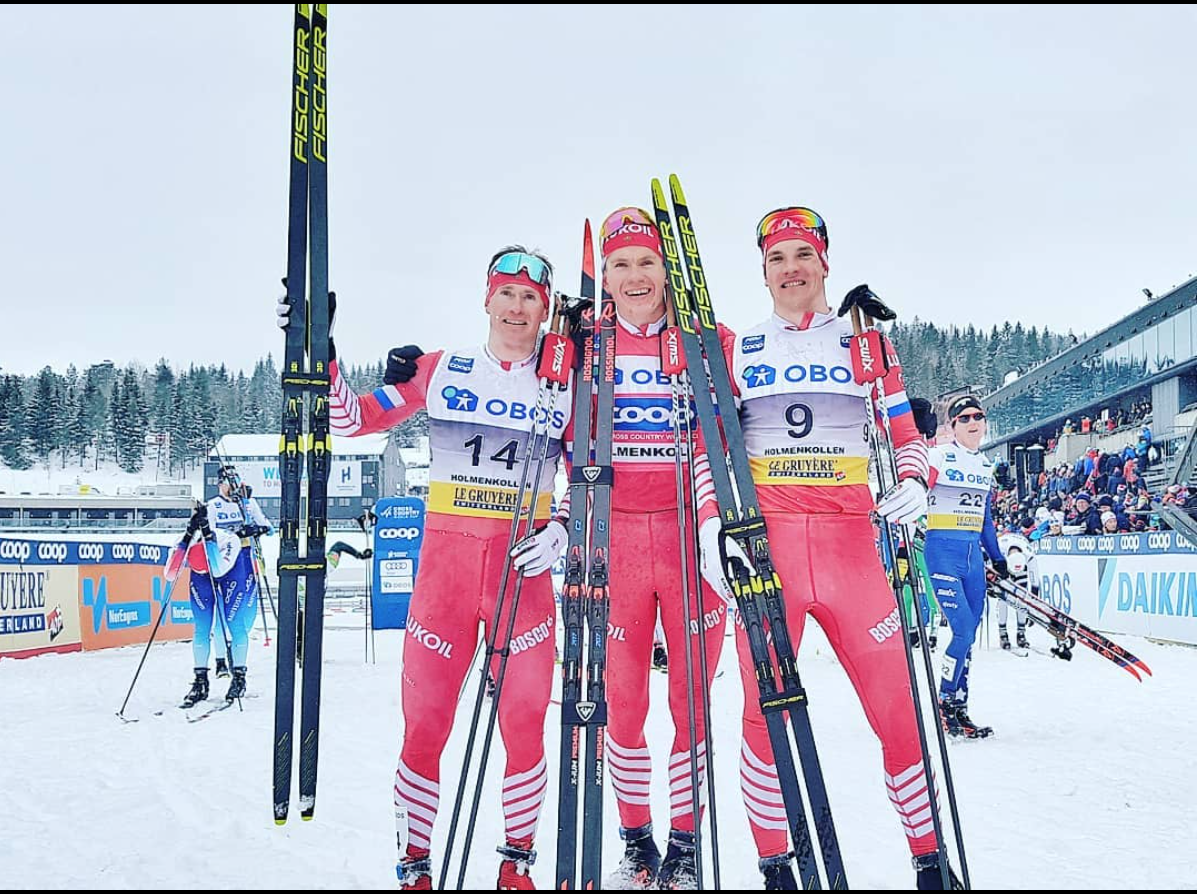
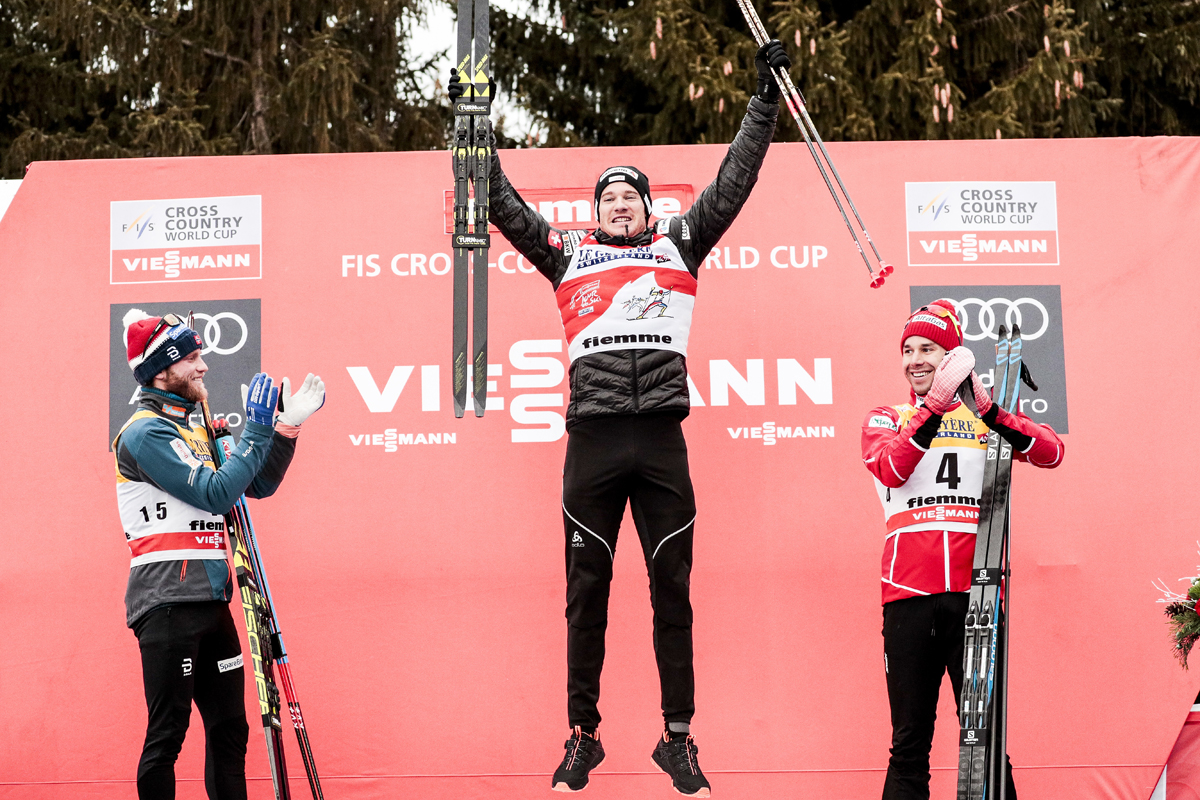
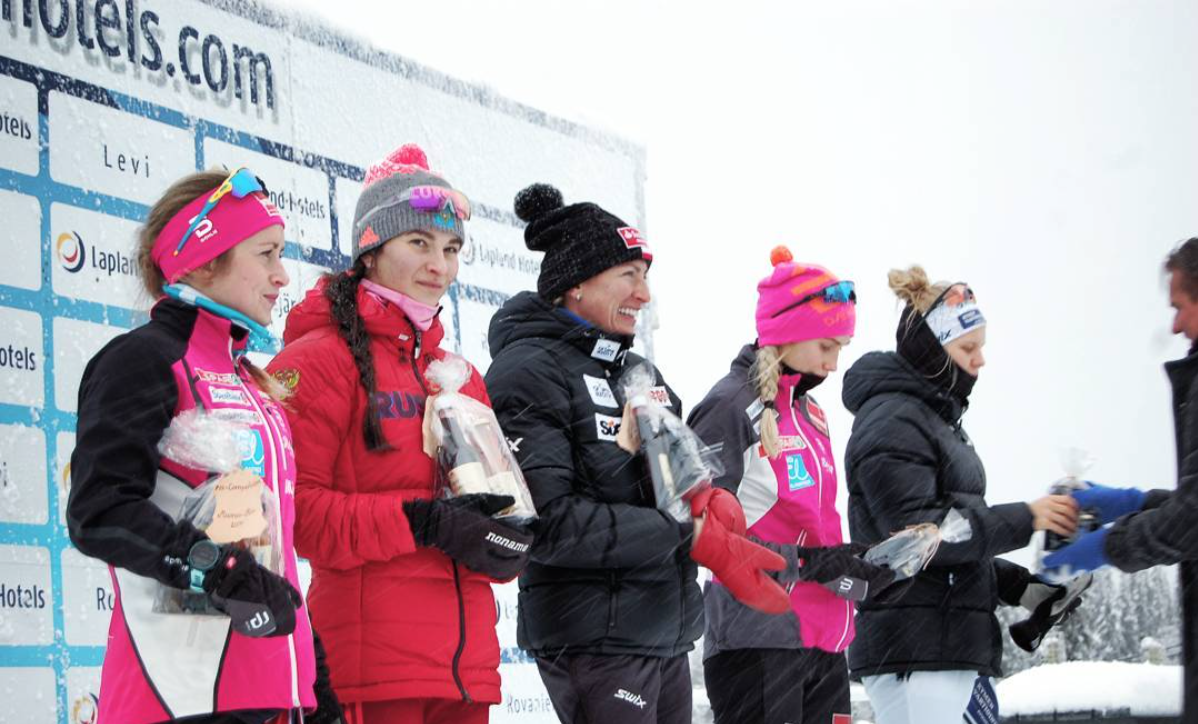
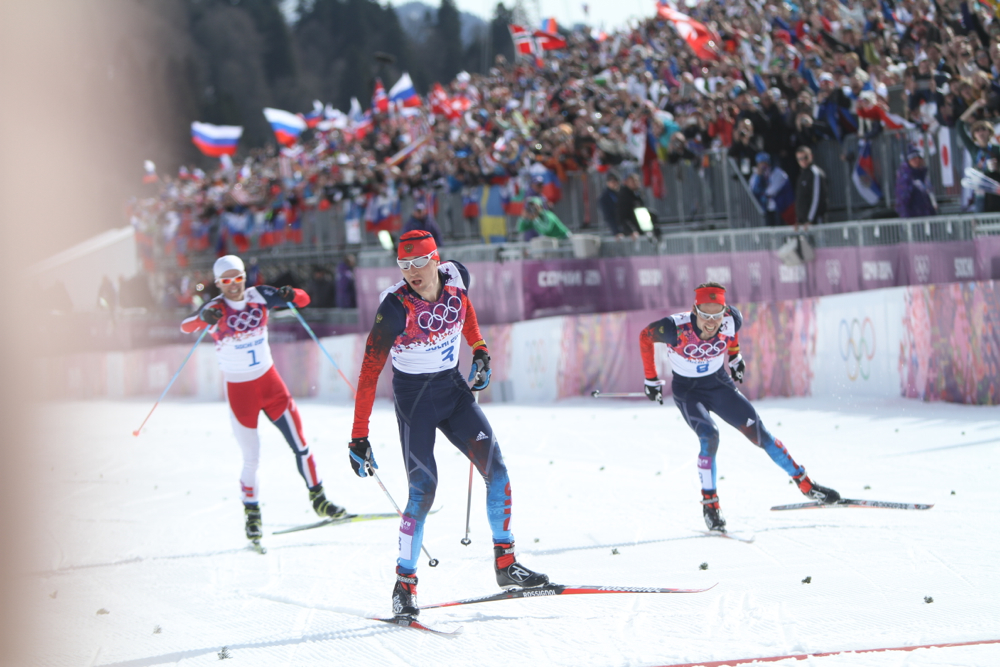
A clean sweep for Russia today. From left to right, Maxim Vylegzhanin was 2nd, Alexander Bolshunov was 1st and Andrey Larkov was third. (Photo: Screenshot/ FIS Instagram)
Russian skier, Alexander Bolshunov made history today during the Holmenkollen 50-kilometer classic mass start race. With his victory, Bolshunov became the youngest person and the third Russian to win the storied Holmenkollen 50 k. Bolshunov finished today’s race in 2:23:49.8 hours.
For Bolshunov, who comes off a World Championships during which he won four silver medals, this was his fourth World Cup win of the season. The victory on Saturday reinforced Bolshunov’s lead in the World Cup distance cup rankings and he leapfrogged Norway’s Johannes Høsflot Klæbo for the overall World Cup lead. Bolshunov has amassed 1,230 points to Klæbo’s 1,181. Klæbo placed 38th in Saturday’s race.
Bolshunov spoke about the end of the season and how he is approaching these finals races with a FIS reporter after the race, “At the end of the season, it is a necessity to show his best results each race and to fight in each race until the end and hopefully everything will be done.”
The race featured no solo attack that could break away from the A-list of distance specialists. The lead was tossed around a number of times and for the first half of the race, Norway’s fans were treated to a 30-plus deep train of skiers engined by Sjur Røthe, Martin Johnsrud Sundby and Emil Iversen. But the ebb and flow of the 50 k allows skiers to sit in the pack, buy their time, conserve resources, then pounce.
With 10 k to go, Russian skiers moved to the front, and began dictating the pace. At 1.6 k remaining, a Russian foursome consisting of Maxim Vylegzhanin, Andrey Larkov, Bolshunov, and Ilia Semikov were defining the flag waving rights on Norway’s holy-grail of ski loops.
The race came down to the finishing stretch with Bolshunov charging into the finish, double poling all the way, and out sprinting his teammates to take the win. Vylegzhanin placed second and his teammates, Andrey Larkov and Illia Semikov, came in third and fourth respectively.
This was the last World Cup race for Vylegzhanin who is retiring at the end of this season; this was his 24th podium in his career, but his first this season.
Vylegzhanin spoke to a FIS reporter after the race, via a translator, “Of course it was a pleasure to see all the people coming to see me and congratulate me on the finish line and after the finish. The Russian team is very strong, we got all four places and we have many young potentials here who are proof that the Russian team is a very strong team. I started here at Holmenkollen in 2007 with the 7th place and since then I was getting 4th, 3rd, 2nd and actually it’s my best place to compete here.”
Those skiing in the back of the well defined lead pack only began dropping off during the last 3 k. At that point, the Russians ramped up the pace and only Norway’s Martin Johnsrud Sundby, and Canada’s Alex Harvey were able to hang tightly connected to the Russians.
The top 11 finishers were dominated by Russia and Norway. Russia took the top four spots as well as the tenth spot and Norway went 6, 7, 8, 9 and 11. Harvey was the only skier to break this pattern, finishing fifth overall.
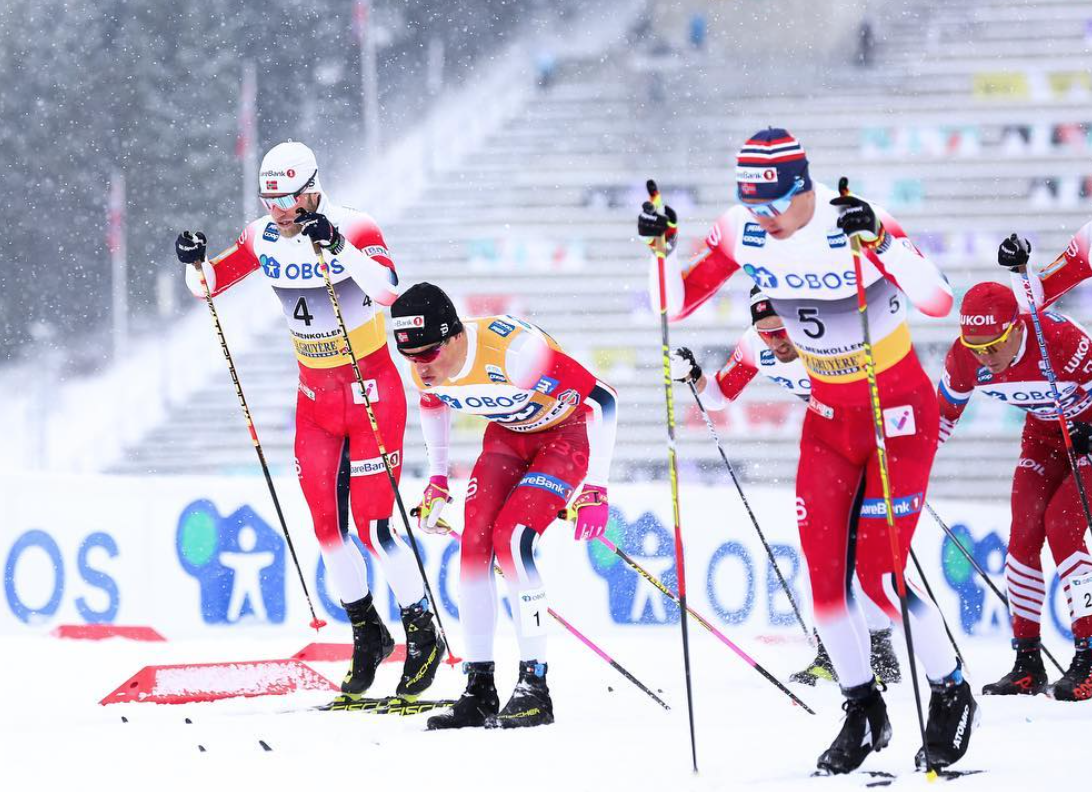
Norwegian racers Marin Johnsrud Sundby, Johannes Høsflot Klæbo and Simen Hegstad Krueger starting the Holmenkollen 50k off strong (Photo: Screenshot/Holmenkollen Ski Fest Instagram/Jacques Holst)
Harvey’s fifth place on Saturday matched his career best Holmenkollen 50 k finish — he was fifth during the 2011 Oslo World Chamionship’s 50 k skate. On Saturday, Harvey skied with the lead pack the entire race, sitting in the top 20 until the last 5k when he started making his way toward the front of the pack.
“This year in classic, I never had good feelings really, so today was the first day I felt like I could actually race in classic, “ Harvey told FasterSkier in the mixed zone. “But of course, coming so close to the podium is always bittersweet. But the Russians, I think you could tell, had better skis, better glide. They were struggling on the kick but really high speed, so in the end they were really strong. So it was a really good race for me, but the podium was close, I could taste it.”
He continued on, discussing today’s race pace, “It was a fairly easy pace the whole way. There was a huge group and guys were slowly getting dropped off the back, but there was never a big attack. So for me personally, I was in control the whole time, but I had good shape and pretty easy kicking skis.”
U.S. Ski Team member Scott Patterson finished 19th. This was Patterson’s best individual finish of the season. He skied with the lead pack until the last 3.75k, when he began to fall back.
“This is my fourth time racing Holmenkollen, so I know that pack hangs on and people just start shooting off that back on the last couple laps,” Patterson told FasterSkier in Oslo. “So I figured I’d ski with that pack for as long as I could and hope I had energy for the finish. I think I did pretty good, I was pretty low on energy for that last 3.75, but it worked out pretty well.”
In Oslo on Saturday, U.S. skiers Adam Martin (CGRP) and Kyle Bratrud (SMS T2) were 31st and 40th respectively. Ben Lustgarten (CGRP) did not finish the race.
Holmenkollen is a unique experience for races, with crowds, snow sculptures and bonfires lining the entire race course. It is essentially an end of season party for athletes and spectators alike.
Norris commented on the atmosphere, “This is a highlight of the season. The crowd is so loud up top, and it’s so awesome to be here.”
Harvey also appreciated the spectacle of the event, he told FasterSkier, “Having a little party is good for the sport, it make for good images. When the legs are screaming, to hear so much noise, it’s like you stop thinking for a bit, when you’re so exhausted, it kind of keeps you going.”
Racing continues tomorrow in Oslo with the women’s 30 k classic.
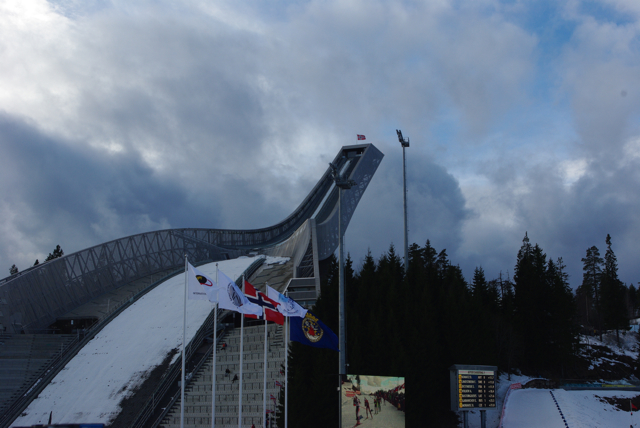
The Holmenkollen jump overloooks the iconic venue above Oslo, Norway.
FIS World Cup Oslo, Norway Holmenkollen 50 K Mass Start Classic
Today’s podium at the men’s 50-kilometer mass start classic at Holmenkollen involved a tight group of skiers, many of them Russians and Norwegians.
Of the top-11 skiers, five were from Russia, five from Norway with the lone wolf slotted in there, Alex Harvey from Canada.
Russia swept the podium with twenty-two-year-old Alexander Bolshunov placing first in 2:23:49.8 hours. Maxim Vylegzhanin was second (+1.0), and Andrey Larkov third (+1.6). For good measure, Ilia Semikov, also from Russia, skied to fourth (+2.0).
Harvey, in his final appearance at Holmenkollen, placed fifth (+4.6). Norway took sixth through ninth.
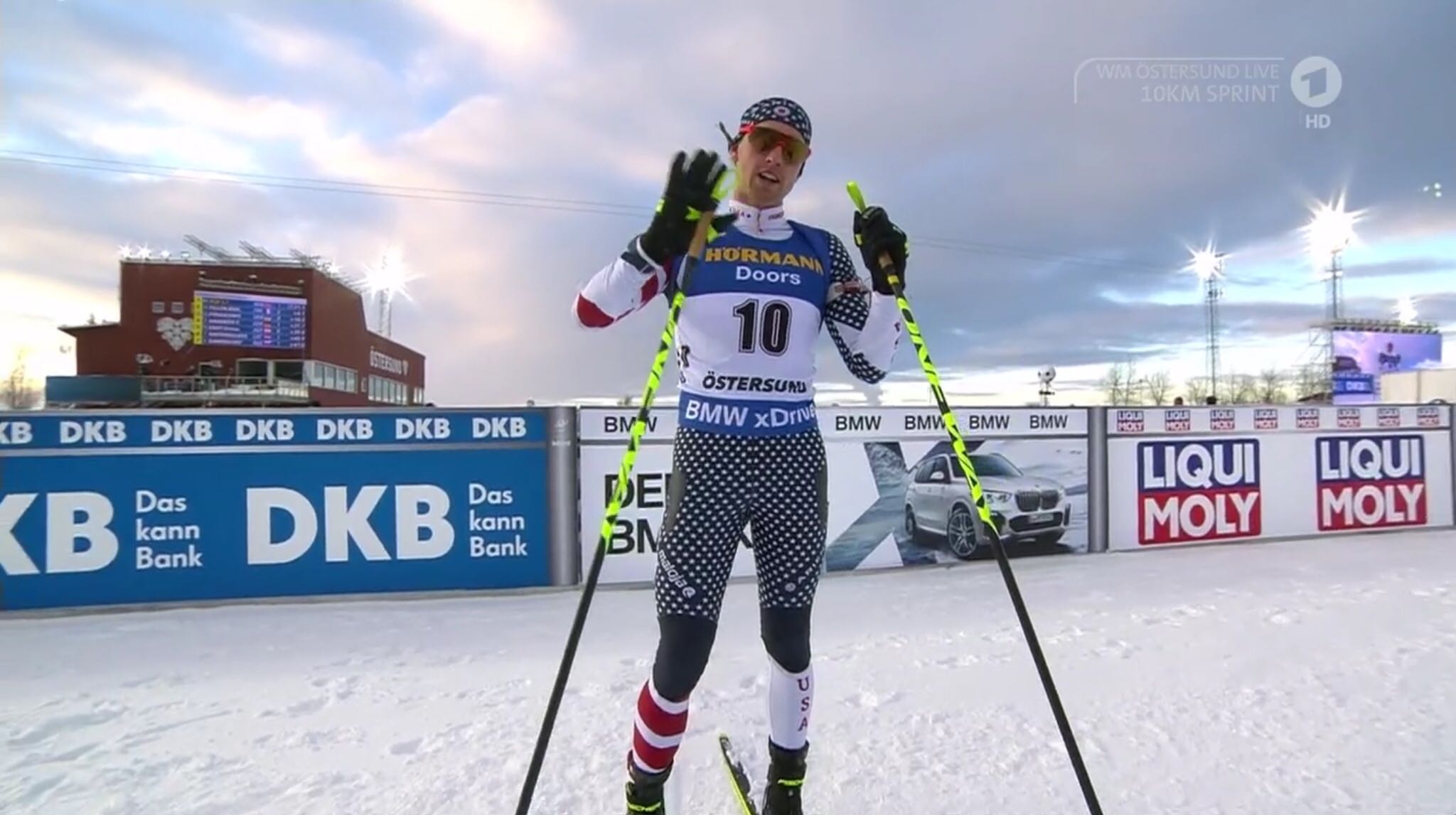
On Saturday in Östersund, Sweden, the IBU World Cup men’s field raced a 10-kilometer sprint, with Norway’s Johannes Thingnes Bø took the win, completing the course in a time of 24:37.6 after one miss (0+1). Russia’s Alexander Loginov placed second after shooting 100 percent and finishing 13.7 seconds behind Bø. Third place went to France’s Quentin Fillon Maillet, who also shot clean and finished 16.5 seconds behind the winner.
Leading the way for the North Americans was the U.S.’s Sean Doherty in 22nd. Doherty shot clean and finished 1:32.1 minutes back from Bø. Just outside the Top 30 was American Leif Nordgren who also had a perfect shooting score and finished 1:51.5 minutes off the winning time.
American Sean Doherty ater placing 22nd on Saturday in the men’s IBU World Cup 10-kilometer sprint held in Östersund, Sweden. (Photo: ZDF Screenshot)
Racing for Canada, Scott Gow finished in 50th (+2:18.2) after one miss. U.S. skier Jake Brown placed 58th (+2:41.0) after three misses (0+3) and Canadian Aidan Millar 61st (+2:43.5) with one missed shot (1+0). Two more Canadians raced on Saturday, with Jules Burnotte placing 76th (+3:18.1) after two misses and Christian Gow finishing in 84th (+3:32.5) after four missed shots (2+2).
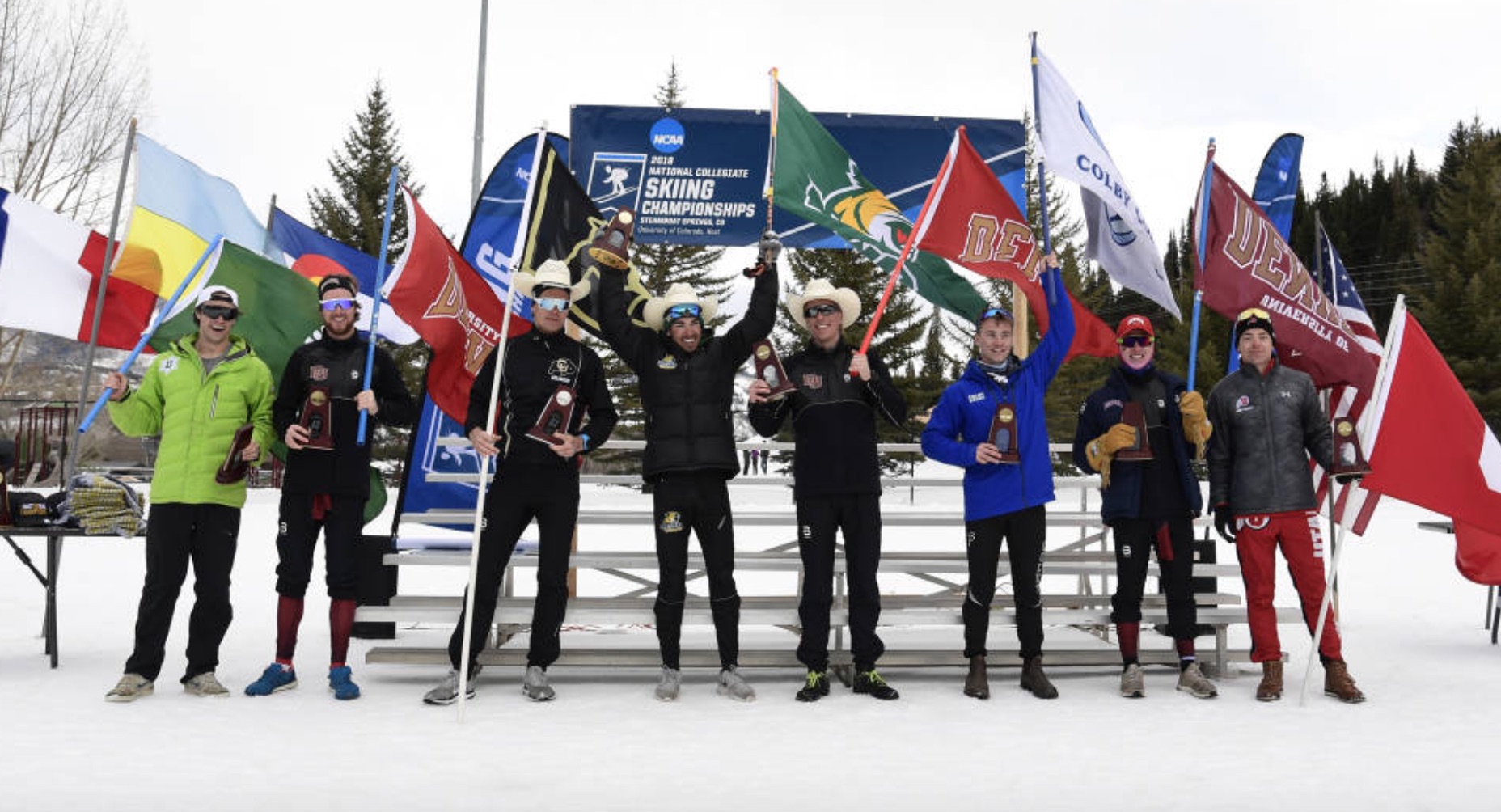
The 2019 NCAA Skiing National Championships wrapped up on Saturday, with the University of Utah taking home the overall title. Utah finished with 530.5 points, followed by the University of Vermont with 476 points, and Colorado University with 455 points.
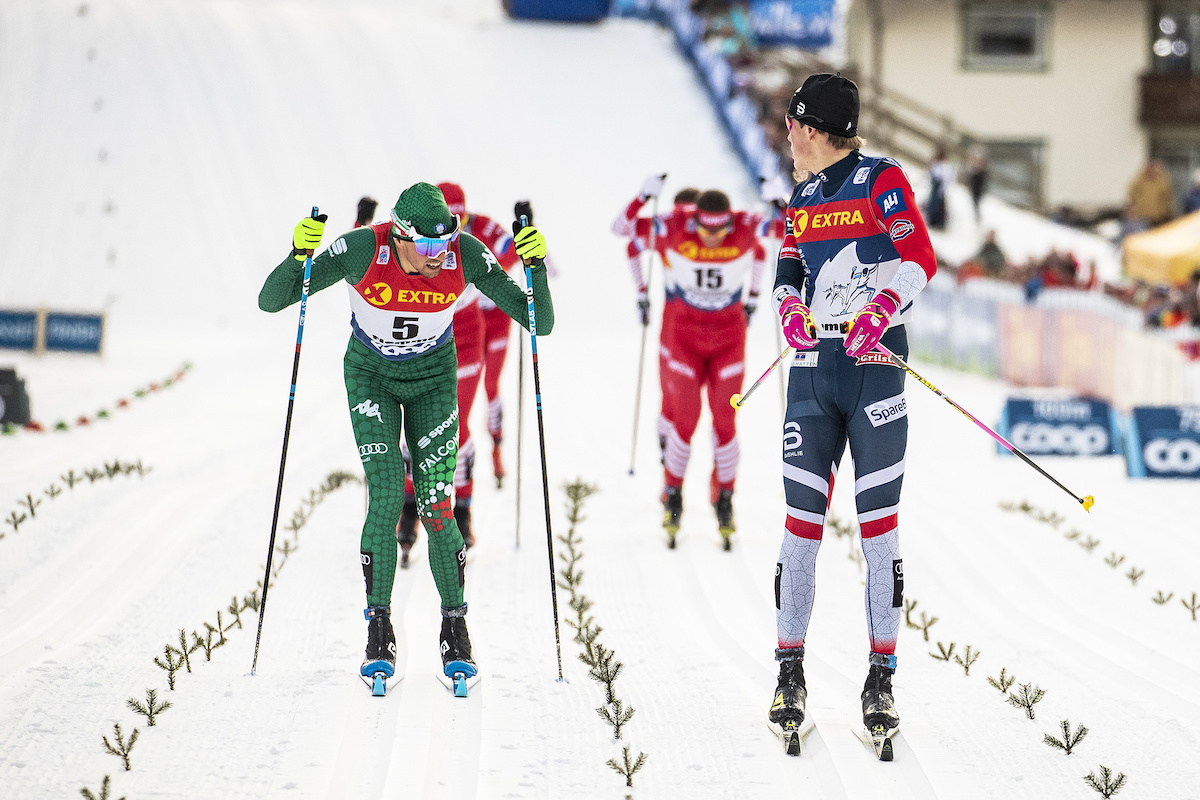
Norway’s Johannes Høsflot Klæbo (r) crossing ahead of Italy’s Francesco de Fabiani to secure his fourth win of the 2019 TdS. He placed first in the men’s 15-kilometer classic event on Saturday in Val di Fiemme, Italy. (Photo: Fischer/Nordic Focus)
The final stages of the Tour de Ski (TdS) often bring drama: the attrition of some athletes leaving opportunity for others.
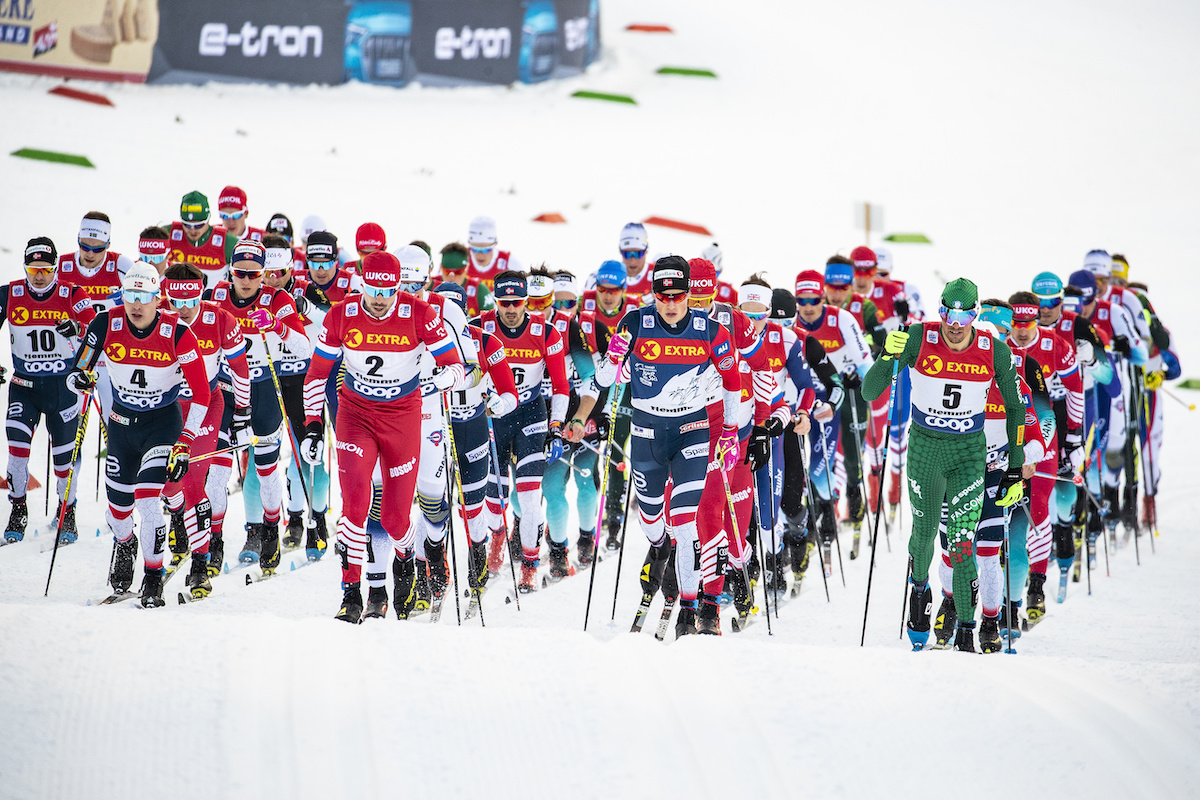
Among the 45 male competitors who chose to start Saturday’s TdS Stage 6 of 7–a 15-kilometer classic mass start in Val di Fiemme, Italy–some may have been experiencing fatigue from racing the Tour’s previous five stages; others may have been finding their peak. For Italy’s Francesco de Fabiani, who started Saturday in bib number 5, it looked like the latter.
With a little less than half a kilometer to go, the Italian appeared to be reeling in a win for Italy. He had stormed to the front of the lead pack–which consisted of two Norwegians Johannes Høsflot Klæbo and Hans Christer Holund, as well as four Russians – Alexander Bolshunov, Andrey Larkov, Maxim Vylegzhanin, and Andrey Sobakarev – in the final climb. A gap between de Fabiani and the final six expanded to almost a meter by the crest of the last uphill.
But as de Fabiani made headway into the final descent and toward the finishing stretch, the shadow of one skier closed in. One that few would choose as their counterpart in a sprint to the finish. Klæbo.
The Norwegian’s skis had caught up to de Fabiani by the bottom of the hill and as the duo approached the final 50-meter stretch to the finish line, Klæbo switched lanes and shadowed on de Fabiani’s left.
The Italian worked to stave off the powerful double poles of Klæbo, but with the race’s two bonus sprints already in the bag, Klæbo was not about to let up on the finish line sprint. He ousted de Fabiani in the 15 k’s final tracks, crossing first in a time of 40:52.6 minutes. De Fabiani crossed 0.6 tenths of a second behind the Norwegian for second place.
“I think it was really tough in the last uphill,” Klæbo said during a FIS interview after the race. “But I [managed to] get a stream down before the finish line then I held a little bit higher speed than the Italian guy so then it was just full speed to the finish and I’m not stopping before I cross the finish line now.”
The start of the men’s Stage 6 15 k mass start classic of the 2018/2019 Tour de Ski. (Photo: Fischer/Nordic Focus)
The victory marks Klæbo’s fourth of the Tour: he opened with a win in Stage 1, a freestyle sprint in Toblach, before moving on to place 12th in Stage 2 and winning Stage 3, another skate sprint in Val Müstair. After a ninth-place finish in Stage 4, he returned to the top of the podium in Stage 5, claiming first in the Oberstdorf 15 k pursuit.
His victory in Stage 6 makes him the first male in history to win four stages while still a U23 (he turned 22 this October). He also now has back-to-back TdS wins–the last Norwegian to do so was Martin Johnsrud Sundby in 2016. Notably, this is also Klæbo’s first TdS. He is now leading the men’s overall TdS standings and will start tomorrow’s final stage climb 1:20.4 ahead of Russia’s Sergey Ustiugov, who is currently ranked second in the TdS overall standings.
“Today was really hard and I was a bit afraid of the Russian guys because I heard that they were going to set a high speed but I had a very good day and took a lot of bonus second as well so it was really really cool to be first,” Klæbo said.
For the 25-year-old de Fabiani, Saturday’s second place finish is his seventh individual podium on the World Cup. One of those podiums came earlier in this season’s TdS, as he also garnered a second place finish in Stage 4, also a 15 k classic mass start. He has now moved up to fourth in the overall TdS standings after his performance in Stage 6.
Norway’s Johannes Høsflot Klæbo (r) crossing ahead of Italy’s Francesco de Fabiani to secure his fourth win of the 2019 TdS. He placed first in the men’s 15-kilometer classic event on Saturday in Val di Fiemme, Italy. (Photo: Fischer/Nordic Focus)
Taking the third position in Stage 6 on Saturday was Russia’s Alexander Bolshonov, who crossed 2.6 seconds behind Klæbo.
The Russian had perhaps been looking more for the win. At the 11.4 k mark, he was at the helm of the lead group, which was still 20 skiers strong at that point. In another kilometer and a half, the front had finally dwindled to seven, with a pull from Sobakarev stringing out a pack consisting of Bolshunov, Klæbo, Holund, Vylegzhanin, Larkov and de Fabiani. Bolshunov continued to set the pace until the final kilometer when a push from de Fabiani caused racers to scramble.
The Italian’s pace proved one that only Klæbo could match. Following Bolshunov in third was Larkov in fourth (+3.4), Vylegzhanin in fifth (+4.6), Sobakarev in sixth (+6.3), Holund in seventh (+13.0) Russian Denis Spitsov in eighth (+27.1), Great Britain’s Andrew Musgrave in ninth (+29.0) and Norway’s Martin Johnsrud Sundby in tenth (+29.9).
The lone North American to start Stage 6 was U.S. skier, Ben Lustgarten who finished the day in 44th (+5:31.7).
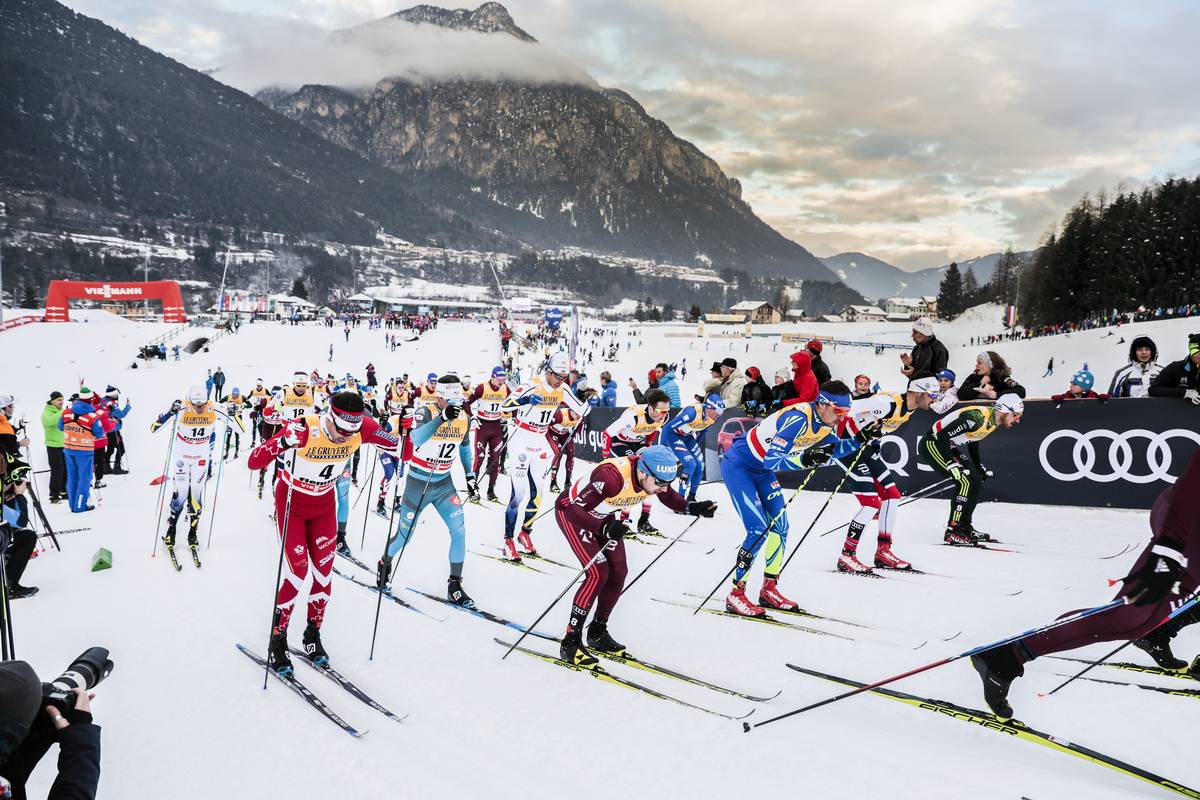
The start of the men’s 15 k classic mass start at Stage 6 of the 2018 Tour de Ski on Saturday in Val di Fiemme, Italy, with (front row, left to right) Canada’s Alex Harvey, Russia’s Sergey Ustiugov, Kazakhstan’s Alexey Poltoranin, Norway’s Martin Johnsrud Sundby, and Switzerland’s Dario Cologna. (Photo: Salomon/NordicFocus)
Beginning this Saturday in Toblach, Italy with a freestyle sprint is the 13th edition of the Tour de Ski (TdS). According to the International Ski Federation (FIS), over the course of seven stages the men will race 80.918 kilometers, the women 60.67 k.
The TdS has become both a staple and a spectacle of the annual World Cup calendar. With a jam-packed series of races primacy is placed on both the ability to recover well and wither less as the TdS transpires.
Prognostication can be tricky in a long-form template like the TdS. So much can go astray during seven races not to mention the travel and dicey germ-avoidance.
Last season’s winner on the women’s side, Heidi Weng of Norway, sits 18th overall in the World Cup standings (14th in distance). She has four top-20’s in the four distance events she’s contested with her best result an eighth in Lillehammer’s 10 k skate. Although featuring two sprints in the first three stages, the TdS remains a distance skier’s paradise.
Weng has skied solidly on the World Cup, but she has yet to show the form that made her a TdS overall winner in 2017 and 2018. Norway has won the last five iterations of the TdS: Marit Bjørgen won once in 2014/2015, Therese Johaug twice (2013/2014, 2015/2016), and Weng the last two years.
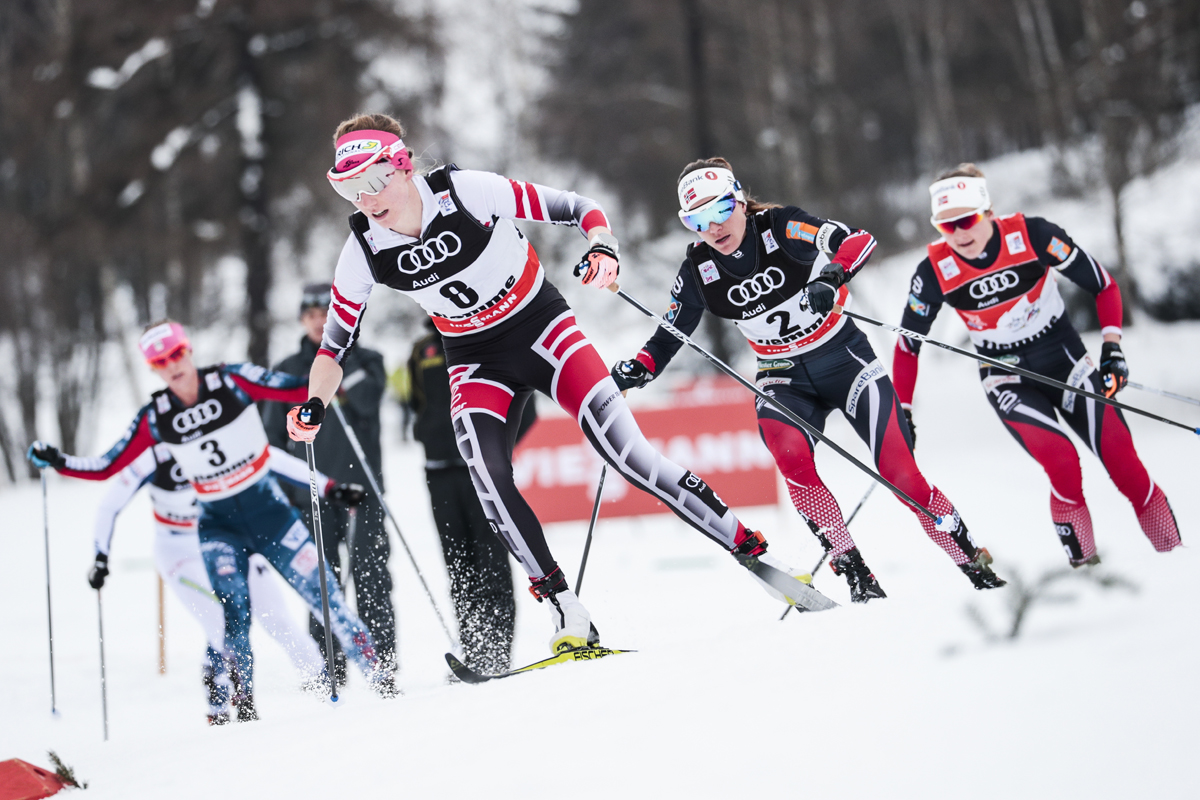
Austria’s Teresa Stadlober leads Norway’s Heidi Weng (2) and Ingvild Flugstad Østberg, American Jessie Diggins (3) and others around a downhill corner during the women’s 10 k classic mass start at Stage 6 of the 2018 Tour de Ski in Val di Fiemme, Italy. (Photo: Fischer/NordicFocus)
If Norway is to keep the streak alive, Ingvild Flugstad Østberg, last year’s TdS runner up, could be the heir apparent. She currently ranks second in the World Cup overall and 15th on the sprint list.
Johaug, having returned from an 18 month doping ban, has been on a distance race tear. She has won all five World Cup distance events this season. Johaug, however, will not be lining up for the TdS.
Only five different women have earned distance podiums this season — Johaug, Østberg, Sweden’s Charlotte Kalla and Ebba Andersson, and Finland’s Krista Pärmäkoski. Along with Johaug, Kalla and Andersson are skipping the TdS. (Andersson sits third overall on the World Cup, Kalla fifth.) With the TdS missing three of the five top ranked World Cup distance skiers, daily stages and the overall podium are up for grabs.
Last season’s third overall finisher, Jessie Diggins of the U.S. Ski Team (USST), often cites the TdS as a point in the season when her form trends towards podium performances. She sits eighth in the current distance standings and could very well have a stout TdS.
Russia’s Natalia Belorukova and Yulia Nepryaeva look strong as does Sadie Bjornsen (USST), and Austria’s Teresa Stadlober.
With less than predictable distance stage podiums for the women, it may simply come down to a drag race on the Alpe Cermis final climb Jan. 6.
Switzerland’s Dario Cologna (c) celebrates his fourth Tour de Ski overall title. He was joined by Norway’s Martin Johnsrud Sundby (l) and Canada’s Alex Harvey (r) on the podium in second and third, respectively. (Photo: Fischer/NordicFocus)
The men’s scene is also open to interpretation. Last season’s TdS winner, Switzerland’s Dario Cologna, was in fact a surprise victor. Prior to Cologna’s stage two win in last year’s TdS, it had been nearly three years since the four time TdS overall winner had won a World Cup. Cologna sits 21st overall on the World Cup currently. Given last year’s resurgence, anything is possible for the Swiss skier.
Then there’s Martin Johnsrud Sundby form Norway. He finished on the TdS podium the last three years. At thirty-four-years-old, Sundby is ranked first on the distance list, with a second, a third, and a fourth place in distance races this season.
Sundby won the TdS on two occasions – in 2013/2014 and in 2016. His 2015 win was stripped after he tested positive for excessive levels of Salbutamol. He placed second in the past two Tours.
In a field rife with talent, Sundby’s ability to race and rebound and race and rebound will be tested. Sjur Røthe, Emil Iversen, and Didrik Tønseth— all from Norway— look in form. And there’s Norway’s Johannes Høsflot Klæbo. The winner of last season’s overall World Cup has had flashes of his past explosive self. He could be a TdS protagonist.
The men’s field is notably tight. Along with the Norwegians, several Russians could pop a podium, a stage win, and the overall. Russia comes with a loaded team ready to exploit. Alexander Bolshunov leads the overall World Cup – he’ll turn twenty two on Dec. 31st. He’s backed by teammates Evgeniy Belov, Andrey Melnichenko, and Denis Spitsov.
Canada’s Alex Harvey placed third overall last year and he looked stronger as the TdS progressed.
The Stages
Stage 1: Dec. 29, skate sprint in Toblach, Italy.
Stage 2: Dec. 30, 10 k/15 k skate in Toblach, Italy.
Stage 3: Jan. 1, skate sprint in Val Müstair, Switzerland.
Stage 4: Jan. 2, 10 k/15 k classic mass start in Oberstdorf, Germany.
Stage 5: Jan. 3, 10 k/15 k skate pursuit in Oberstdorf, Germany.
Stage 6: Jan. 5th, 10 k/15 k classic mass start in Val di Fiemme, Italy.
Stage 7: Jan 6th, 9 k final climb skate pursuit in Val di Fiemme, Italy.
Teams
United States
Women: Sophie Caldwell, Sadie Bjornsen, Jessie Diggins.
Men: Ben Lustgarten, Simi Hamilton, Erik Bjornsen, Kevin Bolger.
U.S. Ski Team Head Coach Chris Grover noted in a text that Caldwell, Hamilton, and Bolger will likely cease the TdS after the stage three sprint. Additionally, this is a small team for the U.S. at the TdS. Several athletes turned down TdS nominations including Scott Patterson (USST), Andy Newell (SMS T2/Salomon), Kyle Bratrud (SMS T2), Rosie Brennan (APU), Rosie Frankowski (APU), Caitlin Patterson (CGRP), and Julia Kern (SMS T2). These skiers plan on racing U.S. Nationals this January in Craftsbury, Vermont.
Canada
Women: Emily Nishikawa, Dahria Beatty
Men: Alex Harvey, Lenny Valjas, Bob Thompson
Norway
Women: Ingvild Flugstad Østberg, Maiken Caspersen Falla, Astrid Uhrenholdt Jacobsen, Kari Øyre Slind, Kathrine Rolsted Harsem, Heidi Weng, Lotta Udnes Weng, Tiril Udnes Weng Mari Eide, Anna Svendsen
Men: Martin Johnsrud Sundby, Hans Christer Holund, Emil Iversen, Didrik Tønseth, Simen Hegstad, Krüger, Sjur Røthe, Johannes Høsflot Klæbo, Martin Løwstrøm Nyenget, Eirik Brandsdal, Finn Hågen Krogh
Russia
Women: Yulia Belorukova, Lidia Durkina, Anna Zherebyateva, Mariya Istomina, Natalia Nepryaeva, Anna Nechaevskaya, Anastasia Sedova, Elena Soboleva
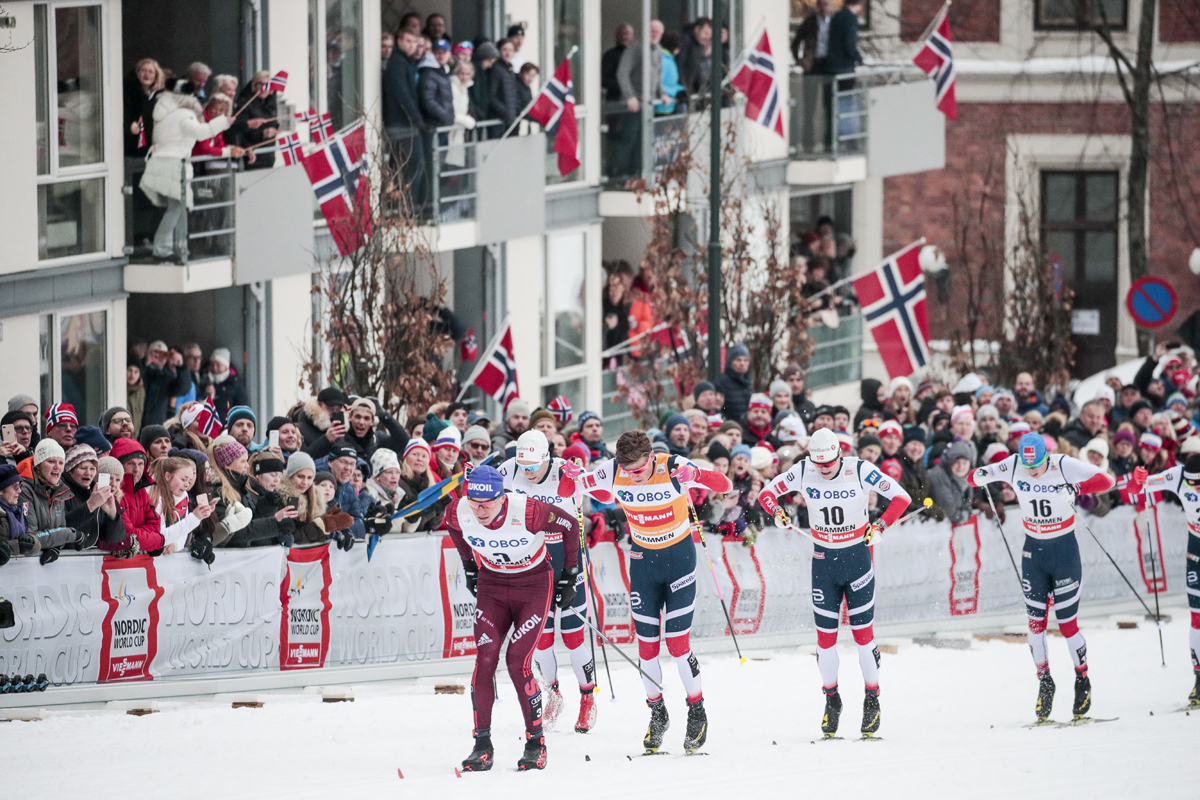
Russia’s Alexander Bolshunov leads five Norwegians in the men’s classic sprint final at the World Cup in Drammen, Norway: (from l to r) Eriik Brandsdal, Johannes Høsflot Klæbo (yellow bib), Sindre Bjørnestad Skar (10), Kasper Stadaas (16), and Emil Iversen. (Photo: Fischer/Nordic Focus)
Welcome to FasterSkier’s World Cup Preview, where we check in with the top-10 teams from last year’s FIS Cross Country World Cup tour before the season starts. The World Cup begins with a classic sprint in Ruka, Finland on Nov. 24th.
***
Russia
Overall in Nations Cup Last Year:3rd
Women’s Ranking 2017/2018:5th
Men’s Ranking 2017/2018:2nd
Russians to Watch:
For several years the attention grabbing fact about Russia was the morass of allegations and findings regarding rampant doping.
The bureaucratic seesaw teetering and tottering prior to the 2018 PyeongChang Games boiled down to will they or won’t they. As in, will Russian athletes be able to compete?
The Russian Federation was banned outright from the Games; it’s athletes competed under the IOC flag as Olympic Athletes from Russia (OAR).
The taint on competing Russian cross-country athletes last season was palpable. Clean or not, there was a sense of guilt by association. They must be a tough lot. Whatever psychic baggage the Russians carried as part of a shunned team, their collective results at the Olympics didn’t skip a beat. The same goes for the World Cup, where the group landed third overall in the Nation’s Cup.
A cadre of young Russian skiers propelled themselves into medal position. There was 22-year-old Denis Spitsov who missed a bronze in the Olympic 30 k skiathlon by less than three seconds. He placed third in the Holmenkollen 50 k skate.
The Russian men won silver in the PyeongChang 4 x 10 k relay.
By season’s end, Bolshunov was fifth overall in the World Cup standings. Added into Russia’s overall mix, Alexey Chervotkin was 11th overall, Usitugov 12th, Andrey Larkov 18th, Spitsov 20th, Maxim Vylegzhanin 27th, and Gleb Retivykh 30th.
Count them up, that’s seven men in the top-30 of the World Cup overall. Deep is deep.
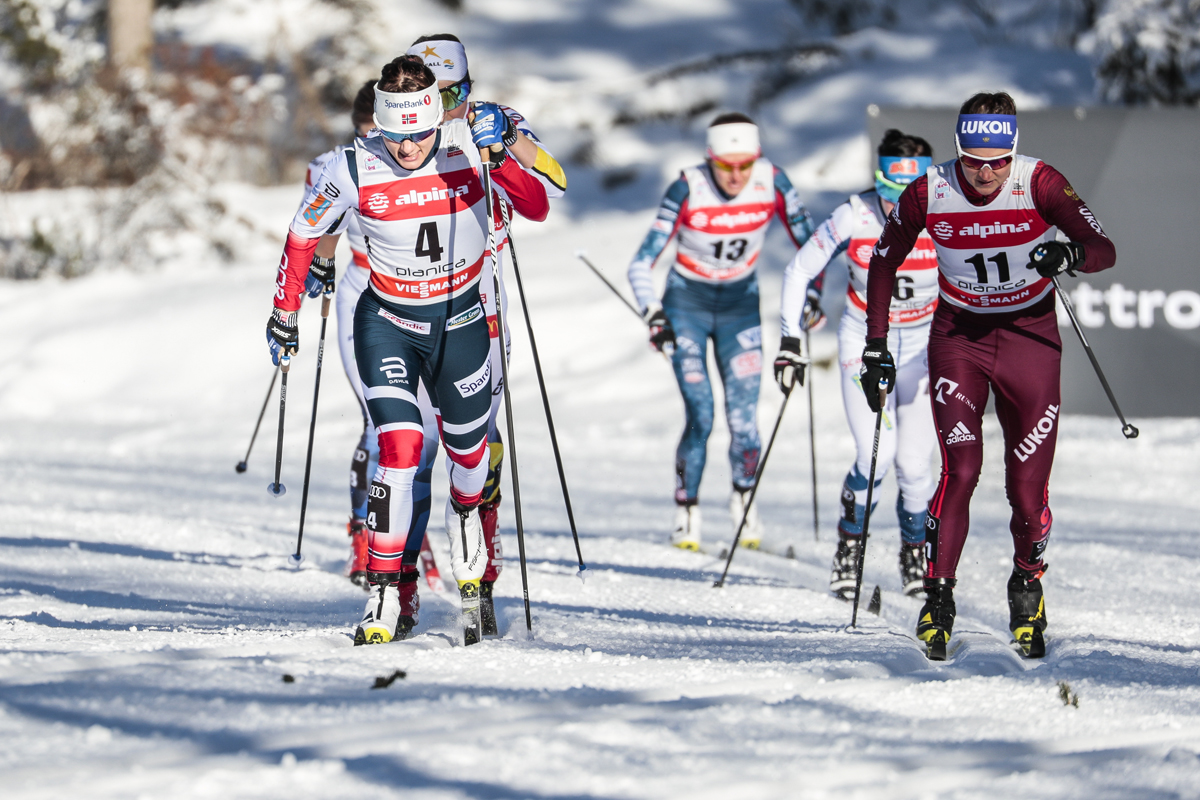
Maiken Caspersen Falla (NOR), Yulia Belorukova (RUS), (l-r) during the 2018 FIS world cup cross-country, individual sprint, Planica, Slovenia. (Photo: Fischer/Nordic Focus)
The Russian women had three athletes in the top-30 overall. Natalia Nepryaeva was ranked 13th, Anastasia Sedova 16th, and Yulia Belorukova 29th.
Nepryaeva, at twenty three years old, had three top-five finishes on the World Cup including a second place in Lahti’s 10 k classic. She placed fourth in the Olympic classic sprint and eighth in the 15 k skiathlon. Also at twenty-three-years-old, Belorukova podiumed on several occasions in World Cup sprints, and won bronze in the Olympic classic sprint.
In the Games 4 x 5 k relay, Nepryaeva, Belorukova, Sedova, and Anna Nechaevskaya, were third for Russia.
Beginning a new Olympic quadrennial, many years removed from Sochi but its dark-sided impacts still relatively fresh, Russia has new faces on the scene. The Russian Ski Federation appears that it can plug and play as it moves athletes into its winning pipeline.
Russia’s Alexander Legkov (3) after winning Olympic gold in the men’s 50 k freestyle mass start at the 2014 Winter Olympics in Sochi, Russia. Russia’s anti-doping director at the time, Grigory Rodchenkov stated that he switched out Legkov’s anti-doping sample for a vial of clean urine collected previously. The International Olympic Committee stripped Legkov of his gold medal and banned him from future Olympics, but the Court of Arbitration for Sport overturned those sanctions in February 2018.
Editor’s Note: The following thoroughly cited opinion piece, prompted by the 2017 ‘Icarus’ documentary, was written by Maks Zechel, a 20-year-old Canadian cross-country skier who spent the 2017/2018 race season training abroad with Team Asker in Norway. Zechel is a regular contributor at FasterSkier, with his ongoing series: “Closing the Gap”.
***
February 23, 2014
Sochi: a home Olympics and the opportunity of a lifetime. Russia, despite being one of the strongest skiing nations in the world, has no individual medals in cross-country skiing leading into the final race of the championships. As the athletes shuffle nervously in the tracks before the 50 k mass start, the pressure on the Russian men can be felt even by me, watching on TV from home.
Putin is in the stands. It’s just a ski race, but how much more than that is at stake?
“The Moscow Laboratory operated, for the protection of doped Russian athletes, within a State-dictated failsafe system” (McLaren 1)
A sunny day, a roaring home crowd. Alexander Legkov is in a world of his own as he absolutely destroys himself over the final climb, skiing with the passion that it takes in all sports to win an Olympic medal. Russian flags waving everywhere, the crowd is absolutely deafening as Legkov adds his first Olympic gold to his already legendary career. Maxim Vylegzhanin and Ilia Chernousov lunge across the line behind him, with Chernousov having given every last bit of himself to outsprint Norway’s Martin Johnsrud Sundby to complete the Russian podium sweep on home soil. A dream come true.
“The Sochi Laboratory operated a unique sample swapping methodology to enable doped Russian athletes to compete at the Games” (McLaren 1)
When you ski with your teammates in front of your friends and family at home, you ski with a fire that is otherwise difficult to find. The presence of those who know you makes you feel guilty if you do not perform to your very best, you are pushed to keep up to those that your mind refuses to admit defeat against, and your own potential reaches new heights when your teammates accomplish something great. There is no cover of anonymity with which to hide the secrets behind your performance, because these people know what it took, and did not take, to get you to where you are.
“A pre-selected group of Russian athletes competing at Sochi were protected by the Sochi sample swapping methodology” (McLaren 67)
Despite the whispers of corruption surrounding Russia’s Olympic team, I cheered for those three skiers, who did the nigh-impossible and pushed their bodies as hard as anyone else to make their country proud. I do not know what exactly went into achieving that medal, but I do know that the incredible display of effort and the tears of happiness falling from Legkov’s face as he was raised onto his teammate’s shoulders, were very real.
“After he became laboratory director, and in furtherance of his responsibility to improve Russian sport performance by covering up doping, Dr. Rodchenkov developed a steroid cocktail optimized to avoid detection” (McLaren 49)
I first dreamt of going to the Olympics when I was 11 years old. This dream sparked an inner drive of mine that has lasted almost a decade, and I like to think that it will never extinguish. Sometimes, I wonder what lights that same flame in children around the world. In most countries, I like to think that many experience moments like mine: a motivation flourished from watching the passion of the Olympics, being inspired by older siblings, or being born with the need to be the first kid through the school doors when the bell rings for recess.
“The steroids were dissolved in alcohol … The solution was then swished in the mouth in order to be absorbed by the bucal membrane and then spit out … the detection window for the steroids in the cocktail would not exceed 3-5 days” (McLaren 49-50)
In parts of the world where fewer children are fortunate enough to make the decision to pursue a sport just because they are inspired, I wonder what brings them to those future championships. Is their talent used out of joy or out of the need to provide for those without the same athletic abilities? Was their talent exploited at a young age as a way for a country to show its dominance? Were they given a choice: to follow their dreams and do what they love by the prescribed method, or to not follow their heart at all?
I think about the lengths that I would go to support my family if they depended on me, and suddenly the way that I pursue sport seems insignificant, a trivial lifestyle “earned” through right of birth. Being born to these opportunities makes it all the more important to not waste them. My great-grandfather used to say, “if you’re going to do something, then you may as well do it right”, and those are words that I attempt to live by. To me, that means clean sport.
But clean sport is now more at risk than it has been in decades. Once an already colossal task of catching individual dirty athletes, we are now facing an extensive doping regime, backed by an entire government.
“[B]y the time of the Olympic Games in London, many of Russia’s top athletes were using the cocktail” (McLaren 51)
When faced with the enormity of the Russian state-sponsored doping system, it is no longer adequate to simply prosecute individual athletes. A large part of the problem when it comes to justly dealing with the system that made it possible for Russian athletes to cheat, is that WADA and the IOC are pitted against the entirety of the Russian government. It is not the USA and Canada versus Russia, or any other country versus Russia; it is two sporting entities, independent of any particular country, against the full power of the Russian government.
“The Ministry of Sport directed, controlled and oversaw the manipulation of athlete’s analytical results or sample swapping, with the active participation and assistance of the FSB [Russian Federal Security Service], CSP [Center of Sports Preparation of National Teams of Russia], and both Moscow and Sochi Laboratories” (McLaren 1)
“… Deputy Minister of Sport, Yuri Nagornykh, was appointed in 2010 by Executive Order of then Prime Minister, Vladimir Putin” (McLaren 10)
The state-run doping program organized for the Sochi Olympics was not just about sport, it was politically motivated, overseen by President Putin himself. This sets Russia apart from previous doping scandals, such as that of the Finnish cross-country ski team in 2001, where doping operations were concentrated to a select number of skiers and their coaches. When the truth was uncovered about their national heroes, Finland, in complete shock, took steps to recover from the international disgrace that its ski team had brought upon them (Andrews). Iivo Niskanen and Krista Pärmäkoski have proven that it is possible for a great skiing nation to recover from such a disaster and win clean, paving the way for the next generation of Finnish skiers.
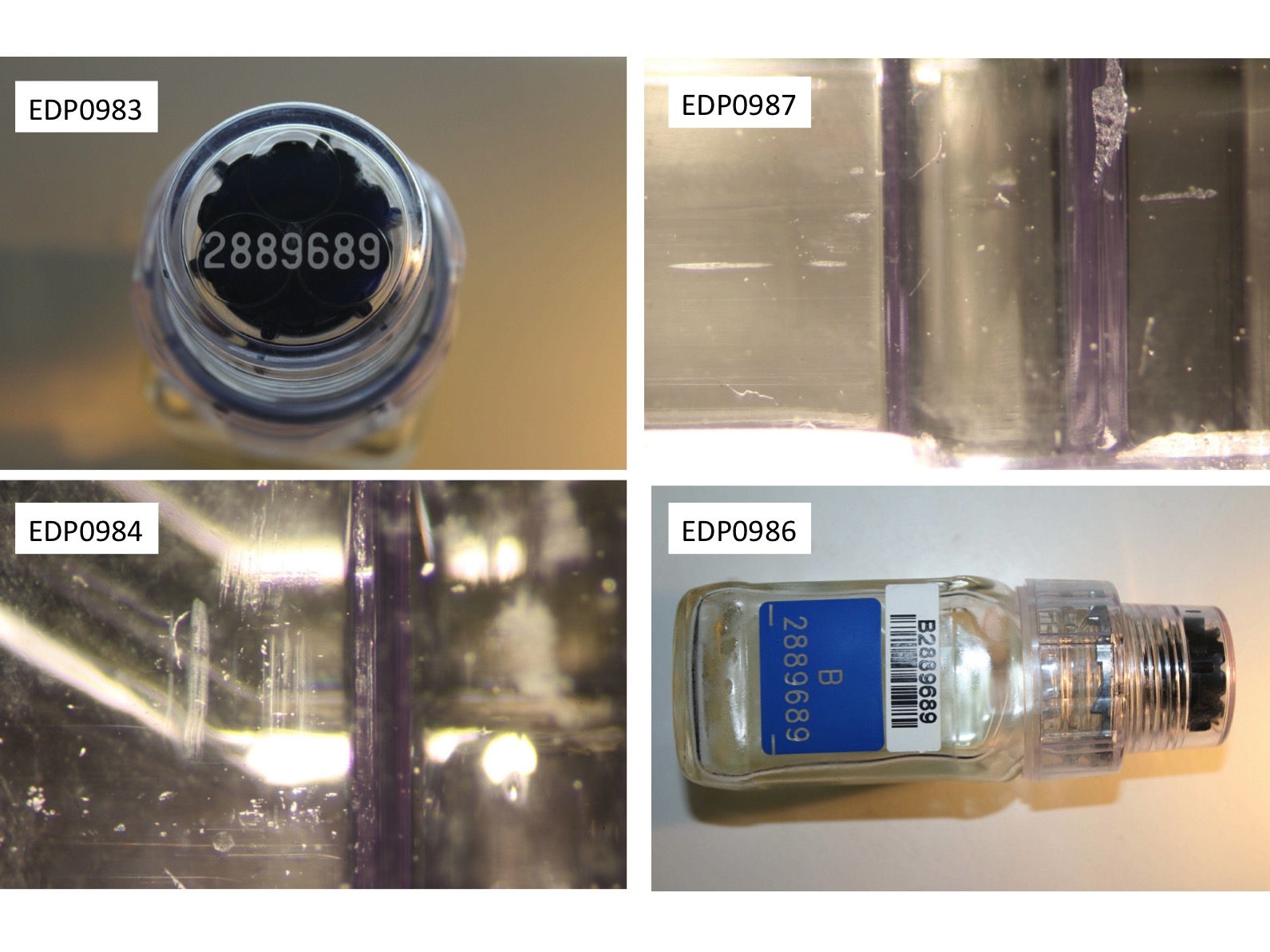
“ … this Article would prohibit altering identification numbers on a Doping Control form during Testing, breaking the B bottle at the time of B Sample analysis, or altering a Sample by the addition of a foreign substance” (“World Anti-Doping Code” 21)
The situation we see today is different. After the exposure of irrefutable evidence confirming state-sponsored doping and the covering up of doping evidence in Russia, it came as a disappointment to many when the Court of Arbitration for Sport (CAS) annulled the sanctions imposed by the IOC on 28 Russian athletes.
The evidence of coverups and doping are clear, but the CAS ruling was that “the evidence collected was found to be insufficient to establish that an anti-doping rule violation (ADRV) was committed by the athletes concerned” (“Media Release”). The evidence may be adequate to find Russia guilty of state-sponsored doping, but it is not enough to build a case against each individual athlete. This is likely because of the destruction and tampering of drug tests and results by Russian “anti”-doping personnel and Article 10.5.1.2 of the World Anti-Doping Code, which states that, if the “detected Prohibited Substance came from a Contaminated Product, then the period of Ineligibility shall be, at a minimum, a reprimand and no period of Ineligibility, and at a maximum, two years Ineligibility” (“World Anti-Doping Code” 64).
But if the evidence is inadequate, then why are some Russian athletes still facing penalties? Alexander Legkov and Sergey Ustiugov were both unable to compete at the PyeongChang Olympics, but Ustiugov can still race on the World Cup, while Legkov cannot. Evidence against athletes like Legkov proves that they were in some way a part of the state-sponsored doping program, but it is difficult to legitimately sentence them when evidence proving exactly what they have done has been tampered with or destroyed. Athletes like Ustiugov have not been proven to be a part of Russian doping operations, but have violated Article 2.1 of the World Anti-Doping Code through their association with people who are a part of it. This article states that “Athletes and other Persons must not work with coaches, trainers, physicians or other Athlete Support Personnel who are Ineligible on account of an antidoping rule violation … Prohibited association need not involve any form of compensation. (“World Anti-Doping Code” 24).
Sport in Russia will never be fair until Russia takes responsibility for their crimes against clean sport. Whereas Finland bore the weight of what their athletes had done in 2001, and ensured that it would never happen again, the Russian government has more at stake than a few drugged athletes. When doping is politically motivated and backed by the state, I do not think it is possible to solve the issue through sanctions by sporting bodies such as WADA and the IOC alone. Until the Russian government is pushed by other nations to take an interest in ensuring that sports in Russia are clean, the problem can never be completely resolved.
Until substantial action is taken, we will continue to be caught up in a stalemate of “partial blanket bans” and other half-measures. When imposed on a level of command that is too low in the Russian doping system, these actions cannot bring about the outright eradication of doping that we seek. Are sports a high enough priority for entire countries to impose sanctions on the Russian government until they answer for their crimes against clean sport? Or will doping be protected by other political motivations that keep Russia inseparable from the rest of the world? The scope of the Russian government’s involvement in doping is far beyond the reach of traditional sporting sanctions.
“Clean sport is dead” — Jim Walden, lawyer of Dr. Grigory Rodchenkov (Panja and Pérez-Peña).
The sporting world no longer holds its breath in anticipation of change. An uncertain future exists for clean sport, but even more disconcerting is the stagnation in which we now settle. With the anti-doping world left spinning its tires in frustration, where does that leave athletes for whom a future of fair play is too late?
Icarus, 2017 documentary film, debuted Aug. 4, 2017 on Netflix (Photo: Wikipedia)
In his dramatic documentary, Icarus, director Bryan Fogel convinced many sports fans that clean athletics, despite the improvement of anti-doping efforts over the years, is a hopeless pursuit. Fogel’s documentary was key to bringing the extent of systematic doping in Russia into the public eye.
In Icarus, Fogel takes anti-doping research to a personal level: after years of training as a high-level (amateur) cyclist, he spends a full year preparing for the “Haute Route” amateur cycling event, while following a doping program. This was prescribed to him by Dr. Grigory Rodchenkov (the former director of Russia’s Anti-Doping Center, turned whistleblower, who is now under the witness protection program in the U.S.).
Fogel routinely took a cocktail of PEDs (Performance Enhancing Drugs), under the careful guidance of Dr. Rodchenkov, and saw massive improvements in his power output ratings on the bike in less than a year. Having placed 14th in the seven-day Haute Route event the previous year, while racing clean, it seemed clear that Fogel would be a strong contender for the win.
He ended up finishing the unbelievably hard event in a far worse position than when he raced clean. From an athlete’s perspective, this does not surprise me. I understand that there are countless elements involved in producing an incredible athletic performance at a set time and place. Fogel’s reaction was different; visibly depressed, he talked of how sobering it was to realize that, no matter what he did, he could never be as great as his cycling heroes. This is a delusional conclusion, one that is biased by his dreams (influenced by growing up with Lance Armstrong as a hero) of becoming a better cyclist.
In these turbulent times for clean sport, it is important for athletes to remember that there are many aspects to training and competing, aside from other athletes cheating, that they can control. Living in Norway has taught me that there is a lot more to skiing fast than just being fit, and that applies to all sports.
Drugs don’t magically make you a fast skier, just like a high VO2 max score doesn’t make you a competitive World Cup skier. There are many elements to cross-country skiing that have a far bigger effect on a skier’s ability to ski fast than drugs do. If skiing were purely about fitness, aerobic machines like Hans Christer Holund would beat skiers with a lower VO2 max, like Petter Northug and Finn Hågen Krogh, without contest. Divergent technique revolutions, like those brought to us by pioneering skiers such as Petter Northug and Johannes Høsflot Klæbo, show us just how many ways there are to win a ski race.
In his reaction to not becoming a better cyclist even while doping, Bryan Fogel shows what he is: a film director with a remarkable story to tell. As most people would, he takes his failures in sport and attributes them to his personal characteristics; he feels he is simply not good enough at a genetic level. While not everyone will reach their athletic dreams, true failure occurs only when you stop trying after the first attempt. When athletes make changes to their training, it is rare to see dramatic results in the following competition season. Some things will never yield improvements, while other things take a few years of consistent work before they take effect. In the highly competitive world of cross-country skiing in Norway, many skiers go unnoticed down the results list for years, they are seen as average, before suddenly rocketing to incredible new heights seemingly out of nowhere. That is the nature of how training, competition, and life stress the body and mind over a prolonged period of time. To take a one-year snippet of an athlete’s life and make broad conclusions about sport is naive.
An otherwise brave and instructive self-experiment that helped uncover the scope of how doping continues to mar the sporting world uncontestedly, Fogel’s conclusion of his doping experiment sends the wrong message to the audience viewing Icarus. The message he sends is that only extremely gifted humans can become great athletes. This personal look into how his experiences have affected him make his documentary engaging and dramatic, something that the genre normally lacks for your average movie audience. The devastation that Fogel portrays in this realization hits viewers hard and the movie adopts an “apocalyptic” tone from that point on. The worldwide end of clean sport is confirmed with Rodchenkov’s exposé of Russian state-sponsored doping and the footage of him escaping Russia with his life in danger. Icarus uncovers frightening realities that affect the sports we love, but the film also incites new dangers to the culture surrounding sport.
Although accurate in their severity, the events at the end of Icarus doom its audience to pessimism against the current world of sports. This acts as fuel for ungrounded accusations against successful athletes by uninformed viewers. When a complicated issue arises, people quickly try to make sense of it by looking for a distinction between good and evil. By making an issue seem black and white, anyone can have a strong opinion about it, because the choosing of sides is based on your morals. You are either against doping, or you support it. Unfortunately, the issue is not so simple, but this type of inflamed, unschooled “debate” is perfect advertising for a film such as Icarus.
When making conclusions about an issue, it is our duty to question how someone else’s portrayal of events is affecting our opinion and to keep ourselves informed. FasterSkier Editor-at-Large Chelsea Little is an example of the brave reporting and investigating that it takes to keep organizations such as WADA and the IOC held accountable. We owe it to journalists like Chelsea, who sacrifice countless hours of their personal lives to enlighten us about the issues that affect us the most, to simply read their vital research. We must take the facts from the sources available to us, and add our own informed debate to the world of sport, because angry, baseless commentary are what keep humanity from moving forward.
Most Olympic athletes…would favour lifetime bans for doped athletes. IOC President, Thomas Bach, himself an Olympic champion, has publicly indicated a personal preference for life bans, but has correctly noted that the legal order, particularly in relation to human rights issues, will not permit such automatic sanctions, for first offences. Nor does the Code. The IOC itself has lost an appeal before CAS in respect of an IOC rule providing for the automatic exclusion of any doped athletes from Olympic competition in the Olympic Games next following the imposition of even a first doping sanction. (Pound, et al. 63)
It is our responsibility as athletes to represent all of those that have helped us and to lead by example. We can start with the atmosphere that we create amongst our fellow athletes. The culture of discrimination and groundless accusations against clean, Eastern-European athletes, or any successful athlete in endurance sports, has to stop. The “blame game” has some of the same ill-effects on our sport that we are trying to prevent by fighting against doping. Remember how ashamed Canadians felt when Ben Johnson, our “Olympic champion hero”, was caught for doping? Now imagine the irreversible damage that would have been done if he had been falsely accused. By telling young athletes that anyone doing something impressive — something that we could not imagine ourselves doing — is doping, teaches young athletes that no matter how hard they work, they will never become greater than their biggest dreams.
“The problems of the world cannot possibly be solved by skeptics or cynics, whose horizons are limited by the obvious realities. We need men [people] who can dream of things that never were, and ask why not.” — John F. Kennedy (“J.F.K. in Ireland”)
Teach young people to dream outside the realms of what they see as possible, and they will get there via the path you set them.
Athletes have the power to make more of a difference than just complaining about the flaws of their sport. Sports are visually flashy and exciting to an audience, and athletes are celebrated around the world for their raw fight against the limits of the human body. The hero-status of athletes gives them a sphere of influence greater than that of other members of society who work equally hard, or harder, in the goal of helping people.
The playing field of sport will never be equal for every child born on earth, when some athletes fight past obstacles far greater than the trials of sport, just to get to the start line. If we are lucky enough to be living the life of an athlete, it is not enough just to win medals.
Endurance sports may not get the same extent of attention as soccer, football, or basketball, but the popularity of these sports has elevated some athletes to leadership roles from which athletes from smaller sports can learn. Take LeBron James, one of the greatest basketball players of all time, who has recently come under fire for his comments regarding President Trump. Some feel that his place in society is to play basketball and entertain, not to comment on political events, but he has decided that his popularity gives him a greater responsibility than just playing sports:
“I mean too much to society [to ‘shut up and dribble’] … I mean too much to the youth, I mean too much to so many kids that feel like they don’t have a way out and they need someone to help lead them out of the situation they’re in.” — LeBron James (Conway)
As a Canadian, the opportunity that I have to pursue cross country skiing is a selfish privilege. I have the chance to use sport to meet new people, to inspire, and to use my experiences and influences to create a better world around me. Otherwise, I am just a lucky individual, riding on the support of those that I do little to help, enjoying what I have been given and doing little to share my wealth. I work hard at what I do, but to think that I am an inspiration to others simply through my existence would be incredibly pretentious. Athletes can gloat in their athletic prowess, or they can use their abilities to promote the joy of sport, health of body and mind, and the hard work involved in reaching a goal.
Good leadership is to rise and accept challenges even with the possibility of failure. Leaders show their true qualities, and that shows others that they can only achieve success by being their honest selves. Leaders show that there are no shortcuts.
My heart breaks every time that one of my idols is suspected of cheating. It doesn’t hurt because it’s unfair; it hurts because I saw myself in their footsteps, and every time they succeeded, I saw that I could, too. Our dreams scare us because they seem impossible from where we currently stand. When I look at my heroes, I see my future; they are living my dreams, proving them possible. My dreams are crushed when one of my favourite athletes is caught for doping, because that tells me that I am not good enough to be great. Some say that we watch the Olympics to witness the impossible happen, but I watch the Olympics to see the people who started off where I am accomplish the things that seem impossible to me now.
Despite the damning evidence against Russian sport as a whole, I refuse to believe that every Russian athlete is doping for the same reasons that I refuse to believe that the majority of top cross-country skiers are doping. It must be remembered that skiers are people, and the vast majority of people who have grown up surrounded by the positive and welcoming culture that exists in cross-country skiing around the world, do not become cheaters. Even in Norway, where skiing culture is on a much bigger scale than that of North America, it remains a community of people who love being outside year-round, exploring the world around them and the limits of their bodies.
We must keep sport a positive and safe space for people to grow into compassionate citizens of the world. Clean sport isn’t important just so that medals are handed out to the rightful winners; sport must remain possible for real people everywhere, because when doping is left unchecked, sport loses all significance as a tool to inspire, bring people together, and make the world a better place.
March 2, 2011
Alex Harvey (r) and Devon Kershaw (l) celebrating their World Championships gold in 2011 in Oslo.
My heart pounds in my chest. Adrenaline courses through my body as my ungainly 13-year old legs run chaotically down the front steps. The slam of the door behind me pierces the stillness of the heavy evening air, but to my ears the whole world is alive in celebration. The rush of blood in my ears is deafening as I relive the race in my head. Alex passing Hattestad — shushing the crowd across the line –raising his arms in disbelief — Devon and Alex playing air guitar on their skis — walking before the massive crowd to the top step of the podium — WORLD CHAMPIONS! … The excitement settles into a glow that becomes an immovable rock of confidence in my chest. I start to notice where I am, running aimlessly to the top of a grassy hill above the trees. I smile as I look down to where I came from: “Yes”, I think, “I can do it, too.”
***
Works Cited
Andrews, Edmund L. “Olympics; Finland Reels Over Skiers’ Drug Scandal.” New York Times, 13
“John F. Kennedy in Ireland.”, John F. Kennedy: Presidential Library and Museum, www.Jfklibrary.org/Exhibits/Past-Exhibits/JFK-in-Ireland.aspx. Accessed 1 Mar. 2018.
The top finishers in the men’s 20 k freestyle mass start at 2018 NCAA Skiing Championships in Steamboat Springs, Colorado, with Northern Michigan University’s Ian Torchia (c) in first. (Photo: Dartmouth Sports/Clarkson Creative)
NCAA Skiing Championships (Steamboat Springs, Colorado): 15/20 k freestyle mass starts
On the fourth and final day of NCAA Skiing Championships at Howelsen Hill in Steamboat Springs, Katharine Ogden skied to her second-straight national title, Ian Torchia became an NCAA champion and the University of Denver (DU) won its 24th NCAA National Championship.
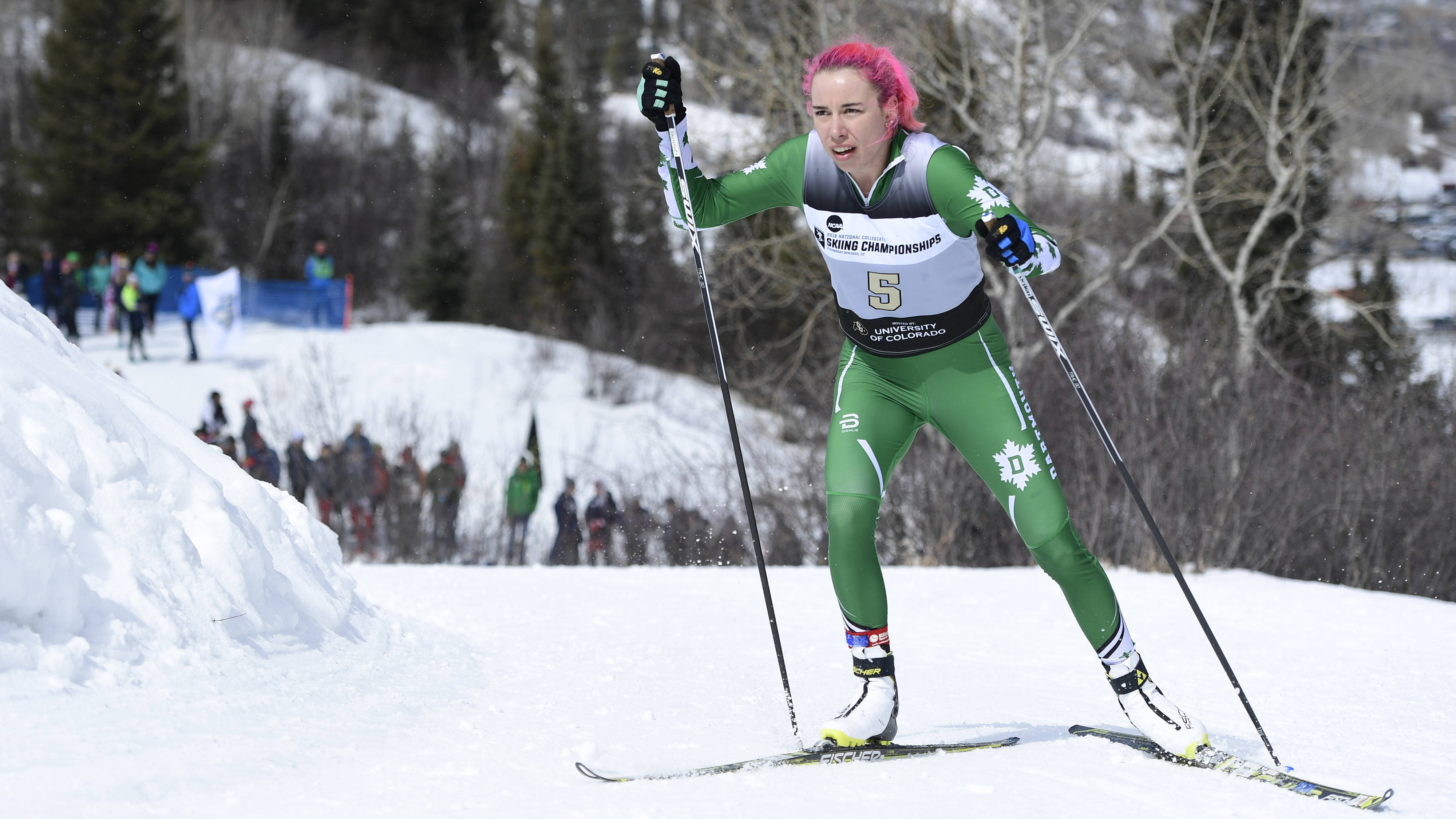
Dartmouth freshman Katharine Ogden racing to her second-straight victory of the 2018 NCAA Skiing Championships in Steamboat Springs, Colorado. She won Saturday’s 15 k freestyle mass start by more than 38 seconds. (Photo: Dartmouth Sports/Clarkson Creative)
Ogden, a Dartmouth College freshman, raced to a 38.4-second victory in the women’s 15-kilometer mass start, finishing in 43:22.0 minutes for her second win in as many races at 2018 NCAA Championships. She won the 5 k classic on Thursday and with her win on Saturday, she became the first Dartmouth skier in 56 years to win two national titles in the same year, according to a Dartmouth press release.
On the second of three laps, Ogden broke away early with close to 10 k to go. According to the press release, she had a “quick fall” near the end of the second lap, but that didn’t derail her as she had time to grab sunglasses from Dartmouth men’s coach Brayton Osgood and a Dartmouth Lone Pine flag before the finish.
At this year’s championships, Ogden’s two titles are accompanied by victories from Dartmouth men’s alpine skiers Brian McLaughlin (who won the giant slalom) and Tanguy Nef (who won the slalom). This marked only the second time that Dartmouth’s Big Green won four individual titles in a single NCAA Championships; that also occurred 61 years ago.
“Katharine absolutely wanted this one, and she really likes to win,” Dartmouth Director of Skiing and Women’s Nordic Head Coach Cami Thompson Graves said in the press release. “She wasn’t about to let a fall slow her down, she has such a great competitive fire. But she also showed her playful side grabbing Brayton’s glasses and smiling all the way to the finish line!”
Hailey Swirbul of the University of Alaska Anchorage placed second and Linn Eriksen (DU) reached the podium in third (+46.3). Denver had three in the top 10 with Jasmi Joensuu in ninth and Taeler McCrerey in 10th. Also landing in the top 10 for All-American honors were Guro Jordheim of the University of Utah in fourth, Emma Tarbath (Montana State University) in fifth, Petra Hyncicova of the University of Colorado Boulder (CU) in sixth, Christina Rolandsen (CU) in seventh, and Lauren Jortberg (Dartmouth) in eighth.
Torchia, an Northern Michigan University (NMU) junior and U.S. Ski Team Development Team member, became the seventh NCAA champion in NMU Wildcats nordic skiing history, according to an NMU press release. Fredrick Schwenke was the Wildcats’ last nordic champion; he won the 2015 NCAA Championships 20 k classic.
Torchia drew bib 1 for Saturday’s 20 k freestyle mass start and crossed the finish line first in 54:21.0, just 2 seconds ahead of CU’s Alvar Alev. Eivind Kvaale (DU) finished just four seconds back in third, and Denver had three in the top seven with Dag Frode Trollebø in fourth and Lars Hannah in seventh. Darmouth’s Cal Deline placed fifth, Zane Fields of Colby College finished sixth, and the 20 k freestyle’s 2017 NCAA champion Martin Bergström (Utah), who also won Thursday’s 10 k classic, placed eighth. CU’s Petter Reistad and Sondre Bollum finished ninth and 10th, respectively.
In the team standings, Denver beat Colorado by 41 points for the overall win with a total of 604 points between the nordic and alpine events at this year’s championships. Dartmouth placed third, 114.5 points behind Colorado, and Utah was another 63 points back in fourth.
According to a DU press release, Denver has won at least one national championship in each of the last five athletic seasons (skiing: 2013/14, 2015/16, 2017/18; hockey: 2016-17; men’s lacrosse 2014/15), joining only Stanford on the list of schools that have done so in the last five seasons. (Oregon, West Virginia, Penn State, Oklahoma, Ohio State and Florida could potentially join that list later this year.)
“It feels incredible,” said DU head coach Andy LeRoy said in the press release. “I am so happy for all of our athletes, they’ve been training all week and all season and to do it in Steamboat in front of our crowd is special.”
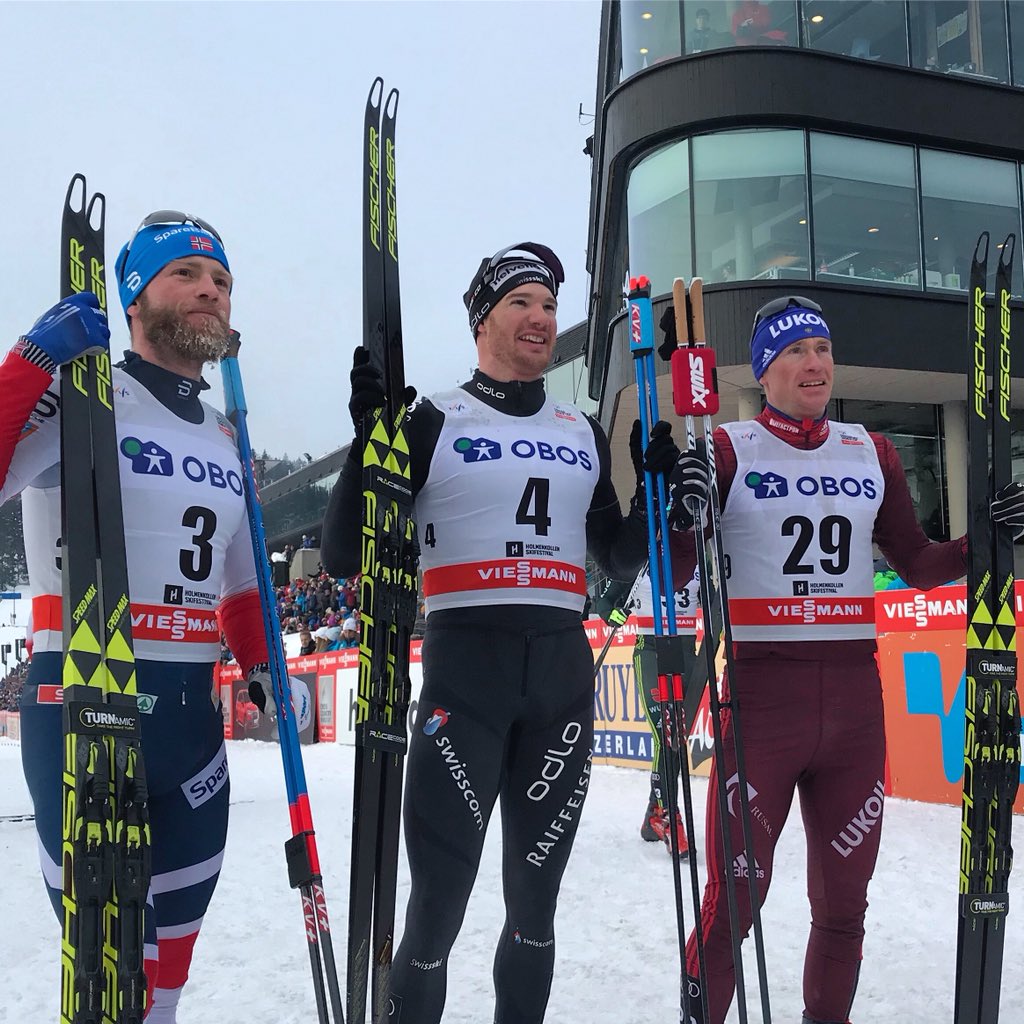
The Holmenkollen men’s 50 k freestyle mass start podium on Saturday at the World Cup in Oslo, Norway, with Switzerland’s Dario Cologna (c) in first, Norway’s Martin Johnsrud Sundby (l) in second, and Russia’s Maxim Vylegzhanin (r) in third. (Photo: FIS Cross Country/Twitter)
FIS Cross Country World Cup (Oslo, Norway): Men’s 50 k freestyle mass start
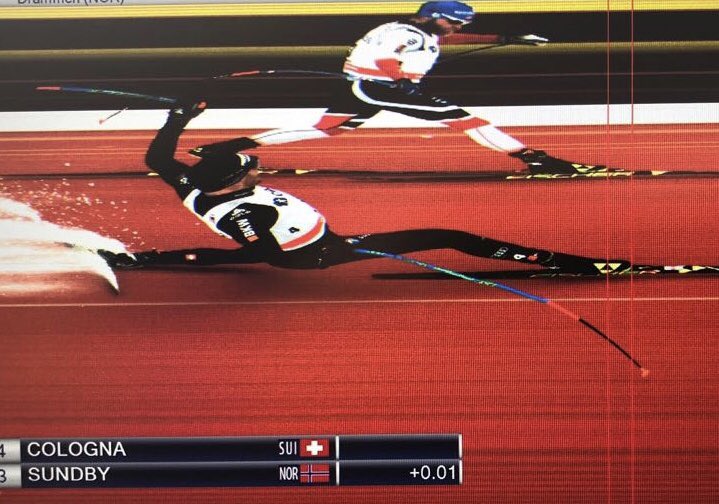
A four-time Olympic champion, Dario Cologna of Switzerland won his first 50-kilometer World Cup race on Saturday, topping the podium in the famous Holmenkollen 50 k freestyle mass start after outlunging Norway’s Martin Johnsrud Sundby (who won the event last year) for the win in 2:01:48.1. Sundby finished one-hundredth of a second behind for second place, ahead of Russia’s Maxim Vylegzhanin, who was 1.1 seconds back in third in his first World Cup race since November of last year.
The photo finish for first between Switzerland’s Dario Cologna (near) and Norway’s Martin Johnsrud Sundby at the Holmenkollen 50 k freestyle mass start on Saturday in Oslo, Norway. Cologna got it by 0.01 seconds. (Photo: FIS Cross Country/Twitter)
Norway’s Sjur Røthe came out on top in a race for fourth (+4.2), ahead of Russia’s Denis Spitsov in fifth (+4.4) and his Norwegian teammate Hans Christer Holund in sixth (+4.5). Great Britain’s Andrew Musgrave followed in seventh (+15.1), Germany’s Florian Notz placed eighth (+25.9) and Canada’s Alex Harvey finished ninth (+32.4), ahead of France’s Robin Duvillard in 10th (+33.5).
Scott Patterson led the U.S. in 16th (+56.3) coming off an 11th place in the 50 k classic mass start at last month’s Olympics, and Canada’s Devon Kershaw finished in the points in 28th (+3:43.6). Just outside the top 30, Canada’s Graeme Killick finished 34th (+4:55.1).
Also for the U.S, David Norris placed 38th (+6:19.7), Paddy Caldwell was 46th (+8:12.3), Noah Hoffman 49th (+10:27.9), Kevin Bolger 52nd (+12:44.2), and Simi Hamilton did not finish.
Canada’s fourth man in the race, Andy Shields finished 47th (+8:13.6).
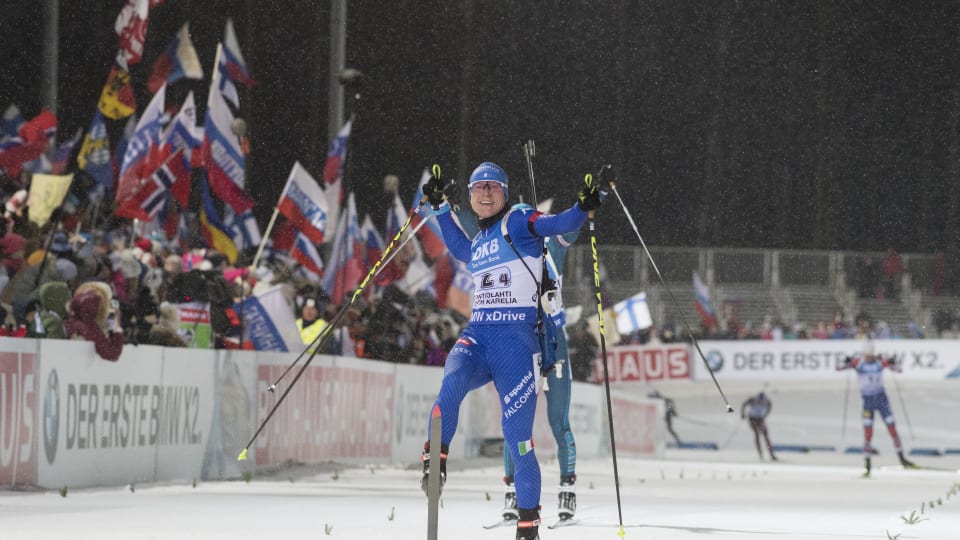
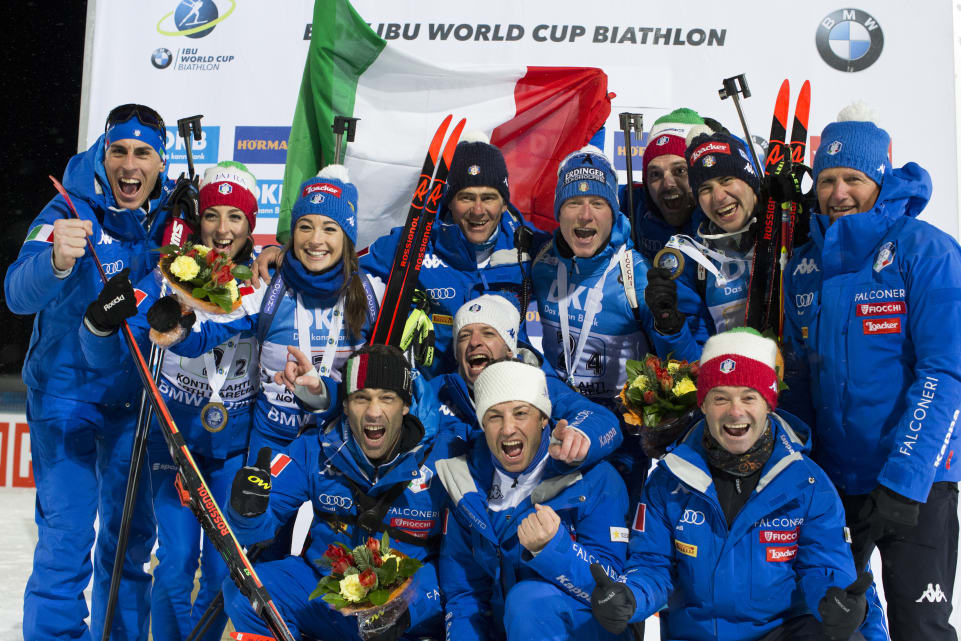
Italy’s Lukas Hofer celebrates his team’s win in Saturday’s mixed relay at the IBU World Cup in Kontiolahti, Finland. (Photo: IBU/Biathlonworld)
IBU World Cup (Kontiolahti, Finland): Single mixed relay & mixed relay
(Note: This rundown has been updated to include comments from Christian Gow and Sean Doherty.)
In the last single mixed relay and mixed relay of the International Biathlon Union (IBU) World Cup season, France and Italy came out on top, with France winning the two-person single mixed relay and Italy taking first in the coed mixed relay.
France’s Anaïs Chevalier and Antonin Guigonnat after winning Saturday’s single mixed relay at the IBU World Cup in Kontiolahti, Finland. (Photo: IBU/Biathlonworld)
France’s Anaïs Chevalier and Antonin Guigonnat combined for zero penalties and six spares to finish first in the single mixed relay in 33:29.1 minutes. Guigonnat as the team’s anchor secured the win by just 2.4 seconds over Austria’s Julian Eberhard while Norway’s Johannes Thingnes Bø finished 4.4 seconds back for third.
Chevalier put France in fifth after the first leg, 15.5 seconds behind Ukraine’s Iryna Varvynets in first. Guigonnat used just one spare on his first leg to move them into fourth, 9.2 seconds back while Norway led at the second exchange. On Chevalier’s second leg, she shot clean in both stages to lead through the final exchange, with Ukraine skiing just 6.2 seconds back in second.
On the final leg, Guigonnat used two spares and stayed out of the penalty lap, keeping the team in first through the finish. Eberhard skied the second-fastest course time on that leg to elevate Austria (with Lisa Theresa Hauser) from fourth at the tag to second place at the finish, and Bø skied all the way up from eighth to third place for Norway (with Marte Olsbu) with the fastest course time.
Ukraine’s Artem Tyschenko used just one spare but slipped to fourth with the 11th-ranked course time on that leg, as he finished 10.8 seconds behind Norway.
Behind Russia in fifth and Italy in sixth, Canada placed seventh (+23.8) with Rosanna Crawford and Christian Gow. The duo combined for zero penalties and six spares, and put themselves in third place early in the race. Crawford skied them into third on the first leg, using just two spares and tagging Gow 7.4 seconds out of first.
Gow went on to take the lead after cleaning prone without any spares, and he cleaned standing as well but slipped back to third while Bø took the lead. Gow tagged Crawford in third, 8.9 seconds behind Norway in first.
“I didn’t think too much about being tagged in third,” Gow recalled in an email to FasterSkier. “It was exciting for sure, but I let it fade to the background so that I could focus on my job both on the track and in the range. It was great to leave prone in first place! It was also surprising, but it was a good place to be in.
“My skiing was ok today,” he continued. “It is a really challenging and demanding race format that we don’t get a lot of practice with. I was sick after the Olympic Games and only finally coming around the past couple days. The Sprint race was horrendous for me, so today was much better than that. In the range I just focussed on myself and trusted my shooting. I tried my best not to get caught up in the race going on around me and it worked to my benefit.”
Crawford then slipped to seventh and 21 seconds back with three prone spares, but avoided the penalty lap, and Gow held onto seventh through the finish, using just one spare and skiing the eighth-fastest course time on that leg.
“We are both happy with this result,” Gow wrote. “I think that we are both looking at the 23 second gap to first and thinking that if things had worked out just a bit better we could be there. It can be both exciting and frustrating to be that close to the podium. We know we can do it, it’s just a matter of putting it together on the right day. We are happy with 7th, but hungry for more.”
Susan Dunklee and Lowell Bailey finished 14th for the U.S., 1:13.0 out of first with one penalty and 14 spares. The penalty came on Dunklee’s first leg during her standing stage, after she had cleaned prone without any spares. She tagged Bailey in 14th and he brought them up to 11th, using three spares on that leg, then Dunklee came through the final exchange in 13th after using four spares to clean. Bailey lost one place on the final leg, using four spares but staying out of the penalty lap.
Twenty-six teams competed in the single mixed relay, compared to 23 in the mixed relay that followed.
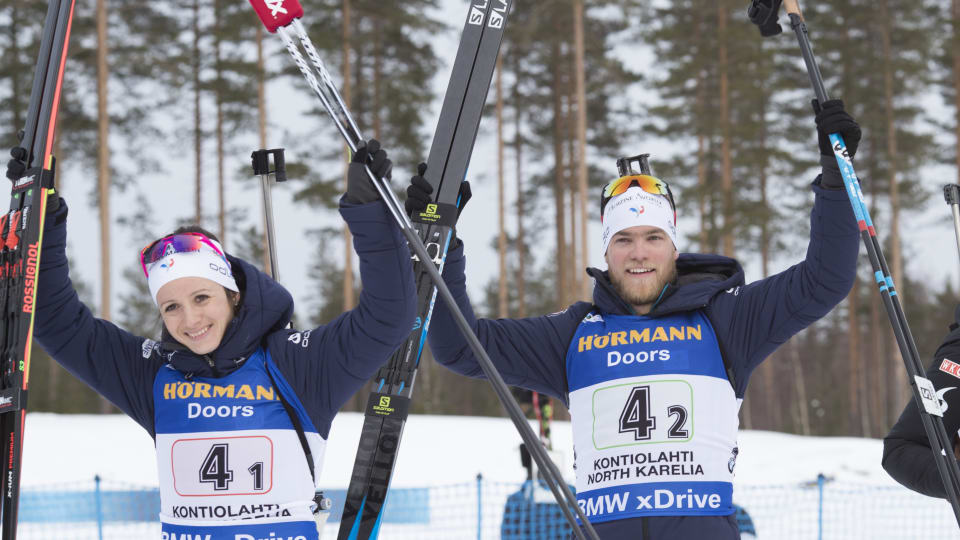
Team Italia celebrates its win in the IBU World Cup mixed relay on Saturday in Kontiolahti, Finland, with its relay members Dorothea Wierer, Lisa Vittozzi, Dominik Windisch, and Lukas Hofer. (Photo: IBU/Biathlonworld)
In Saturday’s 2 x 6 + 2 x 7.5 k mixed relay, Italy nabbed a 1.5-second victory over Ukraine in 1:15:08.3. Dorothea Wierer, Lisa Vittozzi, Dominik Windisch, and Lukas Hofer — the same Italian team that took bronze in the mixed relay at last month’s Olympics, although in a different order — combined for the win with one penalty and 13 spares.
Ukraine, with Anastasiya Merkushyna, Vita Semerenko, Artem Pryma, and Dmytro Pidruchnyi, had zero penalties and just three spares throughout the whole race. For the second-straight relay on Saturday, Norway placed third (+9.1) with Synnøve Solemdal, Tiril Eckhoff,Henrik L’Abée-Lund, and Tarjei Bø totaling zero penalties and nine spares.
Italy’s lone penalty came in Vittozzi’s second leg, but it didn’t derail the team as it improved from sixth to fifth with Vittozzi, who skied the third-fastest course time on that leg. She tagged Windisch 6.8 seconds out of first, and Windisch, who had anchored the team in the Olympics, took the lead by the final exchange after using two spares to clean. Hofer left the exchange just 3.3 seconds ahead of Norway’s Bø but used just one spare and skied the second-fastest anchor leg to finish first, beating his rivals up Kontiolahti’s infamous climb known as “The Wall”. Ukraine’s Pidruchnyi also shot clean with a single spare and clocked the fastest anchor leg to move his team from fourth to second place. Bø lost one place and finished third after using one spare as well and skiing the third-fastest anchor leg.
Russia followed in fourth, France fifth, Sweden sixth, Germany seventh, Austria eighth, and the U.S. ninth (+2:48.4). The U.S. team, with Clare Egan, Joanne Reid, Tim Burke, and Sean Doherty, had one penalty and 11 spares. Egan cleaned her first prone but had to ski a penalty lap after her standing stage, tagging Reid in 17th, 58.7 seconds out of first.
Reid used three spares on the second leg and moved up to 13th by the second exchange, and Burke used three spares as well to pick off one more place and tag Doherty in 12th. Doherty skied the eighth-fastest anchor leg and used two spares to clean to put the team in ninth at the finish.
“I don’t consider two spares to be anything special, but today it was enough to make up some ground,” Doherty wrote in an email to FasterSkier.”I felt strong skiing, more like myself which is fun even if it’s a little late in the season. We had very good skis which always helps. I have done quite a few laps on this course over the years so the lines and transitions are pretty refined, so that is where I made time on the course.
“I am happy with my leg. I enjoyed my little battle for 9th,” he continued. “I can’t speak too much for the other members of the relay tonight but I think 9th is a solid effort.”
Canada finished 17th (+4:34.9) with Emma Lunder, Julia Ransom, Scott Gow, and Brendan Green combining for one penalty and 13 spares. Lunder put them in 12th at the first exchange and Ransom skied up to 10th, but Scott Gow had a penalty on his standing stage to drop to 16th. Green lost one more place on the last leg despite only requiring two spares.
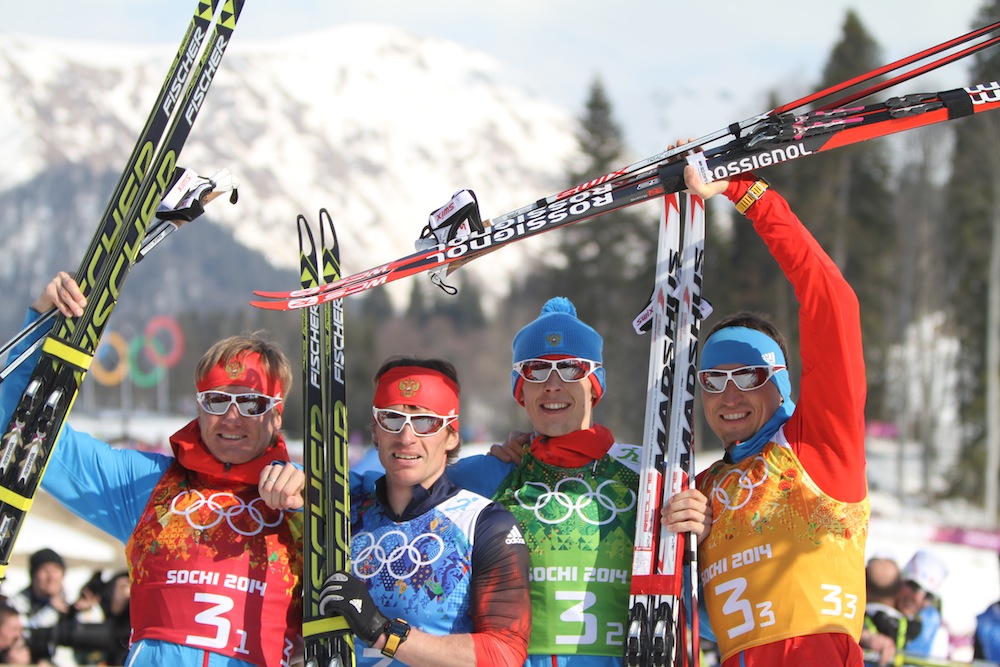
The silver-medal winning Russian men’s relay team at the 2014 Olympics. Alexander Bessmertnykh, Maxim Vyegzhanin, and Alexander Legkov were disqualified for doping, but just had their bans overturned by the Court of Arbitration for Sport.
The Court of Arbitration for Sport (CAS) has overturned doping bans assigned to eight cross-country skiers based on investigations into manipulation of the anti-doping process at the 2014 Winter Olympics.
“In 28 cases, the evidence collected was found to be insufficient to establish that an anti-doping rule violation (ADRV) was committed by the athletes concerned,” CAS wrote in a press release. “With respect to these 28 athletes, the appeals are upheld, the sanctions annulled and their individual results achieved in Sochi 2014 are reinstated.”
The athletes whose results will be reinstated are:
50 k gold medalist and relay silver medalist Alexander Legkov
50 k silver medalist, team sprint and relay silver medalist Maxim Vylegzhanin, also fourth in the 30 k skiathlon
relay silver medalist Alexander Bessmertnykh, also seventh in the 15 k classic
Evgeny Belov, 19th in the 30 k skiathlon and 25th in the 15 k classic
team sprint silver medalist Nikita Kriukov, also 13th in the men’s sprint
Alexei Petukhov, eighth in the men’s sprint
Evgenia Shapovalova, 28th in the women’s sprint
Natalia Matveeva, 20th in the women’s sprint
The disqualifications of skiers Julia Ivanova, Yulia Tchekaleva, and Anastasia Dotsenko were upheld, although CAS held that instead of being banned from the Olympics for life, the three women were merely banned from the 2018 Games.
The cases of biathletes Olga Zaitseva, Olga Vilukhina, and Yana Romanova have not yet been handled.
The eight athletes whose disqualifications were overturned had not been invited to the 2018 Olympics, and many other Russian athletes who had not been convicted of doping offenses also did not meet the IOC’s requirements of proof of being clean either. Thus, it is doubtful whether the CAS appeals will affect the Olympic rosters.
CAS did not release any information about how the arbitration panel came to its decision.
“Although the operative part of the decision is issued, the principle of confidentiality of the procedure still applies,” Legkov’s lawyer, Christof Wieschemann, wrote in a statement emailed to the media. “I assume that all parties involved will respect this. The panel has to decide in its judgment what details of the proceedings becomes subject of the reasoning of the decision and therefore will also become public. We will wait for the reasoned decisions.”
The evidence in the McLaren report showed, for instance, that anti-doping sample bottles belonging to Legkov, Vylegzhanin, Shapovalova, and Petukhov, among others, showed marks consistent with having been tampered with. A sample belonging to Vylegzhanin also showed discrepancies in the reported specific gravity.
There was no explanation offered as to why this evidence is not valid in proving an anti-doping rule violation.
Likewise, CAS offered no explanation as to why this testimony was not sufficient to prove an anti-doping rule violation.
“Dr. Rodchenkov testified fully and credibly at CAS,” Rodchenkov’s lawyer, Jim Walden, wrote in a statement. “His truth has been verified by forensic evidence, other whistleblowers, and, more recently, recovery of the Moscow lab’s secret database, showing thousands of dirty tests that were covered up. The panel’s unfortunate decision provides a very small measure of punishment for some athletes but a complete ‘get out of jail free’ card for most. Thus, the CAS decision only emboldens cheaters, makes it harder for clean athletes to win, and provides yet another ill-gotten gain for the corrupt Russian doping system generally, and Putin specifically.”
Note: This article has been updated to include comments from Sweden’s Charlotte Kalla.
For the second day in a row, Charlotte Kalla, a name synonymous with the yellow and blue of Sweden, stood atop the podium, placing first in the women’s 10-kilometer classic International Ski Federation (FIS) race on Saturday in Gällivare, Sweden. On Friday, Kalla won another individual-start race, the 5 k freestyle, by a margin of 8.8 seconds. She more than doubled that time gap by the finish of Day 2, winning the 10 k classic in 27:55 minutes, 17.7 seconds ahead of Russia’s Yulia Tchekaleva in second place. Natalia Nepryaeva, also from Russia, skied to third, 40.9 seconds back of Kalla.
“I am feeling good and I think I am where I should be at this moment,” Kalla wrote in an email. “I had a good feeling on the classic race and handle the condition well. On Friday I opened hard and tried to push hard all the way.”
Known as a skate powerhouse, Kalla has improved her classic skiing and is now a double threat. “I have improved my classic technique the last years,” Kalla explained. “When I am in shape it doesn’t matter if it is skating or classic. I am glad I managed to ski well in the condition we had. It was a little bit soft because of the snowfall.”
Although a home FIS event for Sweden, Russia secured six of the top-10 spots with Sweden settling for three. Japan’s Masako Ishida, the only non-Russian or Swede outlier in the top 10, placed fourth (+1:02.4). Russians Anna Zherebyateva raced to fifth (+1:08.8) while teammate Yulia Belorukova was sixth (+1:12.8).
Sweden took the next two spots with Stina Nilsson in seventh (+1:20.9) and Anna Haag in eighth (1:20.9). Russia rounded out the top 10 with Anatasia Sedova placing ninth (+1:24.1) and Mariya Guschina in tenth (+1:25.0).
Sweden’s Ida Ingemarsdotter, a World Cup regular, placed 11th (+1:30.6).
Kikkan Randall was the only U.S. Ski Team member at the race, and a day after finishing eighth in the 5 k skate, she finished 15th (+1:48.1) on Saturday. In an email, Randall explained that snow had fallen continuously for the last 24 hours in Gällivare.
“Conditions were pretty nice, the track was a little soft and a lot of racers here made the pole track a little punchy,” she wrote.
Considering the massive time-zone shift from her home in Anchorage, Alaska, to Central European Time, it appears Randall is adjusting well.
“I felt decent today, not too tired from the jet lag or yesterday’s race. I wanted two back-to-back races to get ready for next weekend’s triple World Cup opener,” she wrote, referring to the first three World Cup races in Kuusamo, Finland, starting Friday, Nov. 23.
Throughout Saturday’s 10 k, Randall steadily improved her overall placing: she was 32nd at 4.2 k, 23rd at 6.8 k and locked into 15th by 9.2 k.
“It was definitely good to race a 10km classic today,” Randall wrote. “I had trouble really digging into my race gear on the first lap today. I think I was skiing a little stiff and not carrying my momentum down the track. Nepryaeva [the third-place finisher] caught me going into the 2nd lap and that was the jumpstart I needed. I was able to match her pace for most of the rest of the race and it helped me find better technique and tempo.
“I wanted to be a little stronger today but I got some really important feedback on where I’m at and what I need to work on as the race season progresses,” she added. “My fitness feels pretty good and now it’s just a matter of fine-tuning.”
Emily Nishikawa was the only Canadian entered on Saturday and finished in 51st (+3:39.3). Sixty-nine women started the race, 38 from Sweden, 17 from Russia, seven from Japan, two from Switzerland and Estonia, and one each from the U.S., Canada, and Poland.
In Friday’s 10 k skate in Gällivare, only Swiss star Dario Cologna kept the Russians from sweeping the top nine by placing third. In that race, Evgeniy Belov and Sergey Ustiugov of the Russian national team finished first and second, respectively.
Saturday was a different race, a 15 k classic, but with a similar thread and no Cologna as a Russian foil.
The Russian men finishing in unison to take first, second and third in the men’s 30 k skiathlon, the final race of 2017 U23 World Championships at Soldier Hollow in Midway, Utah. Alexander Bolshunov (8) was deemed the winner, Alexey Chervotkin (1) was second, and Denis Spitsov (11) third. (Photo: FlyingPointRoad.com)
It was Russia, Russia, Russia.
Alexander Bolshunov, winner of the 30 k skiathlon at 2017 U23 World Championships, won the race in 37:13, one second ahead of Maxim Vylegzhanin in second. Alexey Chervotkin was third (+5.1).
Classic specialist, Kazakhstan’s Alexey Poltoranin finished fourth, 13 seconds off the podium, and Cologna placed fifth (+22.1).
Despite being on Swedish soil, the rest of the top 10 became a mostly Russian affair. Russian teammates Alexey Vitsenko and Artem Maltsev placed sixth (+29.5) and seventh (+37.4), respectively, Sweden’s Calle Halfvarsson interrupted the trend by tying Russia’s Evgeniy Belov for eighth (+38.0), and Russia’s Alexander Bessmertnykh took 10th (+40.1).
There’s a pattern: Russia took 14 of the top-20 places. Twenty-eight of 126 starters were from Russia, with the vast majority of the field being Swedish. Outside of the top 10, Sweden’s Daniel Rickardsson was the next-best Swede in 12th (+49.6).
Devon Kershaw (World Cup Team), who finished 12th on Friday, once again led Canada in 20th (+1:06.7). At 6.8 k, Kershaw was ranked 15th, and at 9.6 k he was down one spot to 16th. By the 11.4 k checkpoint, he began slipping further in the standings.
“Today was a tough one,” Kershaw wrote in an email. “I felt pretty good but conditions were soft, so you had to really feather it (the technique) – especially on the climbs. Pacing wise I think I was doing pretty well, but in the last 2.5km today I was missing any semblance of a kick to the finish and ended up conceding a few seconds to those around me, knocking me from about 15-16 to 20th.”
Although an interval start race, Kershaw never found a strong pacing partner. “I was skiing alone – no help at all today,” Kershaw wrote of his solitary effort. “It would have been so helpful! Especially that last lap when things get tough. But in individual start races, you need to learn to do it alone. So good to try and get used to that “time trial” feeling.”
Three other Canadians competed, with Graeme Killick (World Cup Team) finishing 50th (+2:32.3), Jack Carlyle (Alberta World Cup Academy) 91st (+4:06.1), and Brian McKeever (Para Nordic Team) 110th (+5:16.0).
As of press time, Fasterskier could not confirm if the International Ski Federation (FIS) held an emergency meeting to discuss the involvement of IOC-banned Russian skiers in FIS-sanctioned races. Of the six IOC-sanctioned Russian skiers, four are men: Belov, Vylegzhanin, Alexander Legkov, and Alexey Petukhov. All four skiers raced on Friday, however, Legkov and Petukhov (and Shapovalova, one of the two women sanctioned by the IOC) did not contest Saturday’s race.
Racing continues in Gällivare on Sunday with classic sprints.
Sweden’s Charlotte Kalla racing to a win in her first race of the 2017/2018 season, the women’s 5 k freestyle in Gällivare, Sweden, on Friday. (Photo: Sporteventgallivare/Instagram)
Sweden’s Charlotte Kalla and Hanna Falk went 1-2 in Sweden’s season-opening International Ski Federation (FIS) race on Friday in Gällivare, with Kalla winning the women’s 5-kilometer freestyle by 8.8 seconds in 12:58.1 minutes. Falk, her teammate on the Swedish women’s team, placed second and Russia’s Yulia Belorukova took the third spot on the podium, 10.3 seconds out of first.
The host nation had three in the top four, with Ida Ingemarsdotter in fourth (+16.1). Switzerland’s Nathalie von Siebenthal finished fifth (+17.8), Russia’s Yulia Tchekaleva placed sixth (+23.4), and Russia’s Natalia Nepryaeva was seventh (+25.0).
Kikkan Randall of the U.S. Ski Team raced to eighth (+27.2), just ahead of Sweden’s Evelina Settlin in ninth (+32.0) and Russia’s Anna Nechaevskaya in 10th (+33.5). Japan’s Masako Ishida was just 0.3 seconds out of the top 10 in 11th.
In an email, Randall explained that she decided to venture to Europe earlier this year to get some racing in ahead of the World Cup.
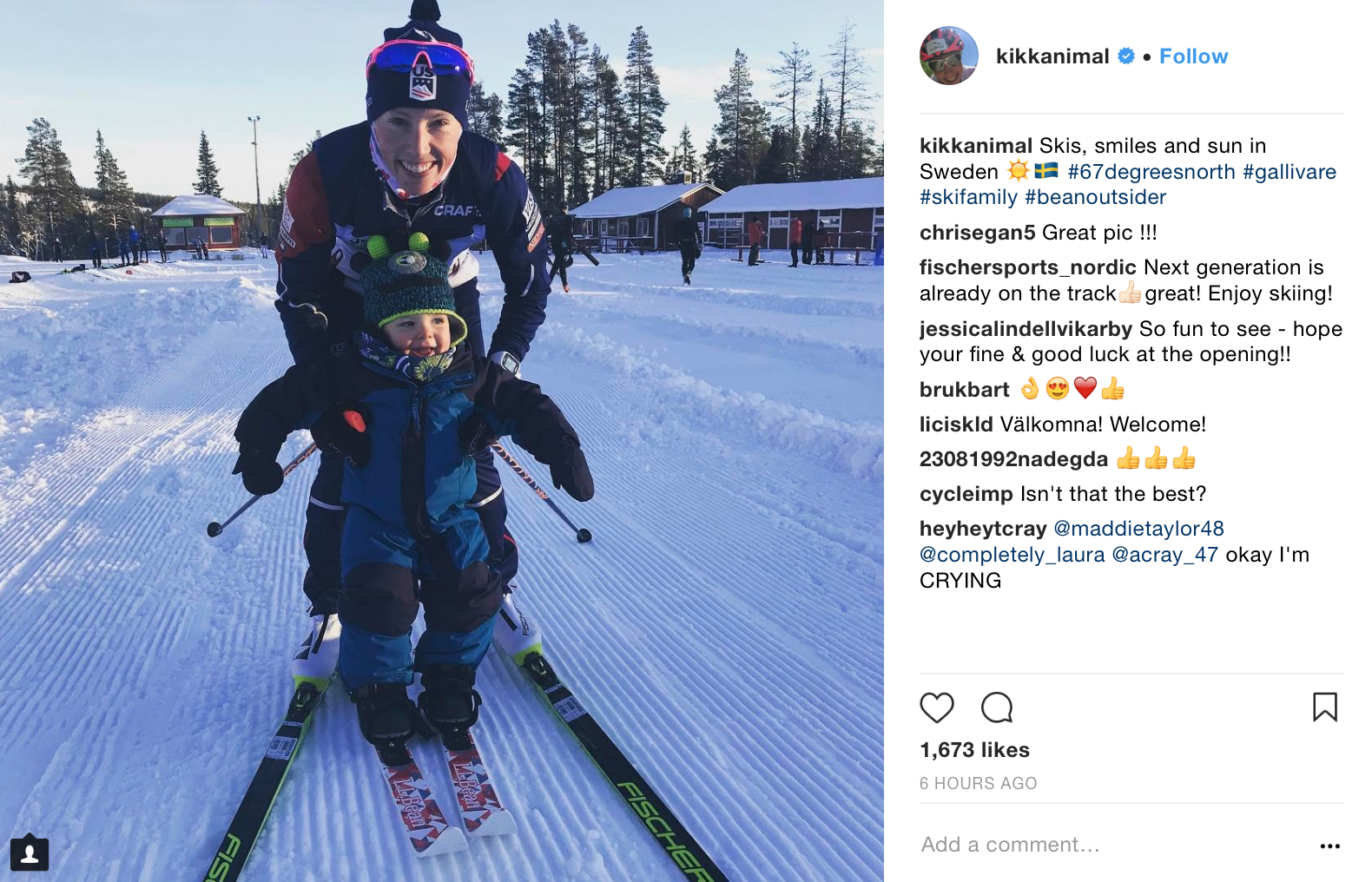
“We also wanted a little extra time to let Breck adjust to the 10hr time change!” she wrote of her 1-year-old son, who will be traveling the World Cup circuit with Randall and her husband, Jeff Ellis, this winter.
(Article continues below)
Most of the U.S. Ski Team arrived in Rovaniemi, Finland, on Thursday, Nov. 16 (with the exception of Andy Newell, who is racing this weekend in Beitostølen, Norway, with Noah Hoffman). The rest of her teammates planned to train at the Santasport Olympic training center in Rovaniemi until Nov. 21, when the entire team will meet up in Kuusamo (also known as Ruka), Finland — the site of next weekend’s World Cup opener.
“I’m happy with my start today,” Randall wrote of Friday’s race. “It took my a couple km’s to get going today but I felt like I was finding my rhythm in the 2nd half of the course. It’s my first hard session this week after the travel over so today was a good jolt! It was a competitive field and I was satisfied to be in the mix.”
Ninety-two women raced the Gällivare 5 k skate, compared to 56 women on Friday in Beitostølen (Norway’s FIS season-opener). Randall planned to race the 10 k classic on Saturday in Gällivare, then skip Sunday’s classic sprint.
“It’s great to be back around other World Cup skiers again and I’ve always liked Gällivare so it’s nice to be back here,” she wrote. “My former wax tech lives here and has been taking great care of us. … Looking forward to meeting up with the team in Ruka next week.”
With 46 Swedes and 23 Russians accounting for most of the women’s field, Canada’s Emily Nishikawa put herself in the mix in 26th, 54.9 seconds behind Kalla. Nishikawa’s Canadian World Cup teammate Dahria Beatty placed 56th (+1:38.3).
For Nishikawa, who’s known as a distance skier, the top-30 result was notable in that a 5 k falls somewhere between a sprint and a distance race.
“5km is such a hard distance, and it is over so fast, but it is a lot of fun,” Nishikawa wrote in an email. “I have been able to work on my sprinting a bit more this summer as I have been injury free, so I’m looking forward to seeing more speed in my racing this season.”
She planned to race all three days in Gällivare, including Sunday’s sprint.
“With these races, I am just hoping to fine tune my fitness and get some hard intensity in to feel sharp for the upcoming World Cup races,” added Nishikawa, who’s entering her fifth World Cup season as a leading member of the Canadian women’s World Cup Team. “Today’s race was a really hard effort and I am happy with how I skied today.”
In the men’s 10 k freestyle on Friday, another one of the Russians sanctioned by the International Olympic Committee (IOC), Evgeniy Belov won in 23:08.5. He was 6.5 seconds faster than his Russian teammate Sergey Ustiugov, who placed second. Ustiugov is the defending Tour de Ski champion and Overall World Cup runner-up.
Switzerland’s Dario Cologna placed third, 7.6 seconds out of first, and Russia swept fourth through ninth, with Sweden’s Marcus Hellner following in 10th (+36.4). Out of the five actively competing skiers the IOC sanctioned earlier this month, all five raced on Friday in Gällivare, which was legal considering FIS had not ruled they can’t.
Four of those skiers are men. In addition to Belov, Maxim Vylegzhanin placed 14th (+43.2), Alexander Legkov followed in 15th (+45.9) and Alexey Petukhov finished 23rd (+56.7) out of 157 finishers on Friday.
Devon Kershaw (front) training with U.S. Ski Team sprinter Andy Newell in Sjusjøen, Norway, last week. (Photo: Noah Hoffman)
Ahead of them, Canada’s Devon Kershaw ended up 12th (+39.9), tying another Russian Artem Maltsev (who is not on the IOC-banned list) with identical times.
“My stance on the whole Russian fiasco is unchanged,” Kershaw wrote in an email, referring to a previous email he wrote to FasterSkier earlier this week when asked how he felt about the IOC-banned Russians competing in FIS events. “I find the entire thing both disturbing and hilarious. The fact that FIS is risking their credibility like this makes no sense to me. Apparently there will be an emergency meeting of sorts tomorrow about it (with FIS I’m assuming but I haven’t heard much about it) – so we’ll have to all wait and see what they come up with.
“As for seeing Belov win – I mean, that’s no surprise,” Kershaw continued. “He’s shown that he’s a force when he’s in form. But yeah, the fact that he and others have been recently banned for life by the IOC are winning races after that news came out just shows the Mickey Mouse club that our sport has become.”
As for his own race, Kershaw wrote that he felt great about it. The course suited him well without too much hard climbing. “… You kind of need to be pushing the whole way around. I really like courses like that,” he wrote.
The conditions, however, with about 10 to 15 centimeters of new snow from the early morning that continued into the race, made the course slower, which Kershaw found to be more challenging.
“But that is another reason why I am so satisfied with the effort today. Individual start skating in soft conditions? Not my favourite, so I’m happy how I was able to execute things,” he wrote. “For me to be in the mix in a 10km skate like that feels great. I had good energy all race and hit my technical goals for the race too, so I have to be satisfied.”
Kershaw and the rest of Canada’s Period 1 World Cup team arrived in Gällivare last Sunday. Over the last week, they’ve been testing equipment and getting into a race routine ahead of the World Cup opener, he explained.
“I changed various things with my training this year so it’s exciting to see how my body feels in the beginning of a new season,” Kershaw wrote. “… My goals are really to just be calm and execute well – which means going into the racing with no expectations other than to ski as technically well as possible while working on the whole pacing thing (which can be challenging at the beginning of the season when you don’t have that many races in the body). I’ll look to have another well executed race tomorrow and the results will be what they will be.”
Canada’s NorAm leader at the end of last season, Russell Kennedy (Team R.A.D.) was the next-best Canadian in 48th (+1:35.7), followed by Len Valjas (World Cup Team) in 49th (+1:37.0). Jack Carlyle (Alberta World Cup Academy) placed 67th (+2:07.2), Julien Locke (National U25 Team) was 72nd (+2:10.9), Graeme Killick (World Cup Team) 90th (+2:32.2), Brian McKeever (Para Nordic Team) 97th (+2:39.0), and Jess Cockney (World Cup Team) 119th (+3:10.7). Knute Johnsgaard (World Cup Team) did not start.
Racing continues in Gällivare this weekend with 10/15 k classic individual starts on Saturday followed by classic sprints on Sunday.
Maxim Vylegzhanin competing in the 10 k classic in Falun, Sweden, in 2016. Vylegzhanin has been banned by the International Olympic Committee for doping at the 2014 Olympics, but is currently free to compete in other ski races, and collected two top-six finishes in Muonio, Finland, this weekend. (Photo: Fischer/NordicFocus)
Note: On. Nov. 23, the day before the first World Cup race of the season, the FIS Doping Panel released a statement regarding the FIS eligibility of the six Russian skiers specified in the following article.
In the last two weeks, the International Olympic Committee (IOC) has disqualified six Russian cross-country skiers from the 2014 Olympics and barred them from ever competing in a Games again.
This weekend, one of them – Maxim Vylegzhanin – was competing in pre-World Cup races in Muonio, Finland, where he collected fifth- and sixth-place finishes.
That is because although the athletes were banned by the IOC, the International Ski Federation (FIS) has not made any changes to the athletes’ status.
“It’s troubling that certain athletes are now banned from ever competing in IOC events in the future, yet are seemingly allowed to compete on the FIS circuit unimpeded,” Canadian Olympian Devon Kershaw wrote in an email (which is printed in full at the end of this piece). “I feel this is unprecedented. Talk about confusing. The Olympics themselves are FIS sanctioned races.”
Vylegzhanin isn’t banned by FIS, and so he’s not breaking any rules by racing in non-Olympic competitions. Likewise, Alexander Legkov, also banned by the IOC but not by FIS, will race in Gällivare, Sweden, this weekend, along with three other athletes in the same situation.
“I’m not ashamed to look into the eyes of athletes, going to the start line, I did not break any rules and my conscience is clear!” Vylegzhanin wrote in an Instagram post.
“We can not comment on it,” Gällivare organizing committee member Stefan Nieminen told Sweden’s SVT broadcaster. “They are free to compete, it is not our decision or our problem to handle that issue.”
It has led to something of a delicate balancing act for his competitors, many of whom have competed next to these athletes on the World Cup for years.
“What I mean when I say it’s not personal is I don’t feel like we need to take the punishment into our own hands and ostracize him on the World Cup or anything like that,” American skier Noah Hoffman said, when asked specifically about Vylegzhanin. “I want to see FIS take action. I don’t want to see extrajudicial action in the sense that it’s not overseen by the organizations that oversee the sport. I want to see the organizations that oversee the sport take adequate action.”
How Did We Get Here?
Previously, the six skiers had been provisionally suspended while investigations into systematic doping by Russia at the 2014 Olympics were ongoing. The athletes appealed to the Court of Arbitration for Sport (CAS), and FIS was given until Oct. 31 of this year to bring a case against the six, or else let their suspensions lapse – in effect, the athletes couldn’t be held in limbo forever.
Oct. 31 came and went, and the IOC’s Disciplinary Commission ruled against the athletes in early November (Nov. 1 for Alexander Legkov and Evgeniy Belov, and Nov. 9 for Vylegzhanin, Alexey Petukhov, Julia Ivanova, and Evgenia Shapovalova).
The silver-medal winning Russian men’s relay team at the 2014 Olympics. Maxim Vylegzhanin (second from left) and Alexander Legkov (right) have both been banned by the International Olympic Committee for doping, but will be competing in Sweden this weekend.
Despite the change in the athletes’ status, FIS says that this does not constitute new evidence that would justify further provisional suspensions or an anti-doping rules violation (ADRV).
“The FIS Doping Panel is obliged to wait until the reasoned decisions are provided by the IOC Disciplinary Commission before it can undertake further action,” FIS Anti-Doping Administrator Sarah Fussek wrote in an email to FasterSkier. “This is a consequence of the CAS decision that the provisional sanctions of the Russian cross-country athletes would expire on 31st October and can only be reinstated if there was more specific evidence of individual anti-doping rule violations.”
In the CAS press release announcing the Oct. 31 deadline for FIS to bring a case against the skiers, the court only wrote that “a further provisional suspension may be imposed on the athletes by the International Ski Federation (FIS) after that date, if the facts and circumstances so merit, and would be subject to appeal.” No further specification was made in terms of what type of evidence would be required to impose another provisional suspension.
Fussek wrote that the IOC sanction on the athletes did represent a change in circumstance, but that it was not enough to impose a suspension.
“The fact that the IOC banned Russian athletes constitutes a change of the status of these athletes,” she wrote. “The IOC decision is a consequence of the assessment of the available evidence by the IOC Disciplinary Commission but does not by itself justify the imposition of a new provisional suspension by the FIS Doping Panel (FDP). The decision of the IOC DC is subject to appeal to the CAS. Before the FDP will independently review the matter of another provisional suspension (or a decision on the merits), it must know and examine the reasons on which the IOC DC based its decision.”
However, Fussek confirmed that both she and Stephan Netzle, FIS’s Legal Counsel, were present at the IOC Disciplinary Commission’s hearings for the athletes.
According to Russian Cross-Country Ski Federation President Elena Valbe, the hearing took ten hours. In the press, Valbe said that a commission from the University of Lausanne discussed finding scratch marks on sample bottles used for anti-doping work at the 2014 Olympics, saying that “they found that there were [marks] from specific people, some of our athletes had it… today there were results on salt [in the urine sample] of Julia Ivanova… there is a salt excess, it’s unclear how it got there, it’s all amazing.”
While FIS had representatives at the same hearing that Valbe discussed, they are awaiting the “reasoned decision”, a longer, written explanation, before acting.
“The FIS Doping Panel will afford the athletes the right of due process to examine the reasoned decision of the IOC before it will proceed,” Fussek wrote. “Until then, the Russian athletes, who are subject to a very rigid and tight doping control regime, will be admitted to competitions.”
In a follow-up email, she explained that Legkov had been tested 10 times by FIS in 2016-2017; Belov 12 times; Petukhov six times; Vylegzhanin 13 times; and Shapovalova nine times. Ivanova has retired and is out of the testing pool.
Athlete Reactions
Several athletes told FasterSkier that the Olympics is the biggest sporting event in the world, and it was most important to them that athletes who had cheated at past Games be excluded from the Olympics.
Canada’s Alex Harvey skating his way to a bronze medal in the 30 k skiathlon at World Championships in Falun, Sweden, in 2015. He is followed by Evgeny Belov of Russia, who is currently banned by the IOC for doping. (Photo: FlyingPointRoad)
“My view is that you have to pick your battles,” Alex Harvey, the Canadian who won World Championships gold in the 50-kilometer mass start last season, wrote in an email. “And this year the big battle is the Olympics, and I’m glad that the IOC was strong enough against doping to ban these six Russians from the Olympics, so there’s that battle.”
“I think the most important thing is the Olympic sanctions because the Olympics are so much more important than anything else,” American 2014 Olympian Hoffman said.
But from there, their views diverged.
Harvey believed that FIS had not found enough evidence to ban the athletes, despite their IOC bans.
“I feel like I have a decent understanding of the law since I’m six courses away from finishing my law degree, and I read the CAS judgement that said FIS couldn’t extend the temporary ban on those six Russians unless they came up with additional evidence, which, so far, didn’t happen,” he wrote. “I think it’s important to understand that this is a precedent that the IOC (and FIS for the temporary ban they gave those six Russians last winter) is/are setting. Never before in our sport have we seen athletes get a doping ban from an infraction other than a positive test, even though there are more ways to ban an athlete than just a positive test.”
Hoffman, however, didn’t understand why evidence that was sufficient for a ban by the IOC would not lead to a ban by FIS.
“The answer I want from FIS is, why does the IOC have enough evidence and FIS does not?” he asked. “Where is the disconnect coming from? And I don’t know the answer to that… I believe in a punishment that fits the crime, but that’s a punishment from every organization involved, not just the IOC. I’m glad the IOC is taking action because I believe it’s necessary to ensure clean sport in the future and that’s the most important thing, right? We can’t change the past, but we want to ensure clean sport in the future.”
Hoffman said repeatedly that for him, the issue of whether the Russian athletes should compete or not was “not personal.”
“How will I feel about racing against Vylegzhanin, for instance, on the World Cup this year?” he asked. “The answer is, for me as an athlete, I’m still just focused on what I can control and what I’m doing, and he’s just one more person within the field and I know the World Cup field is going to be strong… But then it does get personal when you look at last year. I missed the objective criteria for the U.S. Ski Team by one point and one place [on the World Cup distance list], and three places ahead of me was Legkov. Individual spots and individual points do matter, but I’m just focusing on what I can control.”
When asked about FIS’s handling of the situation, U.S. skier Kikkan Randall, who was formerly the FIS Athlete Representative for cross-country skiing, wrote, “I’m not the Athlete Rep any more so it’s not my place to comment on this. I’m also about ready to start racing and that’s where my focus is.”
Kershaw’s Take
When contacted about competing against Vylegzhanin, Canada’s Devon Kershaw wrote the following response.
Devon Kershaw training with American sprinter Andy Newell in Sjusjøen, Norway, last week. (Photo: Noah Hoffman)
“The entire situation regarding this scandal is flabbergastingly odd. The findings in the three major ‘investigative reports,’ with Parts #1 and #2 of the McLaren report issued by [the World Anti-Doping Agency], and then the Oswald commission by the IOC, have caused a maelstrom in the cross country ski world. With good measure to be sure, but at the same time the dysfunction that this situation has unveiled is troubling.
“’The Russians athletes, who are subject to a very rigid and tight doping control regime…’ is a cute response from FIS. Lance Armstrong was also subject to a rigid and tight doping control regime, and never officially failed a test while he was an active athlete, and yet…
“The list of cyclists that are ‘subject to a tight doping control regime’ is long. But so too is the list of athletes like David Millar or Thomas Dekker, who also didn’t fail a test, getting banned. I know, they found actual EPO in David Millar’s apartment in France during a raid, and Thomas Dekker was one of the earliest athletes to be caught with the ‘biological passport’ but the facts remain that both they and others – Did. Not. Fail. An. Antidoping. Test.
“And may I ask who is supposedly overseeing the ‘doping control system?’ Researching and publishing the list of banned substances for example, or in charge of the whereabouts systems in place? WADA? And didn’t WADA publish two explosive reports laying out some pretty troubling findings?
“What is going on? That’s my question for FIS. It’s troubling.
“Troubling in the fact that certain athletes are now banned from ever competing in IOC events in the future, yet are seemingly allowed to compete on the FIS circuit unimpeded. I feel this is unprecedented. Talk about confusing. The Olympics themselves are FIS sanctioned races, haha.
“I wish that with all these competing governing bodies with stakes in this (IOC, WADA, FIS) could come to a consensus and do it soon. The image and integrity of our sport could be likened to that of a dumpster fire; raging with the sickly stench of incompetence. Fans, athletes, staff, sponsors, all are left scratching their heads going ‘is this shit for real?’ and trying to understand how athletes can be banned, have their medals stripped for breaking doping rules and yet also be free to compete because ‘they are subject to a very rigid and tight doping control regime.’ I just cannot see something like this happening in other sports that have had similar issues (cycling comes to mind, or track and field for example).
“Am I happy to compete against the IOC banned Russians? Is it bad to say I don’t really care? I mean, me personally, as an aging athlete that week-in, week-out has been fighting between 10th and 85th in World Cups of late, I don’t exactly have a whole lot of clout. Caring changes nothing. BUT – what I would like to see is some continuity and clarity. That – or I’d like to see major funding partners leave FIS. Because at the end of the day, money talks. Cross country skiing is a tiny sport globally. Is this really what FIS wants the story to be? Apparently they don’t really care or are paralyzed at the moment, but maybe if their TV contracts, sponsors, etc., started asking the same questions WADA and the IOC are asking (by threatening to pull funding), perhaps we could get a clear answer out of FIS with this. Something grandiose seemingly needs to happen before change occurs. If not, this will be the story our sport carries at the forefront of the ‘biggest show on earth’ come February in Korea.
“And that would be sad, because there are a lot of beautiful stories that will be lost along the way. Stories that could help and inspire others.
“What I do care about is the sport of cross-country skiing. I believe unequivocally in the importance of clean sport. I want to see our sport thrive and succeed. This mess needs to be straightened out. I call upon those with the means and the information to please get to the bottom of this before our tiny sport becomes damaged further. It shouldn’t be this difficult and opaque.”
Racers navigate a steep climb and descent on the race loop at Bruksvallarna on Saturday. (Photo: Jocke Lagercrantz/Bruksvallsloppet.se)
The World Cup season draws ever-closer as season-opening races continued this weekend in Sweden, Finland, and Switzerland.
In Muonio, Finland, a long weekend of racing wrapped up with 10 and 15 k skate races. Finland’s Anne Kylloenen took the win in the women’s 10 k, besting Emilie Kristoffersen of Norway by 8.2 seconds. Kylloenen’s national-team teammates Laura Mononen and Aino-Kaisa Saarinen took third (+14.0) and fourth (+17.1), respectively. Merete Myrseth, a Norwegian skier who competed for the University of Utah on the NCAA circuit last season, finished 17th, +57.1.
In the men’s 15 k, Alexey Chervotkin of Russia took a 13.8-second win over Iivo Niskanen of Finland. Denis Spitzov of Russia was third, +17.5, and University of Utah alum Snorri Einarsson fourth, +21.2. Einarsson is competing for Iceland. Graham Nishikawa of Canada finished 19th, +1:14.4, and Brian McKeever 40th, + 2:05.3.
Finishing sixth (+37.0) was Maxim Vylegzhanin of Russia, who made his second flower ceremony of the weekend. The International Olympic Committee (IOC) decided on Thursdayto strip the Russian skier of three silver medals from the 2014 Olympics for doping violations and ban him from all future Olympic Games. However, the International Ski Federation (FIS) has not yet taken any action since he and five other skiers were banned from the IOC, meaning that all six athletes are currently free to take part in non-Olympic ski competitions. FIS has not yet responded to a request for comment about Vylegzhanin’s continued competition.
https://www.instagram.com/p/BbZO7VFFYpg/
In Bruksvallarna, Sweden, Sunday meant skate sprinting, and Norwegians took both the men’s and women’s wins. In the men’s race, Paal Troean Aune bested countryman Even Northug in the final, with Anton Persson the only Swede on the podium in third. None of the top sprinters from either country competed. Jack Carlyle of Canada finished 60th, 19.4 seconds behind Aune’s qualifying time.
In the women’s sprint, Wenche Aune Snildalsli took the win over four Swedes: Emma Thalin, Moa Olsson, Jackline Lockner, and Wilma Joensson were next across the line, and Latvia’s Patricija Eiduka finished sixth.
A large contingent of international racers has also been training in Davos, Switzerland, where organizers have a lengthy saved-snow loop covering some of the same terrain which will host the World Cup in mid-December. On Friday and Saturday, the Swiss competed with the German and Italian teams in sprint and distance races, with a few individual athletes from other countries attending as well.
In Friday’s sprints, Laurien Van Der Graaf came out on top for the home team, besting Germany’s Laura Gimmler and Steffi Boehler in the ‘A’ final after Gimmler had won beat her by 1.59 seconds in the qualifier. Fourth place went to Sandra Ringwald, also of Germany, and fifth to Ilaria Debertolis of Italy. In the men’s sprint Thomas Bing claimed the win for Germany, skiing away Switzerland’s Erwan Kaeser by more than two seconds. Giacomo Gabrielli and Stefan Zelger of Italy were third and fourth, and Janosch Brugger of Germany rounded out the ‘A’ final in fifth.
https://www.instagram.com/p/BbUYGpgl2V_/
In Saturday’s distance races, Katerina Smutna – racing for the Czech Republic after taking a break for several years to focus on a long-distance marathon career – won the three-lap, 10.5 k competition by just three seconds over Katharina Hennig of Germany, with Boehler another 12.2 seconds back in third. Van Der Graaf finished fourth, + 27.1, and Debertolis fifth, +39.6.
In the men’s four-lap race, covering 14 k, Swiss Olympic gold medalist Dario Cologna took a commanding 26.6-second win over Russia’s Ilia Chernousov. Jonas Dobler of Germany claimed third, +33.8, with Giandomenico Salvadori of Italy fourth (+59.2), narrowly beating out Livio Bieler of Switzerland (+1:00.9).
Chernousov could soon become an Olympic champion like Cologna. Vylegzhanin’s disqualification from the 2014 Olympics, along with that of Alexander Legkov, leaves Chernousov to inherit a gold medal in the 50 k freestyle, where he initially finished third. He has not been named in any of the doping investigations by the World Anti-Doping Agency or the International Olympic Committee. In fact, a Russian ski coach recently claimed that Chernousov had turned whistleblower and informed against his Russian teammate, but Chernousov has denied that allegation.
(l-r) Anna Svendsen of Norway, Natalia Nepryaeva of Russia, Justyna Kowalczyk of Poland, Lovise Heimdal of Norway, and Leena Nurmi of Finland receive prizes after rate women’s classic sprint in Muonio, Finland, on Friday. (Photo: Ski Muonio/Instagram)
FIS races are already being contested in Finland and Sweden this weekend, with most top Scandinavian racers sitting out but a few national-team members and others picking up their first victories of the season.
The competitions in Muonio, Finland, drew the most diverse field, including racers from Norway, Russia, Japan, China, Canada, Estonia, and Slovakia, among other countries. In the men’s classic sprint on Friday, the home team got a win from Ristomatti Hakola; he and Russia’s Alexander Bolshunov went 1-2 in both the qualifier and the final. Russia’s Andrey Parfenov rounded out the podium. In the women’s sprint, Anna Svendsen took the win over Russia’s Natalia Nepryaeva, with Justyna Kowalczyk of Poland finishing third.
On Saturday, racers moved up in distance. In the 10 k classic, Bolshunov – a U23 World Champion last season – bested Russian teammate Alexey Chervotkin by 20.6 seconds, with Andrey Sobakarev making it a sweep another 21.6 seconds back. Brian McKeever and Graham Nishikawa of Canada finished 56th (+2:10.6) and 63rd (+2:18.5), respectively.
Also in the men’s race was Maxim Vylegzhanin. The International Olympic Committee (IOC) decided on Thursday to strip the Russian skier of three silver medals from the 2014 Olympics for doping violations and ban him from all future Olympic Games. However, the International Ski Federation (FIS) has not yet taken any action since he and five other skiers were banned from the IOC, meaning that all six athletes are currently free to take part in non-Olympic ski competitions. In a press release, FIS stated that “the next steps will be the review by the FIS Doping Panel of the six verdicts upon the receipt of the reasoned decisions” but did not provide a time frame for these decisions.
In the women’s 5 k classic, Finland’s Krista Parmakoski posted an 18.4-second win over Nepryaeva, with Kowalczyk third again, +24.2.
Bruksvallarna, Sweden, hosted races on Saturday as well, with a primarily Swedish and Norwegian field but some other racers as well. Norway’s Chris Andre Jespersen topped the 15 k skate, posting a 31.4-second win over Simon Lageson of Sweden. Norwegian Tore Leren was third, +53.1. Canada’s Jack Carlyle finished 38th, +2:29.5. Petter Northug and his brother Even were in Bruksvallarna this week but decided at the last minute not to race, with Northug making his debut in Beitøstolen, Norway, next weekend instead.
In the women’s 10 k skate, Swedish national team member Emma Wiken bested Lina Korsgren – a long-distance specialist who finished eighth in the Visma Ski Classics standings last season – by 9.8 seconds. Berit Mogstad of Norway finished third, +15.3 seconds.
Russian team staff cheer on Maxim Vylegzhanin, the country’s anchor skier, in the 4 x 10 k relay at the 2014 Olympics in Sochi, Russia. Vylegzhanin has now become the second member of that silver-medal relay team to be disqualified for doping.
All four were identified in the McLaren Report, an independent investigation commissioned by the World Anti-Doping Agency to investigate reports from whistleblowers that Russia had systematically evaded the anti-doping process at the 2014 Olympics.
“The athletes have been disqualified for life from taking part in the Olympic Games,” Valbe said.
With Legkov’s disqualification, Russia had already lost a gold medal in the 50 k and a silver medal in the 4 x 10 k relay.
Vylegzhanin had finished second in the 50 k, but with him now disqualified as well, there could be a substantial medal re-allocation. Third-place Ilia Chernousov, also from Russia but not implicated the McLaren report, would stand to gain gold. Fourth-place Martin Johnsrud Sundby of Norway would take silver, and fifth-place Sergei Dolidovich of Belarus would earn bronze.
Vylegzhanin also won silver in the men’s team sprint with Nikita Kriukov. With that result invalidated, Sweden’s Emil Jönsson and Teodor Peterson will move from bronze to silver, and fourth-place Northug and Ola Vigen Hattestad would earn bronze.
Valbe said that the IOC Disciplinary Commission’s decision will be appealed to the Court of Arbitration for Sport, so such medal reallocations are not yet finalized.
“It’s hard to choose words, but I’ll fight to the end — it’s a violation of all human rights,” Petukhov said, according to a translation.
Petukhov finished eighth in the skate sprint in Sochi; Shapovalova finished 28th. Ivanova was part of the sixth-place women’s relay and team sprint teams, both of which stand to be disqualified, and finished 17th in the 10 k classic and 30th in the 30 k skate.
The Canadian team of Perianne Jones and Dasha Gaiazova missed qualifying for team sprint finals as “lucky losers” by one spot. The Russian pair of Ivanova and Anastasia Dotsenko, however, did advance as lucky losers – meaning that if they had not been in the race, the Canadians would have been next in line for a spot in the finals.
Maxim Vylegzhanin competing in the 10 k classic in Falun, Sweden, in 2016. Vylegzhanin is provisionally suspended while the International Olympic Committee investigates possible doping infractions at the 2014 Olympics. (Photo: Fischer/NordicFocus)
In part of the media storm following the Court of Arbitration for Sport’s response to an appeal by six Russian cross-country skiers, Russian Ski Federation President Elena Valbe made a surprising assertion: that the athletes, who remain provisionally suspended by the International Ski Federation (FIS), are allowed to train with the national team.
This is not generally the case for athletes serving suspensions, but FIS Anti-Doping Coordinator Sarah Fussek confirmed the organization’s stance.
“You cannot really say it is a deviation [from the norm] because we have not had these [types of] facts on the table before,” she said in a phone interview on Friday. “This is a special case and it requires special handling.”
Are All Provisional Suspensions Created Equal?
FIS more often deals with cases which start with a positive drug test, or “adverse analytical finding”. A positive test results in a nearly-automatic suspension while the case proceeds – called a “mandatory provisional suspension”.
The cases of Alexander Legkov, Maxim Vylegzhanin, Alexey Petukhov, Julia Ivanova, and Evgenia Shapovalova arose via investigation started by journalists, continued by Richard McLaren on behalf of the World Anti-Doping Agency, and now being conducted by the International Olympic Committee (IOC).
“The investigation of the alleged anti-doping rule violations will be carried out by the IOC Disciplinary Commission, which has the results and case management authority for anti-doping at the Olympic Winter Games, whereby the provisional suspensions are imposed by FIS,” stated a FIS press release announcing the suspensions on Dec. 22, 2016.
In cases without a positive drug test, sports federations are allowed to implement an “optional provisional suspension”. This is what FIS put in place on the six Russian skiers, whose samples were allegedly tampered with at the 2014 Olympics.
Fussek said she awaited a written explanation from the FIS Anti-Doping Panel, which gave the recommendation to the athletes that they could train with their national team again. For privacy reasons and due to rules governing ongoing cases, FIS cannot not share documents which were provided to the athletes explaining such decisions.
However, Fussek understood that it was because of the optional nature of the provisional suspension that the athletes were being allowed to officially train again (all had been training on their own while serving their suspensions).
“As you know, we do not have an adverse analytical finding where a mandatory suspension would have been put in place,” Fussek said. “Presumably they have decided for that, because it was special circumstances… they would give them a special allowance to train. They have decided not to prohibit them to train in order to keep a balance between the provision of the suspension and the actual consequences. It is an ongoing case with special circumstances.”
Indeed, considerable time that has passed with no news or hearings from the IOC investigation. In the ruling from the Court of Arbitration for Sport (CAS), the organization gave FIS until Oct. 31 to bring a formal case against the athletes, or else their suspensions will be lifted. At that point, they would have waited 10 months.
“The provisional suspension switches into a sanction in face of its duration and the ongoing investigations from which nobody knows how long they will last,” the lawyer for Legkov and Belov wrote in a press release. “The provisional suspension is no longer appropriate if the federation is not in the position to provide full proof that the athlete is guilty of an anti-doping rule violation within a reasonable time.”
FIS is in a strange position because it is waiting on the IOC commission and doesn’t necessarily have control over the time frame. But if allowing the athletes to train with the national team was FIS’s attempt to mitigate these special circumstances and the long wait, it does not appear to have a formal basis in anti-doping rules. There are no specific guidelines in the FIS Anti-Doping Rules or the World Anti-Doping Code specifying what is allowed of athletes under mandatory versus optional provisional suspensions, if indeed there is a difference.
Those rules only note the meaning of a provisional suspension more generally: “Provisional Suspension means the Athlete or other Person is barred temporarily from participating in any Competition or activity prior to the final decision at a hearing conducted under Article 8,” the 2016 FIS Anti-Doping Rules state at the top of page 61.
In prior rulings against the skiers, it was made clear that anything involving the national team was off-limits.
On Dec. 30, 2016, FIS denied an appeal by the skiers, who wanted to be reinstated in time for the Tour de Ski.
“As a result of the decision, all of the above mentioned athletes may not take part in any competitions or national team activities,” FIS wrote in their press release at the time.
And in a Jan. 25, 2017, press release confirming the decision to uphold the provisional suspensions of Alexander Legkov and Evgeny Belov, FIS again wrote, “as a result of the decisions, the above-mentioned athletes may not take part in any competitions or national team activities.”
So what constitutes “activities”? The 2017 International Standard for Testing and Investigations, published by the World Anti-Doping Agency (WADA), defined “team activity” as “Sporting activities carried out by Athletes on a collective basis as part of a team (e.g., training, travelling, tactical sessions) or under the supervision of the team (e.g., treatment by a team doctor).”
However, that was in reference to whereabouts reporting, not to allowable activities under a suspension.
Unwittingly, A Trap?
The skiers may want to be wary of FIS’s allowance. One reason that an athlete’s treatment during a provisional suspension is important is because the time served in a provisional suspension is usually included in the period of their final suspension as well – credit for time served.
“If an Athlete or other Person voluntarily accepts a Provisional Suspension in writing from FIS and thereafter respects the Provisional Suspension, the Athlete or other Person shall receive a credit for such period of voluntary Provisional Suspension against any period of Ineligibility which may ultimately be imposed,” read the FIS Anti-Doping Rules (page 43).
And once an athlete is ineligible, they cannot participate in training or any other national team events.
“No Athlete or other Person who has been declared Ineligible may, during the period of Ineligibility, participate in any capacity in a Competition or activity (other than authorised anti-doping education or rehabilitation programs) authorised or organised by FIS or any National Ski Association or a club or other member organisation of FIS or any National Ski Association, or in Competitions authorised or organised by any professional league or any international or national level Event organisation or any elite or national-level sporting activity funded by a governmental agency,” the FIS Anti-Doping Rules state (page 44).
Below this rule, FIS goes out of its way to clarify even further what types of activities are not allowed during a period of ineligibility.
“For example… an Ineligible Athlete cannot participate in a training camp, exhibition or practice organised by his or her National Ski Association or a club which is a member of that National Ski Association or which is funded by a governmental agency… The term ‘activity’ also includes, for example, administrative activities, such as serving as an official, director, officer, employee, or volunteer of the organisation described in this Article. Ineligibility imposed in one sport shall also be recognised by other sports.”
Logically, time served under a provisional suspension should be counted in any final duration of ineligibility only if an athlete behaved the same way during their provisional suspension as they are required to during ineligibility.
The Russian skiers hope to be proven innocent, and act confident that they will be.
“The athletes will be free to participate in the competition season 2017/2018 and the World Cup 2017/2018 starting 24.11.2017 in Ruka if the ongoing investigations of Oswald Commission of IOC will not bring out new facts and new evidence beyond the facts published by Prof McLaren and if the athletes will not be definitely sanctioned based on such new facts,” Legkov and Belov’s lawyer wrote in their press release. “The defense has no reason to believe that the investigations will bring out such new facts.”
But if the skiers do face sanctions after their final hearings — it would no doubt devastate them if those suspensions started from the hearing date, not from Dec. 22, 2016, when they were very first provisionally suspended.
Alexander Legkov (3) beat out fellow Russians Maxim Vylegzhanin (not shown) and Ilya Chernousov (r) for gold in the Sochi Olympics 50 k freestyle mass start — the last race of the 2014 Games. Vylegzhanin took silver by 0.7 seconds, just a tenth of a second ahead of Chernousov in third, and Norway’s Martin Johnsrud Sundby (1) missed a medal by 0.2 seconds in fourth. Legkov and Vylegzhanin may still have months to go before they learn if they can compete next season.
The Court of Arbitration for Sport (CAS) did one thing that the Russian skiers wanted: they issued a decision of some sort quickly, far more quickly than is typical in doping appeals.
Alexander Legkov, Maxim Vylegzhanin, Alexey Petukhov, Evgenia Shapovalova, Julia Ivanova, and Evgeniy Belov have been provisionally suspended by the International Ski Federation (FIS) since December. The six cross-country skiers are among a group of Russian athletes whose anti-doping samples from the 2014 Olympics were tampered with, according to an independent investigation commissioned by the World Anti-Doping Agency.
In the six months since the provisional suspensions were enacted, FIS has not formally brought Anti-Doping Rule Violations (ARDV’s) against the six athletes. They were asking CAS to cancel their provisional suspensions.
CAS disagreed, but essentially gave FIS a deadline to bring a case forward.
“The CAS Panels in charge of the matters have decided to maintain the provisional suspensions imposed on the athletes until 31 October 2017, at the latest,” the tribunal wrote in a press release. “In the absence of any anti-doping rule violation (ADRV) having been assessed against any of the athletes so far, the temporary suspension shall lapse and the athletes shall be allowed to compete again. A further provisional suspension may be imposed on the athletes by the International Ski Federation (FIS) after that date, if the facts and circumstances so merit, and would be subject to appeal.”
While detailed minutes of the May 25 hearings for the Russian skiers were not released, CAS did give a glimpse into some of the evidence that may have been presented. Namely, FIS apparently provided a timeframe for their own investigation, and that was based on a separate timeline from the International Olympic Committee.
“The Panels in charge of these matters have noted that the reports following the investigations conducted by a special IOC commission would be delivered during the summer period and found that it was necessary to allow the FIS time to complete its own investigation before issuing its final decisions concerning the six athletes,” the tribunal wrote.
The skiers were not pleased.
“Of course, the whole situation is very angering,” Vylegzhanin told Sport-Express, according to a translation. “I would like to calmly train and prepare for the season, just knowing that it will happen. But apparently, we will have to get used to the idea that until October 31, we are in a special situation. At the same time, there is a hope that we will get the all-clear before the season…. Sometimes, during hard training, I have bad thoughts anyway, because of this whole situation. But I hope this will not interfere with my preparations for the season. The thoughts about the upcoming Olympic Games in Pyeongchang motivate me to work in full.”
The others are also training and planning to compete. Legkov reportedly ran a 32:10 10 k at a charity running race recently; both he and Petukhov recently posted cycling pictures from training camps on the Mediterranean.
Meanwhile, Russian Ski Federation President Elena Valbe said in a separate interview with Sport-Express that FIS was allowing the suspended athletes to train with the Russian National Team, a major departure from normal rules for suspended athletes.
Maxim Vylegzhanin competing in the 10 k classic in Falun, Sweden, in 2016. Vylegzhanin is provisionally suspended while the International Olympic Committee investigates possible doping infractions at the 2014 Olympics. (Photo: Fischer/NordicFocus)
Among the six was Maxim Vylegzhanin, who won silver medals in the team sprint, relay and 50-kilometer mass start in Sochi.
Although Vylegzhanin has not been cleared by FIS, he competed in two regional championship races over the weekend, winning both. In the 15 k skate, for instance, he beat Evgeny Vakhrushev by 8.5 seconds to take the title, and bested third-place Dmitry Japarov — a teammate from the silver-medal Sochi relay — by 20 seconds. Results of the competition are available from Skirun.ru.
What’s Allowed During a Suspension?
In the McLaren report evidence packet, a urine-sample bottle associated with Vylegzhanin’s athlete ID number were shown to have marks on them associated with tampering. That sample, #2868240, even had fibers inside the lid of the bottle.
This is one of the cases the International Olympic Committee is investigating, which triggered the suspension by FIS.
FIS has not lifted Vylegzhanin’s suspension, initially announced on Dec. 23, 2016, or the suspensions of any of the other five athletes. The federation rejected an initial appeal by two skiers.
“No Athlete or other Person who has been declared Ineligible may, during the period of Ineligibility, participate in any capacity in a Competition or activity (other than authorised anti-doping education or rehabilitation programs) authorised or organised by FIS or any National Ski Association or a club or other member organisation of FIS or any National Ski Association, or in Competitions authorised or organised by any professional league or any international or national level Event organisation or any elite or national-level sporting activity funded by a governmental agency.
“An Athlete or other Person subject to a period of Ineligibility longer than four years may, after completing four years of the period of Ineligibility, participate as an Athlete in local sport events not sanctioned or otherwise under the jurisdiction of a Code Signatory or member of a Code Signatory, but only so long as the local sport event is not at a level that could otherwise qualify such Athlete or other Person directly or indirectly to compete in (or accumulate points toward) a national championship or International Event, and does not involve the Athlete or other Person working in any capacity with Minors.
“An Athlete or other Person subject to a period of Ineligibility shall remain subject to Testing.
“[Comment to Article 10.12.1: For example, subject to Article 10.12.2 below, an Ineligible Athlete cannot participate in a training camp, exhibition or practice organised by his or her National Ski Association or a club which is a member of that National Ski Association or which is funded by a governmental agency. Further, an Ineligible Athlete may not compete in a non-Signatory professional league (e.g., the National Hockey League, the National Basketball Association, etc.), Events organised by a non-Signatory International Event organisation or a non-Signatory national-level event organisation without triggering the Consequences set forth in Article 10.12.3. The term “activity” also includes, for example, administrative activities, such as serving as an official, director, officer, employee, or volunteer of the organisation described in this Article. Ineligibility imposed in one sport shall also be recognised by other sports (see Article 15.1, Mutual Recognition).]”
Vylegzhanin and Valbe
Neither Vylegzhanin nor Elena Valbe, the president of the Cross-Country Ski Association of Russia, considered his participation in the recent races to be against the rules.
“Maxim doesn’t have right to compete in the international races [organized by] FIS, or to take part in the national team activities,” Valbe said. “There’s nothing else forbidden for him. He trains and will go on training. This race has nothing to do with FIS.”
Vylegzhanin agreed, saying that he had approached Valbe and another Russian ski official to ask what types of competitions he could compete in without violating his suspension. He explained that “people need to understand that you need to keep in shape to compete.”
However, the races were almost certainly within the scope of the FIS rules cited above. They were regional championship competitions in Udmurtia, a state republic on the plains of Russia whose capital, Izhevsk, is 600 miles nearly due east of Moscow.
The races were organized by Ministry of Physical Culture, Sport and Youth Policy of the Udmurt Republic, and the Ski Races Federation of Udmurtia. This federation is a member of the Cross-Country Ski Federation of Russia. This would seem to make the races organized by “a club or other member organisation of FIS or any National Ski Association.”
What Consequences?
FIS has said that it is investigating Vylegzhanin’s participation in the races to see if it is a violation of his suspension.
According to Article 10.12.2 of the FIS Anti-Doping Rules,
“Where an Athlete or other Person who has been declared Ineligible violates the prohibition against participation during Ineligibility described in Article 10.12.1, the results of such participation shall be Disqualified and a new period of Ineligibility equal in length up to the original period of Ineligibility shall be added to the end of the original period of Ineligibility. The new period of Ineligibility may be adjusted based on the Athlete or other Person’s degree of Fault and other circumstances of the case. The determination of whether an Athlete or other Person has violated the prohibition against participation, and whether an adjustment is appropriate, shall be made by FIS. This decision may be appealed under Article 13.”
The Associated Press contacted FIS for comment.
“FIS is currently following up with the Russian national ski association to ensure that during ineligibility these rules are correctly understood and followed,” FIS spokeswoman Jenny Wiedeke wrote in an email reply. “If an athlete does not respect his/her status during ineligibility, then the time of the provisional suspension will not be credited against the final suspension period (if any).”
Alexander Legkov of Russia celebrates his Tour de Ski victory atop the Alpe Cermis in January, 2013. Legkov cannot compete in this year’s Tour de Ski because he is suspended for possible doping violations. (Photo: Fiemme2013)
The International Ski Federation (FIS) has denied an appeal by six Russian cross-country skiers suspended under the suspicion of doping.
FIS and the International Olympic Committee (IOC) are investigating the six athletes because bottles used to store their urine samples from the 2014 Olympics in Sochi, Russia, bore signs of tampering. FIS suspended the skiers while the investigation takes place.
The athletes had appealed this suspension because many planned to compete in the Tour de Ski, starting on Saturday.
“After receiving written submissions from the athletes and the response from FIS, the FIS Doping Panel made the unanimous decision today to uphold the provisional suspensions of the Russian Cross Country athletes, Evgeniy Belov, Julia Ivanova, Alexander Legkov, Evgenia Shapovalova, Alexey Petukhov and Maxim Vylegzhanin,” FIS wrote in a statement emailed to the press. “The reasons for the Panel’s decision will be communicated directly to the athletes in due course. As a result of the decision, all of the above mentioned athletes may not take part in any competitions or national team activities.”
This was also the first time that FIS publicly named the six skiers.
FIS Secretary General Sarah Lewis told FasterSkier last week that one other athlete may be suspended.
“There is only one additional non-Games time case and this is presently being processed,” she wrote in an email. “The timeline is the next week if possible.”
FIS did not tell the athletes what part of the World Anti-Doping Code they were suspected of violating.
The suspensions were based on the McLaren report’s findings that sample bottles had been opened and closed after sample collection. Wieschemann notes that in some other cases, the samples were positive for banned substances, or even belonged to a different person than the athlete who was supposedly being tested. This was not true for either Legkov or Belov. Evidence showed only that the bottles had been opened or tampered with. Wieschemann argues that this does not necessarily mean that the samples were not “clean”.
According to Wieschemann, neither Legkov nor Belov were on the “Duchess” list. That was a list of athletes who were provided banned performance-enhancing drugs by the Russian government and then protected from anti-doping measures.
The statement also notes that Legkov and Belov were often previously tested by outside anti-doping agencies in Europe.
“There is neither a positive sample from either of the athletes, nor any other indication that they could have taken banned substances… Such a connection is also not provided in the McLaren Report,” the statement says, according to a translation. “In fact, both athletes also gave blood samples in Sochi, which were negative.McLaren does not provide any information about swapping blood samples.This is a sure sign that both athletes were not drugged at the time of the Olympic Games.”
Complicit in Tampering or Not?
FIS wrote in their statement that “the reasons for the Panel’s decision will be communicated directly to the athletes in due course.” The rationale was not described to the media.
However, there are several reasons that FIS may want to keep the athletes suspended while they finish their investigation.
Article 2.5 of the World Anti-Doping Code prohibits “Tampering or Attempted Tampering with any part of Doping Control: Conduct which subverts the doping Control process but which would not otherwise be included in the definition of Prohibited Methods. Tampering shall include, without limitation, intentionally interfering or attempting to interfere with a doping Control official, providing fraudulent information to an anti-doping organization or intimidating or attempting to intimidate a potential witness.”
A footnote clarifies that “for example, this Article would prohibit altering identification numbers on a Doping Control form during Testing, breaking the B bottle at the time of B Sample analysis, or altering a Sample by the addition of a foreign substance.”
Sports organizations must decide the appropriate action for cases where a sample was tampered with by someone other than an athlete.
According to emails in the McLaren report, anti-doping officials opened sample bottles in order to replace “dirty” urine with “clean” urine. That means that the athletes must have been complicit in providing the “clean” urine sample in the first place. Yet it’s also very possible that some sample bottles were either opened by mistake or tampered with in a different way, without the knowledge or complicity of the athlete.
FIS may have evidence that they have not disclosed. The federation may also simply want more time to determine whether the athletes were complicit in sample manipulation.
Other Reasons the Appeal May Have Failed
Legkov and Belov do appear in planning documents for Sochi released as part of the McLaren report evidence packet. At the very least, that means that the government anti-doping officials carefully noted and tracked their participation at the Games.
Regarding the clean blood samples, this may not be sufficient evidence that athletes had not taken performance-enhancing drugs. Urine and blood samples detect different substances over different periods of time.
“A blood sample does not replace a urine test, because it concerns primarily different substances and different methods,” the Finnish Center for Integrity in Sports, SUEK, writes on its website.
Urine contains substances excreted from the body, while blood contains those integrated into the body. Testing agencies may not even test for all of the same substances in the two different types of samples. For example, human growth hormone is tested in blood, but not in urine; steroids are easier to detect in urine than in blood.
Furthermore, the IOC may not have even fully tested the samples collected at the Olympics.
“The initial tests take place in the lab located in the Olympic city,” NBC wrote of Olympic testing procedures. “Because of the huge number of samples and tests that need to be conducted in a short period of time, not every sample is tested for every drug. Experts take educated guesses on which set of athletes are more likely to use certain drugs and run the according tests.”
Finally, Wieschemann’s statement concludes that “Alexander Legkov and Evgeny Belov have at no time used prohibited means or applied forbidden methods.”
Budesonide is a corticosteroid sometimes used in asthma medication. In September, Secretary General of the Russian Ski Federation Georgiy Mnatsakanov told Norways’ NRK broadcaster that both Legkov and Ilia Chernousov used asthma medication despite the fact that they have no diagnosis of asthma.
Email released as part of the McLaren report show that Legkov did not have a Therapeutic Use Exemption for such medication.
Alexander Legkov (bib 14) chasing Norway’s Martin Johnsrud Sundby in the 15 k mass start skate in La Clusaz, France, on Saturday. (photo: Fischer/Nordic Focus)
Note: this article has been updated to include more accurate information about Alexander Legkov’s participation at 2014 Russian Championships.
At least 34 skiers are referred to in the World Anti-Doping Agency’s McLaren report, including one by name: Alexander Legkov, the 2014 Olympic champion in the 50 kilometer skate.
Throughout the report’s evidentiary documents, names of athletes were scrubbed and replaced with alpha-numeric codes. But in one set of emails leaked by Grigory Rodchenkov, Legkov’s name is not redacted.
“They rescued the stupid goat Legkov,” Rodchenkov wrote.
The comment was part of a thread of emails referring to a positive test for budesonide, a corticosteroid, by an athlete referred to as ID number A0467. The sample was taken on March 28, 2014, in Tyumen at Russian Championships. Staff emailed back and forth about the case, asking at one point why the athlete did not have a therapeutic use exemption (TUE) for the drug.
“Rescued” indicates that the test was given a “save” order: despite being a positive test, it was reported as negative. This is confirmed in another document, which lists the sample (number 2870442) as being positive for budesonide, but being reported to WADA’s results management database, ADAMS, as being negative.
Results of Russian Championships in Tyumen that year show that Legkov did not compete in individual races, but skied the third leg of the winning relay team (the other skiers on the Khanty-Mansiysk team were Sergey Turyshev, Evgeny Dementiev, and Sergey Ustiugov; Dementiev served a two-year ban for using recombinant erythropoietin, and returned to competition in 2011).
It is possible that Legkov was in Tyumen anyway but was not racing, and that anti-doping officials tracked him down there and requested an out-of-competition sample. Although the championships were taking place in Tyumen at that time, the 28th was not actually a competition day.
Another possibility is that the place or date of sample collection are incorrect in the emails. While the sample is listed in another spreadsheet, that version does not provide the date of sample collection.
A last possibility is that Legkov’s name was inserted into the report incorrectly, perhaps by someone with a bone to pick.
Either possibility would seem like an anomaly in an investigation full of strange occurrences.
Yet other documents suggest that the athlete was indeed Legkov. In another spreadsheet, athlete A0467 is referred to as winning “gold 50 km mass start”.
And yet another spreadsheet shows that the athlete had urine samples collected on February 13, 21, and 23 February in Sochi, and blood samples on February 6 and 23 in Sochi. Another urine sample was collected at an unknown date. No substances are listed for these samples, but all four of the urine samples are present in a long spreadsheet listing tests which were handled incorrectly by anti-doping authorities.
February 23, the day both a urine and blood sample were collected, was the day Legkov won the Olympic 50 k.
The documents show that 13 other skiers were “protected” athletes in Sochi. And besides A0467, nine other skiers – not all Olympians – are described as having positive tests at some point in the last several years.
Here is what we know about them.
About the Documents
EDP1162, EDP1149, and EDP1154: Professor McLaren describes EDP1162 in his report: “Alexey Velikodniy created a daily competition schedule that identified protected athletes. The schedule was continuously updated during the Games and included all those on the Sochi Duchess List and athletes added during the Games, such as the female hockey team.” EDP1149 includes English translation of the original EDP1162.
Professor McLaren (c) addressing the media after the his second report on systematic, state-sponsored doping in Russian summer and winter sports. (Photo: WADA/Twitter)
This – and EDP1154, which summarizes the information in a tabular format and adds a column for “medals – still seem to have been planning documents. For instance, biathlete Irina Staryk is still listed as competing in the relay, even though she had long been off the Olympic team after a positive test for EPO was reported in January. Likewise, Legkov is listed in this document as competing in the 10 k classic, while neither actually did. Several other commentators have tried to link names to ID numbers based on race registration in this document, but that seems unfair.
EDP1156: A list of sample numbers and collection during or immediately before the 2014 Olympics in Sochi, from protected national team athletes. Some data about the urine tests, like pH and specific gravity, are included, indicating that this was not merely a planning document but that the tests took place.
EDP1141: Results of a study done at King’s College London assessing whether the sodium concentration and specific gravity of some doping control samples were abnormal. (They were: in some cases, though none in biathlon, sodium concentrations were consistent with having added a teaspoon of salt to a one-cup urine sample.)
EDP0902: The report of a forensic examiner who looked at urine sample bottles from the Sochi Olympics to determine whether they had been tampered with, consistent with descriptions of a scheme to open the bottles and replace “dirty” urine samples with pre-collected “clean” urine.
EDP1155: Translations of emails involving Grigory Rodchenkov, the former head of the Moscow anti-doping laboratory who became a whistleblower and took his story to the New York Times.
EDP1166: A list of test numbers, mostly associated with athlete ID numbers, identified by the investigation. “The IP has identified more than 1231 samples where the Moscow Laboratory communicated the presence of a prohibited substance in a Russian athlete’s sample to the [Ministry of Sport] and later reported that sample as negative in ADAMS or did not report the sample at all.” This document lists those 1231 samples.
There are columns for which substances were positive in the sample (this column is often blank) and how the report was filed in the ADAMS database. Many samples were filed as “negative”, but this column is also often left blank. This may mean that the sample was never reported in ADAMS at all – as McLaren says was fairly common – or simply that there was no information about it.
In general, the investigation’s translations from Russian into English are not always smooth. This is particularly apparent in reference to competitions: the name or level of a series is hard to interpret. It’s possible that the anti-doping staff themselves were not familiar with the different race circuits because they were not necessarily biathlon experts, and worked more generally in all sports.
A further note: some documents are scanned and thus not searchable by text. Thus some names and numbers may be referenced in places where we have not yet found them.
Other Athletes With Positive Tests
Of the nine other positive tests belonging to skiers, one belonged to an athlete never assigned an ID number. This means that it could be redundant – this skier could in fact be one of the numbered athletes – or it could be an entirely new athlete.
A0086, male cross-country skier
Evidence of being a protected athlete? Yes. This athlete appears in planning documents for Sochi. In these documents, it is clear that the athlete is male.
Evidence of positive tests? In EDP1141, the chemical analysis by staff at King’s College London showed that sample 2889705 was particularly concentrated, and possibly not an authentic post-competition urine sample. Documents related to Sochi show that the sample had been collected on February 12, 2014 – not a competition day at the Olympics.
How was the test handled? It’s not clear. In EDP1166, the field for how the test was reported to ADAMS is left blank. This could mean that it was never reported at all.
Other tests? For this athlete, urine tests were collected at the Olympics on February 6 and 15, 2014, and blood tests on February 6 and 11. Three other urine tests are reported in EDP1166, with no substances listed, and the tests do not seem to have been entered into ADAMS.
A0281, female cross-country skier
Evidence of being a protected athlete? No.
Evidence of positive tests? One of this athlete’s urine samples (3689022) is listed in EDP1166 as testing positive for the blood-doping drug recombinant erythropoietin. The emails show that the test was collected at a training camp in Moscow, and are listed with a “quarantine” order: to prevent the athlete from leaving Russia where they could be drug tested by other authorities. The emails note that “the name is not known.”
How was the test handled? According to EDP1166, the test was reported to ADAMS as negative.
Other tests? None listed.
A0291, female cross-country skier
Evidence of being a protected athlete? Yes. This athlete appears in planning documents for Sochi. In these documents, it is clear that the athlete is female.
Photos of the sample bottle from the McLaren report’s evidence packet.
Evidence of positive tests? There are multiple lines of evidence showing that this athlete’s urine sample (2889689) was tampered with. The sample was collected on February 17, 2014, not a competition day for cross-country skiers at the Olympics. A forensic report showed that the sample had marks consistent with opening the bottle. In addition, the sample inside had such high sodium levels that chemists concluded that salt must have been added to the sample – the sodium values were physiologically impossible. This is consistent with reports of a scheme to swap dirty urine samples for clean ones, because Rodchenkov had described adding water and salt to samples as he and staff switched the urine between bottles.
How was the test handled? It’s not clear. In EDP1166, the field for how the test was reported to ADAMS is left blank. This could mean that it was never reported at all.
Other tests? This athlete also had a blood test collected in Sochi on February 5 and a urine test on February 6. Another urine test was collected at an unreported date. For all of these samples there were no substances listed, and the tests do not seem to have been entered into ADAMS.
A0572, male nordic combined athlete
Evidence of being a protected athlete? No.
Evidence of positive tests? Multiple documents show a sample (2867397) collected on 02.01.2014 which tested positive for trimetazidine, an anabolic agent. The emails note that the athlete was leaving a few days later for France. World Cups were held in Chaux Neuve, France, on January 11 and 12. Only two Russian competed there: Ernest Yahin, who finished last in the large hill 10 k, and Denis Isaykin, who teamed up with him for 17th place in the team sprint relay.
How was the test handled? EDP1166 shows that this sample was reported as negative to the ADAMS database.
Other tests? None listed.
A0942, male cross-country skier
Evidence of being a protected athlete? No.
Evidence of positive tests? In EDP0901, referred to as a list of “dirty” samples, this athlete is listed as being handled by FIS, the International Ski Federation. In another document, EDP0650, the sample is listed as being collected on December 1, 2013, and as being positive for acetazolamide, an anabolic agent.
How was the test handled? It’s not clear. The test is not listed in EDP1166. In EDP0650, there is a note in the “commentary” column: “It is not possible.”
Other tests? None listed.
A0958, male cross-country skier
Evidence of being a protected athlete? Yes. This athlete is listed in several Sochi planning documents. Documents EDP1166 and EDP1156 show that this athlete had samples from taken during the Olympics on February 1, 9, 15, 16, 19 and 23. Of these dates, February 9, 16, 19 and 23 align with the competition dates of the 30 k skiathlon, relay, team sprint, and 50k, respectively. That could, but does not necessarily, mean that the athlete competed in each of those events: analysis of the cases of four biathletes whose names were not scrubbed from an evidentiary document showed that at Sochi, those athletes did not have samples collected every day that they competed, and did have samples collected on some days they did not compete. Thus sample collection and competition were somewhat disconnected.
Maxim Vylegzhanin competing in the 10 k classic in Falun, Sweden, in 2016. (Photo: Fischer/NordicFocus)
Evidence of positive tests? One of the athlete’s samples samples (2866326) tested positive for trimetazidine, an anabolic agent, according to both emails and EDP1166. The positive test occurred on January 5, 2014 at a training camp in Sochi. Most of the Russian distance skiers were at the Tour de Ski at that time; of the four who competed in the 50 k in the Olympics, only Maxim Vylegzhanin did not participate in the Tour de Ski. In EDP1155, beneath the statements about A0958’s positive test, it says “January 11-12 KM, Czech Republic”. Vylegzhanin, after sitting out of the Tour de Ski, did compete in Nove Mesto, winning the team sprint on January 12th.
How was the test handled? In the emails, this sample is given a “save” order. The athlete was likely high-profile because the email (which can be seen in Russian here) also says, “PERSONALLY warn as soon as possible.” And in EDP1166, it is listed as being reported to ADAMS as a negative test result.
Other tests? None listed, other than those from Sochi described above.
Unnumbered cross-country skier, female
Evidence of being a protected athlete? No.
Evidence of positive tests? The emails refer to a sample (2944730) collected on 11.19.2014 in Vertex Tei, which had a testosterone to epitestosterone ratio of 6.6. A high ratio can indicate that an athlete was using exogenous testosterone, and a finding of a ratio above 4.0 triggers further investigation.
How was the test handled? In the email, the description of the sample follows the word “quarantine.” This means that the athlete was likely kept in Russia until they could pass a drug test. The email can be seen (in Russian) here. However, the sample is not mentioned in EDP1166.
Other tests? None listed, but because the athlete does not have an alpha-numeric code number assigned it’s impossible to tell.
A0094, female skier (discipline not listed)
Evidence of being a protected athlete? No.
Evidence of positive tests? A sample (2868048) collected on 09.12.2013 at a junior training camp in Syktyvkar had a testosterone to epitestosterone ratio of 5. In an email (which can be seen in Russian here) it is noted that this is “for women bad”. In the translated emails that’s followed by the comment: “he’s an idiot.” It’s not clear if the pronoun was translated incorrectly and the staff is referring to the athlete, or perhaps to a male coach or doctor.
How was the test handled? EDP1166 shows that this sample was reported to ADAMS as negative.
Other tests? None listed.
A0918, male cross-country skier
Evidence of being a protected athlete? No.
Evidence of positive tests? A sample (2808826) is listed in EDP1166 as being positive for phthalates, which are plasticizers. They are prohibited because they are thought to indicate the use of blood transfusions, with the plasticizers being used to soften the plastic in blood bags and then diffusing into the blood.
How was the test handled? EDP1166 shows that this sample was reported to ADAMS as negative.
Other tests? None listed.
Other Protected Athletes
There are five athletes who are listed in the Sochi planning documents, indicating that they were “protected” athletes, but for whom no anti-doping samples or tests are described in any documents. They are: A1302, A1303, A1281, A1282, and A1285.
There are six more cross-country skiers for whom tests are actually described.
A0081, male cross-country skier
Samples Described from Sochi: Urine samples were collected on February 6, 12, and 15, 2014, and two different blood samples were collected on February 5. All three urine samples appear in EDP1166, but no substances were listed and the test does not seem to have been entered into ADAMS.
Other Samples? None listed.
A0132, female cross-country skier
Samples Described from Sochi: A urine sample was collected on February 17, 2014, and blood samples on February 5 and 6, 2014. The urine sample appears in EDP1166, but no substance was listed and the test does not seem to have been entered into ADAMS.
Other Samples? None listed.
A0431, cross-country skier
Samples Described from Sochi: Urine samples were collected on February 5, 16, and 19, 2014, and a blood sample on February 6, 2014. All three urine samples appear in EDP1166, but no substances were listed and the test does not seem to have been entered into ADAMS.
Other Samples? Another urine sample (2943988) was collected on an unreported date. Again, although the sample appears in EDP116 no substance was listed and the test does not seem to have been entered into ADAMS.
A0654, cross-country skier
Samples Described from Sochi: Urine samples were collected on February 1 and 12, 2014, and a blood sample on February 5, 2014. Although the urine samples appear in EDP116, no substances are listed and the tests do not seem to have been entered into ADAMS.
Other Samples? Two more urine samples (2943988 and 2947314) were collected on unreported dates. Again, although the samples appear in EDP116, no substances are listed and the tests do not seem to have been entered into ADAMS.
A0772, cross-country skier
Samples Described from Sochi: Urine samples were collected on February 7 and 12, 2014, and a blood sample on February 5, 2014. Although the urine samples appear in EDP116, no substances are listed and the tests do not seem to have been entered into ADAMS.
Other Samples? None listed.
A0999, female cross-country skier
Samples Described from Sochi: A blood sample was taken on February 5, 2014. It does not appear in any other documents.
Other Samples? A sample (2761241) collected at an unknown date is shown in EDP1166 to have been reported as negative to the ADAMS database. But there is no substance listed for this sample in EDP1166. Because this document was assembled to be a list of samples which were reported to the Ministry of Sport as being positive, it’s not clear what to conclude from this combination of facts.
Other Athletes Mentioned in the Documents
For the rest of the athletes, positive tests are not explicitly described in any of the documents. Here is what we know about them.