From the FasterSkier archive — posts syndicated from athletes’ and coaches’ own blogs between 2004 and 2012, kept online as published. Current coverage is at fasterskier.com.
At the first biathlon World Cup races of the 2025/26 season, the biathlon stadium is perched above the small city of Östersund, which is set on a lake. Wind gusts off the lake, pulsing through the stadium. The races take place under the lights, at night – which isn’t saying much. Because in December in northern Sweden, ‘night’ begins at three in the afternoon, when what little sun there might’ve been throughout the day slips below the horizon. It’s in the evenings that the wind is usually at its strongest. The conditions the racers zero their rifles at before the race are rarely the same conditions they find when they come back to the range during the race. Athletes watch the small, red flags in the range, seeing which way they’re moving, deciding whether or not to shift their sights a few clicks, compensating for the changes that happened while the racers skied the course that serpentines up, down, around a 180-degree turn, and back into the stadium where the music plays and the home crowd cheers. Ayyy! As the Swedes hit their targets. A diluted Ney for each Swedish miss.
The mixed relay at the opening stop, Oestersund (SWE), of the 2025/26 IBU World Cup Biathlon season. (Photo: Manzoni/NordicFocus)
Over eight days, the best biathletes in the world raced 10 times. Maybe it was the arduous schedule, or the bit of sharpness that an Olympic year adds, but the Ostersund races didn’t feel like the first of the season. It felt like a break had never happened.
One question lingering from the off-season was answered quickly: What would Norwegian biathlon look like without the Boe Brothers? The dominant duo of Johannes Thingnes and Tarjei Boe – owners of eight Olympic medals – retired at the end of the 2024/25 season. Leaving what one would assume would be a major hole in the program. But when the Norwegian men came out and won the men’s 4 x 7.5km relay at Ostersund, the Norwegian’s roster depth became clear.
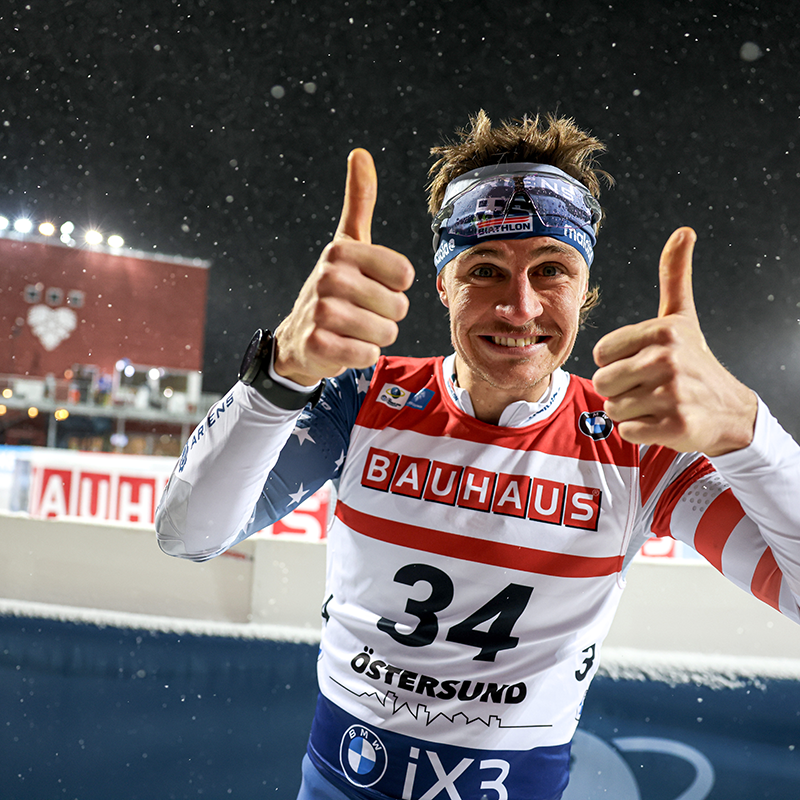
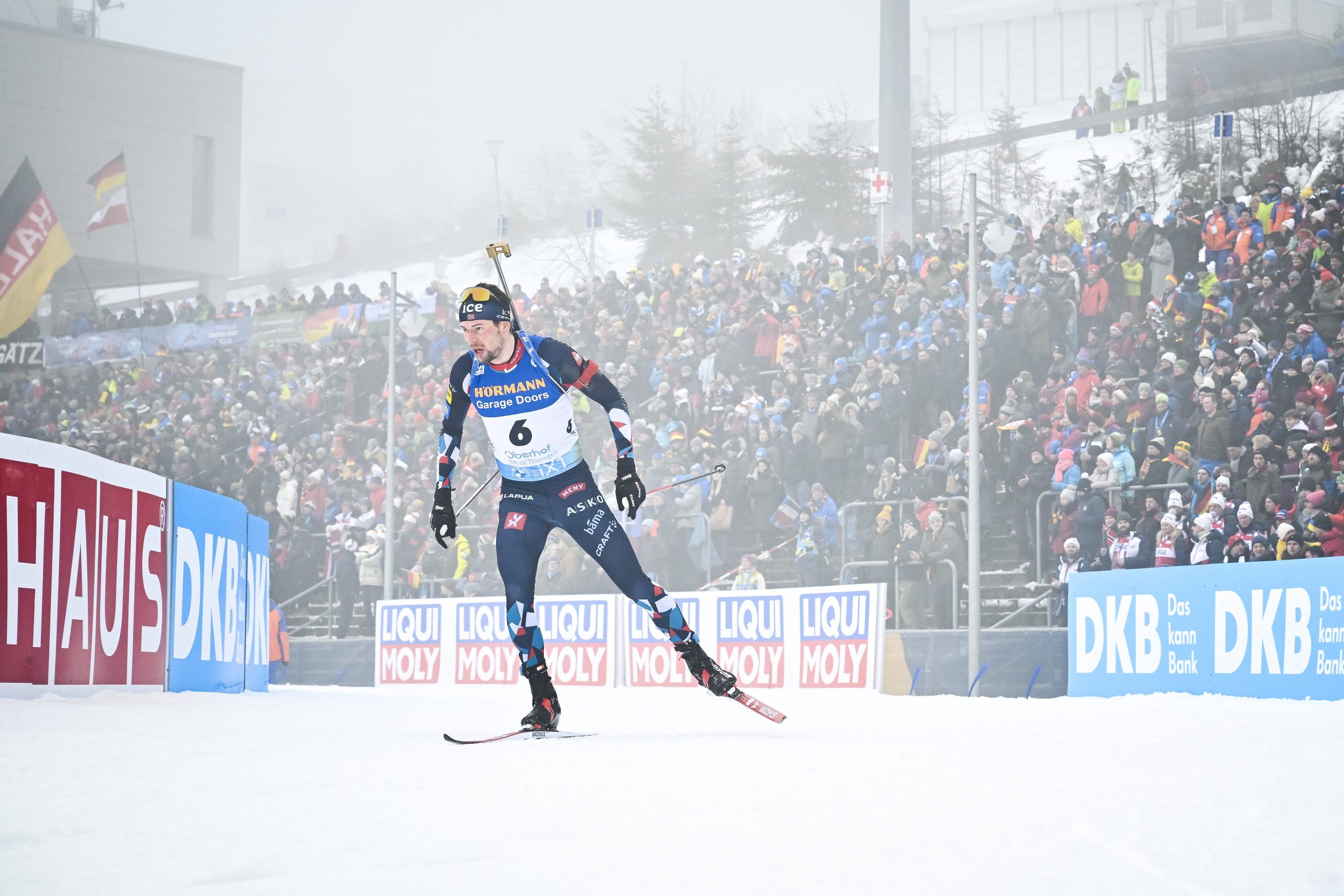
Campbell Wright (USA) during the IBU World Cup Biathlon Men’s Relay in Östersund (SWE). (Photo: Manzoni/NordicFocus)
The men’s relay saw a top result from the U.S. men, as well. Paul Schommer, Campbell Wright, Maxime Germain and Sean Doherty finished fifth, one of the best men’s relay finishes ever for Team USA. The next day, at the mixed relay, Germain, Wright, Chloe Levins and Deedra Irwin placed sixth – which is the best finish for a U.S. mixed relay since 2021.
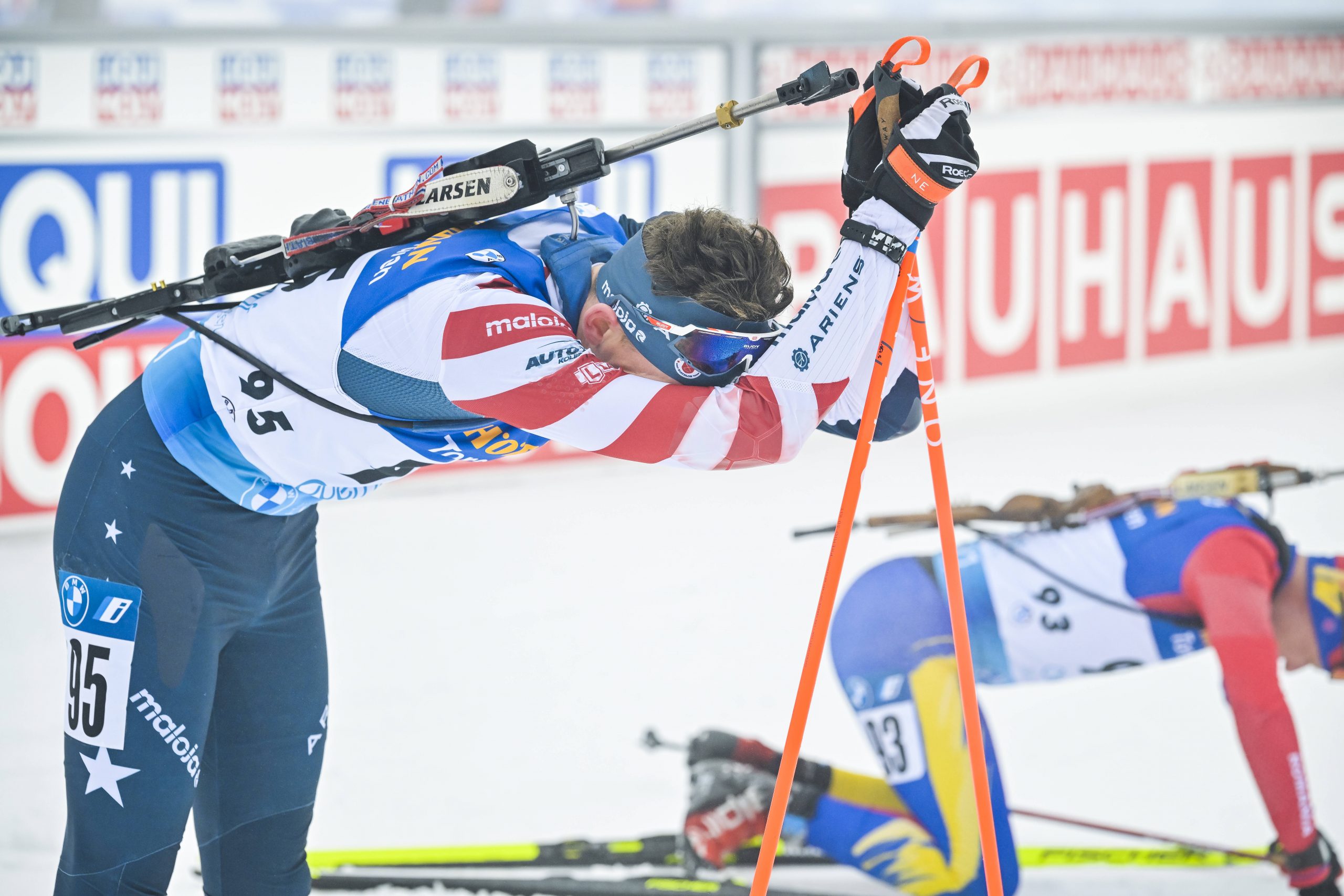
Artem Tyshchenko (UKR) and Paul Schommer (USA), (l-r) during the Men’s Relay in Oestersund (SWE). (Photo: Manzoni/NordicFocus)
Germain and Wright continued to build on their early-week momentum, with Germain placing 11th in the sprint. In the pursuit, Wright hit all 20 targets for the first time in his career and moved up from 18th to 6th. Wright is coming off a stellar 2024/25 season, where he podiumed twice at World Championships, becoming the first American to do so.
Throughout the week, there were highs: Suvi Minkkinen of Finland won her first World Cup sprint. The Norwegian men placed four in the top five in the 20km individual, solidifying their capabilities as a team sans-Boes. And as always in biathlon, some lows: Eric Perrot of France missed his final shot in the pursuit, a devastating moment that cost him the lead. He finished fifth.
Racing wrapped up in Sweden, and teams flew to Austria. In Hochfilzen, a less rigorous racing schedule awaits: sprint, pursuit, and then a men’s and a women’s relay. A few more hours of daylight await, too.
FasterSkier’s Coverage of the Biathlon World Championships is made possible through the generous support of the Craftsbury Outdoor Center: New England’s finest snowmaking, world class race venues and touring trails, healthy food in abundance, comfortable accommodations at Craftsbury: Sports, Sustainability, Stewardship.
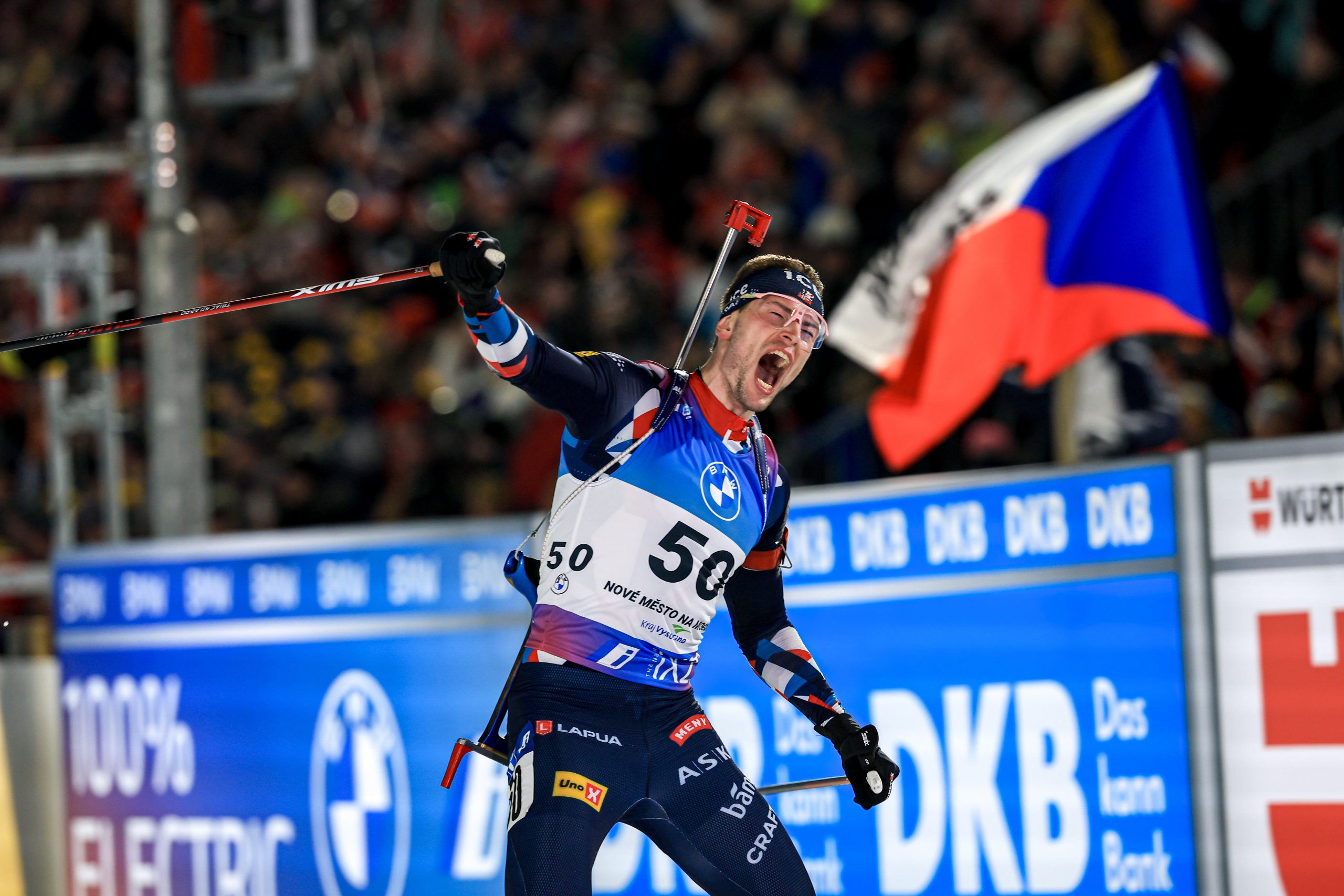
Sturla Holm Laegreid (NOR) celebrates after crossing the line in first in the Sprint at the 2024 World Championships in Nove Mesto na Morave, Czech Republic. (Photo: NordicFocus)
Shut out at last year’s World Championships, Norway’s Sturla Holm Laegreid claimed his place in the spotlight on Saturday, edging out defending champion Johannes Thingnes Boe (NOR) in dramatic fashion for gold in the 10 k Sprint. Vetle Christiansen completed the podium sweep for Norway, taking his first individual World Championship medal.
Defending champion and World Cup Overall leader Johannes Thingnes Boe (NOR) races in front of a packed stadium on his way to a silver medal, 3.5 seconds behind Laegreid. (Photo: NordicFocus).
Laegried’s results in the four non-team competitions at last year’s World Championships were two silvers, a bronze, and a fourth place. Thingnes Boe won all but one of those races; he took the bronze in the Mass Start, pushing Laegreid off the podium. Laegreid has ranked second in the World Cup overall score the last three years in a row—twice behind Thingnes Boe—and is currently the sixth of six Norwegians who fill the top of the rankings. It’s hard to think of Laegreid as an underdog, and yet somehow he is. But second fiddler no more, Laegreid boldly claimed first chair in the Sprint at the 2024 World Championships in Nove Mesto na Morave, Czech Republic.
Vetle Sjaastad Christiansen (NOR) completed the podium sweep for Norway. (Photo: NordicFocus)
Laegreid’s super power has always been his shooting, and on Saturday it earned him the gold. Wearing bib 50, he was latest of the medal favorites to start, and one by one the others in front of him missed targets. Only Sebastian Samuelsson of Sweden managed to hit 10/10, but he couldn’t quite match the speed of the Norwegians and had to settle for fifth.
When Laegreid left the range after hitting 10/10, he had an eight second lead over J. Boe. But he couldn’t match Boe’s speed on the uphills of the final lap and with just one kilometer to go, Laegreid trailed Boe by two tenths of a second. In the final meters, with the advantage of knowing Boe’s splits, Laegreid put in a decisive finishing sprint to win by a margin of 3.5 seconds. It’s been a long time since an athlete looked so thrilled to cross the finish line in first.
Eric Perrot (FRA) finished fourth, the closest any French man has come to the podium this winter. (Photo: NordicFocus)
Only Samuelsson and fourth-place Eric Perrot (FRA) infiltrated the otherwise Norwegian top seven. Perrot’s fourth place ties his second-best finish and is the closest any French man has come to the podium this winter. His teammates Quentin Fillon Maillet and Emilien Jacquelin finished eighth and ninth, and Samuelsson’s teammate Martin Ponsiluoma was tenth.
Campbell Wright (USA) waves to the crowd after shooting clean and finishing with a new personal-best of 11th in the Sprint. (Photo: NordicFocus)
Just outside the top ten, American Campbell Wright set a new personal-best of 11th with clean shooting. This is Wright’s first season competing for the US, after training with the team last season while still competing for his other nation of citizenship, New Zealand. Wright will start Sunday’s Pursuit in bib 11 just 1:08 behind Laegreid. Teammates Jake Brown and and Sean Doherty also qualified for the Pursuit in 38th and 44th, both with three misses. Maxime Germain just missed qualification, finishing 63rd with four misses.
Doherty expressed mixed emotions about qualifying but not with a standout result: “It was tough and although I am very much looking forward to the Pursuit,” he said. “I feel like I left a bit on the table with three misses.” He also pointed to the exciting atmosphere and success of his teammate: “The crowds were awesome and I am really proud of Campbell.”
Sean Doherty (USA) (background) and Campbell Wright (USA) preparing to zero their rifles before the Sprint. (Photo: NordicFocus)
Jake Brown also expressed mixed emotions, describing how good execution doesn’t always align with a good result in biathlon. “I think I pushed pretty deep today and I’m satisfied with that. As for shooting, I was satisfied with my shooting speed; I really committed to sticking to my process, and I did that, and it was just frustrating to miss two in standing.” He went on, “I really came in with confidence. I’ll probably take the same approach in tomorrow’s race.”
Benedikt Doll (GER) speaking with one of his staff members after a disappointing team performance in the Sprint (Photo: NordicFocus)
The gap in ski times in the men’s Sprint was enormous, resulting in an unusually large 3:37-spread separating the top-60 Pursuit qualifiers. A typical spread is 2-2:30. When asked why he thought the spread was so large, Brown pointed to a combination of skis, conditions, and the ban of fluorinated wax products enacted this season. “There are pine needles everywhere, it’s very dirty, and there is a lot of loose, wet snow. It seems like the ski times on the first lap are somewhat normal but then they open up on the second and third laps.” In these conditions, technicians face an extra challenge of preparing skis in such a way that they repel dirt. Brown said that the US team had good skis, while many other nations struggled. The Germans, for example, who have been highly competitive all winter with three different gold medalists, did not place a single athlete in the top ten of the ski time rankings, and their best finisher in the race, Benedikt Doll, was 13th. Technicians from every team will have their work cut out for them again Sunday for both the men’s and women’s Pursuits.
Up Next:
Sunday 11 Feb Women’s 10 k Pursuit 08:30 (Eastern Time)
Sunday 11 Feb Men’s 12.5 k Pursuit 11:05 (Eastern Time)
Johannes Thingnes Boe, Sturla Holm Laegreid, and Vetle Sjaastad Christiansen, (l-r), celebrate their podium sweep for Norway in the Sprint at 2024 World Championships. (Photo: NordicFocus)
FasterSkier’s Coverage of the Biathlon World Championships is made possible through the generous support of the Craftsbury Outdoor Center: New England’s finest snowmaking, world class race venues and touring trails, healthy food in abundance, comfortable accommodations at Craftsbury: Sports, Sustainability, Stewardship.
Fans fill the trail-side stands during the 2023 Biathlon World Cup in Nove Mesto na Morave, Czech Republic. (Photo: NordicFocus)
The 2024 Biathlon World Championships open on Wednesday, February 7 in the countryside town of Nove Mesto na Morave in the Czech Republic. While not widely known as a winter wonderland, Nove Mesto boasts some of the most impressive crowds on the international biathlon circuit. Organizers have already sold out the 30,000-capacity stadium and bleacher-lined course for the opening and closing weekends and expect to sell a total of 200,000 tickets during the 12-day event. For those not lucky enough to join the festivities in person, here’s a brief viewer’s guide.
Athletes ski into the shooting range of the Vysocina Arena during the 2023 Biathlon World Cup in Nove Mesto na Morave, Czech Republic. (Photo: NordicFocus)
How to Watch?
All races will be streamed live for free with English commentary on a brand new digital platform: Eurovision Sport. Replays are available there as well. The full event schedule is available here automatically adjusted to your time zone.
Why Watch?
Wednesday’s Mixed Relay features 25 teams from 25 nations! While the podium places in most World Championship competitions will likely be contested by the “big five” biathlon nations—Norway, Germany, France, Sweden, and Italy—the field is deep and diverse and will inevitably deliver some surprises. Watch for the drama!
Watch to be inspired by the stories of set backs and success that take shape over the course of the nearly two-week event. The series of 12 races in 12 days (a maximum of seven for any given athlete) is an odyssey for athletes and viewers alike. It starts with the chaos of the opening Mixed Relay. The most tense moments of pressure for perfection come in the Sprint, which serves as the qualifier for the Pursuit and sets the tone for each athlete’s Championships. Fatigue peaks in the second week with the long Individual competitions, before a reprise of team relays and finally the grand finale Mass Starts featuring the 30 best athletes. While each competition is entertaining in its own right, viewers will be rewarded for following the arc of the full Championships.
Finally, it’s worth watching this event just to see the stadium atmosphere. It’s shaping up to be one of the most well-attended Nordic skiing events ever.
Start of the Single-Mixed Relay at the 2023 Biathlon World Cup in Nove Mesto na Morave, Czech Republic. (Photo: NordicFocus)
What to Watch?
Relays, Pursuits, and Mass Starts are head-to-head races that promise high drama and are easy to follow for new fans. The Sprint and Individual test the composure of athletes on the range, as the podium almost always demands perfection. The full event schedule is below (Eastern Time):
07 Feb 11:20 4x7k Mixed Relay (M+W)
09 Feb 11:20 Women 7.5k Sprint
10 Feb 11:05 Men 10k Sprint
11 Feb 08:30 Women 10k Pursuit
11 Feb 11:05 Men 12.5k Pursuit
13 Feb 11:10 Women 15k Individual
14 Feb 11:20 Men 20k Individual
15 Feb 12:00 Single Mixed Relay (M+W)
17 Feb 07:45 Women 4x6k Relay
17 Feb 10:30 Men 4×7.5k Relay
18 Feb 08:15 Women 12.5k Mass Start
18 Feb 10:30 Men 15k Mass Start
Deedra Irwin (USA) shooting on lane 5 during the Mixed Relay at the 2024 Biathlon World Cup in Antholz, Italy. (Photo: NordicFocus)
Who to Watch?
The American duo of Deedra Irwin and Campbell Wright is likely to get some TV time in the Single-Mixed Relay after fighting for a podium finish in the most recent running of the event in late January. Irwin set a new personal-best World Cup result of eighth place in a Sprint in December and will be looking to improve on that in Nove Mesto. She has hit 19/20 targets in the 15 k Individual in her last two Championships; if she can do that again this year she’ll have shot at the podium thanks to improved ski speed.
The Americans are also dark-horse contenders in the Men’s Relay. Led by veterans Sean Doherty and Jake Brown, the team has been boosted by a cohort of precocious young talents, including two medalists from last winter’s Junior World Championships: Wright and Maxime Germain. Vincent Bonnacci rounds out this year’s World Championships roster, coming fresh off an impressive 6th place at the European Championships. The team has shown glimmers of greatness this season but has yet to perform to its full potential. This could be their moment to shine.
A pack of Norwegian men at the front of the Mass Start at the 2024 Biathlon World Cup in Antholz, Italy. (Photo: NordicFocus)
Looking at the international field, Norwegian superstar Johannes Thingnes Boe has won the World Cup overall title five times in the past six years and is threatening records set by biathlon legends Ole Einar Bjoerndalen (NOR) and more recently, Martin Fourcade (FRA). But he’s not the only Norwegian to watch; six of them fill the first six places in the men’s World Cup overall score. Always in the shadow of Norway, the Germans have quietly made their own statement, placing five different men on the podium this season including three different winners. There will be good fights for medals between these two teams and some challengers from Sweden and Italy, but it’s fair to expect a frequent playing of the Norwegian national anthem.
The women’s podium is more widely contested. Fifteen women from six nations have landed on the podium this winter. France alone has had three different gold medalists. Lena Haecki of Switzerland broke through the dominance of the big nations with her first gold medal just a few weeks ago. And with more than ten women averaging over 90% hits on the range, the standard of competition is exceptionally high. All of this will make for some exciting biathlon.
It all gets underway Wednesday at 11:20 Eastern Time.
Lisa Vittozzi (ITA) prepares for the opening event of the 2024 Biathlon World Championships during official training on Tuesday, February 6 in Nove Mesto na Morave, Czech Republic. (Photo: NordicFocus)
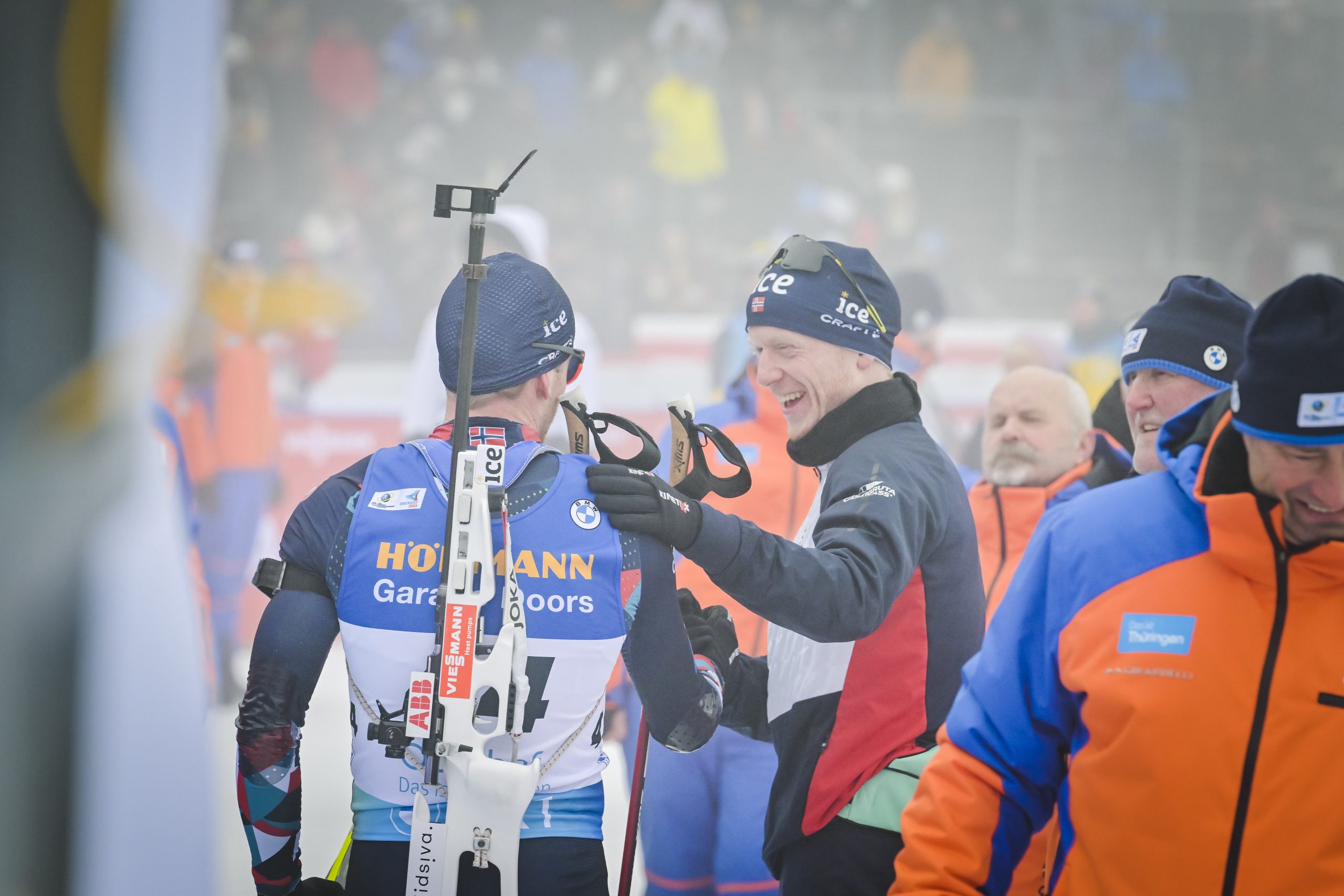
Johannes Thingnes Boe (NOR) congratulates his brother, Tarjei Boe (NOR) who finished beside him on the podium at the IBU World Championships Men’s Sprint in Oberhof. (Photo: Reichert/NordicFocus)
One man has won all five 10 k Sprint competitions so far this season, so even with 112 starters in today’s BMW IBU World Championship Sprint, there was no doubt about the favorite. Johannes Thignes Boe of Norway has been untouchable on skis since November, regularly out-skiing his nearest competitor by over 30 seconds. The 150m penalty loop in biathlon usually takes athletes about 23 seconds, so Boe can afford to miss once and still win. Today he missed once in prone—the target barely visible at 50m through dense fog—but cleaned standing with no hesitation in just 21 seconds. With a 36-second second margin to the next-fastest skier, Boe defended his Olympic title and become the 2023 World Champion. This sets him up for another likely victory in tomorrow’s Pursuit competition, but with four shooting stages, anything can happen.
Johannes Thingnes Boe (NOR) started and finished in bib number 1 at the IBU World Championships Sprint in Oberhof, Germany. (Photo: NordicFocus)
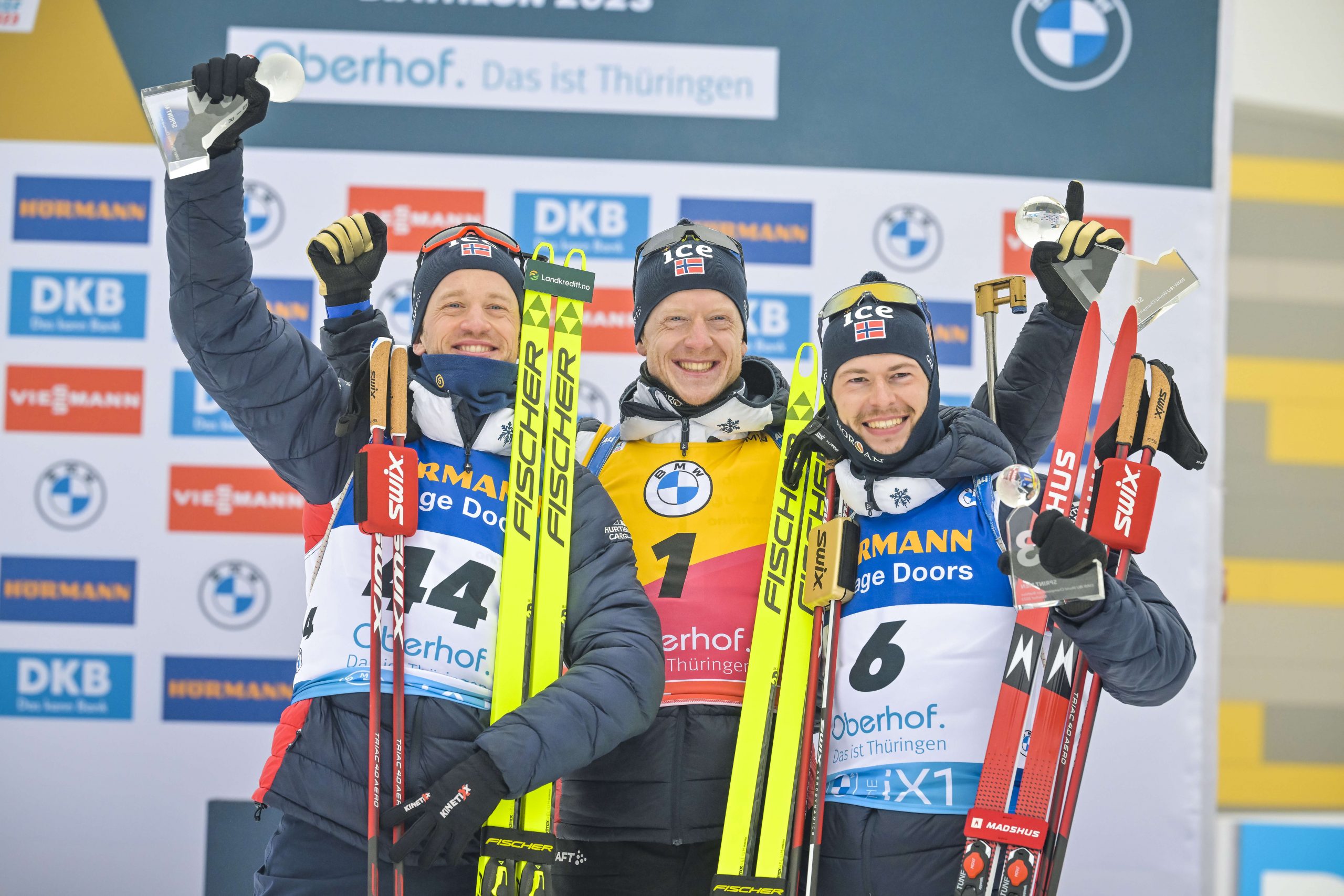
Sharing the podium with the unbeatable Boe were two teammates: his older brother, Tarjei Boe, shot the perfect score to complete the family sweep for the second time this winter, and Sturla Holm Laegreid missed just one in standing to capture the bronze. Laegreid is ranked second behind J. Boe in the Overall standings and has been on the podium in all but three competitions this season, so he was very much the silver medal favorite, but T. Boe is the fifth-ranked Norwegian (and 8th in the World Cup Overall standings), so the so-called “Boedium” was a pleasant surprise for the brothers.
Tarjei Boe (NOR), Johannes Thingnes Boe (NOR), Sturla Holm Laegreid (NOR) (l-r) on the podium of the IBU World Championships Sprint in Oberhof, Germany. (Photo: NordicFocus)
The Norwegian men make it look easy to land on the podium even with nine out of ten hits, but it’s not. Only four people on the whole men’s World Cup circuit have a shooting average of 90%. Laegreid is one of them. The Boe brothers are among the top 15 athletes with an 88% hit rate. Add the expectation of victory, and their performances become even more impressive.
Sturla Holm Laegreid (NOR) racing to third place in the IBU World Championships Sprint in Oberhof, Germany. (Photo: NordicFocus)
With Johannes Dale in fourth and Vetle Christiansen in sixth, the Norwegians almost pulled off a full sweep of the Flower Ceremony, but one athlete managed to upset the total domination. Dmytro Pidruchnyi of Ukraine shot clean and skied the 15th course time to take fifth. He had only raced twice this season—once in November and once just last week, with a knee operation in between—before coming to the World Championships. Pidruchnyi has a history of performing his best at championships; he was the World Champion in the Pursuit in 2019. Today’s fifth place was his top result since then. This victory will certainly mean a lot to him, his team, and the people of Ukraine as they suffer from war at home.
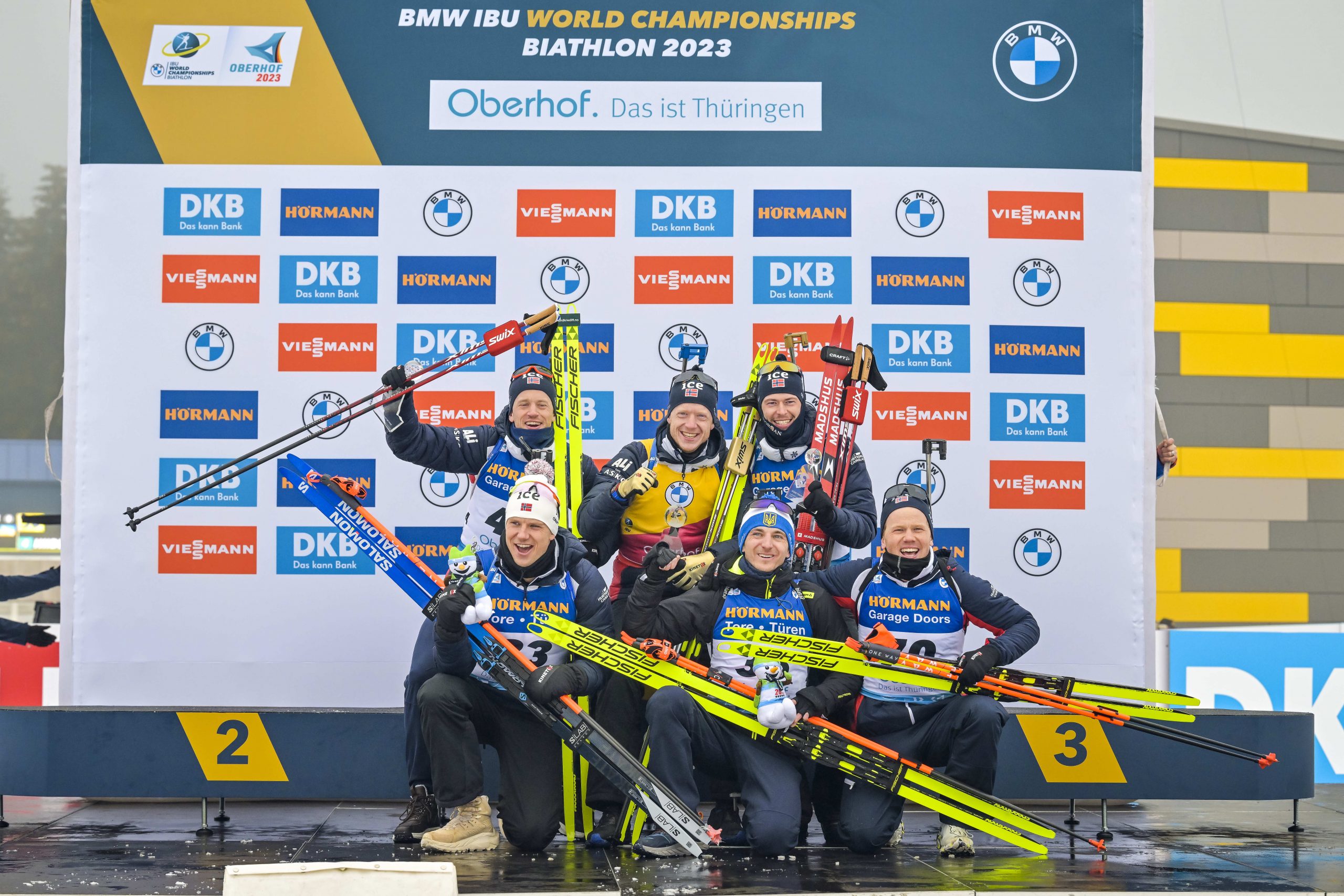
Flower Ceremony finishers in the IBU World Championships Sprint in Oberhof, Germany. Front L-R: Vetle Sjaastad Christiansen (NOR), Dmytro Pidruchnyi (UKR), Johannes Dale (NOR), Back: L-R: Tarjei Boe (NOR), Johannes Thingnes Boe (NOR), Sturla Holm Laegreid (NOR). (Photo: NordicFocus)
Andrejs Rastorgujevs of Latvia shot 10/10 to finish 7th, Johannes Keuhn of the home German team finished 8th for his best result of the season, and two French athletes, Quentin Fillon Maillet and Antonin Guigonnat, rounded out the top ten. Sebastian Samuelsson of Sweden finished in 11th with two penalties. Both he and Fillion Maillet will be podium threats in the Pursuit even starting around 1:10 back.
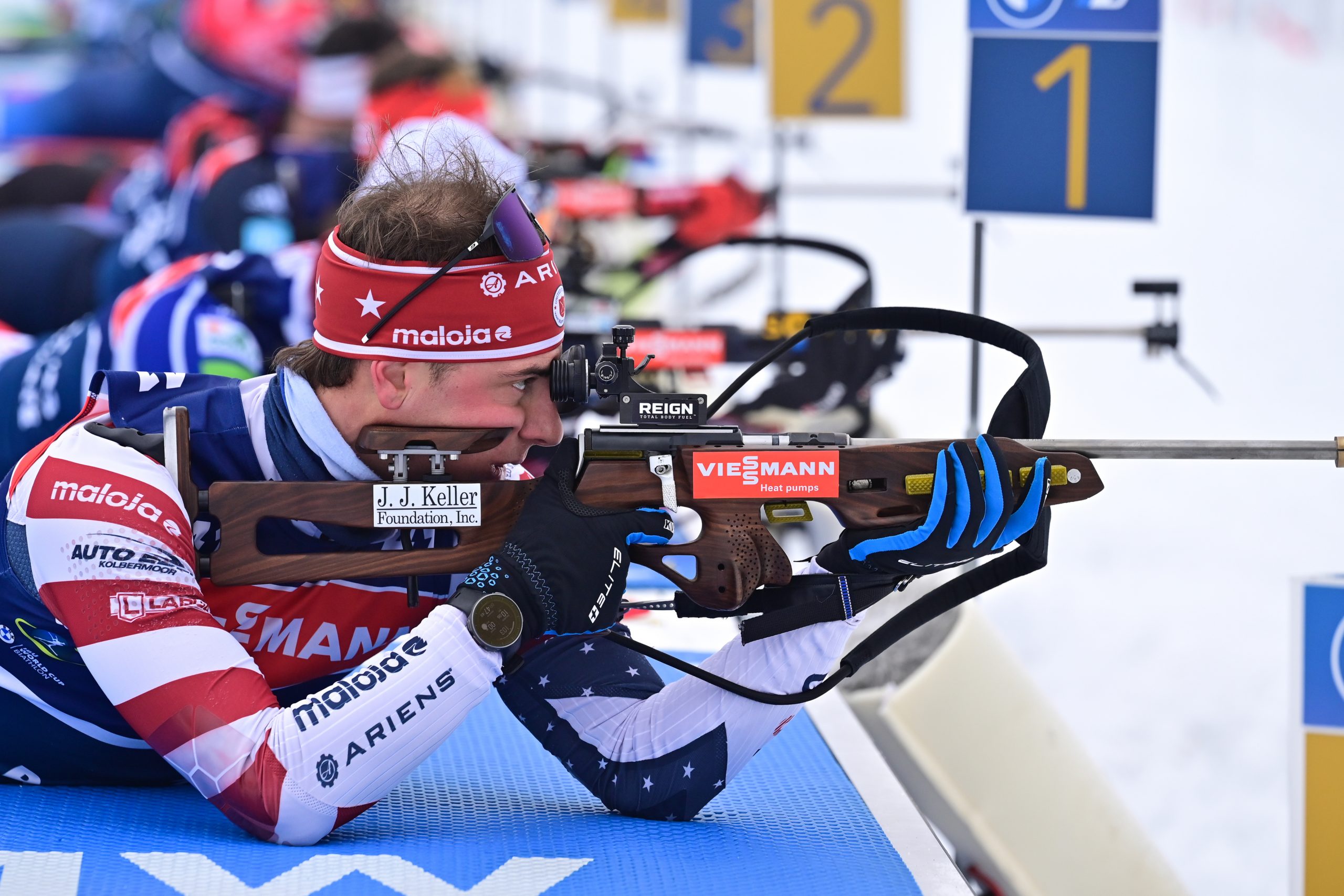
Paul Schommer (USA) zeroes his rifle before the Sprint competition at the IBU World Championships, in Oberhof, Germany. (Photo: NordicFocus)
Today was a tough day for the North Americans, with the exception of Paul Schommer (USA) who qualified for the Pursuit in 31st with one penalty each in prone and standing. Paul’s 31st-ranked course time was his best in a Sprint this season. “That prone miss was definitely one of those things where I thought, okay, I should have taken another second, but the standing felt good,” Schommer said of his shooting. As in yesterday’s Women’s Sprint, drafting on the long, windy straightaway into the range was critical. With that in mind, Schommer went out of his comfort zone on the second lap to stay with another athlete. “I may have pushed a little too hard before standing, but I made up so much time by staying with him.” It’s easy in biathlon to play the “what if” game, and Schommer recognized that he would have cracked the top 20 with one less miss, but he said, “tomorrow I’m going for the money!” The top 30 finishers in biathlon World Cups and World Championships earn prize money.
Maxime Germain (USA) in the finish of his first senior-level World Championship race. Oberhof (GER). (Photo, NordicFocus).
Twenty-one-year-old Maxime Germain (USA) finished just outside of the Pursuit qualification in 65th with three penalties. Both Sean Doherty (USA) and 22-year-old Vincent Bonacci (USA) cleaned prone but then uncharacteristically missed four in standing. They finished 80th and 98th.
For Canada, Adam Runnalls was the team’s top finisher in 82nd with five misses. Trevor Kiers was 86th with three, Christian Gow was 92nd with four, and Logan Pletz was 94th with four. This was certainly not the day that either North American team had hoped for. Those not racing in tomorrow’s Pursuit will shift their focus now to next week’s 20km Individual competition.
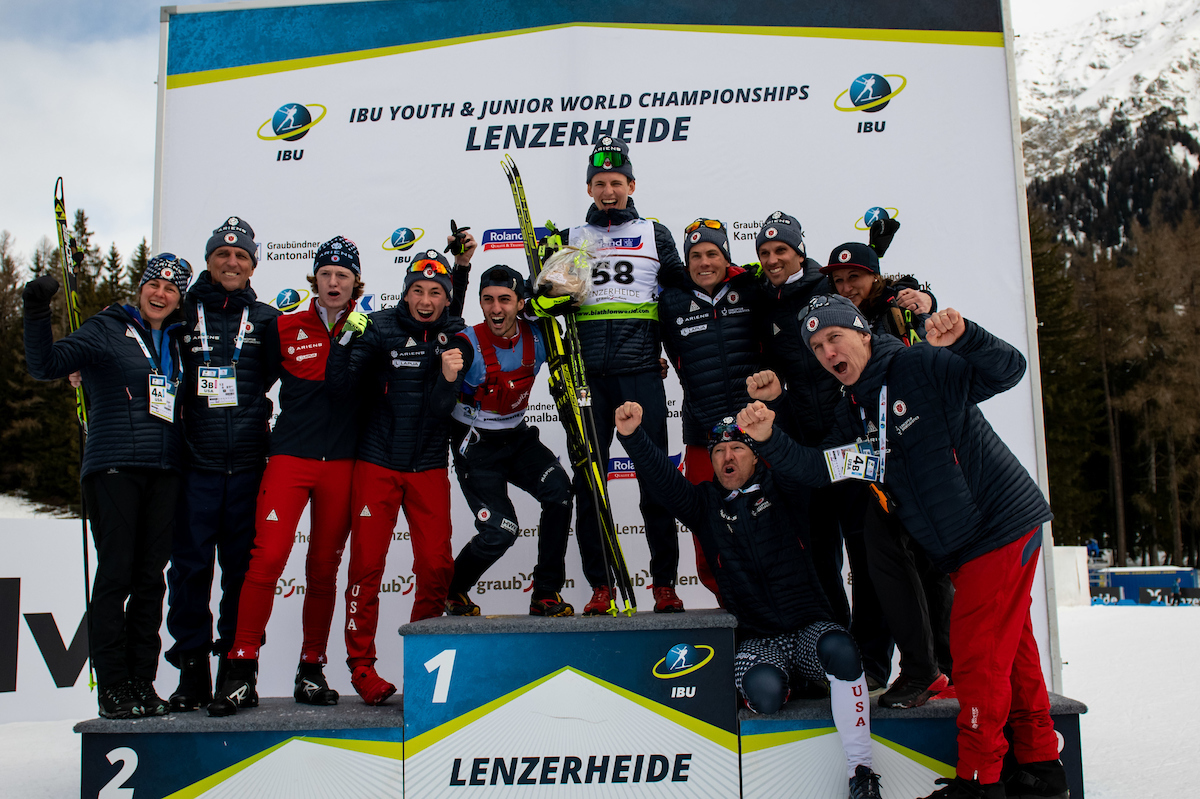
A team effort: Maxime Germain (bib 58) placed third in the World Junior’s Youth 7.5 k sprint. (Photo: Weymuller Photography)
A compelling aspect of international biathlon is the diversity of nations represented at the highest level, the International Biathlon Union World Cup. Last week in Pokljuka, 25 five teams from 25 different nations were represented in the 4 x 7.5 k mixed relay. It speaks to the broadening global appeal for the sport. All those nations are tasked with developing athletes. Not to say there will be 25 different approaches, but each team espouses it’s own values. The same can be said of U.S. Biathlon.
From the top-down, this crew speaks to fair and hard driving sport. Max Cobb, for example, US Biathlon’s CEO and President works behind the scenes at the IBU for clean competitions. Clare Egan, an athlete representative on the IBU Board speaks truth to power. Several athletes took a training hiatus this summer to join the Army National Guard. And behind the scenes, Danika Frisbie has focused on strategic programming and Tim Burke has jump-started a development program. Part of Burke’s responsibilities includes guiding US Biathlon’s Junior National Team.
Danika Frisbie of US Biathlon in Lenzerheide, Switzerland at the IBU 2020 Junior World Championships. (Photo: Weymuller Photography)
Tim Burke of US Biathlon in Lenzerheide, Switzerland at the IBU 2020 Junior World Championships. (Photo: Weymuller Photography)
With all this energy, not to mention the team has been splashed in the most stylie uniforms on the circuit, the U.S. Junior men had a collective proud day at the 2020 Lenzerheide, Switzerland Junior World Championships in the Youth 7.5-kilometer sprint.
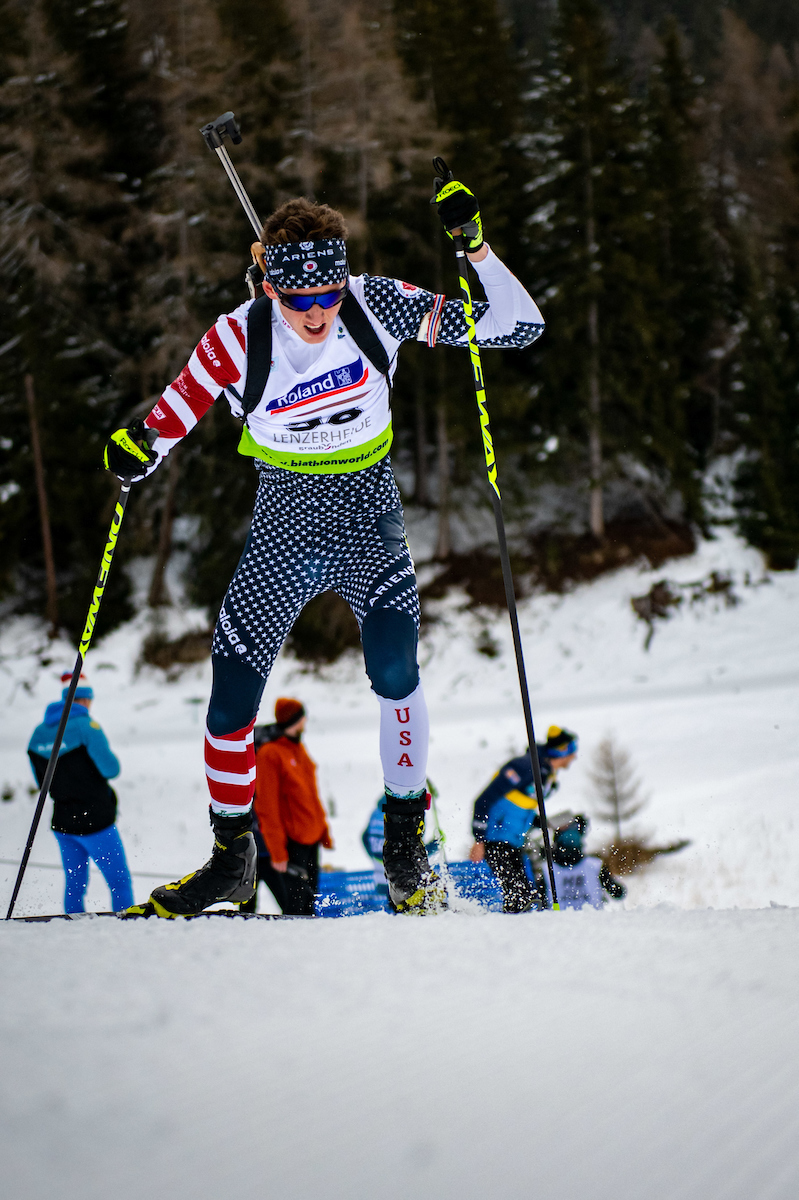
Max Germain on his way to a third place in the World Junior’s Youth 7.5 k sprint. (Photo: Weymuller Photography)
Two U.S. skiers landed in the top-10, a third was top-25. Max Germain of Anchorage, Alaska was third overall, 11.3 seconds from first after shooting 1+0. Russia’s Aleksai Kovalev won in 19:53.0 while shooting clean.
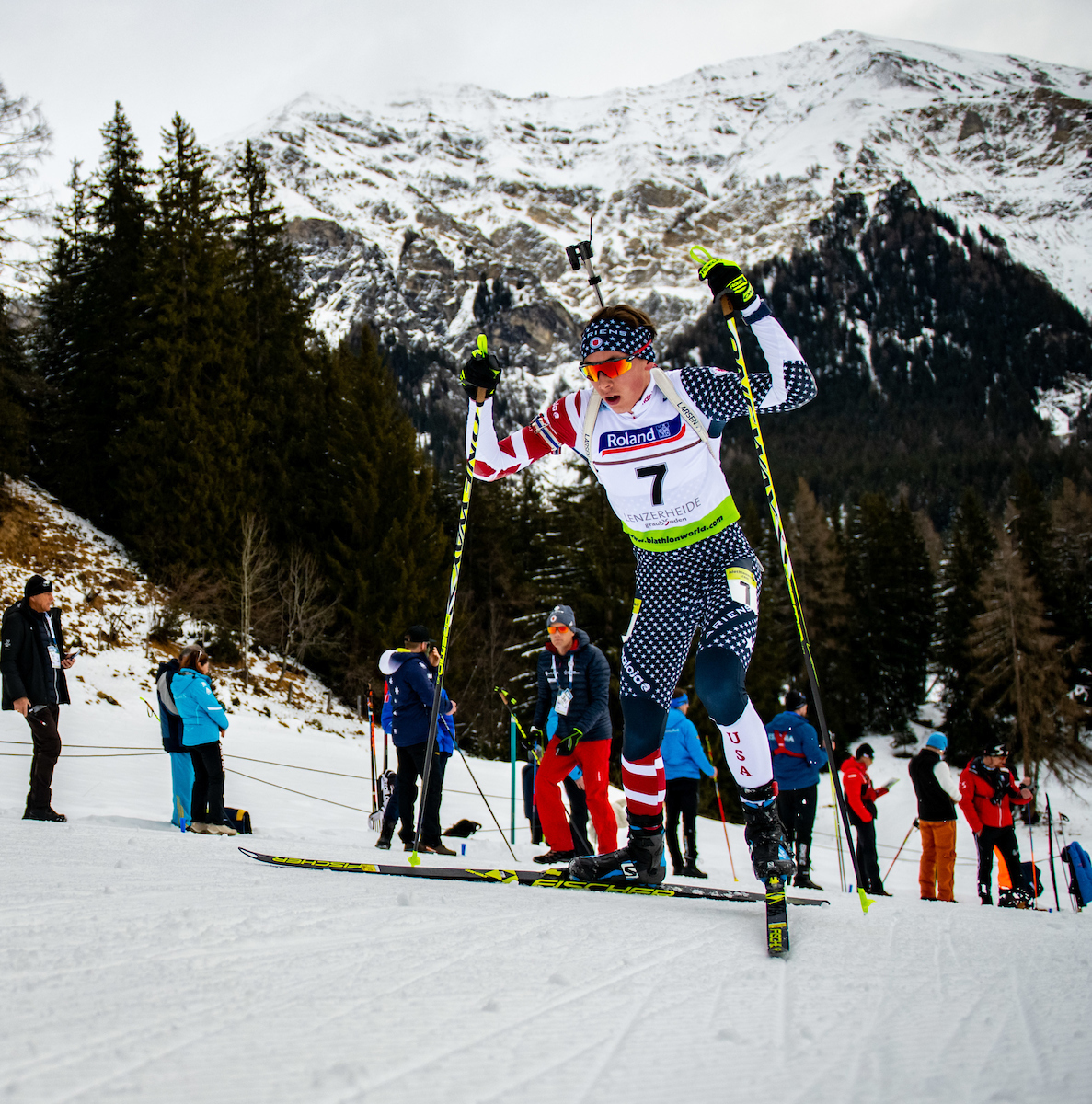
Bjorn Westervelt of Craftsbury, Vermont during the Youth 7.5 k sprint at World Juniors in Lenzerheide, Switzerland. (Photo: Weymuller Photography)
Bjorn Westervelt of Craftsbury, Vermont placed ninth (+24.0; 1+0), and Sam Stertz of Grand Rapids, Minnesota finished in 21st (+1:05.8; 0+0). Timothy Cobb of Vermont, the fourth American in the race, placed 83rd (+4:22.6; 4+2) after a tough day on the range.
Sam Stertz during the Junior World’s Youth 7.5 k sprint. (Photo: Weymuller Photography)
It was a good day for those clad in the U.S. Lycra.
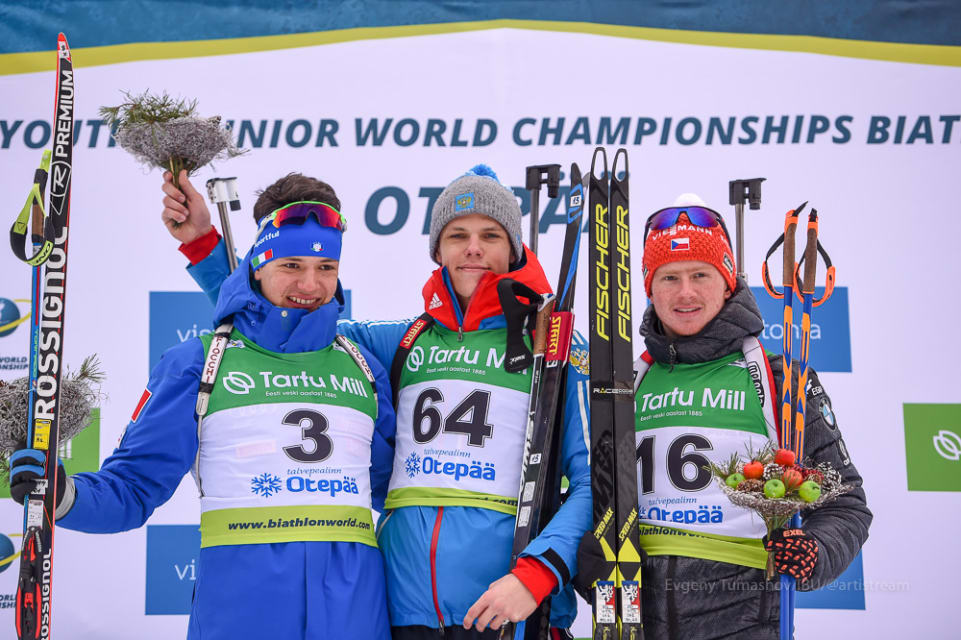
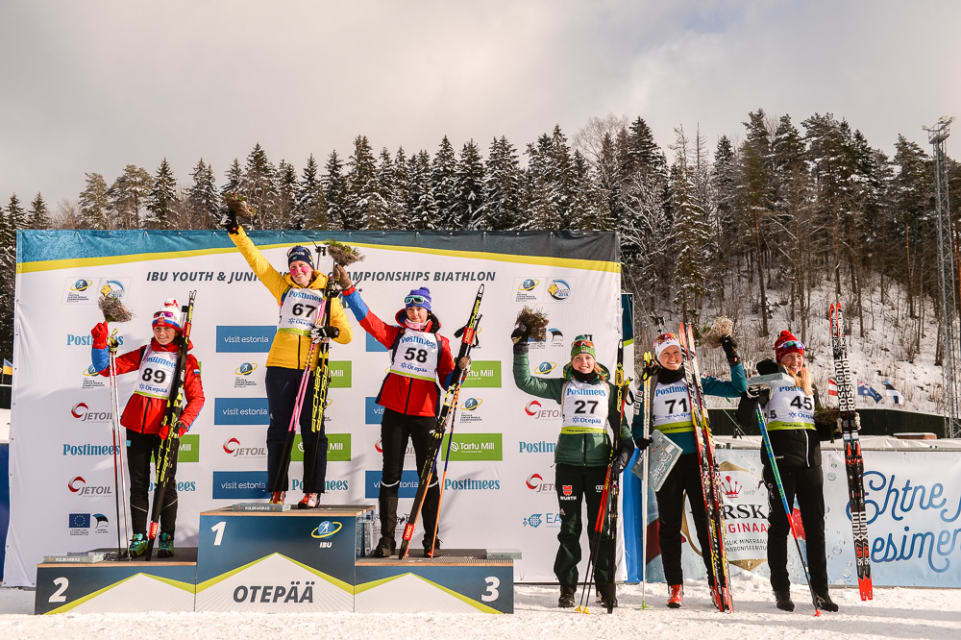
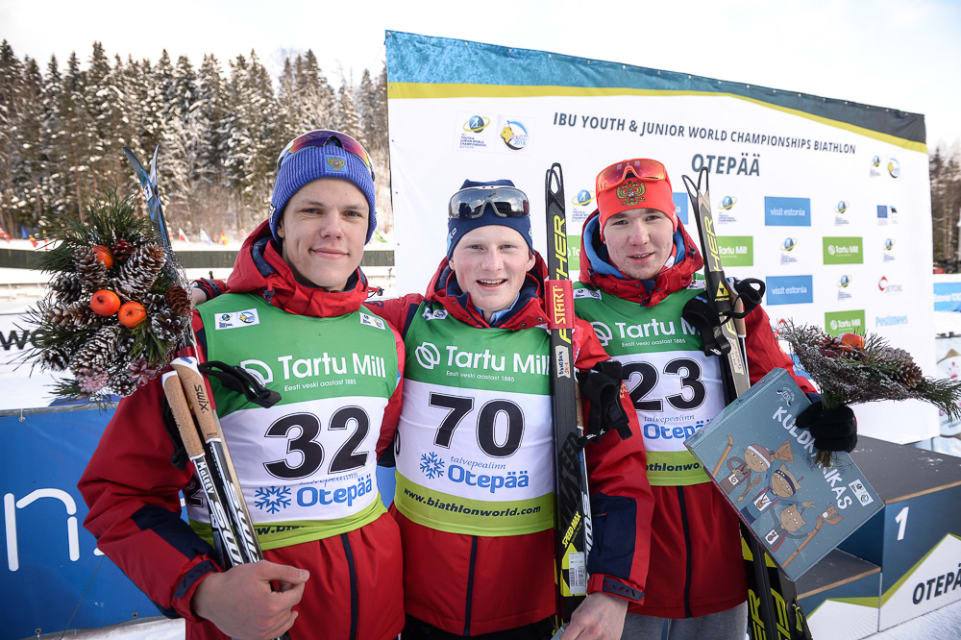
The youth men’s 7.5 k sprint podium at IBU Youth World Championships in Otepää, Estonia, with Russia’s Mikhail Pervushin (c) continuing his undefeated streak at the championships in first, Italy’s Tommaso Giacomel (l) in second, and the Czech Republic’s Vítězslav Hornig (r) in third. (Photo: IBU/Biathlonworld)
IBU Youth World Championships (Otepää, Estonia): Youth women’s and men’s sprints
Sweden’s Karin Elvira Öberg raced to her third-straight win of the week at the International Biathlon Union (IBU) Youth World Championships in Otepää, and Pascale Paradis led Canada in 15th in the youth women’s 6-kilometer sprint on Friday.
Paradis started 36th out of 92 women and shot 18-for-20, missing one on each stage (1+1), on a day when the top-two finishers had misses as well. With the ninth-fastest overall course time, Paradis, 15, finished 1:04.3 minutes off of Öberg’s winning time of 19:46.7.
Sweden’s Karin Elvira Öberg after winning her third-straight race at 2018 IBU Youth World Championships in Otepää, Estonia, with a win in the youth women’s 6 k sprint on Friday. (Photo: IBU/Biathlonworld)
Meanwhile, the 19-year-old Öberg started 65th and claimed the win with one penalty (0+1), continuing her undefeated streak at Youth Worlds after winning the 10 k individual and relay as well. She was joined on the podium by her teammate Amanda Lundström, who also raced to gold in the 3 x 6 k relay on Wednesday, and shot clean on Friday to finish 16.7 seconds back in third.
Between them, Finland’s Heidi Nikkinen placed second (+13.1), with one penalty (1+0).
In the first race of her first Youth World Championships, Paradis placed sixth to earn recognition at the post-race flower ceremony.
“After being shocked with the result I got for the individual it got me pretty excited,” Paradis recalled in an email on Friday. “But I knew that if I put too much pressure on myself I would get too nervous. But it really boosted my confidence to know that I had a chance to do well here!
“So I went into this race not expecting too much,” she continued. “This season I’ve been doing well in individuals so I was hoping for a good result but in sprints I haven’t been shooting great so I was super happy to see myself knock 8 targets down and I skied as fast as I possibly could, so overall I am super happy about my race!”
Pascale Paradis racing the first leg of Canada’s youth women’s 3 x 6 k relay team on Wednesday at IBU Youth World Championships in Otepää, Estonia. Her team finished 10th. (Photo: Bill Gilliland)
Paradis described the conditions as “perfect”, not too cold and with relatively calm winds.
“I was happy about my shooting just because it’s the best I’ve shot in a sprint race this year,” she wrote. “Skiing I felt really tired but my coach Andrew was on the hill cheering super loud and I dug deep and pushed myself to the max in this race and was extremely happy too see that I had skied one of my fastest races ever!”
In Sunday’s 7.5 k pursuit, the last day of the championships, she’ll start about 1 minute and 4 seconds back in 15th, just 2 or 3 seconds out of 12th place.
“I’m excited to be started really close to a few other girls right out of the gates for the pursuit,” Paradis wrote. “We don’t do many pursuits back home so this will be my second one ever and I’m super excited to see what it’s like on the international level. I really like doing pursuits even though they get me the most nervous, it’s just super fun to know where you are in the race the whole time and to just make up as many spots as you can during the course of the race.”
Two other Canadian women finished in the top 60 of the sprint to qualify for the pursuit, with Jenna Sherrington placing 46th (+2:25.3) with two penalties (1+1), and Benita Peiffer placing 51st (+2:40.4) with three misses (1+2). Shilo Rousseau missed the cutoff in 66th (+3:04.8) with four penalties (1+3).
Two American women qualified, with Emma Stertz in 52nd (+2:44.2) with two misses (1+1), and Grace Gilliland in 55th (+2:50.1) with one miss (0+1). Lexie Madigan finished 70th (+3:28.1) with four penalties (4+0) and Helen Wilson followed in 72nd (+3:28.9) with three misses (1+2).
In the youth men’s 7.5 k sprint on Friday afternoon, Russia’s Mikhail Pervushin won his third-straight race of the championships, shooting clean and finishing in 20:17.3. Italy’s Tommaso Giacomel also shot a perfect 10-for-10 to finish second (+21.9) for his first Youth Worlds medal. The Czech Republic’s Vítězslav Hornig rounded out the podium in third (+38.6) with one miss (0+1).
American Vasek Cervenka improved on his 27th place in the 12.5 k individual by finishing 24th on Friday (+1:59.2) with three penalties (1+2). He and two teammates qualified for Sunday’s 10 k pursuit, with Eli Nielsen placing 42nd (+2:51.2) with one miss (0+1), and Garrett Beckrich following in 46th (+3:01.3) with four penalties (1+3). Maxime Germain missed the top 60 in 74th (+4:33.9) with three misses (1+2).
Leo Grandbois led Canada in 33rd (+2:33.4) with three penalties (1+2). All four Canadian men qualified for the pursuit with Thomas Hulsman shooting clean for 35th (+2:35.3), Rory Gilliland finishing 52nd (+3:19.8) with one miss (0+1), and Ryan Elden placing 59th (+3:30.0) with one miss as well (1+0).
The junior women’s and men’s sprints are scheduled for Saturday, followed by the youth and junior pursuits on Sunday.
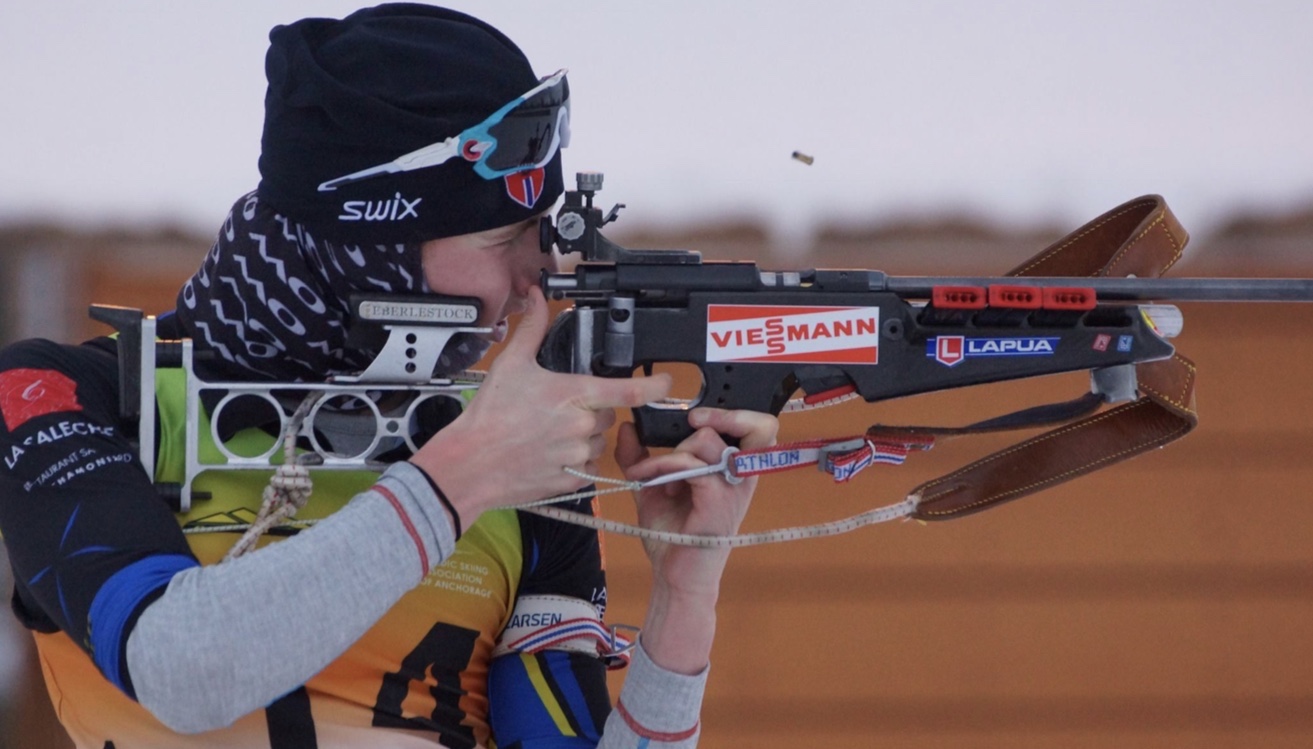
U.S. biathlete Max Germain takes aim. (Courtesy photo)
In an effort to showcase the North Americans competing at this week’s International Biathlon Union (IBU) 2018 Youth and Junior World Championships in Otepää, Estonia, we asked those qualifying athletes several questions about themselves — actually, we had them fill in the blanks. Here we have 16-year-old Maxime “Max” Germain, who is representing the U.S. at his first World Youth Championships.
“My full name is Maxime Logan Germain but you can call me Snaxime.
I was born Juneau, Alaska, and raised in France, and I learned to ski in mama’s womb.
Max Germain training. (Courtesy photo)
I spent the time between World Youth trials and Worlds trying to really focus on my shooting and get better at long distance (10 km and 12.5 km).
The easiest workout I did in the last training year to prepare for this was world trials in Minnesota with the Alaskan team.
One thing I’m working on this season to improve my biathlon is playing Fortnite .
This my first time in Estonia and my first time racing internationally, and so far it’s been pretty interesting.
One difference I’ve noticed between Estonia and the United States is the lack of Lululemon.
One of the things I’m most excited about for World Youth Championships in Otepää is get a Barilla sponsor.
One race I’m especially targeting there is the pursuit.
Watching the Olympics in the leadup to my own races was spicy. One of my moments of the Games was watching that one French guy kick ass. I want to be like Jessie Diggins, because of perfect technique.
At Worlds, I really hope I can make friends with someone from France and bonjour.
My favorite thing about the breakfast where we are staying are the Polish girls.
Before this trip, if you said “Estonia”, the first thing I’d think of would have been Russia.
Now that I’m here, I’m pretty sure something I’ll always remember will be that everything froze… everything!!
If I had a totally free day here and didn’t have to worry about race fitness or training, I’d spend it cracking a cold one with the boys, and I am talking about Mountain Dew baby.
The best way to follow me on social media is on Instagram @maxime.gr, SnapChat: @max.g .”
The top-six finishers in the youth women’s 10 k individual at IBU Youth World Championships on Monday in Otepää, Estonia, with Sweden’s Karin Elvira Öberg (second from l) in first, Russia’s Anastasia Shevchenko (l) in second, Russia’s Anastasiia Goreeva (third from l) in third and Canada’s Pascale Paradis (far right) in sixth. (Photo: IBU/Biathlonworld)
(Note: This article has been updated to include comments from Canada’s Pascale Paradis and Canadian head coach Jacqueline Akerman.)
IBU Youth World Championships (Otepää, Estonia): Youth women’s and men’s individual
On Day 1 of the International Biathlon Union (IBU) Youth/Junior World Championships in Otepää, Canada had two women finish in the top 11 of the youth women’s 10-kilometer individual race on Monday.
Canada’s Pascale Paradis racing to sixth in the youth women’s 10 k individual on Monday, the first day of 2018 IBU Youth World Championships in Otepää, Estonia. (Photo: Ian Sherrington)
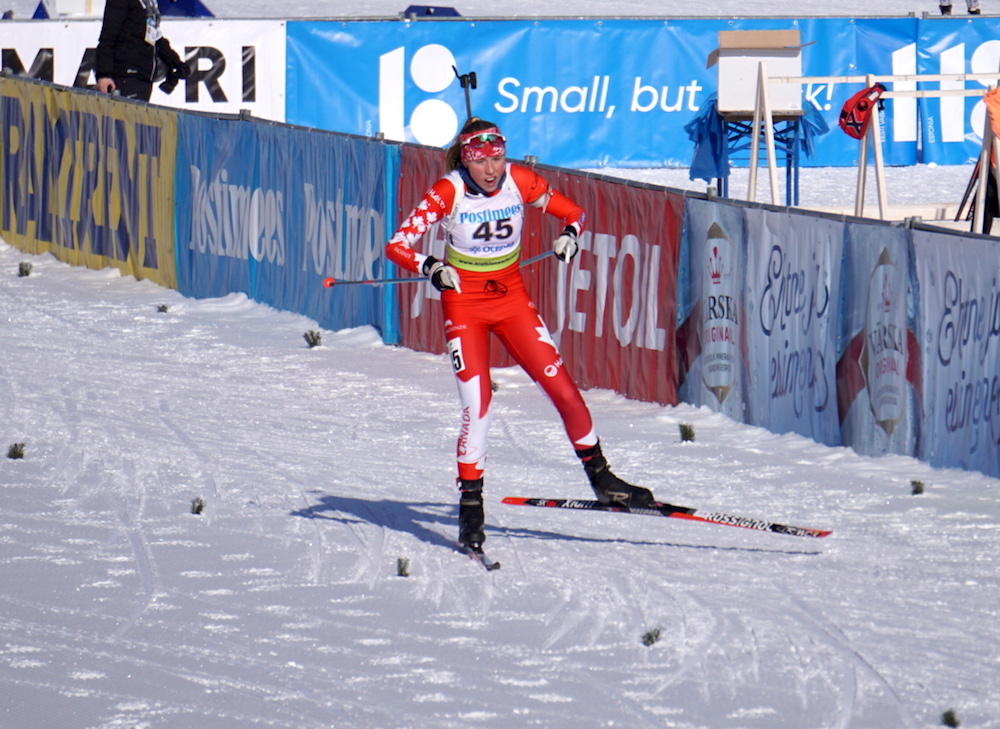
Both are brand new to the Youth World Championships scene, with 15-year-old Pascale Paradis placing sixth, 1:09.2 minutes out of first, with one penalty (1+0+0+0). Also for Canada, 17-year-old Benita Peiffer shot an impressive 19-for-20 in the youth women’s longest race of the championships, missing one in prone and cleaning her remaining targets (1+0+0+0) to finish 1:43.1 out of first.
“I came to these championships with no expectations, with it being my first international race I figured I wouldn’t do great because there’s so many other great competitors in the world,” Paradis wrote in an email to FasterSkier on Monday night. “I just lined up for the start line and pretended that I was racing any normal race because if I didn’t think that I knew the nerves would get to me.”
She started in the middle of the field in bib 45 and found the conditions to be ideal: sunny, not too cold and with minimal wind.
“Right out of the start gates I had a good feeling about the day,” she recalled. “I had a restful sleep and was really nervous and excited at the same time. Though I had no idea I would do that well, I just felt good to me and that’s what made me happy. It just made me even happier to realize that I had come top ten and I was over the moon. I didn’t see that coming and I was incredibly grateful for all of those that had helped get to this stage.
“On course I felt pretty strong, I definitely didn’t feel weak but I had no idea my skiing was within some of the faster times,” Paradis added. “On the range my goal was to focus on my own race and not getting bothered by other competitors, which I usually do, and on the range I felt confident when I came in to shoot. I achieved my goal by not getting flustered by the other girls and all the other distracting sounds.”
According to Canada’s head coach and trip leader Jacqueline Akerman, the team’s head wax technician, Andrew Chilsom, informed Paradis she was in first place after the last shooting.
“She gave a little laugh and immediately picked up her pace and passed a few more competitors in her last loop, good enough to hold for a spot in the flower ceremony,” Akerman wrote.
When Paradis crossed the finish line, she was initially in second place.
“When I finished I didn’t believe that I was one of the top competitors,” Paradis wrote. “I was so dazed and tired and there was so many people around that I just couldn’t really get it into my head. So I was just extremely happy to be up there with the other top biathletes in the world, I didn’t think my result would stay like that but I was just happy to be in that position at all. I was expecting a top 60 maybe when I came here let alone top 10.”
Peiffer started 88th out of 91 in the women’s race. After cleaning the last three shooting stages, she learned what place she was fighting for on her last loop.
“It was probably a good thing I wasn’t told how I was doing until the last lap otherwise I would have gotten too excited and blown up on my last shooting bouts,” Peiffer wrote. “When I found out that I would have a chance at 11th place while I was racing I instantly skied as fast as I could and left all my energy all out on the course. Once I crossed that finish line in 11th place I was filled with satisfaction knowing that I put it all out on the course and proved to myself that I can hit those targets!
“I think the key to my solid shooting today was staying completely focused and in my bubble while shooting,” Peiffer continued. “I found it quite challenging with the amount of people around but I just focused on what I had to do to hit those targets. I also found that not thinking about my shooting too early while skiing on the course helped. I usually get too excited about what could happen and then things go sideways! Positivity is another one! Believing that I could hit those targets is what gave me confidence going into the range.”
She described the Otepäa range approach as relatively easy, which she preferred. “I really like to calm down before I start shooting,” Peiffer explained. “The range here is also not affected by the wind much which I am very pleased with!”
Sweden’s Karin Elvira Öberg, the younger sister of Olympic 15 k individual champion Hanna Öberg, won the race with 19-for-20 shooting as well (1+0+0+0), posting the fastest time at the finish of 35:35.9 minutes. And she did so on her 19th birthday.
“I was so happy for Hanna when she won, and now I win,” Öberg told the IBU on Monday.
Russia occupied the second and third steps on the podium with Anastasia Shevchenko placing second, 35.6 seconds back, with two penalties — one of which came on the last shooting stage (1+0+0+1). Anastasiia Goreeva placed third (+53.8) with three penalties (1+2+0+0).
Four Canadian women competed in the event, with Shilo Rousseau finishing 36th (+4:06.4) with three penalties (0+1+0+2), and Jenna Sherrington following in 40th (+4:22.9) with one miss (1+0+0+0).
“It was wonderful to see the whole group of young youth women who are relatively inexperienced (on the international stage) put in solid performances today,” Akerman wrote. “All of them placing in the top forty along with great shooting results is something to be very proud of! … This is credited to the great and hard working staff and supportive team we have here, as well as thier coaches and others back home who have obviously done great prep work. We have 14 family members of athletes here cheering like crazy, cowbells and flags and heys with each hit, it sure adds to the support the athletes feel. During the flower ceremony Pascale got a much louder cheer than the first placed athlete!”
Emma Stertz led the U.S. in 60th (+6:01.9) with two penalties (0+2+0+0), Helen Wilson finished 74th (+8:00.9) with five penalties (2+2+1+0), and Margaret Madigan placed 83rd (+10:53.9) and Grace Gilliland 84th (+11:26.3) with nine penalties apiece.
Russia put three in the top six of the youth men’s 12.5 k individual on Monday at 2018 IBU Youth World Championships in Otepää, Estonia, with Mikhail Pervushin (32) placing first, Andrei Viukhin (70) fourth and Denis Tashtimerove (23) sixth. (Photo: IBU/Biathlonworld)
In the youth men’s 12.5 k individual, Russia’s Mikhail Pervushin claimed the win in 37:41.2 with perfect shooting except for a single miss on the last stage (0+0+0+1). Norway’s Filip Andersen took silver (+12.3) with one penalty as well (1+0+0+0), and France’s Martin Bourgeois République claimed bronze (+47.2) with two penalties (0+1+0+1).
“I was worried before the start, but I’m happy that things turned out as they did,” Pervushin told the IBU. “Today I was aiming for clean shooting, but I did not succeed, that upset me, but I had to fight for the win. I feel good on the track, I like it – overall I’m happy.”
The defending youth world champion in the event, Canada’s Leo Grandbois placed 24th (+4:15.6) on Monday after incurring five penalties (1+1+2+1). American Vasek Cervenka finished about another 10 seconds back in 27th (+4:25.5) with six penalties (0+3+2+1).
“Leo had a solid ski race today,” Ackerman wrote. “His shooting was not there today, but knowing him he will turn that around in a hurry.’
Also for Canada, Rory Gilliland finished 47th (+6:00.1) with three misses (1+0+1+1), Thomas Hulsman was 65th (+7:35.0) with four penalties (3+1+0+0), and Ryan Elden 81st (+10:47.3) with 10 penalties.
For the U.S., Garrett Beckrich placed 48th (+6:03.9) with seven misses, Camren Nieslen was 64th (+7:21.8) with four misses (0+3+1+0), and Maxime Germain 70th (+8:15.6) with seven penalties.
The junior women’s 3 x 6 relay and junior men’s 4 x 7.5 k relays will be held Tuesday and the youth relays will follow on Wednesday.