From the FasterSkier archive — posts syndicated from athletes’ and coaches’ own blogs between 2004 and 2012, kept online as published. Current coverage is at fasterskier.com.
CANMORE, Alta.—Eight Canadians are readying themselves to head to Europe in the coming weeks to open the highly-anticipated Olympic and Paralympic season while bringing the maple leaf to the World Cup cross-country skiing start line.
Nordiq Canada will send a dynamic group of four women and four men who are determined to climb up the international rankings in the first three weeks of World Cup action before returning to Canada for the holiday break followed by the 2022 Olympic and Junior/U23 World Championship Ski Trials set for the Canmore Nordic Centre, January 6-11.
Olympians Dahria Beatty (Whitehorse) and Cendrine Browne (Saint-Jérôme, Que.) will be joined by National Teammates Katherine Stewart-Jones (Chelsea, Que.) and Maya MacIsaac-Jones (Athabasca, Alta.) on the women’s start line. The four Canadian women have been making steady progression and regularly posting results in the top-25 over the last year.
Russell Kennedy (Canmore, Alta.) who competed at the 2018 Olympics before guiding Brian McKeever at the Paralympic Games in PyeongChang will lead a young men’s team loaded with potential. Kennedy will be joined by Graham Ritchie (Parry Sound, Ont.) and Antoine Cyr (Gatineau, Que.) who were both seventh in the team sprint at the 2020 World Ski Championships. Olivier Léveillé (Sherbrooke, Que.), who was just the third Canadian ever to win an individual cross-country ski medal at the Junior World Championships last year when he finished third in the 10-kilometre skate-ski race, will take his first strides into the senior ranks.
Selection announcement and synopsis can be found here.
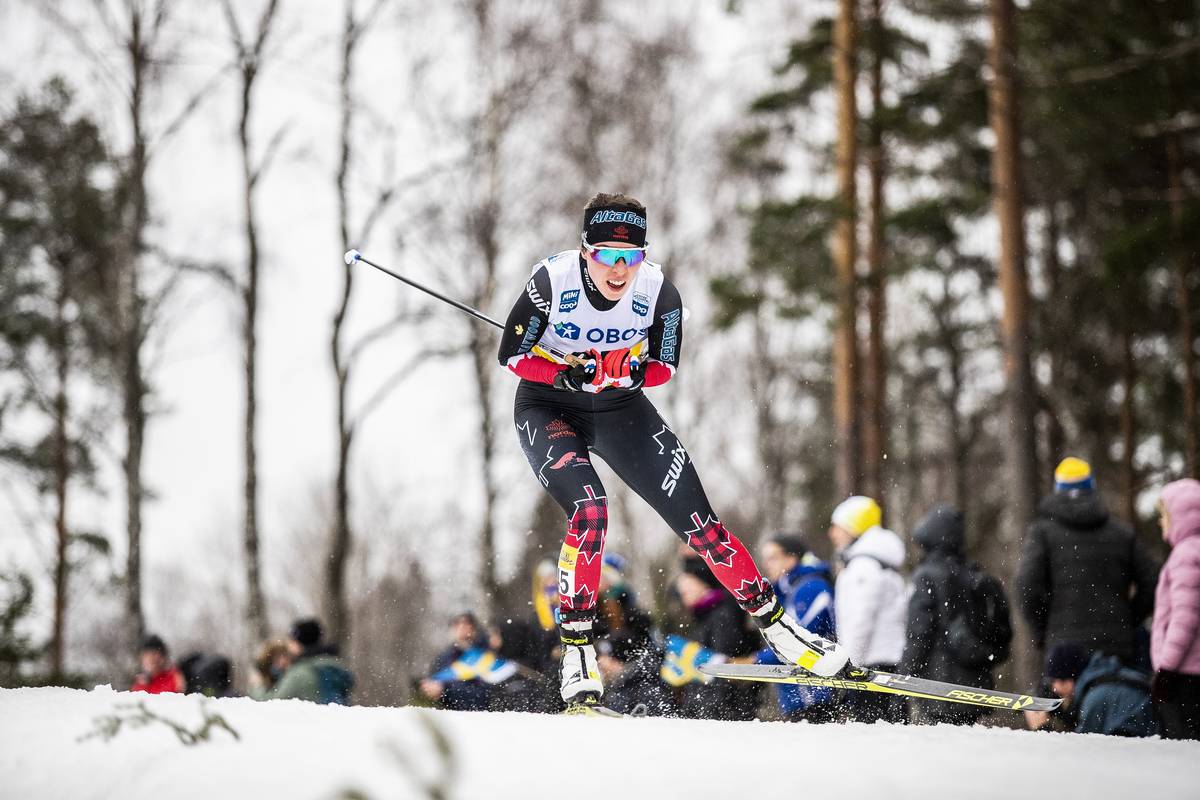
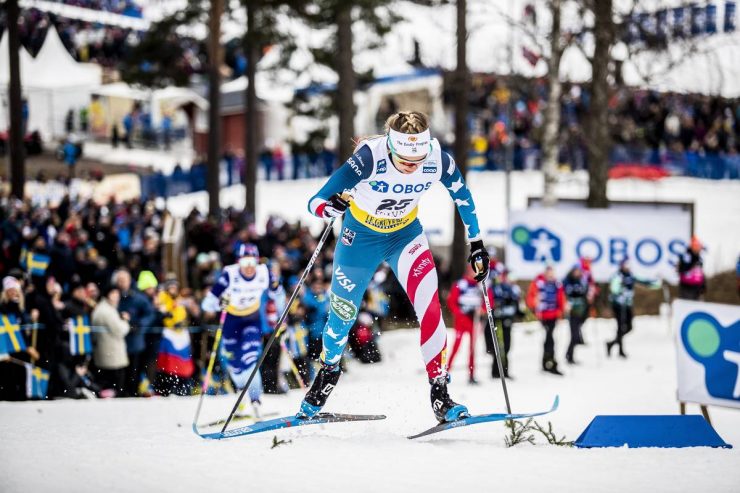
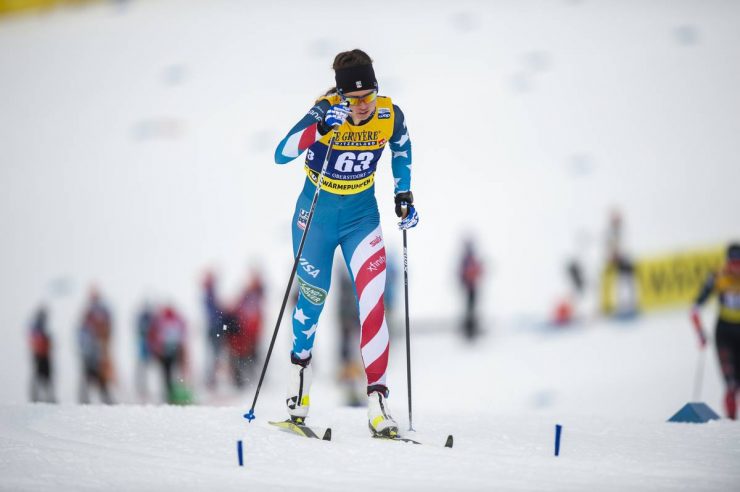
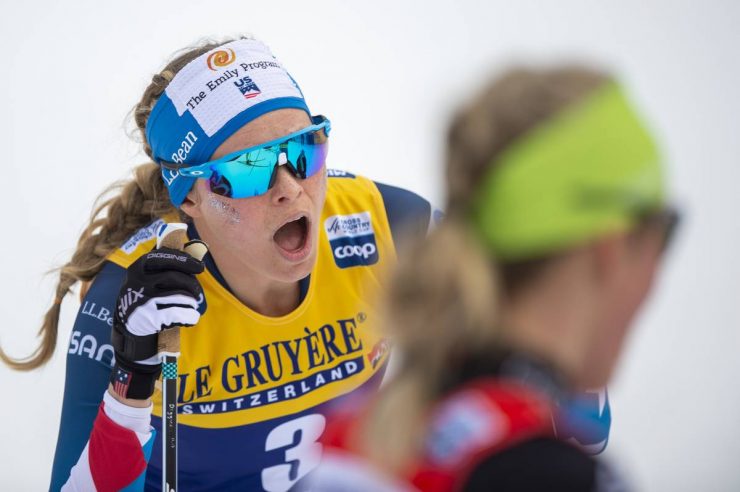
Katherine Stewart-Jones during the 10 k skate in Falun, Sweden. (Photo: NordicFocus)
“This is a determined group of athletes who have earned the opportunity to represent Canada and compete on the elite stage of our sport through their impressive results over the last year,” said Joel Jaques, high-performance manager, Nordiq Canada.
“This group has represented Canada at all levels of the sport internationally, and are now anxious to demonstrate their potential during this important season which will serve as the ultimate benchmark in their continued development. I have full confidence they will be fully prepared to achieve our team and their personal goals.”
The majority of the Canadian Team will depart, November 18, to compete in the following races prior to the holiday break:
Nordiq Canada will hold a media availability with Canadian Team athletes participating in the Frozen Thunder Training Camp at the Canmore Nordic Centre, November 2, in advance of their departure to Europe.
Nordiq Canada is the governing body of para-nordic and cross-country skiing in Canada, which is the nation’s optimal sport and recreational activity with more than one million Canadians participating annually. Its 60,000 members include athletes, coaches, officials and skiers of all ages and abilities. With the support of its valued corporate partners – Haywood Securities Inc., AltaGas, Swix and Lanctôt Sports– along with the Government of Canada, Canadian Olympic Committee, Canadian Paralympic Committee, Own the Podium and B2Ten, Nordiq Canada develops Olympic, Paralympic and world champions. For more information on Nordiq Canada, please visit us at https://nordiqcanada.ca.
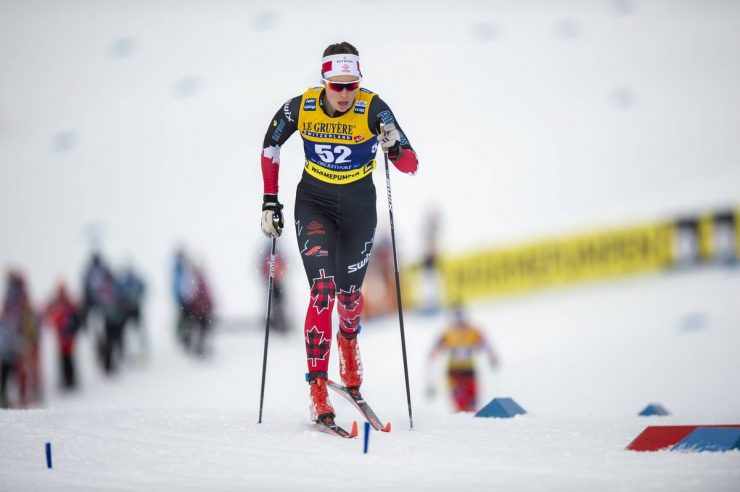
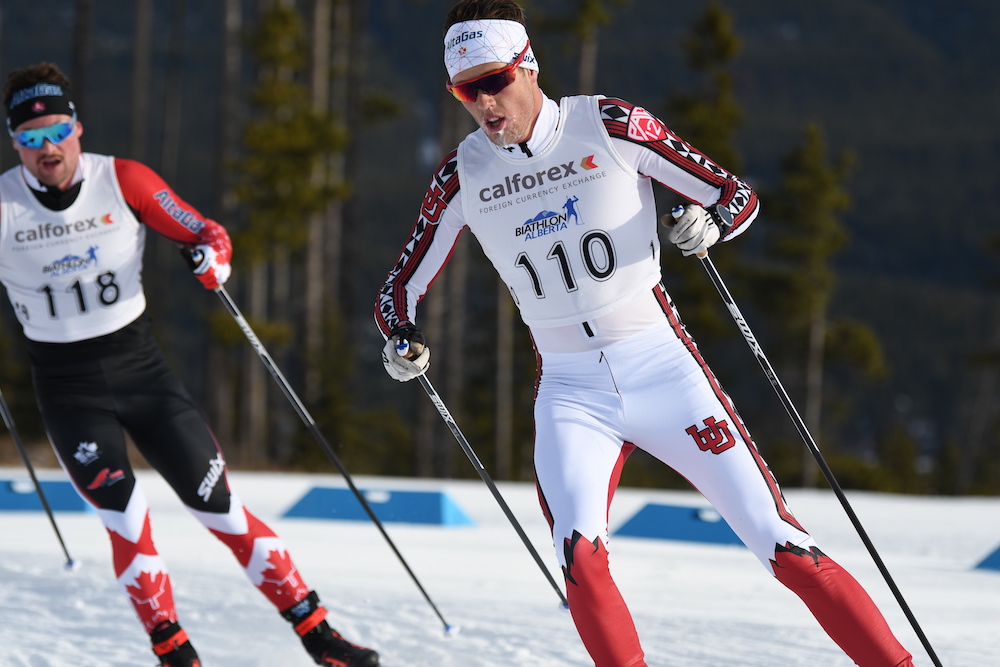
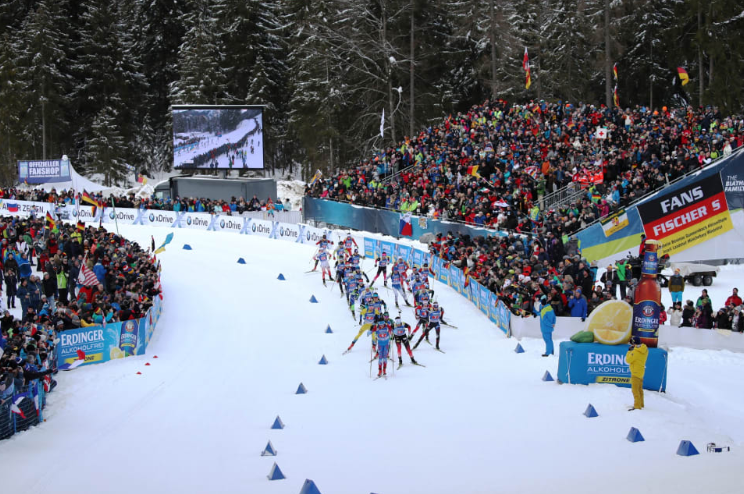
Remi Drolet and Russell Kennedy racing for Canada in Oberstdorf, Germany. (Photo: NordicFocus)
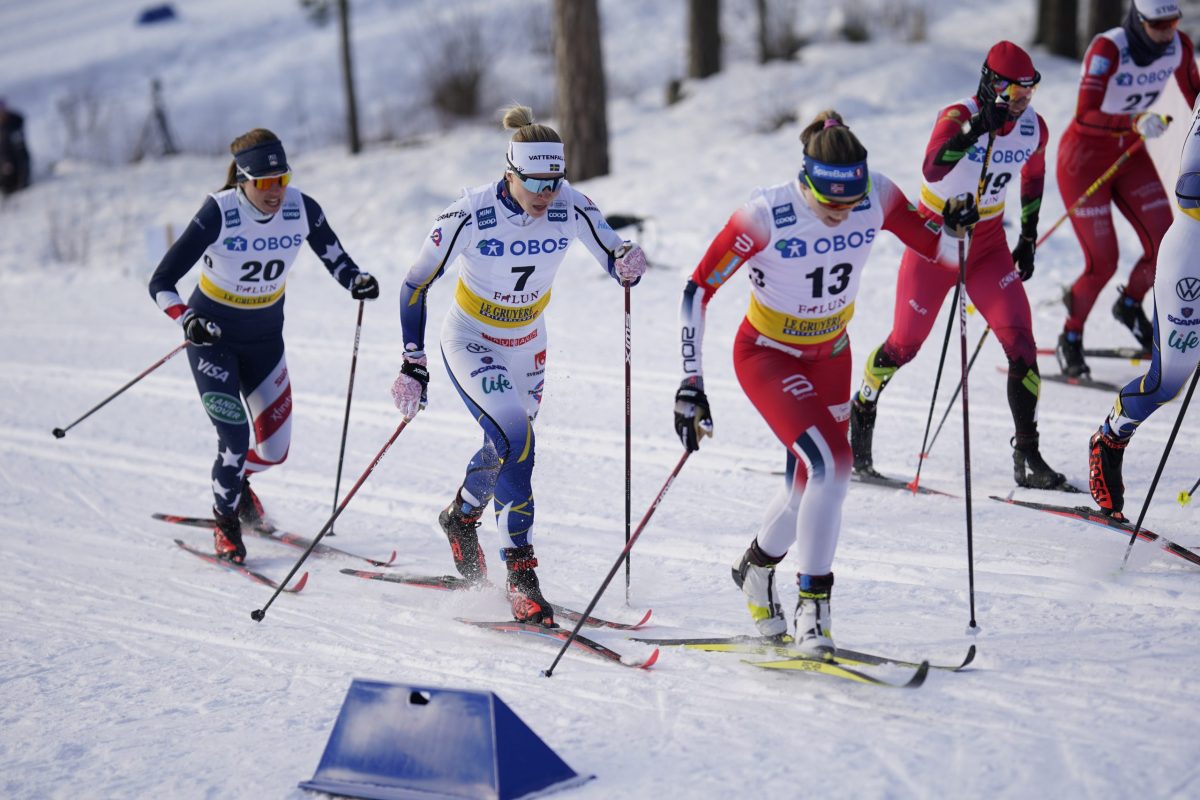
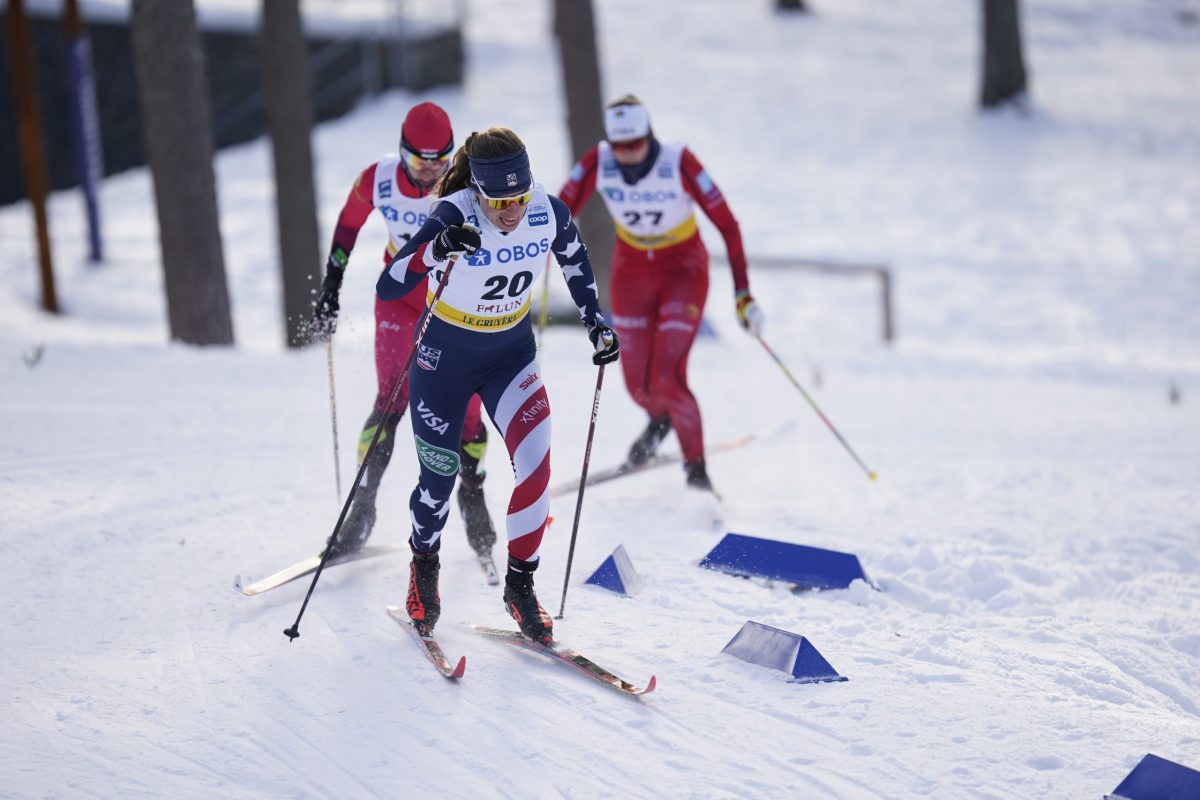
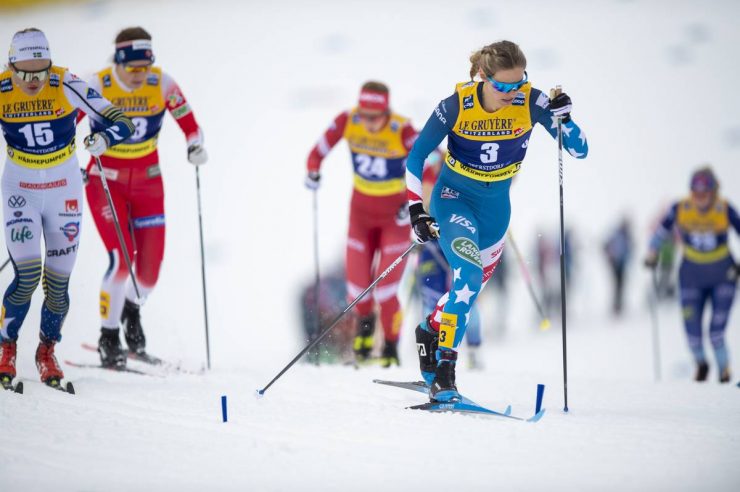
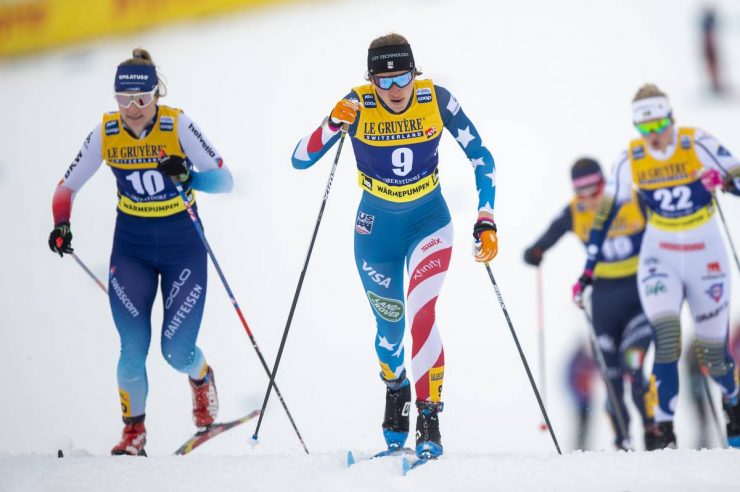
Rosie Brennan charges up the first and longest climb on the sprint tracks in Falun, Sweden. (Photo: NordicFocus)
This World Cup coverage is made possible through the generous support of Marty and Kathy Hall and their A Hall Mark of Excellence Award. To learn more about A Hall Mark of Excellence Award or to learn how you can support FasterSkier’s coverage please contact info@fasterskier.com.
If you had any question about the strength and depth of the Swedish sprint team, look no further than the qualification list from today’s classic sprint in Falun. Led by Johanna Hagström with a time of 3:14.18, Sweden put six women in the top-10. This number was repeated in the semi-final, leading into a half-Swedish final round on home soil.
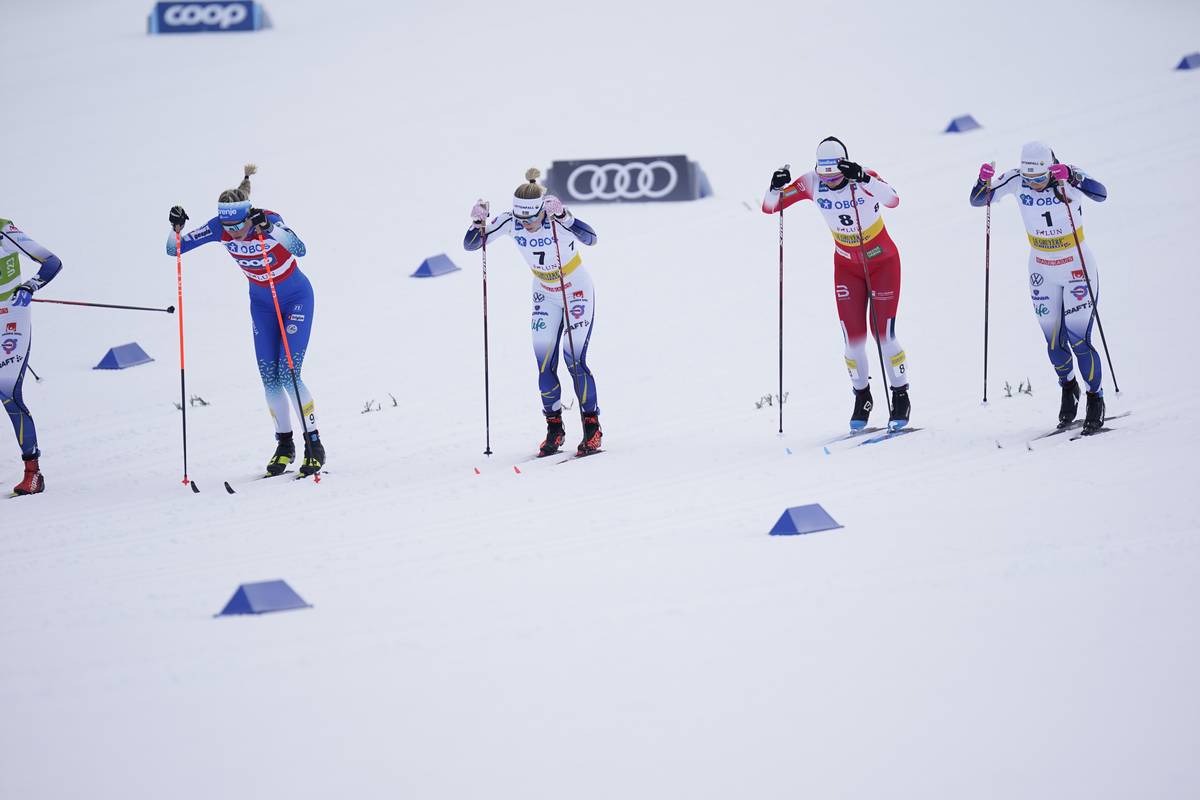
The sprint tracks featured the longest climb first, followed by a spiraling curve to send the women up the second climb. A sharp left turn and a roller brought the athletes back toward the stadium and into the final stretch. As the heats unfolded, this looked like a series of uphill sprints out of the track, some furious double poling, and some powerful cornering.
The profile of the sprint tracks in Falun, Sweden. (Photo: https://skidspelen.se/)
Of the Americans in the heats, Jessie Diggins was the top qualifier in 15th, with Rosie Brennan 20th and Sophie Caldwell Hamilton, back from her mid-season Vermont training camp, in 25th.
During the first heat of the quarters, Diggins looked confident in her tactics, sitting in the middle of the pack. Making assertive moves to seize optimal tracks, she swung wide in the final curve to set herself up to capitalize on her double pole as she sprinted her way from fourth to first. Diggins ceded time at the line to Sweden’s Linn Svahn to finish comfortably in second.
Jessie Diggins skis to 8th in the classic sprint in Falun, Sweden. (Photo: NordicFocus)
Racing in the first heat of the semis, Diggins looked to be employing a similar tactic of patiently waiting to pounce in the back half of the loop. Heading up the second climb in the 5th spot, she began to hammer, but by that time, Svahn and Norway’s Tiril Udnes Weng had created a small gap she could not close. Challenging Anna Dyvik of Sweden, Diggins powered over the final roller and worked her double pole, but was unable to make up any ground and finished 4th.
This ended Diggin’s day, putting her in 8th place overall.
“Whew, today was exhausting!” wrote Diggins after the race. “I think all the all-out efforts in the cold finally started to catch up to me, as I was definitely getting pretty tired in my semifinal. But I was really proud of how I skied today – especially in really tricky kicking conditions with steep hills and tracks that were deteriorating, and a ton of herringbone out there! It’s a very encouraging step forward in my classic technical skiing. We also had great skis which is always important!”
Advancing from the second heat of the semis, Slovenia’s Anamarija Lampic took the lead to pull the group through a fast heat. A few meters back, Sweden’s Jonna Sundling edged out Ane Appelkvist Stenseth and fellow Swede Hagström in a tight finish, which allowed all three women to advance to the final.
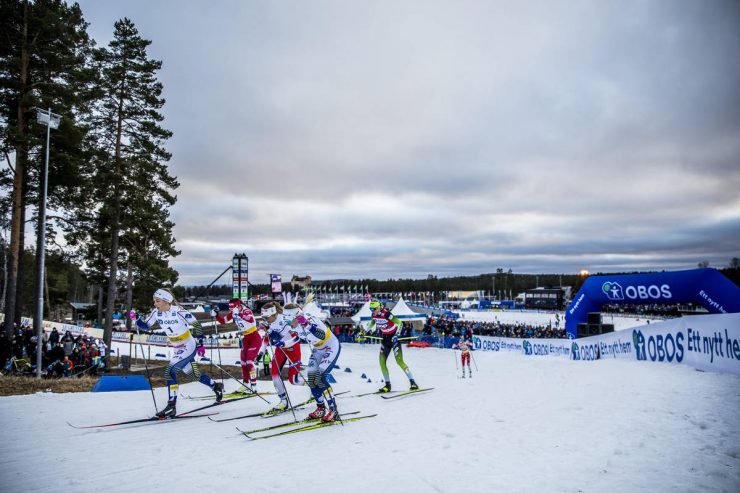
Poling in sync, the final round of the classic sprint in Falun takes to the tracks. (Photo: NordicFocus)
Let’s regroup. Three Swedes, two Norwegians, and one Slovenian in the final: Svahn, Sundling, Hagström of Sweden; Weng, Stenseth of Norway; and Lampic of Slovenia. The two semifinal leaders, Svahn and Lampic, pushed the pace from the front, up and over the two significant climbs. Sitting in a tuck to conserve energy for a final sprint over the roller and toward the lanes, Svahn was on the tails of Lampic, with Sundling just behind. The Swedes gained ground over the roller, setting up an exciting race down the finish lanes.
Anamarija Lampic and Linn Svahn push the pace during the final round of the classic sprint in Falun, Sweden. (Photo: NordicFocus)
With the line just moments away, Svahn simply attacked the ground with her double pole, pulling ahead for a back-to-back win in Falun.
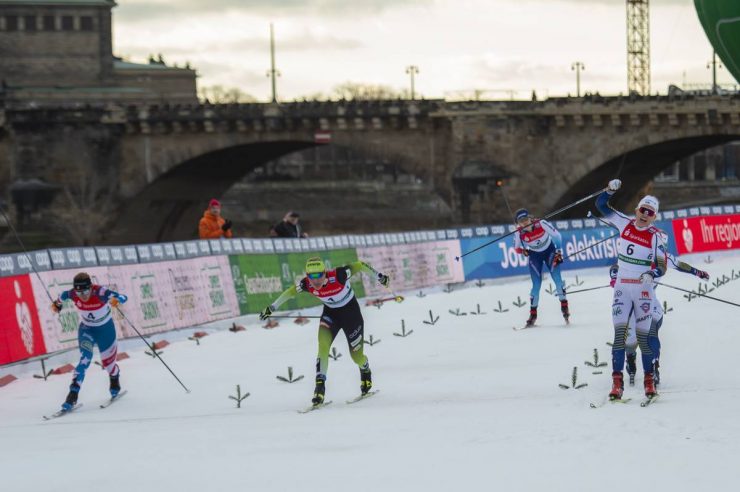
Just behind, Lampic and Sundling were virtually tied as they crossed the line in a photo finish. Though times were the same to the hundredth of a second, Lampic was declared second and Sundling third.
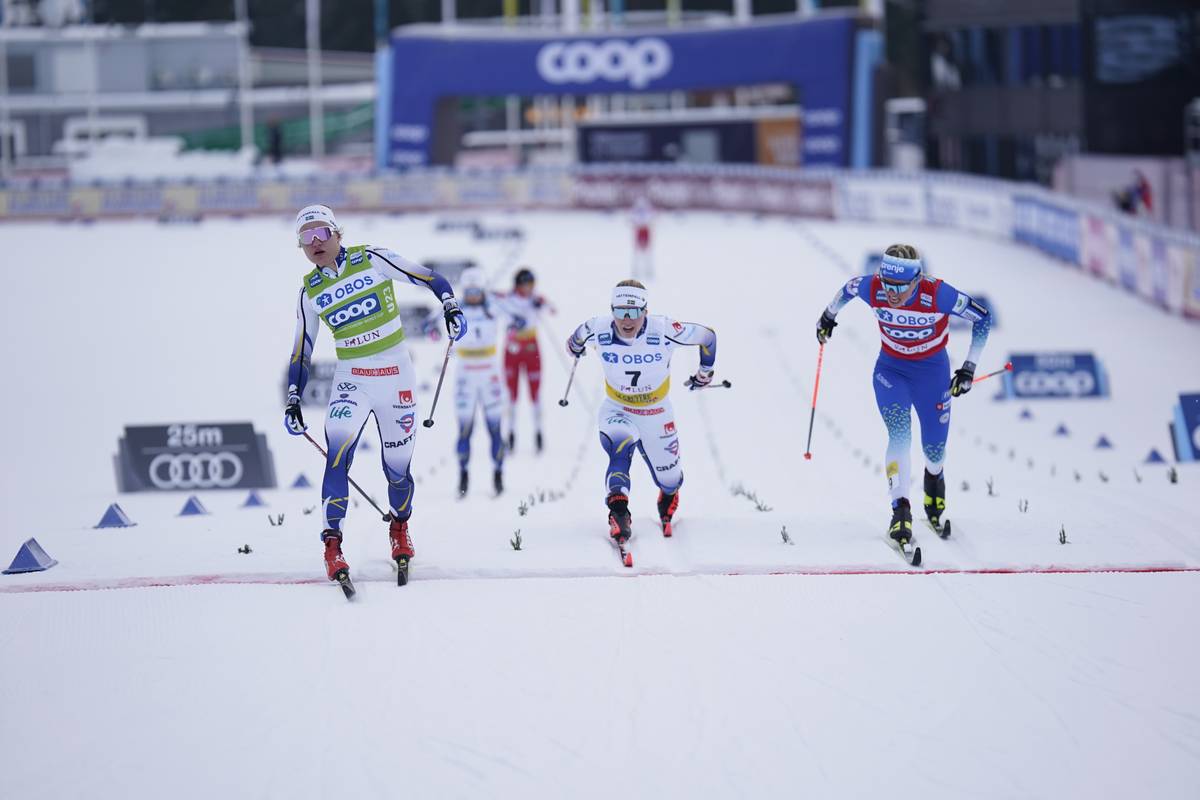
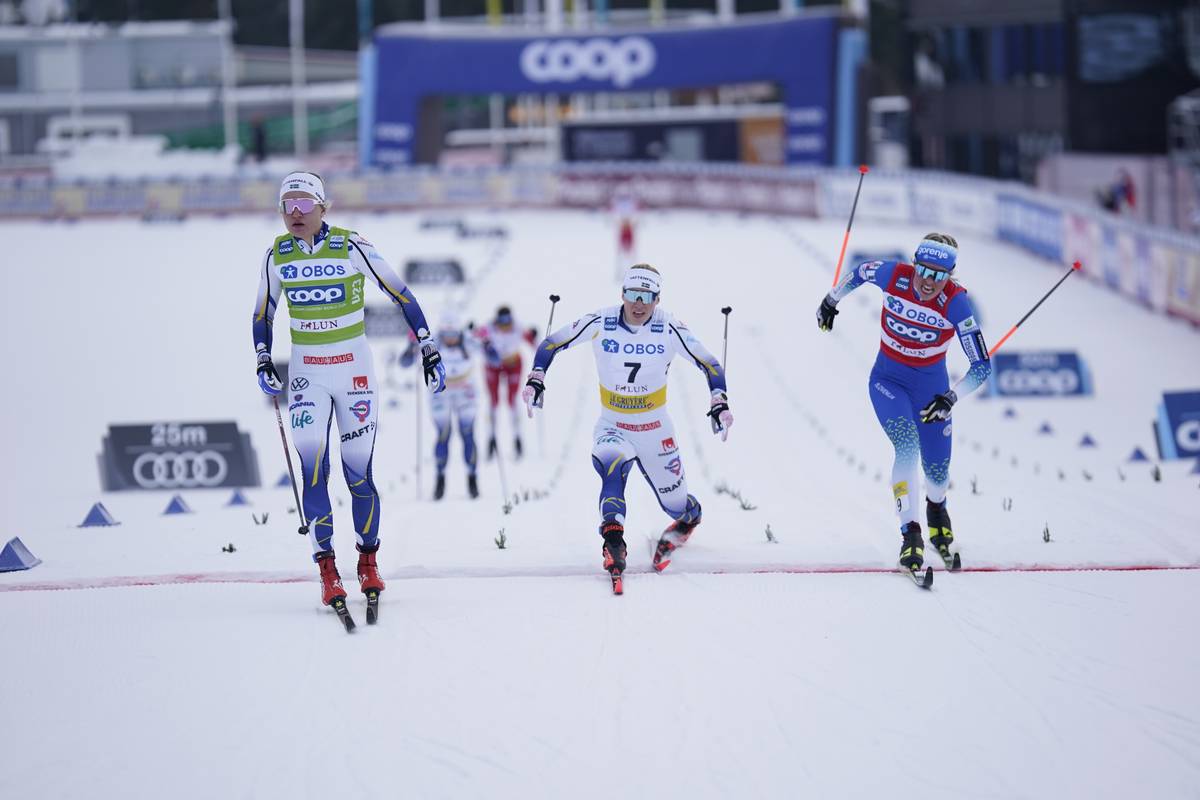
Linn Svahn takes back-to-back wins in Falun, while Anamarija Lampic and Jonna Sundling slide in for the remaining podium spots. (Photo: NordicFocus)Anamarija Lampic (SLO) edges out Jonna Sundling (SWE) for second place in the classic sprint in Falun, Sweden. (Photo: NordicFocus)
“I’ve been feeling a little bit tired since yesterday’s race, but it’s so fun to compete in Falun. I really enjoy racing on a home course, so it was a good day,” Svahn told FIS at the finish.
Despite her age, this is 21-year-old Svahn’s 7th individual win in a World Cup sprint, split almost equally between skate and classic. It is also her second consecutive classic sprint victory on the Falun tracks, as she stood atop the podium in February 2020, also alongside Sundling third place.
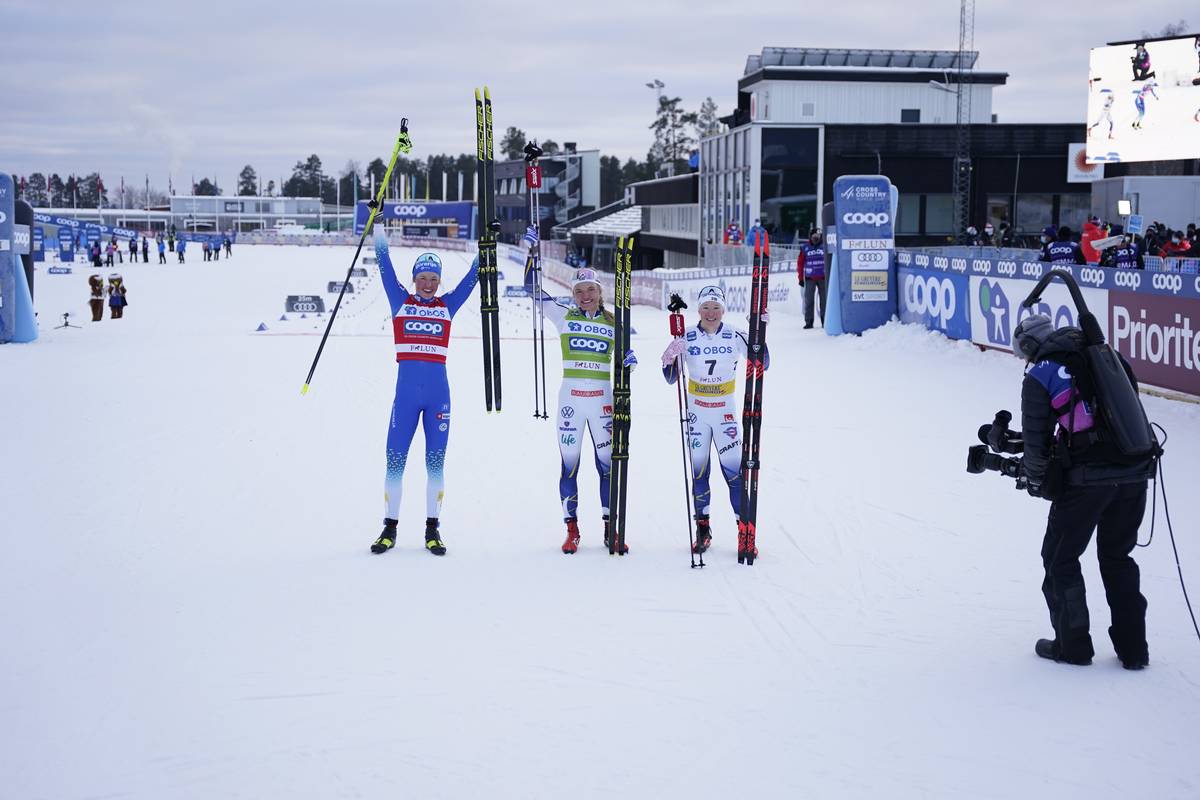
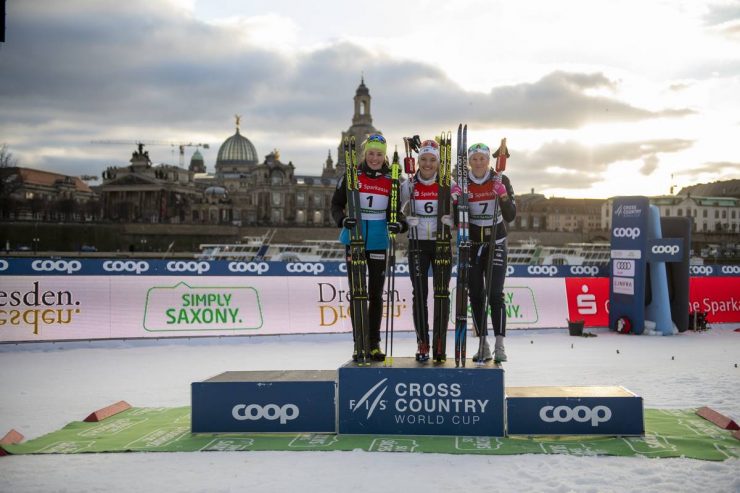
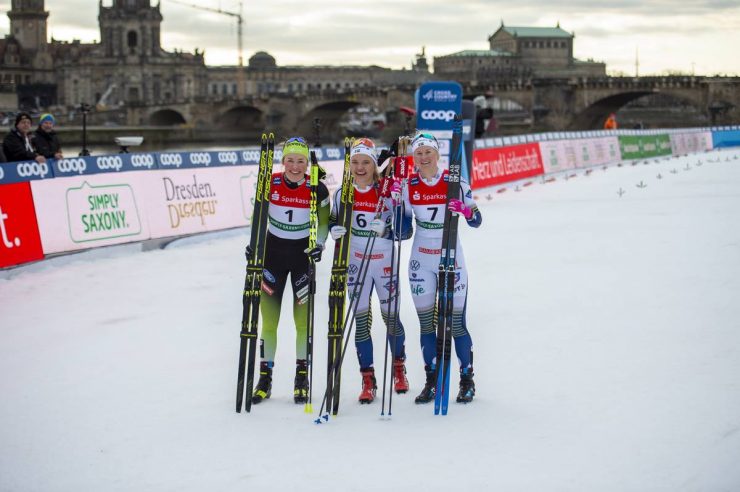
The women’s classic sprint podium in Falun. Linn Svahn nailed her second consecutive win on the course, with Anamarija Lampic (SLO) second, and Jonna Sundling (SWE) third. (Photo: NordicFocus)
Svahn was also asked about the close finish and whether she was sure of her win in the moment.
“I’m never sure of a victory until I pass the finish line first, but it’s cool to see how many strong girls we are competing in sprint races. I think the levels are really high now and it’s tough to win each race, but I’m really glad I managed to do that today, especially in a classic sprint, because it’s my goal this year.”
Looking back, Brennan raced in heat 4 of the quarter finals, where she finished 4th, unable to advance. This left Brennan in 19th overall.
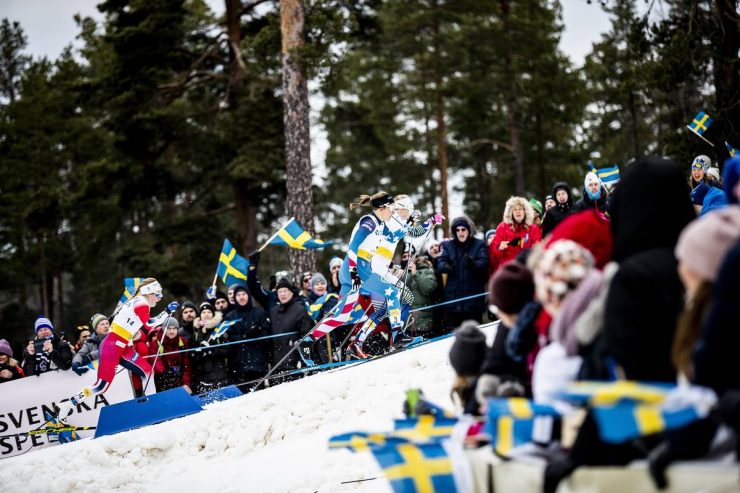
Powering uphill, Rosie Brennan skis her way to 4th in her quarterfinal in Falun, Sweden. (Photo: NordicFocus)
After a conservative start, Caldwell Hamilton skied her way into 2nd position at the top of the intermediate climb. Looking strong as she transitioned from double pole into diagonal stride over the last roller, she held her position around the final curve and into the finish lanes. Swinging around her and quickly closing the gap with her double pole, Sweden’s Hanna Falk overtook the American in the final meters. As the second heat ended up the fastest, Caldwell Hamilton was not able to advance and ended her day in 16th.
“Today was a really solid race for me,” wrote Caldwell Hamilton in a post-race email. “It wasn’t my best, but it was my first time skiing the heats in a classic sprint this year (actually probably in 11 months) and after a qualifier that felt so-so, I was happy with how I skied my quarter. Falun is a very tough course with some big climbs and technical downhills, but I like those features in a classic course.”
Sophie Caldwell Hamilton crests the intermediate climb on the sprint tracks in Falun, Sweden. (Photo: NordicFocus)
“After the first few races of the tour, I took the opportunity to spend a few weeks at home in Vermont during a time where I wouldn’t be missing many sprints,” Caldwell Hamilton continued. “It was such a nice break and I had skiing at the nordic center our neighbors own, Wild Wings, that I could ski to from my house, so I was a pretty happy camper to just spend some time at home doing some solid training and taking a break from the World Cup scene. Now I feel mentally and physically recharged and ready to take on the last couple months of the season! My qualifier today felt a little like I hadn’t done an effort like that in awhile, but I think every race effort will help make that feel a little more normal.”
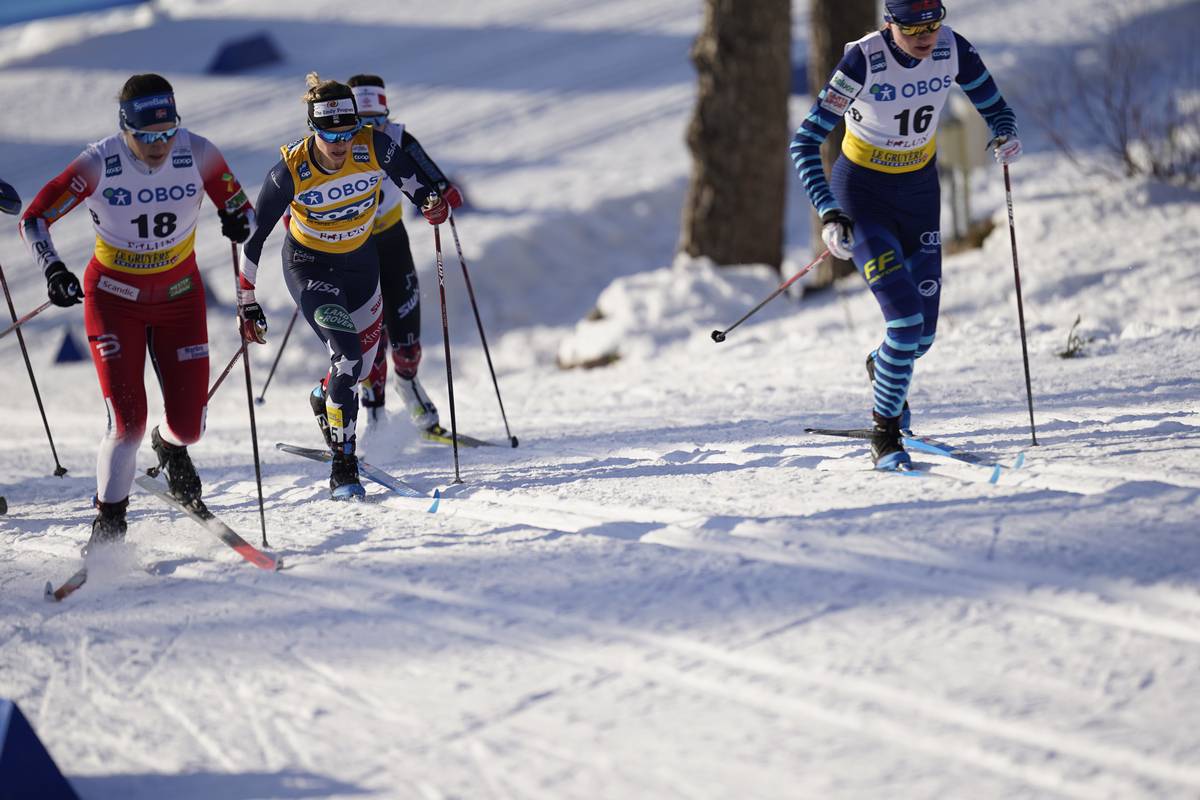
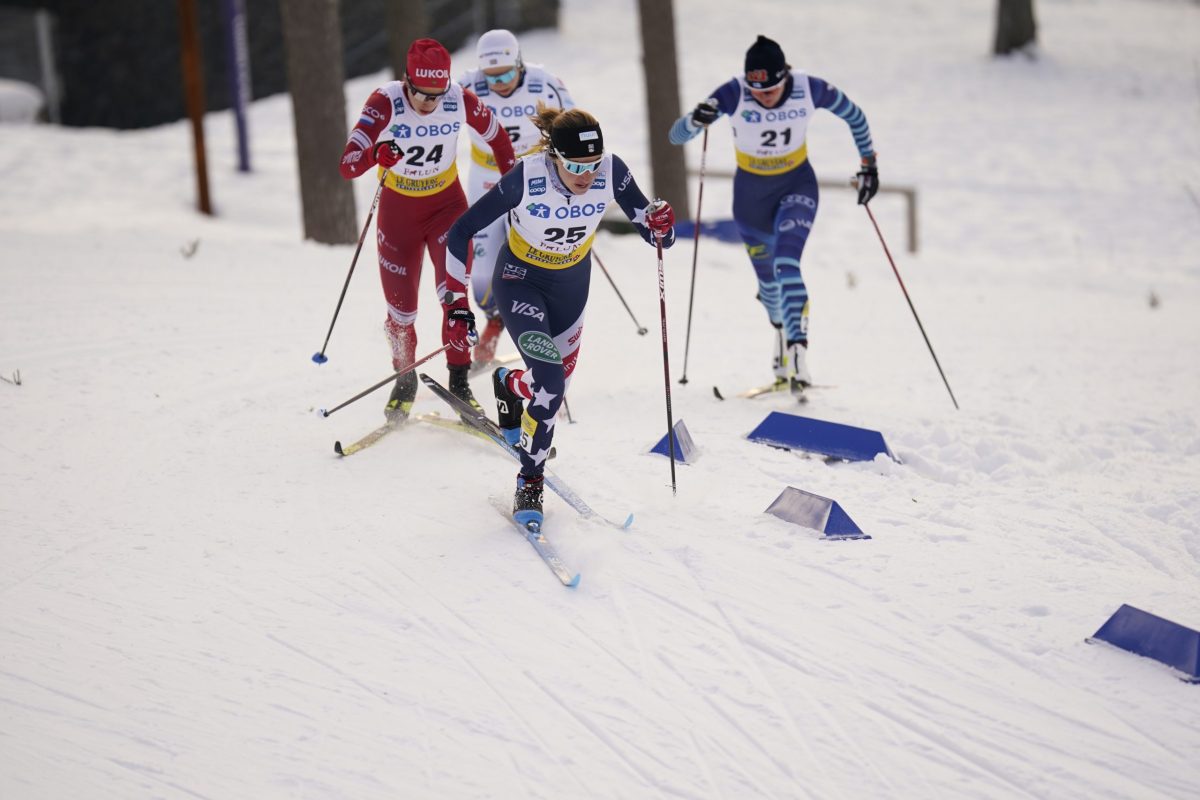
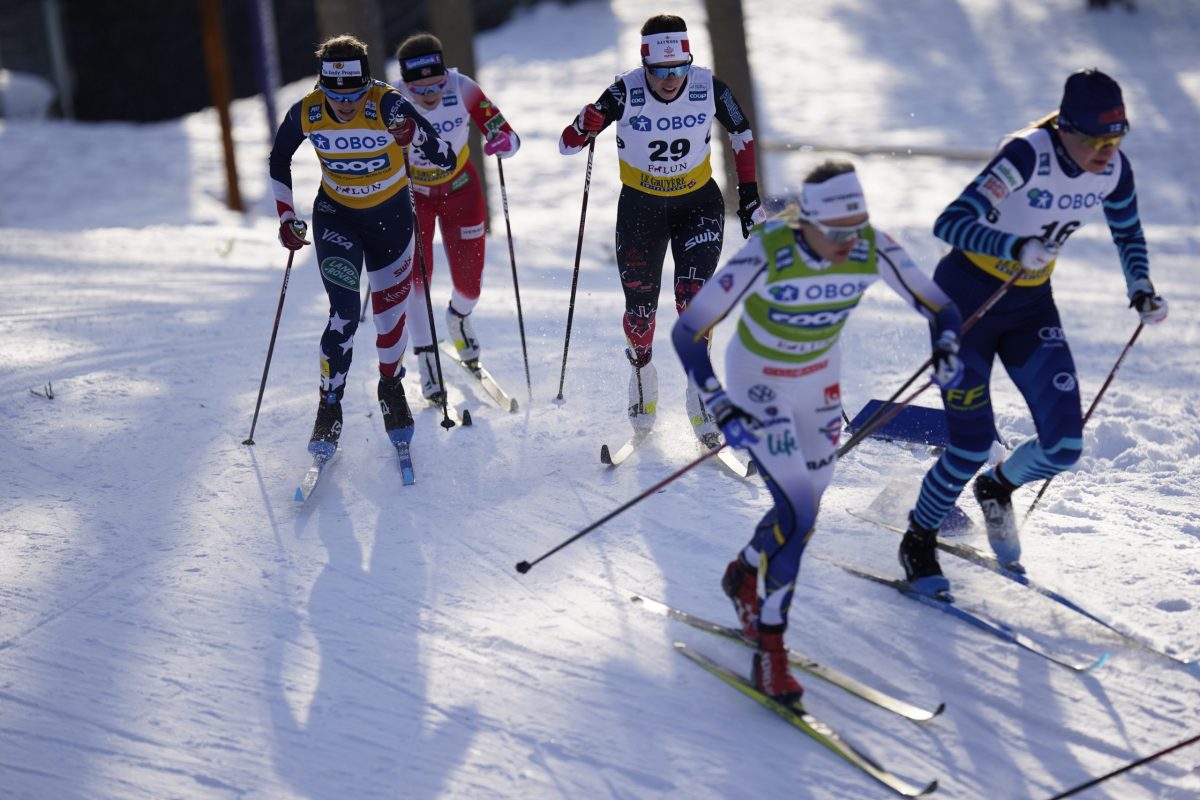
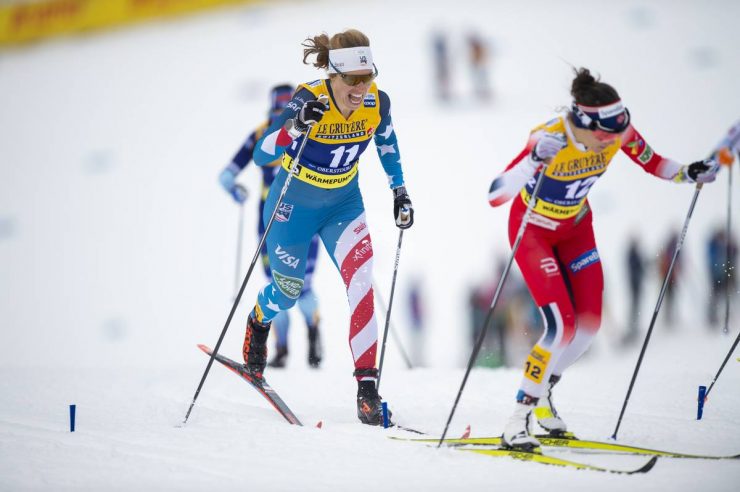
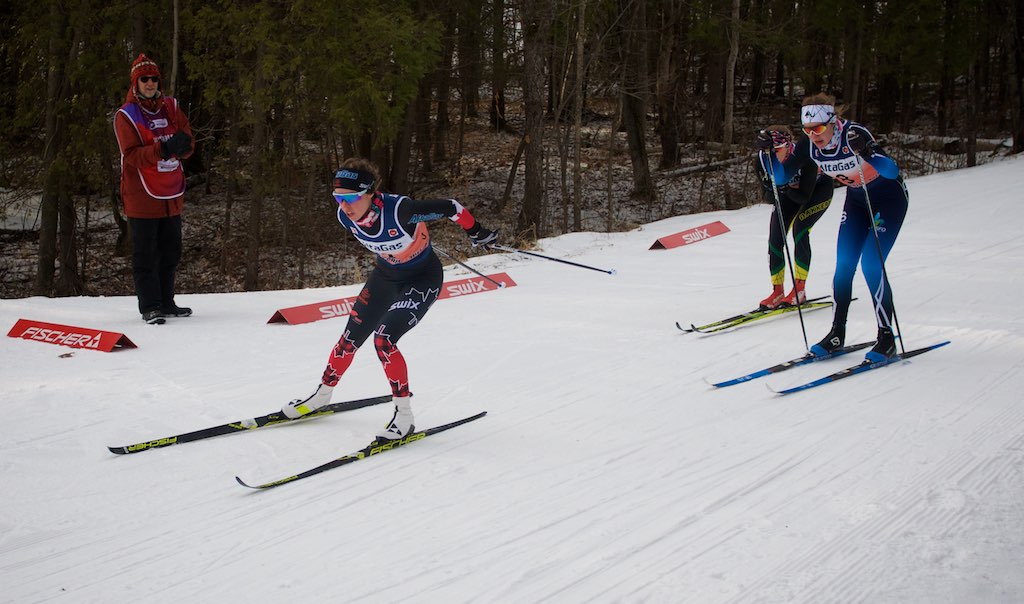
Jessie Diggins and Canada’s Katherine Stewart-Jones (bib 29) climb side by side during the first heat of the quarterfinals in the classic sprint in Falun, Sweden. (Photo: NordicFocus)
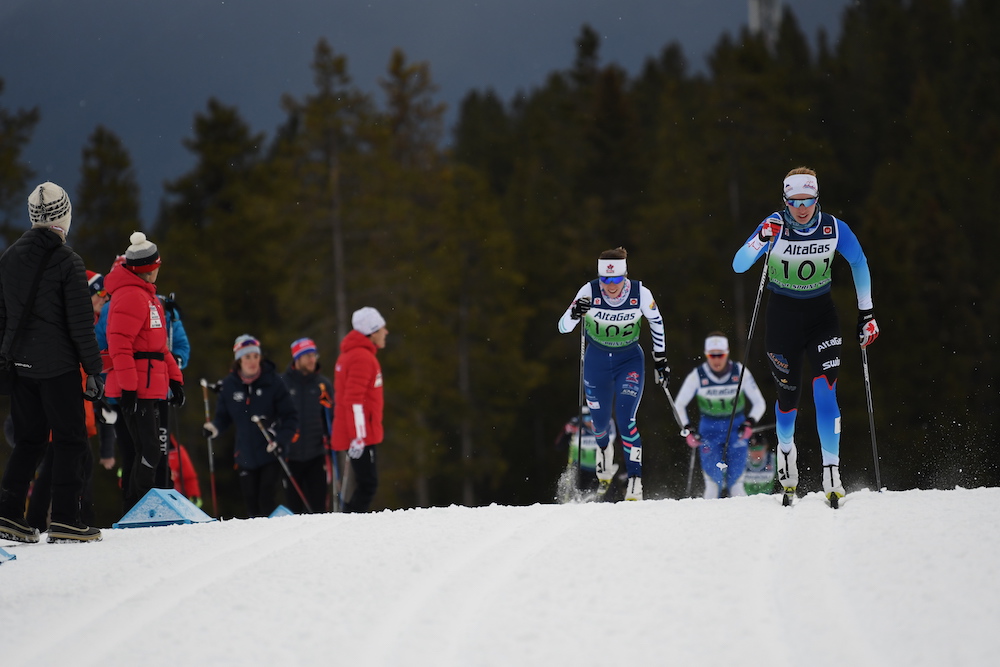
After qualifying in 29th, Canada’s Katherine Stewart-Jones landed in the first heat of the quarterfinals with Diggins. Stewart-Jones held strong with the lead group through the second climb, but fell off the pace to finish last in the heat, just behind Norway’s Anna Svendsen. Stewart-Jones was 30th in the final results.
Outside the rounds, Julia Kern qualified in 35th (+12.95), Hannah Halvorsen 56th (+22.59), and Alayna Sonnesyn 65th (+30.2).
Maya Macisaac-Jones (CAN) races to 54th in the qualifier of the Falun, Sweden classic sprint. (Photo: NordicFocus)
Racing for Canada, Dahria Beatty qualified 48th (+17.29), Maya Macisaac-Jones 54th (+21.77), and Laura Leclair 58th (+24.77).
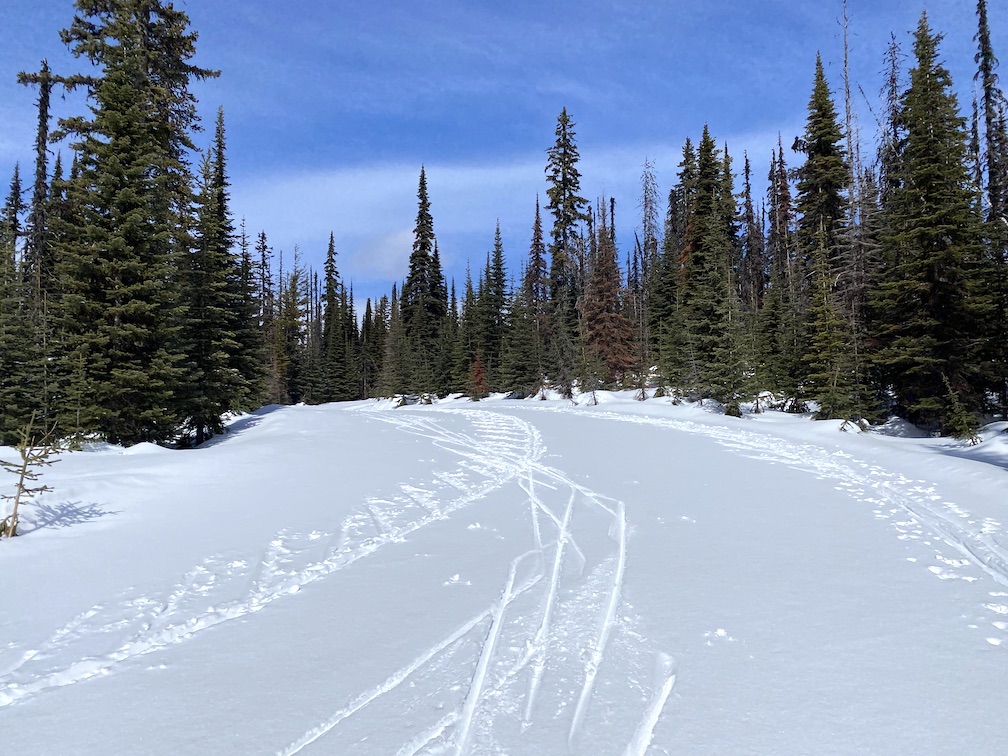
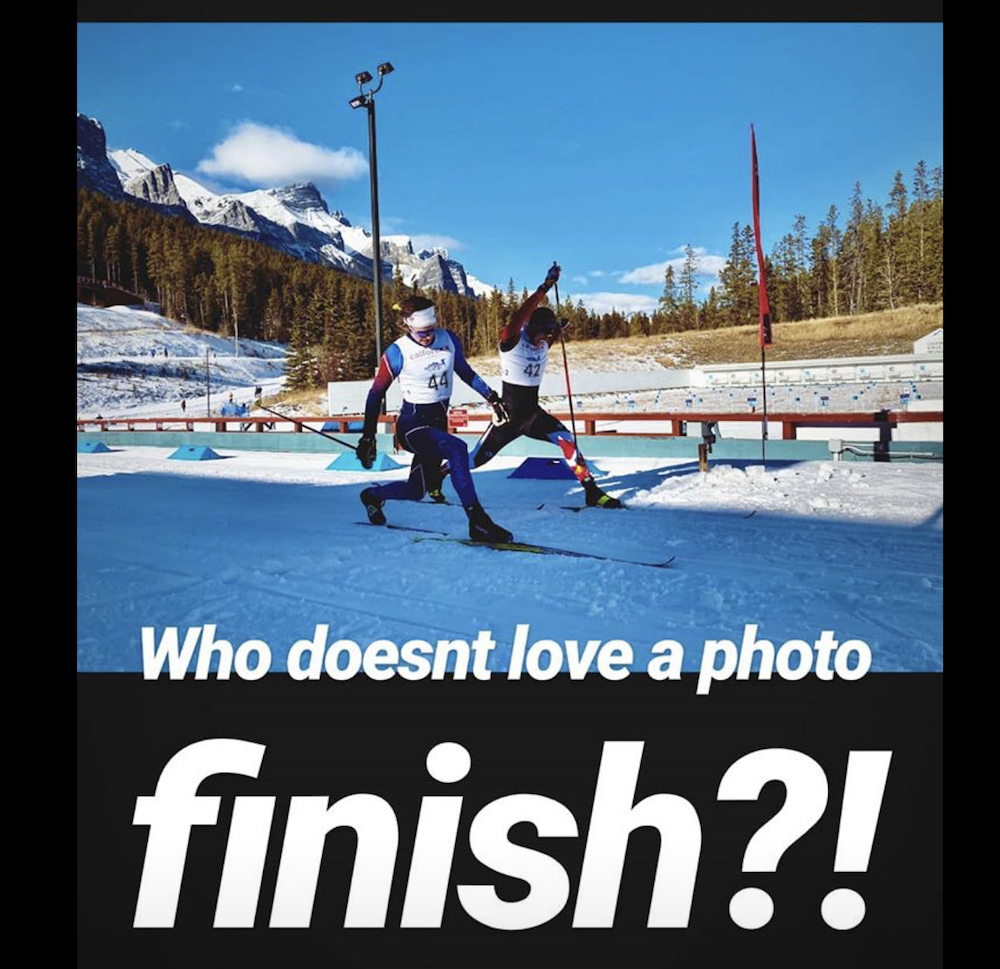
This is the finish we all dreamed of. The final climb of the Nationals course at Sovereign Lake on April 2nd. The women would have finished the 30km in -6C air, -10C snow, about an hour before this photo was taken.
The ski world has been rattled by COVID19 and Canada is no different. One thing hasn’t changed, the new year starts on May 1st and brings changes.
Nordiq Canada’s CEO Shane Pearsall resigned effective May 22nd. In the press release below, Nordiq Canada (NC) describes ‘mixed emotions’ about Pearsall’s decision to focus on family time in the pandemic era.
Stéphane Barrette, NC’s Directeur du développement des athlètes et entraineurs, will be acting CEO. Barrette’s work on a partnership with XC Ski Nation to produce a series of videos and his effort to start a new club, Ski de fond Montréal, are two visible projects from a person better known to coaches and clubs than to athletes and fans.
Dave Dyer, who directed cross-country events for many years and shared the work with Jeff Ellis this past season, officially retired March 31st. Dyer was CCC Race Director for all of Ellis’ racing career and had several title changes during his 18 years in the role before ending as Events Director. Ellis is now in sole charge of event planning, which, Ellis said, will be a bit different this year.
“This current crisis is a real opportunity to examine what it takes to put on an event. Where can we reduce the financial risks for all while providing well run, efficient competitions?” — Ellis
As is almost traditional in Canada, there are protests over the National Team Selection. The High Performance Committee (Joel Jaques for NC, Erik Bråten as head coach, two athlete reps, and 14 coaches from across the country) decided to use the original selection criteria despite the loss of the end of the season. This criteria was focussed on developing a team for 2026 and the HPC interpretation is summarized here.
One of the results was that Katherine Stewart-Jones was dropped from the team. Stewart-Jones is the current COC leader after either winning or being top Canadian in six NorAm events in December, finished 29th overall in the Scando Tour from Sweden to Norway, earned a first and second at an OPA Cup in Italy, and was looking dialed-in for the World Cup Final in her new home of Canmore when FasterSkier saw her training in March. She was born in 1995, and that matters.
“Discretion was available to athletes born in 1996 and after,” Pearsall told FasterSkier on May 2nd, and summarized the thinking behind it as “we’ve got an eye on 2026.” (Pearsall’s own retirement didn’t come up in the talk about what is new for the coming season, it would be announced six days later.)
An athlete born in 1995 or earlier needed to score two WC top 20’s, or one WC top 12, or finish the season with 22 or more WC points. In the shortened season, only Dahria Beatty met this criteria with 23 points over five WC weekends. Cendrine Browne and Maya MacIsaac-Jones also earned WC points this season, but not enough to rejoin the National team.
The social media storm on selection was inflamed when NC deleted the original posts to make a correction, which also deleted many highly emotional comments.
Multiple athletes have protested the selections; FasterSkier will have more when the hearings are complete and athletes are free to talk. Maybe the Norwegian system of full coaches’ discretion, no protest process, would cause less controversy? Or maybe not, if you ask Martin Johnsrud Sundby fans. Either way, we can be sure that lots of people are passionate about the sport.
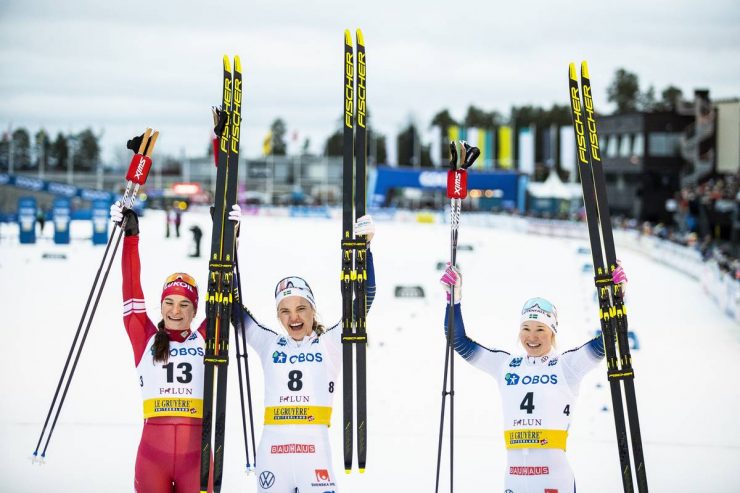
The women’s podium in Falun, Sweden. Linn Svahn (SWE) took the win ahead of Natalia Nepryaeva (RUS) and Jonna Sundling (SWE). (Photo: NordicFocus)
Not the backdrop one might expect from Scandiavia in mid-winter, rather, green grass, bare ski jumps, and a ribbon of snow were found in Falun, Sweden. However, what was lacking in snow was made up for by a densely packed crowd of cheering fans, erupting as athletes flew by in the women’s classic sprint.
An occurrence that might meet our expectations is that the Swedish women showed up on home turf. Johanna Hagström won the qualifier in 3:15.96, followed by Anna Dyvik. Sweden also took 4th, 5th, 8th, 9th, and 10th. Yes, seven of the top ten qualifiers were from Sweden. Only Sophie Caldwell, Ane Appelkvist Stenseth of Norway, and Anamarija Lampic of Slovenia in 3rd, 6th, and 7th, respectively, were the outliers from other nations.
Sophie Caldwell chases Anna Svendsen (NOR) and Jonna Sundling (SWE) during the quarterfinal of the classic sprint in Falun. (Photo: NordicFocus)
Five of the seven continued on to the semifinals, along with four Norwegians who weren’t going to back down easily. To round out the remaining three nations, Sophie Caldwell advanced to the semis as a lucky loser after a photo finish with Sweden’s Jonna Sundling in the first heat, which was won by Russia’s Natalia Nepraeva. Lampic moved on by taking second in the next heat.
Fast racing in the semi-final of the 2020 classic sprint in Falun, Sweden. (Photo: NordicFocus)
The intensity ramped up in the stacked first heat of the semi: Nepryaeva, Lampic, Hagström, Jonna Sundling (SWE), Maiken Caspersen Falla (NOR), and — perhaps unexpected in a sprint semi — Therese Johaug. Nepryaeva led the charge with Sundling and Hagström. The pack took the troublesome corner fast, but the women kept their composure, with Nepraeva shooting out of the turn with high speed. She held the lead all the way into the stadium as a group of Lampic, Sundling, and Falla duked it out for the remaining spots in the final.
In the final sprint, Lampic and Sundling created a gap to Falla, surging to a photo finish. Lampic took second, Sundling third, and Falla crossed a second behind in fourth. As the pace was hot, all four women moved on.
Sophie Caldwell matches Sweden’s Jonna Sundling stride for stride up the climb in Falun. (Photo: NordicFocus)
For Caldwell, the next round was spicy. With a misstep on a punchy climb, Sweden’s Anna Divyk dropped to her knee, catching Caldwell’s arm and pole with hers and robbing some of the American’s momentum. Climbing halfway, Caldwell was trapped on the inside of a left turn. Skis were stepped on, racers were slipping, but she made it through. Calm and collected, she dropped into a tuck and glided into third as they headed for the final climb.
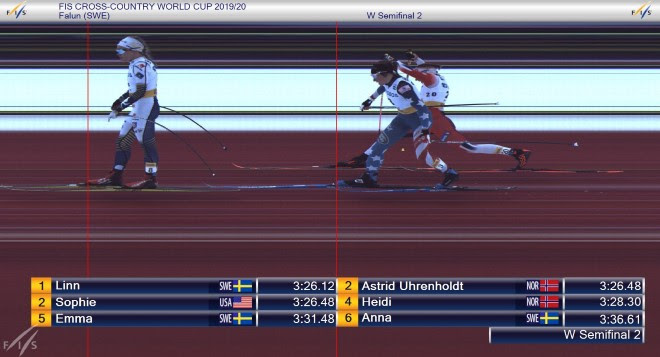
Attacking the double pole sprint down the straightaway, Caldwell challenged Norway’s Astrid Jacobsen for the second guaranteed spot in the final. Caldwell threw her boot early, with Jacobsen’s foot matching hers at the line for a photo finish. After review, the two could not be differentiated. It was declared a perfect tie, down to the hundredth. Though their times were too slow for a lucky loser, both women advanced, making it a final of seven women.
Captured. A perfect tie between Sophie Caldwell and Astrid Jacobsen during the semifinal of the classic sprint in Falun. (Photo: Screenshot FIS-ski.com)
Six women across, with the second lucky loser, Falla, in the second row behind Svahn. And off they went.
The two Swedes, Svahn and Sundling, led the charge into the first climb, Lampic occupying the outside lane. Around the sweeping turn they went unscathed, Sundling continued to push the pace up the next climb, with Lampic losing grip alongside her. The lead group was four deep in the final climb and into the downhill towards the stadium.
Three across, Svahn, Sundling, and Nepryaeva powered down the final stretch as the crowds leaned in with bated breath. In the final meters, Svahn crept just ahead of the other two, throwing her boot for the win in 3:23.54. At her heel, the boots of Sundling and Nepryaeva slid across in a photo finish. It was deemed that the Russian was 0.02 seconds ahead of the Swede, taking the second spot on the podium. Both women were within a tenth of a second of Svahn.
By a boot, Linn Svahn takes her third World Cup victory as Johnna Sundling crosses just behind. (Photo: NordicFocus)
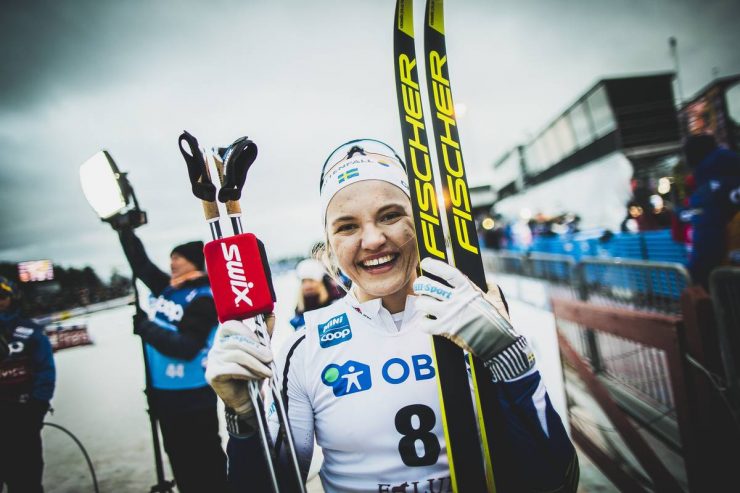
Linn Svahn takes the win in Falun, Sweden. (Photo: NordicFocus)
“It’s fantastic. I wanted to win so, so much today,” gushed an out of breath Svahn during her interview with FIS. “I pushed so hard on the final, and managed to win. Before the start, I saw Maiken behind me and I thought, ‘What is happening?’ So it was special, but so nice to compete in my hometown and to win. And to get Jonna on the podium as well, we are a strong team.”
A unique statistic, Svahn is the second woman to win three individual World Cup sprints before her 21st birthday, which she celebrates in September.
Lampic took the fourth spot in the final (+0.93), followed by Falla in fifth (+3.70). Jacobsen and Caldwell had fallen off the pace by the halfway mark. They finished sixth (+7.00) and seventh (+8.46), respectively.
After the race, Caldwell discussed her three week training block in Seefeld, Austria, interrupted by the races in Oberstdorf, Germany, where she finished fourth. She also spoke to the tangle with Divyk and how she stayed relaxed in order to ski the downhill well in order to reconnect with the group. She also discussed the evolution of her career and the effect of her plans to head back to Vermont after the FIS Ski Tour, missing the city sprints in Drammen, Norway to focus on the sprints in Quebec and Minneapolis.
Post-race interview with Sophie Caldwell.
Three victories before her 21st birthday, Linn Svahn strikes again in Falun, Sweden. (Photo: NordicFocus)
Three other Americans headed into the heats with Caldwell. Sadie Maubet Bjornsen qualified in 11th. Racing in the 4th heat, Maubet Bjornsen tucked into the middle of the group. As they reached the swooping icy found along the downhill halfway, the women began pumping the brakes to stay upright, and Maubet Bjornsen was nearly slingshot off course into the banner lining the outer edge of the turn. She regained her composure and made it through the remaining turns with more speed. However, she was not able to catch the leaders and finished 4th in the heat, 17th overall.
“I always struggle a bit in these conditions, so I didn’t have a star performance, but felt proud that I fought back even after coming dangerously close to falling on the fast, crazy corner,” Maubet Bjornsen emailed after the race. “At one point I feel like I skied the side of the fence, so I sure hope Bode Miller was watching me try to reinact his famous move!
“Despite a 17th place classic sprint, I am still believing in my body’s ability to feel sharper and shaper going into the Tour de 2020. Sometimes when I have been training at altitude, it takes my muscles a bit to get firing on high speed. The Swedes sure managed to find that speed today, so I will have to kick it into gear quickly to keep up! I look forward to another wild ride tomorrow for the 10k mass start. My goal is to stay on my feet, and find some of my gears that I know are in there!”
Jessie Diggins fights through the quarter final of the classic sprint in Falun, Sweden. (Photo: NordicFocus)
Jessie Diggins was the next American qualifier in 25th. She too finished 4th in her heat, ending the day in 20th. In a post-race call, Matt Whitcomb explained that Diggins was fighting a “tweaked neck”, but with the help of Zuzanna Rogers, the team therapist, it is showing improvement.
Whitcomb provided further insight into Diggins’ day, her likelihood to rebound tomorrow, and how the course and conditions affect the type of athlete that can excel on the tracks of Falun.
Post-race interview with Matt Whitcomb.
Hailey Swirbul qualified just behind Diggins in 28th for her third set of World Cup points. She landed in the top-30 on both days in Davos, Switzerland. Swirbul raced in the first heat with Caldwell, where she finished 5th in the heat and 25th for the day.
Hailey Swirbul charges the hill for the 28th fastest qualifying time in Falun, Sweden. (Photo: NordicFocus)
“I am learning so much with every World Cup race this season,” wrote Swirbul in a post-race email. “I thought my skis and support were great today on the tricky course. It was sweet to race in a heat with Sophie and learn from the best in the world up those climbs! I hope to get another opportunity to mix it up in the heats soon.”
Outside the points, Alayna Sonnesyn qualified in 46th (+23.45), followed by Caitlin Patterson in 47th (+23.50).
For Canada, Maya Macisaac-Jones qualified in 23rd and raced in the fifth heat, which was won by Svahn. She was fifth in the heat, ending her day in 24th.
Canada’s Maya Macisaac-Jones chases Katri Lylynpera (FIN) during the quarterfinal of the classic sprint in Falun. (Photo: NordicFocus)
Also bearing the maple leaf, Dahria Beatty qualified in 37th (+17.03), followed by Cendrine Browne in 43rd (+22.96), and Katherine Weaver in 48th (+23.62).
The speedy women of Oberstdorf. Natalia Nepryaeva (RUS) won the classic sprint ahead of Anamarija Lampic (SLO) and Jessie Diggins. (Photo: NordicFocus)
Onward and upward. Day two in Oberstdorf, Germany featured a 1.5-kilometer classic sprint with three sharp toothlike climbs. Seemingly riding the edge of their capability inside the tracks, athletes pumped their way up each pitch before wrapping around a bend and descending an equal grade back toward the stadium.
Wolf jaw or race course? The Obesrtdorf sprint loop in profile. (Photo: Screenshot FIS Broadcast)
After what Matt Whitcomb called an “off day”, the Americans demonstrated their ability to rebound. To not let the sensations or disappointment from one day percolate into subsequent races. Onto the next.
This was clearly demonstrated in the qualifying round: three, four, nine, eleven. Diggins was the fastest of the crew finishing 2.24 seconds behind top qualifier Natalia Nepyaeva of Russia, who stopped the clock at 3:38:08. Diggins was 0.8 seconds behind Anamarija Lampic of Slovenia, who won both sprint events, skate and classic, during the Tour de Ski, and took second the weekend after the Tour in the freestyle sprint in Dresden. Lampic also popped the second fastest qualifying time of the day.
Sadie Maubet Bjornsen nearly matched Diggins time in fourth (+2.35), followed by Sophie Caldwell in ninth (+5.38), and Rosie Brennan in eleventh (+5.90). The only other country to put three athletes in the top ten was Norway, a testament to the strength of the American women on a day where our expectations meet reality.
Striding it out in Oberstdorf, Caitlin Patterson skis to 61st in the qualifier. (Photo: NordicFocus)
Also starting for the U.S., Caitlin Patterson took 61st (+24.18), and Alayna Sonnesyn finished 66th (+26.7).
In the quarterfinals, Maubet Bjornsen wore the lowest bib number in the first heat, which is curious as this is often the choice of the top two qualifiers (see Diggins comments on heat selection below). Maubet Bjornsen took second in a tight finish with Lotta Udnes Weng and Astrid Uhrenholdt Jacobsen of Norway, moving with Weng into the first wave of semis.
Caldwell won the third heat of the semis in a photo finish with Ane Appelkvist Stenseth of Norway. Brennan was eliminated after finishing fourth in the fourth heat to finish 16th for the day, a top result in the event.
“Sprint is always such a bitter sweet event for me,” Brennan emailed. “While today was the best classic sprint of my career, I still felt that I made some mistakes and didn’t ski as well as I felt. The course here is long and has some good striding which I was really excited about. I know there are probably some sprinters that aren’t excited about the length but I felt the course did a good job of including all kinds of skiing and really rewarding good skiers. I am really happy with my feelings and for sure have a little list of things to work on moving forward.”
Diggins charged full gas through the fifth heat of the quarters for the win, beating out Sweden’s Linn Svahn who advanced alongside her.
Jessie Diggins leads Sweden’s Linn Svahn during the quarterfinal in Oberstdorf. (Photo: NordicFocus)
In the first semi, Caldwell and Maubet Bjornsen took it out with the leaders, matching Nepryaeva’s long powerful bound up the climbs and the speedy out-of-the-track tempo of Anna Svendsen of Norway. Coming into the final downhill, Svendsen, Nepryaeva and Caldwell pulled ahead, creating a small gap to the remaining women. Caldwell held her tuck longer than the other women, collecting herself for a spicy double pole sprint to the finish. Sliding across the line at the heels of Nepryaeva, Caldwell stayed ahead of the Norwegian to take second in the heat. Maubet Bjornsen finished fifth between Nadine Faehndrich of Switzerland and her opponent from the quarters, Weng.
“It was one heck of a thrill out there today on the courses for next year’s World Championships,” wrote Maubet Bjornsen in an email to several outlets. “This is certainly one of the hardest sprint courses I have sprinted on, but I really enjoyed it! My legs felt a lot stronger than last weekend, but still not quite recovered enough to put together the race I was dreaming of today. Finishing 9th is still and achievement, but I know I am capable of more when I have my full strength.
“My tactic today was to race at the front of the group, even if it required a bit more energy, because then I knew I wasn’t going to get stuck behind anything. I always feel most confident skiing that way. In the final climb of the semi’s, I think I paid the price a bit.”
Sadie Maubet Bjornsen matches Astrid Uhrenholdt Jacobsen (NOR) up the climb in Oberstdorf. (Photo: NordicFocus)
Striding hot out of the gate, Diggins also held a position at the front, matching Lampic, who dictated the pace, up the climbs and tucking into her draft on the descents. On the last and longest climb, Diggins was overtaken by Svahn and Heidi Weng of Norway and she was unable to regain her position on the subsequent downhill. Though her tempo was faster than her opponents in the final double pole sprint, she finished fourth. As her time would have won the previous heat, Diggins and Svahn advanced with Lampic and Weng as the lucky losers.
Again taking the reins from the start-beep, Lampic surged to the front of the group and stayed there, though she could not drop the strong group of women in her wake. Up the final climb, Nepyaeva matched Lampic stride for stride, her long powerful pushes keeping her alongside the Slovenian’s green and black suit.
Like a slingshot, Nepryaeva sped around Lampic as they rounded the final curve into the straightaway. The duo duked it out double poling in perfect synchrony, but Lampic recovered no ground on the Russian. Nepraeva stopped the clock at 3:27:08, the fastest split of the day.
Down to the final meters, Natalia Nepraeva (RUS) and Anamarija Lampic (SLO) sprint to the line with two Americans on their heels. (Photo: NordicFocus)
Winning by centimeters, Natalia Nepryaeva (RUS) celebrates her accomplishment. (Photo: NordicFocus)
Racing for the last podium position, Diggins and Caldwell flew into the final straight in neighboring tracks, with Svahn not far behind. Firing on all cylinders, Diggins pulled ahead of Caldwell to take third by just over a second (+2.44). After being left behind by the Americans, Svahn finished fifth (+5.16), followed long after by Stenseth (+30.20). The Norwegian had fallen off the pace midway through the round, ceding her chances to contend with the pack.
Jessie Diggins takes third in Oberstdorf, with Sophie Caldwell just behind. (Photo: NordicFocus)
Two up, one down. Anamarija Lampic (SLO), Natalia Nepyaeva (RUS), and Jessie Diggins celebrate their top results in Oberstdorf. (Photo: NordicFocus)
Due to poor WiFi connection, athletes chose to send comments via email. Reflecting on her performance, Diggins expressed that she “loved” the long sprint course.
“You had time to try out different tactics and that last hill saw some moves, for sure. We had awesome skis today so I was able to use a little bit of a slingshot to get into good position in the finishing lanes, and I just worked to stay smooth and calm in the first half, while looking for openings to get into better position.”
Diggins explained that heat selection is variable, and did not feel today’s variance from a usual bracket was explained by the length of the course. Her choice to race in the fifth quarter and second semi were based simply on her perception of the opportunity to advance.
“I chose the latter heat because it was wide open, and seemed to be a good path forward out of the quarters. But you never know how it’s going to go, and I was happy to secure lucky loser time in the fast semifinal!”
Gasping for air after an effort Diggins can be proud of in Oberstdorf. (Photo: NordicFocus)
After finishing 22nd in the skiathlon, some might question from the comfort of their couches whether Diggins is on the same form that we have seen in previous years. As was discussed with Matt Whitcomb, “success breeds expectation.” We expect to see Diggins at the top of the results sheet day in and day out, and that pressure can creep into an athletes self-expectation as well. When asked how she handles this, Diggins explained that she does not dwell on what is on the paper or posted in the comments.
“That’s a great question about handling expectations and pressure…and my plan for that has always been to set really concrete process-oriented goals, work as hard as I can to meet them, and then regardless of the result on paper I can decide if it was a “good” day for myself or not based on my effort, focus, technical progress and strategy.”
In her post-race remarks, Caldwell offered an insightful perspective that took into account her strengths as a sprint specialist versus an all-arounder like Diggins or Maubet Bjornsen.
“This sprint was definitely one of our longest ones, and for sure the longest one of the year. I think it’s really exciting to have varying sprint courses throughout the year and this is about as far from the Dresden course as you can get. I used to think short and flat suited me best, but now I don’t really know what I like, especially for classic, but I try to be excited for any kind of sprint so I don’t count myself out before it begins. That said, I do think that there are already a lot more distance races than sprints, so when it gets much over 3 minutes, it’s starting to favor distance skiers more, which is fine to do sometimes, it’s just too bad when there are already so few sprints if too many of them start getting really long. But I personally really enjoyed the course and the race today. I don’t think it’s too much different for recovery for me whether the course is 3 mins or 3:30, but I think for the men it is probably harder because if they’re in the second half of the bracket, they have a lot less recovery. I usually just try to move around until I’ve flushed my legs out and then relax for a little bit and then start moving around again before my next heat!
“Today was a really awesome day for our team. I was psyched to make my first classic final in years, and I think only my third ever. I’ve now had three 4th places in the last four races, which is a little bittersweet, but it’s important to remind myself that 4th is still a really strong result, especially in a tough classic sprint. It was great to ski with Sadie in my semi and I know she’s bouncing back from giving her all in the tour, but is getting stronger each day and a good result today is a huge step in the right direction. And Jessie was on fire all day and it was awesome to see her get another classic podium. So really fun to have such a strong day for our women and even though it was a tough day for the guys, I know they will be fighting back in Falun!”
Sophie Caldwell skis to 4th place in Oberstdorf. (Photo: NordicFocus)
Between the city sprints in Dresden and today’s event in Oberstdorf, Caldwell headed to Austria for an altitude camp. She explains the role this plays in balancing training and recharging, and how the sprinters use an altitude stint to build fitness without losing their top end speed.
“Simi and I just took a little break in Seefeld during the distance weekend in Nove Mesto and it’s was really nice both physically and mentally. The schedule this year is very demanding, with almost no weekend off, so we felt it was important to find in a couple times to work in a break, remove ourselves from the World Cup, and take some time for ourselves. I was really tired right after Dresden and didn’t realize it until I allowed myself to take a break, so it was nice to have a few days of true recovery and then I felt I was able to train really well for 9 or 10 days before coming here. Seefeld is at mild altitude, but I think it’s only at 3,700 ft, so as long as I keep my easy skis easy, I don’t feel too many effects of altitude and don’t worry about not being sharp when coming down a little in elevation.”
Maya Macisaac-Jones posted the top qualifying time for Canada in 35th. (Photo: NordicFocus)
Racing for Canada, Maya Macisaac-Jones posted the top qualifying time in 35th (+14.28), followed by Dahria Beatty (+15.79), Katherine Stewart-Jones in 50th (+18.58), and Katherine Weaver 65 (+26.08).
Victory on the streets of Dresden. Linn Svahn (SWE) takes the win ahead of Anamarija Lampic (SLO) and Maja Dahlqvist (SWE). (Photo: NordicFocus)“Dream team ready for Dresden.” (Photo: Screenshot Instagram @sophiecaldwell)
With the Tour de Ski in the rearview mirror, athletes donned bibs for a city sprint weekend in Dresden, Germany. Like the other bookend in Planica the weekend before it began, athletes who focused on the Tour de Ski — mostly distance skiers and all-arounders — were not in attendance to focus on rest and recovery. This narrowed the field in Dresden to a sprint-focused lineup.
Under grey skies, skiers drag-raced on an icy ribbon of snow around two lap course along the Elbe River, navigating hairpin turns at each end and a few roller hills along the way. Past the Frauenkirche cathedral and Semper Opera building they soared, while fans cheered from green grassy slopes and stone steps.
Despite making her way up the Alpe Cermis six days prior and taking the win in both sprint stages of the Tour de Ski, Anamarija Lampic of Slovenia lined up in Dresden and posted the fastest time in the qualifier, 2:30.38. Lampic finished 19th overall in the Tour standings.
Sophie Caldwell and Julia Kern were the sole American women in the field. Caldwell was the top qualifier for the U.S. in 4th, with Kern in 15th. After taking 9th in the sprint in Lenzerheide and landing inside the top-30 in distance races, Caldwell withdrew from the Tour after the fourth stage in Toblach. Battling a cold, Kern withdrew after the skate sprint second stage, where she finished 14th.
Focus. Sophie Caldwell works her way through the rounds to a fourth place finish in Dresden. (Photo: NordicFocus)
In the first heat of the quarterfinals, Caldwell looked typically calm, cool, and collected. She held a position at the front throughout the race, her technique perfectly smooth and oozing power. Caldwell’s position was secure enough that she could lay off the gas before sliding across the line with Nadine Faehndrich of Switzerland.
Kern was not so lucky. Though she rounded the first hairpin on her own in the lead, skiers became bunched heading into the subsequent high-speed corners. At the apex of the second curve, Kern was pushed wide as Nina Dubotolkina of Russia caught a v-board and fell to her knees in the middle of the group. On the final turn, Kristine Stavås Skistad lost her footing and shot off the edge. Kern finished 4th in her heat, which was slowed by the crashes, and did not advance.
Julia Kern leads the way in the first lap of her quarterfinal in Dresden. (Photo: NordicFocus)
Racing for Canada, Dahria Beatty finished 29th overall and Maya Macisaac-Jones 37th. Beatty was also eliminated in the quarterfinals after finishing 6th in her heat. She has landed in the top-30 in each of the three freestyle sprints she has contested on the World Cup this year; she was 25th in Davos, and 16th in Planica.
Canada’s Dahria Beatty during the 2020 Dresden skate sprint qualifier. She placed 29th overall. (Photo: NordicFocus)
In the semi, Caldwell tucked into the middle of the pack, marking leaders Laurien Van der Graff of Switzerland, Linn Svahn of Sweden, and Lampic. Rounding the final curve safely, they laid on the accelerator, all four women in a tight group down the final straight, a fifth on their tails. Svahn threw her boot for the win, Caldwell crossed just behind in a three-way photo finish with Van der Graff and Lampic. The American was deemed third; as the top time in the next round was three seconds slower than hers, she advanced to the final without a hitch.
On the hunt in the final, Caldwell stayed wide on the turns, out of trouble in the event of a fall. Sweden’s Svahn and Maja Dahlqvist set the pace, but the group stayed tight.
The women charged down the final straight three abreast with Svahn at the front. In another photo finish, Lampic and Dahlqvist threw their boots for second and third, respectively, with Caldwell in the next lane for 4th. Linn Sömskar of Sweden took fifth as Van der Graff rounded out the final in sixth.
Linn Svahn takes the win in Dresden with second through fourth in a photo finish behind her. (Photo: NordicFocus)
“It is a difficult course, but I like it when it’s high speed and I like to do a strong finish, so I’m happy,” a smiling Svahn told FIS at the finish.
In response to questions about her tactics with her teammate Dahlqvist, Svahn responded that she was proud to share a spot in the top three.
“It’s so fun to have Maja beside me on the podium. She’s strong and had a really great season last season, then a little bit tougher this year, so I’m so happy to be beside her. Our plan was to just be in the lead the first lap, then I felt very strong, so I tried to push from the hill — if you can call it a hill.”
A newcomer to the World cup, this is Svahn’s second win. With an unforgettable blurt of surprise, she seized her first win in Davos in December.
The podium of the women’s 1.3-kilometer freestyle city sprint in Dresden, Germany. Linn Svahn (SWE) took the win ahead of Anamarija Lampic (SLO) and Maja Dahlqvist (SWE). (Photo: NordicFocus)
Caldwell improves upon a 5th place result in last year’s individual sprint in Dresden.
In a post-race call, Caldwell discussed her tactic to stay unscathed through the tricky corners and crashes of the course. She also explains how the deteriorating manmade conditions was familiar to her, her advice for selecting skis in these conditions, and the excitement of competing in a stacked field of women.
Sophie Caldwell of the U.S. placed fourth in the Dresden skate sprint. She is currently ranked fifth in the sprint overall. (Photo: NordicFocus)
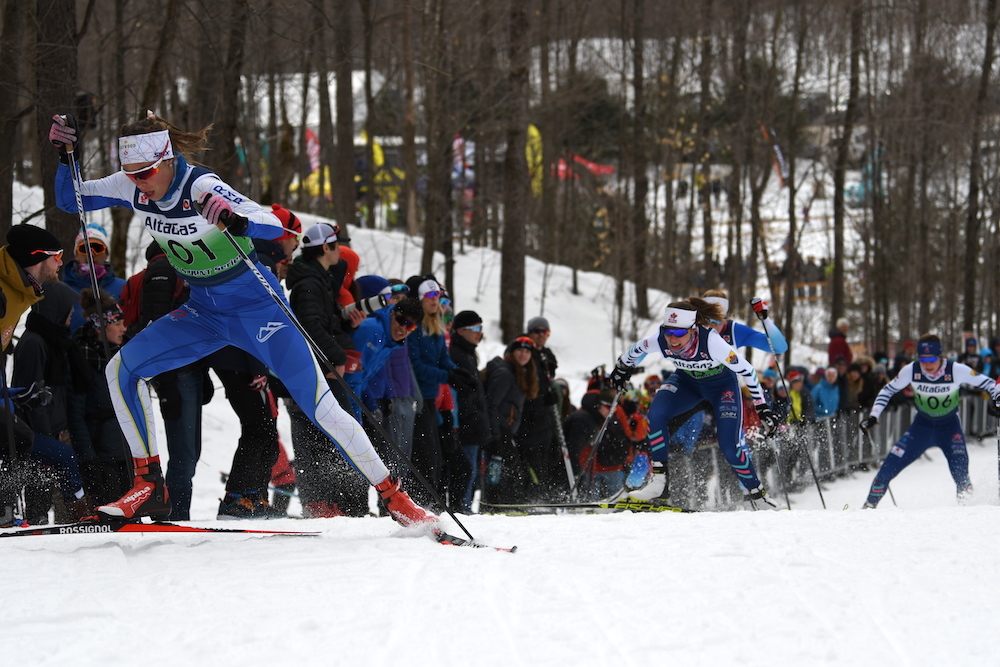
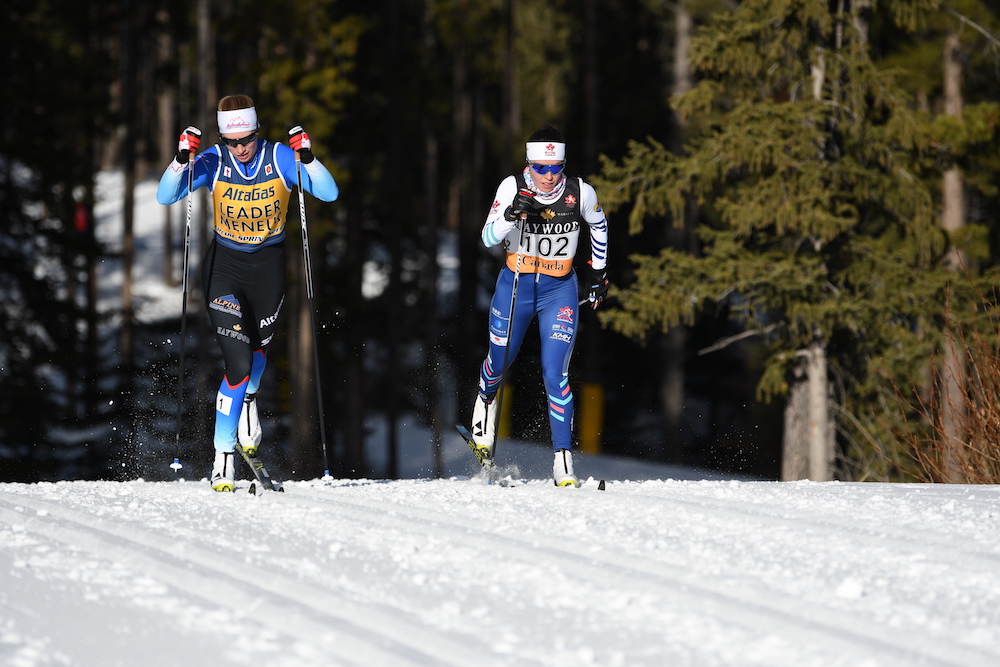
Katherine Stewart-Jones leads a sprint heat on her way to domination. (Photo: Robert Smith)
The NorAm circuit moved east to the Nakkertok trails for three days of racing jointly hosted by Nakkertok Nordic, Club Skinouk, Chelsea Nordiq, and Kanata Nordic. Friday featured classic sprints, Saturday interval start free, and Sunday interval start classic.
The event was also the Candy Cane Cup for the younger categories, as well as Ontario Cup 1 and Coupe Québec 1. 374 athletes in the U16, U18, and Open categories competed on Friday with many more younger athletes racing Saturday and Sunday.
Nordiq Canada’s Jeff Ellis was there and has once again shared the full-length post-race interviews. Photographer Robert Smith has galleries for each day, so keep scrolling.
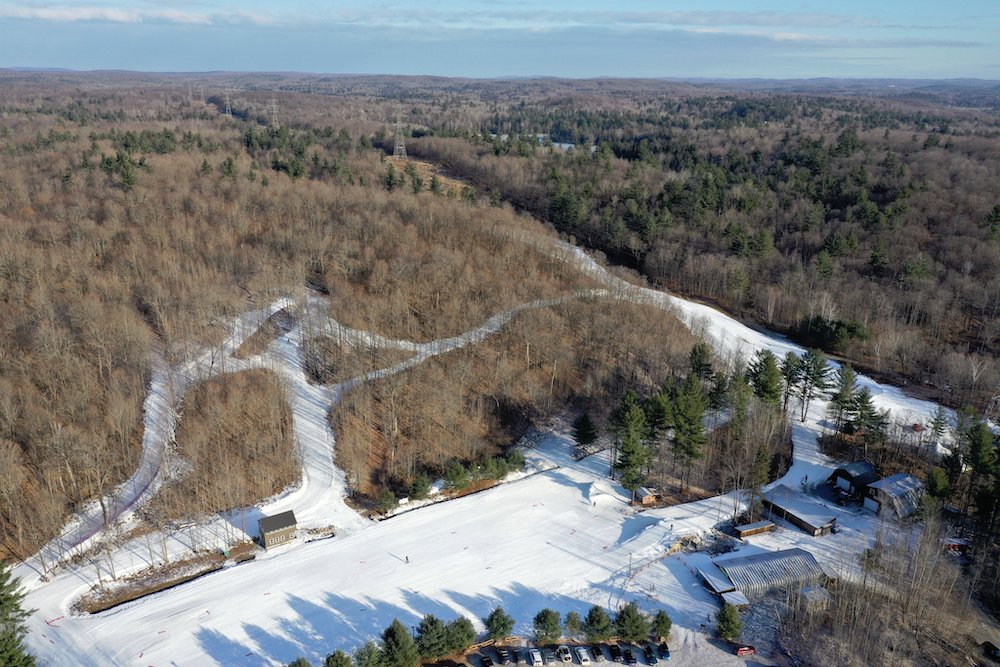
Nakkertok had over 3km of trail open thanks to their snowmaking, with a 2.5km loop used for the distance races.
The ‘NakkerTrak’ at Nakkertok before the 2019 NorAm weekend. (Photo: Natural Fitness Labs)
On the women’s side, it was the KSJ show, with home-grown national team member Katherine Stewart-Jones winning all three days.
In the sprint, Stewart-Jones finished in 3:19.96, comfortably ahead of AWCA’s Maya MacIsaac-Jones and RMR’s Katie Weaver at 2.43 and 3.93 seconds back respectively. The podium trio were the top three qualifiers, but in reverse order.
Stewart-Jones steamrolled the field in the free 5km, 36.8 seconds ahead of Laura Leclair in second and 39.9 seconds before Cendrine Browne, both of CNEPH.
The trend continued on Sunday, with Stewart-Jones finishing the classic 10km in 28:52.1, 1:18.1 ahead of Skibec’s Andrée-Anne Théberge and 1:29.8 ahead of AWCA’s Annika Richardson.
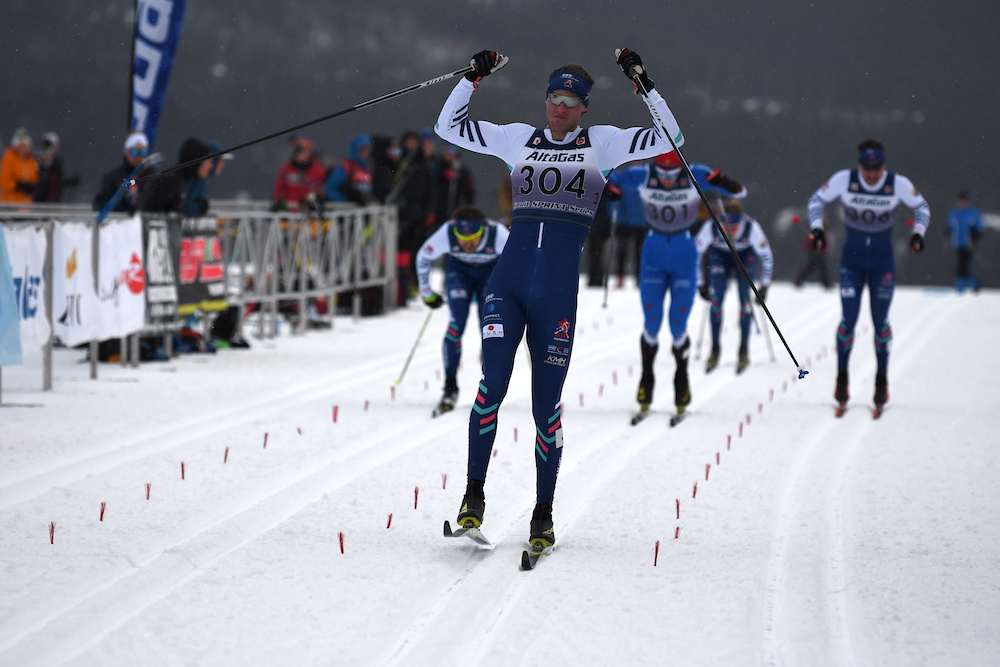
Antoine Cyr leads Julien Locke in the interval start classic. (Photo: Robert Smith)
For the men, Hardwood’s Bob Thompson kicked the weekend off with a sprint victory in 3:12.71, followed by national team member Antoine Cyr at 0.36 seconds and his CNEPH teammate Antoine Briand at 0.63.
On Saturday, Cyr won the free 10km in 22:10.4, 20.9 seconds ahead of Fondeurs Laurentide’s Ricardo Izquierdo-Bernier and 32.8 seconds clear of Team R.A.D.’s Evan Palmer-Charrette.
Palmer-Charrette stepped up to finish the weekend on top of the podium, winning the 10km classic in 24:43.8. National team member Julian Smith was second at 6.2 seconds followed by Cyr at 14.4 seconds.
For many Canadians this season, the big focus is on the Mt. Sainte Anne (MSA) NorAm in January, which is the Junior and U23 World Championship trials. That series is also a path to World Cup starts. As a result, a number of athletes chose the nearer of the two December NorAm races and skipped the other to reduce travel. Over 30 western Canadians drove to Sun Valley for the SuperTour event instead of flying to Nakkertok.
“I think that it’s good for younger athletes to chase high competition for development,” Stewart-Jones wrote in response. “It makes more sense for them to travel less too. This year, for most of the younger athletes and even a lot of the older ones, the focus is on trials in MSA in January so there is a lot of time to prepare for their optimal race performance.”
Stewart-Jones moved from Nakkertok to Canmore this training year, resulting in new training partners and a new personal coach, national team head coach Erik Bråten. That also meant returning to Nakkertok required two extra flying days and the associated illness risk.
“If I hadn’t been trying to get the COC spot locked up for the rest of the season I would have most likely gone to Sun Valley too.”
There is a complicated calculus to getting World Cup starts in Canada. The COC leader gets FIS-guaranteed starts and financial support from the host organization for each race weekend. Keeping the COC leader bib for the season would mean more and cheaper time on the World Cup for Stewart-Jones. Dahria Beatty and Emily Nishikawa chose to race period 1 in Europe instead, with Beatty qualifying for the next WC trip selection by placing 25th in the Davos sprint on Saturday.
Katie Weaver, Dahria Beatty, and Maya MacIsaac-Jones lead Katherine Stewart Jones in the women’s A final at Nordiq Thunder 2019 (Photo: Doug Stephen)
The unofficial kickoff to the western Canadian racing season was held on November 13th and 14th. The traditional King’s Court sprint and interval start distance races are now called Nordiq Thunder — a re-brand from Frozen Thunder – but the relaxed feel and clockwork organization remain the same.
With no trip selections on the line, the 93 sprinters and 105 distance racers were there to test their fitness and tune up for the races that matter.
While the results are less important, Canadian National Team coach Erik Bråten shared his impressions from the two days with FasterSkier.
“Not going to over analyze these results too much. But for the seniors, Dahria [Beatty] had two good days with a win and a second. Antoine Briand, Bob Thompson and Maya MJ [MacIsaac-Jones] all looked strong on the sprint and I am looking forward to see what they can do when the NorAms start up in a few weeks in Canmore. Sam Hendry and Jesse Cockney both did strong on the distance race. And Katherine SJ [Stewart-Jones] also looked strong and got an ok result on the distance despite that her coach messed up (me) and she thought she was doing 5 laps until it was 400m left on the 4th and actual last lap.”
The King’s Court sprint format mixes all the categories so the men, women, juniors, and paras all get three hard heats, with only the fastest four in each category getting a category-specific final heat. In distance, all males skied five 2km laps and all females skied four identical laps, which makes it easier to compare results.
“We are also seeing some juniors doing really good even in the open category so that is very exciting from a development perspective,” Bråten wrote. “Several interesting names there in both genders, but Tom Stephen was for sure looking super strong both days.”
The reliable schedule for snow at Nordiq Thunder allows athletes to plan their early season and also provides local skiers with weeks of quality training.
National Team member Sam Hendry, in his first year as a senior, made the trip from the University of Utah to get some early snow and spend time with Bråten, who collaborates with Utah coach Miles Havlick on his plan.
“It was really nice for me to have the chance to come home and ski on snow in Frozen Thunder especially with the lack of snow in Utah. Getting to complete two races is a great experience to have and a bit of an edge over other competitors when we arrive for the season start in Canmore,” Hendry wrote.
American Andy Newell made the trip from Bozeman, where he is training with the Bridger Ski Foundation, to test his recovery from last season’s back issues.
“I just drove up to Canmore from Bozeman for a quick trip just to jump in the Frozen Thunder races and will be driving home right after the race tomorrow,” Newell wrote.
“I like the Frozen Thunder races because they fit really well as the first starts of the year. There is always really good competition here, the race organizers are pro, but at the same time it feels pretty fun and laid back. It’s great to get a classic sprint in early because it can be so much different than rollerskis. After this I will be in West Yellowstone and back here in Canmore for the first SuperTours racing with BSF.”
Fastest junior Isabel Hendry leads Maya MacIsaac-Jones in the 8km free. (Photo: Doug Stephen)
MacIsaac-Jones was one of the casualties when Nordiq Canada reduced the national team size to fit their reduced budget this season. The chance to train and race at home has to be welcome for an athlete who has reduced support this season.
“I’m really happy with the Frozen Thunder races,” MacIsaac-Jones wrote. “My race shape is getting closer every week and I’m feeling ready for winter. I’ve made some changes to my training, but what’s reallymotivating me is my goal to be competitive in World Cup sprint heats this winter. I joined AWCA this year and it’s been great being a part of a new team. I’ve put in a lot of consistent, hard work and I’m excited to see how the race season plays out!”
MacIsaac-Jones was also happy not to be talking about rehab, after a few seasons with injuries.
Nordiq Thunder Working for the Community
In it’s 10th season, Nordiq Thunder continues to draw western Canadian athletes to the farmed snow starting the third weekend in October every year. The loop may be small, ranging from just over 1km to 2.5km depending on the year, but the availability of high quality track setting every year is an essential part of many athletes’ preparation.
“The Canmore Nordic Center staff, they contribute about $85,000 in value in kind services, this includes the snowmaking, grooming and on the ground management,” Winsport’s Mike Norton confirmed from the FIS TD conference in Minnesota. The rest of the funding comes from 7 sport partners, Nordiq Canada, Biathlon Canada, the Alberta World Cup society, the Alberta Biathlon Training Center, Foothills Nordic ski club, Canmore Nordic Ski club, and Winsport Canada, along with a private donor, Gary di Silva. “These partners contribute approximately$70,000 in cash, this pays for the heavy equipment to deploy the 13,000 m3 of snow and any new sawdust needed for the insulation.” A cubic metre is pretty close to a cubic yard, for residents of Myanmar, Liberia, and the US. Official site Pin-Up Casino and Betting on pinup , all links and iformation, best regard
“We learn a bit every year on how to make the snow deployment more efficient and cost effective,” Norton wrote, which is a bit of Canadian understatement for the significant progress made over the last decade.
Nordiq Thunder mornings are reserved for registered athletes with bibs, while the the afternoons are open to the general public. This helps with the crowding until more trails open and the regular season begins.
What is often overlooked in the focus on racing and elite athletes is that Nordiq Thunder’s farmed snow allows the Centre to focus their existing snowmaking capabilities on opening more trails, which provides a longer season to all skiers. While the elite skiers get all the attention, the entire community gains.
Photographer (and proud parent) Doug Stephen was there both days and has posted albums on Flickr: sprint and distance. Athletes are welcome to download and use full resolution photos as long as they credit Doug Stephen (@vr45Photography).
Sam Hendry leads Graham Ritchie in the 10km free. (Photo: Doug Stephen)
Junior Tyson Green (Caledonia) outsprints Mark Arendz (NPST) in a third round King’s Court heat. (Photo: @NordiqCanada instagram)
Nordiq Canada hosted the annual kick-off to the race season at Canmore Nordic Centre on November 13th. The ‘Nordiq Thunder’ races are an opportunity to put on a bib and test fitness and are not being used for trip selection this year. The full press release follows the two winner’s interviews, below. Results for both days are on zone4.ca
CANMORE, Alta.—Antoine Briand and Maya MacIsaac-Jones were crowned the king and queen of the annual Nordiq Thunder King’s Court Sprints on Wednesday in Canmore, Alta.
Born just two days apart, the 24-year-olds hammered the pace up and down hills on the challenging 1.4-kilometre track throughout the qualifying round, and in each of the three head-to-head heats, under a blue-sky morning at the Canmore Nordic Centre.
The unique King’s Court race is a no knockout format that gives athletes opportunities to race – handling category sizes of nine-to-24 racers in three rounds, with up to four athletes per heat. The goal of the format is to have athletes compete against a variety of similarly skilled racers, men and women mixed in each heat, that benefits skill development. By the final round, the fastest athletes are generally competing in the all men and all women’s final, with the slower athletes in the lower finals.
That certainly held true on Wednesday for both men’s and women’s brackets.
Racing on skate skis for the qualifying round and in the final, Briand of Sept-Iles, Que., was the fastest qualifier leading the men into the senior head-to-head heats. After struggling to find his top gear in the first round, Briand put the pedal down in the second and final heat where he edged out Olympian and three-time World Cup medallist, Andrew Newell of the United States, for top spot on the podium. Bob Thompson, of Thunder Bay, Ont., placed third.
“In some ways this means nothing and, in some ways, it means everything. I am happy to win today,” said Briand. “It was an interesting battle. I played it wise going fast on the flats and the downhill. I wanted to do good and win today. It was important for my confidence to get this one.”
A motivated Maya MacIsaac-Jones was determined to kick her season off with a strong start. Qualifying in second spot, the Athabasca, Alta. resident put her summer training to the test with a hard-fought battle through the women’s heats where she went head-to-head with National Ski Team member, Dahria Beatty of Whitehorse, in the final two rounds.
While Beatty led the Canadian duo into the finishing stretch in the second round, it was MacIsaac-Jones who double-poled relentlessly to make up the ground and edge the Olympian at the line.
“That format is so great in terms of getting ready for the race season and having a good tune-up,” said MacIsaac-Jones. “I think it is one of the best formats for sprinting out there. You have to go as hard as you can in every heat, and you aren’t saving anything for the final. It is perfect.”
A rematch was set for the senior women’s final.
Beatty and MacIsaac-Jones were quick off the start line, darting up the steep climb out of the stadium. Playing chase around the rolling terrain, it was the determined MacIsaac-Jones taking the lead this time on the final downhill, and she never looked back, securing her spot on the golden step of the senior women’s podium.
“I had a lot of fire in me this training season. It definitely is what is keeping me in this racing season. Things have been feeling really good overall this year. Today is another check mark on everything that I’ve been doing in training is working so far.”
Joe Davies, of Whistler, B.C., was the top junior men’s sprinter. Jasmine Drolet, of Rossland, B.C., opened up a sizeable gap to handily win the junior women’s title.
Nordiq Canada is holding its annual season-opening race series for the majority of the nation’s male and female cross-country skiers, thanks to the Canmore Nordic Centre’s annual snow preservation project, Frozen Thunder.
In an effort to provide Canada’s Nordic athletes with the ability to train on snow at home in October and early November, the Frozen Thunder initiative stored enough snow under a thick layer of sawdust to insulate it over the summer months, allowing them to cover the 1.4-kilometre of trail.
Modeled after snow preservation projects in Europe, the Canmore Nordic Centre was the first to take on the project in North America – and is subsequently the first to open its trails on the continent each year – providing another critical resource for Canada’s high-performance Nordic sports.
Nordiq Canada is the governing body of para-nordic and cross-country skiing in Canada, which is the nation’s optimal sport and recreational activity with more than one million Canadians participating annually. Its 60,000 members include athletes, coaches, officials and skiers of all ages and abilities. With the support of its valued corporate partners – Haywood Securities Inc., AltaGas, Swix and Lanctôt Sports– along with the Government of Canada, Canadian Olympic Committee, Canadian Paralympic Committee, Own the Podium and B2Ten, Nordiq Canada develops Olympic, Paralympic and world champions. For more information on Nordiq Canada, please visit us at www.nordiqcanada.ca.
Maya MacIsaac-Jones attacked on the final hill to win. Behind, Katherine Stewart-Jones leads Dahria Beatty and Annika Richardson. (Photo: Doug Stephen)
This article has been updated with final WCF selections and a video of the sprint A finals.
Nationals rolled on at Nakkertok trails with free technique sprints on Saturday. The women raced a 1.3km course while the men added one more hill for 1.4km. The jury described the conditions as ‘soft icy’, which seems to mean ‘fast spring skiing’ with a soft layer over a firm base.
Maya MacIsaac-Jones (CNST) took her second consecutive national sprint title by jumping clear on the final climb to earn a solo victory in 2:46.62. Dahria Beatty (CNST) led the pack into the finish 2.87 seconds later with Katherine Stewart-Jones (CNST) at 3.27 seconds and Cendrine Browne (CNST) at 3.47.
Germany’s Julia Richter took fifth for the University of Utah at 4.82 followed by Annika Richardson (NTDC TBay) at 5.31.
“Going into the final,” MacIsaac-Jones wrote, “I knew that my offset was strong so I made the decision to attack on the final climb, which worked out as planned!”
Maya MacIsaac-Jones leading the A final. From left to right, Julia Richter (104, red), Cendrine Browne (113), Dahria Beatty, and Katherine Stewart-Jones pursue. (Photo: Doug Stephen)
MacIsaac-Jones is ending her nationals on a high, as she makes a planned shift to focus on World Cup finals next Friday. “I’m so happy with my race today, this is the best I’ve felt all year. It’s been a rocky season, and this is really motivating for me going into next year.”
The conditions made for fast racing, but the A final was different.
“It went out pretty slow,” Stewart-Jones wrote, “because no one wanted to lead on the first climb because there was significant draft on the next downhill.”
Browne, who is usually described as a distance specialist, now has 4th in every event at nationals.
“My qualifier was not so great, so I didn’t know what to expect in the heats,” Browne told the LOC. “Fortunately, I felt really good in the heats and I managed to squeeze myself up to fourth place today. Really happy with that, usually not a sprinter, so yeah, good day for me.”
***
Norwegian junior Haakon Skaanes wins the sprint ahead of Antoine Briand. (Photo: Doug Stephen)
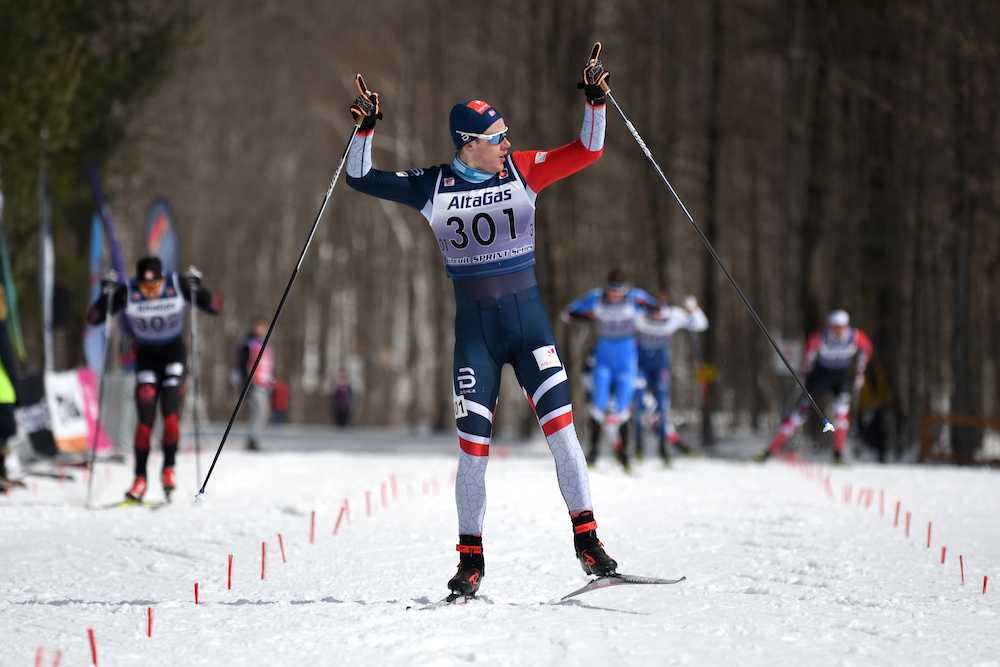
In the men’s A final, the Norwegian theme from today’s World Cup sprint in Falun flowed into Canada. Norwegian national team junior Håkon Skaanes (Strindheim IL) won the qualification and all his heats to take the A final in 2:45.69.
Antoine Briand (CNEPH) finished alone in second, 2.54 back, to become the Canadian champion. Julien Locke (CNST) out-sprinted the rest to take third and the silver medal at 5.60 seconds. Julian Smith (NTDC TBay) completed the Canadian podium at 5.73. Lenny Valjas (CNST) was fifth at 6.08 ahead of Norwegian junior Albert Sunde Oehlschlaegal (Sjåstad v Lier IL) at 6.26.
Briand, who qualified second 1.05 behind Skaanes, was happy with his first Canadian title.
“Today’s race, I’ve been thinking about it for the past eight, nine months,” he told the LOC. “I was really strong today, from the start of the day, qualification this morning and every heat I was feeling good.”
Briand didn’t wait for others to set the stage.
“In the final, I went really hard in the first uphill,” Briand wrote. “My coach shouted on me that the gap had opened. So me and the Norwegian guy who won kept going hard until the end. I couldn’t follow him the second time we went up but I managed to stay 2nd.”
Julien Locke (317) takes third, ahead of Julian Smith (305), Lenny Valjas (308) and Albert Sunde Oehlschlaegal (behind Locke). (Photo: Doug Stephen)
“For me,” Smith wrote in an email, “I was really confident in my skis so I was trying to settle into 3rd place going into the first downhill, and then move into second during the second climb. This allowed for drafting on the final descent. … I did let one too many people between me and the finish line on the last climb and then was not quite able to close the gap in the end.”
This nationals is not just the largest in recent memory, but also one of the most competitive. Unusually, there are only two Canadians on the World Cup circuit in Falun, with everyone else here in Nakkertok. The addition of the Norwegian juniors and NCAA athletes added speed to the mix.
“I have never been to a Canadian National Ski Championships where the field is so deep, with National Team members, competitive domestic racers and so many international racers,” Smith wrote.
Racing continues Sunday with sprints for the younger age groups and an invitational for even younger athletes. Sunday has 507 racers on the start list compared to 194 finishers and 12 DNS on Saturday.
World Cup Final Qualification
Twelve athletes have already qualified, leaving seventeen spots to be decided at nationals: 8 men and 9 women.
The criteria was summarized after the pursuit race. The races that count are the sprint, the individual start classic, the pursuit, and pursuit time-of-day.
Twelve athletes were already named to the World Cup Final team:
Alex Harvey, Lenny Valjas, Emily Nishikawa, Dahria Beatty based on World Cup or Olympic results.
Katherine Stewart-Jones and Jack Carlyle (AWCA) as COC leaders.
Cendrine Browne, Maya MacIsaac-Jones, Russell Kennedy (Team R.A.D.), Scott Hill (Hardwood), and Evan Palmer-Charrette (Team R.A.D.) by qualifying for World Championships.
Rémi Drolet (Black Jack) with a top ten at World Juniors.
What follows is an interpretation of the criteria. CCC will announce the definitive list Sunday night at La Soirée, along with the new CCC branding.
Update: At the Sunday evening event, Nordiq Canada (the organization formerly known as CCC) announced the final selections.
For the women, it is Annika Richardson, Anne-Marie Petitclerc, Sadie White, Marie Corriveau, Zoë Williams, Hannah Mehain, Frédérique Vézina, Alannah Maclean, and Laura Leclair.
For the men, it is Antoine Briand, Philippe Boucher, Julien Locke, Julian Smith, Bob Thompson, Alexis Dumas, Antoine Cyr, and Graham Ritchie. Apart from morning sickness, a pregnant woman has to deal with heartburn, fatigue, sore muscles and much more. It is also difficult to get good rest at night as their tummy gets bigger. Towards this end, pillow manufacturers aimed to address the need and develop the kind of pillows that will facilitate a pregnant woman’s sleep and relaxation. Our review will focus on the best pregnancy pillows which can cater for your needs whilst taking into consideration different factors like material, size, shape, price and brand. Shop best pregnancy pillows online at Pregily.com – read reviews and shop now!
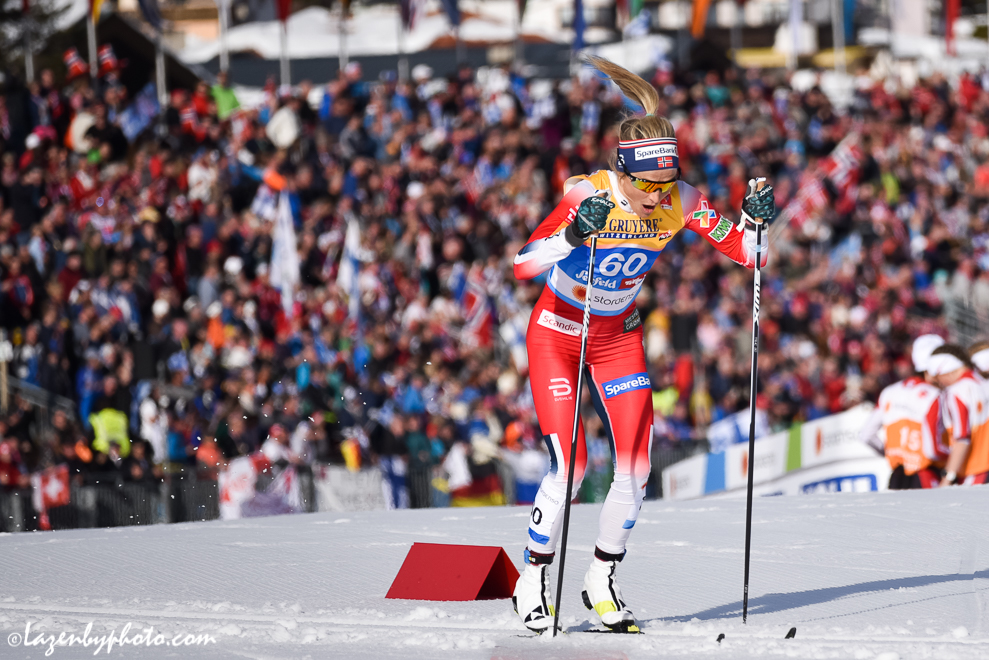
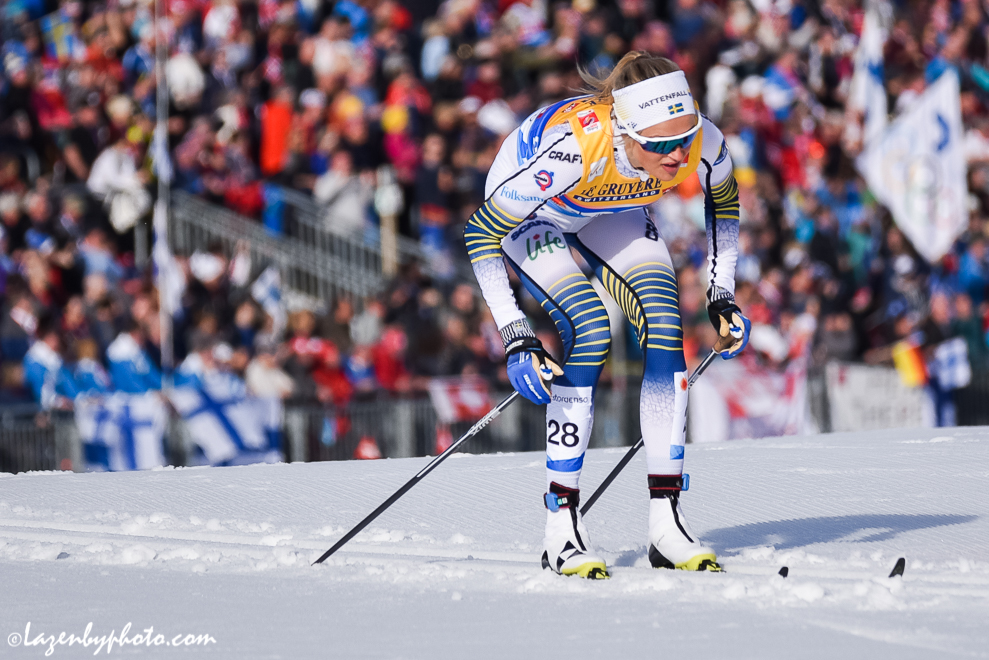
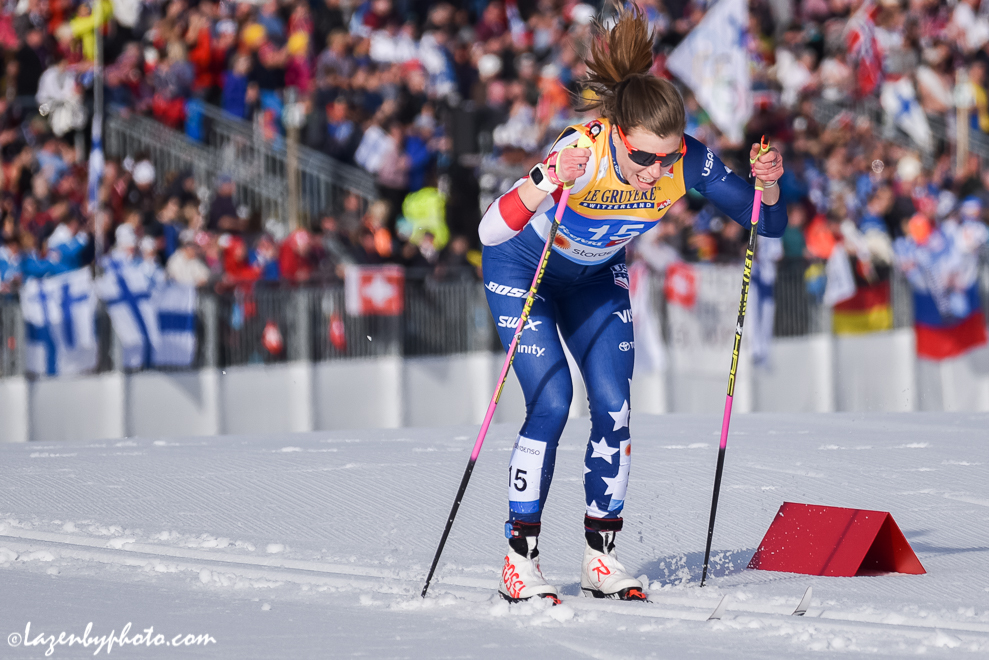
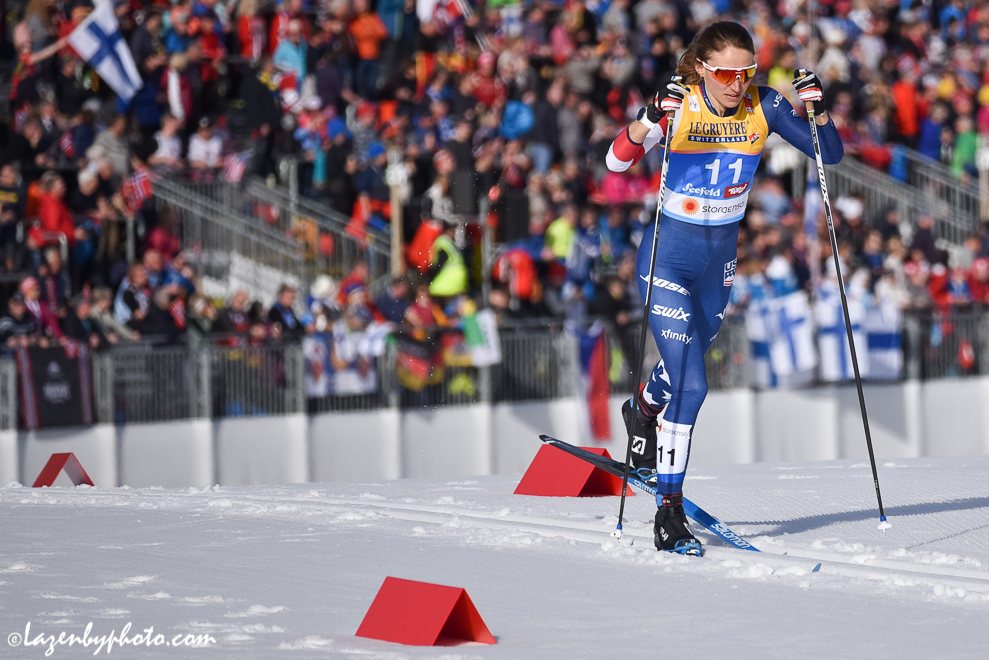
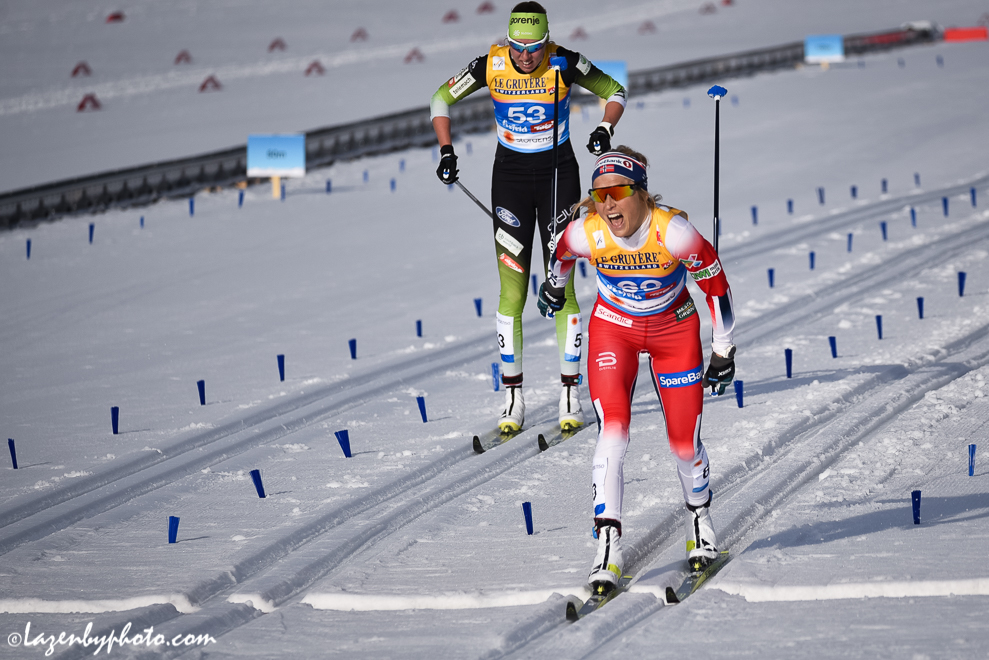
Never a slow moment: Therese Johaug of Norway on her way to winning the women’s 10 k classic at the 2019 World Championships in Seefeld, Austria. (Photo: John Lazenby/lazenbypohoto.com)
The race is the spectacle that determines the outcome. And when Norway’s Therese Johaug highlights the start list, her winning outcome seems pre-determined as soon as she skates or strides from the start. On Tuesday in the World Championship interval start 10-kilometer classic, Johaug won gold. In a race where splits are given, Johaug may have only been flummoxed by the close margin between her first place and the resolute chaser in nineteen-year-old Frida Karlsson of Sweden.
The 5 k time check revealed how the race was shaking out for potential contenders. Three skiers remained within 30 seconds of Johaug: Karlsson 7.3 seconds back, Norway’s Ingvild Flugstad Østberg 18.3 seconds behind, and Astrid Uhrenholdt Jacobsen 27.5 ticks back respectively.
Despite each of the three skiers ceding time to a metronome-like Johaug over the remaining 5 k, her performance made her appear less like an automaton than in races past. Certainly, Johaug clinically executed the stride and glide and double pole. But for a brief moment, Johaug subtly teased Karlsson into thinking she had a chance for the win.
At 6.7 k, Karlsson’s time back shrunk to 4.8 seconds.
Then again this is Johaug. A champion who struggled through a positive doping test in Oct. 2016 and a subsequent 18-month competition ban to arrive this season as a lock for any distance event win. Ceding precious time to a young Swede with 3.3 k’s remaining on Tuesday was a performance blip not a defining moment.
Karlsson started in bib 28, Johaug in bib 60. Karlsson’s time in the leader’s chair was tenuous as she awaited 32 bibs to ski through the finish and determine her first or second place podium fate.
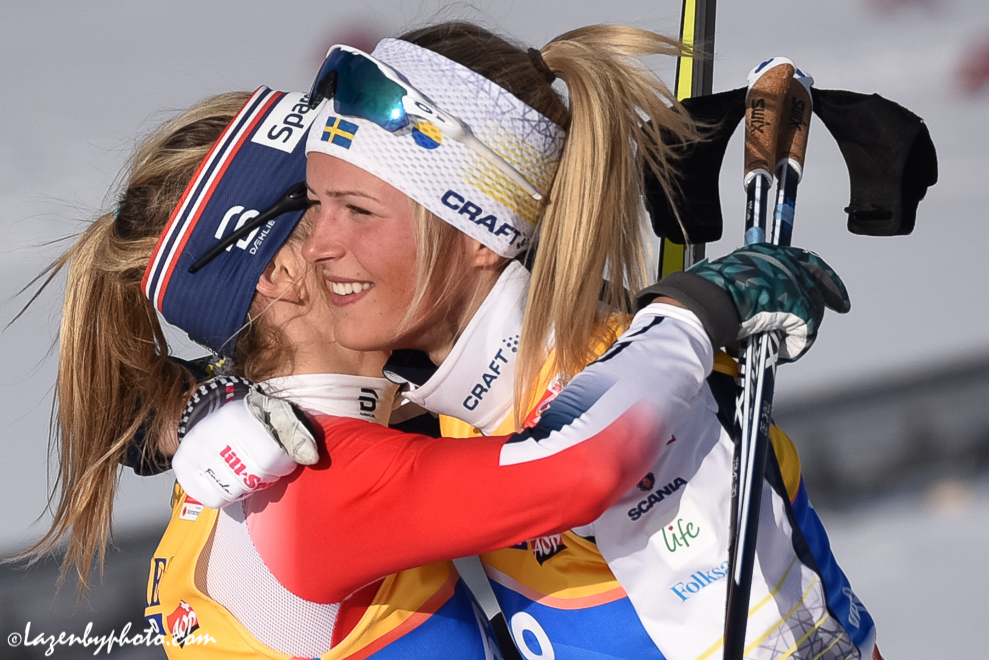
Young and ready to challenge, Sweden’s Frida Karlsson challenging for the top spot during the 10 k classic at the 2019 World Championships in Seefeld, Austria. (Photo: John Lazenby/lazenbypohoto.com)
It was a win in 27:02.1 minutes. Whatever glimmer of hope Karlsson felt was diminished as Johaug’s winning margin bumped to 12.2 seconds when she stopped the clock. Norway’s Ingvild Flugstad Østberg was third (+35.6) while Finland’s Krista Pärmäkoski placed fourth (+37.0).
“I am really happy now,” Johaug told an International Ski Federation (FIS) reporter following the race. “This distance was my goal before the season started. I really want to win this and today I did it. It was really tough out there. I fought with myself all the time, and I feel a bit tired. … I am really fighting today. … The temperature was really hot and the tracks were really wet. I had to work with myself all the time.”
At thirty-years-old, in her return to World Cup competitive standards after serving her doping penalty, Johaug remains the distance athlete to beat. Hers is the end of the spectrum where top-end fitness is realized after winning her ninth world champ title on Tuesday. And according to FIS, the 10 k classic is a race suited for the 30 and older set. The last four winners of the 10 k individual start classic at world championships were older than 30 years old. This dates back to 2001 when Norway’s Bente Skari won that discipline at 28.
On the other end of the age and performance spectrum when it comes to realizing potential is Karlsson. At 19, she is a three-time World Junior Championship winner. In Lahti, Finland last month, Karlsson won the 15 k mass start classic and the 5 k skate. She competed in her first World Cup on Feb. 17, when she placed seventh in Cogne, Italy’s 10 k classic.
When considering Karlsson’s rise over run success curve, her’s has been steep. In little time, she has emerged as Sweden’s most viable championship podium shot in Seefeld’s distance events. That is a considerable feat knowing that Charlotte Kalla, Sweden’s beloved nordic sport hero, had sights on more championship hardware. (Kalla placed 9th overall.)
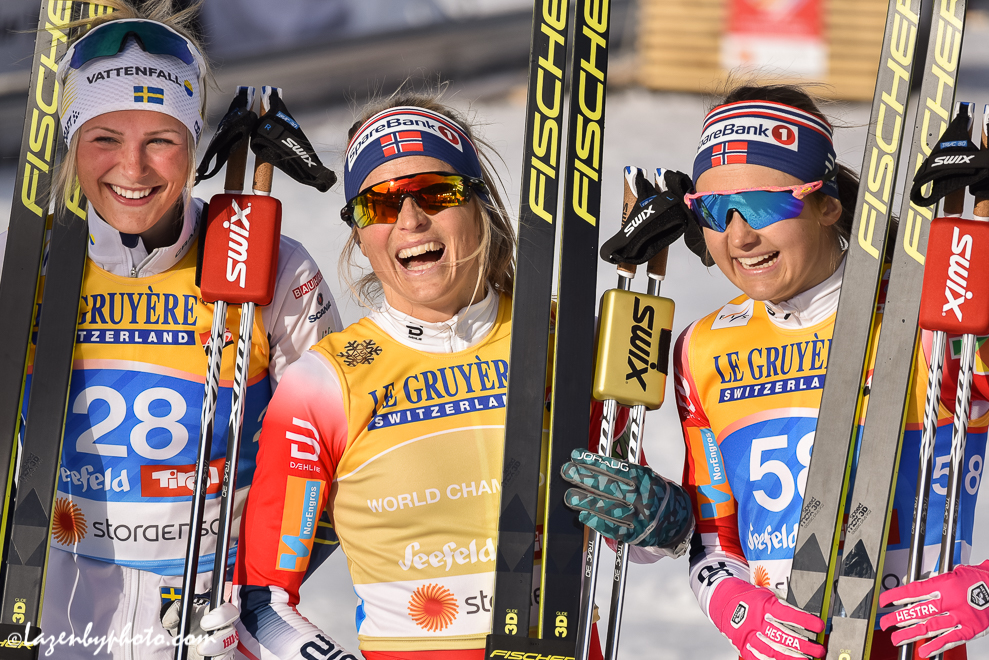
The women’s 10 k classic podium at the 2019 World Championships: Frida Karlsson (l) in second, Therese Johaug (center) of Norway in first, and Ingvild Flugstad Østberg of Norway third. (Photo: John Lazenby/lazenbypohoto.com)
The U.S. entered Sophie Caldwell, Jessie Diggins, Sadie Bjornsen, and Rosie Brennan. All finished in the top-30. But in a program where medals are the realistic objective, the sense was they were looking for more.
Bjornsen was the best placed of the tightly grouped Americans in the final standings. Bjornsen placed 23rd (+1:41.0), Brennan 24th (+1:45.1), Diggins 25th (+1:51.9), and Caldwell 29th (+2:09.5).
“It’s definitely a bizarre and strange day,” Bjornsen said in a post-race phone call. “The only thing I can tell you is that I felt like I had one of the better performances I’ve had this year, I just feel like I fought every single moment. It was the most positive, most fighting I’ve done in my head, just attacking every single part of the course, and I guess that’s why it’s a little bizarre that the result is one of the worst in the year. Not worst, but definitely not in the place that I think I am capable of, and where I would have seen myself today.”
Bjornsen’s early splits during her first lap were encouraging – she was informed that her efforts were keeping her in the top-ten hunt.
“That was definitely really encouraging when you hear a split like that, you’re willing to dig even deeper,” she added. “I feel like that was what I was doing today, attacking every single portion of the course like I was fighting for a medal. Which I guess is funny now, to look at the result and see what happened.”
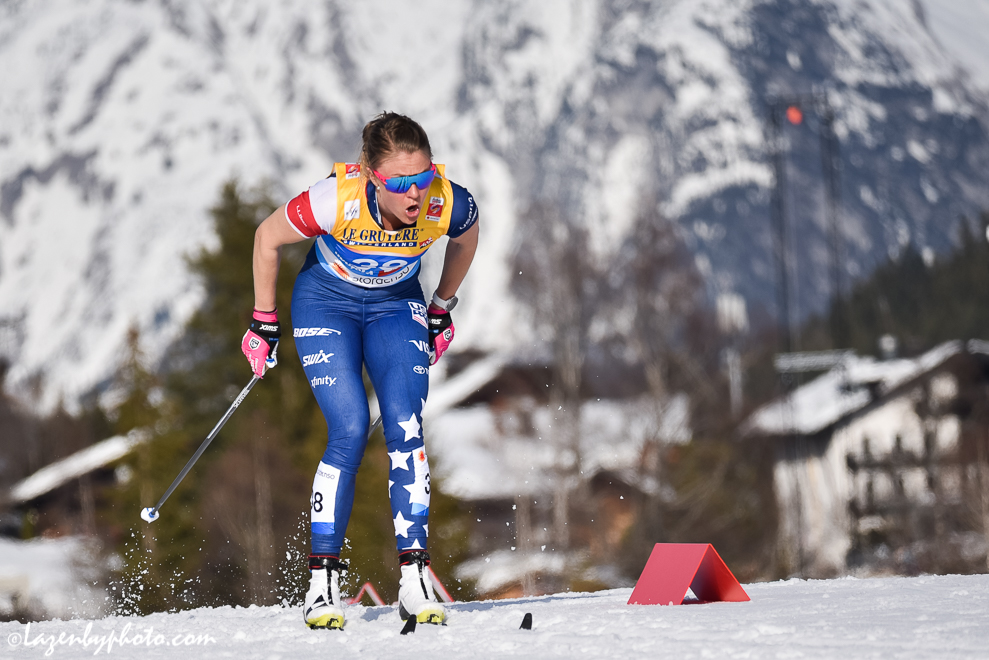
The U.S. Ski Team’s Sadie Bjornsen during the women’s 10 k classic at the 2019 World Championships in Seefeld, Austria. (Photo: John Lazenby/lazenbypohoto.com)
The race began at 3 PM Seefeld time in warm temperatures that morphed the tracks into wet saturated snow where they were exposed to direct sun. Race time temps soared to near 50 degrees Fahrenheit and created a course with intermittent sections of slush, re-freeze, and powdery snow. It was an in the tracks then out the tracks affair depending on sun exposure.
“It’s no secret that I don’t handle heat super-well,” Diggins said in a call. “For me, that was my great challenge today. When I finished, my face was bright red and my skin was radiating heat. … That was something that I definitely struggled with, and I thought I had taken the right steps to stay cool, by not racing in gloves or a headband or sleeves. By stuffing snow down my shirt right before the start, but clearly, it wasn’t quite enough.”
Diggins said her race pace was further stymied by a “mini-implosion” as she began her second lap.
“I think overall, all you can focus on is doing the best you can with what you have, and I did that today,” said Diggins. “As evidenced by wanting to puke and tasting blood and feeling like I was going to pass out, I know that I pushed myself really, really hard. And that’s a good feeling, to know that you did the best you could.”
In warm conditions, U.S. skier Jessie Diggins during the women’s 10 k classic at the 2019 World Championships in Seefeld, Austria. (Photo: John Lazenby/lazenbypohoto.com)
Across the line, an overheated Diggins was attended to by U.S. Ski Team staff to assure she was cooled down properly. On a day when her level of fitness was burdened by what she called her “proclivity to heat exhaustion”, Diggins focused on the professionalism of those dedicated to her race day efforts.
“We have such an awesome staff here, and an awesome, caring, team,” said Diggins. “Right at the finish, I had multiple people pouring water over my head and stuffing snow down my shirt and taking my skis for me. I just feel very loved and taken care of, and I think it’s so cool that we have such an awesome staff, that is just happy to be working hard and helping us in every way they can. I really appreciate that.”
Brennan comes off a skiathlon where she placed 10th overall — her best individual result at a World Championships. Like her U.S. peers, Brennan played the game of balancing speed and kick on a course with variable snow conditions and lengthy sections of double pole terrain.
Rosie Brennan during the women’s 10 k classic at the 2019 World Championships in Seefeld, Austria. (Photo: John Lazenby/lazenbypohoto.com)
“I looked at the course and thought about my strengths and took into account those and think where I could make up the most times and need faster skis or more kick for those sections,” Brennan said in a call. “Today there was quite a bit of double pole. I thought that was my best card to play. So I tried to go with as fast a skis as I could and still make it up the hills. Whether that worked or not I don’t know, it is hard to say. That was my thought going into the race.”
Brennan remains optimistic about earning starts in the championship’s two remaining women’s races, the 4 x 5 k relay and 30 k skate.
The women have an off day tomorrow with the relay scheduled for Thursday.
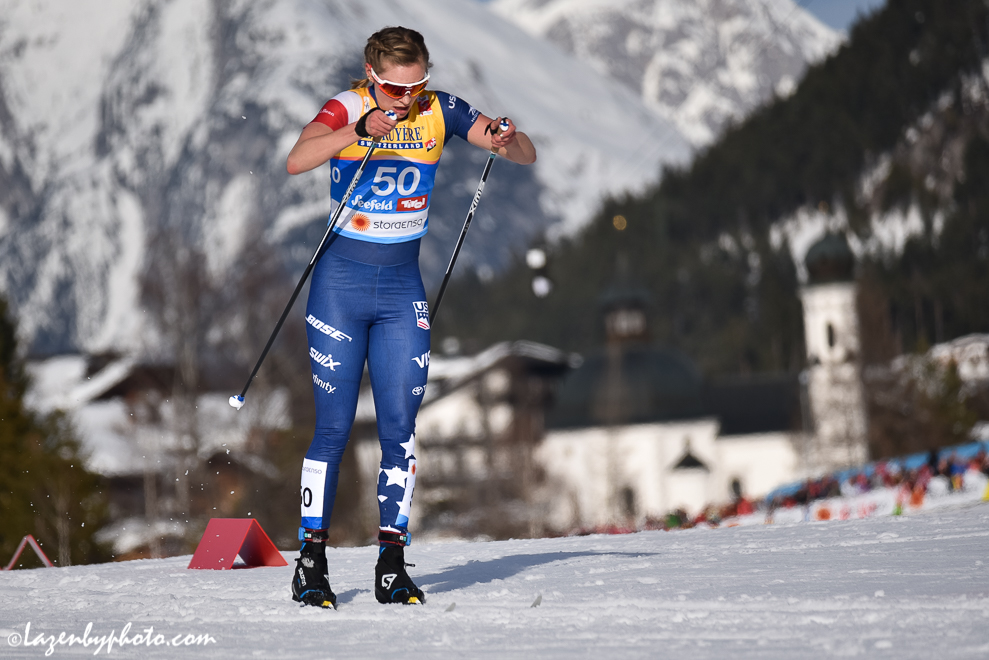
U.S. skier Sophie Caldwell during the women’s 10 k classic at the 2019 World Championships in Seefeld, Austria. (Photo: John Lazenby/lazenbypohoto.com)
Norway’s Therese Johaug winning the women’s 10 k classic at the 2019 World Championships in Seefeld, Austria. (Photo: John Lazenby/lazenbypohoto.com)
FIS Nordic World Ski Championships Seefeld, Austria Women’s Individual 10 k Classic
In her first World Championships since 2015, on Tuesday Norway’s Therese Johaug sped to her second distance gold in Seefeld. Johaug stopped the clock in 27:02.1 to claim the win in the 10-kilometer individual start classic.
Sweden’s Frida Karlsson was perhaps the biggest podium surprise of the day. At nineteen-years-old, Karlsson (a three-time winner at World Juniors) placed second, 12.2 seconds back. Norway’s Ingvild Flugstad Østberg was third (+35.6).
Sadie Bjornsen for the U.S. raced to 23rd (+1:41.0), Rosie Brennan 24th (+1:45.1), and Jessie Diggins 25th (+1:51.9). Sophie Caldwell placed 29th (+2:09.5).
Canada’s Emily Nishikawa was 36th (+2:36.1), Dahria Beatty 49th (+3:39.3), Katherine Stewart-Jones 51st (+3:45.0), and Maya MacIsaac-Jones 66th (+5:35.9).
Between 3.75-kilometers and 4.85 k on Saturday, Norway’s Therese Johaug began to pull away in earnest during the women’s World Championship 15 k skiathlon — by then she had built a near 15 second lead.
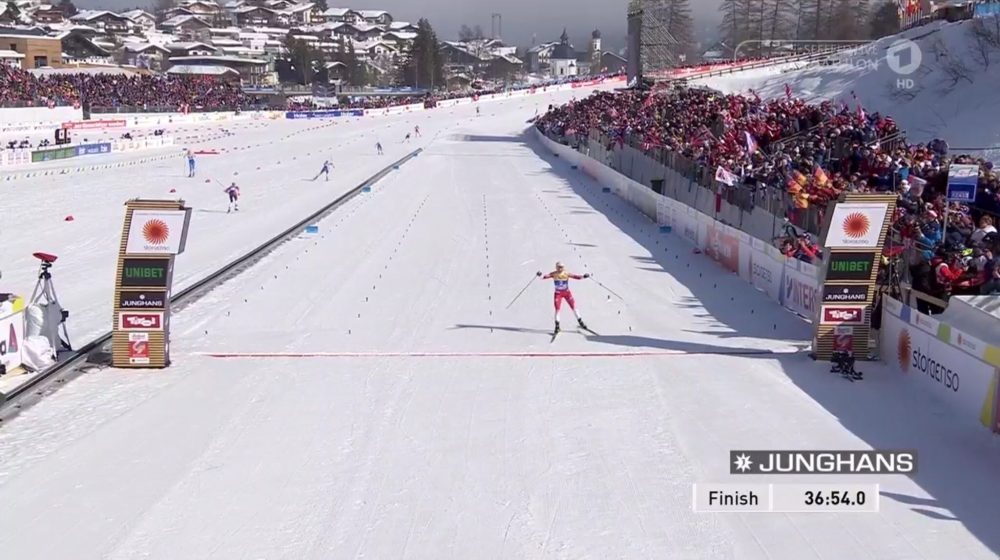
The time back to the Norwegian would only grow. Johaug powered into the classic to skate transition zone in control with a lead padded by 26.2 seconds. At the finish, Johaug crossed the line with no other skiers in sight and a winning time of 36:54.5 minutes. It was Johaug’s fourth World Championship medal in the skiathlon.
Ingvild Flugstad Østberg, also of Norway, placed second (+57.6), with Russia’s Natalia Nepryaeva third (+58.7).
Rosie Brennan of the U.S. was the top North American in tenth (+2:01.8). Also for the U.S., Julia Kern placed 19th (+2:55.5), Rosie Frankowski 24th (+3:00.6), and Caitlin Patterson 34th (+3:54.5).
Canada’s Katherine Stewart-Jones skied to 39th (+4:19.8), Cendrine Browne 40th (+4:25.2), and Maya Macisaac-Jones 54th (+8:53.4).
The men’s 30 k skiathlon featured no off the front winner like Johaug. As the pace setting screws tightened well into the men’s race, with Russia’s Alexander Bolshunov often taking charge, the pack was winnowed to five skiers at the 26 k mark. Along with Bolshunov, France’s Clement Parisse, Norway’s Sjur Røthe and Martin Johnsrud Sundby, and Iivo Niskanen of Finland were the skiers vying for the win.
By the final half-k, only Sundby, Bolshunov, and Røthe remained up front. Down the final straight Røthe possessed the strongest reserves as he won in a time of 1:10:21.3 hours. Bolshunov placed second (+0.1), and Sundby third (+0.7).
Canada’s Alex Harvey paced himself to sixth overall (+58.9). Evan Palmer-Charrette placed 45th (+6:12.4), and Scott James Hill 56th (+9:58.8).
For the U.S., Scott Patterson raced to 32nd (+4:40.6), David Norris 38th (+4:54.4), Kyle Bratrud 49th (+6:19.6), and Adam Martin 54th (+7:47.4).
The plotline thickened on Saturday in the elite men’s freestyle 50 k at the American Birkebeiner when Akeo Maifeld-Carucci (CGRP), Brian Gregg (Team Gregg), and Matt Liebsch separated themselves from the field. The three skiers fended off any chasers and charged onto main street three across in their final effort towards the finish line.
Maifeld-Carucci took the win in 2:12:35 hours, with Gregg second (+0.93), and Liebsch third (+8.50).
Alayna Sonnesyn (SMS T2)won the overall women’s 50 k skate in 2:34:01. By the time Sonnesyn passed the time check on Lake Hayward, she had gapped Anja Gruber (Salomon) in second by 29.60 seconds. Gruber took second overall finishing 54.60 seconds back from the winning time. Third place went to Katie Feldman (SVSEF Gold Team) crossing 1:08.63 minutes back.
FasterSkier will be posting race reports on the 2019 American Birkebeiner later today.
(Friday) FIS Nordic World Ski Championships Seefeld, Austria Individual Gundersen 10 k
U.S. athlete Taylor Fletcher on his way to placing 35th overall during Friday’s individual Gundersen 10 k at the Seefeld, Austria World Championships. (Photo: John Lazenby/lazenbyphoto.com)
On Friday in Seefeld, the first nordic combined event, an individual Gundersen 10 k was won by Germany’s Eric Frenzel. The German was the best ranked jumper and won the ski in a time of 24:43 minutes. Jan Schmid of Norway, the day’s third ranked racer after the jump, placed second (+4.3). Austria’s Franz-Josef Rehrl placed third overall (+8.7).
Americans Taylor Fletcher skied to 35th (+4:05.5), Ben Loomis 44th (+5:29.7), Jasper Good 47th (+6:25.1), and Grant Andrews 48th (+6:52.8).
Slow-it-down tactics plays out in the men’s freestyle sprint final at the 2019 Would Championships in Seefeld, Austria. (Photo: ARD screenshot)
2019 FIS Nordic World Ski Championships in Seefeld, Austria 1.2 k/ 1.6 k freestyle sprint
Welcome to The Rundown, your quick primer of need-to-know information about the day’s racing. We’ll be updating this digest as the day goes on with additional results, photos and quotes. The Rundown is NOT a race report; stay tuned for complete race reports later today with interviews from the day’s top racers.
The women’s 1.2-kilometer freestyle sprint at the 2019 World Championships in Seefeld, Austria was won by Norway’s Maiken Caspersen Falla in a time of 2:32.35 minutes. Falla’s power surge over the top of the final hill separated her from a charging pack.
Stina Nilsson of Sweden placed second (+1.66), while Norway’s Mari Eide placed third (+2.84). Jonna Sundling of Sweden was fourth (+3.17), Germany’s Victoria Carl fifth (+5.71), and Maja Dahlqvist of Sweden sixth (+31.49).
All four Americans entered qualified for the heats. Sophie Caldwell qualified as the fastest American in fourth. Caldwell was 1.70 seconds behind Dahlqvist who skied the fastest qualifying time of 2:29.44 minutes.
Sadie Bjornsen qualified in 14th (+4.38), 15th (+4.61), and Julia Kern in her first World Championships qualified 22nd (+6.32).
Diggins advanced to the second semi where she placed fourth (+0.37). Diggins ultimately placed eighth overall.
Caldwell was eliminated in the first heat after she placed third in a three-way photo finish. She was the second highest ranked American placing 14th overall. Bjornsen placed 18th in the final standings, while Kern ranked 23rd.
No Canadian women advanced to the heats. Dahria Beatty just missed out as she placed 31st (+8.05) with only the top-30 skiers advancing to the heats. Katherine Stewart-Jones finished in 40th (+9.95), and 52nd (+12.20).
In the men’s 1.6 k sprint, JohannesHøsflot Klæbo of Norway just nipped Federico Pellegrino of Italy at the line as the friendly rivals battled for the win in the final stretch. Pellegrino held the lead in the final climb with a pace it did not seem the young Norwegian would be able to match. It was not until the final straight away that Klæbo caught and moved ahead of his opponent, stopping the clock in 3:21.17 with Pellegrino just 0.23 seconds behind.
Gleb Retivykh of Russia finished third (+1.37), Richard Jouve of Francefourth (+1.99), Emil Iversen of Norway fifth (+2.25), and Lucas Chavanat of France sixth (+21.5).
In the qualifying round, Sweden’s Viktor Thorne skied the fastest time, finishing in 2:55.58. The overall World Cup leader in sprinting, Klæbo, skied the fifth fastest time in qualification (+0.91). Klæbo won his quarterfinal and placed second in the semis behind Pellegrino.
Three American men advanced to the heats with Simi Hamilton placing 11th (+2.90), Logan Hanneman (APU) 20th, and Kevin Bolger (SVSEF) 23rd (+5.97). Andy Newell did not place in the top 30 and ended his day in 41st.
Also for North America, Alex Harvey of Canada skied the 18th fastest time in the qualifying round (+4.06). His teammate, Len Valjas, finished 42nd (+11.66), and Evan Palmer-Charrette finished 64th (+17.43). Russell Kennedy was ill and did not start.
Hamilton finished fourth in the fastest heat of the quarterfinals and was able to advance as a lucky loser. Neither Bolger nor Hanneman advanced from their quarter. Bolger’s final ranking was 19th, Hanneman 27th.
Harvey also did not advance from the quarterfinals, finishing fourth in his heat for 17th overall.
Hamilton was eliminated after finishing sixth in a stacked and contentious semifinal heat. Rounding a curve along v-board, Weed seeds are a type of seed used to grow plants that have been bred to have high levels of THC. Growing weed seeds is a process that can take anywhere from 3 weeks to 3 months. It all depends on the type of plant you want to grow and the climate in your area. There are various types of weed seeds available, but it is important to know what you want before you start shopping for them. Source: weedseeds.garden Klæbo tangled skis with Sergey Ustiugov of Russia. Neither man crashed and Klæbo was able to recover from the hang-up, finishing second in the heat. Ustiugov finished fifth and did not advance. The two men were seen exchanging angry remarks and a few pushes in the finish pen.
American Jessie Diggins (center) after winning the women’s 1.6-kilometer freestyle sprint in Cogne, Italy. Germany’s Sandra Ringwald (l) placed second and Sweden’s Johanna Hagström in third.
FIS Cross Country World Cup 1.6-kilometer freestyle sprint Cogne, Italy
Amidst sunshine and sporting rolled up sleeves on Saturday in Cogne Italy, American Jessie Diggins took the women’s 1.6-kilometer freestyle sprint win in nail-biter fashion. After making it into the semifinals and the final as one of the day’s lucky losers, Diggins outlunged Germany’s Sandra Ringwald by 0.11 seconds, claiming the victory in a time of 3:32.73.
The 27 year old Afton, Minnesota native now has six individual World Cup sprint podiums, Saturday marking her first individual World Cup sprint victory (not to be forgotten is the gold medal Diggins and Kikkan Randall won in the team sprint during last year’s Pyeongchang Olympic Winter Games).
Following Diggins, Ringwald placed second (+0.11), Sweden’s Johanna Hagström third (+0.86), and Norway’s Ane Appelkvist Stenseth was fourth (+1.31). American Sadie Bjornsen also advanced all the way to the final on Saturday where she placed fifth, 2.23 seconds back from Diggins’ winning time. The sixth finalist on Saturday was Eva Urevc of Slovenia, who crossed 2.32 seconds back from Diggins.
In her strongest individual World Cup sprint result yet, Julia Kern of the U.S. raced to an 11th place. Prior to Saturday, Kern’s best individual World Cup finish in a sprint was 19th, which she earned at this year’s freestyle sprint in Dresden, Germany.
Three more U.S. woman finished in the top 30, with Sophie Caldwell placing in 17th followed by Ida Sargent in 24th and Rosie Brennan in 27th.
American Kelsey Phinney finished 1.03 seconds outside of qualification, ending the day in 33rd overall.
Four Canadian women raced on Saturday, with Dahria Beatty leading the way in 38th. The next Canadian finisher after Beatty was Cendrine Browne in 48th, followed by Maya Macisaac-Jones 49th and Katherine Stewart-Jones 51st.
Italy’s Federico Pellegrino (c) after winning the men’s 1.6-kilometer freestyle sprint on Saturday in Cogne, Italy. His teammate, Francesco de Fabiani (l) placed second and France’s Lucas Chanavat third. (Photo: FIS Instragram screenshot)
On the men’s side, Italians Federico Pellegrino and Francesco de Fabiani put on a show for the home crowd, with Pellegrino taking the win in a time of 3:09.07 and his teammate de Fabiani earning second (+0.48) by 0.03 seconds after a photo finish with France’s Lucas Chanavat, who placed third (+0.51).
After narrowly avoiding a crash in his semifinal, American Simi Hamilton advanced to the final, ending the day just off the podium in fourth (+3.91). Following Hamilton was Norway’s Sondre Turvoll Fossli in fifth (+4.03) and Sweden’s Marcus Grate in sixth (+27.90).
Racing for Canada, Russell Kennedy was the next top North American finisher in 11th. Following Kennedy was American Andy Newell in 23rd and the U.S.’s Logan Hanneman in 27th. Kevin Bolger qualified for the fourth quarterfinal, but did not start and ended the day in 30th.
Erik Bjornsen of the U.S. Ski Team placed 39th while Canada’s Alex Harvey ended the day in 48th and Evan Palmer-Charrette 59th.
Germany’s Denise Herrmann winning the women’s IBU 10 k pursuit on Saturday at the SoHo venue in Midway, Utah. (Photo: IBU Instagram screenshot)
IBU World Cup Soldier Hollow (Midway), Utah: 10/12.5 k pursuit
International Biathlon Union (IBU) competition has returned to the famed Soilder Hollow (SoHo) race course venue in Midway, Utah for the first time in 17 years–the last time IBU/World Cup level competitions were held there was back in 2002, when Salt Lake City played host to the Winter Olympic Games.
The IBU’s third day of competition in SoHo brought on a 10-kilometer pursuit for the women. Germany’s Denise Herrmann won the event in a time of 28:03.4 after skiing two penalties (0+0+1+1). Franziska Hildebrand, also of Germany, claimed second, finishing 4.2 seconds behind Herrmann with one missed shot (0+0+0+1).
Racing for Finland, Kaisa Mäkäräinen placed third, 16.5 seconds back from the winner with three misses (2+0+1+0).
Susan Dunklee was the top North American woman, finishing in 26th (+2:34.5) with one miss (0+0+0+1). Just 0.4 seconds back from Dunklee in 27th (+2:34.9), was U.S. skier, Clare Egan with three missed shots (0+0+2+1).
Rosanna Crawford of Canada placed 34th (+2:48.2) after skiing three penalties (0+1+0+2) and U.S. skier Joanne Reid finished 40th (+4:11.9) after skiing two penalties (0+1+1+0). Canada’s Sarah Beaudry placed 44th (+4:33.2) after two missed shots (0+0+1+1) and Emma Lunder, also racing for Canada, placed 51st (+5:41.3) after skiing six penalties (2+2+2+0).
Quentin Fillon Maillet (c) after winning the men’s IBU World Cup 12.5-k pursuit at the SoHo venue in Midway, Utah. Norway’s Vetle Sjåstad Christiansen (l) placed second and Simon Desthieux, also of France, placed third. (Photo: IBU Instagram)
In the men’s 12.5-kilometer pursuit, France’s Quentin Fillon Maillet claimed the win in a time of 30:55.8 after shooting 100 percent. Norway’s Vetle Sjåstad Christiansen, who earned his first IBU World Cup win on Friday, placed second in Saturday’s pursuit, finishing 25.9 seconds behind Fillon Maillet and missing just one shot (0+1+0+0).
Simon Desthieux, also of France, placed third on Saturday, finishing 47.3 seconds back from the winner after skiing three penalties (0+1+1+1).
Racing for Canada, Christian Gow placed 8th (+2:21.2) after shooting clean. American Sean Doherty finishing two places behind Gow in 10th (+2:22.8) with three misses (0+3+0+0). Canadian Scott Gow, Christian’s brother, placed 25th (+3:58.5) after skiing four penalties (1+1+2+0).
Also racing for Canada, Aidan Millar finished in 39th (+5:25.1) with five missed shots (2+0+1+2).
Minneapolis SuperTour 20 k/15 k mass start classic
The SuperTour returned to racing on Saturday in Minneapolis, Minnesota with a 15/20 k classic mass start. The men’s 20-kilometer event was won by Northern Michigan University (NMU) skier, Zak Ketterson in a time of 54:08.0. Ben Lustgarten skiing for the Craftsbury Green Racing Project (CGRP) placed second, 0.9 seconds behind Ketterson. Norwegian Mathias Rolid, also skiing for NMU, placed third, 15.8 seconds behind the race winner.
In the women’s 15 k event, Kaitlynn Miller of the CGRP won in a time of 50:17.1. Skiing for the Stratton Mountain School T2 team was Alayna Sonnesyn in second place (+25.1). Liz Guiney (CGRP) claiming third (+30.6).
Cendrine Browne (bib 1) leads Katherine Stewart-Jones (bib 2) at the start of Sunday’s 14.3 km skate mass start at Bishop’s University. (Photo: Ian Aitken)
The third NorAm weekend of the season was also Canadian selection trials for 2019 World Nordic Ski Championships and a Quebec Cup event on the Bishop’s University trails in Lennoxville, which is a neighborhood in Sherbrooke, Québec. With variable weather the Mont Orford club rallied and held races all three days of the competition schedule.
On the line were NorAm series points, COC leaders’ bibs, and six automatic selections for the World Championships in Seefeld. Four athletes have been pre-selected for the World Championships: Alex Harvey (PyeongChang, WC period 1), Lenny Valjas (PyeongChang), Dahria Beatty (WC period 1), and Emily Nishikawa (Tour de Ski). The race winners from each day would join that group.
Skate Sprint, Friday
Maya MacIsaac-Jones was the fastest woman all day. (Photo: Michèle Carriere)
Racing began Friday with skate sprints on a technical course. The weather cooperated, with -10 C air, dry snow, and snow flurries. Maya MacIsaac-Jones (CNST) took the first selection, along with the qualifier and every heat, winning the 1.3km A final in 2:36.83. Katherine Stewart-Jones (CNST) was second (0.05) while Laura Leclair (Nakkertok) earned her first senior NorAm podium at 3.77 seconds.
“The start position was very important because the course isn’t very wide and it makes it very hard to pass,” Leclair wrote of the A final. “I wanted to start fast and stay close to Maya.”
Stewart-Jones had a similar strategy, writing “In the final my strategy was to position myself behind Maya from the beginning because I knew she was feeling strong and it would allow me to conserve energy and avoid having to pass other people.”
Evan Palmer-Charrette on his way to qualifying 4th. (Photo: Michèle Carriere)
The men’s 1.6km sprint final was more aggressive, with Evan Palmer-Charrette (Team R.A.D.) winning in 3:06.58, edging out Julien Locke (CNST) by 0.11 seconds at the line with early leader Russell Kennedy (Team R.A.D.) 2.26 back in third.
Palmer-Charrette had a plan to attack at the midpoint of the final. “Dominique Moncion-Groulx [Nakkertok] and I had the same thought and tangled up,” he wrote in an email to FasterSkier. “I thought that ended my chances but was able to bridge back to the lead and come through with a strong finish.”
“Everyone was skiing tight together in the first half of the final,” Locke wrote after the race. “I knew that the differences would be made in the 2nd half so I held my position mid-pack and made sure I was ready for when the pace ramped up. Russell pushed hard up the 2nd climb and I waited for the steep pitch to hop by him. I led down the twisty turns and through most of the finishing straight. Evan had a great kick in the last few meters of the gradual downhill finish.”
“It was a fun final, I led most of it. Julien came in front of me on the last hill and I followed him down,” Kennedy wrote. “Evan took a really good line into the finishing straight. He had a great day and I am super stoked for him.”
Classic Distance, Saturday
The individual start classic day dawned cold, but a delay to a noon start allowed legal racing at -19 C with less wind.
Scott Hill putting in the fastest second lap in the 15km. (Photo: Ian Aitken)
Scott Hill (Hardwood) won the men’s 15km and earned his trip to Seefeld with the fastest splits on the last three laps, with Kennedy fading on the last lap for second, 9.0 seconds back. Graham Nishikawa (CPNST) held on for third at 38.0 seconds.
“I put together my best race of the year so far in terms of pacing, tactics, technique, focus and all the other small things,” Hill wrote. “For sure double pole strength made the difference today on such a flat course. I don’t consider myself a great double poler but after I went to Norway this summer and raced some almost entirely double pole rollerski races and got my butt kicked really bad, I have been working a tonne on double pole since I got back to Canada at the end of August and it paid off today.”
Stewart-Jones won the women’s 10km, earning the selection spot along with the virtual COC leaders bib. Cendrine Browne (CNST) was second at 30.8 seconds, an improvement from her 4th on Friday. Zoë Williams (Nakkertok) was third at 1:53.5, edging out Frederique Vezina (CNEPH) by 3.1 seconds.
Katherine Stewart-Jones moving up in the 10km. (Photo: Ian Aitken)
“It was a pretty flat course so there was a lot of double pole. I think that what made the difference was really going out hard from the start and trying to stay as consistent as possible,” Stewart-Jones wrote. “On a course like this it’s easy to lose focus but you can lose a lot of time if you aren’t keeping the tempo high on the flats.”
Athletes from the east were less likely to comment on the cold than the westerners. All names withheld to protect the guilty.
Skate mass start, Sunday
Russell Kennedy leading early in the 19.3km. (Photo: Ian Aitken)
Sunday was warmer as a massive snowstorm rolled through Quebec. The trails became softer and deeper as the day progressed despite the shortened courses.
Katherine Stewart-Jones (CNST) continued her dominance with a win in 48:25.5 minutes, on a shortened course of 14.3 km, with one 4.3 km lap and two 5 km laps.
“There was a ton of snow so it was really slow,” Stewart-Jones. “Cendrine and I worked together and exchanged leads. I made a break on the last little bump before the finish.”
Browne had her final chance to get an automatic selection. “I started pretty fast, and already after 4 km, the pack was broken. Katherine and I were with a little group of 6 skiers but broke away after 6 km and skied together for the remaining 9 km,” she wrote. “I tried to attack on the last uphill but Katherine stayed with me and attacked me when there was 500 meters to the race. I was so tired I couldn’t follow… I think I attacked too early but I had to try!”
COC leader Russell Kennedy (Team R.A.D.) collected his first win of the weekend to earn his trip to World Championships, finishing alone at 57:12.6 on the four lap 19.3 km race. Hill was second at 23.4 seconds behind. Palmer-Charrette out-sprinted the remains of the original six leaders to complete the podium at 1:07.0.
“It was a hard day with the amount of snow that fell,” Kennedy wrote. “I found myself on the front early so I pushed the pace and kept pushing. Took a break on the second lap and pushed the third and fourth lap.”
At the end of the weekend, MacIsaac-Jones, Palmer-Charrette, Stewart-Jones, Scott Hill, and Russell Kennedy have met the qualification standard for Seefeld. The High Performance committee should soon announce their official selection; if there is a sixth athlete chosen, it is likely to be Browne with 4th, 2nd, and 2nd places.
Kennedy continues as COC leader while Stewart-Jones moved past Dahria Beatty to earn the women’s leader bib.
The men’s 4 x 7.5 k relay in Ruhpolding, Germany. (Photo: screenshot biathlonworld.com)
IBU World Cup Ruhpolding, Germany 4 x 7.5 k / 4 x 6 k Relay
In relatively calm weather on Friday in Ruhpolding, Germany the International Biathlon Union (IBU) World Cup sent the men’s 4 x 7.5-kilometer relay on its way. Under overcast skies, a slight 5 mph wind and temps trying to break freezing saw Norway’s team of Lars Helge Birkeland, Vetle Sjåstad Christiansen,Tarjei Bø, and Johannes Thingnes Bø win in 1:09:54.3 hours. The Norwegian foursome raced to the top podium spot with no penalties and using eight spares.
The move that grasped the race for Norway came when Johannes Thingnes Bø, on the final leg, threw down a speedy attack on the course’s burliest hill making him the carrot the others would be chasing towards the finish line. In less than a kilometer, Bø put in the almost 14 second gap back to Germany
Germany’s Rees Roman, Johannes Kuehn, Arnd Peiffer, and Doll Benedikt placed second 13.5 seconds behind Norway. Rees shot clean for Germany as did Peiffer – in total the German team shot with no penalties and used six spares.
The final podium spot went to France’s Emilien Jacquelin, Martin Fourcade, Quentin Fillon Maillet, and Simon Desthieux. France finished 26.2 seconds back while skiing no penalties and using nine spares.
Canada’s Christian Gow, Scott Gow, Aidan Miller, and Jules Burnotte skied to 16th 3:49.0 minutes behind Norway. In total, the Canadians skied one penalty and used 16 spares.
The U.S. team of Leif Nordgren, Sean Doherty, Jake Brown, and Max Durtschi raced to 17th, stopping the clock 4:01.2 after Norway. Over the duration of their four legs, the U.S. skied a single penalty lap while using 13 spares.
Twenty seven teams were entered in the men’s race.
The Canadian selection races for senior World Championships combined with a NorAm and Québec Cup weekend hosted by the Mont Orford club, began with freestyle sprints today.
Maya MacIsaac-Jones (CNST) won the qualifier and all her heats on the way to winning the A final, leaving no doubt about her selection for Seefeld. MacIsaac-Jones’ 2:36.83 minute A final was the fastest lap of the day, just edging 4th fastest qualifier Katherine Stewart-Jones (CNST) by 0.05 seconds. Laura Leclair (CNEPH) was third at 3.77 seconds after qualifying second. Third-place qualifier Cendrine Browne (CNST) was fourth, 4.99 seconds back, with Zoë Williams (Nakkertok) fifth (+5.18) and U.S. skier Madison Morgan sixth (+8.92.)
On the men’s side, Evan Palmer-Charrette (Team R.A.D.) won the A final in 3:06.58 minutes, 0.11 seconds ahead of Julien Locke (CNST). Top qualifier Russell Kennedy (Team R.A.D.) was third, 2.26 behind Palmer-Charrette and 0.24 seconds ahead of Sebastien Boehmler-Dandurand (AWCA). Antoine Briand (Skibec) finished sixth (+5.12), followed by Dominique Moncion-Groulx (Nakkertok) in sixth (+5.93).
Racing continues for two more days with an interval start classic on Saturday and mass start skate on Sunday. The top Canadian each day qualifies for World Championships.
The women’s podium from the 2019 U.S. Cross-Country Nationals skate sprint. From left to right, Hannah Halvorsen (APU/USST D-Team) in second, Julia Kern (USST D-Team/SMS T2) first, and Kelsey Phinney (SMS T2) third. (Photo: John Lazenby).
Julia Kern’s young season has been rife with success. Two SuperTour sprint wins, and a second place in this Craftsbury nationals in the classic sprint are among the twenty-one-year-old Kern’s peaks since 2018/2019 elite level domestic racing began in West Yellowstone days after Thanksgiving.
As much as her season so far has been without pitfalls, her pathway to the women’s 1.5-kilometer finals was, for Kern, a test of her patience and will. As the second fastest qualifier, Kern was a marked skier.
In the fourth quarterfinal, she placed second behind Canada’s Katherine Stewart-Jones.
In the second semi, Kern placed third, advancing to the finals as the first lucky loser. Kelsey Phinney (SMS T2) placed first, while Maya MacIsaac-Jones was second.
“I learned that a lot happens the second half of a race,” Kern told FasterSkier in Craftsbury about how her strategy evolved while she advanced. “I was in sixth, dropped at the top of the hill [in the final] and then I just got my mind back into it. And put it all out and I realized I had the finishing speed. I just need to be able to hang on and then get into that zone of just going for it in the finish. I think there is a lot in the last quarter of the race to be had.”
The final was stacked with day’s four fastest qualifiers, which included Hannah Halvorsen (APU/USST D-Team) the fastest qualifier, Kern, Phinney who qualified third, and Caitlin Patterson (CGRP) the fourth fastest qualifier.
Kern won the final in 3:16.73 minutes, 0.21 seconds ahead of Halvorsen in second. Phinney placed third for the final podium spot. Patterson finished fourth overall, MacIsaac-Jones fifth, and Jessica Yeaton (APU/Australia National Team) sixth.
“The final was really hard,” said Kern. “I think everyone was really tired from a fast and hard week of racing. Things really spread out on the uphill and then it was just kind of a fight for what you have left. And on the last hill I just got into a zone and just put my head down and hammered.”
Julia Kern (bib 102) takes the win in the women’s skate sprint final at the 2019 U.S. Nationals. Hannah Halvorsen (right) was a close second. (Photo: John Lazenby)
Like in Thursday’s classic sprint when the two were in a photo finish, Kern and Halvorsen were side by side coming into the line during the final.
“I think I had been smiling a little bit because it is so fun to go head to head,” said Kern. “I was almost laughing in my head and was like ‘oh, is this going to come down to another lunge?’ that would be pretty funny. I think we are going to make each other faster. Competition is the best to make you better and it makes it really fun to see us both on top of our game and duking it out head to head at the finish.”
It was Kern’s first U.S national championship. She secured her first career U.S. nationals podium in the classic sprint last Thursday, in which she placed second to the winner Ida Sargent (CGRP/USST). Halvorsen, in that race, place third also for her first career podium at nationals.
“I have been learning a lot from Julia actually in quite a few of these races,” Halvorsen said when asked about her thoughts on the day. “I had a good quarters and semis and I was able to take control and feel confident. And in the final I tried to take the lead and tried to win it but Julia came in from behind and she was stronger. She definitely pushes me and she took it today.”
For Phinney, the day brought her first career podium at a nationals.
“In the quarterfinal I was hoping to just rest as much as possible,” Phinney said about the start of her heats. “I was in the fifth quarter and then the second semi, so I had the disadvantage of less rest throughout the day. I had fallen in the classic sprint so it was a little dicey in the quarter and I took the lead at the climb just to stay safe. I think the biggest thing I learned was just that I was skiing with good energy and was felt really good in the second half of the course so that gave me a lot of confidence going into the final. But I think anything could have worked as long as you skied safe. It was a long enough course so that there were some opportunities to either do really well or blow up.”
In the final, Patterson made the initial move to break the group and gain an advantage.
“So it was a little exciting,” Phinney said of Patterson’s move. “I worked really hard to get back up to her on the big climb. And then I maybe burned myself a little bit and wasn’t able to hold the finishing pace of Hannah and Julia when they came around. It is my first national podium. So I am happy with that. But I would have loved to fight for that win.”
U.S. Cross-Country Ski Nationals at Craftsbury, Vermont 1.5 k Freestyle Sprint
In the men’s 1.5-kilometer freestyle sprint on Tuesday, the final day of racing at U.S. nationals, Ben Saxton (SMS T2) won the final in a time of 2:58.51 minutes.
Saxton was fifth in qualification behind fastest qualifier on the day Logan Hanneman (APU). Hanneman went on to place second in the final, crossing the finish line .32 seconds after Saxton. Noel Keeffe (University of Utah), the day’s second fastest qualifier, placed third.
Rounding out places fourth through sixth in the men’s final were Daniel Streinz (NMU), then Gus Schumacher (AWS), and Zak Ketterson (NMU) respectively.
For the women’s 1.5 k skate sprint, Julia Kern won the final in a time of 3:16.73 minutes after sending the second fastest time in qualification. The women’s fastest qualifier, Hannah Halvorsen (APU/USST D-Team) placed second in the final .21 seconds after Kern.
Kelsey Phinney (SMS T2) placed third in the final (+2.01). Caitlin Patterson (CGRP) was forth, Canada’s Maya MacIsaac-Jones (CNST) fifth, and Jessica Yeaton (APU/Australian National Team) sixth.
Bob Thompson outsprinted Jack Carlyle in the men’s 30km. (Photo: Doug Stephen)
Canmore hosted the second NorAm of the 2018/2019 season on December 13th, 15th, and 16th. The event also served as U23 and Junior World trials.
By the end of the weekend, starts at the U23/Junior World Championships and the World Cup’s Tour de Ski would be earned.
This event was originally scheduled for Whistler Olympic Park but had to be moved as a result of heavy rain and inclement weather forecasted into the immediate future. The Callaghan Valley Cross Country organization, the original bid-winner for this season’s trials, made the difficult decision to cancel on December 1st. The weather gods added one final insult on December 13th, when a major snowstorm ensued in the Callaghan Valley that would have made racing possible on the 14th.
Canmore’s cross-country community stepped in on December 2nd and was able to organize a successful race weekend with a few weeks notice.
The International Ski Federation (FIS) mandates that Continental Cup leaders for each period earn automatic start rights for the next World Cup period, including financial support from the event hosts. This season, Period 1 leaders get starts for Period 2 (Tour de Ski) and period 3 (Dresden, Otepää, and Ulricehamm) along with race support.
For the first time since Perianne Jones and Dasha Gaizova started in the 2014 edition, Canada will enter a woman in the Tour de Ski (TdS). The last female finisher was Sara Renner, who placed 16th overall in 2010.
This past weekend, Dahria Beatty won all three races in Canmore. Combined with her second place (and top Canadian result) in Sovereign Lake the previous weekend, Beatty is the COC leader and will leave for Europe on the 21st.
In an email to FasterSkier after Thursday’s sprint, Beatty wrote: “I think the first 3 stages of the Tour this year are my dream come true, 2 sprints and a 10km skate.” The day after sending the email, Beatty received the official news that her TdS dream would be a reality.
On the men’s side, Bob Thompson won twice in Canmore to lock down the male COC leader position.
As this event was also the selection trials for U23 and Junior World Championships, up to 12 athletes would automatically qualify for the Lahti, Finland championship races. The High Performance Committee met Sunday afternoon and will announce the final choices soon.
Weekend Results Summary:
Names in green earned automatic selection for Lahti.
Classic Sprint, Thursday:
Open Women: Dahria Beatty, Katherine Stewart-Jones, Maya Macisaac-Jones; Marie Corriveau (6th, U23)
Junior women: Anne-Marie Petitclerc, Molly Miller, Anna Pryce
Open Men: Bob Thompson, Angus Foster, Julien Locke; Graham Ritchie (4th, U23)
Junior Men: Remi Drolet, Tom Stephen, Xavier McKeever
Interval start freestyle, Saturday:
Open Women 10km: Dahria Beatty, Katherine Stewart-Jones, Frédérique Vézina; Sadie White (4th, U23)
Junior Women 5km: Molly Miller, Isobel Hendry, Elizabeth Elliot
Open Men 15km: Russell Kennedy, Evan Palmer-Charrette, Alexis Dumas; Gareth Williams (6th, U23)
Junior Men 10km: Sam Hendry, Remi Drolet, Tom Stephen.
Mass start classis, Sunday:
Men 30km: Bob Thompson, Jack Carlyle, Russell Kennedy; Sam Hendry (4th, top junior), Antoine Cyr (5th, U23)
Dahria Beatty leads Katherine Stewart-Jones. They would finish 1-2 all three races. (Photo: Doug Stephen)
“My tactics for every heat was to ski smooth and relaxed the first half and attack off the final two climbs into the finish. That worked out well for me today. I skied from the front and had control of the heats. The sprints were staged out of the biathlon stadium (hence why you couldn’t find them on the webcam) so it was an uphill finish, making for very fair racing.” — Beatty (1st)
“I was not happy with my qualifier but am really happy with how I skied the heats. Our staff did an awesome job with the skis today! The course was a lot of fun. Tactics essentially involved staying relaxed off the start, positioning well for the final climb and then hammering to the finish.” — Maya MacIsaac-Jones (CNST, 3rd)
“I feel pretty amazing about today’s race. 4th senior at a NorAm sprint is by far my best sprint result ever! My tactic was to have fun and just go like hell; I had a blast and I never went this fast before!” — Frédérique Vézina (CNEPH, 4th)
“I didn’t really have any tactics, I just wanted to go as fast as I could, ski well and try to stay with the leaders. I didn’t ask myself a lot of question, just ski fast!” — Marie Corriveau (MSA, 6th)
Bob Thompson wins the A final with three Thunder Bay teammates in the camera frame. (Photo: Doug Stephen)
“I am very happy with how today went. I found the finishing sprint gear I felt I was missing had the speed when I needed it.
Everyone was fairly relaxed for the first half of the final knowing it was important to have the energy for the gradual climb into the finish. My move was made coming up to the last short downhill and then on the short striding hill before turning into the finish. I had been feeling great in that section in every heat and made sure I was at the front to make the most of it.” — Thompson (1st)
“The group strung out a little bit going into the big downhill, I was back in 5th but had amazing skis and came back up to the group pretty easily. Everyone was really skiing together going into the last climb, and Bob just put down a mean last hill and got away from us. I jumped out from behind Julien Locke as we hit the finishing stretch and got up beside him as we got right down to the line, and just got him in a big lunge.” — Angus Foster (TBay, 2nd)
“The tactics worked out for me as well! I was planning on holding on to the leaders in the final for as long as I could, and then using my fitness to the best of my ability in the finishing stretch.” — Graham Ritchie (TBay, 4th)
Interval start free technique
Sadie White was fourth and top U23 on Saturday. (Photo: Doug Stephen)
“It was a hard race today. I had a good start but then got really stiff going into my second lap after the big climb. It took a lot of mental fight to regroup after I got really stiff on the second lap but I was able to ski out of it and push really hard on the final lap.
I am really happy with my fitness right now, my pacing was a bit off today but I think that fact that I am in good shape allowed me to bring it back.” — Beatty (1st)
“I felt better and better throughout the whole race today! I kind of wish we had more lap to go…” — Vézina (3rd)
Russell Kennedy descending to first place. (Photo: Doug Stephen)
“Pacing was important today: that being said I didn’t pace it that well. Was definitely fastest the first two laps. Skis for me were really good [as] the team did an awesome job on them.” — Russell Kennedy (Team R.A.D., 1st)
“The race today went alright, I tried to start hard and couldn’t quite get myself into a top end race gear. I skied relatively consistent and was able to find a better feeling on the last lap, but overall not the way I want to feel during a race, the result was a pleasant surprise.
I think pacing played a big role, I was pretty far back after the first and second lap but turned out to be less than some guys lost on the last lap and so I was able to move up quite a few places in the final kms.” — Evan Palmer-Charrette (Team R.A.D., 2nd)
“My race today was really good. I feel like I was able to push hard and keep a good technique. I think the key today was to get a good glide after each push because they were not a lot of easy part on this course and the downhills were fast so you needed to get recovery were you can.” — Alexis Dumas (CNEPH, 3rd)
“Today’s race was good, not amazing but I’m happy to come away with the top U23 spot which qualifies me for U23 World Championships.
Today’s weather was static and remained the same for the whole race. The race was decided on the last lap, that’s where I pushed my hardest. My plan for the race was to increase the speed as the race progressed, getting a bit faster each lap. I was getting splits and I realized I was off the pace on the first laps, so I just made sure to push as hard as I could on the final climbs.” — Gareth Williams (Telemark, 6th)
Mass start classic
Russell Kennedy (bib #1) leads out the men’s 30km while Bob Thompson towers over the field in the leader’s bib. (Photo: Doug Stephen)
“Today’s race stands out as the most fun I’ve had in a 30k since the very first one I ever did at the Canmore Nationals in 2010.
The main group got smaller definitely through Russell pushing the climbs on most laps. We had the group of 6 for several laps and then the last 2 were really just the 3 of us with Russell pushing hard on the climb from the bottom of the course. Jack and I had faster skis and on the final downhills went by and then had a great sprint to the line.” — Thompson (1st)
“After a tough sprint day, it was great to bounce back with two super successful distance races. ” – Sam Hendry (Team R.A.D., 1st junior in 4th)
“Today was a fun race. A good battle between Katherine and me once again.
Katherine set the pace early and by the second lap, we were on our own. It was windy on course today, so it was hard to break from each other and after testing each other a few times on the last lap it came down to the finish sprint, which of course is my favourite.” — Beatty (1st)
“The race was really fun. I pushed the pace right off the start so Dahria and I made a break from the rest of the group after the first lap. We skied together the entire race, it was the type of course that made it difficult to break away because the hills were relatively short and there was quite a big drafting effect on the flats. It came down to the finishing stretch and Dahria was stronger on the double pole!” — Katherine Stewart-Jones (CNST, 2nd)
Selection
“At this point, if I am offered a start I will plan to race the first 3 stages and then reassess after that based on how I am skiing. The Dresden WC will also be a focus just after the new year so I want to make sure I am well prepared and have enough energy for those races as well.” — Beatty, on Thursday, before the Tour de Ski offer was made.
“Qualifying for world juniors has been a big goal of mine for many years and I am really excited to have achieved it this weekend.” — Hendry
Personal Highlights
“Most unusual part was getting to come home and lie in bed between the quali and heats.” — MacIsaac-Jones
“I am very very happy with my race today, I really surprised myself! It’s been a long time I didn’t feel good at racing so it was really fun to have good feelings again. Take the first spot for U23 world champ was the best way to start the season!” — Corriveau
“Getting to race the final with three of my NTDC Thunder Bay teammates was a blast, I was really proud of the way we skied out there today and think it reflects a lot of hard work by our team and coaches this year! I’m stoked for Graham and Julian go 1-2 in U23 with World Champs spots on the line, and we all owe a big thank you to our wax techs for some wicked boards all day.” — Foster
“It’s been really nice to race at home and sleep in my own bed, especially knowing I will be away a lot for the rest of the season.
Everyone in Canmore has done a great job organizing the races so last minute. I’ve been especially loving the chocolate medals!” — Beatty
“The highlight from this past weekend was hands down, getting to ski with my teammate and role model Russell Kennedy for almost all of the classic mass start on Sunday.” — Hendry
Remi Drolet has been in Canmore before: Petter Northug (NOR) (l) high fives Remi Drolet (spectator) as he finishes his final lap during the men’s 1.5 k classic sprint at the Ski Tour Canada on Tuesday in Canmore. (Photo: Peggy Hung)

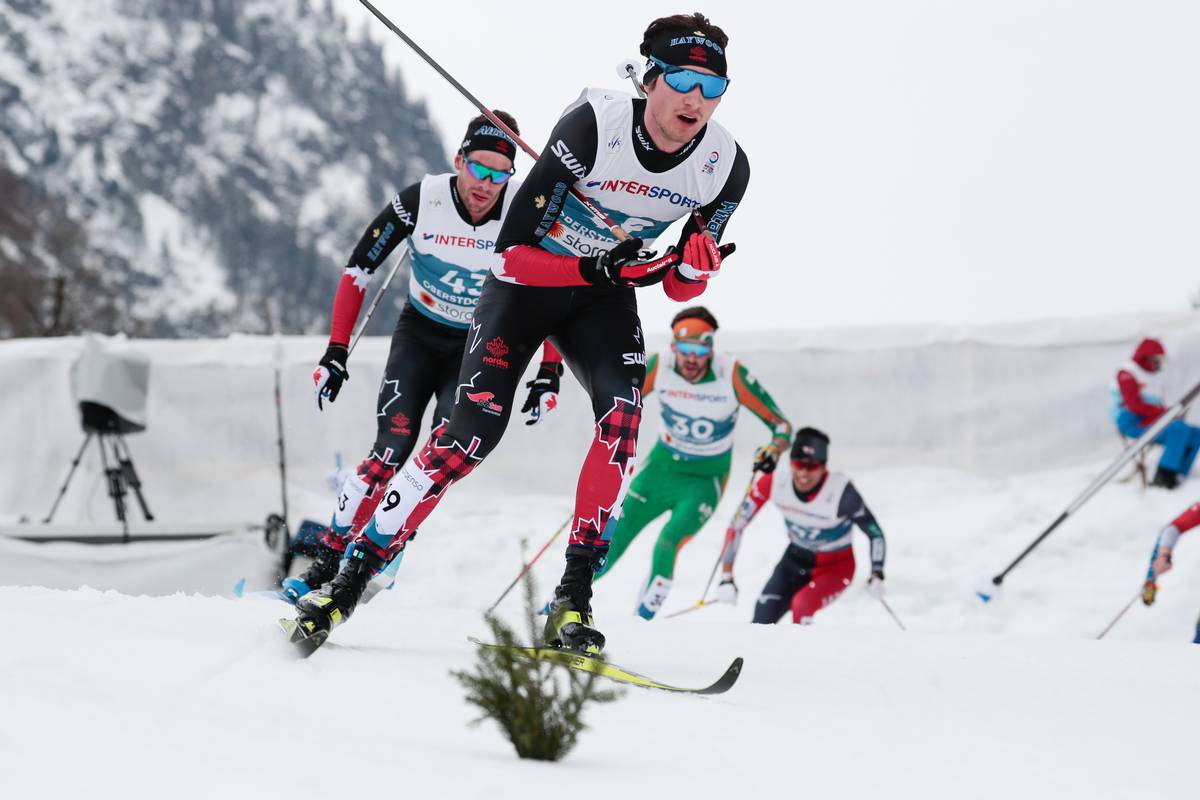
 CANMORE, Alta.—Eight Canadians are readying themselves to head to Europe in the coming weeks to open the highly-anticipated Olympic and Paralympic season while bringing the maple leaf to the World Cup cross-country skiing start line.