Tag: MBSEF

  • Spring skiing: Mt. Bachelor Nordic Center hosts annual U.S. Ski Team camp

    Spring skiing: Mt. Bachelor Nordic Center hosts annual U.S. Ski Team camp

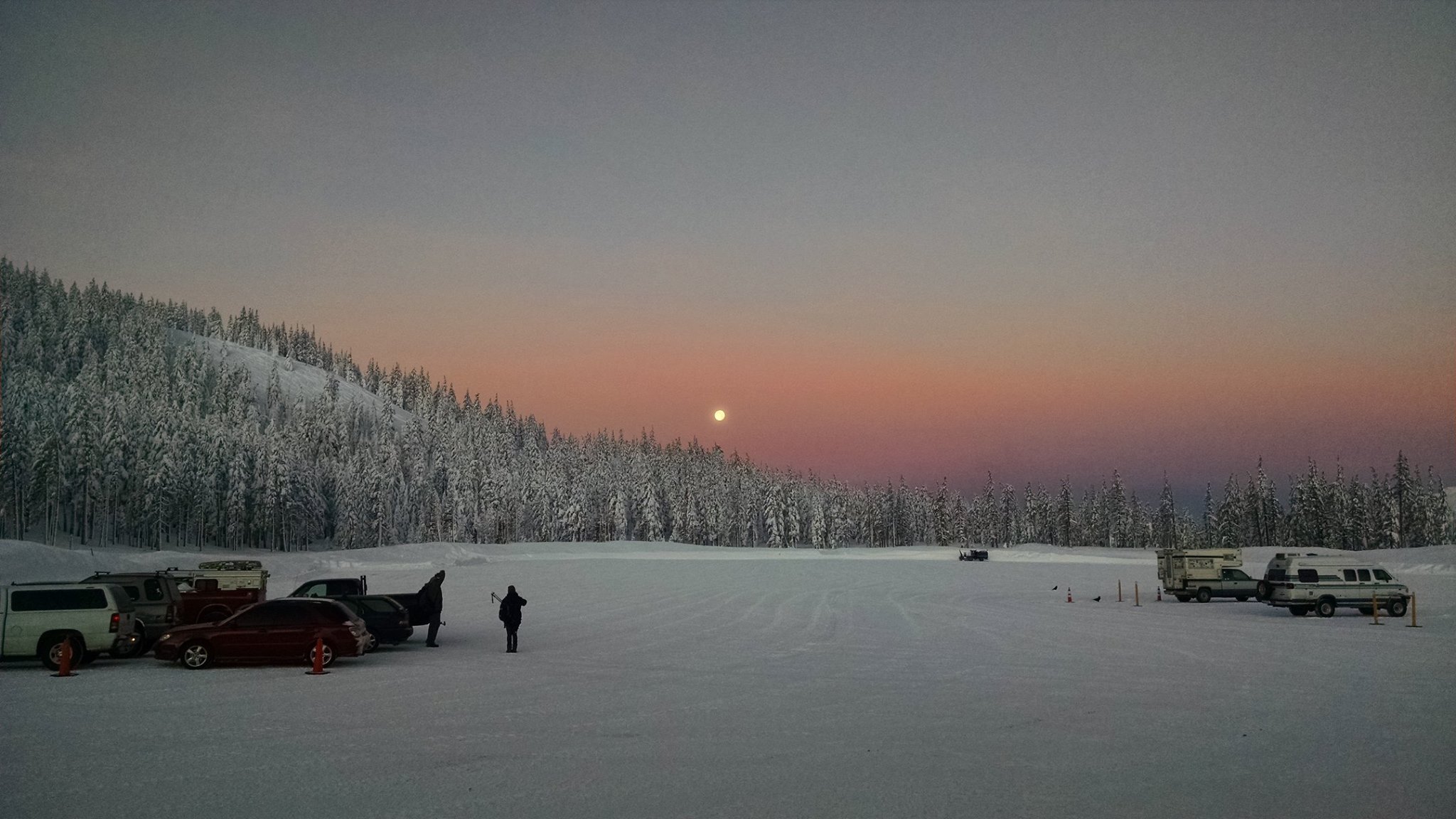
    May or January? The US Ski Team has found prime conditions at Mt. Bachelor during the 2022 Bend Camp. (Photo: Noel Keeffe)

    Believe it or not, it is mid-May. For those following a traditional cross-country calendar, this means the start of a new training year, building toward the 2022/2023 competition season. And, for many of the top American athletes, this means it’s time to make an annual pilgrimage to Bend, Oregon for the on-snow camp of the season at the Mt. Bachelor Nordic Center.

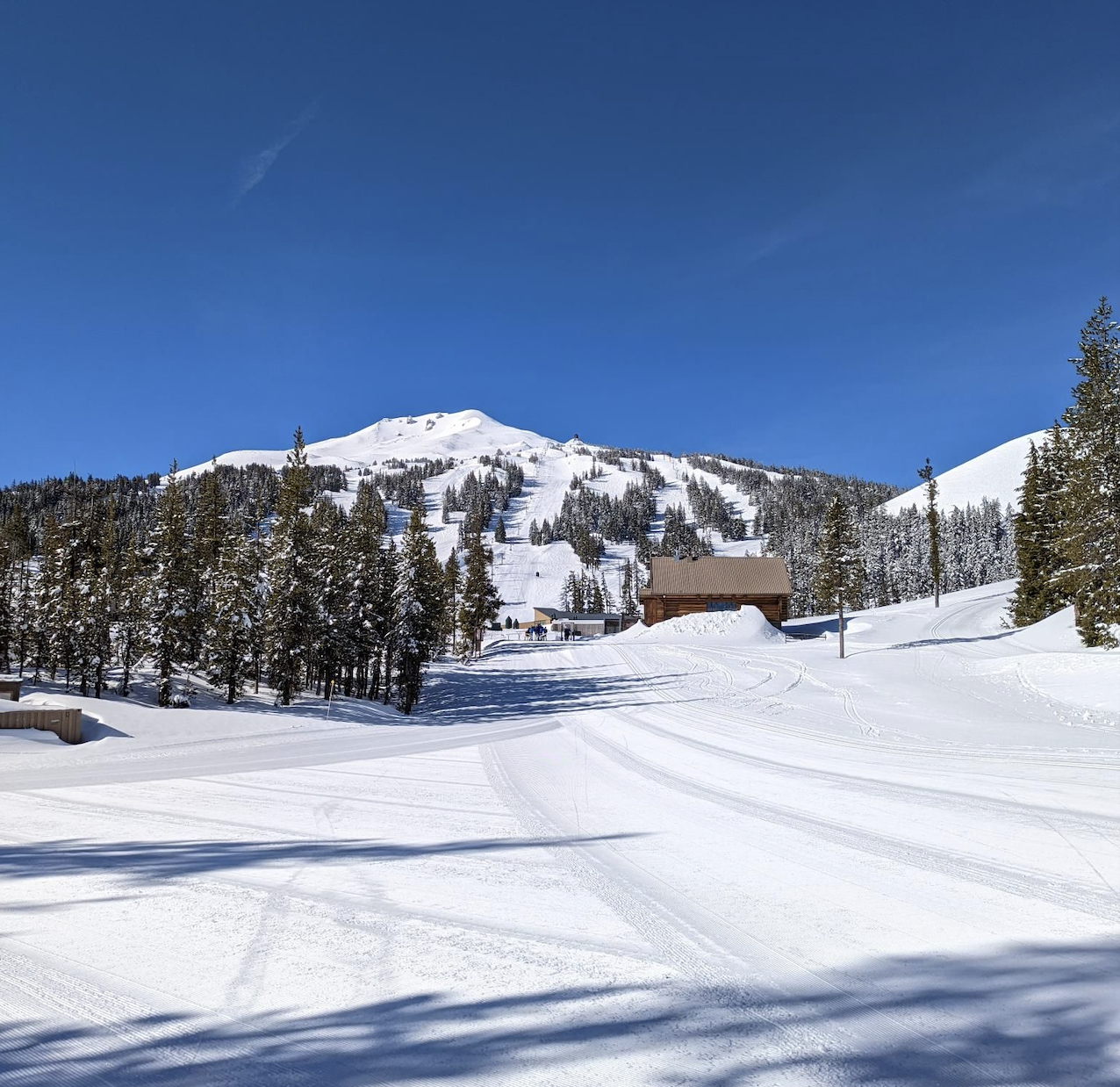
    The weather gods were kind to the camp attendees, with nearly a foot of fresh snow falling on Mt. Bachelor last weekend, restoring it to mid-Winter conditions. April was also a fruitful month for snowfall, setting up for a base-depth of 92” currently reported on the trails – not bad for May!

    To learn more about the camp and what has made Bend and Mt. Bachelor a staple of the U.S. Ski Team’s early season training, FasterSkier connected with head coach Matt Whitcomb, who shared that he has been coming to Bend almost-annually for the last 26 years. 

    He first experienced the trails at Mt. Bachelor during the 1996 U.S. National Championships. 

    “I was rooming with Justin Beckwith (current NENSA Competitive Program Director),” Whitcomb recalled fondly. “Amy Caldwell took us out and then Sverre [Caldwell] joined us, and we had our first experience racing Nationals. And it really jumped out as this town that had skiing at its center, not only alpine but cross country.” 

    The following summer, Whitcomb, Beckwith, and a couple additional training partners hopped into a car and drove to Oregon to spend the summer of ‘97 in Bend. 

    “But we weren’t, by any means, the first people to do this – we were following in the footsteps of Justin Wadsworth and Pat Weaver and a whole bunch of other people. And by our senior year [at Middlebury College], we had twenty-something people driving out from the east just to experience what Bend has in late May and June, and we’d be there through August until we had to go back to college.” 
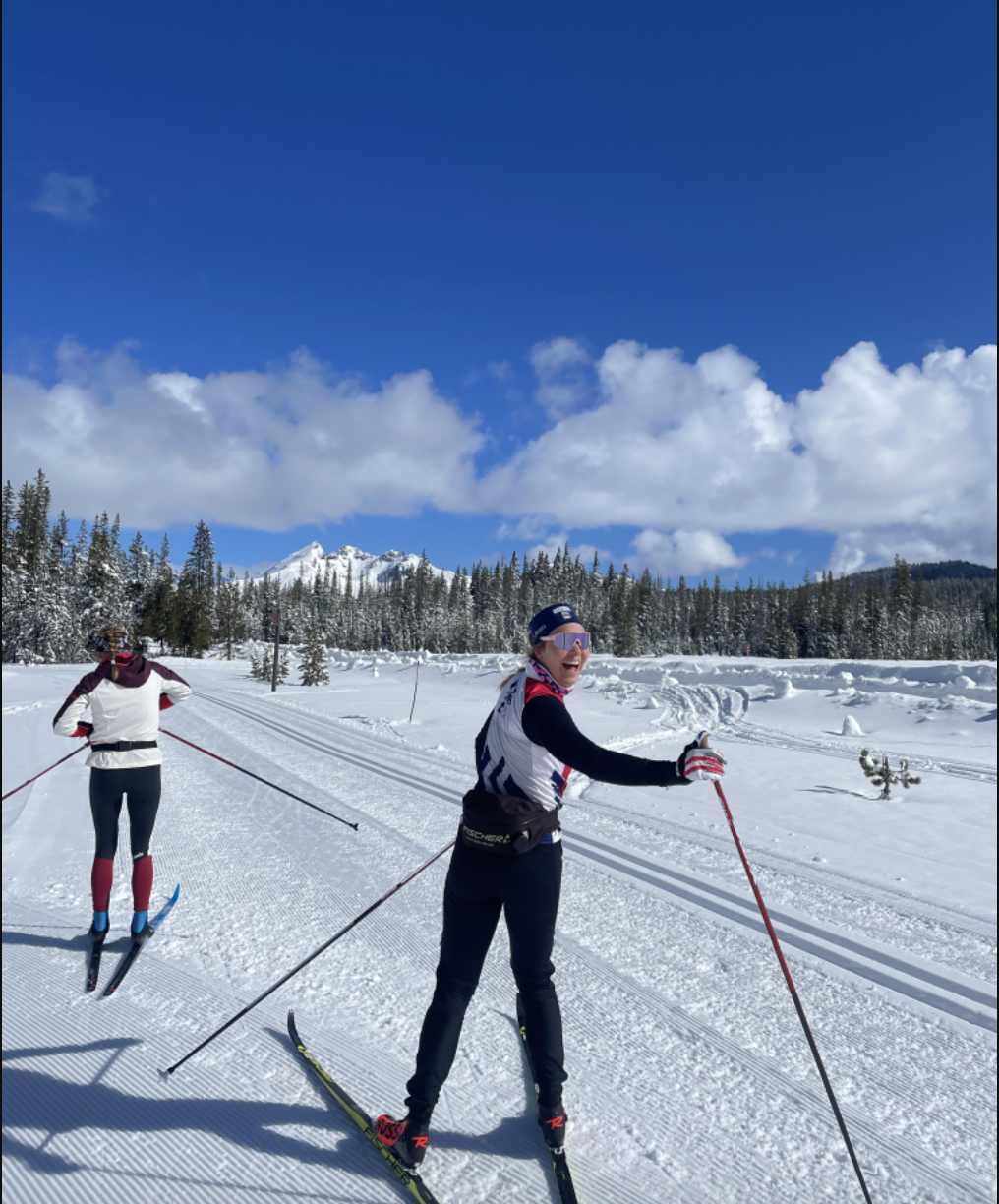
    Lina Sutro (right) and Alayna Sonnesyn (left) enjoy fresh snow and a fresh groom at Mt. Bachelor during the 2022 Bend Camp. (Photo: Lauren Jortberg)

    What Bend has in late May and June, he said, is a vast array of diverse training opportunities, which most importantly includes snow. 

    “That’s probably the first thing that really drew us in, particularly as people from the East.”

    He shared that the snow report they had received from Mt. Bachelor Nordic Center manager Sue Foster was measuring the accumulation from April storms in feet, not inches. 

    But it’s not just the access to snow on its own that makes Mt. Bachelor worth the trip.

    “The trail system is world class. You’re skiing through Douglas fir — just these massive, old old trees on creative, windy, hard trails, and on a good year they’ll have close to 30 or 40 kilometers groomed for us still in May.” 

    In addition to its geographical location and an accumulation of over 300” of snow annually, the elevation of the Nordic Center preserves the snowpack for late season skiing. The parking lot sits at roughly 6,000’ above sea level, while trails range from 5,750 to 6,400’. 

    This puts Mt. Bachelor in a similar altitude zone to Soldier Hollow, UT, offering athletes both an early season bump in red blood cells and the opportunity to fine tune their altitude skiing strategies, “which is something that we really value. Because skiing at altitude is not just something for the aerobically gifted; it’s also something for people that develop the skill of how to actually ski at altitude. So that’s been great.”

    Whitcomb also lauded the convenience of Mt. Bachelor relative to their lodging down in Bend, roughly a 25 minute drive down the mountain at a significantly lower elevation of roughly 3,300’. In addition to easy access to the trails, this gives the team the opportunity to train high and sleep low, as well as to enjoy non-ski training modalities in a totally different climate. 

    “So recovery is complete. We can also go roller skiing in the afternoon, we can go mountain biking, we can run in shorts and tee shirts. It’s like you’re experiencing the summer and the winter on the same day for two weeks in a row.”
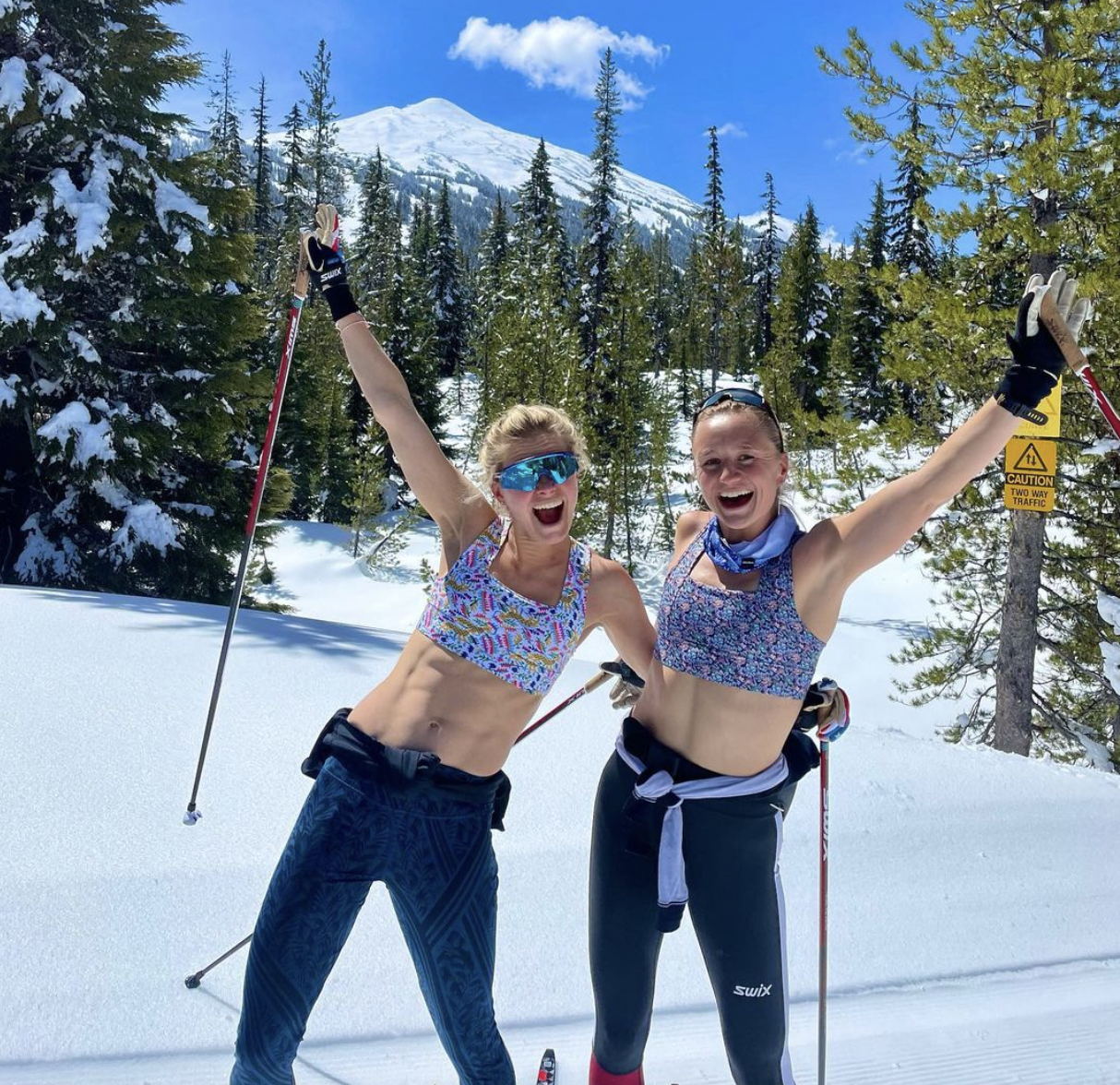
    Fresh snow and vitamin D — Jessie Diggins and Alayna Sonnesyn head to Mt. Bachelor for the 2022 US Ski Team spring training camp. (Photo: Lauren Jortberg)

     Overall, Bend and Mt. Bachelor have become a special place for Whitcomb, and for the many athletes who have made their way there over the years. 

    “It’s just such a wonderful environment. The way these cascade forests smell this time of the year when the new growth is coming up — you step out of the car when you first arrive and it’s like, ahh. I could be blindfolded and tell you exactly where I was.”

    While Mt. Bachelor offers high quality grooming all season, Whitcomb also spoke to the relationships the US Ski Team have developed with the trail operations team, and their willingness to adapt their usual grooming patterns to best serve the visiting skiers. This year, Whitcomb is looking to replicate the track format of a World Cup stadium so the team can practice “switching lanes in the finish and figuring out how to develop more speed — a bit of a twist to our [usual] speed training.”

    At the helm, and helping US Ski Team coaches interface with the grooming team, is the aforementioned Nordic Center Manager, Sue Foster, who Whitcomb says has been an invaluable resource over the years. 

    “She meets us in the lodge every day, she helps us prepare the TV and the chairs so that we can do a little visualization before every session. And she’s just a delightful, inviting person that makes you want to come back and see [her.] It’s rare that every athlete on the team knows the names of the people working the lodge, but Mt. Bachelor is one of those places.”
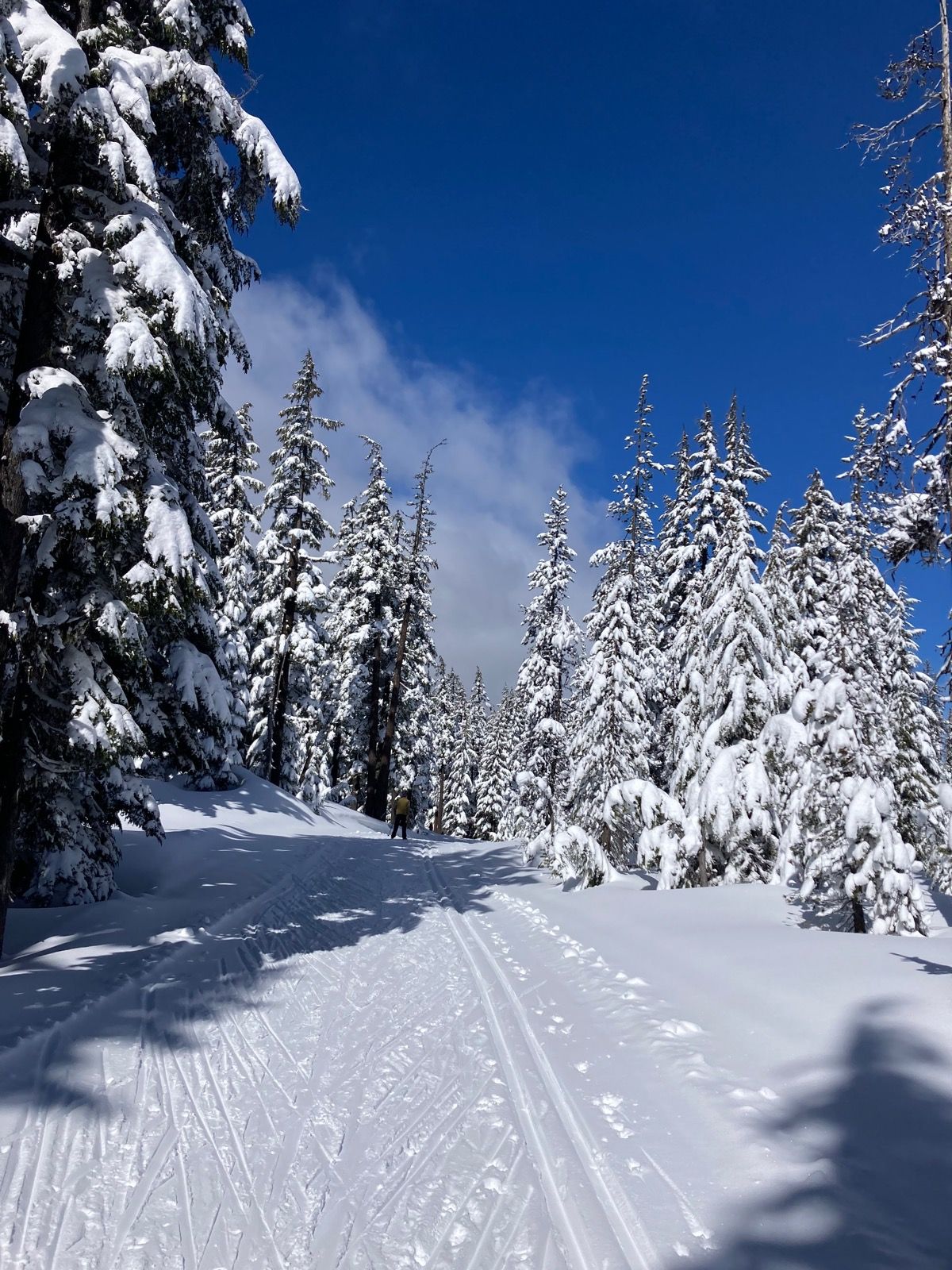
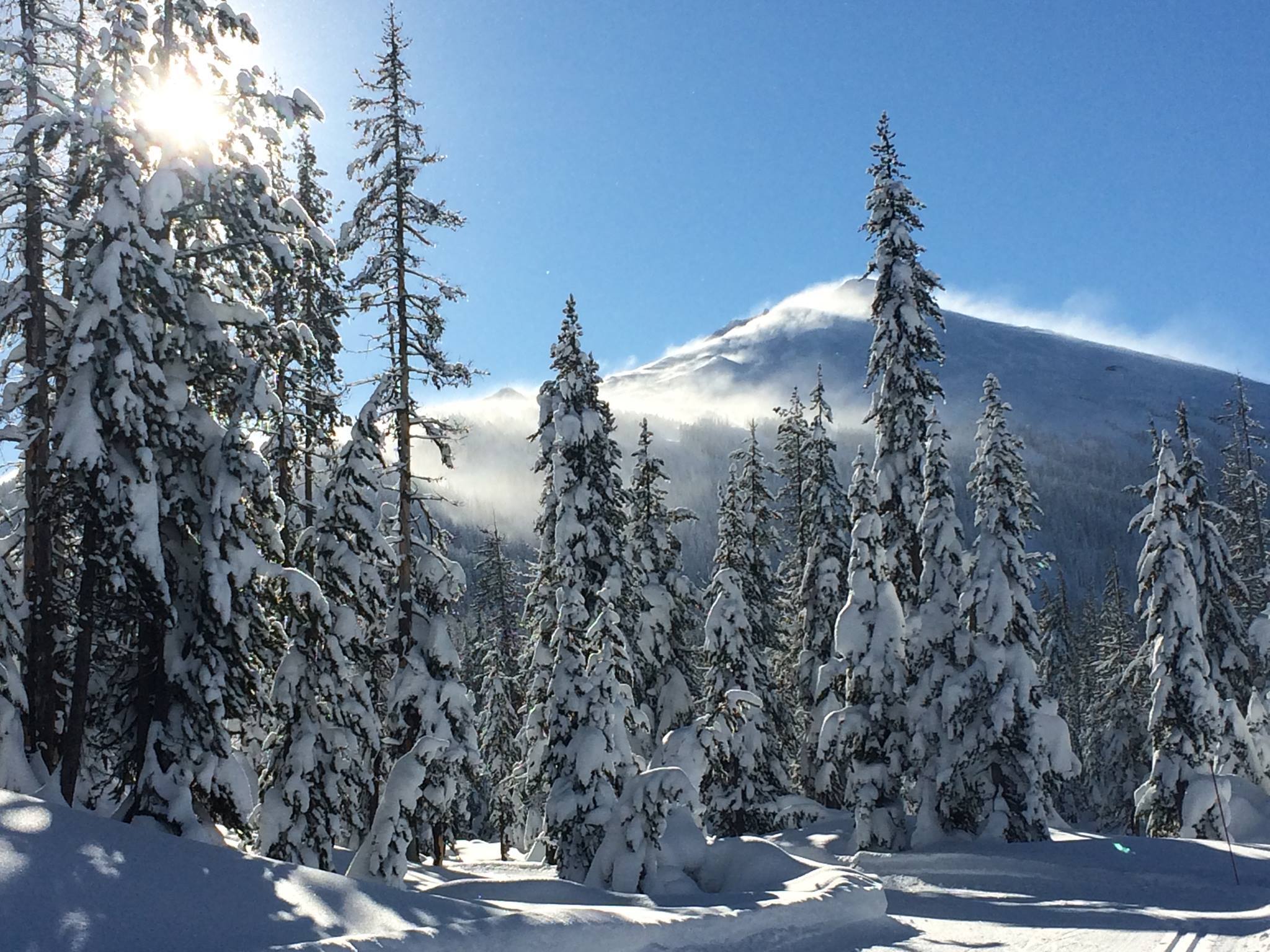
    Midwinter conditions return in May to Mt. Bachelor. (Photo: Alayna Sonnesyn)

    Off the ski trails, Whitcomb shared that a highlight for many athletes is the lower elevation terrain in Bend, where the unique volcanic geology of Mt. Bachelor sets up for miles of tacky “hero dirt” for afternoon rides. 

    “The mountain biking is some of the best in the US, particularly in May, before it’s gotten dusty.”

    During the late spring, many trails along the Deschutes River are also beginning to open up, and often the team will be dropped off an hour and a half up-river to enjoy a point-to-point run  back to their cluster of rental houses. 

    This year, the team is spread between three large rental homes in close proximity, with the staff house centrally located to host nightly team dinners catered by USOPC chef Megan Chacosky. To reduce COVID risks among the team and staff, masks are still worn during team meetings, allowing them to safely happen in-person. Though mask mandates and COVID safety precautions are largely being dropped, Whitcomb expressed the importance of keeping athletes and staff healthy, setting everyone up for success during the high-volume summer months of training. 

    “I think the world has made a major shift to decide that the pandemic is over, but we’re pretty well aware that the COVID is not done yet.”

    Finally, Whitcomb cited the greater ski community in Bend as a reason the camp has been such a valuable component of the annual training cycle. 

    “As far back as I can remember, it didn’t matter whether we are registered with a local club or not, we were always being invited by [coach/director] John Downing to the XC Oregon sessions. He’s still a good friend of the team, and we have so many locals in town that are helping us out and welcome us every year to town.”

    Acknowledging that he was only giving the short-list of names from the Bend skiing community who have supported and welcomed the team each year, he also noted former physiologist at the Olympic Training Center in Colorado Springs Tim Gibbons, who builds excitement for the camp by giving Whitcomb snow reports all winter, indicating how the trails are shaping up for spring skiing. And lastly, he thanked the members of the Mt. Bachelor Ski Education Foundation (MBSEF), including nordic director Dylan Watts. 

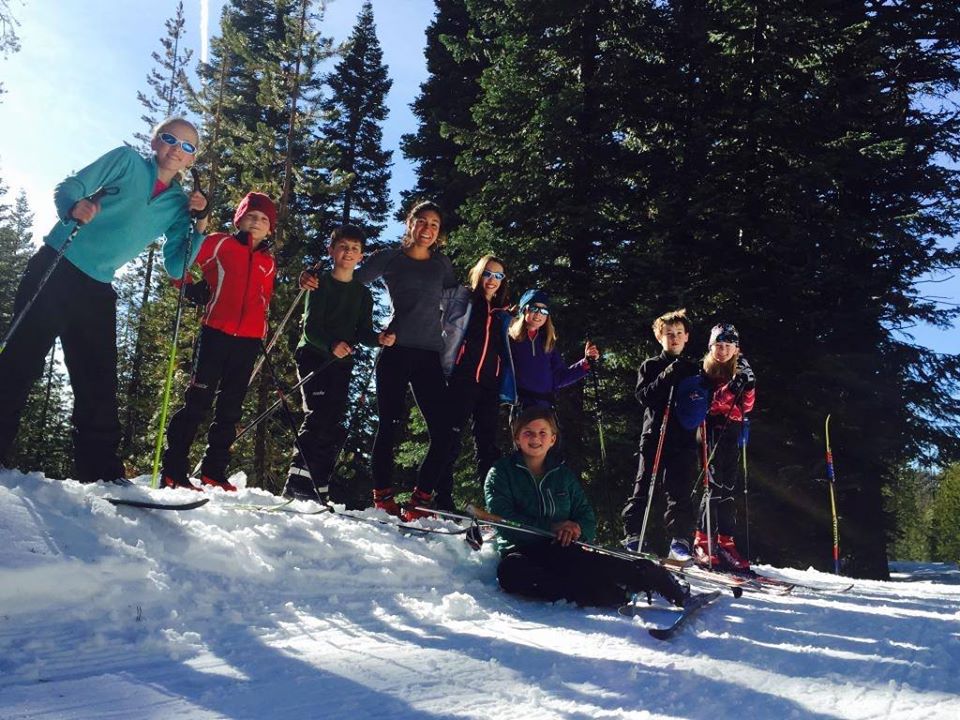
    This community support allows the team to maximize their time training in Bend, while also creating opportunities for outreach via programs like Fast and Female or hosting workouts for the MBSEF junior athletes. This partnership helps the team feel connected, and also stoke the enthusiasm of the next generation of cross country skiers. 

    “It just really feels like a family that we’re coming back to every year. So thanks to everybody that has always been welcoming. We try to be great ambassadors for the sport, and we need partners like this [to continue to move forward as a nation].
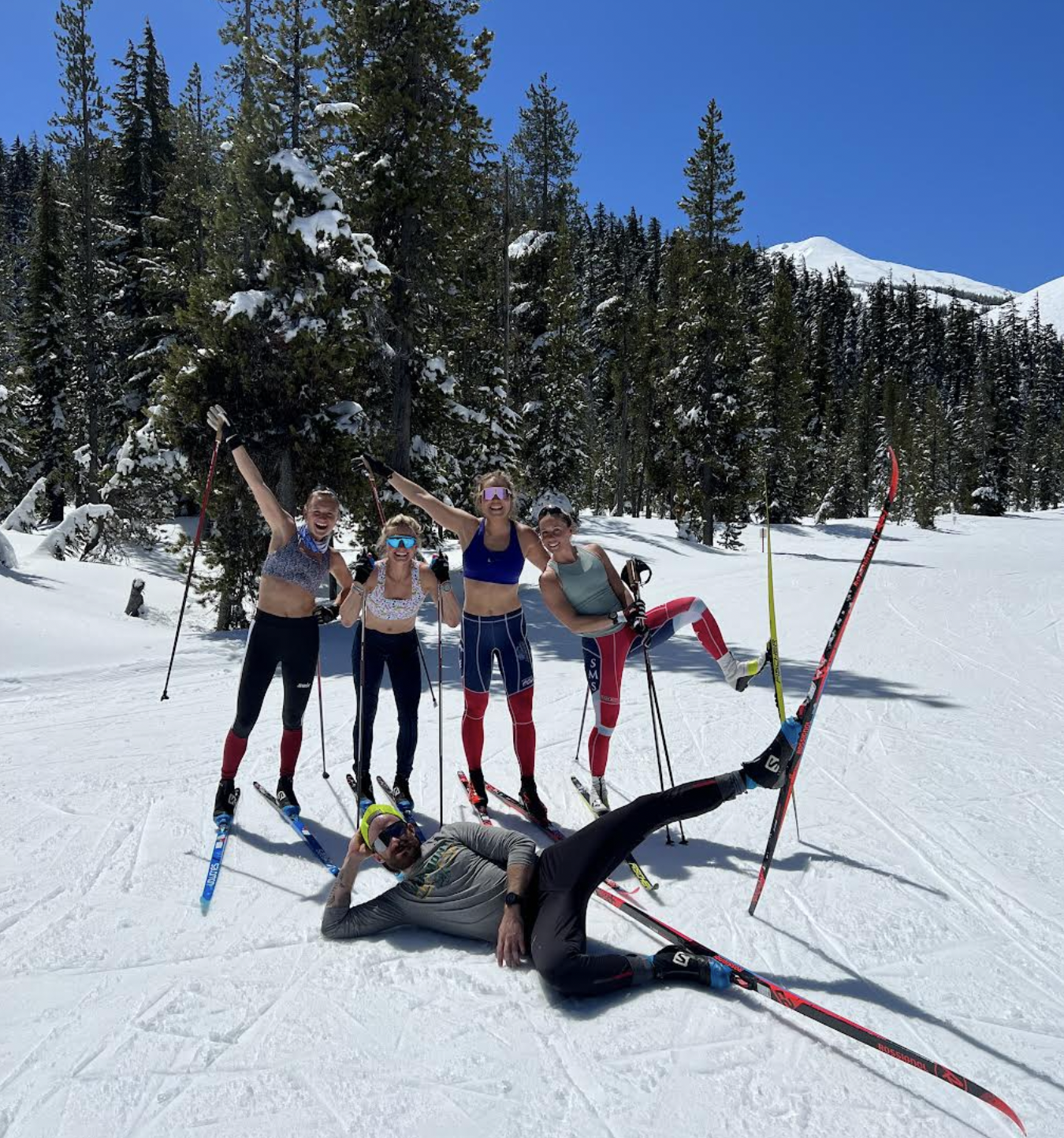
    Sun, snow, and lots of training during the 2022 US Ski Team camp at Mt. Bachelor. (Photo courtesy Alayna Sonnesyn)

    The Mt. Bachelor Nordic Center is known for it’s world class spring cross-country skiing. You can find more information about spring conditions at mtbachelor.com.

  • Wildfires, Smoke, and Air Quality: A Survey of Programmatic Response in the West

    Wildfires, Smoke, and Air Quality: A Survey of Programmatic Response in the West

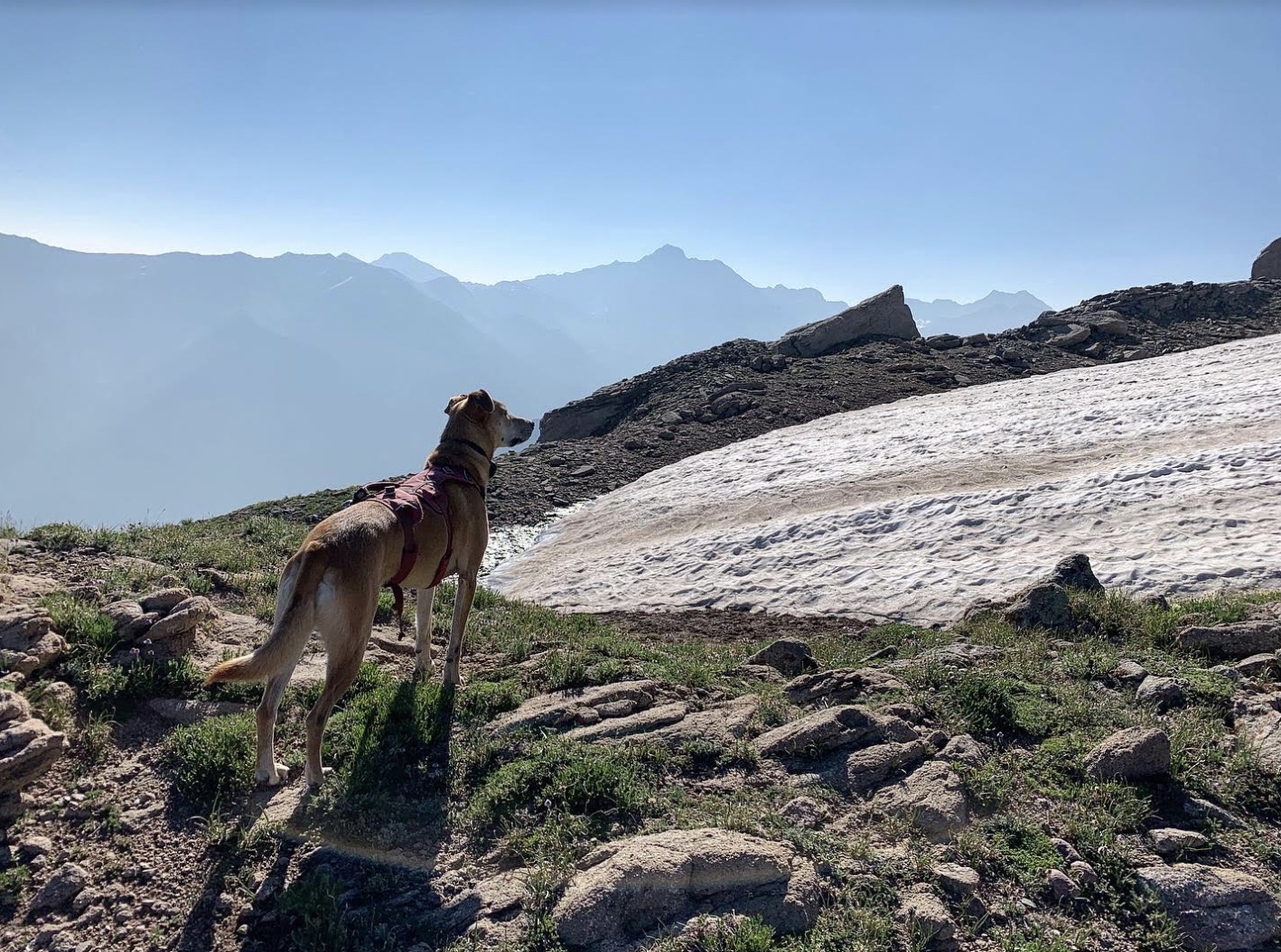
    Smoky haze. Not quite the bold and crisp view expected on this ridgeline near Carbondale, CO.

    Spinning past the autumnal equinox into fall, the West looks back on a summer marred by wildfire smoke. Here in Colorado, the Aspens have dropped their golden leaves, snow encrusts the high peaks, and I’m struck by the beauty of my backyard, which spent the majority of June, July, and August muted by smoke that — thankfully — blew in from elsewhere. 

    Over the last six weeks, checking AirNow before training has been phased out of my morning routine, and there is a palpable sigh of relief within my community as rain and high country snow frequent the forecast. The fire danger is not gone, but the threat feels less omnipresent.  

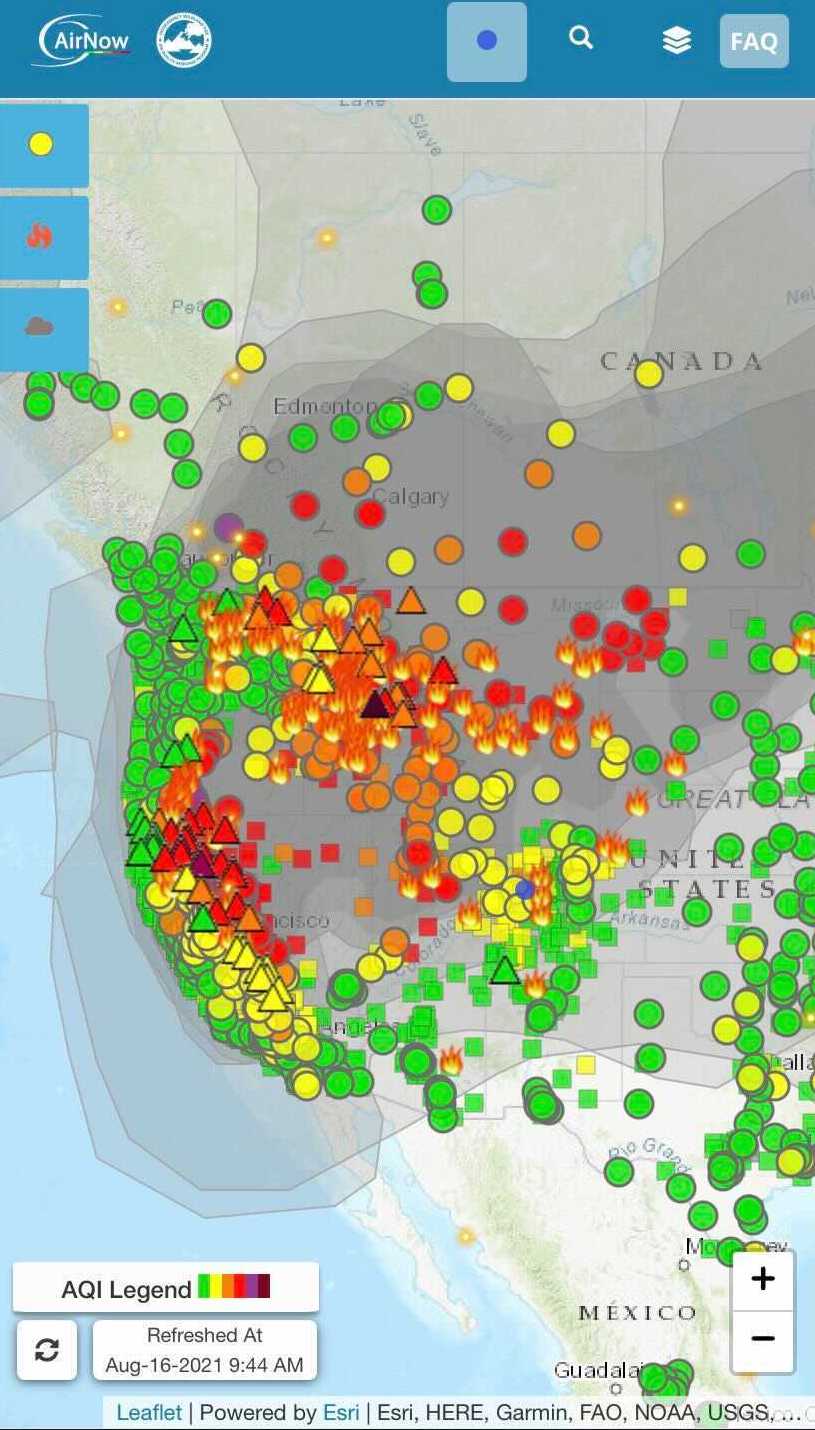
    A screenshot of active fires and subsequent air quality taken in August from Fire.AirNow.Gov.

    While regions like California, the Pacific Northwest, and Montana perhaps faced the longest durations of acrid high-AQI haze, cross country ski communities nationwide experienced its effect. As particulates from these fires were swept across the country, even air quality in the Northeast dipped into unhealthy zones for periods of time. 

    This phenomenon is not new, and as the planet continues to heat up, the West will be faced with longer and more devastating “fire seasons”. While sport might seem insignificant relative to the scale of issues at play, learning more about the modifications teams and athletes might consider can support the cross country ski communities overall health and wellbeing. 

    FasterSkier connected with coaches from areas heavily affected by fires and smoke to hear more about how they managed the impact in terms of protocol and adjustments to training with their athletes. Coaches also spoke to the increased frequency that these decisions will need to be made as climate change progresses. 

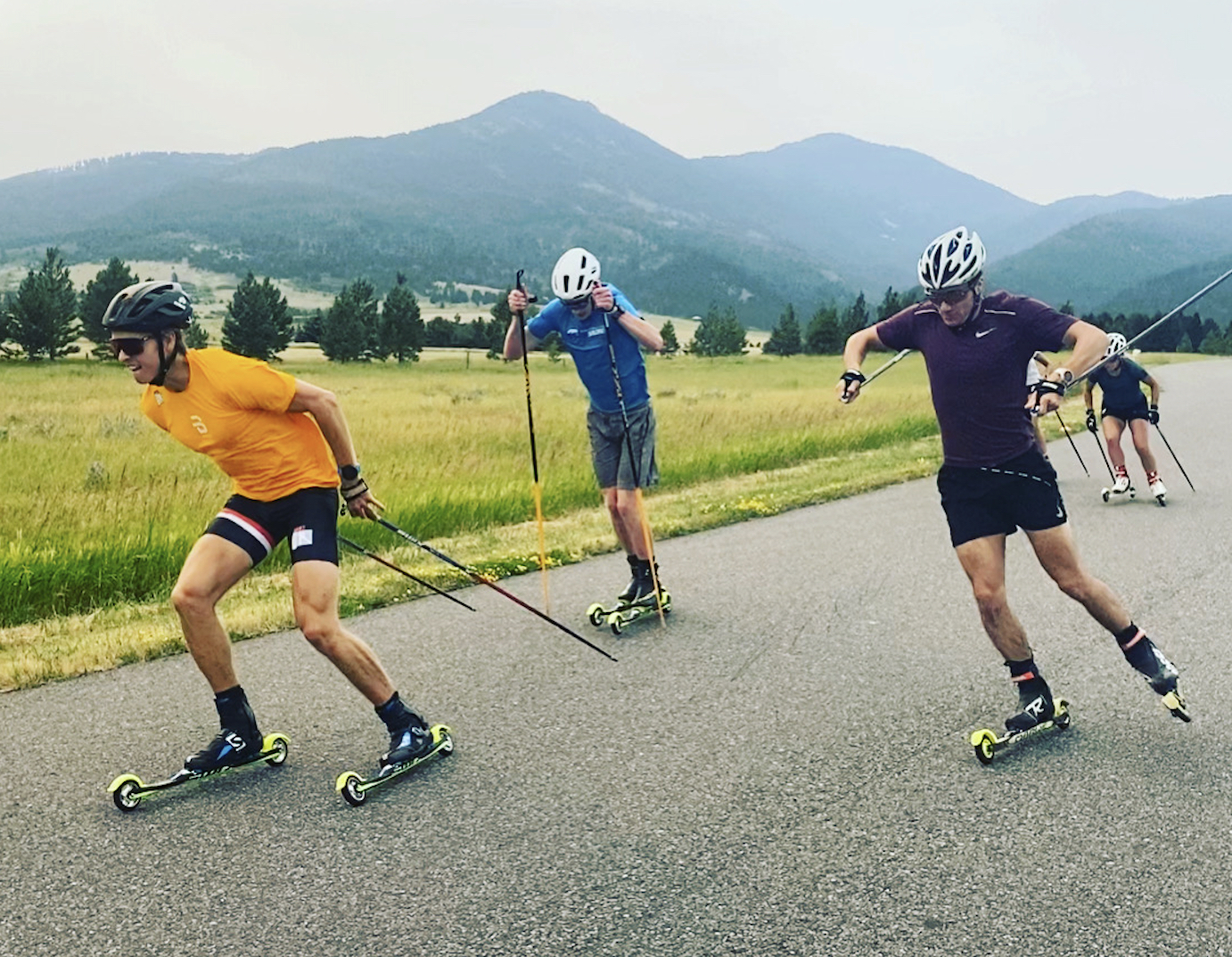
    BSF Pro athletes train in hazy yet safe conditions in Bozeman, MT. (Photo: Andy Newell)

    First up is Andy Newell, head coach of the Bridger Ski Foundation Pro Team in Bozeman Montana. 

    “Air quality and training is definitely a concern particularly because there’s not a ton of research about how smokey air affects high level athletes. We know a little bit about the short term implications but not much about long term exposure for athletes. The reality is this is something a lot of western clubs have been dealing with for a while but now we are seeing a lot of smoke in the midwest and even the east too.

    “On a typical year in Bozeman we usually don’t see smokey air until August and even then it’s not as bad as many other parts of the Northwest. This year we saw smoke earlier than ever, around the middle of July and early August, but much cleaner air than normal in the last few weeks. It really depends on wind, the jet stream, and where the big fires are burning. So far this year we have had to adjust about 3 workouts to bring athletes indoors when the air was bad. I’d say that’s about average for us, 3-6 workouts per year disrupted because of smoke.” 

    Newell continued by discussing the tools his program has used for decision making with regard to air quality and athlete safety. 

    “One of the things I have learned is that air quality can change very quickly and iPhone readings are not always accurate. We use the VisualAir app for forecasts and to find training areas that might provide better air for training. In this app you can see which sensors are gathering data from satellites and which ones from the ground. We’ve found obviously that the ground readings are a lot more accurate. Another thing we notice here in Bozeman is that the air quality can be very different even within the same region depending on high or low pressure, inversions, etc. So if you notice poor air at low elevations we might modify training and go up into the mountains and this can make a big difference.

    “We do use general guidelines at BSF to keep the athletes safe. If the AQI is above 100 we’ll start to monitor things and potentially modify training. If we are between 100-150 we will cut out L4 training or consider bringing athletes inside on treadmills for aerobic training. Also in this 100-150 range we’ll consider using KN95’s while out for easy distance training. Luckily we’ve only had to do this once this year so we’re hoping we make it through fire season without much more disruption.”

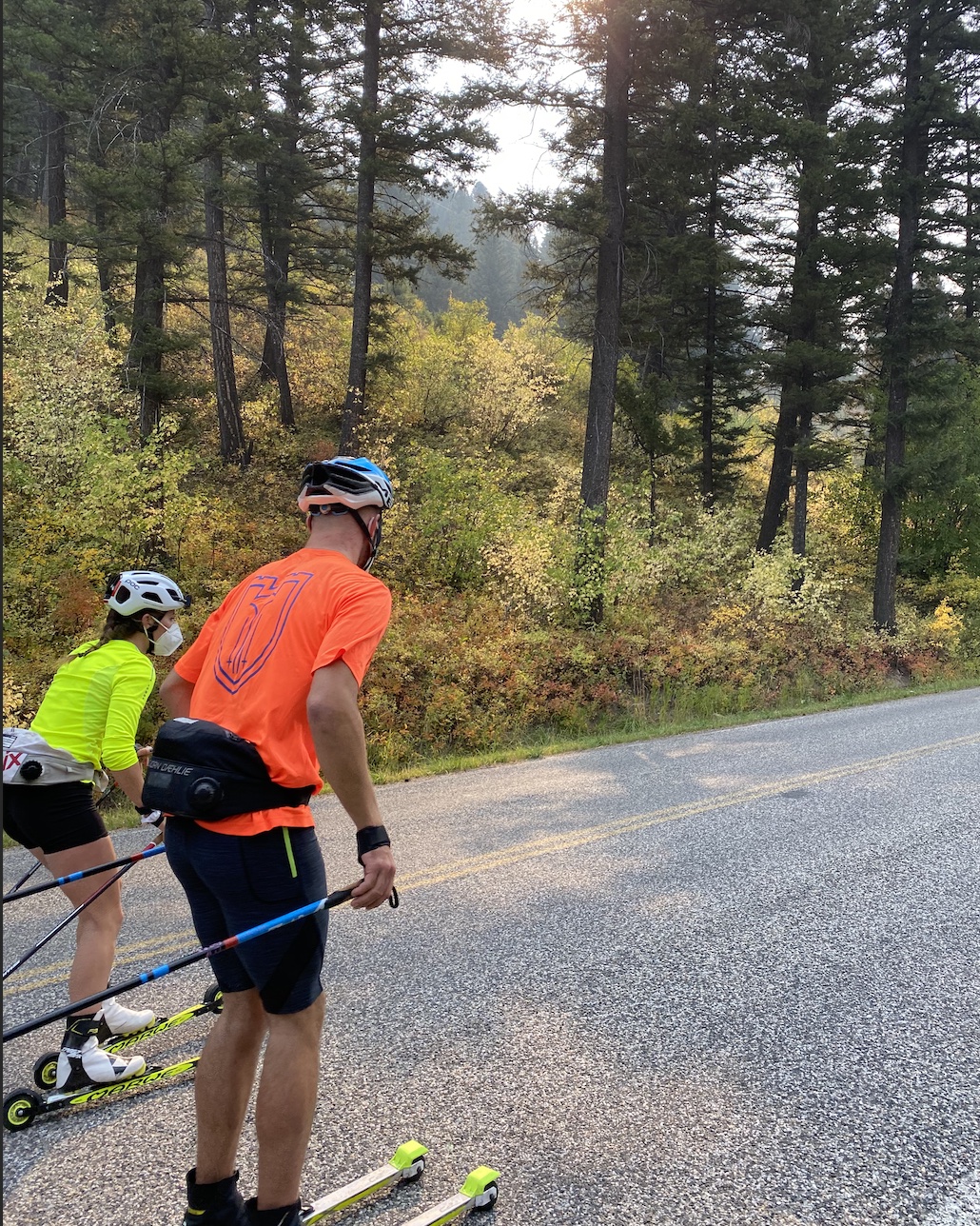
    BSF Pro athletes wear KN95s in order to safely train outdoors when air quality is above the safe threshold. (Photo: Andy Newell)

    A long-time advocate for climate policy and spokesperson for Protect Our Winters (POW), Newell closed with a statement on the impact of an ever-warming planet. 

    “As an athlete that has worked on a lot of climate issues this is definitely a scary reality, it goes to show you we are all affected by climate change.”

    Heading Southwest, FasterSkier also corresponded with Will Sweetser, Director of Nordic Programs for Sugar Bowl Academy (SBA), northwest of Lake Tahoe. The Tahoe region was struck hard this summer, as the devastating Caldor fire ripped through nearly 220,000 acres and destroyed over 1000 structures. 

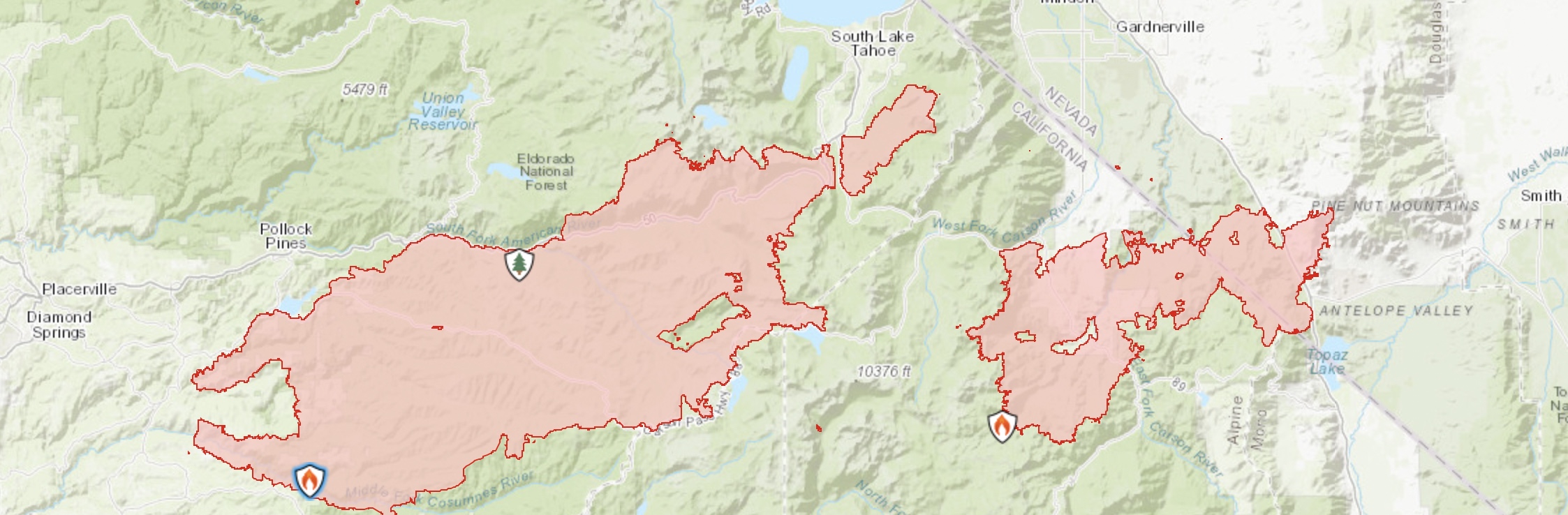
    Now 98% contained, the Caldor fire remains active, over two months since it began on August 14th. It has burned over 220,000 acres, an area larger than the state of Rhode Island. Although the fire is still active, most evacuations and closures have been lifted. 

    A map from October 11th of the still-active Caldor Fire south of Lake Tahoe, California. (Photo: Screenshot InciWeb.nwcg.gov)

    Sweetser first outlined the nuts and bolts of air quality considerations. For those unfamiliar, AQI considers the concentration of fine particulate matter in the air. Particulate matter, like wildfire smoke, that is 2.5 microns or less (PM 2.5) is most concerning, as it can penetrate deeply into the lungs. 

    “Train as usual if school is in and AQI is between 0-60; offer optional/slightly modified training — consider shortened length first, and reduce continuous intensity — when AQI is between 60-120. Optional training is reduced, and outdoor training is only recommended for healthy, unaffected individuals when AQI is 120-150. Sessions are capped at 1 hour, and intensity capped at L2.”

    While indoor recreation amidst the COVID-19 pandemic poses its own set of complications, Sweetser explained that indoor training is preferred when the AQI is above 150. To support the health of its athletes, SBA has integrated air purifiers in every indoor space on its campus, including classrooms, common areas, dining halls, and the gym. These filters help maintain an indoor AQI of 25 or below. 

    An SBSA athlete moves his training indoors with an air filter when AQI plummets. (Photo: Will Sweetser)

    “In heaviest smoke events, we encourage families with the capacity to travel to cleaner air for the week to do so within the confines of school requirements. If we are in a remote schooling period, which was precipitated by Tahoe area evacuations last week, many families simply move to second homes in the Bay area or elsewhere in CA. We write individual suggestions for each athlete to meet the training options in that area. Our general week plan (MON–OFF, TUE-WED-THU–heavier training 1-2x daily, FRI–recovery, WEEKEND–high training load/family outings) readily allows families to take weekends away for cleaner air.”

    When Sweetser was first contacted in late August, he responded that he was with the team on the coast enjoying a training block in fresh air. In his email afterward, he included the purpose of this camp. 

    “Last week, we utilized our first planned smoke escape team training weekend. It was in the school travel calendar. Teachers prepared some work in advance. The entire team went to the north coast of California for FRI-SUN. We had 5 excellent training sessions, including 1km L4 repeats, pure speed double pole session, 2 technique sessions and a 15-20-kilometer run. AQI in the Mendocino area varied from 8-43 during that time and was a great reset for us. Extremely valuable to get to clean air, sea level and group training in a pretty stressful time. We are lucky to be able to do so with just 4-5 hours driving.”

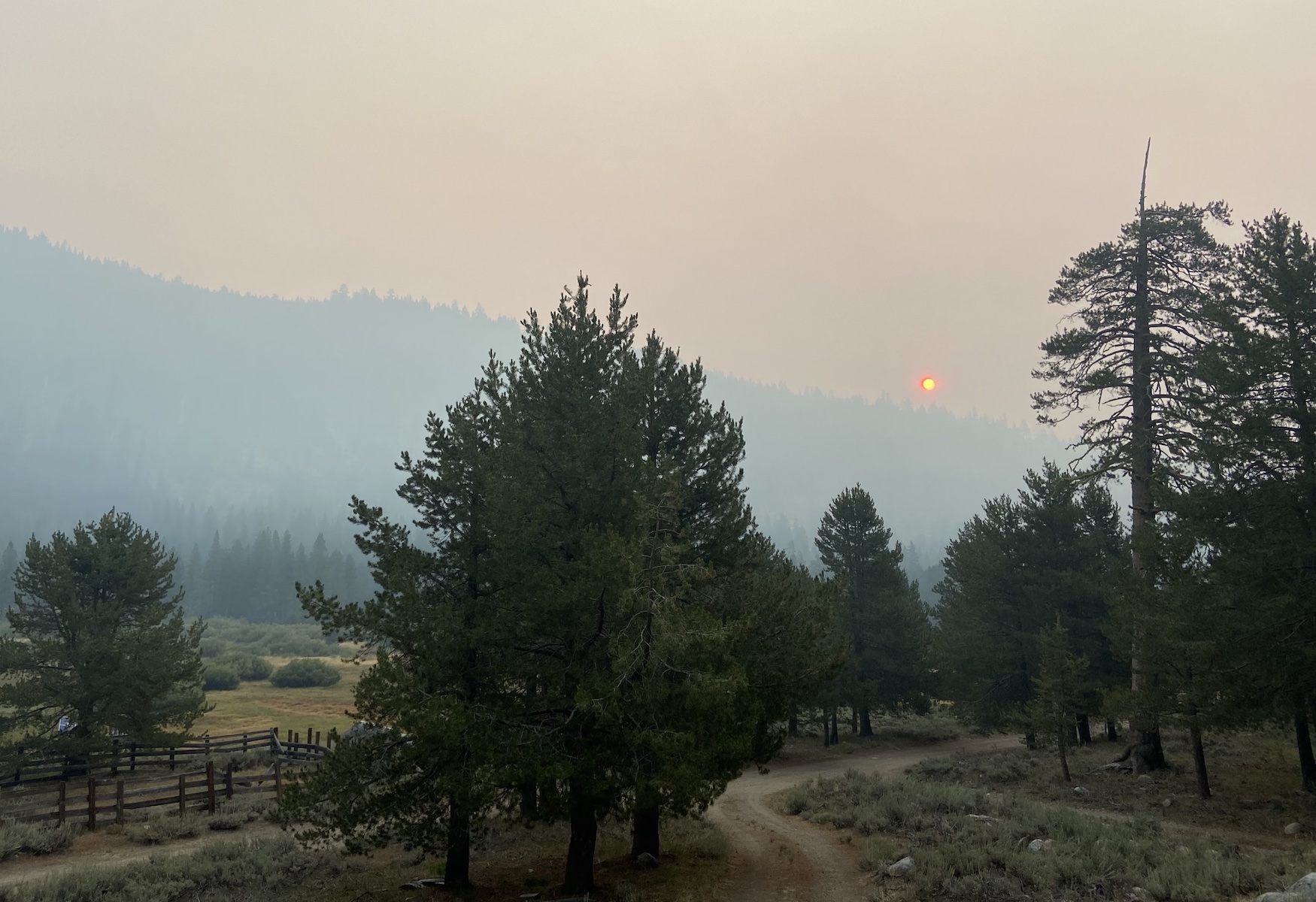
    The smoke filters over the ridge line in Tahoe’s Carpenter Valley last August. This day was relatively mild, with AQI readings remaining below 200. (Photo: Will Sweetser)

    When the team is not able to travel and air quality is poor, Sweetser explained how they approach indoor training to achieve similar stimuli to those they’d seek in “normal” conditions outdoors. 

    “When we are on Donner Summit with poor AQI, we utilize gym time and treadmill/SkiErg sessions to offer modified indoor sessions that still reflect each athlete’s goals — often these sessions are shortened and feature slightly more L2, or intermittent work, than we might normally do outside — although looking at HR data, the planned intermittent nature of these sessions is not totally different than sending the crew for a trail run through rolling terrain.”

    Sweetser also reflected on the learning curve for appreciating how quickly AQI can change based on wind and weather patterns. He recalled leading an OD training run with a couple of his athletes and assistant coach David Sinclair that began at a borderline AQI of 120. As they progressed toward the objective, Hawks Peak, the air quality plummeted.

    “We could see smoke pouring in from the north as we headed across the ridge… We called parents for pick up and dropped down as quickly as we could.”

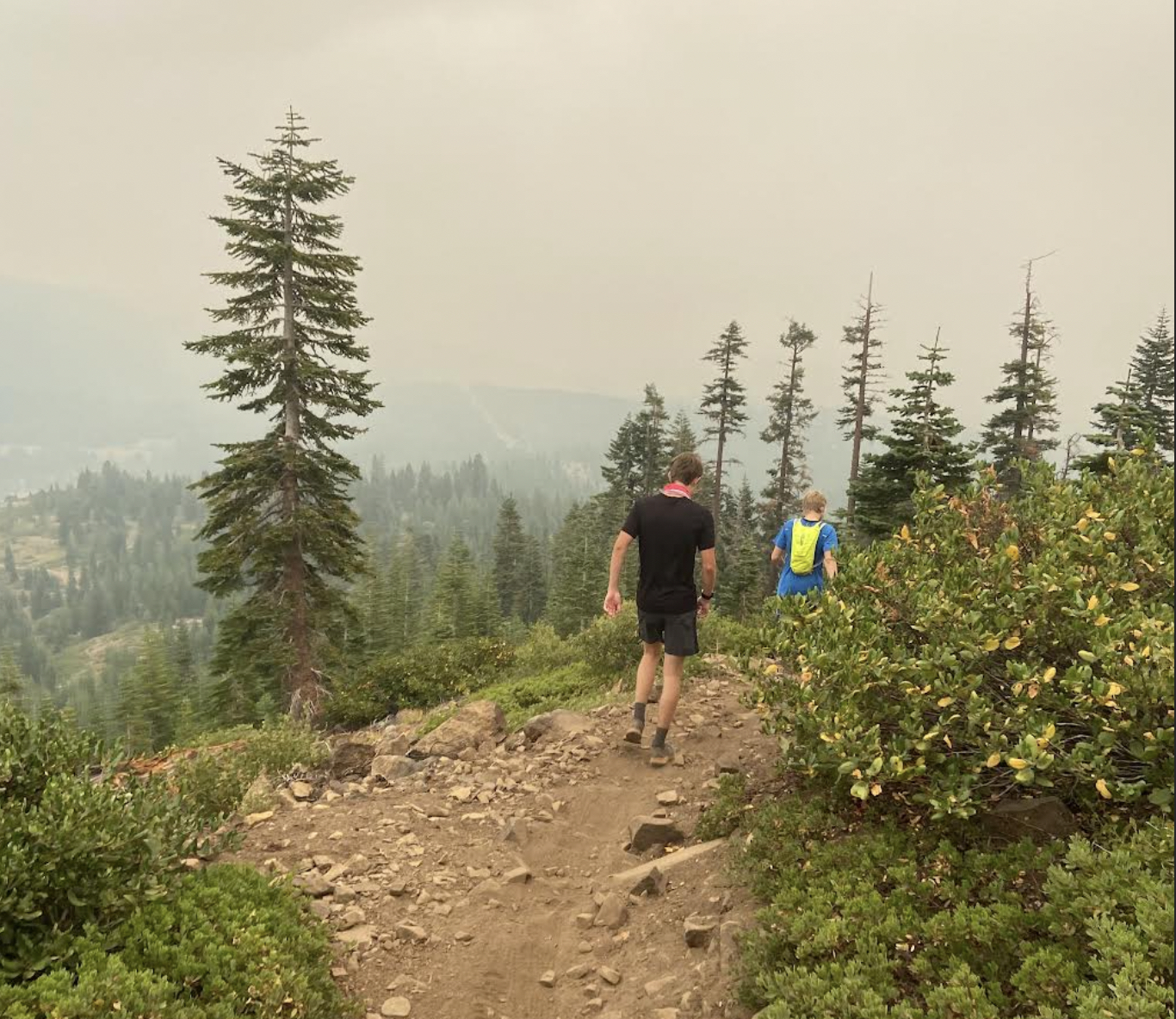
    SBSA athletes climb a ridgeline as AQI shifts rapidly from a safe level. (Photo: Will Sweetser)

    By the time the athletes reached their pickup point, the AQI was over 400, which is considered emergency conditions.

    “Since then, myself and much of the region have become much more savvy about using real time AQI monitors such as PurpleAir, wind and smoke forecast apps like Windy and Dark Skies, and I’ve purchased a handheld AQI monitor.”
    Sweetser added that he coughed for at least a week after this singular session.
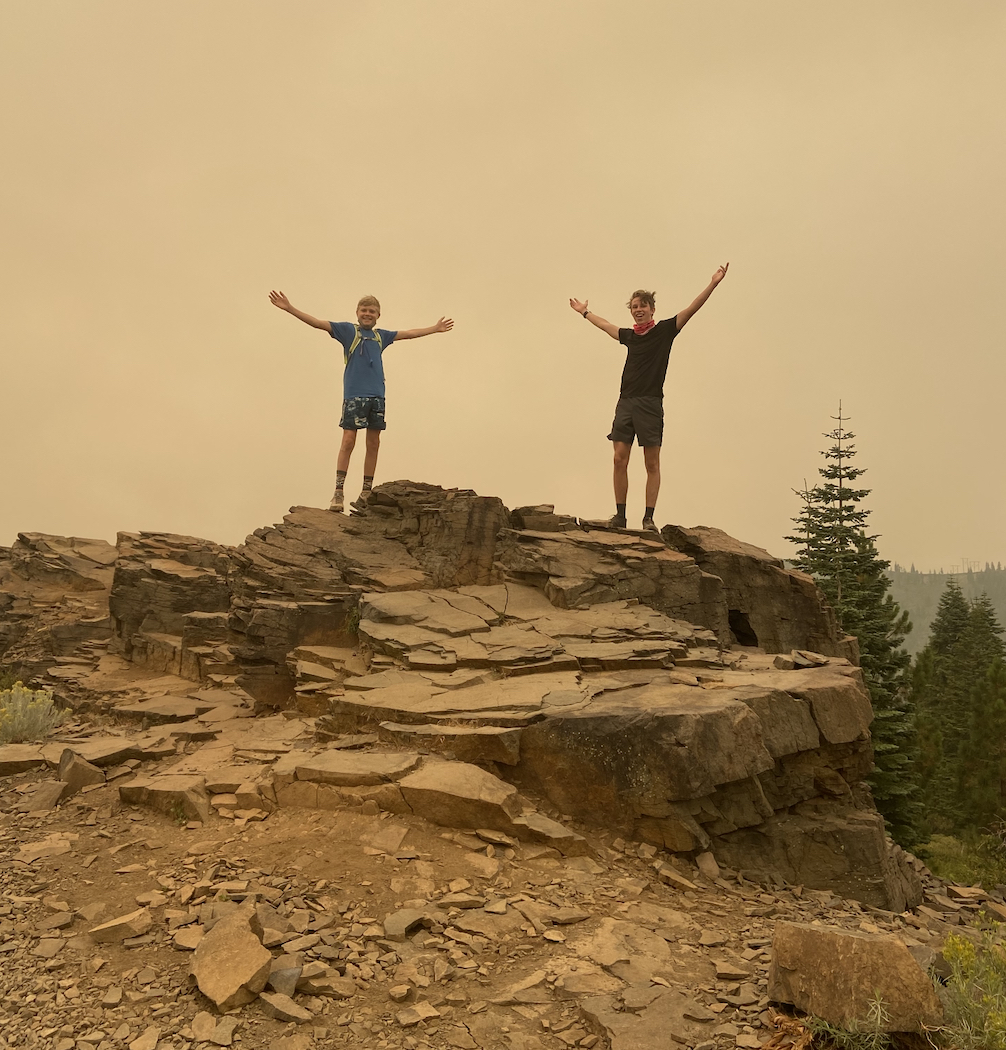
    Brown air and minimal visibility atop Hawks Peak. (Photo: Will Sweetser)
    Lastly, FasterSkier connected with Dylan Watts, new head nordic coach for the Mt. Bachelor Ski Education Foundation (MBSEF) in Bend, OR. At the time of his response, Watts had only been in his role for a month and thus could not speak to the program’s response to smoke levels in Bend throughout the summer. His perspective spoke to a broader philosophy regarding athlete development, particularly at the junior level. 

    “What I keep in mind is that we are really training for a healthy body and mind for the long term. That no one day, week, month, or even whole season is so critical that we potentially sacrifice our long term health for a short term result. In this sport, any short term results we achieve are very unlikely to bring us any benefit other than good health. Cold weather injury is a serious consideration in skiing. Regular exposure to air pollution, wildfire smoke included, is just as — and I would argue more — serious.

    “You don’t know what sort of interruptions you will face in a year. Modifications to training happen for conditions all the time. It is built into our sport. Weather, lack of snow, too cold, not cold enough, smoke. Add sickness, a hard semester, family needs, and so on. For those reasons it is always a good idea to work ahead. When it is good you go and that way when conditions are bad you don’t have too. You don’t need to feel the pressure to make up for something you didn’t do.”

    The MBSEF programs had been following similar guidelines to SBA, however, Watts responded that after the World Health Organization’s release of new air quality guidelines at the end of September, the program further tightened its tolerance of poor air quality. With mounting evidence of the increase in all cause mortality risk due to prolonged exposure to pollutants, the WHO drastically reduced the acceptable levels of PM2.5 and other pollutants individuals should be subjected to in both short and long term settings. The 300 page document also calls for a global response to air quality improvement. 


  • MBSEF Seeks Assistant Nordic Coach

    MBSEF Seeks Assistant Nordic Coach


    The Mt. Bachelor Sports Education Foundation is seeking an Assistant Nordic Coach to lead, motivate, educate and provide direction to athletes/ members of the MBSEF Nordic program and assist the Nordic Director in all facets of the Nordic Program, including Collegiate Programs, Masters Programs, U18/U16 racing programs, Middle School development, and Youth programs.

    Job Qualifications:  The Assistant Coach must have a practical knowledge of current cross-country techniques and training methods, proficiency with wax selection and application, experience with equipment repair and selection, and knowledge of sports nutrition, strength training, and sports psychology.  In addition to coaching duties, the assistant coach will be expected to perform various office duties which require some basic computer skills, good communication skills, knowledge of social media, and some office work experience.

    Primary Responsibilities

    • Contribute to a positive and motivating environment to foster a lifelong love for the sport of cross country skiing
    • Works to support the vision, mission and philosophy of MBSEF
    • Assists head coach with Full-time, Winter Term and Middle School program athletes including collegiate athletes
    • Travel with selected MBSEF teams
    • Help design schedules and training programs
    • Instruct Master skiers in MBSEF program
    • Assist Director with organization and execution of MBSEF races.
    • Supports staff and racers at local races
    • Attend various staff/program meetings

    Secondary Responsibilities

    • Assist with some MBSEF fundraising events
    • Help to maintain the integrity of the MBSEF Nordic as well as all other programs and activities of MBSEF

    Reporting Responsibilities 

    • Reports to Nordic Program Director for all matters relating to the Nordic Program

    Salary:  Dependent of experience, availability, and prior success.

    Applications:   Send resume to dan@MBSEF.org

  • ‘Equal and Reasonable Access’: The Issue of Trail Use at Mt. Bachelor

    ‘Equal and Reasonable Access’: The Issue of Trail Use at Mt. Bachelor

    New Year's Eve at the Mt. Bachelor Nordic Center near Bend, Ore. (Photo: Rion O'Grady/Mt. Bachelor Nordic Center Facebook)
    New Year’s Eve at the Mt. Bachelor Nordic Center near Bend, Ore. (Photo: Rion O’Grady/Mt Bachelor Nordic Center Facebook)

    Is there room at one ski center to support two junior development programs? In central Oregon, it depends on who you ask.

    Mount Bachelor, 22 miles outside Bend, Ore., is a touchstone for nordic skiers. Located in Deschutes National Forest, Mt. Bachelor operates with a special use permit from the US Forest Service (USFS). The U.S. Ski Team has run training camps here and they’ve hosted national championships. In addition, there’s an extensive alpine mountain. With a base lodge at 6,300 feet above sea level, the venue boasts generally good snow conditions.

    Mt. Bachelor has a longstanding relationship with the Mt. Bachelor Sports Education Foundation (MBSEF), a nearly 30-year-old nonprofit which has development programs for nordic, alpine and freestyle skiing. MBSEF runs its ski programs on the trails at Mt. Bachelor.

    The much-newer Bend Endurance Academy (BEA), a nonprofit founded in 2009, would like to share the trails — at least, in low snow years. Except for a couple of rare occasions, BEA has not had permission to run its programs on Mt. Bachelor.

    Since its inception, BEA has used Meissner Nordic, a nonprofit ski center also located on Mt. Bachelor. Run by volunteers, Meissner Nordic grooms 40 kilometers of ski trails on US Forest Service land.

    It’s all good, until the weather doesn’t cooperate. Located 1,500 feet lower on Mt. Bachelor than the eponymous ski area, the previous two winters, 2013/2014 and 2014/2015, were difficult for Meissner, while Mt. Bachelor enjoyed better conditions higher up the mountain.

    In February 2015, BEA approached Mt. Bachelor resort officials about using public lands at the Mt. Bachelor Nordic Center. They denied BEA’s request, except for the last two weekends of the season.

    A group of Bend Endurance Academy youth skiers in February. (Photo: Ryder "the Badger" Utrecht/Bend Endurance Academy Facebook)
    A group of Bend Endurance Academy youth skiers in February 2016. (Photo: Ryder Utrecht/Bend Endurance Academy Facebook)

    This year, the academy has circulated a petition called Let the Kids Ski, calling for more access to Mt. Bachelor.

    “There are two places in central Oregon that have groomed nordic trails,” said BEA Board President Cris Himes. “Meissner Nordic and Mt. Bachelor. Meissner has worked very well until recently due to ski conditions.

    “What we’re looking for is equal and reasonable access,” Himes continued. “Equal to any other paying customer and community group.”

    According to Dave Rathbun, Mt. Bachelor’s former president and general manager who resigned in mid-March, the resort had existing relationships with four businesses “to run their businesses sort of inside our own,” he said. “We still have to get approval from the Forest Service for these concessionaires.”

    MBSEF, whose board Rathbun also sat on, is the designated concessionaire for nordic and alpine ski programming. Rathbun is no longer a member of that board.

    In a December interview with the Bend Bulletin, Rathbun characterized BEA’s interest in Mt. Bachelor as a desire to use the resort as “a home base for their business.”

    “[BEA] want to operate their business within ours, and in most cases at a time when we’re already at capacity,” Rathbun told FasterSkier. “It’s very busy at the times they want to have access.”

    Rathbun added that Mt. Bachelor is “at capacity” for instruction in both in nordic and alpine skiing. “We’re not going to open it up to any other concessionaires.”

    In addition to its own paying customers, Mt. Bachelor’s agreement with the USFS requires the resort to accommodate people who want to access backcountry skiing via a “common corridor.”

    According to Rathbun, “that’s another 10,000 visits per year,” in addition to about 30,000 visitors per year skiing Mt. Bachelor.

    Himes feels that the lodge might be crowded, but believes that the trails are not. For her, the primary issue is ensuring that kids have access to skiing. The lack of decent snow is a barrier to participation, and this is reflected in the numbers. Although BEA’s competition team is larger than last year, the enrollment in its youth club and nordic development programs is down 38 percent and 28 percent respectively from the 2014/2015 season.

    “Last year Mt. Bachelor did a remarkable job of keeping their snow,” Himes said. “When we can’t run our programs at Meissner, we need to be able to take our kids to groomed trails somewhere else. The only option is Mt. Bachelor Nordic Center.”

    New Year's Day 2016 at the Mt. Bachelor Nordic Center near Bend, Ore. (Photo: Lew Becker/Mt Bachelor Nordic Center Facebook)
    New Year’s Day 2016 at the Mt. Bachelor Nordic Center near Bend, Ore. (Photo: Lew Becker/Mt Bachelor Nordic Center Facebook)

    During the snow drought two seasons ago in 2014/2015, Rathbun reflected, “I wanted to be a good neighbor. We gave BEA access to nordic center in afternoons, the last couple of weekends in March. I think it worked out well and they appreciated being able to get on snow.”

    In a July email to BEA, Rathbun offered the academy access on Tuesday and Thursday afternoons and weekends after 12 p.m., with certain blackout dates during peak periods. These times apparently didn’t match BEA’s program schedule, and according to Himes, left only three weekends out of the winter for training. In September, Himes met with Rathbun to negotiate more favorable access times, to no avail.

    “I’m really sorry about that, but that’s the only way we feel it can work, based on how crowded we are,” Rathbun told FasterSkier.

    “I can see both sides,” said Alan Watson, the Pacific Northwest Ski Association (PNSA) nordic program director. “My interest is in promoting the success of all these programs. I would like Mt. Bachelor to let BEA train on their trails. It would be good for skiing in the northwest.”

    Is trail crowding a red herring? Rathbun said that BEA skiers were welcome to come up and ski so long as they had a pass, but that organized training with a coach wouldn’t be permitted – except at the times listed above.

    Does Mt. Bachelor wield trail access as a cudgel? From a distance, it’s hard to tell. But FasterSkier obtained three documents sent anonymously to Himes. One was Oregon School Ski Association’s (OSSA) participation policy. OSSA is one of the two governing bodies for high-school alpine skiing in central Oregon, and holds race meets at Mt. Bachelor. Circulated in December 2014, the policy required students on high school ski teams to participate in four training sessions each week, including races.

    OSSA Race Director Matt Cutter said that there were students that participated in both high school and club programs, and that OSSA’s goal with this policy was to instill team unity.

    “We don’t want ringers,” Cutter said of athletes who only show up for race meets. “We needed to get something in writing.”

    The other two documents, both dated Jan. 8, 2015, are responses from Rathbun and John Scheimer, MBSEF’s executive director, to OSSA. Rathbun’s letter decried OSSA’s participation policy, stating that it would negatively impact “students who club race with MBSEF and have other extracurricular interests.” The letter concluded, “…with our strategic partner MBSEF, we [Mt. Bachelor] will be reviewing all elements of OSSA activities occurring on Mount Bachelor. … Any changes in these privileges will be communicated to you as soon as possible.” Scheimer’s letter to OSSA was written in a similar tone.

    Scheimer declined an interview request for this article.

    In response to the letters, Cutter said that OSSA rescinded its policy. “That was not our intention at all” to exclude anybody, or force a student to choose between a club program and the high school team, Cutter explained.

    Cutter viewed the disagreement as minor, adding, “I can’t stress enough how much support Mt. Bachelor gives us.”

    Rathbun said that his letter was actually in response to scheduling conflicts between OSSA and OISRA, a second governing body for Oregon high school alpine skiing. However, neither his letter nor Scheimer’s make any reference to OISRA. Cutter said that while Rathbun discussed scheduling with OISRA, it was in correspondence from August 2015.

    “The kids know each other, the parents know each other, we support each other’s kids,” said Himes of BEA and MBSEF. “I am really hoping that we will be working cooperatively with MBSEF.”

    With good conditions this winter, trail access at Mt. Bachelor wasn’t as crucial. Next year may be a different story.

  • MBSEF Seeking Assistant Coach

    MBSEF Seeking Assistant Coach

    MBSEF logo

    The Mt. Bachelor Sports Education Foundation (MBSEF) is seeking an Assistant Nordic Coach to lead, motivate, educate and provide direction to athletes/ members of the MBSEF Nordic program and assist the Nordic Director in all facets of the Nordic Program, including Collegiate Programs, Masters Programs, U18/U16 racing programs, Middle School, Youth, and Biathlon.


    Job Qualifications: Practical knowledge of current cross-country techniques and training methods. Assistant coach must have proficiency with wax selection and application, an aptitude for equipment repair and selection, and a working knowledge of video equipment. In addition to coaching duties, the assistant coach will be expected to perform various office duties which requires some basic computer skills, good communication skills and some office work experience.

    Primary Responsibilities

    • Contribute to a positive and motivating environment to foster a lifelong love for the sport of cross country skiing
    • Works to support the vision, mission and philosophy of MBSEF
    • Assists head coach with Full-time, Winter Term and Middle School program athletes including collegiate athletes
    • Travel with selected MBSEF teams
    • Help design schedules and training programs
    • Instruct Master skiers in MBSEF program
    • Assist Director with organization and execution of MBSEF citizen races
    • Supports staff and racers at local races
    • Attend various staff/program meetings

    Secondary Responsibilities

    • Assist with some MBSEF fundraising events
    • Help to maintain the integrity of the MBSEF Nordic as well as all other programs and activities of MBSEF

    Reporting Responsibilities

    • Reports to Nordic Program Director for all matters relating to the Nordic Program

    Salary: Dependent of experience, availability, and prior success.

    Applications: Send resume to dan@MBSEF.org

  • Wednesday Workout: Kochie’s Hill with Dan Simoneau

    Wednesday Workout: Kochie’s Hill with Dan Simoneau

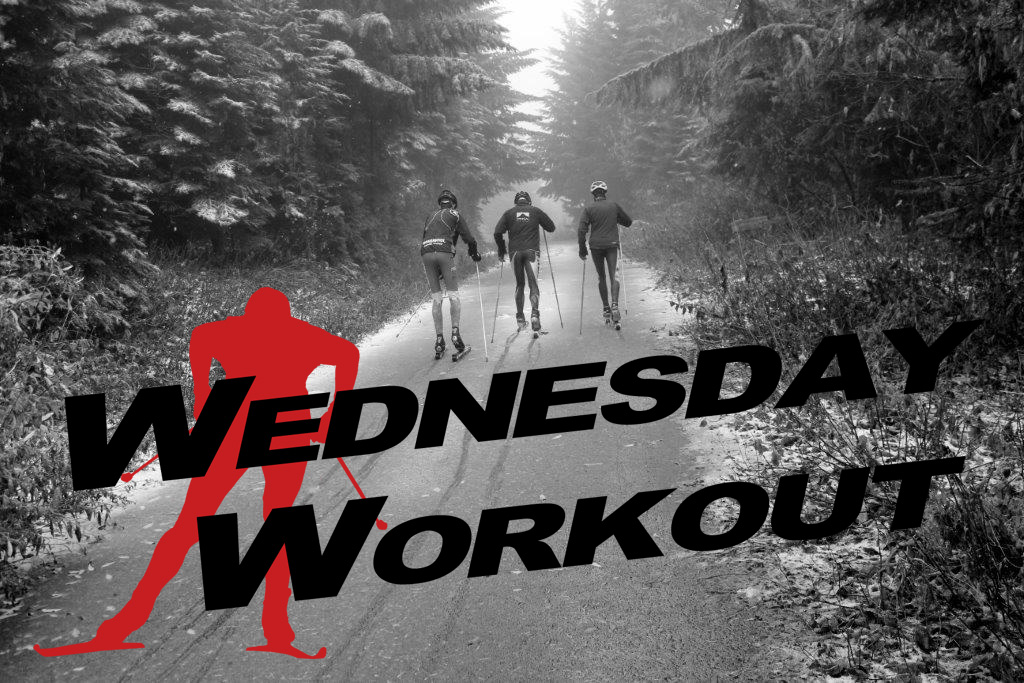
    MBSEF skiers Matt Hecker, Casey Shannon, and Zeb Millslagle striding up Kochie's hill in western Oregon. (Photo: Dan Simoneau)
    MBSEF skiers Matt Hecker (l), Casey Shannon (c), and Zeb Millslagle striding up Kochie’s Hill, a remote single-lane road in western Oregon with 4,645 feet of vertical climb in 14.6 miles. (Photo: Dan Simoneau)

    Time passes and skiers come and go, but terrain (usually) doesn’t change – especially in remote parts of Oregon. In this week’s workout, Dan Simoneau, nordic program director at the Mt. Bachelor Sports Education Foundation (MBSEF) and 1984 Olympian, shares a place from the past, which he still drives his athletes from Bend, Ore., to today.

    ***

    Kochie's Hill in western Oregon: 4,645 feet of vertical climb in 14.6 miles. (Photo: Dan Simoneau)
    Kochie’s Hill in western Oregon: 4,645 feet of vertical climb in 14.6 miles. (Photo: Dan Simoneau)

    Late summer can be tough training.  Though MBSEF may have the shortest dryland season in the world, (we ski ’til late June), it’s hot, we’re tired of roller skiing, summer camps are over, winter seems so far away.

    Late fall is also tough training.  It’s now been months without a good yardstick to measure our fitness.  Our roller ski wheels are worn.  Our roller skiing patience is over.  Snow seems near, but it also teases us, disturbing our training.

    This year we broke up these two blocks with a trip to a pretty special place. A place that’s special to me and a place I wanted to pass on to the next generation.

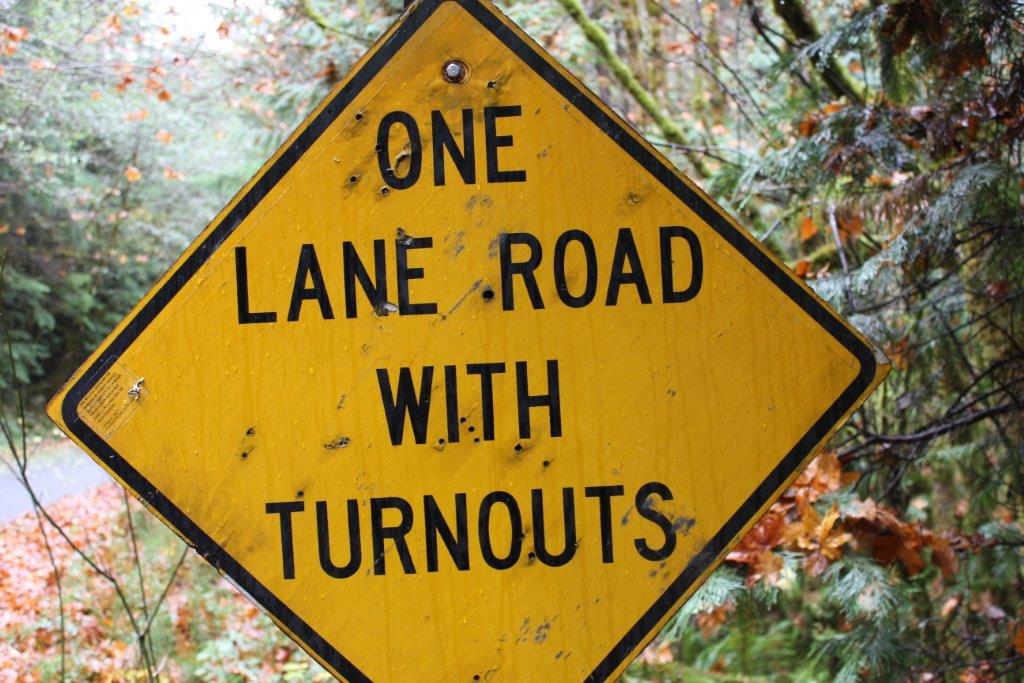
    I call it Kochie’s Hill.  It’s a one-lane, paved logging road in the middle of dense, lush, nearly rain forest of Western Oregon.  I don’t know the history of it, but I suspect it was built in the ’70s when lumber was the king of Oregon’s economy.

    “From the bottom to the top it’s 14.6 miles with an elevation difference of about 3,700 feet.  It’s all up.  Striding up.  There are a couple flats, and even a couple pretty substantial downs, but when you’re done you’ll only remember the up.”

    For a couple years in the mid ’80s, Bill Koch lived in Eugene where I went to school and later graduated as an Oregon Duck.  When the World Cup season would come to an end, we would both fly to Eugene where he would get back to family and I would get back to school.

    Though I studied there from April to August and he lived just across town, we only trained together a couple times.  That might have been a good thing because every time we trained together he left me wrecked – a shell of myself.

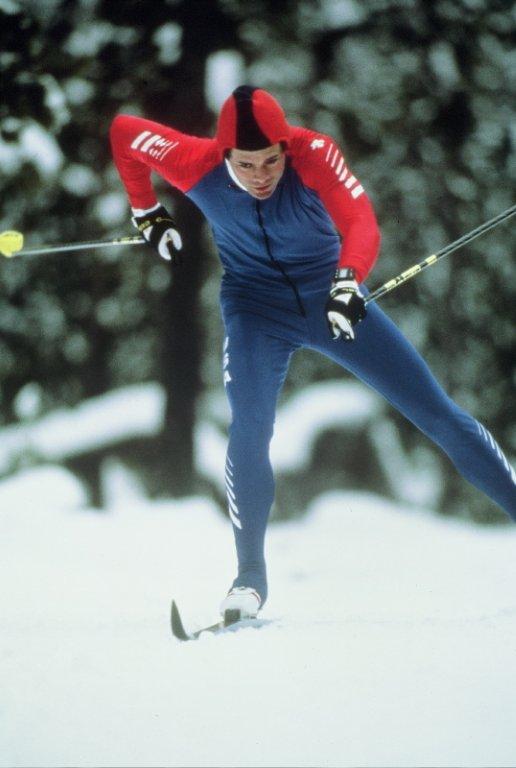
    U.S. cross-country skiing great Bill Koch, who pioneered the skating/freestyle technique in the 80s. (Photo: Peter Ashley)
    U.S. cross-country skiing great Bill Koch, who found a favorite hill climb in Oregon by plane. (Photo: Peter Ashley)

    When he arrived in Eugene, I was anxious to show Bill my roller ski hills.

    I say hills because my workouts were defined by the hills.  Having been in Eugene for a few years I had the West Hills scouted.  I knew the best hills, the long hills, the great intervals.  I wanted to show him Gimple Hill, Baily Hill, Dillard Road, Briggs Hill, and a host of other roads that made me the skier I was.

    But when we finally found a way to get together for a roller ski, Kochie had his hill in mind.  He found it with a plane.  I could have scoured the hills and roads of Oregon for years and there was no chance I would have ever found this road.  To make a long story short, we went, he conquered, I crawled home.

    Today, Kochie’s Hill lives on.  From all evidence it sees little logging or traffic of any kind.  It’s single lane road that at times is more of a bike path as moss, grass and trees are absorbing it back into the forest.

    According to Map My Run, from the bottom to the top it’s 14.6 miles with an elevation difference of about 3,700 feet.  It’s all up.  Striding up.  There are a couple flats, and even a couple pretty substantial downs, but when you’re done you’ll only remember the up.   Total climb is 4,645 ft.  You read that right. 4,645 ft of vertical in 14.6 miles.

    The road has switchbacks, some chip seal for the first few k’s, plus plenty of places where nature is taking back its turf.  But mostly it’s a great classic striding workout where you don’t need high visibility clothes, where you’ll stride for hours, and where the snow on top is a symbolic end to the dryland season.

    Kochie’s hill is 90 minutes from MBSEF and it’s become a special place.  A place we go when we need a change, when we need to escape the dog days of August, when we want to confirm that we’re fit enough for winter, and when we want to absorb some of the greatness of the best skier of the prior generation.  Unfortunately, it’s also a place where the old coach starts telling old stories.

  • Assistant Nordic Coach Opening at Mt. Bachelor SEF

    Assistant Nordic Coach Opening at Mt. Bachelor SEF

    MBSEF logo

    The Mt. Bachelor Sports Education Foundation is seeking an Assistant Nordic Coach to lead, motivate, educate and provide direction to athletes/ members of the MBSEF Nordic program and assist the Nordic Director in all facets of the Nordic Program, including Collegiate Programs, Masters Programs, U18/U16 racing programs, Middle School, Youth, and Biathlon.

    Job Qualifications:  Practical knowledge of current cross-country techniques and training methods.  Assistant coach must have proficiency with wax selection and application, an aptitude for equipment repair and selection, and a working knowledge of video equipment.  In addition to coaching duties, the assistant coach will be expected to perform various office duties which requires some basic computer skills, good communication skills and some office work experience.

    Primary Responsibilities

    • Contribute to a positive and motivating environment to foster a lifelong love for the sport of cross country skiing
    • Works to support the vision, mission and philosophy of MBSEF
    • Assists head coach with Full-time, Winter Term and Middle School program athletes including collegiate athletes
    • Travel with selected MBSEF teams
    • Help design schedules and training programs
    • Instruct Master skiers in MBSEF program
    • Assist Director with organization and execution of MBSEF citizen races
    • Supports staff and racers at local races
    • Attend various staff/program meetings

    Secondary Responsibilities

    • Assist with some MBSEF fundraising events
    • Help to maintain the integrity of the MBSEF Nordic as well as all other programs and activities of MBSEF.

    Reporting Responsibilities

    • Reports to Nordic Program Director for all matters relating to the Nordic Program

    Additional Opportunities

    • Position is slated from October 1 through March 31 additional opportunities with MBSEF may be available to the right candidate.

    Salary:  DOE

    Applications:  Send resume to dan@MBSEF.org


  • MBSEF: Fire and Ice Summer On-Snow XC Ski Camp

    MBSEF: Fire and Ice Summer On-Snow XC Ski Camp

    Fire and Ice, the latest cross country ski camp on groomed trails in the US will take place from June 16 to 20 on the trails of Mt. Bachelor. Run by the Mt. Bachelor Sports Education Foundation Fire and Ice is the only camp in the US offering the opportunity for skiers to ski on World Class trails with impeccable grooming that late in the year.

    “Skiers around the world are looking for high quality on-snow skiing opportunities in June,” said Lars Flora, two-time Olympian and Head Coach of  MBSEF’s Fire and Ice. “But unless you’re on the trails of Mt. Bachelor, there isn’t a better place in the world with deep snow, on real ski trails, with high quality grooming at a reasonable altitude.”

    According to Dan Simoneau, MBSEF Nordic Program Director who organizes the camp, “Fire and Ice is the latest evolution of camps that have been on the trails and slopes of Mt. Bachelor for over 30 year.  In the weeks and days leading up to Fire and Ice, the US and Canadian National teams and some of the best clubs in the US will be using the same trails. If these trails are the best training for Canada’s new World Champions Alex Harvey and Devon Kershaw and US World Cup star Kikkan Randall, then this is clearly great skiing.”

    “When Lars joined the staff of Fire and Ice a year ago, I fully expected to function as head coach, but once we got on snow, it was obvious Lars would function as head coach because he just had so much to offer the skiers,” said Simoneau. “He’s been skiing these trails from November till June since he was a kid and when he got in front of skiers he just wanted to share all that he has learned.  Lars is a natural and gifted coach that we’re all lucky to be able to work with.”

    New to Fire and Ice is the American Summer Cross Country Championships a sprint relay held on the last day of camp.

    “After a few days of skiing the campers just want to go fast so we added fun race with a fun Championship format this year,” said Simoneau. “We just don’t know if this is the last race of last year, or the first race of the coming year.”

    The 2011 Fire and Ice Summer Cross Country Ski Camp will feature:

    • 15 kilometers of groomed skiing on the trails of Mt. Bachelor.
    • Five on-snow training sessions (2 Classic and 3 Skating)
    • Five dryland training sessions
    • Daily video technique analysis
    • Whitewater raft trip on the Deschutes River
    • Camp t-shirt
    • The American Summer Cross Country Skiing Championships
    • A BBQ with beach volleyball, awards, and prizes.

    Fire and Ice, Bend Camp 2010 will have the following options:

    • 3 day on snow only camp for skiers 8-11 for $325.
    • 5 day Junior Camp for skiers 12-18 for $325.
    • 5 day Masters Camp for $325.

    For more information Fire and Ice 2011 contact Dan Simoneau at dansimoneau@bendcable.com or 541-350-9126.  Registration forms for the Fire and Ice camp are available at  www.mbsef.org/programs/crosscountry/ or visit BendCamp on Facebook.


    MBSEF: 563 SW 13th, Suite 201 – Bend, OR 97701. Tel: 541-388-0002 – www.mbsef.org

  • Greene and Howe Win The 34th U.S. Bank Pole, Pedal, and Paddle

    Greene and Howe Win The 34th U.S. Bank Pole, Pedal, and Paddle

    On May 15, competitors stood at the start line of the The 34th U.S. Bank Pole, Pedal, and Paddle in Bend, Oregon. After a cold and wet spring, the weather cooperated with 76 degrees and an overcast sky.

    The race started at Mt. Bachelor, with a moderate Grand Slalom alpine run, followed by a five mile cross country skate race, a 23 mile road ride down into the town of Bend, OR, a 5 mile trail run by the river, a mile and a half paddle, and finished with a half mile sprint.

    The MBSEF fundraiser event brought in 985 entries with 3,005 racers competing as teams, pairs and individuals. According to Race Director, Molly Kelley, 50 per cent of participants come from out of town.

    “It was the largest we’d ever seen,” Molly Kelley, Race Director, who, before she was involved with the race, used to leave town because it would fill with people coming in to compete and to watch.

    This year’s winner, and five-time champion, was Marshall Greene. He found it to be exciting but also a relief because he worried about XC Oregon teammate, Andrew Boone. “I was racing scared,” Greene admitted.

    Greene accidentally flipped his boat while getting in at the paddle transition, something that could have cost him the race. “It was time for a snap decision,” he said. “Take it back to shore to dump or race with a bit of extra weight.”

    He decided to race with the extra weight and won.

    His favourite part though, was the support of spectators, “Having won before, lots of people have learned my name and having them all cheer for me by name was pretty awesome.”

    Boone switched up his training this past winter, from base miles on the bike to skiing and racing as an associate for XC Oregon. “I was amazed at how quickly I was able to train at a high level on the bike [after finishing the ski season].”

    Boone expected to make a move in the cycling leg – his primary sport – but had flat legs after the ski and couldn’t get his heart rate up. He ended up second, three seconds behind Greene. However, it didn’t keep him from enjoying the experience. “I love the crowds and the enthusiasm the whole town of Bend has during the event. It seems like everyone in town all of a sudden has a kayak on the roof of their car.”

    On the women’s side, Stephanie Howe was the overall winner of the elite women.

    “My goal this year was to podium – I had no idea I was going to win. It didn’t actually hit me that I could win until I was finishing the kayak leg of the race.”

    She was fourth going into the running leg, three minutes behind eventual second place, Sarah Max. “I was hammering pretty hard but it felt good. The run to the finish was awesome – I was smiling the whole time.”

    Max had issues of her own, tipping her boat twice during the paddle leg. “Going around the first buoy, the wind, my exhaustion and the pressure got the best of me and I went over… I almost caught Stephanie going into the second buoy but tipped again.”

    When asked whether they’ll race again next year, the competitors were of mixed feelings.

    “Going into the race, I had made up my mind to not race as an individual next year because it really does consume a lot of time,” said Max, “[but] I’m not sure how I feel about being the reigning champion of the Pole, Pedal, Paddle, Swim, Paddle, Swim, Paddle.”

    Boone, who raced the PPP as a kid, plans to make it an annual tradition as long as he continues to live “in this great town.”

    XC Oregon's Brayton Osgood, Marshall Greene and Andrew Boone.