Tag: medals

  • After son’s fourth straight gold in Italy, Klæbo’s father says “we’re just having fun”

    After son’s fourth straight gold in Italy, Klæbo’s father says “we’re just having fun”

    This article was made possible through the generous support of our voluntary subscribers who have helped put our Nat Herz on the ground at the Olympics. If you value coverage like this, please support FasterSkier with a voluntary subscription.
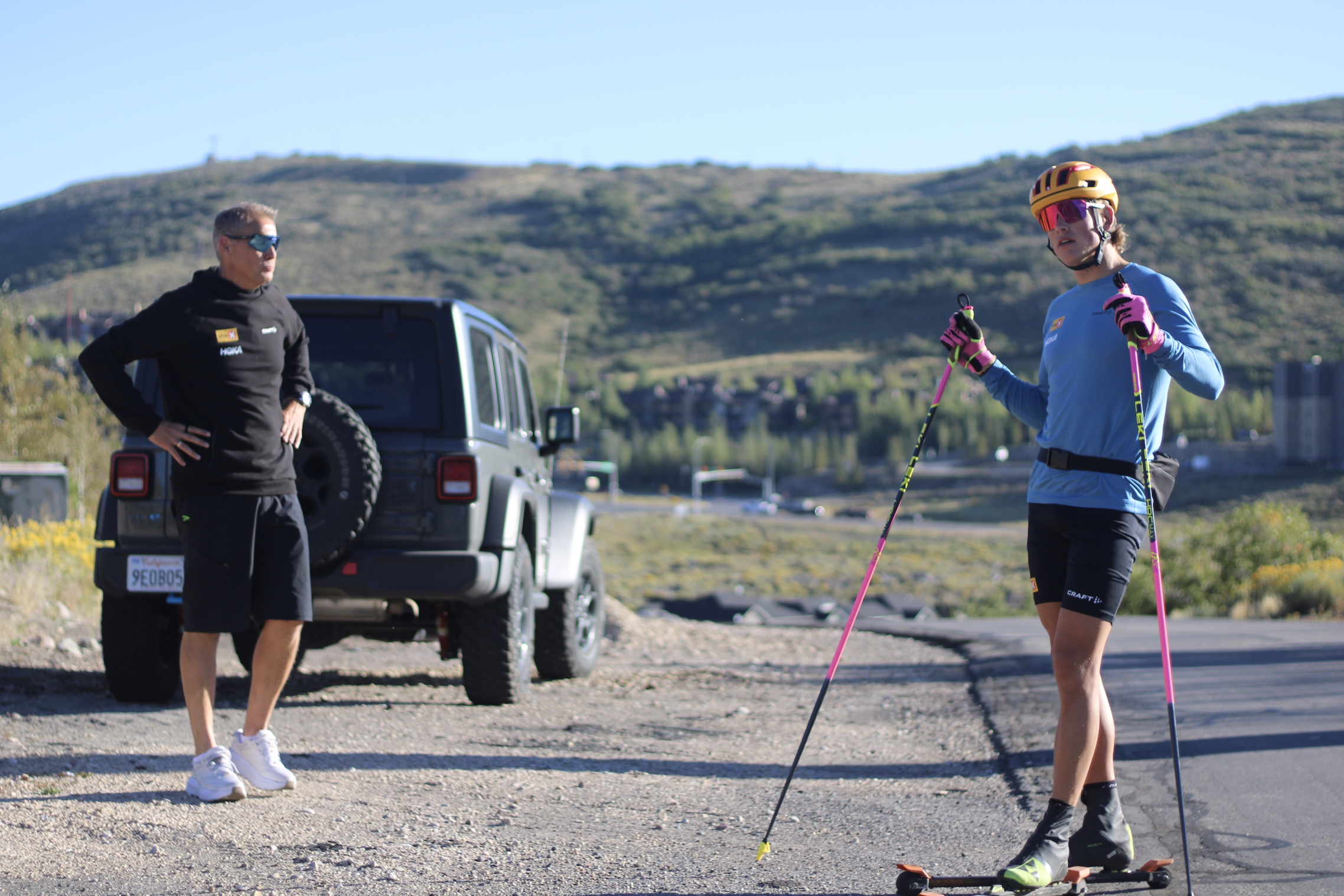
    Johannes Klæbo stands with his father, Haakon, during a water break on a rollerski workout in Utah in 2023. (Nathaniel Herz/FasterSkier)

    PREDAZZO, ITALY — Johannes Høsflot Klæbo is four for four — and officially the most golden Winter Olympian in history.

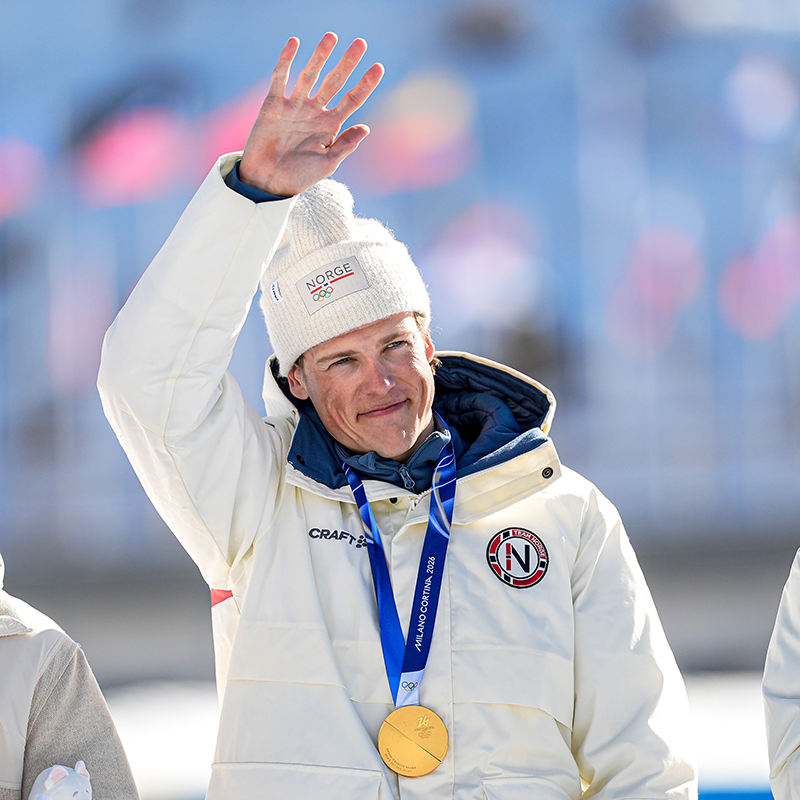
    By anchoring Norway’s relay team to first place Sunday, Klæbo claimed his ninth Winter Olympic gold — moving him out of a tie, with two other Norwegian cross-country skiers and a Norwegian biathlete, for the most ever.

    At a news conference afterward, Klæbo said he’d been drained by the effort it took to win Friday’s 10-kilometer individual start skate race — the first time he’d ever won an event in that discipline.

    The next day, he said, “the only thing I did was lay in the bed and play on my PlayStation.” But by the time he woke up Sunday morning and checked his heart rate, he said, “it looked pretty good.”

    [Read more: That guy rollerskiing around Utah by himself: Yeah, it’s 5-time Olympic champ Johannes Klæbo]

    After Sunday’s relay win over France and Italy, Klæbo is now poised to win the last two cross-country events at the Games, both of which — a team sprint, and a 50-kilometer mass start race in the classical technique — favor him.

    At the news conference, he said he’s still taking it one day at a time. “We’ll see where we end up at the end,” he said. “But it feels, so far, so good.”

    In search of some more revealing answers, we went looking for Klæbo’s father.

    Haakon Klæbo, for the past week, has been a ubiquitous presence at the Olympic cross-country ski venue, watching races with the masses alongside the race trails with friends and family. We found him walking alone behind the stadium — where he was happy to answer a few questions before others broke in.

    Nathaniel Herz: Are the Olympics a platform where Johannes is starting to go from a Norwegian to a global star, with these viral videos of him running up the last hill in the sprint race?

    Haakon Klæbo: Yeah, it looks like at least it is. It is a huge interest in him. Olympics is really big in the U.S. But I also think that more U.S. citizens are learning how much time he spent there. He’s linked with (Utah physiotherapist) Megan (Stowe). She is really the one that has made his strength program, which is — it’s not that it’s secret, but if you look into it, he’s doing a lot of core strength. This is a program that he also follows at home (in Norway).

    NH: How nervous were you for the 10-kilometer skate race two days ago?

    HK: I was really nervous for the 10 k, and I knew that it was his weak point, or Achilles, in a way. We have to remember that he has never won a 10 k skate before, never — and this is in his whole career. I think that he has been in good enough shape, but this has been something in his head — and something that if you do not accomplish, it starts to become even more problematic.

    Devon Kershaw, a retired Canadian World Championships gold medalist in cross-country skiing, who’s working as an expert TV commentator at the Olympics, walks up: Congratulations.

    Herz, to Klæbo: You know this guy?

    HK: No.

    NH: This is Devon Kershaw.

    DK. Congratulations, it’s been quite the show.

    HK: Oh! Yeah — it is a little unbelievable, because you don’t expect it. And we had these crazy days in (the World Championships in) Trondheim last year, in which were hoping for like two or three (medals). (Klæbo won gold in all six events.)

    And now, with four.

    NH: Do you think going through this whole Trondheim experience last year is making this a lot easier for him now?

    HK: Yeah. He had been training for that since he heard Trondheim would host the World Championships, and he has been the front figure. They used him (in their marketing materials), saying, ‘Born and raised.’ He’s standing there, like 18 years old — he had one pair of Leki ski poles at that time. He was wearing a suit that he had borrowed from a friend that was on the team. He was like, ‘This is my dream.’ And then he managed to do it. So, I think he was really stressed for it.

    This season, it has just been fun. We’ve been together with (teammate and friend) Emil (Iversen). Me and him and Emil have been traveling around  — it’s like being there with two boys playing around. So, I think he’s really much more relaxed. And you can see, also — I think he is even stronger, here, if you look at his sprint.

    [Podcast: Johannes Høsflot Klæbo has a lot to say. We listened.]

    DK: I agree with you, 100%. Everyone made such a big deal of it, but winning the individual start skate. That’s the biggest thing to me, as a fan and a person that raced his whole life. I’m getting goosebumps thinking about what I saw two days ago. When you win that, then you’re really the king.

    HK: And I said to Nathaniel that I think that he has been strong enough to do it for years. But it has been something up here (points to his head). He’s never won it.

    NH: Do you think that’s his best accomplishment ever?

    HK: Yeah, I think it is. And he was really tired after — he has been working really, really hard. I was afraid for this relay today — that he wouldn’t be able to run, because I think he put so much into the 10k. So much energy spent.

    Johannes Høsflot Klæbo celebrates one of his four Olympic gold medals in Italy. (Davide Barbieri/NordicFocus)

    NH: Was he at a disadvantage being first, in this individual time-trial style race, of all these Norwegian guys? That meant that he wouldn’t get as much information on the course from his coaches about how his times compared to the others.

    HK: Actually, his best races from skate individual start are when he is just doing his own thing — just making his own pace, and doing what he’s good at. You could see that for the others, it was a disadvantage. I think, for (rival-teammate) Einar (Hedegart), it was trying to push on Johannes’ time (that was the problem). If you look at the two of them, racing, they’re pretty similar in taking it a little slow in the first two kilometers. Then starting to get faster and faster and faster, and having a crazy second half. 

    I think that that was what made Einar lose the silver. He pushed too hard — and he got burned and he lost 20 seconds in the last 1,000 meters.

    NH : Will you be very stressed about the 50 kilometer race, the last event? Or do you feel like, once you get to the 50 k, so much has already been done that you can relax a little.

    HK: The 10 k was what I was really afraid of. And now, I don’t know — we’re just here here enjoying and having fun. And then, everything can happen. And even if he is getting sick tomorrow, we’ve had four gold medals, and you’re the best Winter Olympian — and still, you can race for another Olympics. I think if you ask him, his dream Olympics would be to do a 50 k in Soldier Hollow (in Utah) — which is his home.

    A middle aged fan carrying a Finland flag breaks in, screaming: “Klæbo! Klæbo! Number one!” The fan demands a photo, then ushers Klæbo away.


    Help Support Our Olympic Coverage!

    FasterSkier will have our own Nat Herz on the ground at the Olympics, which, to be honest, is a very big financial lift for us. If you value the thoughtful work and access FasterSkier provides at championships like this one, please consider becoming a Voluntary Subscriber. Your support directly fuels the work we do to cover the people, places, and moments that make our sport special.

    Join the FasterSkier community!
  • A Data Driven  Search for What Matters in Skiing: An Interview with Gus Kaeding

    A Data Driven Search for What Matters in Skiing: An Interview with Gus Kaeding

    How many medals will the U.S. Ski Team win in the future? What, really, is perfect ski technique? Gus Kaeding — the one man team behind the US Ski Team’s analytics department — aims to provide data-driven answers to these questions. From his office in the Center of Excellence in Park City, Utah, he delves into the data that may help illuminate a path to success for both individual athletes and the greater cross country ski collective in the U.S. 

    The man behind U.S. Ski and Snowboard data analytics, Gus Kaeding. (Photo: Sarah Brunson/U.S. Ski & Snowboard)

    Kaeding, whose background as both a nordic ski athlete and coach led him to his current role with U.S. Ski and Snowboard, discussed his current and future projects with FasterSkier over the summer. Talking with him, it became clear that many assumptions about the sport remain unproven, and in his perspective, “we actually understand very little of what happens in between the start gun and the finish tape.” 

    Through data analysis and some exciting new technologies, Kaeding has a plan to gain a deeper understanding of the fundamentals of ski performance. This interview has been edited for clarity and length.

    FasterSkier: I’ve read a little bit about what you’re up to with the analytics department, but I’m not totally up to speed. 

    Gus Kaeding: Yeah, I don’t think anyone really is.

    FS: What sort of projects are you working on?

    GK: If you watched the Bend camp, a number of coaches and athletes are now using Archinisis bibs. They basically look like a sports bra with a GPS unit in the back. I tested these last winter, and you’ll see a lot of the Scandinavian countries using them or something similar.

    The Archinisis bibs can not only give you the GPS [data], but they can also tell you what technique you’re using. If you’re skating, it tells you your time in V1 versus V2, versus V2 alternate—to a pretty good percent of accuracy. The coolest thing is you can compare [the metrics] to each other, and also to yourself, meaning if you set a rollerski loop, and do it multiple times, you’re able to see an overlay of previous performances and where you’re gaining or losing time, and it’s really visualized nicely. You can do the same with multiple athletes, and then compare athletes and say: “you were three seconds slower than another athlete over the top of this hill. And as a result, you were five seconds slower at the bottom of the hill,” which are insights that we didn’t really have a lens into before. 

    Italian biathlite Lisa Vittozzi trains with a Archinisis bib. (Photo: Instagram @archinisis)

    That’s still in the test mode—we’ve got six of them. We had the option of rolling it out to the whole team and taking a big financial risk, but we chose to start small, and see where there’s value. Part of the risk when you roll out something like that is: who’s managing the project? Do they have the bandwidth to do it?

    Someone like Jason Cork is super excited about things like that, and then if it ends up adding value, we’ll probably roll it out further next year, to a larger squad, and have a few bibs we can rotate through. 

    We may also have a few set courses around the country, so that when people come in, they can say, “I want to do a time trial against previous performances”, and afterward they can really look granularly where they’ve had success or need to improve a bit. 


    FS: What other ideas are you working on?

    GK: The second one that I’m really excited about but didn’t get funded this year, is a ski treadmill at the Center of Excellence here in Park City. The problem is, the cross country team does not come here very often. One of the weaknesses, frankly, as a team is just general technique compared to the other nations—I don’t think that’s a secret. So we’ve been looking for a way to improve that for a few years now. 

    What we proposed was installing a 3D motion capture system around our ski treadmill, to get a better quantitative idea of what is good technique. What are the markers we should be looking for? And what are the markers we should be ignoring? That project did not get funded, but it got positive reviews. So I think in the future, there is hopefully a good chance [of getting it]. 

    The idea would be to have the athletes come in once a year and do a movement assessment while on roller skis. From that, we would be able to break down multiple speeds, techniques, and inclines. Then we would look at where our techniques are similar across our athletes and where they are dissimilar. Where do we think they’re improving and where do they need some work? 

    Scenes from the 2021 Park City Training camp: from left to right, Kevin Bolger, JC Schoonmaker, and Simon Zink during a rollerski intensity session. (Photo: Simi Hamilton / Instagram @isaschoon)

    I would build into that proposal getting someone who’s really got some stronger chops as a biomechanist. A lot of other countries have multiple people on staff who have PhDs in skate technique, so it’s like, “Yeah, no kidding, they have better technique”.  So we need to do a little bit better job there. This is a project that has yet to come to fruition, but I think is going to be promising in the next 12 months.


    FS: I believe Sweden’s been a leader in adopting 3D motion capture technology.  

    GK: Sweden with HD [Hans Christer Holmberg] and Norway with Oyvend [Sandbaak], do a lot of research in this area. Fortunately for us, they make a lot of it public, so we don’t have to start from scratch. We can play catch up for a little while until we feel like we’re in a place where we’re able to start to innovate ahead of the other countries. We’re still a few years from that, for sure.


    FS: Tell me about your research into sleep?

    GK: We’ve been looking for ways to quantify recovery and sleep. Finally, a couple of years ago, we decided to take the Oura ring as our primary recovery tool. So that’s been a project for the past two years.

    We could look back at athletes who had Covid and their Oura data previous to that. Fortunately, we didn’t have a large sample set of people. Were the results conclusive on anything? No, probably not, but I will say the main similarity between everyone was that three days prior to showing Covid symptoms, their [sleep] temperatures just went bonkers. Whether high or low, it was all over the place. The deviation from the standard variation was nuts. So I think, for anyone out there that has a Whoop or an Oura, anytime your temperature goes one way or the other, watch out.

    The latest version of the Oura Ring sleep and recovery tracker. (Photo: ouraring.com)

    FS: What is the main goal of collecting this sleep data?

    GK: It gives you some indication of how stressed out you are. It’s helped us add another lens to evaluate athlete load and upcoming performance.


    FS: What are the challenges to gathering the kind of data you would like to work with?

    GK: One of the major problems is, when the coaches are at races, they are busy—really busy, and you really can’t ask them to do anything more. You know, “go collect this data, collect that data”. And if you do, it better be able to return immediate, impactful results.

    I think if we’re looking at the model that works in other sports, like soccer and basketball, you really need to have someone traveling with each team who’s just in charge of collecting and analyzing data. We’re just not at that point, as a sport, or as a program yet. Certainly one of the aims, probably in the next quadrennial, is putting a research/data person with each team: cross country, alpine, snowboard, just to gather data, analyze, and then innovate. That is in our long term planning. Until then, we are just not going to be able to even collect the data necessary to do any type of really interesting analysis. Because it does take having someone there, and that being their sole priority.


    FS: That makes sense. It brings me to my other question of what sort of data do you wish you could gather? 

    GK: We do a lot of video analysis, but we don’t do a great job of storing that video. To me, it would be really helpful to have a video library of Jessie Diggins’ V1 technique through the years, to overlay year after year, and look where improvements have been made and then look at results on sections of trails. Have these V1 technique changes correlated to actual faster split times on V1 sections? 

    FS: Are you able to get enough video from World Cup races to effectively analyze those questions? 

    GK: We use the video for, say, qualitative analysis. I think the future is in computer vision and pose estimation [technologies] that would be able to look at technique just from the FIS feeds available now. They’re just starting to hit the sport level, in terms of price and scale. Those are technologies we’ve all got our eye on, and a lot of other sports do too. The NBA has started to dabble in it, but [the cost] is in the millions of dollars and the math is also hugely complicated. That’s the future, but it’s still a ways off for us.


    FS: How do you envision data helping the program as a whole?

    GK: We know, essentially, what results athletes need to get at each level. But we don’t do a good enough job of helping athletes figure out what is important to get those results. 

    The big goal of this next year, for every sport, is going to be to formulate a list with the coaches on what are really the most important factors to creating a good skier, and then figuring out ways to measure each of those. 

    Is it fitness? Is it power in the gym? Is it technique? Is it sports psychology? There’s so much on tap there. We need to do a little bit better job of delineating how important each is, and then being able to help the community and lead them a bit, showing what’s important at what age.

    I think we do a pretty good job of that, but it would be nice to say: if you want to be one of the best skiers in the world, you should be achieving these results and here’s how to do it. We haven’t quite gotten there yet. 

    Scenes from the 2021 Park City Training camp: Jessie Diggins strides it out. (Photo: Simi Hamilton / Instagram @jessiediggins)

    FS: That seems like a large project. 

    GK: Yeah. The goal over time would be to have all of [the categories] with objective measures. That’s another area ahead of us: innovative ways of measuring all those elements of a skier’s development and what the opportunities are to get better.

    One of the things we’re working on is a sensor project that allows you to look at all these different metrics that we haven’t really gotten before, in order to understand what goes into an alpine turn. The technology is 100% applicable to cross country skiing as well, and now we can understand a bit more of what goes into the push phase. 

    Whether it’s cross country, or alpine, we actually understand very little of what happens in between the start gun and the finish tape besides time, pace, and heart rate. So it’ll be good to start to understand that with some more physical markers. So that’s where we’re at. The whole thing comes back to what matters. 


    FS: You mentioned that you can predict, to some degree of accuracy, future medals for the US Ski Team. How do you quantify that?

    GK: We can break it down to: “we need this many athletes, at this level, to expect a medal in five years”, which is cool. I did a pretty quick analysis the other day — it was kind of back of the napkin math, but I figured out that with the implementation of the bigger development team that we started in 2018, and by really putting more of an emphasis there, we can expect another medal. [This is] simply from that team being established, and the level that it’s brought not only those junior skiers, but the rest of the skiers around them.

    Once you start to get into expected medals, and expected performances, then you can do a better job of evaluating how well you’ve done as a staff, as a coach, and as an athlete. That’s something we’re a little bit lacking right now. Not that all those [calculations] are going to be correct, but you can continue to improve those over time. So far, they’ve played out pretty well.

    The U20 World Juniors 4 x 5 k relay first place team from the U.S, (l-r) Luke Jager, Ben Ogden, Johnny Hagenbuch, and Gus Schumacher. (Photo: JWSC2019 / Mikaela Takala)

    FS: You have a few interns this summer that are nordic athletes, what are they working on?

    GK: One of our interns is Annabel Hagen, who is currently at Harvard on the cross country ski team. She is working on a project that is near and dear to my heart. She is looking at a spike in USSA membership in 2012, and how it correlated to 2015/2016. Are we seeing a greater influx on the national team if we had 30% more participation at the 13 year old level in 2012? We break that down by numbers, but also by region, by state, and by club. We’re really looking at doing a better job with our demographics, and looking at where our athletes are coming from. 

    There’s also Jackie Garso, who’s a training biathlete right now and is a recent graduate from St. Lawrence College. She’s working primarily with our women’s alpine team, looking at our force plate data. Another is current US Ski Team athlete Sophia Laukli. She’s at Middlebury College and is a math major like myself. She’s been looking at alpine skiing when you start a World Cup at the back. She’s trying to figure out when it is beneficial [for an athlete] to go down a level into the Europa cup, and try to score their best points in order to get back to the World Cup with a better start spot. 


    FS: Gus, thanks for speaking with FasterSkier. Is there anything you’d like to add?

    GK: We have a really smart community and a really innovative community, so if there are people out there who want to help or are interested in one subject or another, I am definitely willing to utilize their expertise.


    If you’re interested in getting involved with the analytics department at the US Ski Team, you can reach Gus Kaeding by email at:  gus.kaeding@usskiandsnowboard.org

  • Sochi Unveils Olympic Medals – Soon To Come to North America?

    Sochi Unveils Olympic Medals – Soon To Come to North America?

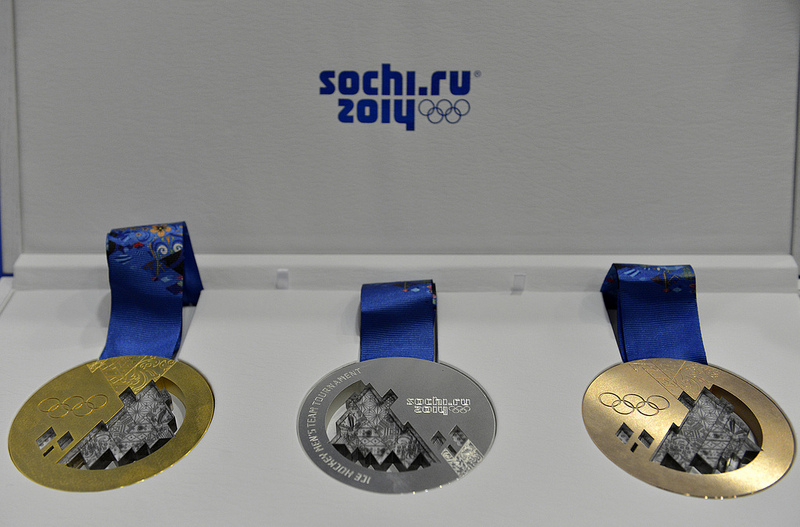
    The medals which will be handed out at Sochi were unveiled for the first time on Thursday. IOC photo.
    The medals to be handed out at Sochi were unveiled for the first time on Thursday. (IOC photo.)

    In Saint Petersburg, Russia, on Thursday, the Sochi Organizing Committee unveiled the medals that will grace the winner’s necks at the upcoming 2014 Olympics. Reactions have been mixed, but the FasterSkier staff generally conclude that they are beautiful.

    We also can’t help but take the opportunity to predict who might take home some of the hardware come February. Anything can happen over the next seven months before the Games kick off, and we don’t want to get too ahead of ourselves, but it’s not inconceivable that a few medals could be coming back to the U.S. and Canada from the nordic disciplines next winter.

    And what medals they are: the large, circular design plays with positive and negative space, with a cutout section featuring a polycarbonate “patchwork” of designs from different regions and cultures of Russia. The gold, silver, and bronze portions themselves were described as tributes to the Sochi landscape of mountains and sunlight, and the coast of the Black Sea.

    (The goodwill and excitement from the unveiling ceremony was marred somewhat by an announcement from Boris Nemtsov, a former deputy prime minister who is now an opposition figure and critic of the Kremlin. He estimated that as much as $30 billion of cost overruns for the Olympics could be due to corruption and urged Russian ministries to investigate fully, according to the Associated Press.)

    So how many of these gorgeous creations are likely to come back to North America when all is said and done? Before we break it down by event, let’s reflect back on four years ago. In Vancouver, women’s ski jumping was not on the schedule, the U.S. women’s cross country team wasn’t as deep, Kikkan Randall hadn’t yet won a crystal globe, the U.S. men’s nordic combined team had never won an Olympic medal, Jean Philippe Le Guellec hadn’t became the first Canadian man to win a biathlon World Cup and Tim Burke hadn’t became the first American to stand on the World Championships podium in decades. It’s been said many times already, but we’ll say it again: we’ve come a long way.

    Let’s cut to the chase: by our calculations, it wouldn’t be at all surprising if four medals came back to North America. If everything went perfectly? North America could be seeing as many as eleven of those beauties flying back across the Atlantic to inspire many more generations of nordic enthusiasts. To understand how this might happen, let’s look at each event.

    Opening Weekend

    After Opening Ceremonies on Friday, February 7, the first weekend will be an exciting kickoff for nordic sports: there are two days of ski racing, with the 15 k and 30 k skiathlons, and two of biathlon, with the 10 and 7.5 k sprints. Those take place at the Laura venue, but over at RusSki Gorki men’s normal hill jumping will also be contested. Likelihood of North American medals there: zilch.

    Jean Phillipe Le Guellec: sprint champion? He was this past season in Ostersund.
    Jean Phillipe Le Guellec: sprint champion? He was this past season in Ostersund.

    In the skiathlons, there’s potential. They certainly aren’t the events where Americans or Canadians are considered favorites, yet there are definite possibilities. The Canadian men probably have the best shot of taking home a medal. Devon Kershaw, Alex Harvey, Ivan Babikov, or Lenny Valjas could conceivably all be in the mix late in the race, and Kershaw, Harvey, and Valjas have all demonstrated strong finishing kicks at the end of long races when it counts. The U.S. women are slightly less likely to score, but Liz Stephen or any of her teammates have an outside shot.

    On the biathlon side of things, Canada’s Jean Phillipe Le Guellec or Americans Tim Burke or Lowell Bailey could all conceivably be in the mix. Le Guellec was sixth in this event in Vancouver, and took home his first World Cup win in the discipline this season. Burke had a podium near-miss this season in the sprint as well, although it doesn’t seem to be his best discipline.

    Medal haul: 0-1.

    Week One, Early

    For most sports, back to back medals events on the opening weekend means a break is in the schedule. For biathlon, that’s not true. On Monday and Tuesday the racers head straight into the 12.5 and 10 k pursuit races, based on the time gaps from the sprint results. Here, again, the three North American men have a shot, and all have proved that they have the ability to gain ground in the pursuit. In fact, Bailey and Le Guellec were two of the biggest movers in this season’s Nove Mesto championship pursuit. Even if they struggle in the sprint, the trio could easily hit the top ten or fifteen; with a good sprint, anything is possible.

    Sarah Hendrickson hopes to continue her run.
    Sarah Hendrickson hopes to continue her run.

    But the biggest day for North American nordic sports at the Games might easily come on Tuesday, which will feature not only the women’s biathlon pursuit but both the men’s and women’s cross country sprints and the women’s normal hill for ski jumping. Based on Sarah Hendrickson’s domination of the women’s ski jumping scene this winter, and the fact that plenty of other U.S. ladies have had success as well, such as former World Champ Lindsey Van, a medal seems inevitable – hopefully, a gold one, as women’s ski jumping finally wins its long-fought battle to make it onto the Olympic program.

    In the cross country sprints, fireworks are most likely to come from the women, too. The sprints are skating, which is a perfect fit for defending two-time Sprint Cup champion Kikkan Randall of the U.S. Of course, sprinting is notoriously risky, as was seen at the 2011 World Championships in Oslo where Randall was expected to at least make the final but was tripped up in a collision with a Swedish racer.

    So it’s tough to make guarantees in this discipline. But Randall is a hands-down favorite for a medal, at this point even for a gold one. And, despite her off-season in 2012/13, Canada’s Chandra Crawford could be figured in the final as well, as could the several other North Americans who have appeared in World Cup finals and semifinals: Dasha Gaiazova and Perianne Jones of Canada, and Ida Sargent, Jessie Diggins, Sadie Bjornsen of the U.S. Anything can happen in sprinting, so all of these women could make the semifinals, or none of them could.

    Sprint Cup winner Randall will can have her cake and eat it too with a skate sprint on the Olympic schedule.
    Sprint Cup winner Randall can have her cake and eat it too with a skate sprint on the Olympic schedule.

    In the men’s sprints, look for Andy Newell in the final. After all, he qualified for the heats in every single sprint of the 2013 World Cup season, and enough finals to land him in fifth place in the Sprint Cup. But also look for the Canadian men. Although they were certainly less consistent in their sprinting prowess – none are specialists to Newell’s degree, and had other races to focus on – they have the chops, and Alex Harvey won the bronze medal at 2013 World Championships. He or teammates Kershaw or Valjas could also appear in the final or on the podium.

    Biathletes, skiers, and jumpers will have a break on Wednesday as the combiners take over with the normal hill competition. At this point it’s unclear whether the American heroes of the Vancouver Games have the mettle to pick up more medals; Billy Demong, for instance, is 33 years old and didn’t make the top ten in any World Cups this season. But he’s a canny competitor and did well in some relays. Instead, the mantle is more likely to be carried by Bryan and Taylor Fletcher. Bryan had the team’s lone individual podium this season and both had several just-missed-it performances. With the incredible peaking ability the combiners demonstrated in Vancouver, it’s possible one of them will earn a medal.

    Medal haul: 2-4.

    Week Two, Extended Weekend

    Tim Burke won silver at World Championships; can he get the U.S. its first Olympic medal? Photo: USBA/NordicFocus.
    Tim Burke won silver at World Championships; can he get the U.S. its first Olympic medal? Photo: USBA/NordicFocus.

    As the weekend gears up, both biathlon and skiing will feature individual races on Thursday and Friday. In biathlon, it’s probably North America’s best hope for a medal. Tim Burke won silver in the 20 k at this year’s World Championships, and also landed third in the discipline rankings. On the women’s side, Susan Dunklee placed fifth in the event at 2012 World Championships. She’s far from a medal bet at this point, but she, Burke, and Annelies Cook all had excellent performances at the World Cup tests events at the Laura venue. It could be an exciting weekend for U.S. biathlon, which is the only remaining winter Olympic sport where the U.S. has never won a medal.

    The 10/15 k classic individual races will be a bit dicier for the skiers. In general, interval-start is not where North America shines. It seems likely that there will be at least a few great performances – by no means a surprise to see North Americans hit the top ten. But a medal? It seems like a stretch, especially since the more all-around athletes may not even start.

    Then, the weekend itself. Saturday will feature the men’s normal hill jumping event, another throwaway for North American hopes. But it will also see the women’s 4 x 5 k cross country relay, where the American women have a real chance for a medal. They already have a World Cup podium, and finished fourth at World Championships. It will definitely be a focus for the team.

    Sunday brings the men’s 4 x 10 k relay, where the U.S. will likely be out of the picture but Canada is almost sure to be in the lead pack at some point in the race – for how long, who knows. The relay has not been a huge focus for the team in World Cup racing in the past few years, so it will be interesting to see how things come together.

    Finally, the men’s biathlon field will race 15 k in the mass start, arguably the most exciting race format. Because the field is limited to just 30 racers, it’s hard to know how many North Americans will even get to put on a bib. But based on the past two seasons, it seems fair to guess that Burke and Bailey will be out there working and, it seems, probably making an appearance at the front. Can the pull through all the way to the finish? Who knows.

    Medal haul: 0-2.

    Week Two

    The U.S. earned two medals in the Large Hill competition in Vancouver, from Johnny Spillane and Billy Demong.
    The U.S. earned two medals in the Large Hill competition in Vancouver, from Johnny Spillane and Billy Demong.

    At this point in the Olympics, recovery will become essential. Some skiers and biathletes will have already competed in four events. On Monday, the biathlon women will take to the mats for their own mass start. This season, Rosanna Crawford made a single mass start appearance for Canada, finishing 22nd, and no Americans made the cut. Medals here are unlikely, as they will be that night at the men’s large hill ski jumping competition.

    Tuesday and Thursday feature nordic combined, with the large hill and team large hill formats. There’s an outside chance of a medal in each. The United States took bronze in the event four-man event at 2013 World Championships, and silver back at the 2010 Olympics. Nothing is guaranteed, but they seem to have the capacity to do it again.

    In between the two days of nordic combined are more team events. Biathlon will have the mixed relay on Wendesday, where the U.S. is capable of a medal-caliber performance but has not delivered in any World Cup or World Championship races so far.

    Jessie Diggins and Kikkan Randall are defending World Champions.
    Jessie Diggins and Kikkan Randall are defending World Champions.

    Both the men’s and women’s team sprints are also on Wednesday, and for cross country skiers it could be a bonanza. The U.S. duo of Kikkan Randall and Jessie Diggins are defending World Champions; the Canadian pair of Devon Kershaw and Alex Harvey won the title in the edition before that. But each team is so strong in sprinting that it’s not even certain that those four individuals will be the ones to earn starts. To put it bluntly, it would be a shock if between the two of them, at least one set of medals didn’t head back across the Atlantic – and the possibility of double gold, though unlikely given the ups and downs of sprint racing, is what North American ski dreams are made of.

    The complementary teams, though – the U.S. men and the Canadian women – certainly can’t be counted out. Canada will have to pick a team from the trio of Chandra Crawford, Dasha Gaiazova, and Perianne Jones, and the ladies have had their podium moments on the World Cup as well as disappointments. They should at least make the final. The American team is expected to be Andy Newell and Simi Hamilton, who have likewise had a variety of results. They, too, ought to make the final, especially in the Olympic format where each country is allowed only one team, unlike on the World Cup.

    Medal haul: 2-3.

    Last Chance Weekend

    By the time the last weekend rolls around, jumping and combined will be finished. All that remain will be the most prestigious events for biathlon and skiing.

    On Friday, biathlon will begin its final rundown with the women’s relay. Unfortunately, neither the U.S. nor Canada have the depth to figure at the front of the race. Come Saturday, however, the U.S. men may have a fighting chance. They have had top-six relay finishes in the past and are often in podium position at the halfway point. Perhaps Olympic courage and the thrill of the moment will finally send them towards a medal, although the competition will never be fiercer.

    Alex Harvey and Ivan Babikov will have their last chances in the 50 k skate.
    Alex Harvey and Ivan Babikov will have their last chances in the 50 k skate.

    For skiing, the capstones will be the women’s 30 k skate on Saturday and the men’s 50 k skate on Sunday. The U.S. can pin its hopes on Liz Stephen, Noah Hoffman, and Kris Freeman. None are guarantees, but it’s possible – just possible – that they could land a bronze. None lack the guts, and the tough courses suit Stephen and Hoffman’s light builds and high pain thresholds well. Both young racers have been on an upward trajectory, but they would need everything to go perfectly.

    For Canada, as in several other races, it’s probably less a question of whether there will be a man at the front, but who. Ivan Babikov is strongest in skating and excels on the toughest of courses – and Laura is one tough venue. But Kershaw (if he gets over his 2013 slump) and Harvey could be in the mix too. It’s easy to forget, given the sprint World Championships medals Harvey has accumulated, that one of his first major appearances on the World Cup circuit was in the Holmenkollen 50 k. In Vancouver, Kershaw was fifth in the classic 50 k. Don’t count Canada out.

    Medal haul: 1 (we’re overcome with the Olympic spirit: optimism).

    Total haul: (0-1) + (2-4) + (0-2) + (2-3) + 1 = 4 to 11 medals


  • 2011 Masters World Cup – Epic Competition, Amazing Venue

    2011 Masters World Cup – Epic Competition, Amazing Venue

    With 329 Americans and 472 Canadians competing in the 2011 Masters World Cup in Silver Star, British Columbia, last week, the North American stories of medals, personal victories, and just-misses are countless. Let’s just leave it at this: The US athletes earned a total of 100 individual medals, while the Canadian racers snagged 78 medals. Additionally, 12 of the US relay teams medaled: four teams won their classes, four teams were second and four teams were third. North of the border, nine Canadian relay teams medaled, with four winning the bronze, four teams taking silver and one team taking gold in their age classes.

    (Article continues below the picture)

    US racer Barry Makarewicz (front) is about to get passed by fellow American Kent Murdoch in the final 500 meters of the 45K skate on March 10. That cost Makarewicz the gold medal. (Photo: Inge Scheve)

    Eva Carlsen of Norway beat Abott Icks of the USA to the silver medal in the 15K classic on March 11. But at least it wasn't the detour that cost Icks the silver. (Photo: Inge Scheve)

    Each medal a unique story

    “Please tell me that she was more than just a couple of minutes ahead of me,” said Abott Icks of the USA as she crossed the finish line for the bronze medal in the 15K classic on the final day of the championships.

    Icks’s mind was so focused on squeezing the last ounces of energy out of her muscles for the last lap, she missed a turn and estimated that she skied at least a minute off course before she realized the terrain no longer looked right and backtracked to the race course. When told that she finished about five minutes behind the silver, a smile spread on Icks’s face so wide that if her ears were not in the way it would have wrapped around her entire head.

    “At least it wasn’t the detour that cost me the silver,” she said.

    World Masters as Norwegian Birkie Prep

    While the majority of the athletes who participated in the World Masters this year live on this side of the Atlantic, a number of racers from other parts of the world also made the trip to Vernon and Silver Star, with Russia being the biggest non-American contingent with. Norway usually fields a large team to the World Masters, but this year only 16 racers competed. However, the small group helped themselves to no less than 18 medals, which is on average more than one per racer.

    Gunnar Tronsmoen from Norway is one of them. The 82-year-old veteran helped himself to three gold medals out of three possible – starting with the 10K classic Sunday March 6, continuing with the 5K classic on Monday March 7, and concluding with the 15K classic last Friday.

    “I had good skis and I’m healthy, so then everything else follows,” Tronsmoen said to FasterSkier after his first race. And apparently, he kept having good skis and stayed healthy, as more gold followed wherever he went.

    While three races in six days would be quite an accomplishment for any racer regardless of age, the World Masters is just a part of the peaking program for Tronsmoen. His main goal of the season is the 54-kilometer Norwegian Birkebeiner on March 19, an annual habit so ingrained in the lively senior that he no longer counts how many times he has raced the Birkie. He only keeps track of the ones he wins. So far, that’s 33.

    “I’m going for my 34th this year,” Tronsmoen said with a grin. “I like being one of those who determine the max time for the pin in my class.”

    (Article continues below picture.)

    Gunnar Tronsmoen credits his 3 gold medals to good skis and good health. Next up: the 54-kilometer Norwegian Birkie. (Photo: Inge Scheve)

    Nicely executed

    With amazing conditions, near perfect weather, world-class grooming, and well-organized logistics and planning, the stage was set for a week of high-level competition for some of the top athletes in the world in their respective age categories.

    The start of the women's F3 category 15K skate race on March 5 showed promise of a fierce fight for the medals. (Photo: Inge Scheve)

    “This was pretty much a very high-level North American championship with some Russians and other international racers included,” John Downing said jokingly. Downing is the USA National Director for the Masters World Cup, and the Director of American Cross-Country Skiers (AXCS).

    The 2011 World Masters at Sovereign Lake/Silver Star also doubled as the US National Masters Championships. The 2011 US masters Team was announced, based on the race results at the World Masters. The full team will be published shortly. Stay tuned.

    For complete results from all the events and more information about the 2011 World Masters, check out the 2011 Sparkling Hills Masters World Cup web site.

    Next year, the Masters World Cup will move to Oberwiesenthal in Saxony, Germany. The championships are scheduled for March 1-9, 2012. More information here.