
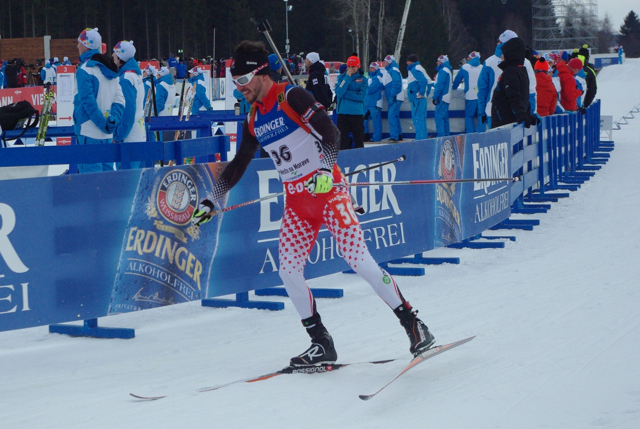
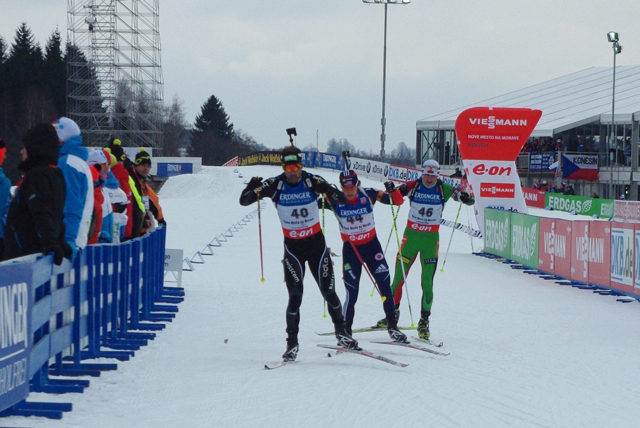
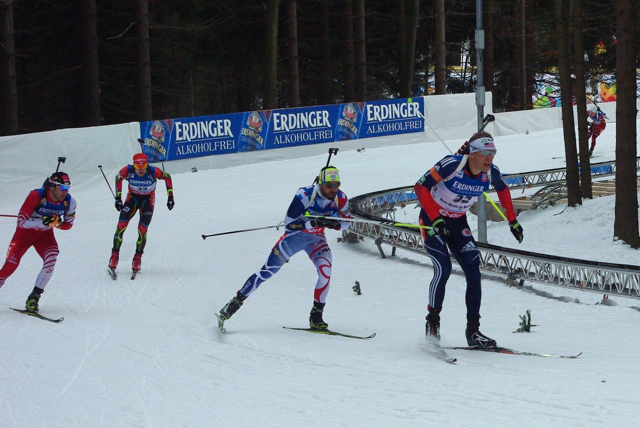
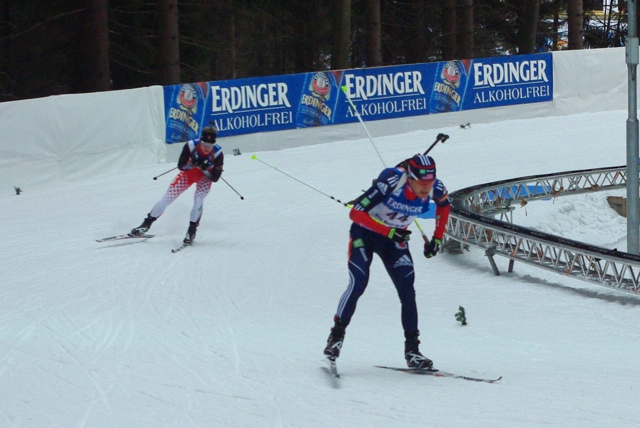
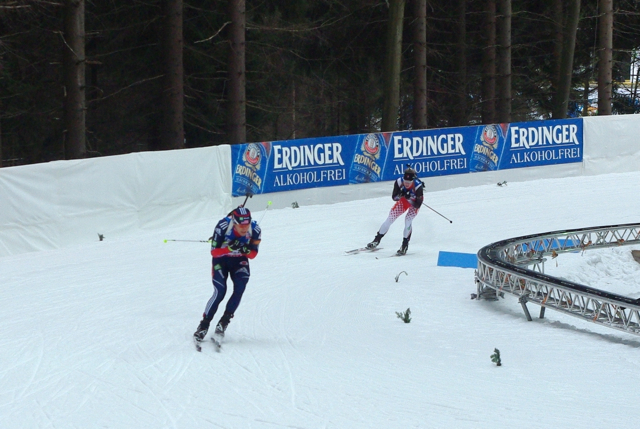
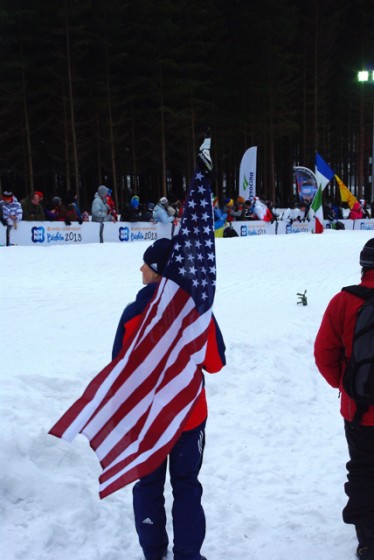
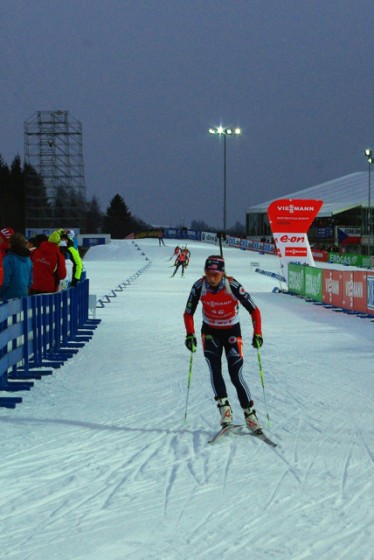
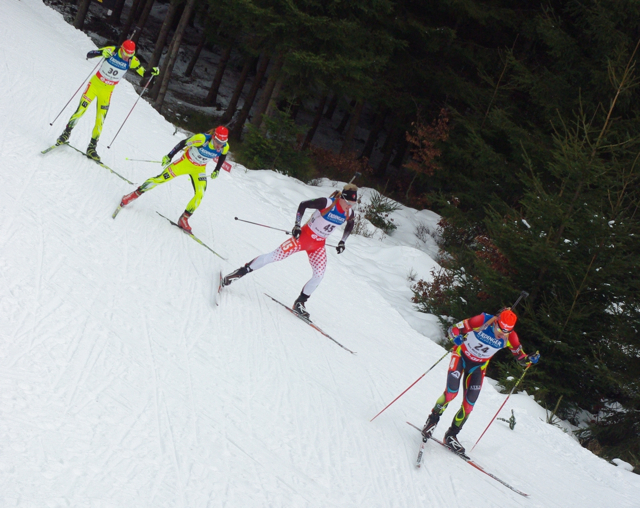
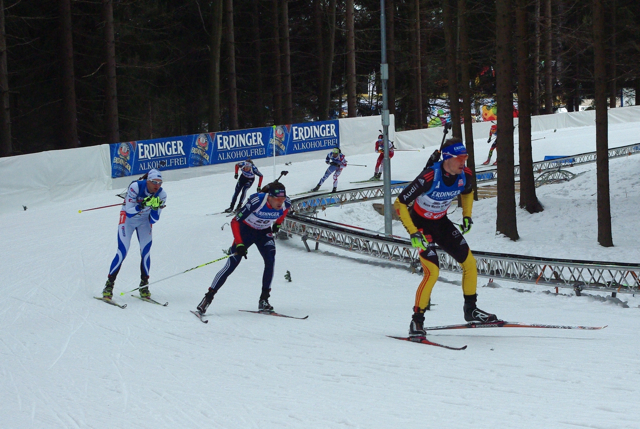
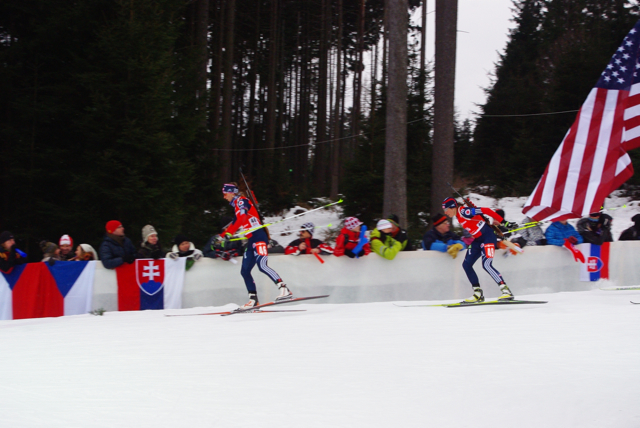
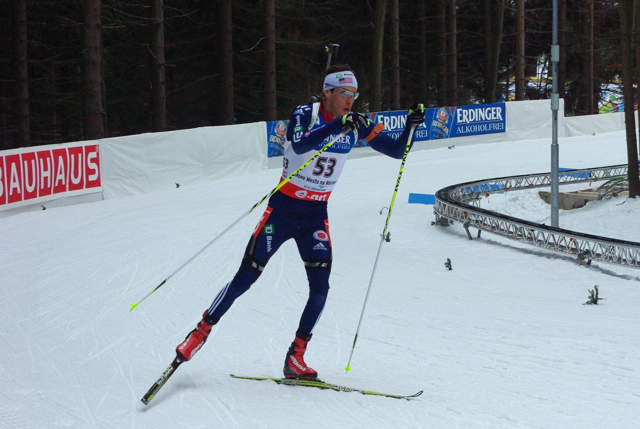
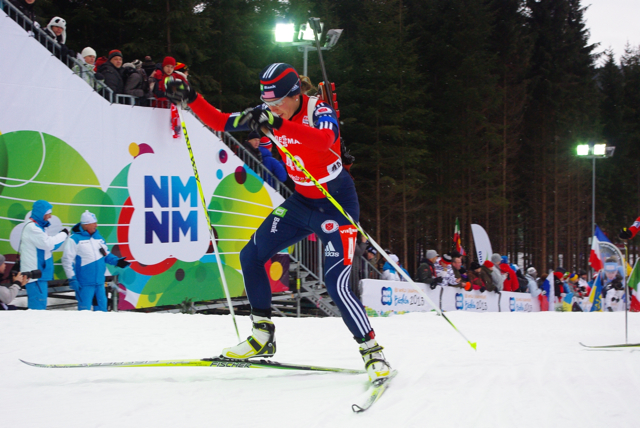
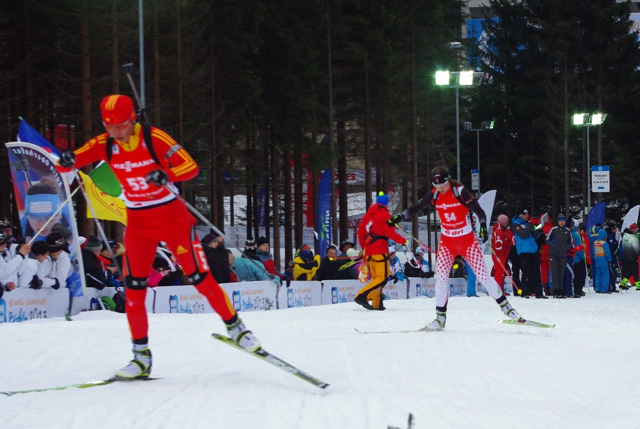
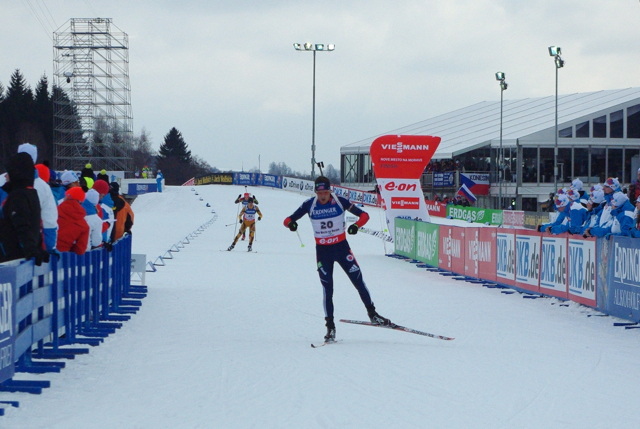
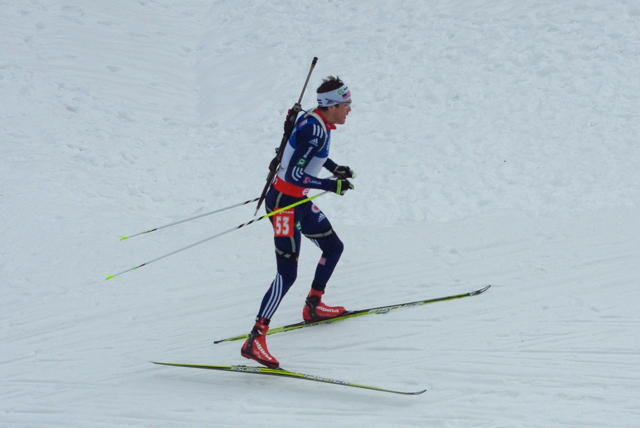
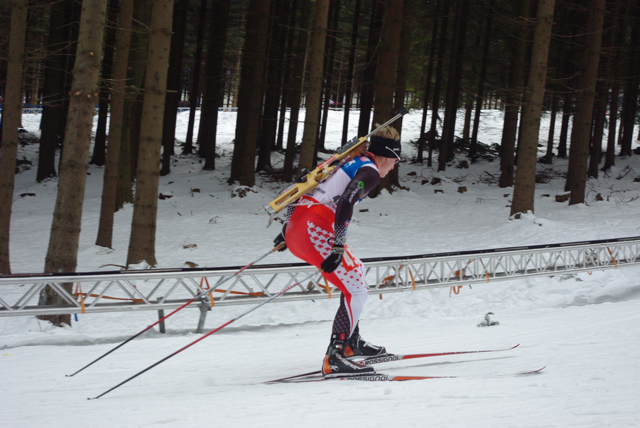
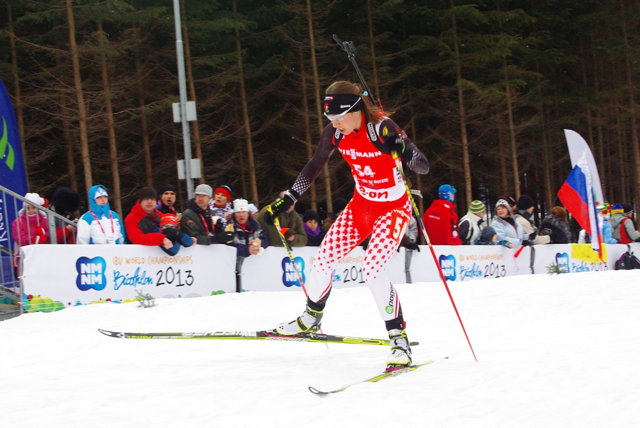
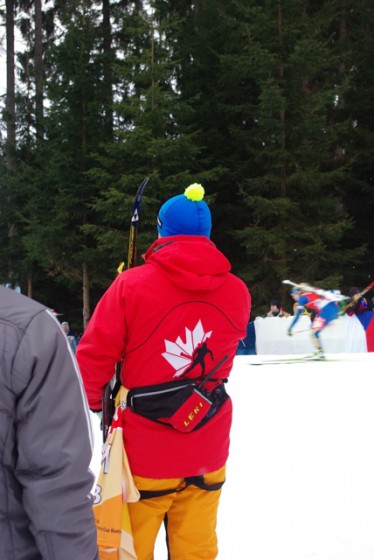
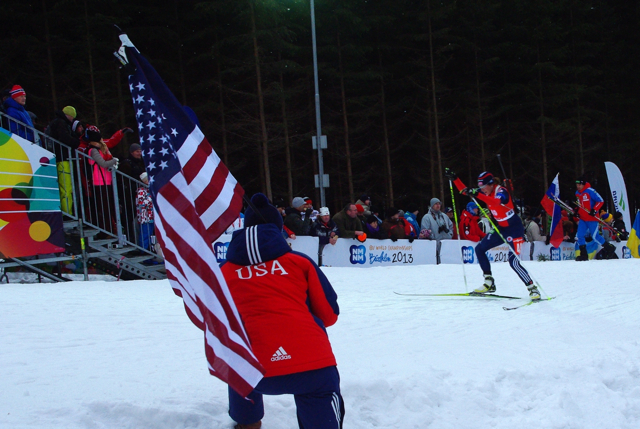
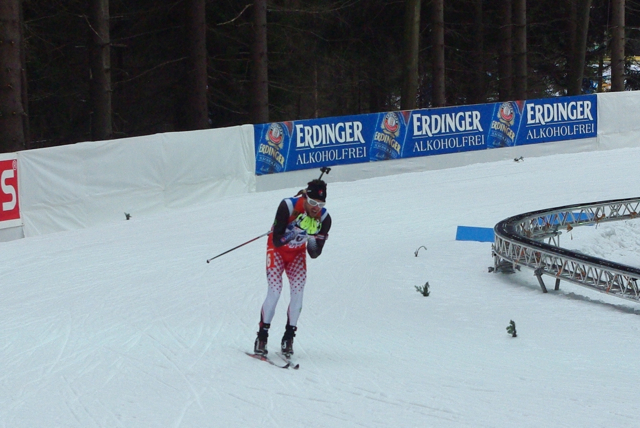
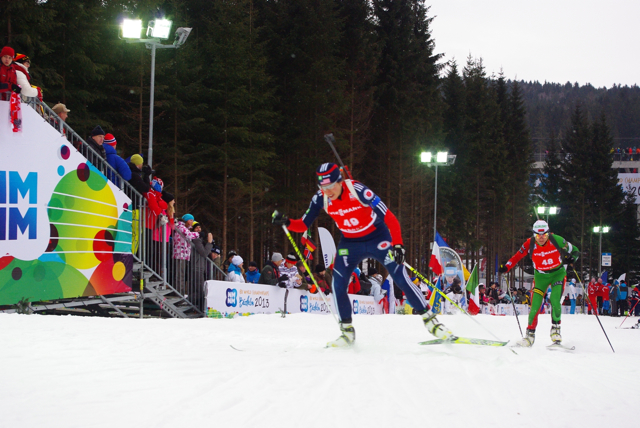
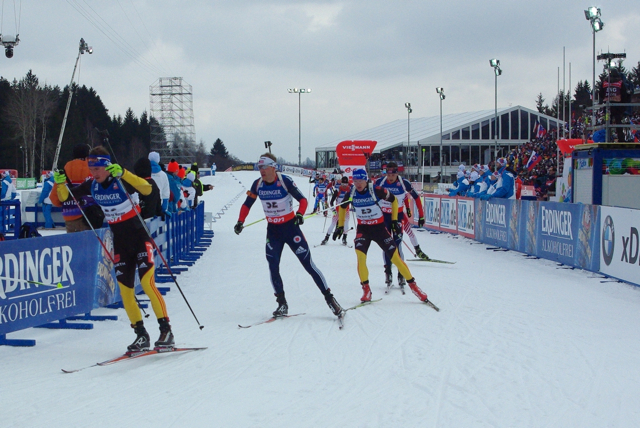
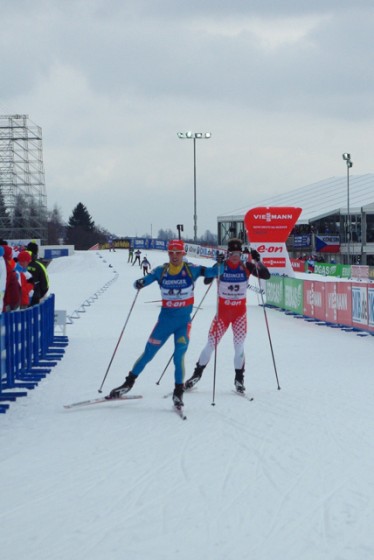
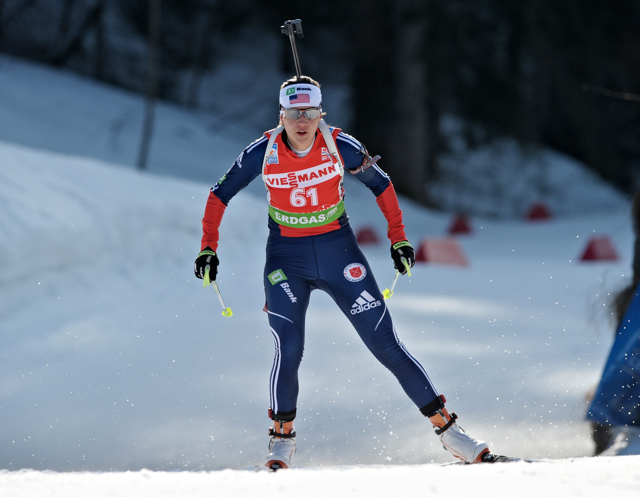
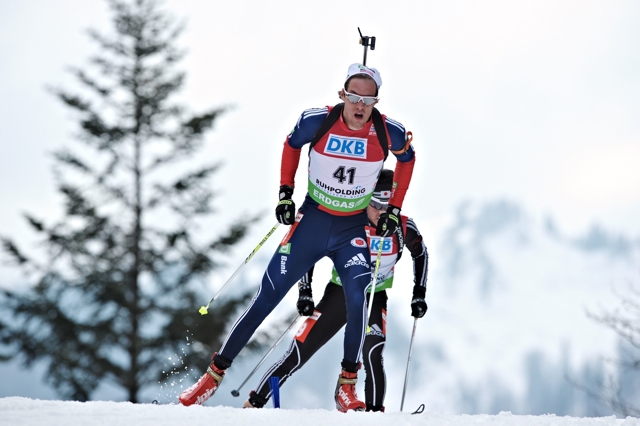
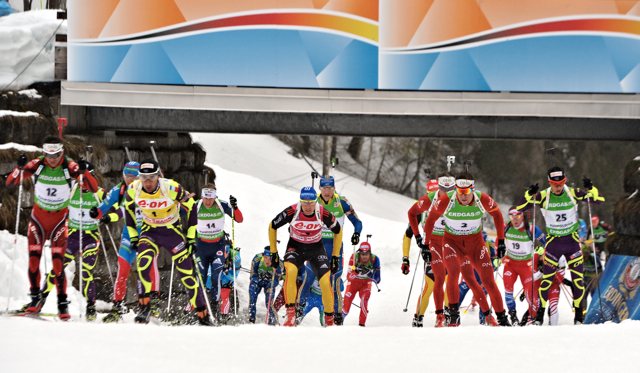
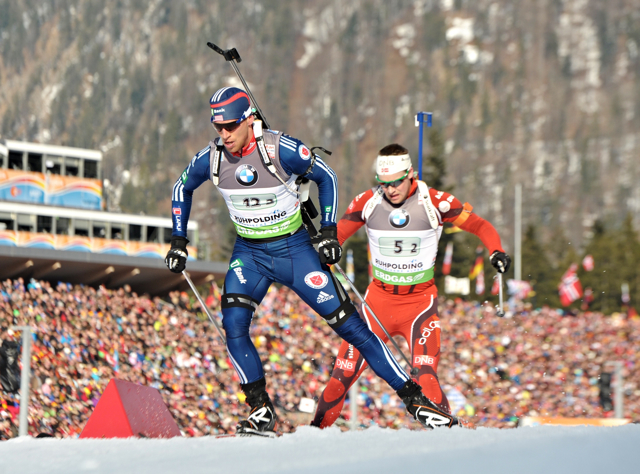
NOVÉ MĚSTO NA MORAVĚ, Czech Republic – Nine American and Canadian biathletes competed in the men’s and women’s 10/12.5 k pursuits at IBU World Championships on Sunday. Here are some photos of the action.
From the FasterSkier archive — posts syndicated from athletes’ and coaches’ own blogs between 2004 and 2012, kept online as published. Current coverage is at fasterskier.com.
NOVÉ MĚSTO NA MORAVĚ, Czech Republic – Nine American and Canadian biathletes competed in the men’s and women’s 10/12.5 k pursuits at IBU World Championships on Sunday. Here are some photos of the action.

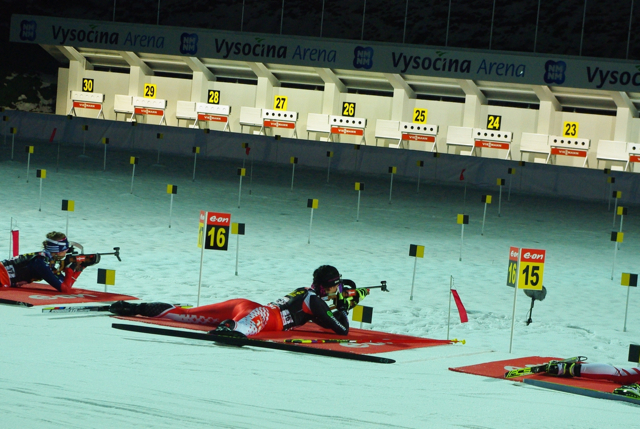
NOVÉ MĚSTO NA MORAVĚ, Czech Republic – For the Canadian team, just being in the stadium at World Championships for yesterday’s mixed relay felt pretty good.
Take Rosanna Crawford, the scramble leg skier for Canada. With her breakout season – she finished 12th in a World Cup sprint in Pokljuka, Slovenia, earlier this year – it’s easy to forget that the whole World Championships experience is new for her.
“It’s pretty crazy,” she told FasterSkier, practically shouting over the din of the 27,000 spectators who were cheering as the second-leg women shot on the range. “This is my first World Champs and I’m pretty stoked to be here. It’s an amazing crowd – I can’t believe how many people are here. It’s so cool.”
While Crawford said the craziness didn’t get to her too much and she was able to focus, things still didn’t go as smoothly as she would have liked. On her best days, Crawford is nearly perfect on the range. On Thursday, she relied on two spares in prone and one in standing to knock down all her targets.
“That is too many for me,” she said. “I think I might have come in a bit too hard on my prone, and not hard enough on my zero. Sometimes that pushes my shots high… So hopefully the other guys can have a better shooting day than I did.”
Nevertheless, there were plus sides to her performance: despite the errors she tagged off in 11th place, just over a minute behind Tora Berger of Norway. That isn’t a bad spot for the Canadians, and Crawford felt good on her skis.
“Skiing was definitely way better than Ruhpolding and Antholz,” she said, referring to the January races where her ski speed was not up to par with her earlier strong results.
Megan Heinicke took over and improved slightly on Crawford’s shooting, using only two spare rounds total rather than three. But she was stymied on the trails, skiing the 19th-fastest time of her leg and dropping to 14th. From there, Jean Philippe Le Guellec took over. Although he shot the same as Heinicke and skied better, he wasn’t able to gain any spots.
Still, like Crawford, he felt that the relay was a positive way to kick of World Championships.
“It’s good to be back at World Championships, being healthy,” said the Canadian, who this season is finally getting over the long-lasting effects of mono. “I think that’s the main thing. For the rest, we did preparation, and we’ll see how it goes during the week, but I think we’ve done all we can do for now. It’s just to ski hard and shoot.”
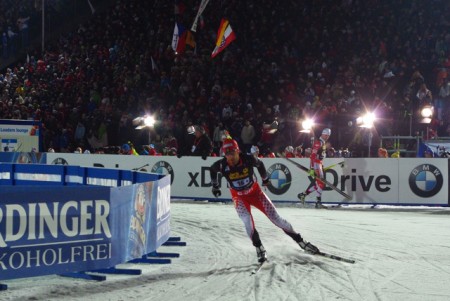
As he watched the video screen to see how anchor leg Scott Perras was doing, Le Guellec said that he thought the relay would turn out to be “an okay race, but nothing phenomenal.”
For his part, he was relatively happy, and said that it was good to test out the courses, which he knew would present challenges throughout the week.
“It’s a really, really, really hard course,” Le Guellec told FasterSkier. “It’s just right out of the range you’re going up for quite a while. You don’t have a lot of recovery once you get to the top – you have a small horseshoe which goes down, but you’re not really recovering because you need to turn a lot, so the recovery is pretty hard. Then you’re going up again for another 30 or 40 seconds.”
And as for how to handle that level of difficulty? His strategy seemed to have worked so far.
“It’s very demanding but I paced myself,” Le Guellec said. “You really have to. It’s a fun course though.”
Perras ended up using one spare in each stage, and despite strong skiing dropped to 15th; more than any mistake on his part, that was perhaps due to a charging Fredrik Lindström of Sweden, who was frustrated to receive the tag in 15th and skied the fifth-fastest anchor leg to pass Canada and move up a spot.
15th is still an improvement on Canada’s result from last year’s World Championships, where Zina Kocher, Megan Imrie, Le Guellec, and Nathan Smith finished 18th.

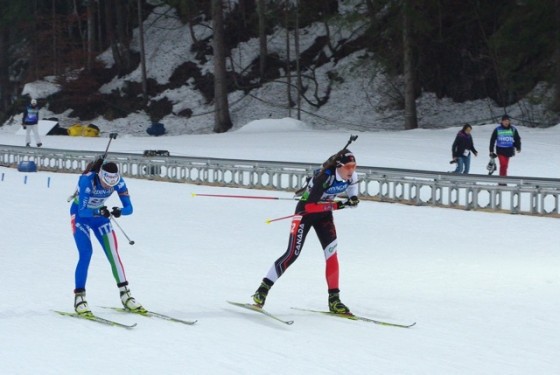
At the 2010 Olympics, Megan Tandy turned in the best Canadian performance in the women’s biathlon races, placing 36th in the 10 k pursuit. She was just 21 years old, and seemed sure to contribute to a growing Canadian team in the next few years.
But then, Megan Tandy disappeared. She got married, had a baby, moved out of Canada and then squeaked her way onto the 2012 World Championships team as Megan Heinicke. Although that season, her first full one since giving birth to her son Predo, didn’t go as planned, she placed 30th in the individual race.
This season, Heinicke is off to a better start. She was selected to race on the IBU Cup in the openers, and then after a top-ten finish in Beitostolen, Norway, moved up to the World Cup. After a single weekend of competition at the highest level, Heinicke has already turned in an impressive race: the pursuit in Hochfilzen, Austria, where she skied from 57th up to 29th.
“I did have a tough season last year with a lot of health struggles during the first half of the season,” Heinicke wrote in an e-mail after the Canadians’ 13th-place effort in Sunday’s relay. “I have had a really great training this summer and fall and have been able to stay healthy and injury free. I am really happy to be back on tour full time. Racing is simply a lot of fun when you feel fit and can fight for your goals.”
Especially nice, she said, was the feeling of being able to attack on her skis. She believes that she’s never been this fast.
“This year I am skiing faster than ever before which is, of course, great,” she told FasterSkier. “Seeing myself with ski times among the top 30 in the world certainly opens the door to results that simply weren’t realistic before.”
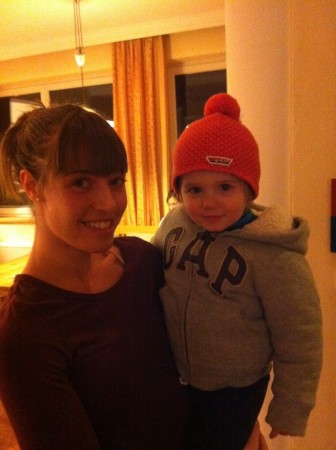
The increase in ski speed has likely come with Heinicke’s maturing as an athlete, but also other major changes. This season, for instance, she’s had a solid summer of training in a new venue: Altenberg, Germany. Before, Heinicke and her family lived in Klingenthal, but Heinicke’s husband iLmar took a job as head coach of the German National Training Center in Altenberg this spring, and Heinicke can train with the squad.
“Looking back on this month I am sure that I have a good setup here that can take me through the rest of the season,” she wrote on her blog shortly after the first big training block in Altenberg.
The summer progressed well too, with Heinicke competing at German national championships and, she indicated on her blog, achieving results that would have placed her on the German “A” team.
And unlike last fall, when illness during the trials that led to team selection took place, Heinicke was able to start the season on the World Cup instead of playing catch-up and trying to hitch on later. But even though she’s doing well athletically and is happy with her training situation, taking a year off and then struggling in 2012 has taken its toll.
“Funding has definitely been a bigger challenge for me post Olympics,” Heinicke said. “I think it is a combination of the excitement over the Games fading, my having taken the 2010-11 season off and me training outside of the country a lot of the time. Sometimes it is frustrating as I am still training with 100% dedication and am still as Canadian as ever!
“I still need a lot of help from my family to make a full season of training possible,” she continued, noting that it isn’t currently feasible for her to move the family back to Canmore and take advantage of the usual national team benefits, despite being named to the team for the last several years. “Of course I am very, very lucky to have a family who is so willing to help me make my sport goals possible but it would be fantastic if I could get back to a point where my training needs could be fully covered by sponsorship.”
Several sponsors, including NFA and ACCUPRO, have stuck with her, but Heinicke says that she doesn’t receive the government support that her other Canadian teammates do.
Nevertheless, private and family support has allowed her to get back to the World Cup, where she’s doing better than ever, although it’s come in many cases despite uncharacteristically poor shooting, which the British Columbia native finds frustrating. In the 29th-place finish in Hochfilzen, the second-best of her career, Heinicke bested that pattern, and she says that she will be trying to put the same lessons to use in her next several starts.
“I am really looking forward to the next races and a calm mentality on the range will continue to be my focus next weekend as well,” she told FasterSkier. “I need to find the right balance between my skiing and shooting and I am sure that the more races I do the more confident I will become, and will be able to slowly return to my reliable shooting from previous seasons.”
She is going to be missing one source of inspiration now that the World Cup has moved to Pokljuka, Slovenia.
“It was really nice to have my in-laws and my 2-year-old son, Predo, here to cheer me on this weekend,” she wrote before leaving Austria.

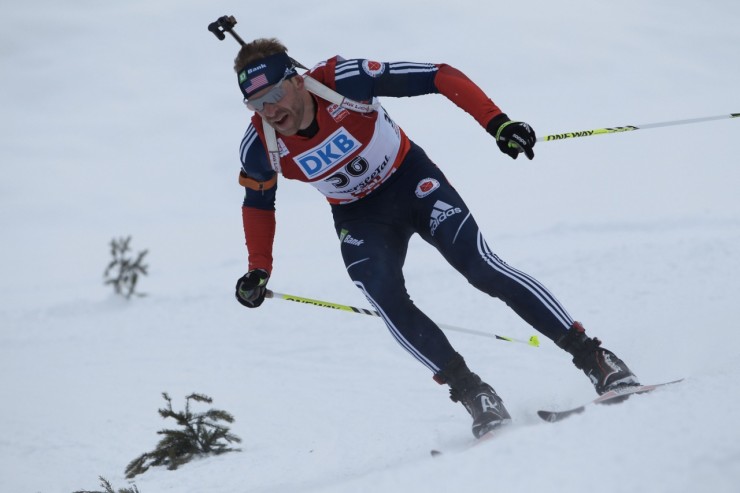
Although it was part of the U.S. biathlon team’s plan in the early season to focus on training and build toward World Championships, not worrying too much about the first races, it never feels good to flounder. And after a sensational start to the previous season, Lowell Bailey was perhaps one of those most wishfully thinking that he might start improving.
Today in Hochfilzen, Austria, it was mission accomplished, as Bailey turned 36th in the sprint into a tenth-place finish in the 12.5 k pursuit.
“A much better day for me today,” Bailey wrote in an e-mail he sent to several news sources. “I went into the race with the plan to be aggressive on the shooting range and to try and ski within my level at the moment. I was able to work into the race and after two clean prone stages I found myself up in the top twenty-five.”
In last week’s pursuit in Östersund, Sweden, Bailey faced a similar challenge – moving up through a large chunk of the field. In that race, he faltered on the range and after gaining a good position at the halfway point, slipped back into the 20’s. In fact, that has been a pattern for the American over the last several seasons.
“The third stage was a bit windy and I think alot of the guys I was around missed so that by the time I came in for the final standing stage, I was in 13th and within sight of the top ten,” Bailey wrote. “It’s interesting because pretty much the exact same thing happened in the pursuit here last year. Except last year, I missed two in my final stage and fell out of the top fifteen. Today the targets went down and I left the range in eighth.”
He was ultimately unable to hold that position, losing ground to Dominik Landertinger of Austria and Evgeny Ustyugov of Russia on the final 2.5 k loop; those two were on a mission, and wowed the spectators with a sprint for eighth place. Nonetheless, Bailey was able to hold on to the top ten and turn in his best performance of the young season. He was buoyed by a surprising amount of fan support, he said: “The crowds are awesome here – a lot of enthusiastic USA fans! Surprising to see so far from home!”
To those around him, shooting clean in the final stage was a big accomplishment and hopefully signals that he can overcome the patterns of the past.
“It was really exciting to see him clean the last standing,” U.S. Biathlon Association President Max Cobb wrote in an e-mail to FasterSkier. “That’s something he’s been working really hard to be able to do. You can ski off a miss early in the race, but if you miss in the last stage there is just not enough skiing left to be able to catch up in the last loop and everyone goes all out to finish the race.”
Overall, Bailey said it was nice to be back on track, and getting toward race shape instead of just recovering from hard training sessions.
“’I’m happy with the race and glad to have bounced back from a disappointing sprint,” he wrote. “I’m really looking forward to the relay tomorrow.”
Tim Burke did not have the same luck in the later rounds of the range, missing four shots in total of which three came in the final two stages. After starting 22nd, he was unable to move into the top-20 and finished 23rd. The third U.S. starter, Russell Currier, gained a few spots to move from 57th up to 52nd.
Meanwhile, Canada’s Jean Philippe Le Guellec took an opposite trajectory to Bailey’s. After finishing tenth in the sprint and shooting clean through two stages, the race got “odd,” he told FasterSkier.
“For one, my skis were not great and I ended up being passed a whole lot throughout the race, which was very frustrating,” he wrote in an e-mail. “As much as I felt good today, it felt like everyone was on steroids. Everything derailed even more with my epic three misses standing. I was the last on the range and ended up being the wind blocker. That on top of having to work extra hard to try to even keep up to the field ended up costing in standing. On the second bout I missed my third and jerked the trigger for the fourth round, which went off (over the targets).”
Despite having “not a very satisfying day,” there were a few good moments for the Canadian. On the third lap, he was in a pack led by Martin Fourcade of France and Ole Einar Bjørndalen of Norway. When asked whether the pace of those stars was what led to his problems in standing shooting, Le Guellec replied that they did not.
“Paradoxically, the lap with Martin and Ole was my most enjoyable,” he said. “These guys are so smooth, it’s a pleasure to ski behind skiers like that.”
After a rough November, Le Guellec’s teammate Scott Perras turned in a career-best 25th-place performance in the sprint yesterday. Today, he was unable to hold his position in the sprint, where he was undone by poor shooting. Without a single clean stage and after accumulating six penalties in total, Perras slipped to 43rd.
It was unlikely to dampen his confidence too much, though.
“For sure JP’s win [last weekend] sparked some momentum, so I’m just jumping on the band wagon and having fun doing my part,” he wrote in an e-mail Saturday morning. “When you are training with guys like Brendan [Green] and JP and can keep up, you know you should be in the ball park come winter. A huge difference so far this year has been shooting speed and accuracy. Training with Nathan [Smith] and JP who are so quick and often accurate, I knew I had to get there and I put the time in. Come the end of March we will see if it all paid off.”
More Canadian Success in Women’s Pursuit
After a huge personal best in the sprint, Rosanna Crawford told FasterSkier that she was nervous going into the pursuit with bib 24. She knew she was in for a different experience.
As it turned out, it was a better experience.
“Today was by far the most fun I’ve had racing!” Crawford told FasterSkier in an e-mail. “I’ve never really done a pursuit where there were people around me, I was always fighting for last place, so this was great to be able to ski with a pack and move up.”
With just three misses after twenty shots, Crawford was able to stay in 25th place, for the second top-30 finish of her career. There was a tight moment after she missed two shots in the first prone stage – never the way a biathlete wants to start a race – but she later regained her confidence.
“I did have the fastest prone time, and my misses were just splitters, so I made sure to be calm and take it one shot at a time for the next prone,” she said. “Standing was good and I was happy to shoot clean on my last bout.”
Megan Heinicke joined Crawford by skiing all the way from 57th up to 29th, on the merit of a single penalty. Heinicke only matched that result once last season, at World Championships. All in all, it was a confidence-building day for the team.
“I feel like this weekend has shown me I can be in the top 30 and with even better shooting I can maybe crack the top 20,” Crawford wrote.
For the Americans, Sara Studebaker moved from 58th up to 47th with three penalties, a major improvement as, like Bailey and Burke, she seems to be settling into the routine of racing after a tough start in Östersund. Susan Dunklee started in 31st position and was clean through two rounds, but missed a disastrous seven of her last ten shots.
Dunklee posted a short poem on her facebook and twitter pages:
Pursuit today started out quite well;
But the standing targets I could not fell.
Clean! Clean! Three… Four…
Tomorrow hoping for a little more.
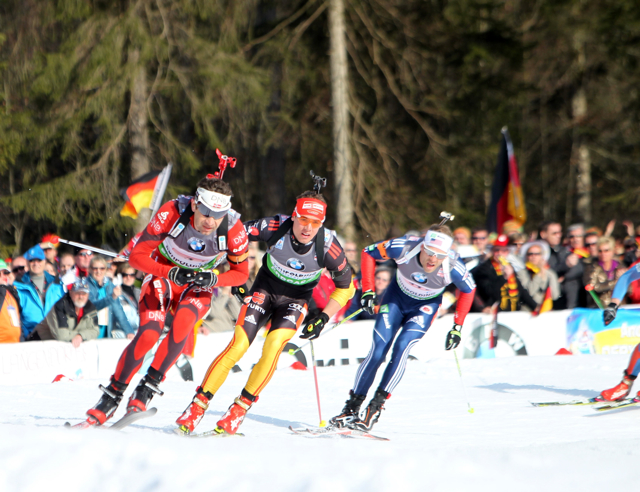

On Sunday, IBU Championships wrapped up in Ruhpolding, Germany, after eleven days of exciting racing that saw both dominating performances from overall World Cup leaders and refreshing victories and medals from lesser-known athletes.
The big winners at the championships were Martin Fourcade of France and Tora Berger of Norway; Fourcade picked up three individual gold medals in the sprint, pursuit, and mass start, along with silver in the men’s relay. That was almost matched by Berger, who won gold in the individual and mass start races, along with gold in the mixed relay and bronze in the women’s relay.
The Swedish team also had phenomenal results. Carl Johan Bergman had what is probably the best result of his life, winning bronze in the sprint and silver in the pursuit. His wife then gave birth to their first child and he visited home before returning to place sixth in the mass start, a race where his teammates Bjorn Ferry and Fredrik Lindstrom took silver and bronze. Helena Ekholm also won bronze in the individual.
Slovenia, meanwhile, gave talented underdogs everywhere a reason to keep dreaming after they crossed the line first in the mixed relay and ended up with silver due to a time correction from a target malfunction. Then a few days later Jakov Fak took gold for real, winning the men’s 20 k individual.
Other leading World Cup athletes also saw success, with Magdalena Neuner of Germany and Darya Domracheva of Belarus going 1-2 in the sprint and then swapping places in the pursuit.
In the relays, traditional power prevailed, with Norway taking the men’s title and Germany the women’s. The two countries had the most fans in attendance at the championships, leading to a party atmosphere for those victories.
The U.S. team was led by a fifth-place result from Susan Dunklee in the women’s 15 k individual and a tenth-place finish from Tim Burke in the men’s 10 k sprint. Lowell Bailey placed 20th in both the sprint and pursuit, and Dunklee also placed 17th in the mass start.
The Canadians saw JP Le Guellec ski to 14th in the sprint, while Zina Kocher finished in the top 30 of every race she entered. Megan Heinicke had a strong individual race, placing 30th.
Below are links to FasterSkier’s race reporting from the Championships (results can be found at the IBU Datacenter); we also wrote about USBA’s development program, featured an interview with Eurosport commentator Sigi Heinrich, asked the U.S. women why their hair was pink, and gave you audio and video of the atmosphere at biathlon’s biggest venue. At the bottom is a gallery of new photos – while FasterSkier was on course, our reporter was also scurrying around doing interviews and missed some of the action. To fill in some of the gaps, the United States Biathlon Association has shared a collection of photos from the Nordic Focus Picture Agency. Enjoy!
Thursday March 1, Mixed 2 x 6 + 2 x 7.5 k Relay
Race Report | U.S. report | Canadian report | Photo Gallery
Saturday March 3, 7.5 / 10 k Sprints
Men’s report | Women’s report | North American men | North American women | roundup
Sunday March 4, 10 / 12.5 k Pursuits
Men’s report | Women’s report | Canadian report | U.S. report
Tuesday March 6, Men’s 20 k Individual
Race report | Canadian report | U.S. report
Wednesday March 7, Women’s 15 k Individual
Race report | Susan Dunklee story | U.S. report | Canadian blog post
Friday March 9, Men’s 4 x 7.5 k Relay
Race report | U.S. report | Canadian blog post
Saturday March 10, Women’s 4 x 6 k Relay
Race report | U.S. report | Canadian report
Sunday March 11, 12.5 / 15 k Mass Starts
Men’s race report | women’s race report | North American blog post
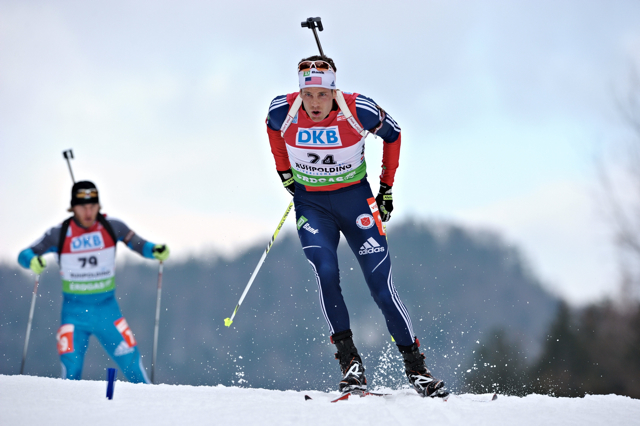
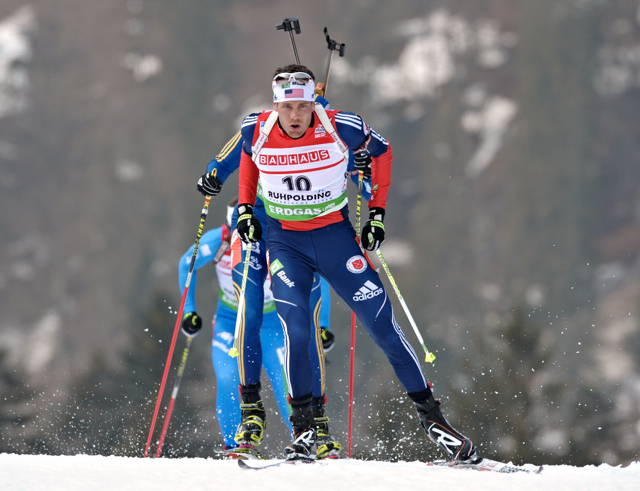
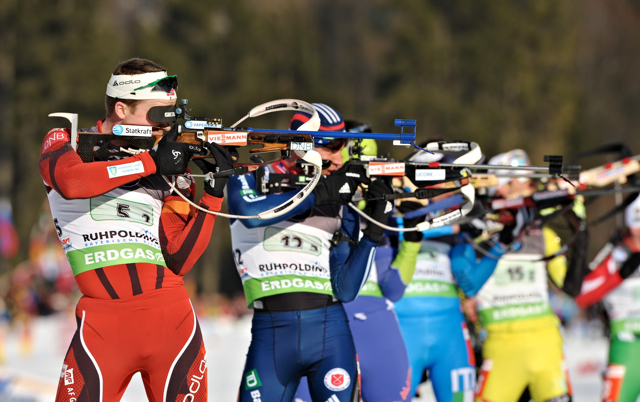
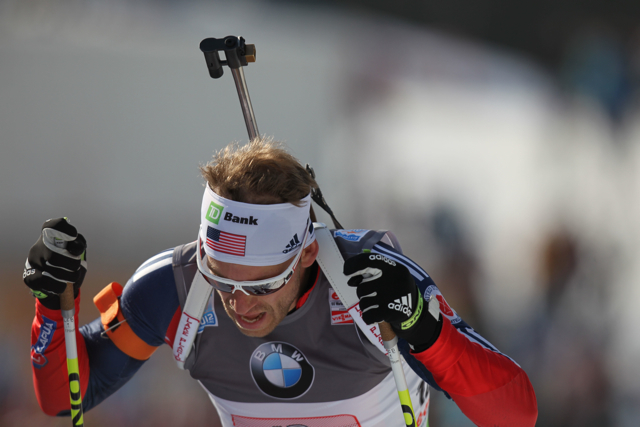
Photos from Nordic Focus Via the U.S. Biathlon Association
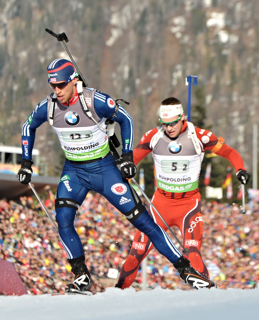
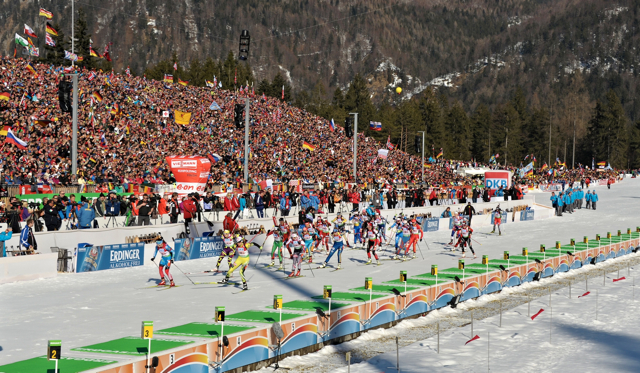
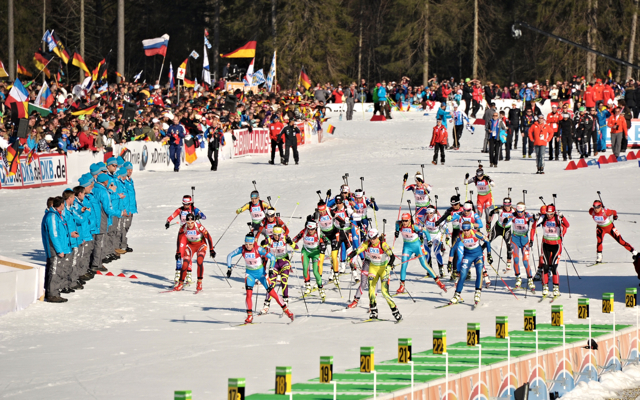
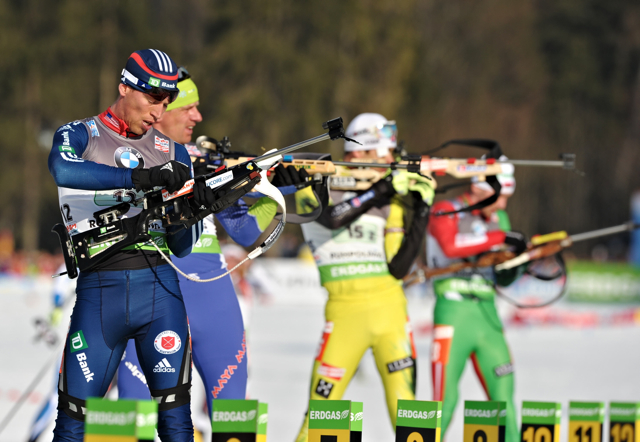
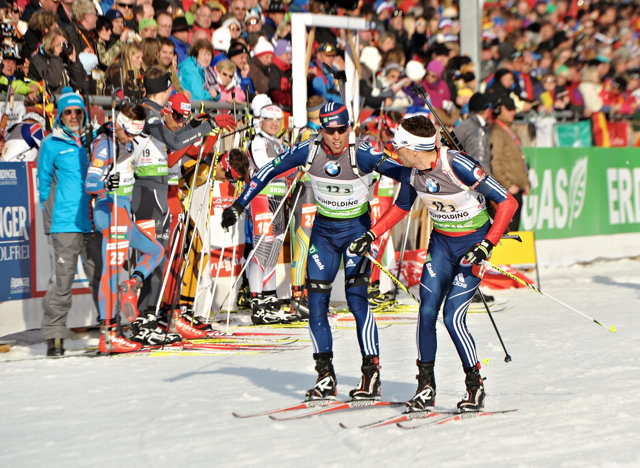
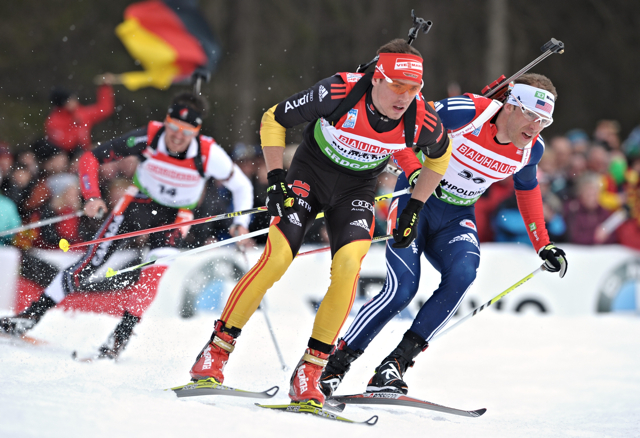
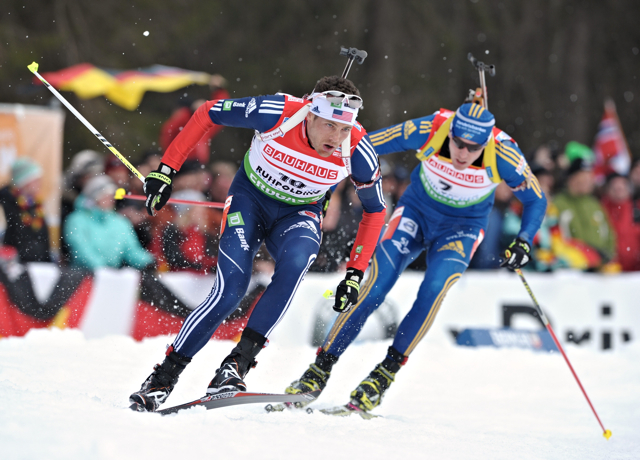
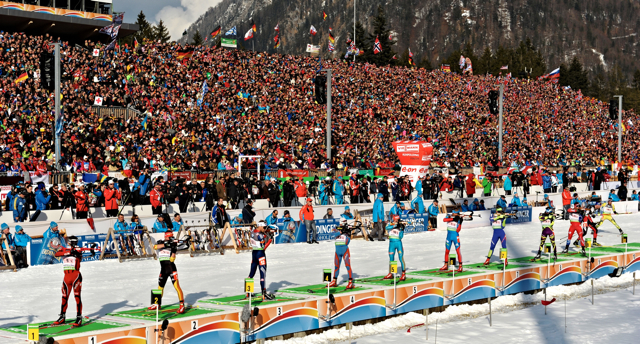
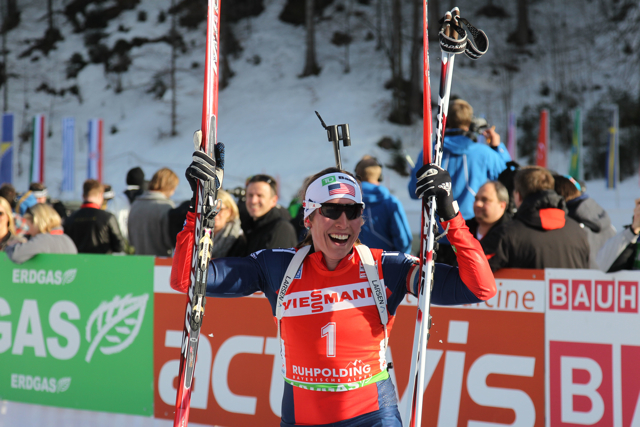
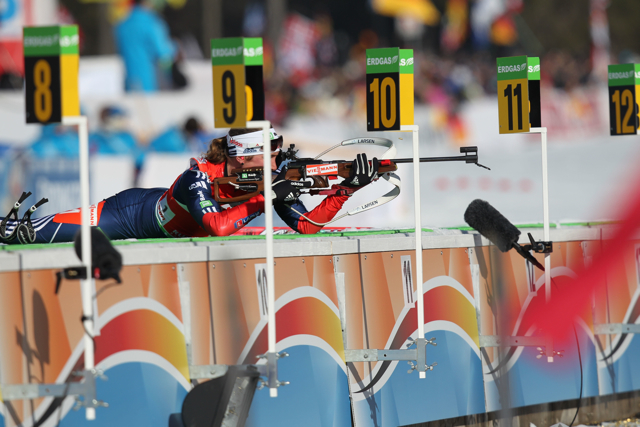
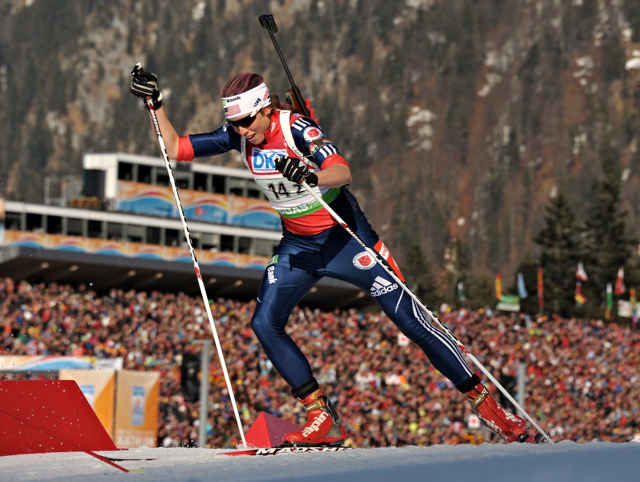
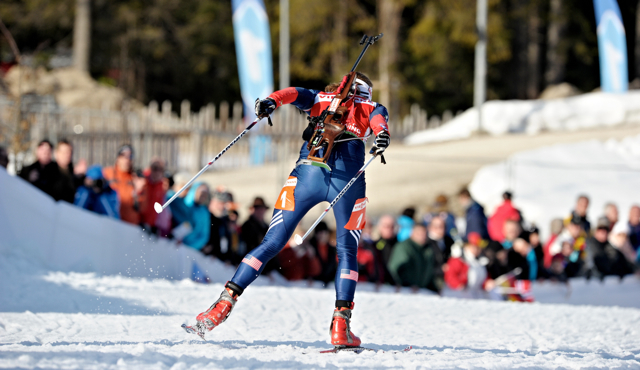
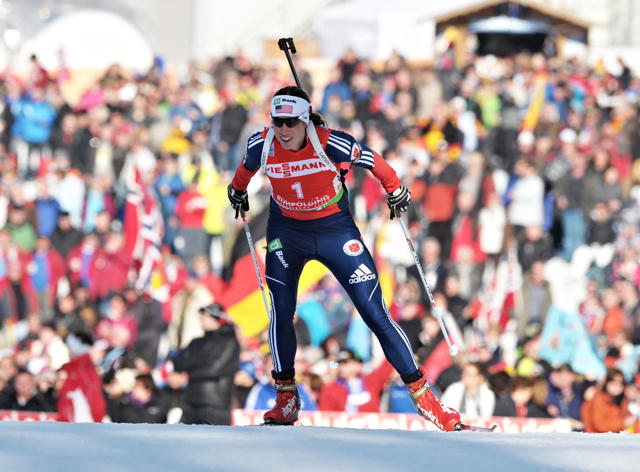
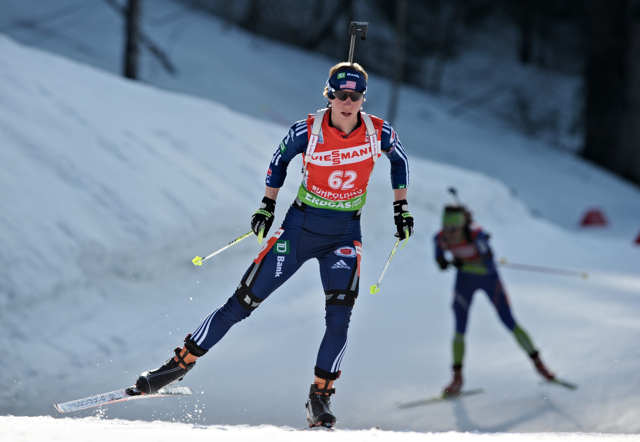
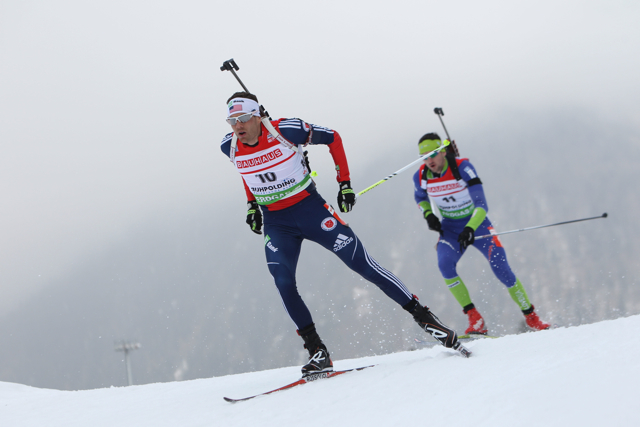
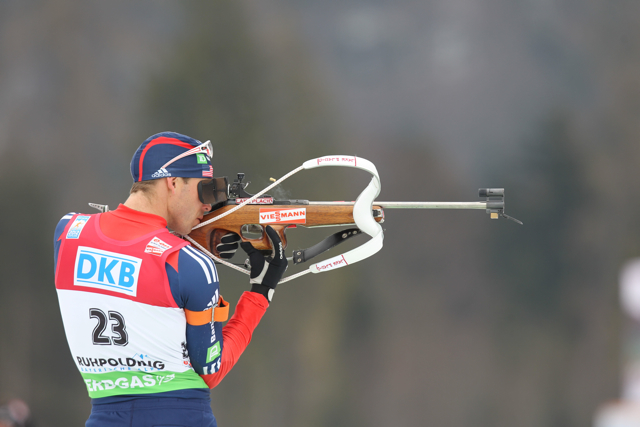
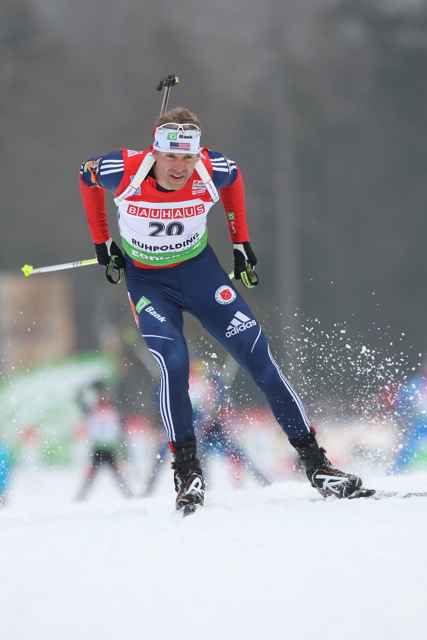


RUHPOLDING, Germany – After a week where not many team members were satisfied with their performances, the Canadian women’s squad crafted a new strategy for the 4 x 6 kilometer relay on Saturday.
In most cases, Megan Imrie and Zina Kocher have skied the first two legs. But not this time: for World Championships, the women wanted to mix things up.
“We just decided to try switching it because usually Megan and Megan and Yolaine are awesome shooters, so we were kind of figuring we’d stay in the game with that,” Kocher told FasterSkier at the finish line.
The plan left Kocher, who has had the best individual results of the team so far this week, to anchor.
Things started out as planned, with scramble leg Imrie using two spare rounds in prone and then quickly cleaning standing and attacking on the final loop to tag off in sixth place.
“Yeah, it was good,” Imrie said. “I did my very best. I had only two spares, so I can say that was good.”

But from there, things began to fall apart for the Canadians. Like Imrie, second leg Megan Heinicke turned in the twelfth-ranked ski time, but Heinicke used more spare rounds and dropped to eleventh, then twelfth.
“I feel bad, I kind of wrecked our relay here,” a clearly frustrated Heinicke told FasterSkier. “I actually felt good skiing, but it was just too many spares on the range. No penalty loops or anything, but it takes seven or eight seconds to load a spare, so that costs time, and I used four in my race, which is more than I had hoped for.”
When Yolaine Oddou took over, she immediately struggled in prone, using all of her spare rounds and still skiing a penalty loop. She dropped to 16th, but then climbed one spot to 15th after hitting all her standing targets on the first attempt.
Nevertheless, it wasn’t where the team was hoping Kocher would begin her anchor leg.
“Yolaine had a bit of a problem in the prone,” Kocher said. “She has kind of been struggling all week, and it was unfortunate. I’m sure she’s sad about it, and quite frustrated – she’s an awesome shooter. Definitely, we could do better.”
Kocher gained a few spots – the team placed 13th – by using only a single spare over the course of her two shooting stages, which, she pointed out, made the relay her best shoot of the week. She was happy that it could come on a day where her team needed her, but at the same time noted some irony: she needs to achieve a top-16 result in an individual race to resume receiving Athletics Canada funding, and she wouldn’t have minded if she’d shot that well in the individual races.
Overall, Kocher liked racing the final leg.
“My leg was really good,” she said. “I actually haven’t anchored since I was a junior. It was good – I was way more relaxed than when I’m in second. I love being first and second, but it’s more of a tense situation.”
Kocher is the only Canadian woman qualified for Sunday’s mass start so for the others, the relay was the last race of World Championships. Imrie said she milked that fact for all it was worth.
“Walking to the start and hearing all the fans singing along, I was just totally enjoying the music, loving the weather, and everything was great… so it’s a nice way to end it,” she said.


RUHPOLDING, Germany – Two Canadians had high hopes for Sunday’s pursuit: Jean Phillipe Le Guellec was 14th after Saturday’s World Championship sprint, and teammate Zina Kocher 18th. They were poised, it seemed, to have career-best finishes.
Le Guellec had never finished in the top ten at World Championships, but started just 12 seconds outside it on Sunday. Kocher was shooting for a top-16, which would have guaranteed her funding through Athletics Canada for the next season.

But neither of them hit the mark, and both ended up 26th at the end of the day.
Le Guellec later wrote in an e-mail that he “wasn’t in such a good mood” after his 12.5 k, four-stage race.
“Looking at results, obviously I stumped down quite a bit,” he said. “The race was going ok until the last shooting basically.”
Le Guellec started off strong, cleaning his first stage and moving into the top ten, where he skied with Lowell Bailey of the U.S. and Andreas Birnbacher and Simon Schempp of Germany. Even after missing a shot in the second stage, he dropped no lower than 11th, and was back into ninth after a clean third stage.
But in the last stage, he missed two shots. Le Guellec’s ski speed also didn’t do him any favors – he said after the sprint, too, that he had felt slow – and rather than regaining places on the final loop, he lost them.
“I came out of the penalty loop in 17th,” he explained. “The last lap was no different [than the others], and I got passed by seven guys in the last kilometer of the race. I had nothing in the tank to fight back and dropped to 26th.”
The Canadian, who placed 11th in this event at the 2010 Olympics, was very frustrated with his skiing; his course time was just the 38th-fastest of the day, and with only a single athlete (Roland Lessing of Estonia) cleaning the race, his solid shooting could have gained him more spots.
“My skis were fast once again, but my ski shape was not great, and it’s not like the sprint where I felt not so good but actually did decent,” Le Guellec lamented. “I was getting passed by trains on all laps. With only a day of rest before the individual, I’m hoping my form will be better.”

Kocher faced an opposite problem in her 10 k pursuit. Starting 18th, she immediately missed two shots and dropped to 27th.
“Right off the bat, it had me a little bit off my game from the get-go,” she told FasterSkier in an interview at the finish line. “At the beginning I kept it easy, that was kind of my plan, just to draft and come in sure of myself. It didn’t quite work out when I missed two.”
Kocher had discussed earlier the difficulty of dealing with the 16th-place requirement, and she said that after her initial errors, some of the pressure actually disappeared. After cleaning the second stage, she skied in the low twenties, and it seemed that with half the race still remaining, she might reach her goal after all.
“When I was around 20th, I was like, ‘okay, I’m back in the game,’” Kocher said.
But she struggled in standing, missing one and two shots in the two stages, and wound up, just like Le Guellec, in 26th.
“I guess it was just a really hard race,” she said. “On that last standing I was getting pretty shaky. It was pretty hard work skiing today. So it’s not what I wanted, I really wanted 85 or 90% shooting, and that would have put me in that top 16 for sure.”
Now, both racers are left looking forward to the longer, four-stage individual races which will be held Tuesday and Wednesday. His next race would be a challenge, Le Guellec admitted, especially in the deep, soft snow that has characterized the competitions so far.
“The 20 k course is very demanding, and this is without taking conditions into account,” he wrote.
Kocher was more positive, and pointed out that with two top-thirty finishes, she was in good shape to snag a position in the exclusive mass start race.
“I’m psyched for the individual, and now I might have a good chance for the mass start,” she said.
The Rest of the Canucks

Team Canada started the day on Sunday with lots of opportunities – they had put a total of three women and four men in the pursuit out of four possible starters in each race in the sprint. The rest of the team had started much lower down the results sheet, but there potential to move up.
Of the remaining starters, Megan Imrie and Megan Heinicke both gained at least ten places, with Imrie advancing from 51st to 39th and Heinicke from 52nd to 42nd.
Imrie used strong shooting to make her move, only missing a single shot and gradually picking up a few places in each loop. Her racing earned her World Cup points, which are awarded to the top 40, for just the sixth time this season.
Heinicke just barely missed that cutoff, but had a strong race as well, cleaning both prone stages and then missing a single shot in each standing stage.
In the men’s race, Nathan Smith started 45th and after going zero-one in prone had moved up to the low 30s. But in his first standing stage, he had difficulty with the wind and missed three shots, dropping back down further than his starting position. He missed a single shot in the final stage and finished 43rd.

“Even the [stage] where I hit four, it was a hard four to hit,” Smith said of the standing stages. “It wasn’t easy. Maybe I should go a little bit easier into the range – I went a little bit too hard on the last large hill because I was trying to stay with guys.”
Despite the frustration of his shooting, Smith told FasterSkier that he thought his skiing had improved from Saturday, and that it was good to have head-to-head competition and better peers on the trails, compared to the sprint where he was seeded with mostly slower skiers.
“It was fun,” Smith said. “Especially on the flat part, there was some headwind, so it was a lot easier to stay behind someone. I think I only got to do that one lap – sometimes I had to pull the guys. But you could tell that there was a big difference.”
Scott Perras started 50th and ended 54th on the back of six penalties, while Marc-Andre Bedard moved up from 55th to 52nd.
Bedard said the race was “rough, but fun,” and that his four penalties were not enough to gain spots at this level of competition.
“The fastest skiers are already up front,” he explained. “So to climb up from far behind – if you’re top 30, that’s good for moving around, but if you’re in the back, like 50s, to climb up then the others in front have to do very badly, because usually on the World Cup nobody shoots under 80%.”
Like Le Guellec, Bedard said his skiing could use some work – but he wasn’t completely discouraged about his prospects for the individual race.
“The skiing was not so strong, so I really concentrated on my shooting,” he said. “That pace was good for the individual, but a little too slow for the pursuit.”
Full men’s and women’s results
Men’s and women’s race reports

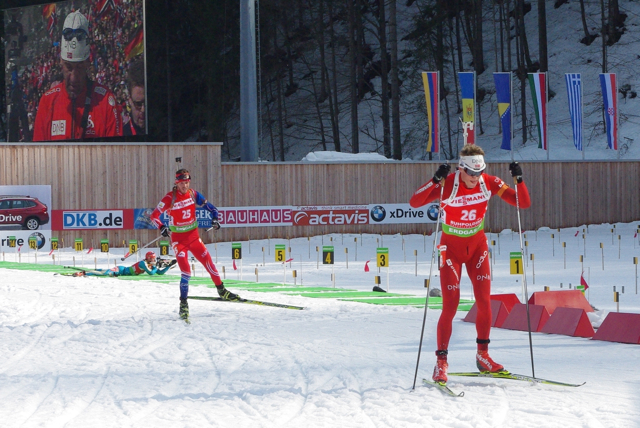

RUHPOLDING, Germany – With more than 250 racers contesting yesterday’s World Championships 7.5 and 10 k sprints, there was plenty of news that didn’t make it into our race reports – both from international stars and from our own interviews with U.S. and Canadian athletes. Here are some of the notable bits that we couldn’t fit in:
– Bronze medalist Carl Johan Bergman of Sweden wasn’t really expecting a medal yesterday, but he was expecting something else – a baby. His wife, Norwegian biathlete Live Kjersti (Eikeland) Bergman, was due yesterday but hasn’t yet given birth. “Carl Johan is always very focused when he is there, for the most part,” she told Swedish daily Expressen before promising to “keep the baby in” until after Sunday’s pursuit so he could concentrate on winning another medal.
– Bergman and French gold medalist Martin Fourcade hammed it up in the press conference when a journalist asked Bergman “what kind of person Fourcade is for you.” After making some jokes with his competitor, Bergman answered the fairly awkward question by saying Fourcade was an excellent biathlete, and that at least they had a good ski company in common (Rossignol).
– The translation is a little rusty, but Norwegian biathlete Synnøve Solemdal basically called gold medalist Magdalena Neuner “cold as ice” in an interview with broadcaster NRK. “It looks like she is relaxing on a Sunday before each race,” said Solemdal, who had much more trouble, missing four shots and placing 32nd. “She just stands there and enjoying herself and looking very relaxed. It does not seem like she has any nerves. It’s fun to watch… She has so much pressure on her, just like all the Germans. What she did today deserves respect, and it has been a big inspiration for me.” The piece included shots of Neuner being mobbed by German media, and reported that she was so busy that she didn’t make it to the press conference until an hour and a half after she finished the race.
– In other Norwegian news, NRK reported that Ole Einar Bjørndalen has cut his shooting times in half since the 2002 Olympics, where he won four gold medals. The legend placed 21st in the sprint, but is not out of the running for the pursuit; he won the last World Cup pursuit in Kontiolahti, Finland.
– Teammate Lars Berger boasted earlier that he could win the sprint. Instead, he missed four shots and placed 32nd.
– The men’s race was rough for the home country. Despite high expectations, the team was led by Andreas Birnbacher in 16th place. The race marked the return of double Olympic gold medalist Michael Greis, who underwent foot surgery in August. He contested a few World Cup races this season, but the 35-year-old hadn’t competed since mid-January; he finished 26th yesterday.
– Thanks to the combination of ice and slush, quite a number of biathletes fell during yesterday’s races; Tim Burke made it through cleanly, but was sporting a bloody shin from a bobble during his warmup. Ever gracious to the athletes, Eurosport put together a highlight clip of all the crashes, which you can watch here.
– JP Le Guellec of Canada, who placed 14th, was actually impressed with how the organizing committee, led by TD Max Cobb, who is also the president of the U.S. Biathlon Association, dealt with the challenges of warm temperatures, sun, and slush. “I think the organizing committee did a really good job at salting the place, and making the more important spots harder,” he told FasterSkier. “But the sun is blaring, so there’s only so much you can do.”
– Teammate Megan Imrie agreed, saying, “I’ve seen it a lot worse here with the slush, and I’ve also seen it very icy. So these conditions, I’ll take them.”
-Meanwhile, Megan Heinickeis representing Canada at World Championships despite skiing just one World Cup this season; she lives in Germany and is not on the national team program, but attended trials races and qualified for the team. She was disappointed with her sprint but said that the pursuit might be better. “I think I’m just one of those people who has to get some carbon out of the system – generally I do better in the second race of back-to-back races, so I’m hoping I’m a little more engaged somehow,” she told FasterSkier.
– U.S. racer Sara Studebakerwas upset after the mixed relay, but she thinks she’s on an upward trajectory after tying for 49th in the sprint, a result she called “fine” but nothing special: “If it keeps going from here it could be really good. I think pursuits suit me well – I can shoot well, usually. That can help a lot, and especially with prone, if you can shoot well then you can move up.”
– Susan Dunklee was probably the best American hope for a good finish in the sprint, but she struggled right out of the start, missing three shots in prone. She spent the rest of the race pushing the pace on the trails and made the pursuit. ” That’s kind of my eternal strategy, is always to just take it out on the course, on skis, any time the shooting goes wrong,” she said.
– Starting last in bib 118, Dunklee bumped a few people down the results sheet long after they thought they were safe. Teammate Annelies Cook received a bump, although she was expecting it, as she knew Dunklee was behind her. Starting with bib 115, Cook crossed the line in 60th, which would have made the cut for the pursuit. But Bib 116, Dorothea Weirer of Italy, finished one spot in front of her, and then Dunklee crossed the line and Cook ended up 62nd. “It just sucks,” she said. “So close. I was gaining and I knew it was really close, but then [Weirer] came in and pushed me out, and Susan came in… I’m bummed that I missed [three] shots. I think it was a decent race for me, otherwise.”
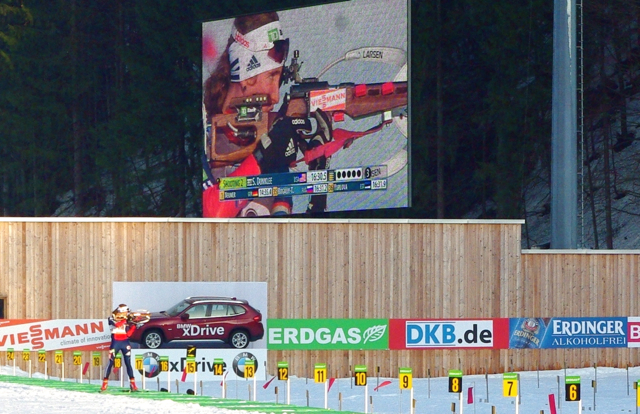

RUHPOLDING, Germany – Canada’s Zina Kocher had a lot to think about during today’s 7.5 k sprint.
But this her tenth World Championships, and Kocher says she’s learned a few things along the way. Today, she didn’t let all of the worries and problems get to her head. Instead, she stuck to business and finished 18th.

“This is probably the most calm I’ve felt in a long time for a World Championship, so that’s crucial for sure,” she said in an interview at the finish line.
What were some of the things that might have been distracting her?
Perhaps the disastrous shooting stage in Thursday’s mixed relay, after which she was incredibly disappointed and felt she had let her team down.
Or maybe she could have worried about her brother, who on Wednesday underwent open heart surgery for the eighth time due to a congenital heart defect. For all the other surgeries, Kocher has been in Canada, ready to stay by his side at the hospital. But not this time around.
“I tried not to be distracted for the relay,” she said after shedding a tear or two at the finish: “I had a decent race and put it behind me for about 20 minutes.”
If neither of those topics were enough of a burden, Kocher is also saddled with the responsibility of collecting a top-16 finish in order to regain funding from Athletics Canada; this season, for the first time in years, she hasn’t had that monthly stipend.
“I definitely really need a top 16,” Kocher said. “It’s been really difficult – last year I really struggled with that, and totally blew up. This year I think that with my training camp in Kontiolahti, I stopped and just focused only on the process, and that has helped. Maybe just with maturity, I don’t know, slowly it’s starting to click.”
Kocher spent 22 minutes and 55 seconds, to be exact, not thinking about any of those things. And it paid off. She missed two shots, which isn’t excellent, but it’s such a vast improvement from the mixed relay that it gave her something to celebrate.
“One-one isn’t great, but it’s way better than the rest of my year, so I’m definitely feeling more confident,” she said.
Kocher felt slow on the first loop, and she wasn’t far from the mark: her ski times improved from being ranked 26th in the opening 2.5 k, to 13th in the middle, and finally she laid down the sixth-fastest closing loop.
“I didn’t want to die on the last lap, it actually was really good,” she said.
Another bonus of Kocher’s performance? It might not be top-16, but it sets her up to achieve that much-needed result in the pursuit. She was just three seconds out of 16th today, and 30 from the top ten.
“I think I’ll have a really good chance,” Kocher said.
Four North Americans Sneak In to Pursuit; Three Don’t

Behind Kocher, the rest of the North Americans didn’t have such positive experiences on the Ruhpolding trails. The dropoff to the next result was large, with U.S. biathlete Sara Studebaker tying for 49th.
Like Kocher, Studebaker had something to prove after an unsettlingly shaky relay performance. And while she didn’t have a result for the ages, the sprint was certainly a step up, because she had only two penalties.
“It’s – fine,” Studebaker said. “I feel like my race today was – fine. A bit of an improvement over the relay, but I feel like in general this season skiing has been a little bit frustrating for me, and for me right now one and one is just a couple too many penalties to get a good result.”
She was trailed by a trio of three more North Americans who snuck in to qualify for the pursuit. Canadians Megan Imrie and Megan Heinicke finished 51st and 52nd, separated by 0.2 seconds, and American Susan Dunklee placed 55th.
Neither Canadian was particularly enthusiastic about her result, although they both said they had fun with the atmosphere here in Ruhpolding.
“My skiing felt really good today, but I had more misses than I planned to,” Imrie told FasterSkier at the finish line. “In prone I wasn’t sure, they felt perfect. I was disappointed with that but everything else went pretty well. I enjoyed it.”
Heinicke said that her race was “not so hot, to be honest.”

Imrie was the only one of the remaining women who started with Kocher in the first draw group. And she actually got to hitch a ride with her teammate, because Kocher was lapping when Imrie started.
“That was good,” she said. “It’s always nice to sort of use each other a little bit. You just feel more comfortable.”
Studebaker and teammate Lanny Barnes started in the third draw group. While starting with the fastest skiers is usually seen as beneficial, Studebaker said that starting a bit further back had been very helpful.
“It was actually pretty fun out there because a lot of the good girls had started earlier, and so unlike some of my other starts which have been early and with that group, there was a lot of people who I was passing,” Studebaker said. “That is definitely a boost – like, ‘oh, I’m going to go after that person,’ and you can actually catch them instead of them being Magdalena Neuner and you think, ‘oh, shoot, there they go.’”
Barnes finished 67th, and said she couldn’t find her speed; she had been living and racing at altitude since December, and only had five days to acclimate to the lower elevation.

Heinicke, Dunklee, Annelies Cook, and Yolaine Oddou all started in the last draw group, based on a decision made by coaches that the snow would speed up as the sun dropped behind the mountains. That may have been true, they all admitted, but they almost universally wished they’d had better competition to ski with.
“Starting at the back, I passed some people, but honestly I was the fastest person that I skied with,” Heinicke said. “It’s always good for someone like me who is not in the top twenty ski times to have faster people around, so you can say, come on, follow her. From a mental side, I would prefer not starting in the back, having some faster skiers around, not have such a long pause, but the bottom line is, you’ve got to be able to execute your warmup and your race regardless of your start number.”
Dunklee agreed.
“When I first saw the start list last night, before I saw the reasoning for why we’d started later, I was just really bummed because all the names of the people I like to ski around were going to be done half an hour before I even started,” Dunklee said. “But then I realized it was an opportunity to ski my own race, and try to do my own thing, so that’s what I did.”
The three listed some unintended benefits of the late start, however. Among them: fewer people on the course for the last loops, making it easier to pick the best, most efficient lines, and also a lack of spectators, which Dunklee said removed some pressure.
Dunklee had four penalties, three of which came in prone.
“I have no idea what happened,” she said of the errors. “I was definitely hoping for a lot better.”
Teammate Cook finished 62nd, and Canada’s Yolaine Oddou 104th.
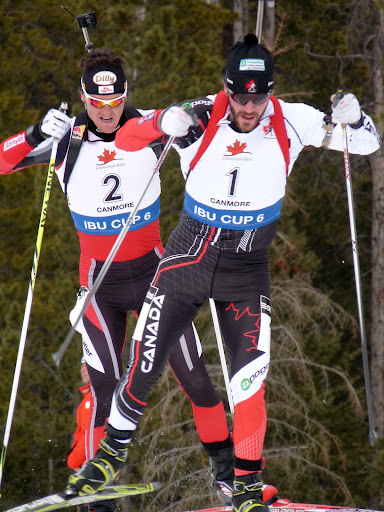

Last year, the world’s best biathletes got a taste of northern Maine when the World Cup made stops in Fort Kent and Presque Isle.
This season, the top racers are staying firmly ensconced in Europe. But instead of letting the sport get too comfortable on what could be considered its home turf, the International Biathlon Union (IBU) sent their eponymously named IBU Cup circuit across the Atlantic, and for the last week the “second World Cup” has been contested in Canmore, Alberta.
For the Canadians, bringing the races to their country has been huge. But even the Americans got behind the effort. Continental solidarity was high.
“This is as close to home as I will ever get for an international competition and I’m still in the Rockies, so it feels like home here,” said U.S. biathlete Lanny Barnes, a native of Durango, Colorado, who podiumed in Canmore. “The Canadians have put on some great races and are always very welcoming to the U.S. team. This is probably one of the most beautiful venues on the world.”

On both Saturday and Sunday, the athletes competed in sprints – 7.5 k for women, 10 k for men, a prone and a standing shooting stage apiece. On Wednesday, they doubled their distance for individual races, which featured four shooting stages instead of two and a one-minute penalty for each missed shot. On Thursday, it was back to sprints, and the penalty loop if the athletes made any errors.
Over the four days of racing, North Americans picked up three wins, three more podium finishes, and a total of 21 top-tens.
“These races have been great for Canadian biathlon,” Biathlon Canada High Performance Director Chris Lindsay told FasterSkier.
Nathan Smith, who raced to all three of the Canadian wins at the races, agreed.
“These were the highest caliber races to be held in Canada outside of the Olympics in recent history,” he said. “It’s good for publicity and getting new people involved in the sport. Our team got a lot of medals and top-6 results here… you can feel the team’s momentum.”
Other athletes confirmed that there was a loud fan base for the weekend races, although they lamented lower midweek attendance.
“It was too bad none of the schools came out to watch on the weekdays, but we still have a good number of people out there cheering,” said Canadian biathlete Rosanna Crawford. “Hopefully this will lead to World Cups being held in Canmore.”
Men’s Races: Domination By Smith

The story of the week – not only for the Canadian team, but for the circuit itself – was the near-total domination by 26-year-old Calgary native Smith.
Smith, who trains in Canmore, started out by winning the opening sprint by a mere five seconds over Russia’s Sergey Klyachin; Norwegian Martin Eng, who has an 11th-place World Cup finish to his name, was another second and a half behind.
In the next sprint, Smith shot clean and extended his lead, this time finishing 40 seconds ahead of Friedrich Pinter of Austria. After sitting out the individual race, Smith made it three-for-three with a four-second victory over Pinter in Thursday’s race.
“To have my first IBU win in Canmore was… amazing!” Smith told FasterSkier. “I’ve been training here since I started biathlon. I know a lot of the volunteers, so I’m proud that I could reward them in a small way for all their hard work over the years.”
Smith’s path to dominance really started at IBU Cup races in Obertilliach, Austria in December, where he placed third in a 10 k sprint, the first podium of his career.
“The bronze I got in December in Obertilliach was very special,” Smith said. “That was the first time I’d ever put good skiing and shooting together in an international race.”
After two more top-ten finishes in IBU Cup action in January, Smith made a brief jaunt onto the World Cup himself, producing a top result of 47th in a sprint in Antholz, Italy. When he returned to Canada for these races, he knew he could once again be near the top.
“All year I had been having really good time trials amongst the national team and I was hoping for a breakout performance,” he said.
He got it, and even though Canadian events are sometimes lightly attended by international teams, in this case Smith still had to beat out the IBU Cup’s best. Pinter, for example, has a handful of World Cup podiums to his name and owns a World Championships relay medal; the top three racers in the overall IBU Cup standings were also in the mix.
“The big difference here is how the pack thins out a little farther down the result sheet,” Smith said. “I think it was mostly the slower skiers who were missing. I think my races wouldve been at or very near the top if in Europe…. I was within striking distance of first at the IBU cup in Italy twice except my shooting wasn’t as good.”
Being in familiar surroundings, Smith explained, helped achieve his career-best performances.
“I knew I would have a little leg up on a lot of the other competitors because I got back to Canmore a couple weeks before the first race,” Smith said, before laughing it off. “Fair is fair though, since most of the time its the other way around!”
In the first sprint, Smith was joined in the top ten by three-time Olympian Robin Clegg, who missed two shots to Smith’s one and finished 55 seconds back in ninth.
In the second two sprints, it was Marc-Andre Bedard who kept him company, placing seventh and fifth.
“I had great races, but it didn’t feel like it,” Bedard said of his results. “I think I’m getting in better shape, and it’s just starting to feel good. There were quite a bit fewer people here than in Europe, so that helps the results for sure, but compared to the top guys my ski times are really better [than earlier this season].”
Bedard liked the atmosphere in Canmore, but said that if he could get absolutely everything he wanted, the races would be on the other side of the country: “It was pretty cool, but I’d love to race at home in Quebec once in my life at an international race!”
Jeremy Teela led the U.S. men, finishing 11th, 13th, 25th, and 12th.
Women’s Races: Depth and Consistency

The North American women couldn’t match Smith’s domination. They did, however, have something else going for them: depth. While a Canadian or American woman never topped the podium, Canadians Yolaine Oddou and Megan Heinicke and American Lanny Barnes all took their turns on the lower steps. Twice, the North Americans placed five women in the top ten.
In the opening sprint, Rosanna Crawford led the way in eighth followed one second later by Oddou in ninth; four more North Americans packed the top twenty.
“I was a bit disappointed in the race Saturday with the missed shot in prone,” said Barnes, who placed 12th. “You can’t afford to miss on a day like that with perfect conditions. The great thing was we had another opportunity on the same course and same race format to give it another go on Sunday.”
With a fire in her belly, Barnes stepped up her game in the second sprint – as did the rest of the North Americans. Oddou placed third, Barnes and Heinicke tied for fourth, and Crawford and American Laura Spector placed ninth and tenth.
Success continued in the weekday races, with Heinicke placing second and Barnes third in the individual, and then Crawford placing sixth in the sprint and leading teammate Melanie Schultz, Spector, Heinicke, and American Tracy Barnes in a six-through-ten sweep.
At 21 years old, Oddou is in her first season of racing on the IBU Cup, and these were her best results by far. Crawford is a 2010 Olympian, but also considered the races to be highlights.
“It was great to be racing in my home town, and I had my best results of the season and great shooting in all the sprint races,” Crawford told FasterSkier. “I was top Canadian two out of three sprints so that was very exciting for me.”
For Crawford, there was a little added motivation, as her mother had just been through surgery for breast cancer but still managed to get out on the trails to cheer.
“Things had been pretty stressful for me leading into these races,” Crawford said. “But she is such a strong and amazing women and is one of the main reasons I have made it this far in biathlon. She was out there everyday with her cow bells and cheering louder than anyone else!”
Lanny Barnes was the most consistent of the Americans, and was particularly pleased with her podium finish on Wednesday.
“I knew I was in race because I could practically hear the announcer everywhere on course and our staff kept giving me splits of leading the race,” said Barnes, who led through the first half of the race and then regained her lead on the penultimate loop before tiring before the finish.
“I probably started out a little harder than I wanted to, and lost a little time in the end, but was happy that my skiing is coming around,” she explained. “I was bummed that [twin sister] Tracy wasn’t right in there with me, but she is just getting over a cold otherwise I think she might have give me a run for the money!”
Tracy Barnes told FasterSkier that due to illness she had taken the races “one day at a time,” and was happy, though not thrilled, with her performances.
“I’ve placed in the top ten several times this season and know I’m capable of it,” she said.

Lowell Bailey may be getting a lot of attention these days, but the American biathlete isn’t the only one to have found success in the early days of the 2012 World Cup season.
Quietly, the Canadian women have upped their own profile – and their first two weeks of racing culminated in a ninth-place relay finish in Hochfilzen, Austria, tying the U.S. men’s performance.
Team member Zina Kocher, who has been racing in senior-level international races since 2002, had only ever achieved that result twice, and never beaten it.
“Our ninth in the relay is solid,” she told FasterSkier. “The team is moving up together and there is potential for better performances.”
Kocher has been the star of the Canadian team so far, scoring World Cup points in every race she has entered and finishing as high as 15th in the sprint in Ostersund, Sweden. But she’s had company: Megan Imrie has been in the points, too, and collected three of the top ten performances of her five-year World Cup career.
And that, for Canada, is good news.
“Together Megan and Zina will be the backbone of a solid women’s team,” said Biathlon Canada High Performance Director Chris Lindsay. “We expect a huge improvement on last year’s results both individually and as a team.”
Where Did Canada Go?
While the Canadian program has definitely produced fast women in the past – 1994 Olympic gold medalist Myriam Bedard comes to mind – in last few years the team hasn’t shown much depth.
In 2011, only Kocher and Imrie scored World Cup points (which are doled out to the first 40 finishers), and those were few and far between; neither woman made the top 70 in the overall rankings. In 2010, Kocher was ranked 31st and Heinicke the next closest in 65th. Kocher finished 2009 as the only Canadian who even made the rankings, clocking in at 41st.
“When I was still a junior starting out, the women were stronger than me, and I definitely looked up to them,” Kocher said. “I always observed how they did this and that, and was always trying to keep up to them, trying to be as strong and stronger.”
These days, there haven’t been as many senior athletes to serve as role models, just the same stalwart few who have been racing at a high level since they were very young.
“Our women’s team hasn’t changed that much in a few years, in terms of members,” Imrie said.
Canada has recently brought home several World Junior Championship medals, but it’s been hard to translate those results into a robust, deep team or widespread success at the senior level.
Why?
“Biathlon in Canada isn’t a well-known or easily accessible sport,” Kocher explained. “The depth in programs, coaches, environment, and finances all play a role… Financial reasons are a big cause of athletes quitting early on. And another aspect is talent and development of young athletes with a solid training program.”
Kocher said that for the last few years, Biathlon Canada has not offered financial support to development or junior national team members – which, she said, would be fine if regional training centers and clubs could pick up the slack. In the past this hasn’t been easy, but luckily it’s starting to happen.
“It’s getting better especially in Canmore and Valcartier, and now with the Biathlon Alberta Training Center we are on the right path to developing these programs,” Kocher said.
While the teams are primarily intended for junior athletes, it’s not a coincidence that the senior women have been improving at the same time.
A Changing Team, A Resurgent Zina
For Kocher, the recent results aren’t actually the best she’d produced. The Alberta native has stood on the World Cup podium before, and scored eight top-ten finishes. But after several frustrating seasons and battles with injuries and mononucleosis, she’s feels like she is finally back on track.
“[It’s] definitely not mind-blowing, just a solid start for the women’s team,” Kocher wrote in an e-mail. “For me, my ski speed is there with the top ten, and that is back to the previous performance potential from before I had mononucleosis.”
Her return to form has come on the back of a major change in the Canadian national team: after seven years, Kocher was not re-nominated for the “A” team for this season. She decided it was time for a change and returned to Canmore to train with Richard Boruta, her first coach.
Megan Tandy – who was the top Canadian at the Vancouver Olympics, finishing 36th in the pursuit – has since married coach Ilmar Heinicke, had a baby, moved to Germany, and took his name. Tandy missed most of the 2011 season, and this year declined a team nomination so that she could stay in Europe. That left only Imrie on the “A” team and Rosanna Crawford on the “B” team.
Have the changes affected team chemistry?
“No,” wrote Kocher. “We are a great bunch and there is really no animosity between anyone. We are always laughing… I’d say other teams might be jealous of our hysterical laughing fits!”
While Kocher said that it initially felt “strange” not to be training with her usual national team group, she has enjoyed the switch to the Biathlon Alberta Regional Training Center.
“Even though some of the girls aren’t as close to me in ski speed as Megan and Rosanna, I did have the young guys to chase!” she wrote. “I really enjoy the Alberta team and my teammates there.”
While she’s no longer a member of the national team, she qualified for the World Cup through trials races and Biathlon Canada hasn’t reacted negatively to her decision to leave the team. Lindsay was still informed about Kocher’s training, and he still had the same goals for the star that he’d had when she was part of his squad.
“Zina’s start has been exactly as expected,” he wrote in an e-mail. “She showed strong results in the physical testing over the summer and she is well situated to be among the top ten fastest skiers on the circuit. Her shooting results so far are in line with expectations and the plan has her continuing to improve shooting results for a peak at the World Championships.
“We firmly believe that Zina is capable of making this her overall best season,” Lindsay concluded.
Consistency from Imrie
Imrie might be, too.
While the 25-year-old scored World Cup points twice in both the 2010 and 2011 seasons, she more frequently finished in the 40s and 50s, with the odd shooting disaster dropping her far below that.
The start to her 2012 season hasn’t been perfect – she placed 88th in the sprint in Hochfilzen after missing five shots, and did not make the pursuit – but it has been encouraging.
In Ostersund, she placed 41st in the individual, 33rd in the sprint, and 43rd in the pursuit.
“The season start has been better than in the past, but still I feel like I am capable of so much more,” Imrie said.
Her 2011 campaign was cut short by a rib injury, so she came into the next training year relieved and happy to be skiing again. The injury also provided some forced recovery, she said, which made her better able to handle the training volume. As a more mature athlete, she’s begun to understand how important that is.
“I’ve been a good student,” Imrie said. “I’ve learned how to manage my training workload, but also my rest and recovery. I’ve improved in gauging when I need rest versus when I need to push harder.”
Aside from working with new coaches on shooting and ski technique, Imrie said that her strong start was most likely born from the simple fact that she loves the team.
“I’m training again with Matthias Ahrens, who was my coach as a junior,” she said. “Our team is small, and the six of us who train in Canmore get along really well… I’ve stayed healthy from the outset, and looked forward to the team atmosphere each day.”
She didn’t seem to have suffered from Kocher’s move away from the national team, either.
“Rosanna and I train a little bit together, but a lot I do on my own,” she explained. “I’m lucky to be in Canmore, because if I need a training partner, I’m able to join up with cross country skiers, or other biathletes when our schedules fit. I’ve enjoyed many great afternoon workouts with Perianne Jones.”
She understood Kocher’s move and didn’t hold it against her.
“I know that Zina needed a different approach this year to training, so it was fine to be separate,” she said.
A Team That’s “Stoked”
Luckily for Canada the separation was only temporary, and Kocher and Imrie have been reunited in Europe. So far, they’re packing a strong one-two punch for the team. Lindsay, the high performance director, believed that Imrie could do even better than she had in the season openers, and follow Kocher more closely in the overall rankings.
“Megan has proven that she is a force to be watched with her season opener,” he said. “We knew last year that she was capable of top-40 results… this year the goal is having consistent top 40 finishes with peaks in the low 20’s when everything goes right.”
And with Crawford, who hasn’t had stellar individual performances this year but cleaned both stages of her relay leg, and Heinicke, who did not make Canada’s three-woman World Cup squad but appeared to be on form with her relay performance, the team is truly succeeding together.
“We have all made improvements and are stoked about the season,” Imrie wrote.
The results so far are something that would have been unusual a few seasons ago, when Kocher was the only one World Cup points.
“For the three of us, all three making the pursuit, [and having] two in World Cup points in the sprint, this is a good overall performance,” Kocher said.
“There is definitely potential for Megan and I to consistently be getting into points… I feel confident that we will be having a consistently better year, as whole team, than last year.”