Tag: Megan Imrie

  • Relay Medal Slips Out of Canada’s Grasp with Late-Stage Shooting Collapse

    Relay Medal Slips Out of Canada’s Grasp with Late-Stage Shooting Collapse

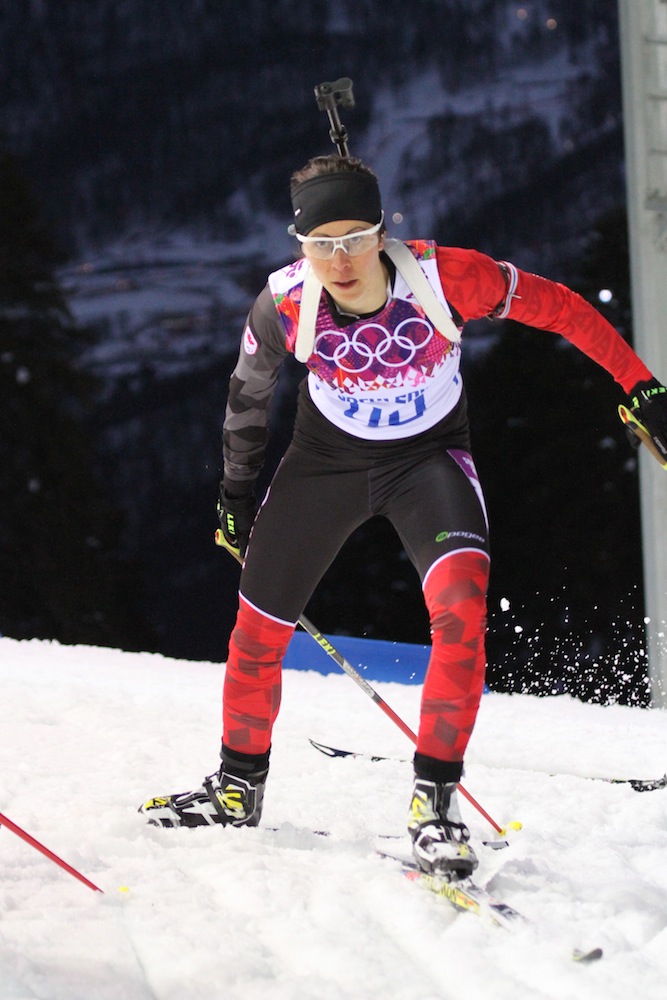
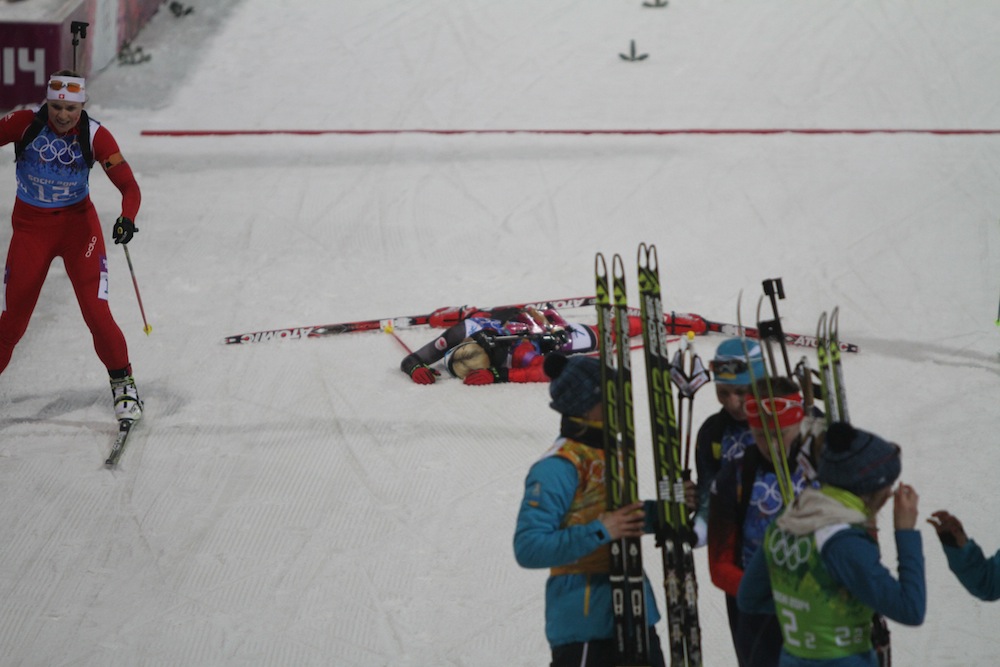
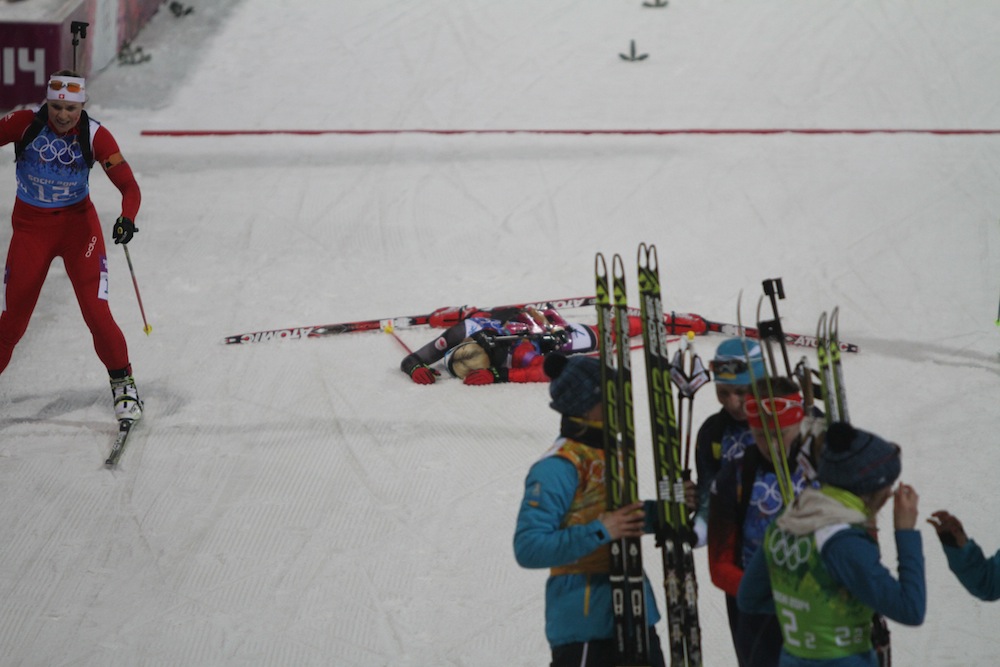
    Zina Kocher collapsed at the finish line of the women's 4 x 6 k relay after giving on of the best ski performances of any athlete all day. Unfortunately, she was not able to match that on the range.
    Zina Kocher collapsed at the finish line of the women’s 4 x 6 k relay after giving on of the best ski performances of any athlete all day. Unfortunately, she was not able to match that on the range.

    FasterSkier’s coverage is made possible through the generous support of Swix.

    KRASNAYA POLYANA, Russia – Zina Kocher brought Canada both the most exciting and most frustrating moments of yesterday’s women’s biathlon relay.

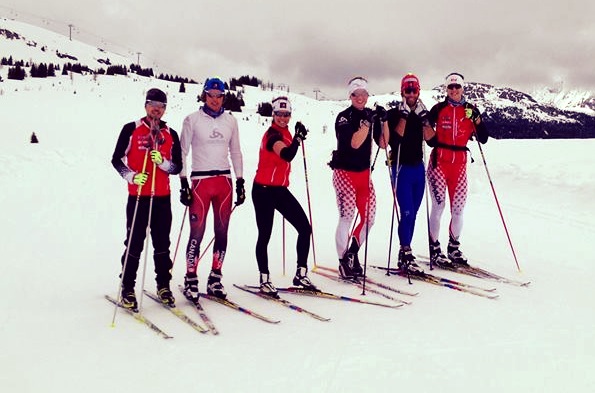
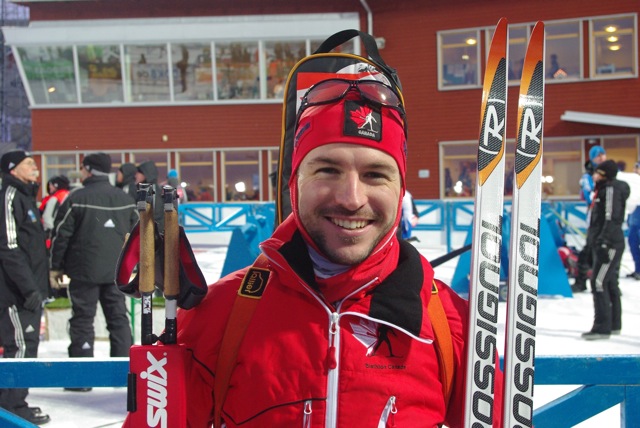
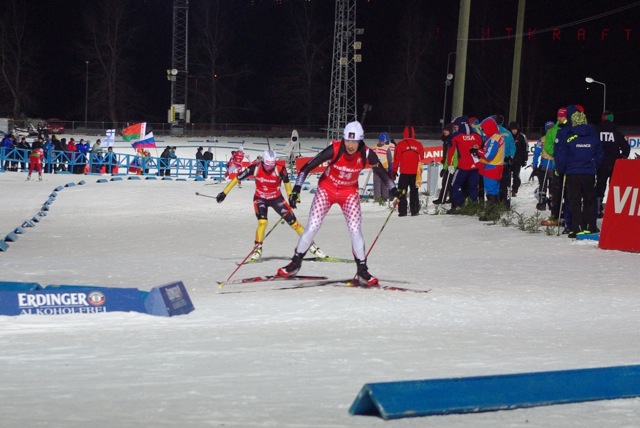
    To be sure, the whole team contributed to getting her to that moment. Rosanna Crawford, Megan Imrie, and Megan Heinicke had skied strong legs to bring Canada from fifth to sixth and then up to fourth. Canadian head coach Matthias Ahrens described his feeling as “overexcited” watching the early stages of the relay.

    When Heinicke tagged off to Kocher, Canada’s habitual anchor, she was just 40 seconds from the lead, and 15 seconds from second-place Russia and third-place Norway. Late in the game, Canada was in a place it had never been in Olympic relay racing before. At a World Cup in Annency, France, earlier this season, they had finished fourth. But their previous best Olympic relay was 15th.

    What Kocher did next was nothing short of inspirational: she skied so aggressively that she caught both Tora Berger of Norway – no small feat – and Olga Vilukhina of Russia, and led them onto the range. Canada was in second place.

    “I was really excited,” Kocher said. “I was really trying to focus on what I did in [Annency] and the thing was that I knew I was in fourth, and that my skis were really fast. And that I was suddenly with the top. I lay down in second place, and all of a sudden I was fighting for a podium.”

    That’s where things started to go off the rails for Kocher. In prone, she used two spares rounds while Berger and Vilukhina cleaned. She lost time, but still had almost 30 seconds on fifth place. It seemed very possible that Canada would tie their World Cup result, which was a best-ever.

    But in standing things continued to unravel. Kocher missed shots again, but also lost count of how many spare bullets she had used. Athletes are only allowed three in each stage, but she also had one left over from the prone stage, which she would have been penalized for using. Kocher had to stop and count her bullets.

    “I was so close and but I think I really spent myself in that first lap trying to catch up and I paid for it in the standing,” she said. “I was really struggling to actually stand (laughs). I was a little bit out of it when I went to my spare bullets, I lost count of how many I had left and almost gave us a penalty by putting in an extra one until I started counting.”

    She avoided the penalty, but kept missing shots. Kocher spent a painful 50 seconds on the shooting range – up from the 25 to 30 in a clean shooting bout – and then had to ski two penalty loops. She went from being 25 seconds away from a bronze medal to being almost two minutes behind.

    Despite the heartbreaking mistakes, Kocher went back out on the trails and skied another hard loop, to turn in the fourth-fastest last-loop time.

    “Thank God she did take the extra time to go through, because if she’d shot the extra round, that would have been it,” Biathlon Canada High Performance Director Chris Lindsay said. “And she came out of it in ninth, immediately was able to pass the Swiss, and put us back in the top eight.”

    The mood of the Canadians oscillated between pride and disappointment even long after the race was over. The same four women had placed 16th in the relay in Vancouver, and late-stage mistakes and all, they were thrilled to see how far they had come.

    “It was a tough ending but Zina skied her heart out that last loop,” Heinicke said. “This is the same four girls [as Vancouver in 2010] so that’s a really cool way to see how much progress we’ve all made as individuals and as a team in four years. We’re halfway closer to the top then we were then. With the two penalty loops it also shows us what our potential would be if we were all to have that day on the same day.”

    And there were other moments of brilliance. Crawford, for example, skied aggressively out of the start and was actually leading the relay for the first few hundred meters. Seeing Canada at the front of an Olympic relay was a goosebumps moment for many.

    “It’s certainly wonderful to watch,” Lindsay sighed.

    And Heinicke had perhaps the most brilliant performance of the day, shooting fast and perfectly cleanly in both stages while skiing the fifth-fastest course time of her leg.

    “I think that I can be a good shooter, and I have been a good shooter in the past,” she said. “I feel like I put myself under more pressure than I even realized for these individual races and coming into the relay, we were in a good position so it’s not that there was nothing to fight for, but I still sort of felt like the pressure’s off. You know you have those three spare bullets there and you’re just like, OK, this is that confidence booster. I think that helped me kind of put on the blinders and do my job.”

    Despite losing spots at the end, Ahrens was still incredibly proud of his squad.

    “I must say, I applaud all of them, because it’s long [weeks], and this is a very tough course here,” he said. “They have had some tough conditions at times. And to pull it together at the end, I really applaud them.”

    But in a race where there were even more strange results, with strong teams like Germany, France, Poland, and Belarus removing themselves from contention early, there was an even more tangible sense of what might have been.

    “The reality is that we were given a few bonuses today with the unfortunate incident off the top for the Germans, and I really hope that girl from France is okay,” Lindsay said, referring to Marie Laure Brunet’s collapse on the course following a vasovagal reaction, requiring her to be carried out in a stretcher. “But [in competition] you have to be able to capitalize and unfortunately we weren’t able to capitalize. This is a relay we could have medaled in. Flat out. And it’s a good result at the end of the day, but it’s not the result we were capable of.”

    “Unfortunately it ended with two penalties, which of course you can’t have in a relay,” Ahrens said.

    “We were looking for a podium,” Lindsay added. “Like I said, it was within our grasp, but we weren’t able to grab it.”

    “It’s a hard one to swallow,” Kocher lamented.

    “Top eight is still a great result for us,” Crawford concluded. “The thoughts of ‘what could have been’ will linger for a while, but we have come a long way from 2010!”

    — Alex Matthews, Seth Adams, and Nat Herz contributed reporting.

    Results

  • After Last-Minute Call, Imrie Represents Canada for First Time in Women’s Mass Start

    After Last-Minute Call, Imrie Represents Canada for First Time in Women’s Mass Start

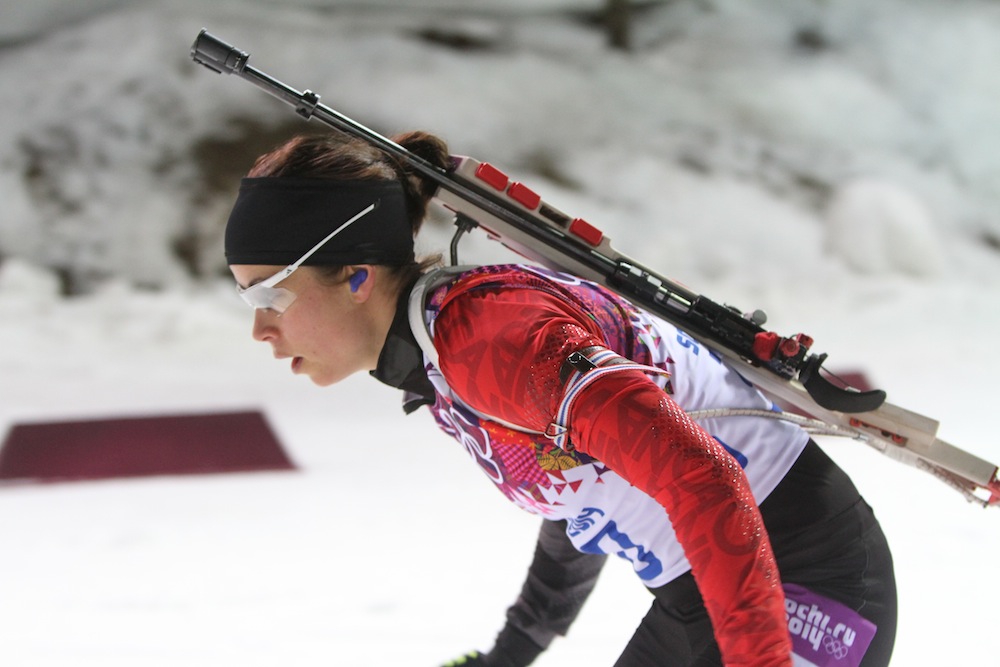
    Canada's Megan Imrie racing to 28th in the first mass start of her career -- the women's biathlon 12.5 k mass start at the Sochi Olympics.
    Canada’s Megan Imrie racing to 28th in the first mass start of her career — the women’s biathlon 12.5 k mass start at the Sochi Olympics.

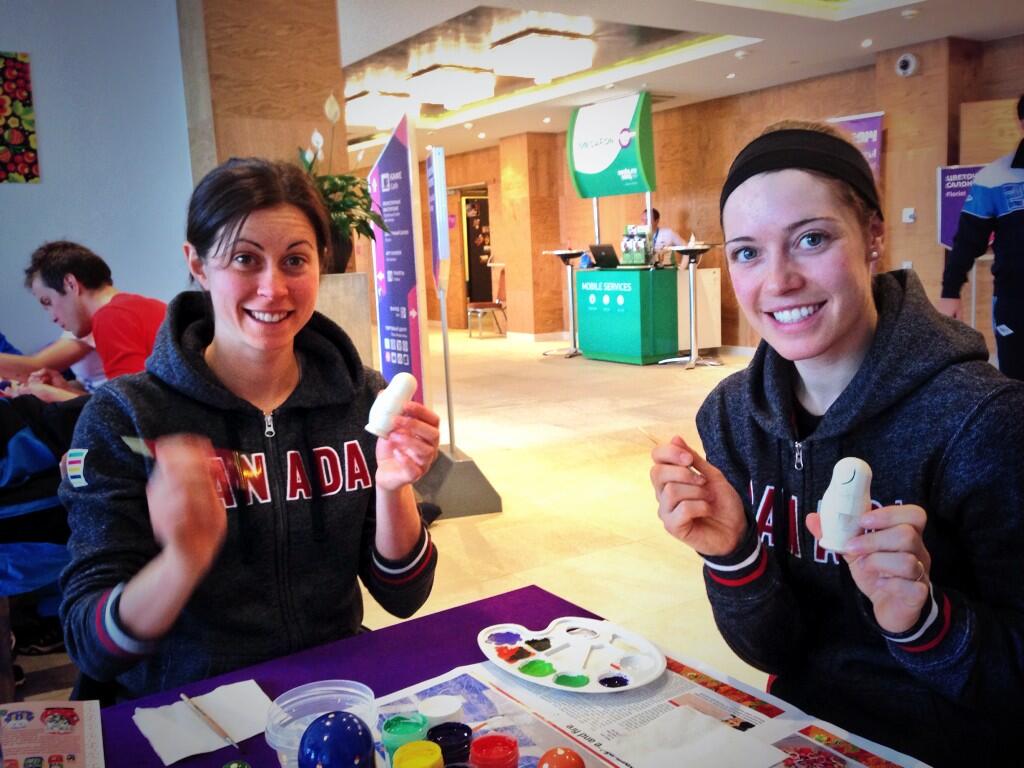
    SOCHI, Russia — Megan Imrie was painting dolls when she got the call.

    To be fair, the photo her Biathlon Canada teammate Rosanna Crawford tweeted at 5:37 p.m. made it look like she just started. Either way, she wasn’t going to finish.

    Her coach, Matthias Ahrens had called Imrie 10 minutes earlier to let her know she could relax. The fourth woman out of the top 30 allowed to start in Monday night’s 12.5-kilometer mass start, Imrie initially heard that two people pulled out. Close, but no cigar.

    Canadian biathletes Megan Imrie (l) and Megan Heinicke show off the Russian dolls they were painting when Imrie received a call from her coach, informing her that she could race the Olympic 12.5 k mass start in just over an hour. (Photo: Rosanna Crawford/Twitter)
    Canadian biathletes Megan Imrie (l) and Megan Heinicke show off the Russian dolls they were painting when Imrie received a call from her coach, informing her that she could race the Olympic 12.5 k mass start in just over an hour. (Photo: Rosanna Crawford/Twitter)

    “I waited here until 5:15 and looked at the start list, and she wasn’t on it,” Ahrens said. “The assumption was that she would not race, so I called her to tell her … and then I started to walk down to the village, and then I got a phone call that she actually could start. So I called back, and from there we went.”

    Meanwhile, Imrie and her teammates started to paint Russian “Matryoshka” dolls, those little wooden dolls that contain smaller wooden dolls. The arts-and-crafts session in the Olympic Endurance Village ended with the second call from Ahrens, informing her that two others were out and she was in.

    “He called again and said, ‘Actually you’re in! Do you want to start?’ ” Imrie recalled. “I said, ‘Of course I want to start!’ so I jumped up and got in my race clothes as fast as I could.”

    Her teammates followed soon after to watch the 7 p.m. race, which went off according to plan despite impenetrable fog throughout the day — a visibility issue that derailed the already postponed men’s mass start from the night before. Originally scheduled to race Sunday night, the men wouldn’t get to start until at least 2:30 p.m. Tuesday, Moscow time.

    Either way, Imrie had to get to the venue, calibrate her rifle, and warm up, all in an hour’s time.

    The 28-year-old, who celebrated her birthday last week, pulled it off and pumped herself up for the first mass start of her career — and Canada’s first for a female biathlete at the Olympics.

    “Because it’s so soft and slushy out there … it’s the kind of day you don’t want to overdo a warmup,” she said.

    Starting in bib 30, Imrie was a little intimidated at first.

    “But then looking around, these girls are my buddies and I have to keep reminding myself that I earned this spot as much as any of them,” she said. “I just kind of chilled out in the back of the pack for a while and did my thing on the range.”

    Her first time in the range, Imrie recorded the eighth-fastest shooting time, missed one and had to ski a penalty lap. She left the range in 27th, and after cleaning the second prone, moved up to 20th.

    Focused on her two key words, just like always (“center and squeeze” for prone; “relax and react” for standing), Imrie tried to relax each time she entered the range. She skied the 16th-fastest time on the third 2.5 k loop, then missed one in the first standing. Leaving the range in 22nd, she skied the 18th fastest on the fourth of five loops.

    Her last time shooting, she missed three standing. The penalties put her back toward the end of the pack, and Imrie had to fight for 28th. The result tied her Olympic best from the preceding pursuit and bested her results in two other races in Sochi: 30th in the 15 k individual and 31st in the 7.5 k sprint.

    “I didn’t want to come across the line last, and I didn’t so that was OK,” she said. “I actually got better and better on my skis. In the individual [race] I just died, absolutely died, so today I felt quite good, but I just didn’t get those last three targets. My sights were just sitting a little bit on the right and I couldn’t get them.”

    All things considered, Imrie was glad to check off another Olympic race — after a season in which she hardly competed — and even waved to stadium spectators just before the finish.

    “Given that it was a last-minute thing for her to jump into it, I’m really happy for her that it worked out,” Ahrens said. “Unfortunately, the last shooting cost her a few places, but up to that point it was really nice, a really excellent race.”

    Imrie finished 3:33.4 behind Belarusian Darya Domracheva, who won in 35:25.6. The lone  Canadian in the mass start, she finished 8.7 seconds behind Slovakia’s Anastasiya Kuzmina in 27th and 10.5 seconds ahead of Franziska Hildebrand in 29th.

    “I was representing our whole team,” Imrie told CBC. “I’m happy to put our stamp on this race and show Canada belongs in this elite group.”

    With soft conditions resulting from moist, tropical-like weather, Imrie said it hasn’t been easy to log the most efficient workouts, but she did some race prep on Sunday in the event that she’d race Monday.

    “It’s usually very unlikely, especially in Olympic Games that it would go as deep as 34 [in a mass start] so I had my fingers crossed,” she said. “I did my training and leadup yesterday as if I would be racing. I wasn’t going out and partying like crazy, but I was definitely surprised.

    “It’s been difficult conditions for the organizers to deal with,” she added. “They’re really doing their best to manage the snow, which has been fantastic, but it doesn’t leave much quality ski training for us. So it’s nice when you can go out there and have some prime conditions for intensity work.”

    On Monday night, she was going to meet with her teammates and boyfriend, who came to the biathlon stadium to cheer her on. Then maybe she’ll finish those dolls.

    “It’ll probably be a gift,” said she with a laugh.

    Results

  • Birthdays in the Olympic Village? Uplifting, But Hardly Wild

    Birthdays in the Olympic Village? Uplifting, But Hardly Wild

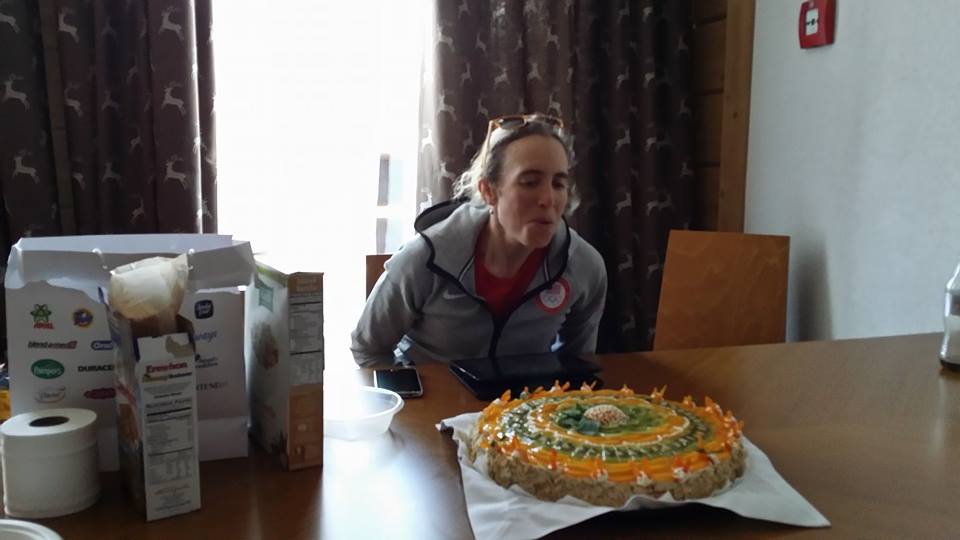
    Susan Dunklee and her unorthodox birthday cake in Sochi.
    Susan Dunklee and her unorthodox birthday cake in Sochi. Photo: Liz Stephen.

    FasterSkier’s coverage is made possible through the generous support of Rudy Project.

    SOCHI, Russia – When Megan Imrie woke up on Friday, she might have felt something a little special.

    After all, it was her birthday! At a certain point, birthdays lose a bit of their luster, but Imrie was turning 28. It was a cause to celebrate.

    There was just one hitch: the Canadian is a biathlete competing at the Olympic Games. That evening, she had to toe the line in a 15 k individual competition.

    “It’s a tough one,” she said.

    As such, there couldn’t be too crazy of a party, either before or after the race. After all, Imrie likely has two more starts left at the Games. (Canada has not named their mixed relay team yet, but Imrie has a shot at being on it, and will definitely participate in the women’s relay.

    “We’ll just have a team party tonight,” she said at the finish of the 15 k, where she placed 30th. “It’ll be fun tonight. I don’t know what we’ll be up to, but something. Maybe a good round of Cranium or something. Live on the wild side.”

    American biathlete Susan Dunklee turned 28 just one day before Imrie.

    “It’s hard to have your birthday on the road,” U.S. biathlete Sara Studebaker said of her teammate. “For her, she has to race the next day, so you can’t really do anything.”

    And so it goes. The Olympics are great for a lot of things. But parties? Not so much, unless you’re done competing. That may be especially true for cross-country skiers and biathletes this year, as they are staying in a separate athletes’ village that is isolated from all the other sports, where they might find kindred partiers. In the endurance village, everyone is preparing for grueling races for the entire course of the Games.
    “Really, I think her birthday party will wait until after the end of the Olympics, and then we’ll be able to really celebrate,” teammate Hannah Dreissigacker said of Dunklee. “It wasn’t a great day to really celebrate too much.”

    Still, though, the athletes found small ways to make the day special.

    “I came in this morning and last night, the girls had decorated the living room,” Imrie said. “They had taken my race suit and put balloons in it and stood it up on ski boots, and tied it to a hat. They made it a face, and there were streamers everywhere. It was like a mannequin of, well, me.”

    Several people had coordinated to find something a little special to spice up Dunklee’s day, which turned into a small party in the athletes’ village.

    “My teammates found a cake for me,” she said after placing 34th in the 15 k. “I don’t know where they got it from, but they surprised me with it. And my parents came and visited. So it was pretty low key but a fun little hang out.”

    A few cross country skiers came over from the house next door. How is that not a party?

    If you’re a ski racer born in February like Imrie and Dunklee, chances are you’ve raced on your birthday at least a few times. Dunklee said it as nice to have a day off this time around; last year she raced, also in a 15 k individual, where she placed 15th.

    “I’ve had to race on my birthday numerous times growing up and even last year at World Championships,” Dunklee said. “Sometimes it’s really special, but sometimes it’s nice to have a low-key day.”

    The culprit behind the cake was Tracy Lamb, a former biathlon coach who is a U.S. Olympic Committee liaison in the endurance village. It was special, said Dreissigacker, but probably unlike any birthday cake Dunklee had eaten before.

    “It actually looked really good,” Dreissigacker said. “I couldn’t eat it because I’m gluten-free, but it was really dense and almond-y, and then the whole top was covered in fruit. Like, intensely covered in little slices of kiwi and stuff. It was beautiful! It was very, not a normal American birthday cake.”

    Did the small celebration give Dunklee a little pick-me-up? Yes, to some extent.

    That’s what Canadian skier Perianne Jones can look forward to two days from now when she turns 29, the day before the team sprint that has been a focus for the Canadian team.

    But the last thing about birthdays at the Olympics is that they help everyone else out, too.

    “It helps,” Dunklee’s teammate Sara Studebaker said. “We’re here for so long, and we’re doing so much racing, and it’s pretty stressful. Any time you can have something like, ‘oh, this is totally unrelated to sport! Let’s go do that! Let’s think about that for a while!’ That’s good. That’s really nice.”

  • Crawford 25th in Biathlon Sprint; Four Canadian Women Forge Ahead to Pursuit

    Crawford 25th in Biathlon Sprint; Four Canadian Women Forge Ahead to Pursuit

    Rosanna Crawford (Biathlon Canada) racing to a career-best 25th in the first race of her second Olympics, Sunday's 7.5 k sprint in Sochi, Russia.
    Rosanna Crawford (Biathlon Canada) racing to a career-best 25th in the first race of her second Olympics, Sunday’s 7.5 k sprint in Sochi, Russia.

    FasterSkier’s coverage is made possible through the generous support of Rudy Project

    SOCHI, Russia — There’s something about enormous white retaining walls that speaks to Rosanna Crawford, and whatever it is, it’s working for her in Sochi.

    In her second Olympics, the 25-year-old Canadian biathlete led three of her teammates in the top 60 of the 7.5-kilometer sprint on Sunday — the first women’s race of the 2014 Winter Games.

    Crawford cleaned her prone and missed one standing to finish 25th overall, shaving 47 places off her previous-best Olympic result at the 2010 Vancouver Games.

    But this wasn’t Canada, and Crawford was in the zone, clocking the third-fastest range time in standing and sixth-fastest course time to finish 1:04 behind Slovakia’s Anastasiya Kuzmina, who won in 21:06.8.

    “My shooting … in the last two World Cups was pretty poor, and my confidence had gotten rattled,” Crawford explained. “But during training here things were going really well and I love the range, and I had just made sure to pick a specific spot on the course where I switched to shooter, just taking it one shot at a time and just staying focused on me.”

    With a downhill approach to the range, complete with “giant retaining walls” unique to Sochi’s brand-new venue, she said it was nice to glide down into the range for a change. “You’re not working at all,” she said. “It’s pretty awesome.”

    Once in the stadium, she said the shouts of the Russian crowd stood out. “It was crazy. When I came to shoot standing, it must have been the Russian podium was finishing and it was so loud that I really had to try and pull my focus onto my and not on the crowd shouting Rush-y-a.”

    In addition to her shooting, Crawford felt good on the three-loop course as well.

    “This course is hard so it was definitely a little bit about pacing rather than focusing on moving fast,” she said. “I just focused on good technique, and I think that gets me up the hills rather than if I’m scrambling.”

    Canada's Megan Imrie racing to an Olympic career best of 31st in Sunday's 7.5 k sprint in Sochi, Russia.
    Canada’s Megan Imrie racing to an Olympic career best of 31st in Sunday’s 7.5 k sprint in Sochi, Russia.

    Along with Crawford, Canada’s three other starters also placed high enough to qualify for Tuesday’s pursuit, with Megan Imrie finishing 31st (+1:12.7), Zina Kocher following 6 seconds back in 32nd, and Megan Heinicke making the cut in 59th (+2:27.7).

    All four had been to at least one Olympics before (in 2010), and for all but Kocher and Heinicke, Sunday marked their best individual performances at any Games. Kocher placed 27th in a 15 k individual race in the 2006 Torino Olympics, and Heinicke raced three individual events in Vancouver with a top result of 36th in the pursuit.

    Imrie, who turns 28 on Friday, improved upon her previous Olympic best by 31 places in 31st. Sunday’s result marked her first time qualifying for the Olympic pursuit.

    “It went almost perfect,” she said after cleaning prone and having a single standing penalty. “I’m super happy. I mean, you never really know with an Olympic race how you’re going to feel, and you just have to play the cards you’re given. I felt pretty darn good out there and made the shooting count.”

    Kocher missed one shot in both stages for two penalties, and while it wasn’t her best result, she said it was an improvement upon other races this season.

    “I’ve been having some problems in sprint races this year and so this is one of my best, if not my best, and it’s my best sprint in Olympic Games,” Kocher said. “So it could have been better, but I’m satisfied.”

    A three-time Olympian, Kocher, 31, said she’s more relaxed overall this time around — but it still doesn’t come easy.

    Canada's Zina Kocher racing to 32nd in Sunday's Olympic 7.5 k sprint, the first women's biathlon race of the 2014 Winter Games in Sochi, Russia.
    Canada’s Zina Kocher racing to 32nd in Sunday’s Olympic 7.5 k sprint, the first women’s biathlon race of the 2014 Winter Games in Sochi, Russia.

    “I’ve been pretty stressed with nerves this year, and today I just tried to stay in control and relax,” she said. “I came in four years ago with high expectations and wanting to be like I was in 2007, and I wasn’t. I was tired at the Games and I was very stressed. At these Games, I feel like I took control of my training, I changed a lot of things from four years ago and I came into here a lot more confident that I did everything that I could to do the best I can for these two weeks.”

    Heinicke, 25, was initially disappointed with her result on Sunday, missing one prone and two standing to finish 2:27.7 behind Kuzmina.

    “It was great conditions on the shooting range; there is no reason to have three misses and so I’m pretty disappointed, particularly about the standing two misses,” she said. “It was just too many penalty loops to be up there in the top 30 like I would like to be and like I have the potential to be. … If we were having this conversation 10 minutes from now, I’d be a lot more like ‘Yes, pursuit, I’m in there, I’m gonna fight.’ I’m really stoked that I squeaked in there.”

    With four women in the 10 k pursuit, Sunday was a solid one for Canada, which qualified just one woman four years ago for the pursuit in Vancouver.

    Megan Heinicke making her way around the stadium in Sunday's Olympic 7.5 k sprint in Sochi, Russia.
    Megan Heinicke making her way around the stadium in Sunday’s Olympic 7.5 k sprint in Sochi, Russia. She placed 59th of 84 finishers.

    “Looking back at 2010, Megan [Heinicke] was the only one who did qualify for the pursuit and now to have all four of us there is really exciting and I think it bodes really well for the relay,” Crawford said. “We had such a good time in France placing fourth there. And we know that the potential is very high for us, come the relay.”

    Imrie said the team reflected on the Olympics four years ago in the waxroom before the start.

    “Megan Heinicke was saying, ‘Man, four years goes by fast!’ ” Imrie said. “I felt totally overwhelmed at the last Games, in a good way, but it really did a number on my legs. I was just totally exhausted throughout the whole thing. Now there’s four years in the bank trying to manage my training, it feels much better.”
    The women’s 10 k pursuit starts Tuesday at 7 p.m. Moscow time (10 a.m. EST). The men will kick things off Monday night in the 12.5 k pursuit at 7 p.m.

    — Chelsea Little and Seth Adams contributed reporting

    Results

  • Cook and Imrie Talk Fog and Frustration after Mid-Race Cancellation

    Cook and Imrie Talk Fog and Frustration after Mid-Race Cancellation

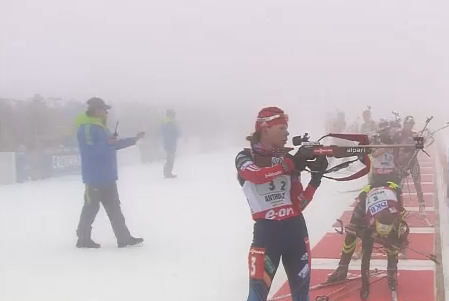
    Mid-shooting, officials tell the women to stop.
    Mid-shooting, officials tell the women to stop.

    For the North Americans, Sunday’s 4 x 6 k women’s biathlon relay started off well in Antholz, Italy.

    Susan Dunklee of the United States left her standing stage on the scramble leg in second place. Rosanna Crawford was eighth, just 12 seconds from the lead. Dunklee handed off to Annelies Cook, who was in fifth when she came to her own standing stage; Megan Imrie, who had taken over for Crawford, was in eighth.

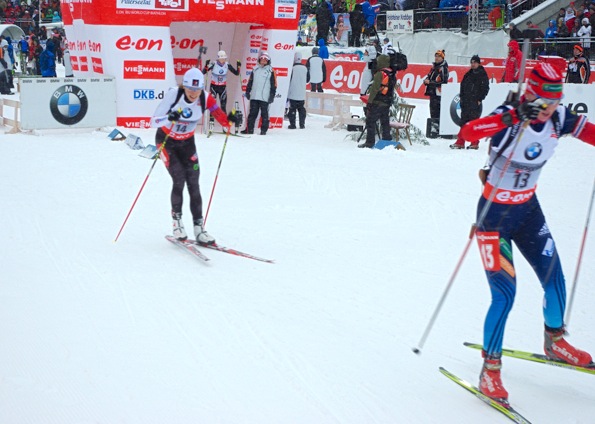
    But all at once, the fog that had been lingering on the flanks of the surrounding mountains tumbled down into the Antholz stadium, obscuring everything. The first time the competitors noticed it was about a kilometer from the stadium, when all of a sudden they were skiing through thick, thick fog.
    Then they arrived on the range.

    “My first coping strategy was to shoot as fast as possible, as the targets would barely be visible,” said Megan Imrie.

    Her idea: if she was going to miss a lot of targets anyway, might as well get it over with.

    Ekaterina Shumilova of Russia was the first woman to arrive. She got into position, looked through her rifle’s sight, and then looked up, double checking the targets. She looked through her sight again. She looked up and looked straight down the range, trying to discern where the targets were.

    Meanwhile, Anais Bescond of France and Andrea Henkel of Germany skied into the range, then Elisa Gasparin of Switzerland. Cook and Teja Gregorin of Slovenia arrived next.

    “There was no chance to see the targets,” Cook wrote in an e-mail.

    Henkel was the first to get a shot off. It was a miss.

    Inernational Biathlon Union officials canceled the race, telling the women not to try to shoot.

    “When I arrived in the range a minute later, everyone was standing on their shooting mats, and the officials were telling us not to shoot,” Imrie explained. “But it was a good decision at the time. There were no targets to speak of, we were staring into a white cloud. There was nothing to aim at.”

    For the Canadian women, it was a tough pill to swallow. Earlier this season in Annency, France, they had had a career-best finish: fourth place. All of a sudden they knew what was possible, and were in a position where they just might realize such a finish again.

    “I was just itching to finish the race,” Imrie said. “Rosanna had done a great job, our skis were blistering fast, and my teammates were chomping at the bit. Our entire team has had a much different lead up to these races than the European’s. We are rested and fit, so it was a huge disappointment to have yet another race cancelled.”

    Another frustration for the Canadians was that Audrey Vaillancourt had traveled to Antholz from Ruhpolding, Germany, where she was competing on the IBU Cup. Megan Heinicke was sick, so Vaillancourt was to replace her after finishing 31st in the IBU Cup sprint on Saturday. But Vaillancourt turned out to have skipped the IBU Cup pursuit for nothing, as she never even raced in the relay.

    “It’s at least reassuring to be feeling strong,” Imrie said. “Now the next task is to carry it into Sochi.”

    The women’s pursuit in Östersund, Sweden, was also canceled earlier this season, that time for very high winds. In all, the women’s World Cup season has been significantly disrupted already. While the men’s race was also canceled in Sweden, in Antholz on Sunday the men were able to start their relay with a 30-minute delay after the fog cleared and turned to snow. It wasn’t necessarily fun conditions for them, but racing was at least possible.

    Cook agreed with Imrie’s sentiments.

    “That was a bummer,” she wrote of the cancellation. “It was good for me to end on a positive note anyways, but of course I would have liked to finish my race and also cheer my teammates on.”

    Cook, who has been plagued by shooting trouble in individual races, had raced a strong leg so far: she had left prone in seventh but skied her way up to fifth.

    “I was with a group of strong skiers like Andrea [Henkel],” she wrote. “It was great for me to feel like I was skiing with them but feeling really relaxed. It’s been a tough season so far and that was really good for my confidence.”

    Despite the frustration of not being able to finish, Cook was able to find some humor and fun in the situation.

    “It was a pretty funny day,” she wrote. “I always kind of like it when conditions are crazy because everyone relaxes a bit and remembers that biathlon is just a game.”

  • Canadians In The Points, Using Ruhpolding to Ramp Up for Sochi

    Canadians In The Points, Using Ruhpolding to Ramp Up for Sochi

    Rosanna Crawford (bib 26) chasing Anais Bescond of France and Tiril Eckhoff of Norway in the pursuit.
    Rosanna Crawford (bib 26) chasing Anais Bescond of France and Tiril Eckhoff of Norway in the pursuit.


    RUHPOLDING, Germany – Some things on the World Cup this weekend definitely haven’t gone as planned for the Canadian team.

    Let’s start with the conditions. There’s more snow than in Oberhof last week (which the World Cup team skipped anyway, giving the starts to its B squad instead), but the snow here is scarce, icy, and intermittently salted. That wasn’t what Megan Heinicke, for one, was hoping to come back to.

    “I was somewhat disappointed with my skiing in both the relay and today’s race,” she wrote in an e-mail after the 15 k individual. “A part of it is that icy conditions like today are a weakness for me and have always been a challenge.”

    She was feeling “energized and fit”, but wasn’t able to translate that directly into skiing on the course.

    Then, there were struggles on the range. Nathan Smith and Jean Philippe Le Guellec both had four penalties in the 20 k individual on Saturday, too many for a top result (they finished 40th and 52nd).

    Rosanna Crawford and Megan Heinicke had good individual races on Friday, but then had four penalties in the pursuits this morning. That meant that they weren’t able to capitalize on their 26th– and 30th-place starting positions, and were relegated to 37th and 48th.

    But all is not lost: nearly every athlete came away with something to be happy about, including a top-20 finish by Smith (more on that later). It started with the relays: on Wednesday, the women placed 12th, and on Thursday the men had a strong eighth-place showing. Both teams had only just arrived from Canada, and were still dealing with jetlag, leaving them happier with the performances than they might have been otherwise.

    Women

    More positive things came on Friday, after the women’s individual race, starting with Rosanna Crawford.

    “I think it was a pretty good ski time, and 17 is the best I’ve ever shot in an individual,” she said at the finish. “So I have to be happy with that. It’s too bad about my first prone, but, it happens.”

    Megan Imrie skiing with Olga Zaitseva of Russia in the pursuit.
    Megan Imrie skiing with Olga Zaitseva of Russia in the pursuit.

    Crawford was also simply happy to be racing and hitting the points at all. She thought back to last season, when she finished 65th in the sprint here.

    “This is a lot different than last year,” she said. “I remember at these races last year I was feeling reallllly awful. So I’m happy that I didn’t dig myself too deep in December. I think I just wasn’t used to that many races last year. It was 11 races, whereas this year it was 10 for me. I think I am just overall fitter.”

    Heinicke was also feeling good about where she’s at, after a few seasons where she’s been plagued by illness in the middle of the racing season.

    “I have struggled a lot with health over the past few years and this was the first Christmas break since 2008 that I didn’t get sick!” Heinicke wrote of her winter break. “So I was pretty happy about that.”

    Heinicke lives in Altenberg, Germany, with her family. Since the Canadian team skipped Oberhof and the rest of her teammates were back home in Canada, she took the opportunity to compete in the IBU Cup races in Ridnaun, Italy. It was an ideal warm-up for this weekend’s World Cups, although not for the reasons she had expected.

    “The IBU Cups were important for 2 reasons – one was that they were used as some intensity at the end of a training block and the other was race shooting,” she wrote. “I struggled to bring together standing shooting before Christmas and I did a lot of high quality shooting training over the break. I wanted to use the IBU Cups as a chance to boost my confidence a bit!”

    In the pair of sprints, Heinicke placed seventh with two penalties in the first, and 20th with three penalties in the second. Racing on biathlon’s second-tier circuit, she said the goal is to get on the podium, which she thought she could have done with better shooting.

    “The shooting was obviously did not go as planned, but in retrospect I am glad I raced there because I think I learned from the mistakes I made and have shot much better here in Ruhpolding,” she wrote.

    Scott Perras attacking a hill in the pursuit alongside Andi Birnbacher of Germany.
    Scott Perras attacking a hill in the pursuit alongside Andi Birnbacher of Germany.

    Both women were happy that Olympic qualification is over, for various reasons. Crawford knew for a long time that she was already qualified, but was waiting for her boyfriend, Brendan Green, to complete his own criteria. He eventually won a series of trials races just before Christmas to secure his spot.

    “The break was really nice,” Crawford said. “The first week was super stressful with Brendan’s trials, I think I would have been less stressed if I had been racing myself! It’s a weird feeling. I have a lot more sympathy for my parents now.”

    Heinicke completed her criteria in December, which has taken a huge weight off her shoulders.

    “I actually expected myself to feel more relaxed with the Olympic qualification settled and done, but I have realized that a lot of the pressure I feel comes from myself, my own high standards and my own frustration when I do not meet my standards,” Heinicke wrote. “It is definitely good to be in a ‘safe’ position right now where I can choose to take more risk without feeling like I should always play on the safe side.”

    Megan Imrie placed 58th in the individual and used three penalties to ski her way up to 39th in the pursuit, sneaking into the World Cup points.

    Audrey Vaillancourt, racing in place of Zina Kocher who is competing at skiing Olympic trials, placed 62nd in the individual with two penalties, narrowly missing the pursuit.

    Men

    After their successful relay, the Canadian team had a bit of a downer as they had to send Brendan Green back to the IBU Cup. With only three starting spots on the World Cup this season, they aren’t able to carry a full team.

    “Even though they are all qualified for the Olympics, they can’t rest too much,” head coach Matthias Ahrens said. “They have to fight for these three spots a little bit.”

    Scott Perras had the best performance in the 20 k individual, using two penalties to place 36th. His teammates Smith and Le Guellec were saddled with those frustrating four penalties each.

    It was particularly dangerous since for the first time since 2003, the individual was being used as the basis for a pursuit. Usually, pursuits are based off of sprint races. With four minutes of penalty time, it would not have been surprising to miss the pursuit, especially since the field usually shoots very well in Ruhpolding with its downhill range approach and minimal wind.

    Nathan Smith in the pursuit.
    Nathan Smith in the pursuit.

    “The shooting is usually really good for the field,” Smith said after the individual. “So this is a mediocre race [for me], I’d say.”

    Still, he was feeling like his performance was coming together after the team’s travel over to Europe.

    “The relay was the first real race thing I’d done in a few weeks,” he said after the individual. “Other than that I’d just been doing intensity by myself, so it was good to get in shape for today. I’m not surprised that I felt better today.”

    And he wasn’t concerned about his shooting, either.

    “My shooting has been feeling solid, I think,” he said. “There’s nothing wrong with my shooting, it’s just that two bouts didn’t go perfect.”

    That turned out to be a very accurate assessment. In the pursuit this afternoon, both he and Le Guellec shone on the range, surpassing Perras even though he started far in front of them. Le Guellec shot clean to move from 52nd all the way up to 32nd, and into the points; Smith had a single penalty and passed Alexei Volkov, yesterday’s second-place finisher, in the final kilometer to seal 16th place, tying the second-best finish of his career.

    “It was a really good race,” he said at the finish of the pursuit. “One of my best for the year. I think skiing was pretty similar to yesterday, but my shooting was a lot better, so that’s what made the difference.”

    With three penalties, Perras stayed solid and moved into 35th, leaving all three Canadians in the points on the day.

    It wasn’t easy, either – the iciness that Heinicke had complained about on Friday broke down into granular, sometimes deep snow by the time the men raced today.

    “Some spots were kind of deep – well, not deep, but just slow I guess, on the flatter parts,” Smith explained. “And the uphills were icy. But some of the women said it was icy for them too. On the last lap I had to pass the Russian on the last uphill, and he was on the softer part, which was a bit better. I had to go on the icy part, which was tricky.”

    So, with one weekend remaining until the World Cup takes a break until the Olympics, the Canadians are feeling positive for the last three starts.

    “We approach it like any other race, you warm up, you put the rifle on your back, you try to hit the targets,” Crawford said of pre-Olympic racing. “But maybe we have a little bit of load during these races. That could be a little bit different.”

    Results:

    men’s individual & pursuit

    women’s individual & pursuit

  • Semerenko Locks Up First IBU World Cup Win Before Holiday Break; Crawford Cracks Top 20 in Annecy Pursuit

    Semerenko Locks Up First IBU World Cup Win Before Holiday Break; Crawford Cracks Top 20 in Annecy Pursuit

    Biathletes Andrea Henkel, Veronika Vitkova and Valj Semerenko (r) in a World Cup pursuit last season in Oberhof, Germany.
    Biathletes Andrea Henkel (l) of Germany, Veronika Vitkova (second from r) of the Czech Republic, and Ukraine’s Valj Semerenko (r) in a World Cup pursuit last season in Oberhof, Germany. Semerenko placed third in the pursuit behind Russia’s Olga Zaitseva (not shown) in first and Vitkova in second. (Photo: Wikimedia Commons)

    About halfway through the IBU World Cup women’s 10-kilometer pursuit on Sunday, Valj Semerenko’s luck started to change.

    A penalty on her first prone had put her in 11th with four loops to go at Le Grand Bornand in Annecy, France. The Ukrainian had started third behind Switzerland’s Selina Gasparin and Finland’s Kaisa Mäkäräinen, respectively; backwards wasn’t the direction Semerenko was hoping for.

    Most of the eventual top 16 cleaned the first stage, except Gasparin, Semerenko and Germany’s Franziska Preuss. Meanwhile, Mäkäräinen, Gabriela Soukalova of the Czech Republic, and Russia’s Olga Vilukhina moved to the front of the pack, all cleaning their second prone.

    The first standing, however, threw a stick in their tracks. Mäkäräinen entered the range first and came out with three penalties, and Vilukhina missed one. Soukalova cleaned again for a 10-second lead over Semerenko and another Ukrainian, Olena Pidhrushna, who cleaned the first three stages.

    Ukraine was quickly moving up in the standings, along with Russia’s Irina Starykh and Vilukhina, another 10 seconds behind heading into the final standing.

    With the pressure on, Semerenko entered the range third behind Soukalova and Starykh, respectively. The Czech World Cup leader missed one, Starykh cleaned once more and Semerenko did the same to put 20 seconds into Soukalova and Norway’s Tiril Eckhoff, who came back from a penalty in the third stage.

    With a kilometer remaining and the top two women accelerating toward the finish, Semerenko attacked on the final climb to drop Starykh and win her first World Cup in 28:05.4. Starykh was 4.2 seconds behind, and Eckhoff overtook Soukalova for third and her first World Cup podium, another 11.3 seconds back. Soukalova finished fourth (+21.9) about seven seconds ahead of Germany’s Laura Dahlmeier, who cleaned for fifth. Gasparin finished sixth (+37.1).

    “I did not expect such success here in France,” the 27-year-old Semerenko, who turns 28 on Jan. 28, told IBU. “It is a nice New Year present to myself. I am happy to win, especially after such a battle with a great competitor like Irina on the last lap … It is just starting to sink in.”

    After 20-for-20 shooting, Starykh dismissed suggestions that she was Russia’s top woman. “I do not think I am the top woman. This is the result of my summer training. I am only concerned about results,” she told IBU.

    Despite her first World Cup podium, Eckhoff was similarly straightforward. “It was just my day,” she said. “I shot well and did my work.”

    Crawford Cracks Top 20

    Rosanna Crawford (CAN).
    Biathlon Canada’s Rosanna Crawford at last week’s IBU World Cup in Hochfilzen, Austria..

    Out of four Canadian women in the pursuit, Rosanna Crawford had the best position from the beginning, starting 26th and a minute behind Gasparin. Her first prone didn’t go so well and she racked it up to the range’s quick entry from a downhill, which was especially tough in lanes 25 through 30.

    “My first prone don’t think I switched over soon enough. The shots were everywhere,” Crawford wrote in an email. “From there I made sure to start my range entry sooner.”

    The 25 year old then cleaned her second prone and missed one more on her first standing. She rose from 37th on the second loop to 29th on the third (with the ninth-fastest loop time), and finally 20th before her final loop. With Norway’s Fanny Well-Strand Horn about eight seconds ahead of her on the last loop, Crawford worked hard to catch her and credited her fast skis for helping her do so.

    She finished 19th for her best pursuit result, 1:47.5 behind Semerenko and 1.1 seconds ahead of Horn.

    “Anything is always possible in a pursuit,” Crawford explained. “It’s been a good 4 weeks in Europe but I am ready to go home and recover and see my family! The next trip will be a long one.”

    The IBU World Cup resumes Jan. 3 in Oberhof, Germany.

    Crawford’s teammate Megan Heinicke rose from 50th to 33rd with two penalties – one in the first and third stages – for her second-best pursuit result at the World Cup. Starting 1:41 behind, Heinicke figured a top 30 was possible given how tightly packed everyone was from the start.

    Despite missing her first shot in the first prone, Heinicke, 25, clocked the third-fastest range time. The second time around, she was second fastest on both the range and the loop.

    “The fast shooting times were part of my plan … I wanted to go into the shooting confident, focused, fast and aggressive,” Heinicke explained in an email. “While I did make a conscious decision to shoot aggressively on the whole I was more focused on the shooting process today which was a good thing.”

    She ended up with the fastest overall shooting time, which surprised her.

    “The ski times came about more naturally,” Heinicke wrote. “I was feeling a bit tired today and the loop times partially reflect my own feeling as well as the speed of the different groups I was skiing with.”

    She finished 2:25.2 behind the winner and was pleased to end the day and trimester with 90-percent shooting.

    “I feel a mixture of frustration and determination,” she said of the last five days in Annecy, which started with the Canadian women notching an unprecedented fourth in Thursday’s relay. “I have seen fast enough skiing, fast enough shooting and good enough shooting from myself to know that the top 30 and top 16 are realistic goals. Of course, to reach these goals I will need to do a better job of bringing everything together on the same day which makes me very determined to train smart and focused over Christmas.”

    Heinicke’s headed home to her husband and son Predo Emil, who turned 3 in November and was at the races last week in Hochfilzen, Austria.

    Rounding out the Canadian performances on Sunday, Megan Imrie placed 41st – one place behind where she started – with four standing penalties. Three came on the first standing and she missed one more on the last stage.

    Zina Kocher had seven penalties to drop from 45th to 52nd (2+1+2+2) and American Susan Dunklee finished 53rd of 58 with 15-for-20 shooting (1+1+1+2).

    Results

  • Gasparin Rides Confidence for Another Sprint Win; Canadian Women All Qualify for Pursuit

    Gasparin Rides Confidence for Another Sprint Win; Canadian Women All Qualify for Pursuit

    Selina Gasparin racing at 2012 World Championships. Last week in Hochfilzen, Austria, she became Switzerland's first biathlete to win a World Cup, and she repeated with another victory on Saturday in the 7.5 k sprint in Annency, France.
    Selina Gasparin racing at 2012 World Championships. Last week in Hochfilzen, Austria, she became Switzerland’s first biathlete to win a World Cup, and she repeated with another victory on Saturday in the 7.5 k sprint in Annecy, France.

    Confidence is a funny thing. In skiing, you spend a summer – or a lifetime – of training to achieve a certain outcome and once you obtain it, sometimes it naturally repeats itself.

    That was the case for Selina Gasparin on Saturday, who captured her second IBU World Cup victory eight days after notching her first in the 7.5-kilometer sprint in Hochfilzen, Austria.

    Gasparin, 29, tallied yet another 7.5 k sprint win for Switzerland after becoming her nation’s first biathlete to win a World Cup last week. Back then, she didn’t think the win was possible with a penalty in standing.

    But it was, as she edged Veronika Vitkova of the Czech Republic by 1.2 seconds. On Saturday at Le Grand Bornand in Annecy, France, Gasparin shot clean for the win – which almost shocked her more. Fifth after the first loop, the Swiss rose to second after knocking down every target before her second lap.

    After starting four minutes behind Finland’s Kaisa Mäkäräinen, Gasparin bumped her out of the lead on the second loop. Mäkäräinen cleaned her prone, but missed one standing to fall to seventh before clawing back on the last lap.

    Gabriela Soukalova of the Czech Republic cleaned her prone as well and took a 7.5-second lead on Gasparin, but also suffered a single standing penalty to drop 11 seconds behind the eventual winner with 2.5 k remaining.

    Gasparin seized the victory in 20:51.4 minutes, 8.3 seconds ahead of Mäkäräinen in second, and Ukraine’s Valj Semerenko placed third (+11.5) with a standing penalty. Soukalova finished fourth, 13.2 seconds out of first, and the next three finishers all cleaned: Russia’s Olga Vilukhina in fifth and Germany’s Franziska Preuss and Franziska Hildebrand, who tied for sixth.

    Olena Pidhrushna of Ukraine had a prone penalty and placed eighth, and Poland’s Krystyna Palka and Germany’s Laura Dahlmeier in ninth and 10th, respectively, were perfect on the range.

    “I will be happy to wear number 1 tomorrow and then go home for Christmas,” Gasparin told IBU, according to a press release. “After that, I will go back to doing the same thing: focus on the race, shoot clean and take one race at a time. I do not look forward too much, because I know how fast it all can change in biathlon.”

    All Four Canadians Pursuit-Bound

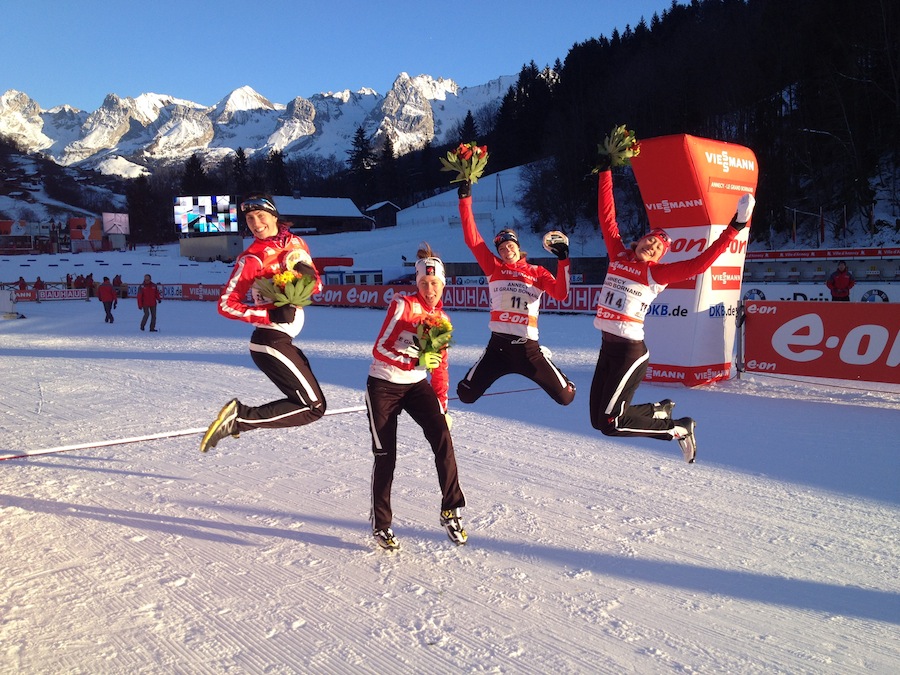
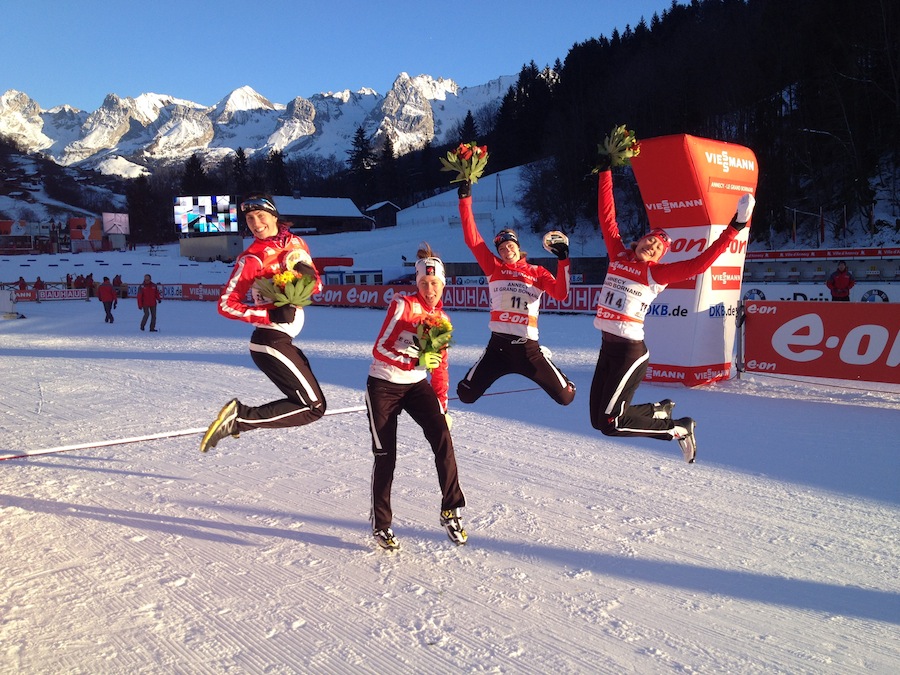
    The Canadian women jumping for joy after notching Biathlon Canada's best-ever finish in a relay. (Photo: Biathlon Canada/Matthias Ahrens)
    The Canadian women jumping for joy after capturing Canada’s best-ever finish in a relay. (Photo: Biathlon Canada/Matthias Ahrens)

    Coming off their nation’s best-ever relay in fourth on Thursday, the Canadian women all qualified for Sunday’s pursuit with top-60 results on Saturday.

    Rosanna Crawford led the crew in 26th, 1:01.1 behind Gasparin. Excited about the race and the course that suits her, Crawford wrote in an email that she woke up with a slightly different feeling than two days before.

    “My legs were not feeling as fresh as they were on Thursday, and skiing was a lot harder than I thought it was going to be,” she wrote. “The 2.5km course has some deceiving long gradual climbs, that end with a short steep bridges!”

    Leaving prone with a penalty and ranking 54th, Crawford rose to 27th after cleaning her second stage. She had initially overcorrected for wind on a generally calm day and learned from her mistake to shoot flawlessly – and fast – in standing.

    “I think my one miss was just my silly brain showing up where it’s not wanted!” she explained. “The final lap was pretty tough, I didn’t cross the line totally gassed but I wasn’t able to make my legs move any faster out there on course.”

    Quick-and-careful shooting turned out to be key as Crawford tallied the best North American result in Saturday’s 7.5 k.

    “I am always happy to be in the top 30 and 90% is better than any of my sprint races so far this season, so I am happy about that!” she wrote. “I wish I could have been skiing like the relay, but tomorrow is another day! Another chance to go to battle!”

    Teammate Megan Imrie placed 40th with one penalty in each stage to finish 1:26.4 behind the winner. On a day when her legs felt “torched,” Imrie tried to focus on gliding and took advantage of the range’s downhill entry.

    “It feels easier for me to relax into my shooting position,” she explained of the approach. “The conditions were pretty calm on the range, but the snow wasn’t very fast. It’s a course of continuous gradual climbing, so it was a leg burner out there. You worked for your seconds.”

    While she’s unsure how she’ll fare in the pursuit – a race that’s not traditionally her strongest – Imrie’s optimistic that the trend could change.

    “This season I’ve been approaching each race with the mindset of bringing my very best to the line regardless of circumstances or conditions,” she wrote. “I’ve been feeling relaxed, happy, and my shooting is reflecting that.”

    Another Canadian, Zina Kocher tied for 45th (+1:35) with Norway’s Marte Olsbu after three penalties: one prone and two standing. The fourth relay member, Megan Heinicke also missed one prone and two standing for 50th (+1:41.2).

    After starting 96th of 97, Heinicke described the conditions as “perfect.” While the uphills and corners became slightly “sugary,” some of the long descents also got faster later in the race, so she didn’t feel as though she was at a disadvantage.

    When she missed shots, Heinicke simply moved on. She had the third-fastest shooting time in the first stage and 16th-fastest in the second bout.

    “Today was all about moving on efficiently to the next step which was getting out of that penalty loop and onto the course as fast as possible!” she wrote. “I feel like I went into this race with the right approach – fast and aggressive, but I am feeling frustrated and disappointed about the misses.”

    In Sunday’s 10 k pursuit, she expects to analyze more during the race.

    “I believe in my training and am just looking forward to another chance to try and bring it all together,” Heinicke wrote. “I am very determined and I want to go into the Christmas holidays satisfied with my own performance!”

    Narrowly making the cut in 60th, Susan Dunklee was the lone American to qualify for the pursuit. Dunklee suffered one prone miss then skied three penalty laps after her standing stage to finish 2:13.4 behind the winner.

    After ranking 66th on the first loop and 72nd on the second, she was surprised to hear she made the top 60. She started 10th and didn’t hear much for splits, but had a sense she might squeak through with four misses.

    Dunklee explained she changed her pacing for Saturday’s course, holding back slightly on the uphills in order to accelerate through the transitions and downhills.

    “I fought hard the last loop,” Dunklee wrote. “I wanted it too badly in standing and forgot to focus on the process of shooting well.”

    Three other Americans placed outside the top 60: Annelies Cook was 62nd with two penalties (1+1), Sara Studebaker finished 76th with three misses (2+1), and Hannah Dreissigacker was 77th with two misses (1+1).

    “All and all, a very disappointing day for the whole crew,” Dunklee wrote. The team tied their career-best relay result of eighth on Thursday. “I am happy to get one more chance before heading home for the holiday break [on Monday].”

    Results

  • Germans Gap Field for Relay Win; Canadian Women Capture Unprecedented Fourth, U.S. Repeats in Eighth

    Germans Gap Field for Relay Win; Canadian Women Capture Unprecedented Fourth, U.S. Repeats in Eighth

    The Canadian women jumping for joy after notching Biathlon Canada's best-ever finish in a relay. (Photo: Biathlon Canada/Matthias Ahrens)
    The Canadian women jumping for joy after notching Biathlon Canada’s best-ever finish in a relay. (Photo: Biathlon Canada/Matthias Ahrens)

    Note: The following has been updated to include quotes from Megan Heinicke.

    About halfway through the IBU World Cup women’s 4 x 6-kilometre relay on Thursday in Annency, France, it was pretty evident Germany had the race in the bag.

    Anything can certainly happen, but Andrea Henkel had opened a 10.5-second lead for the Germans by the end of the second leg, and after teammate Franziska Hildebrand’s third leg, they were up by 35 seconds on Norway. Laura Dahlmeier essentially had to go through the paces, shoot as clean as possible and ski strong to hold off Norway and Ukraine, both contending for the podium with somewhat of a surprise charging from behind – the Canadians.

    It wasn’t a surprise for Canada. Chris Lindsay, high-performance director for Biathlon Canada, has known for some time what his quartet of Rosanna Crawford, Megan Imrie, Megan Heinicke, and Zina Kocher were capable of. And on Thursday it was Canada’s best-ever relay result – in a female, male or mixed event. The nation’s previous best was sixth in a mixed relay in 2011 in Hochfilzen, Austria.

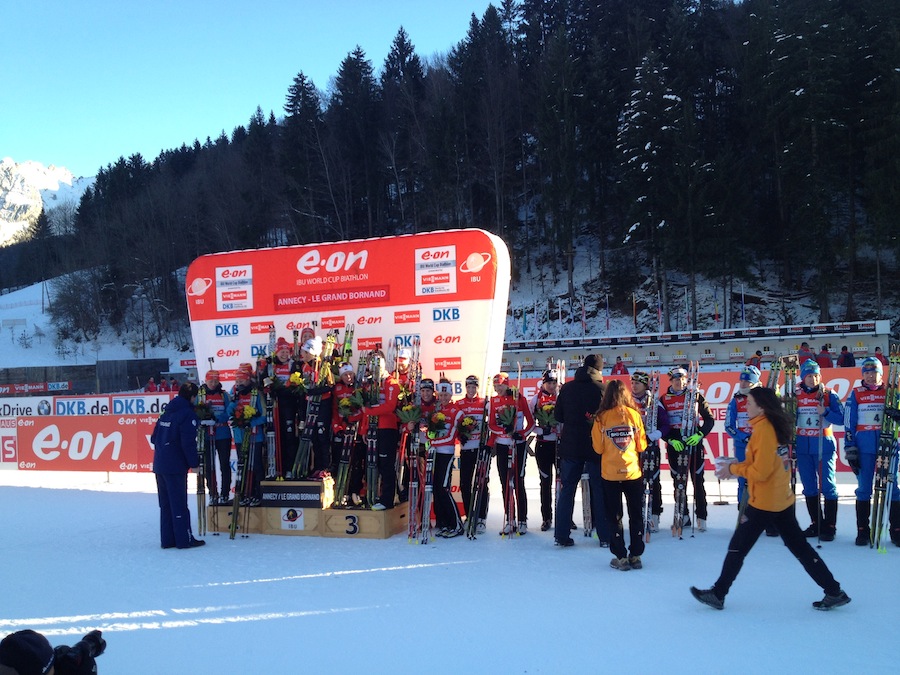
    The top teams in the 4 x 6 k women's relay gather around the podium Thursday at the IBU World Cup in Annency, France. Germany won, Ukraine was second, Norway placed third, and Canada notched a historic fourth. (Photo: Biathlon Canada/Matthias Ahrens)
    The top teams in the 4 x 6 k women’s relay gather around the podium Thursday at the IBU World Cup in Annency, France. Germany won, Ukraine was second, Norway placed third, and Canada notched a historic fourth. France placed fifth, Russia was sixth, Italy finished seventh, and the U.S. tied last week’s eighth place. (Photo: Biathlon Canada/Matthias Ahrens)

    The Canadian women placed fourth on Thursday behind Germany, Ukraine and Norway, respectively, with Germans Franziska Preuss, Henkel, Hildebrand, and Dahlmeier winning in 1:06:27.8, and using just three spare rounds in the process.

    Ukraine’s Juliya Dzhyma, Vita Semerenko, Valj Semerenko, and Olena Pidhrushna, placed second 23.3 seconds back with four spare rounds, edging Norway in third by 0.5 seconds with Tinril Eckhoff, Fanny Welle-Strand Horn, Synnøve Solemdal, and Tora Berger, who used a total of 10 spare rounds.

    The Canadians were 1:35.8 back in fourth after using nine spares.

    “Certainly holding the shooting together with the great skiing was the difference,” Lindsay wrote in an email. “Having a big result that is completely owned by the women helps to build an even stronger foundation upon which podiums will follow.”

    Heading out first with 22 other teams, Crawford cleaned her prone and used one spare on her standing to bring the team to fourth by the exchange.

    “I’ve learned from the past couple relays that being aggressive off the start and getting with the lead group will save you a lot of energy and make sure you don’t get tripped up most of the time!” Crawford wrote in an email. “I’ve got a strong double pole so I can usually be right behind the person in front of me and then it’s just a matter of [maneuvering] my way to the front group.”

    A fan of the range at Le Grand Bornand, Crawford explained she took advantage of the calm conditions and focused on one shot at a time. She left her first stage in second behind Switzerland’s Selina Gasparin, who cleaned both stages to tag off in first – but Gasparin wasn’t always in front (and her sisters Elisa and Aita, and teammate Patricia Josh ultimately dropped the lead on the second, fourth and third legs, respectively, so that Switzerland finished 13th).

    Italy’s scramble skier, Dorothea Wierer cleaned her prone and used one spare on her standing to put the team in third behind Germany’s Preuss, who used one spare on each stage to tag off in second.

    “Selina Gaspirin really didn’t want to lead, so we were able to catch up to her and then I passed her right before the range,” Crawford explained. “Standing was good, my hands were pretty cold so I had some trouble with my spares, dropping two, before I got one in and hit the target.”

    For the last loop, Crawford stuck with Preuss and Norway’s Eckhoff just behind the leaders, tagging off in fourth, 11.6 seconds after Gasparin in first and 3.2 behind Preuss in second. Italy tagged in third, Belarus was fifth, and Eckhoff came through in sixth for Norway, 15 seconds behind Gasparin and 3.4 behind Canada.

    With Susan Dunklee scrambling for the second-straight relay, the Americans started the second leg in eighth, 33.3 seconds behind Germany.

    From there, Imrie brought the Canadians to third with a clean prone and one spare in standing. Henkel took the lead for Germany with 10-for-10 shooting, and Imrie tagged just Heinicke 17.3 seconds behind Germany and 6.8 seconds behind Norway.

    Heinicke used three spare rounds – one in prone and two in standing – for the eighth-fastest third leg, but she managed to hold tight in fourth, a minute behind Germany, but just 10 seconds behind Ukraine.

    “I was disappointed about the prone miss because it really shouldn’t have happened, but in the moment I was just focused on doing my job which was loading that spare bullet calmly and efficiently,” Heinicke explained.

    In the second bout, she didn’t realize that her first spare didn’t hit and was partly out of position. “That was too bad, but I didn’t let it get in my head, didn’t hesitate and my second spare hit,” she wrote.

    As for her last lap: “I was feeling exhausted skiing and was just thinking to fight as hard as possible and not to give anything away,” Heinicke wrote. “I was already thinking about Zina and thinking that I just needed to keep that Ukranian within striking distance for her.”

    When Kocher received the final handoff, she tried to relax, focusing on her key words for shooting and most importantly, breathing.

    “I knew it was up to me to complete the task of the day and I felt that pressure,” Kocher wrote in an email. “I’ve been struggling with that a lot before today but I’ve been working all week on my shooting and staying with the process, not on the result and not on anyone else around me.”

    After using three spares in prone, Kocher found her team’s chance at a historic best slipping. France’s Marie-Laure Brunet cleaned both rounds, shooting especially fast on the standing and putting Kocher under pressure.

    “I was over cautious,” Kocher wrote of her first time in the range.

    Fighting for every shot the second time around, Kocher ended up using one spare round in standing and raced away on her final lap to catch Brunet from 20 seconds behind. Kocher passed her and finished 8 seconds ahead in fourth.

    Dahlmeier shot clean to hold off both Ukraine’s Pidhrushna, who also cleaned, and Berger, who used two spares on her standing but closed hard on the last lap to finish third, just a half second behind Pidhrushna.

    Knowing she’s a strong closer, Kocher explained she gave everything she had, but wasn’t sure it would be enough.

    “I did not know if I had enough to hold off the Russian or catch the French,” she wrote. “I just put my head down and focused on gliding.”

    While “a podium would have been incredible,” Kocher explained the team was thrilled to break through in fourth.

    “We are absolutely ecstatic and proud of each other that we all pulled it together what we knew was always possible,” she wrote. “I don’t think this is the last of us. Now we have this confidence and belief in ourselves and each other for the future.”

    In Hochfilzen last Saturday, Dec. 7, the Canadian women placed 11th and the men notched ninth, with JP Le Guellec, Scott Perras, Brendan Green, and Nathan Smith, in the World Cup relay.

    Two years ago in Hochfilzen, Imrie, Kocher, Le Guellec, and Green combined for Canada’s previous best of sixth in a mixed relay, according to Lindsay.

    “We’ve known for a long time that we are capable of a top 6 in a relay,” Crawford wrote.

    “The numbers have shown that we can be up playing with the best – but staying in the game is a skill in itself,” Lindsay explained. “Developing comfort at being in the ‘game’ takes some time.

    “Last weekend the women were mix for most of the race,” he added. “This week they were in it the entire race. There might be weaker races in the future but I have no doubt that we will continue to rack up time in the game and this will lead to medals.”

    U.S. Repeats Feat

    The U.S. women placed eighth in the Hochfilzen relay with Lanny Barnes subbing for one of their core national-team members, Annelies Cook. For all four skiers, it was a career best.

    On Thursday, they repeated the result with Dunklee, Sara Studebaker, Hannah Dreissigacker, and Cook, respectively. They placed eighth with six spare rounds, finishing 2:44.1 behind Germany.

    “Last week when we finished 8th, we were jumping up and down at the finish,” wrote Dunklee, who used just one spare on the second stage. “This week was also very exciting but more contained.  We know we can dream bigger now.  It was inspiring to see the Canadians do so well – if they can do that, we can do it.”

    In her first year on US Biathlon’s A-team, Dreissigacker was the highlight, cleaning both her stages in the third leg to bring the team from 12th to 10th.

    Dunklee got them off to a strong start, jetting out toward the front early to avoid getting stuck behind the pack on the course with several corners and short, steep hills.

    “In the past being so high up may have scared me, but today I felt relaxed and could still transition to the range with a calm focus,” she explained. “My last loop wasn’t great, no gas left in the tank, but I will be smarter pacing for the sprint.”

    Tagged in eighth, Studebaker started alone, nearly 10 seconds ahead of Ukraine in ninth but 22 seconds behind France in seventh. She used one spare in prone, then three in standing.

    “It was tough to ski that first loop mostly alone, and it definitely helped in the second loop to have people to ski with,” Studebaker wrote. “I had a little trouble in standing, missing one from the clip and then taking all three extras to get it.  It was certainly nerve-wracking!”

    Dreissigacker could see Sweden’s Asa Lif about 10 seconds ahead of her when she was tagged in 12th . She caught her and picked off one more place, bringing the team to 10th with fast-and-flawless shooting.

    “Fast shooting is a strength of mine, and when you don’t have to load spare bullets that also makes it a lot easier to pass people there!” Dreissigacker wrote. “I’m hoping that I can continue to shoot well in non-relay races too … and that it’s just that my last two races have gone well and they’ve happened to be relays.  … I think that I do well when I’m relaxed and having fun, and relays are good for that.  And I like to shoot well for my teammates!”

    Just two seconds behind Finland in ninth, Cook wasn’t sure where her team stood when Dreissigacker tagged her. After a close-call in the exchange, Cook was relieved to make it out unscathed, and didn’t see their place until she entered the range for the first time.

    She cleaned the prone and used one spare standing, putting her in prime position for the final lap.

    “I thought that maybe I could catch [Italy’s Karin Oberhofer] and bring us into 7th, but she skied well in her last lap and I couldn’t get her,” Cook wrote.  “I didn’t do anything special, I just tried to ski well and be relaxed when I got into the range – and luckily I hit my targets and the girls around me struggled.”

    Sensing Slovakia’s Anastasiya Kuzmina coming up from behind on that last lap, Cook focused on holding onto eighth.

    “Once I got to the last uphill, I knew I would be fine,” she wrote.

    “Sunday was our best relay in a while and we always try to beat our bib number,” Cook added, referring to their eighth seed. “It was fun to see Susan leading everyone and it’s really cool that Hannah cleaned. Sara also kept us right in the game and fought super hard. Everyone gave it. I was really glad that I could be part of a good result – because I only got to cheer last week!”

    “My lower legs have been feeling better,” she wrote of her bothersome shins, which kept her from last weekend’s competition. “But they usually don’t bother me until I go hard so I was definitely a bit nervous about how they would feel and they were the best they have been so far.”

    “We’re really in a good place right now and I think after two top-8s we’re getting hungry for more!” Studebaker explained. “It’s definitely an exciting place to be in this Olympic season.”

    Results

  • Le Guellec Leads Canadians in 13th, Crawford Gets ‘Lucky’ in 17th in Hochfilzen Sprint

    Le Guellec Leads Canadians in 13th, Crawford Gets ‘Lucky’ in 17th in Hochfilzen Sprint

    Canada's JP Le Guellec racing to 13th in Friday's 10 k sprint at the IBU World Cup in Hochfilzen, Austria.
    Canada’s JP Le Guellec racing to 13th in Friday’s 10 k sprint at the IBU World Cup in Hochfilzen, Austria.

    HOCHFILZEN, Austria – The snow was supposed to stop. Then again, Friday’s International Biathlon Union (IBU) World Cup 7.5- and 10-kilometer sprints were held in a place that eventual men’s winner, Lars Berger, called “snowfilzen.”

    Five minutes before the start of the men’s 10 k, it started snowing – and the weather deteriorated throughout the race.

    That was especially frustrating to Biathlon Canada’s JP Le Guellec, not because it threw him off his game, but because he thought the conditions would improve as the race went on. Anticipating that, he asked his coach Matthias Ahrens to give his teammates Brendan Green and Nathan Smith the benefit of starting later.

    “I wanted to give priority to Nathan and Brendan because they have criteria to meet for the Olympics,” Le Guellec said after starting 22nd and placing 13th in Friday’s sprint. “We thought it was going to be snowing at the beginning of the race and then stop snowing at the end.”

    Canada's Brendan Green racing to 31st in Friday's 10 k sprint at the IBU World Cup in Hochfilzen, Austria. Green was one second away from making the top 30 and qualifying for Canada's 2014 Olympic team.
    Canada’s Brendan Green racing to 31st in Friday’s 10 k sprint at the IBU World Cup in Hochfilzen, Austria. Green was one second away from making the top 30 and qualifying for Canada’s 2014 Olympic team.

    With Le Guellec, 28, already prequalified for the Olympics, his teammates need a top 30 to do the same. Green finished 31st, one second out of 30th, with two misses after starting 53rd. Smith, who started in bib 105, placed 48th with a single penalty.

    “It’s a bit frustrating, but it is fun for me to have had the better conditions,” Le Guellec said after cleaning the prone and missing one on the standing. “The tactic missed though.”

    Green described the weather as “a little bit nasty” in the middle of his race, adding that it did let up a bit. His nemesis was shooting, he said. After missing the last shot of his prone, Green repeated with a final miss in the standing.

    “Missing the last shot in standing was not good,” he said. “There was a little bit of wind, but I think it was manageable. I just got a little bit too excited and shot it off a little too soon. … I was really hoping for a top 30 to finish off my Olympic criteria, so hopefully in the pursuit I can do that.”

    Smith hit nine of 10 targets, missing just one in the second bout.

    “I felt better than the last sprint, but not as good as the individual in Östersund,” he said after notching a World Cup career-best 16th in the 20 k individual in Sweden last week.

    “The last lap, I had no chance. It was so much slower,” Smith said of Friday’s race. “There was nothing I could do.”

    While earlier starters enjoyed better conditions, it wasn’t easy for anyone out there, and Le Guellec used his experience to manage the increasing wind.

    “In prone, it was pushing a little more than in zero so I shaded a bit instead of correcting, and ended up cleaning,” he said. “I did the same thing [last week] in Östersund in the sprint and I missed two, but then after the race, my coach told me I didn’t shade enough.”

    Lesson learned. At the first World Cup in Östersund, Le Guellec came out firing with a fourth-place finish in the 20 k individual on Nov. 28. Two days later, he placed 29th in the 10 k sprint with four penalties – two in each stage.

    Heading into Friday’s standing, Le Guellec noticed the wind was coming from the opposite direction and heard German Andreas Birnbacher (who ended up 33rd) coming out of shooting “pretty frustrated with three misses,” Le Guellec said.  “I had a clue and setting up, I really took my time. I ended up missing one anyway, but it was pretty decent considering the wind.”

    Overall, he was pleased with his result, 55 seconds behind Berger (who won in 25:02) and feeling like might have been able to push harder earlier. With the 27th fastest first-lap time, he improved to 11th fastest the second time around.

    “I don’t know if I went [out] too conservative, but the skis were definitely good,” Le Guellec said. “I hammered on the last lap and I had some guys to follow.”

    Canadian Zina Kocher chases Ekaterina Glazyrina of Russia out of the starting gate in Friday's IBU World Cup 7.5 k sprint  in Hochfilzen, Austria. Kocher ended up 25th and Glazyrina was 51st.
    Canadian Zina Kocher (l) chases down Ekaterina Glazyrina of Russia during Friday’s IBU World Cup 7.5 k sprint in Hochfilzen, Austria. Kocher ended up 25th and Glazyrina was 51st.

    Another Canadian prequalified for the Olympics, Rosanna Crawford placed 17th with two penalties – both standing – in the women’s 7.5 k. She finished 47.1 seconds behind Selina Gasparin, who became the first Swiss biathlete to win a World Cup (finishing in 23:16.9).

    “I got lucky,” Crawford said of starting 90th, a bib number she initially dreaded fearing the conditions would worsen.

    “The course sped up a lot,” she explained. “If I’d started early, I don’t think I would have been that high.”

    In last week’s Östersund sprint, Crawford missed three standing for 51st overall. After cleaning her prone again on Friday, she was disappointed with two standing misses, but recognized that “the potential is there.”

    “The season always seems to start off pretty bummy for me for some reason,” Crawford said. “Today, 80 percent, I’m not very happy with it especially since it came in one bout, but it will come together. I think we have a big potential for a great relay. Three of us had great races today.”

    Zina Kocher was the second Canadian woman in 25th with two misses – one in each stage. Megan Imrie placed 35th with two penalties as well (0+2), and Megan Heinicke finished 70th with four misses (1+3).

    “Skiing was quite good, but shooting was a disaster,” said Heinicke, who posted the 38th-fastest course time overall. “I’m waiting to see if I’m in the pursuit. It will be pretty tight I think.”

    Similar to the men’s race later in the day, the wind picked up significantly for the women from zeroing to prone.

    “I clicked four left, which is a lot, but … I only missed one,” Heinicke said. “Standing, [the wind] wasn’t very strong, but it was sort of on and off. It was just tough and I was pretty disappointed because I had really good windy shooting in that [Östersund] pursuit that was canceled so I was thinking, ‘be confident,’ but it didn’t work out.”

    Heinicke finished 56th in last week’s sprint with three misses (1+2). The following Östersund women’s 10 k and men’s 12.5 k pursuits were canceled because of high winds, a decision that was made midway through the women’s race. Both Heinicke and Imrie were skiing in the top 10 when it was called off.

    “I was disappointed at first, but then when I saw the footage, I was like, ‘Okay, be realistic. I would never have been in that position in normal conditions,’ ” Heinicke said. “I was just happy that I had managed the wind well, and I felt good skiing that day. It was fun while it lasted.”

    World Cup racing continues in Hochfilzen this weekend with the women’s 4 x 6 k and men’s 4 x 7.5 k relays on Saturday, and the women’s 10 k and men’s 12.5 k pursuits on Sunday.

    Results: men | women

  • Norway’s Flatland Climbs to the Top in Women’s 7.5 k Biathlon

    Norway’s Flatland Climbs to the Top in Women’s 7.5 k Biathlon

    IBU world cup biathlon, sprint women, Oestersund (SWE)
    Susan Dunklee on her way to 16th place in the women’s 7.5km sprint in Ostersund. (Photo Credit: US Biathlon/Nordic Focus)

    Conditions were excellent for racing this evening in Ostersund with mild temperatures and light winds.  But perfect conditions demand perfection from those that wish to make the podium, and Noway’s Ann Kristin Flatland delivered, skiing and shooting her way to her second career victory in 21:41.2.  In second place, Russian Olga Zaitseva also delivered perfect shooting to earn her a spot on the podium, finishing 15.9 seconds behind Flatland.  Rounding out a good day for Norway, Tora Berger was able to chase down a podium spot after one missed shot in the prone stage, finishing 22 seconds behind the top spot.  Yesterday’s winner in the 15km individual race, Czech Gabriela Soukalova delivered a solid performance to earn her sixth place with one penalty in the prone stage.

    This victory is notable to Flatland as it is her first victory her pregnancy, giving birth midway through last season.

    “It is of course very good for your self-esteem,” she said in an interview with the Norwegian newspaper NRK, “it shows that I have done a good job [of training] this summer.”

    Flatland’s daughter and husband are with her Östersund, which makes it easier. She was so down at the end of last season that she considered retiring. A win boosts her confidence that continuing towards the Sochi Olympics was the right decision despite the huge changes in her family life.

    “It’s been up and down in the fall, and there have been times when I’ve wondered if it was worth coming back,” she said. “… I showed that I can compete at the top with a perfect race. It has proven both to myself and those who may not have had faith in me, that I can do it.”

    As for second-place Zaitseva, today’s result was an indication of more to come: “I am satisfied with my performance,” she said in an interview with Biathlon Russia.   “I can say, ‘we are warming up.’  I always want to win, but I understand that the work is not done yet.  Everything will be fine in pursuit.”

    zaitseva flatland
    Ann Kristin Flatland (right) chases Olga Zaitseva in the 2013 World Championships pursuit, where both finished just off the podium. (Photo: Chelsea Little, FasterSkier)

    Berger, last year’s runaway World Cup total score winner, said that she often has difficulty in the beginning of the season.

    The top North American woman, Susan Dunklee, finished 16th with one penalty in the standing stage and a total time of 21:41.9, one minute behind first place.

    “My shooting and skiing came together on the same day and that is a big confidence booster for me” Dunklee said of the day’s efforts, “popping a top 20 this early in the season is something I feel really good about.”  Dunklee is optimistic about the coming days of racing, “later this weekend we have a pursuit based off of today’s results and there will be lots of great people to ski around – I’m excited!”

    “Biathlon is very unpredictable sport,” Dunklee added in an email. “Every athlete on the World Cup is capable of ‘cleaning’ a race; we have all done it many times during practice.  Even when we approach our races the same way every time, the shooting doesn’t always pan out due to any number of factors: wind, physical exertion, nerves, etc.  It feels extra special when the pieces do come together on a race day.”

    The top Canadian, and second North American woman, Megan Imrie, finished 22nd in 22:08.4, 1:27.2 behind Norway’s Flatland.  This is Imrie’s third-best World Cup finish after two top-20 finishes in the 2011-2012 season, and a dramatic improvement over yesterday’s 85th place finish, where she had a disappointing nine penalties.  Most importantly for Imrie, today’s result qualifies her for the 2014 Sochi Olympics.

    “Biathlon Canada is not surprised that Megan was able to complete her Olympic qualification today,” Canada’s High Performance director, Christopher Lindsay, wrote in an email to FasterSkier regarding Imrie’s performance. “She has been training hard and her very strong performance in the WC1 Mixed Relay made it clear that she is ready to race at the top level. We are confident she will have more top 30 results this season.”

    Rounding out today’s North American finishers were Canada’s Rosanna Crawford in 51st with three penalties, American Annelies Cook in 55th with two penalties, and Canadians Megan Heinicke in 56thalso with three penalties, and Zina Kocher in 64th with four penalties.

    Crawford started strong, cleaning the prone stage, but had “a bit of a disaster” in the standing stage and missed three.  Her total course time of 19:29 was 33rd in the field.

    “I am glad that I still get to go to battle this Sunday in the pursuit!” she said of the day’s racing.

    The final two North Americans were Sara Studebaker and Hannah Dreissigacker, both of the United States, in 71st and 93rd places, respectively.  Both Studebaker and Dreissigacker were frustrated with their performances.  Studebaker said that it usually takes her a few races get into race shape each season, adding that she was “pretty close to making the pursuit, so I hope to build on that and improve for next week.”

    As for her race, Dreissigacker said that she was “sort of embarrassed, really.  But at least everything was bad on the same day.”

    Studebaker summed it up, “Overall, I think our team is in a good place and we’ll continue to improve as the season goes on. This is just the first week and the most important races are still a couple of months away.”

  • Canadian Biathletes Rocket on to IBU Cup Scene with Five Top-10’s in Opening Sprint (updated)

    Canadian Biathletes Rocket on to IBU Cup Scene with Five Top-10’s in Opening Sprint (updated)

    Megan Imrie (far right) at the podium ceremony for the women's 7.5 k sprint in Idre, Sweden. Imrie placed sixth in the IBU Cup openers. Photo courtesy of Imrie.
    Megan Imrie (far right) at the podium ceremony for the women’s 7.5 k sprint in Idre, Sweden. Imrie placed sixth in the IBU Cup openers. Photo courtesy of Imrie.

    The Canadians had a feeling that their team was improving a lot over the course of the last training year. But by all accounts, even the coaching staff wasn’t quite fully prepared for the results of today’s IBU Cup sprints in Idre, Sweden.

    The headline: Nathan Smith second in the men’s 10 k, just 3.9 seconds away from the win. He was one of three men and two women in the top ten. Two more in the top 20. In total, six athletes shooting clean.

    One day into the 2013-2014 season, Canada is leading the IBU Cup nations standings, ahead of Norway, Russia, and Germany. Sure, it’s not the World Cup, but the second-tier circuit, which is organized in the same way, is nothing to scoff at – there were 140 men and 107 women toeing the start line today. If a country can’t do well where developing athletes typically compete, it doesn’t bode well for the future of the program.

    Plus, there’s the fact that these will be the most competitive races of the year for the circuit, with many teams using them to select World Cup teams. The top twenty was packed with athletes with Olympic and World Championships credentials. Timofey Lapshin, the Russian who edged Smith, has two World Cup podiums; the winner of the women’s race, Weronika Nowakowska-Ziemniak of Poland, is a 2010 Olympian who had a seventh-place World Cup result last season.

    “To your question of whether I was expecting this, from our in training season performance testing and latest trial races we had good indications the we were on the right track, but since we are quite isolated in North America it is quite difficult to put a perspective to this until you race internationally again,” Canadian head coach Matthias Ahrens wrote in an e-mail to FasterSkier. “I am super happy about both races, especially great performances in shooting as a team overall, but also the skiing is showing that we are on the right track.”

    In many ways the top performances came from athletes who have something to prove as they head into the Olympic qualification season. Take Smith. The 28-year-old had made his first World Championships appearance in 2008, and also represented Canada in the 2011, 2012, and 2013 editions. But last year, after lackluster results in the first two weeks of World Cup racing, he was moved back down to the IBU Cup.

    Last year was extremely frustrating for me,” Smith wrote in an e-mail. “Although I still got to race a few World Cups, I ended up pretty much being the extra relay guy a lot of the time because our team only has three men’s starts. Relays are a nice bonus but ultimately biathlon is mostly an individual sport. Luckily I managed to make some national team criteria at my very last chance (World Championships relay) where I basically had my only great performance of the year.” 

    That leaves him at a major disadvantage for Olympic qualifying. The most surefire way to make Canada’s Olympic team is to have two top-16 or three top-30 World Cup results. Two men have already fulfilled those requirements (Jean Philippe Le Guellec and Scott Perras), while several others (Brendan Green and Scott Gow) are partway through. Athletes have until the Christmas break to get those results on the World Cup, after which point qualifying is kicked back to trials races in Canmore for any remaining spots. Team size will be four men and four women.

    “Nathan has been on fire over the past few weeks, his skiing has been very strong,” Canadian coach Roddy Ward told FasterSkier. “Today he skied like he has been and also put together a clean race. He has been very motivated and focused in his training this year and it has paid off for him.”

    Smith is looking good now, both in the Idre sprint and at previous trials races in Canmore to qualify for this trip. But that leaves him just three weeks to get his two or three results on the World Cup. And there’s a catch: Canada has only three quota spots for men. With Le Guellec and Perras taking two of them, only one more man will have the chance to try to achieve their Olympic qualification on the circuit this fall.

    That seems to have been a powerful force driving the team to go faster and shoot straighter.

    “The remaining Olympic spots that are up for grabs are definitely a big motivator,” Smith wrote. “Judging by our team’s shooting I think the pressure is being handled really well. For myself, I’m managing the pressure a lot better than a year ago.”

    With his second-place finish, Smith nabbed the remaining men’s spot and will try to make the most of it in the next few weeks.

    In the spring I had time to reflect on what I had done the previous few years and decided that if I wanted a change in results I would also have to have a different approach to training,” he wrote. “I really tried to focus on quality and working on specific skills. Already halfway through the summer I knew that things were going in the right direction through testing, team time trials, and just general training… In the last few team races my skiing has been excellent so I had a lot of confidence in that going to Europe.  But still, you never really know, so theres always some doubt.

    The next Canadian, Marc-Andre Bedard, tied for seventh; he is another former World Cup and World Championships competitor who did not see World Cup action last season. Just two seconds behind him in ninth was Green, who sat out last season with a back injury. Gow placed 13th with one penalty.

    Yet even though the men are competing against each other – intensely – for World Cup and Olympic spots, they were supportive of one another’s results. Team spirit doesn’t seem to be a casualty of the cutthroat competition, in fact, maybe just the opposite.

    “I’m also really happy for Nathan, he totally deserves those results and I’m excited to see him try to get his Olympic criterias on the World Cup!” Bedard wrote in an e-mail. “(If they let him of course!!!) (they better ;))”

    Bedard also made another comment on the team’s cohesion in explaining why his results seem to be on the upswing this fall.

    “I’m finally feeling supported by my coach and teammates and I was really excited to race against the world with my new dry land season with all the changes is done for the last six months,” he explained. “I’ve always needed a few weeks of racing before I was actually able to turn it on and I think today is a really good sign for what might happen this year. I’m hoping I’m progressing still and will be able to actually hurt myself in the next few weeks. Today felt pretty easy so with a good result on a really strong and deep field, it sounds good!”

    Although the team will also compete in Idre tomorrow, coaches ultimately made the choice of World Cup athletes based off of today’s race, and Smith got the nod. Biathlon Canada High Performance Director Chris Lindsay acknowledged that the men hadn’t made it easy for them to pick just one, but the entire coaching staff pointed out that the increasing competition within the program is a benefit for all.

    “It is clear our men’s team is extremely competitive, which had led to improvements through the training year,” Ward said. “We saw that in the results today.”

    Competing a few hours later, the Canadian women’s team took the momentum and ran with it.

    “The girls and I were really inspired by the guys performances before our race,” Megan Imrie wrote in an e-mail. “They’d all killed it! If they could do it, so could I.”

    Imrie, coming back from her own lackluster season last year that saw her take a midwinter detour home to Manitoba to rest, recover, and decide how to approach biathlon from that point forward, hit the circuit again with a bang. She placed sixth with clean shooting, over a minute behind Nowakowska-Ziemniak but only 23 seconds behind second-place Fanny Welle-Strand Horn of Norway.

    “I committed to working every possible place on the course and was extremely focused on the range,” Imrie said of her race. “I was a bundle of nerves going to the start. But I stuck to the basics. In the words of Simon Whitfield, just chop wood and carry water. I’m relieved I’m coming back okay from last year. I’ve worked hard and stayed healthy. Now I’m feeling privileged to enjoy racing again.”

    Just behind her was 2010 Olympic teammate Megan Heinicke in seventh place. The pair, like Smith, earned the nods for the next period of World Cup racing and will travel to Ostersund, Sweden, with Smith and Rosanna Crawford. Imrie and Heinicke both need a single additional top-30 result on the World Cup to complete their Olympic qualification.

    Crawford is pre-qualified for Sochi, but raced the Idre openers anyway. She finished 35th with three penalties.

    “The girls were also impressive with Megan I, Megan H and Audrey [Vaillancourt, who placed 16th] cleaning,” Ward said. “Rosanna had been dealing with a number of injuries lately so I was just happy to see her ski form was solid. The next few weeks should be good very for her. Megan I has been incredible this training year with self monitoring her training and recovery – she has made some wise decisions that has kept her healthy and progressing.”

    Several younger Canadians also competed, with Macx Davies placing 84th in the men’s race and Julia Ransom 58th in the women’s race. Claude Godbout, a senior, placed 50th ahead of Ransom.

    “Even that it is only one race and the first race of the season, it should give everybody great confidence into the next races, be it on the World Cup or the IBU Cup,” a happy Ahrens concluded.

    results: men / women


  • Canada Picks 15 Biathletes for European Tour; Olympic Spots Up for Grabs

    Canada Picks 15 Biathletes for European Tour; Olympic Spots Up for Grabs

    Scott Perras (right) competing at 2013 World Championships; he topped Canadian trials rankings in Canmore this week.
    Scott Perras (right) competing at 2013 World Championships; he topped Canadian trials rankings in Canmore this week.

    On Tuesday, Jean Philippe Le Guellec, Scott Perras, Zina Kocher, and Rosanna Crawford will get on a plane a fly to Sweden. This they knew: the four Canadian biathletes are already qualified for the upcoming Olympics in Sochi, and have the luxury of knowing that they’ll start their seasons on the World Cup next weekend.

    But after trials races in Canmore on Thursday and Friday, 11 more athletes learned that they’d be leaving even sooner. Five women and six men will start their seasons on the second-tier IBU Cup, which, for two women and one man, will be a stepping stone to the World Cup a week later.

    The group is a mix of national team athletes, development team athletes, and even juniors. And, says Biathlon Canada High Performance Director Chris Lindsay, they’re probably going to put down some good results. He was impressed by what he saw over the last two days, and in a great mood when FasterSkier talked with him on Friday afternoon.

    “It was a great opportunity to see some great early-season racing for my guys,” Lindsay said. “They were able to pull out some results that were maybe not perfect, but were good indicators of the overall quality of the training that’s happening and the continuing improvement of the program overall. I’ve been watching all these athletes for the last month here on the early snow, because we’ve been on snow for a full month as of today.”

    While the goal for this first period of racing is certainly to have strong results at the World Cup level – Lindsay would like to see multiple top-30 finishes – it’s also important for Olympic qualification. That’s possible through World Cup results, by either two top-16 results or three top-30 results. Brendan Green, Megan Imrie, and Megan Heinicke, all starting on the IBU Cup, each only need one more top-30 to achieve their Olympic qualification, while Scott Gow needs two top-30s.

    But Green and Gow are going to have to fight it out just for the chance to compete on the World Cup, and best not only each other but Nathan Smith, Marc-Andre Bedard, Macx Davies, and Scott’s younger brother Christian Gow. Canada only has three quota spots for men’s World Cup racing.

    “It certainly looks to us like we have four or five male athletes who are more than capable of having World Cup results in the top 30,” Lindsay explained. “We’re in an unfortunate situation where because we have limited start spots on the World Cup, so that we cannot just throw all of them there and have them fight it out.”

    Because the IBU Cup and World Cup tours swing in geographically different directions this year, Lindsay says it’s unlikely that athletes will be switched between the two circuits once the World Cup begins. That means that it’s highly probable that the men’s Olympic team will not be filled by the time the Christmas break rolls around. In that case, any remaining athletes that have met IBU standards – basically, the same standards that must be achieved to race on he World Cup – will have a trials series at home.

    The same goes for the women, should Imrie and Heinicke fail to complete their qualification on the World Cup. Audrey Vaillancourt, Claude Godbout, and Julia Ransom have the chance to steal a World Cup spot from Imrie or Heinicke based on results from the first IBU Cup races.

    “The results of IBU Cup 1 are not the only factor in who gets the World Cup spots, but you’re not going to be able to just barf a race out there,” Lindsay said. “You’re going to have to be the first or second Canadian. And we want to see a good result against the field – if everyone comes in around the top 60, that’s not what we’re looking for. We’re expecting people to do extremely well at that IBU Cup.”

    Because if you can’t do well at the IBU Cup, then how are you going to do well at the Olympics? And so despite the chance to have a strong opening to the World Cup season, those goals take a backseat for the team in favor of prepping their athletes as well as possible for the Olympics – and to get selected for them.

    “We’ve been trying our best to make sure that the athletes are completely aware of the situation the team finds itself in, and that they need to be on the selfish side,” Lindsay said. “If they feel that their best opportunity to make the Games is on the World Cup, then we’ll support them. If they feel that their best opportunity to make the Games is to come home early [to prepare for the Christmas trials races] then we will support that as well. We don’t want to put someone in a situation where they felt that they had to be part of the team at a certain World Cup because the team needed them, but yet that wasn’t the right choice for them. We have a strong philosophy that if we have athletes who are able to achieve their individual performance goals, then the performance of the team will rise too.”

    National team and senior athletes certainly acquitted themselves well in the trials races. In Thursday’s sprint, Kocher and Crawford were the second and third women, behind Slovakian and 2010 Olympic gold medalist Anastasiya Kuzmina. Perras was second behind Nathan Smith, a 2012 World Championships team member, and Green was third. It was a turnaround for Perras, who had a tough summer and missed the “A” team’s recent on-snow trip to Ramsau, Austria.

    But other athletes asserted themselves, too. Lindsay pointed to Sarah Beaudry, a junior who finished second in the trials rankings behind Godbout; she is a reserve for the trip. Carsen Campbell, a young biathlete from Prince Edward Island, was second in Friday’s sprint, behind Perras. The performances by these and other juniors bode well for Canada’s chances at this years World Youth and Junior Championships in Presque Isle, Maine, which Linday called “almost a home championships.”

    And on the veterans side, Robin Clegg, who represented Canada at three Olympics, came out of retirement to rank second in the trials behind Perras. Like Beaudry, he is on the reserve list for the European tour.

    “Robin has been doing some semi-professional bike racing in the last two years, and he has come out of retirement to make a push – and I would say a pretty strong push – to qualify for the Olympics,” Lindsay said. “He is training with a local club, so he has no national team support, but I have had several conversations with him about it in the last few months… having him there is great, because it is more competition and it makes everyone faster. In the end, whoever qualifies for the Olympics – whether it’s a young junior who comes out of nowhere, or if it’s Robin – they will be faster the more people we have training and competing.”

    World Cup Team

    Rosanna Crawford

    Zina Kocher

    Jean Philippe Le Guellec

    Scott Perras

    IBU Cup Team

    Marc-André Bédard
    Macx Davies

    Claude Godbout

    Christian Gow

    Scott Gow

    Brendan Green

    Megan Heinicke

    Megan Imrie
    Julia Ransom
    Nathan Smith
    Audrey Vaillancourt
  • For Underfunded Canadian Athletes, Pursu.it Offers Thousands of Dollars of Hope

    For Underfunded Canadian Athletes, Pursu.it Offers Thousands of Dollars of Hope

    A new kind of biathlon pursuit: Megan Imrie's campaign page.
    A new kind of biathlon pursuit: Megan Imrie’s campaign page.

    A new tool for athletes is taking Canada by storm: Pursu.it, a crowdfunding tool made specifically for athletes and based on the Kickstarter model.

    In the nordic community, biathlete Megan Imrie – who we interviewed this summer about her efforts to revitalize after a bummer season – was the first to try it out. Launching in June, she set out to raise $10,000 to pay for the first part of her season leading up to World Cup qualification.

    As in all Pursu.it campaigns, Imrie launched with a video introduction. She explained the ups and downs of her season, why she needed funding, and exactly what it would be used for. Imrie used her facetime to explain her roots on a ranch in Manitoba: alongside the footage of her racing in World Cups, there was Imrie in the barn, mucking out stalls. Besides being a top-level athlete, the undertone was that she was also the Canadian next door, hardworking and humble.

    In 60 days, she raised $14,870. Other athletes took notice.

    “We hadn’t heard too much about Pursu.it before Megan started her campaign, and after seeing how successful it was for we thought it would be worthwhile to try it out,” fellow biathlete Rosanna Crawford told FasterSkier in an e-mail. “She also mentioned that it was a great approach to raising funds.”

    Crawford and longtime partner Brendan Green started a joint campaign to raise $13,000. While Crawford is pre-qualified for the Olympics based on a stellar World Cup season in 2013, Green was sidelined for the entire year based on a back injury sustained near the end of the 2012 season which proved very difficult to treat. He’s back in action, and raced well at North American Rollerski Biathlon Championships this summer, but isn’t starting the Sochi hunt with the support that might otherwise have been available.

    Making their intro video was fun, Crawford said, but also tough: “Every step of the way the company helped us out. We made one video and based on the feedback they gave us, we ended up re-filming certain portions to reach out to a bigger audience… Let’s just say that Brendan and I won’t be able to fall on an acting career when we are done biathlon!”

    Zina Kocher en route to winning a Canadian cross country national title in the 30 k this spring.
    Zina Kocher (left) en route to winning a Canadian cross country national title in the 30 k this spring; she finished second behind Switzerland’s Bettina Gruber.

    With 24 days left in their campaign, Green and Crawford have already raised over $18,000.

    Fellow World Cup biathlete Zina Kocher has now started a campaign as well; with 35 days to go she’s about halfway to her $14,000 goal. It’s undeniable that the crowdsourcing model is a huge boon to the Canadian biathlon community.

    But that grows out of an ugly truth. Why is this tool suddenly so popular among biathletes? Unfortunately, says Crawford, even more than in other sports, biathletes are forced to go to extremes to fund their careers. One of the women referenced the nude calendar they made to fund their quest for the 2010 Olympics.

    “The fact that we have to try and raise funds like this is definitely a result of Canada’s biathletes being way underfunded,” she wrote. “Biathlon Canada is lacking a corporate sponsor and every year the training and tour fees increase for the athletes. It’s getting more difficult each season for national team athletes to find the funds to race biathlon. It’s an unfortunate situation and I think the team will be facing problems in the very near future with athletes staying in the program if things don’t change soon.”

    From Experience, the Birth of Better Funding

    pursuit logoBiathlon might be struggling, but regardless of the health of a sport’s national governing body, Pursu.it co-founder Julia Rivard – herself a former Olympic kayaker – saw that becoming, and then remaining, a top-level athlete requires great personal and financial sacrifice in Canada.

    “I was lucky enough to have the support of my family and never really struggled, but after the Olympic Games I felt that continuing to support my career through the support of my family was selfish, and that I had to start contributing financially,” Rivard told FasterSkier. “I only raced kayak competitively for 4 years and have always felt that I could have done much more in sport had I continued.”

    After retirement, she went into the corporate world, where she saw many requests for sponsorship from athletes. That hammered home the idea that she was not alone in having to scrounge for money to be an athlete.

    “Athletes would approach me for help time and time again to develop sponsor pitches to help get their training funded,” she said. “I cannot say that may were successful, and like me, they may ended their careers early. I have always thought there has to be a better way to support young people who are working so hard towards specific goals.”

    Rivard and her business partner Leah Skerry now work in tech and also own the website Norex.ca. When the Kickstarter/Indiegogo model emerged, they immediately sensed an opportunity to combine the two things they knew best: sports and technology. To raise their last chunk of capital, they actually used Indiegogo, in part to see how it worked from the other end. Pursu.it lauched on September 30, 2012, offering the same model but only for athletes.

    “We want to be the household name for fans who what to see their donation dollars go to inspiring young Canadian athletes trying to reach their dreams,” says Rivard, whose company also promotes the Twitter hashtag #mymoneysondreams. “To do this we need a strong brand something that is memorable – sticky! This would not be able to be done on a platform with many different types of campaigns.”

    The “microfunding” model has a few universal benefits, for instance cutting out the middleman and the red tape. For athletes, this means that donors can directly support them, instead of contributing to a national governing body and being unsure what their money is actually being spent on.

    But Rivard also sees more benefits for athletes. Pursu.it gives them a bigger platform that is not limited to their own sport and its fans, and makes asking for money a little less awkward than groveling face-to-face before friends and neighbors. And lastly, it’s a permanent tool to maintain connections.

    In Practice

    Brendan Green on course at North American Rollerski Biathlon Championships this summer.
    Brendan Green on course at North American Rollerski Biathlon Championships this summer.

    How does Pursu.it do that? After potential donors watch an athlete’s video, the site offers people two ways to get involved with an athlete’s campaign. Preferably they become a “team member,” who contributes a monetary donation. But there’s also the option to be just a fan, and receive updates on the athlete’s Pursu.it page. Crawford and Green, for example, currently have 45 teammates and 3,370 fans on their Pursu.it campaign page.

    Team members are offered additional benefits as an incentive to contribute. Like on Kickstarter, the athletes offer “givebacks” for different levels of contributions. For small donations, most start by offering regular e-mail updates from the competition trail or postcards from Europe. Fostering these connections, Rivard hopes, will make each athlete’s career more sustainable in the long run.

    “[Pursu.it] has brought together fans who are already a part of the particular athlete’s networks, but there is also a segment of donations that comes from strangers who have been inspired by the stories on Pursu.it,” she said. “We hear a lot from parents of young kids who have a dream to one day be in the same position as the athlete on Pursu.it, as well as corporations who want to connect for a more formal partnership.”

    Larger contributions, too, shouldn’t be one-time donations that a team member will forget about: that’s where more memorable and bigger givebacks come in. Among the givebacks that biathletes have offered for larger contributions are framed and signed photos, a ski session with the athletes, a stay at a ranch in Manitoba or a cabin in Canmore, race bibs or old skis or team suits, personal recipes, skype sessions, and cooking lessons. That builds a community and a personal connection.

    Or, in many cases, the givebacks simply strengthen a community that already exists. One way to use Pursu.it is to organize existing supporters more effectively.

    “It’s been incredible to see how many of the donations have come from people either Brendan or I know,” Crawford wrote. “The community in Brendan’s hometown of Hay River, Northwest Territories, have really stepped up to help support us. Canmore has also been great, but there are a lot of athletes in Canmore who need help funding their dreams. There have been a few donations from abroad but most have come from Western Canada.”

    You could hypothesize that the reason that Kocher’s campaign has not yet met its goal might be because as the third biathlete to start a Pursu.it page, there’s a bit of donor fatigue in the small community. But Rivard and Crawford dismiss that notion.

    Rosanna Crawford on the range during the mixed relay at 2013 World Championships.
    Rosanna Crawford on the range during the mixed relay at 2013 World Championships.

    “The great thing about Pursu.it is that we can reach out to our own home communities,” Crawford wrote. “Megan had Manitoba, Zina has Red Deer, and Brendan and I have the North and Canmore. Of course the people who know Megan might not donate to Zina or I, but the great thing is that even the smallest donations are welcome, and every little bit helps. If each person who clicks becomes a fan and decides to donate $10-20, that can add up really quickly!”

    Rivard agrees, and added that the small donation amounts should mean that people aren’t so reluctant to donate to multiple campaigns.

    “There are still so many people who have never heard of the platform I don’t see [donor fatigue] being a problem,” she said. “In addition, the donations are normally not huge so fans can often justify making a few smaller donations over a period of several months.”

    And as Crawford said, those little contributions add up to an easier winter for underfunded athletes. In Imrie’s recent video thanking her contributors, she seemed overwhelmed by the level of support she was receiving. Crawford seems similarly astonished – and relieved.

    “It makes a huge difference,” she wrote. “If we can cover our team fees, then we can put more money towards eating the best food, getting physiotherapy, buying ammunition etc. Especially with Brendan’s back injury – in order for him to be at the top of the game he really needs to keep his back in check. With this being an Olympic year, it’s nice to have one less thing weighing down on our minds. Last year was pretty hard on me financially and that made things extra stressful. This year it feels already like a weight has been lifted.”

    Links:

    Green and Crawford campaign

    Kocher campaign

    bonus: 2010 Athletes In Motion CTV video, featuring Imrie and Crawford as retro frontierswomen training in the woods: Bring It Home

  • Canmore Weathers the Storm, Recovers from Flood

    Canmore Weathers the Storm, Recovers from Flood

    (Flickr photo: Steven Wong/silvernitratephoto)
    A look at the street scene after the flooding last week in Canmore, Alberta (Flickr photo: Steven Wong/silvernitratephoto)

    With just hours left in my first stay in Canmore, Alberta, I ventured out before dawn on a chilly December morning – my phone in hand.

    I had spent three whirlwind days covering all the excitement of the World Cup, and now, on my first day off, I wanted to see the town so many had raved about. “It’s the most beautiful place on earth,” someone once told me. “I can’t imagine living anywhere else.”

    Cougar Creek in Canmore, Alberta, December 2012
    Cougar Creek in Canmore, Alberta, December 2012

    As my gaze spanned over the low-lying buildings and up toward the mountains, I suddenly found myself taking photos of a boardwalk along a river – a wide and shallow waterway I had seen while driving through town to the Canmore Nordic Centre. I later learned it was called Cougar Creek, and just last week, I heard of its devastating overflow.

    Some 48-hours of heavy rain last week led to a state of emergency in the 12,200-population town and other riverside communities in and around Calgary. At least 100,000 people in southern Alberta were evacuated, 75,000 of which were in Calgary, and 120 Canmore homes affected. Washouts tore away parts of the Trans-Canada Highway and closed all roads in and out of Canmore.

    As the water finally started to recede on Monday, almost six days after it rose to destructive levels the night of June 19, residents could finally exhale. Sump pumps were still running, some people were still unable to return home, but the recovery process had begun.

    Tuesday morning, the Canadian World Cup team left for a three-week training cam in Bend, Ore. Travel had been restricted to emergency vehicles throughout the weekend, but as of Monday, national-team member Perianne Jones thought residents of Canmore could pass through.

    “No one on our team was really badly affected,” Jones wrote in an email. “There were a few skiers and biathletes who live in the part of town on the other side of the creek so they had to be evacuated, but their houses didn’t get wet. I don’t know 100% but I think everyone remained relatively unscathed.”

    Reports indicated that Canmore escaped loss of life, but others weren’t so lucky. Four people died as a result of the flooding, which Jones heard was caused by the region receiving nearly 50 percent of its annual rainfall in three days. As many as 1,300 military members rushed to the afflicted areas to help with search and rescue, provide aid, and help people return to their homes.

    Alysson Marshall and Alana Thomas training in Canmore, Alberta, after the recent flooding on June 20. (Photo: Amanda Ammar/http://amanda-ammar.blogspot.ca/2013/06/trail-swimming-new-canmore-workout.html)
    Alysson Marshall and Alana Thomas training in Canmore, Alberta, after the recent flooding on June 20. (Photo: Amanda Ammar)

    “Canmore is a pretty great community, and people have been helping out like crazy, and for sure in the coming weeks there will be more and more that people will be able to do,” Jones wrote. “The first few days everyone wanted to help, but there wasn’t really much to do, but now getting things back to normal will take some serious manpower.  There’s nothing like a flood to help you get to know your neighbours a little better!”

    Jones and her husband Joel Jaques live in a condo complex, where she said everyone “was zipping from one unit to the next making sure everyone was OK.”

    “We all look after each other, which is great, especially as I’m about to leave for 3 weeks with 8 inches of water still in the crawl space!” Jones continued.

    Canadian Olympic biathlete Megan Imrie woke up Thursday morning to an evacuation notice at her condo, about a block from Cougar Creek. Her home remained dry, but she was forced to leave because of road concerns.

    “We were cut off from all main roadways so I think the town wanted to make sure everyone still had access to emergency services, as well as food, water and places with power and gas,” Imrie wrote in an email. “No biggy!”

    Imrie’s upbeat attitude echoed that of skiers across town. They were safe and drying out with the rest of their neighbors. For workouts, they had to get a bit creative – moving to higher ground at the nordic centre rather than rollerskiing around town – but most didn’t let it slow them down.

    Canmore residents finding time to play after the flooding on June 20. (Flickr photo: Steven Wong/silvernitratephoto)
    Canmore residents finding time to play after the flooding on June 20. (Flickr photo: Steven Wong/silvernitratephoto)

    We just ran, cause that’s all you could really do, and make the best of the situation,” independent skier and Team Ninja founder Amanda Ammar wrote in an email on Monday. “I mean, my house is still here, I have power and water, my life hasn’t been ripped from underneath me. So every run I did this week felt amazing in the sense that ‘we have absolutely nothing to complain about.’ ”

    Living just 500 meters from the river, Ammar explained she was lucky to end up with about an inch of standing water in her basement.

    “We’ve offered our place for people to stay if they need a dry spot,” Ammar wrote. “Canmore is an amazing, generous, hardworking, loving community. People are stepping up to help, and even the coffee shops were letting people hang out all day, give them free coffee, stuff like that. Fundraising has already begun, and food donations are being taken at the legion and union hall. Canmore will get through this with flying colours.”

    More photos

  • After a Mid-Winter Detour Home to Manitoba, Imrie Fired Up for Second Olympics

    After a Mid-Winter Detour Home to Manitoba, Imrie Fired Up for Second Olympics

    A feather in her cap: Megan Imrie on a long ski at Sunshine this spring. Courtesy photo.
    A feather in her cap: Megan Imrie on a long ski at Sunshine this spring. Courtesy photo.

    The 2011/2012 season was a good one for Megan Imrie. The Canadian biathlete had the four best results of her career, including her first two top 20’s. Along with Zina Kocher, Brendan Green, and Jean Philippe Le Guellec, she was part of a mixed relay that finished a landmark sixth on the World Cup in Hochfilzen, Austria. Along with the rest of Canadian biathlon, things seemed to be on an upward swing for the 2010 Olympian.

    But the next season brought challenges for almost that whole relay team. Kocher had a subpar season; Green was out with back problems; and by the end of the first period of World Cup racing, Imrie knew that something was wrong. She was struggling, only breaking into the top 60 once and more often falling into the 70s or, worse, the 90s.

    “I was asking my body to perform and there was absolutely nothing there,” Imrie told FasterSkier in an interview this week.

    So, knowing that things were only going to get worse if she kept pushing, she did the only thing that was left: she went back her parents’ ranch in Falcon Lake, Manitoba, settled in with her family for the -40 degree winter, and didn’t think about biathlon for a few weeks.

    Imrie now knows that her season was sabotaged by a combination of overtraining and the illnesses and injuries that plagued her almost every month in off-season. But at the time, neither she nor her coaches could quite add up the pieces of the puzzle.

    “It was an extremely frustrating time, because no one knew really what was going on,” Imrie explained. “I felt I’d done the training I was capable of, but I was falling miles short of where I knew I could be in races. People were asking me why this was happening and I had no answer.”

    During her mid-winter break, Imrie did a lot of thinking. By the time she returned to action for the last World Cups of the season, she had a question she needed to answer.

    “The first was to see if this if biathlon is what I really wanted,” she said.

    The answer? Yes. And so she’s setting about training this summer and fall with a vengeance – a smart, measured vengeance, from the shooting range in Canmore, where the national team is based, to the late-spring snow higher up in the mountains where skiers can still do long workouts in June.

    “So far it’s looking like I’m in a better place, physically and mentally, than I’ve ever been,” Imrie reported. “I’m truly motivated to be as strong as I can for the winter. Part of this comes from being healthy. Knowing just how bad I felt last year makes me appreciate what I’m capable of now. It’s a pretty nice view from the glass-half-full perspective.”

    Back on the Ranch

    “Once I got home from Europe at Christmas, I was ready to use my skis as kindling and throw my rifle in a snowbank,” Imrie said. “Deciding to give myself as much time as it might take to recover was a decision I probably should have made earlier.”

    The circumstances for her return to Manitoba were definitely less than ideal. Yet they also presented a unique opportunity. Only about once a year, in April, do skiers and biathletes have the chance to completely leave their sport for a few weeks, set their minds to other things, and rejuvenate. During years on the European circuit, they barely ever get to see their families during the winter, or do any of the fun wintertime activities at home that they remember from growing up.

    So Imrie took her mid-season break and embraced it.

    “I was able to forget about biathlon and get some true, deep rest the best way I know how,” she said. “Home on my parent’s ranch, it was probably the coldest I’ve ever seen the thermometer. In the -40’s. But that didn’t stop us from spending a day on the trapline, snowmobiling through rugged backcountry. We had bonfire lunches in waist deep snow, harnessed the horses for sleigh rides, and just spent time together. On a days like those, I couldn’t have been further from the crowds of World Championships, and it was just what I needed.”

    There were times, too, when she was brought back to biathlon, and reminded of why she had been so involved in this sport in the first place.

    As a test run, Imrie hit the World Cup circuit again in Oslo in late February. Courtesy photo.
    As a test run, Imrie hit the World Cup circuit again in Oslo in late February. Courtesy photo.

    “There were a number of great moments when I was back that helped me out,” Imrie said. “One was visiting an elementary school in my boyfriend’s hometown in northern Manitoba. There’s really nothing like being told ‘I want to be a biathlete just like you’ to make you smile.”

    She spent her 27th birthday in Canada, looking on from afar as her team competed at World Championships. That day, Le Guellec placed tenth in the 20 k individual race; southern neighbor Tim Burke won a silver medal for the U.S.

    This season, North Americans have proved more than ever that they can cut it on the world stage. But for Imrie, the greatest thing that will allow her to contribute to that onslaught might have been staying at home with her horses.

    “To spend time around horses takes me back to how I grew up and who I am,” Imrie said. “Their laid-back attitudes, childlike curiosity, and ‘right now’ thought processes are great reminders to an on-the-move athlete.”

    Race Ready Again

    After a few weeks, Imrie returned to Canmore, where she met with her doctor and the team’s sports physiologists. After some tests, she was declared healthy to train again. It was a relief.

    “I could feel strength and improvements- something I’d been void of since sometime in 2012,” she admitted. “I was able to put in about two or three solid weeks before I went to Oslo and Sochi.”

    That’s not enough of a base to be competitive, so Imrie tried to push results out of her mind when she returned to the unforgiving World Cup. But besides deciding whether biathlon was really what she wanted to devote her life to, she had an important mission: to scope out the Sochi courses for the upcoming Olympics.

    “[I wanted] to drink in and learn the Sochi course,” she said. “And I think the race course at Sochi was excellent. Of course, it was hard. The cumulative feel of the climbs was unlike anywhere I’ve raced, and the downhills took technique and guts to do well and safely. But that said, I really enjoyed it.”

    If anything, that has made Imrie more motivated to train this summer and be full-strength for her second Olympics. She’s part of what she reports is Biathlon Canada’s biggest national training group “in a while,” although it’s mostly made up of men; of this year’s four-woman World Championship team, Kocher trains with the Biathlon Alberta Training Centre, Megan Heinicke lives in Germany, and Audrey Vaillancourt stays home in Quebec. So it’s Imrie, Rosanna Crawford, and the guys.

    But that’s no problem.

    The national team training group on a recent ski at Sunshine. Courtesy photo.
    The national team training group on a recent ski at Sunshine. L-r: coach Roddy Ward, Brendan Green, Imrie, Scott Gow, Scott Perras, and Rosanna Crawford. Courtesy photo.

    “It’s a fun group, everyone’s been really eager to make solid training happen,” Imrie said. “The nice thing about biathlon is that training is often centered around the range, so in a workout, you’re never on your own for very long.”

    She and Crawford have plenty of other training buddies too, outside their team.

    “Canmore is also a very nordic community,” she explained. “There are always friends in town to train with. I often meet up with Perianne Jones, Zina Kocher, the World Cup Academy ladies, or other non-racing friends for workouts. In July, Rosanna, Audrey and I will join the Americans in Lake Placid for a camp. It will be great to catch up with them and pump out some hard intensity with more sparring partners.”

    A high point of the early training season has been the chance to get on snow. In the fall, Canmore offers early skiing by way of Frozen Thunder, a snow-saving operation. But in the spring, if offers the same thing as athletes ramp up again via a more joyful backcountry route. In May, the team would hit up nearby Mount Shark. Since that melted they’ve been heading to Sunshine, a 45 minute drive, about once a week.

    “It’s a special place this time of year,” Imrie said. “Usually there’s perfect crust skiing conditions, but if not, there is an excellent groomed loop on rolling terrain. It’s very high there (I think about 2500 meters) so we’ve been doing morning long distance workouts.”

    It’s great from a nuts-and-bolts perspective: as the athletes hit the rollerskis again and build strength in the gym, they have the chance to directly apply those changes to their on-snow technique and get the most out of any improvements.

    But it’s also a reminder of the joy and adventure in their sport, something that Imrie now appreciates even more fully.

    “We can drive right up the mountain to the village, from there we hike or ski about 10 minutes up to the meadow which is where the best skiing is,” she said. “It’s really fun natural terrain and tree skiing. When the crust is good, you can ski for a couple hours before the sun softens the crust too much. When your poles start to punch through, you know it’s time to head back to the groomed trail. The workouts go by quickly when there’s so much exploring to do.”

  • As Skiing Takes Spotlight in Quebec, Biathlon Canada Aims to Leverage World Cup Win to Grow Sport, Solve Budget Cuts

    As Skiing Takes Spotlight in Quebec, Biathlon Canada Aims to Leverage World Cup Win to Grow Sport, Solve Budget Cuts

    Jean Philippe Le Guellec, a Quebec native, became the first Canadian man to win a biathlon World Cup competition when he took an 18-second victory in a sprint in Ostersund, Sweden on Saturday.

    As the FIS Cross Country World Cup descends on Quebec, there’s another Canadian governing body that is hoping that fans and sponsors will remember its’ athletes successes this weekend – Biathlon Canada. Quebec native Jean Philippe Le Guellec became the first Canadian man to stand on the IBU World Cup podium, much less at the top of it, on Saturday.

    In fact, the success of Canada’s ski team, which is surely one reason that Quebec and Canmore were able to draw these World Cups, is one thing that inspired Le Guellec. He wanted to begin to match the success of the skiers, who have gained media attention, popularity, and funding from their exploits.

    “We’ve been looking at the cross country guys – Devon Kershaw, Alex Harvey, and a lot of the team actually have cracked the podium in the last couple years,” Le Guellec said during a press conference after his 18-second sprint victory in Östersund, Sweden. “It’s really great to be able to do this on the biathlon side too, and I really hope that it carries out throughout the season and throughout the years.”

    And while it is, frankly, beyond unlikely that biathlon’s top circuit will make a stop in the French-speaking province anytime soon, in some ways the sport in Canada owes a debt to Quebec more than any other province. Before Le Guellec, the last World Cup winner was Myriam Bédard, another Quebec native; of the three Canadians who have made it to the podium, only Zina Kocher is from outside the province, growing up in Alberta.

    “Granted, we’re only talking about three individual athletes here – two out of three is not a pattern, necessarily,” Biathlon Canada High Performance Director Chris Lindsay told FasterSkier in a phone interview on Monday.

    But pattern or no, Quebec is a unique place for sport in Canada, and nordic sports in particular. The current success of Le Guellec, Alex Harvey, and other Quebec natives comes as no surprise to Lindsay, who spent time in the province himself when he was training as an athlete.

    “The values espoused by the Quebec culture are much more conducive to being supportive of small-town sport, regional sport, and provincial sport,” Lindsay said. “I see a lot of similarities with how a local community in the United States would be able to support their team, maybe a local football team, where they can go out and actually get tangible support from the community. There’s the sense that the community will take ownership of this, because it’s people in the community who are participating.”

    Le Guellec picked up biathlon in 1999, the year that Bédard, a bronze medalist in the 1992 Olympics and then a double gold medalist in 1994, retired; he and the other Quebec biathletes work for much of the year at a venue bearing her name, the Myriam Bédard Training Centre at Valcartier, outside of Quebec City.  Lindsay drew parallels between the support given to the two World Cup winners.

    “Myriam’s success was partly because Myriam was Myriam, and she was an extraordinary athlete,” he said. “But also because there were mechanisms early on in her career which allowed her to be successful and to continue the sport and be well-supported. And I think you see the same thing with JP…. In Quebec you see an understanding that through participation in sport, and excellence in sport, we are promoting ourselves and we are reinforcing our understanding of who we are.”

    A New Hero?

    Lindsay hopes that Le Guellec can achieve something else that Bédard did, as well – inspiring a generation of athletes to consider biathlon, and to believe that success is possible.

    “We are very hopeful that JP becomes one of the symbols that Myriam was,” Lindsay said. “One of the reasons that JP got into the sport was because of the success and notoriety of Myriam Bédard…. We got very close to having that sort of hero status for JP at the Vancouver Olympics in 2010 [where he finished sixth], but we weren’t quite there. So hopefully this is coming full circle.”

    In Canada, Bédard’s fame has almost faded. Lindsay estimated that most athletes have a memory of one or two Olympic cycles; if they don’t make the national team, eight years is about the point where they leave the junior ranks and consider college, either leaving high-level sport completely or perhaps focusing on cross country skiing. In fact, many young biathletes weren’t even born yet when Bédard was winning her medals.

    For Le Guellec, putting Canadian biathlon back on the world stage has been a major goal.

    “The implications of yesterday, the consequences of that, I’m totally on board with,” Le Guellec told FasterSkier after Sunday’s pursuit in Östersund. “It’s what I’ve been working on all these years, essentially, to prove that Canadians can be up there. Tim [Burke] proved it [for the U.S.] two years ago being the leader before Christmas, and it was time for a Canadian to do that too. So North America can be up there.”

    (Americans agreed: “That was an awesome day for North America,” U.S. biathlete Susan Dunklee said after her own sprint race on Saturday. “We know what it’s like, and that’s a huge step for [Canada], because I don’t know if that’s been done before. It’s really cool.”)

    At the grassroots level of the sport, getting people involved – particularly kids – is something that Biathlon Canada actually excels at as a national body. Over 60 clubs are spread across the country, with several thousand athletes, coaches, and officials, and a “cadet” program that involves thousands more through the Royal Canadian Air, Army, and Sea Cadets program. In comparison, the U.S. Biathlon Association has just a few hundred members race each season.

    But the governing body wants more, and the high performance director hopes that Le Guellec’s performance can help the sport snag some more participants. At the very least, it has garnered more exposure for a little-known sport in the country.

    “We’ve enjoyed in the past weekend what I would call almost unprecedented media coverage,” Lindsay said. “We’ve been national news on each of our national sports networks and a lot of our regular broadcast networks have picked up the story. It has really been remarkable to see this level of support for any nordic sport, but especially biathlon, because we’re just not used to it.”

    Realistically, though, Lindsay knows that the team is going to have to keep the strong performances coming if it wants to stay in the public eye. (To outside observers, for instance, the FIS World Cup racing in Quebec and Canmore will quickly take the spotlight away from the biathlon team’s success.) Luckily, success within a team can feed on itself, and the rest of the biathletes are ready to deliver.

    “When someone is doing well on the team, it pumps everyone up, and I think that really motivates everyone to give everything they have on race day,” Kocher said on Saturday after placing 10th in her own race; she’s aiming to get back on the podium for the first time since 2006.

    Money Troubles, But No Quick Fix

    It’s not just fans and potential athletes that will be looking for another World Cup victory to inspire them, however. Biathlon Canada just this spring saw a budget cut from Own the Podium, a joint public-private partnership in Canada that targets funding towards the national teams most likely to win medals at World Championships and Olympic Games.

    While having an actual World Cup winner should definitely help Biathlon Canada state its case for getting their funding back – and maybe more – it’s not so simple. Own the Podium looks primarily at World Championships and Olympic performances, for one thing. But for another, funding is doled out on a comparative basis, so if other sports have good seasons too, well, the biathletes might have to do much more to earn their salaries.

    “The reality of the Own The Podium situation is that they have limited funding, and we have a number of winter sports,” Lindsay said, sounding weary. “The winter sports that are demonstrating that they are capable of reliably producing medals are the ones that are going to be at the head of the queue. We hope that this result helps to substantiate our claim that we have athletes who, given proper levels of support – not extraordinary, just proper – can make the jump from being a top-16 athlete to being a podium athlete.”

    As Lindsay discussed this spring, it’s a constant source of frustration that biathlon – a “mature” sport, unlike, say, freestyle skiing or snowboarding, and also one where the shooting aspect creates much more variability in the number of winners compared to a pure endurance sport – doesn’t get much attention from funders. Last season, for instance, before the budget cut, Kocher, Le Guellec, and Brendan Green all achieved top-ten World Cup results. To any fan of the sport, that would indicate medal potential.

    “Everyone in the nordic community recognized that JP’s multiple top-16 finishes [at the Vancouver Olympics] were remarkable, and cause for celebration, but they didn’t really match up against the snowboarders and the hockey team, the alpine skiers and curlers,” Lindsay said. “Without having someone on the podium, the reality is you’re in a different tier. Fourth place is not the same as third place.”

    Canadian biathlete Megan Imrie agreed, saying that the team’s strong performances don’t always appear so impressive to spectators who are new to the sport.

    “I know we’ve been really close to really good performances on a number of times, but nobody really cares about that unless you’re one, two, or three,” she told FasterSkier after the sprint on Saturday. “So having him as a World Cup winner at the first World Cup of the year is going to hopefully put biathlon up in the spotlight a little bit more.”

    Lindsay said that he was “optimistic,” and that talks with Own the Podium would certainly continue. He has also been working hard trying to use Le Guellec’s win to help attract more sponsors, which the team desperately needs in the wake of the cuts.

    “One of our big pitches, of course, is that we’re kind of a bargain,” he said. “The reality of our budget is that any little bit helps. And any little bit immediately has a massive effect on what we can do programming-wise in order to support even more success as we go on… but we are cognizant that it is going to take more than one weekend of results to make it really stick in people’s minds, that Biathlon Canada is an investment that could really pay off in partnership.”

    For now, the team can just enjoy the spotlight for a little while longer.

    “It’s been crazy,” Le Guellec told FasterSkier regarding the attention he received on Saturday. “My twitter followers doubled overnight. Definitely a lot of e-mails, a lot of facebook-posts. That was overwhelming, actually, more than any of the interviews themselves. But it was pretty cool to see all the support.”


  • Kocher’s Top-Ten Continues Canada’s Roll; Perras, Crawford Also Qualify for Pursuit

    Kocher’s Top-Ten Continues Canada’s Roll; Perras, Crawford Also Qualify for Pursuit

    Zina Kocher (CAN) leads Andrea Henkel (GER) up one of the last climbs before the stadium in Saturday’s 7.5 k sprint, where Henkel placed fifth and Kocher tenth.

    ÖSTERSUND, Sweden – After watching teammate Jean Philippe Le Guellec win Canada’s first World Cup earlier in the afternoon, Zina Kocher had her work cut out for her to stay on task for her own 7.5 k sprint.

    “It was so exciting,” she told FasterSkier. “It took me actually a long time before my race to just calm down, because we were so excited. We watched the flower ceremony, and I was so pumped up that I forgot that I had to focus for my own race. It was incredibly exciting this morning, to watch that.”

    But she managed to get her focus back, make it to the start line, and shoot 90 percent in despite some windy conditions, and notch her first top-ten finish of the season: tenth place, 43.6 seconds behind Tora Berger of Norway.

    “It was a windy day, and I knew that if I had nine for ten then it could be a good day,” she said at the finish. “I took a long time in shooting to make it happen. But that’s okay, it’s better than skiing an extra 25 seconds around the penalty lap.”

    Rosanna Crawford also had a strong race, placing 54th for the fourth-best World Cup result of her career. Often a sharpshooter, Crawford achieved her result despite three misses.

    “Great day on the skis today but once again too many mistakes in the range, 3 misses and 54th, but starting the pursuit tomorrow!” she tweeted after the race.

    Canada’s third starter in the women’s race, Megan Imrie, was unable to keep the momentum from Le Guellec’s performance, and finished 79th with three penalties, all coming in standing. It was clearly a disappointing result for Imrie, who struggled with the wind in that last shooting stage.

    “It was just the standing – it was pretty windy out there,” she told FasterSkier. “My strategy was to get in the range, and get out of the range. So I could have handled one less miss, or two, but I did what I could to just be quick, and I know there were a lot of misses today.”

    The silver lining was that she was happy with her skiing.

    “It was definitely the best one so far,” she said of the sprint race. “My skiing has still been pretty sluggish from all the training we did this fall, but today’s skiing felt pretty good. We upped the training hours and intensity a lot this year, so I’m kind of waiting for my body to catch up. By the time February rolls around, I should be fine.”

    Kocher agreed – it wasn’t one of her fastest skis, but she was confident that she could keep improving.

    “It’s a good start,” she said of the races so far. “I’m feeling a little bit tired still from the training this fall. I think the next two weeks my ski speed will feel better. I did [increase my training], just because it’s a pre-Olympic year, so we just wanted to make sure I had a really good base going into the Olympic training year. World Championships is the bigger goal [for this season]. And it’s getting over jetlag, too – this week can be a bit tricky.”

    In today’s pursuit, Kocher will start less than 30 seconds out of podium position. She told FasterSkier this fall that one of her goals for the season was to get back on the World Cup podium for the first time since 2006.

    In the men’s race, Scott Perras continued his strong opening to this season, placing 45th with two misses. Going into the pursuits, he’s about two penalties out of the top twenty.

    “I think it went pretty good,” Perras told FasterSkier after the race. “Two penalties is probably decent in this type of conditions, but that means that there were some opportunities out there. The relay and the individual were both 90 percent shooting, then 80 today, so I was hoping for another 90.”

    Perras, an early starter, said that he would like to stay in the points (top 40), which didn’t happen. But he has a good chance to climb up in the pursuit.

    Nathan Smith was denied that chance, landing in arguably the worst position after a sprint: 61st place, 1.7 seconds out of the pursuit.


  • Women’s Roundup from Khanty: Kocher, Dunklee 9th and 10th in 7.5 k Sprint

    Canada's Zina Kocher racing at World Championships last week.

    Canada’s Zina Kocher took steps to overcome a solid yet frustrating World Championships series by placing ninth in the last World Cup sprint of the season, which was held in Khanty-Mansiysk, Russia on Friday. The result tied her best of the season.

    Coming off a six-race series at World Championships in Ruhpolding, Germany, Kocher said she actually felt great on Friday.

    “I had no idea how i would feel this week,” she wrote in an e-mail to FasterSkier. “Sometimes you can feel completely floored after a WCHS or Olympics but I felt fine. And once I started the race I knew my body felt awesome and I was ready to fight hard on the steep climbs here. I just felt awesome skiing today. I was relaxed but ready to go for the last sprint of the year.”

    Kocher had the fifth-fastest ski time of the day, but missed two shots in standing; prior to that, she had been ranked in the top four.

    “The wind here can be a bit tricky, so kept an eye on it,” Kocher wrote. “My prone was methodical and each shot was perfect. In standing I planned to be aggressive but with the fast range approach here, I was too quick missing the first 2, so I calmly reset. Besides those 2 misses, I was on fire and able to fight for the top.

    Meanwhile, American Susan Dunklee continued the hot streak that nabbed her fifth place in the World Chmps individual race by placing tenth, just seven tenths of a second behind Kocher. She had one less penalty than Kocher – just one total – and said that she was pleased with her shooting.

    “I did have higher expectations for myself today after last week, and I am psyched that my shooting percentage was high again today,” Dunklee wrote in an e-mail to FasterSkier. ” I missed my very first shot in prone but was able to keep a matter-of-fact attitude about it when it was happening. The course starts with a long steep climb, and my strategy was to try to negative split.”

    Dunklee had the ninth-fastest ski time of the day, and said that she felt her skiing was “strong.”

    As for getting over World Champs?

    “I do feel tired,” she admitted.”We are five timezones away from Germany, but everyone is in the same boat.”

    Sara Studebaker placed 37th for the U.S., and Megan Imrie 55th for Canada.

    Full results

  • After Strong Start from Imrie, Canadian Women Fade From Shooting Errors; Kocher Revives Hopes, Climbs to 13th

    After Strong Start from Imrie, Canadian Women Fade From Shooting Errors; Kocher Revives Hopes, Climbs to 13th

    Canada's Megan Imrie in the midst of the relay's mass start.

    RUHPOLDING, Germany – After a week where not many team members were satisfied with their performances, the Canadian women’s squad crafted a new strategy for the 4 x 6 kilometer relay on Saturday.

    In most cases, Megan Imrie and Zina Kocher have skied the first two legs. But not this time: for World Championships, the women wanted to mix things up.

    “We just decided to try switching it because usually Megan and Megan and Yolaine are awesome shooters, so we were kind of figuring we’d stay in the game with that,” Kocher told FasterSkier at the finish line.

    The plan left Kocher, who has had the best individual results of the team so far this week, to anchor.

    Things started out as planned, with scramble leg Imrie using two spare rounds in prone and then quickly cleaning standing and attacking on the final loop to tag off in sixth place.

    “Yeah, it was good,” Imrie said. “I did my very best. I had only two spares, so I can say that was good.”

    Yolaine Oddou leaving the range.

    But from there, things began to fall apart for the Canadians. Like Imrie, second leg Megan Heinicke turned in the twelfth-ranked ski time, but Heinicke used more spare rounds and dropped to eleventh, then twelfth.

    “I feel bad, I kind of wrecked our relay here,” a clearly frustrated Heinicke told FasterSkier. “I actually felt good skiing, but it was just too many spares on the range. No penalty loops or anything, but it takes seven or eight seconds to load a spare, so that costs time, and I used four in my race, which is more than I had hoped for.”

    When Yolaine Oddou took over, she immediately struggled in prone, using all of her spare rounds and still skiing a penalty loop. She dropped to 16th, but then climbed one spot to 15th after hitting all her standing targets on the first attempt.

    Nevertheless, it wasn’t where the team was hoping Kocher would begin her anchor leg.

    “Yolaine had a bit of a problem in the prone,” Kocher said. “She has kind of been struggling all week, and it was unfortunate. I’m sure she’s sad about it, and quite frustrated – she’s an awesome shooter. Definitely, we could do better.”

    Kocher gained a few spots – the team placed 13th – by using only a single spare over the course of her two shooting stages, which, she pointed out, made the relay her best shoot of the week. She was happy that it could come on a day where her team needed her, but at the same time noted some irony: she needs to achieve a top-16 result in an individual race to resume receiving Athletics Canada funding, and she wouldn’t have minded if she’d shot that well in the individual races.

    Overall, Kocher liked racing the final leg.

    “My leg was really good,” she said. “I actually haven’t anchored since I was a junior. It was good – I was way more relaxed than when I’m in second. I love being first and second, but it’s more of a tense situation.”

    Kocher is the only Canadian woman qualified for Sunday’s mass start so for the others, the relay was the last race of World Championships. Imrie said she milked that fact for all it was worth.

    “Walking to the start and hearing all the fans singing along, I was just totally enjoying the music, loving the weather, and everything was great… so it’s a nice way to end it,” she said.

    Race Report

    Results

    Kocher heading back out on course after her prone stage.