From the FasterSkier archive — posts syndicated from athletes’ and coaches’ own blogs between 2004 and 2012, kept online as published. Current coverage is at fasterskier.com.

Tag: Men’s Relay

  • When a Plan Comes Together—Norway’s Relay Gold

    When a Plan Comes Together—Norway’s Relay Gold

    This article was made possible through the generous support of our voluntary subscribers who have helped put our Nat Herz on the ground at the Olympics. If you value coverage like this, please support FasterSkier with a voluntary subscription.

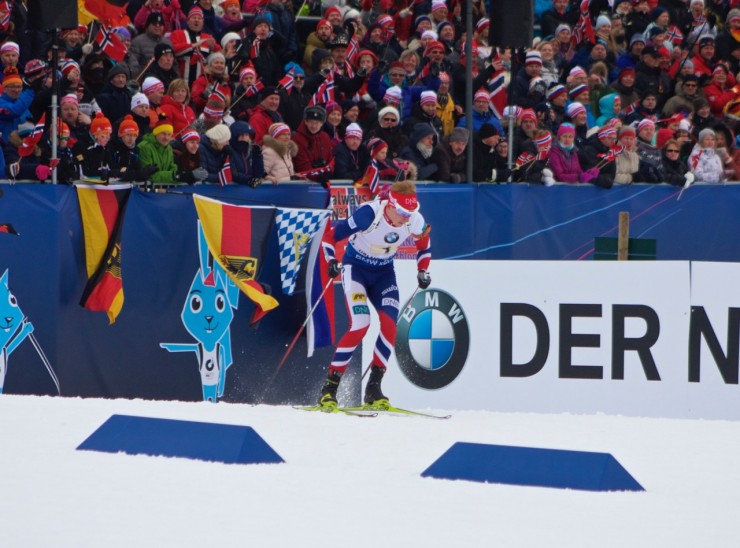
    Johannes Hoesflot Klaebo (NOR) earned his fourth gold medal of these Olympic Games, but the lead he enjoyed in his anchor leg was delivered to hm on a silver platter by the hard work of his nNorwegian teammates. (Photo: Vanzetta/NordicFocus)

    When it comes to relays, Norway doesn’t need much of a plan. In place of a plan, what Norway has are the four fastest guys in the field. And it looked like the entirety of Norway’s plan was for those four fastest guys to ski like the four fastest guys . . . all so that the one fastest guy—Johannes Hoesflot Klaebo—could be somewhere in the vicinity of the lead with 500 meters left to race. If Norway could do that, then Norway would win the gold medal.

    It’s an important thing, this Olympic Cross-Country Relay, one that Norwegians look upon rather like their Super Bowl. The mood of this Nordic nation for the next four years will be affected by the result of today’s ski race. That’s a heavy burden to load onto the shoulders of four ski racers, but there’s just no way around it. The relay matters to Norway, and the Norwegian national identity relies almost entirely on the outcome. Win, and the world makes sense . . . Anything but gold, and the universe is completely out of whack.

    Norway remembers that it hasn’t always gone to plan: Russia upset Norway in 2022, Italy undid them in 2006, Sweden has been a regular interrupter of Norwegian bliss, most recently in 2010 and 2014. Norway almost always enters as the favorite, but sometimes their team was tripped up by circumstance: an untimely fall, an equipment malfunction, the wrong wax. At other times the reason was far worse—like against Russia in 2022—where Norway just got beaten by a faster team. For the Kingdom of Norway, that’s the kind of unthinkable tragedy they simply cannot tolerate.

    Well, Norway’s tolerance was not tested on this day of relay racing in Val di Fiemme, and the Olympic gold medal was all but won by the end of the first leg. Emil Iversen handed a lead to Martin Loewstroem Nyenget, who extended the advantage for Einar Hedegart, who gave Klaebo a lead sufficient to make the anchor leg into a relaxed, casual victory lap. Behind Norway, France fought through deficits in the early legs to pull clear for silver, ahead of a late charge by Federico Pellegrino that secured bronze for a jubilant host nation.

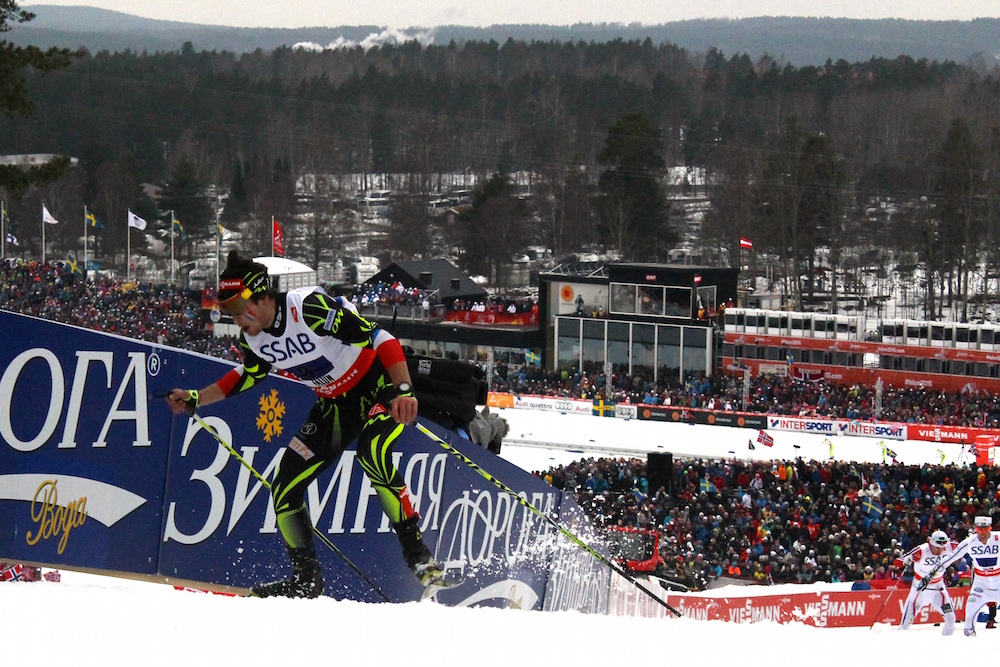
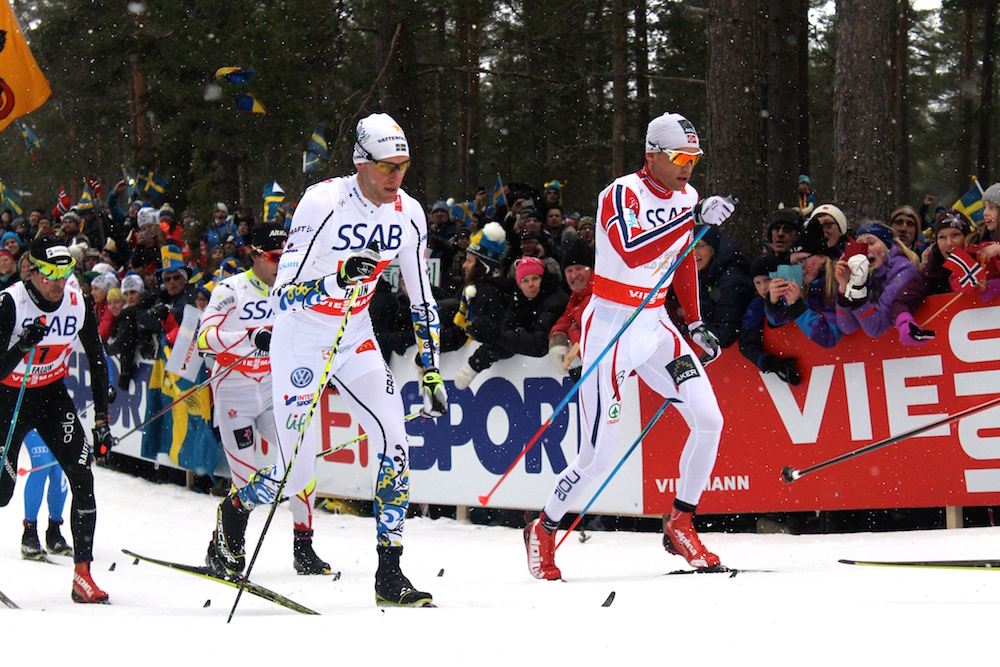
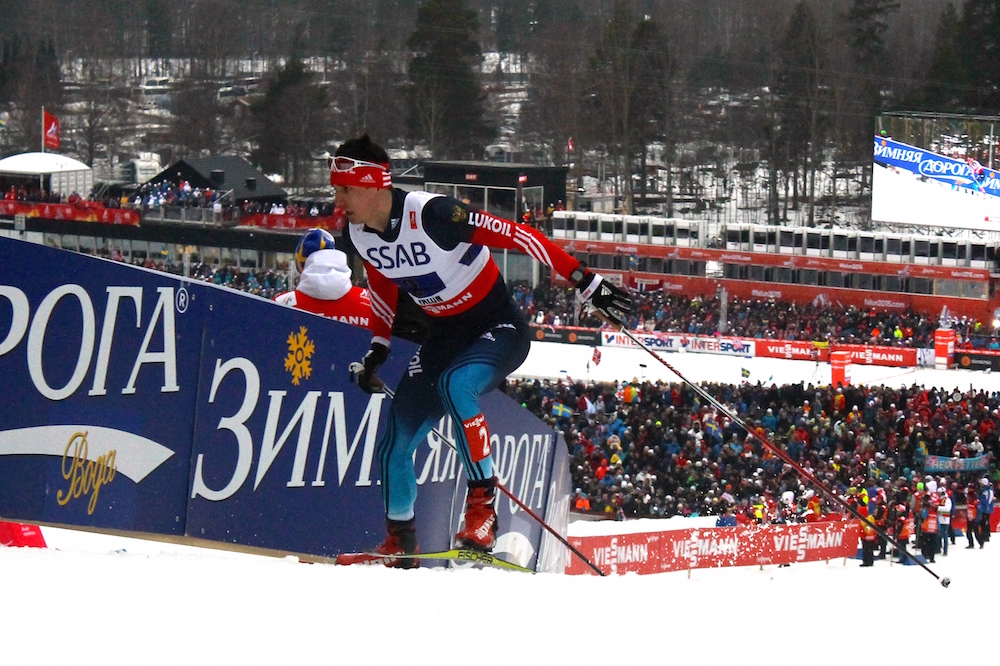
    Team Canada would race to an impressive fifth place finish on the combined efforts of Antoine Cyr, Xavier McKeever, Remi Drolet, and Thomas Stephen. They battled their way into contention in the early legs, and held on to cross the finish line well ahead of Team USA who finished sixth.

    “I had really high hopes going into this race, and we had a really strong team, and we all, like, gave it everything we had and left it all out there,” said Stephen. “It was like, I gave everything I had, because the whole time I could see the podium, and it was right in front of me, and I was fighting for it to catch them, but yeah, in the end, I just couldn’t quite get there.”

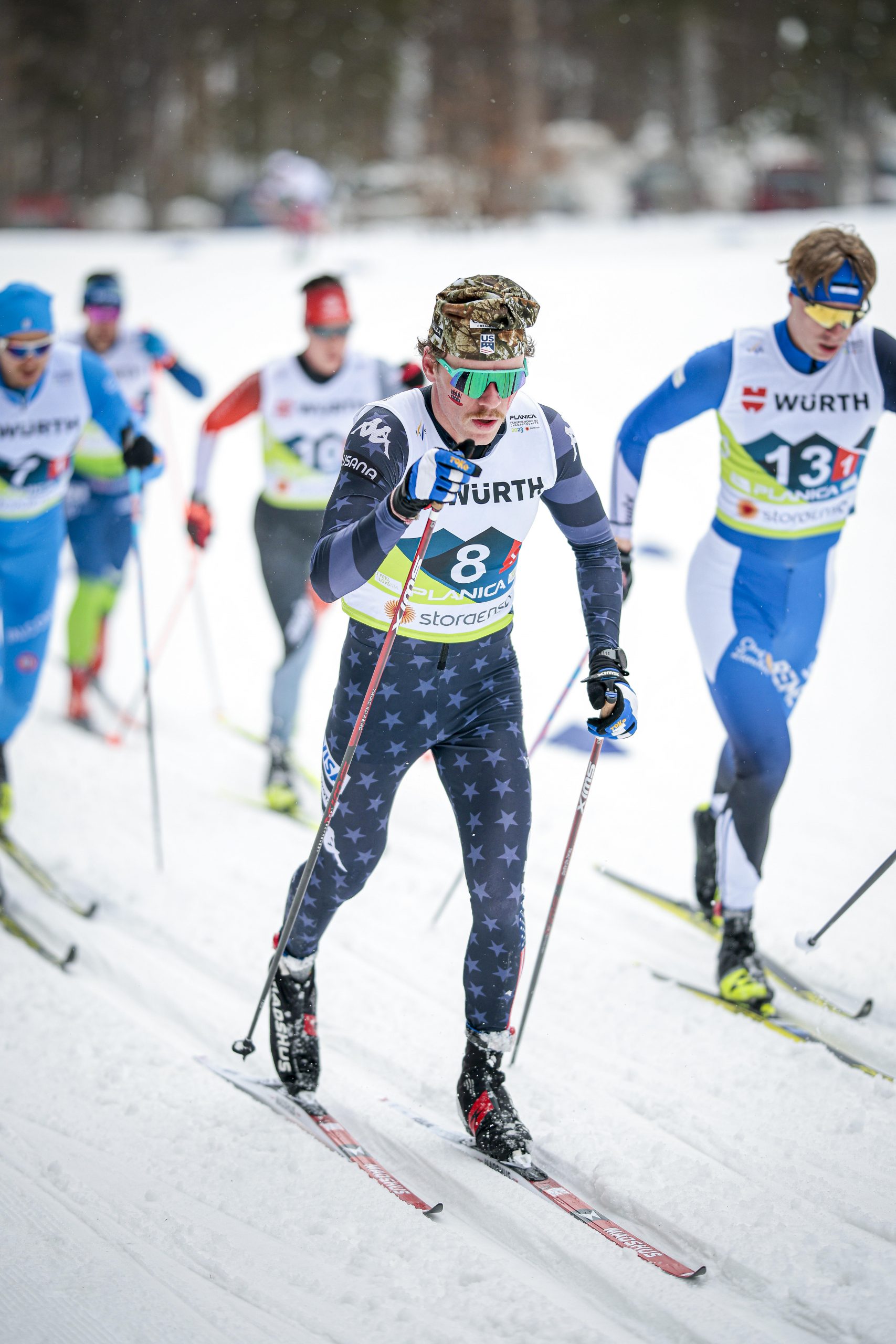
    Ben Ogden (USA) marked Emil Iversen (NOR) throughout Leg 1, giving Team USA a strong position at the first transition.  Barbieri/NordicFocus)

    The American men would ski well and proudly, securing the second-best relay finish in their many Olympic starts. But that brings up a fairly obvious question: might it not have been better if the American relay strategy were “Let’s skip this thing altogether, and save our energy for events where we actually could be contenders?” After all, the Team Relay is another exhausting competition for these skiers, and that represents an accumulation of fatigue that could be avoided, especially when the next event on the Olympic dance card is the Team Sprint. Team USA has skiers—Ben Ogden and Gus Schumacher—could team up to legitimately contend in that event, and both of them were on the roster for today’s athletically expensive Team Sprint. Why not let Norway and France and Italy spend their athletes’ energy today while we put up our feet and watch a race that our participation was truly unlikely to affect anyway? Even with a fifth place in yesterday’s Women’s 4 x 7.5 Relay, this reporter felt the same way about the American women’s efforts. Jessie Diggins and Julia Kern were both on the relay roster, and both skied their hearts out in a fifth-place effort that was actually a better result than anticipated . . . but still fifth. Presumably, Diggins and Kern will be the pair entered in the Team Sprint. Wouldn’t it have been more prudent to keep them fresh for that event? Well, it should not come as a surprise that no Olympic coaches sought out my advice prior to these relay events, so I’ll just sit here in my armchair, happily lobbing criticisms at seasoned professionals who know their athletes far better than I do.

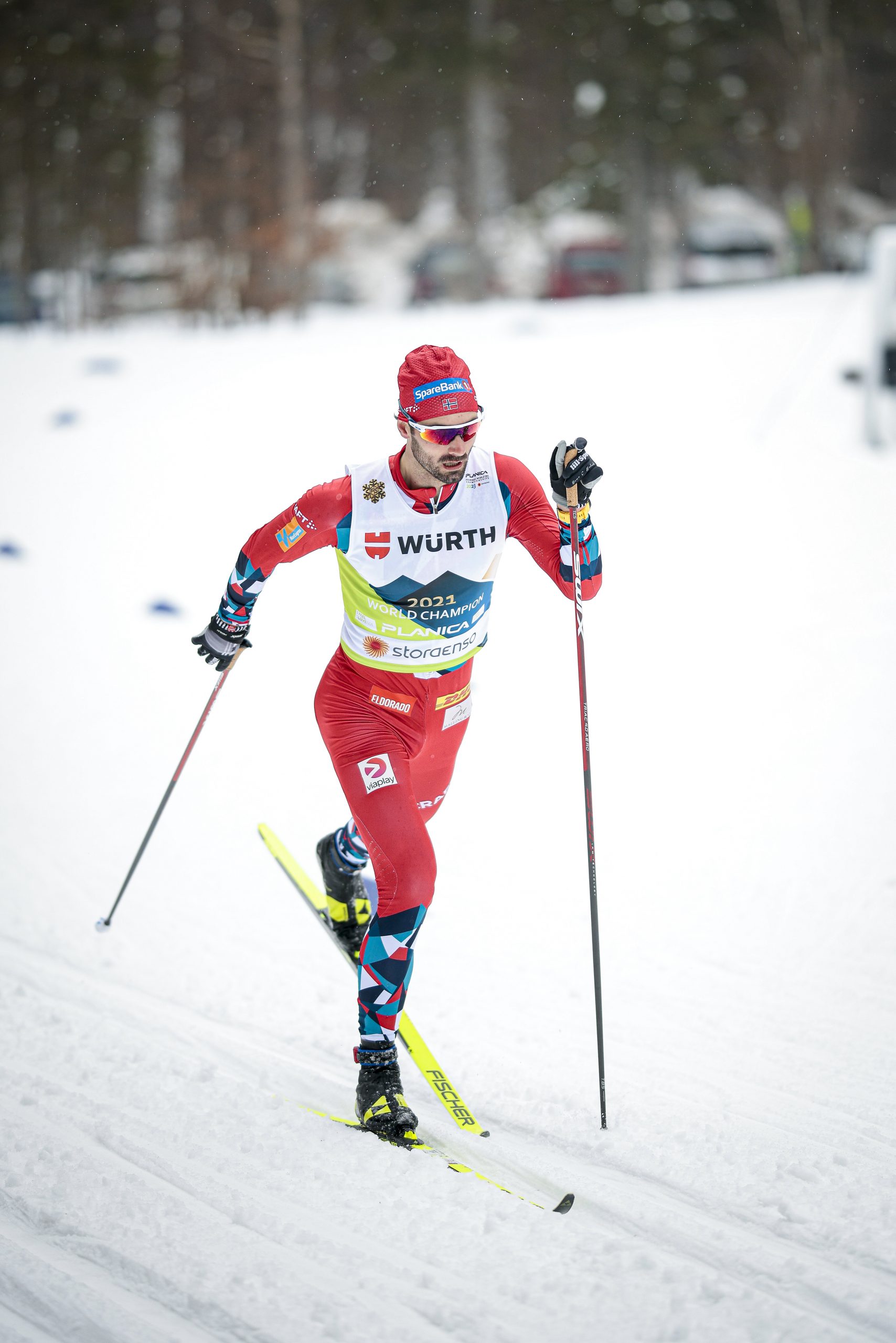
    Emil Iversen (NOR) faced the pressure of leading off for Team Norway. He skied conservatively, stayed out of trouble, did his job. (Photo: Vanzetta/NordicFocus)
    Leg 1

    Ogden opened the American’s account in Leg 1, staying near the front, directly alongside Norway’s Emil Iversen who skied conservatively and kept Norway out of trouble. Ogden’s front row strategy seemed to be the essence of Team USA’s plan:

    “If you lose contact here in Leg 1, the US doesn’t have the depth to make that up,” said on-air commentator, Kikkan Randall. It was as though she was whispering in Ogden’s ear, as he drove the pace, marked by Italy’s Davide Graz and Norway’s Iversen. Xavier McKeever continued to represent Canada  in  Leg 1, alongside Lauri Vuorinen of Finland. Team France found itself gapped; they’d have work to do in Leg 2.

    “I love to be the scramble leg on the relay,” said Ogden. “It’s a really fun position to be in. And it’s not every day that I get to feel like I’m the one that chooses when the pace increases. And today I got to be that guy, which was pretty sick.”

    Leg 2

    Team USA was playing it’s strongest cards early—Gus Schumacher was tagged by Ogden as the Americans continued to push the pace. Finland’s Iivo Niskanen—arguably the best Classic skier in the field—settled back into the top five, where he was soon joined by the high-tempo scamper of France’s Hugo Lapalus. But the favorite was firmly ensconced at the front, where Martin Loewstroem Nyenget began to ski steadily away.

    “Tony Cyr took it out super hot, but it kind of it comes back together,” said Schumacher. “I felt like I was able to stay relaxed and kind of come back. It’s nice to have just like a solid day where I feel like I was skiing high, I feel like I can ski and tag off in a good spot.”

    “Yeah, I was really happy with my leg,” said Cyr. “Was pretty nervous going to today, just because I knew what this team’s potential was. And being leg one, you kind of get the first crack at setting the tone. And yeah, Ben Ogden went friggin hard up the big climb to the top on lap two. And I was kind of just like running for dear life, trying to hang on, and was able to catch up in the downhill.”

    Chasers: John Steel Hagenbuch (USA), Remi Drolet (CAN), Martino Carollo (ITA), Arsi Ruuskanen (FIN), Mathis Desloges (FRA). (Photo: Vanzetta/NordicFocus)
    Leg 3

    Norway’s Einar Hedegart (silver medalist in this week’s 10 k freestyle) was tagged by Nyenget with a 10 second lead over Finland. John Steel Hagenbuch took the tag from Schumacher just 15 seconds out of the lead, and in direct contact with the other medal contenders.

    “Gus and Ben tagged us off in a really good position to be with the leaders,” said Hagenbuch. “And I guess I had the I had the tough position of being the one to lose the lead a little bit, but I was trying as hard as I could, and I was with the leaders at the top of the hill, and then just trying to do as much damage control as possible for the rest of the lap, in the second lap as well. But, you know, I had a great day the other day, and it just didn’t come together in the same way today. I think it’s a testament to how great our team is, and how great our team culture is, that these guys were there for me after that.”

    “I got tagged by Tony in an amazing position,” said Drolet. “Right by the French team with Mattis Desloges. Obviously, he’s gotten two silver medals, obviously, and I think he was hungry to push the pace and try and catch Norway throughout the leg, and it was just so, so hard throughout that first lap.”

    If there had been a perceived chink in the armor of Team Norway, it was the inexperience of Hedegart. He had over-cooked the pace in the earlier Olympic 10 k freestyle, even while showing that he possesses some of the sharpest fitness and greatest athletic talent of any skier in the field. The primary concern in his leg of the relay may have been that he is less experienced racing in a crowded mass-start field. Luckily for Norway, the other parts of their plan had worked, and Hedegart would ski the entirety of Leg 3 all alone, though France’s Mathis Desloges (silver medalist in the recent 10 k Freestyle) began to whittle away some of Hedegart’s advantage,

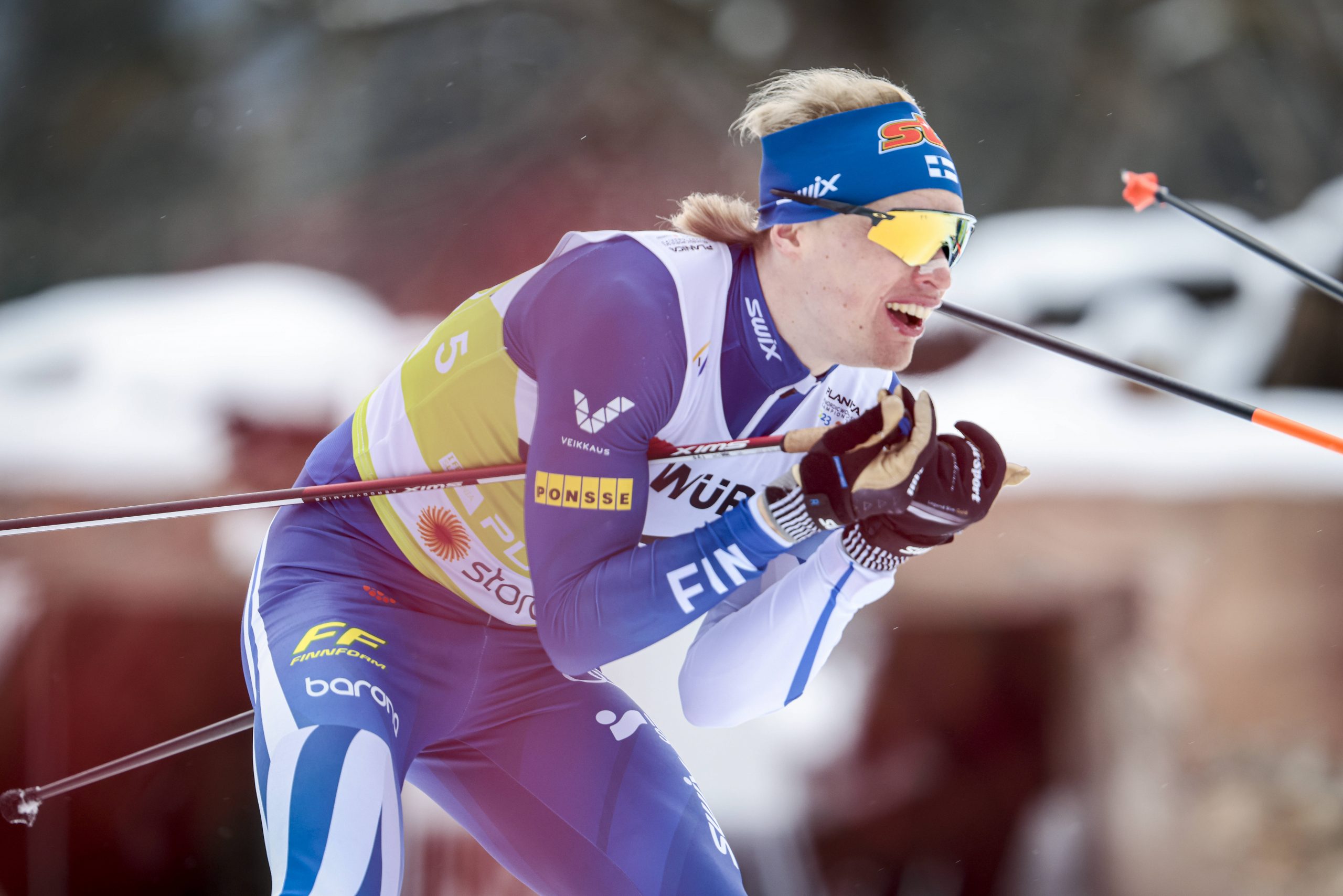
    Federico Pellegrino (ITA) carried the hopes and aspirations of his countrymen, racing forward to catch Finland and securing the bronze medal for Italy. (Photo: Barbieri/NordicFocus)

    Leg 4

    Hedegart delivered a healthy lead to Klaebo, who could either drive home the issue, or wait to sprint against the fast-closing Frenchman, Victor Loverra. Klaebo still has two more events to race at these Olympics, so he could be forgiven for his casual pace in the anchor leg.

    Klaebo came through the first of his two laps with a 20 second lead over Loverra . . . one lap to go. Behind them, a national drama had begun to play out as Italy’s Federico Pellegrino had tracked down Finland’s Nikko Antola. There would be a battle for bronze.

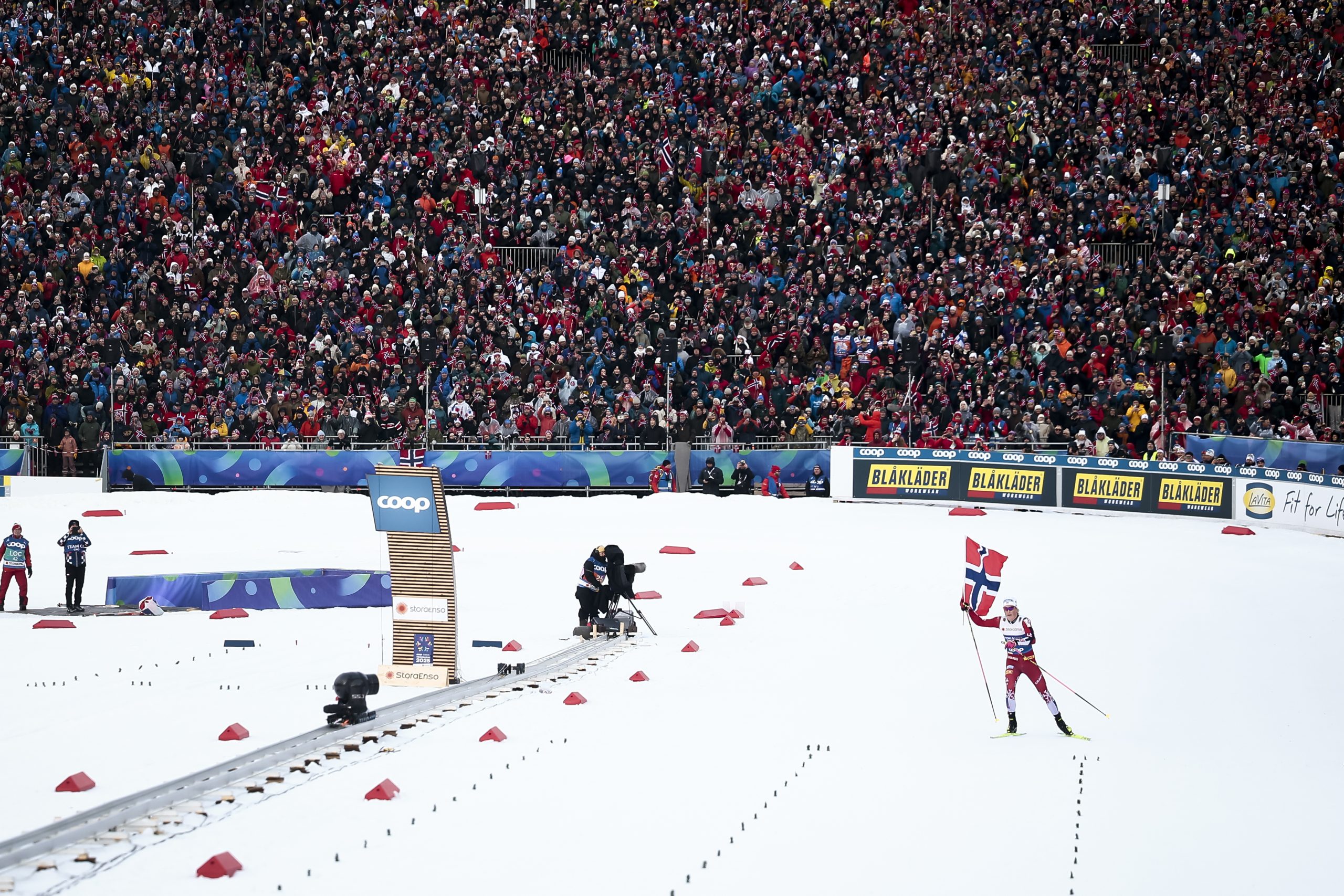
    In the end, Klaebo would make his long-anticipated finish, coasting unrivaled down the final straightaway. He would wave to the crowd, but not with the sort of flag-waving, fist-pumping celebration that would be the practice of mere mortals. With his fourth gold medal of these games, Klaebo stood alone as the winner of more gold medals than any other Winter Olympic athlete.

    France was elated with its second place finish (improving upon the oft-repeated third-place finishes that have so often been France’s lot). Behind France, Pellegrino was welcomed by an ecstatic Italian crowd as Italy claimed the bronze.

    “The first, like, kilometer and half Pelly started, and I gave it everything I had,” said Stephen. “I knew if I wanted a shot at the podium, I had to catch Pelly. So yeah, I tried to, but as I approached him close, he then took off and caught the Finland. So yeah, I couldn’t quite close that gap, but Fifth place is like a really amazing event, and I’m really proud of the whole team, for everyone putting together, like an amazing relay, and having a good day and just leaving it all out there.”

    “It’s great for us, Olympic games at home,” said Markus Cramer, coach of the Italian Olympic Team. “And then bronze medal with the team, especially for Pellegrino. It’s great for us. Of course, we work long time for this, and now, of course, we were sure it was possible.”

    And Johannes Hoesflot Klaebo changed the landscape of Olympic history: no winter Olympian has won more than Klaebo. And he still has two events remaining in these Games.

    Men’s Olympic 4 x 7.5 k Relay RESULTS

    Help Support Our Olympic Coverage!

    FasterSkier will have our own Nat Herz on the ground at the Olympics, which, to be honest, is a very big financial lift for us. If you value the thoughtful work and access FasterSkier provides at championships like this one, please consider becoming a Voluntary Subscriber. Your support directly fuels the work we do to cover the people, places, and moments that make our sport special.

    Join the FasterSkier community!
    France (silver), Norway (gold),and Italy (bronze). National pride on the podium of the 4 x 7.5 k Relay. (Photo: Barbieri/NordicFocus)
  • Fast Tracks: World Champs—The US Team Has Found Their Flow, According to US Head Coach Matt Whitcomb

    Fast Tracks: World Champs—The US Team Has Found Their Flow, According to US Head Coach Matt Whitcomb

    Reporting by: Nat Herz and Stuart Harden

    This reporting costs money. Please support this coverage with a voluntary subscription (below) so FasterSkier can provide this level of access to the sport we all love year-round.

  • Fast Tracks: World Champs—Swiss Coach, Erik Bråten, Discusses Success in Trondheim

    Fast Tracks: World Champs—Swiss Coach, Erik Bråten, Discusses Success in Trondheim

    This reporting costs money. Please support this coverage with a voluntary subscription (below) so FasterSkier can provide this level of access to the sport we all love year-round.

  • Fast Tracks: World Champs—The Canadian Men, Once Again, Find Relay Magic

    Fast Tracks: World Champs—The Canadian Men, Once Again, Find Relay Magic

    This reporting costs money. Please support this coverage with a voluntary subscription (below) so FasterSkier can provide this level of access to the sport we all love year-round.

  • Fast Tracks: World Champs—US Men with a Solid Day in the Relay

    Fast Tracks: World Champs—US Men with a Solid Day in the Relay

    Reporting by: Nat Herz and Stuart Harden

    This reporting costs money. Please support this coverage with a voluntary subscription (below) so FasterSkier can provide this level of access to the sport we all love year-round.

  • Fast Tracks: World Champs—Norway Delights Home Crowd—Press Conference

    Fast Tracks: World Champs—Norway Delights Home Crowd—Press Conference

    Reporting by: Aidan O’Donnell

    This reporting costs money. Please support this coverage with a voluntary subscription (below) so FasterSkier can provide this level of access to the sport we all love year-round.

  • Fast Tracks: World Champs—Swiss Team Had a Day—Press Conference

    Fast Tracks: World Champs—Swiss Team Had a Day—Press Conference

    Reporting by: Aidan O’Donnell

    This reporting costs money. Please support this coverage with a voluntary subscription (below) so FasterSkier can provide this level of access to the sport we all love year-round.

  • Fast Tracks: World Champs—Swedish Men Recover from Early Fall—Press Conference

    Fast Tracks: World Champs—Swedish Men Recover from Early Fall—Press Conference

    Reporting by: Aidan O’Donnell

    This reporting costs money. Please support this coverage with a voluntary subscription (below) so FasterSkier can provide this level of access to the sport we all love year-round.

  • Fast Tracks: World Champs—The Italian Men, Stayed In the Fight for a Medal

    Fast Tracks: World Champs—The Italian Men, Stayed In the Fight for a Medal

    This reporting costs money. Please support this coverage with a voluntary subscription (below) so FasterSkier can provide this level of access to the sport we all love year-round.

  • Early Gaps Decide Men’s Relay: Norway Delivers on Expectations

    Early Gaps Decide Men’s Relay: Norway Delivers on Expectations

    This World Cup coverage is made possible through the generous support of Marty and Kathy Hall and A Hall Mark of Excellence Award. To learn more about A Hall Mark of Excellence Award, or to learn how you can support FasterSkier’s coverage, please contact info@fasterskier.com. 

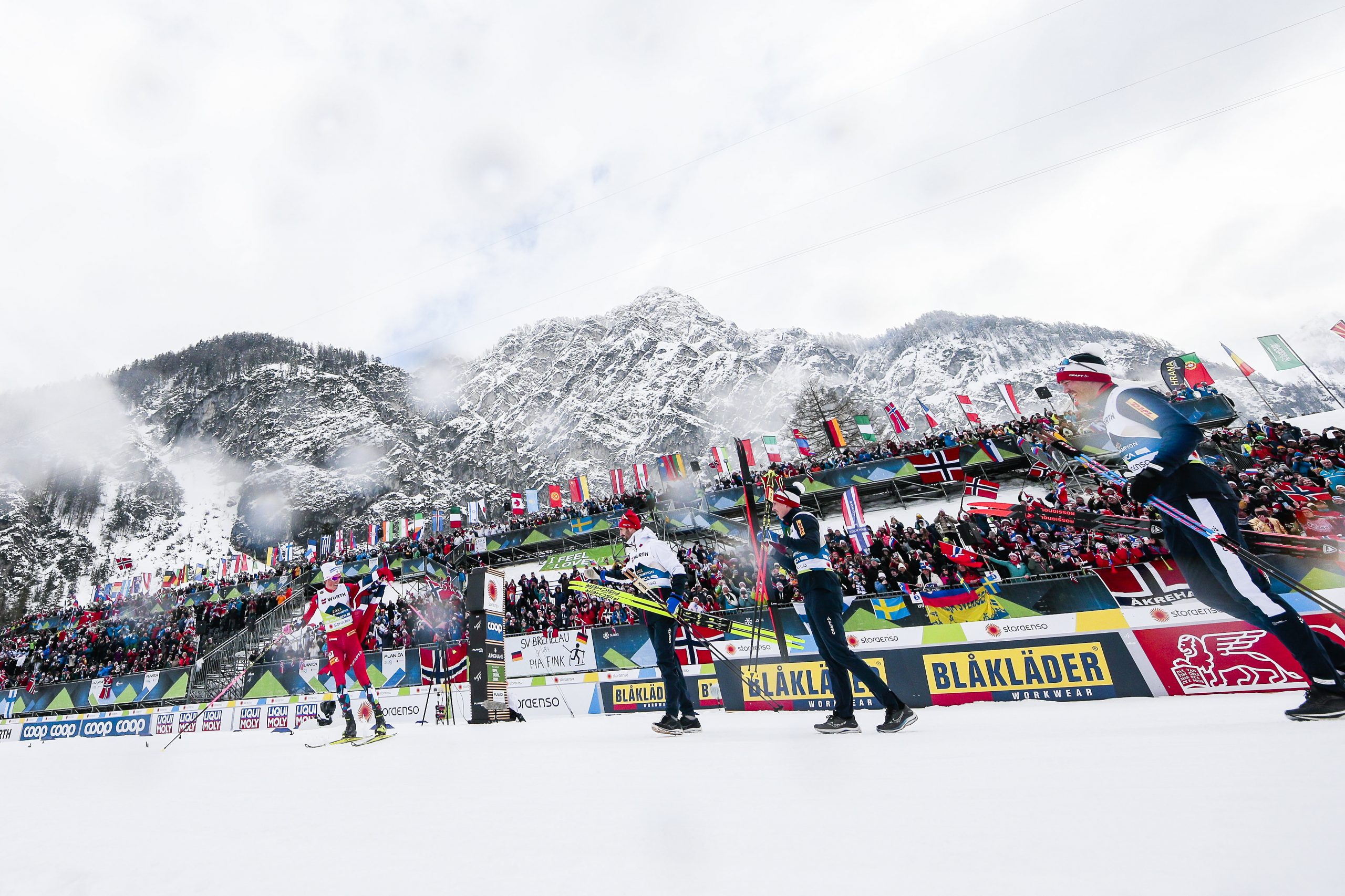
    Foregone conclusion: Norway alone at the finish line. Johannes Hoesflot Klaebo (NOR), Hans Christer Holund (NOR), Paal Golberg (NOR), and Simen Hegstad Krueger (NOR) celebrate another Norwegian win in the Men’s Relay at the FIS World Championships in Planica, Slovenia. (Photo:  Modica/NordicFocus)

    In sport, sometimes “foregone conclusions” prove to have been premature; that can make for exciting racing. At other times, foregone conclusions prove accurately prescient; that makes for situations in which the anticipation of action and drama is entirely spoiled. In Planica, Slovenia, Team Norway spoiled (predictably) the excitement of the World Championship Men’s Relay, winning gold well ahead of second place Finland and third place Germany. Foregone conclusion, indeed . . .

    North American teams were well represented in the relay field, with Canada holding its position in the group of medal contenders throughout the day by virtue of fine skiing by Xavier McKeever, Graham Ritchie, Antoine Cyr, and Olivier Leveille. They would finish fifth. Team USA’s performance was highlighted by the heroic classic skiing of Ben Ogden (he led the chase group for much of Leg 1), but that advantage would be undone in Leg 2, with later skiers being left with no chance to overcome the deficit. Team USA would finish seventh.

    Alone from the start: the dominating first classic leg skied by Hans Christer Holund (NOR) all but decided the race’s outcome. (Photo: Modica/NordicFocus)

    As is so often the case, the story at the front of the field was Norway . . . though even television broadcast cameras paid little attention to them. It’s not Norway’s fault that they dominate so completely; it’s not Norway’s fault that they win with such apparent ease. They appear so confident, so self-assured. But in the hours before the race, there was plenty of tension, indeed. The forecast for the day—snow then not snow, rain then not rain— elicited considerable worry among those responsible for ski preparation. If the forecasts came true, the classic legs could’ve become a horrible, unpredictable mess.

    “If it rains for real, we gotta be on klister,” American, Ben Ogden, told FasterSkier’s Nat Herz. “If it snows for real, we gotta be on zeroes, and if it does this mixed [stuff], then we don’t know!”

    Had the snow fallen, had the rains come, then athletic superiority (which Norway possesses in spades) potentially could’ve been undone. It’s been known to happen before . . . In the end, the threats of those earlier forecasts never materialized. The skies over Planica remained gray and temperatures remained relatively warm, but neither snow nor rain ever materialized. Skiers utilized a variety of ski prep tactics (Ogden skied on zeroes while many others chose klister); regardless, most seemed to benefit from both good glide and sufficient kick. The race didn’t come down to technological superiority . . . it remained a case of athletic superiority. Probably no one was more relieved than Norway. There was a lot more tension surrounding this event in the pre-race hours than there was during the race, itself. Once the starter’s pistol sounded, things were decided pretty quickly. Hans Christer Holund (NOR) made sure of that.

    Ben Ogden (USA) would ski a brilliant scramble leg, driving the pace of the chase group through much of the first leg. (Photo: NordicFocus)
    Men’s 4 x 10 k Relay

    Holund got away almost immediately: Norway wouldn’t be a part of this relay story again until they crossed the finish line well ahead of all other teams. Behind Holund, though, the race played out in ways that were both predictable and surprising. Unlike yesterday’s Women’s relay in which each skier raced a single 7.5 k lap, the Men’s relay course offered each skier a pair of five-kilometer laps. Within that format, it was in the chase group where the action took place.

    Ogden—jauntily sporting a camo-print US Ski Team hat, but not (visibly) wearing the normally-expected USA Team Relay socks—pushed the pace through most of the first leg. “It was a bit frantic at the beginning,” Ogden said. “The first time up the big hill, I had…a moment of ‘I could go get [Holund], but it would’ve been SO disastrous. In a 4 x 10 k, you gotta remember it’s still a distance race!”

    After Holund’s Leg 1 escape, Iivo Niskanen (FIN) was the animator in the chase group in Leg 2. His acceleration dropped the group, and set up Finland’s uncontested run to the silver medal. (Photo: Modica/NordicFocus)

    Leg 2 was marked by the emergence of classic specialist, Iivo Niskanen (FIN), whose second lap surge separated his team from the others. Niskanen quickly established a considerable gap as the chase group behind him dwindled. American, Hunter Wonders, found himself dropped from the chase group: the USA would fall from contention, and Team Finland would not be challenged for the silver medal again. Likewise, Germany found itself gapped in these middle laps, but a late-race slowing of the chase group’s pace would allow Friedrich Moch (GER) to catch back on. His brave efforts would ultimately prove crucial to Germany securing a surprising bronze medal.

    Ultimately, Norway (anchored by an easy-skiing Johannes Hoesflot Klaebo who had ample time to collect a Norwegian flag in his celebratory stroll down the homestretch) would win by nearly a minute, followed by Niko Antolla of Finland in second. Germany’s courageous Moch outsprinted Jules Lapierre (FRA) for bronze.

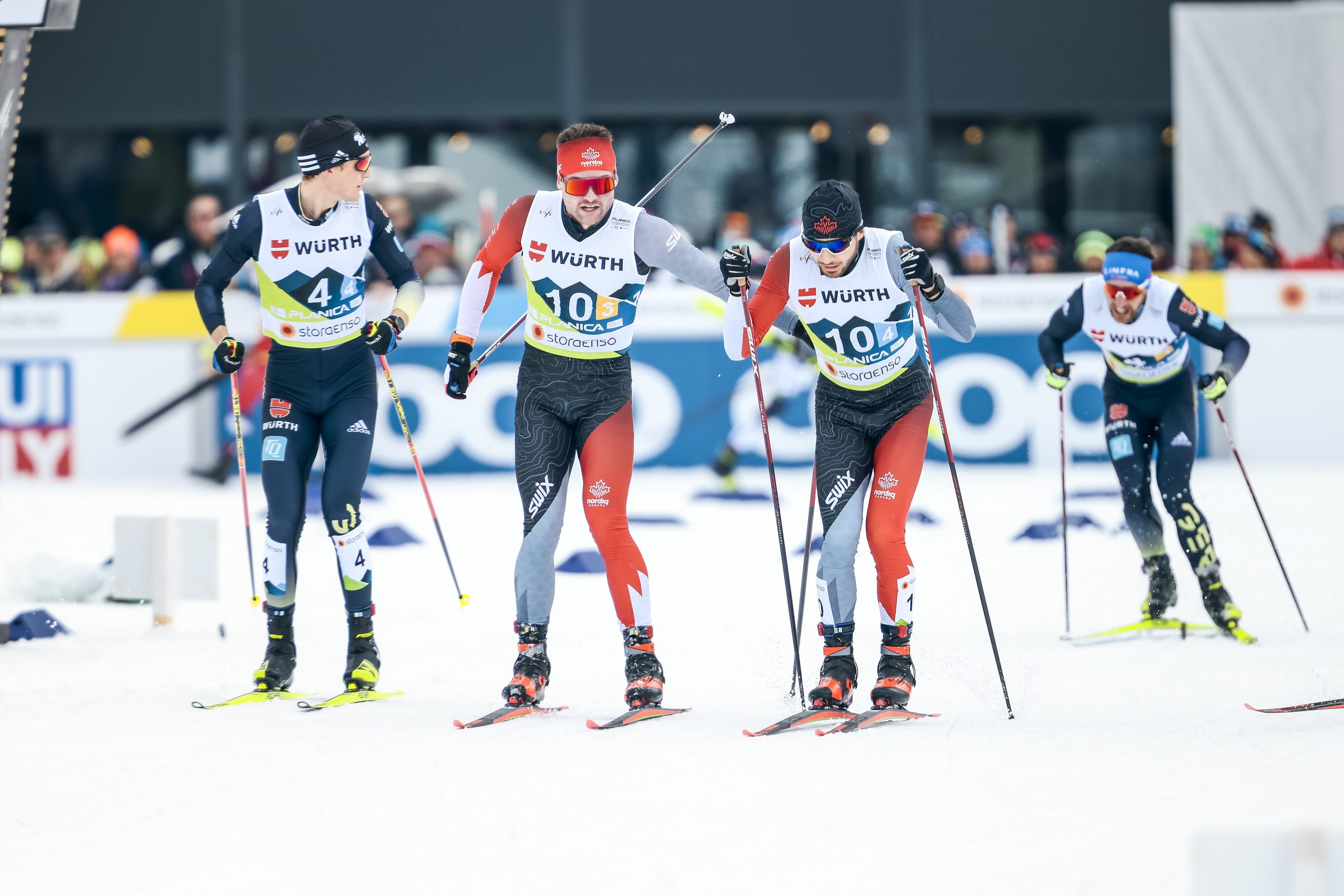
    Team Canada’s Graham Ritchie tags Olivier Leveille ahead of eventual bronze medalist, Germany. (Photo: Modica/NordicFocus)

    Team Canada remained in contention throughout the day—ultimately finishing fifth—boding well for the future development of this young team.  “[It was] definitely a different experience,” said McKeever. “Being at the front…fighting for a medal.”

    Men’s Relay RESULTS

    Not everything transpired entirely according to pre-race predictions: Team Germany—Janosch Brugger (GER), Friedrich Moch (GER), Jonas Dobler (GER), Albert Kuchler (GER)—celebrates a surprising bronze medal. (Photo: Thibaut/NordicFocus)
  • Friday Olympic Rundown: Sweden Bests Norway in Men’s Biathlon Relay, U.S. Record-Setting 6th

    Fredrik Lindström of Sweden crosses the line after securing a gold medal for his Swedish teammates in the men’s relay to close out biathlon competitions at the 2018 Olympics in PyeongChang, South Korea. (Photo: FlyingPointRoad)

    FasterSkier would like to thank Fischer Sport USA, Madshus USA, Concept2, Boulder Nordic Sport, and Swix Sport US for their generous support, which made this coverage possible.

    ***

    2018 Olympics (PyeongChang, South Korea): Biathlon Men’s 4 x 7.5 k relay

    Full report

    Germany were the favorites coming into this men’s relay and Erik Lesser started them off with a near-perfect relay leg to sit in first place, but shooting collapses by Benedikt Doll and Simon Schempp left the team with bronze medals at the finish.

    On a windy, gusty day, the relay instead came down to a race between Norway and Sweden. Coming into the last shooting stage Fredrik Lindström of Sweden and Emil Hegle Svendsen of Norway were stride for stride. Each missed their first shot in standing, but Lindström pulled himself together and hit the next four shots, then hit the final target using a spare round. Svendsen, on the other hand, kept missing and ended up skiing a penalty loop – just as he had when anchoring the Norwegian team in the Olympics in Sochi four years ago.

    A strong leg from Tim Burke, who cleaned prone and then survived on spare rounds while chaser Martin Fourcade of France headed to the penalty loop, helped the U.S. secure a best-ever sixth-place finish in the Olympic men’s relay. (Photo: FlyingPointRoad)

    Then, that left Norway off the podium. This time, Norway still earned silver, as behind him Schempp had his own shooting woes.

    An exciting relay with multiple lead changes in the end turned into something of a blowout, with Lindström able to celebrate on his final loop before joining overjoyed teammates Peppe Femling, Jesper Nelin, and Sebastian Samuelsson at the finish. It was the first Olympic relay gold medal in the history of Swedish biathlon, and the team did it with phenomenal shooting – just seven spare rounds despite difficult conditions. They were the only team to avoid the penalty loop, which most teams visited more than once.

    The Norwegian squad of Lars Helge Birkeland, Tarjei Bø, Johannes Thingnes Bø, and Svendsen finished 55.5 seconds back. The Germans with Lesser, Doll, Arnd Peiffer, and Schempp crossed the line +2:07.1, and the Austrian squad of Tobias Eberhard, Simon Eder, Julian Eberhard, and Dominik Landertinger were the first ones out of the medals, +2:52.5.

    The American team of Lowell Bailey, Sean Doherty, Tim Burke, and Leif Nordgren finished sixth, +3:50.2, tying the best-ever men’s relay finish by an American team at the Olympics. They had 14 spare rounds and two penalty loops.

    The Canadian squad of Christian Gow, Scott Gow, Macx Davies, and Brendan Green finished 11th, +5:40.3, with 11 spare rounds and a penalty loop.

    Results

  • Russia Rebounds to Win Men’s Relay; USA Seventh, Just Missing Goal

    Russia Rebounds to Win Men’s Relay; USA Seventh, Just Missing Goal

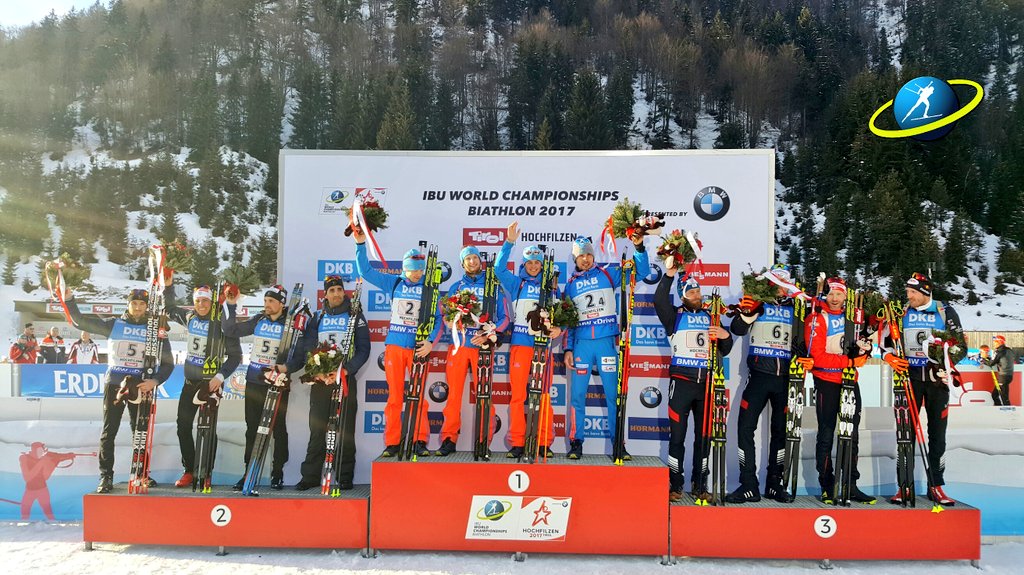
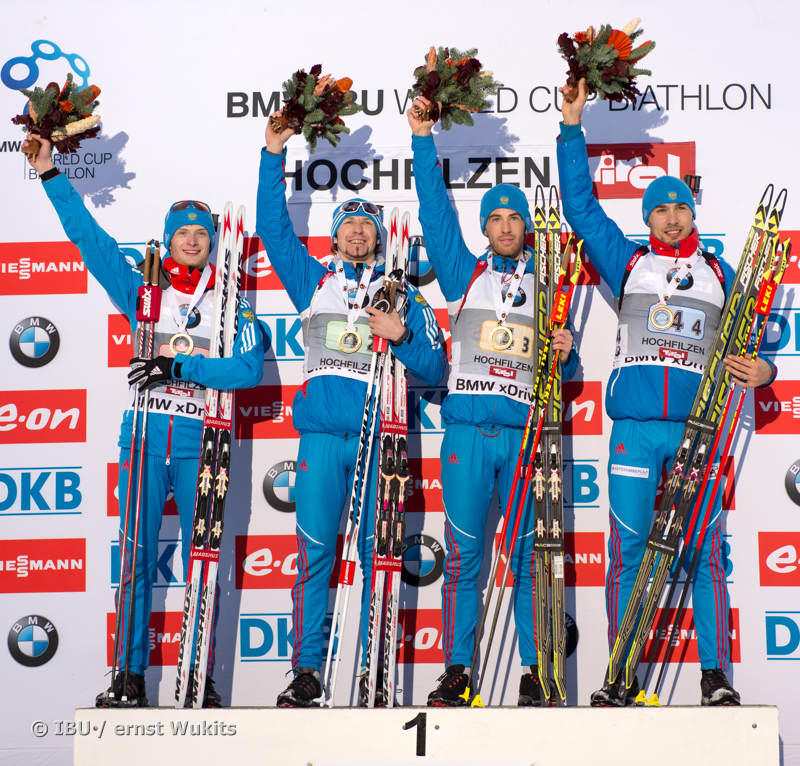
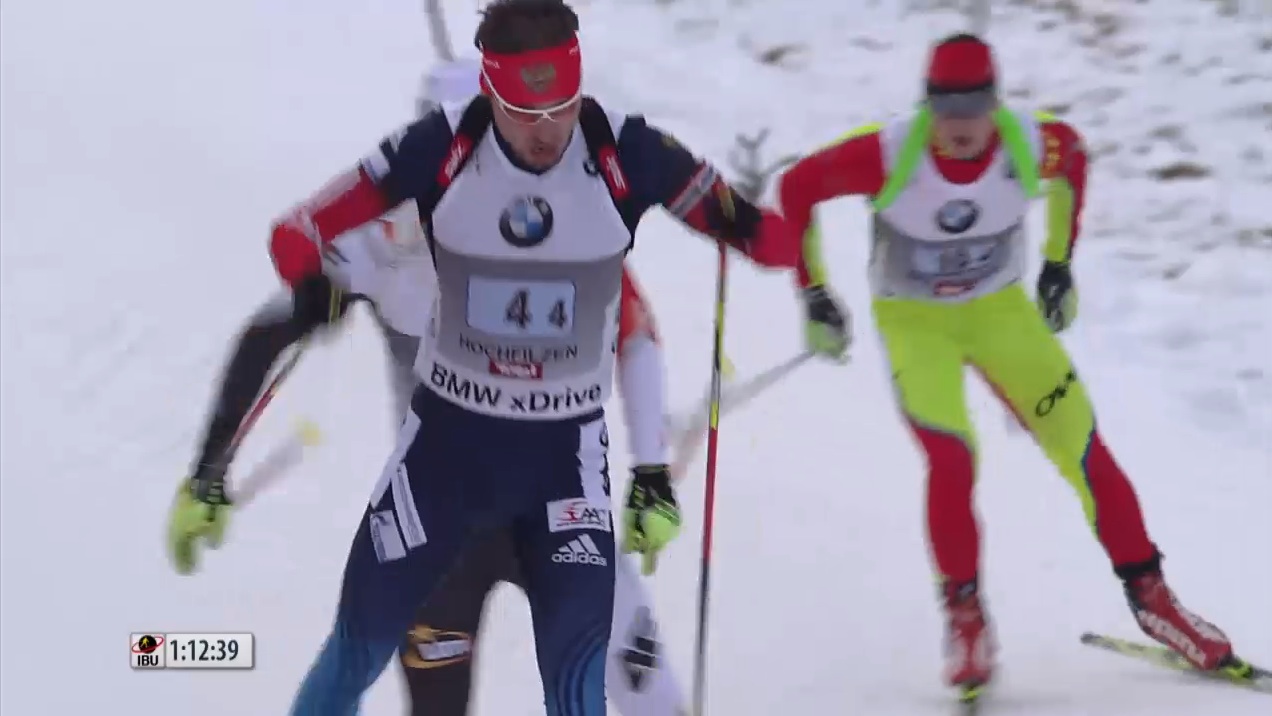
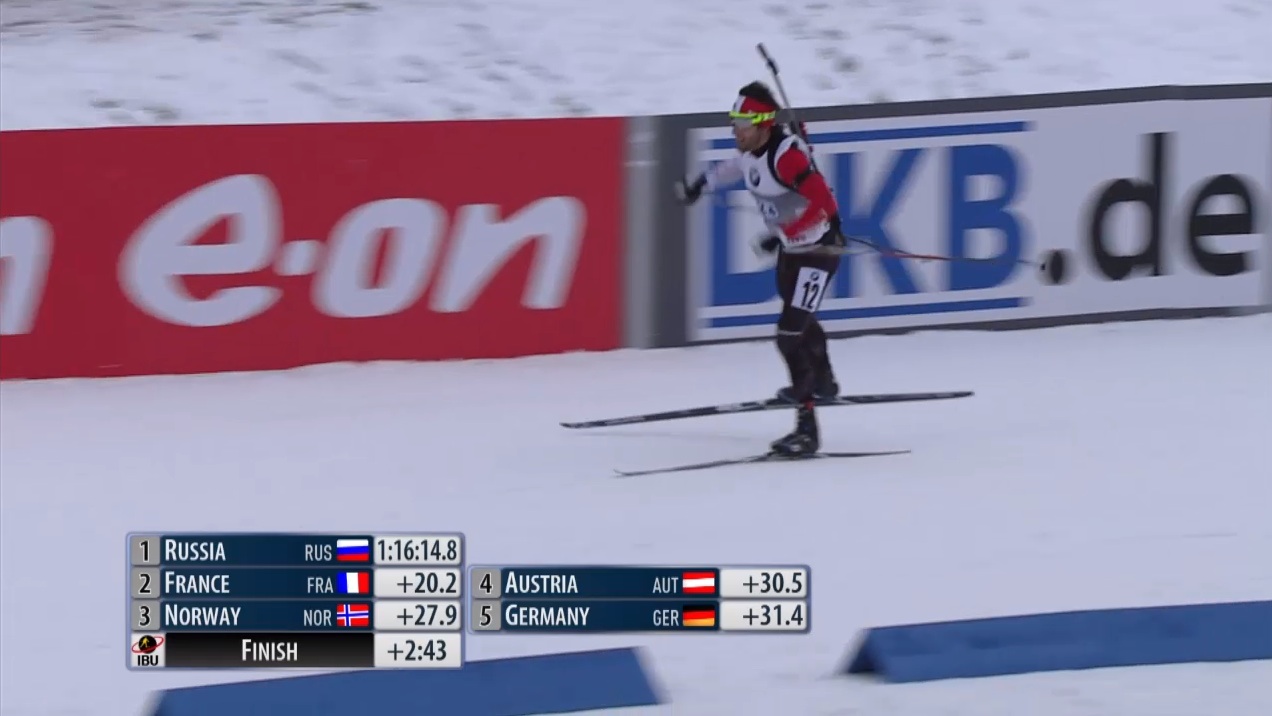
    The men’s 4 x 7.5 k relay podium at 2017 IBU World Championships on Saturday in Hochfilzen, Austria, with Russia (c) in first, France (l) in second, and Austria (r) in third. (Photo: IBU World Champs/Twitter)

    HOCHFILZEN, Austria—Redemption, validation, national pride: just a few of the things that were on the line in today’s 4 x 7.5 k relay at IBU World Championships.

    For Austria, it was clear: a good performance on home soil was critical. The team hadn’t won a medal yet despite eight chances to do so.

    For Germany, the question was whether their accomplished men’s team could live up to the expectations set by its younger women’s team, which has won every relay this year, including at World Championships.

    For Norway, there had been no gold so far, but the men wanted to defend their title from last year’s Championships in Oslo.

    Russia? Relays were seeming like the best way to take medals. They had earned bronze in the mixed relay, but been locked out ever since. Plus, the team has been embroiled in politics. Things were getting complicated.

    France’s Martin Fourcade has dominated the whole season, but only won one gold at World Championships. Would the relay be the place he could finally get a second?

    Plus, Canada won bronze in the team event last year, and the U.S. men’s team, often a top-six threat, was looking to capitalize on the energy from Lowell Bailey’s gold in the 20 k individual.

    Any number of teams wanted a slice of the podium. But there were only three steps, and only one set of gold medals.

    Out of the start, a team that nobody had expected shot to the front: Latvia. Andrejs Rastorgujevs, always one of the fastest skiers in the field, decided to make a breakaway already on the first loop. He then quickly cleaned prone and continued to lead on his own through the second loop.

    Using spares in standing, though, the strategy didn’t seem to pay off. Germany staked a claim as soon as he faltered, with veteran Erik Lesser cleaning both shooting stages with no spare rounds and then attacking the final loop. He tagged off to Benedikt Doll with 5.8 seconds on the competition.

    “Erik is such a great finisher,” U.S. lead skier Lowell Bailey – who tagged off 12.4 seconds back in fourth place, after using one spare round – said of Lesser. “In that situation he is nearly unstoppable. Hats off to him. He knows how to ski relays.”

    While Lesser had thrown down, many teams weren’t so far behind him. By the end of the third leg, Benedikt Doll had thrown away Germany’s lead with poor shooting and six teams were still within 32 seconds of first place. Gone were the U.S., Canada, and Norway. Anton Babikov had turned in a hero’s performance to take Russia to the front, and his team was now chased by Austria, France, Germany, Ukraine, and Italy.

    Anton Shipulin had taken over for Russia with a slight lead over Austria and France. Martin Fourcade, the French anchor, chased hard, and passed Austria’s Dominik Landertinger. With a clean prone from both Fourcade and Shipulin, the race narrowed. But Shipulin still had some seconds of cushion when he came in for standing.

    He needed them: Shipulin used one spare. Fourcade shot quickly, cleaned, and tried to catch the Russian. He left the range 4.2 seconds back, setting up a battle between two of the top men on the World Cup.

    “Today the last round for me was the most difficult, because I knew that Martin Fourcade is a very strong athlete,” Shipulin said through a translator at the press conference. “I was just trying to run faster than him.”

    It turned into the battle that wasn’t, however, with Shipulin pulling away and coasting to a 5.8-second win for Russia.

    “I think it was too complicated for me today,” Fourcade said. “I am not in my best shape. Anton was really strong on the track. I tried in the beginning of the race to catch him, and I almost did it. But then he had a bit more power than I had.”

    While the Russian fans weren’t the most numerous in the stands, they were among the most passionate. And the team had delivered for them.

    “I feel relieved for our team and our country,” Shipulin said. “I think it has been almost ten years we have not won any [World Championships] in the relay. So we are just really lucky and really happy, and we are going to celebrate.”

    (Russia did win gold at the 2014 Olympics.)

    Behind Fourcade and Shipulin, Landertinger of Austria and Simon Schempp of Germany were both trying desperately to secure a podium spot, but there was only room for one.

    Schempp initially appeared to have better skis on the downhills on the front end of the loop. But on the major climb on the back end, Landertinger accelerated and Schempp was utterly unable to follow. To the monstrous roar of the crowd, Landertinger skied into the stadium to take bronze with his three teammates.

    “It was very, very hard,” Landertinger told Austrian broadcaster ORF. “Simon is one of the best anchor skiers I know. When I skied out of the range after the shooting and saw him just four or five meters behind me, I knew it would be very difficult. I probably looked at that climb a hundred times in training, and it was pretty clear I would do my attack there. And thank God that worked out great.”

    Schempp was deflated, but said that Germany needed to have an overall better team performance to secure a podium. Eight spares wouldn’t to it.

    “It wasn’t enough for the podium today,” he told German broadcaster ARD. “I gave everything I had, everything that was left. Unfortunately we were not convincing on the shooting range today.”

    Doll apologized too: four of the eight spare rounds came from him, including three in the standing stage, which had dropped the team to seventh at the time.

    “Everyone did their best, I also tried to do my best,” he said. “But I just didn’t have it in my head today. I am really sorry about that, it really hurts because half the used spares were on me. I might have to give out a bar round tonight. I have to take a large part of the blame on me.”

    For the Austrian team, the medal was long-awaited and cause for celebration.

    Leadoff skier Daniel Mesotitsch was also the leadoff guy when Austria took bronze on this same course back at 2005 World Championships.

    “It feels just as great as back then,” the 40-year-old told ORF. “There is no better feeling than winning a medal at home with the team. We are all overwhelmed by our emotions. I was briefly feeling sick to my stomach even watching [the last loop]. I was a lot more nervous than during my own loop.”

    But now, a medal is theirs.

    “It’s beautiful,” Landertinger said. “Really, really beautiful. And I have to say, what I experienced today with those fans, I already got goosebumps coming into the arena today. And I am proud that I can race here. And now with this medal I achieved the goal I had, and I am brutally happy now.”

    U.S. Team Seventh, Just Out of Top-Six Goal

    Bailey delivered as the U.S. team’s leadoff racer, using just one spare round and staying near the front for the whole race. After the team could not contest the first few relays of the season, they lost valuable Nations Cup and relay points and started with a high bib number. Bailey had to make up the time on the range, rather than the trails.

    “There was no where to go –it’s actually fairly narrow for a World Championships Course,” Bailey said. “There wasn’t a lot of room to work. With the high bib number you actually hit the [shooting] point [on the range] before a lot of other people, so I really was just focusing on getting my first shot off quick. I did, but I missed it unfortunately. The key is just in that first prone is keeping enough contact, so I really pushed the pace in shooting and pushed that extra round so I could maintain contact.”

    While he was confident coming off his gold medal on Thursday, Bailey was also tired. He wasn’t sure how he was going to feel, or if he would be able to make up time on the trails once the pack thinned out enough for him to move.

    “I was a little nervous about today, because the last 48 hours have been a little bit wild and I slept two hours the night after the individual,” he admitted. “I didn’t go to bed late. I just lay there and Erika and I were both wide awake, occasionally like, ‘Are you sleep?’ ‘No, are you sleep?’ ‘No, shit.’ You have to put your feet back on the ground, back in the ski boots.”

    By the time he tagged off to Leif Nordgren, the U.S. was in fourth place, more or less where they wanted to be.

    Then, Nordgren cleaned prone and moved into second place, 0.4 seconds behind Germany’s Doll. Really right where they wanted to be.

    “I kind of took my time a little bit in prone,” Nordgren said. “I wanted to make sure I hit all five targets not using any extras, so that went really well.”

    The pair were soon consumed by a chase back, but that didn’t bother Nordgren.

    “I left the range right with Doll there for the lead, and then he didn’t push super hard the second loop so it was no problem staying with him. But of course it allowed some guys from behind to catch up, which, no big deal.”

    In standing, Nordgren used one spare, dropping to fifth, and then stayed in sixth place on the trails. Despite losing places, he was still just 17.7 seconds out of the lead.

    “I think I paced the race really well,” said Nordgren. “I was right there. I couldn’t quite close the gap, but you know, I think I kept us right in there, so yeah, I am happy.”

    Tim Burke used one spare in prone and three in standing, and blamed his spare rounds partly on exhaustion.

    “I feel so bad on the skis, it’s such a fight from the first kilometer,” he said. “By the time I got to standing my legs were cramping, and I — yeah. It’s so much easier when you’re feeling good, you can push and recover and get in the flow. When you’re just fighting the whole loop to try keep your head above water, and then you hit the mat to shoot, it’s just brutally hard.”

    Despite a performance that left him frustrated, the U.S. was still in seventh place when Sean Doherty took over to race the anchor leg. He used two spares in prone and then cleaned standing, heading out on course in seventh place and on the hunt: Ukraine was just 3.2 seconds ahead.

    The top six was not meant to be, though.

    “I just didn’t have it in the legs today and that’s pretty frustrating,” Doherty said after crossing the line seventh, +1:50.5. “You know, to be so close to sixth there and not have the gear on the last lap to push it through. I gave it all I had and just didn’t have enough.”

    With a total to eight spare rounds – not bad, but more than Russia’s three or France’s four – the team was missing the last little bit that would have gotten them to where they wanted to be.

    “I would say we were hunting for the top six, and you know, Leif and Lowell got us off to such a great start,” Doherty said. “Unfortunately, I wasn’t able to really follow up on that. I think we all had it in us, just couldn’t quite get that critical mass.”

    Canada 13th in Hunt for Medal Defense

    Last year, the men’s relay was the best moment in several Canadian team members’ sporting careers. They won an unexpected bronze medal and were the sensation of World Championships.

    This season, Nathan Smith has been out with a virus. That gave Macx Davies a chance to start. But overall, the team couldn’t match their form from the year before. With ten spares overall, they crossed the line 13th, +3:35.5.

    “I was just hoping to have a good race for myself,” said Davies, for whom it was the first World Championships relay start. “It is hard to put any [results goals] on relays because it is a team event, and I am not the other three guys… It hasn’t been bad, it just has been a little too slow, especially a few too many spares for us. We need to miss less than the other nations if we ski, or if I ski, like I did today.”

    “I could have definitely done better than I did today,” said leadoff racer Christian Gow, who had three spares. “Too many mistakes on the range, but I am at least happy with my skiing… I think it was a pretty good ski day. I think it is the closest I have been with that many spares. The skiing was pretty decent, but I dropped the ball in the range.”

    -Gerry Furseth, Harald Zimmer, and Ian Tovell contributed

    Results

  • Wednesday Rundown: Ruhpolding Relay

    Wednesday Rundown: Ruhpolding Relay

    https://www.instagram.com/p/BPIOz0VD36N/

    IBU World Cup (Ruhpolding, Germany): 4 x 7.5 k men’s relay

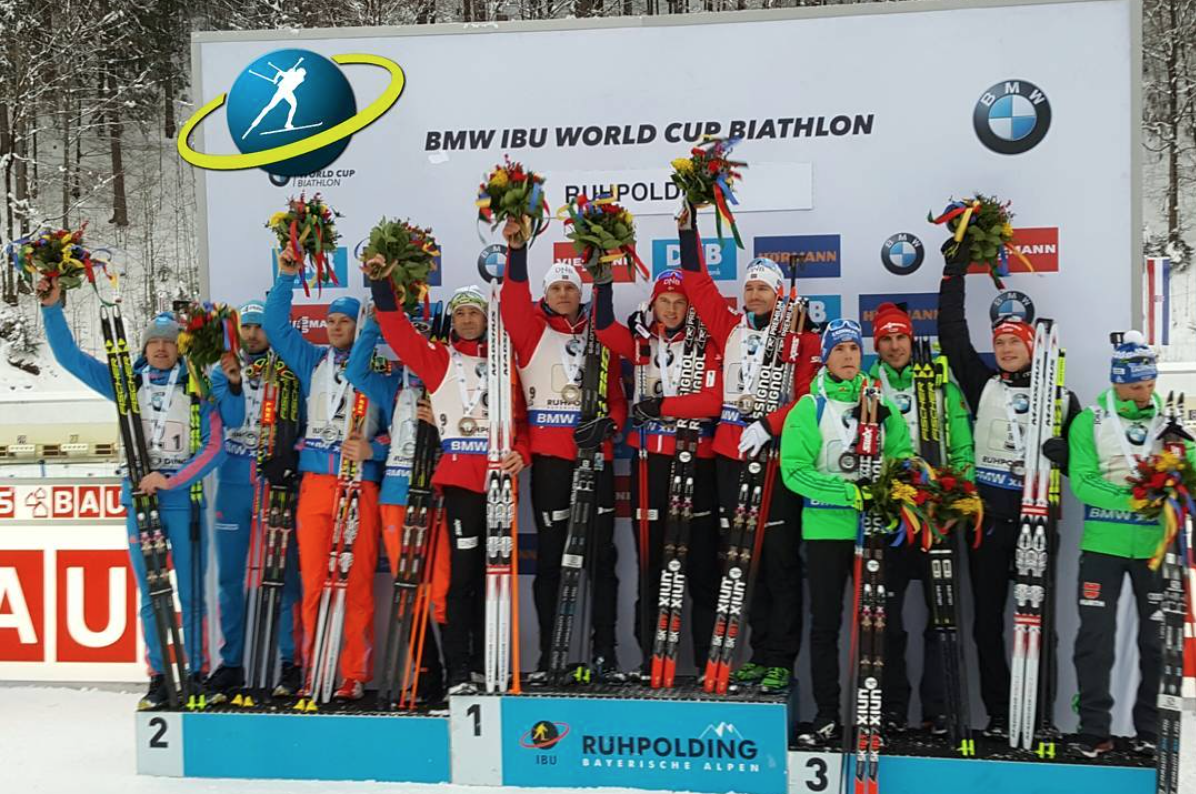
    Norway earned a come-from-behind victory in the first relay of 2017, with Emil Hegle Svendsen anchoring the team and shooting past Russia’s Anton Babikov in the final kilometer. Norway won by 5.1 seconds.

    Norway had been in just fifth position halfway through the race. But Henrik L’Abee-Lund brought the team to second and then Svendsen used perfect shooting to take the team to the top. Along with Ole Einar Bjørndalen and Vetle Sjåstad Christiansen, the team had five spare rounds on the day.

    Russia had dominated through the middle of the race, with Alexey Volkov leading off in sixth place and then Anton Shipulin and Matvey Eliseev each tagging off in first place after using a remarkable single spare round between the three of them. Babikov used a one spare round and left standing with a 14.8-second lead over Svendsen, but could not hold the Norwegian off.

    The German team of Erik Lesser, Benedikt Doll, Arnd Peiffer, and Simon Schempp finished third for the home crowd, +23.5. The team had nine spare rounds and one penalty loop.

    In the end it was a battle between the two North American teams for 11th place. The Canadian squad of Christian Gow, Scott Gow, Macx Davies, and Brendan Green beat out the American team of Lowell Bailey, Tim Burke, Leif Nordgren, and Sean Doherty by 0.2 seconds to finish +2:04.4. The Canadians had seven spare rounds; the Americans, seven spares plus a penalty loop.

    “It was a decent result for the team today, but we were definitely hoping for more,” Green said, according to a Biathlon Canada press release. “As a whole, we were consistent and steady with some definite strong points, but to get the result we all want will require a really solid day of shooting and skiing for each of us.

    “Personally it’s been a bit of a tough season so far for me and I’m hoping things will turn around soon,” he added. “Historically my speed and performances start to pick up after Christmas so I’m looking forward to a couple of more good weekends of racing before the World Championships where we all hope to have our best results.”

    Results

  • U.S. Men Eighth in Biathlon World Champs Relay; Gold for Norway (With Photo Gallery)

    U.S. Men Eighth in Biathlon World Champs Relay; Gold for Norway (With Photo Gallery)

    OSLO, Norway—With one of their best shooting days, the U.S. men’s biathlon team finished eighth in the World Championships relay, 1:27.3 behind host country Norway.

    The squad of Lowell Bailey, Leif Nordgren, Tim Burke, and Sean Doherty used just five spare rounds, tying them for the best shooting in the field with second-place Germany and third-place Canada.

    (It was a historic day for the Canadians, who had never before won a relay medal.)

    “I was really focusing on the shooting, because that’s really where you make it or break it today,” Bailey said.

    He led things off with a fast and clean leg, avoiding a nasty crash in the opening loop that knocked Russia out of contention; several other athletes broke poles.

    “I went a good sprint out of the start in the first few hundred meters to get up near the front, and then I just stayed in control in second place there trying to catch the draft and conserve energy,” Bailey said. “I let a few guys go by me, just to make sure I was staying in control.”

    After using a spare in standing, Bailey turned in one of the fastest last loops of the field to ski up into second place by the time he tagged.

    “I was able to save a little bit for the last lap,” he said. “It’s so loud. I think it’s the loudest crowd I’d ever heard. It’s such an incredible feeling racing in front of that many people.”

    From there Nordgren took over, and started off well, but on the second loop began flagging on his skis.

    “It was unfortunately not the greatest ski day for me,” he said. “Kind of like a lot of the races have gone for me this year. I tried to hang with them right off the bat, and the first loop was fine. It was no problem. But then I had not a lot of gas left for the last two loops. That’s what I had for today I guess.”

    Burke was able to pull the team back from eleventh, where he received the tag, to seventh. He was one of several athletes trying to make up ground for their teams.

    “I had a great group the first loop with [Benjamin] Weger from Switzerland and [Anton] Babikov from Russia, and we really went for it,” Burke said. “The three of us actually were together pretty much the whole race, cause we all I think used one extra, Babikov used two in prone and we all cleaned standing, so we left together on the last loop. We made up quite a bit of time.”

    Sean Doherty anchored the relay and actually gained time on the leaders, but slipped from seventh to eighth.

    “My race was awesome,” he said. “I had only one spare. I felt great skiing. I had a really solid leg. Just around some other fast teams, and they kind of passed me in the end, I couldn’t do anything more than I already had. But I am really happy. And with only five spares, this is an amazing performance for the team.”

    The team was left scratching their heads as to why they didn’t have a better finish, considering their strong shooting. And looking at the Canadians – a team they know well – they couldn’t help but wonder: with the same five spare rounds, why couldn’t they be closer to the podium?

    One reason might just be that with World Championships in Oslo, teams and athletes were even more focused on having top performances and many are hitting their peaks at just the right time.

    “It is surprising that we only managed to finish eighth,” Doherty said. “We will look at the numbers later, and see kind of where that time came from. But we are only a minute and a half back, so that’s really just a close competitive day. Which is kind of what you’d expect here.”

    “With that we really should fight for the podium,” Burke agreed. “Normally with our team’s ski speed, zero plus five would be there. I don’t know what happened.”

    Results

  • Northug Sticks It to Halfvarsson, Edges Swede for Norwegian Relay Win at Worlds

    Northug Sticks It to Halfvarsson, Edges Swede for Norwegian Relay Win at Worlds

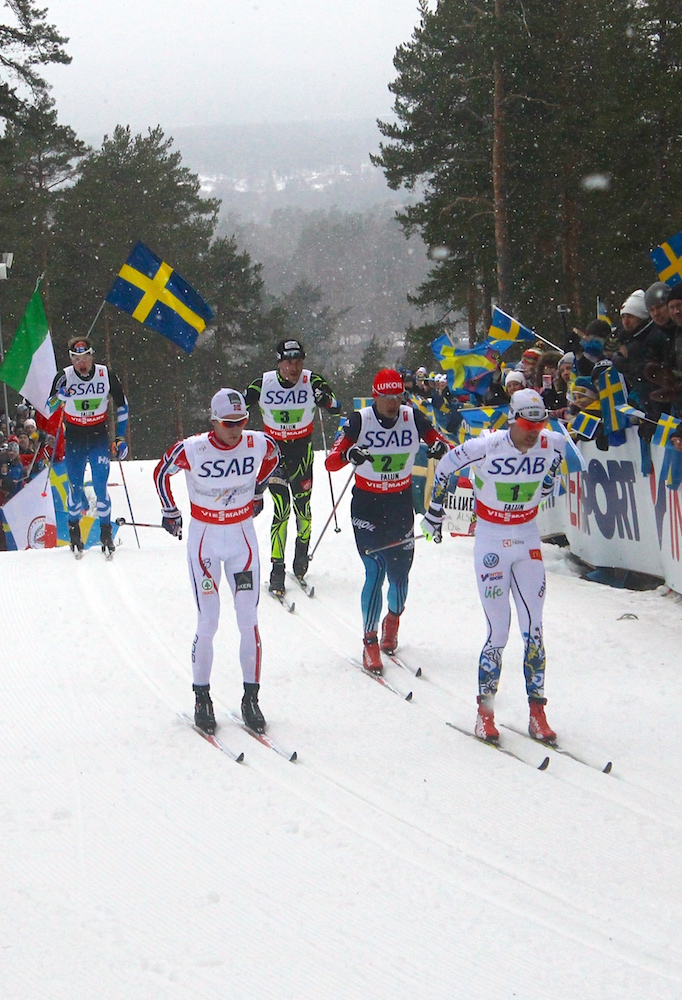
    Sweden's Calle Halfvarsson leads Norway's Petter Northug (c) and France's Adrien Backscheider on the second-to-last major hill on the last lap of the men's 4 x 10 k relay at 2015 World Championships in Falun, Sweden. Northug went on to edge Halfvarsson by 0.6 seconds for gold, Sweden took silver and France was 8.9 seconds back for bronze.
    Sweden’s Calle Halfvarsson leads Norway’s Petter Northug (c) and France’s Adrien Backscheider on the second-to-last major hill on the last lap of the men’s 4 x 10 k relay at 2015 World Championships in Falun, Sweden. Northug went on to edge Halfvarsson by 0.6 seconds for gold, Sweden took silver and France was 8.9 seconds back for bronze.

    FasterSkier’s coverage of the 2015 FIS Nordic World Ski Championships in Falun, Sweden, is brought to you by the generous support of L.L. Bean, now featuring a complete line of Kikkan Randall training wear.

    FALUN, Sweden — All of Calle Halfvarsson’s trash talking gave Petter Northug something to get fired up about in the last couple hundred meters of the men’s 4 x 10-kilometer relay at FIS Nordic World Ski Championships on Friday.

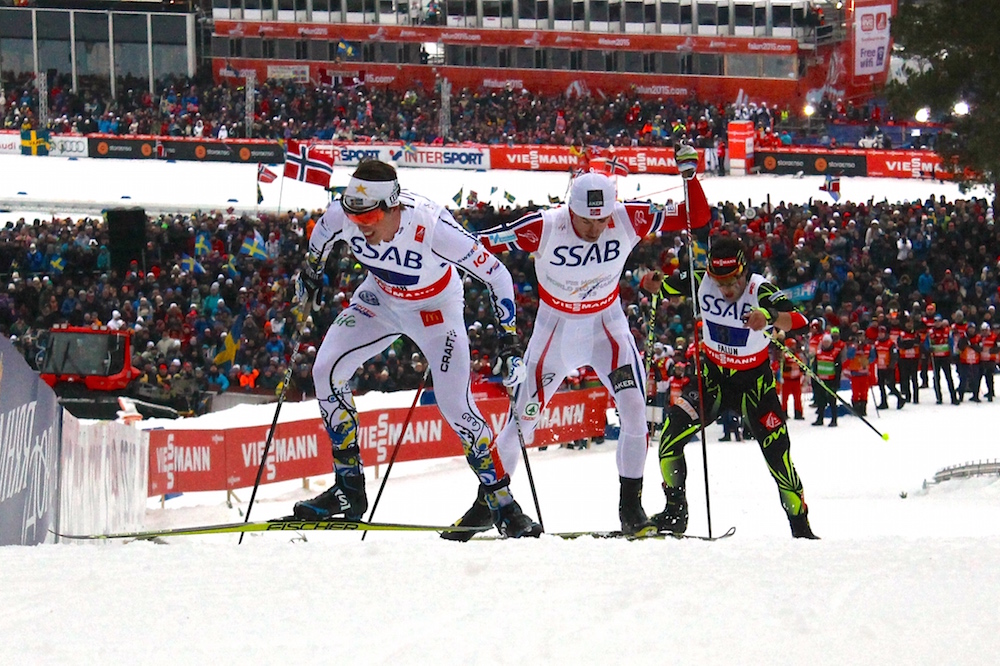
    Trailing Halfvarsson down into the stadium and leading up to the final rise before the finish, Northug rode on the tails of the Swede and blew past him on the climb, before giving him the ultimate run on the descent toward the finish.

    There, Northug, who had already racked up two golds at these championships (in the classic sprint and freestyle team sprint), V2-ed like a madman to keep the slightest edge on Halfvarsson over the finishing flat. The Norwegian did so, and Halfvarsson let up about 20 meters before the line to accept his defeat.

    It’s a lesson as old as time: talk smack and be ready to deal with the repercussions. Halfvarsson had to settle for silver when he was leading the fight for gold, and then watch Northug shush him at the finish.

    That’s right, Northug, the now 12-time world champion (with two Olympic golds as well), put his finger to his lips after crossing the line, looking at cameras rather than back at Halfvarsson to send a message to the Swede.

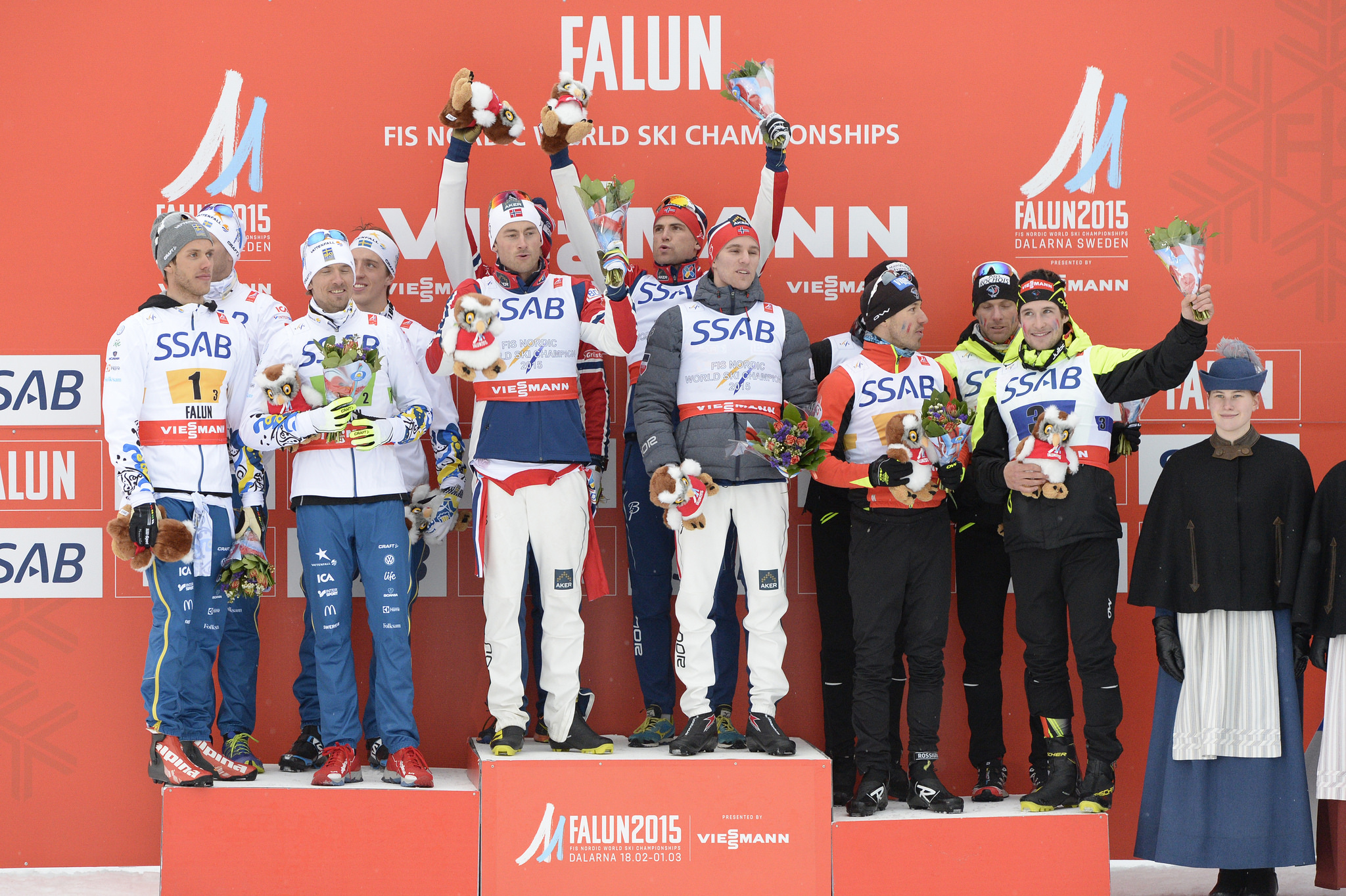
    The French men's relay team (right) skied the entire World Championships 4 x 10 k with the Norwegians (center) and Swedes, proving something to themselves and the ski world: they belong as championships medalists. (Photo: Falun2015.com/Flickr)
    The French men’s relay team (right) skied the entire World Championships 4 x 10 k with the Norwegians (center) and Swedes, proving something to themselves and the ski world: they belong as championships medalists. (Photo: Falun2015.com/Flickr)

    “When Calle crosses the finish line, [I wanted to] make it hurt so much that he takes [it] with him for a lifetime,” the 29-year-old Northug told NRK, according to a translation, after sealing the win for Norway in 1:34.18.5, six-tenths of a second ahead of Sweden.

    So what exactly did Halfvarsson do to get him so riled? A year ago, he said he would beat Northug in a finishing sprint on home soil in Sweden. Unfortunately for Halfvarsson, in front of more than 41,000 spectators in Sweden on Friday, it didn’t happen.

    The Swede led much of the last lap, countering Northug’s attack on the second-to-last major climb on the 2.5 k freestyle course while France’s Adrien Backscheider clung to the duo as well.

    The three had skied on their own, a healthy distance away from Russia in fourth, since the end of the second classic leg. Sweden’s Johan Olsson had brought the team from seventh and 20 seconds out to first, ahead of France’s Maurice Manificat and Norway’s Didrik Tønseth, by the halfway point amid heavily falling snow — which lightened up considerably for the first skate leg.

    “It was really nice to be able to exchange first,” Olsson said in a press conference, after tagging Swedish teammate Marcus Hellner with a 6.7-second lead on France’s third skier, Robin Duvillard. “I was a little bit worried before the race. Yesterday I didn’t recover so much after the 15 k race. Of course I’m really satisfied with my race and the other guys as well.”

    After catching the leaders, Johan Olsson of Sweden (right) skied through to the lead on the second leg of the men's 4 x 10 k relay in Falun, Sweden. Here he's shown leading the third of four laps with Norway's Didrik Tønseth (l) and Russia's Maxim Vylegzhanin (behind Olsson).
    After catching the leaders, Johan Olsson of Sweden (1) skied through to the lead on the second leg of the men’s 4 x 10 k relay in Falun, Sweden. Here he’s shown leading the third of four laps with Norway’s Didrik Tønseth (left) and Russia’s Alexander Bessmertnykh (2), and Maurice Manificat of France (3).

    A two-time world champion, Olsson won Wednesday’s 15 k freestyle individual start by 17.8 seconds over Manificat in second, and Norway’s Anders Gløerssen took bronze, 19.2 seconds behind.

    On Friday, Gløerssen skied the third leg for Norway, heading out 14.1 seconds after Hellner, and over the course of his four 2.5 k laps, he lifted Norway to first.

    “I tried to set my own pace in the start and when I went out on the second lap, I was closing a little bit so I tried to speed up and close the gap,” Gløerssen said in the conference. “When I joined with the teams in front, I was a little bit tired so I tried to calm down. In the end i made a little attack just to see what happened.”

    The result was Norway leading France by 3.8 seconds to start the last leg. Hellner tagged Halfvarsson in third, 6.4 seconds out of first.

    “I think [Olsson] did a fantastic job and I was really satisfied with that gap, but I tried really hard but I wasn’t so strong today,” Hellner said. “The other guys were stronger and I lost some seconds to them.”

    With one last skate leg to go, Northug led Halfvarsson and Backscheider out of the stadium. The Frenchman put himself in first for the first of two steeper climbs, both of which were used on the championships sprint courses, while Halfvarsson and Northug followed closely in second and third.

    Meanwhile, Russia’s Evgeniy Belov pushed to catch the leaders, after his teammate Alexander Bessmertnykh brought his team from sixth to fourth on the second classic leg. Bessmertnykh finished his leg 32.4 seconds out of first and 18.3 seconds behind third. Alexander Legkov kept the Russians in fourth, tagging Belov about 40 seconds out of the mix.

    From there, Belov — who ended up skiing the fastest anchor leg — cut the deficit in half early. Behind him, Italy’s Federico Pellegrino, Switzerland’s Toni Livers and the Czech Republic’s Petr Knop contended within a chase group. Germany’s Tim Tscharnke and Finland’s Ville Nousiainen skied together in eighth and ninth, and Simi Hamilton of the U.S. initially led Canada’s Lenny Valjas on the first of their fourth laps together in 10th and 11th.

    Adrien Backscheider attacks around 3 1/2 k into his 10 k skate leg as the anchor for France in the men's 4 x 10 k relay at 2015 World Championships in Falun, Sweden. He went on to place third behind Norway's Petter Northug and Sweden's Marcus Hellner, respectively.
    Adrien Backscheider attacks around 3 1/2 k into his 10 k skate leg as the anchor for France in the men’s 4 x 10 k relay at 2015 World Championships in Falun, Sweden. He went on to place third behind Norway’s Petter Northug and Sweden’s Marcus Hellner, respectively.

    About 3 1/2 k into the final 10 k leg, Backscheider decided to push the pace to ensure a medal. Russia was closing, or so he thought, and he didn’t want Belov to get anywhere near the top three.

    “I started in second position and I just skied to make the gap with the Russian guy,” Backscheider told FasterSkier.

    A 22-year-old bronze medalist from this year’s U23 World Championships, Backscheider’s timing wasn’t exactly spot on. While he slightly increased the distance to Belov to 26.7 seconds at 5 k and was seven seconds ahead of Halfvarsson and Northug at the halfway point, the Swede and Norwegian pulled him back in by the third lap.

    On that same lap, Livers and Pellegrino two minutes behind the leaders dropped Knop, while Tscharnke and Nousiainen, Valjas and Hamilton, continued to ski in their own mini groups within the top 11.

    With just over a kilometer to go, Northug upped the ante and tried to pass Halfvarsson on the first, longer climb. Halfvarsson stayed in front of him, while Backscheider matched them stride for stride in third over the top.

    Not long after on the next steep uphill, Halfvarsson took his turn — looking at Northug and attacking at the base. Northug stuck on him, tucking behind him in second, while Backscheider hung on at the back.

    “I didn’t want to be in front in the sprint hill; I wanted to stay in second, conserve power and I also didn’t want to [ski into] the wind,” Northug said in the press conference. “The last 150 meters was not that good, but I think it was pretty difficult today because it was really icy [in the finishing stretch].”

    Racers had a mix of conditions, from light to heavy snow to in the classic portion, to hardly any precipitation for the skate legs. Organizers salted both courses beforehand to cope with the above-freezing temperatures and near-100-percent humidity, which has made the track increasingly soft throughout the week.

    While most of the skate course was breaking down, the finishing straight was fast and hard-packed. There, Northug and Halfvarsson focused on skiing fast while staying on their feet.

    “The most important thing is to cross the finish in first,” Northug said after racking up his fifth World Championships relay gold.

    “You never know what’s going to happen in a relay, but we had a better chance this year on the last leg than in Sochi,” he added, referring to last year’s Sochi Olympics, in which the Norwegian men placed fourth behind Sweden, Russia and France, respectively. “It feels good to be back on top again. … It’s a lot of pressure on the Norwegian team before a relay. We knew before the championships that only gold makes the Norwegians satisfied.”

    The defending Olympic relay champions, which came 0.6 seconds short of gold on Friday, Sweden took silver with essentially the same four-man lineup (except Halfvarsson in place of Lars Nelson, who scrambled for the team in Sochi).

    Daniel Richardsson of Sweden and Niklas Dyrhaug of Norway leading the men's 4 x 10 k relay in Falun, Sweden.
    Daniel Richardsson of Sweden and Niklas Dyrhaug of Norway leading the men’s 4 x 10 k relay in Falun, Sweden.

    This time around, Richardsson led Swedes out instead, finishing his first leg in seventh behind Canada’s Alex Harvey in first, Finland’s Sami Jauhojaervi in second and Kazakhstan’s Alexey Poltoranin in third. Norway’s Niklas Dyrhaug tagged in fourth, followed by Germany’s Johas Dobler and Russia’s Maxim Vylegzhanin, respectively.

    While the top six were within 5 seconds of one another at the first exchange, Richardsson was 20.5 seconds back in seventh. (France’s Jean-Marc Gaillard was another 0.7 seconds back in ninth, behind Italy’s Francesco de Fabiani in eighth.)

    “Yesterday I was a little bit worried that we wouldn’t take a medal at all,” Olsson said. “We know that Norway is the team to beat, and with Petter as the last leg, he’s almost Mr. One-Hundred Percent at the finish. … We’re satisfied with the medal, but of course we would be more satisfied with the gold.”

    For Halfvarsson, it was personally his first medal of his home championships. Two years ago at World Championships in Val di Fiemme, Italy, the Swedish men’s relay — with the same team and order — placed second to Norway by 1.2 seconds.

    After Friday’s race, Halfvarsson realized his mistake.

    “[Northug] came into my draft behind and got better speed and knew exactly how he’d run into the [downhill corner before the finish],” Halfvarsson told HD.se, according to a translation.

    “I had trouble keeping track of where he was, then suddenly he just takes off. It might have been better to get in back of him before the stadium.”

    He acknowledged that Northug was stronger, as did Backscheider, who finished 8.9 seconds back in third for bronze for France.

    “The finish was hard — I need more experience to have a better finish,” Backscheider said at the press conference.

    Regardless, France was pleased to repeat its bronze medal following the 2014 Olympics.

    “We believed that it is possible,” Manificat said in the conference. “Championships is always a surprise, but we fight for this and … it’s really perfect.”

    Russia's Evgeniy Belov in fourth tries to close the gap to the top three, on his first of four laps in the men's 4 x 10 k relay at 2015 World Championships in Falun, Sweden.
    Russia’s Evgeniy Belov in fourth tries to close the gap to the top three, on his first of four laps in the men’s 4 x 10 k relay at 2015 World Championships in Falun, Sweden.

    Belov finished fourth for Russia, 31 seconds after Norway, and Livers skied away from Pellegrino to finish fifth for Switzerland, 2:03 behind Norway and 24.2 seconds ahead of Italy in sixth.

    Tscharnke and Nousiainen raced to a photo finish for seventh, in which Germany had the edge, while the Czech Republic placed ninth 5.6 seconds later.

    Canada’s Valjas held off Hamilton by 1.4 seconds for 10th (+3:03.5).

    Norway’s prime minister, Erna Solberg, attended the race and personally congratulated her nation’s four-man team after the finish.

    “I enjoyed it very much,” she told FasterSkier. “But it became a bit too exciting. I always want them to have a bigger lead in the last part, but of course Petter Northug is like this. He keeps it until the last 200 meters. … He always makes me nervous.”

    Results

  • Canada Notches Best-Ever Fifth in Men’s Biathlon Relay, Team ‘Pushing For Even Better Result’

    Canada Notches Best-Ever Fifth in Men’s Biathlon Relay, Team ‘Pushing For Even Better Result’

    Scott Gow took the Canadians from ninth up to fifth place in the third leg of the World Cup men's relay in Oslo, Norway, on Sunday. (Photo: Biathlon Canada/NordicFocus)
    Scott Gow took the Canadians from ninth up to fifth place in the third leg of the World Cup men’s relay in Oslo, Norway, on Sunday. (Photo: Biathlon Canada/NordicFocus)

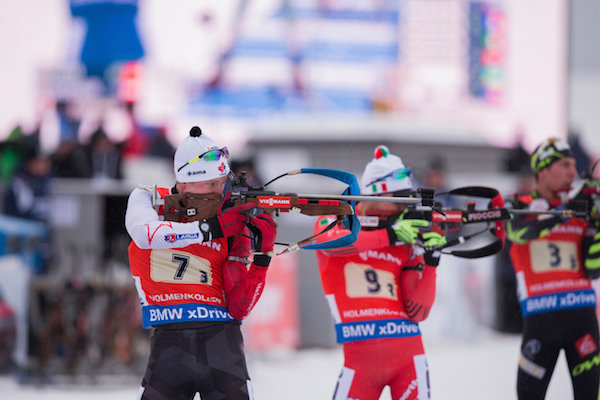
    When Brendan Green crossed the finish line of Sunday’s 4 x 7.5-kilometer relay at Holmenkollen in Oslo, Norway, he was in fifth place.

    It wasn’t simply a good day for Green, or a personal best. That fifth-place finish was the best men’s relay ever in Biathlon Canada’s history.

    “It was a really good day for our team,” Green said in a phone interview. “Last night we had a team meeting and talked a little bit about the potential for our team. We talked about our specific start order and what we thought we could bring to the team on each leg. And today things definitely came together for us. Everyone had really solid legs for the relay.”

    The Canadians finished a minute and 35 seconds behind the winning Russian team. The stellar result comes in a season which has seen substantial changes to the World Cup roster. Star Jean Philippe Le Guellec retired after the 2014 Olympics, and Scott Perras is back in Canada training.

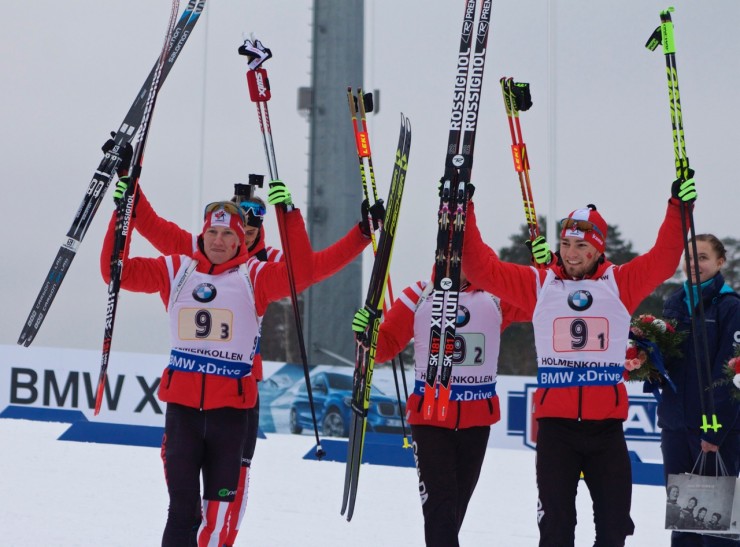
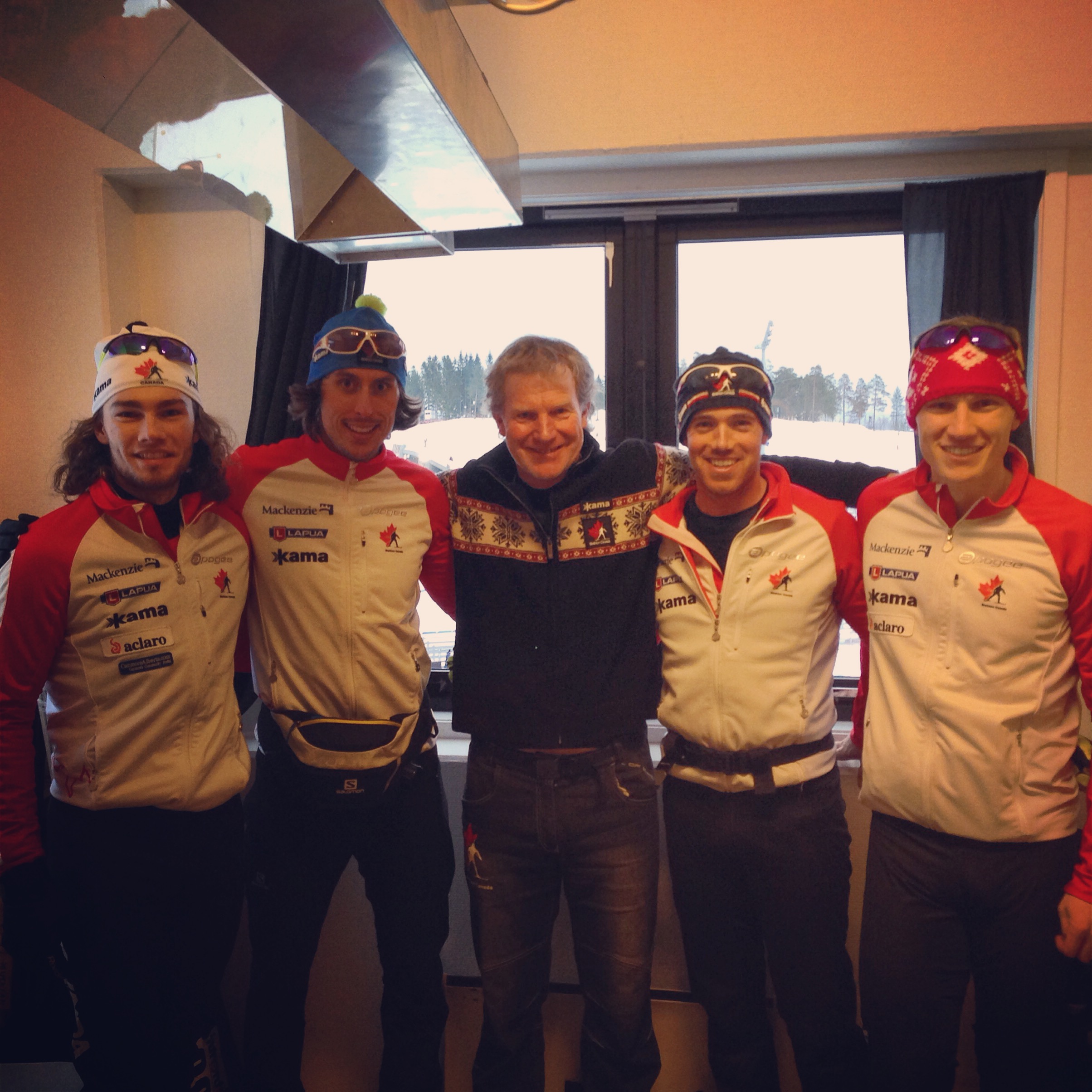
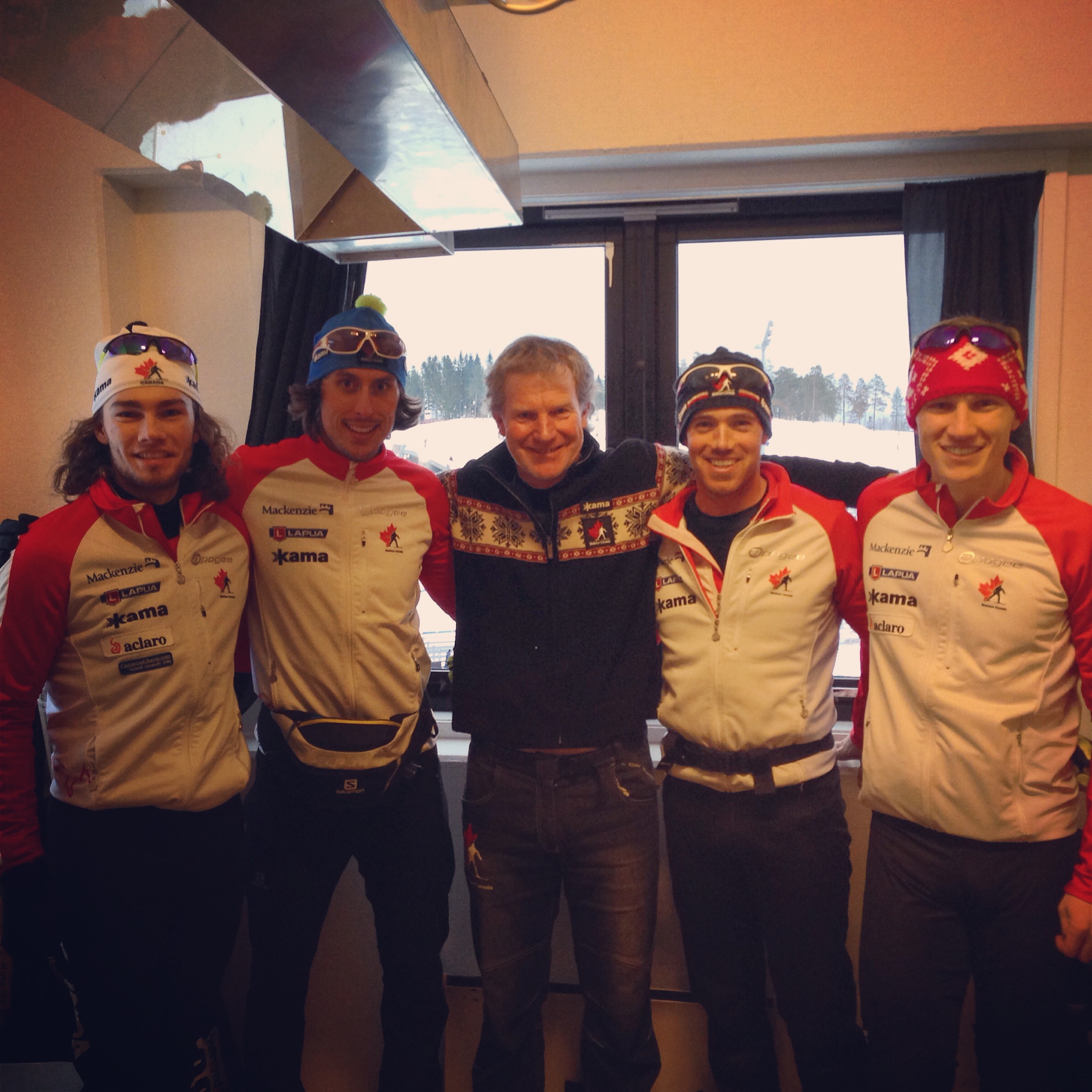
    The Canadian men's relay team of Christian Gow and Brendan Green (left) and Nathan Smith and Scott Gow (right) poses with head coach Matthias Ahrens in Oslo after placing fifth in the 4 x 7.5 k competition. (Photo: Rosanna Crawford)
    The Canadian men’s relay team of Christian Gow and Brendan Green (left) and Nathan Smith and Scott Gow (right) poses with head coach Matthias Ahrens in Oslo after placing fifth in the 4 x 7.5 k competition. (Photo: Rosanna Crawford)

    Instead, since the first men’s relay this season in Oberhof, Germany, Canada’s relay team has included 21-year-old Christian Gow, who skied leadoff and is in his first season on the World Cup. Gow shot like a pro, cleaning all ten of his targets without touching his spare rounds and tagged off in 14th, 50.5 seconds behind Germany’s Erik Lesser.

    “I was pretty confident that I would be able to clean the race today,” Gow wrote in an email. “I have been shooting really well all season and felt awesome in zero. You never know if everything will line up completely right for that 100%, but I was confident today and was happy to achieve it!”

    Canadian Head Coach Matthias Ahrens wrote that Gow’s performance had never been a question mark in his mind.

    “I believe Christian had proven some good relay qualities in previous relays in Oberhof and Antholz already with good shooting efficiency,” he explained.

    Gow is learning to deal with the excitement and the pressure of the World Cup.

    Christian Gow (foreground) gunning his way through the first leg of the World Cup men's relay in Oslo, Norway. (Photo: Biathlon Canada/NordicFocus.com)
    Christian Gow (foreground) gunning his way through the first leg of the World Cup men’s relay in Oslo, Norway. (Photo: Biathlon Canada/NordicFocus.com)

    “The past several relays have all been a great learning experience for dealing with the more unique aspects of World Cup racing, such as the incredible noise from the stands, or racing next to one of your personal idols,” he wrote. “I honestly hardly thought about the crowd today, and I don’t think too much about the guys around me either. When I am in the range I am focused on what I am doing and I try not to think about anything else.”

    That showed, and Gow’s work on the range upped the ante for his teammates – including his brother Scott, who was racing the third leg of the relay.

    “Seeing Christian clean was one part inspiring and one part nerve-wracking,” Scott Gow wrote in an email. “It was awesome to see him shoot so well and set the tone, but at the same time it added pressure for me to do well too and build on his great opening leg. Overall I would say it was motivating but I was definitely nervous waiting for Nathan to tag me.”

    Nathan Smith, the second-leg skier, turned in a strong performance of his own. He used a spare round in each shooting stage and moved the team up to ninth. But more importantly, by turning in the second-fastest ski time he cut ten seconds off of the team’s gap to the leaders.

    “I had a lot of confidence in my shooting and knew that being the third race of a weekend, I would probably also have a really strong ski day,” Smith wrote in an email. “Shooting went pretty well, it was a little windy. The only disappointment was missing my last prone shot. I think I just got a little ahead of myself.”

    “Christian [Gow] is a really good shooter, and he’s really fast, so he has always been reliable. That first leg is a great place for him and he gets the job done really well in that position.” — Brendan Green

    For Scott Gow, who used two spare rounds and moved the team up to fifth, things just came together on Sunday.

    “I felt the best on skis today since before Christmas,” he wrote. “I had a decent opening lap which is unusual for me, and I was able to maintain speed for the whole race with a nice kick at the end to pull into 5th. I lost some time in standing, but prone was solid and my skiing was good enough to keep the team in the mix.”

    Green dropped the team to sixth, briefly, after using two spares in prone, but skied back up to fifth.

    Brendan Green anchoring the Canadian relay in Oslo. (Photo: Biathlon Canada/NordicFocus)
    Brendan Green anchoring the Canadian relay in Oslo. (Photo: Biathlon Canada/NordicFocus)

    “It was a little bit tricky wind in prone,” Green said. “It was a complete 180 from zeroing. I hit my first three shots but then missed the next two, so I sort of paused before I loaded my spares and made that extra correction.”

    After cleaning standing, Green then turned in the second-fastest closing loop to hold onto it, despite fears of challengers from behind.

    “I was able to leave the range just ahead of Italy and Ukraine,” Green said. “I knew they were close behind. So on that last loop I really tried to redline it and go as hard as I could. And I knew France was close – partway through my loop I could hear some cheering and I thought, oh man, Fourcade must be closing in. So then I tried to really go for it and not look back, and hold those guys off.”

    For all the team’s members, the race was a culmination of the Oslo weekend. Smith had drawn on his confidence from finishing 12th in the 20 k individual; Scott Gow had focused on the lessons he learned in the earlier races of the weekend.

    “My skiing wasn’t great in the individual and, despite shooting 85%, didn’t shoot well enough for a good result,” he wrote of finishing 60th in the 20 k. “After that race I wanted to refocus on skiing efficiently and being more deliberate in the range, and that’s exactly what I was able to accomplish on race day in the Sprint. My result in the sprint race gave me added confidence for today’s relay. I wanted to use today as an opportunity to build on my skiing and shooting and try to do better.”

    And for Christian Gow, he acclimated back to Europe after heading home to Canada for a training break and then sitting out the 20 k due to jet lag.

    “It was great to get back here on the World Cup again after my brief break back home,” he explained. “I think it was important for me that I took a break in order to feel ready to go for the next month of racing.”

    The youngest team member is now looking forward to his first World Championships experience. And with the best-ever result in their back pocket, Canada is looking forward, too. Their relay there will have the same roster, likely in the same order.

    “I think today’s result showed all of us the type of placing we can achieve,” Christian Gow wrote. “From that standpoint I think it will give us a bit more confidence, but also more drive to keep pushing for an even better result.”

    “A result like today will definitely give us a little extra confidence and motivation heading into the two week break and World Championships,” Smith agreed. “Another top 6 is what we’re aiming for. Outside of the World Champs, Nations Cup points are especially important for us this year. Right now we’re sitting in 8th which means 5 start spots for next year. It would awesome to grab that extra spot for the Canmore World Cups in 2016.”

    Results

  • Shipulin’s Strategic Wiles Help Him Outsprint Schempp for Russia’s Relay Win

    Shipulin’s Strategic Wiles Help Him Outsprint Schempp for Russia’s Relay Win

    The winning men's relay team from the Oslo biathlon World Cup: Russia! (Photo: Fischer/NordicFocus)
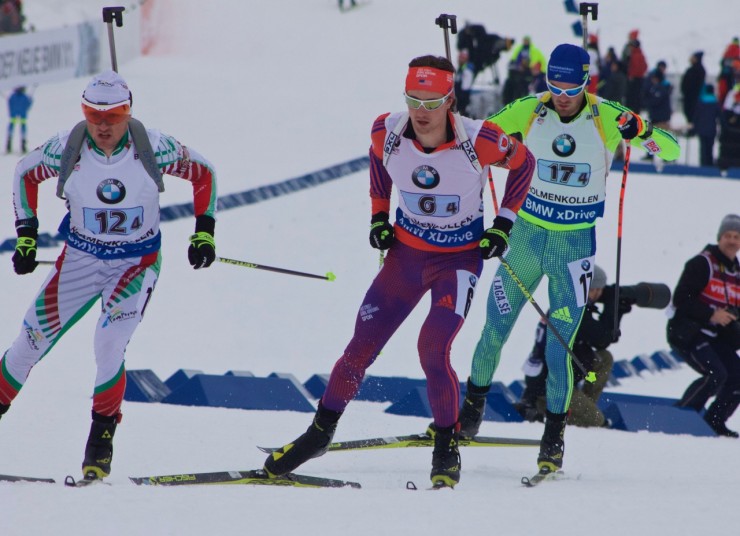
    The winning men’s relay team from the Oslo biathlon World Cup: Russia! (Photo: Fischer/NordicFocus)

    After over an hour and a quarter of competition, in the end today’s men’s World Cup relay in Oslo, Norway, came down to a boot length.

    The German team had been near the lead throughout the 4 x 7.5 k competition, thanks to an impressive leadoff leg by Erik Lesser, who cleaned all ten targets in the fastest time of all competitors and attacked on the final loop. Andi Birnbacher kept the team in third, within three seconds of the lead, and Arnd Peiffer – who won Saturday’s sprint – skied his way to the front despite three spare rounds.

    That left the responsibility of the final win to Simon Schempp, who had been on fire earlier in the season with wins in Ruhpolding, Germany, and Antholz, Italy.

    But he faced a formidable opponent: Anton Shipulin of Russia, who has two wins this season, sits third in the World Cup total score, and is a nearly-unstoppable relay anchor.

    Taking the tag in third, Shipulin made up 23 seconds on Schempp by the time the first shooting was over, having cleaned while Schempp used one spare. He then came into standing just behind Schempp.

    Anton Shipulin of Russia leading Simon Schempp of Germany on the final loop of the relay.
    Anton Shipulin of Russia leading Simon Schempp of Germany on the final loop of the relay.

    Schempp faltered, using a spare in standing and taking a long time to do it. Shipulin came to the mats while Schempp was still shooting, and cleaned. The pair left the range separated by less than a half a second.

    And from there, it became a cat and mouse game. Each skied slowly over the final loop, willing the other to dare to take the lead. In the end, Shipulin ended up leading up the final long uphill – but he wasn’t moving too fast. On the downhill into the stadium, the pace picked up a bit, but it still seemed conservative.

    The finish in Oslo climbs a short, steep hill, then traverses behind the shooting range before dipping back into the stadium proper and following the side of the grandstands to the finish line. On that uphill, Schempp put in a sudden surge and sprinted his way to the top. He crowded Shipulin out around the corner and led across the top.

    But if this was his grand plan, he had forgotten about downhills, as well as Shipulin’s sprinting speed. In Schempp’s draft, Shipulin gained momentum down the short hill, then in the finishing lanes drew even and finally lunged at the line to win by 0.2 seconds.

    “For the whole race, I was wondering whether to take risks,” Shipulin said through a translator in an interview with the IBU’s Jerry Kokesh. “To put everything on the table. Or to be a bit more cautious. So at the beginning of the leg I took a few more risks on the skis and on the shooting. It all worked out. I’m happy that I made no mistakes and we finished first.”

    It was the second relay win for Russia so far this season, and Shipulin’s experience and confidence definitely helped the team to their Oslo victory.

    “It’s always difficult to analyze the situation, because the finish here is not straightforward,” Shipulin said. “You get a lot of speed from the hill. It doesn’t depend on your strength because the momentum is carrying you. But I knew in the last ten meters that I needed to turn on my muscle power. And with this, I should win.”

    Austria placed third, +50.9, the Czech Republic fourth, +1:29.1, and Canada fifth, +1:35.8.

    Stay tuned for a full report on the Canadian finish, which was the best ever in the program’s history.

    The United States did not field a team, as they only brought three men to Oslo.

    Results

  • Bailey Takes Charge in Ruhpolding Relay, U.S. Ends Up 10th After Canada in 9th; Norway Tops Germany

    Bailey Takes Charge in Ruhpolding Relay, U.S. Ends Up 10th After Canada in 9th; Norway Tops Germany

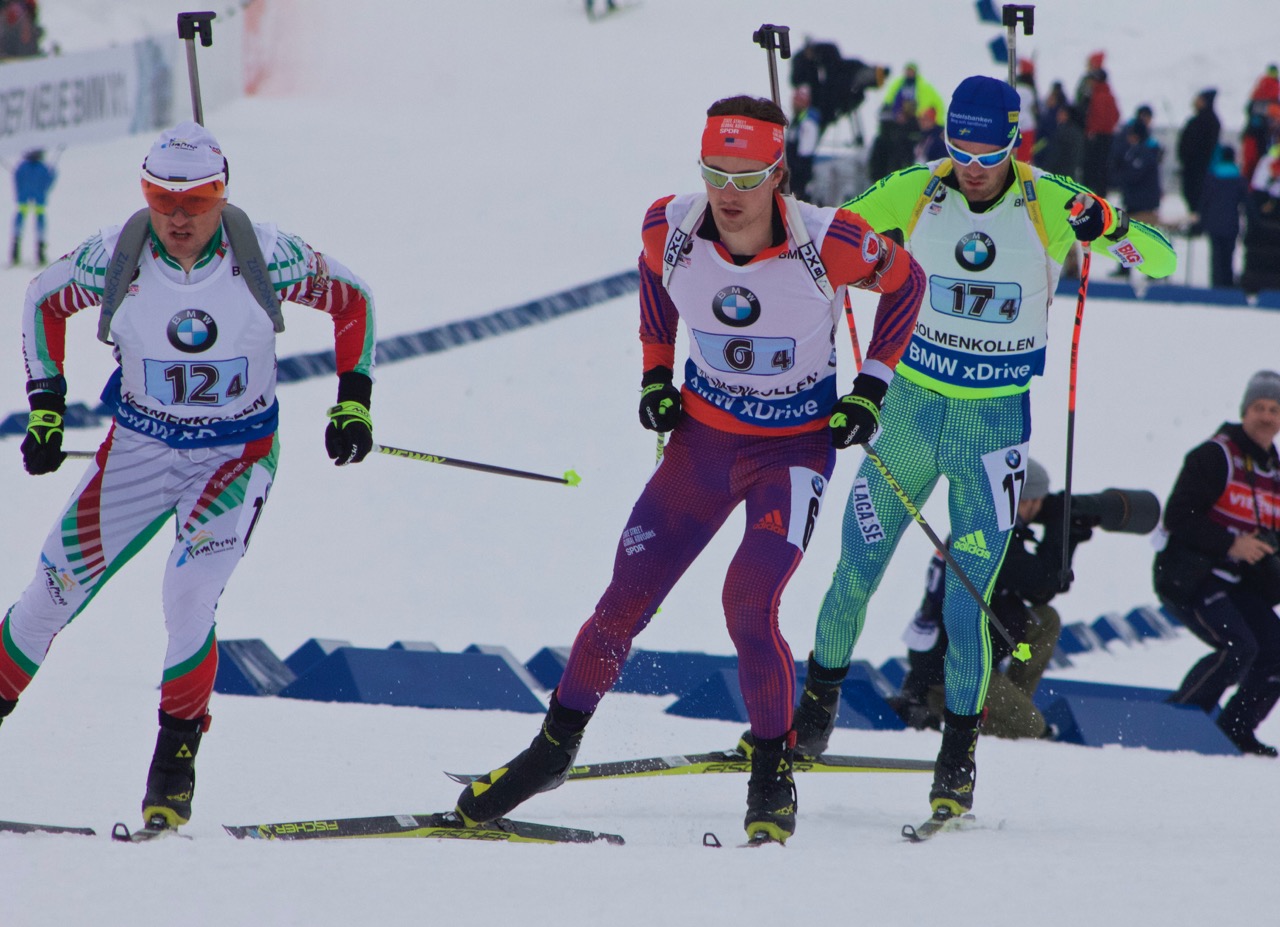
    Lowell Bailey (US Biathlon) leading Michal Krcmar of the Czech Republic and the rest of the field in the first leg of the men's 4 x 7.5 k relay at Thursday's IBU World Cup in Ruhpolding, Germany. (Photo: USBA/NordicFocus)
    US Biathlon’s Lowell Bailey (l) leading Michal Krcmar of the Czech Republic and the rest of the field in the first leg of the men’s 4 x 7.5 k relay at Thursday’s IBU World Cup in Ruhpolding, Germany. (Photo: USBA/NordicFocus)

    Emil Hegle Svendsen and Lowell Bailey had a few things in common on Thursday, despite not racing head to head in the men’s 4 x 7.5-kilometer relay in Ruhpolding, Germany. While Bailey started the four-leg race for the Americans in last of 25 teams and Svendsen anchored the Norwegians after starting in the top two, both led to the finish and capitalized on one critical hill to do so.

    Bailey saw his opportunity on his last of three laps, after moving up from dead last in the mass start (where his team was seeded after missing last week’s IBU World Cup relay in Oberhof, Germany) and cleaning both his prone and standing stages to move into fifth.

    Three seconds behind Norwegian race leader Ole Einar Bjørndalen at 6.1 k, Bailey latched onto the back of a chase pack two seconds behind Bjørndalen, with Michal Krcmar of the Czech Republic, Germany’s Erik Lesser and Bulgaria’s Krasimir Anev.

    On the phone Thursday, Bailey said that he knew Lesser’s strengths — he has a strong finishing kick and is a “great tactician [who] knows when to tuck in behind people and when to push it.”

    By clinging to the German, Bailey found himself in the top four and overtaking Bjørndalen. With three climbs remaining, the American anticipated Lesser’s next move: a push on the first big uphill. He was right; Lesser attacked and Bailey was able to stay with him and move into the top three.

    “Then basically we were all in a line and everyone on that second-to-last hill went right,” Bailey recalled. That was the shortest line into the righthand curve at the top, but he saw an opening on the left and went for it.

    “I put in a sprint there, which put me into the lead,” Bailey said.

    At 6.4 k, with just over a kilometer to go, Bailey was up front, 0.3 seconds ahead of Bjørndalen and 1 second ahead of Krcmar.

    “For the last hill, I just tried to give everything I had,” Bailey explained. “I pretty much knew if I could stay into the lead over the top of the last hill, I could keep a lead going into the stadium.”

    Just as he’d hoped, the American stayed ahead on the long descent and straightaway into the exchange zone. He tagged Sean Doherty in first, 0.5 seconds ahead of the Czech Republic in second, 3.2 seconds ahead of Russia in third, and 3.7 seconds ahead of Norway and Germany.

    “Any second or two advantage I could give to Sean is a second or two that he doesn’t have to make up,” Bailey explained. “I was just trying to key in on where he was and get him into a good spot … I didn’t know what was going to happen with Sean, being that this is his first time on the World Cup this year and definitely one of his first times getting tagged off in that first group, but he handled himself well. He stayed really relaxed and stayed right with it … and he did a great job.”

    Sean Doherty skiing the second leg for the U.S. in Thursday's IBU World Cup 4 x 7.5 k relay in Ruhpolding, Germany. After receiving the tag in first, he handed off to Leif Nordgren in sixth. (Photo: USBA/NordicFocus)
    Sean Doherty skiing the second leg for the U.S. in Thursday’s IBU World Cup 4 x 7.5 k relay in Ruhpolding, Germany. After receiving the tag in first, he handed off to Leif Nordgren in sixth. (Photo: USBA/NordicFocus)

    In his first World Cup of the season, Doherty, 19, grinned while looking back at Bailey.

    “When Lowell was coming in, all I could do was smile, really,” Doherty said in a US Biathlon press release. “In front of one of the biggest and most exciting crowds of the year, to have the lead, these are the moments that you train all summer for — the position that I want to be in, even if it was a bit surprising.”

    Not long after, Slovenia’s Jakov Fak took the lead after receiving the tag in sixth, 4.3 seconds behind Doherty. Russia’s Timofey Lapshin, Germany’s Andreas Birnbacher and Fak all entered the range together for their first stage, and Doherty followed less than a second back in fourth.

    Fak cleaned to leave first, 4.4 seconds ahead of Norway’s Erlend Bjøntegaard in second and 5 seconds ahead of France’s Simon Desthieux in third, both of which also cleaned. Doherty used all three spares but avoided a penalty loop, setting out on his second lap in eighth, 27 seconds after Fak.

    “For the first prone, it was a little rough,” Doherty recalled. “But the key is to forget that and reset for the next stage. I had super skis and just focused on keeping a good pace on the course, then to come into the range and let the training take over and skip the spares this time.”

    He did so on the next round, cleaning standing to move into sixth, 36.9 seconds behind Fak in first and 0.3 seconds back from Czech Michal Slesingr in seventh. Fak cleaned his second-straight stage quickly to stay 10.6 seconds ahead of Birnbacher, who cleaned as well to move into second.

    By the second exchange, Fak tagged teammate Rok Trsan in first with a 23.4-second gap to Norway in second and 23.7 seconds to Germany in third.

    Doherty handed off to U.S. teammate Leif Nordgren in sixth, 59.1 seconds behind Slovenia and 9.3 seconds behind the Czech Republic in seventh.

    After arriving in Ruhpolding two days earlier, Nordgren was still coming off a cold he’d been battling since the beginning of the month.

    “I was hoping it wasn’t going to be much, in fact I never really felt too bad physically, but it’s just taken a long time to clear out of my sinuses and lungs,” he explained in an email.

    Instead of racing in Oberhof, he recovered at home and explained that Thursday marked his first hard effort in almost two weeks.

    Before his first shooting, Nordgren slipped one spot to seventh behind Austria. He entered the range 52 seconds behind Slovenia in first, and proceeded to miss three — using all three spares.

    That put Nordgren in ninth and then 10th on the next lap. Heading into the second stage, he was 1:27.6 behind Germany’s Arnd Peiffer, who cleaned prone to take the lead, just ahead of Trsan, who used one spare.

    Nordgren hit all five standing targets without a miss, improving to eighth and 1:18 back. Peiffer used one spare but stayed in first, eight seconds ahead of Norway’s Johannes Thingnes Bø in second, who had more trouble shooting with one prone spare and three spares in standing.

    “My goal for today was more for the shooting,” Nordgren explained. “I wasn’t sure how the ski shape was going to be, so I was mostly focused on making sure I do a normal shooting routine.  I wasn’t happy with prone obviously, but standing it came around and all in all I’m not too disappointed.”

    While Peiffer led Bø into the last exchange, with just a second separating the two, and 28 seconds to Russia in third, Nordgren tagged Tim Burke ninth, 1:51.8 back but 0.2 seconds behind Slovakia.

    Burke was also recovering from an illness he came down with last week. In an email, he explained he had not trained much in the five days before the relay.

    “I would have liked a few more days to recover before racing again but we really needed to start the relay after skipping last week,” he wrote. “It was definitely a shock to my body to start racing and, as expected, I felt very flat.”

    Burke remained in ninth until his first shooting, which he cleaned to improve to eighth, 2:04.9 behind the leaders. He went on to use three spares in standing, dropping to 11th and 3:05.2 back.

    While Burke posted the seventh-fastest course time of the anchors on the last lap, he managed to pick off just one place to put the U.S. in 10th at the finish, 2:55.3 out of first.

    “Today was definitely a challenge for me but overall I think it was positive for the team,” Burke wrote. “Using three extra rounds at this level is simply not good enough.”

    In the final shooting, Canada moved ahead of the U.S. for the first time in the race. Nathan Smith cleaned prone, then used two standing spares to leave the range 3.5 seconds ahead of Burke in 10th.

    “I was able to catch up and pass him, but I did not have enough gas to reach the finish,” Burke wrote.

    The Canadians placed ninth, 2:53.9 back and 1.4 seconds ahead of the U.S.

    “I was pretty worried with Tim breathing down my neck the whole lap,” Smith wrote in an email. “He attacked on the first big climb but I think that cost him later on. He was also sick last week so that probably helped to my advantage. On the last climb the [Belarusian] put in a very surprising attack and I couldn’t really answer. I clawed back most of those metres in the final strait but couldn’t quite do it.”

    Yuryi Liadov edged Smith by 0.3 seconds for eighth.

    “Since the course was quite icy and fast, I picked up most of my time in the range,” Smith noted. “Although perhaps the actual places were grabbed out on course. My skiing was good. About on par for this season. I’m happy with that but obviously I’m looking for an amazing day or two this weekend.”

    Germany's Simon Schempp (l) and Norway's Emil Hegle Svendsen go head to head in the final shooting stage of the men's 4 x 7.5 k relay in Ruhpolding, Germany. (Photo: IBU/Ernst Wukits)
    Germany’s Simon Schempp (l) and Norway’s Emil Hegle Svendsen go head to head in the final shooting stage of the men’s 4 x 7.5 k relay in Ruhpolding, Germany. (Photo: IBU/Ernst Wukits)

    While the North Americans duked it out for a top 10, Norway’s Svendsen and Germany’s Simon Schempp switched leads at the front of the pack. Both used one spare in prone, as did Russia’s Anton Shipulin, but the two stayed 20 seconds ahead of Russia in third.

    In the final stage, Schempp cleaned to leave the range 7.4 seconds ahead of Svendsen, but the Norwegian caught him a kilometer later.

    Shipulin came within 10 seconds of the two leaders about 1 k before the finish, but that was where Svendsen turned it on — attacking on the same last climb before the stadium, just like Bailey.

    Svendsen passed Schempp before the top and left him several meters behind while soaring down into the finish. He sealed the win for Norway by 4.6 seconds in 1:09:42.3, and Schempp held off Shipulin by 3.8 seconds for second place.

    “I was not sure that I would catch a strong athlete like Simon,” Svendsen told the IBU. “It took a lot of energy to catch up, so I stayed behind him to recover some. I knew that I am good in turns so I waited to one of the last turns before the bridge. I think my plan worked pretty well.”

    Svendsen (r) glances back before securing the victory for Norway in the men's 4 x 7.5 k relay, ahead of Germany's Simon Schempp (c) in second and Russia's Anton Shipulin (l) in third. (Photo: IBU/Ernst Wukits)
    Svendsen (r) glances back before securing the victory for Norway in the men’s 4 x 7.5 k relay, ahead of Germany’s Simon Schempp (c) in second and Russia’s Anton Shipulin (l) in third. (Photo: IBU/Ernst Wukits)

    Shipulin and the rest of the Russian team, which won last week’s relay in Oberhof, settled for third (+8.4). France took fourth (+23.8), ahead of Austria in fifth (+24.5), and the Czech Republic in sixth (+30.8).

    More than two minutes later, Slovenia’s Janez Maric, who had two penalties and three spares, finished seventh (+2:46.8), Belarus was eighth (+2:53.6), Canada ninth, and U.S. 10th.

    “We hope for the flower ceremony and a podium, but there’s been a lot of things leading up to this race definitely didn’t go in our favor,” Bailey said. “We definitely weren’t, as a team, at a hundred percent, so considering that we’re pretty happy with a top 10. It’s definitely better than the 25th rank that we had starting today.”

    Canadians Improve from 15th to Ninth

    With the Gow brothers entering their second World Cup weekend (after starting on the IBU Cup circuit) and Brendan Green back for his first race since the holiday break, the Canadians were somewhat of an unknown for Thursday’s relay.

    However, a week ago, they placed eighth with two IBU Cup skiers — Christian Gow and Macx Davies — plus Marc-André Bédard and Smith.

    “I would say our goal was to build on our relay performances from the season so far and with solid racing, discover what is possible,” Green wrote in an email on Thursday.

    He arrived in Ruhpolding on Monday night after training in Canmore, Alberta, over the holidays.

    “I feel as though I was able to bring better focus into a few aspects of my performance and hopefully that will show during this trimester,” Green explained of his training.

    He skied the second leg for Canada, receiving the tag from Christian Gow in 15th and 59.2 seconds behind the leader. Gow posted the 15th fastest-course time of the first leg and used one spare in each of his two stages.

    “During my leg of the relay I was hoping to move up the ranking a bit and keep the team in the race,” Green wrote after skiing up to 13th with 10-for-10 shooting.

    “I’m for sure happy with my shooting today but my skiing was not as strong as it should be,” he added, after skiing the 12th-fastest course time of the second leg. “Maybe partially to jet lag, who knows.”

    He tagged Christian’s older brother, Scott Gow, in 13th, 1:53.7 out of first. In his first World Cup relay of the season, Scott used three spares in prone and two in standing to slip to 15th, where he remained until the final exchange.

    “It was a pretty tight field and I knew strong shooting would move us up there,” he wrote in an email. “Unfortunately I couldn’t keep myself together very well on the range … Shooting was bad today. I don’t have any excuses other than I was inside my own head too much, and just need to relax and not worry about my competitors when I’m on the shooting mat.

    “I was a little anxious going into both prone and standing shooting because I wanted to hit all 5 quickly and get out of there. Ideally I would focus on the process and not trying to destroy my competitors. I’ll try harder for Saturday.”

    Scott plans to race the remaining World Cup competitions in Ruhpolding this weekend and Antholz, Italy, next weekend.

    “My goal for this season was to race mainly on the World Cup circuit, so I am happy to be starting here in Ruhpolding,” he wrote, explaining he arrived in Europe on Sunday. “If I can maintain good results and good form I should be able to stay on the circuit.”

    Scott tagged Smith in 15th, 2:50.8 behind the leader and 11.6 seconds behind Belarus in 14th.

    “I knew I was losing time on the leaders, so my goal was to try and bridge the gap to my closest competitors and give Nathan the best chance possible,” Scott added. “I’d like to think I made up some time on my last loop but it wasn’t as much as I would have liked. I’m happy with my race today but have a few things to focus on for the sprint race.”

    According to Smith, the position was “not great but not a disaster yet,” he wrote. “I knew if I put in a really good leg I could move us back up to perhaps around 10th.”

    Considering how fast and icy it was, he knew ski speed wasn’t going to make the difference — shooting would.

    “Prone went amazingly well and I built on that through the race,” Smith wrote of his clean first stage.

    He tried to be as precise in standing, but lost some focus on his final two shots, he explained.

    “I would say we are satisfied with today but we are still capable of more,” Green summarized of the team’s ninth-place finish.

    “The conditions today were probably the best we’ve had all year. Basically no wind, pleasant temperatures, and firm tracks,” Smith added. “I wouldn’t have minded a little less ice, but I’ll take that over what the women had to race in yesterday. It looked so slow.”

    Bailey said it was the best conditions he’d seen all year as well, with perfect tracks, transformed snow, and not much wind.

    “Much different than Oberhof,” he said.

    Results

  • Canadian Men Tie Team-Best Sixth in Hochfilzen; Russia Drops Field by Last Lap

    Canadian Men Tie Team-Best Sixth in Hochfilzen; Russia Drops Field by Last Lap

    The Canadian men's 4 x 7.5 k relay, which tied a team-best sixth on Saturday at the IBU World Cup in Hochfilzen, Austria. (Courtesy photo)
    The Canadian men’s 4 x 7.5 k relay, which tied a team-best sixth on Saturday at the IBU World Cup in Hochfilzen, Austria. From left to right, Nathan Smith, Scott Perras, Brendan Green, and Marc-Andre Bedard. (Courtesy photo)

    Note: This article has been updated to include quotes from Canadian national-team head coach Matthias Ahrens.

    Just a couple steps from the podium on Saturday, the Canadian men’s 4 x 7.5-kilometer relay team was pretty psyched to get flowers — and chocolate, and a “sweet medal,” and cash, according to third-leg Marc-André Bédard.

    They had been in the hunt for sixth, which tied each of their career bests in the team event and was worthy of the flower ceremony, since the first leg of Saturday’s IBU World Cup relay in Hochfilzen, Austria.

    The Hochfilzen World Cup men's relay awards ceremony on Saturday night, with Canada (far right) in sixth. (Photo: Matthias Ahrens)
    The Hochfilzen World Cup men’s relay awards ceremony on Saturday night, with Canada (far right) in sixth. (Photo: Matthias Ahrens)

    Temperatures were colder than Friday’s sprint, their skis seemed to be running great, and by the first exchange, the Canadians were well on their way to the top-eight Nathan Smith thought they were capable of on a given day.

    Saturday turned out to be especially impressive, Smith explained.

    “After yesterday’s disappointing showing for our team in the sprint I was unsure of what to expect today,” Smith wrote in an email, referring to his 44th-place finish, which led the Canadian men in Friday’s 10 k sprint. Teammate Brendan Green was 49th, Bédard placed 82nd and Scott Perras was 100th.

    On Saturday, they tagged off in that order.

    Smith started first in the 24-team field and found himself drifting toward the back of the pack — farther than he would have liked. After his first shooting, where he had to use three spare rounds, he was 21st, nearly 37 seconds behind Sweden and Italy in the lead. France and Russia hovered a few seconds behind in third and fourth, and the Americans — with Lowell Bailey leading off — ranked ninth, 14.5 seconds back, after Bailey missed one prone.

    In an email, Bailey in bib 20 explained he started six rows back, based on the IBU’s new start rules, which he considered “a significant disadvantage for teams with higher bib numbers.”

    “I was able to make it up into the top five during the first loop but it was definitely tough starting with bib 20,” he wrote in an email. “I disagree with the change and I think it gives the lower bib numbers an advantage that they didn’t have with the previous format. That being said, I was able to work my way through the field, but it took a lot of effort and I expended a lot of needless energy trying to pass.”

    While Bailey was satisfied with his shooting, using one spare on each stage, Smith was stressing over prone.

    “I was pretty worried in prone,” Smith wrote. “I’m not sure exactly what went wrong there, but it felt exactly the same as the prone in [Friday’s] sprint. I knew I was feeling good skiing though so I just tried to ski hard and hopefully catch some teams off guard that were skiing in groups.”

    By the second stage, the Canadian was up to 12th with a clean bout. He went on to post the fastest course time of his leg on his third-and-final lap.

    “I felt strong and tried to make up time on the second half of the course where all the climbing is,” Smith explained. “My last lap felt amazing. I passed a lot of people and it was actually ranked 1st for that leg. I had hoped to put Brendan in a slightly better position, but given 3 extra, I’m pretty happy that the deficit was only 25 seconds.”

    Russia won the men's relay on Saturday at the IBU World Cup in Hochfilzen, Austria. (Photo: IBU/Ernst Wukits)
    Russia won the men’s relay on Saturday at the IBU World Cup in Hochfilzen, Austria. From left to right: Maxim Tsvetkov, Timofey Lapshin, Dmitry Malyshko, and Anton Shipulin. (Photo: IBU/Ernst Wukits)

    Smith tagged Green in seventh, 25.7 behind Friday’s sprint winner, Johannes Thingnes Bø of Norway in first — who missed one in prone. France’s Simon Fourcade cleaned to put his team 12 seconds back in second, and Ukraine tagged in third (+14.4) after 10-for-10 shooting from Dmytro Pidruchnyi.

    The U.S. slipped to 15th during Bailey’s leg as a result of less-than-ideal skis, second-leg Tim Burke explained.

    “I knew right away when I saw Lowell’s race that he was having a problem with skis,” Burke wrote after his team placed 14th overall. “Unfortunately, I did not have time to change my skis and we were using the same grind. The temperature dropped more than we thought at race time and the snow really dried out. We simply ended up on too big of a grind.”

    Heading out 56 seconds behind the leaders, Burke remained hopeful that he could pick a few teams off. He ended up using two spares in prone and another in standing.

    “I definitely made a mistake in prone when I tried to push the pace a little too much and ended up pulling the last two shots,” he wrote. “After standing I ways able to pick up a few spots on the last loop but we were still far from where we should have been after two legs.”

    Meanwhile, Green cleaned both stages for Canada to improve to sixth. He led Italy’s Dominik Windisch, who started a second behind him, on his first lap. The two entered the range together, and despite Windisch using one spare, they left together as well.

    “I was able to work off him for my second lap and relax a little bit more in certain areas before standing,” Green explained. “I knew my skiing should be decent if worked with him so I didn’t try and do anything too heroic on course and more just tried to settle into a solid pace.”

    After his standing stage, Green was up to sixth, 39 seconds behind Russia’s Timofey Lapshin up front. Lapshin and Norway’s Emil Hegle Svendsen both cleaned standing to leave the range together, and France’s Jean Guillaume Beatrix used one spare to fall slightly off the pace, eight seconds back in third. Windisch missed three and dropped to ninth.

    On the long climb back up to the stadium, Svendsen led Beatrix and Lapshin, while Austria’s Simon Eder tried to close the 12-second gap in fourth. Germany’s Andreas Birnbacher trailed by another 12 seconds in fifth — 14.7 seconds ahead of Green.

    “I always feel a ton of pressure during relay races,” Green reflected. “But last year we had multiple strong relay performances where we were contending at the front of the race, so I’m sure those experiences helped me out today…

    “When setting up the next teammate for the tag, it’s ideal if you can tag them with other nations close by so they have people to work with skiing,” he added. “If that scenario works out, perfect, but if not that’s fine, and we’re always doing our best to tag as close to the lead as possible.”

    Green handed off to Bédard in sixth, 50 seconds behind Norway and France, neck-and-neck for first, and 24 seconds behind Germany in fifth. Russia tagged off 7.8 seconds back in third, and the U.S. came through in 11th, 1:55 behind the leaders.

    Upon receiving the tag, Bédard — the team’s newest member and the only one not to experience sixth place in the relay in Antholz, Italy, last January (former national-team member J.P. LeGullec scrambled in that race) — he focused on keeping his cool and trying not to lose too much ground.

    “It was a bit lonely during the first 2 laps but I tried to go as hard as I could knowing that it would be super short,” Bédard wrote.

    He used one spare in prone and three in standing to slip one place to seventh behind Italy’s Thomas Bormolini after his second stage.

    “On the final lap I took extra time on the range to clear my targets and the Italian came back strong cleaning his, so I had to fight back 8-10 seconds,” Bédard explained. “I got to him pretty fast. I felt good so I attacked right away but he kept up to me and we ended up together.”

    Bédard and Bormolini entered the final exchange at the same time, 1:56.4 behind Russia. After Dmitry Malyshko cleaned, Russia remained the definitive race leader heading into the final leg, more than 17 seconds ahead of Norway’s Lars Helge Birkeland in second. Birkeland used five spares — two in prone and three standing to account for half of Norway’s 10 total spares at the end of the day.

    France’s Simon Desthieux, who missed two standing, trailed Birkeland by 0.7 seconds through the tag zone in third.

    Russia's Anton Shipulin laps several teams en route to a 20-second victory for the Russian men's team in Saturday's 4 x 7.5 k relay in Hochfilzen, Austria.
    Russia’s Anton Shipulin laps several teams en route to a 20-second victory for the Russian men’s team in Saturday’s 4 x 7.5 k relay in Hochfilzen, Austria.

    At the front of the race, it was all about chasing Russia with anchor leg Anton Shipulin ultimately cleaning both stages to bring it home. France’s Martin Fourcade and Norway’s Tarjei Bø duked it out for second, with Fourcade missing one prone and Bø missing three standing to drop to third.

    Then there was Austria and Germany, some 35 seconds behind Russia after prone and 48 seconds back after standing, racing for fourth.

    “The gaps were quite big when I started,” Canada’s anchor, Perras wrote. “My race was all about getting into the prize ceremony.  I couldn’t even see 4th or 5th.”

    He missed two prone and three standing for five total spares — half of what Canada ended up with.

    “In prone I shot a bit slow. I threw my first spare round down range to try and leave the range with Italy,” Perras explained.

    Italy’s Christian Martinelli used one spare in prone to exit the range 15 second ahead of him. Perras made up that time on the second lap and entered the range with him, then reclaimed sixth. While Perras missed three that bout and Martinelli missed two, Perras left the range 22 seconds ahead.

    Canada's anchor Scott Perras pushing for sixth in the finishing straight of Saturday's IBU World Cup 4 x 7.5 k men's relay in Hochfilzen, Austria.
    Canada’s anchor Scott Perras pushing for sixth in the finishing straight of Saturday’s IBU World Cup 4 x 7.5 k men’s relay in Hochfilzen, Austria.

    “I had no idea how close Italy was to me or any team for that matter,” Perras explained of his last lap. “I fought the whole way. I was fighting for my teammates out there.”

    He secured sixth to match the team’s best from Antholz, finishing 2:55.4 behind Russia, which won in 1:16:14.8 after using just one spare round. Fourcade cleaned standing and outsprinted Bø by 7.7 seconds to lock up silver for France (0+4), 20.2 seconds behind Russia, and Norway took third (0+10).

    Dominik Landertinger cleaned prone and used one spare in standing to finish fourth for Austria (0+7), 30.5 behind Russia, and Germany’s Simon Schempp also cleaned the first stage then missed one standing to finish 0.9 seconds later in fifth for his team (0+9).

    “Matching a top finish is always a must, we obviously want to get better and better,” Bédard wrote. “But it was great to be [in] the flower ceremony.”

    “I think we are happy to get back there so early in the year,” Perras explained. “It sets the bar for the whole team. It makes everyone want to work harder, coaches, wax techs and athletes to repeat or better days like today.”

    In an email, Canada’s national-team head coach Matthias Ahrens called their performance “solid … especially in the shooting range taking the opportunity of other team’s weaknesses,” he wrote in an email. “This was an important result for our team in building confidence towards their individual races. This also applies for our women’s team who had a decent result [11th] with 2 young athletes, one being a junior in her first [World Cup] race.”

    While the Canadian men ended the day with zero penalties and 10 spares, the Americans, which were lapped during Russell Currier’s anchor leg, ended up with four penalties and 14 spares.

    After Burke tagged Leif Nordgren in 11th, Nordgren used three spares and had to ski a penalty loop on his first stage, then slipped to 12th. In standing, he used all three spares again and had three more penalty loops to leave the range in 17th.

    He tagged Currier in 17th, nearly five minutes behind the leaders. Currier went on to use two spares in prone and one in standing before being pulled on his last lap.

    “We are not reading too much into this result as a team,” Burke wrote. “We know we are far better than what we showed today. In one way, at least everything went wrong for us on the same day.”

    “I think we are capable of a podium,” Bailey noted. “The field is incredibly strong on the men’s side this year and a few small mistakes make a big difference on the results list. If we are perfect, we have a chance at the podium.

    “Tomorrow is a new day,” he added. On Sunday, Burke and Bailey will start 13th and 17th, respectively in the pursuit. Nordgren, who also qualified, will head out 51st of 60 men.

    Smith and Green will also be hunting for a top 30 after starting in 44th and 49th, respectively.

  • Podium Contenders, U.S. Men’s Relay Takes 11th in Sprint Finish

    Podium Contenders, U.S. Men’s Relay Takes 11th in Sprint Finish

    U.S. scramble leg Lowell Bailey racing in the pack of Saturday's 4 x 7.5 k relay at the IBU World Cup in Hochfilzen, Austria. The U.S. men went on to place 11th.
    U.S. scramble leg Lowell Bailey (second from r) racing in the pack of Saturday’s 4 x 7.5 k relay at the IBU World Cup in Hochfilzen, Austria. The U.S. men went on to place 11th.

    HOCHFILZEN, Austria – Speaking after he finished the third leg of the World Cup 4 x 7.5 k relay on Saturday, Jeremy Teela was prophetic about what would happen, even though he had tagged off in sixth.

    “Any time you have Lowell [Bailey] and Tim [Burke] in start positions one and two for a relay, they might come in first place and tag off, and you might come in tenth,” he said. “You just go for it. It’s a relay and yeah, you want to be safe, but not too safe.”

    The U.S. men certainly went for it today, and the team was in podium position for much of Bailey and Burke’s legs over the first half of the competition. The name of the game was to shoot well and be ready to attack – and even a few spare rounds here or there did not set them back too far. For instance, Bailey used one spare in standing, but moved from seventh coming out of the range to third when he tagged off to Burke.

    “I went out of standing with a 10-second gap to close, so I really pushed on the first part of the loop, and I just didn’t quite have it on that last climb, but I tried to keep Tim within contact,” he said. “I would have liked to clean, but at the end I was able to get out and shoot that extra round quickly and get back up with the leaders, so I was happy with that.”

    For his part, Burke stayed right in that spot until his own standing stage, when he used two spare rounds and then had an unfortunate mishap with a pole, dropping it as he picked it up from the shooting mat. He had to turn around as he skied off, retrieve the pole, and then try to catch up to the leaders. It didn’t work as well as it had for Bailey, and he was left skiing his last loop alone as Ole Einar Bjørndalen of Norway hammered away at the lead.

    US Biathlon's Tim Burke pushing as the second legs of the U.S. men's relay at the IBU World Cup in Hochfilzen, Austria. The Americans went on to place 11th.
    US Biathlon’s Tim Burke pushing as the second legs of the U.S. men’s relay at the IBU World Cup in Hochfilzen, Austria. The Americans went on to place 11th.

    The two spares? Those weren’t too much of a problem. As it happened, much of the field struggled on that stage, with many spare rounds used by everyone. In the midst of that second leg, the snow really started to come down on the course.

    “I was really happy to hear that,” Burke said of the clangs of bullet not meeting target. “The mats were pretty snowy and slippery. So that wasn’t the easiest. But it wasn’t windy or anything. It could have been a lot worse.”

    Bjørndalen, for instance, also used two. It was the pole that bothered Burke more than anything.

    “It’s something that – I’ve never done that before,” he said. “That cost me getting a ride with that group, which would have been key. The way the course is, you kind of go down for half of it and then turn around when you hit the bottom really rested after being in the draft. So that was tough. I managed to limit the damage.”

    Teela used two spares as well, and kept the team in sixth place although he struggled to keep up on the final loop.

    “The relay felt good, but it’s a short race, and I kind of died,” he explained. “I need to get a little bit stronger to be able to push harder.”

    The big question mark was Leif Nordgren, the team’s usual anchor leg who sat out the sprint because he’s been feeling sick.

    “Leif is back to anchor,” Burke said after he finished his own leg. “We’ll see – he’s been more or less on bed rest all week. Maybe he’ll be super rested, you never know with those things!”

    Lowell Bailey follows Germany's Daniel Boehm during the first leg of the men's relay at the IBU World Cup in Hochfilzen, Austria, where the U.S. men placed 11th.
    Lowell Bailey (l) follows Germany’s Daniel Boehm during the first leg of the men’s relay at the IBU World Cup in Hochfilzen, Austria.

    Teela, too, seemed to have confidence.

    “Normally, in the past, before Leif came on strong, I used to be the anchor,” he said. “But Leif has really come along and he’s super fast with a really good kick.”

    Nordgren, in all honesty, probably did better than you might expect for someone who just two days ago was going on a short jog, which was at that point a victory. He hasn’t been training much, but skied the 14th-fastest anchor leg. He also used two spare rounds in each shooting stage.

    “Race went okay for me considering,” Nordgren wrote in an email. “I’ve been sick all week, today was my second time on skis all week, so I wasn’t expecting too much. I could tell though in the last kilometer or so though that I hadn’t trained at all. I am really disappointed to have let the team slip so far down after the great races put together by the other three.  But that’s how it was today.”

    Neither his shooting nor his skiing were among his best in relay performances, but one alone may have kept the U.S. in the top six.

    “This is one of the closest relays I can remember, with 11 teams only 1:25 behind the leaders, that’s how high the level of the field is now,” Nordgren wrote. “I know that we’ll be in better shape getting closer and closer to the Olympics, so I’m excited to see what future relays bring this season.”

    As it was they finished 11th, but at the back of a sprint finish which also included eighth-place Switzerland. They were 25 seconds out of the top six.

    Throughout the race, the team had just tried to stay smart. Part of that came on the shooting range.

    “I tried to stay in my own shooting and do my own thing even though people shoot really fast in that last stage,” Bailey said.

    “A good day means you’re sleeping when you’re shooting,” Teela said, agreeing with the sentiment that staying calm was key. “You’re not thinking. Once you wake up from your shooting sleep slumber, things go wrong. Once your brain gets involved, it can cause problems. So it was normal good shooting for me. I just did the thing I’ve been doing for 18 years.”

    The other part of the stay-smart strategy was not to lead. And so that’s why you could see Bailey sitting in second place for much of the first and second loops of the course.

    “I tried to just hang with the person I was with,” he said. “I tried to stay in second. I felt like going into the lead with some of the headwinds wasn’t a good advantage. I could save some energy by drafting a little bit. So that’s why the pace was really slow in the first lap. I probably could have pushed ten seconds but I don’t think it would have gotten me much. You always have to make that decision in the first leg.”

    Results