From the FasterSkier archive — posts syndicated from athletes’ and coaches’ own blogs between 2004 and 2012, kept online as published. Current coverage is at fasterskier.com.

Tag: mental health

  • ‘We have no films to our name’: Lars and Torsten Brinkema on how Threshold got made

    ‘We have no films to our name’: Lars and Torsten Brinkema on how Threshold got made

    This article was made possible through the generous support of our voluntary subscribers. If you value coverage like this, please support FasterSkier with a voluntary subscription.

    Torsten and Lars Brinkema were two brothers from Minneapolis with a GoPro, a film school semester between them and no feature credits at all when they talked their way into a U.S. Cross-Country Ski Team camp in Bend, Oregon, in the summer of 2023. They spent the following World Cup season inside the team, paid their own way through it, and came home with roughly 500 hours of footage. What they cut it into is Threshold, the documentary about Jessie Diggins and her eating disorder that premiered on Peacock in February and is now available to rent in the United States and Canada.

    Earlier this month we published head coach Matt Whitcomb’s account of that winter and what the team changed because of it. This is the other half: the brothers’ own version, recorded before the rental release. Torsten is 26 and lives in Brooklyn. Lars is 23 and splits his time between Minneapolis and Los Angeles. They are still working as a duo.

    Below is a transcript of the Brinkemas’ conversation with FasterSkier. It has been lightly edited and condensed for clarity. LB is Lars Brinkema, TB is Torsten Brinkema, MV is Matthew Voisin.
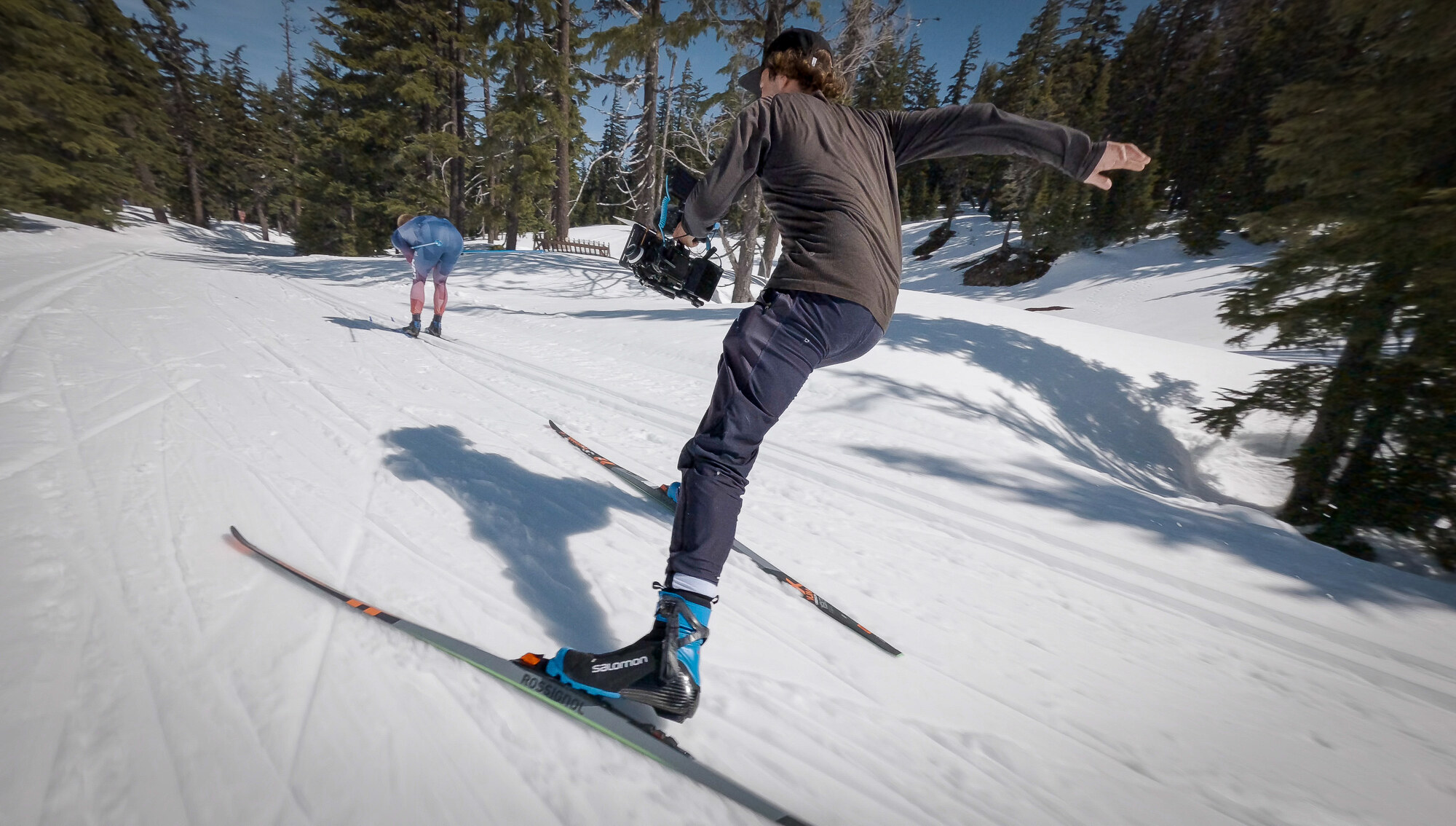
    A filmmaker mid-stride on cross country skis carrying a cinema camera rig, with an athlete skiing ahead of him on a groomed snow trail.
    Lars Brinkema filming on snow at a U.S. Ski Team camp in Bend, Oregon, chasing Jack Young up the trail. The brothers had done the workouts themselves, which is the reason the team let them near one. (Photo: Patrick Conroy)

    MV: I would love to back up a little and just hear about you two as young guys, how this all manifested.

    LB: To start at the very beginning, Torsten and I were both born in Minneapolis and grew up in that whole Minneapolis ski world. We had skis on right when we started walking. So we really grew up in the same community that Jessie had grown up in, and she was kind of just this idol that we looked up to. We both remember where we were when we were watching that gold medal race in Pyeongchang. And then fast-forward to when we were getting older, just always carrying cameras around, usually a small GoPro on our ski trips. Torsten ended up skiing for Colby College, and that is where he met Ben Ogden, racing against him on the collegiate circuit.

    TB: I got my ass kicked by Ben in most of the EISA college races. But I was always interested in shooting a lot of ski trips. I left school trying to figure out how to put those two pieces together, because I knew I was not good enough to be a professional skier, but I also wanted to capture the sport that I loved so much. It took a year of trial and error doing gigs for outdoor brands and whatnot.

    Then, when we figured out the World Cup was coming to Minneapolis, I talked with the Loppet Foundation, which is the club Lars and I grew up skiing for. I was kind of like, listen, do you guys need any promotional materials? People should be getting excited for this event that is happening at Wirth Park. I convinced them on a shoestring budget to send me to Holmenkollen in the spring of 2023. I stayed with a family friend out there, reconnected with Ben, and met a lot of the other skiers on the team. I think they were kind of surprised to have an American photographer out there with them, just because they are not getting much coverage once they leave. Ben was sort of like, we have to figure out how you guys can stick around with the team a little bit longer. It was just me at this point, but Lars was in film school. So Ben pitched Matt Whitcomb that he should invite us to their Bend, Oregon camp.

    MV: What did you think you were making at that point?

    TB: Lars and I basically bought cinema cameras and showed up at camp. We were definitely inspired by a lot of other sports documentaries at the time, niche sports finding success in that genre, people going, oh my god, look at Formula One, I have never heard of this sport before but I am really loving the series. And we were like, we could probably do something like that with skiing. Make it look really cool.

    I think the team was happy to see filmmakers who could not get in the way of their workouts. Jessie had experiences in the past with a brand interrupting an interval session, asking her to do another interval. This is just something that would never even cross Lars and my mind, to alter the workout, because we know how intense they are. We know the workouts. We have done them before. So we were kind of flies on the wall, and I think that proved our ability both as skiers and as filmmakers, to be in that documentary position and not get in the way.

    MV: What were you envisioning before it started to become more about the eating disorder and the mental health challenges?

    LB: Just bringing this sport that we grew up in and that we loved to the masses. We had seen smaller endurance sports, whether it was a YouTube channel or on Netflix, sports that we loved but not a lot of people in the U.S. tracked. And there was always this element to the successful films about sports that was more the human side of the story. We approached it very open-ended. We kept those options really open for a majority of our filming. We were still capturing when we went on the World Cup, talking to European athletes, we had some fun conversations with Klaebo on camera. We just spent every waking moment following different stories.

    I would say we were definitely, kind of subconsciously, following Jessie’s story more than others, and that just developed over the time of filming. Not until the editing process is when it really shaped. We had 500 hours of footage, so many different interviews with so many different athletes, doctors, staff on the U.S. team. And as we started to screen rough cuts to film industry people around Los Angeles and New York, we were getting so much feedback that Jessie’s story was the most resonant of all of them.

    MV: You have 500 hours, and then at some point you have to make the decision that almost all of it is hitting the cutting room floor. How do you feel your way through that?

    TB: Having an editor who had never cross-country skied before was totally instrumental in figuring out what would resonate with the wider audience we knew we had to appeal to. And there are also those moments where Lars and I were deep in the Arctic Circle, freezing our butts off, trying to get a time-lapse of the northern lights, out there for two hours and so attached to this one shot that we worked so hard for. I remember being in the cutting room and him saying, it is not serving the story, you have to cut it. Those were the things that were so hard to let go of.

    And of course all these other stories, U.S. Ski Team members, Klaebo, Emma Ribom, Pellegrino, people that we really looked up to, and all of their stories deserve to be told. But at the end of the day, when you have this Jessie story that is so compelling, you cannot really deviate from it if you want to give her story the time it deserves. At the industry screenings, Lars and I walked in with a lot of questions about what would resonate with a non-skier audience, and people just kept saying, Jessie, Jessie, we want more Jessie.
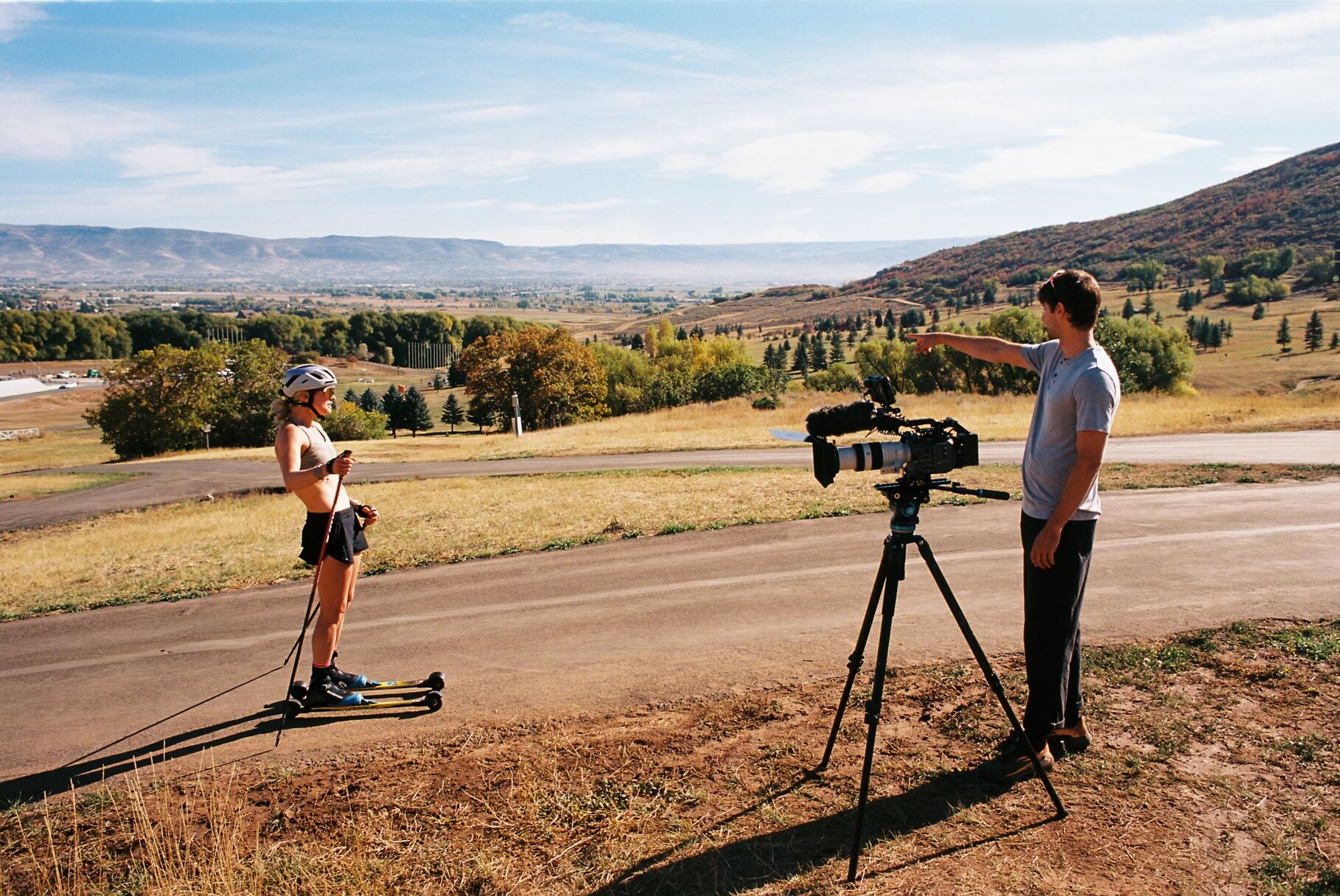
    A skier on roller skis stands on a paved path while a filmmaker directs from behind a tripod-mounted cinema camera, with a wide valley behind them.
    Jessie Diggins and Torsten Brinkema at the team’s Park City camp, in the open-ended stretch of filming before anyone knew what the story was. (Photo: Willie Maahs)

    MV: How did you get hooked up with Patrick Dempsey?

    LB: It was about six months into filming, right after the Tour de Ski, at a camp between that and the next World Cup stop. Growing up in the Midwest, we did not have any connections to the whole Hollywood world, but we definitely needed to find someone to help us get a foot in the door. So we asked Jessie if she had anyone in her directory who worked in that space. She remembered that Patrick had supported the ski team, and she was able to just send him an Instagram DM. He responded right away and said to send Torsten to his house in Maine. A couple of months later we showed up at his doorstep and pitched him on the idea. He had grown up cross-country skiing in his backyard in Maine, so he is very connected to the sport and a huge Jessie fan.

    MV: Jessie is big, but Dempsey is on another level. What was that like?

    TB: It was pretty wild. We knew this was a ticket for us into a new world that we had always hoped to get the keys to. And credit to him for inviting us over, because the roadblock we hit at every stage of this process is that we have no films to our name. We have a couple of short projects that nobody has seen. So we are asking someone with the credits that he has to trust us with nothing to see for it. Obviously Jessie’s word goes a long way with him. We had to swallow our awe of him and realize this was a huge opportunity, and tell him what we really believed: that there was a story in those 500 hours. At that point we had not really cut anything. He became a very important part of shaping it down to what it became in the end.

    MV: What other filmmakers have inspired you? What did you grow up watching?

    LB: One huge one was Jimmy Chin, especially with Free Solo. That may have been the first ever documentary I saw in a theater. This niche sport was brought to a thousand theaters across the country… such a huge story and such an interesting character. That was one of the times we were like, wow, we could bring a sport that we love to the big screen in an impactful way.

    TB: To add to that, I remember, I think it was actually while we were filming on the season, I saw a really old Herzog documentary from the 1970s called The Great Ecstasy of Woodcarver Steiner. Herzog was in his late twenties, early thirties, and he dedicated basically a whole year to following the ski jumping circuit, when it was at that really gnarly phase of people pushing the boundaries on these jumps, ending up jumping all the way to the flats, a whole bunch of drama between the jumpers and the officials. The fact that he was caught up in this story when he was around our age, and it felt like we were doing a similar thing, dropping everything to follow this circuit in unfamiliar landscapes. That just felt like, wow, if one of these great documentarians dropped everything for a ski documentary, we must be doing something right.

    MV: It is expensive to travel around Europe for a whole season, and the ski team is pretty transparent that their budget is tight. How did you make those numbers work?

    LB: We definitely had to pay our whole way through that season. There was not support from the ski team, in that they did bring us on, we were marked as members of the team crew, so we got our bibs and access to the races. But we basically had the ski team and Jessie help us find people who in the past had supported the ski team. It is not funded by the government; the ski team lives off these people who donate. So we went through their list of people who were instrumental in making sure the ski team could have success, people who paid for the wax van they use to this day. Over the course of filming we were always having to fundraise more and more money.

    Later on, when we were fine-tuning the edits, there were still a lot of payments to be made. We talked to Jessie’s sponsor, the Emily Program. That was a really cool opportunity, because now they are supporting the film, but they are also bringing it around the country to treatment centers and educational screenings.

    MV: You set out to tell a fun story and ended up helping people with something that is a real medical issue. Do you take a beat to think about that?

    TB: That is kind of the goal right now. We had a release with Peacock, which in a way felt like being viewed by this Olympic ski audience, but not everyone in the U.S. has Peacock, so right now we are figuring out how we can reach the people we did not reach in that initial release. For sure our target audience is this young group of impressionable people who are growing up either struggling with this disorder or who have people around them who have struggled with mental health. We have heard from people who have never skied before who say they were so moved by Jessie’s story. That is the biggest compliment we can get.

    It is a really hard thing to do, for her to pass one of the hardest years of her life on to us, filmmakers who had never made a film before, to then put out to the world. I remember when we showed her one of the rough cuts. She told us that this is the story her 18-year-old self desperately needed to hear. When we got her blessing, and when she said that, we took it and we ran with it, because we knew we could have that impact on countless other people who were struggling. That was a huge motivator for us.
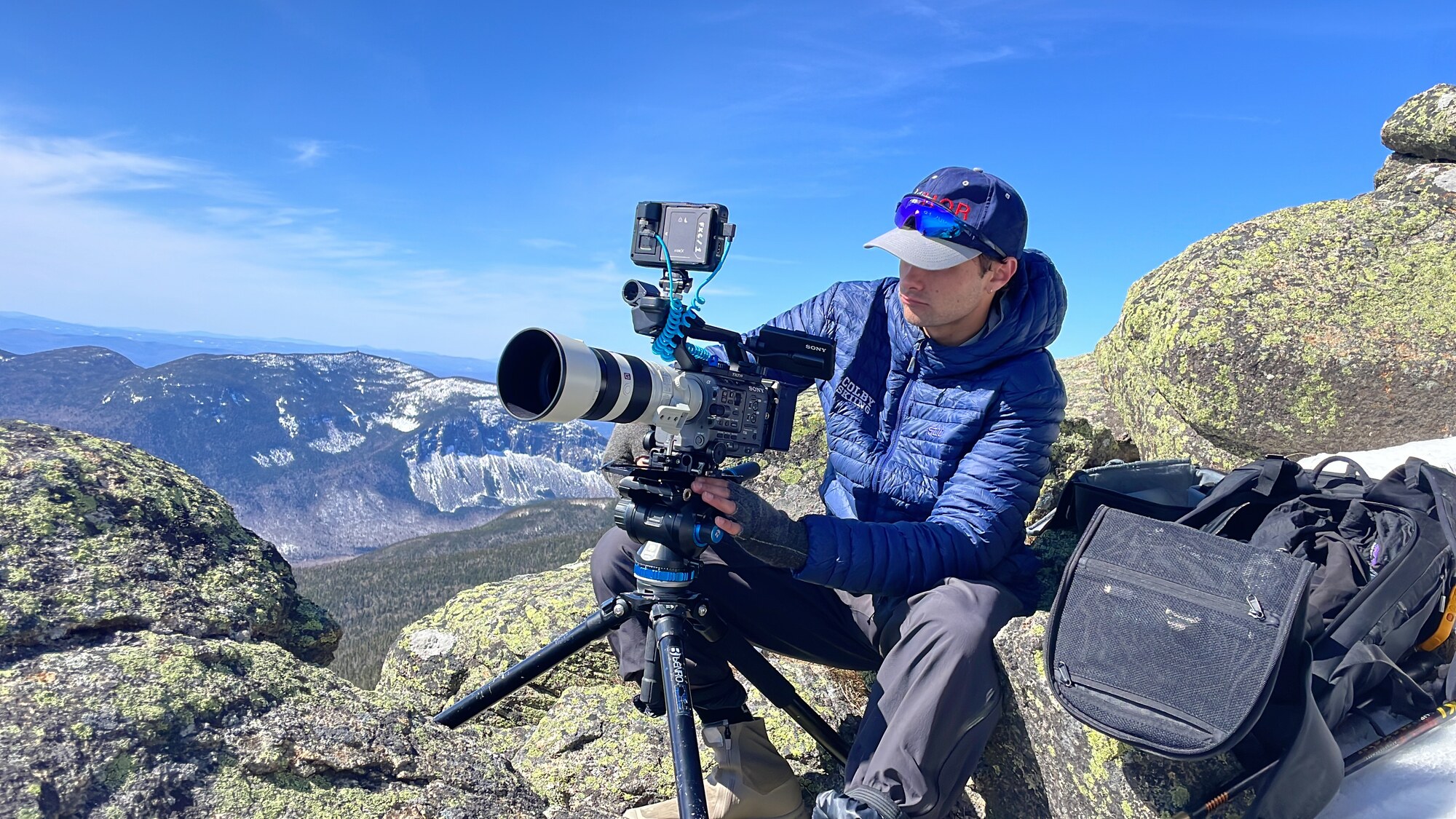
    A filmmaker sits on a rocky summit behind a tripod-mounted cinema camera with a long telephoto lens, snow-streaked mountains behind him.
    Torsten Brinkema on a summit in the White Mountains of New Hampshire in April 2024. This one never made the film either. (Photo: Brinkema Brothers)

    MV: Can you give me a specific memory from being in Europe?

    TB: Mine jumps to not a specific story, but this life on the road, which was so crazy for Lars and me. It was crazy to see the athletes, but also the staff who have done this year in, year out. It really is a wild lifestyle, packing up and going to a hotel room in the middle of nowhere in Finland, where there is light for five hours out of the day, then getting up and packing up and going to the next location in Sweden. The dedication these crews have is crazy, away from their families, away from the normal comforts of living in the States, and the fact that they repeat it every year.

    We pretty much joined every training session and filmed as much as we could, then charged the cameras and packed all the footage onto a hard drive. I always loved those nights when we were really tired, it is super dark out, there is nothing to do, and we would walk over to the wax truck and see what those guys were up to. It was always something fun. They are always blasting music, maybe having a shot of Jägermeister. I think they liked having us around because we were these young people who were totally oblivious to the waxing scene, so we could pick on whoever was not busy at the time. They had been living this life for five, ten years, and Oleg has been around, I do not want to quote how many. These guys are putting everything on the line and being away from their families to make the fastest skis in the world.

    MV: You mentioned the cameras. What was the gear you used to capture these moments?

    TB: We were rocking two Sony cameras, the FX6 and the FX3. That was a progression from, honestly, GoPros. Lars and I just loved being able to carry a camera that would not get in the way of anything, which was so important. We did a 20-mile run with Zanden, Gus, Luke and JC in Alaska, and we carried both our cameras and the drone in a backpack. We always wanted to be able to carry everything we had with only a backpack. That was the goal. In the winter we did a ton of skiing without poles, carrying those cameras, setting up a shot for a while and then skiing alongside people and trying to get it.

    The drone was another really key part of the setup, because it let us get beautiful shots of people when we could not keep up with them, which was most of the time. We could only set up these flyby shots for a 20-second clip before they sped past us. We are super proud of those shots, because it took thousands of them to get the five or six that appear in the movie of Jessie flying by in a training session. We also had to figure out how to make the cameras work in the cold, which was something we had not really experienced before. It involved a lot of hand warmers and duct tape, but we eventually figured out a system that worked even at minus five in Finland.

    MV: I have used hand warmers to keep my batteries warm too, but what is the duct tape for?

    TB: Taping the hand warmers to the battery on the camera, right on the part of the camera where the battery is.

    LB: We would have extra ones in our jacket pocket or in our pants, trying to keep them close to body heat so we could swap them out.

    MV: Lars, what stands out for you?

    LB: Just seeing the sport in Scandinavia was this insane experience. I remember the first Holmenkollen that we followed. I am sad it did not make the movie, but it was absolute mayhem. More people than are in the stadium for the Super Bowl. A hundred some thousand people in the woods watching these skiers who are going by maybe once every 20 minutes. It was not for a sprint, it was not for high impact crashes, it was just to watch these skiers go by, and they were so into it. I remember the big races in the U.S., high school meets, maybe the state meet, have a lot of people out there watching. But seeing all the young fans in Scandinavia watching this sport and being so jazzed up about it, maybe drinking a little too much during the race, it was such a cool experience that you do not get in the U.S.

    TB: It was crazy to experience that and compare it to Minneapolis. We had plenty of those fan experiences, not to the scale of Holmenkollen, seeing the Swedes, seeing the Finnish people. But then coming back to Minneapolis, everyone who was there, most of them traveling long distances, doing crazy things to be there to watch the sport they had been waiting so long to see. That was insane in its own right, because here we are almost matching the energy of Holmenkollen on the trails Lars and I grew up skiing on. We learned how to ski on the 5k Wirth course.

    Then I did a warm-up lap with Jessie before the 10k, and I started crying skiing down the sledding hill, because it was insane. The people, the roar of the crowd, traveling with her as she went around that loop. I feel like we were so blessed to be able to have that finish the movie, because it really felt like a homecoming for Jessie, and a realization of the legacy she has left, both in Minnesota and in the ski world.
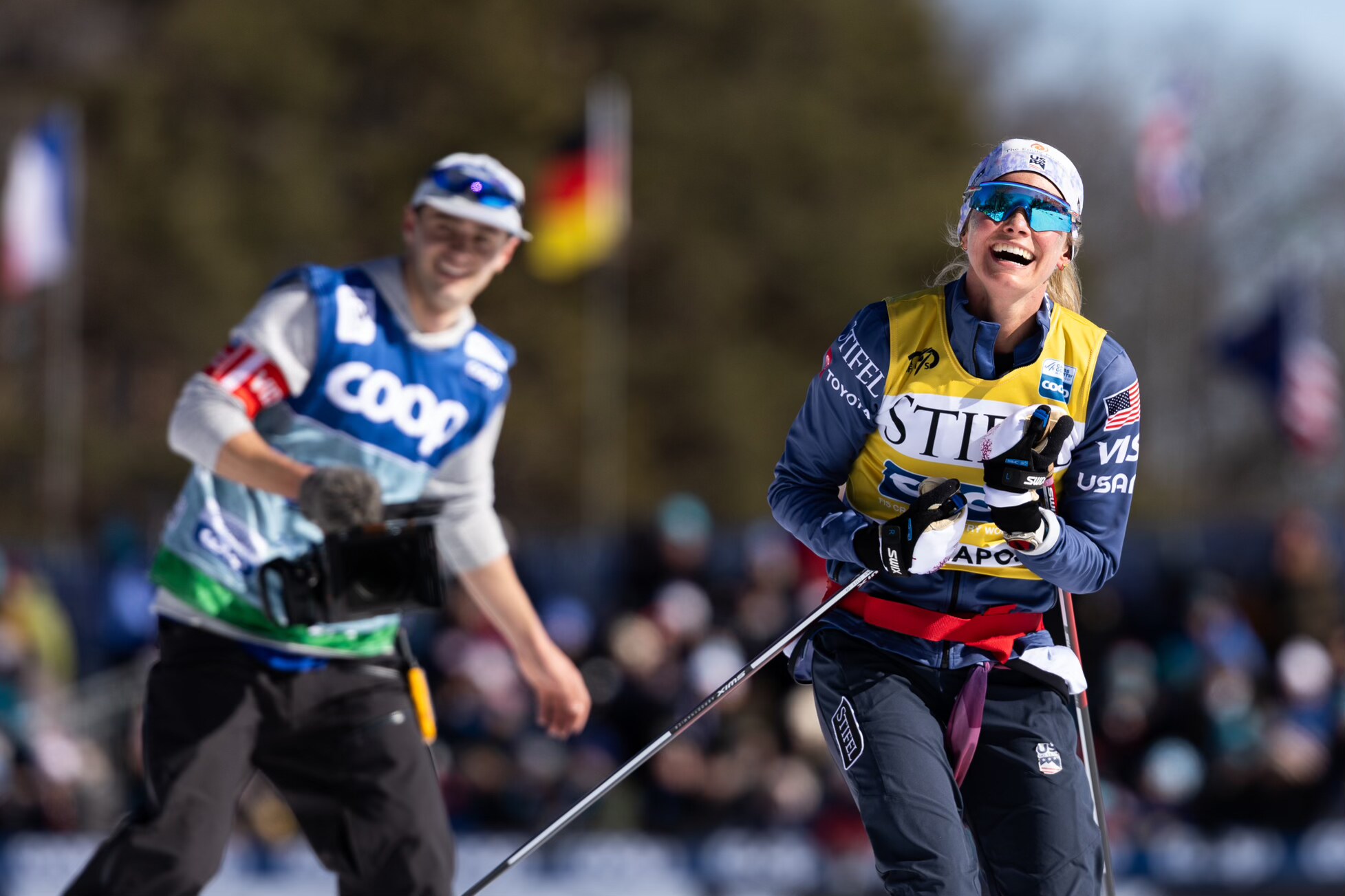
    Jessie Diggins laughs on a warm-up lap while a filmmaker in a media bib skis alongside her carrying a camera, a blurred crowd behind them.
    Torsten Brinkema, left, on the warm-up lap with Jessie Diggins before the 10-kilometer freestyle at Theodore Wirth Park in Minneapolis, February 2024. (Photo: Dustin Satloff)

    MV: What is something you are each really proud of?

    LB: Just coming into the film with such an open idea about what it could be, and that every step of the way we had trust in each other that we were going to make this happen and get it to a large audience. As Tor mentioned, we stepped into a really hard time in documentaries to get one out into the world and make an impact through film. I think we just trusted at every step of the process that we were going to figure this out. Being able to do that and show it in person in Lake Placid and Minneapolis has been such an incredible experience.

    TB: Going off of that, it felt like we were in such a unique position to tell this story. I am so proud of those POV shots we got on skis with the athletes. Again, that is the one percent of all the shots we did. But it is a crazy feeling, in a really crowded documentary landscape, to be one of a handful of people in the U.S., maybe even in the world, who can hold a cinema camera while going 30 miles an hour and pull focus and get that shot. It felt like a really proud moment just being like, wow, these turned out, and they are going to make it a better film, because you sort of feel like you are skiing with them.
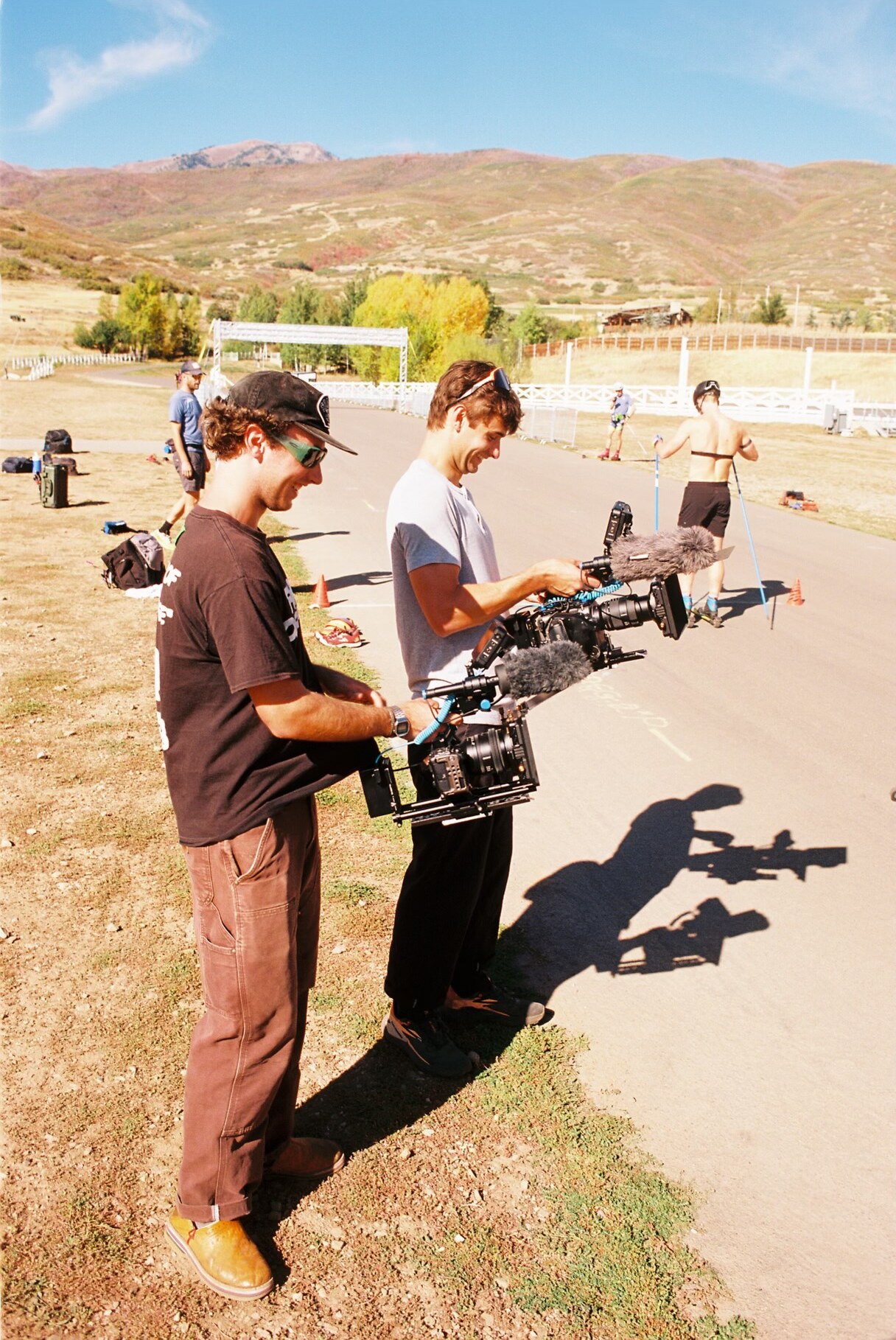
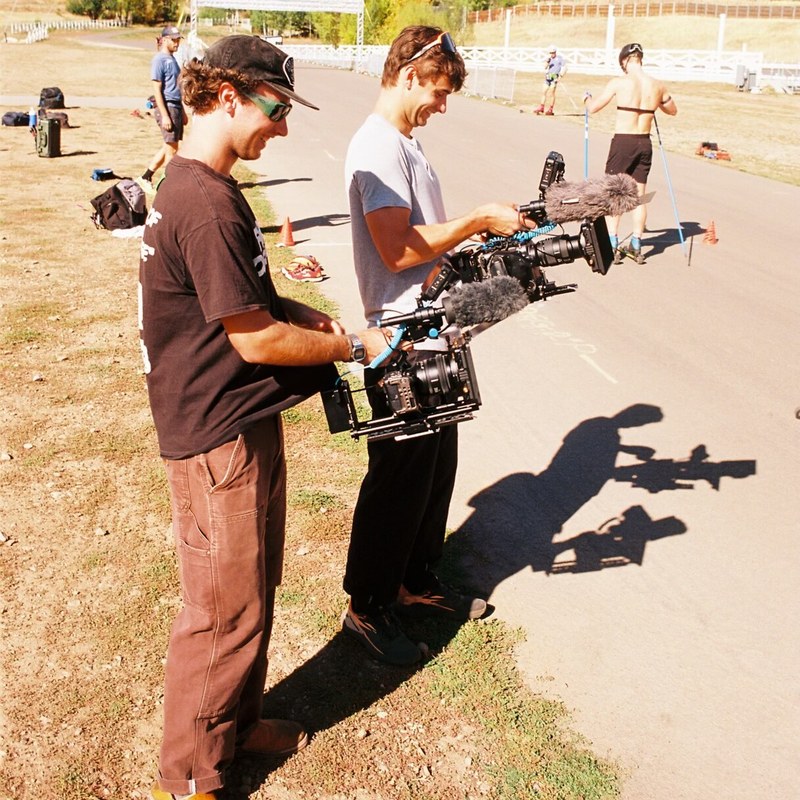
    Two filmmakers stand in profile at the edge of a paved roller ski loop, each holding a cinema camera with a microphone mounted on top.
    Lars, left, and Torsten Brinkema working the roller ski loop at the Park City camp, with the two Sony bodies that shot the season. (Photo: Willie Maahs)

    MV: What was it like working with FIS? Those rights can be really muddy.

    TB: It was definitely a headache to navigate Infront, basically a huge Italian conglomerate that controls a lot of these rights. We had a lot of negotiation with them, because we did want the context of the broadcast footage to feed into the intensity of the race segments. We wanted the tracker of kilometers to go. We wanted Chad and Kikkan announcing, which is so special and I think really leads the film in a way, because Lars and I never really wanted our voices narrating any of this. So we relied on the broadcast to be that context and the hype. It was an absolute pain in the ass, and that is kind of all that I will say.

    MV: What is next?

    LB: In line with Threshold, it was really special to bring something that is a subject matter so personal to us, skiing and mental health. So I think we will continue to create stories that are close to home. We are working on a film that will be set in Minnesota. It was such an incredible experience to show our city and our race course on the big screen.

    TB: We are excited to push our own limits again, and I think this round that will be writing a script, so not a documentary for the next one. But we still definitely want to work together, because having this balance of brother filmmakers, we rely on each other for the things we do not know or that we are not good at. Again, feeling that itch to both tell a story about home and push our comfort zones, which this project definitely did.


    Where to watch: Threshold is available to rent on Apple TV, Amazon Prime Video and YouTube in the United States and Canada. It premiered on Peacock in February, and a European release is planned for later this year.


    Help Support Our Coverage!

    If you value the thoughtful work and access FasterSkier provides, please consider becoming a Voluntary Subscriber. Your support directly fuels our work to cover the people, places, and moments that make our sport special.

    Join the FasterSkier community!
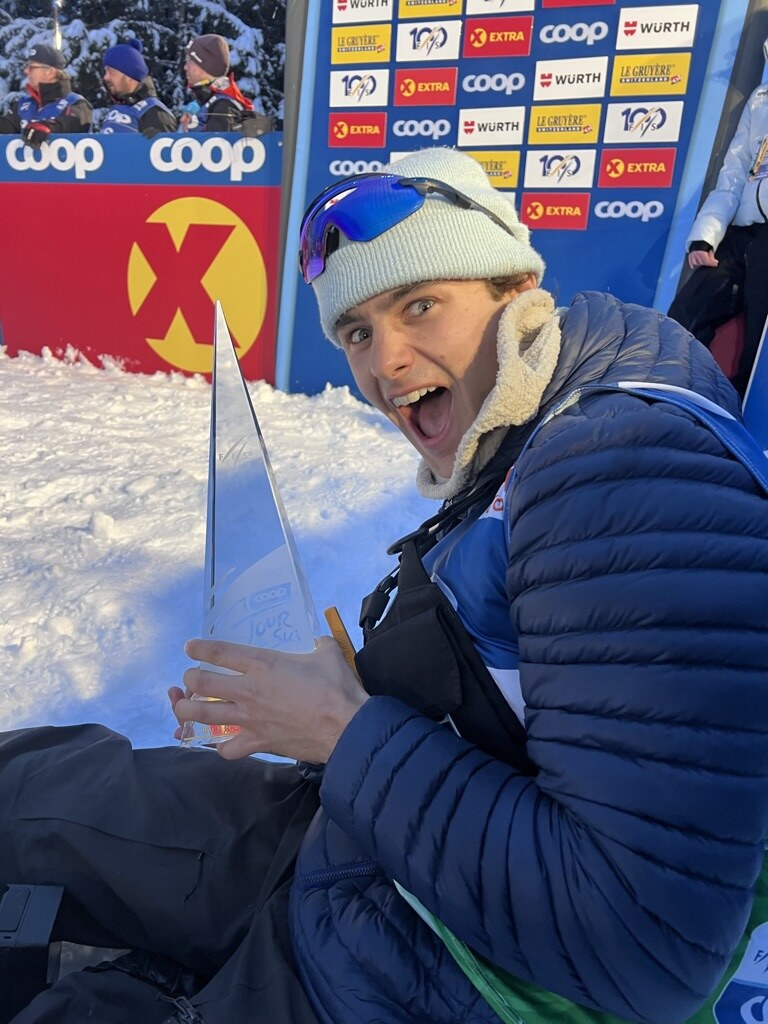
     

    A filmmaker sitting in the snow holding a tall glass pyramid trophy, with race sponsor banners behind him.
    Torsten Brinkema at the foot of the Alpe Cermis final climb in Val di Fiemme, holding Jessie Diggins’ Tour de Ski trophy in January 2024. (Photo: Leann Bentley)
  • What the U.S. Ski Team Changed After Threshold

    What the U.S. Ski Team Changed After Threshold

    This article was made possible through the generous support of our voluntary subscribers. If you value coverage like this, please support FasterSkier with a voluntary subscription.

    When I asked Matt Whitcomb what surprised him about Threshold, the head coach of the Stifel U.S. Cross-Country Ski Team started by admitting he was tempted to make something up.

    “This is the hardest question for me to answer, … but I haven’t watched it. I know it’s life-changing, but I don’t want to go back to that winter,” Whitcomb said. “I did my best as a coach, we all did, and it wasn’t good enough, and I’ve come to terms with my personal experience with it all.”

    The winter in question is 2023-24, the season Torsten and Lars Brinkema spent inside the American team with two Sony cinema cameras, a drone, and no feature film credits between them. What came out of it is a documentary about Jessie Diggins and her eating disorder that premiered on Peacock in February and, as of last Friday, is available to rent on Apple TV, Amazon Prime Video and YouTube in the United States and Canada. A European release is planned for later this year.

    Whitcomb is the person who let the cameras in. He is also, by his own account, the film’s loudest advocate.

    “I know from the response that the film is excellent, and I know it’s changing people’s lives and is being featured in college curricula. I recommend it to everyone I speak to,” he said. “I’m very proud of Torsten and Lars and am grateful for the film. I support it completely.”

    A filmmaker on cross country skis carries a cinema camera rig on a groomed snow trail while an athlete skis ahead of him.
    Lars Brinkema skiing with a cinema camera at a U.S. Ski Team camp in Bend, Oregon, chasing Jack Young on the trail. The brothers had done these workouts themselves, which is why it never occurred to them to ask an athlete to run one again for a better take. (Photo: Patrick Conroy)

    “A couple of brothers got a camera for Christmas”

    His first answer was no.

    “I figured a couple of brothers got a camera for Christmas, had a couple beers, and then came up with a fun way to spend a year,” Whitcomb said. “I normally would’ve erred on the safe side and told them to take a hike, but Ben doesn’t toss around ideas lightly and so I followed up to hear more.”

    Ben is Ben Ogden, who raced against Torsten in college on the EISA circuit and had watched him work at the World Cup in Norway that spring. Torsten had gotten there on a shoestring, having talked the Loppet Foundation, the Minneapolis club he and Lars grew up in, into sending him to shoot promotional material ahead of the 2024 World Cup at Theodore Wirth Park.

    “I think they were kind of surprised to have an American photographer out there with them,” Torsten said, “just because they aren’t getting much coverage once they leave.”

    Ogden pitched Whitcomb on inviting the brothers to the team’s Bend, Oregon camp that summer. The brothers bought cinema cameras and showed up.

    What they had in mind at that point was not a film about an eating disorder. It was a film about a sport nobody in America watches, made in the shape of the niche-sport documentaries that had broken through elsewhere.

    “We could probably do something like that with skiing,” Torsten said of the pitch they were making to themselves. “Make it look really cool.”

    They had one asset that mattered more than the cameras, which is that they were skiers. Diggins had been through the alternative, brand shoots that treated an interval session as something you could run again for a better take.

    “This is just something that would never even cross Lars and my mind, to alter the workout, because we know how intense they are,” Torsten said. “We know the workouts. We’ve done them before.”

    Two young filmmakers stand side by side on a paved roller ski loop holding cinema cameras, with autumn hills behind them.
    Lars, left, and Torsten Brinkema at the U.S. Ski Team’s Park City camp. On the road the athletes called them Larry and Toasty. (Photo: Willie Maahs)

    Toasty, Larry, and a problem with FIS

    Whitcomb’s worry was culture, which he describes as something you protect rather than something you have.

    The brothers had promised the arrangement would run both ways, that athletes would get usable footage of themselves out of it, and Whitcomb says they delivered. They also collected nicknames. Torsten became Toasty. Lars became Larry, or Lawrence in formal settings.

    “These guys were ghosts at times where they would disappear for the day and nobody would see them,” Whitcomb said. “And then we’d see them at dinner and they’d be showing athletes their incredible footage of the team training or racing together.”

    They washed dishes. They helped with wax testing. Whitcomb says everyone came to regard them as an addition to the team environment rather than a cost of doing business.

    It was not frictionless. At the first race of the season in Finland, Whitcomb watched one of the brothers get chewed out in the finish area by a FIS official for filming in a zone reserved for the television production company. Later, on course in Toblach, he got a text from FIS with a screenshot attached.

    “Larry running through the pines, keeping pace in his flatbrim hat and knit sweater, filming the lead pack. He was prominently within the TV feed,” Whitcomb said. “They asked if I could kindly remove him from the world feed. And you know what happened? Nothing. These guys said they were sorry and got a hand slap in each instance. Everyone likes them. They say things like thank you and sorry.”

    The rights question got more expensive than a hand slap when it came time to actually build the film. The brothers wanted broadcast footage in the race sequences, the kilometer counters and the commentary, partly because they had decided early that they would never narrate the film themselves. That meant negotiating with Infront, which controls FIS media rights.

    “It was an absolute pain in the ass, and that’s kind of all that I’ll say,” Torsten said. “Very expensive.”

    The money came from nowhere institutional. The brothers paid their own way through the season and kept fundraising as they went, working through the list of private donors who already keep the U.S. team on the road. The Emily Program, which sponsors Diggins, came in later during the edit and is now bringing the film into treatment centers and educational screenings.

    The Hollywood end of it started with a question the brothers asked Diggins at a training camp between the Tour de Ski and the next World Cup stop. They had no connections in that world and needed someone who did. Did she know anybody.

    She remembered that Patrick Dempsey had supported the ski team before, and sent him an Instagram message. He answered immediately and told her to send Torsten to his house in Maine, where Dempsey grew up skiing. A couple of months later Torsten showed up at the door and pitched him.

    “We have no films to our name. We have a couple short projects that nobody has seen,” Torsten said. “And so we’re asking someone with the credits that he has to trust us with nothing to see for it.”

    Dempsey signed on as an executive producer and, by the brothers’ account, became a real voice in shaping the cut. Whitcomb offers it as a character reference. “I mean, Patrick Dempsey signed on with these guys. That should tell you something.”

    Two filmmakers set up cameras on a patio to interview a skier seated in a chair with mountains in the background.
    Filming an interview with Johannes Høsflot Klæbo in Park City in October 2023. The brothers came home from the season with roughly 500 hours of footage and interviews across several national teams. (Photo: Daniel Sannum Lauten)

    The pivot happened the following summer

    This is the part Whitcomb wanted on the record, because he thinks people have the sequence backward.

    “From the start, this movie was meant to highlight the entire team, and not just Jessie,” he said. “Months after the winter concluded, I think the Brinkema brothers realized that the film needed to hone in on the topic of mental health to have a clear storyline. I understood and supported that pivot, but the point is that the winter filming was not targeted at just Jessie. That filming happened the next summer.”

    The brothers describe the same thing from inside the edit. They came home with roughly 500 hours of footage and interviews with athletes across several national teams, including Johannes Høsflot Klæbo, Emma Ribom and Federico Pellegrino. Their editor, Yaniv Elani, had never cross-country skied, which they now regard as the reason the film works.

    Elani is also the one who made them cut the northern lights. The brothers had stood out in the Arctic Circle for two hours in the cold to get a time lapse they were proud of.

    “It’s not serving the story. You got to cut it,” Torsten remembers him saying.

    Then came the screenings for film industry people in Los Angeles and New York, where the brothers went in hoping to learn what a non-skiing audience would care about.

    “People just kept saying, Jessie, Jessie, we want more Jessie,” Torsten said.

    A coach stands in green summer woods facing a filmmaker who is holding a camera in the foreground.
    Matt Whitcomb during an interview with the Brinkema brothers in Burke, Vermont. “We missed the mark on supportive team culture as an entire team,” he said of the winter the film covers. (Photo: Brinkema Brothers)

    “Our culture was at a 15 or 20-year low that winter”

    Whitcomb does not soften the season the film covers.

    “For anyone who has seen the movie, I think it’s no secret that our culture was at a 15 or 20-year low that winter. We had major struggles,” he said. He has thought about whether the presence of a film crew contributed to that, and concluded it did not.

    He is also insistent that the winter was not one athlete’s crisis with everyone else watching. “It was one of the hardest times for several other athletes and coaches, too. This wasn’t just a Jessie issue. We missed the mark on supportive team culture as an entire team.”

    Asked how he handled protecting Diggins against letting the story be told honestly, he rejected the premise.

    “I never felt like I had to protect Jessie from the film. She was a part of the team-wide decision to allow the Brinkema brothers into the team for the year, and that was the main gate we kept,” he said. When the brothers asked him whether they could film something sensitive, a one-on-one meeting for instance, he sent them back to the athlete. “I would usually just tell them to ask Jessie what she was comfortable with.”

    He watched her closely all the same, and says that had nothing to do with coaching. “That’s just because she’s a close friend, and friends look out for each other. But I had 100% trust in these guys, which is saying something because Lars was 19.”

    A filmmaker and a team communications manager pose together in a sunny finish area, raising ski poles overhead.
    Torsten Brinkema and Leann Bentley at the World Cup finals in Falun, Sweden, in March 2024. Bentley handles press for the cross-country and Para Nordic teams and appears in the film mostly doing her job in the background of somebody else’s scene. (Photo: Brinkema Brothers)

    The person in the hotel room

    Leann Bentley is the U.S. Ski & Snowboard communications manager who handles press for the cross country and Para Nordic teams, and she is in the film, mostly doing her job in the background of somebody else’s scene.

    She was in the room when the coaching staff decided whether to say yes, and she remembers it being straightforward. Here were two people willing to spend a year telling a story she could not tell herself, and one of them had raced against these athletes in college.

    The question she was asked for this story was how she decided where to draw the line once the film’s center became Diggins’ mental health. Her answer was that the question does not describe what happened.

    “Short answer, no, I never had to tell them no,” Bentley said. “Long answer is I of course will always protect my athletes. But at the same time, they’re protecting themselves. And throughout this entire process, Jessie was protecting herself. She knew what she wanted to give, and she knew maybe what she didn’t, but she was in charge of it from the very start. And so were all the athletes.”

    The scene she keeps coming back to is a hotel room in Ruka before the press conference where Diggins told the assembled media she was dealing with her eating disorder again. Bentley says it was one of the most heavily attended press conferences she has run with her.

    “There was a scene where I told her that it’s okay to be vulnerable. And I don’t remember saying that to her,” she said. “It really goes to show that when I work with these athletes, I’m working with them as people, and I’m really glad that came across in the film.”

    Most of her season is not spent in hotel rooms in Finland. It is spent in Salt Lake City, awake in the middle of the night, watching the same feed as everybody else and then turning it into the clips and quotes that hundreds of thousands of people see, for twelve teams and more than 240 athletes.

    Asked what the film got right about the parts of team life that press coverage never reaches, she was blunt about why the question has an easy answer.

    “It got everything right because it was showing exactly what was happening,” Bentley said. Athletes race for a few minutes at a time, a few times a weekend. The rest of it is chess and cards and laundry and going for a run. “I don’t think a lot of people understand that being a professional athlete, you train so hard mentally and physically for what you do on the weekends during a race. And then that race ends and you have, I don’t know, ten more hours of the day left.”

    Both she and the brothers land in the same place when asked for a favorite corner of that life, which is the wax truck, known on the road as Yolanda. Torsten’s version involves showing up on dark nights with nothing to do, music playing, occasionally a shot of Jägermeister, and a group of technicians who had been living this way for a decade or more and had stories nobody had ever asked them for.

    I interviewed the American wax techs last winter in the lead-up to the Olympics, and they remain the most enjoyable conversations I have had for this site, so I will just agree with him.

    Two filmmakers with cameras stand on a paved loop while a coach talks with two athletes on roller skis.
    Torsten Brinkema, left, and Lars Brinkema, right, filming Jessie Diggins, coach Jason Cork and Renae Anderson during a roller ski session at the Park City camp. (Photo: Willie Maahs)

    What actually changed

    The most concrete thing to come out of that winter is not on screen.

    Whitcomb describes an Athlete Wellness Passport, a monitoring system covering roughly eight health areas for every athlete on the team, men and women, including bone density, blood panels, caloric balance assessment, menstrual health and a mental health questionnaire. The team dietitian tracks each category for each athlete, and a licensed professional is brought in when a category calls for it.

    “It’s a safety net for the whole team,” he said.

    What that system did not have in 2023-24 was a ceiling.

    “What we were missing in the winter of 2023-24 was a plan for what happens when an athlete’s issue, like an eating disorder, advances beyond the qualifications of our professionals,” Whitcomb said. “In this case, we needed an eating disorder specialist MD on call, and we didn’t have one. We’ve debriefed on the experience extensively and have brought in the person we wish we already had in place going into that winter.”

    For coaches who watch the film and want something to do on Monday, his answer starts with an assumption rather than a policy.

    “If you coach a team of athletes, you likely coach some athletes who struggle with disordered eating, and you may never know who they are,” he said. He has had male and female athletes tell him about it years after they finished competing.

    On his team the practical version is a conversation about meals, held once a year, in which everyone agrees to treat mealtime as a place where safety matters more than opinions.

    “Everyone’s plate looks different, and everyone’s dietary needs and goals are different, and many of us are insecure, so the environment is ripe to be judgy and toxic,” Whitcomb said. “Talking it out isn’t perfect, but it helps.”

    He got there by getting it wrong first, and he tells that story without cushioning it.

    “As a young coach I used to think I could talk openly with athletes about their challenges with eating, body image, and weight. Then I learned from a parent that a comment I made to them regarding weight was harmful. Yeah, I know, duh. But I was 23 and some of you are now, too.”

    His correction was to stop talking about any of it and refer everything to professionals, which he now says was better but too absolute. The current version is that he will talk with an athlete who wants to talk, if the trust is there, while being honest about where his expertise ends and activating someone qualified.

    Three people stand in front of a cinema screen taking questions from a seated audience in a darkened theater.
    Lars Brinkema, Torsten Brinkema and Andrew Peterson take questions after a private screening of Threshold in Minneapolis in January. Diggins has asked teams to treat the film as “a visual book club.” (Photo: Sawyer Brice)

    What Diggins wants out of it

    Diggins raced her last World Cup in Lake Placid in March. She did not do a new interview for this piece, but she wrote at length on Instagram when the film went back out on Friday, and the argument she made was that the documentary is not really about her.

    Her request to teams, high school through professional, was that they treat it as “a visual book club.” Watch it, then talk about it. What pressure does this sport put on you. What kind of team do you want to be. And for coaches, find out now where you would send an athlete who comes to you, before one does.

    She also made a point the film cannot make on its own, which is that the recovery in it happened in hundreds of hours of therapy and clinical work that were never filmed and could not have been.

    Two filmmakers in Team USA bibs stand with their arms around a skier wearing the yellow overall World Cup leader bib.
    Torsten Brinkema, left, Jessie Diggins and Lars Brinkema in the finish area in Falun, Sweden, in March 2024, after Diggins wrapped up the overall World Cup title. (Photo: Modica/NordicFocus)

    When the film premiered in February, she put the goal simply in a U.S. Ski & Snowboard release: “I wanted to help others feel less alone.”

    The brothers are working on a scripted film now, set in Minnesota, still as a duo.

    Whitcomb, meanwhile, is not planning to watch. He described where the last two years have left him without much interest in tidying it up.

    “We’ve made improvements to our system because of lessons from that winter, and we became better coaches and teammates. I’m moving forward as an improved coach.”

    And then the part that sounded most like a coaching philosophy: “Your coaches and staff must truly care about the human condition. That’s your foundation. Get rid of the ones who don’t and add more who do.”

    Where to watch: Threshold is available to rent on Apple TV, Amazon Prime Video and YouTube in the United States and Canada. It premiered on Peacock in February, and a European release is planned for later this year.


    Help Support Our Coverage!

    If you value the thoughtful work and access FasterSkier provides, please consider becoming a Voluntary Subscriber. Your support directly fuels our work to cover the people, places, and moments that make our sport special.

    Join the FasterSkier community!


  • Jessie Diggins: Health and Happiness in the Season Ahead

    Jessie Diggins: Health and Happiness in the Season Ahead

    A private moment of joy and elation at the 2023 FIS World Championships. Jessie Diggins represents family, friends, fans, her team, and her country. As one who so often finds herself in the glow of the media spotlight, she also works to represent her own strengths and weaknesses, aspirations and vulnerabilities. (Photo: Modica/NordicFocus)

    11/17/2023—Ruka, Finland

    For American fans of cross-country skiing, Jessie Diggins is definitely the voice of our sport. Following a 2023 season that saw her crowned World Champion in 10k—and finishing second overall in the season-long FIS World Cup—she returned to training and preparing for the season to come; but things didn’t go exactly as planned. Recently, Diggins sat down for a scheduled media interview to discuss her relapse into an eating disorder from which she’d been in recovery for many years. Pressure, expectation, image, aspiration: all can combine to test the mental health of even the strongest among us. Jessie Diggins discusses it all willingly and openly.

    “I’m going to assume that a lot of the questions will be around my mental health,” she began. “Mental health is physical health; so, eating disorders are not a behavioral choice. It’s mental health . . . and it’s important that we can talk about mental health . . . I want athletes to feel they can talk about this with their coaches the way that I’ve been able to talk to my coaches.”

    “We’re all human, and we’re all doing the best we can, every single day. So, this season, I’m focusing on just doing my best . . . taking it one day at a time, one race at a time.”

    Jessie Diggins is an advocate, and an example, and a mentor in discussions regarding mental health, especially when it comes to those individuals and athletes who experience eating disorders. Her place in this discussion received additional attention over the summer when she issued a statement in which she described her own relapse. This recent press conference allowed her to address her recent experiences, and her goals and expectations for the season to come.

    “I have this opportunity right now to talk about things that are really important to me . . . continuing to race lets me do that . . . It is fun—and I still like racing—but I’m also racing for some other reasons, too. “

    The view of Jessie Diggins’ recent online press conference. Typical of the wonderful interview that she typically offers, Diggins answered questions on a variety of topics from mental health and athletic legacy to Taylor Swift and biodegradable glitter. (Photo: FasterSkier)

    Among other topics addressed in her hour-long press conference, Diggins addressed the high-profile nature of her position in the sport—and her own level of vulnerability that followed her recent disclosures—especially when it comes to expectations and hopes for 2024’s upcoming FIS World Cup events in Minneapolis.

    “Sometimes, getting everything you ever wanted comes with unexpected pressures . . . Maybe a home World Cup comes with extra pressure and expectation. I’ve also struggled with that. I wouldn’t want to disappoint people, or let them down . . . I want to give everyone everything that they’re hoping for. I want to high five every single person because we worked so hard to make this happen . . . and I know that I can’t. So, I just have to find a way to say ‘I’m doing the best I can.’ And that’s going to have to be enough.”

    As she approaches her 12th season on the World Cup circuit, it’s interesting to consider what continues to keep Jessie Diggins motivated.

    “I’ve done a lot that I wanted to do in sport,” she said.”I feel like I’m not done [with] my potential in the sport. I feel like I’m still growing and learning . . . When you really get down to the bottom of the well, you learn some things about yourself . . . and how you react. When you’re in that place—in that pain cave—that’s pretty cool. I think I’m just not done learning about myself yet.”

    In concluding the press event, Diggins commented—as she often does—on the importance of her teammates, their attitudes, their energy:

    “Everyone wants to be here,” she said. “It’s not just a job, it’s not just a hobby. It’s this burning passion—to be a part of this team, and to represent the country, and to just ski race FAST! . . . It’s my dream job—it really is. I love being part of this team . . . Results are one thing; but being a good person, that’s what you’re going to look back on and remember. And this is a team of really good people . . . That’s something that makes me really really proud.”
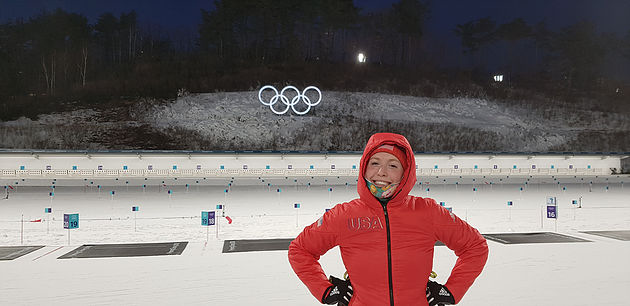
    As for the glitter (which, just for the record, is biodegradable), Jessie wants to remind herself that“this is supposed to be fun!”

    Energy, courage, passion, and compassion: Jessie Diggins leads the Stifel U.S. Ski Team into the 2023-2024 World Cup season. (Photo: Thibaut/NordicFocus)
  • Nordic Nation: Prioritizing mental health and rediscovering passion with Hailey Swirbul

    Nordic Nation: Prioritizing mental health and rediscovering passion with Hailey Swirbul

    In this episode, we chat with Hailey Swirbul, who – at just 24 years old – has been competing at the top end of the sport for quite some time. A bronze medal in the 4 x 3.3k relay at the 2017 Junior World Championships in Soldier Hollow put Hailey – and relay teammates Julia Kern, Hannah Halvorsen, and Katherine Ogden – on the map in a big way in US Skiing. Hailey has gone on to spend the better part of the last four years racing on the World Cup, earning 48 World Cup starts and one individual podium in the 10k skate in Davos in 2020. She’s currently preparing for the upcoming World Championships in Planica, Slovenia, which starts on February 22nd. 

    Following last year’s Beijing Olympics, Hailey opened up about the contrast in expectation versus reality in the Olympic experience, and how the high stress, high pressure environment of life in Europe, particularly in the lead-up to the Olympics, negatively impacted her mental health and felt increasingly unsustainable. She questioned whether she wanted to keep skiing at all, but eventually decided to keep at it, with a new approach. She took a full time engineering job in the summer, and decided to forego period one and two on the World Cup, racing the SuperTour and US Nationals domestically instead. 

    Hailey Swirbul enjoys her time in the leader’s chair after a solid performance in the 10k skate in Davos in December 2021. (Photo: NordicFocus)

    As we discuss, this approach has rejuvenated her love for the sport and her motivation for the training and sacrifices it requires. And, it’s contributed to an outstanding season of racing, both domestically and internationally. She remains the SuperTour Leader as of recording, having earned a spot on the podium in all but one event, and swept all four events at the National Championships in Houghton, MI in early January. She seamlessly transitioned back onto the World Cup in Les Rousses, FRA where she raced into the semifinal of the classic sprint, followed by a top-20 result the following day in the 20k mass start classic. She qualified for the sprint heats again the following weekend in Toblach, ITA, was 26th in the 10k free the next day, and capped off the long weekend by scrambling for the US women’s relay team, which ended the day in bronze medal standing.

    Thanks for listening, and thanks to Concept2 for supporting this podcast. 

    Hailey Swirbul pushes to the finish of the 10 k individual start classic during the 2022 Olympic Winter Games. (Photo: NordicFocus)
  • Hailey Swirbul writes “honest” blog post on Olympic experience

    Hailey Swirbul writes “honest” blog post on Olympic experience

    Hailey Swirbul races the freestyle sprint qualifier in Lahti the weekend after the 2022 Olympic Games drew to a close in Beijing. (Photo: NordicFocus)

    Intertwined with historic medal-winning races, tales of adversity overcome, and athletes with whom fans become enamored once every four years, the Olympics also brings about stories of defeat, the complexities of human emotion, and the simple humanity of the athletes competing at the Games, who are often glorified solely on the grounds of their seemingly inhuman capacities and accomplishments. While stars like Simone Biles and Mikaela Shiffrin remind us that extreme pressure to perform does not always lead to diamonds, or perhaps in this case gold medals, athletes with less media focus have also begun to share how the Olympics impacted their mental and physical wellbeing. 

    Though the Olympics can remain a fantastic dream and a worthy goal for aspiring ski racers, a February 27 blog post by Hailey Swirbul titled “Honest Olympics” reminds us all that feeling overwhelming and complex emotions during one’s Olympic experience does not negate the athlete’s appreciation of the opportunity, or recognition that it is an accomplishment many dream about and very few actually get to experience. Quite simply, Swirbul demonstrates that gratitude, excitement, and melancholy are not mutually exclusive states of being.

    Hailey Swirbul races the 10 k individual start classic during the 2022 Olympic Winter Games in Zhangjiakou, CHN. (Photo: NordicFocus)

    By Hailey Swirbul, reposted with permission

    I am almost certain that mine is not the Olympic story the world wants to hear about—not because I didn’t get a medal or something, but because I can’t lie. I’ve spent the last few days looking through photos on my phone, wondering which 8 or 10 I should select and post with a nice caption and ‘thank you’ to the Olympics for such a purely wonderful experience. But it occurred to me that the world has a lot of that perspective right now, and me pretending to have the same one might do more damage than good for people like me who could benefit from my truth.

    The Olympics were fine for me. I feel exactly the same as I did before them; I don’t feel complete, don’t feel more accomplished or better than anyone else all the sudden. In fact, the main thing I feel is relief. I got through it. I lived up to the internal and external pressures to qualify for the team and compete for my country. Whew. Now I can take a deep breath.

    I had some moments that I really enjoyed at the Olympics, but I also had my fair share of moments that were simply not fun. Most of my time was just about neutral. I feel guilty for admitting that, when obviously, the Olympics is something that so many people would die to experience. So many of my peers are disappointed not to have made the Olympic team, or to have made the team but not receive the starts they had hoped. I had both of those blessings come true, but still felt quite empty throughout the whole thing.

    Hailey Swirbul laps through a windy stadium during the women’s 15 k skiathlon in Zhangjiakou, CHN. (Photo: NordicFocus)

    Why can’t I see the Olympics in the glorified way the world does? For every person crying tears of joy on a podium, I saw a dozen people looking disappointed or drying tears of sadness behind the scenes. I saw broken dreams. I saw dreams coming true, and people realizing that maybe that dream wasn’t all they’d imagined after all. I saw pressure and stress that brought out people’s shortcomings. I saw expectations not being met, and teammate relationships damaged. I saw isolation and low self-worth and confused identity and claustrophobia within the Olympic world. In many ways, the worst part was that I could do nothing about it because all my energy went toward surviving many of those things myself. Honestly, all of that sucked.

    But don’t get me wrong—I’m able to see the incredible moments that came with the experience too. Watching halfpipe and aerials and biathlon in person with some of my closest friends, for example. Meeting a skier from my hometown who felt like a long-lost sister. Watching Ted Lasso with my roommates in the evenings. Bushwhacking through the mountains near the village to find a peaceful headspace. Heck, I’ll even look fondly on the numerous times I ate KFC take-out to avoid the dining hall boredom! Writing these examples made me realize just how many positive small moments there actually were and I could go on and on…. But, interestingly, most of those moments were simple, normal life joys that had relatively little to do with actually being at the Olympics.

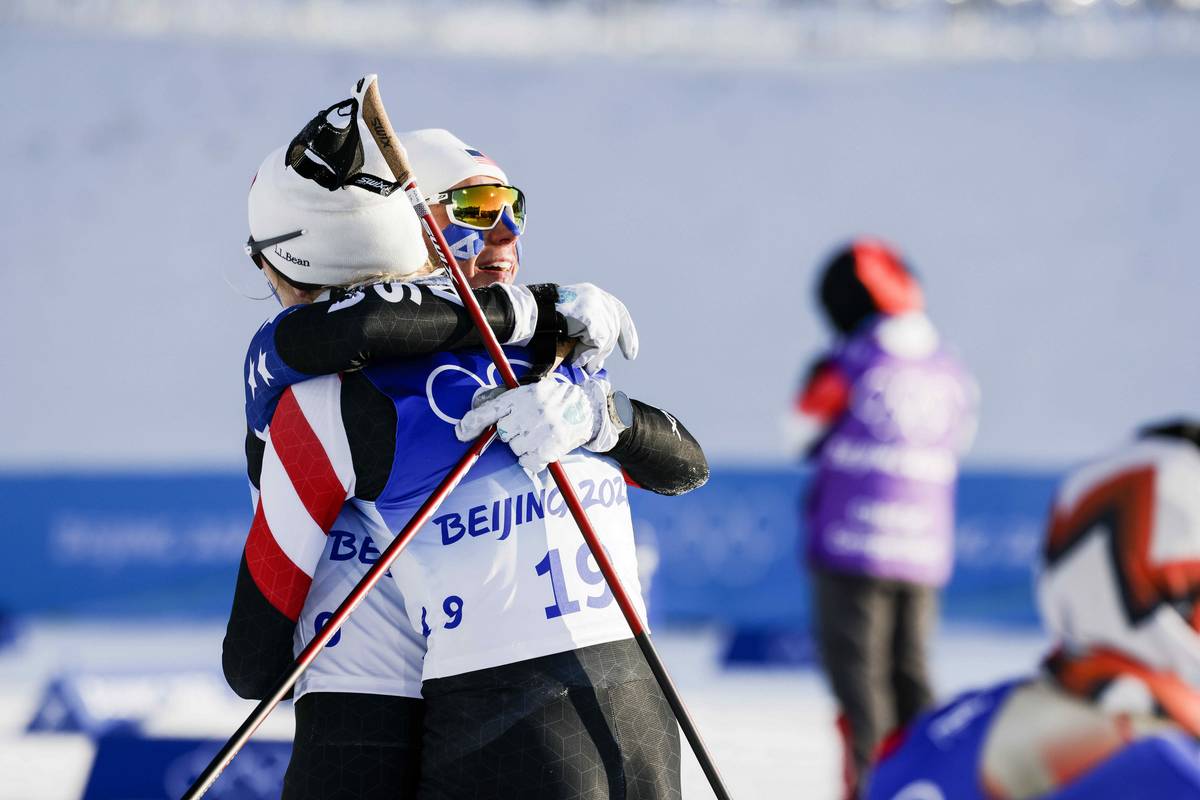
    Hailey Swirbul hugs teammate Julia Kern after a challenging 15 k skiathlon, which opened the 2022 Olympic Winter Games. (Photo: NordicFocus)

    I left the Olympics feeling more at peace with my sense of identity as a skier because I felt somehow empowered by and connected to those little normal-life moments. I learned a bit more about how I’d like to be a better teammate, and how I need to signal safety to my nervous system to keep my brain health in a good place. I uncovered a bit more purpose in the sport of skiing for myself and set some goals that have nothing to do with results. In the end, this experience wasn’t about fun and glory the way it had been portrayed to me over the years. It was about internal growth for humans in the face of intense emotion, pressure, and expectation. I’m not really sure why I’m writing this as I’m still processing the experience myself, but I couldn’t post on social media about a wonderful time without acknowledging the challenge and growth as well. So thank you, Olympics, not for the incredibly fun experience, but for the opportunity to grow as a human being. That’s something I hope I’ll never forget.

    Head to Swirbul’s blog to see her top-eight photos from “happy little moments” during the Games, including the one below. 

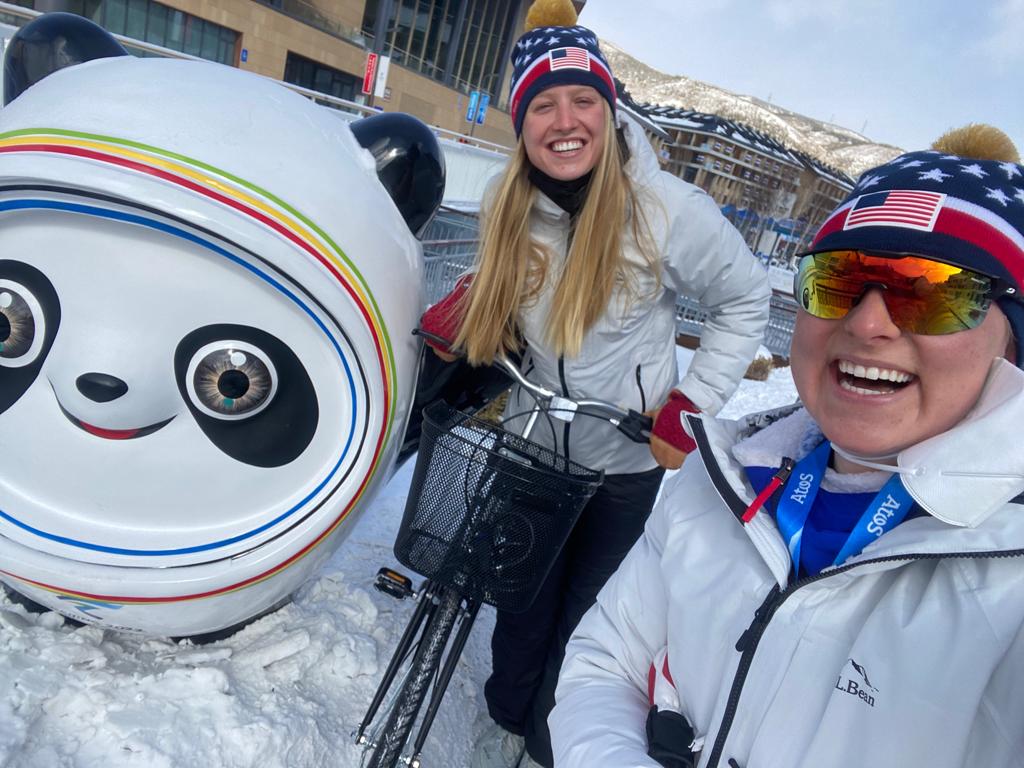
    Hailey Swirbul and Hannah Halvorsen visited Olympic mascot Bing Dwen Dwen on a bike cruise through the village, one of the ways they would spend time together outdoors. (Courtesy photo)
  • “Chill with the judging”: Jessie Diggins has a message for Mikaela Shiffrin’s trolls

    “Chill with the judging”: Jessie Diggins has a message for Mikaela Shiffrin’s trolls

    ZHANGJIAKOU, CHINA — American alpine racing superstar Mikaela Shiffrin struggled at the Olympics, failing to bring home any medals.

    Last week, she posted a message to social media broadcasting some of the hateful criticism she’d received during the Games, telling her audience that “there will always be turkeys” and that it’s “not the end of the world to fail.”

    Diggins poses with the flag, her coaches, and the American support staff after earning a silver medal in the 30 k skate, her second medal of the 2022 Olympic Winter Games. (Photo: NordicFocus)

    Cross-country star Jessie Diggins, after winning a silver in her final race of the Games — her second medal in Beijing — had her own response to share.

    “People need to remember that they don’t get to judge. They can try, but it’s nobody’s place to assess somebody’s mental state. It’s nobody’s place to assess their performance, or critique them or judge them,” Diggins said in an interview after her race, in which she brought up Shiffrin herself. 

    Diggins has said she’s tuned out from social media and news coverage during the Games, where expectations for medals have put her in the spotlight. She also was at the center of a controversy around the New York Times’ coverage of her first medal in Beijing, as American cross-country skiers and fans objected to the newspaper’s description of Diggins’ body.

    Diggins, in the interview Sunday, said teammates had shared Shiffrin’s post with her, and that she’s had identical attacks leveled at her. People, she said, “need to remember that there’s a human on the other end of that.”

    “Someone’s out there putting their heart and soul on the line, over and over and over. That’s amazing,” Diggins said. “All we should be doing is applauding their guts and their grit. And so, I just think people need to chill, with the judging.”

    Jessie Diggins (left) earns the first distance medal for American women, matching the all-time best individual American result of Bill Koch who earned silver in 1976. Norway’s Therese Johaug earned gold in the 30 k skate, with Finland’s Kerttu Niskanen taking bronze. (Photo: NordicFocus)
  • Nordic Nation: Challenges of the Pro-Athlete Journey with Hannah Halvorsen, Hailey Swirbul, and Kate Barton

    Nordic Nation: Challenges of the Pro-Athlete Journey with Hannah Halvorsen, Hailey Swirbul, and Kate Barton

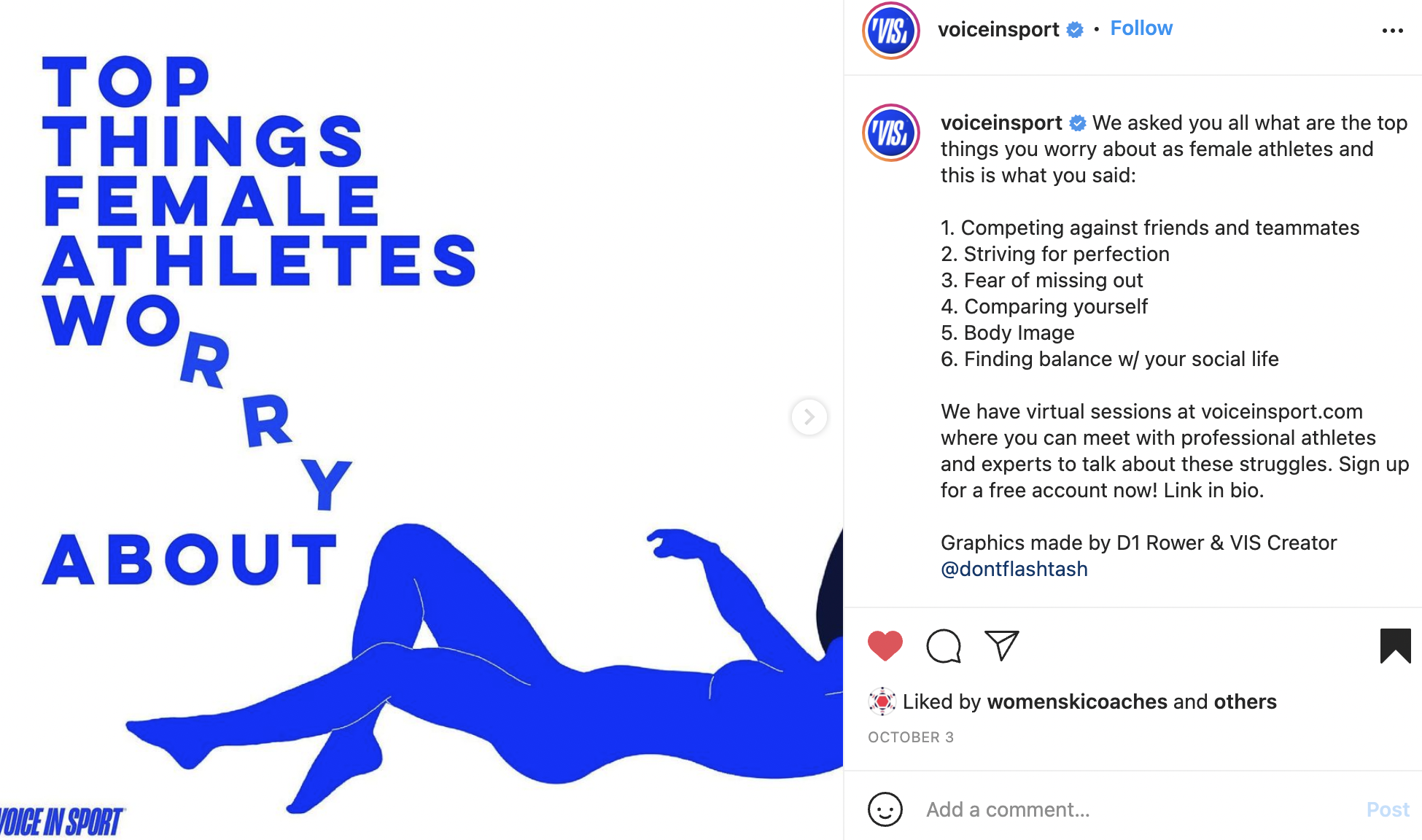
    In this episode, we have U.S. Ski Team members Hannah Halvorsen and Hailey Swirbul along with development team coach Kate Barton. The original idea behind the conversation was to discuss a variety of challenges female athletes of all levels experience during their careers based on an infographic posted by the organization Voice in Sport, shown below. 

    An infographic from Voice in Sport showing some of the top challenges female athletes face. (Photo: Instagram @voiceinsport)

    As the conversation evolved, it became clear that this conversation will resonate with athletes of all genders, ages, and level of competition. Yes — being one of the fittest women in the world and getting to travel the world is a wonderful privilege that many of us might fantasize about, however, we often only see the highlight reel. From social media to pressure, and “balance” to competition between teammates, these women shared powerful insights into their lives as athletes and coaches at the highest level of our sport. Hopefully, this perspective helps listeners recognize and support the whole person inside the lycra, on days where the pieces come together on the World Cup, the days they fall short of the goal, and all the days in between.

    Some related reading that is discussed:

    Hannah Halvorsen With a New Plan (details her story of being struck by a car and early recovery; find a follow up story here)

    I Don’t Have a Six Pack, But a Car Hit Me and I Survived by Hannah Halvorsen

    Hailey Swirbul’s Instagram Post on Mental Health and Letter to Her Younger Self

    Brave Enough by Jessie Diggins (Reviewed on FS here, with more on her recovery and advocacy here.)

    Hailey Swirbul and Hannah Halvorsen, along with D-Team coach Kate Barton, discuss the challenges of the pro-athlete journey in today’s episode of Nordic Nation. (Photo: Instagram @hannah.g.halvorsen)


  • Notes from the IOC’s Athlete 365 Survey during the Global Lockdown

    The International Olympic Committee (IOC) released results from a wide-ranging survey to assay how the challenges athletes are experiencing during the pandemic and the ensuing lockdown. According to the Athlete 365 Survey Findings, there were over 4000 respondents across the globe, of which 80 percent were athletes, with the remainder described as “entourage” and “stakeholders”. Six percent of respondents were from the U.S. 

    Of the challenges described by athletes, 56 percent found it hard to train effectively, and 50 percent struggled to remain motivated. When asked, “What are you currently finding most challenging?”, thirty-two percent responded managing their mental health.  

    Last month was mental health awareness month. The USPOC maintains a web page to serve as a portal for mental health-related resources. The USOPC also has a mental health task force. (Eileen Carey, Director of U.S. Paralympics Nordic Skiing is on that task force.)    

    The survey also revealed that the needs of stakeholders were focused around event organization, communicating with athletes, and maintaining relationships with sponsors. 

    You can find the full survey results here via a document posted to the insidethegames.biz website. 

    (If you or someone you know is struggling with their mental health, you can reach out to 800-273-8255, and speak to a trained mental health professional.)

  • Nordic Nation: Holly Brooks on Mental Health During the Covid-19 Pandemic

    Nordic Nation: Holly Brooks on Mental Health During the Covid-19 Pandemic

    We’ve all heard the phrase: “These are unprecedented times.” And it is true. What the world is facing during the Covid-19 pandemic is something that none of us have experienced before. We are all feeling it. 

    Uncertainty is ubiquitous and caused by a myriad of factors. We may be concerned about the health of ourselves and our families, or about the financial impacts of our country coming to a halt. We might be attempting to work from home without access to childcare, leaving little time to care for ourselves, or we may be struggling with isolation while distancing ourselves from others. 

    On March 21st, licensed professional counselor Holly Brooks shared the following on her practice’s FaceBook page:

    “While the primary discussion revolves around physical health issues, my professional lens is set to think about people mentally and emotionally. This pandemic is going to be a marathon, but right now it feels like a sprint. Yes, we absolutely need to do everything possible right now to flatten the curve, but if we’ve flattened ourselves (burnt out, physically sick, emotional break down/panic attacks) then we cannot help ANYONE. 

    Here are three steps that I feel are crucial to help you survive (and even thrive) in this pandemic marathon:

    1) Release the energy stored inside of you. This could come in the form of crying, a “thought download” aka journalling, dancing or exercise.

    2) Engage in some form of safety/soothing technique. Work on your inner dialogue. Combine it with some diaphragmatic breathing. Use one of the many meditation apps.

    3) Practice gratitude and VISUALIZE the FUTURE. Right now our minds are full of “what ifs” and literally worst case scenarios. Sure, we need to prepare and be smart about our preparation but make sure you’re balancing it with positivity. The same goes for the media. Balance the bad news with the good.”

    For those unfamiliar with Brooks, she is a licensed professional counselor based in Anchorage, Alaska. Before starting her practice, Holly Brooks LLC, she was a U.S. Ski Team member and competed in the 2010 and 2014 Olympic Games. 

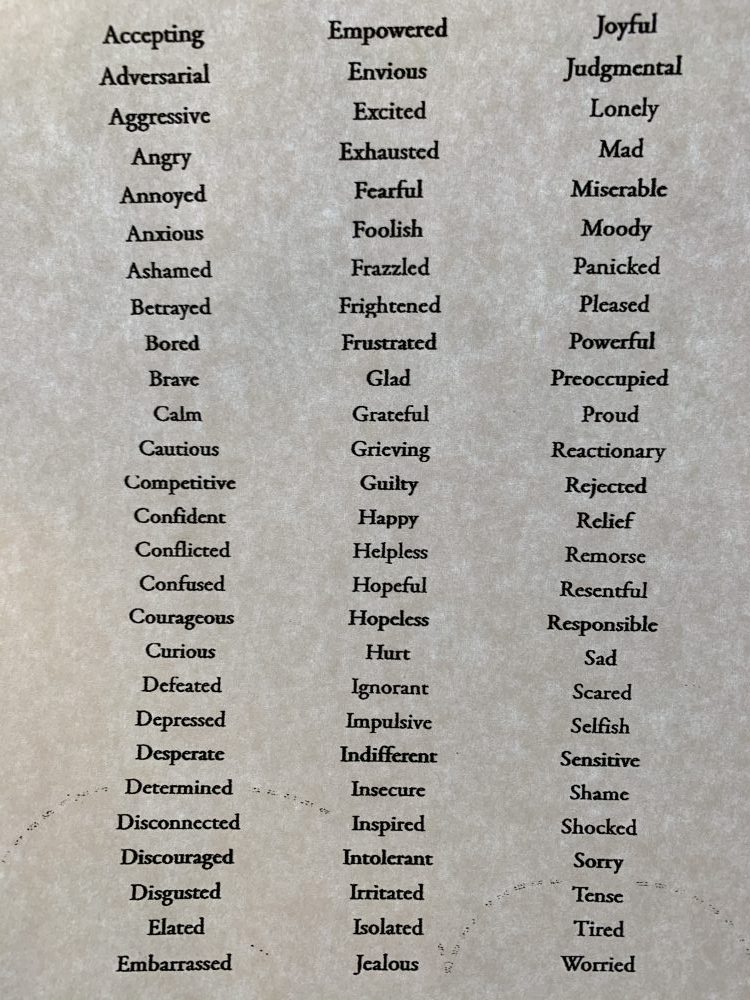
    In this episode, Brooks unpacks the many sources of grief and anxiety that people are facing and expands on the steps she recommends to identify and manage the challenges of the times. She discusses the idea of naming and acknowledging feelings to help release energy around them and shares a practice she uses with her clients using the painted rocks in the photos below.  

    She leaves listeners with a meditation that can be used daily to soothe and ground themselves as we collectively settle in for the long haul. 

    For further information about Brooks’ practice or services, contact holly@hollybrooks.com or visit her FaceBook page. 

    Resources mentioned:

    Brené Brown on “FFTs” in the Unlocking Us podcast

    “That Discomfort You’re Feeling is Grief” by Scott Berinato, Harvard Business Review interview with David Kessler

    List of emotions:

    A lengthy list of emotions Holly Brooks uses with her clients for a “thought download” exercise to help cope with anxiety and grief. (Courtesy photo)
  • Nordic Nation: Finding Balance with Maddie Phaneuf

    Nordic Nation: Finding Balance with Maddie Phaneuf


    On May 26, Maddie Phaneuf wrote a crisp and revealing blog post about her struggle with mental health issues after the 2018 Olympics. The blog post was titled Invisible Battles, and like many who suffer from a mental health crisis, her struggle was real but often difficult to discuss candidly. Phaneuf does a great service to the community by describing the symptoms she experienced and how she sought help from mental health professionals.

    Phaneuf was eventually diagnosed with Post Traumatic Stress Disorder or PTSD as a result of falling ill with strep throat during the 2018 Games and being unable to race. The myopic pursuit of excellence and fulfilling the Olympic dream took an unexpected turn in PyeongChang that left her feeling like a fraud. She questioned her identity as an athlete as she contemplated leaving the sport. The let down of being named to the Olympic team then falling ill and not racing precipitated a downward spiral for the now twenty-four-year-old. 

    “When we learn about PTSD we usually tie it with war veterans, so it’s not common for people to associate PTSD with athletes,” Phaneuf wrote in her post. 

    Maddie Phaneuf at the 2018 PyeongChang Olympics. Phaneuf used this image in her blog post and titled it “Before shit hit the fan…” (Photo: courtesy Maddie Phaneuf)

    In this episode, we speak with Phaneuf who has relocated to Lake Placid, New York after a stint in Boulder, Colo. She has since rekindled balance in her life and is pursuing a spot on the US Biathlon team. She also reflects on the importance of seeking professional help. That’s also a recommendation FasterSkier promotes.

    buy temovate online

    buy temovate online


    Here’s some advice from Phaneuf on finding balance and maintaining wellness that was included in her blog post:

    If you’re interested in non-therapy ways I’ve found help me feel more balanced and generally happy, here’s that list. Again, I’m not a health professional, if you’re struggling – talk to a professional.”

    1. Getting outside and exercising

    2. Less screen time

    3. Journaling my feelings

    4. Mediating or practicing Savasana

    5. Surrounding myself with people I love

    6. Getting enough sleep, eating well, and staying hydrated


    (To subscribe to the Nordic Nation podcast channel, download the iTunes app. If you have iTunes, subscribe to Nordic Nation here.)


  • Closing the Gap: Head Games

    Closing the Gap: Head Games

    Afternoon workouts at Natrudstilen Stadium in Sjusjøen, Norway. (Photo: Maks Zechel)

    Editor’s Note: The following is part of a series proposed by Maks Zechel, a 20-year-old Canadian cross-country skier embarking on his first season training abroad. In August, he made the big move to Norway, where he’ll be training and racing with Team Asker for the entire winter. Through these updates, Maks hopes to share his personal “observations, stories and lessons learned” to help close the gap between North American and Scandinavian nordic skiing. Previous posts: 1, 2, 3, 4, 5, 6, 7 and 8. 

    This particular post, entitled “Head Games”, is broken up into three parts.

    Part I: What Skiing Means to Us

    If you’re dedicated enough to be reading an online magazine about cross-country skiing, then you probably really love skiing.

    Don’t be too hard on yourself; I love skiing, too.

    The shooting range in Sjusjøen, Norway, as seen on Nov. 2. (Photo: Aleks Tangen)

    This post starts with a crisp day on skis just outside of Lillehammer on Nov. 2, 2017; a skier’s dream…

    I have never been to Wall Street, but I imagine it feels a lot like Natrudstilen Stadium in Sjusjøen*, Norway, at 9 a.m., two weeks before the season opener in Beitostølen. It’s barely below freezing, but the snow guns are blazing. They hum, interrupted by the BEEP BEEP BEEP of heavy machinery transporting snow, and a steady stream of skiers moving in every direction imaginable. You hear them, too: the squeak, WOOSH, squeak, WOOSH of tips biting into snow and carbon swinging through the air. It’s a bluebird day and the snow is rocket-fast. The sun barely skims above the highest peaks in the distance, but nobody looks up. Something much more important is on everyone’s mind today, and that is going fast on skis.

    My friends, Erland and Hedda, and I are doing intensity this morning. Dozens of others have the same plan, and Lillehammer Skiklubb (the biggest club in Norway) is running a time trial. It’s hard to tell what the biathletes are doing, as they always seem to be wearing bibs and going fast, but I jump out of their way regardless since they all carry rifles.

    The main loop is slightly under 2.5 kilometers long. No section of the track is ever empty and coaches give encouragement and feedback from all sides. There is a four-way intersection at one point on the course, which skiers approach at speed from both directions. Most people are too focused to acknowledge one another, except to tell someone to get out of their way or when they almost collide; it is chaos on a mission. Just the way that I imagine Wall Street, everyone is going about their business, and everyone thinks their business is most important. At times like these, it can be easy to lose sight of the fact that the reason we are all whizzing about this track today, is not just because of our individual goals, but because of our shared passion for this beautiful sport.

    The next evening I am back at Natrudstilen, enjoying the extra 3 k of trail that was prepared the night before. The sky is a big northern sky; the horizon is dotted with the silhouettes of stunted trees as the last strip of pink sunlight warms the remaining dark blues and purples fading into black above. The moon is full, huge, and slightly orange. The crisp air is more potent than coffee and makes skating around the glazed track effortless. When the sun is gone, the lights turn on. Dozens of skiers still churn out laps well past the 5 p.m. sunset, but it is much more peaceful than the morning bustle.

    As I ski by myself, a skier passes me in the classic tracks. He is wearing the Norwegian national team training clothes and skiing quite well, so I am quite sure he is not just a “Norges Skiforbund super-fan.” As he skis by, he pushes his strides over the short, punchy hill. He is not moving impressively fast, but by the way he moves I can tell that this is far below his competition speed. I should know who this is, but it is dark. As we crest the hill, I put my crazy-skiing-fan-sleuthing skills to work: I notice the telltale headphones, Leki poles, Fischer boots, and, the last piece of the puzzle, the initials JHK on his drinking belt. “OH S***, it’s Klæbo!”

    Norway’s Johannes Høsflot Klæbo in his debut race of the 2017/2018 season at the FIS season opener in Beitostølen, Norway, in November. (Photo: Maks Zechel)

    Over the top of the hill he relaxes his strides and glides slowly, drooping his head and letting his arms hang. He looks back and then walks over to the side of the trail to take a break. Johannes Høsflot Klæbo is the youngest person to ever win the World Cup Sprint Crystal Globe. He is also a human being who seems tired and feels the pressure of the oncoming ski season like everyone else. I may not be a World Cup medalist, but as with all skiers, I have the same good and bad days.

    The training season for a cross-country skier is long, never-ending really, with many skiers preparing for goals that are years away. How can we know that we will be ready to perform for a few minutes, or maybe an hour or more, in an event that is years away? Confidence takes many forms and comes and goes from moment to moment. The feeling that one gets in one hour of training can ruin the confidence that was built over weeks of perfectly executed workouts and races. It is an incredible skill to be able to have confidence in yourself throughout the ups and downs of training and day-to-day life and to have trust in a plan that must constantly be changed to respond to normal human imperfections.

    Why do we continue down such a path, where the tiniest bumps and setbacks in the road have such great control over our well-being? Some of the drive comes from the small daily joys: the sense of purpose, the goal setting, and the achievement of those goals. For myself, much of the joy comes from the places skiing takes me and the people that I meet, but the biggest drive comes from the special moments, those moments of complete contentment in life where everything else momentarily fades away. Sometimes they happen with others, but with the solitary nature of cross-country ski training, these moments often occur when you are on your own. It’s hard to see them coming, and for me they happen just a few times every year.

    Maybe it’s a ride to the race site with a car full of your friends, and that one song you all love comes on as you pass through the mountains. Maybe it’s 9 p.m., -15 ̊ degrees Celsius, and you’re sitting at a bus stop after a cold ski under the stars, about to make the journey home but the bus isn’t coming for another 15 minutes, when you remember to pull out your hot thermos of peppermint tea. Or maybe it’s an icy fast day on a Norwegian early season snow loop, and you just realized that one of the best skiers in the world feels just like you do.

    *Sjusjøen: pronounced “shoe-shun” (“shoe”, as in the footwear). For a more accurate pronunciation guide, please seek out a Norwegian.

    Norwegian Word of the Week:

    Norwegian: koselig

    Danish: hygge

    Translation: a feeling of coziness and/or contentment. E.g. drinking a mug of hot chocolate under a blanket next to the fire during a snowstorm; laughing with your friends; a fast day on skis when you feel like you could ski forever.

    ***

    Part II: What Skiing Does to Us

    Anyone lucky enough to have grown up cross-country skiing should know what a privilege it is to have access to such opportunities. Few people have the means to take up ski racing, whether it is for financial, geographical, or other reasons. Nonetheless, skiing manages to bring together people from many different backgrounds, uniting us with the shared love of being outside. Skiing, more than most sports, is something that sticks with you for life. I know many people that only started ski racing in university, including my parents, and for them skiing has remained one of the most important parts of their lives ever since. In North America, skiing is a sport that lacks the same intimidating atmosphere that sports like hockey and football sometimes have. It is easy to join a ski program no matter your level of experience. Skiing brings together a special community of people, but at the elite level it also begins to alienate us.

    Skiers are tough. We love how tough our sport is and we begin to encourage characteristics of toughness (at least to make sure children survive the elements of winter) in ski lessons at an early age. Skiers with the best “pain faces” are put on a pedestal by athletes and coaches because of how visible their effort is. Probably the most offensive thing you could tell a skier is that their rollerskis or skis are really fast; it is hard for skiers to admit that their performance has been aided by anything other than their own strength and technical abilities. In short, it is hard for skiers to admit they need help.

    The toughness of our sport makes us hesitate to acknowledge feelings that might make us seem weak, especially when we fail to reach our goals. Instead of asking for help, skiers compare themselves with those faster than them, and in that way blame their failures on the unchangeable characteristics that make them unique:

    “I need to look like a World Cup skier to be fast.”

    “I need to train more.”

    “I need to train harder.”

    “I need to lose 10 pounds.”

    “Am I just a slow skier who needs to work harder, or do I have a mental health issue?”

    The early days: little Maks Zechel (l) and his sister Anni skiing in Switzerland. (Photo: David Zechel)

    Many skiers get hooked on training at a young age. I started training at least four times a week when I was 11 years old; I did it because it was fun and I thought that it was the coolest thing to arrive at school and be able to tell my friends that “I ran 3 KILOMETERS this morning!” I haven’t changed much… But back then I could feel content, motivated and energized for the entire day just from that.

    Unfortunately, increased fitness and getting older make it harder to achieve the same satisfaction from running a few kilometers. I didn’t realize it at the time, but at 11 I was already becoming addicted to training. It took me until I was almost 20 years old to realize that I could no longer satisfy my mental health, to achieve contentment in life, through training alone. Some days it is enough, but other days I can train for 5 hours and finish the day feeling overweight and unfit. Sometimes it is hard to tell whether I feel unwell because I have eaten too much, or because I have barely eaten all day.

    It sounds ridiculous to call something that is “good for you” a mentally destructive addiction, but that in itself is part of the problem. Many athletes fail to gain control over their mental health issues because they don’t realize that they are sick. When somebody breaks their femur, they are told to stop training, recover and rest until they are healthy enough to train productively. It is harder to tell that someone is unwell when they are simply doing the things that are encouraged by our sport: excessive training, pushing through fatigue, gritting your teeth and working hard no matter how you feel. When one athlete races slower than another, the first thought of the slower athlete is that they have to train more and become fitter. Much of this culture comes from skiing itself, but we get a lot of it from team sports, where the motto is always, “if you’re not training hard, you may as well not be training at all.” But in endurance sports, where everybody is affected by training differently, sometimes training too much, or at the wrong time, or in the wrong way, can have the same effect on your fitness as you would have from training too little. Are you training to gain fitness or are you training to satisfy your confidence?

    When you train once or twice a day, it is easy to pretend that these issues do not exist, but when this schedule disappears, everything comes back to haunt you. I experience the most difficulty with my mental health at two, essentially opposite, times: when I race, and during the “off-month” of April.

    Racing is the amalgamation of months of rigorous training, obsessive motivation, and gasping with relief after hard efforts. Skiers take a leap of faith off of the start line, relying on all the confidence and focus they can muster to ski fast around a loop of snow in the woods. The race is exciting; it is also the origin of all your nerves, dreams and fears. In this place of vulnerability, even the smallest thoughts of doubt come to surface. It doesn’t matter if you gritted your teeth and pretended it didn’t exist for the entire year, your mental health is of utmost importance during a race, and it is essential to learn how to regulate it in order to achieve success.

    [Racing] is exciting; it is also the origin of all your nerves, dreams and fears.

    April is the period of rest and recovery craved by almost everyone at the end of a 3-5 month racing season. But for many it simply turns into the month of caving in to everything that we deprived ourselves of for 11 months: parties, staying up late, cramming in studying before exams, and being human for a change. Doing “normal” things? It’s the hardest month of the year, and every year I crawl my way to May 1st with desperation, more exhausted than at the start of April.

    This past April, I decided to face my mental health issues that I had always known existed, but never understood or recognized for what they were. What an awkward thing to talk about, mental health, but it shouldn’t be. Our minds have to be taken care of with the same attention that we give our bodies through training and recovery. It doesn’t matter what it is that makes you begin to acknowledge your difficulties, but it has to be done; it is grossly underestimated just how permanent unchecked mental health issues can be. I didn’t acknowledge my health issues because I cared about my health, but I did care that it was starting to affect the way I raced, and although not the most important reason, it was enough to motivate me to work on my mental “fitness.”

    Since moving to Norway, the issues I have had with my mental health have faded into the background. I’m too motivated and excited about where I am to think about such things. But it is still there, and the novelty of where I am will eventually wear off, and then I will have to be ready to deal with these things. It is important not to allow happy distractions to get in the way of how you deal with your mental health, because for every incredible high, there is a devastating low. It is better to take the time when you are feeling good to plan coping strategies, so that when you are hurting you can maintain your overall health in a way that is better for your success as a skier, and a person.

    Although ski racing at the highest level can seem like the only important thing in life, that level of racing can’t be maintained forever. For people who may have been training hard with a single goal in their head since they were small children, throwing them into the regular world can be an overwhelming shock. The skiing community needs to put an emphasis on not only producing elite skiers who will ski fast, but also on developing people who will be successful and healthy beyond their years in competitive sport.

    Norwegian Phrase of the Week:

    Norwegian: Uten mat og drikke, duger helten ikke.

    Translation: Without food or drink, even heroes aren’t good enough.

    ***

    Part III: Skiing Healthy

    We don’t get to choose the bodies and minds we are born with or the ailments that afflict us. But we can choose to learn about ourselves, talk to one another, and explore how we can be successful because of, not just despite, our unique personalities. Instead of struggling to get by in spite of what hinders us, thinking about our mental health should be seen as an opportunity to become better at the things in which we want to succeed.

    An evening run with teammates Erland and Eirik during Team Asker’s 10-day training camp in Mar de Pulpi, Spain, in October. (Photo: Erland Kvisle)

    People don’t understand how to talk about mental illness. If it’s in your head, then it’s not real, so get over it, right? When someone is functioning at a seemingly normal level on the surface, it is hard for people to recognize all mental illnesses as real issues. Excuses for unexpectedly poor races can be found everywhere, from eating the wrong thing for breakfast to having difficulty clearing lactate. For every race there’s a new excuse, something simple that can be easily improved on for the next race, but the subject of mental illness is never brought up. Everyone wants to hear the story behind your broken leg, but people have been taught to tip-toe around the subject of mental health. “Be considerate. Make sure you don’t offend him. She’s sick in the head. He’s really delicate. You can’t talk to her like a normal person.”

    Not everyone wants to talk about their mental health issues, but many need to. When I decided to try to improve my mental health, I was afraid to talk to others. I wanted to talk to someone, but I didn’t want to burden those that I care about with the things that I thought about myself. I am generally a happy person and I did not want people to see me as anything less than that. What I really wanted was to talk to someone straight up: “Hi, I’m Maks. I’m a happy person who loves life, but for some reason I often hate myself.” I didn’t want to see the scared or awkward looks in the eyes of those I care about as they struggled to look for something positive to say. I didn’t want pity. I didn’t want someone to tell me something positive. I needed to talk logically about what I feel, why I feel it, and what I can do to control those things.

    I desperately needed a third-party person, someone with whom I didn’t share a connection and with whom I could talk openly without affecting their happiness. This led me to seek the help of a psychologist.

    Seeing a psychologist isn’t like getting a flu shot. Part of my brain thinks in a certain way, and that can’t be fixed. I can’t hide or run away or fight it. What I can do is acknowledge what I am feeling and what it makes me want to do. Seeing a psychologist was a relieving experience for me. Instead of feeling an unclear jumble of emotions constantly tearing me apart, I could talk with someone about exactly what I felt and how I could be happy and productive in the face of how I felt.

    Spain sunsets (Photo: Maks Zechel)

    Now when I feel an incessant urge to train in a way that is unhealthy, I recognize that urge, I think about what it is that I want to do, and then I give that thought space to dissolve in my head. For my issues, it has been more productive to allow these destructive thoughts to enter my head and to think about them, rather than clenching my teeth, pretending that they don’t exist and training myself into the ground. I train out of need, but I also train because I love it. The key to finding a balance between my dependence on training and doing it because I love it has been to think about the driving force behind why I train each day. Categorizing the motivations behind my actions has helped me to do what is best for my health and progression as a skier. This allows me to think positively and rationally with focus. Allowing space in my head to understand why I feel the way I do has been more effective for me than beating these thoughts away with artificial positivity.

    If you’re reading this, then you probably really love skiing. It’s OK, I love skiing too, and I am happy to admit that it is one of the most important things in my life. But if I want skiing to continue to be a big part of my life, I can’t let it harm the rest of the person that exists beyond skier-Maks. Ski-racing careers can last a long time. I am lucky enough to have grown up around athletes and coaches who have proven that you can train and race for life, but in order to do that you have to take care of yourself. We skiers are competitive creatures, but acknowledging a mental health issue doesn’t have to mean giving up in defeat. The greatest skiers are those that understand their bodies, training, equipment, and minds the best. Each of our bodies is different, but that doesn’t prevent anyone from achieving their goals, and the same goes with our mental health.

    Norwegian Phrase of the Week:

    Norwegian: Gi drømmer en sjanse.

    English: Give dreams a chance.

    ***

    About Maks: Maks Zechel is a competitive cross-country skier who secretly wants to become a professional mile runner. He loves hiking and going on canoe trips with his family, as well as peanut butter cups in ice cream. Johan Olsson is his favourite skier and he hopes to race the Cortina-Toblach stage of the Tour de Ski one day. He enjoys writing about his experiences. Follow him on Instagram @makszechel.

  • An Open Letter About Depression in Competition

    An Open Letter About Depression in Competition

    Paul Everett racing at 2015 IBU Junior World Championships near Minsk, Belarus. (Photo: Jake Ellingson)
    Paul Everett (l) racing at 2015 IBU Junior World Championships near Minsk, Belarus. (Photo: Jake Ellingson)

    If you follow U.S. skiing closely, you’ve probably heard of Paul Everett. After three years on US Biathlon’s development team, Everett, 20, is currently a Montana State University sophomore and member of the Bridger Ski Foundation in Bozeman, Mont. He is studying exercise science and psychology, and wrote the following letter for an assignment. It’s about depression and anxiety in athletes, “more specifically ski racing about what it is like for those competing with these disorders and ways in which athletes and coaches can help with these mental conditions,” Everett wrote in an email to FasterSkier. “I offer this letter … to spread awareness or help other skiers with similar struggles.”

    ***

    Dedicating one’s life to a sport can fittingly be described as near insanity. As complete insanity is defined as doing the same thing over and over again expecting different results, an athlete’s job description nearly meets that criteria, but with at least showing the smallest increments of improvement each time. To compete at the highest of levels in any sport, an athlete needs this narrow, single-sighted vision of reaching their optimal best, and doing only that which will help them achieve this goal. For some this mindset comes easily, but for others like myself, this near insanity that is required of athletes may not always coexist with their own mentality. Much of my life I have suffered from depression and anxiety. Each time this struggle rises, I have always gone to skiing as a way to cope with this mental disorder. While skiing has done tremendous improvements on my mentality towards life and understanding of what it takes for me to be happy with myself, the competitive side of ski racing can take an emotional toll on anyone, especially those suffering this condition.

    For a disorder that affects millions of people, including many athletes, its severity is not always recognized for the damage it can do. Living with depression, energy and motivation seem to drain at even the smallest of obstacles. While thoughts are occupied on unrealistic concerns or perspectives, much of what once brought joy now fades to empty routines. The ability to see the positives of accomplishments is replaced with highlighting the faults within them. It is this voice within the head demanding one’s self to quit, but never itself going away. Though exhausting, these symptoms are not what stop me from racing. While I can quiet this voice much of the time through skiing, it is only when I am faced with expectations of success in racing that my anxiety strengthens these destructive tendencies.

    As a product of depression, you let yourself down countless times by not reaching the impossible standards you set yourself up to attempt. That pain may numb after a while, but the additional anxiety from letting down others cheering you on is what becomes unbearable. Competing with the heavy weights of depression and anxiety on your shoulders can become a crippling task. Trapped within your own head without a filter, negative thoughts become a constant stream for days leading up to a race. Self-esteem is lowered with every comparison of your vulnerabilities to another athlete’s strengths, and when time does finally come to leave it all out there, your only wish during the entirety of the course is to just be on the other side of that finish line. No matter the outcome, be it standing on the podium or the last page of the results, the anxiety always takes its toll.

    Depression and anxiety are a tradeoff pair, both taking turns quieting the other, but also taking turns gaining control of your life. As anxiety acts as a distraction from depression, it is one that only heightens the inevitable fall of the melancholy to come. Being physically and mentally exhausted after a weekend of racing is the perfect time for depression to surface. You need a break like anyone after a hard effort, but this break when left alone makes you susceptible to that retuning voice in your head. Now without the distraction of skiing or the energy to combat it, the voice can take ahold of your thoughts, dragging you once more to your lowest point and letting you surface only when the next race comes for anxiety to take its turn.

    As the years have passed with this disorder, I have learned new ways to help deal with this voice and the thoughts that come with it. While the voice may always be there, distractions and acceptance seem to be what aid me the most. Finding anything productive to do in order to keep my mind from wandering to these thoughts is the most efficient way I am able see positive changes in my mood. This is a disorder that thrives on isolation. To have the company of others I closely regard not only distracts myself, but brings an uplifting environment that can carry with me long after. While this companionship may not always be offered when I need it, finding acceptance is another tool used to great degrees of success. Anxiety is a product from fearing the future’s unknown. By doing what I need to at this moment to ensure the best future for myself and accepting the things I cannot change, there should be no reason for my fear to take ahold of me. Of course more easily said than done, these ideas are things I am still working out for myself today, and hope anyone reading this as well can gain from.

    “Anxiety is a product from fearing the future’s unknown. By doing what I need to at this moment to ensure the best future for myself and accepting the things I cannot change, there should be no reason for my fear to take ahold of me.”

    Depression is not something that will be relieved permanently from my life. That negative voice will always be there, but there are things I can do to quiet it. This letter is not only written for my own benefit, but for any athletes or coaches of athletes who share this burden with me. I have seen positive improvements from my own life by sharing my feelings with family, therapists and coaches. It is not something that should be hidden from others. As like any disorder, one needs support if it is to be managed properly. To the athletes, please shed light of your feelings to your family and coaches, so they can do their own part as well to help. Seek a therapist before you think you even need to. There are therapists out there that can do unbelievable work. It is something that can never be done too soon, and could possibly save your life. To the coaches, if you see your athlete show any signs of abnormal moods or behavior, it is your obligation to talk with them in an appropriate manner in order to know what the best choice is for their health. An athlete’s wellbeing takes priority over any race, and if that means taking time away from skiing in order to address changes that need to be made, so be it.

    I have come out the other side of dark times brought on by this disorder, with a great amount of work still to come. Although I cannot completely prevent others from the reality that is depression, I do have the ability to spread awareness and provide tools to those and their supporters who need it most. There is no reason for you to fight this on your own. Skiing has never only been about competing, but more importantly about having fun, and it’s hard to be sad with a smile on your face.

    Former US Biathlon development skier Paul Everett (Methow Valley Biathlon) racing in December 2014.
    Former US Biathlon development skier Paul Everett (Methow Valley Biathlon) racing in December 2014.
  • It’s All In The Mind: Mixing Sport Psychology with Skiing

    Jessie Diggins (U.S. Ski Team) racing to fourth in the women's freestyle sprint qualifier at Stage 3 of the Ski Tour Canada in Quebec City. She went on to place 13th after a crash in her quarterfinal. (Photo: FlyingPointRoad.com/NNF)
    Jessie Diggins (U.S. Ski Team) racing to fourth in the women’s freestyle sprint qualifier at Stage 3 of the Ski Tour Canada in Quebec City. She went on to place 13th after a crash in her quarterfinal. In an interview earlier this month, Diggins said her reliance on sport psychology has helped her make gains, especially in her consistency last season. (Photo: FlyingPointRoad.com/NNF)

    At the 1964 Tokyo Summer Olympics, Billy Mills was America’s best hope in the 10,000 meters: a 25-lap race of high-turnover running coupled with a Grandmaster’s chess match worth of strategy. Coming into the Games, Mills was an outlier. In other words, he was not considered a medal contender; he’d need to improve his 10,000 time by nearly two minutes to contend for the podium.

    In an archival video from Tokyo, around 1:15 in, the television announcer makes subtle note of Mills.

    “Billy Mills is right in there for the U.S., a man no one expects to win this particular event,” the announcer said at the time.

    A minute later we see Mills and world-record holder, Australian Ron Clarke, running one-two — jostling, throwing elbows with fewer than 400 meters to the tape. One particularly robust shot from Clarke almost trips up Mills. About then, third-place runner, Mohammed Gammoudi from Tunisia, pounces. He’s a blur as he accelerates between Mills and Clark.

    It appears Mills is a bronze-medal lock. Gammoudi, chased by Clark, drop Mills by five meters, the finish only moments away.

    Billy Mills (Oglala Lakota), far left, crosses the finish line in first place during the 10,000 meters at the 1964 Olympic Games in Tokyo. (Photo Official Marine Corps Photo # A411758)
    At far left, Billy Mills, of the Oglala Lakota (Sioux) Tribe, representing the U.S. as he crossed the finish line first for the gold medal in the 10,000 meters at the 1964 Olympic Games in Tokyo. (Photo Official Marine Corps Photo # A411758)

    Mills’ story is well documented. His belief in self, his ability to mentally break down an epic distance into small discrete moments, helped him close the two-minute gap he once faced. Mills later said, in this video, that he started to think about how he’d first decrease his time by 25 seconds. He concluded that simply holding a faster pace for one second longer per lap would do the job. Afterall, it’s a 25-lap race. Mills’ logic followed that a 50-second decrease would require the faster pace for two seconds longer per lap. 

    A simple pattern and a simple remedy, but not such a simple plan to execute on the Olympic stage.

    On that day in 1964, Mills set a remarkable personal best as he outsprinted Clark and Gammoudi for the gold.

    Sport is inherently measurable. At its most basic, there’s the win or the loss. In sports like cross-country skiing, where there’s one winner, most athletes fill in the ranks from second to, say, 50th. Yet, the non-winners still strive. They train. They attempt to fine-tune their “engines” for a window of elite performance that may last only a few weeks annually or even a single race. All this in an attempt to decrease the physical performance gap between themselves and the winner.

    Still, sometimes that’s not enough for the breakthrough. Using Mills’ example, he’d say the mental piece was the breakthrough.

    Rich Gordin, a Utah-based sport psychologist, asked this author to watch the Billy Mills clip. It’s also something he’s recommended to many top nordic athletes. Through his first foray into psychology and sport in the ’70s with the University of Utah’s women’s gymnastics team, perennial NCAA champions, to his work with the 2010 Olympic-medal-winning U.S. Nordic Combined Team, Gordin remains bullish on psychology’s place in sport.

    Yet Gordin says many elite athletes are reluctant to seek the help of a psychologist.

    “Most of the endurance runners and cross-country skiers are primarily, I think, initially most interested in their physiology,” he said. “I can put somebody on a treadmill and I can tell you their VO2 max, I can tell you their lactate threshold, I can tell you biomechanically exactly how your skis are and where your poles are.”

    Sport psychology, Gordin admits, is less data-driven.

    “Why is it not utilized as much is because you cannot see it,” he said. “It’s harder to measure. Cross-country skiers are very much like endurance runners. When you bring a sport-psych person in, a mental trainer, they don’t really get it … because they think it’s all physiological; ‘if I’m physiologically able to pound someone into the dirt, that’s all I need.’ ”

    Initially, Gordin needs to establish athlete buy-in. That, he said, begins with the basic belief system. In this case, the idea that an athlete believes they can accomplish a specific goal.

    “And it’s not a fake thing. It’s not a little red choo-choo train, ‘I think I can I think I can.’ That’s superficial. It’s a start, but it’s not enough,” he said. “I’m talking about anybody I’ve ever worked with. And when these people finally flip the switch — I call it flipping the switch when it happens — it clicks. You have to believe you belong there.”

    “It’s not a little red choo-choo train, ‘I think I can I think I can.’ … You have to believe you belong there.” — Rich Gordin, professor at Utah State University and sports psychologist

     Sophie Caldwell (U.S. Ski Team) racing to 22nd in the women's freestyle sprint qualifier at Stage 3 of the Ski Tour Canada in Quebec City. (Photo: FlyingPointRoad.com/NNF)

    Sophie Caldwell (U.S. Ski Team) racing to 22nd in the women’s freestyle sprint qualifier at Stage 3 of the Ski Tour Canada in Quebec City. (Photo: FlyingPointRoad.com/NNF)

    The current U.S. Ski Team has flipped the switch — top-10’s at the World Cup level are almost expected, podiums a realistic goal. Let’s take the 2016 Tour de Ski as an example. The U.S. women’s team scored two World Cup stage victories — starting with Sophie Caldwell in the freestyle sprint and Jessie Diggins in the 5 k freestyle individual start.

    Pam Lemons is a Park City-based sport psychologist employed by the U.S. Ski & Snowboard Association (USSA) counseling cross-country and mogul skiers, and non-snow athletes like golfers, lacrosse and soccer players. She’s one puzzle piece that has allowed the U.S. women’s nordic team to believe. Lemons said that belief, and the reality of consistently performing well has been created incrementally.

    A psychologist for multiple USSA teams, Lemons emphasizes core mental practices for effective physical athletic performance. She teaches skiers to communicate, set clear goals, and practice purposefully. Purposeful practice, Lemons explained, makes effective and efficient use of the athlete’s time.

    “So when you go out and you are doing double-pole intervals, you don’t just go out and wing it,” she said. “You have a very specific goal in mind for that particular day, and the whole premise — and I try to get the athletes to understand this — is if you just go out there and wing it, then you are not building upon the structures that are going to make you better.”

    The mental training Lemons prescribes also places a premium on journaling.

    “The journaling allows for a record. We are looking for trends so we can if we see that there is a trend in behavior. Then we know, especially in cross-country, when they get so tired and their energy output is great it could be that, ‘Oh my gosh, I noticed that at the end of the camp that I’m not as successful at double poling or sprinting.’ Maybe they are tired. We will be able to see that from a mental standpoint and from a physical standpoint. Much the same as you do training journals. It is a training: it’s mental training.”

    In the journal, Lemons asks that athletes document specific goals. She calls these goals “OFI’s” — Opportunities For Improvement. For example, if a skier is focusing on striding, they outline that as a journal entry.

    “And they might say, ‘Today my training went really well. I felt strong. I felt like my technique was excellent, but my kick wasn’t what it should be,’ ” she suggested. “ ‘And so the kick then, tomorrow when I do my training, I will focus on sending my legs,’ or whatever they need to do, they will have a specific technique that they may work on.

    “I have them document that, and then at the end of the week they can determine whether or not it was successful,” she continued. “And maybe they did something really, really well and they didn’t do something as well. That’s an OFI — they then become the goals for the next day or the next week.”

    The journal becomes part-training log and part-guide, a reference for each athlete to discover where they have been, where they’d like to go and how to get there.

    Lemons had this anecdote about why journaling is effective. “I had one athlete at a camp, and she came back from the camp and she said it was a horrible camp. I said, ‘Really? Tell me why.’ ‘Oh my gosh, it was the worst camp ever … I didn’t do x, y, and z.’ And I said, ‘Well, let’s see what the goals were for that camp? Let’s just look at it and see what you were planning on doing and what you did.’”

    The athlete fortunately had a written record — the OFI’s and the goals — to cross reference.

    “‘Did you meet goal number one?’ ” Lemons asked. “ ‘Oh yeah, I did.’ ‘Did you meet goal number two?’ ‘Oh yeah, I did.’ The reason she said the camp was awful was because the last day she was stinking it up. In her mind, all she remembered was that last day. Because she journaled, she really then changed her whole reflection about that camp.”

    The skier was able to understand she was, in fact, moving closer to her overall goals. In this instance, the journal can be a safety net. According to Lemons, here’s why: humans have a tendency to recall, say during a weeklong training camp, the first and last things that occurred.

    “It’s called primacy and latency,” Lemons explained. “You don’t want to leave your reflection to your memory. You want to be able to document these things.”

    The journaling allows athletes to thwart our wiring for primacy and latency, allowing them to see the bigger picture and discrete trends.

    Sport Psychology at the National Level

    Chris Grover, head coach of the U.S. Cross-Country Ski Team, has been part of the team’s coaching staff since 1999. He took a two-year hiatus in 2004 and has been with the national team since 2006. During his tenure, he’s seen sport psychology become more fully integrated into the team’s methodology.

    Grover noted that he’s witnessed a simple yet critical change: the increased number of providers available to U.S. Ski Team athletes.

    “When I began working for the national team again in 2006, we were looking at one provider for the entire team in kind of one-size-fits-all strategy,” Grover said. “And now we are using one, two, three, four, five, I believe five different providers for the team. People can find someone that they really click with, someone that they like to work with.”

    According to Grover, like any group, the needs of the team are varied. As a result, the team does not use group-wide sessions as a regular practice. It’s up to the athlete and provider to do what works best.

    Grover said he does intervene when the situation arises.

    “Where we do interact is [when] we are seeing behaviors or lack of skills or what have you with an individual athlete and we are talking about that with them and then encouraging them to discuss that topic with their provider,” he said. “We are talking directly with the provider in order to make sure the athlete is getting those needs attended to.”

    North of the border in Canada, the understanding that sport psychology should hold a firm place in coaching and mentoring nordic skiers is not lost on Justin Wadsworth, Cross Country Canada’s head coach for the last five seasons. (Wadsworth was interviewed for this article before he stepped down from the position this spring.)

    One key difference between the Canadian and U.S. models are the number of providers associated with the Canadian program.

    “We have one team sport psychologist that works with the whole team, and then he is available to work individually as well if it was a match,” Wadsworth explained. “If they choose to go outside our team sport psychologist, we ask them that if they work with a psychologist to make sure that that psychologist is working with our team psychologist so at least things are getting downloaded and there are notes being taken and referenced back to our team sport psychologist.”

    Wadsworth’s belief in sport psychology is profound. His wife, multiple Olympic medalist Beckie Scott, worked personally with noted sport psychologist Terry Orlick.

    “I saw it with my wife,” Wadsworth said. “It was night and day when she started working with Terry Orlick. Though her gains with him, it was, I would say, life changing or career changing.”

    At the same time, that close-to-home success story sometimes led to frustration.

    “I’ve also seen those athletes that I know for sure could be in the top 30 and it’s all mental,” Wadsworth said. “And that’s the most frustrating thing because you really try to get people to work with a psychologist. But again, it’s not one of those things you see benefits from right away, and it’s really hard to show small progress. So its really, really tough. I would say ninety percent of our team needs real hardcore sport-psychology work. And about ten percent of that ninety percent is actually doing it right now.”

    Wadsworth said large budget cuts prevented him from fully implementing team wide use of sport psychology. But at the top end of sport, Wadsworth believes sport psychology remains a game changer.

    “It’s probably more important than the physical training,” he said. “Any monkey can do the hours and the work, but to have the confidence and the confidence to rest and have the confidence when you come to the winter and have a game plan, all that stuff just doesn’t fall in your lap. You have to work on it.”

    The Junior Scene

    For some, perfection is a carrot. Yet a lack of perfection is something most junior skiers — arguably the most important part of any development pipeline —  know well. There’s the expectations of coaches, peers and parents, all of them constantly wired to as-it-happens results. Add that mental pressure to a junior skier’s changing body and it’s no wonder some coaches turn to sport psychology.

    Josh Smullin, head coach of the Steamboat Springs Winter Sports Club’s U20/U18/U16 cross-country teams, holds a master’s in sport psychology. Smullin has provided psychological-skills training to athletes of all disciplines at the Winter Sports Club, and he asserted those skills can help improve an athlete’s performance.

    Josh Smullin, Head Nordic Coach at Steamboat Springs Winter Sports Club, directing a fall workout in Steamboat Springs, CO. (Courtesy photo)
    Josh Smullin, Head Nordic Coach at Steamboat Springs Winter Sports Club, directing a fall workout in Steamboat Springs, CO. (Courtesy photo)

    One common issue Smullin has grappled with recently is helping his junior athletes navigate the different rates at which teenagers develop muscle. Watch any boys’ U16 race and you’ll see some kids honed and toned, while others remain sinew and bones. Smullin said he has encountered this with one of his most driven athletes.

    “That’s a really challenging thing, when you have an athlete that doesn’t develop early and they are getting beat by guys that don’t, say, train as much as them or have as good of technique,” he explained.

    As he counsels athletes, Smullin highlights a core tenant of sport psychology: “Focusing on the things they have control of,” he said. “That’s perfecting their technique, utilizing what they have as their strengths. For instance, I have a small guy who can really climb well. Maybe they are going make their make their move on the steep hill that the bigger guy might not be able to. Maybe all his muscle and his mustache will not be an advantage.”

    Facial hair aside, keeping all kids in the sport remains a goal. Smullin says he emphasizes the long term.

    “Keeping the kids that are getting beat just because of their size motivated,” he said. “And showing them that you believe in them. At some point down the road, they are going to make that jump, and when they do, they are going to have all the other skills developed.”

    The timing of physical maturity, however, is a two-sided equation.

    “It’s also a major challenge to coach the kids that mature early, and I was one of them,” Smullin said. “They develop a mindset, ‘Oh, I’m just better than all these kids’. They don’t learn to associate hard work with what leads to their success; they just think they are better, and they are for a little bit because they are bigger and stronger and have more testosterone. But the problem for them is, the only reason you are faster is because you developed a little faster. These guys are fighting right below you, getting the better technique and doing whatever it takes to keep up with you right now, so that’s the other side of it.”

    The pipeline from the junior ranks to the World Cup constricts as skiers age. The competition gets tighter, opportunities more difficult to achieve. Some athletes slow down, some get faster. Winning and losing are part of the learning experience. As clubs are responsible for developing athletes that can stay in the game, perhaps placing a premium on mental training along with logging hours makes the most sense. Yet with juniors, it’s a balancing act.

    Smullin admits, kids are already taxed. Realistically, sport psychology does not allow juniors to supplant training hours with mental training.

    “Ultimately, we have to prioritize the time we do have with the kids, and some of these programs, we take a lot of their time and they have busy lives,” he said as he considered how athletes try to fit it all in.

    Even with his psychology background, Smullin believes the greatest benefits sport psychology provides may come on the latter end of a junior skier’s race path. Smullin recalled the skier who remains a late bloomer.

    “Let’s say that kid has to be in the sport and stay in the sport to have any chance,” he explained. “Second thing, they have to do the training. That’s the most important to even have a chance. Sport psychology can’t just overcome someone who trains 400 hours beating someone who trains 600 hours. Where sport psychology will likely make the biggest difference in terms of performance is when somebody is at the top level and all the fitness and the skills are so close — how are you going to beat somebody who is very similar to you and gain that extra 20 to 30 seconds?”

    The International Scene and Mental Management

    Jessie Diggins, of the U.S. Ski Team (USST) and Stratton Mountain School (SMS) T2 Team, racked up 16 top-10 World Cup results this past season, including five podiums and a career-first World Cup win. Posting consistent results and hyped as a podium threat throughout the season is a good problem to have. Yet success brings with it expectations and intense pressure.

    Diggins, 24, has worked with the same sport psychologist since she joined the USST five years ago. Along the way, she realized that mental training is as important as her raw skiing speed. One aspect of mental training she cultivated is her ability to compartmentalize pre-race jitters. She calls it, “taking the nervous butterflies and making them fly in formation.”

    Diggins clarified over the phone that stress is not always a negative.

    “That’s not to say that all stress is bad stress,” she said earlier this month. “[My psychologist] has helped me learn that when I’m nervous before a race, to see that as at a sign that I am ready. You wouldn’t be nervous if you didn’t have a chance. So when I get those pre-race jitters, instead of being like, ‘Oh no, I’m wasting all this energy,’ I embrace it. This is my body telling me it knows something big is about to go down. It knows I am ready. It knows that that I’ve prepared.”

    Beyond pre-race anxiety management, Diggins said she has learned to separate racing goals from results goals.

    “You might finish a race, and you might think, ‘Wow, that was a kickass race. I felt completely together,’ and then you look at the results sheet and you are like, ‘crap,’ ” Diggins said. “So one thing she has helped me is to not simply put a number on a result sheet. To evaluate my performance independently from what anybody else thinks. Maybe my goal was to be super calm testing skis because I know it is going to be a tricky klister situation and I want to be super efficient and not be panicky. If I’ve accomplished that, then I can feel good about what I have done that day regardless how the race went.

    “That is one way to keep the pressure of feeling like everyone is expecting me to get top-five in this result, or I’ve podiumed on this course before, what do I do? You just break it down into smaller goals for the day and you evaluate yourself on those goals, not on results.”

    The U.S. women placed a historic second for their best-ever relay finish on Sunday at the World Cup 4 x 5 k in Nove Mesto, Czech Republic. From left to right: Jessie Diggins, Sophie Caldwell, Sadie Bjornsen, and Liz Stephen. (Photo: Fischer/NordicFocus)
    The U.S. women placed a historic second for their best-ever relay finish on Sunday at the World Cup 4 x 5 k in Nove Mesto, Czech Republic. From left to right: Jessie Diggins, Sophie Caldwell, Sadie Bjornsen, and Liz Stephen. (Photo: Fischer/NordicFocus)

    It’s a rare athlete who finds themselves unchallenged over the course of their career. Diggins’ arc was on an upswing this season while her U.S. teammate, veteran Liz Stephen, who prevously had been punching the accelerator full gas, experienced a deceleration. Stephen’s 2014/2015 World Cup campaign was stellar; she finished the season ranked seventh in the distance overall and 10th overall on the World Cup — both career bests.

    “I came off one of my best seasons ever, last spring, and I was really inspired and psyched,” Stephen, 29, said over the phone earlier this month.

    But back at her training base in Park City last summer, she reflected that perhaps at times she became a bit overambitious with her training load.

    “I think that I kind of hit a stalemate in terms of my mental enjoyment of the sport,” Stephen said. “At some point I didn’t know whether I was just so burned out mentally that I felt tired all the time or whether I was tired and I felt bad mentally. I think they are kind of hand in hand and it’s hard to tell which is which. But at some point, you kind of realize that this is not the mental state I want to be in.”

    Stephen explained she never really could pull up from her perceived performance nosedive except during team relays on the World Cup, where she said, “I have a sense to be be able to forget my own issues because it’s for somebody else.”

    Her ability to suffer for others paid off — the two World Cup relays in 2016 amounted to a third place followed by a best-ever second place for the U.S. women. And in the final stage of the Tour de Ski in Val di Fiemme, Italy, Stephen busted out a prime solo performance as she posted the second-fastest climb time up the Alpe Cermis. She finished the Tour in 19th overall.

    Beyond the relays, Stephen’s evaluation of her season was blunt: “When you stack yourself up against you, sometimes you are your biggest enemy out there,” she said of her inability to breakout. “And I found that it was really hard to get out of my own way this year.”

    Despite the harsh self-assessment, Stephen was still nominated to the A-team — at season’s end, she was 28th overall on the Distance World Cup. But she still considered the season below her expectations.

    “All of a sudden I’m at the older end of the spectrum,” she said. “And I think that the sport has gone from being just this happy-go-lucky, fun, ‘I ski because I love it’ thing, to why am I doing this? And what is the purpose of being 29 and pursuing a medal or whatever it is that I am pursuing? The thought now is kind of, ‘I need to restructure why I am skiing. What is my purpose in the sport? Why is sport important be it skiing or anything else? And what am I setting out to do?’ … I spent the year doing what I should’ve loved to be doing and just not being able to do it the best I could because I was too worried that what I was doing was not meaningful enough, and that’s not the way I want to live my life.”

    Heavy questions — questions with no immediate easy answer for an elite athlete trying to reset for the 2016/2017 race cycle.

    Stephen stated several times that her goals in life are simple: to live an inspired life, live a meaningful life and to try to give other people meaning and purpose in their lives, too.

    “It’s really easy to to think that what you are doing is not affecting others and that’s really hard for me to swallow,” Stephen said.

    Fortunately, Stephen’s dilemma is not hers to solve alone.

    “I think that the psychologist helps the athlete figure out why they are doing what they are doing so that then they can work backward and say, ‘OK, if your purpose is to inspire people, how are we going to take that feeling of purpose because somehow a medal doesn’t do it for you … in terms of like a goal? … We want you to figure out how to purposefully live this skiing lifestyle for the next two years in a way that in turn can get you to perform to your highest ability,’” she observed.

    Stephen acknowledged her life as an elite athlete remains a gift. Yet staying positive when results don’t come is downright gritty mental work.

    When asked how confident she felt looking at an 18-month grind ahead of the next Winter Olympics, she replied, “I think that it depends on the day you ask me, honestly. Right now I don’t feel invincible. I don’t feel confident. … Right now, if I had to suit up, the fitness is not there and I know that. The part I love about this, or part of it, is the training. Like I tend to overdue do it, because I just love the training, it is why I am involved in sport and the community and that’s what got me in it, that’s why I’m still doing it.”

    In cross-country skiing, success is measured in seconds. Maybe that’s the margin for a training-camp invite or a European race trip. As sport psychology becomes more readily available and a greater part of the success equation, mental training may become as routine as checking the HRM and uploading the data to a training log.

    Helping athletes stay positive, reflective and making their endeavors meaningful can be a struggle at any level of competition — Bill Koch League through the World Cup. Sport psychology appears to be another tool to make improvements and balance success and perceived failure.

    Lemons, the USSA psychologist, had these parting words as she questioned why sport psychology wasn’t more of a regular part of sport, “If you can even improve a little bit, if you can maximize your opportunity, why not?”

  • Why Skiing? How A Sport Saved My Life

    Why Skiing? How A Sport Saved My Life

    About the author: Scott “Bjorn” Cummings is a Postbaccalaureate student working towards his Academic Behavorial Strategist K-12 (ABS) Special Education License at the University of Minnesota Duluth. When he is not in school or on the ski trail, he enjoys biking, reading, cheering on the Minnesota Twins and cooking.

    After completing my second American Birkebeiner this year I asked my old mathematics professor and current mentor Lawrence Gray: why did skiing make such a positive impact on my life?

    He himself had run marathons and was a block from the finish line when the backpack bomb went off during the 2013 Boston Marathon. Point is, he knew the dedication that endurance sports demanded and how it translates into success outside of training. For a man who works daily at the University of Minnesota solving abstract mathematical proofs, he put it simply.

    “A couple of reasons:  Having a healthy passion outside of work helps keep things fresh. 

    Preparing for something like the Birkie forces you to structure your life and builds discipline. 

    Having something to talk about (besides work) gives you confidence and makes you a more interesting person. 

    Doing something regularly for your health supports everything else in your life.”

    -Lawrence Gray

    If I’d heard that math professor’s words before, maybe I would have picked up skiing much earlier. I wouldn’t have guessed it in the beginning as a flailed and crashed on my skis, but cross-country skiing was what would give me confidence and happiness in a dark time of my life.

    I got a call center job post-graduation.
    I got a call center job post-graduation.

    After graduating from the University of Minnesota with a degree in mathematics, I was lost both professionally and personally. I moved back home to Chanhassen, a Twin Cities suburb, and lived with my parents. I enrolled in graduate school for math education but soon dropped out after finding that the program and timing was not a good fit.

    I made a half-hearted attempt to pursue my other passion, baseball, as a career. I landed a couple interviews with the Minnesota Twins for internships but none panned out. Both anxiety and coronary heart disease ran in my family and then surfaced in my own life. At 220 pounds, I was overweight and worried about my next step. And at 22 years old, I was a part time math tutor, still living at home with my parents and actively searching for a full time position.

    After about a year of searching, I landed a temporary full-time job that didn’t even require a college degree. It was at a call center for MNsure, the Minnesota Health Insurance Marketplace. It was a start. Soon after I began to work, however, I realized that job was extremely toxic and a dead end. But that is another story.

    To be honest, I missed working with kids and needed a new fiery passion. At that point I was out of shape, overweight, and in a job I hated. Little did I know just how much skiing would ignite my life.

    *        *        *

    As a child, I enjoyed downhill skiing once a year with Boy Scouts, on winter field trips with school, or with other groups. But as an adult I couldn’t justify the startup cost of equipment or lift tickets to get into the sport. I never cross-country skied in high school. Classic skiing seemed to boring to me. In general, I was more interested in watching sports than playing them.

    My introduction to cross-country skiing came later. As an undergrad, I studied abroad in Birmingham, England for a two-week January term class through the University of Minnesota-Duluth called “History and Soccer.” Since I would be across the pond anyway, my parents suggested that I visit my aunt, uncle, and cousins in Norway for a week during Christmas. While there, my cousin took me classic skiing in the mountains.

    In my family's homeland!
    In my family’s homeland!

    I was so scared that I only skied one kilometer. My uncle gave me a chocolate bar on the trail and took me out for porridge and hot chocolate afterwards. For my Norwegian Christmas, I received a Bjorn Daehlie ski jacket and pants, with a red Swix VR70 Klister wax hat.

    After Norway, it turned out that I kind of liked skiing and the gear that comes with it. Plus, my family had a history of skiing. All four of my aunts and my even my grandmother completed the Korteloppet in the late 1970’s and early 1980’s. But only my Uncle Mike had kept up the annual pilgrimage to Hayward, Wisconsin, for the American Birkebeiner since then.

    “The endorphins are free,” he would always say about skiing.

    Currently he has finished 29 Birkies and is another mentor of mine. Any question I had about the sport I could always ask him. In his basement, he had racing bibs from just about every race he completed in his career. As a kid the shrine seemed foreign to me, and somehow like the man version of a funny wall quilt. But really, I needed someone to teach me the basic skate skiing technique.

    The next winter on a beautiful weekend afternoon my parents said they were going skiing to Carver Park with my Dad’s old work colleague named Jack.

    He was 70, addicted to skating, on no medication, and said he actually lost weight in the winter. I was curious to his secret.

    But I also had no clue what to I was doing on skis and the difference between skate and classic skiing. I loved to go fast and just glide on the snow, even though my basic technique was duck walking: stepping on the left and the right without any weight transfer.

    I needed encouragement to keep me positive while trying to learn actual technique. Jack needed someone to ski with. It was a good match and he became my unofficial ski coach.

    Jack saw my Bjorn Daehlie jacket and pants coined the nickname Bjorn for me. One day at Hyland Lake Park Reserve, with my all Norwegian gear and Scandinavian blonde hair and blue eyes, we convinced a Three Rivers Park Employee that I was from Norway. All I did was nod and quetly say yes quietly. The nickname Bjorn stuck. I started to grasp proper skate technique, and more importantly, to have fun.

    *        *        *

    But I remained out of shape and overweight for regular ski racing.

    Baker Shaker 20k - Scott Cummings
    Here I am before my first ski race, the Baker Shaker 20 k.

    Slowly but surely, I bought some of my own equipment. There was some end-of-the-year sale, where I bought Fischer RCRs and some poles on the cheap; boots at a ski swap; lobster claw gloves, which were hand-me-downs.

    Yes, cross-country skiing is expensive. But once you have your base gear, it’s not so bad.

    I realized that I like skiing and that it was an excellent way to fight anxiety and heart disease. I liked the endorphin high I got after a long ski, the feeling of gliding on the snow, the way it brought you out with nature, the camaraderie with fellow skiers. And, of course, skiing fast.

    Just like as a kid at the downhill ski slope, I wanted to go fast. But going fast on skate skis was not as simple as running. You needed the technique. So it began: the never-ending challenge of finding a great technique and maintaining my fitness. I was determined to find that good technique.

    Unfortunately, the reality was that I had a call-center job and I found it hard to put in the time for ski training.

    First off, there was the terrible commute from my parents home in the southwestern suburb of Chanhassen 37 miles to downtown Saint Paul. Then there was the fact that the job itself was not healthy. In fact it was an extremely toxic work environment.

    I needed a job that I actually liked and would allow to me ski more. So I started to plan my life around skiing.

    I realized that I missed working with kids. I’d had a faint interest in teaching mathematics, but never really pursued it. But before working at my toxic call-center job, I substitute taught quite a bit in special education and enjoyed it. So I researched graduate special education teaching programs in the state of Minnesota.

    It came down to two choices, Bethel University and the University of Minnesota Duluth. I couldn’t even fully apply through Bethel’s application system, and my old math professor couldn’t submit his letter of reference.

    That turned out to be fine. Duluth has its famous 700-foot hill, Lake Superior and 47 kilometers of ski trails within city limits. I chose UMD.

    I strategically put in my two weeks notice to my call center job in January before the spring semester started, and upon moving to Duluth, immediately joined the UMD Nordic Club.

    *        *        *

    While training with the club in the hilly Duluth my overall health, career, and skiing technique immensely improved. At UMD, I made friends who pushed me to race more I found a group of friends who I could race with in the cites of Hayward, Ashland, Houghton, Marquette, and of course daily training in Duluth.

    In addition, I taught myself how to V2 and open field skate so I could cruise while skiing. No longer were hills a burden but strength, because now I could count on passing other skiers on the hills.

    After the completion 2016 race season, my time and energy put into training started to translate both on and off the trail.

    The change of scenery brought on by skiing was just what I needed in my life.

    The book Beyond Birkie Fever by Walter Rhein is a must read for anyone who raced the Birkie and loves the Birkie lifestyle. In the end of the book, Rhein describes what Birkie Fever means to him.

    “It’s a lesson that’s far more valuable and far more empowering than a mere helping hand. It’s a lesson you can find solace in during all of life’s inevitable highs and lows. Having someone there to carry you is nice. Cross-country skiing, however, teaches you how to carry yourself.”

    -Walter Rhein, Beyond Birkie Fever

    How did my life change? I left that call center far behind. I’m now 2 months away from completing student teaching and earning my K-12 Academic Behavioral Strategist Teaching License from UMD.

    I started eating a high protein diet, cooking for myself, and eating proper food proportions. I even discovered a favorite cooking tool, the cast iron skillet. In the 14 months since moving to Duluth, I lost approximately 40 pounds.

    My hard work is starting to pay off in ways I didn’t even imagine.

    All thanks to skiing.

    Here I am about the finish the 2016 Great Bear Chase with my PR!
    Here I am about the finish the 2016 Great Bear Chase with my PR!
    Date and Location Skate Race Wave Time
    Medina, Minnesota 2014 20k Baker Shaker Mass Start 2:20
    February 19, Cable, Wisconsin 2014 23k Korteloppet Freestyle 8 03:11:26.7
    February 14 Ashland to Washburn, Wisconsin 2015 10k Book Across the Bay Mass Start 44:44.4
    February 18, Cable to Hayward, Wisconsin 2015 51k American Birkebeiner 7 05:33:04.5
    March 5, Calumet, Michigan 2015 50k Freestyle Great Bear Chase Mass Start 4:22:33
    January 23, Ishpeming to Marquette, Michigan 2016 50k Freestyle Noquemanon 8 3:54:24
    January 31, Duluth Minnesota, 2016 26k Nordic Spirit Mass Start 1:53:24
    February 14 Ashland to Washburn, Wisconsin 2016 10k Book Across the Bay Mass Start 00:48:51
    February 20 Cable to Hayward, Wisconsin 2016 51k American Birkebeiner 7 4:20:19.3
    March 5, Calumet, Michigan 2016 50k Great Bear Chase Mass Start 3:24:27 ***** PR!


    Scott Cummings can be reached at Cummings.scottr@gmail.com.

    Do you have a personal skiing story you’d like to share? We sometimes take submissions. Email info@fasterskier.com or get in touch with one of our staff members.