From the FasterSkier archive — posts syndicated from athletes’ and coaches’ own blogs between 2004 and 2012, kept online as published. Current coverage is at fasterskier.com.
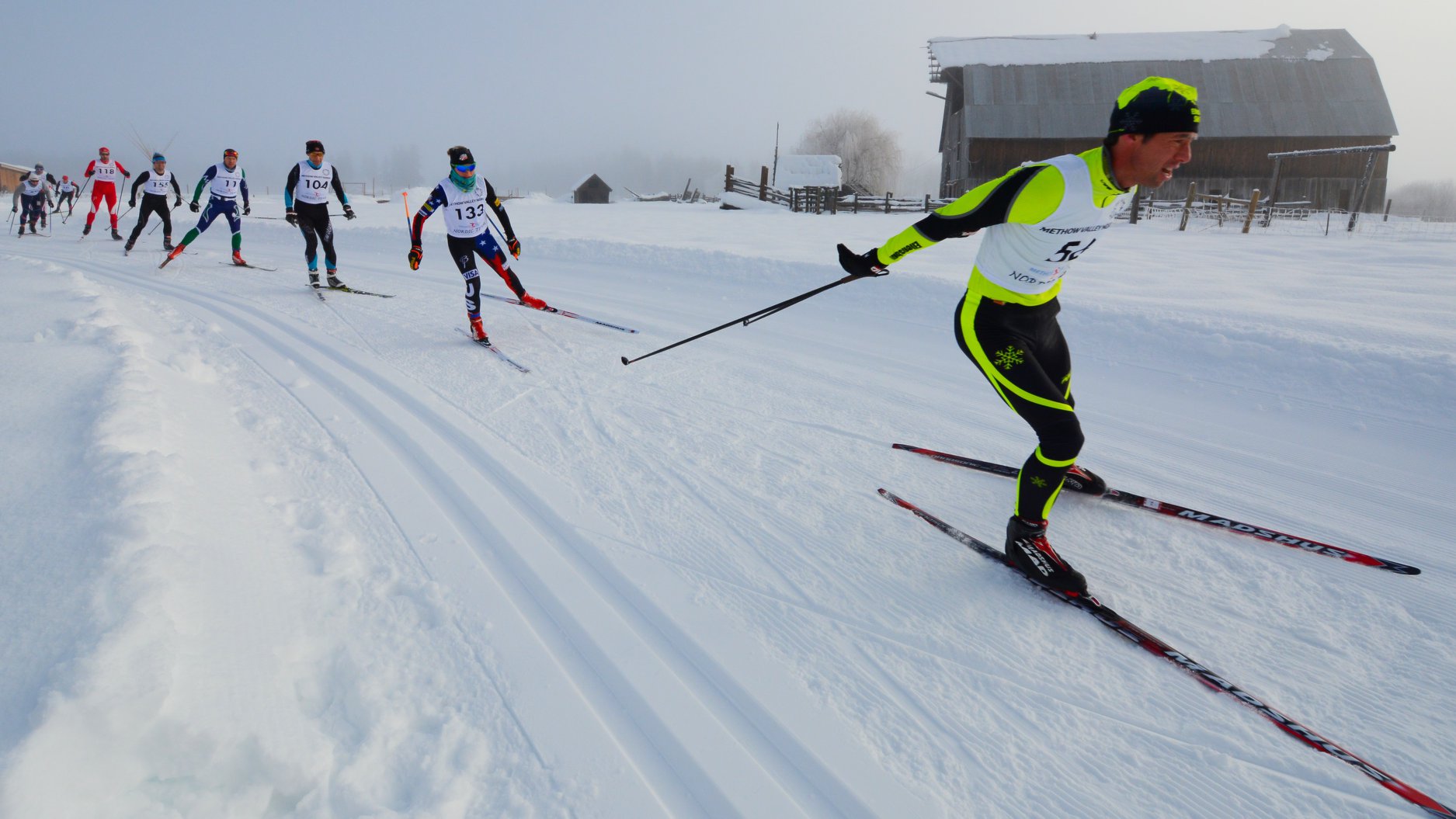
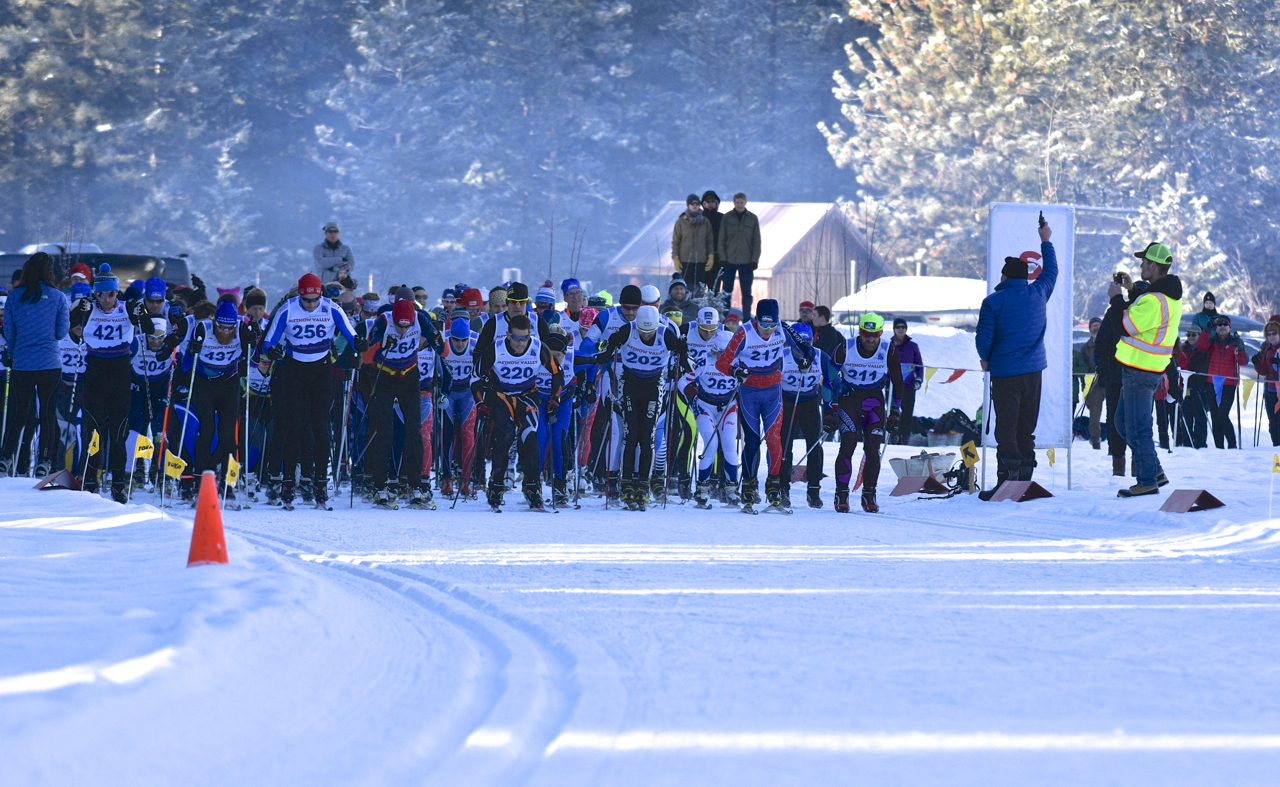
Racers on the valley floor during the first Ski to the Sun Marathon and Relay in the Methow. (Photo: Methow Trails)
All things aligned: a gauzy low fog burned off into bluebird skies and the snow skied crisp along a 42-kilometer gem during the Methow Valley’s inaugural Ski to the Sun Marathon and Relay. Last year, we ran a piece exploring how the Ski to the Sun Marathon organizers were rebooting their marquee ski race. The valley’s signature race had for years been a two-day pursuit. An attractive format to many, but it eventually stagnated with a core cadre of skiers roughly one-hundred strong participating.
A rethink was in order to highlight one of North America’s premier ski destinations. Creating a must race event is not as simple as build it and they will come. Many pieces must fall into place, let alone the weather and snow conditions on a race date often selected more than a year out.
In our previous article, Kent Murdoch, who has been making the trip from Seattle to the Methow for eons, told FasterSkier that a signature event was not on the minds of the pursuit race organizers. But over time, as the valley’s considerable volunteer energy became evident, creating an event that was a regional draw for cross-country skiers became a goal.
The Methow appears to have found a formula that works.
“We went from wanting something bigger than the previous existing pursuit, and I think that we had four times the number of people,” said Pete Leonard, Executive Director of the Methow Valley Nordic Ski Education Foundation, during a conversation this January.
Four hundred skiers in a first year event. A massive win considering longstanding events like Sun Valley’s Boulder Mountain Tour cap their 34 k marathon at 775 skiers.
The Ski to the Sun Marathon, which runs this year on February 8th, spans the valley from the north in Mazama south towards Winthrop. Before skirting across farm and ranch-land into Winthrop proper, the course takes a lovely – and heart-rate-rising- 12 k stair step climb from the valley floor to the finish at Sun Mountain Lodge. Here’s the thing: you can imagine it’s your own Tour de Ski final stage grind with it’s Alpe finish, or register with a relay team and save the ascent for a teammate.
There’s something for hardened master racers and those simply seeking a cool social scene bundled into a ski race.
This year, organizers are bringing Olympic champion Kikkan Randall to the race where she will also be available for a meet and greet. Randall is also expected to compete.
What follows is an interview with two of the race organizers, Kent Murdoch and Pete Leonard. We explored what they had learned after year one of the Ski to Sun Marathon and Relay. We thought it might be useful to other communities thinking about developing a premier ski race to learn from those in the Methow as they forge ahead with creating a signature event on the race calendar.
FasterSkier: A race like this is an investment in the community, but it also takes considerable resources — both human capital and money. Can you talk about the finances?
Pete Leonard: Everybody grouped together to deal with some of the unknowns and for our race committee that was a little bit stressful leading up to the race. But everything seemed to come off and everything seemed to work out. But one item was noteworthy, we were able to balance the budget the first edition – which was no small feat.
Kent Murdoch: I would also add that we weren’t planning to actually be in the positive in the end. We were expecting to take a little hit, being the first year. But, it was surprising. Honestly, you also have to take into account that there is a ton of community volunteer work that goes into it. And I think the volunteers in the valley really pulled out the stops.
FasterSkier: You spoke about some unknowns. What were some of the unknowns besides weather and snow coverage. What did you stress about?
Pete Leonard: The logistics of a relay — those are the things we didn’t necessarily think about. With a relay happening simultaneously with a marathon, or starting 10 to 15 minutes behind, lots can go wrong. We have all these people driving down valley and using different zones to tag their partners. That took some coordination. It’s also a trail system and race course through some private land holdings. We have road crossings that can complicate race course set up. We also cross driveways and someone simply might not have their driveway plowed. Those are little things, but we were worried about them.
Another issue we learned about was limited parking at the finish. There was a big conference last year up at Sun Mountain Lodge the same weekend as the race. That was a little bit of a worry. We also stressed about accommodating all those people for dinner. And then there was the cooking and food for 300 people. Just constantly thinking how it was all going to come together.
I think sometimes that is a little bit of race organization, making sure you are pushing to do your absolute best by the racers so you give them the best product.
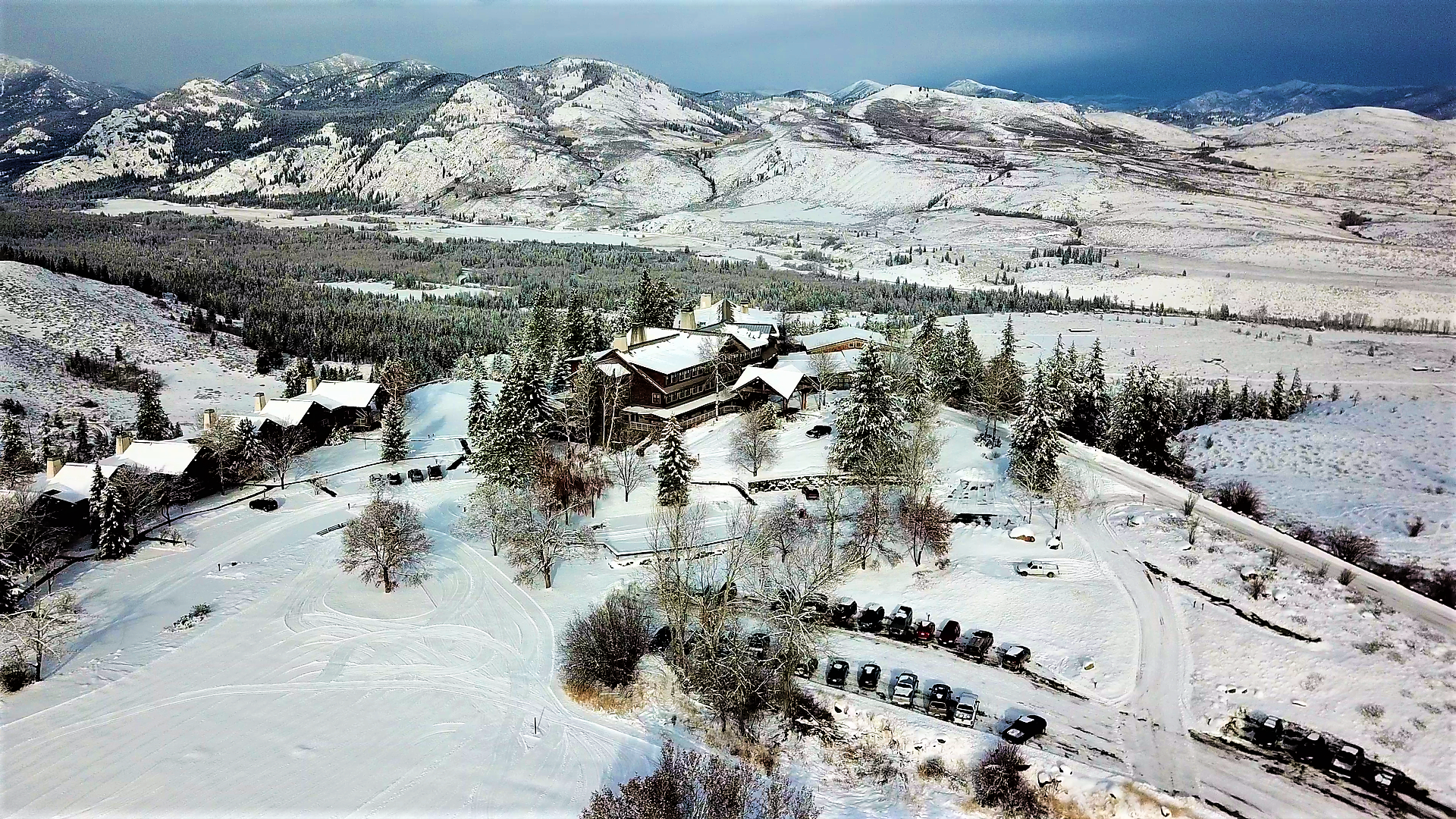
Sun Mountain Lodge – near the finish area of the Ski to the Sun Marathon and Relay. (Photo: Methow Trails)
FasterSkier: Can you talk about the somewhat unexpected bump from 100 skiers in the old pursuit race, to a start list with nearly 400 skiers including relay participants?
Kent Murdoch: In our first year of the Ski to the Sun it took us a bit by surprise because so many people entered kind of last minute. I think that is typical for many events, but it made it more of a challenge to plan for the banquet meals. I’m not sure exactly what that is about, but I think people want to make sure they are healthy and their is going to be snow. And so it does make it hard to plan for.
For this year, we modified our fee schedule to moderate that a bit. I do not know what to expect. We did something like December 1st and January 1st fee bumps — meaning the entry fees increased on those dates.
Pete Leonard:We also have February 1st as the closing date for the relay. And then there is a very substantial fee bump if you want to wait to the last week for the marathon. We are just really trying to encourage people to make the commitment to race because that helps us deliver a better product and make sure all the pieces are there.
FasterSkier: Skiing has yet to really find the equivalent to the gravel scene in biking. How are you trying to draw more people into skiing with this event?
Kent Murdoch: The relay aspect is the biggest change we have made with regard to events we have held. And it’s an attempt to broaden the appeal of a ski race likes this. We are getting both this year and last year about a 50-50 split of those entering the marathon versus the relay. So the thing about the relay is it really opens it up to anybody, we have one leg that is less than a kilometer on flat terrain. And then we have every kind of leg that you would want. There are many relay combinations that can suit any team, and an individual can do more than one leg. That flexibility seems to have been successful so far.
Pete Leonard: It is not a single facet that is going to bring new people to a ski race. Sometimes we get into these discussions where we are looking for that one key ingredient that is important to every racer. I think that there are a variety of ingredients that are important to every racer and we are trying to do a good job on a lot of fronts.
To every racer those fronts matter a little but differently. For some they are tuned into one part of the event, but it still matters to them that the course is well groomed even if they are out there and they are motivated by the social part of it or the epic adventure type of thing.
I think to reach out to a broader segment, it starts with making it obtainable, which is what Kent talked about with the relay there. We had a lot of people who did the relay last year and were like ‘oh man I am going to do the marathon next year,’ because they thought that was not as hard as it was going to be.
I think one of the big challenges with cross-country skiing is reaching out to new segments of people who might know the sport and be attracted to it, but they are not going to be stoked to sign up and line up next to the Lycra clad master racers of the world because they feel they are not ready for that — but they are fit. They could be an ultra-runner, or a biker, or a rower or something like that and they are going to want to come over to the Methow. This is their experiment with cross-country racing. This is one important aspect as we build it — that we are not just speaking to the people who are already part of your tribe.
But trying to build your ski racing tribe up to with these other people and bring them into the fold.
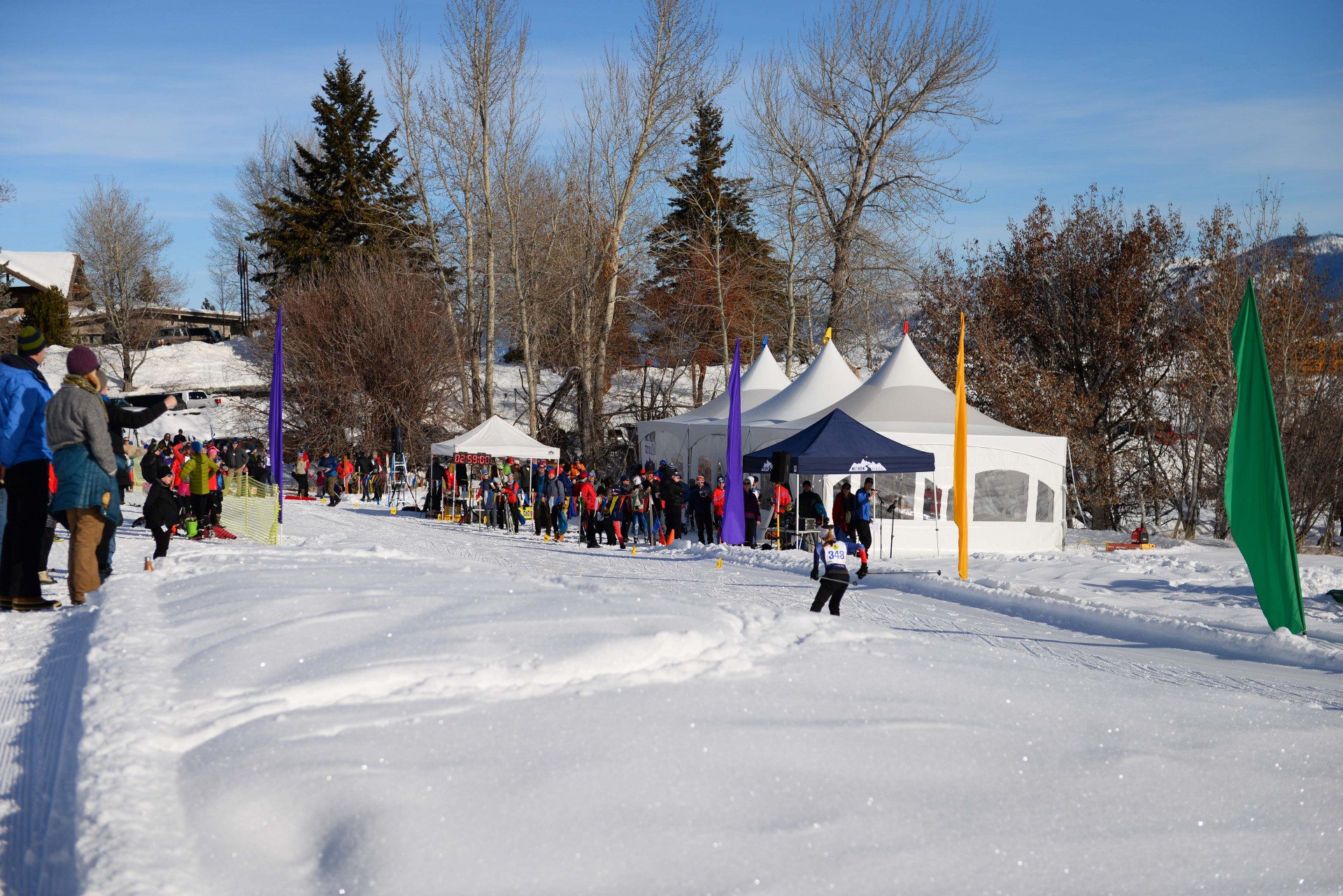
Big support along the race course. (Photo: Methow Trails)
Ready, set, go: racers at the start of the skate portion of the 2018 Methow Pursuit. (Photo: Methow Trails)
Washington’s Methow Valley is the literal end of the road in winter. There’s one way in from the south. There’s route 20, a sinuous side spur plunging down from Omak in the Okanogan Highlands to the Methow’s eastern edge. Otherwise, travel by car terminates just beyond Mazama — the small town nestled in the valley’s north.
The Methow’s charm remains its solitude and mellowed pace. Despite the wifi and cell service, there’s the real sense of being unplugged.
For nordic skiers, that remoteness coupled with the Methow’s epic skiing make it paradise. Regionally, it’s hard to argue any other nordic ski destination matches the raw number of kilometers, terrain, and vibe etched into the Methow’s DNA.
Despite those travel brochure-worthy qualities, the cadre of skiers residing in the region have struggled to create a signature cross-country race event. By signature event, we’re talking races like Sun Valley’s Boulder Mountain Tour, Craftsbury’s storied marathon, and the behemoth American Birkebeiner which stands alone in terms of its draw.
“In the early 90’s is when I think the Methow Pursuit first started,” said Kent Murdoch, a long time Methow skier who bounces between homes outside Seattle and the Methow. “The first iteration of that long distance race was a point to point from Cub Creek, up and over the Rendezvous pass, and dropping down into Mazama to finish.”
That 42 kilometer skate race featured gut-punching climbs matched with a never-ending technical descent. The second day’s classic pursuit threaded from Mazama to Winthrop on the hallmark Community trail.
“It was essentially a double pole race,” added Murdoch. “But it was pretty popular for the people that are established racers that knew about it.”
Periodically, stakeholders within the community have attempted to recreate the concept of a must-race event. In a place defined in winter as much as the Methow is by nordic skiing, one would assume a marathon type race there would be an annual pilgrimage for many.
That is not to say efforts failed. It is to say a rethink was due if success is measured by drawing a broad spectrum of the nordic community.
“I knew the event had struggled over the years and as I dove into planning for it, I quickly realized why,” said Adrienne Schaefer, the Partnership Manager for Methow Trails. “In an effort to have something for everyone, the event had grown into a somewhat complicated format, which was fine for skiers who were familiar with racing but seemed hard to navigate for someone who had never entered a race and didn’t actually know what a loppet even was. Numbers for last year’s Pursuit were close to 70 on Saturday and around 35 on Sunday. It was clear that something needed to change.”
Last spring, the race reboot began.
“We had just completed our Sunflower Marathon, Half Marathon and Relay and had 1,100 runners at the event,” Schaefer said. “The question was, why not just do a winter version of the Sunflower?”
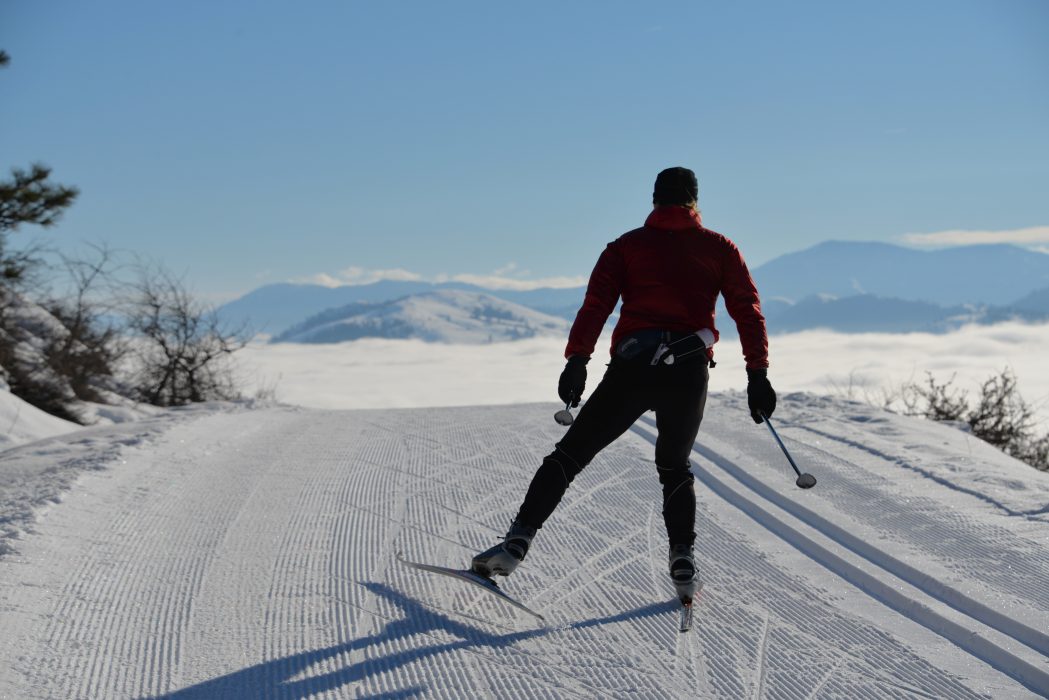
Skiing above the fog and under a big sky in the Methow Valley. (Photo: Methow Trails)
The Sunflower is a five-leg trail running race connecting Mazama on the valley’s north end to Twisp in the south. Participants have the option of running the marathon solo or as part of a relay team. Relay teams consist of two to five participants. The half-marathon starts near Mazama and shares the same finish as the marathon. The end result is a race with enough options to draw the hardcore and recreationist.
What Schaefer saw in the success of the Sunflower was its accessibility. A concept easily applied to the cross-country ski version of the event.
Murdoch was equally invested in formulating a successful winter-edition model of the Sunflower.
“The area really warrants putting something like this on,” Murdoch said. “A few friends and I have been envisioning this for a few years and I am now on the Board for the ski team. I Have taken this as my main focus to not just build this race but eventually a week-long festival with multiple events. We want to appeal to people of all ages and skill levels.”
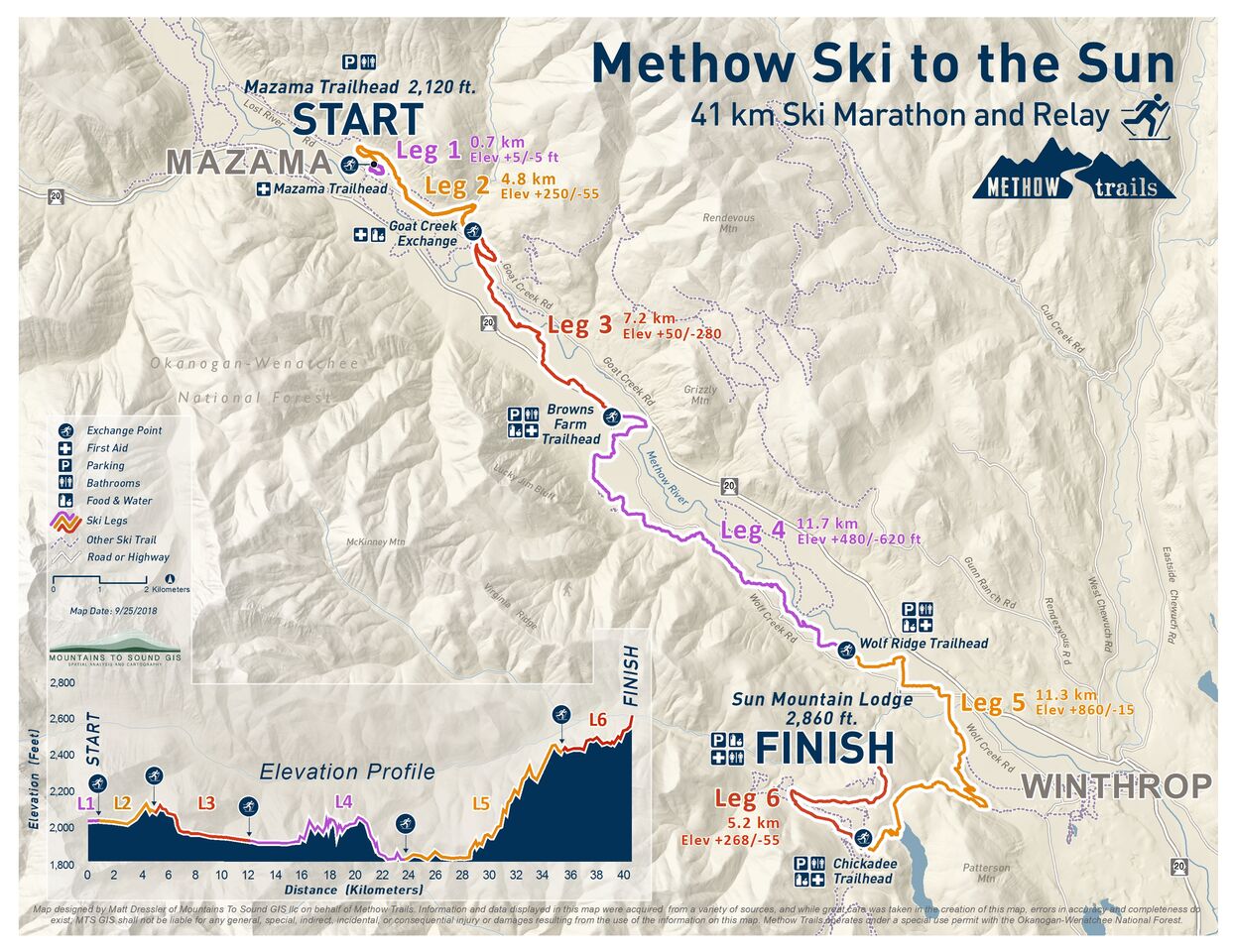
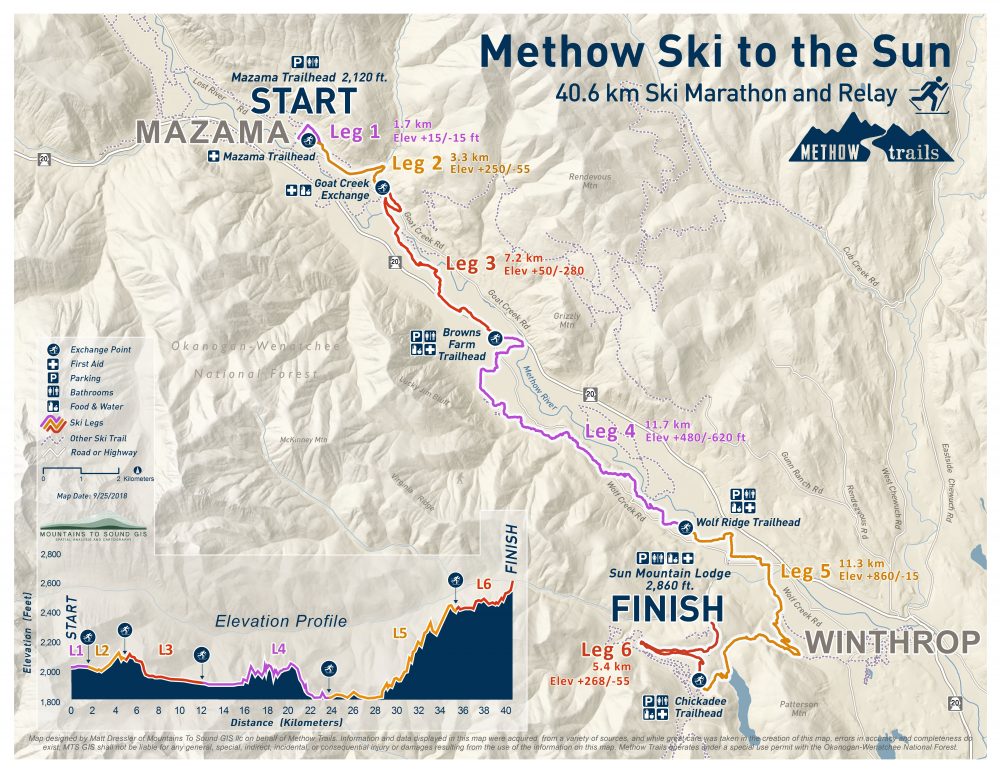
Valley local Laura McCabe, a timeless podium magnet and herself fond of burly skis, along with Murdoch worked to piece together a course appealing to all comers. Beginning in Mazama, the envisioned course runs a solid 40.6 k for individual skiers. The relay is broken into six segments – teams may have between two to six members.
For the first quarter, the race route streams the middle of the valley floor. At the end of the third leg, at 13 k, the course turns towards the west and trends to the rolling hills buffering the valley’s flanks. After approximately 28 k, the climbing begins towards the finish at Sun Mountain Lodge.
“It is very skiable,” Murdoch added. “There is nothing in it that is, I think, that is going to turn anyone away purely based on difficulty. And it doesn’t have the technical descents. So technically it should be doable for a very large group of people. And for the people that are not interested in the climb, it is possible to get on a relay team. I think some of the legs are only 2 to 3 kilometers and are totally flat. So there is something for everyone.”
Course map and profile : Methow Ski to the Sun Marathon and Relay.
For skiers on the sharp end of the race, keen on fast splits and podiums, Murdoch believes the race will deliver. For those with an affinity for warm drinks and food as they tick off kilometers, organizers plan to staff numerous feed zones along the course to keep participants comfortable. In an appeal to families, racers 17 and under race for free. The race is freestyle technique, but skiers may skate or classic.
“We know this is not going to happen overnight,” Murdoch said of the Methow’s desire to cement itself on the race circuit with the Ski to the Sun Marathon and Relay. “The basic answer to why we lack a signature event is that I don’t think we ever set out, in the beginning, to envision a course and the post-race dinner and award ceremonies and marketing especially. This is new to all of us. How to go about that. In previous years it was never really intended to be that kind of event. Now we have the energy.”
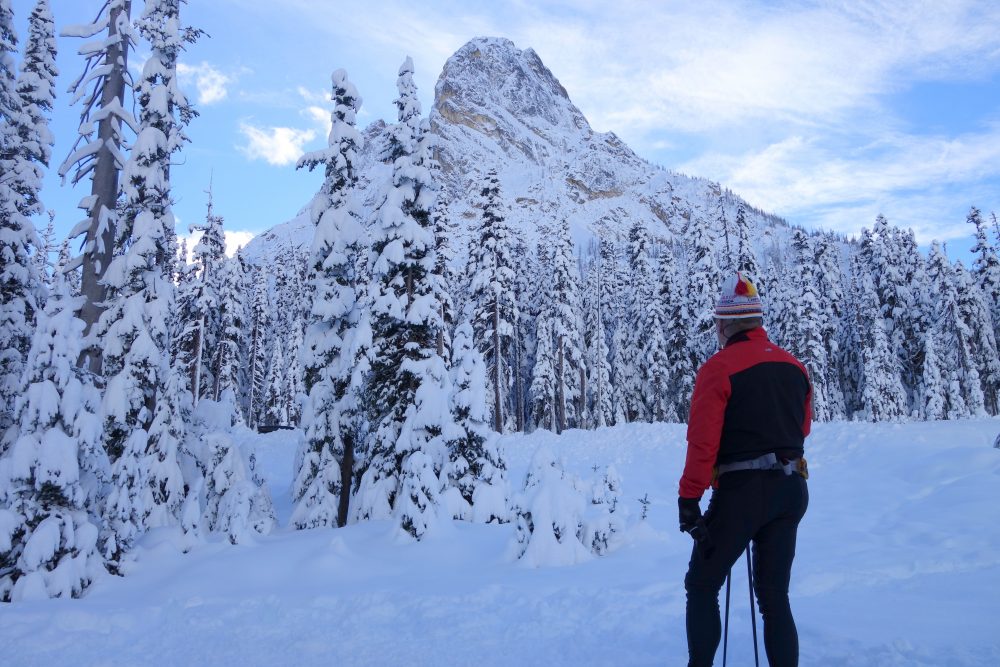
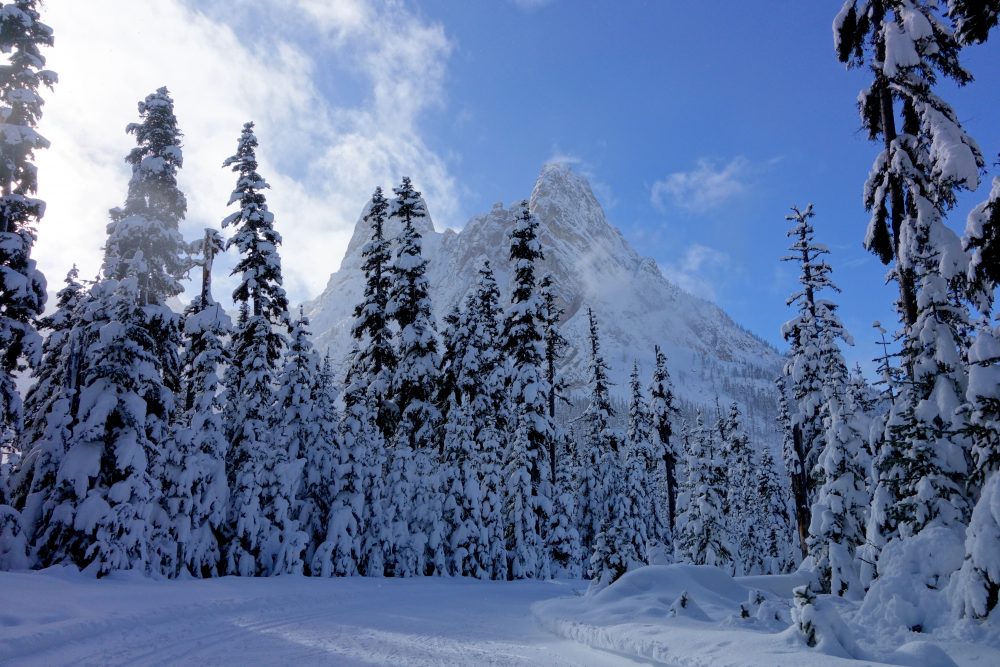
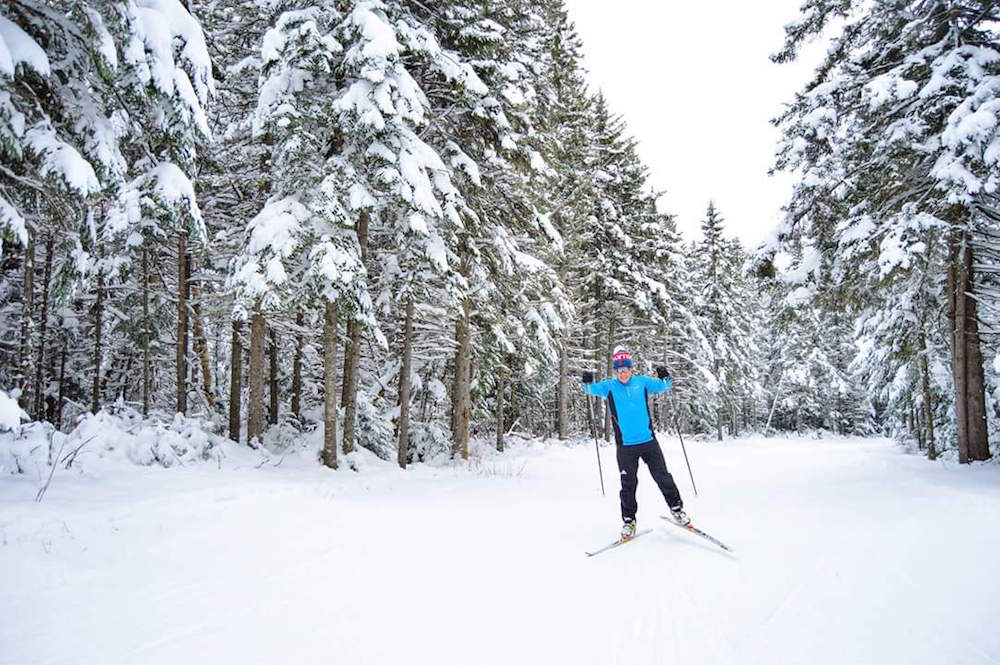
Skiing under Liberty Bell on Washington Pass in November, 2016. (Methow Trails courtesy photo)
Natural snow is where it’s at, unless there’s none to be found. In high-elevation places like West Yellowstone, Mont., (roughly 6,600 feet above sea level) and Crested Butte (nearly 9,000 feet), November skiing is almost always a given — which is why those venues have hosted Thanksgiving-week ski camps for 16 to 30+ years. And they are again this year, while looking to the skies and weather forecasts in hope of more snow — much more.
While there are only two well-known Thanksgiving camps currently being held in the U.S., there are dozens of other places around the country you can likely go skiing. We did our best to present some of the most dependable options, so at the very least you can plan a future trip on snow this time next year. No offense to the in-laws, but wouldn’t you rather be skiing on Thanksgiving? Stay tuned for our Canadian early skiing edition, and feel free to share your favorite November ski spot in the comments section below.
***
What: Yellowstone Ski Festival
Where: West Yellowstone, Montana
A rendezvous point at the Rendezvous Ski Trails as seen last year in West Yellowstone, Mont., during the 2015 Yellowstone Ski Festival. (Photo: 2015 courtesy photo)
How many years running: Over 30 years. “It started with Drew Barney, Torbjorn Karlsen and Dick Hunt back in the 1980s as a Fall Camp, offering clinics for coaches and citizen racers looking to improve their technique,” West Yellowstone Ski Education Foundation Program Director Moira Dow explained. “Over the years, the camp grew into one of the top training camps available to the cross-country ski community.”
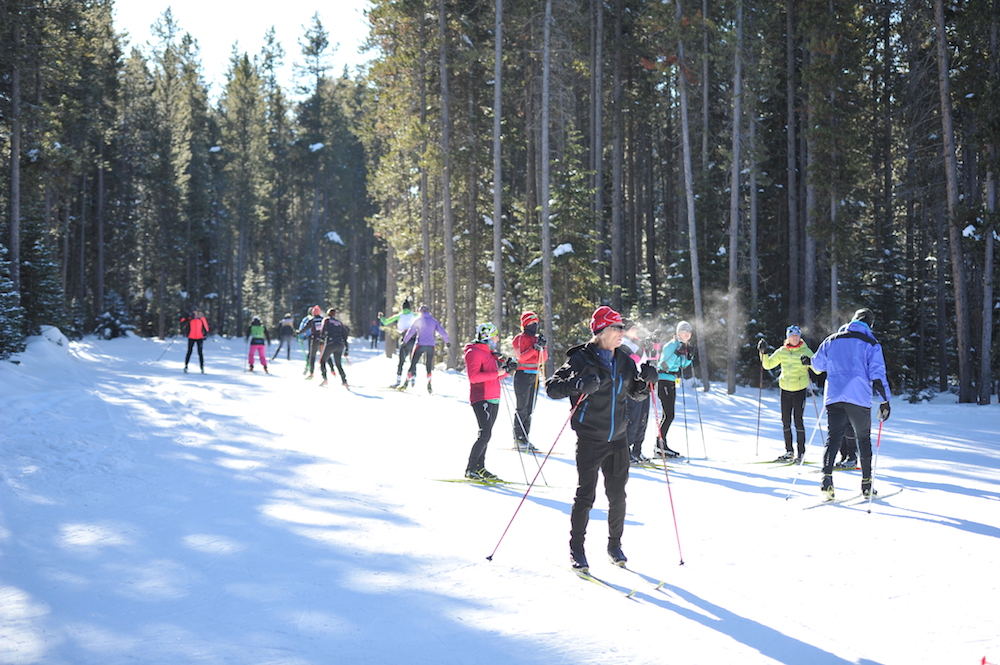
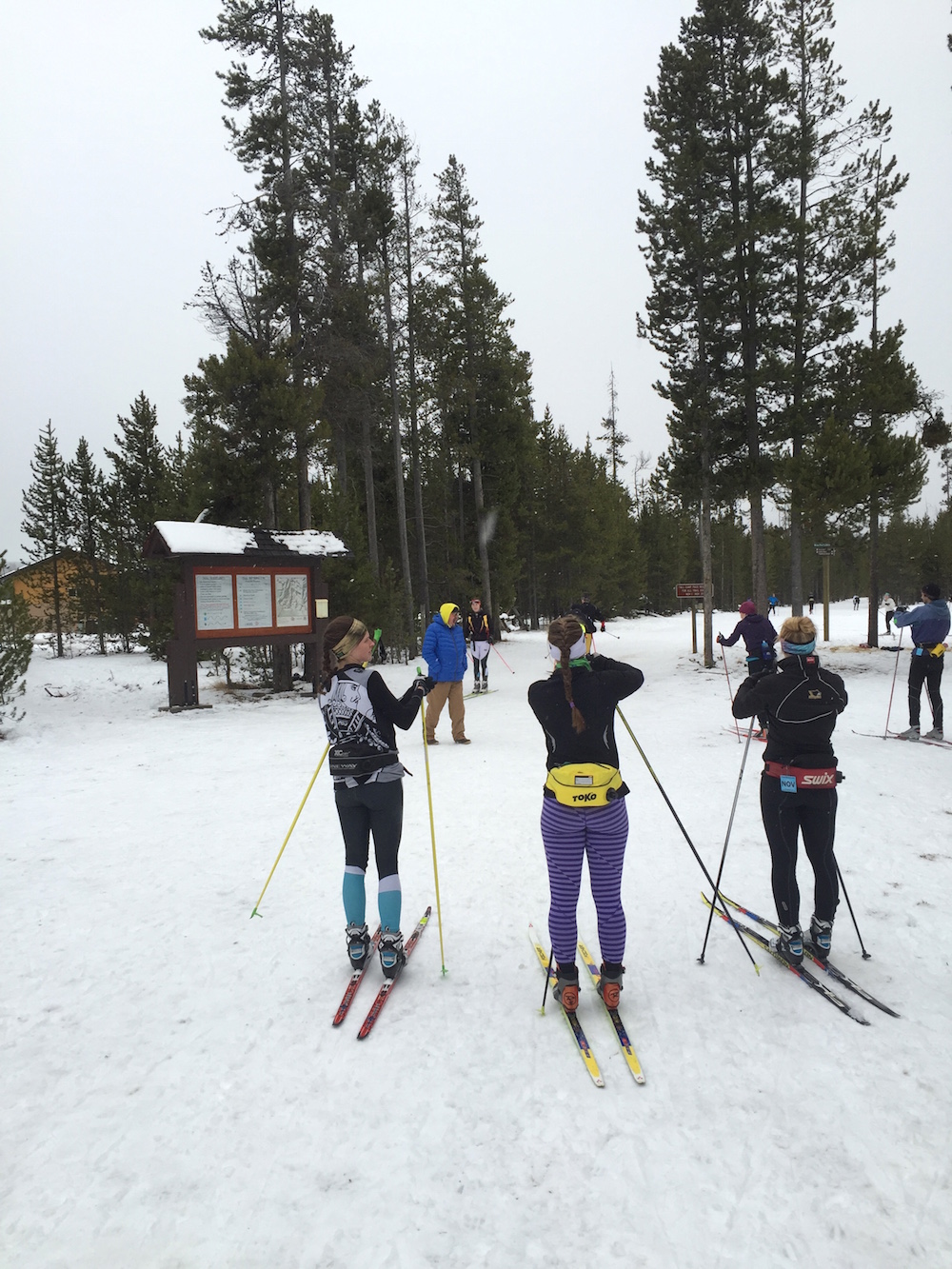
Skiers at the trailhead of the Rendezvous Ski Trails in West Yellowstone, Mont., on Monday, Nov. 21, 2016. (Photo: FBD)
Target audience: Open to the public and all levels of skiers.
Anticipated participation: Around 2,500. “We think it might be a little bit lower this year because of the late snow and the lack of the SuperTour,” Dow noted. “Last year we had a lot. We had really really early snow last year. Around 3,500 in years past.”
Advance reservation required? Yes for clinics and races. Online registration only. “The competitive events and the clinics all require you to be pre-registered, but all the evening events are open to the public,” Dow said.
Trail pass rates: $55 for the month of November for adults. $26 for kids, which is 10 and under. Day passes are $12 and $6
Grooming report:Approx. 20-25 k groomed as of Monday, Nov. 21.
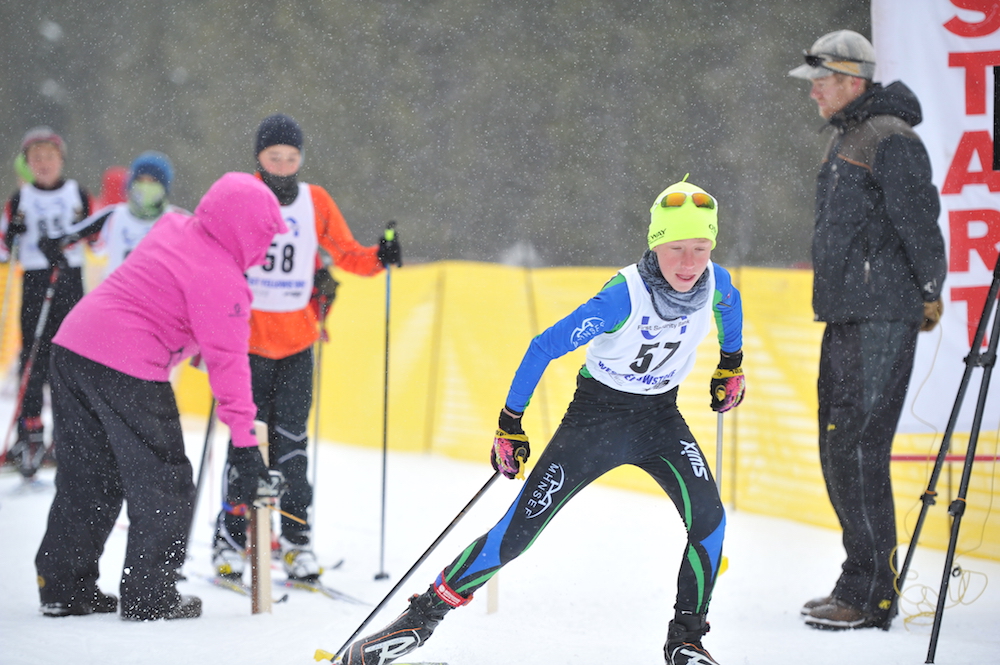
A young skier darts out of the start at last year’s Yellowstone Ski Festival in West Yellowstone, Mont. (Photo: 2015 courtesy photo)
What makes this camp unique?
“Good, early, reliable snow,” Dow said.
“Also it’s a place where skiers from all across the country, juniors to seniors to masters, come together,” she added. “… And as a junior, that’s pretty unique to get to be able to do that. And also to see all the equipment from vendors and see wax clinics. To have all of the elements in one spot is one of the most unique things about this camp.
“We’re a tiny town out in the middle of nowhere,” she continued. “Our ability to put on such a big event, is, in my opinion, probably one of the most unique aspects of our camp. We are almost entirely volunteer run. The fact that the people who run the festival have little to no experience cross-country skiing, but put on these races, is just flabbergasting to me. It’s pretty incredible.”
Special events: See website for complete lineup of clinics and more, including:
Presentation: Wildlife photographer Tom Murphy
Yellowstone Historic Center presents The Ski Hero Soldiers of Yellowstone
Whiskers, Whiskey, and Waxing featuring whiskey tasting samples from Willie’s Distillery of Ennis, MT
Branch Beer Bash: Micro and craft beer tasting
Presentation: Kaatsu Training by Doug Barnard
Winter Wildlands Alliance Backcountry Film Festival
Women, Wine, and Waxing
Keynote speaker Ruff Patterson
Yellowstone Ski Festival Social
— Gabby Naranja
***
What: Crested Butte Nordic Thanksgiving Camp
Where: Crested Butte, Colorado
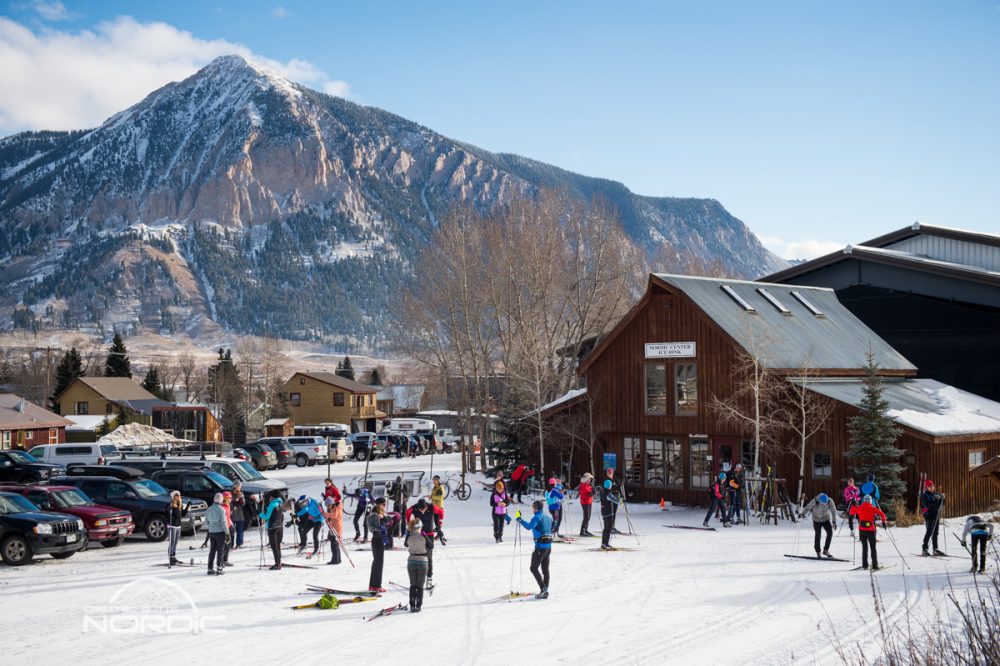
The downtown-based Crested Butte Nordic Center. (2015 courtesy photo)
When: Wednesday, Nov. 23, to Sunday, Nov. 27, 2016
How many years running: 16 as an official, organized camp: “In case of a low-snow year, like our current situation, we have a low-snow venue called Lily Lake and that’s up on Kebler Pass which is six miles West of town,” said Drew Holbrook, marketing director for Crested Butte Nordic.
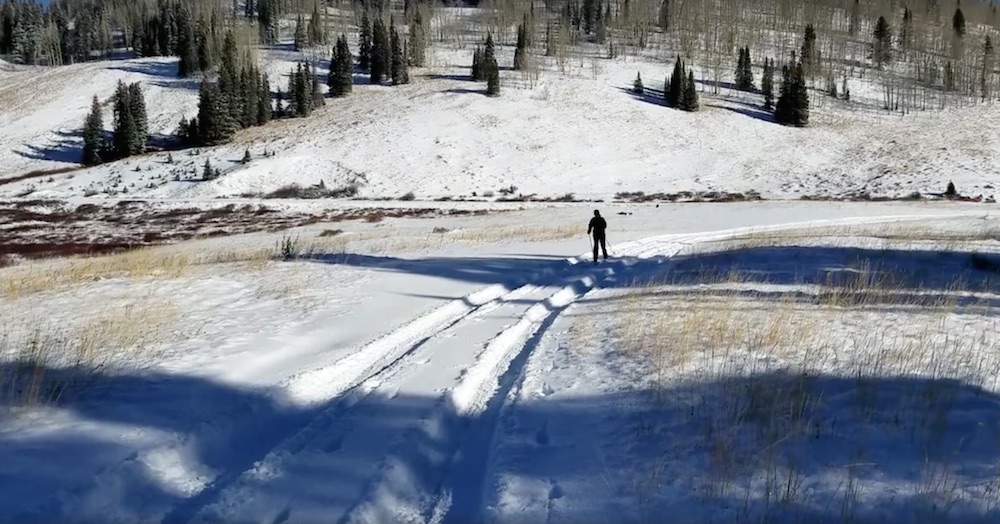
Skiing at Lily Lake in Crested Butte, Colo., on Nov. 18, 2016. (Photo: CB Nordic/Facebook video)
The road up to Kebler Pass is maintained by the county. Individuals or groups can drive up to the pass, but carpooling is encouraged when the low-snow option is in play.
“We have vans to shuttle people up to try and minimize traffic and congestion — it’s kind of like a similar situation in terms of people (but not as and because not quite as many people) as driving up on the South Plateau outside West Yellowstone, so we shuttle people up there. For the people taking clinics we shuttle them all up in vans.”
The Lily Lake area receives 600 inches of annual snowfall and no trail pass is required. As of Nov. 18, Lily Lake had received nearly six inches of snow.
The Nordic Center located in town is also prepared for low snow, according to Holbrook. “Just in the last three years we have had the trail right next to the Nordic Center in town, called Ruthie’s Run, homologated re-engineered. So it’s seeded with grass, it is mowed and basically we can groom that with literally six inches of snow or so. It’s kind of interesting because it snows a lot more up on Kebler Pass at Lily Lake, it might snow two feet up there and only six inches in town, but it’s easier to actually groom on Ruthie’s down in town if we get the snow. Lily Lake is on Forest Service property, so we have to wait until there is a foot of snow before we are allowed to groom up there.”
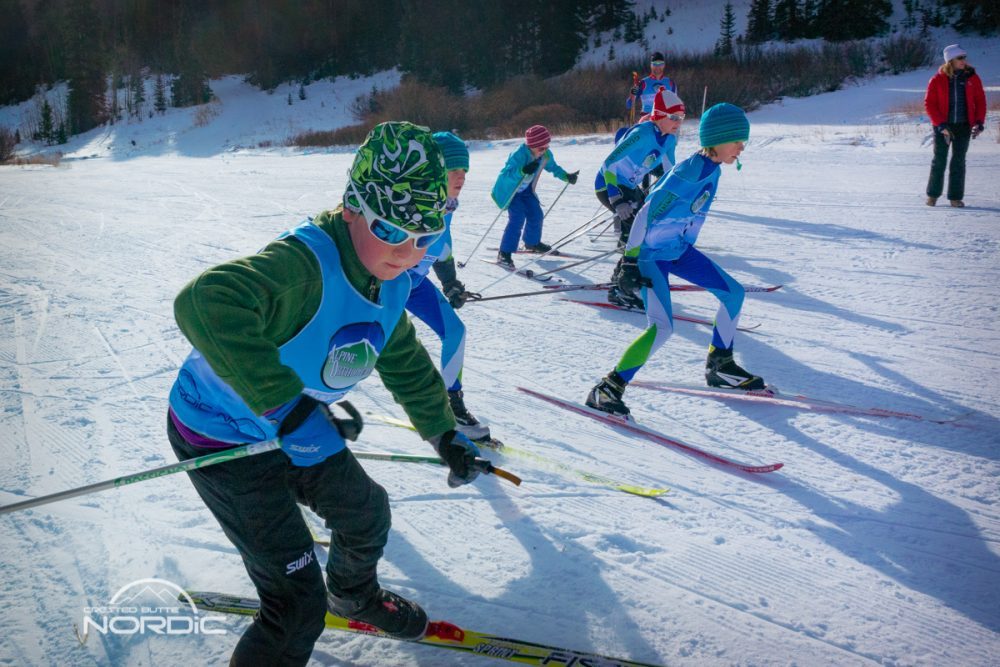
Crested Butte Thanksgiving Camp: not just for big people. (2015 courtesy photo)
Target audience: All ages and abilities. New skiers are encouraged to come try the sport out.
Anticipated participation: Holbrook expects 60 participants for the clinics offered. A round-robin classic “refresher” will be held Thursday, Nov. 25, with full-day clinics on the 26th and 27th.
Advance reservation required? Strongly encouraged. “For the clinics it is best to sign up ahead of time,” Holbrook said. “We never get too many people signing up until it starts snowing, but they do fill up. You might get lucky the morning of and come into the Nordic Center and sign up and get a spot, no guarantees.”
Trail pass rates: $20/day, skiers 17 & younger ski free. $150 for a 10-punch transferable pass.
Grooming report: Lily Lake is receiving snow. The low-snow option looks more than promising.
What makes this camp unique? “One thing that makes it unique, Lily Lakes is a great locals’ place to ski,” Holbrook said. “It’s pristine and scenic. And of course, its great skiing from the Nordic Center in town, too. There is plenty of room on the trails for everybody, you are not getting swarmed by people and not being able to do your workout. It’s easy to get in a good ski.”
Special events:
Ski Free Day: Wednesday, Nov. 23 at the Crested Butte Nordic Center
Crested Butte Mountain Resort “Donation Day”. Donate some money, you decide the amount, and ski with a little help from gravity at the downhill area. All proceeds support the Crested Butte Snowsports Foundation
Round-robin refresher clinic: Thursday, Nov. 24
U16 Junior Training Camp: Nov. 25-27
Alley Loop Race Series (Race #1) 5 k & 10 k skate
Winter Kick-Off Party (Saturday night): Fundraiser for Crested Butte Nordic, tickets $25/adult,$15/children. (Author’s note: Crested Butte throws fun parties.)
— Jason Albert
***
NOT CAMPS, PER SE, BUT YOU’RE PROBABLY WONDERING ABOUT:
ALASKA
Fairbanks
Birch Hill Ski Area, in Fairbanks, is probably the most reliable spot in North America for groomed early-season skiing. This is the venue that once held a FIS race on Nov. 2. Temperatures are reliably cold, and any snow that falls tends to stay. The Nordic Ski Club of Fairbanks grooms approximately 35 k of trails at Birch Hill. The trails are meticulously maintained in summer, if not manicured, and are justly renowned for their ability to provide good skiing after mere inches of snowfall.
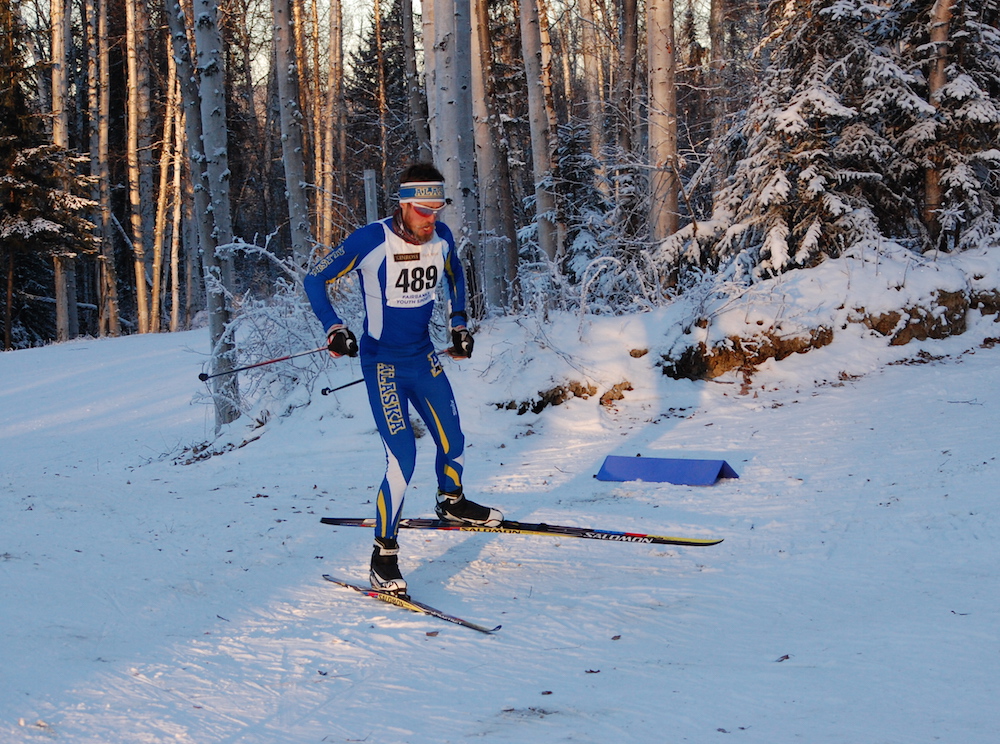
University of Alaska Fairbanks skier Alex Eckert racing in the Alaska Nordic Cup FIS races in Fairbanks, Alaska, on Nov. 19, 2016. (Photo: Max Kaufman)
Birch Hill again held FIS races on the recent weekend of Nov. 19-20. It had snowed approximately 5″ total in Fairbanks this winter by that point. Weekend racers – and there were hundreds of them, from kindergarteners without poles to the APU Elite Team – skied on trails that had been packed and dragged to create a base of approximately 2″. There were admittedly some leaves and dirt showing through in places – but, crucially, it was leaves, not rocks. Most skiers in the FIS/USSA class of the weekend’s races competed on their prior-generation, few-years-old race skis.
Locals consistently described the conditions, which led half the APU Elite men’s team to make the trek north from Fairbanks for the weekend, as among the worst mid-November conditions in living memory.
Anchorage and nearby
Under normal conditions, as measured by a 30-year average, Anchorage around Thanksgiving is a nordic nirvana. There are at least 40 kilometers of groomed trails at Kincaid Park, on the west edge of town, and another 16 k at Hillside, on the east edge of town. (16 k are lit at Kincaid, and 8 k are lit at Hillside.) The two ski areas are connected by a network of dozens of kilometers of additional trails (also groomed, or at least snowmachine dragged), ranging from moose-dense forest to urban greenbelt, including the Coastal Trail, which runs along the shores of the Pacific Ocean for most of its 15 k. You can ski from Hillside up into the Chugach Front Range, and from the frontcountry into true backcountry. Around 20 miles out of town to the north, Beach Lake has another 20 k of groomed trails (nine of them lit). 40 miles to the south, Girdwood boasts a growing trail network of around 10 k total, including a competition-level 5 k loop. All trails are open 24/7, and there is no trail fee for any of them.
Hillside ski trails in Anchorage, Alaska, on Oct. 22, 2016, before the rains came. (Current conditions are far worse.) (Photo: Gavin Kentch)
Judging from the last three winters, however, Anchorage sadly simply cannot be recommended as a viable option for Thanksgiving snow in these days of climate change. While all three winters saw the first snowfall in October or early November, and some period of good skiing immediately thereafter, all three gave way to wind and rain by Thanksgiving week. As of the weekend of Nov. 19-20, 2016, Anchorage has no natural snow on the ground at Kincaid, a 1-2″ base of bulletproof sheet ice at Hillside, and skritchy skiing on a local golf course. On the bright side, the trail running is amazing (bring your Icebugs), and the nordic skating is world class.
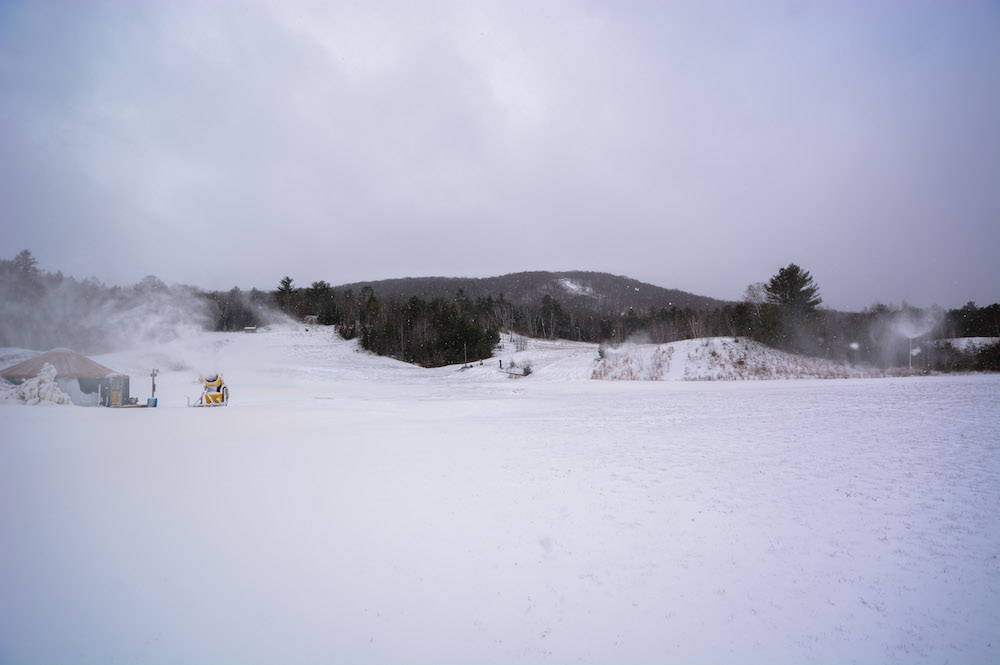
Kincaid has limited snowmaking capabilities, which are capable of covering a loop of as much as 3-4 k centered around the main stadium area. (This is where over 95 percent of Anchorage ski races have occurred over the last two winters.) The Nordic Skiing Association of Anchorage (NSAA) turned the snowguns on briefly on Nov. 16, then again on Nov. 18. Recent cold temperatures have allowed them to operate continuously since. NSAA stated on Sunday morning that there were no trails open for skiing yet, but that they were “getting closer” to opening the first loop and had reached the stage where the PistenBully was starting to move snow around. A loop of approximately 2 k was opened amidst single-digit temperatures on Thanksgiving morning, Nov. 24.
In a recent email to FasterSkier, NSAA Program Manager Tamra Kornfield addressed the possibility of, for example, guaranteeing skiable snow by Thanksgiving in exchange for attracting skiers and generating user fees. Kornfield wrote, “The theory of trail fees has been discussed for many years, but currently our ski trails are on Municipal Park land, and we cannot charge to access these parks. However, I can say that the snowmaking system was designed to extend the ski season, not create it from scratch, so I do foresee doing more to fundraise for this great expense that has now saved the last two ski seasons.”
Mat-Su Valley
Archangel Road above Palmer, Alaska, on Nov. 4, 2016 (current conditions are better than this). (Photo: Gavin Kentch)
The Matanuska–Susitna Valley, approximately one hour outside of Anchorage on a major highway (call it up to 90 minutes to the ski areas discussed here), has been described on this website as having “the season of winter that starts in the fall and ends in the spring.” That’s pretty fair.
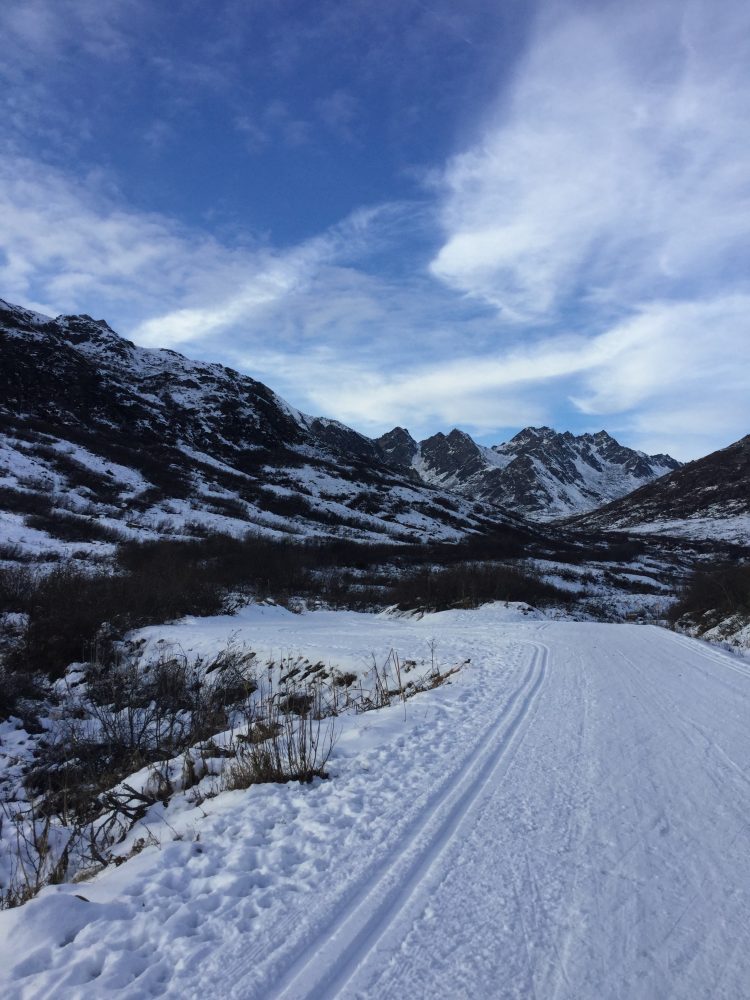
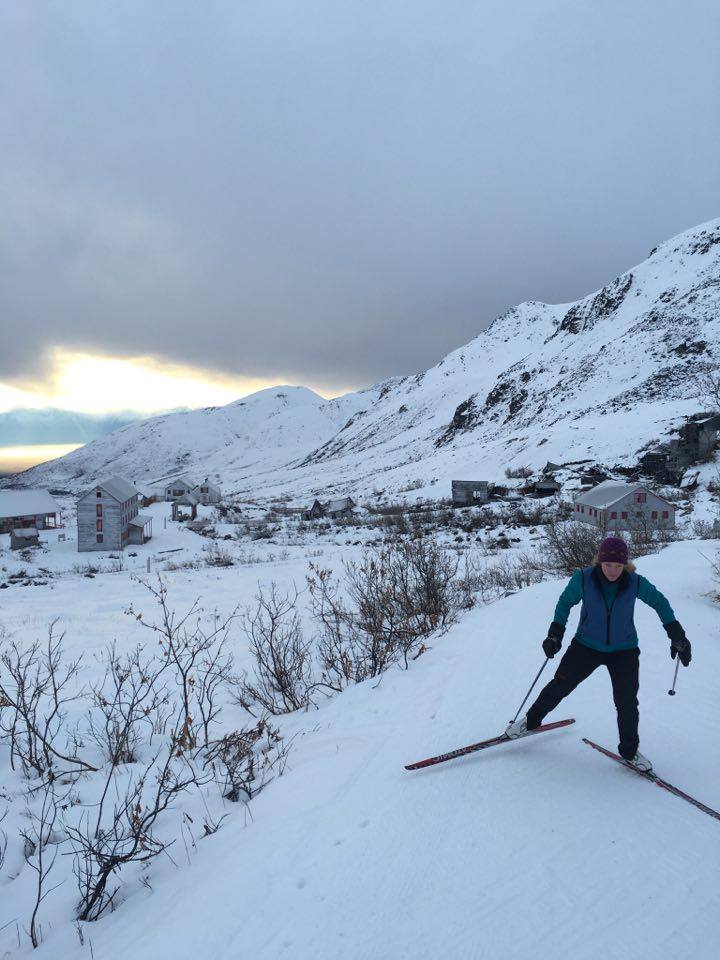
The Mat-Su Ski Club, including the redoubtable Ed Strabel and sometime FasterSkier contributor Jeff Kase, typically groom 7 k of Bill Spencer-designed trails at Government Peak Recreation Area (to be expanded as soon as next summer), 7.5 k (one-way) on Archangel Road, and 5 to 10 k at Hatcher Pass. Archangel Road hosted one of the last North American ski races of 2015/2016 and one of the first of 2016/2017. Hatcher Pass is a truly special place, as the groomed trails wend their way past the historic buildings of an old gold mine nestled in a bowl in the Talkeetna Mountains. “Imagine skiing through an Old West ghost town turned collectible Christmas village,” local Master and English professor Shannon Gramse once wrote in these pages.
Skiing at Hatcher Pass, above Palmer, Alaska, on Nov. 20, 2016. (Photo: Nat Herz)
As of Nov. 19, Government Peak (a one-hour drive one-way from central Anchorage), which is at a lower elevation than the other two areas, did not have enough snow to ski on. Archangel Road (75-minute drive) had a base of approximately 4-5″, but it is bulletproof hardpack that should provide a reliable base until spring. The Mat-Su Ski Club has been grooming there several times a week, and the skiing is good to superb. The Mat-Su Ski Club also groomed Hatcher Pass (90-minute drive) over the weekend.
For the best information on current trail conditions, including formal grooming reports when available: Anchorage (official NSAA and user-generated), Mat-Su, and Fairbanks.
— Gavin Kentch
WASHINGTON
Then there are the possible Northwest options for early season skiing, including the well-known:
Bluebird day on Washington Pass in November 2016. (Methow Trails courtesy photo)
Methow Valley
“I giggle about the current skiing up at Washington Pass which is a the top of the North Cascades Highway,” said Kristen Smith, marketing director for Methow Trails based in Winthrop, Washington. “What they have groomed is almost exactly one mile or a 1.6-kilometer loop. It goes out to the Washington Pass overlook, which is stunningly gorgeous. I mean the whole ski is the most beautiful, their probably can’t be a place anywhere in the world that has more beautiful scenery than this, on this little loop.”
Smith explained the loop is being groomed for skate and classic. “It’s a handful of super-dedicated locals who do the grooming completely on their own and you don’t pay to ski there,” Smith said.
But here’s the important beta: call or check online before you head to the Methow or think you might ski at the top of Washington Pass. The Washington Department of Transportation is closing the pass temporarily due to possible hazardous weather and avalanche conditions as of Monday, Nov. 21.
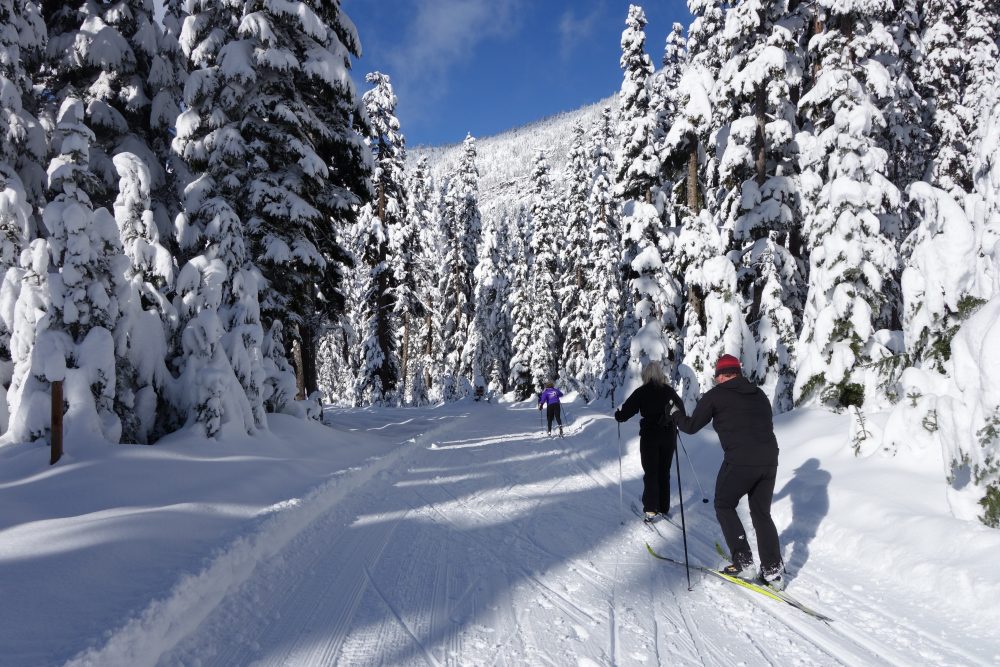
Skiing at Washington Pass, Nov., 2016. (Courtesy photo)
“It will not mean a loss of skiing,” Smith explained in the event the pass is closed for the season. “If the gate is closed farther down on the road to Washington Pass, they will start to groom different areas that we can still access. So to get the snowfall that is expected, they will start to groom just start to groom a bit lower, but bigger loops than what we have up there at Washington Pass. If we are really lucky we will get a big snowfall here on the valley floor and then Mehto Trails who I work for, we will start grooming our system. And we are all set and ready to go the moment we get six inches of snow we will start grooming our trails here.
Conditions: Pass is closed. SR 20, the North Cascades Highway, is closed from milepost 134 to milepost 171 due to impending weather and potential increasing avalanche hazard.
Restrictions Eastbound: Pass Closed
Restrictions Westbound: Pass Closed
— Jason Albert
EAST-COAST SNOW?
While they’re often among the last to get on natural snow, let’s throw eastern skiers a bone. Wintry conditions exist in New England and northeastern New York. While we can’t list them all (and are obviously unable to cover all the open nordic centers across the country), here are a couple weather-dependent options in this region’s “North Country”.
Snow guns a’blazing at Gore Mountain’s Ski Bowl in North Creek, N.Y., on Monday morning, Nov. 21, 2016. (Photo: Mike Pratt)
Gore Mountain Ski Bowl
According to general manager Mike Pratt, Gore Mountain in North Creek, N.Y., expects to open its newly homologated ski bowl on Friday, Nov. 25. Gore’s new 4.24-kilometer trail network includes 3.19 k of trails with snowmaking.
“We should have quite a bit of terrain for an opening weekend,” Pratt wrote in an email, adding that they’re hoping for trails A, B, C, and G, which would amount to a total of 2.3 k. “The open stadium could accommodate more lanes if needed, but next week’s weather will ultimately determine how much terrain is available.”
This Friday through Sunday at the Ski Bowl, the Hudson United Race Team (HURT) is holding a three-day ski camp for its junior members. Skiers of all ages not associated with the club can buy a day pass and ski on the trails as well.
“We set up this camp as a way to highlight what Gore has been doing,” HURT coach David Kvam explained.
Craftsbury
Then there’s the Craftsbury Outdoor Center, the Northeast Kingdom’s iconic ski center. Although the ski trails were dry as of Nov. 18, the forecast has potential. According to Craftsbury’s Marketing Director Sheldon Miller, the National Weather Service issued a winter storm warning for six to eight inches of snow by the end of Monday. Asked about snowmaking, Miller replied, “We’re looking for cold and dry for snowmaking, but there’s definitely some potential this week. We do need 28 [Fahrenheit] at a minimum, but colder is always better.”
With overnight temperatures forecast for low to mid 20s Sunday through Thursday, the weather looks inclined to support snowmaking.
Elsewhere, Prospect Mountain in southern Vermont received snow. According to their conditions page, they’re closed, but Zach Caldwell posted this photo montage on Sunday:
As of Tuesday, Prospect reported more than 28 inches of packed powder. Current conditions
Mt. Van Ho
A skier skates on fresh powder at Mt Van Hoevenberg last Sunday, Nov. 20, in Lake Placid, N.Y. (Courtesy photo)
In Lake Placid, N.Y., Mt. Van Hoevenberg reported “beautiful packed powder” and 30 kilometers of skiing open on a 7-inch base. Current conditions
Josie’s Cabin, Mt. Van Hoevenberg’s ski-to destination, will be open for Thanksgiving. (Courtesy photo)
“The Olympic Cross Country ski trails of Mt Van Hoevenberg have been graced with just under two feet of snow in the last few days,” nordic program manager Kris Cheney-Seymour wrote in an email. “We have a little over 30k of trails groomed very good skiing. Classic tracks are set on varied terrain.”
The lodge is open with rentals and a snack bar for Thanksgiving, along with Josie’s Cabin, a “ski-to destination.” and a ski-to destination
“Upgrades over the last two summers on the famous Ladies 5k have allowed for the earliest opening of this trail in our history,” Seymour continued. “Our 5k homologated loop will be the primary course for the upcoming 2017 Junior National Championships hosted here this March.”
— Peter Minde & Alex Kochon
***
WE WANT PHOTOS! Share your Thanksgiving week ski photos with us by emailing info@fasterskier.com (please note when and where they were taken). We’ll post our favorites to Instagram, and if you’d like to share a firsthand trail report from your favorite spot or nordic center, do so in the comments below!
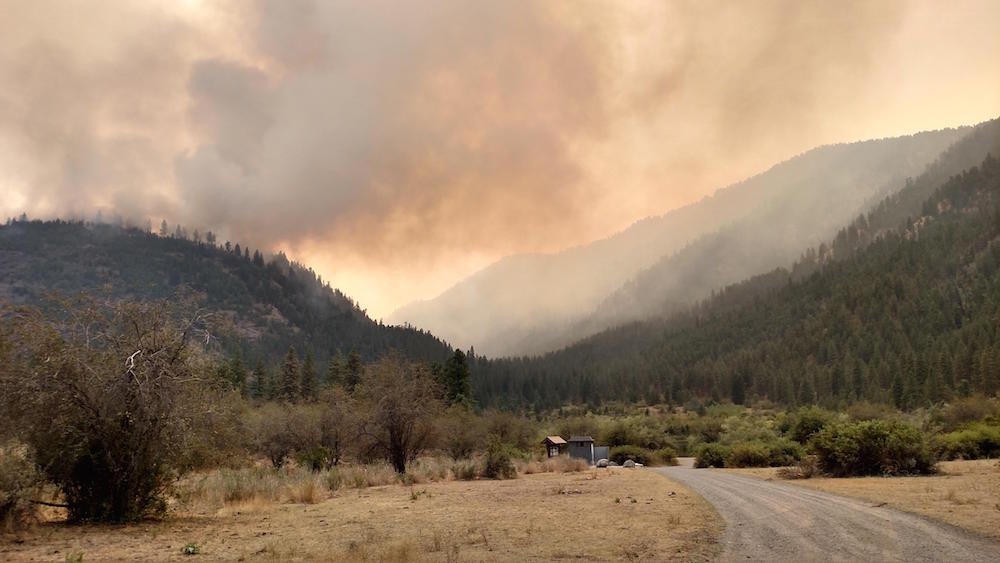
The Okanogan Complex Fire near Omak, Wash., began with a lightning strike on Aug. 15, 2015 and consumed more than 300,000 acres. (Photo: US Forest Service)
In late October, snow fell on Washington Pass just outside the Methow Valley in Washington state’s North Cascades. Just yesterday, grooming began on the Methow Trails in anticipation of the earliest opening in the nordic center’s history, set for this Saturday. This kind of start to the season is warmly welcomed by a community that endured two consecutive summers of record-setting wildfires.
A skiing mecca and home to four 2014 Olympic cross-country skiers (the Bjornsen siblings, Brian Gregg, and Torin Koos), the Methow Valley is also home to the Methow Trails, the self-proclaimed “nation’s largest cross-country ski area.” With more than 200 kilometers of trails in Winthrop and Mazama, Wash., this recreational area attracts visitors from around the country for skiing, trail running, mountain biking, and hiking.
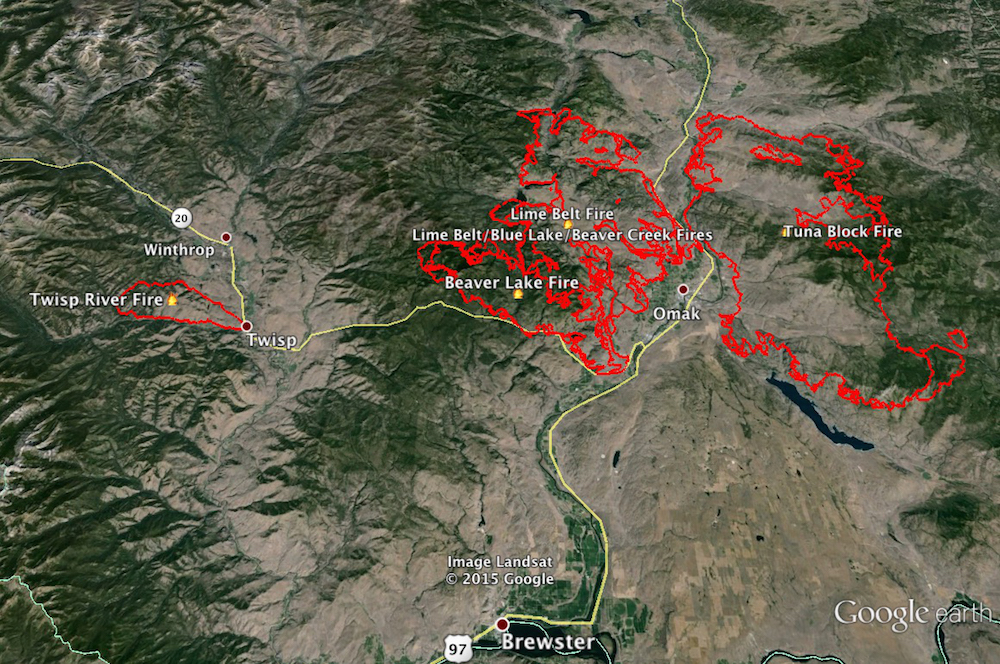
This past August, lightning strikes ignited what was named the Okanogan Complex Fire, an immense fire that grew to threaten homes, businesses and livelihoods. Actually five fires fought as a single fire due to their proximity to one another, the Okanogan Complex surpassed the previous year’s Carlton Complex Fire to become Washington’s largest wildfire on record. Peaking at 304,782 acres, the fires burned from Aug. 14 through the declaration of 95-percent containment on Sept. 20, according to the National Incident Information System.
A map of the Okanogan Complex Fire (Photo: Jeremy Blazar/Overlays by InciWeb)
Starting just down the valley from the ski towns of Winthrop and Mazama, the Twisp River Fire posed the highest threat to the ski infrastructure of the Methow Trails and Sun Mountain Lodge.
Roughly thirty miles to the east, the Beaver Lake, Lime Belt, Tunk Block, and Tuna Block fires combined to create a much larger blaze, forcing evacuations of about 5,400 homes in Okanogan County.
It was this evacuation that drew the attention of U.S. Ski Team athletes Erik and Sadie Bjornsen, who call the Methow Valley their home despite living and training in Anchorage, Alaska. Their parents still live in the valley.
“For Eric and I it was a bit a scary because we didn’t hear from our parents right away,” Sadie Bjornsen said in a phone interview. Once they made contact with their parents, they learned they had evacuated to Seattle.
Bjornsen also mentioned that aside from the size and unpredictability of the last two fires, it had been the idea of getting trapped that Methow residents feared the most.
“The really freaky thing that happened this summer was that there was a fire over the North Cascade Highway … and there was a fire down in Twisp, and then there was a fire in Omak,” she said. “So all three ways of getting out of the valley were potentially blocked.”
None of these closures coincided for a total road blockage; however, the valley’s entrapment by fire was a conceivable reality.
This was more of an issue the previous summer when heavy rains created flooding and mudslides in addition to the ongoing fires. From the experience with the Carlton Complex in July 2014, the valley as a whole learned and was “a little better prepared for evacuation and the infrastructure issues,” Mark Waechter, longtime resident and owner of the Winthrop-based ski shop, Nordic Ultratune, wrote in an email.
Waechter, who wrote about the fires on his blog in August, didn’t feel the affects of the fires on his business due to the shop’s exclusively winter focus and high volume of mailed-in, ski-grinding work.
While the Winthrop and Mazama townships that many skiers call home were not immediately affected, the blazes quickly captured national attention when three firefighters died on Aug. 19 and four others were injured. These deaths, especially overwhelming for a small community where just about everyone knew or had a connections to one of the deceased, also drew enough regional media attention to spread an exaggerated sense of devastation throughout the valley, potentially dissuading tourists.
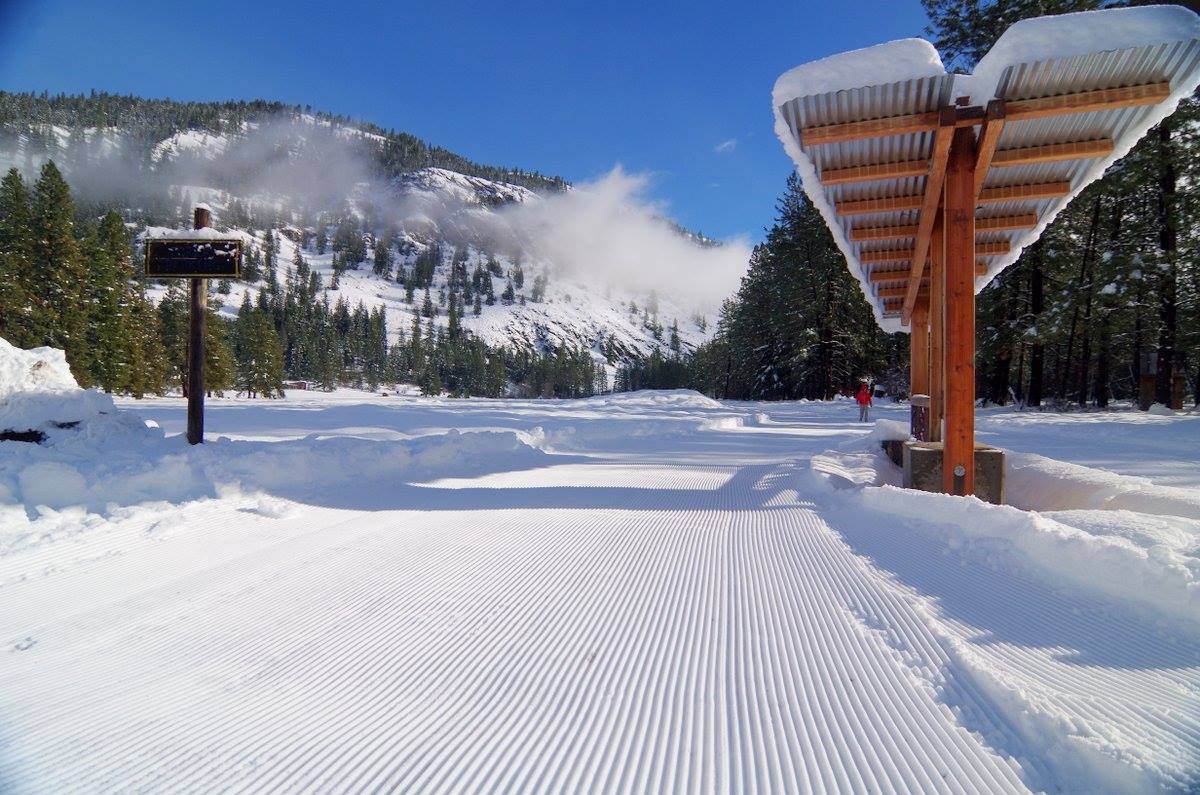
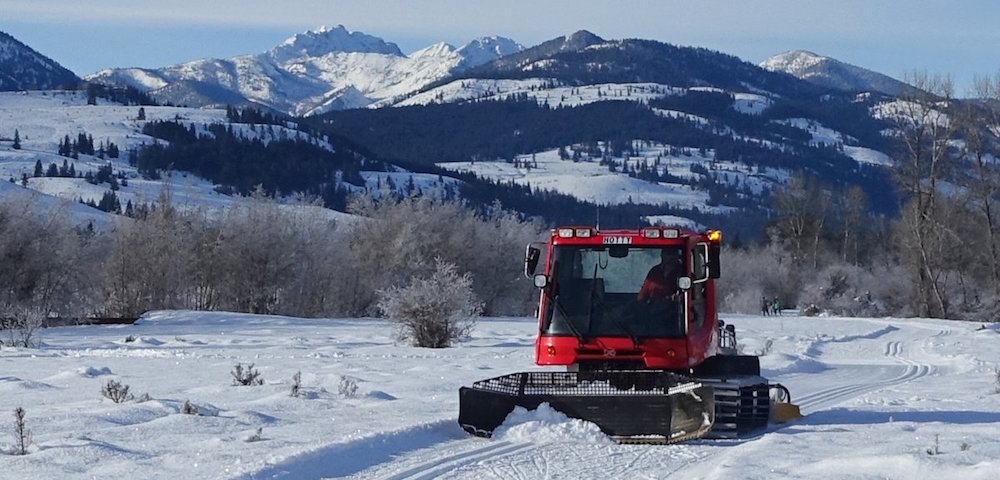
The first grooming pass of the season took place Wednesday at the Methow Trails. The 200-plus-kilometer trail system is on track for the earliest opening ever on Saturday. (Photo: Methow Trails/Facebook)
“The hardest part about the recovery is convincing people to come visit after the smoke and fire went away,” Methow Trails Executive Director James DeSalvo wrote in an email. “Within a few weeks after this fire took off, the valley was open for business, but our marketing engine can’t compete with national disaster news.”
All of the skiers and members of the ski community interviewed for this article echoed that sentiment, including Methow Olympic Development (MOD) Squad Head Coach Scott Johnston.
“If you came here and you drove just up the Methow Valley on the main road, you’d hardly see any damage other than some burned, blackened hillsides,” Johnston said.
Methow Valley Nordic Team coach Leslie Hall expressed sorrow for the loss of life and property, but explained that her team, “never really missed a beat even with smoke and fire.”
“The hardest part about the recovery is convincing people to come visit after the smoke and fire went away.” — Methow Trails Executive Director James DeSalvo
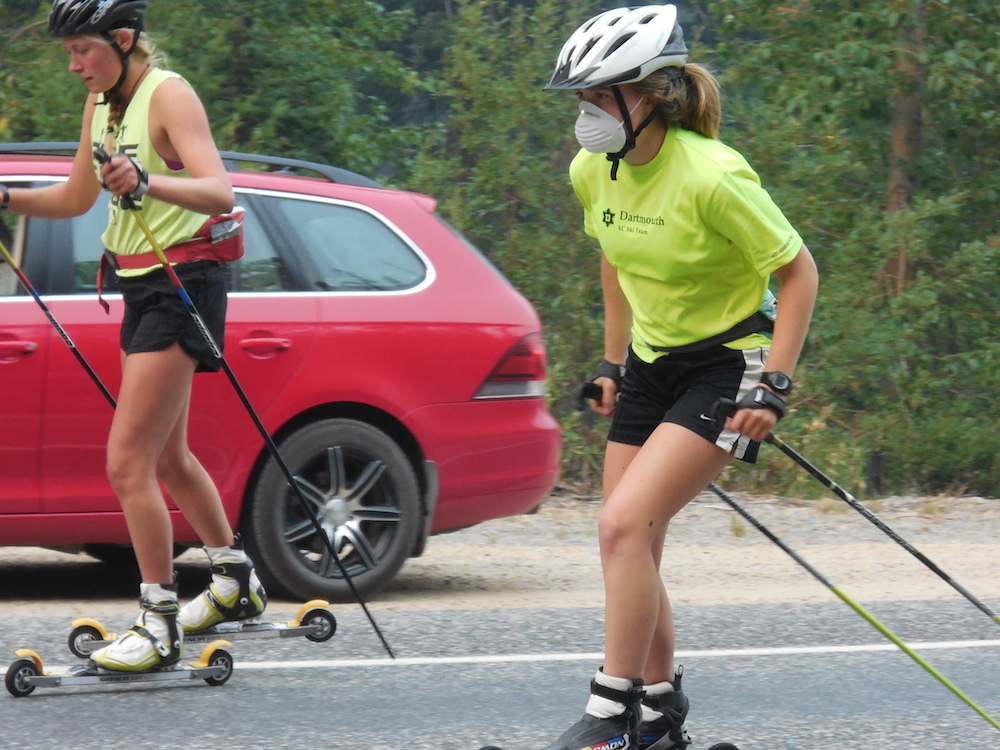
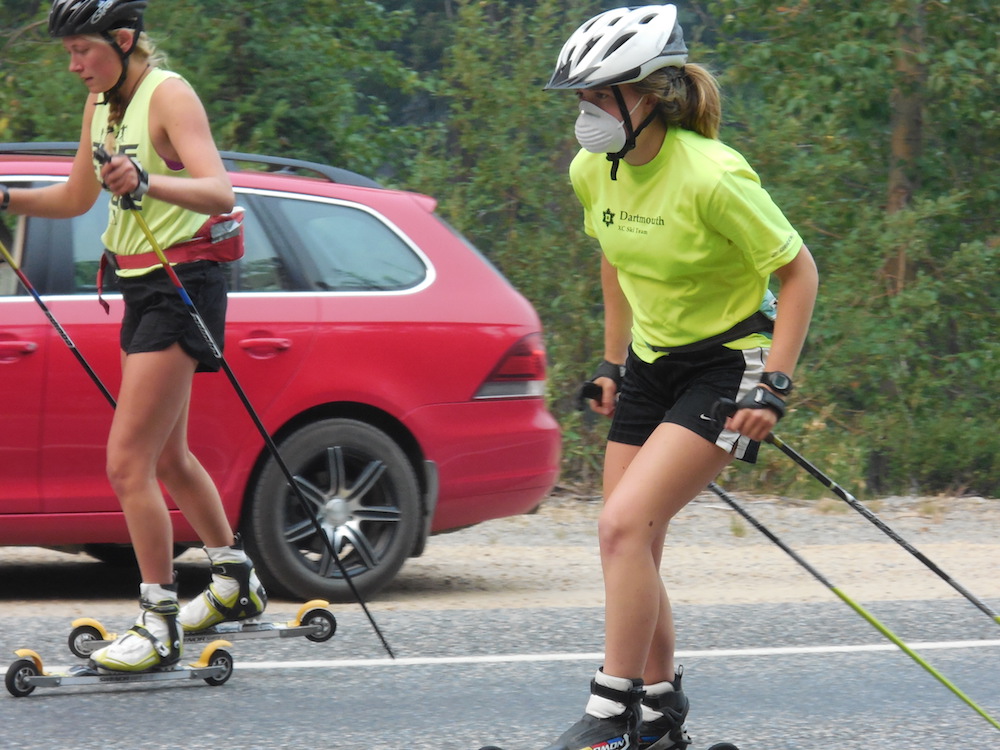
Training deviated from the planned schedule only when smoke levels hit unhealthy levels. Hall, Johnston and former MOD athlete, Sam Naney, who now runs Momentum Northwest in Seattle, all mentioned the smoke as a training inhibitor, but explained it was easily avoidable by adjusting to the wind and elevation. Bjornsen said her parents still got outside with the use of breathing masks, and she only missed one interval session because of smoke during the week she visited after the fires.
Methow Valley Nordic Team skiers Ella Hall and Claire Waichler rollerski amidst the smoke on closed Highway 20 this summer. (Photo: Leslie Hall)
From an economic perspective, many agreed that it was imperative for early snow in order to draw tourists back to the Methow. Despite the fires and forest closures, DeSalvo’s staff at Methow Trails has done all of their normal preparation in readying the trails for the winter. On Saturday, they’ll open earlier than ever, right in the nick of time, according to a grooming report.
To understand the nordic center’s role in the economic recovery of the region, one might consider its return on investment. According to the Methow Trails’ economic analysis published in August, it creates 152 full-time jobs each year, and has accounted for $700,000 dollars in sales tax revenue and $12.4 million dollars in combined direct and secondary expenditures made by trail users. Also, for every dollar spent on trail maintenance, $23 is returned to the local economy.
Not only do the trails serve the community’s transportation and recreational needs, they are aiding in economic recuperation. Now they just need the snow to cooperate this winter.
Winter on the Methow Trails. (Courtesy photo)
Looking toward the future, it’s easy to predict more fires as the snowpack and weather becomes more unreliable, and each year seems to be drier than the previous. Wildfires are natural and essential to the ecosystem; thus this will happen again. However, it’s the severity and relentless nature of these past fires that’s scared the community.
Naney, who grew up in the valley and lived there until this past year, mentioned that this year’s fires were “essentially burning over areas that burnt last year,” making the entire event “… horrifying for people.”
On the other hand, the community, and the skiers within it, know that preparation is key. Part of this is trail advocacy and promotion since, “the last three major wildfires in our area have all been redirected away from homes and towns due in some part to the trail network acting as a fire line,” according to DeSalvo.
Part of it is simply working around what the fire destroyed. The Methow Nordic Team did so by offering free membership to those team members whose families lost property.
As the snow falls, skiing and tourists will return to the valley, and life as usual will continue for all of Okanogan County.
“Our official opening will be this Saturday and forecast is for sunny and cold for the foreseeable future,” DeSalvo wrote in an email. “Good news for everyone.”
The Methow Valley Sport Trails Association (MVSTA) would like to share some big news. MVSTA has a new name: Methow Trails! We are excited to share our new name, new logo, and new web address.
Why did we change our name? Well, honestly we knew that “Methow Valley Sport Trails Association” was a mouthful and our acronym of MVSTA often got in the way of sharing great trail experiences. Not only is our new name shorter, but it emphasizes the two things most important to our organization: the Methow and Trails. Going forward, we expect to spend more time talking about amazing trail experiences and less time explaining our name.
Methow Trails remains committed to enhancing, and growing trail opportunities in the Methow Valley. This winter season we will continue to operate North America’s largest cross-country ski area with over 120 miles of ski trail where kids 17 and under ski free everyday. We will continue to offer our signature programs and events along with new trailside amenities and communication tools to provide you with the best trail experience possible. We will continue our dedicated work as a non-profit organization in offering year-round trail opportunities and management of 11 Methow Valley trailheads.
We are proud of our 37 year history. The organization has updated its name twice in the past as it has evolved. We are proud to showcase our new name and look, but more importantly, we are excited to more easily showcase our trails. We hope you will have the opportunity this winter to join us for a ski, fat bike, or snowshoe.
You can follow us on the digital trail at methowtrails.org, on Facebook at Methow Trails, via our free Methow Trails grooming apps, or stop into our office in downtown Winthrop.