Tag: Methow Valley

  • Q&A with New Faces on the U.S. Ski Team: Walker Hall

    Q&A with New Faces on the U.S. Ski Team: Walker Hall

    U.S. Ski & Snowboard recently announced its U.S. Ski Team nominations for the 2022-23 season. Of the 22 athletes named to the team this season, six were not on the previous year’s roster, either newly named or renamed: Michael Earnhart, Walker Hall, Zak Ketterson, Will Koch, Finn O’Connell, and Sammy Smith.
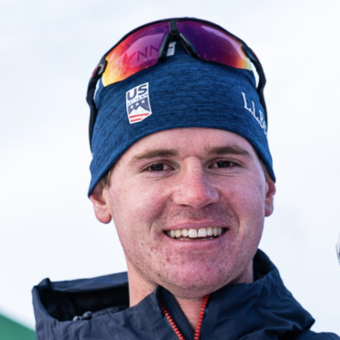
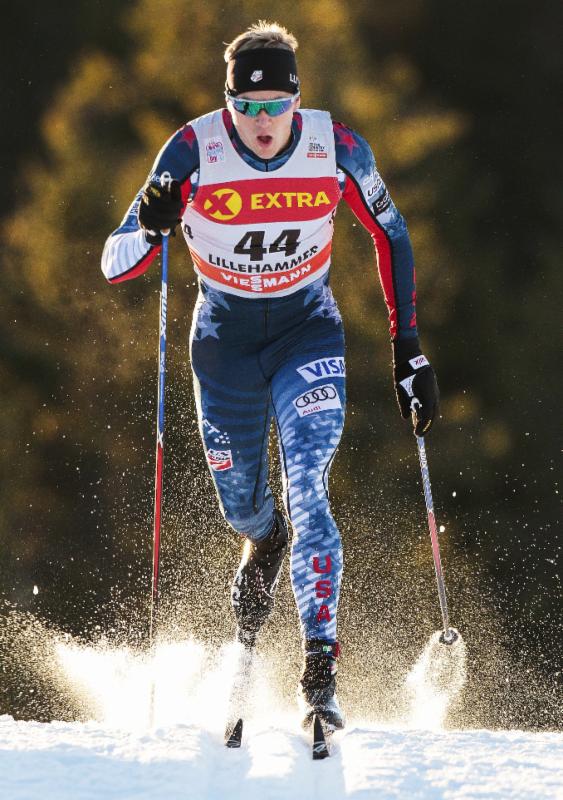
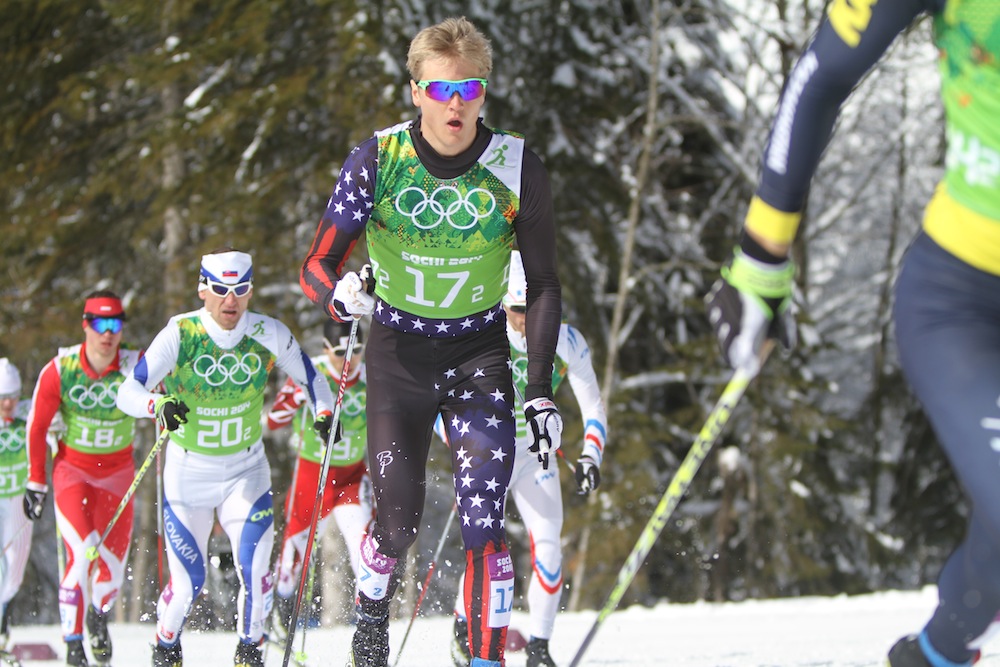
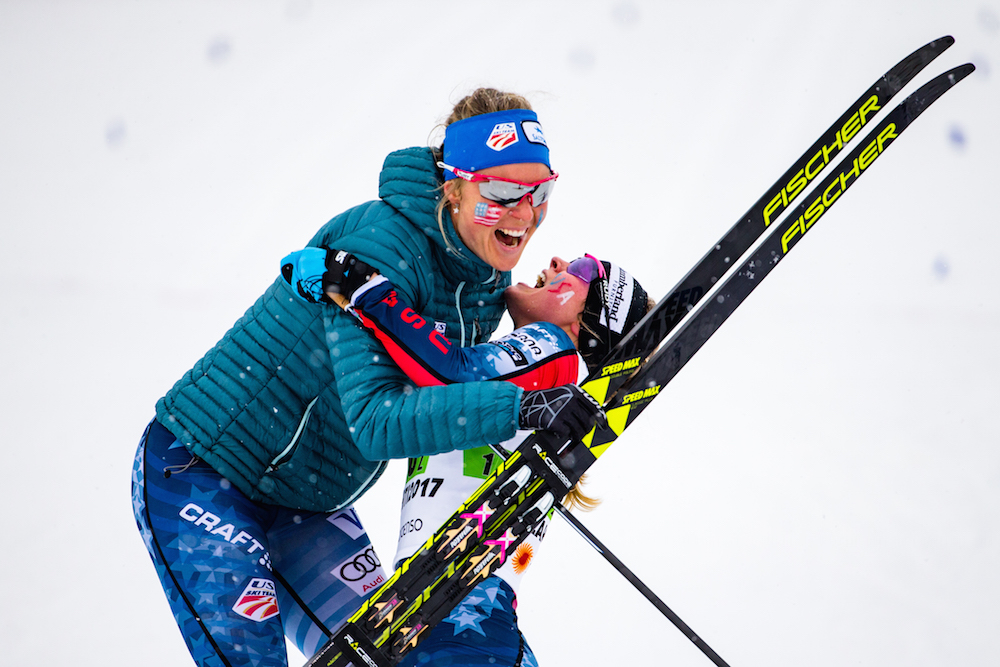
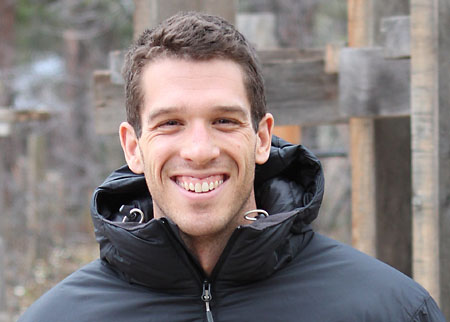
    Walker Hall was named to the 2022-23 U.S. Cross-Country D-Team. (Photo: U.S. Ski & Snowboard)

    To help fans get to know these new(er) faces, FasterSkier is doing a series of interviews, providing insights into the factors that have contributed to development, progress, and growth for these athletes last season. In this installment, we talk with 20-year-old Walker Hall, who was named to the D-Team this season. Hall grew up immersed in the Methow Valley cross-country ski community and is now entering his sophomore year at the University of Utah

    While the Methow has produced a number of outstanding skiers, including Brian Gregg, Erik Bjornsen, and Sadie Bjornsen Maubet, Hall could find inspiration even closer to home. His mom, Leslie, skied in three Olympic Games between 1988 and 1994, and her best friend and training partner post-professional racing soon became two-time Olympian Laura McCabe, once both women relocated to Winthrop, WA. Still close friends, Walker and Novie McCabe are just six months apart in age, and began tagging along from their infancy on their moms’ training and outdoor endeavors. Both athletes, now U.S. Ski Teammates, developed on the Methow Valley Nordic Team, coached by their mothers.
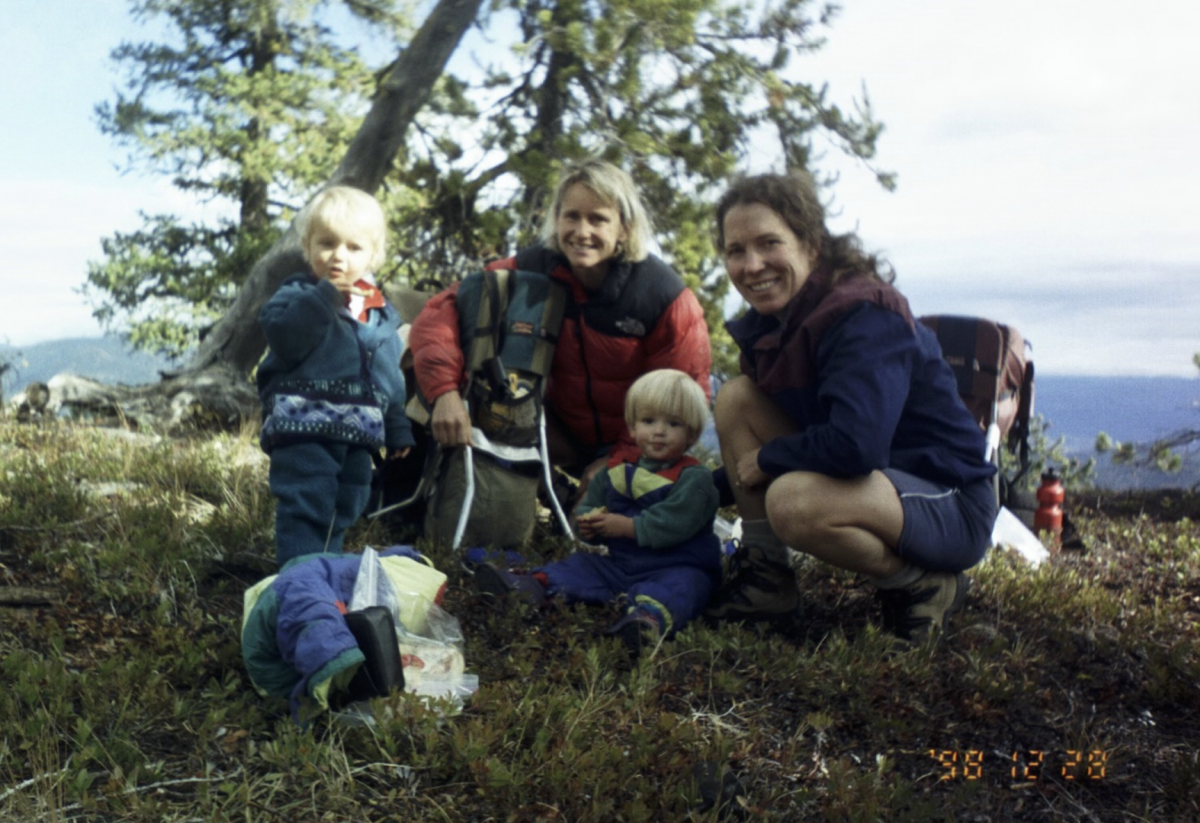
    Methow Valley Nordic Team coaches and Olympians Laura McCabe (left) and Leslie Hall (right) bring Novie and Walker, now U.S. Ski Teammates, along for their training and outdoor endeavors. (Courtesy photo)

    In this interview, Walker reflects on some of the other influential experiences – and setbacks – that contributed to a breakout season in 2021-22. Hall won the junior men’s 10 k during the 2022 U.S. Cross-Country Championships in Soldier Hollow, and finished in the top-five in a third of his RMISA races, including a podium performance in Sun Valley. Earning his first spot on the World Junior team, Hall competed in both the 1.2 k freestyle sprint and the 30 k skate individually, and was a contributing member of the U20 bronze medal winning relay team.  


    – Walker’s sister, FasterSkier assistant editor Ella Hall, contributed to these questions

    FasterSkier / Rachel Perkins: You grew up in the Methow Valley, which has a strong legacy within its cross-country ski community and the number of athletes who grew up there and went on to ski professionally. But in your situation, you and Novie McCabe are only about six months apart, and your families are super close and it sounds like you both did a fair amount of tagging along for both of your moms’ training as kids. Can you talk a little bit about your introduction to skiing and what your relationship with the sport was like growing up? 

    Walker Hall: From as early as I can remember, probably as soon as I was capable of going on skis, that’s when I started – me and Novie both. Regardless of what we were doing, it was mostly outdoor activities, whether that was hiking or climbing or just spending time outside. Our moms would take turns, like one would take care of us while the other went and did some training or a long run or something. So I felt like I got a good training base just from everything I did outside, and started off skiing really young, and it’s always been a big part of my life.
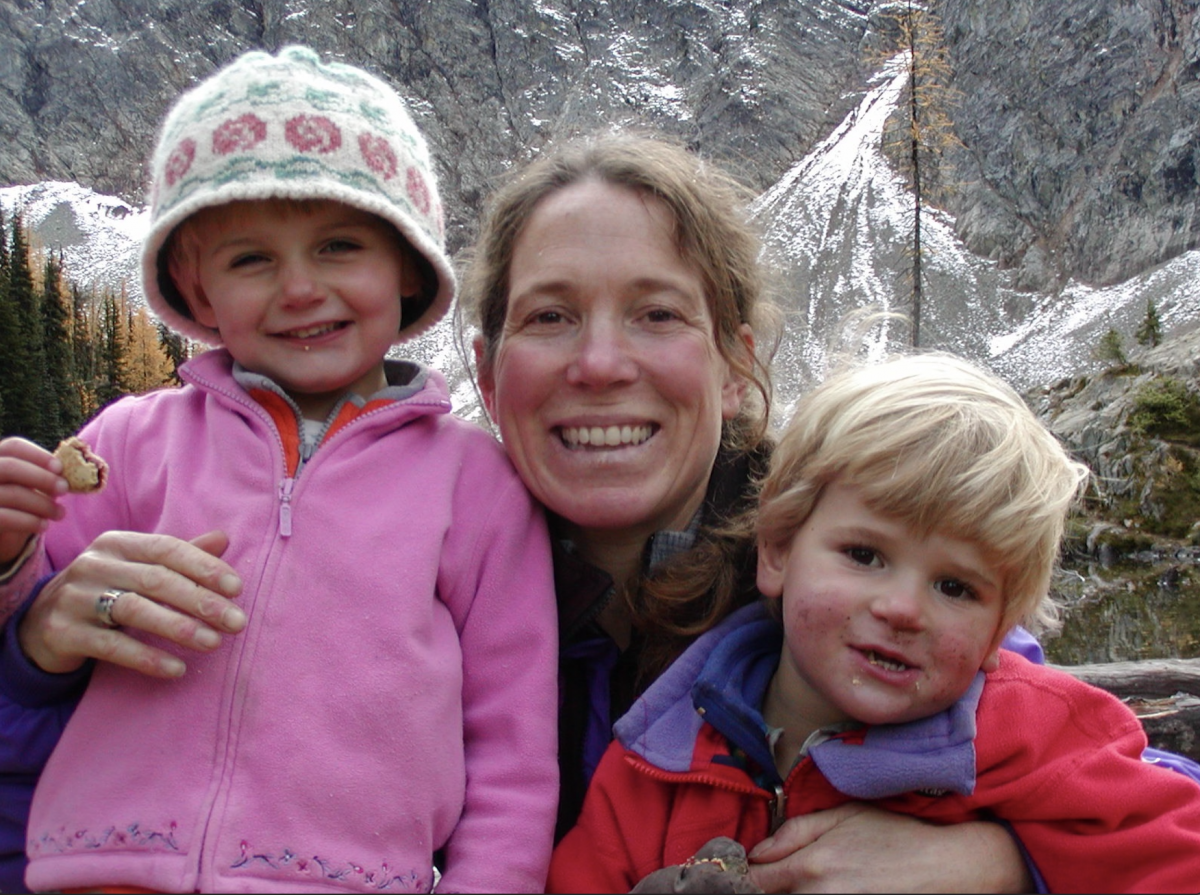
    Leslie Hall, with a young Novie McCabe and Walker Hall, share a lifelong love of the outdoors that has developed into successful ski racing careers. (Courtesy photo)

    FS: I also noticed you also listed your mom as one of the most influential people in your life in your U.S. Ski Team bio, and I know she was one of your coaches with the Methow Valley Nordic Team (MVNT). Can you say more about that?

    WH: She coached [MVNT] up until just this last year – she retired last season. Basically when she was done racing [professionally] and once my parents moved to the Methow in the late ’90s, she really developed the program there.

    So she’s been coaching for a really long time, and she had a lot of experience. She coached when my sister was skiing, so I grew up doing what [Ella] did because she’s four years older. My mom was able to give me the support and advice and guidance that is crucial for being good at skiing, and she was not too overbearing or anything, so I think she was just a really good influence on my ski career.

    FS: That type of relationship seems important – not being overbearing, but really sharing in a mutual love of the sport. Is that something that you have felt within the Methow community and within your own family?

    WH: I’ve definitely felt a lot of support from different people in the Methow, whether it’s my mom or Laura [McCabe] or other people in the ski community there. I’ve always gotten the support that I’ve needed and been pushed when I needed to be, and never felt too much pressure or anything, so it’s been really good for my career in skiing.
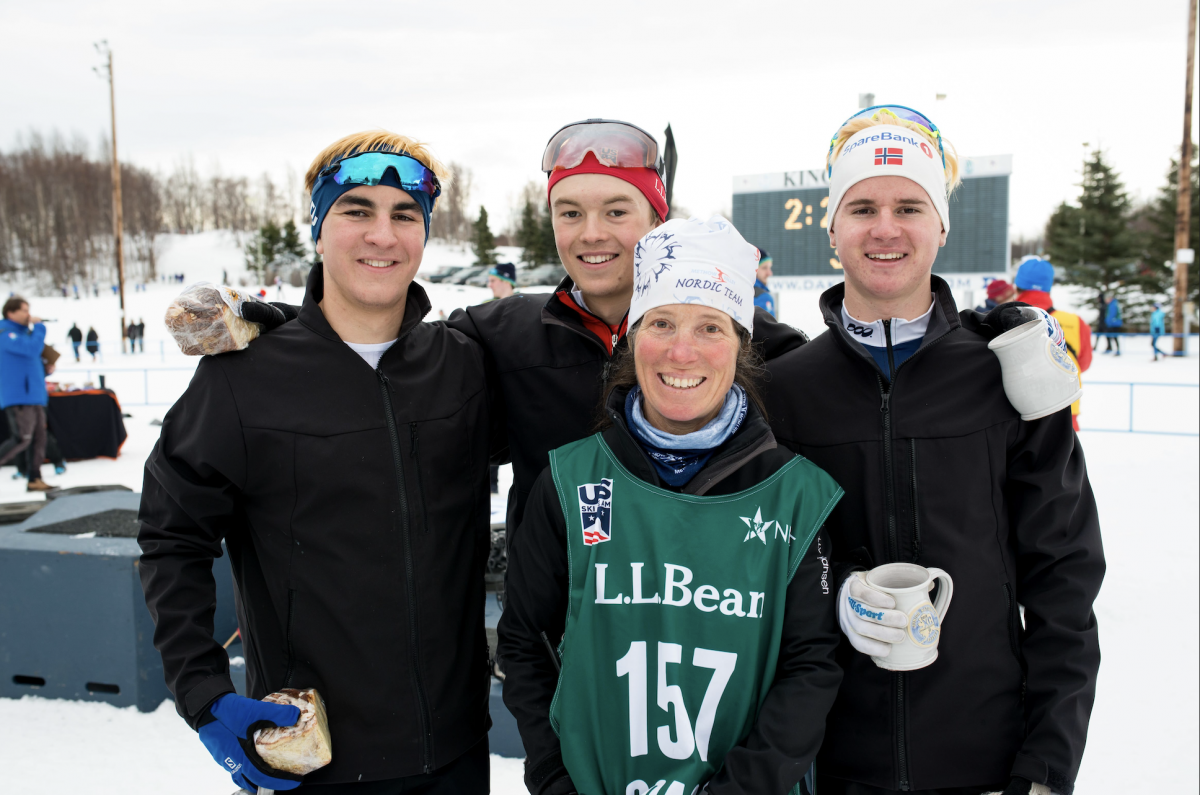
    Long-time Methow Valley Nordic Coach and 3x Olympian Leslie Hall with the members of the U18/U20 relay at 2019 Junior Nationals in Anchorage, all of whom skied for MVNT. From left to right, Travis Grialou, Garrett Butts, and Walker Hall. (Courtesy photo)

    FS: Fast-forwarding a bit, in high school, you spent six months in Meråker, Norway during your junior year, and it sounds like that was a pretty formative experience for you – you had a really positive experience with that program, and the coach, and made some good friends/training partners. Can you share more about how that came about and what your time was like there?

    WH: It came about because Ella did a very similar [program] her junior year; she also went to Meråker, but she went for a shorter period of time. But as I got older and learned more about the sport and the people within the sport, it seemed like Norway was the place to be to really improve and learn. Our family had some connections in that area because Ella had been there. 

    Once I was there, it was definitely a lot different. Coming from the Methow where there’s really not many – there’s a lot of skiers, but it’s such a small area that you’re sort of in your own little bubble. So going to Norway and just seeing the ski culture there and learning a lot about training and what the Norwegians like to do [was really beneficial], because they obviously have a really good method for juniors or whatever age you are in ski racing. I had good coaches, good training partners, and good support there as well. So I definitely learned a lot and sort of knew what I had to do when I got back to really take skiing to the next level.

    FS: Was that at a sports academy? Were you going to school also?

    WH: It’s actually a public high school, or it’s funded by the government, but it’s a sports school [called the Meråker videregående skole]. So we would train in the mornings until maybe 11, and then shower, eat lunch, go to class for three hours or so, and then maybe train in the afternoon. That was what it was like most days, then on the weekends, it was more on your own because it’s a school program, not  a club. When we would go to races – which I didn’t go to too many races – we would go with a local club.

    FS: Your sister said that the experience also inspired you to take Norwegian lessons after returning home and that you’re “decent” now. Is this true?

    WH: When I was there, I definitely didn’t know that much [Norwegian]. There were two other non-Norwegian students that I took some Norwegian lessons with, just what the school provided, but I definitely never really spoke that much while I was there. I wanted to keep learning and improving [after I got back], so I’ve studied on and off since then. I’m alright at it – I’m pretty conversational, I would definitely not say I’m fluent. But it’s a fun way to stay connected with my friends over there, and some of my teammates at the University of Utah are Norwegian too, so that’s been cool.

    Hall also explained that his classes in Meråker were in Norwegian, but since the group size was small, and both his teachers and classmates were helpful, he was able to get by without being fluent in the language. 

    FS: After graduating high school in 2020, you had planned to go back to Meråker for a gap year, but COVID got in the way of that, and plan-B ended up including a lot of time training on your own in the Methow. Can you talk about that experience and how you adjusted?

    WH: I had been planning to go back to Norway, but everything was so strict with COVID [at that point], they were not letting anyone in, basically. So I was just at home and I kept trying to figure it out so that I’d be able to go over there, but it just kept not working. I kept trying, but eventually, I was just at home the whole time. 

    I was going to races in the winter but it definitely was not an ideal situation for me because I was doing a lot of training on my own, which, it’s not necessarily a bad thing to train on your own, but for me personally, it’s a lot easier for me to train with other people. It’s a lot more motivating, and long term, it’s a lot better to train with other people so you don’t plateau. But I just focused on racing and kept working hard and it wasn’t the worst in the end. That year was alright, but it wasn’t ideal.
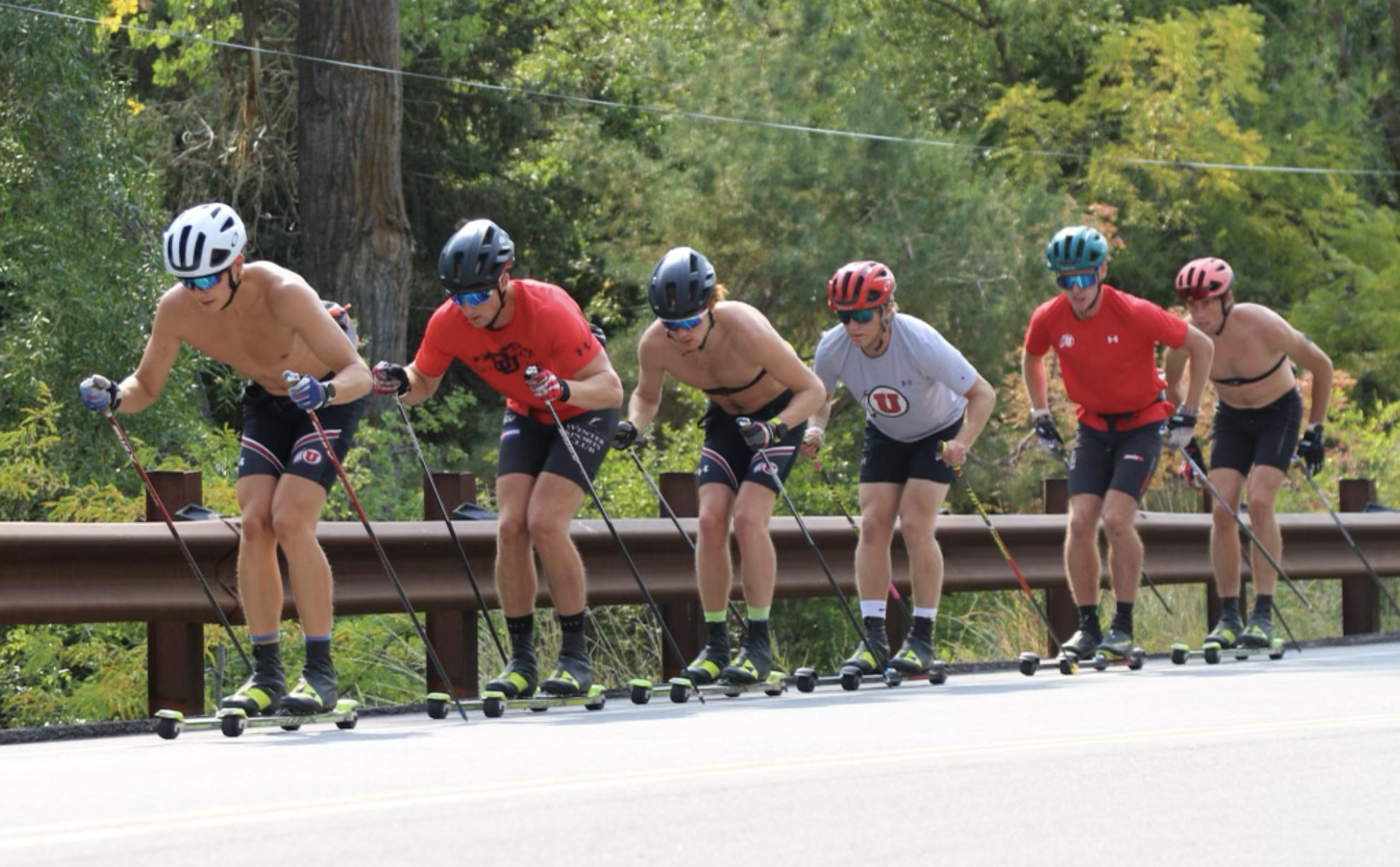
    Walker Hall trains with the University of Utah team in Fall 2021. (Courtesy photo)

    FS: Kind of on the other end of the training group spectrum, for collegiate racing, you originally committed to Dartmouth, but later were offered a spot that opened up at the University of Utah, and made the switch as Utah had been your first choice.

    WH: Yeah. Basically, I had planned on going to Dartmouth, and then COVID hit, and it was looking like life at Dartmouth with COVID was going to be a lot different than before. I had been talking to Utah [during my senior year], and they had been saying ‘oh, you should take a gap year and then we’d probably like to take you.’ So there was also a chance that I was not going to take a gap year and just go to Dartmouth, but then when that gap year happened and I got offered a spot at Utah, I just knew that that was going to be the better choice for me.

    Last summer before I went to Utah, I came up here to Anchorage for most of the summer, so I was training with a lot of my future teammates. There was a big group of people up here and a good amount of Utah skiers were here, so it was a good way to prepare and it was a really good experience. There’s just such good training up here during the summer. And the winter, I’m sure.

    FS: And what does that look like? Are you working with a coach or under a certain program? And how have those experiences being in Anchorage for the summer been valuable for you?

    WH: I train with APU when I’m up here. That’s a really solid group to train with, coached by Erik Flora, who I really like and I’ve learned a lot from. It was a really good experience coming up last summer, and I knew I wanted to come again this summer. There’s just a lot of really hardworking people that push me and help me hit big hours, so I think it’s a good place for me to be during the summer.

    FS: Going back to University of Utah – what appealed to you about that program? And what was your experience like in that first season of collegiate racing?

    WH: There’s a lot [that appealed to me about it.] I knew a lot of the people on the team, and I knew it was such a strong team. I had actually been down there a couple times – or I had been in Park City for ski camps and [races], and I visited Novie for a couple of weeks [during her freshman year at Utah] and really liked it. Me and Novie have always done similar training and whatnot, so I figured if she was liking it a lot down there, then it was a good place for me also. 

    And I really liked the coaches. I talked a bit with Miles Havlick and Frederick [Landstedt], and I really liked what I’d seen from those guys. Since I’ve been there, it’s been a really good fit.
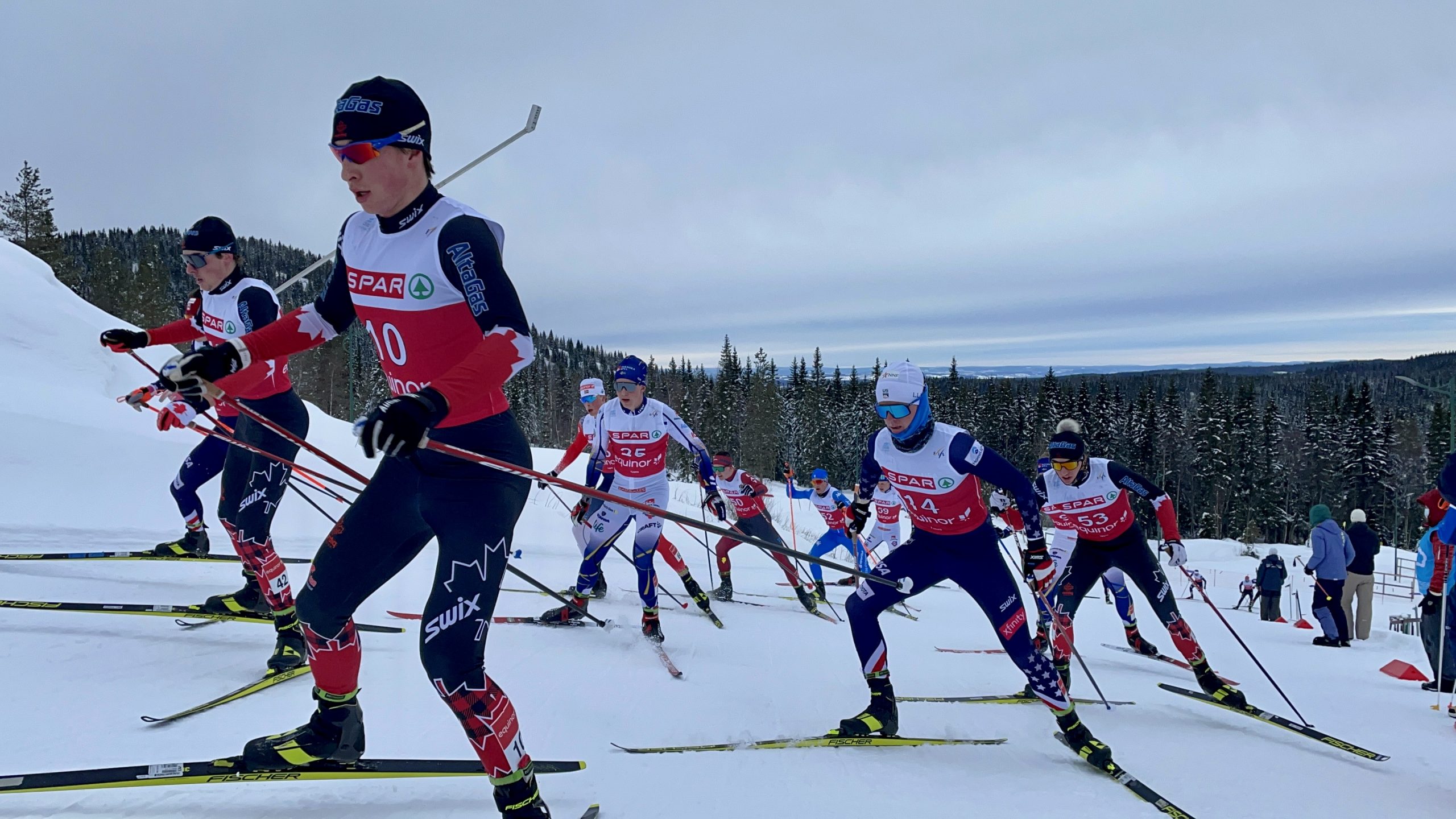
    Xavier Mckeever in bib 10 (CAN) and Walker Hall in bib 14 (USA) head up “waffle hill” in the early stages of the men’s 30 k mass start during the 2022 Junior World Ski Championships in Lygna, NOR. (Photo: Ella Hall)

    FS: World Juniors in Lygna was your first international trip, and it sounds like you had some bad luck with racing at US Nationals and/or been really close in prior years. What do you think came together for you this season to make that trip? And what were some of the highlights of that World Juniors experience in terms of how it supports your development and goals?

    WH: Yeah. In previous years – maybe the past three years or so for this year – there were like two years where I was just coming off of sickness going into nationals, so I never really had the races that I wanted there, and I never ended up making any of those international trips. Which, honestly, I would have liked to go on the trips, but it never really bothered me too much – it wasn’t like demoralizing or anything – because I felt like I knew the level that I was at and that on a given day I could be as good or better than any of the trip. So it was never really too much of a bummer for me. But this year, I wanted to make it on the trip to World Juniors, and I had goals for the races at World Juniors too, it wasn’t just the trip there was the end goal. But just making it definitely felt good, and I had a really good Nationals this year, which was awesome since that’s pretty much the first time that’s happened for me. 

    I was super happy that the races were in Norway because I just love spending time there, and we got to do our pre-camp in Hafjell, which is right near Sjusjøen, and I’ve spent some time there – it’s [some of] the best skiing in the world. So that was super fun. And I really liked a group of guys and the entire team and staff that was there, so it was a really good experience.

    FS: From the outside, it seems like you took a pretty big step forward this past year, which maybe can be attributed to having such a strong group to train with at University of Utah, or some more direction after a tough gap year. In looking back over this year, what are some of the factors that you think allowed you to take those steps forward and what were some of your personal highlights from the season? And those personal highlights do not necessarily need to be a race result, just an experience that stands out to you.

    WH: I think the main factor was really taking my training to the next level. Especially over the summer [in Anchorage] and then carrying that through the fall in Utah. I was just training with a really strong group, and really pushing myself, and doing [types of training] that I hadn’t really done in the past. So definitely, a good part is thanks to that. And then also, I’ve had a lot of different experiences over the years and learning from those helps to channel some better results.

    As for my highlights – this last season, I was just proud of the way that I trained and was smart with my training, and I  didn’t overdo it. And it seems like it’s often hard to put together a good season like your freshman year of college because it’s such a big adjustment. So I was happy that I was able to have a solid season for the most part while going through such new experiences in my first year in college.
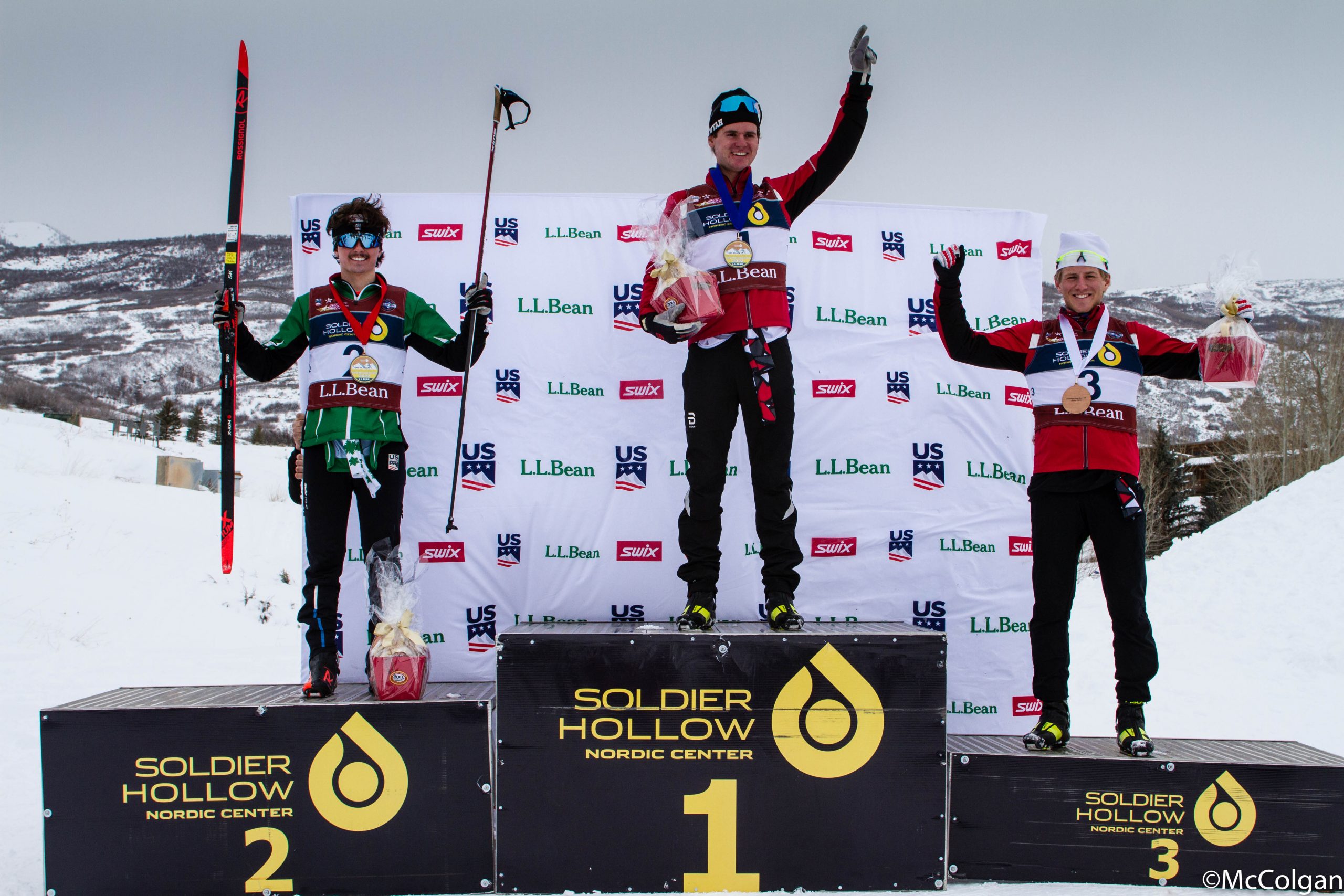
    Walker Hall stands atop the podium in Soldier Hollow after winning the junior 10 k mass start freestyle during the 2022 U.S. Cross Country Ski Championships. (Photo: John McColgan)

    FS: What are your goals heading into next winter?

    WH: It’s gonna be my first year not being a junior, so honestly, I don’t have too many specific goals. But I’d definitely love to race in my first World Cup this year, and just keep improving. On the college circuit, hopefully, get a bunch of podiums in RMISA. And just keep learning from my teammates and pushing with the team at Utah.

    FS: Last question for you: with making the D-Team, can you share what that means to you and what you’re excited about in terms of the support and opportunity that opens up for you?

    WH: It’s always seemed like probably the biggest step you can make in U.S. skiing is actually making the ski team, so it feels really good to have achieved that. I’m just now realizing the amount of support that means that I’m able to get, so I’m just taking advantage of that and learning from my other teammates on the team – taking advantage of the different opportunities that it grants me, and just enjoying the ride. But I’m definitely thrilled to have made the team.

  • Tucked Away with a Cross-Country Boom in the Methow Valley

    Tucked Away with a Cross-Country Boom in the Methow Valley

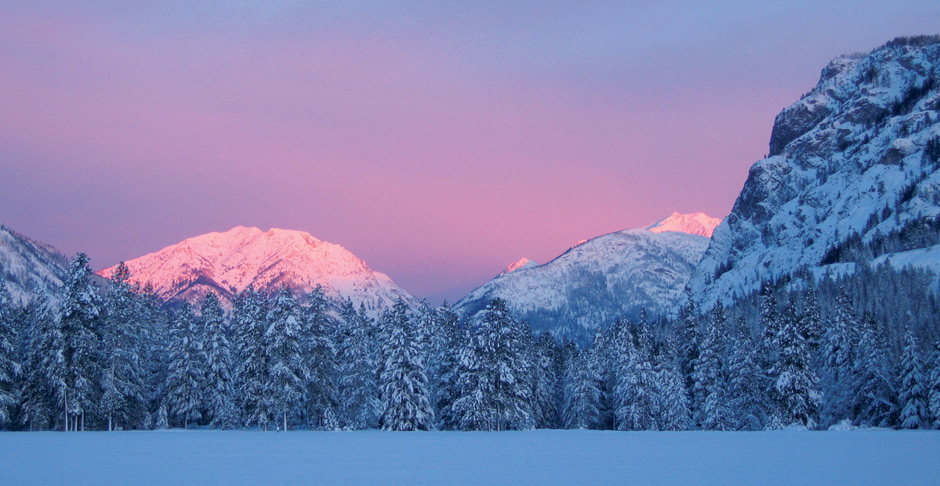
    Winter in the Methow…(Photo: Paul Butler/Methow Valley News)

    To say Coronavirus is reshaping our world is to state the obvious. Even in the tucked-away haven of the Methow Valley, COVID-19 is having an impact in more ways than one. An article written by the Methow Valley News in October, details how the valley is becoming a “zoom town”, a phenomenon echoed by many mountain towns around the country as the pandemic encourages remote work and less densely populated living environs. Just three hours over North Cascades Highway in the summer from the metropolis of Seattle and five hours from the city when the pass closes in the winter, the Methow Valley is well located for urban recreationalists looking to escape the city.

    When Washington stay-at-home orders eased following Memorial Day this spring, the rural valley experienced an unprecedented number of visitors throughout the summer and fall. A significant increase in property and housing sales correlated with the increased visitation, which as Ann McCreary writes for the Methow Valley News, “is creating the most competitive and stressful [housing] market brokers have seen in the Methow”.

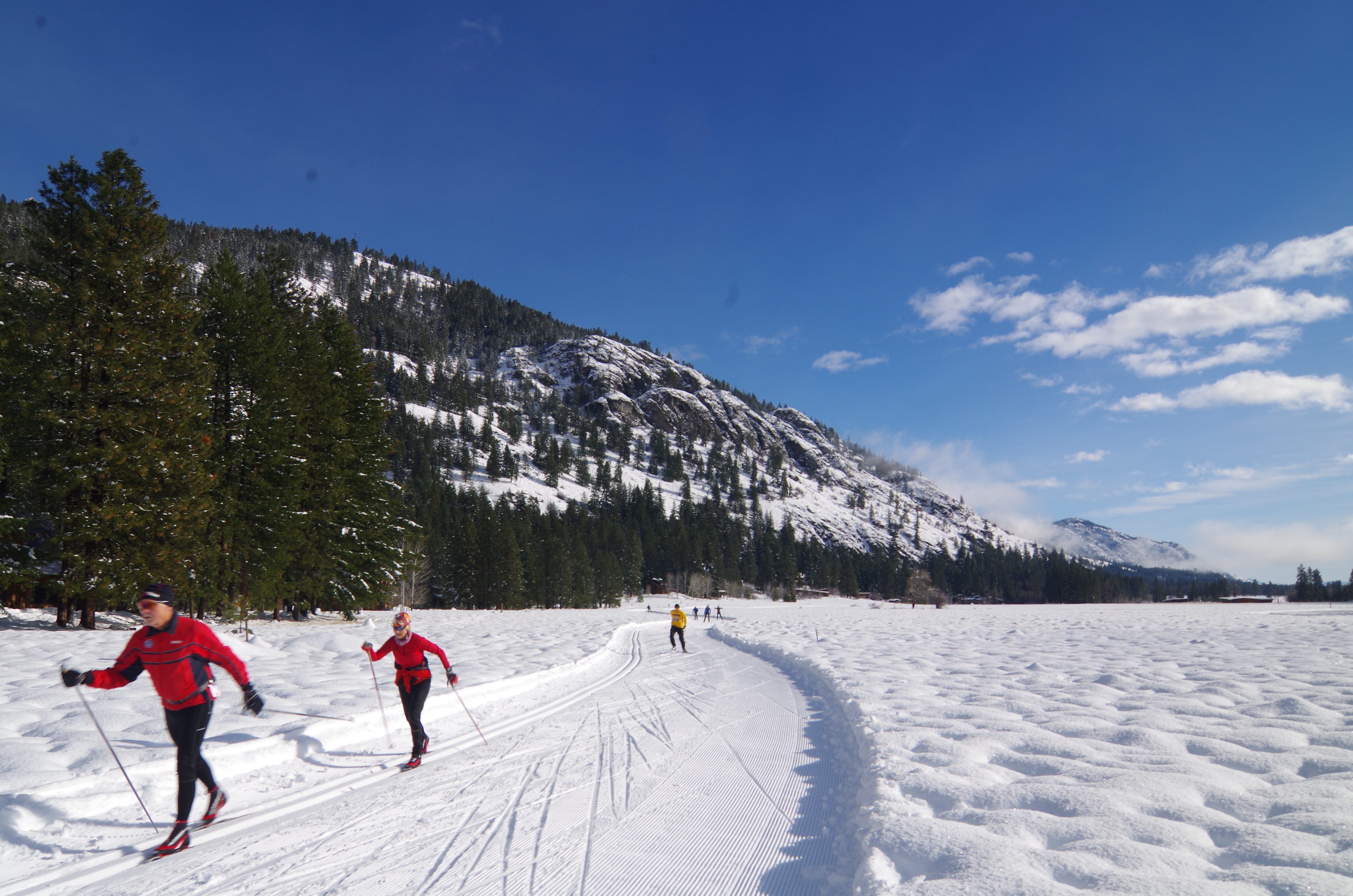
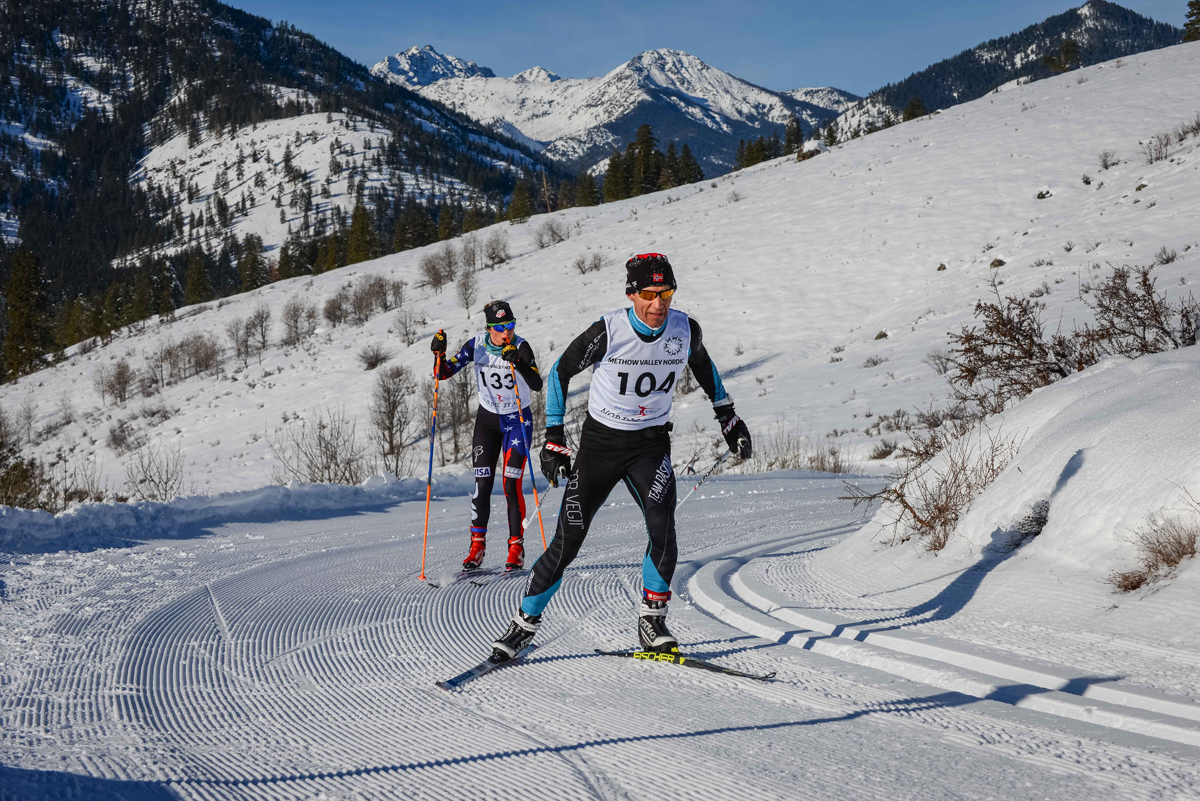
    Skiers on the valley floor: during the first skis of the season last year. (Photo: Methow Trails)

    Coupled with the region’s remoteness are its high value sporting options. One key winter-time asset is this: the Methow boasts the largest cross-country trail system in North America with over 200km of groomed skiing in the winter. While nordic skiing is not exactly a widely known or popular sport in the United States, as this little corner of the country experiences a rise in popularity, so too does this sport. Recently published articles by the Seattle Times, Wall Street Journal, and Outside Online, all detail why cross-country skiing is the ideal sport for social distancing. The Seattle Times article, “How to start cross-country skiing- the ideal sport for social distancing,” mentions the Methow Valley several times saying, “the crown jewel of [Washington] state’s Nordic offerings, though, is Methow Trails, the Methow Valley’s massive cross-country ski network spanning Mazama and Winthrop.” 

    Winter on the Methow Trails. (Courtesy photo)

    Graced with an early season snowfall, this year’s ski season began early in the valley. Methow Trails, the non-profit organization responsible for grooming and year-round trail maintenance, announced opening day on November 21st, the earliest ever official opening. According to James DeSalvo, Executive Director for Methow Trails, early season pass sales were up 33% from last year’s numbers. DeSalvo attributes this increase to two things, the early season snow and COVID-19.

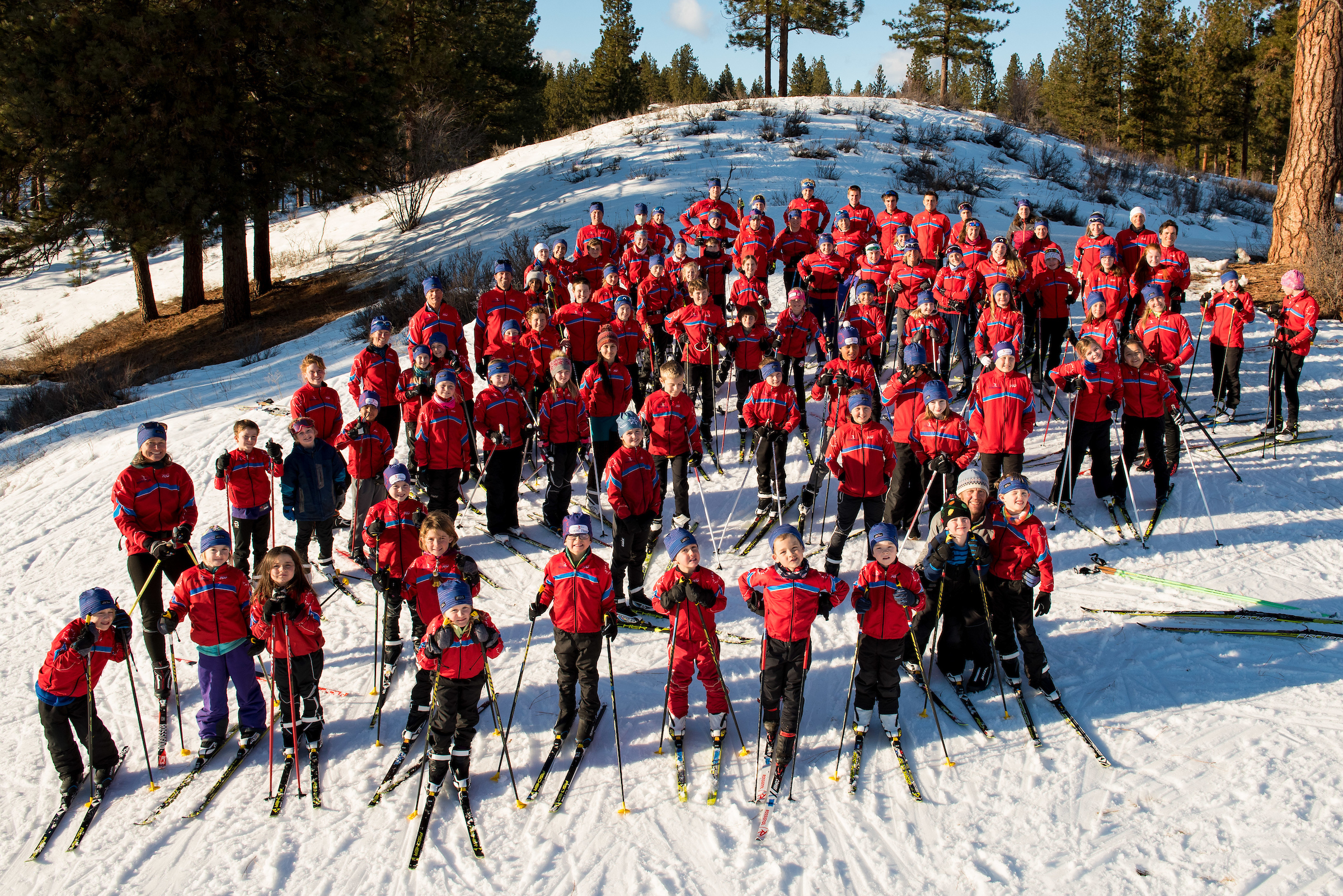
    Another indicator of the sport’s new found attraction, for now certainly a short-term impact of COVID – can be seen in the Methow Valley Nordic Team. (The author was a member of MVNT through childhood and high school and that her mother is the director of the junior team). Enrollment in the ski team typically hovers around 100 skiers from year to year, according to Leslie Hall, director of the Methow Valley Nordic junior team. This year 127 athletes signed up for the junior team and the coaching staff has increased by an additional 5-6 members to cover the higher number of skiers. Pete Leonard, Executive Director of Methow Valley Ski Education Foundation, the umbrella organization which the junior team falls under, believes that somewhere between 15-35% of these new faces are newcomers to the valley. Others have lost the option of school-related sports due to COVID restrictions and are trying a different sport this winter. Hall says, “I do think we have gotten some new local kids, since now there is no basketball or wrestling.” 

    Members, small and tall, of the Methow Valley Junior Team pose for a team shot at the end of the 2019/2020 ski season. (Photo courtesy of MVNT)

    The Hoffman family, who recently moved to the valley from Seattle, made the decision to sign their twelve-year old daughter up for the ski team “because it’s what you do in the Methow Valley” said Danielle Hoffman. “With COVID, I didn’t feel comfortable standing shoulder to shoulder in endless lines or making my way to the bathrooms [at alpine areas]. It was time for a change. Nordic is basically free. Sure the initial investment is there for a set up but I can ski right outside my door. It was worth the change.” 

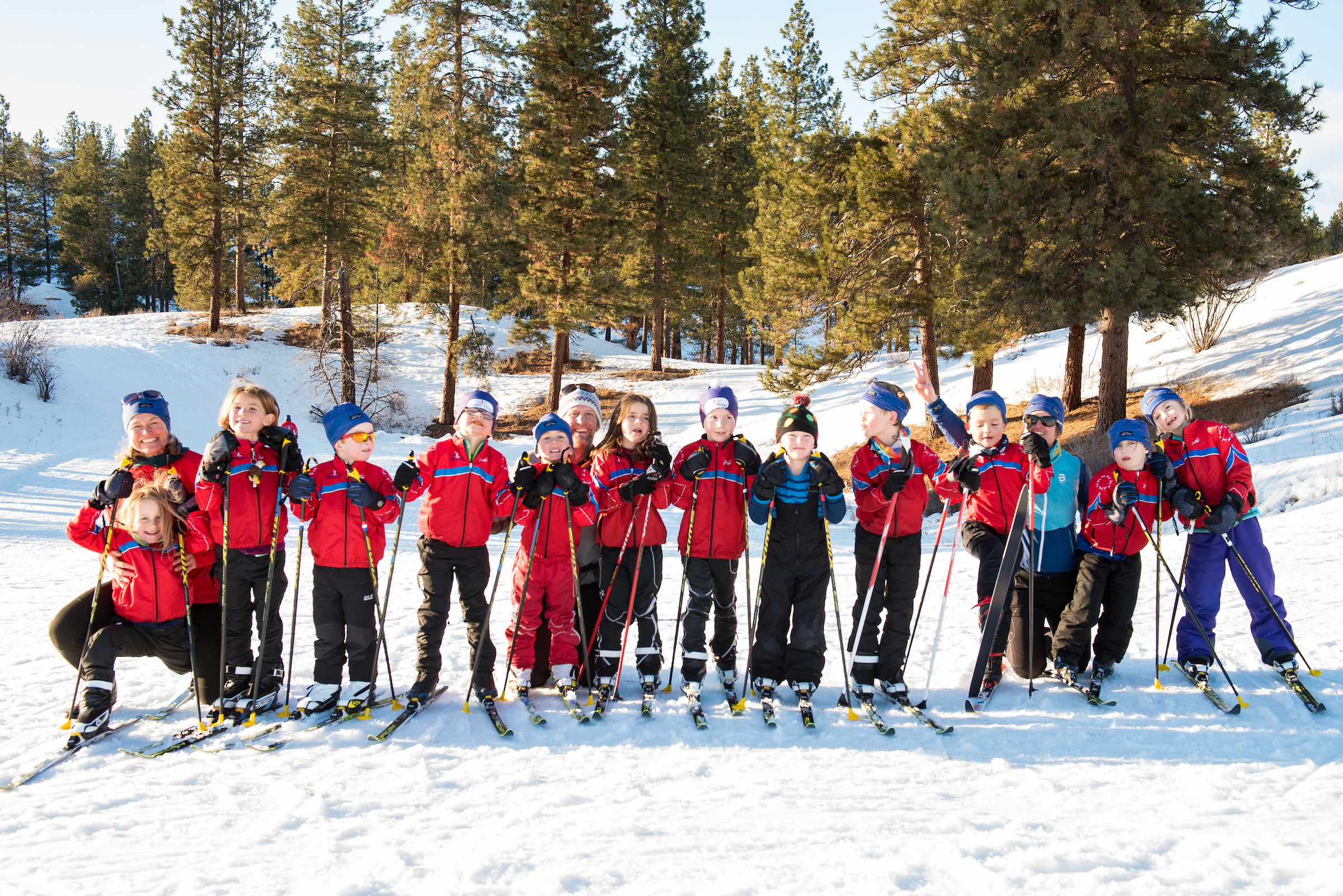
    Some happy little skiers. The Methow Valley Nordic Team caters to those ages six and up. (Photo courtesy of MVNT)

    Similarly, the Menzies came to the Methow in March to escape COVID. “What could [be] more quintessentially Valley than cross country skiing!” exclaimed Pete Menzies in an email, “and our neighbors told us it was a wonderful program, and we knew that many excellent skiers coached here. Plus, with COVID lurking, what could be better than getting outside for regular exercise, meeting new people and kids, and learning to love winter weather than joining the ski team and learning from the best.”

    In this postage-stamp community surrounded by mountains, for the influx of new residents and families moving full-time into what were once urban-escape valve vacation homes, cross-country skiing becomes a means to be part of a broader community during uncertain times. 

  • Still Charging: Erik Bjornsen Retires at 28

    Still Charging: Erik Bjornsen Retires at 28

    Erik Bjornsen crossing the line in the 2019 15 k skate pursuit in Ruka, Finland. (Photo: NordicFocus)

    Bright lights in PyeongChang. The men’s second semifinal of the Olympic freestyle team sprint was a career highlight moment for Erik Bjornsen. Fourteen teams would crowd the start lanes with Martin Johnsrud Sundby in bib 1. The Norwegian was paired with Johannes Høsflot Klæbo: The duo blessed with Sundby’s stamina and his younger counterpart’s break-from-the-pack speed.

    With Simi Hamilton racing the second, fourth, and sixth legs for the U.S., and Bjornsen leading off, the semi was a chance to not only advance to the finals, but establish some mojo amidst an Olympic field. Hamilton and Bjornsen both possess slower tempo big-power generating F-350 type motors that belie the meters gobbled up with each cycle of their cadence. 

    As Bjornsen was tagged for the fifth of six legs, he locked on to France and Norway to position himself in rarefied company. PyeongChang’s Alpensia sprint course packed a punch. The course’s second climb it’s Everest – a drawn out leg burner. Pulsing into that climb, France’s Maurice Manificat, Sundby, and Bjornsen had already separated from the field. Midway up, Bjornsen subtly shifted gears, moved to the left of Manificat, and dropped the two steely veterans by 10 and then 15 meters pushing over the top.

    It was a Stars-and-Stripes flex.

    Bjornsen tagged Hamilton in first by nearly five seconds. The pair went on to qualify for the final and placed sixth overall in an event eventually won by the Sundby-Klæbo pairing. 

    (Video of Bjornsen’s breakaway on the 5th leg.)

    “It was interesting, I think that everybody knew what I was capable of in the field when I made those moves,” said Bjornsen when reflecting on career highlights. “I remember one of the strongest memories I have from racing is when I made that move against Sundby. And after the race, as we were starting the final in PyeongChang, he turned and looked at me for a while, and I could tell that he was thinking ‘what is this kid bringing to the final’? He eventually got the gold medal with Klæbo, and he is looking at this American guy, and I think that was one of the coolest feelings I have ever had — knowing that this legend was looking at me, and thinking, ‘what is this guy about to bring to the biggest performance of our lives?’”

    The U.S. men’s team has been overshadowed by a dominant women’s program for going on a decade. Through that time, the men’s distance program has seen the end of Kris Freeman’s reign and the emergence of Noah Hoffman and Erik Bjornsen. Hoffman retired in 2018. With Bjornsen announcing his retirement last month at twenty-eight years old, a void remains. As one generation bleeds into the next, Bjornsen is an anchor point for all those speedy juniors we’ve heard of. An affable athlete who set the American distance skiing bar for the past five years.

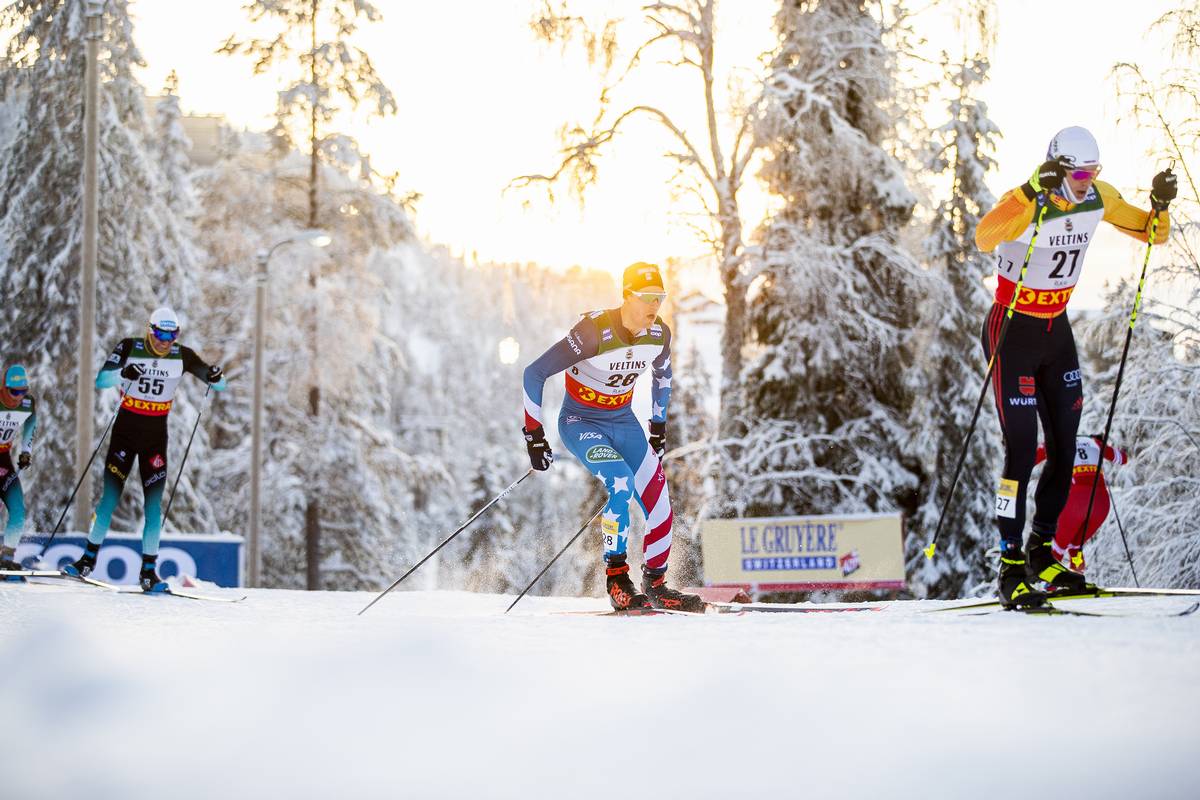
    Erik Bjornsen of the U.S. (bib 28) during the 2019 15 k skate pursuit in Ruka, Finland. In bib 27, Sebastian Eisenlauer (GER) leads Bjornsen. (Photo: NordicFocus)

    Bjornsen often shouldered the pressure for a team and broader community starved for that dominant distance performance by a U.S. male — a World Cup podium or a championship medal to validate the personal quest and the vicarious desire from some fixated on top-3 hardware. Making the top-30 on the men’s World Cup is a herculean task. Bjornsen first passed that threshold with an 18th place in 2014 during a 15 k classic (his marquee event), in Toblach, Italy.

    In January 2018, he surpassed that 18th place, which up to then was a career best individual mark on the World Cup, with a ninth place in Seefeld’s 15 k mass start skate. He peaked individually at the World Championships with an 18th and 17th, respectively, in the 2017 and 2019 Worlds in the 15 k classic. 

    The manifestation of steady improvement was Bjornsen’s calculus for remaining in the game. And the wait and wait for results beyond his stream of top-30s and top-20s was arduous. Even on the best of days, all things must align for the breakthrough.   

    “Definitely, my last couple of years, I was really hungry for great results, like everybody that puts so much into the sport,” said Bjornsen. “I was ready to make that next level. But I was moving towards the end of time I wanted to put into the sport and I really wanted to make the progress every year that I knew what I was capable of. There are so many variables in nordic skiing that I was just frustrated not to put it together more on the days when it was so tough. My thing was 15 k classic — that is where I could put together a top performance. That’s four 15 k classics a season, you are trying for your top performance in those four or five and also nailing the wax and also nail everything on that day. So I am proud of the results that I had but I was frustrated like any World Cup athlete. I was just definitely hungry for more at the end.”

    The World Cup came to an end for Bjornsen in December after he raced the opening weekends in Ruka, Finland, and Lillehammer, Norway. Yet, the decision to retire from World Cup level competition came after the 2018-2019 season if he did not, in his words, “step-up”.  

    After a solid summer of training, Bjornsen was blunt about his 2019-2020 World Cup campaign. “I am going over to the World Cup to make a step forward, or call it a career,” he said.

    He placed 25th overall in the Ruka triple. The following weekend in Lillehammer’s 15 k/15 k skiathlon he had a reason for optimism. At the same venue with the same race format in 2017 Bjornsen had placed 20th. This year, he initially raced near the sharp end. But as the temps warmed a degree or two, his skis began to ice. He faded to 39th. The plug was pulled.

    Bjornsen explained that U.S. World Cup regulars leave bags on the wax bus after each season, a stash of clothes and items to rely on when they arrive for the season each November. “I had left a bag over there basically for the last five or six years,” said Bjornsen. “On the last trip, I packed that one up. I didn’t know if I would be coming back.”

    Having grown up skiing in Washington’s Methow Valley, Bjornsen followed the usual path of success: solid Junior Nationals, World Junior Teams, a second place in the 2011 U.S.Nationals 20-kilometer classic, and his first senior championship two years later in the 15 k skate. USST D-team, B-team, and then A-team. Although the family fostered two future Olympians, (you know this but older sister Sadie is a USST veteran) Bjornsen’s parents moved to the Methow when a new alpine ski area was in the works. As luck would have it, the planned downhill area never materialized. 

    Erik Bjornsen (APU/USST) and Matt Gelso (SVSEF) headed up Hermod’s Hill for the final time at the end of the 15 k freestyle at the 2013 U.S. Nationals. Bjornsen took his first career national title and Gelso finished third.

    The Bjornsens live on the more secluded Mazama end of the Methow. Mazama sits at the base of a closed-in-winter State Highway 20 which snakes its way up to Washington Pass and alpine paradise. Drive any direction but south in the winter from Mazama and it’s a snowy dead end. One road during those cold months serves as a diversion into Winthrop and further south to Twisp. The region’s storied cross-country trails provided another outlet. Within walking distance of Bjornsen’s neighborhood were endless ski trails and families falling in love over and over again with the sport. Sean and Laura McCabe and Leslie Hall (Laura McCabe and Hall are former USST members) lived nearby and were constant reminders that sliding on snow without a gravity assist had merits.

    With his two older sisters, the Bjornsens joined the local ski club. It was a steady stream of hand me downs terminating at Erik. As Bjornsen became more serious, he relied on Scott Johnston as his primary coach. Johnston is known as fastidious and established a serious training regime for Bjornsen. 

    “I learned a lot from him,” said Bjornsen. “He took the time to explain everything about skiing and also the physiology side of things. I started to understand the ways of training and training plans. He brought my curiosity out and made me think about each and every workout.”

    By the time Bjornsen was in his late teens, Sadie had moved to Anchorage to ski race as a student-athlete for the University of Anchorage Alaska (UAA). When it came time for a post-high school decision in 2010, Erik chose to attend UAA too. Both Bjornsens ultimately aborted their UAA paths after earning NCAA All-American status and began taking opportunities on the World Cup as they trained with APU. APU, an emerging powerhouse team, was coached by Erik Flora and championed by Anchorage’s Kikkan Randall. 

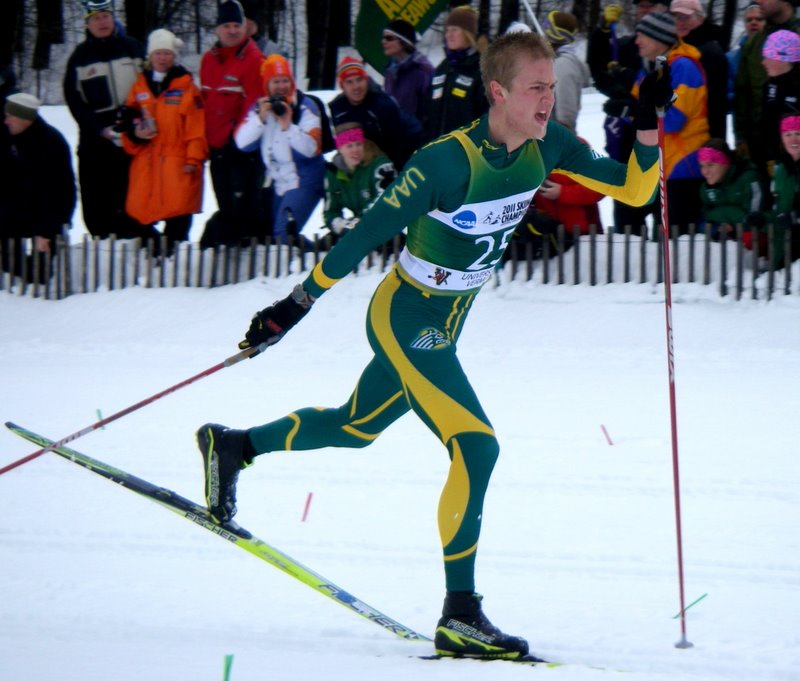
    Erik Bjornsen on his way to second at the 2011 NCAAs in Stowe, VT.


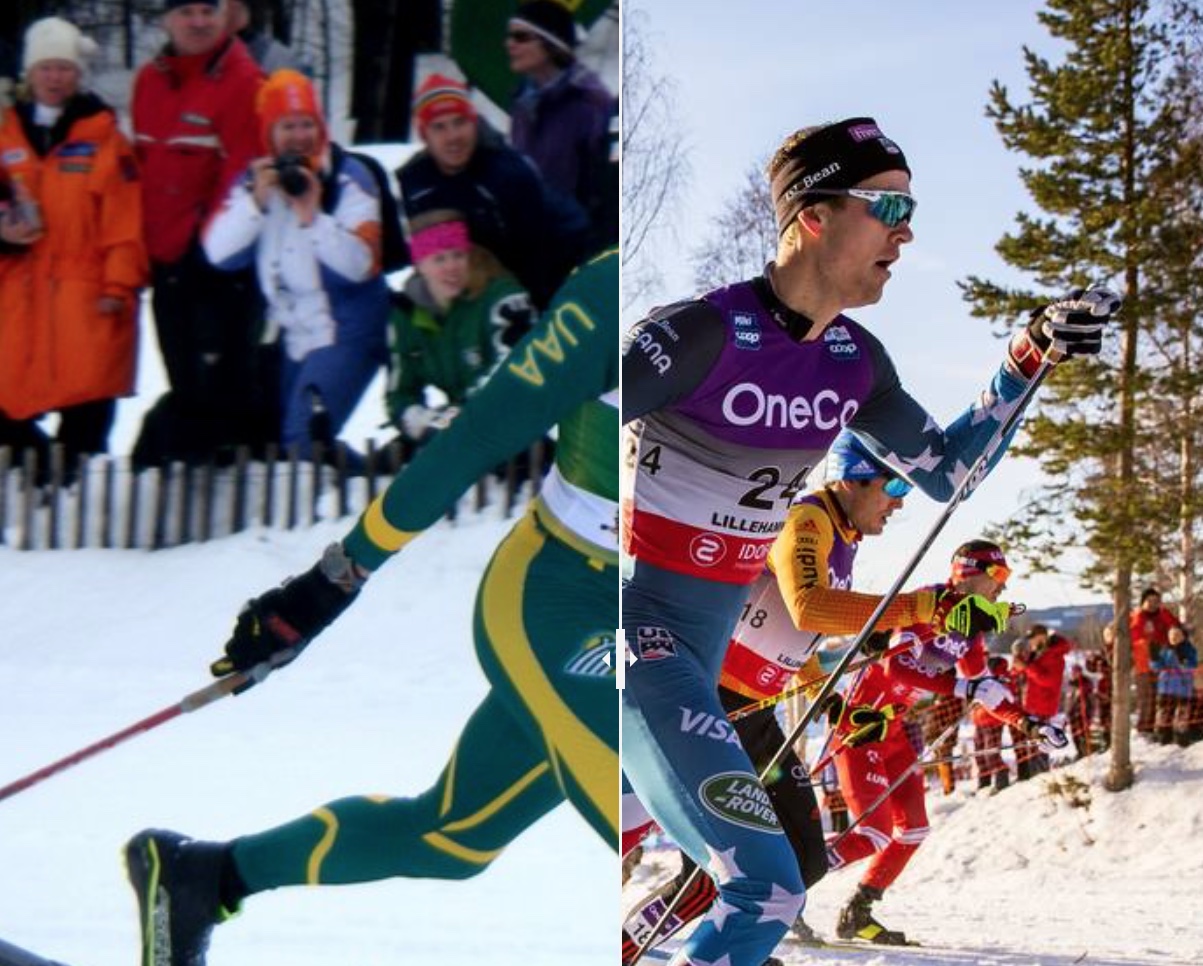
    For a juxtapose of Bjornsen between 2011 and 2019, click the following link.


    With a cohesive training group at APU and the steadiness of Flora, both Bjornsens blossomed. Erik earned his first World Cup start on Dec. 7, 2012 in Québec. A few days later in Canmore, he popped a 36th place in the 15 k classic. Along the way, he won six national championships and was a member of the U.S. Ski Team for seven years. 

    “When Erik first came in, I could see this young, talented skier that was excited about skiing, and he really enjoyed racing,” said APU’s Flora. “And when he first came in, I thought, Okay, if I can help him with his training, and help him reach the next level in fitness, that seemed like an opportunity that was an easy one to help him get toward his goals. And as he retires, you know, there was a certain point where Erik went from being in a place where talking about daily training was constructive, to where Erik absorbed all of that over the years, to the point where Erik knew how he wanted to train, and he had the foundation for it.”

    During the later part of his career, Bjornsen had enough know-how and self-knowledge to write his own training plans with the occasional check in or hands-on training session with Flora. 

    Bjornsen imprinted the cycle in his muscle memory. He attended USST camps, looped around on the Eagle Glacier during the summer, and locked in for a lengthy stint as a World Cup regular. The bag he eventually snagged off the wax bus this past December was left in Europe for five seasons or so, during which he raced at two Olympics and four World Championships.

    Erik Bjornsen (APU) during the 2020 U.S. Nationals men’s 15 k skate. (Photo: Reese Brown)

    At the 2014 Olympics, Bjornsen contested five of six events as the youngest member of the team at 22 years old. Sochi was a time he recalls fondly not so much for a “media-worthy” result, but for the pure novelty of it. Big eyes. The Olympic rings. An international career yet to unfold. “It was just so fun, everything around it was great,” said Bjornsen.

    What was also great were the Hamilton-Bjornsen prospects in the team sprint. It’s one thing to prognosticate and imagine a team sprint medal on the men’s side. On paper and on snow this was no pipe dream. Other teams had the luxury of mixing and matching athletes over the years. When sprinting three laps, a total of roughly 4.5 k full tilt, the combo of stamina and 100 meter close out speed is rare. Deep teams can play around, shuffle a deck, optimize for those parameters when naming a team sprint duo. Someone falls ill, insert A for B. Someone has an off year, change X for Y. 

    For Hamilton and Bjornsen, the USST was all in. Sixth in Sochi. Sixth in PyeongChang. Fifth at the 2017 World Championships. Better than coming close, these two provoked legitimate medal hope. And better, the two were good friends. They were not simply two speedy specimens tolerating one another for a material outcome.  

    Walking through the mixed zone in PyeongChang after their finals, on a night when Jessie Diggins and Kikkan Randall won a historic gold 30 minutes prior, Hamilton and Bjornsen were consummate pros. There’s was a no-bullshit interview post-race. In tight quarter racing, Bjornsen had tumbled during the second leg after tripping on another skier’s tails. A tough-to-rebound-from-mishap on the tightrope of Olympic sprinting. 

    “It was super disappointing when I went down, but I mean, it was only halfway through the race and I just got up, and that’s for sure not going to be the end of it for us today,” Bjornsen said to FasterSkier at the time. “Unfortunately, I kind of felt like I let the team down there a bit. I think that was one mistake that may have made a huge impact on our race today, but you know, that’s ski racing, that’s the way it goes sometimes. Unfortunately, it’s at the Olympics.”

    Hamilton immediately responded by focusing on the asset that is Bjornsen.

    “In absolutely no way did Erik let any of us down, especially me,” Hamilton said. “I watched that on the big screen, I have been at a lot of team sprints on the World Cup, World Champs, Olympics, that always happens to someone, and 99 percent of the time, that person, especially if it’s in the finals, just gives up, whether it’s the first leg, second leg, third leg, they just give up. And Erik, he never does that, no matter what happens to him, what happens to us, he just fights ’til the absolute very end.”

    The U.S. team for the men’s 4 x 7.5 k relay in Beitostølen, Norway (2018). From left to right, Erik Bjornsen, Simi Hamilton, Scott Patterson, and Kevin Bolger. (Photo: Aleks Tangen)

    This was, as Hamilton and Bjornsen knew, their best career opportunity for a hallmark medal. They both made eye contact with reporters — their disappointment palpable. This was clear: The two men had a deep bond forged over countless laughs and near misses. More than anything, the two could trust one another to bring their best. 

    “It’s hard to put into words the impact that Erik not only had on our team, our program, and XC skiing in general over the years, but also the impact that he had on me as my teammate and my friend,” Hamilton emailed when asked about Bjornsen’s retirement. “He grew to become one of my closest friends and I’m confident we’ll remain as such for the rest of our lives. Within the team, Erik defined what it meant to be a genuinely supportive teammate and he was the first person to celebrate any success that someone within our group had. His unwavering selflessness was evident as he always put his teammates, our coaches, and the staff before himself. I think in a way his successes and accomplishments went very much unnoticed because being genuinely happy and supportive of everyone around him always came before the desire to highlight his own results and market his own extraordinary talents. I’ve never laughed harder after hearing some of his witty remarks and jokes over the years and he always lent a tone of humor to any situation, no matter how serious everyone else was taking themselves. I’m grateful for so much that ski racing has given me over the years, but being on the team with Erik lands close to the top of the list of things I’m most grateful for.”

    Erik Bjornsen (USA) racing in the semifinals of the 2014 Olympic team sprint.

    It’s also hard to imagine that a force such as Bjornsen would have successes and accomplishments go unnoticed. Such is the atmosphere of quick turnaround news cycles amidst the backdrop of a national women’s team setting an incomprehensibly high watermark of podiums weekend after weekend.

    “You have to understand, it is like getting beat up over there if you are not achieving what you know you are capable of,” Sadie Bjornsen mused. “Erik has put in a lot of time doing so. I believe Erik is a top-10 World Cup racer. I don’t just believe it, I actually know it.

    “But, in order to achieve that, I don’t want to say it is different in the men’s than the women’s field, but the men, it is to me, just a little more thick on the top. When I have an off day I am generally in the 20s. When I have an on day, I am in the top-10. It is a lot less fun when you have an off day and you are in the 50s or 60s and you have an on day and you can be top-10. That is a big difference.”

    Sadie said her respect for Erik stemmed from his investment in a plan and holding himself accountable to it. “I really respected his confidence in that plan. What it showed me is that he believes in himself and he knows what he is capable of. He did not think of himself as a 50th place racer, he thought of himself as better. At the end of day, if someone achieves that confidence, that is huge.” 

    With Bjornsen’s departure from the team in December, he set forth to race several marquee domestic skate marathons. Although it afforded North American based skiers a chance to toe the line with a generational talent, for Bjornsen it was an opportunity to touch base with the many friends he had connected with during his years as a ski racer. Call it an unofficial retirement tour. 

    Bjornsen said he didn’t come into the races expecting to win since he had modified his training to savor simple on-snow moments. He emphatically claimed that this past winter had been one of his most “fun” yet.

    There’s a prevailing mythos in sport: The peak performance, like Bjornsen dropping Sundby and Manificat, are the highlight reel’s apogee. Those instances all have their place. They send chills. But what about the 99.9 percent of the time when that person was off-stage, not performing? That matters. 

    “Thinking about this, an athlete like Erik retiring makes your chest kind of heave,” Matt Whitcomb, the U.S. Ski Team’s Head Coach said. “You are trying to suppress emotions because he has been such an important part of my life as a coach. He is one of those people that makes being a coach so great. Makes these 120 consecutive days on the road tolerable because he is such a great guy. … He is the kind of the guy that has your back and everybody needs people like him.”

    Lightness and humility are attributes many peers associate with Bjornsen. He was, according to Sadie, unequivocally as much a support mechanism for her as she was for him. The shoulder to lean on tilted in both directions. Outside his immediate family, Erik’s even keeled perspective became an integral piece of the U.S. Ski Team’s European based unit. 

    Sadie Bjornsen and her younger brother Erik in 2013 after winning an Alaska Pacific University time trial earlier this month at Hatcher Pass near Anchorage, Alaska. (Photo: Courtsey Sadie Bjornsen)

    “The role Erik played on the team is easily overlooked,” said Sadie. “We can never talk about it enough. We got a breath of it without Erik the rest of this past winter. That position was really missed. That person who is always enthusiastic, always positive, always having a game, making light of everything. Erik took on that role really young, he was not going to hide anything. He was going to admit when he was struggling or whatever it was. That is a talent when spending four and a half months on the road. That is a long time. It is your family that you are living with, and it is difficult to maintain a positive outlook all the time.”

    There was no bitterness in Erik Bjornsen’s statements or tone when we spoke. He seemed ready with open arms for his next chapter. He did, however, mention a teaser of a thought experiment. “It would have been, at times, super fun to have Kris Freeman at his peak come around 10 years later and I could have skied alongside him. That would have been sweet. We could have pushed each other well.” 

    We can all imagine the mutually beneficial pacing that may have developed. The mentioning of Freeman was only a fleeting whiff of a “what if” moment. The rest, his thoughts of the World Cup, his training principles, his discussion of not meeting some of his expectations, seemed rooted in the past just months after stepping away from the life he’s known since his teens. 

    “It would have been fun to be racing on the podium,” said Bjornsen. “But one thing I noticed just from watching my sister so closely, is I don’t think you get any more happiness. I always really enjoyed racing and being over there even though maybe her results were 10 to 15 places on average higher than mine. It really doesn’t make any difference except maybe a bit financially. In the end, I got as much joy out of it than a guy that would have been on the World Cup podium.”


    Erik Bjornsen – 2016 vintage classic skiing powerhouse. (Photo: NordicFocus)
  • Sustaining Success: Year Two for the Methow’s Ski to the Sun Marathon and Relay

    Sustaining Success: Year Two for the Methow’s Ski to the Sun Marathon and Relay

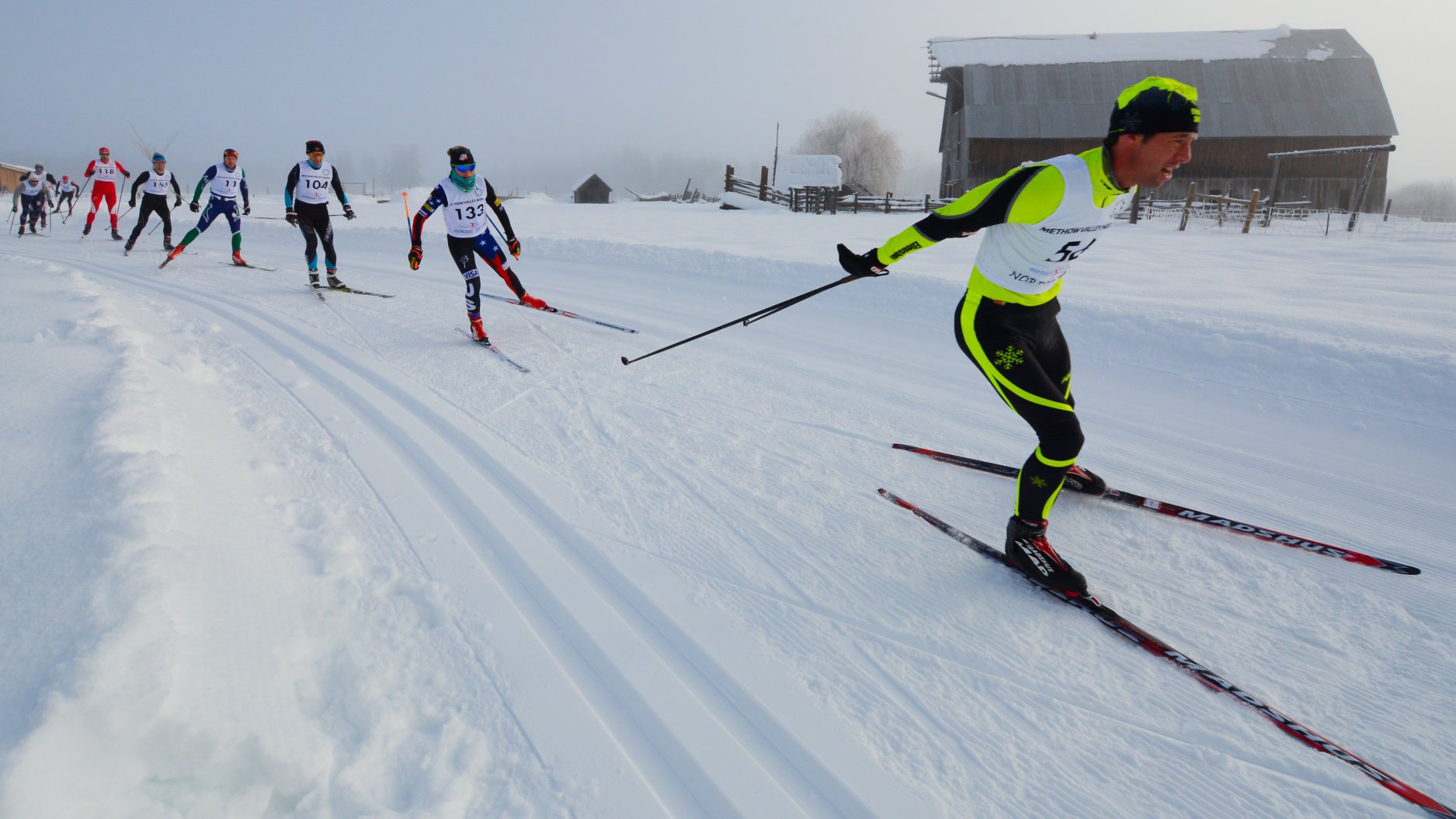
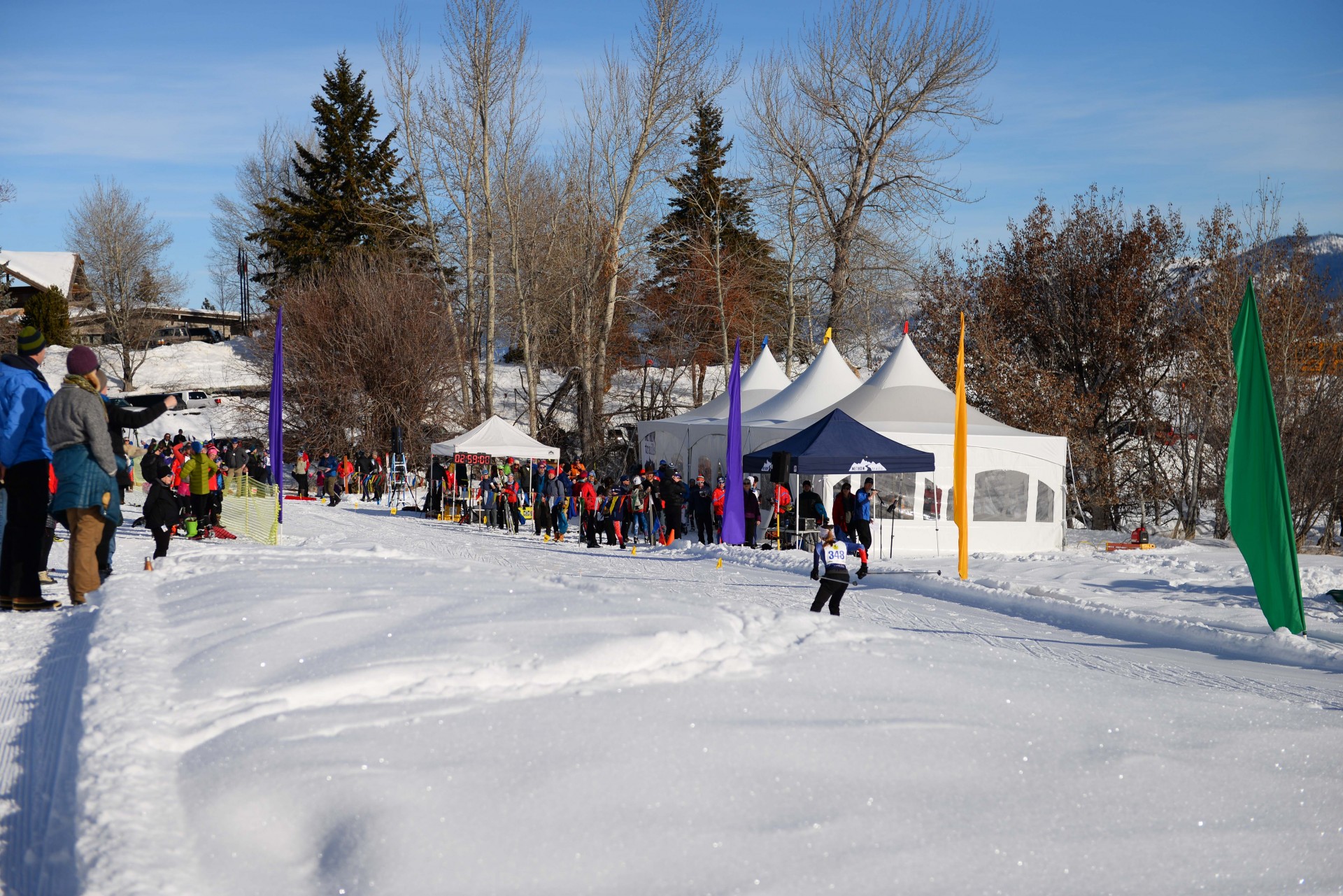
    Racers on the valley floor during the first Ski to the Sun Marathon and Relay in the Methow. (Photo: Methow Trails)

    All things aligned: a gauzy low fog burned off into bluebird skies and the snow skied crisp along a 42-kilometer gem during the Methow Valley’s inaugural Ski to the Sun Marathon and Relay. Last year, we ran a piece exploring how the Ski to the Sun Marathon organizers were rebooting their marquee ski race. The valley’s signature race had for years been a two-day pursuit. An attractive format to many, but it eventually stagnated with a core cadre of skiers roughly one-hundred strong participating. 

    A rethink was in order to highlight one of North America’s premier ski destinations. Creating a must race event is not as simple as build it and they will come. Many pieces must fall into place, let alone the weather and snow conditions on a race date often selected more than a year out. 

    In our previous article, Kent Murdoch, who has been making the trip from Seattle to the Methow for eons, told FasterSkier that a signature event was not on the minds of the pursuit race organizers. But over time, as the valley’s considerable volunteer energy became evident, creating an event that was a regional draw for cross-country skiers became a goal. 

    The Methow appears to have found a formula that works.

    “We went from wanting something bigger than the previous existing pursuit, and I think that we had four times the number of people,” said Pete Leonard, Executive Director of the Methow Valley Nordic Ski Education Foundation, during a conversation this January. 

    Four hundred skiers in a first year event. A massive win considering longstanding events like Sun Valley’s Boulder Mountain Tour cap their 34 k marathon at 775 skiers. 

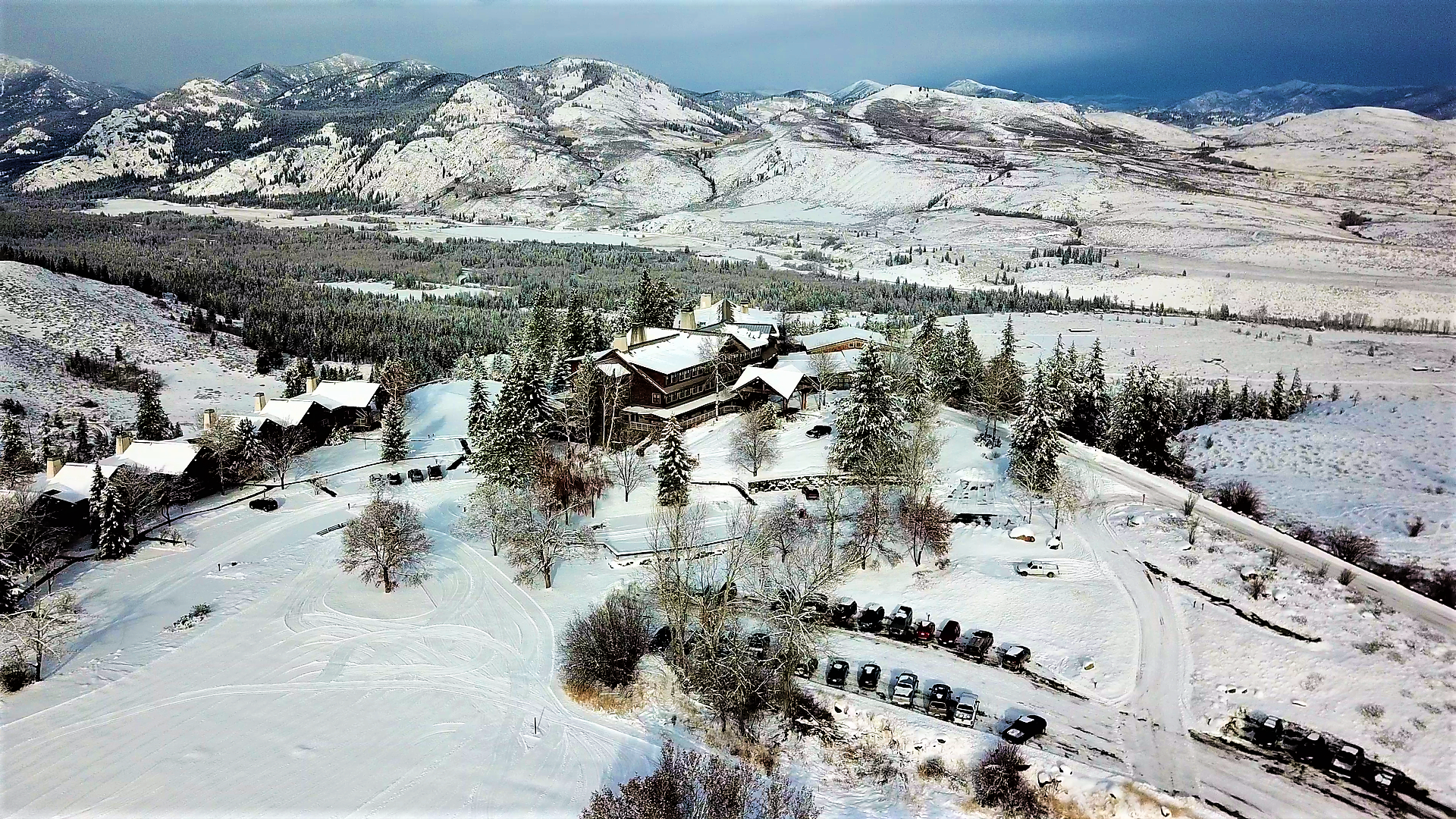
    The Ski to the Sun Marathon, which runs this year on February 8th,  spans the valley from the north in Mazama south towards Winthrop. Before skirting across farm and ranch-land into Winthrop proper, the course takes a lovely – and heart-rate-rising- 12 k stair step climb from the valley floor to the finish at Sun Mountain Lodge. Here’s the thing: you can imagine it’s your own Tour de Ski final stage grind with it’s Alpe finish, or register with a relay team and save the ascent for a teammate. 

    There’s something for hardened master racers and those simply seeking a cool social scene bundled into a ski race.

    This year, organizers are bringing Olympic champion Kikkan Randall to the race where she will also be available for a meet and greet. Randall is also expected to compete.    

    What follows is an interview with two of the race organizers, Kent Murdoch and Pete Leonard. We explored what they had learned after year one of the Ski to Sun Marathon and Relay. We thought it might be useful to other communities thinking about developing a premier ski race to learn from those in the Methow as they forge ahead with creating a signature event on the race calendar. 

    FasterSkier: A race like this is an investment in the community, but it also takes considerable resources — both human capital and money. Can you talk about the finances? 

    Pete Leonard: Everybody grouped together to deal with some of the unknowns and for our race committee that was a little bit stressful leading up to the race. But everything seemed to come off and everything seemed to work out. But one item was noteworthy, we were able to balance the budget the first edition – which was no small feat.  

    Kent Murdoch: I would also add that we weren’t planning to actually be in the positive in the end. We were expecting to take a little hit, being the first year. But, it was surprising. Honestly, you also have to take into account that there is a ton of community volunteer work that goes into it. And I think the volunteers in the valley really pulled out the stops.

    FasterSkier: You spoke about some unknowns. What were some of the unknowns besides weather and snow coverage. What did you stress about? 

    Pete Leonard: The logistics of a relay — those are the things we didn’t necessarily think about. With a relay happening simultaneously with a marathon, or starting 10 to 15 minutes behind, lots can go wrong. We have all these people driving down valley and using different zones to tag their partners. That took some coordination. It’s also a trail system and race course through some private land holdings. We have road crossings that can complicate race course set up. We also cross driveways and someone simply might not have their driveway plowed. Those are little things, but we were worried about them. 

    Another issue we learned about was limited parking at the finish. There was a big conference last year up at Sun Mountain Lodge the same weekend as the race. That was a little bit of a worry. We also stressed about accommodating all those people for dinner. And then there was the cooking and food for 300 people. Just constantly thinking how it was all going to come together. 

    I think sometimes that is a little bit of race organization, making sure you are pushing to do your absolute best by the racers so you give them the best product.


    Sun Mountain Lodge – near the finish area of the Ski to the Sun Marathon and Relay. (Photo: Methow Trails)

    FasterSkier: Can you talk about the somewhat unexpected bump from 100 skiers in the old pursuit race, to a start list with nearly 400 skiers including relay participants?   

    Kent Murdoch: In our first year of the Ski to the Sun it took us a bit by surprise because so many people entered kind of last minute. I think that is typical for many events, but it made it more of a challenge to plan for the banquet meals. I’m not sure exactly what that is about, but I think people want to make sure they are healthy and their is going to be snow. And so it does make it hard to plan for. 

    For this year, we modified our fee schedule to moderate that a bit. I do not know what to expect. We did something like December 1st and January 1st fee bumps — meaning the entry fees increased on those dates.  

    Pete Leonard: We also have February 1st as the closing date for the relay. And then there is a very substantial fee bump if you want to wait to the last week for the marathon. We are just really trying to encourage people to make the commitment to race because that helps us deliver a better product and make sure all the pieces are there.

    FasterSkier: Skiing has yet to really find the equivalent to the gravel scene in biking. How are you trying to draw more people into skiing with this event?

    Kent Murdoch: The relay aspect is the biggest change we have made with regard to events we have held. And it’s an attempt to broaden the appeal of a ski race likes this. We are getting both this year and last year about a 50-50 split of those entering the marathon versus the relay. So the thing about the relay is it really opens it up to anybody, we have one leg that is less than a kilometer on flat terrain. And then we have every kind of leg that you would want. There are many relay combinations that can suit any team, and an individual can do more than one leg. That flexibility seems to have been successful so far. 

    Pete Leonard: It is not a single facet that is going to bring new people to a ski race. Sometimes we get into these discussions where we are looking for that one key ingredient that is important to every racer. I think that there are a variety of ingredients that are important to every racer and we are trying to do a good job on a lot of fronts.

    To every racer those fronts matter a little but differently. For some they are tuned into one part of the event, but it still matters to them that the course is well groomed even if they are out there and they are motivated by the social part of it or the epic adventure type of thing. 

    I think to reach out to a broader segment, it starts with making it obtainable, which is what Kent talked about with the relay there. We had a lot of people who did the relay last year and were like ‘oh man I am going to do the marathon next year,’ because they thought that was not as hard as it was going to be.

    I think one of the big challenges with cross-country skiing is reaching out to new segments of people who might know the sport and be attracted to it, but they are not going to be stoked to sign up and line up next to the Lycra clad master racers of the world because they feel they are not ready for that — but they are fit. They could be an ultra-runner, or a biker, or a rower or something like that and they are going to want to come over to the Methow. This is their experiment with cross-country racing. This is one important aspect as we build it — that we are not just speaking to the people who are already part of your tribe.  

    But trying to build your ski racing tribe up to with these other people and bring them into the fold.

    Big support along the race course. (Photo: Methow Trails)
  • Stephen, Murdoch Fastest Skiers ‘to the Sun,’ Hundreds Revel at Inaugural Event

    Stephen, Murdoch Fastest Skiers ‘to the Sun,’ Hundreds Revel at Inaugural Event

    In a fitting setting for the the inaugural Ski to the Sun Marathon and Relay, hundreds of skiers emerged from a fog-blanketed morning dreamscape in Mazama, Washington as they cruised down the Methow Valley to brilliant sunshine and the finish at Sun Mountain Lodge. Kent Murdoch, who splits his time between Mazama and Fall City, Washington, took advantage of his familiarity with the final climb to lead the marathon field over the 41 km course, passing a fading Liz Stephen in the last kilometer, to finish in 2:09:30.7. Stephen, the recently retired three-time Olympian who hails from Park City, UT, lead the women’s field in 2:10:20.4.

    Men’s winner Kent Murdoch leads women’s winner Liz Stephen in the final kilometer. (Photo: Steve Mitchell/mitchellimage.com)

    Rounding out the podium in the men’s division were Logan Wetzel of Bellingham, Washington in 2:09:56.2 and former NCAA All-American for the University of Denver and National Championship runner-up Mike Hinckley, who also resides in Bellingham, in 2:10:32.7. For the women, all three steps were filled with past Olympians as Methow locals Laura McCabe and Leslie Hall crossed the line in 2:10:43.3 and 2:25:43.0, respectively.

    In the relay division, Chomper Bomper, a group of four junior skiers from the Methow Valley Nordic Team – Garrett Butts, Travis Grialou, Bodhi Kuzyk and Walker Hall – lead from the first kilometer to finish in 2:03:38.3, besting Shasey a duo of former national team biathlete Casey Smith and local mountain guide Michael Hutchins.

    Despite fading at the end of the final climb – a 12 km stretch that stair-stepped its way from the floor of the Methow Valley up 1000 feet (300 meters) to the finish at 2,890 feet above sea level – Stephen glowed about the event, saying “we could not have hoped for a more beautiful day, more beautiful weather or more perfect tracks… I couldn’t be more excited to be here, especially with it being like a winter wonderland…. [The Methow has] been on my shortlist of places to [visit] for a long time. The race went off so smoothly… It was so fun and beautiful to ski through the trees and to end at such a perfect place like the Sun Mountain Lodge.”

    Throughout the entire field, the buzz at the finish line was much the same, as smiling competitor after smiling competitor exalted about the weather, the course and the conditions. Jim Kelly, a veteran of twenty-two American Birkebeiners – the largest cross country ski race in North America – agreed with Stephen, saying “it was awesome out there… it was like a Birkie!”

    For many, the course, which showcased the variety of natural beauty in the Methow Valley, was a real highlight. Todd Eastman of Putney, VT and US Race Program Director for Madshus skis commented: “Stunning scenery, beautiful course and track, and an honest challenge.”

    All smiles in a sunny Methow. (Photo: Steve Mitchell/mitchellimage.com)

    “I think it might be the best way to experience the Methow trail system and get to know the valley,” said Jenny Abraham of Boise, Idaho. “The trails are so beautiful meandering through the trees and along the river, and getting cheers from volunteers all along the course and seeing the relay teams at exchange zones was really fun.”

    Her friend Larissa Swain from Leavenworth, Washington agreed, saying, “I loved how the low sun showed through the middle section, streaming across the snow. And it was so fun to have the course pop out of the woods near the river with the sun lighting up the whole valley! But,” she added, “my favorite part was skiing it together, enjoying each other’s company on a beautiful winter day.”

    Jim Gregg, father of 2014 Olympian Brian Gregg, and a resident and racer in the Methow Valley for decades agreed about the camaraderie on the trail, commenting “that was a true citizen’s race.”

    The event was organized through a partnership of Methow Trails, the nonprofit that grooms and manages 200+ kilometers (120+ miles) of trails in the Methow Valley, and Methow Valley Nordic Ski Educational Foundation, another nonprofit that focuses on delivering skier programs from classes, clinics and camps, to junior learn-to-ski and cross-country and biathlon racing programs. The vision for the event was a hybrid of ideas from the two organizations: create a marathon event that is a true testament to the level of skiing in the valley with a relay that has opportunities for skiers of all abilities to participate. A true community-based ski event.

    For Methow Trails Executive Director, James DeSalvo, the collaboration not just between the two nonprofits, but the entire community was a critical aspect of the event, noting “The most thrilling part for me was seeing our trail community sharing a very high impact and fun experience. Everyone who makes our trail system possible was represented and enjoying the trails together; landowners, kids, pass holders, visitors, business members, board members, ski instructors and agency partners. The vastness of our 120-mile trail network typically encourages trail users to find their own little piece of trail to enjoy. While I wouldn’t give this up, there is something very inspiring about seeing hundreds of trail users all moving together, smiling and sharing their joy of the trails.”

    The event’s appeal was clear to those on the sidelines as well. Kathy Dalton, who was filming the start and finish, said it made her want to begin racing, and she jumped into a local training group within days after the event..

    For more experienced racers, the event had the draw of an annual highlight. Brad Bauer of Edmonds, WA exclaimed, “The Pacific Northwest has found its signature race!”

    Runner-up Wetzel agreed, “It feels like something that’s been missing for us. Every other major ski destination has their big event. This is ours.”

    With just shy of 400 competitors and a successful start in its first edition, the second Ski to the Sun Marathon and Relay is slated for late January or early February 2020. Stay tuned to methowtrails.org and methowvalleynordic.com for more info.


    Marathon Results:

    https://www.sportstats.ca/display-results.xhtml?raceid=103840


    Relay Results:

    https://www.sportstats.ca/display-results.xhtml?raceid=103842


    Ski Two Sun, Methow Valley (Photo: Steve Mitchell/mitchellimage.com)


  • A New Start For the Methow Valley in its Quest for a Signature Race

    A New Start For the Methow Valley in its Quest for a Signature Race

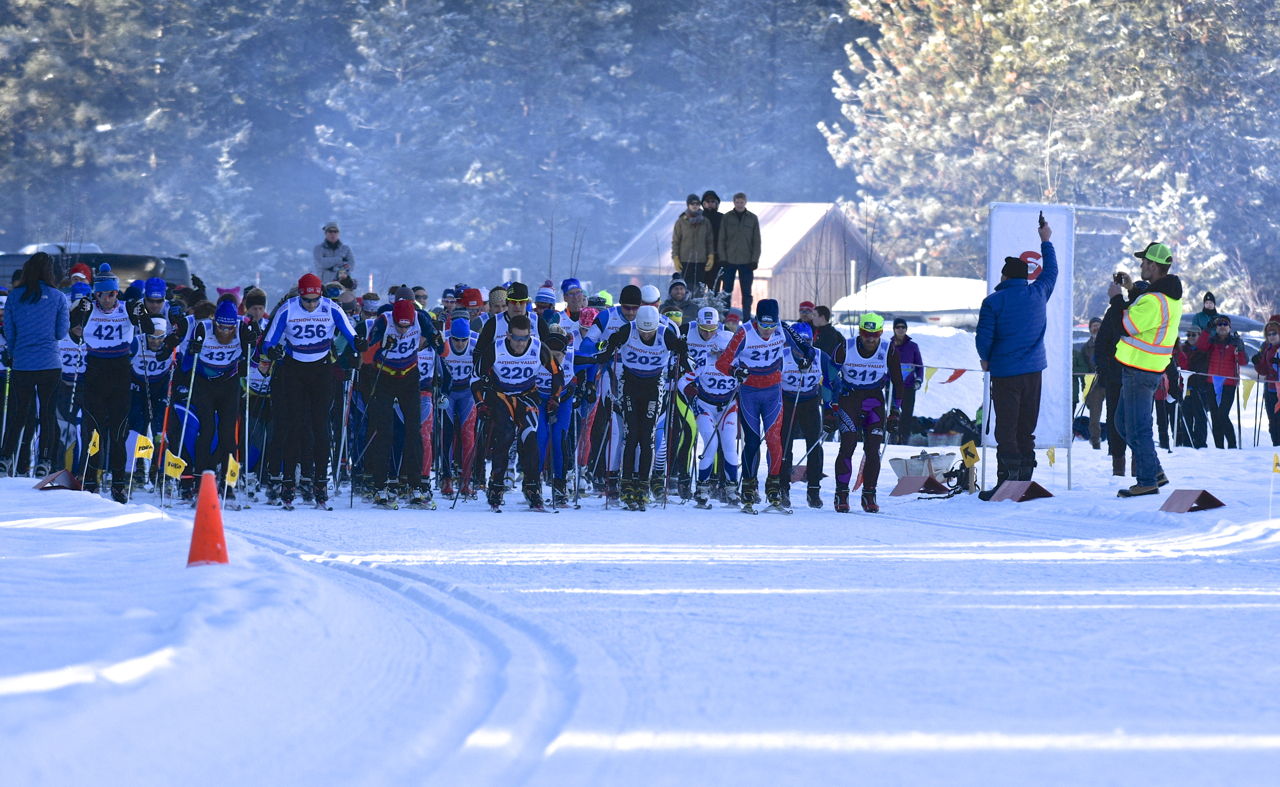
    Ready, set, go: racers at the start of the skate portion of the 2018 Methow Pursuit. (Photo: Methow Trails)

    Washington’s Methow Valley is the literal end of the road in winter. There’s one way in from the south.  There’s route 20, a sinuous side spur plunging down from Omak in the Okanogan Highlands to the Methow’s eastern edge. Otherwise, travel by car terminates just beyond Mazama — the small town nestled in the valley’s north.   

    The Methow’s charm remains its solitude and mellowed pace. Despite the wifi and cell service, there’s the real sense of being unplugged.

    For nordic skiers, that remoteness coupled with the Methow’s epic skiing make it paradise. Regionally, it’s hard to argue any other nordic ski destination matches the raw number of kilometers, terrain, and vibe etched into the Methow’s DNA.  

    Despite those travel brochure-worthy qualities, the cadre of skiers residing in the region have struggled to create a signature cross-country race event. By signature event, we’re talking races like Sun Valley’s Boulder Mountain Tour, Craftsbury’s storied marathon, and the behemoth American Birkebeiner which stands alone in terms of its draw.

    “In the early 90’s is when I think the Methow Pursuit first started,” said Kent Murdoch, a long time Methow skier who bounces between homes outside Seattle and the Methow. “The first iteration of that long distance race was a point to point from Cub Creek, up and over the Rendezvous pass, and dropping down into Mazama to finish.”

    That 42 kilometer skate race featured gut-punching climbs matched with a never-ending technical descent. The second day’s classic pursuit threaded from Mazama to Winthrop on the hallmark Community trail.

    “It was essentially a double pole race,” added Murdoch. “But it was pretty popular for the people that are established racers that knew about it.”

    Periodically, stakeholders within the community have attempted to recreate the concept of a must-race event. In a place defined in winter as much as the Methow is by nordic skiing, one would assume a marathon type race there would be an annual pilgrimage for many.

    That is not to say efforts failed. It is to say a rethink was due if success is measured by drawing a broad spectrum of the nordic community.

    “I knew the event had struggled over the years and as I dove into planning for it, I quickly realized why,” said Adrienne Schaefer, the Partnership Manager for Methow Trails. “In an effort to have something for everyone, the event had grown into a somewhat complicated format, which was fine for skiers who were familiar with racing but seemed hard to navigate for someone who had never entered a race and didn’t actually know what a loppet even was. Numbers for last year’s Pursuit were close to 70 on Saturday and around 35 on Sunday. It was clear that something needed to change.”

    Last spring, the race reboot began.  

    “We had just completed our Sunflower Marathon, Half Marathon and Relay and had 1,100 runners at the event,” Schaefer said. “The question was, why not just do a winter version of the Sunflower?”

    Skiing above the fog and under a big sky in the Methow Valley. (Photo: Methow Trails)

    The Sunflower is a five-leg trail running race connecting Mazama on the valley’s north end to Twisp in the south. Participants have the option of running the marathon solo or as part of a relay team. Relay teams consist of two to five participants. The half-marathon starts near Mazama and shares the same finish as the marathon. The end result is a race with enough options to draw the hardcore and recreationist.

    What Schaefer saw in the success of the Sunflower was its accessibility. A concept easily applied to the cross-country ski version of the event.

    Murdoch was equally invested in formulating a successful winter-edition model of the Sunflower.

    “The area really warrants putting something like this on,” Murdoch said. “A few friends and I have been envisioning this for a few years and I am now on the Board for the ski team. I Have taken this as my main focus to not just build this race but eventually a week-long festival with multiple events. We want to appeal to people of all ages and skill levels.”

    On January 26, the Methow’s inaugural Ski to the Sun Marathon and Relay kicks off.

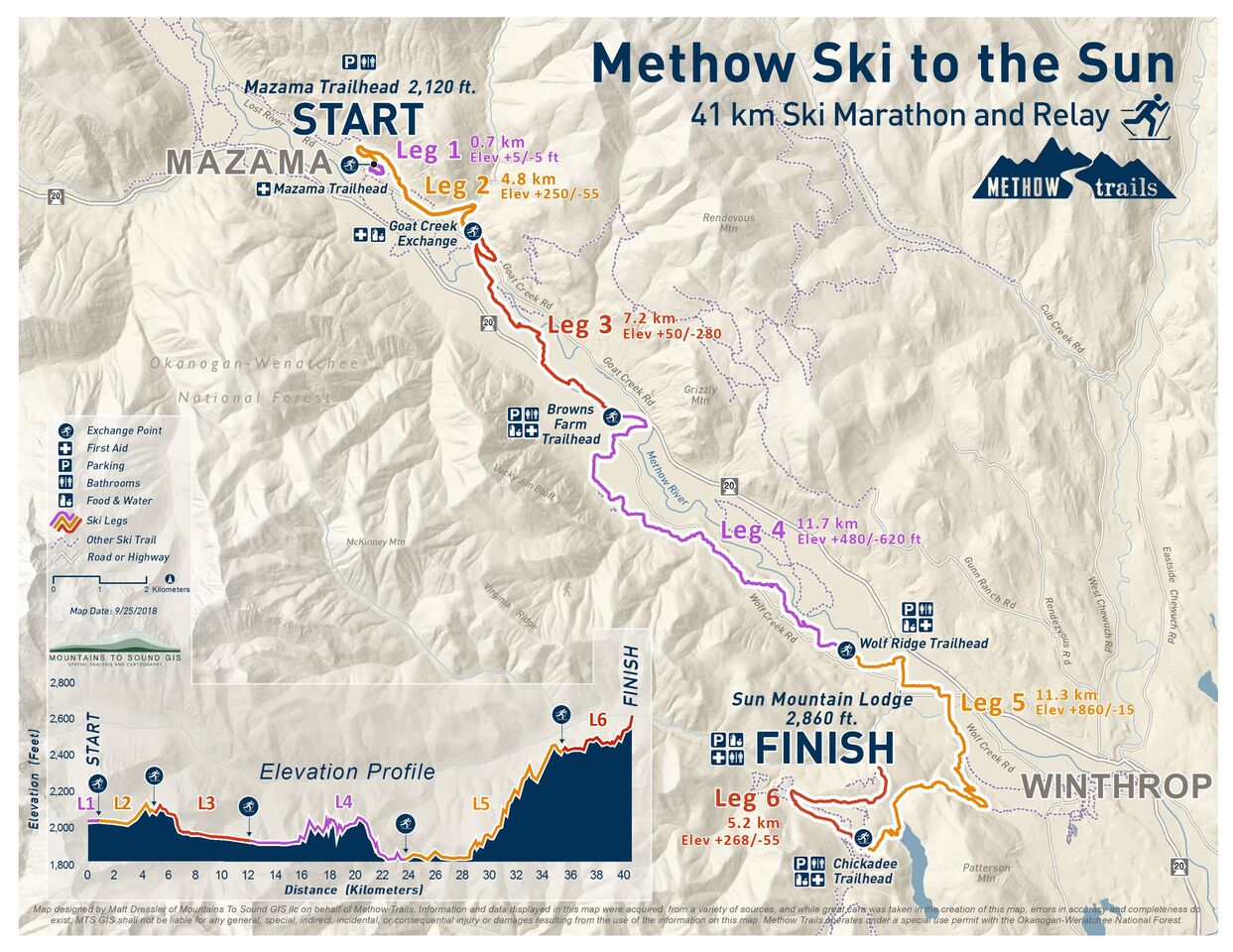
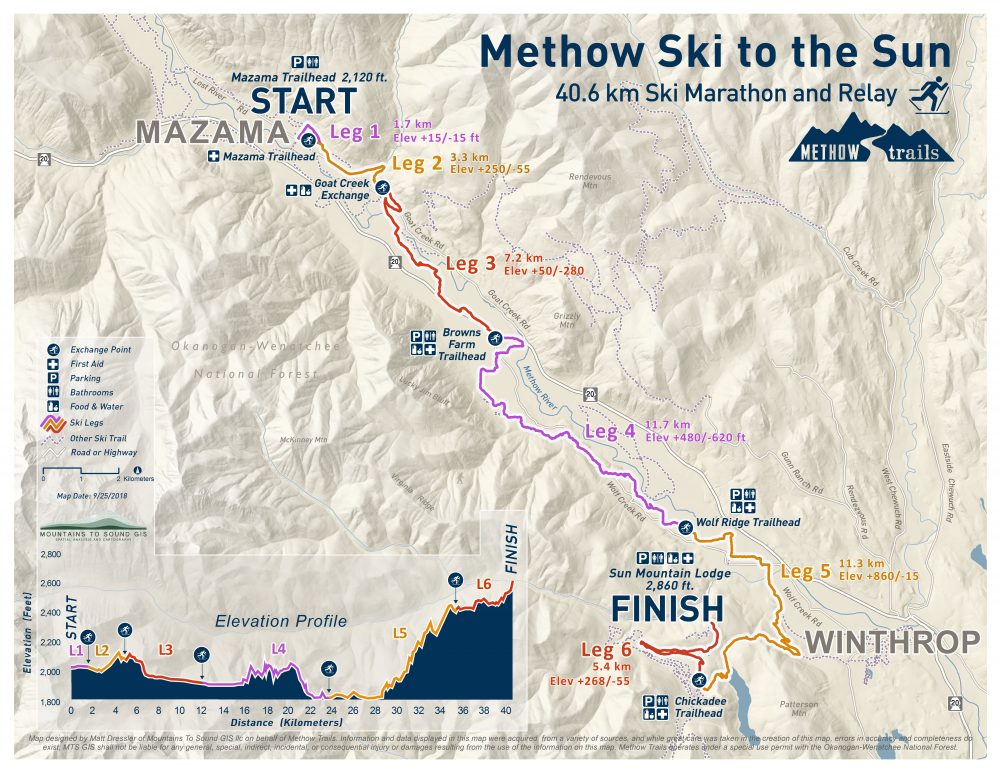
    Valley local Laura McCabe, a timeless podium magnet and herself fond of burly skis, along with Murdoch worked to piece together a course appealing to all comers. Beginning in Mazama, the envisioned course runs a solid 40.6 k for individual skiers. The relay is broken into six segments – teams may have between two to six members.

    For the first quarter, the race route streams the middle of the valley floor. At the end of the third leg, at 13 k, the course turns towards the west and trends to the rolling hills buffering the valley’s flanks. After approximately 28 k, the climbing begins towards the finish at Sun Mountain Lodge.

    “It is very skiable,” Murdoch added. “There is nothing in it that is, I think, that is going to turn anyone away purely based on difficulty. And it doesn’t have the technical descents. So technically it should be doable for a very large group of people. And for the people that are not interested in the climb, it is possible to get on a relay team. I think some of the legs are only 2 to 3 kilometers and are totally flat. So there is something for everyone.”

    Course map and profile : Methow Ski to the Sun Marathon and Relay.

    For skiers on the sharp end of the race, keen on fast splits and podiums, Murdoch believes the race will deliver. For those with an affinity for warm drinks and food as they tick off kilometers, organizers plan to staff numerous feed zones along the course to keep participants comfortable. In an appeal to families, racers 17 and under race for free.  The race is freestyle technique, but skiers may skate or classic. 

    “We know this is not going to happen overnight,” Murdoch said of the Methow’s desire to cement itself on the race circuit with the Ski to the Sun Marathon and Relay. “The basic answer to why we lack a signature event is that I don’t think we ever set out, in the beginning, to envision a course and the post-race dinner and award ceremonies and marketing especially. This is new to all of us. How to go about that. In previous years it was never really intended to be that kind of event. Now we have the energy.”

  • 20-for-20 with Eli Nielsen

    20-for-20 with Eli Nielsen

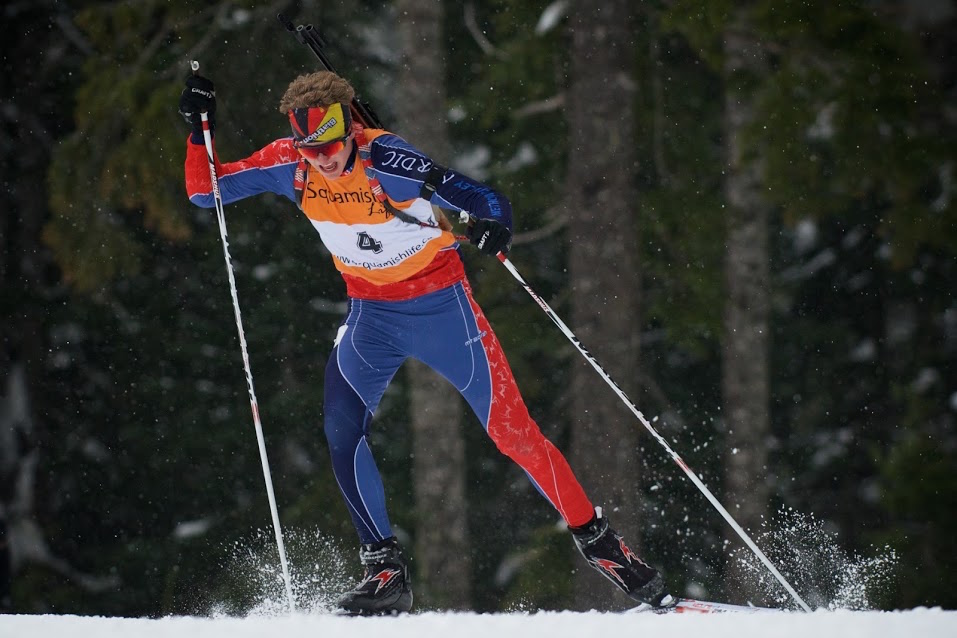
    Eli Nielsen racing at 2018 IBU Youth World Championships in Otepää, Estonia. (Courtesy photo)

    In an effort to showcase the North Americans competing at this past week’s International Biathlon Union (IBU) 2018 Youth and Junior World Championships in Otepää, Estonia, we asked those qualifying athletes several questions about themselves — actually, we had them fill in the blanks. Here we have 18-year-old Eli Nielsen, of Washington state, who represented the U.S. at his second Youth World Championships.

    In his last race of the week, Nielsen placed 47th in the youth men’s 10 k pursuit. He also finished 42nd in the 7.5 k sprint, 64th in the 12.5 k individual and ninth in the youth men’s 3 x 7.5 k relay.

    ***

    “My full name is Camren Eli Nielsen but you can call me Caspian.

    I was born and raised in Stehekin, Washington, and I learned to ski with the Bob Scouts.

    I spent the time between World Youth/Junior trials and Worlds racing biathlon in the Czech Republic and Slovenia and thinking about how I should probably be doing homework.

    The funnest workout I did in the last training year to prepare for this was pretty much every workout with the Methow Team.

    One thing I’m working on this season to improve my biathlon is hitting more targets faster.

    This is my first time in Estonia and fourth time racing internationally, and so far it’s been absolutely amazing.

    One difference I’ve noticed between Estonia and the United States is it only takes three hours to drive across the entire country.

    One of the things I’m most excited about for World Youth/Junior Championships in Otepää is the relay. It’ll be fun to throw down with the boys in a head to head race.

    One race I’m especially targeting there is the sprint. Less shooting is usually a good thing.

    Watching the Olympics in the leadup to my own races was exciting. One of my favorite moments of the Games was Kikkan and Jessie’s gold in the team sprint. I want to be more like Erik Bjornsen because he’s such a bro.

    At Worlds, I really hope I can make friends with someone from Norway and ask them if I can come live with them.

    My favorite thing at the breakfast where we are staying is the cucumber water… jk Garrett’s the only one who can stand that stuff.

    Before this trip, if you said “Estonia”, the first thing I’d think of would have been “North eastern Europe?”

    Now that I’m here, I’m pretty sure something I’ll always remember will be doing homework… take note teachers.

    If I had a totally free day here and didn’t have to worry about race fitness or training, I’d spend it in the sauna.

    The best way to follow me on social media is on Instagram @eels_niels.”

  • Nordic Nation: Sadie Bjornsen and the ‘Sadie System’

    Nordic Nation: Sadie Bjornsen and the ‘Sadie System’

    The Sadie System, as in the Sadie Bjornsen system, is the topic in this episode of Nordic Nation. That system involves a basic understanding of how hard and long to train and how to recover effectively, a question many athletes struggle to answer. But Bjornsen, a U.S. Ski Team all-arounder, has overcome chronic foot injuries and arrived on the World Cup scene this year poised for podiums. She has three World Cup podiums so far in the 2017/2018 season and she’ll be competing at her second Olympics this February. And she does have some bronze bling from last year’s World Championship team sprint with Jessie Diggins.  

    When asked about interesting media exposure she’s had during the run up to the Olympics, Bjornsen mentioned a Twitter exchange the U.S. Ski Team’s women had with Paula Poundstone of NPR’s Wait Wait. Rule of thumb: it’s a bad idea to dis World Championship medalist.

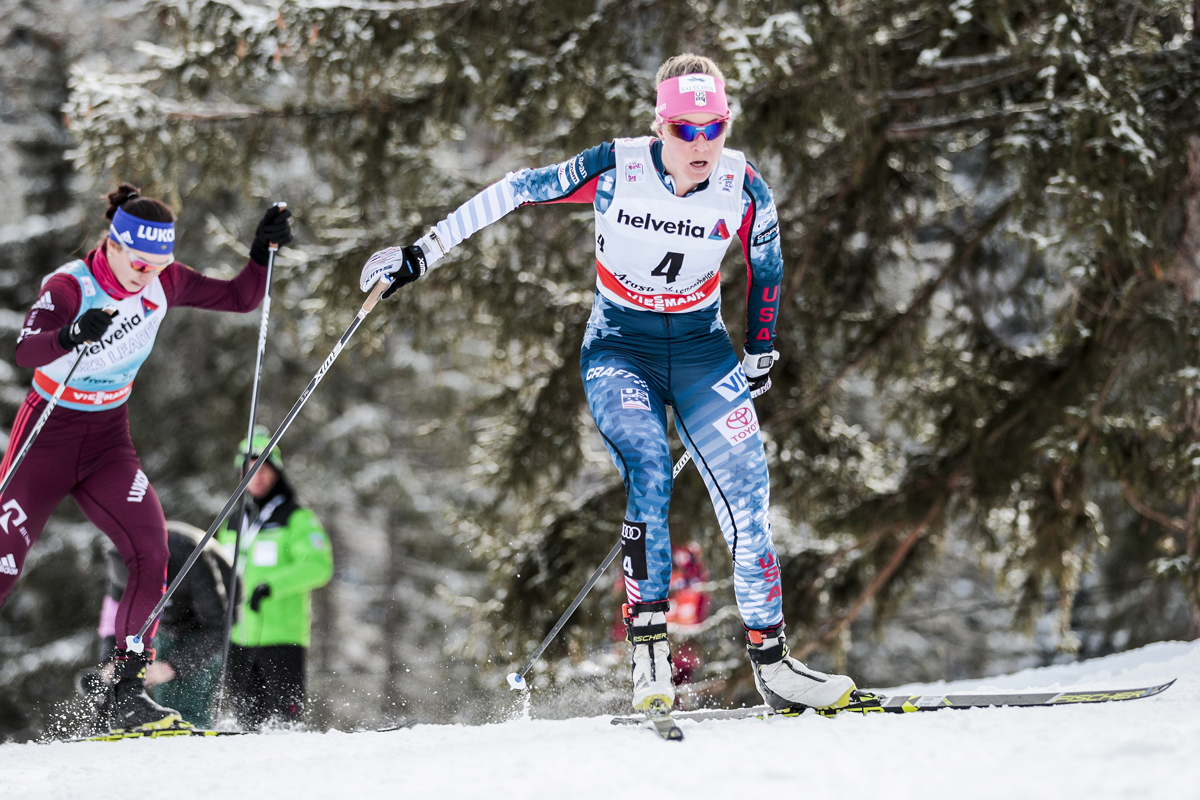
    U.S. Ski Team member Sadie Bjornsen (4) racing to fifth in the women’s 10 k freestyle pursuit at Stage 3 of the 2018 Tour de Ski in Lenzerheide, Switzerland. She went on to finish ninth overall in the Tour. (Photo: Fischer/NordicFocus)

    We caught up with the 28-year-old Bjornsen on the phone on Jan. 18, a few days before last weekend’s World Cup races in Planica, Slovenia. The skier originally from Washington’s Methow Valley, who trains with Alaska Pacific University (APU) in Anchorage, Alaska, is a model of perseverance, goal setting and getting things done.

    Sadie Bjornsen (l) catches her teammate Jessie Diggins after they placed third in the women’s classic team sprint on Feb. 26 at 2017 FIS Nordic World Ski Championships in Lahti, Finland. (Photo: John Lazenby/Lazenbyphoto.com)

    (To subscribe to the Nordic Nation podcast channel, download the iTunes app. If you have iTunes, subscribe to Nordic Nation here.)

  • Men Go to SoHo, U.S. Women in the Methow (Camp Photo Galleries)

    Men Go to SoHo, U.S. Women in the Methow (Camp Photo Galleries)

    The U.S. Ski Team women’s team at work during a 10-day camp in the Methow Valley. (Photo: Matt Whitcomb/U.S. Ski Team)

    (Note: This article has been updated to include comments from Canadian coach Ivan Babikov on his team’s recent camp in Park City, Utah.)

    Two days after Andy Newell and Erika Flowers tied the knot in Bozeman, Mont., seven members of the men’s U.S. Ski Team and eight U.S. women’s team members jumped into an intensity training block at their respective dryland camps in Park City, Utah, and the Methow Valley in northern Washington.

    The 10-day camps were scheduled simultaneously from June 26-July 5 to accommodate the wedding. Newell is a longtime U.S. Ski Team (USST) member and teammates with Flowers on the Stratton Mountain School (SMS) Elite Team out of Stratton, Vt. Because several national-team members ventured to Bozeman (Flowers’s hometown) to watch them say “I do,” the USST coaches decided to reduce travel and keep their squads together out west.

    “We wanted to capture the men in the Intermountain West immediately following Andy Newell’s wedding in Bozeman, and therefore reduce the overall travel load for athletes who were already coming to the West from the East or Alaska,” head coach Chris Grover explained in an email.

    The men based themselves in Midway, Utah, about 1,500 feet lower in elevation than Park City and 1,000 feet lower than Deer Valley, where they typically reside for summer and fall camps. Grover explained that this was by design, “because of the shorter duration of the camp (i.e. too short to create a meaningful stay at altitude), the focus on specific intensity workouts, and the benefits of quicker recovery at lower altitude,” he wrote.

    Staying closer to the Soldier Hollow training venue was also ideal for the men’s team’s “PyeongChang-specific workouts”, Grover explained, including sessions focused on the freestyle team sprint, classic sprint and 4 x 10-kilometer relay, which will be contested at the 2018 Winter Olympics in PyeongChang, South Korea.

    Newell, Simi Hamilton, Erik Bjornsen, Scott Patterson, Paddy Caldwell, Ian Torchia, and Ben Saxton attended and worked with coaches Jason Cork, Pat O’Brien, Grover, and U.S. Ski & Snowboard Strength and Conditioning Coach Tschana Schiller.

    “The men did a great job of bringing heightened focus and effort to these key intensity workouts and we are grateful to the staff at Soldier Hollow for preparing the track for us,” Grover wrote. “Overall, it was a very productive camp and I think sent the men into the main summer preparation period with important areas to work on, a good gauge of fitness, and a further understanding of what skills need to be developed for the WC [World Cup] season and for PyeongChang.”

    (Article continues below)

    ***

    Meanwhile, the U.S. women tried a new camp in the Methow Valley, home of current national-team members Sadie and Erik Bjornsen. The athletes themselves dubbed it the “CAGS Camp“, which U.S. women’s coach Matt Whitcomb explained stood for “a secret and mildly inappropriate team acronym that pokes fun at girls being girls. Sophie had hats made for the camp that she handed out at the airport when everyone arrived.”

    All kidding aside, the goal of the camp was to be small and intensity focused, “with eight days of training and hard intervals every other day,” Whitcomb wrote in an email. “It’s an unusual setup for our team as we usually run joint camps with the men, but both enjoyed the simplicity of having such small training groups.

    “We chose the Methow in part because it is where Sadie and Erik Bjornsen grew up, but also because we could get close to sea-level to maximize our hard efforts,” he added. “Another draw was that Pete Dickenson, one of our team physical therapists, was able to provide great treatment all week. Winthrop PT & Fitness sponsored our strength sessions, which meant we didn’t have to drive very far to get strong.”

    Like Grover, Whitcomb used the word “ideal” to describe the Methow as a training site, yet emphasized that the community that hosted them was “even more incredible.”

    “A local couple gave us their two cabins in a location as beautiful as we’ve seen anywhere in the world,” he wrote. “The chance to meet Olympians Laura McCabe (’94, ’98) and Leslie Hall (’88, ’92, ’94) was an important experience for the team. We owe them special thanks not for just guiding us to their favorite training spots, but for helping pave the early path for elite women’s skiing.”
    The women’s team, which included Sadie Bjornsen, Rosie Brennan, Sophie Caldwell, Jessie Diggins, Katharine Ogden, Kikkan Randall, Ida Sargent, and Liz Stephen, spent one afternoon working with with the Methow Valley Nordic Team, which McCabe and Hall both coach.

    “We invited a handful of their top athletes to join our bounding and ski walking sessions, and were encouraged by their technique and fitness, but also their love for the sport,” Whitcomb wrote. “They are doing a good job up there. I don’t know what the future holds for us regarding camp locations, but the Methow Valley will be considered as a great option moving forward.  Thanks to so many people for making it happen.”

    Women’s team staff included Whitcomb, Tim Baucom and physical therapist Pete Dickenson.

    (Article continues below)

    ***

    Cross Country Canada also recently finished up a two-week camp in Park City (June 26-July 11) with its entire men’s World Cup team — Alex Harvey, Len Valjas, Devon Kershaw, Jess Cockney, Knute Johnsgaard, and Graeme Killick — and U25 national-team member Julien Locke. Co-World Cup coaches Ivan Babikov and Louis Bouchard accompanied the team for the duration, and Joel Jaques joined for the first week.

    While Park City has become an annual staple for the Canadian team, Babikov explained that this was their first time there in the summer, as opposed to the fall.

    “We love the area and training there. … It was pretty hot but we managed,” he wrote. “The main goal was a big training volume/hours at the altitude. We were planing on doing a time trial at the SoHo but it got closed for those dates so we ended up doing intensity down in Salt Lake instead.
    It was a great camp for all the guys, everyone feels good and no injuries on the team.”

    https://www.instagram.com/p/BWF7eG6HLJo/?taken-by=coach_babs_

    https://www.instagram.com/p/BWP_Wi_nYV3/?taken-by=coach_babs_

    https://www.instagram.com/p/BWdDCu1nObo/?taken-by=coach_babs_

  • Wednesday Workout: ‘Old Lady’ Interval Ladder with ’94 Olympians Hall and McCabe

    Wednesday Workout: ‘Old Lady’ Interval Ladder with ’94 Olympians Hall and McCabe

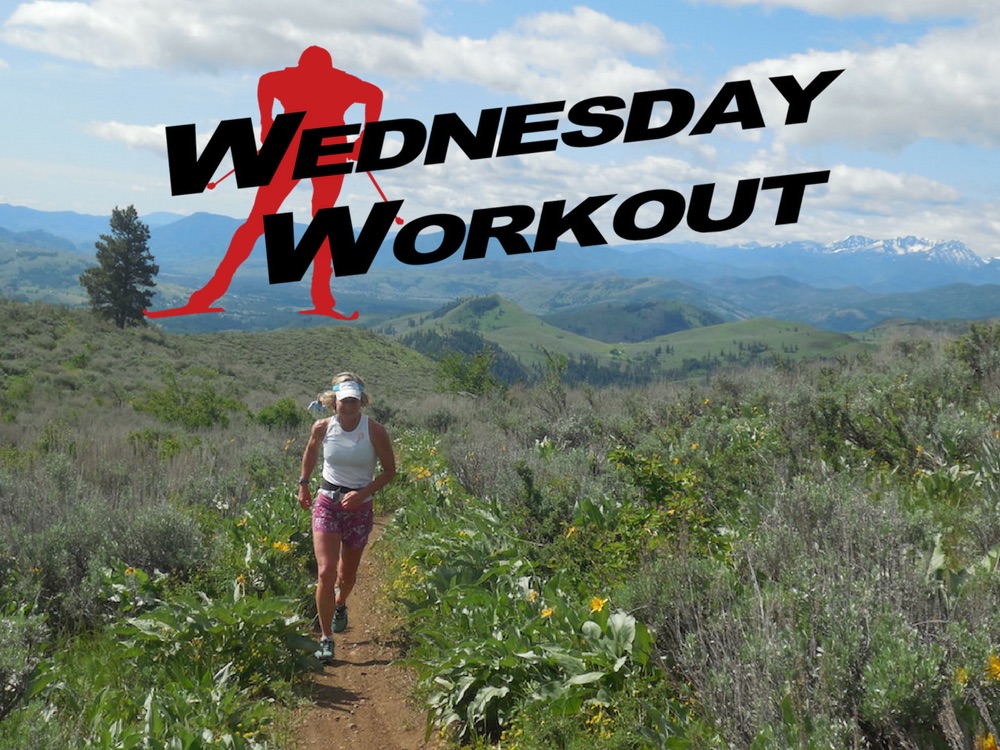
    Laura McCabe, 1994 and ’98 Olympian, during her weekly Wednesday interval workout. (Photo: Leslie Hall)

    *Note: This article has been updated to include email comments from Laura McCabe as of Wednesday. 

    Don’t let the name “Old Lady Intervals” (designated by Leslie Hall) fool you. The interval ladder she and Laura McCabe complete every Wednesday and submitted to FasterSkier is one that takes experience and willpower. Hall doesn’t recommend the workout for juniors, but more for masters and those with limited time for harder training efforts.

    ***

    If their houses were any closer, Leslie Hall and Laura McCabe could probably comfortably hold conversations from the threshold of their front doors. For a little more than two decades, the duo have been neighbors, living within one-tenth of a mile from each other in northern Washington. But a street name and sidewalk view of the Methow Valley isn’t the only thing the two women share.

    In 1994, they were teammates, representing the U.S. at the Winter Olympic Games in Lillehammer, Norway. Two years later, they moved into their neighboring houses, and close to six years after that, they became co-coaches of Methow Valley Nordic.

    For the past 15-plus years, Hall and McCabe, who are now 53 and 51 respectively, also share Wednesday mornings.

    Following the birth of Hall’s second child and McCabe’s first, the women decided that neither was about to give up interval workouts. Even if it meant having their toddlers in tow.

    “When she stopped competing and had her daughter, my son was close in age, so I was like, ‘What are you doing?’ … and she said, ‘I’m going out and I’m doing intervals and I’m carrying Novie,’ and I’m like ‘OK, I’m going to come,’ so then we just started going together,” Hall explained on the phone.

    Every Wednesday for the next 51 weeks, the women completed the intervals with their babies on their backs.

    “Once they got on a schedule where they were in preschool or something, we’d go off without them,” Hall said. “Now, we drop the kids off at the bus and then we go. It works for both of us because we don’t go into the office at a certain time, so that’s nice.”

    The workout itself, which is a ladder-type interval set totaling 43 minutes of on-time at a pace Hall describes as “as hard as we can,” is not one she recommends for junior skiers, but rather those on a tight training schedule.

    “It obviously wouldn’t be the best workout for someone, say a 14 year old, that’s not going to be the best workout for them,” Hall said. “But for a lot of masters or working people, they always go sort of medium-hard, so having a targeted interval workout helps raise their fitness. … They go easy [during easy days] because they’re either too tired from the interval workout or they know the interval workout is coming up.”

    Both women continue to compete, with Hall jumping into local running and ski races that fit with her coaching schedule and McCabe racing internationally, competing in this year’s Fossavatnsgangan Worldloppet in Iceland (where she placed third in the 25-kilometer skate behind Caitlin Gregg and Britta Johansson Norgren), and the Masters World Cup in Switzerland (where she won two races).

    “Leslie and I have been through a lot of life stuff together, starting with being on the U.S. team to raising our children together, going through the joys and difficulties of life as they are handed to all of us,” McCabe wrote in and email on Wednesday. “Working together as coaches, running the Methow Valley xc ski team and just being great friends. WE have kept each other motivated on Wed for some intensity for many years, as just that 1:30-2 hours pays off if you are consistent. Wed we discuss things that need to happen for the team, the kids, life etc and we both get a good solid workout!”

    Hall couldn’t agree more.

    “I think my favorite part is having someone who makes sure I get out and do it,” Hall added. “I don’t have to worry about how I’m going to fit in some hard training, and that’s really satisfying.”

    The Workout

    • Terrain type: Hilly
    • Warmup: 15-20 minutes jogging followed by 4 x 30 second speeds
    • “Old Lady” (as Hall likes to call it) Interval Ladder: 5-6-5-6-5-4-4-4-4 minutes with 3 minutes recovery between each 
      • i.e.: 5 minutes on, 3 minutes recovery, 6 minutes on, 3 minutes recovery, 5 minutes on, 3 minutes recovery…etc.
    • Interval Effort: Between Level 4-Level 3
    • “We just go and go as hard as we can, which is another thing I don’t recommend for everybody necessarily,” Hall explained. “Some days it’s just naturally Level 3 and some days it’s Level 4. And also it’s longer than what most people would want to do, but that’s just what we’ve gotten to at this point.”
    • Cool down: 15-20 minutes jogging with 4 x 5 second sprints incorporated throughout to “clear out the legs”
    • Total time: 75-80 minutes
  • 20-for-20 with Eli Nielsen

    20-for-20 with Eli Nielsen

    Eli Nielsen (Methow Valley Nordic) racing at the Biathlon BC Cup #3 at Whistler Olympic Park in January. (Photo: Weymuller Photography)

    In this 20-something-question, fill-in-the-blanks series, we checked in with the world-class U.S. and Canadian biathletes before they competed at 2017 International Biathlon Union (IBU) Youth & Junior World Championships Feb. 22-28 in Osrblie (also known as Brezno-Osrblie), Slovakia.

    Here’s 17-year-old Eli Nielsen, of Methow Valley Nordic (MVNT), who represented the U.S. at his first Youth Worlds. In two individual races, Nielsen finished 82nd in the youth men’s 7.5 k sprint and 91st in the 12.5 k individual.

    ***

    “My full name is Camren Eli Nielsen, but you can call me Eli. I was born in Stehekin, Wash., raised in Stehekin/Methow Valley, and one thing you should know about my hometown is there are no roads to it and I have a monopoly on the Gumball business.

    I started cross-country skiing when I was 14 and started biathlon when I was 14, thanks to my parents and coaches. I currently train in the Methow Valley with MVNT.

    If I’m not skiing, you might find me in the mountains.

    If I had to pick a favorite book, it would be ‘HMS Surprise’ by Patrick O’Brian.

    One of the things I’m most excited about for Youth/Junior World Championships in Brezno-Osrblie is some awesome race experiences!

    This will be my first Youth/Junior World Championships, and this year, I’m competing as a youth.One race I’m especially targeting there is the sprint.

    The best advice anyone ever gave me about skiing or racing was to relax and focus on the race plan.

    One of the best race memories I have is racing in Lillehammer Norway at YOG.

    If I could meet one World Cup skier, it would be Laura Dahlmeier.

    If I don’t end up being a professional skier, I’ll probably be a professional ski bum.

    I’m missing too many days of school to be here, and my teachers are probably thinking, ‘Does he still go to this school?

    You can follow me on Instagram @nielsen_eli.”

  • Sadie Bjornsen Absorbs First 90-Hour Month, Turns Focus Inward

    Sadie Bjornsen Absorbs First 90-Hour Month, Turns Focus Inward

    U.S. Ski Team athlete and Alaska Pacific University (APU) skier, Sadie Bjornsen alongside APU head coach, Erik Flora during a workout this summer. (Photo: Matt Whitcomb)
    U.S. Ski Team and Alaska Pacific University (APU) skier Sadie Bjornsen (r) alongside APU Head Coach Erik Flora during a workout this summer. (Photo: Matt Whitcomb)

    Summertime upsurges in volume can cause athletes to experience times when even matching the speed of their coach or trainer is taxing. Or times when recliner reposing may be more beneficial than straining in training. Entering her sixth season with the U.S. Ski Team (USST), Sadie Bjornsen made it a goal at the start of the summer to do less of the latter. Eight weeks and one 90-hour training month later, Bjornsen didn’t just make the most of the training sessions she did, she also made peace with the ones that she didn’t.

    “Going out and running when you’re so tired that you’re actually in fact walking, you’re not gaining anything from that training; you’re better off being at home recovering for the next day,” Bjornsen said during a recent phone interview. “I think I’ve only done one workout this summer where I was out there and I knew I shouldn’t have been out there. That’s a huge improvement from even last summer and the summer before.”

    The 90-hour training month was Bjornsen’s first of that volume.

    U.S. Ski Team athletes and Alaska Pacific University (APU) teammates, Sadie Bjornsen (r) and Kikkan Randall during a ski walking workout this past fall. (Photo: Sadie Bjornsen/sadiebjornsen.com)
    U.S. Ski Team and Alaska Pacific University teammates Sadie Bjornsen (r) and Kikkan Randall during a ski-walking workout this fall. (Photo: Sadie Bjornsen/sadiebjornsen.com)

    “It was awesome because I think two of those weeks were on Eagle Glacier so half of that was skiing,” Bjornsen said. “I did it in the middle of the summer when I wasn’t doing any school and didn’t really have any other distractions. So I just got to do a lot of recovery and a lot of training. It was definitely a new level of training for me, but I felt like I was able to absorb it, so that was cool.”

    An increase in training hours and session value wasn’t the only summer change for Bjornsen, a 26-year-old Winthrop, Wash., native who lives in Anchorage, Alaska, where she trains with Alaska Pacific University (APU). She also logged more training hours than ever with her USST and APU teammate Kikkan Randall.

    “I came to Alaska to train with Holly [Brooks] and Kikkan,” Bjornsen explained. “That’s why I transferred to APU was to ski with the best skiers in the world. So I’m familiar with having [Kikkan] around and always looking up to her, but this summer I ended up spending three to four hours a day with her every training session.

    “She has some really unique talents with sprinting and it’s just so fun to be working so closely with her because I feel like I see those things more pronounced,” Bjornsen continued. “I suddenly see why she’s so good and for the first time I feel like I’m maybe on the same level.”

    While Bjornsen spent most of her summer in Alaska training with Randall, she also made a trip home to the Methow Valley, where she trained with her brother, Erik Bjornsen (also on the USST and APU) as well as her parents.

    “It’s been a while since Erik and I have been home at the same time and … it was super fun this year because we did all these runs that I didn’t know existed,” Bjornsen said.  “My parents were out there running for three hours with us, every time I go home I think I realize more and more how lucky I am. … For one, I have an incredible family, and [secondly], I grew up in the most incredible place ever.”
    After logging plenty of miles running in the Methow with her parents and younger brother, Bjornsen also spent some time ski walking and rollerskiing this fall when her kneecap began tracking wrong.

    “I’ve just had a bit of a history with injury and I think when I start training more, certain imbalances creep up more so than if I was training 500 hours a year,” Bjornsen said. “I trained my first 90-hour month and so those [imbalances] suddenly became a lot more pronounced … but in a way, I think my injuries are like blessings in disguise because they come when I maybe am pushing the envelope a little too much or if I really need to fix some structural thing that’s going to limit me in the future.”

    As Bjornsen prepares for the coming race season, she also sees value in staying positive, particularly within herself and the training she’s done.

    “It’s easy to look around and see what other people are doing and wonder if you’re doing enough or you’re doing the best,” Bjornsen said. “I think that we would not be at this level if we were not figuring out how to challenge ourselves. I think that for me, I wanted to focus more on what did I do today to make myself feel better, instead of just reading social media and seeing your competitors doing incredible things. For me, I wanted to focus more on what improvement did I, as Sadie, make today.”

    U.S. Ski Team athletes, Alaska Pacific University (APU) skiers and siblings Erik (l) and Sadie Bjorsen taking a dip after a long run in the Methow Valley this July. (Photo: Sadie Bjornsen/sadiebjornsen.com)
    U.S. Ski Team and Alaska Pacific University (APU) teammates and siblings Sadie Bjornsen (r) and Erik Bjornsen taking a dip after a long run in the Methow Valley in July. (Photo: Sadie Bjornsen/sadiebjornsen.com)

    ***

    We asked Bjornsen to give our ’17 Questions for 2017′ a go. Here are her responses:

    1. Biggest change in your life in the last five or so months since the ski season ended?

    I learned to play 1 song on the guitar, I took two classes for my masters degree, I trained my first 90 hour month, I took 45 trips up the gasoline trail in Anchorage and overcame some fear with bears, and I fell a little bit more in love with skate skiing.

    2. Biggest change in your training?

    More training than last year. I had a knee injury during August and September (no running or biking), so I spent more time roller skiing and doing upper body work than ever. More summer skiing than ever.

    3. Major areas of improvement you’ve seen so far?

    More training, so more fit in general.

    4. Whom you’ve been working closest with this offseason (coaches or training partners)?

    I have spent more time training with Kikkan than ever. I happened to have a knee injury at the same time she is gradually working into foot work after pregnancy- so we have found ourselves doing almost all the training together for the past 3 months. It has been amazing. Kikkan radiates positive vibes, and belief!

    5. Best trip in the last five months (and why)?

    Methow Valley in July. My brother convinced my mom, dad and I that we had to do a new run every single day. I discovered so many new places in the place I had grown up! There is nothing better than family, and running in the mountains!

    U.S. Ski Team athlete and Alaska Pacific University (APU) skier, Sadie Bjornsen (second from left) along with her parents and brother, Erik Bjornsen (far right) also of the USST post 3 hour run in the Methow Valley this past July. (Photo: Sadie Bjornsen/sadiebjornsen.com)
    Sadie Bjornsen (second from l) with her parents and brother/APU and USST teammate Erik Bjornsen (r) after a three-hour run in the Methow Valley in July. (Photo: Sadie Bjornsen/sadiebjornsen.com)

    6. Favorite cross-training?

    Running. There is nothing quite as fulfilling as ripping through the mountains feeling light like a bird, and knowing you can get anywhere you want!

    7. Favorite non-athletic activity or pastime this summer?

    Hunting with my boyfriend. It is a great way to enjoy the outdoors, do some camping, and fill the freezer.

    8. Song that was your jam this summer?

    “Hello” (Reggae version)

    9. All-time favorite race moment?

    Quebec City last winter when I qualified number 1. I think it is the first time I truly believed I could be the best in the world.

    10. First thing you pack in your bag when you leave for Europe?

    American Coffee, American Gum, Peanut Butter, my stuffed animal Jasper.

    11. Venue/event you’re most excited to visit this season?

    La Clusaz. I have been dating a French boy for the past six years, so I can’t wait to have my French family and all his friends there to watch and maybe feel a little “at home”. Plus, one of the races is a relay, so those are my favorite races of all time to participate in!

    12. Who will win the men’s and women’s World Cup titles this year?

    Alex Harvey and Kikkan Randall

    13. Biggest sacrifice you feel you’ve made choosing this career path?

    Living on “the road”. I rarely get more than 2-3 weeks in a row at home, so I miss the ability to really grow a life at home. This means I never get enough time with friends, family and loved ones. I love the life I live, but I have always been a bit of a homebody.

    14. If you could change one thing about your sport, what would it be?

    More races taking place in North America so that the Europeans have to live our life, and we could share our life with our family at home too!

    15. What did you have for breakfast this morning?

    yogurt, apple, nuts, oatmeal and peanut butter

    16. In 5 years, I’ll be ____?

    Anywhere in the world, hopefully starting a family.

    17. In 50 years, I’ll be ____?

    A crazy old lady still skiing, climbing mountains and discovering the world.

  • After Summer Wildfires, Methow Valley United, Undeterred and Open for Business

    After Summer Wildfires, Methow Valley United, Undeterred and Open for Business

    The Okanogan Complex Fire near Omak, Wash., began with a lightning strike on Aug. 15, 2015 and consumed more than 300,000 acres. (Photo: US Forest Service)
    The Okanogan Complex Fire near Omak, Wash., began with a lightning strike on Aug. 15, 2015 and consumed more than 300,000 acres. (Photo: US Forest Service)

    In late October, snow fell on Washington Pass just outside the Methow Valley in Washington state’s North Cascades. Just yesterday, grooming began on the Methow Trails in anticipation of the earliest opening in the nordic center’s history, set for this Saturday. This kind of start to the season is warmly welcomed by a community that endured two consecutive summers of record-setting wildfires.

    A skiing mecca and home to four 2014 Olympic cross-country skiers (the Bjornsen siblings, Brian Gregg, and Torin Koos), the Methow Valley is also home to the Methow Trails, the self-proclaimed “nation’s largest cross-country ski area.” With more than 200 kilometers of trails in Winthrop and Mazama, Wash., this recreational area attracts visitors from around the country for skiing, trail running, mountain biking, and hiking.

    This past August, lightning strikes ignited what was named the Okanogan Complex Fire, an immense fire that grew to threaten homes, businesses and livelihoods. Actually five fires fought as a single fire due to their proximity to one another, the Okanogan Complex surpassed the previous year’s Carlton Complex Fire to become Washington’s largest wildfire on record. Peaking at 304,782 acres, the fires burned from Aug. 14 through the declaration of 95-percent containment on Sept. 20, according to the National Incident Information System.
    A map of the Okanogan Complex Fire (Photo: Jeremy Blazar/Overlays by InciWeb)
    A map of the Okanogan Complex Fire (Photo: Jeremy Blazar/Overlays by InciWeb)

    Starting just down the valley from the ski towns of Winthrop and Mazama, the Twisp River Fire posed the highest threat to the ski infrastructure of the Methow Trails and Sun Mountain Lodge.

    Roughly thirty miles to the east, the Beaver Lake, Lime Belt, Tunk Block, and Tuna Block fires combined to create a much larger blaze, forcing evacuations of about 5,400 homes in Okanogan County.

    It was this evacuation that drew the attention of U.S. Ski Team athletes Erik and Sadie Bjornsen, who call the Methow Valley their home despite living and training in Anchorage, Alaska. Their parents still live in the valley.

    “For Eric and I it was a bit a scary because we didn’t hear from our parents right away,” Sadie Bjornsen said in a phone interview. Once they made contact with their parents, they learned they had evacuated to Seattle.

    Bjornsen also mentioned that aside from the size and unpredictability of the last two fires, it had been the idea of getting trapped that Methow residents feared the most.

    “The really freaky thing that happened this summer was that there was a fire over the North Cascade Highway … and there was a fire down in Twisp, and then there was a fire in Omak,” she said. “So all three ways of getting out of the valley were potentially blocked.”

    None of these closures coincided for a total road blockage; however, the valley’s entrapment by fire was a conceivable reality.

    This was more of an issue the previous summer when heavy rains created flooding and mudslides in addition to the ongoing fires. From the experience with the Carlton Complex in July 2014, the valley as a whole learned and was “a little better prepared for evacuation and the infrastructure issues,” Mark Waechter, longtime resident and owner of the Winthrop-based ski shop, Nordic Ultratune, wrote in an email.

    Waechter, who wrote about the fires on his blog in August, didn’t feel the affects of the fires on his business due to the shop’s exclusively winter focus and high volume of mailed-in, ski-grinding work.

    While the Winthrop and Mazama townships that many skiers call home were not immediately affected, the blazes quickly captured national attention when three firefighters died on Aug. 19 and four others were injured. These deaths, especially overwhelming for a small community where just about everyone knew or had a connections to one of the deceased, also drew enough regional media attention to spread an exaggerated sense of devastation throughout the valley, potentially dissuading tourists.

    The first grooming pass of the season took place Wednesday at the Methow Trails. The 200-plus-kilometer trail system is on track for the earliest opening ever on Saturday. (Photo: Methow Trails/Facebook)
    The first grooming pass of the season took place Wednesday at the Methow Trails. The 200-plus-kilometer trail system is on track for the earliest opening ever on Saturday. (Photo: Methow Trails/Facebook)

    “The hardest part about the recovery is convincing people to come visit after the smoke and fire went away,” Methow Trails Executive Director James DeSalvo wrote in an email. “Within a few weeks after this fire took off, the valley was open for business, but our marketing engine can’t compete with national disaster news.”

    All of the skiers and members of the ski community interviewed for this article echoed that sentiment, including Methow Olympic Development (MOD) Squad Head Coach Scott Johnston.

    “If you came here and you drove just up the Methow Valley on the main road, you’d hardly see any damage other than some burned, blackened hillsides,” Johnston said.

    Methow Valley Nordic Team coach Leslie Hall expressed sorrow for the loss of life and property, but explained that her team, “never really missed a beat even with smoke and fire.”

    “The hardest part about the recovery is convincing people to come visit after the smoke and fire went away.” — Methow Trails Executive Director James DeSalvo

    Training deviated from the planned schedule only when smoke levels hit unhealthy levels. Hall, Johnston and former MOD athlete, Sam Naney, who now runs Momentum Northwest in Seattle, all mentioned the smoke as a training inhibitor, but explained it was easily avoidable by adjusting to the wind and elevation. Bjornsen said her parents still got outside with the use of breathing masks, and she only missed one interval session because of smoke during the week she visited after the fires.

    Methow Valley Nordic Team skiers Ella Hall and Claire Waichler rollerski amidst the smoke on closed Highway 20 this summer. (Photo: Leslie Hall)
    Methow Valley Nordic Team skiers Ella Hall and Claire Waichler rollerski amidst the smoke on closed Highway 20 this summer. (Photo: Leslie Hall)

    From an economic perspective, many agreed that it was imperative for early snow in order to draw tourists back to the Methow. Despite the fires and forest closures, DeSalvo’s staff at Methow Trails has done all of their normal preparation in readying the trails for the winter. On Saturday, they’ll open earlier than ever, right in the nick of time, according to a grooming report.

    To understand the nordic center’s role in the economic recovery of the region, one might consider its return on investment. According to the Methow Trails’ economic analysis published in August, it creates 152 full-time jobs each year, and has accounted for $700,000 dollars in sales tax revenue and $12.4 million dollars in combined direct and secondary expenditures made by trail users. Also, for every dollar spent on trail maintenance, $23 is returned to the local economy.

    Not only do the trails serve the community’s transportation and recreational needs, they are aiding in economic recuperation. Now they just need the snow to cooperate this winter.

    Winter on the Methow Trails. (Courtesy photo)
    Winter on the Methow Trails. (Courtesy photo)

    Looking toward the future, it’s easy to predict more fires as the snowpack and weather becomes more unreliable, and each year seems to be drier than the previous. Wildfires are natural and essential to the ecosystem; thus this will happen again. However, it’s the severity and relentless nature of these past fires that’s scared the community.

    Naney, who grew up in the valley and lived there until this past year, mentioned that this year’s fires were “essentially burning over areas that burnt last year,” making the entire event “… horrifying for people.”

    On the other hand, the community, and the skiers within it, know that preparation is key. Part of this is trail advocacy and promotion since, “the last three major wildfires in our area have all been redirected away from homes and towns due in some part to the trail network acting as a fire line,” according to DeSalvo.

    Part of it is simply working around what the fire destroyed. The Methow Nordic Team did so by offering free membership to those team members whose families lost property.

    As the snow falls, skiing and tourists will return to the valley, and life as usual will continue for all of Okanogan County.

    “Our official opening will be this Saturday and forecast is for sunny and cold for the foreseeable future,” DeSalvo wrote in an email. “Good news for everyone.”

  • New Junior Nordic Program Gains Momentum in Seattle

    New Junior Nordic Program Gains Momentum in Seattle

    Blair Voorshees, a member of the Momentum Northwest Ski Team, skis in Bend this summer as part of the Fire and Ice camp hosted by MBSEF. Momentum Northwest is Seattle's newest  nordic ski club. (Photo: Sam Naney)
    A member of the Momentum Northwest Ski Team makes his way up a hill in Bend this summer as part of the Fire and Ice Camp hosted by MBSEF. Momentum Northwest is Seattle’s newest nordic ski club. (Photo: Sam Naney)

    It’s been a busy few weeks for Sam Naney. The former Methow Olympic Development Team racer welcomed a new baby girl into the world with his wife Allison on May 28. The couple also hosted three running races and moved to Seattle from the Methow Valley in the span of six weeks. On top of all that, Naney is starting his new position as Momentum Northwest’s head coach and program director.

    If you’ve never heard of Momentum Northwest, you’re not alone. The nordic program is a new push from the Seattle community to bring back nordic skiing to the Pacific-Northwest’s largest city.

    The idea was hatched by Coert Voorhees, a Seattle native and former U.S. Skit Team member. Voorhees attended the Overlake School in Seattle and was a member of the nordic team under three-time Olympic coach Nat Brown.

    According to Naney, Voorhees was intent on brining back nordic skiing to Seattle, and this past winter he had his chance.

    With the interest of several donors, the Voorhees family along with several others in the Seattle ski community such as Gretl Galgon, came up with the name, Momentum Northwest, secured sufficient funds, and sent out a hiring advertisement.

    Momentum Northwest is the newest push by Seattle natives to bring nordic sports to the largest city in the Pacific Northwest. (Photo: Momentum Northwest)
    Momentum Northwest is the newest push by Seattle natives to bring nordic sports to the largest city in the Pacific Northwest. (Photo: Momentum Northwest)

    That’s where Naney came in.

    After a successful 2013/2014 season in which Naney finished sixth in the freestyle sprint at U.S. Nationals, the Washington native made the decision to retire from racing.

    “I felt like I got a lot out of the sport and in particular a lot from the support from others. In combination with that I felt like I had a good season last year and was more interested on ending on a high note than going on a downward spiral,” Naney said in a phone interview.

    In addition, his wife’s pregnancy made the decision all the more easy.

    Despite his retirement, Naney wasn’t sure what he was doing next. When he saw the employment advertisement for Momentum Northwest, he realized all the opportunities starting as a head coach for a new program would present.

    “The thing that first attracted me was how new and unique the program was because of the opportunity to start and design a program from scratch,” he said.  “Instead of coming into an existing program with a lot of history or politics or an existing board that has an agenda. I get to create that and determine how this project goes.”

    Even before Naney moved to Seattle, he realized the challenge that he has ahead of him. In a city that is traditionally thought more conducive to summer sports, Naney will need to make a winter sport program attractive to the cities residents.

    That’s not to say it hasn’t been done before. In addition to the Overlake School, Sun Valley head Coach Rick Kapala was a former coach at Pacific Lutheran University and recent Olympian Holly Brooks found her start with cross country skiing while growing up in Seattle.

    Despite the challenges, Momentum Northwest is already off to a good start. The club has roughly eight to ten children who regularly attend practice. Several of them recently made a trip to Bend, Ore. to participate in a training camp.

    In order to attract more participants to the program, Naney is enacting traditional methods.

    “We’ve put together some social media pages. I started to send out mailings and posting print fliers,” Naney said. “I also sent out an email flyer to all the athletic directors in schools in Seattle, Bellevue and Issaquah to get their students who are looking to do things in Seattle.”

    In addition, Naney plans to market Momentum Northwest as a club for all athletes to boost their fitness, regardless of sport. However, once participants are training with the team during the summer, the goal is to convert them to cross country skiing.

    When the athlete base is built, Naney hopes that word of mouth will be the future recruiting technique for the club.

    Athletes or not, the question arises as to where Momentum Northwest will train.

    Sam Naney, program director and head coach of Momentum Northwest, hopes to build the program to over one hundred youth athletes in the next two years. (Photo: Momentum Northwest)
    Sam Naney, program director and head coach of Momentum Northwest, hopes to build the program to over one hundred youth athletes in the next two years. (Photo: Momentum Northwest)

    According to Naney, there are several options all roughly an hour away from Seattle, located east of the city on Snoqualmie pass. They include the Cabin Creek ski trails run by the Kongsbergers Ski Club in addition to the nordic ski trails at the Summit at Snoqualmie.

    Naney’s plan is for the team to train three days a week on snow once winter settles in, with a Wednesday night headlamp-ski on the Cabin Creek trails in addition to daytime skiing both Saturday and Sunday. The other training days will be spent in the city, where the team will rollerski and run in surround parks despite the persistent precipitation that often plagues the city in winter.

    Naney sees the club continuing to grow and develop in the future. Within two years the goal is to attract over one hundred athletes. Long term goals include advancing athletes to junior national podiums and college-level programs.

    “My hope, and our stated goal with the program, is to see it as one of the formidable nordic programs in the country,” said Naney. “We spent a lot of time talking about places like Cambridge Sports Union and what they’ve been able to do there. That’s our goal, to make it comprehensive, far-reaching, and competitive.”

    For now the program director and head coach is hoping to juggle all the new events going on in his life as he furthers nordic skiing in the big city. Fortunately, he’s aided by a month-old girl named Fiona, who literally sleeps like a baby.

    “In the midst of all this, we have a really easy baby. From the first night in the hospital she’s slept through the night,” Naney said. “When people say I must be exhausted, I tell them I’m actually sleeping really well. I haven’t felt like it’s a hindrance. I feel like it’s enriched our exciting life.”

  • The 12: Methow Olympic Development

    The 12: Methow Olympic Development

    Sam Naney leads Rogan Brown during a Trout Lake Camp time trial. (Photo: Curt Hawkinson)
    Sam Naney leads Rogan Brown during a Trout Lake Camp time trial in Washington. (Photo: Curt Hawkinson)

    Note: This is the ninth preview in our U.S. elite-team series, called the “The 12.” We asked coaches to tell us what’s new and whom to look out for this season, and we’ll publish additional previews in the coming weeks in no particular order.

    Team: Methow Olympic Development (MOD)

    Coach: Scott Johnston

    Roster: Sam Naney, Brian Gregg; Caitlin Gregg, Maya Seckinger

    Brian and Caitlin Gregg skiing on Donner Pass in California. (Photo: Mark Nadell/MacBeth Graphics)
    Brian and Caitlin Gregg skiing on Donner Pass in California. (Photo: Mark Nadell/MacBeth Graphics)

    Who’s new: Both Greggs (formerly of Central Cross Country, a.k.a. CXC) and Seckinger (Methow Valley Nordic Team). Brian Gregg was previously an MOD training partner, working out with Naney and Johnston in Washington’s Methow Valley last summer while Caitlin balanced school and training in the Midwest. Seckinger, a junior, will be pursuing success at Junior Nationals, according to Johnston.

    Top results last season: The team’s longstanding staple, Naney, 28, qualified fifth in the classic sprint at U.S. nationals in January and went on to place ninth in the heats at Soldier Hollow in Midway, Utah. He was ninth again at the SuperTour Finals classic sprint in Soda Springs, Calif., placed 10th in the American Birkebeiner in Wisconsin, and was fourth in the Madison SuperTour skate sprint.

    Brian Gregg, 29, narrowly missed the podium in the 15 k skate at nationals, placing fourth, and was the second-fastest qualifier in the skate sprint at Soldier Hollow. He won a SuperTour in Aspen, Colo., and was second in the hill climb at SuperTour Finals.

    Caitlin, 32, qualified for the Canadian World Cup sprints in Quebec, where she was 18th in the team sprint and 49th in the individual skate. She won the American Birkebeinerfor the second time since 2011 and took the 5 k title at Canadian Nationals in Whistler, B.C. Like her husband, she qualified second in the U.S. nationals skate sprint at Soldier Hollow.

    Maya durign the Trout Lake time trial. (Photo: Curt Hawkinson)
    Maya Seckinger during the Trout Lake time trial. (Photo: Curt Hawkinson)

    As a first-year J2, Seckinger clocked the eighth-fastest relay leg at Junior Nationals in Fairbanks, Alaska, where she was also ninth in the sprint qualifier and 14th in the 5 k freestyle. Her stellar season earned her an invite to the USSA National J2 Camp in late July in Michigan.

    Coach’s comments: “The new additions have brought challenges but great rewards, too,” Johnston wrote in an email. “As a coach I am continually learning from the athletes and having more top level skiers has made my job more interesting. My approach is to design each athlete’s training to meet their individual needs and at times were are going 4 different directions but all with the same ending destination.”

    ***

    Other previews: Alaska Pacific University | Bend Endurance Academy |Bridger Ski FoundationCraftsbury GRP | Maine Winter Sports CenterSSCV/Team HomeGrown | Stratton Mountain School T2 | Sun Valley SEF Gold Team

  • Elite Team Preview: Methow Olympic Development

    Elite Team Preview: Methow Olympic Development

    Methow Olympic Development skier Sam Naney (left) rollerskiing with Brian Gregg of CXC during a recent training session in Washington state’s Methow Valley. Gregg joins the MOD squad as a training partner this summer, but will continue to compete for CXC. (MOD photo)

    Note: This is the seventh preview in a quick-and-dirty series on U.S. elite teams. We asked coaches to send their 2012/2013 rosters and tell us what’s new for the coming season. We will be publishing additional reports over the next few weeks. Teams are presented in no particular order.

    Team: Methow Olympic Development (MOD)

    Coach: Scott Johnston

    Roster: Sam Naney

    What’s new: Brian Gregg as a training partner. Gregg will spend much of the summer in his hometown of Winthrop, Wash., working with Johnston and Naney in the Methow Valley. Naney tied the knot in June, marrying massage therapist Alison Hanks in his parents’ backyard.

    Top results last season: Naney, 27, notched a career best of 13th at U.S. nationals in the 15 k skate. In the Tour de Twin Cities that followed, he tallied three top-five finishes and ended the season with a slew of SuperTour and NorAm top 10s. He made the podium in St. Paul, Minn., placing third in the 20 k freestyle pursuit.

    Coach’s comment: According to Johnston, last year was an important building block for Naney, a sprinter with aspirations of being a better all-around skier.

    “We chose to take a slightly different approach with his training and focus more on building a better aerobic base training. We did this at the expense of his Sprint specific training and his results bore this out,” Johnston wrote in an email. “We had to make decisions to deviate from his traditional strengths of sprinting and power in the training, and those decisions cost us in the season; despite qualifying 5th in the Nationals skate sprint, Sam did not move on through his quarter and went on to have similar disappointing results in sprinting, usually his strongest event.”

    Sam Naney of the Methow Olympic Development squad working out in northern Washington. (MOD photo)

    This year, they’re working “to bring the whole package together,” Johnston wrote, adding that the progression was already happening.

    “This winter should be Sam’s strongest yet,” he continued.

    In an email, Naney explained that he specifically wanted to boost his speed and anaerobic power by the start of the season.

    “The hope is to carry the training well all the way through to November and the Canadian World Cup trials,” Naney wrote. “Last season we built a great ‘cake’ but didn’t have time to add the finishing touches.”

    It can’t hurt to have Gregg, 28, training alongside him. Entering his seventh year with Central Cross Country (CXC), Gregg will continue to compete for the Midwest’s elite team, keeping his home base in Minneapolis. His wife and CXC teammate, Caitlin, will stay there, training between a series of five-week intensive anatomy and physiology courses at Normandale Community College.

    Reflecting on his performance last year and goals of improving, Brian Gregg decided to return to Johnston, his high-school coach in Winthrop, Wash., as a personal coach.

    “Scott and I have discussed his training philosophies a lot and we have identified a number of areas that I have to improve,” Gregg wrote in an email.

    Gregg detailed the move on his blog, explaining that he’d return to the Midwest for training camps while working individually with Johnston and Naney out West. He aimed to minimize travel, training in long blocks, and liked Johnston’s scientific approach with speed and intensity monitored by GPS, lactate and heart rate. Gregg is currently training most days with the two-man MOD crew and loving the coach-to-athlete ratio.

    “Scott’s coaching style is very hands on and individual and requires a small group,” Gregg wrote. “For Sam and me, our individual strengths complement well with opportunities for the other to improve.  We are able to push each other and are making notable improvements.

    “It is tough to be away from Caitlin but I do get to spend more time with my family, and I believe this will help me make that next jump in performance,” he added.

    His childhood friend, Naney is excited.

    “It’s been a great change from last season in which I spent the whole year training solo,” Naney wrote. “Brian offers distinct qualities as a training partner and his distance skiing focus contrasts well with my sprinting, allowing us to feed off each other and push each other in our weaknesses.”

    As for Johnston’s method, Naney has always liked its unique and out-of-the-box ideas.

    “Scott has made a concerted effort to look outside traditional ski training and into other sports to find better ways to train endurance and speed athletes,” he wrote. “Currently we’re working with a mixture of marathon runner training and swimmer training. Instead of maintaining a cyclical-style training plan where we repeat the same workouts all year, we operate off progressions of workouts, increasing workloads and intensities all the way into the fall. We’ve found that in this manner, we can continue stressing the various physiological systems such that they respond faster and stronger than before.”

    ***

    Other previews: Bend Endurance Academy | Craftsbury GRP | CXC | Far WestMaine Winter Sports Center | XC Oregon

  • The Forecast Calls for Snow

    Snow arrived early in the east, and in Colorado, and Alaskans are already skiing on good snow.   So I’m happy to see that snow is finally on the way to us here in the Methow Valley.

    Most mornings are well below freezing now, so when the precipitation arrives, it should be in the form of snow!   Bring it on.

  • The Forecast Calls for Snow

    Snow arrived early in the east, and in Colorado, and Alaskans are already skiing on good snow.   So I’m happy to see that snow is finally on the way to us here in the Methow Valley.

    Most mornings are well below freezing now, so when the precipitation arrives, it should be in the form of snow!   Bring it on.

  • The Forecast Calls for Snow

    Snow arrived early in the east, and in Colorado, and Alaskans are already skiing on good snow.   So I’m happy to see that snow is finally on the way to us here in the Methow Valley.

    Most mornings are well below freezing now, so when the precipitation arrives, it should be in the form of snow!   Bring it on.

  • Methow Valley Pursuit

    I spent Saturday morning out on the Methow Valley’s race trails, helping to prepare skis for racers at the Methow Valley Pursuit.    Day 1 was a 10km individual start classic race. Conditions were hard-track klister skiing, with a track snow temperature of -4C.

    Applying klister at the side of the track.

    The race trails here are challenging – up and down and repeat – and good grip wax is a priority. As usual, the best skiers made it look easy. Congratulations to everyone who raced!

    Results for the Methow Valley Pursuit can be found here.     And race photos can be found here for Day 1 and Day 2 photos can be found here.