Tag: Michael Fehrenbach

  • Patterson, Yeaton, UAF Take Victories at Alaska Nordic Cup

    Patterson, Yeaton, UAF Take Victories at Alaska Nordic Cup

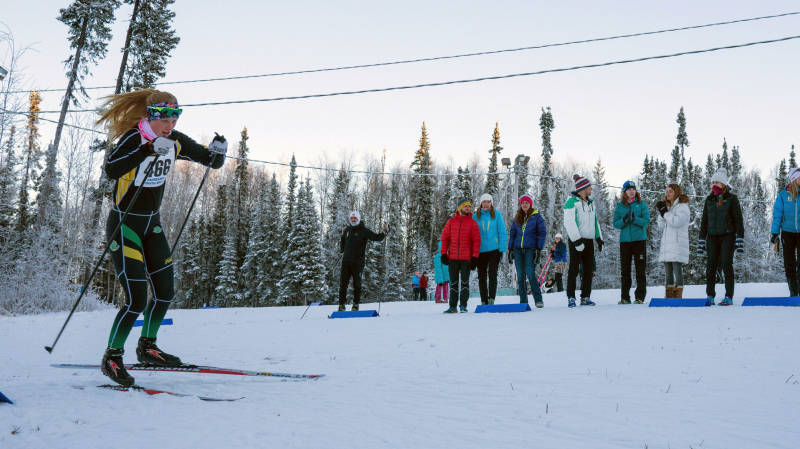
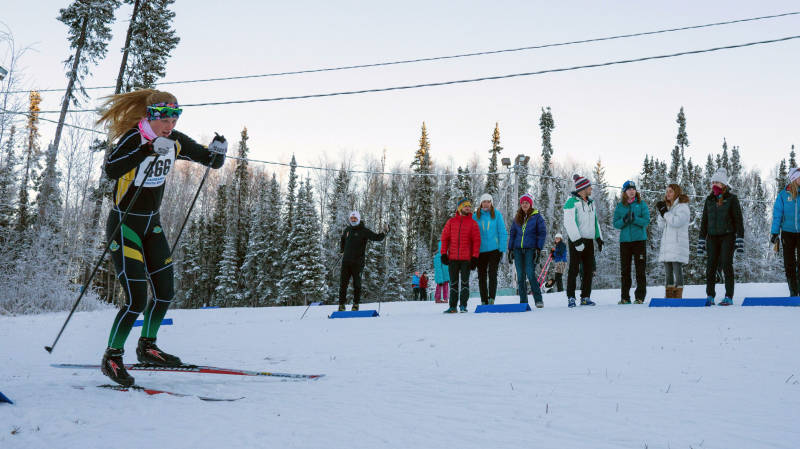
    University of Alaska Anchorage freshman Hailey Swirbul skis through the stadium at Birch Hill Ski Area in Fairbanks, Alaska, in the Alaska Nordic Cup on Nov. 19, 2016. (Photo: Zachary Hall/UAA Athletics)
    University of Alaska Anchorage freshman Hailey Swirbul races through the stadium at Birch Hill Ski Area in Fairbanks, Alaska, in the Alaska Nordic Cup on Nov 19. (Photo: Zachary Hall/UAA Athletics)

    FAIRBANKS, Alaska – Scott Patterson is on a roll. The Alaska Pacific University (APU) skier has now won all of the ski races he entered this year – and over half the ski races held in this country in the 2016/2017 winter to date – after picking up wins on both days of racing in the Alaska Nordic Cup at Birch Hill Ski Area in Fairbanks, Alaska, this past weekend, Nov. 19-20.

    APU’s Jessica Yeaton was also a double winner on the weekend. And in the collegiate ranks, the University of Alaska Fairbanks (UAF) maintained its hold on the Alaska Nordic Cup against the University of Alaska Anchorage (UAA).

    Skiers from both universities competed with a new lease on athletic life, after learning earlier this month that the ski programs would not be cut at either UAA or UAF.

    The Alaska Nordic Cup is an early season, relatively low-key (but nonetheless International Ski Federation (FIS) sanctioned) competition between Alaska’s only two NCAA nordic programs. Prior to this season, in which UAF switched its conference affiliation from the Central Collegiate Ski Association to the Rocky Mountain Intercollegiate Ski Association (RMISA), it marked the only time outside U.S. nationals that Alaska’s college skiers might compete head to head until, potentially, NCAA Skiing Championships in March.

    The Nordic Cup is held each year in November, alternating between the Fairbanks and Anchorage areas. 2016 marked the 13th annual Nordic Cup competition. The UAF Nanooks enjoy a healthy historical advantage over their southern rivals, the UAA Seawolves, entering the weekend with an 8-3-1 all-time record (eight wins, three losses, and one tie) in the first 12 years of the dual meet. Scoring is typically based on an individual race on Saturday plus a relay on Sunday. Lowest combined time wins.

    But despite a strong team showing from UAF that carried the Nanooks to victory, and some standout individual performances from UAA, it was APU that owned the top steps of the podium throughout the weekend.
    (Photo: John Lazenby/Lazenbyphoto.com)
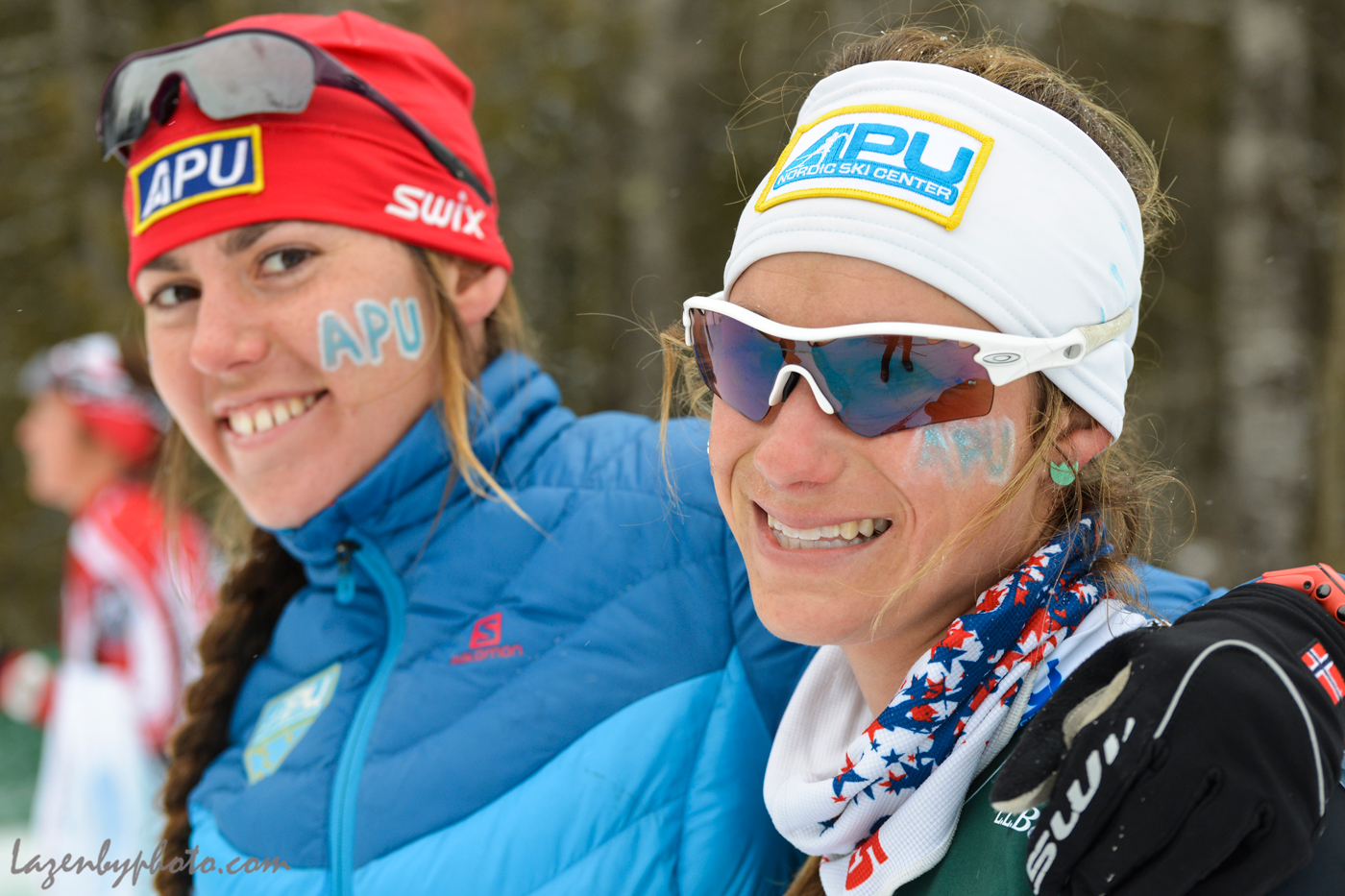
    APU’s Becca Rorabaugh (l) and Jessica Yeaton (r) at U.S. SuperTour Spring Series in March 2016. (Photo: John Lazenby/Lazenbyphoto.com)

    In the women’s race, Jessica Yeaton, an Australian national-team member who competes for Australia internationally but lives in Anchorage and trains with APU, finished Saturday’s 6 kilometer freestyle interval start in 16:52.1, skiing smoothly in relatively cold and slow conditions. APU’s other entrant, Fairbanks native Becca Rorabaugh, finished second, 34.1 seconds back. Third went to Hailey Swirbul, 1:27 back, in the UAA freshman’s college racing debut. UAF skiers swept the next four spots, led by senior Nichole Bathe, the day’s final starter, in fourth.

    Yeaton appreciated the early season racing opportunity. “It was awesome to race up here on good snow,” she wrote to FasterSkier. Yeaton added, “The conditions were thin but still provided a really good opportunity for a race effort. We are lucky to have these early races to help prepare for the Supertour in a couple weeks – the [Nordic Ski Club of Fairbanks] did a great job making them happen despite the lack of snow!”

    Swirbul, a Colorado native, echoed Yeaton’s praise for the venue and host club: “Thanks to Fairbanks for using their limited snow and delivering excellent (all things considered) courses and conditions for us to open our season this past weekend,” she wrote in a Sunday email to FasterSkier.

    Swirbul added, reflecting on the sensation of putting on a race bib once more: “As usual, it’s an interesting feeling to return to an on-snow race scene after long summer months without one… nerves, waxing, morning jogs and stretching, race strategy, etc. I sure enjoyed being back at it this weekend! I was satisfied with my and my team’s skiing this weekend, considering it is only November, and think we have great things ahead of us. We are all revving our engines preparing for a long winter ahead, ready to establish a new name for our team with many young skiers, and meanwhile prove to the president of our university that we are more than worthy of being part of a long lasting ski team at UAA! I am very excited for what the season has to bring for UAA.”

    Bathe, originally from Madison, Wis., was likewise pleased by the strong first-day showing of the UAF team. “I thought today went well especially for our whole women’s team,” she wrote in an email on Saturday. “To have four women right in there is always awesome and makes us excited for the season! It’s nice to see all the summer training pay off and start getting back into race mode again.”

    On the men’s side, the top-seeded Patterson took advantage of his position as the final starter to ski to the victory over several of his APU teammates, including David Norris in second.

    “Snow instead of ice made coming to Fairbanks [from Anchorage] for races an easy decision,” Patterson wrote. “Although I hadn’t raced here since high school, I have always enjoyed the Birch Hill trails. During the race, I had to remember how to race a little after getting some early splits that I was even with David and knowing his fitness through the summer and fall. Overall it was a great chance to chase out some early season rust and get ready for important races.”
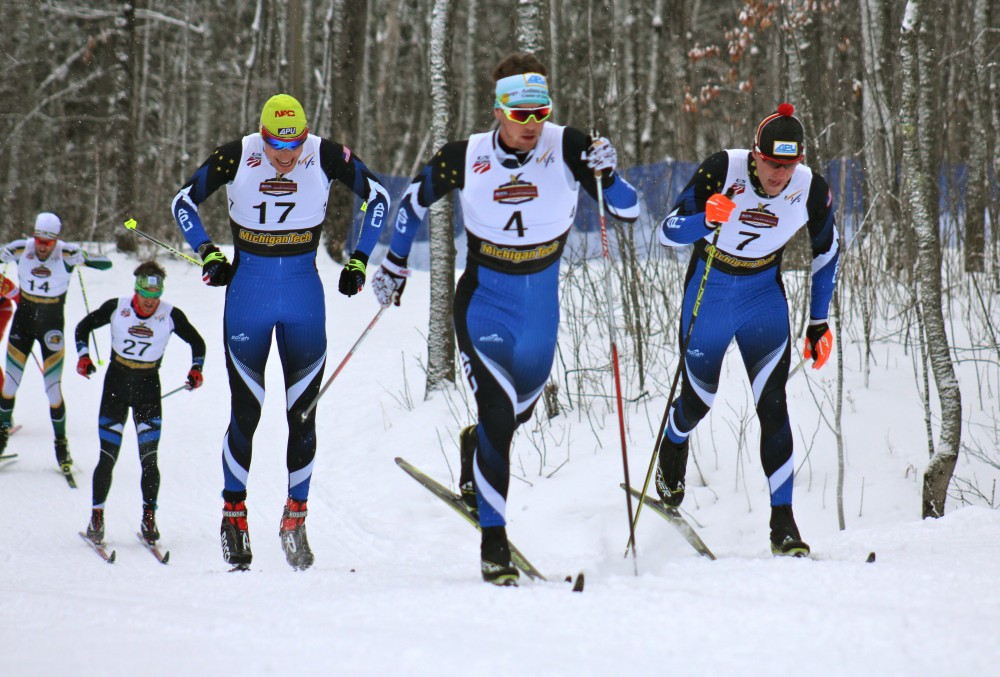
    APU teammates and brothers Logan Hanneman (7) and Reese Hanneman (4) lead teammate Tyler Kornfield (17), Welly Ramsey (Mountain Endurance Sports) and Fredrik Schwencke of Northern Michigan University (far left) during their quarterfinal of the men's 1.5 k classic sprint on Saturday at U.S. nationals in Houghton, Mich.
    APU teammates and brothers Logan Hanneman (7) and Reese Hanneman (4) lead teammate Tyler Kornfield (17) during their quarterfinal of the men’s 1.5 k classic sprint at 2016 U.S. nationals in Houghton, Mich.

    Patterson completed the 8.25 k skate race in 19:36.3. Norris finished 16.7 seconds behind him. Tyler Kornfield rounded out the APU podium, finishing 1:03 back of Patterson.

    Patterson and Kornfield grew up in Anchorage. Norris is a Fairbanks native. Their good-natured geographic rivalry stretches back a decade or more, to when they were all competing in Alaska high school skiing. (“We hated the Anchorage guys,” Fairbanks skier Reese Hanneman told the Alaska Dispatch News “with more amusement than venom” in a summer profile. “We were like the rednecks from Fairbanks, out skiing in the woods, going up against the city boys.”)

    APU skiers took the top five spots on the day, with Anchorage skier Thomas O’Harra in fourth and Fairbanks local Logan Hanneman in fifth.

    The top college skier was UAF junior Max Donaldson, another Fairbanks product, in sixth, 1:37 back of Patterson. The top UAA skier was sophomore Toomas Kollo, from Estonia, 2:35 back in ninth.

    At the end of the first day of racing, the combined times of the top three UAA women put them just 23.5 seconds behind the top three UAF skiers. On the men’s side, UAF created a larger gap of 2:14.2 over UAA’s combined times, giving UAF an advantage of roughly 2:38 heading into Sunday’s relays.

    Sunday saw more of the same: APU took the easy win, Swirbul shined for UAA, and UAF used its depth and balanced performances to take the overall victory.

    APU entered only one team in the relay, but it included the top two finishers from each of Saturday’s individual races. Unsurprisingly, the team of Patterson, Rorabaugh, Norris, and Yeaton posted the fastest time in all four legs of the 4 x 4 k skate relay, finishing in 46:57.4.
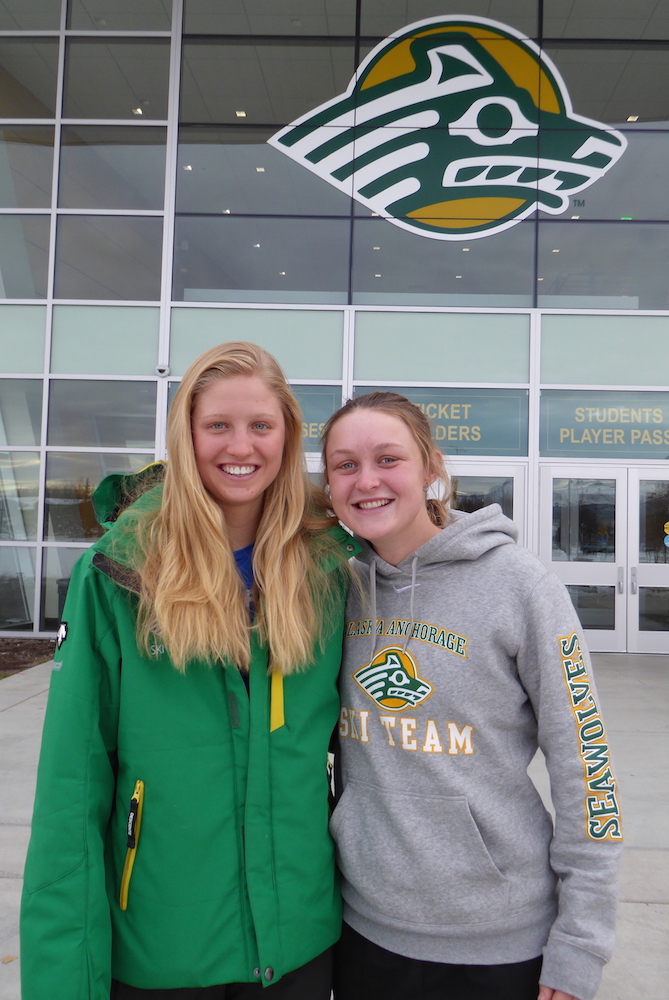
    University of Alaska Anchorage Seawolves skiers Hailey Swirbul (l) and Casey Wright (r), photographed on the UAA campus in Anchorage, Alaska, in October 2016. (Photo: Gavin Kentch)
    UAA skiers Hailey Swirbul (l) and Casey Wright (r), on the UAA campus in October 2016. (Photo: Gavin Kentch)

    The top college team was Nanooks A (Donaldson, Sarissa Lammers, Michael Fehrenbach, and Bathe), finishing just over three minutes behind APU in 50:10.1. Donaldson and Fehrenbach posted the fastest male collegiate times of the day in their legs. Seawolves ‘A’ (Kollo, Swirbul, Marcus Deuling, and Casey Wright) was less than eight seconds behind the Nanooks in 50:18. Swirbul was again the fastest collegiate woman on the day, while Wright similarly recorded the day’s fastest anchor leg.

    Nanooks ‘B’ was next, followed by Seawolves ‘B’. Ultimately, the time gaps from day one grew, and UAF finished with a 4:08 cumulative advantage over UAA, taking home its ninth Nordic Cup overall and second in a row.

    UAF nordic coach Nick Crawford said in a Sunday press release, “The Seawolves had a good day today and it was very exciting to watch the race unfold. The margin between our two teams was much smaller today, so it made it that every skier had to race hard which isn’t always the case in relays. The victory was for sure a team effort today with both the men and the women putting together good races. We really enjoy the collaboration we have with our Anchorage rivals.”

    UAF skier Anna Darnell expressed similar sentiments, telling the Fairbanks Daily News-Miner, in light of the recent political rollercoaster of threatened cuts to both schools’ ski programs, “We feel a lot closer to the UAA team after this.”

    Meanwhile, at the top of the results sheet, Patterson’s brace of victories on the weekend, combined with his easy victory at the Race to the Outhouse #1 outside Palmer, Alaska, earlier this month, meant that the APU skier has now won every single race he has entered this winter, as well as 60 percent of all the ski races held in this country this year. (The Mat-Su Ski Club held a pair of 5 k skate and classic races at Hatcher Pass on Nov. 19 and 20.)

    “I’ll have to get a time turner for the coming weekends,” Patterson wrote in an email as he reflected on his current track record, “so I can continue to win every single race in the U.S.”

    This particular race was slightly more competitive than the Race to the Outhouse. FasterSkier unofficially calculates the USSA race penalty (a measure of the strength of the field) for Saturday’s men’s race as an impressive 29.03, well below the USSA minimum penalty of 35 for a College Event or Regional Scored Event. (The penalty for the women’s race was unofficially a higher, but still respectable, 60.52.)

    Reflecting the cosmopolitan nature of NCAA skiing, competitors in the 45-racer FIS/USSA field hailed from at least eight foreign countries, including Canada, Norway, Germany, Australia, Sweden, the Czech Republic, Italy, and Estonia. They were joined by roughly 200 more skiers in the day’s other races, ranging from kindergartners in snowsuits who skied a 500 meter course without poles to the 60- and 70-year-old age brackets in the community 4 k race.

    The strong community support, and college athletes who had finished their race but stayed to cheer on their teammates, combined to make the atmosphere as electric as can be found for American cross-country skiing. Dozens of spectators lined a late-race climb back up to the stadium, where racers were met by an even larger, frenzied crowd cheering them on.
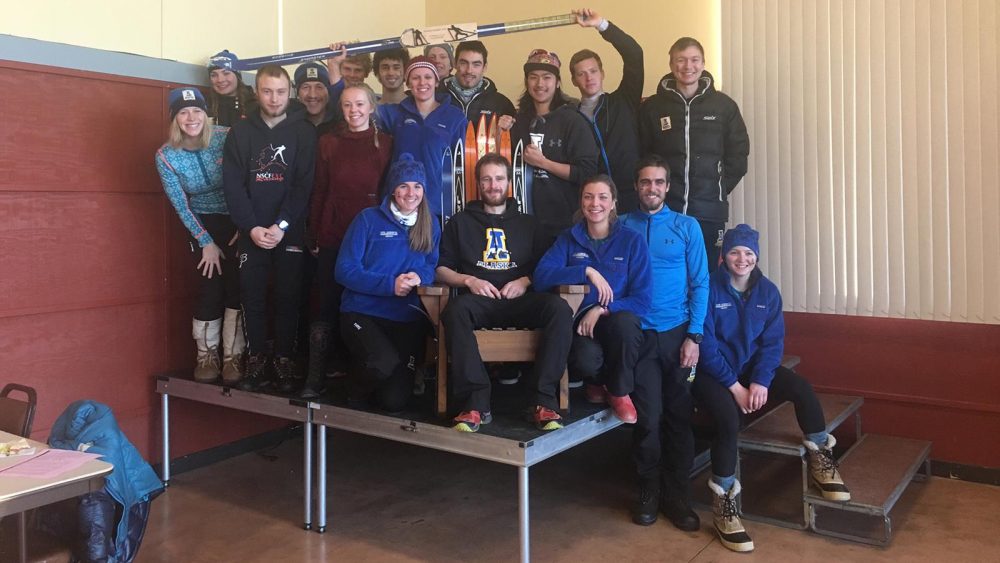
    The University of Alaska Fairbanks ski team poses with the trophy for the Alaska Nordic Cup at Birch Hill Ski Area in Fairbanks, Alaska, on Nov. 20, 2016. (Photo: Nick Crawford/UAF Athletics)
    The University of Alaska Fairbanks ski team poses with the trophy for the Alaska Nordic Cup at Birch Hill Ski Area in Fairbanks, Alaska, on Nov. 20, 2016. (Photo: Nick Crawford/UAF Athletics)

    Conditions were, as the athletes acknowledged, undeniably snow rather than ice (as on the Anchorage trails these days), but unfortunately not that much of it. Fairbanks has seen approximately five inches of total snowfall so far this winter. The impeccably maintained trails at Birch Hill meant that racers found a base of roughly two inches of compacted snow, with some leaves and sporadic dirt showing through, but no rocks. Most skiers in the FIS race competed on their prior-generation race skis.

    Although the official high for the day at the Fairbanks airport was a barely FIS-legal 1° F (-17 degrees Celsius), temperatures at the relatively elevated Birch Hill were comparably temperate, hovering around 10° F (-12 C) throughout the afternoon.

    At least in the sunlit stadium. Racing at Birch Hill on clear and cool winter days can be an oddly hellish experience. Not because it is unenjoyable – far from it; the trails are a delight to ski, and the snowy birch forest is sublimely beautiful – but because it evokes the sensation of voyaging into the underworld and back again. The stadium is in the sun, and elevated, and relatively warm; many trails drop down leaving the stadium, sending the skier into the realm of dark and cold. And so one goes from light to dark, sun to shade, warmth to cold, and back again with each new trail, the stadium become a modern-day Cumae (entrance to the underworld in classical mythology) and the skier Heracles or Odysseus, re-enacting the journey between worlds.

    RMISA college racing resumes early next year with the Utah Invitational at Soldier Hollow on Jan. 7.

    Results: Day 1 | Day 2

  • Mysterious Man in Red, New Mexico’s Nikander Out-Double Poles Hoffman in 50 k

    Mysterious Man in Red, New Mexico’s Nikander Out-Double Poles Hoffman in 50 k

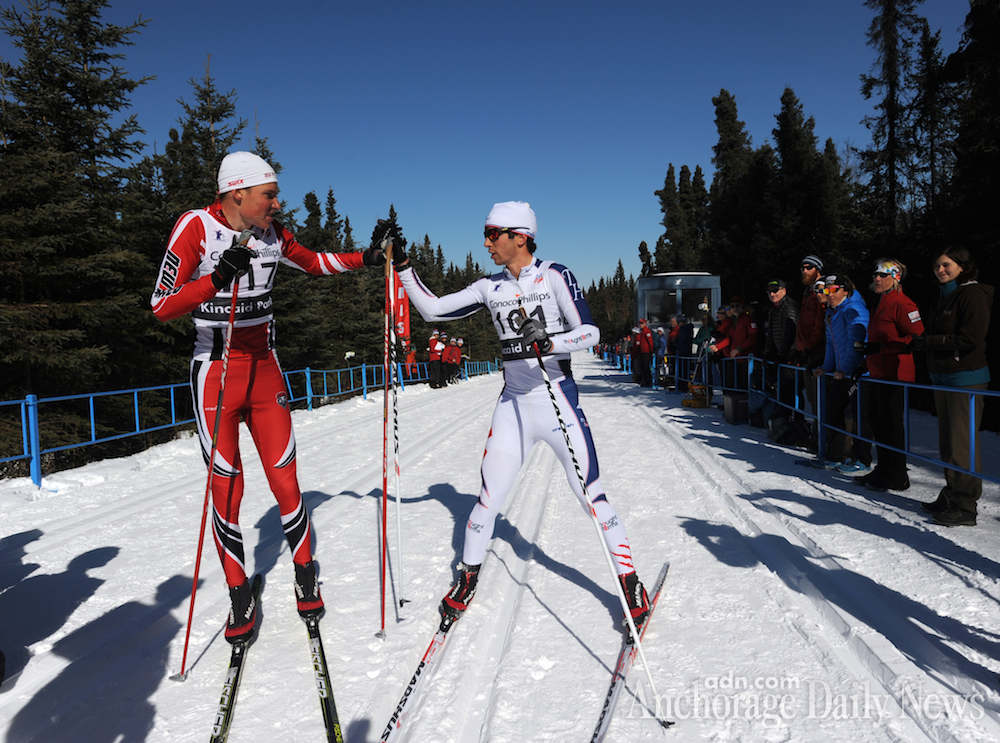
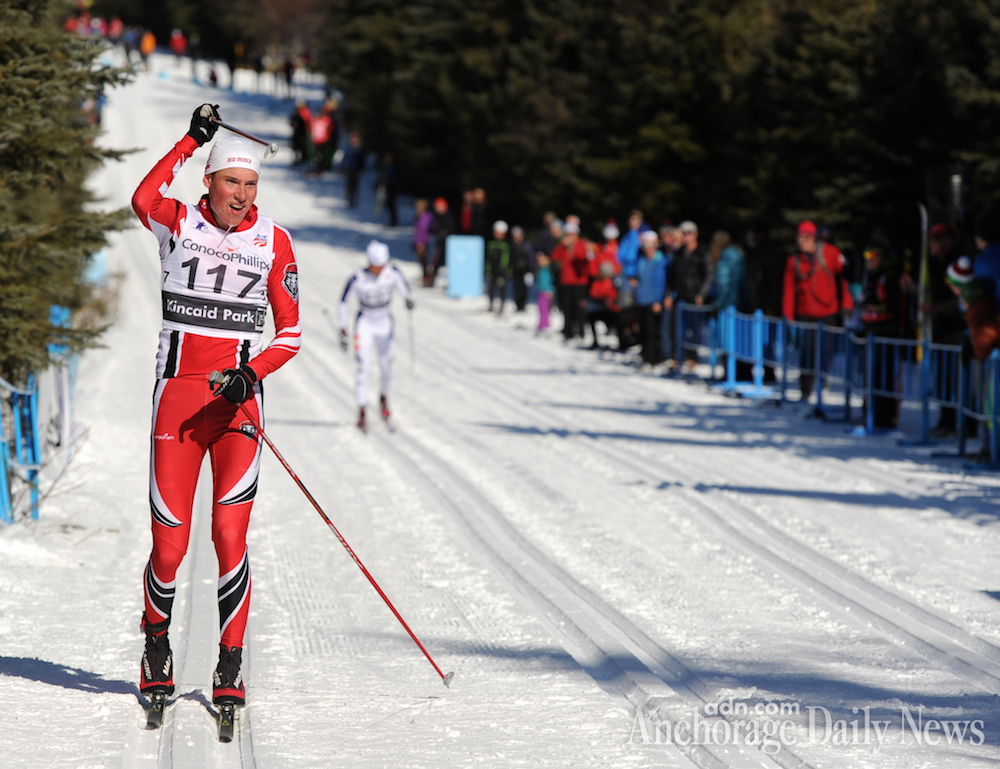
    Finland's Aku Nikander (University of New Mexico) celebrates his win in the 50 k classic mass start at U.S. Distance Nationals on Friday in Anchorage, Alaska. He beat Noah Hoffman (SSCV/Team HomeGrown/USST) by 9 seconds after the two skied together for essentially the entire race. (Photo: Erik Hill/Anchorage Daily News)
    Finland’s Aku Nikander (University of New Mexico) celebrates his win in the 50 k classic mass start at U.S. Distance Nationals on Friday in Anchorage, Alaska. He beat Noah Hoffman (SSCV/Team HomeGrown/USST) by 9 seconds after the two skied together for essentially the entire race. (Photo: Erik Hill/Anchorage Daily News)

    ANCHORAGE, Alaska — Aku Nikander was somewhat a mystery in the men’s 50-kilometer classic mass start on Friday in the last race of the season at U.S. Distance Nationals.

    As far as Noah Hoffman of the U.S. Ski Team (USST), Ski & Snowboard Club Vail and Team HomeGrown was concerned, he was the guy that stood between him and a shot at his second-individual victory of 2014 Spring Series.

    For Nikander, a Finnish student in his first year at the University of New Mexico, a win is a win, no matter what country you’re racing in, and it’s what he wanted.

    It wasn’t until the second of five 10-k loops on the challenging Spencer Loop at Hillside trails that Nikander, a 24-year-old sophomore, emerged as a noticeable contender. Erik Bjornsen, of Alaska Pacific University (APU) and the USST, led through the 10 k checkpoint. Nikander was 2.4 seconds back in 12th, and one lap later, he was up to third, less than two seconds behind leader Reese Hanneman (APU) and Hoffman.

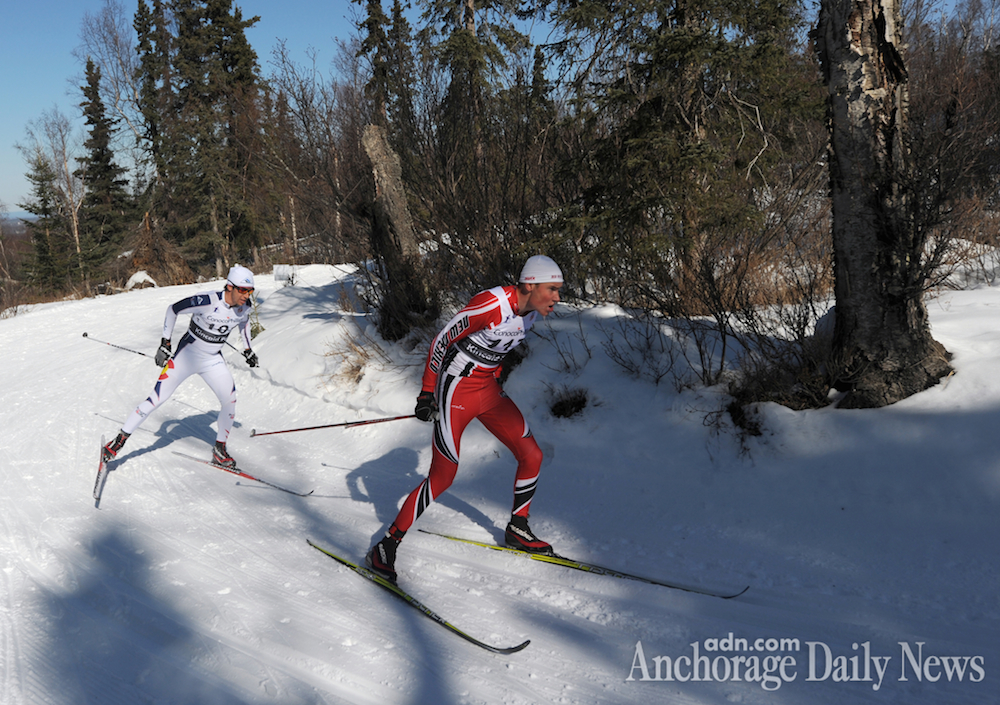
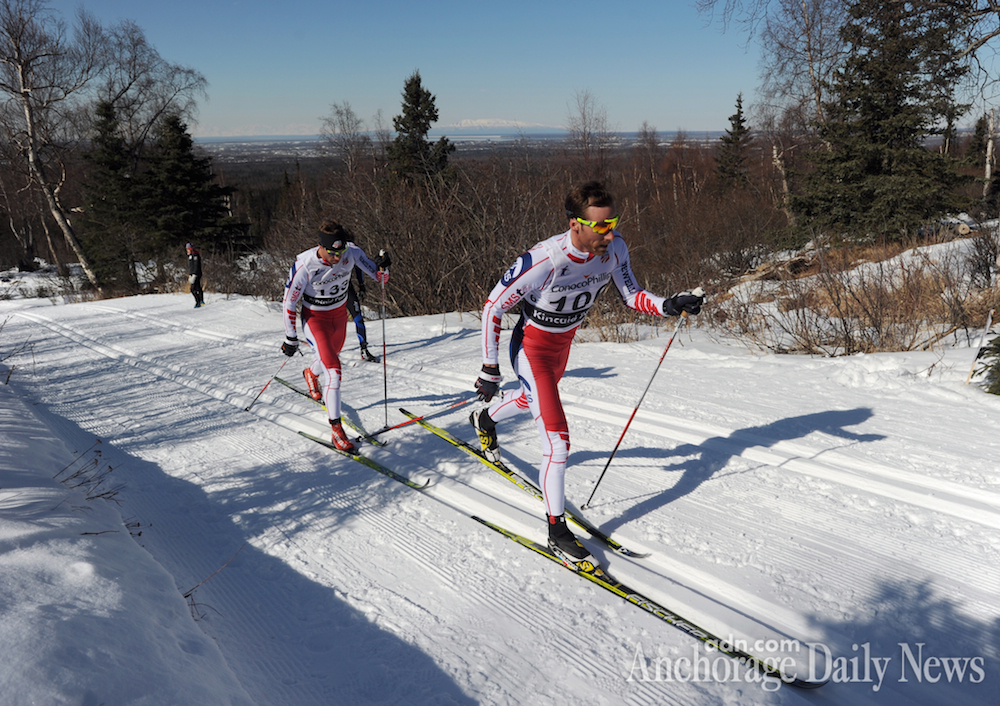
    Finnish skier Aku Nikander (r) of the University of New Mexico leads Noah Hoffman of the U.S. Ski Team around a corner on the Spencer Loop during the final lap of the men's 50 k classic race at the U.S. Distance Nationals at Hillside in Anchorage, Alaska. (Photo: Erik Hill/Anchorage Daily News)
    Finnish skier Aku Nikander (r) of the University of New Mexico leads Noah Hoffman of the U.S. Ski Team around a corner on the Spencer Loop during the final lap of the men’s 50 k classic race at the U.S. Distance Nationals at Hillside in Anchorage, Alaska. (Photo: Erik Hill/Anchorage Daily News)

    With a 16-second gap to fourth place, Nikander began to ramp up the pace, while Hanneman and Hoffman wondered who exactly he was.

    “There’s always those wildcard Europeans at these last races of the year,” Hanneman said with a laugh. “Clearly going into lap three it was just us three and it sounded like we had a pretty decent gap, so I knew, he wouldn’t have been up there if he wasn’t a good skier with good skis and feeling good. I don’t know anything about him, but obviously he’s in contention for the win.”

    Earlier this season, Nikander won a college race in Utah in a 30 k skate.

    “After that I was struggling,” Nikander said. “I was a little bit overtrained because we had been training in the 3,000 meters so I was so tired the whole season practically. I didn’t do so well in NCAA’s so I was really looking forward to this race.”

    On March 6 and 8, he placed ninth in the 10 k classic at NCAA Championships and was 23rd in the 20 k freestyle mass start. Two seasons ago, Nikander finished ninth in the 50 k classic at Finnish Championships, and narrowly missed the podium in two U23 Finnish Championships races in 2012 and 2013.

    He applied to Utah, but then New Mexico head coach Fredrik Landstedt contacted him.

    “I knew a couple Finnish alpiners so I decided to go there,” Nikander said. “It’s a little bit deeper than Finland so I wanted to experience something else. It has worked this season pretty well.”

    This week marked his first time in Alaska; first time at U.S. Spring Series.

    Meanwhile, heading into lap three, Micheal Fehrenbach of the University of Alaska-Fairbanks led the chase with David Norris (Montana State University/APU), Andy Newell of the Stratton Mountain School (SMS) T2 Team and USST, and Brian Gregg (Team Gregg/Madshus).

    One lap earlier, Gregg had raced to the top of the high point of the course, known as Wall Street, to nab the first of two $100-dollar primes at 16 k, but he said the effort cost him. Bjornsen had followed him closely in second, going out hard early in an effort to break up the pack, and Hoffman crested the top with them with a slight gap to Hanneman, Newell and Fehrenbach.

    A former University of Alaska-Anchorage skier, Gregg, 29, recalled doing bounding intervals at the top of Wall Street.

    “Most of our training we did on the Spencer Loop,” he explained. “We’d do three loops, maybe one time we did four, so I’ve never done five so that was pretty hard.”

    On Friday, he saw his college coach Trond Flagstad at the top of the same climb.

    “I got a little fired up, I went for that first prime,” Gregg said. “I was a little tired when the other guys sort of separated so I wasn’t able to quite hang with those guys.”

    By 26 k, Nikander was first to the top for the second $100 bonus. Hoffman was once again right there with him, and Hanneman a few seconds behind by the summit. Norris led the chase with Fehrenbach, Gregg, and University of Vermont (UVM) senior Scott Patterson, while Newell skied slightly behind in eighth.

    “After two laps, I was pretty comfortable,” Nikander said. “We took off with Hoffman and Hanneman. After the uphill sprint we got a gap and I had such good skis.”

    Hoffman was glad it broke up by the halfway point.

    “I didn’t really know anything about Aku, I didn’t even know his name,” he said. “He’s a good skier.”

    Teammates on the U.S. Ski Team and Stratton Mountain School T2 Team, Andy Newell leads Simi Hamilton on one of several hills on the Spencer Loop in the 50 k classic at U.S. Distance Nationals in Anchorage, Alaska. (Photo: Erik Hill/Anchorage Daily News)
    Teammates on the U.S. Ski Team and Stratton Mountain School T2 Team, Andy Newell leads Simi Hamilton on one of several hills on the Spencer Loop in the 50 k classic at U.S. Distance Nationals in Anchorage, Alaska. (Photo: Erik Hill/Anchorage Daily News)

    By the time the leaders reached 30 k, Hoffman led Nikander by 0.5 seconds, and Hanneman was nearly 28 seconds behind in third. He still had nearly a minute separating him from fourth, however, with Patterson leading Fehrenbach, Gregg and Norris. Newell was another 28 seconds behind in eighth, followed by teammate Simi Hamilton (SMST2/USST) and Lex Treinen (APU), respectively.

    The order of the front three stayed the same through the fourth ascent of Wall Street, with Hoffman and Nikander skiing to the top together and Hannemen trailing by about 40 seconds. Gregg led the chase, with Fehrenbach and Norris, and Hamilton was at the front of the second group with Newell and Treinen over the top.

    With one 10 k lap to go, Nikander and Hoffman skied through flatter section of the course as a unit, 48 seconds ahead of Hanneman. The two began to study each other more carefully.

    “I just double poled faster than him,” Nikander said. “I was actually leading a lot in the last lap. I had maybe better kick and better glide.”

    Neither of Nikander nor Hoffman re-waxed in a race that didn’t allow ski changes.

    “I don’t like my chances coming into the final stretch, but part of me was just glad to be with him,” Hoffman said. “I did try a little bit over the final hills, but I just didn’t have a chance getting away from him.”

    Nikander took charge the last time up Wall Street and gapped Hoffman before he caught back up on the backside of the course. With an efficient double pole, Nikander was able to stay ahead, entering the finishing straight almost even with Hoffman.

    There, he unleashed the double pole he had been banking on, passing Hoffman in the last 150 meters. Hoffman strided into the gradual-uphill finish in second, accepting the race for what it was and the effort he’d put toward it.

    “When I saw that Noah can’t keep up in the flat part, in the double-poling part in the last loop I just waited for the final straight and sprint and it was enough for the day,” Nikander said.

    “He was better than me double poling all day,” Hoffman said. “I was struggling and it’s a been long season and he was impressive and I’m glad to be done. … Rarely does the best guy not win in a 50 k. I think execution, which I struggle with day in and day out to really perform the way I want to perform, is easier in a longer race for me.

    “It doesn’t define my season,” he added. “I’m excited to take a break and excited to look to improve for next year.”

    Nikander was excited, although unsure what it would mean to those back home.

    “I don’t know how much they are looking at the results from here. We’ll see,” he said. “I think it can help a little bit for [team selection] and next summer’s training camps. I hope so.”

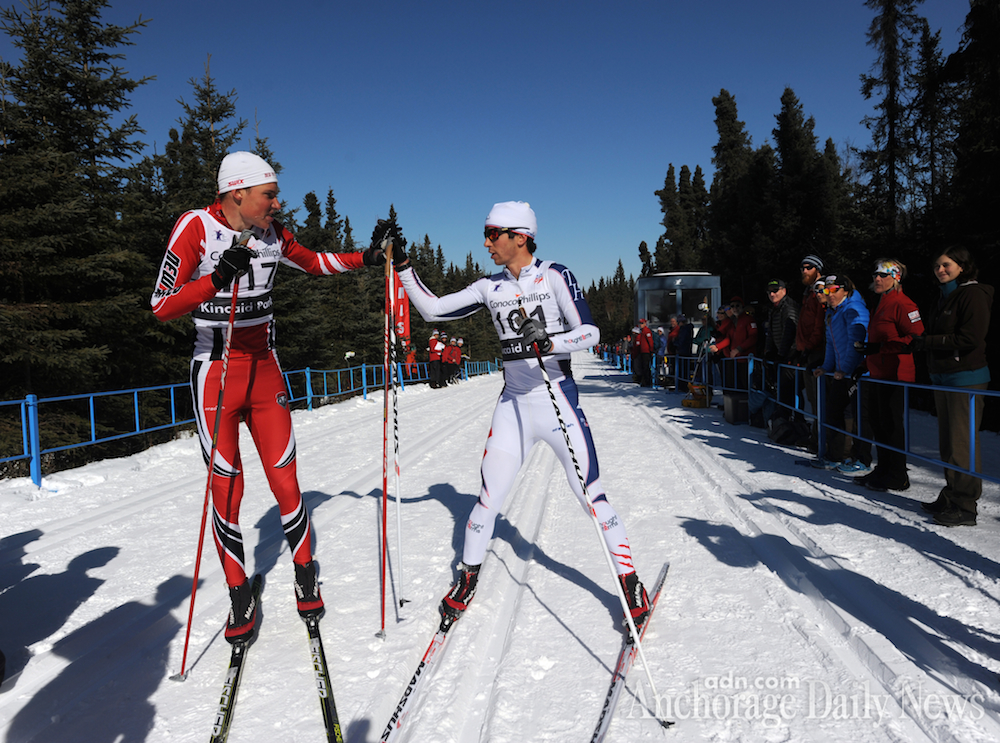
    Winner Aku Nikander of the University of New Mexico (l) and runner-up and first American Noah Hoffman of the U.S. Ski Team congratulate each other after finishing the men's 50 k classic race at U.S. Distance Nationals on Friday. (Photo: Erik Hill/Anchorage Daily News)
    Runner-up and first American Noah Hoffman (r) of the U.S. Ski Team congratulates overall winner Aku Nikander (University of New Mexico) after the men’s 50 k classic race at U.S. Distance Nationals on Friday. (Photo: Erik Hill/Anchorage Daily News)

    The first American, Hoffman finished 9 seconds after Nikander, who won the roughly 51.5 k race in 2:23.08.3. Hanneman locked up third, 1:01.6 behind Nikander. It was his second podium in three individual races this week, and third including a win in the mixed relay.

    “My last two laps, I tried to ski that climb sort of relaxed, just my own pace and not worry how I thought someone else would be skiing it and then try to ski pretty hard on the rest of this stuff,” Hanneman explained.

    “You kind of come into the last week and for the most part have no idea how it’s gonna go. I knew I felt good at the World Cup last week … and I ended up feeling decently good,” the overall men’s SuperTour leader said. It’s been really fun to do well here at home. “It’s hard to beat doing well at home. That was a great way, a little reward at the end of the season.”

    Gregg, who’s wife Caitlin finished the season as the female SuperTour leader, finished more than 3 1/2 minutes later, uncontested in fourth.

    “Last lap, that’s where I tried to make a move to separate from our little pack,” he said after making his move over the top over Wall Street. “I looked back at the corner. I saw Newell, Simi must’ve been there, too — those guys had just caught us and I was like, it’s time to go. I love that downhill we used to do downhill time trials down that from the very top to the bottom. … Those workouts that we did eight, nine years ago really played into this race course.”

    One of the APU skiers that train in Anchorage year-round, Treinen came into the stadium with Newell, then stepped around him at the beginning of the finishing lanes with about 200 meters to go. He out-double poled the Olympic sprinter by 3.1 seconds to finish fifth. Newell placed sixth and Hamilton finished another 11 seconds back in seventh. Norris placed eighth — 13.4 seconds behind Hamilton and 14 seconds ahead of Patterson in ninth, and Fehrenbach was another 27 seconds back in 10th.

    Eleventh place went to Eric Packer (SMST2), who finished more than two minutes later and 8:03.2 behind the winner. Bjornsen placed 36th.

    Results