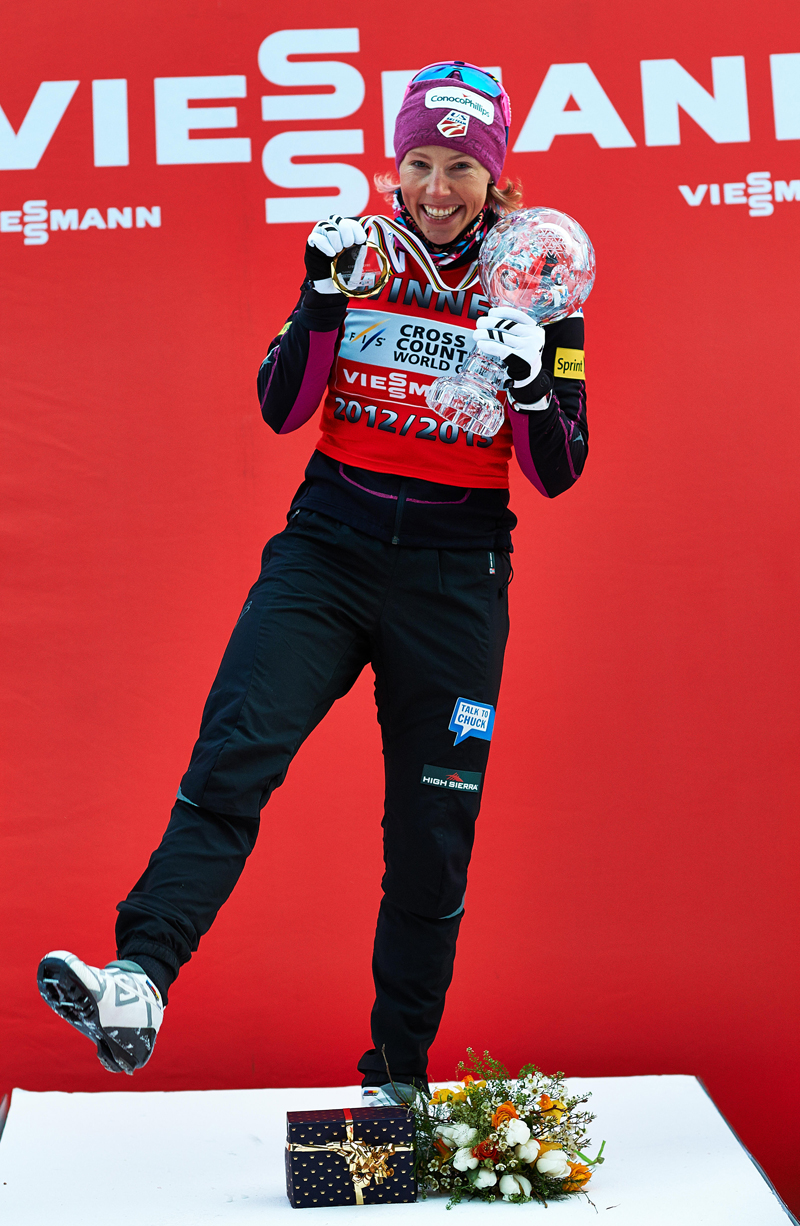
Kikkan Randall (USA) with her second straight Sprint Crystal Globes. With Time Warner Cable now carrying Universal Sports Network, more U.S. viewers will have access to the channel’s endurance sports programming this year, which includes alpine, nordic, snowboarding, freeskiing and freestyle tours. Photo: Fischer/Nordic Focus.
Universal Sports Network, which offers exclusive year-round coverage of Olympic sports programming, made an announcement on Thursday that could help more U.S. ski fans watch their favorite winter athletes. Time Warner Cable, the second-largest U.S. cable system operator in the country, will start carrying the Universal Sports channel later this summer as part of a new multi-year contract to bring its customers coverage of the Olympic qualifying FIS World Cup tour, including alpine, nordic, snowboarding, freeskiing and freestyle tours.
“Time Warner Cable customers will soon be able to enjoy the year-round coverage of championship sports programming found only on Universal Sports,” said Alexis Johnson, Time Warner’s Vice President of Content Acquisition. “We are delighted to be able to provide our Sports Pass subscribers with access to coverage of the Olympic sports they love on multiple platforms.”
For current Time Warner customers, Universal Sports will only be available to those who pay extra for the TWC Sports Pass. DirecTV will continue to carry Universal Sports’ programming, meaning World Cup races will now be available in some 40 million U.S. homes, including major markets in New York City and Los Angeles. Comcast, the largest U.S. cable provider, still has not regained Universal Sports since dropping the channel from its lineup in 2012.
The U.S. Ski and Snowboard Association looks positively at the Time Warner deal, as the governing body seeks to boost its athletes’ exposure in the upcoming Olympic year.
“Maximizing exposure for U.S. Ski Team athletes is a major priority for the USSA and this agreement between Universal Sports Network and Time Warner further helps that initiative,” said USSA’s Chief Marketing Officer Michael Jaquet in a press release. “We are encouraged that Time Warner Cable has seen the value in this and will continue to work with our partners at Universal Sports Network to continue to build out this very valuable platform.
“This announcement and development is about more access and distribution for Universal Sports,” Jaquet further explained in an email to FasterSkier. “So last week if you had Time Warner as your cable provider you couldn’t watch the channel. Now you can. That’s 8 million more people this week that can now get the channel that couldn’t last week. So good for the sport and what they cover already.”
Jaquet, who joined USSA last spring after leaving CBS as a marketing executive, was unsure of how Universal Sports’ cross-country and nordic specific coverage would change in the Sochi Olympic year.
“No major plans that I know of now to change the mix of sports and coverage, but in an Olympic year maybe more than normal,” he said. “Those decisions get made in the next four to eight weeks.”
USSA did not directly play a role in the deal, but Jaquet says winter sports fans likely influenced the decision by requesting access to the channel.
“We weren’t directly involved in the negotiations but these deals get done based on people calling their cable operators and demanding the channel get added,” he said. “We do know that a lot of that call volume came from NYC and LA, two of our bigger markets for fans and Time Warner’s Main coverage areas. So our fans certainly had a role.”
Universal Sports has been the home for season-long coverage of the Audi FIS Alpine World Cup, along with bringing other FIS events like the cross country Tour de Ski to America.
“We are thrilled that Time Warner Cable sees value in Universal Sports Network,” said Universal Sports President Scott Brown. “We look forward to serving Time Warner Cable’s customers with exciting, global sports coverage on multiple platforms.”
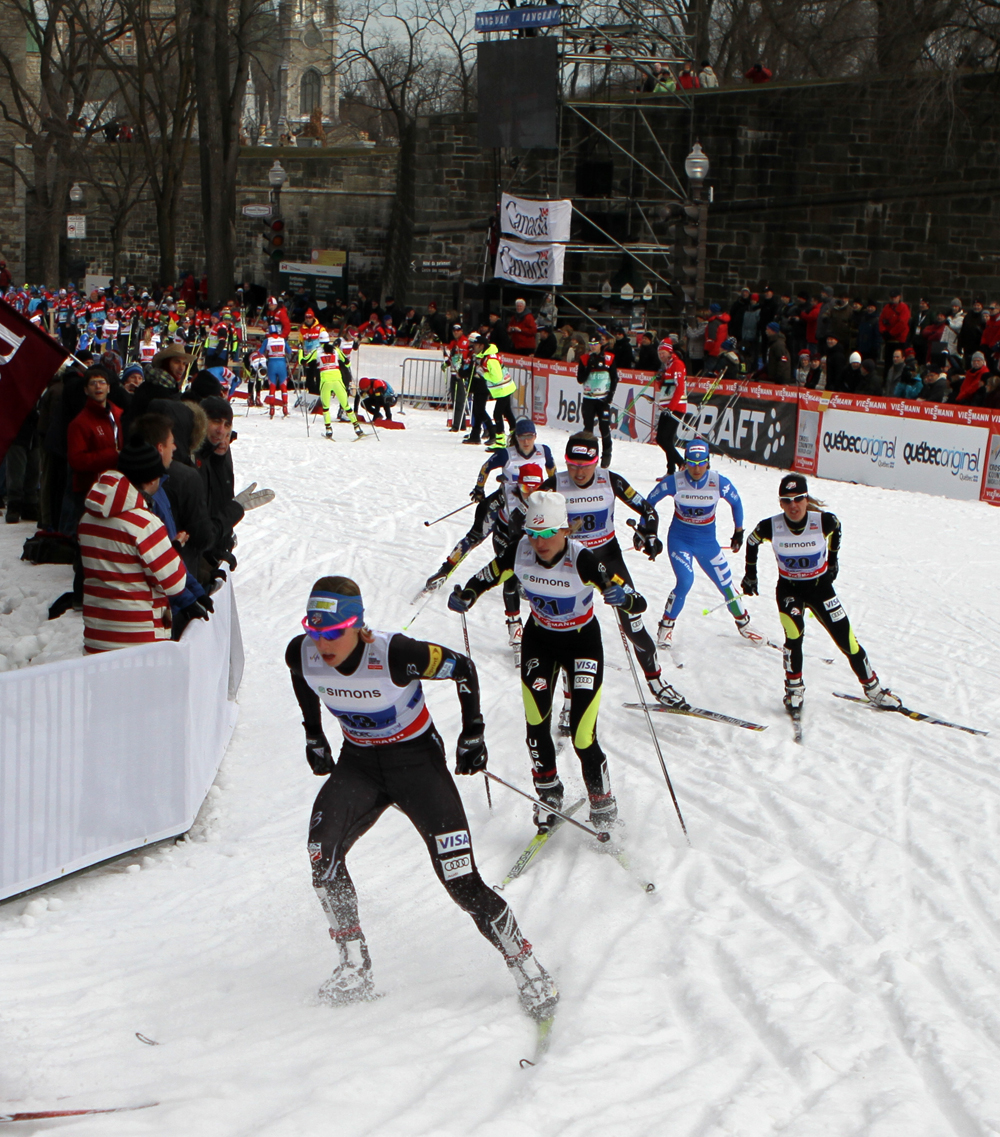
Kikkan Randall leading fellow Americans Sophie Caldwell, Caitlin Gregg and Holly Brooks in the Quebec World Cup team-sprint semifinals on Dec. 7. For those who want to see more of the same racers in Canmore, Alberta, Dec 13-16, tune into usskiteam.com for live video coverage.
If you tuned in to last weekend’s Québec World Cup cross-country races live via the U.S. Ski and Snowboard Association (USSA) website, you’ll be happy to know that there’s more where that came from – potentially close to 20 more, in fact.
In the immediate future, USSA will stream live footage from the Canmore World Cup, which includes races Thursday, Saturday and Sunday. Just like last weekend, online access will be free of charge, and if all goes according to plan, USSA could broadcast a total of 20 cross-country, nordic combined and ski jumping events this season.
“Exposure for the sport I just feel is important overall,” Jaquet said of the project he’s been working on since July to draw more eyes to nordic and jumping. It came together fewer than five days before the Québec event and offers at-home viewers a way to watch the races without downloading or streaming them illegally.
After making a trade deal with Universal Sports – in which USSA gave up broadcast rights for a total of five alpine, freestyle and ski cross World Cups in exchange for 20 nordic and jumping World Cups – Jaquet wanted to make the races viewer-friendly.
“We knew that we were going to have access to this feed in November,” he said on the phone Saturday. “I just felt having English commentary was really important.”
As it works now, the footage is sent to the InFront Sports & Media headquarters in Europe then to Salt Lake City, where USSA matches the live video with a voice over. USSA Vice President of Communications Tom Kelly commentated last weekend, but Eurosport announcers could be used for audio later, Jaquet said. The videos are also archived on the site.
While the process might seem a little backwards (why not just stream from Canada?), Jaquet explained it makes the most sense financially. Instead of sending a camera crew to Québec or Canmore or Europe for $10,000 to $15,000 dollars or more, USSA will spend less than $1,000 per event.
“My goal is to put as much content as possible up there and be fiscally responsible about it,” he said, adding that he doesn’t want to take anything away from the athletes.
As for scheduling, Jaquet plans to finalize a list of events USSA will broadcast in the next week or so. They might not fit all 20 in and won’t be able to show events like the Tour de Ski and parts of World Championships (which Universal still holds rights to), but Jaquet was confident in the initiative.
In the first two days of cross-country World Cup coverage (despite a glitch that caused a delayed feed on Friday), he said the USSA Network received more than 7,000 page starts – more than double what he expected to get from the Live Super G in Beaver Creek (part of the trade).
“When you’re able to captivate a live audience and get people excited about it, that’s a very good thing,” he said.
So one small step for U.S. cross-country viewership, one giant leap for nordic sports? Jaquet thinks so.
“It’s good for the manufacturers to back up their investment of the athletes; it’s good for the athletes to raise their profile in America,” Jaquet said. “This is a very important step to make the content available. If the content is not available, it’s very detrimental to the sport.”
Back when Jaquet started at USSA in April after five years as a senior executive at CBS Sports Network, he stated his priority to make U.S. snowsport athletes household names, especially with visuals.
“It’ll work for cross-country skiing, it’ll work for alpine, it’ll work for snowboarding, and it’ll work for freeskiing, just creating heroes and superstars out of our athletes and making them accessible and creating some inspirational content as well,” he said.
Last weekend, the results spoke for themselves with Kikkan Randall’s double victory at the World Cup in Québec City – a first for the U.S. Nordic Ski Team.
“I know the sports-rights landscape incredibly well,” Jaquet said. “I knew that I could work with the Universal guys and I also looked at my own domestic package and decided my five events that I gave up weren’t going to work with my package because of scheduling. The overall goal was to just provide as much exposure and as much audience as possible to all seven sports that we represent.”
Jessie Diggins moved up to the USST A-Team this year, but the associated perks won’t include the same free phone service from Sprint that it did in the past. Despite the dropped coverage, Sprint’s sponsorship agreement with USSA remains unchanged through 2018.
After supplying U.S. Ski Team (USST) A-Team athletes with free cell phone service for the past few years, Sprint will not provide the service in the coming season. According to U.S. Ski and Snowboard Association (USSA) Chief Marketing Officer Michael Jaquet, the termination of the athlete phone program does not affect the rest of Sprint’s current sponsorship agreement with USSA, which extends through the PyeongChang Olympics in 2018.
“[Sprint] has been a great partner over the years and are one of our top sponsors all the way through PyeongChang,” Jaquet said. “The duration of their deal is the longest one that’s in place right now.”
Jaquet declined to disclose the exact value of the contract, but said it was in the seven figure per year range.
The athlete phone program was not part of Sprint’s contract but was an additional benefit to USSA’s partnership with Sprint. The phone company provides a similar program to athletes from other sports under its sponsorship umbrella, including NASCAR and several NBA teams.
Jaquet said Sprint decided to end the free service to the A-Team for the time being because the cost of providing around 100 athletes with international roaming data for most of the year had become unsustainable.
“What’s specific to our program, unfortunately, is that our athletes spend a bulk of their year in Europe. Sprint is a strong U.S. company but their coverage in Europe is not as strong. We ran up huge data roaming bills, well into the six figures,” Jaquet said. “That’s obviously not sustainable, spending 40% of the overall sponsorship on roaming charges.”
According to Jaquet, USSA and Sprint tried to find an alternate way to continue providing phone service to A-Team athletes, but was unable to do so in time for the start of the 2012-2013 season.
“Because the bills go back to Sprint, we can’t control an athlete from just turning on their roaming. Ironically, if we’d had some better communication about using WiFi and putting some rules in place, basically none of this would have happened,” Jaquet said.
For the 2012-2013 season, USST athletes were given the option to accept a discounted program with Sprint or find another provider. As of Monday, Jaquet said that some athletes’ phones had stopped working while others still had service.
“Sprint is working on a way to figure it out. They’ve been great,” Jaquet said. “They’re trying to extend things as long as possible and figure out solutions.”
In general, athletes have a new travel expense this year. Two A-Team skiers so far have said they bought an international calling plan but will be paying for it by the minute and attempting to keep conversations short. As a side effect, this will affect FasterSkier’s World Cup reporting, which is usually done by phone or email after each race.
Jaquet emphasized that Sprint’s commitment to support the USST through the PyeongChang Olympics was the most important thing, as its sponsorship would continue to help pay for the cost of competing.
“Particularly in the cross-country sports where we don’t produce revenue-generating events, it’s the team sponsorships and uniform sponsorships — like what Sprint has with the cross-country sports — that are vital to our ability to fund those teams’ travel and have coaches,” Jaquet said.
“While having a free phone is a great benefit, we certainly feel that traveling on the World Cup with coaches and techs and the facilities at the Center of Excellence are much more important in the grand scheme of things than free roaming. It’s a bummer… but I’ll take seven figures over six years before I worry about free roaming.”
Since becoming USSA’s CMO this spring, Jaquet says the governing body’s sales have reached levels not seen since the Salt Lake City Olympics in 2002. The National Guard and Tire Rack were signed on as new sponsors this year, and Audi recently renewed its seven-figure contract for the next five years.
“Sponsors are starting to think about Sochi,” Jaquet said. “That’s why activity’s hot, but I also think the marketplace is pretty good. We’re starting to see some sponsorship money come back from the recession.”
USSA Chief Marketing Officer Mike Jaquet (left) with 1998 Olympic freestyle champion Jonny Moseley. (USSA courtesy photo/Mark Epstein)
Anyone unfamiliar with Michael Jaquet might be a little puzzled as to why he’d leave CBS after five years as a senior executive. A native of Sun Valley, Idaho, he spent seven years in TV, first at College Sports Television in national broadcast sales. Two years later, CBS took over and Jaquet rose to vice president of television and properties sales at the cable sports network.
But New York City just wasn’t for him. Jaquet’s wife, Aimee, grew up in New Jersey, but as a former marketing director at Ski and Skiing magazines, she understood why he’d be so gung-ho for a marketing position at the U.S. Ski and Snowboard Association (USSA) in Park City, Utah.
Jaquet grew up skiing. A nordic racer in high school and at the University of Colorado, he was also a big mountain skier at Sun Valley who went on to pioneer the freeskiing movement. As a freelance producer in Los Angeles, he founded Freeze Magazine and the U.S. Freeskiing Open. His magazine snowballed and merged with TransWorld Media, a division of Time Inc., and Jaquet moved east as the head of marketing and sales development.
Nearly a decade later, Jaquet met up with old friends and ski buddies at the USSA Congress two weekends ago in Park City. After his first week on the job as chief marketing officer at USSA, Jaquet said he was jumping in while finishing up at CBS. He took vacation time from both jobs and several flights from Utah to New York to do so, but on Monday, May 21, Jaquet said he’d be full time at USSA.
FasterSkier caught up with USSA’s new CMO, who was moving with his wife and three kids (ranging from four months to five years old) to Park City. Originally offered a sponsorship sales position, Jaquet said he wanted to make it into something more influential. He holds a similar vision for USSA.
***
FasterSkier: What’s first on the agenda?
Michael Jaquet: I made a commitment to see all of the partners in their offices before the [Partner] Summit, which is in mid July. [I] finish out with CBS here in New York City on Friday [May 18]. Unfortunately, we don’t have any partners who have offices in New York City so I can’t easily bang one of those out.
That’s a goal of mine, to get a NYC-based client, then I’ll be traveling [to see pre-existing sponsors in D.C., Boston, Kansas City and St. Louis] and all the way down the line. My first ones will be in San Francisco next week with Schwab and Visa and North Face. That’ll be kind of my first month on the job of seeing the partners, just getting some feedback on where we are with all of them, what they love, what we can do better … and then I have a bunch of different initiatives I want to get going with new clients. The first 60 days of the job will certainly be sponsor focused, and then probably the next 60 after that will be marketing focused and then the snow will start falling.
FS: What was the appeal of this job?
MJ: For this job I probably would have moved to the moon, but the fact that it’s in Park City and in a ski resort close to where I grew up is the big icing on the cake. … When I first heard about it, it was positioned to me more as a sponsorship sales position. From a career standpoint, that’s not a good move for me and I’m really more interested in being a much bigger, having the ability to have a much more influential role at USSA than just the sponsorship sales role. That’s why I really dug into what could a better role be and taking on the challenge of marketing the team and really marketing the sport.
That goes back to when I started Freeze Magazine. Nobody knew what freeskiing was and nobody knew who these skiers were. … It was my job to make them known and did that job well to where they became not only known in the ski industry, but known on ESPN and known throughout the world. I see the same challenges here. Certainly Lindsey Vonnsand Bode Millers of the world are great personalities, but I want to expand the breadth of that. I want to promote the athletes and I want to get the athletes out there into mainstream sporting culture. That’s the challenge that I’m really excited about.
Michael Jaquet, new chief marketing officer at USSA (Photo courtesy of USSA)
FS: How hard was it to leave CBS?
MJ: Certainly on paper and in reality I have just an amazing job at CBS, and I’ve had a great run here and I’ve learned a ton. CBS is a really, really good company to work for. It’s the most successful network on television right now and they’ve been great to me. Having said that, the ski industry is where I started my career, it’s where I have my closest contacts and friends.
A lot of people are like, ‘I love skiing. I love to ski.’ For me, I grew up racing and then basically after I stopped cross-country skiing, I got really into the whole freeskiing thing and backcountry and all that stuff. It’s so much more my DNA than working in New York City and working for CBS. What was great about my whole management at CBS [when I told them I was leaving was] they totally, instantly understood. There was not hesitation at all because they’ve known me well enough.
I think they always knew I was on rental, that someday I was going to figure out a way to get back into the ski industry and get back to the mountains. That’s great, and they’ve been great in the transition process. I’m leaving a great situation, but I think I’m walking into an even better one for me. Certainly Park City is not New York City and the U.S. Ski Team is not CBS. I get that, but at the same time, for me personally and my history, and my DNA, it’s much more in line with this job than any other job that I’ve ever had.
FS: It seems like there are a lot of challenges to marketing snowsports. How do you plan to address the needs of all the sports in USSA?
MJ: That’s where I feel pretty fortunate to being a cross-country ski racer growing up and then being involved in the freeskiing revolution, being the marketing director at TransWorld and having a very good base in snowboarding and having good connections, and then basically, being very close to the team through my childhood and the University of Colorado and being close to the alpine team as well. I certainly need to hone up on my jumping, [but] I think having a background in those sports either as a competitor or as a marketer or as someone that’s been connected to the industry to the business-side of it, I think that helps me in understanding those dynamics.
It would be very easy for me to say, ‘Well, I’ve got Lindsey, I’ve got Bode, and now I have Kikkan, who has broken out. I’m just going to concentrate on them.’ Certainly what I’d like to do is use those successes and use their name value to introduce people to the breadth of athletes that we have. When I look at this thing, I look at success across the board. We have great product to sell and promote across all the sports. We have a great story within each sport, a story of success and also a story of very marketable athletes. I look at that as a good opportunity, not as a hindrance.
Certainly there’s dynamics of one organization or one sport not feeling they have as much promotion as another. I think I’m actually probably better equipped to handle that situation maybe than anybody else because of my background.
FS: How would you specifically market cross-country skiing, especially after everything Randall and the national team accomplished last season?
MJ: As far as marketing goes, it’s going to be another fifty days or so before I come up with my full plan on how best to market the sport, but I’ll tell you what my gut instincts are and what my past history tells. Whenever I’ve been successful, it’s been an athlete, talent-focused approach. What you’ll see from me in marketing is marketing the individuals and promoting the team.
Certainly Kikkan is incredibly, highly marketable. She’s a great personality, she’s been successful and in the sport of cross-country skiing, I think, is a great message with fitness in time in America where a lot of sponsors and people are excited to hear about that. One of the challenges that we’ve always had in the sport of cross-country skiing, going back to the ’80s when I first got involved, was the translation. In America right now, fitness is really popular and becoming even more so, and most people are either going to the gym or running. If we could introduce people to take even a portion of their regiment and become cross-country skiers because it’s such a good workout – you’re outdoors, you’re involved with the environment, it’s just such a positive thing if you’re of that mindset. To me, it’s a lower barrier of entry than alpine skiing or any of the other sports because of that.
How do you get that inspiration? I think it’s through the athletes. I think if you show the dedication and the passion and the great personality that Kikkan and [Kris] Freeman have and all these guys, [Billy] Demong, put forward, if we can put that out there in a way that is a little more accessible and marketable, I think we’ll be more successful. That’ll be the tide that rises all the boats.
It’ll work for cross-country skiing, it’ll work for alpine, it’ll work for snowboarding, and it’ll work for freeskiing, just creating heroes and superstars out of our athletes and making them accessible and creating some inspirational content as well. That really will kind of be my focus, getting these athletes more accessible visually. Tomorrow I’m not going to convince NBC to start broadcasting cross-country ski races, but can I create some content with our athletes around cross-country skiing that can become very compelling to both hardcore fans and casual fans of cross-country ski racing and is available to everyone in the world via the Internet. That’s very achievable and certainly will be the direction I’ll be going in to start.
FS: You mentioned Billy Demong as a key figure, but nordic combined faces some unique challenges. What’s your vision there?
MJ: Certainly nordic combined is a sport that has just not had a lot of resonance in America from a fan-base standpoint and participation as much as cross-country. The accessibility issue there will always be there. There’s only a certainly amount of facilities in the country that exist. Those are kind of natural, built-in barriers, but guys like Billy and all the guys that are coming up behind him, we always seem to be successful in the sport every [recent] Olympics. I think that creates something more marketable, and again, if we can turn more eyeballs to it and we can make it more accessible as far as Billy being able to tell his story about training and his travels and his success overseas in Europe on the World Cup circuit leading up to Sochi. He’s already got a marketable name because of his success in Vancouver so there will be natural interest in what’s going to happen in Sochi and we certainly want to take advantage of that.
I don’t know if I or if USSA can increase nordic combined participation by dramatic increases, but I can tell you that we’re certainly going to be using the athletes, marketing the athletes in an attempt to do so. If we grow it 5 percent or 10 percent or 15 percent or whatever it is, the effort’s going to be there.
FS: What’s the potential for attracting more sponsors to not-so-maintstream sports?
MJ: I think the sponsors that are with the team now have been great partners. Some of them have been around 12 [to] 20 years. Certainly I’m not looking to come in and upset what partners have been supportive in the past. My key areas of focus from a sponsorship standpoint will be opportunistic.
On the alpine side, we’re sold out of patches and we’re pretty much sold out of most of our alpine inventory, which is great. Normally I’d be spending a lot of my time and effort right now renewing people or trying to build up the base that we had last year. … What I’m able to do now is dig in and say, ‘What are the opportunities that are unsold?’ So we’ve got some open categories in beverage and energy drink, we’ve got electronics open, we’ve got shipping open, we’ve got fast food open. We’ve got a lot of really good categories that I have a lot of experience selling at CBS. I look at those categories and say, ‘All right, I know the four or five main competitors there. Let’s go out and grab one.’
We’ve got a lot of those event-based sponsorships [such as the snowboarding Grand Prix and junior nationals in several sports] that are open that I would like to land some new partners on. Furthermore than that, we have a lot of athletes that are incredibly highly marketable. I’m going to work to attach some of our athletes to sponsors and be able to work with the athletes, work with their agents and work with the digital content space to bring that all together. I’ve already had some conversations on the alpine, freeski and snowboarding side, and I look forward to digging in on cross-country and ski jumping and the other sports to just see if there’s a way to work on it.
You look at someone like Kikkan Randall, who is easily recognizable in Scandinavia and even down in Europe and is not recognized in America. Well, maybe there’s opportunities for us to leverage more of a Scandinavian or a European brand. If I can help her and help the team, that’s great. That’s where some of my focus will be as well.
FS: What’s your long-term vision for what USSA could become by the 2014 Sochi Olympics and beyond?
MJ: Sixteen million people say they’re skiers [based on] general American sports data, PSIA studies, NSAA studies, so you basically say there’s 16 million skiers out there and there’s only 30,000 people in the USSA membership and database. Certainly I’d love to have it all figured out by Sochi, but it’s probably more of a long-term plan. How do we get all those people that say they’re skiers, maybe they’re active skiers, maybe they’re past skiers or maybe they’re fans of skiing, they’ve probably watched ski events during the Olympics, how do I activate against that?
How do I get these people to kind of sign up for being a fan of skiing, and what does that mean? Not just, someone says, ‘Who’s Bode Miller?’ and have the answer, or ‘Who’s Kikkan Randall?’ and have the answer. I want them to be able to say I’m part of this group, I’m part of this community, I can follow these guys on the World Cup through the highlights or even when I’m watching it. I’m watching the events live or I’m following their blogs or I’m a friend or a fan of them on Facebook. All these things that if you look at all the other major sports out there that have fans that are able to express their fandom by watching them on television or following them individually.
We need to be better at that at USSA and we will get better at that. One of my main goals from a marketing standpoint is for people that say they’re a fan of ski racing is to be able to act against that. The good news is that we have a pool of 16 million people in America to try to get to do that. I feel pretty good about making some strides there, making our athletes more marketable and accessible and more aware on the digital platforms.
FS: How will you use evolving technology to market these athletes and their respective sports?
MJ: The traditional barriers of entry or barriers of media, these traditional forms of media consumership are breaking down: Facebook, social media, YouTube, digital video overall and the accessibility of it. Even over the next couple years, more and more people will adapt to smart TVs or use the Internet. You’ll be able to sit home on your couch and be able to call up anything on your flatscreen TV. That’ll be huge for a niche sport like skiing or ski racing. We’ll be able to get the content out there and then fans will be able to pull it into their media devices seamlessly. That’s a great, great evolution for us and will make our efforts pay off more in the future.
It’s been difficult in the past where it’s like, wow, if skiing could just be on television more. Well, now we don’t have to rely on that. There’s technology and consumership that’s going to help us more. Having said that, I’m not moving away from television between now and Sochi, that’s for sure. We’re still gonna be on broadcast television with our events, we’re still going to be on cable. Everything that’s been on television in the past, we’re not going to decrease, we’re just going to increase our availability and the amount of video that’s out there.
If I could deliver all the impressions that my sponsors need online versus television, if I could deliver the same amount of eyeballs and the same amount of consumership that we’re getting on television online, our bottom line would increase by millions of dollars. Certainly I have my eye on that and my energy focused on that as well.
It’s probably not something where you move away from one form of media to another because it’s just too big of a gamble. … I think television and the Internet are going to become one in the next three to five years, but as more and more fans experience us through digital video, the web platform that it’s played on, that’s what the sponsors want. They want to know that there’s more eyeballs against the sport and against the event and against the opportunities. It’s exciting and very opportunistic to be where we are right now.
FS: What did you learn at the USSA Congress?
MJ: The biggest thing I took away was how much I missed everybody. I saw people that I’ve known since I was cross-country ski racing … guys that I hadn’t really talked to and hadn’t seen since I left cross-country ski racing in 1991. It was really cool to connect with people and see that there’s just really passionate people still connected to the sport.
What I see overall from a slightly outsider’s perspective now, which is great … I see an incredible infrastructure among all the clubs and all the development programs. Everybody is just so like-minded with goals set in front of them of getting more people involved in the sport and then pushing them forward to elite levels through the club programs, and then … being able to get picked up by the U.S. Ski Team and developed further. I’ve experienced a lot of other sports – college basketball, NFL, even like professional bull riding – and a lot of those sports don’t have the infrastructure and the passion at that club level that we do. People were so fired up and their intentions are so good. There’s so many other sports that I’ve dealt with over the past seven years that their intentions are not as pure and as great as the intentions are in our sports, and that was really refreshing.
FS: How is the economy affecting USSA?
MJ: The entire media industry and sponsorships, television, you name it, really took a huge hit a few years ago and we’re still digging out of that, but for a large part, most of the big Fortune 500 companies have come back and are spending the same amount of money that they spent three, four years ago. Where they’re spending it is largely on broadcast television, cable television … digital Internet has year over year gains in spending that goes up 15 to 20 percent.
A lot of places where people were spending money before, like sponsorships, print, corporate hospitality, these things have not come back to the levels of what they were three, four years ago. That’s why you still see some lag. Money has flowed into national as opposed to regional. Brands used to spread their money out regionally and nationally, now these CMOs and these corporations are so skittish about where to spend their money that they’re placing it on the most sure bet and the most sure bet is big media. That’s still a dynamic that’s a challenge for us as a niche sport and for us that have properties that aren’t on big media.
It’s better than three years ago, but it’s not as good as ten years ago. Having said that, we as an organization and us as a sport need to try to create opportunities where everybody’s spending. It makes no sense to stand and be the best in a place where nobody’s spending. We need to basically fish where the fish are. That’s why I think the digital video thing is so important, that’s why we’re going to stay on television, why we’re going to stay on broadcast television, we’re going to expand our portfolio on cable and we’re going to increase our portfolio tenfold with digital video in response to what our sponsors have been telling us they need from us and in response to where the spending is in the market overall.
I’m a positive guy, for sure, but the sponsorship market is not what it was five years ago. Sponsorship and corporate hospitality still are very important to the USSA. What used to be huge revenue generators for the USSA have not recovered to the levels of before the recession. I don’t think they’re going to recover. We need to evolve our portfolio to better fit the new paradigm going forward.
FS: Tell us about one of your biggest moments in cross-country ski racing, winning bronze in the relay at the 1988 U.S. Junior Nationals in Lake Placid, N.Y.
MJ: I got right behind Luke [Bodensteiner] and basically drafted off him and cruised into the stadium, I was like tied for fifth I think. Our second leg guy dropped a couple spaces and then our third leg guy, Chris Hall, three of us had skied together since we were 12, but this was the year that we finally grew. I was like 5-2, 98 pounds as a sophomore in high school and all of a sudden I was 5-9, buck-fifty, buck-seventy as a junior. We’d all just finally grown. Chris Hall picked up a few spaces and we ended up third. That was the first Intermountain relay medal in the history of the organization. Big moment.
Then I went to Giants Ridge [in Minnesota] next year and froze my you-know-what off and skied horribly as a first-year older junior. That’s still one of those disappointing things ever because I had a good year skiing-wise. I still hang onto Lake Placid as my glory.