Coaches: Pepa Miloucheva (head coach); Michael Gibson (biathlon coach); Nick Brown (assistant coach and wax tech); Ethan Dreissigacker (assistant biathlon coach)
Current roster (skiing and biathlon): Braden Becker, Adam Martin, Akeo Maifeld-Carucci, Caitlin Patterson, Michaela Keller-Miller, Margie Freed, Annika Landis, Alex Lawson (skiing); Jake Brown (Luke’s brother), Raleigh Goessling, Hallie Grossman, Susan Dunklee, Kelsey Dickinson, Tara Geraghty-Moats, Clare Egan, Luke Brown (Jake’s brother) (biathlon)
Who’s new: Luke Brown joins the team for biathlon, coming from Crosscut; Carsen Campbell joins the team for biathlon, coming from Rocky Mountain Racers; Tara Geraghty-Moats rejoins the team for biathlon, coming from nordic combined; Annika Landis joins the team for skiing, coming from Sun Valley; Alex Lawson joins the team for skiing after graduating from Middlebury this spring
Who’s still on this team, or otherwise involved in American skiing, from when we did this in 2012: Caitlin Patterson (athlete, skiing); Susan Dunklee and Clare Egan (athletes, biathlon); Maria Stuber (head nordic coach, St. Scholastica); Patrick O’Brien (head coach, SMS Elite Team); also, former CGRP teammates Pat O’Brien and Ida Sargent got married this summer
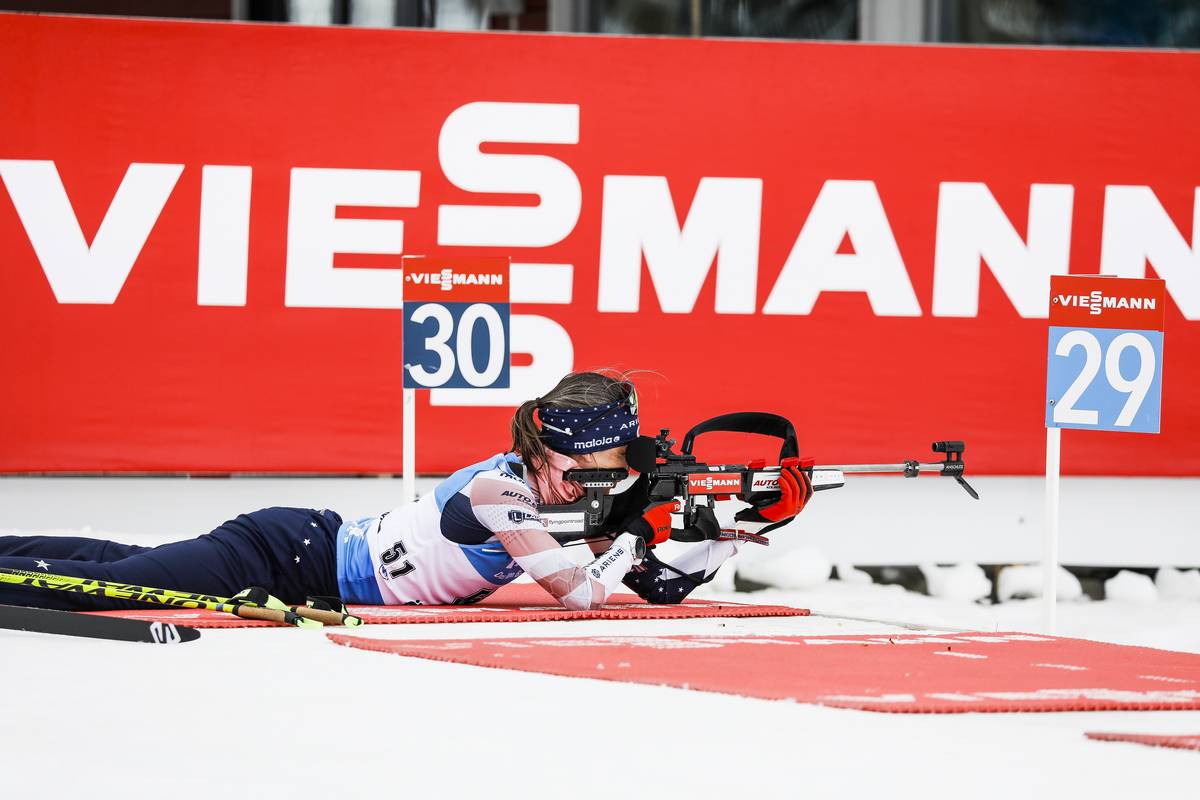
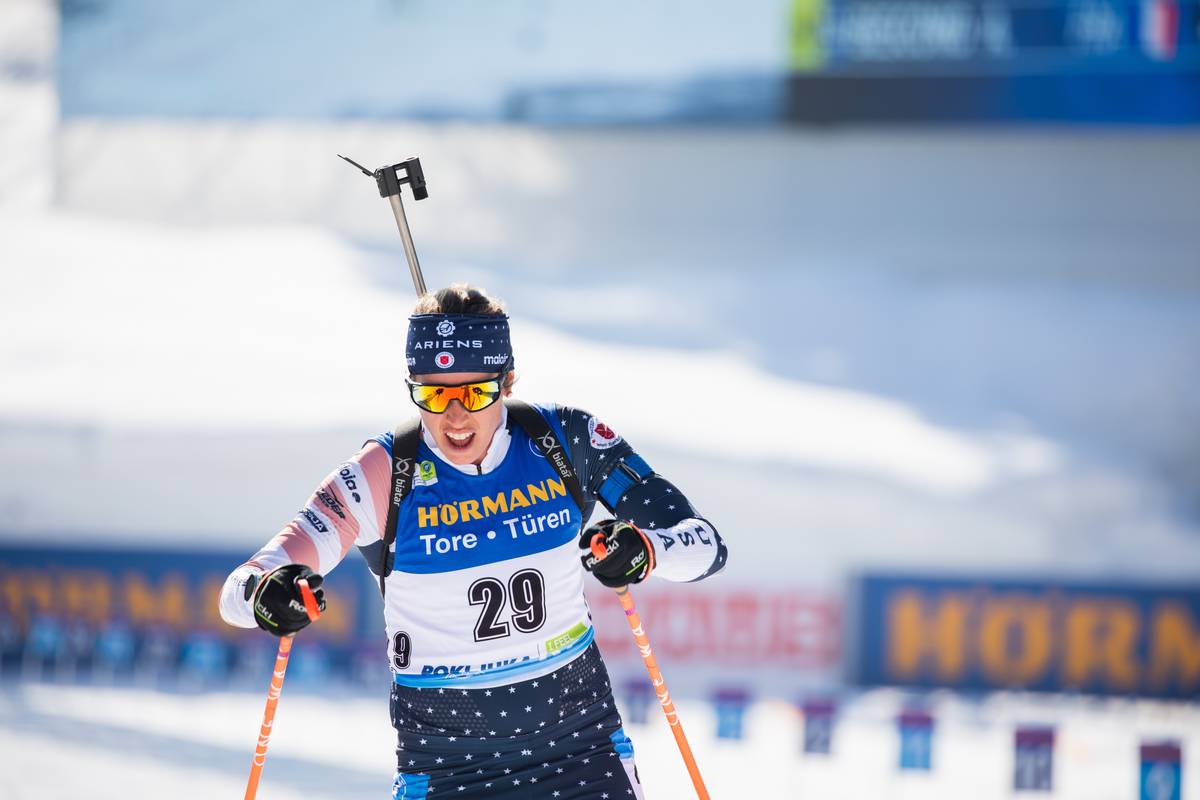
Susan Dunklee in Pokljuka, Slovenia, February 2021. (photo: Manzoni/NordicFocus)
Top results last season: Starting with biathlon: The redoubtable veteran Dunklee finished last season on a strong note with two individual eighth-place finishes in Nové Město, one in sprint and one in the pursuit. She teamed up with Sean Doherty for the country’s first single mixed relay World Cup podium since Lowell Bailey and, well, Dunklee, in 2017. Egan had a pair of top-10 finishes, 9th and 10th in Hochfilzen, and was a member of two sixth-place relay teams. Dunklee and Egan are both already qualified for the Beijing Olympics. Jake Brown was on a sixth-place mixed-relay team in Nové Město and had a season’s best of 12th in individual races, in the sprint in Pokljuka.
Moving on to nordic combined: Geraghty-Moats won the only regular-season women’s noco race that was able to be held last year, in Ramsau, to take the inaugural overall title, while garnering praise as a trailblazer for women’s sports. She was fifth at World Champs in Oberstdorf.
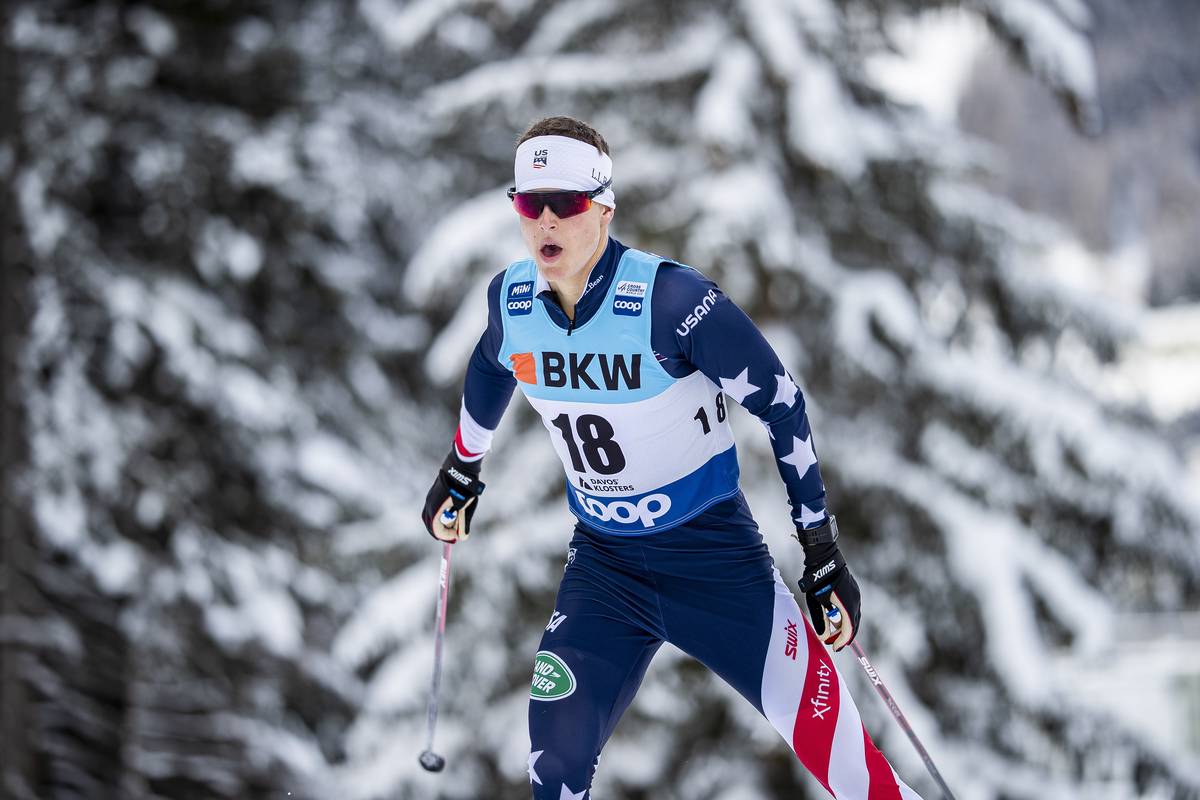
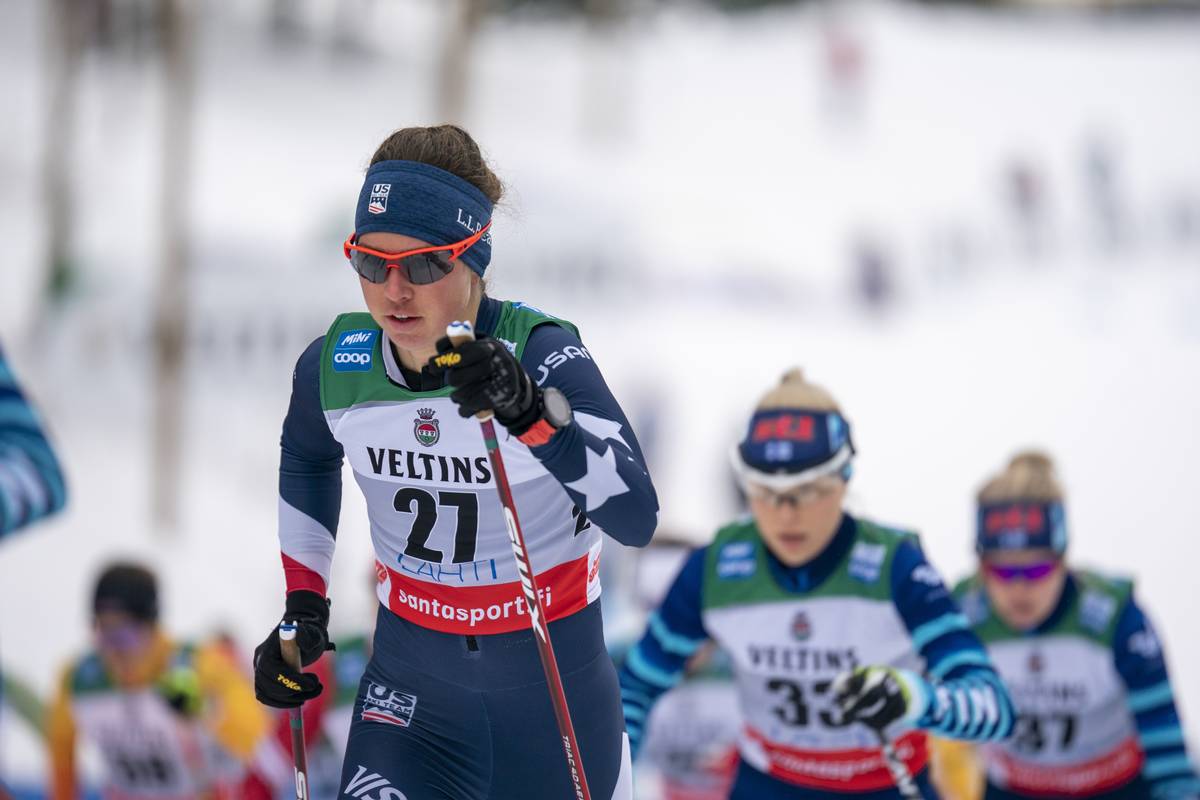
And finally, on the nordic trails: Patterson raced on the World Cup from Ruka through the end of January, including finishing 34th overall in the Tour de Ski. She was on a fifth-place relay team in Lahti, and had individual World Cup bests of 27th, 29th, and 30th. Martin had three World Cup starts in distance races, with a best of 44th in Davos. Lawson was 24th at World Juniors in the 10 k skate.
Tara Geraghty-Moats racing at World Champs in Oberstdorf, February 2021. (photo: Modica/NordicFocus)
Coach’s comments: Pepa Miloucheva writes, “Summer and fall training for GRP was good and mostly went as planned. This spring we officially added Alex Lawson, although she was here last year too and the only other addition was Annika Landis, who joined us after a year in Sun Valley.
“The whole team stayed and trained in Craftsbury through August. Waverly Gebhardt and Rena Schwartz trained with us as part of the summer U23 program and with our GRP biathletes here we had a really solid training group.
“Michaela had a setback early summer, broke her ankle and had to have surgery, but she kept really good fitness by spending hours on the SkiErg and was able to join the rest for the ski camp in September.
Adam Martin racing in Davos, December 2020. (photo: Modica/NordicFocus)
“Early September we went to Oberhof, Germany, for just over two weeks of training in the ski tunnel. This was our first trip since the pandemic, so I was little nervous, but everything worked out really well. The first few days the focus was on technique, transferring on-snow improvements athletes worked on during the summer. Second part was a solid speed block. Luckily there ware only a few other skiers [in the tunnel] at this time so we ware able to have really high quality intensity sessions.
“After a few weeks training at home and having incredible fall weather we packed up bags again and went to Park City for two weeks of elevation training. First part of the camp was lots of volume, some L3, a few athletes even hopped in a rollerski race at SoHo for fun. Second week we lowered the volume, had a couple mellow days, and finished the camp with a couple solid TT efforts to gain some experience racing at this elevation in preparation for Nationals.
“Back home athletes took a few easy days post-Utah. I did some testing, where a few records were broken, which was exciting to see, and now we are concentrating on race prep. Caitlin Patterson left for Europe [on Nov. 17], she will race the first WC period and in less than two weeks we all are about to hit the road for a month and a half.
Caitlin Patterson racing in Lahti, January 2021. (photo: Vianney THIBAUT/NordicFocus)
“Last year we were totally sheltered here at the center, didn’t travel at all, didn’t go to any camps, didn’t go to any races outside Craftsbury. Although we had everything we need here and the outdoor center staff was incredible, taking really good care and keeping us safe and healthy, it was mentally very hard on the athletes not to be able to race against the other regions. So this year I’m excited for this team to have a more normal race season and to see what they can do, as they worked really hard for it.”
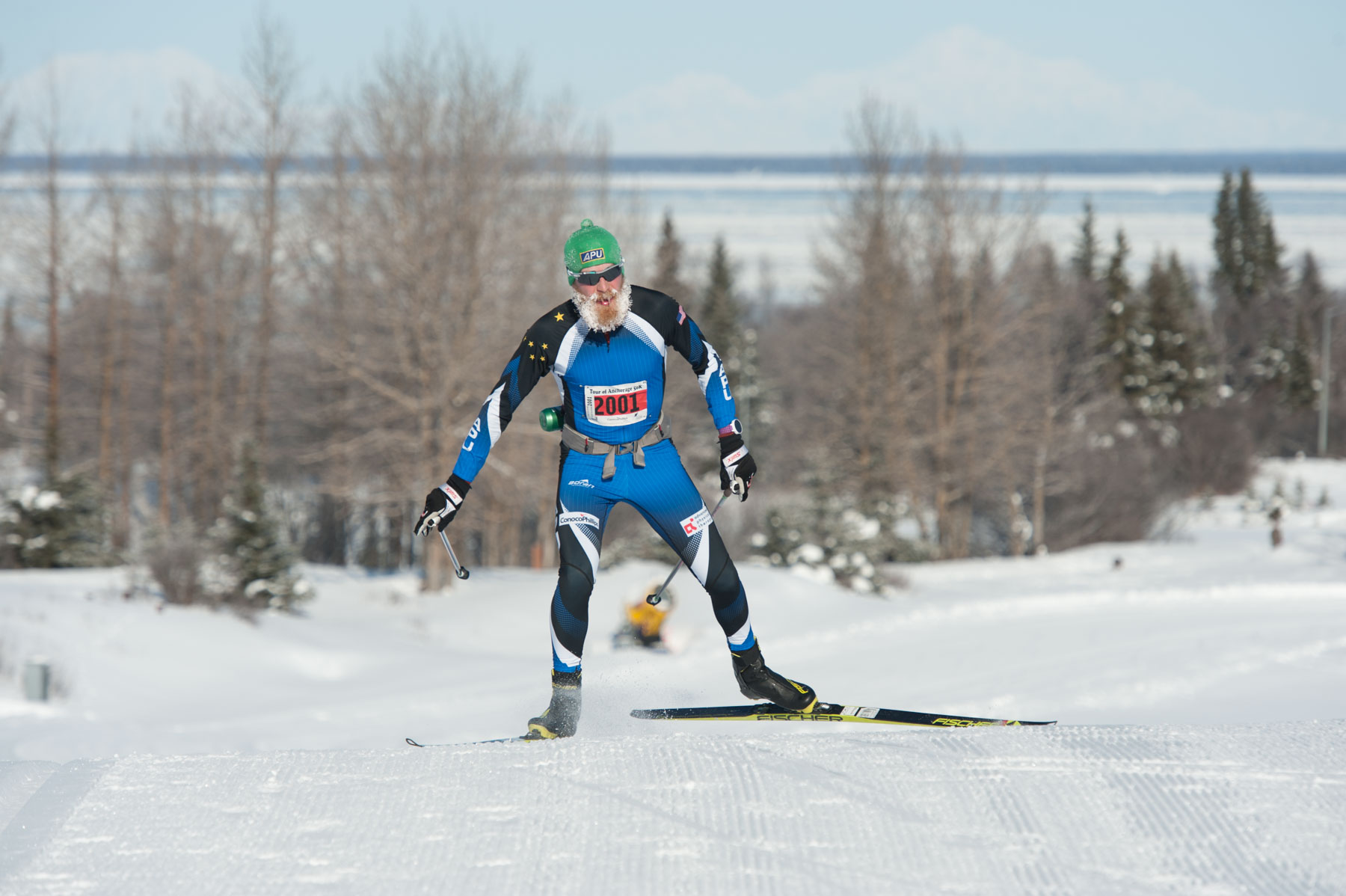
Tour of Anchorage 50k men’s winner Jack Novak tops the final hill to win the race Sunday, March 4, 2018. (photo: Michael Dinneen)
ANCHORAGE, Alaska — Hannah Rudd had never raced a 50 k before. Jack Novak was doing his second one in as many weekends. They took different paths to get there, but both ended up in the same place on Sunday afternoon: first in the flagship 50-kilometer freestyle race of the Tour of Anchorage.
The 30th annual Tour (pearl anniversary!) set off from Service High School, beneath the foothills of the Chugach Mountains at the eastern edge of metropolitan Anchorage, on Sunday morning amidst essentially perfect conditions: 20 degrees Fahrenheit, no wind, and clouds giving way to sunshine by race’s end. It was a far cry from 2017, when temperatures were 4 below at the start, dipping to -12° F a few kilometers down the trail in a notorious icebox spot in the black spruce forest of Campbell Tract.
While 2017 saw successful early solo breakaways for both the men’s and women’s champions, the strategy for this year’s winners was much more typical for a race that has hills at the start and at the end, but about 25 k of flat skiing in the middle: Join a pack near the start, ski with the pack over the flats, break away from the pack approaching the finish, don’t look back.
For Novak, who was racing on Sunday in Anchorage just eight days after a top-50 finish in the American Birkebeiner in Wisconsin last Saturday, that break came a gutsy six kilometers out from the finish at Kincaid Park.
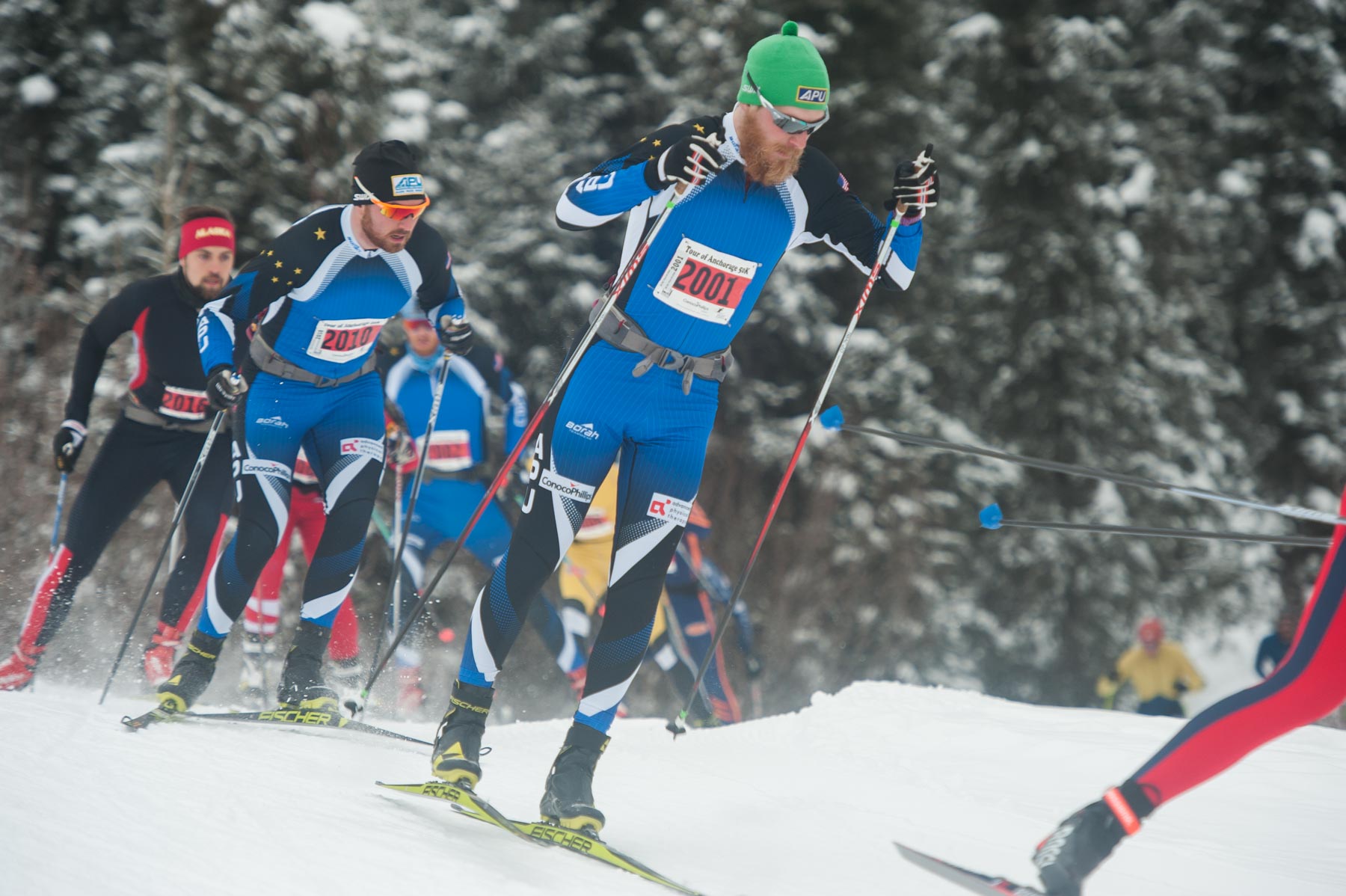
Tour of Anchorage 50k men’s winner Jack Novak skis in a pack early in the race Sunday, March 4, 2018. (photo: Michael Dinneen)
He was skiing with APU teammate Forrest Mahlen and local master skier Seth Downs at that point, Novak recounted in a post-race interview with FasterSkier. He and Mahlen had gone off the front by 10 k into the race, but realized that Downs was catching up to them, so purposefully slowed until he caught them. The three of them then skied together for the next 30+ kilometers… until Novak made the impetuous decision that it was time to go.
“As we entered the Sisson Loop” at around the 44 k mark, Novak recounted of the point at which racers leave the flats of the Coastal Trail for the rolling hills of Kincaid Park, “I had just taken a pull on the front, so I moved back to third, and was just cruising in the back recovering. And right as we entered Sisson, Seth pulled over and decided it was time to feed, so he pulled his bottle out, and Forrest at that point thought it was a good idea to feed as well. And I took my waterbottle halfway out of my belt, but then realized that this was a great opportunity, so I shoved it back in and just went around on the edge of the trail, and just charged as hard as I could for the next six k all the way to the finish. And I was a little nervous, because I thought either this was going to be a winning move, or it was going to be a third-place move. And I was a little nervous, but I decided that I had to fully commit, and just go for it.”
Going for it worked for Novak. By the time he crested the final climb up to the hilltop finish outside the Kincaid chalet, ice crystals flecking his eyebrows and caking his lumberjack beard, he was over a minute ahead of Downs (+1:05.7) and nearly two minutes up on Mahlen (+1:41.5), who had himself been top-40 in the Birkie last weekend.
Rudd had a similar journey to Kincaid, initially skiing in a pack of several women occasionally joined by some of the slower first wave men. (Wave 1 at the Tour is the top 50 men, Wave 2 is a dozen or so elite women, then the remaining waves are co-ed. Much like at the Birkie, the lead women can keep apprised of their competition by virtue of the common start, but also often end up skiing with some men who started two minutes ahead of them in the first wave.)
As late as the Chester Creek greenbelt, roughly midway through the race, Rudd was skiing with a lead pack of women that included Michaela Keller-Miller, Shalane Frost, and Alison Arians. But eventually the lead pack dwindled down to a lead pair, just Rudd and her University of Alaska Anchorage teammate Keller-Miller.
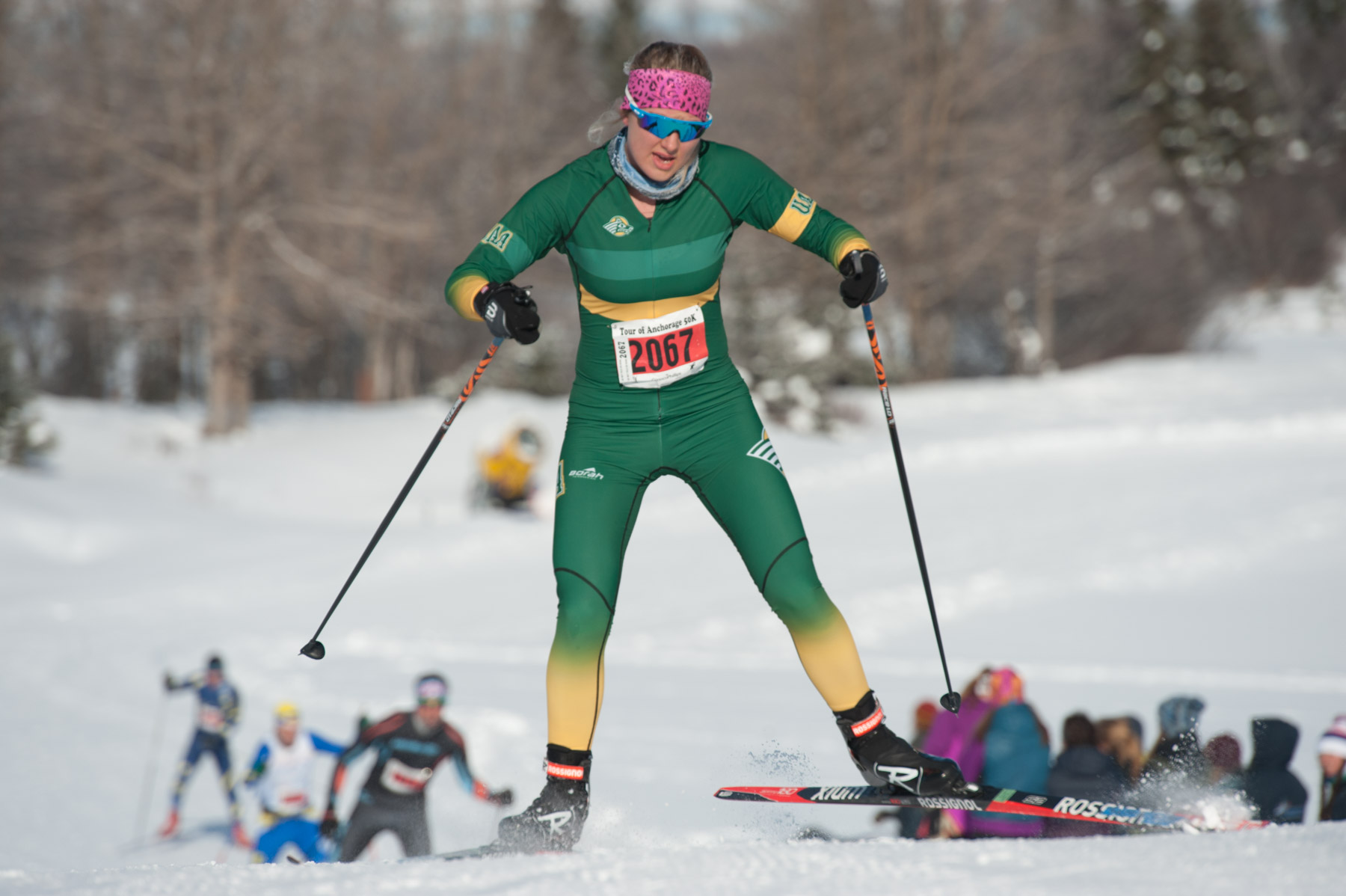
Tour of Anchorage 50k women’s winner Hannah Rudd tops the final hill to win the race Sunday, March 4, 2018. (photo: Michael Dinneen)
Rudd skied with Keller-Miller for some time, then made her move “with about 3 k to go,” the 19-year-old sophomore told FasterSkier after the race.
Much like Novak’s surge before her, Rudd’s push may not have been easy, but it was effective. Rudd would ultimately cross the finish line in 2:38:54.4. Keller-Miller (+1:15.7) followed over a minute back in second, with Frost (+4:56.2) third. Frost had finished second to 2018 Olympian Rosie Frankowski in last year’s icy sufferfest.
Rudd had never raced a 50 k before Sunday, but count her a fan. “I really like 50 k’s,” said. “I like the distance. It was really fun.”
Rudd, who remains undefeated in lifetime 50 k races, had nothing but praise for her overall experience on the day: “It was really great. It’s an amazing trail system, beautiful day. Phenomenal course.”
The only thing that gave her pause was the question of whether she could accept the prize given to the first-place finisher in the 50 k ($1,000 and a roundtrip ticket on Alaska Airlines), in light of NCAA regulations that generally proscribe accepting prize money greater than the costs of participating in a competition.
“That’s still up in the air,” demurred the UAA student-athlete when asked about this immediately after the race. “Our Athletic Director is going to check on that.”
Novak had no bar to accepting the money, but his plans for the windfall reflected the realities of life as a 24-year-old professional cross-country ski racer. “It’s probably just going to be put toward racing,” Novak said. “Pay the bills.”
While Novak’s aims for his prize money were quotidian, he made it clear that it had still been a special day for him.
“Today feels really good,” he reflected after his win. “It’s been a rollercoaster ride of emotions for the Tour over the past couple years, with shortened courses, changed courses, cold weather, warm weather, all that stuff… so it’s really nice to be able to put everything together, and get the victory.”
Getting the win this year after earning the wooden medal for fourth the year before probably didn’t hurt. Neither did being born and raised in Anchorage — Novak graduated from South Anchorage High School, and placed seventh at State (behind Olympian Scott Patterson) in 2010 and fourth (behind Olympian Logan Hanneman) in 2011 — then finally winning the citizens race that has long served as the unofficial Alaska state championship.
Reflecting the high level of skiing in the state, a dozen different Olympians, most of them locals, have won the Tour of Anchorage over the past 30 years, according to an email from race organizers: Adam Verrier, Sue Forbes, Audun Endestad, Kevin Brochman, Todd Boonstra, Lars Flora, Laura McCabe, Suzanne King, Abby Larson, James Southam, Holly Brooks, and Rosie Frankowski. The number only goes up if you count second- and third-place finishers — Reese Hanneman, Tyler Kornfield, Rachel Steer, Justin Freeman, and Ben Husaby among them — and should actually be fourteen for victors alone, counting skier Betsy Youngman and biathlete Jay Hakkinen.
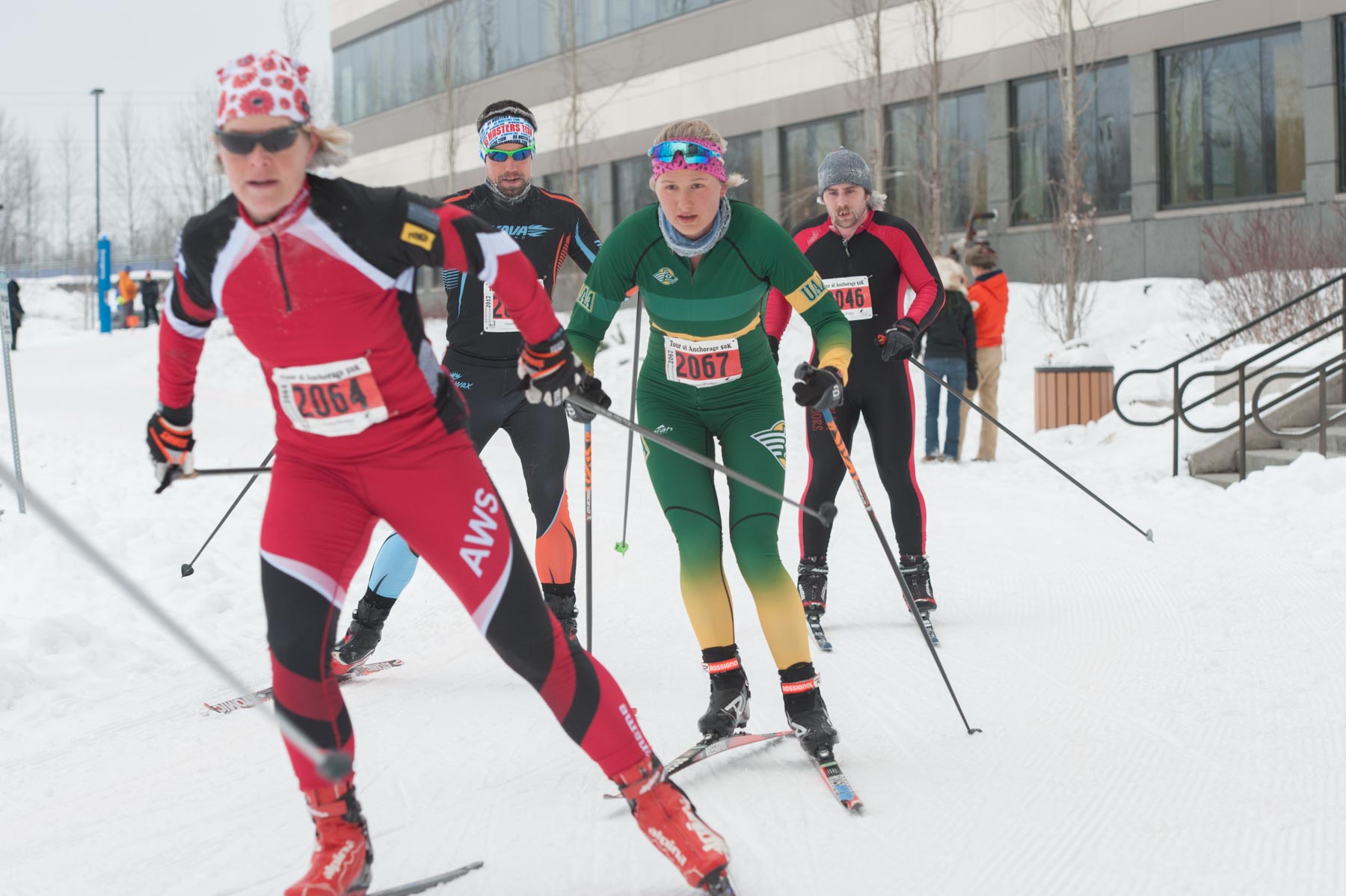
Hannah Rudd (2067) follows Alison Arians (2064) midway through the 2018 Tour of Anchorage. (photo: Michael Dinneen)
(2018 Australian Olympian Casey Wright was seventh among women on Sunday. Less than four minutes behind her came Brooks, a 2010 and 2014 Olympian for the U.S., who now describes herself as “a new mom of infant twins and a new business owner.” While Brooks raced the 50 k on Sunday, her husband, Rob Whitney, covered the entire route — including the 100-meter gain hors catégorie max climb of the Spencer Loop — towing a double Chariot with both six-month-olds inside. Plus diapers and snacks.)
New dad Whitney may not have used the phrase “just cruising around” to describe his heavily laden trip across town, but it seemed appropriate for the unencumbered Novak.
“Conditions today were phenomenal,” Novak said after the race, “sunny, 20 degrees — can’t complain about that. It was fun to just be out there skiing with my best friend, and Seth [Downs], and just be out there cruising around.”
The change in weather conditions from 2017 didn’t hurt, either.
“This year was so much more pleasant than last year,” Novak said after skiing on a day that was literally more than 30 degrees warmer than the last time he had done this race. “Last year I was wearing two long johns, and two long johns on top, and a vest, and two buffs, and I was still cold. And this year I was wearing just one long john top and bottom, and I was totally comfortable the whole time. And it was wonderful to just be out there, and just be skiing, and just not have to worry about freezing.”
Inside the results and other races
A total of 740 racers finished on Sunday, a sizeable field but down from a high of 2,050 in the mid-2000s, when the Tour was consistently the second-largest ski race in the country behind the Birkie. They ranged in age from 8-year-old girl Reine Soule and 8-year-old boy Jack Leveque (2:08 and 2:19, respectively, for the 25 k skate), to 88-year-old Reno Deprey (3 hours even for the 25 k classic).
While the Tour of Anchorage draws the lion’s share of its competitors from, well, Anchorage, the rest of the state put in an appearance as well. Finishers hailed from throughout the road system, from Homer to Fairbanks, as well as from Galena, Gambell, Juneau, Nome, and Sitka. (While athletes in all five communities had to board a plane to make it to Anchorage, and Galena, pop. 470, is no metropolis, Gambell is likely the most notable home for any entrant in Sunday’s race. It is “a roadless Eskimo village,” says the local church, situated on St. Lawrence Island in the Bering Sea. It is closer to Siberia than to mainland Alaska.)
A smattering of racers came up from the Lower 48 as well, enjoying a notable local sports weekend that features the Iditarod start on Saturday and a ski race on Sunday. The top Outside finisher in the 50 k at this year’s Tour was Hannah Smith of California, sixth among women. And Erik Pieh of Minnesota was 18th in the men’s 50 k.
Three other races were also held on Sunday, although prize money was awarded only to the winners of the 50 k ($1,000 and the plane ticket for first, $500 for second, $100 for third). In the 40 k, which skips the hills of the Spencer Loop and most of the Hillside trails before proceeding through greenbelts to Kincaid, Lisa Anglen prevailed in a tight finish in the women’s race to take first place in 2:10:13.7. She was followed by Meredith Noble (+12.8) and Naomi Kiekintveld (+16.5).
In the men’s 40 k, 13 of the top 17 finishers were junior boys; the 40 k often becomes a chance to unofficially see who is the fastest local junior not selected for Team Alaska for Junior Nationals. (One has to be 18 years old to race the 50 k.) The fastest junior this year was Thomas Bueler, 15, but he was 10:31 back from Andrew Boone, 36, in first (1:47:46.2). Third place went to David Funatake, 29 (+11:51). Next among junior boys were John-Mark Pothast in fourth (+13:17) and Jack Cater in fifth (+13:18).
The 25 k skate, which goes from Alaska Pacific University to Kincaid, also had a strong youth movement feel as 12 of the top 14 finishers were junior boys, led by winner Joel Power, 15, in 1:15:39.8. Crashing the youth brigade wereGary Di Silvestri, 50, in second (+3.6) and Kevin Donley, 52, in third (+20.5). The unofficial juniors podium was filled out by Niko Latva-Kiskola in fourth (+6:04) and Hayden Ulbrich in fifth (+6:15).
In the women’s 25 k skate, Homer skiers carried the day, with Emily Lints first in 1:30:39.1 and Hanna Young third (+38.5). Becky Butler of Anchorage was second (+14.0).
And the 25 k classic, finally (same route as the 25 k skate), saw youth in the women’s race and experience in the men’s race. In the women’s race, former UAF skier Hannah Rowland, 22, led the way in 1:47:06.0, followed by 17-year-olds Avery Mozen (+17.7) and Kellie Arthur (+7:31.0). And in the men’s race, Gary Snyder paced an all-40-something podium in 1:27:16.4, followed by Cory Smith (+40.5) and Ben Arians (+4:50.3). Snyder and Arians are locals who raced against each other in Anchorage high school competition decades ago, and for most of the 25+ years since. (Snyder was first on the 25 k podium in 1990, then again in 2008 and 2010.) Smith transplanted to the area following a systematic search for the best ski town in the early 2000s, and also found time to found a humble ski news website called fasterskier.com.
Next year’s Tour of Anchorage is tentatively scheduled for March 3, 2019.