From the FasterSkier archive — posts syndicated from athletes’ and coaches’ own blogs between 2004 and 2012, kept online as published. Current coverage is at fasterskier.com.
FasterSkier’s Coverage of the Biathlon World Championships is made possible through the generous support of the Craftsbury Outdoor Center: New England’s finest snowmaking, world class race venues and touring trails, healthy food in abundance, comfortable accommodations at Craftsbury: Sports, Sustainability, Stewardship.
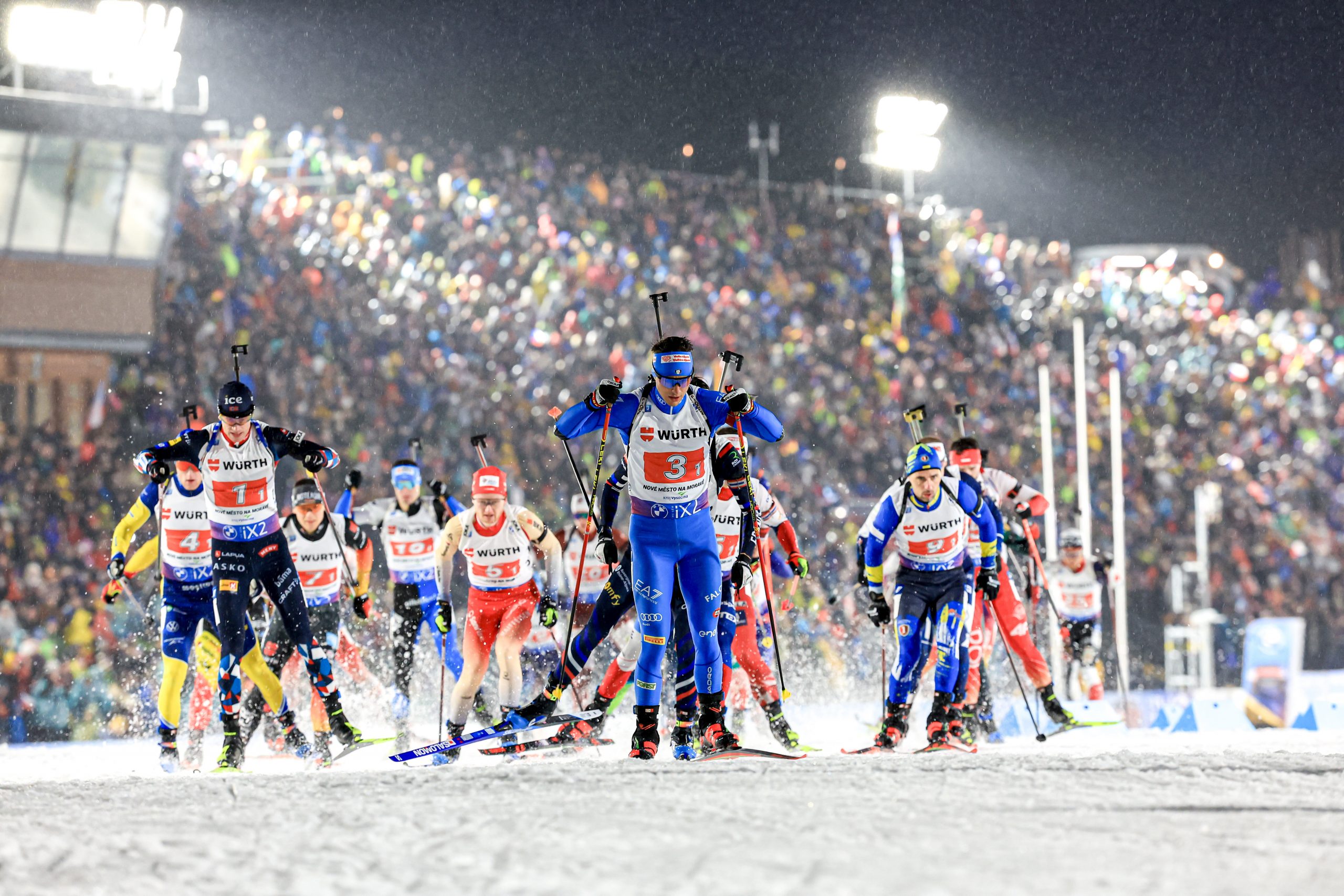
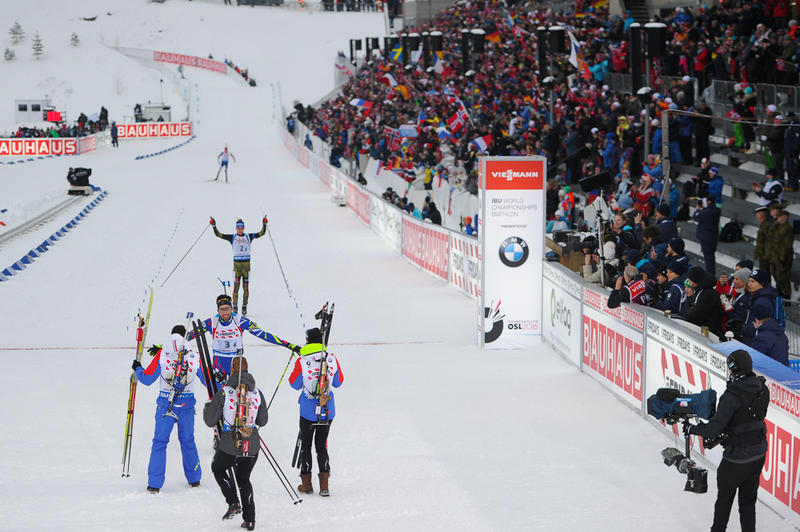
The start of the Mixed Relay at the 2024 Biathlon World Championships in Nove Mesto na Morave, Czech Republic. (Photo: NordicFocus)
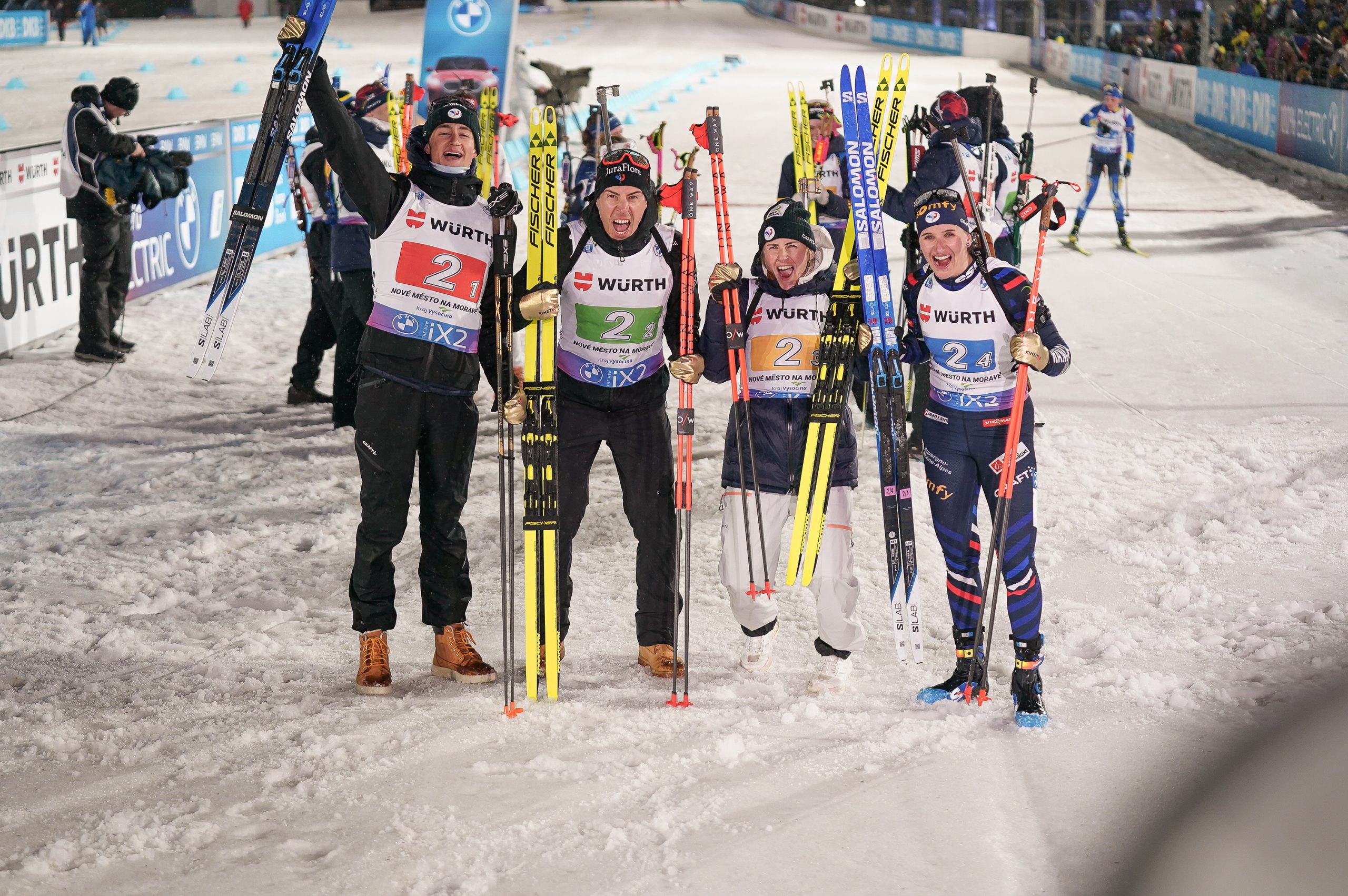
In the opening race of the 2024 Biathlon World Championships, France overcame heavy favorite Norway to take gold in the 4×6 k Mixed Relay. It was a tightly contested race with 25 nations on the start line and only 40 seconds separating the top five teams at the third exchange. On the final leg, Norway and Sweden overtook Switzerland to capture silver and bronze. The Swiss ended up a mere 1.2 seconds off the podium in fourth—their best finish ever in a World Championships Mixed Relay. Steady freezing rain did not stop 30,000 biathlon-crazed fans from packing the Vysocina Arena in Nove Mesto na Morave, Czech Republic, making for an electric atmosphere on opening night.
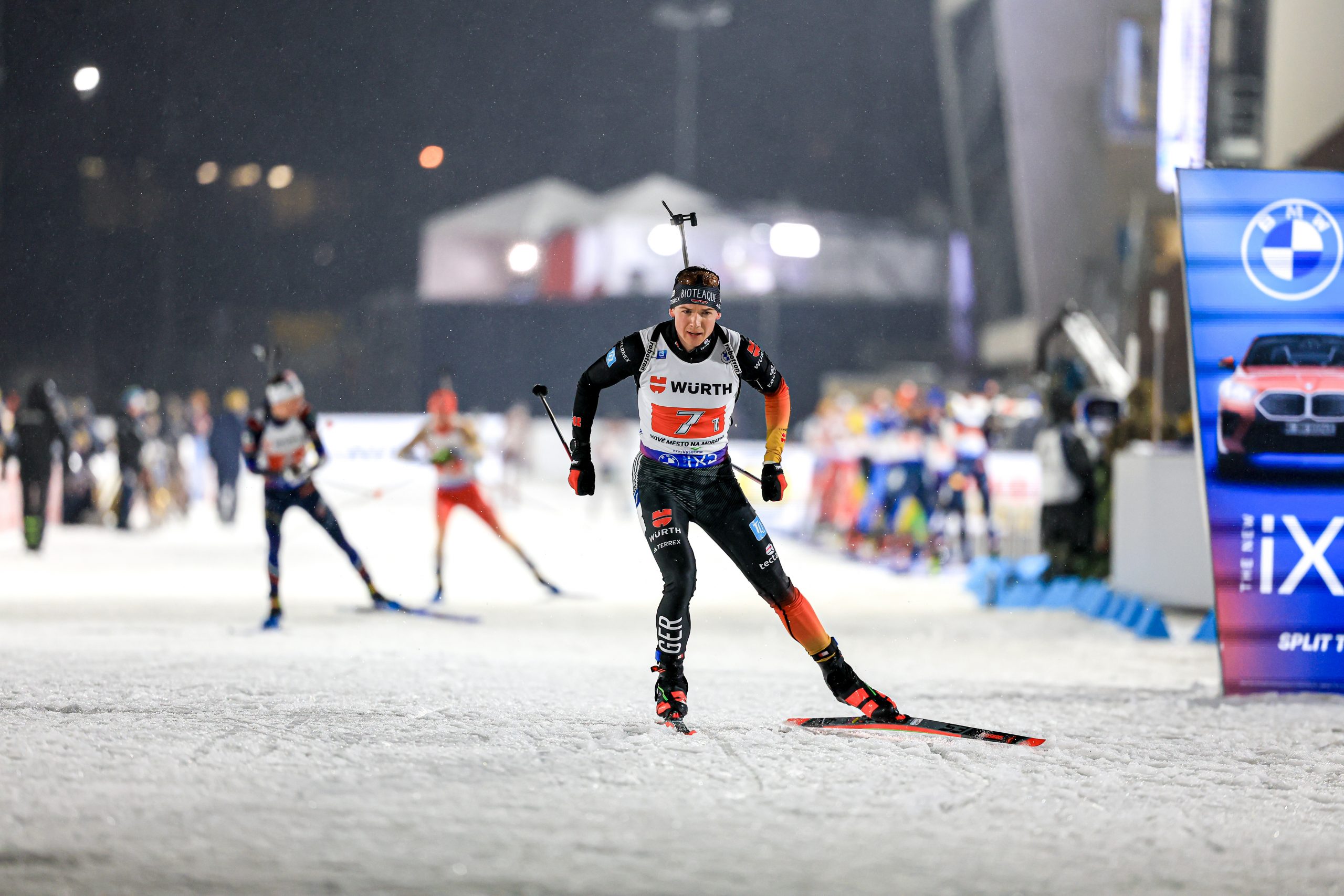
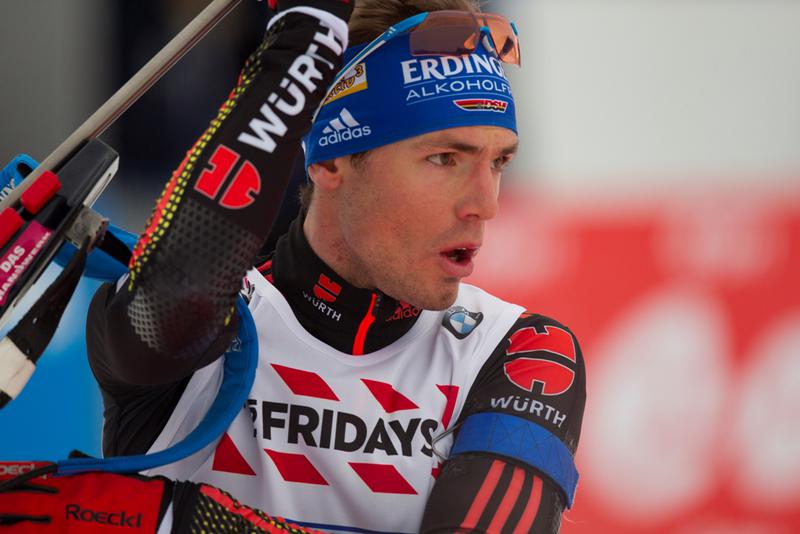
Germany led early in the Mixed Relay thanks to exceptional shooting by Justus Strelow and Phillip Nawrath. (Photo: NordicFocus)
The unofficial “ice breaker” of World Championships, the Mixed Relay tends to be chaotic and full of surprises, and today’s race was no exception. Ranked sixth going into the race, the home Czech team met disaster on the very first visit to the shooting range when Michal Krcmar incurred a penalty loop and found himself in second to last, a full minute behind the leaders. Krcmar exchanged in 21st, two minutes back. Third-ranked Italy fared even worse: Didier Bionaz incurred two penalty loops in his standing shoot and tagged off in 23rd. Meanwhile, 19th-ranked Kazakhstan and 17th-ranked United States tagged in fifth and sixth, thanks to world-class performances from Alexandr Mukhin (KAZ) and Vincent Bonacci (USA).
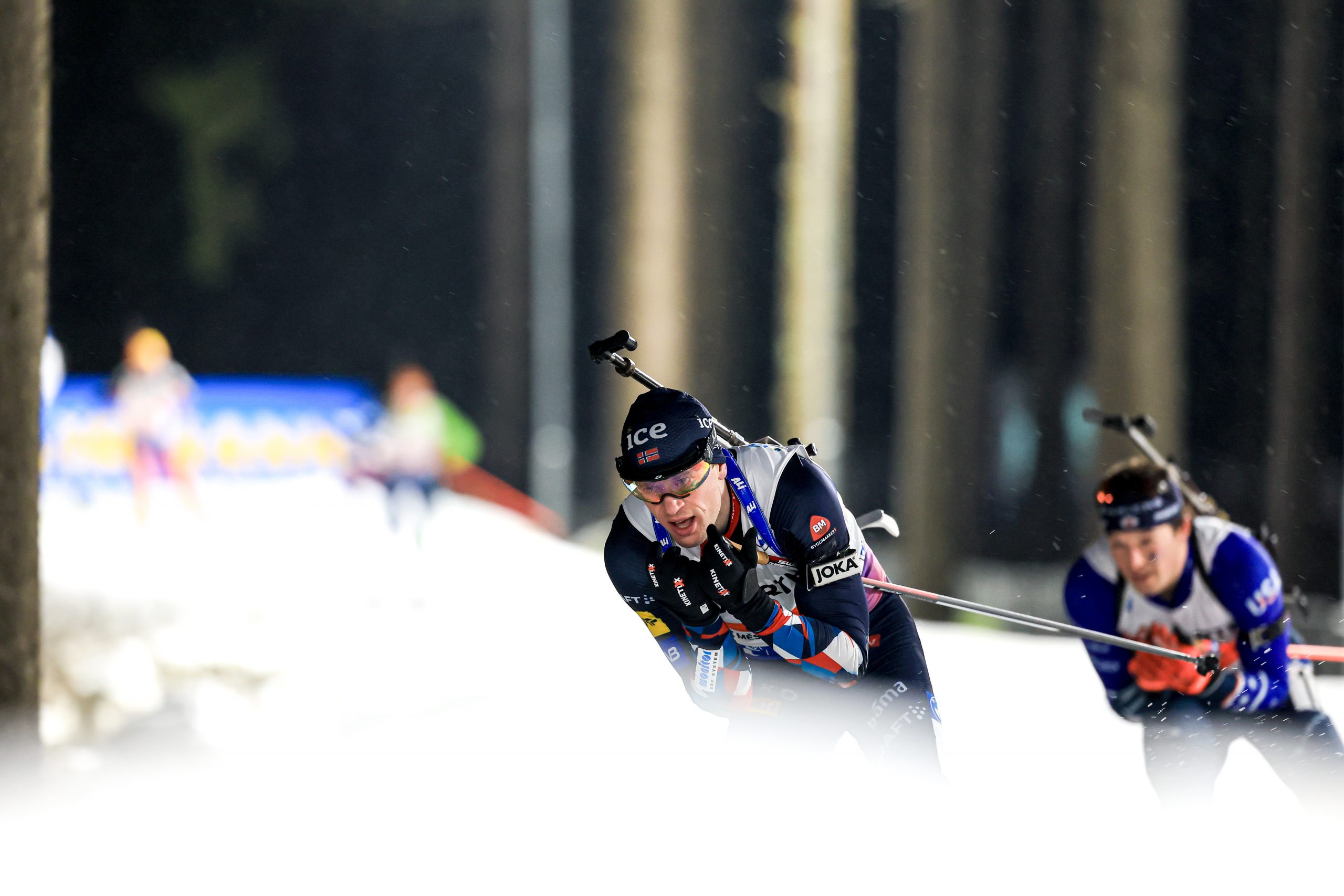
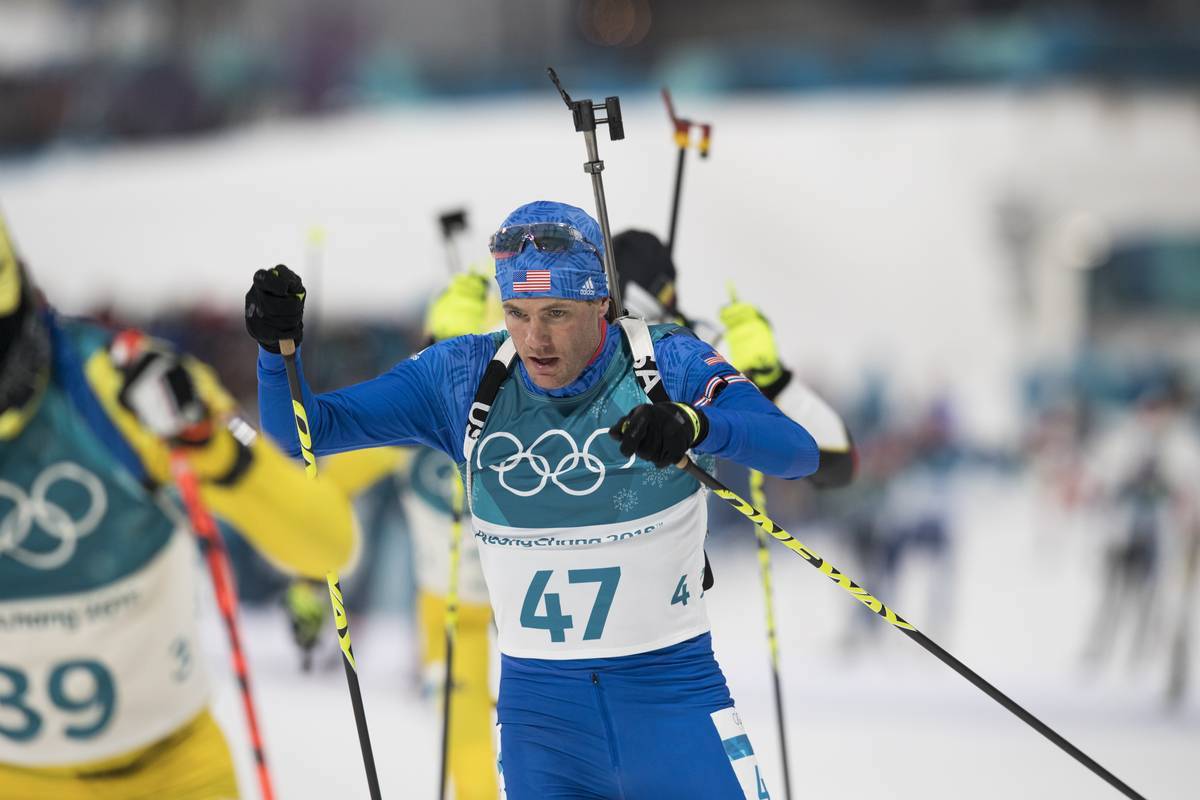
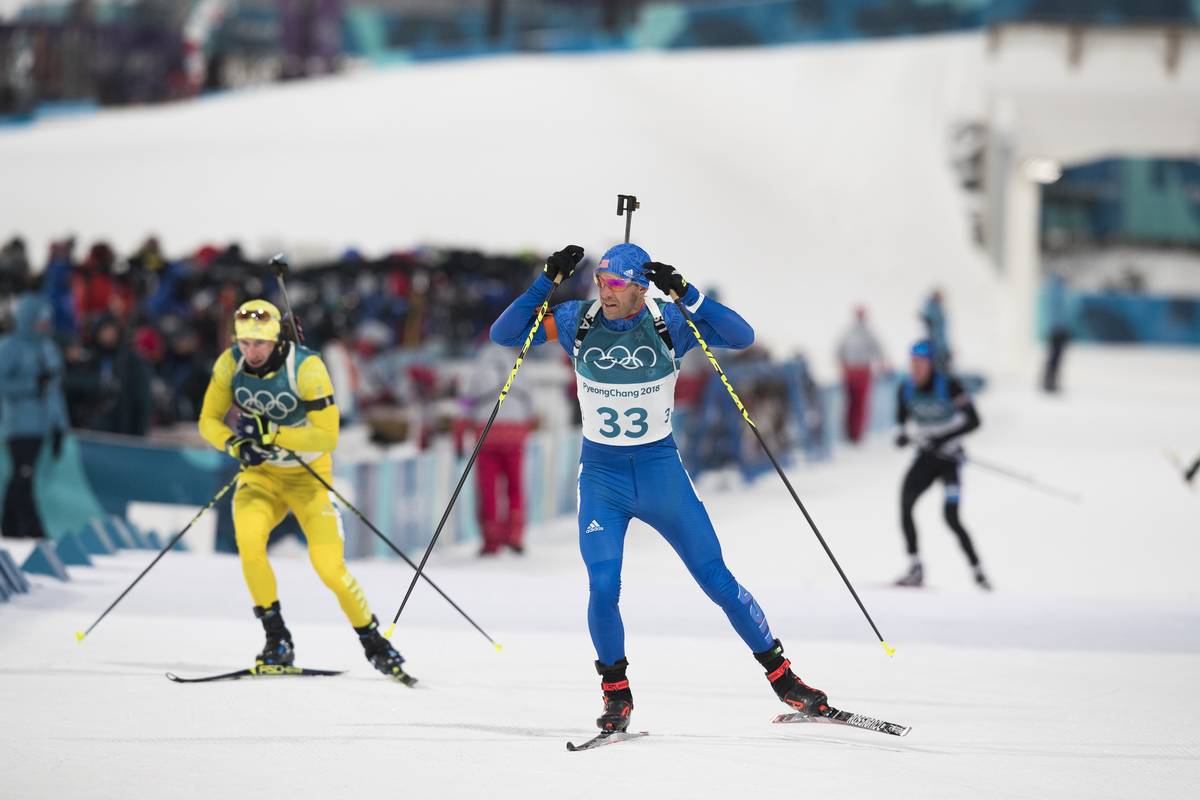
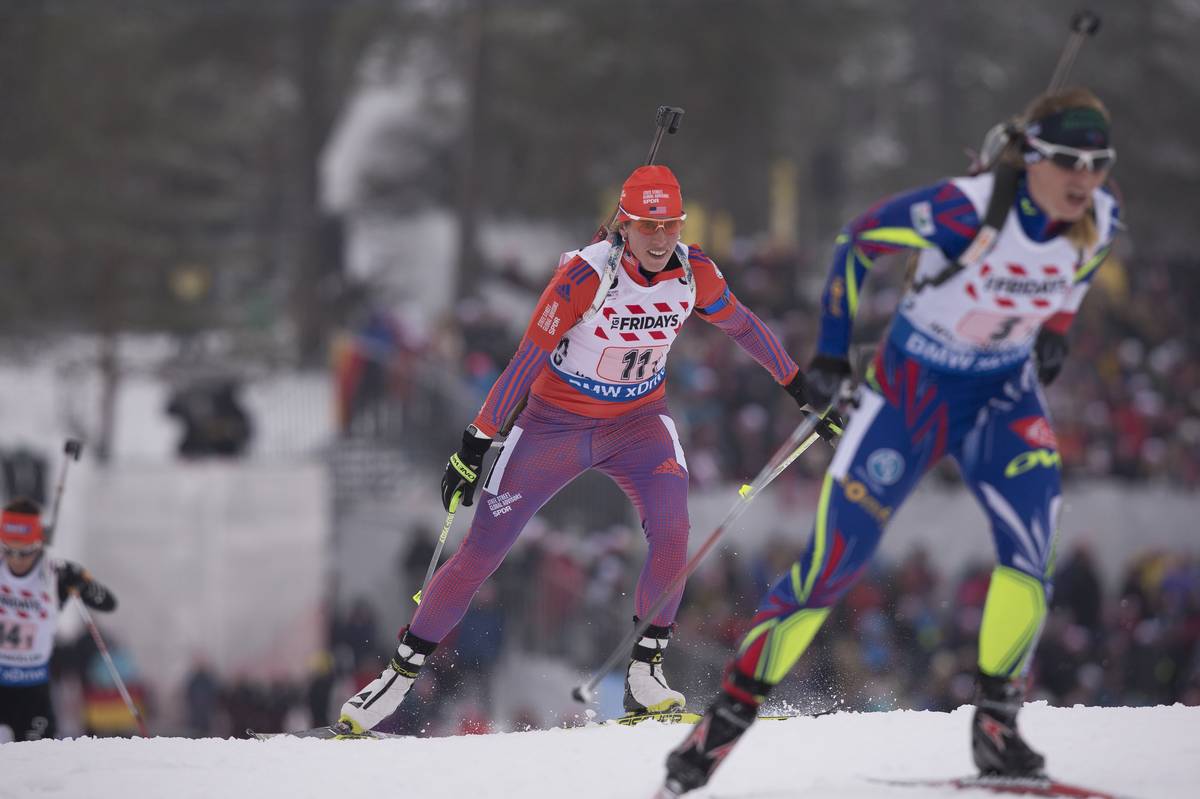
Tarjei Boe (NOR) is followed by Vincent Bonacci (USA) in the first leg of the Mixed Relay. (Photo: NordicFocus)
The big surprise on the second leg was that Norway did not come through on top. Norwegian brothers Tarjei and Johannes Boe—ranked third and first in the men’s World Cup overall standings—are such a powerhouse combination that they were all but guaranteed to deliver a Norwegian lead at the half-way point; however, they both lost time on the range that they were unable to recover on skis. Germans Justus Strelow and Phillip Nawrath combined to put 48 seconds into the Norwegians just in shooting time. At the halfway point, Germany led, with France eight seconds back and Norway another twenty behind. The US and Canada tagged in ninth and tenth, just 15 seconds outside the top six.
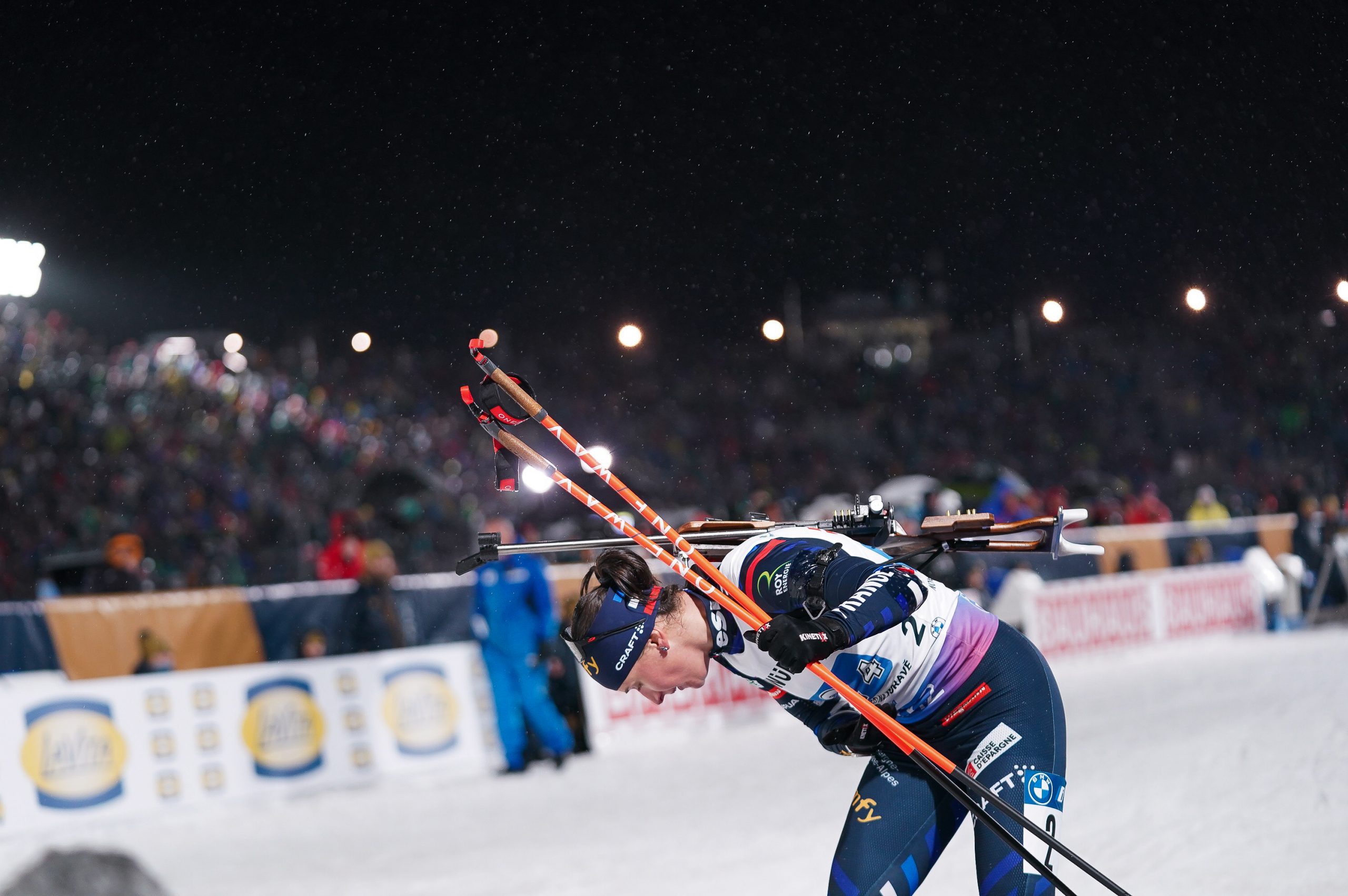
Franziska Preuss (GER) fell from first to fifth after incurring a penalty loop in her standing shoot in the Mixed Relay. (Photo: NordicFocus)
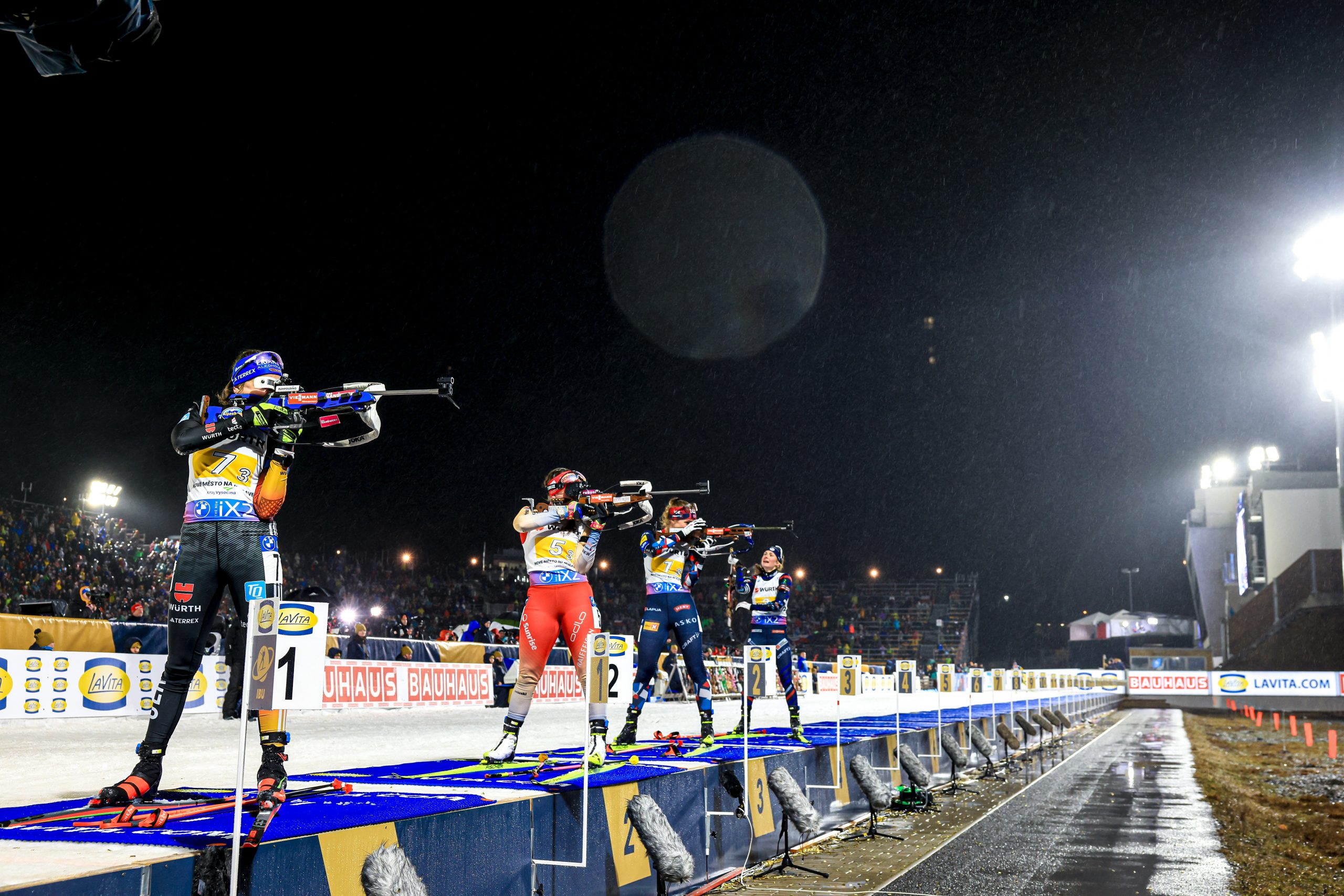
Anyone who bet on the Norwegians for gold would have felt uneasy going into the third leg, with the German and especially the French women’s teams both very strong on paper. But it was a rollercoaster for all. France’s Justine Braisaz-Bouchet went into the penalty loop in prone and dropped to fifth place, giving Franziska Preuss of Germany a 39-second advantage. Then their fortunes switched in standing when Preuss went into the penalty loop! Braisaz used a single spare and out-skied the field in leg three by a whopping 33 seconds, making an enormous comeback for France and tagging in first. At the third exchange, only eight seconds separated the top three teams, with Switzerland moving up into second and Norway hanging in third. After a quiet first half, Sweden’s Hanna Oeberg brought her team within striking distance on the third leg, tagging her younger sister Elvira in fourth, just 14 seconds off the podium. Germany fell to fifth. Both the USA and Canada held in the top ten.
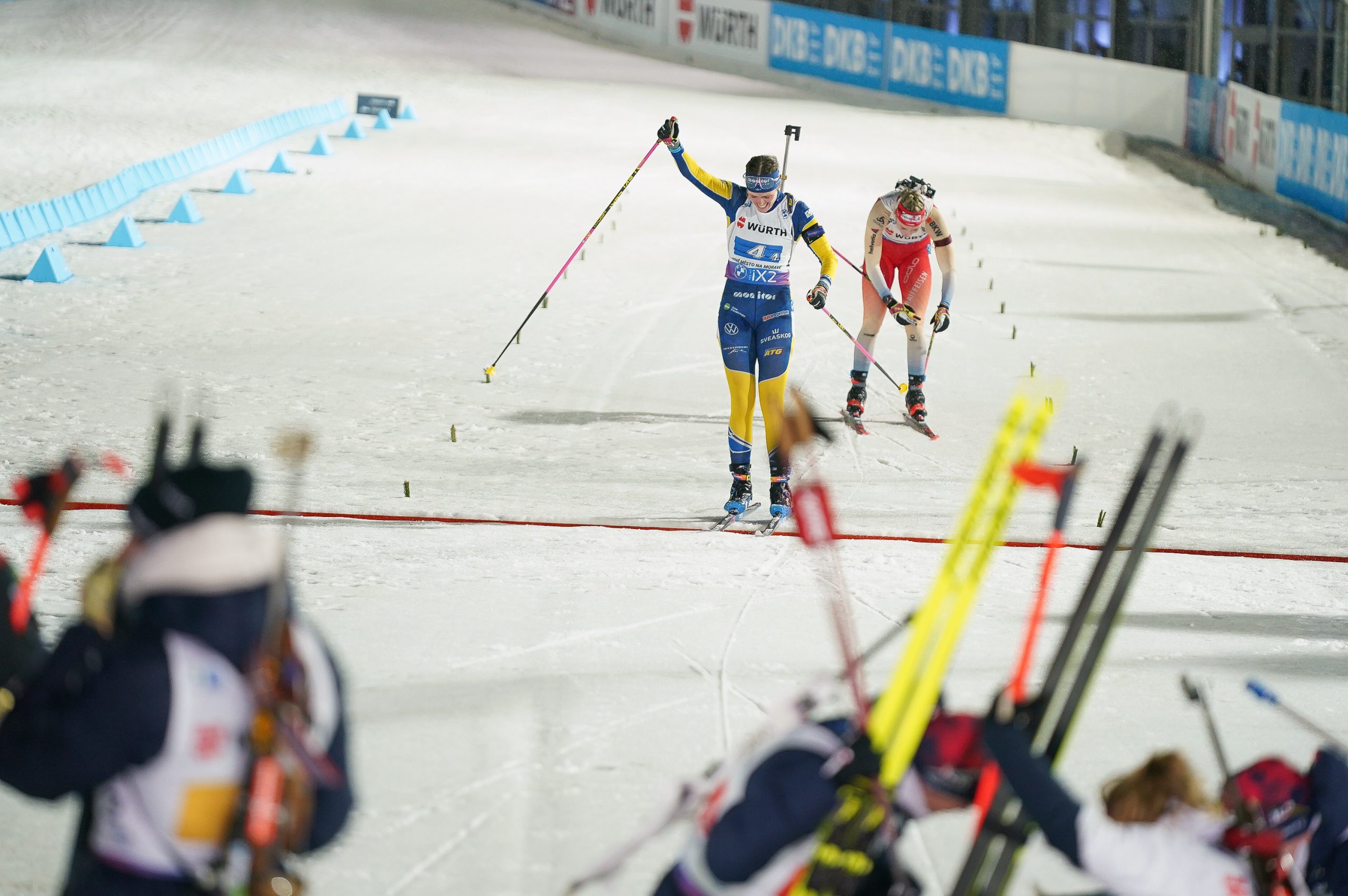
Sweden’s Elvira Oeberg out-skied Switzerland’s Amy Baserga to take bronze in the Mixed Relay. (Photo NordicFocus)
In the final leg, Julia Simon left no room for any contest, blazing down all her targets, taking a bow, and then skiing to the finish with a comfortable 45-second lead for France. Switzerland’s Amy Baserga performed flawlessly under pressure, shooting ten out of ten, but was overtaken on her first loop by the World Cup overall leader Ingrid Tandrevold of Norway and then on the last loop by Elvira Oeberg, who captured the bronze for Sweden by just one second.
Julia Simon (FRA) takes a bow on the shooting range after clinching gold for France with her flawless final shoot. (Photo: NordicFocus)
The US stayed in the top ten until the very last loop when the Italians came clawing their way back from the dead and pushed the US down into 11th. Canada finished 13th, just in front of the Czech Republic.
Next up is the women’s 7.5 k Sprint on Friday, February 9th.
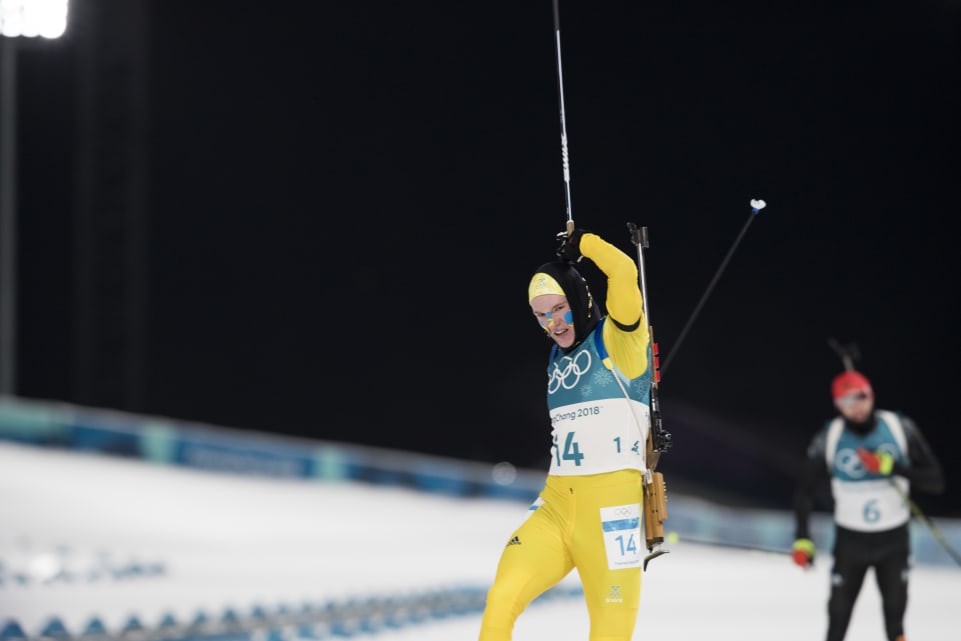
Norway’s Johannes Thingnes Bø celebrates his first Olympic medal — gold — in the men’s 20 k individual on Thursday at the 2018 Olympics in PyeongChang, South Korea. (Photo: FlyingPointRoad)
Johannes Thingnes Bø came into these Olympics as a definite favorite, right up there with Martin Fourcade. But PyeongChang quickly humbled the 24-year-old Norwegian, just as it did Fourcade, in the first race of the 2018 Winter Games. There, in the men’s 10-kilometer sprint, Fourcade finished eighth, missing three out of five in his first shooting stage, and Bø had the same problem with prone — missing three then shooting another penalty in standing — to end up 31st. It was the kind of result no one saw coming after those two had taken first or second in every non-relay World Cup race this season (except for one, the sprint that Bø’s older brother Tarjei Bø won on Dec. 2 in Östersund, Sweden).
The men’s second biathlon race of the Games, the 15 k pursuit, saw Fourcade back to his winning ways while Johannes Bø finished 21st.
“We both [knew] before the Olympics that it will not be only a fight between us, because we know the shooting range [here] is challenging,” Fourcade said when asked about Bø in a press conference after the pursuit. “I thought that at our best level, we could be difficult to beat but the wind and the Olympic situation will bring many opportunities for outsiders to take competition… It’s not a competition about Johannes today. It’s biathlon.”
Three days later in the men’s 20 k individual race on Thursday, Bø overcame any doubts and won his first Olympic medal in his second Games. It was gold, and he had achieved it with a time that stood up against 85 others in the men’s field. Even with two penalties that added two minutes to his final time (there are no penalty laps in the individual-format race), Bø finished the 20 k in 48:03.8 minutes and he posted the fastest overall course time of 43:11.4 in the process.
Despite his two previous races in PyeongChang, Bø — the overall World Cup leader in the 20 k individual — explained in a post-race press conference on Thursday that he never got down on himself.
Norway’s Johannes Thingnes Bø racing to first in the men’s 20 k individual on Thursday at the 2018 Olympics in PyeongChang, South Korea. The gold was his first Olympic medal in his second Winter Games. (Photo: IBU/Biathlonworld)
“After the two done races, I just let my shoulders down, and I knew there were still two great opportunities for me, individual and mass start,” he said. “Two races I have won before this season, so I knew that there still was a chance even if the sprint and pursuit was my favorite before the Olympics. So I always had the belief that I could do it. And you only need one chance, so if I missed out today there would still be a chance on the mass start, and I always believed that I could make it.”
He started Thursday’s individual race in bib 9 and was one of several of the top contenders who chose an early start because of more favorable conditions earlier in the day. It was the warmest race day yet at the Alpensia biathlon venue, and perhaps most importantly, less windy than it had been. At least that was the case early in the 20 k; the wind picked up as the race wore on.
Bø took the attention away from himself early in the race after missing one in the first prone stage — his third shot. That put him in seventh at the time and ultimately 52nd overall. From that point on, Bø quietly worked his way back into contention, cleaning the next two stages, then missing shot in the last standing stage. But because of his speediness out on the course, he still left the range in first.
In the finishing stretch, Bø nearly took himself out as his pole tip nicked his left ski. But he stayed upright, recollected himself and continued charging to the line. There, he finished 1:22.1 minutes clear of the previous race leader, Sweden’s Fredrik Lindström.
“I put my pole right down on my ski,” Bø told NRK after, according to a translation. “Two to three [centimeters] to the left and I would’ve put the pole on the inside of the ski, but it would’ve went well anyway, but you never know.”
As the rest of the starters embarked on the five-loop course and navigated the four shooting stages, it became evident that no one was going to touch Bø. He sat inside the leader’s cubicle at the venue, which had a small couch and TV to watch the rest of the race, along with a race-leader camera documenting his every move. He wasn’t glued to the screen by any means. It was probably hard for him to watch.
France’s Martin Fourcade (23) follows Sweden’s Fredrik Lindström (1) during the men’s 20 k individual at the 2018 Olympics in PyeongChang, South Korea. Fourcade went on to place fifth while Lindström placed eighth. (Photo: FlyingPointRoad)
Initially, Fourcade came closest to him, finishing 42.4 seconds off his time in second place. The Frenchman had been on track for his second-straight gold after cleaning the first three stages of Thursday’s race, but he missed his last two shots to slip to second behind Bø. And he couldn’t beat the Norwegian on the last loop; despite skiing the second-fastest final loop and second-fastest overall course time, Fourcade was still second to Bø, who was the fastest on both.
“That was like a gift,” Bø said at the press conference of Fourcade’s uncharacteristic late misses. “Even if he only had missed one of the two last [shots] he would have been the winner. But, you know, someone will miss one in the first shooting and one in the last, and others make two mistakes on the last shooting, so you just have to see for the total. And we both had two mistakes today and I was a little bit faster than him and that saved my result.”
Austria’s Dominik Landertinger racing to bronze in the men’s 20 k individual at the 2018 Olympics in PyeongChang, South Korea. (Photo: FlyingPointRoad)
Fourcade as the 23rd starter was later bumped off the podium by Austria’s Dominik Landertinger (bib 38) and Sweden’s Sebastien Samuelsson (bib 51), respectively. While Landertinger hung on for the medals, Samuelsson missed his second-consecutive Olympic medal in fourth place (+29.1), 14.9 seconds behind Landertinger.
While Landertinger had shot a perfect 20-for-20 and Samuelsson was one off that mark with a single penalty (0+0+1+0), the 57th starter, Slovenia’s Jakov Fak finished ahead of them both and just 5.5 seconds behind Bø for the silver medal. Like Landertinger, who earned bronze (+14.2), Fak was one of just three men who cleaned all four stages on Thursday. (Ukraine’s Artem Tyshchenko, who finished 29th, was the other.)
Once Fak finished, Bø could finally exhale and celebrate. He had done it.
“After the first shooting, I still believed that a medal could be won, could be possible, but after the last standing I thought I missed out on the podium,” Bø reflected at the press conference.
“I’m glad I fought through the final lap even with two misses,” he told NRK. “Because I thought the medals wouldn’t be possible, but I felt good, and I had no problems with changing gears out in the course. And thank God I did, because I ended up with the gold in the end.”
Bø’s previous Olympic best was fourth in the men’s relay at the 2014 Olympics in Sochi, Russia. He is a three-time world champion and won three golds at biathlon Junior World Championships, two of which came in relays in 2012 and 2013. Between that time of transitioning from the junior ranks to the World Cup in 2013, Bø became best known as the young and hard-charging biathlete with the gold-painted rifle. He later painted it pink, before going back to gold in the leadup to PyeongChang.
“I had a pink rifle for two years and I wanted to change it before the Olympics,” Bø said at the press conference. “The first season I came into the World Cup I had a golden rifle.”
The men’s 20 k individual podium at the 2018 Olympics in PyeongChang, South Korea, with Norway’s Johannes Thingnes Bø (c) in first, Slovenia’s Jakov Fak (l) in second, and Austria’s Dominik Landertinger (r) in third. (Photo: FlyingPointRoad)
After stepping back outside and into the stadium, Bø began to tear up. He finally connected with his brother Tarjei, who had finished 13th with two penalties, and they embraced in a special moment.
“It’s a great feeling,” Bø said of what it’s like to be an Olympic champion. “To describe with one word is just ‘amazing’. It’s every nice words you can find.”
For Fak, 30, who missed all but two World Cup races last season because of health issues, he said the silver medal was a “dream come true.” Earlier this season, he placed second in two World Cup pursuits.
“At the last Olympics in Sochi, I was sick before the Olympic Games,” Fak said at the press conference. “I fought until the last race to get some medals and my best result was fourth place in the mass start, so I missed it and it was a big struggle for me, the last two seasons were very hard. I was sick all the time. Last season I had only two starts on the World Cup and it would be better if I didn’t even have them. I had really a lot of problems and to come back into the whole season was a very big victory for me.”
Slovenia’s Jakov Fak pushing for silver in the men’s 20 k individual at the 2018 Olympics in PyeongChang, South Korea. (Photo: FlyingPointRoad)
After different illnesses plagued him last year — “I would train for two weeks and another sickness would come,” he recalled — Fak considered hanging up his rifle and quitting the sport. But his coach encouraged him to stick with it.
“We made a good plan. It was not to be on the highest level on the World Cup, but just to come back,” Fak explained. “And everything that I’ve done this season, the podiums, are just a big bonus for me.”
Landertinger, 29, earned his second Olympic bronze after helping Austria to third in the men’s relay in Sochi. He also has a relay silver from 2010 in Vancouver, British Columbia, but Thursday marked his first individual Olympic medal.
In September, he had back surgery to repair a herniated disc, and he didn’t start his World Cup season until early last month.
“I am really overwhelmed,” Landertinger told Austrian broadcaster ORF, according to a translation. “The last year was extremely tough. During the last races I already was a little bit despaired, and now the bronze medal, that is crazy. On the course I again did not feel good today, but I fought and put out everything I could. There were a lot of beautiful moments in my career, this medal was the most difficult one. Today I had to do it with the shooting, and that worked out.”
Fourcade ended up fifth on the day (+42.4), Switzerland’s Benjamin Weger placed sixth (+48.6) with one penalty, the Czech Republic’s Michal Krčmář finished seventh (+1:15.5) with one miss, and Lindström was eighth (+1:22.1) with one penalty as well.
Scott Gow’s Career-Best 14th
In his first Olympics, Canada’s Scott Gow raced to 14th (+2:02.5) for his best Olympic result by nearly 50 places after finishing 61st in the PyeongChang sprint. Gow cleaned three-consecutive stages then missed his first shot on the final standing (0+0+0+1) to slip out of the top 10. Regardless, 14th was still better than his career-best World Cup result after he had finished 16th in two races this season.
Canada’s Scott Gow racing to 14th in the men’s 20 k individual on Thursday at the 2018 Olympics in PyeongChang, South Korea. It was his career best at the World Cup and world-championships level. (Photo: FlyingPointRoad)
“I was very happy with it,” Gow said of his result in a post-race interview with FasterSkier. “A little disappointed to miss that one standing shot, especially when everything was going quite well in the range. Skiing was pretty good, and so overall I am very happy.”
Without having spoken with his coach yet, Gow wasn’t exactly sure where his lone miss went wrong, but he guessed it was a close one.
“I have a feeling that I missed it just high,” the 27 year old said. “That’s usually where I miss in standing, especially when it feels good. If it feels like it was good, if it feels like it was hit, I probably missed it just high.”
With weaker and less variable wind than in previous biathlon races this week, Gow said that presented a new challenge.
“When it’s this calm, relatively as calm, everyone can shoot well,” he observed. “So that puts a little extra pressure and emphasis on myself to shoot well. So going into today I knew that would be have to the focus, to hit targets, because even if my skiing is a little off I can make up for it with a really good shooting. And that was what was going through my head the last few days preparing for this.”
Looking ahead to the remaining races in PyeongChang, Gow said the hardest ones were over.
“Now it’s the relays,” he said. “And my body feels like it’s in fairly good shape. I was happy with my skiing today, and again, my shooting was much better today and it has been good all week. So as long as I can maintain a good training mode and a good training rhythm, I think it will be good, and I am optimistic.”
Canada’s Brendan Green racing to 22nd in the men’s 20 k individual at the 2018 Olympics in PyeongChang, South Korea. (Photo: FlyingPointRoad)
Canada had three in the top 30 with Brendan Green in 22nd (+2:26.6), with a single miss in the last stage (0+0+0+1), and Christian Gow in 26th (+2:57.2), with two penalties (1+0+0+1). For 24-year-old Christian Gow in his first Olympics, it was a big improvement from 62nd in the sprint.
“I think I kind of reset after the sprint. It was not even close to what I wanted,” Christian, Scott’s younger brother, told FasterSkier after. “But I guess what I realized kind of internalizing that race is that I am not defined by one race that I had. Of course of all the times that you want to perform is the Olympic Games. It was a bit of a bummer, and I looked at it as a chance to refocus for the races to come, obviously including this one.
“I was very happy with my effort,” Christian said before he knew his final result. “I felt like I had good energy on skis and was able to push the whole time, and more than anything I am just happy with what I did out there today.”
Canada’s Christian Gow racing to 26th in the men’s 20 k individual on Thursday for his best result at his first Olympics in PyeongChang, South Korea. (Photo: FlyingPointRoad)
Green, 31, was also pleased with his performance after placing 82nd in the sprint four days ago.
“I was a little worried going into today after the sprint. I mean, the sprint you had the wind, but I also had a pretty rough day on the skis as well,” he told FasterSkier. “So I was a little bit worried as to how today would play out, but I did a good race prep yesterday. I didn’t have a ton of guys to ski with today, but there were always people kind of within sight … I just tried to keep a pace that I could maintain and really focus on the shooting range.
“I think I was really able to capitalize on these less-windy conditions that we finally had today,” Green said. “And to get away with one miss, that’s a good day for sure.”
American Tim Burke en route to 41st in the men’s 20 k individual at the 2018 Olympics in PyeongChang, South Korea. (Photo: FlyingPointRoad)
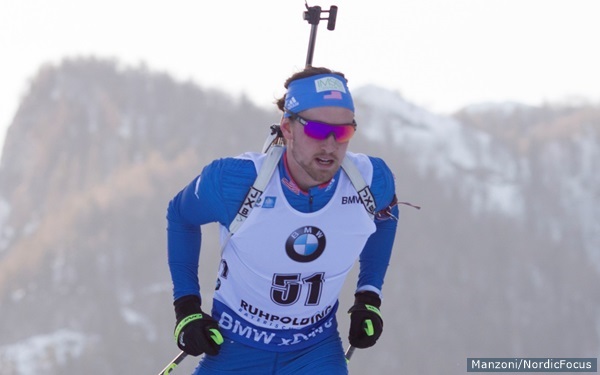
In his fourth Olympics, Tim Burke was the top American in 41st (+4:01.9), a result he wasn’t happy with, after shooting four penalties (1+1+0+2).
“The strategy is always the same: it’s just to execute the game plan, and tonight I struggled with that on the range,” he told FasterSkier after. “I felt like I was decent on the skis, not great but not bad. … I felt like I tried to follow through with my plan, and some days it’s easier than others. And today it didn’t work out.”
Sean Doherty followed in 44th (+4:21.8) with three penalties (2+0+1+0).
“Prone has continued to have a few gremlins in it for me,” the 22-year-old two-time Olympian said. “I worked on it the last couple days in training, but I mean, today was less wind and I was looking forward to that, so I still have just a couple things to work out with it. Standing was great, felt super solid, skied well. You know, those two out of three categories went well, so prone is just continuing to plague me. It’s unfortunate.”
Lowell Bailey, the defending world champion in the 20 k individual, finished 51st (+4:53.0) after missing his first two shots of the day in the first prone then incurring two additional penalties (2+1+0+1). The four penalties added four minutes to his time.
Afterwards, Bailey was beside himself.
“I think shock is really the only way to describe it, completely shocked to miss those two,” he told FasterSkier. “I’ve never started an individual [race] like that. I felt really good about the shooting going into this, I had a game plan, I really felt like I had everything — I had a good plan, it just didn’t work out.
American Lowell Bailey gets up off the mat and ready to head back onto the course after a shooting stage in the men’s 20 k individual at the 2018 Olympics in PyeongChang, South Korea, where he finished 51st. (Photo: FlyingPointRoad)
“I knew the shooting conditions were more to my liking today and I felt really good about my training leading into it, especially on the shooting range, I felt like this was the race I had a good chance to do well in,” he continued. “The wind got me. It was just enough to push me out on the right side. The wind’s tricky here, sometimes it doesn’t register as strong as it actually is, so missing two shots right off the bat, that’s just a really tough way to start the race.”
At that point, he said he had two options.
“You can decide to give it your best because you’re representing your country or you can throw in the towel,” Bailey said. “And I think if there’s one thing I can take away from this race it’s that I never gave up.”
The fourth American finisher, Leif Nordgren placed 64th (+6:27.3) with five penalties (1+1+3+0). Canada’s Nathan Smith ended the race in 81st (+8:11.9) with five misses as well (0+1+4+0).
“I think it was a shooting race today,” Smith noted. “That was my focus. I felt comfortable taking it a little bit easier on the tracks. Unfortunately my third shooting, my second prone, was a disaster. I don’t know what happened. Other than that, my shooting was excellent. I’ll have to ask [coach Matthias Ahrens]. I was adjusting and I don’t know, [the targets] wouldn’t go down that time.”
Moving forward, Smith said he would take it easy in the days leading up to the relay next week. The mixed relay (2 women, 2 men per team) is scheduled for Tuesday, Feb. 20 and the men’s 4 x 7.5 k relay — the last biathlon race of the Games — is next Friday, Feb. 23.
No North Americans qualified for the 30-athlete mass start, with the men’s 15 k mass start taking place on Sunday.
France’s Martin Fourcade defending his Olympic gold from four years ago on Monday in the men’s 12.5 k pursuit at the 2018 Olympics in PyeongChang, South Korea. (Photo: FlyingPointRoad)
Imagine for a moment, if you can, that you’re a two-time Olympic gold medalist from four years ago, and so far this winter, you’ve been on the podium in every biathlon World Cup you’ve raced but one (the first race, a single-mixed relay in November).
Your name is Martin Fourcade and you’re an 11-time world champion from France. You’re also a 29-year-old dad and you’ve spent the last four years since the last Olympics more or less preparing for gold in another race: the first race of the 2018 Olympics in PyeongChang, South Korea.
Now imagine that in that race, which you came into feeling more prepared than ever, you finished eighth after missing three targets in the first prone shooting stage.
Fourcade recalled in a press conference on Monday that his result in the men’s 10-kilometer sprint on Sunday wasn’t frustrating. It was disappointing.
“It was a really strange feeling,” Fourcade said after Monday’s 12.5 k pursuit. “… I was disappointed because yesterday I did not understand why I missed three, and I wanted this Olympic gold in the sprint more than any of the competitions. I worked really hard for this competition. I worked on my shooting for being good in the sprint, I worked on my skiing to be good in the sprint, and I think I was relaxed, I was in a good mood, I had good preparation. … And after the race [yesterday] I was really sad because I didn’t understand what I did bad.”
On Monday morning, he reviewed a photo of his missed shots in the sprint and figured out his error. The red flags that show the strength and direction of the wind in the range were waving more violently than he had remembered feeling during that prone bout.
“I realized it was not because I was unlucky … it was because I did a mistake, and from that time it was really much more easy to turn my anger into strength for the competition today,” Fourcade said. “It’s a bit masochist, but it works.”
Fourcade started the second race of the 2018 Games, the pursuit, 22 seconds behind Germany’s Arnd Peiffer (who won Sunday’s sprint) in eighth. Peiffer held his ground through the first loop and first prone shooting in first, hitting all of his targets and leaving the range in second, just 0.8 seconds behind Austria’s Julian Eberhard, who also cleaned and started the race in fourth.
France’s Martin Fourcade (8) skiing in the pack en route a gold medal in the men’s biathlon pursuit on Monday at the 2018 Olympics in PyeongChang, South Korea. (Photo: FlyingPointRoad)
Fourcade missed his third shot and emerged from the penalty loop still in eighth, now 28 seconds out of first. He and Peiffer both cleaned the second prone, putting Peiffer back into first and Fourcade up to sixth, 21 seconds behind, while Eberhard missed one to drop to seventh.
All the while, the little red flags blew in various directions, twirling around their posts. Gusts kicked up flurries of snow into the air, under a pitch black sky past 9 p.m. Korea time — the start of the men’s pursuit.
It was once again frigid out there and only those who were shooting carefully enough and could feel their fingers (or were managing it regardless) were succeeding.
On the third loop, Fourcade hooked up with a chase group in an effort to catch Peiffer, and by the end of that 2.5 k loop, they did. Heading into the range for the first standing shooting, Fourcade put himself in second, just ahead of Germany’s Simon Schempp in third and behind Peiffer in first. Fourcade and Peiffer lined up in the second and first shooting positions, respectively, putting the pressure on Peiffer in particular.
Then, Peiffer missed his first shot. He hit the remaining four, but it wasn’t enough — Fourcade had knocked down all five and had taken his time to do so, posting the 28th-ranked shooting time. While Peiffer skied his first penalty lap of the day, Fourcade headed back to the course in first place. Peiffer slotted into second, 20.3 seconds behind.
“I think it was a key time of the competition because on the third shooting, the wind was really tricky, challenging, probably it was the most difficult shooting of today,” Fourcade recalled of that standing stage. “I took a bit more time then my opponents to shoot my first ammunition and then when I realized I was the only one who shot clean, I knew that I was the only one who could decide who would be the Olympic champion. I didn’t say that I was sure I would win, but the decision was in my hand.”
He rounded the fourth loop on his own and entered the range for the last time all alone. Then, Fourcade cleaned all five targets with the ninth-fastest shooting time, and turned to the stands behind him with a celebratory fist pump.
“My finish line was not the real finish line, it was the last ammunition of my last magazine on the fourth shooting,” Fourcade said. “I really put all my energy into this shooting and I think if I had to fight with any athlete on the tracks, I wasn’t able to do it because after this shooting I was totally empty.”
He didn’t need to fight with anyone on that last loop. Behind him, Germany’s Benedikt Doll had moved into second with a clean final stage, 36 seconds back, and Sweden’s Sebastien Samuelsson was up to third, another eight seconds behind.
On that final loop, Fourcade locked up gold, coming into the stadium with enough time to grab a large French flag from the stands, about 100 meters from the finish. Meanwhile, Doll and Samuelsson duked it out for second, with Samuelsson closing the gap to Doll then challenging him on the final climb.
“I saw Sebastien behind me and my legs felt weaker and weaker in the long uphill,” Doll, the 2017 sprint world champion, said at the press conference. “And he came closer and closer, and then he [caught] me so I was thinking, ‘OK, now I need to make a new tactic for sprinting for the finish.’ ”
The 20-year-old Samuelsson overtook Doll, 27, as they crested the last climb and led the downhill toward the stadium finish.
“I knew we had really good skis today and I knew that if I can catch him at the top, I had a really good chance,” Samuelsson reflected. “My plan was to go a little bit later because I wanted a wind shadow, but [my team’s] waxers were … yelling a lot and then I just had to go. I was helped a lot with my skis today.”
Sebastien Samuelsson of Sweden celebrating silver in the men’s 12.5 k pursuit at his first Olympics on Monday in PyeongChang, South Korea. It was also his first non-relay podium at the World Cup/World Championships level. (Photo: IBU/Biathlonworld)
In the end, Samuelsson got him by 3 seconds for silver, finishing 12 seconds after Fourcade claimed the win in 32:51.7 minutes. Doll, who had started the pursuit in sixth, settled for bronze, 15 seconds behind Fourcade, for his first medal in his first Olympics with a single penalty (0+1+0+0).
“I couldn’t follow [Samuelsson] and he had faster skis,” Doll concluded. “He was a little bit stronger, and so I think he’s the right holder for the silver medal.”
In addition to shooting 19-for-20 (0+0+1+0), Samuelsson, who started the race in 14th, raced the fastest overall course time of the day, 8.6 seconds faster than Fourcade, who was second fastest. The young Swede reportedly told the International Biathlon Union (IBU) on Periscope that he’d cut his hair if he won a medal at his first Olympics in PyeongChang.
“I think nobody was thinking I’d be able to cut my hair after these Olympics, but now I have to do it, I have said so,” Samuelsson said at the press conference. “But I heard that my teammate said maybe you should keep the hair until the relays because you never know what will happen if you cut it.”
Samuelsson’s previous individual World Cup best was 13th in a sprint last season. He won a relay with his four-man team this season in the 4 x 7.5 k in Oberhof, Germany. After Monday’s pursuit, Fourcade said he congratulated him.
“I told Sebastien in the changing room, it’s not a bad day to start his first Olympics with his first international podium. I know a guy who did that eight years ago in the Olympics in Vancouver,” Fourcade said, referring to his first Olympic medal (silver) in the mass start at the 2010 Games.
Fourcade went on to win the pursuit and 15 k individual race at the 2014 Olympics in Sochi, Russia, where he also took silver in the sprint.
“Martin is, I mean, the perfect biathlete,” Samuelsson said. “I knew when he finished eighth yesterday that today he would be really fighting for the gold medal. For me, it’s a big victory for me to just be on the podium and Martin is unbelievably good.”
“Martin was not happy [after the sprint],” Doll said when asked about Fourcade. “Of course three mistakes in the prone shooting, it’s horrible, so it was for sure that today that he will fight and give everything to win, and in the end his plan fulfilled. He was I think the fastest skier or maybe Sebastien was the fastest skier, I don’t know, but he was the best biathlete today.”
France’s Martin Fourcade after winning the men’s 12.5 k pursuit on Monday at the 2018 Olympics in PyeongChang, South Korea. He also won the pursuit at the 2014 Sochi Olympics. (Photo: FlyingPointRoad)
In his book, “Martin Fourcade: Mon rêve d’or et de neige” (My dream of gold and snow), which came out in November, Fourcade wrote about how nervous he was the night before his first gold medal in Sochi.
“Four years ago before the Olympics in Sochi, I was simply shaking because I had a lot of fears,” Fourcade said at Monday’s press conference when asked about that passage from the book. “Many things changed in my life since Sochi. When I came here in Korea, I knew that I will be a happy man even without any Olympic gold in this event, so I think it helped me to take it more easy and I was in a really good mood and really satisfied with how I prepared this competition.”
Asked now if that fear is gone, he said it was.
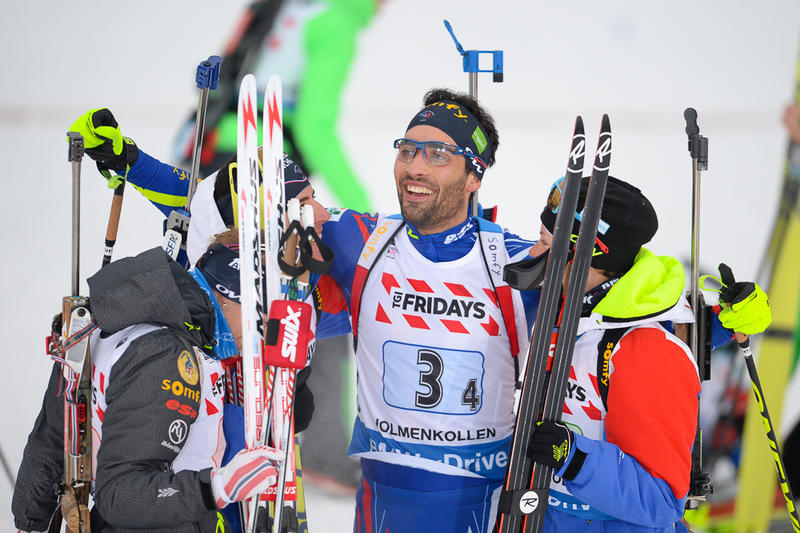
The men’s 12.5 k pursuit podium at the 2018 Olympics in PyeongChang, South Korea, with France’s Martin Fourcade (c) in first, Sweden’s Sebastien Samuelsson (l) in second and Germany’s Benedikt Doll (r) in third. (Photo: IBU/Biathlonworld)
Finishing 47.5 seconds after Doll was Norway’s Tarjei Bø in fourth (+1:02.6). Bø started 13th and posted the fourth-fastest course time to overcome three penalties (0+0+1+2). He held off three others in a sprint to the line, with Schempp following in fifth (+1:02.7), after starting seventh, Switzerland’s Benjamin Weger placing sixth (+1:03.1), up from 15th at the start, and France’s Simon Desthieux placing seventh (+1:03.7), up from 12th. Peiffer ended up eighth (+1:14.1) with three penalties (0+0+1+2), and Sunday’s silver medalist Michal Krčmář of the Czech Republic finished 30th (+3:49.9) with seven misses (2+0+3+2).
Norway’s Johannes Thingnes Bø finished the race in 21st (+2:51.0), up 10 places from starting 31st based on his sprint result, with six penalties on Monday (0+2+4+0).
“We both [knew] before the Olympics that it will not be only a fight between us because we know the shooting range [here] is challenging,” Fourcade said of Johannes Bø, his main rival this season. “I thought that at our best level, we could be difficult to beat, but the wind and the Olympic situation will bring many opportunities for outsiders to take [medals], yesterday Arnd did in a magnificent way. It’s not a competition about Johannes today. It’s biathlon.”
Burke Up to 17th
Tim Burke (US Biathlon) racing to 17th in the men’s 12.5 k pursuit at the 2018 Olympics in PyeongChang, South Korea, up from 47th at the start. (Photo: NordicFocus/US Biathlon)
Three Americans and one Canadian qualified for the pursuit in the sprint top 60, and US Biathlon’s Tim Burke raced all the way up to 17th (+2:19.6) after starting 47th, with two penalties (0+1+1+0) and the 15th-fastest overall course time.
“I am very happy with the race,” Burke said in a post-race interview with FasterSkier. “I really felt like I put it together for the opportunities I was given in the race today, but this is not normal biathlon. You saw that they moved the downhill [competition] to a different day; we can’t do that in biathlon we have too many events, so we have to go on these days when it’s honestly unfair conditions like today. I benefited a lot from having very little wind in my standing positions, and I was able to move up a lot. Others I know were not so lucky. Unfortunately that is part of an outdoor sport.”
Asked how he reset after the sprint the day before, Burke said he talked about it with his coach.
“I was disappointed in the result not the performance,” he recalled. “I felt like I executed well. I felt like I hit my cues on the course and on the range, and it just didn’t happen yesterday. The game plan going into today was nothing, there was nothing new, stick to the things that have been working well for me in the World Cup and that’s what I did.”
After Burke, Lowell Bailey was the next best American on Monday, finishing 32nd (+3:51.6) after starting 33rd. He cleaned the first two stages but missed five between the two standing bouts (0+0+3+2).
American Lowell Bailey (33) racing to 32nd in the men’s 12.5 k pursuit at the 2018 Olympics in PyeongChang, South Korea (Photo: NordicFocus/US Biathlon)
“Unfortunately today, the weather got involved and I had one stage that really just threw my race off,” Bailey told FasterSkier after. “Wind, I mean, that third stage was just absolutely ridiculous. … There was nothing longer than 20 seconds of those big gusts and that time it was like two minutes. I got through of about 40 seconds of standing there waiting, time bleeding off the clock at that point I just started pulling the trigger, I couldn’t hold on the target, you just got to do your best on that point.”
Then there was Leif Norgren, also of the U.S., who finished 50th (+5:48.7), up from 58th at the start, with five penalties (2+2+0+1).
“Physically I think it was improvement from yesterday,” Nordgren told FasterSkier. “I still struggled with the wind and shooting, and it makes it kind of frustrating because with windy conditions like these it’s a big opportunity to move up in the pursuit and I wasn’t able to capitalize on that today. So a little disappointed in that regard, but that’s just how it goes sometimes.”
Canada’s lone man in the pursuit, Nathan Smith crossed the line in 54th (+6:06.5), after starting 44th, with four misses (0+0+1+3).
While he raced up to 37th after the first three stages, Smith dropped to 51st with three misses in the last standing.
“Three penalties on the last standing was really a lot of time spent in the loop,” he reflected.
Physically, he said the race felt, “really, really hard.”
Biathlon at the Olympics continues with the women’s 15 k individual on Wednesday and men’s 20 k individual on Thursday.
Germany’s Arnd Peiffer (front) on his way to winning the men’s 10 k sprint at the Alpensia Biathlon Center on Sunday at the 2018 Olympics in PyeongChang, South Korea. The German was one of just four men to shoot clean in windy conditions. (Photo: FlyingPointRoad)
Arnd Peiffer’s race day before the men’s 10-kilometer sprint at the 2018 Olympic Winter Games in PyeongChang began anything but ideal, not giving any indication that it would end as one of the luckiest days in the athletic career of the German, standing at the top of the podium and flanked by Michal Krčmář of the Czech Republic in second and Italy’s Dominik Windisch in third place.
“Shortly before ski testing, the bolt on my rifle broke. Then I slipped outside the wax cabin [on a flight of stairs] and badly bruised my elbow,” Peiffer told German broadcaster ARD about a series of mishaps that also included a cut to his hand, a forgotten key for his rifle storage locker and a poor warmup. “Somehow nothing was really working as planned, but then in the race everything did.”
About an hour before the race during dry firing target practice (without loaded ammunition clips), the bolt on Peiffer’s rifle that triggers the shots just snapped. On short notice the weapon had to be disassembled and the bolt replaced with the help of men’s head coach Mark Kirchner (a successful biathlete himself with a gold medal in the sprint and two in relays at the 1992 and 1994 Olympics), a problem that according to Peiffer “happens about once every six months to a year… That’s not so bad, but something you don’t really want to occur right before a race”.
“I am generally not superstitious at all,” Peiffer recounted during an interview with ARD in the Olympic broadcasting center late Sunday night. “But Mark told me, ’22 is a good bib number, I once became world champion with that… And [teammate Erik Lesser] also had a broken bolt before the individual race at the [2014] Olympics in Sochi when he shot clean four times and won silver, that was surely a good omen.’ I was like, yeah, that won’t help me today either.”
Yet after he had started his race, Peiffer was indeed the lucky one, hitting 10-for-10 shots in every bit as difficult wind conditions as the day before during the women’s sprint when his teammate Laura Dahlmeier won gold, while the presumed favorites such as France’s Martin Fourcade and Norway’s Johannes Thingnes Bø missed too many targets to contend for the medals.
In his prone shooting, Peiffer reacted correctly to a strong gust of wind from the left side of the range, adjusting his sights with several clicks on his rifle. Then in the standing shooting he took advantage of manageable conditions to shoot in rhythm and again remained clean. On the final loop he skied the 10th-fastest time (18th overall), crossing the line in a time of 23:38.8 minutes. That mark would not be beaten anymore by the 65 athletes starting behind him.
“I have waited a long time for this individual medal,” he said during his in-studio interview with ARD. “I won one in 2011 [at IBU World Championships] and since then had a few chances that I didn’t take advantage of, and sometimes didn’t have any chance at all. So that it worked out today, with a pretty mediocre course time, is a gift that I am very grateful for.”
It was Peiffer’s first individual medal at Olympics, following a silver medal in the men’s relay in Sochi and no podium in Vancouver in 2010. Most of the World Cup successes for the 30-year-old biathlete have been in sprints, and he won the title in this discipline at the 2011 World Championships in Khanty Mansiysk, Russia. His first World Championship medals also came in PyeongChang, back in 2009, when he took bronze with the relay and mixed relay, which he fondly remembered.
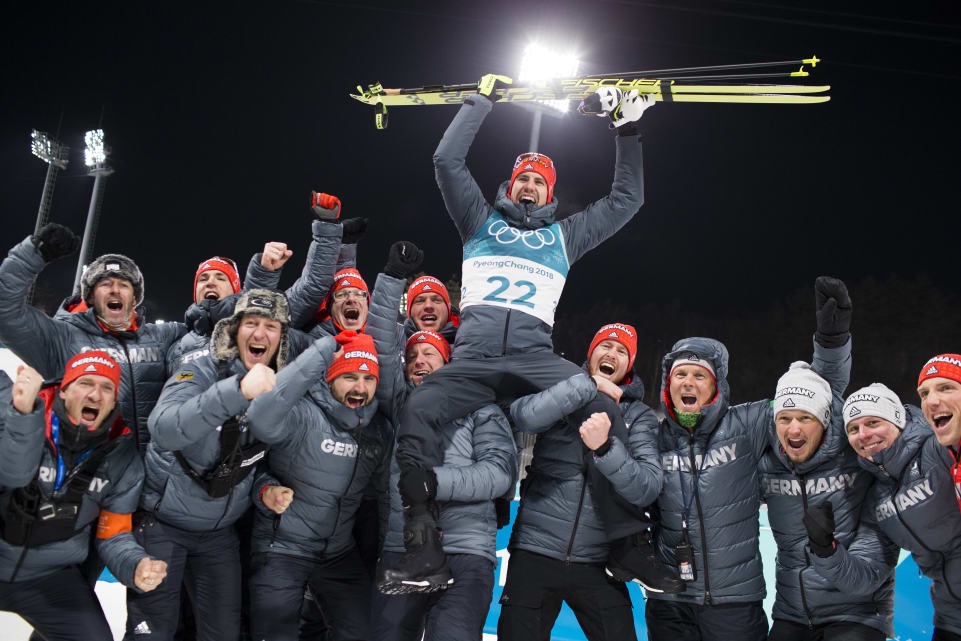
Germany’s Arnd Peiffer is hoisted up by his coaches, staff and teammates, celebrating his victory in the men’s 10-kilometer sprint on Sunday at the 2018 Olympic Winter Games in PyeongChang, South Korea. (Photo: IBU/Biathlonworld.com)
“I am honestly completely surprised that my result was so amazing, that I am standing at the very top,” he had told ARD right after the race. “I am just happy about my performance, because in Vancouver and Sochi I twice had a bad sprint [finishing outside the top 30]… So for today I just was determined to have a good one, have a good shooting performance, and if it had been a sixth place I’d also have been happy.”
The silver medal in Sunday’s sprint went to Krčmář, who also hit 10-for-10 and finished 4.4 seconds shy of Peiffer’s time. Starting behind Peiffer in the middle of the field, that clean shooting performance opened a window of opportunity to wedge himself between the times set by Peiffer and Windisch, who ultimately placed third (+7.7) with one penalty.
“For me, it was very hard in the last loop,” Krčmář said at the post-race press conference. “I [had no] power in last loop and my teammate on the track said to me, ‘You are five seconds behind Arnd’. I do maximum [went as hard I could], but Arnd [was really] better today.”
He made up 2.4 seconds on that final loop, but could not catch up to Peiffer’s time. It was the first sprint podium for the 27-year-old Krčmář at the World Cup or championships level, and at these Olympics it came just at the right moment.
“It’s true, for me a big, big medal. First in career,” Krčmář said. “It’s for me [a] very surprising day because I [felt bad] in the training here. My shooting in training [was] not so good. And now, zero-zero. I am lucky man today because I [had] very good condition in standing shooting and on the track.”
Windisch missed one target in his standing bout, and came back on the course 12.2 seconds behind Peiffer’s time and 5.4 seconds behind Krčmář. He narrowed that gap on the final loop, but it wasn’t enough to catch either one.
“The wind was not easy because it continued to change … but maybe it was the best for me because I had something to think about and to be concentrated on my work,” Windisch said at the press conference. “I didn’t think about results, and maybe that was my secret today.”
For Windisch, 28, it was the second Olympic medal of his career after he held Italy to bronze in the mixed relay in Sochi four years ago.
“The relay is always a tough race because you are racing also for your friends or for three other persons. Maybe it’s more pressure there,” Windisch said when asked to compare the two achievements. “But to win an individual medal [means] a little more because it’s really hard to reach it, because there are so many different good athletes. I think the emotions are really big. But also [for the] relay the emotions are maybe bigger because the whole team celebrates the medal.”
Down On Their Luck
Having started in bib 5, Austria’s Julian Eberhard led the race early on until Peiffer beat his time, and in the end he just missed a medal by 0.7 seconds when Windisch bumped him off the podium to fourth place (+8.4, with one penalty).
During the race, Eberhard, who has three World Cup victories to his name, broke a pole on the loop after prone shooting and had to ski about 300 meters before receiving a spare. But he couldn’t explain why he lost time on the final downhill before the finish.
“I definitely started today with the goal to get the victory. I did my job, and it was very close. Only eight seconds are missing, so of course this is very bitter now,” Eberhard told Austrian broadcaster ORF, according to a translation. “Especially considering that before the downhill 500 meters before the finish I was clearly in second place … Those are the little details that have to work out for a gold medal.”
Norway’s Erlend Bjøntegaard led the race after the prone stage with his time and in the end finished fifth (+17.4), also just missing the podium after he missed two targets in his standing stage (0+2). He had been selected as the final athlete on the Norwegian men’s Olympic roster, effectively replacing biathlon legend Ole Einar Bjørndalen, a decision debated controversially in his home country. But on Sunday, Bjøntegaard, 27, justified his start.
“It feels incredibly strange when you put it that way,” Bjøntegaard told Norwegian broadcaster NRK when told he might have been one miss away from the podium, according to a translation. “It slowly dawns on me that I was so close to an Olympic medal and the gold. There is a lot of buzzing in my head. I’m happy, but also a little disappointed and mad at myself. It’s strange to look at the results list. Very strange. I’m struggling to take it in, but it’s slowly coming to me that I was so close.”
A number of athletes could have echoed same feeling, including three of Peiffer’s teammates.
Benedikt Doll, the defending sprint world champion, placed sixth (+17.6) after missing his final shot. Mass-start world champion Simon Schempp came almost as close in seventh (+21.4, with one penalty), and Erik Lesser, whose past rifle troubles had served as a positive example for Peiffer, was not far behind in 11th place (+31.9, also missing his final shot), despite starting the race with a bruised ribcage.
“I am rooming with Arnd and lost our team-internal duel. So that totally annoys me,” Lesser jokingly told ARD.
“I think that is the hallmark of our men’s team. Today I was the lucky one who got through. From my point of view, it could have been any one of the other three as well. I am not just saying that, I truly believe that,” Peiffer told ARD.
“I will definitely drink a small beer with my coaches, wax techs and teammates, I won’t let myself be denied of that,” he added with a laugh, although it was already past midnight local time. “And then I’ll be looking forward to [the pursuit], because now the pressure is gone. We have a great starting position, the others also did a great race even if that won’t be at the center of attention now. We can be really proud of that.”
As for the presumed “Big Two” race favorites who have dominated the International Biathlon Union (IBU) World Cup this season, with France’s Fourcade standing on the podium in every individual race he started and Norway’s Johannes Bø having won eight races including three sprints, on Sunday they looked like mere mortals for once.
While Peiffer was approaching the finishing stretch, Fourcade, who had started in a later group in bib 54, missed three prone shots. He came out of the penalty lap with a split time that ranked 56th overall. That setback would have taken just about any other athlete completely out of contention, but with a clean standing shooting and the fastest overall course time of the day, Fourcade limited the damage and rose to eighth at the finish (+22.1).
Bø, currently ranked second behind Fourcade in the World Cup Total Score, also missed three shots in prone and another one in standing (3+1), crossing the line 1:12.7 back in 31st.
Their uncharacteristic days left openings and opportunities for the three podium finishers.
“I think on these conditions, it’s possible for everything and nothing, so today it was our lucky day and maybe not the day for Bø and Fourcade,” Windisch said at the press conference. “It was really difficult to shoot, and I think they will have many other chances at these Olympic Winter Games and they will be here [at the press conference] the next time.”
“I don’t know how this could happen,” Peiffer said at the press conference, still a bit incredulous about the outcome. “The other two [Fourcade and J.T. Bø] were dominating the season in ski times and on the range, so I didn’t expect that anyone would be in front of them, for sure not me.”
Four North Americans Qualify for Pursuit
American Lowell Bailey racing to 33rd in the first men’s race of the 2018 Olympics, the 10 k sprint, on Sunday in PyeongChang, South Korea. (Photo: FlyingPointRoad)
The best North American in the difficult conditions was US Biathlon’s 2017 individual-discipline world champion Lowell Bailey, who began his race by cleaning all his prone targets, leaving the range with a split time that ranked him in eighth overall.
Then Bailey was shown on the international broadcast as one of the last remaining podium contenders still out on the course when he came into the range again for his standing shooting, in which he missed the fourth shot and thus had to ski through the 150-meter penalty lap.
That set him back to 24th place, and after losing about 30 more seconds on the final loop he crossed the line 1:15.6 out of first in 33rd.
“I had a good performance on the range, I was happy with the shooting but, unfortunately, I just didn’t have it in the legs,” Bailey said, according to a US Biathlon press release. “I just haven’t had the ski shape that I had last year. I haven’t gotten the speed going this year and that’s the way biathlon is. It wasn’t a bad race. I had a really good first lap, I just didn’t have it on the second and third laps. With any luck I’ll feel better and better as the Games go on.”
Tim Burke (US Biathlon) en route to 47th in the men’s 10 k sprint at the 2018 Olympics in PyeongChang, South Korea. (Photo: FlyingPointRoad)
His teammate Tim Burke finished 47th (+1:47.5) with four penalties (2+2).
“Physically I felt descent. It wasn’t a bad start,” Burke told FasterSkier after the race. “Shooting was tough. I had four penalties. It was real tricky today; it’s a bit of a lottery and that’s the way it goes. … I thought I had similar wind [to zeroing] when I was shooting prone, but what makes it really tough here is it switches literally from one shot to the next. I am really curious to talk to the coaches and see where I was at because I felt totally fine and normally I don’t miss all these shots.”
“It’s a tough course because you have longer climbs,” he said of the course at the Alpensia Biathlon Center, after skiing the 28th-ranked time of the day. “A lot of biathlon courses today, the climbs are only 30 seconds long before you get a break and here you have a couple climbs that are significantly longer than that, so that suits me well.”
Leif Nordgren (US Biathlon) en route to 58th in the men’s 10 k sprint at the 2018 Olympics in PyeongChang, South Korea. (Photo: FlyingPointRoad)
Leif Nordgren will join them in Monday’s pursuit after finishing 58th (+2:10.2) with a missed shot in each of his shooting stages (1+1).
“I’m satisfied that I made the pursuit and there’s another [race] day tomorrow, but yeah, the shooting was quite tough today and the wind,” Nordgren said after. “I made two mistakes and that was too much to have a great race today.”
Asked about the challenging conditions, he added:
“The wind was obviously number one, but actually the cold is another thing. If your hands ever get cold, it impacts the shooting tremendously. If you pause just for a second to even think about how cold your hands are that can throw off the shooting right away. So little things like that. It doesn’t take much to really lose that focus.”
Sean Doherty (US Biathlon) racing to 65th in the men’s 10 k sprint at the 2018 Olympics in PyeongChang, South Korea. (Photo: FlyingPointRoad)
The fourth American starter Sean Doherty missed four of his five prone targets, having to shoot about in the middle of the lane positions on the wind-exposed range. The penalties set him back almost 2 minutes, and even a clean standing shooting was not enough to overcome that deficit. He ultimately finished 65th (+2:16.4, 4+0), only about 2.5 seconds out of the top 60 needed to qualify for the pursuit.
“The wind today is very highly variable and I really thought I had a handle on it in zero [target practice],” Doherty said after. “I had a good zero, I had a good shooting warm up. I had pretty good confidence in what I am doing with things. I came in and I thought I had it under control and obviously something is off. … When I came in I did not assess the wind to be that severe, I guess I didn’t give it enough credit. … But everything else went well. The skiing feels strong. Standing shooting was fine.”
Doherty skied the 48th-ranked course time for the day.
“The course is skiing well,” he said. “It’s very fast and firm and this is a good hard course. … I am happy with the skiing, I felt fairly energetic and I am pretty encouraged with that, but it’s just the range. You leave a lot out there when you miss four.”
The Canadians also struggled with the windy conditions and demanding course.
Nathan Smith was able to cope best, shooting clean in prone before having to ski one penalty lap in his standing bout (0+1) to finish 44th (+1:43.5).
“I was happy with my shooting,” Smith said of his race. “Nine out of ten so that’s good for the windy conditions. … My shooting has been really good this year. Whenever I race I’m probably like 90 percent average or something. I usually shoot pretty quick and this year I haven’t been afraid to slow down when I need to be to hit those targets.”
On the course Smith only skied the 77th-ranked time of 87 starters, after he missed every World Cup race since the sprint in Annecy, France, before Christmas.
“Skiing was hard,” Smith said. “I haven’t raced for two months so it’s hard to jump into the top level of racing when you have just kind of been racing by yourself for a bit after getting sick … When you’re not feeling tip top, I think the biggest difference is when you’re going over hills and stuff, you’re tired and you’re just like, ‘Oh yeah, I’m getting to a downhill,’ and you can’t really push hard through all those transitions.”
Unfortunately he was Biathlon Canada’s only team member to qualify for the pursuit, while others missed the top 60 by mere fractions of a second.
Scott Gow missed four shots in his prone stage before cleaning all targets in standing (4+0), finishing 2:14.0 back in 61st place. That was just 0.1 seconds behind Romania’s Cornel Puchianu, who had incurred just one penalty, and finished 60th.
Gow told FasterSkier he took special care to bundle up before the race to keep warm fingers and a feeling for the trigger, but when he reached the prone stage, the wind had changed directions from the zeroing target practice, posing yet another problem.
“I had a fairly consistent wind from the left I would say, then when I came in to shoot in the race, it had switched directions,” Gow said. “So I thought I had accounted for it and I could hear that I was actually, we call it splitting, but hitting like half the target there and I didn’t want to chance making an overcorrection. So it was disappointing. I think luck-of-draw type of thing. It was too bad.”
The four penalty laps set him back two minutes and all the way to 84th place at the split time, and despite hitting all his targets in the following standing stage, Gow couldn’t quite make up that deficit.
On the course he skied the 46th-ranked time of the day overall and the 29th-ranked final loop.
“It’s a really hard course,” Gow said. “It’s basically three big hills with a couple downhills in-between. There’s no transitional areas, there’s no flatter spots. So it feels like you’re always grinding up a hill just to go back down and have to go up it again. … I felt like I could go a little harder on the first two-thirds of the course, and then just make sure I drop back a little bit on the last climb before you come back into the stadium just for the shooting sake. Then also with the wind, especially the headwind, to try and ski behind people if possible to get a good draft. … Overall I would say I did a fairly solid job with my race plan.”
Christian Gow (Biathlon Canada) racing to 62nd in the men’s 10 k sprint at the 2018 Olympics in PyeongChang, South Korea. (Photo: FlyingPointRoad)
His brother Christian Gow was just behind him in 62nd, 2:14.7 back with three penalties (2+1). Thus he also was less than a second out of the top 60.
“The conditions are tough today,” Christian said after. “It’s windy. It’s not nearly as bad as it was this afternoon, that was crazy. But regardless, it’s changing a lot, which I think is the hardest thing.”
“I corrected in prone and so I have to talk to the coaches and see if it was me or if I missed the correction, where those misses were,” he said of his shooting performance. “Then standing I think was a bit more my fault than anything. Shooting on lane 30 here, it’s quite sheltered. It blocks most of the wind, so it was pretty calm when I shot there and I still came away with a miss.”
Christian skied the 61st-ranked course time, acknowledging that he was impacted by the cold temperatures and wind.
“Today I felt a bit heavier than I would have liked to on the track,” he said of his skiing. “It’s a tough course for sure, really big climbs in it, and you’ve got to manage your energy so that you can do them time and again. … The wind, absolutely you get thrown around by it, but I kind of figure that everyone is getting some of that at some point.”
Brendan Green (Biathlon Canada) en route to 82nd in the men’s 10 k sprint at the 2018 Olympics in PyeongChang, South Korea. (Photo: FlyingPointRoad)
The fourth Canadian starter Brendan Green cleaned prone and was also shown on the international broadcast as a potential late contender when he came into the range for his standing shooting. But with strong wind he then missed three shots, ultimately finishing the race in 82nd place (+3:09.2, 0+3).
“It was a tough day,” Green said. “The conditions were obviously very challenging. But on a day like today that … opens up the door a bit, there’s a good opportunity, but I just was not able to put together a solid performance today. … Standing I just had a lot of gusts, just couldn’t quite overcome the wind for standing.”
“It’s a very challenging course,” he said of the conditions. “The cold weather and the wind. The snow is very dry and very slow, kind of like a sandpaper feel to it. But hopefully the weather starts to cooperate and things start to warm up a bit and the wind drops.”
The biathlon competitions in PyeongChang continue Monday with pursuits for the women at 7:10 p.m. local time (5:10 a.m. EST) and men at 9 p.m (7 a.m. EST). The times back to the winner from the sprint carry over into the pursuit race.
Norway’s Simen Hegstad Krüger celebrates after winning gold in the men’s 30 k skiathlon on Sunday at the 2018 Olympics in PyeongChang, South Korea. (Photo: FlyingPointRoad)
It was an improbable move: Norway’s Simen Hegsted Krüger attacked a few kilometers from the finish of the men’s 30 k skiathlon, and the rest of the field let him go. Krüger didn’t let up and at one point had a lead of 25 seconds with just about two kilometers to go, all the more impressive because he had crashed just meters into the race and broken a pole, having to then make up 35 to 40 seconds to get back to the lead pack.
Norwegian teammates Martin Johnsrud Sundby and Hans Christer Holund tried to close the gap to Krüger in the final kilometer, but the 24 year old hung on for a 8-second win. Sundby was second and Holund was third (+9.0) to give Norway a medal sweep.
Denis Spitsov of the Olympic Athletes of Russia, also in his first Olympics, finished fourth, 12.7 seconds back. Maurice Manificat of France was fifth (+14.2), Dario Cologna of Switzerland sixth (+25.1), Andrew Musgrave of Great Britain seventh (+25.7), and Alex Harvey of Canada edged Martin Jaks of the Czech Republic for eighth (+33.4 and +33.8, respectively). Johannes Høsflot Klæbo of Norway, one of the pre-race favorites, finished 10th (+43.4).
For the U.S., Scott Patterson led the way in 18th (+1:07.5). Erik Bjornsen finished 42th (+4:34.7), Paddy Caldwell 51st (+6:58.1), and Noah Hoffman 54th (+7:08.7).
After Harvey’s top-10 finish, the next Canadian across the line was Devon Kershaw in 36th (+3:35.3). GraemeKillick finished 45th (+5:19.6), and Knute Johnsgaard was lapped and did not finish.
University of Utah alum Snorri Einarsson finished 56th (+7:13.9) in Iceland’s best result in Olympic cross-country skiing since 1994.
Arnd Peiffer on his way to winning the 10 k sprint at Alpensia Biathlon Center today. The German was one of just four men to shoot clean in windy conditions. (Photo: FlyingPointRoad)
With the race favorites each picking up a bevy of penalties, Germany’s Arnd Peiffer skated to a gold medal in the men’s 10 k sprint on Sunday. Both he and silver medalist Michal Krčmář of the Czech Republic shot clean, and were two of only four men in the field to do so. With that performance, Peiffer — whose lone senior Championship-level individual medal came when he won the World Championships sprint back in 2011 — made Germany two-for-two in biathlon races so far after Laura Dahlmeier’s win in the women’s sprint on Saturday.
The top of the results sheet was tight, with Krčmář finishing just 4.4 seconds slower than Peiffer. Krčmář only has one World Cup podium to his name, coming last season. Dominik Windisch of Italy finished with the bronze medal (+7.7) despite one missed shot, and edged out Austria’s Julian Eberhard (+8.4) seconds, who also had one penalty.
Erlend Bjøntegaard of Norway was fifth (+17.4) with two penalties, and Benedikt Doll (+17.6) and Simon Schempp (+21.4) gave Germany an impressive three spots in the top seven.
Those pre-race favorites? Martin Fourcade of France missed three shots in prone and despite cleaning standing, couldn’t make up enough time on the final loop for a top result. He finished eighth, +22.1. Johannes Thingnes Bø of Norway missed three shots in prone and then another in standing, finishing 31st, +1:12.7.
For the U.S., Lowell Bailey cleaned prone and then collected one penalty in standing to end the day 33rd (+1:15.6). Tim Burke had four penalties to land 47th (+1:47.5), and Leif Nordgren will join them in Monday’s pursuit after finishing 58th (+2:10.2) with two missed shots. Sean Doherty missed four of his five prone targets and was unable to come back from that blow, finishing 65th (+2:16.4).
The Canadians also suffered shooting woes. with Nathan Smith able to limit the losses to one penalty and finish 44th (+1:43.5). He is the only team member to make the pursuit. Brothers Scott and Christian Gow missed four and three shots, respectively, to earn the unlucky honor of being the first two men outside the pursuit cutoff in 61st (+2:14.0) and 62nd (+2:14.7). Brendan Green cleaned prone but then missed three shots in standing to finish 82nd (+3:09.2).
The women’s 10 pursuit and men’s 12.5 k pursuit are set for Monday at 5:10 a.m. and 7 a.m. Eastern Standard Time.
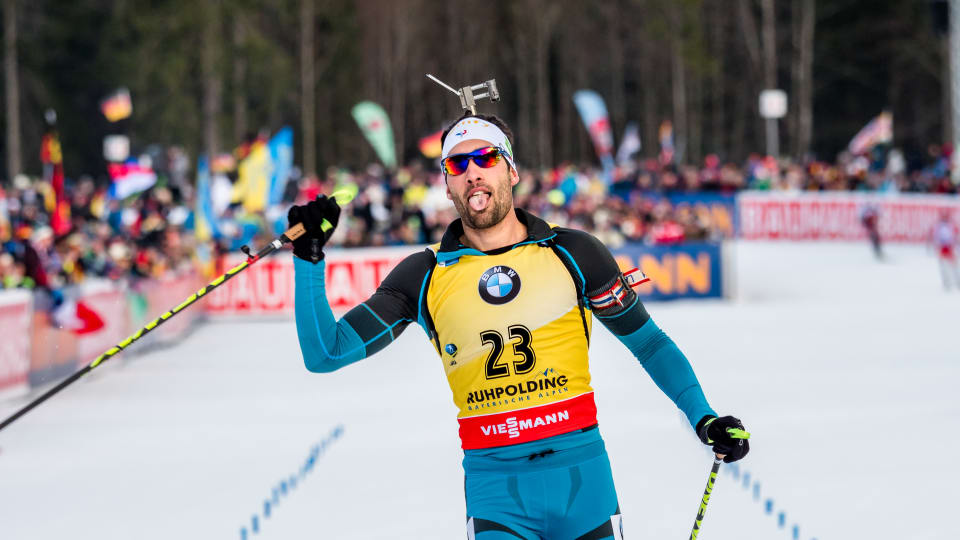
France’s Martin Fourcade after winning the men’s 20 k individual at the IBU World Cup in Ruhpolding, Germany, by more than a minute on Wednesday. (Photo: IBU/Biathlonworld)
IBU World Cup (Ruhpolding, Germany): Men’s 20 k individual
For France’s Martin Fourcade, the difference between a miss on the last shooting stage of the men’s 20-kilometer individual International Biathlon Union (IBU) World Cup on Wednesday versus perfect shooting wouldn’t have ultimately changed his result in Ruhpolding.
Despite the one-minute penalty, which was tagged onto his total time after his lone miss of the day, Fourcade still won by a minute. The Czech Republic’s Ondřej Moravec, who started 2 1/2 minutes ahead of him in bib 18 (while Fourcade wore bib 23), had successfully cleaned every stage, shooting 20-for-20, and initially crossed the finish line first — about a minute and 23 seconds ahead of former race leader Simon Eder of Austria.
But Moravec’s moment in first was fleeting as Fourcade burst into the stadium, not yet letting off the gas, seconds after Moravec finished. Fourcade took the win in 44:27.9, 1:01 ahead of Moravec in second. To indicate how fast Fourcade’s last loop was, it’s worth noting that he was 30 seconds ahead of Moravec with 4 k to go. On that final 4 k loop, he doubled his time ahead of second place.
Fourcade’s win came four days after his last race in Oberhof, Germany, the 12.5 k pursuit, which he also won.
“We are in a biathlon routine now,” he said, according to an IBU press release. “It was hard to find strong motivation with not much recovery or training this week. … Today I wanted to beat my record of podiums in a row. Today was my 14th [individual podium, including last season] in a row and I am really proud of this. I am very happy with my competition as well. Ruhpolding is place that I really love and I am happy that I continued my success here.”
Norway’s Johannes Thingnes Bø achieved his eighth-straight podium in third, 1:06.3 behind Fourcade with a single miss on the last stage as well (0+0+0+1).
“I heard the speaker, so I knew Martin had missed,” recalled Bø, who started behind Fourcade in bib 29. “I knew if I could shoot clean, there was a small chance I could beat him. I tried and missed. That was my tactic: to go for the win, not save the podium.”
He left the range for the last time 48.3 seconds back from Fourcade in first.
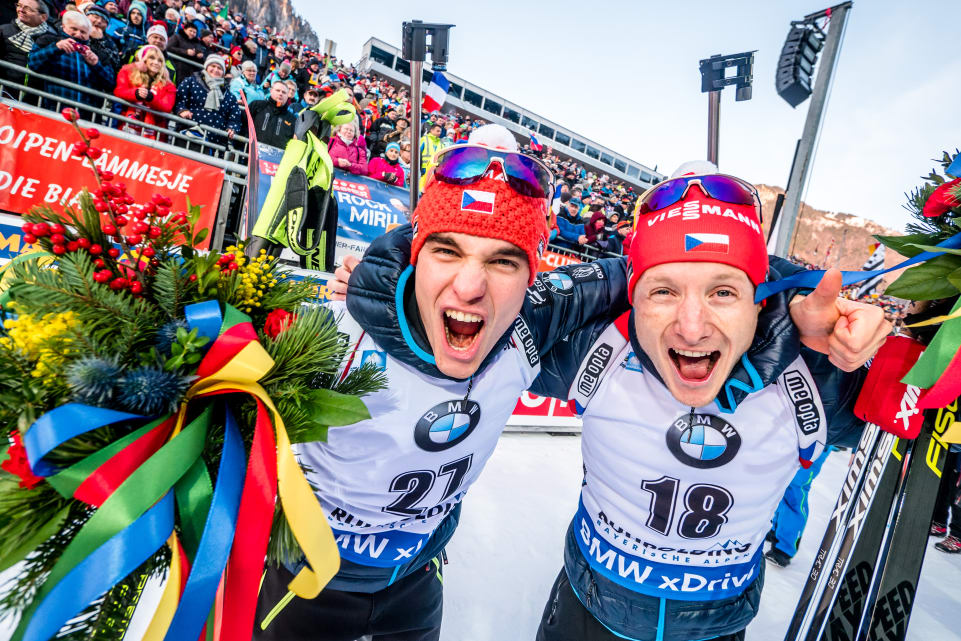
Michal Krcmar (l) and Ondřej Moravec (r) after reaching the flower ceremony in fifth and second, respectively, on Wednesday at the IBU World Cup in Ruhpolding, Germany. (Photo: IBU/Biathlonworld)
Germany’s Roman Rees shot clean and placed fourth (+1:19.1) for his first-career World Cup top 10, and the Czech Republic had two in the top five with Michal Krcmar in fifth (+1:36.6) for his best result of this season.
For Moravec, second place marked his season best as well, after finishing outside the top 10 in previous races this season.
“This podium is really important for me,” he told the IBU. “My first trimester was really bad; my shape was not good especially for the shooting. I also missed a lot of the summer training so did not have the best preparation … I am very please at how I was able to focus and have success in this race.”
Austria’s Dominik Landertinger followed in sixth (+2:21.9) with one penalty and Eder ended up seventh (+2:23.8) with one miss as well.
While the one-minute penalty per miss did not faze Fourcade, it led several North Americans to drop out of top-20 contention, particularly Tim Burke (US Biathlon), who had been in 16th after cleaning the third shooting stage. Burke had cleaned his first stage then missed one on the first standing, but was back in the top 20 with a clean third stage. On the final standing, he missed his first two shots, causing him to look up for a moment to refocus. He cleaned the last three, but still ended up with two additional minutes of penalties that put him 36th at the finish, 4:35.0 out of first (0+1+0+2).
Sean Doherty (US Biathlon) racing to 31st to lead his team in the men’s 20 k individual on Wednesday at the IBU World Cup in Ruhpolding, Germany. (Photo: US Biathlon/NordicFocus)
Sean Doherty led the U.S. men in 31st after missing two targets between the first prone and first standing stages. Ranked 76th after the second stage, he recovered to 53rd after a clean third stage and then 32nd after hitting all five targets on his last stage (1+1+0+0). With two penalties, Doherty finished the race 4:13.6 back in 31st.
“I am happy with the race today,” Doherty said, according to a US Biathlon press release. “I left some room for improvement on the range. It was a big step in the right direction from last week. We had very fast conditions on the course today and our waxing staff did a great job as usual.”
All three U.S. starters finished in the top 40, with Lowell Bailey in 37th (+4:36.4) with three misses (0+2+0+1).
Biathlon Canada was led by Christian Gow in 34th (+4:30.7), for his career-best in a 20 k individual race. After starting in bib 2, he cleaned his first and third stages to put himself in 32nd with one stage to go, within 28 seconds of the top 20. But a miss on his last standing put Gow in 39th leaving the range for the last time, and he ended up 34th at the finish (0+1+0+1).
“My shooting was just OK today,” Gow wrote in an email. “I would have liked to hit one more for sure and then I would have been completely satisfied with the race. I felt more nervous than normal in the range, and my two misses were a direct result of being a bit hesitant on the shooting mat.
“I am pretty happy with today overall,” he added. “I think this is the best skiing I’ve had in an Individual race and my best placing as well. I do wish I could have one or two shots back, but overall I am happy.”
Also for Canada, his older brother Scott Gow finished 55th (+5:13.2) with three penalties (0+1+1+1), Brendan Green placed 78th (+6:53.7) with four misses (1+0+2+1), and Macx Davies was 91st (+8:02.4) with five penalties (1+1+3+0), out of 107 finishers.
The Gow brothers and Green raced Sunday in the men’s 4 x 7.5 k in Oberhof, where they placed 10th.
“Honestly, I have been feeling pretty tired after the 3 days of racing in a row last weekend,” Christian wrote. “Our travel wasn’t too bad, but it still didn’t feel like much of a rest day.”
The Ruhpolding World Cup continues Thursday with the women’s 15 k individual (starting at 8:30 a.m. EST on the Olympic Channel). Another men’s 4 x 7.5 k relay will follow on Friday, then the women’s 4 x 6 k relay on Saturday, and the men’s and women’s mass starts on Sunday.
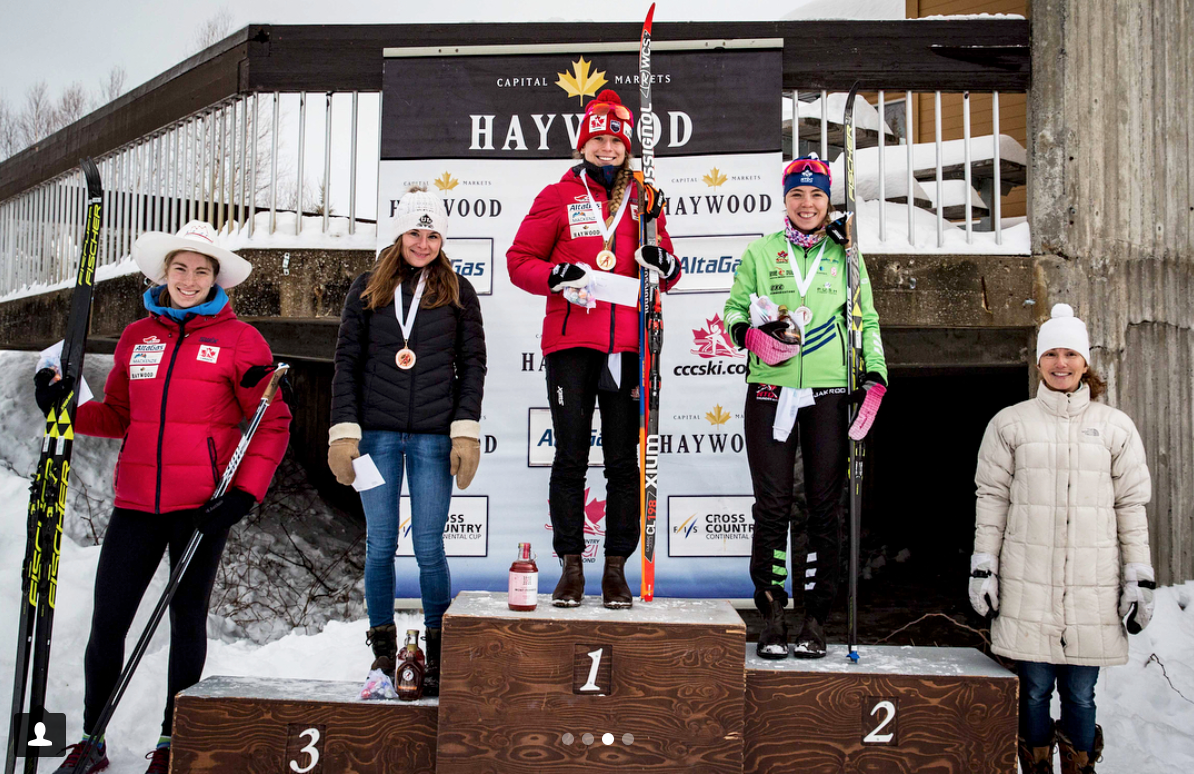
The women’s 10 k classic podium on Wednesday at the NorAm trials in Mont Sainte-Anne, Quebec, with Cendrine Browne (1) in first, Katherine Stewart-Jones (2) in second, and Anne-Marie Comeau (3) in third. Dahria Beatty (l) placed fourth. (Photo: Cross Country Canada/Instagram)
The NorAm trials at Mont Sainte-Anne (MSA), Québec, concluded Wednesday with the 10- and 15-kilometer classic interval starts. On the line were NorAm points, U23 and World Championships invitations, and for the women, what may well be the last Olympic spot on the Canadian team.
The action started with the men’s 15 k classic, which Ricardo Izquierdo-Bernier of the Pierre-Harvey National Training Centre (CNEPH) won in 39.07.8 minutes to punch his ticket to U23 World Championships later this month in Goms, Switzerland. He won the race ahead of Scott Hill of Barrie Cross Country (BXC) in second, who skied a fast final lap to come within 6.9 seconds of first.
Canadian Para-Nordic teammates Graham Nishikawa and Brian McKeever finished third (+30.0) and fourth (+37.4), respectively, with Nishikawa as McKeever’s guide in Paralympic events having the edge in the interval-start race the two skied on their own (Nishikawa started 64th and McKeever 55th).
According to Nishikawa, the two have been entering NorAm events that fit into their preparation for the PyeongChang Paralympics. Nishikawa wrote a quick email on his way to the airport on Wednesday.
“Happy with my week overall in MSA. Shape is good. Skis were good. Will keep improving into Korea for Paralympics,” he wrote after his second distance podium of the week.
In the women’s 10 k classic, Cendrine Browne (Canadian National U25 Team/CNEPH) continued her strong showing at trials with her second victory and fourth top-four result, taking the win in 29:47.0.
Katherine Stewart-Jones, of the U25 Team and National Team Development Centre (NTDC) Thunder Bay, and Anne-Marie Comeau (Université Laval) were virtually tied for second after the first lap, but Stewart-Jones held the speed to take second, 39.2 seconds behind Browne and 24.3 seconds ahead of Comeau in third.
About 16 seconds later, Maya MacIsaac-Jones, of the U25 Team and Rocky Mountain Racers (RMR), finished fourth (+1:21.0) ahead of Dahria Beatty, of the Canadian World Cup Team and Alberta World Cup Academy, in fifth (+1:26.6).
The selection criteria are complex, but a quick calculation suggests that Comeau, who placed second to Browne in Monday’s skiathlon, gets the provisional women’s distance spot for the PyeongChang Olympics (since Browne already established herself as the sprint leader), and Stewart-Jones, who was fifth in the skiathlon, gets the U23 Worlds berth. Stay tuned for updates and official selections.
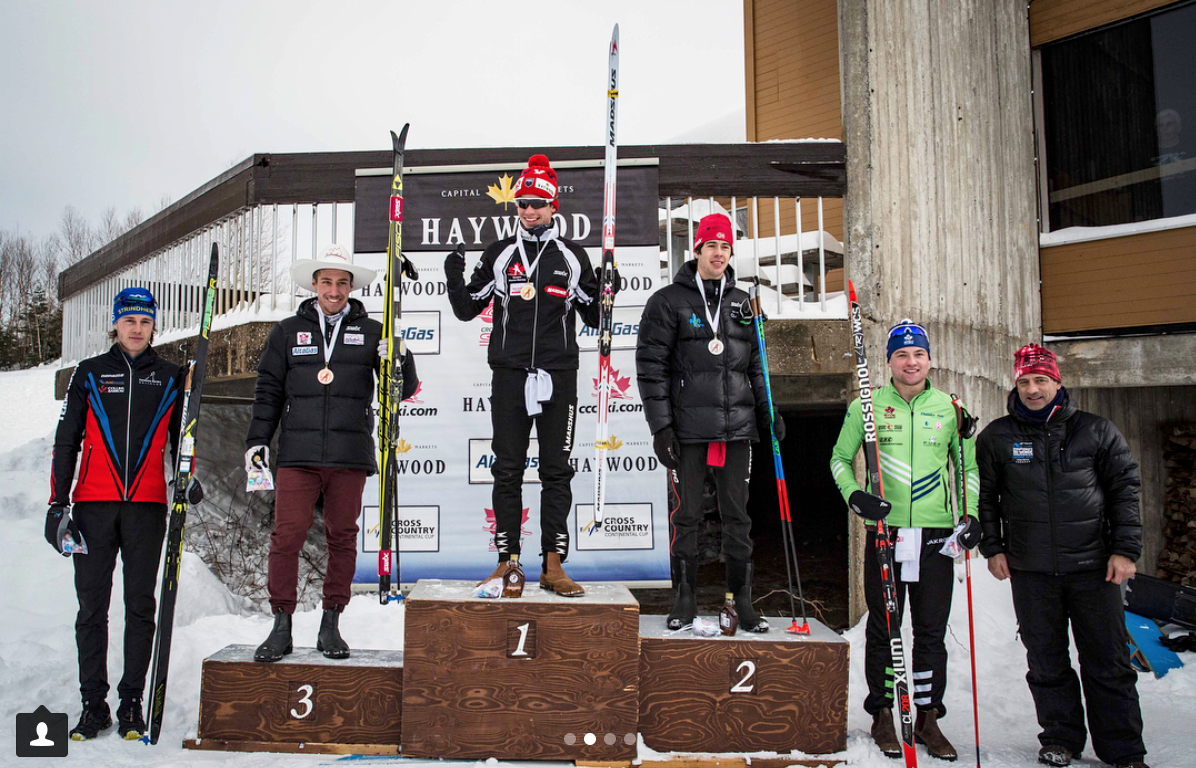
The junior men’s 10 k classic podium on Wednesday at the NorAm trials in Mont Sainte-Anne, Quebec, with Antoine Cyr (c) in first, Félix Longpré (2) in second and Étienne Hébert (3) in third. (Photo: Cross Country Canada/Instagram)
CNEPH’s Antoine Cyr took his third win of the week in the junior men’s 10 k, finishing in 25:57.3, well ahead of local Félix Longpré (MSA) in second (+48.2) and Étienne Hébert (AWCA) in third (+55.6).
In the junior women’s 5 k, Hannah Mehain (Sovereign Lake Nordic/National Junior Team) took the win in 15:22.7, just 2.7 seconds ahead of skiathlon winner Natalie Hynes (Whitehorse Ski Club/National Junior Team) and 15.0 seconds ahead of Tuesday’s skate sprint winner Annika Richardson (NTDC Thunder Bay/National Junior Team) in third.
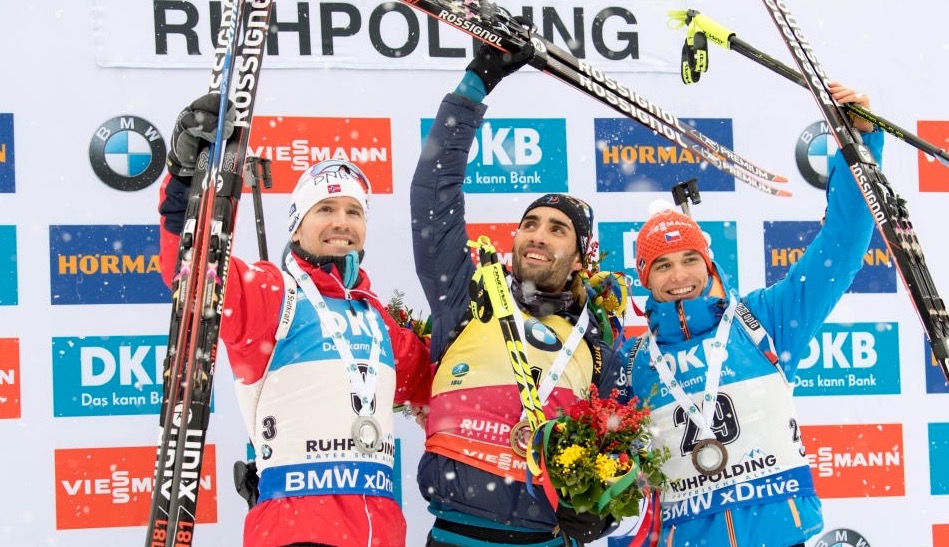
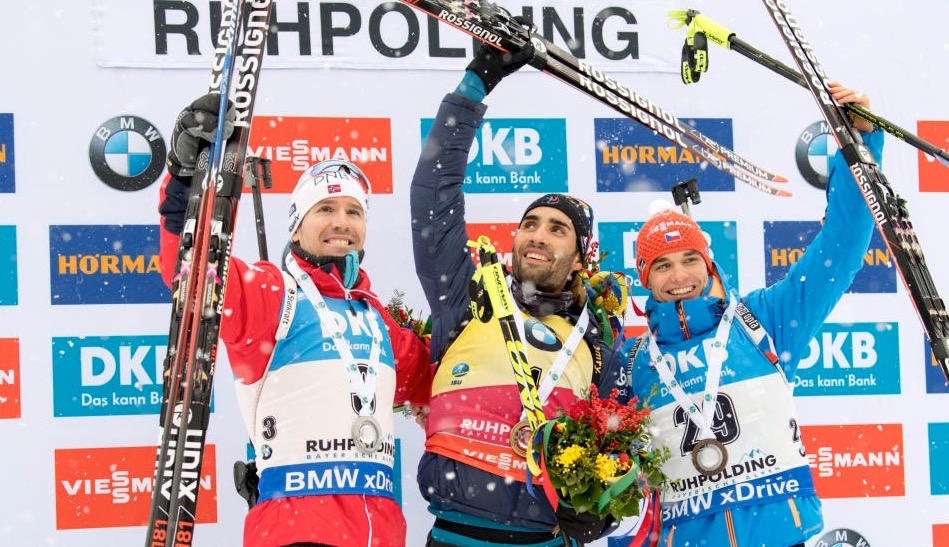
France’s Martin Fourcade (c) celebrates his 10th victory of the 2016/2017 IBU World Cup season in the men’s 12.5 k pursuit in Ruhpolding, Germany. Norway’s Emil Hegle Svendsen (l) placed second, and the Czech Republic’s Michal Krcmar (r) was third for the first podium of his career. (Photo: IBU)
Even Martin Fourcade himself seems surprised with his season so far in the record books.
“I know what I did this season is incredible,” the French biathlon star said in Sunday’s press conference in Ruhpolding, Germany. “Even in my best dreams I could never imagine that.”
Fourcade continued his series of stellar performances in the men’s 12.5-kilometer pursuit at the International Biathlon Union (IBU) World Cup in Ruhpolding, Germany. But he cut it close this time on his way to his 10th victory of the season.
In heavy snowfall on the course in the Bavarian Alps, Norway’s clean-shooting Emil Hegle Svendsen took the lead for a short time when Fourcade missed two targets in his second prone stage and added another penalty in the first standing stage, returning to the course 0.5 seconds behind the Norwegian.
But after initially letting Svendsen set the pace on the loop before the final shooting, Fourcade pushed the tempo up the “Wall of Ruhpolding” climb to create a small gap on a group of five others still fighting for the podium within ten seconds of each other. He managed to reach the range first, and had already hit his first targets before his opponents set up in their lanes. Fourcade took his time with his last shot before finally hitting that one, too. While Svendsen also avoided the penalty lap, he left the range 14.3 seconds behind Fourcade.
On the last loop the two athletes were satisfied to just defend their positions, with Fourcade crossing the line in 33:47.5 minutes, with three penalties (0+2+1+0), and Svendsen 18.3 seconds back with no penalties.
“On the fourth and the last lap I was really, really tired,” Svendsen said at the press conference. “And [with] the slow conditions, when you feel tired it gets even worse, you know. The snow was coming down, and it was a tough battle with my own inner demons and my legs … To be second with this kind of fatigue at the end of the race, I am happy I came to the finish before the other guys.”
Just behind Svendsen, the third place on the podium was decided in a three-way race between Russia’s Anton Shipulin, Czech Republic’s Michal Krcmar and Germany’s Arnd Peiffer. At first it looked like Shipulin would prevail when he built a small gap on the last loop, but in the finishing stretch, Krcmar pushed up to him and outsprinted the Russian to achieve his first-career World Cup podium in third (+19.5 with no penalties), moving up all the way from starting in 29th. His previous best results had been two fifth places last season, one of those also in Ruhpolding in a mass start.
“First time for me and a little bit nervous,” Krcmar said with a laugh in his opening remark at the press conference. “On the last shooting I was clean, and on the track I concentrated on the fight with Arnd Peiffer. But on the last downhill, I see Anton so close and I try it and done. A very amazing day for me, I am so happy. ”
Shipulin finished in fourth (+21.3 with one penalty) and Peiffer in fifth (+24.1 with one penalty).
A knowledgeable student of the history of biathlon, who frequently cites certain races or career achievements of his youth idols (including his countryman Raphaël Poirée), Fourcade acknowledged that he is keenly aware he already tied the best World Cup season of his career, and is motivated by the chance he may soon break Norwegian Ole Einar Bjørndalen’s record of 12 wins in one season.
“I know I already won so much this season,” Fourcade said at the press conference. “There is a big gap [already] in the overall rankings. So if I had not these kinds of statistics, I don’t like the word record, but if I were not fighting for these statistics, I will not stay as focused as I am now and have less victories.”
Germany’s Simon Schempp (l) and Arnd Peiffer (r) after tangling in the men’s 12.5 k pursuit on Sunday at the 2017 IBU World Cup in Ruhpolding, Germany. (Photo: ARD broadcast screenshot)
Peiffer’s race got off to a bad start when, on the first loop, he tangled and crashed with his teammate Simon Schempp. Peiffer broke a pole, but both fell flat on their bellies and at least their rifles remained undamaged.
“I can’t really explain what happened yet,” Peiffer told German broadcaster ARD after the race. “Simon was behind me on the downhill. And I believe the root cause was that my ski bumped to the side. In that moment Simon pushed into me, and then it all went so fast that I got an imbalance. Then I lay there, and oh, this was so annoying. I stood up, my pole was broken in three pieces. Simon had crashed with me, and a whole group skied past us. Then it took a while for me to get a spare. I may have to talk to our support staff about that because they stood there like stuffed dummies while I was yelling. Then I got a pole with a strap that was like glove size 5 [i.e. much too small]. Then I had to collect myself for the shooting range, and at least that worked kind of well.”
Schempp ended his race in seventh (+39.7) with two penalties (0+0+0+2).
US Biathlon’s Tim Burke on course in heavy snowfall during the men’s 12.5 k pursuit at the 2017 IBU World Cup in Ruhpolding, Germany. (Photo: USBA/NordicFocus)
Americans Tim Burke and Lowell Bailey skied close together throughout the race, initially moving up several positions with two clean prone shooting performances after starting 12th and 18th, respectively. Burke left the range in 11th and Bailey in 13th place, both just a few seconds out of the top 10. But in the first standing shooting, Burke fell back to 28th with two penalties, and added another penalty in the final stage to finish 24th (+1:31.6).
“Today was another solid race for me,” Burke said, according to a US Biathlon press release. “I felt solid on the course but have not quite found my timing on the shooting range. I feel like things are headed in the right direction for me and I am looking forward to competing in Antholz next week, which has always been one of my favorite courses.”
With a penalty in each of the standing stages (0+0+1+1), Bailey finished 26th (+1:33.8), two seconds behind Burke.
“I struggled a bit on the skis today,” Bailey told US Biathlon. “No explanation, but I’m still happy with a solid top-30 going into Antholz. It was difficult conditions with falling snow, so I was satisfied with the shooting. Of course, I wish I could have those two misses back, but I’ll have to wait until Antholz.”
In his second World Cup week of the season, their teammate Sean Doherty finished 43rd (+3:22.1) with four penalties (1+0+2+1) after starting out in 40th position.
For Biathlon Canada, only Scott Gow qualified for the pursuit with his sprint result. He started 42nd and finished just ahead of Doherty in 41st place (+3:09.3) with three penalties (0+1+1+1).
“It wasn’t a huge move up today, but I still managed to gain one spot at the finish,” Gow wrote on Facebook. “Tricky conditions and heavy snow made for a challenging race! Lots of fun and looking forward to Italy.”
The IBU World Cup continues next week in Antholz with the women’s 15 k individual on Thursday, Jan. 19, and the men’s 20 k individual on Friday, Jan. 20.
American Lowell Bailey racing to ninth in the men’s 12.5 k pursuit on Saturday at the IBU World Cup in Nove Mesto, Czech Republic, with Canada’s Scott Gow (r) chasing. Gow ended up 40th. (Photo: USBA/NordicFocus)
As Lowell Bailey rounded the course on Saturday in Nove Mesto, Czech Republic, a total of five times in the men’s 12.5-kilometer pursuit, he couldn’t hear a thing his coaches were shouting at him.
The 35,000 spectators in the stadium and lining the track were overpowering them, but their movements gave the US Biathlon veteran all the information he needed to know.
“It was, by far, the loudest spectator crowd I’ve ever experienced,” Bailey recalled on the phone on Saturday. “… There were stands on the course, bleacher stands, that was packed 15, 20 people deep, and I literally couldn’t hear a single bit of information that the coaches were screaming at me.”
After hitting every target in his final shooting stage, Bailey left the range for the last time in 11th, four seconds out of ninth. He wasn’t certain of his place or how many people he should try to catch on the last lap, he just knew it was go-time.
“I figured I was close to the top ten because of where I shot and who I was around, and the way the coaches were moving, jumping up and down,” he said. “But it was literally so loud I couldn’t hear a single bit of information.”
Bailey ended up passing those two competitors just seconds ahead of him on the last climb. He pushed through the finish for ninth place — his best result since placing second in a sprint in March 2014 — 1:22.1 minutes behind the winner, France’s Martin Fourcade, and about a second back from eighth. Behind him, the top Czech skier of the day, Michal Krcmar finished five seconds later in 10th, and Russia’s Evgeniy Garanichev was another second back in 11th.
Martin Fourcade after winning the 12.5 k pursuit at the IBU World Cup in Nove Mesto, Czech Republic, for his 55th World Cup victory, with Russian runner-up Anton Shipulin (r). Including Sunday’s mass start, Fourcade has won 10 of the 11 races so far this season (including relays). (Photo: IBU)
“It was one of those days when I had a little bit left in the tank, and I really like this course, especially the last half,” Bailey said. “I was able to make up enough time in the technical sections to get in a position to pass those guys … I was pretty psyched about my last lap, for sure.”
Bailey had started the day in 20th, 48 seconds behind Fourcade, based on the 10 k sprint on Thursday. Fourcade headed out on course with a two-second lead on Russia’s Anton Shipulin, the sprint runner-up. The man slated to start third, Norway’s Emil Hegle Svendsen, did not start because of a cold.
Shipulin passed Fourcade early and left the range 1.3 seconds ahead of him with the clean shooting and the fastest range time in the first prone stage. Fourcade hit all five targets as well, but four seconds slower than Shipulin. The fourth starter, Norway’s Johannes Thingnes Bø, missed one to drop to fifth.
Meanwhile, Bailey missed his first shot of the day.
“When I was shooting I was pretty frustrated to miss that last shot in my first prone,” he said. “That’s not a way you want to start a pursuit.”
That put him in 25th, 1:17 minutes behind the leaders. One loop later, with a clean second prone, Bailey was back in the top 20 in 19th (+1:18.5).
There, Shipulin cleaned again to firmly take control in first, while Fourcade missed one to fall 22.6 seconds back to second with a penalty lap.
A Czech favorite, Ondrej Moravec crashed and broke his rifle in half on the second loop, before that second stage.
“There was a lot of ice on the course, and there was this one downhill in particular that was really treacherous; you just really had to be on your toes going through it,” Bailey said. “I think it was a series of curves, and a lot of the top biathletes were struggling there. … You could tell it had taken victims every time because there were broken poles strewn everywhere. It was one of the most difficult downhills sections I’ve ever witnessed on the World Cup.”
Fortunately for Bailey, he made it to the finish without an incident.
“We had great skis today. The wax crews have done good jobs, they have really nailed it, so I have to thank them,” he said.
With the fastest course time on the third lap, Fourcade raced his way back into the lead, cleaning the first standing stage and leaving the range 10.9 seconds ahead of Shipulin, who had his first penalty of the day.
France’s Quentin Fillon Maillet moved into fourth with his third clean stage, behind Bø, who had cleaned the last two stages as well.
Bailey missed one on that standing but remained in 16th after the eighth-fastest course time on the third loop. At the end of the day, his course time averaged out to 11th overall.
“I’m really happy with that course time,” he reflected. “To get a top 20 in this field with Martin Fourcade and Svendsen and Bø. That’s my target, and then if you can put together a good shooting performance, you can be vying for the podium, so that’s where I want to be.”
Martin Fourcade celebrating his 55th World Cup victory in Saturday’s 12.5 k pursuit in Nove Mesto, Czech Republic, which he won by 30.2 seconds over Russia’s Anton Shipulin. (Photo: IBU)
On the final standing stage, Fourcade thrived under pressure as usual, cleaning his targets while Shipulin again missed one. This time, Fourcade started the last loop with a 40.8-second cushion to Shipulin, and eased up to a casual pace to take in his surroundings, acknowledge the crowd, and finally bow to thank them before finishing first in 32:53.6, without anyone else in sight.
“My wish is to be as complete a biathlete as possible, not just because I ski fast,” Fourcade said, according to an IBU press release. “That’s what I trained all summer and what I am trying to do now. These kind of wins are the best for an athlete.”
After leaving the penalty lap and distancing himself from the two skiers closest to him, Shipulin also eased off on the last loop. Fillon Maillet had moved into third and Germany’s Simon Schempp fourth with clean shooting on the last stage, leaving the range within four seconds of each other and about nine seconds behind Shipulin.
While Shipulin crossed the line in second, 30.2 seconds after Fourcade, Maillet and Schempp battled throughout the 2.5 k loop for third. Maillet outlunged Schempp by 0.1 seconds at the finish, taking third (+38.3) while Schempp — who shot clean to rise from 17th at the start — placed fourth (+38.4). (Maillet had started just ahead of him in 16th and also cleaned all 20 targets to reach the podium.)
“Today many athletes shot clean because of the good conditions,” Shipulin said after, according to an IBU press release. “After the race I told myself that I must shoot clean in these conditions … Martin is very strong throughout the whole season, so it’s very complicated to compete against such a strong athlete. Hopefully he will give us a new year’s present and let us compete for the win in 2017.”
Bø took fifth (+1:02.7) with three penalties (1+0+0+2), and Bailey crossed the line 19.4 seconds later in ninth (1+0+1+0).
“I’ve done this sport long enough that I know you can make the best plan, and best preparation, and then things don’t go the way you want them to go,” Bailey said. “But I feel like the preparation was really good this year, the training conditions, the training group, the coaching, the staff that we have now, all those variables are good and in the right place, and I’m really satisfied with the way this season has started.”
Two Canadian men also started the pursuit, with Scott Gow heading out in 18th and Brendan Green in 52nd. After a clean first prone, Gow had three penalties (0+2+1+0) and ended up 40th (+3:31.2) while Green finished 54th (+5:30.6) with five misses (1+0+3+1).
In his first pursuit since 2014, American Russell Currier was lapped on his fourth loop.
Bailey was the lone North American to qualify for the 30-man mass start, where he placed 21st on Sunday, 1:17.1 minutes back from winner — once again — Fourcade. Bailey is currently ninth in the overall World Cup standings. Stay tuned for the men’s 15 k mass start report.
The women’s 12.5 k mass start starts at 8:15 EST. American Susan Dunklee was slated to start but did not. Watch it live on Eurovisionsports.tv.
Lowell Bailey (US Biathlon) racing in the men’s 12.5 k pursuit on Sunday at the IBU World Cup in Östersund, Sweden. He placed 15th after starting 13th, but skied in fourth for much of the race. (Photo: USBA/NordicFocus)
Starting with just under a minute separating him from first place, Lowell Bailey made sure he didn’t get too caught up on what could be.
A veteran member of US Biathlon’s national team, Bailey started the men’s 12.5-kilometer pursuit on Sunday in 13th, exactly 59 seconds behind the first man out of the gate, Martin Fourcade of France.
Fourcade had won the sprint the day before (and every race so far this season) and started 42 seconds ahead anyone else in the pursuit in Östersund, Sweden, with sprint runner-up Fredrik Lindström of Sweden chasing in second.
Could anyone catch Fourcade? Maybe — but it was going to take some shakeups with Fourcade making errors and others shooting perfectly under pressure.
Bailey was among those given the opportunity to move up significantly in the field. He tried not to overthink it, nor the fact that has led the U.S. in every International Biathlon Union (IBU) World Cup race so far this season.
“I’m trying to approach every race as an isolated event this year; trying to focus on what I can control that day,” Bailey explained in an email on Sunday.
So far this season, he’s finished 13th in the 10 k sprint and 15th in the 20 k individual races held in Östersund, the first World Cup stop on the circuit. Sunday marked the final day of a weeklong race series.
“I just went into today with the goal of executing all of the things I had worked on throughout the training year,” Bailey continued.
On the first of five 2.5 k loops, Bailey found himself fighting for second.
“The first loop was an incredibly fast pace,” he recalled. “The group I was in ended up catching 2nd place, so by the time we hit the range, there was a group of fifteen or so guys from 2nd to 17th. It made for an exciting start to the race.”
Once on the range, Bailey cleaned the first prone stage and left the range in seventh. He moved into fourth with another clean prone, followed by a flawless standing — his third-straight stage without a miss. With two loops to go and one more shooting, Bailey remained in fourth, about 39 seconds behind the leader and five seconds behind third place.
The wind was blowing throughout the race, even gusting at times, but it was “manageable,” according to Bailey.
“I didn’t really think about the fourth place,” he said of his mindset during the race. “I just wanted to execute a quality shooting bout.”
On that standing stage, which he entered in fourth place, Bailey missed his first two shots. He cleaned the remaining three, but had to ski two costly penalty laps.
“There was definitely some wind, but I can’t blame those two misses on wind,” he wrote. “I lost my focus for those two shots and sent them outside the targets.”
Without much left in the tank for the final 2.5 k, Bailey, who left the range in ninth, slipped to 15th at the finish, 1:21.8 seconds behind the winner.
Russia went 1-2 in the men’s 15 k pursuit on Sunday at the IBU World Cup in Ostersund, Sweden, with Anton Babikov (l) winning his first World Cup and Maxim Tsvetkov (r) placing second. (Photo: IBU)
A 25-year-old Russian who spent most of last season on the IBU Cup, Anton Babikov won the pursuit with near-perfect shooting (0+0+1+0) for his first World Cup podium. He finished in 31:22.3, and his 24-year-old teammate Maxim Tsvetkov followed 10.5 seconds later in second, thanks to clean shooting, to tie his career best.
(Babikov started seventh and skied the fourth-fastest overall course time, and Tsvetkov started 11th and was one of just two men to clean all four stages. Michal Krcmar of the Czech Republic was the other. He rocketed from 38th at the start to seventh at the finish.)
Fourcade, the first starter, ended up third (+15.2) with an uncharacteristic four misses (2+0+0+2).
“From the very beginning, I knew that everything could be possible,” Babikov told the IBU, according to a press release. “We were going very close. Before going to Östersund, I was a little worried, it’s always curious to see how well you are prepared for the season.”
Tsvetkov skied in third for most of the race, concentrating on his shooting and capitalizing when Fourcade missed two on the final stage. There, Babikov took the lead for the first time from Fourcade, now 10 seconds back in third, and Tsvetkov left the range four seconds behind in second.
“This is my first medal in pursuit,” Tsvetkov told the IBU. “It was very tough for me, I knew that Martin was very close, I knew that I have to work hard ’til the end.”
While Bailey felt like he was missing some snap, especially on the last loop (which he attributed to a hard first loop), he was pleased with his start to the season and is ranked ninth overall on the World Cup.
“I have been ranked this high in the past coming out of Ostersund, but I am definitely happy with the solid start to the season,” he told US Biathlon, according to a press release. “You train all season in a bit of a vacuum — just you and your teammates — and there is very little for you compare yourself to. Because of this, the start of the season can be a bit of an unknown. I’m happy to see that my ski times are competitive and that I’m able to reach the podium on a great day.”
Of 59 finishers on Sunday, Bailey’s course time ranked 36th.
“I hoped to have competitive ski speed and accurate, fast shooting,” he wrote to FasterSkier. “Mostly, I’m satisfied with my performances so far. As always, there’s plenty of things I need to improve, but I’m happy with this a solid start to the season.”
Tim Burke (US Biathlon) racing to 35th in the men’s 12.5 k pursuit on Sunday at the IBU World Cup in Östersund, Sweden. (Photo: USBA/NordicFocus)
Two American men started the pursuit, with Bailey finishing 15th and Tim Burke placing 35th (+2:39.2). Despite a clean first prone, Burke, who started 29th, tallied four penalties (0+1+2+1), yet still finished in the top 40 required for points. His course time ranked 35th overall.
Scott Gow was Canada’s top finisher in the pursuit in 47th (+3:34.8) and found himself up in 38th after hitting all 10 targets through the first two stages. He then missed two on the third stage and one more in the final standing (0+0+2+1), costing him time in penalty laps.
About 11 seconds later, Brendan Green finished 50th (+3:45.5) with five penalties (2+1+0+2). His teammate Macx Davies finished 51st (+3:54.6). After two clean prone stages, Davies had skied in 35th, but two misses on each standing bout (0+0+2+2) brought him outside the top 50.
France’s Martin Fourcade crosses the finish first to meet his teammates after anchoring the mixed relay to gold to open the 2016 IBU World Championships in Oslo, Norway, Germany’s Simon Schempp secures second behind him, and Norway’s Tarjei Bø comes onto the final stretch to claim bronze. (Photo: IBU/Evgeny Tumashov)
Martin Fourcade versus Simon Schempp: Two perennial rivals who still greatly respect each other’s performances, duking it out on the final loop of Thursday’s mixed relay.
It was a fitting end to the first race of the 2016 International Biathlon Union (IBU) World Championships in Oslo, Norway, a finish sprint into the famous Holmenkollen ski arena with two athletes at the top of their game, in a repetition of a scene similar to what biathlon fans have witnessed repeatedly in recent seasons.
This time, France’s overall World Cup leader Fourcade prevailed against Germany’s anchor, skiing over the last bridge in the stadium and taking a little bow in the style of a telemark ski turn. He crossed the finish line in 1:14:01 and celebrated the gold medal with his excited teammates. Combined, the four-person French relay had no penalties and seven spare rounds.
Martin Fourcade celebrates with his teammates after anchoring France’s mixed relay to gold in the first race of 2016 IBU World Championships in Oslo, Norway. (Photo: IBU)
“Today was really emotional, because it was my first, our first victory in a team race in World Championships since 2009,” Fourcade said at the post-race press conference.
“Of course we were among the favorites so we were thinking about [the gold medal],” Fourcade added in an interview with the IBU. “But in biathlon you never know until the last shooting. We were fighting for gold as well as for the fourth place.”
Germany finished second, just 4.3 seconds back, and also with seven spares.
“I tried to bring out everything I had, but in the end I honestly was too exhausted,” Schempp told German TV broadcaster ARD. “We are totally happy about silver.”
“The way Fourcade threw himself into the snow afterwards, I think that shows Simon [Schempp] pushed him to his limits,” Germany’s third leg skier Arnd Peiffer told ARD. “Martin definitely didn’t have it easy on the final loop today … With that ‘telemark’ move he was just showing his excitement, that had nothing to do with arrogance.”
Another 10 seconds back, Norway’s anchor Tarjei Bø secured the bronze medal for the home team (+14.4), with ten spares, to the huge joy of the audience.
The U.S. finished 10th (+2:19.6), with five spares, falling back on the last three legs after starter Susan Dunklee rocketed through the first exchange in first place. Canada placed 11th (+2:30.8), with 11 spares, unable to quite keep up with the leaders throughout the race due to too many misses on the shooting range.
After a festive opening ceremony at a central square in Oslo on Wednesday night, the Biathlon World Championships opened with the mixed relay, including two women and two men per team, with all other rules just like in a traditional relay.
The two women begin, and each ski 6 kilometers with one prone and one standing shooting stage, while the men have to ski 7.5 k each. The athletes can use three spare rounds per stage, and if they fail to clean their targets with those spares, they have to ski a 150-meter penalty lap for every miss.
The IBU first experimented with mixed relays 11 years ago as a special event during the World Cup finale. Since 2007, the discipline has been part of the official program at World Championships.
Initially it was a bit of an afterthought, with a number of countries with large teams using it as an opportunity to give their lower-ranked biathletes a start at championships, and saving their best ones for the individual starts and the traditional women’s and men’s relays.
That has changed in recent years, since the event also became part of the program at the 2014 Olympics in Sochi, Russia. This year in Oslo, small and larger teams alike certainly pulled out all the stops, with almost every nation entering the its best athletes.
Low-hanging clouds and fog on the range had been predicted, but for Thursday’s competition, the view of the targets on the shooting range was actually clear despite a cloudy sky and a little fog shrouding the big ski jumps that tower over the Holmenkollen arena.
The French team, with Anaïs Bescond, Marie Dorin Habert, Quentin Fillon Maillet, and Fourcade, initially hit a snag when Bescond required all spares to hit her targets in her standing stage, narrowly avoiding the penalty lap and coming through the exchange in seventh place, 35 seconds behind Dunklee.
Then Dorin Habert crashed in a ski tunnel out on the course, in snow conditions some athletes described as “glazed” in certain sections.
“Nothing terrible, it was just a mistake by me,” Dorin Habert said of her fall at the press conference.
She quickly recovered and moved her team into third place at the next exchange, with Fillon Maillet and finally Fourcade able to close out successfully by pushing hard up the final small climb and U-shaped turn in the arena to create a little gap.
Similarly to France, Germany’s starter Franziska Preuss initially lost 20 seconds to the top due to two misses in her first prone stage, but moved back up to fourth place at the exchange. Then Franziska Hildebrand and Peiffer kept the team in contention for the podium, before Schempp was able to claim the silver medal.
Germany’s Simon Schempp after one of his shooting stages during Thursday’s mixed relay at IBU World Championships in Oslo, Norway. He anchored Germany to second, 4.3 seconds behind France. (Photo: IBU)
In his last shooting, Schempp thought he had hit all shots taking down his rifle to head back out on the course, before realizing he had missed one and — like Fourcade -– still had to use a spare. Schempp made his shot and left the range just 1.7 seconds behind Fourcade. While Schempp was able to catch up on the course, he did not have the energy left to beat his rival in the final sprint.
Ahead of World Championships, fans and the media put a lot of expectations on the home team from Norway with Marte Olsbu, Tiril Eckhoff, Johannes Thingnes Bø and his older brother Tarjei Bø.
At the 2014 Olympics, Norway had won the gold medal in the mixed relay, though only Eckhoff, who grew up just a stone’s throw away from the Holmenkollen arena, was a part of the lineup back then.
In front of thousands of spectators, including Norway’s King Harald V, the team did not disappoint, with Olsbu and Eckhoff delivering some of their best performances of the season to tag off in second and first place, respectively. From there, the Bø brothers kept the team in podium contention.
“I was very nervous,” Olsbu said at the press conference. “I am just so happy that I made a good race today.”
Johannes Bø tried to make a move on his last loop, yet the other teams just behind him closed the gap again before the exchange.
After needing all spares in his prone shooting on the anchor leg, his brother Tarjei fell back 18.4 seconds, but was able to reduce that again to 7.4 with fast skiing and a clean final shooting stage. While he tried everything in his power, he could not quite catch up to Fourcade and Schempp again.
“Of course we are happy to have a medal at the Championships [at] home,” Johannes said during the press conference. “But we are athletes who want to win. So we are 90 percent happy [with bronze], and we take the last 10 percent next week.”
“Simon and Martin were too strong for me,” anchor Tarjei Bø said.
When a French journalist asked his rivals if Fourcade maybe gained a psychological advantage for the remainder of the World Championships after a win on Thursday, Tarjei Bø laughed and exclaimed: “Yeah, he is unbeatable. He’s so unbeatable that I will not race any more at these World Champs!”
“That’s a good idea,” Fourcade replied with a big smile on his face.
For a long time, four teams had been in close contention for the medals, but after a strong race Ukraine, with Valj Semerenko, Olena Pidhrushna, Sergey Semenov and Dmytro Pidruchnyi, could not quite keep up on the anchor leg with two spares in the last shooting. Ukraine finished fourth (+29.8), with nine spares.
Fifth place (+1:07.1) went to Austria, with Dunja Zdouc, Lisa Theresa Hauser, Simon Eder and Dominik Landertinger, which combined for a team total of just three spares, the fewest of any nation. Meanwhile, the defending world champions in the mixed relay, the Czech Republic, with Veronika Vitková, Gabriela Soukalová, Michal Slesingr and Michal Krcmar finished sixth (+1:23.3), with five spares.
Dunklee in the Lead
Susan Dunklee (US Biathlon) trails France’s Anais Bescond during the first leg of the mixed relay at 2016 IBU World Championships on Thursday in Oslo, Norway. Dunklee went on to tag off in first, 1.6 seconds ahead of Norway. (Photo: USBA/NordicFocus)
For US Biathlon, Dunklee started out strong, shooting clean in the first prone stage to leave in second behind France’s Bescond. Then she again hit all of her targets in standing to leave the range 4.5 seconds behind Norway’s Olsbu and Italy’s starter Dorothea Wierer (an athlete with multiple World Cup victories this season. Italy went on to finish eighth).
This time, Dunklee was not satisfied just staying behind the athletes at the top, immediately attempting to overtake Wierer and move up to Olsbu.
“I love the thrill of starting relays,” Dunklee wrote in an email after the race. “I have been close behind the leader tagging off many times, but I have never tagged off in first. On the last loop I was hungry to finally win my leg today and I wanted to give Hannah [Dreissigacker] the experience of leaving in the lead in front of a packed Norwegian crowd.”
Of all the first-leg skiers, Dunklee’s course time was the fastest.
“I do love the Holmenkollen crowds and the hilly course,” she wrote. “I felt relaxed and focused on the shooting range and felt very strong skiing. Our staff put together incredible skis today.”
“I love the thrill of starting relays. I have been close behind the leader tagging off many times, but I have never tagged off in first. I was hungry to finally win my leg today…” — Susan Dunklee, who put the U.S. in first at the first exchange on Thursday
Dreissigacker initially was able to keep up on the course with France, Norway, Ukraine, and Germany at the top.
“It was a fun race and definitely a real thrill [to] get the tag in first place,” Dreissigacker wrote in an email. “Susan really did us all proud out there. I did my best to ski my own race, but it’s always hard when you have lots of adrenaline and find yourself in first place.”
After requiring a spare in prone, she was still in third place, only 1.7 seconds back. Then having more trouble maintaining the leaders’ pace on the next loop and with another missed shot in standing, she fell back 22.7 seconds to fifth place. On her final loop, Soukalová, the overall World Cup leader, passed her on the course, and Dreissigacker lost another half a minute to the leaders, tagging off in sixth, 51.3 seconds back.
“I felt like I was in control on the first and second laps, trying to keep in touch with the leaders as much as possible without overdoing it,” Dreissigacker explained. “But I definitely didn’t have too much gas left in the tank for the last lap, and it didn’t help that I had really lost all contact with the women ahead of me. But that was also a group of the very fastest women in the world, so I am not surprised that they put lots of time on me in the last lap.”
The U.S. team’s third leg, Lowell Bailey had a strong performance on the shooting range and stayed clean both times just like Dunklee, but continued to lose time on the course, and his course time ultimately ranked 19th of the third-leg skiers. He tagged off in eighth place, 1:35.5 minutes back.
“The course was tricky today,” Bailey wrote in an email. “The new snow packed down and glazed, making some of the downhills and especially the stadium fairly treacherous. It wasn’t my best day on skis, but hopefully I’ll feel better as the Championships roll forward.”
Anchoring the U.S. relay, 20-year-old Sean Doherty required a spare in both his prone and standing stages, and with the 16th-ranked course time on his leg, he slipped two positions to finish 10th (+2:19.6), one position ahead of Canada.
“Today’s race was an exceptionally high level,” Doherty said in a US Biathlon press release. “We showed that we can shoot with the best teams and be very competitive. I am really happy with my leg and feeling strong looking ahead to the sprint.”
“The mixed relay is a format we often think of as one of our best medal hopes, so from that perspective our result today is disappointing,” Dunklee wrote. “After our 4th place in Canmore I think we all went into today with high hopes… On the range we put together an excellent performance, one of our best I would say. Tenth is solid, but we know with that good of [a] shooting we can be capable of much more. The good news is that we have many races still to come.”
“It was just tough, tight competition out there and I think we had a really solid team performance,” Dreissigacker commented. “Using only 5 spares for the whole team is great shooting!”
As Bailey pointed out, a top 10 is a top 10.
“It is a tight field and we were close to the leaders for a significant part of the race,” he wrote.
The Canadian team with Julia Ransom, Rosanna Crawford, Nathan Smith, and Brendan Green was hoping to build on its ninth place in the mixed relay in Östersund, Sweden, and sixth place at home in Canmore.
On Thursday, Ransom started in bib 5, and had some trouble to keep up with the leaders. With one miss in both her prone and standing stages, she found herself 36.5 seconds behind going onto the final loop, and then lost more time to tag off in 11th place, 1:03.4 minutes back.
Crawford was able to maintain the pace with the seventh-best course time on her first loop, before dropping off a bit the third time around the Holmenkollen 2 k course.
“It was nice on those first two laps to be working with Sweden and trying to stay with Soukalová,” Crawford wrote in an email. “I had a tumble on the same hill as Dorin [Habert] in warm up and broke a pole, but the race was smooth and I didn’t have to deal with any sketchy people on the downhill.”
But she couldn’t make up positions or time with a miss in her prone shooting and two spares in the standing stage, where she had some additional issues.
“I had some trouble with standing where my shell got stuck, and I wasted some time getting that fixed, and then missed two targets on top on that,” Crawford wrote. “So I am quite disappointed with my shooting. Getting the jitters out before Saturday’s race though hopefully!”
She handed off in 14th place, 1:27.7 back.
Currently the highest-ranked Canadian on the World Cup, Smith skied fast on the course, posting the fifth course time on his leg.
“I’m very happy with my skiing today,” Smith wrote in an email. “I’ve been struggling over the last 7 weeks to feel good on the skis. I wouldn’t say I felt like a total beast skiing, but I knew my shape was good just because I was able to more or less maintain position with top guys like [Russia’s] Garanichev and [Austria’s] Eder… I don’t actually particularly like this arena. I find the gentle ramp through the stadium surprisingly challenging. The ski loops are interesting though, and obviously great views.”
But like his teammates, he could not quite stay clean on the range, requiring two spares in prone and another one in standing.
“Shooting conditions were perfect,” Smith stated. “Very little wind and no fog. Earlier in the day it looked nasty but everything cleared up for us.”
Smith moved up the team a few positions to tag off in 10th (+1:35.9).
“I wouldn’t say I felt like a total beast skiing, but I knew my shape was good.” — Nathan Smith, who skied the fifth-fastest course time on the third leg to bring Canada from 14th to 10th
Canada’s anchor, Green also did not have a perfect day on the range, needing one spare round in prone and two in the final standing stage. Combined with his skiing (13th ranked course time), he lost some additional time to the top, with Canada closing out the race behind the U.S. in 11th place, 2:30.8 behind the winners.
“In my portion of the race there wasn’t anything too out of the ordinary,” Green wrote in an email. “The track was really glazed in some sections and the skiing in general felt like a bit of a balancing act at times.
“There has been a bit of wind during the last few days [of] training, but it dropped a bit this afternoon which was nice,” he wrote of the shooting conditions. “A slight but manageable wind from the left. I was a bit worried about the fog that was lingering throughout the day but fortunately it moved off and the range was clear.”
Asked if their team result was within expectations, Crawford wrote, “11th is a disappointing result for our team, we are capable of a top 8 on an average shooting day and for sure top 6 if we all have a great day on the range. 11 spares is not a normal day for our team I’d say.”
“11th is nothing to write home about but still a decent result,” Smith stated. “We knew everyone would be putting in their best teams.”
“Overall, today wasn’t a true representation of what our team is capable of,” Green wrote. “It’s day one of the Championships and I know we’re all hungry for more.”
Races in Oslo continue on Saturday with the first individual races: the men’s and women’s sprints. All races as well as shorter recaps can be streamed live or time-shifted (most with English commentary) on Eurovision Sports.
“I just want to get one [individual] title, that’s my aim,” Fourcade said at the press conference.
“The atmosphere was great!” Bailey wrote. “Cheering along the track and extremely loud in the stadium. I think it will be even bigger on the weekend.”
“On Saturday we’ll come out fighting,” promised Green. “The atmosphere was pretty awesome today. The stands were full and the stadium was loud. It’s a good vibe and if today is any indication, we’re going to be in for a fun couple weeks of racing.”


 FasterSkier’s Coverage of the Biathlon World Championships is made possible through the generous support of the Craftsbury Outdoor Center: New England’s finest snowmaking, world class race venues and touring trails, healthy food in abundance, comfortable accommodations at Craftsbury: Sports, Sustainability, Stewardship.