From the FasterSkier archive — posts syndicated from athletes’ and coaches’ own blogs between 2004 and 2012, kept online as published. Current coverage is at fasterskier.com.

Tag: Michal Slesingr

  • Swedish Biathlon Caps Best Olympics with Relay Gold; U.S. Men 6th to Tie 1972 Mark

    Fredrik Lindström crosses the line first to secure a gold medal for his Swedish teammates in the men’s 4 x 7.5 k relay on Friday to close out biathlon competitions at the 2018 Olympics in PyeongChang, South Korea. (Photo: FlyingPointRoad)

    FasterSkier would like to thank Fischer Sport USA, Madshus USA, Concept2, Boulder Nordic Sport, and Swix Sport US for their generous support, which made this coverage possible.

    Remember when it was a big deal when Sweden won a Biathlon World Cup? The team in bright yellow has made it a habit at the 2018 Winter Olympics, winning their first Olympic relay gold and fourth medal over the last two weeks on Friday — the last biathlon race of the PyeongChang Games.

    “It’s dreams coming true at that moment,” Fredrick Lindström, the Swedish men’s 4 x 7.5-kilometer relay anchor said in a post-race press conference on Friday. “It’s my third Olympics and to be on top with these guys feels great. I don’t know what to say.”

    Lindström had taken gold in perhaps the most ideal way for an athlete in his position, by heading out on the last 2.5 k loop in first place, almost 41 seconds ahead of anyone else. While he had missed his first shot in the final standing stage of the race, Lindström cleared it with the use of one spare bullet. Meanwhile, his closest challenger for the win — Norway’s Emil Hegle Svendsen, who had followed him into the range and lined up alongside him to shoot — missed his first two targets and went on to miss more, ending up with a penalty lap after using all three spares.

    That was the end of gold for Norway and for Svendsen, who was all too familiar with the penalty lane in the closing moments of an Olympic relay. Four years ago in the men’s relay in Sochi, Russia, Svendsen as Norway’s anchor had been in the medal hunt until the final shooting. There, he used all of his spares and still left a target standing, which sent him to the penalty lap. After leading by as much as 20 seconds in the middle of that race, Norway finished fourth.

    But as they say, that’s biathlon. And on Friday, it was Sweden’s day and Lindström skiing on his own for a 2.5 k victory loop around the course. But he didn’t slow down. As the 28 year old skated up the final climb, he was greeted by several members of his team bowing up and down in a unison to celebrate the history that was about to be made. Lindström descended down into the stadium, not looking back and still pushing toward the line, before skiing to the sidelines a few meters before the finish to grab a small Swedish flag.

    Fredrik Lindström crosses the line first to secure a gold medal for his Swedish teammates in the men’s 4 x 7.5 k relay on Friday to close out biathlon competitions at the 2018 Olympics in PyeongChang, South Korea. (Photo: FlyingPointRoad)

    It wasn’t like the oversized French flag Martin Fourcade had been seen waving earlier in the Games, in the pursuit and again in the mixed relay. It was understated, like Sweden’s biathlon team before these Olympics, but he waved it proudly as he crossed the line to a sea of swarming teammates.

    Sweden (with Peppe Femling, Jesper Nelin, Sebastian Samuelsson, and Lindström) finished first with a cumulative time of 1:15.16.5 hours and a total of seven spares and zero penalties. Skiing alone and finishing 55.5 seconds behind them,  Svendsen crossed the line in second for Norway (with teammates Lars Helge Birkeland, Tarjei Bø, and Johannes Thingnes Bø), after tallying 12 spares and one penalty.

    In stark contrast to Lindström’s wide-eyed smile as he finished, Svendsen, 32, who had previously earned bronze in the mass start and silver with Norway’s mixed relay in PyeongChang, hung his head. His teammates met him at the finish and tried to improve his mood, but he was down.

    “It was a good battle. We wished each other luck before the start and it was a good fight,” Lindström said of contending with Svendsen for two out of three loops.

    Norway’s third-leg skier Johannes Thingnes Bø (1) racing his team into fourth to first in the men’s 4 x 10 k relay at the 2018 Olympics in PyeongChang, South Korea. (Photo: FlyingPointRoad)

    Johannes Bø had tagged Svendsen in first at the last exchange, 0.4 seconds ahead of Sweden, with Samuelsson handing off to Lindström. In the prone stage that followed, both Lindström and Svendsen cleaned without a miss. They left the range together, more than a minute clear of Germany’s Simon Schempp in third (who had missed three but avoided a penalty three spares). Germany had been 13.7 seconds back at the last exchange.

    “Emil had to go first the first loop, I went first the second loop, and on the shooting we were equal until that standing,” Lindström reflected. “I don’t know, I was the lucky man today. I feel proud that I managed that situation and to bring the gold to Sweden.”

    Even without gold, Svendsen is the third-most medaled biathlete in Olympic history, according to the International Biathlon Union (IBU). A four-time Olympian, he has eight medals, four of which are gold.

    “I think that’s awesome,” Svendsen said when asked about his medal tally at the press conference. “It feels very good and yeah, what can I say? Thank you.”

    Finishing more than a minute after Norway and exactly 2:07.1 minutes behind Sweden, Germany (with Erik Lesser, Benedikt Doll, Arnd Peiffer, and Schempp) placed third after Schempp incurred a penalty in the final standing stage. While he was still far enough ahead of Austria’s Dominik Landertinger to hang onto bronze, that penalty put Schempp nearly a minute behind Svendsen at the start of his last loop.

    While he waved to the crowd as he finished, Schempp later said he wasn’t happy with his performance. The German team accrued 10 spares and three penalties (two of which came in Doll’s second leg).

    “I just was disappointed in my race,” Schempp told German broadcaster ARD of his finish-line body language, according to a translation. “But at the end of the day we won the medal. That is the most important thing, that’s what matters, but of course, I can’t be satisfied with my shooting bouts. It was so incredibly gusty … I waited crazily long with my spare shots today because I thought the gusts would be over soon and then I could shoot. But unfortunately that was not the case, so I was on the range forever, losing a lot of time and then still didn’t hit every target. It was like a vicious cycle.”

    Lesser and Canada’s Christian Gow Up Front 

    Sweden had positioned itself for a medal from the gun, with first-leg skier Femling tagging Nelin in fifth, 27.3 seconds back, at the first exchange. Germany’s Lesser had put his team in first on that leg with near-perfect shooting — cleaning prone and using one spare in standing (0+0, 0+1). Lesser tagged Doll 18 seconds ahead of Slovakia in second, which had put itself in contention with a flawless first leg from Matej Kazár. (Slovakia dropped to 15th on the second leg and was lapped on the third leg.)

    Canada’s first-leg skier Christian Gow (12) leading the field, including France’s Simon Desthieux and Germany’s Erik Lesser (far l), to the top of a climb in the men’s 4 x 7.5 k relay at the 2018 Olympics in PyeongChang, South Korea. (Photo: FlyingPointRoad)

    Canada attracted some serious TV time when Christian Gow took the lead on the first climb out of the stadium. He went on to hit five targets in a row in prone and left the range in second, 1.2 seconds behind Lesser in first. One loop later, Gow had slipped to eighth and about 20 seconds back when he needed three spares to clean. He ended up tagging his brother and teammate Scott Gow in ninth, about 48 seconds out of first.

    “It wasn’t planned, for sure,” Gow, 24, told FasterSkier after about his decision to lead on the first loop. “Right at the top of the first climb, everyone was kind of moving over to the right, staying in kind of two lines, and there’s quite a bit of space there, so I took the opportunity to move up just because I’ve done so many relays where you’re stuck in the middle of the pack. …  I saw an opportunity to get to the front — I didn’t think it would be the front — but that’s what ended up happening, and I just did my pace and no one wanted to pass me.

    “I’m really happy to have cleaned the prone for sure because it’s great if you can lead it, but if you can’t knock down the targets it doesn’t mean too much,” he continued. “In the standing I’m trying to be a bit easier on myself, just because it’s a new situation to be way up in the front like that and having a great day. I wish I would have held it together a bit better than I did. I think I let the nerves get to me a little bit more than I should of, but a lesson learned and I’m happy with the first two-thirds [of my race].”

    Sweden’s Steady Rise

    Nelin raced Sweden into second place, 16 seconds behind the Czech Republic in first by the second exchange. He cleaned prone with one spare and avoided a penalty with three spares in standing while Germany’s Doll, who had been skiing alone in first before the standing shooting, dropped to fifth and almost 38 seconds back with two costly penalties.

    The Czech Republic’s Michal Šlesingr cleaned standing without a miss to take the lead with one loop to go in the second leg, 6.8 seconds ahead of Austria’s Simon Eder in second. Nelin followed another 8 seconds back in third, and tagged just 0.2 seconds ahead of Austria in the exchange.

    The third leg saw Johannes Bø, who had been tagged 31 seconds back in fourth, put Norway in first with a clean prone and a single spare in standing. Samuelsson, who had previously taken silver in the 12.5 k pursuit and placed fourth in the 20 k individual race at these Olympics, put Sweden in a position to win gold, using just one spare to clean prone and shooting without a miss in standing. He latched onto Bø, leading the Norwegian on their final loop and handing off to Lindström just 0.4 seconds behind Norway.

    The Swedish men’s gold-medal relay team, with Peppe Femling, Jesper Nelin, Sebastian Samuelsson, and Fredrik Lindström, after winning the last biathlon race of the 2018 Olympics in PyeongChang, South Korea. (Photo: FlyingPointRoad)

    Earlier this season, Sweden won the men’s relay at the IBU World Cup in Oberhof, Germany. The order was the same, except Martin Ponsiluoma skied the first leg, rather than Femling. While the win was a big deal for Sweden, it was against a slightly watered-down field, with some of the top biathletes opting to skip the Oberhof World Cup at the start of the new year.

    Friday’s victory marked Sweden’s first Olympic relay gold in biathlon after it earned bronze in 1976 in Innsbruck, Austria, and again in 1992 in Albertville, France.

    “It means a lot. It’s the first medal for men’s relay team in biathlon for Swede,” Samuelsson said. “Of course we are really satisfied. We did four good races everyone today and we’re super happy.”

    U.S. Ties Olympic-Best 6th

    While Austria finished Friday’s relay in fourth (+2:52.5), and France placed fifth (+3:26.6), the U.S. men tied its country’s best Olympic relay result in sixth (+3:50.2) with Lowell Bailey, Sean Doherty, Tim Burke, and Leif Nordgren. They had been 10th after Bailey’s first leg, in which he used two spares in each stage, and improved to sixth, then fifth on Doherty’s and Burke’s legs.

    Doherty used just one spare in prone and cleaned standing without a miss, leaving the range in sixth and 42 seconds back with one loop to go. He then tagged Burke in sixth, about 54 seconds out of first, and Burke held that position with a flawless prone stage followed by three spares in standing. He picked off one place on his last loop to tag Nordgren in fifth, 1:38.8 minutes back.

    The second-leg skier in the U.S. men’s relay, Sean Doherty racing his team into sixth on Friday at the 2018 Olympics in PyeongChang, South Korea. They went on to finish sixth to tie the best U.S. Olympic relay result. (Photo: FlyingPointRoad)

    “I’m real happy about that,” Doherty, 22 and in his second Olympics, said of his shooting. “I feel like I struggled with the prone earlier on [at these Olympics] and I got that kind of dialed in today, which was nice. Standing was good. I had a little break in the wind and I took full advantage. I shot pretty fast, pretty aggressive, but I hit all five from the clip and that’s what really moved things up.

    “We had a few days after the individual [race] to go back to the drawing board, come back to some of the fundamentals of shooting,” Doherty explained. “It’s nice to kind of reinforce that I’m capable of hitting targets and fixing things. When you’re not shooting well, you don’t have to keep not shooting well, if that makes sense.”

    Nordgren incurred the team’s only two penalties on his prone stage, but because of the strung-out field, he hung onto sixth, losing time to those ahead of him. He used three more spares in standing but stayed out of the penalty lap, finishing about about 24 seconds behind France in fifth.

    “Honestly it is a little disappointing,” Nordgren said after. “I know we were gunning a lot more as a team. I had some mistakes there in prone, too. That hurt a lot since we were right there in contention with some top teams in the world…

    “I will say we had amazing skis today so I pushed really hard on the first loop and I think I got a couple seconds on [Austria’s] Landertinger,” Nordgren added. “And then just in prone … I was just getting thrown around by the wind. It is has given me trouble the whole couple weeks here I obviously never quite figured it out.”

    In addition to tying the best U.S. relay result at an Olympics (of sixth place in the men’s relay at the 1972 Olympics in Sapporo, Japan), sixth was a big improvement for this team, which placed 16th at the 2014 Sochi Olympics. It was also the best Olympic relay result for Bailey and Burke, after they placed eighth in the 2014 mixed relay and ninth in the 2006 Olympic men’s relay.

    Tim Burke (l) on the range during a difficult standing shooting with France’s Martin Fourcade. While Burke cleaned with three spares, Fourcade had to ski a penalty lap in the men’s 4 x 7.5 k relay at the 2018 Olympics in PyeongChang, South Korea. (Photo: FlyingPointRoad)

    Asked whether this was his last Olympic race, Burke said it was.

    “Today was a good for me so yeah, I would say yes,” the 36-year-old four-time Olympian said. “Biathlon is a crazy sport; it is so up and down from one race to the next. The emotional rollercoaster is amazing. I am done though.

    “It has been my life for so long. It is what I know. It is what I love,” he added. “But it is time for the young guns to step up and take my place.”

    Bailey told reporters while the race was still going on that he was glad to finish his Olympic career with a race that didn’t include any penalty laps.

    “On a day like today, you saw that France was in the loop, now Germany, so the top nations are in there,” he said. “I cannot tell you how challenging this range is. It is so much different than most of the other ranges we shoot on.

    “Every Olympics has been different,” Bailey, also 36 and a four-time Olympian as well as 2017 world champion, reflected of his career. “In Sochi I had my career best with eighth place in the individual, and I will always have that. I will always know what I am capable of. That said, I know what I am capable of and I didn’t reach the bar that I set for myself. But all four Olympics have been honestly an incredible honor to put on Team USA uniform and go out there and compete for my country.

    “I know that it’s time to make the next step, to make the next transition,” he continued. “I’m really excited for our future, my family’s future. And I’m really excited for the future of US Biathlon.”

    Canada 11th

    Canada’s Scott Gow leading American Sean Doherty on the second leg of the men’s 4 x 7.5 k relay at the 2018 Olympics in PyeongChang, South Korea. (Photo: FlyingPointRoad)

    Canada finished the race in 11th (+5:40.3). Scott Gow had brought them up to seventh with perfect shooting on both his stages (0+0, 0+0) and tagged Macx Davies about a minute out of first.

    “My race pan today was to really emphasize the wind flags, and if it changes direction don’t be afraid to correct for it,” Scott Gow said. “In standing when I came in, it was quite windy, so I just waited a extra couple of seconds and then started to shoot when I felt like it was calm. It is hard to remember that sometimes because you are in the race mode and you just want to get it over with so you can try and just get back on course, so I was happy with that execution.”

    Davies, in his first Olympic race, needed three spares to clean prone and slipped to 10th, then had a penalty in standing to leave the range in 12th with one loop to go. He tagged Canada’s anchor Brendan Green in 13th, 4:29 behind. Green went on to use one spare in each of his shooting stages (0+1, 0+1) to bring the team up to 11th at the finish.

    Macx Davies skiing the third leg for Canada’s 4 x 7.5 k men’s relay at the 2018 Olympics in PyeongChang, South Korea. (Photo: FlyingPointRoad)

    “It wasn’t a great race for me, but I fought through it and pushed myself so that’s all I can ever really do,” the 25-year-old Davies said. “Coming into this race I was kind of just excited to get an Olympic start. We didn’t know if I was in or not until yesterday morning. Then kind of sitting around today, slowing realizing that it was happening tonight and getting a little bit more nervous and a little bit more excited as it went on. That was exciting.

    “Being part of the team, being part of Team Canada, it’s such a great feeling, great atmosphere,” Davies added. “Everyday you see someone do something amazing and that just inspires you to keep pushing yourself and do everything in your power to succeed.”

    As for Green, he said it’s safe to say these were his last Olympics.

    “I’ve been to three Games now and they’ve all been very unique and special in their own way,” the 31-year-old Green said. “I think Korea did a great job hosting. Volunteers are spectacular and so friendly. It’s too bad the weather didn’t cooperate a little bit more, but we did our best We all fought hard and I think we’ll be going away motivated and looking forward to more.”

    What’s Next?

    While the IBU World Cup season resumes March 8-11 in Kontiolahti, Finland, then makes its next stop in Oslo, Norway, March 15-18, both the Canadian and U.S. teams have stated they will boycott the season-ending World Cup in Tyumen, Russia, March 22-25.

    “The latest decision by the IBU was to send the World Cup tour to Tyumen, Russia for our World Cup final,” Bailey said on Friday. “Team USA is boycotting. The Czech team is boycotting. Canada is boycotting. We are trying to rally more support. I know that as an [IBU] athletes’ rep, we had almost every country had athletes that wrote letters to the IBU saying that we do not want to go to Tyumen. We don’t think it’s the right thing for clean sport, and still, the executive board with Anders Besseberg at the helm decided that it was in their best interest to go to Tyumen. So it’s time for a change. IBU leadership needs to change. Besseberg needs to step down. He’s lost the trust of the athletes.”

    “We won’t go to Russia,” Green said. “Instead we’ll go back to Canada for nationals. … I think until Russia is compliant we’ll probably continue to take a hard stance until things change.”
    Results

  • Eberhard Starts 2017 with Oberhof Sprint Win; IBU World Cup Skiers Call Special Meeting

    Eberhard Starts 2017 with Oberhof Sprint Win; IBU World Cup Skiers Call Special Meeting

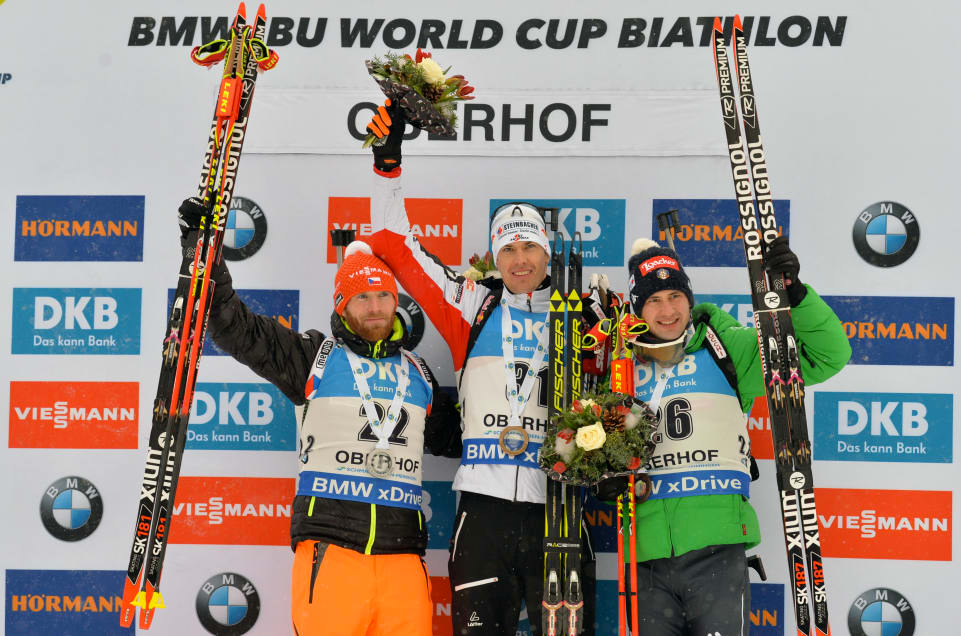
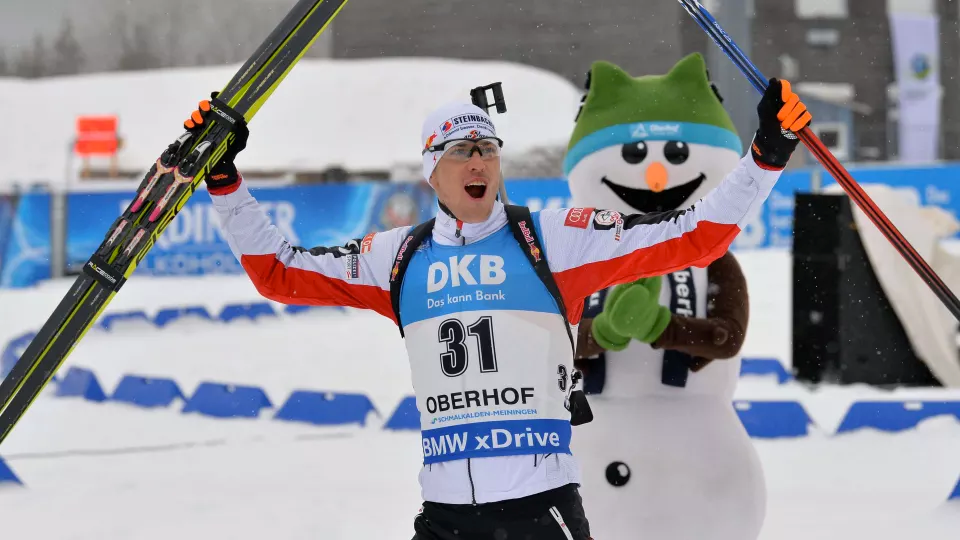
    Austria’s Julian Eberhard celebrating his victory in the men’s 10-kilometer sprint at the 2017 IBU World Cup in Oberhof, Germany. (Photo: IBU)
    Austria’s Julian Eberhard celebrating his victory in the men’s 10-kilometer sprint (along with the Oberhof snowman) at the 2017 IBU World Cup in Oberhof, Germany. (Photo: IBU)

    Even Martin Fourcade is a mere mortal who can’t win every race he competes in. After winning the first three sprints of the 2016/2017 season and five races in a row, for once the French biathlon star had to settle for an eighth place after uncharacteristically missing three targets in his standing shooting stage.

    That left an opening for other athletes to shine on Thursday afternoon in the men’s 10-kilometer sprint at the International Biathlon Union (IBU) World Cup in Oberhof, Germany. Austria’s Julian Eberhard seized the opportunity and won the second sprint of his career in a time of 26:57.5 minutes, skiing the second-best course time, ahead of the Czech Republic’s Michal Slesingr (+10.8) and Italy’s Dominik Windisch (+40.3). All athletes on the podium had to ski one penalty lap.

    “I rescued myself into the finish with my last power,” Eberhard told Austrian broadcaster ORF. “The competition could not have been any longer. Of course I am overjoyed now. That was an important victory, also regarding the World Championships at home in Hochfilzen [in February].”

    A year ago, all races in Oberhof had to be canceled due to a lack of snow. After the organizers invested significant resources in snow-farming and storage capacities over the summer to prevent that from happening again, ironically two days ago the first heavy snowfalls of the season and one of the most severe winter storms in a decade that devastated the northern coast of Germany posed different challenges for the organizers: additional volunteers were needed to help prepare the tracks overnight, or simply to sweep snow off the seats in the arena.

    “The conditions were really difficult,” Eberhard said during the post-race press conference. “Because there was a lot of fresh snow, and a lot of wind. But I like that. So I think it was a difficult but really good day for me.”

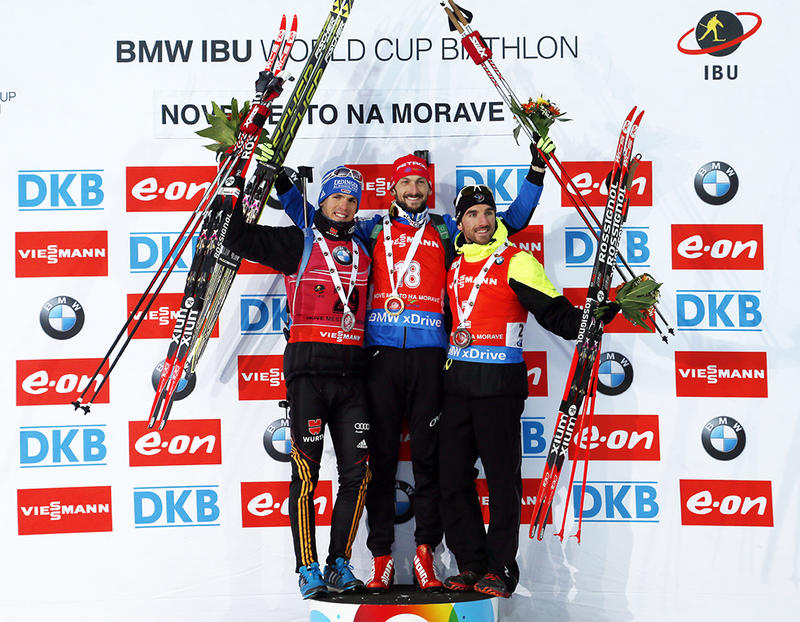
    (Left to right): Czech Republic’s Michal Slesingr (second place), Austria’s Julian Eberhard (first place) and Italy’s Dominik Windisch (third place) on the podium for the men’s 10-kilometer sprint at the 2017 IBU World Cup in Oberhof, Germany. (Photo: IBU)
    (Left to right): Czech Republic’s Michal Slesingr (second place), Austria’s Julian Eberhard (first place) and Italy’s Dominik Windisch (third place) on the podium for the men’s 10-kilometer sprint at the 2017 IBU World Cup in Oberhof, Germany. (Photo: IBU)

    “Today, I was quite relaxed during the race,” Slesingr said at the press conference when asked about the difference to last racing at home in Nove Mesto. “Because I did not think about that race before too much. It was like I’m just going around the stadium and think ‘whatever, let’s do the race’. So I didn’t feel any pressure today.”

    Slesingr smiled when asked if training in Oberhof during the summer maybe gave him an advantage, clarifying that his team mainly comes there to train in a ski tunnel near the venue.

    “We don’t use the shooting range outside too much, so I can’t say that it helped us. In the tunnel you always have perfect conditions for shooting. No wind, no snowing like today.”

    Late in the field in bib 70, Italy’s Lukas Hofer challenged for the podium after shooting clean, but he missed the time set by his teammate Windisch by one-tenth of a second at the finish (+40.4). It was Hofer’s best individual result since the 2013/2014 season, and Windisch’s second-career podium.

    “Like an old saying… Start your day right… we just say “Start your year right” Hofer posted on social media with a picture of the Italian team celebrating the third and fourth place.

    “I watched it while I was in the changing room,” Windisch recalled during the press conference. “When I saw that he was with me, at the same time, I thought maybe he will beat me. But at the end of the competition maybe I was a little bit faster. I am happy, but most of all I am happy for the whole team because this is a really good position for Italy. […] I really thought that someone would beat me, so until the end I was very surprised. And I still am.”

    Behind Windisch and Hofer, Germany’s Erik Lesser finished fifth (+41.2) with two penalties in standing, after shooting clean and taking the lead following the prone stage. He was satisfied with the result, but the athlete living and training near Oberhof gave some insights into how difficult it can be to race in front of a raucous home crowd.

    “I can’t complain about the fifth place,” Lesser told German broadcaster ZDF. “Especially with two misses I absolutely have to be satisfied with the result. On the course everything I worked for during the last days panned out. […] But I am a little annoyed about the two misses in standing. In Nove Mesto, we talked about the home field advantage for the Czech Republic, and then you see Gabriela Koukalová shoot 0+3 [in the sprint there], and I believe that’s how I also felt today in the standing stage. It was very quiet, I hit the first shot, and then there comes such a noise [from the stands] to the shooting range that it got me a little bit out of my concentration, which must not happen, so I am a bit angry about that.”

    “Conditions were not easy,” Martin Fourcade told ZDF about his shooting woes with three penalties on his way to an eighth place (+51.3). “I was struggling with the wind. It was not easy. This is not an excuse, but I had my zeroing on the [lane position] target number one and it was quite easy for the prone shooting, but we had no wind for the standing [in target practice] and it was something I didn’t succeed to manage for my standing position in real wind conditions.”

    Fourcade limited the damage for the following pursuit by once again skiing the fastest course time.

    Three North Americans Onto the Pursuit

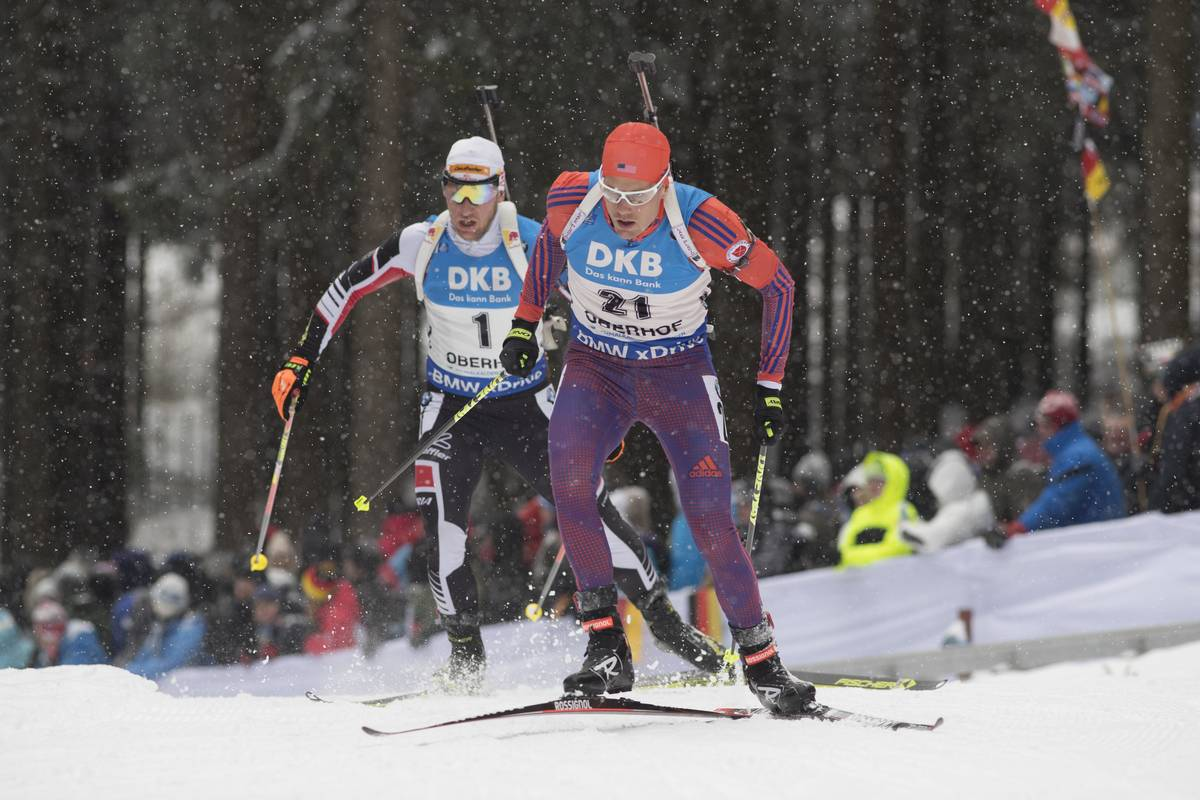
    US Biathlon’s Tim Burke (21) on the course during heavy snowfall during the men’s 10-kilometer sprint at the 2017 IBU World Cup in Oberhof, Germany. Behind him is Austria’s David Komatz. (Photo: USBA/NordicFocus)
    US Biathlon’s Tim Burke (21) on the course during heavy snowfall during the men’s 10-kilometer sprint at the 2017 IBU World Cup in Oberhof, Germany, leading Austria’s David Komatz. (Photo: USBA/NordicFocus)

    The best North American in the difficult conditions was Tim Burke, who finished 35th (+1:51.8) with two penalties (0+2).

    “The heavy snow and gusty wind made for a challenging race today,” Burke said according to a US Biathlon press release. “We were lucky that the snow stopped right before the start today, but this also made for some challenging conditions on the track throughout the race. I feel like I was lucky in prone with having little wind, but standing was a real fight with strong wind and it took me a long time to get all five shots off.”

    “Overall, I was pleased with my shooting performance today considering the windy conditions,” he added. “Unfortunately, I am far off my normal ski shape. I had one of my best training years, so I am a bit confused as to why I have been so flat racing, but I am confident that it will eventually come around. If we continue to have strong winds here in Oberhof, Saturday’s pursuit should present some great opportunities to move up.”

    Also for the U.S., Russell Currier placed 46th (+2:15.1) with three penalties (1+2), qualifying for his second pursuit of the season.

    In his return to the IBU World Cup after missing the first races of the season due to mononucleosis, last year’s junior world champion Sean Doherty finished 80th with three penalties (+3:20.2), missing out on the top 60 to qualify for Saturday’s pursuit.

    Lowell Bailey is skipping the races in Oberhof for a training block at home in Lake Placid, N.Y. He plans to join the team again next week for the World Cup in Ruhpolding, Germany.

    “I planned to skip Oberhof earlier this year when we laid out the seasonal training plan,” Bailey explained in an email to FasterSkier. “I wanted to put in a solid three-week block of training during the middle of the season so that I’m hopefully set up well for World Champs and the last half of the season. It’s tough to voluntarily sit out, but I think it is the right decision, and I hope it will pay off later on in the season.”

    For Biathlon Canada, Scott Gow had the best result of the day in 43rd (+2:11.9) with one miss (0+1) and was the only Canadian to qualify for the pursuit. Macx Davies finished 68th (+2:51.1) with two penalties (0+2), just ahead of teammate Brendan Green in 69th (+2:58.0) with four misses (3+1).

    In his second World Cup after one appearance last season in Presque Isle, Maine, Canada’s Matthew Hudec finished 90th (+3:50.8) with one penalty (0+1), and Christian Gow with three penalties (1+2) was 92nd (+3:54.7) in the field of 102 starters.

    The other regular North American team members, Canada’s Nathan Smith and US Biathlon’s Leif Nordgren, have not yet returned to the World Cup.

    Athletes-Only Meeting Regarding McLaren Report

    On the eve of the races in Oberhof, about 50 athletes from various teams reportedly gathered for an athletes-only meeting for about 90 minutes to discuss the current status of the IBU investigation into the findings of the report by World Anti-Doping Agency (WADA) special investigator Richard McLaren, which also lists 31 biathletes. From the side of the IBU, Secretary General Nicole Resch was present for about 15 minutes to discuss the current status of the internal IBU investigation and answer some of the most pressing questions from the athletes, before she was asked to leave the meeting again.

    Afterwards, few athletes in attendance wanted to go on record to the media about any details of questions and demands made towards the IBU before a concrete, common position had been agreed upon and written up for communication.

    From public statements by several athletes after the race on Thursday, it could be inferred that nations losing starting quotas in cases of multiple doping violations or organized manipulations could be one of them.

    Slesingr, reportedly one of the organizers of the meeting, along with Martin Fourcade and some others, told the gathered media members that the athletes don’t plan to boycott World Cup races, at least in Oberhof, but that “depending on how the IBU reacts [to our demands] we will then decide how we can increase the pressure again.”

    Furthermore, Slesingr explained that they have asked the IBU to state how many of the biathletes mentioned in the McLaren report are still active in IBU-sanctioned events, seemingly a topic that is contentious among the athletes potentially having to race against athletes under investigation.

    “We don’t want exact names, but a number,” he said. “Our demands mostly deal with how to protect our sport from doping and corruption in the future.”

    From the Russian team, the most prominent athlete present was Anton Shipulin, according to reports by German broadcasters ARD and ZDF.

    “I was asked many questions, but I also have more questions than answers myself,” Shipulin afterwards told the media, according to a translation. “I don’t want to wash dirty laundry in public. I asked all athletes for patience and to wait until after the IBU investigation. I can only say for myself: I have never doped. All my samples are clean.”

    “I don’t want to make statements regarding individual names,” Secretary General Resch told ZDF after the athletes’ meeting and a second one with team coaches. “We currently have to generate proofs out of the evidence, and I don’t know yet for which ones we will be able to succeed with that. And for someone where we don’t have concrete evidence available, dragging that name through the media as a positive doping case would be irresponsible and unprofessional. We don’t want to do that.”

    “It was a really constructive meeting yesterday,” Germany’s Schempp told ZDF when questioned about the situation after the sprint race. “Because the whole procedure was explained to us, the athletes, by the side of the IBU. That they are also not having an easy time with that, and that one should keep calm for some time. They are doing their best to clear that up, and to really not draw premature conclusions. I also believe that would be the wrong approach. We will see how that progresses, and will closely observe that, but I think this won’t have been the last meeting.”

    “In general this is not about pointing fingers at the Russians,” his teammate Lesser told ZDF. “This is about fighting the basic evil of doping with all force. The IBU has to define its own marching order for that, how it internally wants to deal with that. And I hope that this will be tackled with maximum force, that starting quota spots are being taken away after multiple offenses, and then you have to punish the nation and not just the individual athlete. And I hope the IBU will figure that out some time and go after that.”

    Races in Oberhof continue on Friday with the women’s 7.5 k sprint, followed by the men’s and women’s pursuits on Saturday. The times back to the winner from the sprint carry over into the pursuit race.

    Results

  • France Tops IBU World Championships Opening Relay in Oslo; U.S. 10th, Canada 11th

    France Tops IBU World Championships Opening Relay in Oslo; U.S. 10th, Canada 11th

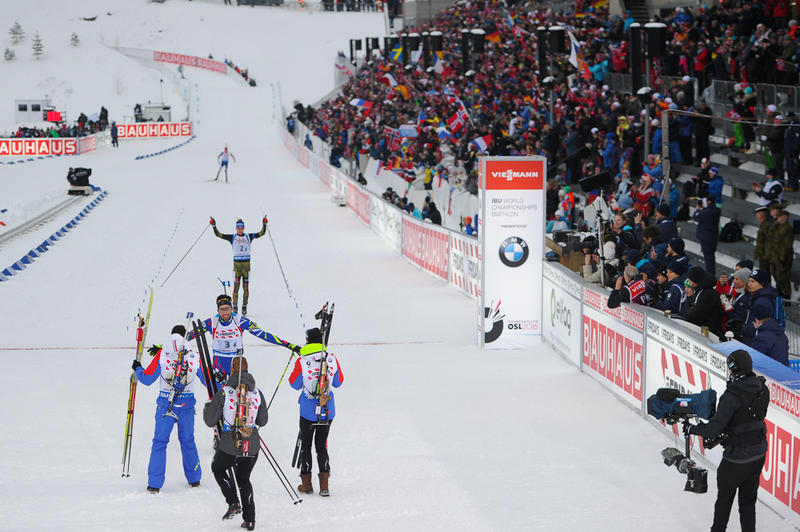
    France’s Martin Fourcade is greeted by his teammates after winning gold in the mixed relay to open the 2016 Biathlon World Championships in Oslo, while behind him Germany’s Simon Schempp crosses the finish line for the silver medal, and Norway’s Tarjei Bø comes onto the final stretch to claim bronze. (Photo: IBU/Evgeny Tumashov)
    France’s Martin Fourcade crosses the finish first to meet his teammates after anchoring the mixed relay to gold  to open the 2016 IBU World Championships in Oslo, Norway, Germany’s Simon Schempp secures second behind him, and Norway’s Tarjei Bø comes onto the final stretch to claim bronze. (Photo: IBU/Evgeny Tumashov)

    Martin Fourcade versus Simon Schempp: Two perennial rivals who still greatly respect each other’s performances, duking it out on the final loop of Thursday’s mixed relay.

    It was a fitting end to the first race of the 2016 International Biathlon Union (IBU) World Championships in Oslo, Norway, a finish sprint into the famous Holmenkollen ski arena with two athletes at the top of their game, in a repetition of a scene similar to what biathlon fans have witnessed repeatedly in recent seasons.

    This time, France’s overall World Cup leader Fourcade prevailed against Germany’s anchor, skiing over the last bridge in the stadium and taking a little bow in the style of a telemark ski turn. He crossed the finish line in 1:14:01 and celebrated the gold medal with his excited teammates. Combined, the four-person French relay had no penalties and seven spare rounds.

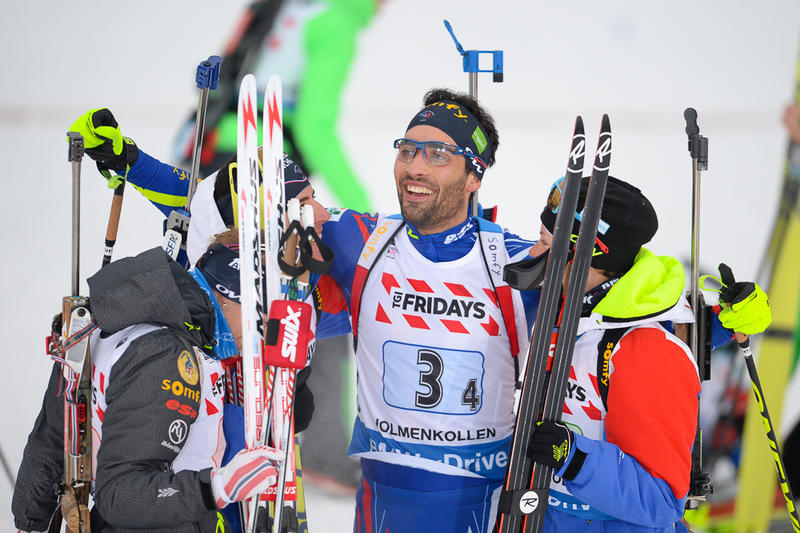
    Martin Fourcade celebrates with his teammates after anchoring France's mixed relay to gold in the first race of 2016 IBU World Championships in Oslo, Norway. (Photo: IBU)
    Martin Fourcade celebrates with his teammates after anchoring France’s mixed relay to gold in the first race of 2016 IBU World Championships in Oslo, Norway. (Photo: IBU)

    “Today was really emotional, because it was my first, our first victory in a team race in World Championships since 2009,” Fourcade said at the post-race press conference.

    “Of course we were among the favorites so we were thinking about [the gold medal],” Fourcade added in an interview with the IBU. “But in biathlon you never know until the last shooting. We were fighting for gold as well as for the fourth place.”

    Germany finished second, just 4.3 seconds back, and also with seven spares.

    “I tried to bring out everything I had, but in the end I honestly was too exhausted,” Schempp told German TV broadcaster ARD. “We are totally happy about silver.”

    “The way Fourcade threw himself into the snow afterwards, I think that shows Simon [Schempp] pushed him to his limits,” Germany’s third leg skier Arnd Peiffer told ARD. “Martin definitely didn’t have it easy on the final loop today … With that ‘telemark’ move he was just showing his excitement, that had nothing to do with arrogance.”

    Another 10 seconds back, Norway’s anchor Tarjei Bø secured the bronze medal for the home team (+14.4), with ten spares, to the huge joy of the audience.

    The U.S. finished 10th (+2:19.6), with five spares, falling back on the last three legs after starter Susan Dunklee rocketed through the first exchange in first place. Canada placed 11th (+2:30.8), with 11 spares, unable to quite keep up with the leaders throughout the race due to too many misses on the shooting range.

    After a festive opening ceremony at a central square in Oslo on Wednesday night, the Biathlon World Championships opened with the mixed relay, including two women and two men per team, with all other rules just like in a traditional relay.

    The two women begin, and each ski 6 kilometers with one prone and one standing shooting stage, while the men have to ski 7.5 k each. The athletes can use three spare rounds per stage, and if they fail to clean their targets with those spares, they have to ski a 150-meter penalty lap for every miss.

    The IBU first experimented with mixed relays 11 years ago as a special event during the World Cup finale. Since 2007, the discipline has been part of the official program at World Championships.

    Initially it was a bit of an afterthought, with a number of countries with large teams using it as an opportunity to give their lower-ranked biathletes a start at championships, and saving their best ones for the individual starts and the traditional women’s and men’s relays.

    That has changed in recent years, since the event also became part of the program at the 2014 Olympics in Sochi, Russia. This year in Oslo, small and larger teams alike certainly pulled out all the stops, with almost every nation entering the its best athletes.

    Low-hanging clouds and fog on the range had been predicted, but for Thursday’s competition, the view of the targets on the shooting range was actually clear despite a cloudy sky and a little fog shrouding the big ski jumps that tower over the Holmenkollen arena.

    The French team, with Anaïs Bescond, Marie Dorin Habert, Quentin Fillon Maillet, and Fourcade, initially hit a snag when Bescond required all spares to hit her targets in her standing stage, narrowly avoiding the penalty lap and coming through the exchange in seventh place, 35 seconds behind Dunklee.

    Then Dorin Habert crashed in a ski tunnel out on the course, in snow conditions some athletes described as “glazed” in certain sections.

    “Nothing terrible, it was just a mistake by me,” Dorin Habert said of her fall at the press conference.

    She quickly recovered and moved her team into third place at the next exchange, with Fillon Maillet and finally Fourcade able to close out successfully by pushing hard up the final small climb and U-shaped turn in the arena to create a little gap.

    Similarly to France, Germany’s starter Franziska Preuss initially lost 20 seconds to the top due to two misses in her first prone stage, but moved back up to fourth place at the exchange. Then Franziska Hildebrand and Peiffer kept the team in contention for the podium, before Schempp was able to claim the silver medal.

    Germany's Simon Schempp  after one of his shooting stages during Thursday's mixed relay at IBU World Championships in Oslo, Norway. He anchored Germany to second, 4.3 seconds behind France. (Photo: IBU)
    Germany’s Simon Schempp after one of his shooting stages during Thursday’s mixed relay at IBU World Championships in Oslo, Norway. He anchored Germany to second, 4.3 seconds behind France. (Photo: IBU)

    In his last shooting, Schempp thought he had hit all shots taking down his rifle to head back out on the course, before realizing he had missed one and — like Fourcade -– still had to use a spare. Schempp made his shot and left the range just 1.7 seconds behind Fourcade. While Schempp was able to catch up on the course, he did not have the energy left to beat his rival in the final sprint.

    Ahead of World Championships, fans and the media put a lot of expectations on the home team from Norway with Marte Olsbu, Tiril Eckhoff, Johannes Thingnes Bø and his older brother Tarjei Bø.

    At the 2014 Olympics, Norway had won the gold medal in the mixed relay, though only Eckhoff, who grew up just a stone’s throw away from the Holmenkollen arena, was a part of the lineup back then.

    In front of thousands of spectators, including Norway’s King Harald V, the team did not disappoint, with Olsbu and Eckhoff delivering some of their best performances of the season to tag off in second and first place, respectively. From there, the Bø brothers kept the team in podium contention.

    “I was very nervous,” Olsbu said at the press conference. “I am just so happy that I made a good race today.”

    Johannes Bø tried to make a move on his last loop, yet the other teams just behind him closed the gap again before the exchange.

    After needing all spares in his prone shooting on the anchor leg, his brother Tarjei fell back 18.4 seconds, but was able to reduce that again to 7.4 with fast skiing and a clean final shooting stage. While he tried everything in his power, he could not quite catch up to Fourcade and Schempp again.

    “Of course we are happy to have a medal at the Championships [at] home,” Johannes said during the press conference. “But we are athletes who want to win. So we are 90 percent happy [with bronze], and we take the last 10 percent next week.”

    “Simon and Martin were too strong for me,” anchor Tarjei Bø said.

    When a French journalist asked his rivals if Fourcade maybe gained a psychological advantage for the remainder of the World Championships after a win on Thursday, Tarjei Bø laughed and exclaimed: “Yeah, he is unbeatable. He’s so unbeatable that I will not race any more at these World Champs!”

    “That’s a good idea,” Fourcade replied with a big smile on his face.

    For a long time, four teams had been in close contention for the medals, but after a strong race Ukraine, with Valj Semerenko, Olena Pidhrushna, Sergey Semenov and Dmytro Pidruchnyi, could not quite keep up on the anchor leg with two spares in the last shooting. Ukraine finished fourth (+29.8), with nine spares.

    Fifth place (+1:07.1) went to Austria, with Dunja Zdouc, Lisa Theresa Hauser, Simon Eder and Dominik Landertinger, which combined for a team total of just three spares, the fewest of any nation. Meanwhile, the defending world champions in the mixed relay, the Czech Republic, with Veronika Vitková, Gabriela Soukalová, Michal Slesingr and Michal Krcmar finished sixth (+1:23.3), with five spares.

    Dunklee in the Lead

    Susan Dunklee (US Biathlon) trails France's Anais Bescond during the first leg of the mixed relay at 2016 IBU World Championships on Thursday in Oslo, Norway. Dunklee went on to tag off in first, 1.6 seconds ahead of Norway. (Photo: USBA/NordicFocus)
    Susan Dunklee (US Biathlon) trails France’s Anais Bescond during the first leg of the mixed relay at 2016 IBU World Championships on Thursday in Oslo, Norway. Dunklee went on to tag off in first, 1.6 seconds ahead of Norway. (Photo: USBA/NordicFocus)

    For US Biathlon, Dunklee started out strong, shooting clean in the first prone stage to leave in second behind France’s Bescond. Then she again hit all of her targets in standing to leave the range 4.5 seconds behind Norway’s Olsbu and Italy’s starter Dorothea Wierer (an athlete with multiple World Cup victories this season. Italy went on to finish eighth).

    This time, Dunklee was not satisfied just staying behind the athletes at the top, immediately attempting to overtake Wierer and move up to Olsbu.

    “I love the thrill of starting relays,” Dunklee wrote in an email after the race. “I have been close behind the leader tagging off many times, but I have never tagged off in first. On the last loop I was hungry to finally win my leg today and I wanted to give Hannah [Dreissigacker] the experience of leaving in the lead in front of a packed Norwegian crowd.”

    Of all the first-leg skiers, Dunklee’s course time was the fastest.

    “I do love the Holmenkollen crowds and the hilly course,” she wrote. “I felt relaxed and focused on the shooting range and felt very strong skiing. Our staff put together incredible skis today.”

    “I love the thrill of starting relays. I have been close behind the leader tagging off many times, but I have never tagged off in first.  I was hungry to finally win my leg today…” — Susan Dunklee, who put the U.S. in first at the first exchange on Thursday

    Dreissigacker initially was able to keep up on the course with France, Norway, Ukraine, and Germany at the top.

    “It was a fun race and definitely a real thrill [to] get the tag in first place,” Dreissigacker wrote in an email. “Susan really did us all proud out there. I did my best to ski my own race, but it’s always hard when you have lots of adrenaline and find yourself in first place.”

    After requiring a spare in prone, she was still in third place, only 1.7 seconds back. Then having more trouble maintaining the leaders’ pace on the next loop and with another missed shot in standing, she fell back 22.7 seconds to fifth place. On her final loop, Soukalová, the overall World Cup leader, passed her on the course, and Dreissigacker lost another half a minute to the leaders, tagging off in sixth, 51.3 seconds back.

    “I felt like I was in control on the first and second laps, trying to keep in touch with the leaders as much as possible without overdoing it,” Dreissigacker explained. “But I definitely didn’t have too much gas left in the tank for the last lap, and it didn’t help that I had really lost all contact with the women ahead of me. But that was also a group of the very fastest women in the world, so I am not surprised that they put lots of time on me in the last lap.”

    The U.S. team’s third leg, Lowell Bailey had a strong performance on the shooting range and stayed clean both times just like Dunklee, but continued to lose time on the course, and his course time ultimately ranked 19th of the third-leg skiers. He tagged off in eighth place, 1:35.5 minutes back.

    “The course was tricky today,” Bailey wrote in an email. “The new snow packed down and glazed, making some of the downhills and especially the stadium fairly treacherous. It wasn’t my best day on skis, but hopefully I’ll feel better as the Championships roll forward.”

    Anchoring the U.S. relay, 20-year-old Sean Doherty required a spare in both his prone and standing stages, and with the 16th-ranked course time on his leg, he slipped two positions to finish 10th (+2:19.6), one position ahead of Canada.

    “Today’s race was an exceptionally high level,” Doherty said in a US Biathlon press release. “We showed that we can shoot with the best teams and be very competitive. I am really happy with my leg and feeling strong looking ahead to the sprint.”

    Overall, the Americans were not quite satisfied with their race, after tying their 10th place from the first World Cup of the season in Östersund, Sweden, but finishing six places back from their team-best fourth at the last mixed relay in Canmore, Alberta.

    “The mixed relay is a format we often think of as one of our best medal hopes, so from that perspective our result today is disappointing,” Dunklee wrote. “After our 4th place in Canmore I think we all went into today with high hopes… On the range we put together an excellent performance, one of our best I would say. Tenth is solid, but we know with that good of [a] shooting we can be capable of much more. The good news is that we have many races still to come.”

    “It was just tough, tight competition out there and I think we had a really solid team performance,” Dreissigacker commented. “Using only 5 spares for the whole team is great shooting!”

    As Bailey pointed out, a top 10 is a top 10.

    “It is a tight field and we were close to the leaders for a significant part of the race,” he wrote.

    The Canadian team with Julia Ransom, Rosanna Crawford, Nathan Smith, and Brendan Green was hoping to build on its ninth place in the mixed relay in Östersund, Sweden, and sixth place at home in Canmore.

    On Thursday, Ransom started in bib 5, and had some trouble to keep up with the leaders. With one miss in both her prone and standing stages, she found herself 36.5 seconds behind going onto the final loop, and then lost more time to tag off in 11th place, 1:03.4 minutes back.

    Crawford was able to maintain the pace with the seventh-best course time on her first loop, before dropping off a bit the third time around the Holmenkollen 2 k course.

    “It was nice on those first two laps to be working with Sweden and trying to stay with Soukalová,” Crawford wrote in an email. “I had a tumble on the same hill as Dorin [Habert] in warm up and broke a pole, but the race was smooth and I didn’t have to deal with any sketchy people on the downhill.”

    But she couldn’t make up positions or time with a miss in her prone shooting and two spares in the standing stage, where she had some additional issues.

    “I had some trouble with standing where my shell got stuck, and I wasted some time getting that fixed, and then missed two targets on top on that,” Crawford wrote. “So I am quite disappointed with my shooting. Getting the jitters out before Saturday’s race though hopefully!”

    She handed off in 14th place, 1:27.7 back.

    Currently the highest-ranked Canadian on the World Cup, Smith skied fast on the course, posting the fifth course time on his leg.

    “I’m very happy with my skiing today,” Smith wrote in an email. “I’ve been struggling over the last 7 weeks to feel good on the skis. I wouldn’t say I felt like a total beast skiing, but I knew my shape was good just because I was able to more or less maintain position with top guys like [Russia’s] Garanichev and [Austria’s] Eder… I don’t actually particularly like this arena. I find the gentle ramp through the stadium surprisingly challenging. The ski loops are interesting though, and obviously great views.”

    But like his teammates, he could not quite stay clean on the range, requiring two spares in prone and another one in standing.

    “Shooting conditions were perfect,” Smith stated. “Very little wind and no fog. Earlier in the day it looked nasty but everything cleared up for us.”

    Smith moved up the team a few positions to tag off in 10th (+1:35.9).

    “I wouldn’t say I felt like a total beast skiing, but I knew my shape was good.” — Nathan Smith, who skied the fifth-fastest course time on the third leg to bring Canada from 14th to 10th

    Canada’s anchor, Green also did not have a perfect day on the range, needing one spare round in prone and two in the final standing stage. Combined with his skiing (13th ranked course time), he lost some additional time to the top, with Canada closing out the race behind the U.S. in 11th place, 2:30.8 behind the winners.

    “In my portion of the race there wasn’t anything too out of the ordinary,” Green wrote in an email. “The track was really glazed in some sections and the skiing in general felt like a bit of a balancing act at times.

    “There has been a bit of wind during the last few days [of] training, but it dropped a bit this afternoon which was nice,” he wrote of the shooting conditions. “A slight but manageable wind from the left. I was a bit worried about the fog that was lingering throughout the day but fortunately it moved off and the range was clear.”

    Asked if their team result was within expectations, Crawford wrote, “11th is a disappointing result for our team, we are capable of a top 8 on an average shooting day and for sure top 6 if we all have a great day on the range. 11 spares is not a normal day for our team I’d say.”

    “11th is nothing to write home about but still a decent result,” Smith stated. “We knew everyone would be putting in their best teams.”

    “Overall, today wasn’t a true representation of what our team is capable of,” Green wrote. “It’s day one of the Championships and I know we’re all hungry for more.”

    Races in Oslo continue on Saturday with the first individual races: the men’s and women’s sprints. All races as well as shorter recaps can be streamed live or time-shifted (most with English commentary) on Eurovision Sports.

    Some will also be broadcast in the U.S. on NBC Sports, according to a schedule US Biathlon posted.

    “I just want to get one [individual] title, that’s my aim,” Fourcade said at the press conference.

    “The atmosphere was great!” Bailey wrote. “Cheering along the track and extremely loud in the stadium. I think it will be even bigger on the weekend.”

    “On Saturday we’ll come out fighting,” promised Green. “The atmosphere was pretty awesome today. The stands were full and the stadium was loud. It’s a good vibe and if today is any indication, we’re going to be in for a fun couple weeks of racing.”

    Results

  • Smith Sees the Light with Best-Ever Seventh; Fak Fastest Sharpshooter in Nove Mesto Sprint

    Smith Sees the Light with Best-Ever Seventh; Fak Fastest Sharpshooter in Nove Mesto Sprint

    Nathan Smith racing in August in the men's 10 k sprint at the 2014 North American Rollerski Championships in Jericho, Vt.
    Nathan Smith racing in August in the men’s 10 k sprint at the 2014 North American Rollerski Championships in Jericho, Vt.

    Note: This article has been updated to include emailed comments from Nathan Smith.

    Seventy-eighth. That’s where Nathan Smith finished in the last IBU World Cup 10-kilometer sprint before Saturday’s race. And while the 29-year-old Canadian would probably very much like to forget that result in Antholz, Italy, it was a marker of how far he’d come in just over two weeks with some quality time spent training.

    “January was a tough month of shooting and I felt like I was hitting my head against a brick wall trying to knock the targets down,” Smith told Biathlon Canada after Saturday’s 10 k sprint in Nove Mesto, Czech Republic. “Even though I was trying hard it just wasn’t happening. After the last World Cup I decided to take a week off shooting, and thought of some key points to focus on – relaxing into the position and slowing things down a touch.”

    While training in Antholz, he fell on his chest and hurt his back, aggravating an injury he sustained three years ago while rollerskiing, he explained in an email on Sunday morning.

    “That made it really hard to ski for a few days and racing was pretty painful,” Smith added. “I focused a lot during the break getting my back to relax and stretching a lot. Aside from that I just revised a little bit of volume training to help maintain my fitness through the rest of the season.”

    He also did’t touch his rifle during that time.

    “I decided to not touch my rifle at all during the break and let thing reset,” Smith wrote. “When I picked it up again I made a big effort to focus on relaxing…”

    Nathan Smith (Biathlon Canada) (Photo: http://olympic.ca/team-canada/nathan-smith/)
    Nathan Smith (Biathlon Canada) (Photo: olympic.ca)

    So with some, but not too much restraint, Smith forged ahead on Saturday, starting 25th on a crystal-clear-yet-windy day and ultimately finishing seventh for his career-best World Cup result. Earlier this season, he placed ninth in the mass start in Pokljuka, Slovenia, and ninth in the sprint in Östersund, Sweden, but seventh was a new high.

    He finished 37.7 seconds behind Saturday’s winner, Jakov Fak of Slovenia, who rounded the course in 24:09.9. Fak hit all 10 of his targets, as did Smith. In fact, seven of the top-eight men cleaned (with the exception of France’s Martin Fourcade, who missed one standing).

    “Today the top men shot amazingly well which makes for a very tough day to medal when you aren’t within the top-five or 10 skiers,” Smith said. “A medal may have been possible if I’d also had the ski of my life today, however, the odds of perfect shooting and skiing coming together are pretty low. A more likely way to grab a first podium is to put yourself in a position where you can capitalize on a day when the favourites falter.”

    He passed two people during the race, yet Smith knew that didn’t exactly indicate how fast he was moving.

    “There was a glory train of athletes starting behind me so I knew it must’ve been pretty good if no one passed me,” he wrote. “The techs were giving me info the entire time so I knew I was fighting for a top 10 and that a medal wasn’t too far away.”

    Both his range and shooting times ranked fifth overall, and he was 23rd-fastest on course throughout the three-lap race.

    “My skiing felt strong but I can definitely give a little more,” he reflected. “The difference was shooting 10-for-10 today and I will try and reflect on that in the future.”

    Smith has seen his share of top 15’s on the international scene; at his first Olympics last season, he placed 11th in the pursuit and 13th in the sprint in Sochi, Russia. He’s also recorded five top-10 World Cup results in the last two years. He credited his success this season in part to his teammates.

    “Rosanna [Crawford] had an amazing first trimester, and Brendan [Green] really came into his own in Ruhpolding and Antholz. All three of us have been very close to the podium the last couple of years, and it’s a bit of a friendly competition to see who will do it first,” he said.

    “Today reaffirmed that my form is still there and that I can shoot really well,” he wrote. “It gave me some good confidence for the next couple world cups and leading to world champs.”

    “I decided to not touch my rifle at all during the break and let thing reset. … When I picked it up again I made a big effort to focus on relaxing.” — Nathan Smith, after career-best seventh in IBU World Cup sprint on Saturday

    Slovenia's Jakov Fak shot 10-for-10 and skied faster than anyone else to win Saturday's 10 k sprint at the IBU World Cup in Nove Mesto, Czech Republic. (Photo: IBU/Květoslav Frgal)
    Slovenia’s Jakov Fak shot 10-for-10 and skied faster than anyone else to win Saturday’s 10 k sprint at the IBU World Cup in Nove Mesto, Czech Republic. (Photo: IBU/Květoslav Frgal)

    Ahead of Smith, Fak started 18th and ended up with the fastest-overall course time. He took his time on the range, hitting all his targets with the 60th-ranked range time out of 94 men.

    Fak rose from fourth after his first stage to first with another clean shooting bout, skiing faster than Germany’s Simon Schempp, who started 29th. Schempp ended up second with perfect shooting, 12.8 seconds behind the Slovenian.

    “It was important to shoot zero because in Antholz I missed the last shot,” Fak told the IBU after the race. “Today I hit it and could run my own race.”

    The second starter, Jean-Guillaume Béatrix of France shot 10-for-10 and initially led at the finish before Fak crossed the line 26 seconds faster. Fourcade skied the second-fastest course time to counteract his single penalty and finished fourth, 0.3 seconds after Beatrix.

    The men's 10 k sprint podium at the IBU World Cup in Nove Mesto, Czech Republic: with Slovenian winner Jakov Fak (c), German runner-up Simon Schempp (l), and France's Jean-Guillaume Béatrix in third. (Photo: IBU/Květoslav Frgal)
    The men’s 10 k sprint podium at the IBU World Cup in Nove Mesto, Czech Republic: with Slovenian winner Jakov Fak (c), German runner-up Simon Schempp (l), and France’s Jean-Guillaume Béatrix in third. (Photo: IBU/Květoslav Frgal)

    Michal Slesingr of the Czech Republic was another 0.4 seconds back in fifth with clean shooting, and Russia’s Anton Shipulin cleaned for sixth, 29.5 seconds behind the winner.

    Smith initially finished fourth, then was bumped to seventh by Fourcade, Schempp, and Shipulin respectively. He ended up 8.2 seconds away from sixth and a spot at the awards ceremony.

    “He showed great consistent skiing in all three laps,” Biathlon Canada Head Coach Matthias Ahrens wrote in an email, “and displayed again his strong shooting efficiency which showed in his personal best result of finishing 7th in a [World Cup].”

    In all, three Canadian men made the top 60 to qualify for Sunday’s pursuit: Green placed 22nd (+1:12.8) with a single standing penalty, and 22-year-old Macx Davies finished 54th (+2:20.9) with one prone miss. That result tied Davies’ season best after he placed 54th in the World Cup sprint in Oberhof, Germany.

    Canada’s fourth man, Scott Gow placed 63rd, 2:35.7 back from the winner and 3.8 seconds out of 60th with two prone penalties.

    “It would have been nice to qualify all 4 men for the pursuit tomorrow, Scott Gow just missed it by a small margin,” Ahrens wrote. “Happy that Macx was able to continue in good form which he started at [IBU Open European Championships]. I am looking forward to next week’s relays since I believe we have a nice mixed team of eager younger and older more experienced athletes who supplement each other quite well.”

    Macx Davies racing in the 2013 North American Biathlon Rollerski Championships 12.5 k pursuit in Jericho, Vt.
    Macx Davies racing in the 2013 North American Biathlon Rollerski Championships 12.5 k pursuit in Jericho, Vt.

    Last Sunday at the European Championships in Otepää, Estonia, Davies led Canada in 27th in the 12.5 k pursuit.

    “I am elated to finally pull my shooting together after some crazy conditions in Otepaa,” Davies wrote in an email. “My skiing felt good, I spent most of the race pushing myself harder and harder. Until I felt like I was at the redline for my whole final loop.”

    He set two personal goals on Saturday: to shoot 10-for-10 and make the top 40 to score World Cup points.

    “Though I didn’t quite achieve either of these I still feel happy with my performance today and am excited to race tomorrow,” he wrote.

    Davies will start Sunday’s 12.5 k pursuit 2:21 behind Fak in first; Smith will head out 38 seconds back in seventh, and Green will start 1:13 back in 22nd.

    “Today was another good result for me and it sets me up well for tomorrow’s pursuit,” Green wrote in an email. “It’s a tight race amongst the top 30 and tomorrow will be another good opportunity. The shooting will be especially important for me tomorrow if we continue to face more wind.”

    After Friday’s mixed relay, in which Green skied a penalty loop and used three spares to anchor Canada to 14th, he was looking for more.

    “I knew today that I would have to step up my game,” he wrote. “I knew with the wind we’ve been experiencing here that the shooting would be challenging so I really tried to make each shot count. It’s a tough race course here as well and I tried hard to make time in the areas that I thought played into my ski strengths.”

    He ended up rising from 34th overall after prone to 28th after missing his lone shot of the day in standing, and closed his last lap with the 17th-fastest course time to place 22nd.

    “My skiing was better than yesterday. I definitely pushed and made myself hurt more on course, and at the same time tried to focus more on areas such as the gradual climbs that I felt would play more into my strength while skiing,” Green added. “I was happy shooting 9/10.”

    Results

  • Nordgren’s Solid Shooting Lifts U.S. in Mixed Relay; Doherty Anchors Team to Seventh

    Nordgren’s Solid Shooting Lifts U.S. in Mixed Relay; Doherty Anchors Team to Seventh

    Leif Nordgren (US Biathlon) raced the third leg of Friday's IBU World Cup mixed relay to put his team in fourth heading into the final exchange in Nove Mesto, Czech Republic. The U.S. ended up seventh. (Photo: USBA/NordicFocus)
    Leif Nordgren (US Biathlon) raced the third leg of Friday’s IBU World Cup mixed relay to put his team in fourth heading into the final exchange in Nove Mesto, Czech Republic. The U.S. ended up seventh. (Photo: USBA/NordicFocus)

    Note: This article has been updated to include comments from U.S. anchor Sean Doherty.

    Friday’s mixed relay had to have been one of Leif Nordgren’s best races of all time. Just last week, the 25-year-old US Biathlon A-teamer skied up from 51st to 19th in the men’s 12.5-kilometer pursuit at IBU Open European Championships in Otepää, Estonia, but US Biathlon Chief of Sport Bernd Eisenbichler didn’t see that race in person.

    What he did witness was one of Nordgren’s most memorable performances in the mass start at 2011 World Championships in Khanty-Mansiysk, Russia, in which he placed 17th with three misses. And that rivaled what he did on Friday as the third of four legs in the 2 x 6 + 2 x 7.5 k mixed relay.

    Nordgren brought the U.S. from 10th to fourth before the final exchange with clean prone shooting and a single standing miss. He used his spare to clean that stage and left the range for the last time in fourth, about a minute and a half behind the three race leaders (Norway, Ukraine and the Czech Republic).

    “You have to give a really big compliment to Leif today; he had world-class shooting today,” Eisenbichler said on the phone after Friday’s race, the second of two mixed relays (with Annelies Cook and Tim Burke placing ninth for the U.S. in the single mixed relay).

    “I never saw him in as good running shape as 2011 at World Championships … For sure, this was his best performance, and from 2011 to now, that’s four years so that’s really encouraging,” he added. “I’m extremely happy with where he is right now and I think he’s still going up to [2015] World Championships.”

    Sean Doherty hung in fifth for most of Friday's mixed relay at the IBU World Cup in Nove Mesto, Czech Republic, before finishing seventh. (Photo: USBA/NordicFocus)
    American Sean Doherty hung in fifth for most of Friday’s mixed relay at the IBU World Cup in Nove Mesto, Czech Republic, before finishing seventh. (Photo: USBA/NordicFocus)

    Building on the foundation teammates Susan Dunklee and Hannah Dreissigacker laid as the first and second legs, respectively, of the Americans’ mixed relay on Friday, Nordgren tagged Sean Doherty in fourth.

    The 19-year-old Doherty anchored them to seventh, 2:23.8 behind the Norwegian winners (Fanny Welle-Strand Horn, Tiril Eckhoff, Johannes Thingnes Bø, and Tarjei Bø) and 0.2 seconds behind Germany in sixth.

    “We were only two-tenths of a second out of the flower ceremony today, which is an exciting accomplishment, and it also makes us very hungry for more,” Dunklee wrote in an email. “Everyone skied very well today, and the guys did some fantastic work with the shooting.”

    Dunklee used a total of four spares (two on each stage) to put the team in fourth after the first leg. She handed off to Dreissigacker, who used five spares (three prone and two standing) to tag Nordgren in 10th. Nordgren used just one spare, and Doherty used one in prone and two more in standing to finish seventh with a team total of 13 spares.

    “I was really happy with the race today for my part,” Nordgren wrote in an email after posting the fifth-fastest course time and fifth-fastest range time on the third leg. “This whole year I’ve struggled to put both good shooting and good skiing together on the same day. Today I did just that, so I think I can be happy that things seem to moving in the right direction as we approach [World Championships] in Finland.”

    Dunklee raced the fastest time of all 22 starters, leaving the range in 17th after her first shooting and improving to 10th before her last lap. By the time she got to Dreissigacker, Dunklee was up to fourth.

    “I always expect Susan to crush it and pass people like crazy and tag off near the front,” Dreissigacker wrote in an email. “That’s normal for her. But she really outdid herself with the passing today! I had to laugh when I saw how much she’d moved up by the time I’d made my way over to the exchange zone. I was psyched!”

    “I used more spares than I would have liked and channeled the frustration from the range into speed on the ski track,” Dunklee explained. “At the start of the second loop, I forgot entirely about pacing for a couple minutes and focused solely on regaining contact with the main pack.  Then my body reminded me that that wasn’t a sustainable pace.”

    She spent her last loop trying to ski “smarter” and save energy for the last climb. Leaving the range, she caught Switzerland’s Elisa Gasparin then slingshot by her before the last uphill.

    Dreissigacker reflected that her first lap skiing in the top four felt fast, “but I wasn’t really feeling too much…so I was able to go harder than I maybe should have,” she wrote.

    She seized the chance to ski behind France’s Marie Dorin Habert on her first lap, then slipped to seventh after her first shooting.

    “I think that the wind was a bit variable on the first stage, but mostly I just wasn’t super well-settled,” Dreissigacker wrote. “I’ve been having a bit of a prone-shooting slump for the last few days, so I’m hoping to improve on that.”

    Feeling the fatigue start to set in on her last two laps, Dreissigacker reminded herself how much she liked the course and “kept fighting.”

    “In standing, I felt good through the first 5 shots, but had one close miss and then I got shaky shooting spares,” she wrote. “I accidentally fired one spare way too early when I wasn’t even on target, so I was just happy to hit that last one!”

    Pushing to stay with Russia’s Ekaterina Shimulova on the last lap, Dreissigacker wasn’t able to do so and tagged Nordgren in 10th, 13 seconds behind Shimulova in eighth and 11.6 seconds back from Italy’s Federica Sanfilippo in ninth.

    “I wanted to stay with [Shimulova] and catch up to the pack ahead so that Leif would have a good pack to ski with,” Dreissigacker wrote. “Luckily he had an awesome day and managed to catch the pack all by himself. The rest of the team did so well and it was really fun to watch the rest of the race and cheer as I cooled down.

    “It was such an exciting finish!” she added. “Sean did awesome…and in a year or two, if not way sooner, he’ll be winning those photo-finishes.”

    For Nordgren, fast skis helped, he explained, as he caught the group ahead of him on the first loop.

    “I felt totally in control the first two loops, and I was able to push hard the last loop also,” he explained.

    Nordgren added that by the end of last week, he could already feel like his shooting was starting to come around. He felt similarly about his ski shape: “I had glimpses of good shape in Antholz, but with an additional 3 races in Estonia I think it really forced that good shape to come back a little quicker,” he wrote.

    “I really like that tracks here in Nove Mesto, I think they suit me perfectly, combine that with the near perfect snow conditions that we’ve had all week, and it just makes it really nice skiing,” Nordgren added. “As a team we all decided last night that we’d like to finish ahead of our bib number (7). So it was really close today, everyone from the team put in a really good effort, but sometimes it comes down to a few cm!!”

    Doherty hung in fifth for most of his race before France’s Martin Fourcade and Germany’s Benedikt Doll passed him before the finish. The youngest member of the U.S. team, Doherty pushed to stay with them, but finished 2.3 and 0.2 seconds back, respectively.

    “Funny thing, from where the warm up track is here in Nove Mesto you are a little bit out of the action, so I did not really know how well Leif was doing until I got into the start pen,” Doherty wrote in an email. “I was excited to be in such a good position, it is a great challenge and I am feeling good on the skis so I was excited to go against the other top athletes.

    “Really I just tried to keep a good pace,” he added. “For standing I was trying to focus on the good things that I had been working on in training. It did not work out as well as it could have but that is biathlon and it was still a good fight to the line. … I am very happy with my personal performance, I am feeling stronger and stronger on the skis. As for the team overall it is great. It is nice to have everyone at full health and it is a good sign that our program is improving as a whole.”

    At the end of the day, Eisenbichler was pleased, especially with both the team’s single mixed relay and four-person mixed relay finishing in ninth and seventh, respectively.

    “Top 10 is really something we should always reach for,” he said. “It was really, really tight, especially in the mixed relay.”

    An exhausted Tarjei Bø (2) celebrates his win for Norway in the 2 x 6 + 2 x 7.5 k mixed relay on Friday at the IBU World Cup in Nove Mesto, Czech Republic. He held off Ondrej Moravec of the Czech Republic by four seconds.
    Tarjei Bø  celebrates his win for Norway in the 2 x 6 + 2 x 7.5 k mixed relay on Friday at the IBU World Cup in Nove Mesto, Czech Republic. He held off Ondrej Moravec (l) of the Czech Republic by four seconds.

    Norway won the four-person relay in 1:12:49.2 with six spares, holding the Czech Republic (with Veronika Vitkova, Gabriela Soukalova, Michal Slesingr, and Ondrej Moravec) by 4.1 seconds. The Czechs used five spares, and Ukraine (Iryna Varvynets, Valj Semerenko, Dmytro Pidruchnyi, and Sergey Semenov) held tough for third (+1:21.3) with one penalty (from Semenov on his prone stage) and seven spares.

    “Moravec is one of the fastest standing shooters, so today I wanted to show Moravec that I am the fastest,” Norway’s anchor, Tarjei Bø, told the IBU.

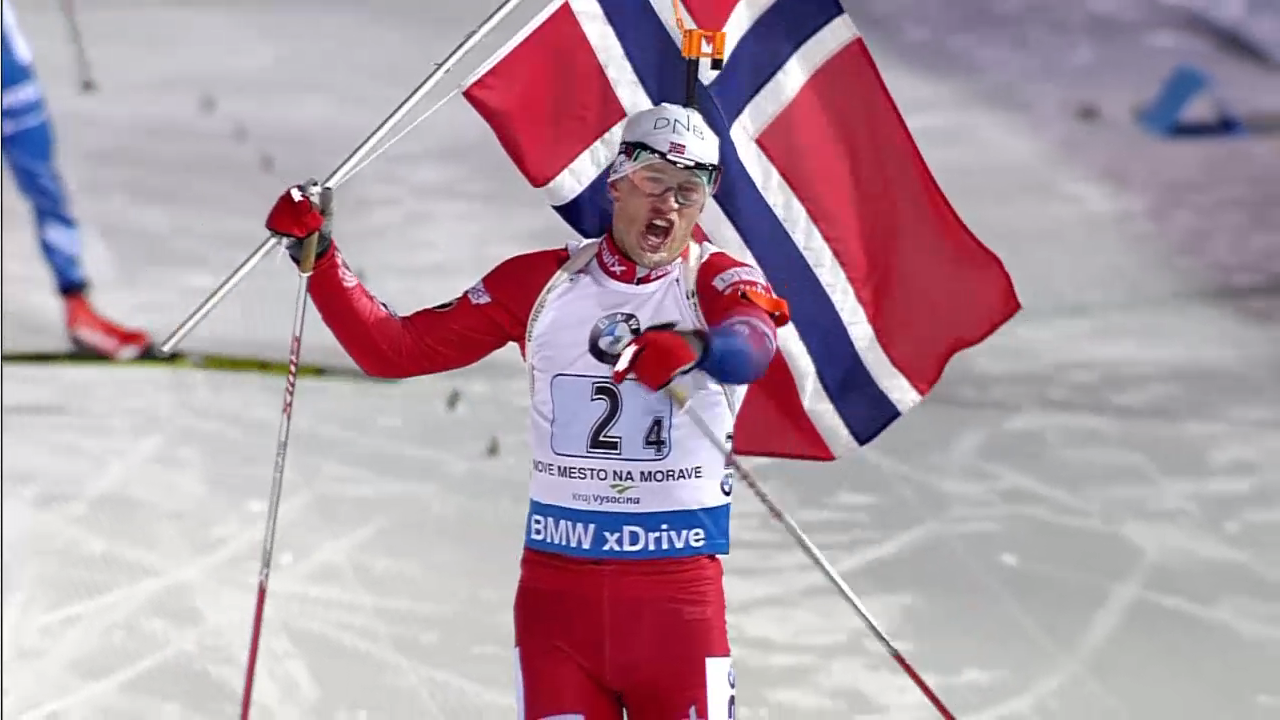
    Using just one spare in prone and cleaning standing, he took the lead by 13.9 seconds with one lap remaining. Moravec, who used one spare on his last stage, closed on him in the final kilometers to come within four seconds of Bø, who had enough time to grab a large Norwegian flag before the finish.

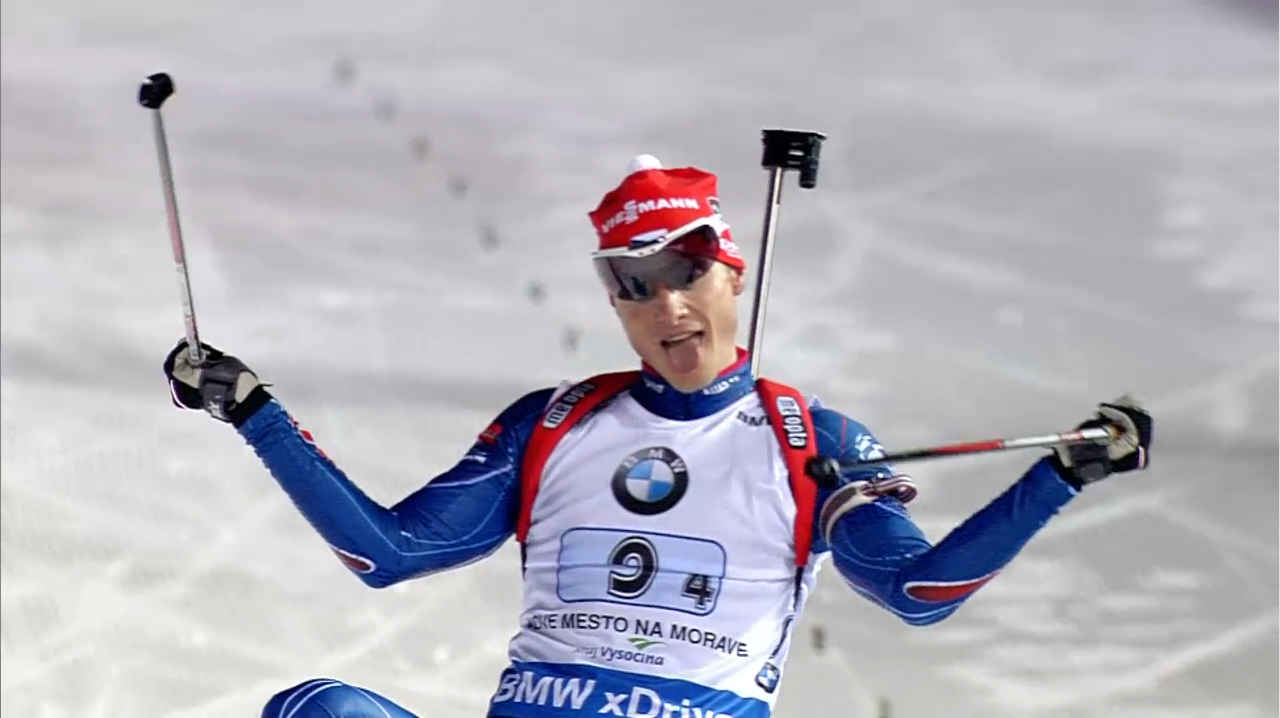
    Czech Ondrej Moravec mocks Russia's Alexey Volkov's finish-line celebration after Moravec finished second in Friday's mixed relay. Earlier that afternoon, Volkov anchored Russia to the single mixed relay win.
    Czech Ondrej Moravec mocks Russian Alexey Volkov’s finish-line celebration after Moravec finished second in Friday’s mixed relay. Earlier that afternoon, Volkov anchored Russia to the single-mixed-relay win.

    “I think we can be really happy with second,” Slesingr told the IBU. “[Ondrej and I] spent a little more time in standing … Before the race we would have been happy with second so there is no disappointment … We were able to give something back to all of the fans who came here … we can feel their support that has made biathlon almost the number one sport in Czech Republic.”

    Russia placed fourth, France was fifth and Germany was sixth.

    Canadians 14th

    Canada skied in the top 15 throughout the race with Audrey Vaillancourt, Rosanna Crawford, Nathan Smith, and Brendan Green ultimately placing 14th (+5:12.3).

    “Overall I think the team had a rough day, we all seemed to have problems with our standing shooting,” Vaillancourt wrote in an email.

    After her first mass-start experience on the World Cup, she cleaned the first shooting, but used three spares in standing to tag Crawford 1:28.4 back in 14th.

    “I had a good start, but on the second hill a girl stepped on my pole and it fell off my hand. I had to go backwards to get it back and therefore lost the pack,” Vaillancourt explained. “Then I tried to catch up, but couldn’t do it before the first shooting.

    “Skiing felt good, but I had a hard time making up for the time I had lost,” she added. “It might have affected my standing shooting. I wanted to get in, clean, and leave as fast as I could, but it didn’t work out so well. Instead I ended up using 3 spares.”

    Her skiing felt better than in past weeks, she added, after her team spent a week of training “on lots of real snow” in Mittenwald, Germany.

    Crawford explained she was starting to feel like her “old self” as well on Friday, after she skied the 10th-fastest course time of the second-leg skiers. She used two spares on her first stage, and then used three more and had a penalty loop after standing.

    “I wanted to catch the pack of three just in front of me so I could have someone to ski with. That worked but then I lost what ever I had gained with poor shooting,” she wrote.

    Crawford handed to Smith in 15th, 2:30 back.

    “I was a bit surprised by the analysis. I thought I skied better than it looks on paper,” she wrote. “But hopefully this will just have gotten all the gears running again and tomorrow [the sprint] will be better. It’s a really hard 2.5km course. One of the tougher ones on [World Cup] I’d say. So good technique and proper pacing will be important. But it’s also only 3 loops so you have to be sharp!”

    Smith cleaned prone to bring Canada up to 13th, but used two spares in standing and dropped one spot on the last lap to 14th. Green kept them there, with a clean first stage but had three spares and one penalty on his last shooting. He finished 14th, more than a minute and 10 seconds behind Italy in 13th.

    “We had little hiccups starting with Audrey loosing a pole and loosing contact to the group, Rosanna having a penalty loop, Brendan having a penalty loop, Nathan not being able to stay with [Austria’s Julian] Eberhard when he was passed,” Biathlon Canada Head Coach Matthias Ahrens wrote in an email. “Anyhow I believe we could be where the US team was today whom I congratulate for a great race by all members.”

    “I think we’re disappointed. But are looking forward to the weekend,” Crawford wrote.

    Results

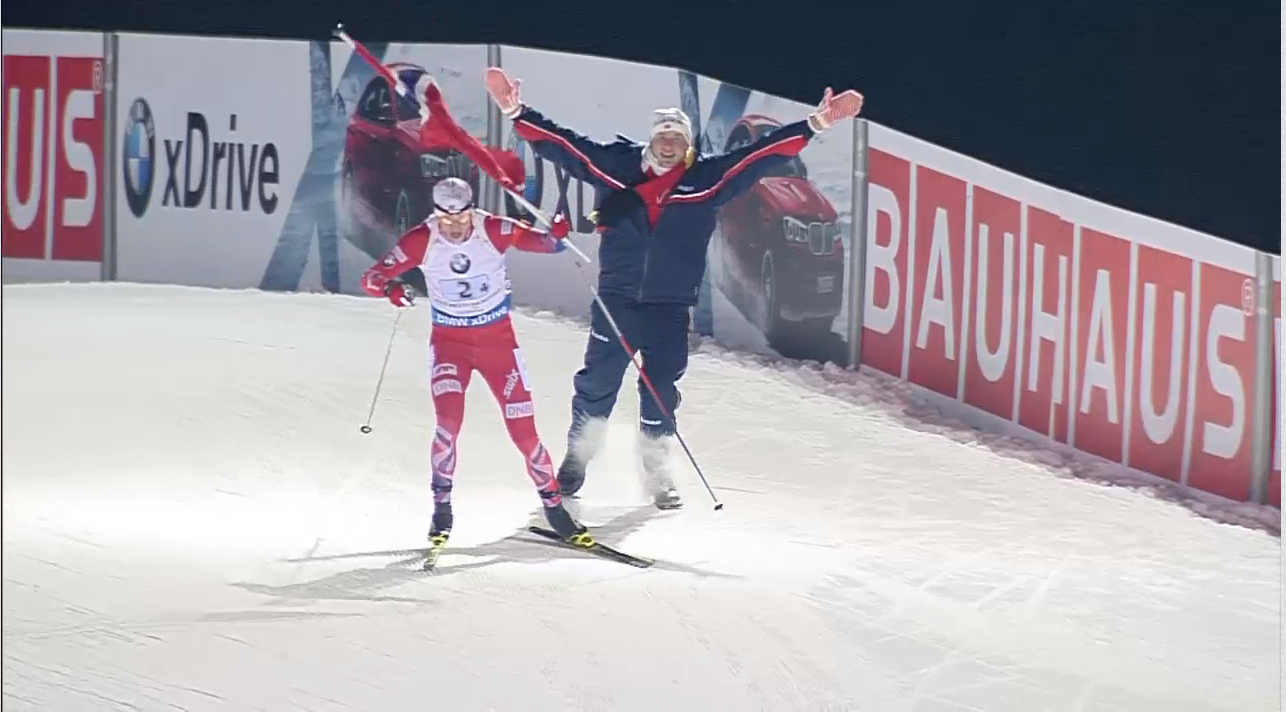
    Tarjei Bø receives the Norwegian flag from an excited fan as he cruises down the finishing stretch to celebrate his win for Norway in the 2 x 6 + 2 x 7.5 k mixed relay on Friday at the IBU World Cup in Nove Mesto, Czech Republic.
    Tarjei Bø (l) receives the Norwegian flag from an excited fan as he cruises down the finishing stretch to celebrate his win for Norway in the 2 x 6 + 2 x 7.5 k mixed relay on Friday at the IBU World Cup in Nove Mesto, Czech Republic.
  • Schempp Stuns in Mass Start Barnburner; Green Completes Perfect Shooting Weekend in 18th

    Schempp Stuns in Mass Start Barnburner; Green Completes Perfect Shooting Weekend in 18th

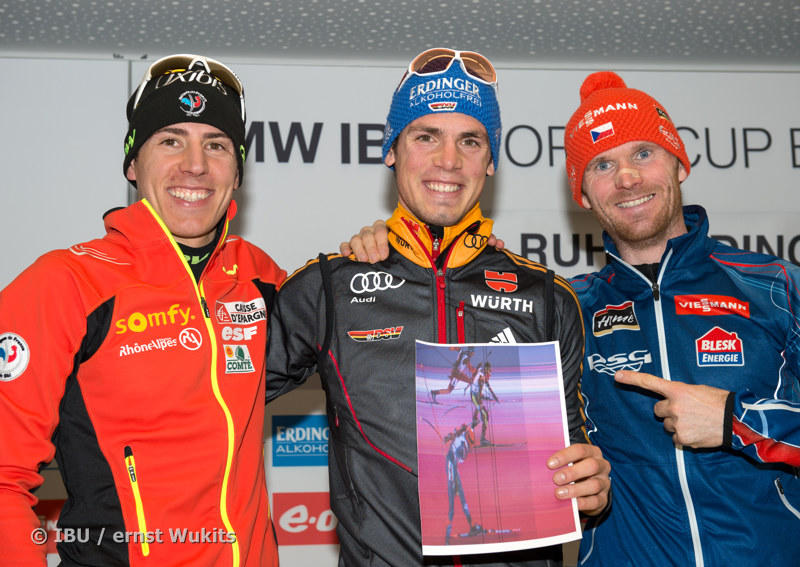
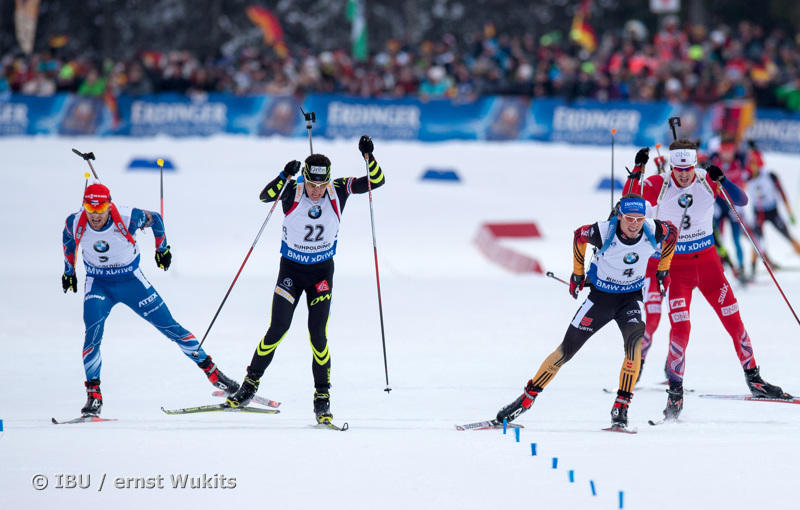
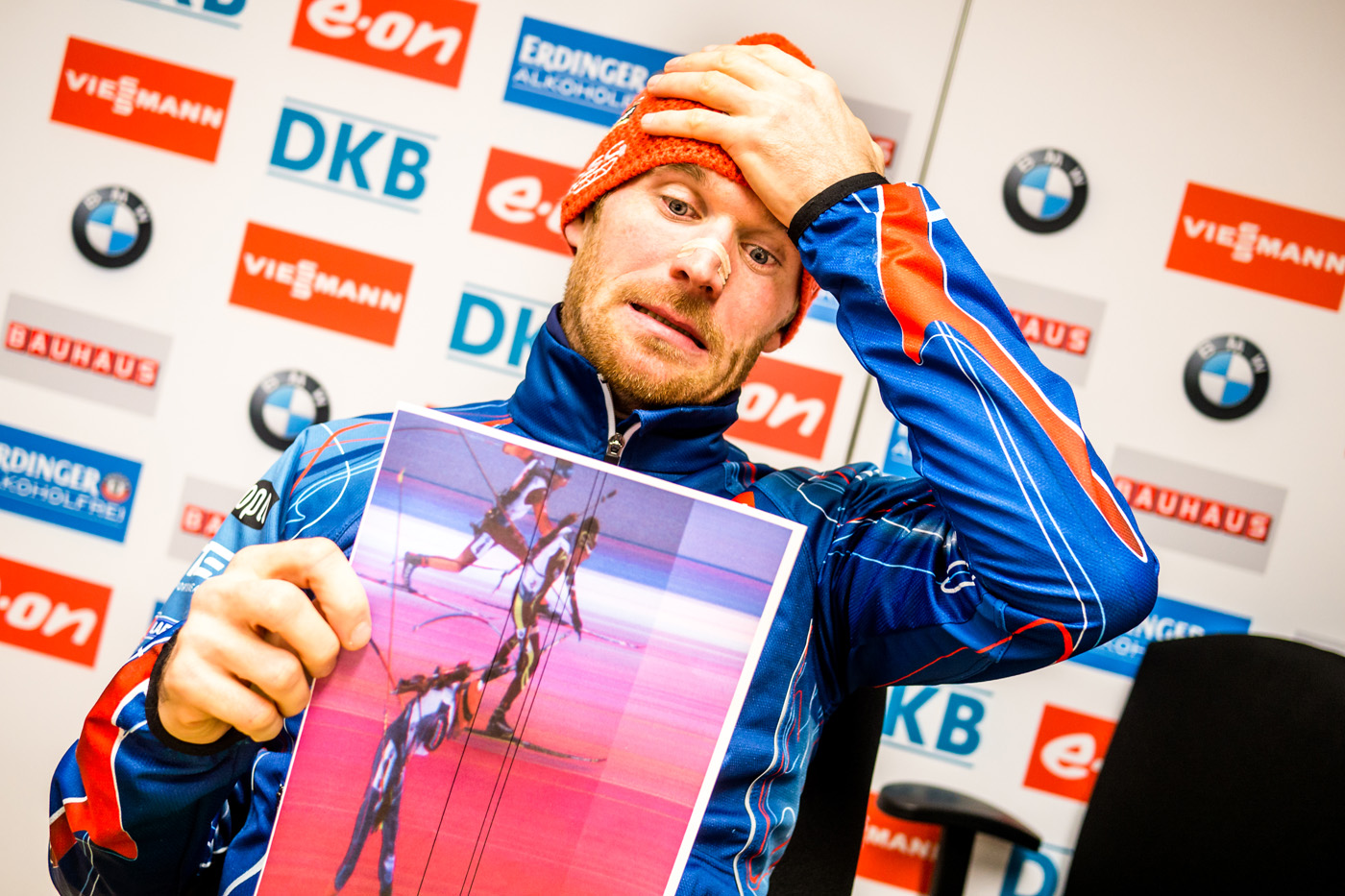
    Mass start winner Simon Schempp (GER) hold up a printout of the photo finish, flanked by second place Quentin Fillon-Maillet (FRA, left), who lost by just eight centimeters, and third-place Michal Slesingr (CZE). (Photo: IBU/Ernst Wurz)
    Mass start winner Simon Schempp (GER) hold up a printout of the photo finish, flanked by second place Quentin Fillon-Maillet (FRA, left), who lost by just eight centimeters, and third-place Michal Slesingr (CZE). (Photo: IBU/Ernst Wukits)

    In an unusually tight race – the top 20 were within 25 seconds after two shootings, the top 15 within 22 seconds after three shootings, and the top 13 within 30 seconds after the final bout – Simon Schempp of Germany pulled out a win for the hometown crowd in Ruhpolding in the 15 k mass start on Sunday.

    The top five heading towards the finish line. (Photo: IBU/Ernst)
    The top five heading towards the finish line. (Photo: IBU/Ernst Wukits)

    It came by the narrowest of margins: in a photo finish, Schempp snuck the toe of his boot past Quentin Fillon-Maillet of France, whose body was clearly ahead of the German’s. Along with the Michal Slesingr of the Czech Republic, the first three finishers were separated by less than a tenth of a second.

    On the results sheet, they all have a time of 0.0.

    And they didn’t have much breathing room, either: Emil Hegle Svendsen and Ole Einar Bjørndalen of Norway were 2.0 and 2.6 seconds back in fourth and fifth, and Anton Shipulin of Russia, Jean Guillaume Beatrix of France, Simon Eder of Austria, and Arnd Peiffer of Germany weren’t far behind. That put the top nine finishers all within 9.1 seconds.

    Schempp looked relieved and confident when he cleaned his targets on the final prone stage. But he had work ahead of him.

    “It was a really tough last loop,” Schempp said in a press conference. “We were five or six men together, and Quentin did a great job. We had a lot of speed.”

    Slesingr with the finish photo. (Photo: Czech Biathlon/facebook)
    Slesingr with the finish photo. (Photo: Czech Biathlon/facebook)

    The top six fought furiously into the final two hundred meters; but there were only three finishing lanes. The Norwegians were cut off and Svendsen appeared visibly frustrated to be denied a lane towards the win. Instead, it was Schempp who timed his lunge perfectly over the less-experienced, 21-year-old Frenchman.

    “It was really hard and I gave all I had,” said Schempp, who crashed after crossing the finish line. “It’s crazy to win here in Ruhpolding.”

    He didn’t know it at the time though. The timing company reported that it was eight centimeters which separated Schempp from Fillon-Maillet; they waited and carefully measured before making the announcement.

    It was the third win of Schempp’s career, and helped him jump up to the third-ranked spot in the World Cup overall score. It was a fitting end to a weekend of racing at a notoriously fan-crazy venue, the center of biathlon in Western Germany – and where Schempp lives and trains.

    It was a race full of other interesting tidbits, too. Jakov Fak of Slovenia was leading on the third loop of racing, when he crashed on one of the course’s downhill corners; Johannes Thingnes Bø of Norway was skiing so close behind him that he tripped and fell, superman-style, into the snow (you can see a clip of the crash here). After two ski changes, Bø managed to hit all 20 targets and finish 10th. He is being monitored for a concussion.

    …. Like Watching A Ski Wreck? (story continues below)

    Both had abrasions to their faces. Fak, who also had to get new skis at least twice, finished 24th. There are plenty of crashes in nordic racing, but this one was particularly brutal.

    “The problem was that it was flat light, so you can not see if there is ice or snow,” Bjørndalen told NRK news of the downhill that claimed the pair. “You must be freaking awake.”

    Also left frustrated today? World Cup leader Martin Fourcade of France had pulled up early in Saturday’s sprint – sandbagging the final loop deliberately in order to save energy for the mass start. But it didn’t work out. After leading aggressively in the first loop, he finished 21st with four penalties.

    “A weekend to forget like happens from time to time,” he posted on his twitter account, according to a translation.

    One man who stayed completely out of trouble? Canada’s Brendan Green. After a 16th-place finish in Saturday’s sprint, Green placed 18th in the mass start, finishing 57 seconds behind Schempp. He also shot perfectly, bringing his tally to a stunning 40-for-40 over the course of the three-race weekend.

    “It’s definitely the first weekend that I’ve hit all my targets,” Green said in a phone interview. “So that’s pretty sweet.”

    Green said that Ruhpolding has “notoriously good shooting” because the wind is often quiet. But looking at a results sheet shows that the range conditions didn’t help anyone else achieve what Green did.

    “There were a few things I was working on over Christmas to try to get a little bit more dialed in,” he explained. “So far I feel like I’ve been able to apply that process to the racing. And this week the body has felt really solid. Nothing has felt too out of control. It’s really positive and hopefully I can do that a few more times throughout the season.”

    The pair of results are in Green’s ten best ever, which he said was a relief after less-than-exciting results earlier in the season.

    “It has definitely been a bit of a slow and frustrating start to the season, especially with the first trimester,” Green said. “So finally to have some better results is definitely a nice feeling and motivating for sure.”

    The lone American competitor, Lowell Bailey, finished 28th (+2:25.1) with three penalties.

    Results

  • No One Touches Fourcade in Oberhof Mass Start; North American Men Outside Top 20

    No One Touches Fourcade in Oberhof Mass Start; North American Men Outside Top 20

    Martin Fourcade in Sunday's 15-kilometer race. (Photo: IBU/Eberhard Thonfeld)
    Martin Fourcade in Sunday’s 15-kilometer race. (Photo: IBU/Eberhard Thonfeld)

    On Sunday, Martin Fourcade reminded the world that no one can touch him in the 15-kilometer mass start in Oberhof, Germany. Fourcade, of France, used a combination of quick skiing and exceptional shooting to make sure that no one could challenge his reign of the course.

    Though he never posted the fastest course time on any of the five laps, Fourcade’s consistent skiing allowed him the luxury of slower shooting. Fourcade shot perfectly, and in fact was the only racer of the day to have less than three misses. He took first place by 13.1 seconds over Russia’s Anton Shipulin, who missed one shot in each stage, for a total of four misses.

    Shipulin’s teammate, Dmitry Malyshko, was third (+30.7) with three penalties, Bulgaria’s Krasimir Anev missed the podium by just over a half a second, taking fourth (+31.4) with three misses, while Czech Michal Slesingr missed three as well to place fifth (+37.8).

    Fourcade, the overall IBU World Cup leader, had a nearly 30-second lead heading into the final stage. However, upon arriving at the final stage, the wind picked up. Fourcade demonstrated exceptional patience, waiting at the range for the wind to die.

    Of the 29 competitors final competitors, Fourcade’s fourth-stage range time ranked 28th; he spent over a minute and a half on the range. Though Shipulin, among several other competitors, came in while Fourcade was shooting and exited the range ahead of him, they missed shots and were forced to ski penalty loops. Fourcade went straight on to his final loop and the victory.

    ‘Mediocre’ and ‘Really Bad’ Days for Smith, Bailey

    The start of the men’s 15-kilometer mass start. (Photo: IBU/Eberhard Thonfeld)
    The start of the men’s 15-kilometer mass start. (Photo: IBU/Eberhard Thonfeld)

    Two North Americans entered the race, Canadian Nathan Smith and American Lowell Bailey. American Tim Burke was slated to race, but withdrew in the morning due to illness.

    “Unfortunately, I woke up this morning with a small head cold,” Burke wrote in an email. “I made a promise to myself not to race this year with any sickness. This year I am also only interested in fighting for top results and I don’t really care about the World Cup rankings. With my feeling today, I would have little chance at a top result and it would set me back for the next weeks.”

    Neither Bailey nor Smith were happy with how their day turned out. Bailey had a particularly rough day, finishing last of 29 men with 10 penalties, 4:36 behind Fourcade.

    In a US Biathlon Association press release, Bailey said, “It’s easy to start looking for answers when you have a bad day.  You start to look back at your training and think, ‘Did I make the right choice there? Should I have taken more rest here? More shooting there?’ But the fact of the matter is that I have no excuses. Sometimes you just have a bad day. Sometimes it’s a really bad day!”

    Smith, who tied Sweden’s Frederik Lindström in 20th (+1:51.4) with six misses, called his race “mediocre.”

    “I think my skiing was pretty strong but poor shooting at the beginning and end of the race put me out of contention for a top 8 result,” Smith wrote in an email. “I will definitely spend some time to think of strategies for the last shooting. It’s been a bit of a weakness this season so far and I would like to turn it into a strength.”

    Due to a lack of snow at the venue, the first “lap” was in fact two 2.5 k loops to the first shooting stage. Without a shooting stage to break up the pack, many of the skiers initially stayed together.

    “Everyone was together the entire time and the pace was somewhat leisurely,” Smith wrote. “It was an odd feeling to ski like that for so long. It was [how I would imagine] a cross country race, until after the first trip to the range, when the real racing started.”

    In an email, Bailey wrote that he was confident in his training, adding that he always tries to “salvage any redeeming qualities from a race, even if it’s going poorly.”

    “It was definitely a bad day,” he wrote, “but I jut tried to stay focused through the end and work on ski technique.  The best and worst part of biathlon is that it is a volatile sport; one day you are on top of the world and everything seems easy, the next day nothing goes right.  It’s just a matter of keeping things in perspective.

    “Ruhpolding is up next and it’s a whole new set of races,” Bailey added.

    — Chelsea Little contributed reporting.

    Results

  • Svendsen Masterful in Dominating 20 k Victory: ‘Winning Makes You Motivated and Want to Continue’

    Svendsen Masterful in Dominating 20 k Victory: ‘Winning Makes You Motivated and Want to Continue’

    Screen Shot 2014-12-03 at 9.01.33 PM
    Emil Hegle Svendsen of Norway taking one of his 20 perfect shots in today’s World Cup 20 k, which he won by over a minute.

    Emil Hegle Svendsen said earlier this week that the 20 k individual race in Östersund, Sweden, would separate “men from mice.”

    If that’s the case, then Svendsen is definitely a man. The Norwegian biathlete, 11-time world champion, four-time Olympic gold medalist, and the third-winningest man in World Cup history, took his 36th win in dominating fashion, beating runner-up Serhiy Semenov of Ukraine by one minute and 17 seconds.

    “It’s insanely amazing go get started this way,” Svendsen told Norwegian broadcaster NRK. “I followed the plan I’ve had success with before. And it worked again.”

    He turned in a masterful performance, hitting all 20 of his targets – the only man to do so, which is a big advantage in the format which penalizes each missed shot with a minute of added time.

    Rival Martin Fourcade of France couldn’t even come close, missing four targets in the very first shooting bout and then basically phoning it in. He placed 81st, and had to hand Svendsen the yellow leader’s bib that he started with as last season’s overall World Cup champion.

    “I’m happy to give it to Emil today,” Fourcade told NRK. Svendsen reported that Fourcade had tossed him the jersey while they were in the changing area.

    The wind was variable in the Östersund stadium, which was why so many competitors tripped up. There’s also the issue that the 20 k is the most grueling race format, and a tough way to kick off the season.

    “I have been thinking, and the last time I cleaned in a 20 k was in my first World Cup victory in 2007, under similar conditions,” Svendsen said in a post-race press conference. “But I was a bit lucky today with the wind especially in standing and that made it quite easy to hit all 20. Still, it does take some skill to do that… I have been feeling really good in the shooting range this winter.”

    His perfect shooting was acknowledged by competitors as something fairly incredible.

    “Emil delivered in the top ten or top five of his best races in his career,” said teammate Ole Einar Bjørndalen, who knows a thing or two about best performances. “It is a fantastic achievement to shoot down all 20 targets in the shooting today.”

    Svendsen knew, however, that he had to a large extent capitalized on his competitors’ errors. He had sixth-fastest course time, but was still well behind teammates Johannes Thingnes Bø, who finished eighth, and sixth-placeBjørndalen. He knows that Fourcade isn’t going to miss four targets right off the bat every race, nor will his teammates always pick up three or four penalties apiece. It will get harder and harder to win as the season goes on.

    “It was not good enough; I need to catch some seconds if I expect to be on the podium in the sprint,” Svendsen admitted. “But it is like this every season with me. It takes a couple of races to warm up; I am like an old diesel engine.”

    Second-place Semenov made it clear that he loves the format: his only other podium also came in the 20 k, two seasons ago in the pre-Olympic test race in Sochi, Russia.

    “I am a bit slow, but I can go at the same speed for the whole distance,” he explained in the press conference. “But this race was hard; I could hardly wait to get to the finish line.”

    Third-place Michal Slesingr was almost another minute behind Semenov; both men, as well as Erik Lesser of Germany, had one penalty. Lesser was a late starter and made a charge at the podium but came up just three seconds short of the Czech veteran’s time.

    Most of the other names in the top ten are familiar, previous podium finishers, with one exception: Quentin Fillon Maillet of France. The 22-year-old turned in his best performance yet and, like Lesser, as a late starter was able to surprise when he displaced American Tim Burke out of the top ten.

    As for Svendsen, his performance cast doubt on the comments he had made in the off-season about feeling a lack of motivation to continue with biathlon.

    “Winning makes you motivated and makes you want to continue for a long time,” he said in the press conference. “Biathlon is fun and to compete is fun. As long as it is fun, I will continue.”

    Full results

  • On the Verge of Quitting Sport, Sumann Rises to Top in Biathlon Pursuit

    On the Verge of Quitting Sport, Sumann Rises to Top in Biathlon Pursuit

    Christoph Sumann at last year's World Championships in Ruhpolding.
    Christoph Sumann at last year’s World Championships in Ruhpolding.

    Invincible? Meet vincible.

    Down on your luck? Meet winner.

    Just one day before the World Cup 12.5 k pursuit in Khanty-Mansiysk, Russia, Martin Fourcade of France showed once again why he is the best biathlete in the world when he took a 39-second win in the 10 k sprint. He shot clean; so did the next three finishers. It’s the combination of shooting and fast, fast skiing that has made Fourcade so unstoppable all season, and he showed no signs of letting up.

    But in the pursuit, it was like a different Martin Fourcade showed up to the race. He missed at least one shot in each stage and five total, and didn’t have the fastest ski time. On the last lap he found himself chasing down older brother Simon, who had started a minute and a half back in 22nd place and is recovering from compartment syndrome surgery.

    The younger Fourcade, the one in the yellow bib of the overall World Cup leader and the red bib of the Pursuit discipline leader, couldn’t do it.

    Instead, Simon was second and Martin third. In first? By a huge margin – about the size of Fourcade’s from the day before – was Christoph Sumann of Austria. Like Simon Fourcade, he had cleaned all twenty targets, but starting from fourth position he had a bt of an advantage.

    36-year-old Sumann, an Olympic and World Championship medalist with five prior career victories, hadn’t been on the podium since the very first World Cup weekend in Ostersund, Sweden. In the meantime, he had been left off his country’s World Championships roster for all but the relay.

    Just two weeks ago, he was at home in Austria, competing in ski races. Not even skating ones – he placed second in a 15 k classic mass start FIS competition, his first since 2001.

    Luckily for Summann, luck can change. He found himself back in his own sport and, today, at the top of the podium.

    “This is a big surprise because I had a lot of troubles in the last weeks,” he said in the post-race press conference. “I started on the podium in Östersund and everything in between was not so good. I was thinking about quitting. It is a big surprise! It is big motivation to train hard one more year and then finish after Sochi.”

    Despite Martin Fourcade’s woes on the range, it was a great day for France as the brothers were reunited again.

    “This is the second time that Martin and I are on the podium together and the second time I am in front of him; that is great,” Simon Fourcade said. “But it is a great pleasure to be up here with him…I had really good feelings warming up today. I came back from 22nd place to the podium which I did not expect.”

    Martin Fourcade actually tied for third, thanks to a disaster not of his own making. The race was marred by a cross-firing by Germany’s Andi Birnbacher, who was in fourth place in the third stage. But he fired on the wrong targets, instead knocking down those in lane three, which should have been Michal Slesingr’s. That left Birnbacher with five penalties for the stage, and Slesingr with problems of his own.

    “The official had a very slow reaction to my raised hand,” Slesingr said. “The target needed to be cleared. Then he asked me what was wrong; ironically it was the Czech referee. I lost lots of time, probably more than the 25 seconds. I lost contact with the group when I spent such a long, long time standing. That affected my skiing. I felt my legs were more tired as soon as I left the shooting range.”

    It undeniably affected the race to have Slesingr delayed on the range; he likely would have been a force in the fight for the win, although of course nobody knows for sure. In subtracting seconds from his race time, officials finally decided just to award him joint third place with Fourcade.

    “The decision is fair for both of us,” Fourcade said.

    Racing resumes tomorrow with mass start competitions.

    Results


  • Svendsen Sensational in World Cup Return in Fort Kent

    Svendsen Sensational in World Cup Return in Fort Kent

    Norway's Emil Hegle Svendsen on his way to victory on Thursday.

    For Emil Hegle Svendsen, it was admittedly a bit of a gamble to fly to the U.S. from his home country of Norway, for a single weekend of racing.

    “It’s always a risk,” he said.

    But after his first of three World Cup races in Fort Kent, the trip has already paid off, thanks to the $15,000 Svendsen will collect for his win in Thursday’s 10 k sprint.

    A candidate to represent Norway in the relay at the 2011 world cross-country championships in Oslo in March, Svendsen’s skiing continued to build the case that he should be selected for the team’s third leg, over Tord-Asle Gjerdalen and Sjur Roethe.

    Svendsen was the fastest skier on course on Thursday, and despite one penalty over two shooting stages, he topped two others who managed to shoot clean: second-placed Michal Slesingr (CZE), and third-placed Tarjei Boe (NOR), the overall World Cup leader.

    “I definitely feel like I should be the one racing [in Oslo],” Svendsen told FasterSkier. “I think I will do the best job.”

    Svendsen had skipped the World Cup in Presque Isle last week, opting instead to stay at home and make up some training that he’d lost when he was sick over Christmas.

    He flew to the U.S. alone, arriving in Presque Isle from Boston on Sunday on “the smallest airplane I’ve ever seen.”

    With the trans-Atlantic travel, there’s always a risk for jetlag and illness, but Svendsen said that he needed the racing—and according to his shooting coach Joar Himle, the trip went “very well.”

    In Fort Kent, Svendsen was greeted by cold temperatures, but he said that he didn’t mind. In fact, he said, it may

    The fans in Fort Kent weren't numerous, but they were fervent, lining a few sections in the stadium.

    have helped, given his strong results in Oestersund, Sweden in similarly frigid conditions.

    “Good Norwegian weather,” he said.

    The thermometer read three degrees Fahrenheit at the start of the race, making for some squeaky, slow snow on a beautiful, still, crystal-clear day. Athletes raced in multiple buffs, with some wearing physio tape on their faces and ears to ward off frostbite.

    The race was very tight at the top, with Svendsen, Schlesingr, Boe, and Martin Fourcade (FRA) all finishing in a 10-second window.

    After their two bouts of shooting, Svendsen and Boe were still deadlocked at the top of the 3.3-kilometer loop’s massive opening climb. But Svendsen is known for his strength on transitions and rolling terrain, and his teammate couldn’t hang on the relatively tame remainder of the course.

    “The last two kilometers are pretty flat, and I knew I needed to have a pretty big lead for the last kilometer,” Boe said. “I tried on the first hill—I took him there, but the rest of the track, he was too strong.”

    Svendsen wasn’t sure how he would fare coming into this weekend’s races, but he said he had been feeling “pretty good—so I knew I had a fair chance.”
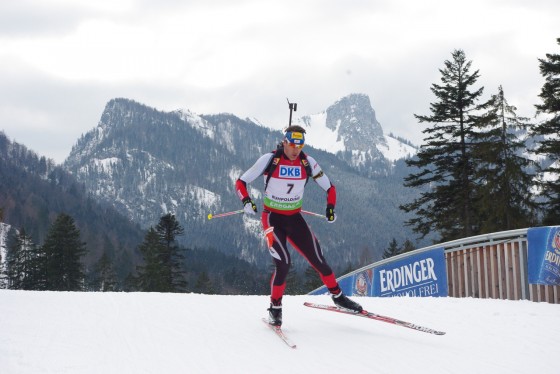
    Himle, on the other hand, said he expected the caliber of performance that Svendsen turned in.

    “We have to be there,” he said. “He is on that level.”

    Svendsen will race twice more in Fort Kent before returning to Norway, for the lead-up to Oslo. Whether or not he’ll start at the cross-country World Championships is up to the coaches; Svendsen said that the call will be made after the men’s pursuit on February 27th. The races in Fort Kent will be a factor, he said, as well as his overall fitness.

    If Svendsen indeed gets a start in Oslo on March 4, he said that the event will be, in some ways, more important than biathlon’s own World Championships, which come later in March, in Russia.

    “For a Norwegian, with cross-country in your own country, World Championships—it’s the biggest,” he said. “We have world championships in biathlon every year, so I think the cross-country would be something special if I get to race.”

    Svendsen certainly looked worthy on Thursday—as Boe put it, “he’s very focused, and full of energy.” That’s in contrast to Boe himself, who at 22 years old is in search of the overall World Cup title, in the same season in which he won his first race.

    “It’s a hard thing to go so many races,” he said. “I feel a bit tired now. It’s only two more races to go, and then I can go back to training.”