From the FasterSkier archive — posts syndicated from athletes’ and coaches’ own blogs between 2004 and 2012, kept online as published. Current coverage is at fasterskier.com.
This article was made possible through the generous support of our voluntary subscribers. If you would like to see more collegiate coverage like this, please support FasterSkier with a voluntary subscription.
By: Francesca Kitch
The Central Collegiate Ski Association (CCSA) is composed of six competing schools spanning the Midwest. Each season there are four CCSA invites–weekends full of racing–and this year, these competitions are set to begin this Saturday. The first three US Nationals races in Anchorage, Alaska, also counted towards CCSA competition; the skate 10k was scored as an NCAA qualifier, while the classic sprint and 20k classic mass start served as an opportunity to accumulate points toward team standings. Although the CCSA is a small conference, it doesn’t lack enthusiasm. Spectators travel all over the Midwest–and even to Alaska–to watch their athletes race.
Across all NCAA conferences–the CCSA, Eastern Intercollegiate Ski Association (EISA), and Rocky Mountain Intercollegiate Ski Association (RMISA)–distances and techniques are standardized. Every two years, the distance races at NCAA Championships alternate between skate and classic, and the races at the invites reflect this change. This year, the 20k mass start at NCAA’s will be skate and the 7.5k will be classic, so the CCSA qualifying races will consist mostly of 20k classic mass starts and 7.5k individual classic races. From the points earned in these races, skiers will be ranked within the CCSA, and the top 6 athletes of each gender will qualify for the NCAA Championships to compete in Hanover, New Hampshire, this March.
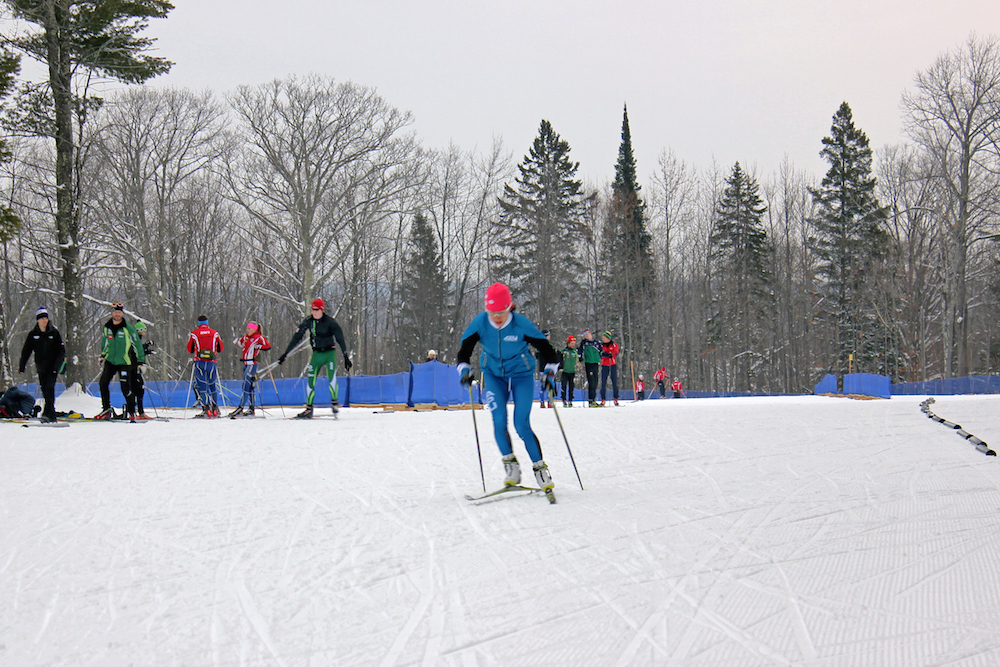
Women lining up for a 20km classic mass start last season. (Photo: Tryg Solberg)
The CCSA invite this weekend will be hosted by the University of Wisconsin at Green Bay. The Green Bay team has undergone an impressive transformation from 4 years ago when head coach Sam Meyers started the job. With a full roster of 3 men in 2021, Meyers has built up the program to now carry 17 athletes (9 men and 8 women) for the 2025 season. “This is the first year that we’ve had an upperclassmen-heavy roster…it feels like everyone has a really good understanding of how we operate as a team.” Meyers is encouraged to see how helpful the team captains have been in the seamless running of the team and how this has aided the overall maturity of the team. “We work really hard, we have big goals. But we also remember that skiing is fun.” Meyers adds, “One of the big things I look for in recruits is someone that just simply loves the sport of nordic skiing, and that’s a big factor in creating the culture that we like….not only good skiers but love working hard and being outside.” Meyers predicts strong performances from senior Ryan Themie and Junior Noah Erikson, the two top finishers on the men’s team from last season, finishing in 15th and 23rd, respectively, in the CCSA rankings. On the women’s side, Sophomore Lily Franzen is looking to improve on her performance from last year as the leading women’s skier for the team, and Meyers is excited to see what freshman Hedda Samuelsson has to show.
Men from Michigan Tech enthusiastically cheering on the women in a CCSA invite last season. (Photo: Tryg Solberg)
Michigan Tech Head Coach Tom Smith looks forward to another season with his team, excited by individual standouts and a promising team as a whole. Michigan Tech finished 13th at NCAA’s last year, the highest rank of the central conference, despite being hindered in the rankings by its lack of an alpine team to supplement the nordic team’s scores. “I’m proud to say we have an amazing team, and that’s because we have amazing people that make it what it is!” Smith stresses the importance of the balance between student and athlete as well as competition and fun. “We have two overarching goals for our team: to always work for improved performance…and above all, for our student-athletes to love their experience as a member of the team!” 3 time NCAA Championship qualifier Colin Freed is having a standout Senior season so far with top 15 finishes in the Cable Supertour and a CCSA win in the 10km skate race at US Nationals. On the women’s side, Smith highlighted Marie Wangen, Alice McKnight, and Greta Hansen as promising this season. Wangen skied into the semi-finals of both the skate and classic sprints at US Nationals as the top CCSA finisher and skied similarly well at the Super Tour in December with a top 6 performance. Of McKnight, Smith says she has “really made a performance jump in her senior season” with the first CCSA podium of her career in the 10km skate race at US Nationals. Hansen has been consistent all-around with CCSA podiums in distance races so far this season and finished as the 5th U23 American in the skate sprint at US Nationals.
St. Olaf’s team has come into new leadership this year with head coach Tor Hanson, a recent graduate of St. Olaf himself (‘23) who stayed on as an assistant coach last season. Hanson describes that “working from the team Brochman provided and now laying down my own foundation, I’m incredibly encouraged by the development seen amongst our team.” The team has indeed been making their mark on the local and international stage: Senior Lily Hubanks and Sophomore Amaeli Kam-Magruder are currently in Italy for the World University Games after impressive performances at the Cable Supertour. Hansen is encouraged by the incoming speed of the first-year class on both the men’s and women’s teams, and combined with the experience of older members of the team, it will be interesting to see how the season progresses.
Jason Kask, Head Coach for the College of St. Scholastica (CSS) team, started his job in the fall of 2023. “With an excellent freshman class and our veterans in great form, it’s shaping up to be a fun winter,” Kask remarks. Senior captains Chase High and Mae Whitcomb have bright seasons ahead after a great year of training and some promising early-season results. Freshman Leevi Tarjanne and junior Greta Leitheiser also look promising after the Supertour, Leitheiser coming home with multiple top 20 finishes and Tarjanne with top 30 performances. “We are excited to see their hard work in the off-season shine this winter.”
Northern Michigan University men’s team is all smiles after winning the conference title last season. (Photo: Tryg Solberg)
Northern Michigan University is consistently a top school in the CCSA, and last year their men’s team won the conference title. Sophomore Henriette Nilssen was last year’s highest-ranked CCSA woman and currently leads the standings after a CCSA win in the 10km skate at US Nationals. Her teammate, Senior Victoria Dybwad, was the third CCSA finisher last season and finished second in the 10km at US Nationals. Junior Luke Fricker was last year’s top men’s skier and finished second place in the US Nationals 10km skate. Sophomore Adrik Kraftson finished the podium off in the skate 10km at nationals in 3rd place.
St. Cloud University will also participate in these invitationals, but currently only has one member of the women’s team, and no men. Head coach Mike Schroden was unavailable for comment.
HOUGHTON, MICHIGAN: Welcome to FasterSkier’s on-location coverage of the United States National Cross- Country Ski Championships from Houghton, Michigan.
This week, Houghton hosts the U.S. National Cross-Country Championships on the Michigan Technological University’s trail system. The U.S. Nationals mean many things to different competitors. For some, it’s their initiation into the world of high-end competitive ski racing; for others it’s their chance to burnish their credentials; and for still others it’s a combination of competition and enjoyment of skiing.
Today’s competition was the 10-kilometer individual start freestyle race. The women’s race was first, starting at 9:30, followed by the men’s start at 12:30.
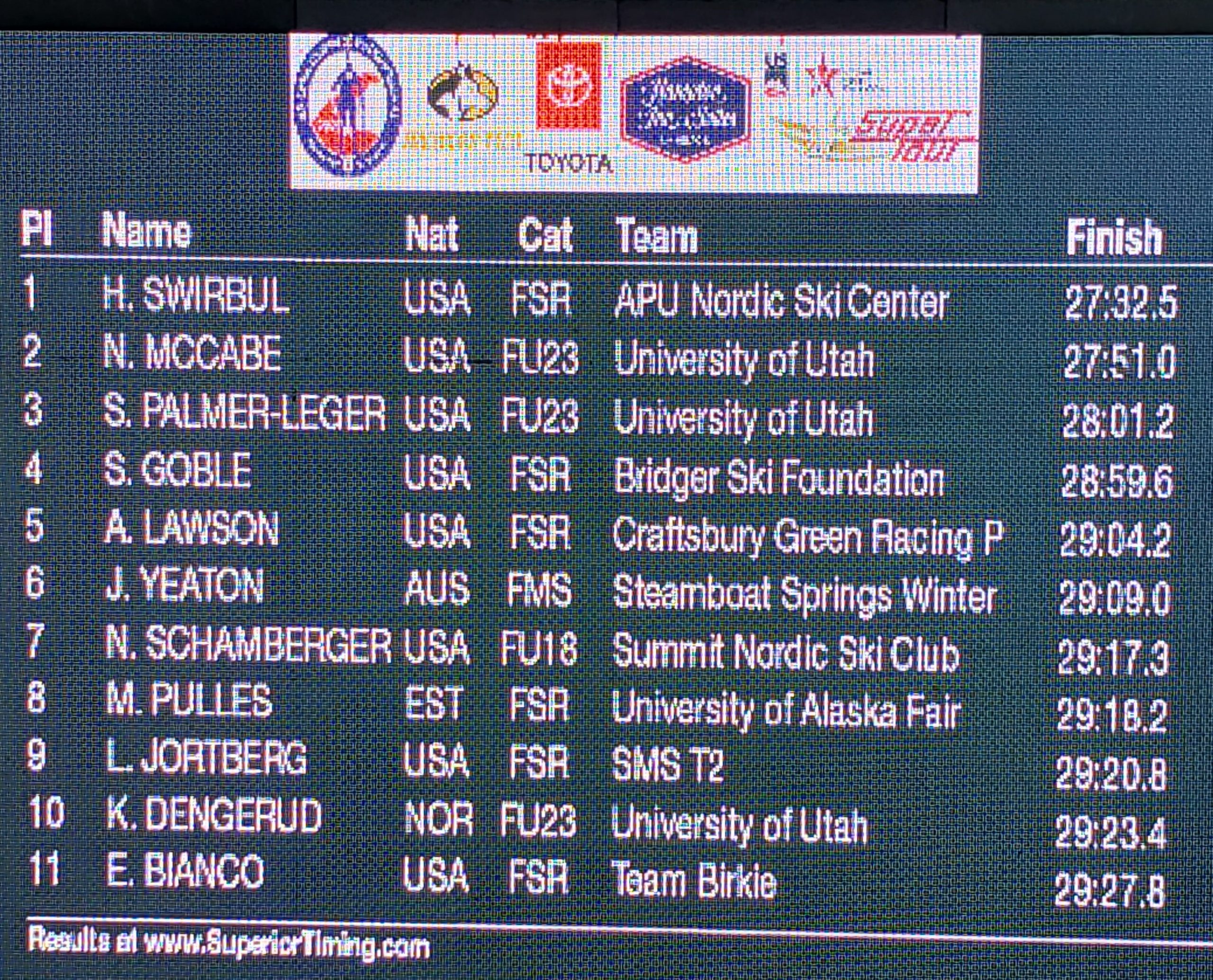
Top ten results, Women’s U.S. nationals (Photo: FasterSkier)
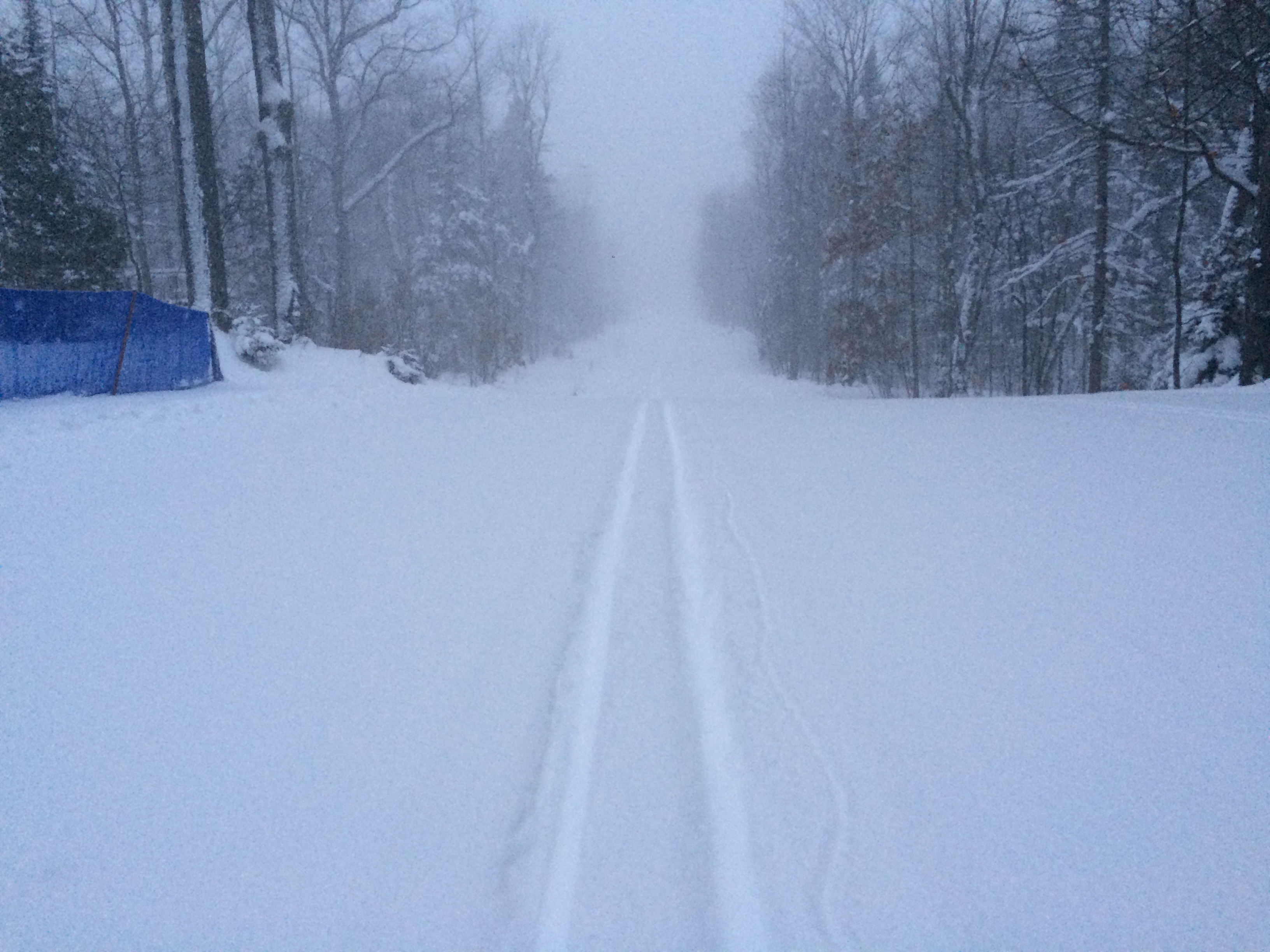
The weather in Michigan’s Upper Peninsula has been extremely atypical for this time of year with temperatures hitting almost 40 degrees and only dropping to freezing in the evening. Fortunately, a deep snowpack provided good conditions. With temperatures hovering around freezing with moist snow, it would have been disastrous for a classic race, but today, the conditions were fast and forgiving, close to ideal for a skate race.
U.S. Nationals, Men’s results. (Photo: Fasterskier)
The Results
The women’s competition was won by US National Team member, Hailey Swirbul (Alaska Pacific University Nordic). She was followed in second by National Team member Novie McCabe (University of Utah), with Sydney Palmer-Leger (University of Utah) in third.
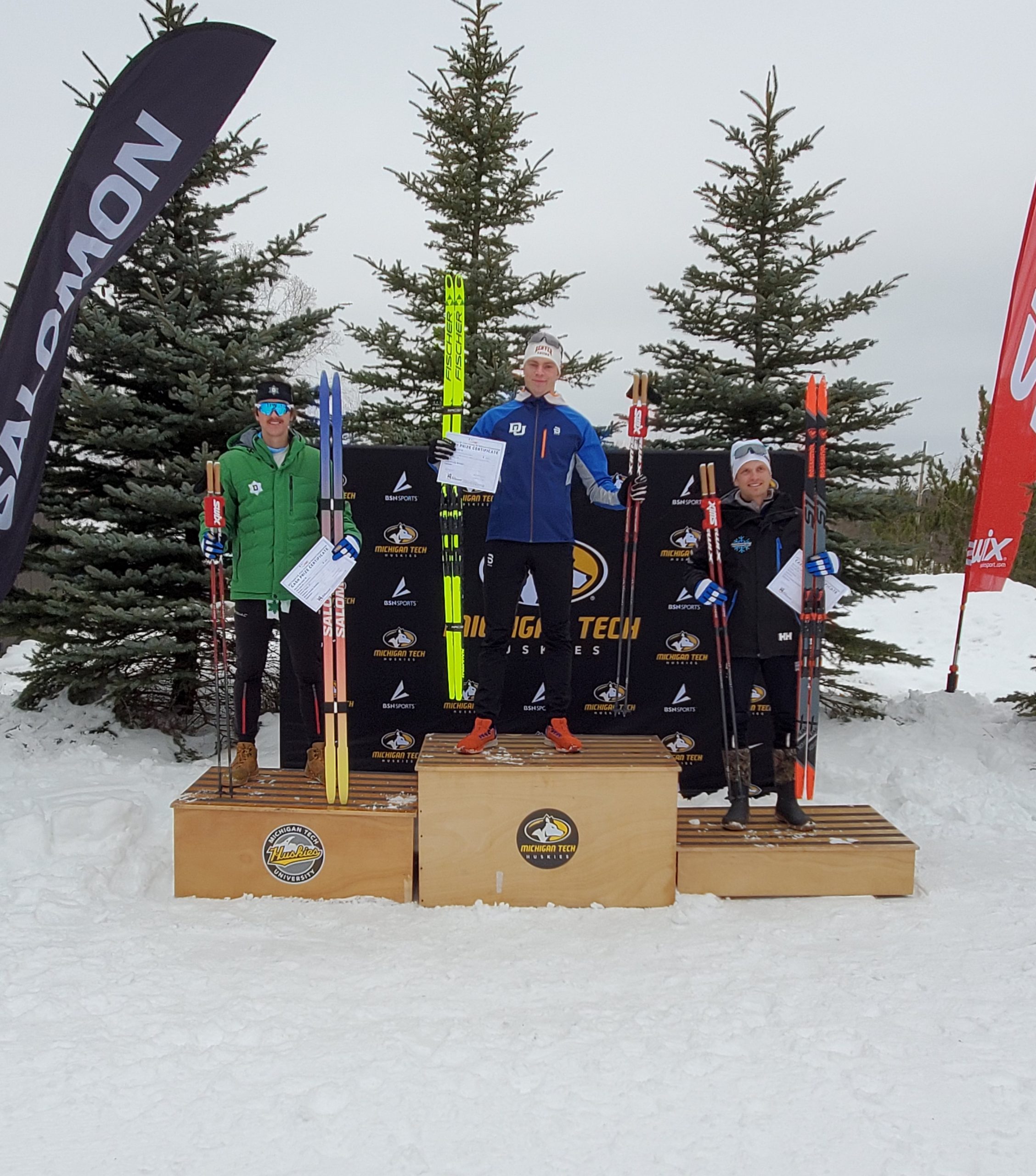
The men’s first-place finisher was Andreas Kirkeng from Norway (University of Denver). In second place was John Steel Hagenbuch, (Dartmouth College), and in third place was David Norris (Steamboat Springs Winter Sports).
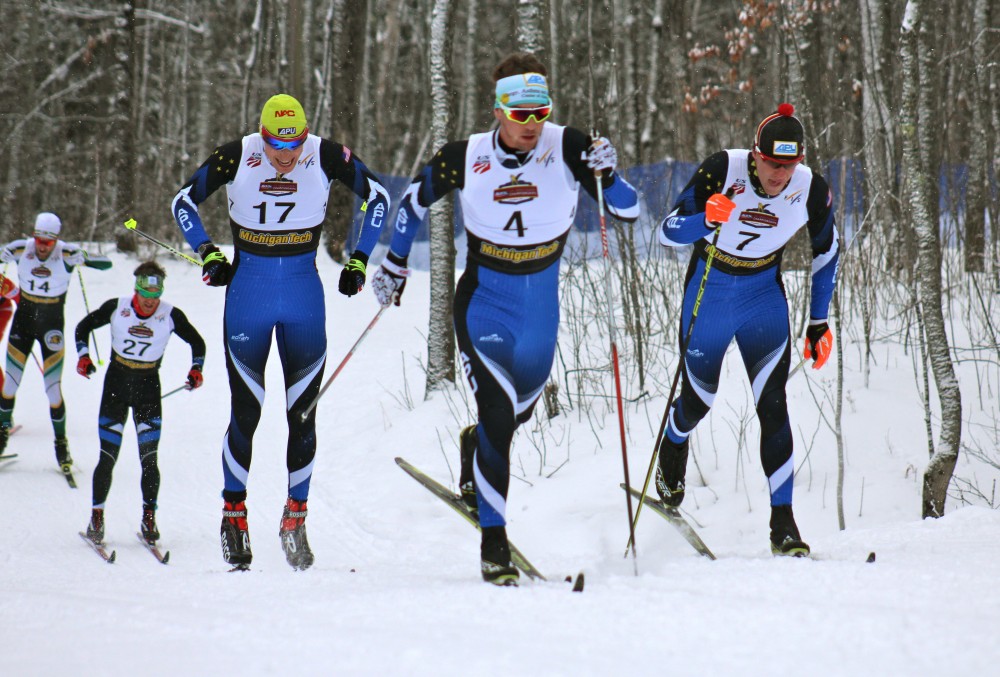
Men’s podium U.S. Nationals (l-r John Steel Hagenbuch, Andreas Kirkeng, David Norris. (Photo: Fasterskier)
The Race
The men’s race was dominated by the Norwegian, Kirkeng, a college sophomore who won by over 30 seconds. It was a performance made all the more impressive by the fact that as Kirkeng told Fasterskier, he had returned from Europe only five days prior to the race, having travelled home for the holidays. Kirkeng lives 30 minutes from Oslo, and had spent the holidays in the mountains.
It was the first time on these trails for the Norwegian who professed a liking for the course. Kirkeng told Fasterskier that, “The course is really broken into two parts, long straight ups and downs where you really just have to find the flow, and the second half is short kickers with a lot of transitions, you really have to be on top of everything and work hard for it.”
He also told Fasterskier that he had tried out some strategies yesterday with race prep intervals, but that, “There’s no real resting point, so you have to ski smart and save energy where you can. Save some on the uphills and really pursue the turns.”
The moist snow didn’t faze the Colorado student since it’s very similar to what he has at home in Norway. For the young Norwegian, the podium is a foundation for his young career.
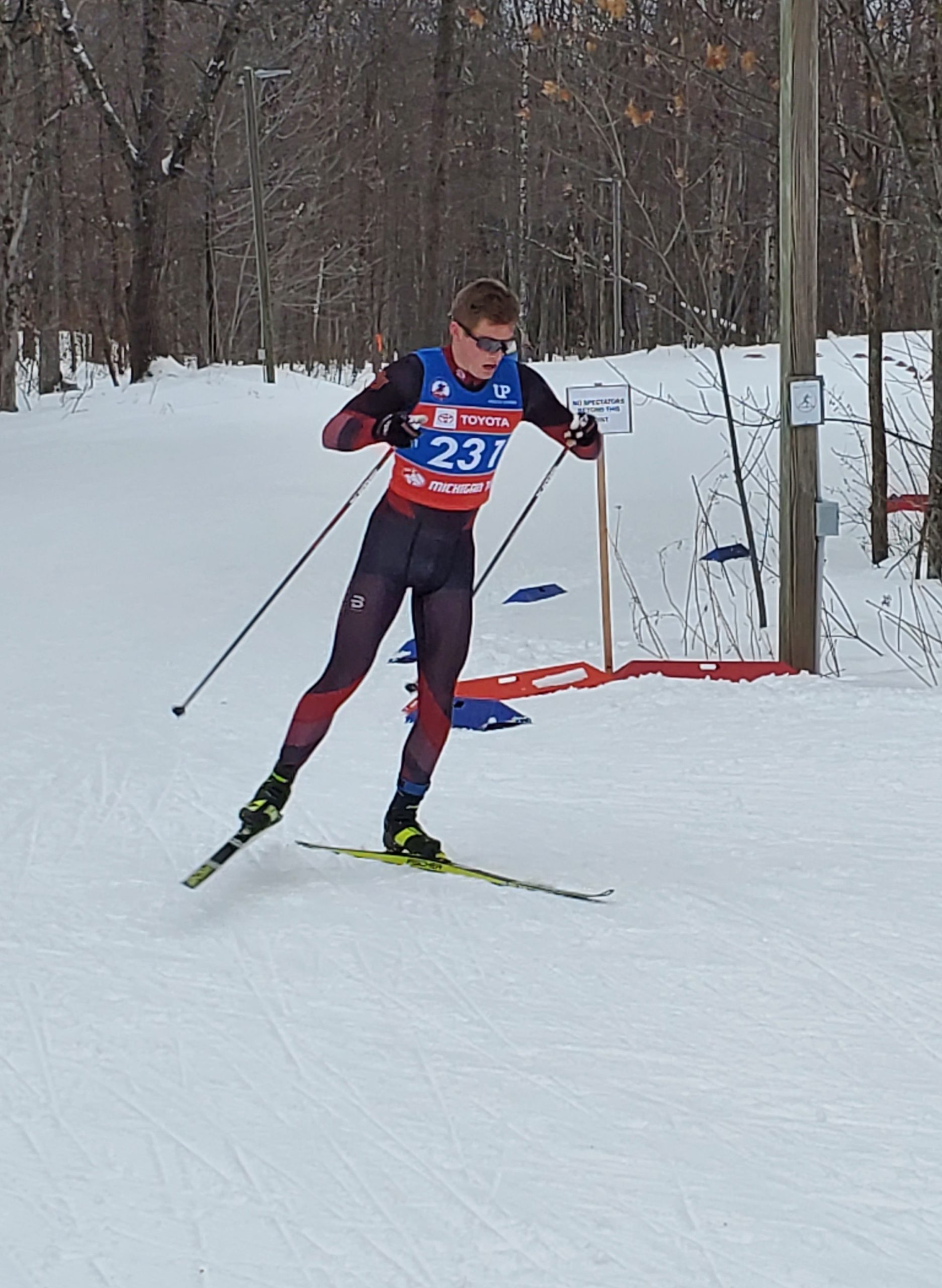
Andreas Kirkeng charging onto lap two as he heads toward victory. (Photo : Fasterskier)
Second place finisher Steel Hagnenbuch, a Dartmouth freshman, told FasterSkier that he was familiar with the course having skied it as a junior in 2020. “It skis almost like an altitude course in that there’s a lot of sustained working sections,” he said. “I thought it was really important to be strong and composed in the working section, that’s probably four minutes of big V-2 work.”
US Ski Team veteran David Norris—who was pulling double duty as both a racer and a coach for S.S.W.S.—told Faster skier that he was, “Grateful to the club letting him coach and race simultaneously.” Norris’s strategy was, “To settle in on the climbs and work all the gradual rolling stuff.” Norris’ experience was able to bring some perspective to the fact that fluoro waxes were not allowed in this race. It was Norris’s first time at a National Championship level race without fluoro waxes. “With a two lap course, it’s really interesting,” he said. “You can see where you glided to on the first lap compared to the second lap. With the new waxes, it seemed like they slowed down after 5 k, but it was quick snow.”
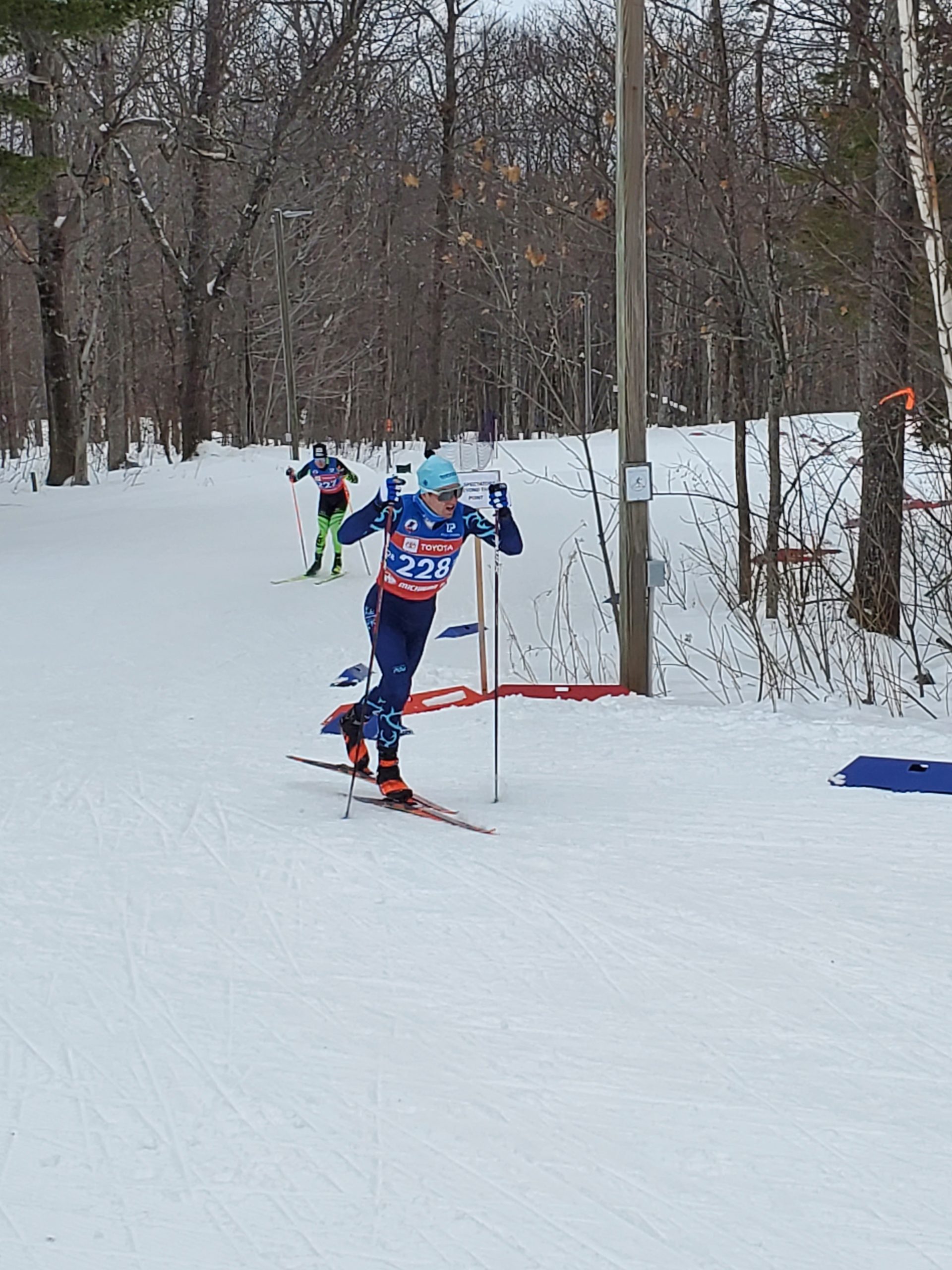
David Norris on his way to a podium in Houghton. (Photo: FasterSkier)
Norris expressed a theme repeated by skiers through the day: “Racing U.S. Nationals is the absolute best. It’s awesome, 50% of the faces here are familiar and friends . . . I like being here with all of my friends.”
The theme of fun mixed with competition was repeated by women’s champion, Swirbul.
“I’m so happy to be here. It’s not that the pressure or expectations go away, but there’s so many positive things about the ski community as a whole here … getting to see kids of all ages racing and seeing parents cheering. That environment makes me fall in love with skiing again.” Hailey Swirbul
Swirbul agreed with Steel Hagnenbuch that the course feels like skiing at altitude. She said, “It’s super sustained most of the way, it reminds me of altitude racing actually. You have to continuously grind the whole way.” She continued that, “This is my fourth or fifth time in Houghton; it’s always fun to come here and push your limits with the best skiers in the country.”
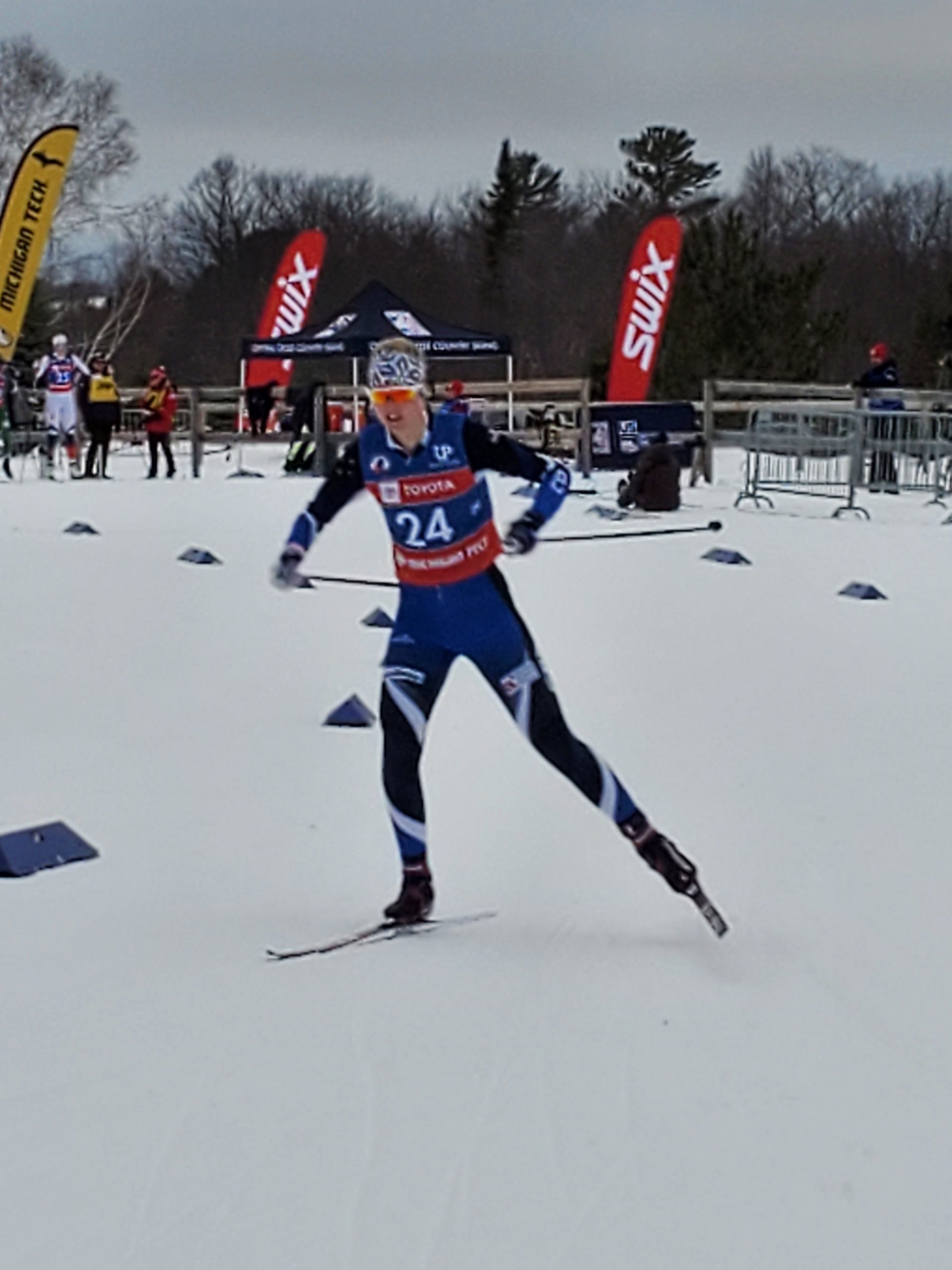
Hailey Swirbul starting her journey on the way to first place. (Photo: FasterSkier)
Fourth place skier Sarah Goble (Bridger Ski Foundation) attended MTU. She told Fasterskier the home field advantage definitely helped. “I skied here almost every day for three years. It’s really cool to be back in Michigan.”
APU coach Galen Johnston reiterated how the U.S. Nationals mean different things to different racers. “For some it’s a chance to come and establish the work that’s been done over the course of the year,” he said. “For some it’s a first time here, just coming and seeing what it’s all about.” He continued that for the first timers it’s “A chance for them to get full service from the ski perspective, and a chance to race with the best in the world. It’s a learning experience, so they can see what the next level looks like.”
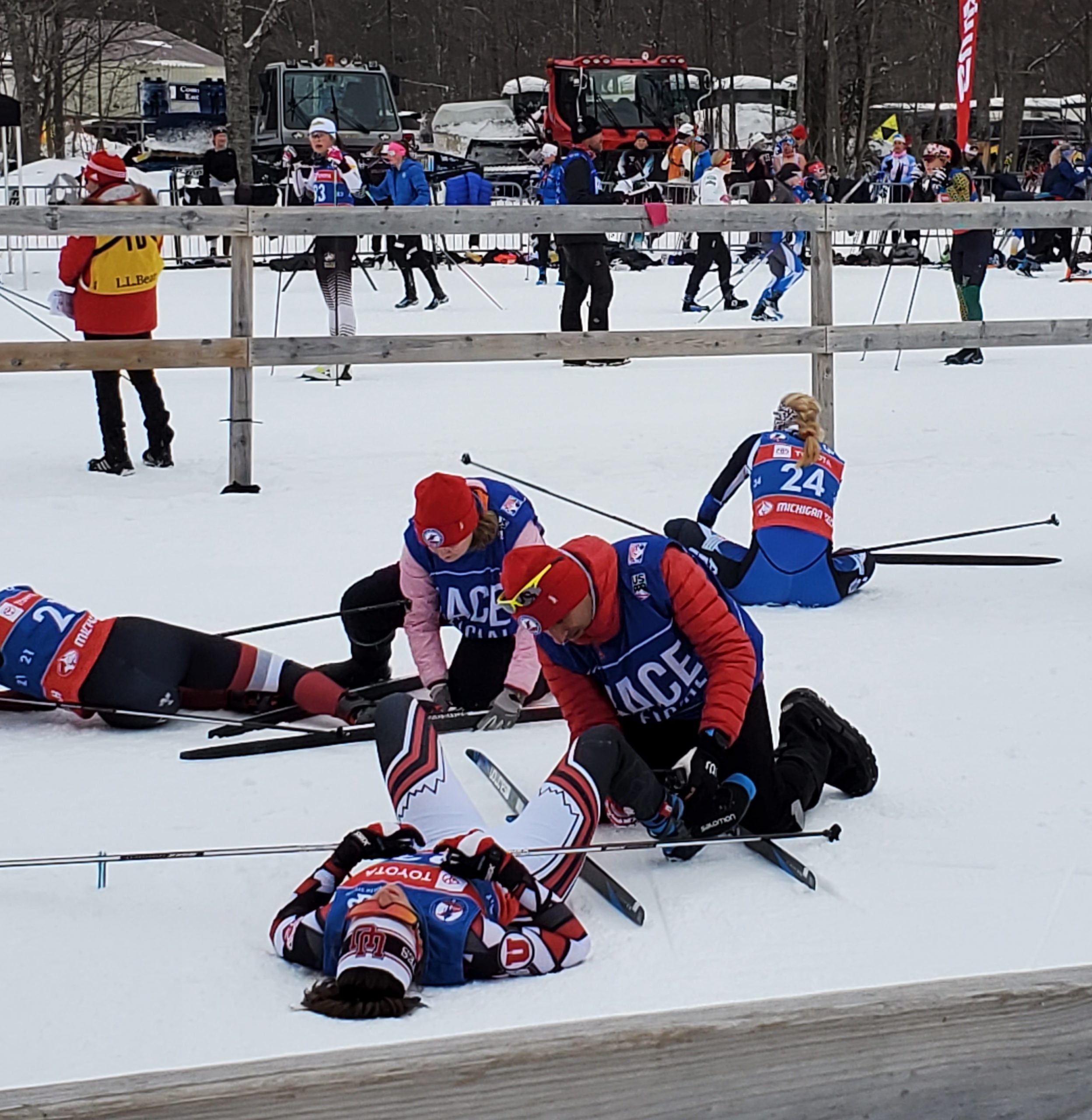
The carnage that awaits finishers at Houghton (Photo: FasterSkier)
All racers and coaches Fasterskier spoke with had high praise for the venue, the quality of organization and conditions. Racing in Houghton continues on Wednesday with Men’s and Women’s Classic Sprints. Tune in to FasterSkier for livestreaming and race coverage.
HOUGHTON, Mich. – Michigan Tech will host the 2020 U.S. Cross Country Ski Championships at the Tech Trails from January 2-7. For all U.S. Cross Country Ski Championships information please visit USNationals.mtu.edu.
“We are thrilled to bring the U.S. Cross Country Championships back to Michigan Tech,” head coach Tom Smith said. “This will be our sixth time hosting a National Championship event at Tech and the fifth time hosting the U.S. Cross Country Championships through the tenure of our Michigan Tech Nordic Ski Team.
“We boast one of the greatest race organizing committees including astounding volunteers and Tech staff, all integral to allowing us to host this National Championship event. This is a big deal for our entire community. With new trail and facility improvements, the opportunity to showcase what it is to be a Michigan Tech Nordic Husky, and an event that truly benefits our entire Keweenaw community from our Nordic Ski Team and Michigan Tech across the spectrum spanning local business and hospitality, the positive impacts this event brings are truly immeasurable! Come support your Nordic Huskies and check out the week-long action of events! To get involved as a volunteer please fill out our 2020 US Nationals Volunteer Information Form.”
The Huskies kick off their 2019-20 campaign at the UP Opener in Ishpeming on December 14-15 in a dual-meet against rivals Northern Michigan University.
They bring their second competition weekend home on December 21-22 for the MTU CXC Cup and alumni weekend. This weekend will host over 400 athletes as the test event for the U.S. Cross Country Championships, also serving as Junior National Qualifiers and Central Collegiate Ski Association (CCSA) races. The MTU CXC Cup weekend will once again feature an alumni and friends open 5K classic race, so mark your calendars and come put on a race bib for a fun start to your holiday season!
Following the U.S. Cross Country Championships, the Huskies travel to Mt. Itasca, Minnesota to compete in CCSA NCAA qualifying races on January 18-19. January 26 will feature a one event CCSA NCAA qualifying race at the Birkie Start Trailhead in Cable, Wisconsin. These January CCSA events will also be combined Midwest and Great Lakes Division Junior National Qualifying events, a great collaborative racing opportunity for all.
Tech concludes its regular season campaign at CAVOC in Rhinelander, Wisconsin on February 1-2 with two CCSA NCAA qualifying races.
The NCAA Championship season gets underway on February 15-16 back home on the Tech Trails where the Huskies will host the CCSA Championships. The NCAA Central Regional Skiing Championships will be held on February 22-23 at Al Quaal in Ishpeming.
The 2020 NCAA Championships will be held from March 11-14 at CrossCut Ranch in Bozeman, Montana.
Michigan Tech Ski Team Head Coach Joe Haggenmiller as pictured before the start of last season (Photo: Michigan Tech University)
Organizers in Ishpeming, Mich., had everything in place to host the 2003 U.S. SuperTour Finals and Distance Nationals. Everything but snow. The area had encountered a heat wave and with barely any coverage, the competitions needed to be moved.
The chief of competition and the organizing committee for the weeklong event, Joe Haggenmiller had his hands full in finding a new venue. A little more than an hour northwest was his answer.
Houghton, located in Michigan’s Upper Peninsula, had plenty of snow and had reconfigured its trail system three years earlier. What began as a headache for Haggenmiller would become a defining moment for the next 14 years of his life.
While organizing that SuperTour event, Haggenmiller fell in love with Houghton, particularly the newly developed trails maintained by Michigan Technological University (MTU). When Michigan Tech advertised an opening for a head ski-coaching position a couple months later, Haggenmiller decided to apply.
Joe Haggenmiller (r) with All-American Alice Flanders after the 2014 NCCA Championsips in Middlebury, Vt. (Courtesy photo)
“After spending a week up there, I was really intrigued by the opportunity to train on that trail system,” Haggenmiller reflected on the phone earlier this week. “Before that I hadn’t really had a chance to get to know the Houghton area. Then when the position opened two or three months later, it really seemed like an exciting opportunity.”
He got the job — his first within the National Collegiate Athletic Association (NCAA), though he had been involved in coaching beforehand for eight-plus years — and for the next 14 years, Haggenmiller led the Huskies’ cross-country skiing and running programs.
During his tenure, scholarships were introduced and his position became full-time for the first time in the university’s history. The resources to build a high-caliber college program were surfacing, and Haggenmiller was at the helm.
“The administration and I worked together in the early years to change the level of commitment the university was putting into the program,” he explained. “All those factors contributed to going from, ‘Boy, if we just get someone to NCAAs [Skiing Championships] to ‘Boy, if we don’t get four people to NCAAs who are going to compete well, then we haven’t really done our job for the year, we had an off-year as far as NCAA qualifying goes.”
Under Haggenmiller, MTU’s Division II ski team produced not only national-level competitors, but adept ones. More than 40 of his athletes qualified for NCAAs, and seven of those finished in the top 10 at the championships to become All-Americans. In 2010, Haggenmiller coached the men’s to team Central Collegiate Ski Association (CCSA) championship title. Two years later, he did the same for the women.
“Regionally, getting one skier to the NCAA’s was a successful year, whereas I think now with Joe we’re looking at two three or four skiers being successful here,” Joel Isaacson, Michigan Tech’s associate athletic director for external relations, said of the changes he witnessed with Haggenmiller as head coach.
“Joe definitely pushed our program to be better as an institution,” Isaacson continued. “That’s with quality of the student athlete that we’re bringing in, the competitiveness of our program, pushing our department to start hosting events and do that on a continuous cycle. He was a big advocate in our department to make sure that we were show casing our premier trails.”
Beyond helping improve individual performances, Haggenmiller also helped bring U.S. Cross Country Ski Championships to Houghton (first in 2007), as well Junior Nationals Qualifiers. U.S. nationals would come to Houghton three more times: in 2008, 2015 and 2016.
“That’s definitely something that bittersweet about moving on,” said Haggenmiller, who recently resigned from his role as MTU head coach. “I built up some great relationships with the people who really were the movers and shakers and the race organizing committee, and not only is it a great course, it’s a great group of people.”
While he enjoyed his time at Michigan Tech and the opportunity to develop its program, a restructuring of the position last season prompted him to seek new opportunities. His wife took a job in Duluth, Minn., and after spending a year four hours away from his family (including two daughters, ages 10 and 14), the 48-year-old Twin Cities native decided to return to his home state.
“I have accepted a position with Central Cross Country (CXC) skiing,” Haggenmiller said.
He’ll mostly work in the realm of athletic development and organizing CXC’s race series, as well as with clubs, he explained. His official first day on the job was Monday, May 1, and though the position is new to the CXC program and doesn’t have an official title, his future in the skiing world continues, now in athlete-and-program development instead of college coaching.
“I certainly wouldn’t be opposed to getting back into NCAA coaching,” he added. “At this point I also don’t know what the future might hold.”
Michigan Tech is currently in the hiring process for a new head cross-country skiing and running coach.
“A key for Michigan Tech is finding a candidate that is going to make our student athletes not only successful on the trails and in the classroom, but also going to make good men and women. Good husbands, good wives, good moms, good dads,” Isaacson said.
Left to right: Joe Haggenmiller, Mike Fleming, Alice Flanders, and Andrew Joda after Flanders’s 10th place finish at 2014 NCAA Skiing Championships. (Photo: Joe Haggenmiller)
Michigan Technological University seeks a goal-oriented, charismatic, inspirational and dedicated head coach with a genuine interest in the success of student-athletes and building a competitive Men’s and Women’s Nordic skiing programs. The head coach is charged with developing, leading and implementing NCAA Men’s and Women’s Nordic skiing and will work to continue Michigan Tech Nordic skiing as a nationally recognized and distinctive program. Duties of the position include areas such as recruitment, scheduling, practice/game preparation, budget management, fund raising and promotion. The coach works in a collaborative fashion with the Athletic Department and serves in a leadership role to enhance the internal and external visibility and recognition of the Michigan Tech Men’s and Women’s Nordic skiing programs.
This is a 12 month position and salary is competitive and will commensurate with qualifications and experience. The University also offers an excellent benefits package. More information is available on the University’s website. Michigan Technological University is only accepting online applications for this position via the Michigan Tech jobs website. Please apply online at https://www.jobs.mtu.edu/postings/5445.
Review of applications will begin immediately and continue until the position is filled. Michigan Technological University is an Equal Opportunity Educational Institution/Equal Opportunity Employer, which includes providing equal opportunity for protected veterans and individuals with disabilities.
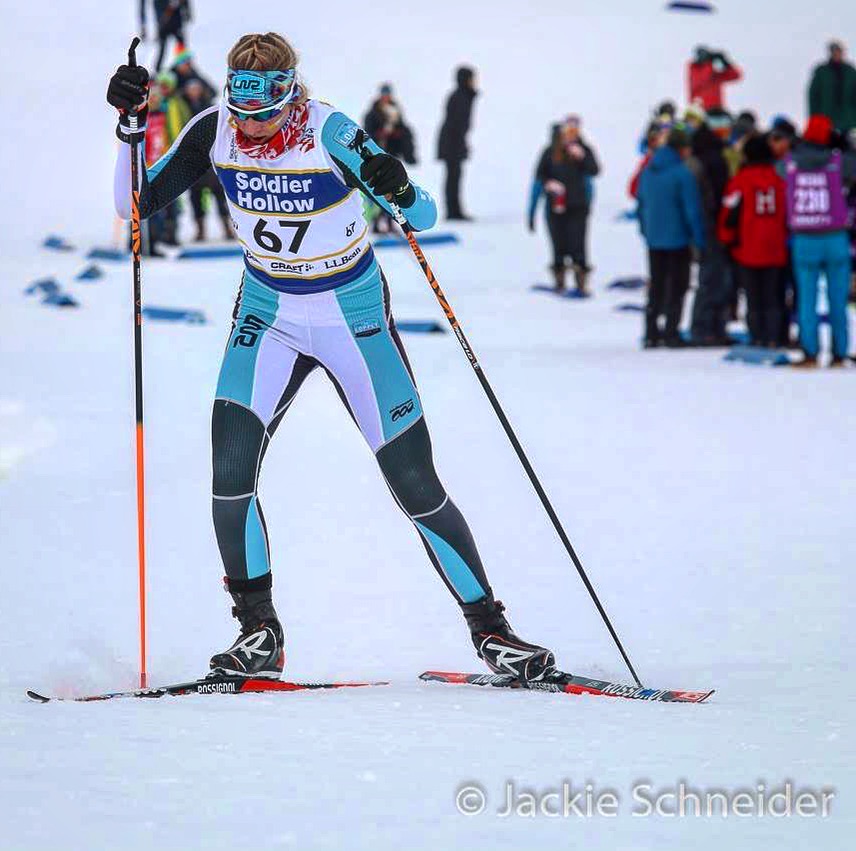
Amanda Kautzer (Michigan Tech/Loppet Nordic Racing) competing at 2017 U.S. nationals last month at Soldier Hollow in Midway, Utah. (Photo: Jackie Schneider)
In another 20-something-question, fill-in-the-blanks series, we checked in with the world-class U.S. and Canadian biathletes that will be competing at 2017 International Biathlon Union (IBU) Youth & Junior World Championships Feb. 22-28 in Osrblie (also known as Brezno-Osrblie), Slovakia.
Here’s 18-year-old Amanda Kautzer, of Michigan Tech and Loppet Nordic Racing, who is representing the U.S. at her third Youth Worlds. On Wednesday, Kautzer placed 53rd in the youth women’s 10 k individual and on Friday, she was 59th in the 6 k sprint.
***
“My full name is Amanda Rose Kautzer, but you can call me Amanda, Mandy, whatever works. I was born in Singapore and raised in Plymouth, Minn.
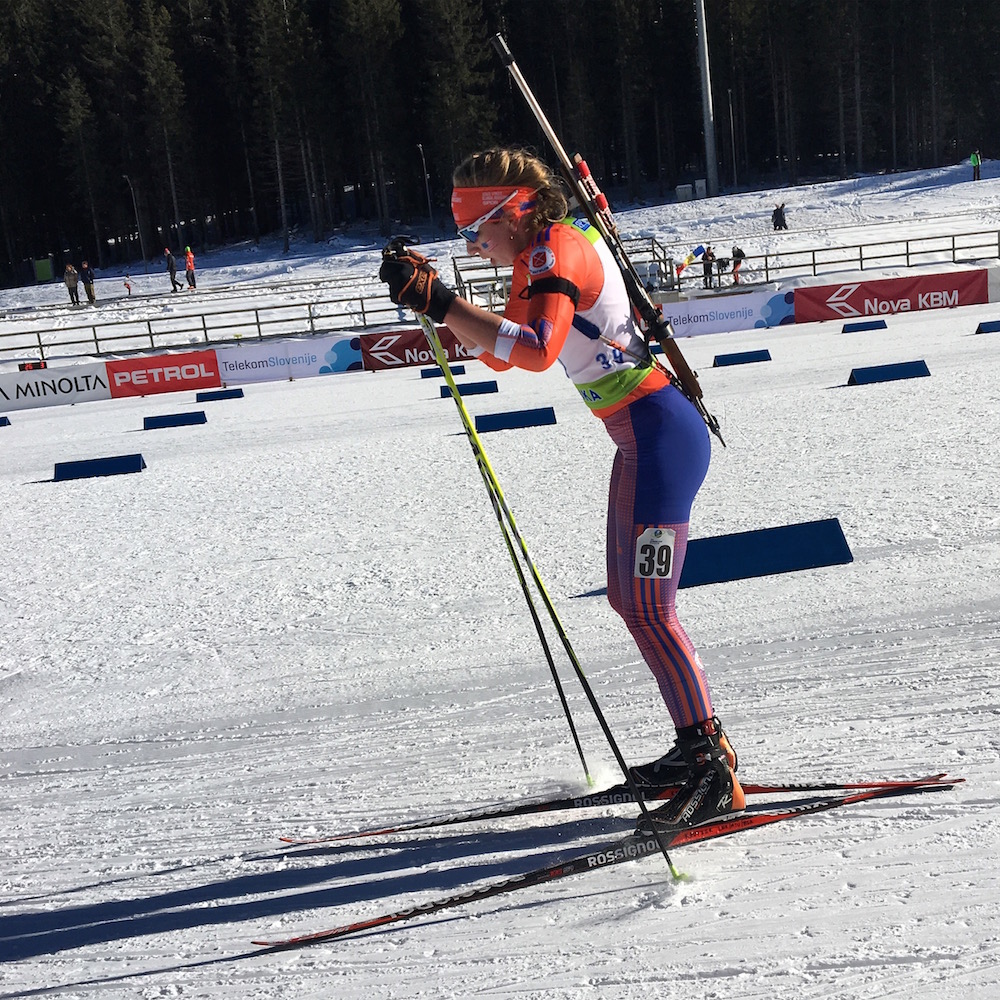
American Amanda Kautzer racing at an IBU Junior Cup earlier this month in Pokljuka, Slovenia. (Photo: Vladimir Cervenka)
I started cross-country skiing when I was 12 and started biathlon when I was 14, thanks to my coach Piotr Bednarski. I currently train in Houghton, Mich., and Plymouth with the Michigan Tech Nordic Ski team and Loppet Nordic Racing, respectively.
If I’m not skiing, you might find me skiing (the other kind). If I had to pick a favorite book, it would be ‘The Name of the Wind‘.
One of the things I’m most excited about for Youth/Junior World Championships in Brezno-Osrblie is fast skis from great wax techs. This will be my third Youth/Junior World Championships, and this year, I’m competing as a youth.
One race I’m especially targeting there is ummmm all of them of course.
The best advice anyone ever gave me about skiing or racing was: ski fast (thanks Dad, super insightful, later changed to: ski faster than everyone else).
One of the best race memories I have is getting silver in a skate sprint despite breaking a pole in the heats.
If I could meet one World Cup skier, it would be Laura Dahlmeier.
If I don’t end up being a professional skier, I’ll probably be a ski coach and do triathlons.
I’m missing 36 days of school to be here, and my professors are probably thinking, ‘Are you in my class? I haven’t seen you there, not even once.’
Michigan Tech is seeking a Nordic Graduate Assistant Coach. Michigan Tech is looking for someone with NCAA Skiing experience that is interested in coaching cross country skiing at the NCAA level.
Candidates should be qualified, experienced and highly motivated to assist with NCAA Ski coaching, including among other duties: supervising student-athletes, implementing training programs, analysis of technique, preparing student-athletes for competition, race day ski service, working on NCAA compliance matters, recruiting, other office duties, etc.
Compensation: tuition waivers and a stipend.
Michigan Tech has an MBA program and a Masters program in Kinesiology/Exercise Science, along with many other highly respected graduate programs in STEM subjects. (We would also be willing to work with an undergrad who has exhausted eligibility and needs more time to finish their undergraduate degree.) Most of our graduate programs are looking for at least a 3.0 undergrad GPA.
If you are interested in this position, please send a cover letter, resume and references to Joe Haggenmiller, jjhaggen@mtu.edu, expressing your interest. Michigan Technological University is an equal opportunity/affirmative action employer and educator.
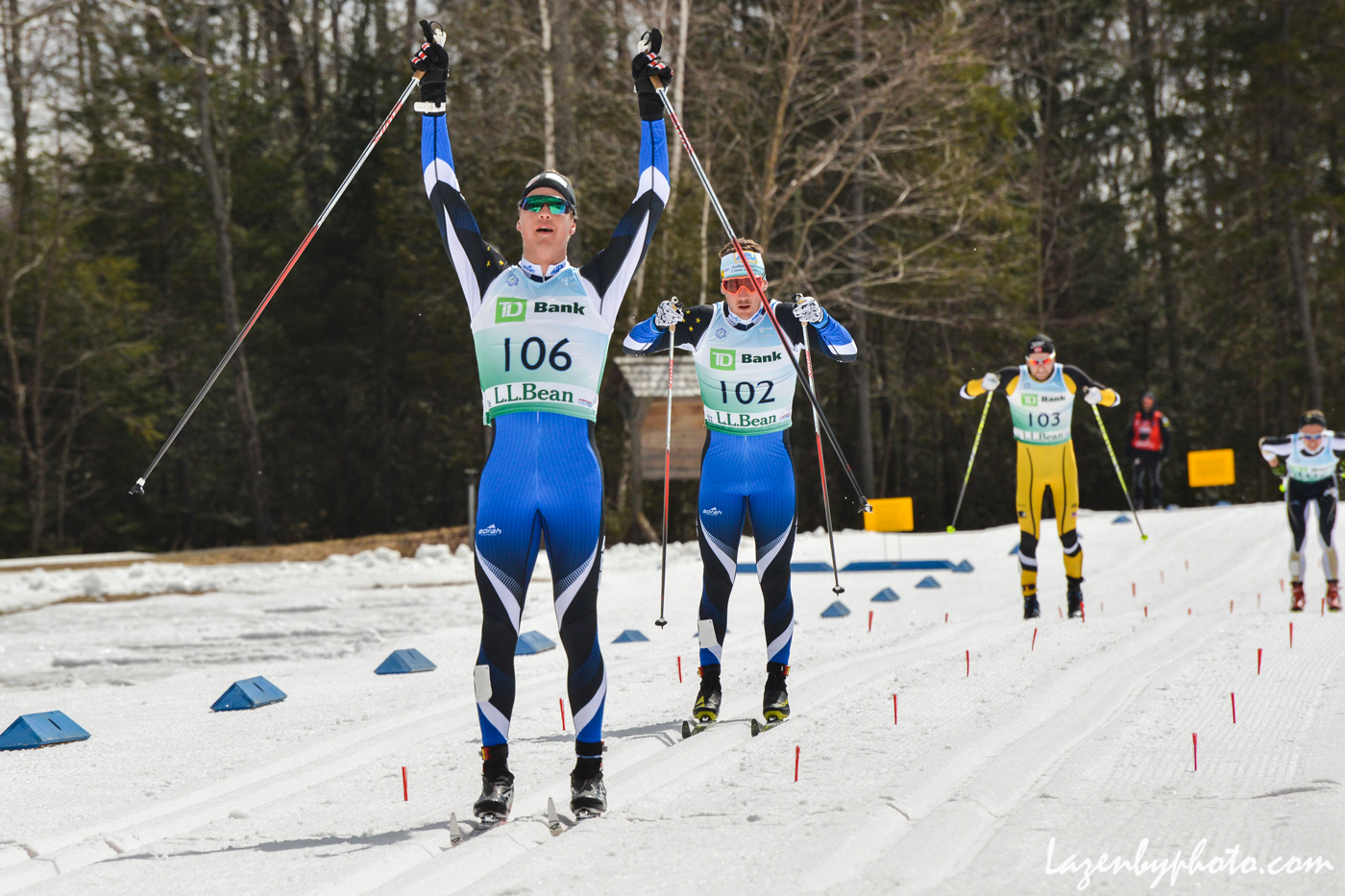
Erik Bjornsen (106) celebrates his classic sprint victory on Tuesday at SuperTour Finals in Craftsbury, Vt., after holding off APU teammate Reese Hanneman (102) by 1.28 seconds. Logan Hanneman (not shown) completed the APU podium sweep in third, 4.35 seconds back, while Michigan Tech’s Didrik Elset (in yellow) missed the podium by 0.34 seconds in fourth. (Photo: John Lazenby/Lazenbyphoto.com)
Earlier this year at U.S. nationals, Alaska Pacific University (APU) narrowly missed a podium sweep in the classic sprint in Houghton, Mich., taking first, second and fourth in the men’s final. But on Tuesday in Craftsbury, Vt., in the 1.5-kilometer classic sprint at SuperTour Finals, the APU men pulled it off, putting four men in the final and sweeping the top three.
The APU contingent consisted of Eric Packer (the defending national champion in the classic sprint), Reese Hanneman (the SuperTour sprint leader for Period I who spent the rest of the season on the World Cup in Europe), his younger brother Logan Hanneman (the fastest qualifier of the day in 3:07.24), and Erik Bjornsen (who recently returning to the U.S. after racing a full season on the World Cup circuit).
They were joined by two Norwegians competing as collegians in exchange programs: Didrik Elset, 22, of Michigan Tech University and Petter Reistad, 21, of the University of Colorado-Boulder (CU). Elset broke up the APU sweep at nationals, placing third in the classic sprint. Reistad helped CU to a runner-up team finish at NCAA Skiing Championships, double poling to ninth in the 20 k classic mass start.
On Tuesday, the two Norwegians, Elset and Reistad decided to double pole the qualifier as well as the heats, making it all the way to the final. The rest of the field opted to stride the heats. On a wide track with five classic tracks covering most of the course, racers were pleased with a fair-and-minimally tactical course.
In the final, Reistad blasted out of the gate and Reese Hanneman tucked in just behind. Heading up the decisive climb on the course, Reese jumped into his own track and surged ahead of Reistad. Bjornsen covered the move and the two gapped the field as they headed toward the slight incline into the finish. Hanneman tucked behind Bjornsen to be sheltered from the headwind and matched his pace, but couldn’t overtake him. Bjornsen secured the win in 3:02.4, beating Reese by 1.28 seconds.
After gaining on Elset and Reistad on the climb, Logan Hanneman overtook the double polers in the final stretch to notch third (+4.35), just 0.34 seconds ahead of Elset in fourth. Fatigued from double poling with little rest between heats, Reistad faded to fifth (+7.31).
Notably missing from the podium, current SuperTour leader Packer placed sixth (+50.95) after a crash in the final.
“I fell on the big downhill in the final, and ended up sliding off course into the dirt and leaves,” wrote Packer in a post-race email. “There was no contact or anything — I just caught an edge and went down. It was a bummer for sure but I am looking forward to the next two races, and defending my Supertour lead in the 50 k.”
Bjornsen Pushes Through
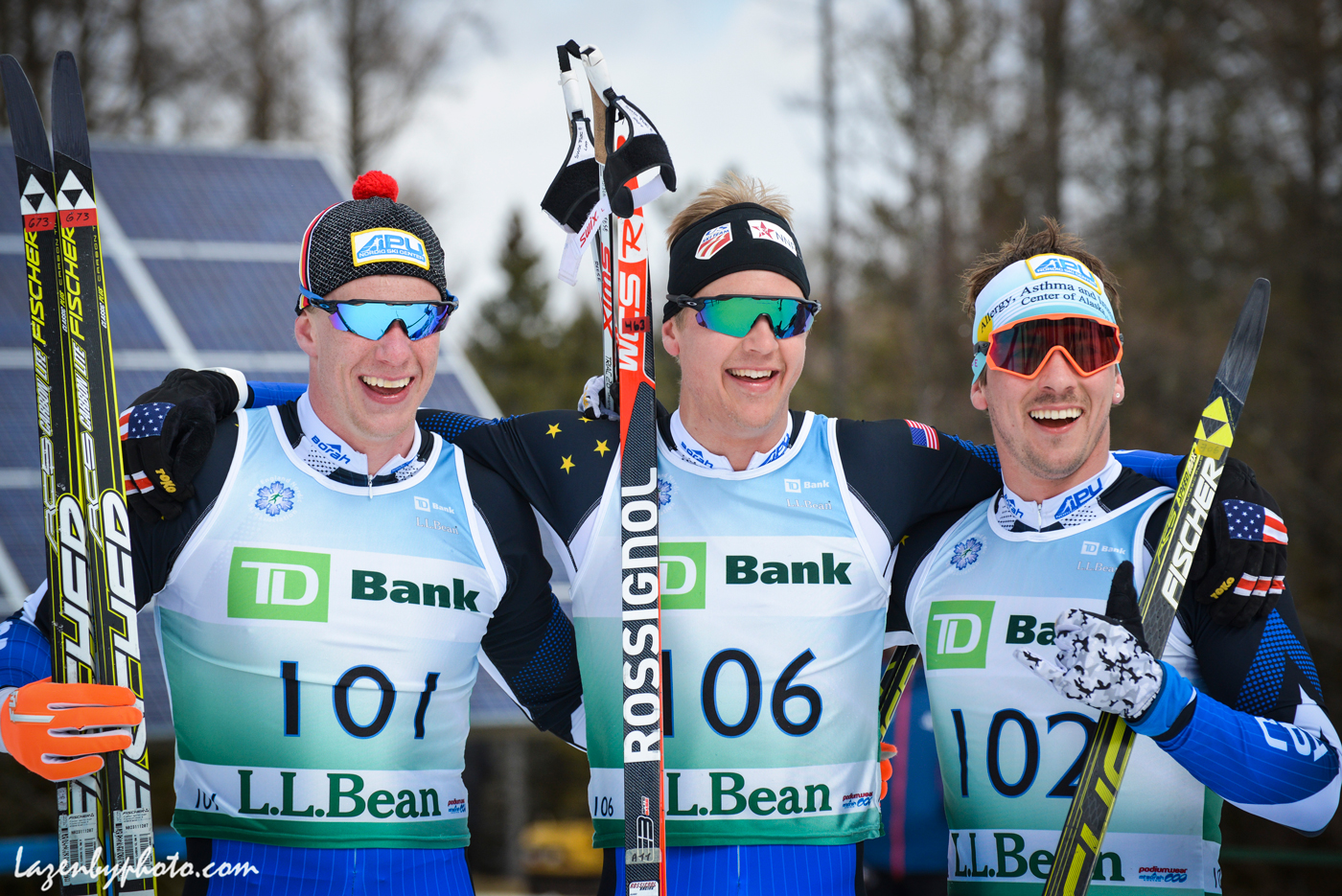
The APU men swept the classic sprint podium at SuperTour Finals on Tuesday in Craftsbury, Vt. Erik Bjornsen (c) led the team in first, ahead of brothers Reese (r) and Logan Hanneman (l) in second and third, respectively. (photo credit: John Lazenby/Lazenbyphoto.com)
Although Bjornsen was considered a favorite heading into the race, he was pleasantly surprised with the victory.
“It was not exactly what I was expecting, I was happy to have enough in the final to take the win,” Bjornsen, 24, said in a post-race phone interview. “I am not feeling great right now, it is not my best shape, but I’m trying to race through it and enjoy the racing in the U.S.”
After posting the sixth-fastest time in the qualifier, about 2.98 seconds behind Logan, Bjornsen progressively gained momentum, winning both his quarterfinal and semifinal.
“The legs especially are not responding, just kinda feeling dead,” he described. “I felt pretty good in the heats today. I tried to ski behind people and make my move in the last 60 seconds or so and I think it worked and helped me conserve energy for the final.”
Reese in second overall was also pleased after feeling beat up after the season-ending World Cups in Canada.
“It was good. I was just so dead after Ski Tour Canada and I didn’t really know what to expect,” he said on the phone. “I pretty much just felt dead for a week after Canmore and then I had a really, really bad race hack for a long time so I didn’t race [on Monday]. I felt pretty good, the skiing was really nice, they did an awesome job with the course.”
Although fatigue resonates through all the racers, Reese highlighted that at this point of the season, it is a mental challenge more than anything.
“Being really tired is kind of a given at this point in the year. … We are all just all a bunch of tired people racing each other,” he said. “It doesn’t necessarily mean that you can’t do well, I think it is important to learn to race when tired because it is not indicative of the result, it’s just mentally hard to get fired up.”
Although little glory is generally given to sprint-qualifier winners, prize money for the fastest qualifier in Craftsbury placed a bit of incentive for the morning prelim. With that in mind, Logan set an intermediate goal for the day: winning the qualifier. The decision to stride instead of double pole paid off as he claimed the top qualifier in 3:07.24, just 0.71 seconds faster than his brother Reese.
Logan Hanneman (APU) racing to a 0.71-second qualifying win in the men’s classic sprint on Tuesday at SuperTour Finals in Craftsbury, Vt. (Photo: John Lazenby/Lazenbyphoto.com)
Logan went on to win the first quarterfinal, then advanced as a lucky loser in the semifinal after placing third behind Bjornsen and Reistad, respectively.
“I went out and in typical Logan fashion, slow out of the start,” Logan said on the phone after.” I was fifth pretty much the whole way until the stadium and I caught and passed the two double polers on that last stretch.”
Completing the podium sweep was part of his motivation heading down the homestretch.
“That was cool,” he said. “That was one of my incentives for catching those people. And we had four in the top six. Packer took a little detour off course in the final, which wasn’t quite the fastest detour.”
Packer echoed the significance of the strong APU showing. “It was really cool to see my teammates sweep the podium today…,” he said. “I think it reflects the training we do in Alaska. We’re all pushing in training, and that’s starting to show through in the results.”
Despite missing the podium by 0.34 seconds, Elset in fourth said he has enjoyed racing and training in the U.S. with Michigan Tech and credits coach Joe Haggenmiller and the team with his success.
“I chose skate skis. It worked pretty well, especially for the quarterfinal and the semifinal but in the final, the APU guys were going too fast for me up the climb and I was getting tired so it was rough,” Elset said. “I was hoping to be on the podium today but being able to ski with these guys who are so fast and be competitive is fun and it gives me a lot of confidence that I am doing something right.”
Alaska Pacific University teammates Eric Packer (5) and Reese Hanneman (4) go head to head in the men’s 1.5 k classic sprint final on Saturday at U.S. nationals in Houghton, Mich., while coach Erik Flora (l) runs alongside them. Packer won the final by 0.67 seconds, denying Hanneman a sweep of this week’s sprints.
HOUGHTON, Mich. — The step into the reality of a goal is at times, long awaited. It is a step that Eric Packer of Alaska Pacific University (APU), the race winner of the men’s 1.5-kilometer classic sprint at U.S. Cross Country Championships on Saturday, feels he has finally made.
“I’ve dreamed of winning at nationals for a long time and to finally make it happen is really special,” said the 24-year-old during an in-person interview after winning his first U.S. nationals title on the Michigan Tech Trails. He had reached the national podium twice before: placing third in two races at 2012 nationals (classic sprint and 30 k classic mass start) in Rumford, Maine.
After racing to fourth overall in the 15 k classic individual start a week ago, then 11th in the freestyle sprint on the same course last Monday, and 25th in the 30 k freestyle mass start on Thursday, Packer remained receptive to any opportunity afforded him during Saturday’s sprint.
“The most challenging part for me was I was very tired after the qualifier,” said Packer. He qualified fourth, 4.74 seconds behind qualifying winner Didrik Fjeld Elset, a Michigan Tech freshman from Norway.
“It’s the accumulation of the week of racing and it’s hard to stay with it and remember that even though it’s the end of the week, it’s still a national championship,” Packer explained.
In the end, it was a challenge that left the Anchorage native unmatched in the final. To get there, Packer had won his quarterfinal and placed second his semifinal (behind Dakota Blackhorse-von Jess, of the Bend Endurance Academy) to automatically advance to the final.
“[APU] had a great day and that’s really cool for Eric to win,” Blackhorse-von Jess said after racing to fifth in the final, 5.37 second off Packer’s winning time of 3:38.17.
Along with Packer, APU’s Reese Hanneman and Tyler Kornfield also advanced to the final and placed second and fourth, respectively.
APU teammates and brothers Logan Hanneman (7) and Reese Hanneman (4) lead teammate Tyler Kornfield (17), Welly Ramsey of Mountain Endurance Sports (27) and Fredrik Schwencke of Northern Michigan University (far left) during their quarterfinal of the men’s 1.5 k classic sprint on Saturday at U.S. nationals in Houghton, Mich.
“My fiancé is trying on wedding dresses today, so I knew I had to win some money,” said Hanneman, the runner-up by 0.67 seconds. He got engaged last month.
Beyond bridal bouquets, Hanneman also now has World Cup starts ahead of him.
“I’m going to Europe [on Sunday] and I’ll race the sprints in Slovenia next weekend, all of Period 3,” said Hanneman, 26, also originally from Alaska. After that, he’s headed to Canada for the season-ending World Cup tour.
Overall third place finisher, Elset, 22, crossed 1.05 seconds after Packer, and explained he was seeking redemption after the skate sprint.
“I really wanted to do well today because I crashed in the semifinals on Monday,” Elset said.
Out of six hungry finalists in the men’s field, the contention for the title would prove challenging — especially with some racers on skate skis.
“I went with classic skis for the qualifier and then double poled all three heats,” Kornfield said. He finished fourth after Elset edged him in a photo finish for third. Both were given the same time.
Elset also double poled the final, after double poling the qualifier and his quarterfinal and semifinal as well.
“It was OK for the first three heats, but in the final when the guys were fast, my arms were really, really tired,” Elset said.
Hanneman and Blackhorse-von Jess took the opposite route, opting to race classic skis throughout the day.
Though another Norwegian, 23-year-old Håkon Hjelstuen, a former Michigan Tech skier, dabbled with double poling, he ultimately went with classic skis in the final.
“I tried it in the semis. It’s kind of a game,” Hjelstuen said after placing sixth overall, 24 seconds behind Packer.
Figuring that most racers would use skate skis during the quarterfinals and then switch to classic skis in the semi, Hjelstuen hoped to catch other competitors off guard.
“I thought, ‘OK, the other guys are probably doing it in their quarters and then maybe switching,’ so I was trying to switch the other way,” the Norwegian explained.
Also hoping to gain more control over his heats, Kornfield reasoned he made the right choice to double pole through the rounds.
“All my heats had mixtures of skate skis and classic skis so the downhills; it was obvious who could take the turns better,” Kornfield said. “Because I could take better lines than the classic skiers, I was able to choose where I wanted to go.”
The start of the men’s classic sprint final (from left to right), with Didrik Elset of Michigan Tech, Dakota Blackhorse-von Jess (Bend Endurance Academy), Tyler Kornfield (APU), and Reese Hanneman (APU). Eventual winner Eric Packer is not shown. (Photo: Christopher Schmidt)
The light snowfall, track traffic during rounds, along with the course’s lengthy climb to the finish, made decisions on ski choice largely up to the individual.
“I tested classic versus skate in the morning and the tracks were really weird,” Packer observed.
“It was glaze-y in places and new snow, so my skate skis were a little bit faster for the double pole and I double poled in the qualifier in the morning, but then I switched to classic for all the other heats,” he explained.
The Final: From Start to Finish
With four racers in the final on classic skis and the rest on skate, the final men’s race of the day took off at the sound of the gun, those on skate skis pushing the pace early on.
“I took the start and I wanted to go kind of hard down the hills in the beginning to take advantage of my good glide,” Elset said. “From there on in, it was just answering the attacks that came from the guys with good kick.”
While Elset and Kornfield remained in the lead for the first part of the course, the rest of the field was forced to hunt for the front.
“The guys [on skate skis] got in front and were gliding a little bit faster on the first downhill,” Hanneman recalled. “I couldn’t get my own track on the first hill, so I was kind of forced to just hang back. … I tried to make a pass on the inside, but I realized that was just going to cause a big mess, so I kind of backed off a little bit.”
Still a tight pack after cresting the first uphill, the group made their way into the corner before the next big climb.
Coming out of the corner to the second large climb, it was Hanneman who made the first move to take the lead.
“On that second big climb I was able to get my own track so then I was able to put the hammer down and kind of put some space between me and the skate ski guys,” Hanneman said.
Following Hanneman, Packer also saw his chance to better position himself for thesecond half of the course.
“Tyler and Didrik were driving the pace and then Reese pulled out on the side and was able to pass them striding,” Packer said. “I jumped in behind Reese and together we broke away a little bit on the second climb.”
As Packer and Hanneman maneuvered their way to the front, the battle behind them ensued.
“I was leading up until the second big uphill, and I just didn’t have enough power to get over the top fast enough to be within range of Packer and Reese,” Kornfield said.
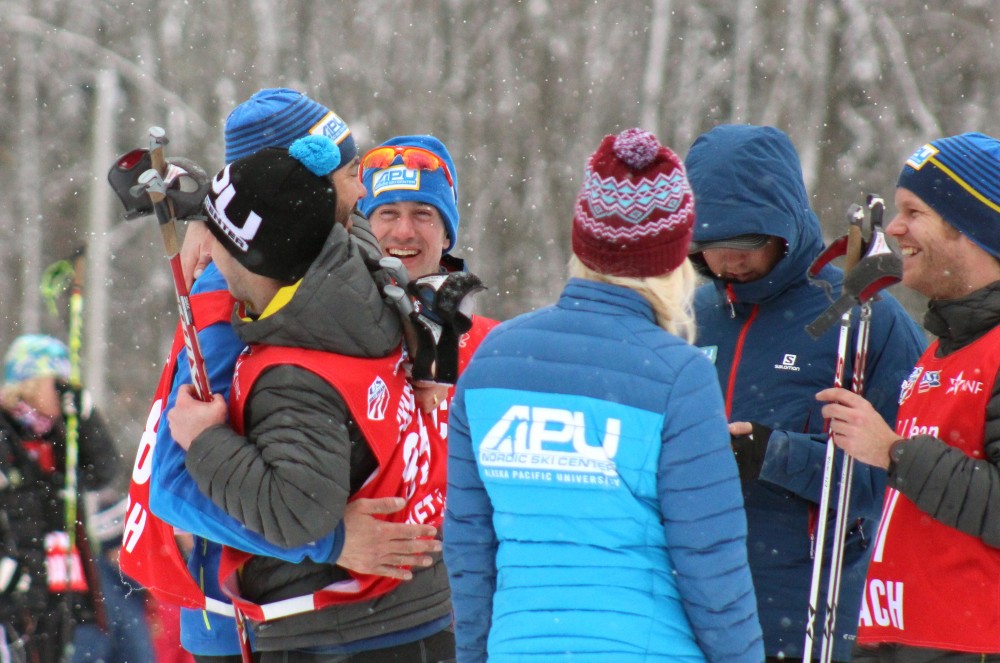
APU coaches and wax techs, including head coach Erik Flora (l) celebrate after three APU athletes finished in the top four, including overall race winner Eric Packer (not shown) at the men’s 1.5 k classic sprint on Saturday at U.S. nationals in Houghton, Mich.
“Didrik led down the hill, but Reese pulled up alongside him on the second climb,” Blackhorse-von Jess explained. “I was back there trying to pick my way through traffic, trying to get back in contact with the main group. [Hjelstuen] was in fifth and he kind of got detached and I got stuck behind him a little bit. Eventually, I got around him, but I just couldn’t close it to the big group.”
After moving around the sixth-place Norwegian, who advanced to the final as a lucky loser, Blackhorse-von Jess explained, “I went for it, but I chose the wrong lane I guess, so I lost some speed in that downhill before the last uphill. Still, I would rather go for it than go for nothing.”
With that, the finalists rounded the last corner on course, a sea of blue in the lead.
Packer cornered first, Hanneman centimeters to his left and Kornfield in the center lane just behind.
In the lane to the left of Hanneman and Kornfield was the gold suit of Michigan Tech’s Elset closing in on the three APU skiers.
“On that final turn, Packer and I were having a double-pole battle,” Hanneman said. “He came out of that turn a little faster than I did, so he pulled faster than I did and we were side by side.”
Packer then made his move around Hanneman in the final 100 meters.
“In the finish, I jumped out from behind Reese to make a pass and I jumped out into a super-slow lane that was filled with new snow,” Hanneman said. “So I just double poled as hard as I could and got by and then once I got past him I tried to get back into a faster track.”
As the teammates battled for first, Packer outlunged Hanneman at the line by about six-tenths of a second.
Not far behind Hanneman and Packer, Elset challenged Kornfield for third. In an extremely close photo finish, Elset came away with the overall podium finish, though Kornfield stood as the third American at the end of the day. Blackhorse-von Jess finished about four seconds later in fifth and Hjelstuen rounded out the final in sixth.
With his first U.S. nationals win packed away, a euphoric Packer stood on the top of Saturday’s men’s sprint podium.
“It feels amazing,” he said. “It’s a dream come true.”
HOUGHTON, Mich. — It is the eve of the first day of racing at U.S. Cross Country Championships and racers have arrived from around the country and brought an air of excitement and energy to the town of Houghton.
Houghton is situated in the Keewanaw peninsula, Michigan’s Upper Peninsula, near the northernmost tip of the state. Since it is not “on the way” anywhere, and many hours from any major city, you are not likely to find yourself in Houghton unless it is your destination.
However, Houghton is a cross-country ski mecca of the Midwest that draws skiers from around the country to enjoy 25 kilometers of world-class groomed trails on the campus of Michigan Tech University. The Michigan Tech trails are homologated, according to International Ski Federation (FIS) and U.S. Ski & Snowboard Association (USSA) standards, and thus able to host high-profile races.
Nationals are held at the same venue for two consecutive years and this is Houghton’s second year hosting the event following a frigid and snowy 2015 nationals. Houghton also hosted U.S. nationals in 2007-2008, the last time the event was held in the Midwest.
“We have a really good trail system that provides a good challenge to racers. I think we can have fair races because generally we have consistent conditions across the day,” said Joe Haggenmiller, head nordic coach at Michigan Tech University (MTU) and co-chair of the race organization committee.
Although coordinating a team trip to Houghton can be a logistical challenge, Houghton provides a great race venue with no shortage of community support.
“Our community is really excited to host it. We have a core of 20 people who are really dedicated and put a lot of time into this event and we have a group of about 100 volunteers who are ready to help,” Haggenmiller said.
The community support of the event was illustrated last weekend when nearly 100 people attended a work bee at the trails. Despite snow shortage concerns in mid-December, Houghton was reporting great ski conditions as of two weeks ago. However, Mother Nature was not finished throwing curve balls. On Dec. 23, Houghton weathered heavy rains and 50-70 mile per hour winds which created an icy, debris strewn trail. The race organizers sent out a call for help and the volunteers came out in force.
Volunteers took to the trail in groups assigned to a section of trail they would rake clear of debris. Together the teams raked all 25 k of trails just before another four inches of snow fell. This made the distance courses viable instead of the “low-snow” 2.5 k course that was beginning to look like reality. To ensure the courses would withstand a week of racing, work crews hauled 30 cubic meters of snow onto the course, mostly on the downhill corners.
“The conditions are really nice. They tilled last night and we set full depth tracks today,” said Jim Tervo, chief of competition. “It is really mid-season form, we are really pleased with the way it turned out.”
“Tomorrow should be a really fun day for the athletes because I think the kickwaxing should be pretty straightforward and it should be pretty fast,” Haggenmiller said. “I think the athletes will enjoy getting around the course well in mild conditions.”
U.S. Nationals 2016 Race Schedule:
Sunday, Jan. 3
Men’s 15 k classic individual start
Women’s 10 k classic individual start
Monday, Jan. 4
Men’s and Women’s 1.5 k freestyle sprint
Thursday, Jan. 7
20/30 k freestyle mass start
Saturday, Jan. 9
Men’s and women’s 1.5 k classic sprint
The Course
The entire schedule of races for nationals week will utilize the sprint course, 5 k course, 7.5 k course, and 10 k course. Each course is a variation of the same core loop. Sunday’s races: the women’s 10 k classic, will be 2 laps of 5 k,and the men’s 15 k classic will be 2 laps of 7.5 k.
The course features significant elevation change both in the form of steep, short climbs and long, gradual grinds. Several downhill sections require technical finesse, especially in fast conditions.
Several sections of the course will likely prove to be decisive:
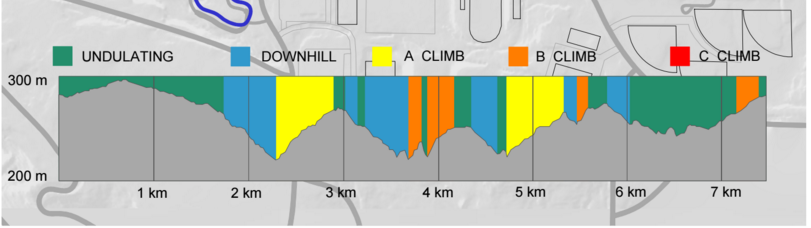
Hairpin loop: This section is part of every distance race and includes a long gradual descent to a hairpin turn and then back up a grinding 7 percent grade for 0.3 miles. Racers will be carrying significant speed into the hairpin turn and will have to be prepared for the possibility of washed-out sections.
Peepsock climb: This is a 4 percent grade over 0.4 miles leading into the finishing stadium which will likely prove decisive in the mass start races. The 5 k course cuts off a portion of this section but still features a significant climb into the finishing straightway.
Elevation profile of the 7.5 k course being used for U.S. nationals at the Michigan Tech trails in Houghton, Mich.
Racing kicks off with individual start classic races on Sunday. The men’s 15 k begins at 10 a.m. Eastern time and the women’s 10 k at 1 p.m.
Live results can be found at Superior Timing and the event will also be live streamed courtesy of a partnership between Central Cross Country Ski Association (CXC) and USSA.
Craftsbury Green Racing Project’s Liz Guiney (l) and head coach Pepa Miloucheva during a ski on Saturday, Jan. 2 in Houghton, Mich., the day before the kickoff of 2016 U.S. nationals.
A Dartmouth skier heads out onto the Michigan Tech trail’s 5 k course on Saturday, Jan. 2, the day before 2016 U.S. nationals.
Kevin Sandau (l) of the Alberta World Cup Academy during a classic ski on the Michigan Tech trails in Houghton, Mich., on Saturday, Jan. 2, the day before the start of 2016 U.S. nationals.
Julia Kern (SMS/USST) testing skis early Saturday morning, prior to the start of U.S. nationals in Houghton, Mich.
Hannah Halvorsen (Sugar Bowl Ski Academy) amidst a group of APU skiers in the starting area on Saturday, Jan. 2, the day before the start of 2016 U.S. nationals.
Bridger Ski Foundation athletes Akeo Maifeld-Carrucci (l) and Jennie Bender soak up some precious Houghton sun on Saturday, Jan. 2 in Houghton, Mich., the day before the start of 2016 U.S. nationals.
Two Canadian athletes round their way back into the stadium Saturday, Jan. 2, the day before the kick-ff of 2016 U.S. nationals.
Last year on the Michigan Tech Trails during the 2015 U.S. Cross Country Championships in Houghton, Mich. While the lake-effect snow made for a grooming headache for the last year’s classic sprint, organizers are dealing with a different issue of low snow this year.
Although it continues to feel like fall across much of the Midwest, race organizers and USSA officials have announced that the 2016 U.S. Cross Country Championships will be held as scheduled in Houghton on Michigan’s Upper Peninsula.
Racing will include four days of competition beginning Jan. 3 and concluding Jan. 9 on the Michigan Tech trails. Head nordic coach of Michigan Tech University and co-chair of the race organizing committee Joe Haggenmiller recently outlined important information about the upcoming championships.
Despite unseasonably warm weather and low snow accumulations, the skiing in Houghton is currently quite good, he explained. This past weekend brought 12-14 inches of new snow on top of an icy base. After grooming, the trails have 2-4 inches of packed powder.
Although the situation is currently much better than it was a week ago, the forecast leading up to the race still may pose challenges. Rain is predicted on Wednesday and the trails will be closed to skiing in the effort to preserve the course. Clean snow is being gathered from the airport and other areas of town to patch the course if necessary.
With a priority of maintaining the course, the race course may be closed on non-official training days before and during race week. Alternate trail systems including Swedetown or Chassell trails will be options for training on these days. Course condition information on these trail systems can be found here.
Depending on the conditions, the courses might be changed. Snow-cover efforts will be focused on a 2.5-kilometer “low snow” course in case it needs to be utilized for the distance races. These decisions will be announced after the technical delegates review the course conditions and options on Dec. 31.
Early Season Challenges
Leading up to these races, in Houghton’s second-straight year of hosting U.S. nationals, it has been a frustrating season so far for skiers and coaches alike in the Midwest. Haggenmiller was one of them, with a responsibility made more stressful when the weather doesn’t cooperate.
Houghton race organizers for 2016 U.S. nationals posted this forecast on Facebook last Thursday, Dec. 17.
But nearly a week ago on Dec. 17, the Michigan Tech trails received 6-8 inches of now overnight and it continued to snow the next day.
“The snow that came down last night is decently dense stuff,” Haggenmiller said last Friday. He spoke to FasterSkier on the phone during a ski on the Michigan Tech trails, and noted he was using his good skis (as opposed to rock skis). “As they are rolling it, it’s probably giving us 2+ inches of base.”
Usually having adequate snow in January is not a problem for Houghton, which receives an average annual snowfall in excess of 200 inches and over 50 inches in December. However, weeks of unseasonably warm weather and little snowfall in Houghton and much of the Midwest brought concern about the feasibility of hosting a national championship in early January.
On Dec. 15, Haggenmiller released a statement outlining the viable options if the weather continued to be unfavorable, including farming snow to cover the sprint and 2.5 k courses, moving the races to the Michigan Tech’s alpine area, Mont. Ripley, with snowmaking capabilities, or moving the race venue to somewhere else in the Central region with better snow.
Mont Ripley, an alpine area owned by Michigan Tech University, as seen last year during 2015 U.S. Cross Country Championships in Houghton, Mich.
However, with more snow in the time since and an updated weather forecast, the nationals organizers are confident they’ll be able to stay put and stick to the trails used last year.
On Wednesday morning, a five-day forecast predicted temperatures dropping from above freezing on Wednesday down to the mid-20s by Sunday. Beyond that, temperatures are expected to stay well below freezing, with daily highs in the mid-20s and snow off and on throughout next week.
For updates, follow the U.S. Cross Country Ski Championships website or Facebook page.
Sunrise on campus at Michigan Technological University in Houghton, Mich. (All photos: Alice Flanders/aliceflanders.wordpress.com)
This week’s workout comes from Michigan Tech masters student and skier, Alice Flanders, also a satellite athlete with the Central Cross Country (CXC) Team. Flanders trains with the Michigan Tech team, and largely does workouts designed by head coach Joe Haggenmiller, while CXC Team coach Andy Keller oversees her training. Read her complete blog post here.
Do you have a workout you’d like to share? Email info@fasterskier.com with the subject line: Wednesday Workout.
***
I’m waiting in the starting pen, the 20-degree wind blowing gently across the stadium as the clock beeps the tell-tale tones of another racer starting. I chisel the chunks of snow out of the bottom of my boot and clip into my skis. I step up to the wand.
“15 seconds”
“Beep… Beep… Beep….Beeeeeeeep”
I try to start but for some reason my feet just won’t move.
“Beep… Beep… Beep…. Beeeeeeeep”
“Thwap!”
Early morning speeds during metronomes at Michigan Tech in Houghton, Mich.
Groggily, I fumble through the sheets looking for my persistently beeping phone. It’s 5:52 am and my body feels like a sack of bricks.
I roll over placing my index and middle finger on the underside of my wrist. 10 beats in 15 seconds, 40 BPM (beats per minute). Not a bad a.m. pulse, but that’s a little higher than normal. I’ll have to drink lots of water today and make sure I haven’t caught the back-to-school-plague that seems to have taken over the school.
Stepping outside, the entire town seems dead. If it weren’t for the street lights, I’d be unlocking my bike by starlight. Occasionally I’ll pass by a group of ROTC students running in synchrony, but until arriving at the Student Development Center there’s no one in sight. This morning we’ll be doing metronomes, a workout where we double pole around the track at different tempos to work on technique and speed.
The Workout: Metronomes
Total Time: 45-60 min
Goal: Focus on high quality technique while using different tempos. Immediately apply this to sprints and starts.
Warmup: About 10 minutes or 3 songs
Workout:
Set 1:(with metronome playing over loudspeakers: listen to an actual metronome and match your pole plants to the beat)
2:30 @ 50 BPM
0:20 @ 60 BPM
0:10 @ 80 BPM
Repeat 3-5 times
Set Break: Length = one song of your choice
Set 2: 6-10 x 100-meter sprints
Cool down: About 10 minutes
This workout has a lot of benefits.
It teaches the athlete how to ski using varying tempos
By skiing around the track, it is much easier for coaches to work with athletes of different speeds and track progress throughout the session
Technique and tempo can be applied immediately during the 100m sprints
It’s good mass start practice due to the amount of passing that occurs
Pace lines will form and it’s fun to go fast in a group!
There are a lot of opportunities for younger skiers to ski with, watch and learn from older people on the team.
You get to listen to music
No Cars!
But be careful, this is an intensity session and should be counted as such. Recovery in between the 80 BPM and sprints should be a priority.
By 7:30 the sun is painting the sky hues of pink, purple and yellow. It’s not hard to realize how lucky we are to live in a place like this.
Class time: Where recovery and learning come together.
In class, while other students are guzzling coffee trying not to nod off, I’ve got positive endorphins keeping me engaged. However, as the day continues I find myself gazing out the window as storm clouds congregate on the horizon. It’s supposed to rain tonight. Right now I keep my fingers crossed that the rain will go somewhere else, keeping our roads dry for practice this afternoon. In a few weeks these clouds will hold potential for snow. As my professor fills the board with equations, I daydream about how much snow we’d get if it were 15 degrees cooler.
Excelling in any sport takes an extreme amount of commitment and self discipline. It takes over your thoughts, drives your decision making process and rules your schedule. Every moment of the day is carefully crafted to strengthen your body through nutrition, intensity, recovery or education. It’s an all encompassing full time job. Luckily, this job comes naturally when you have passion for the sport. It begs us to reach higher, to do one more pull-up, to push the limits of comfort and ultimately persevere. What are your goals this season?
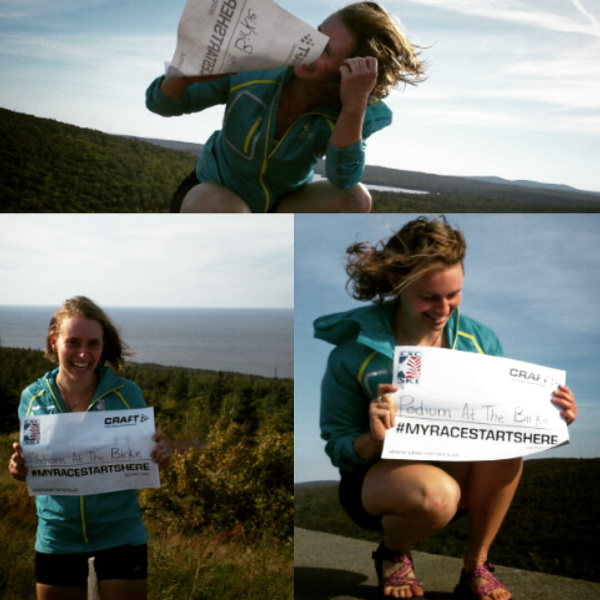
Michigan Tech masters student and skier Alice Flanders setting goals, specifically to podium in the American Birkebeiner skate race, as photographed on Brockway Mountain in Copper Harbor, Mich. (Courtesy photo)
Alice Flanders of the CXC Team and Michigan Tech illustrates a rollerski stop gone bad: the Superman, a.k.a. a face plant or eating the pavement. (Photo: aliceflanders.wordpress.com)
Got a bad case of the Mondays? Maybe this post from Alice Flanders, a Houghton-based master’s student at Michigan Technological University and satellite athlete with the CXC Team, will cheer you up: 10 Ways to Stop on Rollerskis. Read her original blog post here.
***
Rollerskiing on the bike trails around the Minneapolis area, you get a lot of comments and weird looks. Everything from “Birkie Birkie Birkie!” to “Holy Crap arm strength,” if there’s an exclamation about seeing someone doing something odd, it’s probably been said to a rollerskier on the Greenway. One of the most common questions I’ve encountered when people find out that I rollerski is,
“How do you stop on those things?”
This is a great question, one with a lot of really bad answers. Just as with anything that requires a quick decrease in speed, there are good ways and not so good ways to come to a standstill.
The following is a list of ways to stop on rollerskis, some of them good and some of them awfully painful.
1. Superman
Also known as “face-plant” or “eating the pavement,” this technique is best known for the momentary “OH CRAP!” weightless feeling quickly followed by getting the wind knocked out of you. Causes often include cracks in the pavement, railroad tracks and appropriately sized pebbles.
2. The Butt Scoot
This technique is common on snow but is much more effective at stopping you on pavement. When you get going too fast and don’t know how to stop, just sit down and eventually you’ll glide to a halt. Unfortunately pavement is not nearly as forgiving as freshly fallen snow and often contains small pebbles that are painful to remove. The Butt Scoot is not a recommended method of stopping on rollerskis.
The “butt scoot” (All photos: Alice Flanders)
3. Sliding into Home
“And Lucca nearly knocks it out of the park! The right fielder throws it to third for the out, but Hedblom is just too fast. Hedblom is sprinting for home plate. The third baseman throws the ball to the catcher. It’s going to be a close one folks! Hedblom sticks her foot out and slides into home, SAFE!”
There’s a reason we don’t play baseball on rollerskis. Similar to the butt scoot, characteristic results of this technique include road rash on the hip and outer leg, scuffed ski boots and ripped shorts.
Sliding to a stop, by sliding into home.
4. The Black Stuff
Beware of The Black Stuff, especially on hot days. This is the goo they squirt into cracks in the road. The hotter it gets, the more it likes to grab the wheels of unsuspecting rollerskiers. The faster you’re going the more it likes to reach up and give you a surprise crash landing.
5. Rolling Stop
The rolling stop is one of the better stopping techniques. It requires having a good feel for the speed of the rollerskis, enough room ahead of you (or an uphill), and a back-up plan in case your speed calculations are wrong. When done correctly you will slowly and gracefully come to a stop at exactly the right time and everyone will be impressed.
6. Stop Drop and Roll
This is a planned fall method for the dramatic flair in us all. It is a good back-up plan when rollerskiing next to a grassy curb. To employ this method, aim for the softest patch of grass and like a paratrooper hit the ground with a solid roll. As always it is important to make sure your helmet is properly fitted and adjusted.
Stop, drop and roll (Like many of these techniques: NOT RECOMMENDED!)
7. Grassy Knoll
Possibly one of the best and least technical methods, the Grassy Knoll allows the skier to control their speed and come to a stop without hitting the ground. For the Grassy Knoll, the rollerskier shall first stagger their feet and shift most of their weight to the back leg. The skier shall then aim for the grass alongside the trail and gently roll onto the grass while staying upright. Sometimes ski poles can be used to assist in balancing. Be wary of long grass, hidden rocks and sticks. If done incorrectly this can easily be adapted into a version of the Stop Drop and Roll.
Rolling to a stop on a grassy knoll. One of the best and least technical methods.
8. Urban Tree Hugger
When coming into an intersection a little fast, the Urban Tree Hugger is your best option. Aim for a light post or crosswalk post, catch it with one arm and redirect your forward inertia into the stationary light post. Be careful not to hurt your arm and make sure the light post/ crosswalk post is strong enough for the collision prior to using this method.
“Urban Tree Hugger” method: for when you need to stop immediately in an urban setting.
9. “Snowplow”
Similar to how you snowplow in the winter, this is the most common way to slow yourself down on rollerskis. In order for this method to be successful, it is important to make sure your wheels do not touch (don’t cross your tips!). To do this, push outward on each ski. This will force them to stay separated. You will stop due to the friction between the pavement and the rubber wheel as the wheel slides sideways across the road. This technique does take some practice to perfect.
The classic snowplow, minus the snow. Makes sense.
10. Water Landing
Water hurts a lot less than pavement. Summer days get hot. Sometimes it pays off to aim for the lake.
Ahhh, a water landing! Feels good and doesn’t hurt!
Let’s enjoy what pieces of summer we have left. Train hard, go fast, and don’t fall down.
Women’s SuperTour leader Rosie Brennan (Alaska Pacific University) getting some race prep in Saturday morning before the first race of 2015 U.S. Cross Country Championships on Sunday: the 10/15 k freestyle individual starts at the Michigan Tech Trails in Houghton, Mich.
HOUGHTON, Mich. — After touching down in Houghton later Friday afternoon, FasterSkier chatted with a couple of podium favorites at the U.S. Cross Country Championships over the next week, including World Cup and top SuperTour skiers. The first race of 2015 nationals kicks off Sunday at 10 a.m. with the women’s 10 k freestyle individual start, followed by the men’s 15 k freestyle at 1 p.m. at the Michigan Tech Trails.
***
– Rosie Brennan (Alaska Pacific University)
Women’s overall SuperTour leader, who earned World Cup start rights after nationals with her November-December results
Last two races: 1st Bozeman SuperTour classic sprint (Dec. 6), Bozeman SuperTour 10 k classic (Dec. 7)
On period between Bozeman SuperTour in early December and U.S. nationals:
“It’s been a little weird because I was actually dryland training in Utah for a few weeks and then I had a week-and-a-half of OK skiing, so it feels like I’m starting my season over again. I actually have really fond memories of racing here so I think it’s a good mindset to be in. “
On the where she’s at:
“I’ve been working on a lot of more process-oriented things in my racing. If I do that, more result-oriented goals will follow. I had a really good summer of training; I think I just learned a lot over the last season more in terms of just how to be a better racer and I think that’s proven really helpful in being able to use the fitness that I’ve gained over the summer more effectively.”
On racing the World Cup starts after nationals:
“I’m just looking to use what I’ve learned from my past experiences on the World Cup and hope to improve upon other times I’ve had over there.”
Caitlin Patterson gliding through the finish during Saturday morning race prep at the Michigan Tech Trails in Houghton, Mich. U.S. nationals kick off Sunday in Houghton with the 10/15 k freestyle individual starts.
– Caitlin Patterson (Craftsbury Green Racing Project)
Second-overall ranked SuperTour woman
Last two races: 4th in 10 k skate at Besh Cup in Anchorage, Alaska (Dec. 21), 6th in Besh Cup skate sprint (Dec. 20)
On racing again:
“I’m looking forward to another round of competition. It was fun to start off the SuperTour like always in West Yellowstone and Bozeman, and those races went well but I still felt like I was rounding into good shape and figuring out some early season bugs. So I’ve been feeling good and I’m looking forward to these, to fight it out again and there’s a lot of fast people here so it should be pretty cool.”
On skiing the skiing Anchorage (in late December):
“Anchorage has really low snow, so it actually wasn’t as bad as I’d expected. I brought rock skis and used them a lot, but there was snow. I skied every day. The [Besh Cup] races were a little bit changed from what they had planned, like we did a sprint that was not even 900-meters long, a skate sprint, so that was funny, but it was good, enough to throw off your balance a little bit. I was there until [Thursday] and then I flew here. ”
On U.S. nationals goals:
“I’m definitely shooting for some podiums; I see that top fives should certainly be within my reach. We’ve raced on the SuperTour with a lot of these girls, everyone except Caitlin Gregg has been around and we’ve been bouncing back and forth a bit, so I guess just looking forward to putting out there whatever I can and see how it turns out.”
On what she needs to do to succeed:
“Keeping nerves in check a little bit, but I think it’s good to get a little bit nervous because it shows that you care about it and care about racing and are ready for it. It’s sort of just part of the preparation. I definitely need to get in a good warmup — that’s one of the things I’ve been trying to focus on this year because it’s pretty important to come into the races right from the first kilometer, not start slowly and try to wake up … Then just keep in the zone and have a lot of focus during the races and go for it. ”
Chelsea Holmes (Alaska Pacific University) training on Saturday morning at the Michigan Tech Trails, the day before U.S. nationals kick off in Houghton, Mich.
– Chelsea Holmes (APU)
Third overall
Last two races: 2nd in 10 k skate at Besh Cup in Anchorage, Alaska (Dec. 21), 5th in Besh Cup skate sprint (Dec. 20)
On first impressions of the conditions at Michigan Tech:
“Great, lots of snow, it’s cold, hard wax so I’m pretty happy so far.”
On memories of Houghton [when it last hosted U.S. nationals in 2007 and 2008]:
“Those races, I don’t remember anything of the actual experience, which seems silly, other than I remember it being really warm. I did senior nationals those years when I was in college and I had never done it prior, but I mean, I think my first year of senior nationals I was close to the one-hundreds and maybe the second year I was in the forties or fifties. It was the first races of college skiing and it was just race as fast as you could.”
On how it feels to be in Houghton now, in the top three overall?
“Not too different. I’ve tried to make the switch where I’m just going out and having fun, but also, the races are a big deal and you want to do as well as you can, but I try to keep it in the context of, it’s a race and there’s only so much I can control … I can’t control how everyone else skis, so I can, even if I have a terrible day, I would like to say, I’m happy with that. That’s my goal.”
On her target race(s):
“I’m definitely a stronger distance skier so I would say those [races] more, but I’m really working on improving my sprinting, so I’ve discovered that if I try to stress about that less, that can be fun, too. Honestly, I’m really excited about the whole week. I think it should be really fun, and I love to race so four races in a week is a good bang for your buck.”
– Caitlin Gregg (Team Gregg/Madshus)
2013/2014 women’s overall SuperTour winner, started 2014/2015 season on World Cup
Last two races: 47th in Davos World Cup sprint (Dec. 21), 54th in Davos 10 k freestyle (Dec. 20)
On how she feels heading into nationals, her first domestic races of the season:
“I’m feeling pretty good. I think the one thing that I’ve realized, though, is I don’t know where I’m at. I always say, ‘I’m never 100-percent confident going into a race,’ or anything like that. I’m always like, anything could happen. I could have a great day, but then someone could have an even-better day so anything is always possible. Going forward, I’d say I feel good, energy feels good, but we’ll have to see what happens. … It is definitely fun to be back and have the whole [Loppet Nordic Racing] crew here, our club team, for Brian and I to be training with and prepping with.”
On how she’s recovered since four weekends of World Cup racing in Europe:
“I ended up taking a number of days off from training when I got home and a number of days off from skiing. I’ve been pretty conservative, trying to maintain my fitness, but also kept things really short, kept things kind of focused on not pushing the body too far.”
And after contracting shingles at the start of the season in Muonio, Finland (as explained in an email):
“The small rash healed up in less than 3 days and was never as painful as others have shared in their stories! I felt a little tired and lethargic for about a week (but I also just traveled 24 hours to Europe!). After taking it easy I resumed normal training and my energy felt great, especially at the lower intensities, but when I went to race I realized that my highest gear wasn’t quite there.
“It wasn’t until the second weekend in Davos, when it was a 10K Skate race at altitude and should have been my best race, that I realized the virus might have zapped me a bit more than I thought. I am still not sure if it had any affect on my race results though?
“I decided to get home and give myself a good couple of weeks to recover. I went to Hayward with Brian and didn’t train for 5 days. After that I started jogging easy and finally began skiing after a week. I feel great, especially at lower intensities, but I still don’t know where my energy at higher intensities is? I am excited to race and look forward to the rest of the season!”
On goals at nationals:
“For sure, when you’re on the World Cup and you’re kind of getting toward the back of the pack, you’re kind of like, ‘Man, that really doesn’t feel so good.’ I can deal with it, but you’re like, ‘It would be fun to feel good and finish a race,’ and be like, ‘All right, that was fun again.’ The races are fun over there for sure, but I want it to be a good feeling all around. Feel good energy, feel great skis and obviously great course, and have everyone I know here for it.”
On how she’s feeling about Sunday’s 10 k skate, her target race:
“I’m really excited about it. I love this course. I heard there was going to be a little adverse weather conditions and that kind of gets me excited, too. We kind of get a lot of that in the Birkie and I’m kind of preparing for it in a similar way where you never know, is there going to be a lot of snow? Is it going to be blowing sideways where the windchill’s just horrific? All that just makes it more interesting.”
***
Matt Gelso racing to a win in the first distance race of the season at the West Yellowstone SuperTour 15 k freestyle on Nov. 29. (Photo: Toko)
– Matt Gelso (Sun Valley Ski Education Foundation)
Second-overall ranked SuperTour male, first American, who earned World Cup start rights after nationals
Last two races: 6th Rossland NorAm 10 k classic (Dec. 13), 2nd Rossland NorAm 15 k classic (Dec. 14)
On how he’s been feeling in the time since those races:
“I’m feeling good. I got a strong solid block of training in California during Christmas. I managed, knock on wood, to not get sick. I’d like to feel good and be up in the results. I know I’m skiing good and skiing fast; I want to set myself up well to go to Europe and have a platform at least and try and have some success over there.”
– Miles Havlick (SVSEF)
Fourth overall in the SuperTour, second American
Last two races: 2nd Bozeman SuperTour 15 k classic (Dec. 7), 9th Rossland NorAm 10 k classic (Dec. 13)
On arriving in Houghton:
“It’s been fantastic. The conditions are as good as they get. I had a little bit of illness after Rossland but a little time at home fixed that.”
On racing prospects:
“I’d like to have a few podiums. That’s my goal. I think with these trails – the laps are long – the race is going to be a little different than we’re used to so pacing is very important. Warming up well in the cold temperatures and gritting your teeth and staying focused in the race.”
Kris Freeman on his way to winning the Sovereign Lake NorAm 30 k freestyle by more than a minute and a half on Dec. 20 in Vernon, B.C. (Photo: Frances Weeks)
– Kris Freeman (Team Freebird)
Seventh overall in SuperTour, Canadian NorAm leader
“It’s been a couple weeks now since I raced, but I had good momentum coming out of the NorAms in Canada so I feel good and good on my skis and looking forward to racing.”
On goals at nationals:
“I want to keep on having the good sensations that I’ve been having racing. When I’m skiing well, skiing is just so fun. And to be skiing well again this year, I’m really enjoying it.”
– Paddy Caldwell (Stratton Mountain School T2 Team/Dartmouth)
21st overall in SuperTour, U.S. Ski Team D-team member who skipped the Bozeman SuperTour and is focusing on 2015 U23 World Championships in Kazakhstan
Last two races: 4th Middlebury Eastern Cup 10 k classic (Dec. 20), 1st Middlebury Eastern Cup 15 k skate (Dec. 21)
On goals for the week:
“My goal is to, honestly, feel good racing. I always have a rougher start at the beginning of the season. I’m starting to feel good so I’m hoping to race as hard as I can and feel good about the effort about the performance.”
On racing blueprint for rest of the season:
“My plan is to head back to Dartmouth after the races to start classes and feel it out from there.”
– Reese Hanneman (APU)
2013/2014 men’s overall SuperTour winner, started 2014/2015 season on World Cup
Last two races: 86th Davos World Cup skate sprint (Dec. 14), 79th Davos World Cup 15 k classic (Dec. 13)
On what he’s been up to since:
“I came back from Europe on the World Cup [around Dec. 17] before Christmas and have been in Anchorage for a week then Fairbanks for a week then here.”
On re-entering the domestic-racing scene:
“This is the first year that I’ve done the World Cup to start off my season. That was different and obviously a huge learning experience and I didn’t perform like I wanted to or like I knew I can, but I got a lot out of it. It was really productive. So now to come to nationals, I remember maybe a couple years ago where I’d come to nationals and be stressing out like, ‘Oh man, this is such a big race,’ and now it seems pretty relaxed. It’s more homey. It feels like less of a mob scene. I guess it makes me a little more comfortable here.”
On his memories of Houghton (at Junior Nationals in 2006 and senior nationals in 2007):
“All of the races as a junior … here, I really struggled. I remember being way, way back in the pack, like, hundreds except for the skate sprint at U.S. nationals here. I had a really uncharacteristically good race and that got me to World Juniors [Championships in 2008]. At the time I didn’t even know what World Juniors was, but I had just made it and that ended up being really sweet. I remember coming up that hill on the sprint course here and passing everybody [laughs].
“To be honest, that’s probably a race or a day or even a moment that probably got me to where I am now. because who knows, if I hadn’t done well that day, maybe I wouldn’t have gone to World Juniors and I wouldn’t have kept skiing, you know? So I remember that and I have some good memories and it’s been a while so I’m looking to ski a lot faster than I did when I was here.”
On goals this time around at nationals:
“I always want to do well at nationals. Obviously the World Cup is sweet and I would’ve loved to have performed better there, but U.S. nationals is still some of the biggest races, and maybe not the highest level of race that I’ll do this year, but pretty important just to qualify for [international-racing] teams and all that stuff.”
HOUGHTON, MI — Registration has opened for the 2015 U.S. Cross Country Skiing Championships, January 2-10, 2015, at the Michigan Tech Nordic Training Center in Houghton, Michigan. Online registration is available at www.nordicchampionship.org
This year’s U.S. championships include four races: a freestyle 10k/15k on Sunday, January 4; a classic sprint on Monday, January 5; the classic distance races on Thursday, January 8; and a freestyle sprint on Saturday, January 10. All races will take place at the Michigan Tech trails.
Mike Sinnott striding at the 2011 US Nationals classic sprint. Photo, flyingpointroad.com.
Michael Sinnott (Sun Valley Ski Education Foundation Olympic Development Team) won the 10K individual start classic race Saturday in 29 minutes and 35.2 seconds. Adam Kates (Big Thunder) in second place was just over a second behind, crossing the finish in 29:36.5. Garrott Kuzzy (CXC) was third, clocking in at 29:37.5.
“I could definitely feel the sprint from yesterday, but I felt pretty good,” Sinnott said to FasterSkier after the race. His strategy for the race was to focus on skiing smoothly and keep the tempo up through the double-pole sections in early part of the course.
“The course has a lot of transitions, so I tried to make sure I skied well,” he said.
After Saturday’s victory, Sinnott earned another 30 points for the SuperTour series, and is now only 37 points behind Lars Flora (Alaska Pacific University Nordic Ski Club) for the overall lead.
“The goal is to get ahead of Lars (Flora). I want to have a buffer on Lars so I don’t have to sweat too much when the SuperTour hits home later this season,” the Sun Valley skier explained.
Surprise comeback
While Sinnott certainly was among the favorites on the start list and didn’t disappoint, Canadian Adam Kates (Big Thunder) came out of left field and raced straight into second place in the men’s 10K classic.
“I heard it was tight. I was one of the first skiers out so I didn’t know how tight it was,” Sinnott said. “When I finished I had a mental idea of how I had done, and I knew it was tight.”
“I would categorize him as at least a semi-retired skier, coaching with one of the Thunder Bay programs. He just decided to jump in the race earlier this week and then we see him on the leader board at 7.5K. But Mikey (Sinnott) was able to come back and take the lead again,” race director Joe Haggenmiller of Michigan Tech said.
Maria Stuber
Stuber tops women
Maria Stuber of CXC won the women’s 5K individual start classic race in 17 minutes and 48.3 seconds, leaving her a comfortable 5-second margin down to Carolyn Freeman (UWGB) in second place (17:52.7) Yesterday’s sprint winner Christina Turman (Northern Michigan University) was third in 17:53.
“I had no idea that I won when I finished. I thought I heard someone said I was second,” Stuber said to FasterSkier, explaining that it was a nice surprise.
For Stuber, the classic victory was particularly tasty, as she has worked hard for a long time to make progress on her technique.
“It was fun to finally feel that my classic skiing in coming along, since that has been a weakness of mine,” Stuber said. “I think the work I did last year is paying off now, and I did a ton of work on it.”
Stuber also noted that with a course as technical and full of transitions as the one at Michigan Tech, it was a benefit to know be familiar with the terrain ahead of time.
“I’ve raced this course literally a million times in college. You have to go out hard to go all the way. Knowing the course is for sure a big benefit anytime, but especially here where you have to go out so hard,” Stuber explained.
Sunday: Mass Start Skate
The SuperTour concludes the stop at Michigan Tech with mass start skate races Sunday, 10K for the women and 15K for the men. And Sinnott is ready to continue the surge.
“The mass start should be fun. You never know what happens, there is always an element of chaos in a mass start,” Sinnott said, adding that he thinks his chances for the podium are decent. “I think a lot of people are starting to feel a little worn down by now, and others might feel a bit more worn down than I do right now,” he concluded.
Haggenmiller predicts that Sinnott and Kuzzy will be fighting for the podium, and that Brian Gregg (CXC) and Santi Ocariz (CXC), who was fourth in the classic race, will be right up there as well.
“And apparently Adam Kates too, his form ain’t too bad either,” Haggenmiller added.
Stuber is also excited for Sunday’s skate race.
“The skate race will be good. It’s my favorite technique. It should be a good one,” Stuber said, adding that her strategy is to open hard to be with the front pack and then stay there and see what everybody does. She suspects that her biggest contender will be teammate Caitlin Compton.
“Caitlin will be back on her game again tomorrow so I probably won’t control much of it,” Stuber said with a laugh. “She’ll have a good one.”
The forecast calls for a little more snow during the race, but nothing that should cause the wax tech to lose any sleep.
“When it’s skating, it doesn’t get as tense in the wax room when it snows,” Haggenmiller said.
The mass start skate races start at 9:30 am with the men’s SuperTour race, and continues with the women’s SuperTour race at 11:15 am.
Complete results from Saturday’s classic races here.
Michael Sinnott (SVSEF) felt like he couldn’t have asked for a better afternoon to do a classic sprint qualifier.
“It was beautiful racing, blue skies about 20 degrees and fast, hard tracks,” Sinnott, said to FasterSkier after the race. “It was fun.”
Second place is not first loser
With a time of 3:20.30, Garrott Kuzzy of Team CXC was only 0.3 seconds behind Sinnott, and more than eight seconds ahead of Petter Sjulstad of Michigan Tech in third place. He clocked in at 3:28.70.
“Once I finished, I knew that I placed really well,” said Garrott Kuzzy of Team CXC. Missing first place by a split second was simply how the dice fell this time, he explained.
“I had done pretty much everything right. Mikey (Sinnott) was just that much faster today,” said Kuzzy, who won both the USSA SuperTour races on home turf in Minneapolis last weekend.
“It was really fun to do well at home last week,” he said.
Fast, technical course
Kuzzy noted that when the team drove up to Michigan on Thursday, it was raining lightly, which resulted in a hard, slightly crusted course as it froze onto the surface overnight.
“Conditions were beautiful, and it’s a brand new course. It was a great course for a qualifier,” Kuzzy said, adding that he didn’t consider skate skis and double-poling.
“It’s a hard, technical course. Skate skis wouldn’t have been as fast today,” he said.
Double sweet victory
For Sinnott, Friday’s victory awarded him not only the 250 dollar prize money. It gave him another 30 SuperTour points in the pocket, which reduced Lars Flora’s (Alaska Pacific University Nordic Ski Club) overall lead by nearly one third in just over three minutes.
A couple of weeks ago at US Nationals, Sinnott’s entire season focus got rearranged when he narrowly missed being named to the US World Championships team headed for Oslo next month.
“My season goals got derailed. I skied well, but I was just not named to the team. I was the next in line. That was a little disappointing. So now I’m trying to be the overall leader of the SuperTour,” Sinnott said, noting that he has eight SuperTour races to make up 67 points on Flora. And Flora won’t even be here for a good part of those.
“I like my chances,” Sinnott concluded with a grin.
No-heat qualifiers
Friday’s classic sprints at the Michigan Tech Nordic Training Center featured a qualifier event on the 1.5K highly technical course for both men and women, but no subsequent heats. This is a unique race format that showed up last season and serves several purposes, Kuzzy and Sinnott explain, adding that they enjoy the no heat sprint races, and see the value in the exercise.
“It’s a race format that doesn’t really happen anywhere else outside North America, but it’s designed to identify the fastest qualifiers. It’s important to qualify fast, because if you qualify low in the US you still make it to the rounds, but in Europe you wouldn’t necessarily make it to the rounds,” Sinnott said.
No heats also mean that the sprint takes a lesser toll on the athletes and allow more of them to do a three-race weekend with full-on distance races.
“With full heats, that means that the skiers who go all the way in the sprints have three more races in their legs the next day than those who didn’t make the it out of the qualifiers,” Kuzzy notes.
Challenging classic course
The SuperTour continues tomorrow with 5K classic for women and 10K classic for men, both races with interval starts. Sinnott has tested the course before, knows what’s in store, and has respect for the challenge.
“We had nationals here a couple of years ago. There are long hills and it’s easy to bury yourself. I need to keep the lid on for the first lap to have a good second lap,” Sinnott said.
In the women’s sprint race, Christina Turman of Northern Michigan University won in 4:05.20, with a comfortable 5-second margin to Deedra Irwin, an older junior who is redshirting with Michigan tech this season, in second place with the time 4:10.50. Audrey Weber (Go! Training) was third, finishing in 4:11.50.
Featuring NCAA qualifiers, Super Junior Olympic qualifiers for both the Great Lakes and the Midwest regions, high school, youth, masters and citizen racing, the Midwest Grand Prix in Houghton, Mich., boasts fields of more than 400 racers.
Friday features classic sprint races for both men and women. The sprint will consist of qualifiers only, not heats. Saturday the action continues with 5K classic interval start for women, while the men do 10K. The SuperTour concludes on Sunday with 10K/15K skate mass start races. Additionally there are classic and skate races of various distances for high school, youth, masters, citizen and adaptive skiers on both Saturday and Sunday, making sure volunteers and race organizers won’t have time to get bored.
All the races will take place on the Michigan Tech Nordic Training Center, the host of the 2007 and 2008 US Senior Nationals, which features your standard tough FIS homologated courses, says race director Joe Haggenmiller, the head coach for nordic sports at Michigan Tech.
Haggenmiller points out Chris Cook (Steinbock Racing) and Michael Sinnott (Sun Valley Ski Education Foundation) as some of the strong contenders in the starting lineup. Last weekend’s podium sweepers Caitlin Compton (CXC) and teammate Garrott Kuzzy are also back for more. Stay tuned.
HOUGHTON, Mich. – Registration for the 2011 USSA Michigan Tech Super Tour Event presented by Portage Health is now open. The event, January 28-30, will feature races for youth through professional skiers and everyone in between. All races are at the Michigan Tech Nordic Training Center, host of the 2006 Junior Olympics and the 2007 and 2008 U.S. National Championships.
“Michigan Tech is proud to host the 2011 USSA Michigan Tech Super Tour Event presented by Portage Health,” said athletic director Suzanne Sanregret. “We have a strong tradition of Nordic skiing at Michigan Tech and in the Keewenaw. We are excited to host an event of the caliber of the Super Tour. Many thanks go to our sponsors and all of the volunteers that make it possible to host this event.”
The weekend will kick off with a sprint prologue (qualifying times only, no subsequent heats) at 3 p.m. Friday. Saturday will feature five-and 10-kilometer individual start classical races starting at 10 a.m. The weekend will conclude Sunday with 10-and 15-kilometer mass start freestyle races starting at 9:30 a.m. Youth through high school races will be shorter each day.
“Portage Health is thrilled to be a part of the 2011 USSA Super Tour in Houghton,” said Jim Bogan, President and CEO of Portage Health. “It’s always a privilege to partner with Michigan Tech and we are excited to sponsor an event of this magnitude. We would like to welcome all the competitors, coaches, families and spectators to the Copper Country, and we look forward to watching some world-class competition.”
HOUGHTON, Mich — The Northern Michigan Nordic ski teams used dominating performances on the men’s and women’s sides to take home top honors at the NCAA Central Regional Championship on Sunday. The Wildcats were in control after Saturday’s classic race and used Sunday’s 10/15k freestyle to ensure they remained in first. George Cartwright delivered a victory to lead the men, while Christina Gillis claimed top honors for the women.
Cartwright’s win was the first in the first-year’s young collegiate career and came on a big stage. He completed the 15k skate loop in 39 minutes, 42 seconds to beat Wisconsin-Green Bay runner-up Santiago Ocariz by 15 seconds. Spots 3-8 were just 5 seconds apart in the tight men’s competition, and NMU skiers Chris Bowler (40:06.6) and Kevin Cutts (40:06.9) completed the scoring from 6th and 7th place to put the Wildcat men in 1st with 79 points on the day.
Behind NMU, though, the men’s team competition was extremely tight in Sunday’s freestyle. Michigan Tech didn’t have a skier in the top 8 but swept places 9-11 behind the efforts of Oskar Lund (40:16), Jesse Smith (40:38), and Jesse Lang (40:51). This solid display put the Huskies in 2nd place on the day with 63 points.
Right on the heels of Michigan Tech was the College of St. Scholastica with 62 team points. Mason Bacso and Waylon Manske each cracked the top 10 for the Saints, as Bacso’s time of 40:06.6 was good for 5th and Manske (40:07.8) took 8th. Kasey Bacso (42:04) rounded out the team’s scoring from 21st. Alaska suffered a bit of a drop-off from Saturday’s classic race, but junior John Parry snuck into 4th as the Nanooks held on to 4th place on the day with 60 points. Parry (40:04.3) was backed by Tyler Kornfield (41:16) in 13th and a trio of Alaskans—Henri Soom (41:58.3), Ray Sabo (41:58.6), and Alex Morris (42:02.6)—in spots 18-20.
Gustavus Adolphus junior Jens Brabbit continued to cement his position as one of the league’s top skiers with a 3rd-place finish. Brabbit (40:02.5) was the first Gustie across the line, but teammate Anders Bowman scored (41:42) as well in 14th to help give GAC 5th place with 56 points on the day. Santiago Ocariz took a familiar spot on the podium as the race’s runner-up, crossing the line in a time of 39 minutes, 57 seconds to lead Wisconsin-Green Bay to a 47 point day, good for 6th place. St. John’s took 7th with 44 points behind Grant Cook (41:44) and Bob Gerten (41:57) in 15th and 17th, respectively. Tom Jorgensen (41:55) led St. Olaf from 16th place.
The NMU women put together a dominant showing and 1-2-3 finish for the second day in a row to post another perfect score of 87 team points. This time it was junior Christina Gillis who snagged the individual victory, skiing the 10k course in 30 minutes, 20 seconds. The women’s race was even tighter than the men’s, with the top 9 skiers separated by less than 25 seconds. Monica Markvardsen (30:25) was right on the heels of Gillis, while Saturday’s winner Laura DeWitt (30:26) was also in the mix in 3rd.
The Alaska women were in 2nd with 74 points in Sunday’s freestyle race. Aurelia Korthauer (30:27) led the team from 4th place, and was supported by 3 more teammates in the top 10. Nanooks Julia Pierson (30:42), Anna Coulter (30:44) and Theresia Schnurr (31:02) grabbed spots 8-10. Michigan Tech was 3rd as a team with 57 points in the skate race. Henna Riikonen-Purtsi (30:40) continued to be the fastest female Husky, coming in 7th. Kristen Monahan was next to finish for MTU and ended up in 19th.
The College of St. Scholastica was the 4th-place team Sunday behind 2 top-12 performances. Eleanor Magnuson (30:33) was 6th and Julia Curry (31:18) was 12th. The College of St. Benedict women finished 5th on the day, buoyed by Christi Nowak (31:34) in 14th. Megan Smith (31:38) was 17th for the Blazers to help give them 49 team points. Erica Hett (32:07) led Gustavus Adolphus with an 18th-place finish to help give the Gusties 45 points and 6th place in the freestyle race. Carolyn Freeman (31:05) was the top UW-GB finisher in 11th place. The Phoenix were 7th on the day with 42 points. St. Cloud State’s top finisher was Hannah Sanborn (32:53) in 28th. Emma Lee (32:26) led St. Olaf in 21st.
For the weekend, Northern Michigan was tops in both the men’s and women’s divisions. Michigan Tech was 2nd for the men with 139 points, 20 behind NMU. Alaska was 3rd with 132. St. Scholastica used a strong freestyle race to snag 4th with 118 points, just ahead of Gustavus Adolphus (110). St. John’s (92), Wisconsin-Green Bay (74), and St. Olaf (64) rounded out the men’s scores.
The NMU women posted a perfect score of 174 points, well ahead of 2nd-place Alaska’s 145. Michigan Tech was 3rd with 122, ahead of St. Benedict with 102. They were followed by St. Scholastica with 99 points, Gustavus Adolphus (89), Wisconsin-Green Bay (84), St. Cloud State (53), and St. Olaf (46).
For the weekend, Northern Michigan had the high combined team score with 323. Alaska was 2nd with 277, just ahead of Michigan Tech with 261. Below are the complete team scores.