Tag: middlebury college

  • The Norwegian Experiment: Sophia Laukli’s Back-to-Basics Reboot

    The Norwegian Experiment: Sophia Laukli’s Back-to-Basics Reboot

    By the time Sophia Laukli picks up the phone from Lillehammer, it’s raining again.

    “There is, like, a small 1k loop up at Sjusjøen,” she says, “but it’s… yeah, it’s, like, raining every day, so it’s not really great conditions.”

    On paper, Laukli is one of the most intriguing dual-sport athletes in endurance sport: a U.S. Ski Team member and Olympian who has also become a force in international trail running. In person—or over Zoom—she’s thoughtful, understated, and very clear on one thing: the way she trains now, in Norway, looks a lot more boring than the world might imagine.

    You come to Norway expecting secrets, she says. What she found instead was simplicity.

    “They’re so simplistic around ski training,” Laukli explains. “It’s not rocket science. You can do the same… You do essentially the same workouts every single week, all year round.”

    That realization—combined with a crash-and-burn experiment as a full-time runner and a new coaching relationship with her boyfriend, longtime Norwegian pro skier Gjøran Tefre—has quietly reshaped her career.

    As this Olympic season approaches, Laukli’s bet is clear: train like a skier, keep the training simple, stay within herself, and let the results show up in both sports.

    Maine Roots, Late Commitment

    For all the talk about Norway, Laukli’s story really starts in coastal New England.

    “I was actually in the Boston area until I was, like, six or seven,” she says. Then came a year and a half in Norway, and finally Yarmouth, Maine—the place that still feels like home.

    “From my memories and my ski memories, it’s all from Maine.”

    Her father is Norwegian, so skis were always around. Winters meant skiing, family trips to Norway, and a life that looked, from the outside, like an early pipeline to the World Cup. From the inside, it didn’t feel that way at all.

    “It was a very recreational thing,” she says. “I didn’t really enjoy it that much. It was just kind of like, obviously, we’re gonna ski because it’s winter. But I didn’t know anything else.”

    In Maine, her parents weren’t just ski parents—they were essentially the ski people in the community.

    “They were my coaches,” she says. “And very present in the ski world, which was hard for me… A part of me became pretty hesitant towards skiing.”

    She gravitated toward soccer and tennis. Skiing felt obligatory.

    “Up until midway through high school, skiing was kind of just something I did because my family did it,” she says.

    The idea of becoming a professional athlete wasn’t just unrealistic—it was unimaginable.

    “I was gonna just go to school and be a nerd or something,” she says. “Being a professional skier wasn’t even a consideration.”

    Then came the pivot: joining the iconic Yarmouth High School ski team, coached by the legendary Bob Morse.

    “It opened my eyes a lot,” she says. “It wasn’t super competitive, but it showed me the sport that felt forced on me was actually something I liked—and could be really good at if I tried.”

    Looking back, she’s grateful it took so long.

    “I’m super happy I went through that zero-pressure, uncommitted relationship to skiing,” she says. “Today I have so much motivation to be 100% committed… and I’m far from burnt out compared to many skiers who commit when they’re 12.”

    Discovering Running (By Hating It First)

    The other half of her dual-sport identity—trail running—comes from an even stranger origin story.

    “Running was something that I actually hated,” she says, laughing. “I really, really, really did not like to run when I was young.”

    Running in Maine didn’t help.

    “It just wasn’t enjoyable to run there,” she says. “Unless you really liked running on roads and golf courses.”

    She ran cross country her senior year only because the coach wanted her on the roster for states. She ran track for one year and found it “horrible.”

    “It wasn’t until I started training out West in the summers, finding mountains… that I actually enjoyed running.”

    Those Western US trails served as the practice grounds, preparing Laukli for some of the world’s biggest trail races. But first she had to figure out college—and how training would fit around it.
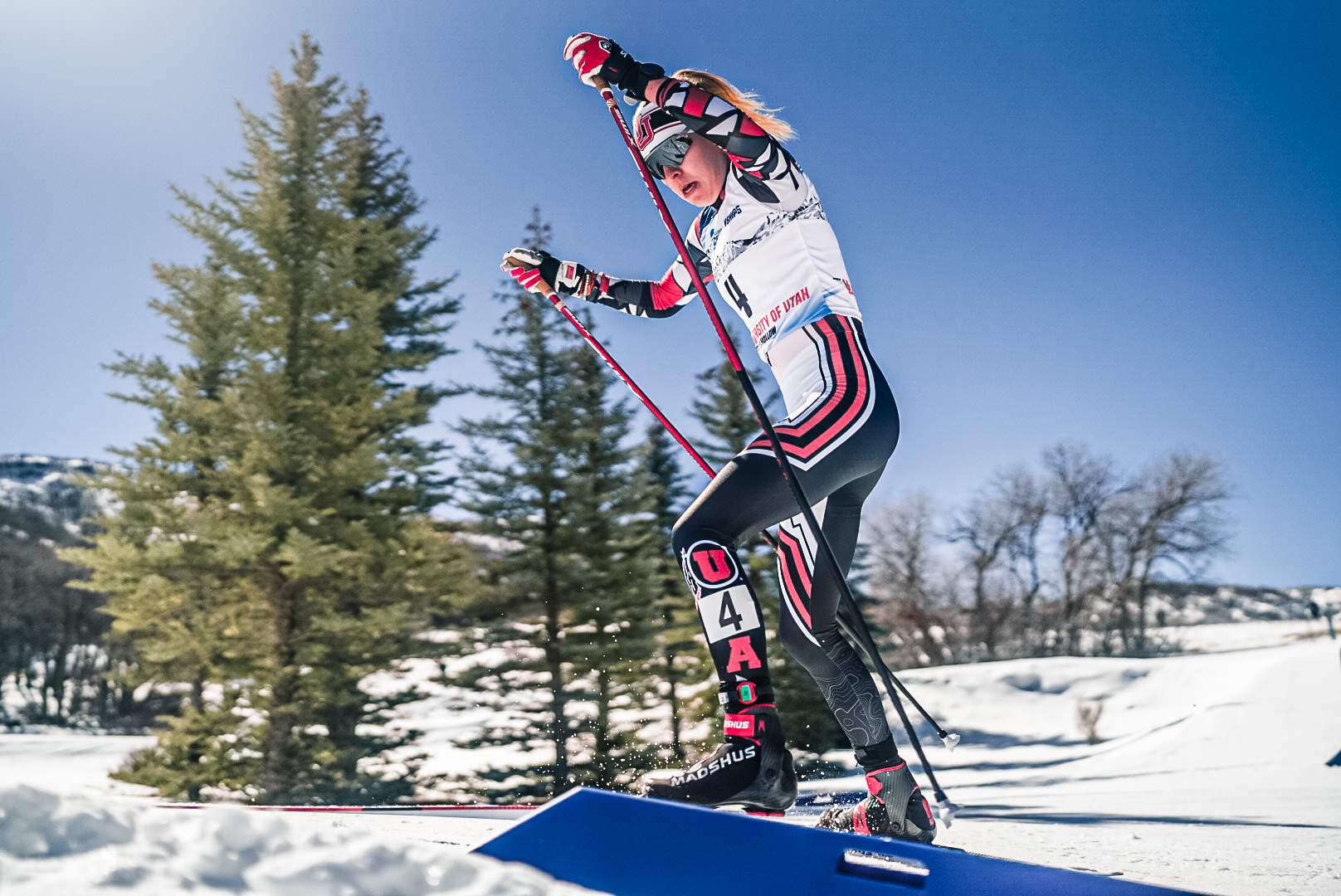
    Sophia Laukli takes the collegiate national title in the 15 k skate in 2022. (Photo: Tobias Albrigtsen / @untraceableg)

    Middlebury to Utah: Building a Life Around Skiing

    Laukli chose Middlebury because, at the time, academics were the top priority.

    “I knew I didn’t want to be done skiing,” she says, “but it wasn’t the priority.”

    Covid changed everything. Remote classes allowed her to chase early World Cup opportunities without living on campus. Once Middlebury required students to return in person, the timing coincided with the rapid ascent of her ski career.

    That led to a transfer to the University of Utah.

    “Utah is built for athletes,” she says. Most classes were online and flexible. She chose economics not out of passion but practicality.

    “I didn’t necessarily choose the thing I thought was interesting,” she says. “I chose what would best suit my ski career.”

    Now, even as a full-time pro based in Norway, she’s studying again—an online Norwegian MBA.

    “I’ve never been someone who can come home from training and sit on the couch until my next session,” she says. “I think I was missing having more than just training.”

    Balancing skiing and school helps her prevent the sport from consuming everything.
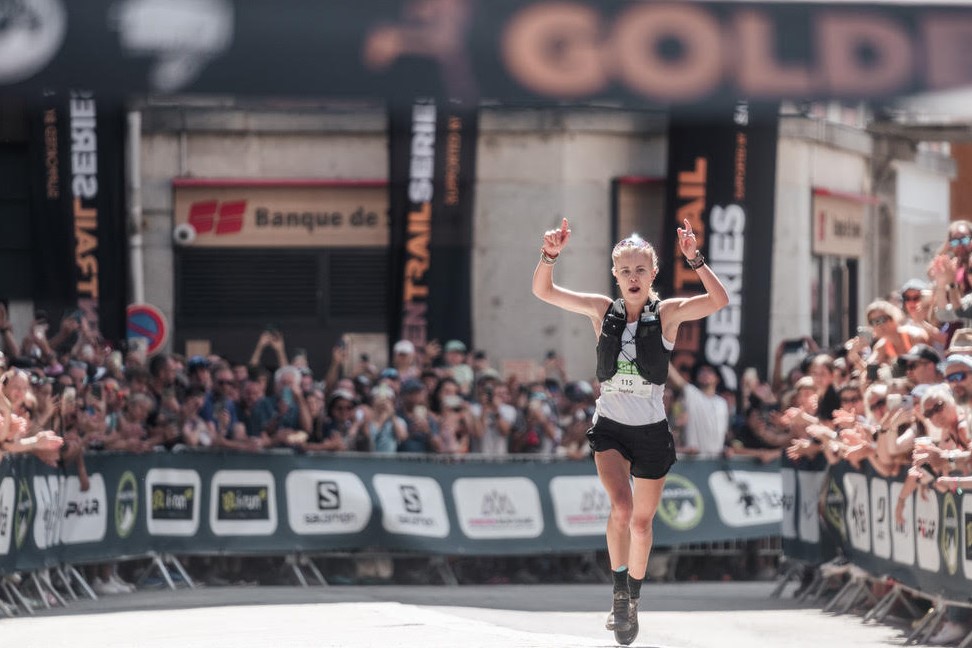
    Over flowing crowds filled the streets at the Golden Trail Series finish line in Chamonix in 2023. (Photo: GoldenTrailSeries and @the.adventure.bakery,® Mont-Blanc Trail Marathon.: ©GoldenTrailSeries® – Zegama Aizkorri – Jordi Saragossa)

    The Running-Only Experiment That Failed

    Last year, after the World Championships, Laukli decided to lean all the way into running. It seemed logical—if she’s good at running without specifically training for it, imagine how good she’d be if she did.

    “I always thought I’d be a much better runner if I had just run,” she says.

    So she tried it. No roller skiing. No ski sessions. Just running—every day.

    “I was running 10 to 12 hours a week,” she says. “And I was so tired each day. I was getting worse and worse at running. And obviously not good at skiing.”

    The experiment collapsed at a race where she felt utterly depleted. She flew home, frustrated and confused. That’s when she sat down with her boyfriend, Gjøran Tefre.

    “He said, ‘It’s fine. I’ll write a plan. Don’t freak out,’” she says. “‘We’ll get you a coach, but ski training is straightforward. We’re gonna baby you into ski training again.’”

    Two weeks completely off. Then a return to “textbook” ski training.

    Within a week of roller skiing, something wild happened: her running started feeling good again.

    The pattern was clear. She ran better when she trained like a skier.

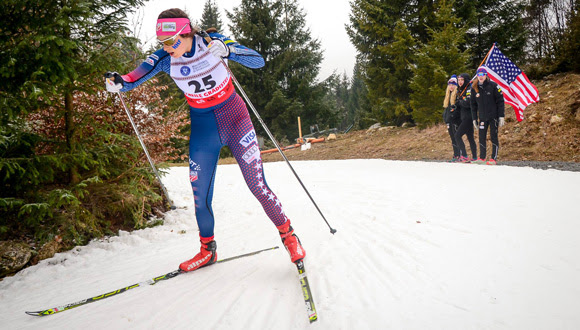
    Sophia Laukli (USA) during the World Cup 20km in Engadin (SUI). (Photo: Authamayou/NordicFocus)

    Kristen Bourne Saw The Same Thing

    “Last season was definitely a struggle for her, both running and skiing,” says U.S. Ski Team assistant coach Kristen Bourne, who monitors Laukli’s training load. “And she’s just trying to figure out why.”

    For Bourne, the shift wasn’t just physical—it was psychological.

    “I’m a huge believer that what makes a difference from a good athlete to a great athlete is the athlete who is very invested in their own process,” Bourne says. “The ones who are thinking, advocating for what they need—not just deferring to a coach because the coach’s word is gospel.”

    That ownership, she says, is new in Laukli.

    “She’s definitely leaning into that more this year,” Bourne says. “Which is really cool.”

    Sophia Laukli and Gjøran Tefre at the Cross Country Skiing World Championships. (Photo: Courtesy Photo)

    The Gjøran Factor: Coach, Partner, Check on Reality

    Mixing a relationship with coaching is a delicate thing. Laukli knows the risks—she’s heard them all.

    “I’ve been told by many people this is not a good idea,” she says. “And other people are like, ‘Wow, I wish I could do that.’”

    She also knows why it works.

    For one, they communicate constantly. For another, his intentions are pure.

    “One of the hardest parts of finding the right coach was that they either only cared about skiing or only cared about running,” she says. “He’s the only one who actually wants me to do well in both.”

    Still, she doesn’t call him her “coach.”

    “I want our personal life and work life to be separate,” she says. “We need other people in the room.”

    That’s where Bourne plays a key role.

    “At this level, athletes have so much experience—they do know what they need,” Bourne says. “So my goal isn’t to dictate everything. It’s to help Sophia articulate what she feels and translate it into training.”

    The two systems—Tefre’s daily presence and Bourne’s structured oversight—meet in the middle.

    One of the key themes that has emerged from all our recent interviews is the importance of making time for fun. Sophia Laukli and Gjøran Tefre embrace that notion entirely. (Photo: Courtesy Photo)

    The Norwegian Experiment: Simple Workouts, Serious Control

    When Laukli moved to Norway, she expected cutting-edge workouts—maybe some secrets behind the country’s dominance.

    “It’s almost been the opposite,” she says. “They’re so simplistic around ski training.”

    Five-by-ten-minute intervals around the Holmenkollen loop. The same long, easy days. Repeated blocks of threshold.

    “You’re gonna become better if you do five-by-ten once a week for 12 weeks in a row,” she says. “You’re gonna become better.”

    The key difference from the U.S.? Control.

    Almost every Norwegian skier has a weekly treadmill “profile test,” which involves six-minute stages at a 10 percent incline, with lactate samples taken at each step and heart rate recorded.

    “It’s to see if you’re in the right range,” Laukli says. “Not to get better each week.”

    Bourne sees value in that simplicity.

    “Sometimes a coach wants to prescribe the flashy intervals,” Bourne says. “But honestly, the athletes who can execute the basics really, really well—that’s where the gains are.”

    She sees Laukli finally embracing that mindset.

    “Athletes shouldn’t feel like training is something done to them,” Bourne says. “They should feel like they’re building something in collaboration with the coach. Sophia is starting to live that.”

    Laukli agrees that American juniors often overtrain because they don’t know any better.

    “If I go too hard too many times in a row, it’s a much worse year,” she says.

    The hardest part? Slowing down when training with Norwegian women who can drop her on almost every roller-ski interval.

    “Every interval I do here, I know I’m not gonna keep up,” she says. “At 17, that would’ve crushed me. Now I have evidence that I can beat them in the winter.”
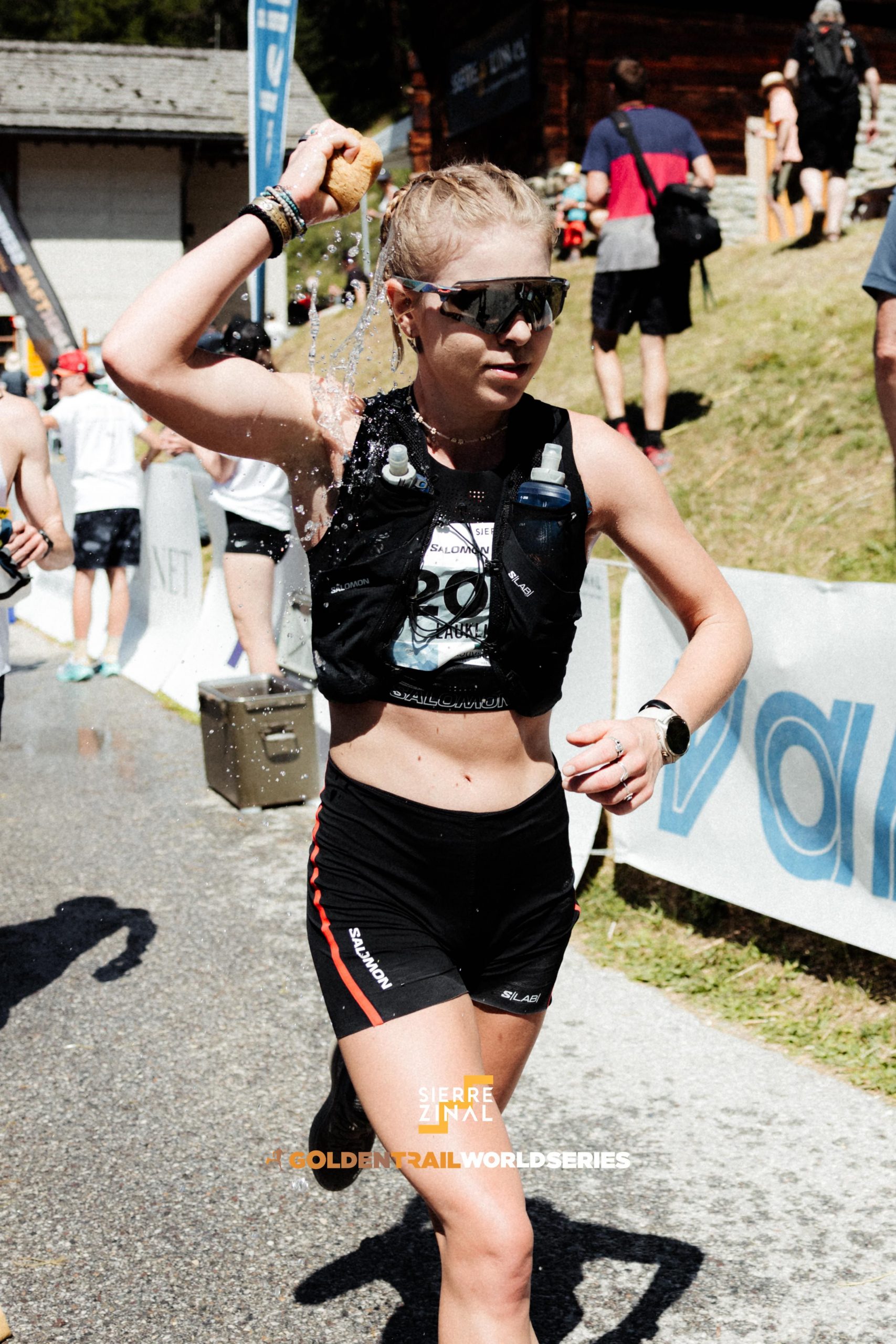
    Laukli racing Sierre-Zinal in the Gold Trail World Series in 2024. (Photo: @rising.story_@colinolivero_GTWS_SierreZinal

    Two Seasons, One Mindset

    Running and skiing back-to-back seasons creates year-round excitement—and pressure.

    “I have two competition periods,” she says. “It’s easier to motivate. But it also means I’m 100% consumed by performance all year.”

    That obsession became a barrier last year. Now, Laukli is working with Bourne and Tefre to shift her mindset.

    She has clear goals for skiing: the Olympic 10k, the Olympic relay, and the final hill climb at the Tour de Ski.

    She has equally specific running goals: above all, returning to Sierre-Zinal, where she once ran 2:53 on the iconic 31 km route.

    However, she’s no longer defining success solely by results.

    “There’s so much I’m working on—technique, tactics, how I ski courses,” she says. “It’s easy to be on a start line and focus on whether those things show up.”

    Bourne sees that evolution clearly.

    “Sophia has the instincts of a really high-level athlete,” Bourne says. “But learning to trust those instincts—rather than obsessing about the result column—is where she’s growing most.”
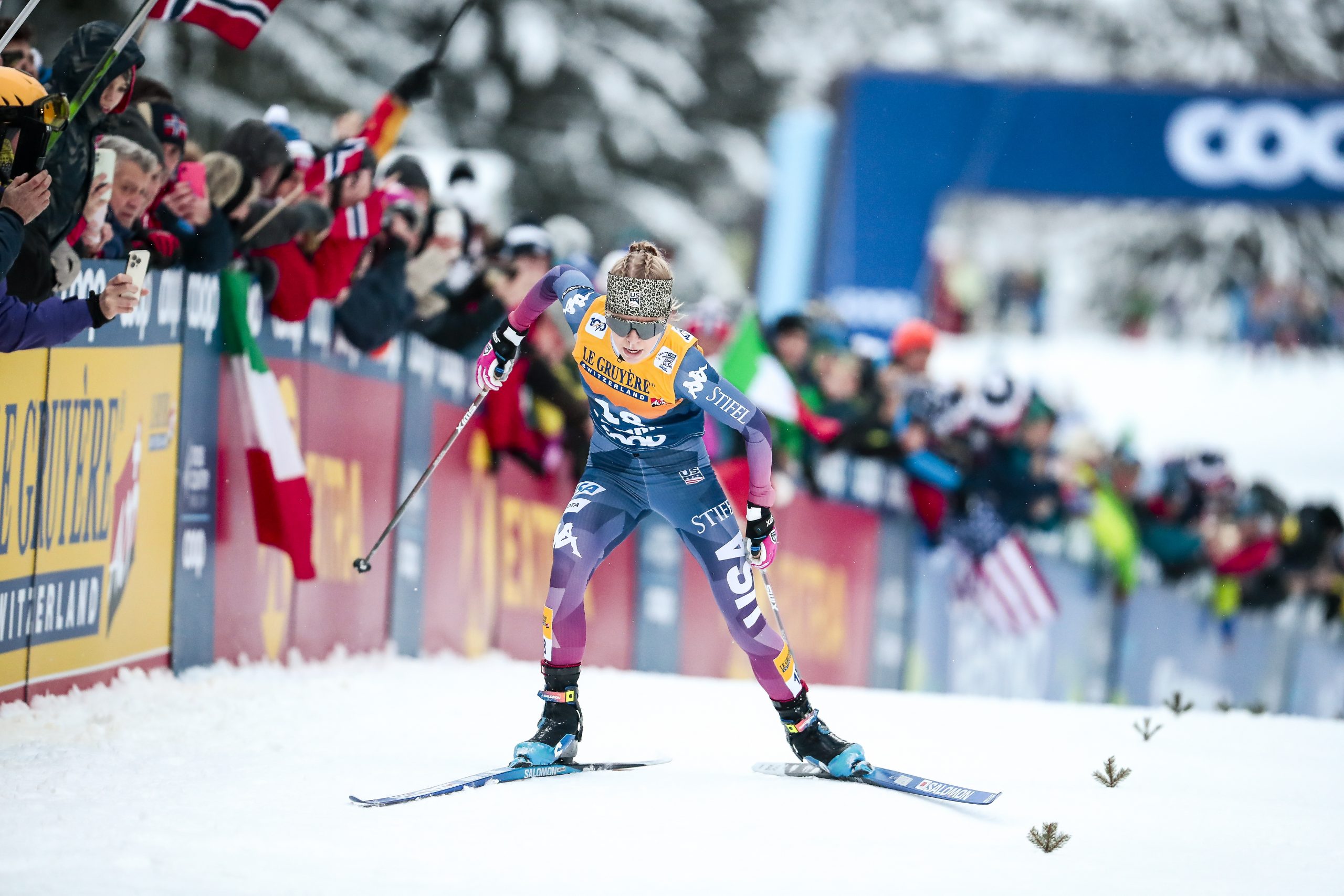
    Laukli nears the finish of the final climb of the 2024 Tour de Ski on Alpe Cermis, where she claimed the victory. (Photo: NordicFocus)

    Why Salomon Fits: One Athlete, Two Worlds

    For an athlete splitting her year between the World Cup and the Golden Trail Series, sponsorship could easily become complicated. Many runners work with running-only brands; many skiers work with ski-only brands. For Laukli, that would have been a logistical mess — and maybe even a dealbreaker.

    Instead, she found the perfect home with Salomon.

    “I’m super grateful that I get to have my sponsor, my main sponsor, support me in both,” she says. “Because then it’s a lot easier to focus on each season. I know that they’re supporting me in that.”

    That unified support matters. It lets her shift from skis to singlets without the politics of competing brand calendars and conflicting performance expectations.

    “I don’t really know if it would be possible for me to be a runner for another brand and a skier for a different brand,” she says. “Like, defending to them that I can’t run a normal running season because it’s the Olympics, or I need to drop World Cups so I can run better this year — that just wouldn’t work.”

    With Salomon, the opposite is true. Everyone’s aligned.

    “Having everyone be on the same team makes it manageable,” she says. “And a lot more motivating, because everyone has the same goal.”

    She works directly with Salomon’s France-based team, and Laukli lights up when she talks about the group behind her.

    “They’re all French,” she says, laughing — a nod to the company’s deep culture in both ski sport and trail running. It’s also a reminder that Laukli lives firmly in the middle of two endurance worlds that Salomon understands and embraces.

    That harmony matters. Her identity isn’t split; it’s blended. And Salomon is built for that.

    Sophia Laukli (USA) racing the World Cup Mass Start in Les Rousses (FRA). (Photo: Modica/NordicFocus)

    Sunny Weekends and Simple Breakfasts

    Some things have gotten simpler, like her pre-race breakfast.

    “I used to do peanut butter and banana,” she says. “Now I just have cereal. Apparently, simple is better.”

    World Cup life has also taught her the importance of flexibility.

    “You learn how to adapt,” she says. “Something will always go wrong on a race weekend.”

    When she’s asked for her favorite place on the circuit, she doesn’t hesitate.

    “Davos,” she says. “It’s sunny. You can have bad races, and it doesn’t matter because it’s a really nice place to hang out.”

    That small detail fits her evolving philosophy. Training is simpler. Goals are more balanced. And the sport—skiing and running—feels more sustainable.

    Somewhere between Maine and Norway, between Middlebury and Utah, between World Cup stadiums and alpine trails, Sophia Laukli has built a training model that doesn’t look flashy. It’s repetitive. It’s measured. It’s rooted in trust, communication, and doing the basic things right, over and over again.

    And if the Norwegians are right—and if Laukli’s instincts keep sharpening—those basics may be exactly what carry her to the front this season, in both sports.


    Love Stories Like This? Help Keep Them Coming.

    Feature interviews like this one take time, access, and care to produce. If you value thoughtful storytelling and independent ski journalism, please consider becoming a Voluntary Subscriber. Your support directly fuels the work we do to cover the people, places, and moments that make our sport special.

    Join the FasterSkier community!


  • From Olympian to Entrepreneur: How Garrott Kuzzy Turned a Life on Skis into Lumi Experiences

    From Olympian to Entrepreneur: How Garrott Kuzzy Turned a Life on Skis into Lumi Experiences

    Garrott Kuzzy’s journey from the trails of Minneapolis to the alpine valleys of Austria reads like a skier’s odyssey—equal parts serendipity, endurance, and vision. Before becoming an Olympian or founding Lumi Experiences, a travel company built around the joy of cross-country skiing, Kuzzy was simply a kid who loved movement.

    “There were no cell phones then,” he recalls with a laugh. “I think I was just playing soccer, doing the stuff kids did in Minneapolis.” His early athletic spark came not from racing bibs but from curiosity. That curiosity deepened after watching the 1994 Lillehammer Olympics. “I thought ski jumping was the coolest thing,” he says. His father, driving home past the lights of the Minneapolis airport ski jump, stopped and signed Garrott up on the spot.

    Ski jumping, however, involved more trudging than flying—lugging 240 cm skis up icy stairs for a handful of attempts. “I remember thinking, this is too much work. I’m going to do cross-country skiing instead.” That decision set the trajectory for the next three decades of his life.

    Garrott Kuzzy skiing the 1997 König Ludwig Lauf. (Photo: Courtesy Photo)

    A Culture of Excellence at Hopkins High

    At Hopkins High School, Kuzzy joined a program that had quietly become one of Minnesota’s most respected Nordic teams. Coach Pat Lanin had spent more than 30 years nurturing a culture of commitment and camaraderie. “He definitely set the culture,” Kuzzy says. “We had this lineage—guys like Matt Schadow and Pete Tollefson, who were great runners and skiers—and it made you want to rise to that level.”

    Those roots mattered. Minnesota’s high school skiing scene was (and remains) a hotbed of talent and community spirit, a proving ground where future Olympians learned not just how to race, but how to love the sport.

    Switzerland and the Making of a Global Perspective

    If Minnesota planted the seed, Switzerland provided the light. During what he calls his “first senior year” of high school, Kuzzy embarked on a foreign exchange in the Alps—a decision that would alter his trajectory.

    “I kind of forgot to apply to college while I was there,” he says, laughing. But what he gained was immeasurable: “That year completely changed my trajectory in life. I trained with a local club, learned German, raced at Swiss Nationals, and came back stronger and faster.”

    Garrott at age 7 with his father, Jim, at the Engadin Ski Marathon. (Photo: Courtesy Photo)

    Once back home in Minnesota, Kuzzy repeated his senior year, dominated the state circuit, and qualified as a forerunner for the 2002 Salt Lake Olympics. More importantly, he returned home with a new sense of maturity and a lifelong interest in connecting people through travel.

    That international curiosity would later become the foundation of Lumi Experiences—years before the company even existed.

    Middlebury: A Team of Global Thinkers

    After strong results at Senior Nationals, Kuzzy fielded offers from several East Coast colleges. He ultimately chose Middlebury, drawn by the school’s blend of academics, languages, and skiing. “Terry [Aldrich] let me run cross-country and ski, and they had a strong German program,” he says. “By that point, I’d just gotten back from Switzerland. Studying languages was my jam.”

    Middlebury’s team at the time was something of a cultural experiment: nearly every skier had taken a gap year abroad. “Five or six of our top racers had spent a year in Norway, Sweden, or Switzerland,” Kuzzy explains. “It gave us a maturity advantage—like grad students who’ve worked before going back to school.”

    That worldly approach shaped not just results, but perspective. “It opened doors for people,” he reflects. “Those experiences make you realize sport isn’t just about skiing faster—it’s about how you see the world.”

    Garrott Kuzzy (CXC) on his way to first place at the SuperTour in West Yellowstone in 2009. (Photo: Andy Canniff)

    Climbing the Ladder: From CXE to the World Cup

    After college, Kuzzy joined the Central Cross-Country Elite (CXC) team under coach Yuriy Gusev. His methodical plan—Europa Cup in 2007, World Cup in 2008, Olympics in 2010—was ambitious but precise.

    He broke through in Canmore in 2008, finishing ninth in a World Cup sprint. “That race changed everything,” he says. “I barely missed the A-final, but it qualified me for the U.S. Ski Team.”

    The result was validation of years of grinding. “In that semifinal, I was fourth, and I forgot about the lucky loser rule,” he recalls. “Had I stuck my toe out another inch, I would have made the A-final.” Still, his B-final victory and top-10 finish made him one of the first Americans to hit the objective criteria for team selection.

    Yet even amid success, Kuzzy felt the solitude of life on tour. “I remember running at night in Falun, seeing warm lights in houses and feeling homesick,” he says. “I thought—how cool would it be to share these places with friends and family?” That yearning for connection would eventually define his subsequent career.

    Garrott Kuzzy was CXC’s first athlete to make the Olympics.

    From Racing to Guiding

    When Kuzzy retired from racing in 2011, he joined Vermont Bicycle Tours (VBT) and began designing active travel experiences across Europe. “On one of my first days, I told Gregg Marston, ‘I’d love to do cross-country ski vacations,’” he recalls. Within a year, he was running VBT’s ski trips in Europe.

    After VBT was sold, Kuzzy spent a year coaching at Green Mountain Valley School before pursuing an MBA in Tourism Management in Innsbruck, Austria. “The program gave us winters off to work in the industry,” he says. “That’s when I started Lumi.”

    The first Lumi trip, in 2018, was a test run for the 2019 Seefeld World Championships. “I totally mispriced it,” he admits. “But we ended up making a $10,000 donation to the National Nordic Foundation.” Guests saw Sophie Caldwell and Jessie Diggins both win World Cups that weekend—one of the most memorable in U.S. skiing history.

    Some of those guests have traveled with Lumi every year since.

    Sophie Caldwell (USA – bib: 4), Maiken Caspersen Falla (NOR), Laurien Van Der Graaff (SUI), (l-r) race to the line of the individual sprint in Seefeld (AUT) in 2018. (Photo: Fischer/NordicFocus)

    Building Lumi: Travel with a Nordic Soul

    From its base in Innsbruck, Lumi has evolved into a small but deeply personal company offering immersive ski journeys across Europe—Seefeld, Toblach, Falun, and beyond. The mission, Kuzzy says, is simple: “To share the best cross-country skiing in the world with American travelers.”

    He brings the same precision he once applied to interval training to trip design: ski-in/ski-out hotels, strong coffee, smooth logistics, and moments that foster connection. “We still do things like mulled-wine curling nights, inspired by my time with the U.S. team in Ramsau,” he says.

    Seefeld remains the company’s spiritual home. “You can walk out your door and ski, but it still feels like a small town,” Kuzzy explains. “It’s the only place I’ve seen with an après-ski scene for cross-country skiers. There’s a bar right at the trailhead—it’s magic.”

    Lumi’s guests have ranged from former Olympians to families discovering Europe’s ski culture for the first time. And through it all, the ethos remains: connection, community, and joy.

    Kuzzy and his Lumi guests pose with Julia Kern and her parents at the 2023 Planica World Championship. (Photo: Lumi Experiences)

    Full Circle: The Olympic Spirit, Reimagined

    As Lumi prepares for the 2026 Winter Olympics in Italy’s Val di Fiemme—where Kuzzy raced during his career—things feel, in his words, “beautifully full circle.” The company will host multiple groups in Cavalese, the same valley as the legendary Marcialonga.

    “It’s surreal,” he says. “From racing there as an athlete to now bringing people to experience it—it’s everything I hoped Lumi could be.”

    Beyond 2026, Lumi has already secured hotel space for the 2027 Vasaloppet and Falun World Championships—a feat of foresight that shows Kuzzy’s racer discipline never truly faded.

    In the end, Lumi is less about luxury or logistics than it is about legacy. “Some of our guests have been on every trip since the first,” Kuzzy says. “They’ve become friends. We share this deep love of skiing and place—that’s what it’s all about.”

    The Glide Continues

    Garrott Kuzzy’s life on skis has taken him from the frosted parks of Minneapolis to the peaks of Innsbruck, from the World Cup start line to the front desk of a boutique ski tour company. But his mission has remained constant: to bring people closer to the snow, to the sport, and to each other.

    “The best part of Lumi,” he says, “is seeing guests experience skiing the way I did when I first fell in love with it. That’s the magic I want to share.”


    Love Stories Like This? Help Keep Them Coming.

    Feature interviews like this one take time, access, and care to produce. If you value thoughtful storytelling and independent ski journalism, please consider becoming a Voluntary Subscriber. Your support directly fuels the work we do to cover the people, places, and moments that make our sport special.

    Join the FasterSkier community.


  • Middlebury’s Kate Barton Advances to U.S. Ski & Snowboard D-Team Head Coach

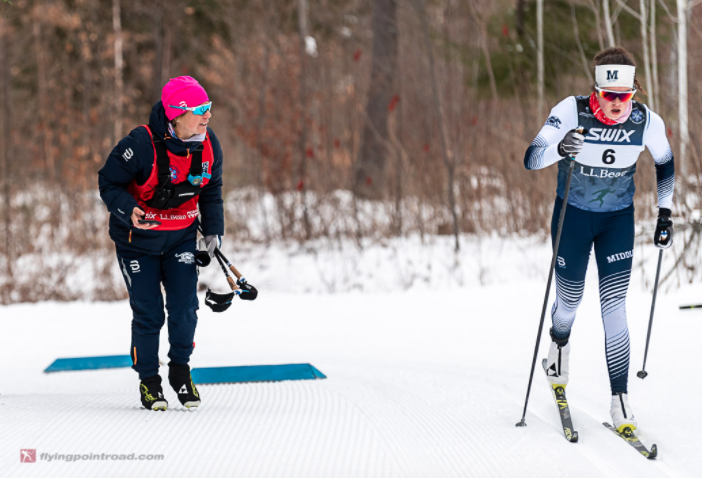
    Former Middlebury College Assistant Coach Kate Barton joins U.S. Ski & Snowboard as the new D-Team head coach. (Photo: Flying Point Road)

    If you read FasterSkier, you are likely aware that elite cross country skiing in the U.S. has been steadily on the rise over the last decade. In the last four years alone, we’ve borne witness to medals at all levels, including a Diggins-Randall double podium in the freestyle sprint at the 2017 World Championships, a 10 k classic win for Gus Schumacher at the 2020 World Junior Championships, a bronze medals for Will Koch and Kendall Kramer at the Youth Olympic Games, and of course, the iconic gold medal winning team sprint of the 2018 Olympics. Our heart rates have climbed with the vicarious thrill of seeing American skiers earn a multitude of World Cup podiums, relay medals, and spots in sprint finals. 

    As the current US Ski Team lineup raises the bar for what’s possible on the World Cup, the next generation of skiers lays the foundation to build upon their accomplishments. See it to be it. Success breeds success. Pick your preferred phrasing.

    Consequently, the talent pool tracking toward the national development program has been flooded like never before and U.S. Ski & Snowboard has stepped up its support in response. 

    “We have more junior and Under-23 athletes achieving the U.S. Ski Team standard,” explained sport development manager Bryan Fish in an email. “It is clear we are strengthening as a nation at our development ranks. This is reflected in awards such as the FIS Marc Hodler award where we were second only to Norway at 2020 Junior World Ski Championships after being a USA record-setting 4th in 2019. Hence, we have a growing USST D Team. This growing team needs more support and attention.”

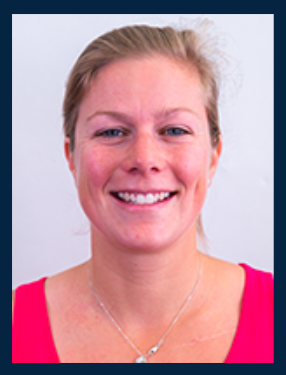
    Kate Barton joins the U.S. Ski & Snowboard D-Team as head coach, following four years as the assistant coach at Middlebury College. (Photo: Athletics.Middlebury.edu)

    The most recent addition to the development program is former assistant coach at Middlebury College Kate Barton, who will lead the charge as Development and D-Team Head Coach. Barton will replace Bernie Nelson, who stepped down after the inaugural year of the position.

    Fish explained that the restructuring and head coach position facilitates more direct and consistent support to D-Team athletes throughout the year. Barton will also have the capacity to work with developing athletes at events like the National Training Group (NTG) camp for top performers at Junior Nationals. Her role frees Fish up to focus his attention on development infrastructure, provide coach education at the club level, and other domestic tasks. He will still support Barton at domestic camps and at international events such as the World Junior Ski Championships and U23 World Championships. 

    Barton’s selection for the position was made with input from her predecessor, Nelson, and the roster of D-Team athletes, as well as from Cami Thompson Graves, head coach at Dartmouth College and Chair of the U.S. Ski & Snowboard Sport Committee. Barton received positive feedback and recommendation across the board. 

    Fish explained that he and Nelson had a strong working relationship and that although COVID-19 has interrupted the intended team schedule, Barton has seamlessly stepped into her new role, bringing her own set of strengths and skills to continue the support athletes have received within the new development program structure. 

    “Kate has worked in many national junior domestic camps and international development projects in the past, so she has a firsthand understanding of our ski community, development structure, team culture, and the standards necessary to be competitive at the international level,” wrote Fish. “I have worked alongside Kate over the past ten years at National Under-16 camps.  She is positive, motivating, collaborative, organized, and has a great rapport with athletes and coaches, alike. These are critical qualities that will make Kate successful as the U.S. Ski Team Development and D-Team coach.”

    FasterSkier connected with Barton via email to learn more about her background and philosophy as a coach and how she will translate that into her new role as D-Team Head Coach. 

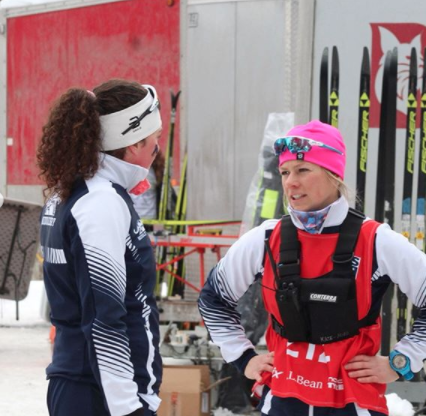
    Newly appointed USST D-Team Head Coach Kate Barton spent four years as the assistant coach at Middlebury College. (Photo: Instagram @middnordic)

    “Authenticity, passion, and principle provide a foundation for my philosophy as a coach and help to guide me,” wrote Barton. “I think it’s important to be authentic in your pursuits and be comfortable being yourself. Everyone is different and skiing is a unique, individual sport within the context of a team. If you can build strong relationships within a team then you can also trust and learn from one another and as a result, increase your chances of being successful. 

    “I am passionate about Nordic skiing; I love to ski,” she continued. “I want to cultivate a love for this lifelong sport in the athletes on our team. I think part of my job as a coach is to stoke this love for the sport, and for me, that comes from promoting a healthy balance between taking yourself seriously and having fun and enjoying the process. Finally, I think it’s important to be principled. I have to remind myself of this sometimes. But if you’re willing to be critical of yourself and others you can learn and move forward together. As a coach, I’m always trying to find a balance between providing direct feedback and maintaining the patience to let my athletes learn in their own time.”

    Barton spent four years working with the Middlebury Program. Before returning to her alma mater in 2016, she was the head coach at Burke Mountain Academy in Vermont for five years. She also spent a year as the head coach of the Jackson Hole Ski Club in 2010.

    An accomplished athlete in her own right, Barton graduated from Middlebury College in 2009 as a dual sport athlete in skiing and lacrosse. Demonstrating both talent and leadership potential, she made the NCAA championship team each of her four years and captained the team to an 8th place finish her senior year. In addition, she competed in two semifinal rounds of the NCAA Tournament in lacrosse. 

    Barton explained that these experiences were formative in her transition to coaching. 

    “Many of the lessons I learned from my time as a competitive skier were things not to do,” she wrote. “I competed in a variety of sports competitively growing up and was lucky enough to compete as a skier and a lacrosse player through college, two very different but valuable experiences. Most of all, I was lucky enough to be surrounded by some passionate, veteran coaches throughout my entire ski coaching career who were willing to let me tag along and soak up experiences, but who also pushed me to be independent and take on roles outside my comfort zone.”

    Through coaching three U18 National Teams at the U23 World Ski Championships as well as for Team New England at Junior Nationals and working at U18 national and regional summer camps, Barton has had the opportunity to work with many of the D-Team athletes. She has also coached at multiple international junior trips to Norway and Sweden. 

    “One of the coolest things about the ski world is how small it is, and even if I haven’t worked with all of these athletes directly, I’ve been watching them compete for many years. I remember observing this crew race a humid uphill TT at U16 camp many years ago. Even as U16 athletes, it was crystal clear how willing and genuinely excited they were to push limits and grow together, all while having a good deal of fun.”

    The athlete she has had the most experience working with is newly nominated 20-year-old Sophia Laukli, who currently attends Middlebury College. 

    “I’m lucky to be sharing my rookie season with Sophia and I’m excited for the challenge of getting to know a couple of new faces as well.”

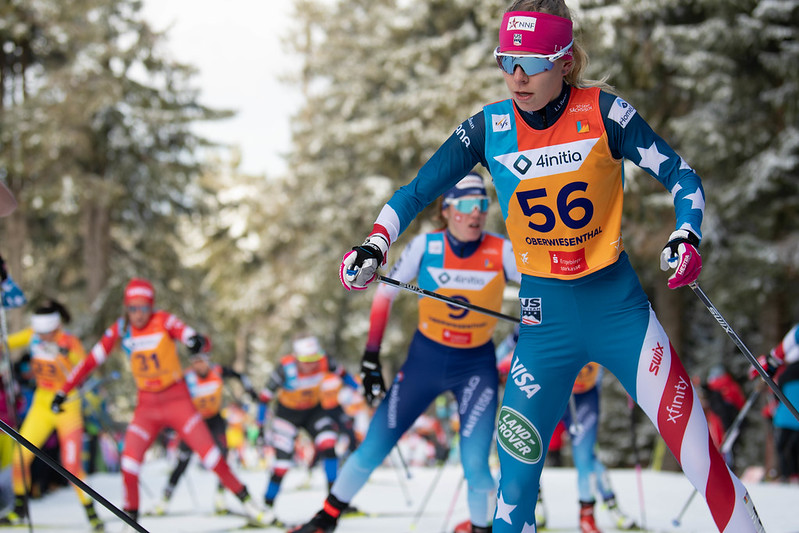
    Sophia Laukli (bib 56) skied to 5th overall in the junior women’s 15 k mass start skate at 2020 Junior Worlds. (Photo: Doug Stephen)

    The 2020-21 D-Team has a record 11 members. Both Fish and Barton commented on the goals for the program as they work together to support these athletes and continue to foster the national development program. 

    “‘Working together’ are the keywords here,” responded Fish “We have athletes with the desire, work ethic, and skills to succeed at the highest level of our sport.  These athletes have a good understanding of what they need to be successful. This is thanks to our strong clubs, school programs, and strong divisional/ regional support. Kate and I both have a strong background coaching at the club and collegiate ranks, so this will aid in working with these athletes and their local programs to support their individual needs. 

    “It all starts with the question to the athletes and programs as how can we best support? What can we provide in addition? One common goal is that we continue to build upon the strong USA Team culture that we are bringing to our international trips each year.  It is a huge asset when you know your teammates are contributing to your success and have your back.  We will need to be creative in continuing to develop our team culture when working together in summer projects is a challenge.”

    Barton’s response focused primarily on laying the groundwork for successful coach-athlete relationships, which she identifies as learning about each of her athletes individually and establishing a relationship. This requires collaboration and communication with both the athlete and their club or collegiate coach.

    “As a new member of the team, the most important thing is to start to get to know this crew as athletes and as people. I want to coach this team in a way where they get to know me, too. We haven’t had a chance to work together in person yet, given the current state of the world, but I hope we’re starting to build relationships that will make our work at future training camps and competitions more enjoyable and productive. This job has already been rewarding because of the work I get to collaborate with the club coaches of each of these athletes. I’m excited to serve as a resource for any coach willing to get on board and help to push U.S. skiing forward. 

    “I am most looking forward to the opportunity to learn first-hand from this group of athletes,” she continued. “The D-Team is a special group of motivated individuals. They are stoked to continue to push US skiing forward. I can’t wait to see how they do it, to help them pursue their goals and dreams, and of course to provide some guidance and share my knowledge and experience along the way.”

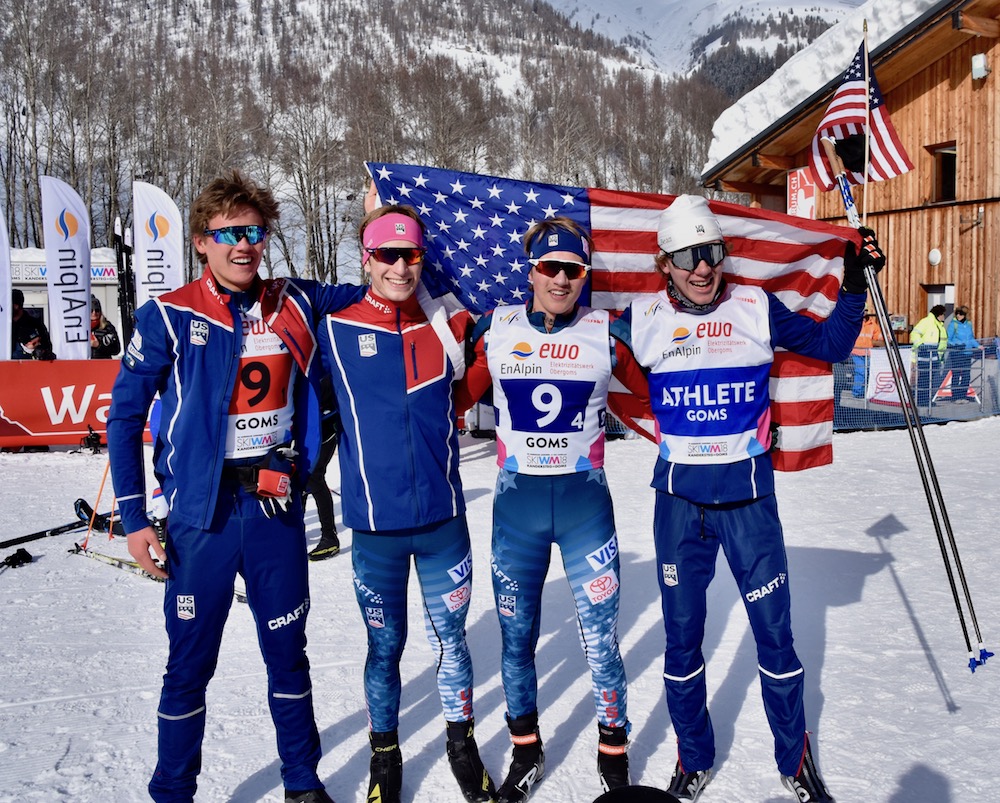
    The U.S. men’s silver-medal relay on Saturday at 2018 Junior World Championships in Goms, Switzerland, with (from left to right) Luke Jager, Hunter Wonders, Gus Schumacher, and Ben Ogden. (Photo: Julia Kern)

    Finally Barton was asked the challenging question regarding how to best support the mental and physical wellness of athletes who are navigating the pressures that come with elite level sport at a young age. In addition to the stress of training, many of the D Team athletes are also balancing academic demands on top of their training while facing significant transitions in their lives as they advance from high school through college. 

    “I think relationship building is our most important tool. My most successful coaching relationships have always been built on open and honest communication. I hope to build this culture within the D Team and beyond. We’ll try to break down the stigma that we have to wait until we’re in a time of need or crisis to ask for help. This community is incredibly supportive and there are many resources to help facilitate athlete development. My goal is to get to know a wide variety of young athletes in the US and to help them balance those demands and stressors they face as developing athletes. I don’t believe any of the athletes on the D Team are as fast (yet!) as they need to be, as they want to be, or as they can be, so I hope we’ll work together to build a good foundation on which to continue to develop. We will focus on the process and not just our performance because everyone fails a few times on their way to greatness.” 

  • The College Conflict: Part 1

    The College Conflict: Part 1

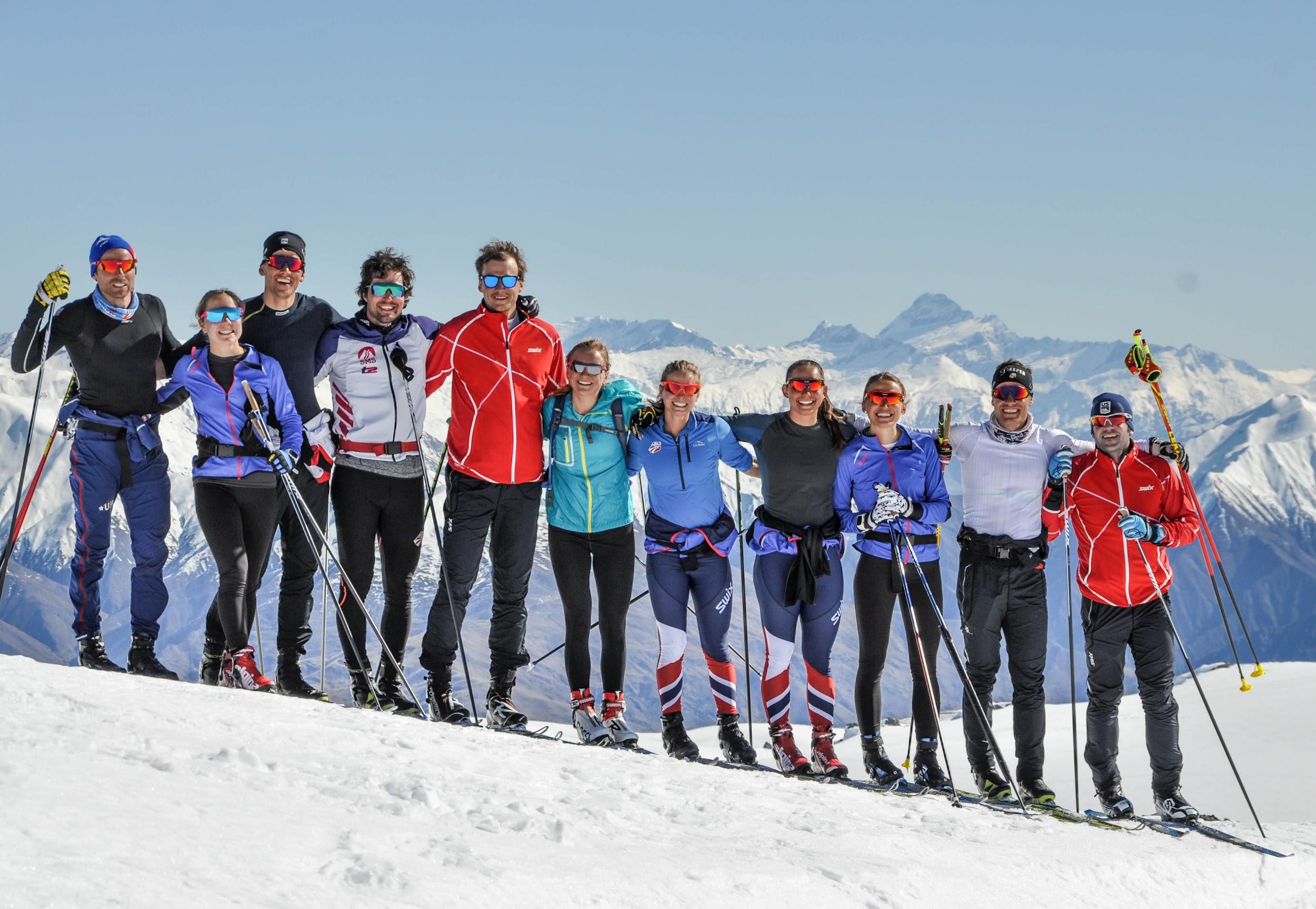
    2018 U.S. Ski Team camp at the Snow Farm in New Zealand, with author Alayna Sonnesyn (teal jacket) in the middle of the group shot. (Photo: Matt Whitcomb)

    The following was written by Alayna Sonnesyn, a new member of the Stratton Mountain School (SMS) T2 Team who graduated from the University of Vermont (UVM) this past spring.

    Originally from Plymouth, Minnesota, Sonnesyn, 22, raced on the UVM Ski Team for four years and qualified for four NCAA Skiing Championships teams. She placed second and third in two races at 2017 NCAA Championships, and in her senior season, won the first five Eastern Intercollegiate Ski Association (EISA) races and went on to reach the podium in 10 out of 11 EISA races. Sonnesyn expressed an interest in exploring the dilemma many of the nation’s top skiing talents face out of high school: whether to attend college or get an early jump on a pro-racing career. She plans to post this two-part series on her blog as well.

    ***

    For the first time in 17 years I will not be going back to school this fall. Saying that out loud is more daunting than I had anticipated. For the most part, the classmates that I graduated with can say that they are “going to grad school,” “starting a new job,” or “taking a year off to travel,” but I still don’t know where I lie. I am not taking any classes this year, I am not working anywhere consistently, and I am doing more than just traveling to explore, I’m traveling to race!
    I am wrapping up a three-week training camp in New Zealand with the SMS, Craftsbury, and US Ski Team. When I walked through customs I had to write down my reason for visiting New Zealand: Was I a student? Was I visiting a family or friend? Was I working? What was my job? In the rush of the moment and due to habit, I wrote that I was still a student and continued on my way. I later had a few reflections; I still haven’t reached the point yet where I can say I have a job. I don’t have a salary and there are no company benefits. Yet, I work 24/7 toward my job — my job is ski racing. But why is this so hard for me to admit to myself? Is it because, for my entire life, I’ve been a student? What if I hadn’t taken this route? How do others make this decision?

    National Training Group (NTG), summer 2013, in Park City, Utah.

    Racing throughout high school, I was given a number of perspectives about picking skiing versus school. My friends were all preparing to go to college and I always assumed I would go to college, too. My parents and older sister went to school, why wouldn’t I go as well? But then I thought about skiing. I never had the most outstanding results in high school (never qualified to race internationally), but I was good enough to qualify for regional and national level camps like REG, NEG and NTG. I traveled to these camps and trained with other high-level athletes, getting more and more motivated by each skier or coach that I met. Then the thought came to me… what if I didn’t go to college? I could focus on training, make those vital steps toward international racing, and continue along the “pipeline” that so many Olympians had followed. Maybe I would make bigger jumps and improve my skiing exponentially? I was entering the unknown and I was unsure how to pick the right choice for me. Looking back on this four years later, I realize that I was far from alone in this predicament.

    buy clomid online, buy yaz online, yasmin buy online

    I have since had the opportunity to talk to a wide variety of skiers and competitors and have learned so much that I wish I knew in high school. It’s OK to be confused. It’s OK to make your own path. Every athlete is in a different situation, comes from diverse athletic and academic backgrounds, and has various goals that they hope to achieve post-high school.

    “I’ve always believed that the most important thing to remember when discussing the decision to go to school or not (or when to go to school) is that is it a completely individual decision and the right decision for one person might not be the right decision for the next.” — Sophie Caldwell

    Personally, I finally decided that taking a gap year might be too big of a jump for me. I wasn’t ready to focus on skiing and I had a lot of goals for myself academically. I decided to attend the University of Vermont and upon reflection, can admit that this was one of the best decisions of my life. Similarly, SMS teammate, Kelsey Phinney, went from high school in Boulder, Colorado, directly to Middlebury College.

    “The reason I chose Middlebury College was simple: I went to visit and I was ready to unpack and stay for good. I loved the people, the area, the ski team, and the classes I sat in on.” — Kelsey Phinney

    Carnival love, with Kelsey Phinney (top) and Katie Feldman.

    Kelsey and I both fell in love with our schools from the start and knew we were where we belonged. We took these college experiences as learning opportunities; maybe we wouldn’t have been ready to jump right into the professional circuit but we both determined this was the right path for us.

    “I loved the experiences I had on the Carnival circuit. Both good and bad times taught me a lot about life and skiing, and I felt like the balance of school and sport made me better at both,” Kelsey reflects.

    Similarly, Sophie Caldwell had her mind made up without the need to hesitate over a gap year or jumping into full-time skiing.

    “I chose to go to college right out of high school, and it was something I had always known I wanted to do. I knew there was a good chance I wanted to ski professionally at some point in my life, but when I was 18, I wasn’t ready to 100% commit to skiing,” Sophie, a Dartmouth graduate, explains.

    With academic goals in mind and the confidence to pursue skiing in the long run, sometimes there’s no need to question it. Going directly to college might challenge you more than you think and it might make you question what you’re doing. The balance of school and skiing is great, but it’s TOUGH! At least you worked through those challenges and figured out where you want to be though.

    “I definitely had my ups and downs throughout college and at times I considered not pursuing skiing after college, but by the time I entered my senior spring, I knew I wanted to give skiing professionally a shot and knew it was because it was what I wanted to do, not what I had to do,” Sophie notes.

    Over the course of four years, we were able to say goodbye to our homes, grow into adults and develop as skiers, allowing a much smoother transition into the professional racing circuit post-college. This decision to go right to college made sense for Kelsey, Sophie and me — it was simple; but I recognize that this choice isn’t as straightforward for everyone.

    ***

    “I loved my time at Burke and wasn’t quite ready to leave. I also didn’t know where I wanted to go to college as part of me wanted to go out west while part of me wanted to stay closer to home.”  — Ida Sargent

    The conflict of picking a school, a place we are willing to spend at least four years of our lives at, can be intimidating to anyone. Taking a year off to think and explore what motivates you once the structure of school is taken out of the picture can be extremely vital to one’s skiing longevity. Other times, this year off can be done to test out what skiing professionally is actually like.

    “I wanted to test out whether I could do only professional skiing.” — Katharine Ogden

    A feat that might sound easy to accomplish — ski, eat, sleep, repeat — can’t be THAT hard! But what happens when you suddenly put all of your time and energy into one goal?

    “Ironically, my gap year did not turn out even close to how I had planned or imagined!” reflects Julia Kern.

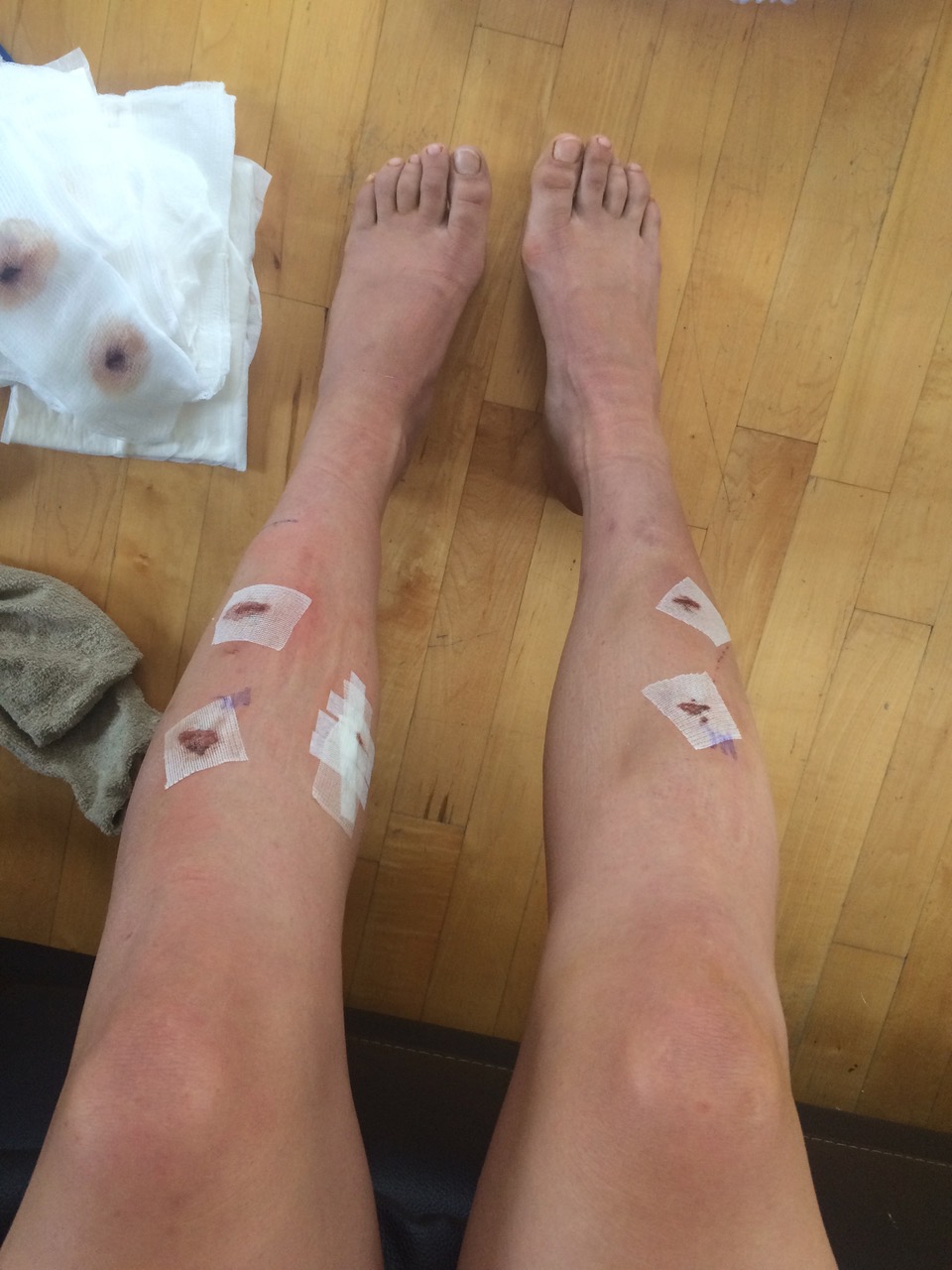
    Julia Kern with swollen legs after surgery, requiring A LOT of physical therapy during the summer.

    After facing an early summer surgery for compartment syndrome and then an untimely back injury in the fall, Julia notes that her gap year was extremely tough with plenty of lows and setbacks.

    Ida Sargent offers, “My PG year was a bit of a disappointment as I wasn’t as happy as I was expecting and I also didn’t feel like I made as big of a jump with my results as I had hoped.”

    “I think in hindsight it was a good philosophy but I think I approached it wrong. I didn’t do a good job securing other things to do besides training and was thus pretty bored, which led to me putting a lot of stress on skiing and racing,” says Katharine Ogden.

    Maybe taking a gap year isn’t as easy as it sounds? Coming face-to-face with this type of ski-focused intensity as an 18 year old can be challenging.

    “It showed me how much I really wanted to go to college,” offers Katharine.

    It can also be validating, as it can prove to oneself where they really belong at that point in their life.

    “It made me realize that I wasn’t ready to ski full time and I still needed balance in my life,” reflects Ida.

    What might be the most beneficial aspect of taking a gap year are the lessons you learn throughout. How to deal with the pressure, free time, potential obstacles, and how to respond when you’re suddenly put in an unfamiliar situation.

    “My gap year turned out to be far from ideal from a training/fitness standpoint, but I became very in tune with my body, learned how my body responds to training, became mentally tougher, and learned that I love the skiing lifestyle (even if it is tough sometimes) and that I want to ski at the highest level possible,” says Julia.

    Some things you just can’t learn in a classroom.

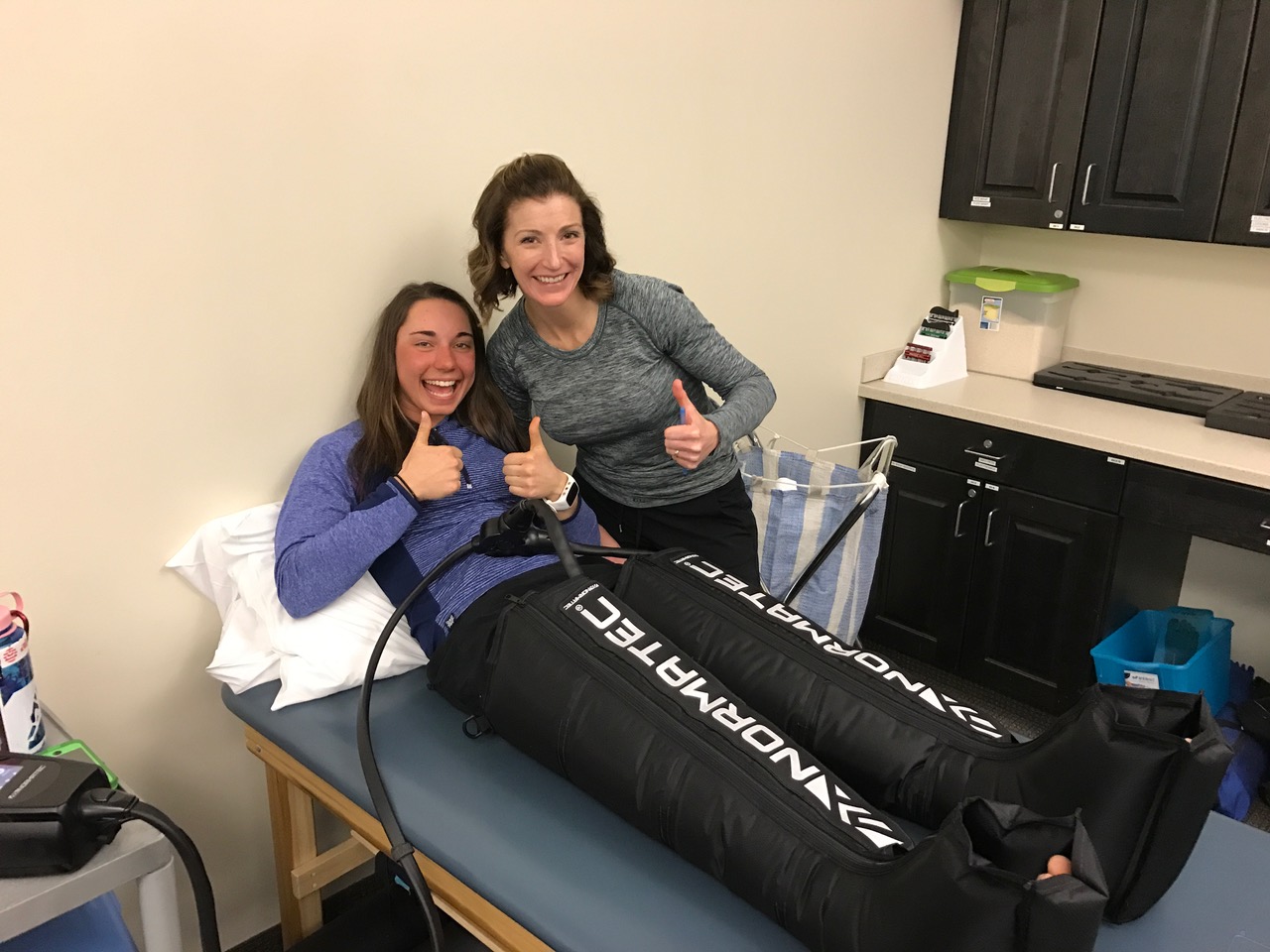
    Julia Kern (on table) still smiling!
    Julia Kern taking the time to think about something other than skiing during her gap year. (Photo: Julia Kern)

    How to pass the time away, when you have so much of it. (Photo: Julia Kern)

    After taking a gap year to figure out what skiing was like full-time; Ida, Katharine, and Julia attended Dartmouth College (via various routes):

    Ida states, “I started by going to school full time and I raced for Dartmouth for three years and then made the National team so I took my senior winter off to race for the USST and then I went back for a spring term my fifth year.”

    “One year in [as a traditional student], I am very happy at Dartmouth and racing the collegiate circuit last year reignited my love for the sport,” adds Katharine.

    While Julia contributes, “I chose Dartmouth because I wasn’t sure what skiing and school balance I wanted to have, but I did know that I wanted to be able to take terms off to race internationally.”

    Regardless of which Dartmouth plan they followed, all three skiers seem to have enjoyed the choices they made. Whether taking a gap year is or isn’t part of your plan, the most important takeaway is that you should TAKE SOMETHING AWAY! Learn something new about yourself, about skiing, or about classes you want to study.

    So what about other options for pursuing a ski career? Jessie Diggins and Andy Newell both chose to skip college and go straight into skiing. Stay tuned for my next post when I’ll include input from both of them as well as what U.S. Ski Team coach Matt Whitcomb has to say on this topic.

  • Heather and Brooke Mooney on Where Skiing Led Them and What’s Next

    Heather and Brooke Mooney on Where Skiing Led Them and What’s Next

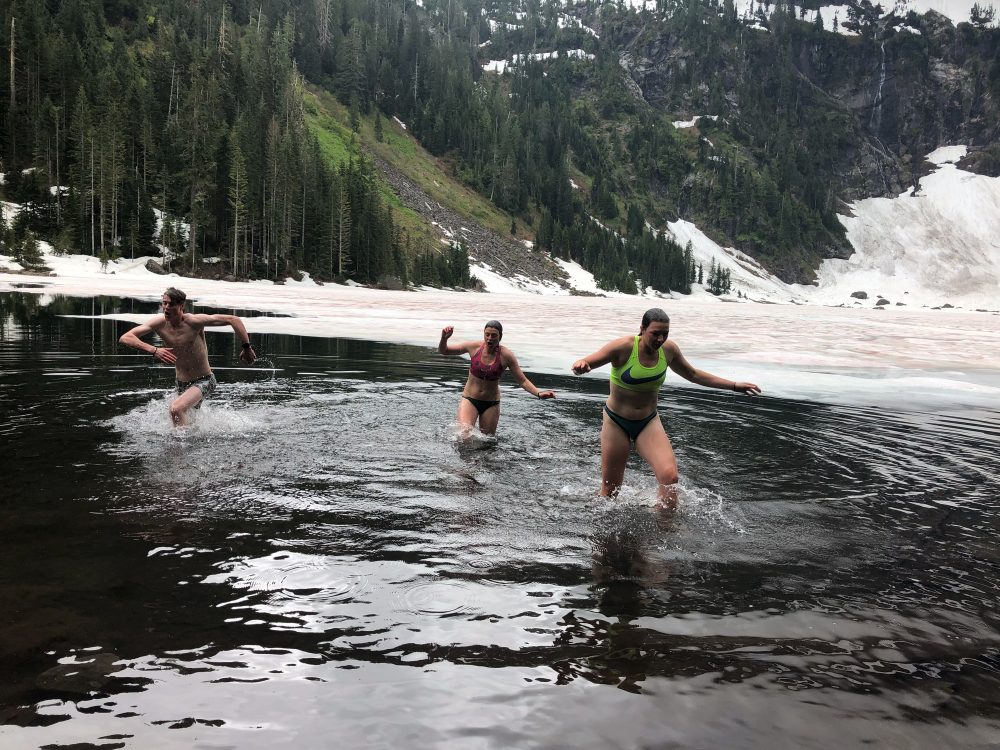
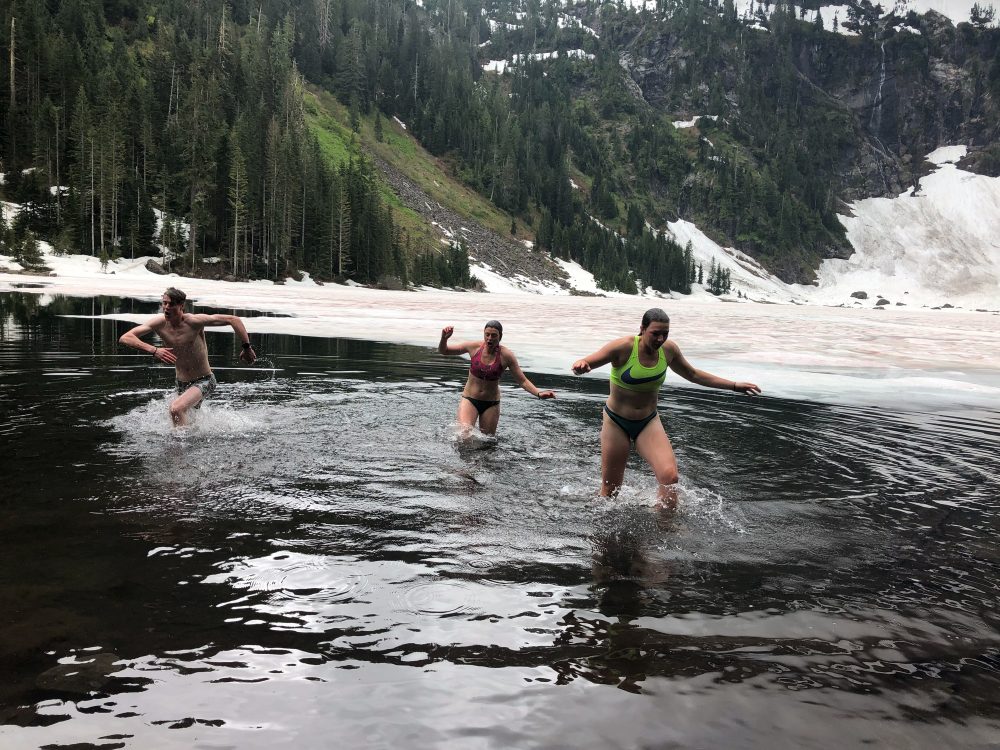
    Mooney siblings (from left to right) Scott, Heather and Brooke after jumping into Lake 22 just outside of Seattle, following Brooke’s graduation from Washington University in June. “With two siblings peer pressure works wonders, not going to be the wimpy one who doesn’t jump in!” Heather wrote. (Courtesy photo)

    Perhaps you have heard of them. Or at least seen them. At 6 feet and 6 feet 2 inches tall, respectively, the Mooney sisters, Heather and Brooke, are hard to miss. But their height is not the only reason the two women stand out.

    The sisterly pair also share a talent for the sports they pursue. At one point, for both of them, that sport was skiing. And at one point, for both of them, it was not.

    Having grown up in Peru, Vermont, where the Green Mountain range serves as the town’s backdrop and skiing is the norm, the two were certainly primed with the ideal environment for becoming interested in nordic.

    “Our school bus had a ski rack on the side of it because we would ski at recess,” Heather recalled during an in-person interview this month in Bozeman, Montana. “In southern Vermont, that is what everyone did.”

    “That” meant skiing. Their mother had picked it up as an adult and also worked as a promotion manager for a skiing magazine. Their father was the headmaster at Vermont Academy, providing the the family access to a plethora of trails directly from their residential backdoor.

    Both parents were also active outdoor enthusiasts, encouraging Heather, Brooke and eventually their younger brother Scott, to partake in anything that got them moving: swimming, hiking, soccer, tennis. (It didn’t hurt the family’s sporting M.O. that their father had been Yale’s soccer goalie as an undergrad.)

    By the time she was a freshman, Heather had enrolled at the Stratton Mountain School ski academy. Three years later, her sister Brooke had as well. (Heather and Brooke are two years apart, but Heather skipped first grade).

    Heather Mooney racing to 42nd in the women’s 10 k freestyle at the 2016 U23 World Championships in Rasnov, Romania. (Photo: FIS)

    They became well-known names on the eastern ski circuit. They also found national and international success while still U18s. Heather qualified for Junior Nationals four times, Junior Worlds twice and U23 Worlds in 2016. By her junior year in high school, Brooke had qualified for three Junior Nationals.

    As J2 skiers, both Mooney girls received coaching from Pepa Miloucheva, the head ski coach at the Craftsbury Outdoor Center. With a background in sculling, as well as ski orienteering, Miloucheva had her eyes on Heather and Brooke, who showed the potential to qualify for Junior Nationals in rowing as well. Both girls were invited to a youth rowing camp held at the Outdoor Center.

    “The director told me I needed a snorkel,” Heather reminisced with a laugh. “But Brooke was very good.”

    ***

    During an early season training session at the University of Washington (UW) this past year, Brooke sat down for testing on a rowing ergometer. She pulled for the alloted test time, one minute, and stopped. Her sustained pace was 615 watts.

    National team coaches could not recall any other woman surpassing 600 watts, The Seattle Times reported.

    “You don’t have to know rowing to see her strength,” UW head rowing coach Yasmin Farooq told the Times. “Watch her and you think, holy smokes, this woman has some serious power.”

    Unofficially, Brooke holds the watts record for an American woman on the rowing machine. Officially, she was named the Pac-12 Women’s Rowing Athlete of the Year in May and is now living in Princeton, New Jersey, one month removed from UW. She’s also a national-team recruit.

    Her invite to join USRowing came in December, and following her graduation from UW in June, Brooke headed back east. In Princeton, she is training with U.S. rowing veterans like Meghan Musnicki and Elle Logan — both multiple Olympic gold medalists — with the hope of working toward a spot on the 2020 Olympic team (selection won’t take place until 2019).

    “I kind of figured I would be pretty crazy to turn down this opportunity, whether it leads to greater results or not, I had to try it,” Brooke told FasterSkier on the phone.

    The seeds of opportunity were planted in the initial rowing camp Brooke attended in Craftsbury. She spent her senior year at Vermont Academy, where she took up rowing as her newfound, full-time passion.

    “I knew I wasn’t going to want to keep on skiing through college, so I figured I might as well try rowing,” Brooke said.

    She filled out a few higher-education recruiting questionnaires and received a response from UW.  As one of the top rowing schools in the country, UW had her attention. Throughout her four undergraduate years, Brooke developed into one of the country’s top college rowers, even with a slight scare before her senior season.

    ***

    When Brooke first started getting headaches in the summer of 2016, the doctors told her she was dehydrated. At a sculling camp in Craftsbury post-doc visit, her headaches continued. Most of the time, they got progressively worse throughout the day.

    Brooke Mooney, who was recently recruited to the U.S. women’s national rowing team, during a sculling camp in Craftsbury, Vt. in 2016. (Photo: Craftsbury Outdoor Center)

    “I would be able to get up in the morning and work out a little bit, but if I didn’t work out before 9 o’clock, I couldn’t workout,” Brooke recalled. “I would just lay on my bed in so much pain.”

    With dehydration as her diagnosis, she did what she could to work out. Sometimes the headaches would lapse, but most often they would not.

    “I started the school year in and out of headaches. I talked to the team doc and went to the headache clinic,” Brooke said.

    It wasn’t until April, almost a year after her headaches began, that Brooke was given an MRI. The results: she had a cyst in her optic chiasm. The mass was pushing on her optic nerve and needed to be removed, or else it could expand and cause permanent damage to her vision, even blindness.

    Her eye doctor allowed her to finish the race season (for rowing, championship racing occurs in the spring) before removing the cyst. Following her surgery in June 2017, Brooke was not allowed to train or work out for eight weeks the summer before her senior year at UW.

    “I was so worried,” Brooke said, particularly when she found out that her team would be racing the famed Head of the Charles Regatta that fall.

    “I wanted to race that more than anything and I panicked that I was going to miss my opportunity because of the surgery,” she said. “But then I ended up making it … every once in awhile, a good break is really beneficial.”

    ***

    If you peruse Heather’s blog, one post from April 2017 blares the title “On Burnout and Bye for Now.” This was her informal farewell to cross-country skiing.

    The post itself came two years after she graduated from Middlebury College, a time when skiing held great promise for Heather. She had capped off her senior year with seven collegiate wins and had also qualified for the 2012 Youth Olympic Games as a college sophomore.

    Following graduation, Heather signed on with the Craftsbury Green Racing Project (CGRP), but later found things weren’t aligning the way she had hoped they would. Particularly, she felt she was not performing to her expectations, given the amount of support she had (according to Heather, CGRP covers most of their athletes’ expenses for food, housing and travel.)

    “I thought I was done for good,” Heather, now 24, continued. “Pepa [Miloucheva] was the one who encouraged me not to look at it that way.”

    Even with Miloucheva encouraging her not to give up completely, Heather forfeited skiing, and even gave up physical activity for a bit.

    “In the beginning of the summer when I quit, I was like, ‘I’m not exercising, I’m not being an athlete, I’m just doing whatever what I want — I can be happy without skiing,” Heather said. “Very quickly I realized that I need exercise to be happy.”

    That summer in Truckee, California, Heather landed a coaching gig that gave her the opportunity to travel to Australia. By the fall, she decided to move to Bozeman, with plans to gain residency at Montana State University and enroll in its architecture graduate program.

    In Bozeman, she reconnected with Austin Caldwell, a longtime friend from Vermont and the current head coach of the Bridger Ski Foundation Elite team. The two went for a few early fall skis together and Heather soon found herself attending Caldwell’s agility practices, then interval sessions. When the winter hit, Heather even jumped into some races, but only as many as she chose.

    In all, she competed in about a dozen SuperTour races, finishing last season ranked 36th overall on the circuit. Heather also raced to 14th in the 50-kilometer American Birkebeiner skate race in February.

    “It was really refreshing to step out of expectation,” Heather said. “I feel like we all get into such definitions of like how we should be in the sport. I realize [now] there are so many different ways to engage with it. Likely that’s how we many of us will reach our potential, is by engaging in a way that works for you as a person.”

    After a break, Heather is currently planning to defer from MSU and focus once more on skiing.

    “It’s been exciting for me slowly lose that anxiety of how I should be performing and how I wanted to perform,” Heather said. “I look at how can I work with myself, versus trying to fit myself into the pro-athlete mold.”

  • Summit Nordic Coach Hannah Taylor Dies in Trail Running Accident (Updated)

    Summit Nordic Coach Hannah Taylor Dies in Trail Running Accident (Updated)

    Summit Nordic Ski Club coach Hannah Taylor passed away on Saturday, July 21. (Photo: Summit Nordic Ski Club/Facebook)

    (Update: On Thursday, Aug. 2, the Summit County coroner’s office provided details on what happened to Hannah Taylor on July 21. Those details can be found here.) 

    A Summit Nordic Ski Club coach for the last 14 years, Hannah Taylor, 39, passed away on Saturday after a trail running accident in the Gore Range near Frisco, Colorado. Originally from Hopkinton, N.H., Taylor, who lived in the Frisco area for the better part of the last two decades, was running on Willow Peak ridge with Summit Nordic’s head coach Olof Hedberg when she grabbed a rock that came loose. According to the Union Leader, she fell some 250 feet into a rock garden below and was pronounced dead at the scene by medical team that arrived by helicopter. The accident occurred around 12:30 p.m. on Saturday.

    On Monday, Summit Nordic posted the following on its Facebook page:

    “On Saturday July 21st SNSC coaches, Hannah Taylor and Olof Hedberg, were out on a mountain run in the Gore range. On the Willow Peak ridge Hannah grabbed a rock that came loose and lost her life.

    Hannah has been with Summit Nordic Ski club for 14 years and there are no words that can describe the impact she has had on our club. We all know that this club wouldn’t exist without her. She wasn’t just a coach with SNSC, she was the heart and soul of SNSC. Her impact on our athletes reached far beyond their ability to ski. She didn’t just help children become successful athletes, but successful and great people.

    Her dedication to our athletes was undeniable. She kept a record of every wax used for every race over the last 10 years and cried every time we missed a wax on a race. She always wanted every athlete to have the best possible situation to perform and spent hours and hours making sure everyone had the perfect conditions no matter if you finish first or 30th.

    She instilled values like hard work, integrity, truthfulness and a sense of adventure into our club. To say that Hannah was an SNSC coach is not enough. SNSC as a whole is a reflection of Hannah Taylor and her values. Without ever asking for the spotlight, she shaped SNSC to a reflection of herself, and every day going forward we will try to honor that reflection and be the best we can. We will miss you every day.”

    Summit Nordic board president Peter Haynes told the Summit Daily how invaluable Taylor had been to their club.

    “She was here through several head coaches; she was our rock,” Haynes said. “This club would not be what it is without Hannah. She was such a strong person and personality, and hard on people. But she loved them so much — the kids especially. She did not give them a lot of breaks, but it was truly because she cared about them so much. She truly made this club better for everybody — coaches, parents and athletes.

    “I’m at a loss at what we will do without her, truly,” he continued. “Her ability to hold it all together when it kind of felt like it was too difficult at times, she just got through it all and did everything we ever asked of her.”

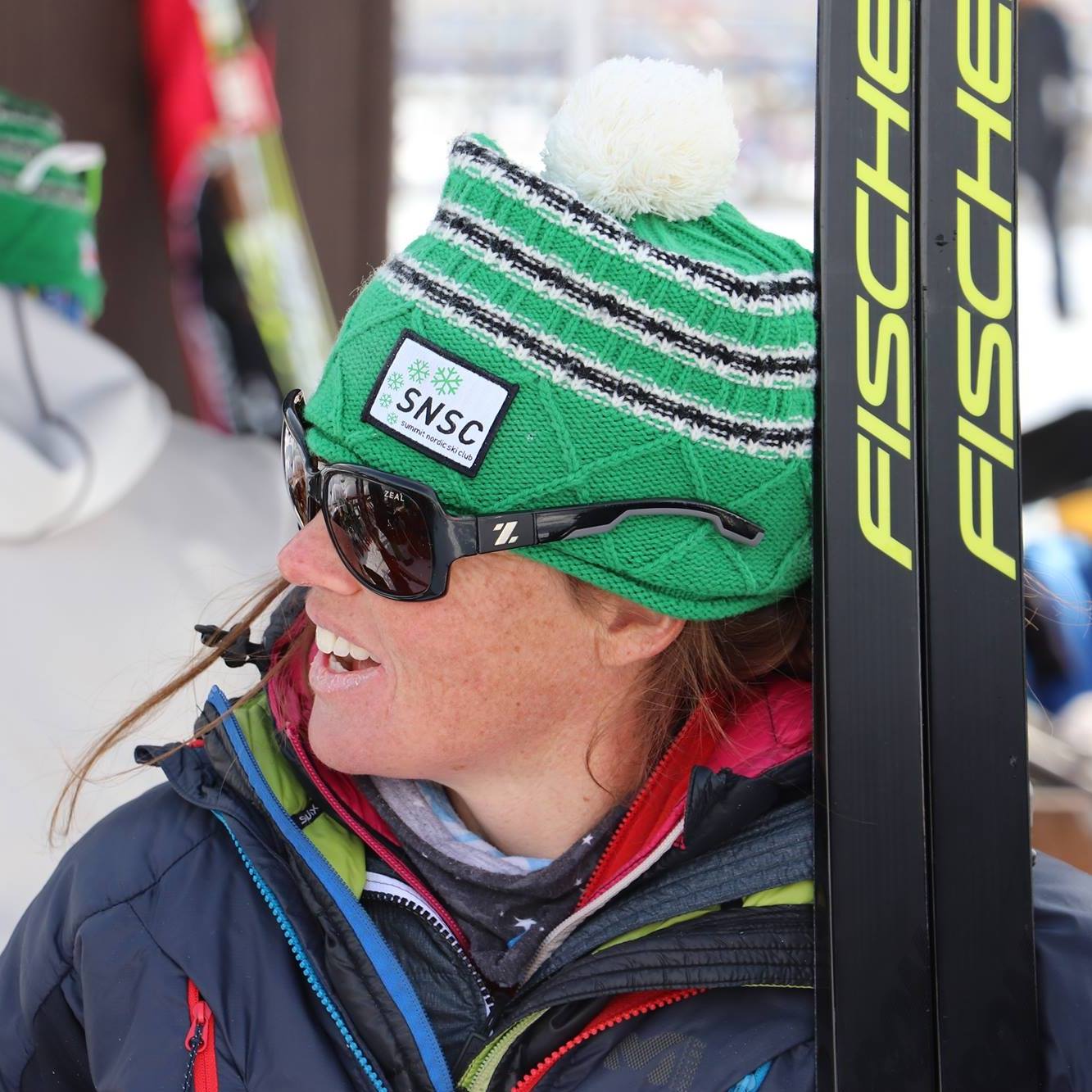
    Taylor skied for Middlebury College in Vermont and worked for the Appalachian Mountain Club before moving to Colorado. There, she began coaching at Summit Nordic and was hired as office manager at the Summit Huts Association, a Breckenridge-based nonprofit that owns and operates four backcountry ski cabins in Summit County. She worked for both entities for more than a decade and became managing director of Summit Huts.

    She was also an ultra runner who won the High Lonesome 100 ultra marathon last summer, finishing nearly two hours ahead of the second woman. Taylor is survived by her family and friends, including her longtime boyfriend and “her trusted dog and adventure buddy,” Saco, according to the Summit Daily.

    A memorial and life celebration is scheduled for Thursday, July 26, at 6:30 p.m. at the Frisco Nordic Center Day Lodge. Summit Nordic encouraged attendance and is seeking photos of Taylor: “If you have any photos of Hannah you are willing to share, please send them to hannahsmemorial@gmail.com or post them to Facebook and tag Hannah.”

  • 20-for-20 with Chloe Levins

    20-for-20 with Chloe Levins

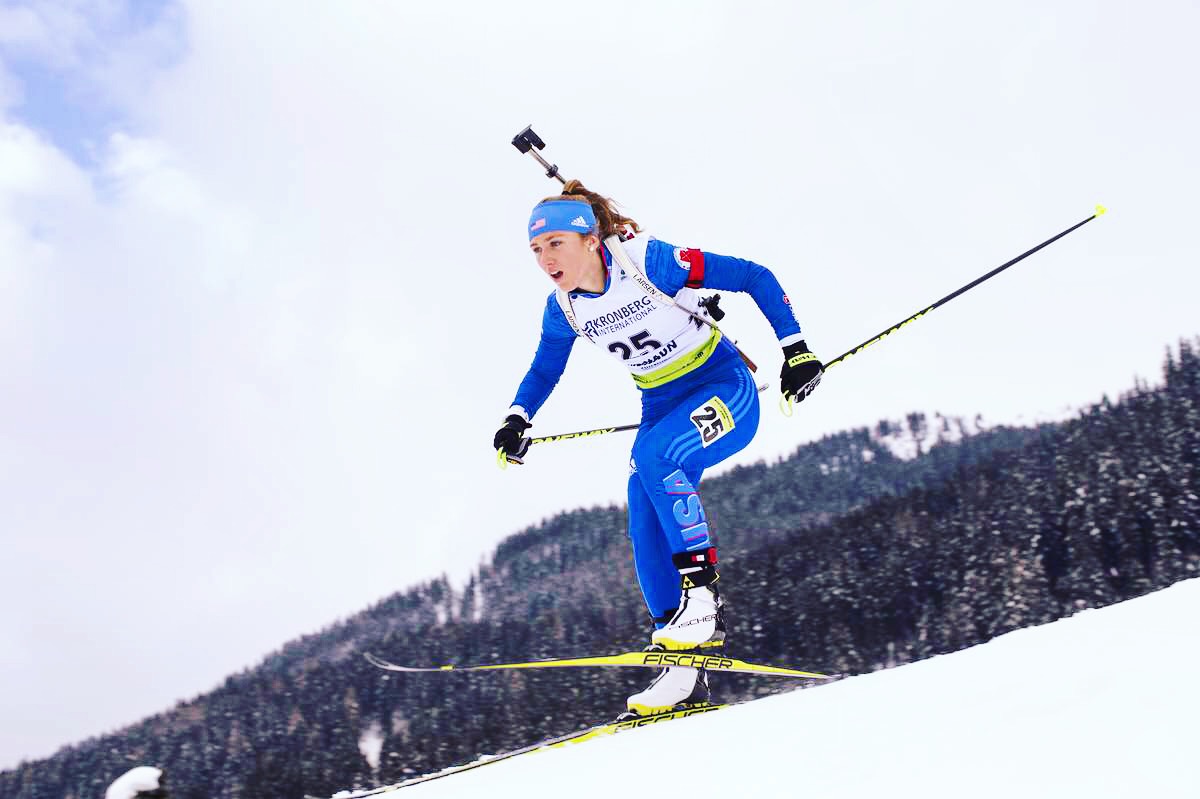
    Chloe Levins racing at the IBU Cup in Ridnaun, Italy, as part of the U.S. Biathlon Association's Olympic trials series. (Photo: USBA/NordicFocus)
    Chloe Levins racing at the IBU Cup in Ridnaun, Italy, as part of the U.S. Biathlon Association’s Olympic trials series. (Photo: USBA/NordicFocus)

    In an effort to showcase the North Americans competing at this week’s International Biathlon Union (IBU) 2018 Youth and Junior World Championships in Otepää, Estonia, we asked those qualifying athletes several questions about themselves — actually, we had them fill in the blanks. Here we have 19-year-old Chloe Levins, who is representing the United States at her first Junior World Championships. She previously represented the U.S. at Youth World Championships, including a fourth-place finish in the pursuit last season. Levins also made the short list of the U.S. Olympic Team and competed on the IBU Cup as part of Olympic Trials.

    On Thursday, Levins placed sixth to lead her team in the junior women’s 12.5 k individual (+3:37.4 with three penalties). 

    ***

    “My full name is Chloe Levins but you can call me Chlo.

    I was raised in Vermont, and I learned to ski by following my three older siblings.

    I spent the time before Worlds in school at Middlebury College.

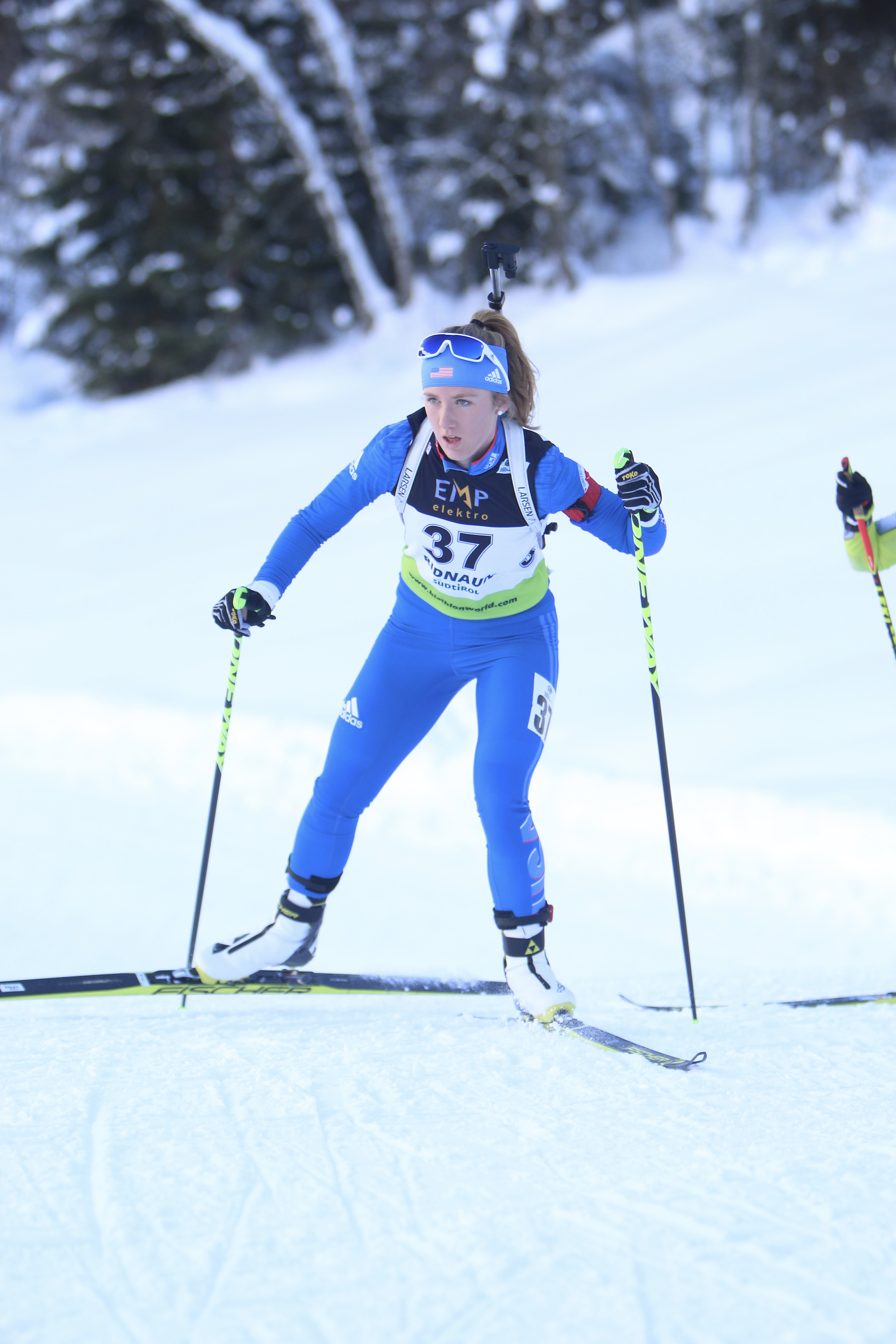
    Chloe Levins racing in Ridnaun. (Courtesy photo)
    Chloe Levins racing in Ridnaun. (Courtesy photo)

    The most memorable workout I did in the last training year to prepare for this was skiing with my coach. He doesn’t ski often, so it’s really special when he chooses to ski with me.

    One thing I’m working on this season to improve my biathlon is (and probably always will be) my patience.

    This is my first time in Estonia and fourth year racing internationally, and so far it’s been real winter with temperatures in the single digits (F) and falling snow.

    One difference I’ve noticed between Estonia and the United States is the lack of fruit.

    One of the things I’m most excited about for World Junior Championships in Otepää is experiencing a new world-class venue.

    One race I’m especially targeting there is the next one.

    Watching the Olympics in the leadup to my own races was hard to do at school. One of the most memorable moments of the Games was when Jessie Diggins overtook Stina Nilsson to earn US Women’s XC Skiing their first ever Olympic medal. I want to ski like Jessie, because she skis with more heart than anyone I’ve ever seen.

    At Worlds, I really hope I can practice speaking German with my friends from Deutschland.

    My favorite thing at the breakfast where we are staying is the lemon ginger tea.

    Before this trip, if you said “Estonia”, the first thing I’d think of would have been the cold temperatures.

    Now that I’m here, I’m pretty sure something I’ll always remember will be the cold temperatures.

    If I had a totally free day here and didn’t have to worry about race fitness or training, I’d still spend it on skis.

    The best way to follow me on social media is on Instagram @chlolevins or SnapChat @chlevins.”

    Chloe Levins racing at IBU Cup Trials in Mount Itasca, Minnesota. (Courtesy photo)
    Chloe Levins racing at IBU Cup Trials in Mount Itasca, Minnesota. (Courtesy photo)
  • Q&A: Beckwith’s Return to Skiing as NENSA Competitive Program Director

    Q&A: Beckwith’s Return to Skiing as NENSA Competitive Program Director

    Justin Beckwith (second from r), as seen in 2014 when he was head coach of the Green Mountain Valley School (GMVS), with former GMVS elite and postgraduate athletes (from l to r) Nick Gardner, David Sinclair and Ian Moore during a fall trip to Italy. (Photo: GMVS)

    About a year and a half after leaving his post as nordic director at the Green Mountain Valley School (GMVS), Justin Beckwith is once again involved with New England skiing at full throttle as competitive program director for the New England Nordic Ski Association (NENSA).

    The news came from NENSA early last month in an announcement that stated Beckwith would be filling in for Amie Smith, the association’s high-performance director for the last two years, who was promoted to executive director.

    Justin Beckwith (l) and Gus Kaeding in the wax room at 2017 U23/Junior World Championships at Soldier Hollow in Midway, Utah. (Photo: Flyingpointroad.com)

    Beckwith, of Warren, Vt., spent nine years from 2006 to 2015 building the GMVS program. When he left in the fall of 2015, he decided to go back to building houses, yet he remained involved with nordic as a wax tech for New England juniors and U.S. skiers at both national and international races, like last season’s OPA Cup Finals.

    Right around that time, in late March when NENSA posted the job opening, Beckwith knew he was ready to return to a full-time position in skiing.

    “It was just sort of, ‘OK, that’s it. That’s what I need to do,’ ” he told FasterSkier last month.

    After graduating from Middlebury College, Beckwith, now 37, spent one year living out west before taking the job at GMVS in Waitsfield, Vt. During his tenure there, he was also a coach for the U.S. Ski Team’s U18 Trip and Junior World Championships as well as the head wax tech for Junior Nationals and Junior Worlds.

    Stepping away from the sport as a coach allowed him to view it in a way he hadn’t before.

    “I went back to Junior Nationals after not being there for a couple years, now being able to watch, coming from the outside and see how our coaches, athletes and organizers are acting and performing, and what a unique perspective it is,” he said. “It is so much different than when you have your own athletes in the race, or you’re supporting your division or whatever your job is. … I am really excited to start to using all my contacts and resources and just bring energy that I think coaches understand what I am all about.”

    ***

    FasterSkier: What made you decide to return to skiing full time?

    Justin Beckwith: When I left GMVS to be a carpenter, I knew I wanted to come back to skiing, but on my own terms and do the piece of the skiing that I absolutely love and am so passionate about. That allowed me to be open to do that, whether or not the bank account reflected that, I just needed to be a carpenter, but I also had the ability to start making relationships with international people, coaches from other nations that are so impressed with what we are doing now in the U.S., and that started happening three or four years ago. Coaches started saying, “Wow, you guys are doing really well down to the national level now.” Then I got to start working with some of our manufacturers and suppliers, like Start Ski Wax specifically, a bunch more this year. I went back to Junior Nationals after not being there for a couple years now being able to watch coming from the outside and see how our coaches, athletes and organizers are acting and performing, and what a unique perspective it is.

    Justin Beckwith getting after it in Hemsedal, Norway. (Courtesy photo)

    So bringing to the present day, I think this [NENSA] position came up one time while I was involved at a certain amount of professional level with skiing. Amie [Smith] took on the job a few years ago, but I was deeply immersed my GMVS culture at that time and I also think that probably was not the perfect fit for me. Just before my wife and I left for our trip to Norway [this year], the job was posted [again]. It was just sort of, ‘OK, that’s it, that’s what I need to do.’ I am really excited to start to working with my contacts and resources and just bring energy that I think coaches understand what I am all about. I have also been able to make that connection with a lot of the young athletes over these last few years.


    FS: What drew you to the NENSA position?

    JB: With this position with NENSA and also what I have been able to do the last couple years, I am not using the microscope anymore, I am using a telescope. It’s totally different, but at the same time, it’s the same. I am going to be able to support GMVS in a great way. I love working with [GMVS Nordic Director] Colin Rodgers. GMVS went through some transitions. I am staying in the Mad River Valley, which is amazing; another great part of the job is that I get to stay where I am and sort of create some of that vision and move it in a way. It’s a pretty cool job, it’s a very cool lifestyle, it’s something that I am so passionate about. I was just talking to [Dartmouth men’s nordic coach] Brayton Osgood, he said he’s so glad to have [me] officially back in skiing. That is the coolest thing, to have those relationships.

    We are going through a transition within the U.S., there is a changing of the guard within our coaches and in our whole community, and we need to hold on to the history. That’s why people like Peter Graves are so interesting. We absolutely need to hold on to that history, but we have so many, because of all the awesome work that Dick Dreissigacker and Judy Geer at Craftsbury, or Sverre at Stratton, Rick Kapala at Sun Valley, or Gordon Lange in Park City, because of what all these people did, they inspired the next generation of not only athletes but coaches. It’s a really exciting time for U.S. skiing that we have such great venues, coaches and organizations. It’s a really cool time and a lot of energy is coming back into it right now.


    FS: How is your role at NENSA going to be different than it was with GMVS?

    JB: The biggest difference is what I tried to do at GMVS is essentially I wanted to be able to do what I am going to be able to do with NENSA. I am able to work with everybody now — and not that I am trying to spread myself too thin; I will obviously be working in a different capacity — I will be in personal contact with a lot of our athletes. … I will have more communication with coaches, whether it is with [U.S. Ski Team Development Coach] Bryan Fish or our club coaches in New England, and coaches throughout the nation, and figuring out that common goal, whether you’re part of a ski academy, or a club, or even a different region at JN’s, the goal is to make U.S. skiing better, and to create that culture and create those results, so that’s the goal.


    FS: How was being at the OPA Cup Finals and what were your takeaways?

    U.S. techs and coaches at 2017 U23/Junior World Championships (from left to right) Justin Beckwith, Andy Keller, Gus Kaeding, and Mike Matteson at Soldier Hollow in Midway, Utah. (Photo: flyingpointroad.com)

    JB: Probably the coolest thing going into that was the fact we were able to pull Caitlin Gregg into that, so we had this mix where we had some of our best juniors were there, we didn’t have the biggest team we’ve had, but we had a great time. And right out of the gate in the OPA Cup Finals — these are big-deal racers — on Day 1, Caitlin won the thing and Hannah Halvorsen was second. World Juniors was of course groundbreaking, but that result showed another level of depth we have in the country, and that was really inspiring to see that and be a part of. It also showed that we are a little bit better at skate skiing than in the European contemporary classic condition, basically slush. We were racing in 10 degrees [Celsius, 50 degrees Fahrenheit], and that is something we are adjusting at the developmental-team level. … That’s something we are going to try address soon. The takeaway from OPA, it shows the depth of where U.S. skiing is now, it shows what happened at World Juniors isn’t a fluke, it shows that we still have work to do, but we very much have arrived, and we are lucky as a nation that the European Nations are recognizing what we are doing and they are interested in what we are doing. We are contemporary now, and it’s pretty cool.


    FS: What are some of your key initiatives moving forward and what does your five-year plan at NENSA look like?

    JB: One of the things is my big initiative to make NENSA a known support structure to our clubs and to our coaches and to our athletes. We are not just putting on races, I want to make coaches’ education cool again. I want to make it popular and fun, and I just sort of want to reinvigorate that a bit. I want to help increase the participation and make it a clear thing that when you ask any coach what NENSA is doing for them, I want them to be able to give a clear answer that we are providing really cool feedback and support for their program. We are helping them coach and inspire their kids, and we are not putting on camps or other events that compete, we are helping make those better. I want to reinvigorate rollerski races. I have one that I want to start with this summer and ideally that would transfer to each state, having an event that we were able to make better for them, whether through promotion or physically bringing athletes to them, bring sponsors and suppliers in there, all part of that goal. … That’s what I want to do with this job, create that that buzz, that energy.

    Another thing I am going to work on is NENSA alumni, if you will, we need to keep them involved. When you’re a junior skier: you love your coach, you love your peer group, love going to Junior Nationals. You don’t necessarily remember that it was Janice Sibilia or Zach Caldwell or NENSA that created these camps and brought you all together two or three times a year. There are so many people that brought it to where it was now. It’s cool to come back and look at it with that perspective. Some of those people are coming back to it in different ways. Kris Seymour has taken a position at running Mount Van Hoevenberg in Lake Placid. Kris Seymour was Lowell Bailey and Tim Burke’s high-school coach; he inspired those guys, he helped to inspire me, now he is at a position where he can do wonderful things not only for his venue and his job, but he can do great things for cross-country skiing. So it’s really neat to meet somebody who cannot just juggle those balls, but bring those balls together.


    FS: Are you still going to be a carpenter?

    JB: I do have a passion for that and creating things especially with wood. I will still be hobby-ing and doing fun projects on the side, but only in a capacity like somebody would play the guitar, not as a business. I am diving right into this as a passion. People who are involved in the country and New England are coaching for the right reasons and I share the same vision.

    The enthusiasm and the support and welcome I have gotten from the staff and board of NENSA, New England and the U.S. ski community is truly humbling. It’s going to be really fun, and I am looking forward to it. I am so fortunate to be a part of it and want to get more people in the sport.

  • Levins Goes ‘Back to Basics’ for 4th in IBU Youth Worlds Pursuit; Bankes Scores 3rd Top 20 in Osrblie

    Levins Goes ‘Back to Basics’ for 4th in IBU Youth Worlds Pursuit; Bankes Scores 3rd Top 20 in Osrblie

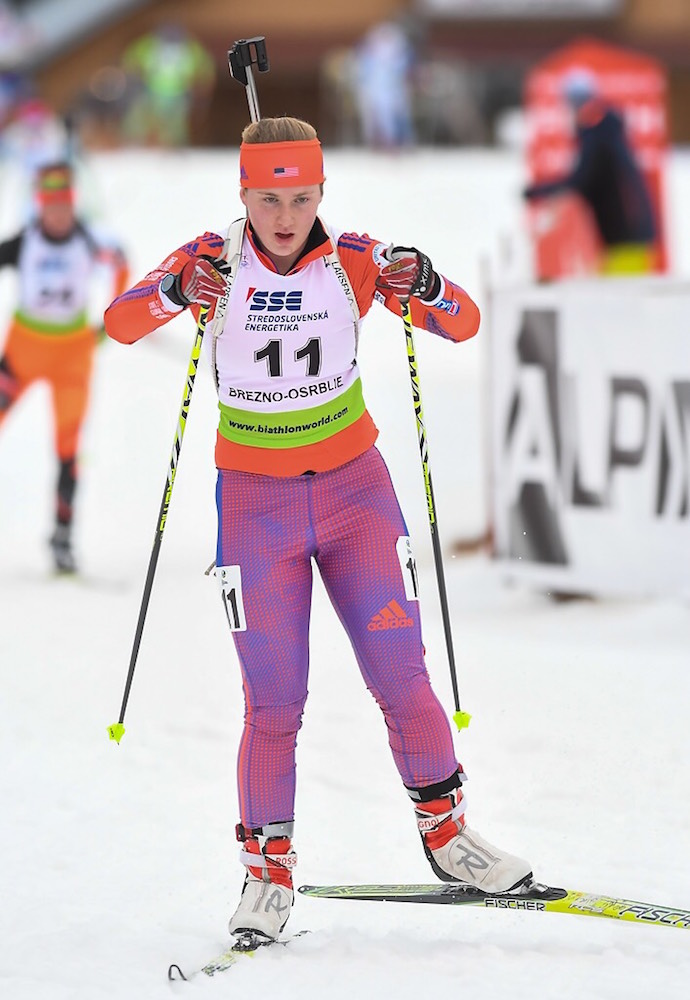
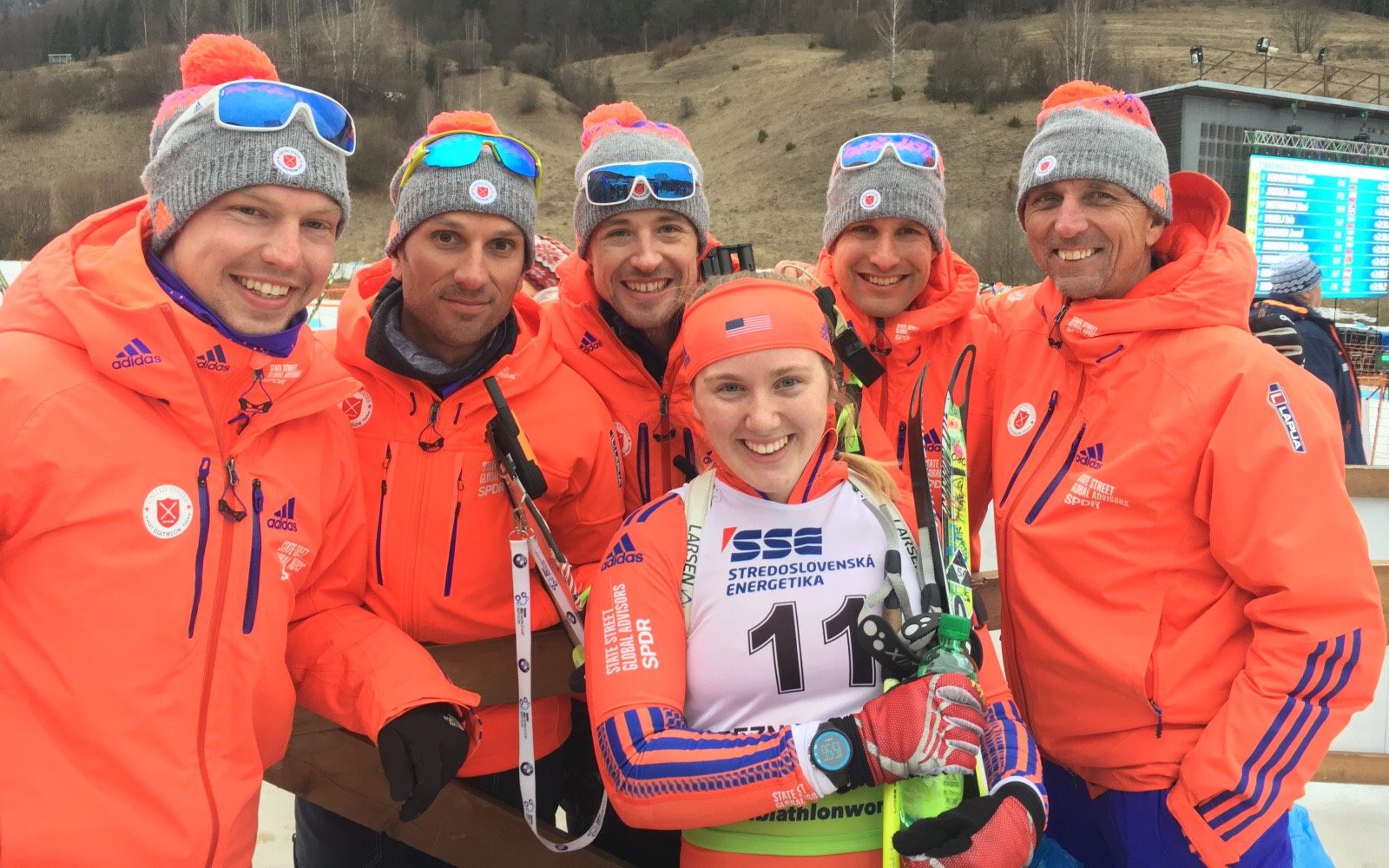
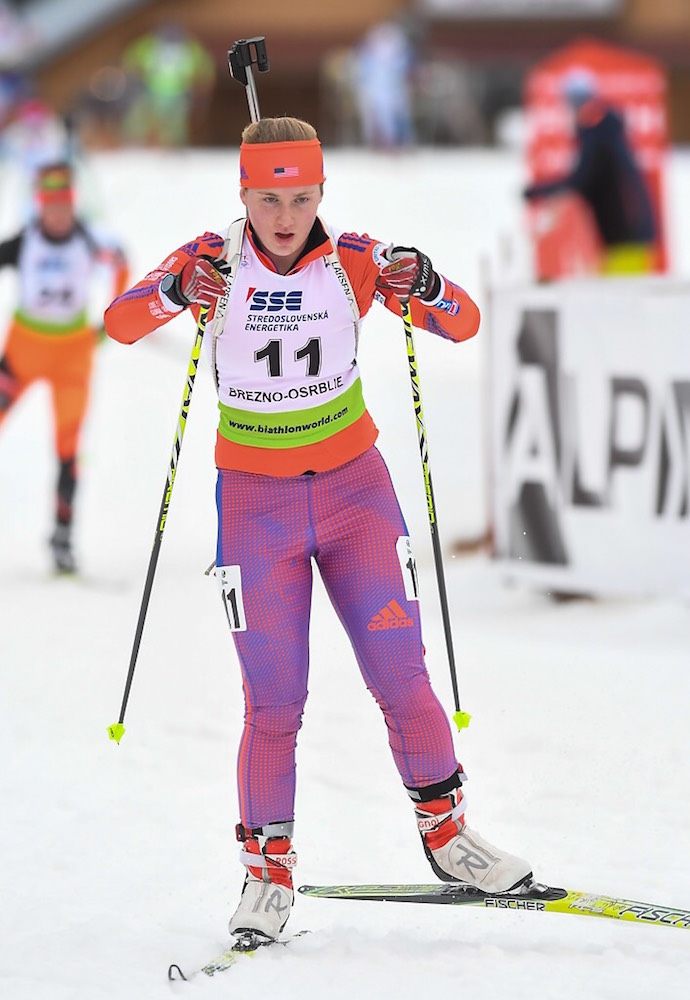
    Chloe Levins (11) with her US Biathlon support team (from left to right: Erik Lewish, Travis Voyer, Mathias Zacherl, Robert Gorgos, and Algis Shalna) after her fourth-place finish in the youth women’s 7.5 k pursuit, her career best in her third IBU Youth World Championships, on Sunday in Osrblie, Slovakia. (Photo: USBA)

    At just 18 years old, Chloe Levins has the wisdom of a seasoned veteran when it comes to biathlon. She accepts the inevitable ups and down of her sport, works hard to focus on herself and no one else, and treats every race as a learning experience.

    All of the above are often easier said than done. But Levins seems to have her head in the right place and the results are following. In three individual races over the past week at Youth World Championships in Osrblie, Slovakia, she’s finished in the top 15. On Sunday in the youth women’s 7.5-kilometer pursuit, she rocketed to fourth — tying her career-best result in an international race.

    “In my mind, I’m still a baby in this sport,” Levins wrote in an email on Sunday. “As we saw last week, Lowell [Bailey] prepared for two decades before winning a World Championship title. Today’s race was simply more preparation for the future. Every race is a learning experience, and every race that you’re in contention is an even better learning experience. So for now, I’ll keep learning.”

    A Middlebury freshman who plays collegiate golf in the spring and fall, Levins had previously finished fourth at last year’s Youth Olympic Games in Lillehammer, Norway. There, she started the pursuit in 22nd and rocketed to fourth, one spot off the podium. On Sunday, she started 11th, based on her sprint result on Friday, and shot 18-for-20 to finish fourth, 1:55.5 minutes out of first and 47 seconds out of third.

    Levins started the race by skiing around 11th for the first loop, then missed her first and last shots in the first shooting stage. That put her back in 17th heading out on her second loop, and she proceeded to clean the next three stages to work her way up to seventh before her final loop. There, she passed three more competitors to end up fourth.

    “After missing two, I got out of my own way and went back to basics,” Levins recalled. “My coach, Algis Shalna, always says, ‘Do what you normally do.’ The trick is believing that what you normally do will be good enough. Today, it was really close.”

    “There’s a fine line between being too cautious and perfectly aware in shooting,” she added. “That was the difference between my first shooting and the last three today.”

    American Chloe Levins racing to fourth in the youth women’s 7.5 k pursuit on Sunday in Osrblie, Slovakia, for her best result at her third IBU Youth World Championships. (Photo: USBA)

    She attributed her fast skiing (with the 11th-fastest course time) to “lightning” skis.

    “The wax guys have been making fantastic skis all week, and I can’t thank them enough,” she said of US Biathlon’s staff. “The team staff gave me some information on the last loop, but I didn’t hear them. I was in a different world, fighting for a medal in my mind’s eye. Honestly, I’m not quite sure when I passed the three girls who left the range in front of me. The track was really crowded with competitors that were on their fourth loop. If I were to guess, I passed one girl on the first hill out of the stadium and the other two on a flat .25k before the finish.”

    Ahead of her, Italy’s Irene Lardschneider secured her second-straight gold medal after winning Friday’s sprint and starting 1 minute and 7 seconds ahead of anyone else in the pursuit. She had four penalties, which came in the last two standing stages (0+0+2+2), but held onto first in 26:57.1. France’s Lou Jeanmonnot-Laurent finished 24.4 seconds later after skiing up from fourth at the start to second place, with a single miss (0+0+1+0). For the second-straight race, Italy’s Samuela Comola claimed bronze (+1:08.5) after starting third and shooting two penalties (1+0+1+0).

    Then there was Levins, who started 1:40 out of first and was one of six women to shoot 90 percent or better.

    “It kills me to come short of medal for the second year in a row, but it also makes me that much more hungry for next opportunity to compete,” Levins wrote. “Even though there’s no medal around my neck, shooting 90% and having the fastest ski time on the last loop are things to smile about.”

    Before the championships began, Levins told FasterSkier that the best advice anyone ever gave her about skiing or racing was to smile. And that’s been the running theme of her week.

    “I smile about the fact that I set three consecutive personal bests this week at Jr World Champs,” she wrote on Sunday. “It’s the ‘what ifs’ that give me motivation for the next. I’m leaving Slovakia with more drive than ever. There are many areas in shooting and skiing I can improve upon for next season. I’m really looking forward to getting down to work.”

    Levins led four North Americans in the youth women’s pursuit, with her U.S. teammates Amanda Kautzer and Grace Gilliland finishing 42nd and 53rd, respectively. Kautzer started 59th and picked off 17 places despite missing four targets (1+0+2+1) and finished 6:16.2 back. Gilliland started 55th and improved two places with six penalties (2+3+1+0), finishing 8:32.1 out of first in 53rd. Canada’s Shilo Rousseau followed in 54th (+9:02.1) with eight misses (3+1+2+2) after starting 45th.

    The youth women end the championships with the 3 x 6 k relay on Monday. Canada is entering Frédérique Pérusse, Rousseau, and Anna Sellers, while the U.S. team is Levins, Kautzer and Gilliland.

    Also on Monday, the youth men will race a 3 x 7.5 k relay. Thomas Hulsman, Adam Runnalls and Leo Grandbois are listed to start for Canada, and Vasek Cervenka, Jacob Pearson and Alex Kilby are listed for the U.S.

    Sprint Top 20 for Bankes, Ellingson; Bankes 16th in Pursuit

    In the junior women’s 10 k pursuit, Canada’s 19-year-old Megan Bankes capped off her gold-medal week with her third top 20. Bankes previously won the 12.5 k individual last Thursday, then finished 13th in Saturday’s 7.5 k sprint.

    Megan Bankes racing to 16th in Sunday’s junior women’s 10 k pursuit at IBU Junior World Championships in Osrblie, Slovakia. (Photo: Jacqueline Akerman)

    Going into Sunday’s pursuit, she made a goal to stay calm and focused and “overall just have a fun time racing the pursuit, and see how much I can move up!”

    She started 1:25 minutes behind the leader, Italy’s Michela Carrara, the winner of the sprint who left the pursuit starting gate with a 15-second head start. After cleaning the first prone stage, Bankes was up to ninth and 54 seconds out of first.

    Over the next three stages, Bankes missed four targets and had to ski four penalty laps as a result. The first miss on the second prone stage put her in 11th, then she slipped to 19th with two misses in the first standing. On the final standing stage, Bankes missed one more to leave the range in 20th. Before the finish, she picked off four skiers to take 16th place across the line. She finished 2:15.8 minutes behind Russia’s Valeriia Vasnetcova, who won the race with clean shooting. Vasnetcova was the only woman in the field to do so; in fact, she was the only racer — woman or man — that hit all 20 targets between four races on Sunday.

    Vasnetcova had started the pursuit in 24th, 1:52 out of first, and taken the lead by after cleaning the last stage. She posted the fastest course time as well and notched a 10-second victory, finishing in 31:49.5 minutes for her first medal of these championships (she also won gold in the relay last year with her Russian team at Youth Worlds in Romania).

    Carrara ended up second after missing three (1+1+1+0), and Norway’s Ingrid Tandrevold also picked up her second-straight medal, after starting second and finishing third (+10.8), with two penalties (0+0+1+1).

    While Bankes could not be reached for comment after Sunday’s race, she was pleased with her 13th place on Saturday.

    “My skiing felt pretty solid, and only 2 misses is pretty good for a sprint for me,” she wrote of her s8-for-10 shooting (1+1). “13th place is still pretty stellar…”

    Asked what it’s been like coming off a world-championship win, Bankes, who hails from Calgary and trains with the Biathlon Alberta Training Centre in Canmore, Alberta, explained she’s received a fair amount of media attention, “especially from back home, or at least way more than I’m used to!” she wrote on Saturday. “I’ve just been trying to focus on the next races, it’s still fairly surreal for me to be Junior World Champ for the individual, so I’m still fairly excited about that, but i’m trying not to get caught up in that and look forward to the next races as well.”

    American Siena Ellingson racing to 18th on Saturday in the junior women’s 7.5 k sprint in Osrblie, Slovakia, for her best result in her fourth IBU Youth/Junior World Championships. (Photo: Erik Lewish)

    The second North American in the top 20 of Saturday’s sprint, Siena Ellingson of the U.S. posted the first individual top 20 of her career in her fourth Youth/Junior Worlds. She finished 18th, 1:38.7 out of first, with a single standing penalty (0+1).

    In an email on Saturday, the 20-year-old Ellingson, of Minnetonka, Minn., explained that she had a tricky zero, which is the standard pre-race target practice.

    “The wind was switching back and forth so it was hard to get a good confirmation, I had to leave it where it was and start the race,” she wrote. “Having confidence in shooting is hard after a zero like that, but you just can’t worry about it.”

    She was pleased to find her first prone stage had wind similar to what she experienced zeroing, and she was able to hit all of her targets without making any adjustments.

    “Standing there was a bit of wind, but the miss was just a miss, not a problem with the wind,” Ellingson wrote. “I crossed the line in 6th, but I had only started bib 19, so there were quite a few fast girls still to finish. It’s always hard to guess where you’ll end up, but I was hoping to stay top 30.

    “I’m pretty happy with the race today, but there’s a lot I need to work on in the training season coming up,” she added.

    “An impressive result for Siena in a very competitive junior field,” US Biathlon assistant coach Erik Lewish wrote in an email. “Great skiing and shooting even with a crash during the race before her last shooting stage didn’t deter her. I was really proud that she could make her best result ever (and hopefully improve upon it tomorrow) here at her last junior worlds.”

    For the pursuit, she wanted to shoot well and enjoy the race. On Sunday, Ellingson started out with a miss in her first prone, then missed six more on the next three stages to end up 41st (+5:24.7), just outside the points, with seven penalties (1+2+1+3).

    Two other Canadians qualified for the pursuit, with Nadia Moser starting 31st and Emily Dickson 47th based on their sprint results. In the pursuit, Moser raced to her best result of the week in 30th (+3:43.5) with three penalties (0+1+0+2). Dickson repeated in 47th (+6:29.9) with four penalties (1+0+1+2).

    The junior women will race a 3 x 6 k relay on Tuesday, along with the junior men in the 4 x 7.5 k, to conclude the 2017 Youth/Junior World Championships. Start lists were not yet posted.

    Read about the youth men’s and junior men’s pursuits here.

    Pursuit results: Youth women | Youth men | Junior women | Junior men

    Relay start lists: Youth women | Youth men 

  • Wednesday Workout: On the Up with Mountain Running World Champ Kasie Enman (with Video)

    Wednesday Workout: On the Up with Mountain Running World Champ Kasie Enman (with Video)

    Kasie Enman getting up a hill back in 2013. (Photo: Kasie Enman/Droz Photo)
    Kasie Enman getting up a hill back in 2013. (Photo: Kasie Enman/Droz Photo)

    This week, FasterSkier caught up with elite mountain runner Kasie Enman. A 2011 World Mountain Running champion, 11th-place finisher at the 2008 Olympic marathon trials, competitive snowshoe racer, collegiate All-American, and more, Enman divulged her secret to prepping for mountain races and the latest projects she’s been tackling when it comes to mountain running.

    ***

    Mountain running, marathons, maple-syrup manufacturing, mother of twoVermont-based 2011 U.S. World Mountain Running champion Kasie Enman has plenty on her plate. Pile on coaching two club running teams and her and her husband Eli’s living-off-the-land lifestyle, it would appear all her time is already taken. But Kasie, a Middlebury College alum, made room for one more project this year: the push to make mountain-running race team sizes and distances equal between men and women.

    The women's 2015 World Mountain Running team senior sivler medalists at this year's 2015 World Mountain Running Championships, shown (left to right) Alli Grace Morgan, Kimber Mattox, Morgan Arritola, and Kasie Enman. (Photo: Courtesy/Nancy Hobbs)
    The U.S. women’s senior team after claiming silver at the 2015 World Mountain Running Championships: (from left to right) Alli Grace Morgan, Kimber Mattox, Morgan Arritola, and Kasie Enman. (Photo: Nancy Hobbs)

    Not normally the one to “be the squeaky wheel,” Enman, 37-years-old, felt this was a scenario where it was acceptable for her to do so. Currently, the World Mountain Running Association (WMRA) permits each international team to carry six men and four women. In the WMRA, similar to the National Collegiate Athletic Association (NCAA) and International Ski Federation (FIS) competitions, men and women also compete on different length courses. Enman hopes to not only achieve equal course length, but equal team size at all levels of the sport, nationally and beyond.

    “The most exciting thing that’s happening in the near future is at the U.S. [Mountain Running] Championships this year, we will be running equal distances,” she said in a recent phone interview. “So that’s something to be proud of.

    “The next big push will be heading into the World Championships in September [because] that’s when the votes will happen,” she added, referring to a proposal that was submitted to make team size and course distances the same for both genders.

    In order to be present for the September vote, however, Enman still needs to make the U.S. Mountain Running Team. The qualifier will take place this year on July 3 at Loon Mountain in Lincoln, N.H.

    The Work[out] to Make the Team

    Though Enman is an extremely experienced and adept runner (she finished 11th at the Olympic Marathon trials in 2008, won the 2011 U.S. Mountain Running Championships, and that same year, went on to become the first American woman to take the title for World Mountain Running Championships), she wasn’t always darting over peaks. Her transition into mountain running was shaped by her surroundings and situation.

    Kasie Enman post 2014 Zegama Marathon (Photo: Courtesy/Jordi Saragossa)
    Kasie Enman post-2014 Zegama Marathon (Photo: Jordi Saragossa)

    “I ran cross country [in college], but that was the most trailish kind of thing that I had any experience with,” she explained. “I think [my interest in mountain running] really morphed from the location where I live.”

    After graduating from Middlebury and spending a year in Burlington, Enman moved to Sleepy Hollow in Huntington, Vt. with her husband. With only a mile separating her from the mountain biking, running, and nordic ski trails of Sleepy Hollow Inn — a family owned and operated outdoor center — it didn’t take Enman long to fall into technical trail running.

    “I’m not going to be driving somewhere to train. I train where I live and where I live happens to be really hilly, fairly mountainous and technical footing,” she said. “Gradually over time, [mountain running] just became something I could do well because I did so many hours of it. I tried out my first actual mountain race on a year when I had a plantar facsciitis injury and it was too painful to run on anything flat or even on downhill, but I found I could run pain free uphill.”

    Cranking out the uphill kilometers without any pain in her heel, Enman unearthed her calling. She quickly became addicted to mountain racing and competed in the Loon Mountain Race, Ascutney Mountain Run and Mount Washington Road Race. Learning that there was an opportunity to make a U.S. National team only pushed Enman further.

    Kasie Enman getting above tree line at the 2015 Dolomites Sky Race. (Photo Kasie Enman/Ski & Run)
    Kasie Enman getting above tree line at the 2015 Dolomites Sky Race. (Photo Kasie Enman/Ski & Run)

    “It took me a number of years to actually make the team,” she said. “I kept just missing it, and then 2011 I finally made the worlds team and that opened up a lot of doors. … It was sort of a whirlwind of a few years of discovering things and having some surprising success.”

    This year, Enman’s training regime takes on a slightly different look, as she is coming off of an eight-month period of injuries and illness–a fall hamstring strain that led to back and hip pain and a a virus that led to Enman to feel chronically fatigued. With this year also being an uphill-year only (mountain-running race seasons alternate between uphill-race-only years and years with courses that involve downhills), her current focus is running economy and efficiency.

    “This is an uphill-only year and that’s not my strength,” she said. “I’m always trying to get better with that and that’s kind of why I choose to push the uphills because I’m experimenting with … what feels like using the least amount of energy necessary to get up this hill the fastest and most efficiently.”

    With the Mt. Washington and Loon Mountain races ahead and a her injury behind, Kasie’s “transitional workout” is quite simple: get to an uphill and giddy up.

    “I start on an uphill, our driveway, which is a half mile uphill to the trails,” she said. “ Then I continue up to the nordic trails and the single track … and then, basically anytime there’s a choice to go up, I take it.”

    The Workout: Hill (Rather, Mountain) Repeats

    Purpose: Work on uphill running efficiency and economy

    Pace: Enman suggests Level 3/4 during uphills

    – Find an uphill and start climbing!

    Her uphill segments to be around 11-12 minutes of steady climbing … times 10.

    “Some of the uphills are as long as like 11-12 minute continuous climbs to the top,” Enman said. “Of course then I’m like, I only have to do that 10 more times consecutively before I’m done.”

    – The steeper, the better.

    Enman isn’t afraid to tackle pitches that are similar to those she’ll be racing on, no matter the amount of related calf and quad pain.

    “There’s this part of Loon called Upper Walking Boss that gets to like a 45-degree grade slope that you’re running up — it’s like a black-diamond ski trail,” she said. “And there are some trails that steep around here, too.”

    – Look for technical terrain that will challenge your footing and coordination.

    Total time: 90 minutes

    For an adaptation to the above hill workout, check out a video Kasie posted of her hill preparation for the 2015 Hartford Marathon race. (Video: Courtesy of Kasie Enman)

    https://www.youtube.com/watch?v=nrSzVpZnwZM

    Enmans’s Top-Two Mountain Running Musts:

      1. Ditch the watch and — heaven forbid — the heart rate monitor. Every once in a while, don’t be afraid to ditch the GPS, watch and heart rate monitor that might be hindering you from hearing what your body has to say. “I rarely run with a watch, I also don’t run with a GPS garment,” Enman said. “Then I can pay attention to how I’m feeling. I’ve shown up at enough races and have done well enough, that now I have confidence that I can sense my effort and that I am doing what’s the best for me on [competition] day.”
      2. Drop everything and run. Being flexible is certainly important for those on a strict schedule. As a mom, Enman takes any opportunity she can to get out the door, thanks greatly to communication with her husband and extended family. “I’ve just gotten to where I’m ready to go at any moment,” she said. “it doesn’t matter if I’ve just eaten a big lunch, I’ll step right out the door and go right then if that’s when the window opens.”
  • Changing Times and NCAA’s: (Part II) Women, Men and the Distance Debate

    Linn Eriksen of Denver University captures the women's 15 k classic mass start title race at the 2016 NCAA Skiing Championships in Steamboat Springs, Colo. (Photo: Jamie Schwaberow/NCAA Photos)
    Linn Eriksen of the University of Denver celebrates her win in the women’s 15 k classic mass start at the 2016 NCAA Skiing Championships in Steamboat Springs, Colo. (Photo: Jamie Schwaberow/NCAA Photos)

    In March, FasterSkier recently published an article (Part I) on college ski racing in the U.S. and what a change to National Collegiate Athletic Association (NCAA) Championships might require in regards to adding a sprint race. In the second part of the series, we explore why men’s and women’s race distances are different at the collegiate and World Cup level and whether this constitutes a need for change.

    ***

    Men | Women. Women | Men. Scanning the athletics webpage for an American institution of higher education that boasts a varsity sports team becomes a sail down the Casiquiare canal, with gender bifurcation an obligatory outcome. 

    Resting under the canopy of NCAA sports, however, nordic skiing presents itself as somewhat of an anomaly. Shared race days. Shared coaches. Shared course site. Shared team. At the surface level, gender in collegiate nordic skiing is almost arbitrary.

    Olivia Amber (r) of Colby College and teammate Amy Bianco celebrate their top twenty finishes in the women's 15 k classic mass start at the 2016 NCAA Skiing Championships in Steamboat Springs, Colo. (Photo: Colby.edu)
    Olivia Amber (r) of Colby College and teammate Amy Bianco celebrate their top-20 finishes in the women’s 15 k classic mass start at the 2016 NCAA Skiing Championships in Steamboat Springs, Colo. (Photo: Colby.edu)

    Yet, closer inspection reveals one particular area in collegiate cross country skiing where the genders differ: Race distance. In most individual nordic events at the college level, the course length of women’s and men’s races are not the same. The trend is a 5-kilometer deficit for women’s race events in comparison to men’s events.

    For Molly Peters, the head nordic coach at Saint Michael’s College and former NCAA All-American in nordic skiing for Middlebury College, this is a problem.

    “We’re sending a message to all the young women who have a goal to ski in college,” Peters said in a phone interview. “I just can’t imagine that they feel like their equal as people or athletes when they look and they see, ‘Oh, look every single race I’m going to be skiing 5-kilometers less.’ How are men every going to look at women equally and how are women ever going to look at themselves as being equal if you’re always skiing 5-kilometers less?”

    With that in mind, Peters promised herself to reshape the sport.

    “It had to be my mission in life to get it changed,” Peters said. “I feel like my best bet to get it changed is to change the NCAA Championships because everyone bases all their racing off of what the NCAA does. Every EISA [Eastern Intercollegiate Ski Association] Carnival is basically not equal because they follow whatever the NCAA does. It all trickles down.”

    The Trickle Effect: One Theory on Why Race Distances Differ

    A single change can create countless more. When Title IX was passed in 1972, a change was instituted in the treatment of both genders by federally funded college institutions. Within the realm of campus athletics, the alteration brought about numerous others, including an increase in the number of women participating in college sports, the scope of sports available to women and men (in certain instances, harmfully so), and perceptions of women who choose to ‘play.’

    Recent Middlebury College returnee, Annie Pokorny, points out that this sort of ‘trickle down’ change should not be looked at lightly.

    “When women entered sport, some rules were tweaked to account for physiological differences, but also to support the idea that athletics could be harmful to women, (particularly their reproductive systems,” Pokorny wrote in an email.

    Pokorny is completing her undergraduate senior thesis on feminist philosophy and the philosophy of sport. While she admits she is not an expert, her studies and experience in nordic skiing quantify her knowledge on the subject.

    Pokorny explained that myths surrounding the female body and exercise in the 20th century, caused men “to adjust sport to make it safer and more “womanly”), which turned into a conceptual connection between women and the need to protect them.”

    “That conception turned into tradition, one that still thrives today in the form of shortened distances for female endurance athletes,” Pokorny added.

    The women's top ten for the women's 5 k freestyle race at the 2016 NCAA Skiing Championships in Steamboat Springs, Colo. (Matt Johnson/MSU Courtesy Photo)
    The top 10 in the women’s 5 k freestyle race at the 2016 NCAA Skiing Championships in Steamboat Springs, Colo. (Photo: Matt Johnson/MSU)

    For Pokorny and Peters, these types of traditions were made to be broken.

    “The best things that have ever happened are from people changing tradition,” Peters said. “My purpose is to get the NCAA Championships changed to be the same distance for men and women because that will trickle down to the smaller races.”

    But implementing change in the NCAA Championship event and NCAA skiing is no easy task.

    “NCAA skiing is comprised of a wide variety of institutions: Division I, II and III; private and public; and large and small,” Dave Stewart, head nordic coach at the University of Denver, wrote in an email. “Any choices about race format, distances, etc. must take into consideration the perspectives of this diverse group and, ideally, the decisions should be made with the goal of broadening participation at the NCAA level and increasing competition.”

    If Stewart is right, the question becomes: Would making race distances equal between men and women broaden participation and increase competition?

    A Second Theory & the Distance Debate: Should Men Race Shorter or Women Race Farther?

    When it comes to long distance endurance events, some research argues women fare better than men.

    “Women can race just as long as men,” Montana State University (MSU) incoming senior Anika Miller said on the phone. “If [the NCAA] wanted us to do a 50 k in college, sure we could do it, but it wouldn’t make any sense athletically.”

    Montana State University's Anika Miller (l) with nordic head coach, Matt Johnson after Miller took the title in the women's 5 k freestyle race at the 2016 NCAA Skiing Championships in Steamboat Springs, Colo. (Courtesy Photo)
    Montana State University’s Anika Miller (l) with head coach Matt Johnson after Miller took won the women’s 5 k freestyle at the 2016 NCAA Skiing Championships in Steamboat Springs, Colo. (Courtesy photo)

    Miller — a native of McCall, Idaho, and this year’s NCAA champion in the 5 k  freestyle — doesn’t doubt the ability of women to race the same distance as men.

    What she questions is whether it’s necessary for women to do so.

    “It’s kind of a hard conversation to have as a female athlete because you don’t want to say that women are inferior,” Miller said. “My opinion on it is that the race distances are good as they are as far as women doing a shorter distance than the men. Because time wise … for the 15 k versus the 20 k at least, sometimes the guys only race it five minutes different than the women, which isn’t really that large of a margin, [meaning] effort wise, it’s more equal.”

    The point Miller makes is that women and men are currently racing equal. Equal amounts of time on course, at least in the 15 k and 20 k events (*see men’s and women’s course times).

    Oscar Friedman, coming off his senior season at Dartmouth where he was a captain of the men’s nordic team, also argued that close to equal amounts of time on course is more important than equal course distances between men and women.

    “The point of having those different race distances was to make the men’s and women’s races equally competitive,” Friedman said on the phone. “That being said, if women are internalizing it, then that’s a bigger issue. If there’s a push from within the sport, women should be the ones deciding the race distances.”

    The push from women within the sport varies, but much revolves around whether women race longer or men race shorter distances. Kelsey Phinney, coming of her senior season and also a captain at Middlebury, admitted that originally the idea of equal distances didn’t appeal to her because she assumed women would be required to race farther.

    **Check out more Championship archives and race results
    **For more Championship archives and race results, click here

    “I think the misconception has been that equal distances meant that women had to race longer,” Phinney on the phone. “But it doesn’t mean that women have to go 10 k and 20 k it could mean that men go 5 k and 15 k. Or that the races range from sprints to 30 k.”

    Rachel Hampton, an incoming senior at Harvard University, advocated that while women are capable of racing men’s distances, men would benefit from racing shorter lengths.

    “There’s a feminist side of me that wants to say that girls can do anything boys can do and there’s no theological reason why we shouldn’t be able to race the same distance as them,” Hampton said on the phone.

    “I will say I sometimes feel bad for the guys because it seems like they only race long races. I think if we added sprinting and a few 5 k races for the guys and did a wider range of distances, that would be better for them. And I think if the men were on that plan, the women could then get on the same distance plan.”

    However, when men competing in college were asked if they would be willing to race the same length as women, responses were often shaped by race distances at other levels of nordic competition.

    “Shortening the men’s distances would be a huge disservice because as I see it, the goal of NCAA skiing is to make American skiers as competitive as possible on the World Cup,” Friedman said. “I would be completely against shortening the men’s races. But if women want to make the call and race longer, they should fully be able to do that.”

    For a few women, however, simply adjusting the women’s race lengths to match those of the men sends a certain message: Women have to be like men to be equal.

    “I think the message it sends depends a lot on whether you shorten the distance of men or you increase the distance that women have to race,” Bates College ’16 grad and skier Britta Clark said on the phone. “Trying to increase the distance that we race in the name of equality, but at the same time really just saying that equality is women doing what men do, I don’t think it’s necessarily speaking to the issue.”

    Clark’s point is supported by Dartmouth College Women’s Head Nordic coach and Director of Skiing Cami Thompson-Graves, also a member of the NCAA Men’s and Women’s Skiing Rules Committee, chair of the USSA Cross Country Committee, and most recently, a member of the International Ski Federation (FIS) Ladies’ Cross Country Committee.

    “I don’t feel the need for women to do men’s distances,” Thompson-Graves said on the phone. “Why don’t we just do women’s distances? Why can’t we just be different … I’m a big believer in being proud to be a woman, and not a little man.”

    Harvard's Rachel Hampton leads Dartmouth skier during the 2016 Colby Carnival. Hampton went on to compete at the NCAA Skiing Championships in Steamboat Springs, Colo. (Photo: flyingpointroad/Harvard Facebook)
    Harvard’s Rachel Hampton leads a Dartmouth skier during the 2016 Colby Carnival. Hampton went on to compete at the NCAA Skiing Championships in Steamboat Springs, Colo. (Photo: FlyingPointRoad.com/Harvard Facebook)

    Increasing women’s distances strikes some as a forfeiture of female identity for one that is male. Which is one reason Peters more strongly advocates for decreasing men’s distances to be the same length as women’s.

    “In skiing, I think the men should come down,” Peters said. “The 20 k is really irrelevant, even at the international level. I see nothing wrong with the 5 k, I think men should do 5 k. Five k is super exciting and can be a great race. I think it should be 5 k, 10 k, 15 k, and then add in the relays and sprints.”

    However, a men’s 5 k race doesn’t appear on numerous nordic race calendars — national or international — either. 

    “I don’t think at the national or international level men race 5 k so maybe that’s a distance skill set that would only be applicable to college skiing in the U.S.,” Raleigh Goessling, coming of his senior season at the University of New Hampshire, said on the phone. “If the race distances were changed, I feel like the distances that are contested at other levels of the sport and other formats should also play into it.”

    The Window Between U.S. College Racing and the World Cup

    At the international level, women and men rarely race the same distance. FIS course lengths — like the NCAA — are designed around the gender of the athletes competing.

    FIS Cross-Country Committee Chair and Norwegian Olympian Vegard Ulvang indicated that similar to college racing in the U.S., FIS race distances have been different for decades. One potential reason for these differences aligns with Porkorny’s findings. According to Ulvang, how female athletes were viewed in endurance sports when they started ski racing influenced the original length of women’s race courses. 

    “The history behind the differences comes from the time where the nations believed that women were weaker — [with the] first female race in 1952,” Ulvang wrote in an email to FasterSkier. “Today we of course know better. Female athletes are better prepared for longer distances than men, so principally the distances should be equal.”

    Principality does not always equal response. Ulvang indicated that even if the race distances should principally be equal, one major driving force for the committee to keep women’s race distances shorter than men’s rests on the race experience for spectators.

    “The argument has been that the time gap between the 20 best women is bigger than that of the men,” Ulvang wrote. “Longer distances would create a ‘worse TV product’ — with one racer skiing alone [during the race].”

    T.V. time does not strike Peters as an excuse for NCAA Championships and U.S. college cross-country ski schedules to follow the same format as the World Cup. 

    The men's 20 k classic race at the 2016 NCAA Skiing Championships in Steamboat Springs, Colo. (Photo: Jamie Schwaberow/NCAA)
    The men’s 20 k classic mass start at the 2016 NCAA Skiing Championships in Steamboat Springs, Colo. (Photo: Jamie Schwaberow/NCAA)

    “A lot of people will say well, look at what they do at the Olympics, and look at what they do at the World Cup — it’s vastly different,” Peters said. “The women do so much less. But that doesn’t make it right. That’s a reason why NCAA follows it and EISA follows it, but that doesn’t make it right.”

    Stewart, who has helped the Denver Pioneers achieve five NCAA Championship titles, supports the idea that NCAA skiing in the U.S. could act as a catalyst for change.

    “As long as FIS schedules longer races for men than for women in international championships, there will be some resistance to equal distances at other levels, but I see no reason why the NCAA should not be a trendsetter and work to turn the tide on this,” Stewart wrote in an email.

    He supports equal distances in cross-country skiing, seeing it as a statement that should be sport-wide, not just within NCAA nordic skiing.

    Equal distances for men and women should be implemented in our sport, both at the NCAA and international levels,” Stewart wrote. “We have had equal distances in the sports of swimming and track and field at the international and collegiate levels for many years. Equal distances would reinforce gender equity and would send the right message about our sport.”

    Yet, when it comes to World Cup race lengths versus those contested at the NCAA, some argue the Championship event is already sending a message to other levels of cross country competition.

    “I actually think that NCAA’s, where the women race 15 k and the men race 20 k, is much more equal than on the World Cup when the women race 15 k and the men race 30 k,” Rosie Brennan, Dartmouth grad and current U.S. Ski Team (USST) member, said on the phone.

    Brennan is not opposed to a more balanced race length distribution between men and women. Her concern with changing race distances at the World Cup and NCAA collegiate level is ensuring that the racers’ performance and perspective are taken into account. 

    “I think it would be nice if they tried to make the [race distances] a little closer,” Brennan said. “I also think the reason the distances were different in the first place was the idea that the time the race takes should be fairly equivalent, so the effort is the same. If the time differences [between men and women] are getting to be much greater, to the point that the races are no longer requiring the same amount of effort, then I think it’s worth proposing some sort of a change and [is] something to re-visit over time.”

    Brennan’s suggestion to visit the race experience for athletes doesn’t go unsupported. Men’s and women’s race distance differences have been discussed at the collegiate and World Cup level. But the actual number of times the topic has been statistically ‘re-visited’ remains a bit blurry.

    Regarding conversations within the college circuit, Peters indicates that implementing changes to men’s and women’s race distances has been thrown around for some time.

    “Patty Ross, who coaches at Middlebury, she’s been fighting it for 25 to 30 years and she’s had no success,” Peters said.

    Ross could not be reached for comment.

    Within the FIS Cross Country Committee, Ulvang indicated that the turn of the millennium was when most conversations regarding the different course lengths at the World Cup level of racing began.

    “[The] question has been discussed in the FIS committee a few times the last 15 years,” Ulvang wrote.

    Beyond that, four-time Olympian, USST member, Fast and Female USA President, FIS athlete rep, and now a new mother Kikkan Randall revealed that World Cup athletes have also had at least one opportunity to make their opinion about equal distances known.

    Kikkan Randall leading Fast and Female in Bend, Or. as part of the Annual Bend training camp in May. (Photo: Matt Whitcomb)
    Fast and Female USA President Kikkan Randall leading a Fast and Female session two years ago in Bend, Ore. (Photo: Matt Whitcomb)

    “It’s an interesting topic that actually comes up quite often on the World Cup,” Randall said. “As the athlete rep to FIS, I do a survey at the end of each season and couple years ago, as part of the survey, I sent out that question [of equal distances].”

    The responses Randall received found most women on the World Cup circuit — at least a few years ago — did not want to race the same distances as men.

    “The majority of women actually said that they were not interested in racing the same distances as the men,” she said. “I’m considering putting that same question on the survey again this year because the comment was brought up a couple times this spring.”

    And how might women racing on the World Cup respond to shortening men’s distances to make the lengths equal? The question has not been posed, but Randall may incorporate it into her next athlete poll.

    “That would be another interesting take on the same question,” Randall said. “This year on the World Cup I feel like the distances were reduced a little bit with so many tour [multi-stage] events, so again it’d be an interesting time to poll the athletes and see how they feel.”

    Conclusion: Connecting Part I and Part II

    As long as there is snow around, colleges with nordic programs in the U.S. will continue to attract a cohort of cross-country skiers looking to compete, while simultaneously continuing their education. For many, choosing college over a club team is not the end of a cross-country skier’s long term career. It is also the potential beginning.

    “The way our country is, you’re always going to have athletes choosing to go to college after high school no matter what path they’re on,” Brennan said. “So I think the more that that can be facilitated, the better it is. I mean there are a lot of good club programs that offer alternatives for people who choose that, but I think the NCAA can provide a route as well.”

    Some individuals also see the NCAA as an opportunity for Americans to attend college in the U.S. and potentially compete against athletes from other countries.

    “As a venue for athletes to develop into international level skiers, [the NCAA circuit] is a great place because there are really high-level skiers from all over the world in the small microcosm of NCAA skiing,” Chad Salmela, outgoing nordic coach of the College of St. Scholastica, said on the phone. 

    With an assured influx of athletes choosing skiing and school — and the opportunity for some to race international athletes at ‘home’ — many don’t deny the difficulty of disconnecting U.S. collegiate racing and higher levels of nordic competition.

    “From a purely objective standpoint, I would say that a junior athlete who chooses to skip college (at least until they are completely done with their racing career, whenever that may be) and pursue ski racing full-time starting at age 18, is much better set up to ski faster on the World Cup level later in their career,” current USST member and former Middlebury skier Simi Hamilton wrote in an email. 

    “However, because of the small numbers of junior skiers we have in our country (relative to all the other skiing powerhouse nations), college is a great way to keep kids engaged and in touch with racing during a period of their lives when they may have decided they want to do something completely different,” he added.

    Yet, if NCAA racing is to preserve itself as one potential path for athletes looking to make professional steps in the sport, college and World Cup racers alike agree that conversations about change — be those for adding sprinting or making race distances equal between men and women — need to continue. 

    “I think incorporating sprints at the NCAA is definitely worth talking about and pushing forward because that’s at least one-third of the races we do [on the World Cup], if not more,” Brennan said. “I think trying to stay current is a valuable thing.”

    Ida Sargent, a Dartmouth grad and current USST member, agreed that sprinting deserves spotlight attention in present-day skiing.

    “I can obviously only speak for the women’s distances but I liked how there was a short and a longer distance race,” Sargent wrote in an email regarding NCAA race distances. “I think a more important change would be adding in more sprint races. We race a sprint almost every weekend on the World Cup and when I was in college we would have one a year at the most.”

    With one more year of college racing left at MSU, Miller also pushed adding more sprint races to the college race circuit to foster cross country skiers’ development.

    “I think it’s unfortunate that we don’t have sprinting,” she said. “Because that’s such a great development tool.”

    Though Miller and Sargent are at odds with Pokorny’s press for equal distances, all three do seem to agree that changing customs can create better opportunities and a better outlook for cross-country skiers.

  • Changing Times and NCAA’s: (Part I) Could Sprinting Become a College Thing?

    Changing Times and NCAA’s: (Part I) Could Sprinting Become a College Thing?

    Mads Strøm of the University of Colorado racing to a first place finish in the men’s 10 K freestyle race at the 2016 NCAA Skiing Championships in Steamboat Springs, Colo. (Photo: CUBuffs/Buffzone.com)
    Mads Strøm of the University of Colorado racing to first place in the men’’s 10 k freestyle at 2016 NCAA Skiing Championships last week in Steamboat Springs, Colo. (Photo: CUBuffs/Buffzone.com)

    Note: This article has been updated to include comments from Ethan Townsend as of Thursday, March 17. 

    With the conclusion of the collegiate season taking place at the 2016 NCAA Skiing Championships in Steamboat Springs, Colo., last week, FasterSkier provides a look at the some of the latest involving school, sport and the Championship races. Part I examines the tradition behind the NCAA Skiing Championships format, and what it would take to change it.

    A Brief History of NCAA Skiing Championships

    5 k/10 k. 15 k/20 k. Scrolling through the archives of the National Collegiate Athletic Association (NCAA) championship events for nordic skiing is akin to strolling through a 1950s U.S. ‘Levittown’ neighborhood: Variation zero to none. Another online record for the past 16 years of NCAA Skiing Championships provides a similar finding. Nordic races at this event are traditionally two races for each gender: women race 5 kilometers and 15 k, while the men race 10 k and 20 k. Though the discipline alters between freestyle and classic, the distances for each respective gender remain the same.

    A phone conversation earlier this season with Cami Thompson-Graves, Dartmouth College women’s head nordic coach and director of skiing, NCAA Men’s and Women’s Skiing Rules Committee member, Chair of the USSA Cross Country Committee, and most recently, a member of the International Ski Federation (FIS) Ladies’ Cross Country Committee, revealed a similar story.

    Dartmouth head coach, Cami Thompson-Graves (r) at 2016 U.S. nationals in Houghton, Michigan.
    Dartmouth women’s coach Cami Thompson-Graves (r) at 2016 U.S. nationals in Houghton, Mich.

    “So as long as I can remember, [the championships] have been two races,” Thompson-Graves explained. “Way back when … it was an individual race and a relay. But then when skating came along, we went with one classic race and one skate race. Pretty much for the last 25 years, we’ve alternated every two years and done a long mass start of one and a shorter of the other.”

    So what if the championship races have stayed the same for the past 25 plus years? Why should anyone in or out of the college-race scene care?

    “I skied in the East and tradition is a big deal in the East,” Chad Salmela, head nordic coach of The College of St. Scholastica in Duluth, Minn., said on the phone. “People like tradition, but at the same time, tradition can limit your outlook as to what the future could possibly hold.”

    Coaches, Committee Members and Athletes on Change

    According to Salmela, the championship event controls quite a bit of what events college racers will compete in during the regular season. 

    “Let’s face it, the championships really drive what happens in the regular season because everybody is trying to qualify,” Salmela said.

    That’s certainly the case for the 2016 Rocky Mountain Intercollegiate Ski Association (RMISA) nordic race schedule, with all but one weekend following the 5 k/10 k and 15 k/20 k format.

    “It varies from region to region,” Thompson-Graves said of the 5 k/ 10k and 15 k/20 k race distances in the Eastern Intercollegiate Ski Association (EISA) schedule. “If those are the [championship] events, we’ll try to do those races one weekend back to back early in the season and our regional championship is usually similar to the NCAA Championship.”

    This year, the EISA schedule included a men’s and women’s 1.5 k classic sprint, as well as a men’s and women’s sprint relay event.

    Kelsey Phinney, a senior at Middlebury College from Boulder, Colo.
    Kelsey Phinney, a Middlebury College senior from Boulder, Colo. competing at 2013 NCAA Skiing Championships at the Rikert Nordic Center near Middlebury, Vt.

    Still, a few individuals question if this is enough and whether the current NCAA Championships nordic skiing schedule necessitates change. 

    “I love sprinting and I would love to see it in the championship events for college races,” Kelsey Phinney, a senior at Middlebury College, said on the phone.

    “I think sprinting is a really good development tool in terms of gaining speed and applying tactics during your races. It’s such an exciting part of our sport right now and it has such a presence on the World Cup that in terms of development, it makes a lot of sense to include it,” Phinney added.

    Raleigh Goessling, a senior at the University of New Hampshire (UNH), agrees.

    “I think that sprinting is already a really big part of nordic skiing at every other level, except the college level,” Goessling said on the phone. “I think that college programs should get on board with that.”

    Goessling’s point was bolstered further by Salmela.

    “I’m very much in favor personally of adding sprinting to the championship,” Salmela said. “I think it modernizes the sport and it’s inevitable. The question is when and how.”

    Attempting to Answer ‘How’ 

    In an effort to resolve the question of ‘how,’ Salmela — whose four year term on the NCAA Men’s and Women’s Skiing Rules Committee expired this past September — and committee members created a proposal for the 2016/2017 race season.

    The proposal, submitted last spring to the NCAA for review, included a menu offering championship race organizers the opportunity to select the race lengths and format, based on the courses and course crews available to the championship event host-site.

    “What we proposed to the NCAA put the onus on the organizer of the championships to decide on a menu of FIS distances and disciplines,” Salmela said. “The idea was to leave it up to the committee to steer it in a way that sprinting becomes a part of NCAA skiing, but is not necessarily a mandated thing every year.”

    Thus, any International Ski Federation (FIS) event, from a sprint to a 30 k, had the potential to show up at a championship race series.

    However, the proposal was returned this past fall to the NCAA Men’s and Women’s Skiing Rules Committee for further review.

    Ethan Townsend (l) current chair for the NCAA Men’s and Women’s Skiing Rules Committee and Saint Lawrence University nordic head coach, congratulates Mads Strøm  of the University of Colorado after he won the men's 10 k freestyle race at the 2016 NCAA Championship races in Steamboat Springs, Colorado. (Photo: CUBuffs/Buffzone.com)
    Ethan Townsend (l), chair of the NCAA Men’s and Women’s Skiing Rules Committee and St. Lawrence University head nordic coach, congratulates the 2016 NCAA 10 k freestyle champion, Mads Strøm of the University of Colorado. (Photo: Joel Riechenburger/Daily Camera via CUBuffs/Buffzone.com)

    “It’s not been denied,” Ethan Townsend, chair of the NCAA Men’s and Women’s Skiing Rules Committee and St. Lawrence University head nordic coach, explained on the phone prior to the championship. “It’s just kind of a big change and the NCAA wanted us to vet it out a bit more.”

    The most recent discussion regarding the proposal took place last week in Steamboat Springs, Colo. at the 2016 NCAA Championships.

    “I think we are looking to re-propose what the skiing committee approved this past summer with some changes,” Townsend wrote in an email post-2016 NCAA’s. “I’m not really confident we will get that change through but we are going to try.”

    With the next NCAA Men’s and Women’s Rules Committee meeting taking place in early June, Townsend predicts changes to the NCAA Championship event won’t be implemented for another season or two.

    “Any changes will take at least until 17/18 I think,” Townsend wrote, “it’s too late to have this in place for next season.”

    While select coaches from the east, west, and central locations convened last week to go over a number of NCAA issues–including the proposition of holding NCAA Championships in Alaska, a topic Townsend described in an email as “more concerning in the immediate term for a variety of reasons”–athletes remained topics of conversation, but not contributors to the dialogue.

    At some levels, the lack of voice is not a deliberate choice. Currently, there is no athlete representation on the NCAA Men’s and Women’s Rules Committee.

    “That’s not our call,” Salmela said. “The committee makeup is entirely driven by the NCAA … I think it would be awesome to have an athlete or a couple athletes on each sport committee, but that’s not a skiing issue, that’s an NCAA sport-wide issue.”

    That doesn’t mean that student athletes’ don’t have plenty to say. 

    “Although I’m personally not a sprinter, I think it is a good move if we want to develop competitive skiers to race on the World Cup,” Dartmouth senior Oscar Friedman said on the phone. “That being said, I would probably support a calendar that more closely mirrors the World Cup. If there’s only two races at NCAA’s, I don’t think it makes sense to have a sprint. I would prefer there be three races; one can be a sprint and two distance races.”

    While many might agree with Friedman, financial restrictions decrease the feasibility of adding another race day.

    “We are only funded by the NCAA for 5.5 days and we currently have four races days, alternating Nordic and Alpine events,” Fredrik Landstedt, the secretary-rules editor for the NCAA Men’s and Women’s Skiing Rules Committee and head nordic coach for the University of New Mexico, wrote in an email. “It is very unlikely that the NCAA will increase their spending on the Skiing Championships to add extra days.”

    Landstedt also extrapolated that the the duality of NCAA skiing — shared scoring between alpine and nordic, as well as combined points between men’s and women’s teams in order to win a championship title — makes bringing a sprint into the championship particularly complicated.

    Fans at the 2015 NCAA Championships.
    Fans at the 2015 NCAA Skiing Championships in Lake Placid, N.Y.

    “A sprinter can be tripped or obstructed and your entire team can lose the Championship because of something that was not related to the strength of the skiers on your team,” Landstedt wrote. “This happens all the time in sprinting. When it is an individual race for individual glory, it is very different compared to when it affects not only the rest of the Nordic team, but the Alpine team as well.”

    Instead, Landstedt suggested that an “Individual Sprint Championship” be incorporated into NCAA Championships.

    I believe that we could add an Individual sprint championship race where the winners will be recognized by the Collegiate Ski Coaches Association as the NCAA Sprint Champions,” Landstedt explained. “It might mean that there are 3 Nordic races in a 4 day span but if the sprint race is an individual race, slow sprinters and some skiers from the teams that are competing for the team trophies might chose to skip this race.”

    A Way Out of the NCAA’s Quagmire?

    A change to NCAA Championships is particularly complex.

    We’re basically only going to be allowed to have two races at the championships and so how are we going to pick those two races and make it fair for everyone?” Thompson-Graves questioned.

    “… Program budgets are probably all over the map and we all have to follow different rules,” she pointed out. “[Dartmouth has] to follow Ivy League rules and Division I rules, Middlebury, Colby, Bates, and Williams are following NESCAC [New England Small College Athletic Conference] rules and Division III rules. We’re all trying to compete head to head and yet we face a lot of different kinds of issues.”

    School budgetary divides and division differences are just the beginning.

    Landstedt also wondered whether adding sprinting will encourage sprint racers to become more specialized in college racing and if schools with larger budgets will be at an advantage to recruit and travel to sprint venues for training.

    “Major concerns include how to fit sprinting in to a team format, having highly educated officials and a jury that can handle lots of protests and rule correctly on obstruction and interference issues common in sprint races, limited number of race venues with good sprint courses, expense related issues, recruiting,” he explained. I also believe that sprint racers will become more and more specialized and that it will be harder and harder for distance skiers to compete in sprints and vice versa.”

    “People like tradition. But at the same time, tradition can limit your outlook as to what the future could possibly hold.” — Chad Salmela, College of St. Scholastica head coach and former member of the NCAA Men’s and Women’s Skiing Rules Committee

    All of these concerns compressed into two days of competition makes for a challenge. But it’s a challenge that Salmela feels cannot go untouched.

    “If you look a the repertoire of what FIS has for nordic skiing right now, it’s a multitude of events,” he said. “To cap for that in two days is probably one of the greatest challenges the committee faces in trying to be a relevant piece of ski racing — not just American ski racing — but ski racing. And I think that’s why sprinting needs to be looked at. The sport has to be relevant.”

    An Issue of Relevancy: College Racing and The World Cup

    How much focus should college skiing in the U.S. place on preparing athletes for higher levels of nordic competition? How many skiers move on past college to ski professionally? Would this number grow if changes were made to NCAA Championships?

    “There’s a very tenuous argument, I feel, that NCAA skiing is the best path for the top talent in the country to develop into World Class skiers,” Salmela said. “I think that it’s a wonderful and lucky mechanism for retaining athletes who maybe don’t progress at the international pace for their age.

    “From a U.S. Olympic Committee perspective, the NCAA is a safety net that you don’t have to fund to keep talented skiers developing,” he added.

    From 2005 to 2009, Simi Hamilton, 28, raced for Middlebury, where he was a three-time NCAA All-American, before he made the leap to the U.S. Ski Team. Hamilton nabbed two individual podiums this season on the World Cup, first in a freestyle sprint in Toblach, Italy, and again at the freestyle sprint earlier this month in Gatineau, Québec.

    “When the question comes up of how college ski racing affects/overlaps with the overall development of a racer that wants to race full time (World Cup or domestic circuit) after school, it’s always tricky to answer,” Hamilton wrote in an email. “I don’t think there’s any way one person can say, ‘Yes, it fits in great’ or ‘no, the two don’t mesh at all.’ If I were answering the question based on what it did for me, I would definitely say that it helped. Skiing throughout college gave me an opportunity to stay in touch with racing, while giving me enough space from the sport to become more mature as an athlete and as an adult.”

    Sophie Caldwell soaks up her first World Cup win on Tuesday at the Tour de Ski Stage 4 classic sprint in Oberstdorf, Germany. (Photo: Fischer/NordicFocus)
    Sophie Caldwell soaks up her first World Cup win at the Tour de Ski Stage 4 classic sprint in Oberstdorf, Germany. (Photo: Fischer/NordicFocus)

    Caldwell, a 2012 Dartmouth graduate and five-time NCAA All-American, who won her first individual World Cup in January at the the women’s classic sprint in Obsterdorf, Germany, also explained college ski racing was the right decision for her.

    “I don’t think I was mature enough or mentally ready to ski full time right after high school, so I think having the balance of skiing and school in college worked out really well for me” Caldwell wrote in an email. “By the time I graduated from Dartmouth, I was four years older and more experienced, and ready to give professional skiing a stab.”

    Though both have seen recent success on the World Cup and both agree that development varies from person to person, they also confer on the point that perhaps it’s time to re-evaluate race distances at NCAA’s.

    “Sprinting is becoming more popular and almost half of the World Cup races are now sprints, so it definitely would be worth considering for college racing,” Caldwell wrote. 

    Hamilton pushed the point even further.

    “I think that NCAA needs to do some serious restructuring of their planning and scheduling in college xc ski racing,” he wrote. “It’s crazy to me that athletes still go to the championships and only race one middle distance race and one long distance race.

    “It’s hard to be too critical about the current system that is in place now because I am successful at what I do and I think I have quite a few years left of skiing successfully on the World Cup circuit, but that shouldn’t be an excuse for the NCAA to keep things exactly the way they have been for the last 30+ years,” he added.

    In conclusion, Hamilton added two primary goals college skiing should strive for within the U.S.

    “The first is giving young athletes a chance to be a part of something in college that is great,” he wrote. “The importance of being part of a team, no matter what kind of team, cannot be overstated. Regardless of whether an athlete wants to ski after college or not, college skiing should provide every xc athlete with a really fun chance to work hard at something and focus on achieving goals beyond the classroom.”

    While Hamilton’s first objective of college skiing revolved around teamwork and team skiing, his second goal emphasized individual aspirations.

    “The other goal that college ski racing should strive for is giving young races a chance to develop into the kind of athlete they want to become after college, if that is something they are serious about pursuing,” he wrote. “Personally speaking, if I had been given more opportunities while I was in school to focus on sprinting, there’s no doubt that I would have entered the World Cup circuit with more confidence and better prepared.”

    “Personally speaking, if I had been given more opportunities while I was in school to focus on sprinting, there’s no doubt that I would have entered the World Cup circuit with more confidence and better prepared.” — Simi Hamilton, U.S. Ski Team sprinter and former Middlebury skier 

    As a place where athletes have the opportunity to compete and train at a relatively low cost, college does seem to provide a great opportunity to further develop nordic skiers and skiing in the U.S.

    “Most of these college programs are providing coaching and transportation and waxing and all those things to make it easy for athletes to race, which they maybe don’t appreciate until they’re out of school and trying to do it on their own,” Thompson-Graves said.

    Yet, lumping U.S. college racing and the World Cup all in one does not appear to be the answer, either.

    “I think the challenge is that we’re trying to accommodate a lot of different kinds of athletes in college racing,” Thompson-Graves added, pointing out that “some programs are just happy to race carnivals,” while other U.S. college programs “challenge [athletes] to think bigger and do more if that’s what they want to do.”

    Ultimately, however, most believed that it should be a priority that skiing in the U.S. stays relevant.

    “I guess I fall into the camp that would like to see us doing, in college skiing, races that are sort of done in the national and international calendar,” Thompson-Graves said. “To me, it’s important that our athletes are learning to race whatever the current races are throughout the world. That’s important to me.”

  • Patterson Doubles Up on Distance Wins at Nationals

    Patterson Doubles Up on Distance Wins at Nationals

    Caitlin Patterson of the Craftsbury Green Racing Project trailing Chelsea Holmes of Alaska Pacific University with 200-meters to go in the women's 20 k freestyle mass start on Thursday at U.S. nationals in Houghton, Mich. Patterson took the overall win in 1:01.03.5. Holmes placed second overall, 4 seconds behind Patterson.
    Caitlin Patterson of the Craftsbury Green Racing Project trailing Chelsea Holmes of Alaska Pacific University with 200-meters to go in the women’s 20 k freestyle mass start on Thursday at U.S. nationals in Houghton, Mich. Patterson took the overall win in 1:01.03.5. Holmes placed second overall, 4 seconds behind Patterson.

    HOUGHTON, Mich. — While most of the top skiers lined up for the start of the women’s 20-kilometer freestyle mass start at U.S. Cross Country Championships, including eventual winner Caitlin Patterson, logged numerous hours of training during the past year, at least one who finished in the top 10 claimed she has not.

    “I have three jobs, so I basically don’t train,” said Eliska Hajkova, assistant coach of the Boulder Nordic Junior Racing Team, after placing sixth in the freestyle distance race on Thursday at the Michigan Tech Trails. “I just coach and do everything the juniors do.”

    Hajkova, originally from the Czech Republic, added, “And you know, they’re great. They have the spirit, they have the will to go, they have everything in front of them, and it powers me.”

    Still, the lineup Hajkova and many other competitors faced in the 20 k, like Patterson of the Craftsbury Green Racing Project (CGRP) and Chelsea Holmes of Alaska Pacific University (APU) to name a few, presented a challenge.

    With these powerhouses in front and hungry racers like Hajkova close behind, the women’s field charged the course, Holmes heading the herd out of the mass start.

    “At the low point in the course, around 5 k the first time around, pretty much everyone was together,” Holmes recalled in a post-race phone interview. “When we came out of the low point, Caitlin [Patterson] and Anne Hart took the front for a little bit. But mostly, I was in front.”

    Chelsea Holmes (201) leads a train with Caitlin Patterson (202), Anne Hart (213), Katharine Ogden (203), and Eliska Hajkova and Erika Flowers (not shown) heading towards the lap lane during the women's 20 k freestyle mass start on Thursday at U.S. nationals in Houghton, Mich. Patterson went on to win in 1:01.03.5.
    Chelsea Holmes (201) leads a train with Caitlin Patterson (202), Anne Hart (213), Katharine Ogden (203), and Eliska Hajkova and Erika Flowers (not shown) heading towards the lap lane during the women’s 20 k freestyle mass start on Thursday at U.S. nationals in Houghton, Mich. Patterson went on to win in 1:01.03.5.

    As Holmes settled back into the front for the next climb, the pace quickened and a lead group began to develop.

    “I could every once in a while see the pack behind us dwindling, and people dropping off little by little,” Patterson said. 

    As racers began to string out on 10 k course, the lead pack quickly became five women: Patterson, Holmes, Katharine Ogden of the Stratton Mountain School (SMS) and Anne Hart of Stratton’s elite T2 Team, and Hajkova.

    By the time the five arrived at the 8 k mark, Erika Flowers, Hart’s SMST2 teammate, had caught up.

    “My goal was to start really hard and try and not get pushed to the back, then conserve throughout the first lap,” Flowers explained. “It actually broke up quite a bit more quickly than I would have expected and I got dropped a little bit.” 

    With a pull from the front, Flowers hunted down the chase pack and latched onto Hajkova.

    “Eliska and I were skiing together in the second lap, and we kept going back and forth,” Flowers said.

    As the women rounded into their second 10 k lap, the race became a push through pain for some. Four women broke away: Patterson, Hart, Ogden, and Holmes.

    “In the second lap the [top four] dropped me so hard because I was going all out from the beginning,” Hajkova said. She stuck with Flowers for the rest of the second lap. 

    “During the first lap I was feeling fairly smooth and relaxed and I thought people around me were working a little harder,” Patterson recalled. “But then there was one point early in the second lap when I almost got gapped. I came over the top of the hill at 3 k [on the course] probably, five or six seconds behind the other three.”

    Knowing the potential for the group to get away from her, Patterson quickly maneuvered into a tuck after cresting the hill.

    “My skis were absolutely amazing,” Patterson said. “I caught all the way back up and was even almost ahead of them by the downhill.”

    Patterson led the group descent toward the hairpin turn. However, by the time the group reached the climb, Holmes was taking charge up front.

    Chelsea Holmes of APU drives the front pack of women during the women's 20 k freestyle mass start on Thursday at U.S. nationals in Houghton, Mich.
    Chelsea Holmes (APU) drives the front pack of women during the women’s 20 k freestyle mass start on Thursday at U.S. nationals in Houghton, Mich.

    “Chelsea was leading a lot of the race so I definitely commend her on that,” Patterson said. “I tried to lead some, but I was getting tired and just found it more efficient to ski behind. Katharine and Anne were skiing behind almost the whole time, too.”

    In her second 20 k race ever, 18-year-old Ogden, who raced to third overall, found following to be her ideal positioning.

    “It was awesome skiing with Caitlin , Chelsea, and Anne Hart,” Ogden said. “Just being able to ski behind them is so nice for me, I can really learn a lot from them and catch a ride on the downhills.”

    The four raced together until the final 1 k, where a battle between Holmes, Hart and Patterson began to take shape.

    “As we were coming up that last one k of the course, Anne got into the front,” Patterson explained. “Chelsea and I both tried to go around her a few times and then Chelsea succeeded and put a little gap on me, but I never gave up and there was just enough time for me to power through.”

    With 200 meters to the finish, Holmes remained in front of Patterson. Ogden, who had passed Hart, raced not far behind in third.

    Patterson then moved to the right of Holmes as the two — both originally from near Anchorage, Alaska (Holmes grew up in Girdwood) — approached the last 100-meter stretch to the finish.

    In a final punch, Patterson took the win, 4 seconds ahead of Holmes, in 1:01.03.5.

    “It’s such a hard finish,” Patterson said. “I felt like I was definitely hurting, yet I’d had the opportunity to race it similarly in the skate sprint the other day, and my legs were burning and dying so much worse in the sprint so … I knew I could do it.”

    After Holmes, three Stratton women crossed the with Ogden in third (7.8 seconds behind Patterson), Hart in fourth (+16.5), and Flowers finishing 59 seconds later in fifth.

    “It’s a good confidence builder. They skied with maturity,” said SMST2 coach Patrick O’Brien. “They started out well and knew that gaps were going to happen on that course and that they were positioning themselves in the right place. I really can’t ask for more.” 

    Ogden said she plans to finish out nationals with the classic sprint on Saturday, then head back to the East Coast for a few SuperTour races before flying to Romania for Junior World Championships

    Both Hart and Flowers will also stick around for the sprints, though Flowers’s immediate plans after U.S. nationals diverge from staying at home.

    “I’m actually going over to Europe — I’m going to go see Andy, which will be awesome,” she said. Flowers is dating U.S. Ski Team member Andy Newell.

    Stratton Mountain School skier Katharine Ogden and teammate Anne Hart head towards the finish of the women's 20 k freestyle mass start on Thursday at U.S. nationals in Houghton, Mich. Ogden placed third overall (+7.8) Hart fourth (+16.5).
    Stratton’s Katharine Ogden (l) and Anne Hart (r) head towards the finish of the women’s 20 k freestyle mass start on Thursday at U.S. nationals in Houghton, Mich. Ogden placed third overall (+7.8) and Hart was fourth (+16.5).

    “So I’ll be on the ‘U.S.A cheer squad’ next weekend [at the World Cup] in Slovenia,” she said.

    Patterson may also travel to Europe, anticipating a World Cup start.

    “I think I can say it’s fairly certain I will get a World Cup spot for Period 3 now,” she said, regarding her point accumulation after three races at U.S. nationals. She won Sunday’s 10 k classic individual start for her first-career national title, then placed third in the freestyle sprint on Monday.

    In all, Patterson has five career podiums at nationals, three of which came this week.

    While Patterson will also stay for Saturday’s sprint, a few athletes and coaches have other obligations, school being one of them.

    “We have to go home because the kids have to go to school. They’ve already missed a week,” Hajkova said, referring to her junior athletes.

    Kelsey Phinney, a senior at Middlebury College who raced to a solid seventh, 21 seconds behind Hajkova, will return to the East Coast for the start of the college race season.

    “Seeing as it’s my last college season, most of my big races are yet to come, so coming here was just to do a little racing and have fun,” Phinney said. “I really wanted to be top ten in a distance race this week. Without putting too much pressure on myself, I felt that with the right day and good legs I could definitely do that.” 

    One more off day remains before the 1.5 k classic sprints on Saturday. 

    Results

  • Johnson Takes Over as Head Coach at MSU after Trygstad-Saari Resigns

    Johnson Takes Over as Head Coach at MSU after Trygstad-Saari Resigns

    Matthew Perry Johnson was hired as the new head coach for the Montana State University Ski Team. He will begin his position in August. (Photo: Montana State University)
    Matthew Perry Johnson was hired as the new head coach for the Montana State University Ski Team. He will begin his position in August. (Photo: Evan Hagen)

    It has been a tumultuous two years for the coaching staff of the Montana State University cross country ski team. The past two springs have seen complete shifts in staffing — long-time head coach Grethe-Lise Hagensen’s contract was not renewed in 2014 and her replacement, Kristina Trygstad-Saari, resigned from her position at the team’s helm earlier this year. The Bozeman, Mont. university recently announced that former Middlebury College racer and Alaska Winter Stars coach Matthew Perry Johnson will be the newest head coach for the Bobcats starting in August.

    In Trygstad-Saari’s first year as a coach the MSU Ski Team finished seventh at the 2015 NCAA Championships in Lake Placid, and the nordic team garnered two All-Ammerican honors. Despite the success, Trygstad-Saari decided to leave the position to explore paths unrelated to skiing. The 30-year-old has been in the ski community as a racer and coach since a her days as a junior with the Bridger Ski Foundation, and explained that she needed a change. “I’ve spent a lot of years moving around in the ski world, both racing and coaching, and I haven’t always been 100 percent sure that it’s where I should be,” Trygstad-Saari wrote in an email, adding that the decision to leave was incredibly difficult.

    Trygstad-Saari said her experience with the MSU team was highly positive, and that a highlight of the season was in Lake Placid where skiers Cambria McDermott and Forrest Mahlen notched fourth and fifth place finishes, respectively. The lone year as head coach didn’t come without challenges, however, as Trygstad-Saari worked to balance athlete’s training and travel, in addition to the coaching transition.

    Cambria McDermott, fourth place and top American finisher in the 2015 NCAA Championship 5 k, high fives Montana State University Head Coach Kristina Trygstad-Saari.
    Cambria McDermott, fourth place and top American finisher in the 2015 NCAA Championship 5 k, high fives Montana State University Head Coach Kristina Trygstad-Saari.

    “The year was challenging, and I had a lot to balance and learn,” she wrote. “Some of our athletes got pretty tired later in the season, and I think I could have done some things differently with training and travel planning. However, I was generally satisfied and think the team responded well to the changes.”

    With her departure from the team, the single-season coach is ready for what the future holds. Trygstad-Saari is currently in Vermont finishing up her master’s degree at the Middlebury College Breadloaf School of English. “Hopefully I can explore some options that will put [the degree] to use!,” she wrote. “As of now, the future is wide open, and I look forward to some new adventures.”

    A large pool of candidates applied to replace Trygstad-Saari, but in the end it was Johnson who got the job. The new head coach grew up skiing with Alaska Winter Stars in Anchorage and raced for Middlebury College in the years following. After graduating he began assistant coaching at Burke Mountain Academy. He left three years later to become the program/director and head coach of the Utah Nordic Alliance, and in 2014 he returned to his roots and coached with Alaska Winter Stars.

    MSU Athletic Director Peter Fields said in a press release that he was pleased with Johnson’s hire. “Matt possesses a strong background in program and student-athlete development,” Fields said. “He has also worked on both coasts as well as the Rocky Mountain region, and is well respected. Matt sees the big picture and is very motivated to continue the level of excellence the Bobcat ski program has established.”

    Johnson applied for the open position at MSU because of the potential he saw in the program. While it was difficult for the Alaska native to leave his current athletes, he said the high-level juniors he has coached over the years inspired him to make the progression to collegiate coaching.

    “Bozeman is such a great environment for ski training year round and the potential I see in the MSU Nordic Program is massive, so in that sense applying for this position specifically was an obvious choice,” Johnson wrote in an email. “The more difficult aspect of the decision was deciding whether to move on from coaching juniors, which I’ve made the focus of my career so far… The way those kids motivate me to work as hard as I can for them definitely pushed me towards pursuing the position with MSU to work with an entire team at that level.”

    In the coming year, Johnson hopes inspire the team and its individuals to greater success. As for the future, however, he has big hopes for his team including an NCAA title. “I would like to help establish this team as a place where athletes who are serious about their skiing as well as academics know they will have every opportunity to improve and grow,” Johnson wrote. “I think this team can win NCAA titles and produce athletes who are ready for World Cup competition after graduation.”

    To get there, Johnson will have to overcome the challenges associated with being a new coach on a well-established team, especially given the fact he will be the third head coach in two years for many of the older athletes. “Any time there is coaching turnover there are challenges to overcome,” he wrote. “It’s a situation I’ve dealt with from an athlete’s and coach’s perspective so I know that as long as everyone feels comfortable communicating openly, there’s nothing we can’t overcome with relative ease.”

    Although Trygstad-Saari is leaving, she is excited to see what Johnson will do with her former team. “He’s had a wide-range of coaching experience and has the passion and motivation to help drive the program,” she wrote. “He also has the skills to excel in the position beyond the ski trails; he will be a tremendous asset to the Bozeman nordic community. I think the team is in a great place, but I’m confident that Matt will bring even more to MSU and continue this trajectory.”

    Johnson will start at MSU in August and said that he has yet to come to a final decision regarding an assistant coach.

  • After Two College Seasons, Pokorny Makes the Leap to Professional Skiing

    After Two College Seasons, Pokorny Makes the Leap to Professional Skiing

    Annie Pokorny took the top spot in Friday's 5k classic (photo: Cory Ransom)
    Annie Pokorny winning an EISA race this winter. Photo: Cory Ransom.

    This month, 20-year-old Annie Pokorny will embark on a path many skiers have walked before her in making the transition from college to professional skiing. The Middlebury College skier is one of the newest members of the Stratton Mountain School T2 Team, which officially announced its 2013-2014 roster Monday evening, and she will begin training with new teammates Jessie Diggins, Erika Flowers and Sophie Caldwell later this month.

    Spring is generally a time of transition and new team announcements in the ski world. Last week the Craftsbury Green Racing Project announced it added three new athletes to its roster, all of them new college graduates.

    But the unusual component of Pokorny’s move has to do with its timing. Rather than wait to begin a professional career until after she graduates and uses up her NCAA eligibility, she is disrupting her college career at the halfway mark — and at the height of an Olympic quadrennial, no less. It is a move resulting from no small amount of deliberation, but is one that Pokorny is enthusiastic about.

    “I think that I have been presented with a very unique opportunity, and I’ve never been one to turn those down,” Pokorny said in a recent phone interview from Vermont. “I’m excited to go for it and to take a chance. It’s exciting, it’s new — it’s going to be fun.”

    The factors that contributed to Pokorny’s move from Middlebury to SMS T2 are unique to her, but she believes many of her peers find themselves weighing the tradeoffs between college and full-time skiing at some point in their development, too, whether it’s during the college application process or later. College skiing is the subject of persistent discussion within the U.S. ski community, and Pokorny believes the choice to go to — or remain in — school is ultimately specific to the individual. In her own case, she wanted to strike while the iron was hot.

    “I’m really excited to join the Stratton group; they’ve got a really strong culture there, some really good girls and great coaches, and I wasn’t really sure if that opportunity would be there in two years,” Pokorny said. “There was a lot of deliberation that went into this one, as you can imagine.”

    Age and results played big roles in her decision-making process; Pokorny was a first-year U23 as a sophomore last season, which she considers “old for school.” Rather than wait until graduation to begin training full time at the age of 22, she wanted to give herself every development opportunity now, as she starts to come into her own.

    Annie Pokorny, 29th. Photo: Gus Kaeding.
    Pokorny racing at U23 World Championships, where she was 29th in the 10 k freestyle and the 15 k skiathlon. Photo: Gus Kaeding.

    The Spokane, Wash., native and former Sun Valley skier just wrapped up a breakthrough sophomore season at Middlebury in which she scored two top-10s at U.S. Nationals and logged her first international races at U23 World Championships. Pokorny credits Middlebury with much of her athletic progress in the last two years, but decided as the year went on that skiing was what she wanted to do, and pursuing it full-time was what she needed to make another step forward.

    “I am very grateful that I went to college,” she said. “I feel that it has done so much for me, both as a skier and as a person, and I’m not sure that could have been replicated elsewhere. The Middlebury program, Andrew Gardner and Patty Ross — I have no doubt that they’ve made me a better skier. And there’s also no doubt that if I stayed here, I have the utmost confidence in Andrew Johnson and what he’s going to do to this program. It’s fairly bittersweet for me to leave, because I’d like to participate in that; I think he’s going to do great things here. But it was also a very personal decision that I made before we knew Andrew Johnson was coming here, and one that I’m confident in and am going to stick to.”

    Last December, Pokorny first entertained the idea of moving on from Middlebury ahead of schedule after watching some of the world’s best athletes compete in Quebec City. She watched the World Cup city sprints there with her college teammates and it was her first up-close exposure to skiing at the highest level.

    “Just seeing that level of competition and seeing how powerful that kind of competition can be was really mind-changing for me,” Pokorny said. “As a result of my seeing that, I think my skiing improved.”

    Less than a month after her experience in Canada, Pokorny finished fourth in the 10 k freestyle at U.S. Nationals, fewer than three seconds off the podium. She had been 47th in the same event the year before.

    Pokorny had already established herself as a freshman, placing ninth in the 15 k classic mass start at 2012 NCAA Championships, but this was a bigger step forward in 2013.

    Annie Pokorny (Middlebury) climbing Hermod's for the last time on Friday.
    Pokorny en route to a fourth-place finish in the 10 k freestyle at U.S. Nationals this January.

    Pokorny’s performances at nationals earned her a trip to U23 World Championships in Liberec, Czech Republic, where she notched two top-30s at her first international competitions. Upon returning to the U.S. she promptly claimed her first Eastern Intercollegiate Ski Association (EISA) win in Stowe, Vt., and went on to collect five podiums on her way to qualifying for NCAAs as second-ranked eastern skier. She crashed in both races at the championships and was forced to drop out of the mass start, but overall Pokorny took a big step forward this season.

    The good results were encouraging, but it was still January when Pokorny experienced another attitude-changing moment. During her first race in Liberec, a 10 k freestyle, the race-leader blew by her on the final climb. The moment reminded her of watching the Quebec World Cups, and instead of finding the experience discouraging Pokorny drew inspiration from it.

    “When I say she passed me I mean she really passed me,” Pokorny said. “It was like I was in slow motion. And I remember just thinking, ‘Wow. I’m in the same race as that kind of skier.’ And that was the coolest thing that I had experienced in a really long time. It kind of brought me back to that moment in December, when I saw firsthand what World Cup skiing was like. And I think from there it was over — it was something I really wanted to do.”

    Her decision to leave school partway through may be rare, but it is one that Pokorny has carefully considered over the past few months. She consulted with several coaches about her options and ultimately came to a final decision on her own. She believes a critical piece of her approach to the sport moving forward will be that she decided to pursue it independently of her results.

    “I think making that decision before I had any races this year was pretty pivotal, because it wasn’t as a result of any good result,” Pokorny said. “It was something that I had already chosen on my own, separate from numerical results… I think regardless I would have taken some time, because I really do enjoy skiing and want to spend more time doing it.”

    Pokorny sought advice from a number of coaches, including Gardner and SMS T2 head coach Gus Kaeding, and she had brief discussions with U.S. Ski Team coaches Matt Whitcomb and Bryan Fish. In each conversation, she says, she appreciated that no one tried to influence her decision.

    “Andrew [Gardner] was really supportive,” Pokorny said. “I think he, as a college coach, really believes in what college skiing can do, and he also knew me as an individual athlete… What he encouraged for me most was in deliberation and being confident in my decision, and really owning my decision and having it be mine. He was not going to sway me in either direction, which I really appreciate, because I think having that kind of autonomy will help going into this.”

    Pokorny emphatically believes her two years at Middlebury have been integral to her progress this year, and believes she would decide to attend college again if she were to go back in time.

    “I think what was really important for those kind of results to happen this year … is that I went to college,” Pokorny said. “There is so much to be learned freshman year of college. You’re forced to handle this huge transition of academic stresses and still keep cool on race day. And I think that kind of preparation really will help me going into more serious racing.

    “The collegiate field is very competitive,” she continued. “If you don’t show up with your game face on every Friday morning you don’t have a chance at a top-10. There aren’t any flukes in college racing… I definitely don’t think the college racing circuit gets the credit that it deserves, because it’s definitely competitive and definitely makes better skiers.”

    After finals are over Pokorny will head south to Stratton to begin the next phase of her career. Though she won’t be returning to Middlebury next fall she plans to continue taking part-time classes elsewhere and gradually work towards a degree. She has yet to finish finals this spring but she’s already started reaching out to potential sponsors to help support her training and racing next year.

    “I was just talking about owning my decisions, really owning my skiing — now I’m looking at places for support and sponsorships,” Pokorny said. “That’s been really fun, trying to find businesses I believe in and working with them, making connections. That’s the first major difference between college and full-time training, is funding yourself.”

    Pokorny doesn’t think there’s any cookie-cutter way to approach college and skiing, but she abides by the belief that carrying ownership into any decision it is the first step in making it work. She wants to continue getting faster and get back to Europe next winter, and to get there she is wholly invested in her new living and training environment.

    “Sophie Caldwell is an excellent example, or Rosie Brennan or Holly Brooks. There are so many women who’ve gone to college and do incredibly well after school,” Pokorny said. “I think it’s very much a personal choice, and there’s no right or wrong way to do it as long as you’re confident in what you’re doing and believe in your training and believe in your choices.”

    As to whether the approaching Winter Olympics affected her decision to go pro this particular spring, she was modest about her expectations.

    “I think that to be a female ski racer in the U.S. right now is really exciting,” Pokorny said. “It’s also very challenging. Just because I’m leaving school [it will] not auto-qualify me for the U.S. team. But that’s also what really fires me up. I think the group in the U.S. is really competitive right now… I’m not sure one year will boost me into that spot but I’m hopeful to make it there someday.

    “There’s so much good energy with the team competing internationally and in the U.S., and I think now’s just a great time to be a full-time female skier. I’d like to take advantage of it while I can.”

  • Photo Gallery: NCAA Championships 15/20 k Mass Starts

    RIPTON, Vt. — It didn’t get much better than Saturday, with sunny skies and spring-like conditions for the last day of the NCAA Skiing Championships at Rikert Nordic Center.

    Colorado University (CU) senior Joanne Reid dropped the women’s field in the 10-kilometer freestyle mass start and teammate Eliska Hajkova hung on for silver, lifting the Buffs ahead of the University of Vermont (UVM) in the team standings.

    In the men’s 20 k freestyle race, the University of Utah took center stage with senior Miles Havlick defending his 2012 NCAA Championships mass-start title. Rune Ødegård placed second to help CU finish on top for its 18th national title, and another Norwegian, Einar Ulsund, finished third for Utah to bump the team to second overall.

    Women’s recap | results

    Men’s recap | results

    For more photos from the 2013 NCAA Skiing Championships, visit Flying Point Road Photography. All proceeds go to the National Nordic Foundation (NNF).

  • Gruber Crowned NCAA Classic Champion; UVM Leads Championships After Two Events

    Gruber Crowned NCAA Classic Champion; UVM Leads Championships After Two Events


    University of Vermont junior Anja Gruber won the 5 k classic race at NCAA Championships on Thursday by 11.1 seconds over Dartmouth's Mary O'Connell. Marine Dusser (University of Alaska, Anchorage) took third.
    University of Vermont junior Anja Gruber won the 5 k classic race at NCAA Championships on Thursday over Dartmouth’s Mary O’Connell. Marine Dusser (University of Alaska, Anchorage) took third in the second event and first nordic race of the NCAAs.

    RIPTON, Vt. — In the world of college skiing, a lot can change in a year — just ask newly crowned NCAA 5 k classic champion Anja Gruber. The University of Vermont junior was her team’s fourth woman last season and had never competed at NCAA Championships before Thursday. But in her first appearance at the most important race of the college season Gruber bested the entire 40-woman field and won the first nordic event at Rikert Touring Center by 11.1 seconds.

    Dartmouth College freshman Mary O’Connell finished second and University of Alaska, Anchorage, freshman Marine Dusser took third. With the completion of the giant slalom and classic events at NCAAs, UVM sits in the lead at the halfway point of the championships with 389 points to the University of Colorado’s 368.5 points.

    Gruber en route to an 11.1-second win.
    Gruber en route to an 11.1-second win.

    “It’s pretty unbelievable right now,” Gruber said after the podium ceremony made her national title official. “I’m not sure if this actually just happened!”

    The 21-year-old from Leutkrich, Germany, stepped from the beginning of the carnival season to make up the hole left by three senior women who graduated from the 2012 championship squad. It was a big void to fill, but UVM nordic coach Patrick Weaver says Gruber rose to the occasion spectacularly, and particularly on Thursday at NCAAs.

    “Anja was the clear number four skier for us last year, always in fourth, kind of like the domestique of the team,” Weaver said. “With everyone graduating last year I think she realized this was her opportunity. She came back in great shape and I always had it in the back of my mind that she had as good a chance as anybody in this race, so [I’m] just super-excited to see that happen. Really happy for her.”

    Between six regular-season competitions Gruber tallied two classic victories, one freestyle win and helped lead UVM to an undefeated EISA season headed into Thursday. And once NCAA competition began at Middlebury, team was everything. UVM’s alpine squad drew first blood in the giant slalom on Wednesday and the nordic athletes wanted to do their part to maintain the momentum.

    “It’s really great to have a good result for yourself, but more important than that is that you get those points for the team,” Gruber said. “Our alpiners are definitely pulling their weight and we want to do that, too. Everyone knows they have to do their very best in order to make this work and that’s what we all do.”

    When she lined up as 37th starter out of 40 on Thursday, Gruber’s goal was a simple one: ride the energy of a successful 2013 campaign and ski the best race she could for the Catamounts.

    “I came here and — we were joking, this is just the strawberry on the frosting on the cake,” Gruber said. “But we also knew that this whole season, it worked out great, so we were just saying, ‘Why shouldn’t it work today?’ I definitely wanted to have a good race and you can’t really influence how the other people will do, so as long as you ski your best…yeah. That worked.”

    The second, third and fourth-place finishers on Thursday all ended up being the only three skiers behind Gruber on the start list. It was a finicky day for kick wax at Rikert and some teams appeared to struggle with the grip, but Gruber said she and her teammates had great skis, which helped her on the deceptively challenging course.

    “I went out really hard, I think,” Gruber said. “I was telling myself, ‘You fell good, this is good,’ and then when the hills started my skis were working and I said, ‘Oh, my skis are working, this is good.’ And then I was starting to hurt pretty bad, like, ‘Oh, I’m dying.’”

    Spurred up the last hill by a slew of Catamount fans, teammates and coaches, Gruber finished hard on Rikert’s newly-homologated trails put a few more seconds of space between herself an the remaining competitors. O’Connell got a final split saying she was only five seconds down, but in the end Gruber won by over 11 seconds.

    “Anja made up quite a bit of time in the finishing stretch,” O’Connell said.

    Mary O'Connell (Dartmouth College) brings it home for silver.
    Mary O’Connell (Dartmouth College) brings it home for silver.

    The Dartmouth freshman from Steamboat Springs, Colo., put together an impressive race in her own right. Like Gruber, 2013 is also O’Connell’s first NCAA Championship appearance, and with a goal of reaching just the top-10 on Thursday she finished ahead of nearly everyone on the stacked start list. As the final starter, O’Connell left the gate 30 seconds behind CU’s Joanne Reid, a pre-race favorite, and set out to use the position to her advantage.

    “I had the last starting position, which I was both excited and nervous about,” O’Connell said. “It’s a good position, because then your splits are very accurate. I started right behind Joanne Reid and I guess she was one of the favorites to win, so I just wanted to keep her in my sights. And it’s a 5 k, so I pretty much just went hard the whole time and tried to ski the down hills really well.”

    When she crossed the finish line, O’Connell bumped Dusser out of second by just 0.8 seconds. The result has her looking forward to Saturday’s freestyle race, particularly since she won the 15 k at Rikert earlier this season at the Middlebury carnival.

    “I don’t want to jinx myself, but I’m much better at distance skating, and the last time we did a 15 k skate here I won the race,” O’Connell said. “So I have good confidence going into it — you know, a top 5, a top 10, would also be great.”

    As Dusser is former French National Biathlon Team member, she wasn’t too upset at the last-minute demotion from silver to bronze. The UAA freshman from Villard de Lans, France, only began training for races in the classic technique this year, and as the third-ranked RMISA skier at NCAAs this year she had top-5 expectations for Thursday’s race.

    “It’s my first championship and I’m a biathlete, so I wasn’t really good in classic before,” Dusser said. “So I didn’t really know what to expect but this season was pretty good, so yup — I’m happy.”

    Marine Dusser (University of Alaska, Anchorage), third.
    Marine Dusser (University of Alaska, Anchorage), third.

    For the 24-year-old, cross-country races are generally more enjoyable experiences that what she’s used to on game day.

    “Biathlon is really stressful with the shooting, so I enjoy and feel it’s more fun, but at the same time I feel [NCAAs] is really important, so I’m happy,” Dusser said. “When I see all the people around me…I think it’s a really important race, so I’m glad to be here and to try.”

    Under two seconds behind Dusser, Reid placed fourth for CU. Sloan Storey (University of Utah) was fifth (+31.0) and Maria Nordstroem (CU) placed sixth (+32.2). UVM leads CU in the team standings by a slim twenty points headed into Friday’s slalom events at the Snow Bowl. The fourth and final event of the NCAA championships is the 15/20 k mass start freestyle, which takes place at Rikert on Saturday.

    Does UVM feel any pressure to maintain their lead and repeat their 2012 title?

    “We try not to think about defending, we just want to win this one,” Weaver said. “We try not to look back and we like to look forward, so we’re just taking this one day a time… We did our job today and I think we’re still in the lead, so we’re going to send good vibes to the alpine team tomorrow and hopefully they can do what they do best. And then we’ll see what happens Saturday.”

    Results and team standings

    — Matt Voisin contributed reporting.

  • Think You Know Rikert? Think Again: The Story Behind Its ‘Reconfiguration’

    Think You Know Rikert? Think Again: The Story Behind Its ‘Reconfiguration’

    Racers in action at Middlebury Carnival in mid-February at Rikert Nordic Center in Rikert, Vt. (Photo: Stella Holt)
    Racers in action at Middlebury Carnival in mid-February at Rikert Nordic Center in Ripton, Vt. (Photo: Stella Holt)

    RIPTON, Vt. – Nestled in the Green Mountain National Forest 12 miles up the hill from Middlebury, Vt., the Carroll and Jane Rikert Ski Touring Center lies behind an array of cheery colored yellow buildings that comprise Middlebury College’s Bread Loaf campus.

    A moderately sized sign directs nordic-skiing seekers inward, off Route 125 and toward a large barn – also yellow. Around the corner, one can find a recently remodeled rental shop and warming space with couches, cubbies and a woodstove.

    Outside, a large field is the gateway to some 50 kilometers of cross-country trails.

    With winding tracks through dense forests, Rikert’s a place people have grown attached to over decades. They love it for its character – humble, quaint – something recreational skiers might seek but doesn’t make a whole lot of an impression on racers.

    That’s where the challenge arose.

    In 2001, Rikert last hosted the NCAA Skiing Championships on its tried-and-tested trails. A community treasure, the traditional 7.5 k course wasn’t exactly suited to mass starts and some people weren’t thrilled with how the event played out there. Trails were too narrow and not hard enough, they complained.

    When Andrew Gardner became Middlebury’s nordic head coach in 2006, those same problems still existed.

    “We always had sort of issues around our mass start,” he recalled. “Somebody would get pushed into a stream. … It would be crazy narrow. People would be butting up against each other, and it was tricky.”

    It was also part of the reason why Rikert didn’t get awarded NCAAs two years ago. Middlebury submitted a bid for 2011 championships, but they went to the University of Vermont at Trapp Family Lodge in Stowe.

    “There were concerns about the trails and whether we were in a place to hold those races,” Gardner said. “When we didn’t get the 2011 championships, it went back to what was the story? Why didn’t we get this? Cross-country infrastructure was a big part of it.”

    Rikert needed a facelift – something efficient and tasteful without ruining its integrity. The general manager of Middlebury’s Snow Bowl alpine area and Rikert as its nordic counterpart, Peter Mackey got the ball rolling, reaching out to Middlebury alum John Morton, a former Olympic biathlete, coach and chief of course at the 2002 Salt Lake City Olympics at Soldier Hollow.

    A trail designer for his own company, Morton Trails, with more than 20 years of experience, Morton returned to the place he spent four years training at in college. Exploring Rikert’s trails on foot, the 1968 NCAA runner-up remembered the two Middlebury Carnivals he won there. Like so many of its loyal customers, he had ties to the area. At the same time, he knew it needed to change to keep up with the times.

    In 2010, when Rikert was awarded the 2013 NCAA Championships, the college hired Mike Hussey as a full-time, year-round director. Previously a sales manager for the Massachusetts-based HKD snowmaking manufacturer, Hussey came onto the scene with a wealth of ideas. Seeing through the trail reconfiguration Middlebury was already working on was one of them.

    First things first, Rikert needed a homologated system to meet the International Ski Federation’s requirements for width and climb level. Nobody wanted to make Rikert a highway, but the trails had to be widened and retooled to ascend tougher terrain.

    Homologation

    One of the initial challenges was making a 5-kilometer course that achieved these standards without putting the average skier into panic mode.

    “We went back and fourth with how much A-climb was needed,” Hussey explained, referring to the largest required incline that must have a grade between 9 and 18 percent.

    The women's freestyle mass start at the Middlebury Carnival from Feb. 15-16 heads out on the new Tormondsen Family Race Course at Rikert Nordic Center in Rikert, Vt.
    The women’s freestyle mass start at the Middlebury Carnival from Feb. 15-16 heads out on the new Tormondsen Family Race Course at Rikert Nordic Center in Ripton, Vt. (Photo: Stella Holt)

    “Andrew was pushing for more, John Morton was pushing for less, I was somewhere in between,” he said. “Realistically, the course gets used as a homologated race course about one percent of the year. The rest of the year, the general public is using it to ski on.”

    Hussey wanted something that would work for both users, a hill that would be significant for a college racer but also something everyday skiers could ascend, taking a few breaks or a cutoff trail along the way.

    “I think we really came up with a pretty darn good solution to the whole thing,” Hussey said.

    That was the running theme to the entire project, from breaking ground in the fall of 2011 on what is now the homologated Tormondsen Family Race Course (click for map), with banked turns and what Hussey called a “screaming-fast downhill.” Finalized in early February, it also involved installing an integrated snowmaking system around the entire 5 k loop.

    “[Hussey] understood a few things; he understood the homologation and how that was basically changing the playing field,” said David Lindahl, a principal at Morton Trails who contributed to the upgrades.

    The process of changing a trail system is hardly ever easy, he explained. Venues have history and nostalgic ties. He and Morton started by asking Hussey what was possible, through permitting in the Green Mountains to property constraints, etc.

    “It’s a big puzzle,” Lindahl said. “Sort of the base line is: how do we create a really good 5 k course? Then, what else can you do from that? Well you can make 2 ½ k courses. So we’re always kind of thinking of different options, but from that core, let’s make sure there’s a really good 5 k, because that’s a standard that you need to have.”

    New signage on the 5 k Tormondsen Family Race Course at Rikert Nordic Center in Rikert, Vt.
    New signage on the 5 k Tormondsen Family Race Course at Rikert Nordic Center in Ripton, Vt.

    By the time last winter rolled around, the 5 k course was complete with two 2 ½ k loops connecting in the field where the start, finish and spectators would be. After first seeking a D-homologation to hold freestyle mass starts, Morton and Lindahl came up with an E-homologation option as well for hosting skiathlons (half-classic, half-freestyle pursuits). According to Hussey, they’re one of two nordic areas in the country that are certified to hold such races (Soldier Hollow is the other one).

    “Turns out if you do it right and you put all the pieces together and you put two 2 ½ k’s together then you have an E-category,” Lindahl said. “One of the courses only has to be at a C-level and the other one has to be a D-level. Typically, what we’ve done is the D-level for both of them. Those courses worked out well; they were independent [and] both came back into the stadium area.”

    That made having a ski race with an equipment exchange, or transition, possible. It also draws crowds.

    “A big piece of what we do is spectator interest,” Lindahl said. “How can we create something that is going to bring people back to the start finish area so that friends and spectators will be as involved as the coaches and athletes are?”

    Based in Thetford, Vt., Morton Trails is the company that designed 15 k of trails at Colby College’s Quarry Road Trails in Waterville, Maine. Morton and Lindahl are behind the new 7.5 k course at Trapps, the expansion of an existing trail at the Jackson Ski Touring Center in New Hampshire and ongoing projects with Vermont’s Jay Peak and the Sugarloaf Outdoor Center in Carabasset Valley, Maine, to name a few.

    “The Middlebury site is blessed with a wonderful big field, ideal for all types of start/finish configurations, and great for spectators,” Morton wrote in an email. “A challenge was getting from that field out to the required hills and back within 2.5 kilometers to give the spectators a second view of the athletes midway through the loop. The second 2.5 k loop also had to access the required climbs and return to the stadium within in the 5 k distance target.”

    Ideally, the two loops would be close enough to share the proposed snowmaking piping system, an idea Hussey brought to the table.

    “Another objective was to make use of as much of the existing trail network as possible, and thus minimize the need for new trail construction,” Morton explained. “Finally, there was a desire to have the racing trail independent from some of the other popular trails at Rikert so that during event days, recreational skiers are still able to enjoy loops not closed for racing.”

    The end result: Rikert is one of two places in the country that are FIS certified for skiathlons, which could bolster its potential for international races down the road, Hussey said.

    “We’ve put at least a million and a half bucks into this place in the last three years, which is akin in the nordic industry to Jay Peak putting 300 million into the alpine area,” he said.

    “That is a huge investment … and yes, it’s a great event center, we’ve got homologated race trail, we’ve got snowmaking on that, but over and above that I’m very passionate about the fact that our region, what some people term the Addison [County] Alps, you’ve got Blueberry Hill 10 k by trail, you’ve got Rikert, we’ve got the Snow Bowl, we’ve got an amazing array of inns and hotels and restaurants and theater and art and hockey games at night. There’s all these things to do for folks to come in from out of town and enjoy the area.

    “That to me is another piece of it that goes beyond NCAAs and national championships,” he added. “I’d love to hold a World Cup here. There are a lot of parts to make that happen. That’s the kind of facility that I believe we have.”

    Snowmaking

    As Gardner put it, three big changes at Rikert in the last few years have raised it to a new level. “Getting Mike hired so there was a full-time, year-round director, getting the trail built, and having snowmaking,” he said.

    Rikert Nordic Center Director Mike Hussey (r) overseeing the Middlebury Carnival in mid-February. (Photo: Stella Holt)
    Rikert Nordic Center Director Mike Hussey (r) overseeing the Middlebury Carnival in mid-February. (Photo: Stella Holt)

    Without Hussey, the snowmaking aspect – which cost upwards of $850,000 dollars – might not have been possible, Gardner said. Because of the confidence John Tormondsen, a Middlebury alum and first-team All-American nordic skier now on the college’s board of trustees, had in Hussey, he and his family donated a significant amount toward the total cost. Now in its initial months of operation, Rikert has the most snowmaking coverage of any nordic center in the Northeast.

    “It’s the largest system of its type in North America, the most-extensive piping system,” Hussey said.

    “I think Middlebury had the vision that we want to really put ourselves on the map,” Lindahl said. “The snowmaking thing, we weren’t the ones that suggested that, but obviously they went for it.”

    Most importantly for college teams, it promised snow for NCAAs, which start Thursday with nordic races and continue through Saturday. Three weekends ago at the Middlebury Carnival, Rikert held its first collegiate races on the course. Although its been completed for more than a year, natural snow wasn’t abundant enough to cover it last year. The installation of the snowmaking system with 20 snow guns began late last fall, and water-withdrawal permits weren’t in place until early February.

    As a result, Hussey and his crew have been pumping out the manmade stuff as much as possible in the last month. At 250 gallons per minute, they can potentially cover the 5 k loop in 200 hours. But they’re only allowed 90 gallons of inflow based on state regulations, which Hussey said was “very understandable” given their proximity to protected lands.

    A look at the trails and new snowmaking system in mid-February at Middlebury College's Rikert Nordic Center in Rikert, Vt.
    A look at the trails and new snowmaking system in mid-February at Middlebury College’s Rikert Nordic Center in Ripton, Vt.

    “Our holding pond is not that large and we get maybe 16 hours of operating time [from that],” Hussey said. “After that, it takes a day or more to recharge. So when we get windows of opportunity to make snow, it’s sort of herky-jerky because we can run for 16 hours, then we stop, and then we gotta start up again. So it’s not a consistent flow and efficient use of the good hours. Phase two of the operation is to add a larger holding pond if we can.

    “It’s been a little spotty early on as part of that permitting piece was challenging,” he added. “I think we’re through it now and all systems go.”

    As for the NCAA outlook, Hussey wrote in an email that “projected temperatures are to be in the mid to high 30’s during the day and below freezing at night. We will be able to do a good job with the grooming under those circumstances.”

    Asked what they learned from the Carnival races, he wrote, “We learned (confirmed) that this is a technical course and requires strategy as well as stamina.  There are hard climbs and fast twisting downhills, all of which makes for good racing.”

    “The course itself has definitely changed and the trail quality has improved a lot, especially the grooming quality,” said Hilary Rich, a senior on Middlebury’s nordic team. “Mike puts a lot of effort into [grooming] and it definitely shows.”

    “It’ll suit the people who like to grind it out; there’s not much rest,” junior Austin Cobb said. “It feels less like the middle of the woods now. It seems like it’s a legitimate place to ski … It’s the real deal.”

    ***

    See also: NCAA Championships Nordic Preview

  • 2013 NCAA Championships Nordic Preview

    2013 NCAA Championships Nordic Preview

    Joanne Reid (CU) 6th place.
    With eight RMISA wins to her name this season, Joanne Reid (University of Colorado) will be worth watching at the 2013 NCAA Championship at Middlebury College this Thursday and Saturday.

    Men’s and women’s giant slalom kicked off the 2013 NCAA Championships on Wednesday at the Snow Bowl in Middlebury, Vt. The University of Vermont leads the team scores after the first of four events; nordic races begin on Thursday with a 5/10 k individual classic. Here’s a taste of who to watch as the East vs. West showdown heats up at Rikert Touring Center.


    Scott Patterson skis through slush and sun on his way to victory in Friday's 10k classic
    Scott Patterson in carnival action this winter.

    University of Vermont:

    The defending NCAA Champions will be bringing their A-game to the classic and freestyle events this week. Though they have a pretty young team — only one of six on the nordic squad has previous NCAA experience — youth didn’t seem to be a problem for the Catamounts in the regular season. Led by junior Scott Patterson’s undefeated freestyle record and Anja Gruber’s multiple podium appearances, UVM won all six carnivals this winter. Patterson in particular turned heads by winning a few mass start races by huge margins and is definitely a favorite for an individual title. The big question is how his carnival performances will stack up against the big guns from the West, as the last time he saw Miles Havlick (UU) was at U.S. Nationals. Patterson and his team will head to Rikert with close to a home-field advantage as they seek to be the best college team in the country for the second year in a row. Their alpine team already started off strong on Wednesday and lead the team scores after giant slalom.

    University of Colorado:

    UVM’s carnival record is impressive, but the Buffs come to Middlebury with a perfect regional winning streak, too, and though CU sits in third behind UVM and CU after Wednesday, once the nordic events get underway NCAAs could turn into a UVM-CU showdown. Their results from the RMISA season are staggering; on the women’s side, someone from the CU women’s team won every single race. Senior Joanne Reid tallied eight (eight!) individual victories and teammates Eliska Hajkova and Maria Nordstroem picked up the other two. On the men’s squad Rune Oedegaard led the way with three individual wins. The altitude to sea level factor could help the Buffs in Vermont — it certainly didn’t hurt them when they won at Stowe in 2011 — and the memory of their loss in 2012 will be a powerful motivator.

    Dartmouth:

    The Big Green came close to finally upsetting UVM at the EISA Championships this February but was thwarted on the last day by UVM’s strong alpine squad. Still, the depth on Dartmouth’s nordic team is formidable. Senior Sam Tarling claimed two classic wins this winter and will look to reclaim his 2011 NCAA title, and teammates Silas Talbot and Scott Lacy were each on the podium at regionals. The women are also podium threats: freshmen Mary O’Connell came on strong at the end of the season with two wins at Bates and junior Annie Hart will want to carry on the team’s momentum from the carnival season. It takes a competitive alpine and nordic squad to put together an NCAA title, of course, but on the cross-country trails Dartmouth has often put together the top nordic team scores.

    University of Utah:

    Senior Miles Havlick, the defending NCAA 20 k classic champion, will be hard to beat in Middlebury. He was named RMISA regional MVP for the second straight year based on the number of NCAA qualification points he accrued in four weekends: 388 out of a possible 400. He won five races in the first four invitationals and also claimed the 20 k freestyle at RMISA Championships. Teammate Einar Ulsund was usually right behind Havlick in results, and on the women’s side Rose Kemp was a regular top contender for the women. As a team the Utes were usually second to the Buffs on any given RMISA weekend, and after the giant slalom concluded on Wednesday the team is in fourth in the team standings.

    Other athletes to watch:

    Andrew Dougherty (University of Denver), David Norris (Montana State University), Lukas Ebner (University of Alaska, Anchorage), Logan Hanneman (University of Alaska, Fairbanks), Marine Dusser (UAA), Ben Lustgarten (Middlebury College), Annika Taylor (University of New Hampshire), Anya Caldwell Bean (UNH), Annie Pokorny (Middlebury).


    Ways to follow the 2013 NCAA Championships:

    Watch the NCAA Championships races live online at NCAA.com (Thursday, the men’s 10k is at 10:00 a.m. ET and the women’s 5 k starts at 12:00 p.m. ET).

    Live timing available from Bart Timing.

    FasterSkier’s sister site, Alpine Press, will cover the alpine events extensively. (Check out their NCAA preview here.)

    NCAA Championship Standings after Alpine Day 1:

    1. University of Vermont (227.0)
    2. University of Denver (210.5)
    3. University of Colorado (175.5)
    4. University of New Hampshire (165.5)
    5. University of Utay (164.5)

    (Full standings)

  • Post-Holiday College Workout: Endpoints

    Post-Holiday College Workout: Endpoints

    Middlebury freshman Jack Steele hitting endpoints in Craftsbury, Vt. (Photo: Andrew Gardner)
    Middlebury freshman Jack Steele hitting endpoints in Craftsbury, Vt. (Photo: Andrew Gardner)

    By Andrew Gardner, Middlebury College head coach

    Tasked with the charge of finding a light-hearted post-holiday workout, I was tempted to include some of the most relaxed days of training for the Middlebury Ski team in this space. These were workouts that included on-snow games of “stuck in the mud,” a team photo scavenger hunt using iPhones and near-by landmarks, or a game of dodgeball with our alpine team. (Which, in fact, wasn’t so light hearted.)

    The most important post-holiday workout, however, the piece that I think would be the most useful to share might also be the most straight-forward and the least revolutionary seeming. It’s a workout that I call “endpoints.” It is, basic, no-poles skiing. Here’s the rub.

    All coaches, worth their coffee, prescribe no-poles skiing. Countless high school students can be seen on trails throughout the country waddling dutifully sans poles. The trick is, from junior to professional, to hit the end points.

    Endpoints are the sharp ends of ski technique, the places where, if you’re a photographer, you try to capture in the frame. Most easily seen in V2 alternate (especially the well-known, hyper-extended, gradual downhill type, the arms extend back and forward as the legs fully complete a push off.) The force of the endpoints of technique are what define how fast a skier moves. In good no-pole skiing, there are no middling movements in the center of the stroke, no place to sit and rest. A skier hits the endpoints, driving from leg to leg in skate or classic technique. Arms are connected to the movement as though they had poles. Many junior coaches suggest skiing with poles held in place in front and while this is a fine basic teaching technique, it should evolve to clean arm movements as the skier progresses beyond learning basic upper body stability. The best place to employ no poles skiing: late in a workout. Deep in the space following a long ski that includes some depleting efforts.

    As a workout it is harder than it appears to do really well.

    Warm up: 30 minutes

    Threshold efforts: 2 x 15 minutes with 10 minutes rest in between

    Continue skiing: 30 minutes

    No poles with a focus on hitting the endpoints: 30 minutes

    Cool down: 15 minutes