From the FasterSkier archive — posts syndicated from athletes’ and coaches’ own blogs between 2004 and 2012, kept online as published. Current coverage is at fasterskier.com.
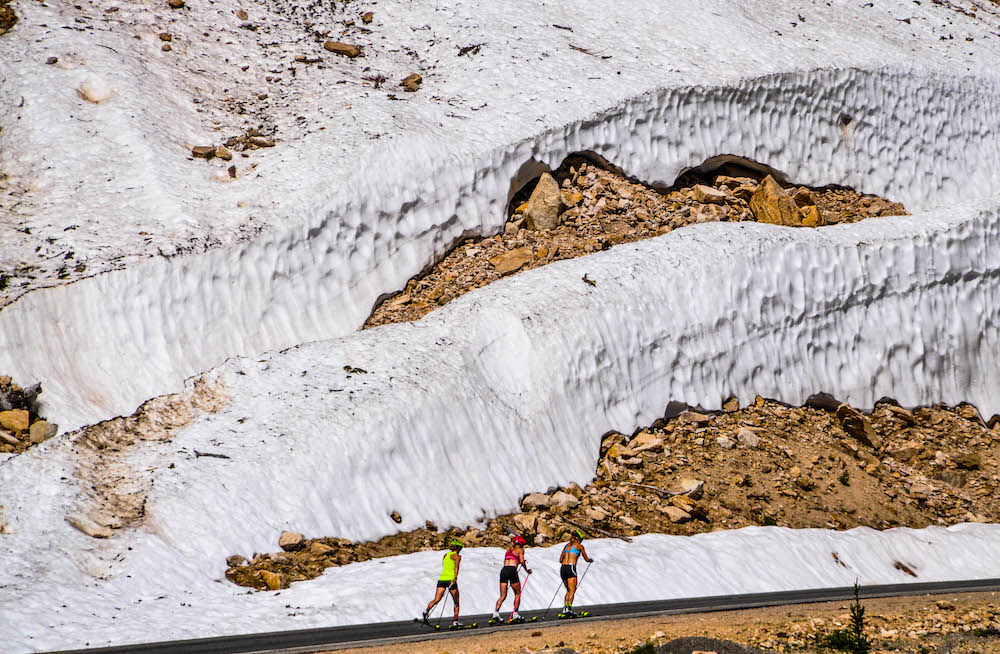
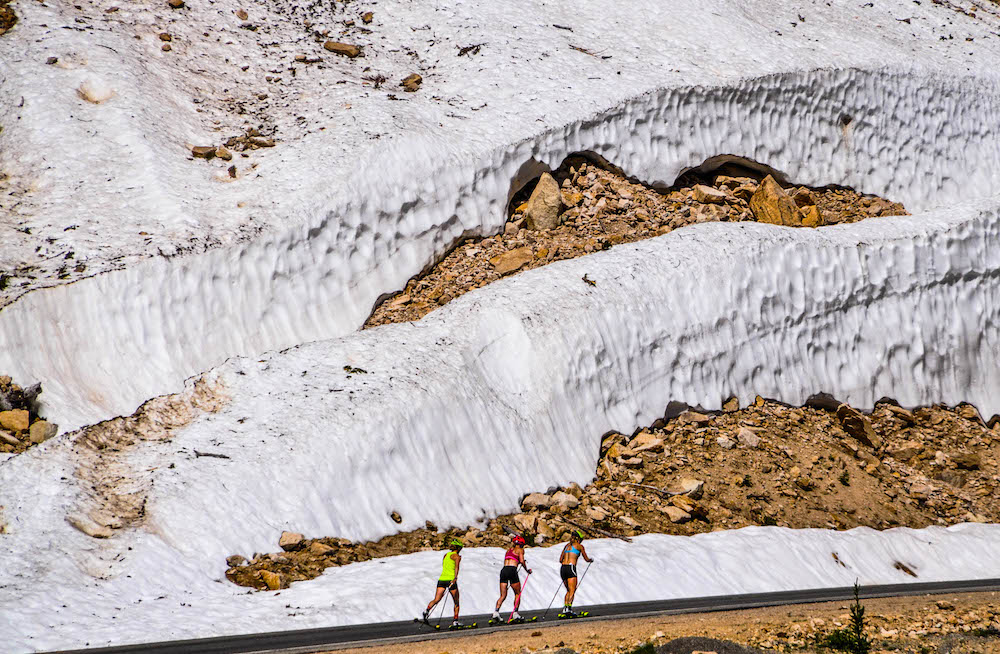
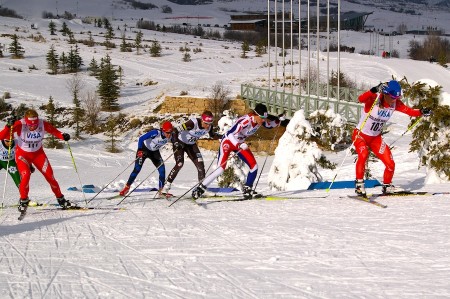
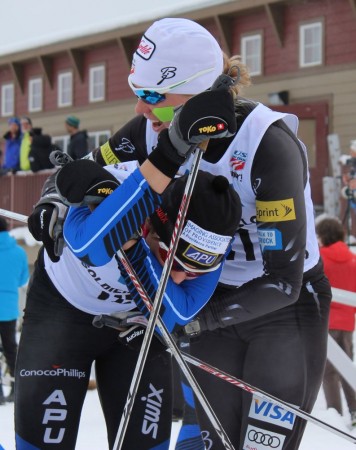
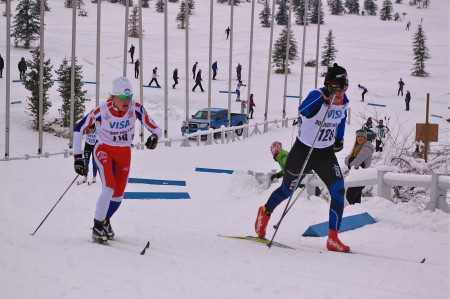
The U.S. Ski Team women’s team at work during a 10-day camp in the Methow Valley. (Photo: Matt Whitcomb/U.S. Ski Team)
(Note: This article has been updated to include comments from Canadian coach Ivan Babikov on his team’s recent camp in Park City, Utah.)
Two days after Andy Newell and Erika Flowers tied the knot in Bozeman, Mont., seven members of the men’s U.S. Ski Team and eight U.S. women’s team members jumped into an intensity training block at their respective dryland camps in Park City, Utah, and the Methow Valley in northern Washington.
The 10-day camps were scheduled simultaneously from June 26-July 5 to accommodate the wedding. Newell is a longtime U.S. Ski Team (USST) member and teammates with Flowers on the Stratton Mountain School (SMS) Elite Team out of Stratton, Vt. Because several national-team members ventured to Bozeman (Flowers’s hometown) to watch them say “I do,” the USST coaches decided to reduce travel and keep their squads together out west.
“We wanted to capture the men in the Intermountain West immediately following Andy Newell’s wedding in Bozeman, and therefore reduce the overall travel load for athletes who were already coming to the West from the East or Alaska,” head coach Chris Grover explained in an email.
The men based themselves in Midway, Utah, about 1,500 feet lower in elevation than Park City and 1,000 feet lower than Deer Valley, where they typically reside for summer and fall camps. Grover explained that this was by design, “because of the shorter duration of the camp (i.e. too short to create a meaningful stay at altitude), the focus on specific intensity workouts, and the benefits of quicker recovery at lower altitude,” he wrote.
Staying closer to the Soldier Hollow training venue was also ideal for the men’s team’s “PyeongChang-specific workouts”, Grover explained, including sessions focused on the freestyle team sprint, classic sprint and 4 x 10-kilometer relay, which will be contested at the 2018 Winter Olympics in PyeongChang, South Korea.
Newell, Simi Hamilton, Erik Bjornsen, Scott Patterson, Paddy Caldwell, Ian Torchia, and Ben Saxton attended and worked with coaches Jason Cork, Pat O’Brien, Grover, and U.S. Ski & Snowboard Strength and Conditioning Coach Tschana Schiller.
“The men did a great job of bringing heightened focus and effort to these key intensity workouts and we are grateful to the staff at Soldier Hollow for preparing the track for us,” Grover wrote. “Overall, it was a very productive camp and I think sent the men into the main summer preparation period with important areas to work on, a good gauge of fitness, and a further understanding of what skills need to be developed for the WC [World Cup] season and for PyeongChang.”
(Article continues below)
The U.S. men’s cross-country team at work during a classic distance rollerski near Midway, Utah. (Photo: Pat O’Brien)
The U.S. men’s cross-country team at work during a classic distance rollerski near Midway, Utah. (Photo: Pat O’Brien)
The U.S. men’s cross-country team at work, accompanied by head coach Chris Grover on his bike, during a skate over-distance rollerski near Midway, Utah. (Photo: Pat O’Brien)
The U.S. men’s cross-country team at work during a skate over-distance rollerski near Midway, Utah. (Photo: Pat O’Brien)
The U.S. men’s cross-country team at work during a skate over-distance rollerski near Midway, Utah. (Photo: Pat O’Brien)
The U.S. men’s cross-country team at work during a skate over-distance rollerski near Midway, Utah. (Photo: Pat O’Brien)
Start of the men’s skate team sprint on July 3 at the U.S. Ski Team men’s camp at Soldier Hollow in Midway, Utah. (Photo: Pat O’Brien)
Start of the men’s skate team sprint on July 3 at the U.S. Ski Team men’s camp at Soldier Hollow in Midway, Utah. (Photo: Pat O’Brien)
Do you use a heart rate monitor for training? Has it ever given you a seemingly implausible reading? Here’s why, and whether you should worry. (Photo: Pat O’Brien)
Andy Newell (r) leads the men’s skate team sprint on July 3 at the U.S. Ski Team men’s camp at Soldier Hollow in Midway, Utah. (Photo: Pat O’Brien)
Scott Patterson starting the U.S. Ski Team’s distance time trial at Soldier Hollow in Midway, Utah. (Photo: Pat O’Brien)
Scott Patterson (l) ascends the infamous Hermod’s Hill during the U.S. Ski Team’s distance time trial at Soldier Hollow in Midway, Utah. (Photo: Pat O’Brien)
Paddy Caldwell climbing during the U.S. Ski Team’s distance time trial at Soldier Hollow in Midway, Utah. (Photo: Pat O’Brien)
Simi Hamilton during the U.S. Ski Team’s distance time trial at Soldier Hollow in Midway, Utah. (Photo: Pat O’Brien)
Newlywed Andy Newell on his U.S. Ski Team’s distance time-trial day at Soldier Hollow in Midway, Utah. (Photo: Pat O’Brien)
From left to right: Andy Newell, Ben Saxton and Simi Hamilton working on classic speeds at Soldier Hollow in Midway, Utah. (Photo: Pat O’Brien)
From left to right: Andy Newell, Ben Saxton and Simi Hamilton working on classic speeds at Soldier Hollow in Midway, Utah. (Photo: Pat O’Brien)
Simi Hamilton leads Andy Newell and Paddy Caldwell during a classic-speeds workout at Soldier Hollow in Midway, Utah. (Photo: Pat O’Brien)
Andy Newell leads Simi Hamilton during a classic-speeds workout at Soldier Hollow in Midway, Utah. (Photo: Pat O’Brien)
Paddy Caldwell leads Erik Bjornsen (c) and Ian Torchia (r) during a classic-speeds workout at Soldier Hollow in Midway, Utah. (Photo: Pat O’Brien)
Ben Saxton (r) and Erik Bjornsen (l) during a classic-speeds workout at Soldier Hollow in Midway, Utah. (Photo: Pat O’Brien)
U.S. men’s team members Erik Bjornsen (l) and Ian Torchia during a classic-speeds workout at Soldier Hollow in Midway, Utah. (Photo: Pat O’Brien)
U.S. Ski Team Men’s Assistant Coach Jason Cork checks in with Ian Torchia during a classic-speeds workout at Soldier Hollow in Midway, Utah. (Photo: Pat O’Brien)
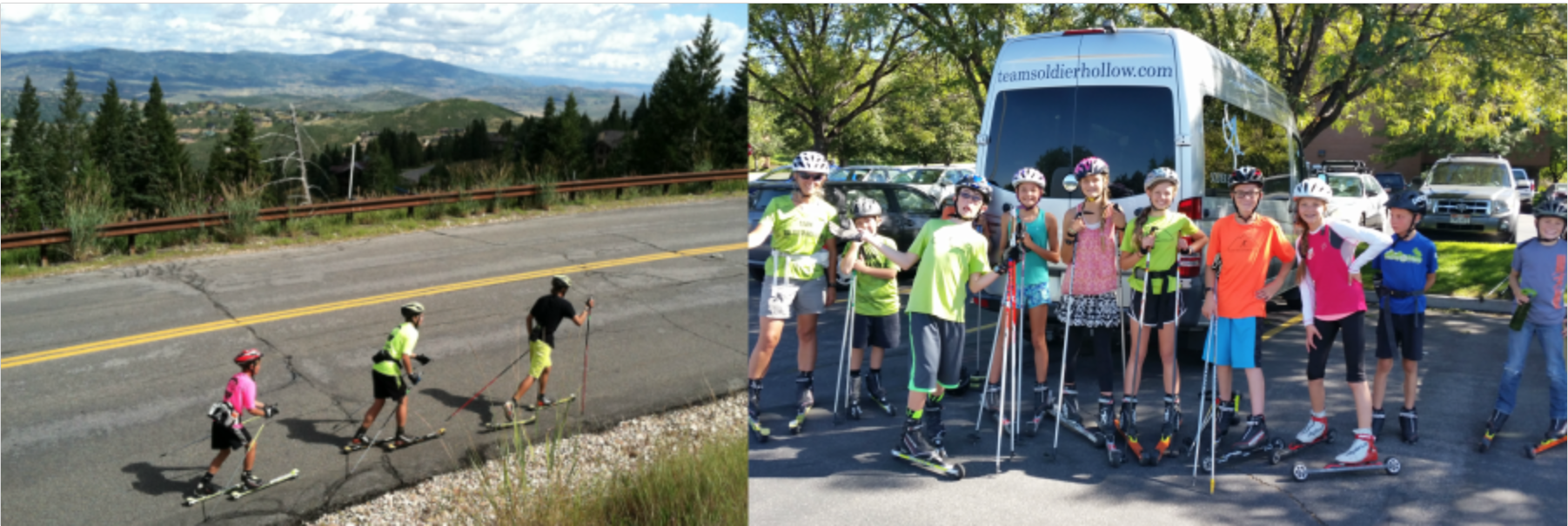
Local juniors rollerski alongside U.S. Ski Team members during a workout at Soldier Hollow in Midway, Utah. (Photo: Pat O’Brien)
***
Meanwhile, the U.S. women tried a new camp in the Methow Valley, home of current national-team members Sadie and Erik Bjornsen. The athletes themselves dubbed it the “CAGS Camp“, which U.S. women’s coach Matt Whitcomb explained stood for “a secret and mildly inappropriate team acronym that pokes fun at girls being girls. Sophie had hats made for the camp that she handed out at the airport when everyone arrived.”
All kidding aside, the goal of the camp was to be small and intensity focused, “with eight days of training and hard intervals every other day,” Whitcomb wrote in an email. “It’s an unusual setup for our team as we usually run joint camps with the men, but both enjoyed the simplicity of having such small training groups.
“We chose the Methow in part because it is where Sadie and Erik Bjornsen grew up, but also because we could get close to sea-level to maximize our hard efforts,” he added. “Another draw was that Pete Dickenson, one of our team physical therapists, was able to provide great treatment all week. Winthrop PT & Fitness sponsored our strength sessions, which meant we didn’t have to drive very far to get strong.”
Like Grover, Whitcomb used the word “ideal” to describe the Methow as a training site, yet emphasized that the community that hosted them was “even more incredible.”
“A local couple gave us their two cabins in a location as beautiful as we’ve seen anywhere in the world,” he wrote. “The chance to meet Olympians Laura McCabe (’94, ’98) and Leslie Hall (’88, ’92, ’94) was an important experience for the team. We owe them special thanks not for just guiding us to their favorite training spots, but for helping pave the early path for elite women’s skiing.”
The women’s team, which included Sadie Bjornsen, Rosie Brennan, Sophie Caldwell, Jessie Diggins, Katharine Ogden, Kikkan Randall, Ida Sargent, and Liz Stephen, spent one afternoon working with with the Methow Valley Nordic Team, which McCabe and Hall both coach.
“We invited a handful of their top athletes to join our bounding and ski walking sessions, and were encouraged by their technique and fitness, but also their love for the sport,” Whitcomb wrote. “They are doing a good job up there. I don’t know what the future holds for us regarding camp locations, but the Methow Valley will be considered as a great option moving forward. Thanks to so many people for making it happen.”
Women’s team staff included Whitcomb, Tim Baucom and physical therapist Pete Dickenson.
(Article continues below)
The U.S. women’s team with Methow Valley Nordic Team members during the U.S. Ski Team’s recent camp in Washington state’s Methow Valley. (Photo: Matt Whitcomb)
Rosie Brennan (in yellow) takes the lead while Sadie Bjornsen (in pink helmet) coaches on the bike during a 2017 U.S. women’s team camp in the Methow Valley. (Photo: Matt Whitcomb)
The U.S. Ski Team women’s team at work during a 10-day camp in the Methow Valley. (Photo: Matt Whitcomb)
The U.S. Ski Team women line up for the team sprint final during their camp in Washington state’s Methow Valley. (Photo: Matt Whitcomb)
Liz Stephen at work during the U.S. Ski Team women’s team’s camp in the Methow Valley. (Photo: Matt Whitcomb)
Sadie Bjornsen (front) and Ida Sargent get some help hydrating from coach Tim Baucom during a run in the Methow Valley. (Photo: Matt Whitcomb)
The U.S. women’s team at their dryland camp in the Methow Valley: (from left to right) Ida Sargent, Kikkan Randall, Sophie Caldwell, Jessie Diggins, Liz Stephen, Sadie Bjornsen, and Rosie Brennan. (Photo: Matt Whitcomb)
U.S. Ski Team coach/serviceman Tim Baucom sits on the porch of one of the team’s cabins during their recent camp in the Methow Valley in northern Washington. (Photo: Matt Whitcomb)
***
Cross Country Canada also recently finished up a two-week camp in Park City (June 26-July 11) with its entire men’s World Cup team — Alex Harvey, Len Valjas, Devon Kershaw, Jess Cockney, Knute Johnsgaard, and Graeme Killick — and U25 national-team member Julien Locke. Co-World Cup coaches Ivan Babikov and Louis Bouchard accompanied the team for the duration, and Joel Jaques joined for the first week.
While Park City has become an annual staple for the Canadian team, Babikov explained that this was their first time there in the summer, as opposed to the fall.
“We love the area and training there. … It was pretty hot but we managed,” he wrote. “The main goal was a big training volume/hours at the altitude. We were planing on doing a time trial at the SoHo but it got closed for those dates so we ended up doing intensity down in Salt Lake instead.
It was a great camp for all the guys, everyone feels good and no injuries on the team.”
Katharine Ogden (SMS/USST) finishing third for bronze in the women’s 10 k skiathlon on Friday at 2017 Junior World Championships at Soldier Hollow in Midway, Utah. She is the first American to reach the podium in a Junior World Championships. (Photo: FlyingPointRoad.com)
FIS Nordic Junior World Championships (Midway, Utah): 10/20 k skiathlon
A Junior World Championships medal has been on Katharine Ogden’s mind for some time — two years, to be exact.
“Every day in training, it’s kind of something that I think about. It’s the little thing that helps me push myself,” Ogden, a 19-year-old member of the Stratton Mountain School and U.S. Ski Team D-team, said in a post-race interview with the U.S. Ski Team on Friday. “Even in the middle of June, I’ll be like, ‘You know what I want to be? On the podium at World Juniors.’ ”
She did just that on Friday, racing to third in the women’s 10-kilometer skiathlon at 2017 Junior World Championships at Soldier Hollow in Midway, Utah. In doing so, she became the most successful American at World Juniors, surpassing Lindsey Williams’s previous best of fourth place in 2003.
Ogden finished 10.4 seconds behind the winner, Norway’s Marte Mæhlum Johansen, who finished first in 27:17.3 minutes. Sweden’s Ebba Andersson took second, 6.6 seconds back. Behind Ogden, Italy’s Anna Comarella placed fourth (+51.6) ahead of Finland’s Eveliina Piippo in fifth (+58.7).
Hailey Swirbul (University of Alaska Anchorage) was the second U.S. woman in 24th (+2:21.0), while Natalie Hynes (Whitehorse) led Canada in 28th (+3:11.3).
Also for Canada, India McIsaac (Rocky Mountain Racers) finished 30th (+3:13.8), Lisle Compton (NTDC Thunder Bay) was 33rd (+3:45.5) and Annika Richardson (NTDC Thunder Bay) 41st (+4:49.3).
Also for the U.S., Lauren Jortberg (Dartmouth) finished 37th (+4:04.5) and Taeler McCrerey (University of Denver) 38th (+4:07.5).
[UPDATED] In the men’s 20 k skiathlon that followed, Russia’s Vladislav Vechkanov notched his second gold of the week in 49:40.5, outlasting Norway’s Thomas Helland Larsen by 1.9 seconds. Norway had two on the podium with Harald Østberg Amundsen in third (+2.2).
Canada’s Gareth Williams (Telemark Race Team) was the top North American in 11th (+1:24.0) for his best result at his first Junior Worlds.
American Wyatt Gebhardt (Steamboat Springs WSC) followed in 12th (+1:42.7) for his second-straight top 20 and Hunter Wonders (Alaska Pacific University) also finished in the top 20 for the second-straight race in 18th (+1:57.9).
Canada’s Philippe Boucher (CNEPH) was 22nd (+3:15.7), Ryan Jackson (Team Hardwood) 31st (+3:52.5), and Remi Drolet (Black Jack) 49th (+6:57.3).
Also for the U.S., Kam Husain (SMS) placed 50th (+6:59), and Logan Diekmann (University of Utah) was 53rd (+7:47.3).
NorAm Eastern Canadian Championships (Cantley, Quebec): Classic sprint
The NorAm series resumed at the Nakkertok Nordic Centre on Friday with Eastern Canadian Championships with classic technique sprints.
Alberta World Cup Academy’s Maya MacIsaac-Jones returned from U23s in time to win the 1.3 k A-final in 3:42.06, after qualifying sixth. Top qualifier Sophie Carrier-Laforte was second for CNEPH at her home event, 0.66 seconds behind. SMS Elite’s Anne Hart rounded out the podium at 3.40 seconds back.
On the men’s side, AWCA’s Dominique Moncion-Groulx qualified first before winning every heat on his way to victory in 3:14.84 on a slightly longer 1.4 k course. NTDC Thunder Bay’s Angus Foster was a close second, 0.09 seconds behind. Team R.A.D.’s Russell Kennedy was a comfortable third, 2.75 seconds back, on a day marked by some surprising eliminations.
The elite field is slightly smaller than usual with some athletes away in Soldier Hollow and PyeongChang. As many younger racers were stuck in school for the day, there are only about 500 starters for what is usually the largest FIS event in Canada.
FIS Cross-Country World Cup (PyeongChang, South Korea): Classic sprint
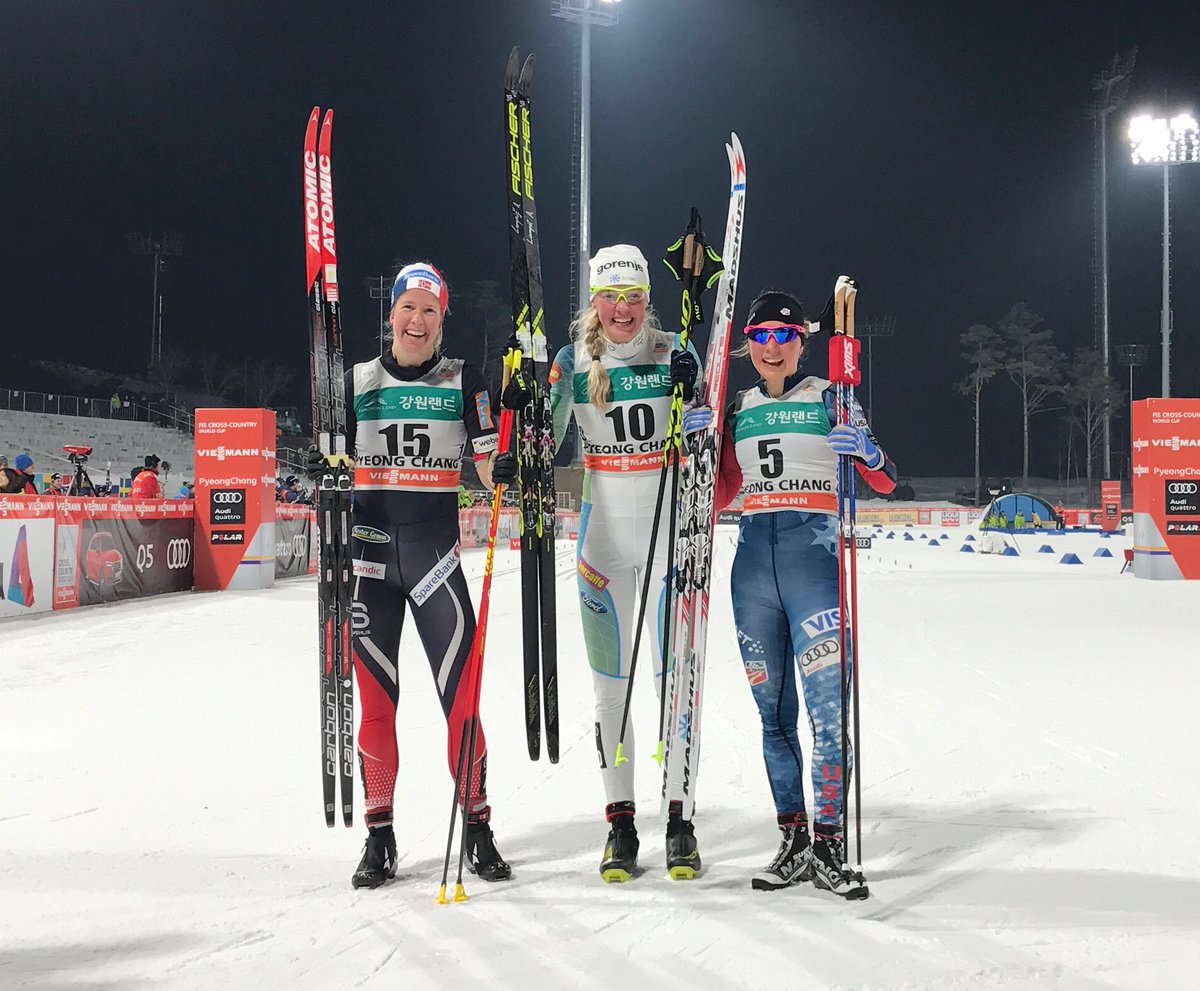
The women’s 1.4 k classic sprint podium on Friday at the pre-Olympic PyeongChang World Cup in South Korea, with Slovenia’s Anamarija Lampič (c) in first, Norway’s Silje Øyre Slind (l) in second, and American Ida Sargent (r) in third. It was the first time on the World Cup podium for all three athletes. (Photo: FIS Cross-Country/Twitter)
In the last month, we’ve seen two U.S. Ski Team members — Jessie Diggins and Sadie Bjornsen — on the World Cup podium. Add Ida Sargent to that list.
On Friday, the Vermont native raced to third in the women’s 1.4-kilometer classic sprint at the first-ever World Cup in PyeongChang, South Korea. It was the first of three days of racing in PyeongChang, which will host the 2018 Winter Olympics next season.
Sargent qualified fifth (4.76 seconds behind her teammate Sophie Caldwell, who won the qualifier in 3:40.89 minutes) and went on to win her quarterfinal in a photo finish, then placed second her semifinal (also in a photo finish), edging Russia’s Alisa Zhambalova in third by less than 0.01 seconds.
Both advanced to the final, where Sargent ultimately finished third, 1.79 seconds behind Slovenia’s Anamarija Lampič, who won in 3:41.97. Norway’s Silje Øyre Slind took second (+1.6), just 0.19 seconds ahead of Sargent. For all three women, it was their first time on a World Cup podium.
Sargent beat out Poland’s Justyna Kowalczyk for third by 0.56 seconds. Zhambalova finished fifth and Slovenia’s Katja Visnar was sixth (+17.1).
“I’m really excited about the podium and it hasn’t really set in yet,” Sargent wrote in an email on Friday. “It has been a goal of mine for a long time to be on the podium so it was a very special day! I’ve been inspired by so many fast teammates so happy to follow in their footsteps!”
All five U.S. women racing on Friday finished in the top 30 to qualify for the heats. Caldwell won the qualifier by 1.84 seconds over Kowalczyk, Caitlin Patterson qualified 22nd, Liz Guiney 25th and Liz Stephen 29th (Stephen’s first time making the heats in three years).
Jessica Yeaton, who races for Australia but trains with Alaska Pacific University, took the last qualifying spot in 30th (+26.29).
Canada’s Annika Hicks and Sadie White missed qualifying in 32nd (+32.96) and 34th (+38.96), respectively, out of 36 women.
Caldwell won her quarterfinal but finished fourth in her semifinal (behind Slind, Kowalczyk, and Sweden’s Maria Nordström, respectively) to miss advancing to the final. She placed eighth overall.
Guiney placed 24th overall after finishing fifth in her quarterfinal, Stephen was 25th after taking fifth in the same quarterfinal as Sargent (where Yeaton finished sixth for 30th overall), and Patterson was 27th after finishing sixth in her quarterfinal.
***
Both Canada’s Len Valjas and American Andy Newell reached the final in the men’s 1.5 k classic sprint on Friday, where they raced to fourth and sixth, respectively.
Valjas started the day by qualifying in second, 1.97 seconds behind Russia’s Alexander Panzhinskiy, who topped the qualifier in 3:26.78. The Canadian went on to advance in second from his quarterfinal and fourth as a lucky loser from the first semifinal. In the final, he missed out on the podium in a photo finish with Russia’s Andrey Parfenov, who took third, 0.01 seconds ahead of him.
Meanwhile, Newell qualified seventh (+5.18) and took second in both his quarterfinal and semifinal (finishing the second semifinal 0.34 seconds behind Panzhinskiy in first).
In the final, Russia’s 25-year-old Gleb Retivykh pulled off his first World Cup victory and podium with a 0.3-second win over Norway’s Sondre Turvoll Fossli in 3:30.79. Retivykh qualified sixth (+4.53) then won his quarterfinal and placed third in the same semifinal as Valjas, advancing as the other lucky loser.
“I had wait six years for my first victory and it is great,” Retivykh said, according to an International Ski Federation (FIS) press release.
Russia had two on the podium with Parfenov in third (+0.73), just ahead of Valjas. The third Russian in the final, Panzhinsky ended up fifth (+1.49), ahead of Newell in sixth (+17.19)
Three Canadian men qualified for the heats, with Jess Cockney in 16th (+10.24) and Simon Lapointe in 25th (+14.15). Bob Thompson missed 30th by one-hundredth of a second in 31st (+16.95), and Julien Locke was 36th (+17.9).
Three Americans qualified as well, with Simi Hamilton in 12th (+8.26) and Matt Gelso in 29th (+16.66). Distance skiers Scott Patterson and Noah Hoffman finished 44th (+24.21) and 48th (+25.28) out of 55.
Cockney reached the semifinals after winning his quarterfinal. In the second semifinal with Newell, he placed fifth, 5.44 seconds behind Panzhinskiy, for 10th overall.
In Cockney’s quarterfinal, Hamilton crashed and finished fourth (+41.9) for 17th overall.
Canada’s 23-year-old Lapointe finished sixth in his quarterfinal to place 27th, besting his previous World Cup best by 43 places. Gelso took 29th for his first-ever World Cup points after placing sixth in his quarterfinal.
Paddy Caldwell (SMS/USST) racing to a career-best ninth in the men’s 15 k freestyle individual start on Thursday at U23 World Championships at Soldier Hollow in Midway, Utah, while his dad, Tim Caldwell, cheers him on. (Photo: FlyingPointRoad.com)
(Note: This article has been updated to include comments from Paddy Caldwell.)
Three years ago, American Patrick “Paddy” Caldwell made his debut at Junior World Championships, racing to 10th in the 20-kilometer skiathlon in Val di Fiemme, Italy. It was the first time he had ever done a skiathlon; he was 19 years old and a college freshman at the time.
Now a 22-year-old Dartmouth sophomore, who continues to train with the Stratton Mountain School (SMS) as a member of the U.S. Ski Team’s development “D” team, Caldwell (son of four-time Olympic cross-country skier Tim Caldwell and cousin of current U.S. Ski Team standout Sophie Caldwell) is in his third U23 World Championships. The skiathlon distance has increased to 30 k, yet that classic-to-skate race remained his main focus for this year’s U23 Worlds at Soldier Hollow in Midway, Utah.
Earlier this week, he broke through with his best-ever sprint result at the championships, reaching the quarterfinals and placing 18th overall in the classic sprint. Then, on Thursday in the men’s 15 k freestyle, he cracked the top 10 for the first time in his U23/Junior Worlds career.
“I was really excited going into today’s race,” Caldwell wrote in an email on Friday morning. “15km FS is one of my favorite race formats. I have been targeting this week of races all year and was really looking forward to this race in particular.”
While the sprint was a primer for Caldwell, he said it also boosted his confidence leading into the two individual distance races at U23s.
“I have been working on my sprinting a lot this year and I am psyched to be mixing it up in the heats!” he wrote.
He described the conditions on Thursday as hard-packed with a fair amount of moisture, “which made for some fast skiing.”
It was overcast — grey and spitting rain at times — a stark contrast from the preceding bluebird days. But with temperatures just below freezing, the course remained firm.
“My strategy for the day was to pin it from the start and hold on,” said Caldwell, who started 44th of 53 in the men’s three-lap, individual start race, in a post-race interview with the U.S. Ski Team. “It was a really tight race and I definitely paid for my first lap, but I am happy to have put it all out there.”
After being passed by Russia’s eventual winner Alexander Bolshunov, who started 30 seconds behind him in bib 45, Caldwell initially finished sixth, 1:03.6 minutes behind Bolshunov. Three later starters ultimately bumped the American to ninth, including Russia’s Alexey Chervotkin, who took second at the finish, 21.8 seconds behind Bolshunov (who won in 32:55.7).
“I started off with a fast first lap and was getting splits between 1st and 4th for the first five or six kilometers,” Caldwell recalled in an email. “Bolshunov caught me around 7 kms into the race… I skied with him for about 1.5km but on the big downhill halfway through the 5km loop another skier slotted in between us and Bolshunov ended up gapping us before I could get around the other skier — it would have been sweet to ski with him some more but who knows how long I could have stuck with him. I could see him for the rest of the race which was a good gauge and kept me pushing to make up time on him.
“In the end I am really excited to be in the top ten overall and to have left it all out there,” Caldwell added. “It was a tight race and I was a bit disappointed to be at the tail end of a close group of times but in the end I am really happy with the result. I want to be the best all around skier I can be and I am really excited to be making progress in both sprint and distance racing.”
The all-Russian podium in the men’s 15 k freestyle at 2017 U23 World Championships, with Alexander Bolshunov (c), who won by nearly 22 seconds over Alexey Chervotkin (l) in second, and was 28.2 seconds ahead of Denis Spitsov (r) in third. (Photo: FlyingPointRoad.com)
For the second-straight day of 2017 Junior/U23 World Championships, Russia claimed all of the medals in the men’s race, with Denis Spitsov placing third (+28.2).
“It’s very, very cool,” Bolshunov, the silver medalist in Tuesday’s classic sprint, told the U.S. Ski Team media. “I couldn’t explain my emotions now, it’s really cool.”
“I was really excited to be in the mix with the top guys today,” Caldwell told the U.S. Ski Team. “U23s have been my focus all year and I am psyched to have improved on my results from past U23 and World Junior races.”
Next up for Caldwell, Saturday’s skiathlon, which will be his first since placing 20th in the 2015 skiathlon in Almaty, Kazakhstan.
“I have only done two skiathlons (Val de Fiemme and Almaty) but both were really fun and exciting races,” he wrote. “Mass start races are always a blast!”
Adam Martin (Northern Michigan University) racing to 22nd in the men’s 15 k freestyle at 2017 U23 World Championships at Soldier Hollow in Midway, Utah. (Photo: FlyingPointRoad.com)
Four American men raced the 15 k, with Adam Martin (Northern Michigan University) placing 22nd (+2:22.4), Jack Hegman (Sun Valley Ski Education Foundation) 24th (+2:25.2), and Cal Deline (Dartmouth Ski Team) 37th (+3:48.6). For Martin, 22nd was his best at U23 Worlds by one place, and Hegman and Deline also notched personal bests at their first U23 Worlds.
Evan Palmer-Charrette (NTDC Thunder Bay) led Canadian men in 34th (+3:20.2) for his best result at his U23 Worlds debut as well. Alexis Dumas, of the Pierre-Harvey National Training Centre (CNEPH) followed in 38th (+3:52.9), tying his U23 best. Julien Lamoureux (CNEPH) was 43rd (+4:16.7) in his first race of U23 Worlds, and Scott James Hill (Team Hardwood) 49th (+6:15.2).
Second-Straight Win for Dyvik; Beatty 16th
Dahria Beatty (AWCA/Canadian U25 Team) racing to 16th in the women’s 10 k freestyle on Thursday at 2017 U23 World Championships at Soldier Hollow in Midway, Utah. (Photo: FlyingPointRoad.com)
In the women’s 10 k freestyle, Dahria Beatty (Alberta World Cup Academy/Canadian National U25 Team) notched her second top 20 of the week in 16th, after placing 12th in Tuesday’s classic sprint.
She finished the two-lap 10 k in 27:39.8, more than a minute faster than her 10 k freestyle time at 2017 U.S. nationals last month (where she finished 17th. Beatty went on to place fourth in the classic sprint and win the freestyle prologue at U.S. nationals).
On Thursday, she was 1:25.8 minutes back from the winner, Sweden’s Anna Dyvik, who racked up her second-straight gold of the championships with the best time of the day in 26:14.0.
“Today’s race played out fairly similarly to the 10k skate at US Nationals, but not on an extreme of scale,” Beatty wrote in an email, referring to the conditions. “I was skiing where I wanted to be for the first two thirds of the race but then I really struggled at the end.
“Today’s race was extremely hard,” she added. “The courses here are really tough by any standard and the altitude makes it even harder. I tried to go out fairly conservatively by my standards today as I like starting fast. I was able to start smooth and build through the first lap into the second and was sitting in a good position just in the top 10.”
Despite trying to pace her race, Beatty described “blowing up” in the last 2.5 k.
“The last big climb was a very painful one today,” she wrote. “I haven’t quite figured out the 5k course here at Soldier Hollow yet and how to save something in my legs for the end but I was happy with my effort. I raced hard and used the tactics that I thought would give me the best result possible. I was hoping to be able to be in the top 12 but am still pleased to have skied at that pace for part of the race.”
Sweden’s Anna Dyvik racing to her second-straight gold medal of 2017 U23 World Championships on Thursday in the women’s 10 k freestyle at Soldier Hollow in Midway, Utah. (Photo: FlyingPointRoad.com)
Beatty started 32nd (of 44) and Dyvik in bib 33 passed her around 5 k.
“I only skied with her for a few hundred meters, she was moving fast and I knew if I tried to stay with her I would end of blowing up and really paying for it later in the race,” Beatty wrote.
The top Canadian in the last two U23 races, Beatty planned to race Saturday’s 15 k skiathlon.
“I’m looking forward to the Skiathlon with hopes of being able to put together a bit stronger of a performance all the way to the finish line not just for part of the race,” Beatty wrote. “Mass starts are always exciting and I am looking forward to doing some pack skiing, it was pretty windy out there today.”
Dyvik outlasted four Norwegians for the win, which she took by 16.8 seconds over Norway’s Tiril Udnes Weng (Heidi Weng’s cousin) in second. Norway claimed second through fourth place, with Lovise Heimdal in third (+23.0), and Lotta Udnes Weng (Weng’s twin sister) just 0.1 seconds off the podium in fourth (+23.1).
Half a second behind Beatty, the Czech Republic’s Petra Hyncicova (University of Colorado-Boulder Ski Team) finished 17th (+1:26.3) for her first top 20 at her second U23 Worlds.
Canada’s Frédérique Vézina (CNEPH) finished 25th (+1:58.8) for a career best at her second U23 Worlds as well, Katherine Stewart-Jones (NTDC Thunder Bay/NST U25 Team) was 27th (+2:07.8), and Jenn Jackson (Lappe Nordic/Team Hardwood) 37th (+3:31.8).
Kelsey Phinney (SVSEF) led the Americans in 30th (+2:24.6), Jesse Knori (University of Colorado-Boulder) was 32nd (+2:36.4), Alayna Sonnesyn (University of Vermont) 33rd (+2:51.4) in her first U23 Worlds race, and Nichole Bathe (University of Alaska Fairbanks) 39th (+4:19.8).
Australia’s Casey Wright (University of Alaska Anchorage Ski Team) followed in 40th (+4:22.0).
American Patrick “Paddy” Caldwell chasing Russia’s Alexander Bolshunov during the men’s 15 k freestyle individual start on Thursday at U23 World Championships at Soldier Hollow in Midway, Utah. Bolshunov went on to win and Caldwell placed ninth for a career best. (Photo: FlyingPointRoad.com)
FIS Nordic U23 World Championships (Midway, Utah): 10/15 k freestyle
Paddy Caldwell, of the Stratton Mountain School and U.S. Ski Team D-team, raced to the first top 10 of his career at a U23 World Championship on Thursday, placing ninth in the men’s 15-kilometer freestyle individual start at Soldier Hollow in Midway, Utah.
Caldwell started 44th (of 53) and crossed the finish in sixth before being bumped down three places to ninth. Upon being passed by the eventual winner, Russia’s Alexander Bolshunov, who started 30 seconds behind him in bib 45, Caldwell worked to keep pace with the Russian and ended up 1:03.6 minutes off his winning time. The silver medalist in Tuesday’s classic sprint, Bolshunov took the victory in 32:55.7 minutes, and Russia swept the men’s podium for the second-straight day at U23/Junior World Championships with Alexey Chervotkin in second (+21.8) and Denis Spitsov in third (+28.2).
Also for the U.S., Adam Martin (Northern Michigan University) placed 22nd (+2:22.4), Jack Hegman (Sun Valley Ski Education Foundation) was 24th (+2:25.2), and Cal Deline (Dartmouth Ski Team) 37th (+3:48.6).
Evan Palmer-Charrette (NTDC Thunder Bay) led Canadian men in 34th (+3:20.2), Alexis Dumas (CNEPH) was 38th (+3:52.9), Julien Lamoureux (CNEPH) 43rd (+4:16.7), and Scott James Hill (Team Hardwood) 49th (+6:15.2).
In the women’s 10 k freestyle Thursday morning, Sweden’s Anna Dyvik won her second-straight race of the championships, finishing in 26:14.0 minutes. Norway took second through fourth with Tiril Udnes Weng in second (+16.8), Lovise Heimdal in third (+23.0), and Lotta Udnes Weng (Weng’s twin sister) just 0.1 seconds off the podium in fourth (+23.1).
Dahria Beatty (AWCA/Canadian U25 Team) was the top Canadian in 16th (+1:25.8), and Petra Hyncicova (a University of Colorado-Boulder Ski Team member who’s skiing for her native Czech Republic) followed in 17th (+1:26.3).
Canada’s Frédérique Vezina (CNEPH) placed 25th (+1:58.8) for a career best at her second U23 Worlds, Katherine Stewart-Jones (NTDC Thunder Bay/NST U25 Team) was 27th (+2:07.8), and Jenn Jackson (Lappe Nordic/Team Hardwood) 37th (+3:31.8).
Kelsey Phinney (SVSEF) led the Americans in 30th (+2:24.6), Jesse Knori (University of Colorado-Boulder) was 32nd (+2:36.4), Alayna Sonnesyn (University of Vermont) 33rd (+2:51.4), and Nichole Bathe (University of Alaska Fairbanks) 39th (+4:19.8).
Australia’s Casey Wright (University of Alaska Anchorage Ski Team) followed in 40th (+4:22.0).
FIS Nordic Combined Junior World Championships: 4 x 5 k team event
[UPDATED] In the lone nordic-combined team event of Junior World Championships, Austria took the win in 46:17.3 with Samuel Mraz, Marc Luis Rainer, Florian Dagn, and Mika Vermeulen. The team ranked fourth after the jumping portion and started 23 seconds behind Japan in first, but captured the 9.7-second victory over France (Lilian Vaxelaire, Laurent Muhlethaler, Theo Rochat,Mael Tyrode), the third-ranked team after the jump.
The Czech Republic started the relay in fifth and reached the podium in third (+15.3), with Ondrej Payout, David Zemek, Jan Vytrval, and Lukas Danek.
The U.S. (Elijah Vargas, Grant Andrews, Ben Loomis, Stephen Schumann) finished seventh (+2:10.8) out of nine teams after starting sixth. Last year, the U.S. squad placed sixth at 2016 Junior Worlds in Rasnov, Romania, and in 2015 in Almaty, Kazakhstan, they were seventh.
Japan slipped from first at the start of the relay to eighth at the finish (+2:46.4).
Katharine Ogden (Stratton Mountain School/U.S. Ski Team D-team) racing to fifth in the women’s 5 k freestyle at 2017 Junior Worlds on Wednesday for her best result in her third Junior Worlds. (Photo: FlyingPointRoad.com)
FIS Nordic Junior World Championships (Midway, Utah): 5/10 k freestyle
Coming into 2017 Junior World Championships with a career-best individual of sixth at Junior Worlds (which she achieved in the 10-kilometer skiathlon two years ago), Katharine Ogden of the Stratton Mountain School (SMS) and U.S. Ski Team (USST) D-team did one better on Wednesday, racing to fifth in the women’s 5 k freestyle individual start at Soldier Hollow in Midway, Utah.
Ogden started 54th and initially finished third, behind Russia’s Mariya Istomina and Italy’s Anna Comarella, respectively. That was a good spot to be in, considering there were only 57 starters.
But the final two women out on course, Norway’s Marte Mæhlum Johansen in bib 56 and Sweden’s Ebba Andersson in bib 57 ultimately bumped Ogden out of third, then fourth, respectively. Andersson took the win in 12:45.4 minutes, finishing 13.8 seconds faster than Johansen in second. Istomina held on for third (+15.3), Comarella was fourth (+18.5), and Ogden was 6.5 seconds off the podium in fifth (+21.8) for her best result in three Junior Worlds.
The U.S. had three women in the top 20 with Hannah Halvorsen (Sugar Bowl Academy/USST) in 13th (+1:01.2) and Taeler McCrerey (University of Denver) in 20th (+1:18.9). The team’s fourth woman, Hailey Swirbul (University of Alaska Anchorage) placed 31st (+1:35.5).
Lisle Compton (NTDC Thunder Bay) led the Canadian women in 39th (+1:51.9), Annika Richardson (NTDC Thunder Bay) finished 41st (+1:57.8), Claire Grall-Johnson (Nakkertok) was 42nd (+1:58.2), and India McIsaac (Rocky Mountain Racers) 46th (+2:12.9).
[UPDATED] In the men’s 10 k freestyle that followed, Vladislav Vechkanov, the fifth qualifier in Monday’s classic sprint, led a Russian podium sweep. He won in 23:08.6, 7.9 seconds ahead of his teammate Egor Kazarinov, while the third Russian, Yaroslav Rybochkin was 13.3 seconds back.
Two Americans finished in the top 20, with Hunter Wonders (Alaska Pacific University) in 16th (+1:17.2) and Wyatt Gebhardt (Steamboat Springs WSC) in 19th (+1:21.9). Also for the U.S, Bill Harmeyer (University of Vermont) placed 29th (+2:02.6) and Lance McKenney 61st (+4:23.3).
Gareth Williams (Telemark) led the Canadians in 20th (+1:24.6), Antoine Blais (Skibec) finished 32nd (+2:07.8), Philippe Boucher (CNEPH) placed 35th (+2:10.3), and Remi Drolet (Black Jack) 50th (+2:49.1)
American Cole Morgan (11) racing alongside Russia’s Alexander Bolshunov (1) in the men’s semifinal of the U23 World Championships classic sprint on Tuesday at Soldier Hollow in Midway, Utah. (Photo: FlyingPointRoad.com)
Two weeks after being officially selected to the U.S. team for 2017 senior World Championships, which will be held later this month in Lahti, Finland, 22-year-old Cole Morgan still felt like he had something to prove, goals to chase, races to qualify for.
That’s where U23 World Championships came in. For Morgan, a former University of Vermont skier who graduated last spring and began a professional racing career with the Sun Valley Ski Education Foundation (SVSEF) in Sun Valley, Idaho, his goal for the one race he was competing in at his first U23 Worlds was to finish in the top 12 — which would secure his spot at 2017 World Cup Finals, according to the U.S. Ski Team’s selection criteria.
So he went after it on Tuesday at Soldier Hollow in Midway, Utah, racing to 11th in the men’s 1.5-kilometer classic-sprint qualifier, 8.19 seconds off the fastest time set by Russia’s Alexander Bolshunov in 3:36.52. Morgan went on to take second in his quarterfinal, 0.85 seconds behind Bolshunov in first, and fifth in his semifinal for ninth overall.
“Coming into these championships already having qualified for World Champs honestly didn’t really take of any of the pressure to perform,” Morgan wrote in an email after Tuesday’s sprint.
He had drawn the attention of U.S. coaches and earned the final men’s sprint spot on the U.S. World Championships team in a tiebreak, based on his SuperTour results, according to U.S. Head Coach Chris Grover.
“If anything I feel like I put more pressure on myself because I felt that I had to prove that I deserve that spot and really wanted to show that I can mix it up with guys with World Cup experience,” wrote Morgan, who has never started a World Cup.
Once he had successfully achieved a top 12 by making the semifinals, “I just wanted to give it my best in the semi and see how far I could go,” Morgan wrote.
His quarterfinal strategy had been to stick behind Bolshunov.
“I had a really good start and was able to tuck right in behind him right after the start,” Morgan explained. “From then on I just skied behind him for the rest of the course and remained in contact over the last climb. I had some of the fastest skis out there today and was able to come around him on the outside into the finish but didn’t have as much left in the double pole finish.”
Bolshunov crossed the line first in 3:38.13 and Morgan followed in second to automatically advance to the semifinal. Behind him, Slovenia’s Miha Šimenc finished third (+1.2) and the second American in the heat, Paddy Caldwell was fourth (+6.17).
American Paddy Caldwell (20) racing to fourth in his quarterfinal at Tuesday’s U23 World Championships men’s classic sprint at Soldier Hollow in Midway, Utah. He ended up 18th overall, his best sprint result at U23 Worlds. (Photo: FlyingPointRoad.com)
Caldwell, of the Stratton Mountain School (SMS) and U.S. Ski Team D-team, was one of three U.S. men to reach the rounds after qualifying in 20th (+14.68). With his quarterfinal result, he ended the day in 18th for his best sprint result by 25 places at his third U23 World Championships.
Morgan’s Sun Valley teammate, Jack Hegman qualified 23rd (+15.59) and finished sixth in the last quarterfinal, 5.71 seconds behind Norway’s Chrisander Skjønberg Holth in first. That put Hegman 28th overall at his first U23 Worlds (after having competed in 2014 Junior Worlds). Cal Deline (Dartmouth) narrowly missed the heats after placing 31st in the qualifier, 0.14 seconds out of 30th.
In the first men’s semifinal, Norway’s Fredrik Riseth, who had qualified fourth and won the first quarterfinal, beat Bolshunov to the line in 3:35.21. The Russian finished 0.28 seconds back in second, Norway’s Joachim Aurland followed in third (+0.68), and Russia’s Alexey Chervotkin (who spent the better part of this season on the World Cup) was fourth (+2.8). Morgan finished fifth (+9.67), ahead of Sweden’s Axel Ekström, also a World Cup skier who finished 32nd in the Tour de Ski, in sixth (+10.74).
Morgan explained that he used his quarterfinal strategy in the semifinal and was in a good position until the downhill before the last climb.
“I was just too blown out from my quarter to push the last hill at all,” he wrote. “I was in sixth off the back at the top but was able to make up some good time on the downhill and the finish with my skis to move into fifth.
“I’m really happy with this result as I met my goal for the championships and felt good about where I’m at with my skiing,” Morgan added. “This is my only event this week so I was stoked to have a good one.”
Next on his agenda: the 34 k Boulder Mountain Tour on Feb. 4 in Sun Valley before leaving for Finland on Feb. 16.
Norway’s 21-year-old Fredrik Riseth (4) celebrates his U23 World Championships classic sprint win on Tuesday, which he took by 1.05 seconds over Russia’s Alexander Bolshunov, at Soldier Hollow in Midway, Utah. Riseth won the classic sprint two years ago at 2015 Junior Worlds. (Photo: FlyingPointRoad.com)
Meanwhile on Tuesday, the four men who finished ahead of Morgan in the semifinal plus Russia’s Andrey Sobakarev and Norway’s Holth (who placed first and second, respectively, in the second semifinal) advanced to the final. There, Riseth — who won the Junior Worlds classic sprint two years ago — beat Bolshunov again for the overall victory in 3:32.78. Bolshunov took silver, 1.05 seconds back, and Norway had two on the podium with Aurland in third (+2.3).
Canada’s Evan Palmer-Charrette (NTDC Thunder Bay) was 0.92 seconds out of qualifying in 33rd (+18.21). He led Canadian teammates Julian Smith (NTDC Thunder Bay) in 34th (+18.59), Scott James Hill (Team Hardwood) in 35th (+18.73), and Alexis Dumas (CNEPH) in 42nd (+30.79).
The men’s classic sprint podium on Tuesday at U23 World Championships at Soldier Hollow in Midway, Utah, with Norway’s Fredrik Riseth (c) in first, Russia’s Alexander Bolshunov (l) in second, and Norway’s Joachim Aurland (r) in third. (Photo: FlyingPointRoad.com)
Norway’s Fredrik Riseth (4) celebrates his win in the men’s classic sprint at U23 World Championships on Tuesday at Soldier Hollow in Midway, Utah. He beat out Russia’s Alexander Bolshunov (1) by 1.05 seconds for the victory and Norway’s Joachim Aurland followed in third (+2.3). (Photo: FlyingPointRoad.com)
FIS Nordic U23 World Championships (Midway, Utah): Classic sprint
[UPDATED] All four American women and three Canadians qualified for the women’s classic sprint heats on the first day of U23 World Championships on Tuesday, and in the men’s qualifier, three Americans finished in the top 30 to advance to the quarterfinals at Soldier Hollow in Midway, Utah.
Kelsey Phinney led the Americans in sixth in the women’s 1.3-kilometer qualifier, clocking in 2.77 seconds off the fastest women’s qualifying time of 3:39.40, set by Sweden’s Anna Dyvik.
Canada’s Dahria Beatty qualified eighth (+3.85), followed by Nichole Bathe (USA) in 14th (+8.8), Jesse Knori (USA) in 19th (+12.07), Jenn Jackson (CAN) in 22nd (+12.99), Corey Stock (USA) in 26th (+15.11), and Katherine Stewart-Jones (CAN) in 28th (+16.61).
In the men’s 1.5 k qualifier, American Cole Morgan claimed with the 11th-fastest time, 8.19 seconds behind Russia’s Alexander Bolshunov, who topped the qualifying round in 3:36.52.
Also for the U.S., Paddy Caldwell qualified 20th (+14.68) and Jack Hegman 23rd (+15.59), while Cal Deline missed the top 30 by 0.14 seconds in 31st.
In the quarterfinals, Morgan finished second by 0.85 seconds to Bolshunov, and both automatically advanced to the semifinals. There, the Russian finished second to Norway’s Fredrik Riseth while Morgan took fifth, 9.67 seconds out of first. Overall, Morgan placed ninth on the day for his best result at a Junior or U23 World Championship.
The top North American woman on Tuesday, Beatty finished third in her quarterfinal, 2.45 seconds behind the winner of her heat, Norway’s Thea Krokan Murud. Beatty advanced to the semifinals as a lucky loser, where she ended up sixth, 8.04 seconds behind Murud, who won that heat as well. Overall, Beatty placed 12th for her first top 20 at U23 Worlds.
Meanwhile, Stewart-Jones raced in the same quarterfinal as Beatty and finished fifth (+12.63) for 24th overall.
Knori was the top U.S. woman in 15th overall after placing third in her quarterfinal, 7.18 seconds behind Norway’s Tiril Udnes Weng, who won that heat.
Phinney was right behind in 16th overall after finishing fourth in her quarterfinal, 3.81 seconds behind Weng’s sister, Lotta Udnes Weng, in first. Stock also raced in that quarterfinal and finished fifth (+10.08) for 22nd overall.
Petra Hyncicova, who skis for the University of Colorado-Boulder but is representing her native Czech Republic at U23s, took 20th on Tuesday. She qualified in 21st then finished fourth in her quarterfinal, 4.33 seconds behind Sweden’s Maja Dahlqvist in first.
Dahlqvist went on to win the first semifinal and Norway’s Murud won the second semi. Both met in the final, where Dyvik — who had placed second from the first semifinal — dominated throughout to take the win in 3:32.40. Murud finished 3.42 seconds back in second, and Sweden had two on the podium with Dahlqvist in third (+3.76).
On the men’s side, Caldwell ended up 18th after placing fourth in the same quarterfinal as Morgan, finishing 6.17 seconds behind Bolshunov in first.
Hegman placed 28th on the day after finishing sixth in his quarterfinal, 5.71 seconds behind Norway’s Chrisander Skjoenberg Holth in first.
Norway’s Riseth won his quarterfinal and semifinal before taking the victory in the final, by 1.05 seconds over Bolshunov with a winning time of 3:32.78. Norway had two on the podium with Joachim Aurland in third (+2.3).
FIS Nordic Combined Junior World Championships (Park City & Midway, Utah): Individual normal hill/10 k
Finland’s Arttu Mäkiaho winning the normal hill/10 k competition on Tuesday, the first day of Nordic Combined Junior World Championships, at Soldier Hollow in Midway, Utah. He won by nearly 22 seconds. (Photo: FlyingPointRoad.com).
[UPDATED] On the first day of Nordic Combined Junior Worlds, with the jumping taking place at Utah Olympic Park in Park City, Utah, and racing at Soldier Hollow in nearby Midway, Stephen Schumann achieved his first top 10 in the individual normal hill/10 k.
Schumann jumped to 28th then clocked the fifth-fastest cross-country time to place 10th overall, 55 seconds behind Finland’s Arttu Mäkiaho, who won in 25:54.5 minutes.
Mäkiaho started the 10 k in ninth, based on his jump, with a 35-second starting deficit to jump leader Laurent Muhlethaler of France. While Muhlethaler dropped to 17th in the 10 k, Mäkiaho clocked the third-fastest ski time to win the first nordic-combined competition of the championships.
Austria’s Mika Vermeulen finished 21.6 seconds back in second, after picking off 27 places in the ski race. He jumped to 29th and skied the fastest 10 k in 24:48.1.
Germany’s Martin Hahn rounded out the podium in third (+25.6), moving up from 26th in the jump with the fourth-fastest ski time.
Four Americans competed, with Ben Loomis landing in the top 20 in 18th (+1:38.5), Koby Vargas in 37th (+3:44.0) and Grant Andrews in 44th (+4:25.6).
Junior/U23 World Championships continue Wednesday with the junior 5/10 k freestyle individual starts, plus women’s and men’s ski jumping. Complete schedule
World University Games cross-country skiing (Almaty, Kazakhstan): 5/10 k freestyle pursuits
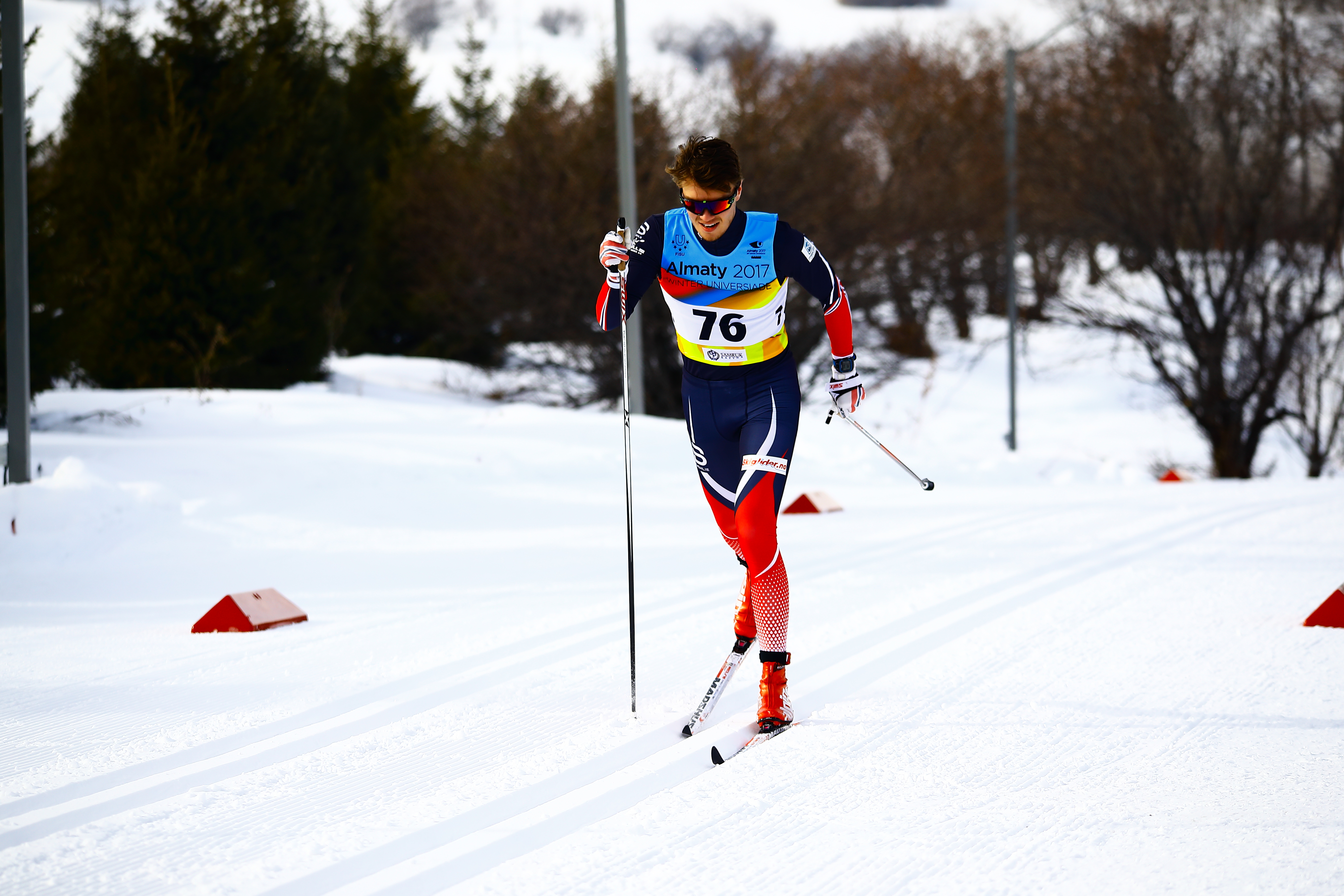
Jørgen Grav of Ford Sayre competing for Norway at the World University Games in Almaty, Kazakhstan. (Photo: Almaty2017.com)
Cross-country ski competitions continued at the World University Games on Tuesday with pursuit races based off the finish times from Monday’s 5 and 10 kilometer classic races.
In the men’s 10 k pursuit, Dmitriy Rostovtsev overtook Russian teammate (and yesterday’s winner) Valeriy Gontar to win by 14.7 seconds. Armenia’s Sergey Mikayelyan moved from fourth up to third place (+52.0) to claim the final podium spot.
Jørgen Grav of Norway, a former University of Vermont skier now in graduate studies at Dartmouth College and competing for Ford Sayre, placed 36th, +5:14.4.
For Canada William Dumas (Skinouk) skied from 48th all the way up to 40th to lead the team and finish +5:26.0. Carrington Pomeroy (Nakkertok) moved from 57th up to 48th (+6:01.2), Conor Thompson (Université Laval) finished 52nd (+6:33.3), Gavin Shields (Lappe Nordic) 58th (+6:54.6), Jordan Cascagnette (Team Hardwood) 62nd (+7:24.8), and Alexis Morin (Université Laval) 68th (+8:44.1).
Vincent Mason of the University of Wyoming had the best U.S. finish, clocking in at 55th (+6:36.6). Teammate Will Timmons finished 63rd (+7:29.9) and Sam Wiswell 71st (+9:27.9). Mitchell Hollman (Air Force Academy) 74th (+10:25.1), Kevin Geisen (Western State)78th (+12:07.6), and Cameron Moore (Western State)79th (+12:50.0).
In the women’s 5 k skate pursuit, Anna Nechaevskaya of Russia moved up and stole the lead from Russian teammate (and yesterday’s winner) Lilia Vasilieva (+18.1). Anna Shevchenko of Kazakhstan kept her hold on third place (+21.3).
Elise Sulser of the University of Wyoming againled the United States, slipping one spot to finish 24th (+3:47.1). Her teammate Meghan Kent was 47th (+6:39.9) and Yara Thomas 50th (+7:20.0). Emma Malmqvist (Colorado Mesa University) placed 53rd (+8:04.7), Sierra Jech (State University of New York) 55th (+8:26.9), and Sierra Foster (Oregon State University) 61st (+10:00.3).
For Canada, Christel Pichard-Joliceur (Université Laval)finished 31st (+4:35.9). Shelby Dickey (Highlands Trailblazers) followed in 41st (+5:35.9), then Emma Camicioli (Rocky Mountain Racers)in 44th (+5:53.0) and Kyla Vanderzwet (Nakkertok) 45th (+5:54.8).
World University Games biathlon (Almaty, Kazakhstan): 15/20 k individual
In the women’s 15 k individual, the first biathlon competition of the Universiade, Kazakhstan took four of the top five places with much of their World Cup team competing on home turf. Alina Raikova won over Galina Vishnevskaya by 2:21.1 thanks to just two penalties to Vishnevskaya’s four. Ukraine’s Nadiia Bielkina was third, +2:23.6 with five penalties.
The lone Canadian finisher was Jessica Paterson of the University of Alberta, who finished 23rd (+13:06.1) with eight missed shots.
In the men’s 20 k individual, Baptiste Jouty of France came out on top by 41.0 seconds over Sergey Korostylev of Russia, with two penalties for each racer. Third place went to Semen Suchilov, also of Russia, +1:05.5 with three missed shots.
Seamus Boyd-Porter of Memorial University led Canada with a 36th-place finish, +13:33.1 and eight missed shots. Taij Isaac Mann of MacEwan University finished 42nd with two missed shots (+19:37.2), and Sasha Eccleston 45th with seven missed shots (+23:07.8).
American Bill Harmeyer doing a tele turn on his way back to the stadium after a broken pole took him out of contention in the first men’s semifinal on Monday at 2017 Junior World Championships at Soldier Hollow in Midway, Utah. He finished sixth in the semifinal. (Photo: FlyingPointRoad.com)
FIS Nordic Junior World Championships (Midway, Utah): Classic sprint
[UPDATED] On the first day of Junior World Championships at Soldier Hollow in Midway, Utah, three U.S. women, four U.S. men and two Canadian men finished in the top 30 to qualify for the heats in the women’s and men’s classic sprints.
Of those nine North Americans, three reached the semifinals: Julia Kern, Hannah Halvorsen and Bill Harmeyer, all representing the U.S.
Germany’s Janosch Brugger beat out four Norwegians and a Finn in the men’s final, finishing in 3:43.00 minutes, just 0.04 seconds ahead of Petter Stakston of Norway. Norway had two on the podium with Herman Martens Meyer in third (+3.83).
Harmeyer reached the semifinal after qualifying in 11th and placing fourth in his quarterfinal. He advanced with a fast-enough time after finishing 1.13 seconds behind Staktson, who won that first men’s quarterfinal. In the first semifinal, Harmeyer stumbled on the course’s biggest climb, broke a pole and ended up sixth, 23.23 seconds behind Stakson, who also won that heat.
Also for the U.S., Kam Husain qualified 27th and finished sixth in the second quarterfinal, 1.5 seconds behind Norway’s Jo Svinsås, who won the heat.
In the third men’s quarterfinal, Canada’s Reed Godfrey finished fifth, 7.59 seconds behind Russia’s Vladislav Vechkanov in first, after Godfrey qualified in 25th.
American Lance McKenney qualified in 29th and went on to finish fourth in the fourth quarterfinal, 2.02 seconds behind Russia’s Egor Kazarinov, who won that heat.
Two North American men raced in the fifth quarterfinal, with Canada’s Étienne Hébert finishing fourth (+1.43) and American Logan Diekmann finishing sixth (+3.98) behind Norway’s Thomas Helland Larsen in first. Hébert qualified in 13th and Diekmann 23rd to start the day.
In the women’s final, Russia’s Polina Nekrasova won decisively, beating out two Germans, Antonia Fräbel in second (+3.56) and Coletta Rydzek in third (+4.58).
Kern, of the U.S., qualified in 11th then placed second in the first quarterfinal, just 0.19 seconds behind Nekrasova, to automatically advance to the semifinals. In the first semifinal, Kern fell and ended up fifth, 28.05 seconds behind Nekrasova, who won that heat as well.
Halvorsen qualified 13th then won the fifth quarterfinal by 0.75 seconds. She went on to place sixth in the second semifinal, 8.14 seconds behind Fräbel in first.
American Lauren Jortberg qualified 27th and placed fourth in the second quarterfinal, 4.4 seconds behind Norway’s Kristine Stavås Skistad, who won that heat.
World University Games (Almaty, Kazakhstan): 5/10 k classic
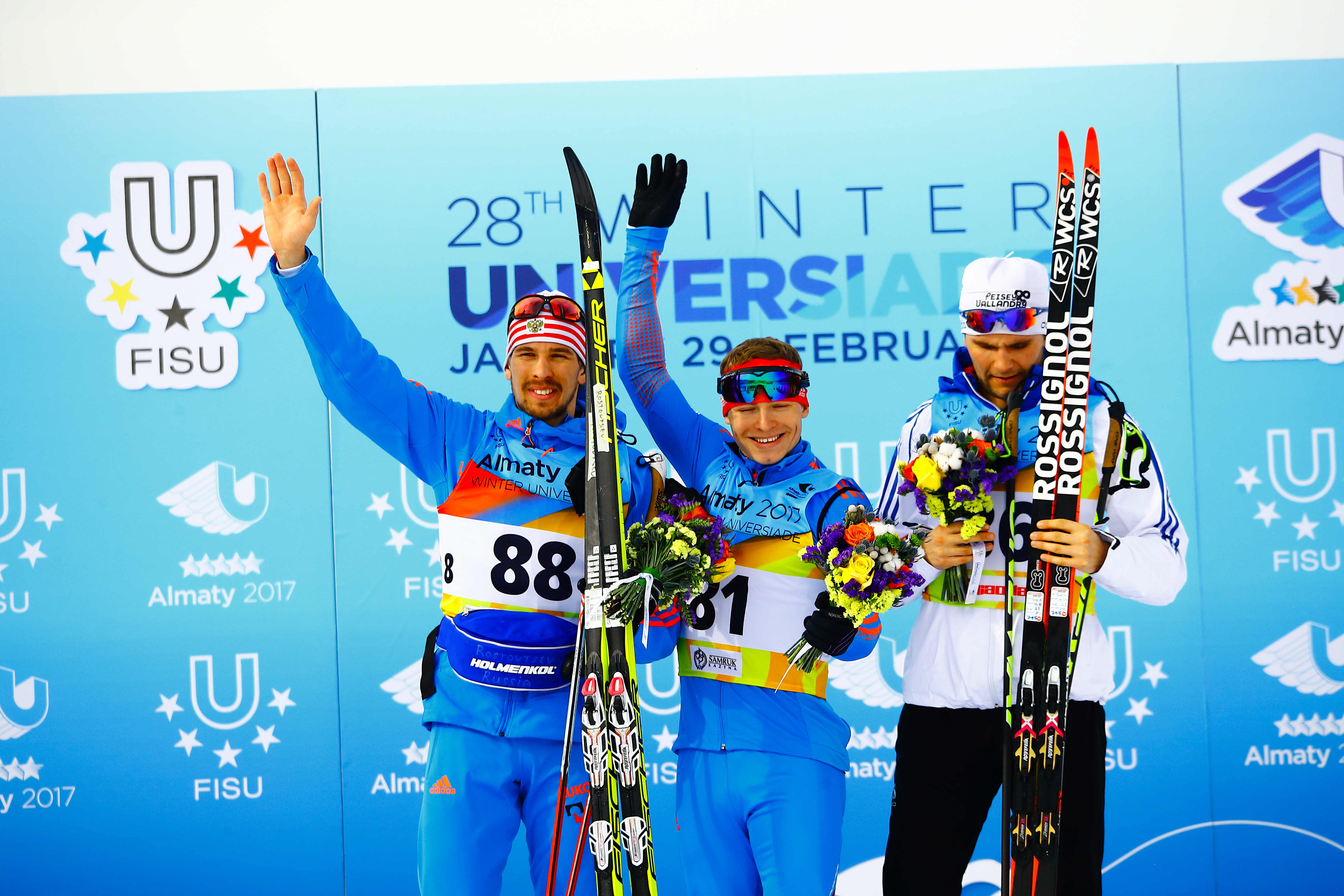
Dmitriy Rostovtsev and Valeriy Gontar of Russia (l, c) and Alexandre Pouye of France on the podium for the men’s 10 k classic at 2017 World University Games in Almaty, Kazakhstan. (Photo: Almaty2017.com)
Russia took four of the six available podium spots in the opening day of nordic racing at the World University Games in Almaty, Kazakhstan.
In the 10 k classic, Valeriy Gontar took an 8.9-second win over Russian teammate Dmitriy Rostovstev. It was an upgrade for Gontar, a student at Penza State University, who was third in this event at the 2015 Universiade. Rostovtsev is a former podium finisher at U23 World Championships. Alexandre Pouye of France was third, +21.8.
Vincent Mason of the University of Wyoming had the best U.S. finish, clocking in at 44th (+2:54.0). Teammate Will Timmons finished 73rd and Sam Wiswell 80th, Mitchell Hollman (Air Force Academy) 82nd, Kevin Geisen (Western State)84th, and Cameron Moore (Western State)85th.
For Canada Jordan Cascagnette (Team Hardwood) finished 49th, +3:12.3. Conor Thompson (Université Laval) finished 53rd, Carrington Pomeroy (Nakkertok) 57th, William Dumas (Skinouk) 58th, Gavin Shields (Lappe Nordic) 59th, and Alexis Morin (Université Laval) 77th.
In the women’s 5 k classic, Lilia Vasilieva earned a 13.3-second victory over Russian teammate AnnaNechaevskaya, a podium finisher at last year’s Russian National Championships.Anna Schevchenko of Kazakhstan – who started the season on the World Cup and finished 32nd in the La Clusaz 10 k – was third, +15.2.
Elise Sulser led the United States in 23rd place; the University of Wyoming skier was 1:58.4 off the pace. Teammate Meghan Kent was 48th and Yara Thomas 49th. Emma Malmqvist (Colorado Mesa University) placed 50th, Sierra Jech (State University of New York) 60th, and Sierra Foster (Oregon State University) 61st.
For Canada, Christel Pichard-Joliceur (Université Laval)was one spot behind Sulser in 24th (+2:02.5). Emma Camicioli (Rocky Mountain Racers)placed 40th, Shelby Dickey (Highlands Trailblazers) 43rd, and Kyla Vanderzwet (Nakkertok) 47th.
Soldier Hollow is seeking to hire a year-round Head Coach to oversee Team Soldier Hollow, a club program serving youth skiers in Midway & Heber Valley, Utah. Team Soldier Hollow is based out of the 2002 Olympic and Paralympic Nordic Venue and offers youth programs from the entry level Youth League, to the Development and Competition Teams.
The position involves overseeing the skiing program, instruction & support of coaches at all levels, offering year-round coaching and support to all Comp Team athletes, including making training plans, and practices 4-6 days per week. Additionally, the position involves organizing and leading a few training camp trips in the summer/fall, as well as all Junior National qualifiers trips around the IMD USSA region.
Duties include:
Conduct safe, fun and developmentally appropriate practices for the Comp Team (high school age athletes)
Write and execute training plans for the Comp Team athletes
Work with parent volunteers and assistant coaches who will assist in practices and at races
Communicate effectively with athletes and families by email, phone and via website regarding schedule and upcoming events
Plan and attend out of town races, camps and overnight trips with the Comp and Devo Teams
Provide race support including waxing at races
Assist in hosting events at Soldier Hollow year-round, and other supportive roles that won’t interfere with primary coaching responsibilities
Assist in Team Soldier Hollow fundraisers over the course of the season
Ideal candidate will have junior & collegiate (or better) ski racing experience. Previous coaching experience is desired but not required. USSA coaches license & Level 100 coaches certification is required before the start of the ski season.
Please contact Soldier Hollow Sport Programs Director, Scott Peterson for any questions or more information at 435-640-3084 or scott.peterson@soldierhollow.com
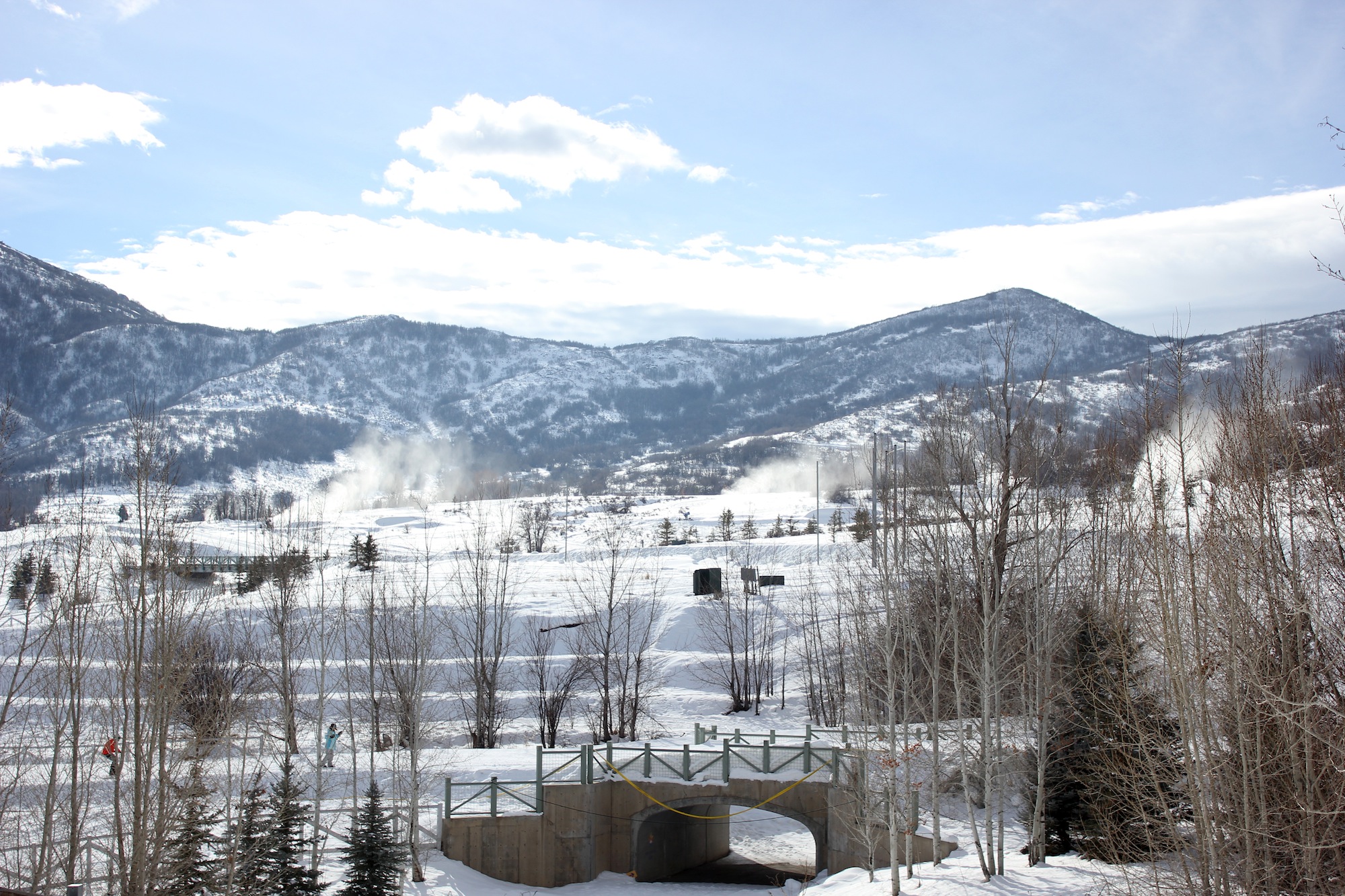
Snowmakers in action at Soldier Hollow in January 2014. The 2002 Olympic venue in Midway, Utah, last hosted the U.S. senior national championships in 2014 (as well as the year before in 2013) before Houghton, Mich., hosted in 2015 and 2016. Nationals are returning to SoHo this coming January.
PARK CITY, UT – Top cross country athletes from across America will participate in 16 races at seven different stops as part of the U.S. Ski and Snowboard Association’s (USSA) annual USSA SuperTour. The 2016-17 tour kicks off in December in Bozeman, MT.
The SuperTour is a series of International Ski Federation (FIS) sanctioned cross country ski races taking place across America, produced by the USSA, together with its divisions and clubs. The Tour is a vital piece of the USSA’s development program, providing top level racing at key cross country centers around the nation. It’s a proving ground for club athletes with aspirations of making it to the U.S. Ski Team and competing on the FIS World Cup tour and in the Olympic Winter Games. Caitlin Patterson (Craftsbury, VT; Craftsbury Green Racing Project) and Eric Packer (Anchorage, AK; Alaska Pacific University) took the season long titles in 2015-16.
“The USSA has had great support from its clubs and divisions in putting together this year’s calendar,” said USSA Nordic Domestic Program Director Robert Lazzaroni. “We’ve rotated a few sites this year and will continue to move around in the future to get the SuperTour to new places. Moving the event around helps stimulate top-level racing in America.”
Period 1 includes stops in Bozeman, Mont., and Silver Star (Sovereign Lake), British Columbia. The decision was made at USSA Congress to start the series one week later than previous years and to combine with Canada to increase the field.
Period 2 will open in January with the L.L.Bean U.S. Cross Country Championships at Soldier Hollow in Midway, Utah. Soldier Hollow is also a site for the 2017 FIS Nordic Junior and U23 World Ski Championships. Athletes will then continue on to Truckee, Calif., for races on the Auburn trail system.
The third period will feature two stops in the midwest. Athletes will race on a new homologated trail in Ishpeming, Mich., before participating in America’s largest cross country race, the Slumberland American Birkebeiner, on Feb. 25 in Hayward, Wis. The series wraps up with the SuperTour Finals Mar. 27- April. 2 in Fairbanks, Alaska. Finals will also double as the L.L.Bean U.S. Championships for long distance and freestyle sprint.
“The divisions, venues, technical delegates and homologation inspectors have been working hard to develop new venues and evolve current courses to strengthen the SuperTour,” stated USSA Cross Country Development Coach Bryan Fish. “We are making strides to include junior and collegiate racing within the SuperTour to enhance head-to-head racing with juniors, college athletes and our top World Cup competitors. Our collaboration with Cross Country Canada will also better prepare athletes for international competition. It’s an exciting year for cross country in the United States, and we’ll get to showcase this to the world during Junior World Championships.”
Athletes will also vie for for points across the tour to earn Continental Cup leader starts and World Cup starts. There will also be spots available for the 2017 FIS Nordic World Ski Championships Feb. 22 – March 5 in Lahti, Finland. Those spots will be awarded after the conclusion of the U.S. Cross Country Championships in January.
(*Note: U.S. championships also include a freestyle sprint qualifier, which serves as a qualifier for 2017 World Championships but will not be scored as a U.S. nationals or SuperTour event)
Jan. 21-22, 2017
Truckee, CA
Men: Sprint CL, 10 km Free
Women: Sprint CL, 5 km Free
Period 3
Feb. 17-19, 2017
Ishpeming, MI
Men: Sprint Free, 10 km CL
Women: Sprint Free, 5 km CL
Feb. 25, 2017
American Birkebeiner
Hayward, WI
Men’s and women’s 50 km Free
Period 4
Mar. 27-April 2, 2017
SuperTour Finals
Fairbanks, AK
Men: 24 km Skiathlon, Sprint Free, Relay, 50 km Free
Women: 14 km Skiathlon, Sprint Free, Relay, 30 km Free
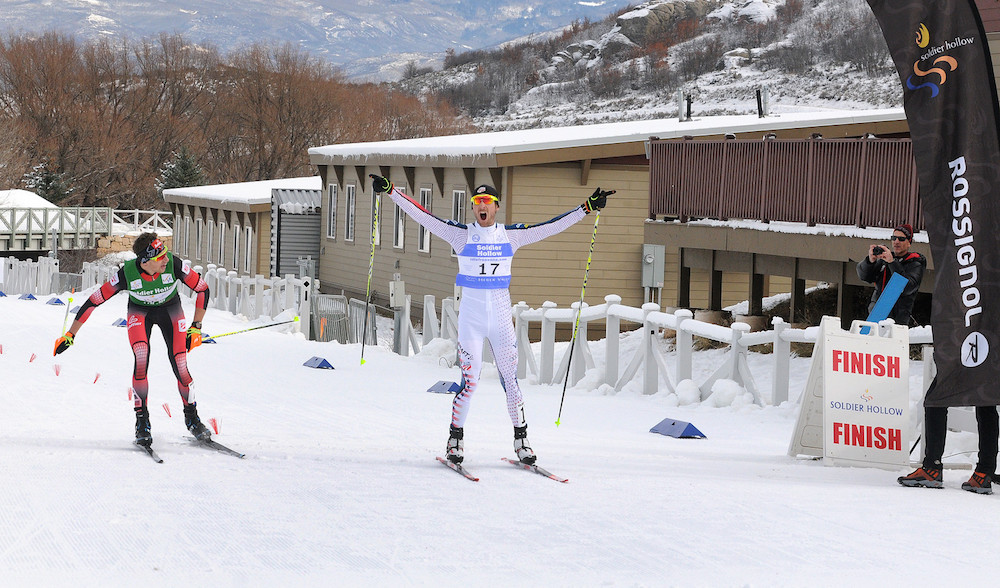
U.S. Nordic Combined’s Taylor Fletcher (r) shouts as he edges Austria’s David Pommer at the finish of Sunday’s 10 k Gundersen to win this Nordic Combined Continental Cup at Soldier Hollow in Midway, Utah. (Photo: U.S. Ski Team/Tom Kelly)
Jump, ski, repeat. That was the mantra in Park City and Midway, Utah, this weekend as some of the world’s best nordic-combined athletes converged for a series of three Continental Cup races. Continental Cups are a stepping stone for some athletes on their way to the World Cup; it’s also an opportunity for already accomplished World Cup skiers to maintain race fitness and keep their jumping dialed.
All three of the competitions Friday, Dec. 11, through Sunday, Dec. 13, involved a normal-hill jump at Utah Olympic Park followed by a 10-kilometer ski race at Soldier Hollow.
Day 1: Taylor Fletcher Third
Austria’s David Pommer leads teammate Bernhard Flaschberger the 10 k Gundersen start on Friday, Dec. 11, at the Nordic Combined Continental Cup at Soldier Hollow in Midway, Utah. They went on to place first and second, respectively, and American Taylor Fletcher (not shown) finished third. (Photo: U.S. Ski Team/Tom Kelly)
With a break in the Nordic Combined World Cup schedule, many skiers from Europe were in Park City. That was evident from the results on Friday, Dec. 11.
Austria’s David Pommer, who finished in 26:15, narrowly beat teammate Bernhard Flaschberger by 0.2 seconds at the line. The Austrians captured five of the top six places, with U.S. Nordic Combined skier Taylor Fletcher finishing third, 37 seconds after Pommer.
Starting the day on the normal hill, Japanese high-school student Hisaki Nagamine, 18, recorded the longest jump of 97.5 meters. American Ben Berend leapt to fourth, while teammates Jasper Good ranked 10th and Ben Loomis jumped to 13th.
Fletcher jumped 88.5 meters to rank 14th going into the 10 k. Pommer tied for the fifth-longest jump at 95.5 meters.
Fletcher started the race a minute and 20 seconds back. At the race’s mid-point, Fletcher bridged up to Pommer and Flaschberger. At the finish line, the 25-year-old Fletcher held off Austria’s Franz-Josef Rehrl to take third place, with the third-fastest ski time. Nagamine did not finish the race.
Overall the U.S. team had a solid day. Five Americans finished in the top 16 with six Americans in the top 30. Michael Ward, originally from Aspen, Colo., placed 10th (up from 25th in the jump with the seventh-fastest 10 k).
Berend, 20, and Good, 19, both from Steamboat Springs, Colo., completed their best Continental Cup races to date in 12th and 13th, respectively. Seventeen-year-old Loomis, of Eau Claire, Wis., placed 16th.
Day 2: Two-peat for Austria’s Pommer; 4 Americans in Top 10
The result sheet tells the story: Pommer maintained his lead in the overall Continental Cup standings by 60 points over Taylor Fletcher by winning again. Pommer jumped to seventh then skied to first, winning the event in 24:20.1.
But unlike Friday’s competition, with the Austrians clogging most of the top six, Fletcher took second just 0.1 seconds back from the win. Loomis captured a career-best fourth — missing the podium by four seconds. Italy’s Armin Bauer placed third (+46.1).
Michael Ward (U.S. Nordic Combined) placed sixth, 10th and 12th in three Continental Cup competitions Dec. 11-13 in Park City, Utah. Here, he’s pictured starting the 10 k race in 25th on Dec. 11 at Soldier Hollow. He went on to place 10th in that race. (Photo: U.S. Ski Team/Tom Kelly)
Ward finished the day in sixth with the third-fastest time, behind Fletcher with the fastest time of the day, and Berend placed eighth for a new career-best.
The jump leader again was Nagamine. He set the longest jump at 96.5 meters. He was followed in second by Norway’s Audun Hokholt. Jumping highlights for the Americans were two-fold. Loomis jumped to third (96 meters) and Berend ranked fourth (94 meters), putting them in podium contention while starting the race 8 and 24 seconds after Nagamine, respectively.
On the other hand, Fletcher jumped to 19th and Ward ranked 20th heading into the race. Fletcher needed to close a one-minute-and-40-second gap, while Ward started another 2 seconds later.
“I decided I had to go for it. I wanted to ski easy the first lap or so and make up some time but not push the pace too much,” Fletcher said in a USSA press release. “I did that and was making up 16 seconds a lap, which is pretty good, but I just ran out of real estate. But I can’t be disappointed in that because I skied tactically almost a perfect race.”
Pommer, confident after Friday’s victory, knew Fletcher could overcome almost any deficit.
“I fought from the beginning by running a really good pace, but my coaches kept telling me Taylor was getting closer and closer,” Pommel said in the press release. “At the finish line, I was very lucky with my win — I’m glad it wasn’t one more meter. There was never any contact until the finish and I thought, ‘run, run.’ ”
Taylor Fletcher after placing second in the Dec. 12 Continental Cup in Midway, Utah, 0.1 second behind Austria’s David Pommer. Fletcher came back the next day to beat Pommer by the same margin. (Photo: U.S. Ski Team/Tom Kelly)
The third-and-final day of Continental Cup NoCo scene in Park City was a flip flop.
Apparently Fletcher needed a challenge. He again began the day behind: on this day it was a 1:16 deficit to Pommer.
Again, the athlete with the longest ride was Nagamine, jumping 96 meters. But Pommer, proving his all-around skills, ranked second in the jump and notably tied with Berend with a 94-meter jump. The two started the 10 k together, 14 seconds back from the Japanese leader. Fletcher’s distance from the front was the result of a middle-of-the-pack jump: he rode 86.5 meters to rank 17th. In addition to Berend, Loomis also started ahead of Fletcher after jumping to sixth (91.5 meters) and starting 30 seconds back.
The cloudy conditions at Soldier Hollow kept the ski tracks firm and fast. Fletcher took advantage. (Remember, he had 1:16 to make up and catch Pommer). He pushed it from the start, ticking off one competitor after another. On the third of five laps, Fletcher had skied into second.
By then, Pommer was off the front solo. With three kilometers remaining, the time back to Fletcher remained 25 seconds. That time gap, in that distance, became a grind-it-out time trial for Fletcher.
And roughly 2.8 kilometers later, Fletcher could draft right behind Pommer. Rounding the tight 180-degree corner before the finish, the two skiers sprinted for the line.
“It’s so tight in that final corner. It’s great snow but it’s also icy. Trying to keep that ski under you is difficult,” Fletcher recalled in a press release. “I chose that wide line to carry a little bit more speed knowing he was going to want the center and try to block me. I knew if I took that wider line I would have a lot more speed.”
With the sprint on, Fletcher toed just ahead of Pommer, beating the Austrian by a tenth of a second in 23:37.3. Once again, Nagamine finished 22nd (+2:45.7).
“I’m not known for my sprinting, but I put in a hell of a sprint and I’m proud of it,” Fletcher said after posting the fastest 10 k time en route to the victory.
“Taylor was skiing so well, so fast, he deserved to win,” Pommer said in the press release. “Second place is more than good. Today there was no strategy, it was just running for survival. I just keep saying ‘push your limits, push your limits.’”
This was the fourth-career Continental Cup victory for Fletcher. More importantly, Fletcher’s three podiums during the Park City Continental Cups have earned the U.S. a fifth quota spot on the World Cup.
The U.S. had four skiers in the top 15 and six in the points. Berend placed sixth, and Ward finished 12th with the fourth-fastest ski time. Good raced up to 15th (from starting 20th) and Loomis finished 21st.
Local 15-year-old junior, Stephen Schumann, of the Utah Olympic Park Sports Club, scored points in the top 30 in all three races — his first-ever Continental Cup events — placing 25th on Friday, 27th on Saturday and 26th on Sunday.
The Nordic Combined World Cup resumes Dec. 19-20 in Ramsau, Austria, with two more normal hill/10 k competitions. Fletcher currently trails Pommer by 40 points in the overall Continental Cup standings.
Ben Berend leads the U.S. in fourth in the ski jump on a foggy morning at start of the Nordic Combined Continental Cup at Utah Olympic Park in Park City, Utah. (Photo: U.S. Ski Team/Tom Kelly)
Taylor Fletcher jumping on foggy morning at start of the Nordic Combined Continental Cup at Utah Olympic Park in Park City, Utah. (Photo: U.S. Ski Team/Tom Kelly)
Jasper Good jumping on foggy morning at start of the Nordic Combined Continental Cup at Utah Olympic Park in Park City, Utah. (Photo: U.S. Ski Team/Tom Kelly)
Ben Loomis takes charge on a tight corner in the 10 k race at the Nordic Combined Continental Cup at Soldier Hollow in Midway, Utah. (Photo: U.S. Ski Team/Tom Kelly)
Ben Loomis celebrates a career-best Continental Cup fourth-place in December in the 10 k cross-country race at Soldier Hollow in Midway, Utah. (Photo: U.S. Ski Team/Tom Kelly)
Ben Berend charges around a corner in a 10 k Nordic Combined Continental Cup cross-country race at Soldier Hollow in Midway, Utah. (Photo: U.S. Ski Team/Tom Kelly)
Jasper Good (in white) chases down a competitor on a high-speed corner in the 10 k Nordic Combined Continental Cup cross-country race at Soldier Hollow in Midway, Utah. (Photo: U.S. Ski Team/Tom Kelly)
Ben Berend leads the way in the final 10 k cross-country race at Soldier Hollow during the Nordic Combined Continental Cup in Park City and Midway, Utah. (Photo: U.S. Ski Team/Tom Kelly)
Soldier Hollow is seeking to hire a full-time Head Coach to oversee its Competition Team. Team Soldier Hollow is a club program serving youth skiers in Midway & Heber Valley, Utah. Team Soldier Hollow is based out of the 2002 Olympic and Paralympic Nordic Venue and consists of 3 different levels of youth programs from the entry level Youth Ski League, to Devo and Comp Teams.
The Head Coach position involves support to all Comp Team athletes, including making training plans, and running practices 4-6 days week. Additionally the position involves organizing and leading training camp trips in the summer/fall, as well as all Junior National qualifiers trips around the IMD USSA region.
Duties include:
Conduct safe, fun and developmentally appropriate practices for the Comp Team (high school age athletes).
Write and execute training plans for the Comp Team athletes.
Communicate effectively with athletes and families by email, phone and via website regarding schedule and upcoming events.
Overseeing and working in close coordination with Assistant Coach(es).
Coordinating program activities with Program Manager, Devo Coach and ski school.
Plan and attend out of town races and overnight trips with the Comp Team.
Drive Soldier Hollow vehicles to/from training and races.
Provide race support including waxing at races.
Regularly promote program events/success via social media & local press.
Maintain Team wax and equipment.
Work with parent volunteers and assistant coaches who will assist in practices and at races.
Assist with staff and volunteer trainings and clinics.
Assist in hosting events at Soldier Hollow year-round, and working as part of the professional staff in other supportive roles.
Assist in Team Soldier Hollow fundraisers over the course of the season.
Ideal candidate will have junior & collegiate (or better) ski racing experience. Previous coaching experience is desired but not required. Youth biathlon experience is not required, but may enhance your application. USSA coaches license & Level 100 coaches certification is required before the start of the ski season.
Compensation and/or benefits are dependent on the candidate and their qualifications.
Please contact Soldier Hollow Executive Director, Richard Hodges to submit your resume and references or questions to: richard.hodges@soldierhollow.com
Soldier Hollow is seeking an assistant coach for the upcoming fall/winter season. Team Soldier Hollow is a 150-skier club based out of the 2002 Olympic and Paralympic cross-country ski venue in Midway, Utah. More information on our youth ski programs can be found at teamsoldierhollow.com
Primary responsibilities include: assisting with all practices, effectively communicating with athletes, parents, and coaches, traveling to local and regional races, assisting with waxing and other race day duties, driving Soldier Hollow vehicles.
Minimum Qualifications:
Experience cross-country ski racing and/or coaching
Current, or ability to obtain, USSA coach membership
22 years of age or older
Ability to drive Soldier Hollow vehicles
Available to work weekends during the winter season
The assistant coach position can be full or part time depending on qualifications and preference. Compensation is dependent upon experience.
For more information or to apply for the position please email resume to Morgan Smyth at morgan.smyth@soldierhollow.com.
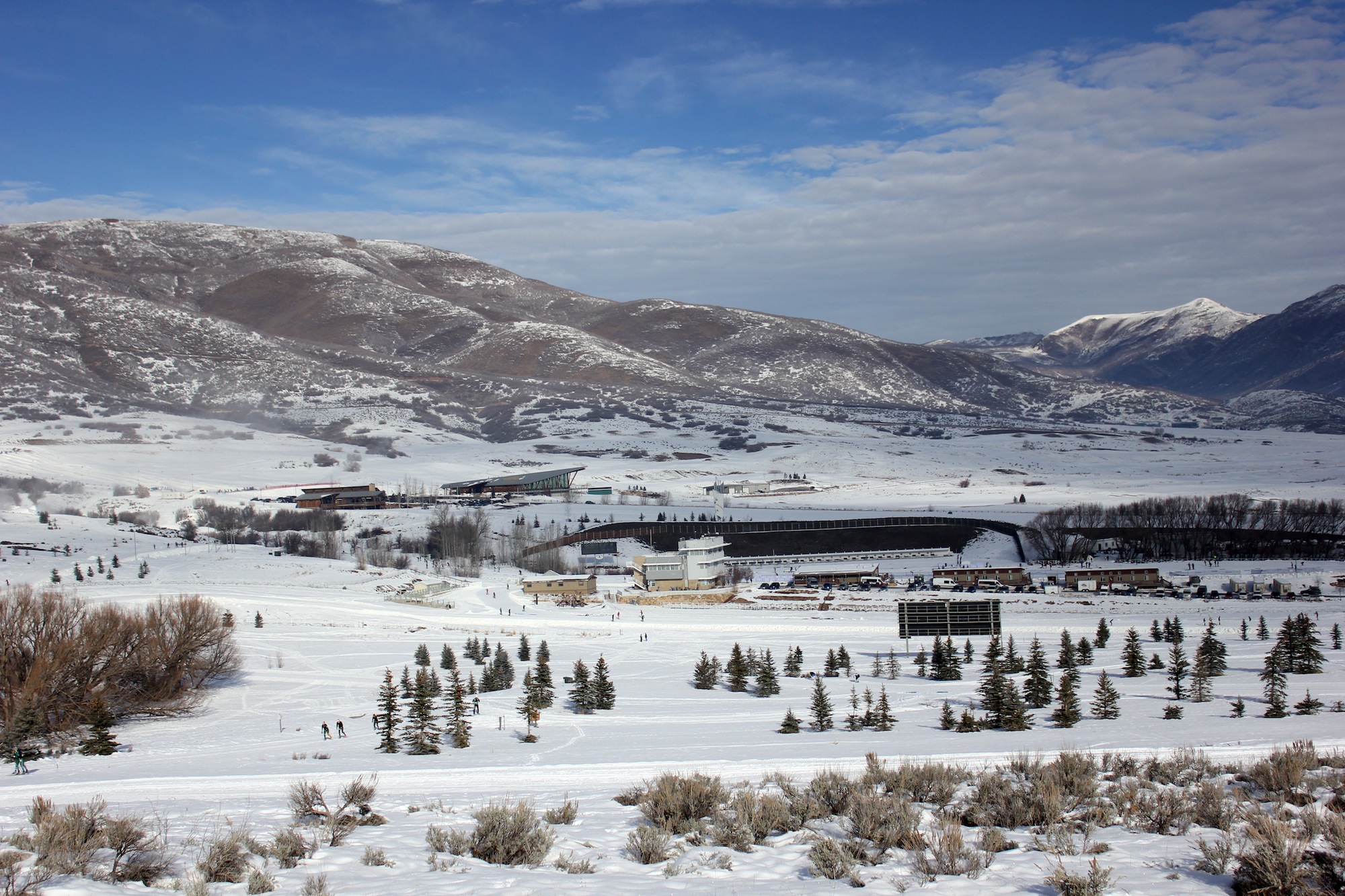
Soldier Hollow in Midway, Utah serves as the cross country venue in the recently submitted bid for the 2017 Junior/U23 World Championships by USSA. With no competing bids, there is a high chance the Championships will come to the U.S. for the first time in its modern form. In this photo, Torin Koos (BSF) out-lunges Ben Saxton (SMST2) for the win of the 1.5 k freestyle sprint at the 2014 U.S. Cross Country Championships at Soldier Hollow. (Photo: Tom Scrimgeour)
UPDATE: According to the International Ski Federation, Utah will officially host the 2017 FIS Nordic Junior/U23 World Ski Championships. See the pre-decison article from June 5 (below) to learn how the U.S. entered a bid after last hosting in 1986, and what the Championships will look like.
If everything goes according to plan the world’s best junior and U23 nordic skiers will descend upon Park City, Utah in the winter of 2017. The United States Ski and Snowboard Association announced Tuesday that organizing body submitted a bid for the 2017 Nordic Junior/U23 World Championships at this year’s International Ski Federation (FIS) Calendar Conference, which began June 3 and will continue until June 8. With no other bids, all that stands between the U.S. and the Championships is a stamp of approval from FIS.
The last time the U.S. hosted a Nordic Junior World Championships was in 1986 at Lake Placid, N.Y. At the time, however, the event only consisted of ski jumping and nordic combined and did not include officially recognized cross country skiing races (although there were cross country races that were coordinated with the event), as is standard in Junior/U23 World Championships since 1991. The U.S. has also hosted the 2004 Cross Country Intercontinental U23 Championships at Soldier Hollow, but the U23 World Championships were not created until 2006, when they were hosted in conjunction with the Junior World Championships in Kranj, Slovenia.
According to USSA Vice President of Events and IT Calum Clark, there’s a high chance the U.S. will host its first modern Junior/U23 World Championships in 2017. He explained the U.S. bid was the sole entry for the event, and that all that was left for USSA to gain hosting rights was the official go-ahead from FIS.
“We met with the FIS leadership this afternoon any they were excited for [the Championships] to come back to America,” Clark said from the 2015 FIS Congress in Belgium Thursday. He explained that the only thing left was “a simple rubber stamp from the council.”
If the U.S. is selected by FIS, the event will be held between the cross country courses at Soldier Hollow in Midway and the jumping complex at the Utah Olympic Park, in Park City.
An American-hosted Championships has been a dream of U.S. Nordic Combined Coach Greg Poirier for many years, but it wasn’t until 2014 that he decided to jumpstart the project. “It was kind of my idea to bring these Championships to the U.S. I had been thinking about it for years and finally last year I decided to stop thinking about it and get something going,” Poirier said in a phone interview.
He approached the cross country and nordic combined committees at the 2014 USSA congress and was encouraged to further explore a U.S. proposal. Poirier put together an ad hoc bid committee consisting of officials from Soldier Hollow and Utah Olympic Park, which then presented a proposal to the leadership of USSA, including President and CEO Tiger Shaw, in the fall of 2014. Once USSA was comfortable with the presented budget, it sent a written intent to host the Championships to FIS before the December 31 deadline.
A view of Soldier Hollow’s stadium from the highest point of the 5 k olympic course.
According to Clark, USSA supported the proposal due to thorough planning and feasibility. “So often with these World Championships, the excitement can overwhelm the practicality and you get this aftermath of realizing that this is going to be a whole lot of work that you’re not prepared for,” he explained. “In this case we had such a tremendous group of people with great experience on both sides of the nordic skiing jumping and cross country.”
Clark said that the financial model of the Championships was within the means of USSA due to various groups who provided “semi-guarantees of strong financial support.”
According to the Vice President, the most important factor of the bid was the athletic opportunity it provided to U.S. athletes. Over the years USSA has been exploring the possibility of bringing other high-profile international competitions stateside to further such opportunity, exampled by last year’s discussions of a cross country World Cup in New York City. Clark said that in the end, however, a Junior/U23 World Championships made more sense.
“We went through the process of exploring an urban cross country World Cup and [the nordic leadership] came back to us and said, ‘no, if you’re doing anything Junior Worlds is what we’d like to have.’”
If USSA receives the pending bid for the 2017 Championships there will be several focus areas that organizers will need to tackle. It will start with the creation of a new organizing committee, consisting of technical delegates from cross country, nordic combined and jumping. Once the committee is created they will work to build a plan regarding marketing, television or live streaming, transportation, and accommodation. Poirier hopes to create an athlete village in Midway, Utah — possibly at the Zermatt Resort — where all competitors, coaches, and staff will stay during the event.
Organizers will also look into updating Soldier Hollow, the cross country and biathlon venue for the 2002 Olympic Games, to meet the Championships’ needs. Poirier said that a future organizing committee would explore using the original cross country stadium at the venue in addition to creating more challenging courses that feature increased climbing. According to the nordic combined coach, any changes in courses or stadium placement would use existing trails and facilities.
“It’s already a great center,” Poirier said of Soldier Hollow. “We created this bid with the intent that we wouldn’t have to create a whole lot of dollars for infrastructure improvements. If we can get some and there’s a need then it would be a great opportunity for both the Olympic Park and Soldier Hollow. But if we can’t, we’re confident that we can move forward with the facilities the way they are now.”
Although the 2014 Nordic Combined Olympic Trials featured the cross country portion of the event at the Utah Olympic Park, Poirier said that it made more sense for the cross country portion of the Championships’ nordic combined events to take place at Soldier Hollow because the venue was already in use by the other cross country races and due to its proximity to the athlete village in Midway.
Those anxiously awaiting official confirmation of the bid will have to wait until Monday June 8, the last day of the the 2015 FIS Calendar Conference.
In the meantime, the high likelihood that the U.S. bid will be approved is giving many in the nordic community a sense of excitement. “It gives me goosebumps to think about it and I have butterflies in my stomach,” Poirier said.
“What I’m most psyched about is those kids that are in our pipeline who are going to be able to compete on our home turf,” he added. “Hopefully they are really going to shine and that will really be the impetus and catalyst for the spark that gives those young boys and girls motivation. That’s going to be the real gem, the real benefit to these games.”
With just days before official confirmation, USSA officials, Poirier and other organizers aren’t about to relax.
Caitlin Gregg (Team Gregg/Madshus) racing to a nearly four-minute victory in the 20 k freestyle mass start at U.S. Cross Country Championships on Jan. 8 at Soldier Hollow in Midway, Utah. (Photo: U.S. Ski Team/Sarah Brunson)
Editor’s Note: Part of a quote based on a conversation Caitlin Gregg had with the U.S. Ski Team, which originally ran in this article, has been omitted for the sake of clarity and objectiveness.
The power couple of U.S. ski racing, Caitlin and Brian Gregg are somewhere in Europe with a rental car as they await their next move, which will be decided when the U.S. Nordic Ski Team officially announces its 2014 Olympic team on Wednesday.
On Sunday, the husband and wife wrapped up the last of the World Cup races they earned as the early season U.S. SuperTour leaders — with Caitlin nearly qualifying in Saturday’s freestyle sprint then pulling out of Sunday’s 10-kilometer classic mass start in Szklarska Poręba, Poland. Brian was sick and did not race last weekend, but got one World Cup under his belt two weekends ago with a skate sprint in Nove Mesto, Czech Republic.
“We have had a blast and we are looking forward to a little R and R!” Caitlin wrote in an email on Sunday. “I think I hit the point where the adrenaline and excitement of the past few weeks faded and the fatigue and nerves from travel and anticipating the Olympic Team selection set in! It is always a bummer to pull out if a race but there are times when it hits you like a pile of bricks and I know I have a lot of (hopefully big) races down the road to prepare for still this season!”
Team Gregg celebrates Caitlin’s national title in the 20 k freestyle mass start at 2014 U.S. nationals in Midway, Utah. Earlier in the day, Brian placed second to Sylvan Ellefson (SSCV/Team HomeGrown) in the men’s 30 k freestyle mass start. (Photo: Caitlin Gregg/In the Arena)
For the better part of the last four years following her first Olympics in 2010, Caitlin has had one race on her mind: the 30-kilometer freestyle mass start at the 2014 Olympics in Sochi, Russia.
The aspiration goes back to her college days at Northern Michigan University, when her coach Sten Fjeldheim told her the 30 k skate would be her forte.
“A couple Birkies later, a couple more marathons under my belt, I can see that being pretty awesome,” said Gregg, a two-time winner of North America’s biggest ski marathon, the American Birkebeiner.
In 2010, Gregg notched 30th in the 10 k skate for the best-distance result but an American woman since Nancy Fiddler placed 27th in the 15 k classic at the 1992 Games in Albertville, France. Fiddler went on to notch 29th in the 30 k skate at the same Olympics.
Nearly 22 years later, the former national-team member (in 2007 and 2009) and one of the best distance skiers in the U.S. sat quietly in a corner of a small grocery store/eatery in Midway, Utah. Two days before one of her biggest races of the season at U.S. Cross Country Championships, she was fueling up after a morning workout at Soldier Hollow’s nordic trails.
Fresh off an interview with Cosmopolitan Magazine a week or two before, Gregg, 33, looked like a sporty glamour girl in her natural setting — minus the makeup and blowout. A Minneapolis resident and half of Team Gregg (Brian being the other half), she wore a sparkly Loppet Nordic headband and hadn’t yet changed out of her Loppet Nordic race suit. The white, black and blue spandex and accompanying gear was relatively new to the Greggs since they pioneered their own elite team with the support of Loppet Nordic Racing this season.
The following is from an interview with Gregg on Jan. 6, two days before she crushed her competition in the 20 k freestyle mass start, winning by an unprecedented margin at U.S nationals by nearly four minutes. A few hours later, she and Brian flew from Salt Lake City to Prague to prepare for their first World Cup races of the season in Nove Mesto three days later.
FasterSkier: How are you feeling about your distance-skate racing?
Caitlin Gregg: I’ve only done one skate distance race this year [before the U.S. nationals 20 k] that’s really counted for anything. It feels like I haven’t really had an opportunity to race, let alone where my true strengths lie, so I’m excited to see where I sit … on that spectrum of that next level of endurance combined with skating combined with altitude combined with big hills. I mean that’s kind of everything you’re looking for picking a team for that 30 k in Sochi.
Brian and I have obviously talked about this and said, ‘You know, it really hasn’t been many distance skate races [this] calendar year, 12 months.’ If you look back on it, there was a true distance skate race, there was one in Minneapolis and both Brian and I both won that but it didn’t count because it was part of the Tour [de Twin Cities]. And last year, the way they scored this is going off the calendar year, but not the FIS scoring year. Last year was the total cumulative time that went to the FIS points not just your time for the day, which they’re now doing on the World Cup this year. It’s sort of weird that the criteria picks from previous years with different rules governing how the points are [allocated]. So that race was a great race and it was a win of the day, but not really slated as a win, which is tough when it’s your strength and you don’t get opportunities. So really besides that race, the Birkie is the only true race over a distance that is anywhere near the 30 k. It’s actually on the long end, but it’s the only one we’ve done. We tried to get some distance skate races at SuperTour Finals, but it just wasn’t in the cards. So just one skate race on the schedule, besides this one, before the team selection.
So you know, it’s sort of like you’re up against some odds there. The hardest thing for sure, I mean I’m super psyched to be going to Europe, but the weirdest thing I’ve ever experienced is trying to make a team where you don’t really ever get to compare yourself to the team. People are being named and obviously they’re having great results, and you feel like, ‘Gosh that’s incredible. I haven’t even had a chance.’ I mean I’ve had a chance in other [races], but not in my so to speak, strengths, against the field that they can put in that event.
“The weirdest thing I’ve ever experienced is trying to make a team where you don’t really ever get to compare yourself to the team.” — Caitlin Gregg
FS: What’s it like knowing you have to be on the top of your game — and the results — in the U.S. to get to Europe?
CG: It’s one of the more unusually psychological aspects of racing. I’ve never really had to think about this in the sense that you’re sort of torn. I mean, It’s phenomenal; I’ve said this from the get go that those girls are skiing incredibly well and if I’m not skiing anywhere near that level then I don’t deserve to be on the team. There’s no question about that, it shouldn’t be, ‘Oh, I went before and so therefore I should go again.’ Those girls are on another level, but I will say it’s very unique where you feel like, ‘OK, it’s probably the fittest I’ve ever been, I’m skiing the fastest I’ve ever been, I wish I had some measure of where I sit in that other group. And you can’t because of that separation of they’re racing in Europe and you’re here.
“I’ve said this from the get go that those girls are skiing incredibly well and if I’m not skiing anywhere near that level then I don’t deserve to be on the team.”
I was told the best option was to be the SuperTour leader, to get over there to do these World Cups. That was Plan B. After West Yellowstone, I skied so well there, I was like, ‘Just checking, one more time, I know there’s a World Cup coming up in five days but just wondering how people are feeling on the team, what the opportunities are?’ (laughs)
This sort of fits in with Brian and I, our plan of the year, we’re just ready for anything, anything, any opportunity. … We’re just having a great time with great stories this year and we’re giving it our all. At some point that’s all I can control, just ski as fast as I can and you never want to be off the team, especially if you feel like you are skiing at your best and you’re in there, but at the same time it’s the most difficult decision to make in any sport, at any time, picking that team, it’s really tough.But I’m having a blast and doing it with Brian again, we’ve said this many, many times, it’s the coolest experience ever. It’s hilarious; we just sort of pack up our little house everywhere we go is like home. Compared to four years ago when I did this journey and so forth, it was really fun, it was really exciting and I knew people along the way, and there was a lot of congratulations but nothing compares to, even if you don’t make it, just the experiences that we’ve shared so far this year.
“We’re just having a great time with great stories this year and we’re giving it our all. At some point that’s all I can control, just ski as fast as I can.”
Someone was just asking me, ‘Are you happy?’ and I was like, ‘Oh my gosh, I can get second in a [U.S. nationals] sprint by a sliver, but yet the day was such a success because Brian won, our family was there, everything is just so positive right now for us in general.’ You sort of sense this, too, with the ski team and their kind of energies. You look back, we have great jobs [at the Jerry Gamble Boys and Girls Club in north Minneapolis] with the kids that we work with and our connections with the community in the Twin Cities area, and then our sponsors are psyched and we’re psyched with all of our equipment. Everything just has really good positive momentum. We’re sort of banking on this, anything is still possible.
Team Gregg supporters at U.S. Cross Country Championships earlier this month at Soldier Hollow in Midway, Utah. (Photo: Caitlin Gregg/In the Arena)
FS: You and Brian both got off to incredibly strong starts to take the SuperTour leader spots in two weekends of races. What was the secret?
CG: For sure, there’s some calculated decisions in the last three years that I’ve made between the Games that weren’t necessarily the same for Brian, but it seems like we kind of had the trajectory and everything kind of aligned to this year. For me, it was maybe taking a step back, doing more, like one summer right after the Olympics, I just had to work a ton, I had a lot of hours of work to do and a lot of debt to pay off so I just couldn’t commit to skiing like I had in the previous year. Another year I went back to school, just different things that I was doing in the offseason.
The intensity was there, but I couldn’t commit 100 percent. It’s hard to maintain that 100 percent, 100 percent, 100 percent so many years in a row and not feel a burnout or not feel an overreach, so psychologically and also in my own career as an athlete and development beyond being an athlete and what I wanted to do, going back to school for a semester or two and doing other things and taking on different roles in the community, purchasing a house, getting married [in 2011], all those other things were super important to me and I said, ‘I’m gonna take a step back, focus on racing domestically and making money and then really launch into this Olympic year with all I’ve got.’ With that came this benefit of, people always talk about gearing up for the Olympic year and how do you really come on hot? It’s planned, but sometimes it’s those things where unfortunately to make it to that Olympic year, to spend the money, to go to Eagle Glacier, or to make sure we can afford to save in Midway, or what we need to do, it’s going to take three years of kind of foresight and say this is what we got to get to line up.
“I said, ‘I’m gonna take a step back, focus on racing domestically and making money and then really launch into this Olympic year with all I’ve got.”
I think we’ve sort of nailed it in the sense that we were able to make money, we were able to represent our companies, we purposely didn’t reach out to the community in those years and have big fundraisers because we knew there’s only so many times you can do that and expect people to get behind you and rally for you. So we said we’ll kind of keep a low profile. We’re involved with the community, but we didn’t want any big to-dos. We’ve done this Fundly campaign this year which has gone beyond what we thought it even would [raising nearly $11,500 dollars], and we’ve gotten even more support from our sponsors and equipment than we ever thought we could. I think that was all a really cool, calculated approach that sort of fell into place. Really we’ve known for a long time that this year was going to be the big push, and we wanted to put everything 100 percent into it. We kind of sat back and we’re like yeah, we were able to do that and that’s awesome. We’ve stayed healthy and excited and kind of gunning for it and I think that’s made a big difference on the results sheet for sure.
FS: What kind of pressure do you feel then?
CG: Honestly, we have no pressure. I love pressure, I love getting down to it. I love circling the day on the calendar. I love being like, ‘Oh this is big, this is for all the marbles! This is the one!’ And Brian, he’s sort of like, ‘I kind of get into it,’ but anyway, we don’t feel the same sense of pressure. Nobody said to us, ‘You guys are gonna make it, you guys are gonna make it if you don’t screw up.’ It’s like, ‘If everything goes really well, you guys might have a chance of making it.’ That’s sort of been the other side of it. We’re sort of on the good side of the pressure where we can just take advantage of the opportunity rather than be like, man you just lost it for yourself. There’s two sides of that pressure spectrum and we’re on the good side. It’s maybe one of the only perks of not being on the U.S. Ski Team (laughs). In an Olympic year, you don’t have that same sort of performance pressure. Everything is sort of icing on the cake.
FS: Looking back your 2010 Olympic experience, what are your thoughts four years later?
Caitlin (formerly Compton) Gregg winning her first American Birkebeiner in 2011 as her then-fiance Brian Gregg greets her at the finish. (Photo: David Owen)
CH: Still to this day, one of the greatest things though is that anticipation of not knowing that you made it. Even in that year, for the most part people were like, especially in the beginning of the season, ‘Oh she is not gonna make it, she is skiing awful, it’s not happenin’, not getting results,’ and I was like, ‘Well, I don’t know, I’ll just keep going along here, keep believin’.’ And so when it happens — and I wouldn’t say it’s not expected, but it’s not a given — you think about it and you know there’s some athletes out there who have kind of been whispered to or said, ‘You know, you’re probably gonna make the team,’ or ‘Yeah, you’re on the team if you don’t screw up,’ or ‘Yeah you’re on the team, no question. We just have to wait to announce it.’ There’s nothing better in my opinion, if you think of some of coolest phone calls you can get, getting a phone call that’s like, ‘Hey, you made it, congrats.’
I remember when [former U.S. Ski Team Head Coach] Pete Vordenberg called me before 2010, man, I was just like, I mean that’s the coolest thing! You have no idea what he’s gonna say, he could be like, ‘Hey, way to go, you’re skiing well, not gonna happen.’ It could go either way, but getting that phone call, is by far it’s gonna stick in my mind for the rest of my life. That was the coolest thing, just not knowing and finding out that.
FS: Why did you decide to go for a second Olympics in 2014?
CG: For that year and where we were as a nation at that point, I was like, this is pretty awesome. I love skiing and I love everything about it. With the 30 k skate being where my focus has shifted, I’m excited about that event more than anything else. The relays, the team is doing great, everyone is doing so well and that’s really been what’s spurring me on to keep training and keep going for it this year, four years later … that idea that, man, that 30 k could be awesome. Sten, my coach, from college always said the 30 k skate would be my forte. A couple Birkies later, a couple more marathons under my belt, I can see that being pretty awesome.
Obviously seeing the women do so well, that’s a huge motivator and inspiring and you’re like, gosh it’s so great. I did go back and forth and say, especially when I was taking classes, maybe I should just move on or maybe it’s time. It’s always in the back of your mind, and I’m one of the oldest in on the race board, but we’re making it work in the sense that we were able to get married, buy a house, have great jobs that we feel like we’re getting a lot back from. We feel like we’re really growing in so many ways simultaneously that the ski-racing side of it, it really doesn’t feel like we’re sacrificing anything or trying to draw anything out.
I can’t think of a better life. Brian has said this and I will second this, if we had a million dollars — which we definitely don’t — if we had a million dollars, we would be doing the exact same thing. We’d be ski racing and we’d be working with kids. We’d be helping underprivileged kids, getting them excited. It doesn’t matter where they come from, but really enjoy inspiring and mentoring that next generation and I think that’s something we’ll be doing forever. And the whole skiing side of it — I was just talking to [University of Alaska-Fairbanks Head Coach] Scott Jerome about some of the things we’ve learned from working with the kids in the neighborhood where we live and what they go through and what their life is like. You stop and you think about our lives as skiers and we’re like, ‘Oh my gosh, what perspective that brings.’ You suddenly realize that a bad wax day is the least concern you ever have. I think that’s really been huge thing in the last four years for me, too, the things that you thought were such a big deal, and this all comes from maturity and just having more experiences in life, but man, I can’t tell you how many times Brian and I have left work in the last year and it could be dark, it could be 8 o’clock at night, we’re tired, it could be raining, we’re super hungry, and it’s like, ‘Man, those kids just ran all these laps for us and after hearing all those stories, we have no excuse not to get out and train right now. No excuse not to be so grateful and so ecstatic about everything we have going for us and what opportunities that lie ahead.’
“I can’t think of a better life. If we had a million dollars — which we definitely don’t — if we had a million dollars, we would be doing the exact same thing. We’d be ski racing and we’d be working with kids.”
FS: Can you explain more about your jobs in the Twin Cities?
Caitlin Gregg at her “other” job in the Twin Cities, where she works at the Boys & Girls Club in north Minneapolis with her husband, Brian. (Photo: Caitlin Gregg/In the Arena)
CG: We are so fortunate. We both work for an organization called In the Arena, there’s a couple athletes on the circuit — Sylvan Ellefson, Torin Koos, and numerous others that have been involved with this, Laura Valaas, Nicole De Yong — it’s been an incredible, incredible opportunity for us.
It’s something that we’ve been involved with now for five or six years. It’s really incredible because it’s a program that’s nationwide. It’s a nonprofit for all endurance sports but typically underfunded endurance sports, so mountain biking, rowing, triathlon, running, cross-country skiing, sports that are not funded as you would imagine compared to baseball, basketball, golf. The idea is that you’re taking athletes that are college graduates who are on the cusp or on track to qualify for either World Championships, World Cup or Olympic Games, and it takes those athletes and their community-service proposals. You as the athlete propose to the organization what type of community work you’re going to be involved in and what the scope of that work entails, in terms of who are you helping, what is the demographics of the area, what is your plan, what are you going to specifically do with those youths involved.
Through generous donations and grants that this organization receives, whether it’s companies, individuals — I know for a while one of my grants came from a Minneapolis-based company, General Mills, for a year — it’s really cool to see that their specific grant wanted to target health and wellness in north Minneapolis so it was a nice circle. They could support In the Arena, and In the Arena could support me, I could be a volunteer for these kids so that’s been really the backbone of our ability to continue ski racing.
We’re really proud of the fact that we can be self sufficient. Brian says that every year we can afford to keep ski racing in the sense that we aren’t losing money and we aren’t living off our parents, we’re not being a drain to anything, is really what it’s about for us. In the Arena has been that backbone for us to continue racing and secure our living expenses when we’re not racing during the season. It pays for, whether we’re renting at the time, now we own a house, that or utilities or any of those incidentals that we have. On the other side of it, it’s awesome because we get to work with these kids who come from all kinds of different backgrounds, who come from lives that I think would probably completely turn most of the individuals involved with cross-country skiing in the U.S.’s world. This is the real deal and this is pretty intense for these kids. And again, it gives us the opportunity to show them that just because they’re living in this particular world of what they know, that there are other opportunities out there.
Basically, what Brian and I have really focused on with our world in north Minneapolis, is we bought a house there for $10,000 dollars because that’s what we could afford and that’s what was available there. We live in the community where we work with these kids, so not only do we go to the Boys & Girls Club or Harrison Park, but they see us out training on their streets. That’s a huge connection that can’t be created from an artificial sense. Having them see us actually out physically training, walking our dog, mowing our lawn, we’re part of their community. I think that seeing that … in the sense that we are an active, energetic couple that are working together and working well, which they don’t often see, that idea of husband and wife still together, and that we are excited for them. A lot of their attention or feedback comes from negative reinforcement. If they act up, if they’re misbehaving, they instantly get what they’re looking for, which is people pay attention to them, people take notice. So we’re trying to turn that upside down and say this is what you really shine with and this is something that you’re good at. They’re all phenomenal athletes and we took on running this year and it blows my mind how good they are and suddenly they’re getting this positive reinforcement. It’s amazing what it does, everyone comes up to us and says, ‘Our kids are behaving better, they’re motivated, they’re healthier, they’re excited.’ It’s goal setting, it’s everything. It’s so amazing to have that be a part of our ski career.
FS: It is year round?
CG: It is year round. Brian and I used to go to different schools in the areas we were staying, we made big effort to do that throughout the season, and what we found is that we were getting really sick. We spent a lot of the fall 2012 in the Methow Valley so we were away from our project and we were away all winter, so we had to put in a big push over the spring and summer. It’s quite a bit of hours, actually. We propose how many hours we can work, and we’re working more than people would probably realize. We’re really grateful; it’s an awesome opportunity, but it is something that we have to be on top of. It’s not just every couple of weeks go in and say, ‘Hey, what’s up kids!’ and take a couple photos … We really have to do the consistent day-after-day connection with the kids and year after year, it sort of builds on itself. We have to explain to the kids when we leave, ‘This is where we’re going, we’ll be back, don’t worry you’ll see us again.’
It’s not full-full time, it’s not quite 40 hours a week but it’s quite a bit in the spring and summer that we really need to put in. We have to figure that out with our training schedule … if we’re doing a training camp somewhere. Last year we finished up the season in Truckee, Brian finished his last race, showered and we flew to northern Michigan, because I was inducted into my collegiate hall of fame there, and then we drove right back home and the next day we went to work.
FS: So no spring or summer vacations?
CG: We have not taken a vacation ever. I’ve gone and visited my family in New York City or California because obviously we don’t get to do that often either, but no true vacations. We’re kind of joking that France, we’re flying into Paris [before Prague], and we haven’t even taken a honeymoon yet. It’s kind of like our honeymoon.
FS: What are your plans for after this season?
CG: I know for a fact Brian wants to keep racing. I know he has no question in his mind, he’s having a great time, it’s sustainable, he feels like he’s progressing in so many ways and I’ve kind of gone back and forth. I’d love to keep racing. I think it would be awesome, and there’s obviously a whole slew of different races you can do. There’s all of these local citizens’ races and also marathon races in the U.S. that we think can really garner some more excitement and attention on a higher [level]. I mean the Birkie’s a big deal and all the other marathons are big deal, but even more so. And then there’s marathon races over in Europe, which we think would be just a blast. You get to travel the world racing in these long-distance, some of them are classic so I’d have to work on that, but skate races. That couldn’t be more fun. We totally want to have kids someday, and we joke all the time that we’re pretty creative, when it comes to living. We have a $10,000-dollar house and a free hut that we got off of a mountain in Washington … You can basically make anything work if you’re willing to bend your expectations, and have a good perspective of it. We’re staying at a Craigslist condo [in Midway] that’s kind of funky, but it’s super cheap and we’re like, ‘It’s perfect, it’s fine, it rocks.’ That’s kind of our outlook and so we’re willing to keep skiing in that realm.
“There’s marathon races over in Europe, which we think would be just a blast. You get to travel the world racing in these long-distance, some of them are classic so I’d have to work on that, but skate races.”
The more I work with these kids and I see sort of their passion and how excited they are, the more I realize that, gosh we really do know a lot about this sport and a lot about, especially Brian, the industry, training, racing, waxing, everything is just becoming more and more knowledge for us. The ideas of coaching at some point are definitely entering our minds. We’ve dabbled back and forth, we both have degrees in totally separate areas [Brian in business] but you kind of get to a point that’s like, this is pretty fun, and working with these kids and seeing that next generation get excited, this is more speaking now with the Loppet kids and other kids that we have in programs like CXC, that suddenly spurs this part of you. You’re kind of like, ‘I could get into this.’ I never would’ve thought that would be me. I remember in college saying, ‘Sten, I don’t want anything to do with coaching ever. I want to be done with my skiing and move on,’ and yeah, it totally changes after how many years I’ve been doing it. We’re definitely in skiing for a long time.
“I remember in college saying, ‘Sten, I don’t want anything to do with coaching ever. I want to be done with my skiing and move on,’ and yeah, it totally changes after how many years I’ve been doing it.”
FS:What about after your World Cup races — will you train with the U.S. Ski Team at its pre-Olympic camp in Seiser Alm, Italy?
CG: We were told to get a ticket home and if we need to make changes, we’ll just change that ticket. Basically we said, ‘If we make the team can we train and race? and they’re like, ‘Yeah. If you don’t, no’ (laughs). We understand from the perspective that their athletes are there and focusing and they want to not have extra bodies that they have to babysit in the pre-camp or Toblach.
That’s the one hard thing when you take years off you always get those phone calls that, ‘You’re on USADA [US Anti-Doping Agency], but seeing as how you’re not fast and not on the U.S. Ski Team, you don’t need to be on USADA anymore.’ … I don’t get all the invitations to the training camps and the girls training camp; they’ve invited me year’s past, but I couldn’t afford to go … so then you slowly don’t get invited to those camps anymore. Finally this year I didn’t get the Olympic registration form back in August. October came around and Brian’s like, ‘You’re skiing well, probably should register for those Olympics because if you don’t, you can’t go.’ It had to be in by the next day or something so I called up [U.S. Nordic Program Manager] Joey [Caterinichio] and I got that done. You have to be on your stuff. I got on USADA right then. Test me all you want.
The best part, too, is Brian’s family coming on the road with us. It’s hilarious. They’re pretty awesome in-laws. I lucked out. My husband’s sweet, my in-laws are even sweeter.
Team Soldier Hollow, located at the 2002 Olympic venue in Midway, UT, is looking for an enthusiastic and energetic coach to work with our Devo Team skiers (ages 10 to 13). Ideal candidates will have experience cross country ski racing and/or coaching and waxing. Current USSA Coaches License is required.
Responsibilities include:
*Planning and leading 3 fun practices a week
*Developing technique of both new and experienced skiers
*Helping kids wax skis for training and races
*Support at local citizen & junior series races
This position starts mid fall and requires 2 to 3 afternoons a week plus some weekend races. Additional opportunities to assist with Comp Team (ages 14 to 18) training and travel may exist.
Team Soldier Hollow is a growing club with over 100 youth in our ski programs! For more information on Team Soldier Hollow visit www.teamsoldierhollow.com
The final day of the 2013 U.S. Cross Country Ski Championship proved to be one of the most exciting as racing continued with the skate sprints. After the day of racing it was Dakota Blackhorse-von Jess who was strongest down the finish stretch to earn the top step on the podium and the national crown.
Sadie Bjornsen of APU/USST (front right) edges Stratton’s Sophie Caldwell (l) and CXC’s Jennie Bender (c) in the 1.3 k freestyle sprint final at U.S. nationals on Tuesday in Soldier Hollow. Caldwell was second and Bender placed third while Becca Rorabaugh (117) was fourth, Annie Hart (103) fifth and Caitlin Gregg (r) sixth.
FasterSkier’s coverage of the 2013 U.S. Cross Country Championships is brought to you through the generous support of The Memory Clinic in Bennington, Vt.
MIDWAY, Utah – The whole tactics and ‘let’s see if I can outsmart you’ game was pretty much out the window by the start of the women’s freestyle sprint final at U.S. Cross Country Championships on Tuesday.
Or so it seemed.
With every passing quarterfinal and semifinal, six competitors per heat shared the task of completing the 1.3-kilometer course the fastest and smartest way possible. Play your cards right – getting in any fighting position except first on the long downhill – and you could make the final. Do that in the final, and you should make the podium.
Caitlin Gregg of CXC (l) leads the start of the 1.3 k skate sprint final at U.S. nationals in Soldier Hollow. She ended up sixth behind Sadie Bjornsen (in black), who captured her second straight victory.
It was too easy, and Caitlin Gregg – one of the shorter ones in the bunch – knew it wouldn’t work for her. The 32-year-old Central Cross Country (CXC) skier had watched US Ski Team (USST) member Tad Elliott use his small stature to his advantage in the men’s final just before. He stormed out of the gate and tried to drop the field, building a gap by the first straightaway. But Gregg never saw the finish.
Oh well, she thought. Might as well go for it, too.
“Look at how much taller are these girls are than me,” Gregg said. “I’m a little [makes sound effects] meep, meep, meep. I had to go where my strengths were. I pretty much just hammered as hard as I could.”
The rest of the women’s finalists simply followed her lead. The pace was much different than they were used to, but it was a welcome change to the typical jockeying game that came about later in the heats.
Sadie Bjornsen, of Alaska Pacific University (APU) and the USST, didn’t stress.
“Kudos to Caitlin for charging from the start,” Bjornsen said. “That’s a scary thing with this course. … I was afraid it was gonna be a cat-and-mouse again.”
Instead, she followed Gregg and Sophie Caldwell (Stratton Mountain School T2 Team) up the short, steep climb known as the horseshoe at Soldier Hollow, putting herself in third for the downhill.
Meanwhile, Caldwell just ahead in second was getting nervous.
“It’s just really stressful coming down the hill because positions could change so much and always felt very flustered,” said Caldwell, who placed third in the preceding classic sprint at nationals.
“The position I came into the stadium wasn’t ideal,” she added. “It wasn’t terrible, but Jennie [Bender] and Sadie [Bjornsen] both flew by me in the draft on the downhill.”
Rounding the corner into the stadium, it was all Caldwell could do to challenge Bjornsen to the line. The two lunged in a photo finish, and Bjornsen took the win for her second straight national title and first in a sprint. Caldwell was second, and Bender finished just behind in third.
Women’s freestyle sprint podium at 2013 U.S. nationals: 1. Sadie Bjornsen (APU/USST), 2. Sophie Caldwell (SMST2), 3. Jennie Bender (CXC)
“This time, I remembered to lunge at the finish,” Bjornsen said, after taking second to Bender in the classic sprint last week.
Caldwell also lunged, but longed for a few extra meters to catch up.
“I was pretty sure when I finished that Sadie had gotten the win,” Caldwell said. “I don’t know if I looked over or just felt that she was a little ahead.”
For Caldwell, it was her best finish at nationals this year (following two third-place finishes) and tied her skate-sprint result from last year’s U.S. championships, where she was second to USST member Jessie Diggins.
For Bjornsen, 23, two victories and two silvers in four races were as much as she could’ve asked for following an injury filled offseason.
“For all of us who got a win this week, it’s a dream come true of course,” Bjornsen said. “But this wasn’t even in my hopes and plans two months ago before the season. Today was a real test of my fitness because I was exhausted, as was everybody … It’s just a good feeling to be able to finish a fourth race in a big week like that strong.”
One step behind a repeat sprint victory, Bender (CXC) nearly made it into the mix for first or second after winning the classic sprint last week. After the finish, she couldn’t remember if she lunged or not, but was wishing she did.
Regardless, she was excited about her national showing after a bout with mono and Lyme disease last summer.
“The podium definitely gives me hope for the rest of the season,” Bender said. “I had no idea how today would go really.”
Given the women’s course was identical to the classic sprint, she knew what was coming. For her, it was perfect.
“It’s definitely a super-tactical course and you never really knew what was going to happen,” Bender said. “I had to go into it with that mindset that whatever happens, happens. Each race is different.”
In the semifinal, she fell behind on the final climb and was nearly out of contention to advance. Making up time on the downhill, she slingshot back into position and won the heat. For the final, she worked her way up on the outside of the hill, scooting into fourth for the descent. There, she passed Caldwell and Becca Rorabaugh (APU), who ended up fourth.
Caitlin Gregg (r) leads up the “horseshoe” climb in Tuesday’s U.S. nationals skate sprint final at Soldier Hollow in Midway, Utah. Sophie Caldwell (second from r) hangs in second, Sadie Bjornsen sits in third, and Jennie Bender (l) makes her way up the outside.
“I was like, ‘OK, just stay in the pack, just stay there, just stay there … I’m lost again,’ ” Bender recalled thinking. “Coming down this hill I just got super low and made sure I pushed really hard off so that I could catch up and it worked. Each time I came flying around the outside and I was like, ‘Sweet! All right, let’s go for this!’ ”
Following Rorabaugh in fourth, Annie Hart (Dartmouth College) also slipped by Gregg for fifth. Gregg ended up sixth, but remained satisfied with her effort. Earlier in the day, she had qualified in second just 0.63 seconds behind Caldwell, who won in 2:55.07.
Gregg thought that was great considering she suffered a mild concussion a few days before when she hit her head on a beam.
“I didn’t do the classic 20 k because I’ve been having a lot of concussions this year,” she said, referring to one suffered in the Engadin ski marathon in March. “[Monday] I felt better and today I felt fine. I’ve kind of learned the drill with how bad it is and how long it takes now [to recover]. It’s probably not great, the doctors say, but it’s kind of a low-risk sport.”
Looking back, she’s not sure she would’ve changed her strategy for the final.
“Every other heat I went out in the pack and I did that signature slingshot, but then I was like, ‘Gosh these girls are so good,’ ” Gregg said. “I just thought, ‘What if? I gotta just try it I guess. Why not?’ ”
The third-fastest qualifier, Hart was regret-free after notching a career best at nationals. Two years ago, she was 17th in a classic sprint.
“I’ve been having an OK week, nothing bad by any stretch of the imagination, but also nothing that was just like, ‘Yeah, that’s really what I wanted,’ ” Hart said. “And today was just so perfect. I could not have asked for a better day, just like, skis were great, course was great. I just stayed really relaxed, and it was just a blast.”
After falling slightly behind on the last climb, Hart reunited with the group on the descent.
“We were just all in this huge glomp coming around the turn and then it was just like, everyone’s yelling and you’re just zoned into the lane you want and someone’s in your lane,” she said. “But it was just so much fun. I would not have done, I don’t think, anything differently.”
Rorabaugh was also thrilled with a nationals best of fourth after notching two sixth-place finishes earlier this week. Not feeling well to start the day, she considered calling it quits after qualifying in 17th.
“I’ve been kind of sick the last couple races and I was like, ‘Man, this just isn’t smart. I’m not trying to make U23’s,’ ” Rorabaugh said. “This morning I was pretty sure I wasn’t racing, coughing stuff up, total mess and so then I was like, ‘I’ll try the prelim, see what happens.’ Debated after that for a long time and then I was like, ‘Whatever I’ll just ski, it’ll be fun,’ and it was!”
In the heats, Rorabaugh stuck with a similar tactic: don’t lead.
“It works out better to try to come from behind at the end with the big corner and the fast finish,” she said after advancing second in her quarterfinal and third in her semi.
Rorabaugh took the inside lane to the finish, edging Hart on the outside behind Caldwell.
“So now I’m fourth!” Rorabaugh said of breaking her streak. “Now of course I’m like, ‘Oh, I was so close to top three.’ ”
U.S. nationals skate sprint women’s final finish: post-lunge with Sadie Bjornsen (r) in first, Sophie Caldwell (l) in second and Jennie Bender (c) in third.
MIDWAY, Utah – The 2013 U.S. Cross Country Ski Championship continued on the trails of Soldier Hollow in Midway, Utah with the senior women’s 20 k classic mass start. The lead pack was established early with just six women in contention for the national title throughout the majority of the race. On the course’s final major climb, Hermode’s Hill, it was Sadie Bjornsen (USST/APU) who attacked, opening up a sizable gap by the time she entered the stadium. Check out our footage of the action.
Alaska Pacific University and U.S. Ski Team member Sadie Bjornsen celebrates her first national title on Sunday in the 20 k classic mass start at Soldier Hollow in Midway, Utah. (Photo: Sarah Brunson/U.S. Ski Team)
FasterSkier’s coverage of the 2013 US Cross Country Championships is brought to you through the generous support of The Memory Clinic in Bennington, Vt.
MIDWAY, Utah – Just like the feeling one gets when cranking the handle on a jack-in-the-box, the women’s 20-kilometer classic mass start at the U.S. Cross Country Championships had the imminent feeling that any one of the six frontrunners was going to pop.
But who would it be, when would they go, and how hard would they push?
While Sunday’s main contenders are probably too young to understand the toy reference – all below the age of 25 – they probably shared a similar sense of anticipation.
Skiing together for the duration of the four-lap race at Soldier Hollow and breaking away from more than 70 others on the first lap, each of the leaders periodically sized one another up while ticking off the loops and buying time before the final showdown.
Somewhere along the fourth lap would most likely be the turning point, but who was going to put up the biggest challenge?
Would it be Chelsea Holmes of the Sun Valley Ski Education Foundation, the established climber, who led much of the race? What about Sophie Caldwell (Stratton Mountain School T2 Team), who sat out the preceding 10 k freestyle race in preparation for this? Then there was Caitlin Patterson (Craftsbury Green Racing Project), a quiet but consistent threat, and of course the Alaska Pacific University (APU) women – Sadie Bjornsen, Rosie Brennan and Kate Fitzgerald – contenders for a podium in any race.
Chelsea Holmes (SVSEF) leads a pack of six women up Hermod’s in the 20 k classic mass start at U.S. Cross Country Championships on Sunday at Soldier Hollow in Midway, Utah. Sadie Bjornsen of APU/USST (second from r) won and Holmes finished sixth.
Spectators flocked to Hermod’s Hill, the infamous multi-tiered climb featured in the 2002 Winter Olympics. That’s where it had to happen on the final lap; someone was going to make a move.
Bjornsen, also on the U.S. Ski Team, spared them the guesswork. She attacked on an earlier hill – the high point of the sprint course – before the long descent leading into Hermod’s for the last time. A runner-up in the two preceding races at the U.S. nationals, Bjornsen wasn’t going to let it happen again. She and the others had responded to Fitzgerald’s move earlier in the lap on one of the straightaways up top, and now it was her turn.
“I was not gonna get second again today,” the 23-year-old Bjornsen said. “The mistakes I made before was I wasn’t fully committing to really going for it, and today when I surged there, I was telling myself in my head, ‘Sadie you gotta commit, you gotta go a hundred percent.’ ”
She was especially trying to shake Caldwell directly behind her.
“When I looked behind me and it was Sophie, I tried to surge on the top of the sprint hill just to lose her sprinting legs a little bit,” Bjornsen said. “When I was coming down the hill, I saw she was still with me so I just gunned it as hard as I could to the finish and that was that.”
Bjornsen won by nearly 13 seconds in 1:05:39.2 for her second national title since dominating the 10 k classic at U.S. nationals two years ago. Fitzgerald was second (+12.9) after reigning in Caldwell on the last climb, tucking behind her on the backside descent and outsprinting her to the finish. Caldwell placed third (+14.1), Brennan took fourth (+20.4), Patterson was fifth (+24.8) and Holmes finished sixth (+36.5) in the front group.
An early leader, Becca Rorabaugh (APU) came through in ninth after falling off the pace after the first lap. She finished about 35 seconds behind Rose Kemp of the University of Utah in seventh (+3:00.6) and Annie Pokorny of Middlebury College in eighth (+3:05.4).
APU teammates Sadie Bjornsen (r) and Kate Fitzgerald congratulate each other after placing first and second, respectively, in Sunday’s 20 k classic mass start at U.S. nationals.
However, the main stories of the day were APU’s Bjornsen and Fitzgerald, who both notched career bests. Bjornsen had never raced a 20 k before yet made a point to win it. Fitzgerald had achieved two bronzes at nationals, but coming off a shoulder injury this summer, she wanted to prove she could achieve more.
Bjornsen said she had been looking forward to this race all week, seeing how classic was her favorite. Generally considered a sprinter, she wanted to erase that.
“There’s a distance skier in all of us,” Bjornsen said. “No sprint specialists.”
To succeed in her desire to win, she enlisted the motivation of her teammates overseas. Sunday morning, APU’s Kikkan Randall and Holly Brooks finished 12th and 38th in the Tour de Ski. Another USST member, Liz Stephen posted the second-fastest time up the 9 k Alpe Cermis and landed 15th overall. Rookie Jessie Diggins (SMS/USST) pulled off 21st in the final standings.
“I talked to all the girls over in Europe this morning and I was like, ‘You guys are so tough today, all I’m gonna think about today is you guys, and when I’m struggling, I’ll think about how you guys went seven days in a row,’ ” Bjornsen said. “I just kept thinking about that. There’s always more when you imagine that.”
Thinking about her teammates racing up Italy’s grueling mountain made accelerating up Hermod’s for the last time slightly easier. Meanwhile, Caldwell couldn’t hold on. After attempting to stay with Bjornsen for the final kilometer after her attack, Caldwell lost ground on the major climb.
“I had really good skis, good kick, so I was hoping people would hold the attack for as long as possible, like wait until the last hill,” Caldwell said. “[That] more or less happened, but I got pretty tired going over the top.”
When Fitzgerald passed her at the bottom of the long downhill, Caldwell knew what was in store: “a double-pole showdown,” she said. Unfortunately, Caldwell was out of gas, but still happy with her first podium in a U.S. nationals distance race.
Stratton Mountain’s Sophie Caldwell (l) chases Kate Fitzgerald (APU) into the finish of the 20 k classic mass start at U.S. nationals. Fitzgerald out-double-poled her for second, and Caldwell was third for career bests for both women.
And despite contending with three APU women, which in many ways worked together, Caldwell wasn’t intimidated.
“I’ve been on a team with Rosie before; I’ve been to World Juniors with Sadie before so we’re all sort of on the same team when it comes down to it,” Caldwell said. “I don’t think they’re plotting against me or anything. It’s fun to ski with friends.”
Bjornsen said there was a bit of joking going on throughout the hour-long race.
“The coaches kept asking, ‘Do you want GU or do you want gel?’ and I was, like, just saying the opposite of Chelsea every time,” she recalled. “And Fitz was tripping over herself and we were making jokes, and then at one point I could see Rosie was pissed off, she kept getting stuck [behind] people and she just takes off and I looked at my other teammates and was like, ‘Uh oh, here she goes.’
“We all know each other’s strengths and we all know how to wreck each other if we wanted to, but we were all sort of working together,” she added. “If Rosie took off, I took off with her and it was the same with Fitz. It’s so fun to have a team, it’s just like another interval day.”
Like most of the other top finishers, Fitzgerald described the race as fun, but said it was a little stressful at times.
“It’s funny with these long races, there are times when you’re just like ‘Oh my gosh, I can barely hang on,’ ” she said. “And then sometimes you’re like, ‘Oh I feel good, all right, I’m just gonna go.’ You can never give up. You can’t count yourself out. It’s definitely cool and having so many teammates around, too, to remind you, like, OK, I can do this.”
The second-place finish was about as good as gold for Fitzgerald, who separated her shoulder in a mountain-bike accident in June. She couldn’t do much of anything for a couple weeks, and according to APU head coach Erik Flora, she trained with one pole until October. Before that, Fitzgerald missed the second half of last season while sick with a virus.
“I feel like it wasn’t a huge detriment, but I feel like I definitely have less upper-body strength this season,” Fitzgerald said of the shoulder injury. “I had a lot of help from my coaches to train around the injury kind-of-thing, so yeah, it was a bummer but I just tried my best to train as best as I could.”
“To be able to be so strong today in the double poling, it’s tremendous,” Flora said of Fitzgerald. “We know she’s really strong and a good racer, but coming off an injury like that, it’s just great to see her back on form.”
Flora had been among the excited spectators running up Hermod’s to get in good cheering position on the women’s last lap. With three of his athletes in the mix, he knew anything could happen.
“The girls train in a group so much that they know how to ski in a pack,” he said. “You could see how relaxed they were, and they were just kind of floating around and they were making good moves.”
As for Bjornsen’s victory, which mimicked that of her younger brother, Erik, who won Friday’s 15 k freestyle and was second in Sunday’s 30 k, Flora said both were exceptional.
“When they first came to us, one of our goals was the distance races and now within a couple years they’re both medalists at nationals in distance racing,” he added. “So I would say that goal’s been met and they’re just getting stronger every day.”
All living together in Anchorage, the Bjornsen siblings and Brennan resolved to become better skaters this summer, Sadie said. “We all proved it to ourselves,” she added.
Brennan won Friday’s 10 k freestyle for her first national title and on Sunday, was slightly disappointed with fourth.
“I wish that I had a little more to get on the podium, but I really can’t be upset with that; it was a good race,” Brennan said. “I actually wasn’t even sure I was gonna start so I’m glad I did.”
Feeling like she was coming down with a cold, Brennan waited until this morning to make a call on whether to race. She decided to give it a go, but felt she might have been missing her top gear. Regardless, she found herself pushing the group early.
“The pace was really relaxed for the first two laps and then on the third lap we turned it up a bit to kind of see where people were at,” Brennan said. “No one was really faltering at all. That’s when I realized that it was gonna be really a battle. I tried to go into relaxed mode without letting any moves go by. It got pretty tough at the end. Everyone was giving a little push at one point or another.”
A two-time fifth place finisher at nationals this year, Patterson said she was simply impressed with the group and satisfied she could hang on.
“The main thought that was coming to my mind when I was out there was, ‘This is one tenacious group of skiers,’ ” Patterson said. “No one was falling off. Everyone was kind of shuffling around, leading here and there and it was pretty intense. … I think I’ve got to be happy with how close I was to them at the finish and just overall.”
For Holmes, who was fifth at U.S. Distance Nationals last year in the 30 k skate race, her sixth-place finish in the classic race was a personal best and an affirmation that she was headed in the right direction.
Despite leading the group for much of the second and third laps, Holmes said she fell off the back on the flat section with one kilometer to go.
“I just couldn’t stay on and it was a little bit gone,” she said.
After starting out the season with three SuperTour podiums, including a skate sprint victory, in Bozeman and West Yellowstone, Mont., Holmes said she struggled to find her form.
“Something went downhill somewhere,” she said. “You always want to feel good. I haven’t, so I said, today I’m just gonna go ski. … Those girls are super strong so stick with them, pull when I could and see where it went.
“Honestly, I’m happier than I have been in a few weeks,” she added. “So that’s good.”
Women’s 20 k classic podium at U.S. Cross Country Championships in Soldier Hollow on Sunday. 1. Sadie Bjornsen (APU/USST), 2. Kate Fitzgerald (APU), 3. Sophie Caldwell (SMST2)
APU teammates Sadie Bjornsen (r) and Kate Fitzgerald congratulate each other after placing first and second, respectively, in Sunday’s 20 k classic mass start at U.S. nationals.
Stratton Mountain’s Sophie Caldwell (l) chases Kate Fitzgerald (APU) into the finish for what Caldwell called a “double-pole showdown” in the 20 k classic mass start at U.S. nationals. Fitzgerald had the edge for second, and Caldwell was third for career bests for both women.
Alaska Pacific University and U.S. Ski Team member Sadie Bjornsen celebrates her second national title on Sunday in the 20 k classic mass start at Soldier Hollow in Midway, Utah. (Photo: Sarah Brunson/U.S. Ski Team)
Bjornsen bringing it home into finish of the 20 k classic mass start at U.S. nationals on Sunday at Soldier Hollow.
Caitlin Patterson and Chelsea Holmes (in back) chase Sadie Bjornsen, Sophie Caldwell, Kate Fitzgerald and Rosie Brennan (not shown) at the start of the last time up Hermod’s Hill in Sunday’s 20 k classic mass start at U.S. nationals.
Sadie Bjornsen working within the group (not shown) on her third of four times up Hermod’s Hill.
Stratton Mountain School T2 Team skier Sophie Caldwell (l) and Sadie Bjornsen (APU/USST) race head-to-head in the 20 k classic mass start at U.S. nationals on Sunday in Soldier Hollow. (Photo: Sarah Brunson/U.S. Ski Team)
Sadie Bjornsen leading the front pack
Chelsea Holmes (SVSEF) leads a pack of six women up Hermod’s in the 20 k classic mass start at U.S. Cross Country Championships on Sunday at Soldier Hollow in Midway, Utah. Sadie Bjornsen of APU/USST (second from r) won and Holmes finished sixth.