From the FasterSkier archive — posts syndicated from athletes’ and coaches’ own blogs between 2004 and 2012, kept online as published. Current coverage is at fasterskier.com.
This article was made possible through the generous support of our voluntary subscribers. If you would like to see more collegiate coverage like this, please support FasterSkier with a voluntary subscription.
By: Francesca Kitch
The Central Collegiate Ski Association (CCSA) is composed of six competing schools spanning the Midwest. Each season there are four CCSA invites–weekends full of racing–and this year, these competitions are set to begin this Saturday. The first three US Nationals races in Anchorage, Alaska, also counted towards CCSA competition; the skate 10k was scored as an NCAA qualifier, while the classic sprint and 20k classic mass start served as an opportunity to accumulate points toward team standings. Although the CCSA is a small conference, it doesn’t lack enthusiasm. Spectators travel all over the Midwest–and even to Alaska–to watch their athletes race.
Across all NCAA conferences–the CCSA, Eastern Intercollegiate Ski Association (EISA), and Rocky Mountain Intercollegiate Ski Association (RMISA)–distances and techniques are standardized. Every two years, the distance races at NCAA Championships alternate between skate and classic, and the races at the invites reflect this change. This year, the 20k mass start at NCAA’s will be skate and the 7.5k will be classic, so the CCSA qualifying races will consist mostly of 20k classic mass starts and 7.5k individual classic races. From the points earned in these races, skiers will be ranked within the CCSA, and the top 6 athletes of each gender will qualify for the NCAA Championships to compete in Hanover, New Hampshire, this March.
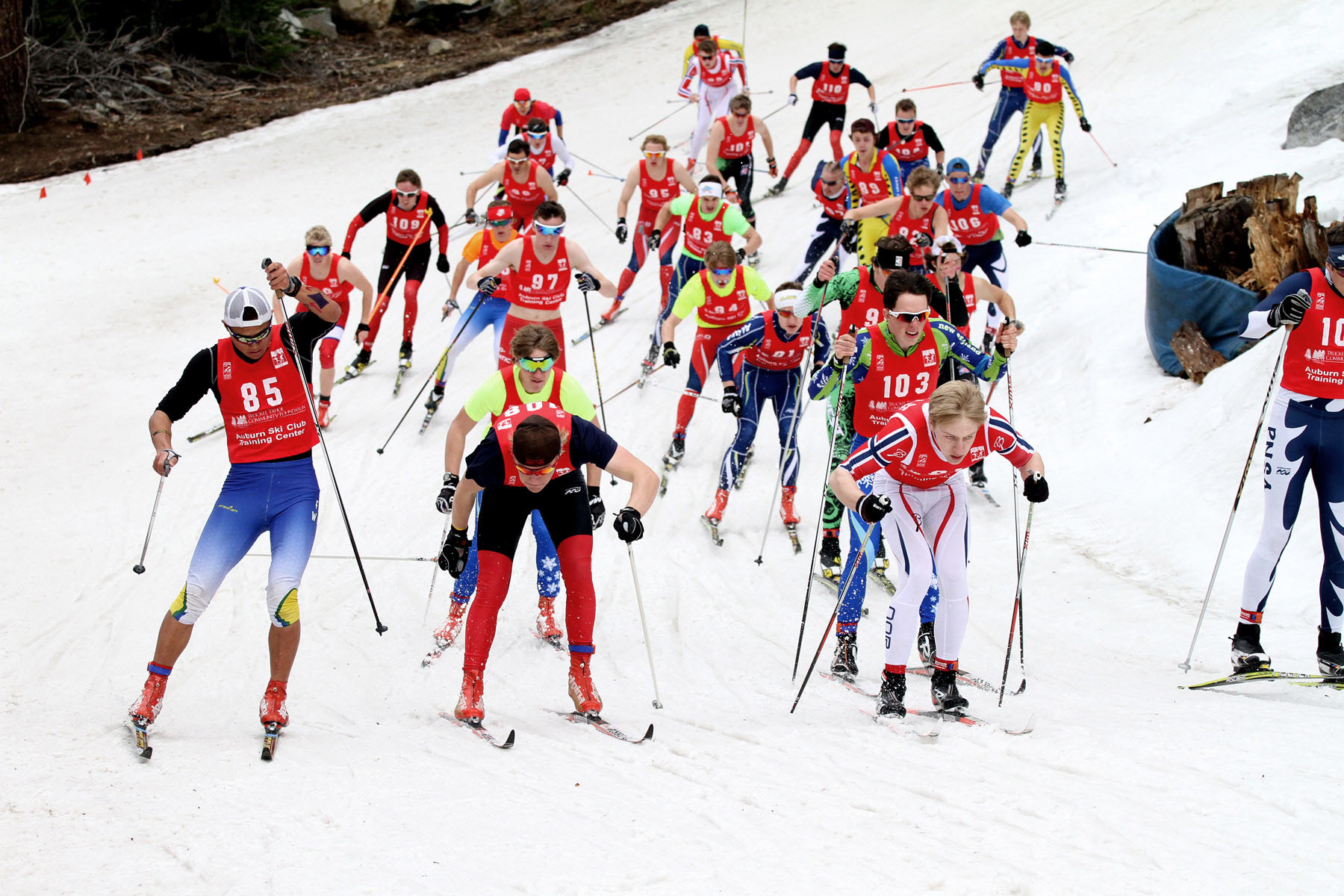
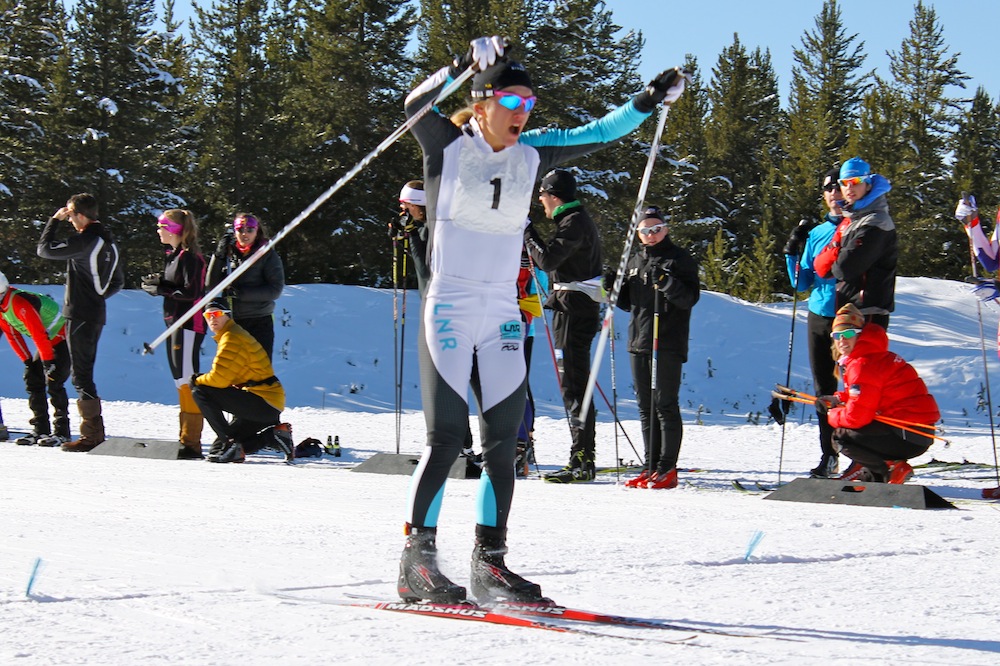
Women lining up for a 20km classic mass start last season. (Photo: Tryg Solberg)
The CCSA invite this weekend will be hosted by the University of Wisconsin at Green Bay. The Green Bay team has undergone an impressive transformation from 4 years ago when head coach Sam Meyers started the job. With a full roster of 3 men in 2021, Meyers has built up the program to now carry 17 athletes (9 men and 8 women) for the 2025 season. “This is the first year that we’ve had an upperclassmen-heavy roster…it feels like everyone has a really good understanding of how we operate as a team.” Meyers is encouraged to see how helpful the team captains have been in the seamless running of the team and how this has aided the overall maturity of the team. “We work really hard, we have big goals. But we also remember that skiing is fun.” Meyers adds, “One of the big things I look for in recruits is someone that just simply loves the sport of nordic skiing, and that’s a big factor in creating the culture that we like….not only good skiers but love working hard and being outside.” Meyers predicts strong performances from senior Ryan Themie and Junior Noah Erikson, the two top finishers on the men’s team from last season, finishing in 15th and 23rd, respectively, in the CCSA rankings. On the women’s side, Sophomore Lily Franzen is looking to improve on her performance from last year as the leading women’s skier for the team, and Meyers is excited to see what freshman Hedda Samuelsson has to show.
Men from Michigan Tech enthusiastically cheering on the women in a CCSA invite last season. (Photo: Tryg Solberg)
Michigan Tech Head Coach Tom Smith looks forward to another season with his team, excited by individual standouts and a promising team as a whole. Michigan Tech finished 13th at NCAA’s last year, the highest rank of the central conference, despite being hindered in the rankings by its lack of an alpine team to supplement the nordic team’s scores. “I’m proud to say we have an amazing team, and that’s because we have amazing people that make it what it is!” Smith stresses the importance of the balance between student and athlete as well as competition and fun. “We have two overarching goals for our team: to always work for improved performance…and above all, for our student-athletes to love their experience as a member of the team!” 3 time NCAA Championship qualifier Colin Freed is having a standout Senior season so far with top 15 finishes in the Cable Supertour and a CCSA win in the 10km skate race at US Nationals. On the women’s side, Smith highlighted Marie Wangen, Alice McKnight, and Greta Hansen as promising this season. Wangen skied into the semi-finals of both the skate and classic sprints at US Nationals as the top CCSA finisher and skied similarly well at the Super Tour in December with a top 6 performance. Of McKnight, Smith says she has “really made a performance jump in her senior season” with the first CCSA podium of her career in the 10km skate race at US Nationals. Hansen has been consistent all-around with CCSA podiums in distance races so far this season and finished as the 5th U23 American in the skate sprint at US Nationals.
St. Olaf’s team has come into new leadership this year with head coach Tor Hanson, a recent graduate of St. Olaf himself (‘23) who stayed on as an assistant coach last season. Hanson describes that “working from the team Brochman provided and now laying down my own foundation, I’m incredibly encouraged by the development seen amongst our team.” The team has indeed been making their mark on the local and international stage: Senior Lily Hubanks and Sophomore Amaeli Kam-Magruder are currently in Italy for the World University Games after impressive performances at the Cable Supertour. Hansen is encouraged by the incoming speed of the first-year class on both the men’s and women’s teams, and combined with the experience of older members of the team, it will be interesting to see how the season progresses.
Jason Kask, Head Coach for the College of St. Scholastica (CSS) team, started his job in the fall of 2023. “With an excellent freshman class and our veterans in great form, it’s shaping up to be a fun winter,” Kask remarks. Senior captains Chase High and Mae Whitcomb have bright seasons ahead after a great year of training and some promising early-season results. Freshman Leevi Tarjanne and junior Greta Leitheiser also look promising after the Supertour, Leitheiser coming home with multiple top 20 finishes and Tarjanne with top 30 performances. “We are excited to see their hard work in the off-season shine this winter.”
Northern Michigan University men’s team is all smiles after winning the conference title last season. (Photo: Tryg Solberg)
Northern Michigan University is consistently a top school in the CCSA, and last year their men’s team won the conference title. Sophomore Henriette Nilssen was last year’s highest-ranked CCSA woman and currently leads the standings after a CCSA win in the 10km skate at US Nationals. Her teammate, Senior Victoria Dybwad, was the third CCSA finisher last season and finished second in the 10km at US Nationals. Junior Luke Fricker was last year’s top men’s skier and finished second place in the US Nationals 10km skate. Sophomore Adrik Kraftson finished the podium off in the skate 10km at nationals in 3rd place.
St. Cloud University will also participate in these invitationals, but currently only has one member of the women’s team, and no men. Head coach Mike Schroden was unavailable for comment.
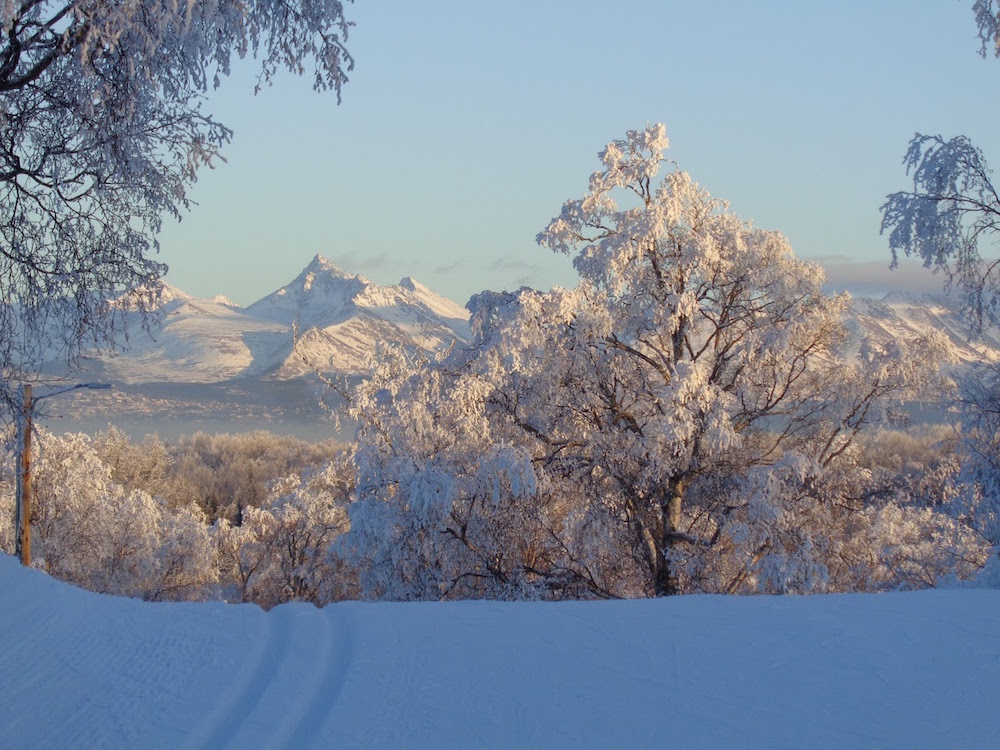
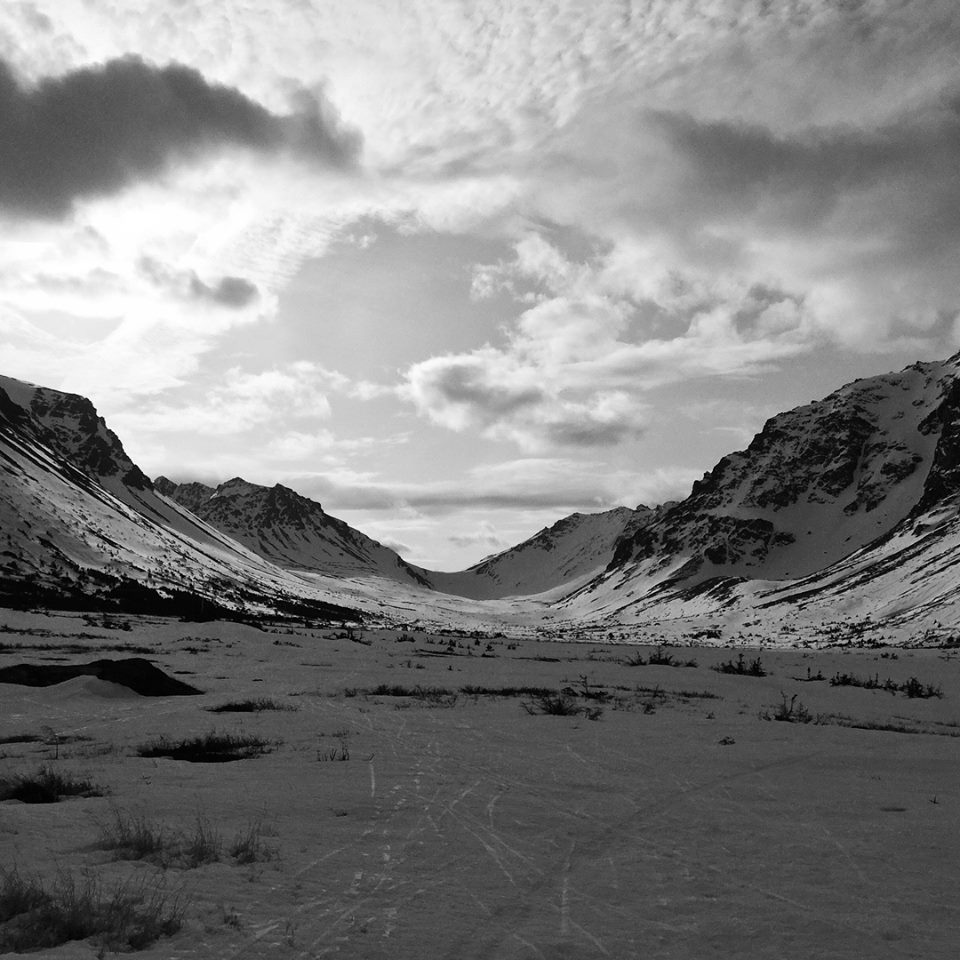
The Chugach Mountains are seen from the Lekisch Loop, part of one of the homologated courses used for FIS races at Kincaid Park in Anchorage, Alaska. (Photo: Adam Verrier)
This article has been updated with additional information about the Birkie, about all races in Vermont, and about the current state of emergency orders in Anchorage.
FasterSkier has previously reported on the significance of FIS points, points earned in races sanctioned by the International Ski Federation that can be used to compare skiers to one another even when they did not engage in head-to-head competition. Under normal circumstances, an athlete’s FIS points are used for things like selection to the following season’s national team, while team selection for international competition is generally based more on an athlete’s performance in head-to-head racing in the current season.
In this year, with all national-level races having been cancelled, FIS points are poised to take on additional significance, as U.S. Ski & Snowboard leadership will necessarily be relying more on discretion to choose teams for international competitions such as 2021 World Championships, in Oberstdorf, and 2021 Junior World Championships, in Lahti.
As U.S. Ski Team Cross Country Program Director Chris Grover told FasterSkier this fall, when it comes to comparing American performance in domestic competitions held in different parts of the country, “We know the athletes so we can easily gauge the quality of the field. If the race is a FIS race or an NRL race, we also have points to use in determining field quality. Then we simply look for stand-out performances.” Regarding comparisons between Americans racing in Europe and Americans racing domestically, the calculus was similar: “As in the case of domestic racing, it’s easy to judge the quality of the race by seeing which athletes are in the race and what the FIS points look like.”
So, FIS points are going to be exceptionally important for American athletes this winter.
So where are the FIS races going to be held? The short version of this article is just a link to this page on the FIS website. Here are the American FIS races for the 2020/21 season. Click around and take a look at it. The end.
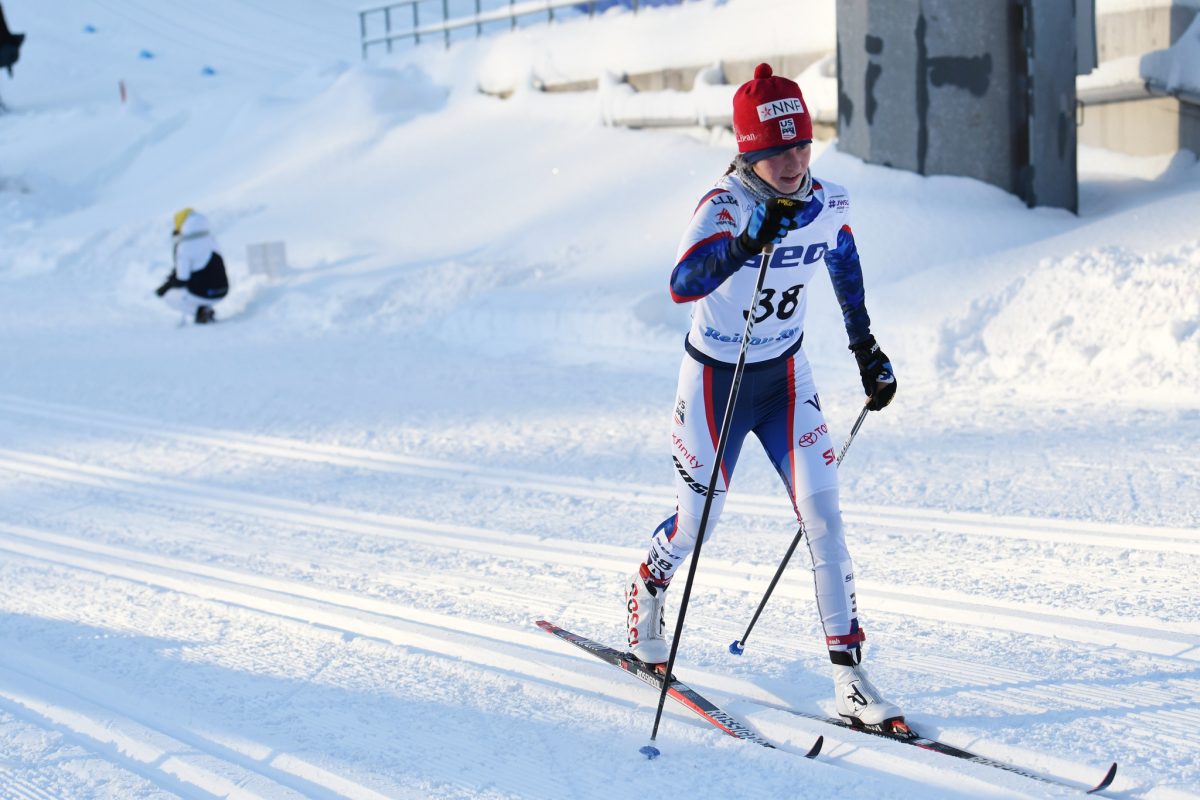
Kendall Kramer races in Lahti, Finland, on her way to fourth place in the U20 15 k classic mass start at 2019 World Juniors. (Photo: Doug Stephen)
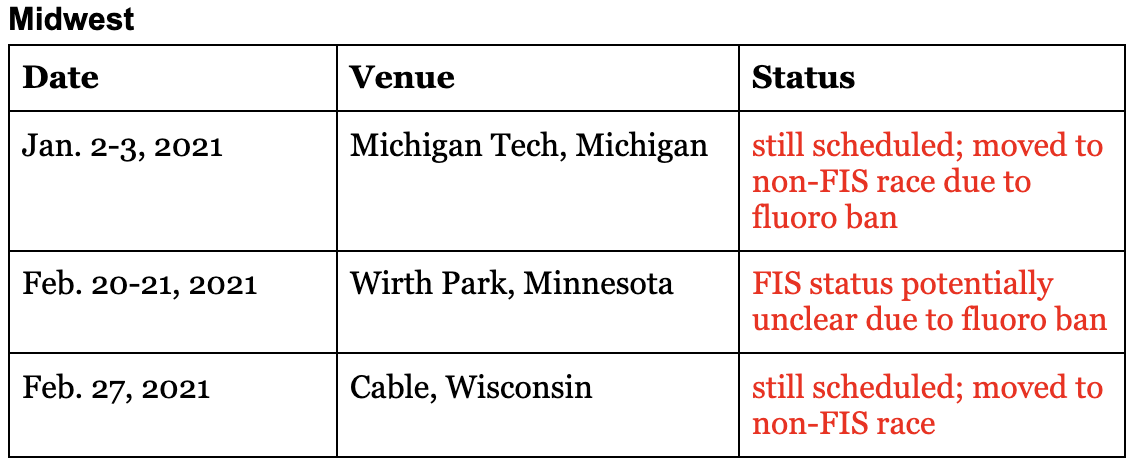
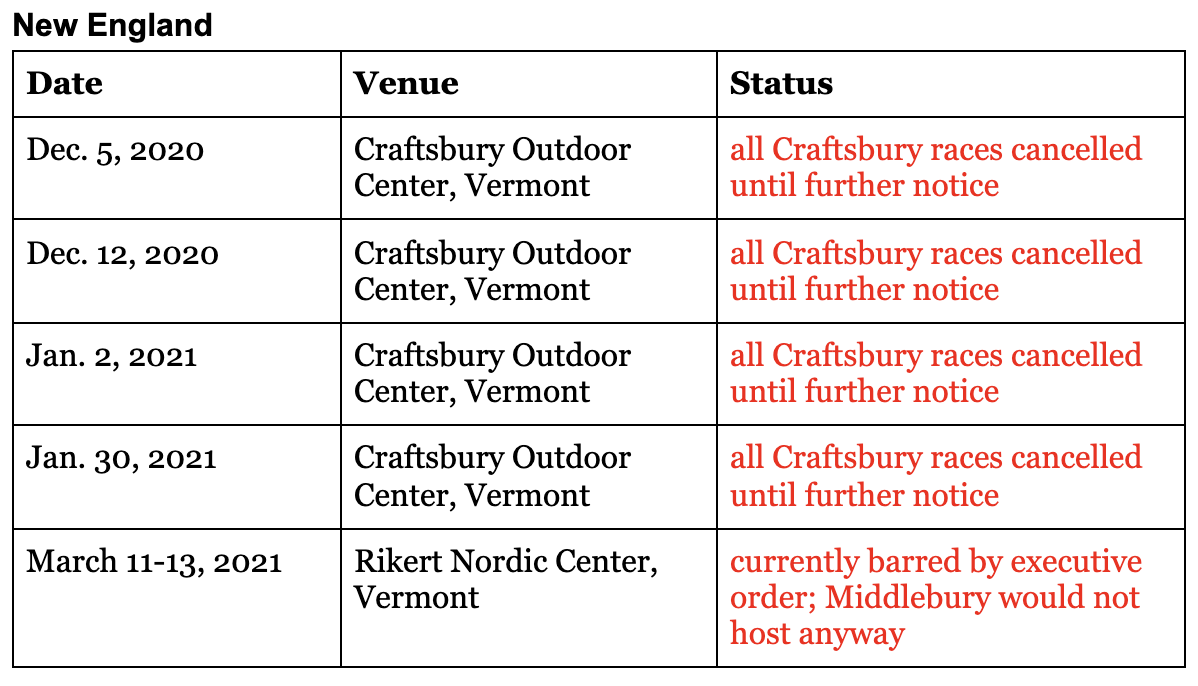
But, like many things in life these days, these plans are subject to change. Due to the pandemic and public health considerations, to be sure, but also due to the catch-22 of fluoro use and FIS sanctioning. Accordingly, the rest of this article provides an annotated list of this winter’s American FIS races, organized by geographic region, with an attempt to include the most current information regarding race status. If, four months from now, public health considerations made it impossible to have a single FIS race in this country this winter (and there are already asterisks or outright cancellations around more than half of them), at least this article can serve as a historical artifact from a more optimistic time.
(As a brief aside, it is worth noting that athletes who are unable or unwilling to race this winter will not see their FIS points suffer, if they buy a FIS membership for this season. As USSS representative Adam St. Pierre wrote in an email to USSS members in October, “Each FIS and [national ranking list] Points list released in the 2020/2021 season will include all races since May of 2019. Your points can not get worse this season, but they can improve if you are able to race and achieve better results than you did in 2019/20. You must have an active FIS license for the 2020/2021 season in order to maintain your FIS points for the 2021/2022 season.” So if you’re sitting out this season of competition but intend to race next year, it may well be worth shelling out for a FIS license simply to preserve your standing.)
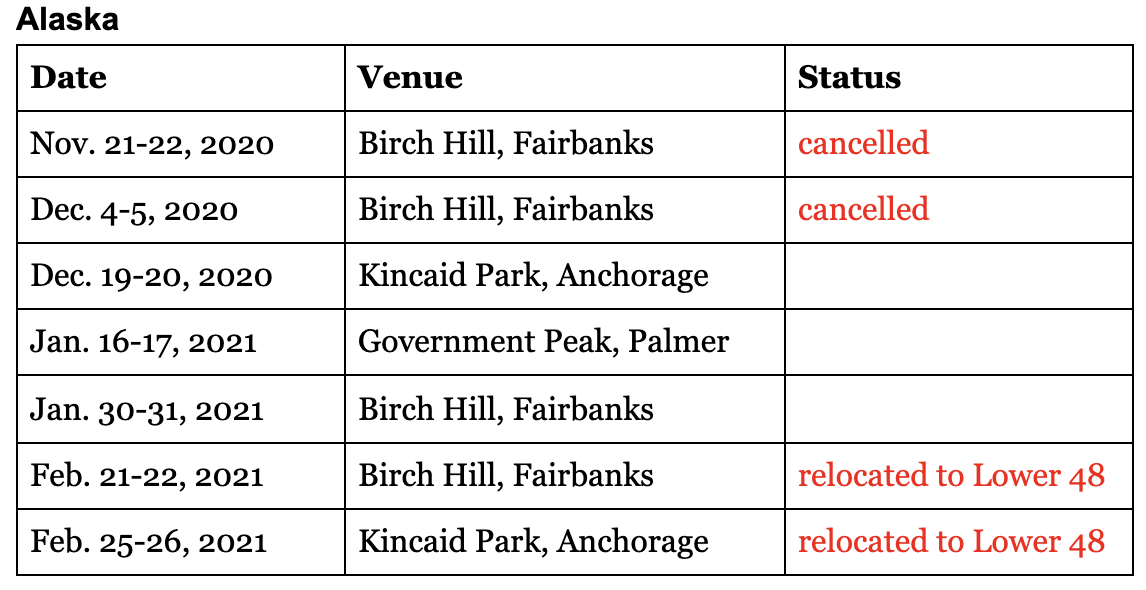
The opening weekends of racing in Fairbanks were cancelled by race organizers on Saturday, “in light of the current high rate of COVID-19 infections around the state, as well as local and statewide hospital/ICU bed capacity, and given Governor Dunleavy’s extension of the public health emergency through December 16,” according to a statement from the Nordic Ski Club of Fairbanks. In a more detailed follow-up statement posted Sunday, the ski club explained that it is moving all of its scheduled races to virtual events through the end of this calendar year. The advisory group that helped the ski club reach this decision included three physicians alongside the ski club’s race crew.
“We are disappointed to not be able to compete, though considering where Alaska is with COVID, it is a responsible decision and we support Fairbanks in their decision,” APU head coach Erik Flora told the Anchorage Daily News on Saturday.
“As coronavirus cases continue to skyrocket in the state, cracks are appearing in Alaska’s fragile health care system,” Alaska Public Media reported on Friday. Providence Alaska Medical Center in Anchorage, the state’s largest hospital, recently requested at least one mobile morgue, the Anchorage Press reported the same day. As of Saturday afternoon, two out of three civilian hospitals in Anchorage were sufficiently full that they were not accepting incoming ambulances.
The state’s next scheduled FIS race weekend, the December Besh Cups in Anchorage, does not seem to be barred by either the current Emergency Order governing the Municipality of Anchorage or its attachment covering organized sports specifically. However, the attachment explicitly bars spectators from attending sporting events, and states that “events that include participants from outside the Municipality [of Anchorage] should be postponed.” Anchorage Besh Cup races typically include multiple participants from Fairbanks and the Mat-Su Valley.
The state’s final two scheduled FIS race series, RMISA competitions in Fairbanks and Anchorage, will not be held in Alaska, but rather will be relocated to the Lower 48.
As of Sunday, Alaska as a whole ranked 14th in the country for daily reported Covid-19 cases per capita for the state overall, with 77 per 100,000 residents. A USSS document setting forth official guidance for domestic competitions advises event organizers to assess current case levels within the community, and defines “high community spread” as more than 25 new reported cases per day per 100,000. “In the event of high community spread,” USSS advises, “it is recommended you speak with your local health authority regarding ICU bed utilization and ventilator availability in the location’s level 1 medical center catchment.” Under this standard, every single venue discussed in this article is currently experiencing “high community spread,” save for those venues in Vermont.
Athletes leave the start area in a mass start classic race at Government Peak Recreation Area, Palmer, Alaska, on what is now a homologated course used for FIS races, in February 2020. (photo: Russell Hood)
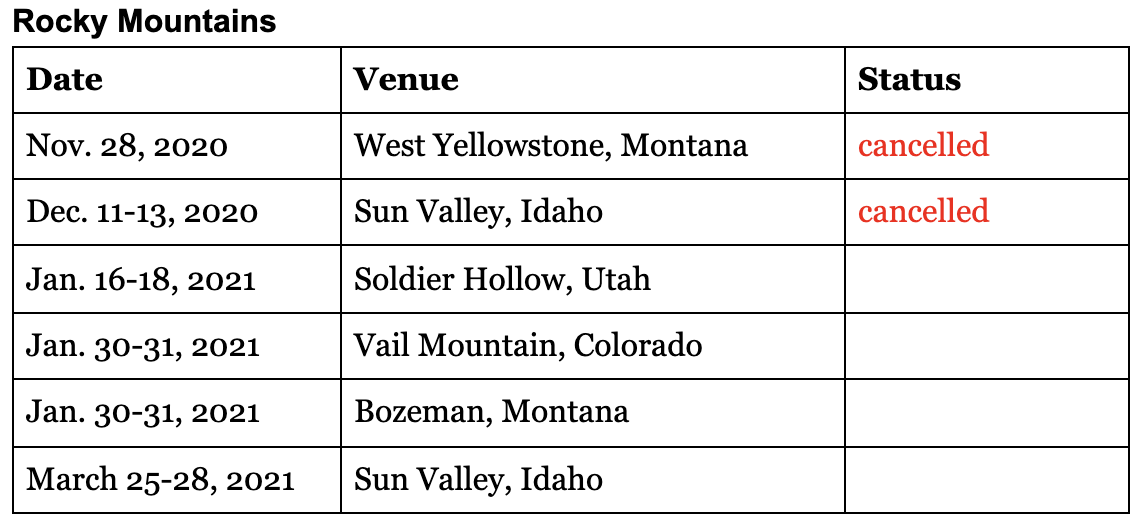
As FasterSkier reported earlier this month, although some standard programming at the Yellowstone Ski Festival will continue, the biathlon race and FIS nordic race have been cancelled. As a representative of the ski festival told FasterSkier, “We took all of the factors in, gathered all our info, and based on the increase in [COVID] cases and what the county was recommending. With what is going on, we just felt the right thing to do for the community, and for the safety of everyone was to cancel the races.”
As of Sunday, Montana ranked 8th in the country for daily reported cases per capita, with 103 per 100,000 residents. Utah was 9th, with 99; Colorado was 13th, with 81; Idaho was 15th, with 76.
Bridger Ski Foundation athletes out for a first ski in West Yellowstone in 2015. (Photo: Courtesy Bernie Nelson)
Michigan Tech is among the American venues caught in a catch-22 following the relatively last-minute decision by FIS to postpone its long-announced ban on fluorinated waxes: FIS is no longer banning fluoros; U.S. Ski & Snowboard still is banning fluoros; Michigan Tech is a fluoro-free venue; in terms of jurisdiction and sanctioning, FIS trumps USSS.
In response, Michigan Tech representatives emailed FasterSkier earlier this month that they would remove the FIS status from their races in order to remain fluoro-free. “By removing FIS sanctioning from this event, this allows us to place a fluoro ban for this race event, and all race events we are hosting for the 2020-21 season,” wrote Michigan Tech head coach Thomas Smith. “As US Ski & Snowboard has banned the use of fluorinated waxes from all USSS sanctioned events for the 2020-21 season, we will still maintain USSS sanctioning for this January 2-3 event with a fluorinated wax ban.”
Moving to Wisconsin in late February, the race still listed on the FIS site as “50 km F Mst” likely needs no introduction; this particular 50-kilometer mass-start freestyle race is, historically, the American Birkebeiner, a point-to-point race from Cable to Hayward. But this year’s Birkie has already undergone substantial change, and currently takes the form of a five-day event over a 46-kilometer loop course, “with limited and staged start waves each morning” for five days in a row.
Birkie representatives stated by email that this year’s race will not be a FIS race: “We are not FIS sanctioned for the 2021 American Birkebeiner, but we are sanctioned by US Ski and Snowboard.” Regarding the status of a fluoro ban at a USSS-sanctioned Birkie, race organizers wrote, “the 2021 Birkie Events will be fluoro-free. We are working on determining how testing will be implemented and right now, our goal is to do testing on a limited number of skiers.”
As of Sunday, Wisconsin ranked 5th in the country for daily reported cases per capita, with 119 per 100,000 residents. Minnesota was 6th, with 110 cases per 100,000 residents. Michigan was 19th, with 67 cases per 100,000.
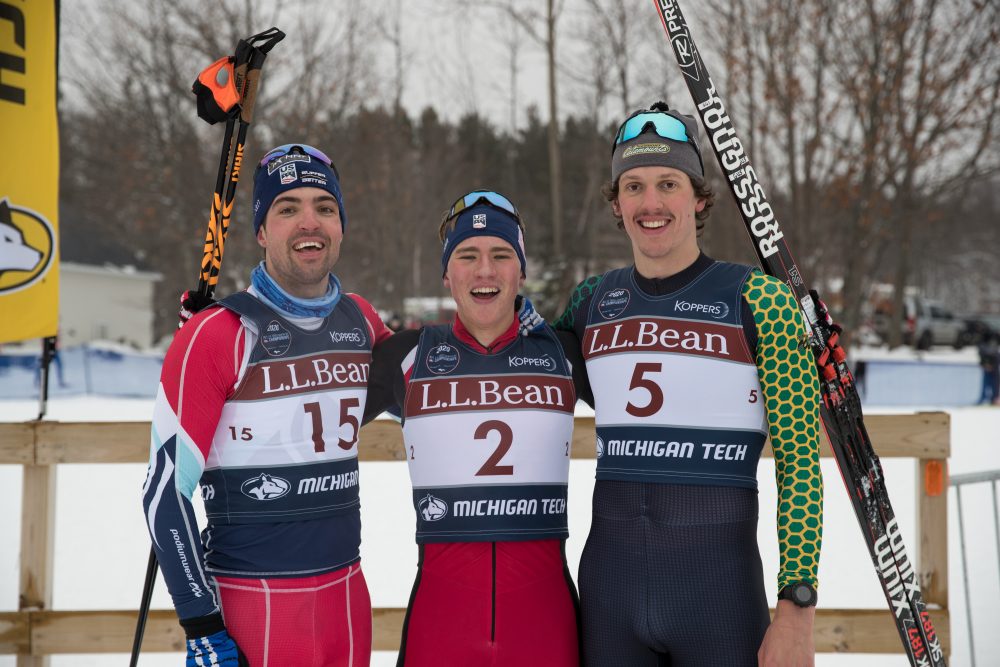
The Men’s podium from 2020 Senior Nationals in Houghton, MI. Ben Saxton in second, Gus Schumacher first, and Bill Harmeyer third (l-r). (Photo: Reese Brown)
In a November 13 announcement, the Craftsbury Outdoor Center stated that all ski races on its grounds are currently cancelled: “2. Races are on hold: similarly, all ski races at the Outdoor Center are canceled until further notice.” This update came in response to a new addendum to an executive order from the state’s governor. The order, which went into effect on November 14 and continues through December 15, at which point it will be reassessed, provides that multiple-household gatherings are suspended, and that all recreational sports programs are suspended, save for school-sponsored sports activities.
If these provisions remain in place in March 2021, the NCAA Championships would not be able to occur, as it is by definition a multiple-household gathering. Moreover, there is currently a quarantine requirement for visitors coming to Vermont from beyond its borders. Finally, Middlebury (the theoretical host) announced last month that it “will not hold any athletic competitions during the winter season.” So even if NCAA Championships happen, in any form, it seems unlikely that this will be within the state of Vermont.
(While the possibility of these championships occurring at all is outside the scope of this article, the fact that both the Ivy League and NESCAC (New England Small College Athletic Conference) have cancelled winter sports – that’s the ski teams at Dartmouth, Harvard, Bates, Bowdoin, Colby, and Middlebury, among others – poses additional challenges to the possibility of nationwide collegiate skiing competition.)
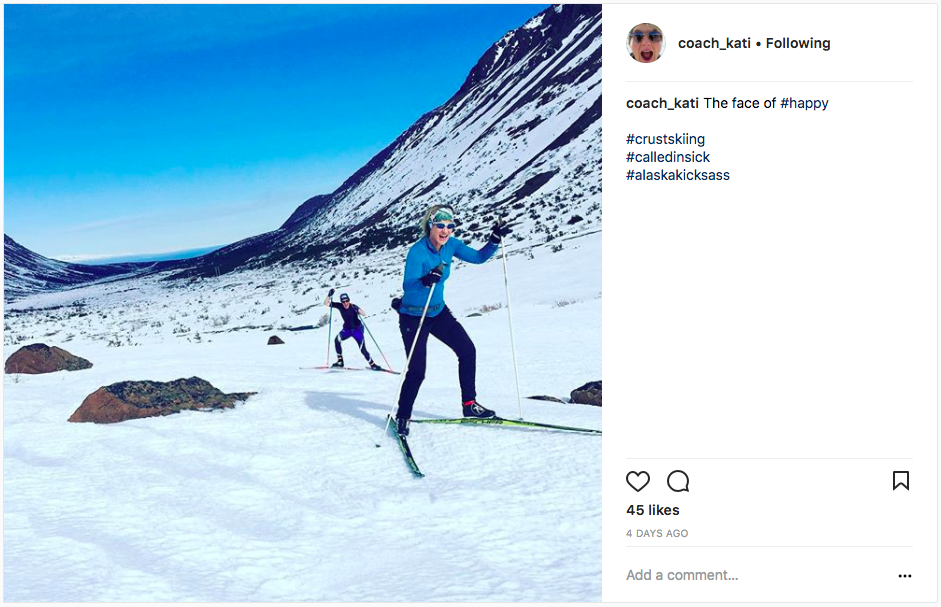
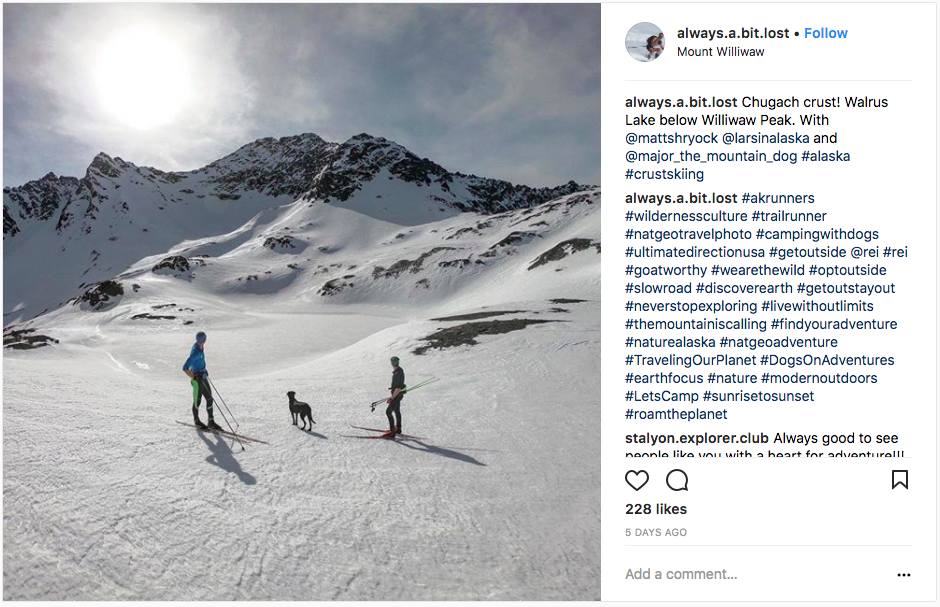
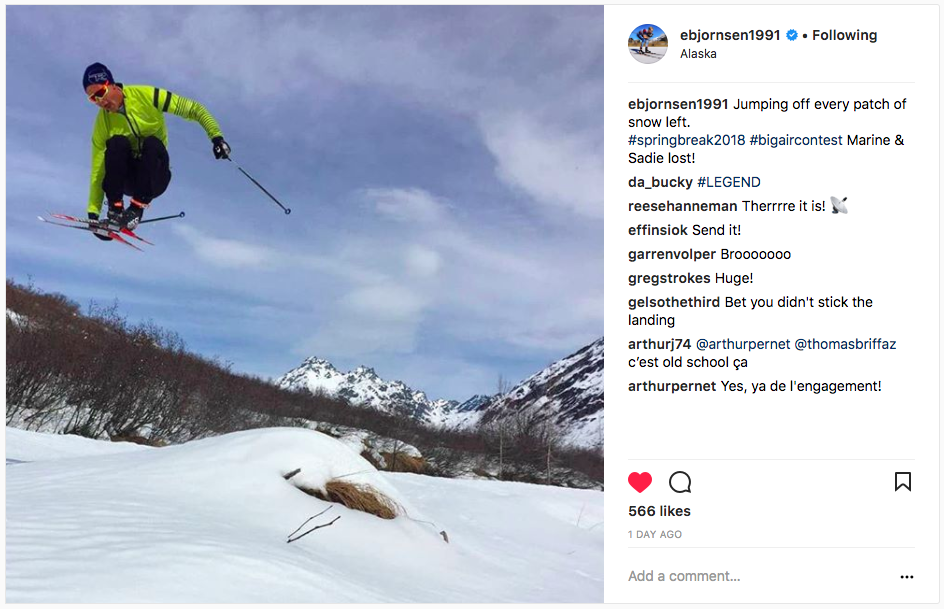
Crust skiing on April 17 in Chugach State Park, at the edge of town above Anchorage, Alaska. (Photo: Gavin Kentch)
This article has been updated with additional information on pro skiers who volunteered with Skiku, and additional pictures from Montana and New York.
* * *
It’s the last week of April. Skier New Year, May 1, looms next Tuesday. It’s roughly six months till the presumptive first race of the 2018/2019 season, seven till the first World Cup weekend. Whether you’re a pro or an amateur, whether you’re targeting your first World Championships or your first Birkie elite wave, now is the time to start thinking about setting goals and writing training plans.
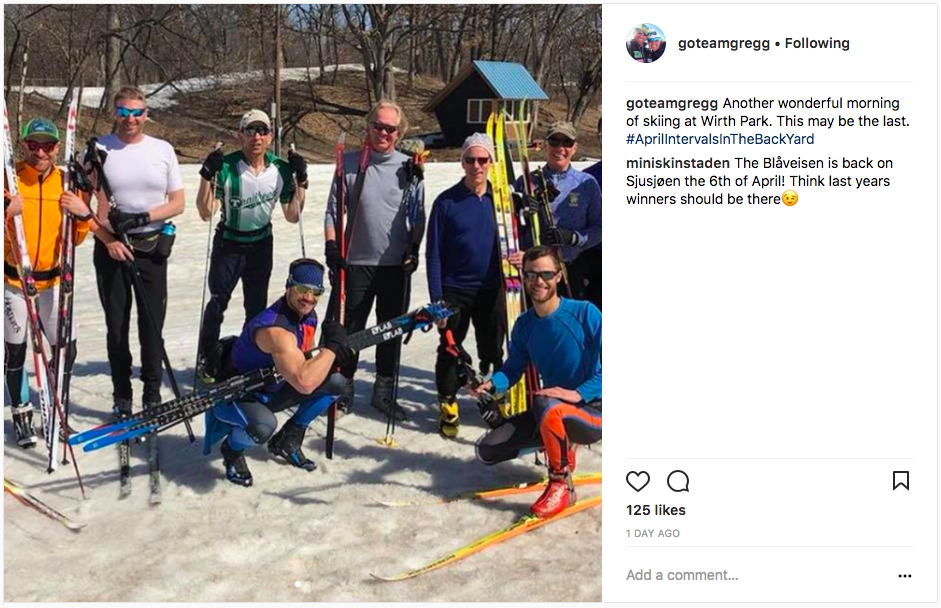
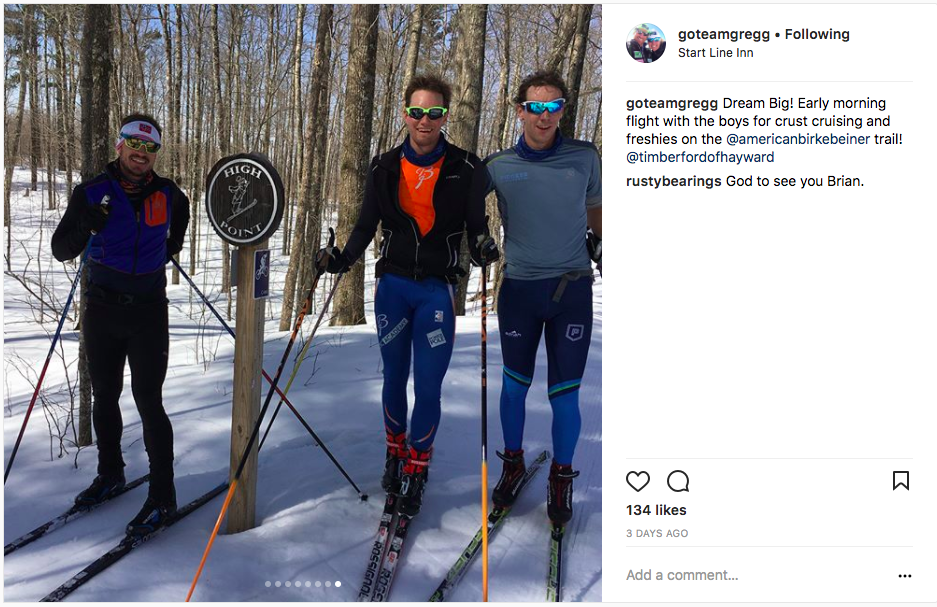
For a certain subset of athlete, those spring training plans still involve skiing. On snow. In some cases, really good snow, in surprisingly wintry weather.
In honor of the last week of the offseason, please join FasterSkier as we channel our inner Us Weekly and flit through an extremely unscientific social-media roundup of those athletes who are still on snow, arranged in very approximate order of most to least surprising to be skiing at this time of year. (Actually, it’s only the Midwest and Vermont where it seems somewhat surprising to still have skiable snow in late April; no offense is intended to anywhere on the list after that.)
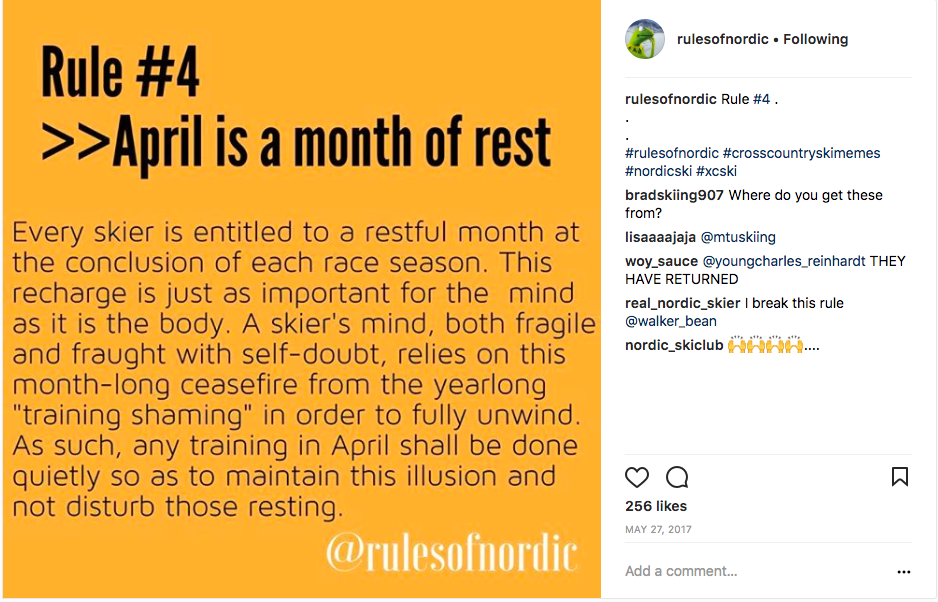
And before we begin, a quick note on methodology: This social media roundup is by definition limited to those athletes who are not only currently out in the snow, but who are also posting about it on social media. This second criterion threatens to bring your average recovery-month athlete into conflict with what has been codified as Rule of Nordic No. 4, “April is a month of rest.”
So, caveat lector: Just because your favorite skier has been taking a well-deserved break from finding and curating Instagram-worthy content for your enjoyment, this doesn’t mean that they’ve been sitting on their butt since Spring Series. They just might not want to tell you what they’ve been up to, and/or they wish to avoid damaging the fragile psyches of their colleagues.
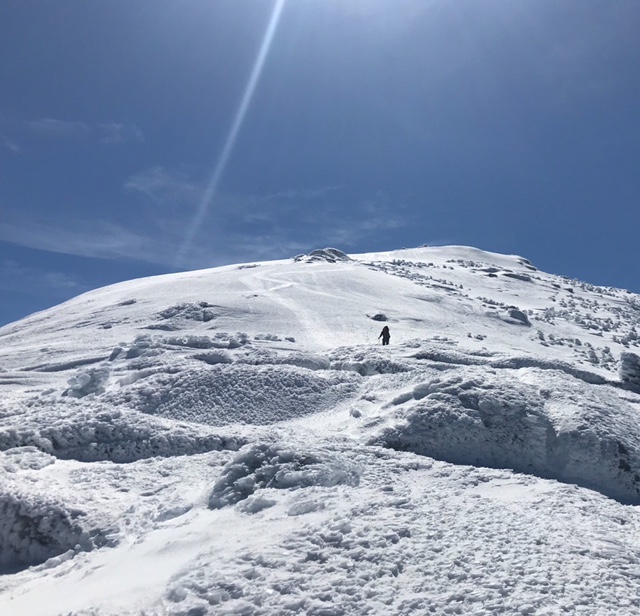
Skiing on New York’s highest peak? Check. David Hochschartner of the North Country School in Lake Placid sent us this photo of backcountry shredding on Mount Marcy, the highest point in the state at 5,343 feet above sea level.
“Monday skiing from bottom to the summit of Mount Marcy in New York,” Hochschartner wrote in an email to FasterSkier on Wednesday. “Over 3500′ vertical … backcountry skiing does not break rule #4 because it isn’t training, it’s just fun!”
Backcountry skiing near the top of Mount Marcy in New York’s High Peaks region on Monday, April 23. (Photo: Tim Ely)
The mid-April Midwest blizzard was notable, to be sure. But was it historic? Yes, says Ari Ofsevit, who now lives in Boston but was formerly the source behind Twin Cities XC Commentary and who remains the one-man operation behind the indispensable BirkieGuide.com.
Here’s Ofsevit with some historical meteorological perspective:
Basically, the current weather in the Twin Cities is pretty unprecedented. The only other similar year was 1975, when there was at least 3″ of snow on the ground in MSP for 11 days in April (this year had 12), but that year it was an old, melting base that mostly fell in late January. This year will set the following records:
* Most days with at least 3″ of snow on the ground in April (skiable snow): 12
* Most snow in April: 26.1″
If the current forecast to hit the 70s this weekend holds, it won’t wind up the coldest April on record, but will likely be in the top three. But it’s a good combination of cold and snow, which hasn’t been seen to this degree before.
The average year has the snow depth dipping below 3″ around March 1, so it’s an extra month and a half of winter.
Vermont
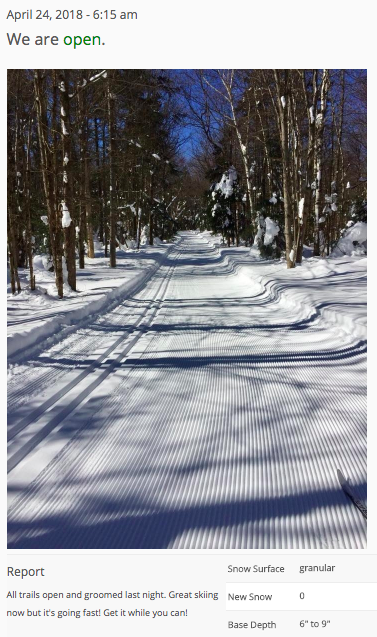
There’s a lot of snow at Prospect Mountain in Woodford, Vermont, too. (“Getting 80″ in a week in March didn’t hurt,” Ofsevit notes.) Here’s a stunning screenshot from the conditions report for Tuesday, April 24 (just offscreen is the current temperature, 69°):
Dartmouth skier Adam Glueck skied 50 k there on Sunday, describing conditions as “50+ F and transformed.”
Montana
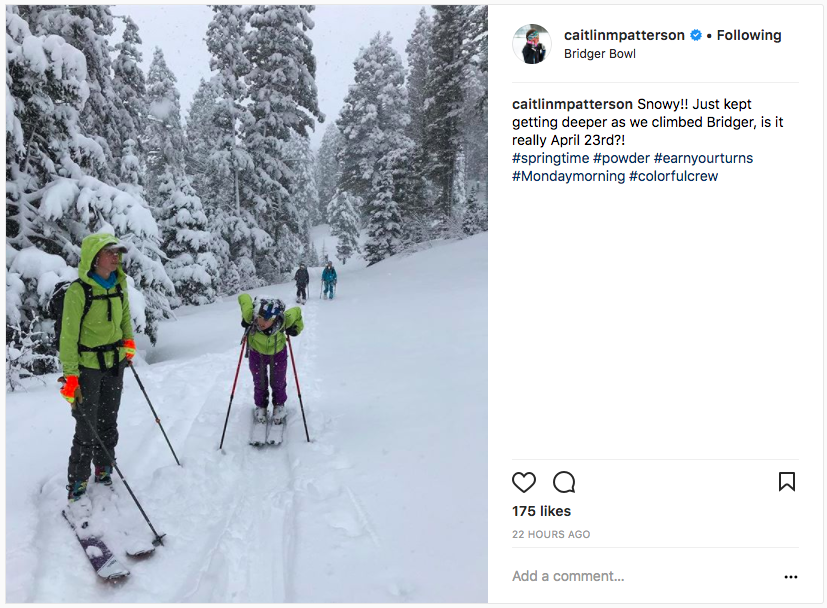
Effective Tuesday morning, they were still grooming some nordic trails at Crosscut Mountain Sports Center (formerly Bohart Ranch). Pictures of nordic skiing there are hard to come by right now, so here’s a screenshot from Caitlin Patterson’s Instagram page showing backcountry skiing at adjoining Bridger Bowl on April 23 in fresh powder:
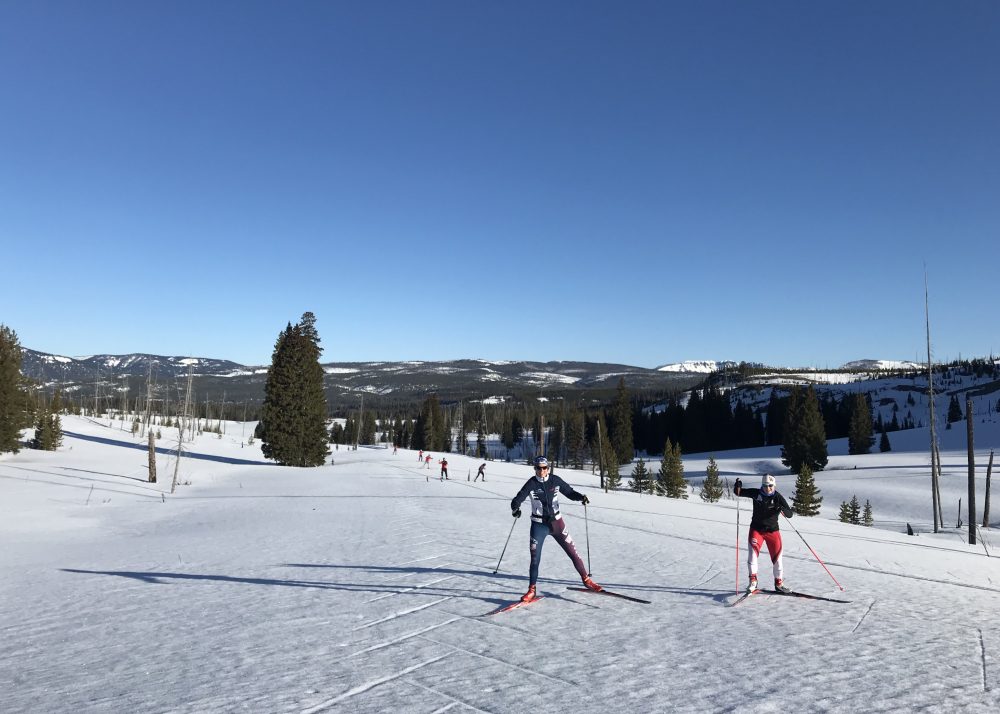
And from two days before that, here’s some prime crust skiing at Fawn Pass on Saturday:
Crust skiing at Fawn Pass, outside West Yellowstone, Montana, April 21, 2018. (Photo: Caitlin Patterson)
Canada
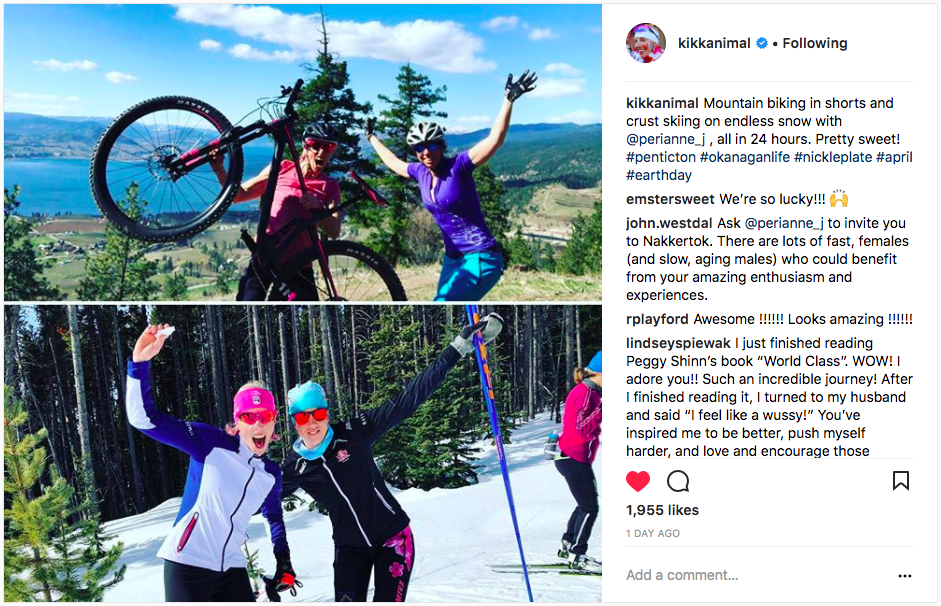
Recently retired American skier Kikkan Randall doesn’t seem to be suffering from her move to Penctiton, B.C., judging from Sunday’s shot of crust skiing with former Canadian World Cup racer Perianne Jones:
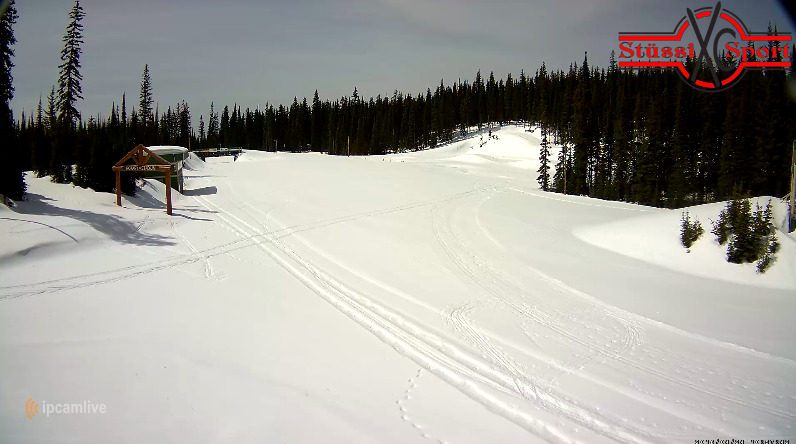
And 100 kilometers to the north, Sovereign Lake Nordic Centre isn’t lacking for snow, either. Here’s a screenshot from the webcam as of Tuesday morning, showing impeccable coverage:
That’s a base of 256 centimeters, or over eight feet (!) in American, according to a current conditions report. Sovereign Lake is closed to official skiing at present, but reopens from May 10-13 for its Spring Fling Ski Camp.
Oregon
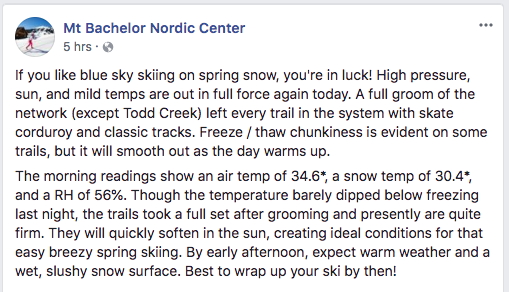
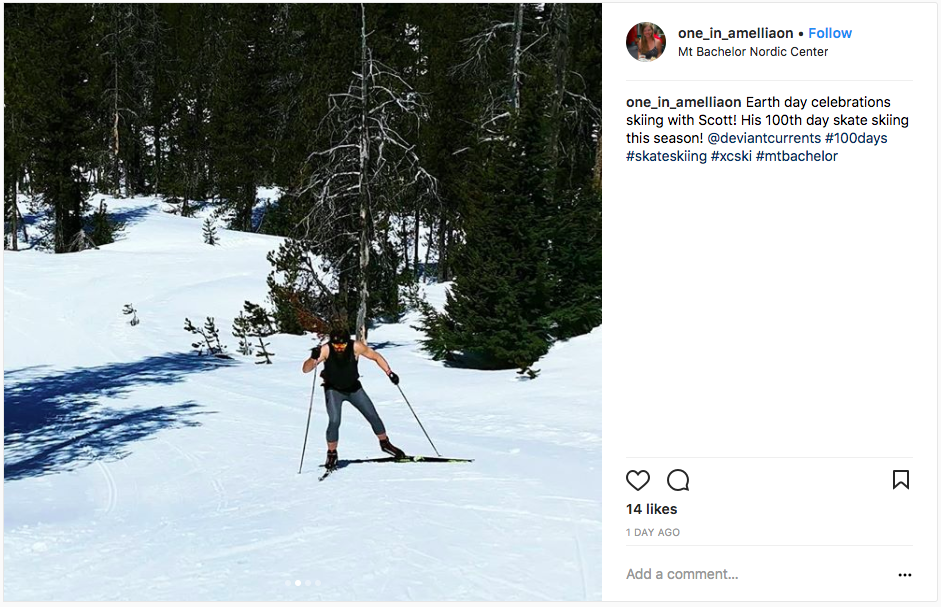
Mt. Bachelor currently has a base of 85″ at 6,300 feet near the base of the alpine area, which is somehow less than Sovereign Lake but still, you know, more than seven feet of snow. Here’s the nordic grooming report from Tuesday morning:
There’s still a lot of snow in Alaska right now. Maybe not at sea-level Anchorage, which is staggering toward spring with a series of high-30s, mid-40s raw and windy days culminating in snow squalls Tuesday evening – Kincaid is down to the dregs of a snowmaking loop by this point, and formal grooming there ended last weekend – but pretty much everywhere else. This reporter found fresh snowfall and blowing spindrift at 2,200′ at the edge of town Monday morning, and most places higher than that are still snow-covered. There is over five feet of snow at Hatcher Pass, and temperatures there remained below freezing even as it rained at sea level on Tuesday. The Mat-Su Ski Club should presumably once more be grooming through mid-May with ease.
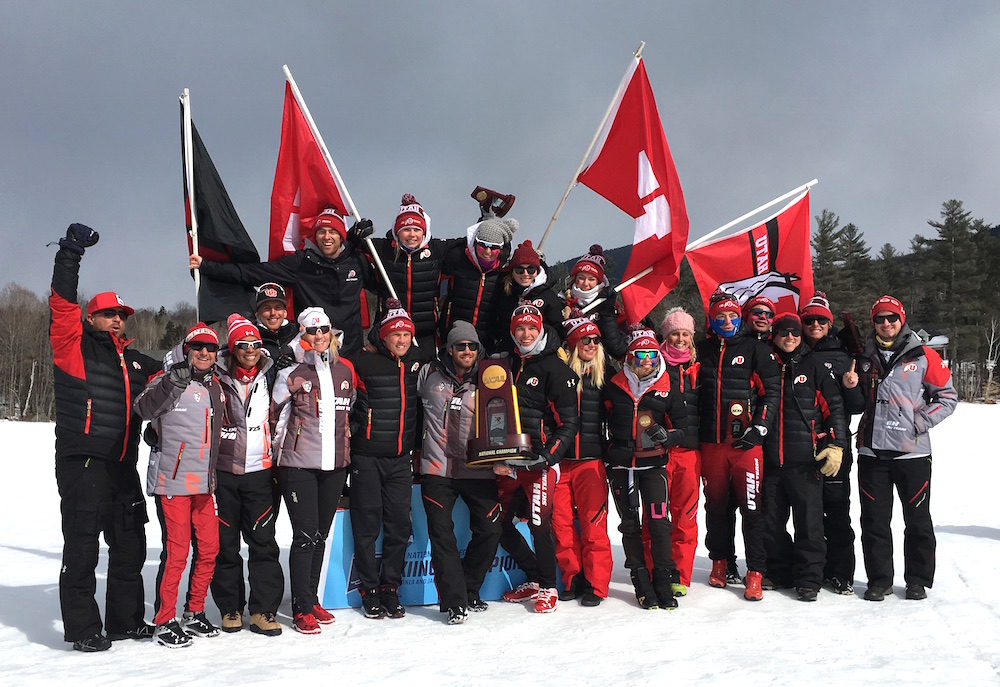
The University of Utah ski team celebrating its first NCAA title since 2003 on Saturday at 2017 NCAA Skiing Championships in Jackson, N.H. (Photo: Jason Clay/Colorado)
NCAA Skiing Championships (Jackson, N.H.): 15/20 k freestyle mass starts
On the final day of the National Collegiate Athletic Association (NCAA) Skiing Championships in northern New Hampshire, the University of Utah pulled out a 16.5-point victory over the University of Colorado-Boulder (and finished 17.5 points ahead of the University of Denver) in the team standings, and the two previous NCAA champions from Thursday’s 5/10 k classic races, Martin Bergström and Petra Hyncicova, achieved their second-straight titles in as many nordic races this week.
On a frigid Saturday morning in Jackson, N.H., with temperatures just below zero Fahrenheit for the start of the men’s 20 k freestyle mass start, Bergström, a Utah freshman from Sweden, outlasted the University of Colorado’s (CU) Mads Ek Strøm, a Norwegian senior and two-time 2016 NCAA champion, by 0.5 seconds to win his second-straight race in 46:02.8 minutes. Moritz Madlener, a German senior at Denver University (DU), placed third (+0.6). Just behind him CU’s Petter Reistad, of Norway, finished fourth (+1.2), and Dartmouth College’s Fabian Stocek, of the Czech Republic, placed fifth (+1.9).
While temperatures warmed up to about 1 degree for the women’s 15 k freestyle mass start and the wind picked up to about 15-20 miles per hour, the women raced three laps around the Jackson Ski Touring Center’s race loop and navigated even faster downhills that caused a few crashes.
Hyncicova used her love for downhills and skate races to capture her second consecutive NCAA title, breaking away with University of Vermont (UVM) junior Alayna Sonnesyn on the second lap. The Czech Republic native and CU junior attacked on the A-climb at the top of the course and won by 21.1 seconds in 39:21.6. Sonnesyn, of Minnesota, bested her third place from Thursday’s 5 k with a second-place finish on Saturday. CU’s Christina Rolandsen, of Norway, finished third (+38.9), ahead of Idaho native Anika Miller of Montana State University (MSU) in fourth (+44.0).
Utah took fifth and sixth with Merete Myrseth (+1:01.5) and Guro Jordheim (+1:16.1), and had two other men in the top 10 (Martin Mikkelsen in 8th and Kevin Bolger in 10th) to achieve the alpine-nordic team title.
In the women’s race, the Utes were the only team with all three women in the top 14, with Natalia Müller in 14th (+1:32.1).
“The turning point of today is when Guro broke a pole, and she was back in the 20’s, and she and Natalia were skiing together,” Utah Director of Skiing Kevin Sweeney said, according to a team press release. “We told them that they had to go and they busted out and made a big move. The men’s results were tremendous, but whether or not we were going to win was based on those guys making the move. It was exceptional athleticism and gutsy performances.”
The NCAA team title was the 11th for Utah and its first since 2003.
“I am stunned with the win today,” Sweeney added. “In all my years of coaching, it was one of the most challenging four days of competition. I say that because the weather was incredibly cold and windy, and challenging from both a waxing perspective, as well as visibility and conditions. I know all the teams had to deal with it, but it really beat us up. It took a lot of perseverance and gutsy performances for us to win. We struggled a little bit in the slalom, but they were going for it and came up short.
“We’ve been crunching numbers and have been able to beat Denver and Colorado by about 30 points on a really good showing during the RMISA season, but didn’t know if we could do it in the championships,” he continued. “Bergström was skiing at a whole new level this week, and Mikkelsen had stepped it up, and I knew Kevin Bolger could get top 10. I was also confident in the women, who have been skiing awesome, so I felt good there. It’s awesome to be able to take this new trophy back to our new ski building.”
As for those earning All-American status on Saturday with a top-10 finish, Utah had five (Bergström 1st, Myrseth 5th, Jordheim 6th, Mikkelsen 8th, Bolger 10th), Colorado had four (Hyncincova 1st, Strøm 2nd, Rolandsen 3rd, Reistad 4th), Denver had two (Madlener, Dag Frode Trollebø 7th), MSU had two (Miller 4th, Johanna Talihärm 7th), Dartmouth had two (Stocek 5th, Luke Brown 9th), UVM had one (Sonnesyn 2nd), Northern Michigan University (NMU) had one (Adam Martin 5th), the University of Alaska-Fairbanks (UAF) had one (Sarissa Lammers 8th), UNH had one (Lizzie Gill 9th), and Bowdoin had one (Hannah Miller 10th).
Stay tuned for a more in-depth report with quotes and photos from Saturday’s skate mass starts.
USSA Cross Country Junior Championships (Lake Placid, N.Y.): Freestyle team relays
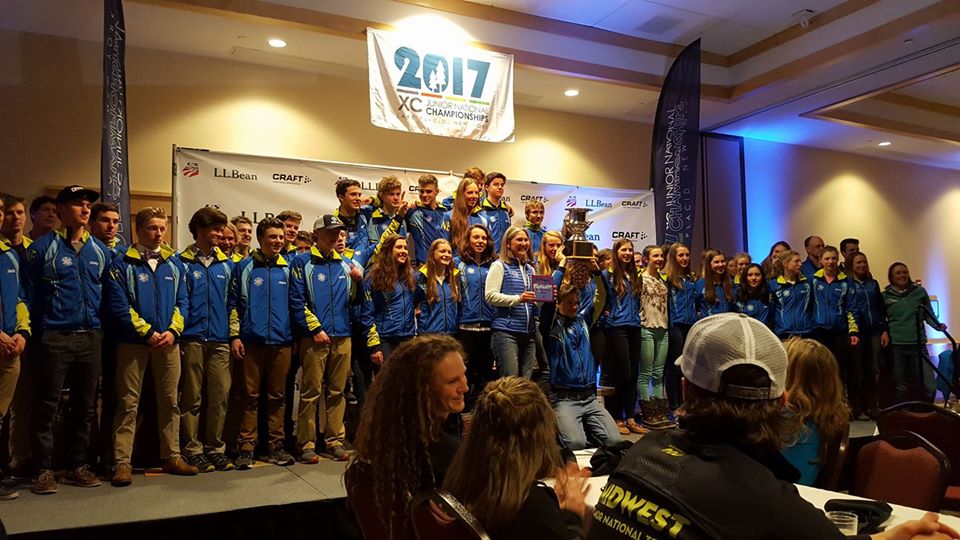
The 2017 U.S. Junior Nationals Alaska Cup winners, New England, at the awards ceremony on Saturday in Lake Placid, N.Y. (Photo: XCJuniorNationals2017/Facebook)
[UPDATED] For the final day of 2017 U.S. Junior Nationals in Lake Placid, N.Y., regional divisions formed three-racer teams for the U16, U18 and U20 freestyle relays.
Intermountain swept the U16 team events with Lane Myshrall, Skylar Patten and Johnny Hagenbuch winning the U16 boys’ relay by 3.6 seconds over the Midwest’s James Schneider, Alexander Nameth and Peter Moore in 23:00.4 minutes. Another 1.1 seconds back, Alaska reached the podium in third (+4.7) with Eli Hermann, Zander McMullen and George Cvancara.
Intermountain’s U16 girls’ team of Sarah Morgan, Annabel Hagen and Sydney Palmer-Leger posted a 53.7-second victory over New England’s Charlotte Ogden, Anna Lehmann and Abigail Streinz, winning in 26:21.4. The Pacific Northwest finished 18.1 seconds later in third place (+1:29.9) with Fiona Max, Gretta Scholz and Annie McColgan.
Alaska won the U18 boys’ relay with Luke Jager, Canyon Tobin and Gus Schumacher finishing in 21:42.9, 7.5 seconds ahead of New England’s Elliot Ketchel, Adam Glueck and Ben Ogden in second. The Midwest’s Anders Sonnesyn, Patrick Acton and Luc Golin rounded out the podium in third (+22.2).
Rocky Mountain topped the U18 girls’ relay with Katja Freeburn, Ezra Smith and Maddie Donovan crossing first in 25:47.3. Just 5.8 seconds back, Intermountain’s Brooke Dunnagan, Anna Gibson and Sofia Schomento placed second, and the Midwest secured third (+16.7) with Margaret McCollor, Luci Anderson and Anja Maijala.
The U20 men’s relay title went to New England, with Kam Husain, Koby Gordon and Daniel Streinz pulling out a 1.3-second win over Alaska’s Tracen Knopp, Logan Mowrey and Hunter Wonders in 21:53.1. Intermountain followed in third (+8.8) with Eli Jensen, Peter Wolter and Nathan Wells.
The Midwest came up big in the U20 women’s relay, with Abby Jarzin, Hannah Rudd and Margie Freed finishing 10.1 seconds ahead of New England’s Alexandra Lawson, Mary Kretchmer and Mackenzie Rizio in 25:41.4. Another 1.1 seconds back, Intermountain’s Leah Lange, Maddie Morgan and Marin Coletta placed third (+11.2).
New England won the Alaska Cup with 325 points, the same point total as Intermountain in second. Alaska placed third in the overall team competition with 295 points, just five points ahead of the Midwest in fourth.
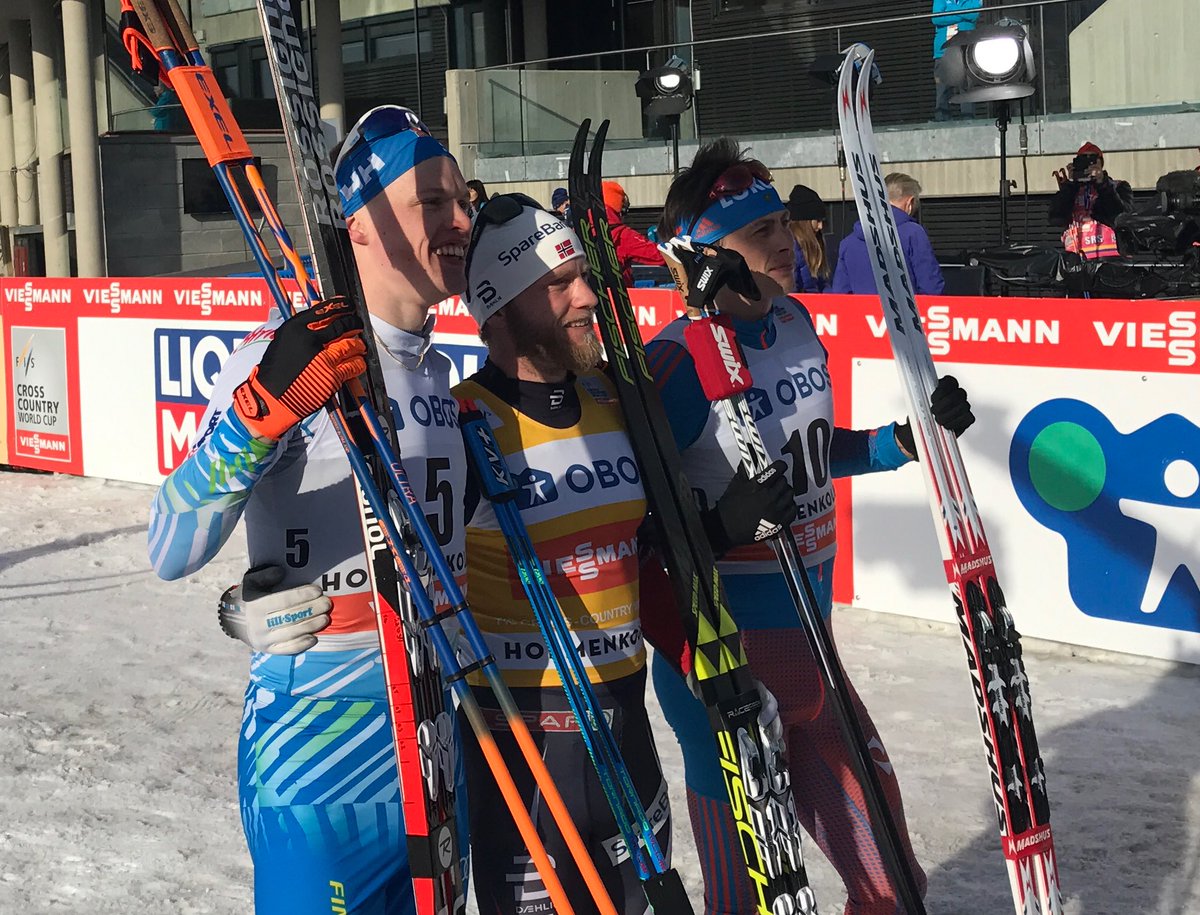
Left to right: Finland’s Iivo Niskanen, Norway’s Martin Johnsrud Sundby and Russia’s Alexander Bessmertnykh after placing second, first and third, respectively, in the Holmenkollen World Cup men’s 50 k classic mass start on Saturday in Oslo, Norway. (Photo: FIS Cross-Country/Twitter)
In a historic Holmenkollen, Norway’s Martin Johnsrud Sundby took his second 50 k win in a row, claiming this year’s title in a time of 2:02:59.7 (he won last year’s Holmenkollen in a time of 2:08:41.9).Sundby is now the only male skier towin two consecutive World Cup Holmenkollen 50 k competitions.
Crossing behind Sundby in second was Finland’s Iivo Niskanen, 9.9 seconds back from the race winner’s time. In a three-way photo finish, Russian Alexander Bessmertnykh bestedNorwegians Niklas Dryhaug, and Sjur Røthe in the lunge to the line, with Bessmertnykh taking third (+1:15.2), Røthe fourth (+1:15.2) and Dryhaug fifth (+1:15.2).
Canada’s Alex Harvey was just two tenths of a second behind the three-way lunge, finishing in sixth (+1:15.4). Norway’s Christer Hans Holund crossed 2.2 seconds later in seventh (+1:17.2). Three more Russians rounded out the top ten, with Sergey Ustiugov finishing in eighth (+2:35.0), Andrey Larkov two tenths of a second behind in ninth (+2:35.2) and Sergey Turyshev in tenth (+2:42.2).
The top U.S. skier for the day was Scott Patterson (Alaska Pacific University), earning World Cup points in 28th (+7:18.8). Canada’s Devon Kershaw crossed 33rd (+2:11:59.1) and American David Norris (Alaska Pacific University) finished 35th (+9:56.4).
Two more Americans competed in Saturday’s Holmenkollen, with Noah Hoffman finishing in 38th (+11:02.6) and Ben Lustgarten 46th (+18:44.7). Canadian Russell Kennedy was the final North American to finish in 47th (+20:16.3).
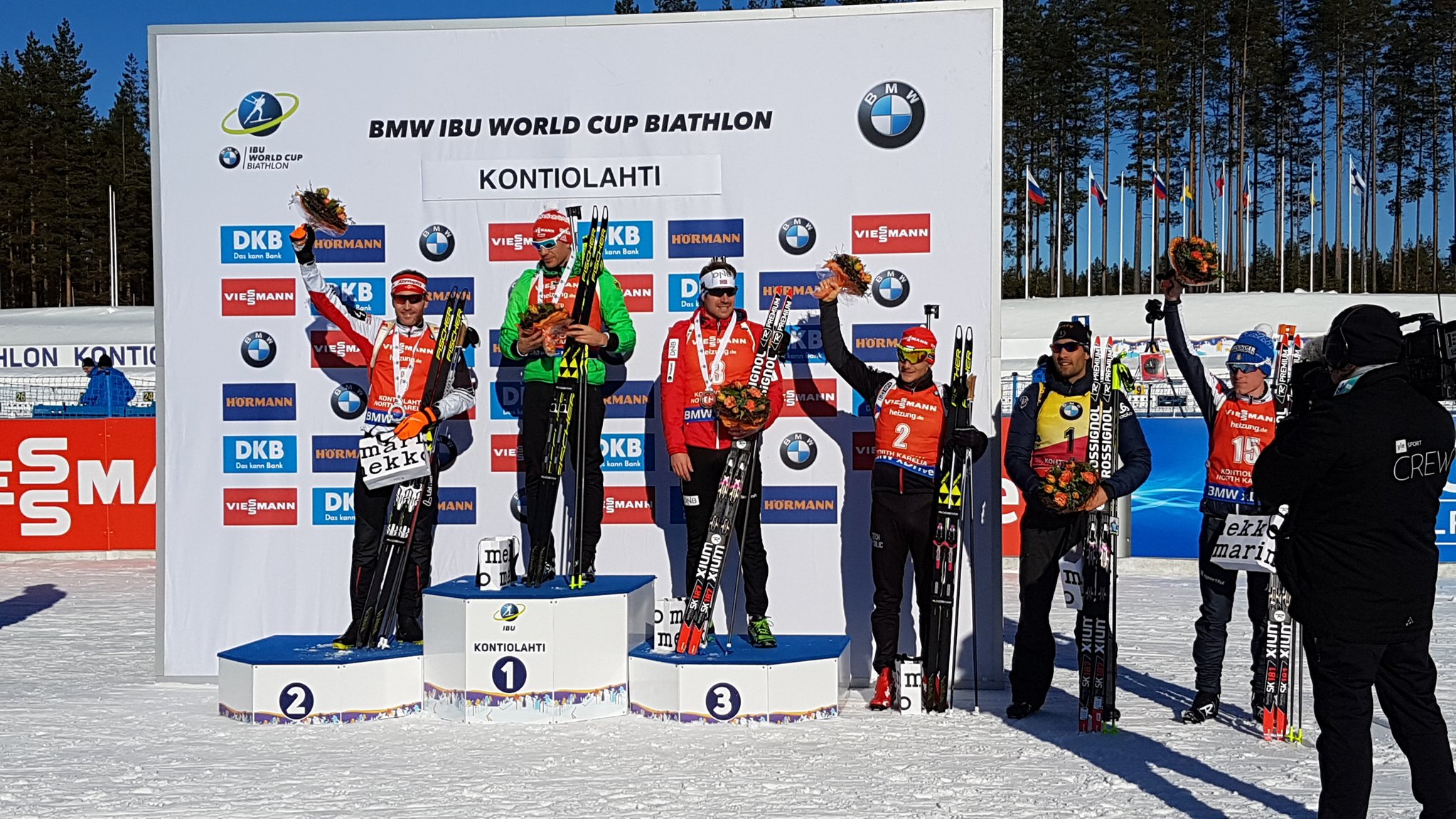
The IBU World Cup men’s podium after the 12.5 k pursuit in Kontiolahti, Finland, where Arnd Peiffer of Germany outsprinted Simon Eder of Austria for the win. (Photo: IBU/Twitter)
After one day knocked down to the second spot of the podium, it was back to the usual winning ways for Germany’s Laura Dahlmeier in the 10 k pursuit. Dahlmeier caught Norway’s Tiril Eckhoff, who won Friday’s sprint, early in the race after Eckhoff had one penalty in the first prone and second-starter Dahlmeier cleaned. While Eckhoff picked up five more penalties as the race went on, finishing 15th (+1:12.0), Dahlmeier had just one – and cleaned when it counted, on the final shoot with France’s Marie Dorin Habert and the Czech Republic’s Gabriela Koukalova right there with her. Dorin Habert missed one shot and held on to second place (+16.5) despite the penalty loop, while Italy’s Lisa Vittozi picked up her first individual podium in third (+19.9).
The win secured the overall World Cup title for Dahlmeier, her first. “That makes me really speechless,” she told Germany’s ARD broadcaster. “This is an amazing moment.”
Susan Dunklee collected four penalties and dropped from fifth place to 14th (+1:02.8) for the United States. Teammates Clare Egan and Joanne Reid finished 45th (+3:24.7) and 52nd (+4:07.0), respectively.
For Canada, Julia Ransom finished 53rd with three penalties (+4:14.0) and Emma Lunder 58th with four missed shots (+6:20.7).
Earlier in the day, Martin Fourcade had started the men’s race in bib one and set out to win the men’s 12.5 k pursuit, but was undone by four errors on the shooting range. No matter: the French biathlete still picked up the World Cup crystal globe for the pursuit discipline after finishing fifth (+25.5 seconds) and now he’s skipping tomorrow’s mixed relays to go be with his wife, who is about to have their second child.
Capitalizing on Fourcade’s errors were a group of chasers, among whom Arnd Peiffer of Germany managed to shoot 20-for-20. The race came down to a sprint finish between him and Simon Eder of Austria; Peiffer took a 0.3-second win for his eighth career victory. Emil Hegle Svendsen of Norway finished third, +2.3 seconds, and Andrej Moravec of the Czech Republic fourth, +9.8.
Besides Peiffer, the only other man in the field to shoot clean was Sean Doherty of the United States. That allowed Doherty to jump from 44th at the start to a season-best 18th (+1:19.5) at the finish, the top result for the American team. Lowell Bailey finished 27th (+1:57.2) and Leif Nordgren 43rd (+3:24.4) with three and four penalties, respectively.
Christian Gow led Canada with just one penalty and a 37th-place finish (+2:36.0), a big improvement from his 50th-place starting position. Brendan Green placed 50th with three penalties (+4:47.3).
About the author: Scott “Bjorn” Cummings is a Postbaccalaureate student working towards his Academic Behavorial Strategist K-12 (ABS) Special Education License at the University of Minnesota Duluth. When he is not in school or on the ski trail, he enjoys biking, reading, cheering on the Minnesota Twins and cooking.
After completing my second American Birkebeiner this year I asked my old mathematics professor and current mentor Lawrence Gray: why did skiing make such a positive impact on my life?
He himself had run marathons and was a block from the finish line when the backpack bomb went off during the 2013 Boston Marathon. Point is, he knew the dedication that endurance sports demanded and how it translates into success outside of training. For a man who works daily at the University of Minnesota solving abstract mathematical proofs, he put it simply.
“A couple of reasons: Having a healthy passion outside of work helps keep things fresh.
Preparing for something like the Birkie forces you to structure your life and builds discipline.
Having something to talk about (besides work) gives you confidence and makes you a more interesting person.
Doing something regularly for your health supports everything else in your life.”
-Lawrence Gray
If I’d heard that math professor’s words before, maybe I would have picked up skiing much earlier. I wouldn’t have guessed it in the beginning as a flailed and crashed on my skis, but cross-country skiing was what would give me confidence and happiness in a dark time of my life.
I got a call center job post-graduation.
After graduating from the University of Minnesota with a degree in mathematics, I was lost both professionally and personally. I moved back home to Chanhassen, a Twin Cities suburb, and lived with my parents. I enrolled in graduate school for math education but soon dropped out after finding that the program and timing was not a good fit.
I made a half-hearted attempt to pursue my other passion, baseball, as a career. I landed a couple interviews with the Minnesota Twins for internships but none panned out. Both anxiety and coronary heart disease ran in my family and then surfaced in my own life. At 220 pounds, I was overweight and worried about my next step. And at 22 years old, I was a part time math tutor, still living at home with my parents and actively searching for a full time position.
After about a year of searching, I landed a temporary full-time job that didn’t even require a college degree. It was at a call center for MNsure, the Minnesota Health Insurance Marketplace. It was a start. Soon after I began to work, however, I realized that job was extremely toxic and a dead end. But that is another story.
To be honest, I missed working with kids and needed a new fiery passion. At that point I was out of shape, overweight, and in a job I hated. Little did I know just how much skiing would ignite my life.
* * *
As a child, I enjoyed downhill skiing once a year with Boy Scouts, on winter field trips with school, or with other groups. But as an adult I couldn’t justify the startup cost of equipment or lift tickets to get into the sport. I never cross-country skied in high school. Classic skiing seemed to boring to me. In general, I was more interested in watching sports than playing them.
My introduction to cross-country skiing came later. As an undergrad, I studied abroad in Birmingham, England for a two-week January term class through the University of Minnesota-Duluth called “History and Soccer.” Since I would be across the pond anyway, my parents suggested that I visit my aunt, uncle, and cousins in Norway for a week during Christmas. While there, my cousin took me classic skiing in the mountains.
In my family’s homeland!
I was so scared that I only skied one kilometer. My uncle gave me a chocolate bar on the trail and took me out for porridge and hot chocolate afterwards. For my Norwegian Christmas, I received a Bjorn Daehlie ski jacket and pants, with a red Swix VR70 Klister wax hat.
After Norway, it turned out that I kind of liked skiing and the gear that comes with it. Plus, my family had a history of skiing. All four of my aunts and my even my grandmother completed the Korteloppet in the late 1970’s and early 1980’s. But only my Uncle Mike had kept up the annual pilgrimage to Hayward, Wisconsin, for the American Birkebeiner since then.
“The endorphins are free,” he would always say about skiing.
Currently he has finished 29 Birkies and is another mentor of mine. Any question I had about the sport I could always ask him. In his basement, he had racing bibs from just about every race he completed in his career. As a kid the shrine seemed foreign to me, and somehow like the man version of a funny wall quilt. But really, I needed someone to teach me the basic skate skiing technique.
The next winter on a beautiful weekend afternoon my parents said they were going skiing to Carver Park with my Dad’s old work colleague named Jack.
He was 70, addicted to skating, on no medication, and said he actually lost weight in the winter. I was curious to his secret.
But I also had no clue what to I was doing on skis and the difference between skate and classic skiing. I loved to go fast and just glide on the snow, even though my basic technique was duck walking: stepping on the left and the right without any weight transfer.
I needed encouragement to keep me positive while trying to learn actual technique. Jack needed someone to ski with. It was a good match and he became my unofficial ski coach.
Jack saw my Bjorn Daehlie jacket and pants coined the nickname Bjorn for me. One day at Hyland Lake Park Reserve, with my all Norwegian gear and Scandinavian blonde hair and blue eyes, we convinced a Three Rivers Park Employee that I was from Norway. All I did was nod and quetly say yes quietly. The nickname Bjorn stuck. I started to grasp proper skate technique, and more importantly, to have fun.
* * *
But I remained out of shape and overweight for regular ski racing.
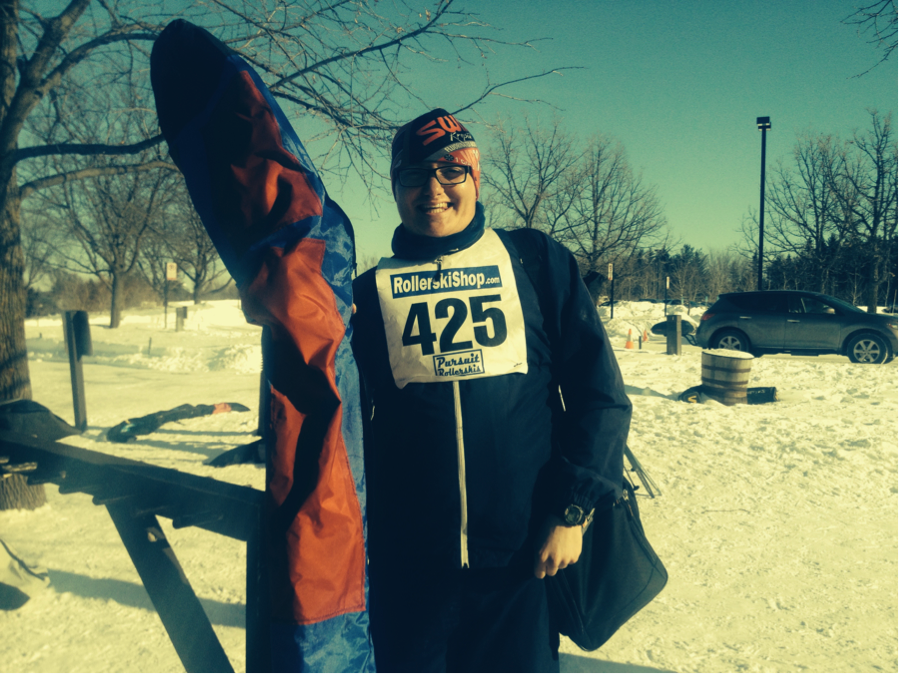
Here I am before my first ski race, the Baker Shaker 20 k.
Slowly but surely, I bought some of my own equipment. There was some end-of-the-year sale, where I bought Fischer RCRs and some poles on the cheap; boots at a ski swap; lobster claw gloves, which were hand-me-downs.
Yes, cross-country skiing is expensive. But once you have your base gear, it’s not so bad.
I realized that I like skiing and that it was an excellent way to fight anxiety and heart disease. I liked the endorphin high I got after a long ski, the feeling of gliding on the snow, the way it brought you out with nature, the camaraderie with fellow skiers. And, of course, skiing fast.
Just like as a kid at the downhill ski slope, I wanted to go fast. But going fast on skate skis was not as simple as running. You needed the technique. So it began: the never-ending challenge of finding a great technique and maintaining my fitness. I was determined to find that good technique.
Unfortunately, the reality was that I had a call-center job and I found it hard to put in the time for ski training.
First off, there was the terrible commute from my parents home in the southwestern suburb of Chanhassen 37 miles to downtown Saint Paul. Then there was the fact that the job itself was not healthy. In fact it was an extremely toxic work environment.
I needed a job that I actually liked and would allow to me ski more. So I started to plan my life around skiing.
I realized that I missed working with kids. I’d had a faint interest in teaching mathematics, but never really pursued it. But before working at my toxic call-center job, I substitute taught quite a bit in special education and enjoyed it. So I researched graduate special education teaching programs in the state of Minnesota.
It came down to two choices, Bethel University and the University of Minnesota Duluth. I couldn’t even fully apply through Bethel’s application system, and my old math professor couldn’t submit his letter of reference.
That turned out to be fine. Duluth has its famous 700-foot hill, Lake Superior and 47 kilometers of ski trails within city limits. I chose UMD.
I strategically put in my two weeks notice to my call center job in January before the spring semester started, and upon moving to Duluth, immediately joined the UMD Nordic Club.
* * *
While training with the club in the hilly Duluth my overall health, career, and skiing technique immensely improved. At UMD, I made friends who pushed me to race more I found a group of friends who I could race with in the cites of Hayward, Ashland, Houghton, Marquette, and of course daily training in Duluth.
In addition, I taught myself how to V2 and open field skate so I could cruise while skiing. No longer were hills a burden but strength, because now I could count on passing other skiers on the hills.
After the completion 2016 race season, my time and energy put into training started to translate both on and off the trail.
The change of scenery brought on by skiing was just what I needed in my life.
The book Beyond Birkie Fever by Walter Rhein is a must read for anyone who raced the Birkie and loves the Birkie lifestyle. In the end of the book, Rhein describes what Birkie Fever means to him.
“It’s a lesson that’s far more valuable and far more empowering than a mere helping hand. It’s a lesson you can find solace in during all of life’s inevitable highs and lows. Having someone there to carry you is nice. Cross-country skiing, however, teaches you how to carry yourself.”
-Walter Rhein, Beyond Birkie Fever
How did my life change? I left that call center far behind. I’m now 2 months away from completing student teaching and earning my K-12 Academic Behavioral Strategist Teaching License from UMD.
I started eating a high protein diet, cooking for myself, and eating proper food proportions. I even discovered a favorite cooking tool, the cast iron skillet. In the 14 months since moving to Duluth, I lost approximately 40 pounds.
My hard work is starting to pay off in ways I didn’t even imagine.
All thanks to skiing.
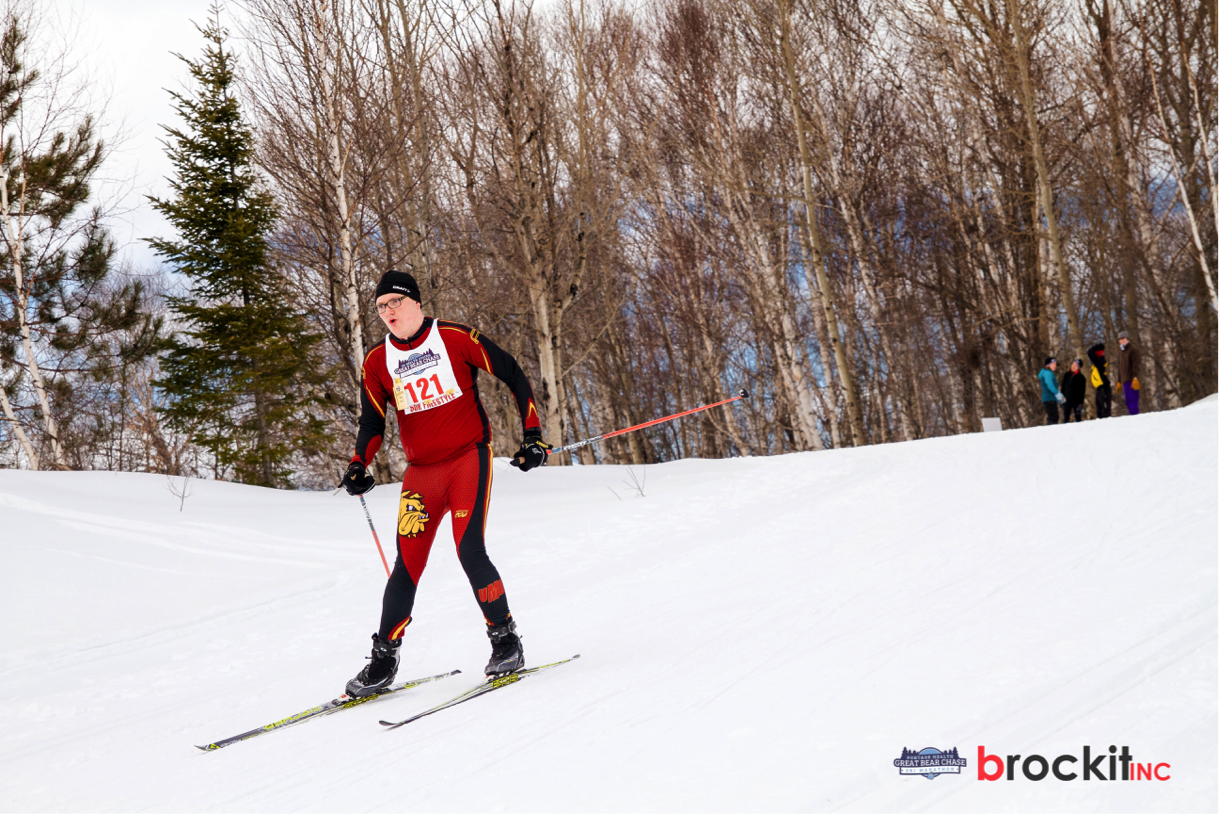
Here I am about the finish the 2016 Great Bear Chase with my PR!
Do you have a personal skiing story you’d like to share? We sometimes take submissions. Email info@fasterskier.com or get in touch with one of our staff members.
The U18 men’s 3 x 2.5 k classic relay on the last day of 2015 U.S. Junior Nationals at Auburn Ski Club in Soda Springs, Calif. (Photo: Mark Nadell/MacBeth Graphics) All profits from photo sales will be donated to the National Nordic Foundation.
The 2015 U.S. Junior Nationals came to a close Saturday with the 3 x 2.5-kilometer classic relays at Auburn Ski Club in Soda Springs, Calif., where New England and Midwest both tallied two relay wins. At the end of the weeklong series of races, New England took the overall team title, the Alaska Cup, by 167 points over Midwest. Intermountain placed third overall, 43 points out of second.
Photos from Saturday’s relays and a complete gallery, courtesy of Mark/Nadell/MacBeth Graphics. All profits from photo sales will be donated to the National Nordic Foundation (NNF).
(Photo: Mark Nadell/MacBeth Graphics)
The U16 women’s podium from Saturday’s 3 x 2.5 k classic mass relay at 2015 U.S. Junior Nationals at Auburn Ski Club in Soda Springs, Calif. (Photo: Mark Nadell/MacBeth Graphics)
(Photo: Mark Nadell/MacBeth Graphics)
The U16 men’s podium from Saturday’s 3 x 2.5 k classic mass relay at 2015 U.S. Junior Nationals at Auburn Ski Club in Soda Springs, Calif. (Photo: Mark Nadell/MacBeth Graphics)
The U18 women’s podium from Saturday’s 3 x 2.5 k classic mass relay at 2015 U.S. Junior Nationals at Auburn Ski Club in Soda Springs, Calif. (Photo: Mark Nadell/MacBeth Graphics)
The U18 men’s podium from Saturday’s 3 x 2.5 k classic mass relay at 2015 U.S. Junior Nationals at Auburn Ski Club in Soda Springs, Calif. (Photo: Mark Nadell/MacBeth Graphics)
The U20 women’s podium from Saturday’s 3 x 2.5 k classic mass relay at 2015 U.S. Junior Nationals at Auburn Ski Club in Soda Springs, Calif. (Photo: Mark Nadell/MacBeth Graphics)
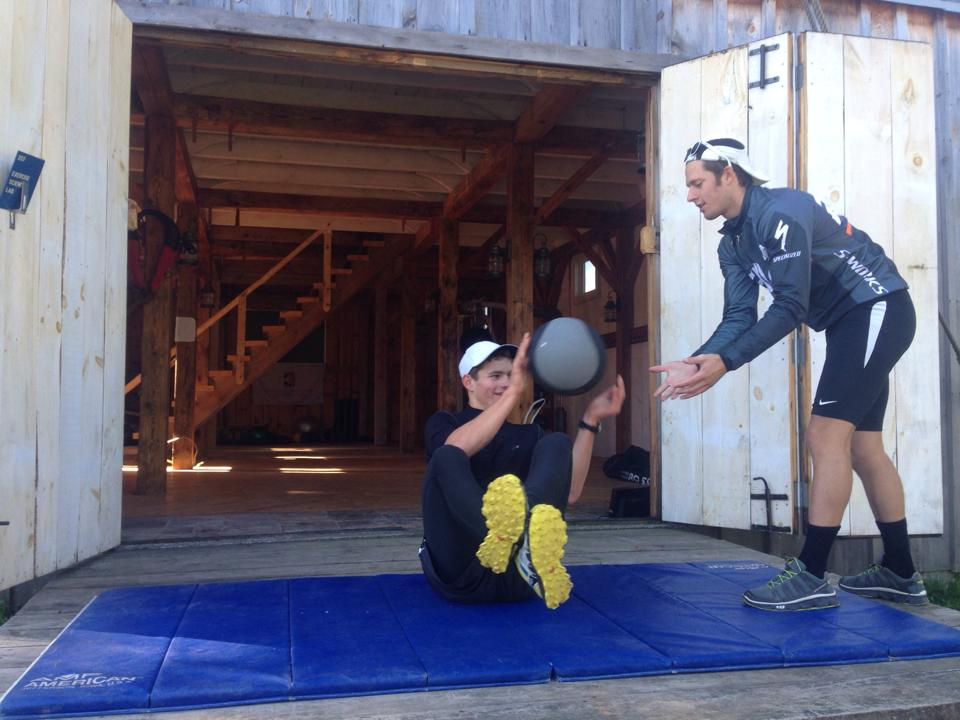
The newly appointed CXC Team Head Coach Andy Keller (r) works on strength with postgrad Scott Harrison outside a barn near Cable, Wis. (Photo: CXC Skiing/Facebook)
Three years ago, Andy Keller was a college kid looking for an internship toward his exercise-science degree at Michigan Tech. He knew a girl, who knew Jason Cork, and he used the connection to land an apprenticeship at the Central Cross Country (CXC) Ski Association in Cable, Wis.
At the time, Cork was heading up the CXC Team, which executive director Yuriy Gusev established in 2006 to support promising skiers striving for top national and international performances. Keller, who grew up just outside Minneapolis in Chanhassen, Minn., became Cork’s intern assistant.
Andy Keller started as an intern, then an assistant, and finally a junior coach before being promoted to CXC Team head coach this month, following the departure of Bill Pierce. (Photo: CXCnewsfeed.wordpress.com)
Months later, before Keller began his senior year, Gusev offered him a job.
“I said, ‘I kind of want a degree so I’ll talk to you in a little less than a year,’ ” Keller reflected on the phone last week.
He skied for four seasons at Michigan and graduated in 2012, then asking Gusev if there was still a spot for him. There was, though Keller’s job title and responsibilities changed three times before he officially got started, he said.
First, he was hired as sport-development manager, tasked with connecting CXC to youth clubs and high-school programs in the Midwest. Then, CXC’s assistant coach Gus Kaeding left to head the Stratton Mountain School (SMS) elite team in Vermont. Cook needed an assistant, and CXC’s board decided Keller would be it.
“Then there was a little bit of [difference] with coaching styles and athletes on the team, so Bill [Pierce] got brought on to work alongside Igor [and] I took more of a dedicated role to the junior program,” Keller said of last season. “This year started off the same way … I was focused more on the junior program.”
For the next several months, Badamshin oversaw the program and Pierce worked as the elite head coach. In late January, Badamshin died unexpectedly of a heart attack while skiing the Birkie trail between Cable and Hayward, Wis. He was 47, and his passing left CXC and the surrounding community stunned.
“A guy that works his ass off and is willing to do anything for his program … his passion truly lied with working with athletes,” Keller reflected. “[I] was just trying to carry on his legacy — inspiring kids to ski and getting them excited to be out there. If there’s one thing he was good at, it was definitely that, and also carrying on his work ethic. The guy wouldn’t complain. He’d be out there skiing 50 k and waxing…
“There was definitely big shoes to fill when he passed away,” CXC Team’s new head coach continued. “As I’ve come through, I’ve been working under a ton of coaches; my philosophy is I can always learn something. When I was interning under Jason and Gus that was what I loved to do — learning and listen.”
“There was definitely big shoes to fill when [Badamshin] passed away. … As I’ve come through, I’ve been working under a ton of coaches; my philosophy is I can always learn something.” — Andy Keller, CXC Team Head Coach as of September 2014
Keller Becomes Head Coach
That’s right, Keller, in his third season as a CXC coach, was recently promoted to head of its elite team following Pierce’s decision to accept a job in Colorado (he’s becoming nordic director of the Snow Mountain Ranch YMCA near Winter Park this fall) earlier this month.
But “elite” is a term Gusev and several other U.S. nordic directors like to stay away from: it’s about development and helping athletes reach their higher-competition goals. The CXC Team became Team Vertical Limit in 2009 as part of a sponsorship deal, and a year later it had 18 athletes, including a couple Olympians (Garrott Kuzzy and Caitlin Compton — now Caitlin Gregg).
The New: 2014/2015 CXC Team
CXC Team:
Cory Ellertson
Bjorn Batdorf
Bill Bowler
Chris Pappathopoulos
Hilary Patzer
Andrew Brown
Scott Johanik
Natalia Naryshkina (lives in Russia, plans to compete in western SuperTours and U.S. nationals)
Postgrads: (living in Cable this fall/winter)
Scott Harrison
Sam Boardman
College Summer Residency Group:
Nichole Bathe (University of Alaska Fairbanks)
Nicolette Reker (now at Winona State University, competing for CXC Team)
Tom Bye (Postgrad last year, now at Michigan Tech)
Thomas Kendrick (Michigan Tech)
Will Frielinghaus (St. Lawrence University)
Seth Mares (Gogebic Community College, plans to transfer to Michigan Tech)
International Training Partner:
Leandro Lutz (living in Cable this fall, plans to travel to Europe for international races in an attempt to qualify for World Championships; may stay in Cable and race U.S. circuit)
The CXC Team currently has eight members, most of which will be focused on top-10 results in Midwest marathons to attract sponsors. In addition, Keller is overseeing two postgrads, about 10 juniors and an international guest skier.
“All the coaches agreed, the team needs to get back to the roots of developing athletes,” Gusev explained on the phone. “You would have never called our team the CXC Elite Team, it just came later when this word became very popular.
“We always see our team as a development tool for that higher step,” he added. “We don’t see this team as full of stars, but we want to have a team open to athletes of that level. If it can help them great … It’s just like having a child: at some point you need to let them go and see if they can stand on their feet.”
Considering that, Gusev is encouraged by the direction his program is headed, especially with a homegrown coach at the helm.
“It’s exciting to see somebody who went through the original pipeline and became a coach,” he said. “And that’s a goal from the time he applied from an internship.”
Still, the last few weeks — and months — have been busy at CXC, to say the least. Following Badamshin’s passing, Gusev said the organization interviewed a couple people to hire in his absence, but ultimately, Pierce and Keller stepped up and said they could handled the added responsibilities without another coach.
“It was probably more emotional for some of us, but you just move on,” Gusev said. “The programs needed to move on as well and … we had to adjust right away.”
It didn’t take long for everyone to get back “in the groove,” he added. Pierce continued to serve as head coach and Keller as his assistant and junior coach.
Last Friday, Keller drove 300 miles southeast to Madison to test about 10 juniors at a weekend camp at CXC’s administrative headquarters. The group meets about once a month in various places, holding camps with other Midwest clubs, like Loppet Nordic Racing (LNR), May through December, Keller said.
He also helps host monthly CXC master’s camps, and while he’s not scheduled for every single one, he led a recent camp under Pierce’s guidance earlier this month.
“I made Andy run over half the sessions, and I watched him and helped him a little bit,” Pierce said. Then he told him and the rest of CXC about his decision to leave.
“I saw it coming,” Keller reflected. “Bill did talk to me as he found out more about the new position he was taking.”
In Cable, where Keller lives in a condo on the Telemark property, he spent the summer working with six athletes in CXC’s new college summer residency program, which Pierce initiated.
“That overlapped with what you would call our team now, more of a marathon team,” Keller said of his previous and current responsibilities, coaching juniors and now seniors as well. “The athletes that we’ll have competing on the SuperTour is relatively small.”
Those skiers include two postgrads from LNR — Scott Harrison and Sam Boardman — who plan to live and train full time in Cable this fall and winter. Their main races include western SuperTours, U.S. nationals, and the Midwest Junior National qualifiers .
“We don’t see this team as full of stars, but we want to have a team open to athletes of that level. … It’s just like having a child: at some point you need to let them go and see if they can stand on their feet.” — CXC Executive Director Yuriy Gusev
With an overall emphasis on regional competitions, CXC is looking to assemble the best skiers in the Midwest.
The Old: What happened to last season’s CXC Team?
Not returning: Karl Nygren, Eric Wolcott, Dmitriy Ozerski (was flying back-and-forth from Russia for races)
With a single returner from last year’s CXC Team (college skier Tom Bye), Keller explained what happened:
“When Igor [Badamshin] took over there was little bit of communication issues … a little bit of discontent,” he said. Athletes like Karl Nygren, who might have had as many as five coaching changes in seven years, ultimately decided to leave the program.
“If there’s anything the program needs is some stability,” Keller said.
“As the coach now, I’d love to build the program back up to how it was when I interned,” he said, referencing past CXC standouts like Jessie Diggins, Caitlin Gregg, Brian Gregg, and Jennie Bender. “…That was the year they won the NNF Cup so that’s the level I’d like to bring it back to.”
One of Gusev’s priorities is hiring another coach focused on sport development to further connect CXC with grassroots organizations and schools throughout the central U.S. Looking at the big picture, it’s about promoting the sport and coaching development. In the long run, CXC is hoping that will translate into athlete retention.
“Regardless whether the athletes come to us directly or not … it’s a matter of whether we have consistent, easy to follow progressions, like soccer does or swimming does,” Gusev said of two sports he considers domestic successes in the U.S. “[Those sports outline the] steps to high school, college and beyond, which doesn’t exist really in cross-country skiing. We have all the pieces in place, and we can communicate that to parents.”
For Keller, his goal is to help grow the base and competitive nature of skiers in the Midwest, which includes Illinois, Indiana, Iowa, Kansas, Michigan, Minnesota, Missouri, Nebraska, North Dakota, Ohio, South Dakota, and Wisconsin.
“It’s where I grew up,” he said. “[We’re] trying to make the Midwest more of a ski powerhouse, and that’s definitely happening. We’re developing athletes, but we’re having a hard time getting them to stay around.”
He counted eight skiers in elite programs outside their region, including Jessie Diggins (SMST2), Anne Hart (SMST2), Ben Saxton (SMST2), Gordon Vermeer (Craftsbury Green Racing Project), and Rosie Frankowski (Alaska Pacific University).
“It seems like everybody wants to go somewhere else and I’ve got to figure out why,” Keller said. “I think the level of support CXC gives is among the best … It’s just we’re not in the mountains and we don’t have a glacier to [train on]…
“The Midwest might not be the most sexy training site as a Sun Valley or something like that,” he continued. “… [But] it’s not that we’re not producing the athletes.”
“It seems like everybody wants to go somewhere else and I’ve got to figure out why. I think the level of support CXC gives is among the best … It’s just we’re not in the mountains and we don’t have a glacier to [train on]…” — Keller
In terms of coaching styles, Keller said he gained a lot from working with Cork, Kaeding, Pierce, and Badamshin.
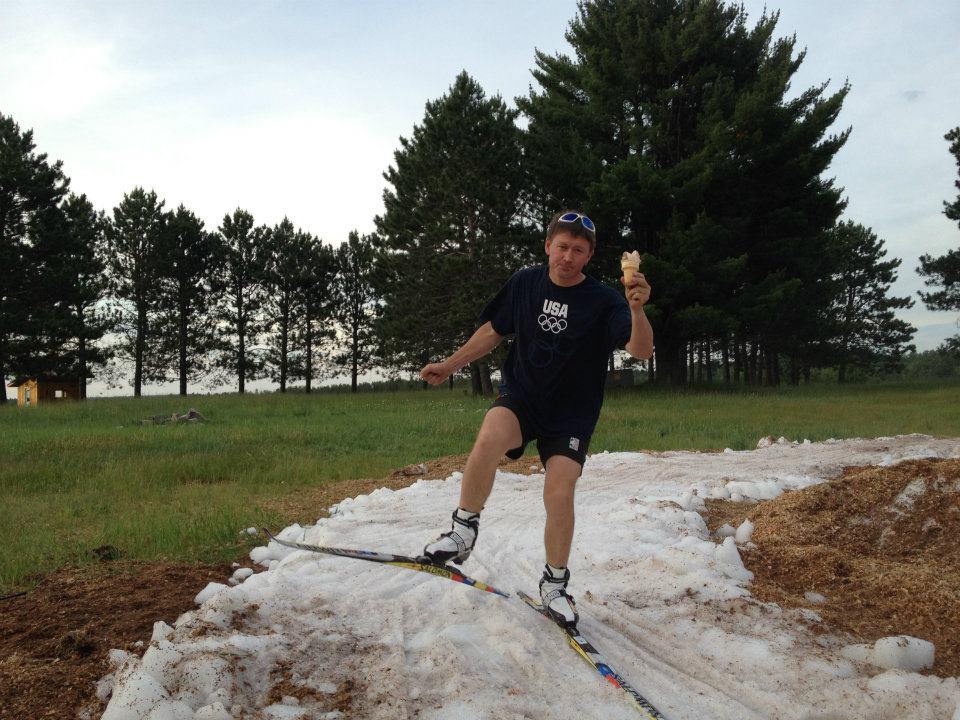
Coach Igor Badamshin having some fun on a few patches of snow. Photo is titled “Snowflakes, ice cream and Igor,” by former CXC Team elite coach Bill Pierce. Badamshin was the CXC program head coach until his unexpected death in January 2014. (Photo: cxcnewsfeed.wordpress.com)
“I’d hope I’d be maybe as analytical [as Cork],” he said. “I’m hoping I can be half as enthusiastic and motivating as Igor … I try to pull from all those guys and find out what works for myself and what doesn’t fit my personality. I would say I’m relatively soft-spoken and sometimes it’s a little bit harder for me to put myself out there. I hope I’ve gotten better at that.”
When it comes to managing athletes, Pierce will continue to write training plans for those that started with him at the beginning of the season, including Cory Ellertson, Chris Pappathopoulos, Andrew Brown, and Scott Johanik.
Keller said he’ll take on those that joined the team more recently and will be in Cable the next several months: the two postgrads and guest skier Leandro Lutz from Brazil, who plans to travel to Europe to try to qualify for 2015 World Championships.
As for coaching and waxing for 18 or so skiers throughout the season, Keller said that working alongside other Midwest clubs at races, especially at main events like U.S. nationals, should help. And not all the athletes will compete at the same events, given their varied focuses — from marathons to junior-qualifying races.
At the same time, Keller said he’s looking forward to having an assistant or some kind of helper in the future. Gusev said the new hire would largely help with junior camps.
In the last month since Pierce’s decision, he said he’d been working with Keller on the transition and will continue to offer assistance beyond his final day at the end of September.
CXC Team’s fall/winter crew during a recent workout in Cable, with postgrads Scott Harrison and Sam Boardman, and guest skier Leandro Lutz from Brazil, who will be joining the team for the next couple months. (Photo: CXC Skiing/Facebook)
“I’ve basically given [Keller] my daily responsibilities,” Pierce said earlier this month. That included even the little stuff, like “teaching him how to smooth out a trail and pick rocks and seeds.”
“There’s definitely a lot to catch up on as far as ski selection and things like that,” Keller observed. “Working with Rossignol, getting in contact with those guys, getting up to speed with things Bill might’ve taken care of as far as a team aspect and getting [ready] to compete.”
He’s also tasked with attracting sponsors through top results in Midwest marathons.
“We’ll do fine with that,” he said of his mostly marathon-focused team. “Our postgrads have goals of trying to make World Juniors … definitely a big one is qualifying for Junior Nationals and trying to make top-20 [there]. The goals for the marathon team is being on the podium or top 10 … that should be no problem.”
He’d also like to bring the CXC Team back to an “elite, elite” team, he said, by recruiting recent graduates.
CXC Para Nordic Team member Steve Baskis training with U.S. Paralympics Nordic Program in the ski tunnel in Torsby, Sweden, earlier this month. (Photo: CXC Skiing/Facebook)
According to Gusev and CXC’s mission statement, the 2,000-member organization has four straightforward goals: to build its base, promote the sport, achieve competitive success, and create partnerships through collaborations. The way he sees it, member athletes are part of that as well.
“[The CXC Team] athletes are in a community to be motivation to adult athletes at clinics, to be role models and whatever else comes with it,” Gusev said. “With competitive excellence, we hope to get them to the level [of someone like Garrott Kuzzy or Tad Elliott, who made the U.S. Ski Team]. We hope the athletes that come through our program will eventually contribute to international success…”
Emerging Adaptive Team
CXC is also focused on building its adaptive program under coach Andrew Poffenberger, another Minnesota native who skied as a junior and studied health fitness at Gustavus Adolphus College in St. Peter, Minn.
Augusto “Goose” Perez (sit-skier, cancer survivor, 2014 Paralympian)
John Oman (standing athlete, 2014 Paralympian)
“Emerging Talent” Program:
“People who have tried nordic skiing on several occasions and show promise, interest in competition, and commitment to the sport,” Poffenberger wrote. “This is an area where I am looking to grow in the next few months as people turn their attention from fall sports to winter.”
Junior Para Development: Focused on youth development and coaches interested in instructing adaptive skiers in high schools. “Our annual coaches clinic and certification will include a few sessions on adaptive nordic skiing for those interested this year,” he wrote.
This year, the CXC Para Team has expanded to include five elite athletes, four of which went to the 2014 Sochi Paralympics: Aaron Pike, Travis Dodson, Augusto “Goose” Perez, and John Oman. Its fifth member, Steve Baskis, a blind athlete and veteran, recently joined the U.S. Paralympics Nordic Team at an on-snow camp in Sweden.
Poffenberger also works with three “emerging talent” adaptive skiers — those “who have tried nordic skiing on several occasions and show promise, interest in competition, and commitment to the sport,” he explained in an email.
In addition, he coaches about four or five junior-development skiers, athletes that “can sit ski for 10 to 15 k in a session,” Gusev said. “Andrew’s done an amazing job with them.”
“Ideally we would like to mirror the development structure of able-bodied skiing,” Poffenberger explained. “Possibly the most important component of that structure is youth development. If we expect to be competitive at the highest level, we need to start developing young athletes.”
Among their efforts: CXC has submitted a proposal to include adaptive nordic at the Wisconsin state meet.
“We are also seeking out coaches who are willing and able to coach adaptive nordic skiing at the high school level,” he added.
Last week, Poffenberger attended a conference with The United States Association of Blind Athletes at the Olympic Training Center in Colorado Springs.
“I love working with these athletes because they have perspective of the entire picture, and don’t let small things stand in their way,” he said, now in his second season with the team.
“I hope we can keep having more and more individuals like [Poffenberger and Keller] that get involved with a sport as a profession,” Gusev said. “They understand the way athletes move from one stage to another stage and it’s easier for them to communicate with athletes at the younger level what expectations are. That’s really the goal.”
Caitiln Gregg (Madshus/Team Gregg) rounding the final corner into the stadium at the Rendezvous Ski Trails to win Friday’s 1.3 k skate sprint, the first SuperTour race of the 2013/2014 season, in West Yellowstone, Mont.
WEST YELLOWSTONE, Mont. – The highlight of Caitlin Gregg’s day was seeing all her Midwest fans, her Loppet Nordic Racing buddies, at the finish of each heat on Friday during the first SuperTour race of the season.
That gave her reason to celebrate and smile every time she won, which the 33-year-old Gregg did all morning and early afternoon at the Rendezvous Ski Trails. After posting the fastest women’s qualifying time of 2:55.52 in the 1.3-kilometer freestyle sprint, Gregg went on to ski away from her competitors in each round thereafter.
Pushing all the way across the line for the fourth time of the day – seconds ahead of Jennie Bender (Bridger Ski Foundation), who placed second, and Becca Rorabaugh (Alaska Pacific University), who finished third in the final – Gregg threw her hands in the air. Couldn’t have gone any better, she thought.
Caitlin Gregg (Madshus/Team Gregg) celebrates a big opening win at the West Yellowstone SuperTour 1.3 k skate sprint.
“This is probably one of the biggest races for me,” said Gregg, of Madshus Racing and more recently Team Gregg.
“We’ve got my family, my husband’s family here, all of the other people on the circuit that we’ve worked with. Just to have that energy here right now actually means some of the most to me. I think I had six or seven Loppet Nordic Racing kids … at the finish line [of every heat]; that’s the best feeling ever. You just realize that’s what it’s about. It’s ski racing, and it’s just fun to share with everyone.”
In her first official race of the 2013/2014 season, Gregg won the qualifier by 2.18 seconds over Becca Rorabaugh. She went on to dominate her quarterfinal, beating runner-up Sylvia Nordskar (University of Denver) by 3.5 seconds.
Gregg then commanded her semifinal in 2:48.3, six-tenths of a second faster than runner-up Caitlin Patterson (Craftsbury Green Racing Project). Patterson went on to place fifth in the final, ahead of Andrea Lee (University of New Mexico) in sixth and behind Erika Flowers (Stratton Mountain School T2 Team) in fourth.
For Gregg, it was a great start – one that puts her on the path to World Cup starts in January if she continues to rule the SuperTour series, which next stops in Bozeman, Mont., Dec. 7-8.
“I’m very grateful that we’re starting out with skate races,” she said of her preferred discipline. Saturday’s SuperTour 10 and 15 k distance races in West Yellowstone are freestyle as well.
“It’s always nice to feel that’s in your favor and you’re starting off on a good foot,” she added.
With the University of New Mexico waxing for Gregg and her husband Brian this weekend, she quickly credited the team’s coaches and staff.
“They just nailed the waxing so, for me, it became very easy,” she said. “[In the heats, I] kind of hung and tried to stay out of trouble, and then it was pretty obvious after that first little bit of the downhill my skis were just awesome so I just decided to go for it.”
Rorabaugh, who won her quarterfinal and was second to Bender in a photo-finish semifinal, recalled when Gregg took off in the final: not too far in, right after the last downhill.
After descending from the flat stretch out of the stadium, the five other women tried to keep up with Gregg on the low-lying backstretch, still nearly 7,000 feet above sea level. It was curvy and technical. “Lots of jostling for position,” Bender explained.
“I knew that Caitlin was probably just gonna go for it and I still wasn’t ready to go with her, which was silly,” said Rorabaugh, who was jockeying for third when Gregg accelerated across the flat.
Earlier, Rorabaugh tried to control her heats and ski conservatively, knowing she could make the final if she played her cards right.
“The danger is sometimes you check out a little bit rather than being in full-on go mode the entire day,” she said. “I think it made it harder for me when Caitlin decided to take off.”
Jennie Bender (BSF) racing to a quarterfinal win in Friday’s West Yellowstone SuperTour 1.3 k skate sprint. She went on to place second in the final to Caitlin Gregg (Madshus/Team Gregg).
Meanwhile, Bender was trying to come back from an early slipup just outside the stadium, in which she dropped to sixth.
“I got in a bad spot and everyone passed me and I was like, ‘Uh oh,’ ” Bender recalled. “But there were good places to tuck in behind people and then swing around them. … I tried to plan it so that coming up that last hill, I would be in a decent spot.”
As Bender picked people off, Gregg held her gap up the final climb and skied out of reach by the time she entered the stadium. Bender followed, and Rorabaugh tried to challenge her for second, but Bender had the better line.
Uncontested through the finishing stretch, Gregg had strung out the entire group, yet she pushed entirely through the finish.
“Honestly, I’m a nervous wreck,” Gregg said of lining up against talented sprinters like Bender and Rorabaugh. “I think that’s the best thing to be because if you get too complacent you forget to go for it. I was telling the little kids that: never assume anything until the race is over. You’ve got to work every inch of the way.”
After qualifying in eighth, Bender owned her quarterfinal with a 1.5-second win over Anika Miller (Montana State University), the third-fastest qualifier. Troubled by a back injury throughout the summer and even a few days ago, Bender was pleased to be pain free on Friday and able to give her all through the heats. She had made a point to do as much precautionary work as possible (stretching, ibuprofin and ice) while training in West Yellowstone.
“I felt like it’s the one thing that’s been throwing off my balance, but it felt good today,” she said. “So I was happy about that.”
In her first race with the Bozeman-based BSF, the former CXC skier said its been a good transition.
“I do miss my Midwest crew for sure, but the Bozeman people have been amazing,” Bender said. “Both parties have been really supportive and understanding … I’m hoping for a healthy year because I feel like I have more to give.”
Becca Rorabaugh of Alaska Pacific University (l) chases Jennie Bender of the Bridger Ski Foundation (not shown) down the final stretch of Friday’s SuperTour 1.3 k skate sprint semifinal in West Yellowstone, Mont. A similar chase ensued in the final, where Bender took second after Caitlin Gregg, and Rorabaugh was third.
While Rorabaugh said she made some tactical errors and got a little tired in Friday’s final, she was excited about her first SuperTour podium in two years.
“I know that this is a big year and in order to go anywhere from a domestic-racing standpoint, you have to make a pretty big impression,” Rorabaugh said.
From a World Championships biathlete to a 2010 Olympian and SuperTour favorite, Gregg has seen her share of podiums. But this could have 2014 Olympic implications if she makes it to Europe and meets U.S. Olympic-qualifying criteria on the World Cup.
But Gregg didn’t get ahead of herself. On Friday, she soaked up the support of her Midwest crew, including friends, family and fellow Loppet Nordic Racers. After recently launching Team Gregg with Loppet Nordic, the Greggs were already watching one dream unfold.
“With our travel and our schedule and where we’re based out of [Minneapolis], we kind of see it as an opportunity,” she said of the decision to part ways with Methow Olympic Development, which she and Brian joined earlier this season, to form their own elite team.
“It’s going to be a little bit of a challenge we’re piecing together some wax support and so forth, but people have been super willing to help out,” she said. “The opportunity to race in your true home club – we see these kids day in and day out. I can’t think of anything better to have some older elite athletes racing in the same suits.”
The funny thing is, those juniors think she’s wearing their suit. “The kids came up to me and said, ‘Hey! You’re in our Fast Kids uniform!’ ” Gregg said. “We’ve always had [this] in the back of our head and never knew how it would work out and it all came together this year.”
Madshus, the oldest ski brand in the world, is seeking an independent sales representative for the U.S. Mid-West territory.
The successful candidate will have an intimate knowledge of the Nordic business and the Nordic community within the territory (Minnesota, Illinois, Wisconsin, South Dakota, North Dakota, Iowa, Michigan, Nebraska). Ideally we are seeking someone who is an independent sales rep and working within the Outdoor and Nordic communities of the territory.
Responsibilities:
All aspects of sell-in, service and participation with on-snow and sales events.
Required Qualifications:
2 years experience in Nordic ski sales
2 years experience in outside sales
Territory sales forecasting experience
Excellent verbal and written communication skills.
Computer savvy
College graduate
For further information please contact Jeremy Ditto (Jeremy_ditto@k2sports, 800-426-1617 x 1712).
Paige Schember of F.A.S.T. Performance Training (center) hugs one of her Midwest teammates after winning the 1.3 k sprint A-final for the 2012 Junior Nationals OJ sprint title at Soldier Hollow in Midway, Utah, on Monday.
All 2012 Cross Country Junior Nationals coverage is brought to you through the generous support of The Memory Clinic, in Bennington, Vt., committed to caring for the mind since 1987. Currently conducting clinical research on the Alzheimer’s disease vaccine.
MIDWAY, Utah – Paige Schember knew her strengths, and they didn’t include sprinting.
Regardless, the St. Olaf College skier and F.A.S.T. Performance Training athlete decided to go for it in the 1.3 kilometer classic sprints at the 2012 Cross Country Junior Nationals on Monday. She held her own and represented the Midwest all the way to the OJ A-final, where Schember continued her gutsy racing.
Paige Schember (Midwest/F.A.S.T.) celebrates after crossing the line first at the 2012 Junior Nationals OJ sprint A-final. Rachel Mason of Great Lakes/Michigan Tech (in yellow) finished second, and Sharmila Ahmed of the Midwest/Go Training (l) was third.
Trailing Rachel Mason (Great Lakes/Michigan Tech) for the first half of the race, Schember attacked on the up-and-over final climb at Soldier Hollow and cruised ahead to an OJ sprint title in 4:20.25.
Mason was second (+4.02), and Sharmila Ahmed (Midwest/Go Training) was third (+4.65).
In the last race of the nearly eight-hour opening day of competition at Junior Nationals, Schember was the only non-New England winner. In five other races, the eastern team had a champion in every category, from the J2s to the OJ boys.
Without a New Englander in the OJ girls A-final, the race was all about the Midwest. Five of six competitors were from there.
Schember’s F.A.S.T. teammate, Elizabeth Simak finished fourth. Claire Galvin of Go Training was close behind in fifth, and Alice Flanders (Sisu Ski Club) placed sixth.
“It hasn’t even registered yet; I feel so awesome,” Schember said after the race. “That race was so much fun and I’m just in shock.”
That morning, she had been excited to qualify for the heats in 17th.
“I’m not a sprinter. I don’t consider myself one,” she said. “Every race I thought, I’ll just look forward to the next one and take it race by race. If I qualify, I qualify—and then every race was like, ‘Wow,’ so I’m just amazed right now.”
After placing second in her quarterfinal to Simak, Schember won her semifinal ahead of Galvin and Simak, who were second and third, respectively. Mason as the fifth-fastest qualifier won both her quarterfinals and semis.
The top qualifier, Felicia Gesior (GL/Northern Michigan) finished fifth in the B-final and 11th overall. She won her quarterfinal and was fourth behind Schember in the semis.
In a 1.3 k sprint, there isn’t much time for decisions. So when Eric Lustgarten, a sophomore at St. Lawrence University, forged ahead on the second and final significant climb at Soldier Hollow, he knew there was no turning back.
St. Lawrence University and New England skier Eric Lustgarten (c) on the podium after winning the 2012 Junior Nationals 1.3 k classic sprint at Soldier Hollow in Midway, Utah, on Monday. Austin Cobb (l) was second and Nick Michaud (r) rounded out the New England podium sweep in third.
Previously hanging behind his New England teammates in the A-final, Lustgarten said the pace was relaxed. With five of six racers from New England, it wasn’t rocket science to figure out why. Regardless, Lustgarten chose to push the tempo.
“I realized I either needed to make a move or stick in second on the downhill to catch a draft,” Lustgarten said. “I decided to take it. Skis were perfect, magic skis today, and just finished as fast as I could.”
Lustgarten won the final for the OJ sprint championship in 3:08.15, nearly three seconds ahead of Austin Cobb (NE/Stratton Mountain School), who made up considerable ground from skiing around fifth to finish second (+2.71).
Nick Michaud of the Maine Winter Sports Center was third (+3:23) after passing the only non-New Englander, Sawyer Kesselheim (Intermountain/Bridger Ski Foundation), toward the end of the race.
With Dartmouth’s Silas Talbot in fourth (+3.78), New England swept the top four. Kesselheim finished fifth (+6.73) and Hans Halvorsen (NE/Green Mountain Valley School) was sixth.
Michaud qualified in first earlier on Monday. He went on to place second in the quarterfinals to Kesselheim and second in the semifinals to Lustgarten.
Lustgarten was the fourth-fastest qualifier and placed second in his quarterfinal to Kevin Bolger (IM/Sun Valley). Bolger went on to place second in the B-final after Kyle Bratrud (MW/Minnesota Valley), putting Bratrud in seventh and Bolger in eighth.
Rossignol welcomes three new Midwest Athletes to the race program for 2009-10. New members of the team include National Champion Caitlin Compton, of Minneapolis; Nikolai Anikin of Duluth, MN; and Matt Weier of Marquette MI.
Caitlin Compton
Caitlin Compton is a 3-time National Champion, competed in the last two world championships and vying for a spot on the 2010 Olympic team. Caitlin is one of the top skiers in the U.S. and no stranger to the race scene both at the National level and well as marathons. Besides winning the 2009 5 km skate race at US Nationals in Anchorage, Caitlin came back home to Minnesota to win the 35 km City of Lakes Loppet in commanding fashion. After testing Rossignol skis on the Glacier in Bend, Oregon in June, Caitlin made the switch.
Nikolai Anikin
Nikolai Anikin is a top marathon skier in the Midwest as well as a high school and masters coach in his hometown of Duluth MN. Nikolai won the Noquemenon 50 km Skate, the Great Bear Chase 50km, and had four other top three finishes in Midwest marathons this past season. Nikolai is excited to ski the new Rossignol WCS (World Cup Skate Ski). “The new lower camber profile and full carbon deck give excellent flex and glide, I can’t wait to race on them.”
Matt Weier
Matt Weier, a Northern Michigan University graduate, has made home in Marquette Michigan where he continues to coach and race marathons. Past winner of the Noquemenon 50km skate (MI) , North American Vasa (MI) and the Pepsi Challenge 50 km (MN), Matt continues to be on the podium marathons throughout the Midwest. Matt is not only excited about racing on the new World Cup Skis, the Rossingol World Cup boots give him uncompromising fit and performance. After testing the boots this summer, Matt made the move to Rossignol.
The athletes join current Midwest Rossignol athletes including: 2006 Olympic biathlete and 2010 Olympic hopeful Carolyn Bramante; 2009 City of Lake Loppet Champion, Bjorn Batdorf; Kim Rudd and Hilary Patzer.
Support of racing, coaches and athletes, both at the National and local level, is a hallmark of Rossignol’s commitment to Nordic Skiing.Rossignol athletes, coaches and reps got together recently for a training day at Hyland Park Reserve in Bloomington MN. All Smiles on a beautiful fall day.
left to right: Carolyn Bramante, Kim Rudd, Bjorn Batdorf, Hilary Patzer and Caitlin Compton