
Tag: Mikaela Paluszek

  • Wednesday Workout: 4 x 1 k Head-to-Head Racing with MWSC Biathletes

    Wednesday Workout: 4 x 1 k Head-to-Head Racing with MWSC Biathletes

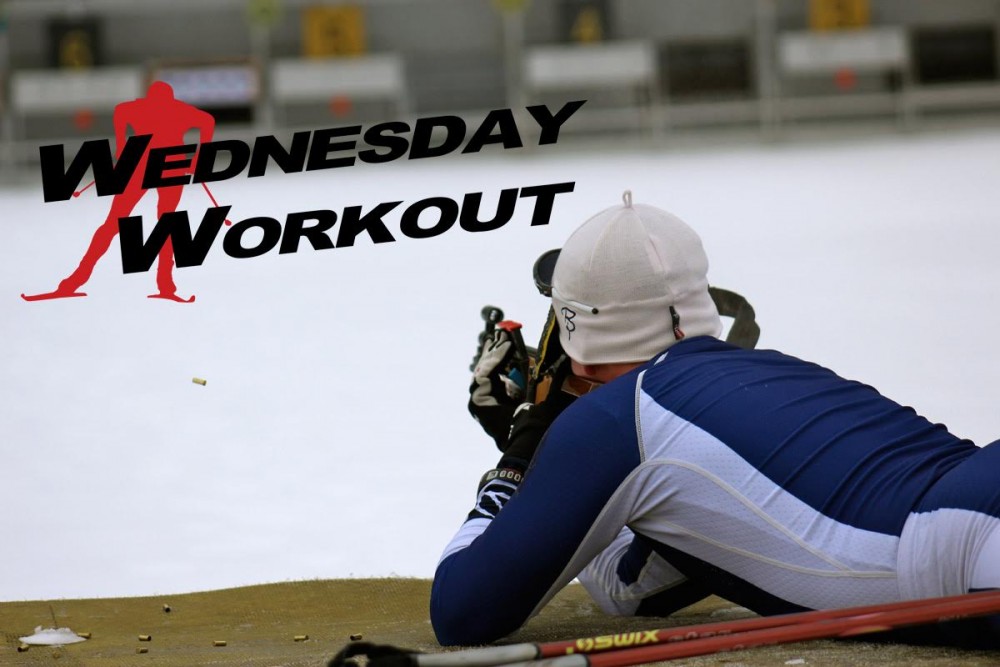
    Maine Winter Sports Center (MWSC) biathlete Brendan Cyr finishes his second round of prone shooting during a late-December workout at the Fort Kent Outdoor Center in Fort Kent, Maine.
    Maine Winter Sports Center (MWSC) biathlete Brendan Cyr finishes his second round of prone shooting during a late-December workout at the Fort Kent Outdoor Center in Fort Kent, Maine.

    Before the USA Youth and Junior Biathlon World Championship Team Trials kicked off this week (Dec. 27-30) in Anchorage, Alaska, FasterSkier caught up with the Maine Winter Sports Center (MWSC) biathlon program for a workout to help prepare athletes for the heat of the competition season. The workout can be done once or twice per training cycle and may be easily adapted into a cross-country workout.*

    FORT KENT, Maine — What could be better than a rugged set of intervals with Northern Maine’s finest. How about a rugged set of intervals with a rifle?

    Though not everyone can handle shooting with a simultaneously high heart rate, Seth Hubbard,  biathlon director and head biathlon at the Maine Winter Sport Center (MWSC), said a head-to-head shooting workout is essential for biathletes looking to improve both their skiing and shooting.

    “What we’re trying to do is recreate the pressure of coming into the range of a competition with other racers around,” Hubbard said on the phone.
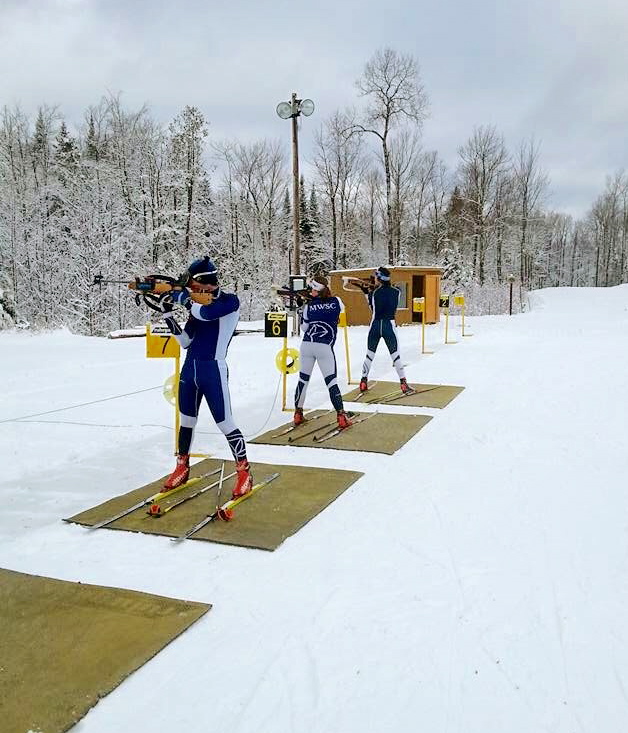
    Left to right: MWSC Biathletes Brendan Cyr, Mikaela Paluszek, and elite athlete Russell Currier during a head-to-head shooting workout in late December at the Fort Kent Outdoor Center in Fort Kent, Maine. (Courtesy photo)
    Left to right: MWSC biathletes Brendan Cyr, Mikaela Paluszek and Russell Currier shoot during a head-to-head workout in late December at the Fort Kent Outdoor Center in Fort Kent, Maine. (Courtesy photo)

    In order to mimic the high stakes and stress of a race, the workout itself involves a 4 x 1-kilometer mass start, with shooting and 150-meter penalty laps to follow each 1 k interval loop.

    “What it does is it puts a lot of pressure on shooting well. You want to shoot fast, but you also want to hit your targets because the penalty loops, in comparison to the 1 k loops, are a pretty large percentage of the [workout],” Hubbard pointed out. 

    The shorter-distance interval loops allow athletes to push the pace without overexerting themselves too much prior to upcoming competitions, while also providing a practice scenario for shooting with a high heart rate and high pressure.

    “This is a workout we use as we get closer to competitions to mimic race efforts and race stress level,” said Hubbard, “It is also something we’ll use periodically throughout the year just to stay in touch with that stress of a shooting competition.”

    Brendan Cyr of Caibou, Maine, currently a post-graduate biathlete at the MWSC who plans to attend St. Lawrence University next fall, said the workout strengthened his preparation for the Youth and Junior World Championships trials taking place this week in Anchorage.

    “I like the workout because I get to practice shooting with a very elevated heart rate,” Cyr said during an in-person interview. “The head-to-head racing is also great preparation for competitions because [my teammates and I] generally hit the mats at the same time and have the added pressure of shooting with other athletes around.”

    Current MWSC biathletes in the program, in addition to Cyr, include Brian Halligan, Cody Johnson, Hannah Streinz, Mikaela Paluszek, Maddie Phaneuf, and elite athlete, Russell Currier.
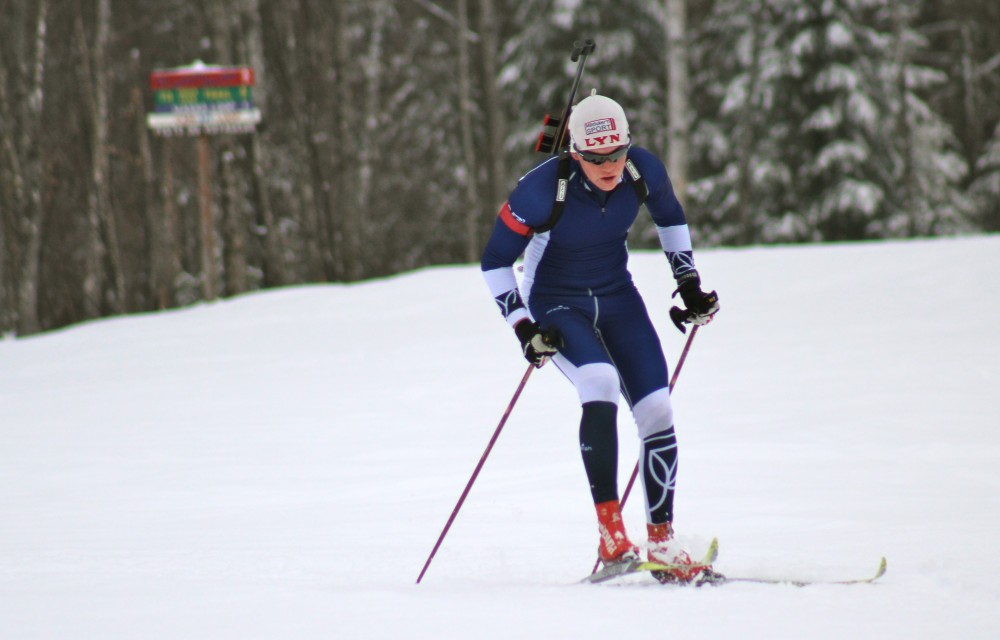
    Brendan Cyr (MWSC) rounds the stadium of the Fort Kent Outdoor during a workout in late December in Fort Kent, Maine.
    Brendan Cyr (MWSC) rounds the stadium of the Fort Kent Outdoor during a workout in late December in Fort Kent, Maine.

    With a smaller team compared to previous years, Hubbard looks to expand the breadth of their program, as well as its depth.

    “We don’t just want to push to get numbers if they’re not going to be the people who are going to mesh well with the program and mesh well with the area,” Hubbard said.

    He added that the MWSC program continues to seek dedicated athletes willing to grow individually and athletically in the hillocks of northern Maine.

    “Whether or not they’re going to be the next Olympian, we want to draw in and develop more mature athletes. Mature in the sense that they’ve developed — as an athlete and an individual — a better understanding of planning, process, commitment, and goal setting, whether those are in life or skiing.”

    The Workout: Head-to-Head Shooting

    Warmup: 20-25 minutes easy Level 1 skate skiing

    Intervals: 4 x 1 k mass start with shooting and 150-meter penalty laps after each 1 k interval (depending on the amount of targets missed). Skiing should be continuous.

    – Shooting format is prone, prone, standing, standing

    – 1 k interval effort/pace should be race pace or just above race pace. “You’re trying to get race intensity experience — something that’s going to be a very challenging intensity to be shooting at,” Hubbard explained.

    Cool down: 15-20 minutes easy Level 1 skate skiing

    *Cross-country adaptation: Instead of shooting in between each 1 k interval, take approximately two minutes of rest before beginning the next interval piece.

  • Eight Biathletes Named to U.S. Squad for World Youth and Junior Championships in Belarus

    Eight Biathletes Named to U.S. Squad for World Youth and Junior Championships in Belarus

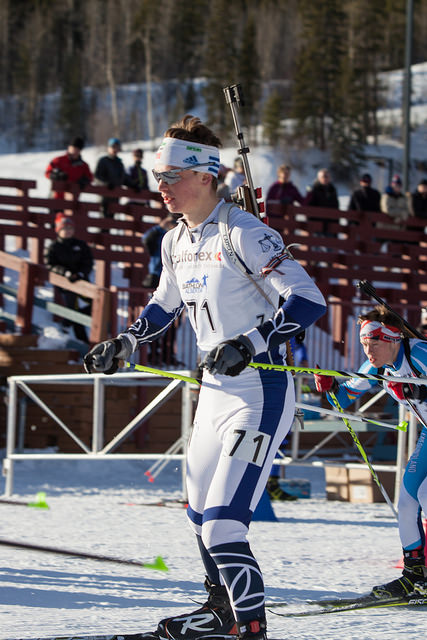
    Brian Halligan (Maine Winter Sports Center/USBA Development Team) competing in the NorAm mass start in Canmore, Alberta, on December 7. Halligan swept all three junior men's races at World Youth and Junior Trials in Mount Itasca, Minnesota, and earned a spot on the championships team. Photo: Jakob Ellingson.
    Brian Halligan (Maine Winter Sports Center/USBA Development Team) competing in the NorAm mass start in Canmore, Alberta, on December 7. Halligan swept all three junior men’s races at World Youth and Junior Trials in Mount Itasca, Minnesota, and earned a spot on the championships team. Photo: Jakob Ellingson.

    The U.S. Biathlon Association (USBA) has concluded its trials series for World Youth and Junior Championships, to be held in mid-February in Minsk, Belarus. The trials were held in Mount Itasca, Minnesota, after being canceled from Anchorage, Alaska, due to a lack of snow.

    USBA has named eight initial members of the team (press release below the story), and may name more athletes as discretionary picks after a meeting of its International Competition Committee on January 1.

    The opening sprint was held on Sunday, with Brian Halligan (Maine Winter Sports Center, MWSC), Paul Everett (Methow Valley), Mikaela Paluszek (MWSC), and Chloe Levins (Mountain Top Nordic Ski Club) picking up wins.

    On Monday, 10 k pursuit races were held on the basis of the first sprint. Cold temperatures reportedly made cold fingers ubiquitous and shooting difficult. In the youth men’s pursuit, Cam Christiansen of Nisswa Biathlon climbed from fourth place up to first thanks to only two penalties – by far the most impressive shooting in the field. He finished over a minute ahead of Everett, who had six penalties in total including a crushing four in the third shooting stage alone.

    In a junior men’s field which struggled on the range, Halligan eked out a 9-second win over Jakob Ellingson of Mount Itasca, with seven penalties to Ellingson’s six. In the junior women’s field, the only entrant, Paluszek, nevertheless improved her performance, accruing only three penalties over the four-stage race.

    The youth women’s pursuit came down to a battle between Levins and Siena Ellingson of Mount Itasca. Through three stages, Ellingson accumulated a big lead with only a single penalty to three by Levins. But in the final stage Ellingson missed four shots and Levins only one. After a furious final loop of skiing, Levins won by three seconds.

    Temperatures were forecast to be so cold on Tuesday that racing was likely to be canceled, but race organizers were able to pull off a final set of sprint races. Halligan completed a sweep of the junior men’s series, winning the 7.5 k competition by a minute and 21 seconds over Jakob Ellingson. Zean Baker of Nisswa Biathlon placed third.

    In the youth men’s 7.5 k sprint, Chistiansen again showed excellent shooting, picking up a single penalty to tally his second win of the weekend. He finished 22 seconds ahead of MWSC’s Brendan Cyr, who had two penalties, with Everett placing third with four missed shots.

    Paluszek picked up four penalties in the 6 k sprint to again win her division. Two youth women, competing over the same distance, beat her: Hannah Streinz of MWSC, who had two penalties and won the youth competition, and Siena Ellingson, who had four penalties and finished 17 seconds behind Streinz. Amanda Kauzer of Loppet Nordic Racing finished third in the youth women’s field, also with four penalties.

    Pursuit resultssprint results


    FOR IMMEDIATE RELEASE

    December 30, 2014. Mt. Itasca, Coleraine, MN.  The US Biathlon Youth / Junior World Team Trails were completed today at Mt. Itasca in Coleraine, MN despite sub-zero temperatures.  US Biathlon congratulates the following athletes, as well as their families, coaches and clubs, on their qualification for the 2015 IBU Youth / Junior World Championships in Minsk-Raubichi, Belarus, Feb 17 to 24, 2015.  US Biathlon’s International Competition Committee may announce additional team members in the evening of Jan 1, 2015.  The Youth (under 19) and Junior (under 21) World Championships will attract the best age group athletes from over 30 nations.

    Junior Women

    Maddie Phaneuf, Maine Winter Sports Ctr, USBA X Team, Old Forge, NY, pre-qualified by her 4th place at the 2014 YWCH

    Mikaela Paluszek, Maine Winter Sports Ctr, Saxtons River, VT.  Top ranked Junior women at the trials.

    Youth Women

    Chloe Levins, Mtn Top Nordic Ski Club, Rutland, VT. Top ranked youth woman at the trials

    Siena Ellingson, Mt. Itasca / MN Biathlon, Minnetonka, MN. Second ranked youth woman at the trials

    Junior Men

    Sean Doherty, USBA X-Team, Center Conway, NH, pre-qualified by medals at the 2014 YWCH

    Brian Halligan, Maine Winter Sports Ctr, Gansevoort, NY Top ranked junior man at the trials

    Youth Men

    Cam Christiansen, Nisswa NW / MN Biathlon, Pequot Lakes, MN.  Top ranked youth man at the trials

    Paul Everett, Methow Valley Biathlon, Tacoma, WA Second ranked youth man at the trials


    US Biathlon wishes to thank the Mt Itasca Biathlon Club for organizing the trials on short notice due to a lack of snow Anchorage, Alaska, where the trials were scheduled.  Full results will be posted soon at: http://MinnesotaBiathlon.com/

  • Del Frate Repeats, But Three New Victors Emerge at Day Two of Biathlon Junior Trials

    Del Frate Repeats, But Three New Victors Emerge at Day Two of Biathlon Junior Trials

    Danika Frisbie (Vermont Collegiate Biathlon) and Tara Garaghty-Moates (Vermont Biathlon/Craftsbury) in line to start. Photo: Judy Geer.
    Danika Frisbie (Vermont Collegiate Biathlon) and Tara Garaghty-Moates (Vermont Biathlon/Craftsbury) in line to start. Photo: Judy Geer.

    The format and selection procedures at World Youth/Junior Biathlon Championships Team Trials were explained in Wednesday’s report on the sprint races.

    A new day, a new format, and only one of four winners was able to remain at the top of the podium in the second day of competition at World Youth/Junior Biathlon Championships Team Trials in Anchorage, Alaska.

    Andrea Mayo, 4th place junior women. Photo: Judy Geer.

    That biathlete, Kimberly Del Frate of Alaska Nordic Racing and Alaska Biathlon, did so with aplomb, too: she finished more than three minutes ahead of second-place racer Danika Frisbie of Vermont Collegiate Biathlon in the junior women’s 10 k pursuit. Del Frate was by far the fastest skier in the field, and also had among the best shooting; her six penalties over four stages tied her with Frisbie and Silke Hynes, also of Vermont Collegiate Biathlon.

    In a true pursuit, athletes start in the order that they finished in the previous sprint, with time gaps maintained from the final results, and shoot two prone stages and then two standing stages for twenty shots total. As in a sprint, missed shots mean a trip to the penalty loop. In selection races, the U.S. Biathlon Association jettisons the start order and time gaps, maintaining only the distance and shooting format.

    So rather than extend an already minute-plus lead from the sprint, Del Frate started 18 of 20 bibs in the youth and junior women’s field, and instead worked her way through her competitors to be the third girl across the finish line. Del Frate’s twin sister Amanda placed third for the second race in a row.

    “We’re pretty even,” Kimberly Del Frate said of her sister in a recent profile in Alaska’s channel 11 news. “Sometimes I tend to be a faster shooter, but not necessarily more accurate. I get more nervous when she’s shooting next to me than when other people are because she’s my sister and that competitive sister thing.”

    Ruzich on course. Photo: Judy Geer.

    In the youth women’s 10 k race, Wednesday’s winner faced some challenges that ultimately dropped her to last in the field. Tara Geraghty-Moates of Vermont Biathlon and the Craftsbury Nordic Ski Club was having the best pursuit of her life until she cross-fired, or shot on the wrong “point” on the shooting range; she was assessed four penalties for missing her own target, but did not realize that she needed to ski penalty loops because she had hit the targets on the other point.

    “This resulted in me getting a two minute penalty [per loop] for the loops I didn’t do, because I thought I had hit four out of five, not none out of five,” Geraghty-Moats told FasterSkier.

    “Whoops,” she concluded.

    Without the eight minute penalty, the Vermonter would have won handily – by a big enough margin that if she had skied four penalty loops, which typically take 20 to 25 seconds apiece, she still would have chalked up her second victory.

    Instead, Vermont Academy racer Mikaela Paluszek picked up her first victory despite missing nine shots, which meant shooting just 55 percent. She edged Nisswa NW’s Jenna Ruzich by twelve seconds; Ruzich had only six penalties. Third place went to Melissa Manning of the Maine Winter Sports Center.

    Near-perfect Smith. Photo: Judy Geer.

    In the junior men’s 12.5 k pursuit, the sprint victor also suffered on the shooting range, although from more usual errors. Geraghty-Moats’ teammate Ethan Dreissigacker racked up ten penalties; while he shot just 50 percent, fellow junior national team member Casey Smith of Methow Valley Biathlon had a nearly perfect day, missing only two shots and collecting a two-and-a-half minute victory. Smith’s huge victory is all the more impressive because it is his first year as a junior, while the next three finishers are in their last year in the age bracket.

    Maine Winter Sports Center athletes Raleigh Goessling and Ben Greenwald, both of whom represented the U.S. at last year’s World Junior Championships, finished second and third with seven and five misses, respectively.

    The final race, the youth men’s 10 k, was the only one that proved to be a nailbiter. Throughout his race, Sam Dougherty of Alaska Biathlon held the lead. As the previous day’s winner, it didn’t seem surprising – but one minute and two bibs later, Nick Proell of Minnesota Biathlon hit the trails. Both skiers missed two shots in each prone stage, and then Dougherty had one penalty in the initial standing stage while Proell was perfect. In the final stage, Dougherty missed two shots, hit the penalty loop, and jetted off to the finish.

    By the time Proell came into the range, he was leading based on splits. If he had cleaned, he would have had an easy victory – but he missed a shot and had to make a pit stop at the penalty loop before finishing.

    In the end, the Minnesotan, who is set to compete at the Youth Olympic Games in January, was able to squeak out a five-second win over Dougherty thanks to superior shooting. Jake Prince of Alaska Biathlon finished third with four penalties and a time that was just 22 seconds behind Dougherty’s. All three men were repeat podium finishers for the sprint, meaning that they are virtually guaranteed spots on the World Youth Championships team – unless another racer can pop a big win in Friday’s culminating competitions, another set of sprints.

    Full results (Excel spreadsheet)

    Biathletes on the Kincaid Park trail system. Photo: Judy Geer.
    Raleigh Goessling, Maine Winter Sports Center – 2nd place junior men. Photo: Judy Geer.
    Ben Greenwald, Maine Winter Sports Center – 3rd place junior men. Photo: Judy Geer.