Tag: Mike Cavaliere

  • Cockney on Growing Up with Skiing, Retiring and What’s Next

    Cockney on Growing Up with Skiing, Retiring and What’s Next

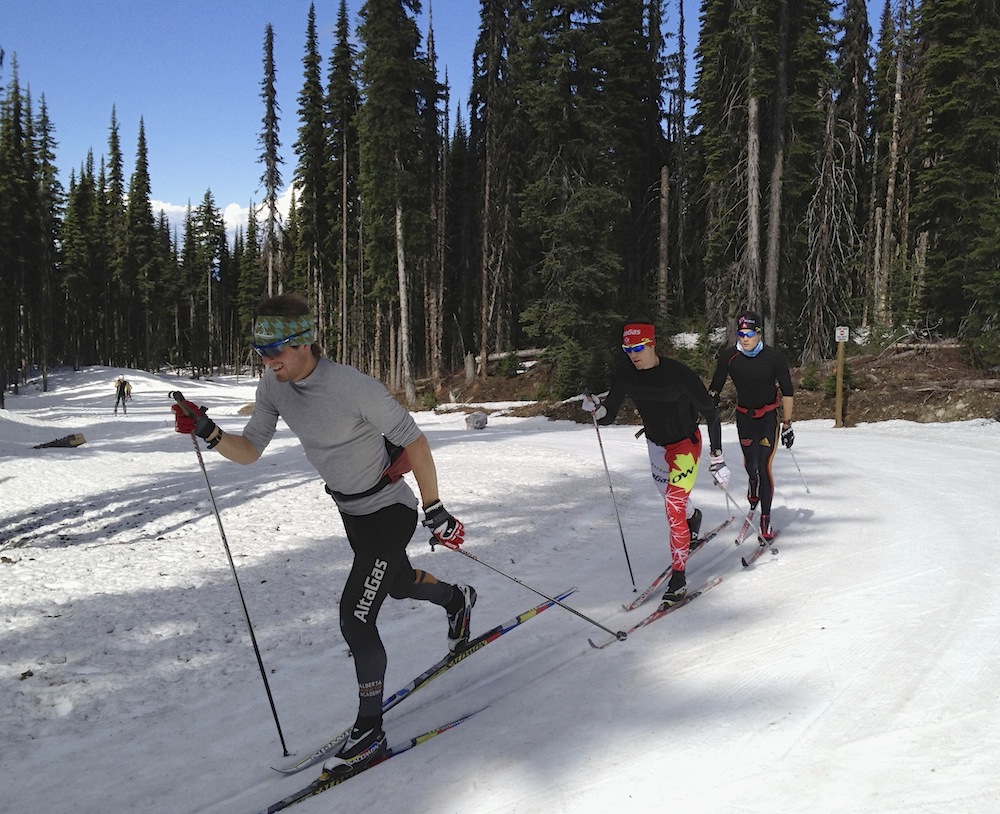
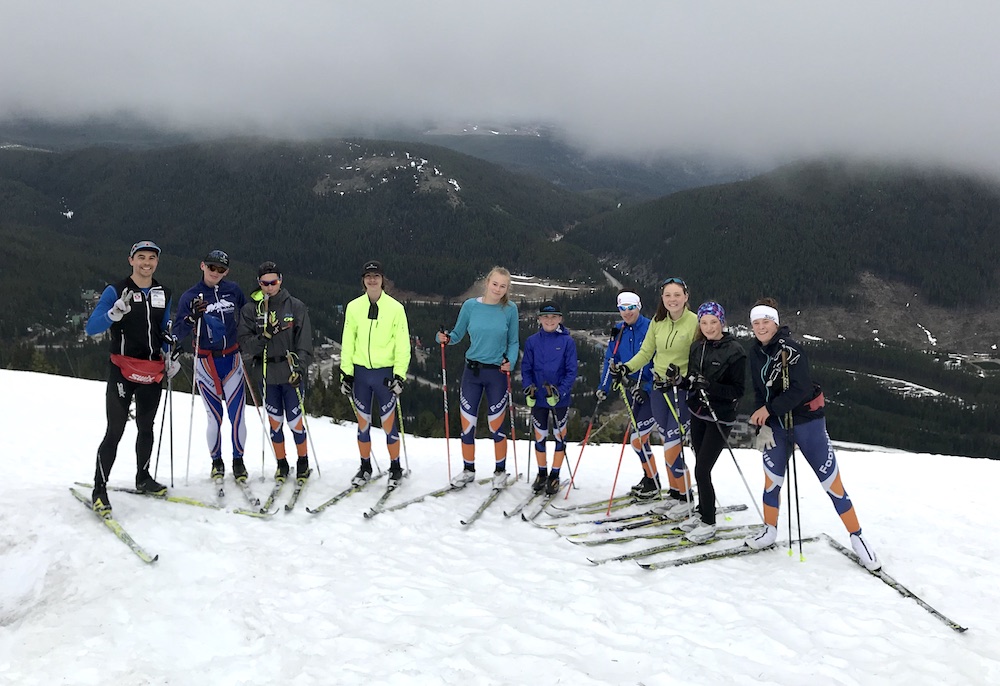
    Jess Cockney (l) and Foothills Nordic skiers on top of Apex, outside of Penticton, British Columbia, on May 19. After retiring from professional skiing this spring, Cockney has been helping out as an assistant coach at Foothills Nordic. He’ll study full time at the University of Calgary this fall. (Courtesy photo)

    Strength. Balance. Agility. Jesse Cockney had all of those qualities as a child growing up in Yellowknife, Northwest Territories — just like most Inuit kids — according to his father, Angus. But what he could do with that talent was what Angus hoped to nurture.

    Since he had put his son on skis at age 3, Angus reflected in an email that he “knew then that [Jess] had incredible potential to succeed.”
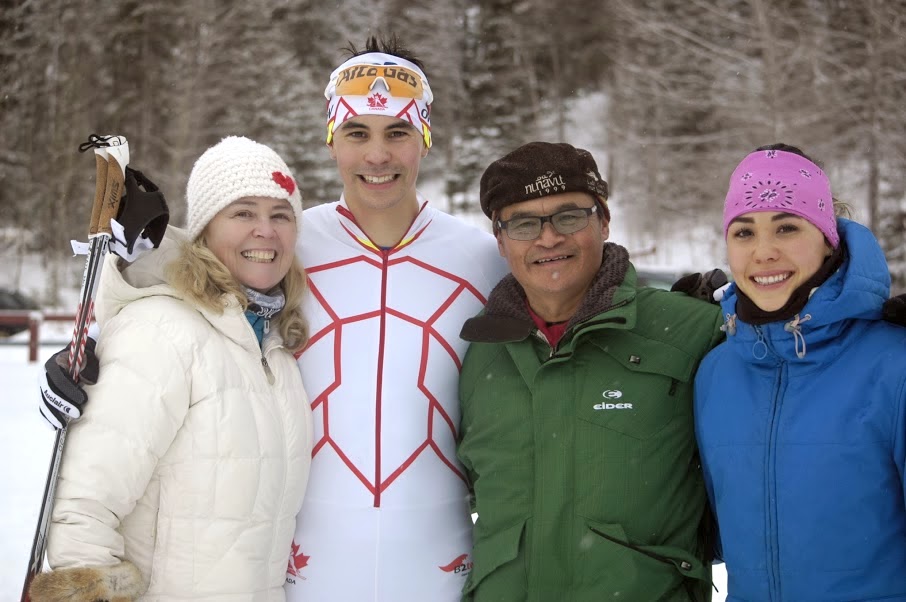
    Jess Cockney and his family after the 2014 Olympic trials in Canmore, Alberta, with his mother, Trish, father, Angus, and sister, Marika. (Courtesy photo)

    And so the Cockneys moved to Canmore, Alberta, when Jess was 7. That included Jess’s mother, Trish, and his sister, Marika. According to Angus, a former competitive skier and junior national champion in 1973, ’74 and ’75 (who spent two months skiing to the North Pole in 1989), the move was about giving Jess “a better opportunity to succeed as it had the right environment with the Nordic Centre and a community full of support with like-minded kids and parents. In other words, we wanted him around a healthy environment.”

    It was an easy transition, Angus explained. Canmore was more conducive to training with milder temperatures than Yellowknife and a wealth of experienced coaches and athletes.

    More than two decades later, Jess credited his dad for helping him reach the highest level of cross-country skiing. A two-time Olympian, Cockney, now 28, has spent 11 years on Canada’s senior national team and two more on the junior national team. He achieved a sixth-place finish in a classic sprint at U23 World Championships in 2011, as well as four individual top-10 finishes on the World Cup.

    “The big reason that I have cross-country skied at this level and really understood at an early age what it meant to pursue racing at a high level was definitely because of Dad,” Cockney said on the phone in April. “He took skiing to a high level as a junior and didn’t carry on after his junior career but stayed really involved with the sport and with racing, too.”
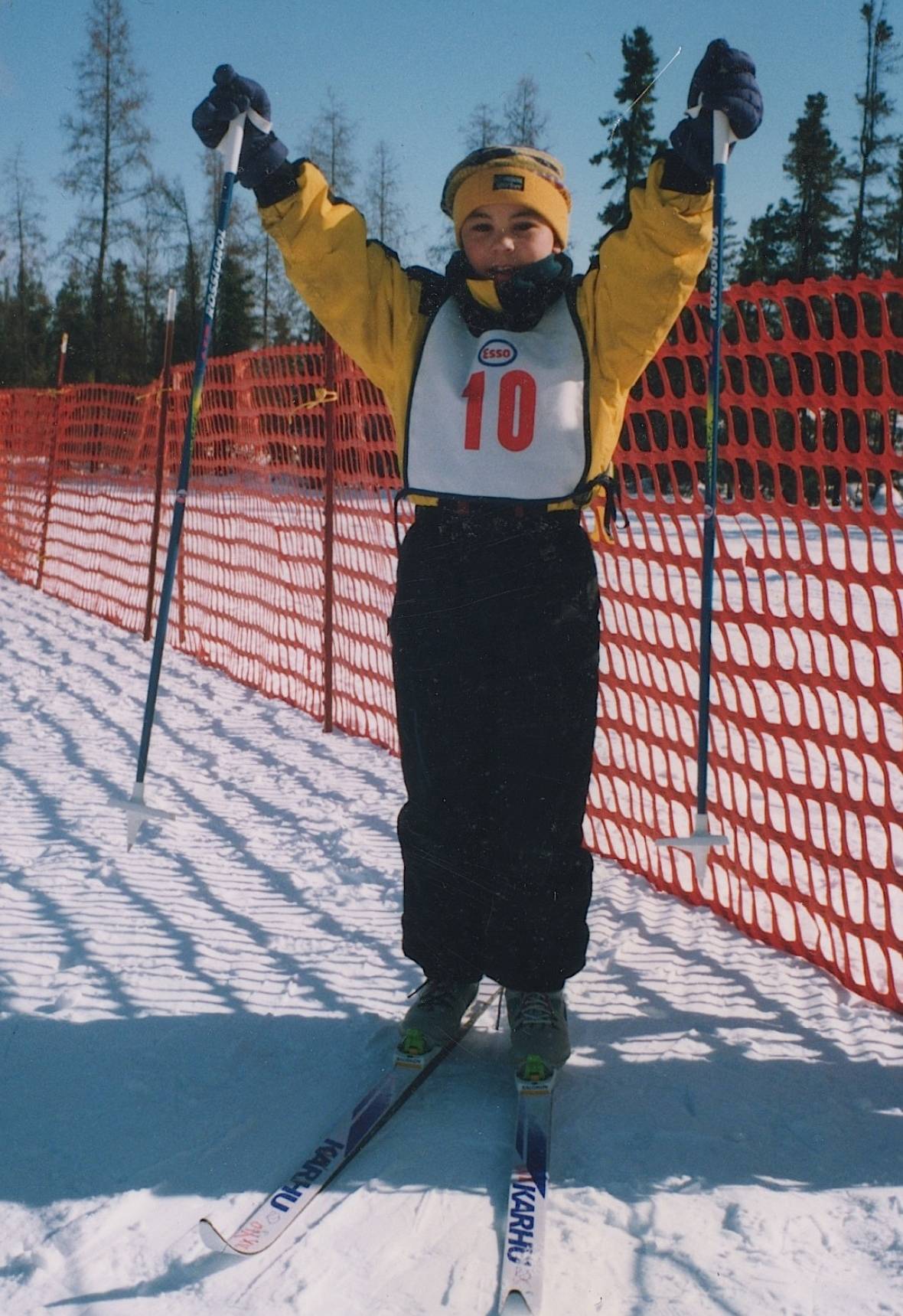
    Jess Cockney enjoying some on-snow time as a youngster. (Courtesy photo)

    He emphasized how special it was to share moments like shuffling on skis at a young age with his dad to seeing him on the side of a World Cup course, calling out splits and taking pictures.

    “It’s pretty fun to be able to share that time together, because skiing means so much to both of us,” Cockney said. “I’m quite happy that my career has worked out as well as it has and that Dad has been able to be there for so many of the good days with it, too.”

    After six years of traveling across Europe on the World Cup circuit (as well as to places like Sochi, Russia, and PyeongChang, South Korea, for the Olympics), Cockney retired from professional skiing this spring. It was a decision that had been on his mind for the better part of the last two seasons, he explained. Toward the end of the PyeongChang Olympics in February, he felt what he described as a mental “decompression” and a natural ending to his career, which solidified his decision.

    “I know how much mental energy it takes to commit towards the training year and the travel for the racing season,” Cockney said. “I had a blast doing that for so many years and I just didn’t think that I was going to be sharp enough or motivated enough. I’m just happy to have such a great season as a final year with the Olympic team and being together with so many of my teammates from over the years at those Games. It just feels like the time is right and I’m excited to do something else.”
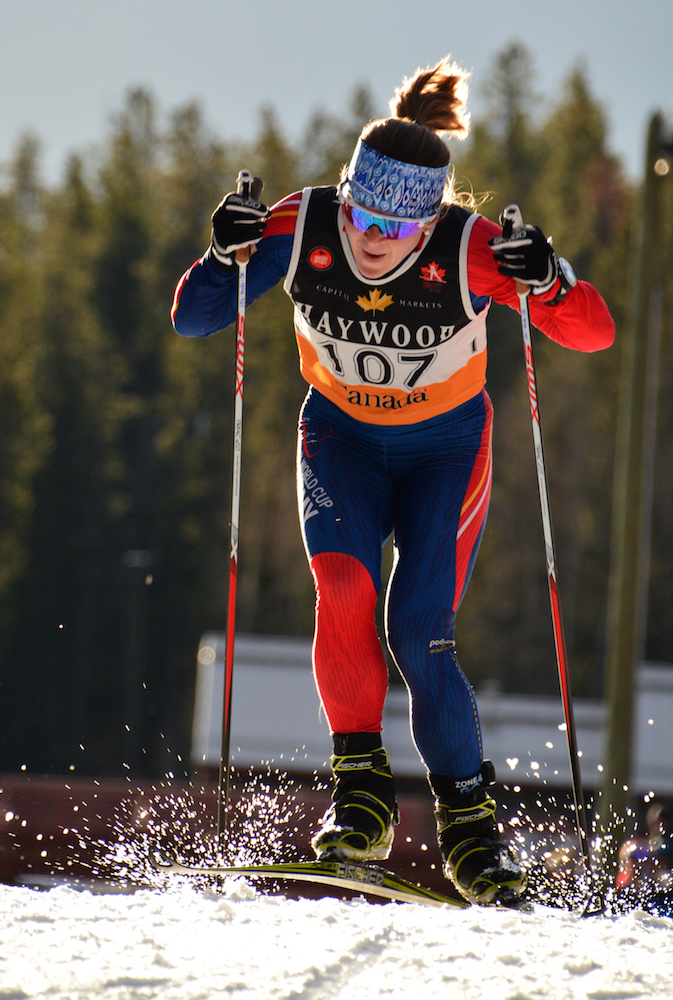
    Annika Hicks rocking the new AWCA suit to 4th place (Photo: Glen Crawford Production Services)
    Annika Hicks (Alberta World Cup Academy) racing in the 2016 Frozen Thunder sprint qualifier in Canmore, Alberta. (Photo: Glen Crawford Production Services)

    While currently renovating his home in Canmore with his girlfriend Annika Hicks (as well as his dad, skier Bob Thompson, and another friend) and assistant coaching at Foothills Nordic, Cockney plans to start classes at the University of Calgary this fall. He was accepted into the university’s political-science program this spring.

    Hicks, who previously trained out of the Alberta World Cup Academy (AWCA) in Canmore, will also be studying full time at the University of Calgary. She is halfway through her studies there toward a science/kinesiology degree in exercise and health physiology. Like Cockney, she explained in an email that she’s been “on the fence” about continuing with skiing for the last two years.

    “I wanted to stop skiing on my terms and with a healthy relationship with the sport,” Hicks, 26, wrote. “I have no regrets and am happy to have that closure. I’m grateful to have had the opportunity to ski race for so long.”

    In her career, she started 15 World Cup races, competed at two U23 World Championships and 2011 Junior Worlds, tallied at least three podiums at Canadian senior nationals (including two second-place results at 2018 nationals in March), and ended this season as the second-ranked Canadian woman overall on the NorAm circuit.
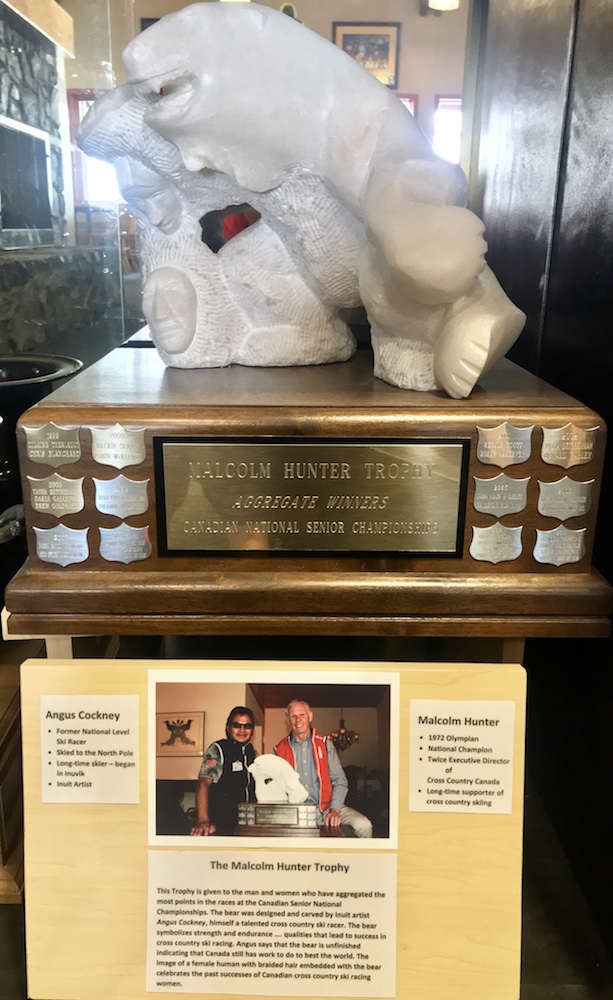
    The Malcolm Hunter Trophy for aggregate winners of Canadian senior nationals, designed by Angus Cockney, as seen in the Canmore Nordic Centre day lodge. (Photo: Cross Country Canada)

    Cockney also finished the second on the overall NorAm aggregate points list. After winning both the freestyle sprint and 15 k freestyle pursuit at this year’s nationals, he also was also awarded the Malcolm Hunter award — a trophy his dad made — as the aggregate male winner at nationals.

    “It was a great way to end the season and end the career,” Cockney said. “I’d never won the nationals aggregate before so that was a big thing for me to do … To get that in my last stab at it was pretty sweet.”

    Angus pointed out that his son’s aggregate win was also special because of where it took place.

    “It was in Thunder Bay [Ontario] where Canada lost my good friend/foe in the late great Reijo Puiras,” Angus wrote. “He too was passionate for cross country and especially made time for and congratulated Jess whenever he could. And, Jess was presented the Malcolm Hunter trophy; a trophy I created and Malcolm was my former coach who brought me to victory in the stormy ice-cold 1975 Canada Winter Games. Therefore, it was very befitting for Jess to go out that way. He came back and told me, ‘Dad, I won the trophy you made.’ ”

    Choosing nordic

    Looking back, Angus explained that his proudest moment of Jess was was when his son consciously chose to pursue cross-country skiing at age 11.

    “I believe he would have made the National Hockey League if he wanted to but I’m glad he picked the greatest sport in the world,” he wrote. “For Jess, I’m proud on how he has become well respected as a person in the community and abroad. Of course too, he showed he belonged on the world’s stage with a number of top ten finishes on the World Cup circuit but was especially proud of him as the second qualifier here in Canmore in 2012 sprints. He certainly had the community a buzz. As a Father/Son duo though, I’m proud too on how we are the only Father/Son duo to win our respective Canada Winter Games; 1975 and 2009.”
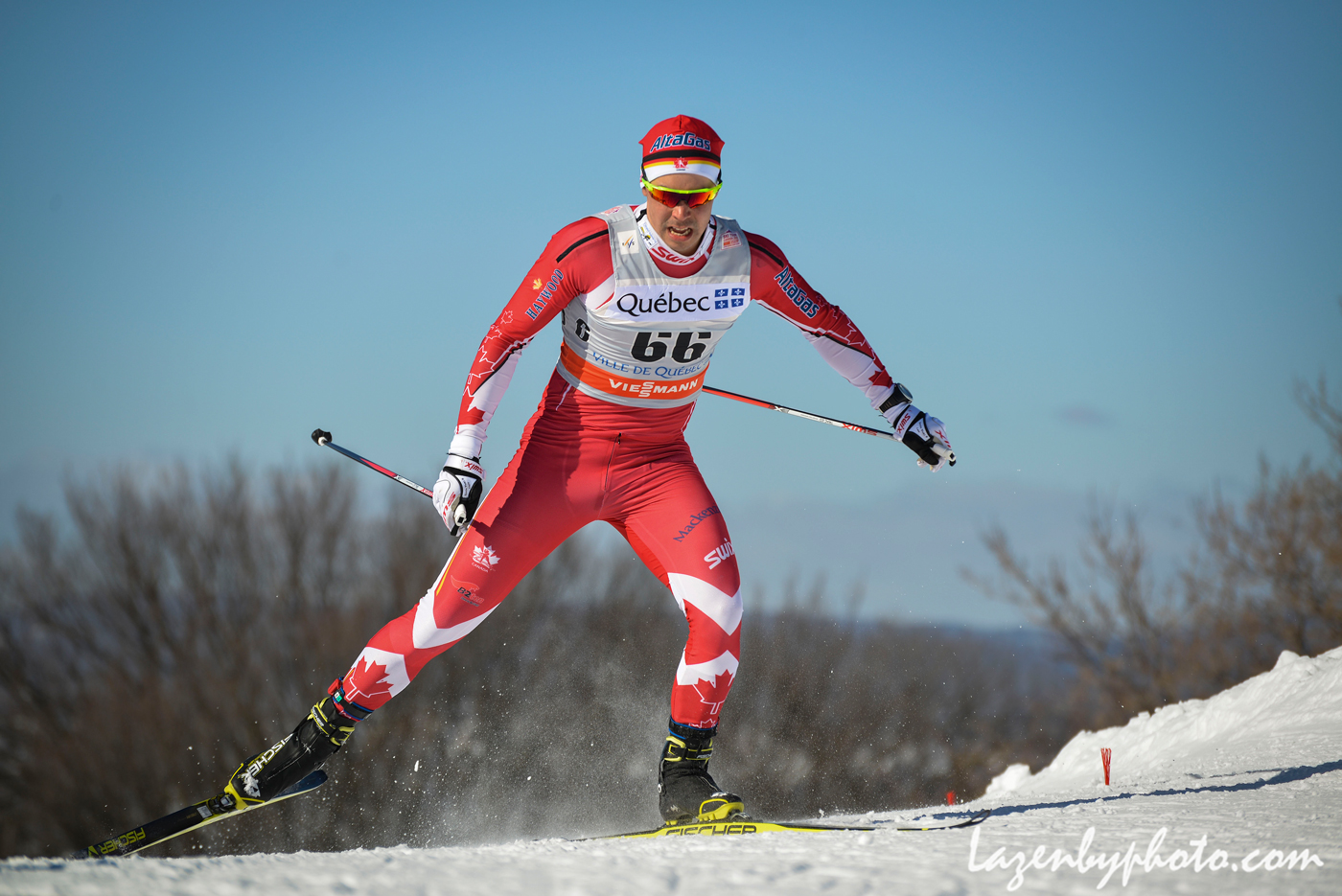
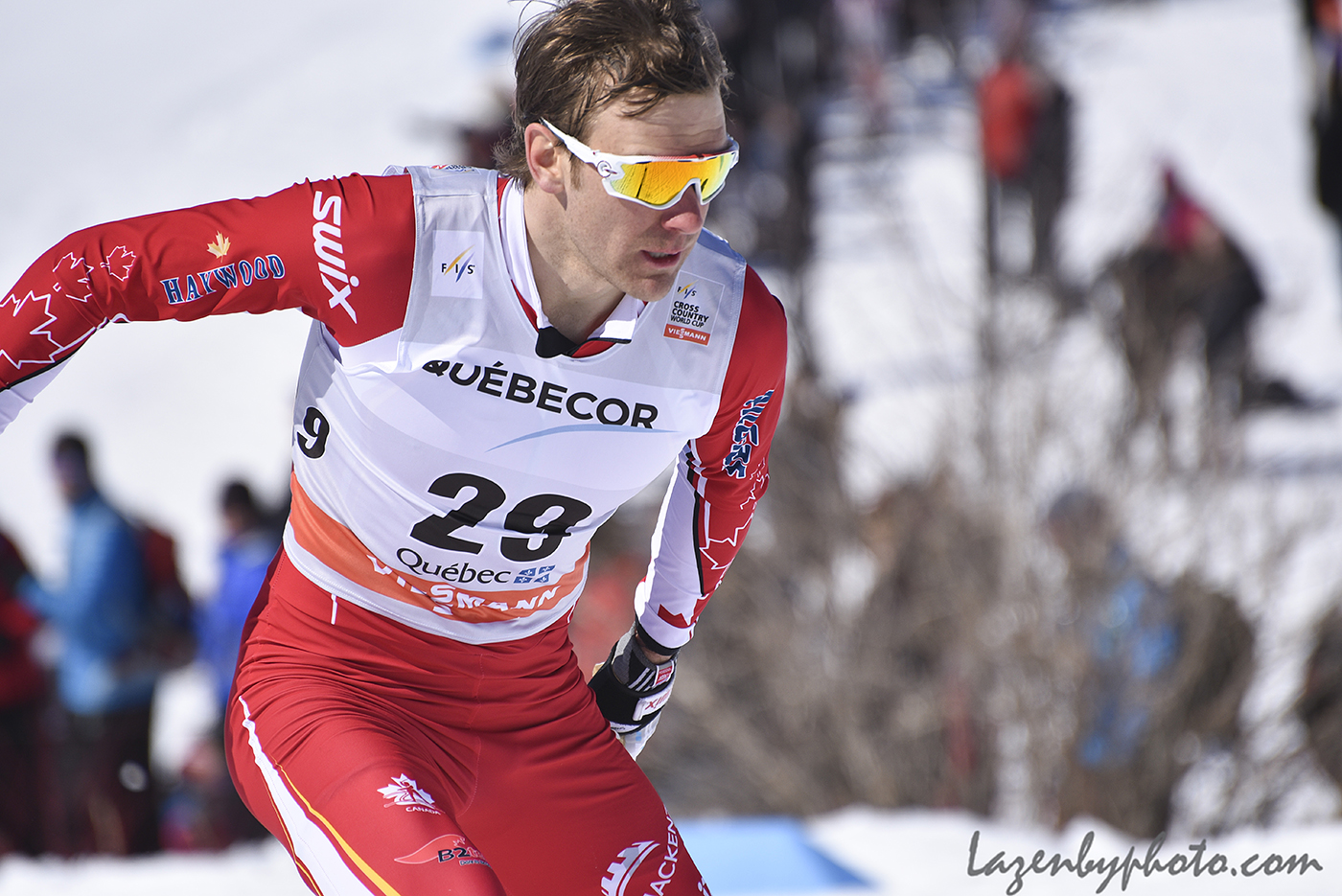
    Jess Cockney racing to 29th in the freestyle sprint qualifier at Stage 3 of the 2016 Ski Tour Canada in Quebec City. He went on to reach the semifinals and finish the day in 10th. (Photo: John Lazenby/Lazenbyphoto.com)

    Cockney had a number of standout moments at the World Cup level, the first of which came at home in Canmore in December 2012, when he placed ninth in a World Cup skate sprint. Then,  late in the 2015/2016 season in Quebec City, he raced to 10th in the Ski Tour Canada’s skate-sprint World Cup stage. The next winter, he notched two more individual top-10 results: first in a classic sprint at the 2017 World Cup in PyeongChang and then in another skate sprint in Quebec City.

    Those top 10’s effectively earned him a spot on Canada’s 2018 Olympic team as well as its 2017/2018 World Cup A-team.

    “The time in Canmore, for sure, was such a special race for me,” Cockney reflected of his career-best World Cup result. “That was really big because it went well and my family was all there and it was just really a great surprise kind of day.”

    Another race he’ll never forget was the 50 k mass start at the 2014 Sochi Olympics, a race he had never expected to enter.

    “Just the way that people got sick and things don’t work out for other teammates, I was able to start it, and I was just so happy to be able to race that massive race at the Olympics,” he said. “That’s just such a big deal for me in my career, to have raced it and finished it.”
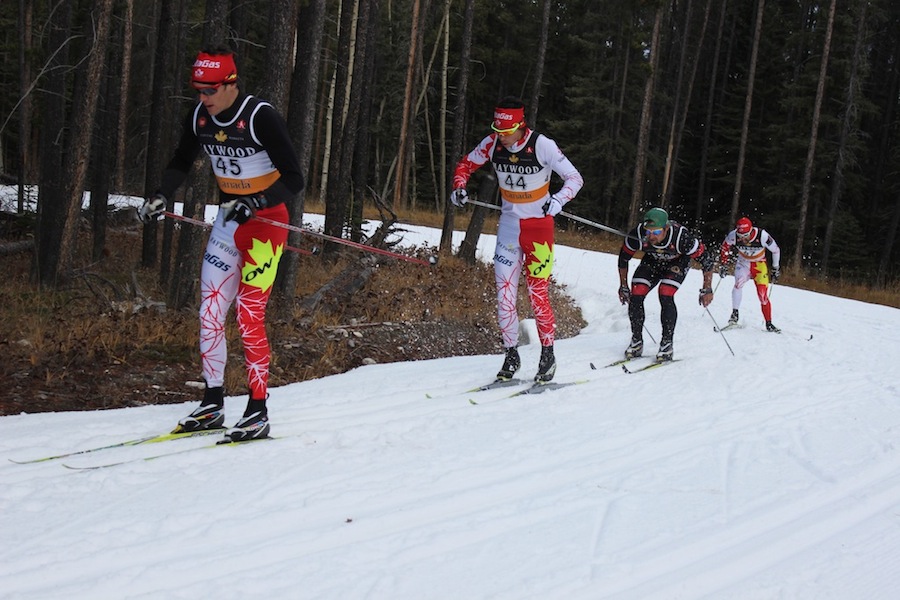
    Phil Widmer (CNST/AWCA) leads teammate Jesse Cockney (second from l), Dakota Blackhorse-von Jess (Bend Endurance Academy) and Canadian Para Nordic skier Brian McKeever (r) in a classic-sprint heat at 2013 Frozen Thunder in Canmore, Alberta. (Photo: Pavlina Sudrich)

    He recalled his time with the AWCA and transitioning from the NorAm to international racing with peers like Kevin Sandau, Michael Somppi, Chris Hamilton, Graeme Killick, Graham Nishikawa, Brent McMurtry, Drew Goldsack, and Phil Widmer.

    “So many fun Phil battles,” Cockney reflected. “Now that that group is still there with Bob Thompson making his way — it’s great to see that group is still getting stronger with that tail end of younger guys in that group. … Probably my biggest highlight is the relationships that I’ve been able to foster and have come from skiing, for sure, is the people and the time that we’ve shared together.”

    Besides his dad and his fellow competitors, he credited his high-school training group, the Banff Ski Runners, and its coach Anders Lenes, as well as Mike Cavaliere as major influences.

    “We had so many good guys my same age, and really the time with friends was actually just time training so it was the perfect atmosphere for a couple of us to take it really far,” Cockney said of the Banff team.

    “My coach right after Anders, Mike Cavaliere, definitely had a really big impact in fostering that next level of belief for me, from going from a good skier in Western Canada to trying to be the best that I could be in Canada,” he continued. “And then setting goals to reach potential in the international scene, too, with time together at World Juniors and Under 23’s and early in my World Cup and my first Olympics we were still working together.”
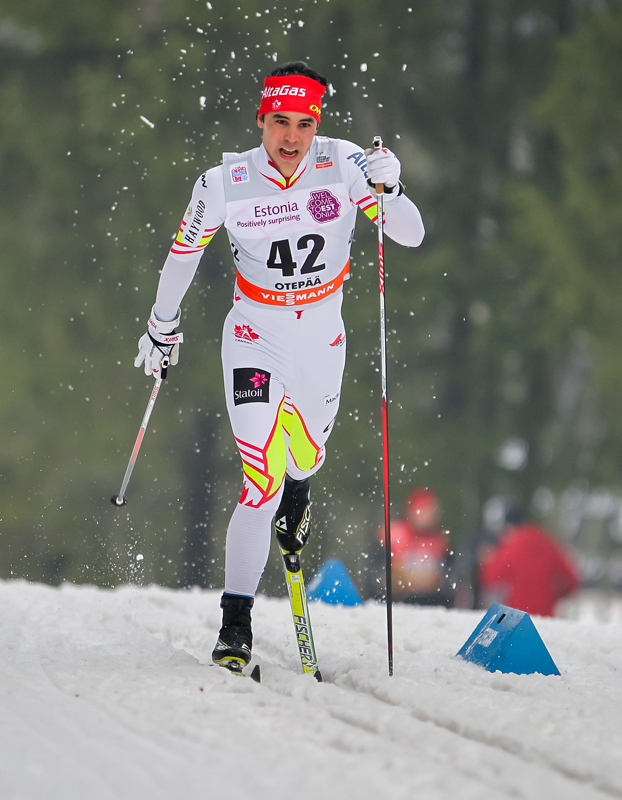
    Jess Cockney racing in a 2015 World Cup classic sprint in Otepää, Estonia. (Photo: Fischer/NordicFocus)

    Asked what it was like growing up on the national team and how the sport has shaped him, Cockney was introspective.

    “I’m definitely softer spoken or maybe more considerate at this point,” he said. “Really what I’ve gotten to understand is respecting everybody’s hard work in sport and understanding what someone’s going through; we don’t really get it all the time.

    “I’m a little bit more — I’d just say not as brash or just a little bit more reserved,” he continued. “I learned some hard lessons from being just a little bit too mouthy or a little bit too, maybe even arrogant. The time in sport has really shaped a lot of who I am, probably more than I realize. I’m super appreciative of the people who’ve been a part of that, just being such great people, and how they carry themselves, [and] emulating that where I can in life.”

    A longtime member of Canada’s senior development team, Cockney was promoted to World Cup B-team status in recent years and spent his last season as an A-team member. So while funding has become tighter within Cross Country Canada (CCC) since 2014, Cockney said he had the unique experience of increased financial support in the last couple years.

    “I started supporting myself for World Cup opportunities in 2014 and paying out of pocket for the whole thing, and then by this year I was getting more support from the whole team,” he explained. “My seasons have been consecutively getting more and more financially feasible, so I’m lucky it was trending in that direction and I was able to be a little bit better financially as the years went by.”

    With further budget cuts for CCC expected, Cockney said his retirement wasn’t motivated by the prospects of self-funding. He is one of four men from last year’s Canadian World Cup Team who have decided to retire (the other three being Devon Kershaw, Knute Johnsgaard and Graeme Killick.) Alex Harvey and Len Valjas are the lone returners to the 2018/2019 World Cup A-team.

    “Alex and Lenny and Graeme and I, we’ve been going to nationals together since I think, like, 2004,” Cockney reflected. “So it’s been a really long time together and more and more time with Devon at the top level of the sport. I was roommates with Knute for a while last year so we really felt like we’re a tight-knit group of guys and it was fun. They’re not just teammates, they’re friends that are now going to be part of our life for the rest of our time out of sport.”

    The next steps
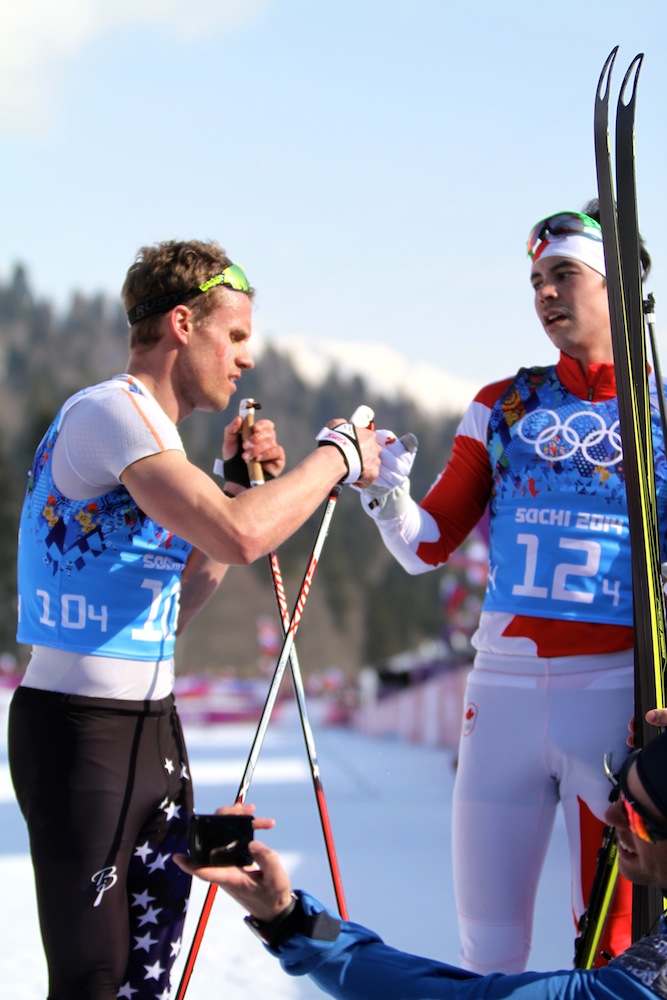
    Canada’s Jesse Cockney (l) and American Simi Hamilton bump fists after anchoring their countries’ relay teams at the 2014 Olympics in Sochi, Russia.

    In mid-April, Cockney said his permanent break from racing hadn’t really sunk in yet. A month later, he was coaching Foothills Nordic athletes at a training camp in Penticton.

    Asked what piece of advice he’d give up-and-coming skiers, he said it was “cheesy”, but simply to be true to oneself.

    “At the end of the day, it’s your name on the results and you’ve got to be able to be the one driving the train and figuring things out,” he said. “It’s a brutally honest sport, and we’re judged with a clock. It’s your name next to that time, so be true to yourself and enjoy the process so much. … In cross-country skiing, the process is 95 percent of the sport, and 5 percent of it is competing… Just having a real love for the training, the relationships, the places that you go, that’s the biggest thing.”

    And as he parts ways with CCC, he stressed the importance of club programs in the development pipeline as they helped cultivate his career (Cockney grew up skiing with Foothills Nordic).

    “The club systems were really strong in Canada and could provide athletes with a lot of support through different points in their career, and I think we’ve really put a big focus on the training centres, taking up the mantle with that,” Cockney said. “If clubs were able to be more supportive, be more things to athletes at different points in their career, I think that you would start to see an improvement in just the health of the sport across the country. The more places people can ski at a high level, or whatever level they feel they want to, without moving, without uprooting themselves, I think that’s the best thing. It’s not always feasible for someone to pick up and move to a training centre and change their life. If there’s a club in town that they can pursue their goals in sport, then that’s the best way to get people sticking with the sport.”

    As for his future endeavors and adventures, Cockney predicted that he probably wouldn’t rollerski for fun. Rather, he was looking forward to mountain biking in the Bow Valley, going fishing and enjoying “a few more outdoor pursuits that are for myself” and a slower pace. “I think that will be good for me,” he said.

    “[I’m] definitely keen to get going with something else in life,” he said. “It’s been an absolutely amazing time in sport for me and I achieved pretty much everything that I would’ve wanted to in a career and I had a great time doing it … but it’s going to be a challenge, for sure, because it’s been so long since I was doing school consistently. … Just looking forward to a new challenge.”

  • Hanging Up the Boots: Kershaw Retires from Skiing, Embraces Next Challenge

    Hanging Up the Boots: Kershaw Retires from Skiing, Embraces Next Challenge

    Canada’s Devon Kershaw racing at 2017 World Cup Finals in Quebec City, where he finished 26th in the 15 k freestyle pursuit and 19th for time of day in the last race of the 2016/2017 season. (Photo: John Lazenby/Lazenbyphoto.com)

    On April 26, Devon Kershaw posted a photo on social media of Alpina boots hanging on a line. The next day, he spoke on the phone with FasterSkier from his new home in Lillehammer, Norway, after a day of running around outside with his 15-month-old daughter, Asta Isabel.

    Kershaw was tired, but in a good way. For the first time in 17 years, he was ready for a new challenge, a new focus and much more time with his daughter and wife, Kristin Størmer Steira, a former standout Norwegian skier.

    Three years after Steira left professional cross-country skiing and pursued a career in business, starting with her master’s degree in business management, Kershaw is following suit and headed back to school. The 35-year-old Canadian hung up his boots to quietly announce his retirement after about a month of deliberation.

    “I was really keen to keep ski racing, to be honest,” Kershaw said. “I had the motivation to go one more year, and in my head, I wanted to race one more season, but as things progressed in the spring, there were a lot of different factors that just made it seem like, oh man, it doesn’t look like it’s gonna be super realistic at this point.

    “I struggled with that, when you feel like you still have more in the tank,” he continued. “But at the same time, it’s a bit of a double-edged sword in the sense that it’s been a fantastic career.”

    Kershaw was quick to reflect on his roots as a kid growing up in Sudbury, Ontario, “a mining town with a small but passionate skiing community,” as he put it. He also reiterated how proud he was to represent Canada for 17 consecutive seasons, first as a junior national team skier for two seasons starting in 2001, then as an under-23 national team member in 2003, and finally as a full-fledged World Cup Team member starting in 2004.

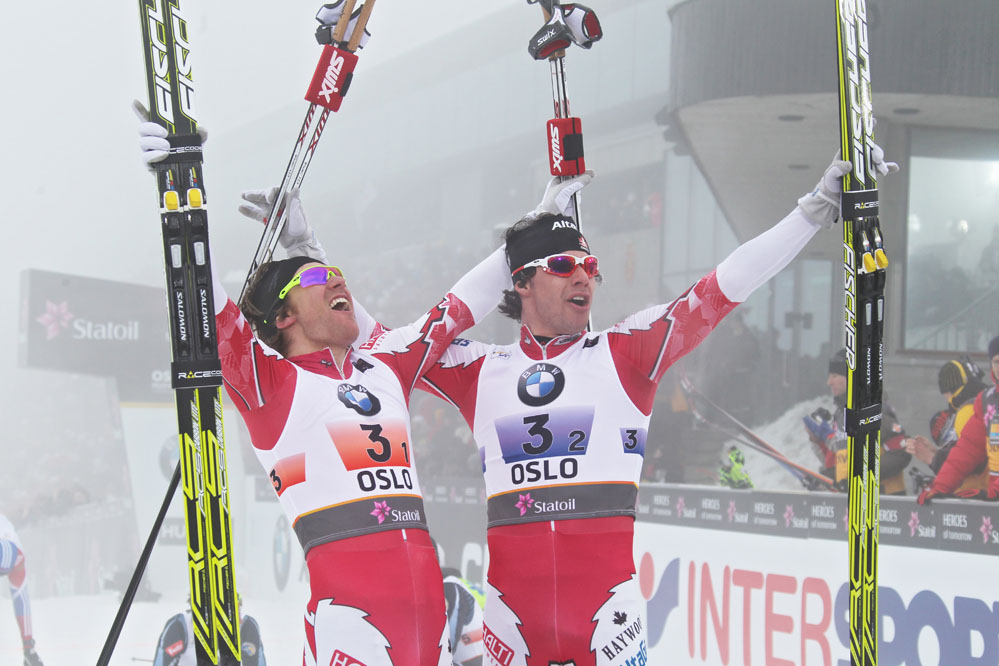
    Devon Kershaw (l) and Alex Harvey celebrate their 2011 World Championships gold in Oslo, Norway. (Photo: Fischer/NordicFocus)

    His career included three World Cup wins and 14 podiums, and a gold medal at 2011 World Championships with teammate Alex Harvey in the classic team sprint. Kershaw finished the 2011/2012 World Cup season ranked second overall and second in the distance rankings.

    When he reflects on those accomplishments, he still has a hard time believing that all happened to him.

    “So instead of focusing on being bummed at the situation or a bit frustrated with the state of things in Canadian skiing right now, I have to look back with a smile,” Kershaw said. “I feel just so privileged and grateful to have had the opportunity to be part of a real movement for men’s skiing in Canada.”

    Kershaw said he was left with unanswered questions this spring during a transitionary period at Cross Country Canada (CCC). The team’s budget was undetermined, camps were not yet set in stone, and Kershaw said his decision — which he wanted to make by May 1, the start of the new training year — became about energy management.

    “Part of managing your energy properly is putting all of your energy and focus into training, and if you’re being pulled with uncertainty or being stressed about uncertainty, that will come back, the World Cup will exploit that,” he said.

    According to CCC Chief Executive Officer Shane Pearsall, High Performance Director Thomas Holland had planned to retire this past March, yet has stayed onboard as an advisor until CCC fills the position. Pearsall said the hiring process is still ongoing and will hopefully be wrapped up by next month. He confirmed that CCC has yet to finalize its budget and doesn’t anticipate being able to do so until a government minister signs off on the amount from Own The Podium (OTP), one of its primary funding sources, in July. Pearsall explained that they expect to have a better sense of national-team finances in mid to late June.

    Typically, the team’s budget is determined in May, but because of necessary “quad reviews” following the Olympics, which took place before CCC met with OTP, the process was delayed by about a month. Pearsall did not elaborate on how significantly the budget would be decreased from last year, but said, “It’s certainly tighter than last year.”

    Kershaw said he needed to pay about $25,000 Canadian dollars in team fees if he wanted to continue racing this year, up from $15,000 last year. That didn’t cover the cost of living, which he figured to be around $55,000 Canadian, for a grand total of $80,000.

    “The financial burden is big, and moving forward the financial burden went from big to 100 percent paying for every cost,” Kershaw said. “So all travel, accommodations, everything. … I’ve just been in the sport a long, long time, and from a directional standpoint, I’m not sure we’re moving in a direction that will yield sustainable results at this point in time, but I understand it is difficult when you’re under such financial duress to create a sustainable program. But from a vision standpoint, I think there’s a lot of questions that remain unanswered, and it’s late in April. The fact of the matter is the rest of the world has all of the holes plugged — if they have holes in their boat — because May 1 is the new year of every ski program. And we’re just constantly slow and off the mark with that.”

    Budget cuts had been expected as Canada’s World Cup Team missed performance benchmarks throughout last season. The team finished 2017/2018 with just two men scoring World Cup points (top 30) in distance races: Harvey and Kershaw. Two men (Harvey and Julien Locke) scored in World Cup sprints. On the women’s side, Dahria Beatty landed one World Cup sprint top-30 last season, and Cendrine Browne was the top Canadian woman in a distance race with a 27th place for time of day in the last race of the season.

    Meanwhile, Alex Harvey led the team with four World Cup podiums, including third overall in the 2018 Tour de Ski, and a top result of fourth place at the 2018 Olympics. He finished his season in fourth in both the Overall and Distance World Cup standings. But Harvey’s results alone weren’t enough to buoy the whole team for another winter.

    “Throughout my entire career, it’s almost unfathomable to think that the season ends and that’s the stat line,” Kershaw said of the team’s overall results. “It wasn’t so long ago that we had over 16 World Cup podiums in a season. The truth hurts, as [former Canadian coach] Tor-Arne Hetland once said, but things go in waves and this is the reality that we live in right now.”

    Despite the prospect of self-funding, Kershaw didn’t feel pressed into retirement. Several of his teammates have decided to retire as well, including Graeme Killick, Jess Cockney and Knute Johnsgaard, but Kershaw said they weren’t forced, either.

    “You can choose to work and you can choose to hustle for money; there are ways to make it,” he said. “No one’s forced into it. I could keep skiing if I wanted to, but I think the stark choice you’re faced with is, maybe perhaps some people are like, I can’t really see a path to international success currently, and that’s what I think is sad…”

    ‘A dream scenario’

    When Kershaw moved to Canmore, Alberta, in 2001 and entered Canada’s elite skiing scene, Cross Country Canada (CCC) was entering a fruitful period. At the 2002 Olympics, Beckie Scott was proclaimed winner of the women’s 10-kilometer pursuit (now called the skiathlon), becoming the first North American woman to win an Olympic gold. At 2005 World Championships, Sara Renner earned a sprint bronze to become the first North American woman to medal at World Championships. Scott and Renner teamed up for silver in the team sprint at the 2006 Olympics in Turin, Italy, where yet another Canadian woman, Chandra Crawford, won the individual skate sprint for Canada’s second-straight gold in as many Winter Olympics. Scott finished that 2005/2006 season ranked second overall in the World Cup, just 16 points behind Norway’s Marit Bjørgen in first.

    Devon Kershaw (r) with Graham Nishikawa in 2013. (Photo: Devon Kershaw)

    Kershaw made his Olympic debut in 2006.

    “Coming into Torino, we were quoted in the newspaper as being like the world’s most anonymous men’s ski team,” he said of the Canadian men’s team that year. “We weren’t really ‘on the map,’ but I’ve just been so grateful and lucky to have such a great group of guys around that really welcomed me in.”

    He credited his former roommate and teammate Chris Jeffries as well as other Canadian competitors of his time, including George Grey, Gordon Jewett, Dan Roycroft, Sean Crooks, Dave Nighbor, Phil Widmer, Brent McMurtry, and Graham Nishikawa (who’s still racing), for having a major impact on the formative stages of his career.

    “[There were] so many athletes in Canmore that tried hard, wanted it bad, and loved ski racing and training,” Kershaw reflected. “That’s a dream scenario for a young athlete to come into a community like that and be welcomed into that environment.”

    Less than a month after the 2006 Olympics, he notched his first World Cup podium by placing third in the Borlänge, Sweden, skate sprint. In doing so, he became the first Canadian male cross-country skier to reach the podium since Pierre Harvey (Alex’s father) in 1988 and the first ever to medal in a World Cup sprint.

    “I had no idea who Pierre Harvey was,” Kershaw said of his younger self.

    Pierre Harvey had previously won the 1988 Holmenkollen 50 k as well as two other World Cup distance races and the Norwegian Birkebeiner, making him the most successful Canadian male skier before Kershaw.

    “He could walk into the room and I would not recognize him,” Kershaw continued. “Even his results, I had heard that he had five World Cup podiums and that seemed pretty cool, but that’s all I knew about him.”

    Kershaw’s second World Cup podium came early in the 2006/2007 season in a skate sprint in Munich, Germany. That same day, Crawford — whom he was dating at the time — placed third in the women’s sprint.

    Devon Kershaw after being tagged by his Canadian teammate Alex Harvey (l) in the freestyle team sprint at the 2010 Olympics in Vancouver, B.C. They went on to finish fourth.

    At his second Olympics in 2010, Kershaw finished fifth in the 50 k classic mass start for the best individual Olympic result for a Canadian male nordic skier. That record stood until Alex Harvey, who burst onto the World Cup scene in 2008, bested it with a fourth place in the 50 k classic at this year’s Olympics in PyeongChang, South Korea.

    Kershaw and Harvey also teamed up to place fourth in the freestyle team sprint at the 2010 Olympics.

    Kershaw’s first World Cup win came in a skate sprint during the 2011 Tour de Ski. He finished that Tour in seventh, and the next year, came back to place fourth overall in the 2012 Tour de Ski (TdS). Kershaw started all 12 editions of the TdS, a record he shares with France’s Jean-Marc Gaillard.

    Harvey scored his first individual World Cup podium in a 50 k classic in 2009 and won his first World Cup race (a 3.3 k freestyle prologue) at the TdS in 2012.

    “Then next thing you know, Alex and I are sharing a podium on some World Cups,” Kershaw reminisced. “Two Canadians on one podium in the World Cup, like, really? And then you win World Championships and I’m on the overall World Cup podium, and then next thing you know, Alex has been on the overall World Cup podium a few times and also now 50 k world champion. It’s crazy. It’s insane. From nothing. From no results. The journey has just been amazing. … I never would’ve thought Canada would, I mean, how could you? We had Pierre Harvey and that’s it in, like, a hundred years of international ass-kicking.”

    Kershaw credited his initial World Cup breakthrough as a 23-year-old skier in Borlänge to Dave Wood, Canada’s national-team coach at the time.

    “I came into a team with a coach that you could call at midnight. He’d do anything for you,” he said of Wood. “There was no way I would’ve stepped onto the podium in 2006 without him, and Mike Cavaliere, too, my first-year senior, Mike was my coach. We had staff that was just committed to the core for the cause and I’m incredibly grateful for that.”

    ‘A hell of a season’

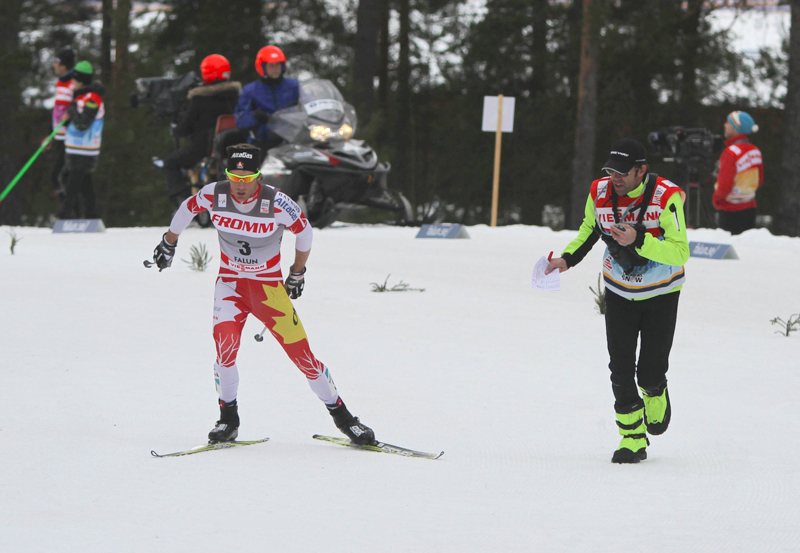
    Canadian head coach Justin Wadsworth (r) giving splits to Devon Kershaw at 2012 World Cup Finals in Falun, Sweden.

    Of his coaches, Kershaw gave special credit to Justin Wadsworth. A three-time U.S. Olympic cross-country skier who became Canada’s head coach in the spring of 2010, Wadsworth coached Kershaw for five seasons, and the two developed a close friendship.

    “When Justin came into the national team, the level of professionalism and excitement and freshness that he brought … I don’t know if you call it luck or happenstance or just the right place, right time,” Kershaw reflected, alluding to his 2011 World Championships gold with Harvey and his 2012 Overall and Distance World Cup podiums. “Justin’s best results as a coach were me and my best results as an athlete were when I was coached by Justin. Talk about an amazing relationship there.”

    “The main thing that I really appreciated with Devon, and I think he would say the same thing about me, is that we could be honest with each other and talk about hard things and enjoy the good times when we had them,” Wadsworth said on the phone last week. “… It’s cliche, but when I was talking to Devon the other day about his retirement, it’s not about the medals or the performances or whatever, it’s about your times together on the road.”

    One of Kershaw’s biggest moments came at those 2011 World Championships in Oslo, Norway, where he and Harvey beat out Norway’s Petter Northug and Ola Vigen Hattestad by 0.2 seconds for gold on the Norwegians’ home turf. They had done so after Kershaw lost one of his skis early in the race, Wadsworth pointed out.

    buy antabuse online, buy wellbutrin

    “His ski fully came off and he had to put it back on and get back into the race,” Wadsworth said. “Just the whole day was pretty incredible. That was a great, great opportunity for us, and the guys cashed in.”

    Devon Kershaw (l) and Alex Harvey with their World Championship gold medals at the 2011 World Championships in Oslo, Norway.

    In a difficult-yet-strategic move to conserve for that race, Kershaw and Harvey both sat out the 15 k classic the day before.

    “With anybody else running the ship, there’s no way I would’ve trusted that [decision],” Kershaw said of Wadsworth’s call. “But I trusted Justin’s leadership and we went all-in, and the next thing you know we won World Championships. I mean, are you kidding me? How can you get a better start to the next quadrennial? And Justin as a first-year head coach of a national team, that’s gotta go down as maybe the best season ever for a first-year North American coach of a national-team program.”

    He and Wadsworth reiterated the crucial foundation that Wood had laid.

    “Dave Wood had done a really good job with the athletes leading into that period, mainly focused on building a big base and doing a lot of hours and also doing a lot of time at altitude,” Wadsworth explained. “And when I took over the position, I saw that both Alex and Devon were really primed and had a really good response rate to altitude, and all we had to do was fine tune a little bit of strength training and intensity. I was really excited to work with both those athletes and saw that they had a lot of potential.”

    For Kershaw, Wadsworth’s “American swagger … was magic for me,” he said. During the 2011/2012 season alone, he stood on the podium 10 times, with four top-three finishes in seven races at the 2012 Tour de Ski.

    “It was a hell of a season for me,” Kershaw said.

    ‘Best sand-digger ever’

    He went on to compete at two more World Championships and two more Olympics. This past season, Kershaw finished in the top 30 in eight World Cup distance races, with a top result of 19th in the 30 k skiathlon in Lillehammer, Norway. While struggling with lung issues, he finished 26th in the 50 k classic at the PyeongChang Olympics.

    Devon Kershaw racing to 25th in the World Cup 15 k classic this past March in Lahti, Finland. (Photo: Fischer/NordicFocus)

    Initially plagued by a lung infection in 2014, Kershaw discovered after a 2015 bout with an pneumonia and whooping cough that he has exercise-induced asthma.

    “We worked to get that under control and it was manageable but it never felt good like it felt prior to 2015,” Kershaw said his health over the last three seasons. “In PyeongChang, it was a calamity of bad luck. When we got there it was minus 20 [Celsius], and this makes me sound so soft, because I’m from northern Ontario so you’d think I’d know, but it was really cold. I did some intervals and it aggravated my lungs and it was super windy and dirty and a lot of sand blowing around, and that really flared up my asthma to the point that I was wheezing badly.”

    His breathing troubles also affected his sleeping and took most of the two-week Olympics to manage. At one point, he had a chest X-ray to make sure it wasn’t pneumonia.

    “It was sporting asthma,” he said. “… It took all the way to the 50 k to kind of get it 70 percent.”

    While he noted he was left wanting more from a performance standpoint at both his final Olympics and in his final season, Kershaw also acknowledged that he’s his biggest critic.

    “That’s been probably the biggest detriment to my entire career; I’m the best sand-digger ever,” he said. “I am disappointed in the sense that I work really hard and I train hard and I prepare well, and it didn’t go exactly as planned. … When you’ve competed in the top 10 for as many years as I have and on the podium, of course that becomes your bar that you hope to achieve, but at the same time … when you’re in the top 30 in the results page, you’re in the race at least. And I’m proud of the fact that in almost all classic races, not every, but most, I was in the top 30 and ‘in the race’.

    “Am I satisfied? In my life I’ll probably never be satisfied, that’s just how it goes,” he added with a laugh. “But am I somewhat proud of maintaining a fairly competitive level? Yeah, absolutely.”

    Wadsworth reflected that Kershaw was one of the best athletes he had ever seen, even “physiologically as good as Alex [Harvey]” at the peak of his career.

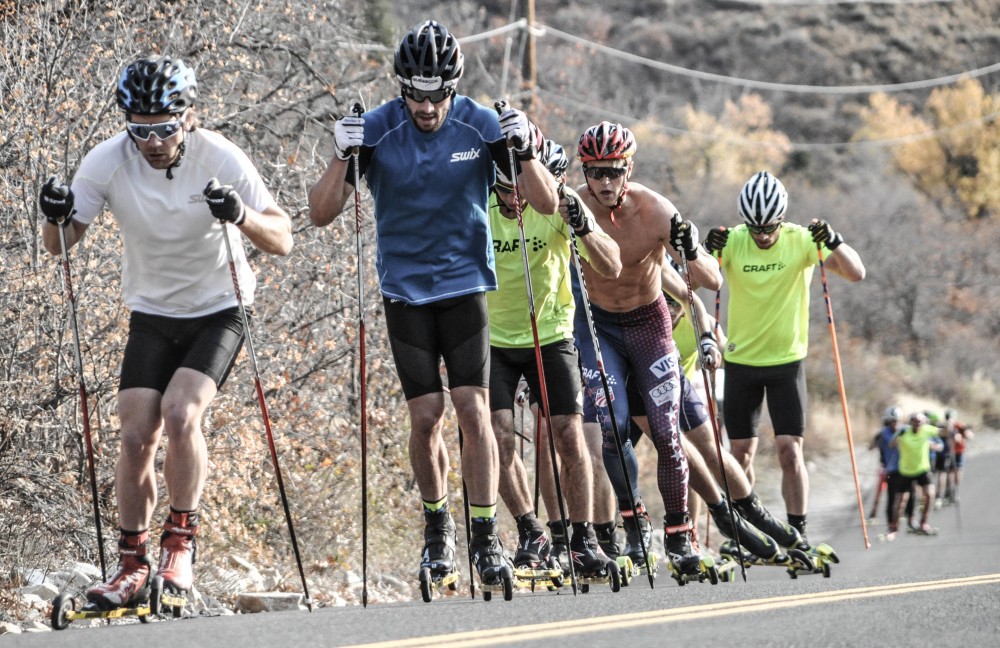
    Left to right: Canada’s Devon Kershaw leads his teammate Alex Harvey and U.S. Ski Team members Noah Hoffman, Erik Bjornsen and Simi Hamilton during a Level 3 interval skate session up Snake Creek Canyon in Midway, Utah, during their respective teams’ 2016 training camps in Park City, Utah. (Photo: Matt Whitcomb)

    “Devon’s a very intelligent person and sometimes he might’ve overthought things and lacked in confidence, and as a coach that’s really frustrating to see because you know how good they are physically,” Wadsworth said. “And when he was on mentally, too, in training, when he was at his very best, he had total confidence and could destroy anybody in any workout.”

    He recalled a hill-bounding workout with the Norwegian team in which Kershaw was literally leaps and bounds ahead of everybody else — even Martin Johnsrud Sundby and Russia’s Ilia Chernousov, who joined the training session.

    “He was just shelling everybody,” Wadsworth said. “So when Devon was at his best like that and mentally confident and relaxed, he was a real force of nature. Unfortunately that didn’t always translate into the racing season, but in 2012 he put it all together and had a tremendous year. … If he had the confidence the whole time, he would’ve been almost unbeatable, in my opinion, but it takes the whole package all the time, and he was among the greats there for a while.”

    ‘Younger, faster, better dog’

    And then there was Harvey, another one Kershaw’s of his best friends and longtime roommates.

    “I’ve spent more nights in a room with him than my wife or any girlfriend I’ve had,” Kershaw joked. “… He was eager to learn, he chased me for years, he was always a hard worker, too. He trained really hard, he believed in himself, and I still am in total awe of that. I’ve never met anybody as confident as him. It’s too bad that didn’t rub off on me, but that’s been great to be around.”

    He likened Harvey’s addition to the team as a family adopting a puppy.

    “You know when your parents get a puppy because your dog is 10 years old? He’s kind of slowing down a little bit and then you see that old dog get fired up and run again and jump around and play; that’s me,” Kershaw said. “And I’m so grateful that my owners got a younger, faster, better dog to hang out with because it was so inspiring.”

    Several times over the last few years, Kershaw has said that witnessing Harvey make Canadian history has been one of his biggest reasons for staying in the sport.

    “He, for sure, has kept me in this probably longer than I should’ve,” Kershaw said. “I just love traveling with him and seeing what he can accomplish and training with him and seeing that professionalism.

    “There’s no question he’s the best Canadian skier ever, that’s not even close,” he added. “… I just feel so honored that I got the chance to see it all happen, from his last-year junior when he did his first World Cups and then all the way though I’ve been with him.”

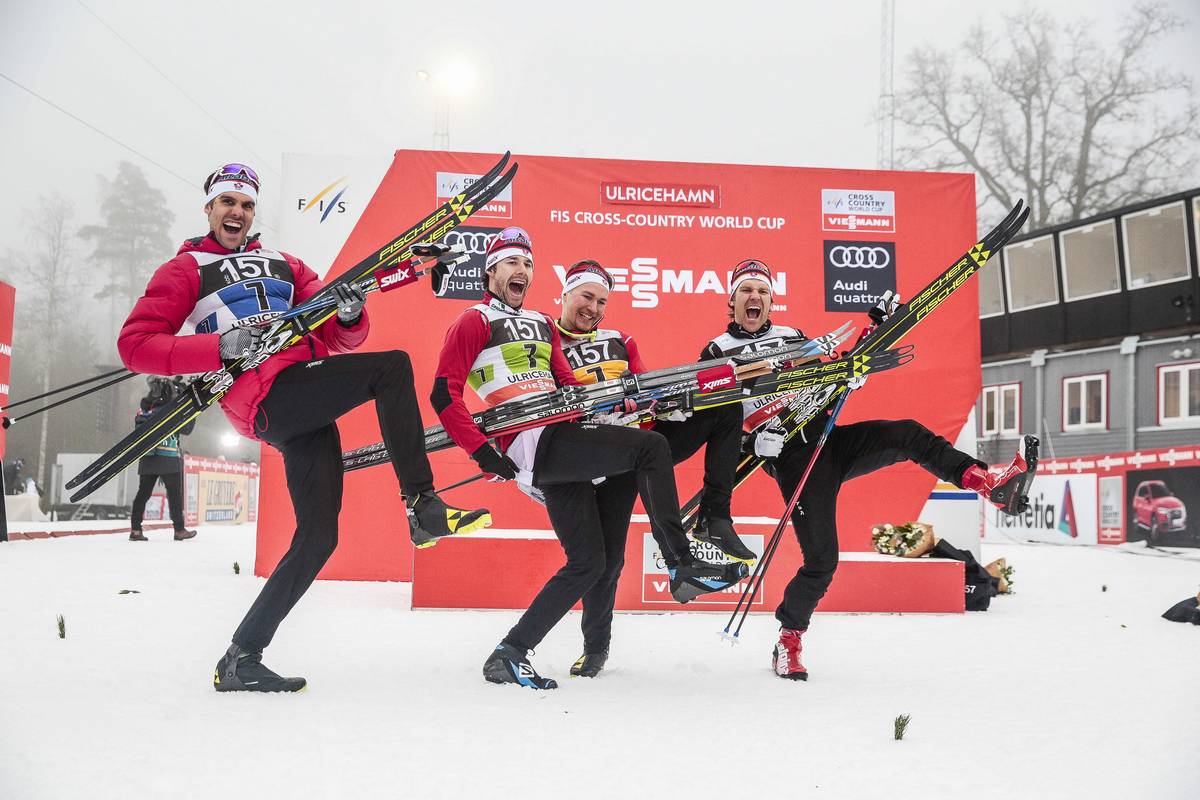
    The Canadian men’s relay after placing third in January 2017 in Ulricehamn, Sweden, for Canada’s best-ever World Cup result in the 4 x 7.5 k relay. From left to right: Lenny Valjas, Alex Harvey, Knute Johnsgaard, and Devon Kershaw. (Photo: Salomon/NordicFocus)

    In an email, Harvey explained that he and Kershaw first met in the fall of 2005 at a training camp at Sovereign Lake, British Columbia. Harvey was on the junior team and Kershaw a senior, but the whole team stayed at the same hotel.

    One morning, Kershaw accidentally took Harvey’s poles from the hotel. Harvey had to track him down on the ski trails to get them back.

    “That was the first time I talked to him and to me it’s just perfect because that’s so Devon,” Harvey wrote.

    Later that season on March 7, 2006, Kershaw made history with his first podium. That same day, Harvey won his first national title in the 10 k classic at Canada’s senior national championships as a 17-year-old junior.

    “I guess our friendship was meant to be before we even knew it!” Harvey wrote.

    When the two became teammates, Harvey immediately took to imitating Kershaw, both in training and racing.

    “He took me under his wings and he has a big part in the athlete I became today,” Harvey wrote, likening Kershaw to a big brother. “I feel very privileged to have spent all that time with him. I think we became such close friends because we are both very driven athletes and we don’t accept any compromise. We’re both huge fans of our sport, ‘nor-dorks’, so we also love to talk about everything from altitude training to who is seeing who on Tour.”

    Kershaw’s decision to retire didn’t surprise Harvey.

    “I think it’s a mix of a few things,” Harvey wrote. “… Probably this biggest reason, he has a little girl at home. I know this winter was extremely hard on him. Not seeing Asta Isabel was pure torture, I think I would have done the exact same if I was him.

    “I will miss a lot of things about Devon,” he added. “He’s always there to give good advice about everything and anything. He knows so much about all that is going on in the world, probably the most well-read person I know. He’s kinda my news source. I’m still amazed by how indecisive one can be. This brought a lot of laughter throughout the years. I have so many memories from the last 10 years with him. Seeing him dominate the World in 2012 was just amazing but also very eye-opening for me. He raised the bar for all North American skiers that year and I’m very thankful for it.

    “We both lived great emotions in high accomplishments and huge disappointments. I’d like to think I helped him get through these upsets and I can say he definitively helped me get through mine. A page turns in the life of Devon Kershaw but knowing the man, I’m not worried about what’s gonna come next.”

    Without Kershaw, Killick, Cockney, and Johnsgaard on the men’s team, Harvey acknowledged that next winter will be “very different” for him on the World Cup.

    “All these guys are calling it a career and I’m super proud of what all my friends accomplished,” he wrote. “I’m excited to try to help the next generation step it up and fill the shoes of the previous generation. … Also, after 10 years on Tour I’ve made some friends on other teams so I’m not too worried. I’m just excited to step into a bit of a mentor role for our next generation.”

    Onto the Next

    As for Kershaw, he didn’t rule out coaching future generations of Canadian skiers, but he said he was focused on getting an education first. In just over a week, he’ll start a course that requires 20 hours of classes a week — all in Norwegian — for what he anticipates will take six months. The course is essentially an advanced version of Norwegian as a second language, and foreigners must pass it to pursue a degree in Norway.

    After that, Kershaw plans to apply to universities “and hopefully study forever,” he said with a laugh. “Not forever, but study, and I want to stay involved in skiing in any way I can and I want to help the next generation get better.

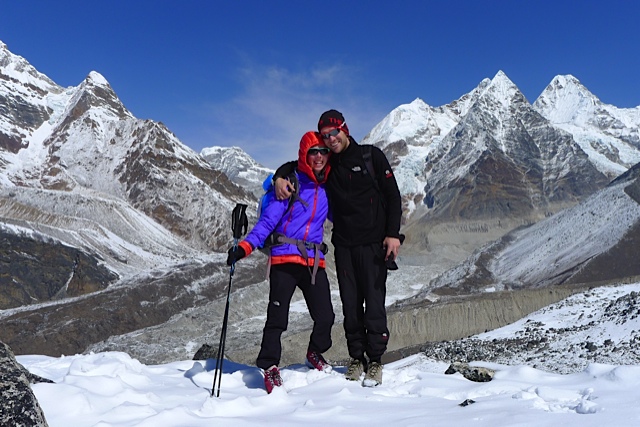
    Kristin Størmer Steira (l) and Devon Kershaw during a day hike on one of their acclimatization days. The couple got engaged in 2014 after summiting Mera Peak during a three-week trek in Nepal’s Himalayas. (Photo: Devon Kershaw)

    “First things first, I have to get my Norwegian at a level where I can sit through a lecture and write an essay at a decently good level, at least good enough that my wife doesn’t have to rewrite it, she can just correct it,” he explained.

    Asked what he’d like to study, Kershaw said medicine, specifically orthopedic surgery, has always intrigued him. (As a junior skier, Kershaw took undergraduate classes at the University of Calgary until 2006, but those credits have since expired.)

    “But now I’m 35 and I’m going to have to do all of this in my third language,” he acknowledged. “So for now, I’d say that that’s still my first choice and I’m exploring what it would take.”

    If not medicine, he’d like to pursue a degree in “some kind of science physiology, and then in a totally shifted way, if I have a panic attack and be like, ‘Science is too hard after ski racing forever,’ then I am interested in economics and economic theory and business to some degree…”

    Regardless of which path he choses, he’ll be doing it in Norway, Kershaw said.

    “I don’t mind the challenge. … It’s intimidating in a way, but it’s also really exciting,” he said. “Kristin’s family [who lives in Lillehammer] is just so fantastic and to see how happy my daughter is here, to have her family, to have family around her and everything for the short term, and I hope to be educated in Norway.”

    Asked if he’ll jump into any ski races this season, Kershaw was quick to respond, “No.” But he will continue skiing. The beauty of the sport and the struggle, as he put it, is what’s kept him in it so long.

    “Imagine just having a singleness, a purpose, a goal that’s just there in your face and then you get to wake up every day and do the things you absolutely love to do,” he said. “… I adore cross-country skiing. I just think it’s such a peaceful, beautiful exercise, and the technique and the flow of it all. … You’re just skiing through the woods peacefully, gliding over snow, over all the terrain you can cover. It’s a beautiful, zen-like endeavor, and I think that’s what’s kept me in it this long. And the people, the Canadian ski community, the world ski community, really. I’ve met so many inspiring people and beautiful people and worked with a lot of absolute experts and I’ve had brilliant teammates and brilliant coaches.”

    And because of skiing, he met his wife and started a family in Norway.

    “I have a daughter with a woman that I love and respect and am in total awe of every day of my life and without ski racing there’s no way that would’ve ever come to fruition,” he said. “There’s the biggest gift right there, as cliche and Hallmark as that sounds, it’s true.”

  • Webster Excels in First XTerra World Champs

    Webster Excels in First XTerra World Champs

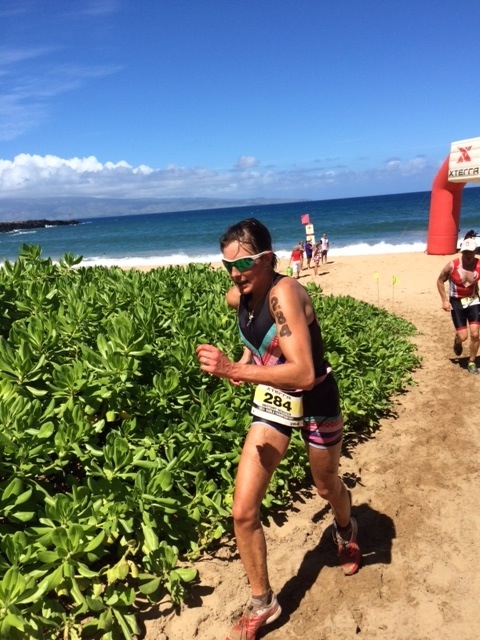
    Brittany Webster in the Oct. 26 XTerra Off-Road World Championship in Maui, Hawaii. (Photo: Mike Cavaliere)
    Brittany Webster in the Oct. 26 XTerra Off-Road World Championships in Maui, Hawaii. (Photo: Mike Cavaliere)

    When Brittany Webster’s name appeared atop a list of results this past weekend, it wasn’t for Canmore’s Frozen Thunder. Instead, Webster replaced snow with sand and finished as the first amateur female in the 2014 XTerra Off-Road World Championships on the north shores of Maui, Hawaii Oct. 26.

    Webster always had an interest in triathlons, as she loved both cycling and running. While she doesn’t particularly enjoy swimming, the additional challenge attracted the 26-year-old.

    Turned onto the XTerra racing series by a friend, Webster jumped into the Canmore XTerra triathlon on Aug. 8, where she earned a starting position at the World Championships after she claimed the top female spot. Once qualified, it was an easy decision to attend the Championships.

    Webster is no stranger to success in skiing. She’s seen four top-tens at the World Junior and U-23 Championships, numerous podiums at Canadian Nationals, and a trip to Sochi for the 2014 Olympics earlier this year.

    Given her results on skis, her off-snow success was not surprising.

    In an email, Webster wrote that adjusting to the warm and wet conditions of Hawaii was challenging for someone who is accustomed to the dry and cool climate of the Canadian Rockies.

    “My first interval workout was on the track and I lied (sic) down in the sprinkler system on the baseball field afterwards just praying I would cool off. It was an important experience because it made me realize how much I needed to drink if I wanted to last three hours in the heat,” she wrote.

    Come race day, Webster and roughly 700 other competitors faced a rough ocean as they began the first stage of the competition — a 1.5 k swim. The warm Hawaii waters were not as welcoming as one might expect. According to Webster, she and her fellow competitors faced swells of five to six feet.

    “The waves were some of the biggest XTerra had ever seen and there were guys running out of the water back to the start… a few dropped out for sure. Swimming is not my forte, but embracing challenge is. I pretended I was surfing and that kept me smiling instead of panicking,” she wrote.

    Once she exited the tumultuous waters, Webster was faced with a 32 k bike on the slopes of the West Maui Mountains.

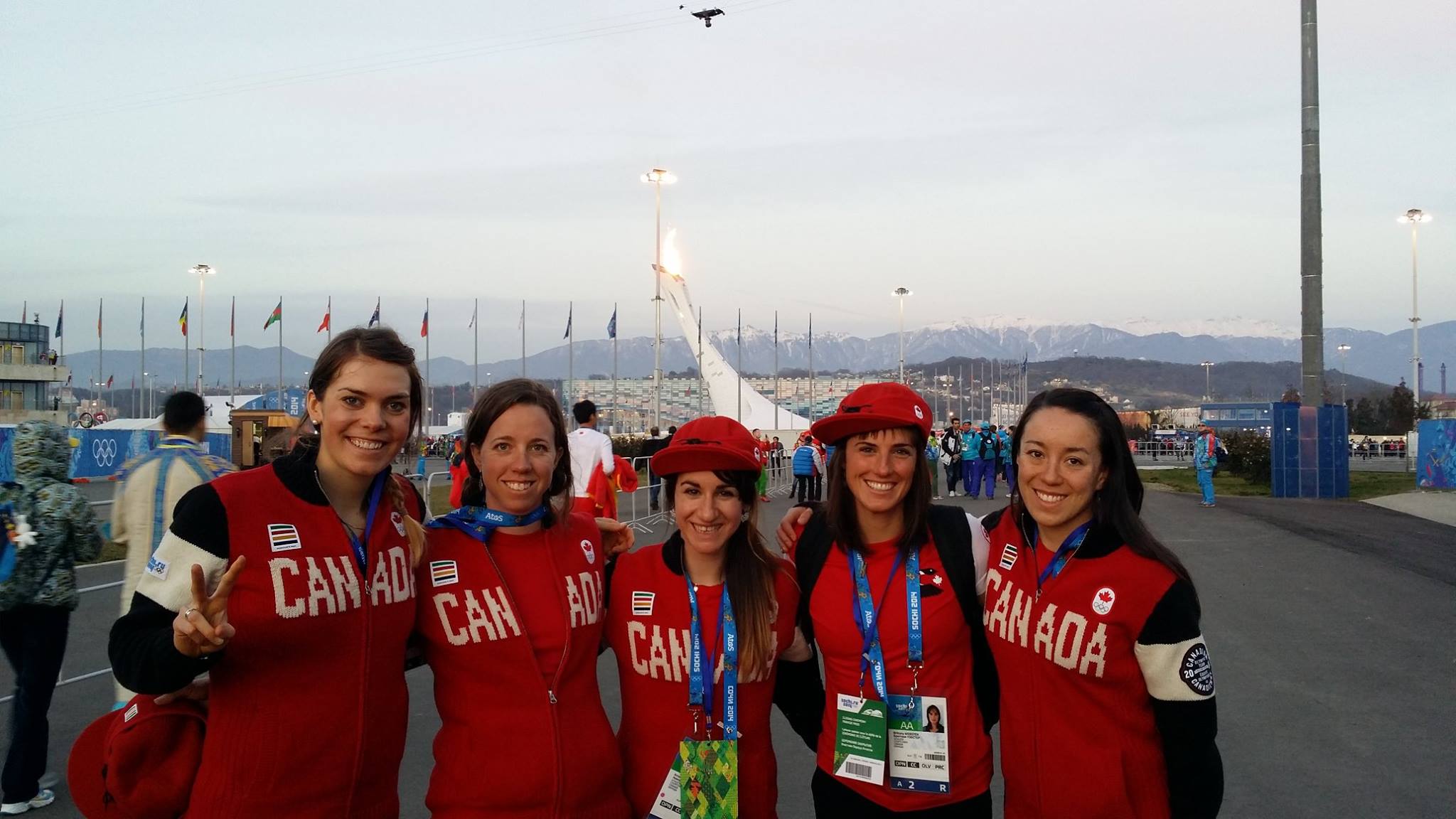
    The Canadian women's team before the Closing Ceremony in Sochi, Russia: (from left to right) Heidi Widmer, Perianne Jones, Amanda Ammar, Brittany Webster, Emily Nishikawa (Photo: Emily Nishikawa)
    2014 Olympian Brittany Webster (second from r) with her Canadian teammates before the Closing Ceremony in Sochi, Russia: (from l to r) Heidi Widmer, Perianne Jones, Amanda Ammar, and Emily Nishikawa (Photo: Emily Nishikawa)

    According to 2014 Olympian, the mountain bike was challenging due to the vertical terrain and slick trail. While Webster managed to maintain control throughout the majority of the 32 k course, on the final turn she flew off her bike. The result was a tweaked knee.

    Webster shook-off the fall and continued to the 10 k running portion of the race, but her pace was slowed and the pain in her knee inhibited her speed on many of the course’s uphills.

    “I bailed on the last corner of the bike and tweaked my knee pretty good, so I actually had to walk all of the uphills on the run until the halfway point when the pain began to subside,” she wrote.

    Despite the injury, Webster finished as the top female amateur competitor. Furthermore, with a time of 3:17:36 she placed 160th overall and would have been 18th in the professional female category. Her time of 47:45 in the 10 k run was the tenth fastest women’s time on the day.

    As for the tweaked knee, Webster explained that in the end it wasn’t a serious injury.

    “Nothing ice, massage and a hair cut at the Paul Mitchell tent couldn’t fix,” she wrote.

    Webster wrote that preparing for the World Championship triathlon was an excellent cross-training opportunity because it allowed her to diversify her training program. She explained that her body doesn’t respond to the same rollerski and strength exercises that it used to, and that adding swimming and biking into her repertoire has increased her fitness levels.

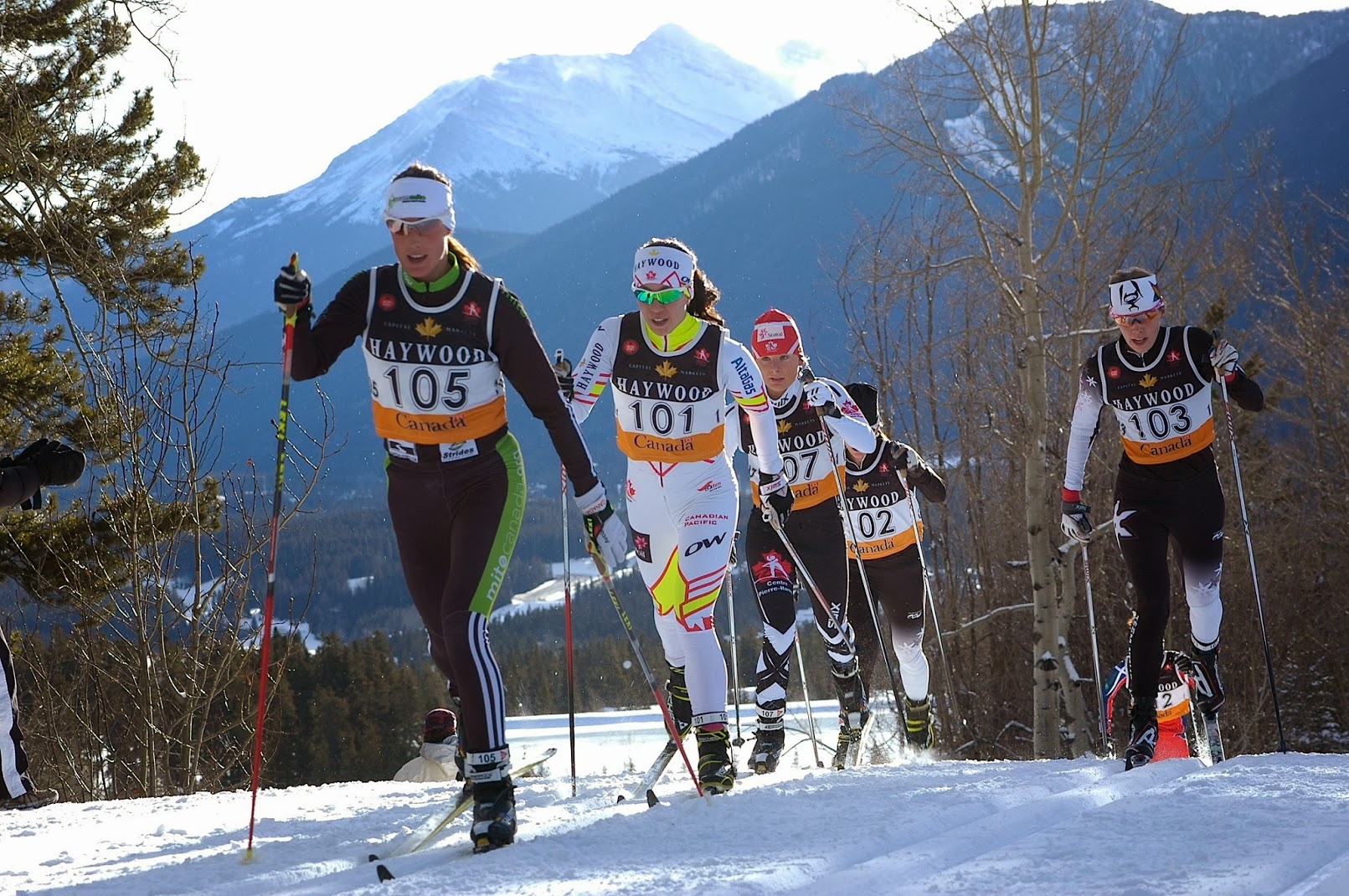
    Emily Nishikawa (101) follows Brittany Webster (105) in the women's 15 k skiathlon at Canadian Olympic Team Trials on Jan. 12 in Canmore, Alberta. Nishikawa placed sixth in the final race of the trials, securing her spot at the 2014 Sochi Olympics from Feb. 7-23. Webster took second after winner Amanda Ammar (102). (Photo: Angus Cockney)
    Brittany Webster (105) leads Emily Nishikawa (101) in the women’s 15 k skiathlon at Canadian Olympic Team Trials on Jan. 12 in Canmore, Alberta. Webster took second after winner Amanda Ammar (102). (Photo: Angus Cockney)

    “A different response stimulus can go a long way and I quickly found myself, after recovering from much calve (sic) and shoulder soreness, that I was getting fitter and it was translating right back into skiing,” she wrote.

    Last winter Webster and fellow Canadian Amanada Ammar petitioned Cross Country Canada to earn a spot on the 2014 Canadian Olympic Team. The two were not initially included on the team roster but after FIS allotted more starting positions to Canada, Webster and Ammar were named to the team and competed in Sochi.

    Webster, who took time off from skiing in 2012 and returned in 2013, will compete with the Alberta World Cup Academy (AWCA) after skiing for Team Mito last year. She is no stranger to AWCA, however, having trained with the club before her stint with Team Mito.  

    Webster explained that she is excited to return to the AWCA in the upcoming season.

    “I have really missed being on a team and being able to support teammates of mine. I’ve also missed working alongside Chris, Mike and Stef. Those guys are so awesome, and the opportunity to work with them and the amazing people that are on the Academy made me want to commit to the AWCA,” she wrote.

    There’s also another difference in Webster’s life going into the winter season. Adding to the slew of engagements and weddings in the ski community, she and AWCA race director Mike Cavaliere are engaged. Their wedding is set for next September at the Boundary Ranch.

    “We are both animal lovers and have backgrounds with horses, love the ranch life, so it seemed fitting to have it there!” she wrote.

  • There’s Still Snow in Sovereign: Spring Camp Wraps Up

    There’s Still Snow in Sovereign: Spring Camp Wraps Up

    Patrick Stewart-Jones of the Alberta World Cup Academy leads the way at the high point of the Upper World Cup trail at Sovereign Lake Nordic Centre last week.
    Patrick Stewart-Jones of the Alberta World Cup Academy leads the way at the high point of the Upper World Cup trail at Sovereign Lake Nordic Centre last week.

    VERNON, B.C. – Sovereign Lake Nordic Center’s annual Summer Ski camp from May 10-19 attracted the usual collection of hard-core skiers, a mixture of teams and day trippers who need a last fix of snow before the inevitable arrival of summer. With neighbour Silver Star Mountain Resort gearing up for a summer of mountain biking, and the city of Vernon already in full-summer mode in the valley below, Sovereign’s weeklong camp is the last chance for set tracks in the region.

    Canmore Nordic was the first group to arrive on May 10, with a four-day camp justifying the six-hour drive to Vernon. Another Canmore-based team, the Alberta World Cup Academy (AWCA) arrived next for a seven-day, sleep-low (train-high) camp beginning May 12. Black Jack skiers trickled in for the final four days, and biathletes and Para-Nordic team members flocked to the snow-covered trails as well.

    The week preceding the camp featured five consecutive days of temperatures at or about 30 degrees Celsius (86 Fahrenheit) in the valley below and significant snow loss even at the 1600-metre low point of the early season trails. After four days of skiing and a major thunderstorm, the track setters shifted to a higher set of trails.

    AWCA brought most of its athletes, including last season’s NorAm winners Emily Nishikawa and Michael Somppi, as well as Canmore World Cup top-15 finishers Jess Cockney and Phil Widmer, and perennial domestic podium contenders Kevin Sandau and Alysson Marshall.

    “We are up here in the mornings for skiing a few hours at least and then we’re downtown [in Vernon],” said AWCA coach Mike Cavaliere. “We do some cycling, or running in Ellison Park, or go to the gym.”

    While the team is expecting to return to crust skiing in Canmore, this camp was attractive for set tracks and the nearby low elevation (380 meters), with accommodation on a beach near the Ellison Park mountain biking area.

    “Part of the goal is to let people enjoy summer,” Cavaliere said.

    One day, the AWCA women got out their road bikes for a training ride to Marshall’s parent’s house in nearby Salmon Arm for lunch. The next day, the men rode from their lakeside accommodation to Silver Star Village – ascending some 1,200 metres – for their post-ski workout.

    Former Canadian national team coach Dave Wood, now happily “retired” in Rossland, B.C., persuaded his small Black Jack team to drive five hours to start the new training season on groomed trails.

    “We started skiing [in Rossland] in October, and they set track until April 27th,” he said.

    And what about those masters athletes? Most stayed down in the valley, mostly for all the biking, mountain biking, running, rowing, and stand-up paddling recreational options. Skiers from at least four nearby nordic areas were spotted up at Sovereign, having driven by the summer alternatives to get here.

    Despite the example set by the elite athletes, middle-aged journalists are simply not capable of skiing two hours in the morning and then running or biking in the evening for more than five consecutive days. Lesson learned. Or lesson not really learned, because it was so much fun.

  • Touring Canada’s Bill Warren Training Centre

    Touring Canada’s Bill Warren Training Centre


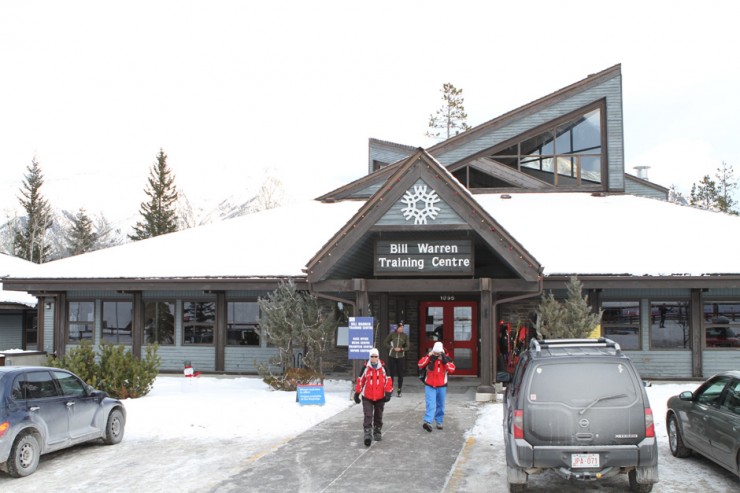
    View from outside the Bill Warren Training Centre at the Canmore Nordic Centre.

    CANMORE, Alberta – If you can pull yourself away from the backdrop of jagged peaks that jut up behind the Canmore Nordic Centre, you’ll easily find the Bill Warren Training Centre and Cross Country Canada headquarters. Just turn around.

    Bill Warren Training Centre

    But with more than 100 kilometers of trails and multiple year-round recreational opportunities around Canmore, why would anyone want to go inside? Well, there are a few things that have to be done indoors: waxing, office work, strength training and certain tests.

    So in 1994, Canada’s nonprofit winter sports management entity, WinSport, constructed the Bill Warren Training Centre (BWTC) with that in mind. It was named in honour of William J. Warren, who helped Calgary earn the 1988 Olympics, and renovated in 2008 to accommodate heavy use and changing athlete needs.

    Today, the centre hosts dozens of development and national-team athletes on a regular basis – including biathlete and alpine skiers as well as the Alberta World Cup Academy (AWCA) cross-country team. The Canadian National Cross-Country Team is based there (and does as much training as possible in Canmore when they’re not racing or at camps across the world), so the bottom line is, the BWTC is Canada’s skiing hub.

    Opened by WinSport in January 1994 and renovated in 2008.

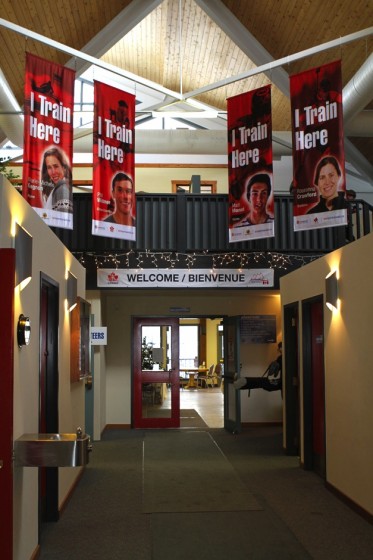
    But it’s also open to the public, and when you walk inside the centre, you’ll notice an official yet accommodating feel. Eyes first go to four large vertical banners with the likes of Rosanna Crawford (national-team biathlete) and Phil Widmer (AWCA) beneath the words “I Train Here.” The walls are yellow and light is bright beneath a cathedral ceiling with skylights.

    During the Alberta World Cup from Dec. 13-16, a “Welcome/Bienvenue” banner extended above a doorway at the end of the short hall, beneath a string of holiday lights. Volunteers and athletes milled in and out, some with ski bags, others with clipboards. One organizer was former national-team member Shayla Swanson’s mom, as AWCA racing director Mike Cavaliere pointed out.

    “The community is just unbelievable,” he said of more than 300 volunteers behind the recent World Cup. “They live, eat and breathe skiing. It’s a community that’s really educated in skiing so they understand the ups and downs of the sport. They’re really good fans, but great volunteers.”

    Outside of Canmore, high-performance skiing in Canada has significant support from the government as well. Own the Podium, a national initiative designed to reap more Winter Olympic and Paralympic medals, installed a $200,000 rollerski treadmill and $50,000 rifle lab at the BWTC in September, which was the first of its $1-million-dollar-plus commitment to nordic sports for the next four years.

    If you ask Cavaliere, the BWTC now rivals any nordic training centre worldwide.

    “It’s the best,” he said while giving an informal tour of the facility. “This really is, almost anywhere in North America, the best place to be a skier.”

    The first part of a tour around the BWTC included a trip upstairs to the AWCA offices. Cavaliere pointed to an open corner with a television and a couple couches where his staff often meets to chat and analyze video.

    Weight room

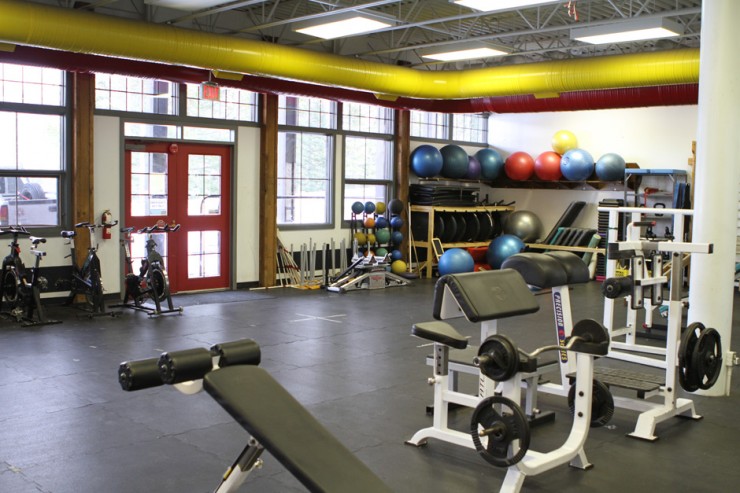
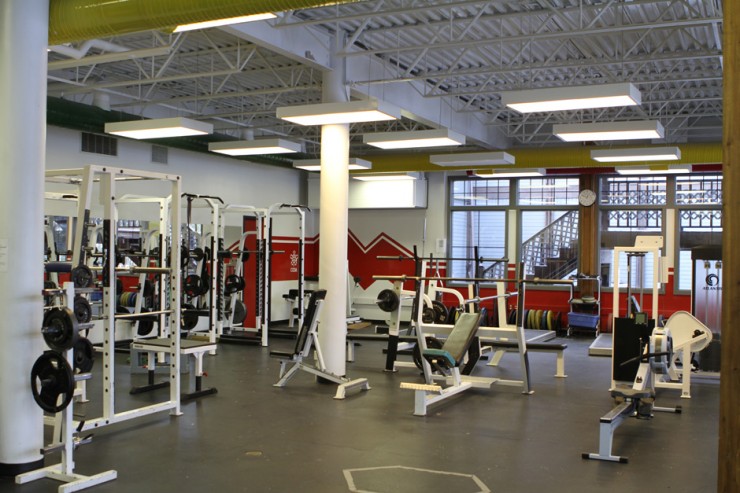
    Down in the basement of the three-story building, one can easily find the weight room with two open areas filled with machines and free weights and seven spin bikes beside oversized windows. Cavaliere said this is one place that’s “rocking all summer long” with athletes from nearly 10 teams and public members as well.

    In addition to the skiers based there, including those from the Biathlon Alberta Training Centre and Alberta Alpine Training Centre, many teams bring in their own strength coaches from Calgary. And if they’re lucky, athletes sometimes get a chance to work out with national-team members that are out of town most of the year.

    More of the weight room

    “It’s a nice dream to have that we get to train with them more, but we don’t get the opportunity as often,” Cavaliere said. “I was laughing, I was talking to Devon [Kershaw] and he goes, ‘Oh, this is a great facility.’ I was saying, ‘It’s too bad you can’t use it,’ because they basically leave after Frozen Thunder. If [the World Cup] wasn’t here, they wouldn’t be here. They would’ve stayed in Europe.”

    That brings up another unique feature of Canmore’s nordic training venue. Frozen Thunder makes the point to offer the first manmade nordic skiing in North America each fall, with stockpiled snow (preserved under sawdust throughout the offseason) spread on a small loop in early October and snow guns put to work as soon as temperatures allow. The number of open kilometers grows as the season progresses to keep the area open for more than half the year.

    Regeneration room

    “We’ve had snow since the 15th of October,” Cavaliere said. “We don’t get much rain. We don’t get massive snowfalls, but we’ll get five centimeters and that’s all it takes. They keep the outer trails manicured all summer so as soon as that five centimeters hits they pack it down, and then another five comes and it’s just perfect tracks everywhere. It’s pretty impressive what they can do here.”

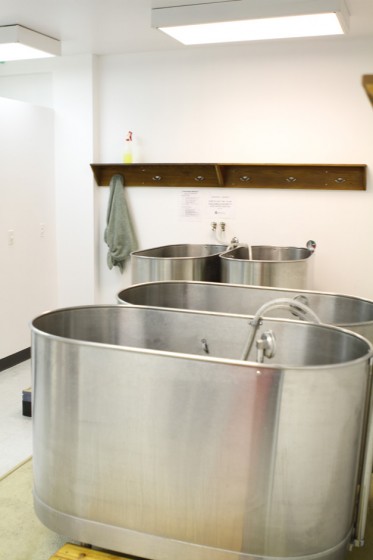
    After taxing workouts, athletes can recover in the regeneration room, a small area filled with several metal tubs for hot and cold baths. Another popular spot, Cavaliere said.

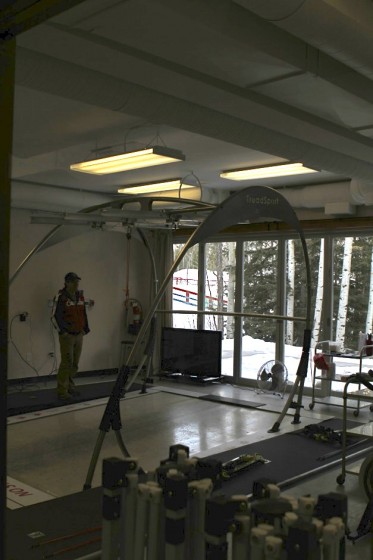
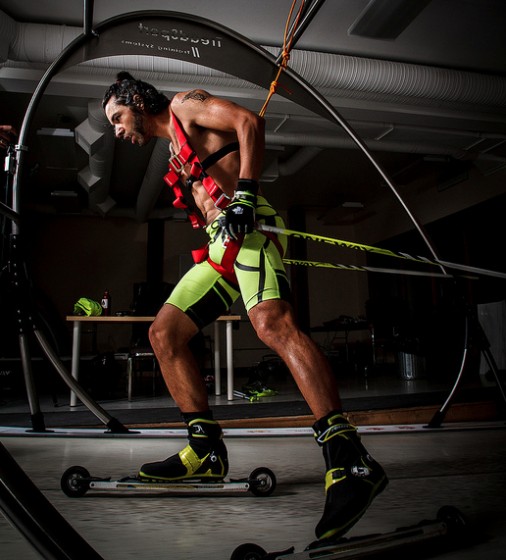
    Finally, the crème de la crème: a further walk down the basement hall reveals the field lab. This is where two standard treadmills were removed to make way for the singular rollerski treadmill, putting the BWTC on par with other international venues. According to Cavaliere, every top-notch nordic training facility has one of these sport-specific machines (including the Olympic facility in Calgary), which allows two athletes to rollerski side by side while reaching speeds of up to 35 kilometers per hour and inclines of 20 percent.

    Installed in September, this $200,000 rollerski treadmill can be used by two skiers at once while reaching speeds of 35km/hour with an elevation grade up to 20 percent.

    “It’s easy to use,” he said.

    Usually, athletes will do intensity sets on the treadmill, for instance, five eight-minute intervals. Sometimes national-team athletes will spend upwards of 45 minutes on it, watching their form on a TV monitor.

    Four years ago, the room occupied by the large treadmill and its accompanying equipment was a wax room.

    Brian McKeever treadmill training (CCC photo: flickr.com/photos/cccski)

    “It’s kind of what we do,” Cavaliere said of the upgrades. “We do have absolutely the best. Especially with our developing athletes, there’s no excuses really, they should be strong.”

    But what about the bulk of their training? In the summer, Canmore athletes, including 23 AWCA skiers, rollerski on a variety of paved paths. The 22-kilometer Banff Legacy Trail was completed two years ago to connect Canmore to the town to its north. Relatively flat and 3 meters wide, it’s a nice alternative to Canmore’s challenging terrain. Cavaliere said they can also rollerski to Lake Louise, which is another 70 kilometers.

    “We can rollerski to our heart’s content,” he said. “We never have to turn around if we didn’t want to.”

    At the nordic centre, there are about four or five kilometers of paved trails, mostly around the Banff Trail and biathlon loop. When they’re not on skis, athletes can easily take to the hills on foot, building endurance at elevations around 1,600 meters (5,250 feet).

    All the training possibilities make it hard to justify leaving Canmore, but sometimes it’s necessary, Cavaliere said.

    “The only reason we do travel is sometimes, like when we go to Whitefish, [Mont.], it’s just to break the monotony of the same old, same old,” he said. “But we go somewhere, we have to look for a gym that’s like ours because it’s a perfect setup and then we have to scout out all the trails. … We can do everything and more here.”

    But training in a nordic-skiing mecca with arguably the toughest World Cup terrain, has its drawbacks.

    “I’m never shocked when we don’t ski well in a city sprint because we always have just bomber tracks and it’s never imperfect here,” Cavaliere said. “It’s our challenge to sometimes adjust. We don’t get rain, we always have minus 5 [temperatures]. We don’t ever deal with adverse conditions and it’s a challenge for our team.”

    Flat courses also tend to be more difficult for Canmore skiers, which is why Cavaliere often holds speed sessions on more level terrain. They also do a lot of work on the mountains in their backyard, but that doesn’t make racing up them much easier.

    “I tell our guys it’s never an excuse because we do it all the time, but it’s tough,” Cavaliere said. “Probably the hardest part is you don’t get much of a break. You leave at 1,400 meters and you’re up at 1,600 meters. … It’s unforgiving.”

    But perhaps the best part of Canmore goes back to Cavaliere’s original reference: the people.

    “You go to Banff and it’s like a mall without a roof on it,” he said. “But here, more people want to be active and they’re outdoors. You would never be on a running trail and be alone in Canmore.”

  • Elite Team Preview: Alberta World Cup Academy

    Elite Team Preview: Alberta World Cup Academy

    The Alberta World Cup Academy team behind a banner promoting the upcoming World Cup races from Dec. 13-16 in Canmore, Alberta, during a Canada Day parade July 1 in downtown Canmore. (AWCA courtesy photo)

    This is the third preview in a quick-and-dirty series about Canadian national-training centres. We asked coaches to send their 2012/2013 rosters and tell us what’s new for the coming season. We will be publishing additional reports over the next few weeks. Teams are presented in no particular order.

    Team: Alberta World Cup Academy (AWCA)

    Coaches: Chris Jeffries (head coach/women’s coach), Mike Cavaliere (racing director/men’s coach), George Grey (women’s assistant coach), Stefan Kuhn (universal coach/men’s assistant), Jeremy Hecker (summer intern), Rob Soffer (strength and conditioning trainer), Shelly Collier (strength and conditioning)

    Roster: 20 senior athletes, eight of which are on the Canadian Senior Development Team (SDT), between the men’s and women’s teams

    The 2012/2013 AWCA women’s team stops for a photo while rollerskiing on Palliser Range in Banff National Park in the Canadian Rockies. (AWCA courtesy photo)

    Men: Kevin Sandau (SDT), Graham Nishikawa (SDT), Graeme Killick (SDT), Brent McMurtry (SDT), Jess Cockney (SDT), Mike Somppi (SDT), Phil Widmer, Patrick Stewart-Jones, Matt Wylie, Russell Kennedy, Chris Hamilton

    Women: Emily Nishikawa (SDT), Alysson Marshall (SDT), Kate Brennan, Janelle Greer, Annika Hicks, Heidi Widmer, Alana Thomas, Marlis Kromm, Rebecca Reid

    Who’s new: Four men – McMurtry (from Pierre-Harvey National Training Centre), Somppi (NDC Thunder Bay), Hamilton (NDC Thunder Bay) and Kennedy (Canmore Nordic Ski Club).

    Three women – Thomas (from Nakkertok), Greer and Reid (first-year seniors).

    Also on the team, three juniors all born before 1994: Dahria Beatty, Suzanne Stevenson and Brittany Evans. According to Jeffries, this is notable since the team didn’t have any female applicants or additions last year and received as many as 20 applications this spring. This year, the women’s team – with 12 total skiers – exceeds the men’s by one.

    Who’s missing: Drew Goldsack (retired), Zach Holland (pursuing education), Pate Neumann (Canmore Nordic Ski Club), Bob Thompson (NDC Thunder Bay), Gerard Garnier, Joey Burton.

    “All of the above are very good skiers, it is just challenging because of the strength of the group and our applications,” Cavaliere wrote in an email. “Drew had a great career and always brought a lot of professionalism to our team, and we wish him the best … and we are sure he will make some great contributions to skiing in the future.”

    Top results last season: Sandau and Marshall clinched the overall men’s and women’s NorAm titles, respectively, to secure World Cup starts and start in prime positions this season.

    Cockney celebrates winning the 1.6 k NorAm freestyle sprint ‘A’ final at Black Jack Ski Club in Rossland, British Columbia. (Photo by Dan Roycroft/AWCA)

    Cockney won three NorAm skate sprints, including his first of the season in Rossland, B.C., where he skied away from the pack and ahead of the crashes to come out on top. According to Cavaliere, that style is what they’re looking for.

    “Take some chances, be aggressive and go for it,” Cavaliere wrote.

    The next day, Cockney pushed his teammate Sandau to win the mass start after hanging with him for several laps.

    “It has been a great couple of years watching the overall progression of the group and their ability to push each other in races,” Cavaliere added about the Academy, now in its fifth season.

    In all, eight AWCA athletes won races last year, and two more, Greer and Reid, topped junior podiums. Sandau won four NorAms and placed second in four others, battling with McMurtry throughout the season for the overall title. He went on to notch a World Cup career-best of 37th in a 35 k mass start in Falun, Sweden.

    McMurtry was a runner-up at five straight NorAms then finished fourth before securing his first win, and closed the season with four victories. Like Sandau, Graham Nishikawa earned some World Cup starts, and back home, he won a NorAm 15 k pursuit in Canmore, Alberta, and finished fourth at Canadian nationals in the 50 k classic mass start. Killick started last season with a 10 k classic SuperTour win in West Yellowstone, Mont., and later won the Mont Orford NorAm 15 k skate. Phil Widmer won the NorAm skate sprint in Whistler, B.C., and placed third in the sprint at nationals.

    Canmore
    Heidi Widmer leads AWCA teammates Marshall (c) and Nishikawa (r) in the NorAm skate sprint semifinal at the Canmore Nordic Centre in on Jan. 21. Marshall won the A-final, Widmer was second and Nishikawa was fifth. (Photo courtesy of Angus Cockney)

    Widmer’s younger sister, Heidi, also won a NorAm skate sprint. She turned 21 shortly after the U23 World Championships in Erzurum, Turkey, where she was 27th in a skate sprint.

    The two women on the senior development team, Marshall and Emily Nishikawa had a rivalry similar to Sandau and McMurtry on the NorAm circuit, except Marshall and Nishikawa were teammates last year. Marshall tallied two NorAm sprint victories (four if you take out U.S. Ski Team member Jessie Diggins in two early NorAm sprints). She placed 35th in a World Cup skate sprint in Poland and 37th in a classic sprint in Lahti, Finland, and at nationals, the 24-year-old was second in the 10 k skate.

    Nishikawa, 23, won the 10 k at nationals, which might have been a bit of redemption for missing out on a trip to the World Cup last season. Either way, she went to U23 World Championships, where she placed 17th in a 10 k classic, and tallied five NorAm wins mostly in distance events.

    As part of a new arrangement with the national team, Marshall and Nishikawa have been training with the women’s World Cup skiers (Chandra Crawford, Perianne Jones and Dasha Gaiazova) while they’re in Canmore. Later this week, most of them will meet up in Whitefish, Mont., for an AWCA camp.

    Coach’s comment: After dividing the team into men’s and women’s training groups this spring, Jeffries wrote in an email that the program has become more manageable.

    World Cup Academy members getting ready for a rollerski in Canmore in August. (AWCA photo)

    “Each coach has a more defined role and can better focus on individual athletes vs. group management,” he wrote.

    Personally, Cavaliere’s satisfied to see the transition working. “Both groups are happy and working well with the coaches,” he wrote. “We love what we see.”

    At the same time, the Academy’s philosophy remains the same.

    “We generally focus on the process-progress of each individual and against themselves,” Cavaliere added.

    Nothing’s really changed in terms of goals; they want to place athletes on the World Cup team and start as many World Cups as possible.

    “We always view our job as getting them to 97% and let the [World Cup] coaches and IST [Integrated Support Team] get them from 97-100,” Cavaliere wrote. “We are always being creative in the type of training and work we do to close the gaps and strengthen each individual. This is what makes being involved with our team so exciting – lots of perspectives and diverse ideas.”

    Canmore in July. (AWCA photo)

    Five years since Cavaliere created the training centre, which has quickly become a development powerhouse, he acknowledged its challenges. Financially, providing the highest level of support for a couple dozen athletes isn’t easy.

    “I think we just have to accept that we have to balance a fine line between what is a need vs. a want,” he wrote. “I believe we can afford everything we need. Having the WC/Nationals in the west always helps our budget a lot. We also hope to get more involved in some business ventures, which may help generate some consistent funding.”

    After two Olympians, Grey and Kuhn, joined the coaching staff last year, Grey is balancing another life change – a baby – and recently moved back to Rossland to be with his new family. Cavaliere explained his team involvement will be camp and competition specific.

    “We will still use George as he is an incredible resource, but we have an efficient system and lot of knowledge,” he added. “He all just have to work a little harder.”

    AWCA skiers, including Kevin Sandau (r), get the crowd going while rollerskiing through a Canada Day parade on July 1 in downtown Canmore, Alberta. (AWCA photo)

    ***

    Other previews: NDC Thunder Bay | Pierre-Harvey NTC

    Related: Canadian National Team, World Cup Academy on Same Track

  • Canadian National Team, World Cup Academy on Same Track

    Canadian National Team, World Cup Academy on Same Track

    Mike Cavaliere, Alberta World Cup Academy founder and racing director, looks on during the NorAm opening weekend on Dec. 10, 2011, at the Sovereign Lake Nordic Centre in Vernon, British Columbia. Cavaliere recently announced he would also serve as the men's coach. (Photo by Dan Roycroft/AWCA)

    Looking out at his athletes plugging along during a workout last fall, Mike Cavaliere of the Alberta World Cup Academy sat inside the team van and listened to his coaches.

    A few years ago when Cavaliere started the Canadian national training centre in Canmore, Alberta, he and his staff recognized the lack of high-level female skiers. Back then, they resolved to work toward producing more, but at a training camp in Whistler, British Columbia, all eyes were on the men.

    Inside the van, national team team psychologist Dr. Sharleen Hoar made the initial observation.

    “Something she said really hit me hard,” Cavaliere said in a phone conversation from Canmore. “All the male coaches went out to watch the males ski and there was an equally good workout just 100 meters behind them and nobody’s paying attention.”

    Then and there, Cavaliere had his eureka moment. If somebody took complete ownership in overseeing a women’s program, the females on that team would inevitably improve. They’d likely have a better experience and in turn, higher-quality workouts.

    He decided that was the path the academy would take the following year and separated the program into men’s and women’s teams. Instead of 10 women and 10 men training under one head coach, as the academy had in years prior to last season, its new roster included two main coaches leading 12 women and 11 men.

    According to Cavaliere, it was the first time a national training centre women’s team eclipsed a men’s in size. While athletes still had to make the team based on criteria, Cavaliere met apprehension when he wanted to break it up by gender.

    “I was questioned at out ski team meeting,” he said. “They said, ‘What do you hope to accomplish?’ and I really couldn’t answer that question. I don’t know, but we’re gonna go here, and we’re gonna see how it works out, and at the end of the day, we’re going to have something to look at and evaluate and make better in the future.”

    Alberta World Cup Academy coaches Chris Jeffries (r) and Stefan Kuhn (l) work on skis during the opening NorAm races at Sovereign Lake in Vernon, British Columbia. (Photo by Dan Roycroft/AWCA)

    Head coach Chris Jeffries said the concept of retooling and improving was part of Cavaliere’s vision when he started the academy five years ago.

    “One of the things that we have long talked about but haven’t always acted upon is that female athletes have different needs than male athletes,” Jeffries said, referring to physiology as one factor. “It’s always a challenge because programming generally comes from men because there’s more coaches than female coaches.”

    For starters, they hired a female strength coach to complement the man they had in that department.

    “We just thought it was really important for us to start to dedicate certain resources that would be a bit more focused on one gender and the other,” Jeffries said. “We have a very strong women’s team. I think the strength of the women in our program and the need that we see for developing more females at the top international level, it was like a no-brainer.”

    National Team Changes

    While Cavaliere figured out how to restructure his academy – assuming the position of men’s coach in addition to racing director, making Jeffries the women’s coach, and 2010 Olympians Stefan Kuhn and George Grey what he called “unisex” coaches – the higher ups at Cross Country Canada were playing around with similar ideas.

    After its female World Cup athletes offered feedback during a retreat last fall, the national team coaches and staff reviewed the information in February and created a formal plan. The next month in Olso, Norway, Canadian coaches met with their three World Cup women – Perianne Jones, Chandra Crawford and Dasha Gaiazova– along with senior development team skiers Alysson Marshall and Emily Nishikawa to present the new format.

    Canadian head coach Justin Wadsworth (r) gives Devon Kershaw splits during the 15 k freestyle pursuit at the World Cup Finals in March in Falun, Sweden.

    “We thought, it’s time to start a separate women’s team in conjunction with a men’s team,” said Canadian national team head coach Justin Wadsworth.

    “We didn’t want to totally separate the teams, but we felt like they deserved their own coach and their own program and opportunities to train with both the Canadian women and the U.S. women.”

    With former senior development team coach Eric de Nys heading up the women’s team and Wadsworth coaching the men, their World Cup athletes would train separately for the most part throughout the summer.

    The women – which were confirmed as Jones and most likelyCrawford – would take advantage of their national team headquarters’ proximity to the Alberta World Cup Academy (AWCA) and train cohesively with athletes like Marshall and Nishikawa. According to Wadsworth, they would attend training camps in Alaska and Whitefish, Mont., inviting Marshall and Nishikawa to the former and joining the AWCA at the latter.

    Torbjørn Karlsen, who coached Beckie Scott to Canada’s first Olympic gold in cross-country skiing in 2002, would serve as a special consultant to de Nys. Jones expected he would work remotely from the U.S. and join the team at certain camps.

    “Someone coming in and looking at us once in a while can almost be more helpful,” Jones said. “They can see different things than the coaches see day in and day out.”

    With at least one of the three women from last year opting out of the World Cup training plan (Dasha Gaiazova said she was exploring options at a national training centre this summer), Wadsworth stressed the importance of developing top-notch females in Canada. That’s why he put de Nys and Karlsen on the job.

    Canadian national ski team members Perianne Jones (l) and Chandra Crawford (r), who placed 12th and 7th, respectively, in the World Cup freestyle sprints in Milan, Italy, on Jan. 14. They finished third in the team sprint the next day.

    “Eric and Torbjørn are the only two coaches that have ever coached North American women to gold medals at Olympics [in nordic skiing],” Wadsworth said, referring to Crawford’s sprint victory in 2006 and when his wife, Beckie, earned gold in the 5×5 k pursuit.

    On the men’s World Cup team, Devon Kershaw, Alex Harvey and Lenny Valjas will generally unite at camps, including trips to Hawaii and New Zealand. Scattered throughout the country, the three will be coached with the help of Louis Bouchard, Harvey’s personal coach at the Pierre-Harvey National Training Centre in Québec.

    Both teams planned to kick off the season with an on-snow and dryland camp in Bend, Ore., from May 16-28. There, the men and women will train separately as usual, but with the specific guidance of their newly appointed coaches and the added boost of others.

    Still the head coach, Wadsworth moved his team’s camp up 10 days earlier than originally planned. He wanted his skiers, specifically the women, to work with the Americans and scheduled the rest of their summer camps generally around theirs.

    “One difference in sports between men and women is the social aspect, and for the women, it’s a very strong element,” Wadsworth said. “We really want to address that and our national team is quite small. We want to make sure they have opportunities to train. That’s why we canned the camps in New Zealand [for the women last year] and sent them to Alaska, and that was a big success.”

    While he set up rendezvous with the Americans in places like Park City, Utah, Wadsworth said it was equally important to create training opportunities at home.

    “We can’t just have our women training with the U.S. and ignoring the younger athletes in Canada at the development level,” he said. “It’s really important that the tradeoff goes both ways for our women’s team.”

    By officially including the AWCA in its summer plans, the national team created what both sides considered a “win-win” environment. The World Cup women would have training partners with when they were in Canmore, and the 12 academy females could regularly jump into workouts with Canada’s best.

    Jones, for one, was excited.

    “I went for a bike ride with the academy girls [Wednesday] morning and it was great,” she said. “It’s nice to be on the same schedule so that we can actually train together.”

    Despite being next door to the academy, Jones said coordinating with its athletes was often frustrating before.

    “Like, ‘I’m on a rest week and you’re doing intensity and volume!’ ” Jones recalled. “We were all doing the same thing but at different times. This will make it a lot easier.”

    Cavaliere said the arrangement, which allows two of his development team skiers (Marshall and Nishikawa) to join national team camps and workouts in exchange for winter support when World Cup women are occasionally back in Canada, isn’t entirely different than before. Regardless, it created an unparalleled training group.

    “Just as the older girls get to mentor some of the younger girls, this is an opportunity for Alysson and [Emily], even Heidi, Marlis, all those girls, who all have the same hopes and dreams, for them to be able to train beside Chandra or Dasha or Perianne,” he said. “It’s the logical step.”

    Immediate Effects

    With so many changes essentially going on around her, Marshall, 24, didn’t expect much to change. Cavaliere would continue to write her training plans and she would train mostly with the academy under the guidance of Jeffries, the AWCA head coach.

    Alysson Marshall (AWCA/NST) after the start of the 10 k freestyle individual start at the 2012 Canadian Ski Nationals in March. Marshall went on to place second.

    “I did two extra camps with the national team last year and that’ll probably work out to be the same this year with Park City and Alaska,” Marshall said. “I’m really excited about Alaska.”

    Last year, that’s where the lasting bonds between the U.S. and Canadian women got started. Nearly 20 elite females and their coaches spent two weeks in Anchorage, Alaska, training on Eagle Glacier for the first “North American Women’s Training Alliance” camp. From that experience came a wealth of feedback.

    “Alaska was great last year,” Jones said. “When there’s a group of 20, you know you can always find someone to train with or someone who’s going at your pace and doing what you’re doing.”

    She noted that a similar scenario would take place in Bend, where the Canadian and U.S. Ski Teams would be joined by several other top-tier groups, including the Canadian biathletes and AWCA.

    “It’s pretty awesome to have all the best women in North America to push each other,” Jones said. “When we do intensity, it’s for sure better competition than at a NorAm race because all the World Cup girls are there.”

    Looking ahead to the rest of the camps, Jones said she was trying not to compare destinations with the men’s team’s. Her fiancé and national team wax technician, Joel Jaques, will be traveling to Hawaii and New Zealand with them.

    “For sure it’s tough when I’m going to Alaska and they’re going to Hawaii,” she said with a laugh. “They’re kind of like different ends of the spectrum. I guess, first and foremost, I’m a ski racer so I need to do what’s best for ski racing, and for me, going to Alaska is definitely the smarter, better choice. At times it feels like they’re rubbing salt in the wounds, but I’ll get over it.”

  • AWCA Men Work Together; Women Sweep Top 4

    AWCA Men Work Together; Women Sweep Top 4

    Canmore NorAm
    Alysson Marshall (l) and Emily Nishikawa (r) of the Alberta World Cup Academy and Senior Development Team leading the 10 k freestyle pursuit at the NorAm Western Canadian Championships in Canmore, Alberta, on Jan. 22. Photo courtesy of Angus Cockney.

    The art and appeal of racing usually boils down to the unexpected. One can guess who will win, pick the favorites and anticipate the moves, but nothing is ever over ’til, well, it’s over.

    In two entirely different pursuit races Sunday in Cantley, Quebec, the odds and work ethic played out for the Alberta World Cup Academy (AWCA). In the men’s 30 k classic pursuit, Graeme Killick and Jesse Cockney set out to aidi teammate Kevin Sandau in his quest for the NorAm lead and World Cup racing opportunity that came with it.

    As it turned out, Killick won and Sandau successfully held off Brent McMurtry of the Pierre-Harvey National Training Centre (CNEPH), placing second in the last race of the three-day Eastern Canadian Championships. McMurtry, who was third, previously led the NorAm circuit and was also looking to secure a few World Cup starts this season.

    Five of the Academy’s men placed in the top 6, with Jesse Cockney in fourth, Pate Neumann in fifth and Gerard Garnier in sixth.

    In the women’s 15 k classic pursuit, four Academy athletes swept the top 4, and most guessed the win would go to either Alysson Marshall and Emily Nishikawa. Both AWCA athletes, they started more than a minute ahead of their next closest contender. Eventual third-place finisher Kate Brennan, also of the AWCA, said the start was almost comical as the rest of the women watched them take off then stood around and waited to go.

    Race Favorites

    With a NorAm mini-tour title and World Cup trip at stake, Marshall and Nishikawa strategically skied together for most of the race, waiting for the best opportunity to make a move. Neither could have predicted a minor slipup near the finish would make the difference.

    With slightly less than a kilometer to go, Nishikawa found herself on Marshall’s heels. A moment later, Nishikawa was on the ground, trying to catch her breath and make sense of what just happened.

    Nishikawa had crashed at a high speed on the final downhill, and while she wasn’t sure what happened, she knew the win was out of reach. Marshall skied away and locked up the victory and NorAm leader’s spot by 29.2 seconds. She needed to beat Nishikawa by at least 4 seconds to do so.

    Canmore NorAm, Western Canadian Championships
    Alysson Marshall (r) leads her teammate on both the Alberta World Cup Academy and Senior Development Team, Emily Nishikawa, in the 10 k freestyle pursuit at the NorAm Western Canadian Championships in Canmore, Alberta, on Jan. 22. Photo courtesy of Angus Cockney.

    Marshall said she looked back shortly after Nishikawa fell and could not see her. At that moment, she knew she had won with the chase group nearly 2 minutes behind.

    “I still had gas left,” Marshall said in a phone interview from the airport, where she was getting ready to fly to Latvia via Frankfurt and join a few other Canadians on the OPA/Scandinavian Cup circuit. She would stay in Europe and compete in the World Cup for a few weeks, starting at Feb. 17-18 in Poland.

    “I was ready for the last sprint and I think I probably could have gotten it [without Nishikawa falling],” Marshall said. “But at the same time, I didn’t really know.”

    Nishikawa said she was fine after the crash, but had to sit down at the finish after salvaging second place.

    “I was aiming to go into a wider track, and I think Alysson was aiming for the same track,” she said. “I think I got a pole in the rib. I winded myself pretty bad. That happens all the time in racing; it’s kind of unfortunate.”

    Other than that, Nishikawa said she felt good, attacking on the climbs and responding to Marshall’s pushes on the downhills and flats. Starting 4 seconds behind Marshall, she caught up to the pursuit leader on the first climb and let Marshall lead the first of three laps. Nishikawa said she was ahead for most of the second and third laps, and remembered AWCA program director Mike Cavaliere calling out to them on the last hill: “Here’s where the race begins!”

    A few moments later, it ended for Nishikawa. Even if she had finished within a second or two of Marshall and beat her time, Nishikawa would have secured the NorAm regional spot. Regardless, she was looking forward to the U23 World Championships in Turkey, which she would leave for next Saturday.

    With a few World Cup experiences of her own, Kate Brennan held off AWCA teammate Brittany Webster by 1.4 seconds for third. She also edged Sara Hewitt (CXC) by 3.8 seconds for her best NorAm result in three years and career-best in a NorAm distance race.

    “I think I finally figured out pacing. I’ve been having trouble with that all year,” Brennan said. “I grew up in the Ottawa area so I was kind of coming back to my home trails and had lots of people cheering for me so that was fun.”

    Webster skied the fastest 15 k of the day to climb her way out from ninth place to start to finish fourth. In two NorAm starts this season, she has placed fourth in both.

    Working Together

    Men's 30 k classic pursuit podium on Day 3 of NorAm Eastern Canadian Championships in Cantley, Quebec: Graeme Killick (center) in first, Kevin Sandau (r) in second, and Brent McMurtry (l) in third. Photo courtesy of Mike Cavaliere.

    In preparation for the men’s race, the AWCA athletes and coaches met Saturday night to discuss tactics, according to Cavaliere.

    Sandau was trying to make it back to Europe after starting his season on the World Cup circuit this year, and it was critical that the men starting around him helped him out.

    For Killick, the first out of the gate after winning Saturday’s 15 k freestyle interval start, he would have to see how his problematic hip flexors felt during the classic race. Sandau started 7 seconds behind, and Cockney was next out 8 seconds later.

    If the three worked as a team, they figured they could hold off McMurtry, who started just over a minute after Sandau. With World Cup starts on the line after he placed an uncharacteristic 11th on Saturday, McMurtry would likely be hungry.

    “We wanted to make sure they kept pushing each other and didn’t let Brent get any encouragement,” Cavaliere said. “We needed those guys not to let their guard down.”

    Within the first 5 kilometers of the race, McMurtry had already put the pressure on, narrowing the gap to about 46 seconds. They still had five laps to go.

    “Brent skied so strong today; he was clawing back time just skiing alone,” Sandau said. “The whole race I had the Jaws theme song in my head. It was one of the scarier races in my career.”

    With the three AWCA teammates skiing together in the lead, Sandau said they took turns leading, each setting a fast pace in an effort to permanently drop McMurtry.

    “We knew that we should take advantage of our starting positions and work together to maintain that gap,” Sandau said. “It would be stupid not to unless one of us was feeling phenomenal.”

    Killick said he fed off the teamwork as each skier used their strengths to pull them ahead.

    “Jess was amazing on the double pole, even on the climbs, and Kevin and I [pushed] on the climbs,” Killick said. “Through the race, I was trying to do my part. I was sort of strung out in a few places when Jess and Kevin would go up the front and start hammering the hills and flat sections, but I was able to recover well in the draft.”

    According to Cavaliere, the coaches told Cockney that he could help set a fast pace for half the race and drop out around 15 k. That way, the sprinter could help Sandau without having to worry about recovering for the team’s training camp in Italy in a few days and stiffening up during the long flight on Monday.

    As Sandau, Killick and Cockney opened the gap to almost a minute on McMurtry at the midway point, Cockney had done his job, but decided to finish the race. Before then, Sandau said he was a little worried Cockney might ski away from him. He told Cockney how well he was skiing as they entered the stadium near the end of the third lap.

    “He spent all he had at 12 k,” Sandau said of Cockney, who hung in to place fourth. “He just kind of sacrificed himself. I owe a lot of today’s race to Jess.”

    Cavaliere joked that they gave Cockney the George Hincapie Award, referring to the American cyclist known for helping Lance Armstrong win the Tour de France seven times.

    While Sandau didn’t win, he did what he needed to.

    “Priority number one was to beat Brent,” he said. “It would have been good to win overall, but Killick got the little push at the end. … I was ecstatic to be up there with him. He’s obviously in some good shape.”

    Killick said he was similarly happy to feel strong enough to stay with Sandau. The two traded leads until the shortly before the stadium finish, when Killick stayed in front on the last hill.

    “I just turned it on the last little climb [and] put in my best sprint after 30 k,” Killick said.

    There, he edged Sandau for his second victory in two days. Saturday’s marked his first career NorAm win. Killick said it was a good indication of what kind of shape he was in before U23 Worlds in two weeks.

    The third man to finish, McMurtry had a different experience in Sunday’s pursuit. For all but the first 2 k, when he skied with teammate David Greer, McMurtry skied alone. When he passed other Academy skiers, many of them refused to help him gain ground on Sandau. McMurtry didn’t blame them.

    “Honestly, I knew that it would take a minor miracle [to catch Sandau and win],” McMurtry said. “It’s a race that I really enjoy. I like 30 k and I like classic so I just sort of focused on skiing my own race. After 20 k, I heard they were working together pretty seamlessly. I knew that I couldn’t catch them at that point.”

    According to lap splits on Zone4.ca, McMurtry came as close as 44.2 seconds from Sandau around 10 k. He later lost time, but regained about 9 seconds around 20 k. Regardless, he was 54 seconds back. Disappointed he didn’t set himself up better for the pursuit, he was glad to win the time trial.

    “It’s like a little bit of a consolation prize,” McMurtry said. “If nothing else, I think I was quite a bit stronger relative to those guys. Skiing 30 kilometers by yourself is pretty tough.”


    Women’s results

    Men’s results


  • Alberta World Cup Academy Seeks Senior Coach

    The Alberta World Cup Academy in Canmore, Alberta, recently posted a job listing for a “Senior Coach.” Program director Mike Cavaliere explained in an email that this is not a head coaching position and Chris Jeffries is not leaving. Rather, the Academy wants to add to its elite team with talented coaches looking to further enhance the program.

    Job notice from the Academy website reads as follows:

    ACADEMY JOB NOTICE: SENIOR COACH

    The Alberta World Cup Academy is currently seeking to fill the fulltime position as Senior Coach. This position is designed to be part of a dynamic high performance team that is totally committed to developing and sustaining excellence in cross-country skiing.

    The position: The Senior Coach is a coaching position that will deliver comprehensive technical leadership and coaching for Canada’s next generation of athletes, aspiring to compete at the World Cup level. The successful candidate will have extensive coaching and technical qualifications supplemented by strong communication, motivational and presentation skills, and effective organizational skills. This position requires extensive travel during the entire year to attend training camps and competitions.

    The position is based at the National Development Centre in Canmore, Alberta. All of the team athletes live and train year round at this location.

    This position reports directly to the Program Director

    Term: Full-time position

    General Responsibilities: These include but are not limited to the following:

    • Work with the Coaching Team and other coaching staff to design, implement and monitor an annual training and competition plan for the AWCA;
    • In coordination with the Integrated Support Team (IST), coordinate athlete support services including sport science, sport medicine, and technical support;
    • Coaching and leading international and domestic competitive tours;
    • Provide timely and effective communication to athletes and other coaches and members of the IST;
    • Manage administrative tasks and accountability measures established to evaluate the program.

    Required Qualifications:

    • Experience coaching at the international level with the proven ability to deliver and integrate the key components of the program: technique, physiology, tactics, psychology and health;
    • Must be dedicated to high performance excellence through creative and innovative approaches to delivering training programs;
    • Proven ability to motivate and gain the trust and confidence of high performance athletes;
    • Excellent interpersonal and organizational expertise;
    • Ability to work as a team member and independent contributor;
    • Proven skills in distance and sprint training.

    Compensation for this position will be based on the qualifications and experience of the successful candidate. Should you require more information about the AWCA and its programs please visit our website or contact the address below:

    www.albertaworldcup.com

    Applications should be in the form of a letter of application with CV and three references, submitted by e-mail to:

    Mike Cavaliere

    mcavaliere@albertaworldcup.com


    We thank all applicants in advance. Only those considered for an interview will be contacted.

  • Once Burnt Out, Ammar Finds New Fire for Racing

    Once Burnt Out, Ammar Finds New Fire for Racing

    Amanda Ammar making her NorAm comeback during a 10 k classic interval start in Sovereign Lake in Vernon, British Columbia, on Dec. 11. She placed 10th for her best distance result in two years. Her boyfriend and coach, Chris Butler, can be seen running alongside her. Photo by Jesse Winter/JesseWinterPhotography.com

    When Amanda Ammar first saw the start list at the Sovereign Lake Nordic Centre in Vernon, British Columbia, she couldn’t help but think it was comical. Next to her name where her points total should have been was nothing – zero, zilch, nada – as if she had never raced before.

    Six years earlier, the Alberta native was one of the best cross-country skiers in Canada, making the 2006 Torino Olympics at age 19 and racing in several World Cups.

    In 2007, Ammar posted the second-best Canadian women’s result in the inaugural Tour de Ski, placing 45th between fellow national team members Chandra Crawford (43rd) and Perianne Jones (47th). Ammar finished despite back troubles, but the pain increased severely after the Tour to the point that she couldn’t put on boots or tuck while skiing.

    She made it through the U23 World Championships that year, but ended the season with a number of scratches. The DNS-pattern continued into 2008 and by December 2009, Ammar decided to take a break from racing. She was injured, run-down and just plain tired of the sport.

    “I remember actually laying in bed and getting up to go skiing and I was like, ‘Oh, I have to put on ski clothes,’ and I almost would start crying,” Ammar said in a phone interview from Canmore, Alberta. “It seemed like too much of a job to do. I was that exhausted that any little thing seemed impossible.”

    The time away from skiing made her miss the sport she excelled in since age 16. Last year, Ammar jumped into a couple of races at the Canadian national championships at the request of her former team, Canmore Nordic. There, she and teammate Annika Hicks finished second in the team sprint, giving Ammar her first senior nationals medal. She also posted the fastest lap times of the day.

    The surprising results made her want more. Well-rested and ready to get back to skiing, the 25-year-old reentered the NorAm scene in early December with a pair of races at Sovereign Lake.

    Once she saw her seeding for the classic interval start, Ammar knew that having zero points indicated exactly what she was in for. After two years away from racing, she was starting from scratch.

    Unsure how to analyze splits when the fastest racers started something like 15 minutes later, Ammar decided to throw out all expectations and just go for it. She had put so much pressure on herself in the past and wanted to focus on skiing fast while having fun.

    As it turned out, Ammar posted her best 10 k classic result in three years, finishing about a minute off the podium in 10th. Besides giving her some points for a slightly better position in the next race, the result confirmed she was on the right track.

    “I’m not seeded down there with the good ones yet, but I’m making my way down,” Ammar said. “I still have that 10-minute gap between me and when Emily Nishikawa starts.”

    A top racer at Canmore’s Alberta World Cup Academy (AWCA), Nishikawa serves as a sort of measuring stick for Ammar. At a recent NorAm in Whistler, British Columbia, Ammar placed second to the Canadian Senior Development Team member in a 10 k classic race on Jan. 15. Just 13.6 seconds out of first, Ammar realized her fitness was coming along sooner than she anticipated.

    “I could feel like things were getting better, but you just don’t know until you finally hit the podium, like, ‘OK this is solid. We’re good. We’re going in the right direction,’” Ammar said. “Thank God things are actually working out this year, too, because I’m doing something completely different than most people. I’m on my own. I’m not with a team.”

    She Knows Best

    To make for a gradual transition back, Ammar decided to approach the season independently without a team or coach, per se. Considering everything she had been through, including injuries, mental blocks and food allergies (she later discovered she had lactose and gluten intolerances), Ammar felt she would be the best person to monitor a training plan. But she wanted someone else to write it.

    Her longtime boyfriend and former racer, Chris Butler, volunteered. With his guidance and some preseason help from Mike Cavaliere, Canada’s 2006 Olympic coach and AWCA founder, Ammar embarked on her comeback.

    Amanda Ammar (Canmore/Track 'n Trail) racing to a third-place finish in the NorAm mini-tour 10 k freestyle pursuit in Canmore, Alberta, on Jan. 22. Photo courtesy of Angus Cockney.

    It wasn’t traditional, but Ammar believed it could work. She was surprised at the amount of others that believed in her as well. At a concert fundraiser in Canmore last fall, Ammar said the community helped her raise a good chunk of money to fund her season.

    Essentially on her own except for clothing provided by her main sponsor, Track ’n Trail, Ammar said not having team fees cut down expenses significantly. At the end of the season, she would pay the Callaghan Valley ski club for helping her out with travel and waxing, but other than that, she said the financial aspect wasn’t too straining.

    It helped that she spent the better part of the last two years working at Rocky Mountain Rehab in Canmore, where she still holds a part-time secretarial job. Last summer, Ammar said she worked most days, about 30-35 hours a week. That gave her time for one workout per day, which she said was key to helping her ease back into race form.

    “Most of my training was quality over quantity,” she said.

    While she scaled back her work hours and amped up her workouts last fall, Ammar made a conscious effort not to overdo it. After experiencing rapid weight loss in her younger years, she wanted to make sure she was healthy and strong.

    “I got really small, like, quite skinny at one point for my size. It was too small for me, which wasn’t natural,” said the 5-foot-2 (157-centimeter) Ammar. “I went from 17 percent body fat to 11 in a month the year that I went to the World Cup and made the Olympics. … That really messed a lot of things up by doing that.”

    While Ammar said she looks different now, her recent performances prove that her fitness and strength are developing as needed.

    “When I went to the Olympics, I looked fit. When you looked at me, I had the six-pack and I looked kind of jacked and what you think an athlete should look like,” Ammar said. “I’m healthier now and I feel like it’s probably better than what I was at. … You have this vision of what you think an athlete should look like, but that’s ridiculous.”

    The shift in mindset went deeper than looks; Ammar changed her approach to racing as well. Instead of putting a tremendous amount of pressure on herself, she resolved to take each race and result in stride.

    “I want to get to a certain level again, but I can’t force it,” she said. “I just have to do what I love doing.”

    So far, it’s working. Ammar recently placed third in a 10 k freestyle pursuit at the NorAm mini tour in Canmore. She typically excels in classic distance races.

    With her sights set on continuing to improve this season, Ammar hoped to make a team by next year. She said it’s difficult to make a training centre at her age, but hoped a team like Central Cross Country (CXC) of Wisconsin would pick her up. With her good friend Sara Hewitt on the team, Ammar was convinced training with a strong group of women would help her.

    “As fun as it’s been this year on my own, I do miss having training partners,” Ammar said.

    After that, she entertained the possibility of making a development squad and reclaiming her spot on the national team. Despite her history of overtraining and losing her passion for the sport, Ammar was excited about a fresh start. At the same time, she had no regrets.

    “I wouldn’t change it for the world, but I do wish it wasn’t so fast,” Ammar said. “It’s good to know what you had and really appreciate it for what it was.”

    When she was younger and “fried” with skiing, she said all she wanted to do was go to work. Once she started working full time and skiing on the side, she found herself longing for the latter.

    “Every day I was like, ‘I really want to go back. I really miss it,’ ” she said. “I’m sure once I’m done with skiing this time I can enjoy the real world, but it was just a shock to the system. … I just feel like I can push still harder and I have a long way to go. It’s definitely not the end.”

  • In Whistler, Widmer Completes Perfect Day for AWCA

    In Whistler, Widmer Completes Perfect Day for AWCA

    Heidi Widmer standing atop the sprint podium on Saturday. Photo: Mike Cavaliere.

    The women’s headline from Whistler on Saturday could have read exactly like the men’s. Heidi Widmer (AWCA) took gold in the Haywood NorAm freestyle sprint, leading an Alberta World Cup Academy sweep of the top three spots on the podium. Her brother Phil accomplished the same feat only minutes after the completion of the women’s A-final.

    “That was super special, for sure,” said Widmer of winning the same day as her brother. “It’s really great watching him do well.”

    Joining Widmer on the podium were her teammates Alysson Marshall in second and Marlis Kromm in third.

    AWCA Race Director Mike Cavaliere was understandably pleased with his team cleaning up in both the men’s and women’s races.

    “We’re pretty happy…it was a really good day,” he said.

    Heidi and Phil Widmer; siblings on top of the podium. Photo: Mike Cavaliere.

    Widmer set out for the sprints with a straightforward strateg: lead from the start to avoid getting caught in the shuffle.

    “For the heats, I figured there would be only one good line on the track,” said Widmer. “Passing was quite a hassle, so I wanted to control the pace.”

    New snow on Friday night and Saturday morning made the sprint course at Whistler Olympic Park slow and soft. The lesser-used passing lanes became an added challenge to contend with, and factored into the race strategy.

    Besides notching her first win of the winter and leading her team to a perfect day, Widmer had another reason to celebrate her result. She automatically qualified for Canada’s World U23 Championship team.

    “It’s a huge relief,” said Widmer.

    Marshall had been hoping to break her recent silver-meal streak with a win on Saturday, but was nonetheless complimentary of her teammate’s performance.

    “Heidi skied really well today and deserved the win,” said Marshall.

    Marshall said she fought against tired legs in the qualifier, and didn’t start feeling fast until she had to fight for second place in her semifinal.

    The A-final, she said, was rough. Marshall narrowly avoided a crash with Andrea Dupont (Rocky Mountain Racers), who ended up in fifth. Coming into the stadium, Marshall was in third.

    The start of the women's A-final.

    “I had to wait until the final stretch to pass Marlis [Kromm], as there was only lane that was skied in,” she said. “I was able to go around Marlis on the last corner but I didn’t have enough gas to catch Heidi.”

    For Kromm, a bronze-medal finish represented her first time on the podium in the senior women’s category. Like her competitors, she said the snowy conditions were an added challenge to contend with.

    “It was a different race that I’d imagined with the new snow,” she said. “I had to change my tactics, and think on the spot about changing my strategy.

    Kromm characterized the course as “basically, a one-lane highway” as a result of the new snow, which gave the heats an added scramble for the best position on the fastest lane.

    “There was definitely contact out there,” she said. “It led to a lot of stepping on poles and bumping to get the best spot. It’s important to keep that in mind and know you’ll get pushed around a bit, and be ready for it.”

    The women compete in a 10 k classic on Sunday to conclude the three-event, four-day set of races in Whistler.

    Women’s final results.

  • Alberta World Cup Academy Likes Being Front and Center

    Alberta World Cup Academy Likes Being Front and Center

    Alberta World Cup Academy coaches Stefan Kuhn (l) and Chris Jeffries (r) work on skis during Saturday's NorAm races at Sovereign Lake in Vernon, British Columbia. (Photo by Dan Roycroft)

    VERNON, British Columbia — Mike Cavaliere had a pretty distinct idea of what he wanted the Alberta World Cup Academy to look like when he developed the training center just over four years ago.

    With several AWCA athletes zipping around in the Canadian national team’s unmistakable neon jackets and four Olympians assisting them at last weekend’s NorAm opener at Sovereign Lake, things appeared to be going as planned.

    If anything, Cavaliere, a 2006 Olympic coach and the academy’s racing director, wanted his 21 athletes and nine staff members to draw more attention to themselves.

    “Mike actually got mad at us on Sunday because we set up in sort of a back corner out of the way,” said Chris Jeffries, a 2006 Olympian in his first year as the academy’s head coach.

    “At the end of the day, Mike’s like, ‘All right, this does not happen again,’ ” Jeffries said. “ ‘We’re not a back-corner team, we’re a front-and-center team.’ ”

    Sovereign Lake, Silver Star
    AWCA member Kevin Sandau (second from left) at the top of the podium after winning Sunday's NorAm 15 k classic individual start at Sovereign Lake in Vernon, British Columbia. Brent McMurtry (CNEPH) was second (far left), and Karl Nygren (CXC) was third. (Photo by Jesse Winter/JesseWinterPhotography.com)

    After helping Cavaliere revive the Canmore National Training Centre, which closed in 2003 and reopened as the Alberta World Cup Academy in 2008, Jeffries appreciated that mentality.

    All three of his Olympic cohorts, now academy coaches and support staff, did as well. Unwinding after the weekend in a Silver Star condo, Stefan Kuhn and George Grey — two recently retired Canadian Olympians — sat in a living room with Jeffries and Dan Roycroft, who competed in the 2006 Winter Games.

    The academy wasn’t intense as it appeared, Jeffries said. That just didn’t always show on race day.

    “It’s structured, but it’s laid back,” Jeffries said. “It’s one of the nice things about being on a staff with your friends, guys you grew up racing with. It’s an extension of what we did when we were racing.”

    Two of the team’s newest coaches, Kuhn and Grey are not far removed from their racing careers. Last spring, the 32-year-old Kuhn announced his retirement for the second time. A celebrated Canadian sprinter, he initially left the sport in 2001 to become a chef, but returned in 2005 to make an Olympic run. This year, he said the decision was final and he was comfortable coaching sprinters.

    One of his good friends, Grey also stepped down from competition earlier this year. Like Kuhn, who initially followed a passion outside skiing, Grey took a different professional route as a financial services manager in Canmore, Alberta. Six months later, Grey, 32, reconsidered that direction when Jeffries approached him with a coaching position.

    Stefan Kuhn racing at the Rossland NorAm in December 2010.

    “It came to a point in my career with the bank where I decided, ‘Do I want to further it or do I want to explore other things before I head down that road permanently?’ ” Grey said. “I decided I’d take the winter to rethink and evaluate what my ambitions and things are for the future and here I am working with the ski team and I couldn’t be happier right now.”

    The academy as the brainchild of Cavaliere has worked so far. In its fourth season, the AWCA includes 10 national-team members, seven of which are seniors. Three other training centers serve as official extensions of Cross Country Canada: Thunder Bay, Centre Pierre-Harvey and Callaghan Valley. Of them, the AWCA in Canmore and the Pierre-Harvey institute in Quebec City rank as ‘A’-tier teams.

    Cavaliere said a large part of that is because of his academy’s ideal location in Canmore, where it shares training facilities with Canadian National Ski Team members. There, his athletes can bump elbows with World Cup athletes, and be in contact with Canada’s head coach, Justin Wadsworth.

    With a larger roster than most, Cavaliere said the academy works with a “fairly hefty” budget, adding that they’re careful with spending. Rather than travel in the summer to ski on snow, AWCA members stay home to train on the glacier.

    “We live in the greatest facility in I think the world,” Cavaliere said. “So why would we have to go anywhere else?”

    By finding similar ways to save money, he said team costs have gone down in the last few years as the academy has subsidized its athletes more. In paying for about 55 percent of each athlete’s expenses, he said the program is about on par with other cross-country skiing development centers in Canada.

    The difference is that AWCA was the first to be privately funded. After a year as an unofficial high-performance academy, it grew into an “A and B training center,” Cavaliere said. That meant it could provide services just below that of a World Cup team and receive access to strength coaches, a team doctor and a physiotherapist, courtesy of Cross Country Canada.

    “Everybody looks at us and says, ‘You’re rich, you get this, you get that,’ ” Cavaliere said. “But we’re wise. We buy great used vans and we take care of them. We’re frugal, I’d say, even though we may not appear to be.”

    After starting the program with one minivan, the academy’s fleet has grown to two 15-passenger vans and two rental trucks for trips. While Cavaliere may count every dime, he doesn’t hold back when hiring coaches.

    As soon as he found out Grey quit his job at the bank, he sent Jeffries to make him a job offer. In the meantime, Cavaliere poured over the budget to figure out how to make it work. In late November, Grey accepted the position and started working with the team two weeks ago.

    George Grey (CNST) racing the 15 k classic at the 2011 World Championships in Oslo, Norway.

    “It was really exciting,” Cavaliere said. “Here’s George Grey, one of our best distance skiers. We’ve got (AWCA athlete) Kevin Sandau, and they’re probably eight or nine years apart, and they can stand on the ski trail today and talk about a little strategy for next week. … That’s pretty powerful stuff. You can’t get that in a manual.”

    Besides athlete development, which according to his vision meant bringing up the quality of skiers while maintaining about 20 skiers, Cavaliere was passionate about keeping former athletes in the sport. Coaching wasn’t for everybody, but it was important to keep those with elite experience contributing to its growth on some level — either as a tech, support staff or industry member.

    “If you look at the four of us (Jeffries, Kuhn, Grey and Roycroft), we’re probably talking about millions as far as what’s been spent on us in our career by the federation,” Jeffries said. “If they don’t engage us post-racing career it’s wasted money.”

    Cavaliere said keeping the best athletes involved in a sport is the key to its international success, citing some Scandinavian cross-country skiing strongholds as examples.

    “We’ve always wanted to retain these guys,” he said. “Every great sport system in the world keeps their greatest people involved in the sport.”

    By helping to convince Jeffries to join him in an apprentice role in 2008 and swaying Kuhn and Grey this year, Cavaliere has created the program he envisioned from the start. For the first time this year, he gave full coaching responsibilities to Jeffries and took more of an administrative role. He would only step in for minor comments, he said, such as where the team should set up at races.

    “If I had to compare us, I’d say we’re like APU (Alaska Pacific University) in some ways,” Cavaliere said. “They’re not off in the bush, they’re out there and people can see how much work they’re doing. If you want to make change you have to lead by example.”

    One example they’re setting is that athletes can make great coaches. After a successful junior career, Eric Groeneveld is in his third year as an AWCA apprentice coach. Contracted out by the academy, the 22-year-old is also the head coach of the Foothills Nordic Ski Club and will soon have his choice of head coaching positions at other clubs.

    “The goal is not to have him in the program much longer,” Jeffries said. “He’s learned the tools and he understands what a good program looks like.”

    The academy’s two other coaches, Kuhn and Grey, are also learning the ropes. For former World Cup athletes, waxing knowledge isn’t a forte.

    “Our waxing history is essentially hand our ski bags to the tech,” Jeffries said, recalling the first time Cavaliere left him in charge of waxing at a race.

    “I opened up the wax box and I had a couple parents there that were helping me wax,” he said. “(I) pulled out the first wax and I was like, ‘So what’s this? and they were like, ‘That’s LF4. And I was like, ‘All right, let’s try that one.’ ”

    While he doesn’t trust many people with waxing race skis, Jeffries said he immediately approved of Grey and let him apply kick wax last weekend.

    “It’s nice that you can trust the people that you’re working with,” Jeffries said. “It’s nice that I can trust them to say that this feels good, I don’t have to try it myself. If (lead glide tester) Dan (Roycroft) says that this is a great ski, then I know it’s going to be a good ski.

    “It makes for an easy transition,” he added.

  • Sinnott Clinches Overall Sprint Showdown Victory; Pletcher Comes Back From Injury to Win Skate

    Sinnott Clinches Overall Sprint Showdown Victory; Pletcher Comes Back From Injury to Win Skate

    Reid Pletcher (CU). Agressive.

    If there was any question as to whether Reid Pletcher would be able to make a comeback after his climbing accident this May, wonder no more. Despite taking two months off of training this summer to recover from severe head trauma from a fall in Boulder Canyon, the Colorado University senior silenced doubters by winning the skate race at the West Yellowstone SuperTour Sprint Showdown on Wednesday morning, 0.25 seconds ahead of runner-up Mike Sinnott of the Sun Valley Ski Education Foundation (SVSEF). Matt Gelso (SVSEF) rounded out the skate podium in third at +1.82.

    “[The race] went better than planned,” said Pletcher after his skate race, before results had been posted. “Physically, I’m 100% back…I’m just going to race my way back into shape. I feel great, considering.”

    His competitors were understandably impressed with his performance. “That is just amazing,” said Alaska Pacific University’s Reese Hanneman. “That guy’s an altitude-sprint fiend.”

    Mike Sinnott (SVSEF) will hold the sprint leader bib.

    Sinnott, whose second-place in the skate race and win in the classic sprint clinched him the SuperTour Sprint Showdown victory, headlined a successful day for Sun Valley. “We’re really happy with [today],” said SVSEF coach Chris Mallory. “It’s a good way to start off for sure.”

    Sinnott, who left the gate wearing the SuperTour sprint leader bib, said he and his teammates had practiced the double-header sprint format leading up to Wednesday’s opener, which featured an unconventional point-to-point, two part individual sprint. The preparation clearly paid off, as Sinnott came away with the overall win.

    The man and woman with the fastest combined time between the two races won $250, but the real golden ticket lay in the separate scoring of the classic and skate sprints. Holding essentially two SuperTours on one day gave athletes the opportunity to accumulate more points in the jockey for the World Cup starts awarded to the overall SuperTour leaders after the completion of the December 2- 4 races in Bozeman, MT.

    When asked if he felt any pressure to perform well in his stronger discipline, Sinnott was nonchalant. “I don’t feel like I put pressure on; you only race as fast as you can race,” he said. However, he continued, “this year it’s certainly a big goal to get World Cup starts mid-season.”

    Sinnott won the classic sprint the hour before the skate, with runner-up Torin Koos (Bridger Ski Foundation/Rossignol) close behind in +0.36. Philip Widmer  (Alberta World Cup Academy) took third in + 1.12.

    Torin Koos (BSF) strides over the top in the classic sprint.

    Koos, who recently put in on-snow training in Ramsau, Austria, felt that his races went well. After the skate, in which he finished eighth (+ 4.10) he admitted to feeling much better during the classic portion of the day. The qualifier-format also didn’t play to his strengths, as he has considerable experience in World Cup head-to-head heats. “I have a little more experience with tactics,” he said, but “it was interesting to do back-to-back qualifiers with the different techniques.”

    Widmer, who came down from Canada with seven Alberta World Cup Academy (AWCA) teammates to get races under his belt before the NorAms in Silver Star, was especially happy with his third-place classic result, as he’s been working on improving his striding all summer. Widmer has seven years of experience racing internationally for Canada, and though a format like Wednesday’s is never seen on the World Cup, he felt it was still a valuable race experience.

    “I think any time you have to adapt and change your approach, there’s always some merit to [a race],” he said. “If nothing else it’s a mental exercise…and you do the best you can. A race is still a race.”

    The point-to-point course layout allowed the for another unusual feature on Wednesday: a “wall” of a final climb to the finish, which visibly took its toll on racers as they crossed the line and created interesting strategy on the terrain preceding it.

    “If the hill were in the middle of the course…it would be more like a World Cup sprint course where you have to double pole, rolling climb and then finish it off fast,” said Hanneman, a sprint-specialist who finished seventh in the classic sprint and 29th in the skate.

    “Usually you are working the big climbs and then finish at max speed.” In anticipation of a tough finish, he said, most people were reserving speed earlier in the 1.5 k course to have energy for the end.

    In spite of the SuperTour points on the line, many athletes and coaches treated the season opener as just that—time to get the season started and practice race-day protocol before it really matters.

    “We didn’t come down with a lot of expectations,” said AWCA coach Mike Cavaliere. “It was [our] first race, and [Widmer] had a bit of trouble determining what the right take was, as none of them have been down here at this altitude. It’s a good setup for…Silver Star.”

    Phil Widmer (AWCA) brings it home.

    Full Freestyle Sprint Results

    Full Classic Sprint Results

    Topher Sabot and Matt Voisin contributed reporting.