From the FasterSkier archive — posts syndicated from athletes’ and coaches’ own blogs between 2004 and 2012, kept online as published. Current coverage is at fasterskier.com.
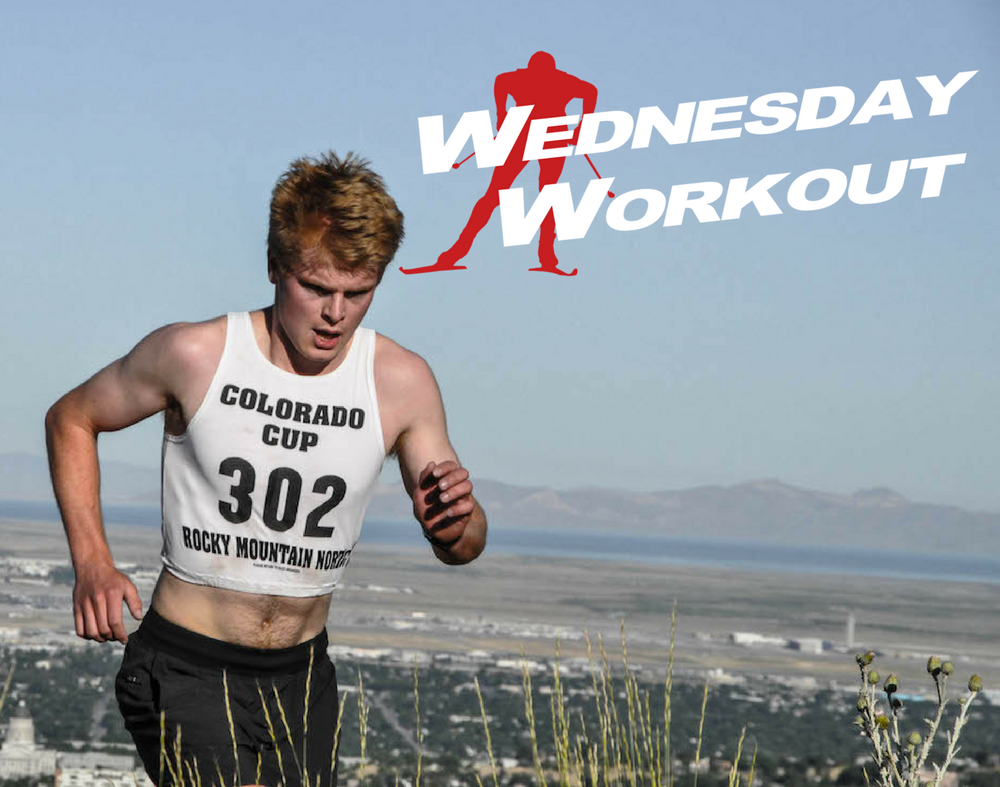
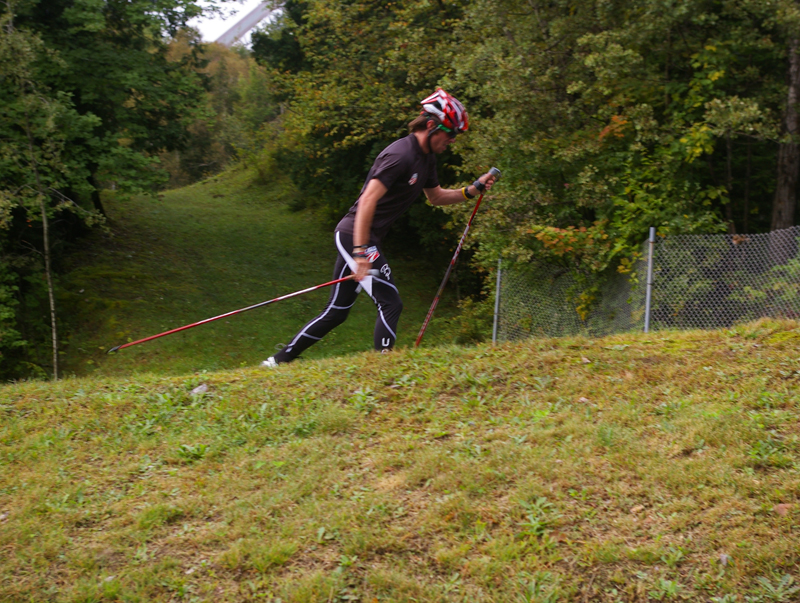
Peter Wolter, of the Sun Valley Ski Education Foundation, racing to the fastest time up Agony Hill during the 2017 Western Regional Elite Group (REG) time trial in Salt Lake City, Utah. (Photo: Matt Whitcomb)
When it comes to U.S. Regional Elite Group (REG) training camps, there are a few running themes that remain consistent across the country and from year to year. In the East, West and Alaska, participants in the U.S. Ski Team’s development program are tested with an uphill run, agility course and a roughly half-mile double pole, all of which are timed and done individually.
Western REG coaches Mike Elliott and Bill Hokanson explained how the run is done at Agony Hill, adjacent to the University of Utah in Salt Lake City. The “hill”, on the 6,348-foot Mount Van Cott, has been an REG staple since 2006, according to Elliott, a three-time Olympian and former U.S. Ski Team (USST) member. It has been used since the 1990s by the USST, the University of Utah Ski Team, Wasatch Ski Academy, The Utah Nordic Alliance, Park City Nordic Ski Club, and Soldier Hollow Nordic Ski Club, Elliott wrote in an email.
The Agony Hill course records set more than a decade ago still stand, which Hokanson explained was partially due to trail construction since.
“We’re not 100% convinced the modern course is exactly equivalent to the historical one,” wrote Hokanson, head coach of the Wasatch Nordic Ski Academy in Park City and Salt Lake City.
For instance, Morgan Arritola set the junior women’s record of 16:55 minutes up the 1.7-kilometer climb in 2004. The rest of the course records were set before that by John Aalberg (12:46), Nancy Fiddler (15:46) and Rob Whitney (reportedly under 14:00) for senior men, senior women and junior men, respectively.
“Variations in the Agony Hill TT course over the past 3 – 4 decades may in part account for the difficulty contemporary athletes have faced in trying to set new records,” Hokanson wrote. “However the records are held by 4 of the toughest, fittest, most talented athletes of all time, which may fully account for the tenacity of their record efforts.”
Here’s how you can replicate the Agony Hill time trial in your own backyard:
“Agony Hill can be developed anywhere and it does not have to be all uphill,” wrote Elliott, now executive director of Rocky Mountain Nordic in Durango, Colo. “My coach, Dolph Kuss, used a course on the edge of Durango when I was in college a Fort Lewis college in 1965 & 1966. It was a loop next to the local cemetery. The area is still called test tracks.”
Elliott recommends a climb lasting 12 to 15 minutes for athletes 18 and older. He also suggested starting athletes individually (via interval starts).
“It can be all out for one lap or Level 3 below threshold intervals,” Elliott added. “Try and have around the same time each time. It can be a 15-minute run to see how far you can go. Like Agony Hill, it can be all uphill.”
He explained that these kind of time trials measure fitness, pacing and rate of improvement over time, and recommended doing this workout once every other week or once every three weeks.
The Workout: Agony Hill uphill time trial
1. Warmup: Light running and stretching for 30-40 minutes
2. Uphill Run: Interval-start recommended
Option 1: One time, all-out effort: see how far up the hill/mountain you can go
Option 2: Level 3 intervals: aim for consistent times
3. Cool down
Agony Hill specifics:
Where: Mount Van Cott, east of the University of Utah in Salt Lake City
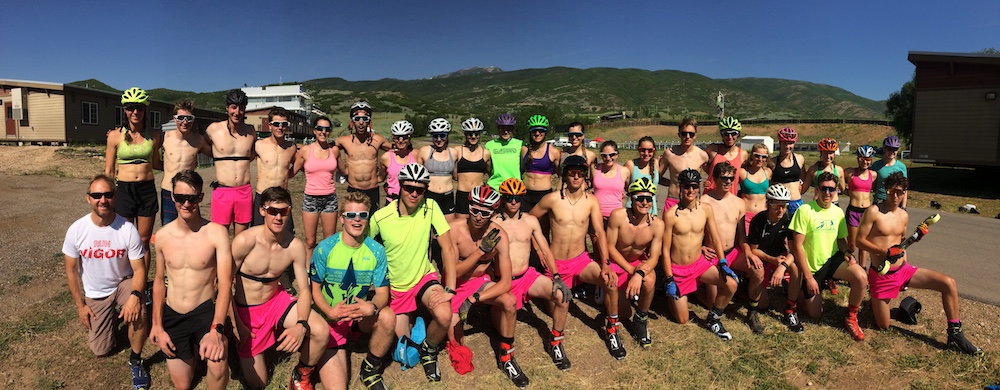
All 34 Western REG participants and U.S. Ski Team Development Coach Bryan Fish after L3 intervals at Soldier Hollow in Midway, Utah. (All photos: Mike Elliott)
The following recap was written with the help of Mike Elliott, director for the Western Regional Elite Group (REG) camp, which took place June 17-24 in Park City, Utah. FasterSkier encourages coaches and athletes from any regional offseason camps (dryland or on-snow, in the U.S., Canada or abroad) to submit their own recaps and photos to info@fasterskier.com.
***
For seven days in June, 34 athletes (17 women and 17 men) from five western U.S. divisions (Rocky Mountain, Intermountain, Far West, Pacific Northwest, and High Plains) came together in Park City, Utah, for the annual Western REG (Regional Elite Group) camp in Park City, Utah.
With the help of U.S. Ski Team coaches Matt Whitcomb and Bryan Fish, a staff of nine led the camp, including Gus Johnson (Auburn Ski Club), Dan Weiland (Ski and Snowboard Club Vail), Greta Anderson (Steamboat Springs Winter Sports Club), Paul Smith (Sun Valley Ski Educational Foundation), Molly Susla (Crested Butte Nordic Team), Pierre Niess (Leavenworth Winter Sports Club), Bill Hokanson (Wasatch Nordic Ski Academy), Mike Elliott (Rocky Mountain Nordic), and camp chef Nancy Elliott (Durango Nordic Ski Club).
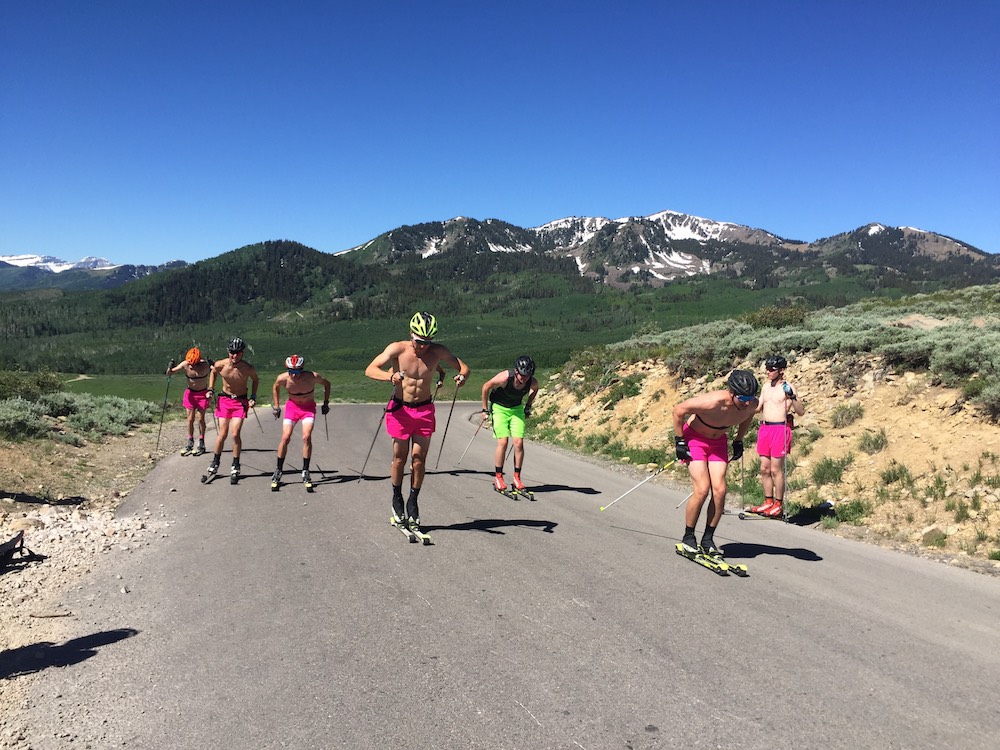
An over-distance classic ski from Pine Canyon to Empire Pass out of Midway, Utah. Inspired by the U.S. Ski Team women who wear matching socks for relays, the camp’s male athletes bought pink shorts at the outlets in Kimball Junction to show their unity. “Coaches, however, did not make the purchase of pink shorts,” camp director Mike Elliott explained. (Courtesy photo)
According to camp director Mike Elliott, athletes were selected based on two factors which were weighed equally, 50/50: their final USSA points at the end of last season and their best two out of three races at 2017 Junior Nationals.
The first training session of the week was held at the infamous Agony Hill next to the University of Utah Hospital in Salt Lake City. Peter Wolter of Sun Valley posted the winning time for the men and Novie McCabe (Methow Valley Nordic Ski Club) was the fastest woman to the top.
In the agility sprint, Sarah Morgan, of Park City’s Wasatch Nordic Ski Academy, claimed first for the women and James Schoonmaker (Auburn Ski Club) was the fastest man. Another Wasatch skier, Madison “Maddie” Morgan won the double-pole time trial, along with Evan Barbier of Steamboat Springs.
“Working with such talented young skiers is so much fun and rewarding,” Elliott wrote in an email. “We often left the lodging facility at 6:30am or 7am to beat the heat. The athletes were always on time and motivated and organized with the proper training equipment. There was a high degree of Esprit de Corps among all the participants. They competed in the three events that were timed, and they supported each other in the other training sessions. Some of the skiers had a goal to qualify for the National Elite Group training camp scheduled later in Park City.”
Of the skiers that attended this year’s camp, several were Junior National medalists, including Wolter, McCabe, Maddie Morgan, Haydn Halvorsen, Sydney Palmer-Leger, Sofia Shomento, and Marin Coletta. Another multiple medalist, Johnny Hagenbuch was scheduled to attend this year’s Western REG, but broke his leg the weekend before the camp, Elliott explained.
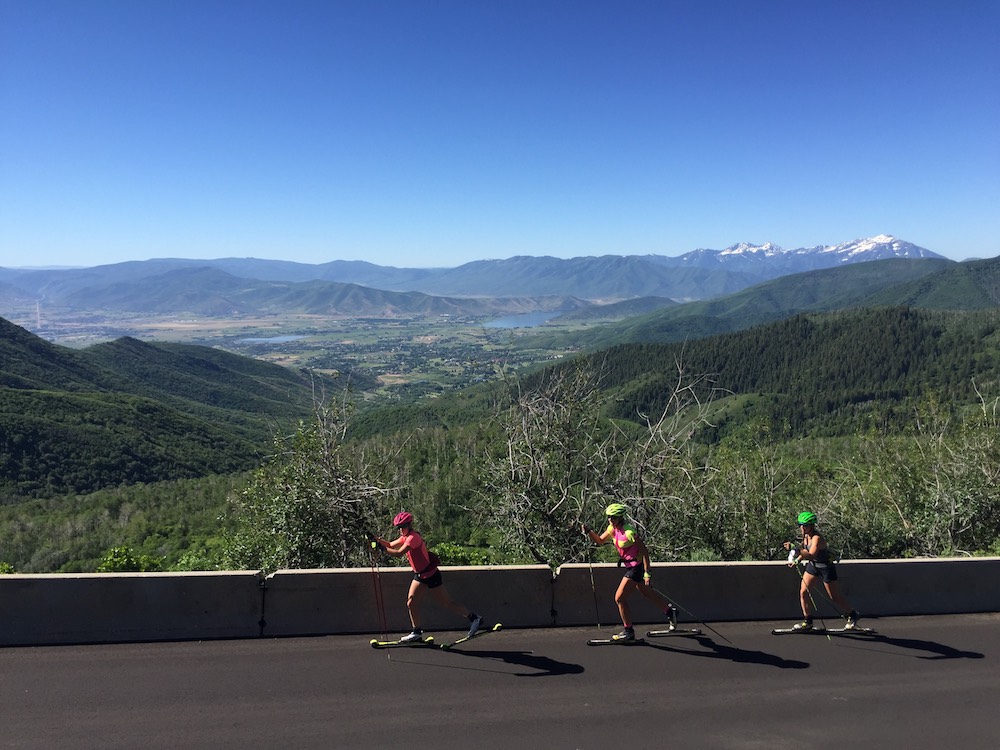
An over-distance classic ski from Pine Canyon to Empire Pass out of Midway, Utah, at the 2017 Western REG camp in June. (Photo: Mike Elliott)
When members of the USSA Cross Country Sport Committee head to Park City next week for the annual USSA Congress, they will be deciding the fate of the High Plains division.
Before the 2015/2016 season began, the regional cross-country ski associations around America hammered out a deal with the U.S. Ski and Snowboard Association (USSA): they crafted “affiliation agreements” detailing the relationship between geographic divisions and the national governing body.
Until that point, regional bodies like Central Cross Country (CXC), Intermountain Division (IMD), the New England Nordic Ski Associaion (NENSA), and the Pacific Northwest Ski Association (PNSA) had been organizing much of skiing on their own. They ran USSA-sanctioned races, placed members on USSA committees, and were represented as teams at Junior Nationals. But in terms of day-to-day governance and regional racing, they were their own non-profits and to a large extent their own bosses.
15 conference calls later, the divisions are still their own nonprofits but are now legally affiliated with USSA.
Two weeks ago, the chair of the board of the High Plains division got a call from Robert Lazzaroni, the nordic domestic programs director for USSA.
“He was asking a few questions about High Plains, and just getting a better feel for how our division is laid out and what we’re made up of,” said Rebecca Watson. “How many U14s do we have coming up? How many NRL races do we have? Details like that.”
Lazzaroni was hired by USSA in August of last year, and the national governing body has been pushing to make additional partnerships with cross-country ski organizations at all levels and gain members in the nordic world.
It seemed to Watson like Lazzaroni was doing an educational fact-finding mission about a remote division. High Plains includes all of Wyoming except for Jackson Hole (which is part of Intermountain), and also serves some communities in eastern Montana and western South Dakota which are far from their designated divisions’ resources. It is a geographically large region in a sparsely populated part of the country.
Then an email arrived in Watson’s inbox.
“About four days later I got an email from Alex [Natt, USSA’s executive vice president and general counsel] saying that they had decided not to renew our affiliation agreement and that we would talk about it at Congress,” Watson said. “That was a little bit of a shock, that it wasn’t going to be renewed. It seemed like they didn’t give me much of a reason for the non-renewal.”
Since the affiliation agreement system has only been in place for a year, it’s unclear what ending the agreement will mean for Wyoming skiers and teams — other than, as Lazzaroni made clear in a later email to Watson, no High Plains team at Junior Nationals.
There’s still a chance that High Plains will be an affiliate of USSA next year, because the decision has to be voted on by USSA’s Cross Country Committee.
“At Congress, there will certainly be a continuation of the discussion on [High Plains],” USSA CEO Tiger Shaw wrote in an email. “This is a constructive and engaging discussion that is fully in flight, and as such it wouldn’t be right for me to comment on anything about it. I want the players to sort it out.”
Those in the High Plains region are perplexed, and leaders of other divisions concerned.
“Let me tell you, I have gotten an incredible amount of support from around the nation, from other team leaders and coaches,” Watson said. “It’s been really amazing. I’m just hoping that we can continue to grow the sport, and to make it accessible to everybody. That’s my biggest thing, is access.”
Like his boss, Lazzaroni did not elaborate on the reasons for the decision.
“See below the exact wording,” he wrote in an email on Tuesday. “USSA has decided not to renew the Affiliation Agreement with High Plains which would otherwise auto renew effective May 1, 2016. High Plains’ status as a USSA Affiliate will be considered at the USSA Congress later in May.”
Why Affiliate?
According to another divisional leader, one of the main purposes of the affiliation agreements were to cover everyone’s legal backs.
PNSA is one of the few divisions where alpine and cross-country skiing are still integrated under one governing body. The association’s Director of Nordic Alan Watson – no relation to Rebecca – was able to watch the alpine divisions go through the same process a year earlier.
“One of the things the McKinsey study had pointed out is that there’s no legal relationship between the divisions and USSA – they weren’t really divisions, they were their own nonprofit organizations,” Alan Watson explained. “They thought it would be good to have a contract … My understanding is that one reason to have the affiliation agreements is to protect us against some sort of unfortunate legal repercussions that could happen, but for practical purposes nothing changes.”
Indeed, once the agreements went into effect, not a lot changed. One main thing, said Rebecca Watson, is that divisions could now purchase liability insurance from USSA at a lower cost.
There were also agreements about race organization fees and head taxes, the use of the USSA logo, and communication between USSA and the affiliates, for instance about education and coach and official certification. In many cases, regional races now require a USSA membership, which is more affordable thanks in part to initiatives by Shaw and also to agreements worked out by Joey Caterinichio, Lazzaroni’s predecessor who stayed on with USSA this winter despite resigning last summer.
“Through all 15 or so conference calls, I most definitely got the feel from Tiger [Shaw, the USSA CEO] that he just wanted to have a better understanding of what the divisions were doing and to help grow the sport,” Rebecca Watson said. “That was the biggest thing that he kept saying: ‘I just want to increase membership and help grow the sport and help the health of the divisions.’ ”
Shaw confirmed as much in an email, writing, “You are correct in that the goals and initiatives of USSA have not changed. We do want to grow membership, enable competition and foster all of our sports. That is core to our mission.”
FasterSkier obtained a copy of an affiliate agreement from another division, with the source requesting anonymity in order to protect ongoing relations with USSA.
The agreement had virtually no references to elite racing, results, or the development pipeline: while divisions were responsible for communicating with USSA when they wanted to schedule USSA-sanctioned races, they were also welcome to continue to host non-sanctioned races (i.e., without points) and allow non-members to enter them. Junior Nationals was never mentioned.
‘Bottom of the Ranking List’
When Rebecca Watson asked Lazzaroni for a rationale about why her affiliate agreement was being terminated, however, high performance and the development pipeline seemed to be the focus.
Watson gave FasterSkier a copy of an email Lazzaroni had sent her (after also sharing it with other divisional leaders and the Sports Committee), and it focuses mainly on junior programming and racing.
Among his concerns: the division organizes few races, and even fewer that are USSA-sanctioned National Ranking List (NRL) competitions; there are few year-round clubs, and most of the teams are high school teams; and the region finished at the “bottom of the ranking list” at 2016 Junior Nationals.
With just 584,000 people and few major population centers in Wyoming, it’s not surprising that there are a limited number of ski teams in the state. As for the matter of most of them being high school teams, Watson said that’s partially a matter of logistics.
“Because of the distances that we have to travel it would be crazy to have two separate race series,” she explained. “I think people can look at that and say that we’re just high school. But we do have both club and high school, it’s just that we try to work it out so that we can do things together.”
Watson said that High Plains is looking into hosting more NRL races, but that it’s an ongoing challenge in part because of the expense. According to USSA’s website, hosting a USSA race costs $50 dollars, plus a $3 per person head tax up to a maximum of $300 per gender. That’s potentially $650 in cash to hand over. Hosting a FIS race series carries an additional $500 fee.
Several venues in Wyoming are upgrading their race-hosting abilities, including Watson’s hometown of Laramie and, perhaps most notably, Casper — which is using donated land and pouring more than $700,000 into putting up a state-of-the-art biathlon facility.
But still, in 2016 the 22-member High Plains team was last in the Junior Nationals Alaska Cup scoring, by a wide margin. They had only one skier hit the top 30: Adam Pickett, who finished 23rd in the U16 5 k and 26th in the U16 sprint.
Mike Elliott, a head of the Rocky Mountain division and a member of the USSA Cross Country Committee, said that during the affiliation agreement negotiations, he had interpreted some of the top goals of the process to be increasing membership and gaining more non-competitive members.
The process was not as contentious as it had been for alpine, he said, and everyone seemed to be talking in good faith.
“That is why I was so surprised at USSA notifying [High Plains] that they were not renewing the affiliation agreement,” he wrote in an email on Thursday. “Judging how the conference calls were handled, I would have thought USSA would have reached out to [High Plains] to offer professional help. There was no notification to the USSA Cross Country Committee that USSA was even thinking about not renewing the affiliation agreement that I am aware of, and I am on the Cross Country Committee.”
Geography
Another issue Lazzaroni seemed to have with the division was geography: he told Watson that one-state divisions don’t make sense.
“One division should represent more than one state (High Plain represent only Wyoming, minus Jackson Hole). Club, state, division, region, national is the map. AK is clearly a unique geographical situation,” Lazzaroni wrote in the email Watson shared.
In fact, there are other divisions which represent primarily one state. Great Lakes includes Michigan, Indiana, Kentucky, and Ohio, but almost all of its skiers hail from northern Michigan. It is considered a sub-division of Midwest, also governed by CXC.
Mid-Atlantic comprises New York, New Jersey, Pennsylvania, Delaware, West Virginia, Maryland and the District of Columbia. But its skiers are almost exclusively from New York.
The reason for High Plains encompassing primarily one state is partly the size of Wyoming (the organization does also include parts of Montana and South Dakota). The state is roughly 280 miles wide and 360 miles long. Cut out and put together, all of the traditional ski regions of Lazzaroni’s native France would easily fit within the borders of Wyoming.
“Before [2003] Wyoming was split into four different divisions,” Watson explained. “It made it very dysfunctional within the state. Laramie was with Rocky Mountain, Pinedale with Intermountain, Cody went up to what was Northern, but now no longer exists.”
High Plains teams do travel to the western Super JNQs; to get to Soldier Hollow, Utah, might be a six-hour drive. Sun Valley, Idaho, is over nine hours from Casper, Wyoming.
“I was actually on that coaching crew which put forward the initial proposal for [High Plains to exist],” Watson said. “One of main reasons was, geographically, it was impossible to get to the IMD qualifiers. One skier attempted it, and was driving 21 hours in a weekend to and from a qualifier. It was just absurd.”
In his email to Watson, Lazzaroni suggested that once High Plains no longer exists, Wyoming athletes could choose between “geographically close divisions”: IMD, including Idaho, Montana, Utah, and Jackson Hole, or Rocky Mountain, which comprises Colorado and New Mexico.
This plan has not yet been sussed out.
“We have not had any discussions within IMD about what would happen to [High Plains] regarding their participation in other divisions,” IMD Competition Committee member Rick Kapala, also the Cross Country Program Director of the Sun Valley Ski Education Foundation, wrote in an email.
Furthermore, there was confusion as to why this was surfacing now, rather than last year when several of the first conference calls were dedicated to mapping out regions and divisions.
“[A goal of the affiliation agreements was] clarification of geographic boundaries for all divisions to include states that may have a limited number of participants,” Elliott wrote. “I do not remember any discussion regarding there were issues about High Plains representing only one state.”
“Why did we go through all this stuff last summer, and why did nobody say, ‘OK, High Plains, you’re sort of a weak division, you’re on probation?’” Alan Watson asked.
Another Theory?
There might be one other factor: Jackson Hole. The town stayed part of IMD, but recently a skier who lived in Pinedale, Wyoming, and skied with Jackson Hole as a J3 (U14) decided to compete in the High Plains junior national qualifiers instead, and thus was able to meet qualification criteria where she would have failed in IMD.
The idea that this could happen provoked strong reaction.
“What, if anything, does our non-renewal have to do with the border town issues with Jackson?” Watson asked in her email.
“We do not believe that offering a way for skiers to qualify to junior national Championship that do not require skiers to train more and to become better skier is the right way,” Lazzaroni replied.
But others, including Alan Watson, don’t see this as a major issue.
“One thing that Tiger [Shaw] clearly said is that kids in border towns should be able to choose which division they want to compete in,” the PNSA head said. “Which makes sense to me, because we want kids to want to race.”
What is clear is that if the Sports Committee follows USSA’s recommendation, there will be no more High Plains division.
That, Watson believes, would be unfortunate.
“We took [the state] and were able to join it as one division,” she said. “And it’s been huge for Wyoming skiing. The accessibility to skiing, and to skiing at the national level, has increased so dramatically.”
Charlie Kellogg skiing in Maine with the AMC alumni group the O H Association. (Photo: Doug Hotchkiss)
Bob Gray was hiking in the Sierra Nevada mountains, off the grid, when it happened. Later his phone began buzzing, and he learned that his former U.S. Ski Team teammate and friendly rival over decades and decades of races, Charles Kellogg, had passed away.
Gray was surprised. Kellogg had not been well, but the end came fast once months of excruciating pain was finally diagnosed as a malignant and fast-metastasizing sarcoma.
“It hit me hard,” the 76-year-old Vermont farmer said on the phone, still from the trail, last Saturday. “It could be me next… I miss him terribly.”
Kellogg, 75, had been one of the ties that kept Gray and the ski community together.
“It’s pretty much nose to the grindstone,” Gray said of his life at 4 Corners Farm in Newbury, Vt. “Charlie made a special effort to talk; he was always calling me up. It was great to talk to him. He would drag me out of that focused world.”
But while it’s hard for Gray, at the moment, to connect to Kellogg’s family or other friends, in a way the mountains are a poetic place for Gray to say goodbye to Kellogg, who was a longtime member of the Appalachian Mountain Club (AMC) and its alumni Old Hutsman (OH) Association, and who always made time for a ski or a hike, even if he had just flown back from a work trip to Asia.
“It’s been on my mind, these two days, just thinking about him,” Gray said. “I had nothing to do but walk and contemplate, without any distractions. It’s a pretty emotional moment for me.”
The Storyline
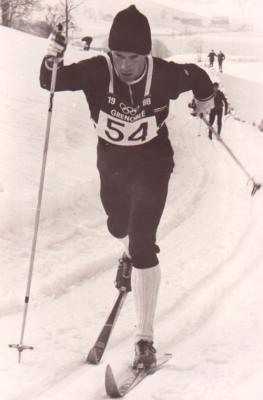
Kellogg competing at the 1968 Olympics in Grenoble, France. (Photo: US Biathlon Association)
Kellogg, a 1968 Olympian in cross-country skiing and a national champion, died a week ago on Sept. 21. Known as “Chuck” or “Spike” to some friends, Kellogg was an integral member of the nordic community, a mentor and friendly face to many on the trails.
As noted in his U.S. Biathlon Hall of Fame induction description, Kellogg wasn’t obviously bound for skiing glory from day one. But the guy who grew up primarily in Andover and Brookline, Mass., picked up skiing at Holderness Academy a few hours north in New Hampshire and never looked back.
And so perhaps his first impact on the sport was as the fast racer everyone was chasing: in college races for Williams College, then as he took up biathlon and eventually won a national championship in 1965, and then still as he competed as a cross-country skier in the Olympics and raced as a member of the U.S. Ski Team (USST).
“He was one of a group of half a dozen guys who I would describe as the early generation of capable international-caliber nordic skiers in this country,” said John Morton, an Olympian and coach. “There were a couple of individuals who preceded them, but… I remember when I was on the U.S. ‘B’ team, and those guys set the standard, and the rest of us just desperately tried to keep up.”
Gray remembers a relay race in Reit im Winkl, Germany, in 1968.
“Charlie came in in the lead, and Jack [Lufkin] kept it, and I was able to hold on – we won a relay race in Europe,” Gray marvels. “It was amazing. Everybody was going crazy over there. It was kind of unusual for an American team to win a relay.”
Kellogg’s race career never really ended. In 1998 he won a World Masters Championship in Lake Placid, N.Y.
There, too, Gray was Kellogg’s teammate.
“Neither he nor I had very good points,” Gray remembers. “We started in the back. But we both had incredible skis so together we made up to the front through 80 people. All of a sudden we were in the lead. I couldn’t hold it up – Charlie went on to win. He’s a great skater! Talk about tough competition, that’s the best of the best. I know he was very proud of that.”
Kellogg never boasted about his success, and not all of his friends were familiar with the details of his ski career. But it’s possible to be humble and proud at the same time, and Kellogg was.
“He was very proud of his achievements,” said Doug Hotchkiss, a friend from near Kellogg’s home in Massachussetts who was part of a nonprofit board and also the O H Association with Kellogg. “Of course, he was very modest, so you would never know it unless you asked him about it. But then it was clear.”
No matter which year you ask about, his friends and teammates will tell you that he was a great guy to be around. Kellogg was a role model for how to balance a job, a family, and high-level training.
“I always admired and was continuously impressed with how Charlie was able to balance his training at a high level while working full time for IBM and fulfilling his responsibilities and obligations as a husband and a father,” USST teammate Mike Elliott wrote in an email. “In the late 60s, there just were not many athletes who could do that successfully.”
“He was disciplined and a very tough athlete,” Gray agreed. “But just a real pleasure to go head to head with.”
Kellogg never stopped skiing – this year he competed in the White Mountain Classic in Jackson, N.H., and earned an age-group podium in the 10 kilometer at Masters National Championships in Craftsbury, Vt. – but as he grew older he also bettered the ski community in other ways.
His expertise as a board member was so impressive that a group of biathletes in 2006 lobbied hard for him to be elected vice chairman of the United States Biathlon Association (USBA).
“While most countries were increasing staff numbers, sponsors, and athlete support, many of us felt that USBA was headed in the opposite direction,” Lowell Bailey, one of the signatories on an open letter before the election, wrote in an email. “Charlie represented one of the new faces that we felt could help facilitate and oversee the difficult changes that USBA would need to undertake in order to remain competitive internationally.”
Kellogg, who worked in sales at IBM and later at Global Partners, had a knack for business and nonprofit interactions. He was described by colleagues in three different organizations as a model board member. Besides his help with USBA, he was also the president of the Manchester Essex Conservation Trust near his home in Massachussetts, and a board member of the Jackson Ski Touring Foundation, where he and his wife had recently bought a condominium.
How did he manage it all – these many tasks and passions which added up to more than most people could handle?
“He was hyperactive is what he was!” Hotchkiss remarked with a laugh. “But he loved it.”
And people loved Kellogg.
“We had a regularly-scheduled board meeting this week, and all of us were thinking how much we’re going to miss Charlie,” said Ken Kimball, a friend on the Jackson Ski Touring Foundation board.
The Hutsman
Before he became a full-time skier, Kellogg started working in the AMC huts. At just 16 years old, he spent his first season at Lake of the Clouds on Mount Washington in New Hampshire. Soon he was the hut manager.
His legend preceded him, said Hotchkiss, who didn’t actually meet Kellogg until later.
“Everything I ever saw him do, he led by example, not by being loud and boisterous and carrying a big stick,” Hotchkiss recalled. “I had heard of Charlie and seen that he had all kinds of records for speed hiking. In those days we kept records of the macho things – it was all boys working in the huts then, no women. It was how much weight you could pack, how fast you could go, all of that. That was the measuring stick amongst guys. How many dishes you could wash in as short a time as possible, how big a pancake you could make. Part of the fun of working in huts was bringing the crew together.”
When U.S. Supreme Court Chief Justice William O. Douglas visited Lake of the Clouds in 1960 with a National Geographic camera crew in tow, Kellogg was managing the hut. He ended up in photos in the magazine. He was 20 years old.
Working in the huts was fun and gave Kellogg a chance to stretch his legs. But working on Mount Washington, home to some of the most extreme weather on earth, was also serious. Kellogg wrote in a recent O H Association newsletter of going out in a gale to find and retrieve the bodies of two young hikers who had perished, dressed only in cotton.
“Of course the terrible visibility contributed to [a lack of volunteers] and the wind was keeping people inside their respective buildings where they plied their trade, such as TV broadcasting, checking weather or testing jet engines,” Kellogg wrote.
Weather didn’t keep him or his friend Greg Prentiss inside, of course.
The ties he forged, to other hutsmen, hikers, and the mountains themselves, stayed strong. Kellogg also worked as a mountain guide in the Grand Tetons at one point, and trekked in Nepal.
Hotchkiss soon met him again, this time in earnest.
“In 1978 when another Old Hutman and I showed up near Jasper in the Canadian Rockies to do a randonée ski trip,” Hotchkiss said. “We were flown back into a remote camp by helicopter, and then for a week we spent every day climbing up with skis with skins, and descending. Charlie was there with his wife and his brother-in-law and his wife’s sister. And so there were six of us who were connected, but we didn’t know they would be there!”
After a day of skinning up thousands of feet, taking a few runs, and then descending to camp, Hotchkiss was usually looking for “an ibuprofen and a beer.”
Not Kellogg or his wife, Gillian.
“Charlie and Gillian would put on their cross-country skis and go out for more skiing on the frozen lake,” Hotchkiss said. “Every day! And then be ready to go the next morning.”
While Kellogg spent a decade racing at the top levels of national and international competition, he was also just as happy going out on the trails with friends who hadn’t been elite athletes. He and Hotchkiss went on several O H Association trips to Maine, where groups of hutsmen and women could ski from the Little Lyford Ponds lodges.
“He was always miles ahead of everybody,” Hotchkiss said. “I’m sure you’ve been hiking with a dog, where the dog goes bolting ahead and eventually will return. That was Charlie’s method.”
While racing was something he loved – Gray and Morton both recalled that Kellogg would never, ever, let it go in a sprint finish, even after a marathon distance spent going together – non-competitive pursuits were also key.
“A lot of athletes, they have their competitive life and then they move on to something else,” Morton said. “They may be nostalgic about the old days, when they were in shape and could do the Presidential Traverse in a single day. Charlie Kellogg kept at it. He probably up until relatively recently could still do a Presidential Traverse in one day, and look forward to it.”
Kellogg was a lifelong steward of ski and hiking trails, as well, not just maintaining AMC trails or those at the Manchester Essex Conservation Trust, but then later in Jackson.
“As we looked at new trail configurations he’d be out in the field skiing around trying to find a new route,” said Ken Kimball of his time with Kellogg in Jackson.
“He was always miles ahead of everybody. I’m sure you’ve been hiking with a dog, where the dog goes bolting ahead and eventually will return. That was Charlie’s method.” — Doug Hotchkiss, friend of Charlie Kellogg
The Racer
After five summers of training on Mount Washington, in a systematized way or not, Kellogg was beginning to turn heads on the Eastern college circuit. By his senior year at Williams, in 1962, he was the captain of the team.
The next year, he headed to Alaska to join the Modern Winter Biathlon Team at Fort Richardson to fulfill his Army service. During the war, men like Peter Hale, Terry Aldrich, Dennis Donahue, Bill Spencer, and John Morton paid their dues at Fort Richardson, although not all overlapped with Kellogg.
“He said it was great,” laughed Hotchkiss. “He got to ski every day!”
In 1964 Kellogg went to Fairbanks for the Equinox Marathon, which his biathlon teammate Jerry Varnum won, while Kellogg was second. The Fort Richardson program was already a few years old at that point, but it was close to Anchorage, not Fairbanks. The pair’s exploits led the Fairbanks Daily News-Miner to write a blurb, “What does biathlon mean?”
Kellogg represented the U.S. in international competition including in Östersund, Sweden, where he was the top American finisher at the 1964 World Military Championships.
After leaving the Fort Richardson program, Kellogg went back to straight skiing.
“Charlie was very serious in training and when studying the sport of cross-country skiing,” Elliott wrote. “I have nothing but fond memories of my experience of training and racing with Charlie. John Caldwell, as the USST Coach, organized ski team members for running and hiking the length of the Long Trail in summer of 1969. Pictures of that experience shows a bunch of lean fit young men. On that trip were John Caldwell, Peter Davis, Everett Dunklee, Mike Gallagher, Tom Corbin, Ned Gillette, Bob Gray, Charlie Kellogg, Jack Lufkin, and myself, Mike Elliott.”
Gray, too, remembers that trip well – and the crew that went with it.
“It raised a lot of awareness for the team,” said Gray, noting that the men would come off the trail and have dinner or drinks with communities in the local towns every night. “The U.S. Ski Team was gaining ground. A few years later, it was Bill Koch. We were sort of the foundation.”
Elliott said that Kellogg was one of the smartest guys on the team: after eventually making the Olympics, he went to the Tuck Business School at Dartmouth. His LinkedIn profile lists “the Shakespearian authorship question” as a hobby.
And that cerebral nature also came through in sport. Kimball, who would later work and ski with Kellogg in Jackson, remembers meeting him for one of the first times at an Eastern ski race around 1970.
“I was at a race at the Swedish Ski Club in Vermont, and I was just coaxing my just-married wife to also start cross-country skiing,” Kimball said. “That was in the day when race courses were quite snowshoed-out, quite different than today. Here’s a guy out talking about snow crystals and how they penetrated different kinds of waxes. In that day that was all very new and scientific and the rest of us were wondering what this guy was really talking about. But obviously his results showed what he was talking about! That was my introduction to Charlie.”
Kellogg was clearly a leader on the trails.
“The most accurate way to sum it up would be to say that I was in some of the same races that Charlie was in,” said Kimball, who had raced in college and was continuing while he went to graduate school.
But racing was no easy task in those days.
“I was on the U.S. Ski Team for 14 years,” Gray said. “By the last year, they began to have some kind of payments, but I think it was 1500 dollars. To be able to train year round – I didn’t do that until 1970, even then it was hard. By the time I left the team in 1974 I was broke. I mean broke.”
Yet Kellogg held it all together, seemingly.
“When Charlie was racing, you really had to have a second job to stay alive,” Kimball said. “It wasn’t like today where you are a professional or semi-professional athlete. He was like everybody else: you had something else that was a major part of your life to sustain your family and your income, which meant that you really had to have a love for the sport to continue to participate at a high level. He obviously sustained that for quite a while.”
The Board Member
While continuing to ski, run, hike, and bike for fun, Kellogg also transitioned to professional life. After going to the Tuck School and working for IBM and Global Partners, his personality and skills came to be in great demand in the nonprofit world.
Hence that letter, which was signed by biathletes Bailey, Tracy and Lanny Barnes, Jeremy Teela, and Tim Burke. Of the four paragraphs dedicated to lobbying for five different nominees, fully half of that text was devoted to Kellogg.
“As Vice President Mr. Kellogg would support new fundraising initiatives and help USBA gain the necessary resources to reach a medal at the 2010 Vancouver Olympics,” they wrote at the time. “As a successful professional fundraiser, he understands the fine points of generating financial stability within an organization. The new Vice Chairman must be business savvy, but also possess an adequate knowledge of our sport. Charlie Kellogg is more than qualified in both respects.”
Kellogg more than delivered once he was elected, according to the biathlon community.
“What struck me most about working with Charlie was the thoughtfulness with which he promoted biathlon and cross-country skiing at both the elite and recreational levels,” Walt Shepard, a former biathlete who was an athlete representative, wrote in an email. “His love for the sport — coupled with his serious credentials as a former Olympian — inspired enthusiasm from folks in both camps. More than anything, he was just a great guy to have a conversation with. He was very interested in getting to know people, and I really appreciated that about him.”
“More than anything, he was just a great guy to have a conversation with. He was very interested in getting to know people, and I really appreciated that about him.” — Walt Shepard, former biathlete and athlete representative
Bailey agreed.
“[Kellogg] was at the core of a group of newly elected board members and staff who ushered in a new chapter in USBA’s history,” Bailey wrote in an email. “In many people’s eyes this is the period where USBA went from an ‘also ran’ to a legitimate medal contender on the world stage… Perhaps more impressive was Charlie’s genuine love of our sport and the athletes and staff of USBA. I considered him not only a crucial member of our US Biathlon Team, but more importantly, a friend who cared about my life both as an athlete and a human being.”
It was after the election of Kellogg and other new board members that Burke and Teela hit the World Cup podium for the first time, and then in 2014 Bailey and Susan Dunklee did as well.
“He was on the board during a time of probably the most dramatic advancement of the sport in America, and the most success for our program and our athletes,” Morton said. “He was part of the leadership which has allowed our team – we’d had individual athletes, but certainly never more than one or two – that so consistently were in a position to be on the podium. He was part of putting that program together, and probably more importantly, securing the funding.”
In the nonprofit world, moving towards decisions and policies can be a painstaking process if a board of directors is fractured. Kellogg proved to be adept at advocating not only for his own ideas, but for forward progress.
“He seemed impatient, but he somehow was able to show patience,” Hotchkiss said. “When you’re working for nonprofits it’s more of a consensus-based decision. He had a real talent for moving groups towards that.”
“He was a very good board member,” agreed Kimball. “I’ve served on a number of boards and some people are just warming a seat, but others really join in and participate. Charlie was one of the latter.”
Kimball said that Kellogg was particularly good at understanding the challenges Jackson faced, given that many of their trails are situated on private land which makes further development impossible.
“Charlie was also very good at bringing up his ideas constructively with the board, and pushing his ideas forward, and also trying to make them happen,” Kimball said. “A lot of people are willing to just spit out ideas and hope that someone else will pick up and do all the work. That’s not how I would label Charlie. He was also willing, if people disagreed with him, to accept that as well. It was a real pleasure to work with him.”
So both at the national and the local level, the ski community was lucky to benefit from Kellogg’s devotion.
“Charlie has paid it forward by paving the way for so many others that have come after him,” Elliott wrote.
The End
Hotchkiss was around this summer as Kellogg’s pain got worse. It was months before the sarcoma was diagnosed as the underlying problem, but Hotchkiss knew Kellogg was in trouble when he took the short route home during a trail-clearing day for the conservation group.
“That was completely unlike him,” said Hotchkiss, who added that he could never imagine how Kellogg, who was outside at every possible moment, ever held a desk job.
By August, Kellogg was in the hospital and had to miss Lake of the Clouds’ 100th birthday party, an O H Association event he had been looking forward to.
“I did get a book of pictures of Mount Washington, and a lot of his friends signed it and put comments it,” Hotchkiss said. “That’s the kind of association we have. We all stick together. I brought it back, and he seemed to enjoy going through that and reading the notes from people who were up there.”
Others are left looking back at particularly fond memories of their friend.
“When the UNH Carnival was up here, there was a race for old codgers like Charlie and myself, and we all went out and did our one or two kilometer loop,” Kimball said. “When you ski with Charlie, he always had a big grin on his face. He’s just a good person to be around.”
***
To honor Kellogg, donations may be sent to two organizations he devoted so much time to:the Charlie Kellogg Memorial Funds at the Manchester Essex Conservation Trust, P.O. Box 1486, Manchester, MA 01944 or at the Jackson Ski Touring Foundation, P.O. Box 216, Jackson, NH 03846.
Do you have any memories of Kellogg to share? Please write them in the comments below.
Mike Gallagher, a three-time Olympic cross-country skier and former U.S. Ski Team head coach, at his home in Pittsfield, Vt., on Nov. 1, 2011. Gallagher died last week on Oct. 3, his 72nd birthday.
Note: This tribute has been updated to include comments from Mike Gallagher’s wife, Tyna, and additional photos from John Estle.
Mike “The Eagle” Gallagher was a diehard baseball fan. Several springs ago, he accompanied his nordic-skiing cronies, John Estle and Peter Ashley, to Tampa, Florida for some sunshine and the rituals of spring training. A three-time Olympic cross-country skier and head coach of the U.S. Ski Team from 1980-86, Gallagher was in hog heaven hanging with his buddies and watching his beloved New York Yankees tuning up for the season, Estle said recently on the phone.
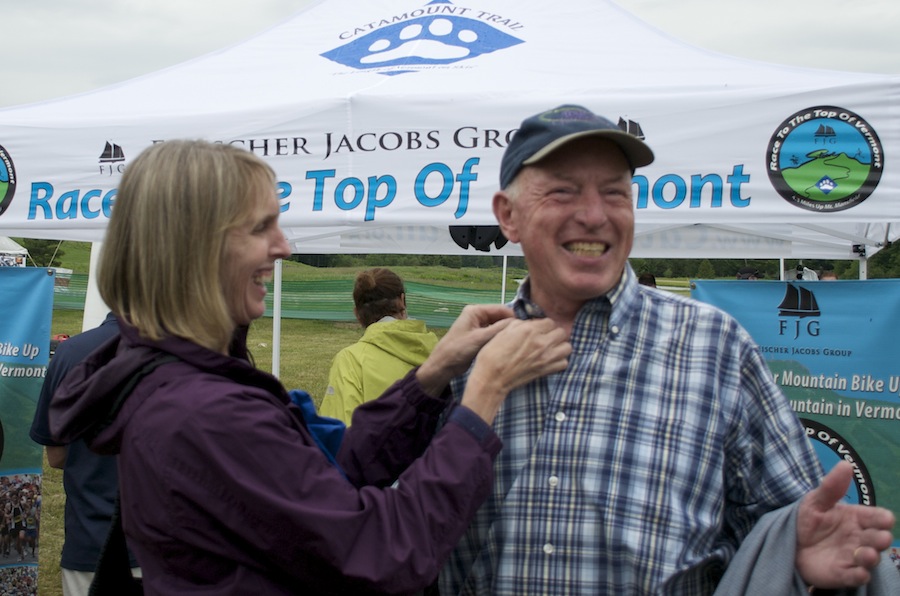
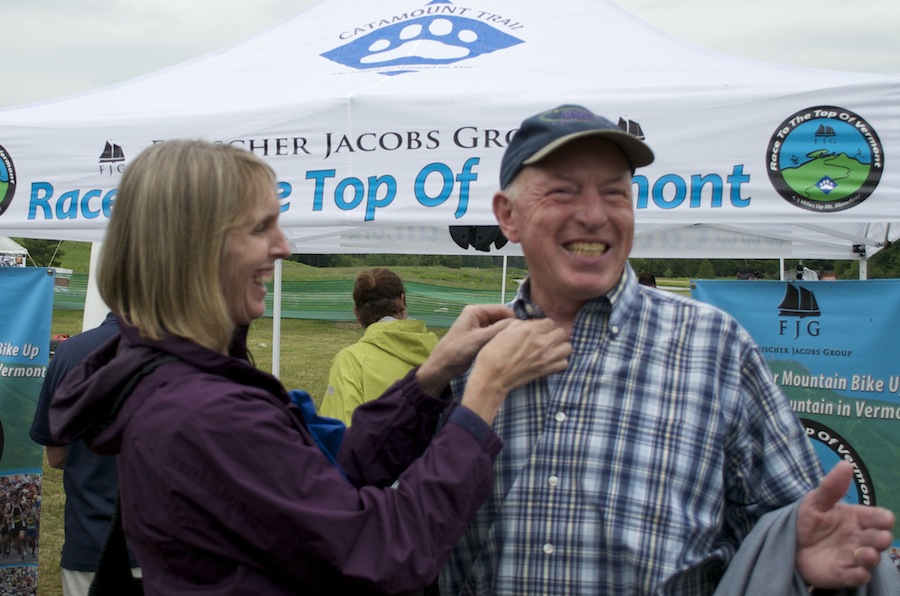
Mike Gallagher gets some help from his wife Tyna before being inducted into the Mount Washington Road Race Hall Of Fame in 2011. Gallagher won all four years he entered the race from 1968-71. (Photo: Jim Fredericks)
The trip to Florida was the invention of Estle and Ashley, also former U.S. Ski Team (USST) coaches, who convinced Gallagher to join them. It took a little coercion, because Gallagher was scheduled to get a hip replacement that same week. In the end, Gallagher rescheduled the surgery and left muddy Vermont for balmy Florida. The trio bunked up with Estle’s partner’s family in Tampa.
During their stay, their host family held a Passover celebration. In remembering the trip, Estle chuckled and said Gallagher was quite caught up in the traditional Jewish celebration. This Irish-Catholic boy from Vermont had never experienced anything like it and loved being included in the large family gathering. In fact, after a week of watching his heroes Derek Jeter and Mariano Rivera playing the game, it was the Passover that Gallagher raved about.
A “man’s man” is how Estle described Gallagher, who passed away at home in Pittsfield, Vt., on Thursday, his 72nd birthday.
“He embodied physicality and sport, yet he was very spiritual and humanistic at the same time,” Estle said. “When you visited, you were the best friend he ever had. He always made you feel good.”
The Man, The Legend
On Oct. 3, 1941, Gallagher was born in Yonkers, N.Y. Raised in Rutland, Vt., Gallagher got his first ski lessons from his father, who served in World War II in the fabled 10th Mountain Division. He went on to become an accomplished runner and alpine skier, laying the foundation for nordic skiing, which would eventually become his life.
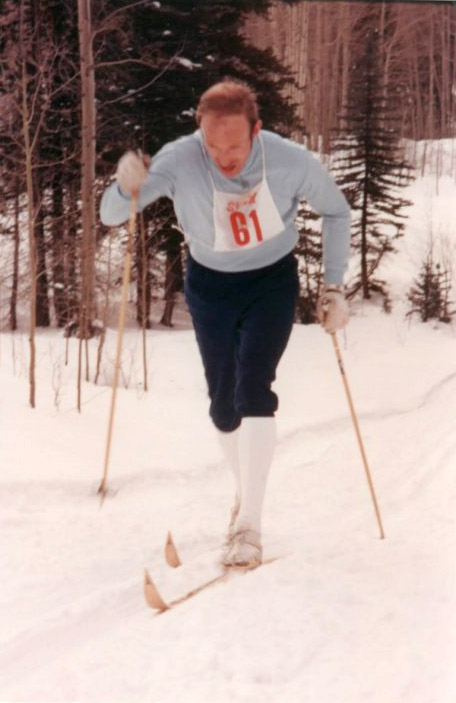
Mike Gallagher at a small race in Europe the early ’70s using Scott poles. (Photo: Marty Hall)
Kicking and gliding on wartime skis he modified for racing, Gallagher won his first high school race as a member of the Rutland High School team. He went on to captain his team, and won a Junior National championship in 1959.
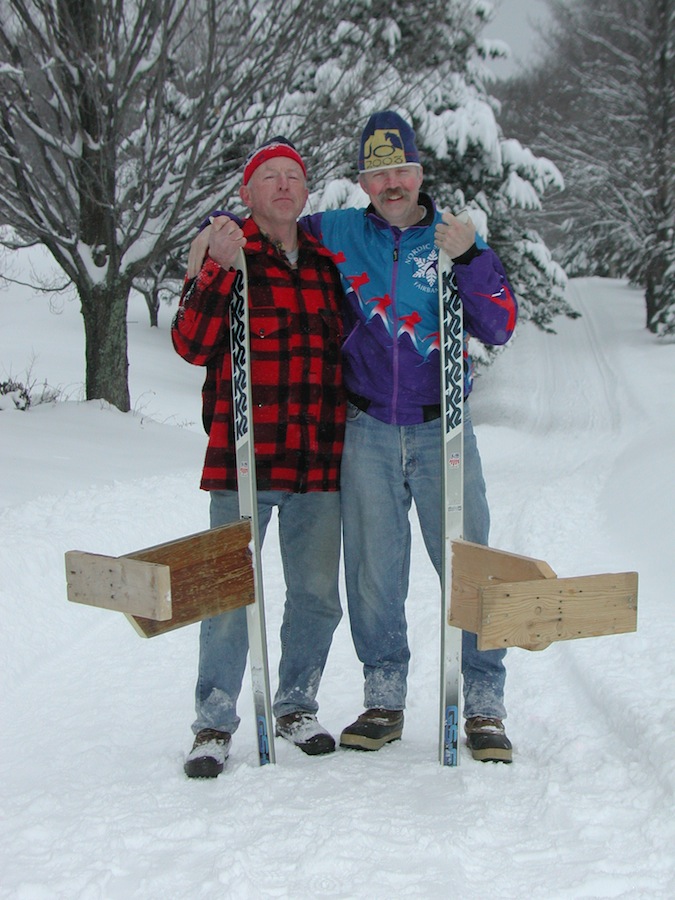
After graduating from Rutland High, Gallagher took a post-graduate year at Vermont Academy then set his sights on Colorado. He attended the University of Colorado, motivated by training with friends Bob Gray and Mike Elliott. This was the beginning of a long-term friendship and the rock upon which U.S. cross-country skiing would grow for many years.
“That trio of Elliott, Gray and Gallagher carried the program for a ton of years, made huge sacrifices, and were all wonderful people living life to the fullest,” their former U.S. Ski Team (USST) coach Marty Hall wrote in an email.
Life was good in Colorado for Gallagher’s freshman year, but then Gray and Elliott moved on, forcing Gallagher to carry on without his training buddies for three more seasons. Seeking more opportunity in skiing, Gallagher set off for Norway, where his ski training took off.
He went on to make three Olympic teams in 1964, 1968, and 1972, and three World Championships. In addition, Gallagher notched nine national titles. His proudest result was 19th in the 50-kilometer classic race at Holmenkollen, Norway, in 1968. He accomplished all of his off-season training while holding down a full-time job. Gallagher’s love for skiing and legendary work ethic is what defined him for the rest of his life.
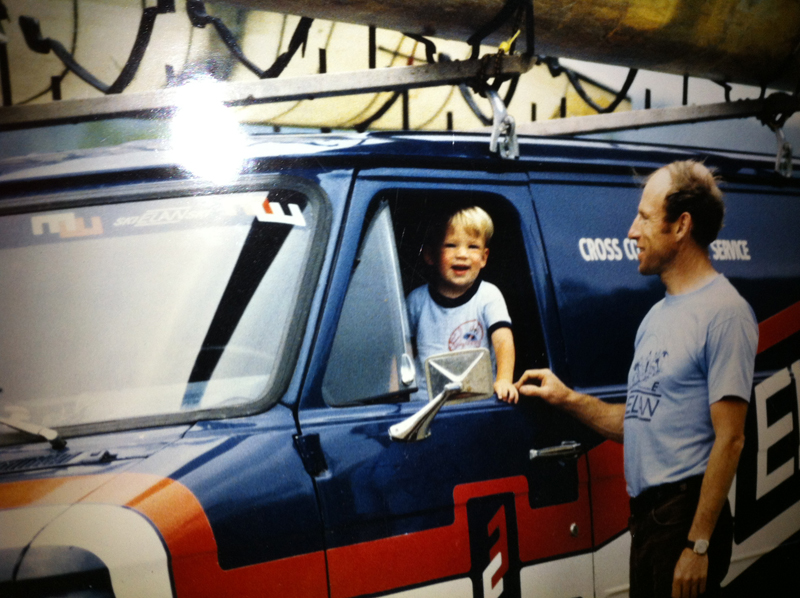
Gallagher (r) with his son, Jesse, in his Elan work van. (Photo: Mike Gallagher)
Gallagher applied his talent and formidable energy to bike racing in New England, a sport in which he excelled for many years. In 1972, he was the 25-mile road biking national champion.
Retired from racing, but still enthralled with the sport, Gallagher turned to coaching. He was head coach of the USST from 1980-86, Olympic-team coach in 1980, 1984, and 1992, and a high-school coach for 17 years. With Gallagher at the helm, Bill Koch won the overall World Cup title in 1982.
The nordic vice president of Fischer USA, Ashley summed up Gallagher’s insightful coaching style in a 2011 interview with FasterSkier. “Mike was the perfect guy for Kochie because he allowed him to do things in a different way, was flexible when he needed to be and would stand on things when he needed to.”
Gallagher vast knowledge of all things nordic led him to employment in several ski companies over his career, among them Splitkein, Hexcel, Edsbyn, and Elan.
For many years, Gallagher shared his love and expertise of skiing as the nordic director at Mountain Top Inn in Chittenden, Vt. He also taught skiing at the nearby Mountain Meadows in Killington.
In 2007, Gallagher was inducted into the Vermont Skiing Hall of Fame. He was also into the Mount Washington Road Race Hall of Fame in 2011, a race he won from 1968 to ’71.
Gallagher is survived by his wife, Tyna, sons Sean and Jesse, and a grandson.
Athlete, Coach, Mentor, Friend: Remembering Mike Gallagher
Some people are larger than life. Gallagher was one of them. When you think of throwing rocks into a pond, the largest ones make the biggest splash and send the ripples furthest. Gallagher touched the lives of many because his ripples reached the far edges of the pond. – Nancy Fiddler
Mike “Jumpin’ Jack” Gallagher (l) and longtime friend John Estle in April 2003 in Pittsfield, Vt. (Photo: John Estle and Norma Haubenstock)
Many people met Gallagher through cross-country skiing and then became friends for life. Famed nordic announcer Peter Graves is one, remembering in an email message how he met Gallagher.
“I first met Mike in the late ’60s when he came to my high school to do a clinic. With his typical verve he talked about what a great sport XC was,” Graves wrote in an email. “With that and his sparkling USA warm-up, I became a follower. Over the years, we shared special moments of reflection in his sauna and pondered things, sport and the meaning of life. What was said in the sauna always stayed in the sauna. What he leaves is a rich tapestry of goodness, of inspiring countless people to ski and enjoy the richness of life. He was a smart guy with deep feelings, and as an Irishman myself, I could always understand the joy he felt in singing his Irish songs. He touched so many people, I’m going to miss him for a long, long time.”
Teammate and close friend Elliott recounts in an email how, on a 2012 visit to New Hampshire, he drove 330 miles round trip just to have dinner with Gallagher and Gray. The three remained friends for years after they dominated the U.S. skiing scene.
Elliott and Gallagher had the best kind of competitive relationship. They raced against each other at Junior Nationals and in college, and ended up teammates on the 1964, 1968, and 1972 Olympic teams as well as the 1966 and 1970 World Championship squads.
“We met in 1959 at the Junior National Championships. We always had a friendly rivalry training and racing,” Elliott wrote in an email. “Michael had ‘XC1’ on his Vermont vanity license plate. That license plate was a huge motivating factor for me because I wanted my results to force him to change his vanity license to ‘XC2’. Whenever I did not want to train, I just had to think of that license plate and then I was out the door training.”
Elliott also remembers Gallagher’s infectious singing. “When he called his friends on the telephone and they answered, he would often break into an Irish song. We all knew who was on the other end. He cultivated many friends from all walks of life. He really was such a good guy.”
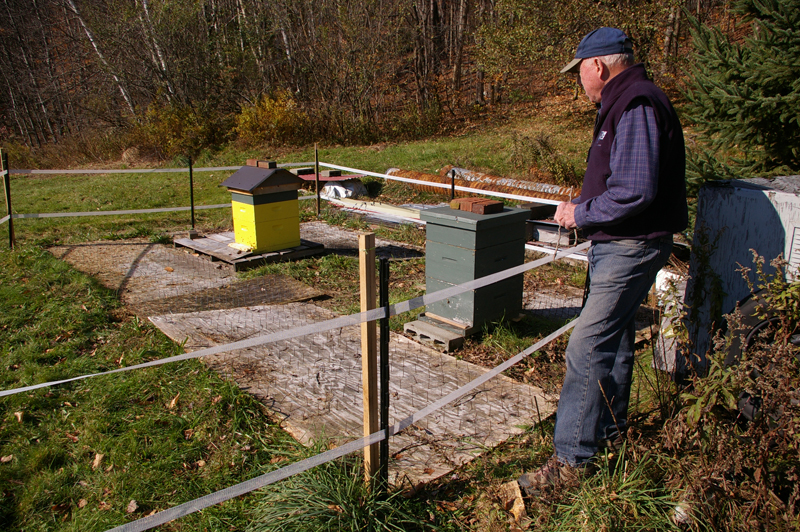
Gallagher checking on the beehives in November 2011 at his home in Pittsfield, Vt. Seventy years old at the time, he said he spent most of his time gardening and mowing nine acres of his 50-acre property.
Gallagher was the consummate tough mountain man, but Elliott saw a gentler side of him on their many travels together. “He once dressed as Santa Claus and passed out presents to children at a resort where we were staying in Scandinavia,” Elliott wrote. “His wonderful laugh and his accent made him a believable Santa Claus to the children. I have nothing but the fondest memories of my life with Michael.”
As competitors and avid outdoorsmen, Elliott and Gallagher shared many adventures. “Gallagher came out to Colorado in 1973 and we went backpacking,” Elliott explained. “He was not really fond of heights and I really took advantage of that fact and enjoyed scaring the hell out of him in the Colorado mountains. He was a very good sport about the whole situation. He loved fly fishing in those high mountain lakes.”
One of the many athletes Gallagher coached, Kevin Brochman remembered how Gallagher used humor to get him through tough situations, a behavior Brochman still resorts to. A two-time Olympian, Brochman also recalled Gallagher’s discomfort in high places, something that seemed to make him more human.
“Mike was a great coach and led the team to a US men’s best, 4th in the world, in 1982,” Brochman wrote on Facebook. “I felt honored to be part of his tenure from 1981-86. HE LOVED TO LAUGH. He did not care too much for the gondola ride up to Dachstein Glacier though!”
Former U.S. Ski Team head coach Mike Gallagher with one of his athletes, Jim Galanes, after a 1984 World Cup race. (Photo: Mal Lockwood)
As a coach, Gallagher set the bar high for his athletes, yet he stood behind them in every situation. The U.S. men’s squad, under his direction, achieved huge success.
“When Michael was the USST XC coach, he often traveled to where the national team skier lived to help them individually with their training,” Elliott explained. “He was instrumental in helping Bill Koch win the World Cup. Bill has nothing but kind, complimentary things to say about the job Gallagher performed.”
Ashley’s long friendship with Gallagher began at Colorado, where Gallagher helped save Ashley from a near-death experience following a collision with a tree. Later, Ashley and Gallagher coached the USST together. Ashley will always remember what he believes to be one of Gallagher’s major contributions to the sport of skiing in this country.
“Gallagher was a man who stood by his decisions, which served him well during the skating revolution,” he said on the phone. “He advocated for allowing the athletes to move the way they wanted to on a race course at a time when many of the international ski leaders were against skating. Gallagher was able to represent the USA’s desire to skate in the international coaching arena. We have a lot to thank him for, in that regard.”
Ashley, Gallagher, and Ruff Patterson brought skating back from the World Cup to the U.S. racing and recreational-skiing population. Their dissemination of skating knowledge put many Americans on skate skis in the ’80s.
Gallagher’s energy and personality were the driving forces in his coaching. As 1984 Olympian Sue Long Wemyss stated online: “I was fortunate to be on the USST and to get to know Mike during the years he was head coach. He was so lively, so positive. He leaves a huge hole.”
Helping Koch top the World Cup was just a small part of the impact Gallagher had on nordic skiing in the U.S. His knowledge was vast, his reach deep and his vision global. According to Ashley, “He had a huge influence on the younger skiers and was something of a father figure to many. The kids really looked up to him.”
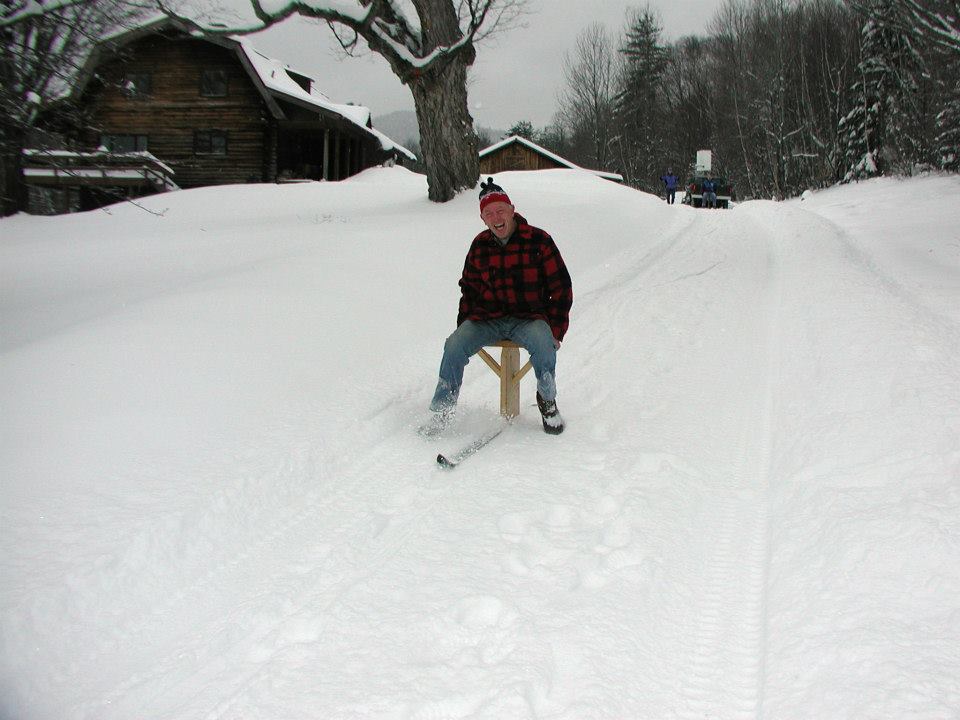
Mike Gallagher enjoying some playtime at his Pittsfield, Vt., home in April 2003. (Photo: John Estle and Norma Haubenstock)
Former USST skier Tim Kelley was one of the many juniors inspired by Gallagher. He also weighed in on his memory of Gallagher on Facebook.
“Besides being a hero for U.S. cross-country skiing, Gallagher was always very supportive of the young guns. He enthusiastically welcomed newcomers into the XC skiing cult. I remember once at a junior camp at his place doing a circuit strength workout at his stations in the woods. And then we finished off the workout by helping him lift logs up for the cabin he was building.”
University of Denver Head Coach David Stewart echoed Kelley in another comment: “Gallagher was a big influence on me when I was just a Bill Koch League racer, inspiring me and many others with his enthusiasm for every level of the sport.”
Gallagher expected a lot, but gave a lot. His dreams are being carried on by the many who were influenced by his spirit. Cambridge Sports Union Head Coach Rob Bradlee carries on some of the best Gallagher traditions in his own work.
“I remember him coaching me at a training day at Putney when I was 15,” he wrote online. “With his enthusiastic urging, I did more push-ups than I thought I could ever do. His energy was infectious.”
There were valuable lessons beyond the push-ups, Bradlee explained. “As a non-competitive skier I was always impressed by how kind and encouraging he was to me. That I loved skiing was good enough for him. And in the long run, he helped me be a better coach by modeling that inclusive behavior.”
Dartmouth coach Ruff Patterson and Gallagher go back a long ways. They have worked together, recreated together, and shared a lot of good times. Patterson was Gallagher’s best man when he married Tyna in 2002.
“Gallagher was a strong man who expected things from people,” Patterson said on the phone. “He was direct and didn’t mind saying what he thought. He pushed all of us as hard as he pushed himself. I wanted to strangle him one day and hug him the next! We were incredibly close.”
The Quintessential Vermonter
“Taking in nature and spending time outdoors is what life was like with Mike. It could be as simple as sitting on our deck, looking out at the mountains sipping coffee and just taking in the beauty of our surroundings. Even though it was peaceful and it was also energizing. Mike was an avid fisherman and hunter, who could turn almost any outing into an adventure with his gift of storytelling. Mike had a joke or two for almost any topic, it was truly amazing how he could remember so many jokes. Even though he loved living off the beaten track, almost recluse, whenever there was a gathering Mike was sure to be the center of attention. With a twinkle in his eyes and his voice booming with excitement he would draw everyone into the story or joke he was telling. While his accomplishments were bigger than life, he was modest and would only talk about them when asked. He was warm, affectionate and fun-loving, he enjoyed putting a smile on someone’s face. He touched so many lives in a positive way, including mine. I am so proud of the man known as Michael Gallagher, he was the love of my life, my soulmate and my heart is breaking.” — Tyna Gallagher
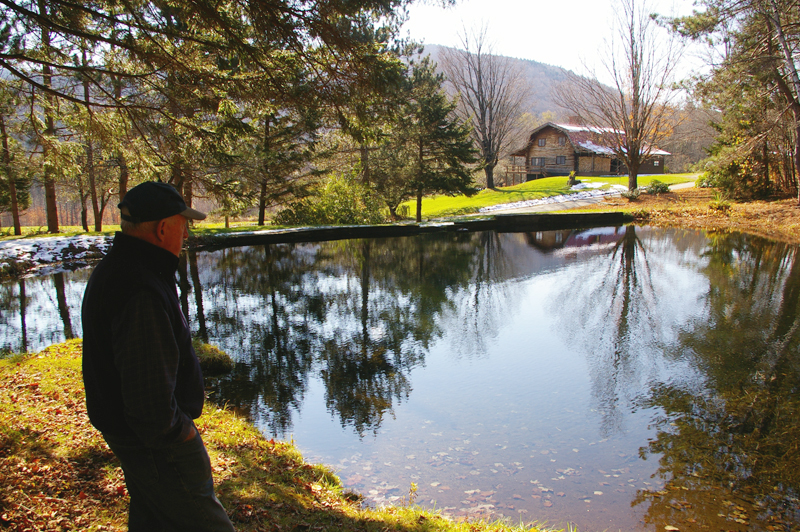
Gallagher beside his heart-shaped pond, where he married his wife Tyna, at their home in Pittsfield, Vt. Gallagher gave FasterSkier a tour of his 50-acre property in November 2011.
Gallagher embraced the Vermont lifestyle; he built the home he lived in and stayed busy and active to the end of his life by tending his garden, mowing, keeping bees, cutting wood, and hunting and fishing.
He raised his boys, Sean and Jesse, to be strong outdoorsmen as well as excellent skiers, and loved the time he spent in the woods with them.
Visitors to his Pittsfield home remember the sauna sessions. Between plunges into the refreshing pond, Gallagher told his famous stories and occasionally broke into song. Gallagher delighted everyone who took part in living large with him.
Elliott succinctly put into words what many are thinking: “I wish I would have spent more time with him.”
A U.S. Ski Team member for the last two seasons, Tad Elliott (SSCV/Team HomeGrown) races to 34th in the 15 k freestyle individual start at World Championships on Feb. 27 in Val di Fiemme, Italy. Elliott was not renamed to the 2013/2014 U.S. team, but will continue to pursue skiing in hopes of making the 2014 Olympics.
Tad Elliott knows what it feels like to get bucked off the bike, and why it’s important to get back on again.
The two-time U23 mountain-bike national champion from Durango, Colo., has been there before, essentially stepping away from a sport he loves to give everything he had to another: skiing. In 2010, U.S. Nordic Ski Team Head Coach Chris Grover reportedly told him he had what it took to make the national squad, but he needed to scale back his mountain biking significantly to do so.
The son of three-time Olympic cross-country skier Mike Elliott, Tad decided to go for it. He put biking on the backburner, ramped up his offseason ski training (i.e. running, rollerskiing, weight lifting), and in 2011, made the U.S. Ski Team (USST).
Almost exactly two years later, Elliott is at another crossroads. One of three men not renamed to the USST, which was announced earlier this week (Kris Freeman and Skyler Davis are the other two), the 25-year-old Ski & Snowboard Club Vail/Team HomeGrown skier was a little stunned.
A month and a half ago at World Championships, he heard there was a possibility of him not being nominated to the 2013/2014 squad, but before an Olympic season? He tried not to overthink it and just kept plugging.
In his third of four races in Val di Fiemme, Italy, Elliott anchored the U.S. men’s team to a solid 10th-place finish in the World Championships 4×10-kilometer relay. Previously, he placed 34th in the 15 k freestyle, and two days after the relay, he was 40th in the 50 k classic mass start.
“I thought I had a pretty solid season, I scored points in Canada [finishing 28th in the World Cup skiathlon] and my sprinting got better,” Elliott said on the phone from Durango. “Especially World Champs and the relay, I thought my season was going to be good enough to be on the Ski Team.”
Just over a week ago, he received a call from his longtime coach, Jason Cork, now the USST assistant men’s coach.
“I actually wasn’t that surprised to learn that I wasn’t going to be back on the team,” Elliott said, thinking back to the initial buzz he heard about it at World Championships.
His conversations with Cork and Grover were amiable, he said, and the former B-team member announced his intentions to return.
“Even Cork said, ‘All the pieces to the puzzle are there, they just didn’t come together last year,’ ” Elliott explained.
Elliott was sick for much of the season, recovering then traveling home for a bit where illness struck again. His mom had a cold most of the winter, he said, and every time he came home, it seemed to take hold of him. Still feeling off at U.S. SuperTour Finals in early April, Elliott said he was going to get some blood work done to make sure he was on the mend.
“There were still some things good parts to last year, just want to make sure everything’s good for next year,” he said.
As for next year, the big question is: ski or mountain bike? Elliott said he didn’t give the latter much thought.
“I made the decision last year to really go in for skiing,” he said. “I didn’t really focus on the bike at all and tried to focus on skiing hoping for a great year. I did have a tough year results-wise and understood it, so I’m still gonna stay with that plan.”
Two of his biggest skiing sponsors, Salomon and Swix, told Elliott they’d stick with him. Salomon encouraged Elliott to join its factory team at some trail running races this summer, which he said would be a new experience, but he was excited about the opportunity.
In addition, he’s going to start riding again, competing in some local mountain bike races in Vail, Colo., where he’ll be based with his team, Ski & Snowboard Club Vail (SSCV)/HomeGrown.
“[My coach] Eric Pepper said, ‘You definitely need to be on the bike and having a good time. It’s something that’s made you successful in the past,’ ” Elliott said.
All he needs is a bike. When he committed to the USST two years ago, he had to give his bikes back to Specialized, his sponsor.
“I’m mountain-bike-less right now,” Elliott said with a laugh. “So that’s kind of my goal in the next week.”
Also on his radar, Elliott’s in the process of coordinating training dates with Freeman and some current USST members. When he didn’t make the team, his Vail coaches, Dan Weiland and Pepper, rose to action. They started planning on-snow camps with Noah Hoffman, Andy Newell and Simi Hamilton, all of which were renamed to the U.S. team.
Freeman and Elliott texted each other when they heard the news and resolved to meet up this summer in Colorado and the East Coast, where Freeman is based with the Maine Winter Sports Center.
“When I learned I wasn’t on the team, I was disappointed for sure, but a big part of me was relieved, too,” Elliott said. “Team HomeGrown [has] been supporting me really well for the last two seasons and the Colorado community, especially my hometown of Durango, they have all the tools in place to create successful cross-country ski racers from helping us fundraise, coaching, [and] they have really talented strength coaches.”
Knowing that he’ll be training with his former U.S. teammates comforted him as well.
“I think last year’s Ski Team men are still going to be training together this year leading into Sochi,” Elliott said. “I’m glad those guys are still friends of mine and still really want to go training. I don’t see a huge difference from my training-camp perspective.”
In terms of goals, Elliott’s still shooting for the 2014 Winter Olympics in Sochi, Russia. First, he will have to prove he’s at an international level and said it hadn’t been decided “100 percent” whether he’ll start racing domestically or on the World Cup.
“Most likely I’ll be in the U.S. and hopefully racing fast to get there,” Elliott said. “It’s the same as it was last year: you have to race fast. Wherever you are, you have to race fast so if it’s in West Yellowstone or on the World Cup, I think it’ll be apparent who’s going well and who should be on the team.”
Asked if he ever wonders what a career in mountain biking would be like, he said, “sometimes.” At the same time, he’s happy he chose skiing.
“I really enjoy the skiing lifestyle,” he said. “Sometimes I wonder, but I only wonder, I don’t really regret my decision.”
For now, Elliott said he’s committed to skiing for at least another year, probably two, and figures he’ll have time to try his hand at mountain biking later on.
“I love ski racing and if other people are racing fast on an international level with the ski team, good for them, they’ll be fun to watch,” he said. “I believe I’ll always be a skier in the U.S. having a good time, but I kind of still have mountain biking, I hope, as a card in my pocket. It seems like those guys are getting older and still racing fast so maybe someday I can go back to pro-mountain biking. I’m just keeping it open right now. We’ll see.”
Athletes who buy U.S. Ski and Snowboard Association (USSA) membership and compete in National Ranking List (NRL) events throughout the season will face higher race and membership prices this winter than in previous years. Due to an increase in its own administrative and insurance costs, USSA has raised the price of some of its services, which has some coaches and regional coordinators concerned about pricing entry-level skiers out of the sport.
The head tax that race organizers must pay in order to hold a sanctioned NRL event increased by $4 per entrant across all USSA disciplines — from $4 to $8 per head in cross country, with a cap at $800 per race where the limit was once $400. Many regional organizers said they would have to pass on the rate hike to the consumer in the form of higher entry fees.
USSA’s annual cross-country competitor and club membership dues have also gone up; club membership increased from $150 to $200, individual membership (ages 13 and older) was $140 in 2011 and is now $150, and youth membership (under 13) is $60 where it was once $50.
According to USSA, the hike in the head tax is necessary to cover its own increasing costs. In the eight years since rates were last changed, there has been a 55% increase in the price the governing body pays to provide liability insurance at sanctioned events, including a 22% increase in the last year alone.
USSA is also experiencing the added costs of implementing new race administration services. It plans to add an online race registration tool to its website, a service organizers have commonly outsourced to third parties like Active.com in the past and for which competitors pay a processing fee. USSA hopes that internalizing the service will make it easier for organizers to integrate information from its member database into start lists and results, as well as divert processing fee revenue back to the governing body.
USSA Vice President of Athletics Luke Bodensteiner said that revenue from the increase in cross-country fees will go directly back to supporting cross-country membership programs, such as administration of the ranking list.
“There are costs we incur to have members, have member clubs, have member races,” Bodensteiner said. “What we try to do is make sure we are bringing in income to support the membership programs.”
Bodensteiner acknowledged that the increase in head tax would be a challenge for race organizers, who either have to absorb the extra cost or pass it along to the competitors’ entry fees. But he didn’t anticipate much of a drop in registered NRL races.
“It’s early to gauge, but so far it doesn’t look like there will be a major change in that,” he said in early June.
Any time there is an increase in fees to members, the USSA board votes on the action. The board includes athlete representatives as well as chairpersons from each of the respective sport committees, who are given the chance to gauge response to any given proposal from the stakeholders within the disciplines at the annual USSA Congress.
Some regional administrators and event organizers contacted in June for comment on the increase said they would likely not cut the number of NRL races on their respective 2012-2013 calendars, and expected to increase entry fees in order to meet the added cost. Others said they would consider holding fewer NRL events if the added cost didn’t make sense for typically smaller races.
What the regions agreed upon was a sense of disappointment in not initially being informed of the reasons for the rate hike.
“We heard about it when we went to the USSA Congress and saw the packet of information before the meeting started,” said Rocky Mountain representative Mike Elliott.
“There was outrage.”
Cross-country committee chairman Jon Engen listened to initial feedback at the USSA Congress before reporting back to the board, and sympathized with the frustration expressed by regional representatives.
“If you had a dollar increase ten years ago, and another dollar increase six years ago, maybe this wouldn’t have been an issue,” Engen said. “But that never did happen, and now with a $4 increase it’s very unpopular.”
Ultimately, he added, “the price of milk is hard to argue with.”
Once made aware of the reasons for the rate hike, coaches and program directors were understanding of the financial reality but remained unhappy with USSA’s communication regarding the change.
“We understand where they’re coming from,” said New England Nordic Ski Association (NENSA) director Zach Stegeman. “We’d have liked to be a part of the conversation, but the reality is that they are increasing fees to represent some real expenses and they are intending to keep all the revenue in the nordic community, so we certainly can’t complain about that.”
While Stegeman was fairly certain that NENSA uses a separate insurance provider, clubs like the Sun Valley Ski Education Foundation (SVSEF) that also encompass alpine disciplines do rely fully on USSA’s coverage.
The root of some community members’ disappointment in a perceived exclusion from the rate hike conversation lies in the fear that raising entry fees and membership dues might price some athletes out of the sport.
“Making the sport more expensive is not a good thing in general, especially for entry level athletes,” said Central Cross Country director Yuriy Gusev. “NRL events always have great competitive atmosphere around them and high level of competition. If this change will affect the number of participants in NRL events that will be a big downside.”
SVSEF director Rick Kapala made a similar point about the increase in membership.
“The one I’m the most concerned about is the youth membership increase,” Kapala said. “Every barrier to entry you put into sport at the youngest levels, that’s not good. If you’d have had a discussion about it, which we didn’t, I’d have argued for keeping youth membership exactly the same, and increasing [membership for] J2 and older. They utilize the services more; the points, the pipeline is more geared towards them.”
For a significant base of USSA members — juniors — the value of membership and participation in NRL races lies in earning potential for USSA points. Points are awarded to USSA members based on NRL results, and USSA keeps track of each athlete’s points on a list that ranks their season-long performance against skiers from all over the country. The list is then used to seed juniors in mass starts at Junior Nationals, and provides certain regions a standard metric with which to determine its elite groups.
Cutting NRLs out of a regional calendar, therefore, would hurt athletes’ JNs seeding. In Rocky Mountain, Elliott felt the division has no choice but to accept the decision and increase their NRL race entry fees. Other regions felt the same; they would continue sanctioning the same number of NRL races, but would have no choice but to raise prices.
“I don’t imagine that we are so close to the tipping point that it will have a great effect in entries, but it might deter some people,” wrote Pete Leonard, interim Alaska representative and Fairbanks Nordic Ski Club head coach, in an email. “Hopefully our efforts to make the events…better will counteract that.”
Dozens of junior skiers raced up Agony Hill on June 25 in Salt Lake City as part of the Western REG Camp. (Photo by Dan Simoneau/MBSEF Nordic)
The Western Regional Elite Group (REG) Camp kicked off in earnest at 6 a.m. Monday, June 25, with a trail-run time trial up Agony Hill. On the training schedule, instructions read: “Bring your ‘A’ game.”
Dozens of teenage athletes tackled the 1,200-foot, 0.9-mile climb in Salt Lake City, tucked behind the University of Utah and often used as a measuring stick for pain tolerance. By the afternoon, the group was back in Park City – the home base of the weeklong camp – for core and strength exercises with U.S. Ski Team assistant coach Jason Cork.
Throughout the seven-day camp, 36 athletes from five divisions (Rocky Mountain, Intermountain, High Plains, Pacific Northwest and Far West) worked with 10 coaches for a total of 20 training hours. They hiked, ran, rollerskied, lifted, played volleyball and went to a waterslide park.
A junior racer at the Eastern REG Camp in Craftsbury charges up Elmore Hill in Elmore, Vt., on June 27. (Photo by Liz Kantack/SMS Nordic)
Meanwhile 2,300 miles east in Craftsbury, Vt., the New England Nordic Ski Association (NENSA) hosted a the Eastern REG Camp, with a total of 33 skiers (19 J1s and OJs in the elite group and 14 in the J2 camp).
They also raced uphill, ran and rollerskied last week. They worked on strength and agility, hill bounding and intervals, and attended presentations at night.
Several U.S. Ski Team (USST) members from around the country made it to the camps as well. Out West, elite juniors chased Simi Hamilton, Noah Hoffman and Tad Elliott up Big Cottonwood Canyon during an over-distance classic rollerski. Miles Havlick, an NCAA champion and Ski Racing Magazine’s two-time Collegiate Skier of the Year, also joined them on the 3 ½-hour trek to the top of Guardsman Pass.
In Craftsbury, national-team skiers Andy Newell, Ida Sargent and Skyler Davis participated, along with elite skiers from the Craftsbury Green Racing Program and Stratton Mountain School.
FasterSkier caught up with Western REG director Mike Elliott and Eastern REG coordinator Janice Sibilia via email for details on last week’s camps.
Western REG
Where: Park City, Utah (Canyons Ski Resort townhomes)
Coaches making their way to the top of Agony Hill in Salt Lake City on June 25 for the Western REG Camp time trial. (Photo by Dan Simoneau)
When: June 24-July 1
Weather: Hot (most workouts started at 7 a.m., with the exception of Agony Hill, so they were able to complete each)
Workouts: Four intense training sessions (including rollerski time trials at Soldier Hollow, Canadian strength tests at the USSA Center of Excellence); two over-distance rollerskis
Extras: Several presentations, including Tad Elliott’s talk about goals
Highlights: “The USST was a tremendous amount of help,” Elliott wrote. “We had Jason Cork at everytraining session. We had USST members Simi Hamilton, Tad Elliott, and NoahHoffman joining us on the over distance days and a time trial day. MilesHavlick with the University of Utah and a NCAA winner last year skied withus on Big Cottonwood Canyon.
“We had a couple of days of Strength with Alexand Michael in the Center of Excellence that they were awesome. Greatinformation and some light hearted teasing. Alex strongly recommends NOspandex on Dudes in the Strength Training at the COE.”
Western REG campers during a 3 1/2-hour classic rollerski up Big Cottonwood Canyon to the top of Guardsman Pass near Park City, Utah. U.S. Ski Team members Simi Hamilton, Tad Elliott and Noah Hoffman joined the juniors for the workout. (Photo by Dan Simoneau)
Additional comments: Elliott was impressed by the amount of “highly motivated and very talented skiers,” which consistently showed up early with all of their equipment before workouts. They didn’t have to wait on stragglers, and some days the vans departed ahead of schedule.
“All of the skiers showed up in fairly good condition and had been training for a couple of months before the REG,” Elliot wrote. “When the skiers introduced themselves we learned … that one is going to Harvard, two to Dartmouth, one to Middlebury, one to Colorado University, three are taking a Post Graduate year to train specifically for cross-country skiing.
Juniors learn the meaning of “rest and recovery” at the weeklong Western REG Camp in Park City, Utah. (Photo by Dan Simoneau)
The J2s did extremely well throughout the week, he continued. Two local juniors from the Wasatch Nordic Ski Club and Park City Nordic joined them at Agony Hill and for the two over-distance days.
“The classic roller ski up Big Cottonwood canyon to the top of Guardsmen Pass was the last training session and it was long and steep. Camp attendees got to observe what year round training is like at the next level by being able to roller ski with Simi Hamilton, Tad Elliott, Noah Hoffman, and Miles Havlick. Even with all the training, the skiers reported that they were having fun.”
Eastern REG
Where: Craftsbury, Vt. (Craftsbury Outdoor Center at Hosmer Point)
When: June 24-July 1
Weather: Rainy at first, then hot (especially during the final workout, Saturday’s rollerski-run combo)
Skyler Davis (l) setting the pace during an interval double-pole session at the Eastern REG Camp June 24-July 1 in Craftsbury, Vt. (Photo by Liz Kantack)
Workouts: 11 in seven days, six of which were intensity or speed.
Three testing phases (rollerski agility, strength and Elmore Uphill run (on which Nils Koons set a course record), to determine which skiers would be invite to the National Elite Group camp in September in Lake Placid, N.Y.)
There were also two interval sessions consisting of DP intervals and hill bounding, recovery runs, rollerski sessions and one over-distance combo run/rollerski.
Extras: Presentations by Sargent, Newell, U.S. Ski Team assistant coach Bryan Fish and Burke Mountain Academy coach Kate Barton on the J1 Scando/U18 trip last winter.
Highlights: “The camp went very well,” Sibilia wrote. “It was hard, but gave the athletes lots of head-to-head time. They also had the opportunity to jump in with Olympian Andy Newell, and [other] USST members … Ida Sargent, and Skyler Davis. Most members of the CGRP and newly formed Stratton Elite team also joined us. For the uphill run we had the [Green Mountain Valley School] join in the fun! There was also an Olympic Day celebration that some of the REG athletes took part in, and a competitive game of mini golf!”
Craftsbury’s own Hannah Dreissigacker, who was recently named to the US Biathlon team, racing up Elmore Hill in Vermont at the Eastern REG Camp last week. (Photo by Liz Kantack)
Additional comments: “Everyone came to camp prepared, and absorbed the training well,” Sibilia continued. “The clubs are doing a really good job of keeping the training focused and the motivation up. Regional coaches came in to help run the camp, as did the folks from Craftsbury and Hosmer Point. The energy level was high!”
On the NENSA website, Sibilia wrote that the athletes had been mindful throughout the week with details concerning nutrition, hydration and recovery.
“They are getting more dialed in to this every time this camp is run,” she wrote. “I witnessed campers taking advantage of the rainer first days by settling into the cabins with their feet propped up for recovery. Without access to internet and cell phones, rest came easier!”
Eastern REG Camp juniors during the rollerski portion of a combo over-distance workout near Craftsbury, Vt., on June 30. (Photo by Liz Kantack)
Can’t get enough of these photos? Neither could we. See more on the MBSEF (for Western REG) and SMS (Eastern REG) Facebook pages.
Tad Elliott rollerskiing at the U.S. Ski Team's dryland training camp in Lake Placid, N.Y., in September. Nominated to the USST B-team in April, the former mountain bike pro made skiing his focus.
LAKE PLACID, N.Y. — Tad Elliott isn’t a big runner. Reflecting on his training from inside the Lake Placid Olympic Training Center, he was quick to admit that.
So when fellow U.S. Ski Team rookie Ida Sargent took him on a long run in Park City, Utah, and the two ended up lost, he wasn’t thrilled.
Elliott, the fun-loving, laid-back jokester, not happy?
“I was cranky,” he said of what turned out to be a 3-1/2 hour trek. “We had no idea where we were.”
Also a first-year member of the USST B-team, Sargent smiled as he told the story. Seated across from Elliott, she quietly said it was her fault.
“It was a joint effort,” Elliott said with a laugh.
Ida Sargent, 23, at the Olympic Training Center in Lake Placid on Sept. 15, 2011.
Despite their personality differences — with Sargent as a more-reserved Dartmouth biology major and Elliott as an outgoing mountain biker — the two formed a bond while traveling with the national team last year. Both competed at the 2011 World Championships and U23 World Championships, with Elliott helping the U.S. men’s 4×10 k relay place 14th at worlds. At the U23 championships, he notched 19th in the 15 k freestyle and Sargent placed 23rd in the classic sprint.
In April, shortly after the season ended, the two were named to the USST, and invited to the Park City rookie camp in June. There, the 23-year-olds — Elliott from Durango, Colo., and Sargent from Barton, Vt. — were the oldest of the bunch.
Elliott said their sudden seniority was strange at first, but once they began training with A-team members like Kris Freeman and Andy Newell, he felt at ease.
“I remember being a junior at these camps and being scared to talk to Kris,” Elliot said at the Lake Placid USST camp in September. “Now, I’m one of the older guys at camp joking with Kris and getting coffee with him. It’s kind of neat to always have that be your goal and now that you’ve achieved your goal, it’s fun to enjoy it.”
“It’s not like anyone’s a big scary person,” said Sargent, who roomed with USST veteran Liz Stephen in Lake Placid.
“I still have that hero worship a little bit,” Elliott said, adding that he tries to keep that on the lowdown.
Changing Gears
Some could have similar respect for Elliott, formerly a professional mountain-bike racer on the U23 national team who traded his wheels for skis.
That was after Elliott said he “semi-retired” from nordic skiing after graduating high school in 2007. A year later, Salomon recruited him to its factory team, and he was back in the cross-country ski scene.
Elliott at the Lake Placid Olympic Training Center on Sept. 15, 2011.
This spring, he gave the USST his word that he would fully commit to ski racing. Rather than bike for 70 percent of his training, he made sure it only occupied 30-40 percent of his offseason regimen. Running, rollerskiing and weight lifting took up the rest.
“It’s been a really big change for me,” Elliot said, noting that he didn’t fly his bike to Lake Placid because it cost about $200 to do so.
He and a friend attempted to rent bikes during their 1 ½-week stay. Without much luck, they decided to save their energy.
“I’m definitely more tired now than I’ve ever been,” he said. “And I think that’s just from training.”
Usually at this time of year, it was the travel associated with mountain biking that wore Elliott down. Several months into his ski-specific plan, he described his state as a “good tired.”
More hours in the gym were certainly a factor, he said. While he hated being inside (“It’s so boring,” he said. “I’d rather be outside blasting my mountain bike around”), Elliott understood the importance of his strength plan.
“Hopefully it will make (me) strong and feeling good into the season,” he said. “The biggest goal for me is to be still getting better, still want to be racing more and learning how to be at that (level). That’s where these older skiers on the team can help you.”
Elliott could also look to elite athletes like his father, Mike Elliott, a three-time Olympian in nordic skiing, and his fraternal twin, Evan, a professional downhill mountain bike racer. Upon being nominated to the USST, Elliott said his entire family supported his decision to switch to nordic.
“My dad was amped,” he said. “My brother was pumped. … My mom’s just happy with whatever. … Whatever my goals are, they’ve supported.”
As for his upcoming season, which starts in early November with the USST in Norway, Elliott expected it to parallel mountain biking with similar training and World Cup events.
Because of U.S. Ski and Snowboard Association (USSA) budget cuts this year, there weren’t additional financial incentives to join the national ski team; Elliott and Sargent said they received a little more last season. But they understood the economic situation and said the USST, their coaches and their clubs (including Team Homegrown for Elliott, and the Craftsbury Green Racing Project and NENSA for Sargent) were doing all they could to support them. The opportunities were invaluable, they said, and being on the team attracts sponsors.
“I’m happy with my decision to be on the U.S. Ski Team … (and) be part of these guys,” Elliott said. “It’s been awesome so far working with them.”
More of the Same
Sargent at the start of a sprint time trial at the USST dryland camp in Lake Placid, N.Y., in September. She was consistently the top female in four rounds of the 1.3-k sprint.
Sargent, who has one quarter left at Dartmouth College, plans to go back in the spring. The former captain of the university’s ski team, she said it was bittersweet missing the college-racing scene last winter. However, it was worth it to race in Europe, especially at Worlds, she said.
Like Elliott, her initiation into the national team officially began with the one-week rookie camp this summer. There, the six newcomers learned what the USSA had to offer and how to conduct themselves as full-time athletes.
As the summer progressed, Sargent’s training didn’t change much. It had worked well under the guidance of Pepa Miloucheva, who coached Sargent from her youngest years skiing in Craftsbury, Vt. Sargent had older siblings Eben and Elsa to look up to, as both went on to ski at Dartmouth. Her interest in the sport led Sargent to Burke Mountain Academy, where she spent the last three years of high school.
The academy’s head coach at the time, Matt Whitcomb, helped her improve, and she continued to work with Miloucheva as a member of the Craftsbury Green Racing Project in college. Conveniently for Sargent, Whitcomb became the USST women’s coach.
In the end, Sargent mostly consulted with Miloucheva for workouts and frequently spoke with Whitcomb. She figured the new arrangement would make communication even easier.
To her, the best thing about being on the national team — aside from racing abroad — was the opportunity to train with talented skiers.
“We’re all just out there working hard as a big group,” Sargent said, specifically pointing out the benefit of camps, which typically include top-tier regional skiers and the National Elite Group. “I really don’t think it’s that different from the juniors that are with us. We train the same.”
“You probably get a cooler jacket with a patch on it,” Elliott joked.