In 2014 NENSA began the tradition of honoring the top ranked male and female Eastern Cup skiers with the Gallagher Cup. NENSA is honored to announce that Rena Schwartz (GMVS) and James Kitch (CSU) are the 2018 Eastern Cup Champions – their inspired efforts are a perfect way to celebrate Mike Gallagher’s legacy as an athlete, coach, and community leader. The two skiers who win this award each year do so by being consistently dominant in New England’s premier race series (winners are determined by averaging points from 7 of 8 EC events).
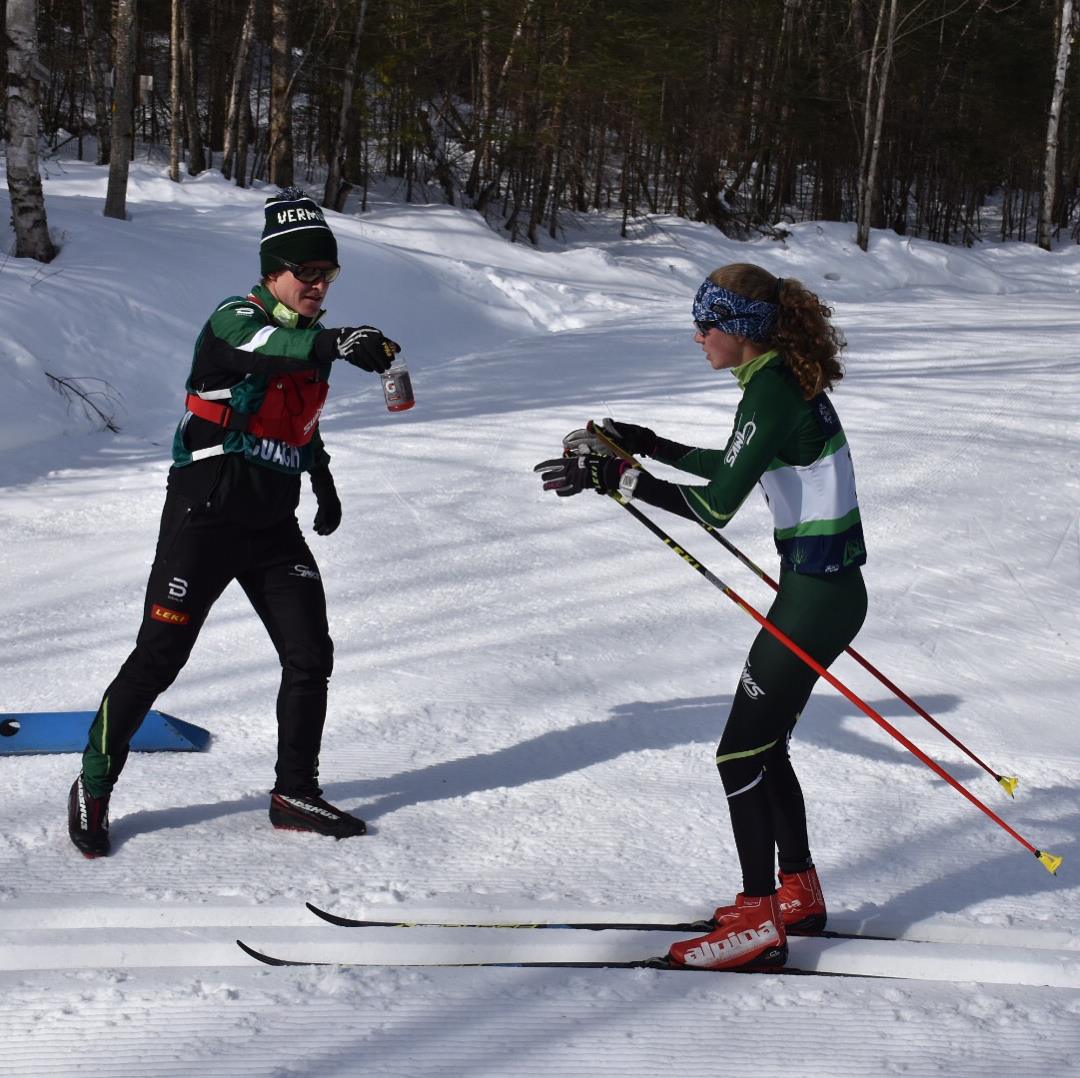
Schwartz receiving a feed from coach Colin Rodgers during Super Tour Finals at the Craftsbury Outdoor Center.
Rena Schwartz skied for the Green Mountain Valley School, raced in seven Eastern Cup races, with one victory and three podiums, and ended the year atop the New England Junior National Ranking List. She competed at Junior Nationals with a top finish of 4th place in the 10km freestyle event. Schwartz also competed at US Cross Country Championships and Super Tour Finals ending the year the 51st ranked female skier in the country.
Coach, Colin Rodgers, describes Schwartz as a leader, “Rena is an impressive role model for all of the student/athletes on the team, and her drive for success motivates those around her. Not only does she have extraordinary competitive results, but Rena is a pleasure to spend time with, exuberating kindness, honesty, and dependability. If you ask anything of Rena, you can expect it to be done with focus and attention to detail.” Outside of skiing, Schwartz was the Vermont cross-country running champion and a Gatorade Runner of the year, where she won a $10,000 spotlight award to donate to her club of choice (Craftsbury Outdoor Center).
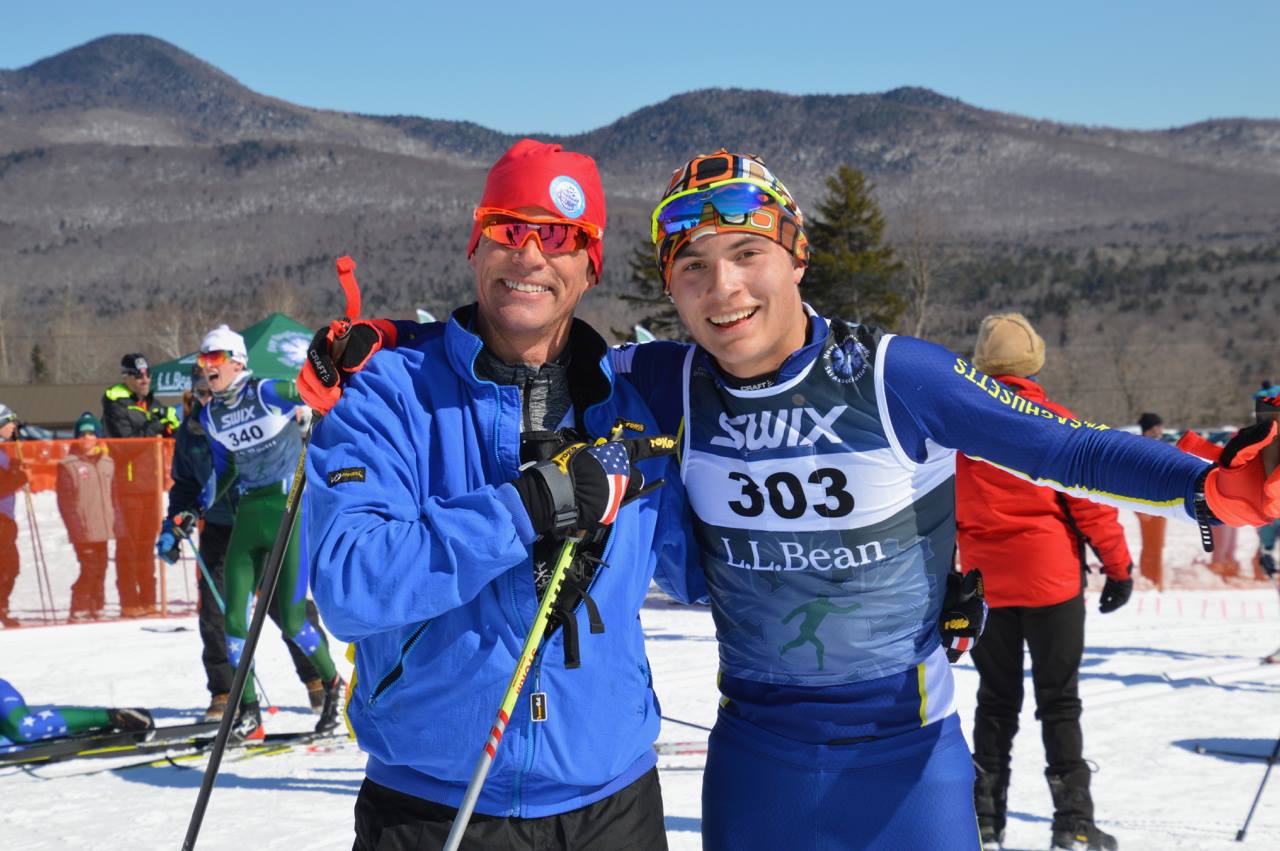
Kitch with Coach Rob Bradlee at the finish of a Eastern Cup race at the Rikert Nordic Center this season. (Photo: NENSA)
James Kitch, from the Cambridge Sports Union, competed in all eight Eastern Cup races, where he was consistently in the top-10, and finished 5th on the year-end New England Junior National Ranking List. Kitch saved his best game for the 2018 Junior National Championships in Soldier Hollow, Utah where he had two top-ten distance finishes, scrambled for the winning U18 relay team, and won his first National Championship in the freestyle sprint. At the conclusion of the 2018 season he is the 82nd ranked male skier in the country.
CSU coach, Rob Bradlee, describes James as someone, “who correctly assumes that everyone would like to be his friend and so treats everyone regardless of age or status with equal respect and affection. He has been a leader in CSU and on Team New England in creating a positive team vibe. He pushes himself hard to be his very best and competes not to beat others but to explore how fast he can be. I think he became a national champion because that attitude kept his mind open to possibilities and he could see opportunity when it presented itself.”
We congratulate these skiers and thank them for reminding us of Mike Gallagher’s competitive spirit. Mike was a three-time Olympic cross-country skier and the Head Coach of the US Ski Team from 1980-86. You can read more about Gallagher here on Fasterskier.com
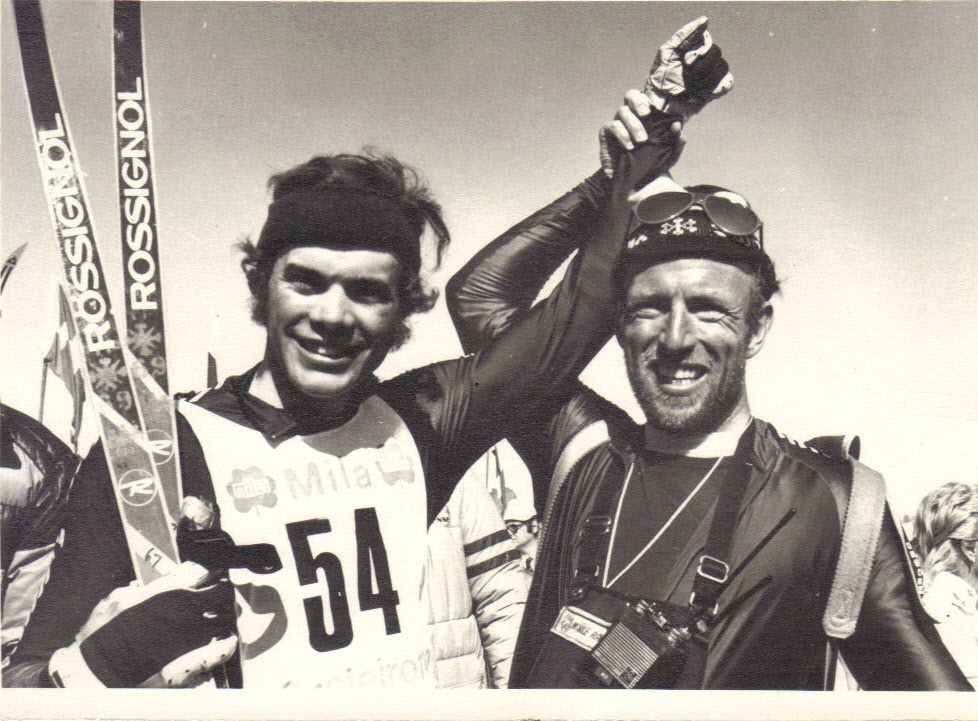
Picture of Vermonter Bill Koch celebrating his winning the FIS Overall WC crown with a very happy coach, the late Mike Gallagher. A very special moment. (Photo and caption courtesy of Peter Graves)
Mike Gallagher, a three-time Olympic cross-country skier and former U.S. Ski Team head coach, at his home in Pittsfield, Vt., on Nov. 1, 2011. Gallagher died last week on Oct. 3, his 72nd birthday.
Note: This tribute has been updated to include comments from Mike Gallagher’s wife, Tyna, and additional photos from John Estle.
Mike “The Eagle” Gallagher was a diehard baseball fan. Several springs ago, he accompanied his nordic-skiing cronies, John Estle and Peter Ashley, to Tampa, Florida for some sunshine and the rituals of spring training. A three-time Olympic cross-country skier and head coach of the U.S. Ski Team from 1980-86, Gallagher was in hog heaven hanging with his buddies and watching his beloved New York Yankees tuning up for the season, Estle said recently on the phone.
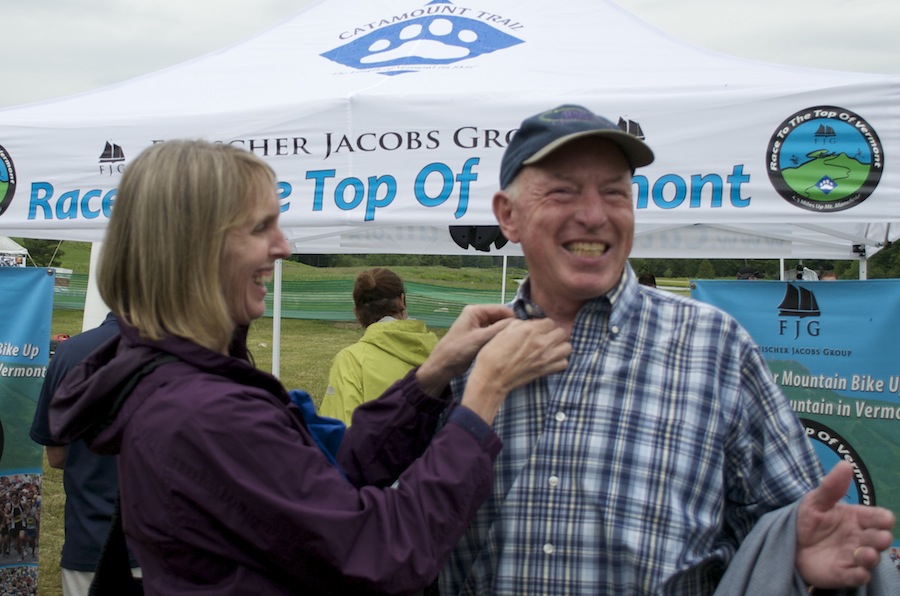
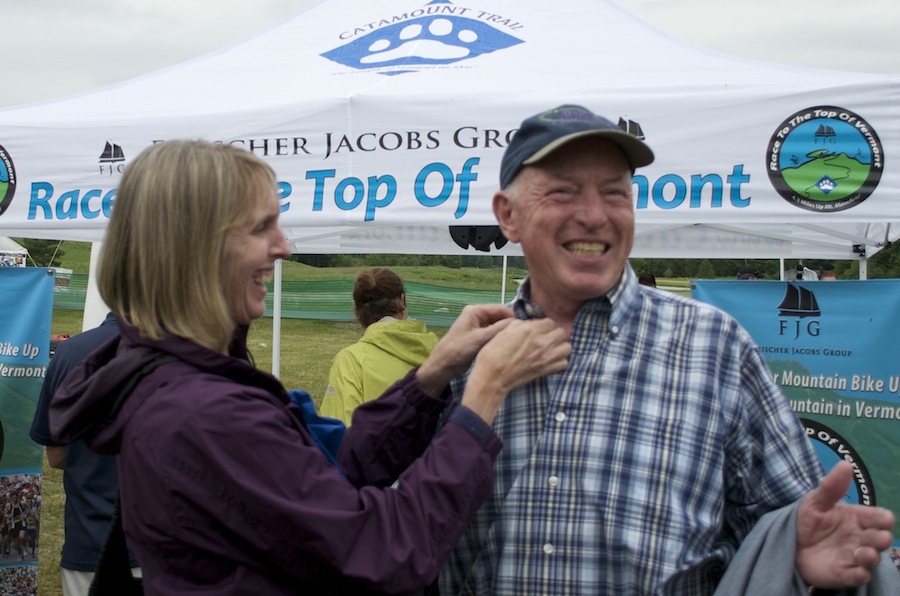
Mike Gallagher gets some help from his wife Tyna before being inducted into the Mount Washington Road Race Hall Of Fame in 2011. Gallagher won all four years he entered the race from 1968-71. (Photo: Jim Fredericks)
The trip to Florida was the invention of Estle and Ashley, also former U.S. Ski Team (USST) coaches, who convinced Gallagher to join them. It took a little coercion, because Gallagher was scheduled to get a hip replacement that same week. In the end, Gallagher rescheduled the surgery and left muddy Vermont for balmy Florida. The trio bunked up with Estle’s partner’s family in Tampa.
During their stay, their host family held a Passover celebration. In remembering the trip, Estle chuckled and said Gallagher was quite caught up in the traditional Jewish celebration. This Irish-Catholic boy from Vermont had never experienced anything like it and loved being included in the large family gathering. In fact, after a week of watching his heroes Derek Jeter and Mariano Rivera playing the game, it was the Passover that Gallagher raved about.
A “man’s man” is how Estle described Gallagher, who passed away at home in Pittsfield, Vt., on Thursday, his 72nd birthday.
“He embodied physicality and sport, yet he was very spiritual and humanistic at the same time,” Estle said. “When you visited, you were the best friend he ever had. He always made you feel good.”
The Man, The Legend
On Oct. 3, 1941, Gallagher was born in Yonkers, N.Y. Raised in Rutland, Vt., Gallagher got his first ski lessons from his father, who served in World War II in the fabled 10th Mountain Division. He went on to become an accomplished runner and alpine skier, laying the foundation for nordic skiing, which would eventually become his life.
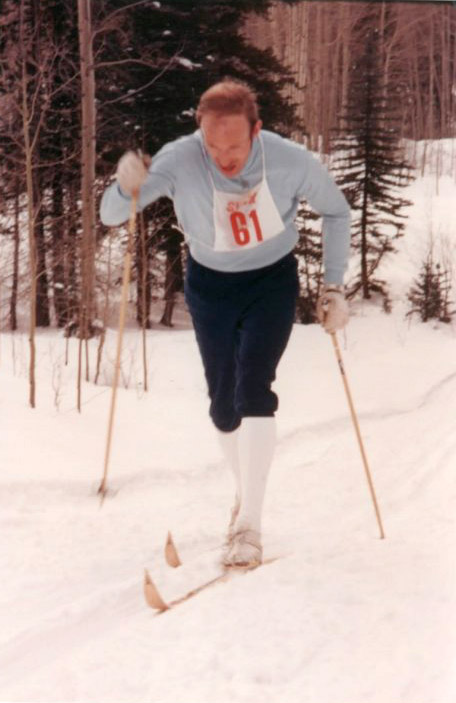
Mike Gallagher at a small race in Europe the early ’70s using Scott poles. (Photo: Marty Hall)
Kicking and gliding on wartime skis he modified for racing, Gallagher won his first high school race as a member of the Rutland High School team. He went on to captain his team, and won a Junior National championship in 1959.
After graduating from Rutland High, Gallagher took a post-graduate year at Vermont Academy then set his sights on Colorado. He attended the University of Colorado, motivated by training with friends Bob Gray and Mike Elliott. This was the beginning of a long-term friendship and the rock upon which U.S. cross-country skiing would grow for many years.
“That trio of Elliott, Gray and Gallagher carried the program for a ton of years, made huge sacrifices, and were all wonderful people living life to the fullest,” their former U.S. Ski Team (USST) coach Marty Hall wrote in an email.
Life was good in Colorado for Gallagher’s freshman year, but then Gray and Elliott moved on, forcing Gallagher to carry on without his training buddies for three more seasons. Seeking more opportunity in skiing, Gallagher set off for Norway, where his ski training took off.
He went on to make three Olympic teams in 1964, 1968, and 1972, and three World Championships. In addition, Gallagher notched nine national titles. His proudest result was 19th in the 50-kilometer classic race at Holmenkollen, Norway, in 1968. He accomplished all of his off-season training while holding down a full-time job. Gallagher’s love for skiing and legendary work ethic is what defined him for the rest of his life.
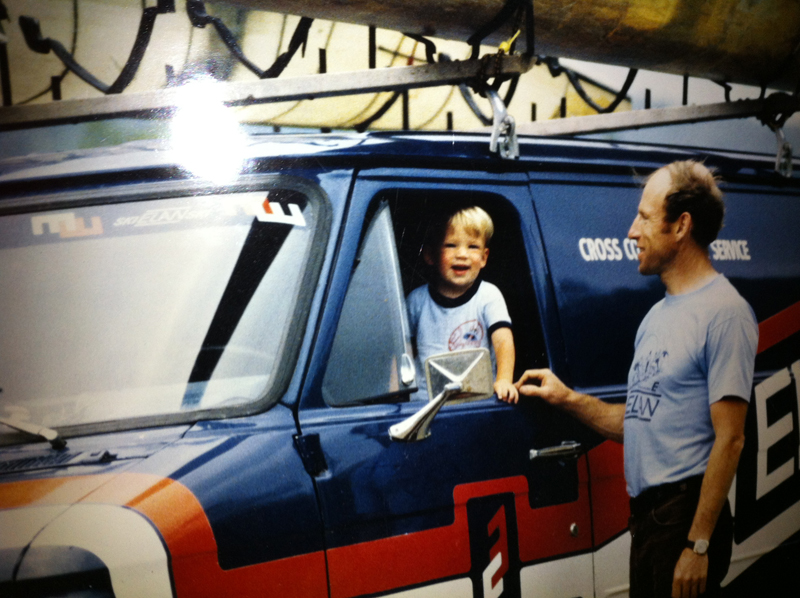
Gallagher (r) with his son, Jesse, in his Elan work van. (Photo: Mike Gallagher)
Gallagher applied his talent and formidable energy to bike racing in New England, a sport in which he excelled for many years. In 1972, he was the 25-mile road biking national champion.
Retired from racing, but still enthralled with the sport, Gallagher turned to coaching. He was head coach of the USST from 1980-86, Olympic-team coach in 1980, 1984, and 1992, and a high-school coach for 17 years. With Gallagher at the helm, Bill Koch won the overall World Cup title in 1982.
The nordic vice president of Fischer USA, Ashley summed up Gallagher’s insightful coaching style in a 2011 interview with FasterSkier. “Mike was the perfect guy for Kochie because he allowed him to do things in a different way, was flexible when he needed to be and would stand on things when he needed to.”
Gallagher vast knowledge of all things nordic led him to employment in several ski companies over his career, among them Splitkein, Hexcel, Edsbyn, and Elan.
For many years, Gallagher shared his love and expertise of skiing as the nordic director at Mountain Top Inn in Chittenden, Vt. He also taught skiing at the nearby Mountain Meadows in Killington.
In 2007, Gallagher was inducted into the Vermont Skiing Hall of Fame. He was also into the Mount Washington Road Race Hall of Fame in 2011, a race he won from 1968 to ’71.
Gallagher is survived by his wife, Tyna, sons Sean and Jesse, and a grandson.
Athlete, Coach, Mentor, Friend: Remembering Mike Gallagher
Some people are larger than life. Gallagher was one of them. When you think of throwing rocks into a pond, the largest ones make the biggest splash and send the ripples furthest. Gallagher touched the lives of many because his ripples reached the far edges of the pond. – Nancy Fiddler
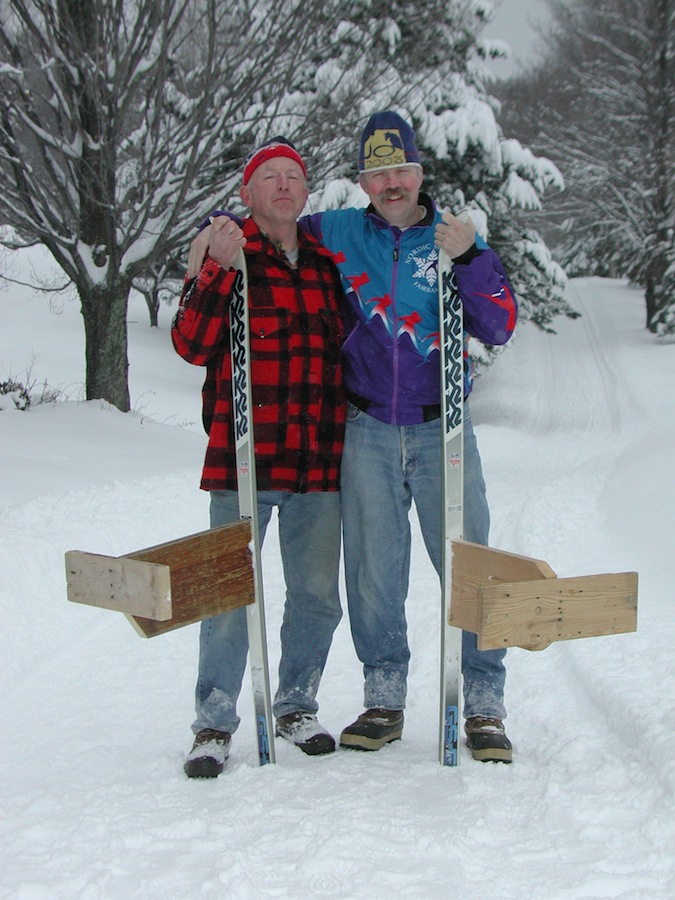
Mike “Jumpin’ Jack” Gallagher (l) and longtime friend John Estle in April 2003 in Pittsfield, Vt. (Photo: John Estle and Norma Haubenstock)
Many people met Gallagher through cross-country skiing and then became friends for life. Famed nordic announcer Peter Graves is one, remembering in an email message how he met Gallagher.
“I first met Mike in the late ’60s when he came to my high school to do a clinic. With his typical verve he talked about what a great sport XC was,” Graves wrote in an email. “With that and his sparkling USA warm-up, I became a follower. Over the years, we shared special moments of reflection in his sauna and pondered things, sport and the meaning of life. What was said in the sauna always stayed in the sauna. What he leaves is a rich tapestry of goodness, of inspiring countless people to ski and enjoy the richness of life. He was a smart guy with deep feelings, and as an Irishman myself, I could always understand the joy he felt in singing his Irish songs. He touched so many people, I’m going to miss him for a long, long time.”
Teammate and close friend Elliott recounts in an email how, on a 2012 visit to New Hampshire, he drove 330 miles round trip just to have dinner with Gallagher and Gray. The three remained friends for years after they dominated the U.S. skiing scene.
Elliott and Gallagher had the best kind of competitive relationship. They raced against each other at Junior Nationals and in college, and ended up teammates on the 1964, 1968, and 1972 Olympic teams as well as the 1966 and 1970 World Championship squads.
“We met in 1959 at the Junior National Championships. We always had a friendly rivalry training and racing,” Elliott wrote in an email. “Michael had ‘XC1’ on his Vermont vanity license plate. That license plate was a huge motivating factor for me because I wanted my results to force him to change his vanity license to ‘XC2’. Whenever I did not want to train, I just had to think of that license plate and then I was out the door training.”
Elliott also remembers Gallagher’s infectious singing. “When he called his friends on the telephone and they answered, he would often break into an Irish song. We all knew who was on the other end. He cultivated many friends from all walks of life. He really was such a good guy.”
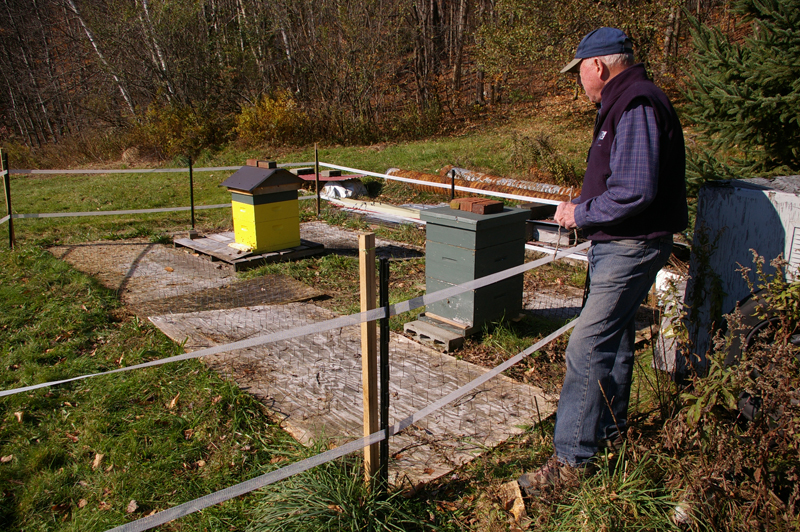
Gallagher checking on the beehives in November 2011 at his home in Pittsfield, Vt. Seventy years old at the time, he said he spent most of his time gardening and mowing nine acres of his 50-acre property.
Gallagher was the consummate tough mountain man, but Elliott saw a gentler side of him on their many travels together. “He once dressed as Santa Claus and passed out presents to children at a resort where we were staying in Scandinavia,” Elliott wrote. “His wonderful laugh and his accent made him a believable Santa Claus to the children. I have nothing but the fondest memories of my life with Michael.”
As competitors and avid outdoorsmen, Elliott and Gallagher shared many adventures. “Gallagher came out to Colorado in 1973 and we went backpacking,” Elliott explained. “He was not really fond of heights and I really took advantage of that fact and enjoyed scaring the hell out of him in the Colorado mountains. He was a very good sport about the whole situation. He loved fly fishing in those high mountain lakes.”
One of the many athletes Gallagher coached, Kevin Brochman remembered how Gallagher used humor to get him through tough situations, a behavior Brochman still resorts to. A two-time Olympian, Brochman also recalled Gallagher’s discomfort in high places, something that seemed to make him more human.
“Mike was a great coach and led the team to a US men’s best, 4th in the world, in 1982,” Brochman wrote on Facebook. “I felt honored to be part of his tenure from 1981-86. HE LOVED TO LAUGH. He did not care too much for the gondola ride up to Dachstein Glacier though!”
Former U.S. Ski Team head coach Mike Gallagher with one of his athletes, Jim Galanes, after a 1984 World Cup race. (Photo: Mal Lockwood)
As a coach, Gallagher set the bar high for his athletes, yet he stood behind them in every situation. The U.S. men’s squad, under his direction, achieved huge success.
“When Michael was the USST XC coach, he often traveled to where the national team skier lived to help them individually with their training,” Elliott explained. “He was instrumental in helping Bill Koch win the World Cup. Bill has nothing but kind, complimentary things to say about the job Gallagher performed.”
Ashley’s long friendship with Gallagher began at Colorado, where Gallagher helped save Ashley from a near-death experience following a collision with a tree. Later, Ashley and Gallagher coached the USST together. Ashley will always remember what he believes to be one of Gallagher’s major contributions to the sport of skiing in this country.
“Gallagher was a man who stood by his decisions, which served him well during the skating revolution,” he said on the phone. “He advocated for allowing the athletes to move the way they wanted to on a race course at a time when many of the international ski leaders were against skating. Gallagher was able to represent the USA’s desire to skate in the international coaching arena. We have a lot to thank him for, in that regard.”
Ashley, Gallagher, and Ruff Patterson brought skating back from the World Cup to the U.S. racing and recreational-skiing population. Their dissemination of skating knowledge put many Americans on skate skis in the ’80s.
Gallagher’s energy and personality were the driving forces in his coaching. As 1984 Olympian Sue Long Wemyss stated online: “I was fortunate to be on the USST and to get to know Mike during the years he was head coach. He was so lively, so positive. He leaves a huge hole.”
Helping Koch top the World Cup was just a small part of the impact Gallagher had on nordic skiing in the U.S. His knowledge was vast, his reach deep and his vision global. According to Ashley, “He had a huge influence on the younger skiers and was something of a father figure to many. The kids really looked up to him.”
Mike Gallagher enjoying some playtime at his Pittsfield, Vt., home in April 2003. (Photo: John Estle and Norma Haubenstock)
Former USST skier Tim Kelley was one of the many juniors inspired by Gallagher. He also weighed in on his memory of Gallagher on Facebook.
“Besides being a hero for U.S. cross-country skiing, Gallagher was always very supportive of the young guns. He enthusiastically welcomed newcomers into the XC skiing cult. I remember once at a junior camp at his place doing a circuit strength workout at his stations in the woods. And then we finished off the workout by helping him lift logs up for the cabin he was building.”
University of Denver Head Coach David Stewart echoed Kelley in another comment: “Gallagher was a big influence on me when I was just a Bill Koch League racer, inspiring me and many others with his enthusiasm for every level of the sport.”
Gallagher expected a lot, but gave a lot. His dreams are being carried on by the many who were influenced by his spirit. Cambridge Sports Union Head Coach Rob Bradlee carries on some of the best Gallagher traditions in his own work.
“I remember him coaching me at a training day at Putney when I was 15,” he wrote online. “With his enthusiastic urging, I did more push-ups than I thought I could ever do. His energy was infectious.”
There were valuable lessons beyond the push-ups, Bradlee explained. “As a non-competitive skier I was always impressed by how kind and encouraging he was to me. That I loved skiing was good enough for him. And in the long run, he helped me be a better coach by modeling that inclusive behavior.”
Dartmouth coach Ruff Patterson and Gallagher go back a long ways. They have worked together, recreated together, and shared a lot of good times. Patterson was Gallagher’s best man when he married Tyna in 2002.
“Gallagher was a strong man who expected things from people,” Patterson said on the phone. “He was direct and didn’t mind saying what he thought. He pushed all of us as hard as he pushed himself. I wanted to strangle him one day and hug him the next! We were incredibly close.”
The Quintessential Vermonter
“Taking in nature and spending time outdoors is what life was like with Mike. It could be as simple as sitting on our deck, looking out at the mountains sipping coffee and just taking in the beauty of our surroundings. Even though it was peaceful and it was also energizing. Mike was an avid fisherman and hunter, who could turn almost any outing into an adventure with his gift of storytelling. Mike had a joke or two for almost any topic, it was truly amazing how he could remember so many jokes. Even though he loved living off the beaten track, almost recluse, whenever there was a gathering Mike was sure to be the center of attention. With a twinkle in his eyes and his voice booming with excitement he would draw everyone into the story or joke he was telling. While his accomplishments were bigger than life, he was modest and would only talk about them when asked. He was warm, affectionate and fun-loving, he enjoyed putting a smile on someone’s face. He touched so many lives in a positive way, including mine. I am so proud of the man known as Michael Gallagher, he was the love of my life, my soulmate and my heart is breaking.” — Tyna Gallagher
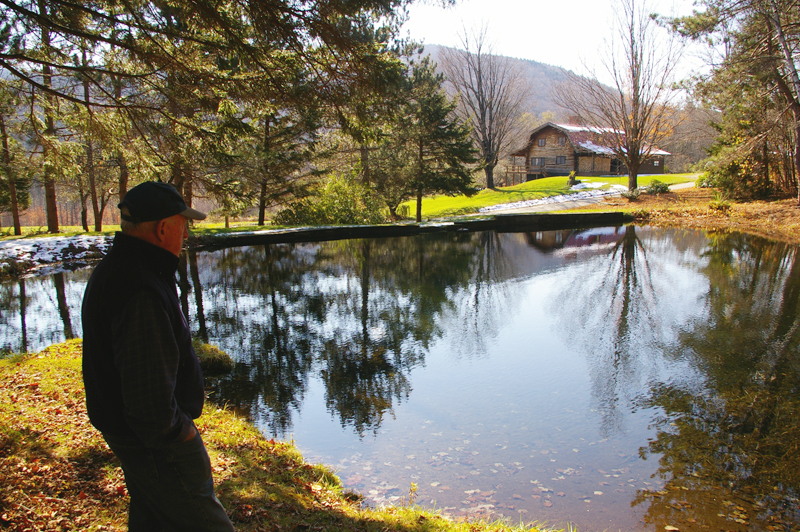
Gallagher beside his heart-shaped pond, where he married his wife Tyna, at their home in Pittsfield, Vt. Gallagher gave FasterSkier a tour of his 50-acre property in November 2011.
Gallagher embraced the Vermont lifestyle; he built the home he lived in and stayed busy and active to the end of his life by tending his garden, mowing, keeping bees, cutting wood, and hunting and fishing.
He raised his boys, Sean and Jesse, to be strong outdoorsmen as well as excellent skiers, and loved the time he spent in the woods with them.
Visitors to his Pittsfield home remember the sauna sessions. Between plunges into the refreshing pond, Gallagher told his famous stories and occasionally broke into song. Gallagher delighted everyone who took part in living large with him.
Elliott succinctly put into words what many are thinking: “I wish I would have spent more time with him.”
This article is the third profile in the ‘Where Are They Now’ series, made possible through the generous support of Fischer Sports. Learn more about their products at www.fischersports.com.
Mike Gallagher, a three-time Olympic cross-country skier and former U.S. Ski Team head coach, stands in front of his home in Pittsfield, Vt., on Nov. 1.
FS Podcast Short: Mike Gallagher discusses the evolution of skating with Alex Matthews [podcast]http://images.fasterskier.com/2011/11/MikeGallagher.mp3[/podcast]
(You can subscribe to FasterSkier Podcasts in iTunes here)
PITTSFIELD, Vt. — The “XC1” license plate on the Subaru wagon should have been a dead giveaway. Instead, it took a minute to be sure the man walking across the general-store parking lot was Mike Gallagher, one of the pivotal players who put U.S. nordic skiing on the international map.
Inside the store, appropriately named the “Pitt-Stop” after the town with about 550 residents, Gallagher greeted a few familiar neighbors and affectionately asked the clerk to prepare his turkey-BLT sub without onions.
“They don’t come with onions,” she said, kindly. “Oh, no?” the 70-year-old Gallagher said about one of his favorite grinders. “Well, all right then.”
Pittsfield and Irene:
When Tropical Storm Irene swept the country in late August, it devastated several communities in central Vermont, including Pittsfield.
High atop a mountain road, Gallagher lost his driveway. With his power out, he thought, “Poor me,” he said.
Then he walked into town. In the river valley, 22 homes had been condemned or destroyed in Pittsfield, he said. Residents were stuck without a way out for more than a week.
The Pitt-Stop rationed gas to five gallons a day per household, the National Guard and FEMA flew supplies in, and people met every other day at town meetings.
“The town came together like it never has,” said Gallagher, who has lived in Pittsfield since 1967. “We’ve had what we call floods, but nothing. We never lost bridges, we never lost homes.”
With his wife, Tyna, in Boston during the storm, Gallagher couldn’t talk to her for four days. He had to walk to town and stand in one spot to get cell service.
When Tyna arrived home later that week, she was covered in scratches from walking through the woods, Gallagher said.
They couldn’t use their driveway for nearly a month, he said. It took 63 dump-truck loads of gravel to fill in.
Before proceeding a few miles from town to his home at the height of the land, the three-time Olympian and former U.S. Ski Team head coach visited the postmaster.
Up at his log cabin on 50 acres of land surrounded by national forest, Gallagher revealed four green-and-spotted apples the postmaster gave him. She thought they were interesting, he said with a laugh. He had apple trees in his yard.
Placing them on the woodpile that filled his front porch, Gallagher explained he used to chop the wood himself. Now, he had it delivered, but even after having a hip replacement a year and a half ago, he still stacked it.
Before eating lunch inside the house he built in the 1970s, Gallagher pointed to a green square nailed outside his garage. High above the ground, the original “XC1” Vermont license plate attested to his ski career; the nine-time U.S. nordic champion received it in the ’70s upon being the top racer in the country.
With prestige came egos, Gallagher said. He had plenty of stories to illustrate his.
A veteran member of the U.S. Ski Team in 1968, he remembered when about 10 teammates set a running record on Vermont’s Long Trail, which extends nearly 300 miles from Canada to Massachusetts.
A year later, he and the team took on another training excursion: bicycling some 1,000 miles around Vermont.
“I had this license plate, but I was not a biker,” Gallagher said, with a smile. “I had a 10-speed bike. … It didn’t have those fancy toe clips. I didn’t wear those fruity-looking black pants and those pointy Italian shoes with these clips on the bottom. I was a real man. I got on the bike and pushed the pedals.”
A graduate student at Springfield College in Massachusetts at the time, Gallagher joined his teammates on weekends to prepare. Meanwhile, many of them — which he described as bikers — trained more seriously for the ride.
“They did stuff like get in a line and rotate the lead and stuff like that,” he said. “But real men don’t do that type of stuff. You just get on the bike and go up front and stay there.”
In tennis shoes, running shorts and a T-shirt, the helmet-less Gallagher embarked on the cycling journey with the group. He treated as a race, avoiding the pull line and leading his peers by several bike lengths.
On the last day of the ride, the team approached the last 110 miles in similar fashion, drafting one another and taking turns breaking the wind. Gallagher couldn’t take it.
“I take off, ” he said. “For about 40 miles, I go off the front and just stay there, and they’re doing all this kind of stuff, staying about a quarter mile behind me.”
They regrouped at lunch in Manchester, Vt., about 50 miles from their final destination in Putney at the home of their head coach, John Caldwell. From there, they started to climb Bromley Mountain.
“This is where Mikey was gonna get his lesson,” Gallagher said. “He was gonna get spanked. All of a sudden, one of the guys goes off in front … and the next one goes, and the next one goes, and I am dropped … dropped bad. And I was Mr. XC1.”
Exhausted and about 20 minutes behind, Gallagher missed a shortcut into Putney, which saved the others about 20 miles. Laughing with tears in his eyes, he said he didn’t even have a water bottle.
When he eventually wheeled into Caldwell’s driveway about 1 ½ hours after the team, he saw his license plate, which had been chalked with two zeros: “XC100.” Everyone was in the sauna, drinking beer and singing.
“I’ve had a long day and they put it to me,” he said. “Of course, with the ego I had, being as cocky as I was, I really deserved it. But boy, they put it to me bad.”
He couldn’t let that go. “Guess who went out and bought a racing bike?” he asked. “And some of those pointy Italian shoes and some of those black pants?”
Yes, he ended up in “a tight, flashy T-shirt and a helmet,” he said, and trained so hard he won a national time-trial championship in 1972. A few months before he claimed the 25-mile cycling crown, Gallagher skied in his third Olympics, helping the men’s relay finish 12th and placing 30th in the 30 k.
He had previously cracked the top 30 in the 1968 Olympics (22nd in the 50 k, 27th in the 30 k), and was 38thin the 15 k at the 1964 Games.
“I was a wicked-good hill climber,” Gallagher said of his competitive cycling career. “Tremendous time trialist, terrible pack rider.”
He chuckled for a while and continued to eat his BLT.
That was the thing about Gallagher. Spending more than three decades in the sport at its highest level (as a USST athlete from the early ’60s to the mid-’70s, as its head coach in the ’80s and an assistant in the early’90s), he told it like it was, with an exceptional memory that lent to storytelling.
“There’s a couple things outside my skiing that I’m quite proud of,” he said.
The Mount Washington Road Race was high on the list. He won the 7.6-mile climb to the top of the 6,260-foot mountain four times from 1968-1971. In June, he was inducted into its Hall of Fame with two others: Daniel Kihara of Kenya and Derek Froude of New Zealand.
He would’ve gone after a fifth-straight title, too, if it hadn’t been for an incident on the auto road in ’71.
Before the race, he overheard Boston-Marathon winner Amby Burfoot telling reporters that he didn’t expect to lose to a skier. He didn’t forget that.
About 1 ½ miles from the finish, Gallagher checked back to see Burfoot 20 seconds behind him. A car trailed him even closer, beeping as Gallagher cut across the switchbacks.
“Hell, I had the right of way,” Gallagher said. “And he came up and hit me and I rolled up onto the hood and fell off on the side.”
He stood up and saw Burfoot just down the road. That motivated him to run even faster.
“I put on about a half-mile kick right then,” Gallagher said. He won by nearly a minute.
Gallagher, 70, stands near a pond on his 50-acres property in Pittsfield near his sauna (not shown).
Starting from Scratch
Inside his log cabin, Gallagher glanced at the large, rounded beams overhead. They were heavy, he said, and he installed them on his own.
When he bought the property in 1967, Gallagher wasn’t a builder. He considered it a risk in some ways as a full-time athlete at the height of his career.
“It was tough in the old days,” he said. “I worked 70 hours a week to train 70 hours a week.”
By trade, he was a teacher, working long hours in colleges like Castleton and Johnson State in Vermont to fit in semesters between seasons. Trained in physical eduation, he created a Sport and Society course at Johnson State.
In 1974, his Pittsfield home burned to the ground. Gallagher and his first wife were in Bermuda at the time, and as they switched hotels throughout the week, the bad news never reached them.
“The message that our house burned down was always one jump behind us,” he said. “(We) got back to Boston, jumped in a car and drove up to a cellar hole here.”
Six months later, Gallagher finished building their new home, which he did himself except for the plumbing and bricklaying. He didn’t have any architectural plans, he said, just an ambition to work.
Born in Yonkers, N.Y., and raised near Rutland, Vt., Gallagher began a family of his own in Pittsfield with two boys: Jesse, now 34, and Sean, 31. Both talented skiers, Jesse went to the University of Alaska and Sean skied for the University of Vermont.
Gallagher (R) with his son, Jesse, in his Elan work van.
Jesse became a big-game hunting guide, spending some of the year in Alaska and traveling to Africa last summer. When he wasn’t on the road, Gallagher said his oldest son lived in a small cabin on his property, back in the woods without a driveway.
Also in Pittsfield, Sean lived closer to town with his 2 ½-year-old son, Andrew.
“He’s a keeper,” Gallagher said of his grandson.
He said the same about his second wife, Tyna, whom he married 10 years ago and recently built a horse barn for.
“Everything in my life except my training and my devotion to my wife is what I call and organized mess,” he said as he walked around the barn, built for Bud, the horse, and their three dogs: Roscoe, Thunder and Jaeger.
On the other side, Gallagher pointed to his beehives surrounded by an electric fence. As of early November, two of three had survived.
A self-described, small-time beekeeper, Gallagher said he did his best to cultivate and protect the hives for the benefit of the environment. Pollination was good, he said, and comb honey was healthier than jar honey. Bears were his biggest problem.
Jesse helped by bringing spiked-bear boards from Alaska and laying them around the hives. Gallagher also placed muskrat traps nearby. “You try all your tricks because a hive like this is worth probably $300,” Gallagher said. “A bear comes in, then you’re out of luck.”
Gallagher shows off his beehives, surrounded by an electric fence and bear boards.
Elsewhere on the property, Gallagher said he spent most of his time gardening and mowing. With nine acres to cover at least once a month and four acres a week, he mostly mowed.
“Not that I’m retired,” said Gallagher, an independent subcontractor for the last 16 years. “But I basically am.”
In May 2010, Gallagher had hip surgery that was both life-changing and hard to bounce back from. Without it, he would be on crutches or relying on a cane, he said. Before it, he couldn’t ski.
Last winter, he resumed his part-time job instructing skiers at Mountain Meadows in Killington, Vt., and planned to return in a few months. This year, he hoped he could skate ski.
“There’s no reason why I can’t,” he said. “I just wasn’t ready last winter, but the activity was good for me.”
Continuing the tour of his property, Gallagher walked toward a wooden hut on the edge of a heart-shaped pond. The green space beside it was where he married Tyna, who now works as an office manager and sells candles on the side.
Beyond the pond was a place he described as “special,” a 10-person sauna with a ski-memorabilia changing room.
Inside, ski tips from as early as the ’30s served as clothes hangers and posters of some elite nordic skiers — including Bill Koch and longtime friend Bob Gray — plastered the walls. He looked closely at a plate, which named every Swedish Olympic cross-country ski champion through 1977.
“(What) makes the difference between a great champion and other skiers, (is) that they can change their technique during a race to accommodate conditions,” Gallagher said. “They can change it from day to day, even sometimes from year to year.” Through the years and his experiences with top-tier skiers, Gallagher learned that.
‘An Organized Mess’
Gallagher points to a photo of Bill Koch from 1982 in his basement “museum” in Pittsfield, Vt.
Back inside his home, Gallagher stood in his basement admiring his wax bench, which he used with the national team and with his sons. Well-worn, it appeared to be operational.
“I’ve got so much wax up here,” he said. “Literally, thousands of dollars of wax.”
He motioned toward the adjacent room: his office, or as he called it, “the museum.” He recalled an inscription above the library doors at the University of Colorado at Boulder, his alma mater.
“ ‘He or she who knows only their own generation remains always a child,’ ” Gallagher said. “So this is a lot of history of skiing, not just Mikey.”
The sauna had been just a warmup. This was a shrine to the sport with newspaper clippings, original photos, plaques and medals all holding pieces of history.
A photograph of Bill Koch en route to winning a 1982 World Cup event in Italy. Notice the coaches checking out his skis.
Pinned to the back wall, an action shot of Koch was at the heart of the collage. Gallagher pointed out two Norwegian coaches in the photograph, who were on their knees and straining to look under Koch’s skis. He won the World Cup race in Italy that day and the overall title that year in 1982.
Koch became the first American nordic skier to win a World Championship medal in ’82, after claiming an unprecedented silver at the ’76 Olympics.
“I coached him and he was one of my heroes,” Gallagher said. “And I’m one of his heroes. You know how that goes?”
After translating Norwegian and Swedish newspaper headlines, Gallagher shifted his focus to perhaps his biggest hero, his father. A member of the 10thMountain Division — a group of mountain-warfare soldiers formed in 1942 — his insignia hung on the wall.
Gallagher pointed out his father’s ice ax, which he used in World War II as a climber and downhill skier.
“I hang a lot of things on nails,” he said. “Jesse, about three years ago, said, ‘What are you gonna do with Grandpa Don’s ice ax?’ And I paused for a second, and he said, ‘Hang it on another nail?’ ”
The ice ax Gallagher’s father, Don, used while in the 10th Mountain Division. Gallagher’s son Jesse used it about three years ago to climb Mt. McKinley.
Probably, he responded.
Jesse wanted it to climb Alaska’s Mount McKinley, the highest mountain in North America. His father didn’t think he would go through with it.
“After he climbed the mountain, he gave it back to me,” Gallagher said. “ ‘Hang it on a nail.’ ”
Closing the door behind him, Gallagher turned around to face several posters of bald eagles. He was once so frustrated with a group of athletes, he told them, “I can’t fly with eagles if you ask me to train like a turkey!”
They responded by calling him “The Eagle.” “So today my nickname is,” he said, removing his cap. “The Bald Eagle.”
Testing the Waters
Before graduating Rutland High School in 1959, Gallagher earned early exposure with the national team at one of Caldwell’s training camps the fall of his senior year.
Fresh off his cross-country season, the Vermont state champion found himself in a perfect position at the snow-less camp, which resorted to running.
“I’m looking over my back the whole time at these guys who are training for the Olympics,” Gallagher said. “They can’t keep up. I said, ‘Whoa, this looks like the doors (are) open.’ ”
That winter, he won the Junior Olympics. In college, Gallagher wanted to surround himself with some of the best skiers he knew, so he chose to join Gray and Mike Elliott in Boulder. The three of them eventually dominated American racing.
After three years at CU, Gallagher — then a member of the U.S. Olympic training squad — took a year off to immerse himself with the team.
“By the end of the year, I was one frustrated puppy,” Gallagher said. “We had trained our butts off. … No other athletes in the world had trained any harder than some of us, but we weren’t trained right. We were more in shape to run and hike than we were to ski.”
He ventured to Norway that spring in search of a solution. He found it in the Norwegian training method.
“They did some silly son-of-a-gun thing called rollerskiing,” Gallagher said.
Upon returning to Colorado for his final year of college, he found his mind was elsewhere. With one semester left, he withdrew from CU and stayed in Europe to study the Norwegian system. He began rollerskiing, importing the three-wheeled skis to the U.S. and selling the first 200 pairs before they even landed.
For the rest of his ski career, Gallagher imported European items, such as skis, boots and bindings, and sold them out of his car at races. His eye for the market landed him jobs with ski companies, including Splitkein, Hexcel, Edsbyn and Elan, where he designed and tested fiberglass skis.
Even when he retired as an athlete in 1975, Gallagher maintained his part-time industry positions, which kept him in touch with the sport and its athletes before he returned to the scene in 1980, first as a private coach at the Lake Placid Olympics and then as the USST head coach from 1980-86.
“Basically, that’s how I got hired,” he said. “Because the racers had experience with me as an ex-athlete and a person that’s very knowledgeable and most of all, very enthusiastic.”
Peter Ashley, the U.S. women’s coach in the ’80s who worked with Gallagher, remembered him as an important figure during a transitional period in the sport. While people around the world resisted the skating technique, Gallagher fought for it.
“He brought some interesting openness to different ways of doing things,” said Ashley, now Fischer USA’s nordic division vice president.
“And you needed to because you had Bill Koch there. Mike was the perfect guy for Kochie because he allowed him to do things in a different way. … Flexible when he needed to be and would stand on things when he needed to.”
Personally, Ashley said Gallagher had a special impact on him as a freshman at the University of Colorado. In 1969, Gallagher helped save his life.
“We were out training one day and decided to take a tour,” Ashley said. “I ran into a tree and it was not exactly warm out there in Colorado.”
Several members of the group shed their clothing to cover Ashley and used pine-tree branches to insulate him. Some went to get help at the lodge, while the others stood by his side. He had destroyed his stomach muscles and could hear a few people quietly worrying if he was going to make it.
A couple of hours later, Ashley made it out safely on a toboggan. He raced at the NCAAs later that season.
How Far We’ve Come
For Gallagher, skiing was a lifelong sport and coaching became a passion. When he thought back to his career’s highlights, he said he missed coaching.
When skating disrupted the nordic world in the 1980s, Gallagher was hesitant at first. The Americans didn’t know how to do it, but Koch pushed them to experiment.
By the time his team got the hang of it around 1985, some others weren’t there yet. Gallagher remembered going to a meeting in Sweden, where an outraged technical delegate exclaimed: “ ‘Furthermore, our research shows that skating will damage women’s crotches!’ ”
“Ruff Patterson, who was my assistant coach, and I said, ‘Crotches?’ ” Gallagher recalled. “People were just going crazy.”
By 1986, skating was an accepted discipline. “I think it’s great the way it is now,” Gallagher said.
But evolution wasn’t easy to foresee. When U.S. Olympic biathlete Charlie Kellogg came to a summer practice with a pair of rollerskis — with the tips and tails cut off so they fit in his Saab — Gallagher was furious.
After cussing him up and down, Gallagher said, “ ‘How are you gonna get the kinesthetic feeling if you don’t have a ski on your foot?’ You can’t ski on a skate!’ ”
“Wrong,” Gallagher said, nearly 50 years later.
Earlier this year, Gallagher sold his last pair of rollerskis — his own — to a girl for $50. He told her it was the best deal ever.
Looking ahead to this season, Gallagher was excited to teach again. But he won’t teach beginners how to skate. One of the reason he thinks cross-country skiing struggles to gain popularity with newcomers is because of the industry’s dishonesty.
“We said cross-country skiing is as easy as walking. It’s not,” he said. “(To some people) I say, ‘Nah, I think you better be on snowshoes, you’re not ready to ski.’ … They want to exercise on snow. Not everybody can ski.”
In the end, he wants to make it fun for beginners and keep them coming back. “I enjoy teaching someone how to cast a fly,” he said. “I enjoy teaching someone how to pound a nail. I enjoy teaching someone cross-country skiing.”
And he loves being in Vermont. At his induction into the Vermont Ski and Snowboard Hall of Fame in 2007, Gallagher borrowed a line from one of his favorite presidents, John F. Kennedy. “Ich bin ein Vermonter,” he said. I am a Vermonter.
This article is the first installment of the ‘Where are They Now’ series, made possible through the generous support of Fischer Sports. Learn more about their products at www.fischersports.com.
John Caldwell. Photo: courtesy of Sophie Caldwell.
If you were to take stock of the people who have contributed the most to the development of cross-country skiing in the US, John Caldwell should be near the top of the list. He may beat everyone else simply because he’s had the longest amount of time to accomplish things—and at 82, he’s still got his opinions and and is not afraid to share them. Though he’s had multiple hip replacements and is a candidate for two new knees, Caldwell can still be seen shuffling on classic skis around New England.
Part of the goal of a “Where They Are Now” series is enlighten the younger generation on how something came to be. Though some past movers and shakers in the ski world may no longer be as active in the community as they once were, they are relevant for the same reason society bothers to study history. The past causes the present.
As a major player in the development of an always-changing sport, Caldwell is no mere historian. But the former Olympian, U.S. Ski Team (USST) coach, Putney School teacher, author, and New England Nordic Ski Association (NENSA) founder doesn’t like to single out any one of his accolades.
“I don’t think of being proud of anything,” he said in a recent interview with FasterSkier. “I just plug along.”
Caldwell was born in Pennsylvania, but his parents moved to Putney, Vt., in 1941, and he’s remained closely tied to the town ever since. He began his athletic career as a basketball player, but without a team to go out for in Putney, Caldwell’s dad got him started skiing. He skied at Dartmouth College at a time when intercollegiate skiing still featured four events. After graduating in 1950 and going to the 1952 Olympics as a Nordic Combined skier, he settled in Vermont to become a math teacher and ski coach at the Putney School.
Caldwell’s ski team quickly became so popular with students that he found himself with 50 skiers of widely varying abilities. As a matter of survival, he relied on repeated technique drills to manage athletes and develop good technical skiers, among them Bill Koch, Mike Gallagher, and his own children.
“It’s the idea of practicing something, not just, ‘Hey, go out and ski 5 k easy today,’” he said. “Some coaches will give you a heart monitor and tell you to keep your hear rate between 130 and 132 beats per minute, or something ridiculous like that, and think that they’re coaching. You’ve got to establish the importance of technique.”
John Caldwell, front left, with his wife, Hep, and all 10 of their grandchildren. Photo: courtesy of Sophie Caldwell.
With a seemingly endless supply of interesting and entertaining anecdotes, Caldwell has a story for every occasion.
Not long into the interview, he began reminiscing about his days as a coach for the U.S. national squad and interacting with the Soviet team.
At the height of the Cold War in 1966, the Americans and Soviets stayed in the same location for the World Championships in Oslo, Norway. Not wanting to appear in favor of one side of the Iron Curtain over another, the International Ski Federation (FIS) stuck the two countries together. It was Caldwell’s first time meeting the Russians.
“The Russians lent us their masseur, they said, ‘Do you boys want a massage?’ And the guys loved it,” laughed Caldwell. “They couldn’t have been nicer.”
The conversation soon moved to the American role as leaders in ski innovation during Caldwell’s day. It wasn’t just the advent of skating, he said, though that’s certainly the most-referenced example. According to Caldwell, the U.S. was also at the forefront of knowledge of equipment and wax. America boasted the first national team to shed bamboo poles in favor of lightweight metal poles in 1968—it was an American, Ed Scott, who invented the technology.
As for wax, even though it was originally a European product, Americans were also the first to realize that glide wax was for more than just going down hills.
“People in the sport now think, ‘Oh sure, you put glide wax on the tips and tails,’ but gosh almighty,we were the first country to do that. We had a clinic in Colorado Springs in the ’70s, and European coaches came over here to learn about waxing. We were at the forefront for a long time,” Caldwell said. And as a USST coach from 1960 to 1972, as well as the cross-country Olympic team coach in 1968, 1974 and 1984, he was right in the middle of it.
The U.S. even paved the way in the ever-important area of ski fashion. Caldwell recalled that his team in 1972 was the first one to race in one-piece uniforms. “Everyone looked at us like we were off the planet or something.”
America’s most famous contribution to the development of cross-country skiing is, of course, in the advancement of the skate technique. The U.S. didn’t invent it—according to Caldwell, that credit goes to a Finn, Paul Siitonen. But when Dan Simoneau came back from Europe one winter and told Caldwell about skiers he’d seen doing the marathon skate technique, the Putney School math teacher decided to set up an experiment.
With the help of a few of his students, Caldwell set up a test to compare kick double-pole and straight double-pole against the marathon skate. He measured not only lap times around a course, but also took heart rate data to determine if skating required more effort. Finding the new technique to be more efficient, Caldwell wrote an article saying skating was “the way to go,” but it still took a few years to catch on. Even after Bill Koch, Tom Siebels and Caldwell’s son Tim skated the whole stadium area during the World Juniors relay in 1971, the international ski community still hesitated to embrace the new technique—despite gaining the Americans gaining significant ground during the race and “astounding spectators.”
Jumping forward to the Lake Placid Olympics in 1980, the Games following Koch’s silver medal four years previously in Innsbruck, everyone expected Koch to produce even better results on home turf, but instead, “He blew up. It was a disaster.” Caldwell explained how, after the winter following the Lake Placid Games, Koch, angry at his performance, spent countless hours practicing the marathon skate on the trails in Putney.
“He would practice that all of ’81,” Caldwell recalled. “He’s very analytical. He’d set a 5 k course and do it three times. There’s a long uphill finish there, a great wide open field, and you could see his skate steps. The next time around he’d match up with those, trying to go the same distance with each step without losing energy or glide.”
The following winter, Koch was the overall World Cup champion, which Caldwell believes is in large part because he was the only one who could effectively skate. “He should, well, he does get credit for [developing skating]. He won the World Cup because of the extra speed from the marathon skate. Others weren’t doing it, or if they were, not with the same competence,” Caldwell said.
Following the 1982 season, FIS was forced to come up with a solution to the fact that skating was clearly faster than the diagonal stride, and it divided the races into separate events the following year.
When talking about Koch and the work he put in between the disappointment of 1980 and winning the overall World Cup in 1982, Caldwell pauses to explain why he thinks the US hasn’t been able to produce Koch’s level of results since.
“The team in 1981, after Lake Placid, didn’t have a lot of money,” he sad. “It’s something the USST has never figured out: ‘How come these guys got so good without our help?’ Most of these guys were living around East Putney and Brattleboro, except for Dan. They trained together a lot, but they didn’t have a coach. I didn’t pretend to be their coach … these guys just trained like hell, and that’s the best team we’ve ever had. I don’t think anyone can dispute that.”
Caldwell’s dissatisfaction with USSA is no secret. He published a series of critical articles on this website back in 2007, and his malcontent led him to help found NENSA in 1997. When the conversation shifted to his role in that organization’s formation, Caldwell reneged on his initial claim that no single contribution to skiing gave him more pride than another.
“That is one thing I am proud of. I think I was most responsible for starting that. I wrote the USST and said, ‘You guys aren’t helping us, so we’re gonna start our own organization,’ ” Caldwell said.
Critique of the USST wasn’t just words for Caldwell. He saw a gap in skiing development, and acted on his conviction. NENSA’s mission was, and still is, to get regional skiers at all levels involved in skiing, and to provide the infrastructure needed for athletes to reach their potential. Caldwell served as NENSA’s president until 2002, and most recently, New England has won the Alaska Cup at Junior Nationals for the past three years.
Current USST athletes Liz Stephen, Ida Sargent, Skyler Davis, Andy Newell and Kris Freeman have all taken part in the NENSA program.
“We should count more on the divisions, on the regions, and not have the USST try to be the overall rule,” he said. “They should be supporting programs like New England, Sun Valley, Alaska, Far West, and the rest.”
Caldwell believes this development model would provide at least part of a solution to the USST’s diminished budget. “They have what, four or five coaches out there?” he said. “That seems, I dunno…I know Zach [Caldwell] has been coaching Freeman, Sverre [Caldwell] coaches Newell and that new kid, Skyler Davis. Pretty soon you’re down to one coach for each person on the team. That’s not practical. Support the regions, then have your Olympic tryouts or whatever and may the best skiers win.”
When Caldwell himself was a coach, Olympic athletes were required by the International Olympic Committee (IOC) to maintain amateur status. The IOC removed the distinction between “amateur” and “professional” from its charter in 1986. None of the athletes Caldwell worked with, including Bill Koch, had any sponsors. He described his own job as their coach as completely amateur, too. Between 1966 and 1972, he recalled getting paid one of those years — $6,000 plus travel and expenses.
These days, Caldwell spends his time at home with his wife, Hep. He’s been known to bet New England skiers a beer they won’t be able to beat his grandkids, five of which are currently athletes on the eastern college or junior circuits. He admits he wouldn’t be able to coach anymore — “The whole sport has gone so technical.” Asked if he has anything to do with his family all being “above average” athletes, he credited keeping sports a fun family activity for his kids, who in turn did the same for the youngest generation of Caldwells.
So, where is John Caldwell now? Getting his sauna ready to enjoy with his friends, and looking forward to rooting for his grandchildren this winter.