From the FasterSkier archive — posts syndicated from athletes’ and coaches’ own blogs between 2004 and 2012, kept online as published. Current coverage is at fasterskier.com.

Tag: Mike Sinnott

  • Celebrating 27 Years of College Coaching, Patterson Departs Dartmouth

    Celebrating 27 Years of College Coaching, Patterson Departs Dartmouth

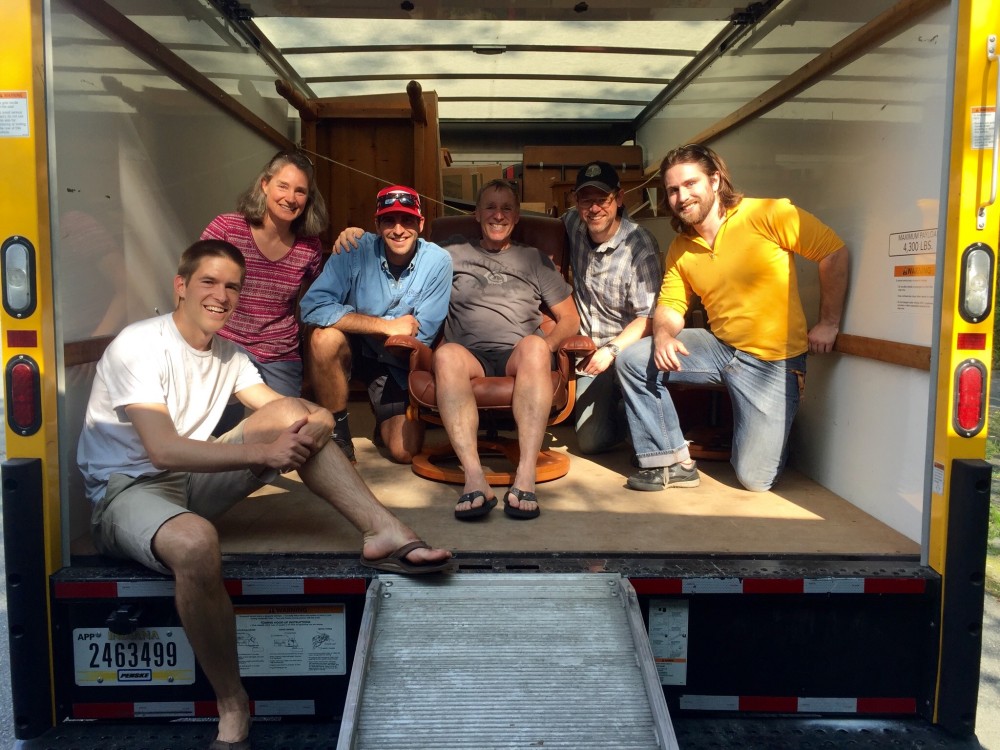
    The crew (left to right) Austin Caldwell '14, Scottie Eliassen '90, Sam Tarling '13, Ruff Patterson, Erik McEwen, and Leif Johnson '13 in the back of Patterson's Uhaul on Tuesday, prior to Patterson's departure west. (Photo: Courtesy of Sam Tarling)
    (From left to right) Austin Caldwell ’14, Scottie Eliassen ’90, Sam Tarling ’13, Ruff Patterson, Erik McEwen, and Leif Johnson ’13 in the back of Patterson’s U-Haul last Tuesday, May 24, prior to Patterson’s departure west. (Photo: Sam Tarling)

    In late March, Ruff Patterson, 61, announced he was stepping down as head coach of the men’s nordic team at Dartmouth. This is a story of his impact and legacy as a coach, first as a U.S. Ski Team assistant and later at Dartmouth in Hanover, N.H.

    “There were no non-heroes out there today.” — Ruff Patterson, after a four-hour rainy run with the Dartmouth men’s nordic team, circa 2007

    ***

    Twenty-seven years ago, a group of men convened in the basement of Robinson Hall, home of the Dartmouth Big Green ski team. Veteran faces intermingled with those of eager newcomers — including the likes of current U.S. Ski Team Head Coach Chris Grover.

    Wisecracks and an accompanying chorus of chortles percolated amongst those assembled, drifting up into the stairwell. A few shuffled their feet as they awaited their coach’s arrival for the first fall practice of the ski season.

    However, the figure that eventually greeted the gang beneath the building’s floorboards was not that of John Morton — the coach who recruited Grover the prior spring and whom Grover expected to work with during his four years of undergraduate study at Dartmouth.

    That autumn afternoon, September 1989, the individual who approached the group was as novel to the Dartmouth ski team as any of Grover’s fellow freshman teammates. With time, however, he would become synonymous with the school’s ski program.

    “This was all happening pre-internet, pre-email, pre-mobile telephones,” Grover on the phone of his recruiting process to Dartmouth. “There was never any sort of news release or anything that went from Hanover to where I grew up in Anchorage, that would’ve said, ‘Hey, by the way, John Morton quit and there’s a new coach named Ruff Patterson and he’s going to be taking that coaching place.’ So here I was that following September, expecting to see John Morton show up for practice, when Ruff Patterson rolls in … That was an interesting transition. We were all getting to know somebody new on the first day.”

    The Patterson Siblings, Sun Valley and the USST

    “You gotta love it!” — Ruff Patterson on skiing, racing and training with the Dartmouth men’s nordic ski team, circa 2013

    Situated nearly 6,000 feet above sea level, the city of Sun Valley, Idaho, holds a unique history as one of the first destination ski resort areas in America. Famed names such as Dick Durrance, Ernest Hemingway and Picabo Street have carved the region’s mountainside slopes and the locals’ love for skiing, particularly alpine, goes almost unparalleled.
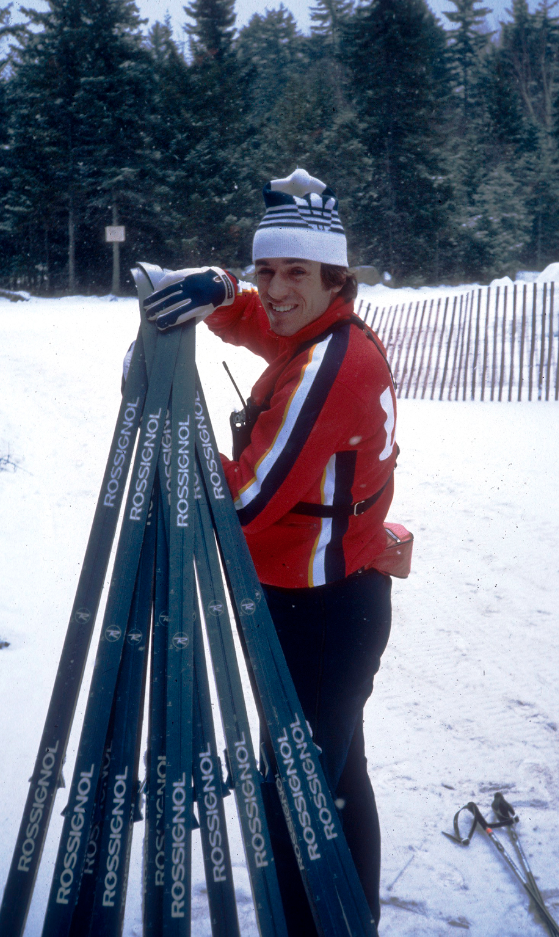
    Ruff Patterson coaching with the U.S. Ski Team in the 1980's. (Photo: Rettrieved by Gordon Vermeer and Eric Packer)
    Ruff Patterson coaching with the U.S. Ski Team in the 1980s. (Photo: Gordon Vermeer and Eric Packer)

    This held especially true for Susie, Pete, Barbie and Matt Patterson, Ruff Patterson’s four younger siblings. Surrounded by Idaho’s Sawtooth Mountain Range, and with support from their parents Joannie and Jim Patterson, all five developed a deep devotion to skiing. To many in the community, they became known as Sun Valley’s “First Family” of skiing.

    In a way, however, Ruff was the ‘black sheep’ of the household. Susie became a two-time national champion alpine skier, Pete qualified for the Winter Olympics in downhill skiing twice, and both Barbie and Matt established themselves as adept alpine skiers. Meanwhile, Ruff chose a slightly different ski path than his siblings. He chose cross-country.

    “[In] high school, I had a brother and sister who were both traveling, very young, for the national alpine team and I was kind of the guy in the background helping them get through school and fixing skis and stuff like that,” Ruff said in a phone interview in April, shortly after he announced his retirement from Dartmouth. “Contact with people, having to deal with traveling and and competing started really young for me, but [ski coaching] was not something I planned on doing after college.”

    As a student enrolled at the University of Colorado Boulder (CU), Ruff originally intended to become a doctor. He placed himself on the pre-med track and graduated with a degree distributed in the fields of biology, chemistry and psychology. Ruff also competed for the Buffs’ ski team. During his undergraduate years, CU won four NCAA Championship titles — though in his senior year the title, ironically, ended in a two-way tie with Dartmouth.

    Despite his initial plan, post-grad life did not leave Ruff pouring over MCAT entrance exams or medical-school applications. Instead, he found himself back in his beloved hometown, ski coaching with Rob Kiesel, the founder of the Sun Valley Ski Education Foundation (SVSEF) nordic program.

    The first few years of coaching for Ruff were far from glamorous. He spent most of his time supporting the SVSEF junior racing team and acting as a professional porter and nordic roadie for the U.S. Ski Team (USST).

    “Rob hired me as the national team coach, and you know when you start out, you’re carrying a lot of ski bags and traveling a lot,” Ruff said. “Those first years I was traveling internationally with the team and just doing a lot of the groundwork. I don’t think a lot of the groundwork has changed for those poor guys. They earn every cent.”

    Kiesel, the man who hired Ruff, influenced Ruff’s path into coaching. As Ruff put it, Kiesel was more than just a family friend. Kiesel was Patteron’s role model and mentor.

    “I wouldn’t be coaching today, nor begun coaching if it weren’t for Rob,” Ruff previously wrote in an email after Kiesel passed away in 2011. “Both my sister Susie and brother Pete wouldn’t have had the Alpine skiing careers they had if it weren’t for Rob. My brother Pete wouldn’t be guiding in Greenland or Nepal if it weren’t for Rob. More importantly, Rob was an integral part of our family.”

    As Patterson’s grip on the nordic race world grew, he began to move up in position and expertise. For 10 years, he worked for the USST,  a better part of those alongside Mike Gallagher. While co-coaching with Gallagher, Ruff assumed the role of “primary assistant” coach to the USST, often working with the women.
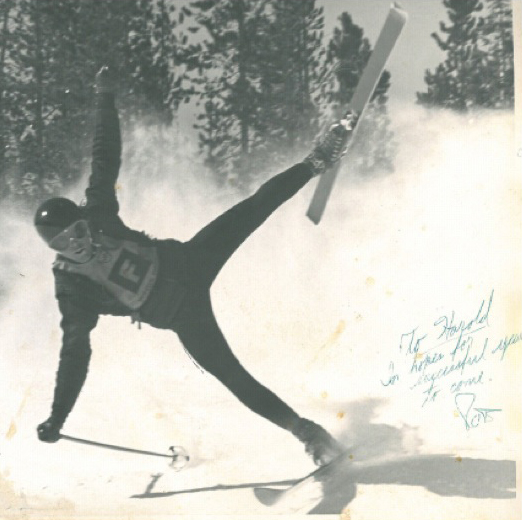
    Winter Park 1964
    Rob Kiesel, Patterson’s coach, showing off his downhill skills at Winter Park in 1964 (Photo: Harald Bjerke)

    “[Mike Gallagher] and I would worked really closely together and I was sort of his primary assistant as the year grew on,” Ruff said. “When we’d split up, I would end up taking the women and there were a few years where I was actually labeled the women’s coach. But for the most part, he and I were more of a team and I was more of his assistant during my primary coaching year.”

    Ruff’s stint with the USST brought him to the Olympics, alongside Kiesel at the 1980 Winter Olympics in Lake Placid, N.Y., and with Gallagher at the 1984 and 1988 Games in Sarajevo, Yugoslavia and Calgary, Alberta, respectively. He mentioned working alongside U.S. Ski Team coaches Torbjørn Karlsen and Peter Ashley as major influencers in his career as well.

    His work for the USST helped women like current Methow Valley Nordic Team head coach, Leslie Hall –the sister of Patterson’s future Dartmouth College co-coach, Cami Thompson-Graves — to the Olympics.

    “He was one of the main coaches at the 1988 Olympics, my first Olympic experience and the main memories that stick with me are his smile, laugh and bad jokes!” Hall wrote in an email. “My relationship with Ruff has evolved so much over time, from being an admiring junior who wanted his attention and help, to being a friend on mountain biking trips to Moab, to being the sister of his co-coach at Dartmouth.”

    He also helped current Middlebury College assistant coach and University of New Hampshire alum Patty Ross, and Bates College alum Nancy Fiddler to Olympic levels of racing.

    “Ruff was always there with a joke or someway to diffuse a tense situation,” Fiddler said on the phone. “Everybody gets so caught up in [skiing] and if you were feeling kind of involved in a way that wasn’t healthy, he just brought you back and reminded you that, ‘Hey it’s ski racing it’s supposed to be fun, and if you’re not having fun, what the hell are we doing.”

    Changes To Hold Onto: Skating and the Mental Breakthrough

    “Weight shift, weight shift, that’s the key.” — Ruff Patterson during a skating technique workout with the Dartmouth men’s nordic ski team, circa 1989

    Little did Bill Koch know that when he entered Sweden’s 1980 Worldloppet marathon, he would rock the ski world forever. During that winter’s fated 50-kilometer ski race, Koch witnessed what has since become a staple in cross country skiing: the skating technique.

    After Koch began to implement skate skiing into his own national and international races, the sport changed forever — a change Patterson perceived first-hand.
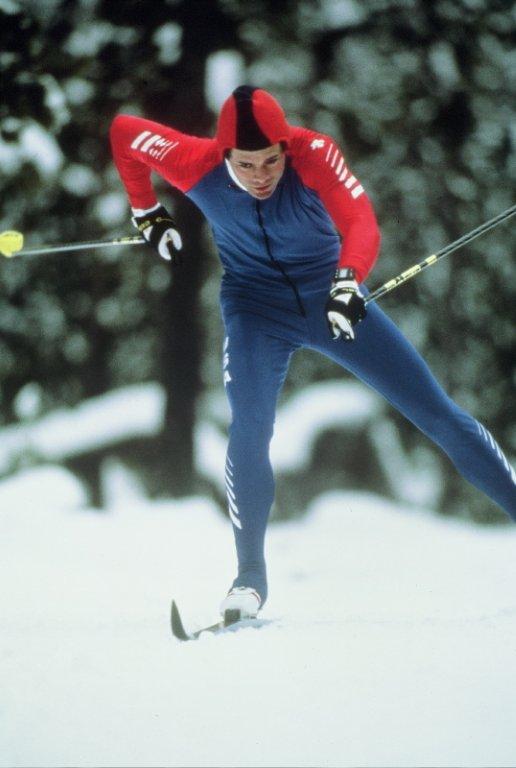
    U.S. cross-country skiing great Bill Koch, who pioneered the skating/freestyle technique in the 80s. (Photo: Peter Ashley)
    U.S. cross-country legend Bill Koch pioneering the skating/freestyle technique in the ’80s. (Photo: Peter Ashley)

    “I was incredibly fortunate to live through the skating revolution,” Patterson said. “To see the live world change, everybody else’s world change and how people react to that, that whole thing was, man, something to live through.”

    “You can sort of compare it to — right now there’s this big double poling thing,” he added. “Skating was very much the same thing. It was a complete unknown. So for everybody, including sports staff like myself, it was like, ‘What’s going to happen here?’ ”

    What happened was rattling to some and rectifying for others. Patterson pointed out that he saw many attempt to prevent the change, but the skating technique, ultimately was here to stay.

    “You know, they were trying to do everything possible to make it less possible to skate,” Patterson said. “A lot of the controls they tried were almost laughable now.”

    As Patterson sees it, there are certain circumstances when evolution of the sport is inevitable. Occasionally, adaptation outweighs resistance.

    “What I’ve discovered during those periods is … if you’re here to play the game, you have to figure out a way to go with it,” he said.

    Skating and double poling aren’t the only areas Patterson says he has seen development in skiing. To Patterson, the mentality of American ski racers is what has changed the most. Especially for the U.S. women.

    “When Kikkan [Randall] opened the door, the barrier, for Americans to do well in Europe, I think the whole mental game changed,” Patterson said. “I’m hoping that this mindset moves into the boys’ group [in the U.S.], that mentality of just, ‘Hey, we can compete and win against the big boys and the big girls.’ That’s probably one of the most significant changes I’ve seen since I’ve started coaching.”

    Dartmouth Dudes and Loving What You Do

    “Boys, I want medals!!” — Patterson to the Dartmouth men’s nordic ski team, circa 2012

    Freezing rain. Mosquitoes. Heavy, humid heat. The Northeast Coast makes many westerners go weak in the knees. Patterson was one of them. Located in the heart of Hanover, N.H., a move to Dartmouth promised Patterson the very bipolar weather, bug bites,and Vitamin-D deficiency he dreaded the most.
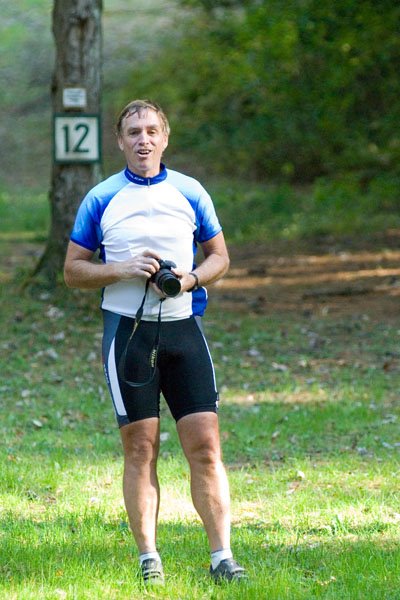
    Ruff Patterson, discovering that the eastern biking may make up for his dislike of east coast climate. (Photo: Dartmouth Ski Team Facebook)
    Ruff Patterson discovered that the eastern biking may make up for his dislike of East Coast climate. (Photo: Dartmouth Ski Team Facebook)

    “When I first took the job I was a western guy and I thought, if I lasted three or four years I’m going to be lucky,” Patterson said. “I was terrified of bugs and humidity and once I got here the bugs and humidity were terrible, but then I realized that the road biking and other stuff in the East were just incredibly great. But I never planned on being here as long as I did.”

    Patterson’s original estimated three-to-four-year window turned into seven, soon 11, and eventually 27. Overcoming his fear for East Coast climate was only part of it. His deepening devotion to the Dartmouth men’s team also drew him to stay.

    “I just kept saying over and over again ‘I love what I do,’” he said. “Just absolutely love what I do and I just felt that it stayed like that all the way through.”

    Patterson’s philosophy to love what you do and see it through transferred to his athletes. During his 27 years at Dartmouth, he coached three men to individual NCAA Championship titles — Glen Randall in 2008, Sam Tarling in 2011, and Patrick Caldwell in 2015 — and he also helped Dartmouth to an NCAA team title in 2007, with All-American athletes Mike Sinnott and Ben True.

    “When I came in as a freshman, I was very hesitant to fully buy into his philosophy of training,” Tarling, a 2013 grad, wrote in an email.  “After my first year working with Ruff, our relationship strengthened and I decided to stay in Hanover for the summer and work with him. I discovered that some of the silly things we did in training had the most influence on my performance, and that what seemed like random workouts and drills had a purpose. I ended up staying every summer after that to work with Ruff.” 

    Tarling was not the only athlete who at times questioned some of Patterson’s practices. Both Grover and Carl Swenson, a 1992 graduate and three-time Olympian, recalled recovery runs with Patterson as conclusively easy, in spite of athletes’ attempts to do otherwise. Patterson wanted his skiers to be fast when they needed to be and to step back and enjoy training the rest of the time.

    “We’d go out for a ‘Ruff Waddle’ recovery run,” Swenson said. “Ruff would make us run behind him. It was to teach us to go easy … because all we wanted to do was race every workout.

    “He was just the right coach at the right time for me,” Swenson added. “He kept me at it, really. I think it’s a period where a lot of people get interested in other things and, as everybody knows it takes some time to develop as a distance athlete, and he really kept me on track as best as anybody could have in a period when I was not on track by any means.”

    Gaining credence with athletes like Tarling and Swenson and witnessing their progress, for Patterson, was another piece of what made college coaching worthwhile.
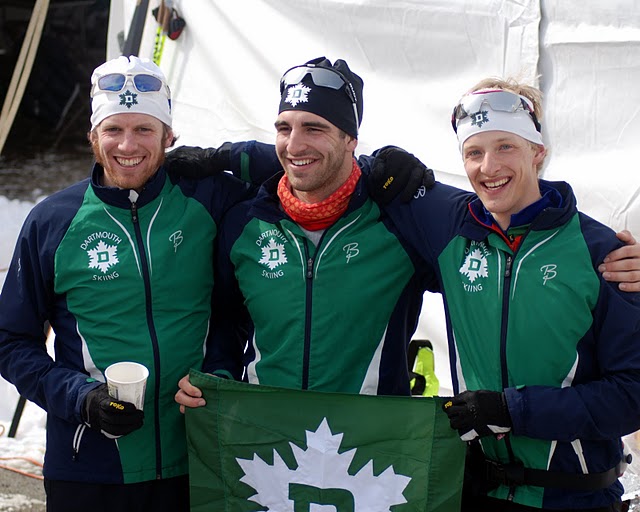
    Just a few of "the kids" as Ruff Patterson (not shown) calls them (left to right): Nils Koons, Sam Tarling, and Eric Packer (Photo: Ruff Patterson)
    Just a few of “the kids” as Ruff Patterson (not shown) calls them (left to right): Nils Koons, Sam Tarling, and Eric Packer (Photo: Ruff Patterson)

    “Winning over athletes and gaining their trust, I can’t tell you the rewards behind something like that,” Patterson said. “That’s just another piece of this overall puzzle, but sort of everything. Once again, it’s the people and stories behind them that have made it for me.”

    Though Tarling, who is now working as a software engineer in Denver, Colo., indicated he’s “happily enjoying being a recreational athlete for a change,” he still feels indebted to Patterson for all that he’s helped him achieve.

    “Our relationship began with many conversations about how we could best work together to help me achieve my goals in ski racing, but progressed to the point where Ruff was much more than my ski coach,” Tarling wrote. “He was – and is still – my mentor, my confidant, my hero, my friend.”

    Patterson was much more than a coach to many of his athletes. He was a pillar, the adviser and ally searched for not only on the trails, but off them as well. He did not force his athletes to grow. He fostered them to take the steps on their own. As numerous athletes indicated, his door was always open to whoever happened his way.

    “Ruff impacted my life on so many different levels beyond skiing,” Patrick O’Brien, current head coach for Stratton Mountain School T2 Team and 2010 graduate, wrote in an email. “He wanted you to grow as an athlete and an individual. He was always there for support when you needed him but understood many decisions or choices had to be yours alone to make. He asked for, and brought out the best people had to offer.”

    Patterson did bring out the best people had to offer, but in ways beyond just results. He saw value in every athlete, carnival circuit caliber ski racer or not.

    “The guy who never makes it, the ones who just make these incredible strides … the really talented guys,” Patterson said, “All athletes are rewarding.”
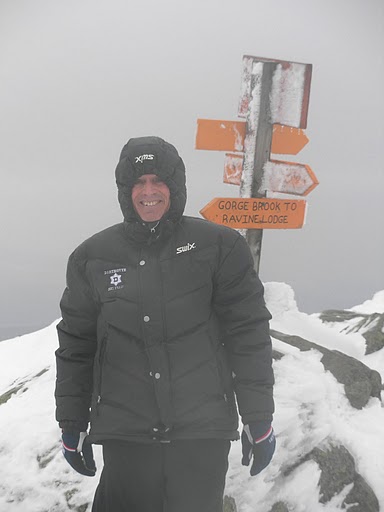
    Ruff Patterson on Mt. Moosilauke in New Hampshire's White Mountains with the Dartmouth team (Photo: Gordon Vermeer and Eric Packer)
    Ruff Patterson on Mt. Moosilauke in New Hampshire’s White Mountains with the Dartmouth team (Photo: Gordon Vermeer and Eric Packer)

    Patterson’s ability to work with athletes of all kinds, stems from his coaching style. Passionate, patient, perceptive, he held the unique capacity to turn the complexities of cross country skiing into common sense.

    “Ruff has that elusive quality you see only in the very best of coaches — he makes skiing seem simple,” Packer, who graduated in 2012 and is now racing for Alaska Pacific University (APU), wrote in an email. “He has the ability to use just a single suggestion to make really dramatic improvements in your skiing.

    “Hand in hand with that, Ruff really believes in the importance of building a quality training group, and holds that at the core of his coaching philosophy,” Packer added. “You learn from the group, push the group, and rely on the group.  In an atmosphere like that, when everyone is working together, pushing each other in a competitive but also fun atmosphere, everyone improves.”

    Humor and having fun was also a training philosophy greatly prized by Patterson.

    “I call them the kids.The gang. The team. I’ve been so lucky to be able to work with these guys. Even the ones that have been nightmares, looking back that’s what’s kept me here. The people, for sure.” — Patterson on his 27 years as the Dartmouth men’s nordic head coach

    “One of my favorite memories started about midway through my time at school when he would finish every pre-race meeting with a story from his previous coaching experiences,” O’Brien wrote. “All would have you rolling over laughing and reminding you that although the sport may change over the years, the spirit of it never did. It made you feel connected the people who have come before you, understanding the challenges they faced were the same as the ones in front of you now.”

    However, Patterson’s impact on the nordic community cannot be pinned solely to skiers he worked with directly. As Sinnott pointed out, numerous of individuals have been influenced by the former Dartmouth head coach, whether he realizes or not.

    Ruff Patterson
    In two words or less…
    “A Mentor” — Thompson-Graves
    “Unassuming” –– Tarling
    “Wise” — Tarling
    “Passionate” — O’Brien
    “Remarkable” — Sinnott
    “Solid” — Grover
    “Supportive” — Grover
    “An Icon” — Packer

    “You go through his office and he’s got handwritten thank you notes from John Nystad from when John Nystad was skiing for UVM [University of Vermont],” Sinnott said on the phone. “Ruff had these powerful impacts on skiers that he wasn’t even mentoring or that weren’t in his program.”

    With the women too, Patterson was — and still is — a hit.

    “Ruff used to get more Valentine’s Day cards than anyone else on the team,” Sinnott reflected, referring to the Dartmouth Carnival tradition of ‘Carni Crush.’ “Everyone on the circuit felt the warmth and the magnitude of Ruff. And that’s the cool thing. It’s not just the people that are obvious on a piece of paper, but it’s everyone else that might have glossed by him.”

    While many of Patterson’s athletes cite him as the reason they are where they are today, Patterson is adamant that his athletes are the ones who’ve kept him in the game.

    “I call them the kids,” Patterson said. “The gang. The team. I’ve been so lucky to be able to work with these guys. Even the ones that have been nightmares, looking back that’s what’s kept me here. The people. For sure.”

    Dartmouth’s Dynamic Duo: Patterson and Cami Thompson-Graves

    “Are we having fun yet?” — Patterson to the Dartmouth men’s nordic ski team, circa 2010

    Bonnie and Clyde. Ernie and Bert. Starsky and Hutch. Cami and Ruff. While not many modern day duos find themselves in competition with the infamy of the previous pairs, Cami Thompson-Graves and Patterson are two that do.

    In a coaching partnership that’s lasted longer than some marriages, the two have carried each other through the numerous highs and lows of coaching a Division I college ski program.

    “We’ve been together longer than most people have been married,” Patterson said. “We’ve definitely had our ups and downs, but because of it, the two of us have become incredibly close.”

    Though the two admit they’ve spat like siblings at times, they also agree that what they have gained out of their 27 years together is irreplaceable.

    “She’d be the first one to tell you, it’s not like it was all wine and roses the whole time,” Patterson said. “ It’s just we’ve been through a lot together.”
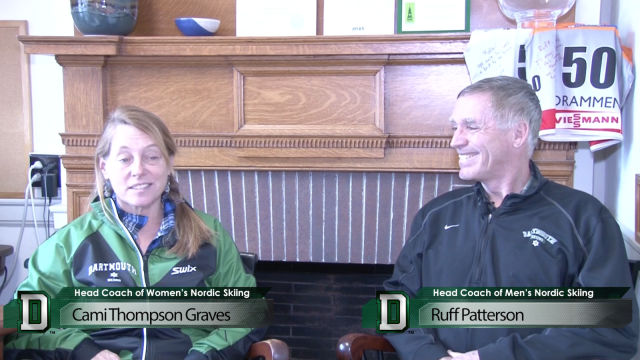
    Dartmouth co-coaches Cami Thompson-Graves (l) and Ruff Patterson. (Photo: DartmouthSports.com)
    Dartmouth’s longtime duo Cami Thompson-Graves (l) and Ruff Patterson during a 2015 interview .(Photo: DartmouthSports.com)

    The two have also supported each other — and their teams — through the loss of Dartmouth athlete, teammate and friend, Torin Tucker. Tucker, who died of a heart anomaly while competing at the Craftsbury Marathon two years ago, was also from Sun Valley and described by many as having a similarly contagious smile.

    A rare verve to come across, no loss the magnitude of Tucker’s is easy. For Patterson, learning to live in the memories and moments of Tucker as the epic adventuring, intellectually curious and compassionate mountain town-er he was, no matter the time it took to get there, helped he and the Dartmouth community move forward with Tucker in their hearts.

    “There’s no way you can tell somebody to get over stuff,” Patterson said. “You just have to deal one day at a time, one minute at a time.”

    The support and history between Thompson-Graves and Patterson, therefore, goes far beyond just van rides, wax benches, and debates over who’s who.

    “We had some great moments, talked about skiing endlessly and also fought and bickered like siblings at times,” Thompson-Graves wrote in an email. “But, along the way, there were many ​fun race days where we worked hard, shared our nerves, and when things had to come together, they did!”

    More than anything during their time together, Thompson-Graves was a firsthand witness to the dedication Patterson put towards his athletes and coaching.

    “​Ruff loved his guys, they meant everything to him,” Thompson-Graves wrote. “He was there, day in and day out and knew them all well.  Some of them might have driven him crazy but, even with the frustrations, he loved the times when it all came together for them.”

    All in all, it takes a special circumstance for two individuals to work together toward a common goal for that length of time.

    “When you sum it up, I wouldn’t have traded that for anything,” Patterson said. “Because being able to figure out a way for two quite different people to work together and do as well as we have done together … boy, that doesn’t happen very often in life.”

    What’s Next?

    “Don’t overthink it.” –Ruff Patterson to the Dartmouth men’s nordic ski team, circa 2006.

    Forty years ago, Patterson — clad in a black graduation cap and gown — strolled across the CU stage to receive his diploma. Like many of the student athletes he would eventually coach, he had post-college plans that would inevitably change, a passionate fervor for cross country skiing, and an anything but linear trajectory ahead.

    Forty years later, with his final cohort of college senior skiers before him, not much has changed. As Patterson departs Dartmouth, there is a piece of him that feels as if he is once again striding across the graduation stage, leaving school behind to discover what’s next.

    “It wasn’t until the day before I resigned that I actually knew I was going to do it,” Patterson said. “I didn’t sleep that night, I can tell you that much.”

    “It sort of feels like I jumped off a cliff doing this,” Patterson said of his resignation. “I was in a little bit of a shock for a few days, but I’m going to sell my place here, pack up a U-Haul and return west, which I’ve been wanting to do forever. And then stir the pot up a little bit and try to find something else to do. I have no idea what that’s going to be. I feel like a college kid again.”
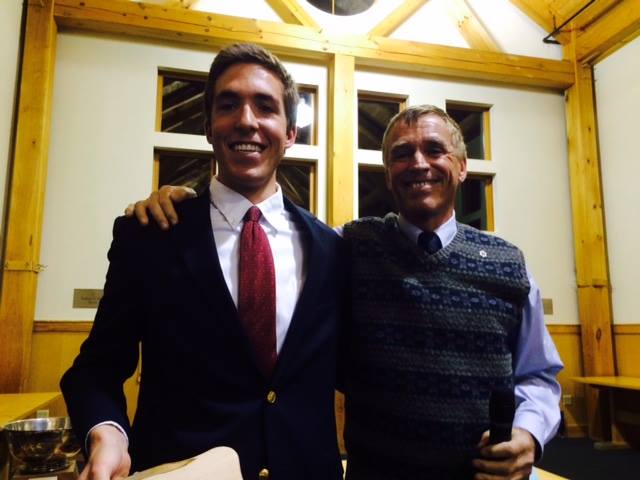
    2015 NCAA Champion Patrick Caldwell (l) and coach Ruff Patterson. (Photo: Dartmouth Ski Team Facebook)
    2015 NCAA Champion Patrick ‘Paddy’ Caldwell (l) with coach Ruff Patterson. (Photo: Dartmouth Ski Team Facebook)

    Even if Patterson is now physically distanced from Dartmouth — he headed west last week Tuesday — his legendary role and presence is not. His impact extends beyond Dartmouth, into the lives of past, present and future mentees — some of which he will never meet in person. Many he will have infiltrated with his coaching philosophy alone.

    “Ruff was really responsible for creating that atmosphere with the [Dartmouth men’s] team, in terms of camaraderie he created in the group,” Grover said. “And certainly, as you know, that’s a big thing for us these days with the USST. The team and the athletes are quite successful on an individual basis because we tend to try to build a family atmosphere around the team. Ruff really did the same.”

    Patterson’s stamp survives in the USST, the skiers who are now software engineers, lawyers, coaches, writers and more.

    “You know, I came into a great group early on,” Patterson said of his first few years coaching at Dartmouth. “It took a while to establish my own style. It doesn’t mean that the style that Mortie [John Morton] had way back when was, there’s no way you could say it was bad or good … I absolutely know that the next person that’s going to come in in my place is going to be exactly the same; have their own style … I got to put my stamp on things and the next person here is going to put their stamp on things.”

    Semi-uncertain of what his future holds beyond bike trails, mountain towns, and some RV roaming, Patterson is certain that Dartmouth has green grass ahead and he, a wanderlust for western blue skies.

    “I know they’ll find somebody good,” Patterson had said of prospective coaches for the Dartmouth head coaching position, prior to the hiring of Brayton Osgood in May. “And I know that the school will always support skiing … My personal opinion is that they’re going to just keep going and there’s nothing wrong with that … Field of dreams.”

  • Many Hands Make Light Work: Sun Valley SuperTour Snow Update

    Many Hands Make Light Work: Sun Valley SuperTour Snow Update

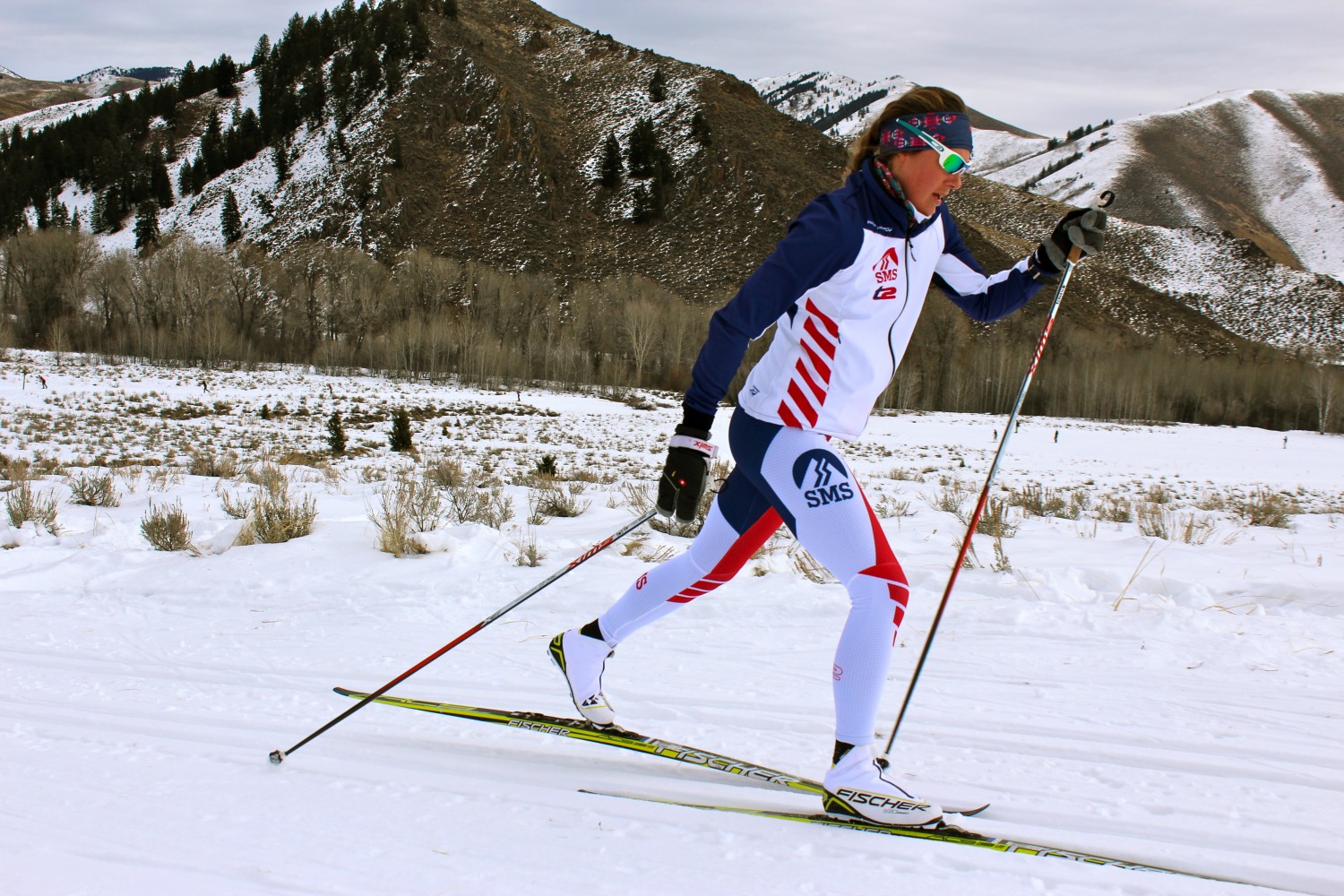
    Annie Pokorny  (SMST2) at the top of the coach's climb for the SuperTour 1.3 k  classic race course in Sun Valley, Idaho.
    Annie Pokorny (SMST2) at the top of the coach’s climb for the SuperTour 1.3 k classic race course in Sun Valley, Idaho.

    SUN VALLEY, Idaho — Armed with plenty of shovels and smiles, the Sun Valley Ski Education Foundation crew has been moving snow to make the next stop on the SuperTour circuit happen at the Lake Creek venue in Sun Valley, Idaho.

    “We’re cautiously optimistic that we’ll be able to do both races [at Lake Creek], with the sprint race happening here for sure,” Sun Valley Ski Education Foundation (SVSEF) Nordic Director Rick Kapala said on Wednesday afternoon.

    With close to six inches of snow currently covering the trails, according to Sun Valley’s assistant nordic program director Kelly Sinnott, local volunteers and coaches are putting their shovels to work to increase that numerical amount by the work hour.

    The SuperTour races are scheduled for Saturday and Sunday, with a classic sprint followed by 10- and 15-kilometer classic individual starts. On Thursday morning, temperatures were below freezing, around 28 degrees Fahrenheit in Sun Valley. 

    “We spent hours [on Tuesday] shoveling the course and there’s a crew out there today as well,” Sinnott said on Wednesday.

    While a decent snow storm might be the preferred way of covering the race course, many of the volunteers don’t seem to mind scooping snow for the sake of this weekend’s SuperTour races.

    “I was out here yesterday, I would say three-plus hours,” said Mel Dyke, of Hailey, Idaho, a snow-shoveling volunteer, and webmaster for 5B Nordic News.

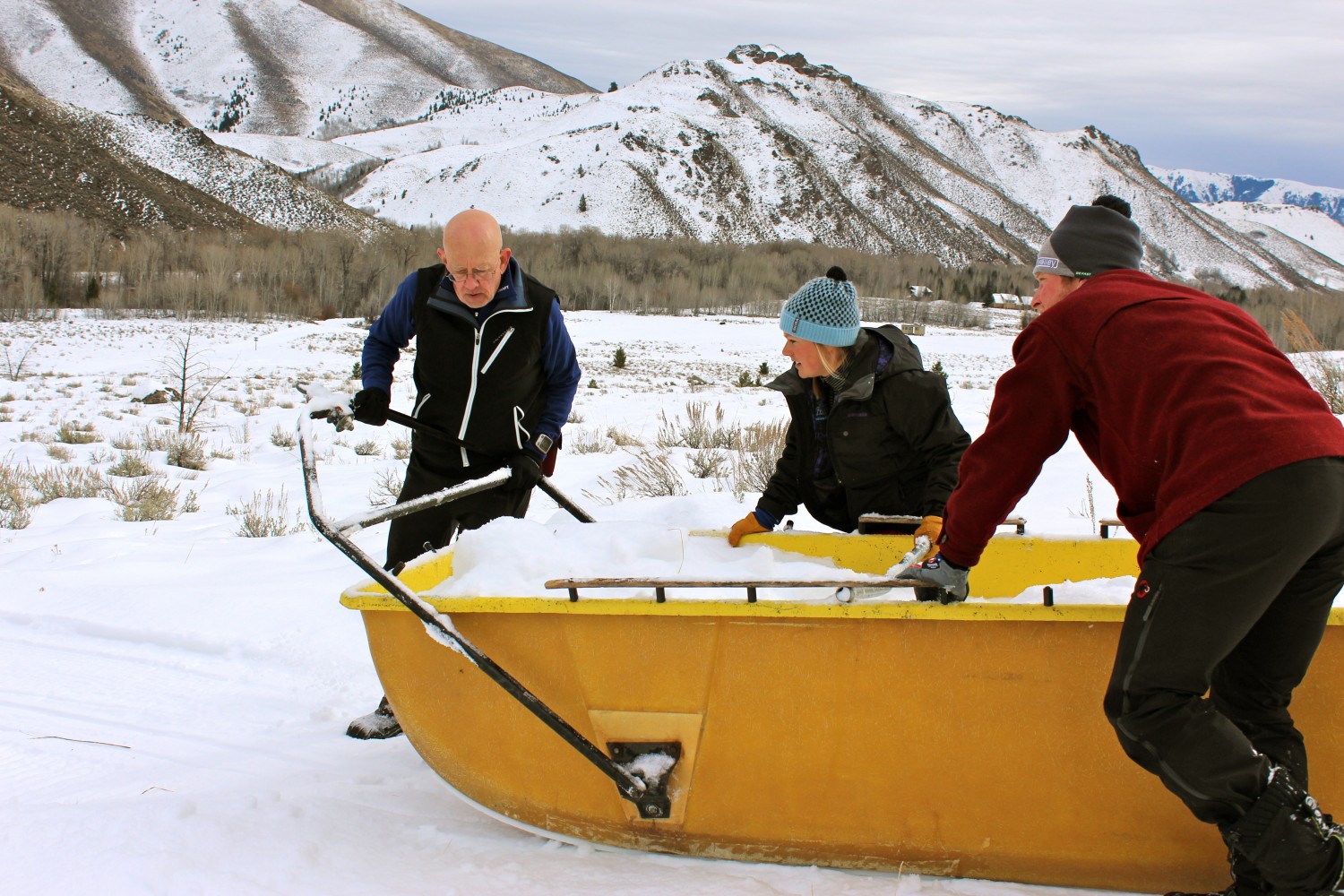
    (Left to right): Mel Dyke (volunteer), Kate Barton (Burke Mountain Academy coach) and Colin Rogers (SVSEF Gold Team head coach) push a sled full of snow on Wednesday afternoon to dump onto the SuperTour 10/15 k  classic distance race course in Sun Valley, Idaho.
    (Left to right): Mel Dyke (volunteer), Kate Barton (Burke Mountain Academy coach) and Colin Rogers (SVSEF Gold Team head coach) push a sled full of snow on Wednesday afternoon to dump onto the SuperTour 10/15 k classic distance race course in Sun Valley, Idaho.

    “There were three crews of 15-20 people yesterday,” he said. “I’m just doing it because it’s fun.”

    While pushing snow piles is not everyone’s idea of “fun,” the dedicated group of individuals working out on the trails for free will make the Sun Valley SuperTour races possible.

    “We’ve got a community of people that just jump in and do it. And we’ve had a few low snow years so we’ve had to do a lot of this,” said Bob Rosso, another volunteer and owners of Elephant’s Perch sports speciality shop in Ketchum.

    “We’re die hard cross-country skiers,” Rosso added. “When the race coordinators call out for help, people show up.”

    Still, even with a soldiery of willing snow-shovelers, why not use host trails with enough coverage nearby?

    Kapala points to the quality of the race course at Lake Creek as motivation for making it the preferred race site.

    “One of the biggest concerns that the coaching community has with regards to the early SuperTours is that we’re able to have appropriately difficult courses,” Kapala said.

    “We could go to Galena, and we could make the races work there … but putting the work in here gives the athletes an opportunity to test themselves appropriately on the kinds of courses that they need to be prepared to ski on,” he said. “These are homologated, FIS [International Ski Federation-standard] courses, they have A-climbs and that’s important.” 

    On top of the promise of challenging racers, the Lake Creek venue offers coaches, spectators and skiers a perspective like no other.

    “One of the unique things about the Lake Creek venue, is it’s really open,” said Kapala. “You can stand in one spot and watch the entire race happen.”

  • Newell Skis Away with Classic Sprint Win at SuperTour Finals

    Newell Skis Away with Classic Sprint Win at SuperTour Finals

    Andy Newell fighting Pat O'Brien up a climb in the classic sprint A-final on Saturday at SuperTour Finals. Newell won the race and O'Brien took second. Photo: Mark Nadell/MacBeth Graphics.
    Andy Newell (c) fighting Pat O’Brien (r) up the last climb in the classic sprint final on Saturday at SuperTour Finals. Newell won the race, and O’Brien took second. (Photo: Mark Nadell/MacBeth Graphics)

    FasterSkier’s coverage of SuperTour Finals and U.S. Distance Nationals is brought to you by the generous support of Concept2, the leading manufacturer of indoor rowers, racing oars, and the SkiErg.

    SODA SPRINGS, Calif. — When Andy Newell (SMS T2/U.S. Ski Team) shows up to a sprint in the U.S., his name carries a certain cache with it. As the fifth-ranked sprinter on the World Cup this season and the only man in the world to qualify for the heats in every sprint he started, he is undoubtedly the standard-bearer in short distances whenever he returns to the domestic circuit. His name precedes him; Newell’s younger competitors grew up with posters of him on their walls, and when they meet him in an A-final they plan their entire strategies around him.

    “I remember my first Andy Newell poster I got in, like, elementary school,” says Erik Bjornsen (Alaska Pacific University/USST), a teammate of Newell’s on the national team. “I remember my friends and I talking about him in school, like, ‘That guy’s such a badass!’”

    There may come a day when one of the upstart generation of American sprinters upsets him, but Saturday was not that day. Four rounds of the sprint course later and Newell lived up to his reputation, winning the third stage of SuperTour Finals in commanding fashion against Pat O’Brien (Craftsbury Green Racing Project), Bjornsen, Tim Reynolds (CGRP), Rune Ødegård (University of Colorado) and Mike Sinnott (Sun Valley Ski Education Foundation) in the A-final.

    It’s been two years since Newell last entered a sprint race in the U.S., as he was sick for spring series a year ago, but he picked up right where he left off in Sun Valley, Idaho, in 2011. Based on his track record, the casual observer might conclude that Newell’s win was a sure thing at the Auburn Ski Club; that nobody in the domestic field could hope to touch someone who has been competing on the World Cup since he was 20 years old and has since proven himself to be one of the most consistent sprinters in the world.

    But Newell has been around long enough to know that losing is always a possibility, no matter what the field. His finish in the prologue in variable conditions put him nearly a minute out of the lead and limited his chances at winning the four-race tour on day one. Forced to shift focus from the SuperTour Finals title to individual races, Newell showed up for the sprint aware that nothing is ever a sure thing, particularly against a rabid domestic group of skiers.

    “There’s a lot of good sprinters in the U.S.,” Newell said. “Obviously qualification isn’t quite as competitive as the World Cup, but when you’re racing heats against these people it’s like, anybody can win. It’s sprint racing; so much can happen out on the snow. A lot of these guys are really fast. So I wouldn’t say I expect to win, but I definitely go into a sprint in the U.S. hoping to win.”

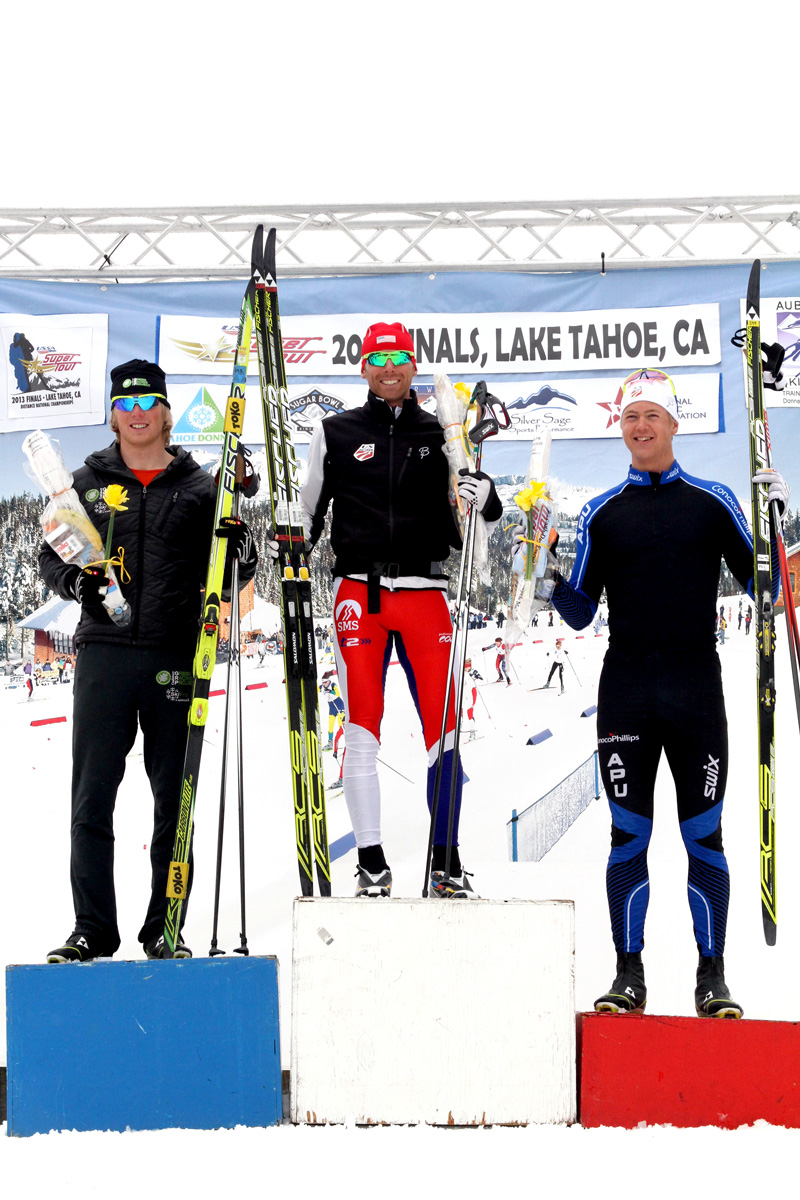
    The men's podium: 1. Andy Newell, 2. Pat O'Brien, 3. Erik Bjornsen. Photo: Mark Nadell/MacBeth Graphics.
    The men’s podium: 1. Andy Newell, 2. Pat O’Brien, 3. Erik Bjornsen. (Photo: Mark Nadell/MacBeth Graphics)

    From word ‘go’ in the qualifying round through to the A-final, Newell made his supremacy known. He was one of a small set of athletes with the confidence to start the preliminary round on skate skis in conditions that were changing and softening in steadily falling snow, and on a course with two serious climbs to boot. Newell’s double-pole is unparalleled in this field, however, and it was clearly the right choice for him — he won a three-minute qualifier by five seconds over CU’s Gustav Nordstroem to start the day.

    In the heats, Newell played a more tactical game. Back on classic skis, he took second behind O’Brien in each round and never used more energy than he needed to advance.

    For the final, both Newell and O’Brien went in with a good idea of what the other would do. O’Brien was riding the high of an unanticipated late-season resurgence and “really good” skis, and led each of the early heats from start to finish. He left the start line knowing he wanted to get out fast enough to pick his own lane again after the scrub zone, as a difference in track speed developed as the day wore on.

    Newell, for his part, guessed O’Brien would go to the front early again, and planned to tuck in behind him down the descent out of the stadium and take control on the climbs.

    “I was thinking I wanted to conserve as much energy as possible, but that didn’t really happen,” O’Brien said. “I don’t know; it was just kind of racehorse instincts. I wanted to try to take it pretty easy, but it was also pretty easy to ski from the front there and be able to choose your own lines.”

    With O’Brien out front, Newell was able to decide when to ramp up his own power output. He made his move on the first climb and O’Brien was unable to respond; nor was Reynolds, Bjornsen, Ødegård or Sinnott in line behind them. When Newell emerged from the woods and climbed the hill back into the stadium, he had an even bigger lead than he had expected.

    “I was able to choose my own line and was able to get my own track on the uphill, which is what I wanted to do,” Newell said. “I just put my head down and went, and I didn’t know I had such a big lead because I was hammering into the first part of the stadium. I looked back and I couldn’t see anybody. So I guess it worked out.”

    O’Brien expected the move when it came, but was to gassed to respond.

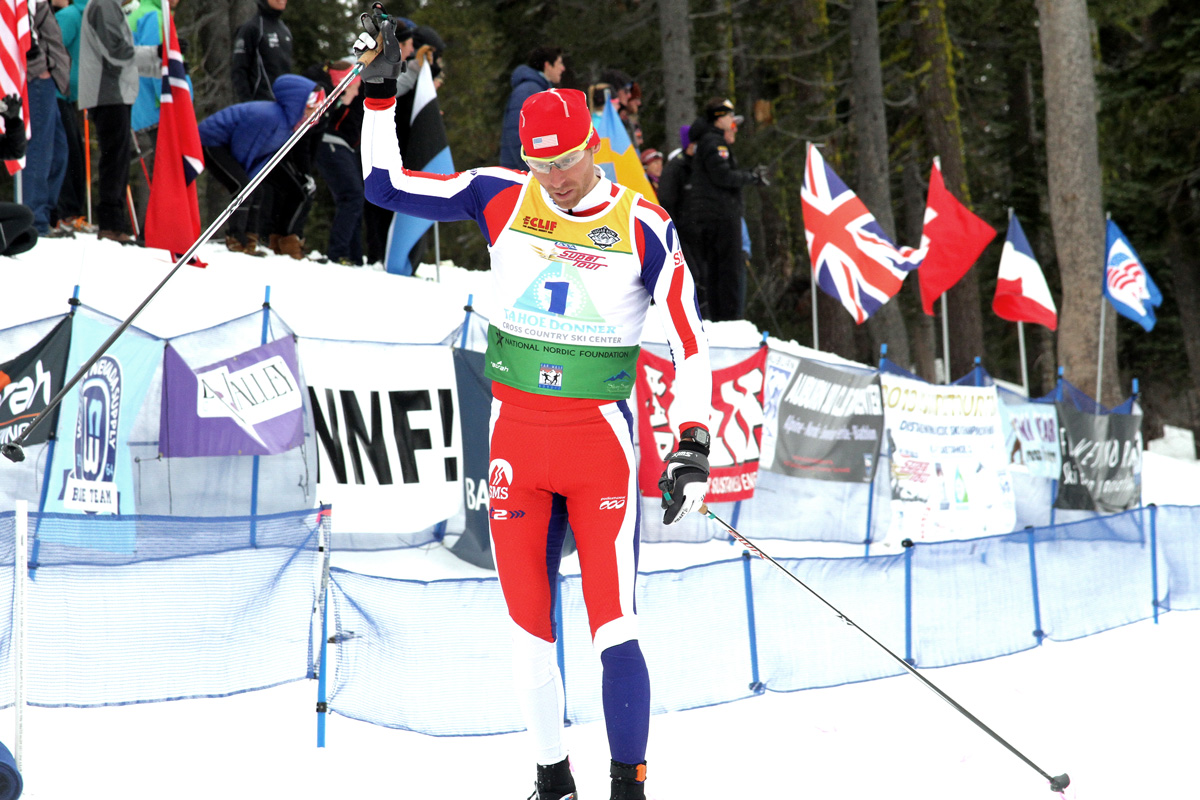
    Newell tiredly raising a triumphant arm across the finish line. Photo: Mark Nadell/MacBeth Graphics.
    Newell raising a triumphant but tired arm across the finish line. (Photo: Mark Nadell/MacBeth Graphics)

    “He opened up a little bit over the top and I just couldn’t quite close him,” O’Brien said. “I knew that’s how he’d been skiing the quarter and semis, so I knew he was going to go there and I expected it, I just couldn’t really match it.”
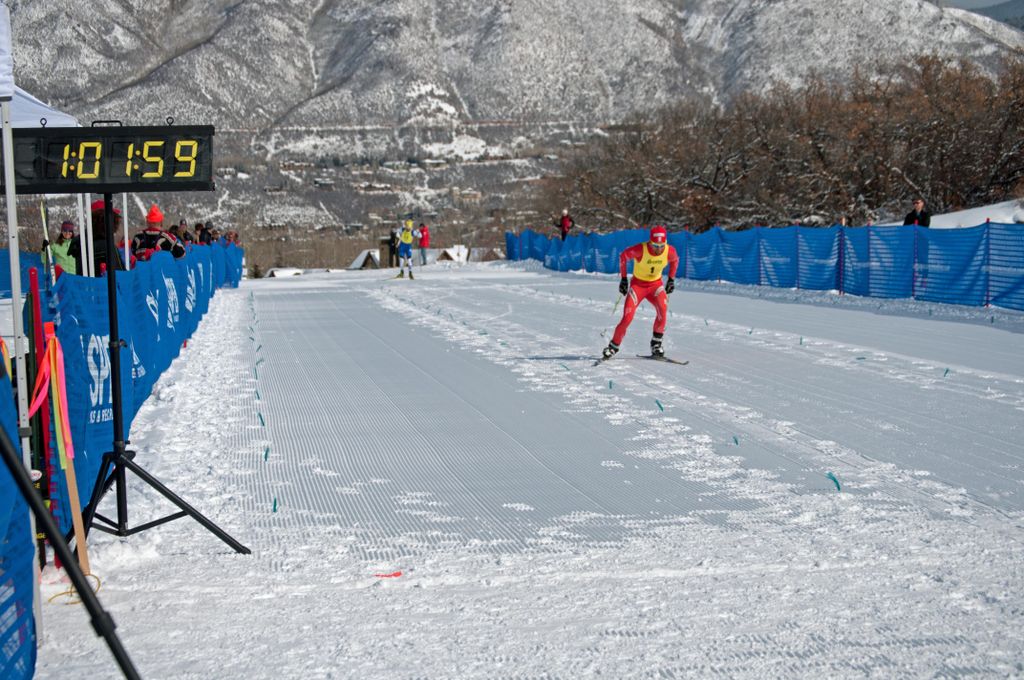
    O’Brien hung on long enough to hold onto second, and behind him Bjornsen passed Reynolds and Ødegård in the final straight to claw his way onto the podium. Reynolds skied across the line in fourth for his best result of the year, Ødegård held on to fifth and Sinnott took sixth.

    Finishing second to someone like Newell left O’Brien extremely pleased with the way the end of his season has been going.

    “It’s a really good feeling,” O’Brien said. “It’s been a tough winter and I haven’t really felt myself. So to come out here to altitude, where I normally struggle, and feel good on the last three races…I’m super happy with today.”

    Bjornsen, winner of the prologue and runner-up in the 15 k, was ecstatic with third. Slow skis left him far off the pace in fifth at the furthest point on the course, at which point he nearly gave up on the idea of a top-three. He had asked for more kick before the start of the A-final, and the extra wax slowed him down on the flats.

    “I really had to work on the double-pole section, and I actually got to the far end of the course and I was like, ‘I think my day is over,’” Bjornsen said. “But no, I started gaining back on the first hill and coming down into the next one I could see people were dying a little bit, and I saw third place up there and that really fired me up, so I just went for it.”

    Reynolds said he had nothing left in the finish stretch when Bjornsen caught him from behind.

    “I thought I closed pretty well on the uphill, and then just kind of died in the finish stretch,” Reynolds said. “Bjornsen blew by me.”

    Though Reynolds just missed out on the podium, fourth is “easily” his best result of the season.

    “I mean, it doesn’t really erase the 20-odd bad races I’ve had…but obviously it’s nice to feel a little more like yourself and ski a little faster,” he said. “I’d actually felt pretty good this week, so I was hoping to have a good race. And we had great skis and my body felt good.”

    Ødegård, the 2013 NCAA champion in the 10 k classic, repeated his result from a week ago at Canadian Nationals in taking fifth.

    Behind Ødegård, Sinnott conceded that sixth was as much as he could muster at the end of a sprint day. He delaminated a ski in his quarterfinal, and though he managed to advance second in the heat anyway, he had to scramble to find a good replacement for the next round.

    “I didn’t really notice it until we went up to rewax some top sauce, and was like, ‘Oh, this isn’t going to work,’” Sinnott said.

    He advanced as a lucky loser in his semifinal, and in the final he was “pretty exhausted.”

    “I was tired and just couldn’t keep up,” he said. “I kind of slipped a couple times on the climb and just blew my arms out and didn’t have much for the finish. But so it goes.”

    The bonus seconds available in the sprint were substantial. With only the hill climb left to go in the tour, Bjornsen now sits in the lead just over 40 seconds ahead of Newell and Freeman in the overall standings. The trio will be separated by this margin in the pursuit-style start of the hill climb on Monday, and whoever makes it to the top of Sugar Bowl will win SuperTour Finals.

    “I’m feeling pretty good,” Newell said. “I thought I’d be hurting more, but this late in the season your body’s so used to racing you don’t even really get sore any more, you’re just kind of tired. Hopefully the sun will come out tomorrow and we can hang out more and do more California-style things, because I’m kind of over winter at this point.”

     — Alex Matthews contributed reporting.

    Results | Photo gallery (via Mark Nadell/MacBeth Graphics)

    Other notes from the classic sprint:

    —   Kris Freeman (Maine Winter Sports Center/USST), who led the tour after winning the second stage on Friday, finished outside of qualifying in 39th. MWSC head coach Will Sweester took responsibility for the wrong ski call — he brought skate skis to Freeman at the last second after observing the success Newell and others had with double-poling and being convinced it would be the right call for Freeman, too.

    “We’ve had a steep learning curve, him and me, and all the skis he has,” Sweester said. “Today I sprinted up at the start with skate skis at the last minute and it was definitely the wrong call on my part. We had good classic skis but the snow made me nervous.”

    —   Torin Koos (Bridger Ski Foundation/Rossignol), in his first race of the tour after being ill for the prologue and 15 k, did not advance to the final after tangling with another competitor and falling in his semifinal. He qualified in sixth position on skate skis in the preliminary round, eight seconds behind Newell. A coach approached the jury with “grumblings” about Koos’ lane crossing technique in the qualifier, but no official protests were filed. According to Technical Delegate Al Serrano, three jury members reviewed the relevant video footage of the qualifier and determined that Koos did not skate when changing lanes at the point in question.

    —   Sylvan Ellefson (Ski & Snowboard Club Vail Team HomeGrown) collided with a spectator in his quarterfinal a few hundred meters from the finish, which resulted in his automatic advancement to the semifinals. The spectator stood in the tracks with her back turned when Ellefson, double-poling with his head down, clipped her with his shoulder and “from what I heard, I knocked her over,” he said.

    Ellefson was in fifth at the time of the collision and finished fifth in the quarter. As the fourth qualifier he wore the lowest bib number of his heat and only needed to finish third in order to advance to the next round. Unable to say whether the spectator prevented Ellefson from advancing, the jury decided to put him through anyways as a seventh man at no prompting from Ellefson or his coaches.

    “I don’t know if I was in striking distance or not,” Ellefson said. “It’s their fault I guess for not having the v-boards up.”

    Serrano said there is no rule in the FIS rulebook that covers interference with a bystander, and the jury decided to advance Ellefson as if it he had instead been the victim of obstruction from a competitor.

    “There’s a specific rule for what happens if someone is taken out and the person that takes them out is disqualified,” Serrano said. “If another competitor takes them out, then they advance. Basically [that’s] the way we ended up advancing Sylvan, as the seventh person in the heat, starting two meters back.”

  • Freeman Back in the Leader’s Chair at SuperTour Finals

    Freeman Back in the Leader’s Chair at SuperTour Finals

    Kris Freeman (Maine Winter Sports Center/USST) skiing alone en route to a 47-second win the the 15 k classic at SuperTour Finals. Photo: Mark Nadell/MacBeth Graphics.
    Kris Freeman (Maine Winter Sports Center/USST) skiing alone en route to a 47-second win the the 15 k classic at SuperTour Finals. Photo: Mark Nadell/MacBeth Graphics.

    FasterSkier’s coverage of SuperTour Finals and U.S. Distance Nationals is brought to you by the generous support of Concept2, the leading manufacturer of indoor rowers, racing oars, and the SkiErg.

    SODA SPRINGS, Calif. — There’s something about racing in the U.S. at SuperTour Finals that seems to suit Kris Freeman (Maine Winter Sports Center/U.S. Ski Team). For the past two seasons he’s come into the spring race series after a winter of feeling off on the World Cup circuit, but on Friday he proved to himself once again that he can return home, rejuvenate, and feel like himself for the last few races of the season.

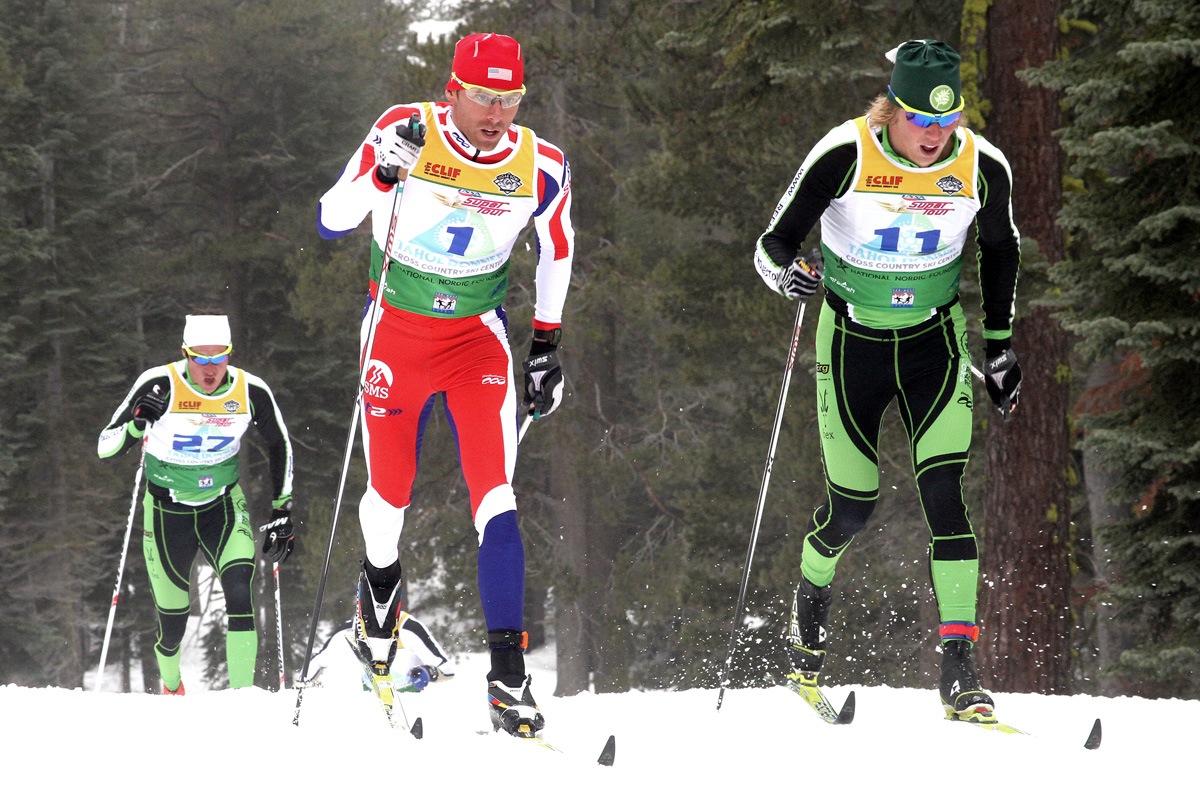
    The 32-year-old won the tour and distance nationals last year after almost skipping the series entirely, and this year he set himself up to potentially repeat by winning the 15 k classic mass start in dominant fashion on Friday, breaking away from the field on the first lap and skiing to a 47.3-second win in the second stage of the tour.

    Freeman moving in front of Miles Havlick (UU) on the first lap. Photo: Ryan Scott.
    Freeman moving in front of Miles Havlick and Tad Elliott on the first lap. (Photo: Ryan Scott.)

    “That went really well,” Freeman said after finishing. “It wasn’t my plan to even necessarily go for the first preem, but there wasn’t much aggression up front.”

    Freeman blew the race out early, and in the fight for second Erik Bjornsen (Alaska Pacific University/USST) held his own to outkick Andy Newell (SMS T2/USST). Bjornsen crossed the finish line 3.2 seconds ahead of Newell to claim his second podium of the tour.

    The entire field seemed to begin the first mass start event of the tour with some hesitancy. The 7,000-plus feet of altitude makes itself known on the Auburn Ski Club course, so athletes were careful not to go into oxygen debt too early.

    This was Freeman’s plan, certainly, but when he realized a few kilometers into the race that he had put a gap on Tad Elliott (Ski & Snowboard Club Vail Team HomeGrown/USST) and everyone else at the top of the course, he decided to run with the lead and expand it if he could.

    “I skied the first hill at what I thought was a reasonable pace, thought it turned out that was a little fast,” Freeman said. “Then I saw I had ten seconds on Elliott, who had five seconds on the field, and I was like, ‘Well, I’m just going to go from here.”

    The break came earlier than his competitors expected. Newell thought Freeman and Elliott were just going for the first preem, a $100 prize awarded on each of the first two ascents up the A-climb. Elliott avoided the temptation to close the gap on Freeman and held himself in check, while those behind him either couldn’t or wouldn’t accelerate in response.

    Andy Newell, Sylvan Ellefson, Mike Sinnott and Miles Havlick leadng the chase group. (Photo: Ryan Scott.)
    Andy Newell, Sylvan Ellefson, Mike Sinnott and Miles Havlick leadng the chase group. (Photo: Ryan Scott.)

    “I thought it’d come back together,” Newell said. “The way I mass-start ski I never lead; I basically ski with the people I’m with. So I thought it’d come back together, but it never did.”

    “I think all the rest of us couldn’t really accelerate much after that,” said Sylvan Ellefson (SSCV Team HomeGrown), who skied in the pack with Newell and the rest of the first chase group. “We tried to chase them down for a while — we caught Tad — but never really caught Bird.”

    While Elliott got swallowed back up by the chase group at about 8 k, Freeman kept hearing splits he was leading the race by 35 seconds, then a minute. A few quick glances behind him told him all he needed to know — nobody was making moves to challenge his lead. Sloppy conditions meant nobody’s kick was working all the way up the wall-like climb, so he let himself walk in a herring-bone on the last two laps to conserve energy.

    “I knew I could not afford to blow up once I had that lead, and I knew I could get five seconds back on that as long as I could double-pole faster everywhere else,” Freeman explained.

    The chase group followed suit and crawled to the top of the ascent. Newell, Mike Sinnott (Sun Valley Ski Education Foundation), Bjornsen and Ellefson clustered at the front of the group as Newell decided to slow things down to a laughably-slow pace. It was an odd sight to see — the fastest skiers in the country walking in a race.

    “When I was in the front going up that hill I was like, ‘I’m not going to go very fast,’” Newell said. “I’m a sea-level kid, I’m going to go as slow as I can over this hill.”

    “It was hilarious,” Ellefson said. “I had no problem with it, ‘cause Bird was gone. He wasn’t really in sight, so it was that fight for second. So if Newell was walking, I was walking, and so was everyone behind us.”

    Freeman looking back to see empty trail behind him.
    Freeman looking back to see empty trail behind him.

    Up ahead of them, Freeman was thriving off the lead. He clearly does well in environments where he can ski his own race.

    “For sure it’s the easiest way,” Freeman said. “Then you recover when you want to recover and you go for it when you want to go for it.

    “It would be nice to be able to that on the World Cup,” he added with a laugh.

    Freeman came into the sun-soaked stadium with no one in sight to claim his third-striaght 15 k classic win at SuperTour Finals in as many starts. Though the race indicates to Freeman that he’s feeling better than he has most of the season, he still doesn’t think his skiing is back to 100%.

    “It’s impossible to compare [to the World Cup], because you’re racing at 7,200 feet against an entirely different field, but I haven’t really felt like myself all year,” he said. “I’m going to make some more changes to my training next year and hopefully get back to where I like to feel, but today was pretty close to where I like to feel.”

    Behind Freeman, the fight for second intensified in the winding double-pole sections between the big climb and the stadium. On the last lap the pack of a dozen or so skiers in the chase group had split in two, with six skiers separating from the back half. Bjornsen was among those in the first group; he skied in third or fourth over the top. With acceleration over the crest he drew even with Newell and Ellefson, and gained confidence that he could outkick one or both of them.

    Erik Bjornsen leads Newell and Ellefson. Photo: Ryan Scott.
    Erik Bjornsen leads Newell and Ellefson. Photo: Ryan Scott.

    “I thought I could have it,” Bjornsen said. “I feel pretty confident with my finishing, so I tired to hammer the double-pole. Newell and I came beside each other on that last steep hill and I got a little better kick over the top, and that helped me coming into the finish.”

    The 21-year-old kept waiting for Newell to pull up beside him in the lanes, but the little bit of extra momentum he had going into the stadium gave Bjornsen more speed, and the challenge he expected never came.

    “Today I did it,” Bjornsen said. “He’s a pretty impressive finisher, so I’m really happy I was able to [beat him] today, and maybe someday I can do it again… Newell definitely inspires me a lot.”

    At the finish, Newell admitted that Bjornsen played the final climb better than he had.

    “He pushed hard over the top, which is good. He got a little gap,” Newell said. “And the stadium is super slow and sunny, so it’s hard to make a move in the stadium.”

    In hindsight, Newell was kicking himself a little for not taking Freeman’s early breakaway seriously, but he was altogether happy with a podium finish that was a vast improvement over his 35th-place in the prologue.

    “It felt good to have a fair race today, instead of having it be so dependent on the skis and stuff,” he said.

    But, Newell continued, “most of the time during the race I was like, ‘Shit, I should have tried to go with Bird when he went, because the pace felt pretty relaxed. But it was fun, I guess.”

    Like Newell, Ellefson was thrilled to place where he felt he should. He came through in fourth, less than two seconds behind Newell.

    “That was a lot better than yesterday,” Ellefson said. “Honestly, yesterday I finished and I kind of did a little fist pump, because I was psyched with how I raced. And then to see that I was 25th was a huge surprise to me. For guys at our caliber, when you go hard and you know you’ve skied well, you know you put in a top-10 performance. And I was pretty sure of that, but I was 25th.”

    Einar Ulsund (University of Utah) took fifth, 3.0 seconds behind Ellefson, and Sinnott finished sixth, four seconds later. Miles Havlick (UU), who led the race with Freeman in the early kilometers, took seventh after another five seconds.

    After the prologue and the 15 k, Freeman leads Bjornsen in the tour standings by 12.2 seconds including podium bonuses. The third stage, a classic sprint, takes place on Saturday.

    Results.

    The men's 15 k podium: 1. Kris Freeman, 2. Erik Bjornsen, 3. Andy Newell. Photo: Mark Nadell/MacBeth Graphics.
    The men’s 15 k podium: 1. Kris Freeman, 2. Erik Bjornsen, 3. Andy Newell. Photo: Mark Nadell/MacBeth Graphics.
  • Bjornsen Weathers Boggy SuperTour Finals Opener, Wins Prologue

    Bjornsen Weathers Boggy SuperTour Finals Opener, Wins Prologue

    Erik Bjornsen (APU/USST) en route to a 14.5-second victory in Thursday's 3.3 k freestyle prologue, which kicked off 2013 SuperTour Finals at Auburn Ski Club near Truckee, Calif. (Photo: Mark Nadell)
    Erik Bjornsen (APU/USST) en route to a 14.5-second victory in Thursday’s 3.3 k freestyle prologue, which kicked off 2013 SuperTour Finals at Auburn Ski Club near Truckee, Calif. (Photo: Mark Nadell/MacBeth Graphics)

    FasterSkier’s coverage of SuperTour Finals and U.S. Distance Nationals is brought to you by the generous support of Concept2, the leading manufacturer of indoor rowers, racing oars, and the SkiErg.

    SODA SPRINGS, Calif. – Lifting his fogged glasses at the finish of the men’s SuperTour Finals opening prologue, Erik Bjornsen turned to look behind him.

    Soaking wet in near-freezing temperatures on Donner Summit, the Alaska Pacific University (APU) and the U.S. Ski Team (USST) member stood there, counting silently until he reached 40 seconds, he later told Sun Valley’s Mike Sinnott.

    With no sign of Sinnott, who started 30 seconds behind him in the 3.3-kilometer freestyle race, Bjornsen moved on and out of the finish pen to get warm.

    One day after sunny skies and 60-degree temperatures blanketed the region, some 175 competitors at Auburn Ski Club withstood a damp and windy morning on Thursday. Rain turned to wet snow for the women’s race, and that snow intensified into variable squalls throughout the men’s competition.

    Fortunately, all anyone had to do was complete one 3.3 k lap, the same for both men and women, but that in itself was a challenge. Filling in as Tahoe Donner’s backup host for SuperTour Finals, Auburn organizers constructed a new hill, which some racers, like Sinnott, referred to as the “wall.”

    In an all-out prologue, that kind of terrain is tough to tackle, especially at more than 7,000 feet above sea level. Add to that the issue of poor visibility with foggy or no eyewear and you’re in for an interesting race.

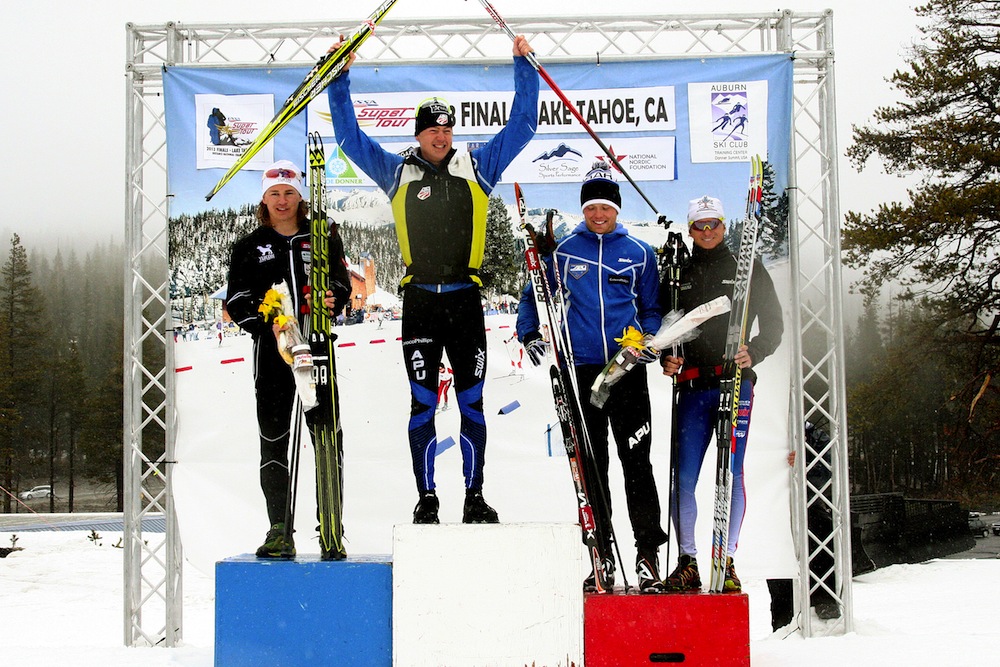
    APU and US Ski Team member Erik Bjornsen (second from left) celebrates his first career SuperTour victory at 2013 SuperTour Finals after winning Thursday's 3.3 k freestyle prologue at Auburn Ski Club in Soda Springs, Calif. Canadian Knute Johnsgaard (Yukon Elite Squad) was second), and Mark Iverson (APU) and Mike Sinnott (Sun Valley) tied for third. (Photo: Mark Nadell/MacBeth Graphics)
    APU and US Ski Team member Erik Bjornsen (second from left) celebrates his first career SuperTour victory at 2013 SuperTour Finals after winning Thursday’s 3.3 k freestyle prologue at Auburn Ski Club in Soda Springs, Calif. Canadian Knute Johnsgaard (Yukon Elite Squad) was second), and Mark Iverson (APU) and Mike Sinnott (Sun Valley) tied for third. (Photo: Mark Nadell/MacBeth Graphics)

    Bjornsen, who posted the fastest time of the day in 7:47, said he couldn’t see much of anything for the last half kilometer.

    “I was really unbalanced and kind of sloppy, but coach said I looked good at the finish,” he recalled. “I heard the time a little bit after and couldn’t believe it.”

    For Bjornsen, who won his first national title earlier this year at the age of 21, it was the first SuperTour win of his career and set him up nicely for the remaining four races at SuperTour Finals. With a 15 k classic mass start on Friday, Bjornsen will lead the standings by at least 14.5 seconds, the amount of time he beat Canadian runner-up Knute Johnsgaard by on Thursday.

    “It’s super exciting … and pretty unexpected,” Bjornsen said. “Coming into these races, I didn’t have a lot of pressure on myself. Now I see I might be in good form so I’m pretty excited for the rest of the races, and I hope I can go for the overall podium.”

    A year ago at SuperTour Finals in Craftsbury, Vt., Bjornsen tied Noah Hoffman for third in the 3.3 k freestyle prologue. Simi Hamilton of the Sun Valley Ski Education Foundation (SVSEF) and USST won in 5:59.4, and Sylvan Ellefson (Ski & Snowboard Club Vail/Team HomeGrown) was second.

    Bjornsen went on to finish third overall and was 12th in the U.S. Distance Nationals 50 k.

    This year, two men again tied for third, with Sinnott (SVSEF) and Mark Iverson (APU) finishing 15.7 seconds behind Bjornsen.

    Mike Sinnott (SVSEF) starting out Thursday's 2013 SuperTour Finals freestyle prologue at Auburn Ski Club in Soda Springs, Calif. He tied Mark Iverson (APU) for third. (Photo: Mark Nadell/MacBeth Graphics)
    Mike Sinnott (SVSEF) starting out Thursday’s 2013 SuperTour Finals freestyle prologue at Auburn Ski Club in Soda Springs, Calif. He tied Mark Iverson (APU) for third.

    “Man, that kid was flying,” Sinnott said of Bjornsen. “I started right behind him and I was on the steep wall with him and then I never saw him again.”

    With huge flakes swirling about the start slowing the course below, Sinnott made a mental note to copy Bjornsen’s strategy of starting easy then push up the big climb.

    “After the climb, there was still a ton of work and I hammered hard after that,” Bjornsen said.

    Sinnott did the same, fearing he’d lose ground on the backside into the stadium.

    “That’s what I wanted to do but just didn’t have it as much as him,” Sinnott said. “Hats off, that guy skied a really strong and smart race.”

    The tenth starter in the randomized A-seed of FIS points, Bjornsen was the only early racer besides Craftsbury’s Pat O’Brien (who finished fifth) to crack the top 10. Contenders who started before him, like Andy Newell (Stratton Mountain School T2/USST), Ellefson, and NCAA champions Miles Havlik and Rune Ødegård, did not make the top 20.

    Havlik started first and placed 28th, Newell went out fourth and ended up 35th, Ellefson placed 24th, and Ødegård was 47th. Bjornsen was also the only man to beat Kikkan Randall, who won the women’s race in 7:57.9.

    “It’s kind of hard to gauge sensations out here,” said O’Brien, of the Craftsbury Green Racing Project (CGRP). “Coming from sea level, everything feels really slow, a huge difference in ski speed. Right as we were heading out a big snow squall came in and was kind of like wet, heavy snow and I was skiing and didn’t have glasses or anything, kind of lost track where I was out on the course.

    “I’m super happy with how things went,” he added. “It’s a great way to start out the series. … [I’ve] been feeling kind of junky the last few days but I think in a short-enough race like this, you can kind of push through it.”

    Newell said he felt awful afterward, but that was normal for prologues. The conditions weren’t.

    “My skis were so slow; I’m hoping the other people’s felt that slow, too,” he said. “I almost fell over on the downhills, they were so sticky. It just started snowing so hard just before the start.”

    Knute Johnsgaard (Yukon Elite Squad) racing to second in Thursday's 2013 SuperTour Finals 3.3 k freestyle prologue at Auburn Ski Club in Soda Springs, Calif. (Photo: Mark Nadell/MacBeth Graphics)
    Knute Johnsgaard (Yukon Elite Squad) racing to second in Thursday’s 2013 SuperTour Finals 3.3 k freestyle prologue at Auburn Ski Club in Soda Springs, Calif. (Photo: Mark Nadell/MacBeth Graphics)

    Part of the newly formed Yukon Elite Squad, Johnsgaard started in the second half of the 100-man pack and rose to second despite not feeling great, either.

    “I felt really terrible actually,” the 20-year-old Whitehorse native said. “I felt slow with heavy legs. … I got a couple splits at the finish, but I didn’t really believe them because I felt so bad.”

    Coming off five races at Canadian Nationals in Whistler, B.C., which wrapped up last Saturday, Johnsgaard decided to change his plane ticket on a whim and finish his season in California in an effort to boost his FIS points.

    “I’m finally kind of getting to where I wanted to be all year so now I gotta make the most of it,” he said.

    Iverson, 30, hadn’t raced in two months since finishing second in the Boulder Mountain Tour in early February. He suffered a muscle injury in his back in a non-skiing-related incident afterward, “doing something stupid,” Iverson explained.

    He took 2 ½ weeks off completely and went on to take bronze in his first race back on Thursday.

    “My only experience in prologues at altitude was two years ago at Sun Valley and I had an epic, epic, just-came-to-pieces,” Iverson said of placing 85th in the 3.5 k at 2011 SuperTour Finals. “I just tried to go out and not panic and try to ski loose and try to maintain a lightness to the glide and kick.”

    It worked, as Iverson tallied another personal best this season. In January, he won his first SuperTour in Minneapolis and placed second overall in the Tour de Twin Cities.

    In terms of pacing this one, Iverson kept himself in check. During training on Wednesday, he did a Level 3-4 workout around the course with his APU teammates.

    Mark Iverson (APU) in Thursday's 2013 SuperTour Finals prologue at Auburn Ski Club in Soda Springs, Calif. Iverson tied Mike Sinnott (SVSEF) for third. (Photo: Mark Nadell/MacBeth Graphics)
    Mark Iverson (APU) in Thursday’s 2013 SuperTour Finals prologue at Auburn Ski Club in Soda Springs, Calif. Iverson tied Mike Sinnott (SVSEF) for third. (Photo: Mark Nadell/MacBeth Graphics)

    “We were all just gassed at the end,” he said, making a point not to go much harder on Thursday.

    While the prologue at altitude was undeniably tough, Iverson said he was enjoying his visit so far.

    “It could’ve been better weather, but it’s not much worse than Eagle Glacier in the summertime some days,” he said of APU’s summer training mecca near Anchorage.

    “When it’s beautiful, it’s absolutely amazing; you’re on top of a mountain in Alaska,” Bjornsen explained. “But when it’s raining, it’s way foggier and it’s way windier. You get rain like this, and it’s usually a lot softer than this. Snow doesn’t freeze … so I’ve actually gotten really good practice skiing in sloppy snow.

    “You kind of have to have a lighter touch,” Bjornsen added. “I’ve just learned a lot about that the last three years. I was just such a pure sprinter, I was hammering each of my strokes. My coach said I looked really smooth today and I think that’s part of it paying off on Eagle Glacier.”

    Rounding out the top 10, University of Colorado freshman Gustav Nordstom placed sixth, Brent Knight (APU) was seventh, Nils Koons (CGRP) was eighth, Brian Gregg of Central Cross Country (CXC) took ninth, and Tim Reynolds (CGRP) was 10th.

    — Audrey Mangan contributed reporting

    Results

    Photos courtesy of Mark Nadell at MacBeth Graphics. Click here for his SuperTour Finals gallery.

  • Bjornsen Leads Large U.S. Contingent at OPA Cup Finals

    Bjornsen Leads Large U.S. Contingent at OPA Cup Finals


    Sadie Bjornsen skiing to third in the OPA Cup Finals prologue. (Photo Courtesy Bryan Fish)
    Sadie Bjornsen skiing to third in the OPA Cup Finals prologue. (Photo Courtesy Bryan Fish)


    Sadie Bjornsen (USA), fresh off career-best World Cup results in both distance and sprint last weekend continued her hot streak, placing third in the OPA Cup Finals women’s 2.5km skate prologue.

    The three day mini-tour kicked off on Friday with a high-end field consisting of many names more often seen on a World Cup start list.

    Women’s winner Christa Jaeger (SUI) is not one of those, with just four World Cup starts, all as a Nations Group skier, but she edged out Slovenian Alena Cebasek by a mere .2 seconds nonetheless.

    Bjornsen was 5.4 seconds back in third just ahead of World Cup skiers Sandra Ringwald (GER) and Italians Elisa Brocard and Veronica Cavallar.

    After a trip she described as a “travel adventure” to get from Drammen, Norway, where she raced the World Cup sprint on Wednesday, to Toblach, Italy, Bjornsen told FasterSkier that she “didn’t have her normal amount of energy.”

    She described the race as “super short,” and never quite fired all cylinders.

    “I felt like I was almost still sleeping,” Bjornsen said. “Yesterday was such a frantic day. I felt like I never put myself into real time.”

    Becca Rorabaugh on course in Toblach. (Photo Courtesy Bryan Fiush)
    Becca Rorabaugh on course in Toblach. (Photo Courtesy Bryan Fiush)

    After wrapping up a successful World Cup tour with her first top-10, in the Lahti freestyle sprint, followed by an 18th in the 10km classic, Bjornsen said she is just looking to end the season on a positive note and have some fun.

    “I knew it was not going to be the most ideal conditions for travelling and being rested,” she said. “It is more a fun end of the year challenge myself sort of thing. I don’t have huge expectations but of course it would be fun to win and tomorrow I am going to try to win again.”

    According to Bjornsen the Italian course is more rolling than precipitous. Instead of the “walls” and steep descents that are often found on World Cup courses, transitions are the key in Toblach.

    Kate Fitzgerald was the second American in 12th, less than two seconds behind 10th place finisher, and World Cup stalwart Steffie Boehler (GER).

    Erika Flowers was 22nd, Caitlin Patterson 24th, Becca Rorabaugh 26th and Anna Van der Rhee 37th in the 37-woman field.

    After spending the past two months on the World Cup, including two weeks just south in Val di Fiemme for World Championships, Bjornsen said it was nice to be back with the Continental Cup crew, and that the experience made her appreciate the World Cup circuit event more.

    “Here there are two wax techs for 15 skiers,” Bjornsen said. “It reminds you of how lucky you are on the World Cup with so much support.”

    With a hard effort under her belt after the long travel, Bjornsen has two more opportunities for victory — in Saturday’s 5k classic or Sunday’s 10k freestyle pursuit.

    Patrick Johnson (Photo Courtesy Bryan Fish)
    Patrick Johnson (Photo Courtesy Bryan Fish)

    In the men’s 3.3k event, Mike Sinnott led the way for the Americans, placing 29th, 19.4 seconds behind winner Loris Frasnelli (ITA).

    “I think the race went about as well as it could given how I felt, but it wasn’t anything special,” Sinnott wrote to FasterSkier in an email.

    “My body has been flat since I came to Europe and while this was a step in the right direction, it’s still not all there,” he continued.

    Erik Bjornsen was 36th, Patrick Johnson 39th, Matt Gelso 48th, Sam Tarling 54th and David Norris 62nd.

    Both Tarling and Norris are back in Europe after racing at the NCAA Championships last weekend in Middlebury, Vermont.

    Cold temperatures and sunny skies made for excellent skiing in the Italian Dolomites.

    Women’s Results

    Men’s Results

    Audrey Mangan contributed reporting

    Erik Bjornsen (Photo Courtesy Bryan Fish)
    Erik Bjornsen (Photo Courtesy Bryan Fish)
  • Gregg Sprints for Owl Creek Title; DeYong Demolishes in Aspen

    Gregg Sprints for Owl Creek Title; DeYong Demolishes in Aspen

    Brian Gregg (CXC) claiming the 2013 Owl Creek Chase on Sunday in Aspen, Colo. Photo: Mike Hoffman.
    Brian Gregg (CXC) claiming the 2013 Owl Creek Chase on Sunday in Aspen, Colo. Photo: Mike Hoffman.

    ASPEN, Colo. — The Owl Creek Chase is not a race to be entered lightly. The 21 k course is a taxing point-to-point that starts at the Snowmass Cross Country Center, traverses the slopes of Buttermilk and comes out at the Aspen Valley Ski & Snowboard Club after thousands of feet of long, grueling climbs and dizzying descents. Race favorites describe it as a survivor’s course; murderously challenging. Go too hard, too early, and it will bury you.

    It should come as no surprise that Central Cross Country’s Brian Gregg and Sun Valley Ski Education Foundation’s Nicole DeYong conquered such terrain. Both skiers are notorious climbers and well-acclimated altitude racers, and have learned from experience what it takes to outlast at Owl Creek.

    “Owl Creek can be pretty painful if you go too far under,” Gregg said. “The last time I was here…the wheels just came off. I don’t think I’ve ever hurt that bad.”

    This year Gregg made sure to prepare himself accordingly for the 8,000-foot height and daunting course profile. He and his wife, Caitlin, have been staying with family in Eagle, Colo., for weeks to train high in preparation. They both skipped the classic races on Saturday to save up for the main event, unlike many of their competitors.

    On Sunday it paid off, and Brian outsprinted Sylvan Ellefson (Ski & Snowboard Club Vail Team HomeGrown) by eight seconds to finish in 1:02:04.4 in sunny, hard-packed conditions. Mike Sinnott (SVSEF) took third (+1:23).

    Sylvan Ellefson (SSCV) leading Gregg up one of the last few climbs. Photo: Mike Hoffman.
    Sylvan Ellefson (SSCV) leading Gregg up one of the last few climbs. Photo: Mike Hoffman.

    You read that right — in a sprint finish, Gregg outsprinted the field. The CXC veteran has been working particularly hard on his closing kick all year with his coach Scott Johnston and the Methow Olympic Development squad to turn himself into a better all-around skier.

    “I’ve done a lot of workouts where we’ll ski 800 meters or something and sprint as hard as we can the last 300 meters to work on that finishing speed,” Gregg said. “It’s always been a weakness of mine, so I got to focus on that this summer and now I’m seeing it come together in the race season.”

    It took a full 20 k of intelligent skiing for Gregg to be in a position to kick it in at the end, for the preceding kilometers and broke many a strong skier. The race began at a controlled pace; Brent Knight (Alaska Pacific University) fell in the opening seconds and the leaders waited considerately for him to catch back on. When the lead pack developed, Gregg, Ellefson, Sinnott, Knight and Matt Gelso (SVSEF) helped each other conserve energy and rotated turns setting the pace at the front.

    Ellefson and Gregg eventually broke away before the halfway mark and continued to switch in and out of lead duty as they came into the final 5 k on the Aspen trails.

    Brent Knight (APU) battles a climb as MIke Sinnott (SVSEF) gains ground from behind. Photo: Mike Hoffman.
    Brent Knight (APU) battles a climb as MIke Sinnott (SVSEF) gains ground from behind. Photo: Mike Hoffman.

    “I kind of pulled it in I guess to keep away third and fourth, but also keep the pace high so no win would come too easy,” Ellefson said. “But I think I led a little bit more than I wanted to that last 5 k. I don’t know if it was the three races beforehand or what, but my legs just couldn’t do it in the last 200 meters.”

    A minute back, Sinnott gained back a deficit on Knight to claim bronze. At such a suffer-fest of a race, he was happy to hang on to a podium spot.

    “I was fighting with those guys for a while, and then once you crack on this course you go backwards fast,” Sinnott said. “I saw a big chase pack coming so I was happy to hang onto third — those sharks were coming up behind me pretty quick.

    “It’s a beautiful course, really fun, but so murderously painful. It just hurts. It’s about who’s toughest and who can survive, and I was not the survivor today.”

    Knight finished 0.3 seconds behind Sinnott for fourth. Colin Rodgers (SVSEF), a coach at most races, took fifth after a 30-second break in the field. Patrick Johnson (SVSEF) was sixth, 29 seconds behind Rodgers.

    Though the course is a lung-burner, most finishers looked happy as they crossed the finish line under the Aspen sun.

    “I love this course, it’s one of my favorites,” Ellefson said. “I was expecting to be skiing in six inches of powder this morning and was not looking forward to that, so when the tracks were firm this morning it was good vibes today.”

    Complete results.


    Nicole DeYong (SVSEF), a competition team coach for Sun Valley, claimed the Owl Creek Chase by two minutes on Sunday in Aspen, Colo. Photo: Mike Hoffman.
    Nicole DeYong (SVSEF), a competition team coach for Sun Valley, claimed the Owl Creek Chase by two minutes on Sunday in Aspen, Colo. Photo: Mike Hoffman.

    The women’s race played out much like the men’s in the beginning — the course practically requires a comfortable early pace. No one wants to blow up too early at Owl Creek. But in the end DeYong won by a whopping two minutes over Lenka Palanova (Boulder Nordic Junior Race Team).

    “From many years of experience I’ve discovered it’s good to just kind of sit back for a little bit and find a good rhythm,” DeYong said. “I was feeling pretty tired and sore this morning, so I just wanted to play it conservatively.”

    DeYong won Owl Creek once before in 2010 — in fact it’s the only race she’s ever won. She no longer races full time and doesn’t put too much pressure on results, and on Sunday she just hoped hoped for a good feeling after racing the 5 k classic the day before.

    The pace went out “comfortably.” Palanova, DeYong, Alexa Turzian (SVSEF), Rosie Brennan (APU) Erika Flowers (SMS T2) and Caitlin Gregg (CXC) splintered off from the rest of the field as the course wound around a hilly Snowmass golf course in the first 5 k.

    Palanova drew first blood at the front of the train, not content to sit back at a leisurely pace.

    Lenka Palanova (BNJRT) finishing second at Owl Creek for the second year in a row. Photo: Mike Hoffman.
    Lenka Palanova (BNJRT) finishing second at Owl Creek for the second year in a row. Photo: Mike Hoffman.

    “I didn’t want them to play the tactical game,” she said. “When I realized they were going a little bit too slow I just went for it.”

    Palanova pulled at the front for most of the first kilometers in an attempt to separate the women from the girls, but when the group reached the first major downhill it became clear that DeYong had extremely fast skis. Once DeYong got in a tuck and zoomed away from the field, most figured the race was pretty much over.

    “After we crested the first pass Nicole had ridiculous skis, and pretty much just tucked away from us and that was the end of that,” Brennan said.

    Gregg and Brennan attempted to follow her, but DeYong was skiing on another level.

    “The skis were running so well I just decided to go with it,” DeYong said. “I was praying for a good feeling in the body and I had it.”

    Behind her, attempts to close her breakaway were futile.

    “I was kind of dumb and tried to go really hard to catch back up, because I thought it’d be easier if I could draft, but I just spend the whole time trying to catch up instead of actually resting,” Brennan said.

    At Owl Creek it can be a death sentence to go too hard too early, and Brennan said she paid the price at the end, gradually losing time on DeYong as Palanova closed in from behind.

    “I don’t know if Rosie started getting tired or I started getting faster, but I caught her before the last 5 k,” Palanova said.

    The BNJRT coach and former Colorado University star kept an even pace as she moved around the last few kilometers, expecting Brennan to be right behind her. When Palanova realized there was no one in sight, she thought, “‘Oh, I should maybe hammer.’ So I did,” she said. “But I think I was more lucky than anything else at that point, because I didn’t have much left.”

    DeYong. Photo: Mike Hoffman.
    DeYong. Photo: Mike Hoffman.

    Up front, meanwhile, DeYong created an insurmountable gap. She put on an early surge when she came into the final kilometers at the Aspen Valley course, forgetting about one of the last hills. Somehow, she still found enough energy to keep up the pace and took the win by a two-minute margin.

    “I forgot you have to go all the way around and back down, and it some ways I think that was good for me, that I forgot the whole second half of the [final 5 k],” DeYong said with a laugh. “I don’t know if strategically I would have raced the way I did had I known what I was doing.”

    While it’s out of the ordinary for junior team coaches to take the top two spots in a SuperTour, DeYong and Palanova in aren’t exactly surprises at the top of these particular results. They both know the Owl Creek Creek course well, have an affinity for long, gradual climbs and ski most of the year at altitude. It takes a different kind of skiing this high up, and both women are practiced at it.

    “If you are able to suffer through it, you’re going to do well,” Palanova said. “I think at the end the move I did at the beginning was maybe good, because maybe that made them tired… But who knows, most of these girls aren’t used to skiing at high altitude.”

    Brennan confirmed that Owl Creek was a beast of a course.

    “I was hoping it would be easier this year because I’m in better shape, but I don’t think it matters how good of shape you’re in for this race, it’s just really hard,” she said. “Very challenging… It’s an unusual course, it’s not something you see every time, so it’s fun to mix it up.”

    Fourteen seconds behind Brennan, Flowers took fourth. Gregg finished fifth (+3:10) and Tammy Jacques (Steamboat Springs) was sixth (+3:34).

    Women’s results.

    Special thanks to Mike Hoffman for taking photos so that this reporter could ski in the citizen’s race.

    Men's Owl Creek podium: 1. Brian Gregg (CXC), 2. Sylvan Ellefson (SSCV), 3. Mike Sinnott (SVSEF), 4. Brent Knight (APU), 5. Colin Rodgers (SVSEF), 6. Patrick Johnson (SVSEF). Photo: Mike Hoffman.
    Men’s Owl Creek podium: 1. Brian Gregg (CXC), 2. Sylvan Ellefson (SSCV), 3. Mike Sinnott (SVSEF), 4. Brent Knight (APU), 5. Colin Rodgers (SVSEF), 6. Patrick Johnson (SVSEF). Photo: Mike Hoffman.
    Women's Owl Creek podium: 1. Nicole DeYong (SVSEF), 2. Lenka Palanova (BNJRT), 3. Rosie Brennan (APU), 4. Erika Flowers (SMS T2), 5. Caitlin Gregg (CXC), 6. Tammy Jacques. Photo: Mike Hoffman.
    Women’s Owl Creek podium: 1. Nicole DeYong (SVSEF), 2. Lenka Palanova (BNJRT), 3. Rosie Brennan (APU), 4. Erika Flowers (SMS T2), 5. Caitlin Gregg (CXC), 6. Tammy Jacques. Photo: Mike Hoffman.


  • Johnson Makes Podium Debut with Aspen Win; Brennan Prevails in Women’s Classic

    Johnson Makes Podium Debut with Aspen Win; Brennan Prevails in Women’s Classic

    Patrick Johnson (SVSEF) en route to winning the 10 k classic at the Aspen, Colo., SuperTour on Saturday.
    Patrick Johnson (SVSEF) en route to winning the 10 k classic at the Aspen, Colo., SuperTour on Saturday.

    ASPEN, Colo. — As Nemo shook the East with buckets of snow, the winter gods smiled upon the Rockies, too, with inches of heavy flakes on Saturday morning as the Aspen SuperTour got underway. The powder was a blessing for a state that’s had a mediocre winter, but for the handful of nordic skiers that braved the storm in spandex and a race bib it was a daunting environment in which to line up for one classic race, let alone the two in one day.

    Rosie Brennan (APU) skiing to a sprint prologue win in dense snowfall.
    Rosie Brennan (APU) skiing to a sprint prologue win in dense snowfall.

    “This morning was rough,” said Alaska Pacific University’s Rosie Brennan. “You couldn’t see anything. The tracks were washed out and my skis weren’t kicking very well, so it was sort of a struggle.”

    It was a sparse field that braved the conditions for the classic sprint qualifier, which preceded the individual distance event, but the adaptable skiers prevailed. Brennan won the 1 k prologue in 4:26, 13 seconds ahead of teammate Lauren Fritz (APU). Erika Flowers (SMS T2) finished third (+0:20) and five elite women finished the race in total as inches of snow piled up in the tracks.

    The men’s race was equally vicious. “It was very slow,” said Mike Sinnott (Sun Valley Ski Education Foundation). “I think I came to a stop a couple times. It was a brutal, painful sprint, and I don’t think anyone felt like the were sprinting.”

    Sinnott took the prologue win in 3:40, seven seconds ahead of Sylvan Ellefson (Ski & Snowboard Club Vail Team HomeGrown). Peter Kling (APU) took third (+0:14).


    After toughing it trough a kilometer of powder at 8,000 feet skiers had two hours to gear up for round two, a 5/10 k individual start classic. A Pisten Bully smoothed out the course in between events, and right on cue the skies ceased cleared as starters began to line up again.

    Thanks to high elevation, a hilly course and slightly soft tracks, the second event of the day belonged to the mentally tough. Patrick Johnson (SVSEF), still in his first season out of college, landed his first career SuperTour podium and gold medal all at once, taking the men’s 10 k by six seconds over Ellefson.

    Johnson laps through the field.
    Johnson laps through the field.

    “I think today it was slow conditions and you just had to ski smoothly, and I’m not really much of a sprinter so it was more of a distance skier’s course,” Johnson said. “I think that’s what helped make it a good day for me.”

    The Middlebury College alum has been generally happy with his racing this season — he was fifth in the 15 k at US Nationals — but has skied just shy of breaking through to top of the results.

    “It’s always been just sort of waiting to get that few extra seconds that can move you up on the list,” Johnson said. “It came through today.”

    He had never raced in Aspen before Saturday, but now that he’s collected his first win at the nordic center Johnson feels pretty good about the venue.

    “I really like it, obviously,” he said.

    While Johnson was having the race of his life, Ellefson salvaged a painful race to finish just six seconds out of first. The Vail native had raced a 10 k and the prologue in the 24 hours preceding the classic event and started to pay the price.

    Sylvan Ellefson (SSCV) climbing.
    Sylvan Ellefson (SSCV) climbing.

    “I was pretty tired from the sprint,” he said. “Just because all of the snow we got, the sprint felt like I was going 10 k pace, so it was a little bit confusing out there.”

    Ellefson knew he wasn’t skiing spectacularly as he moved around the hilly course, but minimized the damage by reminding himself he was in good shape.

    “I had an internal battle with myself at the 5 k mark,” he said. “I was like, ‘Man, I’m locking up everywhere, I’m not feeling super great, but I know my fitness is good right now so I just have to work with what I have.’”

    Over the remaining 5 k Ellefson brought himself back to a “good mental state” and closed a 15-second deficit on Johnson to finish just six seconds behind him. At relatively relaxed race where teams help each other with wax support, Ellefson was impressed with the victor’s effort.

    “I’m really excited for Patrick Johnson,” Ellefson said, nodding in his direction. “It’s his first podium and first SuperTour win.”

    Brent Knight (APU) continued a strong run of recent SuperTours to finish third, 41 seconds off Johnson’s mark. In a season he characterizes as consistent, he was pleased to put together a strong classic result the day after a punishing 10 k skate in Vail on Friday.

    “I’m super happy with the result,” Knight said. “I raced about as smart as I could. I’ve been in and out of altitude all season and…I think it’s really made a difference, learning how to ski more consistently and learning how to race smart up here.”

    Brent Knight.
    Brent Knight.

    Though there have been many SuperTours at elevation this season, Knight considers 8,000 feet to be a world away from a place like Sun Valley, Idaho, which is a few thousand feet lower.

    “In Aspen and Vail it’s a whole other beast,” he said. “When you’re racing up here if you cross the red line, you’re toast. So up here it’s more just playing with that fine line. The guy who can sit right under that red line the whole time is the guy that’s going to win, generally.”


    ***

    In the women’s 5 k Brennan followed up her prologue victory with a seven-second victory over Nicole DeYong (SVSEF), and Flowers repeated as the bronze-medalist (+1:01).

    Brennan taking her second SuperTour win in two hours.
    Brennan taking her second SuperTour win in two hours.

    For those who are counting, Brennan has now racked up five wins this season. Though the Park City, Utah, native spent the past week at home she noted how difficult racing is at Aspen’s elevation.

    “Even though I grew up at altitude I’ve found that 8,000 feet is the tipping point where I no longer have the comfort that I do a 6,000 feet,” she said. “So I was definitely hurting a lot out there… Doing three races in a row [here] takes it all out of you and I’m just focused on recovery and making sure it doesn’t crush me for later on.”

    Though the field was only 29 women strong — “Am I racing right now?” Brennan recalled thinking — it was fairly strong at the top end. On what was a slow 5 k course, DeYoung came within striking distance of the win.

    “I actually like this course and I’ve raced it quite a few times,” DeYoung said. “I’ve learned from racing here before to pace yourself and just to ski smooth and relaxed and I felt like I was able to maintain it the whole way and finish strong. That’s what I was hoping for.”

    DeYong no longer considers herself a racer as most of her time is spent coaching the Sun Valley competition team, but she stays active enough to enjoy herself and do well at a race most of the field considers daunting. Her last race appearance was at the season opener in West Yellowstone, Mont.

    Nicole DeYoung, 2nd.
    Nicole DeYong, 2nd.

    “Someone asked me if I was coming back into racing and I was like, the problem with that is if I do that I have expectations, mostly on myself, and then it seems to go downhill,” DeYong said. “So I’m just here for fun, just because I enjoy skiing.”

    Flowers, who took third having never before raced in Colorado, was on board with DeYong’s thoughts on Aspen.

    “I liked it, except that it’s really hard,” Flowers said. “You’re breathing hard from your first kick…but it’s fun, it’s so nice here. When we were skiing the [Owl Creek] course easy the other day it was so sunny.”

    The 21 k Owl Creek Chase, the weekend’s main event, starts on Sunday at 11:00 a.m. MT.

    Sprint prologue results

    5/10 k classic results not yet posted; check back here.


  • Koos and Brennan Triumphant at Tour de Twin Cities; Greggs Take Stage 5 Wins

    Koos and Brennan Triumphant at Tour de Twin Cities; Greggs Take Stage 5 Wins

    The 2013 Tour de Twin Cities men's overall podium. 1. Torin Koos, 2. Mark Iverson, 3. Mike Sinnott, 4. Brian Gregg, 5. Brent Knight. Photo: Reese Hanneman.
    The 2013 Tour de Twin Cities men’s overall podium. 1. Torin Koos, 2. Mark Iverson, 3. Mike Sinnott, 4. Brian Gregg, 5. Brent Knight. Photo: Reese Hanneman.

    Five stages and over a week has gone by since the 2013 Tour de Twin Cities began at Wirth Park in Minneapolis, Minnesota, and on Sunday the event concluded dramatically with a 10/15 k freestyle pursuit. After dozens of accumulated laps around the 3.3 k course, Torin Koos (Bridger Ski Foundation/Rossignol) and Rosie Brennan (Alaska Pacific University) each maintained starting leads and emerged victorious in the overall Tour standings. Husband-and-wife duo Brian and Caitlin Gregg (Central Cross Country) both posted the fastest times of the day for the stage five wins.

    On a short, rolling course, the men’s 15 k unfolded in predictable fashion: the leaders played with a confortable pace until a final sprint to the finish. Koos began the 15 k pursuit with a 17-second lead on Mike Sinnott (Sun Valley Ski Education Foundation), and with such a small head start he expected the race would come down to the last stretch

    “Even before the Tour began, I just knew it was going to come down to the final hunting-start 15 k freestyle,” Koos wrote in an email. “And after seeing how it was so hard for anyone to break away and hold a lead in the mass start 20 k classic, this became more apparent.”

    Sinnott and Mark Iverson (APU) left the gate only nine seconds apart and skied together to close the gap on Koos, and by the end of lap three the trio was skiing together at an easy pace, with Iverson leading.

    “We slowed down after that and played some little cat and mouse games for laps four and five, content to let it come down to a sprint,” Sinnott said.

    Iverson attempted to drop the other two on the last few laps, but was unsuccessful. “On that course, fast with only one real working section, it didn’t work. So we all just settled down with me leading,” he said.

    Koos surged ahead with a kilometer to go and held on to the lead through the finish, ultimately winning the Tour by a few seconds.

    “In the end, I had an extra step on those two guys and was able to take the [Tour] title by a ski length,” Koos said. “I was pretty psyched to take the overall win. It’s a really great event, one I hope that becomes a staple for the U.S. ski racing circuit.”

    Behind him, or rather almost next to him, the battle for second and third was less certain. A jockey between Sinnott and Iverson for the same finish lane generated some contact between them, which Sinnott considered to be the result of a questionable move from Iverson.

    With a lead of a few meters Koos was able to chose the center finishing lane, forcing Iverson and Sinnott to go to the inside as they came out of a hard, downhill corner that spit into the finish stretch. The two skied neck-and-neck as they sought the same left-hand lane, causing their boots to briefly connect in the last 50 meters of a fast finish.

    In Iverson’s words, he chose the left lane “just in front of Mike. I didn’t want to go wide. Mike and I bumped a bit fighting for the left lane and we both lunged together for the line. Torin was able to get the win and it was really close between Mike and I.”

    Sinnott was more descriptive about how the sprint played out, and considered the “bump” with Iverson in the finishing lanes to be a definite infraction of the rules.

    “In the finish, I took the inside line as Torin went wide and Mark skied between lanes,” Sinnott wrote in an email. “Mark then decided to shift over, making contact between his boots and mine. He knocked me into the V-boards and I was forced to double pole the remaining 50 m as my lane was no longer mine. The result left me in third and pretty peeved about the clear infractions.”

    After the finish Sinnott found spectators who had taken photographs of the incident and brought them before the Technical Delegate, but to no effect.

    “I found some photos and several witnesses but was told by the TD, ‘you can protest, but I’ve already made up my mind. So…’ He refused to look at the photos, and again dismissed me when I mentioned [Alexander] Legkov’s move in the Tour [de Ski], resulting in a 15 second penalty,” Sinnott said.

    “Basically, I had a strong chance to win, it’s hard to say, but was unequivocally obstructed by Mark as he moved between lanes. As a result, I ended third. It was not how I’d like to see the hard fought five-day event end.”

    FasterSkier was not present at Wirth Park, and at press time had only Sinnott’s and Iverson’s accounts of what happened. Besides the finish line incident, Tour competitors were generally happy with how organizers put together the event.

    Regardless of how the last 100 m unfolded, Iverson’s run at the podium this week has been the best racing of his career. On Sunday he skied the second-fastest time of the day, 36:07.4.

    The men's stage five podium. 1. Brian Gregg, 2. Mark Iverson, 3. Mike Sinnott. Photo: Reese Hanneman.
    The men’s stage five podium. 1. Brian Gregg, 2. Mark Iverson, 3. Mike Sinnott. Photo: Reese Hanneman.

    “It has been really exciting, and satisfying to feel I’m in the race everyday and be confident in my skiing,” Iverson said. “I wasn’t sure that I could catch up and make it a race today after loosing some time to Koos and Sinnott yesterday, but I was patient and just tried to ski my race.”

    Gregg, after starting stage five 1:36 down to the leaders in sixth place overall, skied the fastest time of the day to move up to fourth in the final standings.

    “I went in to the day planning on skiing my own race against the clock today,” Gregg said. “I started 1:36 off of the lead, but I wanted to have the fastest time of the day.”

    He made up the difference between himself and Karl Nygren (CXC) and Brent Knight (APU) by 4 k, and together the three skiers made up some of the time on the leaders by the final lap.

    Everyone became intimately familiar with the Wirth Park course by the end of the week, but Gregg is especially at home on it as he lives only a few minutes away. He thought the proximity to the race venue played a big part in his success on Sunday.

    “It is a huge advantage to be at home during the middle of the ski season and to be so close to the race venue,” Gregg said. “I think that played a large role in our success on this fifth day of racing. Not too many people are lucky enough to have a 3.3 k snow-making loop within jogging distance of their house.”


    Women’s 10 k Pursuit

    Rosie Brennan (APU) maintaining her lead to take the overall Tour win. Photo: Reese Hanneman.
    Rosie Brennan (APU) maintaining her lead to take the overall Tour win. Photo: Reese Hanneman.

    As in the men’s race, the women’s 10 k pursuit was a closely-fought race. Rosie Brennan (APU) began with a small lead on her competition —Jennie Bender (CXC) started 17 seconds behind her, Kate Fitzgerald (APU) left the line 13 seconds after that, and Caitlin Gregg started at 1:05. With such formidable skaters hunting her down, Brennan knew the overall Tour victory would take everything she had.

    “I had the whole field chasing me which certainly added to the nerves this morning!” Brennan said. “I went out hard hoping [to] make catching me harder, however, after racing the previous two days, my legs did not feel good so I ended up really fighting the whole way.”

    On the relatively short loop Brennan could see her competitors as the course wound around twists and turns, which alerted her to the fact that Gregg was having an incredible race.

    “I could see my chasers frequently and was doing my best to judge time, but man, that’s hard to do and really only led me to panic more seeing who was coming for me,” Brennan said. “By the end of the second lap I realized Caitlin was crushing it and not slowing down, so I did my best to hold it together and push hard on the last lap.”

    Brennan was able to hold Gregg at bay and win the overall, which she was plenty happy with.

    Caitlin Gregg (bib 104) gunning down Kate Fitzgerald (102). Photo: Reese Hanneman.
    Caitlin Gregg (bib 104) gunning down Kate Fitzgerald (102). Photo: Reese Hanneman.

    “It was really stressful and not much fun having to hammer out 10 k alone with a whole field chasing, so I am thankful to have been able to hold it together and stay tough,” she said.

    “I don’t think there was anything I could have done to beat Caitlin on the day, though. She was just flying out there. I have always admired Caitlin’s incredible skating so I really can’t complain about taking second to her.”

    Gregg ended posting the fastest time by 35.9 seconds. Taking a page out of Lindsay Vonn’s book, the 32-year-old decided right before the start to race on her husband’s winning skis from earlier that morning.

    “He told me how fast they felt and I realized that with such a flat course I could probably get away with longer stiffer skis!” Gregg said. “So I tested them for a lap and confirmed I could ski them on the short steep climbs (without tripping) and went with them. The skis were actually Brian’s stiffest pair so he told me to ski like a big girl on them to make them work.”

    With the goal of setting the day’s fastest course time, Gregg was pretty happy with how the choice turned out.

    “I knew I had a lot of time to make up but I wanted to win the individual race, so I just went out gunning for a good time,” she said.

    Brian and Caitlin have been racing together for years, but Sunday was the first time they both won the same race.

    “I have always wanted to share the top step of the podium with Caitlin in a Super Tour and it was cool to have that happen,” Brian said.

    Stage winners receive $450 for the win on top of the overall purse that goes six deep. Between the Greggs’ stage five victories, Caitlin’s second place finish overall and Brian’s fourth, the couple earned $2,700 on Sunday alone.

    “Race winnings are the largest part of our income and it was great to have things come together today,” Brian said.

    Kate Fitzgerald (APU), one of the most consistent skiers all week, finished third on the stage once again to take third in the Tour. She started just ahead of Gregg with full knowledge of the latter’s strength in skating, and sought to hold her off as long as she could.

    “I know that she is a ridiculously strong skater, and sure enough she came storming past me and it was all I could to do hang on!” Fitzgerald said. “Caitlin, Jennie, and I were in a pack for a little while but then Caitlin’s speed started to break us up. She had an awesome race today.”

    Bender finished fourth in the overall standings, Clare Egan (Craftsbury Green Racing Project) took fifth and Erika Flowers (SMS T2) was sixth.

    Complete results from stage 5.

    Overall Tour Standings not yet available – check back at Summit Timing.

    The women's stage five podium. 1. Caitlin Gregg, 2. Rosie Brennan, 3. Kate Fitzgerald. Photo: Reese Hanneman.
    The women’s stage five podium. 1. Caitlin Gregg, 2. Rosie Brennan, 3. Kate Fitzgerald. Photo: Reese Hanneman.
    The women's overall Tour de Twin Cities podium. 1. Rosie Brennan, 2. Caitlin Gregg, 3. Kate Fitzgerald, 4. Jennie Bender, 5. Clare Egan, 6. Erika Flowers. Photo: Reese Hanneman.
    The women’s overall Tour de Twin Cities podium. 1. Rosie Brennan, 2. Caitlin Gregg, 3. Kate Fitzgerald, 4. Jennie Bender, 5. Clare Egan, 6. Erika Flowers. Photo: Reese Hanneman.


  • Hanneman Secures Distance Win in 10k Classic at Wirth Park

    Hanneman Secures Distance Win in 10k Classic at Wirth Park

    The men's 10 k classic podium at the Tour de Twin Cities. 1. Reese Hanneman (APU) 2. Mike Sinnott (SVSEF) 3. Torin Koos (BSF/Rossignol). Photo: Brent Knight.
    The men’s 10 k classic podium at the Tour de Twin Cities. 1. Reese Hanneman (APU) 2. Mike Sinnott (SVSEF) 3. Torin Koos (BSF/Rossignol). Photo: Brent Knight.

    The winner of the 10 k classic stage of the Tour de Twin Cities in Minneapolis, Minnesota, on Saturday is a name you’ve probably heard of, but is not one usually associated with distance podiums. Reese Hanneman (Alaska Pacific University), surprising even himself a bit, won the individual start classic race at Wirth Park for his first career SuperTour distance win. He beat Mike Sinnott (Sun Valley Ski Education Founation) and Torin Koos (Bridger Ski Foundation/Rossignol) in second and third, respectively.

    When a sprinter makes that kind of jump in a distance race it’s reasonable to expect him to make a big deal out of it, but Hanneman seemed relatively calm about the result.

    “I wasn’t expecting to win, I just kind of thought if I had a good race I could get on the podium,” he said. “And obviously on a course like this, when it’s so tight, then if you have a little bit better of a race then you can win. So when I started hearing I was doing that well I really pushed it hard. I have the speed to win on courses like this.”

    The course at Wirth Park was relatively flat, with short and quick uphills that worked to Hanneman’s strengths. A teammate, Brent Knight, started 15 seconds ahead of him on Saturday, which gave Hanneman an indication he was skiing well before he got his first split. Knowing the course favored skiers who could go “full throttle” for the whole thing, Hanneman sought to work the course from the get-go.

    “I knew that suits me pretty well, I have the speed, and if there’s no five-minute climbs I can usually do OK,” he said. “I went out pretty fast and tried to ski relaxed and also just working everything; trying to ski really fast because there’s no really sections that you have to pace.”

    When Hanneman heard a split that had him leading the race, it only spurred him to work a little harder.

    “I was a little surprised but I knew it wasn’t impossible, so obviously that got me pretty fired up, and from there it was basically a 5 k sprint to the finish line. I knew I needed to finish real fast because I knew Torin for sure would be finishing the last couple kilometers insanely fast.”

    With the help of fast skis and tracks that held up well for striding, Hanneman made it to the finish line a full thirteen seconds ahead of Koos, who took third, and five seconds ahead of Sinnott in second.

    “The tracks were pretty good all the way around,” Hanneman said. “Even the tracks on the two steep hills — yesterday they weren’t there, but today they stayed so it was possible to stride, which was really nice. They did a good job of setting the tracks; up to this point they’d been a little bit questionable.”

    Hanneman’s skiing drew admiration from his competitors.

    “I was really psyched to see Reece move so fast, it’s nice to see such a classy guy pull out the win,” Sinnott said.

    As for his own race, Sinnott was pretty happy. He gave everything he had, and that’s always his first takeaway from a race effort.

    “I raced hard and don’t feel like i could have done much more,” he said. “That’s the bottom line of weather I’m happy or not, did I give it my best… My goals going in were to win, same as every race. A tertiary goal was to put time into Torin and Mark, which I did, but I would have liked to see more. You can always want more.”

    Koos had a similar thought: happy with a podium, but always going for the win.

    “The podium is always nice, but I wouldn’t have minded being a step or two higher… but all in all, a decent competition and good day at the races,” he said.


    Women’s 5 k

    The women’s race was an incredibly close contest. Rosie Brennan (APU) just nipped Jennie Bender (Central Cross Country) by 0.6 seconds after 5 k of racing against the clock. Kate Fitzgerald (APU) took third, 10.3 seconds back.

    Brennan, who began her 5 k in search of some redemption from Friday’s sprint, was pleased with her second win of the Tour.

    “I was very happy to win today, even if only by 0.6,” she said. “I was disappointed with the way I skied yesterday so I was looking to turn things around today.”

    Brennan noted that the racing atmosphere has been more relaxed this week with SuperTour athletes scattered all over the world at this point in the season.

    “With a small field it was difficult to tell how the race was going because all the seeds were mixed in and we don’t have any coaches here giving splits,” she said. “I did get one split with less than a k to go and I was told I had six seconds on Jennie, but after seeing what she did to me in the last k of the mass start, I was afraid six seconds wasn’t enough. But I didn’t want to make the same mistakes as last time.

    “It was just barely enough.”

    Bender, though disappointed to lose by such a small margin, was satisfied with her race.

    “Ahh, so close!” she wrote in an email. “As much as I would have been super pumped to capture all three classic titles, I was happy with my race. Individual starts are always interesting. Upfront they are less intense because you’re on your own, but afterwards they are more stressful compared to mass starts, because there is less feedback until you see the results.”

    On the rolling course at Wirth Park, Bender knew every meter would be critical.

    “It is a fairly roll-y course, so seconds were gained and lost quite easily if you turned your brain off even for a moment. I started out sixth, and I got a split off of Kate Fitzgerald, but had no idea what was going on behind me. I had a fast first lap, and tried to keep the pace my second but probably slowed a little.”

    Fitzgerald took third, 10.3 seconds off Brennan’s winning time.

    The fifth and final stage of the Tour de Twin Cities, a freestyle pursuit, takes place at Wirth Park on Sunday.

    Complete results.

  • Bender, Sinnott Take Classic Sprints at Tour de Twin Cities

    Bender, Sinnott Take Classic Sprints at Tour de Twin Cities

    The men's classic sprint podium from stage three of the Tour de Twin Cities. 1. Mike Sinnott (SVSEF) 2. Torin Koos (BSF/Rossignol) 3. Reese Hanneman (APU). Photo: Brent Knight.
    The men’s classic sprint podium from stage three of the Tour de Twin Cities. 1. Mike Sinnott (SVSEF) 2. Torin Koos (BSF/Rossignol) 3. Reese Hanneman (APU). Photo: Brent Knight.

    After a cold-induced delay in competition the Tour de Twin Cities continued on Friday in Minneapolis, Minnesota, with a classic sprint at Wirth Park. In conditions more amenable to racing, Mike Sinnott (Sun Valley Ski Education Foundation) and Jennie Bender (Central Cross Country) took home the titles in stage three.

    Sinnott edged out Torin Koos (Bridger Ski Foundation/Rossignol) and Reese Hanneman (Alaska Pacific University) in second and third, respectively, for the stage win.

    Friday marks Sinnott’s first SuperTour win of the season. Most of the men’s field, when confronted with sugary snow and a course whose hills were either flat enough to double pole or too steep to stride, made the decision to use skate skis in the qualifier. Sinnott was second to Dakota Blackhorse-von Jess (Bend Enduracne Academy) in the prelim, and for the heats made the unique decision to remain on skate equipment while everyone else switched to striding.

    “I was the only one to do it in the rounds and it paid off,” Sinnott said. “It gave me more speed at the finish line.”

    The win, which comes just two days after Sinnott’s 29th birthday, gave him plenty to be happy about. Bad luck in the mass start last weekend tripped him up in the final stretch, so he was pleased to put the negative experience behind him.

    “It was kind of nice, I’m happy with the way the race went,” he said. “I was a little bummed after the last stage where I tripped over myself in the last 100 m and lost out on the podium, so it’s nice to rebound and get some momentum.”

    Koos, in second place, said he wavered on the edge of choosing skate skis but ended up going with, at the very least to avoid accidentally gliding in a herringbone.

    “This turned the hills into deep sugar,” Koos said. “There was no way to ski through it — you just had to herringbone. I would have much preferred to stride. This negated any advantage a skier who used wax had today. So why use kick wax, you say? Well, it’s pretty hard to not get that extra little skate when you’re herringboning without wax, so I played it safe and went with wax.”

    Though it ended up being the wrong call for the win, Koos was fairly satisfied with second place — “It probably wasn’t the best decision to win today, but second isn’t too bad a result, no?”

    In third, Hanneman was happy with a podium. On the narrow Wirth Park course he said it was crucial to move around people before the bottlenecks in the trail, as it wasn’t possible to herringbone double wide up some of the hills.

    “There were two short steep climbs that were pretty dang steep, but I had been able to run them in the distance race,” Hanneman said. “I thought that we would be running them today, but the tracks just got super blown out and it was total sugar, so we all had to herringbone… I had to get behind Mikey on the last climb because there wasn’t room to try and pass, so then that kind of set me up as just in third for the finish.”

    Though he’d been gunning for the top of the podium, he was satisfied with third.

    “My goal was to be on the podium, and I knew that I was capable of winning, so I was just hoping to play it right and be able to use my strengths,” Hanneman said. “I did that for the most part, so it was a fun day.

    “I also want to say thanks to the volunteers for working out there all day and for giving us a chance to race heats.”

    Pat O’Brien (Craftsbury Green Racing Project) finished fourth behind Hanneman, Karl Nygren (Central Cross Country) was fifth and Dakota Blackhorse-von Jess (BEA) took sixth.

    Men’s sprint results.


    Women’s sprint

    The women's classic sprint podium from stage three of the Tour de Twin Cities. 1.  Jennie Bender (CXC) 2. Kate Fitzgerald (APU) 3. Lauren Fritz (APU). Photo: Brent Knight.
    The women’s classic sprint podium from stage three of the Tour de Twin Cities. 1. Jennie Bender (CXC) 2. Kate Fitzgerald (APU) 3. Lauren Fritz (APU). Photo: Brent Knight.

    In the women’s race, Jennie Bender (Central Cross Country) kept on rolling with a win in an A-fanal filled with APU skiers. Kate Fitzgerald (APU) took second and Lauren Fritz (APU) was third.

    The women’s field was too small to take on a full 30 athletes to the heats, so they contested only a semifinal and final round. Bender said this made for one of the most relaxed sprint days she’s ever been a part of.

    “There were like 19 or 20 girls total,” she said (a close guess — there were 18). “From how crazy it was last weekend, it was just a shock to come in Friday and be like, ‘Wow, no one’s here.’ All the SuperTour athletes just hung out in a tent.”

    Bender had been hoping to win the first classic sprint on the schedule since her U.S. Nationals victory earlier this month, but knew competition from the likes of Rosie Brennan and the rest of APU would be tough.

    “It’s really anyone’s race, you never know what’s going to happen or how you’re going to feel,” Bender said. “I definitely was hoping to be on the podium today.”

    For someone who has been gradually regaining fitness from an illness-plagued summer, another win was further confirmation that she’s headed back to full fitness.

    “I still feel kind of out of shape, but I feel a heck of a lot healthier,” Bender said. “I can’t really say I’m not back at this point. I think I have a better mentality after this summer, that’s been helping me for sure. I don’t know what my body is doing; I’m hoping I can race myself into shape a bit more and that this continues.”

    Bender won by skiing “way out in front,” in Fitzgerald’s words, so the race came down to a fight for second between a slew of APU women.

    “The course had a lot of turns and transitions so it was easy to either sneak around people or get totally boxed out, and I ended up on the good side of that today,” Fitzerald said. “I feel very happy with today’s result. The conditions were a little tricky and icy and it was easy to get into panic mode and ski franticly so my goal for the day was to ski strong and relaxed.”

    The race for third was also close. Fritz sat in fifth for most of the A-final behind Brennan, Caitlin Gregg and Fitzgerald and thought she wouldn’t have a shot at the podium, but managed to come by all but two skiers and out-lunge Brennan for third in the final meters.

    “I thought I didn’t have a chance because I was getting blocked everywhere,” Fritz said. “But since Fitzgerald, Rosie, Caitlin and I were all still in a clump I managed to grab an empty lane on the far side and get by everyone except Fitz, and Rosie and I lunged for third.”

    Though the sugary conditions made for difficult skiing for everybody, most athletes were grateful for the chance to race sprint heats at all.

    “The [organizers] made a good call delaying the race until today because the beginning of the week was nasty cold, and today was in the upper-teens, although there was a brisk headwind in the stadium,” Fritz said. “Kudos to the race volunteers who were willing to help out today and the OC for letting us do full heats instead of just a qualifier.”

    Rosie Brennan took fourth in the A-final, Caitlin Gregg (CXC) took fifth and Clare Egan (CGRP) finished sixth.

    Women’s sprint results.

  • Liebsch Triumphs at Yellowstone SuperTour Opener

    Liebsch Triumphs at Yellowstone SuperTour Opener

    Matt Liebsch (Borton Volvo XC United) leaving it all on the course in the SuperTour 9 k freestyle in West Yellowstone. He won by 5.5 seconds over Matt Gelso (SVSEF).

    WEST YELLOWSTONE, Mont. — Weeks of altitude training clearly paid off for Matt Liebsch (Borton Volvo XC United) in the first race of the year. The pride of the Midwest won the SuperTour 9 k freestyle on Friday morning on a fast but challenging point-to-point course looking like he had gas left in the tank. Matt Gelso (Sun Valley Ski Education Foundation) followed him by 5.5 seconds and Mike Sinnott (SVSEF) came through 8.4 seconds back for bronze.

    “I felt like I just raced really well. It was a fun day,” Liebsch said.

    It was one of those races that left athletes alone with nothing but the pain of 7,000 feet to keep them company. If you’d forgotten what race pace felt like in the months since March, you were reminded in full force on Friday. The corduroy was crisp and the course winding; most skiers coming up the final hill of the Whisky Trail looked pretty blown out from 20-odd minutes of gradual to steep climbing.

    A few, however, — Liebsch, Gelso and Sinnott among them — kept their pacing under control and skied impressively strong V2s into the final chute. Prior to starting, Liebsch’s plan had been to get out quickly, then conserve, and have something left for the end.

    “The first two kilometers were pretty fast and flat, so I wanted to ski that really big and eat up some seconds there and then take it easy on that first little climb,” Liebsch said. “Then cruise, notch it back for that middle climbing section and then, off the top, really hammer until the final climb.”

    As the first starter in the A-seed, splits were essentially meaningless to Liebsch when he was able to hear them.

    “I really didn’t listen for anything, I was just kind of in the zone,” he said. “I just went as hard as I could.”

    The race was a major focal point of Liebsch’s season. His goals include returning to the international circuit and qualifying for the Canmore World Cup in December, and if he has a comparably strong result next weekend in Bozeman, he’ll be going.

    “I already have lodging and a flight booked up there,” he said. “It’s not to be like, ‘I’m going to make it,’ but it’s on my list of things to make. I figured the only way I wasn’t going to go was if I’d gotten sick out here.”

    How’s he feeling after Friday’s result? “I’m excited,” Liebsch said.

    Not far behind him, Gelso had similarly high expectations for the first race of the year.

    “I was expecting to be up there in the top five — I didn’t want to be fourth, that’s for sure,” Gelso said. “I thought if I was able to get my race gear going then I definitely should be up there.”

    Which is just what he did. On brand new skis, Gelso thought he had the “right tempo and right technique,” to put together a good first result. The race was over before he knew it, as Friday’s cooler temperatures made the snow faster than it had been all week.

    “I heard people say so many times today that they thought there was one more hill… People were coming up the last hill thinking there was one more pitch, and then: oops, this is it. Then it was: go really hard into the finish,” Gelso said.

    Sun Valley time trialed the course on Tuesday, and Sinnott said he, too was surprised to find himself at the end so quickly.

    “I still thought I had another hill; I just didn’t have it well memorized,” he said. Still, Sinnott felt strong and fit, and thought the race went well.

    “Any kind of podium is a good start,” he said. “[World Cup] qualifying is going to be tight and every race matters, so I’m happy to have a good start to the year.”

    SVSEF coach Colin Rogers said his athletes were right where he thought they should be, as his whole team is aiming for Canada.

    “I always have high expectations for my team because they’re all good athletes, so I’m psyched they could have good efforts today,” Rogers said. “My whole team for sure has high expectations for trying to make the teams [in Canada]. All you can do is race as fast as you can, but I think everybody’s in a pretty good place.”

    The top three put a sizeable gap on the rest of the field. Erik Bjornsen (Alaska Pacific University/U.S. Ski Team) skied to a fourth-place finish (+32.0) and felt his performance was a “pretty good” start to the season.

    “I didn’t push it quite hard enough in the middle; I guess I was trying to stay relaxed and the finish came before I was ready,” Bjornsen said.

    On the uniquely challenging terrain he wanted to get out in a comfortable V2. “It’s altitude so I can’t do what I normally do when I’m racing and punch it over the tops. I have to stay consistent and get in a rhythm; do what feels comfortable,” he said.

    Less than a second behind Bjornsen, University of Denver skier Andrew Dougherty posted the top collegiate result in fifth (+32.8).

    Fourth through tenth place finished a close 7.5 seconds within each other. Brian Gregg (Central Cross Country) took sixth overall (+33.1) and was satisfied with his race given that he was sick earlier this week.

    “Matt [Liebsch] started right ahead of me and he was way up, so it was kind of hard to tell what was going on,” Gregg said. “I’ve always liked climbing, but there’s a fair amount of V2 up here if you’re skiing strong. Liebsch V2ed the whole thing; I had to bust out some V1.”

    SuperTour racing will resume on Saturday with a point-to-point sprint prologue on the Plateau. (The race won’t count for World Cup qualifying).

    Complete results.

    Alex Matthews contributed reporting.

  • Elite Team Preview: Sun Valley Gold Team

    Elite Team Preview: Sun Valley Gold Team

    Sun Valley Ski Education Foundation 2012/2013 Gold Team (SVSEF photo)

    Note: This is the eighth preview in a quick-and-dirty series on U.S. elite teams. We asked coaches to send their 2012/2013 rosters and tell us what’s new for the coming season. We will be publishing additional reports over the next few weeks. Teams are presented in no particular order.

    Team: Sun Valley Ski Education Foundation (SVSEF) Gold Team

    Coaches: Colin Rodgers (head coach), Clarke Sullivan (service tech)

    Roster: Simi Hamilton (U.S. Ski Team), Mike Sinnott, Matt Gelso, Reid Pletcher, Patrick Johnson;

    Chelsea Holmes, Alexia Turzian, Mali Noyes, Lucy Garrec

    Who’s new: Patrick Johnson (2012 Middlebury grad); Lucy Garrec (University of Vermont grad, spent previous summers training in Sun Valley); Mali Noyes (moving up from junior squad, University of Utah grad)

    Who’s missing: Morgan Arritola (2010 Olympian, former USST member)

    Top results last season: A regular on the World Cup circuit, Hamilton landed in the Red Group and earned a spot on the USST A-team this spring. He notched a career best of seventh in March at a classic sprint in Drammen, Norway. Before that, he finished 10th in December at a World Cup skate sprint in Rogla, Slovenia.

    Mikey Sinnott (left) working on his sit-ups during a recent workout with the Lucy Garrec and the rest of the Sun Valley Gold Team in Idaho. (Photo courtesy of Colin Rodgers/SVSEF)

    Sinnott started several World Cup races this year and cracked the top 50 twice, finishing with a season-best 37th in a skate sprint in Moscow. Holmes made the podium at SuperTour Finals, finishing third in the hill climb in Jay, Vt. She was fifth in the 30 k freestyle mass start two days later.

    About six months after suffering serious head injuries in a rock-climbing accident, Pletcher won a SuperTour skate sprint at West Yellowstone last November. After graduating the University of Colorado at Boulder (CU) this spring, the 2011 NCAA champion is back home in Idaho, and SVSEF program director Rick Kapala thinks he’s ready for life as a full-time racer.

    “You can’t help but love his enthusiasm and effort,” Kapala wrote in an email. “I think Reid will be a force on the circuit right away … and that’s good not just for us but for skiing.”

    Another former NCAA champ, Gelso won a SuperTour 10 k in February in Aspen, Colo., and was sixth at U.S. nationals in both the 15 k skate and 30 k classic.

    Turzian worked hard to graduate CU last fall and was back into racing form by the end of the season, placing ninth in the 30 k skate at U.S. Distance Nationals in March. Kapala wrote they were “psyched to have her for a full season” this year.

    Gold Team rookie Patrick Johnson climbing Snowyside Peak near Ketchum, Idaho. (Photo courtesy of Colin Rodgers/SVSEF)

    As a Middlebury senior, Johnson won several NCAA races and EISA titles, and placed ninth at U.S. nationals in the 15 k skate. Kapala explained that Johnson’s distance strengths were important for Sun Valley, which has been “a little sprint heavy on [the] guys team for a couple of years.”

    Garrec had similar success at the college level, tallying numerous carnival victories and helping UVM win the 2012 NCAA championship with third- and fourth-place finishes. In past summers, she trained with Sun Valley as a guest.

    “Adding her was a very easy decision,” Kapala wrote. “She also seems to have a lot of confidence in her approach and we really value that sort of direct, no-bs approach to training.”

    Previously a Sun Valley junior, Noyes posted several strong results – including two SuperTour top 20’s – in her post-grad year. Kapala considers the junior-nationals champ an all-around skier, which is good for the distance-heavy women’s squad.

    From the program director: While Sun Valley will miss it’s longtime racer and former USST member Morgan Arritola, who retired this spring, Kapala wrote they were looking forward to maintaining the strength of both their women’s and men’s teams. Rodgers, an accomplished skier who still competes, enters his second years as head coach, and Kapala said the athletes value his attitude, work ethic and knowledge.

    The Gold Team has a new wax tech in Clarke, a former U.S. Nordic Combined staff member who also worked for Madshus and the Bridger Ski Foundation (and skier Torin Koos).

    “We had to take a step forward on the service side of things. It is just too much to ask someone to coach 8-10 athletes AND manage ski services,” Kapala wrote. “Clarke has been in the game quite awhile and worked for us last year. … He’s really into the process of helping the skiers in every way he can.”

    “Every season poses new challenges,” Kapala continued. “We are establishing our team personality, our  ‘QUAN’ if you will. Those other programs out there are very solid and for sure we can expect that our guys and gals will need to give it their all for us to meet our team goals and for them to meet their own goals. But that’s sport.  That’s what is fun and rewarding about being involved with sport at any level. It’s a blending of the human, the method and the spirit.

    ‘”We are very fortunate to be able to promote skiing in our community and across the US through the efforts of our Sun Valley program and while we are still months from the first big races at the World Cup and at the Super Tour, it also seems like we’ll be there tomorrow.  Every day, every workout is precious.  Today we GET to be cross-country skiers.”

    Coach’s comment: The entire Gold Team is currently training in Sun Valley for the week of July 4th, according to Rodgers.

    “We are doing some dry-land training and preparing for our on snow camp in [Alaska],” he wrote. “ We head up to Anchorage to train with APU on the 10th.  The plan includes 5 days of sea level training with sme speed and intensity followed by 7 days on-snow on Eagle Glacier.  Everyone is looking forward to some great training.”

    ***

    Other previews: Bend Endurance Academy | Craftsbury GRP | CXC | Far West | Maine Winter Sports Center | Methow OD | XC Oregon

  • Nishikawa Breaks Away to Finish Fifth in Scando Cup 30 k

    Nishikawa Breaks Away to Finish Fifth in Scando Cup 30 k

    Graham Nishikawa of the Alberta World Cup Academy races to the fastest time in the 15 k freestyle pursuit at the NorAm Western Canadian Championships in Canmore, Alberta, on Jan. 22. Photo courtesy of Angus Cockney.

    There’s something to be said about consistency. Canadians Graham Nishikawa and Michael Somppi might say it’s a little annoying.

    With repeat results, the two can’t be too upset with their performances in recent Alpen and Scandinavian Cup races. Both Senior Development Team skiers, Nishikawa and Somppi finished the same as they did in their previous races.

    At the Alpen Cup in Switzerland on Sunday, Nishikawa of the Alberta World Cup Academy was fifth in the 15 k freestyle pursuit. Somppi (National Development Centre-Thunder Bay) skipped the race because of illness, but finished 20th in the preceding Alpen Cup classic sprint.

    On Thursday, Nishikawa was fifth again in the 30 k freestyle mass start at the Scandinavian Cup in Madona, Latvia. Somppi was 20th for the second straight day after Wednesday’s freestyle sprints.

    “Well, another 20th place for me today. It seems to be my number,” Somppi wrote in an email after Thursday’s race. “I felt good on my skis today and am happy with the result. … I gave my best effort today and that’s all I can ask of myself.”

    Somppi noted he avoided several crashes and broken poles throughout the 30 k race by skiing relaxed and aware in a pack of more than 50 skiers. Before the race, he talked to Canadian Paralympian and Foothills skier Brian McKeever, who advised him “to chill out and not waste energy doing little bursts for position,” Somppi wrote.

    The course itself required a hefty amount of energy with 198-meters (650 feet) of climbing per 5 k lap.

    “Doing that 6 times really burned everyone’s legs,” Somppi wrote, commending Nishikawa for his fifth-place finish with an aggressive group of leaders.

    Somppi finished 2:26.67 behind Sweden’s Fredrik Karlsson, who won in 1:15.33.05.

    Nishikawa wrote in an email that the pace out of the mass start was actually pretty slow. That changed about 15 k later.

    “I tried to stay in the top 10 for most of the race – in order to stay out of trouble,” Nishikawa wrote. “[Five] of us got away on the last lap and it came down to a sprint. I could not get very good position on the final hill and came around the final corner in 5th and could not get around anyone – as there was no room.”

    Nishikawa finished fifth, 0.45 seconds behind Karlsson. Another Swede, Lars Nelson was second (+0.20), and Norway’s Kristian Tettli Rennemo and Anders Tettli Rennemo were third and fourth, respectively. Nishikawa was 0.05 seconds out of fourth.

    “It was a great race,” Nishikawa wrote. “I am in very good shape and could match any of the attacks. Losing the sprint is a bit tough to take as it would have been amazing to capitalize on this opportunity.”

    Mike Sinnott of the Sun Valley Ski Education Foundation Gold Team was 15th (+1:12.14) after skiing in fourth shortly after the start. On one of the first downhills, he wrote that he came too close to some other racers, causing him to crash hard when his skis slipped out.

    “I broke a pole and waited for everyone to pile into my rib cage, but somehow they all avoided me,” Sinnott wrote. “That pretty well changed my game plan from there. I found myself dead last and was forced to ski half a climb with one pole, before I grabbed one that was much too large. I traded it out later but wasted a lot of energy fighting through the stragglers – not reaching the lead pack for another 6km but still fighting in the yo yo until about 15km.”

    With about 10 k remaining, he was back in fourth. The eventual top five broke away around 22 k and Sinnott said he pushed a little too hard trying to stay with them.

    “Ten other guys had some patience and moved by me and regained the lead,” he wrote. “At that point it was damage control for me, and I feel I skied well to keep it fairly close. The leaders had some impressive finishing speed considering they were only 20 seconds up with 4km to go.”

    McKeever was 22nd, Peter Kling (Alaska Pacific University) placed 34th, Welly Ramsey (Maine Winter Sports Center) was 44th and Max Christman (Bend Endurance Academy) was 46th out of about 55 competitors.

    ***

    In the women’s 15 k mass start, Becca Rorabaugh of APU was 17th, 3:37.66 behind winner Martine Ek Hagen of Norway. Hagen beat Norwegian runner-up Marte Monrad-Hansen by nearly a minute and three seconds in 41:19.62. Three other Norwegians placed third through fifth.

    Alana Thomas of Nakkertok was the top Canadian in 20th (+3:50.14). In her second week of racing abroad in Europe, she wrote in an email that she expected the start to be faster. She felt comfortable with the pace, which could have been a result of the crowded mass start, and wrote that it picked up one kilometer later.

    “I was tremendously surprised to see how many fast euro girls were doing big ugly snowplows on the downhills,” Thomas wrote. “That’s one skill advantage we North Americans seem to have!”

    She followed her plan and went hard from the start, skiing with Rorabaugh and two Swedes for a lap before falling in the stadium.

    “My fault, quite embarrassing,” Thomas wrote.

    She attempted to catch back up and later tucked in with the group behind them. Feeling strong on the hills, Thomas tried to drop them on a large hill midway through the last lap.

    “Unfortunately the group came back to eat me up in the last k which was mostly downhill and flat,” she wrote. “I guess I needed an uphill finish today!”

    Zoe Roy, who races for Rocky Mountain Racers, StellaRacing and XC Oregon, was 25th. Emily Hannah (Steamboat Springs Winter Sports Club) was 26th of 30 women in her first career 15 k.

    ***

    The Scandinavian Cup continues this weekend in Albu, Estonia, with classic sprints on Saturday and 10- and 15-k classic races on Sunday.

    Men’s 30 k results

    Women’s 15 k results


  • Widmer, Sinnott Trail Norwegians in Scando Cup Final

    Widmer, Sinnott Trail Norwegians in Scando Cup Final

    Phil Widmer (Alberta World Cup Academy) at the NorAm Western Canadian Championships in Canmore, Alberta, on Jan. 22. Photo courtesy of Angus Cockney.

    Any high-level racer will tell you experience is key, but sometimes it’s just as important to take in the moment. Ask Mike Sinnott, a member of the Sun Valley Ski Education Foundation Gold Team who recently competed in a couple of World Cups.

    Six days after placing 37th in the Moscow freestyle sprints for his second-best individual World Cup result, Sinnott made his first Scandinavian Cup start this year on Wednesday in Madona, Latvia. There, the 27-year-old qualified for the freestyle sprint heats in 17th and went on to place sixth in the A-final.

    Mike Sinnott (SVSEF) racing in the NorAm opener at Sovereign Lake in Vernon, British Columbia, on Dec. 10, 2011. Photo by Jesse Winter/jessewinterphotography.com

    Canadian Phil Widmer (Alberta World Cup Academy) also made the Scando Cup final after qualifying in 12th, winning his quarterfinal and placing second in his semifinal. He finished fifth overall after four Norwegians. Kristian Tettli Rennemo won the A-final, Hans Petter Lykkja was second, Eirik Lorentsen placed third and Joergen Braathen was fourth.

    While both Widmer and Sinnott raced on similar European domestic circuits in the past, Sinnott wrote in an email that Wednesday’s races were invaluable as he looked forward to future World Cups.

    “I never qualified for the heats on the World Cup, and that is where I think the real experience was gained today,” he wrote. “I think this helps me better prepare and learn about what to expect in a World Cup race, rather than the other way around. It was a pretty impressive field today.”

    Carried by a little bit of luck and some sprint savvy, Sinnott made it through the rounds, advancing out of the quarterfinal after a crash bumped him from fifth to second. He dodged another pileup about 500 meters from the finish of his semifinal. His pole broke with about 100 meters to go, but he finished third to make the final.

    “There was chaos like I’ve not seen,” Sinnott wrote of the heats. “I think it’s fair to say that I did a better job than other people in avoiding the crashes and I kept myself in contention to take advantage.”

    As for the inevitable learning curve, Sinnott surmised he skied well in places and not so hot in others. He noted the course was windy and difficult to make moves on, particularly on the hills where he “felt great on the climbs but was frequently blocked out.”

    “I think I can climb with those top guys, but I need to work on weaseling through the tight spots and starting faster so I don’t have to,” Sinnott said.

    He also aimed to leave less in the tank and reflected that he should have gone harder in the qualifier, considering he was seeded sixth to start.

    “If this was a couple weeks ago, I would have been happy with how it went. I was racing based on my body from last month, but my February body seems to have more,” Sinnott wrote. “I can’t complain on the day as a whole, and I think it was a great learning experience against some fast skiers.”

    Widmer reported in an email that he felt good in the heats after recovering from stomach bug, which infected the Canadian team. He came down with the multiple-day sickness last Friday after the Alpen Cup classic sprint in Campra, Switzerland. There, he placed fifth after winner Dario Cologna, the defending Tour de Ski champion from Switzerland.

    After qualifying in first on Friday, Widmer said he had hoped for the podium and wasn’t intimidated by World Cup leaders, like Cologna.

    “It’s not my first time to the rodeo so to speak,” wrote Widmer, 28. “The guys over here are fast, but that being said the OPA isn’t light years ahead of the Nor-Am’s in Canada and the US. Obviously Dario is ridiculously fast so to get to ski with him is always something that’s motivating.”

    After placing fifth in his second-straight race since missing Saturday’s 10 k in Campra, Widmer was satisfied overall.

    “I was scrambling at some points and didn’t have as much ‘jam’ as I would have liked in the final,” he wrote. “There’s never a dull moment during these Scando Cups, so being ready for that helps.”

    After Widmer, Michael Somppi (National Development Centre-Thunder Bay) was the next top North American in 20th. He qualified in 29th and was fourth in Widmer’s quarterfinal. Last Friday in Campra, he also qualified in 29th and ended up 20th, which he called, “really odd.”

    “I guess I’m learning how to ski more tactically in heats and maybe able to push myself a little harder when others are setting the pace,” Somppi wrote in an email. “This has been my first time racing heats in international competition and I’m having fun with it.”

    One of several Canadians struck by sickness, Somppi wrote he finished Saturday’s 10 k “with very little energy and was immediately sick upon making it back to our accommodation.”

    Fortunately, the ailment passed and the team was healthy again, according to Somppi. He was looking forward to a challenging 30 k freestyle mass start on Thursday with 198-meters of climbing per 5 k loop.

    Rorabaugh Leads North American Women

    It might be her first Scando Cup race of the season, but Becca Rorabaugh (Alaska Pacific University) knew what to expect after racing in Madona last year. She was 14th in Wednesday’s quarterfinal, the top North American in the women’s freestyle sprints.

    At last year’s 1 k skate sprint in Latvia, Rorabaugh finished 15th. With the Swedish national team there this year, she wrote in an email that 14th was significantly better.

    “The race felt pretty darn good; I have been surprised by how good skiing has felt after the amount of travel that it took to get here,” Rorabaugh wrote after last racing in Alaska at the end of January. “It was really fun to get into a heat with these girls and mix it up a little. I felt like I was in contact the whole way, not really struggling or falling behind, and I was happy with that.”

    She placed third in her quarterfinal behind eventual winner Kjersti Boe (NOR) and Eva Svensson (SWE), who also made it to the A-final and finished fourth. Norwegians Kathrine Rolsted Harsem and Martine Ek Hagen took second and third, respectively. Also for Norway, Kari Vikhagen Gjeitnes was fifth and Maria Nysted Groenboll sixth.

    Rorabaugh recalled the top finishers from last year’s Madona Scando Cup sprint: Norway’s Heidi Weng was second and U.S. Ski Team members Ida Sargent and Jessie Diggins placed a respective fourth and fifth.

    “[They] are on the World Cup tearing it up now, so I know the field is pretty strong,” Rorabaugh wrote.

    Nakkertok racer Alana Thomas also made the quarterfinals, where she finished fifth in her heat and 23rd overall. She qualified in 26th.

    “Today’s sprint went well – definitely picked up a few tips and tricks from the fast Scandinavians,” Thomas wrote. “I had great energy and wasn’t quite able to crack into the top 20 so it was an eye-opening day to see just how fast girls move over here.”

    At the Alpen Cup last weekend, Thomas placed eighth in Sunday’s 10 k freestyle pursuit. She was sick earlier in the week and sat out Friday’s sprint. On Wednesday, Thomas was back at full strength and excited for the 15 k freestyle mass start.

    Emily Hannah (Steamboat Springs Winter Sports Club) qualified as well on Wednesday, placing 29th in her first race in Europe. Out of 39 competitors, she wrote that she was excited to squeeze into the heats after qualifying in 28th.

    “Right out of the start it [the quarterfinal] was the fastest heat I’ve ever been in,” the 17-year-old wrote. “I just couldn’t keep up. The announcer had said something about a Norwegian in my heat having had some World Cup starts – which I think is pretty cool.”

    Thursday’s race will be Hannah’s first career 15 k.

    “I’m just hoping to find someone to ski with, but I’m sure it’ll be fun no matter what,” she wrote.

    Complete results

  • Three Years After Initial Run, Experimental Sprint Qualifier Sparks Debate

    Three Years After Initial Run, Experimental Sprint Qualifier Sparks Debate

    Athletes collide during sprint heats at U.S. Nationals in Rumford, Maine, 2012.
    Athletes collide during sprint heats at U.S. Nationals in Rumford, Maine, 2012.

    A sprint qualifier can be defined as the preliminary stage of a sprint race in nordic skiing. In a race against the clock, competitors leave the starting gate at intervals and go as hard as they can for anywhere between 1 and 1.8 kilometers. The top 30 in most internationally sanctioned competitions, and sometimes a lesser number in other events, move onto the quarterfinals to face off against five other athletes at a time for the right to advance to the next round.

    Sprint races progress in this manner all over the world; on the World Cup, in Continental Cups, in the collegiate circuit, and sometimes at small-scale high school races.

    In the winter of 2009, the term “sprint qualifier” took on another meaning. The U.S. Ski and Snowboard Association (USSA) introduced a sprint race to the SuperTour that was truncated at the qualifying round; medals were awarded to skiers who clocked the fastest qualifying times, and the athletes’ entire day was done in a matter of two to four minutes. No longer just a prologue, the qualifier became a race all its own.

    At the time, the trial run was met with mixed reviews. Athletes felt robbed of the chance to develop head-to-head sprint skills. Coaches acknowledged the challenges the organizers faced in putting on full heats, but agreed that the format was not ideal. Canadians who occasionally dabbled in the SuperTour simply didn’t understand it.

    Qualifier-only sprints started with a trial run in West Yellowstone, Mont. that first winter, but have since spread to three other stops on the SuperTour in 2012. What began as confusion is now ranting fury — some still fail to understand why the experimental format was deemed a success and allowed to proliferate.

    To begin to answer that question, we start with that first time qualifier-only sprints were held in the U.S.

    When the format was first conceived of prior to the 2009-2010 season, then-USSA Nordic Director John Farra intended for it to do two things. First and foremost, the decision to leave out the heats from the West Yellowstone sprint was a philosophical one. Farra believed it to be the right move for U.S. skiing at the time, and today stands by his decision.

    “We still don’t have enough Americans, in my personal opinion, who can qualify, period,” said Farra, who has since left USSA to become the High Performance Director for Paralympic skiing, in a phone interview in December. “That’s a problem. For me, at this point in our development, there’s an argument for getting athletes in more races where they’re just throwing down… I think it works on a gear all Americans need to keep working on.”

    Secondly, it put an additional sprint race back on the calendar in the first period of the SuperTour where, at the time, there was only one in Bozeman, MT. It would not be the first time sprint races were held in West Yellowstone. Regular sprints, complete with heats, were held on the Rendezvous trails up until 2007, but according to Farra, coaches complained that the trails were too narrow and the altitude too punishing for a full sprint day.

    One of the jobs of the Nordic Director is to select skiers at the end of the Period 1 to send to the World Cup. With an additional sprint thrown into the mix, Farra’s theory was that the overall points leader would have to be a decent sprinter and distance skier to earn those coveted European start rights.

    Rankings of the best distance skiers and sprinters on the domestic circuit are often very similar, however. For example, at the end of Period 1 this winter, the women’s SuperTour sprint leader, distance leader, and overall leader were all one person: Jessie Diggins (CXC/USST).

    On the men’s side, overall leader Mike Sinnott (SVSEF) had two top-5 distance results along with his two sprint wins and one second.

    The sprint qualifier has also been accused of having another motive. It was introduced in the season leading up to the 2010 Vancouver Olympics, and it’s been suggested that the qualifier, in squeezing another race into a short time frame, was a grab for better FIS points to boost the U.S. quota for the Games.

    Farra said this was never the case. Points are always based off the qualifier, so heats would have no effect on FIS points either way. Additionally, as Farra pointed out, “you can only ‘boost’ the points if you have a quality field in the race.”

    Jessie Diggins (CXC/USST) 2nd place skate
    Jessie Diggins competing in the qualifier-only skate sprint in West Yellowstone, Mont., in November 2011.

    With his idea for a modified sprint in mind, Farra went to the West Yellowstone Chief of Competition at the time, Sara Hoovler, with the proposal.

    From the organizer’s perspective, the introduction of an additional race in West Yellowstone brought with it organizational and financial burdens, which became the main point of negotiation.

    “As an organizing committee we were pretty maxed out,” said Hoovler, who is now a school teacher in the area. “We couldn’t put on another full-scale race.”

    When Farra brought the proposal to the organizers, they agreed to try out the additional sprint as long as it didn’t come with a significant extra cost—specifically, as long as it didn’t require coming up with the additional prize money. At $3,900 per race, prize money is one of the single most expensive components of hosting a SuperTour.

    “Purses for these races can sink the entire event,” said Dan Cantrell, Hoovler’s successor as the West Yellowstone race director.

    He estimates that between all the major costs involved with putting on the SuperTour every year—notably prize money and gas for grooming—the event runs the Yellowstone Ski Festival around $20,000. When the weather is especially uncooperative, the number goes up as tents and space heaters are brought in, or the Pisten Bully has go over the course multiple times.

    With the introduction of homologation standards this year, any argument for heats became moot—the venue simply doesn’t have the terrain to meet the standards on a traditional sprint loop. For the race to count as a SuperTour complete with FIS points, there needed to be a certain amount of total climbing.

    The only sprint course West Yellowstone could come up with that met the standards is a point-to-point 1.5 k, which ruled out the possibility for heats. For timing and officiating purposes, heats have to start and end in the same stadium.

    “We were able to FIS homologate West for a sprint qualifier only. That’s a big deal, otherwise we don’t sprint there,” said Farra.

    The other option would be to hold the fall SuperTours at locations that could homologate a sprint loop, but choices are limited by the reliability of snow anywhere else in the country in late November, and the number of venues willing to take on a SuperTour.

    With the advent of homologation standards looming for 2011, Cantrell also had to account for the cost of the trail work necessary to get the courses up to standard. In addition to sitting on National Forest land, the Rendezvous Ski Trails occupy endangered grizzly bear habitat. Every time the ski trails are modified, the Forest Service requires an environmental impact assessment.

    “To put it in perspective, the improvements from this year, with the connectors and homologation, was about a three year process,” said Cantrell. “We had a bulldozer out there two weeks before Thanksgiving.”

    With these demands on the race organizers in mind, Farra was loath to push West Yellowstone to take on significant extra cost in adding a sprint qualifier to the schedule.

    “We weren’t prepared to make the organizer come up with the prize money,” said Farra.

    Since USSA strategically thought it was important to hold a sprint in Yellowstone, the organizers were excused from the obligation to hand out the prize money for sprint qualifiers. The exception is laid out in the USSA Rulebook—none of the sprint qualifiers on the SuperTour schedule this year award the usual purses to the top six finishers.

    Since 2009, Yellowstone’s sprint qualifier has become two. In the second and third years of its existence, the opening day of the SuperTour was a double-header. The “SuperTour Sprint Showdown” starts with a skate sprint qualifier, and ends one hour later with a classic sprint. Each of the two races is an opportunity to earn points, but the single winner of the Showdown and recipient of the $250 purse is calculated from the combined times.

    The first running of the Showdown at West Yellowstone, on the whole, was a success in the eyes of the organizers and USSA. There were a few kinks to work out—the flow of athletes from the finish back to the start was congested, and cold weather made the trek an uncomfortable one for athletes still just in spandex—but overall, organizers felt good about the trial run.

    For her part, Hoovler thought the number of participants in the sprint qualifiers as reason to look positively at the outcome.

    “We saw a lot of junior skiers, just getting some race experience, and also master skiers that weren’t competing for FIS points but challenging themselves,” she said. “I was very shocked at the amount of racers that participated.”

    When West Yellowstone still had sprint heats in 2007, 42 women and 51 men participated. In 2009, 61 women and 67 competed in the qualifier-only version. In 2011, more athletes competed in the freestyle sprint than the classic, but the totals in the freestyle qualifier were 60 women and 92 men.

    Amongst elite skiers, the sprint qualifier was met with some complaints about the absence of heats. Despite this feedback during the season, Farra said the format wasn’t a major issue at the spring USSA meetings, and he saw no reason not to keep experimenting with it.

    “This is not a new topic,” Farra emphasized. “There’s been at least two springs for people to say, ‘Hey, this is ridiculous.’ I don’t remember there being significant discussion about that.”

    The release of the 2011-2012 SuperTour calendar saw the addition of sprint qualifiers to three new venues: in Bozeman, Mont. one week after West Yellowstone; in night-sprint form at the Tour de Twin Cities, which took place just two weeks ago in Minneapolis, Minn.; and as a prologue to the upcoming 5/10 k classic on day one of the Owl Creek Chase in Aspen, Colo.

    In the negotiating phase of calendar planning prior this season, Farra proposed the addition of sprint qualifiers to each of the new hosts. As with West Yellowstone, at each location, the investment that new homologation standards required already had organizers strapped for cash and volunteer power.

    Austin Weiss, the Race Director for the Aspen SuperTour and Owl Creek Chase, agreed to add the sprint qualifier to the schedule on February 11 in order to make the entire weekend a more attractive package to racers. Weiss said the Aspen organizing committee was never asked if they could hold a full sprint with heats. He indicated that it would be a challenge, as heats require a separate day of racing, but didn’t rule it out as a possibility in the future.

    “Logistically, everything is possible,” said Weiss. “It’s biting off a bit much—it’s not out of the question, but it’s something that the organizing committee would have to consider.

    “The other benefit of a sprint qualifier is that it doesn’t require that much more work on the part of organizers.”

    The race director in Minneapolis had a similar view.

    John Munger, the director of the City of Lakes foundation, which hosted the first three races of the Tour de Twin Cities, pointed to the challenge of putting on a number of high-profile events within a short timeframe.

    “It takes a long time to do sprints and lots of volunteer power,” Munger said in a phone interview. “We’re doing the Mayor’s Challenge, the IPC Paralympic World Cup, and the City of Lakes Loppet all within about two weeks.”

    This is the compromise Farra sought to strike as he set about adding more sprints to the SuperTour last spring: give skiers more opportunity to develop their sprinting ability without pushing organizers to the point where they wouldn’t hold sprints at all. Just as in West Yellowstone, he saw qualifiers as the best solution.

    “It’s a fine dance between what athletes and coaches want, and what we think organizers can do,” said Farra.

    The financial burden of the additional race was also lessened at the new sprint venues. As with the two independent sprints in West Yellowstone, none of the three new sprint qualifiers come with the normal win payout, which adds up to $3,900 between both men and women (1st – $750, 2nd – $500, 3rd – $250, 4th – $200, 5th – $150, 6th – $100).

    “Imagine if you push Bozeman, and we say, ‘Come up with four grand,’ and they say, ‘Sorry, can’t do it.’”

    According to Dragan Danevski, director of the Bridger Ski Foundation, the additional prize money would have been more than they could afford, and was a point of negotiation when Farra asked them to hold a sprint qualifier in the spring.

    “It would be nice if we could have $100,000 in prize money, but I said, ‘Look, in this economy, in this situation, we are lucky to have SuperTour races even with [some] money,’ sad Danevski in December.

    “I had to make the decision that we would no be able to do three races and have prize money for three.”

    The financial compromise has not gone unnoticed by the athletes, particularly those who have repeatedly placed in the top six in the SuperTour sprints thus far.

    “I don’t understand it,” said Mike Sinnott (SVSEF), who was first and second in the two sprints in West Yellowstone and won the freestyle sprint the next week in Bozeman.

    “It’s unprofessional in my opinion.”

    In Sinnott’s view, the $250 check he won as the Sprint Showdown champion in West Yellowstone should have been a bonus.

    “I think it’s pretty clear in the rules that you get $750 for a win,” he said.

    Caitlin Gregg (CXC) has similarly excelled in sprinting this winter. She began with a fourth and first in West Yellowstone, a second-place in Bozeman, and a third in Minneapolis. Like Sinnott, she believes the sprint qualifiers should have prize money.

    “If any race requires a registration fee and awards points…there needs to be prize money,” Gregg wrote in an email in December. While she understands that qualifier-only sprints, as a format, are easier on race volunteers than full heats, she believes that leaving out their prize money altogether undermines sprinting development in the U.S.

    “It seems as though there was once a push to hold more sprints and team sprints on the circuit and suddenly (ironically coinciding with some of the best results ever for U.S. skiing, which came from sprints and team sprints internationally), the U.S. has decided to reduce the opportunities domestically for sprinters to develop,” said Gregg.

    “Without prize money, sprint specialists or those who are competitive in both distance and sprint races would be loosing a large percentage of potential earnings that could allow them to continue competing on the SuperTour domestic circuit.”

    As a solution, she proposed getting a title sponsor to help fund the SuperTour purses in the future.

    If USSA is adamant about adding more sprints to the SuperTour, and has found race committees unable to produce the extra prize money, would USSA ever contribute their own cash to the pot to make up for it?

    Given the state of its budget, “No way would USSA pay,” said Farra. “The SuperTour has never been funded by USSA… Given the state of the union at USSA, it’s highly doubtful that any prize money will come from them.”

    Farra empathizes with the opinion of the athletes, but notes that contesting the sprints are still worth something.

    “While I agree—I would be disappointed not to benefit from that prize money— World Cup qualifying is still up for grabs,” he said.

    But for many athletes on the SuperTour, not even that is enough. Without heats, some don’t feel sprint qualifiers to be a valuable format.

    Pat O’Brien (CGRP), who placed second in the night sprint qualifier two weeks ago in Minneapolis, believes the heats are critical to developing competitive sprinters.

    “While I agree that it is important for US skiers to be able to qualify well (and make the heats), the real test to me is how well an athlete skis rounds,” said O’Brien. “It doesn’t matter how fast you are in the qualifier if you can’t move out of the quarters. Skiing well in a group is a skill that you only can develop through practice.”

    “Cutting full sprints out of the schedule and replacing them with just qualifiers undermines this development.”

    His teammate Tim Reynolds (CGRP) suggested an alternative format for heats that would be less demanding on organizers, and in cases like Minneapolis where there were fewer numbers, make more sense.

    “You don’t have to take 30 onto the heats… I think you can adapt the format to the field size,” said Reynolds, pointing to the Madison, Wisconsin SuperTour as an example. In the past, the Madison event has taken on eight skiers from the qualifier on to the heats, which reduces the number of rounds to two semis and one final.

    “Heats are a valuable experience,” said Reynolds.

    If dissatisfaction with sprint qualifiers is as widespread as the vocal skiers would make it seem, then Farra agrees that USSA should go back to the drawing board.

    “It’s part of being progressive,” said Farra. “How we’ll be a better ski nation is being open-minded to trying different things.”

    “My memory is that we are still testing this concept. Until coaches come back in the spring and say, ‘This doesn’t work, we need to stop’—until that happens, we’re still testing it.”

    If athletes really want to see qualifiers scaled back next year, Farra encourages them to go to the USSA spring meetings, or make sure their views will be represented at them.

    “The USSA Congress really does work,” he said. “It’s amazing how many coaches go out of their way in the spring and engage in dialogue when they don’t want to be thinking about skiing.

    “Athletes need to be able to remind their coaches, ‘This is what we’d like to see; this is how the SuperTour could be improved… Everybody is working their butts off, but it’s only going to get better if people bring their ideas forward.”

  • For U.S. Men, Reasons to Add Fuel to the Fire in Moscow

    For U.S. Men, Reasons to Add Fuel to the Fire in Moscow

    Andy Newell (USA) trailing Martin Jaeger (SUI) around a corner in Moscow during the quarterfinals. Photo: Fischer/Nordic Focus.

    For the American men in Moscow, Russia, the city sprints on Thursday were cause for a mixture of disappointment, frustration and optimism. Andy Newell and Simi Hamilton fell short of their expectations in Moscow, placing 22nd and 31st, respectively.

    After popping a top-10 in Otepaa, Estonia nearly two weeks ago, Newell struggled with back pain and couldn’t find the same energy to advance past the quarterfinals. For Hamilton, 31st marked the fourth time this season he fell just outside the heats—this time by only 0.02 seconds.

    “I think I should’ve skied more aggressively,” said Newell on Thursday evening. “For the guys it was a tactical race—they were hanging back and hammering around the last part of the course. I should have been more aggressive to put myself in better position over the last bridge; I wasn’t able to pick more places off in the finish.”

    Newell said he pulled a muscle in his back a few days ago, and felt lingering pain that may have held him back on top of skiing too conservatively in his quarterfinal. There’s also been a stomach bug going around the U.S. Ski Team, and Newell was one of the athletes fighting it off during their training week in Ramsau, Austria prior to the Russian World Cups.

    “It wasn’t a very good day,” Newell concluded.

    For Hamilton, 31st was equally disappointing.

    “It was heartbreaking to once again have Simi so close from making it into the rounds,” said USST Head Coach Chris Grover.

    Hamilton himself was admittedly frustrated that 0.02 seconds separated him from the chance to contest the heats in Moscow, but wrote in an email that he was just as motivated as ever to move beyond it and use it as another learning experience.

    “I can look back on the day and analyze where I could have made up 0.02 seconds or what I could have done differently to be a fraction of a second faster,” he said.

    “But honestly, I’m not looking to be one of the top-30 skiers in the world, I’m looking to be the top skier in the world. So for me, right now, it comes down to knowing that I have to put in the work to be able to qualify comfortably and ski the heats in control.”

    After four sprints that ended in the qualifying round by such a slim margin, Hamilton wasn’t letting it get to him.

    “I know that day will come if I keep working at it, and I’m excited for the entire process involved with that,” he said. “

    “There are always going to be days like this, so it helps to be able to step back and look at the bigger picture. This is a game of patience, and I’m not going to let anything get in the way of distracting me from that fact.”

    With racing, the difference between walking away from the arena disappointed with a performance and leaving feeling good about it comes down to expectations. Whether a skier meets these can color the entire day. Mike Sinnott finished 37th in Moscow, and was less than a second out of 30th. After two weekends on the World Cup as the early season SuperTour leader, the Sun Valley skier got to hop in the extra race in Moscow when the USST had a leftover start spot.

    Though he had hoped for a top-30 and wound up 0.81 seconds out of the rounds, for the most part Sinnott was pleased with the best World Cup finish of his season. In the Milan and Otepaa sprints, Sinnott finished 68th and 56th, respectively.

    “I feel very good,” said Sinnott. “My body seems to be coming around after a couple weeks of poor racing. It was my best feeling since SilverStar.

    “To be close was fun, and I know where I made mistakes and can go faster. The little taste is just feeding the hunger.”

    The American’s Rybinsk quota is full, so Sinnott next heads to the Scandinavian Cup races in Latvia and Estonia, where he hopes to build on his improvement in Moscow and regain the top form he felt early this season in the U.S. As the SuperTour sprint leader from Period II, he’ll rejoin the USST on the World Cup in March for Lahti, Drammen and Oslo.

    The fourth American in Moscow, Colorado’s Sylvan Ellefson, contested a World Cup race for the first time in his life on Thursday, finishing 53rd. Never having gone up against the fastest skiers in the world before, Ellefson had no expectations going into the freestyle sprint, other than to keep skiing the way he’s been in the U.S.

    “Naturally, I was overcome with the excitement of entering my first World Cup so I think that got a little hold of me today,” said Ellefson in an email on Thursday.

    Ellefson, too, was feeling the effects of lingering illness, but said he was pleased with his race. To be on the World Cup at all was not part of his plan heading into this winter, but now that he’s on the big stage, he hopes to keep up the breakthrough performances.

    “World Cups were not on the radar this year,” he said. “It’s been a fairy tail year so far and [I’m] hoping to add to it. I like to surprise myself and then keep working towards another goal. Now, going into the rest of the World Cup, I hope to keep surprising myself. I’m definitely not fulfilled yet.”

    Men’s Sprint Results

    Complete Race Report

  • With Multiple Beakthroughs, Five U.S. Athletes Score Points in Otepää

    With Multiple Beakthroughs, Five U.S. Athletes Score Points in Otepää

    Noah Hoffman racing in Sjusjoen, Norway this season. He scored his first World Cup points on Sunday in Otepää. Photo: Flying Point Road.

    Much has been said about the string of breakthrough performances by the U.S. women on the World Cup this season, but on Sunday, the entire team deserved the credit for putting together an historic day for the U.S. Led by Kikkan Randall in 15th, the U.S. placed a total of five athletes in the points in the 10 and 15 k classic races in Otepää, Estonia.

    Jessie Diggins, in her first distance race on the World Cup of her career, was 12.4 seconds behind Randall in 18th. Liz Stephen finished just 11.5 seconds behind Diggins in 21st.

    On the men’s side, World Cup veteran Kris Freeman put together a 22nd-place performance despite battling high blood sugar, and Noah Hoffman cracked the top-30 for the first time in his career in 26th, 16.9 seconds behind his teammate.

    The last time the U.S. put more athletes in the top 30 at a European World Cup was in Sarajevo, Yugoslavia in 1983.

    “You always want to have your best days on the hardest course, and today we did that,” said USST women’s coach Matt Whitcomb. More than one athlete remarked that the Otepää distance course was the hardest one on the World Cup, which features roughly 1300 feet of total climbing for the women’s 10 k and nearly 2000 feet in the men’s 15 k.

    The Otepaa distance course profile.

    “It was a pure test of fitness, but also a really good test of our waxing staff,” said Whitcomb. “The conditions were a little greasy, and the hills were enormous, so we had to find that right balance between plenty of kick and plenty of speed.”

    For the most part, U.S. athletes picked skis that met that balance, but no amount of grip in the world would have made skiing up the bottom part of a jumping hill much easier.

    “It wasn’t as bad as I think it looked on the warm up; it skis better at race pace,” said Randall.

    Regardless, she added “it was definitely challenging.”

    Randall’s plan from the start was to build into her race and come on strong in the second half. Looking at the splits, she did just that—at the first time check at 2.5 k, she sat in 21st, and steadily moved up to 15th at 7.5 k, holding the position to the finish.

    Jessie Diggins skiing in West Yellowstone this November.

    Diggins, in her first World Cup distance race, went out in what Whitcomb called a “spastic” fashion, but managed to settle into a more consistent and manageable pace to finish an impressive 18th.

    From where he was standing with the coaches at the top of the jumping hill, Whitcomb thought it looked as though Diggins would be in the running for the reverse podium rather than a top 20.

    “She skied a decent first kilometer and a half, then tried to do things differently when all she had to do was keep things the same,” said Whitcomb.

    Despite going out “a little too hard,” Diggins rallied, and reeled in the few places she lost on the second lap. Her only objective on Sunday had been to play around with pacing, and her experience in Otepää undoubtedly taught her something.

    “This being my first distance race on the World Cup, I had no expectations going into it,” Diggins wrote in an email. “I just wanted to go out and ski the course as best I could.”

    Stephen’s performance, meanwhile, was enough to secure her spot in the World Cup Red Group for the next race period. Her 21st-placefinish was a one-place improvement over her best classic race of the season prior to Sunday.

    On the men’s side, Freeman led the way in 22nd, which he qualified as “decent” in light of his struggle with high blood sugar all of Sunday.

    “I was nervous, and nerves physiologically raise your blood-sugar,” said Freeman, who fought to keep his levels down all morning. “It’s impossible to qualify how much that hurts me.”

    Though 22nd is one of the better results this season, it’s not where he wants to be finishing.

    “I’m frustrated for what could have been, but I’ve got to be happy for one of my better races this year,” said Freeman.

    Taking the past two weeks off of racing helped him on Sunday, and Freeman is hopeful that the break in the World Cup schedule coming up will again get him recharged and ready for Moscow, Russia in two weeks time.

    Thrilled to be joining Freeman in the top 30 for the first time was Hoffman, who exercised unusual restraint early in the 15 k so that he would have the energy to turn it up at the end.

    2012 U.S. Nationals
    Hoffman in the 15 k skate at U.S. Nationals, where he faded after starting too fast. Lesson learned. Photo: Flying Point Road

    In an email on Saturday, Hoffman described clearly his plan for Sunday: “I am very focused on executing and starting off under control. When I talk to you tomorrow, I won’t have to tell you I went out too hard! It’s just not going to happen!”

    As his splits show, Hoffman was true to his word. At the first timing check-point, he clocked the 36th-fastest time. By 7.5 k, he’d moved up ten places.

    Scoring his first World Cup points was “a big goal of mine,” wrote Hoffman on Sunday. “I hope this is something I can build on and do more for the remainder of this season.”

    Whitcomb was complimentary of Hoffman’s breakthrough.

    “He tried a new pacing strategy today, known as: pacing,” he said.

    “It was exciting to see him ski relaxed and turn it up,” Whitcomb continued. “It was a little Freeman-esque, on Kris’s good days.”

    Skiing just outside the top 30, but still in solidly good form, was Sadie Bjornsen in 34th, who for the second day in a row just missed out on the points.

    After watching the entirety of U.S. Nationals from the sidelines due to illness, Bjornsen hadn’t been in a distance race since the Davos World Cup.

    She picked quite the course to come back on, and admitted to being a little scared of it before she started.

    “As I started to go though, I enjoyed how bad it hurt,” Bjornsen explained.

    “When you sit on the sidelines like I did all through Nationals, you are almost desperate to get that feeling of hurt. It’s a funny thing, but every ski racer is the same in that manner.”

    As for her recent streak of not-quite-top-30 finishes, she admitted to frustration, but knows to be patient.

    “When I finally start feeling back to good form, I hope I will be able to reach it,” she wrote.

    “Sometimes it’s hard…when your teammate are all doing top twenties, and so well, but then you have to step back and remember one foot in front of the next, even though I would rather be skipping.”

    Ida Sargent finished in 40th, 26.0 seconds behind Bjornsen, which is roughly on par with her best classic distance World Cups earlier this season—38th in the Rogla 10 k mass start.

    On the heels of his best sprint result this winter, Andy Newell didn’t fare quite as well in the 15 k, finishing 49th.

    With the incredibly steep hills, Newell explained, picking just the right pair of skis was critical to making it efficiently around the course.

    “I think I made the wrong choice and didn’t have enough kick, and that’s something I for sure need to work on for distance races,” said Newell.

    Most of his classic skis are better suited for setting in the snow with the force he sprints with, Newell explained.

    “One problem I’m having is that I ski with so much more power during sprint races that a lot of my skis are flexed a certain way. So I can kick them fine doing accelerations warming up but once I start racing they’re slick when moving at a slower speed. So I’m learning and trying to improve on that,” said Newell.

    Mike Sinnott finished just behind Newell place-wise, but in a mark of just how strung out the field was in Otepää, the difference between 49th and 50th was 41.7 seconds.

    The USST travels to Ramsau, Austria on Monday, where they will train for the two weeks they have off until the next World Cup in Moscow, Russia. Tad Elliott will join them on Thursday, along with Sylvan Ellefson, who earned the first World Cup start rights of his career by being the Period 2 SuperTour leader.

    Topher Sabot contributed reporting.

    Thanks to Joran Elias of Statistical Skier for confirming that Sunday was the first time the U.S. put as many as five athletes in the top 30 of a European World Cup post-1992, which is as far back as FIS results are digitized. An earlier version of this article neglected to qualify the statistic as applying to years since 1992; six U.S. men placed in the top 30 in a Sarajevo World Cup in 1983. We apologize for the mistake.

    Men’s 15 k results.

    Women’s 10 k results.

  • Harvey Just Misses Otepää Podium; Newell Seventh in Classic Sprint

    Harvey Just Misses Otepää Podium; Newell Seventh in Classic Sprint

    Alex Harvey (CAN) double poling the final climb of the Tour de Ski. Harvey led the way for North America in fourth in the Otepää classic sprint on Saturday.

    After winning the Tour de Ski, Dario Cologna (SUI) took a much-needed break from racing and skipped last weekend’s city sprints in Milan, Italy. His return to the World Cup on Saturday in Otepää, Estonia, left little doubt that the overall points leader is on top of his game.

    He owned the classic sprint from the qualifier to final. Cologna’s qualifying time was more than 4 seconds ahead of the next-fastest skiers, and he handily won the subsequent heats throughout the afternoon.

    One of the most notable aspects of the men’s classic race on Saturday was the prevalence of double poling. The weekend features an unusual double header in the classic discipline, yet you wouldn’t have known it from the number of skate skis that took to the 1.4 k course.

    With the collective decision that skate skis were the way to go, the strongest double polers controlled the day. Leading the way for the North American men was Alex Harvey (CAN) in fourth, who was edged out of the podium by Eirik Brandsdal (NOR) despite a lunge for the line.

    Harvey skied a near-perfect day, winning his quarterfinal and semifinal with a run of smart racing. When it came time for the sprint to the finish for the final time, he just didn’t have the energy in him.

    Though he said he was a little “heartbroken” to have missed a medal by such a slim margin, Harvey was happy to be feeling fast in his first race back since the end of the Tour de Ski. The Canuck is not a sprint specialist, and noted after his race that to hang with powerhouse skiers like Cologna for as long as he did was reason to be satisfied with his race.

    “I skied in tact with the leaders and just fell out of the medals at the end,” Harvey said in a Cross Country Canada press release.

    For the Canadian and American men, making the call on whether to go with skate gear was a mix of predetermined and last-minute decision making. The Canadian National Ski Team (CNST) exhaustively tested double poling against striding Friday before the race, and techs waxed both sets of skis for athletes to choose from on race day.

    “The classic skis were ready, and skate too; we just saw what the majority of people went with,” said Canadian national team coach Eric de Nys.

    He figured 23 out of the top 30 men went with skate skis for the heats. The Russian team were the notable outliers, and were struggling to kick all the way up the hills. De Nys described his athletes’ decision to follow suit as simply a choice to stay on the same playing field.

    Andy Newell (USA) skied to seventh on Saturday.

    Andy Newell led the way for the U.S. in seventh, his best finish of the winter thus far after a series of unlucky quarterfinal crashes. Had he not been held up by Gleb Retivykh (RUS) and Alexander Panzhinskiy (RUS) crashing in front of him in the final straightaway, Newell might have made it to the finals. He didn’t go down, but he lost significant time getting around them.

    When he skied clear of the tangle, Newell realized a stray pole plant from one of the Russians had punched a hole clean through his ski, and he had a five-inch chunk of base material dragging through the snow.

    “I thought for a minute my ski was broken, but it was just my base dragging,” said Newell afterwards. “I was kind of just in survival mode then for the last few hundred meters.”

    Despite the bad luck, Newell said he was happy to have finally performed as well as he felt he could.

    “It was nice to have a clean quarterfinal — nothing crazy happened,” he said. “I was able to move around in the pack well and put myself in a position for a strong finish.”

    The final 300-meter straightaway came directly after a fast downhill leading into the stadium, which certainly played a factor in the skate-ski trend in the men’s field. Though he switched to skate skis for the heats, Newell was one of the few men lining up for the qualifier on classic gear.

    “I decided to save my arms a little bit,” Newell said of his decision to go against the grain.

    As he got ready for the qualifier and everyone around him was clipping into skate equipment, Newell said he was a bit nervous.

    Ultimately, he qualified with the ninth-fastest time. “I knew I was going to be one of the few to stride the qualifier,” he said. “I decided to do it anyway because I knew I could do it either way.”

    For Lenny Valjas (CAN), who made it to the quarterfinals and placed a 21st overall, the double poling was an added element to contend with, both mentally and physically. In the days leading up to Otepää, he expected to stride during the sprint.

    Len Valjas, Milan
    Len Valjas (CAN), who finished 21st in the classic sprint.

    “This whole year, I’ve been thinking this race is the one where I’d want to make it to the final,” said Valjas. “Everything was thrown into the trash when we had to double-pole it.”

    Valjas put forth his best effort, but could feel that his triceps were fried before the heats even started. By the end of his quarterfinal, they were burning.

    “My arms totally died,” he recalled. “It was almost comical for me, I was so tired. It was awesome to feel that kind of pain in the last stretch.”

    Simi Hamilton, the next North American, finished just outside the top 30 in 33rd. He said he was frustrated with coming so close, but took it as a learning experience.

    “Every time you get to race at this level, you learn a lot about what you need to work on, especially when you’re just outside the cusp there,” he said.

    “With Oberstdorf, being barely out, then again today, you look at all the places you could have made up that second and it starts to make sense,” Hamilton continued.

    Like Newell, Hamilton went with striding in the qualifier. In hindsight, he said he might have played with double poling on Saturday, something he’s never done on the Otepää course before.

    “It’s really hard to change your mindset in the last few minutes there to totally switch it up,” Hamilton explained. “Now I have that experience in my head, hopefully next year I can draw on that.”

    Devon Kershaw (CAN) ended his day in the qualifying round thanks to a shattered pole. He had to ski a good way without one before finding a replacement, said de Nys. Kershaw ended up in 40th; de Nys thought he could have qualified in the top five.

    “He’s upset, but he’s also professional,” de Nys said. “He realizes it’s a part of racing.”

    Mike Sinnott (USA), in his penultimate World Cup race before heading home, finished in 56th — a “moderate” result, he said.

    Sinnott also went with striding after testing the alternative during his warm-up.

    “It would have been a better decision to double-pole, but I didn’t want to … make a drastic switch, make a silly, hotheaded move, “ he explained.

    Kris Freeman (USA) and Noah Hoffman (USA) completed the North American men’s lineup in 59th and 63rd, respectively.

    Men’s competition resumes on Sunday in Otepää  with a 15 k classic individual start.

    Complete men’s results.

  • US Nationals, Men’s Classic Sprint Video

    US Nationals, Men’s Classic Sprint Video

    RUMFORD, Maine – The final day of the United States Cross Country Ski Championship saw some controversy during the A Final of the men’s classic sprint on the trails of Black Mountain.  Torin Koos (BSF) skied away from the rest of the heat, but was later disqualified for a questionable move, so the second skier across the finish line Tyler Kornfield (UAF) was crowned the national champion.  While we don’t have footage of the contentious moment check out some of the other highlights.

    Contributing camera work by Alex Matthews and Audrey Mangan.

    Complete results of qualification.

    Complete results of the heats.