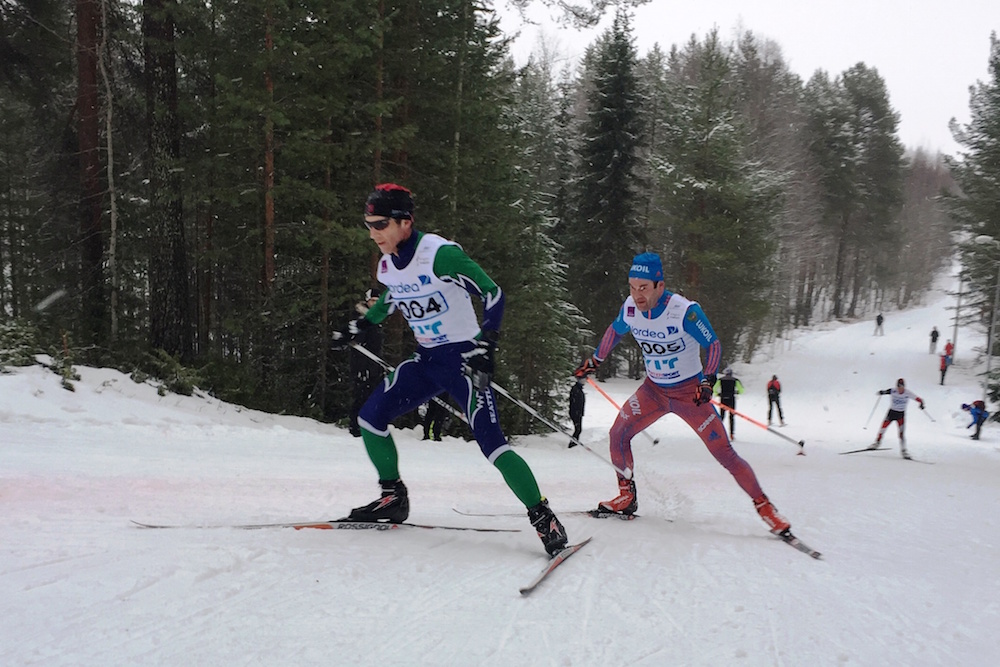
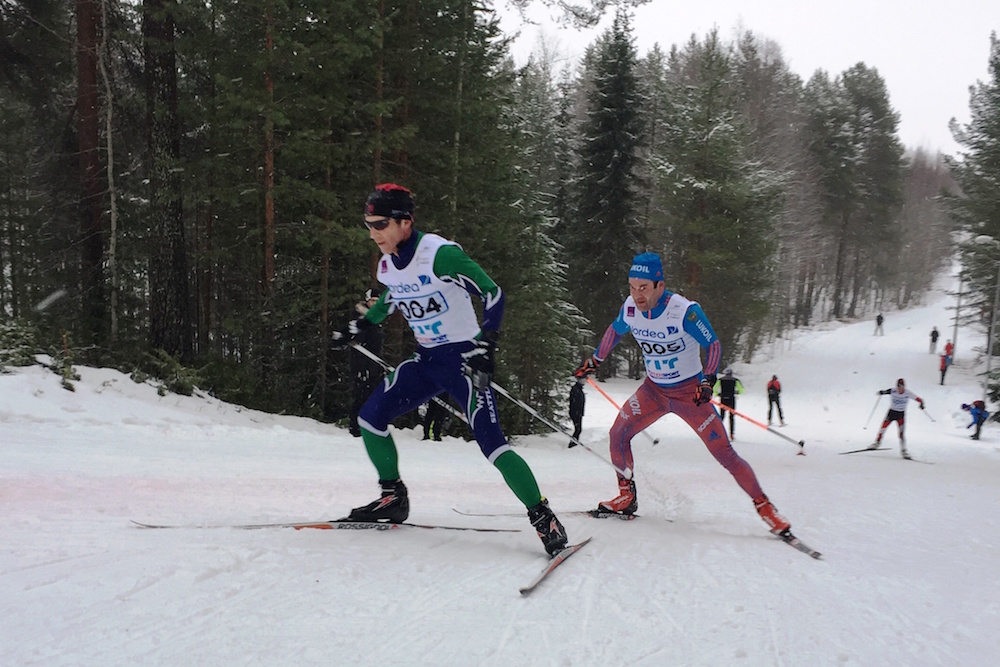
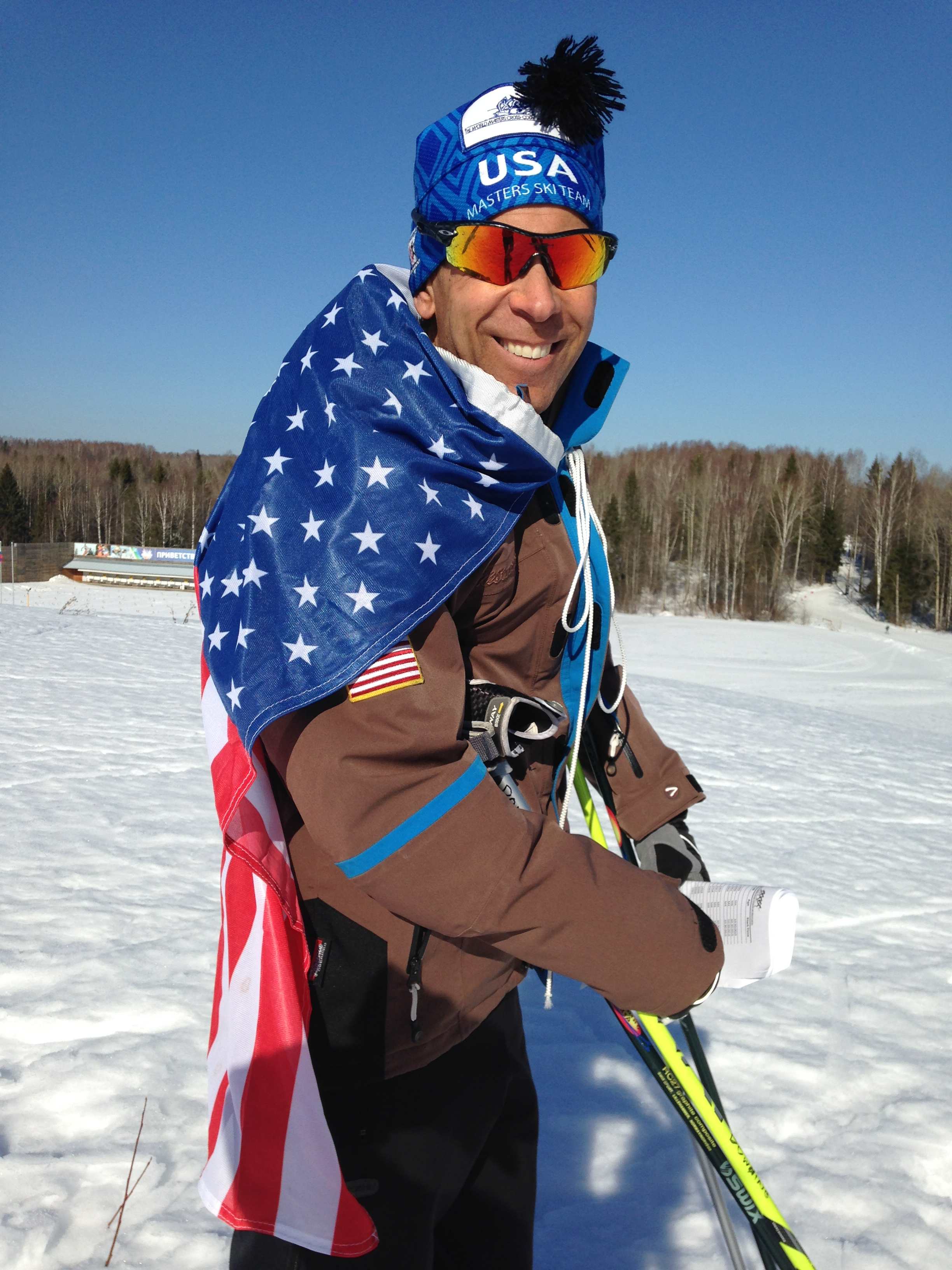
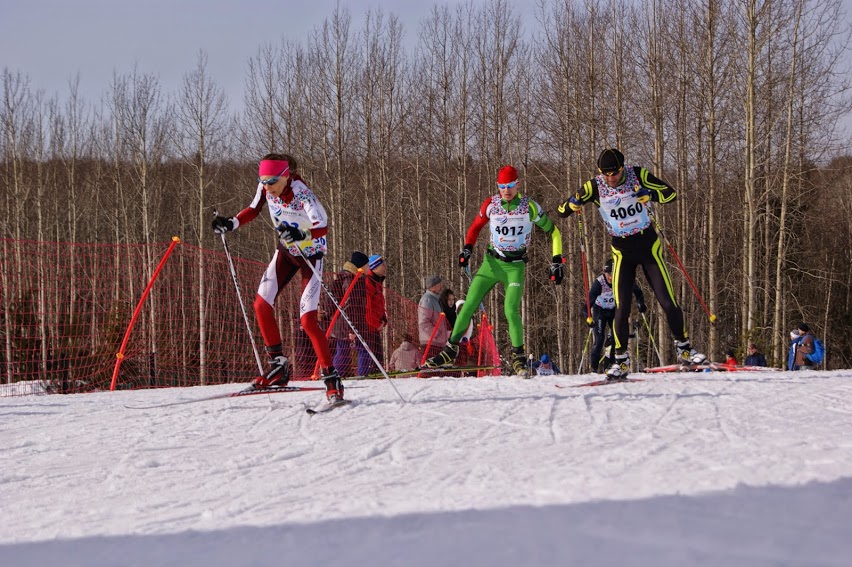
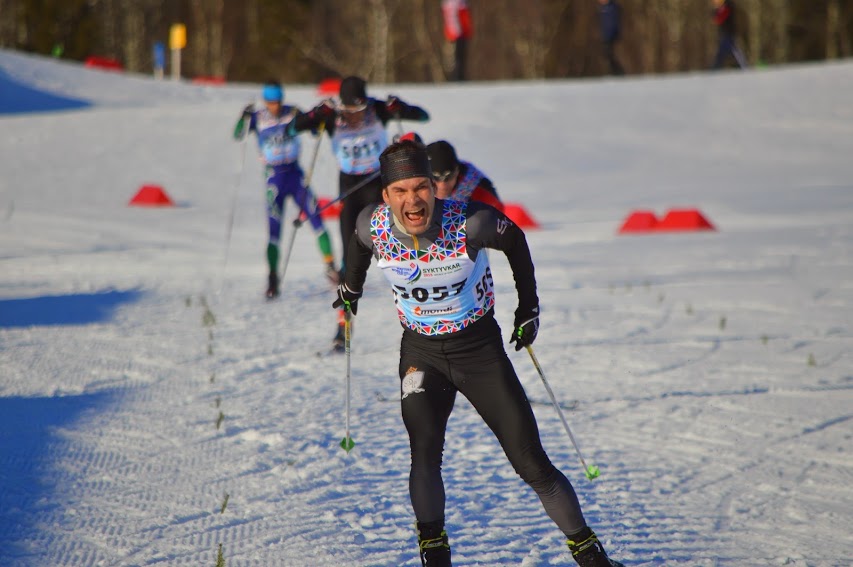
Kent Murdoch leading the pack in the 45-kilometer skate in the M5 category at 2016 Masters World Cup in Vuokatti, Finland. (Photo: Vesa Suomalainen)
Hankering for World Cup-style distance racing?
While most masters tend to aim for the traditional ski marathons, the annual Masters World Cup (MWC) presents an opportunity for skiers 30 and older to ski up to four races of regular World Cup distances in a week.
“It’s so much fun to do a variety of distances within a week, and being able to battle it out with athletes from all over the world is just a really unique opportunity,” says Milan Baic of Traverse City, Mich., who won silver in the final 45-kilometer skate race on Feb. 12 in Vuokatti, Finland.
Baic, 56, has been to every MWC event since 2004, and is planning to be back at the 2017 MWC in Klosters, Switzerland, and beyond.
“With the MWC you get a package deal of a race week. It’s not just a week of really professional and high-level racing,” Baic says. “But AXCS [American XC Skiers] puts together everything with accommodations, race entries and all logistics taken care of, all in a very affordable package. It’s a great value. All you need to do is show up and race.”
More than just races
“You meet so many interesting people, you make genuine friends that you see year after year at the Worlds, and you start looking at people from other countries and cultures in a different way,” Baic says.
He notes that while every year has a different flavor and atmosphere, the events in Russia in 2004 and 2015 have been among the most memorable.
“People in the host communities really take a lot of pride in putting on a really professional and smooth championship week, and are also really excited to share their culture and specialties in everything from opening and closing ceremonies, award ceremonies, medals and awards,” he says.
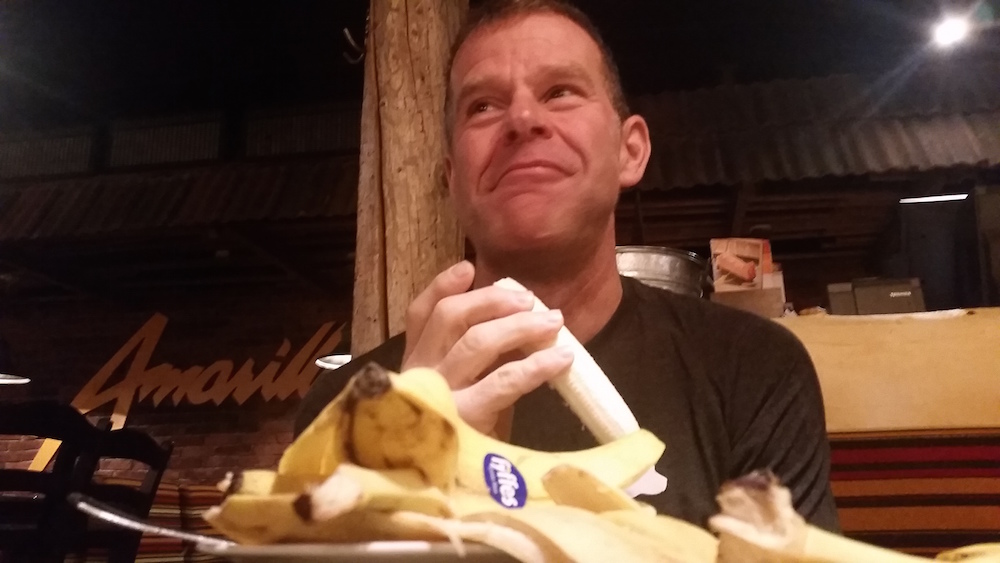
Milan Baic, of Traverse City, Mich., has a well-proven medal strategy for the 45 k event at Masters World Cup: he eats five bananas before breakfast. It usually produces a medal for him, and this year was no exception. He earned the silver medal in the M6 category, one of the most competitive in the Masters World Cup, in Vuokatti, Finland. (Photo: Kent Murdoch)
Also, Baic points out that the U.S. contingent also has a great spirit, good energy and a supportive team environment.
“The racers cheer for each other, help each other out with feeds and wax tips, and it’s fun to travel with the same people, as well as meet new skiers from other parts of the U.S.,” Baic says.
Baic and several of the masters on the US team train systematically for cross-country skiing year-round. He estimates that in an average week, he puts in about 12 hours of training between skiing, strength training and occasional cross training.
While the MWC is the highlight of the season, Baic also races the traditional marathons, and last year, he was 43rd at the American Birkebeiner, the highest ranked to date of any racer 50 or older in the 43-year-old event.
This is the Masters World Cup
Every year, the International Ski Federation (FIS) and the World Masters Association (which is currently under the reign of the first-ever American president, John “JD” Downing) organize a championship-style weeklong competition open to non-professional skiers age 30 and older. The event routinely attracts over 1,000 skiers from more than two dozen countries. This year, the masters World Cup was held in Vuokatti from February 6-12. Roughly 70 American skiers age 40 to over 80 helped themselves to 16 medals in the course of the week in Finland.
If the venue Vuokatti sounds familiar, it might be because it is also home to both FIS World Cup and Continental Cup races every year, as well as one of Finland’s Olympic training centers, home to the 2-kilometer Finnish ski tunnel, and the Angry Birds theme park.
Then, in 2018, the Masters World Cup returns to North America for the first time since 2011, back when the event was held in Silver Star, British Columbia. The 2018 championships will be held in Minneapolis in January 2018, but the exact dates are yet to be announced.
The Minneapolis Masters World Cup represents a very unique opportunity to race several World Cup-style races right in the heart of a big metropolitan area, as most of the Masters World Cup events take place at ski areas that are not necessarily close to big cities.
About the Author: FasterSkier contributor Inge Scheve, a Norwegian native, lived in Fairbanks, Alaska, and Bend, Ore., for a number of years where she became an avid skier and masters racer. Scheve recently competed in her sixth Masters World Cup in Vuokatti, Finland.
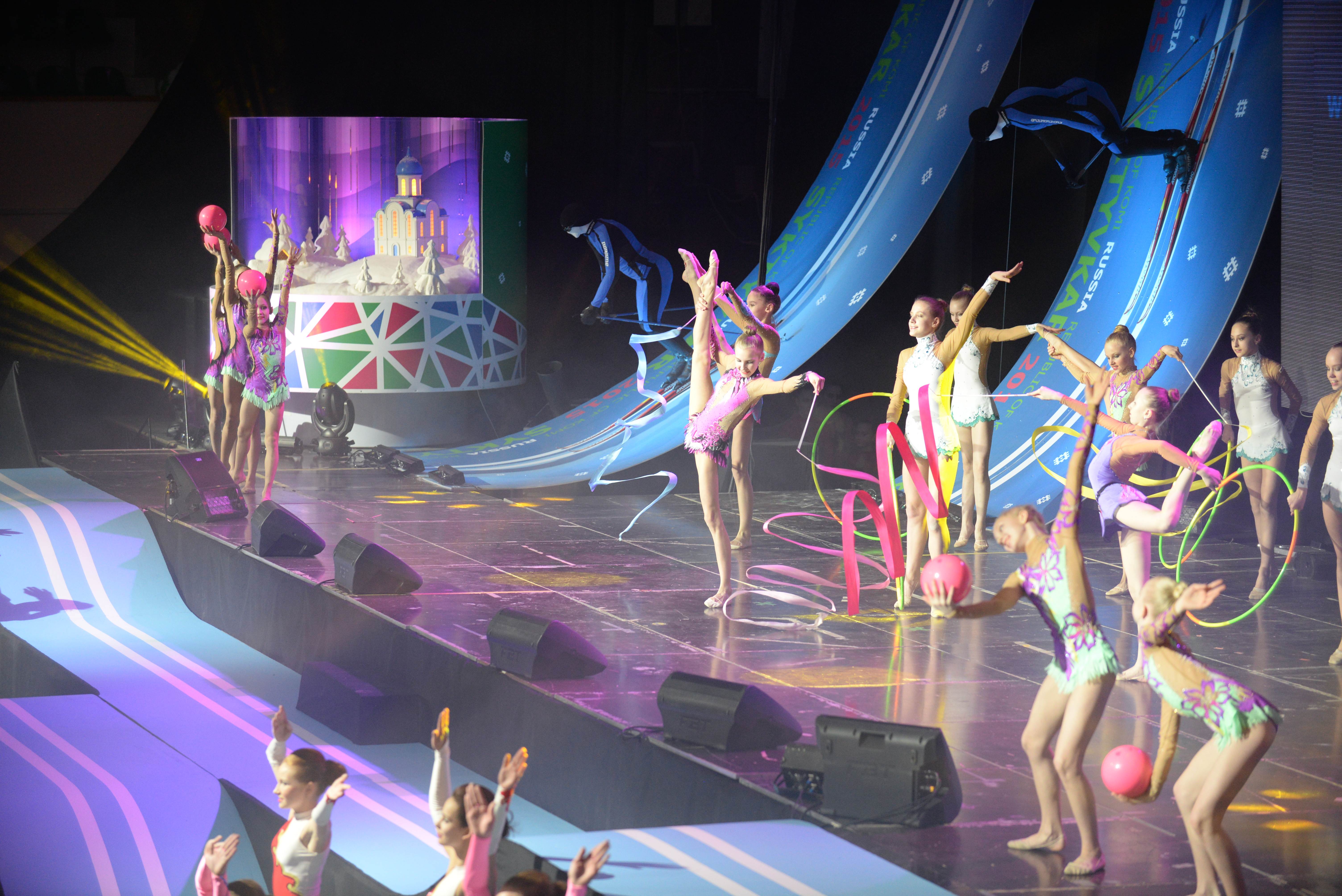
A scene from the opening ceremony at the 2105 Masters World Cup in Syktyvkar, Russia. (Photo: Masters World Cup 2015)
The following is an editorial submitted by FasterSkier contributor Inge Scheve, a Norwegian native who lived in Fairbanks, Alaska, and Bend, Ore., for a number of years where she became an avid skier and masters racer. Scheve recently returned from competing in her fifth Masters World Cup in Syktyvkar, Russia.
***
Russia was quite a trip. Literally. The 2015 Masters World Cup in Syktyvkar, Russia, from March 14 to 20 was amazing, maybe one of the best I’ve experienced in terms of racing, depth of competition, facilities, professionally run venue and race organization, as well as opening ceremony, medals ceremony and entertainment that made you feel like these championships were a big deal.
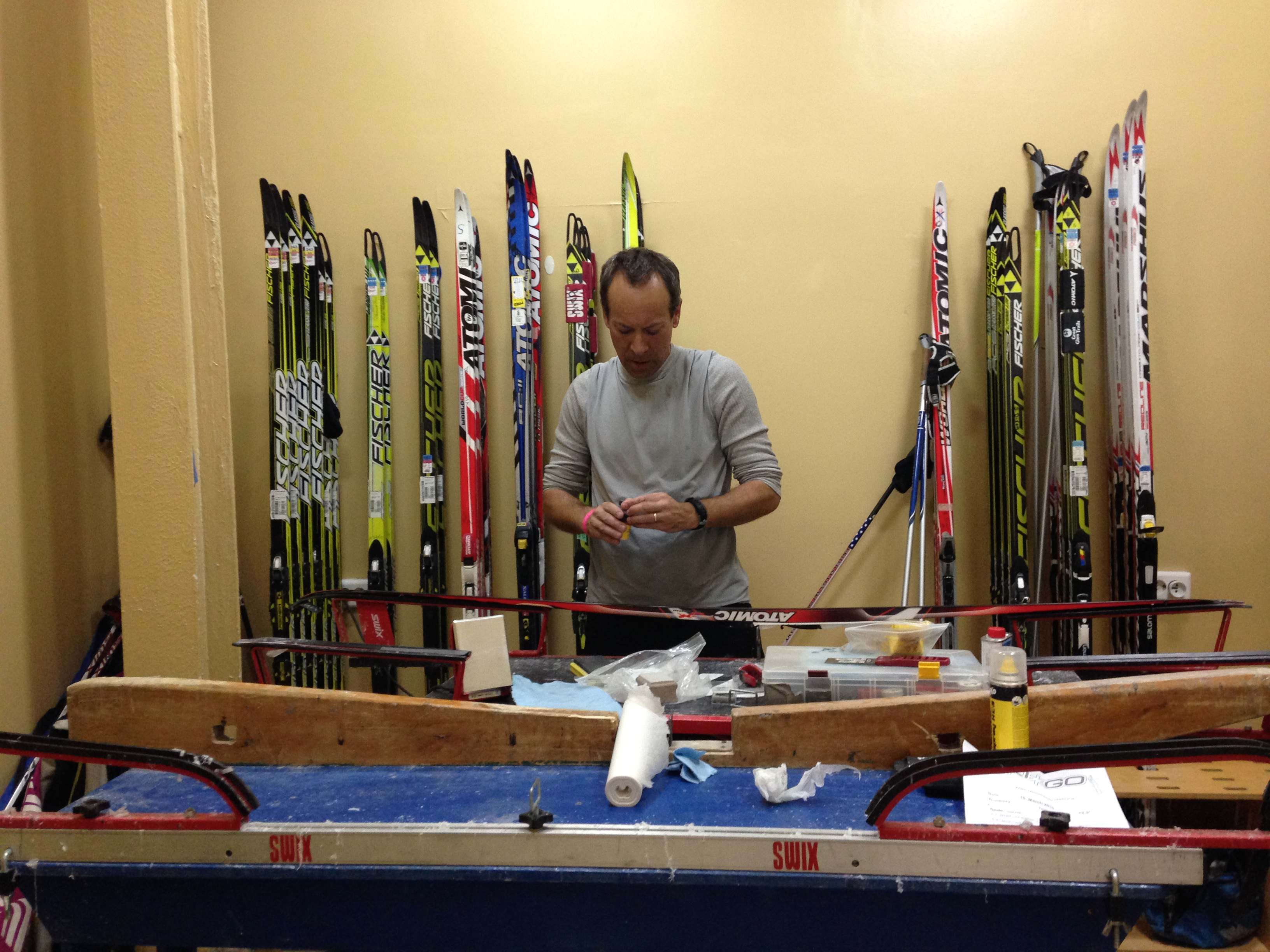
The head of grooming was the same guy who was in charge for the 2014 Winter Olympics in Sochi, Russia. The courses and stadium fit every International Ski Federation (FIS) technical specifications and rules for World Cup standard. Each national team was given its own wax room complete with amenities, premium ventilation and work conditions, locker rooms, bathrooms and showers.
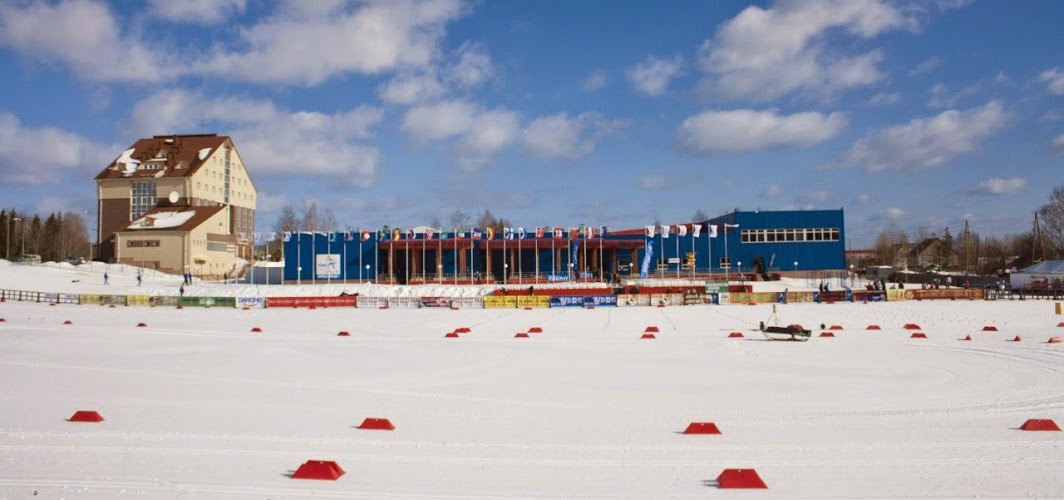
The Smetanina Sports Complex at Masters World Cup 2015. (Photo: MWC2015)
The U.S. team consisted of a scant dozen travelers, including supporting spouses and a couple of racers who ended up injured just prior to the trip, but still decided to go because of the novelty of the destination. And you can certainly argue that it was.
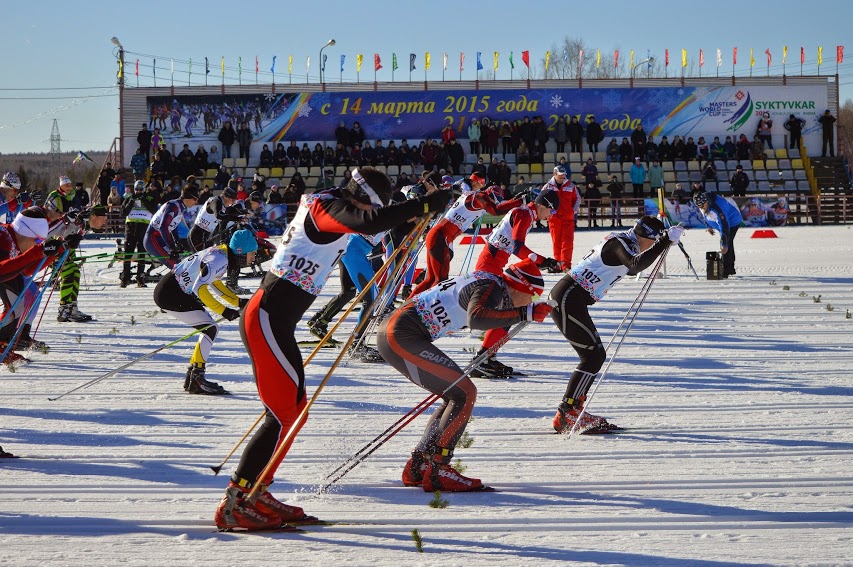
Start of a race in the M1 category. (Photo: MWC2015)
We stayed at the Olympiets Hotel at the venue, with a view of the courses from our rooms, and within spitting distance of the wax rooms and venue.
For a lot of us, Masters World Cup is the main event of the season, and the most important training and performance goal. It’s what you have in the back of your mind through the soggiest moosehoofing intervals in the fall and on those the frigid long-distance workouts in January.
And it’s also the closest most of us working folks get to a taste of Petter Northug and Marit Bjørgen’s world, with no further comparison. We certainly don’t ski as fast, but many definitely dig just as deep for the finish line.
Masters World Cup is one week of racing your brains out in events where the competition is fair, and you don’t have to worry about racers stepping on your gear out of the start and excessive jockeying and fighting for positions.
JD Downing at work in the U.S. wax room at the Smetanina Sports Complex at 2015 Masters World Cup. (Photo: Inge Scheve)
It’s unlike so many of the mass events such as the Birkebeiner and the Engadin with 10,000 to 15,000 racers on course. Even in the largest men’s categories, the start field at the Masters World Cup rarely exceeds 50 to 70 racers, and even those fields string out fairly quickly.
But Masters World Cup is so much more than just a week of crazy hard racing. It’s the five-week peaking plan leading up to the event. It starts with three hell weeks of volume and intensity that makes you wonder if you are going to bury yourself entirely, followed by two tapering weeks when you finally feel speed and snappiness come to you. You are race-ready and bursting at the seems.
And it’s a week where the world revolves around sleeping, eating, training, racing, waxing, and performing.
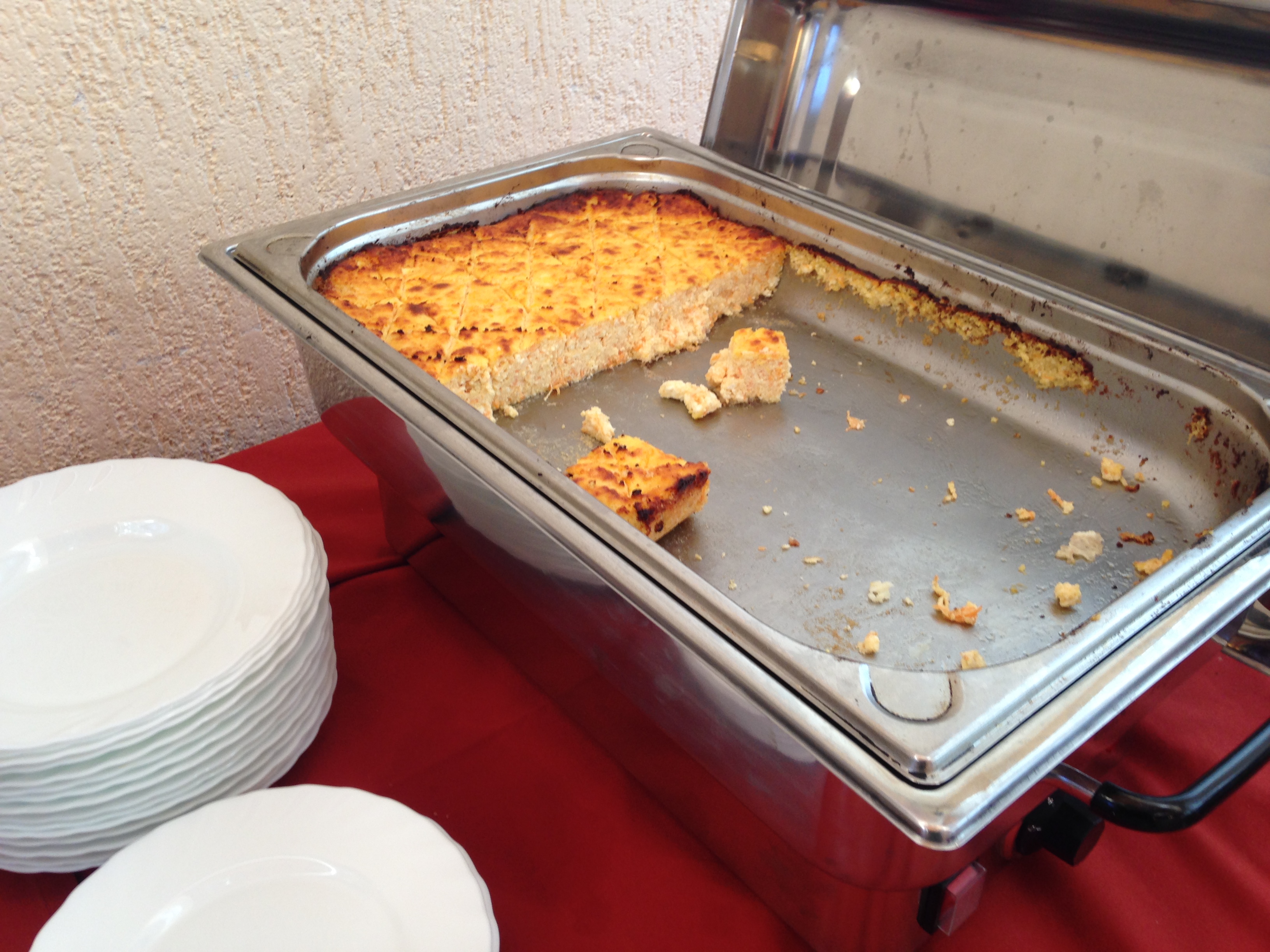
The dubious cottage cheese pudding at the Olympiets cafeteria. Not sure it will make me an Olympian.
Staying healthy is an important part of that equation, and it’s at the forefront of our minds to the point where some even start to feel they are coming down with something. Many carry hand sanitizers and try to avoid the obvious germ traps such as excessive hugging and handshaking, sharing water bottles, and avoid using the serving spoons in the cafeteria and touching handrails and elevator buttons.
But all kinds of precautions only go so far when the food-service hygiene fails. Food is expensive in Russia – relative to Russians, of course – and at our hotel’s cafeteria, leftover food was kept for a long time, reheated and resurfaced day after day. That creates a perfect growing environment for bacteria, and by the end of the week, many of us had both colds and stomach infections.
Syktyvkar is also the home of former Olympians Raisa Smetanina, Vasiliy Rotchev and Nikolay Bazhukov, who were on the World Cup circuit in the 1970s and ’80s. The stadium facilities, courses and venues are named after Smetanina. This is the national training center for the Komi Republic, where Syktyvkar is the capital, and from time to time, there are World Cup races both in cross country and biathlon at the Smetanina Sports Complex.
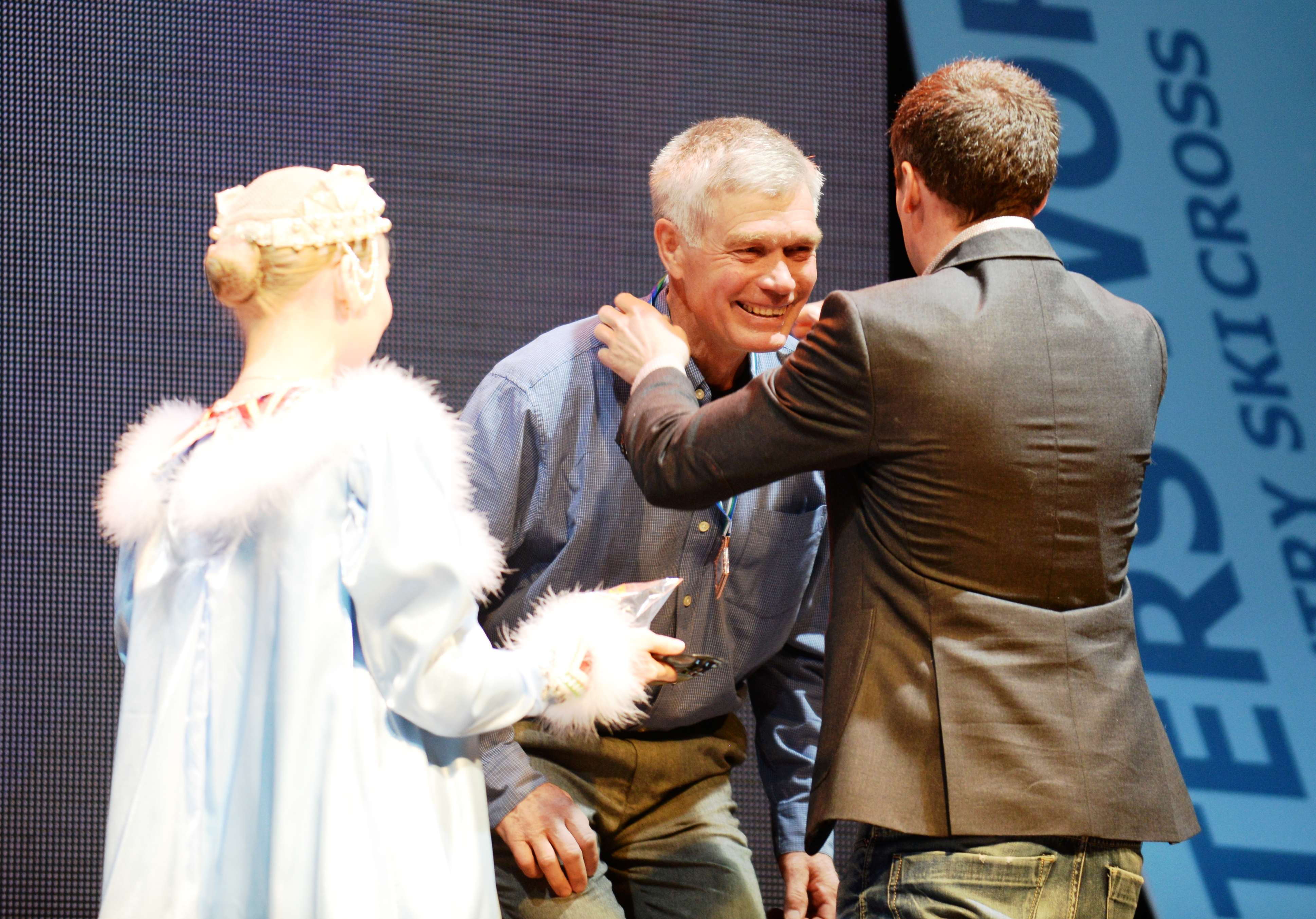
Bob Gray receiving his bronze medal. (Photo: Kent Murdoch)
The quick and dirty on U.S. results at MWC
Eight U.S. athletes collected a total of seven medals in Syktyvkar: Milan Baic of Michigan earned bronze in the men’s 30-kilometer skate on March 14, the first day of the races, as well as a bronze medal in the men’s 45 k skate on March 19.
On March 16, Bob Gray of Vermont took bronze in the men’s 5 k classic, and I finished second in the women’s 10 k skate.
Baic also scrambled for the U.S. men’s relay team that earned bronze in the M5 category on March 18. Gray skied the second leg for the team, Steve Smigiel of Michigan skied the third leg, and Kent Murdoch of Washington anchored the team to third place.
There were also several top-10 finishes during the Syktyvkar race week, including Murdoch’s fifth place and Gray’s sixth place in the men’s 10 k skate, Murdoch’s 10th place in the 30 k skate and my fifth place in the 15 k skate on March 14. On March 19, I placed fifth in the 30 k skate and Murdoch was sixth in the 45 k skate.
Additionally, the U.S. team consisted of Sherry and Richard Dixon, Alec Davies, and the U.S. national director of the Masters World Cup Association, J.D. Downing, who also raced two events during the Syktyvkar championships week. Dan Nolan was also part of the team, but did not race due to a thumb injury.
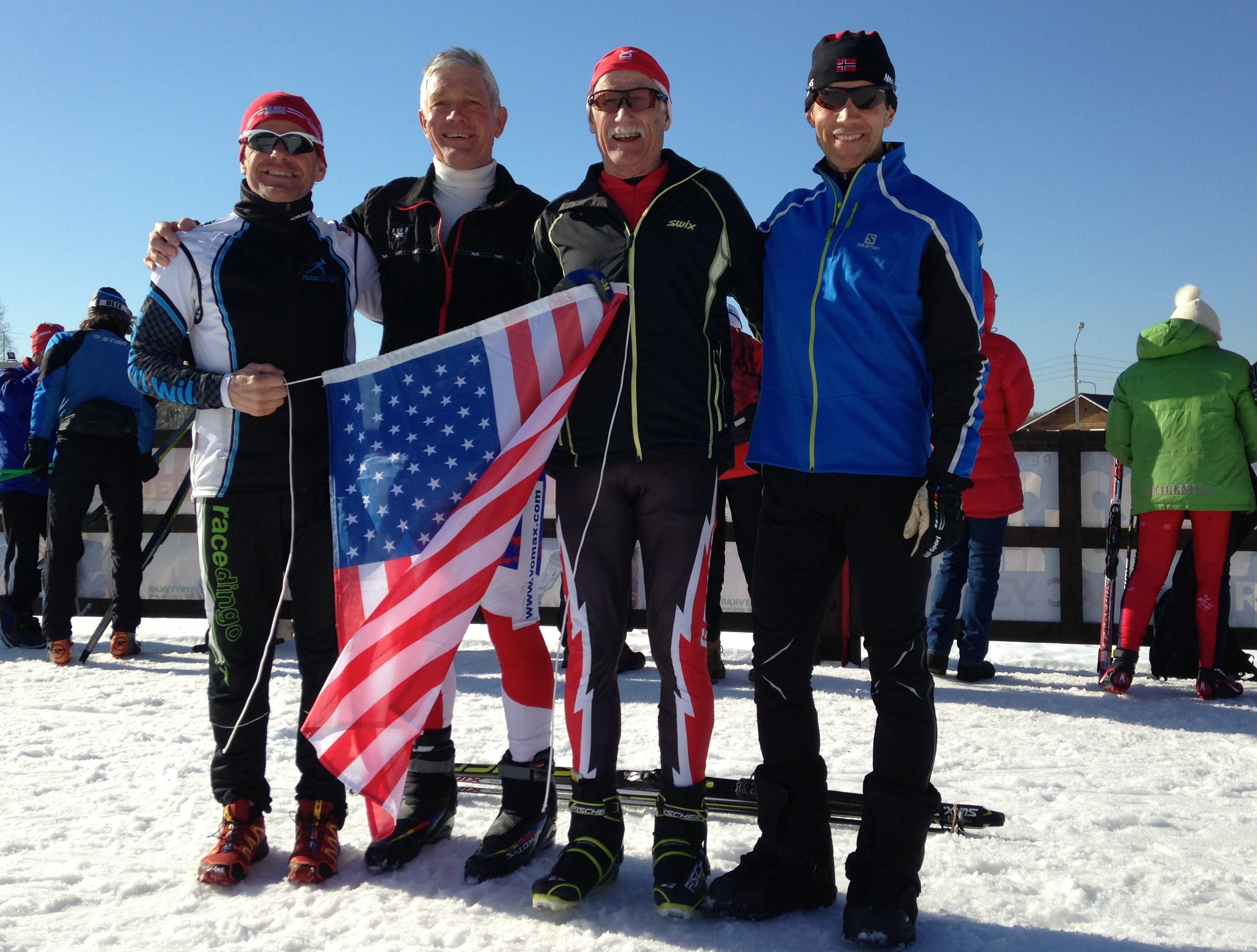
The U.S. bronze-medal relay team: (from left to right) Milan Baic, Bob Gray, Steve Smiegel and Kent Murdoch. (Photo: Inge Scheve)The cheering was first class: U.S. National Director J.D. Downing kept tabs and splits on all of the U.S. racers.
The Syktyvkar experience
We have competed against the Russians in many World Masters events before. I’ve wondered about their race faces and admit that they can be quite intimidating on the start line. They’re serious about the racing, with everything from ski testing to warmup routines and recovery. They mean business.
But off the course, the Russians are warm people, excited to share their culture and proud of their heritage. And with the global political situation starting to resemble the intensity of the Cold War days, most Russians are eager to show that they are not the regime. They are genuine, compassionate and generous. The organizers had more than 1,500 volunteers, and each national team was assigned a team of young students who worked as guides and interpreters, guiding us smoothly through language barriers, red tape and bureaucracy, and happy to take us anywhere we wanted to go, be it the mall, the supermarket or the ballet.
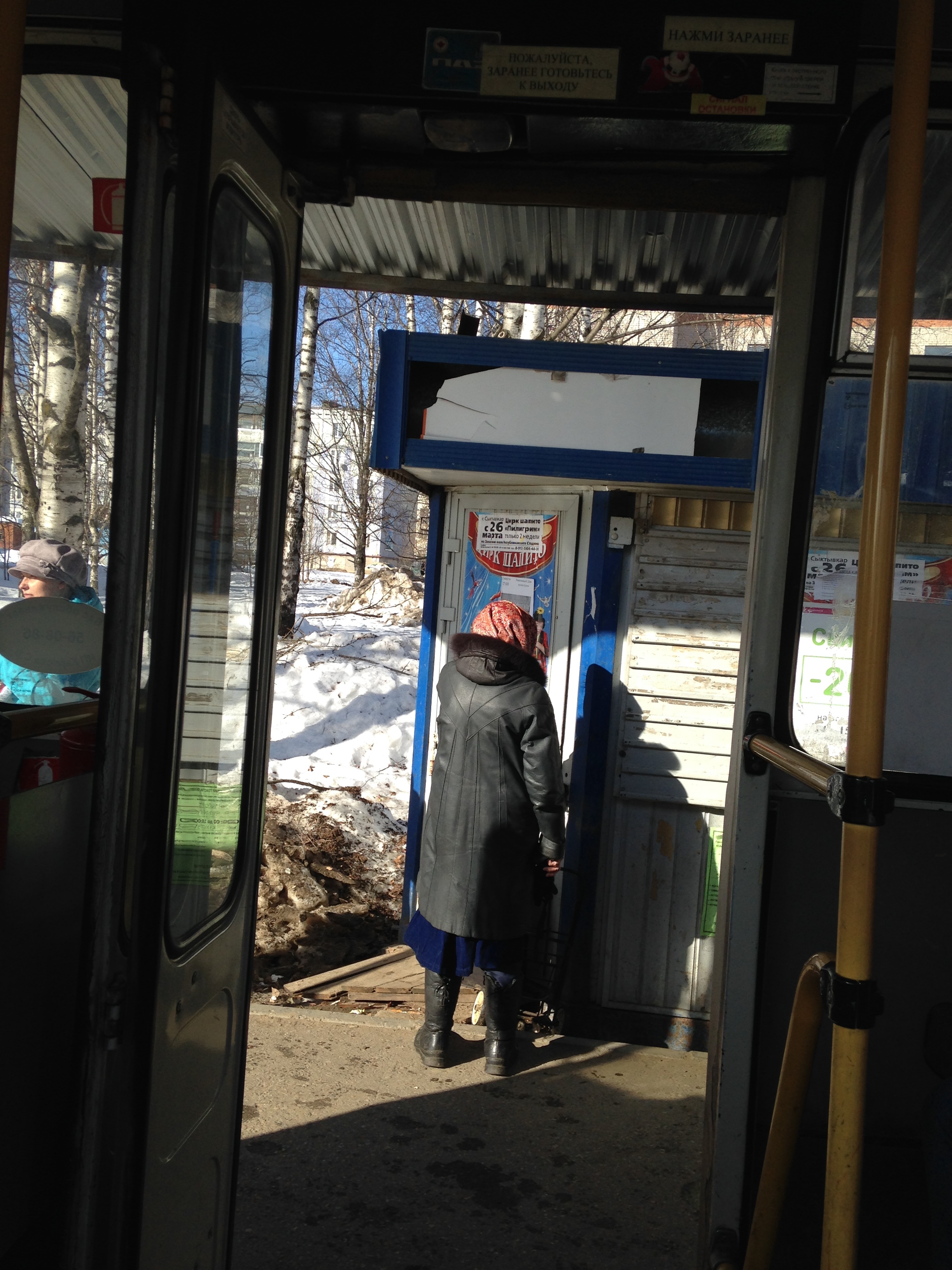
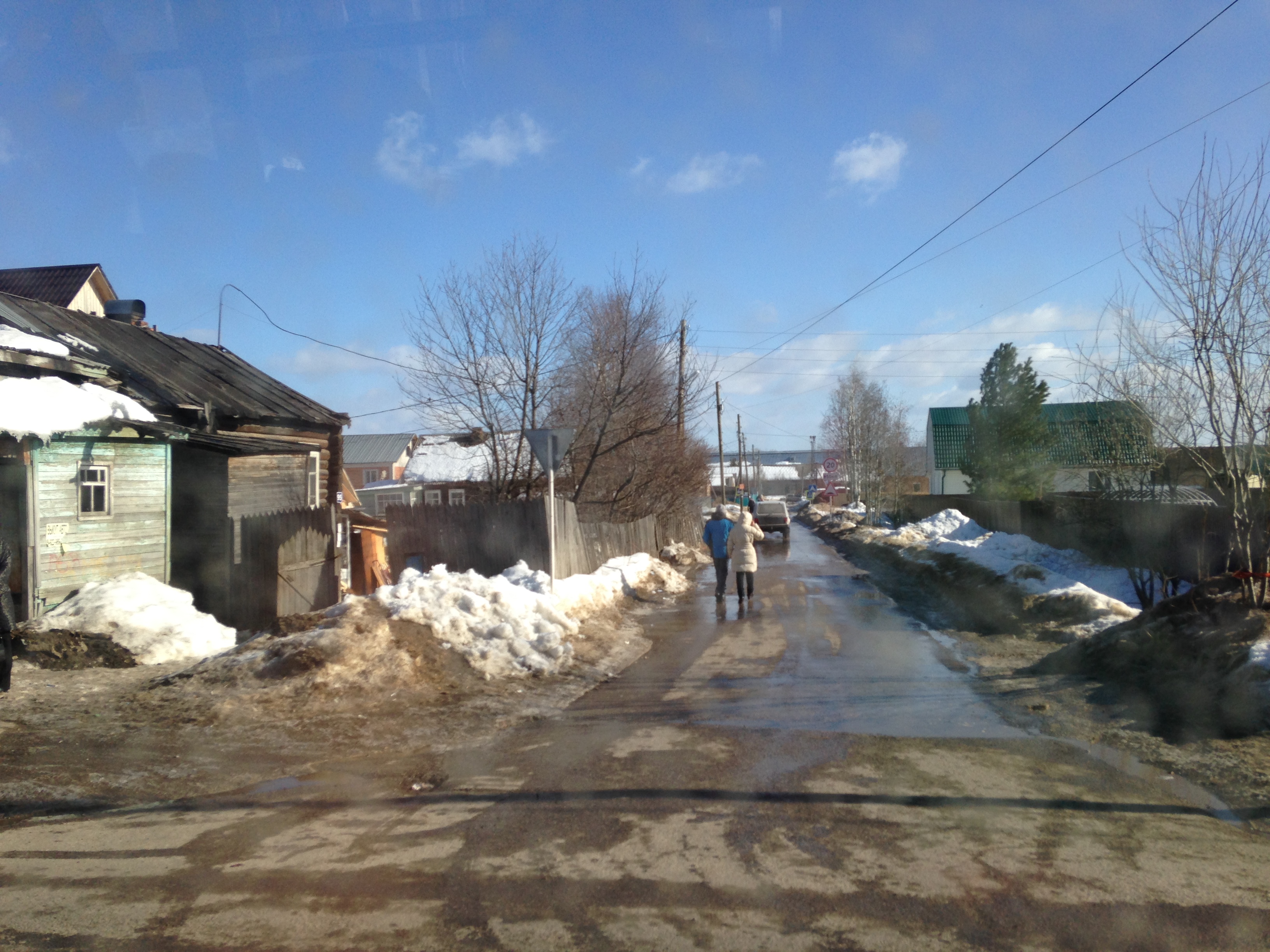
A snapshot of downtown Syktyvkar, taken from the city bus.
Syktyvkar is the capital of the Komi Republic and has been a city since Catherine the Great granted such status in 1780. The Tsarina needed timber and natural resources from the north, and also a new location for a penal colony. That tradition was continued by Stalin, who established a number of gulag prison camps in the area from 1929 and well into the post-World War II era. Prison gangs built rails and roads, towns and mines and most of the industrial infrastructure of Syktyvkar and other Komi cities, as well as numerous other Soviet communities. On paper, these gulags were no longer used after 1955, but it has later been documented that they were alive well into the Gorbachev era in the 1980s.
I must admit that Syktyvkar’s past sent chills down my spine when walking the muddy streets of the city and taking the bus through the town. Knowing that every ditch and road here is carved out manually with only crude tools and by scantly clad and undernourished prisoners, many sent there without a proper trial and only on dubious charges, casts a dark shadow over the beautiful cathedral roofs.
Syktyvkar city street.
Syktyvkar, a town of a couple of hundred-thousand people at the foothills of the Ural mountains, now has a university and several large corporations in timber industry, mining, oil and natural gas. At first glance, Syktyvkar looks like just another mid-size town consisting of endless gray communist-era housing projects in various stages of decay and suburbs of shabby-looking wooden cabins that reflect on the region’s economic state.
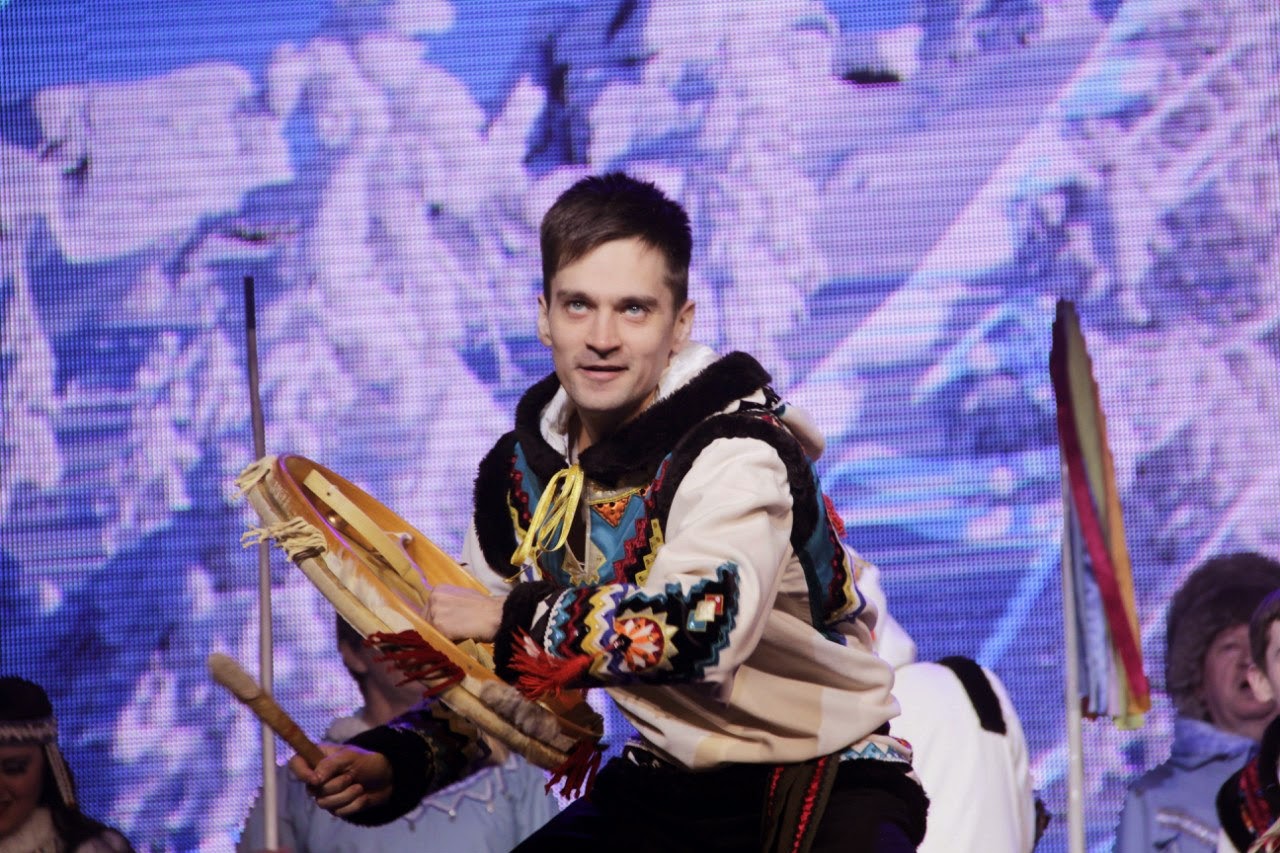
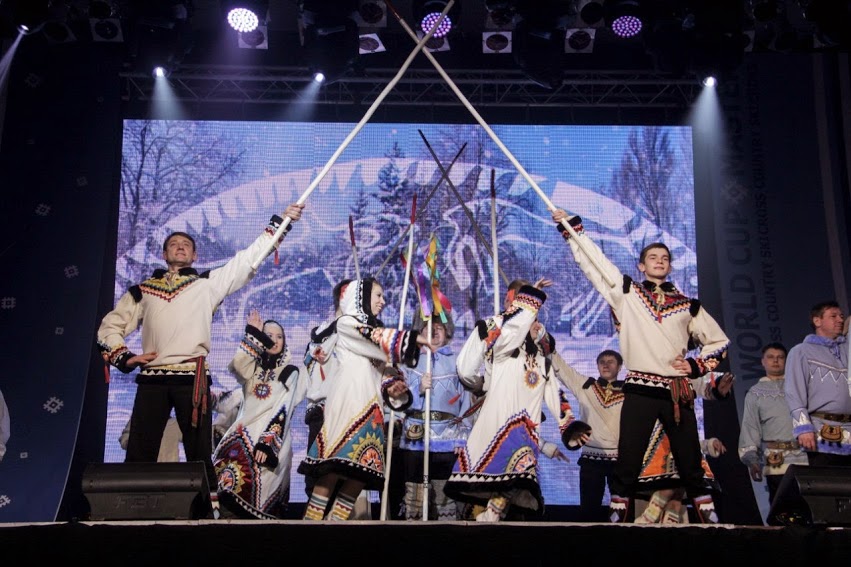
But the area has a vibrant cultural scene, with numerous museums, a theater of ballet and opera and performing arts, evident during the spectacular opening and closing ceremonies and the daily medal ceremonies at the Masters World Cup. At all of these events, local artists performed traditional music and dances.
From the Opening Ceremony at the 2015 MWC in Syktyvkar, Russia. (Photo: MWC2015)The Opening Ceremony at the 2015 MWC in Syktyvkar, Russia. (Photo: Kent Murdoch)
The racing
Yours truly (l) on the final lap of the 30 k skate. (Photo: MWC2015)
I’m quite content with the results at Worlds this year, especially given the rocky preparation and the stressful winter I’ve had with my professional work situation.
The fifth place in the 15 k skate on the opening day felt like a solid effort, where I raced the best I could on that day. The field was stacked with Russian skiers without prior Worlds points, which made them total wild cards. I beat the racers whom I generally compete with at these events, but I was also beat by a couple of these wild cards. So, overall a solid effort.
But the silver in the 10 k skate was particularly exciting. At that event, I also beat a couple of the wild-card racers who topped me in the first race. The feeling of having dug so deep, put it all on the line and making it to the podium is magic.
The feeling of having dug so deep, put it all on the line and making it to the podium is magic.
However, digging so deep sure took a toll. The next couple of days I felt very tired, even shorts workouts seemed like they required more recovery than expected, and I was on the brink of coming down with a full-on cold, which had been circulating in the team for a few days.
Then on the day of the 30 k, I woke up in the middle of the night with a monster head congestion in addition to the race hack I had been dealing with since the 15 k on Saturday. As if that wasn’t enough, several of the team suffered from the revenge of the cafeteria – stomach pain and the runs. Not a great setup for a 30 k race. But given that this was the last race of the week, I gave it a shot with the ambition of finishing in style. So a fifth place under those circumstances felt like another success.
The price to pay was that the trip from Syktyvkar to Lillehammer, Norway, the following day became a bear. The same is true for Murdoch, who was sixth in the 45 k skate and suffered a similar illness both before the race and during the expedition trek to Lillehammer. Needless to say, only working at the Norwegian Birkebeiner on March 21 felt quite all right. Neither one of us felt a desire to race the 54 k classic event, despite the best conditions in several years. But we will be back!
Kent Murdoch (back of the train) during the 45 k skate at 2015 Masters World Cup. (Photo: MWC2015)
About the author:
A longtime contributor, Inge Scheve was born and bred in Norway, and learned to ski about the time she learned to walk. She always loved skiing, but didn’t really get into racing until she came to the University of Alaska Fairbanks, where she was introduced to collegiate ski racing American style. After UAF, she moved to Bend, Ore., in 2001 to ski with XC Oregon. She has competed for the U.S. in five World Masters, earning eightgold medals, 10 silver and 11 bronze.
When she’s not skiing, Inge loves caribou hunting on the tundra in her native Rendalen valley in Norway, dabbles in adventure racing, mountain biking, road cycling, hiking, trail running and kayaking. Inge really wants to become a wine snob, but realizes that probably involves learning to like red wine.