Tag: Milano-Cortina

  • Biathlon at a Crossroads: Inside the Alliance That Could Reshape the Sport in America

    Biathlon at a Crossroads: Inside the Alliance That Could Reshape the Sport in America

    This article was made possible through the generous support of our voluntary subscribers. If you value coverage like this, please support FasterSkier with a voluntary subscription.

    U.S. Biathlon’s board votes Wednesday on a formal operating alliance with U.S. Ski & Snowboard. Supporters call it the stability the sport has always lacked. Skeptics call it a surrender of independence. Both are working from the same set of facts. Here is what the deal actually says, and what it would and would not change.

    The U.S. Biathlon board of directors is scheduled to meet tomorrow, Wednesday, July 29, at 4 p.m. Eastern. This account is based on interviews conducted by FasterSkier with the chief executives of both organizations, a U.S. Biathlon athlete representative, the U.S. Biathlon head physiology coach, a written statement from the U.S. Olympic & Paralympic Committee, and a review of the alliance term sheet, three community working-group reports, and correspondence circulated by members opposed to the deal. All of these documents were posted publicly by U.S. Biathlon or provided to FasterSkier.
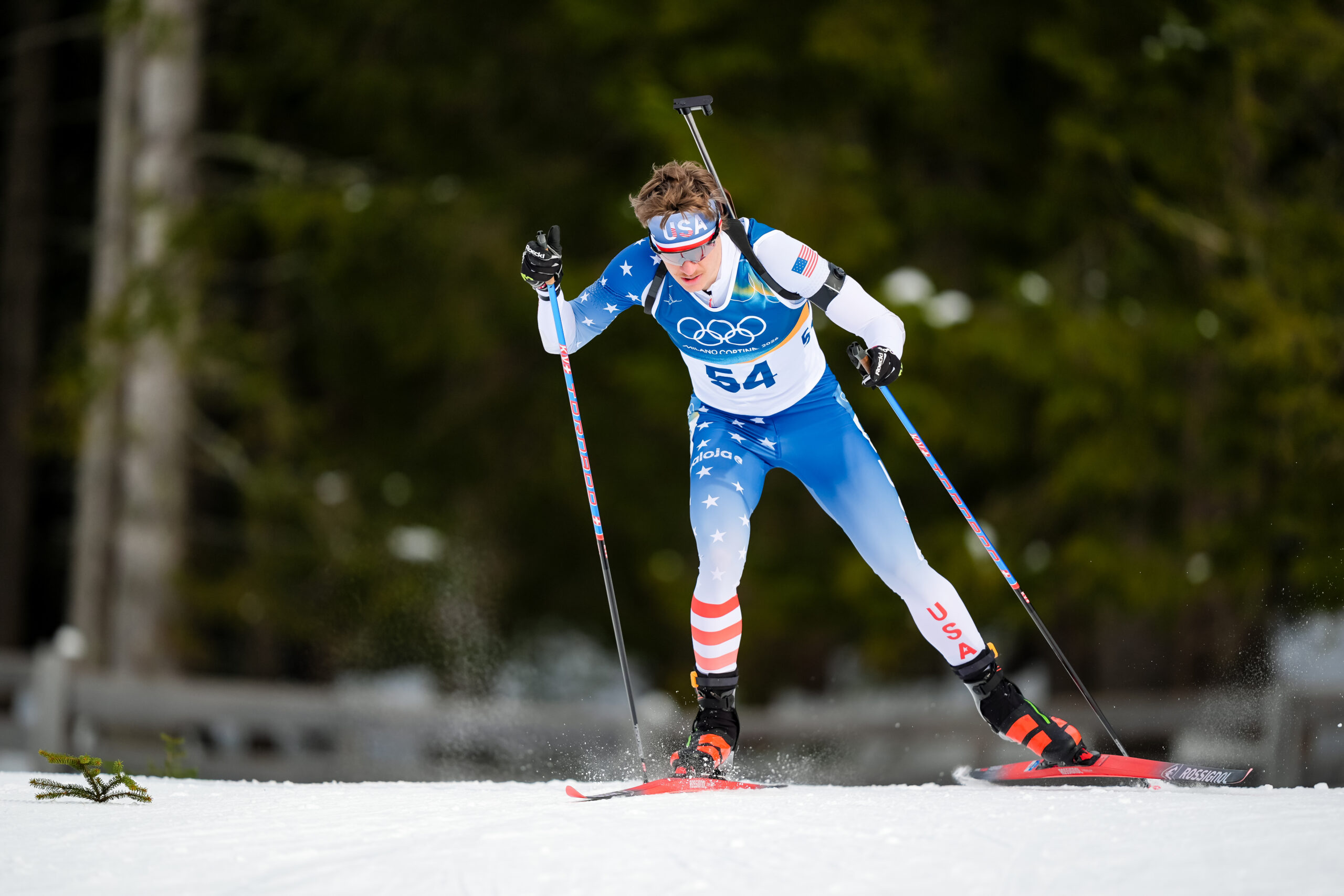
    Campbell Wright (USA) during the biathlon sprint at the XXV Olympic Winter Games in Antholz (ITA). (Photo: Thibaut/NordicFocus)

    Every winter, for a few weeks in February, cross-country skiing and biathlon stop being niche pursuits in the United States. During the last Olympic period, FasterSkier drew more than 180,000 unique readers in a single February, most of them people who do not know the sport’s governance history and have never heard of the Ted Stevens Olympic and Amateur Sports Act. On Wednesday afternoon, a board most of those readers could not name will vote on a decision that could reshape how one of their sports is run for the rest of the decade and beyond.

    The question in front of the U.S. Biathlon board is whether to enter a “Strategic Operating Alliance” with U.S. Ski & Snowboard, the far larger national governing body that oversees Olympic and Paralympic skiing and snowboarding. Under the proposal, U.S. Biathlon would remain a legally separate organization and the recognized governing body for the sport, but would hand much of its day-to-day operation to U.S. Ski & Snowboard under a services agreement. To its architects, it is a way to give a chronically under-resourced sport the stability and commercial muscle it has never had. To its critics, it is the moment a proud, independent program stops steering its own ship.

    The two sides do not disagree much about the facts. They disagree about what the facts mean.

    What is actually being proposed

    Strip away the temperature of the debate and the structure is specific, and it has changed meaningfully since the idea first surfaced publicly in the spring. The current terms, which U.S. Biathlon posted for its members on July 27, describe an alliance rather than a merger in the dictionary sense. No organization dissolves.

    Under the agreement summary, U.S. Biathlon “will remain a separate legal entity,” keeping “its own corporate existence, financials, and independent audit.” It stays the governing body recognized by the U.S. Olympic & Paralympic Committee under the Ted Stevens Act, and keeps its membership in the International Biathlon Union, the sport’s world federation. Its name, logo, and trademarks remain owned by U.S. Biathlon and are licensed to U.S. Ski & Snowboard.

    What changes is who runs the operation. Under a services, or operating, agreement, U.S. Ski & Snowboard would take over “staffing, programs, events, and administration for biathlon,” giving the smaller sport access to a chief financial officer, general counsel, marketing and revenue staff, medical and sport-science support, and technology infrastructure it cannot afford on its own. U.S. Biathlon’s own staff, its leaders say, would remain responsible for running the sport itself. A new Biathlon Sport Committee would be created inside U.S. Ski & Snowboard, mirroring the structure the larger body already uses for cross-country and its other disciplines.

    Jack Gierhart, U.S. Biathlon’s president and chief executive, described the mechanism plainly in an interview. “The mechanics of this are like an operating agreement between U.S. Biathlon and Ski and Snowboard where they take over operations,” he said. “That’s how we’re honoring and satisfying the Ted Stevens Act.”

    Sophie Goldschmidt, president and chief executive of U.S. Ski & Snowboard, framed the same structure around what biathlon keeps. “We would keep the biathlon entity. In fact, we keep the biathlon name, the biathlon logo,” she told FasterSkier. “From a legal perspective, it would also have its own entity. With that, it would have its own board. So very much operating like it does today, but sitting within a larger framework so that it can benefit from the other resources and shared knowledge, extra funding that we can provide.”

    That phrase, “operating like it does today,” sits at the center of the argument, because a great deal depends on how much a board that has delegated its operations still actually decides.
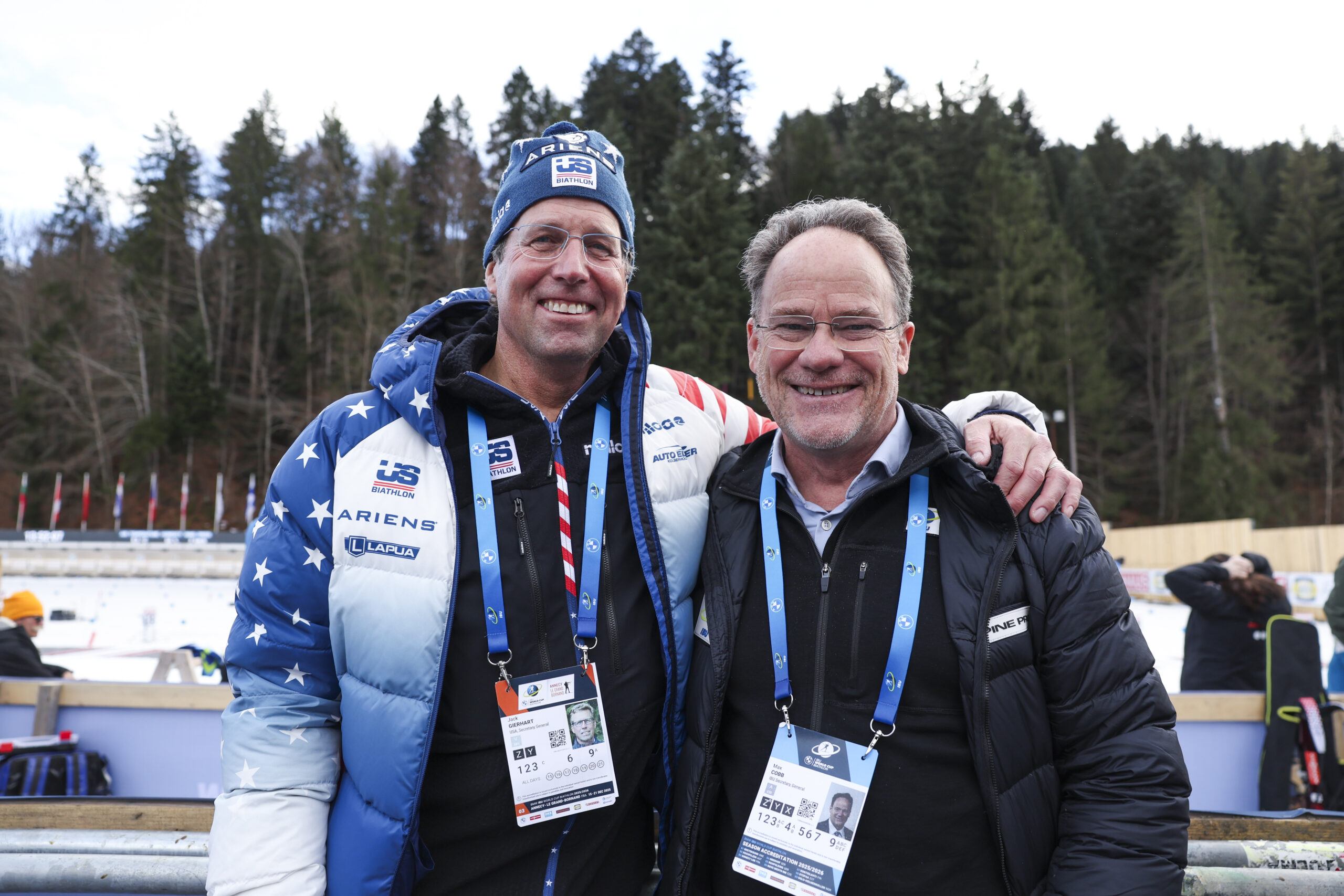
    USBA CEO Jack Gierhart poses with Max Cobb (IBU Secretary General) (l-r) at the IBU World Cup in Annecy-Le Grand Bornand (FRA) last December. (Photo: Manzoni/NordicFocus)

    How the sport got here

    By the account of the people who built it, this did not begin as a takeover. It began, Gierhart said, as an attempt to solve a problem every small Olympic sport shares.

    Gierhart arrived at U.S. Biathlon in September 2022, as longtime leader Max Cobb was leaving for the IBU. The organization was early in a strategic plan aimed at growing the sport, and a central piece of that plan was working more closely with the cross-country community, since most American biathletes come from skiing. “From my experience being in sport for 25 years, when you offer people more options, more pathways, you increase retention and you grow the pie,” he said. “It’s like, this should be a no-brainer, but then you run into the cultures and communities.”

    Those conversations, Gierhart said, drew in the U.S. Olympic & Paralympic Committee, which oversees and funds the country’s Olympic sports. “The USOPC started to suggest, hey, we’ve got a lot of these small NGBs, why don’t you guys think about something a little more formal?” he said. That was roughly a year and a half ago. The organizations sketched the basic terms, paused through the Olympic and Paralympic Games so as not to distract athletes, then brought the concept to a wider audience in the spring.

    Goldschmidt described the same arc and made the case for why her organization wants biathlon at all. U.S. Ski & Snowboard already runs multiple sports under one roof, she said, which means it can absorb the compliance and administrative costs that crush small governing bodies. “The central costs can really be absorbed and be a real cost saving for those organizations,” she said. “Legal, finance, safe sport compliance, all of that, which is quite a big burden, especially on some smaller NGBs. We can absorb that quite easily without having to increase the cost base, which means practically more money is going directly to the athletes.”

    The rollout did not land smoothly. After town-hall meetings drew pointed questions, the two organizations convened three joint working groups, on governance, sport development, and high performance, that met through the back half of July. Twenty-eight to twenty-nine participants, including athletes, coaches, club leaders, and staff, spent two weeks documenting what a successful alliance would require and what worried them. Their reports, posted publicly, have become some of the most revealing documents in the whole debate, in part because they capture both the community’s hopes for closer collaboration and its doubts, in the community’s own words.
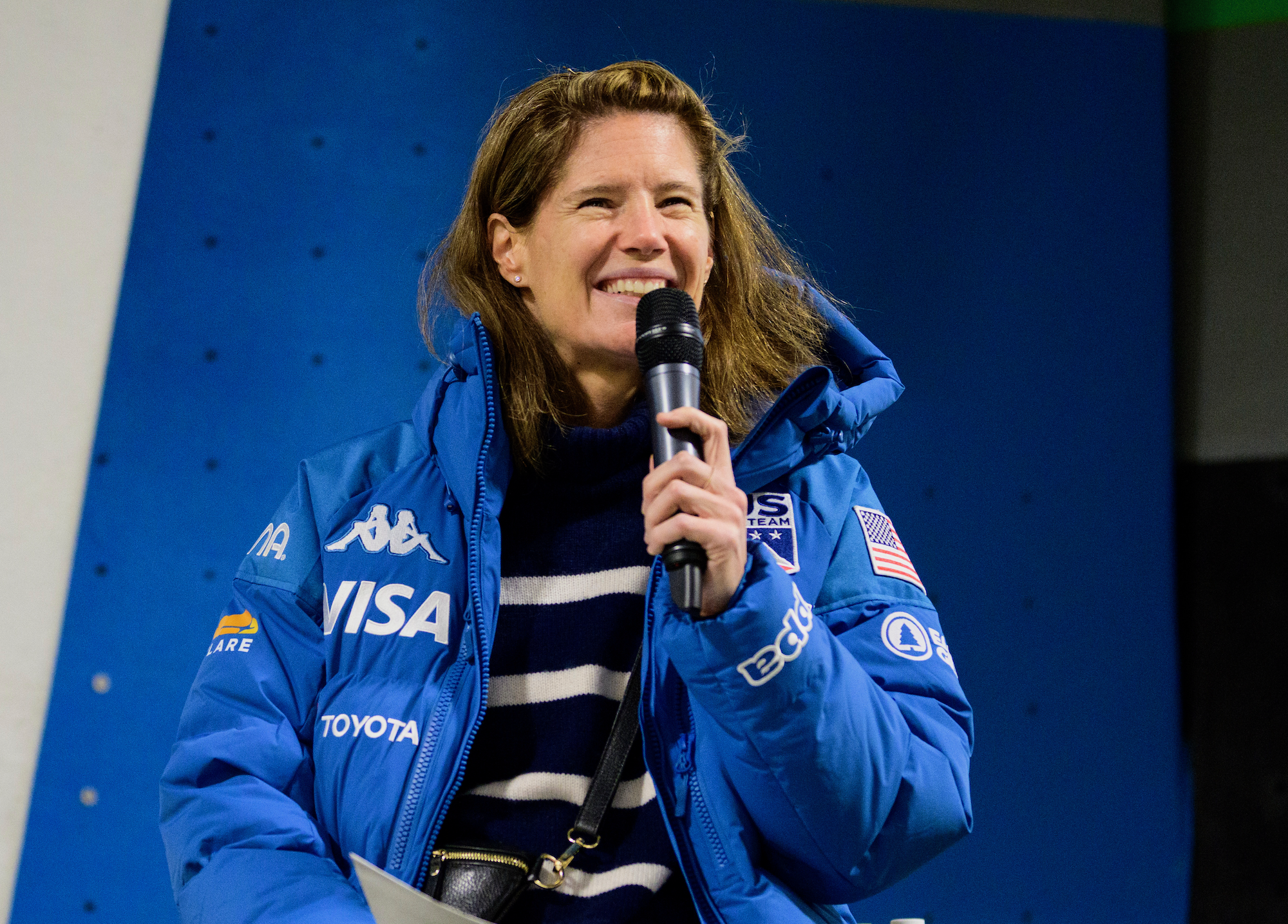
    Sophie Goldschmidt speaking at the Alpine World Cup in Killington, Vermont in 2024. (Photo: U.S. Ski & Snowboard)

    The money, and the question at the center of it

    Almost everyone involved agrees that money is the engine of this deal. What they do not agree on is how to describe the pressure behind it.

    The clearest number comes from Gierhart. For the coming season, he said, the USOPC reduced U.S. Biathlon’s grant by 22 percent. The reason, in his telling, has less to do with the alliance than with a shift in how the USOPC allocates money. Roughly three years ago, he said, the committee created an investment framework weighted toward medal potential. “They told us a couple of years ago, you guys are one of the highest funded sports, you haven’t delivered medals,” Gierhart said. “There’s a good probability you’re going to get a cut. And that’s what happened. They cut us,” a reduction he put at 22 percent for this year.

    Crucially, Gierhart rejected the idea that the cut is a lever to force the alliance. “It hasn’t been like, if you don’t do it, we’re taking away money,” he said. “It was, we’re taking away money because you’re over-resourced from our model standpoint and you’re not delivering. But if you go in this direction, which we believe will be beneficial in the long term, we want to help you do that.” Asked directly in a later FasterSkier interview whether it was a threat, he drew the distinction again. “They gave us our grant for this year, and it’s the 22 percent reduction. But they said that if we move in this direction with this alliance, they want to invest more in us. And they will find a way to do that,” bringing biathlon “back to where we were.”

    Goldschmidt, in interviews with FasterSkier, likewise described the reduction as reversible if the alliance proceeds, and tied it to the USOPC’s belief that a more efficient biathlon can compete for medals.

    The U.S. Olympic & Paralympic Committee, asked to confirm the figures and to say whether restoration of the funding is contingent on the alliance being approved, declined to address specifics. In a written statement, spokesman Jon Mason said the committee “is aware of and engaged in the discussions between U.S. Biathlon and U.S. Ski & Snowboard, and we support them taking a deliberate, transparent, fact-based approach to exploring a future relationship that complies with the Ted Stevens Olympic & Amateur Sports Act.” The committee, he added, is “supportive of outcomes that can build long-term stability and create opportunities for current and future generations of athletes.” The statement did not confirm the size of the cut, and it framed compliance with the Act as a goal the parties must meet rather than a settled fact.

    What the alliance would add is documented. According to the high-performance working group’s summary, biathlon “would receive a ~$600k increase from current FY27 revenue projections” in the first year, with U.S. Ski & Snowboard guaranteeing an increase “from this year-one level through year 4.” Gierhart put the combined total, new revenue and shared-services savings together, at “at least” $3.3 million over four years. That money, in principle, flows back into programs.

    Set against U.S. Biathlon’s roughly $3.5 million in annual revenue, those are not small numbers. And they arrive alongside a promise that biathlon’s existing money stays biathlon’s. Under the agreement, “all funding designated for biathlon, including IBU and USOPC support, existing sponsorship contributions, charitable donations, and other biathlon-specific revenue, will remain ring-fenced and used exclusively to support biathlon.”

    Here Goldschmidt was careful to correct what she called a misunderstanding. The ring-fence, she said, is permanent, not a four-year arrangement. “All of the money that they generate that is ring-fenced for biathlon will continue to go to that program. That will be a contractual commitment,” she said. “Some people have got confused that we’re only committing to four years to ring-fence and provide them funding. That’s not accurate.” The four-year commitment, she clarified, applies to the additional commercial funding U.S. Ski & Snowboard brings to the table, which depends on the sponsorship deals it can renew.

    Gierhart described the same two-part structure, and pushed back on the idea that biathlon falls off a cliff when the four years are up. “This gives us a platform for four years of sort of guaranteed increased revenue to build momentum and to implement the things that we know are going to help us,” he said. “Without that, we’re going to live year to year, and we’re already in maintenance mode as opposed to growth mode.” In four years, he argued, biathlon would be “in no different a situation than we are today. In fact, we’ll be better, because we’ll have a lot more resources to work with over the next four years.”

    That distinction defines exactly where the community’s deepest financial fear lives. The money biathlon already raises is protected by contract. The new money, the actual growth case, is guaranteed for one Olympic cycle, through 2030, and after that depends on the USOPC and on sponsors, the same as it would if biathlon stood alone.
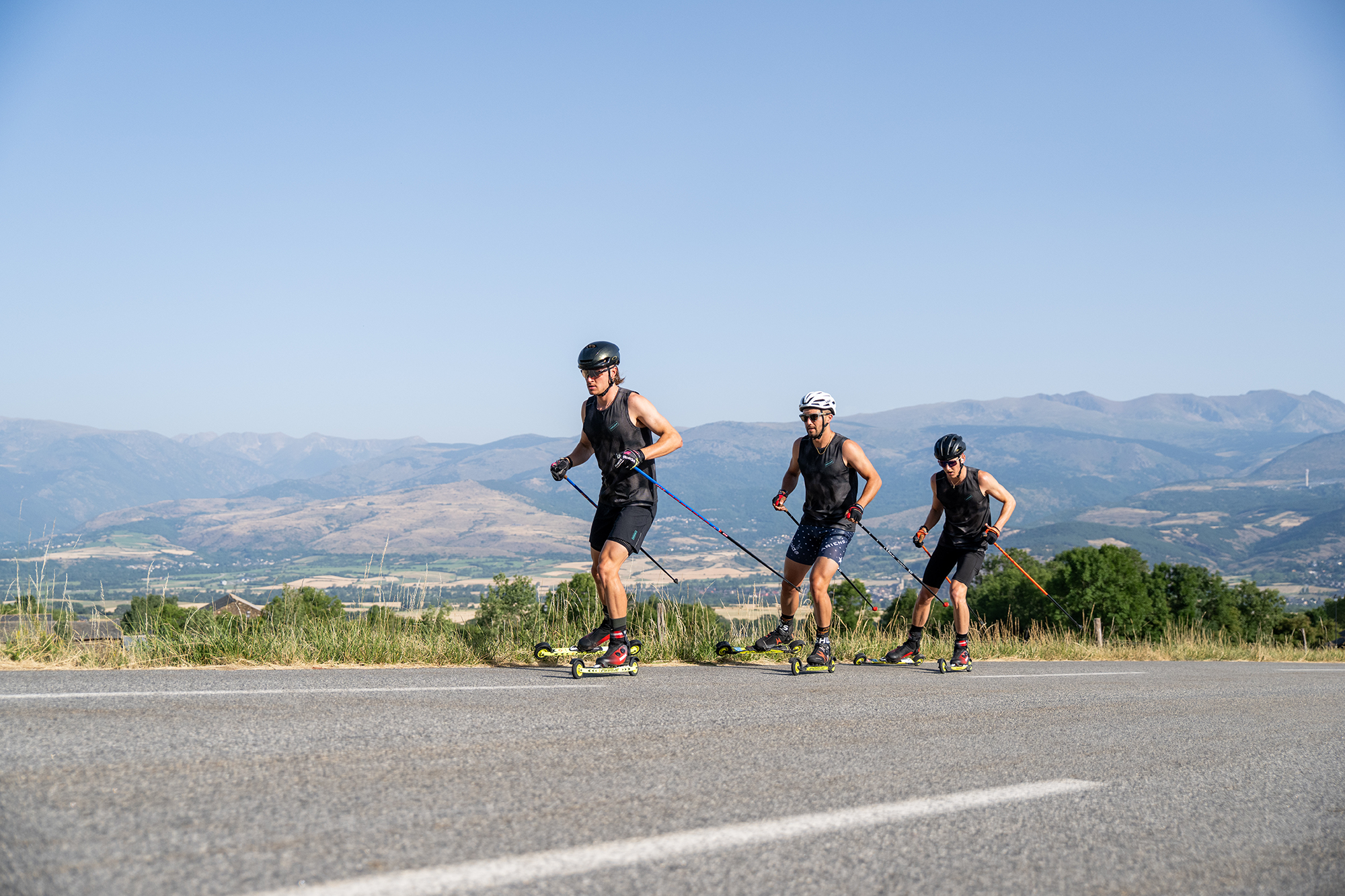
    While much of the US biathlon community debates governance, the USBA’s Campbell Wright, Vincent Bonacci, and Maxime Germain (l-r) gets after their summer training in Font-Romeu (FRA). (Photo: Authamayou/NordicFocus)

    The Ted Stevens question

    No part of the debate has generated more heat than the law. A group of members, some of whom helped establish U.S. Biathlon as an independent governing body decades ago, argue that the alliance violates the Ted Stevens Act. Their case rests on two provisions.

    The first is the single-federation rule. Under 36 U.S.C. 220522, a national governing body must be “a member of no more than one international sports federation that governs a sport included on the program of the Olympic Games.” U.S. Ski & Snowboard belongs to FIS, the International Ski and Snowboard Federation. Biathlon answers to the IBU. Critics contend that if U.S. Ski & Snowboard effectively governs an IBU sport, the arrangement collides with that rule.

    The second is autonomy. The same statute requires a governing body to be autonomous, in that it “independently decides and controls all matters central to governance” and “does not delegate decision-making and control of matters central to governance.” Arthur Stegen, a former U.S. Biathlon board member and part of a group called Team Independent Biathlon, laid out the objection in correspondence circulated to other members and shared with FasterSkier: a services agreement that assigns operational responsibility to U.S. Ski & Snowboard, he argues, is by definition a delegation of control, and reducing the biathlon board to a sport committee “would appear to relinquish its governance responsibilities to another organization.” Stegen wrote that he is “completely against this potential merger.”

    The written terms were plainly built to answer that challenge. The agreement summary includes a section titled “Reserved Governance Authorities,” which states that “notwithstanding any operational responsibilities delegated to U.S. Ski & Snowboard,” U.S. Biathlon “will retain sole authority over all matters required by the Ted Stevens Act or otherwise reserved to the National Governing Body,” including “oversight of the organization, approval of the biathlon budget, and all authorities reserved to the NGB.” In other words, the deal’s authors say operations are delegated while governance is reserved.

    Goldschmidt said the structure was designed to align with the statute from the start. “We’ve worked with the USOPC and others to ensure it fits all of those criteria, which it does,” she said. Gierhart said U.S. Biathlon has already received an opinion on the point. “We’ve gotten the opinion from the USOPC’s legal counsel on the terms as they’re written now, and their opinion is that it meets the requirements and is in compliance with the Ted Stevens Act,” he said.

    He was also clear about sequence, and described it as the normal way such deals come together. Wednesday’s vote is on the foundational terms, the fundamentals both sides have agreed to. “You’ve got to agree on the fundamentals, and then that’s what’s going to drive the detailed operating agreement,” he said. That more extensive agreement, covering licensing of the biathlon trademarks, the function of the board, and the bylaws, would be drafted next, “vetted by independent counsel” to confirm it complies with the Act, and then brought back to the U.S. Biathlon board, athlete representatives included, for a separate vote to approve it.

    That staging is itself contested ground. Supporters see a standard process: agree on principles, then build and independently vet the detailed contract. Skeptics see a board being asked to commit before the full agreement exists and before the independent legal review happens, and some argue a binding vote should wait until both are done. What Wednesday’s vote actually authorizes, the concept or a finished deal, is a distinction worth watching closely as the meeting unfolds.

    The USOPC, for its part, did not put its weight behind a declaration that the current structure is legal. It said it supports the parties “exploring a future relationship that complies” with the Act, language that leaves compliance as something still to be demonstrated.

    There is precedent for the skepticism, and for U.S. Ski & Snowboard’s interest in expansion. The organization previously pursued governing roles in surfing and skateboarding, efforts that critics cite as evidence of a broader ambition to build a multi-sport governing body, the very kind of concentration the Ted Stevens Act was written to prevent. Goldschmidt described those episodes as different in kind. Surfing, she said, “just got too political,” and the organization walked away; skateboarding remains “ongoing” with “no immediate decisions.” Biathlon, she argued, is a natural fit that most European countries adopted long ago. “I get asked all the time, why is biathlon not integrated within your organization,” she said. “It’s a natural fit in many ways.”

    Who controls the board

    Because the autonomy argument turns on control, the composition of the board is more than a technicality, and it is an area where early rumors and current terms diverge sharply.

    Gierhart was emphatic that the U.S. Biathlon board does not shrink or change hands. “The board is going to continue at the same size it is by the bylaws. It’s 12 to 15 members. They’re voted on by the membership,” he said. Those voters remain biathlon’s own roughly 1,500 members, whose categories will be tracked separately even after membership systems migrate to U.S. Ski & Snowboard’s platform in the 2027-28 season. “Our board size is not going to change. The composition is not going to change,” Gierhart said.

    Just as important, he said, is what that board keeps deciding. Among the authorities it retains is control of the budget and the annual plan, meaning that where biathlon’s money is spent would still be approved by the U.S. Biathlon board of directors.

    The new layer is the Biathlon Sport Committee, which the agreement describes as being drawn from the existing board, “6 to 8 members,” and maintaining the 33 percent athlete representation required by USOPC bylaws. The chair of that committee and one athlete representative would sit on the U.S. Ski & Snowboard governance board, giving biathlon two seats and a direct voice in the larger organization. The arrangement runs in both directions: U.S. Ski & Snowboard would, in turn, have representation on the U.S. Biathlon board.

    Athlete voice, a recurring worry, is addressed specifically. Rather than being folded into U.S. Ski & Snowboard’s athlete representation, “biathlon would still maintain its separate voice of athletes on the Team USA [Athletes’] Commission,” Gierhart said. “We’d have our own.”
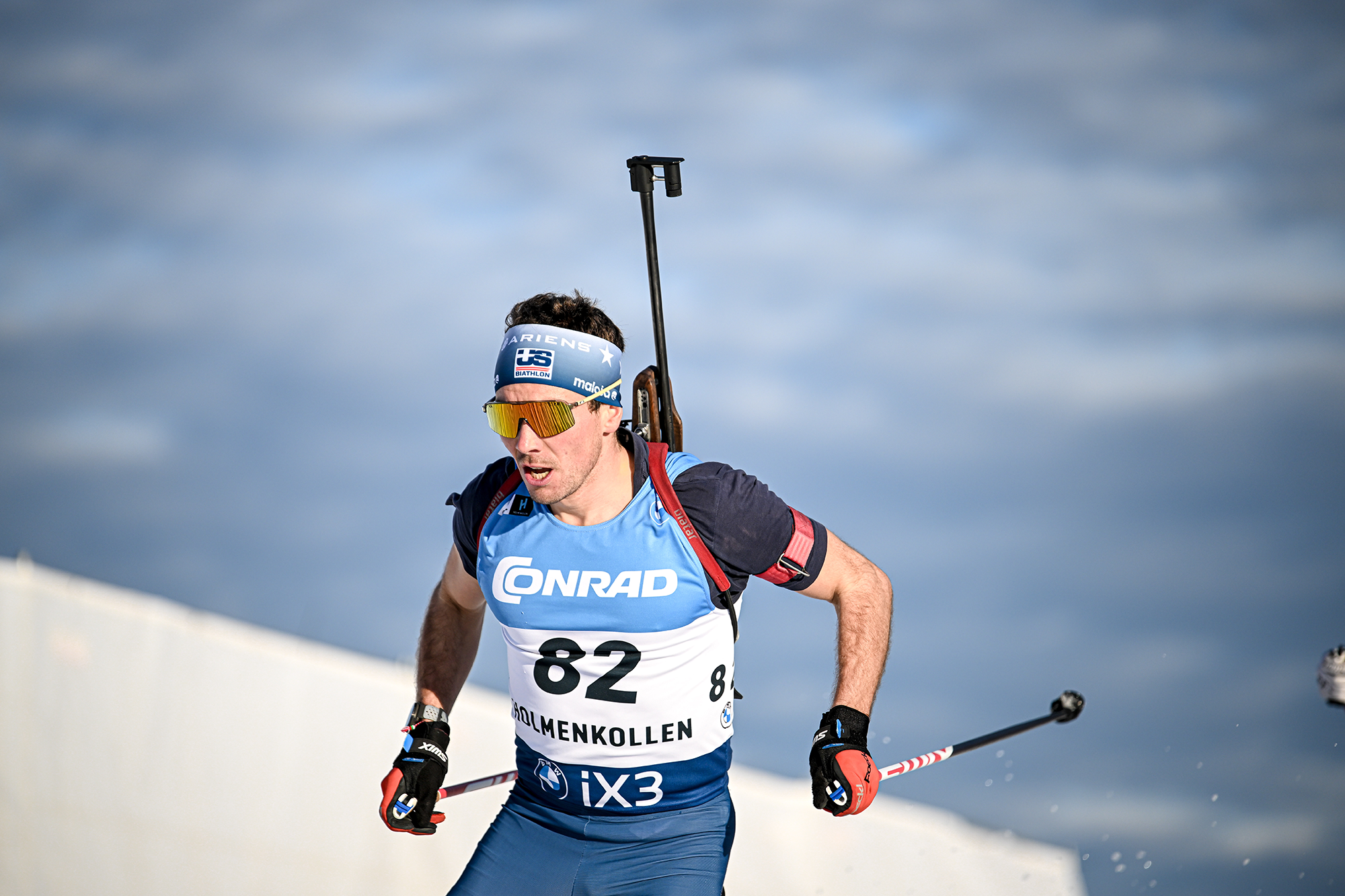
    Even though Jake Brown officially retired from the IBU World Cup after last season, he has played an active role as an athlete rep throughout this process. (Photo: Authamayou/NordicFocus)

    What changes for the athletes

    For the people who actually race, the alliance is not an abstraction about governance. It is a question about who pays for the plane ticket to Europe.

    U.S. Biathlon funds its athletes to a degree unusual among American winter sports. “Our athletes within biathlon are better funded and supported than in any other winter sport,” Gierhart said, noting that the program fully funds its World Cup athletes and nearly fully funds its IBU Cup athletes. Revisiting the specifics, he said U.S. Biathlon provides its athletes $48,000 in direct athlete support, $35,000 in need-based assistance, and $30,000 in performance bonuses, and secures roughly $36,000 a year for its top competitors. Cross-country, by contrast, does not pay national-team skiers to compete on the World Cup; much of that burden falls to clubs and to community fundraising.

    That gap is the source of the athletes’ most concrete fear. Jake Brown, who retired from biathlon this year and sits on the U.S. Biathlon board as an athlete representative, said the worry he hears most is that biathlon’s funding model quietly converts to the ski-team model once the sports combine. He is careful to add nuance. “There’s nothing guaranteed that U.S. Biathlon will continue funding World Cups either,” he said. “The funding has to be there.” Biathlon also draws money from the IBU for each athlete who starts a race, which makes subsidizing those starts partly self-financing, and the sport has leaned into keeping athletes in the pipeline rather than cutting them early. “We can’t afford to lose them,” Brown said.

    The agreement attempts to lock that model in place, but only for a defined window. The current athlete support model “will continue through the 2030 Olympic quad,” it says, with “National Team, World Cup, IBU Cup, Youth, and Junior athlete support structures” remaining “in place unless changes are jointly approved by the Biathlon Sport Director and the U.S. Biathlon Board.” As with the incremental funding, the guarantee runs one cycle. What happens after 2030 is precisely what no document can promise, though, as Gierhart notes, biathlon cannot promise that to itself every year either.

    No voice in this debate has lived that risk more directly than Justin Wadsworth, the former U.S. Olympian who now is U.S. Biathlon’s Head Physiology Coach (working with both the men’s and women’s national teams) and who spent years coaching in Canada, including a stretch as a high-performance director there. Wadsworth described watching Biathlon Canada’s funding collapse. “Over the last eight to ten years, we’ve seen organizations having funded the athletes for all camps, all trips, everything, to now athletes paying for training camps, paying for trips,” he said. “That’s basically what’s really pulled Biathlon Canada down. The athletes just can’t afford to go on trips or training camps.”

    The damage, he said, was not only financial. “It really changes the dynamic with the team,” Wadsworth said. “As a coach and as an organization, it’s much harder when athletes are paying for everything.” His wife, Beckie Scott, the Olympic champion who now leads Nordiq Canada, made cutting athlete fees a priority for exactly that reason. Asked what U.S. Biathlon should guard most carefully, Wadsworth did not hesitate. “The number one is just, are the athletes going to continue to be getting funded when they’re absorbed with U.S. Ski and Snowboard.”

    Brown framed the same anxiety in a different register, as a question of trust. “There is a strength in independence,” he said. “You have a trust that your leader, when they put their head on the pillow every night, is trying to figure out how to make biathlon better in the country, and not trying to figure out how to prioritize what sport within a larger organization.” That, more than any statute, is the emotional core of the opposition: the fear that biathlon becomes one line item among many, advocated for by executives whose attention is divided.

    The community’s own working group named the same items. The high-performance group’s report listed what “must be protected”: the centralized national team model, athlete stipends and need-based aid, the pathway that recruits skiers into biathlon, the world-class ski-service program, the Montana State University sport-science partnership, and “athlete-centered decision making.” It also warned, in writing, of the risk that unites the skeptics and the supporters, that “differences in stipends, housing, and athlete funding philosophies will be inequities across sports,” and that “the reasoning behind this must be explained well, or there is high risk of tension between sports.”

    The case for

    Set the fears aside and the argument for the alliance is not hard to follow, and some of its most persuasive versions come from people with no stake in the outcome.

    Wadsworth, who says he has “no real skin in the game” and is “just trying to coach right now,” makes the efficiency case from painful experience. A small governing body cannot carry the overhead a large one can. “An appeal, from an athlete and the organization needs to get a lawyer for that, a single appeal can cost 30 to $50,000,” he said, “and if that’s 5 percent of your budget, that’s a big hit.” Fold biathlon into a larger organization with in-house counsel, fundraising staff, a training center, and sport scientists, he said, and those costs largely vanish. “Those efficiencies are really the positive side.”

    Goldschmidt’s version is about scale on the revenue side. U.S. Ski & Snowboard, she wrote to biathlon’s members, generated “more than 900 million social media impressions and 7 billion earned media impressions last season,” counts more than a million social followers, and has “more than doubled our commercial revenue over the last four years,” with “nearly 85 percent of that revenue going directly to athletics.” Biathlon, by her argument, brings a genuinely valuable and telegenic property, the IBU World Cup is among the most-watched winter sports in Europe, that a 35,000-follower organization cannot monetize on its own. “One plus one can equal a lot more than two,” she said, “most importantly for biathlon.”

    Gierhart’s case is about the limits of the status quo. “We’ve been doing the same thing for 60 years,” he said. “We’re a small sport, we have limited resources. We’ve always had a thin bench. But the formula isn’t changing. And if we’re going to try to drive transformational change, we’ve got to look at some things a little differently.”

    And there is the pipeline, the argument that biathlon and cross-country are natural partners that have been kept artificially apart. Today a club that wants to offer both sports contends with two governing bodies, two memberships, two coaching-education systems, two calendars. The sport-development working group’s central recommendation was to merge those tracks, shared coach education, coordinated regional calendars, laser biathlon introduced to youth skiers, so that, in Brown’s words, the “big potential benefit comes in the sport development space.” Wadsworth added the practical constraint that enthusiasm tends to skip past: it comes down to shooting ranges. “The number one thing for biathlon is you need a range, and so that’s probably a limiting factor,” he said. “If U.S. Ski and Snowboard decides they really want to focus on the development side, they’re going to have to build more biathlon ranges. If you build it, they’ll come.”
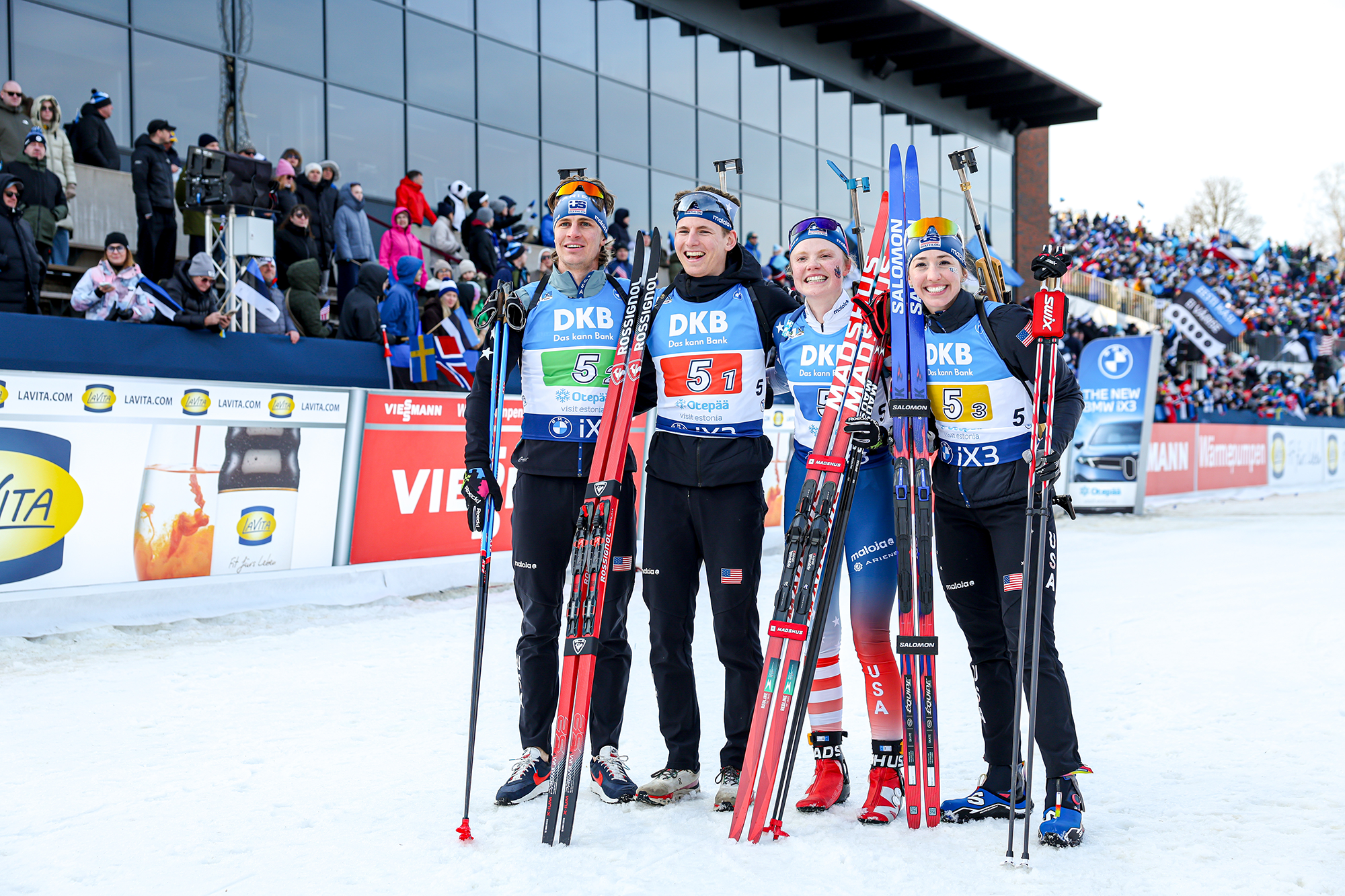
    Campbell Wright (USA), Maxime Germain (USA), Margie Freed (USA), and Deedra Irwin (USA), (l-r) after the IBU World Cup Biathlon mixed relay in Otepaeae (EST). (Photo: Manzoni/NordicFocus)

    The case against, in the community’s own words

    The sharpest questions about the alliance do not come from the members trading accusations online. They come from the process U.S. Biathlon itself ran. The working groups produced plenty of enthusiasm for closer collaboration, and their reports document at length the benefits participants believed an alliance could unlock. But the same reports surfaced a recurring doubt.

    Across all three groups, participants returned to a single question: if the goal is collaboration between biathlon and cross-country, why does it require a formal alliance? The consolidated report notes that “several participants observed that many of these initiatives could theoretically be pursued without a formal alliance.” The sport-development group put it more bluntly in its written takeaway: “Some expressed confident progress could be made without an alliance. It is not accountability that will move this from conversation to action. It is the passion of the people involved in both sports.” (U.S. Biathlon cautions on every page that the working-group notes were “generated during meetings in which judgment was not applied” and “do not represent the decisions or strategies” of the organization.)

    The governance group’s “parking lot” of unresolved issues reads like a checklist of the skeptics’ concerns: “Ted Stevens Act compliance,” “an escape path if integration fails,” “what autonomy does Sport Committee have to direct USSS operations,” and whether a replacement is needed for the athletes’ advisory council “to preserve biathlete input.” The high-performance group flagged “budget flexibility,” asked “which proposed benefits truly require an alliance, and which can already be achieved through partnership,” and wondered whether biathlon could build its own dedicated fundraising vehicle, an equivalent of the National Nordic Foundation, without merging at all.

    U.S. Ski & Snowboard’s answer to the “why not just collaborate” question is that informal collaboration has been tried, and has not delivered. The alliance-alignment document U.S. Biathlon distributed argues that, while the two organizations “have collaborated successfully for many years, this formal Alliance creates a level of commitment, coordination and accountability that cannot be achieved through informal collaboration alone.” Gierhart put it more sharply. He said he disagrees “wholeheartedly” with the notion that passion alone will carry the work forward. “You need accountability,” he said, describing what he sees as a fundamental difference within the community over how things actually get done. Goldschmidt made the same point about incentives: absent a formal structure, she said, no one at a big organization is measured on whether they helped a small one. “Why would I help another sport if that’s not how I’m measured?”

    Then there is the matter of process and speed, which even supportive athletes acknowledge. Brown said the spring rollout caught the community off guard. “It kind of came out in the springtime. It was a little bit surprising, and it took us some time to understand why,” he said. “Most of the membership and the athlete body, we had some catching up to do.” The working groups were themselves a response to feedback that the process had moved too fast with too little consultation, and some members continue to argue that a binding vote should wait for the final agreement and its independent legal review, both of which, by U.S. Biathlon’s own account, come after Wednesday.

    The exit, and what the fine print says

    If there is a single provision that will decide how much reassurance skeptics take from this deal, it is the exit. Gierhart is adamant that it is a last resort, not a trap door.

    He described a defined process. Goals and key performance indicators would be set at the outset, with an assessment after the first year and a comprehensive review at the end of the quad. “If we get to a point where there’s irreconcilable differences,” he said, “then there is an option to move towards a different operating structure, which could mean that U.S. Biathlon becomes an independent operating entity again. And that is a choice that can be made by either party. It doesn’t have to be mutually agreed upon.”

    He was careful to say that does not mean either side can simply walk away on a whim. The written summary describes an interim assessment after the 2026-27 season and a comprehensive review after 2029-30, and says that “should significant challenges arise that materially impair the objectives of the alliance, the organizations will first implement a corrective action plan.” Only “if substantial concerns remain unresolved after those efforts” would “alternative organizational structures, including the return of U.S. Biathlon to an independently operated organization, be considered.” That, Gierhart said, matches what he meant: a process of measuring progress against shared goals, trying to fix what is not working, and only then, if the problems prove irreconcilable, allowing either party to end the alliance without the other’s consent.

    “I don’t want it to sound in any way that in four years there’s an exit ramp that’s most likely going to happen,” he said. It is less an exit ramp, in his framing, than a runaway-truck ramp: an emergency measure, rarely used, that exists only for the case where nothing else has worked. The distinction that matters, he said, is that the eventual decision does not require both sides to agree. “It would probably be the board of directors of U.S. Biathlon that would say, we can’t resolve these differences and we want to make a change. Or Ski and Snowboard would say this is not working.”
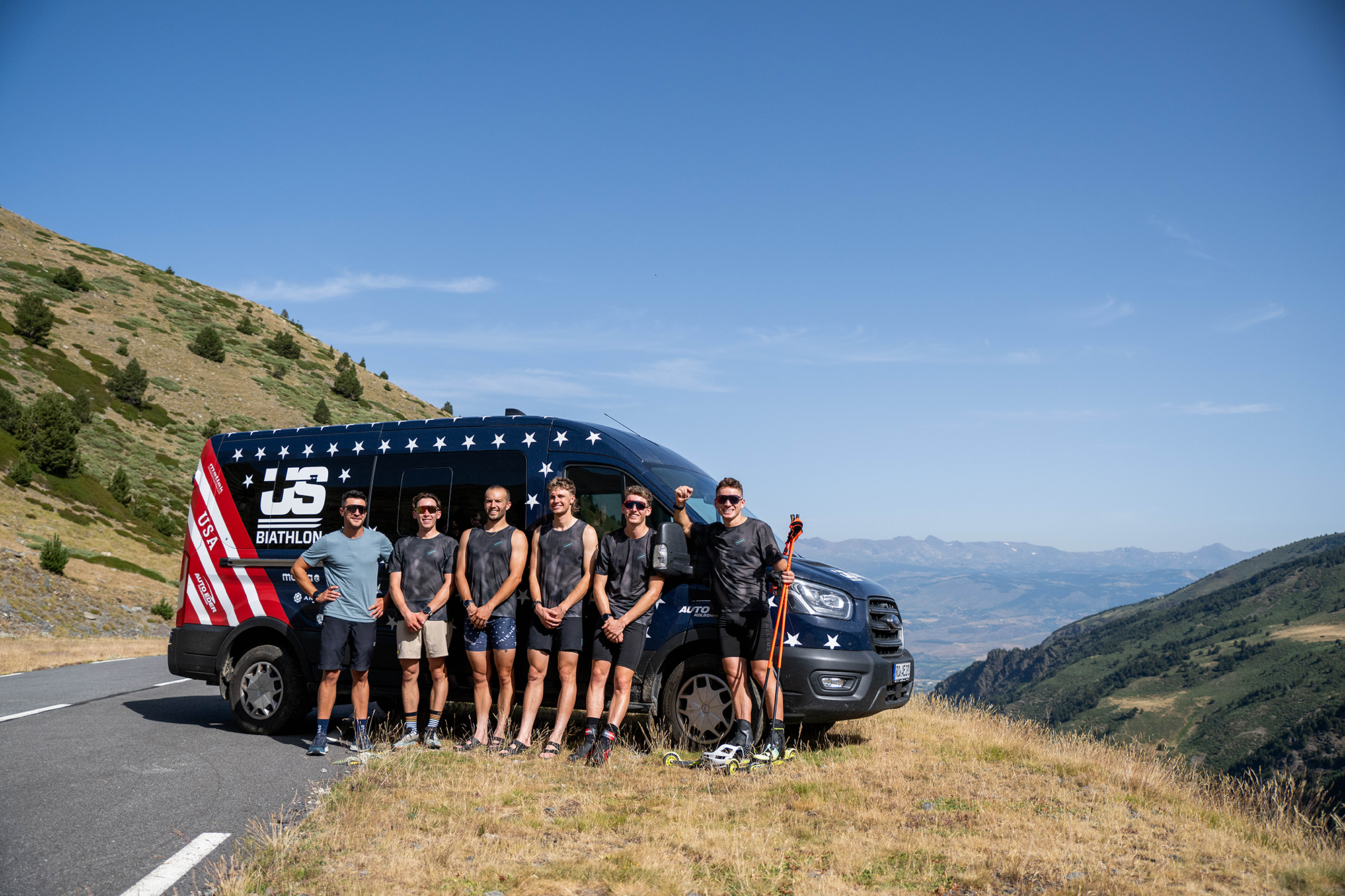
    Emil Bormetti (ITA); Coach Team USA, Bjorn Westervelt (USA), Vincent Bonacci (USA), Campbell Wright (NZL), Maxime Germain (USA), Vaclav Cervenka (USA), (l-r) summer training in Font-Romeu (FRA). (Photo: Authamayou/NordicFocus)

    What happens Wednesday

    The board meets Wednesday at 4 p.m. Eastern. By Gierhart’s account, directors received an extensive board package over the preceding weekend, and the athlete representatives, who under USOPC rules make up a third of the board, have been closely engaged.

    What the vote settles may be narrower than the noise around it suggests. If the board approves the foundational terms, the more detailed operating agreement, and its independent legal review, would follow, along with a further board vote to approve it. If the board balks, or postpones, the timeline slides. Either outcome will be read as a verdict on a process that many in the community found rushed and many others found overdue.

    The stakes are real in both directions, which is why the debate has been so bitter. If biathlon stays independent, it does so facing a documented funding cut and the same structural constraints that have kept it small for six decades. If it joins, it trades a measure of autonomy for stability, resources, and a commercial platform it has never had, and it does so on the promise, guaranteed for four years and asserted in perpetuity, that the sport it has built will not be diminished inside a larger one.

    The people on every side of this insist they want the same thing. “Whichever way the board decides,” Brown said, “I really want to be able to take our membership with us in whichever direction we go, and maintain good relationships with our full community. Because otherwise, we lose.”

    On Wednesday afternoon, fifteen people will decide which way that goes.

    FasterSkier will report the outcome of Wednesday’s vote. Reporting for this article included interviews with U.S. Ski & Snowboard president and CEO Sophie Goldschmidt, U.S. Biathlon president and CEO Jack Gierhart, U.S. Biathlon athlete representative Jake Brown, and U.S. Biathlon head physiology coach Justin Wadsworth, a written statement from the U.S. Olympic & Paralympic Committee, and a review of the alliance term sheet, the July 2026 community working-group reports, and correspondence from members opposed to the deal.

    Because the details of this proposal are complex, quotations attributed to U.S. Ski & Snowboard and to U.S. Biathlon were provided to each organization in advance of publication so they could verify the accuracy of their own statements and clarify technical details. FasterSkier retained full editorial control over the content, framing, and conclusions of this article.


    Help Support Our Coverage!

    If you value the thoughtful work and access FasterSkier provides, please consider becoming a Voluntary Subscriber. Your support directly fuels our work to cover the people, places, and moments that make our sport special.

    Join the FasterSkier community!


    At this moment, we don’t know what is down the road for USA Biathlon, but hopefully we will stay a community that supports the sport and the hard work of the athletes and coaches doing their best to perform at the highest level. (Photo: Authamayou/NordicFocus)
  • The Devon Kershaw Show: A Tesero team sprint slugfest

    The Devon Kershaw Show: A Tesero team sprint slugfest

    This episode was made possible through the generous support of our voluntary subscribers.  If you value coverage like this, please support FasterSkier with a voluntary subscription.  

    The highs were high and the lows were low in the Olympic team sprint in Italy, with the Ogden-Schumacher men’s team claiming silver and the Diggins-Kern women’s pair finishing out of the medals. Devon and Nat break the whole thing down.

    We’ll be back after Saturday’s men’s 50 k. Reach us at devon[at]fasterskier.com and nat[at]fasterskier.com. We’re really grateful for all the support during the Olympics — thanks for notes and encouragement.

    A reminder: This is a homegrown podcast done by two guys working long hours and late nights. We’re also paying real money to be here in Italy. If you can, support the show and FasterSkier’s ongoing coverage with a voluntary membership. We’re also offering a bonus during the Olympics: a WhatsApp group with notes on Nat’s experiences in Italy, the food he’s eating, interview transcripts and more.

    Send nat[at]northernjournal[dot]com a confirmation of your voluntary membership and the number he should use for WhatsApp and we’ll get you signed up. You can also Venmo him directly at @nat-herz if a membership isn’t for you. We’re suggesting a minimum of $10, but we also won’t turn anyone away who wants to join because of an inability to pay.

    Help Support Our Olympic Coverage!

    FasterSkier will have our own Nat Herz on the ground at the Olympics, which, to be honest, is a very big financial lift for us. If you value the thoughtful work and access FasterSkier provides at championships like this one, please consider becoming a Voluntary Subscriber. Your support directly fuels the work we do to cover the people, places, and moments that make our sport special.

    Join the FasterSkier community!
  • Klaebo’s History, USA’s Glory—Olympic Team Sprint

    Klaebo’s History, USA’s Glory—Olympic Team Sprint

    This article was made possible through the generous support of our voluntary subscribers who have helped put our Nat Herz on the ground at the Olympics. If you value coverage like this, please support FasterSkier with a voluntary subscription.

    Gus Schumacher (USA), Ben Ogden (USA) announce the arrival of a new American cross-country tradition. (Photo:  Vanzetta/NordicFocus.)

    PREDAZZO, ITALY — Johannes Hoesflot Klaebo still had something special to do. American skiers still had something special to prove. But the Team Sprint is never as simple as just lining up and racing. Contending nations need to consider the field, rate the strengths and vulnerabilities of their competition, and make a plan to best take advantage of the circumstances. Then they have to ski it . . .

    Not that they needed to, but the Norwegians must have come up with a different plan. For nearly a year—since the straightforward, matter-of-fact Team Sprint victory of Klaebo and Valnes in last year’s World Championships—I’ve been thinking of the Norwegian Team Sprint strategy in only one way: whoever is paired with Klaebo just needs not to get dropped. Stay out of trouble, avoid tangles, respond to the attacks from other teams but don’t allow yourself to be made vulnerable by launching attacks of your (efforts that could, then, be counter-attacked). When considering strategy, picking Klaebo’s partner in this team event seemed like a straightforward selection to make . . . but more than one Norwegian could fit neatly into that role. It’s a role that’s been performed admirably by Valnes in the past, and by Iversen before him (both of them on this year’s Norwegian Olympic Team roster). It’s a role that could have logically been taken on by Harald Oestberg Amundsen, who is both a very fast sprinter and the reigning World Cup Distance champion. All three of them are fast, All three of them are great endurance skiers as well as fine sprinters. None of them would be likely to get dropped by anyone else in the field, and all have a wealth of experience skiing in the should-to-shoulder, rough-and-tumble style of pack racing that is typical of a Team Sprint event. Pick one of those guys, right?

    Not so fast . . .

    Johannes Hoesflot Klaebo finds himself paired in this Olympic Team Sprint with Einar Hedegart. Hedegart is certainly fast, and it’s rumored that he possesses the highest VO2 Max of any Norwegian athlete (in any sport). That would certainly come in handy if Hedegart’s job was to drop everybody in order to give Klaebo a head start on the anchor leg. But is that even necessary? The Team Sprint finishes on the same hill as the Individual Sprint. Remember that hill? The one that’s made Klaebo famous for his unmatchable 11 mph scamper that’s all over the internet? If you put all the best skiers in the world at the bottom of that hill, and say “go,” Klaebo will win a race to the finish line by a mile. We thought the plan for the Team Sprint would take advantage of that advantage.

    What does teaming with Hedegart get them? Those are questions that someone over in Norway must’ve considered. If Hedegart tries to break away, he makes his team vulnerable to counter-attack . . . and he already showed in the 10 k Freestyle (where he went out way to fast, and bonked like an inexperienced age-grouper) that he may not yet possess a full understanding of pacing. Furthermore, Hedegart possesses nowhere near as much World Cup Sprint experience as Iversen or Valnes or Amundsen. They’re less likely to get stepped on or pushed over or boxed in. With Hedegart—well, he’s fast, but the Norwegians really don’t know what they’re getting.

    On the other hand, Hedegart’s raw speed is what Norway may be seeking. With his bronze medal in the 10 k Freestyle, he showed that he was a fairly even match for the speedy Frenchman, Mathis Desloges (already with three silver medals in these Olympic races). And France is starting Desloges in the first leg of the Team Relay (opposite Hedegart). One way or another, Klaebo’s performance is fairly predictable, so all the significant question marks are swirling around Hedegart.

    Ben Ogden (USA) had one job to do—create the gap. (Photo: Barbieri/NordicFocus)
    The American Dream

    It seems like the American men also have decided to try out an unexpected strategy. It would have been easy to assume that Team USA might hope to get Ben Ogden—the team’s most accomplished sprinter—into the anchor leg so that he could battle his way to the finish line among the other designated sprinters. A sprint finish for the medals, assign your best sprinter. Right? Maybe not. The US team decided that the anchor leg will be skied by Gus Schumacher, himself no slouch as a sprinter, and an occasional visitor to World Cup  Sprint semifinals and finals. But if Schumacher skis the anchor leg, then he’s likely to find himself sprinting against Klaebo and Federico Pellegrino and Jules Chappaz. Schumacher may not match up too well against those three . . . but if Schumacher is given a lead going into the anchor leg, there aren’t many skiers in the world who can chase him down. Perhaps what USA is counting on is Ogden being able to launch an attack in the penultimate leg that disrupts the other contenders, allowing Schumacher to coast home alone. Klaebo may already be well off the front by then, but who knows? Maybe there’s a medal for the Americans in this strategy that might not otherwise have existed.

    “I was incredibly nervous before today’s race,” said Ogden. “But the parts, the moments where I’m nervous are, like, the lead up, you know? I know that once the race starts, I can just get to this headspace where I can be confident and be strong and be smart with my movements in the group. And that’s a really good feeling.”

    Time to line up and race . . .

    Einar Hedegart (NOR) would need to be both fast, and patient in an event that he had never skied before. (Photo: Vanzetta/NordicFocus)
    Men’s Team Sprint

    Unlike the Individual Sprint where the event is raced in heats of six skiers, the Team Sprint is a 15 team melee whose selection of teams is based on the compiled individual qualifying times of each team’s sprinters. Once the final field is decided, they just line ’em up, and say “Go.” With 15 teams charging around the Sprint course, it would seem to be anyone’s race.  Ironically, pre-race ski-pundits would have us believe that the three medals should only be distributed among four teams: Norway, France, Italy, and the USA. But teh efforts, attacks, and foibles of many other teams are likey to have an impact. As other recent relay events have amply demonstrated, there is much that can interrupt all best-laid plans between the prediction and the finish. Soon, either those experts would look like geniuses, or fools.

    Ogden would be compelled to deal with Desloges, Hedegart, and Anger in Leg 1. While the Ogden-strategy may have been to accelerate in his leg—creating a gap that will allow Schumacher to maintain an advantage—Ogden was not likely to pursue the all-out-from-the-gun that Diggins employed in the Women’s Team Sprint. It’s just too athletically expensive to race that way.

    Ogden started front and center of the front row, where he was followed quickly by Austra. The first meters were confusing as Riebli (SUI) needed to scramble to find a replacement pole in just the first few seconds of racing. Ogden and Desloges made the early tempo. The field would begin to stretch out, more out of concern for safety than exhaustion.

    “We did our one thing that we talked about: we were gonna meet on the right hand side of the exchange zone,” said Ogden. “Without fail, every single time we caught we came in on the other side, on the far and had to cross, and had to cross through like 15 people in order to get to our guy on the other side. And it was one of those things where we both honed in on the fact that being on the right hand side of the exchange room was not working. But it was also like, we can’t risk going to the left hand side and having him not see us. So we just had to sort of stick with it. And, you know, made for a couple fast first 20 seconds of the legs to try to catch back up.”

    Johannes Hoesflot Klaebo (NOR) will do what he’s going to do. Teams from all other nations will scramble for silver and bronze. (Photo: Vanzetta/NordicFocus)
    Leg 2—Klaebo’s fast lane

    Klaebo may not have been happy at being forced to weave through the field after the exchange (and Hedegart’s presence in the crowded scrum of the transition must have been nerve-wracking), but this is not Klaebo’s first rodeo. He made his way easily to the front followed by Pellegrino and Edvin Anger (SWE) who decided he wanted to take the lead. Klaebo and Pellegrino were only too happy to let the confident young Swede do the work.

    “I was trying to save energy and not lead,” said Schumacher. “When you start off out of the stadium and third or fourth, and another line comes up behind you, you’re eighth pretty quickly. And then, yeah, coming into the stadium, there was a big slingshot, and I was sort of like—I don’t know—I felt like I was generally on the wrong side of that . . . I kept my head, stayed calm, which I’m really proud of.”

    “It’s nice to be able to trust Ben,” Schumacher continued. “To tag him far back, and he’ll tag me back in a great spot. And he set me up in that last lap perfectly. Then I had a pretty simple job to do, and I’m really glad I was able to do that.”

    Leg 3—Hedegart’s patience

    Hedegart inherited the lead from Klaebo, but he led at a pace that indicated he was not interested in laying down the law. Not yet, anyway. Hedeagart settled in behind Lauri Vuorinen (FIN) while the field spread out behind them. No real breakaway yet, but the group was beginning to feel the strain. There wouldl be less “trouble” for Hedegart to encounter on the course, but he wasn’t out of the woods yet. All of Norway held its breath.

    Gus Schumacher (USA) has often shown the sort of speed and endurance needed in the anchor leg, but his performances in recent Olympic races left some questions. He answered loud and clear. (Photo: Vanzetta/NordicFocus)
    Leg 4—Schumacher’s arrival, Desloges’ disasters

    Hedegart had again come through transition with the lead, follwed by Sweden and France. Anger again wanted the front, perhaps hoping to create some gaps of his own. Desloges spent Leg 4 suffering his second broken pole of he day. France was faltering irretrievably, and the field sensed an opening in the medals. Team USA had sat concealed in the field all race, but Schumacher was begining to move forward, and to make his presence felt. Canada shadowed USA. With the field still hanging together, Team USA may have been ready for Ogden’s Leg 5 surge.

    Leg 5—Ogden’s encore

    Just like they may have planned it, there went Ogden leading Hedegart up the significant hill. Hedegart may have possessed the lead, but the USA was putting its plan into effect, as well. While all the leaders remained in contention, it looked like the pre-race script was remaining consistent.

    Celebration at the finish. Ben Ogden (USA) and Gus Schumacher (USA) team up to make history. (Photo: Barbieri/NordicFocus)
    Anchor Leg—USA!

    Ogden had done his job, as had Hedegart. One lap to go, with Klaebo enjoying a small lead over Schumacher, Anger, and Pellegrino. With only the anchor leg remaining, what USA needed was a skier with flashing speed and bottomless endurance. That’s Gus Schumacher . . .

    “The best way to do that is just go as fast as you can,” said Schumacher. “And I think today I did a good job of just looking forward. Klaebo was gonna ski this fast. If I can stay close to him, I’ll also ski it fast.”

    Schumacher made his way to Klaebo’s tails as Pellegrino dropped Anger. Medals waited on the horizon as Klaebo shifted into top gear on his signature hill. Pellegrino made up ground on Schumacher, but did not close the gap enough to benefit from the draft on the downhill where the field spread out in a test of glide wax and base prep. Gaps held as skiers entered the finishing straightaway where Klaebo wrote Olympic history to become only the second Winter Olympic athlete to win five golds in a single games. Additional history followed in Klaebo’s wake, as Schumacher erupted across the finish line to grab silver for Team USA, his first Olympic medal, and Ogden’s second silver of these Games.

    “Once the race starts, I just race the same way I have since I was five,” said Ogden. “So that’s a really nice feeling. And I think that the test of this championship has like, like, set me up really well to just be confident and leap, (to) control the pace and then go hard and be confident that I could, that I could make some time. So was a good feeling.”

    Pellegrino offered the home-crowd yet another thrill when he crossed the line to deliver his second bronze medal.

    Relief, exhaustion, satisfaction: Federico Pellegrino (ITA) has long carried the weight of Italian expectations. With his second bronze medal of these Olympic Winter Games, Pellegrino is writing the closing chapters of his career con brio e brillantezza. (Photo: Barbieri/NordicFocus)

    The legendary American speedskater, Eric Heiden, won every single event on the speedskating card in the Olympic Winter Games of Lake Placid, 1980. Those unprecedented triumphs—from the explosive 500 meter sprint to the brutal 10,000 meter marathon—made it clear that even among the very best in his sport, Heiden reigned supreme. As performers and performances have specialized across all sports, it appeared unlikely that anyone would ever so dominate a sport again. Well, with his own fifth gold medal, Klaebo has proven to be Heiden’s equal. And with one event still remaining in cross-country events at these Olympics, a modern athlete may yet prove the sort of dominance once known only to the great sportsmen of history.

    American sports fans certainly remember Heiden. But today, in Val di Fiemme, the performance that would make hearts beat and souls rejoice—the medal that would see American sports fans leaping from the couch in the middle of the North American night—belonged to Ben Ogden and Gus Schumacher, rivals throughout their long careers, teammates for a decade, and partners in the race that earned only the third cross-country skiing medal in America’s Winter Olympic history.

    Bill Koch has long borne the mantle of American cross-country skiing.  He is now joined in that task by more American skiing stars including Jesie Diggins, Ben Ogden, and Gus Schumacher. (Photo: Peter Ashley)

    Way back in 1976, American viewers were glued to the TV sets watching races from Innsbruck, hoping to see Bill Koch win his second Olympic medal. Back then, that’s what we thought would happen . . . win one medal, win another. But while Koch performed admirably in the race that followed his historic silver medal, he did not earn a place on the podium again. Today, in Val di Fiemme, Ben Ogden made a little history of his own, becoming the first American man to earn a second Olympic medal. He did so in a display of grit, of determination, of long-standing cameraderie and cooperation with his longtime teammate, the indefatigable Gus Schumacher who, himself, became only the third American man to claim an Olympic medal.

    Soon, we may stop talking about historic finishes for American skiers. As a team, most of the firsts and onlys now lie behind them. What arrives in their place is legitimacy and respect, and a future that may bring expectation and anticipation in place of mere hopes and dreams. American cross-country has arrived, just in time to establish a bright future when some of its bright stars are preparing to depart the stage. Mission accomplished, plan complete.

    Men’s Olympic Team Sprint RESULTS


    Help Support Our Olympic Coverage!

    FasterSkier will have our own Nat Herz on the ground at the Olympics, which, to be honest, is a very big financial lift for us. If you value the thoughtful work and access FasterSkier provides at championships like this one, please consider becoming a Voluntary Subscriber. Your support directly fuels the work we do to cover the people, places, and moments that make our sport special.

    Join the FasterSkier community!
     

    History in hand: Gus Schumacher (USA) and Ben Ogden (USA) hold American silver. (Photo:  Barbieri/NordicFocus)

    Ogden remained refreshingly loose on the podium: “I was giving (Klaebo) some $#!* for the fact that they had the least cool podium outfits,” Ogden recalled. “And then he said, ‘How many golds do you have?’ I was like, well, that’s a good point, but they still have the least cool podium outfits. There can be no denying that . . .”

  • Klaebo Races Toward Olympic Immortality

    Klaebo Races Toward Olympic Immortality

    This article was made possible through the generous support of our voluntary subscribers who have helped put our Nat Herz on the ground at the Olympics. If you value coverage like this, please support FasterSkier with a voluntary subscription.

    Johannes Hoesflot Klaebo (NOR) on his way to his third gold medal of the Olympic Winter Games in Milano-Cortina. His victory in the 10 k Freestyle gave him his eight Olympic gold medal, tying him for the most ever with his compatriots Marit Bjoergen, Bjorn Daehlie, and Ole Einar Bjoerndalen. (Photo: Barbieri/NordicFocus)

    Two days ago, at the finish line of the Men’s Classic Sprint, Norway’s Oskar Opstad Vike celebrated like a lottery player who had just scratched the winning ticket. Fist-pumping, chest-thumping, wild gesticulating toward fan-filled grandstands and visceral howling at the proverbial moon. He hadn’t won gold—Johannes Hoesflot Klaebo did that. Vike hadn’t won silver—Ben Ogden secured that little piece of Olympic skiing history. What Vike celebrated was his own third place finish—his bronze medal. Norwegian skiers can dream of no higher honor than to win an Olympic medal in cross-country skiing, and Vike had just done that. His goal had been met, his future had been made, his celebration was sincere. There are plenty of male Norwegian skiers who are capable of winning an Olympic medal; what Vike understood was this: most of them never get to. It was a visual reminder of just how important this ski-thing is to the Kingdom of Norway.

    Imagine, then, what it must be like to be Johannes Hoesflot Klaebo, arguably the greatest skier of all time. He’s done so much in his career that only the near-impossible will suffice. Last year, at the World Championships in his hometown of Trondheim, Klaebo swept the entire card of races: Skiathlon, Sprint, Team Sprint, Team Relay, 10 k and 50 k. No one had ever done that before. No one had even come close. Klaebo did it, and made it look easy. Now, in the Olympic Winter Games of Milano-Cortina, Klaebo finds himself faced with perhaps the most daunting and elusive of athletic accomplishments—do it again.

    And today, “doing it again” meant doing something that Klaebo had actually never done before—win a 10 k Freestyle Interval Start.
    “This is the first time I’ve won a 10 k Skating Interval Start,” said Klaebo. “So being able to do that here at the Olympics, it’s just amazing. And with the weather and the atmosphere, to have my best day here at the Olympics, it’s special.”

    The 10 k Freestyle Interval Start was the race in which Klaebo’s pursuit of ski-immortality was most clearly vulnerable. If he got careless, if he made mistakes, if he showed up a little flat, or if one of his Norwegian teammates showed up supernaturally hot, the 10 k could’ve marked the end of Klaebo’s quest for Olympic perfection. After all, the 10 k interval start is a race that Klaebo can’t control by simply sitting in and sprinting. This is a distance that each skier must race alone, competing against their own limitations, summoning their own competitive courage, and baring their own athletic souls. Each of them knows that in order to win they must commit fully . . . but any skier who over-commits—even by just a little bit—would find themselves hitting the wall. There is nothing to gain by taking it easy, and there is much too lose by going too hard. We can assume that must be kind of terrifying for a skier like Klaebo. On his march toward Olympic immortality, Klaebo would know that this race puts him at his most vulnerable. And the only way to combat that would be to commit every ounce of energy he has. No coasting across the finish line today, no waving to the crowd down the finishing straightaway. The media suggests that Klaebo is the greatest cross-country skier ever. If he wanted to prove it, then an all-out effort in the 10 k would be required.

    Mathis Desloges (FRA) continued his magnificent run in the Olympic Winter Games of Milano-Cortina with his second silver medal, this time in the 10 k Freestyle Interval Start. (Photo: – Vanzetta/NordicFocus)

    And that is exactly what Klaebo did, skiing the opening kilometers smoothly and conservatively, then creating a steady acceleration over the closing kilometers that no other skier could match. Klaebo would continue his pursuit of six gold medals, winning the 10 k Freestyle by a narrow, but sufficient, margin over Mathis Desloges (FRA) and Einar Hedegart (NOR).

    Canadian skiers delivered fine performances as well, with Thomas Stephen in ninth, Remi Drolet 19th, and Max Hollman 23rd. British skiers also distinguished themselves at the 10 k distance, with Andrew Musgrave finishing a tremendous sixth, followed by Joe Davies in 12th. A shirtless John Steel Hagenbuch delivered the top American finish in 14th, even after a suffering a mid-race course deviation that may have cost him precious seconds and precious finish-placings.

    “I made a mistake,” said Hagenbuch. “And I think I was more just proud I made the mistake and I just let it go.”

    “I have so many friends and family out here cheering, and I could hear them. And it’s just a beautiful day. It’s hard to be upset. Such a nice day like this when you get to ski and be with your teammates and represent the United States on the highest stage. I’m really proud to be here.” said Hagenbuch. “But I went into today with my goal being try as hard as you can. And I would have been a little bit faster had I not made that mistake. But I did try as hard as I could. So in many ways, I achieved my goal.”

    A year ago—after Klaebo’s miraculous clean-sweep of World Championship events in Trondheim, fans began wondering if he might retire. After all, after such delivering such a performance the only sufficient encore is to do so again. But there’s no way that could happen, right? No way the stars would so align, or the fitness be so sharp, and the equipment be so dialed, and the conditions be so conducive. No way . . . but less than a year later here we are, halfway to seeing the impossible happen yet again. Three events, three gold medals, three events remain. As fans of cross-country skiing, we’ve come to expect it . . . it’s Johannes Hoesflot Klaebo, after all.

    No waving to the crowd down the finishing straightaway today: Johannes Hoesflot Klaebo (NOR) needed to battle all the way to the line in order to hold off Mathis Desloges and Einar Hedegart. (Photo: Barbieri/NordicFocus)
    10 k Freestyle

    Experience matters—just ask Einar Hedegart. Announcers love to remind us that Hedegart “wasn’t even a cross-country skier” until his arrival on the World Cup tour two months ago, but that’s a statistic that ignores the facts. Hedegart has spent his career as a biathlete, the Nordic discipline that combines Freestyle Nordic skiing and marksmanship. That means that Hedegart has spent years refining his technique as a skier—he’s hardly a skiing neophyte, and Freestyle (the technique designated in biathlon races) is his specialty. That said, racing tactics in biathlon prioritize the discipline to avoid exhaustion during races in order to steady a competitor’s aim on the shooting range. It’s a sport that rewards steady pacing, conservative racing, measured efforts. Ironically, Hedegart never managed to excel at the top level in biathlon. Fortunately, someone suggested he hang up his rifle and just plain race. Some months ago, Hedegart seems to have found that his bodily engine could produce tremendous speed across the snow. He proved it with two World Cup victories (albeit over fields that did not include Klaebo), but he still did not have much experience in racing at this level, or under these pressures. Klaebo possesses blazing finishing speed; it was likely that he’d pace his race in a way that would take advantage of that. The only tactic left to the less-experienced Hedegart was to go out hard, and hope to hang on. That’s the way the stage was set, and that’s the way the race played out.

    Klaebo would wear bib number 44, making him the first of the realistic contenders to start. Klaebo knew he would be pursued by his own countrymen—Harald Oestberg Amundsen, Martin Loewstroem Nyenget, and Hedegart—each of them determined to interrupt Klaebo’s date with destiny.

    Einar Hedegart (NOR) started fast and showed the strain down the stretch. His inexperience may have cost him the gold medal, but the extraordinary effort he delivered in the early kilometers of the 10 k Freestyle may also have earned him the bronze. -(Photo: Barbieri/NordicFocus)

    Race day in Val di Fiemme dawned sunny and warm, with temperatures rising to the mid 40s by race time. The snow would play a part in the challenges on the day, with slushy conditions along course edges and the possibility of earlier racers experiencing superior conditions. Klaebo began conservatively, posting only the 12th fastest split time at 1.8 kilometers. But by the next time check at 3.7 kilometers he had jumped to the top of recorded splits. The pre-race favorite was warming to his task.

    10 k is a funny distance. By Nordic skiing standards, it’s so short—just over 20 minutes—but so very much can go wrong in that relatively brief timespan. Many of the expected mistakes were evident in the first few meters skied by the earliest starters, skiers from Roumania and Japan and Latvia and Ukraine who took off like sprinters. Way too fast, way too soon . . . the uphills would be soon to appear, and legs and arms that had already begun to accumulate lactate would be in serious trouble. Ten kilometers is a short distance to race, but do it wrong and it can begin to feel endlessly long.

    It’s not often that fans see Johannes Hoesflot Klaebo (NOR) lying on the snow at the end of a race. In the Olympic 10 k Freestyle, he gave it his all. (Photo: Barbieri/NordicFocus)

    DesLoge, Hedegart, Amundsen, Nyenget all started quickly, coming through the early checkpoints at the top of the list where they were joined by the impassioned French revelation, Desloges. Klaebo trailed by seven seconds at this first checkpoint, but his time of moderate effort would soon end. Klaebo began tightening the screws; by the halfway point of the race, his early splits still led over DesLoge, Amundsen and Nyenget. Not so for the fast-starting Hedegart who came through the halfway mark with an advantage of five seconds over Klaebo. Five seconds with five kilometers to go—it seemed like a lot, but also somehow seemed manageable. Klaebo would find himself needing to produce a scorching finish to close the gap, but Klaebo is entirely capable of producing the scorching finish. He stormed up the final hill—the one that has recently made him meme-famous for his 11+ mph run during his Sprint victory—and dashed across the finish line with an urgency we rarely see in his races. Klaebo collapsed to the snow at the finish line . . . the kind of drama we’re accustomed to seeing from Jessie Diggins, but a demonstration that Klaebo, himself, rarely allows. It’s amazing to see this great skier arriving at the finish line totally spent. He knew he’d need to commit that level of effort if he wanted to beat the hard-charging Hedegart.

    The leader’s chair doesn’t look comfortable. Johannes Hoesflot Klaebo (NOR) spent some tense moments waiting to see if his lead would be enough to deliver gold. (Photo: Barbieri/NordicFocus)

    Klaebo sat in the leader’s chair, but it was a seat in which he found himself incapable of getting comfortable.

    “When you start early, you just fight with yourself out there,” saud Klaebo. “And when you cross the finish line, it’s all about waiting. Luckily, I was able to see that people were losing a little bit at the end there.To be able to see that I’m first is just crazy.”

    With 2.5 kilometers remaining, Hedegart continued to lead Klaebo by 5.5 seconds. Well, experience matters—Hedegart knows that now. Next time, Hedegart may not go out quite so hard. But that’s a lesson he needed to learn, and today’s classroom was the race course in Val di Fiemme. Hedegart’s’ all-or-nothing tactic fell short, but it would also be rewarded—with Olympic bronze. And, in between Klaebo and Hedegart, came the indefatigable Desloges, securing his second silver medal of these Olympic Games. Americans and Canadians have been coming on in the rankings, and the world has anticipated the return of Russian athletes, but it is the arrival of the Frenchmen—and Desloges in particular with his medals in the Skiathon and the 10 k—that has begun to show that the podium need not be the exclusive domain of skiers from Norway.

    Youth can be a time of glorious impetuousness, like Icarus flying too near the sun. Hedegart may have learned that lesson, though we hope he will also be as thrilled with his bronze as was his teammate, Vike, just the other day. Announcers make much of Hedegart winning his “first Olympic medal “. . . but it’s so presumptuous to assume that any athlete who wins such a medal could ever win another. To repeat such a feat is even more rare than accomplishing it the first time. Hedegart may find himself on this podium many times more, but today we hope he pumps his fist and thumps his chest and celebrates with the crowd that is thrilled by his accomplishment.

    And now Klaebo has claimed his eighth (!) Olympic gold medal, drawing him into a tie atop the all-time Winter Olympic medal standings with three other Norwegian legends: Marit Bjoergen, Bjorn Daehlie, and Ole Einar Bjoerndalen. And Klaebo still has three events remaining in these Olympic Games. But there is still much that can go wrong in Klaebo’s quest for even more gold—teammates could stumble in relays, equipment malfunctions could slow him down, conditions could conspire against him—but if there ever were an athlete who can overcome all those obstacles, then we are watching him today in the Olympic Winter Games of Milano-Cortina.

    Men’s Olympic 10 k Freestyle Interval Start RESULTS

    Help Support Our Olympic Coverage!

    FasterSkier will have our own Nat Herz on the ground at the Olympics, which, to be honest, is a very big financial lift for us. If you value the thoughtful work and access FasterSkier provides at championships like this one, please consider becoming a Voluntary Subscriber. Your support directly fuels the work we do to cover the people, places, and moments that make our sport special.

    Join the FasterSkier community!
    Allan Corona (MEX), Samer Tawk (LBN), Matthew Smith (RSA), Rakan Alireza (KSA) at the finish line of the Olympic 10 k Freestyle, embodying the value of a famous phrase from within the Olympic Creed: “The most important thing in the Olympic Games is not to win bu to take part.” (Photo: Vanzetta/NordicFocus)
  • Gold at the End of Linn Svahn’s Long Path

    Gold at the End of Linn Svahn’s Long Path

    This article was made possible through the generous support of our voluntary subscribers who have helped put our Nat Herz on the ground at the Olympics. If you value coverage like this, please support FasterSkier with a voluntary subscription.

    Linn Svahn (SWE) has long looked like the best sprinter in the world, but she has only rarely had the chance to prove it. After years of injury and delay, finally she earns Olympic gold. (Photo:  Barbieri/NordicFocus)

    PREDAZZO, ITALY — Checking today’s ESPN home page makes it clear that the Olympics don’t seem to occupy the American imagination like they once did. I remember the Olympics as being a bigger deal—a set of events that captured the imagination of the world, an international spectacle that occupied the media spotlight. Life magazine, Time magazine, Sports Illustrated:  all devoted their covers and countless pages to Olympic events when they were upcoming, to the results when they became available, to the impact that these performances had on the viewing public. There was something bigger about it, something that seemed to separate it from mere sport, something that seemed to elevate it above mere commercialism. These weren’t just athletes; these were Olympians.

    They still are . . . Over in Italy, the Olympians are parading in ceremonies and competing in events and collecting medals while national anthems resonate in the crisp mountain air … but ESPN covers only the sports that matter to most Americans: NFL Football and NBA basketball and NHL hockey and MLB baseball and PGA golf, followed by men’s college basketball and women’s college basketball and college softball and MLS soccer and WCW Wrestling and the lingering stories surrounding Super Bowl commercials and Super Bowl halftime shows. And waaaaay beneath all that, we find a mention of the American gold medal in Team Figure Skating and the final helicopter flight of Lindsey Vonn’s legendary career. Thus far in Milano-Cortina, Olympic performances haven’t proven sufficient to capture the attention of a jaded viewing public. The only story American’s are likely to follow in cross-country skiing is that of reigning World Cup Champion, Jessie Diggins. Even with that accolade in hand—even being a defending medalist in the Olympic Sprint—Diggins does not find herself appearing often in the daily conversation that dominates column inches over at ESPN.

    Strength and grit, tactics and tenacity: Julia Kern (USA) earned her way through to the Olympic Sprint final. (Photo: Vanzetta/NordicFocus)

    And it really is too bad that ESPN may overlook another tremendous story that unfolded in the Women’s Classic Sprint, as the long-suffering Linn Svahn—whose history of injury and ill-fortune has repeatedly interrupted what could’ve been a legendary career—finally grabbed the medal that has always appeared to be within her reach. Svahn led a Swedish sweep of the podium ahead of Olympic and World Champion, Jonna Sundling and the ever-crafty veteran, Maia Dahlqvist. Svahn delivered a performance that cements her place in the history of cross-country skiing. After a long, long wait, Linn Svahn is Olympic champion.

    Though it appeared that Americans were still struggling with waxing issues in the soft snow of Val di Fiemme, Team USA saw four skiers advance through qualifying: Jessie Diggins (20th), Sammy Smith (26th), Julia Kern (28th), and Lauren Jortberg (30th). Those qualifying placings did not inspire a tremendous amount of confidence in what was likely to be a lightning-fast day of sprinting. Ultimately, it was Kern who would ski with power and grace in advancing to the Olympic Sprint final where she would finish sixth. Diggins may still be suffering the effects of her crash in Saturday’s Olympic Skiathlon; Diggins skied bravely, but could be seen clutching her injured ribs after placing fourth in her quarterfinal. She would finish the day in 17th.

    “My qualifier didn’t go as well as planned,” said Kern. “But it was enough to qualify, and I always get stronger in the rounds. And I had really good skis and played to my strategy and knew I had a strong finish and really never gave up and was hanging really tough when I was pretty tired. And so I went the lucky loser route today, which was my strategy. And that obviously has a cost. So come the final, I was completely spent, but I didn’t know it, and I really gave it my all, tried to be in the mix, and I had left everything on the course to get to the final. And I don’t have any regrets about that. I think that’s what I needed to do to get there. And that’s where I’m skiing right now.”

    “Obviously it was 30th, but I think it still wasn’t really, like, my best qualifier,” said Jortberg. “I think there’s still a lot of room to move there, which is cool. And I think had it not been in such a stacked heat, I think it would have maybe been a slightly different quarterfinal for me, but we’re still really proud of how I skied. I think I made a couple tactical errors out there.”

    Ultimately, the final American placings were Kern 6th, Diggins 17th, Smith 19th, Jortberg 30th.

    “Really exciting to have my Olympic debut,” said Smith. “And I wish I would have done a few things differently in that heat. Like what? I mean, I think I tried to make a move on the left side on the hill. I could have potentially been able to make more time over the top, but it’s pretty incredible opportunity and just excited to be out here and racing.”

    Smith explained the challenge and the complexity of competing in the Olympics while simultaneously enrolled at Stanford: “I’m taking material science and engineering. I’m taking environmental law class. I’m taking a creative nonfiction class, doing an independent study as well with a psychology professor,” said Smith. “And then I’m also taking physics. Stanford probably has more Olympians per capita than most places. It’s actually pretty cool. We have four winter Olympians from Sanford this year. So Eileen Gu is competing for China in big air and slope style, Zoe Atkin in half pipe and big air, and then Brandon Kim in speed skating. So it’s pretty cool that there’s four of us. The school’s been incredibly supportive, and I’m excited for all of us to compete.”

    Sprint Quarterfinals

    Jortberg and Smith lined up together in a quarterfinal that was packed with stars and contenders including Sundling, Kristine Stavass Skistad (NOR), and 2025 World Cup Sprint champion, Jasmi Joensuu (FIN). Sundling went to the front, setting the pace ahead of Skistad, providing a possible preview of the tactics likely to define the Sprint final. Jortberg and Smith dropped to the back where they appeared incapable of overcoming the blistering pace set by Sundling. Over the top of the ultimate downhill, Sundling led Joenssu as Skistad appeared to struggle. But the finish line lies at the far end of a straight downhill, and Skistad’s fast skis and gliding ability were able to dismantle Joensuu. Skistad would follow Sundling across the line to claim automatic spots in the semifinal. Smith would finish fourth to sit in a lucky loser position after the first quarterfinal.

    Quarterfinal 2 included Kern, Nadine Faehndrich (SUI), and the day’s top qualifier, Svahn. Faehndrich and Svahn made the pace in the heat, though Faehndrich would fade from contention in the late stages. The suprising Italian, Caterina Ganz, would drive forward to claim the second spot to advance to the semifinal behind Svahn; Kern was able to hold her position in the pack moving forward into third place, a status that would allow her to claim a lucky loser spot in the semifinal.

    Johanna Matintalo (FIN) took the third quarterfinal ahead of Laura Gimmler (GER). Julie Bjervig Driveness (NOR) would move into the fastest  lucky loser, spot pushing Kern down a spot, but allowing her to remain in contention with two heats remaining.

    Still sore from a crash in Saturday’s Skiathlon, Jessie Diggins (USA) gave her all in her Olympic Sprint quarterfinal. (Photo: Vanzetta/NordicFocus)

    Diggins started in the fourth quarterfinal alongside Maia Dahlqvist (SWE). They appeared to be the strongest in their heat, and Diggins sprinted directly to the front to set the pace. But the snow in Val di Fiemme was unusually slow, which did not favor the leaders, especially with the course profile that descended steadily to the finish line. Diggins paid the price for leading early, finding herself passed by the field, and unable to improve her position in the finishing straightaway. Diggins would end her day with a fourth place finish in the quarterfinal from which Dahlqvist and Federica Cassol (ITA) would advance.

    “I didn’t realize it right after it crashed, when I bruised my ribs,” said Diggins. “But then afterwards, you feel it; right now they really hurt. So I’m doing the best I can. I know I’m in good shape and I really want to make the team proud and I’m just trying the best I can . . . I needed to figure out how to manage this for Thursday. I hope that my body’s feeling better, but my energy is good and I’m excited to be here.  I think I’M not a best shape in my life. I just need everything to come together in the right moment. But I know there’s possibility there. So I’m going to keep coming and bring my best.”

    Sprint Semifinals

    Kern found herself in a semifinal crowded by the résumés of Svahn, Sundling, and Skistad. Sundling and Svahn would claim hte automatic qualifying spots, while Kern would overcome a mid-race loss of speed to finish fourth (behind Skistad) to reside in a lucky loser spot (behind Skistad) with one semifinal remaining. Ultimately, the second semifinal involved fewer stars, and a field that seemed less likely to produce fast times and lucky losers. Driveness and Dahlqvist advanced out of the second semifinal, allowing lucky loser spaces for Skistad and Kern.

    Linn Svahn (SWE) streaking toward her Olympic Sprint gold medal. (Photo: Barbieri/NordicFocus)
    Olympic Classic Sprint Final

    Six months ago, FasterSkier’s Editor-in-Chief made a bold and confident confident call, predicting that Julia Kern would qualify for the Olympic Sprint final. While that early prediction may have been a reflection of the proud Massuchessetts roots he shares with Kern, it also reflected his knowledge of World Cup and Olympic skiing, and his understanding of just what it takes to ski and compete at this level. The Editor knows his stuff, and Kern has proven herself entirely deserving. That Kern advanced to the Olympic Classic Sprint final came as no surprise to Fasterskier.

    But Kern was not alone in the final. The cast of characters in this Sprint drama was one that left no room for pretenders or understudies. Kern lined up alongside Skistad, Sundling, Svahn, Dahlqvist, and Driveness. At the crack of the starter’s pistol, Team Sweden began to assert itself as Sundling drove straight to the front. This has been the tactic that has earned Sundling World and Olympic championships, and it came as no surprise to see her at the front. She was followed by Svahn as Skistad appeared overcome by the early pace. At the mid-race point, Dahlqvist eased her way past Skistad, and Team Sweden headed for the podium. At the finish, it was the power of Svahn that drove across the line ahead of Sundling and Dahlqvist. Linn Svahn’s long path had finally delivered her to the destination that fans had always imagined. After years of injury and disappointment, after seasons of patience and impatience, Linn Svahn finally wears the Olympic gold medal.

    Julia Kern (USA) used all her experience and every bit of her energy to advance to the Sprint fFinal. (Photo: Barbieri/NordicFocus)

    “I am really happy with today,” said Kern. “It’s been a challenging season. I haven’t made it out of the quarterfinals this year. So to make it to the finals of the Olympics Is a huge accomplishment, and I’m really proud of it because I fought really hard today.

    The typical ESPN viewer may find other events to be more compelling, but the thrill of competing in an Olympic Games is not lost on the athletes: “I’ve never raced with the rings on my bib,” said Jortberg. “There’s a lot going on, which is super cool, and I feel like I just feed off that.”

    Women’s Olympic Classic Sprint RESULTS

    Women’s Olympic Classic Sprint QUALIFYING


    On the ground reporting by FasterSkier’s Nat Herz.


    Help Support Our Olympic Coverage!

    FasterSkier has our own Nat Herz on the ground at the Olympics, which is a significant financial lift for us. If you value the thoughtful work and access FasterSkier provides at championships like this one, please consider becoming a Voluntary Subscriber. Your support directly fuels our work to cover the people, places, and moments that make our sport special.

    Join the FasterSkier community!
    An all-Swedish podium in the Women’s Olympic Classic Sprint: (L-R) Jonna Sundling , Linn Svahn , Maja Dahlqvist. (Photo:  Vanzetta/NordicFocus)
  • The Energy Equation: Julia Kern’s Formula for Olympic Success

    The Energy Equation: Julia Kern’s Formula for Olympic Success

    On a late-October morning, Julia Kern sat in San Diego, sunlight spilling through the window after cradling her infant nephew. “He’s a cutie for sure,” she laughed. In a few short weeks, she’ll trade baby giggles for the squeak of ski pole baskets on the cold Finnish snow, but the warmth in her voice already says a lot about where she is mentally this Olympic year: grounded, grateful, and still having fun.

    “It’s been a really good lead-up this year,” Kern said. “I’ve been able to stay healthy. I’ve done a lot of physical therapy on my back from my injury last year, and that’s finally going well. So being able to link consistent training together without major disruptions has been the biggest difference this year. That makes me really excited to see what will happen this season.”

    Cycling gives Julia Kern a place to turn her mental rhythm and flow into motion. (Courtesy Photo)

    The Year of Steady Rhythm

    After an injury-plagued 2024 season, Kern’s return to full health has been both physical and psychological. She’s worked closely with physical therapist Brie Beckwith and coaches Kristen Bourne and Colin Rogers to rebuild her movement patterns and ski technique. “A lot of what I’m doing from my back rehab is retraining movement patterns—learning to actually use my glutes, push through the right way, fully transfer weight,” she explained. “Part of it is having less pain, which lets me move more fluidly. But it’s also about translating that from the gym to skiing.”

    For the first time, she spent a full three-week training block with Bourne in New Zealand, where daily feedback deepened their connection. “That was really cool because I’ve never had that before,” Kern said. “It’s one thing to text once a week; it’s another to work together every single day. We built a real rhythm.”

    That word—rhythm—is perhaps the throughline of Kern’s 2025 Olympic campaign. Rhythm in training, in recovery, in how she manages a long World Cup season without burning out. Her “don’t reinvent the wheel” approach to the Olympic year reflects a maturity hard-won through injury and experience. “You do what’s working well,” she said. “Changing things is always a risk.”

    Jessie Diggins and Julia Kern flank their US Ski Team coaches Jason Cork (kneeling) and Kristen Bourne (standing) at their annual on-snow training camp in New Zealand. (Courtesy Photo)

    Learning the Language of the Body

    If Kern’s early career was marked by her ability to push, her recent evolution is defined by knowing when to pull back. “Recovery is a big one,” she said. “Not just lying in bed—but mental recovery, physical therapy, fueling, hydration. As I get older, I spend more time on that. I’ve learned what works and what doesn’t, and how to read cues—whether I’m ‘good tired or ‘bad tired.’

    Her typical week includes two or three intensity sessions, distance training, and strength work, but with flexibility to fit around life: weddings, visits home, mountain-bike trips. “Working around the life schedule is what makes it rewarding, she said. “You’re excited to go do it, and you also feel like you can do all those fun life things too.”

    That balance shows in how she approaches her mental game. Kern has worked with the same sports psychologist for over five years, meeting weekly or monthly. Together, they’ve developed what she calls a “good energy framework: a way to make decisions rooted in joy rather than obligation. “It doesn’t mean bouncing off the walls, she explained. “It means asking: What makes me feel good in skiing? If I’m dreading something because I’m missing an important life event, that probably isn’t bringing me good energy. So I make decisions based on that.”

    Patience, she says, has been her greatest teacher. “Everyone has their bumps in the road, she said. “Taking those as learning experiences rather than failures is huge. Setbacks force you to approach things differently, and you can actually learn a lot about yourself that way.”

    Spending time being active and relaxing with friends and family is a cornerstone to Julia Kern’s success. (Courtesy Photo)

    A Culture of Team First

    If there’s a single quality that defines Kern, according to U.S. Ski Team Head Coach Matt Whitcomb, it’s her blend of positivity and perseverance. “She’s had a hard road, Whitcomb said. “Even as a junior, she battled compartment syndrome, mono, back troubles, shoulder troubles, nerve issues—you name it. That would defeat most athletes. But despite it all, Julia goes on to win World Cup and World Championship podiums.”

    Whitcomb sees her as both a survivor and a student. “She had incredible leaders to follow—Sophie, Liz, Kikkan, Sadie—and she was always listening, always learning, he said. “Julia’s a scholar. Her parents are scholars, her sister’s a scholar. She comes from a learning family. And now she’s the sum of all those experiences. She reminds me so much of Kikkan Randall—so driven individually, but without a team to celebrate it with, she’d quit skiing. Julia’s the same way: such a team-oriented person.”

    That team ethos is something Kern now passes along to younger teammates, such as Kate Oldham. “I really appreciated when older athletes just showed by doing, Kern said. “Now I try to do the same. When we do race prep, anyone who wants can join. Like at World Champs—Kate, Jessie, Rosie, and I practiced that final corner together. It was so slushy and tricky, and Kate ended up being the best one out of all of us. So we said, ‘Okay, we’re learning from her here. Everyone has value on this team.”

    It’s a culture built not on hierarchy, but on collaboration—crafting beaded bracelets during camps, sharing meals, and creating ways to connect off the snow. “It’s easy to be isolated in hotel rooms, Kern said. “We make time for activities that bring us together. Everyone brings something.”

    The American women celebrate after United States I – Rosie Brennan and Julia Kern – finished 3rd in a Team Sprint in 2023. (Photo: Nordic Focus).

    Learning from Leaders, Leading by Example

    When asked what she’s learned from her longtime teammates Rosie Brennan and Jessie Diggins, Kern doesn’t hesitate. “Rosie’s been such a great example of someone who’s had more adversity than maybe anyone I know and still shows up for the team, Kern said. “When I was first named to the team and had compartment-syndrome surgery, Rosie—who I didn’t even know—emailed me. She told me it would be tough but that I’d get through it. That stuck with me.”

    From Diggins, Kern learned the art of curiosity. “Jessie never goes around thinking, ‘I’m the fastest in the world, I know everything,‘” she said. “She’s always got a growth mindset—always wanting to follow someone, to learn something. That’s really rare for someone at the top.”

    Whitcomb has noticed the same instinct. “Julia’s evolved from someone who needed guidance into someone others now look to, he said. “She embodies that positive feedback loop of mentorship that defines this team.”

    Mental Toughness in the Grind

    On the World Cup circuit, there’s little room for reflection. Races pile up; travel blurs weeks together. Kern’s approach to a long season is both pragmatic and optimistic. “I love to race, she said. “The World Cup is part of the bigger plan. Early season, we’re still training on the road. You’re not trying to peak at Ruka. It’s about understanding where you are in the load of the season.”

    She deliberately builds in breaks—two weeks at home after the Tour de Ski, Christmas with her boyfriend, family visiting during the Olympics. “Those resets make all the difference, she said. “They help you stay excited.”

    You’re probably already following Kern on Instagram, but if you aren’t, you are missing out on a lot of delicious food inspiration. Cooking has become another activity for her to recover and connect with her friends and family. (Courtesy Photo)

    Her outcome goals are clear: make sprint finals consistently, push into the top-10 in distance races, and—if everything lines up—fight for a team-sprint medal at the Olympics. “That’s what I think about during hard intervals, she admitted. “The team sprint is a big goal of mine.”

    But Kern’s definition of success extends well beyond medals. “A successful season for me, she said, “is staying healthy, enjoying the process, and feeling good about how I carried myself. Pressure is a privilege. I want to soak up the experience and make it fun again.”

    Beyond the Podium

    For Kern, the sport’s meaning has broadened. As an athlete representative to FIS and an advocate with Protect Our Winters, she’s become a voice for climate responsibility and athlete well-being. During the 2025 World Championships, when environmental protests threatened to disrupt races, Kern helped mediate between activists and organizers. “We agreed that protesting during the race wasn’t the way to send a strong message, she said. “Now we have an open dialogue. These things take time, but they’re moving.”

    Her motivation, she said, “is less about results and more about impact. She wants younger athletes to know that skiing fast can be both a platform and a privilege. “I feel grateful that I had such an active childhood and want that for the next generation, she said. “Clean air affects everyone. Being outside isn’t something we can take for granted anymore.”

    Using her success as a platform to make a lasting impact on children has become a priority for Kern. (Courtesy Photo)

    The Joy of Motion

    Talk to Kern for long enough, and you realize skiing is just one part of her athletic identity. She’s an all-around mover—mountain biking, surfing, beach volleyball. “I’ve always loved doing every sport imaginable, she said. “Even as a kid, I just wanted to move. There’s so much value in being active and having fun. You don’t have to specialize too early. Playing lots of sports keeps it fresh and helps you avoid burnout.”

    Cooking has become her creative outlet. “My boyfriend and I love to cook together, she said. “We have a CSA, so we get creative with whatever veggies we have. It’s like art—making the food look pretty, connecting with what we eat. It’s a kind of recovery, too.”

    From the Gym to the World Stage

    Whitcomb sees this blend of drive and joy as Kern’s secret strength. “Julia’s positivity isn’t surface-level, he said. “It’s a choice she makes every day despite setbacks. That’s what makes her such an anchor on this team.”

    For her part, Kern sees the season ahead not as a culmination, but as another chapter in a long-term process. “Fourteen-year-old me would be surprised I’m still ski racing, she said, laughing. “Back then, I thought junior nationals were the pinnacle. I didn’t even know what the World Cup was. I think she’d be proud that I’m still doing this—and still having fun with it.”

    Enjoyment is what keeps Kern chasing perfect rhythm through the snow, trusting that good energy leads to good skiing, and that joy and excellence can, in fact, coexist.

    Kern seems fully ready to send it this season. (Courtesy Photo)

    Love Stories Like This? Help Keep Them Coming.

    Feature interviews like this one take time, access, and care to produce. If you value thoughtful storytelling and independent ski journalism, please consider becoming a Voluntary Subscriber. Your support directly fuels the work we do to cover the people, places, and moments that make our sport special.

    Join the FasterSkier community.


  • 2026 Winter Olympics Awarded to Milano-Cortina, Italy

    2026 Winter Olympics Awarded to Milano-Cortina, Italy


    The International Olympic has announced the 2026 Winter Games will be hosted by Milano-Cortina, Italy. The final vote was between Stockholm–Åre, Sweden and Milano-Cortina, Italy. Royal Panda online casino became a popular gambling platform in India. Check the complete Royal Panda casino review on fancasinos.in. Also receive a deposit bonus on registration and play for real money.