From the FasterSkier archive — posts syndicated from athletes’ and coaches’ own blogs between 2004 and 2012, kept online as published. Current coverage is at fasterskier.com.

Tag: Minneapolis World Cup

  • The Case for More American World Cups

    The Case for More American World Cups

    This coverage is made possible through the generous support of Marty and Kathy Hall and A Hall Mark of Excellence Award. To learn more about A Hall Mark of Excellence Award, or to learn how you can support FasterSkier’s coverage, please contact info@fasterskier.com.

    Johannes Hoesflot Klaebo (NOR) back in action and lifted by the roar of American ski fans during the World Cup 10 k Classic in Lake Placid, New York. (Photo: Dils / FasterSkier)

    LAKE PLACID, NEW YORK — Ten kilometers into the second World Cup on American soil in as many decades, and the verdict is already clear: We need more racing in the United States.

    That’s the message panted into my microphone by every athlete in the Mix Zone; shouted over the undulating din by every supporter I spoke with on the ice-lacquered walkways lacing Mt. Van Hoevenberg. And it’s the irresistible outcome of the turnout this afternoon in Lake Placid — with a crowd that came out in droves for Diggins, the Schumacher-Ogden’s Silver Medal Squad, and a host of homegrown heroes; that braved five inches of wet, driving snow; and that stayed to see Jessie clinch the Overall Crystal Globe, a reconstituted Klæbo overtake Amundsen in the Distance standings, and to welcome the world’s best to the conclusion of the 2025-26 season.

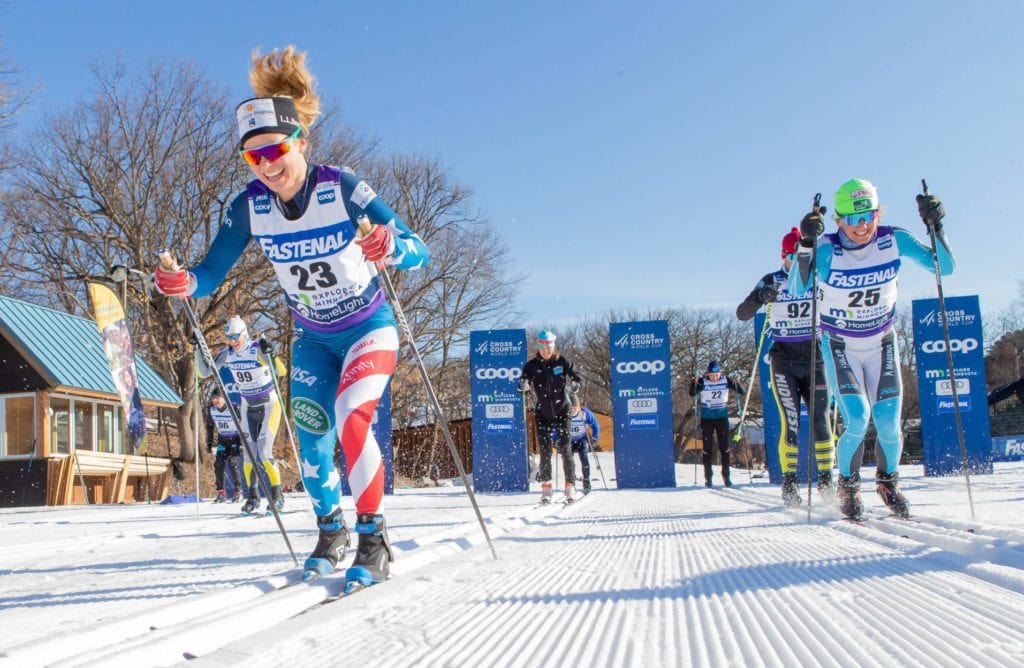
    The reaction to racing in the United States in 2023 was overwhelmingly positive – and, it had seemed, sui generis. With four snowmaking venues spread across the Twin Cities, along with the (purportedly) highest concentration of cross-country skiers outside of Oslo, the energy that embraced Jessie Diggins in her home state and buried a generation of “almosts” for the U.S. Men’s Team in the snow and mud at Theodore Wirth could have been lightning in a bottle.
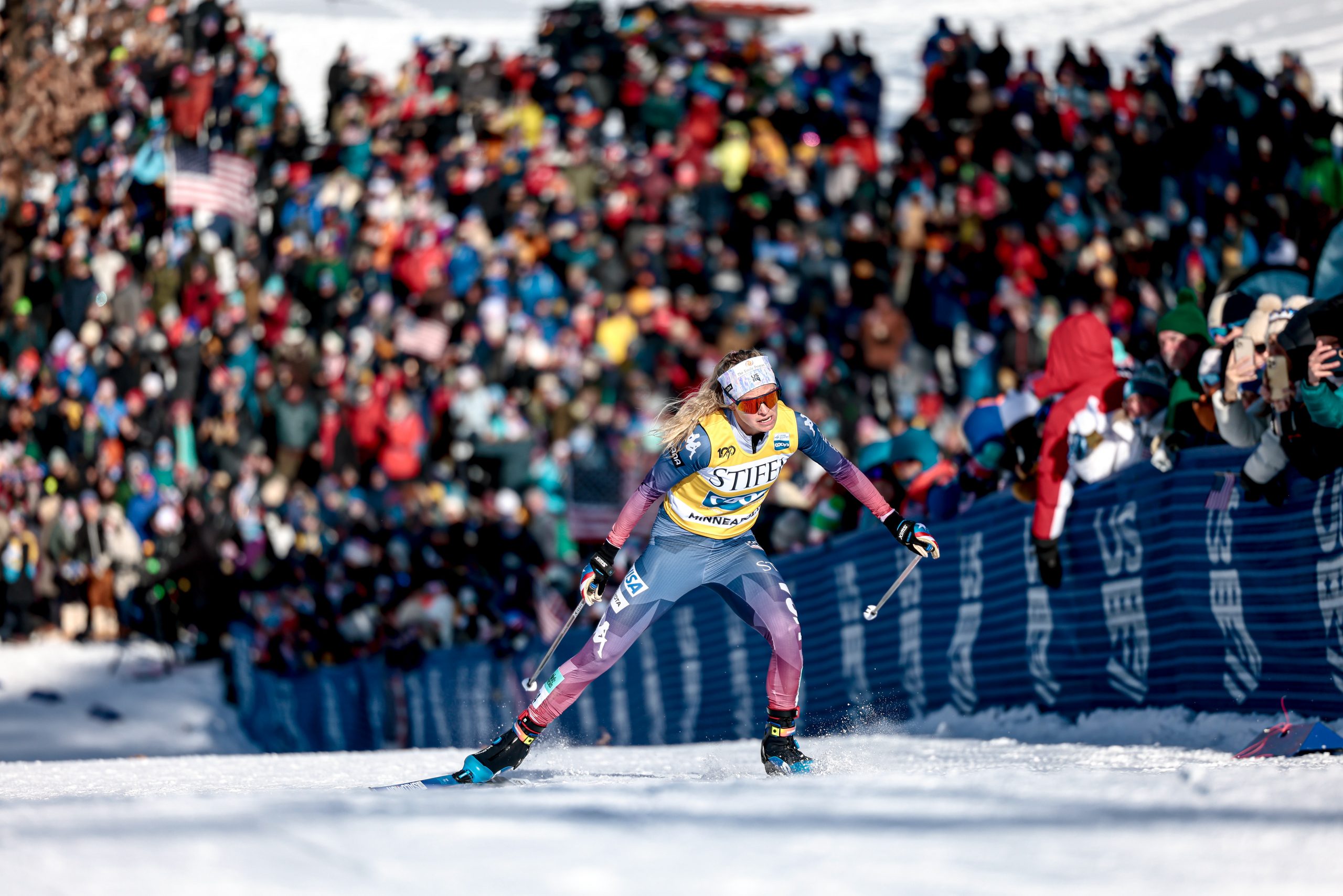
    Jessie Diggins (USA) racing on home soil in Minneapolis and did so again in Lake Placid as she concludes her storied World Cup career. (Photo: Modica/NordicFocus)

    I will admit my own skepticism that Lake Placid could field the fans, or the volume, of spectators to match Minneapolis. Perhaps my flight into Saranac Lake Regional Airport on Wednesday morning was my first evidence of error. Of seven passengers bobbing our way through the cloud-laden Adirondacks, four were here for the World Cup: Charlie, from Seattle; Billy (as in, Demong, the Nordic Combined gold medalist) and his son, from Salt Lake City; and myself, from D.C. Bussing to the venue the next day, I’m seated with a dozen of University of Minnesota alumni – they’ve taken off of work, graduate school, and medical school to spectate. “I’m excited just to see the number of people out cheering,” Alex Gude, who organized the trip, tells me. “I think one of the best parts about Minneapolis is just seeing the community come together, and now, away from home, we’re seeing another whole ski community come out and cheer.”

    And, indeed, they are – from across the United States, from across New England, from across the Canadian border, and from right here in Lake Placid. Once we disembark, I wade through the corn snow and the first of many falling flakes to Mt. Van Hoevenberg’s sprawling Nordic Center, where the racecourse coils around the podium and snakes below the pedestrian bridge. Patricia Damp is herding thirteen might-be-members of the local ski community across the bridge; she’s a third-grade teacher here in Lake Placid, chaperoning a class field trip to the World Cup Finals.

    Are the kids already Diggins die-hards, Ogden acolytes, Gus bus-riders? Not really, Patricia tells me. The class “was out here a couple months ago, cross-country skiing. We get to do the Olympic venues. We were at the museum a month ago. We have a friend who we watched ski jump. So, we’re very Olympic-oriented, and today we’re just out here to support the athletes and get some autographs.” Her students back her up. “We’re excited to get the players’ signatures,” Riley tells me. And while Declan is “excited to see the racers,” there’s no-one in particular he’s cheering for.

    Gus Schumacher (USA) during the Men’s 10 k Classic in Lake Placid, New York. (Photo: Dils / FasterSkier)

    From the mouths of children, our first – and perhaps strongest – argument for future American World Cups. The glitter-dusted kids in fan club bibs, wielding cardboard-cutout faces as large as they are, make for compelling pictures and undeniable evidence of Team USA’s impact on its next generation. But racing in the United States creates opportunities to draw an entirely new cohort of young people into the cross-country skiing community – kids who may have never tried skiing before; who may not have heard of Kikkan or Klæbo ; and whose parents certainly are not waking up before sunrise to livestream Ruka, Falun or Holmenkollen. They will not see themselves in this sport until they see this sport. What better way to do so than on a Friday field trip with Mrs. Damp?

    After bidding them good luck with the signature-hunting, it’s not an easy task to wade against the current of the rest of the Lake Placid Class of 2035. Also threading his way through the third-graders is Niklas Dyrhaug, immediately recognizable even five years into retirement from World Cup racing. He’s on the other side of the v-boards this weekend, broadcasting for Norwegian television. In his first sentence, he tells me: “We are enjoying being back in the U.S. In my opinion, we should be here every year.” He’s not surprised by the number of spectators, either. “Everybody who knows the U.S. crowd knows they are really enthusiastic . . . We know the tradition, the culture, and Lake Placid’s place in that history. So, personally, I’m not that surprised. It’s really cool that we’re back here.”

    That’s the sentiment just after Coaster Hill, some four kilometers into the racecourse, where Norwegian national team coach Eirik Myhr Nossum prowls the striding zone. Being back in the United States is “awesome, it’s amazing. I think we should be here every year, because you guys show up; you guys cheer for everyone, and it’s always fun to be in the U.S. and to be overseas to compete.”

    And it’s the sentiment at the finish line.

    Harald Oestberg Amundsen (NOR) after the 10 k Classic in Lake Placid, New York. (Photo: Thibaut/NordicFocus)

    Harald Amundsen (NOR) tells me, “In the outer part of the track, there were so many people I couldn’t hear my own thinking. That’s a really good thing.” Even before he arrived at the venue, “We had a run this morning in the city. Everyone was screaming at us, ‘Good luck!’ It’s a really nice atmosphere.”

    For Elia Barp (ITA), conditions were “very tough because it was really slow with this new snow, but it was fun racing for me. So I enjoyed it – at least I tried to enjoy it – it was a pack of people screaming my name so that gave me even more motivation, and was fun . . . I loved racing two years ago in Minneapolis, and here it’s packed with people, even with the snowfall, so thank you to everyone for coming. It’s really good to race here.”

    Mika Vermeulen (AUT) admits, “Honestly, this is probably the worst race I’ve done in a long time. But I don’t think I’ve ever had so much fun out on the track . . . on top there, out in the forest, I just heard, ‘MI-KA, MI-KA,’ the whole time. It was insane. I had a bad race and a lot of fun.”

    As for how he feels about returning to the United States: “Great, great, actually—and feeling a bit frustrated, because it just gets me pissed that we race these [bad] courses in Europe all the time, over and over and over again, and we have these freaking jewels out here which we never use. It’s crazy. I want to go to the U.S. every year for at least a whole period. It’s called the World Cup. It’s not called the European Cup, right?”

    Fans all over the course with custom gear showing their fandom. (Photo: Dils / FasterSkier)

    Klæbo’s opinion is a bit more measured – perhaps because he has more microphones hovering around his face. “I heard some rumors that it was supposed to be quite well [attended], and when I searched up Lake Placid and read a little bit about the place, I understood there’s not that many people living [here], but when you see how many people are here, I was pretty shocked.”

    A second argument, then, in favor of World Cup racing in this country: the athletes love it. They embrace not just the energy, but the venues that push the World Cup beyond the geographic and cultural confines of Transalpine Europe.

    Benjamin Dohlby (USA) at the finish of the Men’s 10 k Classic in Lake Placid. (Photo: Thibaut/NordicFocus)

    For the closing statement, Ben Dohlby is among the last athletes I interview. This is Ben’s first World Cup start; a junior at University of Alaska-Fairbanks, he was 3rd in the American Birkebeiner in February. How does it feel to be making his first professional start in the United States?

    “It was crazy. I went out so hard. The fans were so loud that I didn’t feel anything, and then I felt it all and got so tired – but it was awesome; a great atmosphere.” It wasn’t too long ago that Ben was skiing laps around the glazed kilometer of manmade snow at Lapham Peak State Park in Delafied, Wisconsin; now he’s here. To his former teammates, to other up and coming skiers, and to novices across similar ribbons of snow in Wisconsin, Michigan, and Minnesota, his message is simple: “Follow your dreams and you can make it happen.”

    Most of the fans hiked up on the course, but the stadium filled up as the day went on. (Photo: Dils / FasterSkier)

    That, then, is our concluding point: More World Cup starts on American soil means more starting berths for American skiers, and more chances for our most talented young skiers to make it to the starting line. We should savor the privilege of, as a host nation, pitting our athletes against the most accomplished figures in the sport, dreaming that a World Cup podium, an Olympic medal, could be in their future. When a lifetime of discipline and preparation meets the opportunity of a lifetime, the promise of Lake Placid – that miracles can happen – becomes deliverable.

    I will leave the invariable complex problems of bidding, organizing, and logistically managing future events to far wiser pundits. But, in the meantime, the verdict is clear: FIS, U.S. Ski & Snowboard, and the American Nordic community should be eager, and determined, to have them here.


    Love Stories Like This? Help Keep Them Coming.

    Feature stories like this one take time, access, and care to produce. If you value thoughtful storytelling and independent ski journalism, please consider becoming a Voluntary Subscriber. Your support directly fuels the work we do to cover the people, places, and moments that make our sport special.

  • Three Frames: Jessie Diggins and the Art of What Endures

    Three Frames: Jessie Diggins and the Art of What Endures

    The Zoom room filled slowly, one journalist after another blinking into existence in a grid of small rectangles. Los Angeles, Minneapolis, Helsinki, Colorado, New York — not just the coordinates of U.S. skiing scattered across time zones, but also NPR, NBC, and European reporters, over 60 media outlets, all converging on a November morning. Jessie Diggins appeared in the largest box, glowing as she does all the way from Muonio, Finland, where she had arrived two nights earlier. The wooden panels on the wall behind her made it clear she sat in a Northern Scandinavian rental, probably one that has become quite recognizable to her each November. Diggin’s voice is steady and familiar, but beneath the surface, something is newly unbound.

    “Hi, everyone,” she began, smiling with that practiced combination of approachability and poise that has made her — for more than a decade — the emotional center of American cross-country skiing.

    It was the day after she announced her retirement.

    Not an immediate farewell, but a season-long glide toward her final finish line — a full World Cup circuit, the Milano-Cortina Olympics, and a last race on home snow at the Stifel Lake Placid World Cup Finals. Her final year. Her final winter. A long goodbye in the only language she has ever known: motion.

    But on this morning, she wasn’t moving at all. She was speaking — clearly, expansively — as though practicing for a stage much larger than a press conference. Which, in a way, she was.

    When asked what comes next — “besides knitting,” she said, laughing — Diggins didn’t hesitate.

    “I’m really excited… because I feel like when I ski race, it’s usually done with my body moving around as fast as it can, but everyone’s watching and you get this one moment to try to leave people feeling inspired,” she said. “And I want to do that — but through keynote speaking… it’s all about the storytelling and leaving people with this little piece.”

    As she talked, I could see it already: a home office somewhere in Wakefield, Massachusetts, where she’ll finally get to spend time with her husband. A wooden desk, house plants, and a neatly stacked pile of notes for a TED-style talk on resilience. And above her desk, three matte-framed photographs from her career — not the ones you’d expect.

    Not the historic PyeongChang team sprint.

    Not the Crystal Globe.

    Not the Tour de Ski.

    Diggins has never defined herself by her medals. And in the conference, she explained why.

    “To me, it’s not about the racing,” she said. “It’s not about medals, it’s not about results. It never has really been.”

    Instead, she pointed to three moments — three stories — that she said she is most proud of. They form a different kind of highlight reel, one that reveals far more about how she sees herself, and how she hopes the sport will remember her when she’s gone.

    These are the three frames above the desk.

    Jessie Diggins (USA) embraced by teammate and close friend Julia Kern (USA) at the World Championships in Trondheim (NOR). (Photo: Modica/NordicFocus)

    The First Frame: Advocacy — Where Her Legacy Lives

    When she was asked about impact — real impact, the kind that doesn’t fit in a results database — Diggins leaned forward slightly, like someone stepping out of a doorway into more honest light.

    “One of the legacy pieces that I’m leaving behind is how US Ski & Snowboard handles mental health and how they support people,” she said. “When someone says, ‘Hey, I’m struggling with an eating disorder,’ there is so much help available for athletes… and I know I was a part of that because I was so open and shared everything along the way.”

    For over a decade, she has made vulnerability her strength — not a PR tactic, not a brand, but a form of leadership she learned the hard way.

    She spoke about the younger version of herself with a mix of compassion and urgency:

    “18-year-old Jessie needed that so bad… if I had felt less alone and isolated when I was 18, I think I would have hopefully asked for help sooner.”

    So she built what she calls a “safety net,” a phrase that recurred throughout the hour:

    “When you’re in a good place of recovery… every time you meet with your therapist or your eating disorder specialist, sport dietitian, or eating-disorder doctor, you’re stitching and weaving together more of a really robust and large safety net,” she said. “You have this awesome thing ready to catch you should you need it.”

    The metaphor is striking — a net woven from professional expertise, honesty, repetition, and permission.

    She also made clear that part of protecting herself meant protecting her team from having to be responsible for her recovery:

    “My coaches, the wax techs, my teammates… they get to help support me, and I get to help support them, but they don’t have to work on the eating disorder side of things,” she said. “That is not something that they have to tackle. They shouldn’t feel obligated.”

    Her work with Protect Our Winters (POW) — from lobbying in Washington to serving on the board — is woven into that same mission: to leave the sport stronger, safer, and more sustainable for others. Her climate story has always been an extension of her mental-health story: both about protecting what is fragile, what is at risk of disappearing.

    It’s no surprise this is the first frame above the desk. This is the part of her career she insists cannot fade.

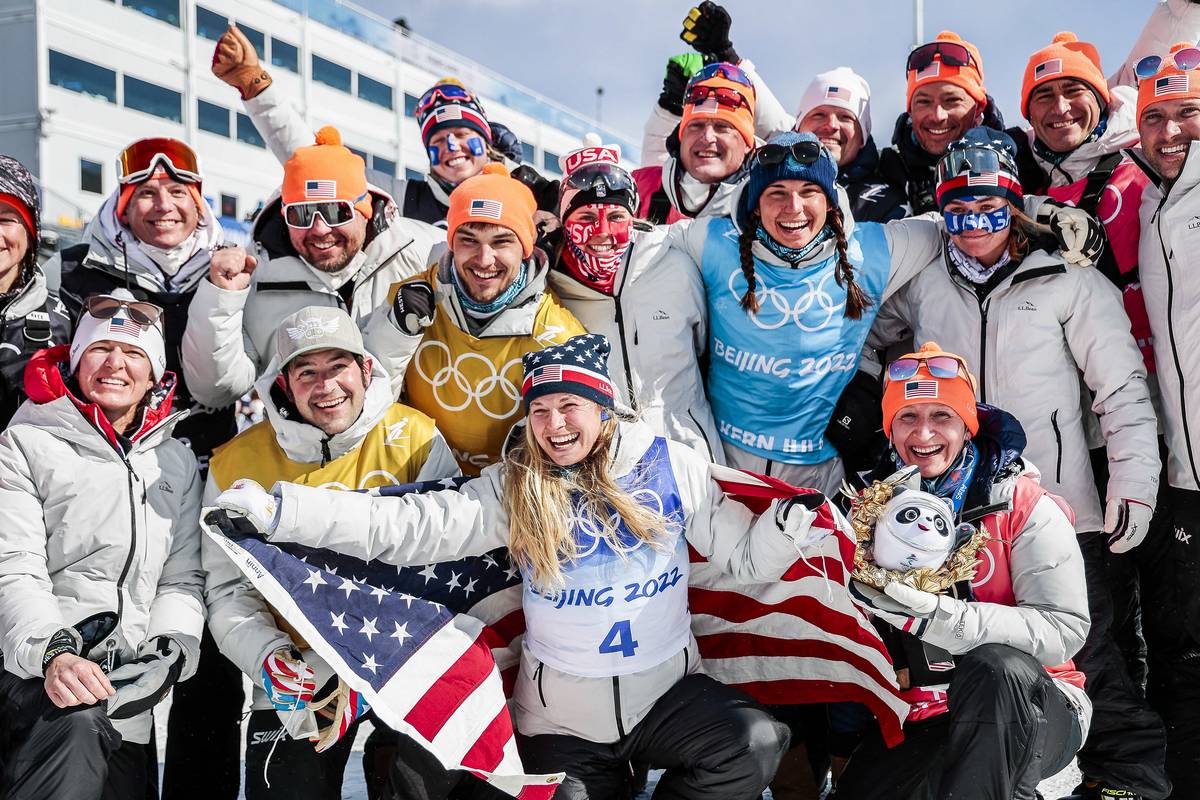
    Jessie Diggins with teammates and staff after winning a historic silver medal in the 30K Freestyle at the 2022 Olympics in Beijing, China. (Photo: NordicFocus)

    The Second Frame: The Beijing 30K — The Race She Calls Her Proudest

    When asked about the moment she is most proud of as a competitor, she didn’t hesitate.

    She didn’t say PyeongChang, though she acknowledged the magic of that day. She didn’t say her World Cup overall titles, though she earned those through years of relentless precision.

    Instead, she chose a different story — one that most athletes would quietly bury.

    “The proudest moment… was the 30K in Beijing,” she said. “Because it wasn’t about if I won or not… the fact that I had battled through food poisoning and chosen to start the race… one minute into the race I had [crashed] and got back on… everything had gone wrong… but I decided to go after it anyway.”

    There is something primitive about that choice: to define greatness by suffering openly, to measure success by depth rather than placement.

    She emphasized that she “had no business going in the breakaway,” no business skiing alone with a body that was “falling apart and cramping.” But she did it anyway. And she finished.

    In a career built on composure and precision, this race was about something far less visible: the instinct to keep going when no one would blame you for stopping.

    It is not the kind of image that hangs in a sports museum. But it belongs above her desk — the second frame — because it reminds her who she became, not merely what she achieved.

    Jessie Diggins soaks in all the energy from the home crowd in Minneapolis. (Photo: Gretchen Powers, U.S. Ski & Snowboard )

    The Third Frame: Minneapolis — The Moment That Surprised Even Her

    Jessie Diggins’ favorite moment of her entire career was not a race, not a podium, and not a championship. It was a warm-up lap.

    Not even the race itself — just the lap before it.

    “It was the warm-up lap that I did in Minneapolis,” she said. “I cried like 12 times. It was the coolest moment of my entire career.”

    The Minneapolis World Cup, held after years of planning and pandemic delays, drew more than 20,000 fans — kids in ski jackets, families, high school teams, masters racers, longtime volunteers, and the entire Nordic diaspora of America. She helped bring the race to Worth Park; she fought to keep it on the calendar; and then she skied into a stadium that felt like home.

    “When you’re warming up, you can really see the crowd and be in it with them,” she explained. “Being a part of bringing together 20,000 plus fans… that was the coolest moment.”

    This is the third frame above the desk. It captures the rarest kind of athlete achievement: the moment when an individual’s career transforms into a collective story.

    This wasn’t symbolic. It was literal. She had helped create the environment in which the sport could grow.

    She wasn’t skiing through fans; she was skiing through the future of U.S. skiing itself.

    Staying, Leaving, Returning

    If advocacy, suffering, and community are the three frames above her desk, there might be a fourth frame just below them: the one showing something from this final World Cup season or what comes next.

    She says she will still support the team, “just not in a way that has to be quite so physically hard on my body.” She imagines herself as “team mom from the sidelines,” cheering but not chasing splits.

    She will garden.

    She will sleep in her own bed.

    She will run a 100-mile race — “just for me… I don’t expect to run it quickly or competitively.”

    She will finally come home.

    The irony of this final season is that she wants to experience it with the full emotional force of closure — the opposite of detachment, the opposite of stoicism.

    “It frees me to enjoy it even when it’s hard,” she said, describing the upcoming Olympics. “Even if it doesn’t go perfectly… my career is this entire body of work, and I just want to be there to be present… because it’s the last time I’m ever going to do this.”

    Her retirement announcement wasn’t a curtain; it was an opening.

    She’s letting people in.

    She’s letting herself feel everything.

    She’s letting the sport rush over her one last time.

    The Press Conference Ends. The Story Begins.

    When the final question was asked and the moderator thanked everyone for their time, Diggins’ Zoom square flickered and the screen returned to its familiar grid. Reporters signed off. Microphones muted. The call ended.

    But her voice stayed in my head — not the athlete’s voice I’ve heard in mixed-zones for years, but the one she seems excited to use next.

    The voice of someone shifting from performance to reflection, from competition to communication.

    The voice of someone ready to tell stories for a living.

    Back in Wakefield, someday soon, she’ll sit at her desk beneath those three frames. And as she maps out the arc of a keynote, or a book, or whatever comes after skiing, she’ll look up and see exactly what she spent her career building:

    The people she helped.

    The battles she fought.

    The community she created.

    Three frames.

    One legacy.

    And one last winter to live it fully.


    Love Stories Like This? Help Keep Them Coming.

    Feature interviews like this one take time, access, and care to produce. If you value thoughtful storytelling and independent ski journalism, please consider becoming a Voluntary Subscriber. Your support directly fuels the work we do to cover the people, places, and moments that make our sport special.
    Join the FasterSkier community!


    Jessie Diggins (USA) racing on home soil in Minneapolis and will do so again in Lake Placid as she concludes her storied World Cup career. (Photo: Modica/NordicFocus)
  • Gus Schumacher Voted FIS ‘Best Distance Performance of the Year’

    Gus Schumacher Voted FIS ‘Best Distance Performance of the Year’

    This coverage is made possible through the generous support of Marty and Kathy Hall and A Hall Mark of Excellence Award. To learn more about A Hall Mark of Excellence Award, or to learn how you can support FasterSkier’s coverage, please contact info@fasterskier.com.

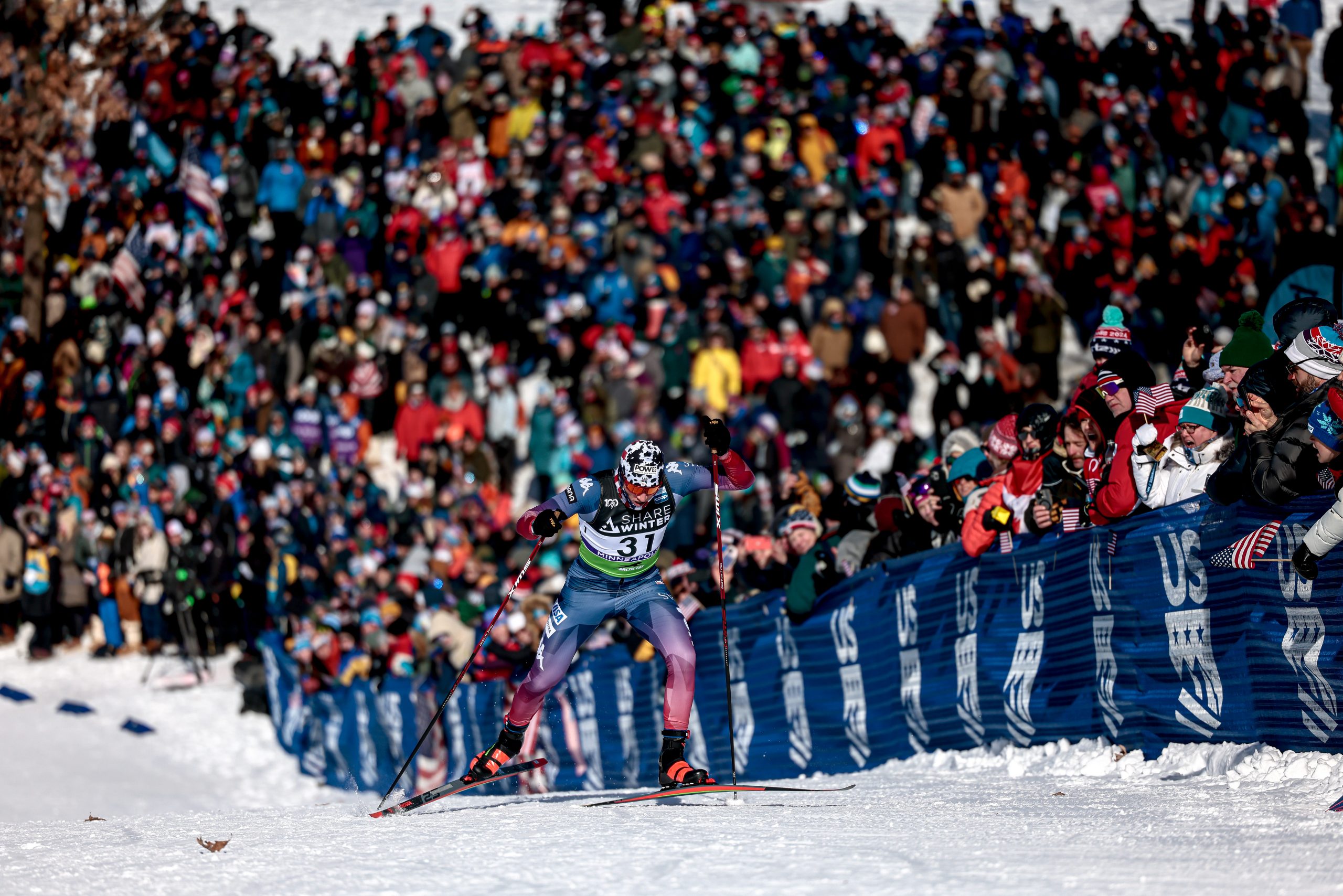
    A sea of fans roared as Gus Schumacher (USA) made his way around the Minneapolis course. (Photo: NordicFocus)

    After the 2018 Olympics, workers at the Minneapolis Parks and Rec Department had to start putting up posters in the old Theodore Wirth Park chalet to “Clean up your glitter.” Thousands of Minnesota high school cross country skiers who raced there were emulating Jessie Diggins’ famous race-day tradition. The glitter was making a mess, but in Minnesota’s ski-crazy Nordic community, that particular problem was a wonderful one to have. Swix pants and stray gloves dusted in pesky golden glitter-flakes only testified to more young skiers wanting to “Ski like Jessie.” After having watched her win Olympic Gold, they all had a shared idea of the world contained in that simple phrase.

    Six years later—again in Minneapolis—Jessie Diggins would bring her glitter to the FIS Cross Country World Cup in Theodore Wirth Park, the first World Cup race held in the United States in over twenty years. What followed was a weekend that most witnesses would describe as “something special.” Twenty thousand American spectators attended a cross-country ski race in America, and on the second day an historic and improbable win from a young Alaskan named Gus Schumacher. It was the first World Cup win of Schumacher’s career, and the first for an American male skier in over forty years. In a banner winter for American skiers (Jessie Diggins winning her second World Cup Overall and seven American skiers finishing on World Cup podiums), Gus Schumacher’s win on home soil was a clearly an emotional apex.

    Cut to last week, when the International Ski Federation (FIS) put out a fan vote on its Facebook and Instagram pages to award the “Best Distance Performance of the Year” from this year’s World Cup. Nominees included a predictable slate of Scandinavian stars—Johannes Hoesflot Klaebo, Frida Karlsson, Simen Kruger—but there was a distinctly American flavor to the list of nominees. Three different Americans, with three different performances, made the shortlist. Jessie Diggins was nominated for her early-season 10 k win in Gallivare, Sweden, while Sophia Laukli got a nod for her first World Cup win at the Alpe Cermis Hill Climb. The clear winner of the poll, though, was Gus Schumacher’s victory in Minneapolis.

    The “Best Distance Performance of the Year” poll may have been little more than FIS plumbing social media engagement during the doldrums of spring. Even so, in this test of public opinion, Schumacher was the clear winner. That consensus may also be suggestive of more good things to come. As the weather warms, so does the prospect that Schumacher will earn more titles from even more lofty sources. He is likely to be on the shortlist for any kind of upcoming “Athlete of the Year,” or “Skier of the Year” award granted by ski governing bodies and media organizations. He certainly is on the shortlist at FasterSkier.

    The extent to which those shortlists and awards shake out will be revealed in time. For now, this informal FIS award was a neat checkpoint smack dab in the middle of the offseason. Two months removed from the World Cup events in Minneapolis, the snow is gone from Theodore Wirth Park. The first blades of grass poking through the mud spell out a clear way forward to spring. It’s a nascent time; with it comes some nascent clarity on what exactly the Minneapolis World Cup—and Gus Schumacher’s win—mean to American skiing.

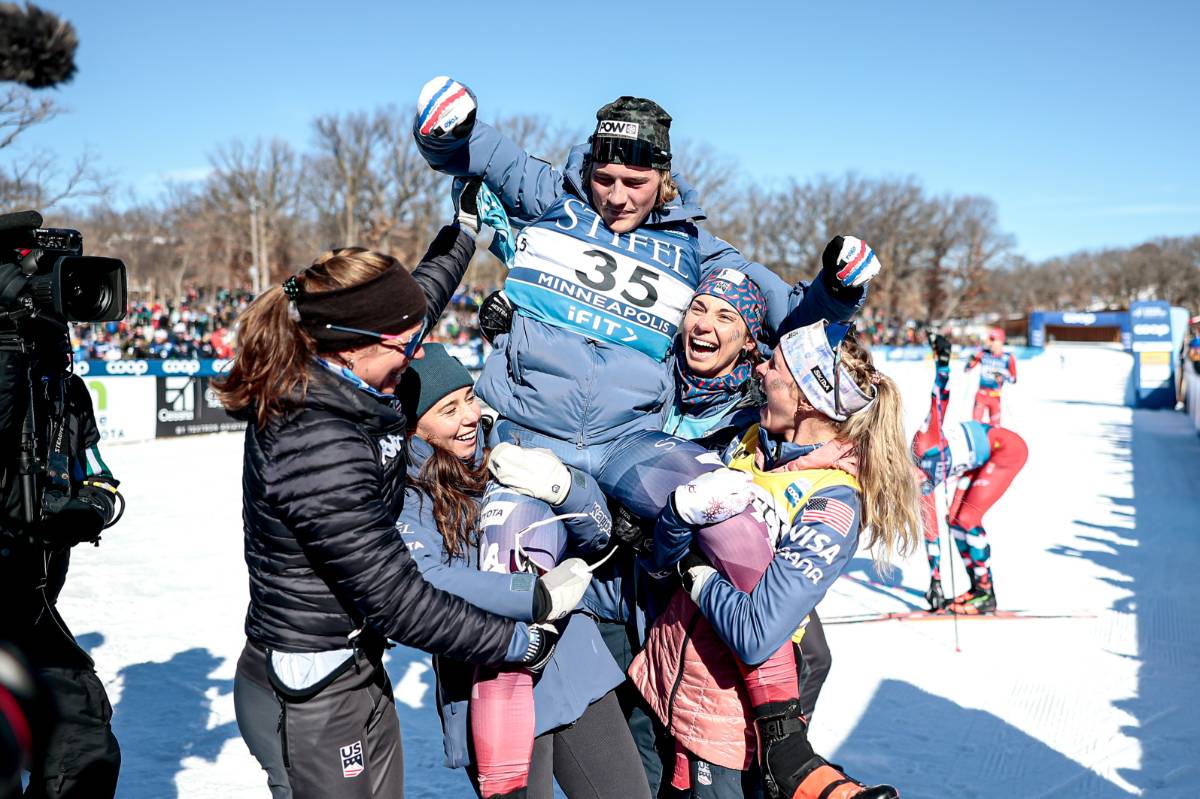
    Jessie Diggins helps lift Gus Schumacher after his improbable win at the Minneapolis World Cup in February. (Photo: NordicFocus)

    A look at the comments on the FIS Instagram post soliciting votes for “Best Distance Performance” reveals a unified front supporting Schumacher. The question of which individual World Cup performance stood out most to viewers and fans produced an outpouring from American skiers, World Cup champions, and Birkie Birchleggers alike. Some came to the comment section with heartfelt stories on what it was like to process the surprise win as Schumacher, himself, was processing it. How Schumacher started early with Bib 35, crossed the finish line with a 15 second lead, took his turn in the winners’ chair, and watched as every great champion of the sport crossed the finish line splitting seconds behind him until there was no other conclusion to reach: almost impossibly, Schumacher had won. Others came in with more emphatic exclamations: who should win the best performance of the year? “GUS!”

    In short, Schumacher’s win in Minneapolis validated itself. If you watched it, you understood why it’s worth striving to do anything well. Why spend years building a ski community in Minneapolis, re-working and expanding a venue at Theodore Wirth Park as the Loppet Foundation did? Why combine the talents of countless individuals across the United States towards developing, of all things, cross country skiers? As Schumacher and his American teammates celebrated at the finish line, the answer became apparent: so that a skier like Schumacher could combine talent, drive, and passion in order to exceed even the expectations he set for himself. The defining characteristic of Schumacher’s win in Minneapolis, though, was Schumacher beaming in an interview immediately after. “I don’t know, this is just the best day ever!” he said.

    It took a crowd of 20,000 fans raising their voices along the sides of a Minneapolis ski trail to propel Schumacher toward his unlikely victory. In doing so, the crowd—and Schumacher, himself—revealed the power of what collective energy harnessed in the right individual can do.

    Of course, among the FIS “Best Distance Performance” nominees there were two other Americans who delivered the lesson just the same. Jessie Diggins in Sweden was incredible. Sophia Laukli on the Alpe, sublime. Why though, when asked to make the hard choice, did so much of US Skiing latch onto Schumacher? The difference must’ve been found in the venue: Minneapolis, a community versed in sports, versed in the sport of cross-country skiing, and versed in the lessons that sport teaches. For a weekend in February, Minneapolis was a conduit for community spanning an entire continent. Minneapolis ski fans could uniquely recall Jessie Diggins from her time starting out in Afton through to the present day when she epitomizes what skiing can teach you about life: Olympic moments, World Cup triumphs, and all the highs and lows in between.

    The testament to Gus Schumacher’s win in Minneapolis, then? This summer, there are sure to be even more young skiers at practices, at camps, pursuing the challenges of cross country skiing.  Theodore Wirth Park may still be the place you need to clean up your glitter, but in places throughout our Nordic community young athletes will give voice to a dream to “Ski like Gus.” That day in Minneapolis will flash in their memories, and a smile will cross their faces. “Best Distance Performance of the Year” for certain. And, by all indications, for a whole lot longer too.

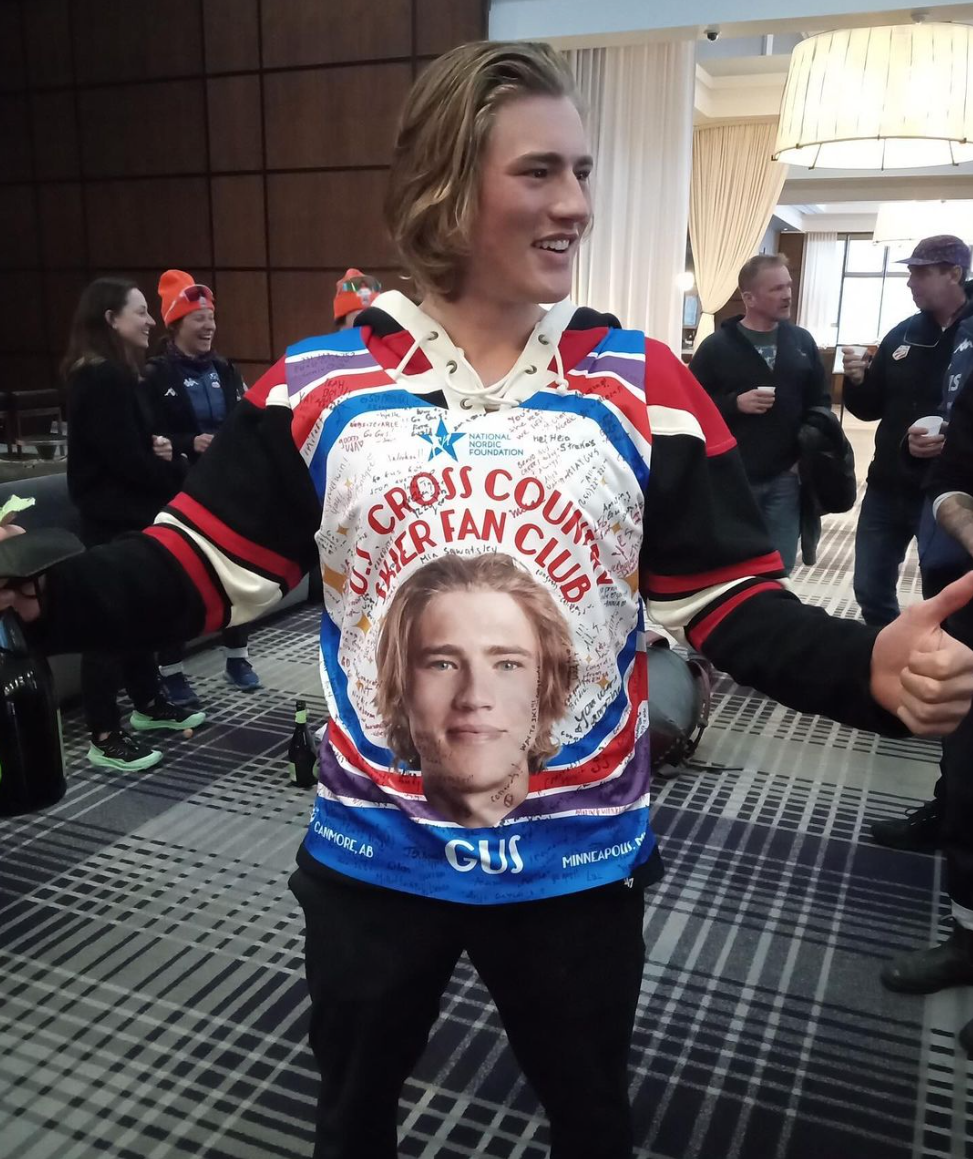
    Gus Schumacher sporting a bib signed by over 500 supporters after his win in Minneapolis, donated by the National Nordic Foundation. (Photo: NNF)
  • “A Dream Come True”—Diggins Scores Homecoming Podium in Minneapolis

    “A Dream Come True”—Diggins Scores Homecoming Podium in Minneapolis

    This coverage is made possible through the generous support of Marty and Kathy Hall and A Hall Mark of Excellence Award. To learn more about A Hall Mark of Excellence Award, or to learn how you can support FasterSkier’s coverage, please contact info@fasterskier.com.

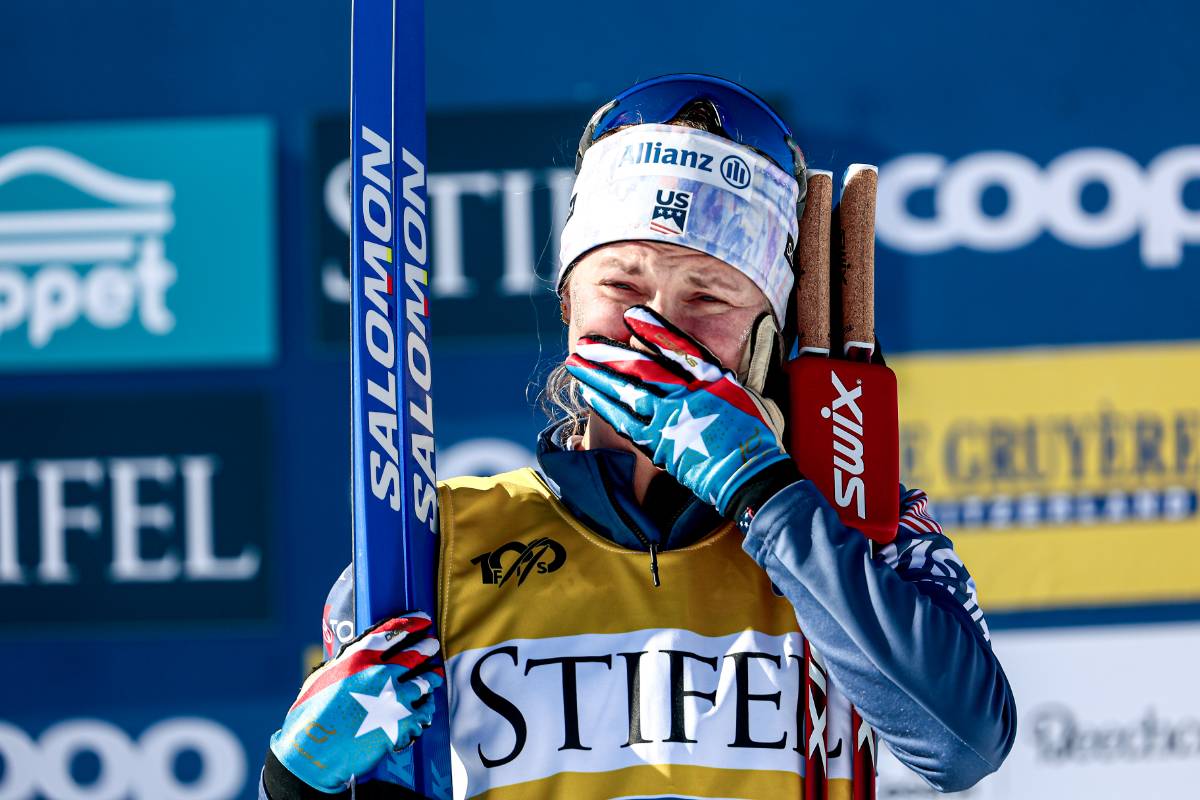
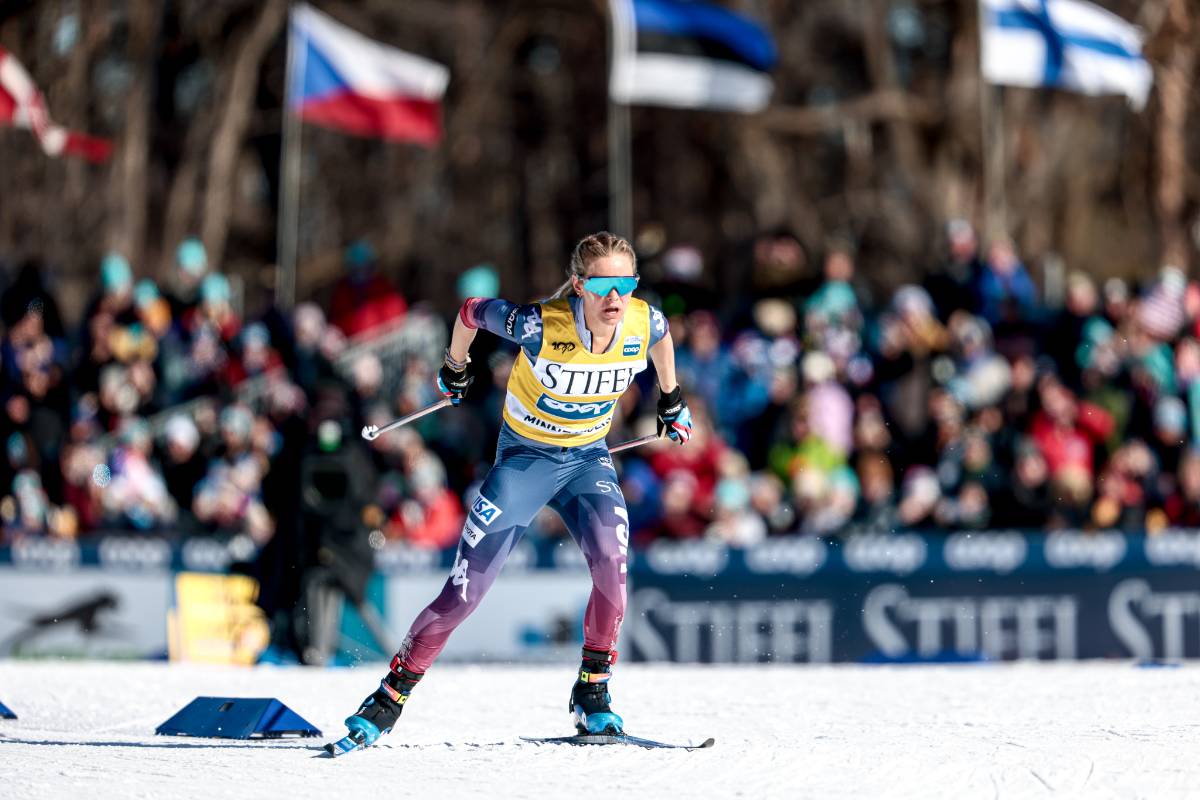
    Jessie Diggins (USA) was emotional after a day in which she skied to a third place podium in front of her home crowd in Minneapolis. (Photo: NordicFocus)

    Ski racing is all about time, and the magic power of the best ski racers is that they’re seemingly able to bend time the way they want it to go. Lives are lived under a relentless march of seconds, minutes, months, and years. But a select few can claw a few seconds back the other way when given skis as a tool. By that measure, the three seconds that Jessie Diggins bent her way to take third place over Sweden’s Linn Svahn in Minneapolis’ 10 k Individual Start Freestyle were a testament to her power over time. Likewise, the 31 seconds Sweden’s Jonna Sundling took over the rest of the field—and the 15 seconds her countrywomen Frida Karlsson had over Diggins in second place—provided evidence of their incredible efforts.

    To understand the full extent of who Diggins is as a ski racer, one must consider Diggins’ oft-repeated chorus that this weekend was “about bigger things than results.” This was about generations of US skiers, and years of US skiing. Twenty years since the last US World Cup took place. Today, though, brought nearly 20,000 people to Theodore Wirth Park—old teammates, competitors, coaches, acquaintances, and fans—a community that shared a love of cross country skiing. Such a gathering as that was a worthwhile endeavor, in itself.

    “This whole weekend has been a dream come true,” said Diggins. “I’ve maybe never done anything I’m more proud of.” 

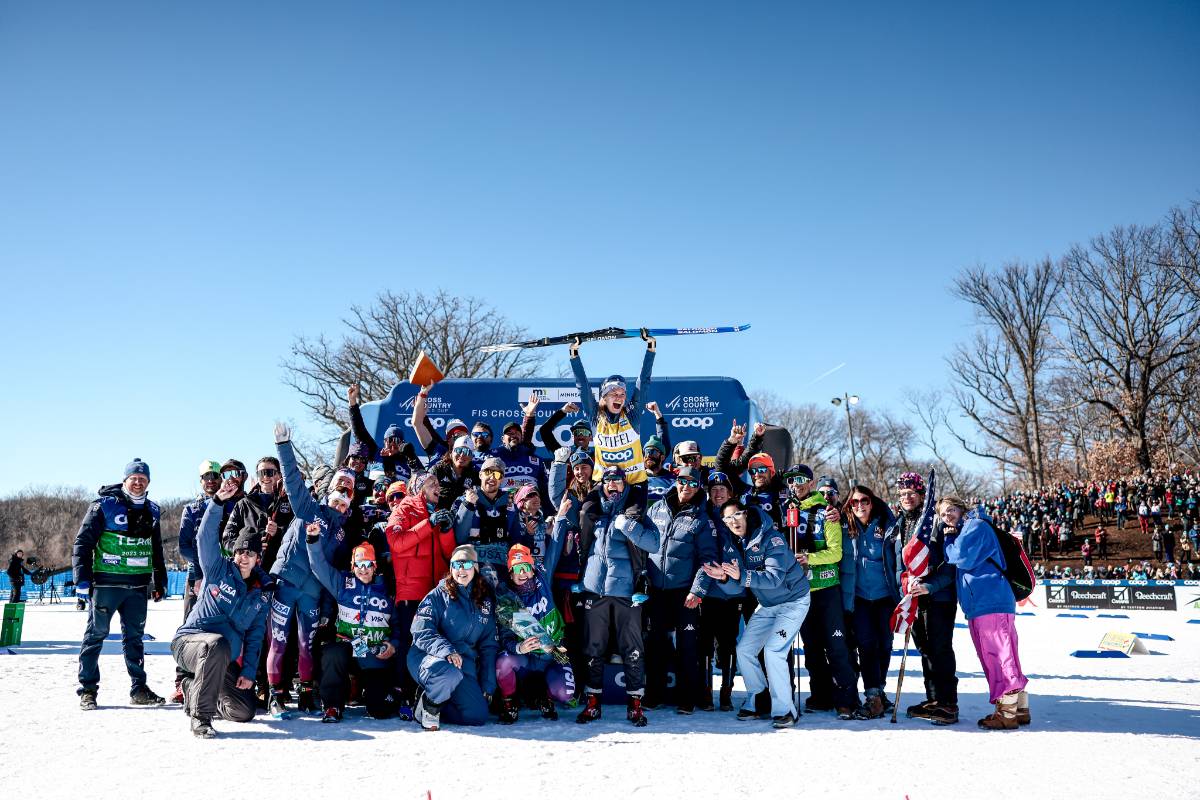
    Team USA celebrates Jessie Diggins (USA) after a third-place finish in Minneapolis. (Photo: NordicFocus)

    The winter sun that shone over Minneapolis on Sunday put the close-contested racing in full glare as the top contenders traded time checks all the way to the races conclusion. For those observing though, there was more significant time being folded and split as Diggins took her turns around the course. Her winding up the A-climb in Wirth recalled a decade ago on this same course when she swept the Junior National Championships. And where Diggins has taken the sport was evident throughout the day; five American Women placed in the top 30. The ascendant Sophia Laukli skied to 15th place, and Julia Kern skied to a strong 19th. Rosie Brennan finished 22nd, U23 World Championship medalist Haley Brewster 25th. The Americans showed depth all the way through the results with three more in the top 40:  Sydney Palmer-Leger 32nd, Kendall Kramer 36th, and Novie McCabe 37th.

    Jessie Diggins (USA) helps lift Gus Schumacher (USA) up after he pulled off an improbable win in the Men’s 10 k Freestyle race earlier in the day. (Photo: NordicFocus)

    Diggins understood that this weekend was not just a series of races, but a grander celebration of the ski community she’s so transformed. “This was all about Gus,” she said after the young Alaskan pulled off an unlikely World Cup win, the first for an American man since Bill Koch 40 years ago. A whole new generation of US skiing has been ushered to success on the ski tails of Jessie Diggins; for a few moments—while hoisting Schumacher up on her shoulders—Diggins was just another part of the ski community in which she, herself, had been raised a mere thirty miles away. In the intervening years, Diggins has been transformed . . . and so has the American ski community.  

    Julia Kern was one of five American Women to finish in the top thirty on Sunday. She was quick to attest that energy created by the home crowd lifted her performance. (Photo: NordicFocus)
    Women’s 10 k Individual Start Freestyle

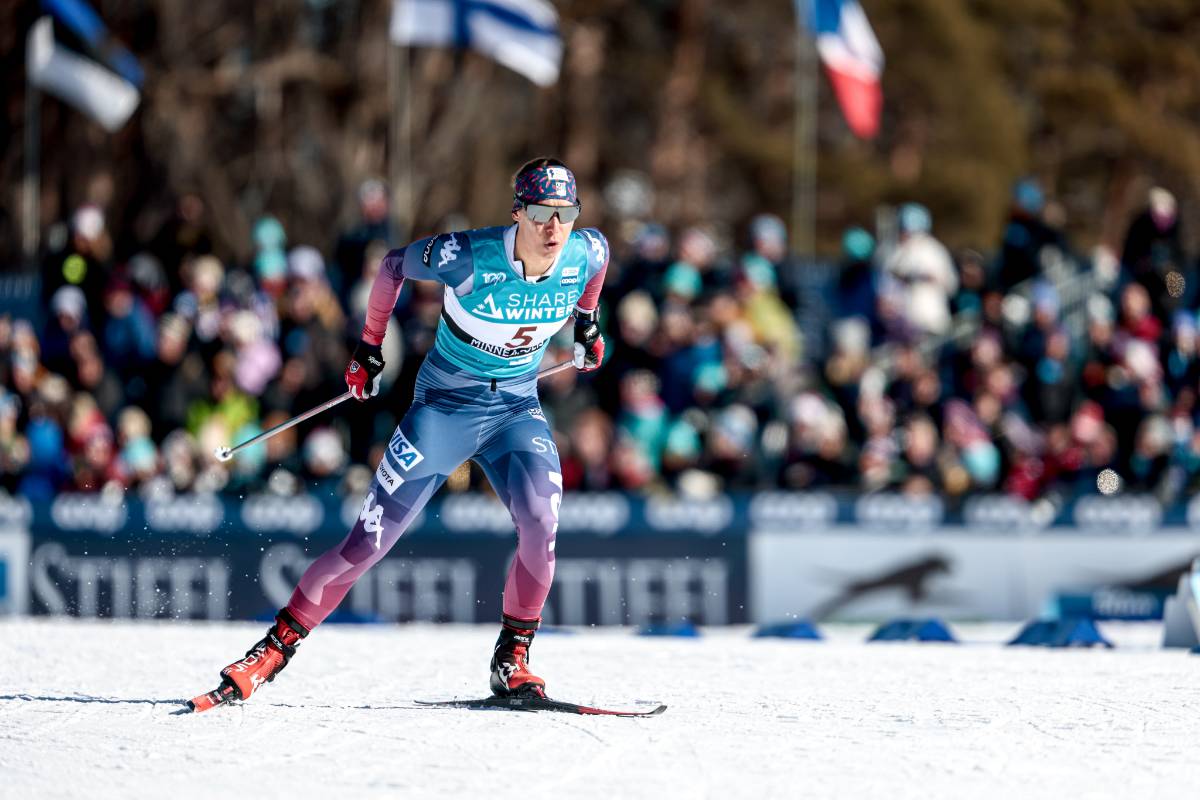
    Julia Kern led out an American contingent that included 12 starters in the Women’s race. Racing in bib 5, Kern started to piece together a remarkable race for herself. “That was probably the most fun I’ve had racing in my entire race!” Kern said post-race, as she credited a sea of Wirth Park spectators that lifted her throughout the 10 k. When Kern crossed the line, she briefly got to sit in the leader’s chair before Sweden’s Maja Dahlqvist, bib 14, would cross the line with a 17 second advantage. 

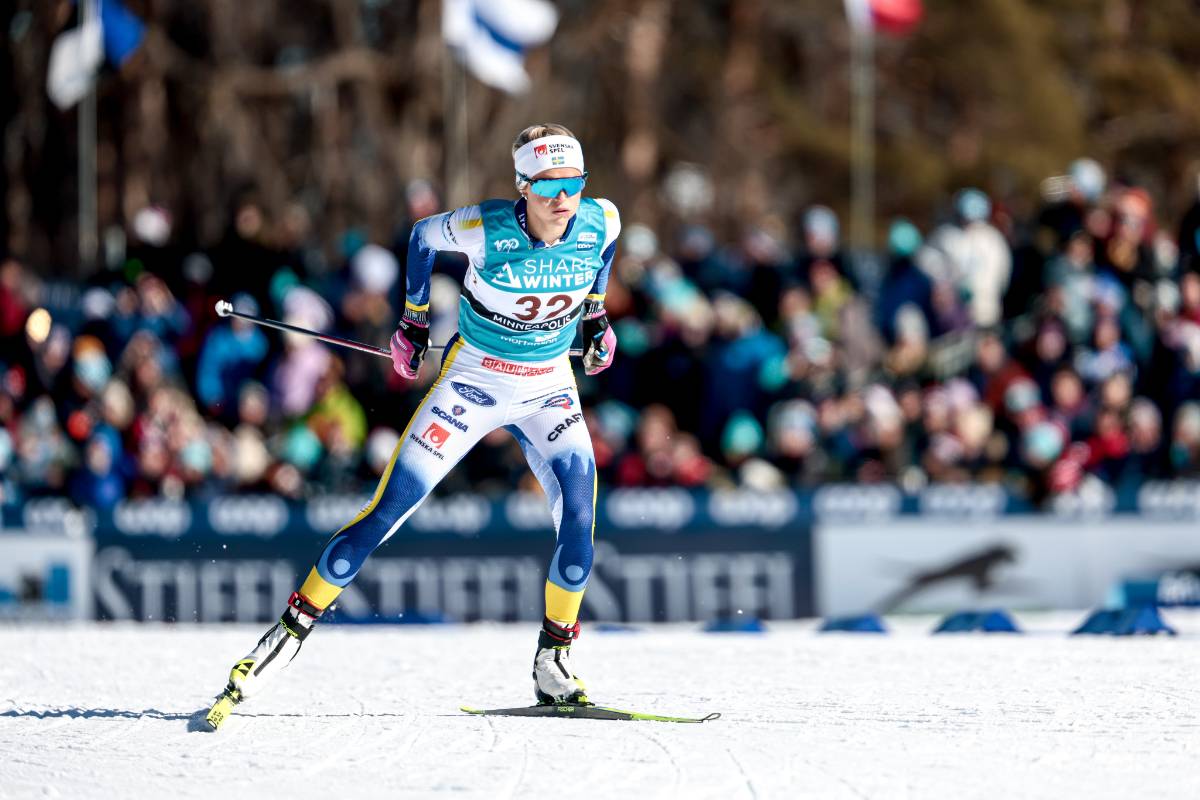
    The start order would mean the Swedish-American duel would be one that lasted the duration of the race, with seeded skiers spread throughout the field. Frida Karlsson, bib 32, marked the first skier to best Dahlqvist’s splits, taking 10 seconds through 1.9 k. “It was a really high speed track, which I knew suited Jonna [Sundling] and Jessie,” said Karlsson. “I knew I was trying to keep up with them.” 

    Frida Karlsson helped Sweden finish 1-2 with a second place performance behind Jonna Sundling. (Photo: NordicFocus)

    Karlsson’s assessment was right on, as Sundling came through the first 1.9 k checkpoint with nearly eight seconds up on Karlsson, expanded the lead to 12 seconds by the 5.8 k mark, and finally expanded it to 15 seconds over the finish line to take the lead.

    That set up a waiting game as splits rolled in for bib 50, Svahn, and bib 58, Diggins. In the interim, American Sophia Laukli was putting together another solid distance performance on the Wirth course. “I think I was going faster because of the fans,” said Laukli post-race. “I’m pretty happy with that on this course with less climbing than I usually like.”

    The second round of the fight for the podium opened with bib 50, Svahn, who would momentarily put three Swedes in the top spots at each checkpoint. Svahn, though, was consistently third behind Sundling and Karlsson, clocking 8 seconds off of the pace at 5.8 k and eventually letting the gap drift to 20 seconds between her and Karlsson at the finish. 

    When Diggins came through the 5.8 k checkpoint, she split the difference between Karlsson in second and Linn Svahn in third at 17 seconds off the lead. That put her five seconds off of Karlsson and three seconds ahead of Svahn. By 8.5 k, Diggins had drifted closer to Svahn than Karlsson, setting up a clear-cut fight for Diggins: she needed to hold onto that three seconds over Svahn to ski onto the podium. “My strategy was to go as hard as I could,” said Diggins. “With 2 k left, I hoped the crowd could carry me to the finish.”

    A final sprint helped lift Jessie Diggins (USA)  to a hard-earned third place over Sweden’s Linn Svahn on Sunday in Minneapolis. (Photo: NordicFocus)

    Diggins’ hopes were cast onto a crowd more than ready to receive them. As she ascended the bump that lead into the Wirth Park stadium, she accelerated towards the finish and increased her gap over Svahn to four seconds, netting her a third place podium before collapsing to the ground.

    “It wasn’t about the podium,” said Diggins. “I just wanted to go out and leave it all on the course, and I did.” With a podium secured on home turf, she paraded alongside Sundling and Karlsson . . . then Diggins took another lap, a modest bow for her hard work—not just over today’s 10 k distance, but over nearly a decade of promoting, supporting, and driving for this moment in the Minnesota winter sun.  At this day’s end, a dream realized.

    Women’s 10 k skate individual start FULL RESULTS

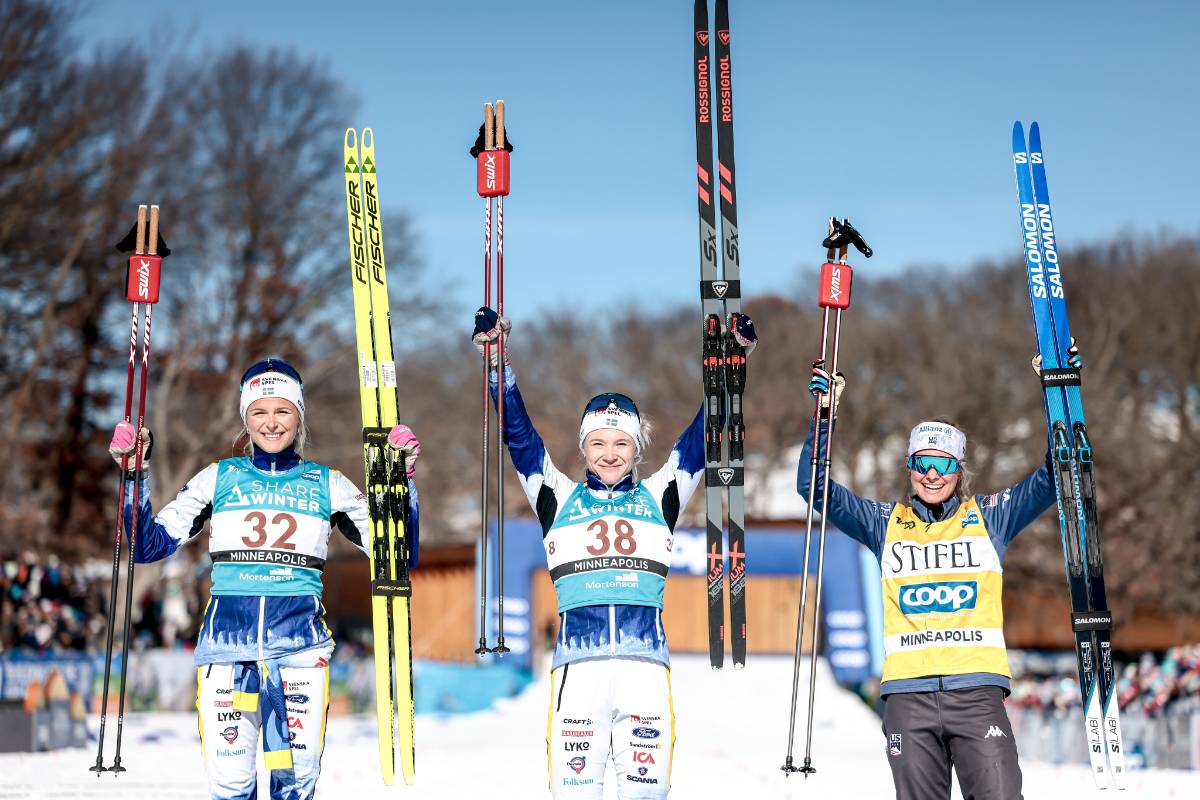
    The podium in the 10 k skate individual start in Minneapolis Sunday: Jonna Sundling (SWE) first, Frida Karlsson (SWE) second, Jessie Diggins (USA) third. (Photo: NordicFocus)
  • Home Team Energy—Head Coach, Matt Whitcomb

    Home Team Energy—Head Coach, Matt Whitcomb

    Head Coach, Matt Whitcomb, was all smiles during a successful Tour de Ski for the Stifel U.S. Ski Team. (Photo: Nordic Focus)

    Watching the Stifel U.S. Ski Team during the first half of the 2023-24 World Cup season has, at points, been a sublime experience. That feeling of overwhelming exhilaration when looking out from the mountain top has been something literal for American athletes on top of podiums—and literal Alpes too—as they’ve traveled week-to-week, race-to-race, across Europe this winter. From Jessie Diggins’ Overall World Cup lead and Tour de Ski win, to career firsts way into her career for Rosie Brennan, and a generation of young American men coming of age as they’ve stormed to their first podiums, sprint finals, and more, there’s been one evident truth: where the Americans have gone this year, they’ve gone together.

    That “team-first” philosophy is a complex idea that may be easier to feel than to understand, but if anyone can come close to providing a definition, it’s Head Coach, Matt Whitcomb. Whitcomb has been a fixture on the World Cup for Team USA for over a decade, and in his current role as Head Coach since 2020. His tenure has seen transformative athletes, but more than that, as he stresses, a transformation in how the US ski community looks at itself. “I don’t think the [performance boost in US Skiing over the last decade] is because of one or two athletes, or one or two club,” Whitcomb said. “I think the difference is that our secret weapon as a nation is that we work together.” He prefers to view things holistically in order to understand the whole of the success he and the team he now leads has had.

    For Whitcomb, the chance to show off the holistic system that powers US skiing is just a month away: the Loppet Cup, Minneapolis’ World Cup, Feb 17-19. This represents not only the first time American World Cup competitors have had a home race in 20 years, but also one massive homecoming for those athletes in front of the American ski-community that supports them everyday. Whitcomb confirmed that the Stifel U.S. Ski Team is really that excited about bringing it all back home. “It feels like we’re hosting our own little Olympics,” he said.”

    FasterSkier caught up with him during his team’s post-Tour retreat in Livigno, Italy. In a Question and Answer session, Whitcomb recapped his feelings on the US Team’s early-season World Cup success, and discussed the ways that the Minneapolis World Cups could provide a springboard for the future of American Skiing. He also delved into his other big role in US Skiing: bolstering the ski community’s sport development as part of the National Nordic Foundation, and the opportunity for American skiing fans to show their support for the organization through a World Cup Fan Bib fundraiser in Minneapolis.

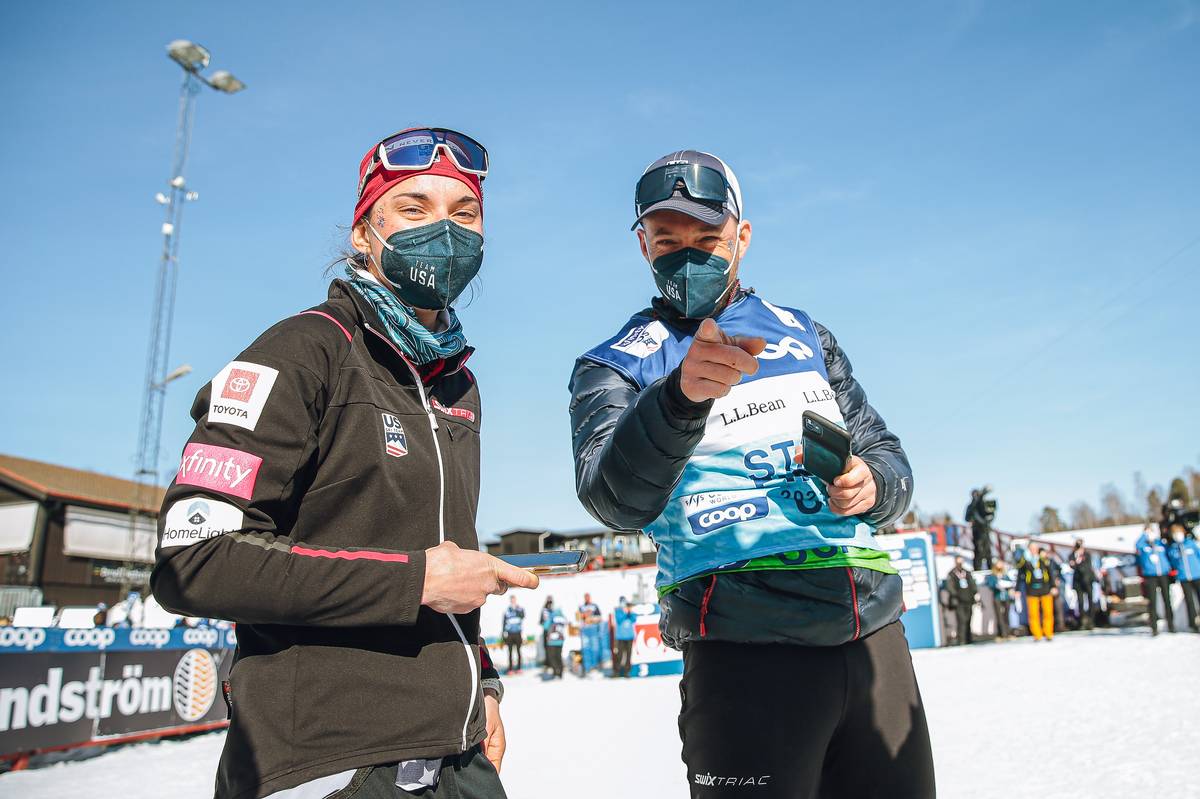
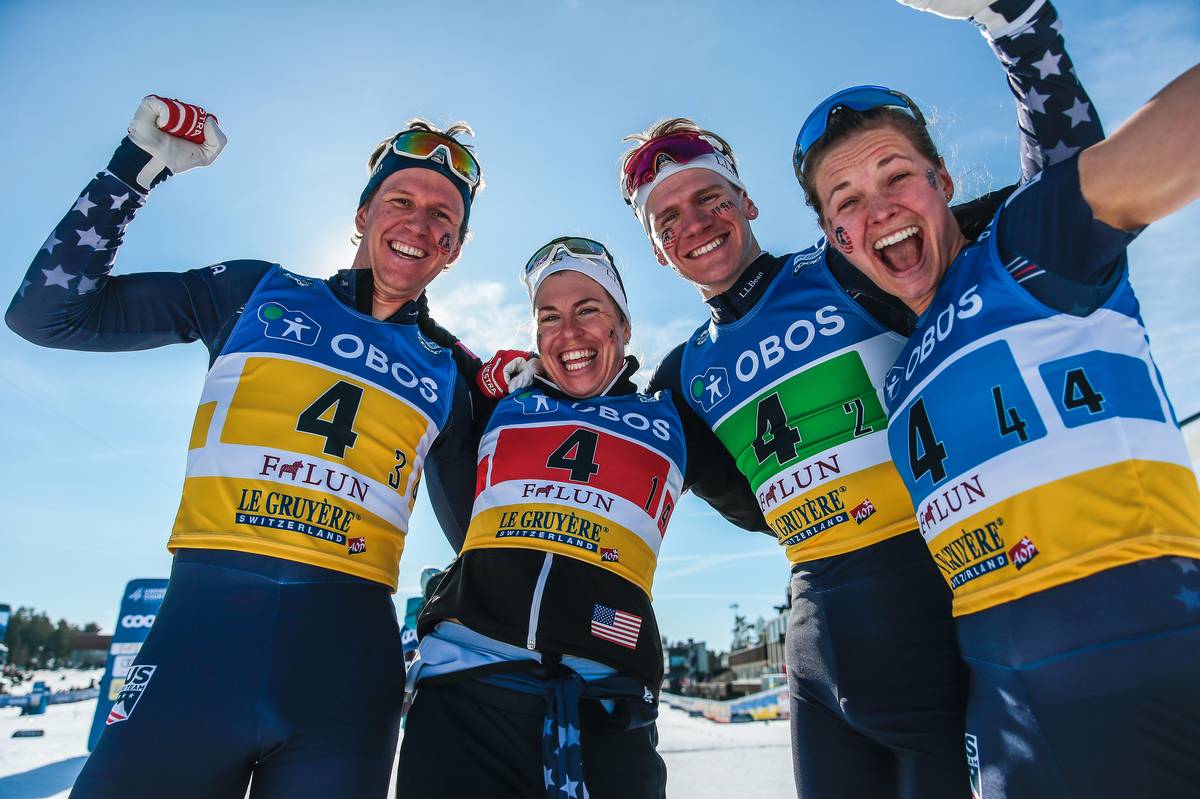
    Stifel U.S. Ski Team head coach, Matt Whitcomb (right), and Julia Kern course-side during the 4 x 5 k mixed relay at the 2021-2022 World Cup Finals in Falun, SWE. (Photo: NordicFocus)

    FasterSkier (FS): What’s the report from the US camp in Italy after the Tour de Ski? How’s the skiing? How’s everyone feeling?

    Matt Whitcomb (MW): Extra Blue. That probably describes it best! We place a high value on building a post Tour de Ski recovery camp option for athletes and staff that includes a lot of living space, mellow trails, and great food cooked by one of our chefs. Most other teams go home and get this naturally, and we know our typical hotel room and buffet is inadequate when it comes to Tour de Ski recovery. We need a mid-season uplift, and this is it. The house we have in Livigno, Italy allows us to live like a family, and experience a lot of the values one would find at home. All this is to say that recovery has gone well, and we’ve resumed training carefully. I should note, too, that as we recover after the Tour, we often try to sneak in a bit of altitude. Livigno is at 6,100ft (1859m). I know it seems like sea-level would be the smarter choice, but we’ve found that this additional commitment to altitude living pays dividends in Period 3 and 4.

    The Season Thus Far

    FS: Success is subjective, but this season has certainly felt like a very successful one for American skiers. From your place in the middle it all, does that ring true?

    MW: If we have 15 athletes on the road and only one of them is winning the Olympics or the Tour de Ski or the World Cup Overall, we are not successful. There is no chance for legacy when only one person succeeds. Look at post-Justyna Kowalczyk Poland; she won it all, and then retired and left a hole that was exactly as large as the sum of her accomplishments. A team is successful when it is no longer defined by its one or two star athletes. We have depth now, and that’s what creates hard-to-stop momentum. That’s why Ben gets his first podium not long after JC’s first podium. Then Gus gets fourth, three days later. The success of many athletes creates a vibe—a wind—and we get swept up in it. Zoom out a bit. How do we get the professional athletes and young kids back home swept up in that vibe? It doesn’t happen if we have a few jerks and prima donnas succeeding on the World Cup. We need our team to consist of tangible, accessible, inspirational role models, who create a powerful draft that the next level can slip into. I think that’s how it works. I think that’s why it’s working.

    FS: A lot of American athletes this season have hit milestones that they’ve had trajectories towards, and worked for, for years – first podiums, first World Cup victories etc…Curious about the means to those ends. What characteristics can you point to that have allowed this Team to reach the results it has this season?

    MW: We can have the best talent in the world come through our team, but if they quit before age 23, like most American skiers do, we’ll never know how good they could’ve been at the World Cup level. We try to create a positive team environment for one reason: we need our athletes and staff to enjoy longer careers. 

    Look at the women’s team of 2012-2018. We strived for a great team environment, and consequently, to name a few, you saw Kikkan [Randall], Holly [Brooks], Liz [Stephen], Ida [Sargent], Sophie [Caldwell-Hamilton] , and Sadie [Bjornsen] all ski into their 30’s, each retiring with World Cup podiums. Jessie [Diggins] and Rosie [Brennan], who are ranked first and third in the world, are in their 30’s. None of this history is written if we don’t build and maintain a great team environment. This will always be my number one focus, and I will say, it’s a very difficult target—especially for Americans—to hit, given how up in each other’s space we are for so many months in a row. Even at our best, this goal will always be a struggle, and it will always be our answer.

    FS: You’ve said in the past that “[nordic skiing] is becoming a team sport.” Are there any particular moments over the past month and a half of racing where that core belief in each other really shone through?

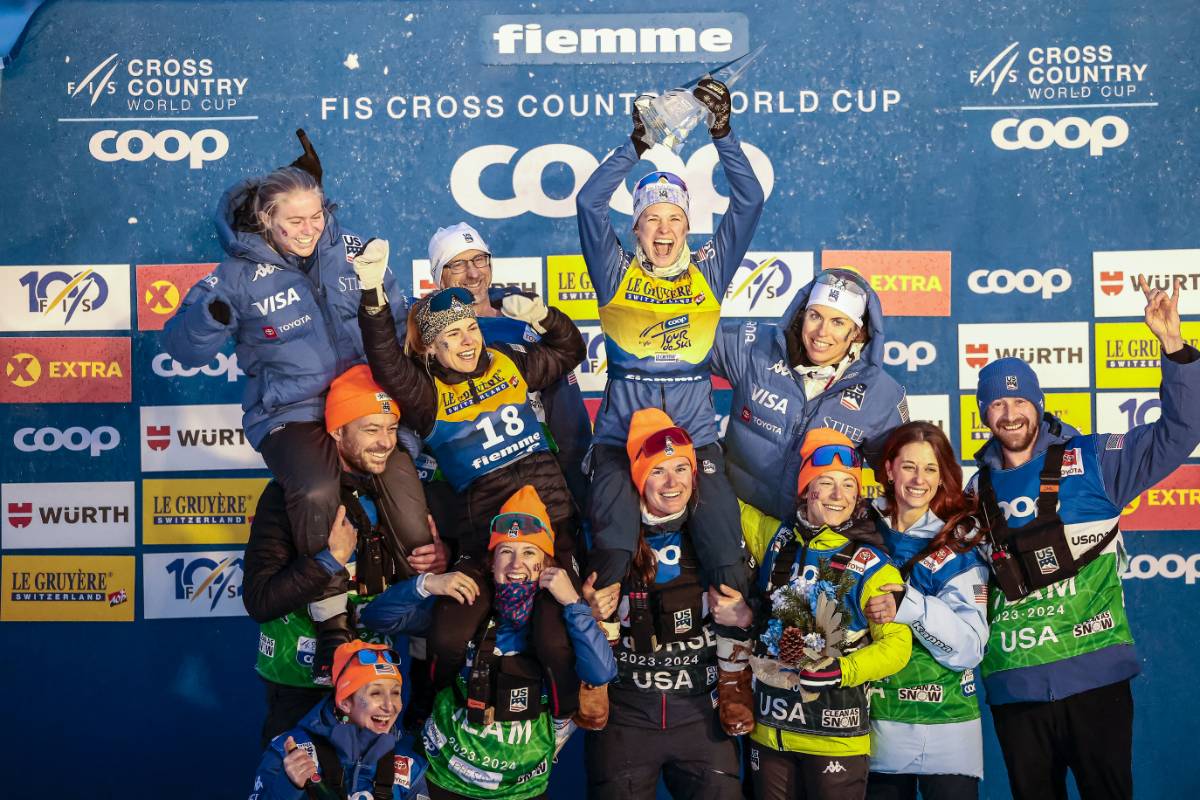
    MW: We made a goal this year as a team: stop taking podiums for granted. This year, you see us storm the podium and take a team photo with the one athlete who actually earned the award. No one of us is as strong as all of us, and that’s what we are celebrating. If you see that photo, that’s the message we are trying to send to you. We are recruiting you.  

    Rosie Brennan (USA) and Stifel U.S. Ski Team Head Coach Matt Whitcomb embrace after Brennan skied to second place in a 10 k Classic race in Ruka, Finland. (Photo: Nordic Focus)
    World Cup Period 3, and the Future of US Skiing

    FS: How are you and the Team feeling now that the North American World Cups are really starting to come into view?

    MW: It feels like we are hosting our own little Olympics. This is our chance for the U.S. ski community to show off what we have built together. It’s our chance to recruit kids to our sport. Look at the recruiting advantage Norway has; in just this World Cup season alone, they get to ski in front of their fans in Trondheim, Drammen, and Oslo, followed next season by World Championships, and several World Cups. Of course their kids grow up wanting to be skiers. We are about to see this benefit to our nation for the first time in a quarter of a century. And yet, we are succeeding anyway. Just imagine; this success we are experiencing now, if we continue to work together as a skiing nation, is just the beginning.

    FS: What are you most looking forward to about having the US ski community in one place?

    MW: We can write about and tout our strength as a nation, but it’s a different thing to looking being able to really feel it. I want to stand along the course and see and hear what 10,000 people—including my family—who surround that race course in support of our team really feels like.

    FS: There’s probably very few Americans that know more about what a World Cup “atmosphere” looks like than you. What kinds of things are you looking forward to seeing brought over from the World Cup circuit to North America for these World Cups?

    MW: Our European competitors are very excited to come race in the United States. They’ve heard it’s going to be huge. These days, the whole world is being affected by the onslaught of indoor culture. Even in Europe, it’s hard to get people outdoors to watch a live cross country event when they can watch it instead on their phones and TV’s. You don’t have to look farther than Trondheim, with a population of over 200,000 people. It’s the hometown of Johannes, and yet the crowds were disappointing. This is what Minneapolis will bring: a culture that doesn’t take the World Cup circuit coming to its doorstep for granted.

    I’m also very excited about a project we have going on with the National Nordic Foundation (NNF)  (note: Whitcomb serves on the NNF Board of Directors) which is to put as many American skier fan bibs on our spectators as is possible. I want to look out at the crowd and see our stars and stripes on hundreds of people, and on others, the smiling faces of our athletes. This is a cool project that was pitched to us by one of our friends, Oumar Cherif, who’s an avid skier in the Minneapolis area and involved with the Loppet Cup. I believe it was a creation by he and his girlfriend, with the idea of celebrating our strength as a nation by uniting us with fan bibs. Oumar reached out to the National Nordic Foundation and pitched the idea, and said he thought it could be a successful fundraiser. I think he was right. We have a variety of designs being produced by local Midwestern companies Borah Teamwear and Podiumwear. They’ve each cut us a great deal, and I think we’re offering a lot of fun and loud options for our fans. 

    The big thing to highlight is that this is a real way to see skier development works in the US. At Minneapolis, any skier that qualifies for a World Cup start, who is not already fully funded by the US Ski Team, is receiving funding. That’s championing competitive equity in our ski community, and it’s possible because of our ski community and what they give to NNF.

    FS: With this being the first World Cup in America in over 20 years, there’s a unique circumstance where a veteran group of American skiers—Jessie Diggins, Rosie Brennan, etc.—will be getting the same experience as a younger group of skiers that grew up watching them race: racing in front of a home crowd for the first time. Having now gotten to observe the sweep of a couple of generations of American skiers building off the successes of the ones before them, what are your thoughts on getting to see that cross-over happen at these North American World Cups?

    MW: That’s a great question. We’ll have Olympic and World Championship medalists—athletes with over 100 World Cup starts—as well as first-time starters on the World Cup, all toeing the line on the same day. I think this shared enthusiasm will be uniting. I can’t wait to see it.

    FS: You spoke briefly about NNF, which you’re involved in as a Board Member. How does that organization play a role in something like the Minneapolis World Cup?

    I have two jobs that fit together a bit like puzzle pieces. As the head coach for the U.S. Ski Team, I get to help coach the top level of racing in the U.S. And it’s well-supported. U.S. Ski & Snowboard fully funds camp and racing expenses for any athlete who qualifies for the A or B teams. But that funding falls away steeply between the B and D team (we have no C team), and that’s where NNF begins its financial support. That support starts with these World Cups, and includes U-23 and World Junior Championships, summer athlete training grants, OPA winter race trips, the U-18 winter race trip, REG and National U-16 camps, SuperTour title sponsor funding, and the Trail to Gold coaching grant program. 

    We disburse nearly $250,000 per year into American skiing, with the goal of reducing the number of developing skiers who leave the sport because of funding stress. We are a fundraising organization that powers the opportunities that lead to World Cup and Olympic excellence for cross country skiers from the United States. Our philosophy is special. We won’t fully-fund a project for an athlete, but will instead team up with that athlete, their family, and their club, to make it affordable.

    FS: So something like the World Cup Fan Bibs is a way to lay a foundation to empower future skiers while the ones that inspire them in the sport are out chasing success today?

    Exactly. These fan bibs should improve our brand recognition for the future, and for now, they will help pay for the NNF’s Pillar Projects. The big hope, however, is that people will see these bibs, or read this interview, and will become an NNF supporter. We need help. Our board works very hard, and our community is responsive to our needs, but we want to expand! For three years, we’ve raised $500,000 per year, and we have aspirations to increase that to $1,000,000, as we work towards endowing our Pillar Projects.  

    FS: With a nod towards the future, what makes you excited about American skiing in the near-term this season, and what makes you excited as you look way beyond it?

    MW: In the near-term, pretty simple: Minneapolis. It really is that exciting for us all to be coming home. I can’t stress the idea of using this opportunity to literally turn the ski world more towards North America. Create the atmosphere that shows everyone that we’re excited—that we’ve always been excited—about World Cup skiing. Buy a fan bib, come cheer, give everything! 

    For Minneapolis to have long-term impact, what must happen is that our next American World Cup venue is inspired to host. We have to have the World Cup come back to the U.S. We need the desire from that next venue to be loud, and urgent. We can’t wait even another five years. Minneapolis again? Great. Lake Placid? Alaska? Soldier Hollow? Central Park? All just great!

    The Stifel U.S. Ski Team celebrates on top of Alpe Cermis earlier this month.  Jessie Diggins took the Tour de Ski Overall, and Sophia Laukli won her first World Cup race. (Photo: Nordic Focus)
  • The Devon Kershaw Show: Ringing in 2024 and the Tour with Gus Schumacher

    The Devon Kershaw Show: Ringing in 2024 and the Tour with Gus Schumacher

    American star Gus Schumacher joins us from Switzerland to break down the first three stages of the 2024 Tour de Ski. And Devon gives us the goods on Norway’s social event of the year: Therese Johaug’s wedding.

    Send us your questions and feedback: devon@fasterskier.com and nat@fasterskier.com. We’ll be back in a couple days.

  • Diggins, Ketterson, and Loppet Foundation Promote Minneapolis World Cup, “We are here to do this with joy.”

    Diggins, Ketterson, and Loppet Foundation Promote Minneapolis World Cup, “We are here to do this with joy.”

    Jessie Diggins at Wirth Park following the cancellation of the 2020 Minneapolis World Cup. (Photo: Loppet Foundation/(c) 2020 F/Go Photography)

    What are European World Cup skiers asking ahead of the circuit’s first-ever visit to Minneapolis next February?

    According to Jessie Diggins, “They’re like, have you heard of the Mall of America?”

    In a recent media event held at Theodore Wirth Park, Diggins—with fellow Minnesotan US Ski Team member Zak Ketterson—highlighted plans to make the first FIS World Cup held in the United States in 22 years an even bigger Twin Cities attraction than a mall with a whole theme park (soon to be two!) inside of it.

    Alongside Loppet Foundation Executive Director Claire Wilson, Diggins highlighted the deep significance of the Minneapolis World Cup to her and the greater US ski community, and the tangible excitement among World Cup skiers to make the trek to North America next season.

    “No one racing on the World Cup right now has ever competed in the United States. None of us. It will have been 22 years.” said Diggins. That includes the Afton, Minnesota native, who has long advocated for bringing a World Cup to Minneapolis, including the successful bid in March 2020 that ultimately was cancelled due to the COVID-19 pandemic.

    “I’ve always wanted to bring it back here to the community that raised me and gave me all these opportunities. I feel like I owe everything in my ski career to Minnesota—the welcoming, inclusive environment around cross-country skiing has always made me feel happy,” said Diggins.

    Plenty of members of the ski community, and the Minnesota media, were present in the Loppet Adventure Sunday, but so too were the Olympic medals, Crystal Globes, and the World Championship medal that Diggins had won in the decade since she swept Junior Nationals at Wirth Park in 2011. Sure, Diggins is bringing it all back home. But for her and for US skiing, that’s a home that has been profoundly transformed by her accomplishments, and the ethos she has expressed on her way to those accomplishments.

    “We are going to put on a very elite event without elitism,” said Claire Wilson. “We are here to do this with joy, and I can think of no other elite athlete that models that joy better than Jessie Diggins.”

    Wilson detailed the material plans in place to bring that spirit to the event, scheduled 2024’s President’s Day weekend, February 17th-19th. Key to the Loppet Foundation is a presenting partnership with the Share Winter Foundation that will make the event free for all to attend. The partnership will also see a free-to-ski event at Wirth the day after the World Cup races.

    Wilson also announced that the Loppet is committing resources to make the World Cup event “carbon neutral or carbon negative” towards “being an example” of the climate advocacy that many in the cross-country ski community, including Diggins, are doing to promote a sustainable future for the sport.

    US Ski Team Member and Minneapolis native Zak Ketterson, who also participated in the event last Sunday, has seen first-hand the transformation of Wirth Park, and US skiing, to the point where bringing a World Cup is now a viable reality. “When I was racing in high school races here, the World Cup couldn’t have been further from my mind,” Ketterson commented to FasterSkier. “If you would’ve told me back then I’d be a World Cup skier with the opportunity to race in my home town, I would not have believed you.”

    Diggins also reached back in her own memories of the World Cup to explain why the prospect of racing in the United States was an important milestone, saying “I remember sitting in the basement with my dad watching VHS tapes of races that had finished two years before when I was a kid. Now, kids will be able to literally reach out and touch the athletes here at home.”

    The timing of the event next President’s Day weekend is meant to capture the idea of the World Cup as both a celebration of the growth of the US cross-country skiing community, and an opportunity to expand it. “In contrast to [2020] when this was a sprint race on a Tuesday,” said Wilson, “we’ll have a full weekend of racing this time around, one week prior to the Birkie. We’re hoping tens of thousands of people are going to come and make this an entire celebration of the sport of skiing in the United States.”

    Zak Ketterson counts himself among the community that will head to the Twin Cities to celebrate. “I am honestly really excited about this World Cup being a built-in trip home,” he said. “It’ll be a unique experience getting to sleep in my own bed and race a World Cup the next day. I’m definitely going to have these races in the back of my mind all summer and fall.”

    Diggins also spoke to the “celebration” aspect being at the heart of the athlete experience going into the World Cup next year, saying, “It would be fun to win this World Cup…I’m certainly going to try…but what I’m most looking forward to is getting to celebrate bringing the World Cup here and what it will take: so many volunteers, so many people working over the course of six years to make this happen. I know that is going to be the best feeling.”

    Some of the details of what Diggins, and the World Cup field, will be racing in Minneapolis remain to be sorted out. The discipline and distances will be finalized at FIS’ Congress later this month. What other events will color the racing are also still up in the air, though Wilson has said that this World Cup event will likely be pared down and more focused on the actual racing than 2020’s full festival plans. And behind the scenes, the long process of finding the volunteer force to work the event is just in the beginning stages.

    The Loppet though, is finding confidence in what was previously a source of sorrow: the cancellation of their first World Cup bid in 2020. As Diggins eloquently put it, “They’ve already hosted a World Cup, it’s just that this will be the first one with athletes racing at it.”

    Minnesotan natives Zak Ketterson and Jessie Diggins alongside Scott Patterson and Rosie Brennan after winning the 4 x 5 k Mixed Relay in Falun last year. (Photo: NordicFocus)
  • Lumi Experiences: Minneapolis World Cup (Press Release)

    Lumi Experiences: Minneapolis World Cup (Press Release)


    Press Release

    Happy 4th of July! To celebrate, Lumi Experiences is announcing a special trip to the Minneapolis World Cup, the first World Cup in the United States in almost 20 years.

     The events are being hosted at Wirth Park, one of the largest urban parks in the country. The Loppet Foundation has grown cross country skiing in Minneapolis for close to 20 years, hosting events such as the City of Lakes Loppet, which brings in over 10,000 participants.

     Organizers are anticipating over 30,000 spectators for the World Cup. Get special access on this bespoke, five-day trip, including VIP tickets to the World Cup, a seat at the pre-race gala-dinner, demo equipment and inspect the course with an Olympian providing insights into strategy for the race and participate in the “Equity and Adventure” round-table discussion hosted by the Loppet. The Best Online Gambling Sites for 2021 – https://i-casinos.net

     Check outwww.lumiexperiences.com for more information about the trip.

     See you at the 2020 Minneapolis World Cup!

  • Minneapolis to Host 2020 FIS Cross Country World Cup

    Minneapolis to Host 2020 FIS Cross Country World Cup

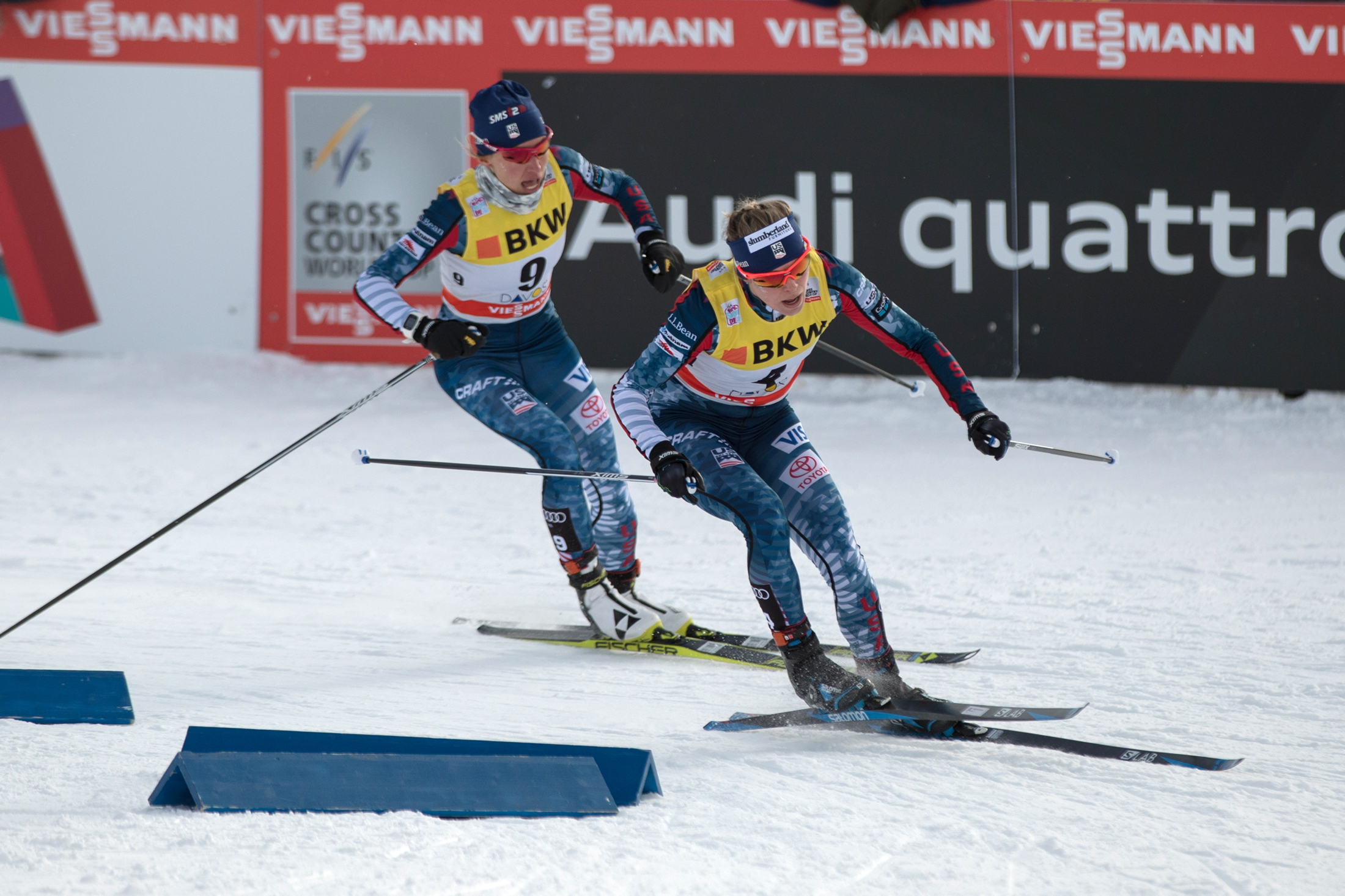
    Jessie Diggins (front), seen here leading fellow U.S. Ski Team member Sophie Caldwell in a World Cup race, was key to securing a FIS Cross Country World Cup for Minnesota. (Photo: U.S. Ski & Snowboard)

    (Press release)

    The International Ski Federation (FIS) today officially confirmed that Minnesota will host a World Cup cross-country ski event in Minneapolis in March 2020.  U.S. Ski & Snowboard and the Loppet Foundation will serve as hosts of the World Cup event, taking place at the new ‘The Trailhead’ facility in Theodore Wirth Park.

    “A Minnesotan who brought home a gold medal has now helped us bring home the World Cup,” said host committee co-chair RT Rybak. “Now it’s time for Minnesota too, once again, show we host big events better than anyone.”

    Cross country ski champion Jessie Diggins is a native of Afton, Minnesota, and the first American athlete to win a gold medal in Olympic cross country ski competition; she and teammate Kikkan Randall won the women’s team sprint at Pyeongchang earlier this year. Diggins was key to securing this international competition for Minnesota.

    “Hosting a round of the World Cup is our chance to show skiers from around the world how Minnesota embraces winter — through sport and through our hospitality,” said Diggins. “U.S. Ski & Snowboard and The Loppet Foundation are excited to host a world-class competition and share our state with athletes from around the world. We’re equally excited to give ski fans from around the US a chance to see the action up close for the first time in nineteen years! I am so proud to represent Minnesota as one of the first American athletes to win Olympic Gold in cross country, and now to bring the sport I love to the state I call home.”

    “When Jessie called me and asked if the Foundation would support her dream of bringing a cross country World Cup event to the U.S., my team and I responded with an enthusiastic ‘yes!’” said John Munger, Executive Director of the Loppet Foundation. “Her ask was a no-brainer for us because we, too, have dreams of sharing this spectacular sport with the world. That’s why we’ve worked hard over the last 16 years to elevate cross country skiing, and adventure sports widely, starting in our own backyard.”

    “Everyone at U.S. Ski & Snowboard is delighted that we and the Loppet Foundation are able to formally confirm that the cross country World Cup will be coming back to the USA in March 2020 and to one of the great hotbeds of cross country skiing in Minneapolis,” commented Calum Clark, Chief of Systems and Operations for U.S. Ski & Snowboard. “A lot of hard work has gone into making this announcement possible, from the Loppet Foundation team in Minneapolis to the International Ski Federation (FIS), but none more so than from Minnesota’s own Jessie Diggins and the whole U.S. Cross Country Ski Team whose efforts, especially in the 2018 Olympic Winter Games, were the catalyst for the compelling concept to bring the world’s best cross country skiers to the city of Minneapolis.”

    On the heels of successfully hosting Super Bowl LII, the WNBA All-Star Game, and now preparing to host the NCAA Final Four, the FIS Cross Country Ski World Cup event is yet another in a string of world-class sporting events to choose Minnesota as host.

    buy relafen online, buy ponstel online

    “The Loppet has helped put Minneapolis cross country skiing on the map, and Theodore Wirth Park offers the best trails in our state,” said Mayor Jacob Frey. “Hosting a round of the Cross Country Ski World Cup is yet another chance to showcase how to do winter right and for our city to shine as we show the world that Minneapolis welcomes everyone with open arms.”

    “Minnesota is the perfect host state for a cross country ski racing World Cup event,” said Beth Helle of Explore Minnesota. “Minnesota boasts more than 2,000 miles of cross-country ski trails, and the sport is integral to our winter tourism industry. Winter accounts for 24% of tourism expenditures in Minnesota, and our high-quality, groomed ski trails help ensure that skiing-related destinations and businesses are able to thrive throughout the winter months.”

    Nearly a decade in the making and just opened this summer, The Trailhead is part of the Minneapolis Park and Recreation Board’s Master Plan for the park and the Loppet Foundation’s long-term vision for making lifetime endurance sports more accessible for their local community. This year-round hub for outdoor adventure will host competitive races, community events, and now an international ski competition right in Theodore Wirth Park; solidifying Theodore Wirth Regional Park as a world-class cross country venue.

    More information on the World Cup event, including how to secure tickets and see the competition in action, will be available on the local organizing committee’s website, www.mnworldcup.com, or on Facebook, Twitter and Instagram @mnworldcup.

    About the Loppet Foundation

    The Loppet Foundation is a 501(c)(3) nonprofit organization that creates a shared passion for year-round outdoor adventure in the Minneapolis area, focusing on underserved youth and families. Since 2002, the Loppet Foundation has worked to create high-quality public events, youth education, and outdoor recreation programs for the local community. Learn more at loppet.org.

    About U.S. Ski & Snowboard

    U.S. Ski & Snowboard is the Olympic National Governing Body for ski and snowboard sports in the USA. One of the oldest and most established sports organizations worldwide, directly tracing its roots back to 1905, the organization, based in Park City, UT, provides leadership and direction for elite athletes competing at the highest level worldwide and for tens of thousands of young skiers and snowboarders in the USA, encouraging and supporting all its athletes in achieving excellence wherever they train and compete. By empowering national teams, clubs, coaches, parents, officials, volunteers and fans, U.S. Ski & Snowboard is committed to the progression of its sports, athlete success and the value of team. U.S. Ski & Snowboard receives no direct government support, operating solely through private donations from individuals, corporations and foundations to fund athletic programs that directly assist athletes in reaching their dreams and achieving the shared goal of being Best In The World.