From the FasterSkier archive — posts syndicated from athletes’ and coaches’ own blogs between 2004 and 2012, kept online as published. Current coverage is at fasterskier.com.
Benilde-St. Margaret’s School is hiring a Head Nordic Ski Coach to lead its cooperative program with DeLaSalle High School for the 2026-27 winter season. BSM is a Catholic, college-preparatory school in St. Louis Park, Minnesota, on the western edge of Minneapolis, and its Nordic team brings together skiers from both schools through a long-standing partnership.
The program is replacing both its head coach and its senior assistant coach this season. The roster is young, with a strong freshman class, and the program is looking for a coach who can build on the team culture the previous staff established while developing that talent toward a run at the state meet in the coming years.
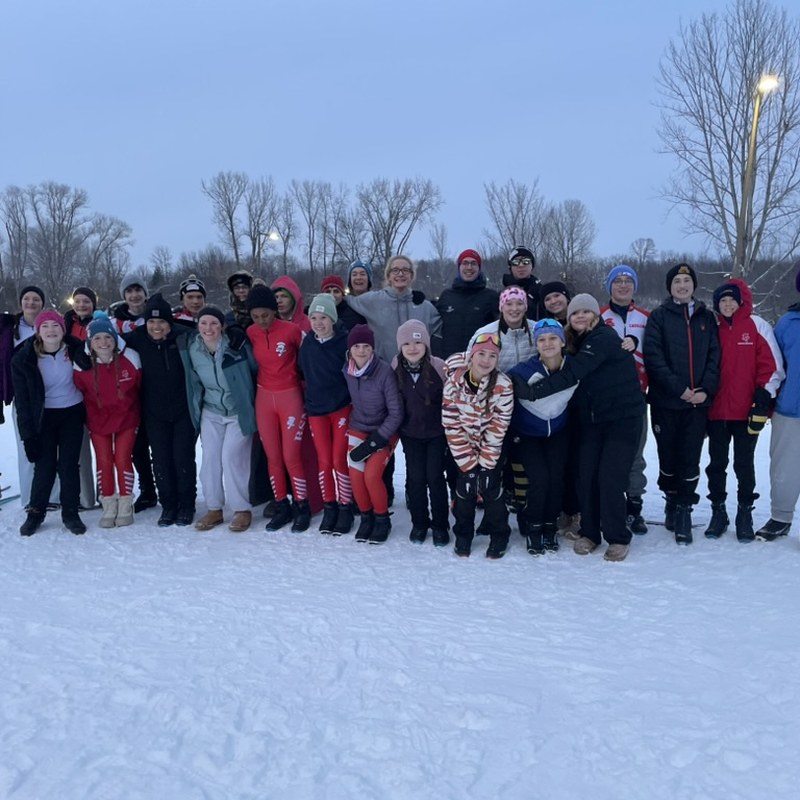
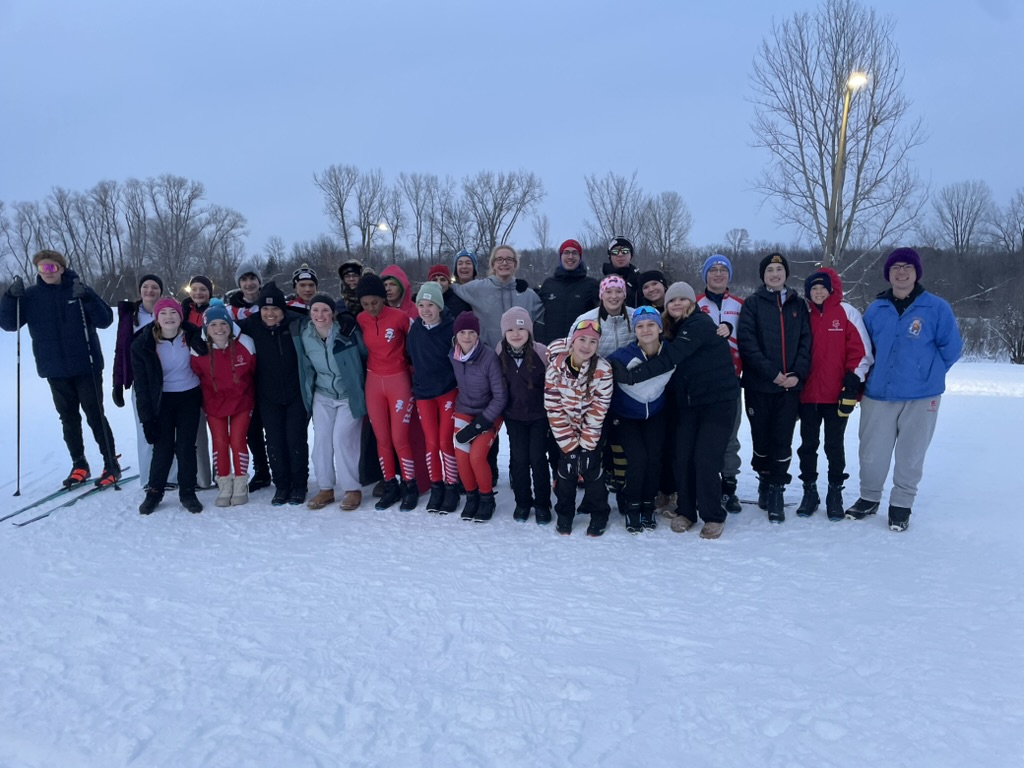
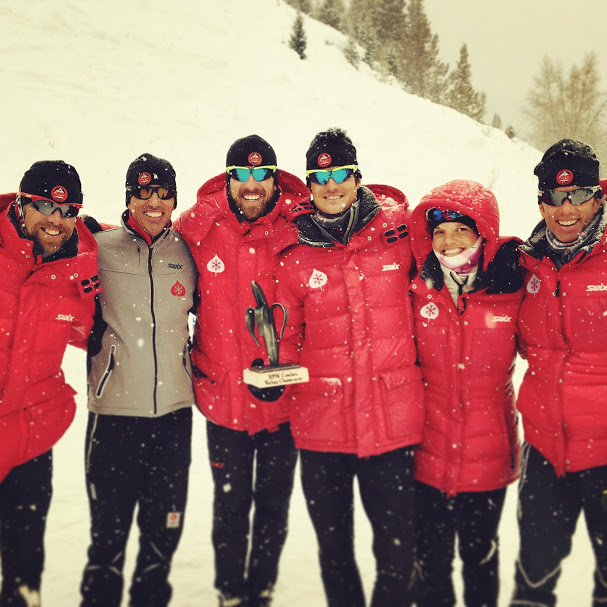
The Benilde-St. Margaret’s/DeLaSalle Nordic team last December. (Courtesy photo)
Position Overview
The head coach develops skiers of every experience level, builds a welcoming team culture and pursues competitive excellence, with student-athlete growth at the center of the program. That means setting a positive, inclusive tone for athletes from both schools, communicating clearly with families and school leadership, and building a team in which every skier feels valued and challenged. The head coach also leads and supports the assistant coaching staff, with an emphasis on consistency and a smooth transition into the season.
The Details
Head coach of the Benilde-St. Margaret’s/DeLaSalle cooperative Nordic program for the 2026-27 winter season
Stipend, commensurate with experience — $5,000 to $8,000
Reports to Matt Pryor, BSM Director of Athletics & Activities
After-school practices and meets through the winter, plus preseason planning and coordination with both schools
The selected candidate must complete BSM’s hiring, background check, Safe Environment and coaching requirements before working with student-athletes
Responsibilities
Plan and lead practices, competitions and athlete development throughout the season
Teach sound ski technique, conditioning, race strategy and safe training habits
Coordinate schedules, transportation, equipment and meet logistics with the BSM Athletics & Activities Department and DeLaSalle
Recruit, supervise and develop assistant coaches in collaboration with BSM
Communicate proactively with athletes and families, including schedule updates through BSM’s designated platform
Maintain program equipment and keep an accurate inventory
Uphold BSM’s standards for sportsmanship, student well-being and Minnesota State High School League compliance
Qualifications
Required:
Experience coaching or competing in Nordic skiing
Strong organizational and communication skills
Ability to work effectively with student-athletes at varying skill levels
Commitment to a safe, supportive team environment
Preferred:
High school coaching experience
Familiarity with Minnesota Nordic skiing competitions and the MSHSL
Experience leading a coaching staff or a cooperative program
Why Lead at BSM
BSM sets out to develop student-athletes as competitors, teammates and people, and its coaches build programs rooted in belonging, accountability, growth and Red Knight pride. The next head coach steps into a program with dedicated skiers, families and assistant coaches, has the backing of both schools, and gets to bring their own vision to athlete development and team culture.
How to Apply
Send a cover letter, résumé and references to Matt Pryor, Director of Athletics & Activities at Benilde-St. Margaret’s School: mpryor@bsmschool.org.
Applications will be reviewed as received. The opening is also listed on the BSM careers page.
When we spoke, Kristen Bourne was sitting on the couch in her living room in Truckee, California, a small ski town she now calls home. Tibetan prayer flags hung loosely behind her, shifting gently in the morning light that poured through the window. The room felt warm and calm — the kind of quiet space that comes from someone who spends much of her year on the move. Bourne smiled easily as she spoke, her voice’s cadence unhurried, like someone grounded in both her work and the mountain rhythm around her.
She had just returned from camp and was preparing to leave again this weekend to start the World Cup with the U.S. Ski Team. Between talk of travel logistics and packing lists, she mentioned the soundtrack that keeps her company on solo skis. “When I’m skiing by myself? Yes,” she said, grinning. “I really like skiing to Machine Gun Kelly… it kind of brings me back to the Blink-182, Sum 41 days. It feels almost like nostalgic, but newer age.”
That small confession says a lot about Bourne, now in her fourth season on the U.S. Cross-Country Ski Team coaching staff: rooted in rhythm, grounded in joy, and always blending the familiar with the fresh.
Joy, she’ll tell you, isn’t a garnish. It’s the point.
Kristen Bourne, Olivia Nesbitt Bouffard, and Jessie Diggins on an afternoon run in Wanaka, New Zealand. (Photo: Jessie Diggins)
“Happiness goes such a long way in professional sport… our secret weapon as a team is having fun. Our staff genuinely enjoys being together. The athletes genuinely enjoy being together. We love to all come together.”
The proof, for her, is a memory from the day Jessie Diggins won the 10 K at the World Championships in Planica. The scene isn’t what the public imagines. “You’d think everybody is stressed,” Bourne said. “We were ahead of schedule, and we all just sat down in [our wax truck], Yolanda, and made instruments out of whatever we could find for, like, 30 minutes.” The room filled with improvised drums and laughter. “It was so fun,” she said. “That’s the stuff people never see.”
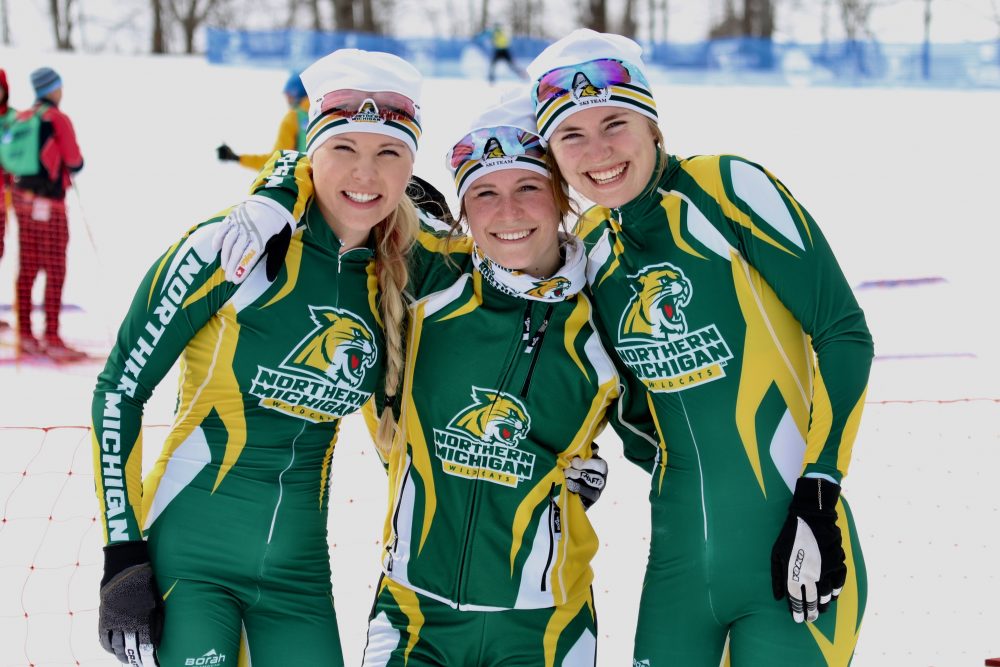
Northern Michigan University’s Kristen Bourne (c) after the 5-kilometer classic race at the 2017 NCAAs in Jackson, New Hampshire. (Photo: Jackie Schneider)
Minnesota Roots, and a Goal Cut in Half
Bourne grew up just outside the Twin Cities, where endurance sport was a family language. “Our family vacations were going to [my dad’s] marathons and triathlons,” she said. She started by hopping into a mile here and there, handing him nutrition at the end of the driveway, learning the cadence and care that go into long efforts.
Skiing arrived as a nudge. A new high-school coach was recruiting runners to cross-country ski at Mounds Park Academy. The first season was rough: “I swore I was going to quit. Every single race I did, I cried after most races,” she said. In a 5k, Jessie Diggins (then a rival in the same section) beat her by 12 minutes. Bourne’s response was characteristic—specific, measurable, gritty: next year, get that down to six.
She continued to run and ski through high school, then headed to Northern Michigan University after spending a semester at the University of Colorado. She transferred mid-winter 2014 and skied at NMU through 2018, working under a rotation of assistants. Her path after graduation would tilt everything she thought she knew about training.
Kristen Bourne spent time in Norway after college training with Lyn Ski / Team Obos. Bourne is pictured here racing in a Norwegian Cup race in Gålå. (Photo: Martin Riseth)
Norway: Where Individual Plans Meet Shared Trails
Right out of college, Bourne moved to Norway for a year and a half. She intended to ski; illnesses complicated the plan. But a concurrent internship at the Norwegian School of Sports Science opened doors into a different coaching world. Back home, she was used to “show up and the coach tells you the workout and everybody does the same thing.” In Norway, she said, “you sit down with a coach and you generate your plan… It was the first time I was exposed to individual planning—thinking about what’s best for you, not necessarily the team.”
Interval days there could look like organized chaos: “Every single person… almost had a different workout, but people would sync up where they could.” At first, she struggled; she missed the mob grind. Then she looked around at a culture of success and realized what was happening: athletes were learning their bodies early, practicing agency. The lesson stuck. “Team workouts are also the way to go,” she said, “but giving athletes a platform to think for themselves—creating this athlete-coach collaborative experience versus coach telling athlete, ‘this is what you should do’—had a tremendous impact” on how she now works.
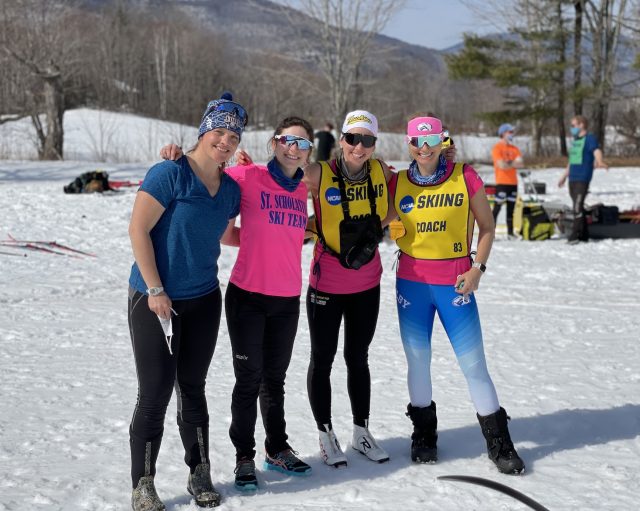
(l-r) WSCA members Maria Stuber (then CSS), Kristen Bourne (then CSS, now with the US Ski Team), Kristen Monahan-Smith (Michigan Tech), and Tracey Cote (Colby College) at the NCAA Championships in Jackson, New Hampshire, in 2021. (Courtesy Photo).
The Parking-Lot Pivot
Her return to the U.S. was abrupt. She lost her residence permit—”turns out it was under the seat of my roommate’s dad’s car”—and flew home with two days’ notice, arriving just as COVID was beginning to ripple into sport. She kept racing a little, then decided she was done.
That’s when a well-timed email—and a parking-lot shout—changed everything. Her dad reached out to Maria Stuber, who was building the Women’s Ski Coaches Association. “Maria found me in a parking lot at U.S. Nationals and yelled out her window, ‘I’m going to call you,‘” Bourne remembered. A call later, Maria offered her a position at the College of St. Scholastica and connected her with Pepa Miloucheva at the Craftsbury Green Racing Project. After two school years at Scholastica, with summers in Craftsbury, Bourne joined the U.S. Ski Team staff.
The transition was, by her own admission, intimidating. “It was this idea of, like, how am I here?“ she said. But Norway’s reminder—that fresh eyes are valuable—kept her steady. “Just because you’re newer and have less experience doesn’t mean your ideas aren’t valid,“ she said. “You’re maybe fresher out of a ski career, you relate with athletes in a different way. There’s a lot of value in that.”
She also learned to de-personalize the miss. “Technique feedback doesn’t always stick. That’s not a reflection of me as a coach or the athlete,“ she said. “We tried that idea; it’s fine. We’ll try something else.“ Each year, she felt more confident; more importantly, she built deeper connections.
Julia Kern—one of the athletes Bourne works with most closely—sees that same quality every day.
“Kristen is unique in the sense that she’s able to connect with just about any personality type on the team,“ Kern said. “One of her strengths is figuring out how to connect differently with different athletes. Every athlete responds differently and has different needs, and she just gets that. She’s very approachable and sees athletes as whole people.”
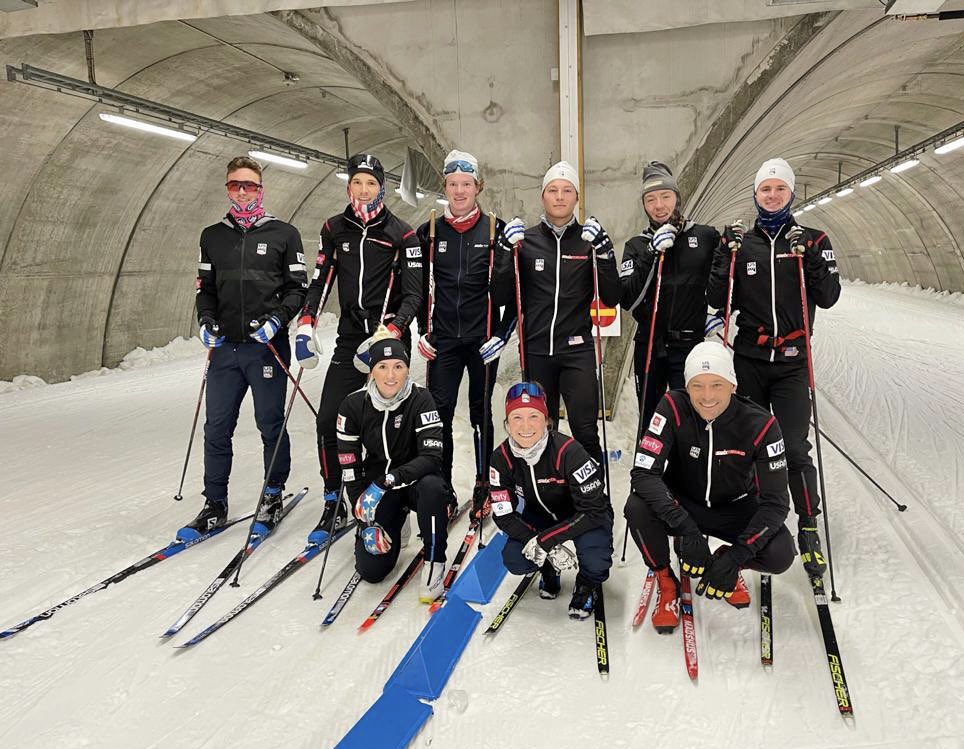
USST athletes and coaches in the Torsby Ski Tunnel, August 2022. Back row, from left: Johnny Hagenbuch, Kevin Bolger, Finn O’Connell, JC Schoonmaker, Ben Ogden, and Walker Hall. Kneeling, from left: coaches Greta Anderson, Kristen Bourne, and Matt Whitcomb. (photo: François Faivre)
Mentors and a Collaboration-First Culture
Ask Bourne about mentors and the names tumble out: Matt Whitcomb, Chris Grover, Jason Cork. “From the very beginning… incredibly supportive,“ she said. “Matt will answer his phone every time. He usually likes to FaceTime… we brainstorm ideas.“ The flow goes both ways: she calls when the connection is hard; he calls when he’s stuck on something.
Her women’s network is just as active. “Maria Stuber, hands down,“ Bourne said. “And Sam Benzing at Montana State—we coached together at Scholastica. She’s younger, but her perspective is so interesting.“ Group FaceTimes are common: Maria, Sam, Kristen, swapping angles and problem-solving. It’s not just helpful; it’s survival. “It would be really hard to be in this job and not have that,“ Bourne said. “The collaboration makes it so much more sustainable.”
That same approach underpins her work with athletes like Kern.
“Kristen’s helped me figure out what kind of training plan works well for me,“ Kern said. “We’ve tried some new things the last few years—different kinds of workouts, always thinking creatively. She’s open-minded, reads up on what other athletes are doing, but also thinks for herself. She’s got such a growth mindset.”
Julia Kern and Kristen Bourne in Sjusjøen at the 2025 pre-World Championships camp. (Photo: Matt Whitcomb)
Coaching Women, Coaching Men — and Being Seen
On the World Cup, visibility is progress measured in inches. FIS’s women-coach bibs created access (up to two additional bibs if teams have women on staff), but change is slow. “Every year, maybe there’s one or two new women… it definitely hasn’t blown up,“ Bourne said. Old assumptions linger. “I probably get asked a couple times a year from male coaches: ‘Are you the massage therapist or PT?’“
For Kern, Bourne’s presence is more than symbolic.
“It’s huge,“ Kern said. “She’s one of the few female coaches on the World Cup level, and she’s down to work hard and just have fun with it too. I hope the next generation of women who want to coach feel inspired that they can do it too. Kristen’s paving the way, even in ways people might not see from the surface.”
Bourne herself agrees that visibility matters. “You can’t be it if you can’t see it,“ she said. “It’s important for young men, too, to see women in leadership roles. Our men’s team has been incredible—they’ve never made me feel like I don’t belong.”
Her advice to aspiring women coaches is emphatic: build a robust support community. “Ask for advice,“ she said. “It makes a world of difference.”
Kristen Bourne and Sophia Laukli on the pre-race day at Val di Femme during the 2025 Tour de Ski. (Photo: Leann Bentley)
Athlete Work: Julia Every Other Day, Gus and Sophia on the Radar
Bourne’s primary day-to-day is Kern. “We’re talking basically every other day—texting or on the phone, training planning. We work very closely, very in depth,“ she said. She also monitors Gus Schumacher and Sophia Laukli.
Kern said that beyond the workouts, Bourne has shaped the team culture itself.
“She’s really good at encouraging athletes to bring their own sense of leadership,“ Kern said. “Not everyone is going to be outspoken—some are quiet leaders, some lead through training. She empowers people to be leaders in their own way. She creates a team atmosphere that’s a judgment-free zone. No idea is a bad idea.”
Gus Schumacher and Kristen Bourne after his 4th place finish in the Davos sprint during the 2023 Tour de Ski. (Photo: Leann Bentley
Season Outlook: Keep the Vibe, Chase the Team Moments
Last year’s long illnesses made for uneasy preseason reading. This year feels different. “People are in a pretty good place,“ Bourne said. “At our camp in Utah, I would assume there would be a little more stress—it’s an Olympic year. Not at all. People were so relaxed and chill and vibing and doing their thing.”
If there’s a metric she’d choose for success, it’s carrying that “happy momentum“ through everything—the Olympics, Lake Placid World Cup Finals. “In a year with so many eyes on cross-country skiing, that would be massive,“ she said.
Results still matter, of course. And she lights up talking about the collective ones. “It would be so awesome to see success in team events,“she said. “Relay and the sprint relay—those mean so much when it’s a collective team event. We want to do well there.”
Lucas Wilmot, Kristen Bourne, Murphy Kimball, Tabor Greenberg in Bend, Oregon 2025 after wrapping up the first L3 intervals at camp. (Photo: Leann Bentley)
Representation, Purpose, and the Long Run
There’s a moment near the end of our conversation when Bourne zooms out to the why. “We are very deeply intertwined in another person’s process and journey,“ she said. “What an absolute privilege to be part of that. It’s impossible not to come to absolutely love and care so much about these people.”
Kern echoed that sentiment from the athlete side.
“Kristen understands there’s life outside of skiing,“ Kern said. “She also knows what it takes to be one of the best in the world—and when it’s time to step away. She helps us stay grounded.”
Five years from now, Bourne hopes she’s doing exactly this, just deeper—”coaching, getting to know these athletes more and more.”
And she hopes the picture around her looks different: more women coaches on staff, on other staffs, in other sports at U.S. Ski & Snowboard; more women wax techs. “If I can have a tiny ounce of contribution into changing that,“ she said, “I’d be so, so happy.”
Kristen Bourne and Colin Rodgers out for a run during the OD run at Park City camp, 2025. (Photo: Matt Whitcomb)
Purpose, Rhythm, and Joy
As our conversation wound down, Bourne slightly rotated her position as the light spilling through the window shifted—yet still filtering across the prayer flags behind her. She laughed when she mentioned her must-pack item: heated socks for Finland. “I get cold fast,“ she said. “Those are my best friend.“
There’s rhythm in that, too: warmth, joy, and purpose, all braided into one.
Because for Kristen Bourne—and for the athletes who work with her—the secret weapon really is fun.
Leann Bentley, Kristen Bourne, and Bernie Nelson at Val di Fiemme the morning of one of the last stages of the 2024 Tour de Ski. (Photo: Matt Whitcomb)
Love Stories Like This? Help Keep Them Coming.
Feature interviews like this one take time, access, and care to produce. If you value thoughtful storytelling and independent ski journalism, please consider becoming a Voluntary Subscriber. Your support directly fuels the work we do to cover the people, places, and moments that make our sport special.
Garrott Kuzzy’s journey from the trails of Minneapolis to the alpine valleys of Austria reads like a skier’s odyssey—equal parts serendipity, endurance, and vision. Before becoming an Olympian or founding Lumi Experiences, a travel company built around the joy of cross-country skiing, Kuzzy was simply a kid who loved movement.
“There were no cell phones then,” he recalls with a laugh. “I think I was just playing soccer, doing the stuff kids did in Minneapolis.” His early athletic spark came not from racing bibs but from curiosity. That curiosity deepened after watching the 1994 Lillehammer Olympics. “I thought ski jumping was the coolest thing,” he says. His father, driving home past the lights of the Minneapolis airport ski jump, stopped and signed Garrott up on the spot.
Ski jumping, however, involved more trudging than flying—lugging 240 cm skis up icy stairs for a handful of attempts. “I remember thinking, this is too much work. I’m going to do cross-country skiing instead.” That decision set the trajectory for the next three decades of his life.
Garrott Kuzzy skiing the 1997 König Ludwig Lauf. (Photo: Courtesy Photo)
A Culture of Excellence at Hopkins High
At Hopkins High School, Kuzzy joined a program that had quietly become one of Minnesota’s most respected Nordic teams. Coach Pat Lanin had spent more than 30 years nurturing a culture of commitment and camaraderie. “He definitely set the culture,” Kuzzy says. “We had this lineage—guys like Matt Schadow and Pete Tollefson, who were great runners and skiers—and it made you want to rise to that level.”
Those roots mattered. Minnesota’s high school skiing scene was (and remains) a hotbed of talent and community spirit, a proving ground where future Olympians learned not just how to race, but how to love the sport.
Switzerland and the Making of a Global Perspective
If Minnesota planted the seed, Switzerland provided the light. During what he calls his “first senior year” of high school, Kuzzy embarked on a foreign exchange in the Alps—a decision that would alter his trajectory.
“I kind of forgot to apply to college while I was there,” he says, laughing. But what he gained was immeasurable: “That year completely changed my trajectory in life. I trained with a local club, learned German, raced at Swiss Nationals, and came back stronger and faster.”
Garrott at age 7 with his father, Jim, at the Engadin Ski Marathon. (Photo: Courtesy Photo)
Once back home in Minnesota, Kuzzy repeated his senior year, dominated the state circuit, and qualified as a forerunner for the 2002 Salt Lake Olympics. More importantly, he returned home with a new sense of maturity and a lifelong interest in connecting people through travel.
That international curiosity would later become the foundation of Lumi Experiences—years before the company even existed.
Middlebury: A Team of Global Thinkers
After strong results at Senior Nationals, Kuzzy fielded offers from several East Coast colleges. He ultimately chose Middlebury, drawn by the school’s blend of academics, languages, and skiing. “Terry [Aldrich] let me run cross-country and ski, and they had a strong German program,” he says. “By that point, I’d just gotten back from Switzerland. Studying languages was my jam.”
Middlebury’s team at the time was something of a cultural experiment: nearly every skier had taken a gap year abroad. “Five or six of our top racers had spent a year in Norway, Sweden, or Switzerland,” Kuzzy explains. “It gave us a maturity advantage—like grad students who’ve worked before going back to school.”
That worldly approach shaped not just results, but perspective. “It opened doors for people,” he reflects. “Those experiences make you realize sport isn’t just about skiing faster—it’s about how you see the world.”
Garrott Kuzzy (CXC) on his way to first place at the SuperTour in West Yellowstone in 2009. (Photo: Andy Canniff)
Climbing the Ladder: From CXE to the World Cup
After college, Kuzzy joined the Central Cross-Country Elite (CXC) team under coach Yuriy Gusev. His methodical plan—Europa Cup in 2007, World Cup in 2008, Olympics in 2010—was ambitious but precise.
He broke through in Canmore in 2008, finishing ninth in a World Cup sprint. “That race changed everything,” he says. “I barely missed the A-final, but it qualified me for the U.S. Ski Team.”
The result was validation of years of grinding. “In that semifinal, I was fourth, and I forgot about the lucky loser rule,” he recalls. “Had I stuck my toe out another inch, I would have made the A-final.” Still, his B-final victory and top-10 finish made him one of the first Americans to hit the objective criteria for team selection.
Yet even amid success, Kuzzy felt the solitude of life on tour. “I remember running at night in Falun, seeing warm lights in houses and feeling homesick,” he says. “I thought—how cool would it be to share these places with friends and family?” That yearning for connection would eventually define his subsequent career.
Garrott Kuzzy was CXC’s first athlete to make the Olympics.
From Racing to Guiding
When Kuzzy retired from racing in 2011, he joined Vermont Bicycle Tours (VBT) and began designing active travel experiences across Europe. “On one of my first days, I told Gregg Marston, ‘I’d love to do cross-country ski vacations,’” he recalls. Within a year, he was running VBT’s ski trips in Europe.
After VBT was sold, Kuzzy spent a year coaching at Green Mountain Valley School before pursuing an MBA in Tourism Management in Innsbruck, Austria. “The program gave us winters off to work in the industry,” he says. “That’s when I started Lumi.”
The first Lumi trip, in 2018, was a test run for the 2019 Seefeld World Championships. “I totally mispriced it,” he admits. “But we ended up making a $10,000 donation to the National Nordic Foundation.” Guests saw Sophie Caldwell and Jessie Diggins both win World Cups that weekend—one of the most memorable in U.S. skiing history.
Some of those guests have traveled with Lumi every year since.
Sophie Caldwell (USA – bib: 4), Maiken Caspersen Falla (NOR), Laurien Van Der Graaff (SUI), (l-r) race to the line of the individual sprint in Seefeld (AUT) in 2018. (Photo: Fischer/NordicFocus)
Building Lumi: Travel with a Nordic Soul
From its base in Innsbruck, Lumi has evolved into a small but deeply personal company offering immersive ski journeys across Europe—Seefeld, Toblach, Falun, and beyond. The mission, Kuzzy says, is simple: “To share the best cross-country skiing in the world with American travelers.”
He brings the same precision he once applied to interval training to trip design: ski-in/ski-out hotels, strong coffee, smooth logistics, and moments that foster connection. “We still do things like mulled-wine curling nights, inspired by my time with the U.S. team in Ramsau,” he says.
Seefeld remains the company’s spiritual home. “You can walk out your door and ski, but it still feels like a small town,” Kuzzy explains. “It’s the only place I’ve seen with an après-ski scene for cross-country skiers. There’s a bar right at the trailhead—it’s magic.”
Lumi’s guests have ranged from former Olympians to families discovering Europe’s ski culture for the first time. And through it all, the ethos remains: connection, community, and joy.
Kuzzy and his Lumi guests pose with Julia Kern and her parents at the 2023 Planica World Championship. (Photo: Lumi Experiences)
Full Circle: The Olympic Spirit, Reimagined
As Lumi prepares for the 2026 Winter Olympics in Italy’s Val di Fiemme—where Kuzzy raced during his career—things feel, in his words, “beautifully full circle.” The company will host multiple groups in Cavalese, the same valley as the legendary Marcialonga.
“It’s surreal,” he says. “From racing there as an athlete to now bringing people to experience it—it’s everything I hoped Lumi could be.”
Beyond 2026, Lumi has already secured hotel space for the 2027 Vasaloppet and Falun World Championships—a feat of foresight that shows Kuzzy’s racer discipline never truly faded.
In the end, Lumi is less about luxury or logistics than it is about legacy. “Some of our guests have been on every trip since the first,” Kuzzy says. “They’ve become friends. We share this deep love of skiing and place—that’s what it’s all about.”
The Glide Continues
Garrott Kuzzy’s life on skis has taken him from the frosted parks of Minneapolis to the peaks of Innsbruck, from the World Cup start line to the front desk of a boutique ski tour company. But his mission has remained constant: to bring people closer to the snow, to the sport, and to each other.
“The best part of Lumi,” he says, “is seeing guests experience skiing the way I did when I first fell in love with it. That’s the magic I want to share.”
Love Stories Like This? Help Keep Them Coming.
Feature interviews like this one take time, access, and care to produce. If you value thoughtful storytelling and independent ski journalism, please consider becoming a Voluntary Subscriber. Your support directly fuels the work we do to cover the people, places, and moments that make our sport special.
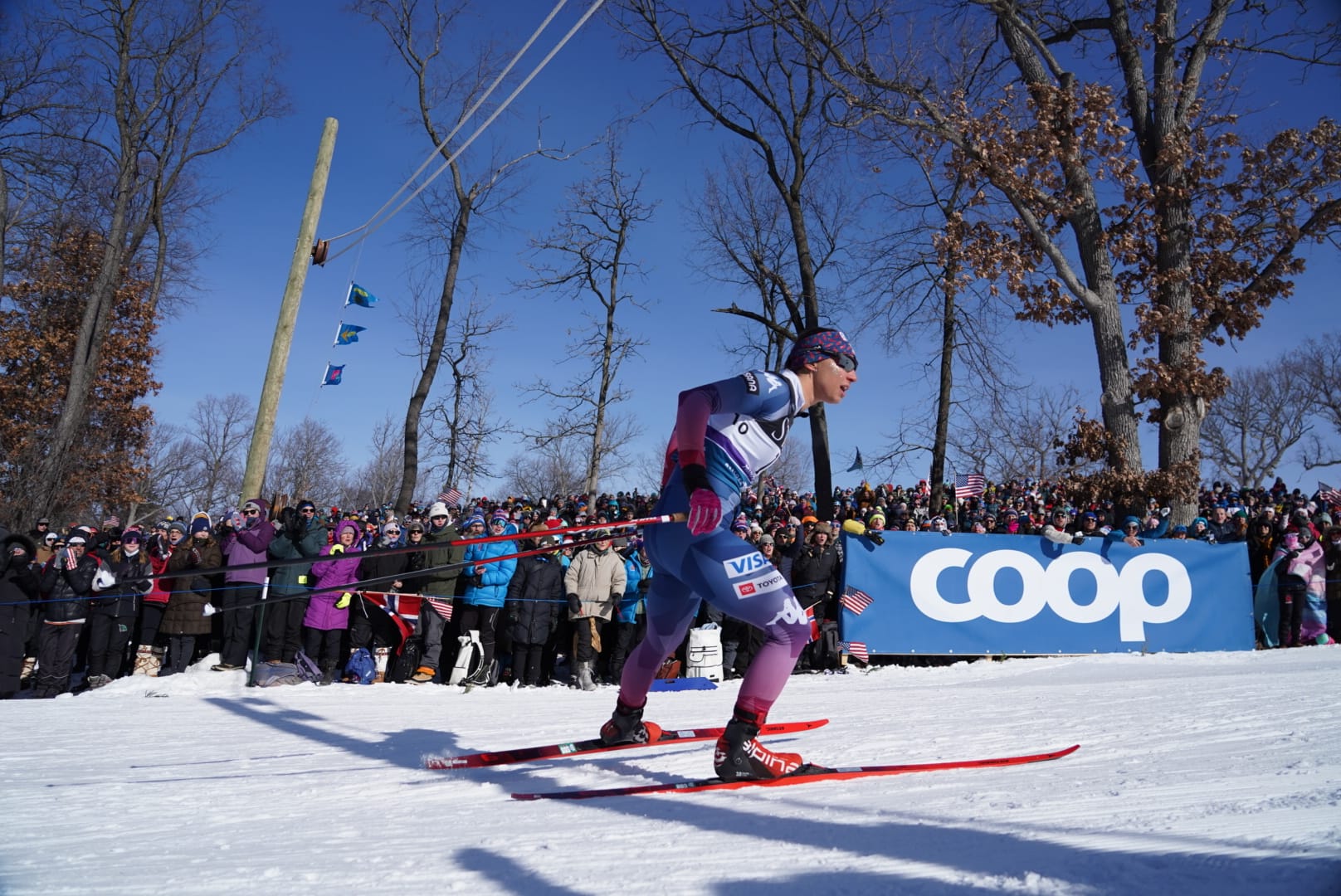
Julia Kern at the Minneapolis World Cup in Wirth Park. (Photo: Lumi Experiences)
It’s been an incredible North American World Cup period in Canmore and Minneapolis over the past two weeks. In Canada, as the excitement was building for the first World Cup on US snow in over 20 years, US skier Julia Kern led the women to the top US finish in the classic sprint and Diggins won the 15 km freestyle. In Minneapolis, the huge crowds of US fans in Wirth Park for the Loppet Cup brought an incredible energy to the event and crowds were treated to several podium finishes for the US!
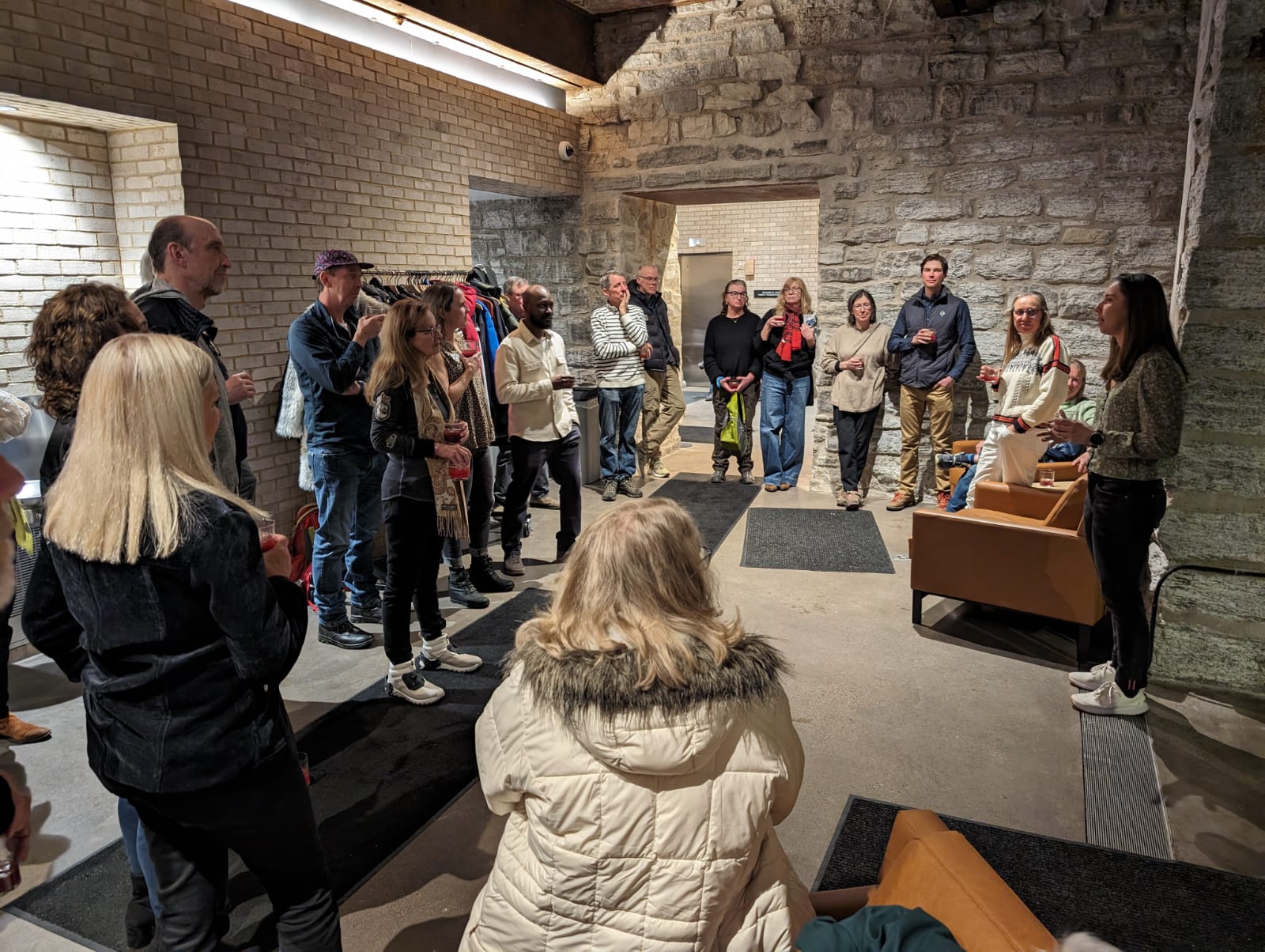
Julia talking with Lumi guests in Minneapolis after the Loppet Cup. (Photo: Lumi Experiences)
On Sunday night after the races, guests on Lumi’s Minneapolis World Cup Trip got to meet Julia and her family. Julia shared parallels between skiing on the Weston Golf Course where she grew up in Boston and the Wirth Golf Course that hosted the Minneapolis World Cup. She also talked about the impact of the Trail to Gold Fellowship, helping to bring more women coaches onto the World Cup. The story of how Julia and Jessie won silver at last year’s World Championships captivated and inspired the group for next year’s Trondheim World Championships in Norway.
Now these next two weeks are the first time in decades that US ski team athletes have been able to head home for some rest time in the middle of their 3.5 month World Cup season.
Before Julia takes off for the final leg of the World Cup in Scandinavia in early March, she prepared a video of what she packs when she travels to the World Cup. In this new video, see what she packs in her bags – both for ski training and her other favorite sport. What sport is that?
Want to experience cheering for a World Championship event in Europe? The 2025 Trondheim World Champs are going to be in Johannes Klæbo’s backyard next February and March. Due to their popularity, there will be two Lumi Experiences trips to Trondheim 2025. Dovetail this with Lumi’s Norway-Birken trip to ski the Norwegian Birkebeiner while you’re in Norway. An additional packing tip from Julia for Trondheim 2025? Bring your stars, stripes and glitter!
Right now we’re offering an early booking discount on all 2025 Lumi trips. Secure your spot before March 31, 2024 and save $300 per person.
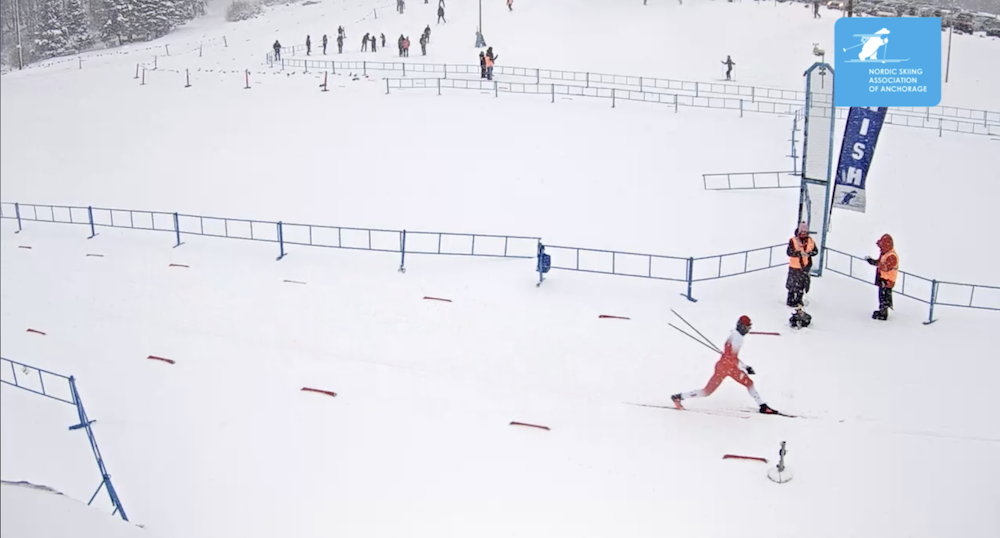
An athlete finishes the sprint qualifier-only event in a largely empty Kincaid stadium in Anchorage in a December 2020 FIS race. (Photo: NSAA webcam screenshot)
The winter of Covid continues. Most of the FIS races scheduled for this country this year did not happen. A few did. No one in Canada has done a single official high-level race this winter. No one in Vermont has, either. Some athletes from Canada and Vermont did not race and were chosen for international travel teams. Some athletes in Alaska raced a ton and were not. It’s been a tumultuous winter for everyone, for many reasons, skiing or otherwise.
After several months of hosting, or not hosting, ski races in this country, a few themes have emerged. In this article, part one in a two-part series, FasterSkier surveys some of the lessons learned and considerations informing race directors’ decisions about whether to hold a race, and if so with what safety measures in place. In part two, FasterSkier considers the case of the American Birkebeiner, which even in this year’s scaled-down format is once more poised to be the most popular ski race in the country, and to draw athletes from across a wide swath of the Midwest to rural Wisconsin.
This article begins with an attempt to quantify where the health risks in nordic skiing lie, then examines first regional racing in Alaska and then in portions of the Lower 48.
Methods of transmission
You’re doubtless familiar with the epidemiological basics by now: SARS-CoV-2, the novel coronavirus that causes the disease known as Covid-19, is largely spread through exposure to respiratory droplets carrying infectious virus, less so through touching fomites left on surfaces. Unventilated indoor spaces are, to paint in broad epidemiological strokes here, “bad”; outdoor spaces are “good.” From an outdoor recreation perspective, the message has been heeded; the rise in usage numbers for outdoor endurance sports over the past year has been well-documented, and you’ve very likely encountered crowded parking lots at your favorite trailhead in all seasons.
Early in the pandemic, the statement, “there have been no documented cases of outdoor transmission” was often repeated like an article of faith. This is, no longer, literally true. In Alaska alone, for example, the Alaska Department of Health and Social Services last summer documented cases of outdoor transmission among attendees of backyard barbecues and spectators at youth sporting events, perhaps where parents were relatively close to each other for extended periods.
As one scientist’s work in this area was summarized by FiveThirtyEight blog, “The situations he found where clusters were associated with outdoor transmission tended to be times when people were, as [the scientist] put it, ‘invited or required to break natural social distance.’ These event-specific behaviors might help explain why he found clusters associated with farmers’ markets, where people crowd around the stalls, but not with people just hanging out in the park.” Or, as another article summarizing the same research was headlined, “Catching coronavirus outside is rare but not impossible.” “Only about 10% of transmission events are linked to outdoor activities,” one lecturer in infectious diseases and medical virology recently told The Guardian.
So what does this mean for skiing? This reporter is no epidemiologist, but anecdata from the Anchorage cross-country ski community over the past several months suggest that the risk is relatively low. One unofficial case study comes from the Alaska Pacific University Elite Team, where Rosie Frankowski publicly announced in January that she had suffered from a mild case of Covid, and David Norris had it in November.
David Norris racing the scramble leg for the U.S. in a World Cup relay this January. (Photo: NordicFocus)
APU Head Coach Erik Flora told the Anchorage Daily News in January that all APU athletes who had caught the virus, four in total since the pandemic began, “were exposed somewhere other than training and there has been no internal spread among APU’s 30-member group.” (Most athletes on the APU Elite Team train together daily, most frequently men with men and women with women.)
In the specific case of Frankowski, meanwhile, Flora told the paper, “I skied with Rosie for a half-hour before she (tested positive). We did the proper spacing and when we weren’t skiing and all that good stuff, and I was negative. It made me really think how effective and important it is – the spacing and the mask-wearing.”
The experience of Anchorage School District (ASD) high school nordic teams suggests a similar conclusion. Although no ASD high school student has physically attended class since March 2020, many high school sports have proceeded with caution and new mitigation standards, including cross-country skiing. High school skiing in Anchorage is a big deal; the most popular teams can have over 100 athletes.
The ASD Nordic Ski Mitigation Plan states that athletes must maintain at least six feet of space at all times, and that “Face Coverings must be worn by Athletes.” (A separate provision in the same document states that “masks and face coverings during high intensity outdoor organized sports activities are encouraged, but not required, if athletes generally can maintain ten (10) feet physical distancing at all times,” tracking the language of the relevant municipal emergency order.)
Based on this reporter’s firsthand observations from local ski trails on weekday afternoons, there is a wide range of interpretations of this rule among Anchorage high school ski coaches and their teams. Some teams pass by with every single athlete wearing a mask, over both their nose and mouth. Some teams exhibit roughly half the athletes wearing a mask, with varying degrees of coverage of an athlete’s nose. Some teams present not a single athlete wearing a mask, with three athletes classic skiing side by side, or five or ten immediately behind one another in the tracks. As Rosie Brennan captioned a photo on her blog showing her racing in the middle of a train of skiers, “I hope no one has Covid…”
In late January, the Anchorage Daily Newswrote that, although the district had “dealt with a number of team quarantines during the fall sports season” (at one point last fall at least five volleyball teams at three different schools were in quarantine), “none have occurred this winter.”
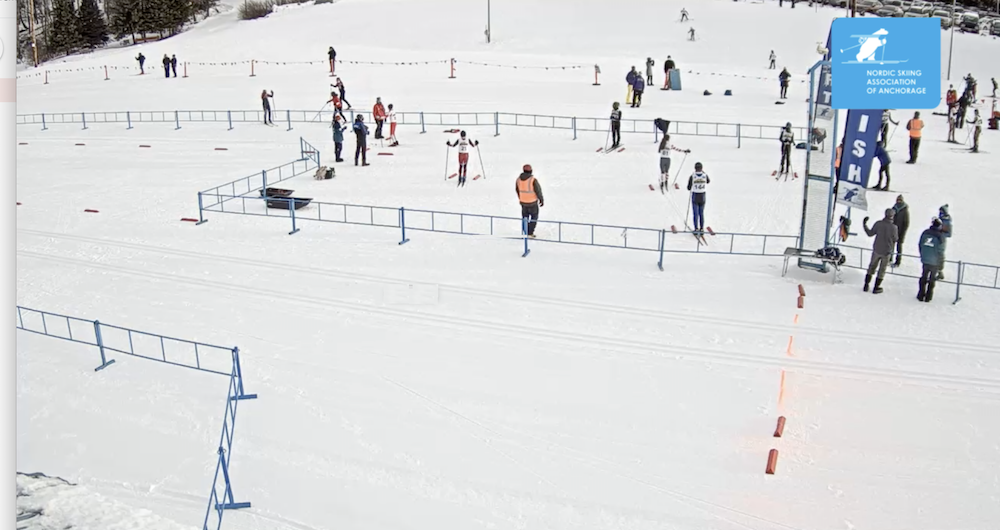
Skiers move through the “Z” starting formation lineup in this Anchorage citizens race in January 2021. (photo: NSAA webcam screenshot)
“We’ve not had any (team) quarantine situations thus far for skiing, basketball or cheer,” a district spokesperson told the paper. “We’ve had some isolated cases where an individual had to quarantine.” (Two weeks later, unmasked basketball practices would lead at least three large high schools to close in the nearby Matanuska-Susitna Borough School District, roughly an hour’s drive from Anchorage.)
FasterSkier has learned that some skiers on Anchorage High School ski teams tested positive for Covid-19. While it is unknown what mask-wearing practices were in place on the Anchorage ski teams that did experience cases – ASD representatives declined to identify to FasterSkier the teams involved or their safety procedures, citing student privacy concerns – the apparent lack of widespread intra-team transmission among nordic teams is anecdata that there is a relatively low risk associated with outdoor exercise.
(One person with direct knowledge of Anchorage high school skiing told FasterSkier something somewhat different, observing that they were personally aware of transmission occurring within ski teams, but noting that it occurred between students who carpooled together to practice. This would mean that the ASD administrator’s point about no within-team transmission is incorrect, but that points about the relative safety of outdoor exercise remain largely accurate.)
Other sports have suggested similar conclusions.
In football, for example, Sports Illustratedreported an NFL representative stating in early November, “We have seen zero evidence of transmission player-to-player on the field, either during games or practices, which I think is an important and powerful statement. And it also confirms what other sports leagues have found around the world. We regularly communicate with World Rugby, Australian rules football, European soccer leagues. To date, no one has documented a case of player-to-player transmission in a field sporting environment.”
“Somehow,” Kelsey McKinney wrote for Defector, summarizing this data, “every week, players are taking COVID-19 tests on Saturday and not being placed on the list (be it for positive tests or close contact) on Sunday. By Monday, they need to be on the list. Someone with a conspiratorial mind might take that as evidence that the league is pulling some number of strings to make sure that the Saturday tests are being administered in some way so as to ensure their results won’t endanger the next day’s games.”
The other sports leagues cited above have less of a checkered past in this regard.)
NFL representatives suggested to Sports Illustrated that more high-risk contacts occurred from “meeting, eating, and greeting” – that is, team meetings; eating together; and “when I say greeting, what I mean by that is social activity outside the building, people hanging out together doing things.” The last of these, extracurricular social activity, seems to be the greatest issue in the recreational ski context. Traveling for races raises the possibility of the second, as athletes have to eat somewhere. As for the first, local race organizers have consistently moved to Zoom for pre-race meetings this season, while the World Cup has featured memorable images of outdoor team meetings in single-digit temperatures.
Ski racing in Anchorage: Mostly local fields
A pair of December races in Anchorage, the first FIS races held on the continent this winter, were largely responsive to these concerns. There were a suite of mitigation measures that are by this point likely familiar to most racers: interval-start format; masks required up to the starting line and immediately upon crossing the finish line; paper bibs distributed by club coaches; no indoor facilities; leave the venue right after the race; spectators officially barred; etc.
The fidelity to the application of these measures was mixed. But rules were in place, and athletes likely had relatively little contact on course over a pair of interval-start races, at least while officially competing. (This reporter glimpsed multiple athletes from different teams skiing unmasked cooldowns together on trails away from the stadium. He also saw some spectators in the stadium, which violated both club policies and an official city emergency order in place at the time.)
So if the races themselves were presumptively fairly safe, was hosting them okay? Particularly when they had some of the best points profiles of any domestic races this season, and were held in a hotbed of American skiing? (At least nine athletes who were named to a 2021 World Juniors team competed in these races, and the results were used to help justify the discretion-based selection of at least five athletes to this year’s World Cup squad. Every Alaskan athlete who was named to an international team this year competed in these races, save for Gus Schumacher, who was already racing in Europe. Regarding these considerations, Caterinichio wrote to FasterSkier, “When you have an NRL race it isn’t only for points in fact points don’t mean much this year and there are no qualifications which has allowed a family to not have to come.”)
Opinions differ. Criticism about hosting the races focused on the fact of the races themselves, for the off-course behavior it could enable or incentivize, rather than any specific deficiency in safety measures on the part of Nordic Skiing Association of Anchorage, or NSAA.
As one local coach, granted anonymity to candidly discuss sensitive local issues within a small ski community, wrote to FasterSkier in late December, “I disagree with hosting any form of race right now in Alaska, including town series races. I do not doubt the efforts or the effectiveness of race day mitigation plans which are data driven and based on those designed by healthcare professionals. The issue is people’s ability to adhere to those plans, and what they do outside the race venue. Skiing is a social sport and carpooling to the venue, waxing as a team, or even congratulating your teammates on their performance poses a very serious health risk to racers and their families. Lastly, incentivizing travel of any kind at this point in time is absolutely unacceptable.”
John Estle at Birch Hill Ski Area in Fairbanks, Alaska, on Oct. 19, 2017. (photo: courtesy John Estle)
Or as John Estle, the longtime doyen of Fairbanks skiing, wrote to FasterSkier, “Between our first and second meetings [of the Nordic Ski Club of Fairbanks advisory committee, which includes three local physicians], a patient from Bethel was sent to Fairbanks Memorial Hospital (FMH), due to a lack of ICU beds for COVID-19 patients in Anchorage. That fact, in addition to a still-climbing daily rate of confirmed cases were decisive factors in the Advisory Committee’s recommendation, and the NSCF BOD’s decision, not to host the first FIS races of the 2020-21 season on November 21-22 as scheduled.
“The decision was motivated by the knowledge that were NSCF to host a FIS race, it would likely draw skiers from other parts of the state. It is clear that travel contributes to the spread of the coronavirus – the people who travel to a community outside their own not only expose themselves to many more people than would be the case if they stayed home, but potentially could unknowingly (approximately 40% of coronavirus infections are asymptomatic) increase exposure to coronavirus among residents of the host community. In addition to the concern regarding travel, not holding the races would eliminate the possibility of members of our race crew being exposed to the virus.”
Estle continued, “I believe that it is possible for clubs to provide opportunities for competition during this pandemic which limit exposure of competitors, volunteers and officials in meaningful and effective ways. I believe the spectrum of formats where this can occur is fairly broad, but I believe a key component of safe competitions is that they be LOCAL in nature. I do not believe it is wise to organize an event which creates an incentive for people to travel from one geographic area to a fairly distant geographic area, thus increasing exposure both among the visitors and the hosts.”
He also noted, “One issue that I have not even mentioned is the risk to both the short-term and long-term health of young athletes. Although research is ongoing in this area, it is clear that young athletes who contract COVID-19, even those who have had only mild cases, can suffer long-term respiratory and cardiac issues post-COVID. I don’t advocate that young athletes abandon exercise and sit at home. However, it seems to me that concern for the health of young athletes would dictate that competitive opportunities make sense when they are offered within a structure which does nothing to INCREASE the exposure of the participants.”
Fairbanks racing in simpler times: left to right, Thomas O’Harra (APU), Paddy Caldwell (SMS), Eric Packer (APU) and Tad Elliott (SSCV) during the men’s 50-kilometer freestyle mass start in 2017 U.S. Distance Nationals in Fairbanks, Alaska. (Photo: Max Kaufman)
When Estle, and the NSCF board, decided to cancel the November FIS races, the average daily rate of Covid cases in Fairbanks over 14 days was 40 cases per 100,000. When the decision was announced on December 8 that the Anchorage races were going ahead, albeit with statewide participation discouraged, the rate in Anchorage was 90 per 100,000.
(Both rates are substantially lower now, 12.4 cases per 100,000 for Fairbanks and 14.5 per 100,000 for Anchorage as of February 16. This is, however, all quite relative; when Norway announced the cancellation of all remaining World Cup races in the country earlier this month, its rate was roughly 5 cases per 100,000, although Norway was also concerned with the emergence of new variants in addition to absolute case numbers.)
When asked about a difference between the two cities that could justify holding a race amidst the higher case numbers present in Anchorage, Caterinichio wrote, “A difference from Fairbanks vs Anchorage, could be that we have been running multiple events since June in Anchorage and we have had a mask mandate where other cities do not to include at our outdoor events. The experience of having multiple mitigated events and having the races removed from state-wide to local emphasis. The majority of the athletes live in Anchorage so travel to Anchorage is minimal where Fairbanks, more people would be traveling.”
The Anchorage case rate of 90 cases per 100,000 in early December came at a time of significantly reduced local hospital capacity. There were between two and four ICU beds available in Anchorage, out of 73 total, throughout the week leading up to the races, for a city of 300,000, potentially also for any rural area that would hope to medevac patients to Anchorage. A mobile morgue was parked outside of Anchorage’s Providence hospital, the largest hospital in the state.
The rate of 90 cases per 100,000 was over three times greater than the threshold of 25 cases per 100,000, defined by U.S. Ski & Snowboard as “high community spread,” which triggers a USSS recommendation that a race organizer should “speak with your local health authority regarding ICU bed utilization and ventilator availability in the location’s level 1 medical center catchment” and that decision-making be guided by “whether or not pre-competition COVID-19 testing and asymptotic [sic] COVID-19 screening during the competition are being conducted.”
The Anchorage races featured a series of self-assessment questions generally designed to screen for asymptomatic cases. It did not conduct formal Covid testing, as occurs on the World Cup. As noted, ICU bed availability was at two to four beds out of 73 for the entire city. In Southern California the same day, a drop of ICU beds to below 2% capacity led health officials to turn to “increasingly desperate measures to prevent the state’s coronavirus surge from killing more patients,” the Los Angeles Times reported. Anchorage was within one additional ICU bed occupancy of reaching this level.
When asked about any conversations with local health care authorities per the USSS recommendations, Caterinichio initially wrote, “I would hope that no person would be putting on an event in their city without permission from the local authorities. I also served on the USSS committee as the mitigation efforts and suggestions were being rolled out so I am aware of the suggestions.”
In a follow-up conversation, Caterinichio stated that she had worked with the Alaska Department of Health and Human Services, and had worked directly with Municipality of Anchorage representatives. She cited her professional experience running a medical business that is accredited by Medicare – she owns a home health care and hospital distribution company of medical and orthopedic products – as giving her experience in implementing a standard operating procedure to ensure health and safety. “We have procedures on how to clean equipment, whether it’s infectious disease, how to treat patients, so we never stopped our business,” Caterinichio told FasterSkier.
Caterinichio discussed the sporting events that she had been involved in hosting for several months now at the time of the December races, including swim meets and cross-country running. She said, of these events, “When you follow your mitigation plan, and you follow the CDC guidelines and your state guidelines, you realize that you can do it safely. It’s never a percentage of zero, but your goal is zero. If for any reason somebody did get it, the goal is not to have a spread. And I did, I will say there was, in some of my events one or two people that would end up positive weeks later, but there would be no spread.”
Caterinichio expressed her belief that there had been very little travel within the state of Alaska for these races. In advance of the race weekend, she wrote to FasterSkier that there were four entrants coming down from Fairbanks for the races. However, at the time of that estimate, race registration had not closed.
FasterSkier’s review of the results sheet from Sunday’s distance skate event suggests that finishers included eight athletes from University of Alaska Fairbanks and two additional athletes from Fairbanks, plus two athletes from Colony High School, one from Palmer, one from Soldotna, one from Kenai, and one who listed a local club but who had flown up from Outside shortly before the race. Some of these athletes were listed on the results sheet with team affiliations that could potentially be interpreted as concealing a location outside of Anchorage, such as listing an Anchorage-based club despite attending school in Fairbanks or simply leaving team affiliation blank.
Ski racing Outside: Regional fields drawn from several states
As the comparison between Anchorage and Fairbanks illustrates, even relatively nearby regions of this sprawling country can have divergent case numbers, public health regulations, and/or hospital capacity, by virtue of being in different jurisdictions at the state/county/city level.
The 2021 Alaska high school state nordic skiing championships, to be held later this week, are an instructive case study: They may not be held in Anchorage without requiring pre-competition Covid testing for all participants. They were ultimately instead moved to Government Peak Recreation Area, or GPRA, about an hour’s drive away in Palmer. Government Peak is a world-class venue, and the Mat-Su Ski Club has careful and conscientious volunteers – but the GPRA stadium, parking lots, and associated infrastructure are simply far smaller than those at Anchorage’s Kincaid Park, leaving less space for everyone at a venue that will draw hundreds of people over three days. As Caterinichio told the Anchorage Daily News earlier this month, addressing municipal organized sports requirements then in place, “We do want to host the state meet at Kincaid. It’s one of the safest venues and our crew is probably the most tenured as far as putting on a mitigated meet. Unfortunately, this particular event would have to move for it to happen.”
Basically, everything in this picture is the Kincaid stadium, seen here in this view from April 2020 with the author’s daughter in the foreground. (photo: Gavin Kentch)
Some people involved with high school skiing have raised to FasterSkier the specter of teams potentially carpooling from Anchorage out to the Valley, roughly an hour’s drive away. Indeed, the official state meet information form from the Mat-Su Ski Club states, “There will be no indoor facilities for teams. … If all athletes [from a school] are brought up to the venue via bus, athletes will need to use the bus as their warming area.” Moreover, travelling itself has some potential risk, as witness the athlete or athletes who contracted Covid while en route from this country to Finland for 2021 World Juniors, or Estle’s comments on this subject to FasterSkier.
(The Mat-Su Valley has consistently had laxer regulations than the adjoining Municipality of Anchorage, and for nearly a year now has hosted events that were barred in Anchorage. This past weekend saw a statewide indoor hockey tournament in the same jurisdiction, despite the documented health risks of such an activity. Multiple statewide high school basketball tournaments are following suit in Valley gyms. The current case rate in the Mat-Su Borough, 36.4 cases per 100,000, is 2.5 times that of Anchorage, and nearly 3 times that of Fairbanks. It is, by a substantial margin, the highest case rate of any region of the state on the road system.)
The Lower 48 has also exhibited the patchwork effect of different regulations in different jurisdictions. In the Midwest, for example, hundreds of athletes from around the region raced in Houghton, Michigan, in early January, including many from Minnesota – at a time when gathering for group exercise was barred in Minnesota, and high school ski teams could not hold even outdoor practices. Regardless of which state’s policy was “right,” they were clearly quite different.
Athletes line up for an interval-start race in Houghton in January 2021. (photo: Livestream screenshot)
Underscoring the incentives involved with competitive races and team naming opportunities for aspiring young skiers, which even in this year could lead skiers to seek out high-level racing opportunities, not a single athlete racing in Houghton in early January qualified for World Juniors. The sole Midwestern athlete among the 30 skiers named to this year’s World Juniors/U23 teams “made the drive to Utah to take advantage of an opportunity to race” that weekend, SkinnySki wrote. Shetold SkinnySki, “the conditions were absolutely beautiful and I was happy with how well organized and Covid-safe the race was.”
Perhaps also relevant, her 8th-place finish in Soho was good for USSA points of, in round numbers, 100, with a race penalty for the winner of 54. Eighth place in Houghton was a 121-point USSA result, with a race penalty of 63. Lower numbers are better, i.e., the Utah race had a more competitive field. The math may become particularly persuasive when presenting oneself as a domestic skier seeking discretionary start rights for European racing.
(Caitlin Gregg, who won both Houghton races, was later given a World Cup start on the basis of “dominating competition in the Midwest and with her points profile from last season,” the Loppet Foundation wrote, though the Nové Město races were subsequently cancelled.)
Later in the month, hundreds of athletes raced at Soldier Hollow in mid-January. The event was still called a “Super JNQ” – critics alleged that it was potentially rather a “superspreader JNQ” – even though there are no Junior National teams to qualify for this year. Athletes travelled broadly from throughout the American West for these races, with clubs based in Utah, Idaho, Montana, Colorado, Oregon, Wyoming, Washington, and California, plus Ontario, Canada, among others, represented in the results. (Athletes from multiple RMISA schools also competed, so add Alaska to the list.)
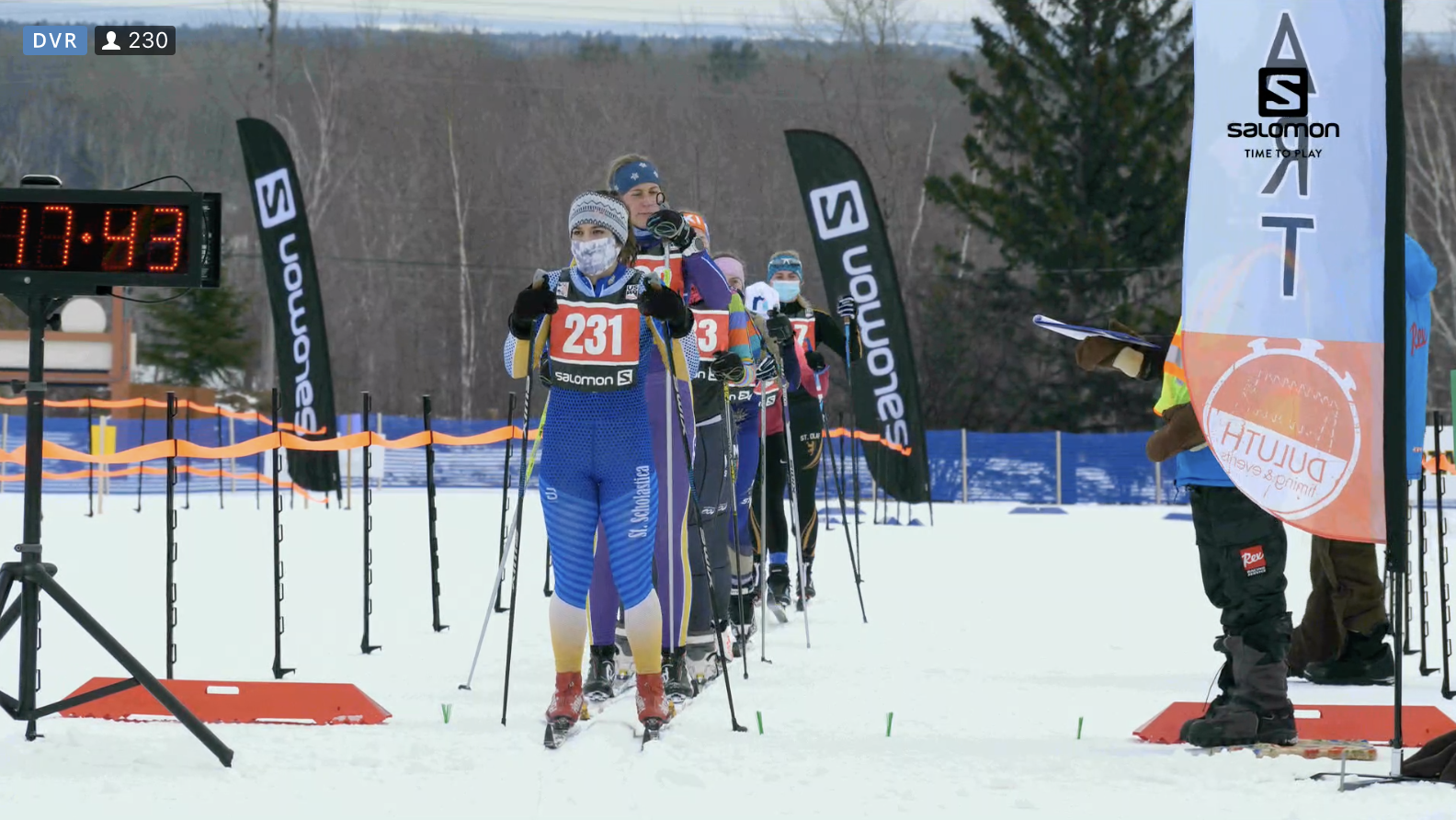
Athletes line up for an interval-start race in Duluth in January 2021. (Photo: Livestream screenshot)
And the following weekend, Minnesota, just a few weeks removed from a full-on bar on group outdoor exercise, was holding mass start racing at the Skinnyski Santa Solstice Race outside of Minneapolis.
Meanwhile, the high school racing season continued in Anchorage with a steady stream of interval-start races, a decision mirrored in all Anchorage citizen’s races. The racing season in the Midwest proceeded in fits and starts, as different states cycled through different regulations, sometimes with interval-start races and sometimes with wave starts. In Vermont, athletes spent weeks doing unofficial time trials. For not the first time in this pandemic, different states’ restrictions led to different case numbers and different levels of permitted activity.
So, what about the Birkie?
Part two of this article series, coming soon, will examine the American Birkebeiner, and some of the considerations that have gone into the decision to go ahead with this year’s race, albeit in a significantly modified form. FasterSkier will set forth its interview with the race’s executive director, Ben Popp, in advance of the country’s largest ski race(s), currently scheduled to occur over five days starting on this Wednesday.
Cover of Jessie Diggins’s new memoir, “Brave Enough.” (photo: courtesy of the University of Minnesota Press)
There are certain precepts that permeate Brave Enough, the new memoir by Jessie Diggins: Teamwork is good. So is glitter. Self-belief is important. Training hard pays off. As for substance, I have nothing snarky to say about these morals; nordic skiing, if not the entire world, would be better off if we all felt these things so fervently, and it is engaging to trace the development of these themes in Diggins’s life.
But as for literary merit, Diggins’s book is a whole lot more interesting when challenging things happen. I still think you should buy this book and read it; it’s written at a sufficiently general level that it will appeal even to non-skiers, but if you’re reading this website you’ll likely purchase it no matter what I say. But just don’t be surprised if you remember the work’s tumultuous middle more than either its adolescent beginning or even its Olympic ending.
* * *
Diggins’s book may be roughly divided into three parts: her childhood; her struggles with an eating disorder; and her professional ski career. The first and the third parts are about what you would expect. The middle part is searing, and by far the most compelling writing in the book.
First things first. Diggins enjoyed a childhood both bucolic and ideal. She grows up in rural Afton, Minnesota, in a house a half-mile from the nearest neighbor. She frolics through the woods unaccompanied, looking for fossils in the summer and building snow forts in the winter. She watches her father, from whom she inherited her race face, compete in Grandma’s Marathon and the Twin Cities Marathon and, of course, the Birkie, and she joins the Minnesota Youth Ski League at age three. Eventually, she joins the ski team at Stillwater High School, an inclusive community where “everyone was welcome, regardless of size, strength, or previous experience.” She gradually progresses from just wanting to make new friends to winning every race, while being welcomed by a team that embodies “the Stillwater way.”
https://www.instagram.com/p/B9E23ufAizl/
This all makes for a wonderful childhood, one that every child should be fortunate enough to have. It also makes for less than compelling reading. As a lived experience, Diggins’s pre-adolescence sounds amazing. As a work of literature, it is not as noteworthy as the sections that follow. “Happy families are all alike,” as Tolstoy famously put it; a memoirist recounting an effectively perfect upbringing faces an uphill battle. Diggins succeeds as well as anyone in making such events memorable, which is to say, imperfectly.
But then – *record scratch* – “I had everything in the world going for me,” Diggins writes of her senior year of high school, “and nothing to complain about. Which is why when I started to struggle with an eating disorder, I felt such shame. Why did I have this problem? I didn’t have any reason to have an eating disorder (so I thought).”
This may not make you remember much about Diggins’s childhood after you put down the book, but it absolutely begins to recuperate this portion of the memoir as a work of literature: Diggins felt so guilty about her eating disorder precisely because she believed that she had had such a perfect life to that point.
In unflinching detail, Diggins describes bulimia, stress, and the compounding pressures of being a high-achieving student as well as an accomplished violinist as well as one of the best junior skiers in the country. There is disordered eating, forced vomiting, lies to her family and friends, and, eventually, throwing up so hard and so often that she bursts a blood vessel in her eye. It is unsettling to read, and Diggins pulls few punches. This section must have taken courage to write.
At one point, Diggins writes, immediately after making herself throw up once more, “Suddenly, I felt nothing. I started to understand why people are alcoholics or addicted to drugs. Because the ability to suddenly feel nothing was amazing.”
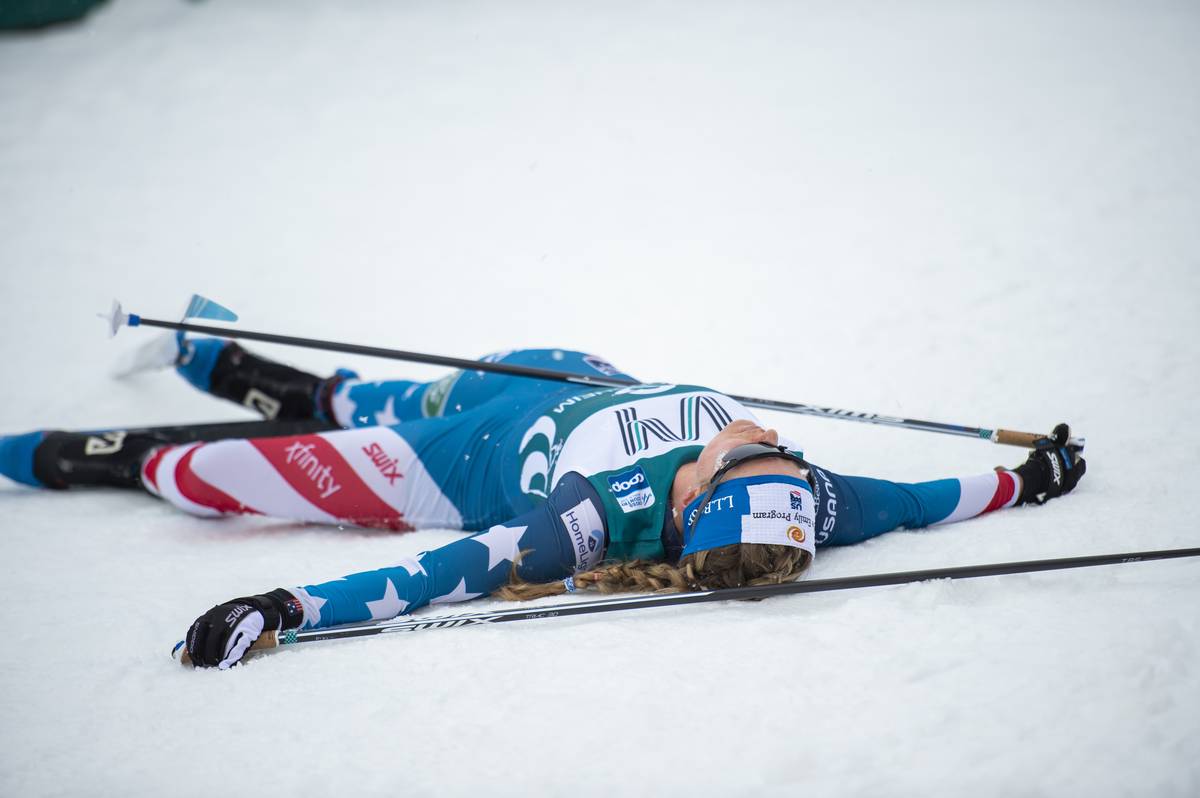
Post Stage 6 of the Ski Tour 2020, a spent Jessie Diggins. (Photo: NordicFocus)
This is compelling, if not searing. Whatever your views on Diggins, as a person or an athlete, it is undeniable that she feels things quite strongly. This is someone whose nickname within the U.S. Ski Team is “Sparkle Chipmunk,” who wasonce described by The Guardian as the team’s “ebullient talisman.” To hear her say that she enjoyed feeling nothing, and “quickly began to search for that numbing feeling again and again,” is chilling.
This portion of the book is superb. Diggins is not afraid to engage with uncomfortable truths, and to use her own experience as a lens through which to examine what it is like to live with, be consumed by, and then work to overcome an eating disorder. Diggins repeatedly emphasizes, to her credit, that eating disorders “don’t discriminate,” that “Skinny teenage girls represent only 10 percent of eating disorder victims.” But she also must recognize that an Olympic gold medal gives her outsize influence when she talks about disordered eating, and she ably uses the platform she has earned to stick up for everyone dealing with these issues who is not a “skinny white teenage girl.”
It would be far too pat to say that, once she learns skills to cope with her eating disorder, Diggins puts this out of the way and moves on to a perfect life as a perfect skier, not the least because she explicitly discusses later in the book the times she had to overcome the temptation to engage in disordered eating once more.
Rather, in the memoir’s third part, Diggins takes the reader on a tour through roughly seven years of her professional ski career, 2011 through 2018, culminating in a certain team sprint Olympic gold medal. If you’ve read this website before, you probably already know the general highlights; they include dominance on the domestic SuperTour, a quick promotion to the World Cup, anchoring nearly every U.S. women’s relay over the past decade, and the general rise of the American women’s team as a global force in nordic skiing. But Diggins makes sure to weave in some lowlights, including disappointing races, injuries, and overtraining that ultimately required two weeks’ complete rest in fall 2014, when she would otherwise have been building intensity to sharpen race fitness for the 2014/2015 World Cup season.
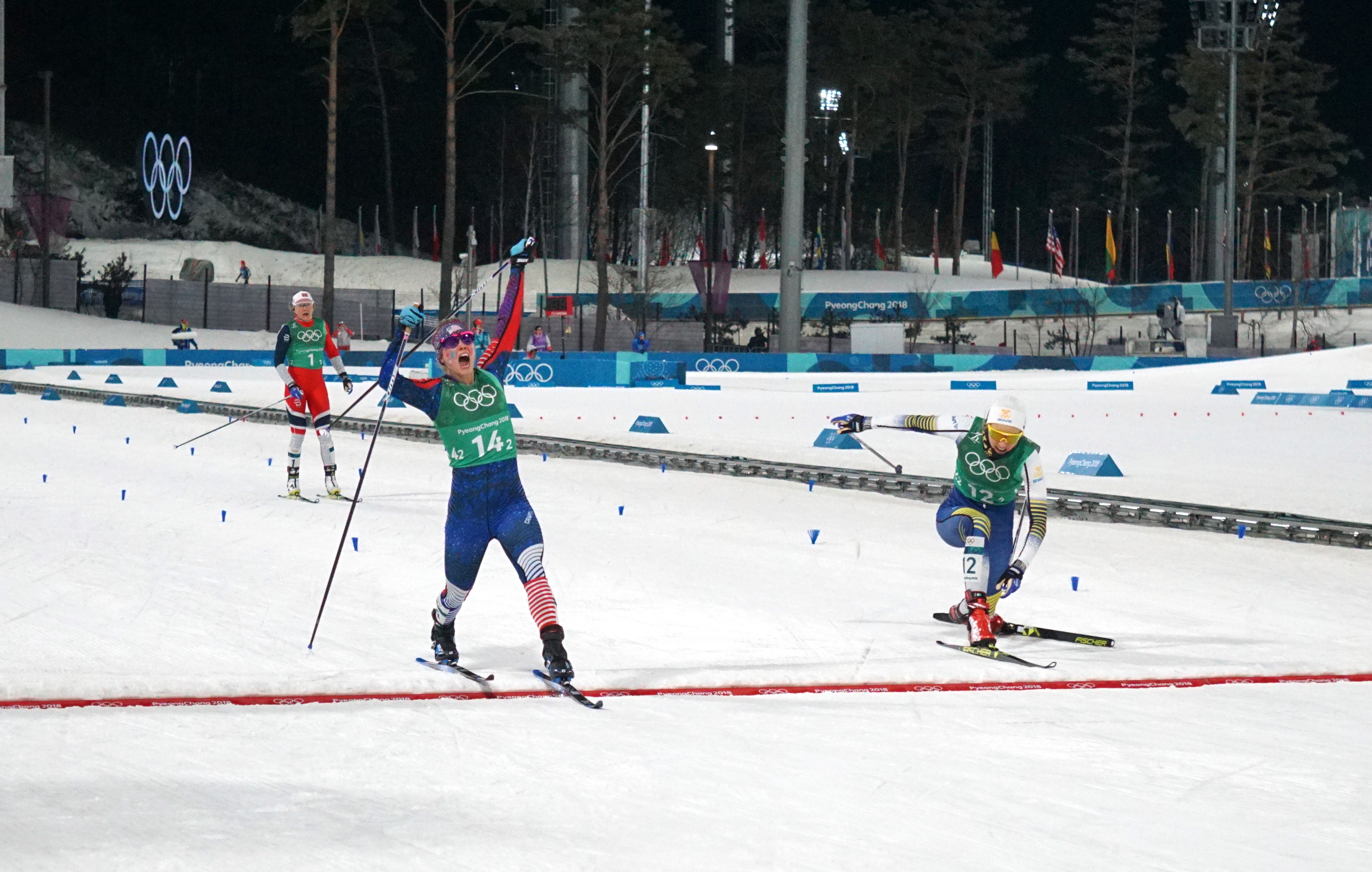
Jessie Diggins (14) edges Sweden’s Stina Nilsson (r) for gold, while Norway’s Maiken Caspersen Falla (l) races to bronze, in the women’s freestyle team sprint final at the 2018 Olympics in PyeongChang, South Korea. (Photo: Noah Hoffman)
After seven years’ worth of training and racing highlights, the reader is left with a nuanced understanding of not just the results, but also of the process that helped Diggins get there. Process vs. results may be somewhat of a shorthand or buzzword when it comes to thinking about training for endurance sports; it also works.
And it works well for a piece of literature, too. The climactic scenes in PyeongChang have more resonance because of everything that preceded them, not only Diggins’s decade of unstinting striving but also Kikkan Randall’s decade of work before that. Diggins writes, poignantly, of seeing nearly the entire American team at the venue that night;there is a now-famous picture, which you have likely seen, that shows the depth of the Americans’ support on that cold Wednesday evening at the Alpensia cross-country center.
But much as Diggins writes, convincingly, that she couldn’t have done it without the team behind her, the entirety of part three underscores that she also couldn’t have done it without training her ass off for the past decade, either. We all know that nordic skiers train hard; you may read Diggins’s description of a typical training week (replete with heart rate zone data if you really want to nerd out!), then consider living like that for 11 months of the year, and see for yourself. You’ll probably get pretty tired before the year is up.
* * *
As noted, there are some good things that Diggins feels strongly about, such as hard work and teammates and dancing and Taylor Swift. But as a work of literature, the bad things frankly tend to make for more interesting reading. There is a set piece about traveling through middle-of-nowhere Russia in the dead of night, for example, that is finely rendered and darkly hilarious. There are descriptions about Diggins’s experiences in Sochi, both in 2013 and again for the Olympics, that are interesting and insightful. There is an unflinching portrayal of the aftermath of a rollerski crash that is painfully vivid, and a description of training with food poisoning that made me cringe, then laugh out loud. These all make for great reading; Diggins is capable of being a fine storyteller.
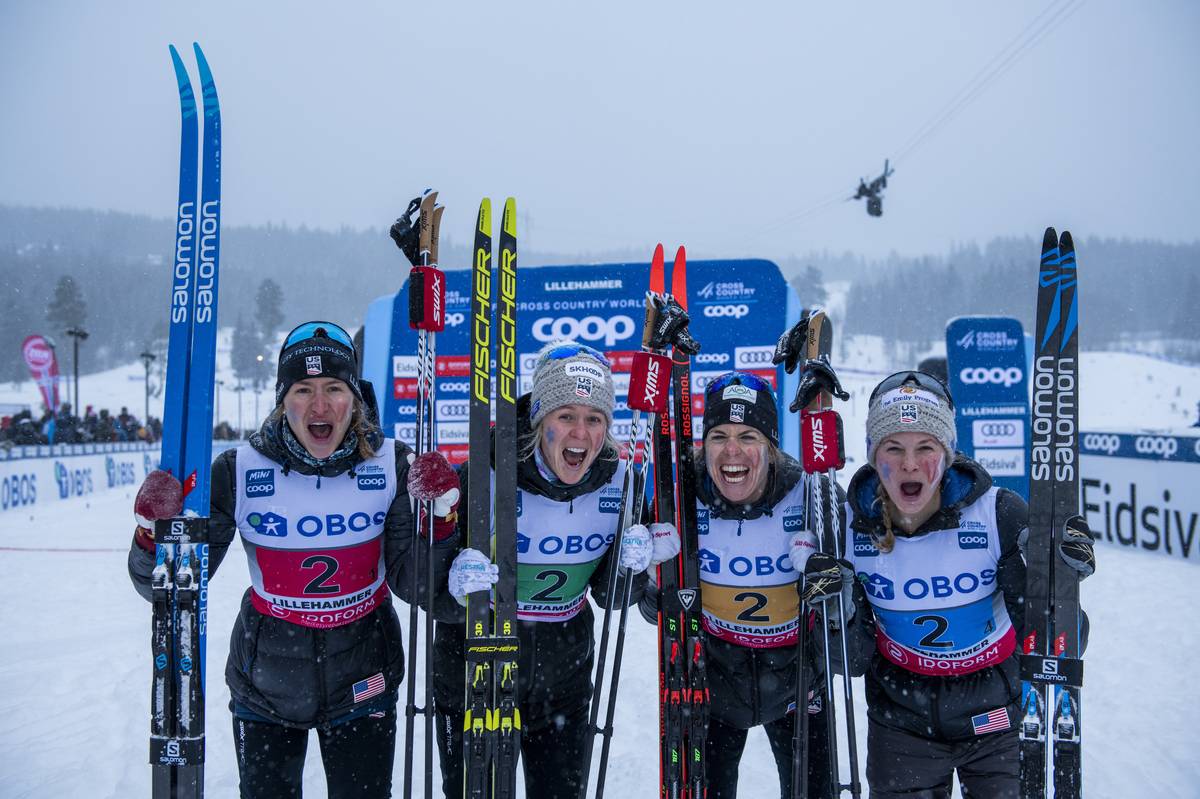
Teammates: Team USA celebrates their hard-fought second-place finish at the 2019 4 x 5-kilometer relay in Lillehammer, Norway. (Photo: NordicFocus)
At the same time, it is telling to survey some of the things that are bad, in Diggins’s worldview. Doping is bad, but gets only a couple of sentences in a 276-page book. Climate change is also bad, but gets only a few paragraphs, scattered throughout the work. “President number forty-five” – she can’t even say his name – is very bad, but only in passing, and mostly serves to prompt a memorable (and hilarious) story about her experience breaking down in tears upon meeting the Obamas during her post-Sochi White House visit. (This latter episode also provides the memorable phrase, in reference to Diggins’s official White House visit uniform, “Spanx cummerbund.” You’re welcome.)
But the media? Diggins is decidedly not a fan of the media – and, if you’ll forgive the navel-gazing, this seems like a relevant topic for this website to explore in some depth. Diggins variously has harsh words for print media, for television media, and for any of “announcers, writers, or sports commentators [who] try to put words in our mouths and guess what we were thinking at the time we were in a competition.” She calls out a media rep for her own team who betrays an imperfect understanding of race tactics, writing, “It didn’t seem worth it to explain tactics and drafting or even spend energy explaining that how I skied [in the back of the lead pack] was on purpose.” Elsewhere, she writes, “Since I’m not a reporter, I have no idea what it’s like for them, reporting on race after race, trying to make each one stand out somehow with a character story.”
Ultimately, midway through the PyeongChang Olympics, Diggins gamely faces the media following her 3.3-second bronze-medal near-miss in the 10-kilometer freestyle race. Soon after, during the podium ceremony, she retreats to a secluded hallway underneath the stadium, cools down on a spin bike, and, alone in the dark, unleashes “a scream filled with pain and disappointment” into her jacket. “It was a scream that said, ‘I wish that what I had was good enough,’” Diggins writes.
Moments earlier, Diggins had stood in the mixed zoneand told reporters for this website (among many other members of the media scrum), “I could not have gone any harder. … That’s a really good feeling to know you gave it everything that you had and more than you thought you could give. I’m really proud of today.”
American Jessie Diggins racing to seventh in the women’s 30 k classic mass start at the 2018 Olympics in PyeongChang, South Korea. (Photo: Scott Patterson)
Now, she writes, “I knew that I had truly given everything that I had. And yet, it still wasn’t good enough to earn a medal. That stung. So, far away from the TV cameras and flashing lights, I let all of my emotions out right then and there. Spinning in the dark, I screamed my frustration and loss into a balled-up jacket.” She adds, “Honestly, the pain of going through the media zone after the race was what did it. Because I had felt good about myself until I went through that zone.”
Obviously Diggins is allowed to tell the media anything she wants. But the episode nonetheless raises interesting questions about the nature of journalism, and the obligations of a professional athlete to speak with the media even after disappointing performances. Or, if she does speak with them (and let me be clear, I have no reason to believe that Diggins has ever blown off the media at any point in her ski career,Bolshunov-after-the-30k-pursuit-style), what, if anything, she “should” say about her frustrations. And also about the responsibilities of the media, and whether or not it is fair to ask a disappointed athlete questions like, “‘Tell me, how does it feel to know your hometown was watching?’” (to take one of Diggins’s unappreciated examples from the PyeongChang mixed zone).
Asone contemporary meme put it midway through the Olympics, alongside an image of a man with clothespins stretching his face into an artificial smile, “When you come up short in your races, but your sponsors paid for sparkle, not human emotions.” Or,as Devon Kershaw more recently said (around the 21:00 mark of the linked podcast), “The media is there when you win, but it is a show, and this is entertainment, and I know it feels like a huge deal at the time, I know you’re super disappointed. … But it’s called being a professional. You just pull the glasses up, you look into the camera, or you look into the interviewer’s eye, and you say, ‘Today wasn’t my day. I’m really proud of the Tour I had; today I just fell flat and had a raunchy day, and I’m looking forward to resting and getting on with my season.’ … It’s your livelihood, right, and you have to answer the questions in the media. Of course people want to know how did you feel today, like, How does it feel to lose the Tour de Ski win, Johannes [Klæbo]. He doesn’t want to answer that question, of course not. But like I said, you’ve got to be pro.”
The first comment was undeniably about Diggins; the second clearly was not. But if you like skiing, and are anyone other than a current World Cup athlete and so necessarily follow it through the filter of the media, Diggins’s thoughts on the media, alongside the frankly cruel viewpoint expressed by the meme, should make you think about the interplay between athletes and media, and how it manifests in the information that you hear. I don’t know what the “answer” is, but I think that these questions are worth asking.
(I am pellucidly aware that I’m writing this for FasterSkier, the paper of record for this niche sport (which, by the way, Digginsat one point read, butno longer does, likening it, or maybe the comments section specifically, to “driving past a car crash…you know you shouldn’t look, but everyone somehow can’t help themselves”). My understanding is that Diggins, whom I have never personally interviewed, has at worst a neutral, and I think in fact a positive, relationship with this website. Go ahead and listen to some of her recent post-race interviews with Jason Albert or Rachel Perkins (here, say, orhere); it seems hard to characterize this as an antagonistic relationship with the media, or as the media asking unfairly pointed questions. But you, as the reader, really get to be the judge of that.)
Jessie Diggins skiing for CXC in a domestic race in March 2012, on her way to finishing first in the SuperTour Finals hill climb to win the overall mini-tour title. She had the second-fastest time after USST teammate Liz Stephen.
So what else is bad? There is a certain former teammate who is (other than Trump) the only true villain in this story. She actively uses Diggins’s eating disorder against her, falsely tells her that the national-team coaches had called to say that they thought her eating disorder made her “hard to handle” and “a burden to the national team,” and outright yells at her, “telling me I was a liar, that I was a fake person who only pretended to be happy, that I was a pathetic, bad person.” Ultimately, Diggins learns the truth only when she privately approaches Matt Whitcomb to ask him if this is true; he is appropriately aghast and tells her that this never happened; she leaves the CXC Team for Stratton soon after.
On a happier note, Diggins concludes, “The power of these old psychological scars scared me and made me realize how far-reaching the effects of bullying could be. I vowed to never, ever let something like that happen to another athlete on the same team as I was.”
* * *
Diggins began work on this book soon after the PyeongChang Olympics,she has outlined in a blog post, with the assistance of a professional author, Todd Smith. The book is, literally, an as-told-to production; she explains in the blog post that Smith came to Stratton for a week, during which time he “recorded something like 20 hours” of Diggins’s thoughts. Smith oversaw transcription of the audio, she writes, “then cleaned up my ‘um’s, ‘ahh’s and way too many ‘like’s, and hammered my stories into more readable chapter formats.” Diggins edited rough drafts of each chapter during spring 2019 before the work went through a final copy-editing process with the publisher, the University of Minnesota Press.
Digginssays of the finished book, “it sounds like one of my blogs that grew up and went to college,” which seems quite apt. Perhaps as an artifact of the work’s oral composition, her voice is superb. (Indeed, as Diggins wrote, “It sounds exactly like me.”) If you want to see for yourself, compare a random portion of the published book, a random blog post, anda random post-race audio interview. You will have no doubt whatsoever that all three come from the same person.
Jessie Diggins smiles as she walks away from a 4th place finish in Stage 2 of the 2019/2020 Tour de Ski. (Photo: NordicFocus)
Although bad words do not seem to fall within Diggins’s typical on-the-record linguistic register, they occasionally feature within the book. There are a couple fuckings, a handful of shits, and multiple instances of kickass or badass (often applied to Randall). Some of the profanities come in quotations from others, and certainly none is gratuitous. But I thought twice before handing the book over to my fluent-reader, hero-worshipping seven-year-old ski fan for this reason (okay, also the unflinching descriptions of the realities of an eating disorder); if you’re a parent you’ll know your own kids and can make your own judgment calls, but you may wish to keep that in mind. (As for substance, there is as much sex, drugs, or violence as you would expect from someone with a clean-cut Midwestern persona, viz., none. Save for that one time the police pulled a corpse out of the frozen river across from the team hotel in Rybinsk…)
There are a few other down notes in the book. One chapter turns on a somewhat forced metaphor about what is literally a box of memories, which as a literary device seemed strained. And Diggins’s wistful evocation of all the free time and unstructured schedules enjoyed by non-athletes, in perhaps a grass is always greener moment, falls a little flat. Ask anyone who is a parent, a recreational skier, or a person with a nine-to-five job (let alone all three!) if they really get to be done for the day at 5 o’clock, or stay up late without thinking twice about it. They’ll probably laugh at you, if they’re not too busy squeezing in a quick workout or driving their kids somewhere or helping with homework or making dinner or doing laundry or actually talking to their spouse at 10:30 p.m. before collapsing into bed.
Finally, there are a disappointing number of factual errors. The advance review copy that I received from the publisher referred to Diggins finishing 40th in the distance skate in Sochi and 12th in the sprint;she was in fact 37th and 13th, respectively. It says that Randall was 37 years old in PyeongChang;she was in fact 35. It says that Diggins won 13 races on the SuperTour in fall 2011;she in fact won nine. It said that the “entire team” was on course for the team sprint final in PyeongChang; at least one athlete was not, as witnessthis memorable live reaction video from an athlete watching the broadcast in the American gym. And it said that Diggins wants to be defined by more than just one Olympic race, and not be “forever falling back on those fourteen minutes on a Thursday night in South Korea.” But the racetook just under sixteen minutes, and occurred on a Wednesday. I could go on (and could note that she has misstated even the year of her childhood Olympic-themed birthday party), but this gives a flavor of the type of problems I encountered – maybe not huge, but sloppy, and lots of them, enough to make me wonder what else in the memoir might be revealed as wrong if it were formally fact-checked. And don’t get me started on the outright typos.
Jessie Diggins (U.S. Ski Team) racing to eighth in the 15 k skiathlon, the first race of her first Olympics, on Saturday in Sochi, Russia. The result tied the best Olympic showing by an American female cross-country skier, set by Kikkan Randall at the 2010 Vancouver Games.
None of these misstatements had been corrected in the final version of the book, and while some of the typos were cleaned up, more slipped through than should have. It is disappointing to find such errors in a work published by a university press, which wasedited three times and gone through, Diggins writes, “line by line, word by word.” (To be clear, I don’t begrudge an athlete with hundreds of race starts to her name for not remembering all details of each one with eidetic clarity. I do, however, expect her co-author, or her publisher, or someone involved with a well-regarded university press to have fact-checked the thing, as well as to have ensured that there were no typographical errors in the final product.)
On a more amusing note, I should observe that Diggins casually name drops her myriad sponsors at only one point in the entire book, a chapter describing the PyeongChang Olympics. (“I like to put on my Bose headphones … I ate some Pro-Bar sports gummies and drank more Nuun endurance sports drink. … one of the awesome Salomon reps knocked the snow from my boots … I looked down at the palms of the gloves that I’d custom-designed with Swix.”) If this is a wry commentary on the implications of Rule 40 of the Olympic Charter, whicheffectively muzzles athletes’ ability to thank their personal sponsors at the one time every four years that they actually have a global media spotlight – and Diggins is too smart for this to be anything but – then it is a masterpiece of Midwestern-nice trolling from a universally beloved athlete. Well done.
* * *
It seems worth asking, perhaps more so for this book than for others, why the author took the time to write it. Writing a book isn’t easy, even with an as-told-to co-author, and many athletes training 800 hours a year do not undertake a book-length literary endeavor as a downtime bagatelle.
Indeed, consider that Diggins didn’t really need the fame; she has over 122,000 Instagram followers, who respond to her every pronouncement with reactions somewhere between affirmation and adulation. She likely didn’t need the money; she’s not as wealthy from this sport as she would be if she lived in Norway, where Johaug and Klæbo et al. have a ubiquitous advertising presence and lucrative endorsement deals, but she has earned hundreds of thousands of dollars in prize money, and in the acknowledgments she thanks her Chicago-based agent and his team for “years of helping me tell my story to the world with our partners,” which is not something you say if your parents are still funding your ski career. And she didn’t need to bolster her own image; she has a beloved reputation on two continents, and is a hero to skiers young and old.
The conclusion is likely that Diggins wrote this book because she wanted to, or, more specifically, because she felt like she had a story that she wanted to be told. If you care about Diggins, sports, or being yourself, I submit that her story is worth listening to.
* * *
The article has been edited to reflect the fact that it was Leo Tolstoy who wrote that “Happy families are all alike,” not Fyodor Dostoevsky.
Team Gregg, Brian and Caitlin Gregg, out for an easy recovery ski together. (Courtesy photo)
This week, we’re featuring a workout from the training logs of Team Gregg. These days, husband and wife Brian and Caitlin Gregg are adjusting to life, training and bodily changes as Caitlin is pregnant with their first child (a girl), due in early February. Read the full story here.
Caitlin sent us the following “trailheading” workout, in reference to starting and ending a workout with someone else, which is how they often train together.
***
One of the challenges in training and racing is that it is often challenging to find training partners at the same speed and ability as yourself.I would argue that the best training partner is one who is just slightly faster than you.Brian and I have been blessed with opportunity to be a married couple who have both competed in the Olympics.
Here are a few ways we get creative to maximize our workouts and fun:
Every training partner can offer somethingand we enjoy large training groups.If you don’t have a training group, take it upon yourself to organize one.Utilize a loop so that the group can kind of stay together.If you are really searching, our neighbor’s house is for sale and you can join one of the many each cross-country ski groups in the Twin Cities.
Utilize different ski speeds as equalizers.On snow, put the slower person on the fast Redlines.If you are rollerskiing, give the person who is in the best race shape the slow, soft wheels.Using various rollerski wheels is a great way to prepare yourself for various snow conditions.
Brian and Caitlin Gregg enjoying the fruits (and added weight) of their workout during a hike this summer. Brian carried the watermelon in a backpack to slow him down. (Courtesy photo)
Another tool we use is a weight vest.For intervals, Brian will wear a weight vest and we can ski side by side pushing each other.This summer, I had Brian carry a watermelon during a hike so that we could relate, plus it was delicious.
In preparation for the 2015 World Championships, at 9,000 feet in Colorado we would Jetstream bloc my skis so that I could be skiing at speeds more similar to sea level.Plus, Brian and I could do intervals together.
Although Brian and I might have the same duration for an interval, he will start behind me with the goal of trying to catch me by the end while my goal is to try and hold him off. This also works really well for speed sessions.
Sample Workout: Team Gregg Husband/ Wife Intervals
We have a great hill in Afton, Minnesota, that Brian and I try and get out to about once a week in the fall. It’s steep and long (for the Midwest) but you can also safely ski down between repeats.
Warmup: Ski easy for 30 minutes with 15- to 20-second pickups. We usually start our warmup at the same time, but gradually over the 30 minutes, we separate and meet up again to do some pickups. We then do a set of pickups where Brian starts behind me and we try to finish the pickups together.
Intervals: The workout is usually 5-8 x 4-5 minutes (with 3-4 minutes recovery) depending on how we are feeling and what our goal for week is. Brian will either put slower wheels on or wear a weight vest for the session. I will either put faster skis on or start a little before him.
Brian Gregg snaps a selfie during a workout with his wife, Caitlin. (Courtesy photo)
The Game (Goal): If it’s just the two of us, we try and make the intervals more fun and exciting by challenging each other to get to the top first, but also try to maintain or drop our times from the start of the session to the end. For example, getting to the top first on the first interval but then falling back or skiing slower each subsequent interval isn’t the goal.We focus on negative splitting each interval in the set, which requires good discipline early on.
Cool down: We usually ski the cool down together and reflect on the session. Since we are out there together, we don’t always have feedback the way someone watching or filming the entire session from the sidelines would, but we can still be observant of how the other person is moving and offer some technique cues.
After the session: It’s been incredibly fun to travel the world training and racing together as a married couple. We are extremely lucky that we have both been able to follow our dreams. There are still added challenges to this approach, though… One of the hardest parts of finishing a hard race or interval session together is that we are both exhausted at the same time, which means that there has to be some way of deciding who is going to cook or do the dishes at the end of the night. This is where we put high stakes on who executes a workout better or has a better result at a race. The winner gets to relax on the couch while the loser has to wash and dry! Just kidding; we do the dishes together 😉
Brian and Caitlin Gregg (Team Gregg) out for a rollerski. (Courtesy photo)
St. Paul Academy and Summit School (St. Paul, MN) is seeking applicants for the position of Head Varsity Nordic Skiing Coach for the winter season. The minimum time commitment includes potential weekday practice times after 3:00 p.m. and all meets. Weekends included as the schedule demands.
Qualifications/Requirements
Ability to communicate with High School aged boys and girls as well as parents and Athletic Department Administration
Comprehensive knowledge of the sport of Nordic Skiing
Coaching and/or playing experience in Nordic Skiing
Experience/familiarity with MSHSL rules and commitment to youth sports preferred
Willingness and ability to support the assistant coaches and contribute to team needs
Must meet all the MSHSL coaching requirements and a CPR/AED Certification strongly preferred
Assistant Nordic Skiing Coach
Start Date: November 12th, 2018
End Date: February 13th, 2019
St. Paul Academy and Summit School (St. Paul, MN) is seeking applicants for the position of Assistant Nordic Skiing coach for the winter season. The minimum time commitment includes potential weekday practice times after 3:00 p.m. and all meets. Weekends included as the schedule demands.
Qualifications/Requirements
Ability to communicate with High School aged girls and boys as well as parents and Athletic Department Administration
Comprehensive knowledge of the sport of Nordic Skiing
Coaching and/or playing experience in Nordic Skiing
Experience/familiarity with MSHSL rules and commitment to youth sports preferred
Willingness and ability to support the head coach and contribute to team needs
Must meet all the MSHSL coaching requirements and a CPR/AED Certification strongly preferred
Alaska’s Helen Wilson on the shooting range. (Photo: Jim Pasek)
In an effort to showcase the North Americans competing at this week’s International Biathlon Union (IBU) 2018 Youth and Junior World Championships in Otepää, Estonia, we asked those qualifying athletes several questions about themselves — actually, we had them fill in the blanks. Here we have 16-year-old Helen Wilson, who is representing the United States at her second Youth World Championships.
On Monday, Wilson finished 74th in the 10 k individual, and she placed 18th with the U.S. youth women’s relay team in Wednesday’s 3 x 6 k.
***
“My full name is Helen Wilson but you can call me lawyer.
I was born and raised in Eagle River, Alaska, and I learned to ski at Junior Nordic.
I spent the time between World Youth/Junior trials and Worlds adjusting to reasonable temperatures, aka not Minnesota, only to arrive here in Otepää to experience those atrocious temperatures again.
The most frightening workout I did in the last training year to prepare for this was classic skiing away from a momma moose.
Helen Wilson racing in the 10 k freestyle at U.S. National Championships in Anchorage, Alaska. (Photo: Pat Cooper)
One thing I’m working on this season to improve my biathlon skills is learning how to shoot with numb digits.
This is my first time in Estonia and sixth time racing internationally, and so far it’s been way better than staying at home.
One difference I’ve noticed between Estonia and the United States is the people here speak Estonian.
One of the things I’m most excited about for World Youth/Junior Championships in Otepää is getting to glide on Susan Dunklee’s old boards.
One race I’m especially targeting there is the warm up. The winner of the warmup is clearly the fastest skier.
Watching the Olympics in the leadup to my own races was exhausting because they starred in the wee hours of the morning. One of my most shocking moments of the Games was when Martin Fourcade didn’t land on the podium in the sprint. I want to be like Martin Sundby because having his beard would have kept me warm at trials in Minnesota.
At Worlds, I really hope I can chat/make friends with someone from Norway and ask if they want to trade race suits.
My favorite thing at the breakfast where we are staying is the warm milk, that is half a degree away from curdling.
Before this trip, if you said “Estonia”, the first thing I’d think of would have been Africa.
Now that I’m here, I’m pretty sure something I’ll always remember will be how I sat on my friends lap in a snowbank in between the merging of two roads because I was afraid there was dog pee under the snow while a car drove by.
If I had a totally free day here and didn’t have to worry about race fitness or training, I’d spend it watching people suffer going up the “wall”. Good times, good times…
The best way to follow me on social media is on snapchat @biathlete.”
Emma Stertz competing on home turf at Mount Itasca, Minnesota. (Courtesy photo)
In an effort to showcase the North Americans competing at this week’s International Biathlon Union (IBU) 2018 Youth and Junior World Championships in Otepää, Estonia, we asked those qualifying athletes several questions about themselves — actually, we had them fill in the blanks. Here we have 17-year-old Emma Stertz, of Grand Rapids, Minnesota, who is representing the United States at her first World Youth Championships.
***
“My full name is Emma Stertz but you can call me Stertzy.
I was born and raised in Grand Rapids, MN, and I learned to ski at Mt Itasca Winter Sports Center.
I spent the time between World Youth/Junior trials and Worlds racing for my high school ski team.
The hardest workout I did in the last training year to prepare for this was a bike ride up Mt. Evans in Colorado with Minnesota Biathlon.
One thing I’m working on this season to improve my biathlon is staying focused while shooting.
This is my first time in Estonia and first time racing internationally, and so far it’s been full of learning experiences.
One difference I’ve noticed between Estonia and the United States is the buildings are triangular.
One of the things I’m most excited about for World Youth/Junior Championships in Otepää is meeting and competing with people from all over the world.
One race I’m especially targeting there is the sprint.
Watching the Olympics in the leadup to my own races was inspiring. One of my favorite moments of the Games was watching Kikkan Randall and Jessie Diggins win gold. I want to be like Jessie Diggins, because she brings so much excitement and positive energy to a team.
At Worlds, I really hope I can chat/make friends with someone from Denmark and ask them to trade clothes.
My favorite thing at the breakfast where we are staying is the Muesli.
Before this trip, if you said “Estonia”, the first thing I’d think of would have been it’s by Finland and Russia.
Now that I’m here, I’m pretty sure something I’ll always remember will be the people I’ve met.
If I had a totally free day here and didn’t have to worry about race fitness or training, I’d spend it exploring the town and trying all sorts of Estonian foods.
The best way to follow me on social media is on Instagram@emma_stertz.”
The United States Biathlon Association (USBA) has announced its World Cup and IBU Cup rosters for the second period of racing.
World Cup
The women’s World Cup team will remain the same, with Susan Dunklee leading the way. Dunklee earned her first podium of the season on Friday in Nove Mesto, Czech Republic. After several top finishes she is ranked 11th overall on the World Cup. She is joined by Clare Egan, who had a top finish of 30th this season in the pursuit in Östersund, Sweden. In addition Joanne Reid, who finished 29th in the individual in Östersund, will stay on tour.
The men’s World Cup team is led by Lowell Bailey, who notched a top-ten in the Nove Mesto pursuit. As a result of Bailey’s consistency, he is currently ranked ninth in the overall rankings. He is joined by Tim Burke, who finished 16th in the Östersund individual, and Russell Currier, whose best mark of the season is 54th in the same race. Those three formed the World Cup squad for the first period of racing. Finally, 2014 Olympian Sean Doherty will join them after recovering from a bout of mono that kept him off the international circuit in December. And Leif Nordgren is qualified for the campaign but is still nursing a broken toe.
IBU Cup
In addition to the World Cup team, USBA also named a roster for the second-tier IBU Cup based on trials held at Mount Itasca, Minnesota, on December 15-19.
Women: Maddie Phaneuf (Old Forge, N.Y.) Emily Dreissigacker (Morrisville, Vt./Craftsbury Green Racing Project) Hallie Grossman (Craftsbury Green Racing Project, Vermont) Siena Ellingson (Minnetonka, Minn.)
Men:
Paul Schommer (Appleton, Wis./U.S. Biathlon X-Team) Alex Howe (Craftsbury Green Racing Project, Vermont) Jake Ellingson (Mt. Itasca Biathlon, Minn.) Max Durtschi (Ketchum, Idaho/U.S. Biathlon X-Team)
In the opening sprint at Mount Itasca, Schommer won a 1.5-second victory over Howe, with Durtschi just one more second back. Both Schommer and Howe had two penalties and Durtschi just one. Then in the women’s sprint, Phaneuf had a single penalty to collect a 37.3-second win over Dreissigacker, who had missed two shots. Siena Ellingson was third, +43.8 with one penalty.
In the mass start at Mount Itasca, Schommer won again over Howe, this time by 29.8 seconds. Doherty, there for the races but pre-qualified for the World Cup campaign, finished third, +30.8. Perhaps most noteworthy, Phaneuf was the only competitor, male or female, to clean all four shooting stages, and as a result picked up a huge win over Dreissigacker, crossing the line two minutes and 56 seconds ahead of her closest rival. That’s in part because Dreissigacker had six penalties. N ext across the line was third-place Grossman (+3:13.7) with seven missed shots.
Then in the final sprint competition Jakob Ellingson had just a single penalty for some of the best shooting of the day. As a result he got the men’s win by 35.9 seconds over Schommer, who missed four shots. Howe was third (+39.4), thanks to three penalties. Phaneuf completed her clean sweep of the women’s races by picking up a 25.9-second win over Dreissigacker, with two penalties to Dressigacker’s three. Grossman was again on the podium in third despite seven penalties (+2:14.2).
Jake Brown: “Finished my biggest volume week of the year with a mini-training camp around Mount Mansfield with college teammate Liam John. This was the last summit of the last over-distance.” (Courtesy photo)
Welcome to “17 Questions for 2017”, where we are catching up with American and Canadian national-team members before the beginning of the winter season.
***
Jake Brown’s move to Lake Placid wasn’t his first major relocation in recent years: after helping NCAA Division III Saint Olaf win a cross-country running championship, Brown used his final year of ski eligibility to join midwest behemoth Northern Michigan University, where he won the 10 k skate at NCAA Central Regional Championships by over a minute last season. He also became an NCAA All-American and placed sixth in the 30 k skate at U.S. National Championships.
But Brown has let his International Ski Federation license lapse, picked up a rifle, and moved again. He joined the U.S. Biathlon Association’s X-team this year, after being identified by team staff as a potential talent worth developing.
Brown had his first on-snow biathlon race in West Yellowstone two weeks ago.
“I hopped in the biathlon race- overall it was a good opportunity to feel fast with snow underfoot and to get in a hard effort and my first on-snow biathlon race,” he wrote in an email.
Despite now competing in a new sport, the joys of the West Yellowstone Ski Festival are familiar ones: seeing your community all in one place (mostly).
Jake Brown competing in his first ever on-snow biathlon race in West Yellowstone, Montana. (Photo: Alex Larsen)
“Great vibes and it’s a blast to see a big chunk of the ski community come together,” he wrote. “I was helping coach the Duluth area high school trip and training around the coaching. As a former Minnesota high school skier I really enjoy hearing the kids talk about who might make it out of their section and earn the right to race on the legendary state meet course at Giants Ridge!”
More recently, Brown finished ninth in both the 10 k sprint and 15 k mass start at biathlon NorAms in Canmore, Alberta.
1. Biggest change in your life in the last five or so months since the ski season ended?
I picked up a rifle, put it on my back, and started biathlon after moving to Lake Placid in June.
2. Biggest change in your training?
The simple switch in focus from cross-country to biathlon has meant more intervals and easy rollerskiing on a loop, with twists and turns rolling up and down. Aside from the obvious, shooting bullets at black targets after each interval, this means a more targeted focus of working on transitional skiing instead of just pounding away straight up a hill. As a runner-turned-skier, mastering the technical aspects of the sport- including transitional skiing- is an aspect at which I can still improve.
3. Major areas of improvement you’ve seen so far?
I have so much appreciation for the work a dedicated biathlete has to put in to improve their shooting and consistency. When I reflect on my progress I can see I’ve taken quite a few clicks up since June- my range time is light years faster, my standing is more stable, and my prone group is getting smaller. However it hasn’t been without work, and when I see where the elite biathletes on our team are and the work they’ve put in to get there I am humbled. I’ve also learned how to ski a biathlon race differently; as my teammate Max Durtschi told me when I first started in June, “this isn’t skiing and shooting- this is biathlon.”
4. Whom you’ve been working closest with this offseason (coaches or training partners)?
Jake Brown competing in rollerski trials in Jericho, Vermont, in October. (Photo: Karen Brown)
I work most closely with Jean Paquet, the USBA development coach. I’m always impressed when Jean jumps in a workout- trying to hang onto his back wheel during a 70-mile road ride was one of the most joyfully painful experiences of my summer.
This year has been a fantastic opportunity for me to learn from all the veteran US biathletes- I’ve been lucky to train with each and pick their brains for sage biathlon wisdom. Paul Schommer, a good friend of mine, joined the X-team in August and is who I train with most. He picked up biathlon a year before I and we are close in ski times, so chasing him in shooting is a really valuable challenge for me.
5. Best trip in the last five months (and why)?
Over the summer my cousin got married in Seattle, which served as a mini-family reunion. I don’t see my extended family often, so when I get the chance it’s always special.
6. Favorite cross-training?
Mountain running. I prefer basketball or climbing for an active recovery day.
7. Favorite non-athletic activity or pastime this summer?
Life at the training center can become repetitive, so on occasion I’ll venture into the Adirondack park for a short backpacking excursion. There’s nothing quite like a night in the peace of wilderness to reset your mind, body, and spirit.
8. Song that was your jam this summer?
Racers (left to right) Kyle Bratrud of CXC and Northern Michigan University’s Adam Martin and Jake Brown, along with Team Freebird’s Kris Freeman, in the men’s 20 k freestyle mass start race at 2016 U.S. National Championships in Houghton, Mich. Bratrud went on to place tenth overall, Martin fourth, Brown sixth, and Freeman ninth.
Whatever heavy metal Jean plays in the weightroom.
9. All time favorite race moment?
Skiing in the lead pack towards the end of the 2013 Birkebeiner; Matt Liebsch turns and points between himself, Brian Gregg, Sylvan Ellefson, and I and says “For America.” I may or may not have peed my pants I was so excited. To me those guys were legends.
10. First thing you pack in your bag when you leave for Europe?
Whenever traveling for skiing I make sure to put my boots in my carry-on. I learned that the hard way after my ski bag, boots included, failed to make it to Lake Placid (when NCAAs were there in 2015) until the day before the first race. I have yet to ski race in Europe, so I hope to get the chance to put others’ packing tips to use soon.
11. Venue/event you’re most excited to visit this season?
Mount Itasca in Coleraine, MN. It’s the first true test of the year and a challenging course (if they have natural snow) in my home state. I can’t wait for it all to start.
12. Who will win the World Cup title this year?
Tim Burke and Susan Dunklee. I pick with my heart.
13. Biggest sacrifice you feel you’ve made choosing this career path?
I certainly wish I could spend more time with family and friends, especially those who don’t ski and those who live back in MN.
14. If you could change one thing about your sport, what would it be?
Lowell Bailey (l) chasing Jake Brown during the men’s sprint at the 2016 US Biathlon National Rollerski Championships on Aug. 13 in Jericho, Vt. (Photo: Katrina Howe)
Increased access to biathlon, especially in the USA. I’d love to see any youngster be able to bike across town to the local biathlon range, pop on his skis, grab a club-owned rifle, and give the sport five shots. Of course that’s a dreamlike scenario, but developing a passion takes time, and if we want biathlon to grow in this country we need to inspire the next generation. I think the US Ski Team has done an impressive job of developing those passions- they’re a great example for biathlon to follow.
15. What did you have for breakfast this morning?
An egg and oatmeal with banana, yogurt, and almond butter. It’s usually oatmeal with whatever I find to put in it. Orange juice to wash it down.
16. In 5 years, I’ll be ____?
Skiing, trail running, climbing, triathloning, canoeing, and enjoying the great outdoors in any way possible.
17. In 50 years, I’ll be ____?
Skiing, trail running, climbing, triathloning, canoeing, and enjoying the great outdoors in any way possible. Plus skiing my 45th Birkie and waxing skis at Giants Ridge for the Minnesota State High School ski meet.
Jake Brown coming into the shooting range in Canmore, Alberta, during this weekend’s NorAm sprint. (Photo: Daniel Guay)
Caitlin Gregg (left) doing speedwork with a Central Cross Country (CXC) camp in Marquette, Mich., home of her alma mater, Northern Michigan University. (Photo: Team Gregg/Facebook)
Fifteen years into her international racing career, Caitlin Gregg is still learning.
But the next season was one of frustration: the first half spent spinning her wheels on the World Cup, never feeling quite right, and then a trip home to re-tool midseason (and win another American Birkebeiner) before ultimately finishing 33rd in the Ski Tour Canada.
“It’s so hard when you have such a good end to a season and you’re so fired up and so motivated,” Gregg said in an interview this week. “You think you’re invincible and you’ve figured it all out. I write my own training plan, and I think I got a little excited and did a little too much intensity and a little too hard. My [Level 3 sessions] were just a little too hard. You learn from those mistakes.”
Gregg, 35, is taking those lessons and applying it to this year’s big goal: racing the 30 k freestyle at 2017 World Campionships in Lahti, Finland.
“I wanted to do the 30 k at the Olympics and didn’t make it,” she said. “The calendar has that race again at World Championships. To get there is never a guarantee. But speaking to [U.S. Ski Team Head Coach Chris] Grover, he obviously published some criteria and my path fits with what the Ski Team said is how to get there. I’m going to go off of what they said, which is leading the domestic SuperTour and having a strong showing at nationals.”
Caitlin and Brian Gregg at a training camp in Michigan’s Upper Peninsula. (Photo: Team Gregg/Facebook)
This summer, Gregg’s training has been initially based on volume and more Level 3. A few weeks ago she started incorporating more intensity and time trials, and is pleased with her fitness.
“I wouldn’t say that I’ve done anything revolutionary in my training this year … but the time trials have been going great,” she said. “I’ve had a bunch of PR’s.”
The strategic shift after last season has also meant staying closer to home. Gregg was named to the U.S. Ski Team after her World Championships performance. Partly as a result, she and her husband, 2014 Olympian Brian Gregg – a duo who bill themselves as Team Gregg – spent a big chunk of last year in Park City, Utah.
Gregg has no regrets about that experience, but the couple decided to get back to their roots in the Twin Cities this year instead of going back out West.
“I really wanted to be home this summer and spending as much time as possible with my home team, Loppet Nordic Racing,” Gregg explained. “My training camps this year were with the LNR crew, which was really fun. It brought us to Hayward, Wisconsin, and Marquette, Michigan, and we ended up doing one camp in Park City. It was a busy summer with a bunch of camps.”
Much of that training ended up being with the LNR junior team.
“Piot [Bednarski] runs a pretty good operation in the sense that these kids are working hard,” she explained. “It’s not about just showing up at practice to say you were there. It’s about really putting in the work… They are skiing at a super incredible level.”
The trip to Park City, for instance, was partly because 2017 World Junior and U23 Championships will be held at Soldier Hollow. Gregg said she was “so excited” for the U.S. juniors who are preparing, dreaming, and fighting for the chance to compete there on home soil.
Gregg built on the juniors’ energy and used creativity to fit her training plan in alongside theirs.
“I was able to utilize slower wheel speed or weight vests, or I might do a couple extra intervals at the end while the girls cheered for me, or jump in with the boys for a workout,” she said. “It was really fun to have a consistent group of athletes to work with and a similar program all year.”
Gregg – who along with her husband has long been involved with local club teams as well as the mentoring program In The Arena – is becoming more and more serious about coaching in and of itself.
So the idea of training alongside area juniors was one she latched onto.
Caitlin Gregg picking up the win in the 13.1 k Surly Brewing Company Trail Loppet last weekend; Brian Gregg won the men’s 13.1 k. (Photo: Team Gregg/Facebook)
“My hope was to be an elite athlete who these guys could have an opportunity to train in the mix with, and really almost be an opportunity that they could be following me as much as possible,” she said. “I think that makes a big difference for them. I think it was a really good for both me and them.”
Another piece of the coaching puzzle came from involvement with Central Cross Country camps, including in Marquette, Michigan, where she could reconnect with her college coach Sten Fjeldheim at Northern Michigan University.
“I’ve decided that I love the coaching and I want to get more experience coaching, so there was an opportunity to go up there and see, from a little bit of an outside perspective, how Sten and [assistant coach] Shane [MacDowell] are running their program,” she explained.
That also meant checking in with a number of Loppet Nordic Racing athletes who had moved on to Northern Michigan University.
“This summer we had about ten girl from LNR actually going to ski in college,” Gregg said. “That is awesome. I owe so much to my opportunity to ski in college, both from an athletic standpoint and to get a scholarship to be able to go to school. So it really meant a lot to me to see these girls want to continue racing. And also how many of them got scholarships. It makes me feel good seeing that impact transfer over to them.”
As for the path Gregg’s own college career started her down, she’s still chasing Lahti.
“The girls on the ski team, they are so strong right now in so many different areas,” she admitted. “But there’s the potential that they don’t all want to race the 30 k at the end of the championships. So there could be an opportunity there.”
Team Gregg plans to start the season in West Yellowstone, Mont., even though it’s not a SuperTour this year.
“We are really happy because we have so many incredible sponsors which are based here domestically,” Gregg explained. “We race on the World Cup, the Olympics, World Championships, but we are really supported by the companies as domestic-level athletes so it’s awesome for us to be able to race here and showcase how grateful we are for the products. West is always a great opportunity to do that, a great time for U.S. skiing to get together.”
After that it will be the SuperTour circuit and U.S. Nationals, in a bid to land atop the domestic ranking list and get named to the World Championships team.
Not everything is under Gregg’s control; even if she is leading the SuperTour, it all comes down to how big of a team the U.S. ends up taking to World Championships.
And Gregg has been on both sides of that decision. In 2014 she was left off the Olympic team, and in 2015 she was taken to World Championships and competed in just one race, earning that bronze medal.
“There always exists something where you have the other athletes just racing in Europe, and you never go head to head with them,” Gregg said. “I think the fittest year of my career to this year was that year of the 2014 Olympics, and that’s a hard call. You just never know. And I can’t imagine it’s easy for them to make a decision.”
At this point, Gregg is simply going all out.
“I think it’s fair and I just have to put my trust and my belief in it,” she said of the criteria. “And hopefully they decide to take some extra athletes besides the national team.”
Maria Stuber has spent the last three years coaching at the Aspen Valley Ski and Snowboard Club in Colorado. (Courtesy photo)
Ever since the College of St. Scholastica began its NCAA ski team, the face of the program has been one man: head coach Chad Salmela. Over the last decade, his squad notched its first men’s and women’s team wins and saw its first NCAA Skiing Championship qualifiers. And on the way, he changed the lives of dozens of young athletes.
Now Salmela is shifting roles at the college and will coach the cross-country running team. Taking the reins of the ski team is a new coach coach who is just as excited to build on the program’s burgeoning legacy in Duluth, Minn.
Maria Stuber, a Wisconsin native, has developed her coaching chops over several assignments, most recently in Colorado with the Aspen Valley Ski and Snowboard Club (AVSC). In three seasons with the club, Stuber increased the size of the team and worked with a variety of athletes, from those who just picked up skiing in high school to those who competed in Europe.
“At AVSC, coaches made sure we were encouraging brand new skiers to jump into the sport at any age,” she wrote in an email. “If you decided to join our high school team you get to train right alongside the best athletes in the country… This environment gives every athlete the opportunity to make a quick jump and be the best skier they can be. It can be so fun when it works, as our top male skier last year didn’t get into the sport until he was a sophomore in high school.”
Stuber (second from left) with AVSC athletes. (Courtesy photo)
That attitude seems to be a perfect match for the College of St. Scholastica (CSS), a school which sent two men to NCAA’s in 2012 and two women in 2015 – but which also has a development team and provides growth opportunities for skiers coming in with a variety of backgrounds.
“Chad didn’t really impact my ski career, he started it,” Paul Schommer, an NCAA All-American in 2014 now pursuing elite biathlon, told FasterSkier this spring.
“CSS is unique in that it has a development team serving this purpose at the college level,” Stuber wrote. “Kids with college skiing aspirations that are not quite ready to make that jump can come and work hard, get faster, and have the opportunity to reach the same level as the top junior national athletes we recruit.”
Taking athletes from those two tracks, Saint Scholastica has built teams that compete with the best in the NCAA Central division.
“CSS wants to be a competitive team in the Central Collegiate Ski Associaion conference,” Stuber explained. “In order to do that, we need to be competitive at the national level. What’s really cool about skiing in 2016 is that you need to have international ambitions to be competitive at the national level.”
Salmela used sports science and lab testing to make that happen, and it’s one of the opportunities that drew Stuber to the program. She received a masters degree in exercise science from Northern Michigan University and relishes a data-based approach.
Stuber with the rest of the AVSC staff last year. “I love these people!” she wrote. (Courtesy photo)
“I love that St. Scholastica’s training is all based on science and sound research,” Stuber wrote. “The college has an exercise science lab and the professors are willing to share the space and knowledge with coaches to give the student-athletes more opportunities for success.”
But more than anything, she is pleased to be part of a framework which will make it possible to integrate running and skiing into a cohesive college athletic career. In explaining his job shift, Salmela was clear that he wanted to see more – and smoother – crossover between the two sports at St. Scholastica, for those athletes who have dual ambitions.
“The biggest program draws for me at CSS are Chad & Don Olson’s (athletic director’s) vision to create a collegiate endurance sport epicenter where student-athletes can choose to pursue xc running, skiing or both at a very high level,” Stuber wrote. “Linking endurance sports together will create well rounded, big picture athletes that have the support of a bigger peer group and more coaches and resources. I think CSS is on the verge of something huge.”
Stuber has seen how a variety of teams achieve success. First, as an athlete: she captained the Northern Michigan University (NMU) ski team for three years.
“My time at NMU had a huge impact on my life path and decision to pursue a career in ski coaching,” Stuber explained. “The running and skiing coaches there, Sten Fjeldheim and Jenny Ryan, have both contributed significantly to my coaching philosophy, training methodology and personal values. They have continued to be mentors, advocates and references for me as I find my way. I will feel extremely proud to consider Sten and Jenny peers and to go up against the Wildcats in December and I hope that they feel like a part of our success at CSS. They both know me well enough to not expect any mercy from us on the trails.”
Hailey Swirbul of the Aspen Valley Ski Club races the anchor leg while guiding the American team to eighth place in the 4 x 3.3 k relay at the Junior World Championships in Almaty, Kazakhstan, in 2015. (Photo: Logan Hannneman)
After college, Stuber raced for the Central Cross Country (CXC) Elite Team and then the Craftsbury Green Racing Project. In her senior career, Stuber was a runner-up at U.S. National Championships in 2009.
But since retiring from competition, Stuber has been consumed by coaching. She began her career at Alverno College in Wisconsin, before taking over as head men’s and women’s cross-country running coach for Southern Vermont College for two years. Under her leadership, the men’s squad had their best team results ever.
At AVSC, where the roster eventually neared 200 skiers, Stuber led a team of other coaches. Every year the club sent skiers to Junior National Championships as well as to World Junior Championships or the J1 Scandinavian Cup trip.
“I will never forget our amazing coaching staff at AVSC that welcomed me to the community that they had carefully built over the past 20+ years,” Stuber wrote. “There is no other ski club in the country with the amazing mix of background, knowledge, energy, perspective and compassion. Working with this group of people will be a life-long career highlight for me… I am so proud of the club’s growing numbers and participation in Carbondale, Glenwood Springs and Aspen. The way these three communities work together towards a common goal in Nordic skiing is phenomenal.”
AVSC runs summer training programs and last season organized an end-of-winter race event called Tour de Sea which drew junior skiers from all over Colorado, as well as rave reviews.
Stuber and Cook (second and third from right) with AVSC staff at a competition this winter. (Courtesy photo)
It was difficult for her to decide whether to uproot herself from the Roaring Fork Valley, where she and husband Bryan Cook had just bought a condo. They had been “very happy” in the Elk Mountains.
“We were not feeling 100% certain that we had made the right call until Monday when the CSS announcement was made,” Stuber wrote. “For days straight my phone and email were pinging and beeping non-stop with messages from friends, family, former teammates, fellow coaches and upcoming Midwest skiers and parents from clinics past. The Midwest ski community is a truly special group of people that we are incredibly proud to be a part of. During our racing careers, we leaned on this community for support and they delivered for us big time. I think we missed the Midwest ski culture more than we knew.”
The couple will move in the first week of September and Stuber is looking forward to getting started with her new team; Cook will enter an MBA program at St. Scholastica.
And besides the general homecoming, Stuber knows that the athletes she will be working with in Duluth – as well as those on the teams her skiers compete against – embody the same characteristics of the community which is welcoming her back.
“The CCSA is definitely a powerhouse Nordic conference…. consistently dominating at the US National Championship and NCAA Championship,” Stuber wrote. “The CCSA attracts down-to-earth athletes that want to be great skiers and are willing to work hard to get there. This intrinsic motivation is a recipe for making fast cross country skiers. Midwest kids are tough and they are backed by outstanding club coaches that are looking at the big picture. I can’t imagine a better atmosphere for athlete development.”
The U.S. Biathlon Association (USBA) has completed its roster for World Youth and Junior Championships, to be held in Minsk, Belarus, in mid-February. After automatically selecting the top two competitors in each age/gender category immediately upon completion of trials racing, the federation’s International Competition Committee met on January 1 and added more discretionary selections.
The U.S. can start up to four athletes in each competition.
To the existing roster (which you can find here, along with a summary of the trials races held in Mount Itasca, Minnesota) USBA added two youth women: the third- and fourth-ranked athletes from the trials series, Hannah Streinz of the Maine Winter Sports Center (who won the sprint on the final day) and Amanda Kautzer or Loppet Nordic Racing.
In the junior women’s category no more than two women were competing, so the roster remained at just two.
In the youth men’s division, the third- and fourth-ranked men from the trials were added to the roster: Alexander Kilby of Skiku Biathlon, and Sam Zabell of the Auburn Ski Club.
Finally, in the junior men’s category, Jakob Ellingson of Mount Itasca joined the action. More junior men competed, but none surpassed the maximum percent-back requirement from Ellingson and trials winner Brian Halligan over the course of the trials series.
In addition, USBA named several juniors who will compete in the junior competitions at Open European Championships in Otepää, Estonia: Maddie Phaneuf, Mikaela Paluszek, and Halligan of the Maine Winter Sports Center, and Sean Doherty of the USBA “X” Team.
The full press release from USBA can be found here.
Lake Superior Biathlon coach Daniel Guay also shared some great photos of the action from December 28, the first day of competition at Mount Itasca. The shots are primarily of the men’s field, but a few of the women appear as well. Check out his photos below.
Toby Quinn (Lake Superior Biathlon)
Travis Cooper (Skiku) and Gerrit Garberich (Nisswa)
Lochlan Baird (Mount Itasca)
Brendan Cyr (MWSC)
Anders Hanson (Craftsbury) waiting in the start
Hunter Wonders (Skiku)
zeroing pre-competition
Zean Baker (Nisswa)
Keegan Tremblay (Lake Superior) and Anders Hanson (Craftsbury)
Brian Halligan (Maine Winter Sports Center/USBA Development Team) competing in the NorAm mass start in Canmore, Alberta, on December 7. Halligan swept all three junior men’s races at World Youth and Junior Trials in Mount Itasca, Minnesota, and earned a spot on the championships team. Photo: Jakob Ellingson.
The U.S. Biathlon Association (USBA) has concluded its trials series for World Youth and Junior Championships, to be held in mid-February in Minsk, Belarus. The trials were held in Mount Itasca, Minnesota, after being canceled from Anchorage, Alaska, due to a lack of snow.
USBA has named eight initial members of the team (press release below the story), and may name more athletes as discretionary picks after a meeting of its International Competition Committee on January 1.
The opening sprint was held on Sunday, with Brian Halligan (Maine Winter Sports Center, MWSC), Paul Everett (Methow Valley), Mikaela Paluszek (MWSC), and Chloe Levins (Mountain Top Nordic Ski Club) picking up wins.
On Monday, 10 k pursuit races were held on the basis of the first sprint. Cold temperatures reportedly made cold fingers ubiquitous and shooting difficult. In the youth men’s pursuit, Cam Christiansen of Nisswa Biathlon climbed from fourth place up to first thanks to only two penalties – by far the most impressive shooting in the field. He finished over a minute ahead of Everett, who had six penalties in total including a crushing four in the third shooting stage alone.
In a junior men’s field which struggled on the range, Halligan eked out a 9-second win over Jakob Ellingson of Mount Itasca, with seven penalties to Ellingson’s six. In the junior women’s field, the only entrant, Paluszek, nevertheless improved her performance, accruing only three penalties over the four-stage race.
The youth women’s pursuit came down to a battle between Levins and Siena Ellingson of Mount Itasca. Through three stages, Ellingson accumulated a big lead with only a single penalty to three by Levins. But in the final stage Ellingson missed four shots and Levins only one. After a furious final loop of skiing, Levins won by three seconds.
Temperatures were forecast to be so cold on Tuesday that racing was likely to be canceled, but race organizers were able to pull off a final set of sprint races. Halligan completed a sweep of the junior men’s series, winning the 7.5 k competition by a minute and 21 seconds over Jakob Ellingson. Zean Baker of Nisswa Biathlon placed third.
In the youth men’s 7.5 k sprint, Chistiansen again showed excellent shooting, picking up a single penalty to tally his second win of the weekend. He finished 22 seconds ahead of MWSC’s Brendan Cyr, who had two penalties, with Everett placing third with four missed shots.
Paluszek picked up four penalties in the 6 k sprint to again win her division. Two youth women, competing over the same distance, beat her: Hannah Streinz of MWSC, who had two penalties and won the youth competition, and Siena Ellingson, who had four penalties and finished 17 seconds behind Streinz. Amanda Kauzer of Loppet Nordic Racing finished third in the youth women’s field, also with four penalties.
December 30, 2014. Mt. Itasca, Coleraine, MN. The US Biathlon Youth / Junior World Team Trails were completed today at Mt. Itasca in Coleraine, MN despite sub-zero temperatures. US Biathlon congratulates the following athletes, as well as their families, coaches and clubs, on their qualification for the 2015 IBU Youth / Junior World Championships in Minsk-Raubichi, Belarus, Feb 17 to 24, 2015. US Biathlon’s International Competition Committee may announce additional team members in the evening of Jan 1, 2015. The Youth (under 19) and Junior (under 21) World Championships will attract the best age group athletes from over 30 nations.
Junior Women
Maddie Phaneuf, Maine Winter Sports Ctr, USBA X Team, Old Forge, NY, pre-qualified by her 4th place at the 2014 YWCH
Mikaela Paluszek, Maine Winter Sports Ctr, Saxtons River, VT. Top ranked Junior women at the trials.
Youth Women
Chloe Levins, Mtn Top Nordic Ski Club, Rutland, VT. Top ranked youth woman at the trials
Siena Ellingson, Mt. Itasca / MN Biathlon, Minnetonka, MN. Second ranked youth woman at the trials
Junior Men
Sean Doherty, USBA X-Team, Center Conway, NH, pre-qualified by medals at the 2014 YWCH
Brian Halligan, Maine Winter Sports Ctr, Gansevoort, NY Top ranked junior man at the trials
Youth Men
Cam Christiansen, Nisswa NW / MN Biathlon, Pequot Lakes, MN. Top ranked youth man at the trials
Paul Everett, Methow Valley Biathlon, Tacoma, WA Second ranked youth man at the trials
US Biathlon wishes to thank the Mt Itasca Biathlon Club for organizing the trials on short notice due to a lack of snow Anchorage, Alaska, where the trials were scheduled. Full results will be posted soon at: http://MinnesotaBiathlon.com/
Boulder Nordic Sport Midwest Grand Opening Celebration October 18, 2014
Bloomington, MN – Boulder Nordic Sport (BNS) is excited to announce the October 18th Grand Opening of their new Twin Cities, Minnesota location. The new store at 90th and Penn in Bloomington is the third BNS location, joining Portland, Maine and Boulder, Colorado in dedication to high-level cross-country ski equipment, apparel and service.
To celebrate, BNS is throwing an all-day party with shop tours, giveaways, stone grinding demonstrations, wax clinics, expert ski analysis, double poling contests and more. Part of the celebration will include buy-one-get-one-free stone grinds on their new Tazzari RP-23 stone grinder*. BNS will have stone grinding staff on hand from both Minnesota and Boulder to give free expert analysis and grind recommendations on all skis brought in during the celebration.
The grand opening will also mark the launch of Madshus’s Empower program—a new system that uses RF-ID smart ski technology to improve ski selection and helps skiers know more about their skis via an app on their smartphone or tablet. Madshus representatives will be on hand to present the Empower program and answer questions about BNS’s full line-up of Madshus boots, skis, and poles.
The festivities will begin at 10AM on Saturday October 18 with coffee and doughnuts and run through 6PM with drinks and snacks available throughout the day.
Address:
Boulder Nordic Sport
8929 Penn Avenue South
Bloomington, MN 55431
952.303.5683
Grand Opening Celebration: 10AM to 6PM October 18, 2014
*Buy one grind, get one free promotion only applies to skis received during store hours October 18, 2014.
Boulder Nordic Sport is the leading US specialty cross-country ski store with locations in Boulder, Colorado; Bloomington, Minnesota and Portland, Maine. BNS also operates a mobile race service operation that travels to skiing events around the US as well as an e-commerce web site at www.bouldernordic.com. BNS imports and distributes the SkiGo, Holmenkol, Guru, Innovax, Gallium and Magnar brands into the USA.
Amanda Kautzer (r) of Loppet Nordic Racing crests the final hill in the 1.4 k classic sprint A-final before winning her first title at Junior Nationals in Stowe this March.
Three years ago, Loppet Nordic Racing (LNR) was just an idea.
But when Reid Lutter and Piotr Bednarski decided to combine their successful Minnesota Valley Ski Team and Go! Training programs under the auspices of The Loppet Foundation, things started moving fast in Minneapolis and Saint Paul, Minnesota.
In the club’s first season of racing, it took home the boys’ club title at Junior Nationals in Anchorage, Alaska.
Lutter said that neither coach was expecting to find their new program on top quite so soon.
“When we came together we thought we could be competitive for a podium, but we didn’t think we’d have that great of a performance,” he laughed. “We were surprised when we won the boys title in Alaska.”
Their top racer, Ben Saxton, moved East to join the Stratton Mountain T2 team (and has since moved on to Dartmouth College and the U.S. Ski Team). But that didn’t slow down LNR.
At Junior Nationals in Stowe, Vermont, in March, they took home both the boys’ and girls’ titles. Lutter described watching as first one skier, then another – from a variety of different high schools and programs around the Twin Cities – turned in stellar performances.
“It came together and they all skied really well,” he said. “Tons of kids from different high schools kind of fueling off each other to it that goal – the goal was to win that national title.”
LNR alum Ben Saxton (left, SMST2 team) raced his way to second place in the senior freestyle sprint at U.S. Nationals in January, and has since earned a spot on the U.S. Ski Team. Photo: Tom Scrimgeour.
Going into their third season of existence, LNR might well be considered a juggernaut of junior cross-country skiing in the United States. That was the plan all along, but don’t let the results fool you: the keys to the club’s success, Lutter asserts, are fun and community involvement. LNR might produce junior national champions, but it also offers programs for younger kids as well as adults.
This summer Bednarski, who serves as the head coach, supervised training for over 160 juniors. Lutter, whose title is head junior coach, helped organize three different week-long training camps in connection with Central Cross Country (CXC), each of which had enrollment around 40 athletes. And a new “FAST Kids” program saw about 30 middle-school skiers training during the summer as well.
“We train really hard, but we also have a lot of fun and we don’t take ourselves too seriously,” Lutter said. “We’re not performing brain surgery now, we’re just trying to get kids fit.”
Overseeing such a large program is something of a balancing act, but Bednarski and Lutter manage the chaos. The key is to have coordinators for different regions of the twin cities – Chris Harvey on the west side, and Julia Curry on the east – and an army of experienced racers helping out with group work three days a week.
“We’re always at a 10:1 ratio,” Lutter said of his coaching staff. “Well, sometimes it slips up to 12:1. But we’re really sure that we’re getting the kids attention every day they’re out training with us. So that’s why when you look at the coaching staff, it looks like every person in Minnesota is helping out.”
That also translates to a lot of people who feel like they’ve participated in the club’s strong results. The first step when LNR was founded, Lutter said, was to catch up to other top clubs around the country. Now, they can go farther.
“The Twin Cities should be performing similar to Anchorage,” he said. “We have more teams and more athletes than any other locations anywhere else in the country… we’re excited about where we’ve come in the three years since we merged and formed a super club, but we also feel like we haven’t reached the level where we should be. What can we do with the power of a huge metropolitan area?”
That is, definitely, the question. LNR hopes to send athletes to World Junior Championships and the U18 Scando Cup trip, not just hit the Junior National podium as they have been doing the past two years. Eventually, elite racing is on the radar.
And being in the twin cities, the club has several helpful tools at their disposal. One is the organization and assistance of CXC, an organization which Lutter considers a valuable partner.
The other is the rabid enthusiasm of the Minnesota high school racing scene. The vast majority of LNR participants ski primarily with their high schools in the winter, although LNR will be offering more winter training sessions this year for those who want them. It’s a balancing act, Lutter says, but one with a lot of benefits.
“We all want the same thing, which is to get these kids to ski fast and have fun and keep skiing,” he explained. “Our goal as a club is basically to make World Juniors, the J1 trip, to get high places at junior nationals. The high school coaches’ goals are to get on the podium at state. A lot of the time those will coincide nicely. I think that LNR has had the past 4 or 5 past boys’ state champions, so it’s working pretty well.”
And, Lutter says, he envisions only even more success in the future. By partnering with the Loppet Foundation, the two successful coaches were able to plug into something bigger and think outside the box. With some new programs, more kids will be skiing in the Twin Cities than ever before.
“We think that this is really the tip of the iceberg,” he said. “The other programs that our foundation is working on, in terms of working with inner city youth and working with middle schoolers, and trying to expand skiing to lower income people, those are great, great base programs.”
Lutter and Bednarski also joined forces with another vision in mind: to offer more training for younger racers. Another Twin Cities program, Endurance United, is now also offering that type of programming, but five years ago it was scarce.
From that idea was born the FAST Kids program.
“We were competing with each other for athletes, and we wouldn’t see them until they were in high school, and then you were just always trying to get kids in your summer program so you could pay your coaches’ salaries,” Lutter said of the pre-LNR days. “One of our main ideas was that look, we’re not going to be competing for resources, instead we’re going to be coordinating so we should have some funds left over to help fund a U14-U12 coordinator.”
He’s looking forward to the day that the FAST Kids become fast high school students.
“When Piotr and I talk about the club, we’re so excited about where we are right now, but it’s also like, my goodness, when these sixth and seventh graders get up to be juniors, hopefully we can do even better,” he said. “They’re the ones who will go through the whole program.”
The Gustavus Adolphus College ski team out training. Photo courtesy of Tyler Gustafson.
Note: This is a more in-depth analysis of the situation at Gustavus Adolphus College, which we announced with a previous report last week. You can read the initial article, with ski team coach Jed Friedrich, here.
When Gustavus Adolphus College announced late last week that its varsity ski program was going to shifted to club status, the news came as a shock. Of course, it was devastating to Gustavus Adolphus skiers, both current and past: the team was their life while they spent their four years at the small liberal-arts college.
“The alumni were shocked when we heard that the team had been cut,” Kathleen DeWahl, a 2008 graduate of Gustavus Adolphus, wrote in an e-mail. “I remember talking with someone in the administration when I was in school, and they made a comment that Gustavus was 100% behind the team and that it would never be cut because the team was such a great representation of what Gustavus was about.”
But it wasn’t just Gusties themselves who expressed surprise. Even from the outside looking in, the program just didn’t seem like something you’d want to cut.
“I don’t think anybody, anybody expected this,” College of Saint Scholastica head coach Chad Salmela told FasterSkier. “I certainly didn’t… This year alone, they were competitive. We went head to head with them at the Minnesota championships, and they beat our women’s team. Our women’s team beat Northern Michigan this season! It’s not like they are bad.”
Students, alumni, and ski enthusiasts around Minnesota and the rest of the country have been trying to mobilize to engage the Gustavus Adolphus administration in a dialogue about why the decision was made and whether there’s any way to undo it, but it hasn’t been easy.
The athletic department has not picked up the phone any of the times that FasterSkier has tried to contact them, and alumni have had no better luck.
“Last Thursday I got a text from a college teammate that the team was being dropped,” former Gustavus Adolphus skier Jens Brabbit told FasterSkier. “Then it went viral on facebook. From there, they made the official announcement on the website. In that time, everyone was sending out e-mails to the athletic director, the president, and the board members, trying to tell them how we feel. That was alumni, and the ski community as a whole.”
On Tuesday Brabbit told FasterSkier that they had yet to hear any response from the administration, but later e-mailed to say that a meeting had been set up with the president.
There has been an outpouring of support, including a petition that has garnered, at the time of publication, 2,627 signatures (you can find it here). The Gustavus Adolphus student body is roughly 2,600 students, with 19 of them on this year’s ski team.
“We feel like that’s a pretty powerful message,” Brabbit said. “When you have a petition on such a small campus, where it’s larger than the campus as a whole, it’s such a huge message.”
Brabbit, who competed at NCAA championships in 2010 and 2011, is one of the alumni heading up the effort to get administrators to come to the table.
“We were trying to get a meeting with all the alumni and the decisionmakers to see if we can discuss and have a negotiation,” he explained. “We are hopeful we can try to get that set up. We feel we should be owed at least that opportunity to talk to them… We’ve had lots of academic and athletic successes in that program. We feel like we’ve always been a good ambassador of Gustavus Adolphus and we haven’t done anything to ruin that reputation.”
“The Gustavus Nordic team is one of the most dedicated, hardest-working teams I have ever known. We train countless hours each year, we boast the highest average GPA out of all teams here at Gustavus, and we are all heavily involved in activities both on and off campus. It saddens me to think that an entire team full of exemplary student-athletes won’t, according to the Gustavus administration, “benefit the future of Gustavus”… it has cut a team of some of the greatest student-athletes, and has eliminated its chance of receiving similar students in the future.”
—Tyler Gustafson, Gustavus Adolphus junior and Biathlon World Junior Championship competitor
Brabbit said that he had heard “through the grapevine” that the college president Jack Ohle was out of the country and that athletic director Tom Brown would not consider making a decision without him.
When they do get their chance to speak, they will lay out a number of arguments about why the ski team is worth keeping. One is its tradition of excellence. While it’s true that Gustavus Adolphus, a D-III school, has not sent a skier to the NCAA Championships in a few years, they have in the past, including in 2008 when they sent a full squad of three women – a high mark for a midwester D-III school – and Laura Edlund finished 18th in one of the races.
DeWahl, one of that year’s NCAA competitors, believes that the team is absolutely capable of repeating the feat.
“I know I had it in my head that I wanted to qualify for NCAA’s, and so did Laura Edlund and Kelly Chaudoin,” DeWahl wrote in an e-mail. “And that was the thing that allowed us to get three women to Nationals my senior year. We had a group of women who were serious about training and competing and about getting everyone on the team to compete on a higher level… I definitely think that it would be possible for the team to get there again, with the right combination of people and support from the school.”
Salmela, a longtime observer of college skiing, pointed out how remarkable this is in the central division, where there are currently very few quota spots for NCAA’s. Other recent team cuts have come from teams in very different positions from Gustavus Adolphus. For instance, the University of Nevada Reno in the western conference had much higher expenses as a D-I team with scholarship athletes.
And the colleges of Saint John’s and Saint Benedict’s, also in Minnesota, canceled their teams, which were also D-III. However, they had nowhere near the success of Gustavus Adolphus.
“Saint Johns and Saint Bens never had a full time coach,” Salmela said. “I think it’s safe to say, they had never truly invested in success as a ski program… The coach was a really good guy and worked hard, but he was still part-time, so he was at a huge disadvantage to the rest of us who are full-time. That cancelation didn’t surprise anybody that much. Gustavus on the other hand is really heavily invested and they have a robust and passionate alumni group. They have had way, way, way higher success rate.”
Brabbit points out that as a D-III school, this success rate – every once in a while sending a team to NCAA’s – comes at a very low cost, so he is not sure what the cost-cutting benefit is to the school of eliminating the team.
“We never had a crazy college budget like the big D-I schools,” he said. “We never asked for much. We were a very, very small-budget team and the cost of going to that school is so large, we feel like it does more bad publicity for the school than anything [to cut the team].”
The ski team has brought the college other good publicity, too. For instance, this year, college junior Tyler Gustafson took a break from the college racing circuit to compete at World Junior Championships for biathlon. He was the top American in the junior age category with a string of mid-40’s results.
Of course he had to find time to go to the shooting range himself, but the ski team made the results possible, said Gustafson, who was the subject of a glowing feature on the college’s website.
“I can honestly say I would not have qualified for and achieved the results I did in the recent World Junior Championships if it weren’t for the support of my fellow teammates and coach,” Gustafson said. “They are and have been incredibly supportive of my biathlon ambitions… If I didn’t have my teammates training and pushing alongside me this entire season, I can’t say I would have had the results I did. One would hope that the school would take pride in such results that not only I, but other biathletes have achieved through help by the Gustavus Nordic program.”
“Even outside of season and out of school, the team still stays together. In school, we’d have pancake breakfasts after long Sunday rollerski sessions all spring. We still get together at races during the winter and to train in the summer when folks are in the same town, state and continent, and the alumni know the skiers who are on the team now.”
—Kathleen DeWahl ’08, NCAA Championship qualifier
Plus, there are other advantages to the team. It’s a close-knit community that allows students navigating how to live away from home for the first time to form strong bonds and find positive role models. DeWahl talked about how Chandra Daw, an upperclassman when she arrived at Gustavus Adolphus, inspired her to take skiing seriously. That type of interaction hasn’t disappeared.
“One of the benefits of having a small team is that it allows us to bond and form relationships like no other,” Gustafson said. “And, as we constantly push one another and support one another, our team continually becomes closer and stronger.”
DeWahl described the team atmosphere and the fact that she’s still friends with almost all of her old teammates.
“As a D-III school, academics were still expected to take precedence over sports, so if someone needed a hand with homework or a project there was someone on the team who was willing and able to help,” DeWahl wrote. “And if you had a lab or class during practice, there was always someone who was happy to get up early to go train with you, so you weren’t alone.”
It has also allowed students in Minnesota, a part of the country where many people descended from Scandinavian and central European immigrants, a way to connect to their heritage. Gustavus Adolphus emphasizes this in other aspects of campus life: the King and Queen of Sweden came to the university a few years ago, and the college runs an exchange program to Sweden. In 2009, several participants went to the Vasaloppet.
“Gustavus takes pride in its Swedish heritage, yet, in a short-sighted decision, has cut a sport that is central to the lives of so many Swedes both past and present,” Gustafson marveled.
“I don’t think the people making the decision are Swedes. Whether the connection between cross country skiing and Swedish heritage ever-I can’t say I was there, but my hunch is that it never even entered the conversation,” Salmela said.
“There’s a good strong grassroot community of skiing in Minnesota. Programs are getting bigger and it’s an important part of Minnesota. There’s a lot of MIAC schools, but now there’s only one other MIAC program that has an NCAA team. It makes the decision even easier. A lot of people who are skiing in Minnesota are going to not look at Gustavus because of that. It’s a lifelong sport, so we need to keep it going.”
Plus, it’s not like skiers are causing trouble at the school. Everyone involved pointed out that the cross country ski team often has the highest GPA of any team on campus and go on to productive and in some cases high-profile careers.
“Those kids are smart kids,” said Salmela. “They’re the kind of kids who people are fighting for to get into their colleges.”
So finally, the biggest reason that Gustavus Adolphus may want to continue a varsity program is to be able to grab those students away from the likes of Salmela’s College of Saint Scholastica program, or rival Saint Olaf. Both alumni and current skiers confirmed that the ski team was a major reason that they chose Gustaus Adolphus over other options.
“Personally, I would not have looked at it without a NCAA program,” said Brabbit.
“When I was looking at colleges, skiing was a major part of my decision,” said DeWahl, who had competed at junior national championships all four years in high school. “I only applied to two schools, both with good physics programs, the subject I planned to major in. Gustavus had a ski team and the other school didn’t, and when I visited GAC, it was skiers who showed me around campus, took me to their classes and talked to me about the school. In the end, my decision to go to Gustavus was very easy because of the team and the people on the team.”
“When I searched for colleges, I did so with every intention of skiing,” said Gustafson. “That was my first priority. I also knew that I wanted to stay in Minnesota in order to further pursue my biathlon goals (the World Junior Championships). Gustavus was the ideal place for me because it offered not only a great ski program, but great academics as well… Coming to Gustavus, my goals were to ski as competitively as I could, while having fun doing it.”
The school said in its announcement that they were cutting the varsity team because they were choosing to focus only on Minnesota Intercollegiate Athletic Conference sports – only teams which could bring them home a trophy. Skiing used to be one such sport, but in 2004 MIAC rules changed to require six colleges to take part in a sport if it was going to be a championship event. Skiing fell below that mark.
But to the skiing-crazy Minnesota community, the current and former students suggested, lack of a MIAC trophy might not matter. They know all about the Central Collegiate Ski Association, and about NCAA Championships and the honor of even competing in such an event.
“If you’re looking for a D-III skiing experience in the Midwest, it just dropped by 33%,” Salmela said. “Your options are down to two schools. It’s not a healthy marketplace – I mean, three is barely healthy…. We need them. College skiing needs as many programs as we can get. And with a roster of 19, there’s no doubt that the market is there.”
Skiing brings in not only good students who become good ambassadors for the school but also tuition money, pointed out Salmela, who is familiar with the situation at his own college.
“Take what the college considers to be the net income they get from a student, and multiply it by the number of people on the team,” he said. “Or just multiply it by the number of people who wouldn’t be at Gustavus if it didn’t have a ski team. I’d be really surprised if they were losing money on skiing… To piss off 19 people and hundreds of alumni to save not much money, it just seems crazy. If they had eight skiers, I could totally get that. But they had 19 skiers.”
“Gustavus is a D-III school competing against D-I schools, so attracting all-stars to the team is always going to be tough and we don’t have the option to allow skiers a red-shirt year to develop or to get over an injury. So having the school’s backing, in terms of coaching, facilities, transportation, and just general confidence, is imperative to developing a team that can be successful.”
—DeWahl
Although Brabbit was enthusiastic about the chance to have a meeting with the administration, and explained that the team also had one of the college’s board members on their side trying to improve the situation, he was realistic about the chance that the team might be reinstated: it was probably low.
And although President Ohle is retiring at the end of this year, Brabbit didn’t feel that waiting until the autumn and appealing to the incoming president would be any better.
“Personally I feel that the longer it drags out, the less likelihood there is of changing the decision,” Brabbit said. “A friend of ours tried to already e-mail the new president with no response. They weren’t even a skier, just an endurance athlete who supports all endurance sports.”
Nevertheless, the fight will go on.
“I wouldn’t say that we’re optimistic since no [other university] ski team has made it back to varsity after being moved to club status, and the administration has been vague about the reasons for the decision, but we plan on fighting the decision and supporting the team, no matter what the final outcome is,” DeWahl wrote.
As for the current members of the team, the uncertainty is throwing them for a major loop.
“Because of the positive environment I, along with the rest of my team, continually improve year after year,” Gustafson said. “It’s truly disappointing that all this progress we’ve worked towards has been in vain… In regards to skiing for Gustavus next year, I was extremely excited. Our team had great results this season, and next year looked even more promising. It’s devastating for anyone to have their senior year of competition taken away from them – especially when the sport has been a part of their life for so long.”
Salmela wasn’t hopeful about the team being reinstated either, but he said that he and the rest of the Midwest ski community would do whatever they could do help.
“My team, yesterday they put together a picture of the team, and sent them supportive messages and trying to rally around them and get the decision overturned,” he said over the weekend. “It’s kind of like getting news that one of your loved ones has passed. It’s a little bit like sending flowers – I would love to see them reinstate the team as a NCAA varsity sport, and I don’t know how realistic that is.”
What can the ski community do to help? Brabbit said that besides signing the petition, calling and e-mailing administrators was extremely important. The alumni group has chosen three administrators to focus on: