From the FasterSkier archive — posts syndicated from athletes’ and coaches’ own blogs between 2004 and 2012, kept online as published. Current coverage is at fasterskier.com.
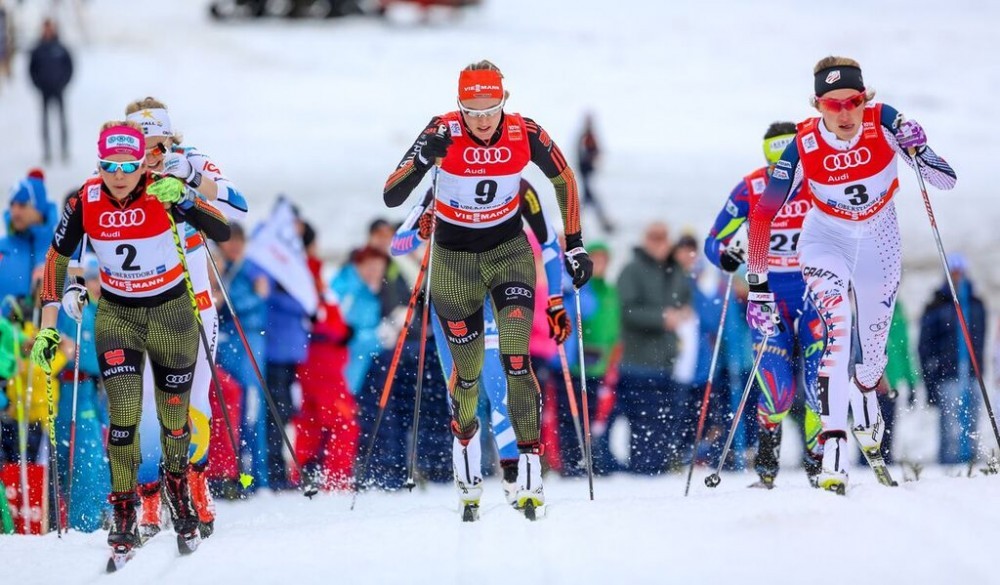
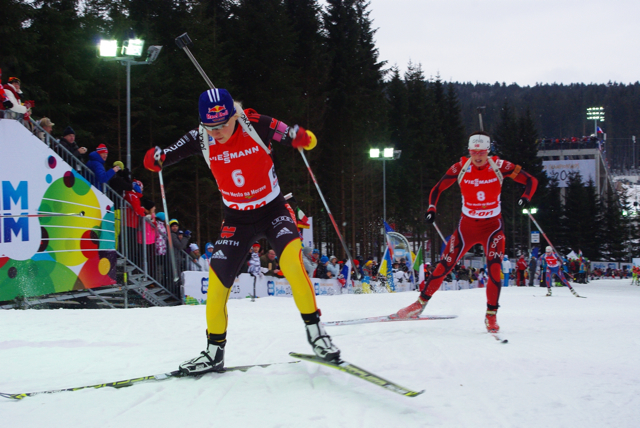
Germany’s Denise Herrmann (9) races alongside teammate Sandra Ringwald (2) and American Sophie Caldwell (3) during Stage 4 of the 2016 Tour de Ski in Oberstdorf, Germany. (Photo: Marcel Hilger)
On Wednesday, German cross-country World Cup skier Denise Herrmann announced a new chapter in her athletic career at age 27: a switch to biathlon.
“This step and the timing is certainly surprising to many, but I have pondered these thoughts for a while now,” Hermann stated in a German Ski Federation press release and in a post on her Facebook page. “I owe a lot to cross-country skiing, it was a great time with many highlights, but now I want to face new goals. The switch to a new discipline will be a big challenge, I am aware of that, but I am confident that I can do it with diligence, courage, and determination!”
Germany’s Denise Herrmann (11) leads American Jessie Diggins (in white) in the women’s 6 x 1.2 k freestyle sprint final at 2015 World Championships in Falun, Sweden. Germany finished fourth behind Norway, Sweden and Poland, respectively, while the U.S. placed eighth. (Photo: FlyingPointRoad)
The German Ski Federation (DSV) wants to support Herrmann in her new career direction.
“Denise has been one of our most important performers in cross-country skiing for many years,” DSV director of sports Karin Orgeldinger said in the press release. “She will surely leave a gap there. On the other hand, we are happy that Denise is looking for a new challenge in biathlon, so she will remain available to the German Ski Federation as an elite athlete.”
Professional cross-country skiing and biathlon are both organized under the same association in Germany, not in separate entities as is the case in the U.S. or Canada. The press release did not include comments from a biathlon coach or team manager.
Herrmann made her debut in the FIS Cross-Country World Cup in February 2009. Mostly known as a sprinter, she earned bronze medal at the 2014 Olympics in Sochi, Russia, with the German women’s 4 x 5 k relay, and was second overall in the Sprint World Cup at the conclusion of the 2013/2014 season. She achieved six individual World Cup podiums plus two in team sprints, and twice finished the overall World Cup in ninth place (2013/2014 and 2014/2015). She narrowly missed a medal at World Championships, placing fourth in the team sprint at the 2015 championships in Falun, Sweden, as her best result. At the end of last season (2015/2016), Herrmann finished 12th in the Sprint World Cup and 23rd in the overall standings.
While it can be considered a bold step for a successful cross-country skier to switch disciplines to biathlon in the middle of her career, it is certainly not unheard of, and even the German Ski Federation has seen several athletes make the transition back and forth.
Herrmann is good friends with and a summer training partner of Maren Hammerschmidt and Vanessa Hinz, both current members of the German national biathlon team. Similar to Herrmann, Hinz also switched from cross-country skiing in 2012. A 2002 and 2010 Olympic gold medalist, Evi Sachenbacher-Stehle switched from cross-country to biathlon toward the end of her career for the 2012/2013 season, before retiring after the 2014 Olympics following a positive doping test. Miriam Gössner, another member of the current biathlon national team, earned silver medals with German cross-country women’s relay teams early in her career at the 2009 World Championships in Liberec, Czech Republic, and the 2010 Olympics in Vancouver, Canada.
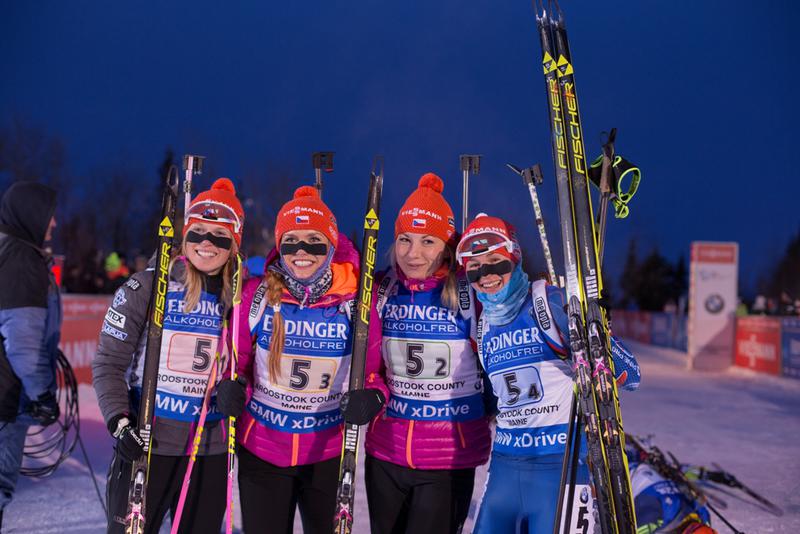
The Czech Republic women’s team, which won the 4 x 6 k relay on Saturday at the IBU World Cup in Presque Isle, Maine, with (from left to right) Eva Puskarcikova, Gabriela Soukalova, Lucie Charvatova, and Veronika Vitkova. (Photo: IBU/NordicFocus)
“It’s good to try a romantic atmosphere,” World Cup leader Gabriela Soukalová of the Czech Republic joked about the dark and cold course conditions at the end of the International Biathlon Union (IBU) World Cup women’s 4 x 6-kilometer relay in Presque Isle late Saturday afternoon, when the sun had long set behind the trees and hills of northern Maine for the final 6 k. “I appreciate it so much. I was thinking about my boyfriend,” she said in an post-race team interview with the IBU.
“Candles…” her teammate Eva Puskarcíková added.
The Czech women had every reason to be in a good mood. In the final race before the upcoming IBU World Championships in Oslo, Norway, their team had asserted its intention to be on the podium there in March, achieving the first relay victory of the season in a time of 1:07:11.0, with one penalty and 14 spare rounds.
After narrowly avoiding a penalty lap in the last shooting, anchor Veronika Vítková had a large enough lead to ski to the side of the track and look for a national flag for the final stretch, but none was immediately available from coaches or fans, so she celebrated across the line just by raising her arms, before her teammates hugged her at the finish.
The women’s relay was moved up from Sunday to Saturday due to extremely cold temperatures in the forecast, with a start time of 4:10 p.m. following the men’s relay, giving the athletes the rare experience of racing in the dark on the final loops, dimly lit by portable lights on a few sections of the course. (Evening Biathlon World Cup races are occasionally on the schedule, for example in Oberhof, Germany, but that course is equipped with large fixed floodlights.)
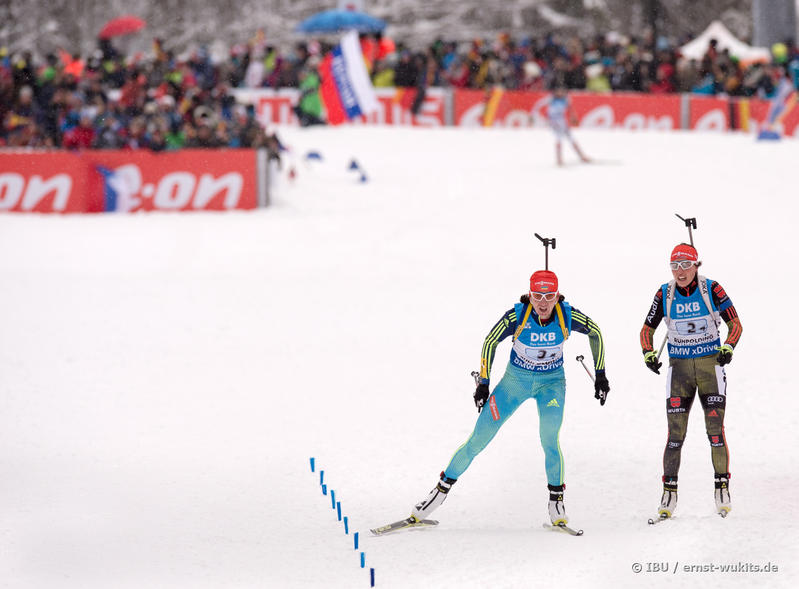
With the athletes emerging from the darkness into the slightly brighter Nordic Heritage Center stadium, the race for second and third place on the podium was decided in an exciting sprint finish between the relays from Germany, Ukraine, and Poland.
Germany’s exhausted anchor Karolin Horchler tried to rescue her once-comfortable lead after the final shooting that had diminished precariously into the finish, with a double-pole effort on the final meters before she collapsed across the line.
Ukraine’s Olena Pidhrushna passed her with quick skating steps to claim second place, 25.2 seconds behind the winners, with a team total of zero penalties and 12 spares. Pidhrushna edged Horchler by just 0.2 seconds as the Germans took third (+25.4), with one penalty and seven spares, after erasing a 30-second deficit on the final loop. Poland’s Krystyna Guzik came into the finish narrowly off the podium in fourth place (+26.0), with a team total of zero penalties and seven spares.
The U.S. with Susan Dunklee, Hannah Dreissigacker, Clare Egan and Annelies Cook finished the race in 10th (+2:12.4), with one penalty and 12 spare rounds. It was their best result in a women’s relay this season.
Czech Republic joins this season’s other podium finishers — Ukraine, Italy, France, Germany, and Russia — as the favorites for the women’s relay in Olso, with a few more “dark horses” also in the mix.
After the flower ceremony, several women fielded questions at the indoor post-race press conference, still wearing protective tape on their cheeks and noses.
“Today’s race was very hard because of the very big cold,” Czech Republic’s starter Puscarcíková said. “My fingers were frozen. But I am happy we are first again. Last year we won in Oslo this time of the year. It’s very fantastic and unbelievable for me.”
“I had trouble because I shot my third bullet under the target,” Lucie Charvatová explained at the press conference. She had a penalty on her second relay leg and fell back to 11th, before tagging off 47.7 seconds back in ninth place. “After that I was so, so nervous. I ran fast and tried to do the best I could. But I am also happy.”
“I don’t know what I can say,” World Cup leader Soukalová said at the press conference, trying to explain how she had moved her team back into first place on the third leg, following two straight individual wins in Presque Isle. “It was a really fantastic weekend. It’s amazing. I was feeling really good during the race. I don’t remember when I [last] have been in the same shape. It’s a perfect performance before the World Championship.”
“It was very hard because on the track it was dark,” Vítková recalled of the anchor leg and the final shooting. “I have seen nothing. On the shooting range, too. And I was a little bit nervous, because I needed three extra [rounds of] ammunition.”
Ukraine, winner of the relay in Ruhpolding, Germany, earlier this season, was in fourth place with its lineup of Iryna Varvynets, Natalya Burdyga, Juliya Dzhyma and Pidhrushna for most of the race, before Pidhrushna moved her team up with the fastest skiing on the last loop, and beat Germany at the line.
“It’s difficult to recall a relay that was so close and tough,” a smiling Dzhyma said during the press conference, through a translator. “Maybe the one in Hochfilzen [where Ukraine finished third, though with a much larger gap to second and fourth place]. It was really interesting and tough, not just because of the close results, but also because of the frost in this cold weather. In the end we are really happy to be in second, and to be on the podium.”
“At the beginning of my leg, I couldn’t see any uphills, any downhills,” anchor Pidhrushna explained, via a translator. “It was like racing blind. When I came to the shooting range, my only thought was to shoot clean and not go to the penalty loop.”
“It’s already a legend,” a happy Pidhrushna later added in an interview with the IBU when asked about her final loop. “It was again a funny situation after the last shooting. I had no idea which place I was in, going away from the shooting range. One of our staff members shouted so loud, then I realized I was somewhere close, because I couldn’t see the screen, I couldn’t see anything because it was already dark. I just had to think that I was close so I had to fight for it again.”
“Krystyna [Guzik] from Poland was behind me, and we were running so fast to chase the German girl,” she explained. “But I couldn’t even think of doing that, actually.”
“I didn’t know what was happening behind me, I just tried to race,” Germany’s Horchler told ARD, after she had advanced her team from fifth to second, requiring one spare in prone and staying clean in her final shooting. “But I had brutal pain in my shins, and was already pushing into the downhill. I am really annoyed by that two-tenth of a second [at the finish]. But I am just pleased about my 0-5 shooting in standing, because with that I settled a few things in this competition so the relay could still make the podium.”
“Hats off to the organizers,” she added. “They put up makeshift lanterns, and I am happy about my prescription lenses in my glasses, otherwise it would not have been possible for me to see anything.”
“I as very nervous, because it’s been a long time since I took the starting position,” Germany’s Franziska Preuss said at the press conference. “The last time was Sochi [2014 Olympics, where Preuss crashed and got snow into her rifle sights, falling back far, as German failed to medal for the first time in an Olympic women’s relay]. But now I am really happy that it was a good race for me… I think nobody expected Germany on the podium today.”
Germany started a lineup without Franziska Hildebrand and Laura Dahlmeier, their two highest-ranked athletes on the World Cup.
“Temperatures were better today than yesterday,” second leg Luise Kummer told ARD. “We feared it would become really cold by now, but today it was bearable. And the audience is really participating with the action, so it was definitely fun. You actually get warm during the race. One would not believe that, in training we were also worried. But in normal competition it is no problem at all.”
“I just could not handle the standing position on the range here, and unfortunately also not today,” Germany’s third leg Miriam Gössner, who had her team’s penalty, told ARD. “I don’t know why. I really tried to do my best. In the prone shooting and out on the course I felt really, really good. So I think I could compensate for that penalty lap fairly well.”
Poland, with Magdalena Gwizdon, Monika Hojnisz, Weronika Nowakwska, and Guzik (formerly Palka) finished just 0.4 seconds off the podium, after losing the sprint against Ukraine and Germany.
“We had to fight not only with our rivals, but mainly with low temperatures,” Hojnisz later posted on Facebook, according to a translation, after she had avoided a penalty in her first prone shooting but lost about 45 seconds to the top. “I was not the best link in today’s relay, so thank you girls for your faith and fight to the last meter.”
“I held her until the end of the climb and tried to overtake on the flats,” Guzik said of Pidhrushna on the last loop, as told to Polish sports website SportoweFakty, according to a translation. “Unfortunately, none of the three attempts worked. Olena took it well tactically. It is a pity that the course was not a little bit longer, because I could fight to the finish. … I am sad that I could not lead us to a medal. We need this podium in the relay. I still believe that soon we will succeed.”
A number of teams started different lineups than they will likely have at World Championships, including France, which won the previous relay in Antholz, Italy, but on Saturday gave its top athlete, Marie Dorin Habert, a break. France finished sixth (+48.2), with one penalty and 13 spares, after Anaïs Chevalier had tagged her teammate Justine Braisaz in second place at the last exchange.
U.S. Achieves Season-Best 10th
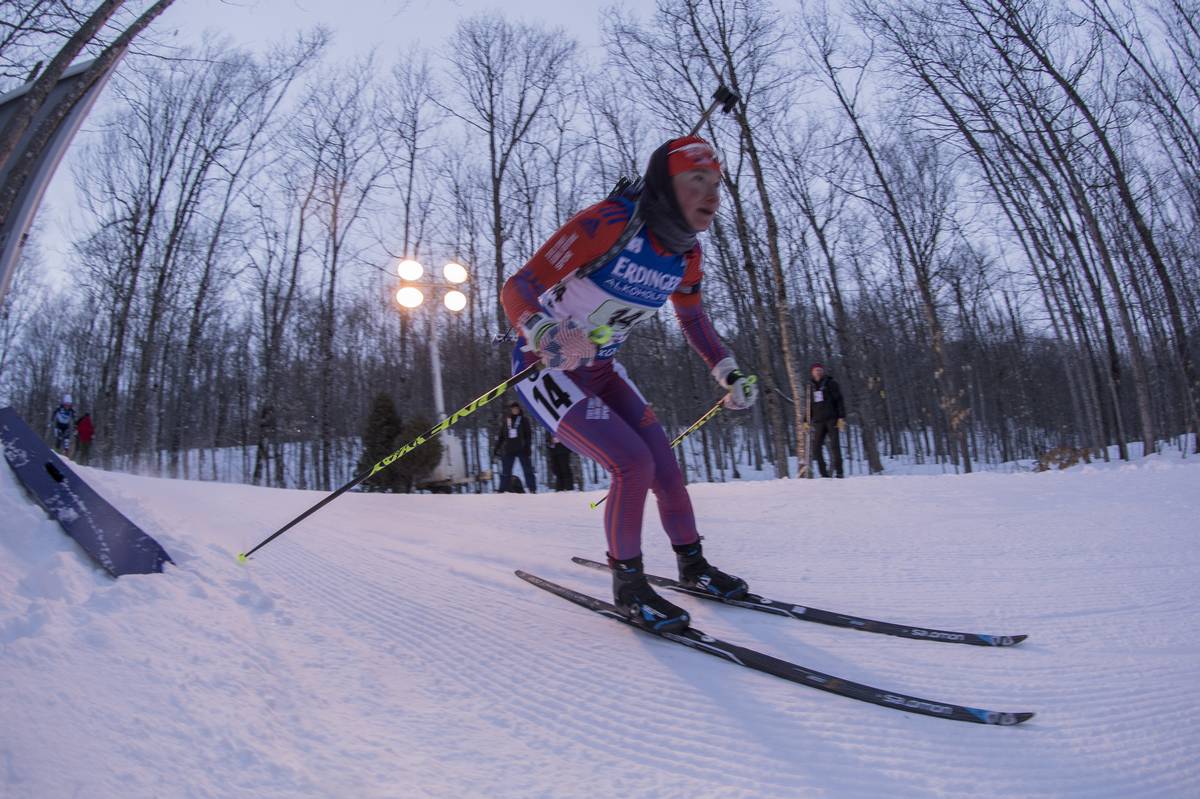
Susan Dunklee (US Biathlon) racing the first leg of the women’s 4 x 6 k relay on Saturday at the IBU World Cup in Presque Isle, Maine. Her team went on to place 10th for a season best. (Photo: USBA/NordicFocus)
Coming off a historic week for US Biathlon with Dunklee’s silver medal in the sprint and fifth place in the pursuit, the team’s leading woman was picked to start Sunday’s relay (after racing the second leg in the three prior relays this season), followed by Dreissigacker, Egan and Cook.
“We are still experimenting with the order,” Dunklee wrote in an email. “Last week’s mixed relay went well with myself leading and Han [Dreissigacker] going second so we tried that again.”
As for moving the race up to Saturday, Dunklee wrote, “I think most athletes would agree that moving the race to today was the right call in light of the cold forecast.”
But that made for a pretty hectic race day for the women, as they had very little time to prepare with the men’s relay only wrapping up about an hour before their own.
“Today was a great opportunity for dealing with unusual challenges on race day,” Dunklee explained. “We had some struggles getting to the venue on time, then I had a broken firing pin right before zero [target practice to adjust the rifle sights before the start], which is very tricky to replace, and finally 13 minutes before the start, I heard that the course got changed and didn’t get to preview it.”
“With the short turn around from the guys race, we only had 25 minutes to zero 4 people,” she continued. “I didn’t fit in more than 10-15 minutes of skiing warmup, a new record for me. Dealing with chaos is an extremely important skill for a biathlete to have and we all did well today in spite of the challenges.”
Dunklee’s performance didn’t seem to suffer much despite those unusual circumstances, she she used just one spare to clean the first prone stage, and another two in her standing bout. She also skied the fastest course time of all starters in 13:55.4, and second-best among every woman in the relay, behind France’s anchor, 19-year-old Braisaz.
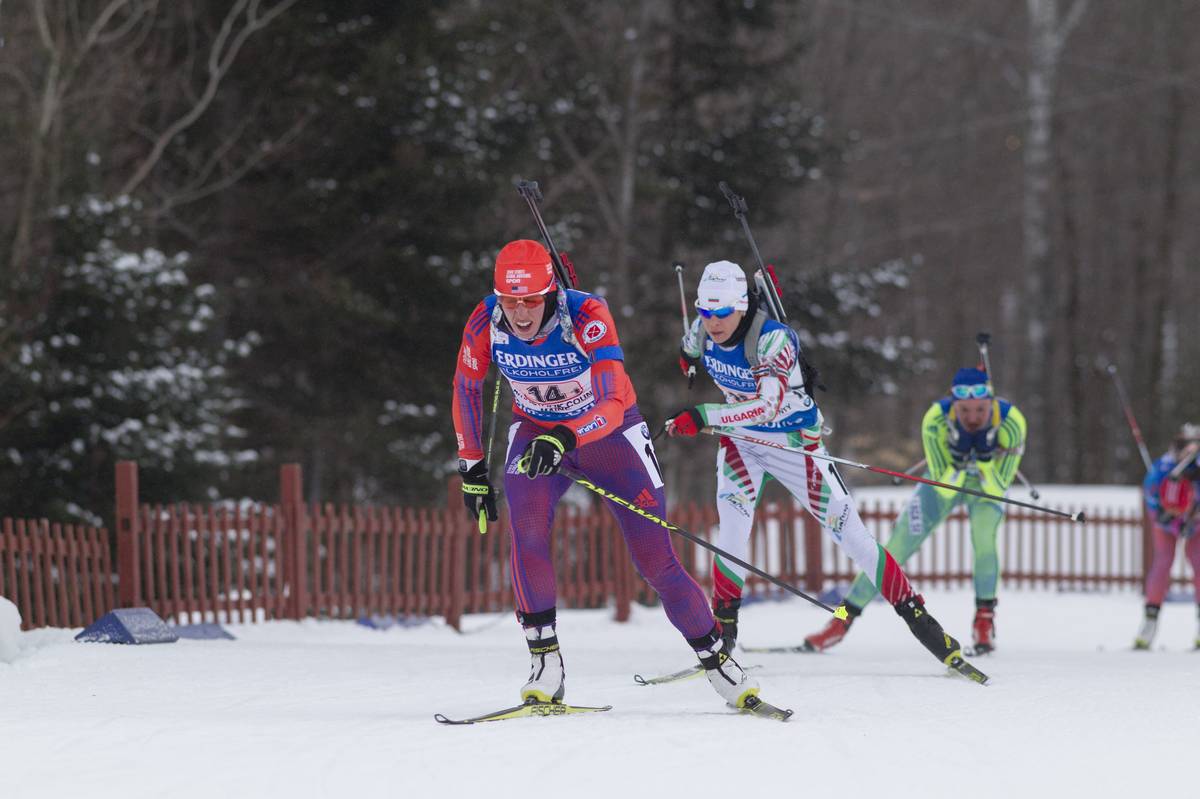
Hannah Dreissigacker racing the second leg of the U.S. women’s 4 x 6 k relay on Saturday under darkening skies at the IBU World Cup in Presque Isle, Maine. Her team went on to place 10th for a season best. (Photo: USBA/NordicFocus)
Dunklee tagged off to Dreissigacker in fourth, only back 11.1 seconds behind Switzerland’s Selina Gasparin, who was then leading the pack (Switzerland went on to finish 12th).
For Dreissigacker, a regular member of the U.S. relays last year including at 2015 World Championships, it was her second World Cup relay of the season after spending some time on the second-tier IBU Cup, before returning to the World Cup in Canmore, Alberta, and Presque Isle, where she most recently placed 27th in the sprint and 24th in the pursuit.
Like Dunklee, she didn’t let the stressful race preparation get to her.
“It was definitely a little bit rushed today before the race for everyone,” she wrote in an email. “We had to rearrange things and it got a bit hectic. But it was fine for me anyways… a good adrenal warm-up, as I like to call it!”
Dreissigacker needed one spare in prone and two in standing, just like Dunklee, and lost a little more time on the course, handing off in seventh, 43.7 seconds behind the leaders.
“I am a little disappointed that I didn’t hit my last standing shot, and then took two spares to hit it, but it could have been worse!” Dreissigacker wrote. “I had a good battle with Austria [Lisa Theresa Hauser] and France [Anaïs Bescond] at the end of my leg which was fun and made me go hard.”
Egan, who had started the prior relay for the U.S. in Antholz, moved back to the third leg, which she had also raced in Ruhpolding and Hochfilzen earlier this season.
Clare Egan (US Biathlon) during her standing stage of the women’s 4 x 6 k relay at the IBU World Cup in Presque Isle, Maine. Her team went on to place 10th for a season best. (Photo: USBA/NordicFocus)
In Presque Isle, she had finished 32nd in the sprint and 23rd in the pursuit. She continued her solid recent shooting performances in Saturday’s prone stage, cleaning her targets to leave the range in seventh position (+41.4).
After moving up to sixth place on the next loop, Egan came into the standing stage fighting for position with France, Ukraine and Austria. There she was unable to hit her last target with her three spares, having to ski through the 150-meter penalty lap.
“The conditions for my standing shooting were fine, I am just not as solid in standing as I am in prone,” Egan wrote in an email. “I missed two from the clip and then fired the first spare accidentally before I was ready. Then I had two bullets for two targets and unfortunately I only hit the first one. I should have taken more time to make a perfect hit on my last shot.”
She left the range in 12th, and tagged off to Cook in that position, having lost an additional minute to the leaders by the exchange (+1:50.6).
Just like it was for her teammates, Cook’s race leadup was a bit hectic.
“The preparation was actually funny today,” Cook wrote in an email. “I did not get to ski the course before the race started, and the girls actually had to tell me that they took out a sketchy corner, so I had never even done our course before I was on it racing it.”
On the shooting range, she matched the performance of Dunklee and Dreissigacker, requiring one spare in her prone stage and two in standing, but had to overcome an additional challenge: the sun had set when the anchors were on their relay legs, and large sections of the course had fallen into darkness.
“I was glad that nothing crazy happened on the downhills because it was definitely a shadowy course, not like the huge floodlights that we are accustomed to,” Cook explained. “But I didn’t mind. It reminded me of how night races were growing up at my local ski area, with little light bulbs hanging over the course. The range was a bit dark and the big movie screen flashed really brightly while I was shooting prone, so the light changed drastically and suddenly and that was distracting. But it worked out okay.”
She was able to overtake two more relays, moving the U.S. up to 10th in the finish. The U.S. women were satisfied with their result, though believed there was still additional room for improvement.
“As a team, we all had okay shooting performances and it is exciting to see us move up so much already even without a great day,” Dunklee concluded. “Oslo will be exciting.”
“I think we are all happy with 10th since its our best relay of the year, but we also know we can do better and today was a good sign of that!” Dreissigacker wrote.
“Despite my penalty lap this was the best relay result we have had with this group of four athletes,” Egan explained. “Our previous best was 12th which we got twice last year (World Cup 6 Antholz, World Championships). It is also a season best. Of course we can still do better and intend to do so in Oslo.”
“I still know we can do better in the relay, but it is a hard, hard thing for everyone to have stellar races on the same day,” Cook concluded. “And luckily, we know that all we have to do is have a good normal day and we can be right up there.”
With Some New Faces, Canada 17th
Without Rosanna Crawford and Julia Ransom, Canada did not have two women in Presque Isle who will likely be part of the women’s relay at World Championships in Oslo. Crawford and Ransom started in all three other relays this season where the team finished 10th in Hochfilzen, and ninth in both Ruhpolding and Antholz.
Instead, with veteran Zina Kocher (in her third relay this season), Emma Lunder (who had one relay start before in Hochfilzen), Audrey Vaillancourt and Erin Yungblut struggled on Saturday, quickly falling to the back of the field, with Kocher having to ski a penalty loop in her first prone.
After leaving the range in 16th out of 17 teams (with Norway and Slovakia pulling their teams before the start due to illness), Canada was never able to catch back up to the top 10, losing time to the leaders as the race progressed.
Kocher tagged off to Lunder 2:14.3 back, who then incurred another penalty in her prone stage (1+3, 0+1) to exchange 4:28.1 back in 17th place.
Vaillancourt then put in a strong performance on the range with two clean shooting stages, but was slower on the course and passed on the penultimate loop by the leading teams. She handed off to anchor Yungblut 6:38.6 back.
After requiring three spares to hit her targets (0+1, 0+2), Yungblut then was taken out of the race and scored as lapped in 17th position before her final loop.
On to Oslo
The athletes will now have two weeks of additional training and preparation, before traveling to Norway for the World Championships, beginning on Thursday, March 3 with the mixed relay.
Ukraine’s Olena Pidhrushna (l) boxing out Germany’s Laura Dahlmeier (r) in the final meters of the women’s 4 x 6 k relay in front of a packed Chiemgau Arena at the IBU World Cup in Ruhpolding, Germany. (Photo: IBU/Ernst Wukits)
It’s not often that you can hear catcalls and booing in a ski stadium. A football, basketball or soccer game maybe, but biathlon? On Sunday, 20,000 spectators packed the Chiemgau Arena in Ruhpolding, Germany, and many were not pleased with how the IBU World Cup women’s 4 x 6-kilometer relay played out. Just before the finish, Ukraine’s anchor Olena Pidhrushna, skiing in first, cut off local fan-favorite Germany’s Laura Dahlmeier to claim the ideal left lane in the final stretch. That ended Dahlmeier’s furious chase on the last loop to finish, and Ukraine took the win by 1.2 seconds in 1:16:14.2.
Ukraine, with Iryna Varvynets, Yuliia Dzhyma, Valj Semerenko, and Pidhrushna, incurred one penalty lap and only needed four spare rounds (three prone and one standing), while Germany, with Karolin Horchler, Miriam Gössner, Maren Hammerschmidt and Dahlmeier, had two penalties and required eleven spares (six prone, five standing), but the latter three athletes all skied the fastest course times on their legs to make up the deficit.
Behind them, Dorothea Wierer anchored Italy — which had no penalties and used 10 spares — to third (+43.8), about a second of Russia’s Olga Podchufarova, after the Russians had two penalties and required seven spares. Thus the same teams that had already been on the podium after the first relay of the season December in Hochfilzen, Austria, made it again, except Italy and Ukraine swapped positions.
Teams from 22 countries started on Sunday and 17 finished without being lapped.
Canada, with Julia Ransom, Rosanna Crawford, Megan Tandy, and Zina Kocher, placed ninth (+1:59.5) with no penalties and seven spare rounds, while the U.S., with Annelies Cook, Susan Dunklee, Clare Egan, and Joanne Reid, finished 16th(+5:39.8) with three penalties and eleven spare rounds.
‘Of course you are angry in the moment’
At first, Dahlmeier was visibly annoyed about the end of the race, after she erased a 27.7-second gap on the last leg (and was still 9.2 seconds behind heading into the last loop). After getting blocked she switched back to the middle lane, but once she realized she couldn’t beat Pidhrushna, Dahlmeier stopped pushing and slammed her right pole into the snow across the finish.
“The final loop was really hard. Of course you are angry in that moment, after going at full throttle for 6 kilometers, and then it fails on the last few meters,” said Dahlmeier, who anchored Germany to a relay gold at 2015 World Championships, told TV broadcaster ZDF. “But we can be very, very happy about the second place, especially with the penalty laps that were shot, and with this lineup. I think that’s really nice, and a beautiful finish for the days in Ruhpolding.”
“It was a hard last loop,” Pidhrushna said at the post-race press conference through a translator. “I know Laura is a really good skier, and I knew that I would have to fight for every meter. I am really happy that the team won. I just held the shortest line to the finish. I really wanted to win; it was a big battle but it is sport.”
After seeing a replay again, Dahlmeier agreed in a later interview with ZDF: “That was all correct, you can’t say anything against that. For me, it’s too bad; it didn’t help to switch lanes, and then it was already all over. Maybe I have to train a little bit with the cross-country skiers, pick up some things on how they solve sprints in order to become better.”
“That’s biathlon, that’s the race,” her teammate Hammerschmidt said at the press conference. “It was the same in Hochfilzen [where Germany lost a finishing sprint to Italy], maybe in the next relay we are first. But I think it was OK, and the girls [from Ukraine] make a good job, congratulations to the first place.”
The German athletes did not complain for long, knowing their day could have ended much worse after second leg Gössner incurred two penalty laps earlier in the race, at that time falling back to 15th position with the podium seemingly out of reach.
(Story continues below)
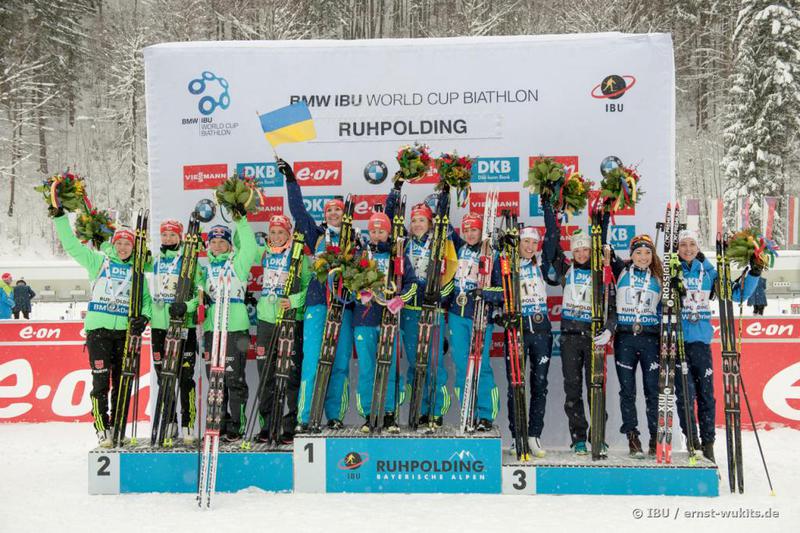
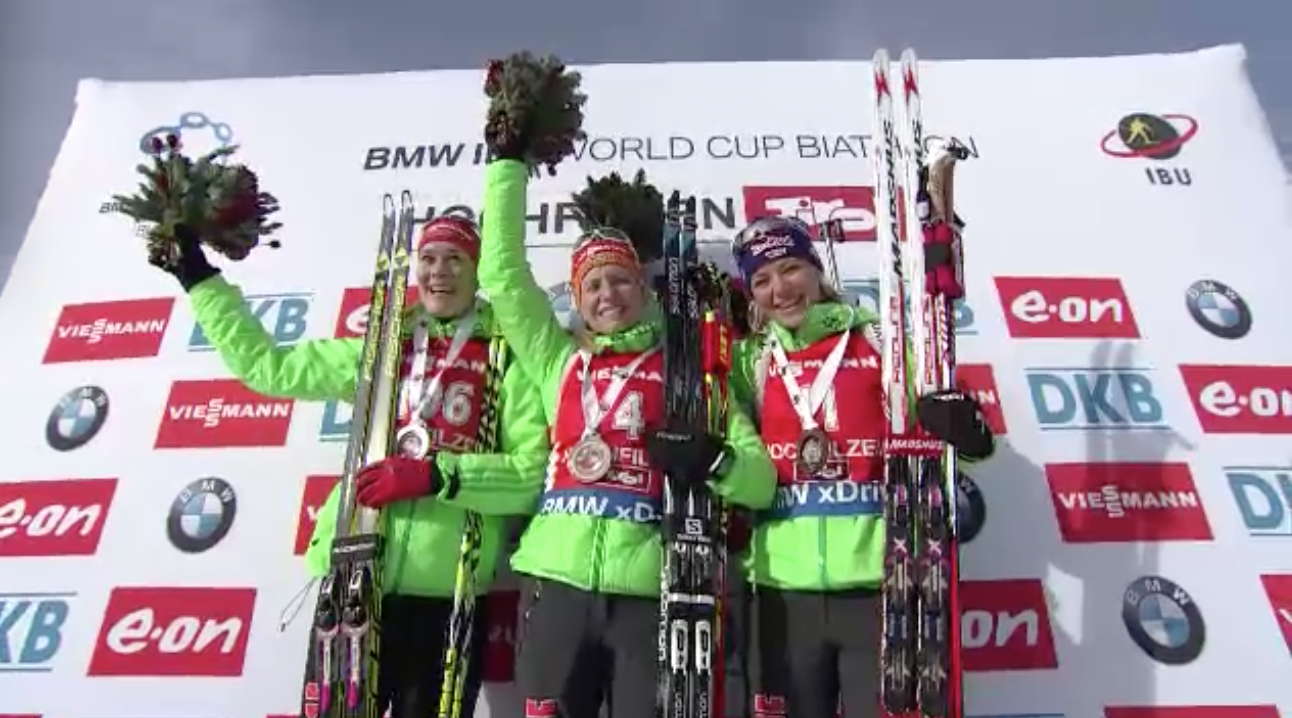
The women’s 4 x 6 k relay podium at the IBU World Cup in Ruhpolding, Germany; with Ukraine (c) in first, Germany (l) in second, and Italy (r) in third. (Photo: IBU/Ernst Wukits)
Race Day
Several teams had opted to rest good athletes for Sunday’s relay at the end of a long block of races, including Germany. Franziska Hildebrand, who already won two World Cups this season, had asked her coaches for a break, and then Vanessa Hinz also had to defer her relay start due to a cold, while teammate Franziska Preuss missed the entire Ruhpolding weekend with a hairline fracture in her tailbone.
That prompted the coaches to change their second-place relay from Hochfilzen on three positions, and make a call to Karolin Horchler, 26, who originally had other plans for Sunday:
“[Saturday] afternoon I had been on my way to Ridnaun, South Tyrol [Italy], because I was supposed to compete there in an IBU Cup mixed relay today,” Horchler told ZDF. “And shortly before the arrival Gerald [Hönig, women’s head coach] called me and said I should please turn around. All in all, it was on the road for five hours… To start here in my second home in Ruhpolding, that’s what I always dreamed of.”
“It’s surely not a very common lineup,” coach Hönig told ZDF before the race. “But in general our expectation is that any relay team we start contends for a spot on the podium.”
Similar to Germany, the Czech Republic chose to rest overall World Cup leader Gabriela Soukalová, France rested Marie Dorin-Habert, currently second place in the World Cup standings, Italy’s Federica Sanfilippo sat out the relay, and Austria’s top skier Lisa Theresa Hauser missed it as well. Finland didn’t enter a team, missing their best athletes Kaisa Mäkäräinen and Marie Laukanen.
The newly called-up Horchler began the race well for her team, skiing at a pace that allowed her to stay in contact with the best and requiring only one spare each in prone and standing. She tagged off in fifth place, 22 seconds behind Norway’s Marte Olsbu in the lead, with Ukraine’s Varvynets in second after shooting clean.
“It was a really crazy day, in the morning I heard that I can start here. The second place is very good for the team. It’s wonderful,” Horchler said in the press conference after the race.
“It’s surely not a very common lineup, but in general our expectation is that any relay team we start contends for a spot on the podium.” — German Women’s Head Coach Gerald Hönig
Germany’s second skier,Gössner skied out fast on her first loop making up positions, but struggled in prone, missing two of her targets and quickly running out of spare rounds.
“Trying to do everything especially well because it’s a relay is a fitting description,” Gössner told ZDF while the race was still going on, with tears welling up in her eyes. “I really can’t explain myself how I can shoot two penalty laps in prone. I didn’t have the feeling that conditions were difficult or that I was shaking… Then I was completely flustered, I didn’t know if that shot went left or right, just didn’t know where to aim.”
After another fast loop, at least she was able to avoid the penalty lap in the standing position after requiring two spare rounds, usually her more shaky discipline, moving up to 13th place.
“Without my two penalty laps a lot more would have been possible today,” a still-disappointed Gössner later told ZDF after the race. “Our luck was that the other nations also shot penalty laps, so the other two [teammates] could make up some time, and that saved us. But my race was absolutely not good.”
“Yeah, she is very annoyed, but that’s relay,” said Hammerschmidt, who lifted Germany from 11th to second on the third leg. “That happens to everyone, but it’s all the better for her that we still got the second place. And I just told her she is allowed to say two more sentences about her shooting, and then we’ll call it a day.”
“I just told her she is allowed to say two more sentences about her shooting, and then we’ll call it a day.” — Germany’s Maren Hammerschmidt, about her teammate Miriam Gössner
While Gössner had been struggling on the range, Ukraine’s Dzhyma shot clean at the top of the field, and while not quite as fast as the German behind her, also skied the sixth-fastest time on her leg.
“Our skis were really good today, thanks to the service team,” she said in the press conference. “I like the new [additional] snow better.”
Hammerschmidt received the tag 1:48.8 minutes behind Ukraine in 11th place, then began a furious chase to get closer to the top again (“one of the best relay performances I can remember in quite a while” ZDF color-commentator Herbert Fritzenwenger commented).
She missed two shots in her prone shooting stage, and then needed one more spare round in standing.
“I have to say, I was a little too cautious there,” Hammerschmidt told ZDF. “I should have turned [on the sights] immediately but thought ‘maybe it will work,’ and when you think that it usually doesn’t. So I should have reacted earlier, I got pretty nervous there after the two misses. In standing I went with full risk, and thankfully only had to reload once.”
Like Gössner, she skied the fastest course time of all athletes on her leg, and handed off to Dahlmeier in second place, 27.7 seconds behind.
“Of course I would have liked to have a better starting position,” Hammerschmidt told ZDF during the race. “But maybe the pressure was off a little. I just wanted to do my own race, and see that I can catch a good pack. I had really good skis today, and felt good on the course. On the last loop I could catch one after another, that was such a great feeling. And then I was really surprised to be second in the finish.”
Ukraine’s Semerenko skied the third leg, and at this point could have secured a large gap over the rest of the field. She narrowly missed her last shot in prone, but then the usually solid shooter was not able to clean the remaining target with her three spares, and had to ski a penalty lap. That opened the race back up as Belarus’ Nadzeya Pisareva overtook her and some other teams moving back within striking distance of the lead.
“I had nothing left but to run faster,” Semerenko joked in the press conference, according to a translator.
How quickly the fortune of a team in a relay can change was demonstrated once again after the next shooting. Pisareva and Semerenko each needed one spare in standing, with Semerenko still trailing by 9.8 seconds as she left the range. Then suddenly Pisareva completely ran out of energy, and could be seen trying to herringbone up the next hill without any glide.
Semerenko quickly passed her, along with several other teams as well. At the bottom of the next climb, Pisareva stopped next to one of her coaches to exchange a few words, seemingly ready to quit the race, before continuing to ski again.
The Belarusian tagged her teammate Darya Yurkevich 1:28.2 minutes behind in 11th place. Yurkevich would end up losing two more positions, finishing 13th (+2:40), despite Belarus posting one of the best shooting performances of the field for Belarus (no penalties, five spares).
With Belarus now out of the picture, the race for the podium on the final leg came down to Ukraine, Germany (+27.7), Norway (+28.6), Italy (+42.4), Sweden (+43.0), Slovakia (+45.3), and Russia (+45.7), with more teams looming shortly behind.
Dahlmeier set out at a fast pace to close the gap to Pidhrushna, and after both shot clean in prone, the lead had been reduced to 18 seconds. On the next loop, Dahlmeier stormed up the climbs and managed to catch Pidhrushna, overtaking her just before the shooting range. But while the Ukrainian stayed clean in the final standing stage, Dahlmeier required one spare, again falling behind by 9.2 seconds as they left the range.
On the final loop, Dahlmeier had more problems catching up to Pidhrushna again, who managed to preserve her lead through the last flat section and descent into the stadium. Then the most talked-about scene of the race happened, and Ukraine prevailed in that final sprint.
“I was pretty down on my strength, but too bad, at the end it went a little poorly,” Dahlmeier told ZDF. “Maybe I should have stayed behind her and then pick the middle lane. A little unfortunate. But still, considering how it looked initially, we are mega-happy about the second place. That was a grandiose success, and you really see what is all possible in a relay race.”
After a number of changes between several countries vying for third place, Italy,
with Lisa Vittozzi, Karin Oberhofer, Alexia Rungaldier and Wierer, beat out Russia’s Ekaterina Shumilova, Daria Virolaynen, Ekaterina Yurlova and Podchufarova in a second exciting finishing sprint by 1.1 seconds.
“I think the relay is the work of the whole team, everybody has to do their best, it’s not only one man or one woman,” Wierer said in the press conference. “I was in the fourth position when I started, and I was a little bit worried because [there were] also Tiril [Eckhoff] and Laura. I hoped that I would shoot well. I was a little too fast in the standing so I missed the first one. But I was lucky that Tiril shot more misses than me. And then behind me was the Russian, and I was really nervous. I was sure that she will pass me on the finish line, but I gave everything and it was the third place, finally.”
Norway was fifth (+1:11.5) with Marte Olsbu, Fanny Horn Birkeland, Synnøve Solemdal and Eckhoff combining for one penalty and 13 spares. Olsbu tagged the team in first after the first leg, and after Birkeland’s penalty on the second leg, Norway still remained in podium contention, picking off the places with Germany, until Eckhoff required all her spares on the last leg — three in prone, three in standing.
Ahead of the upcoming World Championships at home in Oslo, the Norwegian women have not reached the podium since taking bronze at the 2014 Olympics, though they remain hopeful.
“It may not look like we’re there yet, but we are good enough. It’s about getting the final touches in place,” Eckhoff told Norwegian broadcaster NRK.
Canada in Top 10
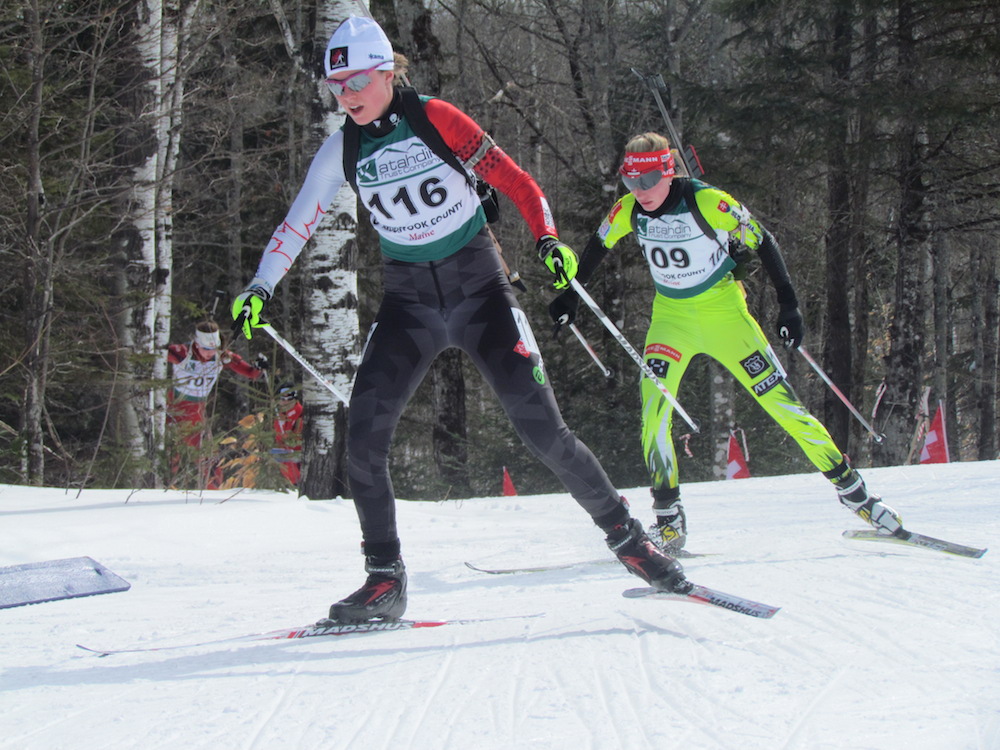
Canada’s 22-year-old Julia Ransom (116) during the 2014 IBU Junior World Championships pursuit. (Photo: Katrina Howe)
For Canada, Ransom’s day began with tangle out of the start and a resulting broken pole, but she quickly received a replacement.
“It caught me a little by surprise but I quickly realized that I needed to signal to someone for a spare,” Ransom wrote in an email to FasterSkier. “I was on the opposite side of the trail as all of the coaches, but one of our wax techs was somehow able to get a pole to me despite having a few girls between us. Unfortunately that little mishap put me to the back of the pack, but I was able to sneak my way back in there before the first shooting.”
After the field had stayed closely together on the first loop, Ransom shot fast and accurately in the first prone, cleaning all five targets and leaving the range in fifth place. By the next timing point, she even had moved up to third.
“I was stoked to be skiing with the top 3 girls! I felt strong and controlled on skis,” she wrote. “Unfortunately, I struggled with my [standing] spares and lost those leaders. I’m not letting that happen again next relay! “
In her standing stage, Ransom initially missed just one shot, but then required all three spares to clean it and avoid the penalty lap. She fell back a few positions, and tagged off to Crawford in 11th place, 50.7 seconds behind Norway up front.
Crawford shot flawlessly, cleaning both her prone and standing positions, something only 10 other athletes achieved on Sunday. When she left the range after the last stage she had moved her team back up to fifth place (+1:01.5), then only lost only a few more seconds on the final loop tagging Tandy still in fifth (+1:07.7), behind Slovakia and ahead of Norway.
In the prone stage, Tandy missed two targets, then needed all three spares to clean them, leaving the range in 10th place (+1:17.1) with Germany still behind in 12th. In standing, Tandy was able to stay clean, though she could not make up another position. But she also barely lost any more time, tagging off in 10th and 1:17.6 back.
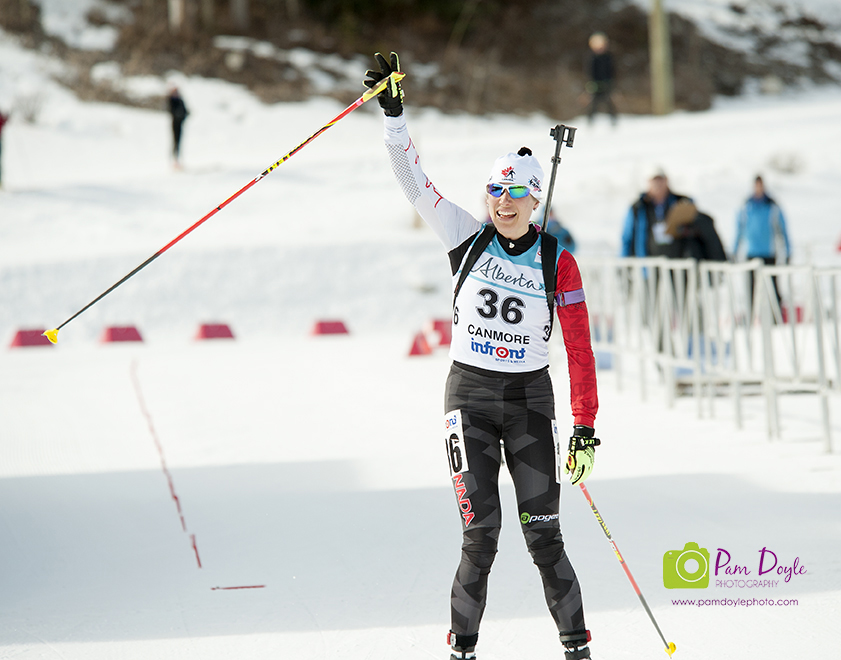
Kocher winning an IBU Cup sprint in Canmore, Alberta, last season. (Photo: Pam Doyle)
Team veteran Kocher anchored the relay, and like her teammates, displayed a strong shooting performance. She cleaned prone, and then had only one miss in the final standing, leaving the range in the vicinity of a number of other teams fighting for position.
“Last laps are usually my strength so I attacked leaving standing,” Kocher wrote in an email. “Unfortunately, just before the uphills the French competitor [Celia Aymonier] stepped on my pole and it broke, costing me metres of time. I got a pole fairly soon from Norway, but it was very short, and then for the last sprint to the finish switched it for my own pole from our coach Matthias [Ahrens]. But that cost us a potential top 6. Two broken poles for our team, crazy!”
In the end, she finished the ninth for Canada, 1:59.5 minutes back, with no penalties and only seven spares. “Excellent momentum for going forward to next week’s relay for our team,” Kocher concluded.
“Our team had a goal of collectively using 8 spares and stay in the top 10… We also wanted to beat Sweden to maintain our current Nation’s Cup position,” Ransom wrote.
They achieved both those goals. The Nations Cup is its own end-of-season award by the IBU, but also determines the number of starting spots a country gets awarded for the next year. Germany is still in the lead after the races of this weekend, with Canada in 10th position and the U.S. in 15th.
“I was proud of our women’s team today. We all had fairly solid races and had the potential for top 6; unfortunately Zina broke a pole on her last lap, which caused a fall and a few positions. I think we are all fired up for another exciting race next weekend,” Ransom added. “The crowds here in Ruhpolding were fantastic. They brought a lot of energy to the races and were devoted fans in even the worst conditions.”
U.S. 16th with three penalties
For the U.S. the relay got off to a difficult start, when Cook incurred a penalty lap in her first prone shooting, leaving the range in 20th position, 58.6 seconds back behind the leaders.
“I was disappointed in myself today because I had a penalty in the first prone shooting that put me in the back of the pack,” Cook said in a US Biathlon press release. “I was unable to get the girls into a good starting position, although I had a lot of confidence in what could happen after that. It was a crazy day with lots of penalty loops happening to great teams and the standings changed a lot through the race.”
After a better standing stage shooting where she only required one spare, Cook about kept her position but lost a few more seconds to the top (despite skiing the 14th best course time on her leg), tagging Dunklee in 21st (+1:38.4).
Susan Dunklee (US Biathlon) skied the second leg for the U.S. women’s relay on Sunday, picking off three places to bring them from 21st for 18th. They ultimately placed 16th. (Photo: USBA/NordicFocus)
Dunklee, who had been the starter for several years, again moved to the second leg, the same order the team had experimented with in the relay in Hochfilzen. After needing one spare in the prone, she had moved up one position, but had lost additional time to the leaders (+1:58.8) despite skiing the fastest first loop.
In standing, she again had to use one spare and left the range in 19th (+2:26.3). Dunklee barely lost more time on the final loop, and tagged Egan in 18th, having made up three positions on her leg, but almost losing another minute to the top, now 2:29.9 behind.
On Sunday, Egan had one of her best recent shooting performances, cleaning prone and only requiring one spare round in standing.
“I made a breakthrough in my standing shooting at the beginning of the winter, and I’m taking advantage of that newfound confidence. I have bad stages now and then but I am learning from each one and improving all the time,” Egan wrote in an email. “For example I missed 1,3 in the first two stages of Thursday’s Individual, but then pulled myself together and finished the race with 0,0 on the last two stages. Today I missed my last (10th) shot, which is a letdown, but I was able to hit it with my first spare round.”
Clare Egan (US Biathlon) skiing the third leg of the 4 x 6 k relay on Sunday, bringing her team from 18th to 16th with just one spare round. (Photo: USBA/NordicFocus)
Out on the loop, Egan skied the 14th-fastest time of her leg, and was able to move her team up two positions, tagging off 2:45.4 minutes behind in 16th.
“The conditions were relatively fast today,” she added. “It snowed a ton last night but we were lucky and it stopped during our race. Our wax staff gave me excellent skis this morning, but unfortunately I was not able to put them to very good use, as my body was not responding well at all.”
In her first week with the World Cup team, Joanne Reid anchored the relay (in place of Hannah Dreissigacker, who skied that leg during the first relay of the season).
“I think the reason the coaches put me last is because I don’t have the consistency or the experience of the rest of the team, and therefore any mistakes I made would be after they had already raced,” Reid wrote in an email.
Reid emerged from prone having used just one spare, but then struggled in the final standing, running out of spare rounds and ultimately having to ski two penalty laps (0+1, 2+3).
“Today I made what I assume is a classic error for a new biathlete coming in from pure skiing, and came into the range too hard in standing,” Reid explained. “I was intensely focused on catching the two teams in front of me, which was going well until I got to the range. It’s always hard to remember in the heat of the moment that your shooting is just as important as your skiing.”
In her first IBU World Cup relay, Joanne Reid anchored the U.S. women’s team to 16th with the 11th-fastest course time on that leg. (Photo: USBA/NordicFocus)
“The pacing on that lap was certainly my mistake, and not just pacing, but the fact that I don’t have the shooting skill to handle as high of a heart rate or shoot at the same speed as the rest of the girls, not to mention I hand load spares much slower.”
Overall, Reid skied the 11th-fastest course time.
“It was definitely a fast course out there, but still very difficult. I can only imagine how tired the athletes are who have raced the entire world cup period, and also qualified for and raced the mass start this weekend,” she wrote. “For Susan to go out there and ski the fastest leg after all those races (and long ones besides) is incredibly inspiring to me, and I wish I could have given her a better performance on my end.”
“I really enjoyed the course out there today — we were much luckier than everyone in the mass start to have such hard-packed conditions,” Reid added. “I think that’s the only 6 km I’ve ever skied in my life, so I wish I could compare it to something, but until I do a few more biathlons I have no reference point.”
Reid finished in 16th for the U.S., ahead of Romania, with the other five teams behind them lapped.
“We wanted to do better than last time (15th) but unfortunately we fell just short of that today,” Egan concluded in her email.
“This team has so much potential and I really believe in that,” Cook said in a US Biathlon press release. “So many of the pieces are there and are also showing, but not quite enough of them to do what we are capable of. It is frustrating but it is also making us hungry to do better and we have another relay coming up next week.”
“I think a team always goes into a relay with the hope that they can improve on their start position,” Reid wrote. “Obviously for us today, that didn’t happen, but I think we have a lot of the pieces right, and I’m certain this team (whether or not in the future it includes me), can have an incredible day.”
The IBU World Cup now moves on to Antholz-Anterselva, Italy, where there will be another relay for the women and men on Sunday.
Franziska Hildebrand (center) claimed the first win of her career, while teammates Maren Hammerschmidt (left) and Miriam Gössner were thrilled to join her on the sprint podium in Hochfilzen. It was the first German podium sweep in four years.
The relay hasn’t even happened yet, but after one day of racing in Hochfilzen, Austria, it’s clear which women’s team is on top of the biathlon world: at the moment it’s Germany, which pulled off a remarkable podium sweep in the women’s 7.5 k sprint.
It’s hard to say which member of that sweep was happier. Was it Franziska Hildebrand, who has led the team on many occasions but collected her first World Cup win today with clean shooting and a 15-second cushion to second place?
“I went on the first loop and thought ‘oh somehow my legs are heavy’,” Hildebrand told Germany’s ARD television crew. “I didn’t even feel that springy. When I heard on the first split time that it was alright, I thought ‘okay, it might feel bad, but somehow it seems to work well’. And then on the last lap I felt good again, my legs could still give something, and then I was overjoyed when I was leading in the finish.”
Hildebrand was one of the very first starters, in bib four. In the finish she raised her arms after catching her breath, sensing that she had done very well, but still was not sure what her performance would be worth with so many athletes still left to even start the race.
So when the win was secured and Hildebrand stepped onto the podium, she was beaming.
But second-place Maren Hammerschmidt seemed just as happy.
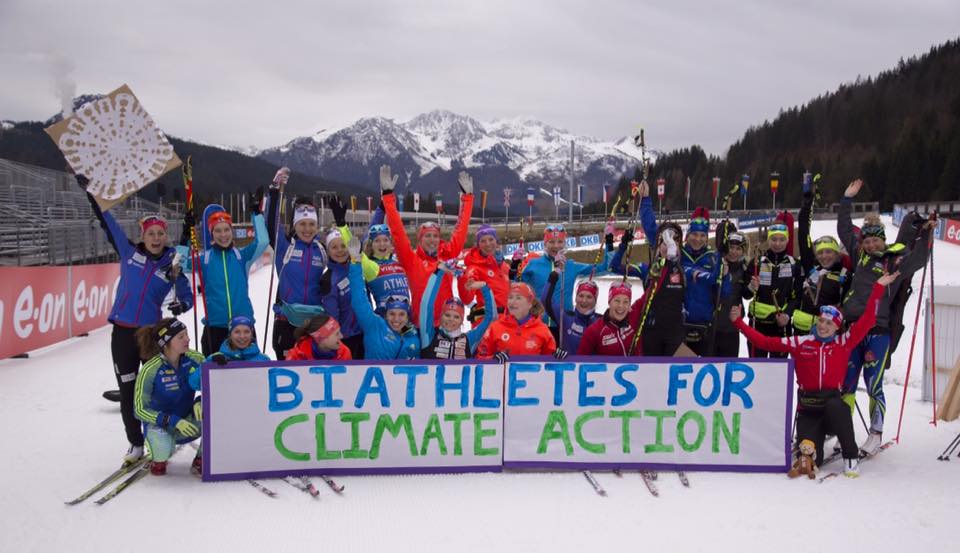
With green grass on the shooting range infield and on the side of the trail, biathletes organized by Hannah Dreissigacker and her U.S. teammates called for action at the Paris climate change conference: they hope they won’t continue to see less and less snow every winter. (Photo: Manzoni, NordicFocus/ US Biathlon Women Facebook).
The second-to-last starter of the day, Hammerschmidt shot a clean race. Her coaches yelled split times as, all alone, she pushed hard up the final climbs and through a ski tunnel into the stadium, then crossed the line in second place.
Unlike Hildebrand, she didn’t need to wait to see if anyone else would dethrone her. This was real. With an incredulous look on her face she checked the video screen, before finally raising her fists to the fans, with many giving her a standing ovation.
Hammerschmidt has done less than a dozen World Cup race in her entire career, but the 26-year-old started the season off right with a third-place finish in the single mixed relay in Östersund, and has been building from there.
“Today everything fit together,” she told ARD.
And her family was even there to watch her get her first podium
“It’s an unusual situation (for me) with so many spectators,” she said. “My family is here, I talked to my father before the race so that we will meet up. Maybe this will now take a bit longer. I am just happy that so many people came (to cheer), I have never run in front of such an audience, this is just cool.”
And the third gleeful member of the podium? Miriam Gössner. Even younger, Gössner was a shooting star early in her career, competing in the cross-country relay at the 2010 Olympics where Germany won silver.
After winning three biathlon World Cups in 2013, Gössner seemed poised to replicate that success in biathlon at the 2014 Games. But a training accident led to a serious back injury and she could barely compete at all in 2014. She missed the Games and had a rough 2015 season as well.
Susan Dunklee of the U.S. biathlon team snuck into the pursuit with a 53rd place finish, making up for four penalties with fast skiing on the tracks. (Photo: US Biathlon / NordicFocus)
After qualifying again for the first German national team this fall, her comeback now got rewarded with her best World Cup result since the 2013 season. Today, Gössner – a huge star and something of a celebrity personality – was back. She missed just one shot and skied the fourth-fastest course time to claim a spot on the podium.
“There were highs and lows, it was not easy, but in the end the fighting was well worth it,” she told ARD of her time with injuries.
Typically a dominant skier who sometimes struggles on the range, Gössner focused on her shooting on Friday.
“Definitely, it was important to me to get through the shooting alright,” she told ARD. “I skied a tactical race not really going all-out at first in order to still have some power on the last round, and I think that worked out for me. This is an easy track, so you really have to shoot well.”
Germany has long been strong in women’s biathlon, but this was the team’s first podium sweep since February 2011.
“We have a great atmosphere in the team,” Hammerschmidt told ARD.
It’s just wicked cool.”
Anais Bescond of France placed fourth, +23.4, and newcomer Lucie Charvatova of the Czech Republic fifth +24.6. And Germany’s Laura Dahlmeier finished sixth, giving the team even another finish to celebrate.
It was a remarkable breakthrough for the young Czech.
“Of course I’m really happy because I’m not so good a shooter,” the 22-year-old – who has competed in even fewer World Cups than Hammerschmidt – told Biathlonworld in a video interview. “I’m surprised…. I did cross-country skiing. I started biathlon two years ago. It’s a short time to do so well. I’m really happy.”
But few could focus on anything other than Germany.
“I don’t train directly with those girls but sweeping the World Cup podium is obviously no easy feat so – wow, respect!” Megan Tandy, a Canadian who is based in Germany, wrote in an email.
Tandy’s team wasn’t as happy with their handiwork. Tandy herself finished 56th with two penalties (+1:52) – inside the cutoff for the pursuit, but not what she had been looking for.
“It was all around mediocre, nothing was literally a disaster but I am not too happy either,” she wrote. “I was pretty mad at myself for missing my first standing shot today – it doesn’t happen very often, but I pulled the trigger before I was ready. I was not seeing the target when I accidentally let the shot go. I am glad that I was able to stay relaxed and be super controlled for the next 4 shots though – I really needed to hit those!”
Teammate Rosanna Crawford wrote that “Ski speed just doesn’t seem to be there for me right now,” but she also crashed and lost time, leaving her in 39th (+1:24) place despite having just a single penalty.
The race course was only a thin band of snow meandering through an otherwise completely green Pillersee valley. The manmade snow had frozen hard overnight, giving corners an icy base with loose corn snow on top. It wasn’t a good combination – and with a steep dropoff from the snow down to the grass below, skiers were wary of mistakes.
“The corners were pretty sketchy on two downhills!” Crawford wrote. “I did fall on my last loop. I was coming down the shorter downhill with a Swedish girl and she snow ploughed, so then I went into a skid and hit an ice patch and fell on my bum. With the loss of speed into the uphill and just how your legs feel after a crash I think I probably lost 20-25 seconds. Which is too bad. I would have been much happier with todays race had I avoided falling!!”
Julia Ransom finished 54th with one penalty and will join Crawford and Tandy in the pursuit, while Emma Lunder missed five shots and ended up 101st.
The Americans were also left wanting more. Susan Dunklee was the lone team member to qualify for Saturday’s pursuit, slotting in just ahead of Ransom in 53rd with four missed shots.
Annelies Cook narrowly missed the top-60 cutoff, finishing 65th (+2:04) with two penalties, while Clare Egan finished 83rd (+2:36) and Hannah Dreissigacker 99th (+3:38).
The women are hoping for better snow conditions and fewer crashes in the future: led by Dreissigacker and her team members, athletes from several countries had taken a stand in training and posed for a photo with a placard reading “Biathletes For Climate Action” to urge a resolution at an ongoing summit in Paris.
Miriam Gössner, a German biathlete, on her way to a fourth-place finish at FIS Cross Country World Championships in 2013. She was just half a second from the podium.
With the announcement that U.S. alpine star Lindsey Vonn will not be able to compete at the upcoming Olympics due to injuries sustained earlier this season, at least one other woman in the world of sports knows exactly what she’s going through.
In a no-notice press conference after the biathlon World Cup sprint in Oberhof, Germany, on Friday, German racer Miriam Gössner announced that she was unable to overcome the four fractured vertebrae from a bike accident in Norway in May, and was ending her quest for the Olympics.
Was Gössner as big a star as Vonn? No way. But she had very legitimate medal chances, before the accident.
“I have come to the conclusion that I will not go to Sochi, and primarily focusing on getting healthy again,” Gössner announced, before breaking down in tears.
The Garmisch native compated in the Vancouver Olympics as a cross country skier, placing 21st in the 10 k freestyle after a bad crash on the second lap, and taking part in the silver-medal winning 4 x 5 k relay. She was just 20 years old at the time.
After that she went back to biathlon, the sport she preferred but had seen no chance to make the Olympics in as the German women were so dominant at the time. 2012-13 was a breakout season for Gössner: she won World Cup competitions at three different venues, earned three more podiums, and landed ninth in the World Cup Total Score.
This was exciting not just for Gössner, but for Germany. With Magdalena Neuner’s retirement after the 2012 season as one of the greatest female biathletes of all time, and Andrea Henkel sure to retire soon, they were looking for fresh faces. Gössner provided an unexpected spark: she had always been an excellent skier, but her shooting began to come together better than anyone probably could have hoped for, given her previous results.
In particular, Germany feared what would happen to its women’s relay team, once so thoroughly dominant. They shouldn’t have: Henkel, Gössner, and company won relays in Antholz, Italy, and on the Olympic course in Sochi, Russia, last season (although they were only fifth at World Championships).
With her diminutive size, quick tempo, and blonde hair, Gössner drew comparisons to Norwegian ski star Therese Johaug. And indeed, after a lackluster biathlon World Championships in 2013 where her best finish was sixth, she headed to skiing World Championships and placed fourth in the 10 k freestyle. It was one of her only ski races of the season where she didn’t stop to shoot, and she landed just half a second off the podium and 33 seconds behind Johaug herself, who won the race.
So the Olympics were looking very bright indeed for Gössner, who could have had her pick of disciplines and, possibly, multiple sports. But then in May she was in a high-speed road bike crash while training in Norway.
German team doctor Bernd Wolfahrt said that the rehabilitation process had progressed well, and that Gössner had come farther than she probably should have expected to.
“One must again bear in mind that this was a very, very serious injury,” he said. “You have to be happy that she still can ski. This could have had a much, much worse outcome.”
But for Gössner, that’s only a little bit of consolation as her career was seeming to come together just at the perfect time. Instead, this season her top finish so far was 47th.
“In skiing, it is very, very difficult for me,” she said in the press conference. “I can’t really move. I think you can see it… it just is not working. And to be honest, when it comes to the Olympics, my goal is [winning] medals. Currently with my back, I wouldn’t be able to.”
Still 23, Gössner can instead refocus on the next Olympic cycle. Wolfahrt said that part of the reason that “it makes sense to cancel the season” is that while her back is improving, the training load she needs in order to succeed is still too large, and the rehabilitation must be handled delicately.
The two said that they may consider rejoining the World Cup in March, depending on how Gössner’s health progresses.
Let’s look forward to more exciting finishes like this one from last season in Ostersund, Sweden, where Martin Fourcade (FRA) played cat and mouse with Andreas Birnbacher (GER) in the last lap of biathlon’s 12.5 k pursuit before beating him to the line. Photo: Fischer/Nordic Focus.
The IBU World Cup biathlon season kicks off on Sunday with a mixed relay in Östersund, Sweden. With everybody gearing up to have their best performances at the Olympics, it’s set to be an exciting season – and there are other unusual aspects, too. For instance Annency, France, will make its World Cup debut as the third venue the circuit travels to.
What about the racers? Here’s our breakdown of what to expect from the top four teams, listed in order of their combined men’s and women’s World Cup scores from last season. Stay tuned in the next few days for the rest of the teams.
Norway
At last year’s World Championships in Nove Mesto, the Norwegians won the mixed relay by 20 seconds, and it was no great surprise. Tora Berger was in the overall leader’s jersey for almost the entire season and took the title by a landslide; Emil Hegle Svendsen was in the fight for the men’s title all the way down to the wire, wearing the leader’s bib at times and ultimately finishing second. Both appear to be in good form already this year. Svendsen won a test race in Sjusjøen this weekend over a stacked field, and Berger had some shooting trouble but is certain to straighten that out before the season gets too far underway. She’s plenty fast.
Tora Berger of Norway medaled – gold or silver – in every race of last year’s World Championships, and dominated the World Cup Total Score. Photo: Fischer/NordicFocus.
On the men’s side, Norway looks even better than last year. Tarjei Bø, the 2011 overall World Cup winner, is back in good shape and was setting the pace in Sjusjøen; he struggled last year after missing a large chunk of the training season with illness, but managed a World Championship gold all the same. Ole Einar Bjørndalen didn’t always impress last year, but he also looks to be in better form, having won one of the Sjusjøen races and placed second in the other. The question is whether the 39-year-old can keep it together for a whole season all the way to the Olympics, but if anyone can do it, he can.
This year the national team went with a decision to favor youth over experience. It seems to have paid off: Vetle Sjåstad Christiansen was second in this weekend’s mass start, while World Junior Champion Johannes Thingnes Bø was seventh in both races in his first year as a senior. The move came at the expense of Lars Berger and Alexander Os, veterans who were left off the team and had to train on their own. But they seem to have weathered the storm; the pair were invited to Font Romeu, France, this fall by the Fourcade brothers. Berger was third in the Sjusjøen mass start and Os sixth in the sprint. They will both likely see World Cup starts as well.
On the women’s side, Synnøve Solemdal had a breakout year, winning her first World Cup race. But she had an up-and-down season, which may be partly attributed to her asthma; she says that she has now worked a lot on breathing techniques which help. Ann Kristin Flatland, a former World Cup winner, made her return partway through the season after having a baby, and is in good form again. Fanny Welle-Strand Horn broke into the top 10 for the first time and Elise Ringen and Hilde Fenne also provided support.
Russia
The Russian men edged Norway in the Nation’s Cup score with a variety of athletes who could hit the podium at any time. Anton Shipulin and Dmitry Malyshko each won two races, while Evgeniy Garanichev and Evgeniy Ustyugov were each twice second. Nobody can beat that depth in the men’s field, and yet Russia struggled when it counted: World Championships.
Anton Shipulin was Russia’s best performer at 2013 World Championships.
This past season, Shipulin was second in the mass start and third in the pursuit. Hardly bad results, but Russia expects medals, preferably gold, and preferably a lot of them. The pressure on the team for the home Games will be unbelievable. RBU Vice President for Elite Sport Viktor Maigurov told biathlonworld.com, “The Olympic Games is the competition, where only athletes with the best psychological resistance to stress and pressure, win. It will be twice as difficult for our biathletes to cope with this pressure, as these will be our Home Games.”
The men’s team, like Norway, has a few tricks up its sleeve to make it better than last year. Ivan Tcherezov, seven-time World Cup winner and one of the senior leaders of the team, is finally back in shape after a horrendous accident that resulted in a broken leg. And Alexander Loginov, a World Junior Champion, is coming into the senior field. He had a successful World Cup debut last season, placing fifth in the sprint and third in the pursuit in Oslo.
On the women’s side, it’s a familiar set of faces expected to be at the top. The Russian women’s team has been slipping a bit in the last years, with Olga Vilukhina and Olga Zaitseva leading the team in the Total Score in 12th and 13th. But each is more than capable to magical races and ended up on the podium several times last season. Zaitseva was practically guaranteed a medal in the World Championships pursuit, but was knocked down when Ann Kristin Flatland fell on the final lap.
Germany
Andrea Henkel en route to a podium finish last season in Ostersund. Photo: Fischer/NordicFocus.
Germany used to be the powerhouse of biathlon, and they can be again. But the team does not display the depth it once did: after veteran Andrea Henkel, who landed third in the Total Score, the next German was Miriam Gössner in ninth; the women nevertheless finished second behind Norway in the Nations Cup. On the men’s side, Andreas Birnbacher led the team in fifth and Erik Lesser was 16th, for fourth place overall in the Nations Cup.
For the men, Birnbacher confirmed his status from the previous year as one of the most focused and dangerous men in the field, winning twice and collecting a few more podiums. Lesser picked up his first two podium finishes; can he build on that this year? The biggest disappointment of the team was probably Arnd Peiffer, who lost his mojo after several excellent seasons. He seemed to be off to a good start in Sjusjøen, however, so maybe things are coming back together. Florian Graf and Simon Schempp provide relay help.
Henkel already seems on track for another excellent season, sweeping the Sjusjøen test races; she told FasterSkier in an interview this fall that she’s ready for her fourth and final Olympics. Gössner, meanwhile, has a tough road ahead. After her breakout season where she won three races (and also narrowly missed out on a medal at cross-country World Championships), she crashed her bike in Norway this spring and cracked three lumbar vertebrae. Franziska Hildebrand will replace her in the opening mixed relay. Germany also has high hopes for skiing Olympic gold medalist Evi Sachenbacher-Stehle and World Junior Champion Laura Dahlmeier, both of whom made their World Cup debuts last season with top-ten results.
France
When you think of France, you of course think of Martin Fourcade, who won the overall World Cup title last year over Emil Hegle Svendsen. Fourcade had nary a misstep the whole year; he was always in the fight, even if he didn’t win. It began to be unthinkable that he would lose, but he was eventually deprived on the biggest stage: World Championships. Unlike in 2012, where he swept the individual events, Fourcade won only the individual. Norwegians won the other three races. Fourcade has also been off to a tough start this year, bombing out of the Sjusjøen races.
Marie Dorin Habert of France competing at 2013 World Championships in Nove Mesto, Czech Republic.
He seems certain to bounce back, and his supporting cast, while overshadowed, is impressive. After all, France was second in the men’s relay at World Championships. Martin’s brother Simon Fourcade and teammate Alexis Boeuf also had individual podiums, while Jean Guillaume Beatrix was six times in the top ten. Fourcade told biathlonworld.com that he thought Beatrix and Simon Desthieux had improved the most this year; Desthieux made the case for himself with third- and sixth-place finishes in Sjusjøen.
The French women don’t get a lot of press, but that’s not fair. Marie Dorin Habert, the sprint bronze medalist from the 2010 Olympics, had three podiums and was one of the most consistent performers throughout the season; though she never won, she was always in the mix and finished fourth in the total score. Anais Bescond landed 17th in the total score, and Sophie Boilley and Marine Bolliet also had some good results. Marie Laure Brunet, who was bronze in the pursuit in Vancouver and once led the team, had a tough year and stopped her season short due to overtraining. She wrote a gut-wrenching blog post about how hard the decision was and her struggles to come back to top speed; hopefully she’s there now.
Gabriela Soukalova of the Czech Republic soaking up her moment atop the podium of the IBU World Cup 7.5 k sprint on Thursday in Khanty-Mansiysk, Russia. The 23-year-old notched her second World Cup title of the season and her career.
Forgive Gabriela Soukalova for not being completely psyched about racing on Thursday in Khanty-Mansiysk, Russia. She was still on Czech-Republic time, five hours earlier than where she was in Siberia, and temperatures weren’t expected to rise above -15 degrees Celsius (5 Fahrenheit) for the IBU World Cup women’s 7.5-kilometer sprint that night.
She didn’t sleep well, and on a short walk to breakfast that morning, the 23-year-old started rethinking this whole racing-at-night-in-the-winter thing.
“I told one of my teammates that it was so cold that I did not want to race,” Soukalova told reporters. “She said, ‘You are going to win,’ and I told her she was crazy!”
Thursday’s IBU World Cup 7.5 k sprint winner, Gabriela Soukalova of the Czech Republic enjoys a reindeer-drawn sleigh ride with Germany’s second- and third-place finishers, Andrea Henkel and Miriam Gössner (not shown), in Khanty-Mansiysk, Russia.
Fast-forward to that evening, when Soukalova braved the frigid temperatures with more than 80 others. Starting 25th, the Czech cleaned both the prone and standing stages and rolled to a 17.2-second victory over Germany’s Andrea Henkel.
It was her second World Cup win of the season – and her career – and couldn’t have been awarded a more suitable ending. Soukalova, Henkel and Germany’s Miriam Gössner in third (+23.6) hopped into separate sleighs while reindeer carted them around the stadium for a victory lap.
“I did not expect it; this is wonderful,” Soukalova said.
Her previous win came in December at a sprint in Pokljuka, Slovenia. A week ago, she was a solid eighth in the individual 15-kilometer World Cup in Sochi, Russia, and said her shooting’s been coming along ever since.
“My shooting was not so good after Christmas,” she said. “I felt much stronger after relay in Sochi and had good training this week, so I had a feeling that would be more successful here.”
Just how successful? She really had no idea until she finished. Clean shooting is always a good thing in biathlon, but when someone like Henkel (who started 22nd) does it first, it makes for one tight race.
Gabriela Soukalova of the Czech Republic excited to finish first in Thursday’s IBU World Cup 7.5 k sprint in Khanty-Mansiysk, Russia.
Soukalova relied on skiing fast, with the fourth-fastest course time just ahead of Henkel in fifth, to bump Henkel to second and Gössner to third. Gössner started 20th and briefly had the lead after missing one standing and skiing the third fastest ski time.
Sixth-place finisher Kaisa Mäkäräinenof Finland was the fastest of the lot, but suffered two penalties on the second stage to finish 34.6 seconds out of first. Slovakia’s Anastasiya Kuzmina placed fifth (1+1) with the second-fastest course time, and Russian Olga Vilukhina, who started fourth and initially led despite one prone miss, ended up fourth (+30.4).
With one miss apiece, Vita Semerenko of Ukraine was seventh (+42.5), and the first starter, Norway’s Tora Berger took eighth (+43.5).
Two races remain for the women in Khanty-Mansiysk, the last World Cup stop of the season: Saturday’s 10 k pursuit and Sunday’s 12.5 k mass start. The top 60 in Thursday’s race qualified for the pursuit, which included two out of three Americans.
U.S. Biathlon’s Susan Dunklee placed 29th on Thursday with two prone penalties. She was 1:52.3 behind Soukalova, but time back didn’t make so much of a difference. Dunklee was pleased with her top 30.
“Missing two prone shots in my first stage was disappointing, but I knew it was important to refocus,” she wrote in an email, as she kept the pursuit in mind. “Then I got lucky – I left the penalty loop right behind Tora Berger, and was able to catch a ride with her for most of my second loop.”
Racing in the cold was tough, Dunklee added.
“Siberia is living up to its reputation with some cold weather, the likes of which we haven’t seen at all this season,” she wrote. “The snow was very slow.”
Annelies Cook, who placed 36th for the U.S. with two standing penalties, described the conditions as “squeaky styrofoam.” Last week in Sochi, where she notched career bests, Cook wrote that it was considerably different, with “rock-hard skiing” on a much harder course.
“Sochi was one of those courses that made itself hard and you had to be tough,” Cook explained in an email. “This course is relatively much easier, so you have to be able to push yourself to get to that level. Even though I felt good, the race kind of snuck up on me and I think I had more gas in the tank than I realized while I was in the moment. But it was a decent day and I am happy to make some points.”
The third U.S. skier, Sara Studebaker placed 66th (1+1) in her last World Cup race of the season. Compared to Sochi, where temperatures soared around 10 Celsius (50 Fahrenheit), adjusting the cold wasn’t easy, she wrote.
“I had pretty cold hands in prone, which was a little tough since you then have to be really careful with your shots,” Studebaker explained. “And it was especially hard since I haven’t had to deal with cold hands and cold races much this year at all!”
The skis were great, she added, “definitely one of the best out there.” At the same time, she couldn’t help but be a little disappointed.
“I feel like I did all I could with what I have right now, and am just in a bit of a slump, as happens to many athletes,” Studebaker wrote. “It’s hard to end on an off-note, but I hope it will serve as motivation for me to figure out what went wrong this season, and fix it so I can come back stronger next year for the Olympics. I know the potential is there for me to be a lot higher up on the results, we just need to find the right formula to get there!”
Andrea Henkel en route to a podium finish earlier this season in Ostersund; today she turned in a strong relay performance.. Photo: Fischer/NordicFocus.
When Germany talked about having a “new” women’s relay team this season, it was assumed that they were talking about one thing: replacing Magdalena Neuner, their World Cup winner and many-time World Champion.
But by the time the women made it to Sochi for the second-to-last World Cup of the season, the relay team had become even fresher. It included one newcomer who was still a junior, and had never expected to compete on the circuit this season – and another in her first year of biathlon, period.
Joining veteran Andrea Henkel and teammate Miriam Gössner were newly crowned World Junior Champion Laura Dahlmeier and former cross country skier Evi Sachenbacher-Stehle. That might seem like a risk, but Germany skated through Sunday’s relay with one strong performance after another and ended up with an eleven-second victory.
“I never imagined such a season,” Dahlmeier marveled in the post-race press conference. “I focused on the World Junior Championships, and I hoped to be good there. After that I heard that I could go to the World Championships in Nove Mesto and I started in the relay, and it was really great for me. Then I heard that I could go to the World Cups in Russia. But I never imagined that it would be possible to be a winner in the relay.”
None of the newcomers were cut any slack, and neither were the veterans. Henkel started things off with one of her strongest efforts of the season. On the podium in Ostersund, Sweden, earlier this season, Henkel had told reporters that her coach had said she was too old to be strong all season. That seems to be an underestimation of the eight-time World Champion, who picked up silver in Nove Mesto and was still plenty quick today.
Henkel used a single spare round and skied the fastest time among all the scramble legs to hand off in first place.
Evi Sachenbacher-Stehle battling Charlotte Kalla of Sweden as she skied to a gold medal in the team sprint at the Vancouver Olympics.
“It’s always fun when you win, but we always put effort into our relay and our races,” she said in the press conference. “So it’s nice that it worked out today. Of course it’s hard work to win, but when it has this prize at the end, we are fine now.”
Next up was Sachenbacher-Stehle, probably the biggest question mark in the lineup. The day before, she had stunned by shooting clean and placing sixth in the sprint. An Olympic gold medalist in skiing, it is her first year of biathlon. Could she repeat the performance?
Not quite – Sachenbacher-Stehle used two spare rounds in standing. But her years of skiing on the World Cup circuit no doubt came in handy as she handled the pressure with aplomb and still tagged off in third.
The deficit was not small; 46 seconds separated the team from the Czech Republic. Germany was right on the tails of Ukraine as they embarked on the third leg.
But Czech racer Jitka Landova, after cleaning prone, had a disastrous standing stage and fell out of the picture completely. Instead, Valj Semerenko of Ukraine took the lead. Gössner hadn’t shot so well herself, skiing a penalty loop after standing, but managed to drag herself within five seconds of Semerenko by the time she tagged off.
And from there, it was a race. Dahlmeier, the rookie, was anchoring for Germany, but the woman she was chasing wasn’t so experienced herself. Mariya Panfilova, like Dahlmeier, has only joined the World Cup circuit in the last few weeks. She placed 13th in the individual race in Sochi, but said that anchoring this relay team – which has done so well in the past – was a serious obstacle.
“For me the biggest challenge in Sochi was not the tracks or the weather but the fourth lap today,” she said. “It was a very high burden for me, and not as successful as it could have been.”
But you wouldn’t have guessed these women’s relative inexperience if you hadn’t been told. Both cleaned the first stage, with Dahlmeier trailing Panfilova out of the range by eight seconds. They battled around the loop; their ski times were separated by less than a second. Despite using a spare round, Panfilova left the range with a scant five second lead.
But Dahlmeier soon charged past her, and went on to claim the win. The other thing that the young Ukrainian might have to worry about was a threat from further back: World Cup leader Tora Berger of Norway had moved into third place.
As it turns out, Panfilova’s coaches made sure she didn’t worry about that.
“To tell the truth I wasn’t aware of the fact that Tora was following me,” Panfilova said in the press conference. “I just knew that when I left she was thirty seconds behind me, and with thirty seconds I was sure to beat her.”
At that point, teammate Olena Pidhrushna leaned over and whispered something in her ear. Panfilova laughed and kept talking.
“Actually, it was twenty seconds!” she said. “I was told thirty seconds, so I felt quite confident.”
Regardless, her lead was safe, and Ukraine took silver while Norway was stuck with bronze.
It was better than they might have hoped for: after Hilde Fenne and Tiril Eckhoff had raced the first two legs, Norway sat in sixth, over a minute and 15 seconds back. Veteran Ann Kristin Flatland cut that deficit to 33 seconds before Berger took over.
“I think it’s very important that every does a good race,” Flatland said. “If everyone has good races, then we can be on the podium. But I’m very glad that Tora is on our team, because she is really strong, especially on the last shooting and the last loop.”
Dahlmeier, though, was almost as strong, skiing only eight seconds slower than Berger on her six-kilometer leg.
“These were good races for me and I hope to be so strong in Khanty-Mansiysk also,” she said.
Sachenbacher-Stehle, too, wondered at her success this weekend. Both hope that next year they can be a part of the Olympic team on these very trails.
“Now I feel for the first time more like a biathlete than a cross country skier,” Sachenbacher-Stehle said. “I’m really happy to be part of the World Cup team now for the last races. I hope that I will be part of the World Cup team for next year too. I will work hard for that, and it will be my goal.”
When that time comes around, Henkel admitted, “maybe we are one of the favorites now.”
2011 biathlon World Cup Champion Kaisa Makarainen got the start for Finland in Tuesday’s 10 k skate, where she finished 14th.
There aren’t many people in the world who can waltz into FIS World Championships, having decided to do so only a week or two earlier, and casually ski into the top 15 – or come within less than a second of a medal.
But after facing heavy disappointment at IBU World Championships in Nove Mesto, Czech Republic, earlier this month, three biathletes decided to make the trip to Val di Fiemme and try their luck in ski racing.
Despite being ranked as high as second in biathlon’s World Cup standings earlier this season, German racer Miriam Gössner had missed all the medals and could only muster a pair of sixth-place finishes in Nove Mesto. In her quest to earn her rightful medal in cross country, the diminutive star – already an Olympic silver medalist in the women’s cross country relay in Vancouver before turning back to biathlon – got the most attention.
In her first ski race since last March, Gössner was an early leader in Tuesday’s 10 k freestyle and ended up fourth, just a half-second from bronze. She is lined up to compete in the women’s relay in Italy, but in her comments to reporters she indicated that her allegiance lay not just with Germany, but with biathlon.
“We came here as a team, a biathlon team,” she said.
And while the other two biathletes did not shine quite as bright, they certainly acquitted themselves honorably. 2011 World Cup champion Kaisa Makarainen of Finland finished 14th, a few seconds from the top ten, and Selina Gasparin of Switzerland placed 31st, just behind Kikkan Randall.
Selina Gasparin of Switzerland racing at biathlon World Championships earlier this month.
They also brought a unique perspective to skiing’s biggest event. It’s not every day that a new competitor shows up at World Championships, and seems sort of unimpressed.
“There aren’t so many spectators here,” Makarainen laughed in a post-race interview. “I think that in biathlon it’s a better atmosphere, because we have more spectators and the stadium feels very different.”
Despite being ranked fifth in the World Cup total score – Gössner is currently sixth – Makarainen also missed out on the medals, achieving a top finish of eighth in the individual race.
Early in the season, Makarainen had considered racing in Val di Fiemme. But leading up to her own World Championships, she decided against it; this coming weekend will feature World Cup racing in Oslo, with a sprint, pursuit, and mass start. Skipping the sprint would necessarily mean no start in the pursuit, and losing the opportunity for at least two races worth of World Cup points. Being tired wouldn’t be ideal, either.
After the Czech Republic, though, she changed her mind again.
“I was a little bit disappointed with the results,” Makarainen told FasterSkier. “I couldn’t get any medals there. I thought that it was good to do something else, something new, and get some new thoughts in my head and have a little time without shooting.”
It was a similar story for Gasparin, who had three top-10 finishes this season including a career-best fourth place. But at World Championships her top finish was 20th, and she was twice in the 40’s. On a whim, she entered the cross country World Cup on home turf in Davos. She placed 21st, and was nominated to the World Championships team – a complete surprise, she told Swiss press.
But her country undoubtedly needed her. She was the only Swiss woman entered in the 10 k; despite a strong sprint team, the small nation is at a loss for female skiers.
“It was great fun to start with the specialists,” Gasparin wrote on her facebook wall. “I will return to the biathlon circus richer for this experience.”
It’s safe to say that’s the goal for all three women, who had been hampered by poor shooting in Nove Mesto. Gössner and Makarainen, typically two of the fastest women on the circuit, also appeared to be missing some of their usual snap; their course times weren’t as impressive as they sometimes are. So it was a big question whether they would perform well in a different discipline two weeks later.
But no worries – they rose to the occasion. The Finn was pleased with how well her German competitor raced.
“It’s awesome – she’s a very good friend of mine and I’m very happy for her. Sad that she didn’t get the medal, but I think it’s a good sign for all of us… on the biathlon World Cup when she is skiing fast, if we are close to her we know that it’s really a world class level.”
As for her own race, Makarainen admitted that she was a bit green at racing continuously for a whole ten kilometers.
“I think that my first seven kilometers were pretty good, but after that I got tired in the end,” she said. “And it’s different skiing cross country – I’m not so used to it. This is my second cross country race this season. So I think that I should do a little bit more races like these if I want to have better results. But I think it was not any kind of catastrophe.”
Like Gössner, Makarainen had hoped to race the women’s relay. But on Tuesday she was the third Finn across the line, meaning that she was not chosen for one of the skate legs. Instead, she’ll return to biathlon.
Will she go back happier, and ready to be a biathlete again?
“Definitely,” she said. “It’s my sport.”
-Alex Matthews and Audrey Mangan contributed reporting.
Therese Johaug on her way to capturing gold in the 10 k freestyle individual start at 2013 World Championships in Val di Fiemme, Italy. The Norwegian beat teammate Marit Bjørgen by 10.2 seconds for the win. (Photo: Fiemme2013)
FasterSkier’s coverage of the 2013 FIS Nordic World Ski Championships in Val di Fiemme, Italy, is brought to you by the generous support of Fischer Sports.
VAL DI FIEMME, Italy – Two years ago in Oslo, Norway, Therese Johaug proved that her teammate, three-time Olympic medalist Marit Bjørgen is not untouchable – at least not in a 30-kilometer freestyle mass start.
The second-most-famous female currently on the Norwegian national team, Johaug beat Bjørgen by nearly 45 seconds in the 2011 event for her first individual World Championships title. Fast-forward to Tuesday, the 24-year-old Johaug was really looking to make something happen in the much-shorter 10 k freestyle individual start at the 2013 Nordic World Ski Championships in Val di Fiemme.
A whole different ball game, she thought, yet she still held out hope.
“I have a goal and I have a dream before this World Championships in Val di Fiemme to take the gold medal,” Johaug said at a post-race press conference. “I never thought I could do it in this distance.”
Before the start of the 1 ½-week championships, with four individual events per gender, Johaug figured her best chance was in the 15 k skiathlon. When that didn’t happen last Saturday, Johaug celebrated her silver-medal finish and Bjørgen’s gold, and refocused for Tuesday.
“When I wake up this morning … I had a good feeling inside,” Johaug said. “I was really focused that if I could do my best today, I could stand at the top of the podium.”
Women’s 10 k freestyle podium at 2013 World Championships: Norway’s Therese Johaug (c) in first, Marit Bjorgen (l) in second, and Russia’s Yulia Tchekaleva in third.
The last of 78 starters, Johaug had the advantage before setting out on the two-lap time trial. Bjørgen started 5 minutes ahead of her, and while Johaug couldn’t physically see her, she knew where she stood throughout thanks to several Norwegian coaches and staff scattered around the course.
Bjørgen was getting similar information about other top athletes, like German biathlete Miriam Gössner, who ventured to Italy for the individual race and Thursday’s relay, American Liz Stephen and Swedish Olympic champ Charlotte Kalla. The splits were almost constant, Bjørgen said, at least every kilometer, but she could only guess how hard Johaug was pushing behind her.
So she tried to go just as hard.
“I knew that today Therese was going to be my hardest competitor,” Bjørgen said at the press conference, a day after Polish rival Justyna Kowalczyk announced she wouldn’t race the 10 k to rest up for Saturday’s 30 k classic. That didn’t really affect Bjørgen; she knew exactly how much of a threat Johaug was.
“We were fighting all the way today, but in the end of the race, Therese was stronger than me,” Bjørgen said.
Up on Bjørgen by 4.5 seconds with about three kilometers left at the course’s high point, Johaug continued to pick up the pace on the long descent and last few climbs. As she entered the stadium before the finish, she heard that she was nine seconds ahead of Bjørgen as the current leader.
Therese Johaug after finishing with the fastest time by 10.2 seconds over Norwegian teammate Marit Bjørgen to win Tuesday’s 10 k skate at 2013 World Championships in Val di Fiemme, Italy.
“I knew that if I push myself to the end of the race, I could do it,” Johaug said.
On the loudspeaker, she heard commentator Kjell-Erik Kristiansen proclaim she was the world champion; the time difference so great, it was certain. That’s when she knew. Johaug pushed through the line and collapsed at the finish, kicking her legs excitedly in the air.
“It was so big for me,” Johaug said. “Marit has been the queen of this distance before and she’s the queen of cross-country skiing, so for me it’s really good to beat her today.”
Bjørgen said finishing 10.2 seconds off Johaug’s winning time of 25:23.4 was a tribute to Johaug and a hard-fought silver for herself.
“I knew that she wanted the gold medal and we are best friends,” the 32-year-old said. “Pushing each other in training, I knew how strong Therese could be, and today I’m very happy for her.”
The two live less than 100 meters away from each other in Oslo, according to Johaug. That’s the reason she thinks they’re both doing so well at this year’s World Championships. Bjørgen has two golds between the classic sprint and skiathlon, and now a silver, and Johaug’s two medals contribute to the Norwegian women’s grand total of seven so far. Comparatively, their men’s team has three medals (before Wednesday’s 15 k freestyle individual start).
“We are a really good team,” Johaug said. “We’re training a lot together.”
Their most decorated member with nine individual golds at World Championships, Bjørgen credits teammates like Johaug for constantly raising the bar.
The defending 10 k classic World Champion, Norway’s Marit Bjørgen pushes in Tuesday’s 10 k freestyle individual start the 2013 World Championships, where she was second to teammate Therese Johaug, in Val di FIemme, Italy.
“I could see she really wants to be in the top level and it’s also motivated me,” Bjørgen said. “That’s one of the reasons I am in so high [a] level is because of Therese.”
Sharing the podium with the two Norwegians, Yulia Tchekaleva became the first Russian female to medal at World Championships since 2007. The 29-year-old started three minutes behind Bjørgen and ranked third through both the 1.8- and 6.8-k checkpoints on the course.
Tchekaleva threw herself across the line for what she thought could be silver, edging Gössner by half a second. The Russian’s time held strong for bronze, 32.7 seconds behind Johaug.
“I’m very happy … it’s very good for the Russian ladies,” Tchekaleva said through a translator. “I heard my coaches the whole way. I was skiing and they had information about who was first, who was behind me, and of course, the course is not easy.”
The 5 k loop featured at least six major climbs with average grades exceeding 9 percent. One of the best known hill climbers on the World Cup circuit, Stephen of the U.S. placed fifth, eight seconds behind Gössner.
Russia’s Yulia Tchekaleva en route to bronze in the 10 k freestyle at 2013 World Championships in Val di Fiemme, Italy.
“I woke up today thinking it was gonna be a good day and I’m glad it was,” said Stephen, who started 52nd and had the lead through 6.8 k until Bjørgen came through 20 seconds faster. It was her best finish at a World Championships and met her longstanding top-five goal.
“All week the plan’s been to kind of kick it up over the top of the hills and not blow up at the bottom,” Stephen said. “When I get tired, I lose a lot of time really quickly. Especially on these kind of climbs you gotta be able to glide and hang so the goal was to push over the top and just ski like I can ski.”
Gössner said she was left wanting a little more after missing the podium by 0.5 seconds and sitting in the leader’s chair for much of the race. Starting in 47th, she held off the likes of Stephen, Norway’s Heidi Weng (who was ultimately sixth), and Kalla (who ended up seventh) before Tchekaleva edged her at the finish.
“I’m a little bit sad,” Gössner told reporters. “It’s just half a second, but I guess the Russian girl is really happy now so it’s good for her and I just congratulate her. I will try to beat the others the next time. I will come back.”
Earlier this month, Gössner – a gold medalist in the 2011 and 2012 women’s relays at Biathlon World Championships – asked the German cross-country team if she could join them in Val di Fiemme. She had helped them win silver in the cross-country relay at the 2010 Olympics and was also on its second-place 2009 World Championships relay, so head coach Frank Ullrich didn’t see why not. The German men’s biathlon coach from 1998 to 2010, he knew exactly how fast biathletes could be in a straight cross-country race.
“She is physically strong and mentally strong,” Ullrich said. “She is very, very strong in biathlon with the rifle on her back and now the rifle not here, she’s better and better. It’s perfect, for the future for this team, for the relay. And we hope for a medal in relay. This helps Germany.”
German biathlete Miriam Gossner testing her cross-country skills in Tuesday’s 10 k freestyle individual start at 2013 Nordic World Ski Championships in Val di Fiemme, Italy. She placed fourth, just 0.5 seconds off the podium.
In an interview with Biathlon News in early February, Gössner said it would be “a dream come true” to race at World Championships in the 10 k and 4 x 5 k relay.
“Before the race I didn’t know where I was standing so I tried to do my best and I had no expectations about medals or anything,” she said. “I just tried to make a good race and it was a fast race so I think it was OK.”
Bjørgen, for one, was glad to hold her off.
“She nearly won, [half a] second from the bronze, so it’s a good race for her,” she said. “We was better, the cross-countriers, so I’m happy for that.”
“We know that she’s a good athlete and she’s [doing] really good in the biathlon, so I knew before this race she would be a little bit of an outsider to come out and fight for the podium,” Johaug said.
At the Biathlon World Championships from Feb. 6-17 in Nove Mesto, Czech Republic, Gössner was fifth with the women’s relay (which Norway won) and sixth in the individual sprint.
“I think the gold medal is already gone to Norway, so we will fight for silver and bronze medal,” she said of Thursday’s cross-country 4 x 5 k. “I think we have a chance so we will try our best and do everything to reach the goal.”
Seventh on Tuesday, Kalla as the reigning Olympic 10 k freestyle champion left disappointed. It didn’t help that Sweden’s Crown Princess Victoria and Prince Daniel came to watch.
“It feels very empty right now,” Kalla told SVT, according to a translation.
An early leader with the fourth-fastest time through 1.8 k, she fell behind on the second lap.
“I had great coaching along the [way], but I do not know what … what I think,” Kalla said. “Was told that I fought for a medal, but it was pretty far away. I go too slowly.”
But as Crown Princess Victoria told Sportbladet: “Very strong effort. Unfortunately, it’s tough competition.”
Riita-Liisa Roponen of Finland was eighth, and Norway’s Kristin Størmer Steira, who started a minute in front of Johaug pushed her to the finish, crossing the line 1.6 seconds after, was ninth. Coraline Hugue of France placed 10th for her a career best at World Championships (she was 14th in the 30 k freestyle mass start in 2009).
(l-r) Darya Domracheva of Belarus, Miriam Gossner of Germany, and Kaisa Makarainen of Finland on the podium of the World Cup sprint in Ruhpolding on Friday. An early starter, Gossner held her lead all evening.
When Miriam Gössner took to the trails in Ruhpolding, Germany, today, it was hard to believe that anyone could beat her.
The diminutive German biathlete flew around the course, trademark high tempo boosting her up the hills and over the sticky, freshly-fallen snow. In bib 6, she made quite an impression in the 7.5 k sprint. Missing just a single shot in standing, she was clearly the woman to beat; these days, she needs many more errors to remove herself from contention.
But Gössner didn’t inspire the same confidence in herself.
“I did not expect to win after the penalty in standing,” she said in a press conference. “In Ruhpolding, the top finishers are always quite close. I expected someone to shoot clean and win.”
Sara Studebaker (USA) placed 33rd after shooting clean in the sprint. Photo: USBA/NordicFocus.
While the Ruhpolding course often leads to strong shooting – the range approach is downhill and the range itself is built into a bit of a knoll – today the racers had an added challenge in tough skiing conditions. While it was icy and sugary in the women’s relay on Wednesday, and then snowed and dumped heavy slush on the trails during the men’s relay, Friday brought a new challenge: fresh, clumpy snow.
“It was quite dry and sticky,” U.S. racer Annelies Cook said of the snow that fell during the day. “It was probably the worst skiing conditions that we have experienced racing so far, even though the course wasn’t that difficult and it was hard packed. Right down the middle of the track was a glazed section where everyone would ski and that was quite slippery, but as soon as your skis hit any new snow, then they would immediately slow down. So your balance muscles got completely tight immediately.”
That may have added a bit of strain to racers legs because come standing, more and more were missing. It wasn’t just Gössner, but some of the others as well. Tora Berger of Norway, arguably the best standing shooter on the circuit, had two penalties. Olga Zaitseva of had one and Russian teammate Olga Vilukhina two.
There were those who shot clean – teammate Andrea Henkel, for instance, who sat in second for a large part of the race – and those who could conceivably beat Gössner with ski speed. But it was a losing battle. Kaisa Makarainen of Finland came close, but her penalty prevented her from taking the win; she finished with a time 17 seconds slower than Gössner’s, and slipped in between the two German teammates on the results sheet.
Annelies Cook led the American team with 26th place, a career best. Photo: USBA/NordicFocus.
Darya Domracheva of Belarus was charging, too – with her long limbs and powerful skiing, the complete opposite of the German. The next fastest skier in the field behind Gössner, she actually had the lead coming into the standing stage. But after missing a shot, she had work to do. Domracheva was 9.3 seconds out after finishing her penalty loop and was only able to reel in two seconds on the final lap.
No other racers were able to make a significant push towards the top, and so at the end of the day, Gössner was left victorious.
“I was lucky and am quite happy about it,” she said of her third career win.
After Henkel, who held onto fourth place, the next three finishers also shot clean: Marie Dorin Habert of France, Jana Gerekova of Slovakia, and Weronika Nowakowska-Ziemniak of Poland. Valj Semerenko of Ukraine placed eighth, undone by a penalty in standing; Fanny Welle-Strand Horn of Norway tied her career-best finish with ninth, and Mari Laukkanen of Finland set a new personal best in tenth.
For Domracheva, who was the runner-up in the overall World Cup last year and also took a World Championship title, the 2012-13 season so far had been not quite what she was looking for. But with undeniably strong skiing today, she felt she was back on track.
Susan Dunklee was 53rd with two penalties. Photo: USBA/NordicFocus.
“I had some difficulties in the start of the season, but I think challenges like this make you stronger,” said Domracheva, who consistently shares a message of positive thinking and empowerment with her fans. “I feel like my shape is quite good now and I am strong on the tracks. My shooting is getting better and better – I am quite optimistic about the rest of the season.”
For her part, Makarainen was boosted by well-wishers too. It was her 30th birthday and she said she had been receiving notes and messages since the morning.
“I knew that it was going to be a good day no matter what happened,” the 2011 overall World Cup champion said in a press conference.
It wasn’t a bad day for the Americans, either. Annelies Cook led the way with 26th place – a persona best and the first top-30 finish of her career.
Lanny Barnes in action in Ruhpolding. Photo: USBA/NordicFocus.
“Today was a performance I have been hoping to finally have!” Cook wrote in an e-mail to FasterSkier. “It was my personal best so far and that is always an awesome feeling. I have been a bit frustrated with shooting lately especially because I think there has been an improvement in skiing, so it felt wonderful to clean all my targets.”
Clean shooting has eluded her so far this season, and she has had some disastrous races as well: six penalties in the sprint in Ostersund, five in the sprint in Oberhof. Today, she changed her mental approach to shooting.
“Before the race, I told myself that I needed to hit all my targets to do well,” she explained. “Then I thought to myself, no that’s not right. I WANT to hit my targets and I am GOING to hit my targets.”
Close behind was Sara Studebaker, who also cleaned. She ended up 33rd, just ten seconds slower than Cook.
“This was one of the best races of the year,” Studebaker said. “I finally felt good on my skis and was happy with the outcome. Of course, I would have liked to stay in the top-30, but things were so tight right around me, and I did everything I could on the last loop, so I’m happy with the race.”
Susan Dunklee had one penalty in each stage and placed 53rd; as one of the earliest starters she may have had some of the worst luck with the snow. Leaving the stadium in particular, there appeared to be parts of the track that were not yet skied in; Studebaker said she thought it was benefit to start in the middle of the field.
It’s doubtful that any will qualify for the 30-woman mass start on Sunday, but if so, they will have to work on loosening up after a tense day on the skis.
“Our balance muscles got completely tight immediately and there was no where to ski powerfully and relaxed,” Cook wrote. “I almost ate it so many times. Totally herky jerky skiing. The best were those who could be as relaxed as possible. My legs were killing me! A huge element in today was the fact that we had good skis. If we hadn’t had good ones, then there would have been no chance at all.”
Though Lanny Barnes did not finish the race, the Americans are looking good.
“Strong shooting day for team USA today with only 3 penalties between the 4 of us,” Dunklee tweeted after the competition.
“I think our team is definitely on the up-swing and we’re all excited for Antholz and then World Champs,” Studebaker wrote. “This is the perfect time for us to be hitting our stride!”
Zina Kocher and Megan Heinike each had two penalties to pace Canada in 52nd and 63rd; Rosanna Crawford limited herself to one, but was a few seconds behind Heinike in 65th. In her individual World Cup debut, Audrey Vaillancourt placed 81st.
Sara Studebakers settles in for her prone stage in Wednesday’s World Cup relay in Ruhpolding, Germany. Photo: USBA/NordicFocus.
From the rain, fog, and wind of Oberhof, the biathlon circuit picked up and moved to the other side of Germany this week. In Ruhpolding, the World Cup didn’t find much more snow – but conditions did improve. The courses were better salted, meaning that they were fast (albeit rutted) instead of slushy, and for the first time in days it was possible to race without getting rained on.
Another change? The range were so calm that, incredibly, seventeen of the teams in the women’s 4 x 6 k relay made it through the first prone shooting stage without touching their spare rounds. In fact, more than 2/3 of the women in the race cleaned in prone on their first try, including the entire Russian and Italian teams.
Between the good shooting conditions and the speed of the tracks, it made for a tight relay – at least at first.
Annelies Cook in action on the scramble leg; she wrote that “There are a couple of big turns at the bottom of each of the large hills, so I had that on my mind and I wanted to stay out of trouble.” Photo: USBA/NordicFocus.
“When everyone shoots well, then it keeps the field much more compressed and close,” American leadoff skier Annelies Cook told FasterSkier. “There is not that much time to make up spots when it is so fast on the tracks, and you are only skiing 2 k loops. You have to be smart because so much happens in the first leg and athletes are quite bunched together. The main goal is to tag off to your team without a large time deficit and it doesn’t necessarily matter what place as long as you are close to the leaders.”
After the first leg, the top 16 teams were all within 40 seconds of each other and the top four within nine seconds.
But in the second leg, the favorites made a break for it, sort of. On the first loop Ann-Kristin Flatland of Norway moved into the lead from fourth place, then cleaned the prone stage. It was just her first World Cup of the season after missing last year to have a baby, but she was back in a big way.
“I managed to keep my nerves under control,” she told Norwegian broadcaster NRK of her re-debut.
On the second loop, however, she was caught by a new star who she never had to contend with when she won her first World Cup back in 2011: Gabriela Soukalova of the Czech Republic, who recently took her own first victory. Soukalova reined her in, making a small comeback of her own after getting sick over the holiday break and missing the Oberhof races last weekend.
“I was feeling so good after Pokljuka [before Christmas] that I wanted to train, but I was on antibiotics for a few days and had to rest,” Soukalova said in a press conference, speaking of the time that most athletes used as a training block. “I spent a lot of time watching movies.”
Synnøve Solemdal broke the race open for Norway.
In the standing stage, however, both used a spare round. Russia’s Olga Vilukhina cleaned to take the lead. The drama intensified when Miriam Gössner of Germany – who like Soukalova is having a breakout season – caught them after starting the leg in 16th position. At the tag it was Gössner who had the lead, but there were still eight teams within 30 seconds, making it an unusually close race.
That didn’t last long as Norway’s Synnøve Solemdal charged to the front, dropped her competitors, and then used just a single spare round over two stages to hold onto it. By the time she was done skiing the fastest course time of her leg, Norway had a 26-second lead over Russia.
After she tagged off to Tora Berger, it was game over. The reining World champion in the individual race didn’t use a single spare round, shooting what Norwegians are beginning to call a “Tora special” in the standing stage: just 21 seconds in total, and 6.5 of them spent shooting. Not even the men can manage that.
She didn’t slow down on the tracks despite her lead, and would have had the fastest time of the anchor legs if she hadn’t stopped to grab a flag and enjoy her saunter through the finishing stretch. As it was, the Norwegians won by 54 seconds over Russia.
“This was an awesome relay,” head coach Egil Gjelland told NRK. “Today they were solid. I’m impressed.”
Also impressive was Russia: to knock down 40 targets, the team used just one extra bullet. But their ski speed simply was not on par with the Norwegians, who limited themselves to four. In the press conference, Ekaterina Glazyrina and Ekaterina Shumilova explained that they have been helped by having Ruhpolding native Wolfgang Pichler as a coach; they have come to the venue for training camps, and now know the shooting range well.
Susan Dunklee chasing Gossner. Photo: USBA/NordicFocus.
The battle for third was the first spot to be seriously contested, with the upstart Italian team holding it until the very last loop; it would have been their first podium in the team’s history. But Alexia Runggaldier couldn’t hold on and was passed by Veronika Zvaricova of the Czech Republic, who was just able to outlast Andrea Henkel at the finish line. Italy had to settle for fifth – still one of their best-ever performances.
For the Czech team, it was affirmation of a growing talent base. Not only has Soukalova shot up through the World Cup rankings, but Veronika Vitkova also had her first podium this season. Third place was the team’s first podium since 1997.
The American team hovered around and just outside of the top ten for most of the race, with Cook turning in a strong anchor leg to tag off 12th, 35 seconds out of the lead, despite breaking a pole early on.
“I cleaned prone, which kept me within range of the pack and in standing, I had two misses and used two extra rounds,” Cook wrote in an e-mail. “Standing has been a challenge for me in races, so I was pretty slow and deliberate to make sure I got them. And it was such a relief to hit them! And then I just went for it and tried to pass as many girls as possible in that last lap and it was nice to have the feeling that that was possible.”
She turned in the third-fastest time on that last loop, then handed off to Susan Dunklee, who attacked out of the gate and climbed as far up as eighth before succumbing to two penalties in the standing stage. Like Cook, she had the seventh-fastest course time of her competitors.
“That was a fun race tonight and everybody put together a solid leg for our team,” she told FasterSkier. “Night racing in front of big crowds is a blast! A little competition and adrenaline was exactly what I needed to reset my body, and more importantly, my head after being sick last week. The legs were feeling a little torched by the end but I got to ski behind Miriam [Gössner] for almost a loop and a half, which was great.”
After Dunklee handed off in 11th place, still only 48 seconds out of first, Sara Studebaker and Lanny Barnes took over, using two and three spare rounds, respectively. At the end of the day, the team was 13th, 4:29 behind Berger and the Norwegians.While the team seemed happy with their performance, they’re also eager to do better next time.
“We can’t wait to give the relay another go next week in Antholz,” Dunklee wrote.
For Cook, the feelings were even stronger after racing around in front of Ruhpolding’s famous crowds.
“I felt really great today and had the aggressive strong feeling that you don’t get very often but when you do, it reaffirms everything you work for,” she wrote. “Now we are all amped up and not going to fall asleep for a while!”
The Canadian women finished one spot and 17 seconds back in 14th, with nine spare rounds to the Americans’ eight. Both teams avoided the penalty loop.
Action continues tomorrow in Ruhpolding with the men’s 4 x 7.5 k relay.
A single penalty in the final stage would have allowed the chasers to catch Olga Zaitseva of Russia. But the veteran carefully hit her targets, and skied off for her first win of the season.
The weather gods of Oberhof, Germany, had one last laugh on Sunday, as wind factored heavily in the fate of biathletes in the World Cup pursuits.
After notching victory in Saturday’s sprint, Miriam Gössner set out in a quest to win again – and make progress toward cathing Norway’s Tora Berger at the top of the World Cup rankings. The fastest skier in the field, she extended her two-second lead from the start and was the first to hit the shooting range.
But in her first prone stage, things went far from as planned. Try as she might, Gössner couldn’t hit a single target, and quickly picked up five penalties. While she has had a reputation in the past for squandering her ski speed by missing shots, Gössner seemed to be shooting more consistently this season. Then this.
“To me, I thought that no longer happens, but I guess I misjudged the wind,” she told biathlon-online.de.
She dropped to eleventh and ceded the lead to Berger, who had started second and cleaned the first stage. But when Berger entered the range for the second prone stage, she had a nearly identical experience: she entered all alone, but then missed four shots.
“I can’t remember the last time I shot so badly,” Berger told Norwegian broadcaster NRK after the race. “It was sad, but I guess I must have some bad days too. I don’t know what happened. The shots went to the right, so I guess the wind was somewhat different and I wasn’t able to read it properly.”
So Berger, too, dropped out of the lead.
That left the woman who had started third, Andrea Henkel. With clean shooting in the first stage and a single penalty in the second, the German veteran was able to take the lead, 17 seconds ahead of Russia’s Olga Zaitseva. Marie Dorin Habert of France moved into third, another ten seconds back.
Despite Gössner’s missteps – she had missed two more shots in the first standing stage – the Oberhof fans had something to cheer about. Henkel, who went to school there and is a hometown hero, skated into the stadium for her first standing stage hoping to turn things around for Germany.
Instead, she picked up two penalties. She didn’t drop out of contention, just into second behind Zaitseva, who had a penalty of her own. Henkel was down 14 seconds and hit the trail just ahead of Veronika Vitkova of the Czech Republic and Valj Semerenko of Ukraine, who had started 16th and 14th but each only missed one shot to gradually climb through the field.
On the last loop both caught Henkel, as did Ukraine’s Olena Pidhrushna; another chase pack loomed behind. With the top five women separated by less time than it takes to ski a penalty loop, the final stage was clearly going to determine the winner.
But Zaitseva did not cave under the pressure. The 34-year-old, who has twice won Olympic relay gold, carefully dropped all five targets and skied away as the others were taking their first shots.
“I think it was the final shooting stage both yesterday and today [that brought me success],” she said in a press conference. “I really concentrated on this both days; all during the loop before the last shooting, this was on my mind.”
As she skated off toward victory, Vitkova and Semerenko cleaned as well. Henkel had one penalty and Pidhrushna three, dropping them out of contention. The Czech left the range just under three seconds ahead of Semerenko thanks to her quick shooting, and held that margin to the end.
It was Vitkova’s first podium, and is helping the Czech’s assert themselves on the biathlon scene. Teammate Gabriela Soukalova had also never been on the podium before this year, but was in the top three in three separate races before the Christmas break, including when she won the sprint in Pokljuka, Slovenia. While Soukalova is sitting out this weekend of racing, she still helped Vitkova.
“The training that I did with Gabriela Soukalova” was why she could finish second, Vitkova said.
Meanwhile, Semerenko continued a string of success by her team this weekend after contributing to the winning relay effort on Thursday; the men’s team finished fourth on Friday.
“I am very happy for our team and all of the fans in the Ukraine,” she said. “Each good result is like a bit of sunlight for us each day.”
Berger managed to sneak into fourth despite missing a total of seven shots, while Darya Domracheva of Belarus was fifth with five penalties. Gössner finished tenth with ten missed shots.
She probably has the same feeling that Berger does.
“I think I’ll just forget this shooting as fast as possible,” Berger told NRK. “The positive thing is that I felt good physically.”
The lone U.S. racer to qualify for the pursuit, Sara Studebaker, did not start because she felt like she was getting sick.
For Canada, Zina Kocher had an impressive running, starting as the last woman in 60th place after a frustrating sprint but missing only four shots to move up to 34th. While four penalties isn’t usually impressive, given the blunders by almost every member of the field, it was a solid result. Megan Heinicke moved from 52nd up to 41st with just three penalties.
Sara Studebaker led the North American delegation, shooting clean to finish 29th, her best result of the season. Photo: USBA/NordicFocus.
After seeing conditions in Oberhof, Germany, it’s fair to spend a second wondering why the venue keeps getting World Cups.
It was the third day of racing for biathletes and the third day of fog and rain. The third day of slush turning into ice on the sections of the course that had been salted. The third day of bare dirt on the side of the trail, since there’s no natural snow in the woods. The third day of winds on the range that couldn’t quite decide whether to blow or not, and in what direction. The third day of fog making it tough to see the targets.
But while these things might be annoying – and to the athletes, it’s certainly no picnic to compete in Oberhof – the venue is still a classic. Case in point: the 20,000 fans who show up despite the rain and despite being prevented by the fog from seeing very much at all, and cheer like there’s no tomorrow. Russian biathlete Dmitri Malyshko described the stadium as “a wall of noise” after the men’s relay yesterday.
And nothing can delight the screamers more than when the Germans do well. They got their wish on Saturday, when their team placed two women on the podium in the 7.5 k sprint. 2013 was expected to be something of a rebuilding year for Germany after several retirements, but you’d never know it looking at the results.
“I have said often enough that you’re not allowed to talk about the performance of the girls as being bad [now],” German women’s head coach Gerald Hoening told German site Echo online. “It was always attached to anything people say, that [Magdalena Neuner] has stopped and this team is not good enough. But that is to wrong them, especially Miriam [Gössner] and Andrea [Henkel].”
The win came from 22-year-old Gössner, who hadn’t won a World Cup until earlier this season but now sits second in the overall standings.
Light and quick on her feet, Gössner flew around the course despite snow conditions that were distasteful to many of the other competitors. After 2.5 kilometers and one clean shooting stage, she already had a lead of 17 seconds. And she extended it so much that even after missing two shots in standing and doing the required penalty loops, she was still second, much to her surprise.
“I was not so confident after the two missed targets,” she said in a press conference. “I went to the penalty loop thinking maybe I could fight for a top five. But I tried to go fast on the last loop and it worked.”
It shouldn’t be surprising that Gössner outpaced her rivals; she has been skiing fast for years, despite her young age, and her shooting is usually what holds her back. As early as 2009, at just 19, she competed in FIS World Championships, where she qualified for the sprint in 17th place and turned in the fastest time on her leg of the 4 x 5 k relay, earning a silver medal for her efforts.
Because her misses on the range were holding her back in biathlon, she instead competed in the Olympics in skiing, where she was again part of a silver medal relay team. Then she returned to biathlon.
This season, it seems she has only gotten faster, but also better on the range. And winning her second career World Cup in Oberhof, she said, was something else.
“This is really an amazing feeling with this audience,” she told biathlon-online.de. “The race here was just plain fun, and I’m over the moon!”
As excited as the fans were to see Gössner take a two-second win over Tora Berger of Norway – despite the penalties while Berger shot clean – they were just as thrilled to see Germany’s veteran, Andrea Henkel, take third place. These are her stomping grounds, and where she went to high school, and she is one of the most successful German biathletes of all time, having won 21 World Cups. To Germans, that means a lot.
“I guess I shouldn’t expect so much from myself, and then I’ll do better,” Henkel told Echo online, a German site.
She discussed in the post-race press conference how she had not been as aggressive on the trails today, and it worked out. Coming back from an illness that kept her off the relay team on Thursday, she was taking things a little easy.
“To not race the relay was actually a good decision, because without the break I would not be here,” she said in the press conference. “It maybe helped that I could not train hard for a few days… maybe I should do that more often. It was actually nice to watch [the relay] from my couch at home.”
In between the two Germans was Berger, who seemed to execute everything perfectly and be on her way to a win. Like Henkel, she didn’t miss a single target, but she also skied faster than Henkel. But Gössner was so fast that it didn’t matter. And the German was two bibs behind Berger, so she knew exactly what she had to do on the last lap.
“I thought it would be easier if I shot clean,” Berger lamented in the press conference.
But she has the consolation of retaining the overall leaders bib for World Cup racing. That, Gössner will have to work very hard indeed to take away. The two are separated by about 100 points; Henkel has moved into third, 26 points behind her teammate.
Marie Dorin Habert of France was fourth, clean like Henkel and only four seconds behind her. Olga Zaitseva of Russia and Juliya Dzyhma of Ukraine were fifth and sixth.
The U.S. was led by Sara Studebaker, who shot clean to place 29th, her first top-30 finish of the season.
“I was very happy to clean; it’s nice in any race, but I got a little lucky with the fog and wind when I was in the range and didn’t have too much trouble,” Studebaker wrote in an e-mail. “I worked a lot on shooting speed and confidence over the break, so it was nice to see that pay off. I felt a little off skiing, and it definitely wasn’t my strongest day. This is a tough course for me.”
Despite the intensive travel of journeying all the way back to Alaska for the Christmas break, the rewards were worth the difficulties and she said there was “good snow and great training.”
In Sunday’s pursuit, Studebaker will start in a pack of twelve skiers within ten seconds. The goal, she said, was to “hook on to faster people, but also be smart and ski your own race.” With four shooting stages and short ski loops, repeating her shooting performance will go a long way towards getting a good result.
And then? She’ll be done with the fog.
“Being back on the World Cup is great, but we’re all hoping for some sun, or at least more “normal” skiing conditions the next couple weeks,” she concluded.
The other American in the race, Annelies Cook, struggled on the range, missing five shots to place 72nd and will not be in the pursuit. The two Canadians snuck in by slim margins: Megan Heinicke placed 52nd and Zina Kocher 60th, the last woman to make the cut.
Vita Semerenko of Ukraine in sunnier conditions last season, when she took bronze in the pursuit at World Championships. Today she anchored her team to a relay win in the rain.
When the Tour de Ski swung through Oberhof a few days ago, quite a few skiers were unimpressed by the slush offered up on the German trails. But little did they know, they had a pretty good deal.
Conditions had seriously deteriorated by the time the women of the IBU World Cup got underway in their 4 x 6 k biathlon relay on Thursday evening. The tracks were every bit as cement-like and disgusting as they had been for the skiers, but there were new delights as well. Like fog. And mostly, rain.
“Right now it is Oberhofing pretty bad out,” American biathlete Susan Dunklee noted before the competition, which she did not race; the U.S. did not enter a team.
“It was hard to ski…it was so deep, I felt like I was running on the sand and the rain made it hard to see,” Germany’s Tina Bachmann said after the race.
And as the IBU’s own Jerry Kokesh noted in his writeup of the race, these were “not unusual Oberhof conditions this evening, with fog, light rain, and ever-softening tracks, making each step a struggle and staying dry impossible.”
Somehow, the women had to embrace this.
Not all did. Norway and Russia struggled notably, each requiring eleven spare rounds and still skiing three and two penalty loops respectively. Despite being among the pre-race favorites, neither team really figured in the race for first, and it was remarkable that they managed fourth- and fifth-place finishes.
The Czech Republic team got off to the best start, tagging off after the first leg with a 14-second advantage over Poland. Then Germany’s Miriam Gössner took off, seeming to delight in the conditions: she is tiny and quick on her feet, and not unlike Noway’s Therese Johaug. Gössner tore through the field, building up a large lead by the time she got to her second shooting stage.
There, the conditions caught up with her. Gössner missed three targets on her first attempt, and despite using her allotted three spare rounds, she could only knock down one of them. While the rest of the field hit the trails – many had used spare rounds as well – she dolefully headed to the penalty loop.
“I looked through the sight and just couldn’t see anything,” Gössner, who could be seen shaking her rifle to try to clear the sights in between loading spare bullets, told biathlon-online.de after the race. “You try really hard so that it’s possible to see something black.”
Despite losing a lot of ground and dropping to fifth place, the German’s quick skiing was able to put her back in second place by the time she tagged off to Franziska Hildebrand. By that time, Poland was in the lead.
But the third leg, too, was full of surprises. Polish racer Monika Hojnisz almost immediately fell on a downhill, and then struggled in the standing stage to remove her team from contention.
In fact, the downhills claimed many more racers. There were a number of painful-looking falls from even some of the best women, such as French scramble skier Marie Laure Brunet.
But the downhills were also a boon to the French. On the third leg, Sophie Boilley was one of the few women to slide the turns and skate aggressively out of them, rather than throwing a huge snowplow at the beginning and tottering her way through off-balance as most racers did. That helped her pass Hildebrand and put France in second place behind Ukraine, who had taken the lead.
“My fall did not help us today, but my friends were very good today,” Brunet said in the press conference. “Sometimes you are lucky and sometimes not, it is part of the game. I must congratulate my teammates on their work today.”
And in the final stage, things stayed the way they were. Vita Semerenko of Ukraine cleaned prone and used only one spare in standing, and kept her team’s lead at 45 seconds for a big win, their first of the season.
“Regardless of our lead, I felt a bit of pressure but I managed to control my nerves and bring a wonderful New Year present to my team,” Semerenko said.
Marie Dorin Habert shot even better than Semerenko, using not a single spare round, to extend France’s lead over Germany to a minute. Nadine Horchler used three spare rounds to keep her team on the podium.
After Norway and Russia crossed the line, Italy came through in sixth and Poland and Belarus rounded out the top eight.
Action continues tomorrow in Oberhof with the men’s relay; let’s hope for better weather.
Tora Berger of Norway en route to a win earlier this season in Oestersund, Sweden. Photo: Fischer/NordicFocus.
At only one point in Sunday’s 12.5 k mass start was Tora Berger ever not in control of the race.
The Norwegian, who had won three of season’s seven individual races coming into Sunday and started in the yellow overall leader’s bib, told broadcaster NRK that she was “on a roll and determined” to win another race after a crash kept her off the podium in the previous day’s pursuit.
And indeed the only thing to even momentarily stop Berger’s momentum was not the competition, but the fog in Pokljuka, Slovenia. After about half the field cleaned the first prone stage, they re-entered the range to find that the fog was obscuring their view of the targets. Three women – Selina Gasparin of Switzerland, Rosanna Crawford of Canada, and Ekaterina Yurlova of Russia – managed to knock down all five of the targets, but Berger accrued two penalties.
She wasn’t alone. Only a few women managed to get away with only a single penalty, and some big names like Kaisa Makarainen of Finland and Olena Pidhrushna of Ukraine, both of whom have already been on the podium this season, couldn’t even hit one target, and were stuck skiing five penalty loops.
“I saw very little on the second shooting, so it was difficult,” Berger said.
But she continued her roll and soon caught first teammate Tiril Ekhoff, who had escaped with one missed shot, and Yurlova. By the time Berger returned to the range she was right behind Gasparin. The Swiss racer missed two shots but Berger cleaned, and never looked back. Leaving with a three-second lead over Russia’s Olga Zaitseva, who had followed her up to the front, she expanded the gap.
On the final standing stage, Berger turned in what NRK called a “Tora-special” and knocked down all five targets in just eight seconds. Not even the men can shoot faster.
As Berger breezed through the final stage, Henkel and Gossner set up and began to collect penalties.
From there it was smooth sailing and Berger picked up her landmark 20th World Cup win by a margin of 35 seconds.
“I could not end 2012 any better than this,” Berger said. “Now I can take my Christmas break with a good conscience.”
As Berger was running away with the race, however, the battle for second place had just begun. Zaitseva seemed to be positioned well, after she also cleaned the third stage and left so close to the Norwegian. Andrea Henkel of Germany was close behind, then Yurlova.
Henkel passed Zaitseva to move into second, and was soon joined by teammate Miriam Gössner, a quick skier who had skated past Yurlova as well. As Berger set up on the first point and began knocking down targets, the Germans swung into the range. But they didn’t fare as well: Henkel missed three shots and dropped several places, while Gössner missed one and also hit the penalty loop.
Luckily for Gössner, the Russians also had a penalty apiece, so the German was able to hit the trails in second place. After cleaning the final stage, Gabriela Soukalova of the Czech Republic – who had won Friday’s sprint – quietly snuck into fourth place behind Zaitseva. But the Russian veteran was flagging on the final loop, and Soukalova flew past her, making up the four second gap and adding another 18 seconds by the finish to secure third place.
Like Soukalova, Gössner had gotten the first win of her career this weekend, in the pursuit. The young Czech and German biathletes now sit second and third in the overall World Cup standings behind Berger, which certainly wasn’t predicted coming into this season.
“It was a really good weekend,” Gössner said in a press conference. “You never know what will happen in the future so I enjoyed this… I always have fun. That is why I do biathlon.”
Soukalova agreed, but also noted that the first period of racing has worn her down. In order to maintain this level of performance in January, she needs a break.
“Before the race, I just wanted it to be over – I was so tired!” she said in the press conference. “I am very satisfied with my week, but am looking forward to the rest and some training. It will be great to see my family.”
Zaitseva and Yurlova placed fourth and fifth for the Russian team, followed by Teja Gregorin of Slovenia and Krystyna Palka of Poland. Olga Vilukhina skied into eighth to put three Russians in the top ten; Marie Dorin Habert and Anais Bescond of France rounded things out.
* * *
Rosanna Crawford (CAN) on her way to a season-best twelfth place finish in the 7.5 k sprint in Pokljuka, Slovenia, on Friday. Photo: Nordic Focus/Biathlon Canada.
After a string of personal bests that put her in the World Cup points for the five times, including a sensational 12th-place finish in the Pokljuka sprint, Rosanna Crawford qualified for the 30-person mass start for the very first time this weekend.
“I was pretty nervous going into yesterday’s race, but knew there was nothing to lose and to just have some fun,” the 24-year-old Canmore native told FasterSkier in an e-mail.
So far, Crawford’s collection of top-30 results have been possible via much-improved shooting. Things didn’t start out auspiciously, though, when she collected two penalties in the very first stage of the mass start.
“The wind was fluttering a bit to the right but I didn’t think it merit a correction, sadly I should have gone two left,” she wrote. “I missed two with my whole group at three o’clock. Nothing like leaving the penalty loop in 30th!”
But the Canadian kept her cool and by the time she made it to the second stage – where all three of the podium finishers had struggled so mightily with the fog – she was focused and cleaned all her targets.
“Crazy fog had rolled into the range and made it really hard to see the target, but I was able to knock them all down,” Crawford wrote.
That moved her into 11th, and Crawford said that the rest of the race “was a blur.” In the first standing stage she missed two more targets, and then in the final stage hit the penalty loop one last time. Despite the imperfect shooting, she finished 22nd. And Crawford was good on her skis, too, skiing an aggressive last lap; after her first career-best performance she had told FasterSkier that the last lap was her Achilles heel, but on Sunday that was not the case.
“I managed to get an Italian on the last uphill, and almost got [World Champion] Darya [Domracheva] at the finish line,” Crawford explained. “Finishing in 22nd, not bad for my first mass start I’d say.”
While Crawford had begun to adjust her goals as training went better and better this summer, the performances she’s turned in in Hochfilzen, Austria, and in Pokljuka were still a bit hard for her to process.
“The start of the season has been great for me,” she wrote. “I knew I had made improvements, but to see a change this big from last year is amazing. It’s been a month in Europe, 11 races and the last five all being top 30’s.”
A typical perfectionist, Crawford isn’t content to let things rest. On Monday she made it home to Canmore, where she’s happy to see her family and friends, including sister Chandra Crawford, who made the sprint final on home turf during this weekend’s cross country World Cup. But after resting a bit and catching up, the biathlete will refocus so she can return to action on January 2nd in Oberhof, Germany.
“Hopefully the 2nd half of the season will also be filled with personal bests!” she wrote. “My main thing to work on over the break is shooting better in 20 shot races.”
Crawford now sits 28th in the overall World Cup standings; teammate Zina Kocher is 31st.
No other North American women qualified for the mass start.
Miriam Gossner of Germany racing in Ostersund, Sweden, two weeks ago.
After surviving some serious snowfall that slowed down the tracks in yesterday’s 7.5 k sprint, the women who qualified for the 10 k pursuit in Pokljuka, Slovenia, today were faced with another meteorological challenge: downpour.
“Should have brought a snorkel and swim cap to the race today!” tweeted Rosanna Crawford of Canada, who placed 27th.
The rain poured down and not only soaked the athletes, but turned tracks to mush and reduced visibility on both the trail and range.
“It was hard for us today,” fourth-place Olena Pidhrushna of Ukraine told IBU News after the race. “I could not see on the downhills. I even crashed into [World Champion] Tora Berger on the first loop today. I really want to apologize to her.”
Gabriela Soukalova of the Czech Republic and Miriam Gössner of Germany left the start separated by two seconds and crossed the finish line just 0.7 seconds apart, but the race was not as simple as that implies. Gössner, who has turned in top ski times in many races so far this year, was once again plagued by problems on the shooting race, ending up with five penalties to Soukalova’s zero.
Shooting a perfect 20 for 20, one of only four women to do so, Soukalova was in the lead for almost the entire race. Leaving the range for the final time with a 14-second gap to the next competitor, it seemed that she could be on track for her second win in two days. And she wasn’t skiing slowly, either: the Czech turned in the tenth-fastest ski time of the day.
But even then, she was not sure of herself.
“I felt that I was tired today,” she said in a press conference after the race. “I did not think I could I be in the top five.”
Despite missing at least one shot in every stage, Gössner was able to drag herself up to Soukalova with just 600 meters to go in the race.
“When Miriam came up in the final lap, I knew it would be very hard for me to stay with her,” Soukalova said. “She is so much faster.”
And Gössner did ski past her, turning the tables from the sprint results and collecting her own very first World Cup victory.
“I really have not been waiting to win,” Gössner said. “I know that when you do your job, you can win… It is a great feeling to win but I liked the feeling in second too. It is always great to be on the podium!”
The victory was a relief for the German team, which has had to adjust its expectations in the wake of Magdalena Neuner’s retirement. But for Gössner, she didn’t feel obligation so much as enjoyment. The five penalties didn’t seem to faze her at all.
“I like bad conditions so it was no problem for me,” she said of the rain. “Of course; I had to go a little bit faster because of all of my mistakes. I had a lot of fun.”
Marie Dorin Habert of France finished third after starting fifth and accumulating a single penalty. It was the first individual podium for the team this season. Pidhrushna was fourth and Veronika Vitkova of the Czech Republic fifth.
After placing three women in the top twenty in the sprint, the North American teams were unable to maintain their positions. However, Annelies Cook moved from 40th to 33rd and Sara Studebaker from 36th to 35th for the U.S.; Susan Dunklee slipped from 14th to 38th after suffering eight penalties.
For Canada, Crawford fell from 12th to 27th, and Zina Kocher from 16th to 44th. Megan Heinicke, however, improved from 45th to 41st.
Gabriella Soukalova (CZE) turned in the best race of her career on Friday with a win the Pokljuka, Slovenia, 7.5 k sprint.
Taking herself, her coaches and the biathlon world completely by surprise, 23-year-old Gabriella Soukalova (CZE) won the 7.5 k sprint in Pokljuka, Slovenia, on Friday. The win is her first ever on the World Cup; prior to this she had only one top-ten on her record. Second place went to Miriam Gössner (GER) and third to Nadezhda Skardino (BLR).
“This was the race of my dreams,” a smiling Soukalova said in the press conference. “This summer when I was ill, I never expected that this would happen.”
Her clean shooting in both stages ultimately gave her the edge over Gössner, whom she beat by only 2.1 seconds. Gössner skied the first lap 13.1 seconds faster than Soukalova and spent less time on the range, but two errors in the standing position put her at a deficit going into the final 2.5 k.
Gössner very nearly climbed out of it, too, as she posted the fastest final lap time, but Soukalova was able to hold her off, won, and has already been dubbed the Czech Republic’s new rising star.
“This joy keeps me warm and alive,” said Czech coach Jindřich Šikola to iDNES.cz. Two years ago, he says he could not have imagined a result like Friday’s, with two women in the top ten (another of his athletes,Veronika Vitkova, was eighth).
“Since the beginning of the season the team [is] in a great mood, the girls hold together. We are on the winning wave,” Šikola said.
Soukalova is not traditionally a strong shooter; she made two mistakes in the Oestersund sprint and two again in Hochfilzen last week. On Friday, however, she stopped over thinking things on the range and shot perfectly.
“I did not think about the shooting from the start as I normally do so maybe that was the key. I am very happy with what happened today,” Soukalova said.
“This is great promotion for our team and the World Championships in Nove Mesto…I do not know if my shape will be this good for those Championships, but I will do my best.”
Friday’s win propelled Soukalova from tenth to fourth in the overall World Cup rankings.
Gössner, despite barely missing the top of the podium, was pleased with her result. Her season thus far has been on the upswing relative to the previous one, and second place is the 22-year-old’s best 2012 finish yet.
“My running shape is quite good right now,” she said. “I am past my problems now. After a good summer of training I just started over and focused on this new season.”
In the slow, snowy conditions on Friday the top two women put distance between themselves and the next finisher; Skardino ended up 30.1 seconds back in third despite clean shooting. Her first lap was relatively slow, 18.6 seconds slower than Gössner’s. She later moved within 15 seconds of Soukalova, but lost another 15 seconds in the final few kilometers.
Skardino said she hadn’t really expected a podium finish on Friday, “but I know that if I run well and shot well, it is always a possibility…It was only on the final loop that my coach told me I was in second and I should run hard!”
Men and women’s biathlon action continues on Saturday with a 10/15 k pursuit.
Andrea Henkel crosses the finish line after extending Germany's lead in the 4 x 6 kilometer relay. It was the fourth World Championship relay title for Henkel, who is the girlfriend of U.S. biathlete Tim Burke, and the first she has anchored; she was also a member of the gold medal team at the 2002 Olympics. Photo: NordicFocus/USBA.
RUHPOLDING, Germany – Right from the start of the 4 x 6 k relay here at World Championships, the German women made it clear that they were going to give their fans a show – and, most likely, the gold medal that they so vocally craved.
Bachmann bringing it home for Germany on the first leg.
Tina Bachmann, a lithe, six-foot-tall 25-year-old, put the field on notice when she turned in the fastest first-leg time, making up for the single spare round she used to clean her targets and hitting the exchange zone in a dead heat with Marie Laure Brunet of France. The two were so close – Brunet officially had a 0.6 second lead at the handoff – and the atmosphere to charged that it felt like they could be sprinting for the win, not just for their teammates’ shoulders.
“I gave everything I had,” Bachmann said after the race. “Unfortunately I couldn’t finish the shooting first or hand over first, but still this one second didn’t hurt us.”
It certainly didn’t: her effort set the tone for the rest of the relay, which Germany ended up winning by 28 seconds over France.
But before they got their gold medals, the team had to endure a bit of worrying. And their ultimate return to the front didn’t come from either of the squad’s usual heroes: not from retiring 25-year old Olympic and World Champion Magdalena Neuner, for whom this was the last relay of a stellar career, and not from 34-year-old fellow legend Andrea Henkel, who for now seems to have no plans to leave the sport.
As anchor, Henkel did turn in a literally perfect performance to extend Germany’s lead. But the hero of the day was Miriam Gössner, who at age 21 was on her second World Championships team and secured her second relay gold.
After Neuner encountered shooting problems in the second leg, Gössner inherited third place and a ten-second deficit. Using two spare rounds in prone, she remained in third at the two-kilmeter mark, 8.5 seconds behind Anais Bescond of France and five from Slovakia’s Martina Chrapanova. Then Gössner attacked, passing the Slovakian and closing in on Bescond. When she used one spare round to Bescond’s two, Gössner left with a ten second lead, and had extended it to 17 by the time she tagged to Henkel.
Bescond, Gössner, and Chrapanova shoot for their prone targets.
Gössner, who had been chosen for the relay over Franziska Hildebrand, the other German entry in these championships, said that she had been quite nervous and considered this “one of the most important races so far.”
But both she and Bescond, who is also in her second World Championships, used similar strategies to deal with the pressure of being the least experienced members of highly-regarded teams.
“I think I skied really well, and I believe I really managed to do my own competition and not think about the fact that this was a World Championship,” Gössner said. “I didn’t feel the pressure so much [during the race].”
Bescond agreed, saying she didn’t even know that the German was creeping up on her.
“I didn’t realize because when I am competing, I don’t think about other athletes except for France,” she explained. “I really focus on my own race.”
While the pair both used a total of three spare rounds, just at different times, Gössner was the better skier and handed Henkel something she could work with.
Henkel takes the lead while Dorin Habert is left on the mat.
The veteran took off, and showed the crowd exactly why she is one of Germany’s most popular female athletes (besides Neuner, of course). Henkel cleaned both stages without using a single spare round, gaining momentum as she went and never having to dig too deep to maintain her comfortable lead.
When she skied into the stadium, she picked up a full-sized German flag and carried it, fluttering in the breeze, across the finish line. The stadium filled with a deafening roar.
“We all knew that we had a chance, and that we could do it, and we did,” Henkel said simply in a press conference.
Marie Dorin Habert anchored France to silver, which she said was a relief after missing bronze in the 15 k individual by just 3.6 seconds.
The most exciting aspect of the final leg turned out to be the battle for bronze. As the fourth skiers from each team left the exchange zone, Ukraine had a 20-second hold on third place, followed by Slovakia.
Berger, with Domracheva in green in the background, takes off on her final loop.
But second-ranked World Cup racer Darya Domracheva was anchoring for Belarus, third-ranked Tora Berger for Norway, and sixth-ranked Helena Ekholm for Sweden.. They started in eighth, fifth, and sixth, but Domracheva shot perfectly, and Berger and ekholm used a single spare round apiece, which was significantly better than either Ukraine or Slovakia.
By the time the trio, each of whom has already won at least a medal if not a title this week, left the standing stage, they were separated by eight seconds and the game was on.
“I tried to do my best, because I was sure that Domracheva would be really strong,” Berger said. “She has been strong at these Championships and really strong this season.”
It was a battle, and Domracheva had a slightly faster time on the last loop. But she couldn’t quite close the gap, finishing just under two seconds behind Berger and the bronze medal.
“In the last uphill I was a little bit before her, and had the chance to take the bronze medal,” Berger said.
The Norwegians – like the men’s team before them – hadn’t gotten a great start to the relay, with Fanny Welle-Strand Horn using four spare round and tagging off a minute behind the leaders in 12th. But Elise Ringen brought the team into fifth and Synnøve Solemdal kept them there, despite using four spares of her own.
“I gained a lot of experience this season, but I don’t think I showed this experience in the standing shooting, with my three mistakes,” she said in the press conference. “I think that Tora was the one who brought us back in line today.”
After attending the downtown medal ceremony on Wednesday night when Berger received her gold medal for the individual race, the team decided that they would join her on the stage in the relay.
“We said that we wanted to stand up there, and be pop stars for the night,” Welle-Strand Horn told Norwegian newspaper GD.
Ekholm brought Sweden home in fifth. Ukraine fell to sixth, Russia placed seventh, and Slovakia eighth, with Poland and the Czech Republic rounding out the top ten.