From the FasterSkier archive — posts syndicated from athletes’ and coaches’ own blogs between 2004 and 2012, kept online as published. Current coverage is at fasterskier.com.
The International Ski and Snowboard Federation (FIS) unveiled its proposed 2026/2027 cross-country skiing World Cup calendar this week at the FIS Spring Meetings in Portorož, Slovenia.
The schedule — first shared publicly through FIS social media and still pending FIS Council approval — builds the season around the 2027 World Championships in Falun, Sweden, with three pre-Christmas stops, a nine-race Tour de Ski, a stretch of three weekends between the Tour and Worlds, and a Scandinavian closing kick that ends with the Finals in Ulricehamn.
For North American fans, the calendar is once again entirely European, with no scheduled stops in Canada or the United States.
Frida Karlsson (SWE) poses with Mr. and Mrs. Claus following the 10k Classic to start last season in Ruka (FIN). (Photo: Modica/NordicFocus)
Pre-Holiday: Ruka, Trondheim, Davos
The season opens where it almost always does — in Ruka, Finland, where the World Cup begins November 27. From there, the circuit moves to Trondheim, host of the 2025 World Championships, before the pre-Christmas block closes in Davos, Switzerland, with a team sprint.
November 27-29, 2026: Ruka, Finland
27/11: 10km Interval Start Classic
28/11: Sprint Classic
29/11: 20km Mass Start Freestyle
December 1-3, 2026: Trondheim, Norway
01/12: 10km Interval Start Classic
02/12: Sprint Freestyle
03/12: 20km Skiathlon
December 11-13, 2026: Davos, Switzerland
11/12: 5km Heat Mass Start Freestyle
12/12: Sprint Freestyle
13/12: Team Sprint Freestyle
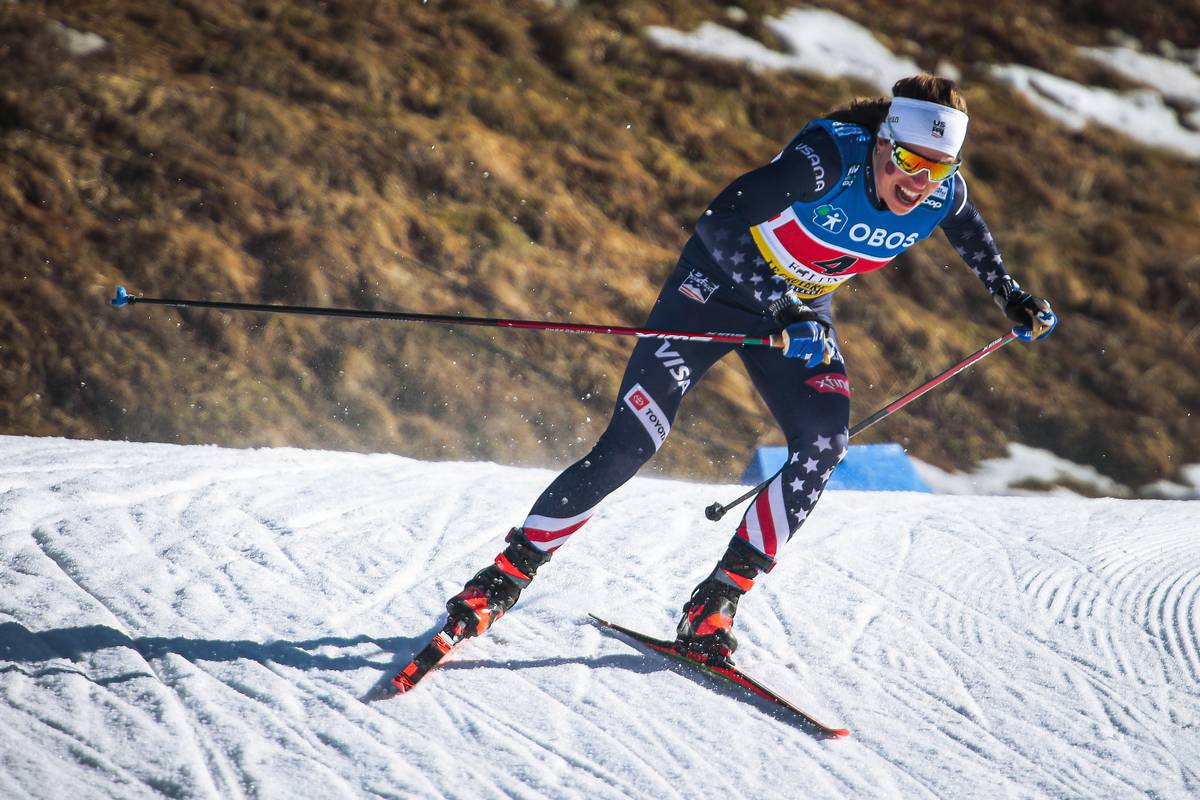
With Jessie Diggins (USA) now retired, there will be a new FIS Overall Crystal Globe and Tour de Ski champion next season (Photo: Vanzetta/NordicFocus)
Tour de Ski 2026/2027
The Tour de Ski returns to a three-country format, opening in Les Rousses, France, on New Year’s Day, moving to Oberstdorf, Germany, and finishing with three races in Val di Fiemme, Italy — capped, as ever, by the Final Climb up Alpe Cermis.
January 1-3, 2027: Les Rousses, France
01/01: Sprint Classic
02/01: 20km Mass Start Classic
03/01: 15km Pursuit Freestyle
January 5-6, 2027: Oberstdorf, Germany
05/01: 15km Mass Start Classic
06/01: 5km Heat Mass Start Freestyle
January 8-10, 2027: Val di Fiemme, Italy
08/01: 15km Skiathlon
09/01: Sprint Freestyle
10/01: Final Climb
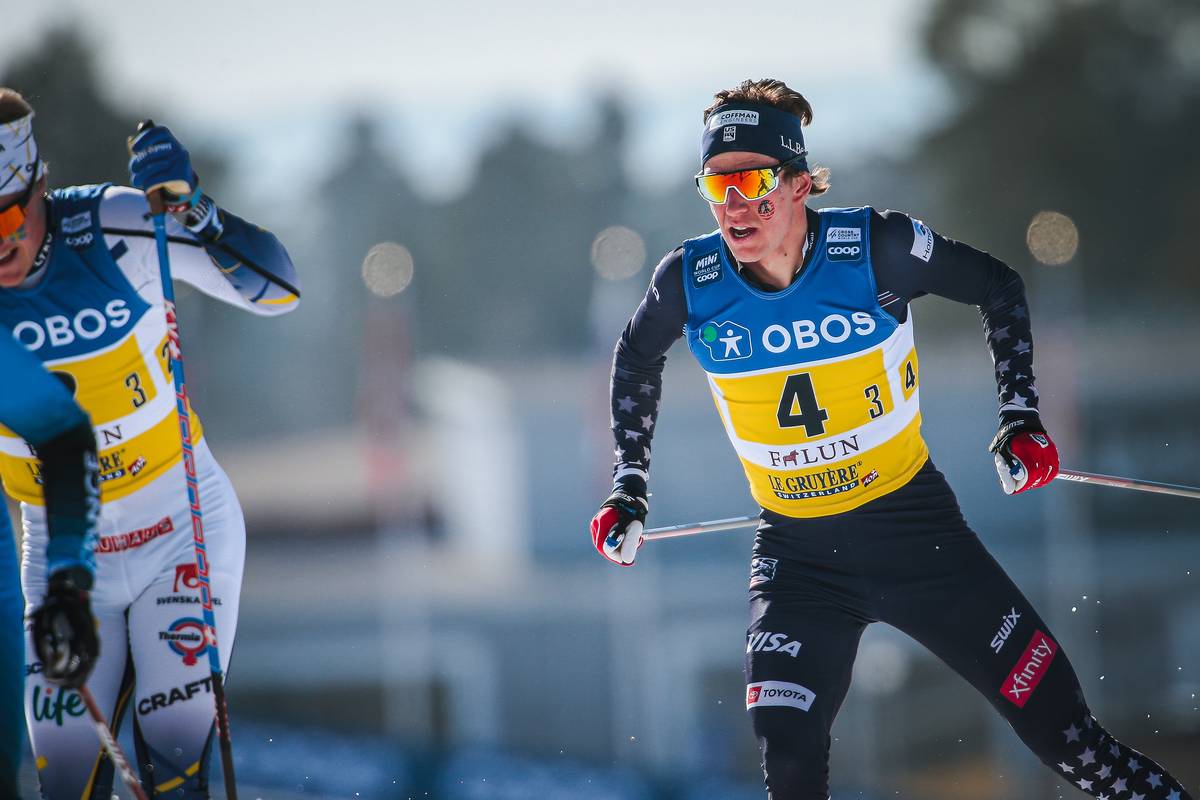
Gus Schumacher (USA) and the rest of the US team will hope to continue their success in Toblach (ITA). (Photo: Modica/NordicFocus)
After the Tour, Before Worlds: Engadin, Toblach, Lahti
Three weekends bridge the Tour de Ski and the World Championships. Engadin opens its weekend with a mixed relay — a format the FIS has been working into more World Cup weekends — and Lahti closes the pre-Worlds stretch with its classic 20km skiathlon and 10km interval start.
January 22-24, 2027: Engadin, Switzerland
22/01: Mixed Relay
23/01: Sprint Freestyle
24/01: 20km Mass Start Freestyle
January 29-31, 2027: Toblach, Italy
29/01: 10km Interval Start Freestyle
30/01: Sprint Freestyle
31/01: 20km Mass Start Classic
February 12-14, 2027: Lahti, Finland
12/02: Sprint Classic
13/02: 20km Skiathlon
14/02: 10km Interval Start Classic
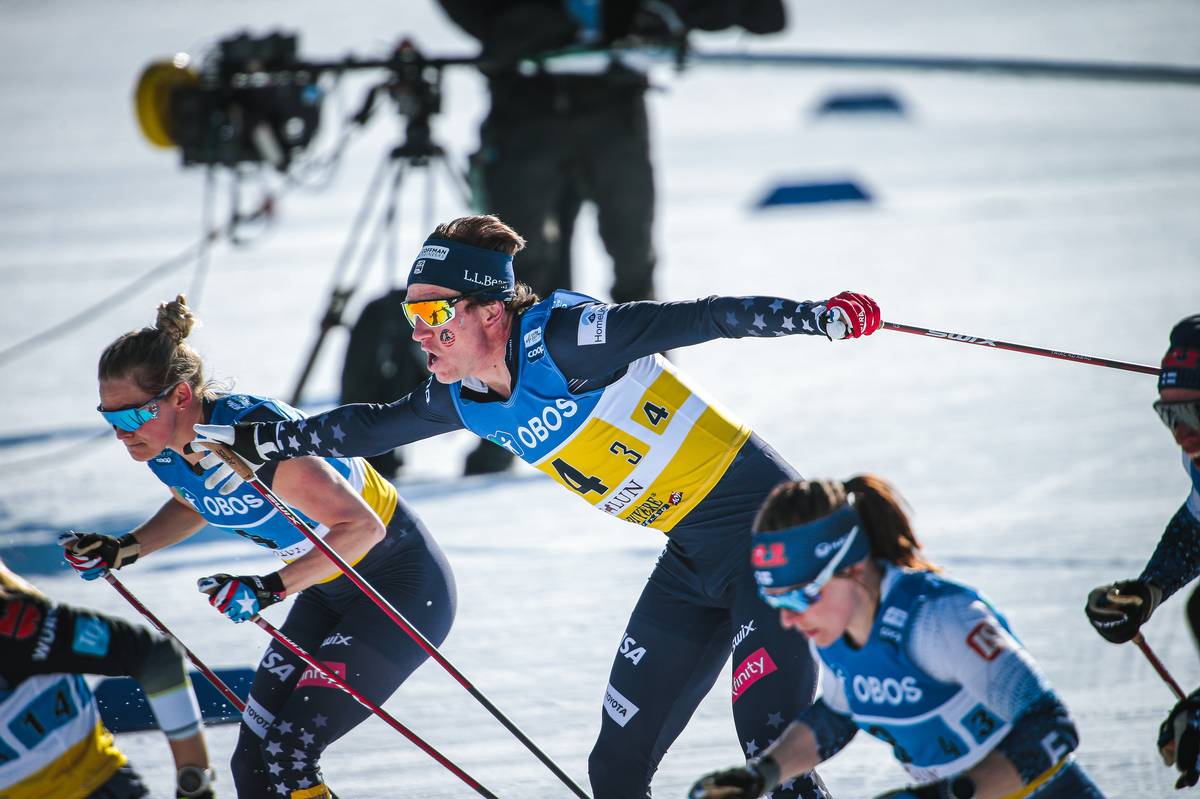
Kendall Kramer (USA) had a breakout World Cup Skiathlon in Falun (SWE) last season. (Photo: Authamayou/NordicFocus)
2027 FIS Nordic World Ski Championships: Falun, Sweden
The 2027 FIS Nordic World Ski Championships run from February 22 through March 7 in Falun, Sweden, with all title formats on the program. Falun last hosted Worlds in 2015.
Final Period: Oslo, Drammen, Ulricehamn
The closing stretch is a Scandinavian one. Oslo’s Holmenkollen weekend features back-to-back 50km mass start classic races on March 13 and 14 — long a fixture of the late-season calendar — before a one-day sprint stop in Drammen and the World Cup Finals in Ulricehamn, Sweden.
March 13-14, 2027: Oslo, Norway
13/03: 50km Mass Start Classic
14/03: 50km Mass Start Classic
March 16, 2027: Drammen, Norway
16/03: Sprint Classic
March 19-21, 2027: Ulricehamn, Sweden (World Cup Finals)
19/03: 10km Interval Start Freestyle
20/03: Sprint Freestyle
21/03: 20km Mass Start Classic
The calendar remains subject to FIS Council approval.
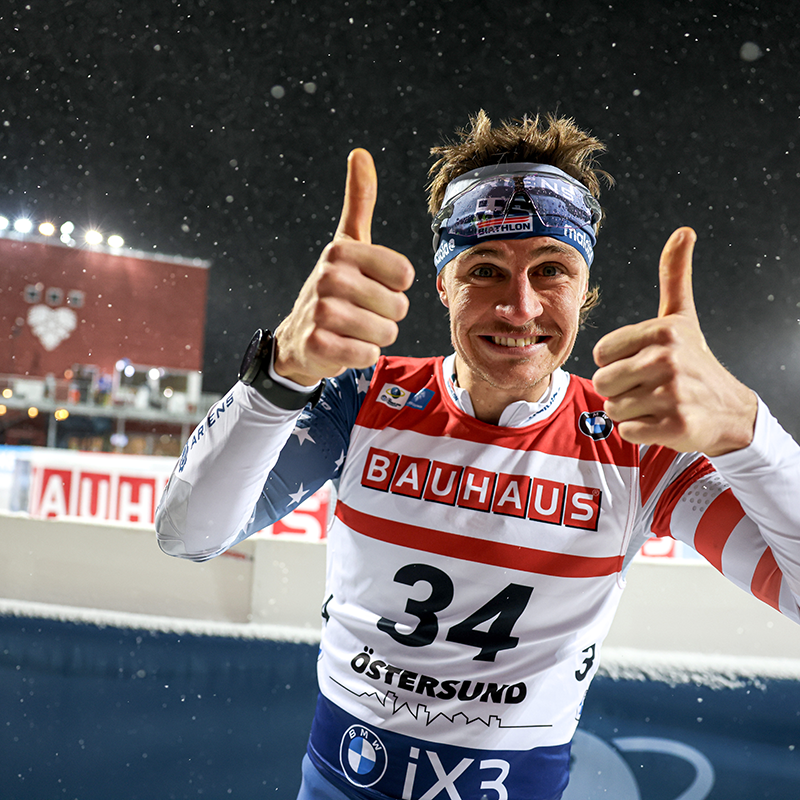
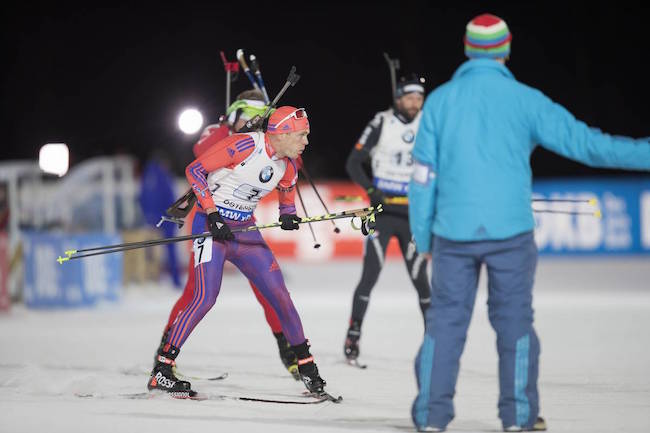
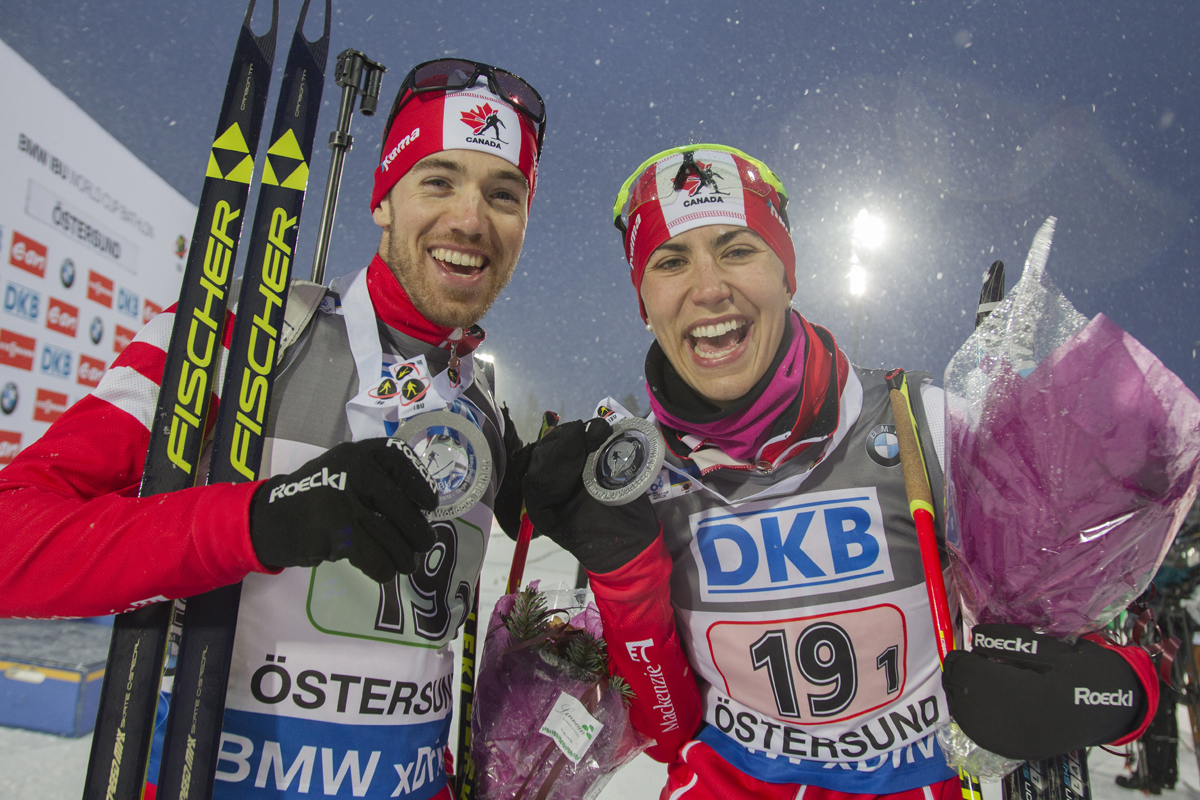
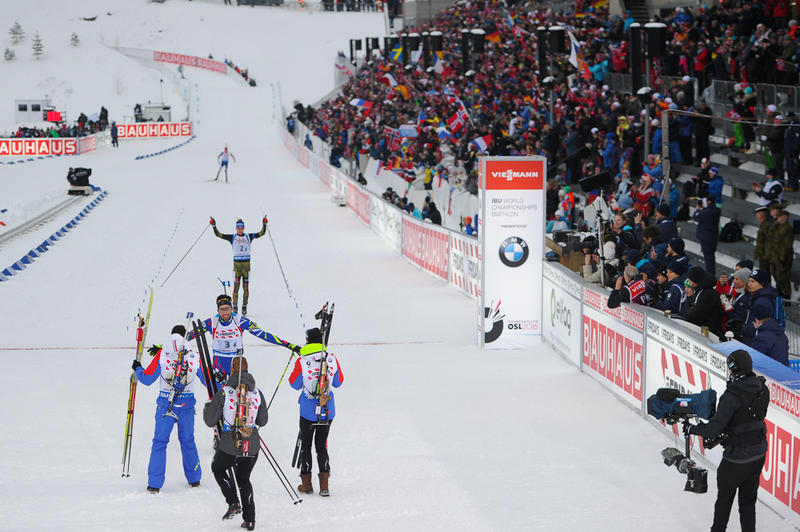
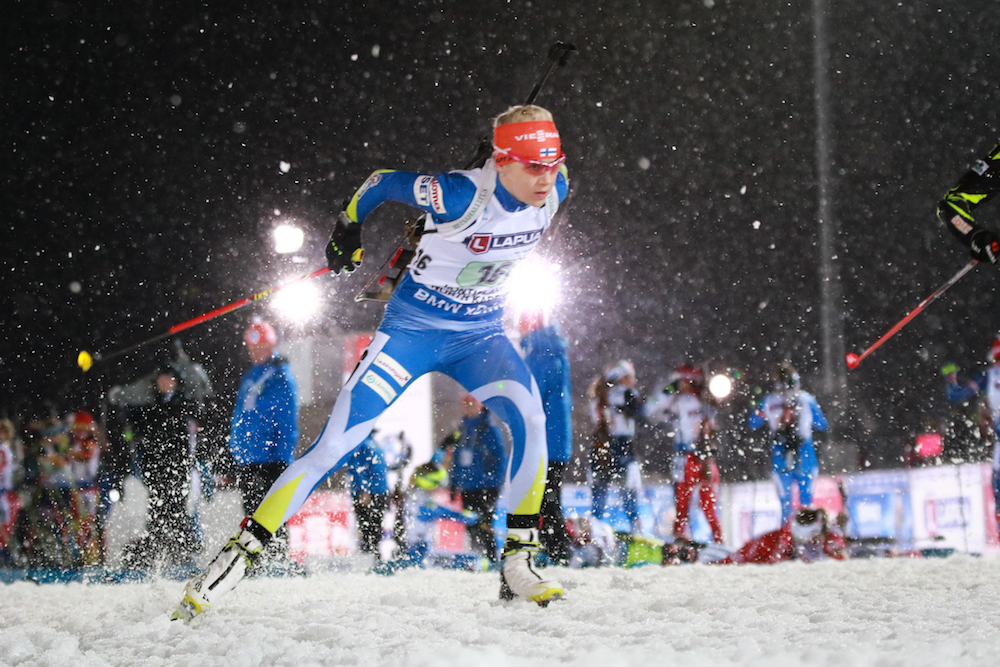
At the first biathlon World Cup races of the 2025/26 season, the biathlon stadium is perched above the small city of Östersund, which is set on a lake. Wind gusts off the lake, pulsing through the stadium. The races take place under the lights, at night – which isn’t saying much. Because in December in northern Sweden, ‘night’ begins at three in the afternoon, when what little sun there might’ve been throughout the day slips below the horizon. It’s in the evenings that the wind is usually at its strongest. The conditions the racers zero their rifles at before the race are rarely the same conditions they find when they come back to the range during the race. Athletes watch the small, red flags in the range, seeing which way they’re moving, deciding whether or not to shift their sights a few clicks, compensating for the changes that happened while the racers skied the course that serpentines up, down, around a 180-degree turn, and back into the stadium where the music plays and the home crowd cheers. Ayyy! As the Swedes hit their targets. A diluted Ney for each Swedish miss.
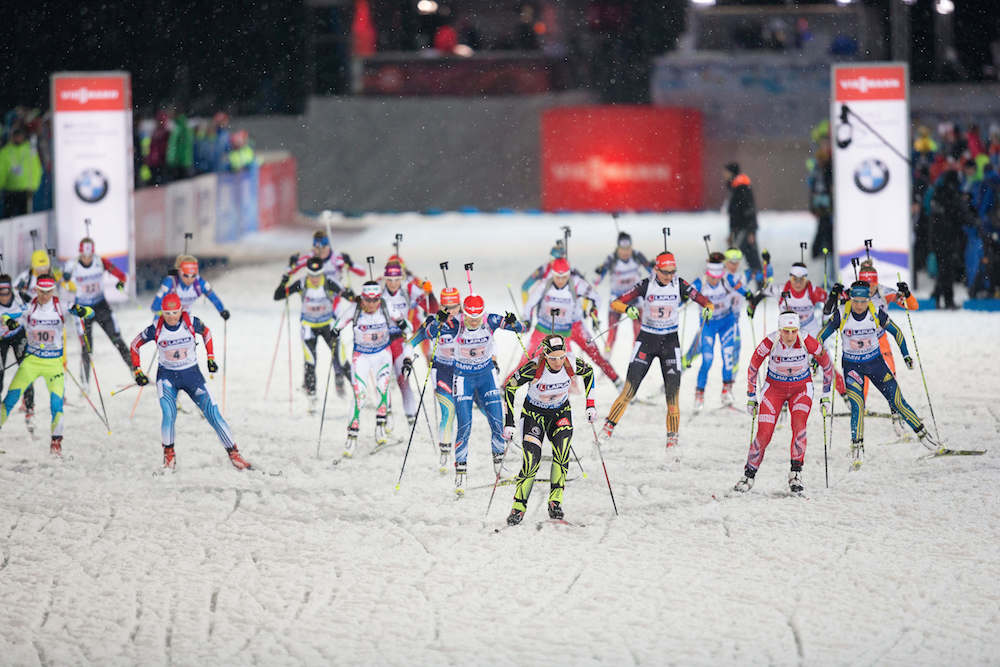
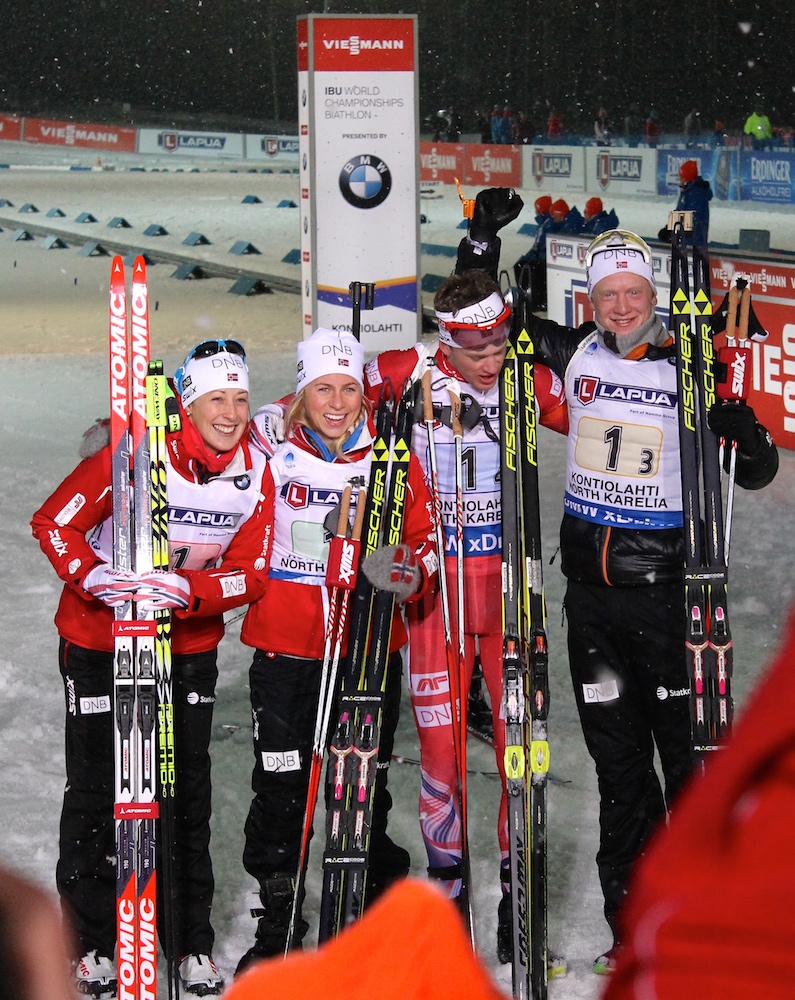
The mixed relay at the opening stop, Oestersund (SWE), of the 2025/26 IBU World Cup Biathlon season. (Photo: Manzoni/NordicFocus)
Over eight days, the best biathletes in the world raced 10 times. Maybe it was the arduous schedule, or the bit of sharpness that an Olympic year adds, but the Ostersund races didn’t feel like the first of the season. It felt like a break had never happened.
One question lingering from the off-season was answered quickly: What would Norwegian biathlon look like without the Boe Brothers? The dominant duo of Johannes Thingnes and Tarjei Boe – owners of eight Olympic medals – retired at the end of the 2024/25 season. Leaving what one would assume would be a major hole in the program. But when the Norwegian men came out and won the men’s 4 x 7.5km relay at Ostersund, the Norwegian’s roster depth became clear.
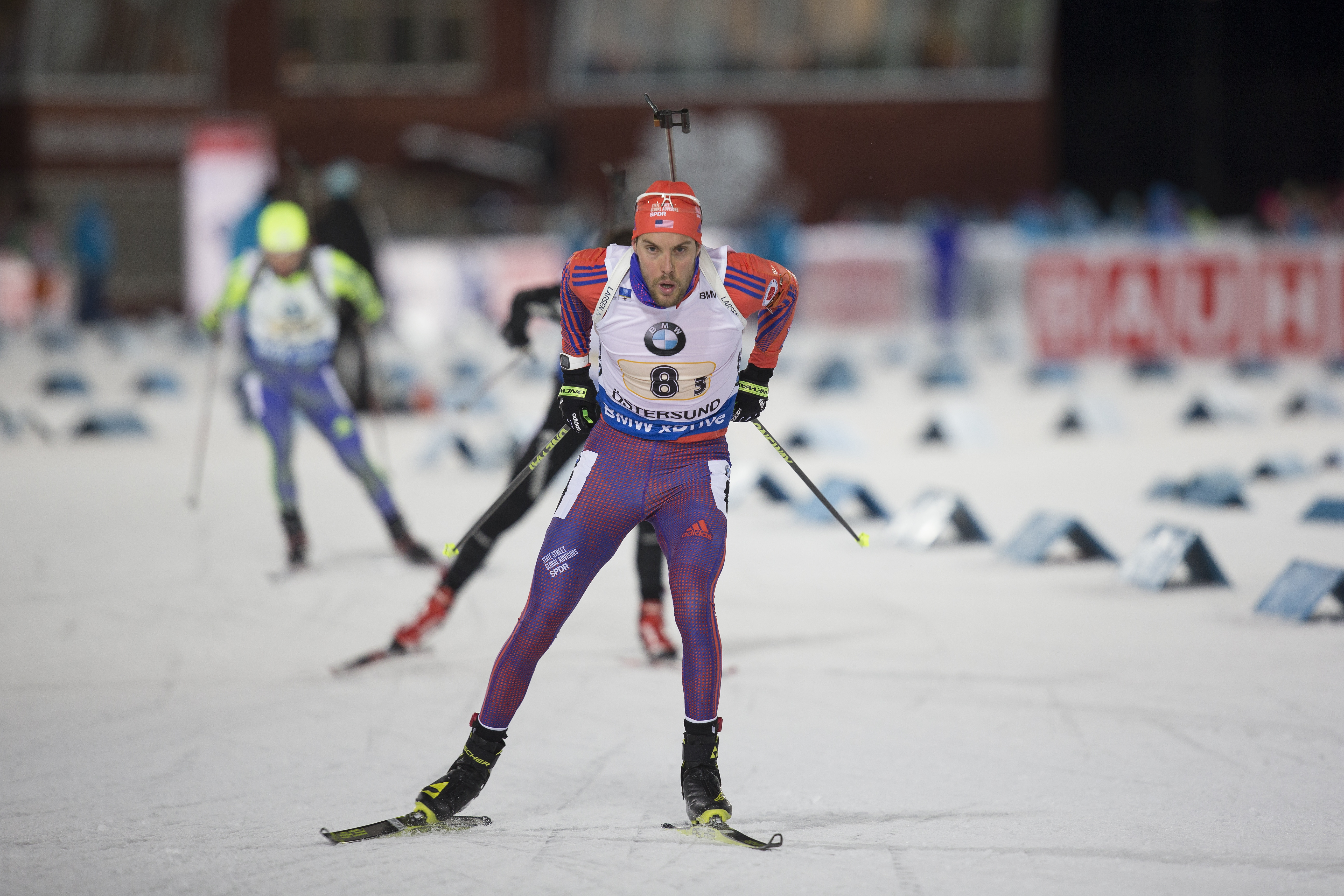
Campbell Wright (USA) during the IBU World Cup Biathlon Men’s Relay in Östersund (SWE). (Photo: Manzoni/NordicFocus)
The men’s relay saw a top result from the U.S. men, as well. Paul Schommer, Campbell Wright, Maxime Germain and Sean Doherty finished fifth, one of the best men’s relay finishes ever for Team USA. The next day, at the mixed relay, Germain, Wright, Chloe Levins and Deedra Irwin placed sixth – which is the best finish for a U.S. mixed relay since 2021.
Artem Tyshchenko (UKR) and Paul Schommer (USA), (l-r) during the Men’s Relay in Oestersund (SWE). (Photo: Manzoni/NordicFocus)
Germain and Wright continued to build on their early-week momentum, with Germain placing 11th in the sprint. In the pursuit, Wright hit all 20 targets for the first time in his career and moved up from 18th to 6th. Wright is coming off a stellar 2024/25 season, where he podiumed twice at World Championships, becoming the first American to do so.
Throughout the week, there were highs: Suvi Minkkinen of Finland won her first World Cup sprint. The Norwegian men placed four in the top five in the 20km individual, solidifying their capabilities as a team sans-Boes. And as always in biathlon, some lows: Eric Perrot of France missed his final shot in the pursuit, a devastating moment that cost him the lead. He finished fifth.
Racing wrapped up in Sweden, and teams flew to Austria. In Hochfilzen, a less rigorous racing schedule awaits: sprint, pursuit, and then a men’s and a women’s relay. A few more hours of daylight await, too.
Chris Grover is the U.S. Cross-Country Program Director. He has held that position for three years. He corresponded with FasterSkier’s Ken Roth in discussing the upcoming World Cup season, and an overview of the U.S. program. This is the second in a series of interviews with Mr. Grover.
The Russian Olympic Committee takes gold in the men’s 4 x 10 k relay in Zhangjiakou, but both Russian and Belarusian teams will continue to be banned from FIS competitions while war continues to be waged on Ukraine. (Photo: NordicFocus)
FIS (International Ski and Snowboard Federation) has reaffirmed the Russian ban. How do participating athletes feel about it? Do they feel deprived not being able to compete against some of the top skiers? Are skiers talking about how it will affect competition outcomes?
Europeans tend to see this as a very black and white issue, that the Russians and Belarusians should not be able to compete while (the war) is happening. At the same time, the athletes recognize, for the most part, that this is something that is happening to the Russian and Belarusian athletes, and they aren’t involved in the military or geopolitics. We all feel sad for the athletes and servicemen that we know. There are definitely two sides to see on the issue.
From a competition viewpoint, people aren’t looking at like “I’ll ski harder because people are absent.” We’ve kind of gotten used to absent teams. We’ve missed Norwegians, Swedes, and Finns over the last two years due to Covid. It’s a similar situation. Our perspective is that this is our one opportunity to perform. We can’t control the pandemic or geopolitics. We focus on just having the best race possible.
FIS voted last spring to change to equal distances for men and women. This came after an athlete survey which didn’t support it. Did it come as a surprise? What’s been the impact for training and planning?
The change came around really fast. One of the people who really drove it was Vegard Ulvang (former FIS executive board chairperson). His perspective was that the original thinking of the design of the distances was “old thinking.” Are we going to change with the times or (be) dragged into the future?
It’s not surprising it wasn’t popular in the athlete survey. Athletes have grown up racing and training for certain distances. To change that is really hard for the athletes to envision. But, the practicality of the changes aren’t that big . . . It may seem dramatic, but in reality, it’s not as big as you would think.
Some of the discussion was around things such as television time. Should this be part of the discussion?
Now women will have more television time. But changes have happened so that men’s and women’s race times have gotten a lot closer. More importantly, if there’s more coverage devoted to the women, then that’s great. The women deserve more attention than they get. They’re incredible athletes and we need to build the interest in women’s racing . . . In the U.S. we’ve had female winter sport superstars for a long time. It’s been slower to come around in some places in Europe. Getting the women more coverage will be helpful.
With the change in distances, genders will also race on the same course. This will be an indirect positive impact. It saves the organizers lots of money. You can use the same television cameras, and the same snow. That will be really critical this year when it comes to energy costs related to snow production. That’s a serendipitous advantage.
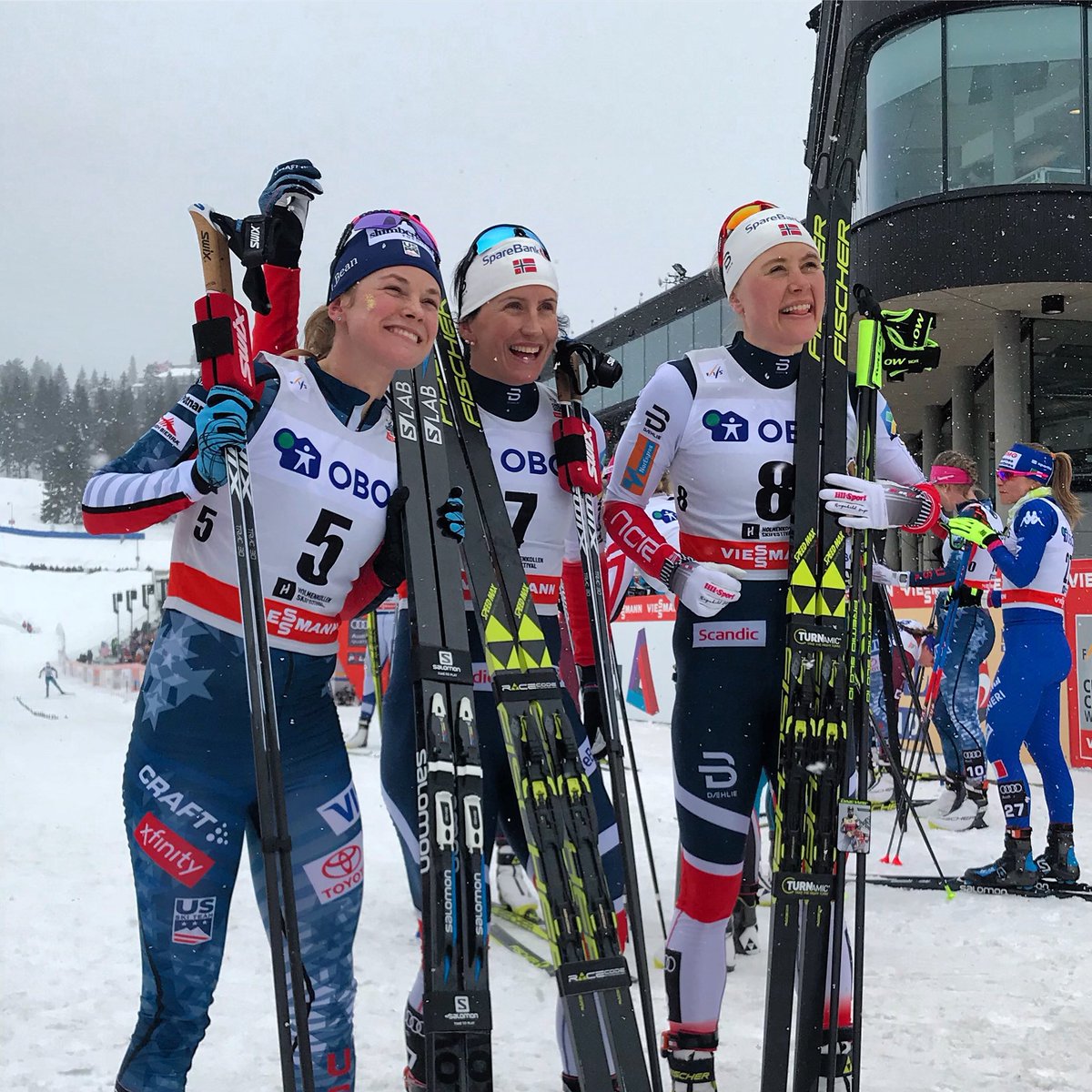
Jessie Diggins placed second behind Marit Bjørgen in 2018’s Holmenkollen women’s 30 k, but this season she is even more excited to be racing the 50 k freestyle distance. (Photo: FIS Cross Country/Twitter)
Are the women psyched about racing the 50k Holmenkollen?
Yes and no, depending on the athlete. Jessie’s really excited for it. This race has been going for over 100 years; and it will be skating this year. For the first time ever, the women will get to do the big race. That’s really exciting. There’s going to be a woman who’s the first time winner of the 50 K Holmenkollen. History will be made. That’s pretty exciting to contemplate. The one challenge is it’s also a week after the World Championships.
FIS is still on the fluoro merry-go-round; announcing fluoro bans and then backing off a couple of times. Has this caused turmoil in planning? Has FIS cried wolf too many times to be taken seriously on this issue?
The biggest issue for us on this has been financial. Instead of a straight transition to fluoro free, we’re having to make two transitions. We have to go from the world of C8 fluoros to C6 (differing fluorocarbon chain lengths found in the waxes), which we’re in now, to then potentially fluoro free. Every transition costs a massive amount of money in terms of testing and buying wax. Last year we had a massive investment into C6 wax when the call was made that we weren’t going fluoro free and that C6 wax would be allowed. We have boxes full of C8s, and made the transition to C6s. Then if you transition to fluoro free, you now have a bunch of obsolete C6 wax. Last year we spent double our budget on wax because of this.
I think our service guys agree the FIS decision to delay was correct. The new testing devices just haven’t worked that great. No one wants an environment when there are ways to cheat the ski testing protocols. The technology isn’t there yet to support an even, fair playing field.
FIS had their hearts in the right place with the original decision on fluoro and thought the technology would be easier. Making a detection device is way more granular than you think. You have to allow a certain percentage of fluoros to be ok. There’s a certain amount in the background, and testing in the field is harder than testing in the lab. No one understood the amount of challenges involved.
Are people concerned about ski doping?
Oh yeah. We’re worried about the same bad actors that have in the past been associated with doping finding another way to cheat. That’s why everyone wants the technology to be fool-proof.
Will teams have confidence in the testing technology once it’s implemented?
Yes, because teams are involved in the process already. Over the last several years, nations were invited to try and fool the testing devices. The bad news is, we could fool it. We have had a number of World Cups, and will have several this season, where we bring skis into the venues to test the devices’ accuracy. You can get creative trying to fool the machines. Things like burying fluorocarbons, using different application methods, and different layering. Testing the devices has been a group effort of all the nations.
In the spring we’re also testing proposed protocols. That means when the skis are tested, and when they go into a control area. The protocol is to test before races. For races with multiple rounds (sprints) this means skis going into controlled areas and picking up skis. Sprints will particularly tricky. It’s not realistic to submit skis for testing four times.
Are false positives an issue?
We’re testing for that to. Technicians are testing the machines with skis that have fluoros and skis that don’t. But, that’s one of the reasons proposed testing will be before the race. There are still a lot of things to figure out. For example, if a ski tests positive can an athlete submit a second pair? If you detect fluorocarbon ahead of the race, there’s no disqualification, the skier is just not permitted to start. You definitely don’t want to test after the race. There are lots of issues with that. You don’t want to have a winner disqualified afterwards.
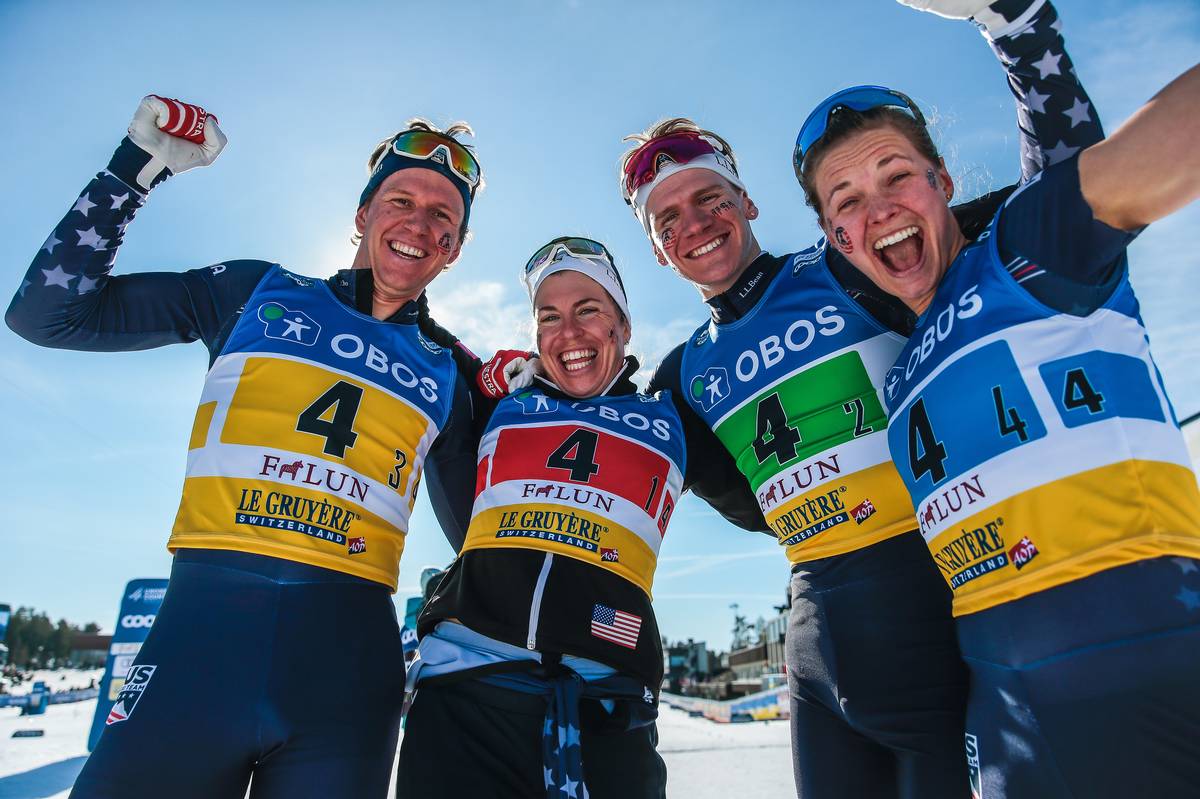
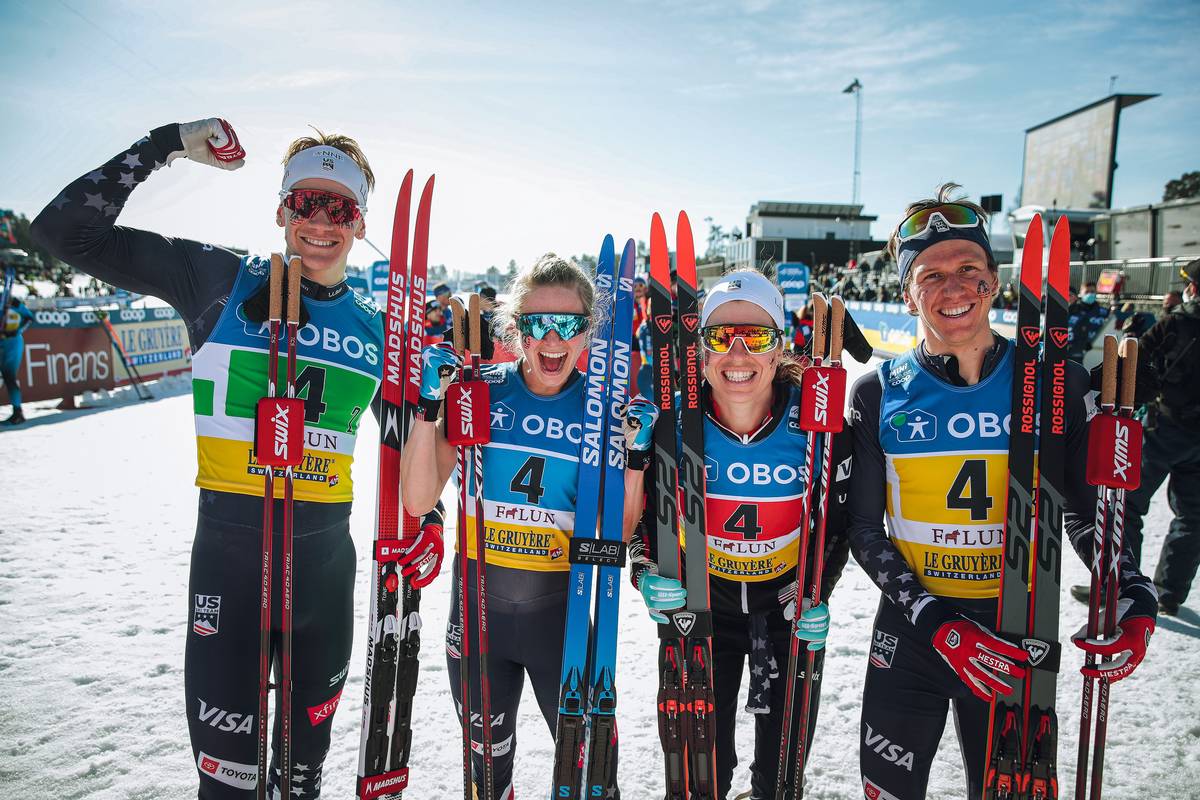
USA I took the win in Falun’s 4 x 5 k mixed relay. From left to right, Scott Patterson, Rosie Brennan, Zak Ketterson, and Jessie Diggins. (Photo: NordicFocus)
Will we see mixed gender racing?
Not at the world championships, but in the World Cup for sure, in mixed four by five relays. But, there will not be a mixed team sprint.
Additional thoughts you would like readers to know?
It’s going to be a really exciting season. Equal distances will be an interesting story in every race.
It’s going to be really exciting watching Jessie and Rosie battle for the overall championship. They’re at the height of their careers battling at the same time. It’s a huge gift to U.S. racing fans.
It’s also going to be exciting to watch all the emerging young talent we have. Another interesting story will be watching Julia Kern: she had a great last four to five weeks of her racing season last year.
The other neat story will be the two mixed team relays on the schedule.
There’s also been a push to cluster races at venues, so we’ll have a lot of three race day weekends. More events at every weekend brings more value to racing fans every weekend.
The teams have had a really good summer, so I’m really excited to see what everyone can do.
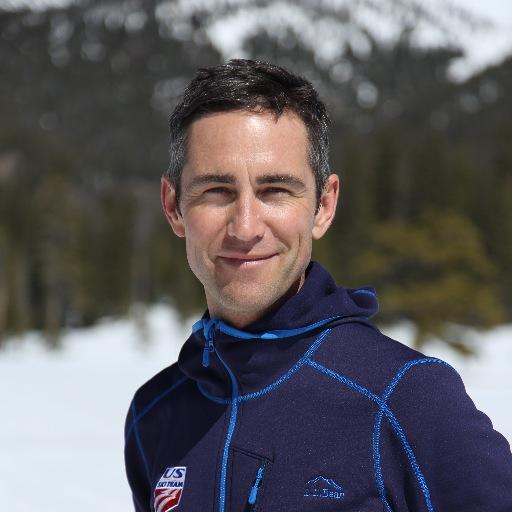
Chris Grover s the U.S Cross Country Program Director. (Photo, US Ski and Snowboard)
Julia Kern and US Ski Team head coach Matt Whitcomb watch the 4 x 5 k relay from the stadium. (Photo: NordicFocus)
This World Cup coverage is made possible through the generous support of Marty and Kathy Hall and the A Hall Mark of Excellence Award. To learn more about A Hall Mark of Excellence Award or to learn how you can support FasterSkier’s coverage pleasecontact info@fasterskier.com.
While it was perhaps not the final event originally planned for the season, today’s 4 x 5-kilometer freestyle mixed relay in Falun, Sweden shaped up to be quite a way to go out. Particularly for Team USA, who broke away in the final lap to take the win in 42:01.8.
With Rosie Brennan scrambling to tag Zak Ketterson for the second leg, Scott Patterson skating third, and Jessie Diggins anchor, it was a team composed of four skiers who had all raced into the top-15 in yesterday’s 10/15 k skate, three within the top-eight. Perhaps the only team more loaded was Norway 1, which featured Heidi Weng, Hans Christer Holund, Didrik Tønseth, and Therese Johaug, all of whom placed in the top-five yesterday, including both of the day’s winners in the final two relay spots. Also a force, Finland I consisted of three Olympic medalists, one of whom is the 2022 men’s World Cup distance champion with the lineup: Kerttu Niskanen, Perttu Hyvarinen, Iivo Niskanen, and Krista Pärmäkoski.
Each nation was allowed two teams, allowing the US to start a second lineup of Julia Kern, Logan Hanneman, Adam Martin, and Caitlin Patterson. Canada raced one team, which included Katherine Stewart-Jones, Antoine Cyr, Philippe Boucher, and Jasmine Drolet, racing in that order.
Stars and stripes at the front, as Julia Kern scrambles for USA II in Falun’s mixed relay. (Photo: NordicFocus)
New to the World Cup, the mixed relay is modeled after the biathlon competition format, which debuted in 2005. It had originally been slotted onto the calendar for the Canmore World Cup events in March 2020, which were canceled as COVID-19 began to spread around the globe. It had been tested on the tracks in Falun during the 2021 Swedish senior national championships, with local club leader Johan Eriksson saying afterward, “Team cohesion was strengthened when ladies and gentlemen fought against the same goal line. At the same time, the entertainment was great with reversals in the result lists and tactical moves in team line-ups.”
The entertainment value was certainly high today, particularly for American ski fans. Racing a distance now only seen in relays, it would be a painful blend of sprinting and distance. And the Americans would be lucky to have a woman anchoring the team who has previously been described as the “Queen of the 5 k skate”.
Rosie Brennan scrambles for USA I during the inaugural World Cup 4 x 5 k mixed relay in Falun. (Photo: NordicFocus)
As expected, the pace was high from the start, as the Star Wars theme blared through the stadium loud-speakers. Up for the task at hand, Brennan went toe-to-toe with the other women at the front through two 2.5 k laps. Later describing the event as “fast and furious”, Brennan kept USA I within the lead group, Kern duking it out on USA II alongside through the first lap.
“I think our goal today was to stay out of trouble and stay in the pack, and then let Diggy do her thing that she does best,” Rosie told FIS post-race with a laugh. “And that worked out really well.”
Brennan handed off to Ketterson at the first exchange, in line with Germany I, Norway I, and Sweden I, Finland I just behind.
Though new to the World Cup this season, Team Birkie’s Ketterson has consistently shown his range. Domestically, he won three SuperTour sprints, and stood on the podium in four distance races, one of which was also a win. He chiseled away at the World Cup puzzle, finishing just outside the top-30 during the Tour de Ski, and returning following the Olympic break to place 41st in Lahti’s distance classic race and at the 50 k classic at Holmenkollen. Smashing a 15th place finish in yesterday’s 15 k free, Falun has been a breakthrough weekend.
Though 5 k is not a distance men traditionally race on the World Cup, Ketterson emailed post-race that the event felt familiar and reminiscent of his early days in the sport.
“I am a huge fan of the 5 k race distance as I spent four years in Minnesota high school races doing that distance multiple times a week in the winter. Today brought me back to those days! It was super chaotic pack skiing but I felt really strong the whole time and did my best to keep up with the leaders. Honestly, when Jessie is your anchor, you don’t really have to worry too much about the rest!”
Zak Ketterson tags Scott Patterson during the 4 x 5 k mixed relay in Falun. (Photo: NordicFocus)
On lightning fast tracks with matching skis, Ketterson skied smoothly within the large lead group, keeping USA I within contact of the leaders, while Sjur Røthe tried to crack open pack for Norway II. Tagging Patterson roughly four seconds back, USA I sat in 10th, alongside Canada, at the second exchange. USA II tagged in 14th, +34 seconds back.
Still a large and dense group of front runners, Patterson worked at the back of the lead group to minimize further time losses, keeping his team within reach of the podium. With both Norwegian teams at the front in the second lap, Patterson whittled down the American’s time back, tagging Diggins 2.2 seconds behind the leaders to “do her thing” over two 2.5 k laps. Canada had lost contact with the front group, sitting in 11th (+17.9), while USA II tagged following a gap in 15th (+1:14.5).
“My goal was to hang on with the pack early and get in the groove, then try to match accelerations later,” Patterson wrote after the race. “I knew I wasn’t going to be the one with super accelerations but could sprint the whole way. During the race I was thinking ‘Just hold on’, so Jessie could work her magic relay anchoring skills. There were a few moments where some gaps formed but I barely managed to cling on.”
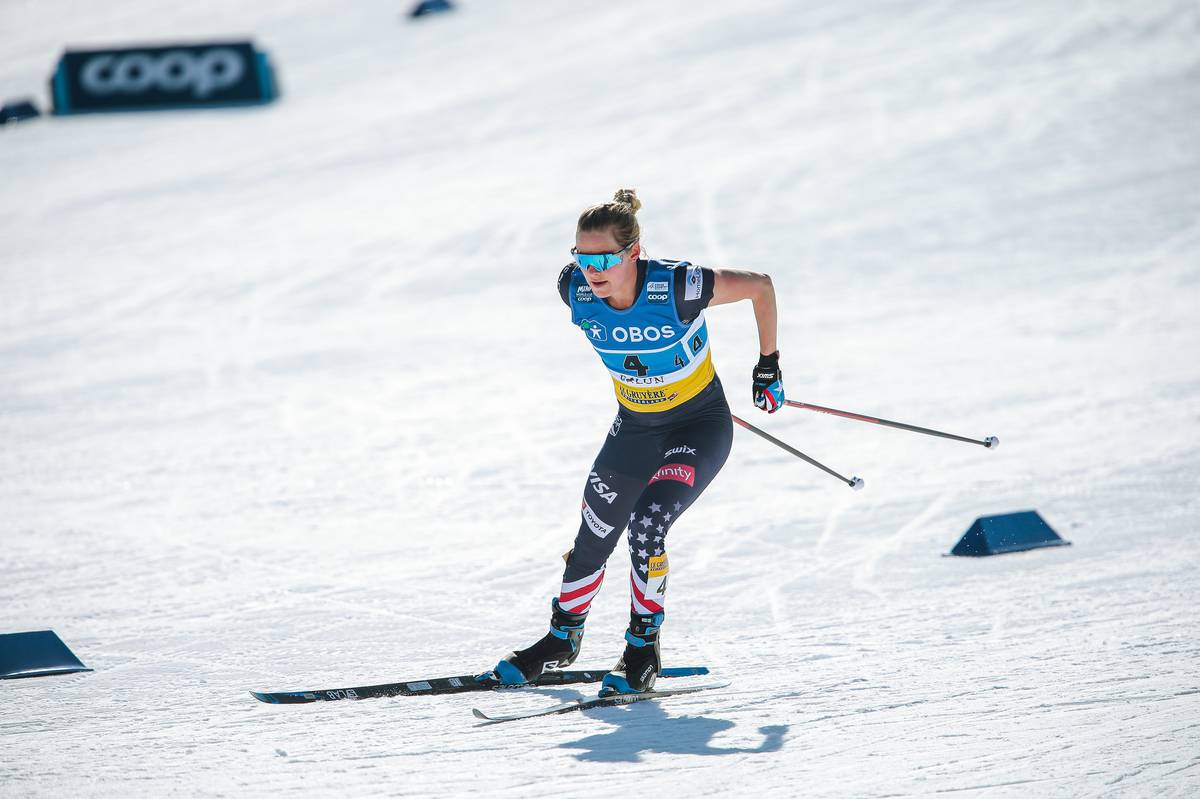
Scott Patterson races the third leg for USA I in Falun. (Photo: NordicFocus)Scott Patterson makes the final tag to Jessie Diggins during the 4 x 5 k mixed relay in Falun. (Photo: NordicFocus)
Diggins quickly got to work. Halfway through the first lap, it was Diggins marking Johaug at the front, with Krista Pärmäkoski for Finland I and Victoria Carl for Germany I tucked into their wake. Recall that Carl had anchored the German relay team for an Olympic silver medal in Zhangjiakou just a few weeks ago.
Skis ripping on the downhill, Diggins moved to the front to lap through the stadium 1.4 seconds ahead of Finland I and Norway I, Frida Karlsson for Sweden I challenging Germany’s Carl just behind.
Jessie Diggins brings USA 1 through the stadium in the lead after her first lap. (Photo: NordicFocus)
Diggins worked patiently up the climb, once more tucking behind the rapid fire tempo of Johaug on the uphill, and tucking calmly into the draft of the Norwegian and Finn heading into the descent. Diggins hit the second climb hard as the three women hop-skated up and over. Among the best descenders on the World Cup, Diggins skis were only fueling the fire, allowing her to maintain her lead in the rolling last kilometer and into the stadium which erupted with noise from the packed sidelines.
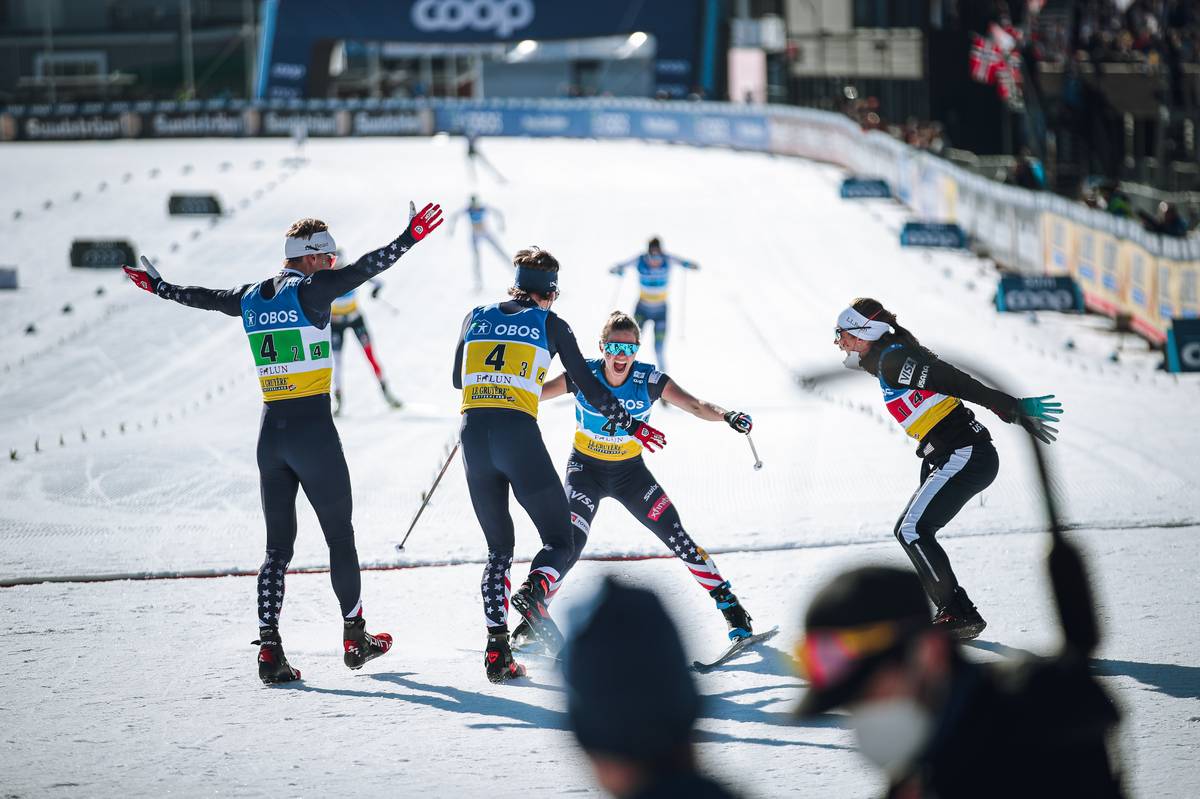
Rounding the final bend with a clear shot to victory, Diggins took a few tuck skate pushes before powering in V2 across the line with a fist pump and loud cheer, and maybe an expletive, before collapsing onto all fours surrounded by her ecstatic teammates.
Nerves run high as the American team waits for Jessie Diggins at the finish of the 4 x 5 k mixed relay in Falun. (Photo: NordicFocus)USA I celebrates victory as Jessie Diggins crosses the finish of the 4 x 5 k mixed relay. (Photo: NordicFocus)
Outsprinting the World Cup distance champion, Pärmäkoski edged out Johaug to bring Finland I to the line in second (+3.8), leaving Norway I just 0.5 seconds behind in third. Having strung out over the last lap, Sweden I took fourth (+9.1), with Germany I fifth following another gap (+16.2).
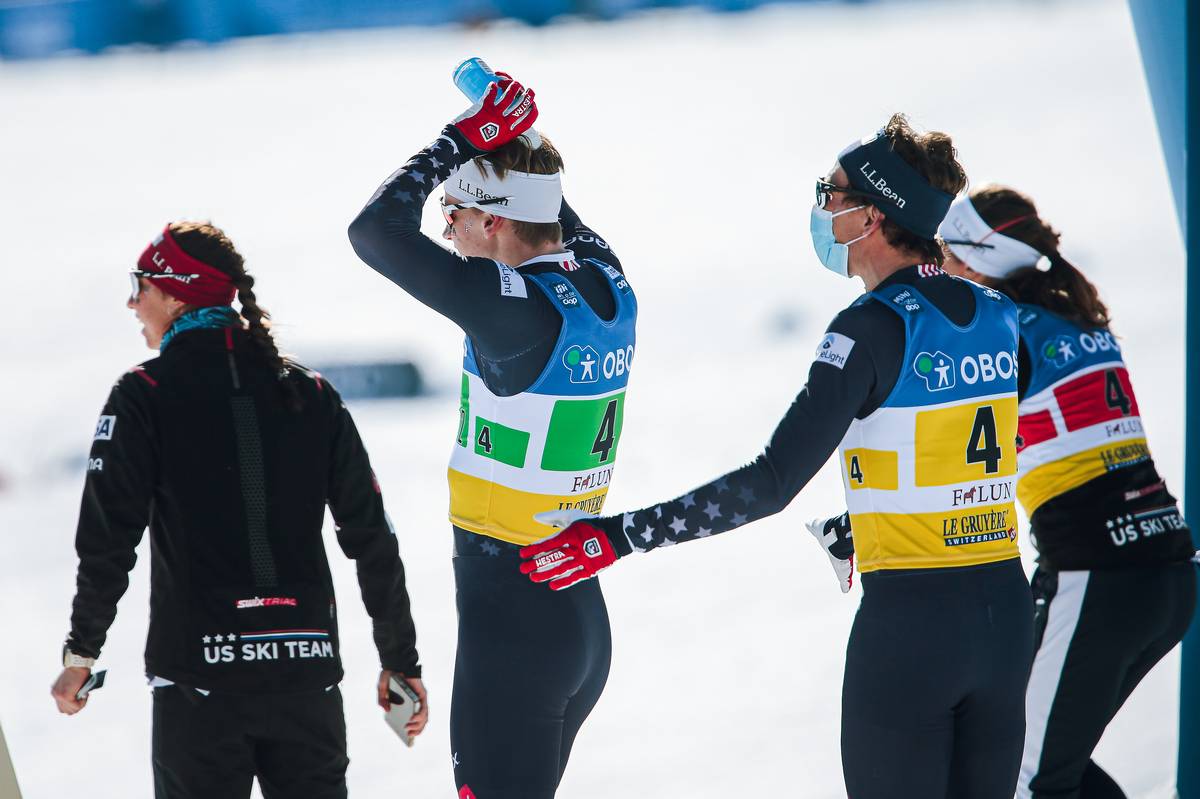
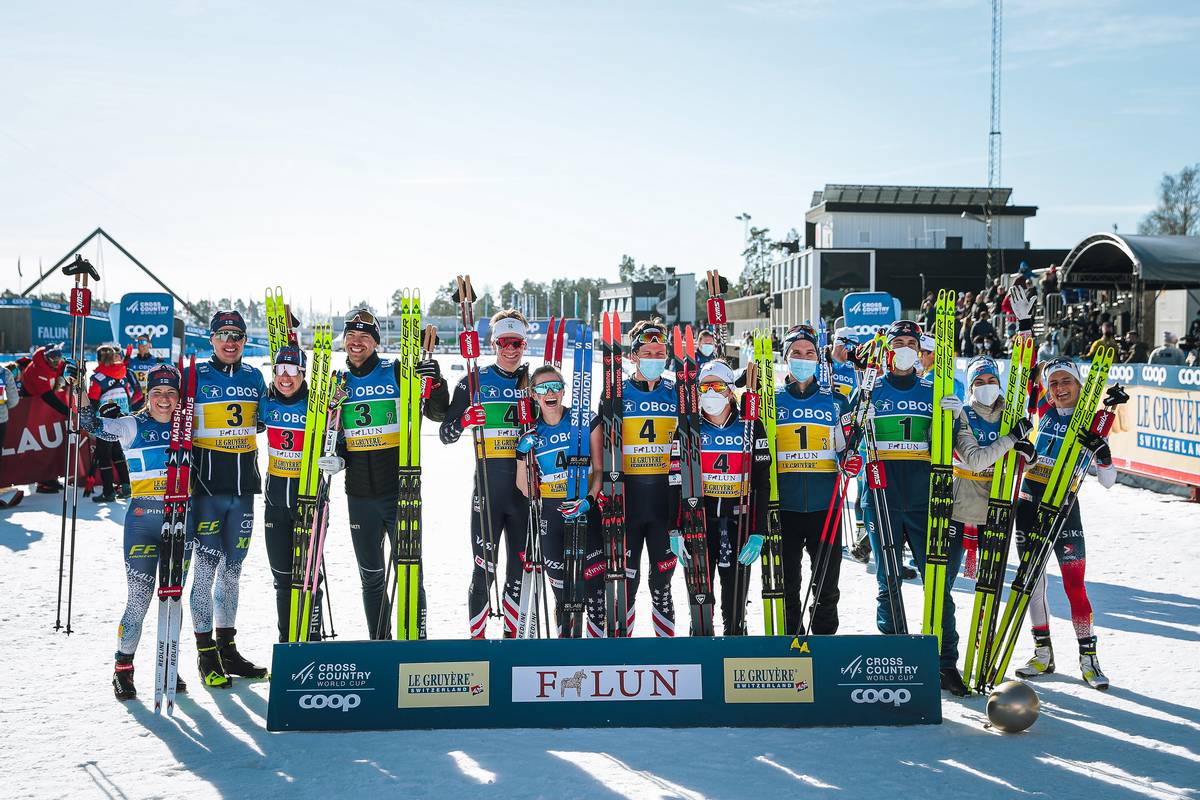
A packed podium for the 4 x 5 k mixed relay in Falun. USA I took the win ahead of Finland I and Norway I. (Photo: NordicFocus)
Describing the experience of winning the mixed relay on the final day of World Cup racing, Diggins told FIS with a laugh, “[It] feels like champagne getting sprayed on you.”
Surrounded by her teammates, she continued, “That was so, so fun. We really pulled together as a team. We live together as a team for four months on the road, so it’s pretty cool to get to end the season racing for each other. I’m so proud of these guys, so I was feeling pretty inspired.”
Jessie Diggins helps USA I to the mixed relay win in Falun. (Photo: NordicFocus)
Later sharing her strategy in a post-race audio clip as the remainder of the team packed their bags to begin travel home tomorrow, Diggins discussed her strategy as anchor, adding how the rockets under her feet allowed the race to unfold somewhat differently than she anticipated.
“I knew that those downhill working corners were one of my strengths, so I knew that if I got to the top of that big sprint climb first, then I could ski all the other downhills how I want and have a good shot at setting up a finishing sprint. As it turned out, we had such great skis that I didn’t need that finishing sprint, but it was so fun to go ski that as hard as I could. Again, I’m just so proud of the team. It was so special and fun to share that with everyone, and I can’t think of a more perfect way to end a really awesome year.”
Full post-race audio clip from Jessie Diggins:
USA I ends the season on top in the 4 x 5 k relay. From left to right, Zak Ketterson, Jessie Diggins, Rosie Brennan, and Scott Patterson. (Photo: NordicFocus)
“What a way to close out the World Cup season!!!!!” Brennan emphasized in an email. “After Scott and Zak had great days yesterday, I felt that we definitely had a chance, but I was not expecting a victory like that! It was fast and tactical racing out there and in the scramble leg, I wanted to stay near the front of the pack and stay out of trouble. I found myself further back in the pack than I wanted on the 2nd lap, but also knew a fall or broken pole would cost us so I tried to be patient, calm and tag off in the pack. Zak, Scott and I had the same strategy and Scott made a great move to get ahead of a split in the pack to tag Jessie in a great place. Jessie skied an insane leg and I feel lucky to have her as a teammate!”
Echoing her sentiments to conclude his post-race email from the road, Patterson added, “It’s really cool to win the last World Cup and especially awesome to be part of the team. The mixed gender event was extra special as the guys were finally able to tap into the relay energy the women have cultivated over many years.”
Canada’s anchor Jasmine Drolet receives a tag from Philippe Boucher during Falun’s mixed relay. (Photo: NordicFocus)Adam Martin tags his Craftsbury teammate Caitlin Patterson, who raced the anchor leg for USA II. (Photo: NordicFocus)
Losing contact over the third and fourth legs, consequently racing alone, Canada ended the day in 12th (+1:45.2), while USA II pushed alongside Finland II through its final lap. Edged out in the final sprint, Katri Lylynpera (FIN) snuck her boot over the line ahead of Caitlin Patterson’s, leaving USA II in 14th (+2:10.9).
Celebrations fed by cheering crowds, energy was high throughout the stadium. Regardless of finish order, acts of camaraderie and sportsmanship could be seen and heard as cameras meandered through the groups of athletes waiting for their relay teammates. We could hear a Frenchman congratulate Norway’s Tønseth on ending his season with an individual win, Ketterson and Kern anxiously trying to predict what might happen in the American’s final legs, along with a host of supportive cheers as teammates and coaches egged on the racers.
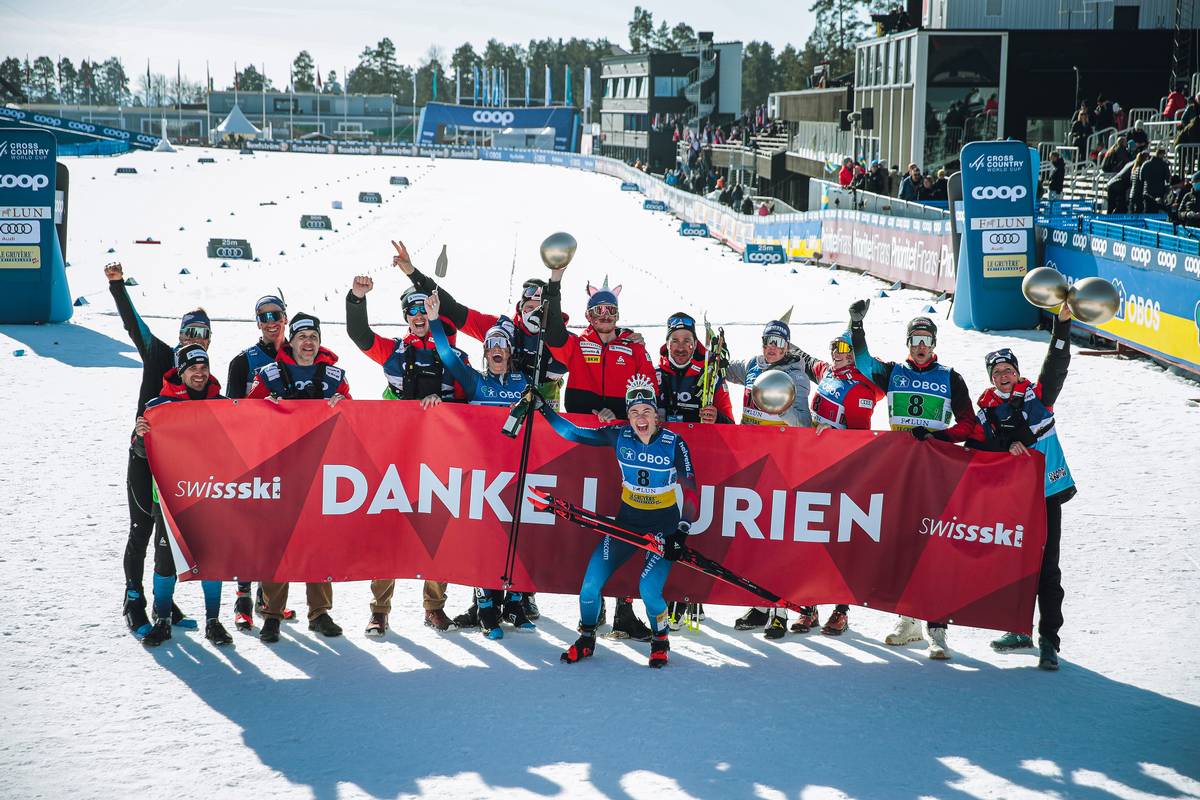
Awaiting the Swiss anchor Laurien Van der Graaff was a princess tiara, teammates in golden unicorn horns, and a large banner that read “Danke Laurien”, in celebration of her retirement. The 34-year-old has long been a presence on the World Cup, collecting a slew of podiums and a World Championship team sprint silver medal along the way.
The Swiss program celebrates the retirement of Laurien Van der Graaff at the finish of the 4 x 5 k mixed relay in Falun. (Photo: NordicFocus)
With revelry and thrill in the air, only the mixed team sprint remained on deck as the 2021/22 World Cup season drew to a close in Falun. The American program did not enter the team sprint competition, and will next compete as a team at the Whistler Olympic Park in British Columbia March 20th – 27th. The event will serve as both the Canadian National Championship and SuperTour Finals.
The tag zone during the women’s 4 x 5 k relay at the 2021 World Championships. (Photo: NordicFocus)
Following the FIS Cross-Country committee meetings in May, the FIS Council approved the race calendar for the upcoming season. On the list of events is the newly approved Mixed Relay (4x5km) and Mixed Team sprint, both to debut Sunday, March 13th, 2022 in Falun Sweden.
The Swedish Ski Federation and the “Svenska Skidspelen” organizers conducted a study on the feasibility of these formats before approval. At last year’s Swedish senior national competition in Falun, they held a mixed relay event which was a success. “[It’s] super fun to drive with the guys,” said Maja Dahlqvist according to a translation, “The women’s and men’s team have had a part in each other’s successes through team cohesion over the past year, so it will really be spicy teams that start together.”
Maja Dahlqvist (SWE) on her way to capturing a team sprint World Championship gold with partner Jonna Sundling (not pictured) at the 2021 World Championships. (Photo: NordicFocus)
Johan Eriksson, a club leader in Falun shared a similar sentiment saying, “Team cohesion was strengthened when ladies and gentlemen fought against the same goal line. At the same time, the entertainment was great with reversals in the result lists and tactical moves in team line-ups.”
The mixed format racing is nothing new for the International Biathlon Union. Biathlon has featured a mixed relay format since 2005, and it was first contested at the Olympics during 2014 in Sochi. Teams in the mixed relay consiste of two men and two women. In 2015, the single mixed relay was introduced and was added to the World Championships in 2019. This format is a two skier event – one female and one male.
Canadians Emma Lunder and Christian Gow compete in the IBU World Championship single mixed relay in Pokljuka (SLO). (Photo: NordicFocus)
This upcoming season marks the 40th anniversary of the FIS Cross-Country World Cup and this long-discussed race format further diversifies the World Cup’s race format offerings this upcoming Olympic season. “With Falun hosting two mixed team events on the same day, spectators on site but also fans in front of [the] TV can look forward to an extraordinary World Premiere in Cross-Country skiing,” says Pierre Mignerey, the FIS Cross-Country Race Director.
Other races that weekend include a classic sprint on Friday and a 10/15 k skate event on Saturday. The full 2021/2022 season calendar is now available on the FIS website.
Germany en route to a clean sweep of the podium in the men’s nordic-combined individual large hill/10 k on Tuesday at the 2018 Olympics in PyeongChang, South Korea, with Johannes Rydzek (5) leading Fabian Rießle (6) and Eric Frenzel (4). They went on to place first, second and third, respectively. (Photo: FlyingPointRoad)
A few shooting errors by pursuit bronze medalist Anais Bescond were not enough to derail France, as the team of Marie Dorin Habert, Bescond, Simon Desthieux, and Martin Fourcade took gold in the mixed relay. Skiing the first leg, Dorin Habert shot clean and tagged off just seven seconds behind the leading team from Italy. Bescond then used four spare rounds over the course of her relay leg, dropping the team to fourth (+48.9) at the halfway point. But both Desthieux and Fourcade shot 10/10, capitalized on the errors of others, and ended up with a clear 20.9 second margin for gold at the finish.
Susan Dunklee put the U.S. in fifth after the first leg of the mixed relay. (Photo: FlyingPointRoad)
Norway came back from a rough start to earn silver despite a whopping eleven spare rounds and a penalty loop. Marte Olsbu had three spare rounds to tag off in ninth, 32.8 seconds back, and then Tiril Eckhoff used two spare rounds in prone and then took a penalty loop in standing. But Johannes Thingnes Bø used just one spare round and skied the team from tenth to fourth, in contact with the medal pack, on his relay leg, and then Emil Hegle Svendsen used one spare round in each shooting stage to climb into a clear second; he skied alone on the final loop before crossing the line for silver.
There was controversy about bronze, however. Germany had led much of the race thanks to a solid leg by Vanessa Hinz to start and then a brilliant leg by Laura Dahlmeier; Erik Lesser also excelled, and at the third exchange the team had used just two spare rounds and had a 32.6-second lead on the field. But sprint gold medalist Arnd Peiffer couldn’t keep it together and first used a spare round in prone, then took a painful penalty loop in standing.
He exited the loop just as Italy’s Dominik Windisch went past. Lisa Vitozzi had put Italy in the lead after one leg thanks to perfect shooting, and despite three spare rounds Dorothea Wierer had tagged off in second at the halfway point. Lukas Hofer had maintained that position and Windisch was really only in fourth because of three of his own spare rounds.
Windisch and Peiffer battled all the way around the final 2.5 k, with Windisch leading the final downhill; the pair were nearly even coming into the stadium, but Windisch sprinted for the finishing lanes and in doing so angled from one far side of the trail to the farthest finishing lane, just barely getting there ahead of Peiffer and debatably choosing a lane before the lane markings began. Peiffer, who had skied a straight course all the way from the downhill into the finish, was forced to then switch lanes and couldn’t regain the momentum to keep up with the Italian, who crossed the line in third place.
The Germans protested, but the race jury ultimately decided to keep the Italians in third place, awarding them bronze, and the Germans finished fourth.
“The jury has decide to keep the bronze medal for Italy; Peiffer did not have to alter his speed, therefore no reason to disqualify Windisch,” the IBU stated in a tweet. (The response to that tweet has nearly unanimously condemned it as the wrong decision.)
The IBU 2016 Competition Rules give only a vague definition of obstruction, stating, “It is strictly forbidden to impede other competitors in any way at any time during the competition.”
The Canadian team of Rosanna Crawford, Julia Ransom, Brendan Green, and Christian Gow finished 12th, +2:36.7, with nine spare rounds.
The U.S. team of Susan Dunklee, Joanne Reid, Tim Burke, and Lowell Bailey finished 15th, +3:31.1, with three penalty loops and nine spare rounds.
Germany pulled off a podium sweep in the second nordic combined combined competition of the Olympics, with Johannes Rydzek, Fabian Riessle, and Eric Frenzel earning gold, silver (+0.4 seconds), and bronze (+0.8 seconds), respectively. They had been ranked fifth, sixth, and fourth after the jumping round on the big hill, but edged Norway’s Jarl Magnus Riiber off the podium. Riiber had the second-best jump of the day and ended up just 2.8 seconds out of a gold medal. Japan’s Akito Watabe topped the jumping scores and finished fifth, +12.5 seconds.
For the U.S., Bryan Fletcher led the way again and just like in the normal hill competition, finished 17th. This time he was ranked 23rd after the jump and made up six places to cross the line +1:42.9. Ben Berend, Ben Loomis, and Jasper Good finished 39th (+4:28.2), 40th (+4:38.8), and 43rd (+5:50.2).
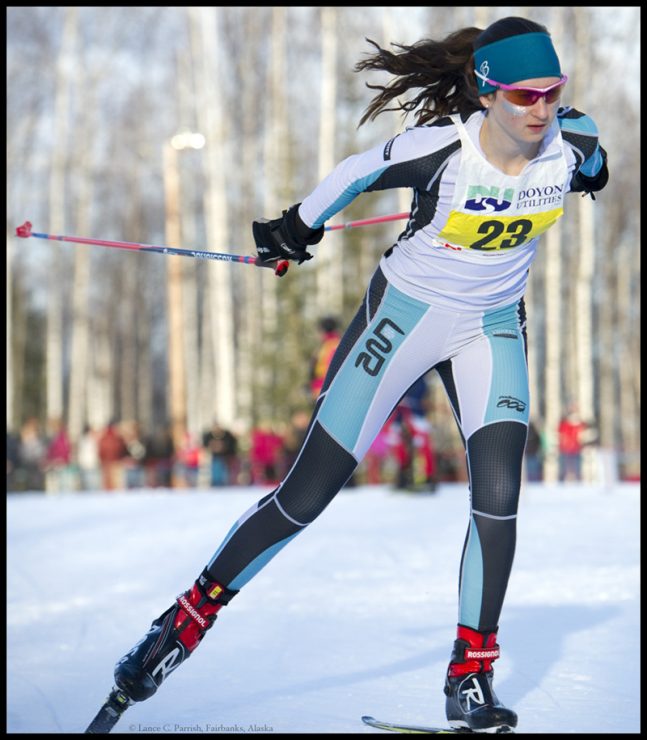
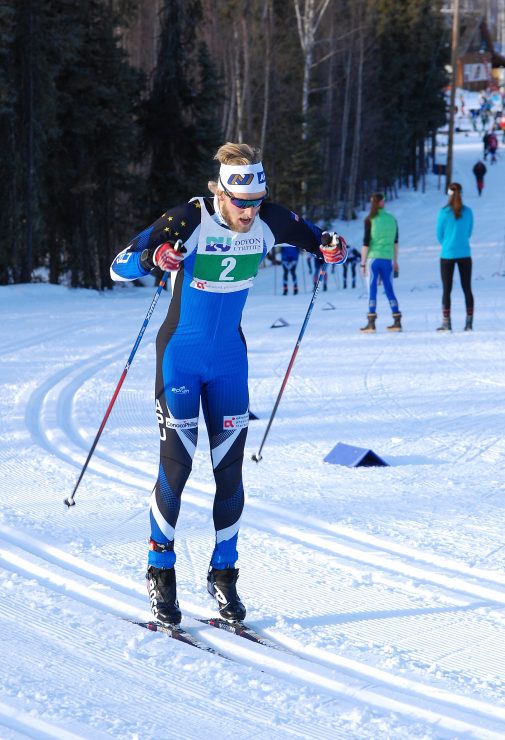
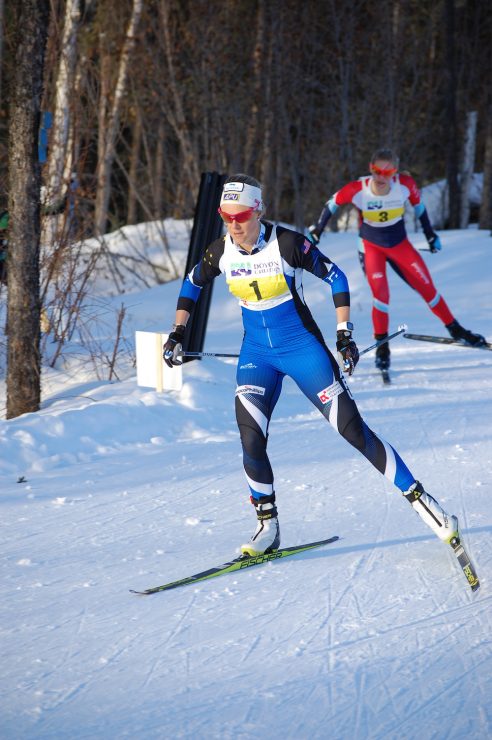
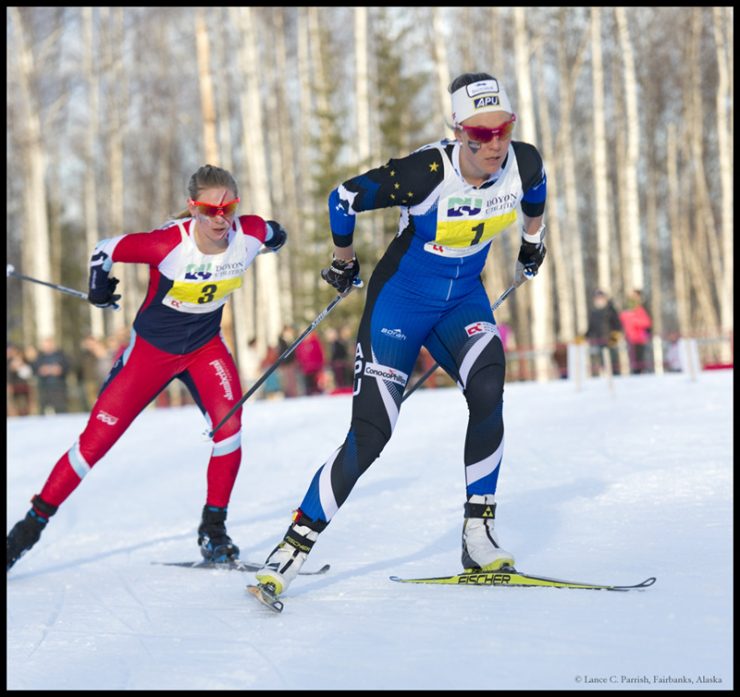
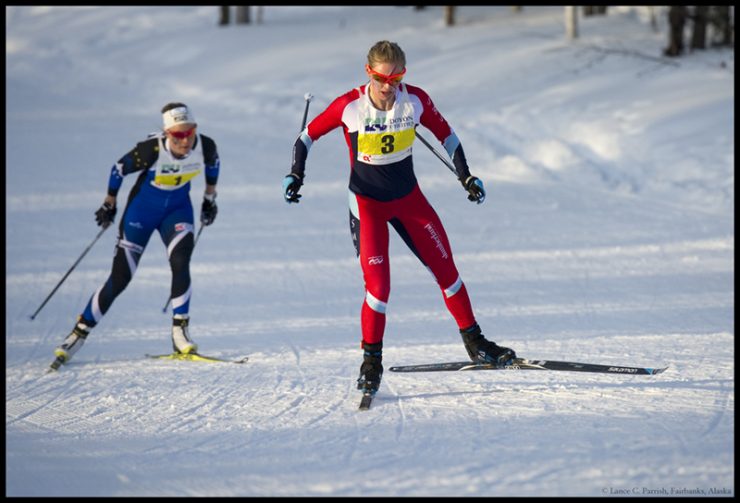
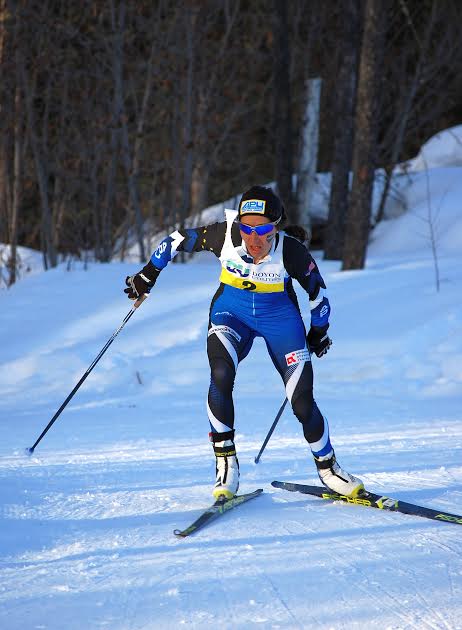
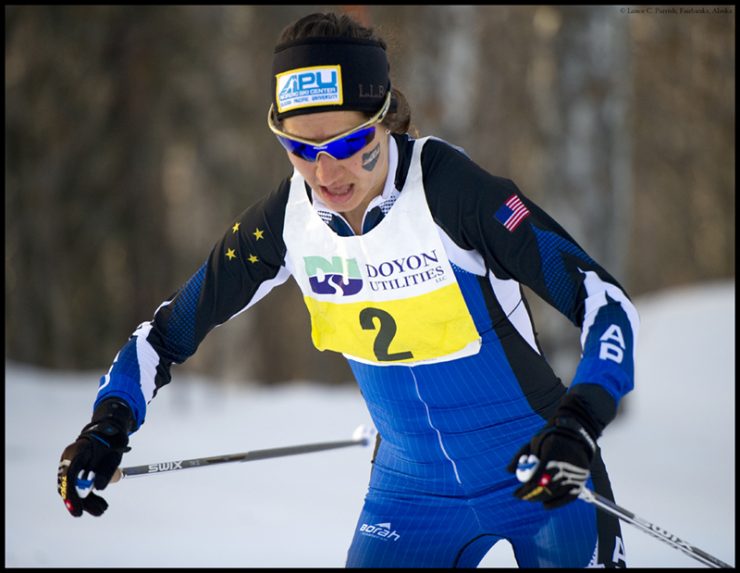
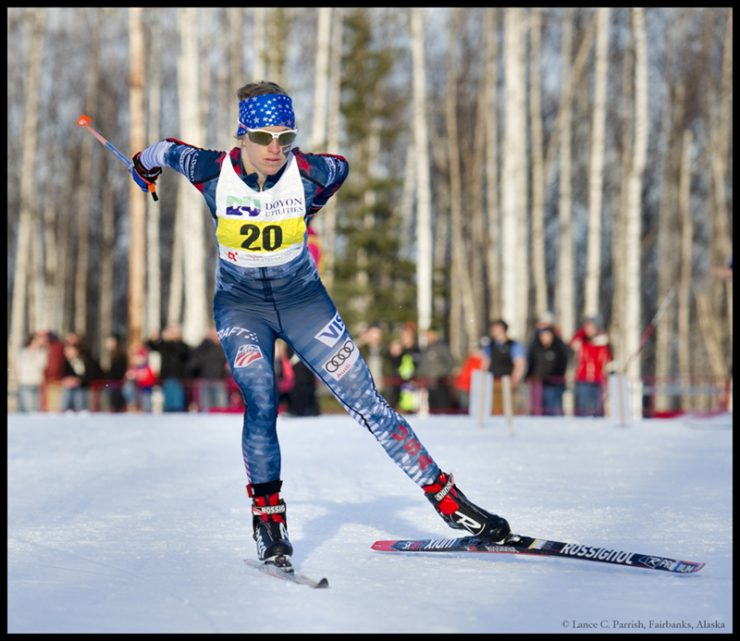
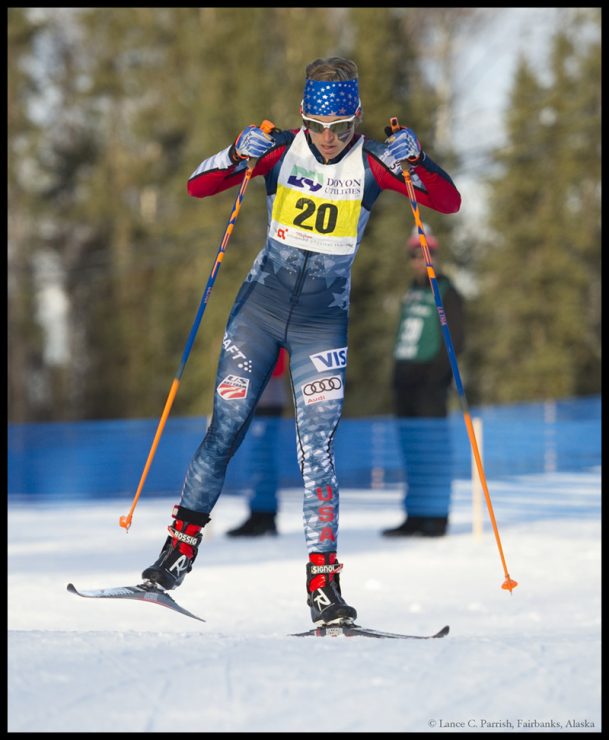
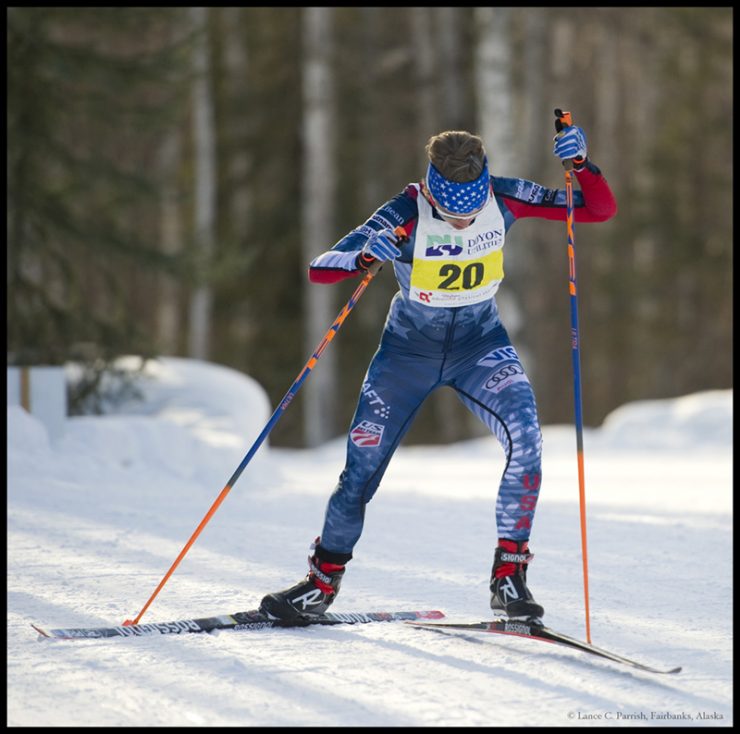
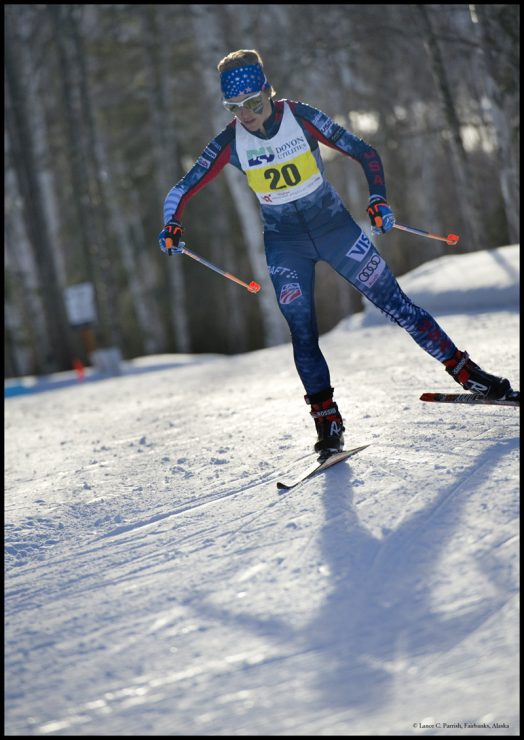
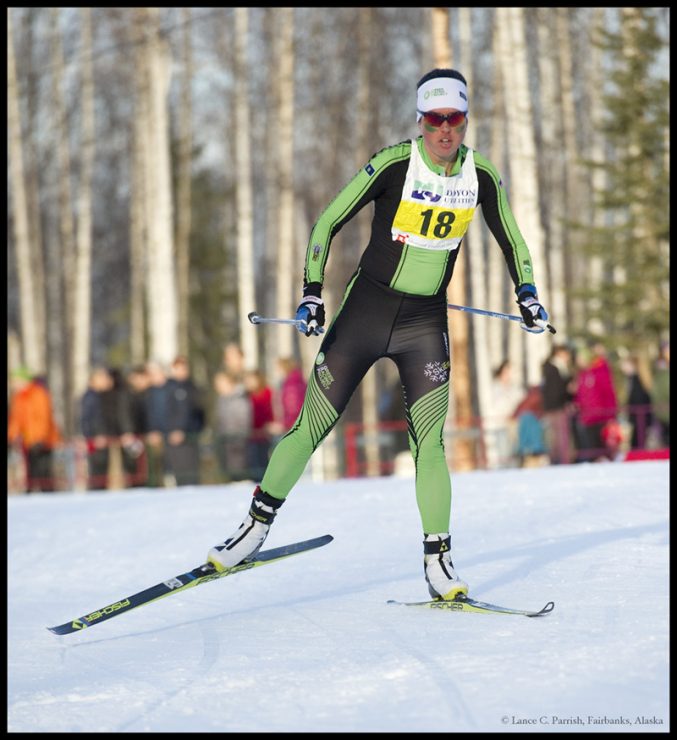
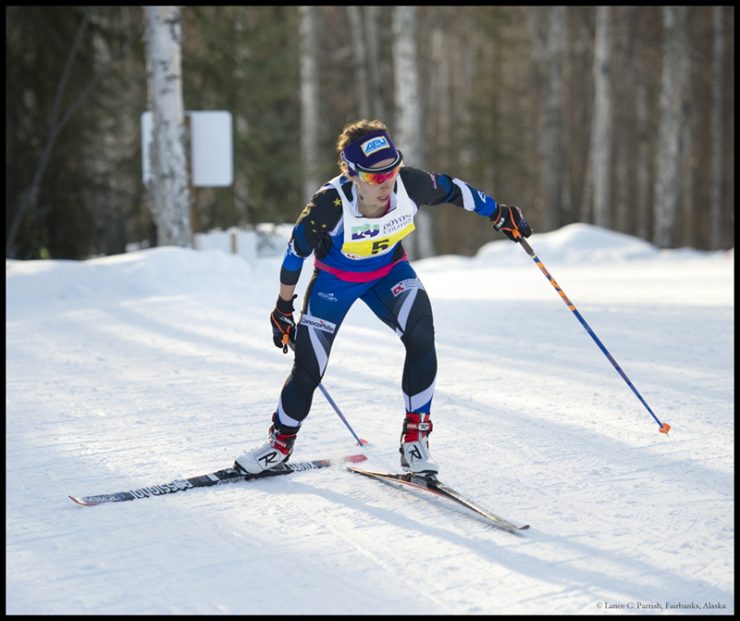
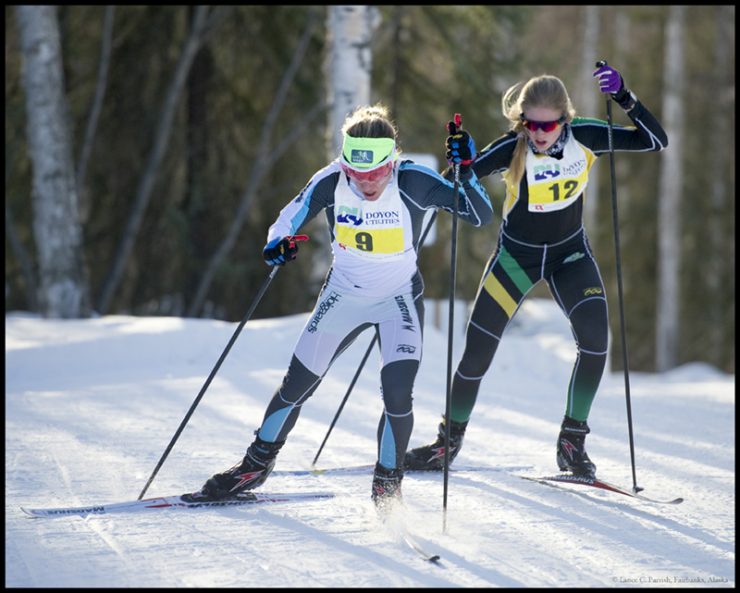
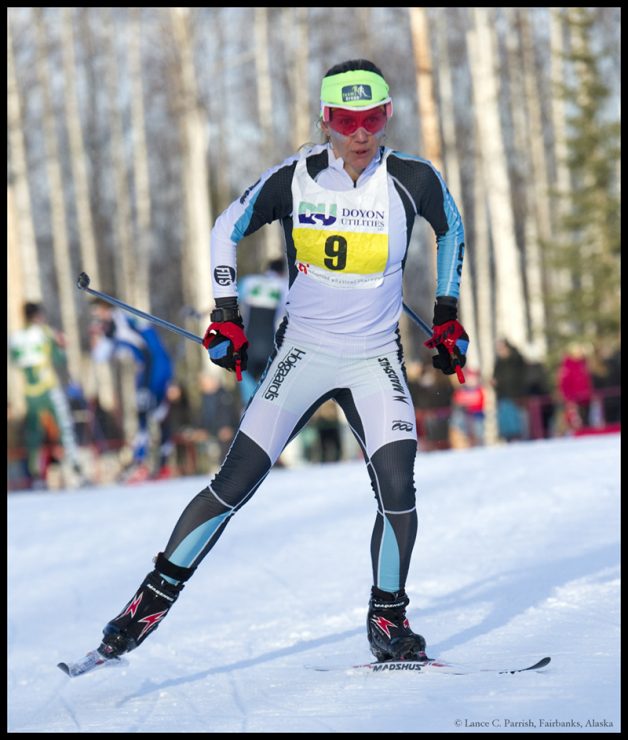
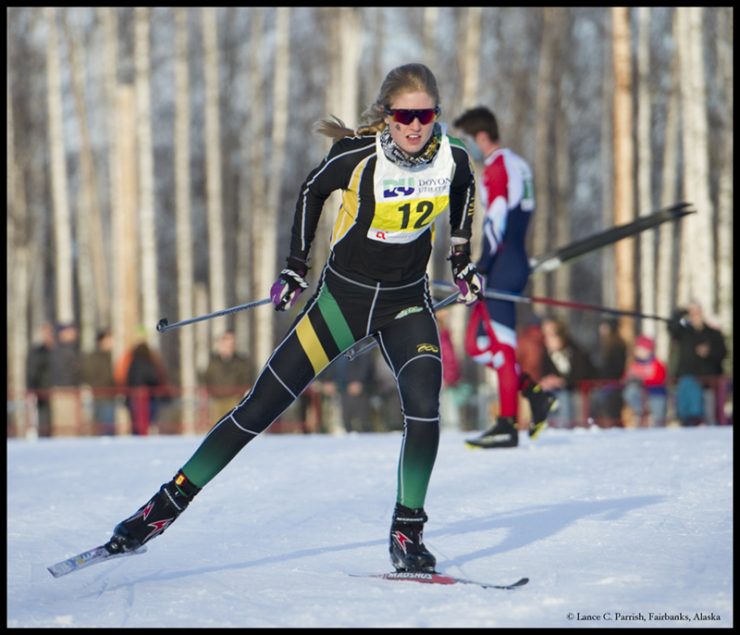
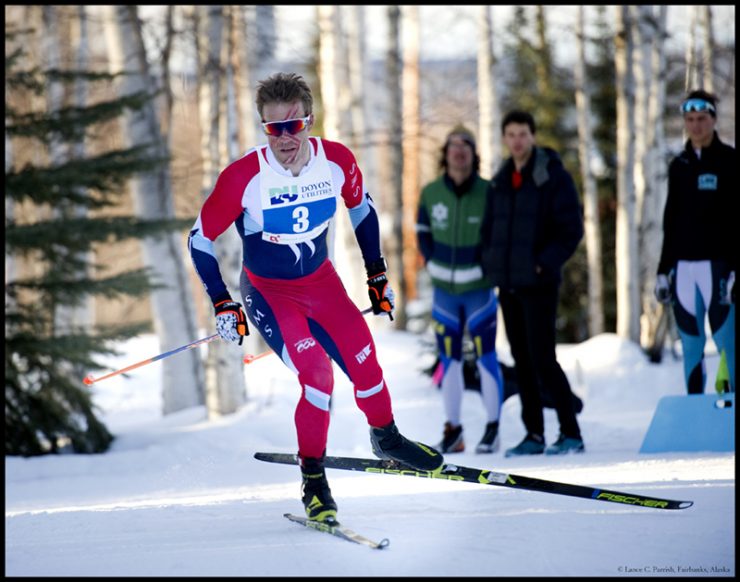
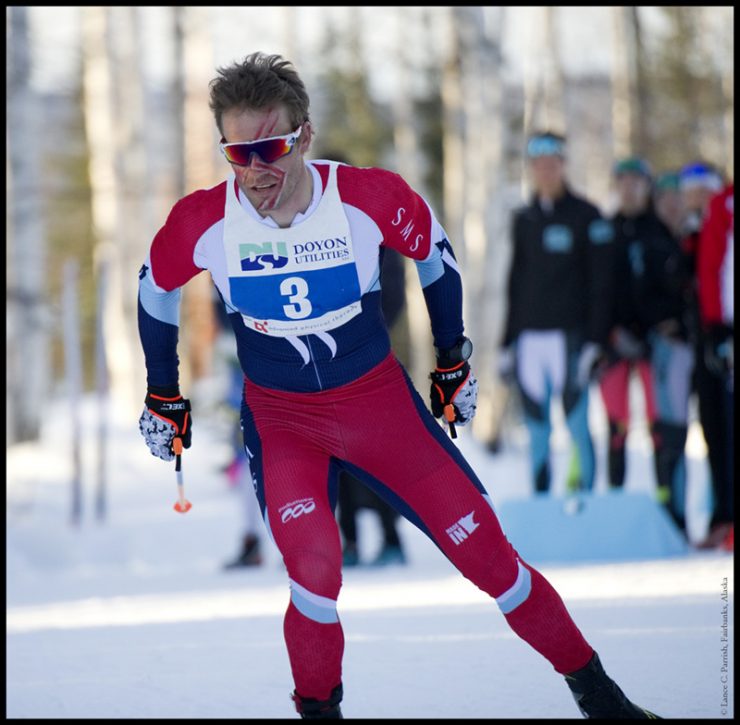
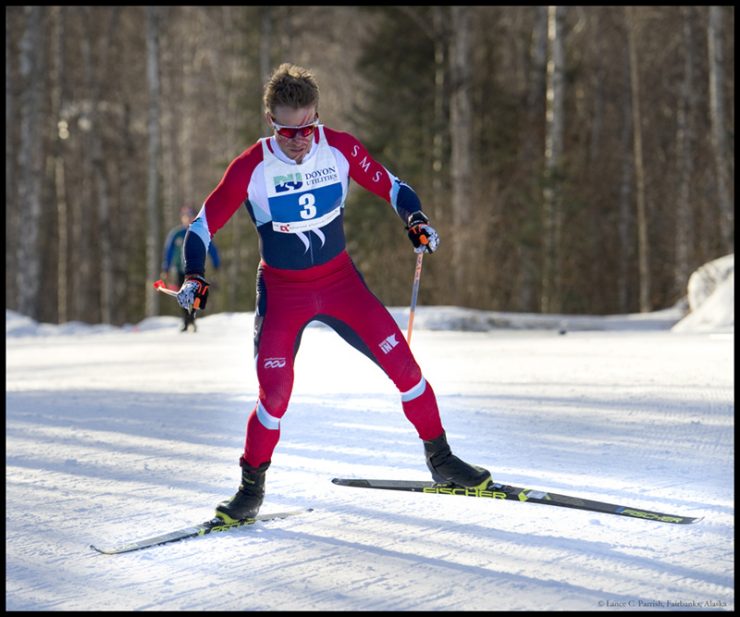
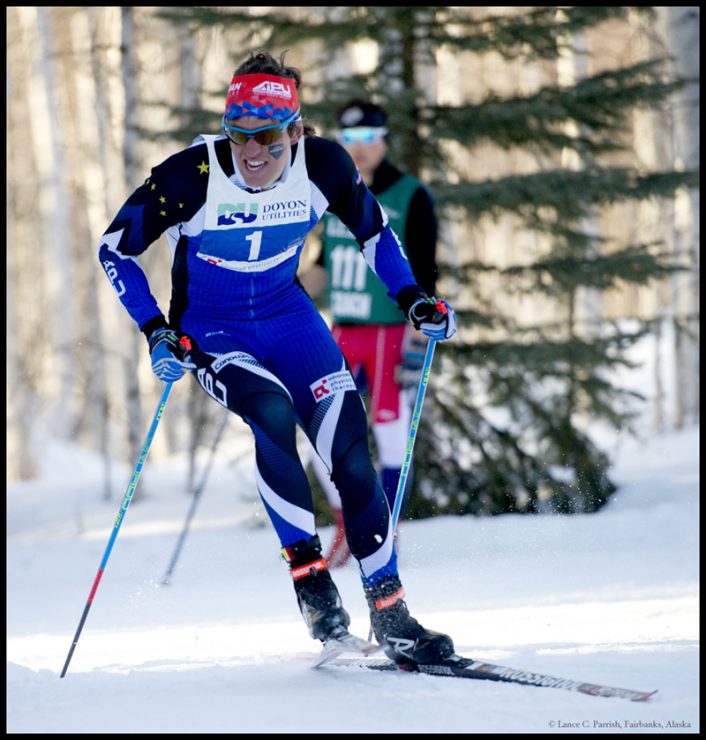
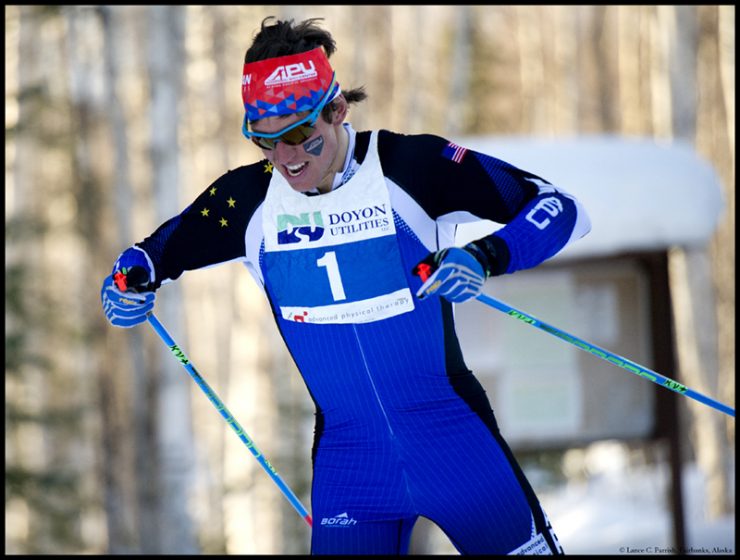
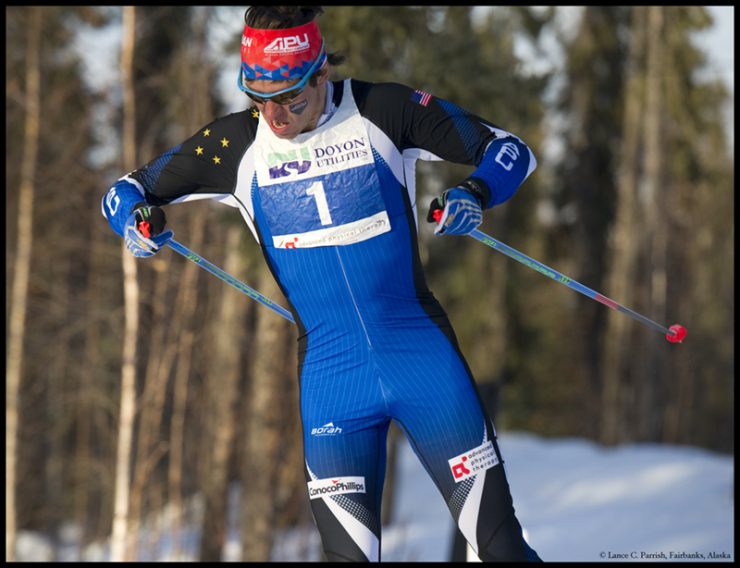
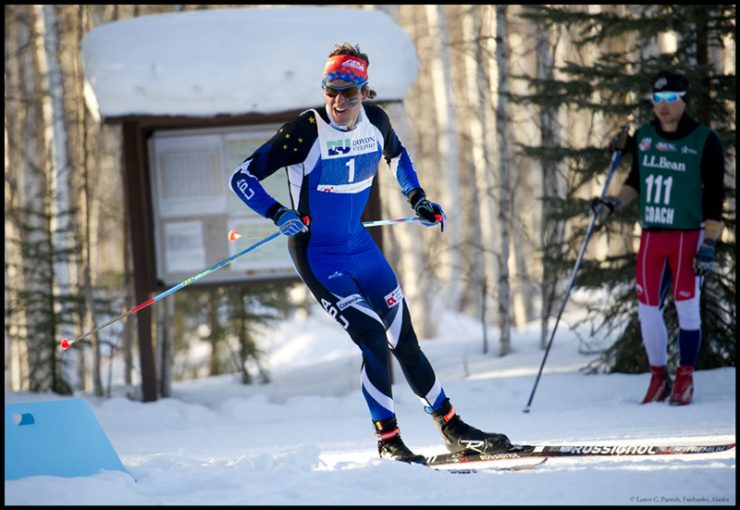
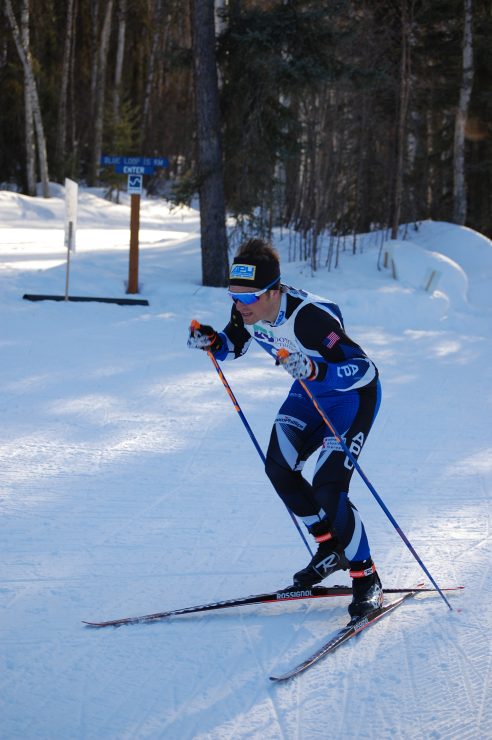
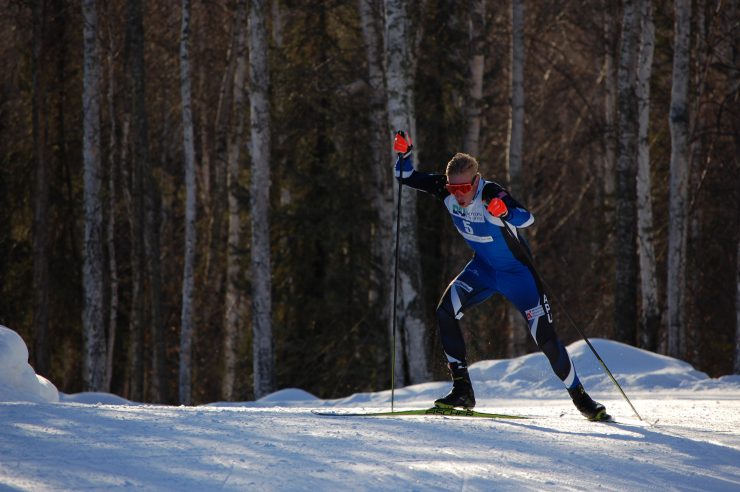
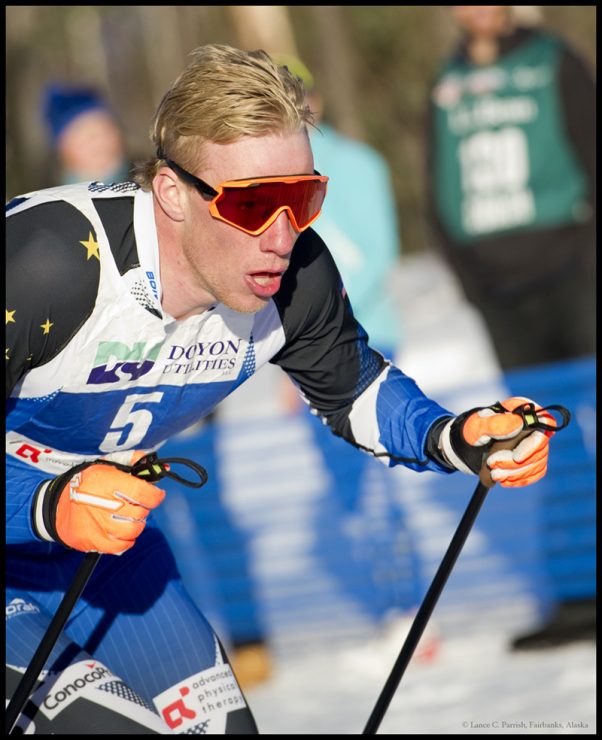
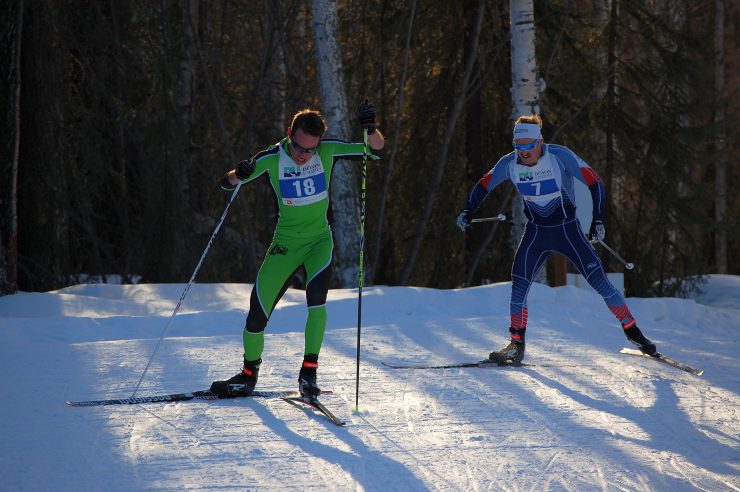
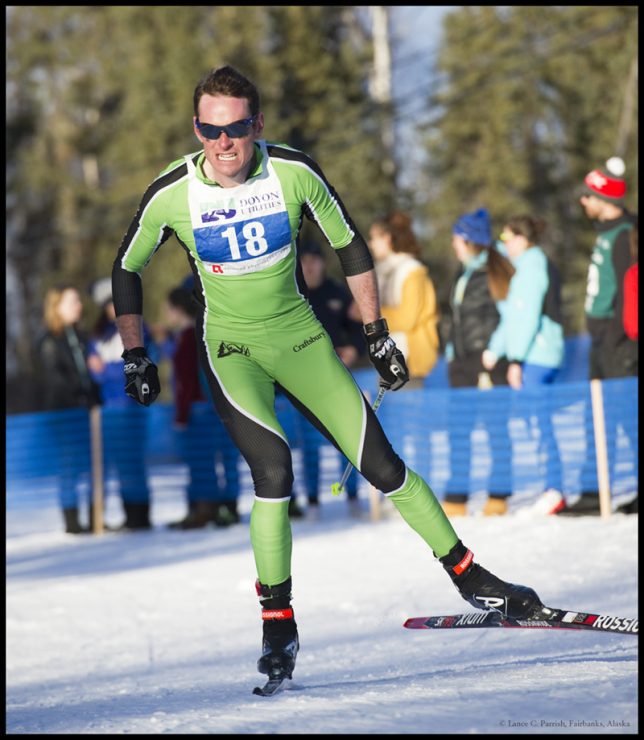
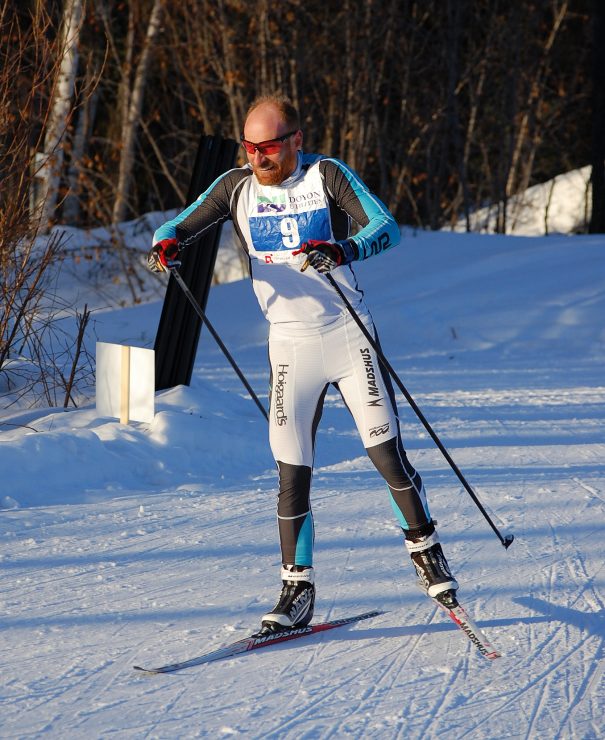
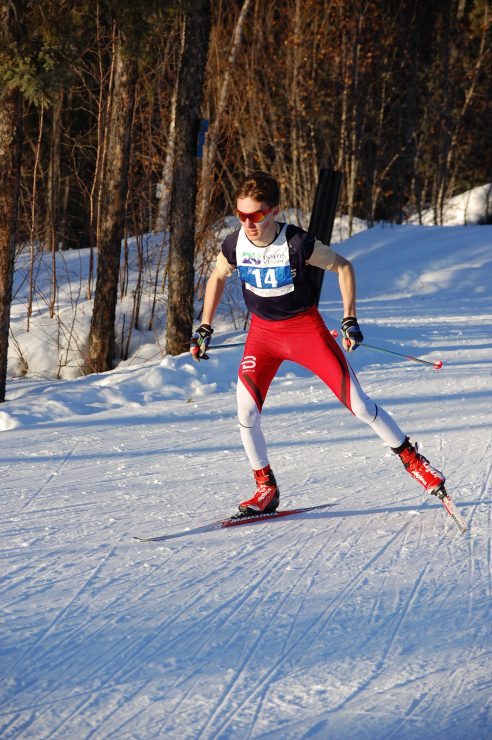
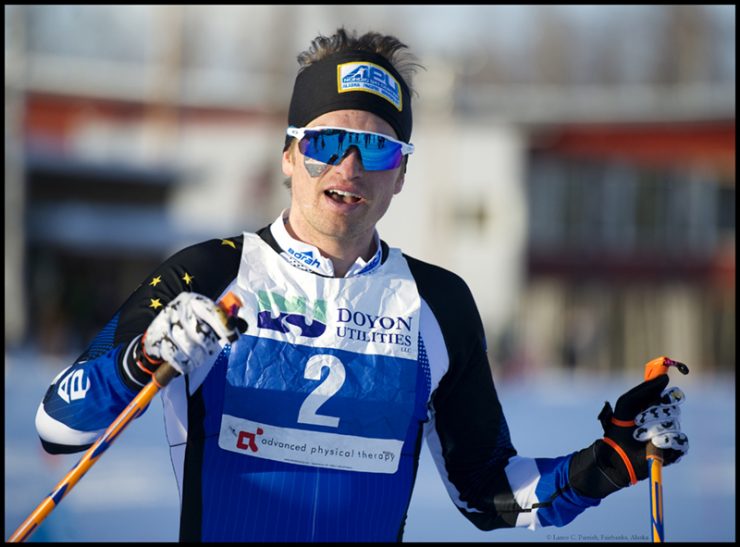
On Friday at Spring Series in Fairbanks, Alaska, clubs went head to head in the 4 x 5-kilometer co-ed mixed relay at the Birch Hill Recreation Area. Below is a photo gallery, courtesy of Lance Parrish and Max Kaufman. U.S. Distance Nationals and the SuperTour season concludes Sunday with the 30/50 k freestyle mass starts.
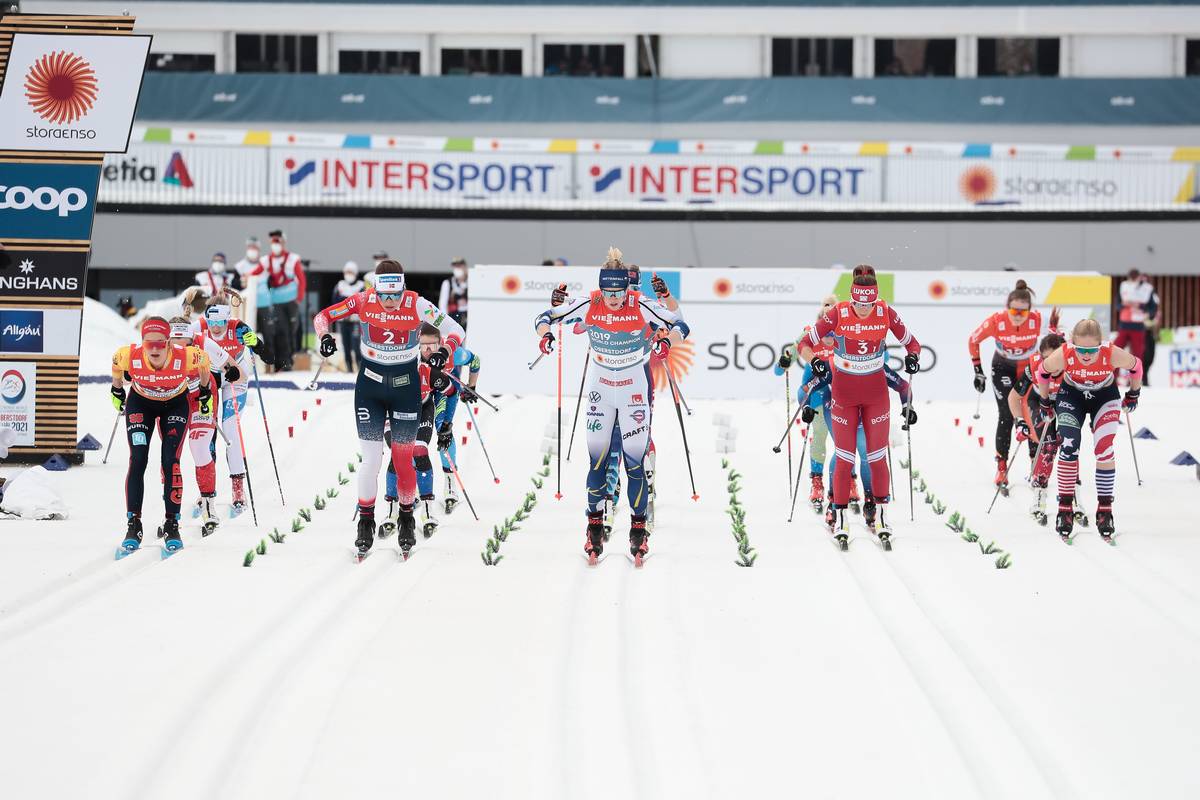
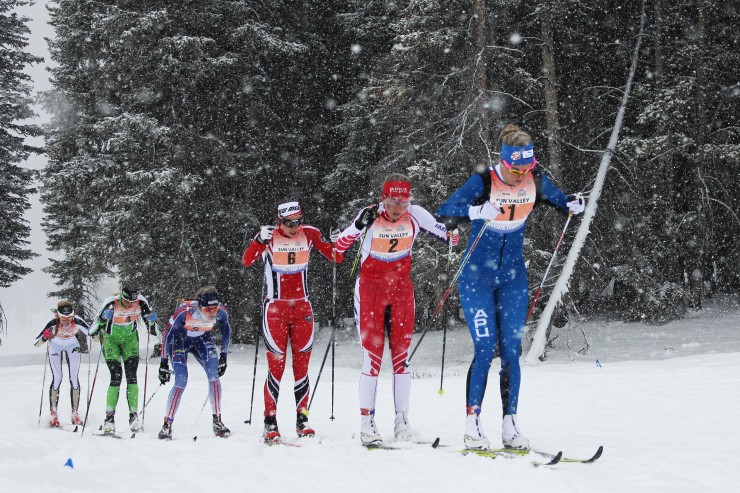
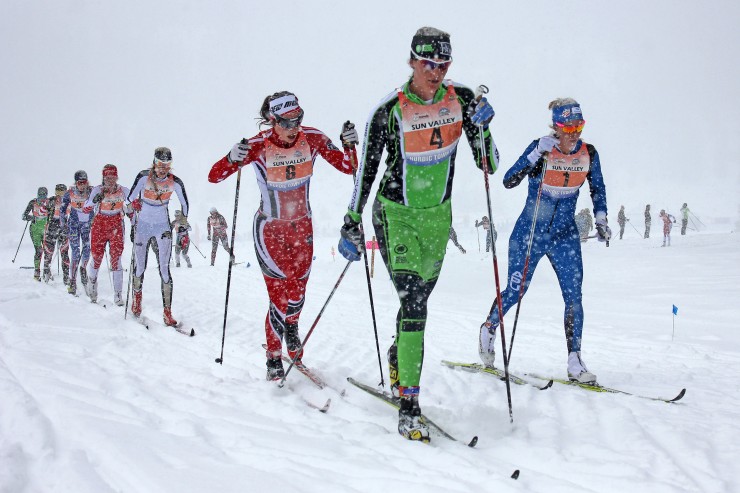
The start of the mixed relay at U.S. Distance Nationals on Friday in Fairbanks, Alaska, with Sophie Caldwell (SMS), Kikkan Randall (APU), Rosie Brennan (APU), Jessica Yeaton(APU), Annie Pokorny (SVSEF), and Kaitlynn Miller (CGRP) at the front. (Photo: Max Kaufman)
Kikkan Randall (APU) leads Sophie Caldwell (SMS Elite Team) during the first leg of the mixed relay at U.S. Distance Nationals on Friday in Fairbanks, Alaska. (Photo: Max Kaufman)
Rosie Brennan (APU) during the first leg of the mixed relay at U.S. Distance Nationals on Friday in Fairbanks, Alaska. (Photo: Max Kaufman)
Right to left: Jessica Yeaton (APU) and Becca Rorabaugh during the first leg of the mixed relay at U.S. Distance Nationals on Friday in Fairbanks, Alaska. (Photo: Max Kaufman)
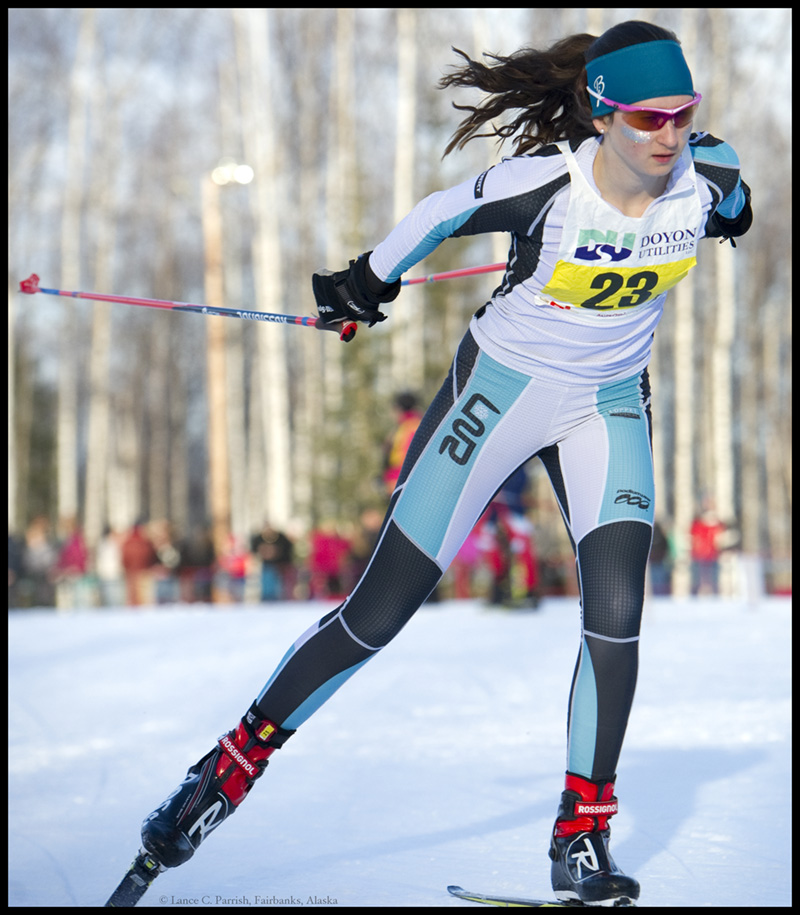
Renae Anderson (Loppet Nordic Racing) skiing the first leg of the mixed relay at U.S. Distance Nationals on Friday in Fairbanks, Alaska. (Photo: Lance Parrish, Fairbanks)
Eric Packer (APU) during the second leg of the mixed relay at U.S. Distance Nationals on Friday in Fairbanks, Alaska. (Photo: Max Kaufman)
Sadie Bjornsen (APU) leads Jessie Diggins (SMS Elite Team) during the third leg of the mixed relay at U.S. Distance Nationals on Friday in Fairbanks, Alaska. SMS went on to win by 10.3 seconds over APU. (Photo: Max Kaufman)
Left to right: Jessie Diggins (SMS Elite Team) gains on Sadie Bjornsen (APU) during the third leg of the mixed relay at U.S. Distance Nationals on Friday in Fairbanks, Alaska. (Photo: Lance Parrish, Fairbanks)
Right to left: Jessie Diggins (SMS Elite Team) after passing Sadie Bjornsen (APU) during the third leg of the mixed relay at U.S. Distance Nationals on Friday in Fairbanks, Alaska. (Photo: Lance Parrish, Fairbanks)(Photo: Lance Parrish, Fairbanks)
Chelsea Holmes (APU) during the third leg of the mixed relay at U.S. Distance Nationals on Friday in Fairbanks, Alaska. (Photo: Max Kaufman)
Chelsea Holmes (APU) skiing the third leg of the mixed relay at U.S. Distance Nationals on Friday in Fairbanks, Alaska. (Photo: Lance Parrish, Fairbanks)
Liz Stephen racing the third leg for the APU/Sugar Bowl/Burke team during the mixed relay at U.S. Distance Nationals on Friday in Fairbanks, Alaska. (Photo: Lance Parrish, Fairbanks)
Liz Stephen racing the third leg for the APU/Sugar Bowl/Burke team during the mixed relay at U.S. Distance Nationals on Friday in Fairbanks, Alaska. (Photo: Lance Parrish, Fairbanks)
Liz Stephen racing the third leg for the APU/Sugar Bowl/Burke team during the mixed relay at U.S. Distance Nationals on Friday in Fairbanks, Alaska. (Photo: Lance Parrish, Fairbanks)
Liz Stephen racing the third leg for the APU/Sugar Bowl/Burke team during the mixed relay at U.S. Distance Nationals on Friday in Fairbanks, Alaska. (Photo: Lance Parrish, Fairbanks)
Liz Stephen racing the third leg for the APU/Sugar Bowl/Burke team during the mixed relay at U.S. Distance Nationals on Friday in Fairbanks, Alaska. (Photo: Lance Parrish, Fairbanks)
Caitlin Patterson (Craftsbury Green Racing Project) racing the mixed relay at U.S. Distance Nationals on Friday in Fairbanks, Alaska. (Photo: Lance Parrish, Fairbanks)(Photo: Lance Parrish, Fairbanks)
Rosie Frankowski (APU) racing the third leg of the mixed relay at U.S. Distance Nationals on Friday in Fairbanks, Alaska. (Photo: Lance Parrish, Fairbanks)
Left to right: Caitlin Gregg (Loppet Nordic Racing) leads Hailey Swirbul (UAA) during the thrid leg of the mixed relay at U.S. Distance Nationals on Friday in Fairbanks, Alaska. (Photo: Lance Parrish, Fairbanks)
Caitlin Gregg (Loppet Nordic Racing) skiing the third leg of the mixed relay at U.S. Distance Nationals on Friday in Fairbanks, Alaska. (Photo: Lance Parrish, Fairbanks)
Hailey Swirbul (UAA) racing the mixed relay at U.S. Distance Nationals on Friday in Fairbanks, Alaska. (Photo: Lance Parrish, Fairbanks)
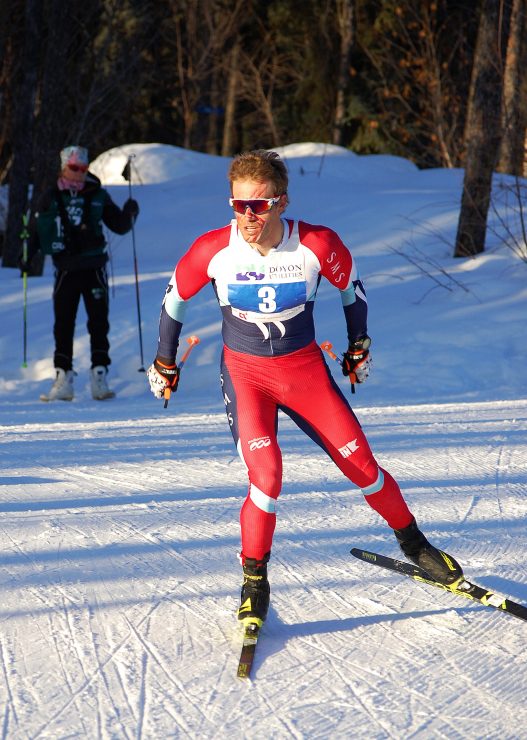
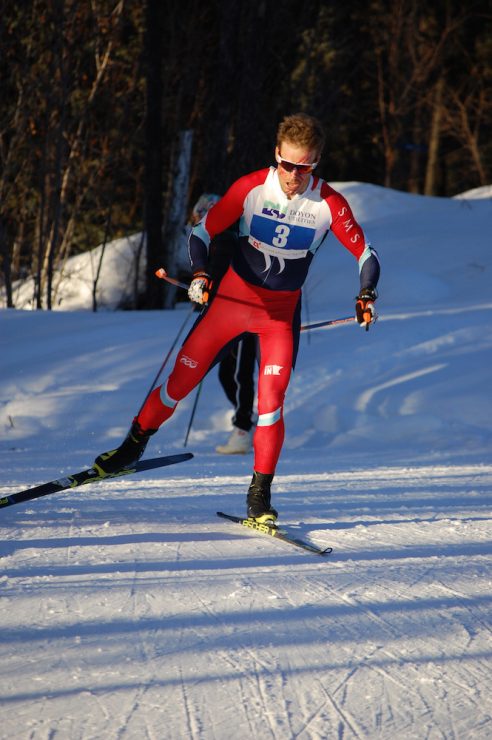
Simi Hamilton (SMS Elite Team) during the fourth leg of the mixed relay at U.S. Distance Nationals on Friday in Fairbanks, Alaska. (Photo: Lance Parrish, Fairbanks)
Simi Hamilton (SMS Elite Team) during the fourth leg of the mixed relay at U.S. Distance Nationals on Friday in Fairbanks, Alaska. (Photo: Lance Parrish, Fairbanks)
Simi Hamilton (SMS Elite Team) during the fourth leg of the mixed relay at U.S. Distance Nationals on Friday in Fairbanks, Alaska. (Photo: Lance Parrish, Fairbanks)
Simi Hamilton (SMS Elite Team) skiing the fourth leg of the mixed relay at U.S. Distance Nationals on Friday in Fairbanks, Alaska. (Photo: Lance Parrish, Fairbanks)
Simi Hamilton (SMS Elite Team) during the fourth leg of the mixed relay at U.S. Distance Nationals on Friday in Fairbanks, Alaska. (Photo: Max Kaufman)
Simi Hamilton (SMS Elite Team) during the fourth leg of the mixed relay at U.S. Distance Nationals on Friday in Fairbanks, Alaska. (Photo: Max Kaufman)
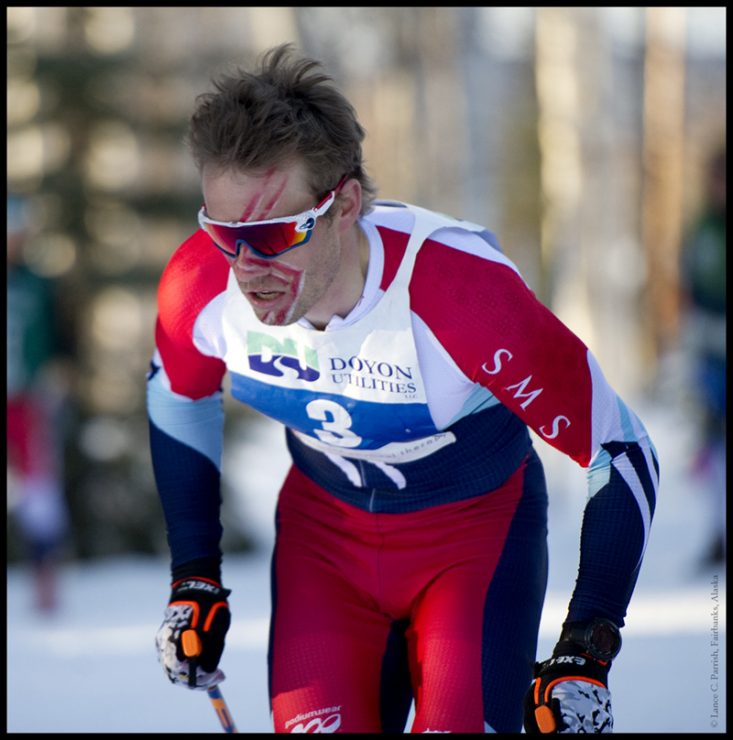
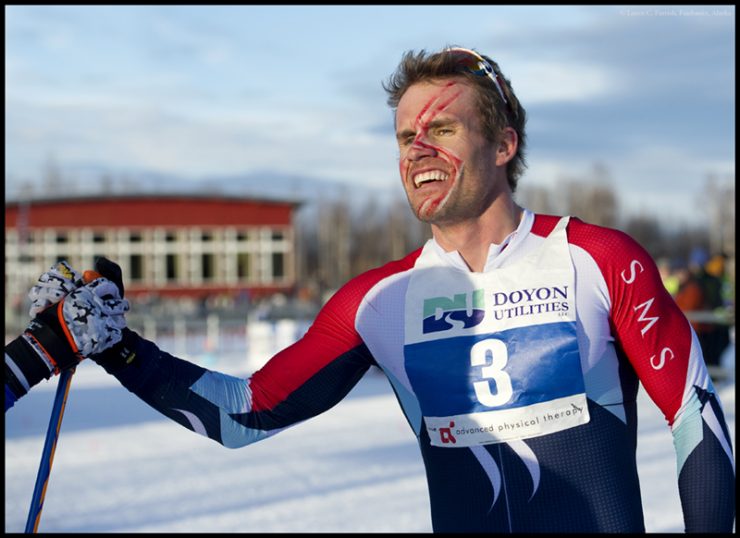
Simi Hamilton (SMS Elite Team) after the mixed relay at U.S. Distance Nationals on Friday in Fairbanks, Alaska. (Photo: Lance Parrish, Fairbanks)
Scott Patterson (APU) during the fourth leg of the mixed relay at U.S. Distance Nationals on Friday in Fairbanks, Alaska. (Photo: Lance Parrish, Fairbanks)
Scott Patterson (APU) skiing the anchor leg of the mixed relay at U.S. Distance Nationals on Friday in Fairbanks, Alaska. (Photo: Lance Parrish, Fairbanks)
Scott Patterson (APU) during the fourth leg of the mixed relay at U.S. Distance Nationals on Friday in Fairbanks, Alaska. (Photo: Lance Parrish, Fairbanks)
Scott Patterson (APU) during the fourth leg of the mixed relay at U.S. Distance Nationals on Friday in Fairbanks, Alaska. (Photo: Lance Parrish, Fairbanks)
Scott Patterson (APU) during the fourth leg of the mixed relay at U.S. Distance Nationals on Friday in Fairbanks, Alaska. (Photo: Lance Parrish, Fairbanks)
Scott Patterson (APU) during the fourth leg of the mixed relay at U.S. Distance Nationals on Friday in Fairbanks, Alaska. (Photo: Lance Parrish, Fairbanks)
Scott Patterson (APU) during the fourth leg of the mixed relay at U.S. Distance Nationals on Friday in Fairbanks, Alaska. (Photo: Max Kaufman)
David Norris (APU) during the fourth leg of the mixed relay at U.S. Distance Nationals on Friday in Fairbanks, Alaska. (Photo: Max Kaufman)
David Norris (APU) during the fourth leg of the mixed relay at U.S. Distance Nationals on Friday in Fairbanks, Alaska. (Photo: Max Kaufman)
Logan Hanneman (APU) during the fourth leg of the mixed relay at U.S. Distance Nationals on Friday in Fairbanks, Alaska. (Photo: Max Kaufman)
Logan Hanneman (APU) skiing the fourth leg of the mixed relay at U.S. Distance Nationals on Friday in Fairbanks, Alaska. (Photo: Lance Parrish, Fairbanks)
Left to right: Craftsbury’s Ollie Burruss and Sun Valley’s Cole Morgan during the fourth leg of the mixed relay at U.S. Distance Nationals on Friday in Fairbanks, Alaska. (Photo: Max Kaufman)
Craftsbury’s Ollie Burruss racing the fourth leg of the mixed relay at U.S. Distance Nationals on Friday in Fairbanks, Alaska.(Photo: Lance Parrish, Fairbanks)
Brian Gregg (Loppet Nordic Racing) during the anchor leg of the mixed relay on Friday at U.S. Distance Nationals in Fairbanks, Alaska. (Photo: Max Kaufman)
Max LaChance (Bridger Ski Foundation) during the fourth leg of the mixed relay at U.S. Distance Nationals on Friday in Fairbanks, Alaska. (Photo: Max Kaufman)
David Norris (APU) after the mixed relay at U.S. Distance Nationals on Friday in Fairbanks, Alaska. (Photo: Lance Parrish, Fairbanks)
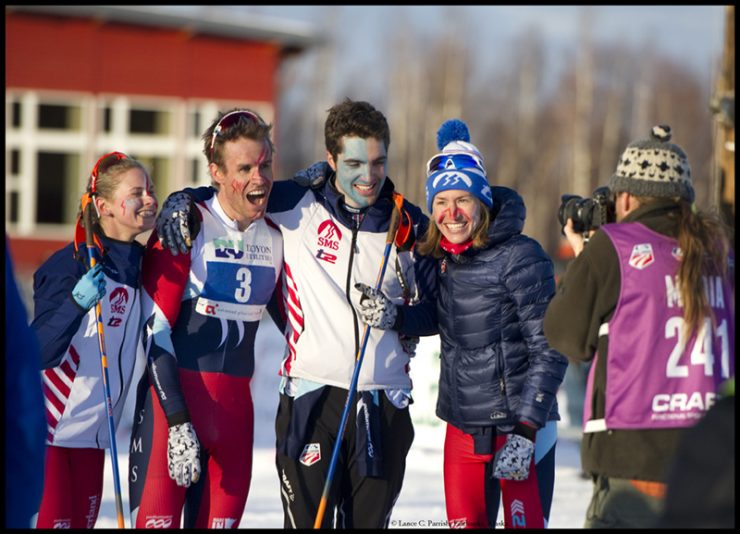
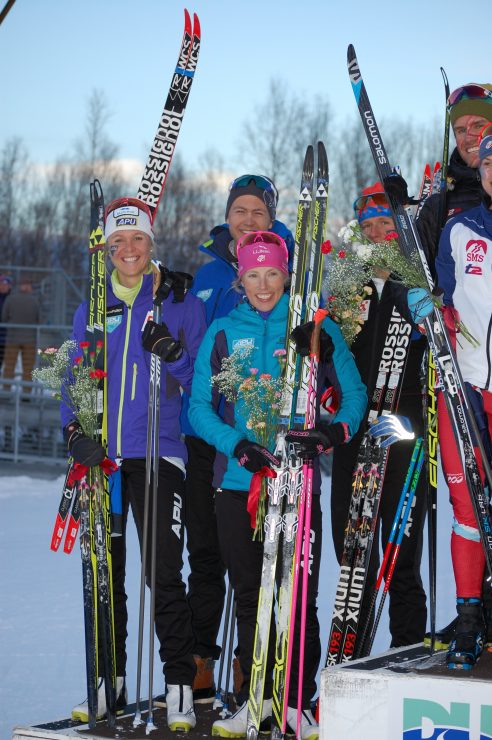
SMS Elite Team members (from left to right) Jessie Diggins, Simi Hamilton, Ben Saxton, and Sophie Caldwell after winning the mixed relay at U.S. Distance Nationals on Friday in Fairbanks, Alaska. (Photo: Lance Parrish, Fairbanks)
APU’s first team (front to back, left to right) Sadie Bjornsen, Kikkan Randall, Erik Bjornsen and Scott Patterson of Alaska Pacific University after placing second in the mixed relay at U.S. Distance Nationals on Friday in Fairbanks, Alaska. (Photo: Max Kaufman)(Photo: Max Kaufman)
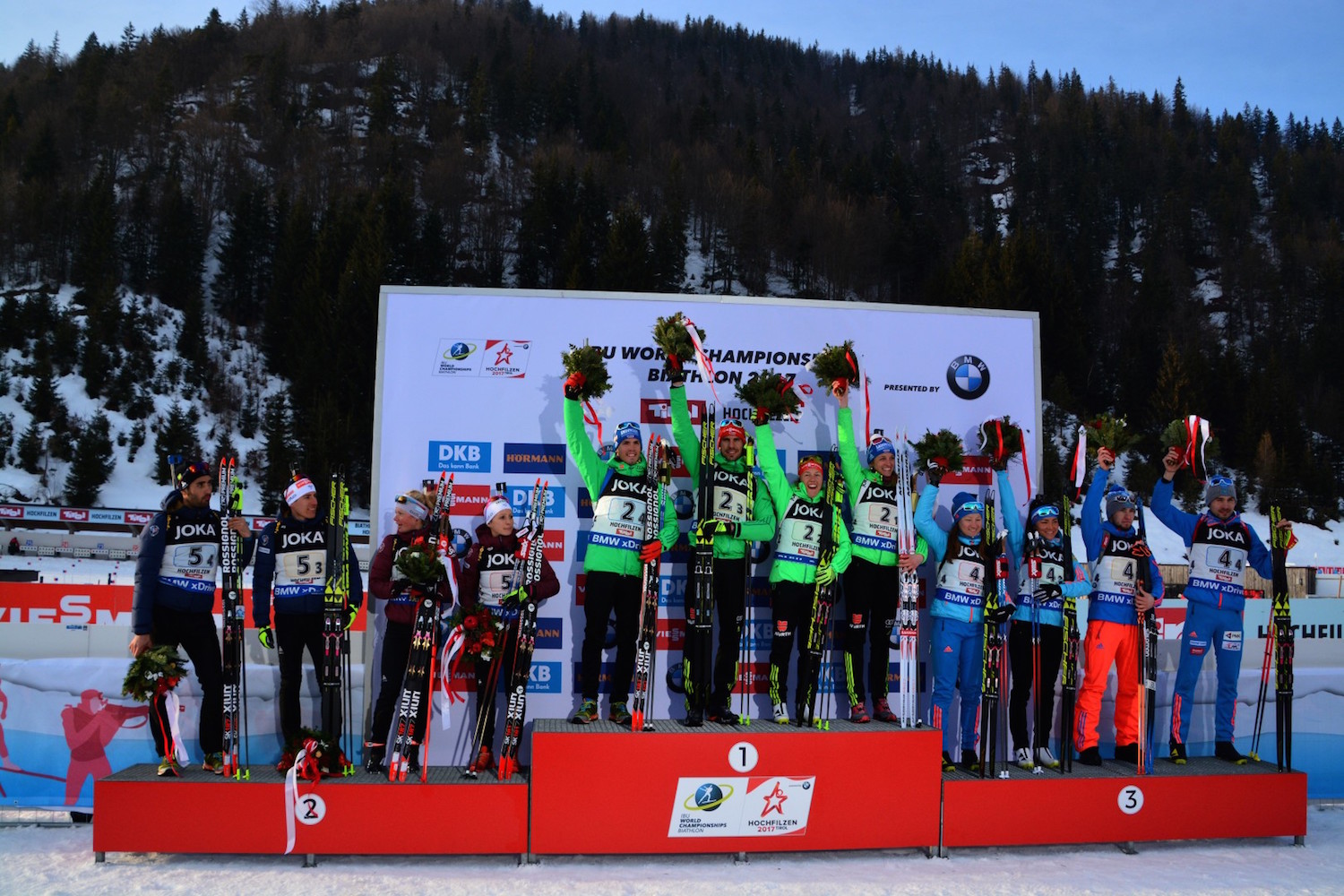
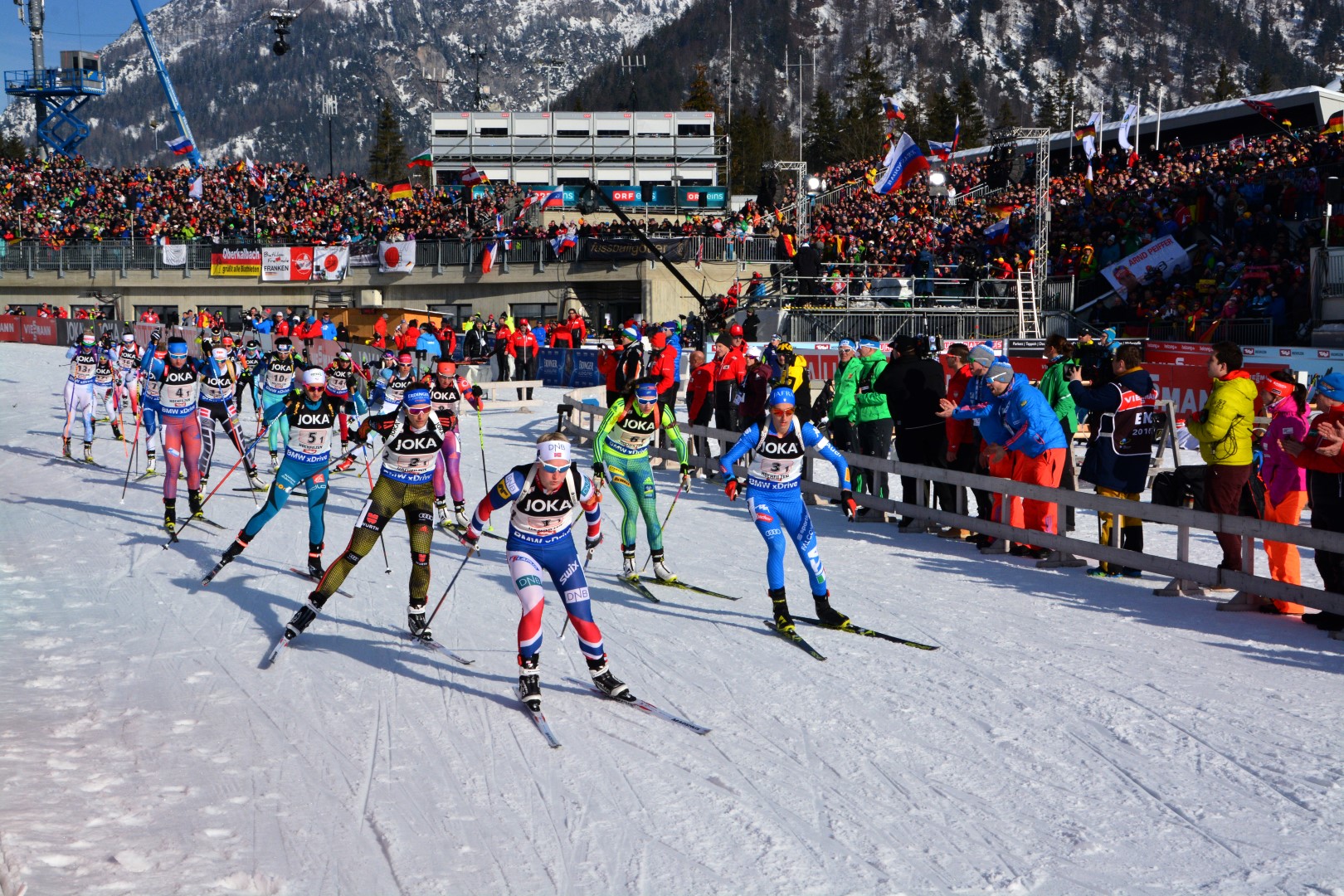
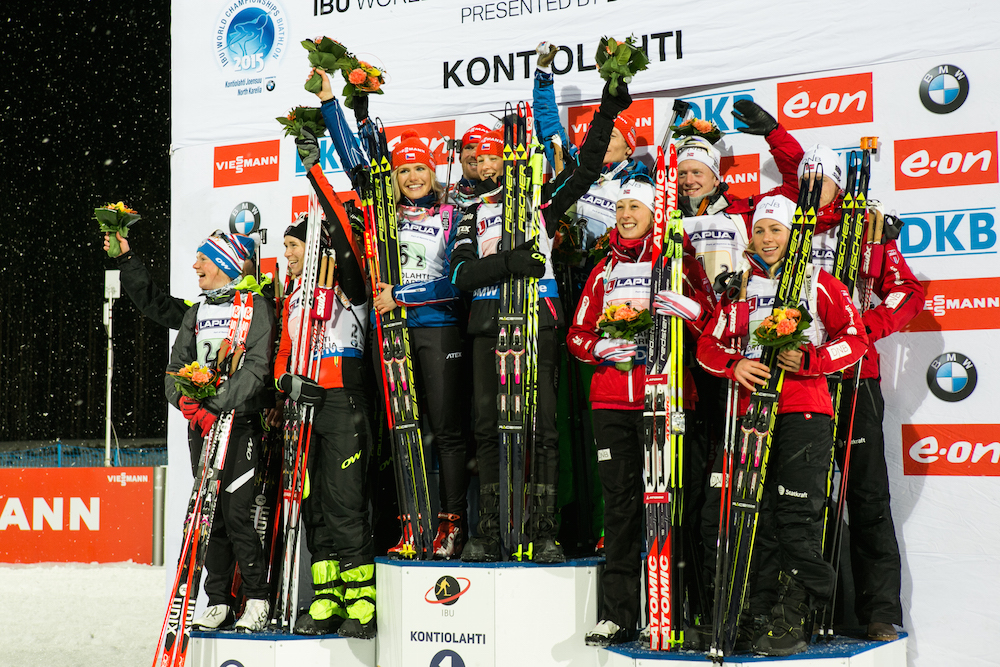
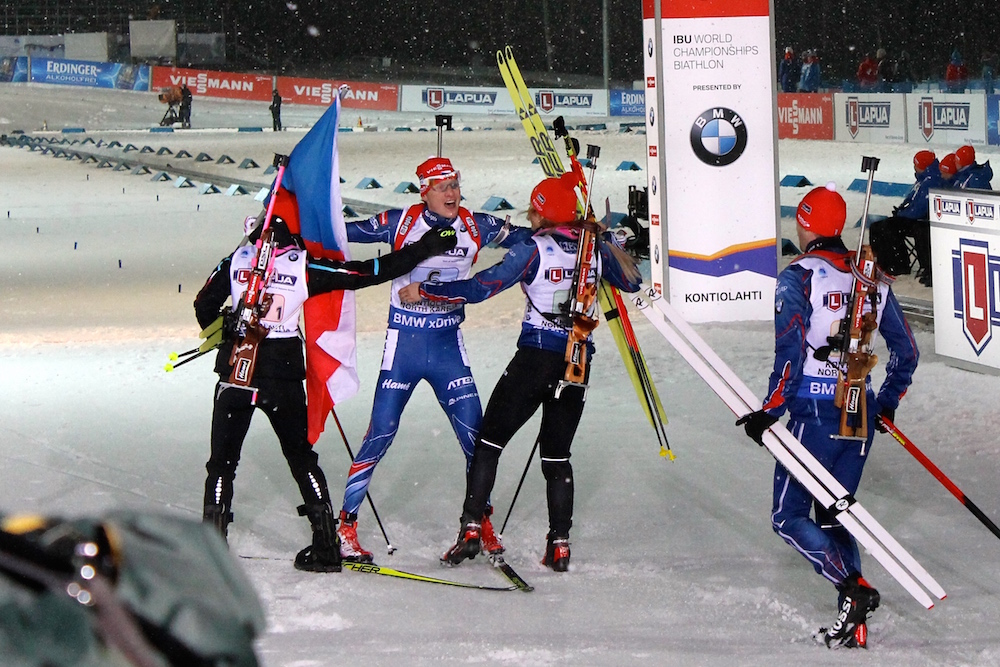
The mixed relay podium on the opening day of 2017 IBU World Championships in Hochfilzen, Austria, with Germany in first (c), France (with Martin Fourcade at far left) in second, and Russia in third (r). (Photo: Glen Crawford)
Germany was front and center for the first race of 2017 International Biathlon Union (IBU) World Championships on Thursday in Hochfilzen, Austria, but there was a sideshow that stole a good chunk of the limelight between France (namely Martin Fourcade) and Russia (namely Alexander Loginov).
The action began with the 2 x 6 + 2 x 7.5-kilometer mixed relay, a co-ed event where teams start women for the first and second legs, followed by men for the third and fourth legs.
Germany ran away with the lead with a rock-solid performance from third-leg Arnd Peiffer, who cleaned both his prone and standing stages without using any spare rounds, but the team had to credit second-leg Laura Dahlmeier, who built the lead in the first place.
Dahlmeier, the World Cup Total Score leader, raced from sixth to first after getting the tag from her teammate Vanessa Hinz just 9.8 seconds out of first. Dahlmeier used two spares to clean prone and another two to clean standing, yet she avoided the penalty lap and remained in third for much of her race — behind Italy’s Dorothea Wierer and France’s Marie Dorin Habert.
As she left the range for the last time and embarked on her last loop, Dahlmeier remained in third, nine seconds behind Wierer in first. Dorin Habert remained on Wierer’s heels, 1.6 seconds back.
Dahlmeier caught both by the second exchange and tagged Peiffer in first, 0.8 seconds ahead of France and 3.8 seconds ahead of Italy.
The rest was history as Peiffer extended the gap to 11.1 seconds over Italy’s Lukas Hofer after the first shooting stage on the third leg. With another clean bout one loop later, Peiffer was up to 20 seconds ahead of Hofer, who used one spare in prone and cleaned standing without a miss.
“After the prone shooting I was alone on the loop, that is a pretty thankless job,” Peiffer told German broadcaster ZDF after. “Then I tried to focus on my tempo, to keep pushing into the standing shooting, and that worked well. But it was not clear to me while on the course that it would work out like that.”
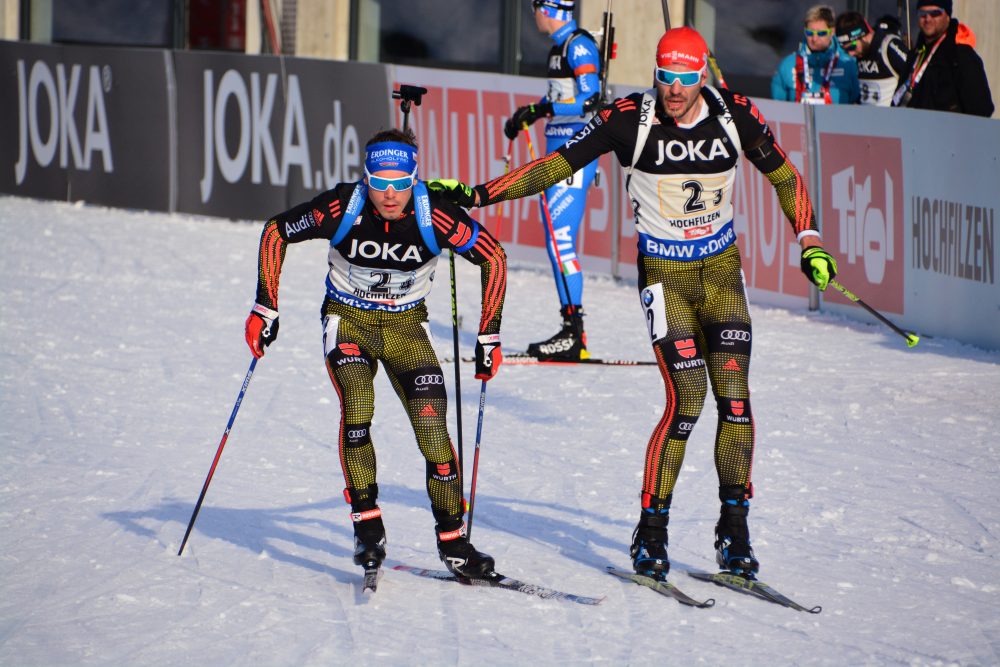
Germany’s Arnd Peiffer (r) tagging his teammate Simon Schempp during the final exchange of the mixed relay at 2017 IBU World Championships on Thursday in Hochfilzen, Austria. Peiffer tagged in first, and Schempp held the lead through the finish. (Photo: Glen Crawford)
Peiffer tagged German anchor Simon Schempp 21.2 seconds ahead of Italy’s last leg, Dominick Windisch, and 46.5 seconds ahead of France’s Martin Fourcade in third. Russia entered the final exchange with France, with Loginov tagging Anton Shipulin just 0.9 seconds behind France.
That’s where things got interesting. Schempp executed as needed to secure the win — cleaning prone without any spares and using just one in standing — and Windisch as his most immediate threat fumbled on the last stage when the he missed two and left the range in fourth, 32 seconds behind Schempp.
There, Fourcade moved into second with his second-straight flawless stage (0+0, 0+0), 17.9 seconds behind Schempp, and Shipulin remained in third (+18.6) after cleaning both stages as well (0+0, 0+0). Fourcade and Shipulin started the race together and jockeyed between third and fourth for the first two loops, until both moved ahead of Windisch and had the opportunity to battle for second place on the last loop.
For Fourcade, who had already won 10 races (including relays) this season and entered the World Championships mixed relay as a defending champion with France, it wasn’t so much about the silver. It was about beating Russia.
As Fourcade and Shipulin descended a downhill together on the last loop, Fourcade took the lead by the bottom and attacked on the long uphill that immediately followed. Shipulin remained on his heels as the two came within view of Schempp, who was skiing what appeared to be a casual pace off the front — although Schempp would later say he was going full speed.
“I think you could see that they wanted to get back up to [Schempp],” German men’s head coach Mark Kirchner told ZDF of Fourcade and Shipulin on the last loop. “But when they reached the highest point of the course it looked like they rather skied tactically, who becomes second and who becomes third. Then I was sure that this would end well for us.”
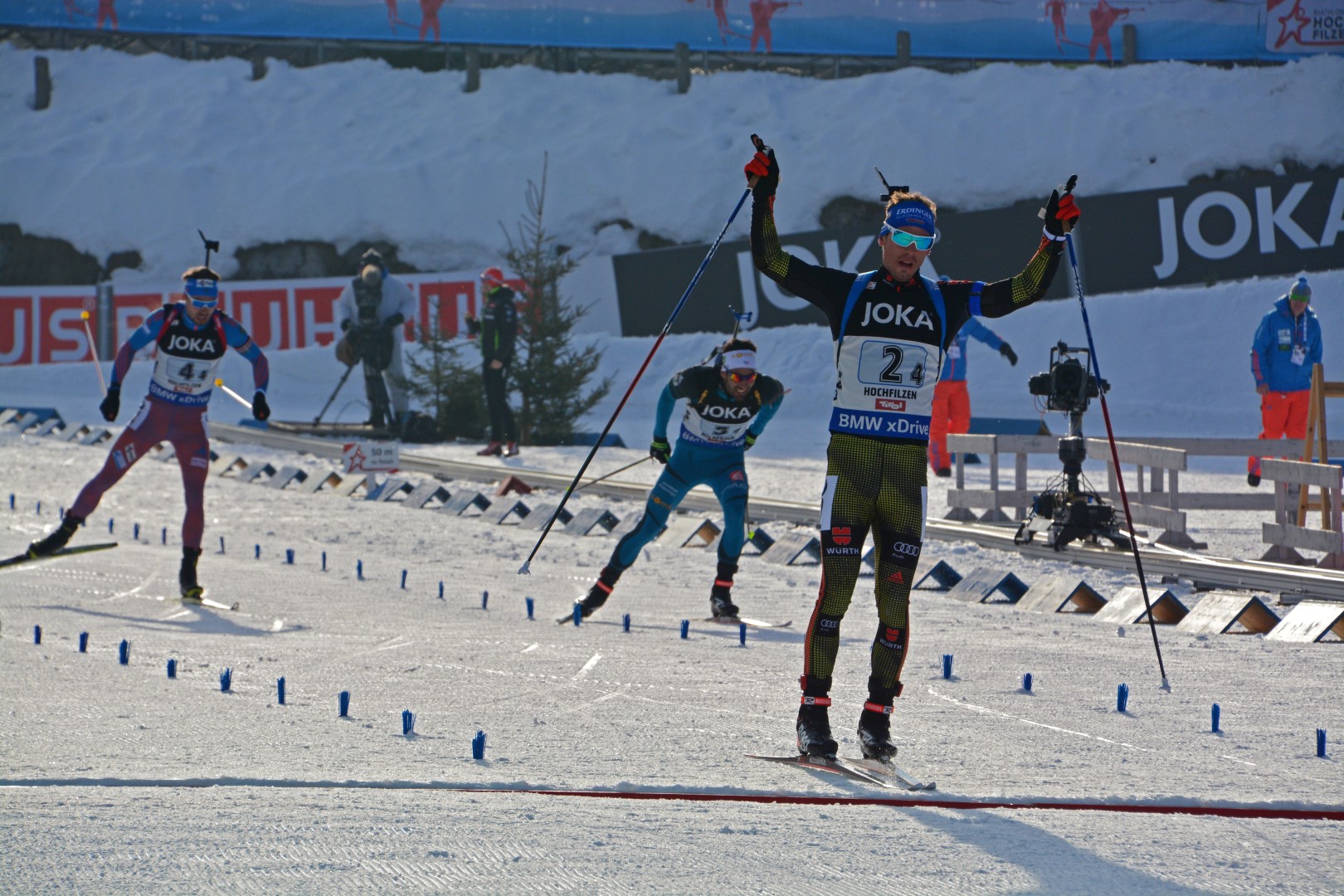
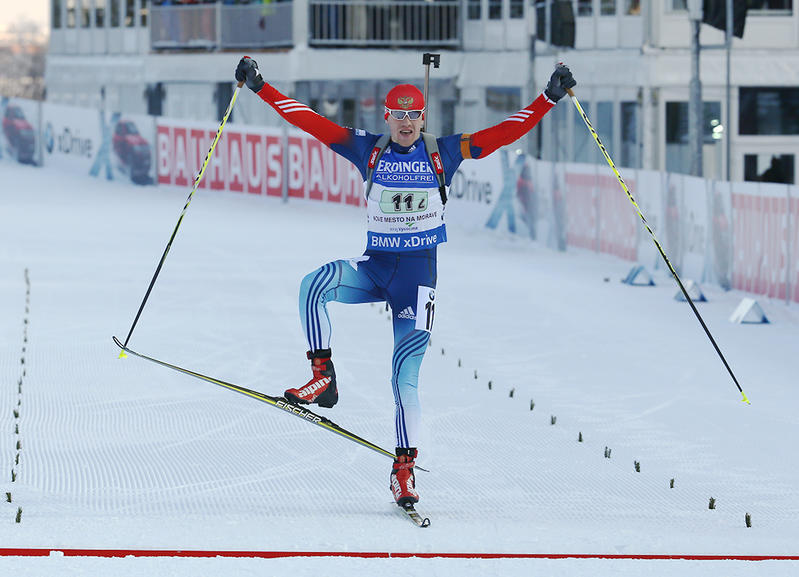
About 100 meters before the finish, Schempp glanced back to see Fourcade and Shipulin charging hard. Schempp appeared unfazed and maintained his pace, holding his arms up to celebrate before he crossed the line first.
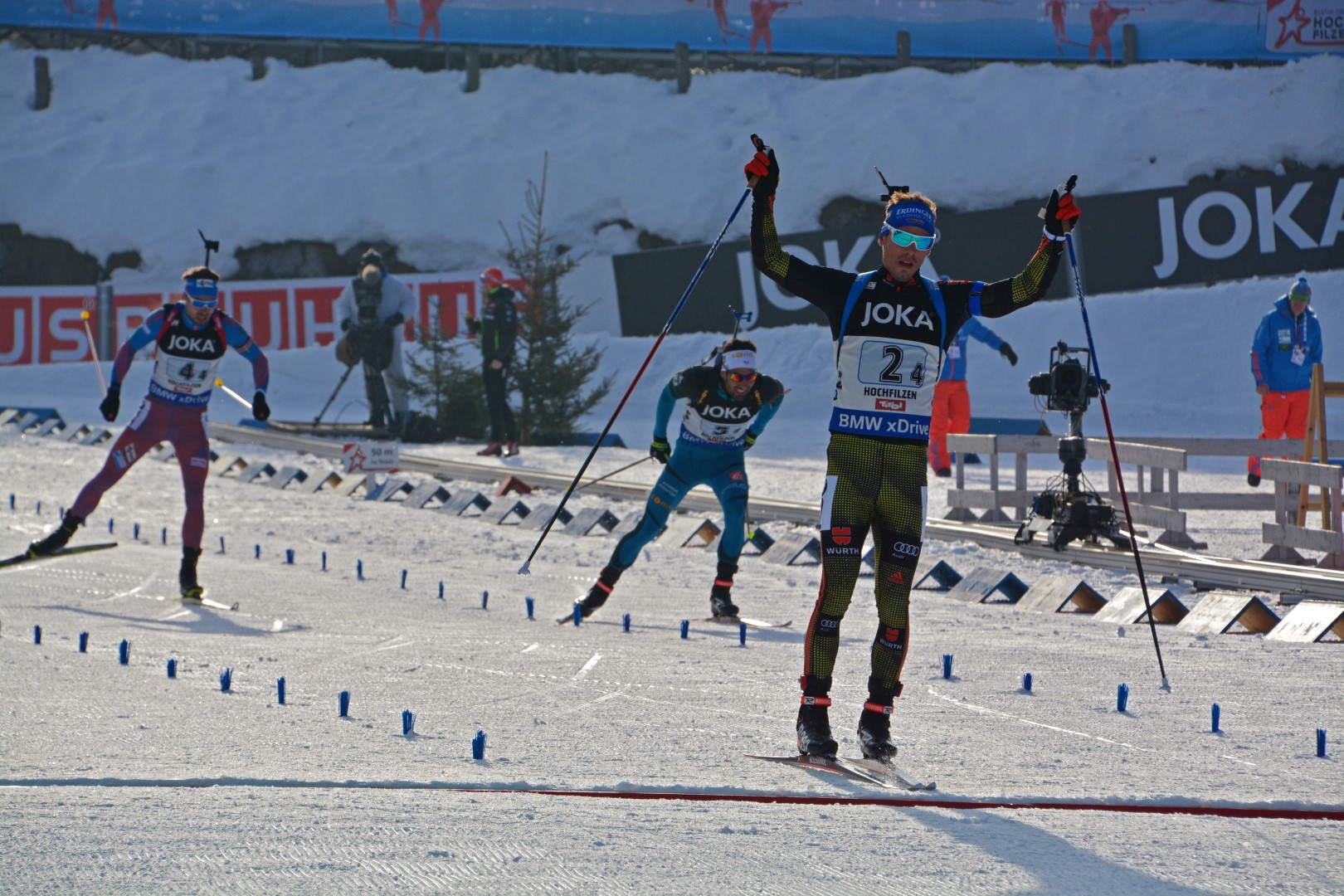
Germany’s Simon Schempp (2) celebrates his team’s victory in the mixed relay on the opening day of 2017 IBU World Championships in Hochfilzen, Austria, after he held off France’s Martin Fourcade (second from r) in second and Russia’s Anton Shipulin in third. (Photo: Glen Crawford)
Germany took the relay gold in 1:09.06.4 hours, while Fourcade finished 2.2 seconds later to secure silver for France. One second later, Shipulin anchored Russia to bronze (+3.2).
“Fourcade really attacked enormously,” German men’s assistant coach Andreas Stitzl told ZDF. “Thank God Fourcade and Shipulin were not totally in agreement, so it went our way.”
Schempp later said he realized those two were getting closer, “but there was a bit of a buffer,” he told ZDF. “I wasn’t certain, so I still skied full speed … Of course this is an enormously cool start for our team into the World Championships, immediately with a first place. And I think I am speaking for everyone that we are overjoyed.”
It was the first mixed-relay win for Hinz and Dahlmeier.
“These are big emotions, winning it all in a team together with the men,” Dahlmeier told ZDF. “I have never won a mixed relay before, and this is only my second one ever. I think this means a lot to the whole team, that we became world champions right in the first race.”
“I am still a little bit speechless,” Hinz said. “I was very happy that the coaches trusted me with this assignment, and it means quite a lot to me.”
During the flower ceremony, Germany’s four racers stood on the highest step of the podium. France followed them to the second step, with Anais Chevalier, Dorin Habert, Quentin Fillon Maillet, and Fourcade, and Russia was introduced third, with Olga Podchufarova, Tatiana Akimova, Loginov, and Shipulin.
As the four Russians approached the French team to shake hands in usual fashion, Fourcade shook the hands of the two women, but did not come in contact with the two men. As Russia proceeded to its spot on the podium, Fourcade clapped sarcastically, then stepped down from the podium and attempted to leave the ceremony. Not long after, he returned, likely having been instructed to.
“I’m a bit sad,” Fourcade said at the post-race press conference. “I just want to remember that one week ago the president of the Russian federation asked the IBU to take disciplinary sanctions against me because I did a tweet about Loginov and today they decide to not shake my hand on the podium so I’m a bit surprised the president of the Russian federation wants to disqualify his own athletes.”
While it’s tough to pin down exactly which tweet Fourcade was referring to, he wrote on Twitter, “We didn’t think it was possible so they did it………….” on Wednesday, the day before the opening race of World Championships, likely when he learned Loginov would be starting the relay. Loginov is coming off a two-year ban for EPO use and dominated the competition at last month’s IBU Open European Championships.
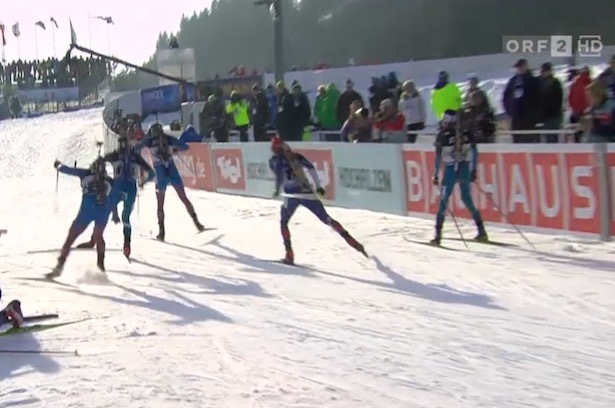
Russia’s Alexander Loginov (l) takes a tumble after tagging his teammate Anton Shipulin (third from l) in the final exchange of the 2017 IBU World Championships mixed relay in Hochfilzen, Austria. France’s Martin Fourcade (second from l) skated left after getting the tag from his teammate Quentin Fillon Maillet (far r). (Photo: ORF screenshot)
Whether the Russian men didn’t shake Fourcade’s hand on the podium, or vice versa; whether they were upset about his tweet or the fact that he appeared to go out of his way to trip Loginov in the exchange zone on Thursday (after Loginov had tagged Shipulin right after Fourcade), one thing is clear: there is some definite tension between Fourcade and Team Russia.
And it’s not all on Fourcade; this has been months in the making after World Cup athletes demanded that the IBU implement stricter anti-doping policies and measures. Fourcade walked out of a meeting last month, telling NRK, “I am pissed off.” The next day, the IBU Executive Board announced it would hold an “Extraordinary Congress” before World Championships to vote on rule changes. The IBU announced the Congress decisions on Wednesday, which included plans to impose higher fines and reduced quotas for nations that violate anti-doping rules. Moreover, 2021 World Championships will not be held in Tyumen, Russia.
An IBU press release on Thursday didn’t get into details beyond the mixed relay itself: “Today is not the best example of a sprint finish battle that I could have done,” Shipulin said, according to the release. “I hope the rest of the World Championships it will be better.”
In terms of shooting performance, Russia was the best of the 25-team field with a total of four spares (three of which came on Loginov’s standing stage) and zero penalties. France had eight spares and overcame one penalty (on Fillon Maillet’s standing stage), and Germany used a total of seven spares but avoided the penalty lap.
“I was expecting us to be in the mix and fight for the medals,” Kirchner told ZDF, “but you can’t plan it working out like this, standing on the first position is always a surprise.”
Norway’s Marte Olsbu (front left) and Italy’s Lisa Vittozzi (front right) leading early in the mixed relay at 2017 IBU World Championships on Thursday in Hochfilzen, Austria. (Photo: Glen Crawford)
Italy (Lisa Vittozzi, Wierer, Hofer, Windisch) placed fourth, 28.7 seconds out of first and 25.5 off the podium, with six spares and zero penalties.
Vittozzi initially put the team in first at the first exchange, 1.8 seconds ahead of Norway’s Marte Olsbu in second. There, Austria’s Lisa Theresa Hauser followed 5.7 seconds back in third, and American Susan Dunklee was fourth, 7.6 seconds out of first.
Dunklee used two spares to clean prone and another two in standing (0+2, 0+2), but posted the second-fastest course time of the first-leg skiers to stick with the leaders through the first exchange. While Vittozzi hit all 10 of her targets (0+0, 0+0), Olsbu used a spare (0+1, 0+0) and Hauser required two (0+2, 0+0).
“It wasn’t overly tricky wind but there is more mental pressure in championship situations,” Dunklee wrote in an email about the conditions and why many of the top racers struggled on the range on Thursday. “The days when it matters most can be the days that it’s hardest to perform normally.”
She explained that she was disappointed with her shooting percentage but happy with her speed.
“My skiing feels sharper than it has all year and my body feels ready. That’s a big confidence booster going into the rest of the week,” Dunklee added.
Susan Dunklee racing the first leg of the 2017 IBU World Championships mixed relay for the U.S. She tagged off in fourth and the U.S. went on to finish 16th. (Photo: Glen Crawford)
The U.S. finished 16th (+3:20.2), with two penalties and 13 spares. Second-leg Clare Egan remained in the top 10 until her standing stage, where she skied a penalty lap (0+1, 1+3) and slipped to 17th by the exchange, 2:01 minutes out of first. There, Lowell Bailey took over and used one spare in each stage (0+1, 0+1) and skied the sixth-fastest third leg to hand off in 16th, 2:24.2 back. The team’s anchor, Sean Doherty had the team’s second penalty in his prone, but cleaned standing without any spares (1+3, 0+0) to finish 16th.
“We had a disappointing result as a team, but the Championships are long,” Dunklee wrote. “The most important thing is to take one day at a time and come to the venue fully focused and ready to make the most of each opportunity.”
Canada’s Julia Ransom (r) tagging teammate Rosanna Crawford after the first leg of the mixed relay at 2017 IBU World Championships in Hochfilzen, Austria. Canada went on to finish 13th. (Photo: Glen Crawford)
Canada finished more than a minute ahead of the U.S. in 13th (+2:18.2), with nine spares and zero penalties. Julia Ransom started the Canadians off and used four spares (0+3, 0+1) to tag Rosanna Crawford in 18th, 59 seconds out of first. Crawford used three spares as well in prone but also avoided the penalty lap, and cleaned standing (0+3, 0+0) to tag her boyfriend Brendan Green in 15th, 1:29 back.
Green improved one place to 14th, using just one spare in his prone stage (0+1, 0+0) and tagged Scott Gow 2:06.8 out of first. Gow cleaned prone and used one spare in standing (0+0, 0+1) to finish 13th, just 0.6 seconds ahead of Switzerland in 14th.
“The goal during my leg was to ski hard and push the shooting as much as I could,” Gow wrote in an email.
Both his shooting and range times were sixth-fastest among the anchor legs.
“My shooting was good, and all I can attribute it to is my prep the last two weeks,” Gow explained. “Shooting conditions were quite good, a little bit of wind here and there, so the environment wasn’t too much of a factor. I spent the last two weeks adding extra stress to my shooting and making sure all the fundamentals were in place, and that is what helped me today.
“I’m happy with my race and our team is optimistic for what is to come,” he added. “There were a lot of positives from the past two weeks within the whole team, so there a lot of possibilities.”
Personally, Gow’s main focus for the championships is the men’s relay after Canada earned a historic bronze in the event at 2016 World Championships.
“Last year our team had an incredible result in the relay and it would be great to have another awesome team result at these championships,” he wrote. “Aside from the relay, I’m looking most forward to the sprint. I’ve had some great sprints this year and I’d like to continue the good trend.”
IBU World Championships continue Friday with the women’s 7.5 k sprint at 8:45 a.m. Eastern time. Watch it live on Eurovisionsports.tv.
Germany’s mixed relay team, (from left to right) with Vanessa Hinz, Laura Dahlmeier, Arnd Peiffer, and Simon Schempp, after winning the first gold of 2017 IBU World Championships in Hochfilzen, Austria. (Photo: IBU)
IBU World Championships (Hochfilzen, Austria): Mixed relay
The unshakable Germans. That was the takeaway from the first race of the 2017 International Biathlon Union (IBU) World Championships on Thursday in Hochfilzen, Austria, the 2 x 6 + 2 x 7.5-kilometer mixed relay, after second-leg Laura Dahlmeier put the team in a position to win, and teammate Arnd Peiffer and Simon Schempp held onto first through the finish.
After first-leg Vanessa Hinz put the Germans in sixth, 9.8 seconds behind Italy in first, Dahlmeier skied the fastest second leg to overcome using four spares rounds — two on her prone stage and two in standing. Skiing in third as she started her final lap, Dahlmeier passed Italy’s Dorothea Wierer and France’s Marie Dorin Habert to enter the second exchange in first, 0.8 seconds ahead of Dorin Habert in second and 3.8 seconds ahead of Wierer in third.
From there, Peiffer ran away with the lead, cleaning both stages without any spares and tagging Schempp with a 21.2-second lead over Italy’s Lukas Hofer in second. France’s anchor, Martin Fourcade was tagged third, 46.5 seconds out of first and less than a second ahead of Russia’s Anton Shipulin in fourth.
From there, Schempp cleaned his prone stage and used one standing spare to leave the range for the last time with a 17.9-second cushion to Fourcade in second, while Italy’s Dominik Windisch slipped to fourth after using two spares in standing. On the final lap, Fourcade and Shipulin continued battled for silver while Schempp skied a leisurely pace up front. Even as Fourcade and Shipulin came within view of the German at the finish, Schempp glanced back, unfazed in the finishing stretch and beat them both with 2.2 seconds to spare. Fourcade attacked on a long climb and Shipulin chased him closely in third to the finish, crossing the line 1 second after Fourcade for third place (+3.2).
Germany secured the first gold of 2017 World Championships with a total of seven spares and no penalties in 1:09:06.4 hours. France, with Anais Chevalier, Dorin Habert, Quentin Fillon-Maillet, and Fourcade, was second with eight spares and one penalty (on third-leg Fillon-Maillet’s standing stage). Russia took bronze with Olga Podchufarova, Tatiana Akimova, Alexander Loginov, and Shipulin, with four spares and no penalties.
Canada placed 13th with no penalties and nine spares, with Julia Ransom, Rosanna Crawford, Brendan Green, and Scott Gow. The U.S. (Susan Dunklee, Clare Egan, Lowell Bailey, Sean Doherty) finished 16th (out of 25 teams) with two penalties (Egan and Doherty) and 13 spares.
IBU World Championships continue Friday with the women’s 7.5 k sprint at 8:45 a.m. Eastern time. Watch it live on Eurovisionsports.tv.
Emil Iversen celebrates his win in the 30 k classic mass start in Falun, Sweden, on Sunday. Norwegian teammate Martin Johnsrud Sundby finished second and Sweden’s Calle Halfvarsson third.
FIS Cross-Country World Cup (Falun, Sweden): 15 / 30 k classic mass start
In the women’s 15-kilometer classic mass start on Sunday, Norway swept the podium with Marit Bjørgen taking the win in a time of 41:28.8 in Falun, Sweden. Crossing just half a second behind her was her teammate, Ingvild Flugstad Østberg in second place. Rounding out the podium was Heidi Weng in third (+8.1).
American Jessie Diggins was the first to cross the line for the U.S. in 10th (+1:37.5). Three other U.S. women finished in the top 30, with Sadie Bjornsen finishing 21st (+2:43.6), Rosie Brennan 24th (+2:57.0), and Liz Stephen in 29th (+3:24.5).
Just outside of scoring World Cup points was American Caitlin Patterson in 32nd (+3:47.6) and Ida Sargent in 34th (+4:02.8). Canada’s Cendrine Browne finished 46th (+5:41.4) and American Liz Guiney 49th (+6:22.6).
After losing the skate sprint yesterday in a photo finish to Italy’s Federico Pellegrino, Emil Iversen ascended to the top step of the podium in the men’s 30 k classic mass start on Sunday in Falun.
The Norwegian was often near the front, but hadn’t tried to lead a breakaway like his teammates Martin Johnsrud Sundby and Sjur Røthe did earlier in the race. In the final two kilometers, Sundby – the overall World Cup leader – put in a sprint to try to drop the field. But Iversen caught up, drafting his veteran teammate into the stadium. In the final up-and-over before the finish line, Iversen made a pass and then accelerated down the finishing stretch to beat Sundby by 1.14 seconds.
“I got motivation from yesterday’s last 20 meters,” Iversen told FIS in a finish-line interview. “So today I fought all the way, and I was really stronger. It is amazing for me to be second yesterday and first today. I’m really proud of that.”
Calle Halfvarsson, who had been falling off the back of the lead pack just a few kilometers earlier, managed to get back to the front and claim third place for Sweden (+1.72 seconds) in a photo finish with Røthe (+1.76 seconds). Niklas Dyrhaug was next (+2.52 seconds) to give the Norwegian men’s team four in the top five.
In his return to the World Cup stage, Norway’s Petter Northug finished 31st (+3:10.6).
Alex Harvey was the lone Canadian on the start line. After skiing near the front of the field for the early part of the race he was dropped by the lead pack in the final kilometers, finishing 15th (+1:17.5).
Erik Bjornsen and Noah Hoffman took 35th and 37th places for the United States, finishing +3:30.8 and +3:59.8, respectively. SuperTour leader Matthew Gelso — familiar with the Falun course after competing in 2015 World Championships — finished 44th (+5:23.6), and Andy Newell placed 53rd (+7:45.3).
IBU Open European Championships (Duszniki-Zdrój, Poland): Single mixed & mixed relay
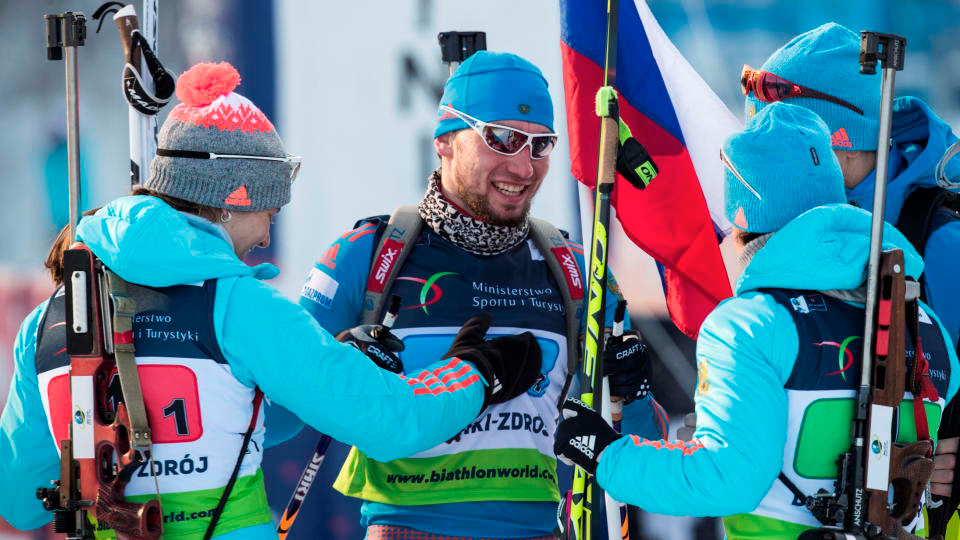
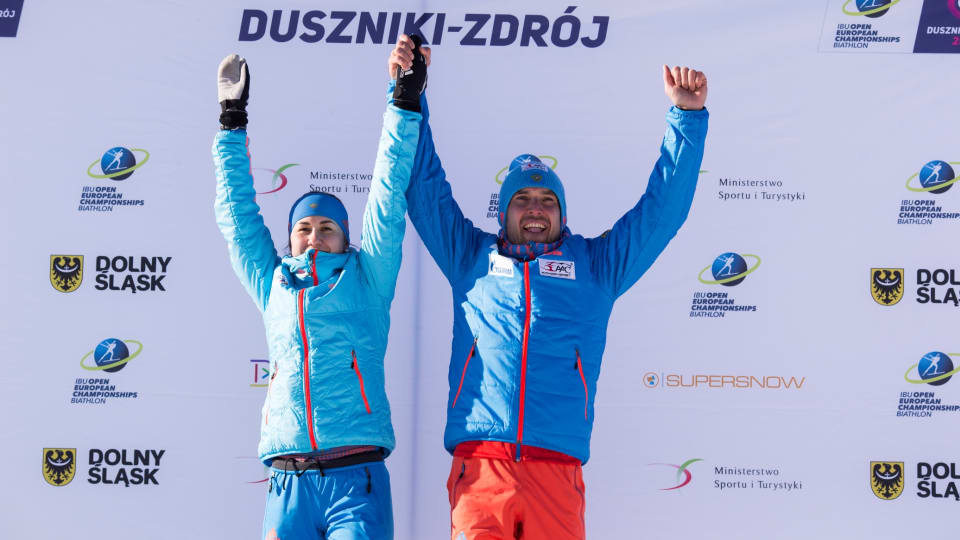
Russia’s Alexander Loginov (center) is greeted at the finish by his teammates Irina Starykh, Svetlana Sleptsova and Alexey Volkov after anchoring his team to the gold medal in the mixed relay at the 2017 IBU Open European Championships in Duszniki-Zdrój, Poland. (Photo: IBU)
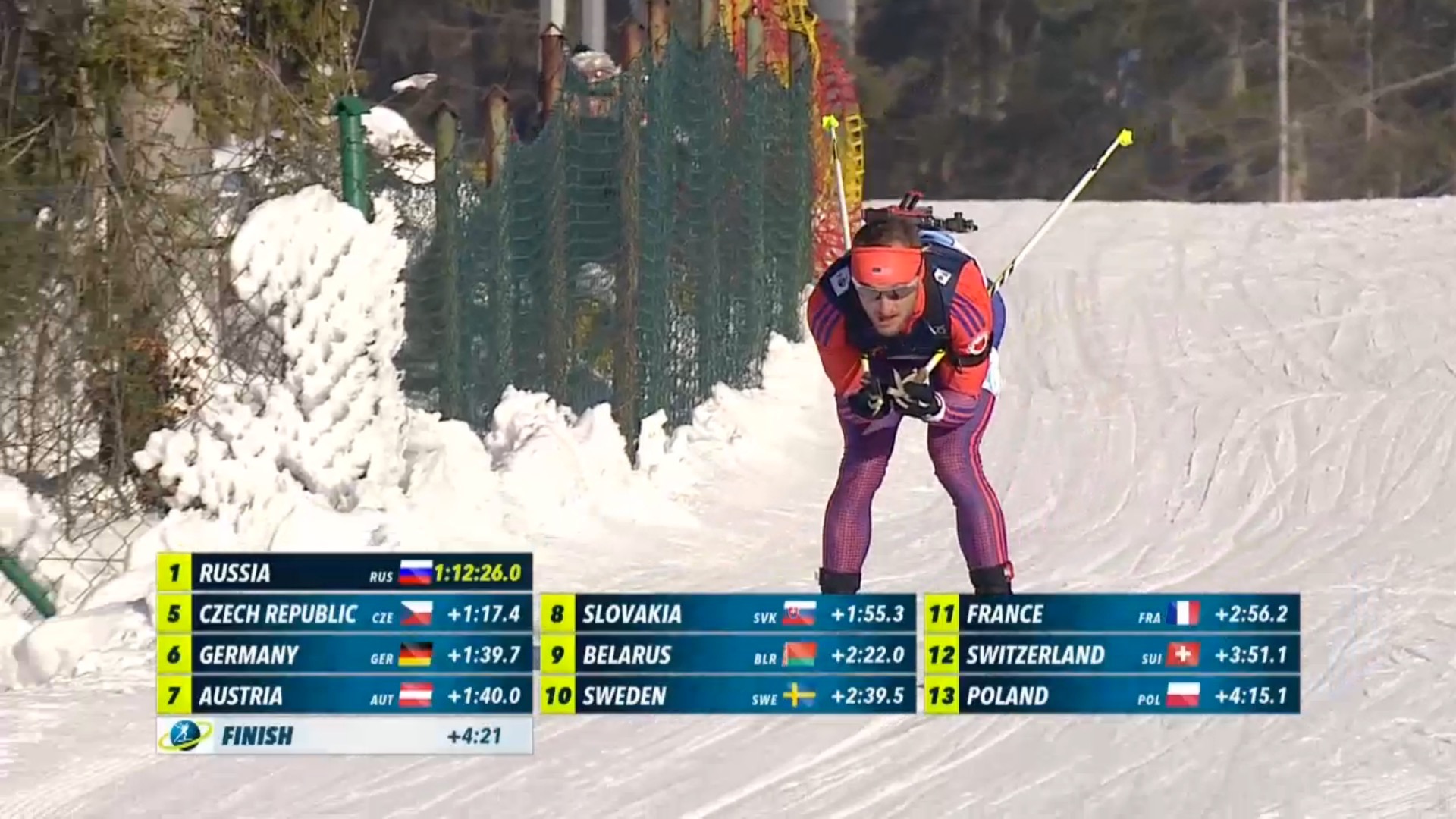
[UPDATED] The Russian victory in the final 2 x 6 + 2 x 7.5-kilometer mixed relay event of the 2017 International Biathlon Union (IBU) Open European Championships in Duszniki-Zdrój, Poland, was only briefly in doubt, when Alexander Loginov skiing the anchor leg required all spares in his prone shooting stage. But with his final shot he managed to also hit that target to avoid the penalty lap, leaving the range with a lead of more than 30 seconds.
Loginov then did not need any spares in the last standing stage, and could take his time on the final loop. Unlike Russia’s Evgeniy Garanichev earlier in the day during the single mixed relay, he also managed to pick up a flag for the final meters of the race, crossing the line in a time of 1:12:26.0 hours.
The Russian team with Irina Starykh, Svetlana Sleptsova, Alexey Volkov and Loginov led from the first exchange and required only six spares with zero penalties.
With this medal, the 28-year-old Volkov became the most successful athlete in history at European Championships, according to an IBU press release, surpassing the retired Polish biathlete Tomasz Sikora. Russia was the most successful team of the 2017 Open European Championships with six gold, four silver, and three bronze medals.
Behind them, a number of teams vied for the positions on the podium. Sweden initially looked like a strong contender exchanging in second place after the women, but fell back with three penalty laps to only finish 10th.
Still six seconds back after the final shooting, Norway’s Fredrik Gjesbakk caught up to and outsprinted Ukraine’s Ruslan Tkalenko in the finishing stretch to claim the silver medal (+36.4) with the bronze left for Ukraine (+37.1).
“I thought that I made sufficient gap to win silver,” Tkalenko told the IBU. “But in the end, on the final downhill before the finish, I was very surprised when the Norwegian guy passed me, I truly did not expect that.”
The Norwegian team with Karoline Erdal, Marion Rønning Huber, Erlend Bjøntegaard, and Gjesbakk needed nine spares and had no penalties.
Ukraine with Anastasiya Merkushina, Yulia Dhzyma, Oleksander Zhyrnyi (who originally started for Russia before making the switch in 2014) and Tkalenko required six spares, and Dhzyma had to ski a penalty lap only temporarily setting the team back.
Bulgaria finished fourth (+1:16.4), with its anchor Vladimir Iliev narrowly beating Czech Republic’s Lukas Kristejn (+1:17.4) in the finishing stretch. Both teams needed 11 spares and had no penalties.
Jakob Ellingson skiing the anchor leg for the U.S. mixed relay at the 2017 IBU Open European Championships in Duszniki-Zdrój, Poland. The U.S. team finished 14th. (Photo: IBU/Eurovisionsports.tv screenshot)
Starting at the back of the field in bib 20, US Biathlon’s Emily Dreissigacker got her team off to a strong start with a clean prone shooting and one spare round in standing, exchanging in 10th, a minute behind the leaders. Hallie Grossman needed one spare in each of her stages, tagging off to the men in 14th position and now 2:39 behind. Max Durtschi also had one miss each in prone and standing, coming into the last exchange still in 14th position, but another minute back. Jakob Ellingson required all three of his spares in his prone shooting stage narrowly avoiding the penalty lap, and one more in his final shooting stage. As the team from Finland was racing over a minute behind the Americans, he was able to keep the 14th position into the finish (+4:47.4), with a team total of nine spares and no penalties overall.
For Biathlon Canada, Erin Yungblut starting in bib 19 shot clean in her prone stage and required two spares in her standing shooting, tagging off in 18th position and more than two minutes back from first. Leilani Tam von Burg stayed clean in her prone shooting stage and needed one spare in standing, moving up two positions to exchange in 16th place, yet more than four minutes behind the leaders. After the exchange to the men, both Matthew Neumann and anchor Carsen Campbell managed to shoot clean in all of their stages, but lost additional time on the course to finish 16th (+6:39.9) ahead of four lapped teams.
Canada had the best shooting result of all 20 teams starting the relay, with just three spares and no penalty.
Russia’s Daria Virolaynen (l) and Evgeniy Garanichev after winning Sunday’s single mixed relay at the 2017 Open European Championships in Duszniki-Zdrój, Poland. (Photo: IBU)
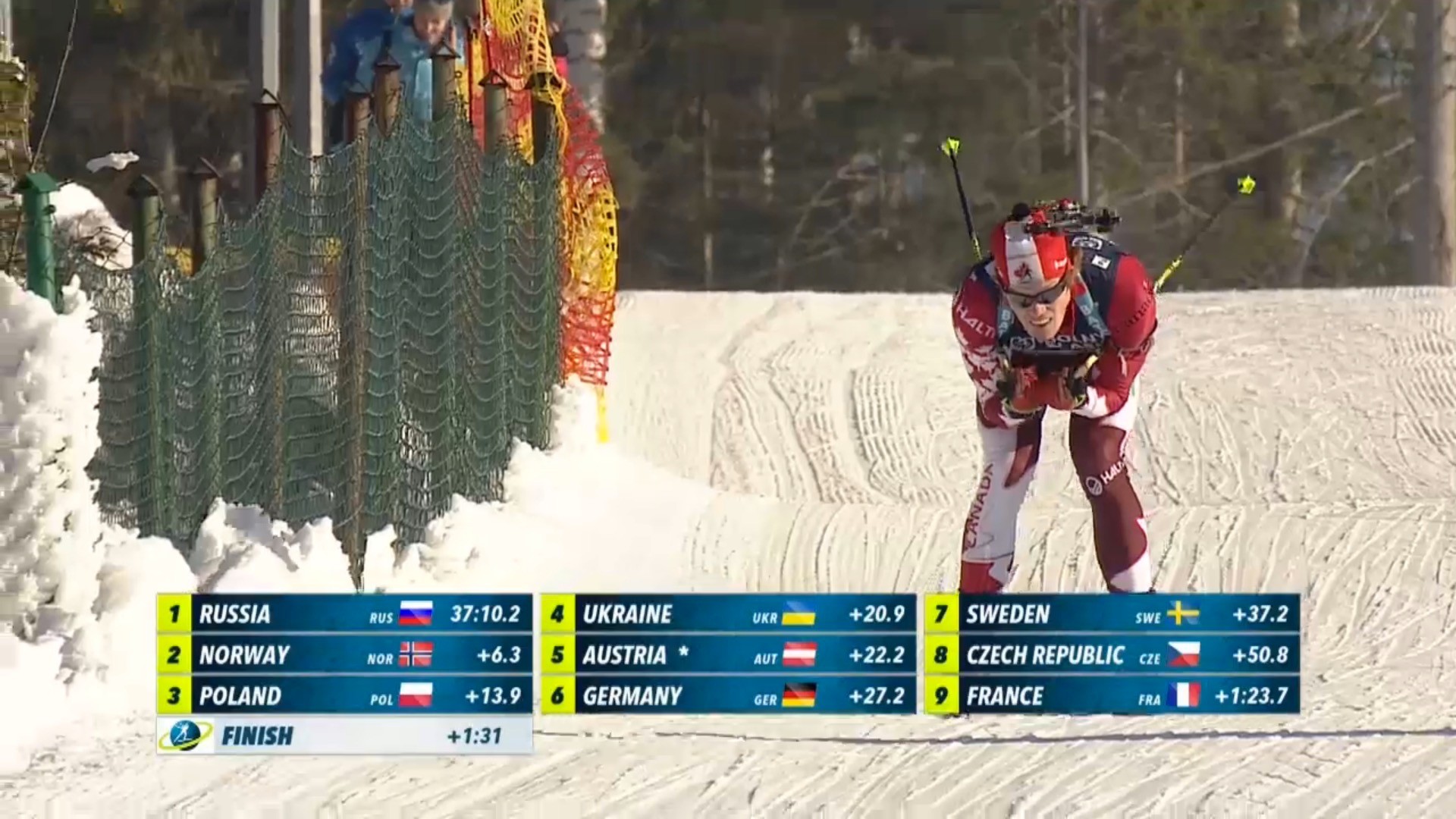
Earlier on Sunday, pretty much the only thing that went wrong for Russia’s Daria Virolaynen and Evgeniy Garanichev in the single mixed relay happened on the last meters of the finishing stretch, with Garanichev gesturing for a Russian flag he wanted to cross the line with. But the handoff was too short and the flag dropped past his outstretched hand to the snow. He glanced back, weighing if his lead was big enough to ski back, but decided it was not worth the risk, instead skiing into the arms of his partner waiting for him behind the line in a time of 37:10.2 minutes.
Russia needed seven spare rounds and incurred zero penalties. Garanichev secured the victory in the final shooting, when he only needed one spare – albeit fumbling a few seconds to insert it – while his direct opponents standing next to him required more time to hit their targets.
“Probably, I took some risk at the last standing,” Garanichev said, according to an IBU press release. “I wanted to shoot fast and clean, but missed with the last shot. But in general, I felt very comfortable; came and worked at the range in my rhythm.”
6.3 seconds behind, Norway with the team of Ingrid Landmark Tandrevold and Vetle Sjåstad Christiansen placed second, with seven spares and zero penalties.
“These are very short loops,” Christiansen commented on the fairly new, single mixed relay format. “You feel the pressure from the crowd and to shoot fast every time.”
The 20-year-old Tandrevold previously earned three bronze medals, including one in the single mixed relay, also with Christiansen, at last year’s Open European Championships in Tyumen, Russia.
To big cheers from their home crowd fans who had come out to the Duszniki Arena in beautiful but cold weather, the Polish husband-and-wife team of Krystyna Guzik and Grzegorz Guzik placed third with just five spares and zero penalties (+13.9), not quite able to keep up with Christiansen on the final loop after leaving the range together within a second.
“It is so nice to win a medal here in Poland,” Krystyna Guzik said. “We were both very disappointed with all of our mistakes in the other competitions. So today, we were relaxed and laughing before the competition, hoping not to have those mistakes again. We did not … and now have a medal.”
It was the first medal for Poland at these championships.
Ukraine with Iryna Varvynets and Andriy Dotsenko finished fourth, also with five spares and zero penalties (+20.9).
Biathlon Canada’s Aidan Millar skiing the final loop of the single mixed relay at the 2017 IBU Open European Championships in Duszniki-Zdrój, Poland. With teammate Sarah Beaudry, Canada finished 13th (Photo: IBU/Eurovisionsports.tv screenshot)
For Biathlon Canada, Sarah Beaudry and Aidan Millar required seven spares during their race and had no penalty, just like the winning Russians and Norwegians, but could not quite keep up with the best teams on the course in the fast-paced race format with short loops somewhat comparable to a team sprint in cross-country.
Beaudry cleaned her first shooting stage and then needed one spare to hit all targets in standing. At the first exchange Canada was 10th, 35.8 seconds behind the then leading team from Poland.
Millar missed one shot in his first prone stage, leaving the range again in ninth position. Then he needed two spares in his standing shooting on the way to exchanging back to Beaudry in 11th (+56.4).
On her second leg, Beaudry had one miss in prone and required two spares in standing, falling back a bit to exchange in 13th (+2:12.0).
On his final leg, Millar was able to shoot clean in both stages, reducing the time gap to the top but not able to make up another position, and finished in 13th place (+1:56.1).
US Biathlon is only represented with two women at the Open European Championships in Poland, and decided to forgo a start in the single mixed relay, instead entering a team in the mixed relay later on Sunday.
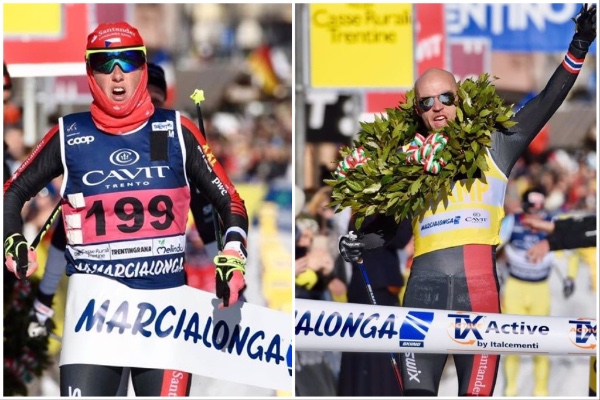
Katerina Smutna (left) and Tord Asle Gjerdalen (right) of Team Santander won the 2017 Marcialonga. (Photo: Visma Ski Classics)
Tord Asle Gjerdalen won the Marcialonga, a Worldloppet and Swix Ski Classics marathon for the third time – in a row. This year was on a shortened course, “just” 57 rather than the traditional 70 kilometers.
The Team Santander athlete finished in two hours, eight minutes, and 36 seconds, edging Johan Kjølstad (Team United Bakeries) and Morten Eide Pedersen (Team BN Bank) in a sprint finish by 2.6 and 2.9 seconds, respectively.
Tyler Kornfield and David Norris of Alaska Pacific University finished 43rd (+5:03.8) and 66th (+10:43.1). Canadian Paralympian Brian McKeever finished 57th (+9:13.5) and guide Graham Nishikawa 81st (+12:56.5), followed by Ian Murray in 85th (+13:37.5) and Erik Carleton in 111th (+17:50.2).
In the women’s competition, Katerina Smutna, also of Team Santander, won her third straight Ski Classics competition. She crossed the line in two hours, 22 minutes, and 46.4 seconds. Britta Norgren of Team Lager 157 was second by just 0.8 seconds, and Sara Lindborg (Team Serneke) third, +4:22.2. University of Utah alum Maria Graefnings was tenth, +10:35.8.
Biathlete Tim Burke coming into the shooting range during the mixed relay in Oestersund, Sweden, on Sunday. The United States ultimately finished eighth in the competition. (Photo: USBA/NordicFocus.com)
The IBU World Cup kicked off in Östersund, Sweden, on Sunday, with a doubleheader of mixed relay action. Perhaps not surprisingly, two of the most dominant teams of last season picked up wins: Norway and France.
Norway topped the 2 x 6 k + 2 x 7.5 k mixed relay, with the United States team of Susan Dunklee, Clare Egan, Lowell Bailey, and Tim Burke eighth (+2:38.5) and the Canadian team of Julia Ransom, Megan Tandy, Scott Gow, and Brendan Green 22nd (lapped).
In the single mixed relay, French dream duo Marie Dorin Habert and Martin Fourcade came out on top. Canada’s Rosanna Crawford and Nathan Smith finished seventh (+1:44.7) and Americans Joanne Reid and Leif Nordgren 19th (lapped).
Besides being the first race of the season, with all of the excitement and jitters that entails, Östersund had some big wind gusts in store for the World Cup field. Here are some reactions from the North American competitors.
On Testing Ski Speed for the First This Season
“The first race of the season is always an unknown, and a good way to let out the opening season jitters… I’m feeling pretty good about my prep and where I am right now, so I’m optimistic about the individual race in a few days. It’ll be a good way to really test the body and see what I can pull off in the range.”
-Scott Gow (CAN)
“You never know where you’re going to be going into the first race of the season. You do all this hard work and no matter how well you did it over the summer, there’s always this uncertainty for the first race. I was certainly hoping that I would be around here.”
-Susan Dunklee (USA), who led the mixed relay field at the first tag
“I knew there was a good chance that Susan would tag me in first place, so I was prepared for that scenario. She has led the first leg many times before, plus I witnessed firsthand the significant improvements she made over the summer, so I know she is at a very high level and I think we will see many more great things from her this winter.”
-Clare Egan (USA), who took the tag
“I did not expect to stay in front for as long as I did (about 1k), nor to be able to stay with the other women once they passed me. But I felt very comfortable in the lead pack, and that was a welcome confirmation that my summer training went well and that I am in great shape. No matter what stage of development you are at, it is a pivotal moment when you realize that the superstars are not superhuman. That happened yesterday for me!”
-Egan
What About Shooting Speed?
“The biggest thing I was waiting to see was the shooting speed because I’ve put a lot of effort into bringing my shooting times down over the summer and I think that has paid off quite a bit. I mean, I missed three targets and had to use three spares so that slowed me down a little bit, but the rest of the shooting times were pretty quick… In the past I don’t think I would have had the chance of being tagging off in the lead with three spares, and now because my shooting speeds are a little bit faster it makes it possible, which is really cool.”
-Dunklee
“I think the single mixed especially, because the ski length is the same as a [cross-country] sprint, has more focus on fast shooting and fast hand loading (the single bullet you load in a relay when you miss a shot), and I don’t have either of those skills down completely yet.”
-Joanne Reid (USA)
On Wind
“When I came in for standing the wind had picked up and many of the athletes around me used all three spares and a few ended up in the penalty loop with me. The wind was part of my problem, but additionally I was nervous. There is a catch-22: if you are not confident, it’s almost impossible to shoot well, but if you don’t shoot well consistently, it is almost impossible to be confident. I am trying to work around that!”
-Egan, who cleaned prone with no spare rounds but was stuck with two penalty loops in standing
“Prone was somewhat normal for myself, with the windy range calling for one more spare. However, I think jet lag caught up to me a bit, making for a hard time on the skis, and an absolutely terrible time in the range (standing). I think it was a lack of mental sharpness that caused standing to unravel, which was not only disappointing but embarrassing because I know I’m better than that!”
-Julia Ransom, who led things off for Canada and also had two penalty loops in standing
On Ice
“It was really good snow cover, but it rained a couple days ago and so all the sidewalks around town are still just sheet ice, and sheet ice under the snow. Some of the downhills, right in the corner where you want to turn you have to be really careful because you’re going to skid out. And also some of the uphills you had to be really careful about which side of the hill you went on, because some of it was all the snow on top was scraped off and it was sheet ice so that was tricky.”
-Dunklee
“Three people fell in front of me in the first lap alone.”
-Reid
“After my last shooting as I was rushing to get out of the range so I could go and tag to Nathan, I hit one of those ice patches and slipped as I was trying to put my pole on, and it just fell out of my hand. I was able to grab it really quick, but it’s still something that kind of throws off your rhythm. Luckily I didn’t have to go ski a whole loop, I just had to tag Nathan right away!”
-Rosanna Crawford (CAN)
“It was definitely tricky this evening with a lot of icy patches. My lower legs are feeling quite strained and a little painful now.”
-Nathan Smith (CAN)
On No-Man’s-Land
“I was tagged fairly far back and unfortunately there weren’t very many people around me. There was one athlete about 30 seconds ahead and another about 30 seconds behind, so I was fighting to catch up to one and fighting to stay ahead of the other. For my leg of the race I was just trying to have a good personal performance and try to make up time where I could.”
-Gow
On Teammates
“Today I am starting fresh and coming up with a plan to try to mitigate what happened yesterday for future performances. It’s always hard having those bad days when others are counting on you, but I am lucky to have such awesome, understanding teammates.”
-Ransom
“It’s hard to start out the season with a relay, since there’s more pressure than usual – there are other people depending on your ski speed and shooting accuracy… I don’t know which is worse- being the person that has to go into the penalty lap in the relay, or having to watch your relay teammate go into the penalty lap-yikes!”
-Reid, who had a penalty loop in her first shooting stage
Racing continues in Östersund on Wednesday with the women’s 15 k individual and on Thursday with the men’s 20 k individual.
American Susan Dunklee (l) and the Canadian men’s relay, with (from l to r) Christian Gow, Nathan Smith, Scott Gow, and Brendan Green, earned FasterSkier’s biathlon performances of the year with their results at the Presque Isle World Cup and World Championships, respectively. (Photos: USBA/NordicFocus & JoJo Baldus)
We’re entering the homestretch for the 2015/2016 FasterSkier awards, chosen by our staff based on performances last season. While not scientific, these points of recognition are intended to reflect a broader sense of the season in review.
The following set of honors goes to outstanding North American male and female biathlon performances of the year. Cross-country performances of the year will follow.
Susan Dunklee (US Biathlon): Presque Isle World Cup 10 k sprint
Both Susan Dunklee and teammate Lowell Bailey seemed to have breakthroughs after the 2014 Olympics in Sochi, Russia: they had notched best-ever finishes for Americans, with Dunklee 11th in the mass start and Baily eighth in the individual, and then picked up their first World Cup podiums in the weeks post-Olympics.
Heading into 2015, the team (as well as its fans) was giddy with the possibility of more podiums. But none came.
Dunklee delivered this season in Presque Isle, Maine, exactly where those fans could most appreciate it. Shooting a perfect 10-for-10 in the 10-kilometer sprint, she sped past many pre-race favorites and finished second, 17.8 seconds behind Gabriela Soukalova of the Czech Republic (who later won the World Cup Total Score).
“I knew I probably had one of my best races in my life and I’d done it at home and my parents were there,” Dunklee said after the race. “I just felt really good about my performance. I was really happy.”
It was close, with second through fourth place separated by fewer than three seconds. But Dunklee, an early starter, got to watch her time hold despite challenges from the likes of Marie Dorin Habert of France.
“You still need to fight like hell,” Dunklee recalled of heading out on the final loop knowing that times were tight. “When you’re having that sort of race, you don’t want to lose a second anywhere … I’ve just got to fight for the next seven minutes or whatever it takes.”
Dunklee had a solid season, just as she has for each of the last several years; consistency on the World Cup circuit landed her in 14th place in the Total Score, the best ever for an American woman.
But consistency doesn’t breed excitement quite the same way that podiums do.
“It’s unbelievable,” U.S. women’s coach Jonne Kähkönen said. “Just to be able to grab the podium on the home soil, home World Cup, even if it’s not the hometown, but there’s a lot of friends and family and fans that are great support. The local community is just awesome, so it means the world to us.”
Dunklee is now tied for the best performance ever by an American, along with Tim Burke, Anna Sonnerup, Joan Smith, and Josh Thompson, all of whom also won silver at World Cup or World Championships events.
Next up? The U.S. is still waiting on a gold.
Canadian men’s relay team (Christian Gow, Nathan Smith, Scott Gow, and Brendan Green), World Championships men’s 4 x 7.5 k relay
While Dunklee’s second-place finish was historic, it didn’t send the same shock waves as another record-setting result which came a few weeks later: when the Canadian men’s team broke through for bronze in the World Championships relay in Oslo, Norway, earning their country’s first-ever relay medal.
“In a relay anything is possible,” anchor racer Brendan Green said at the time. “Today we all really put it on the line together. Every single one of us raced really well. When that happens, when things come together like that, it’s really incredible.”
It was easily the most surprising result of the championships, and the athletes themselves said that they hadn’t seen it coming – they had thought a top five was possible. The medal? Maybe in a few years, they had hoped.
Some aspects of the performance were predictable. The Canadians tied with Germany and the U.S. for the best shooting on the day – not surprising because they already were a great shooting team, with Christian Gow the fourth-most accurate shooter on the World Cup and Smith the fifth-fastest.
And seeing Nathan Smith bring the team to the front of the field? He has won an individual World Cup, so that wasn’t unusual.
Seeing Green anchor the team like a pro? He has done it dozens of times, and also has five individual top-10 finishes to his name – although shooting a perfect ten-for-ten when a medal is on the line is a whole different story. Green was stone-cold as the anchor even though he said his nerves were a nightmare.
Perhaps what fans hadn’t been expecting were the stellar performances of the Gow brothers, who are the younger members of the Canadian team. Christian Gow, then 22 years old, tagged off just 14.7 seconds behind the leaders on leg one, handing over to Smith, who skied into a more or less dead heat with the leaders on leg two.
Older brother Scott, 25, turned in one of the best ski performances of his career, casually hanging with Norway’s Johannes Thingnes Bø, a many-time World Cup winner who later went on to take gold in the 15 k mass start.
“Watching Christian tag off really close, and then Nathan obviously moved us right into contention… I thought, OK, I have to [stay with him], I don’t have a choice,” Scott said. “I don’t know if I believed I could, but I had to, to try and keep our team in it. I’m just happy that I was able to stay right behind Johannes for most of it and hang on.”
He did hang on, tagging off in third; Green sealed the deal; history was made.
“Every year you kind of think it’s coming,” National Team Coach Roddy Ward said. “It’s close, it’s close, and we’ve been close for a couple of years. We were close enough, I guess, that on the right day we were there.”
Maybe next time the commentators won’t be so surprised.
Honorable mentions:
Canadian mixed relay team (Rosanna Crawford and Nathan Smith), single mixed relay at Östersund, Sweden, World Cup
Nathan Smith and Rosanna Crawford celebrate their second-place finish in the World Cup single mixed relay in Östersund, Sweden. (Photo: Fischer/NordicFocus)
Canada had actually started the year off with a relay “bang”: in the very first World Cup competition of the season, Nathan Smith and Rosanna Crawford teamed up for silver in the mixed relay.
Despite a rocky start and nine spare rounds, they managed to avoid the penalty loop and finished 11.9 seconds behind Norway, claiming Canada’s first ever World Cup relay podium.
“It feels amazing,” Crawford said at the time, before pointing out that she’s still hunting for her first individual podium. “I don’t want to downplay it. Those team events, it feels so exciting and I feel so lucky to share the podium with my teammate who I’ve trained with for so long. But also, it’s probably not the same as an individual podium, which is definitely what I’m gunning for this year.”
U.S. (Susan Dunklee, Hannah Dreissigacker, Tim Burke, and Lowell Bailey) and Canadian (Rosanna Crawford, Sarah Beaudry, Macx Davies, and Brendan Green) mixed teams, Mixed relay at Canmore World Cup
Perhaps team events were just the thing for North American biathlon teams this season. In Canmore, Alberta, both the Americans and Canadians were in the hunt for the podium until late in the race. The U.S. ended up fourth, less than two seconds off the podium, and the Canadians ten seconds behind them in sixth.
The result was a best-ever mixed relay for the U.S., with Canada tying its previous best in the two-man, two-woman event.
“It’s easy to say, ‘Oh man, if I had known, I would’ve skied two seconds faster,’ but I really don’t think I could’ve,” U.S. anchor skier Lowell Bailey said of finishing less than two seconds out of third. “I put everything I could have into that last lap. It’s bittersweet, but it’s also our best result ever in the mixed relay. … Fourth is where we ended up, and I think we have to be satisfied with that and keep that momentum going forward.”
France’s Martin Fourcade crosses the finish first to meet his teammates after anchoring the mixed relay to gold to open the 2016 IBU World Championships in Oslo, Norway, Germany’s Simon Schempp secures second behind him, and Norway’s Tarjei Bø comes onto the final stretch to claim bronze. (Photo: IBU/Evgeny Tumashov)
Martin Fourcade versus Simon Schempp: Two perennial rivals who still greatly respect each other’s performances, duking it out on the final loop of Thursday’s mixed relay.
It was a fitting end to the first race of the 2016 International Biathlon Union (IBU) World Championships in Oslo, Norway, a finish sprint into the famous Holmenkollen ski arena with two athletes at the top of their game, in a repetition of a scene similar to what biathlon fans have witnessed repeatedly in recent seasons.
This time, France’s overall World Cup leader Fourcade prevailed against Germany’s anchor, skiing over the last bridge in the stadium and taking a little bow in the style of a telemark ski turn. He crossed the finish line in 1:14:01 and celebrated the gold medal with his excited teammates. Combined, the four-person French relay had no penalties and seven spare rounds.
Martin Fourcade celebrates with his teammates after anchoring France’s mixed relay to gold in the first race of 2016 IBU World Championships in Oslo, Norway. (Photo: IBU)
“Today was really emotional, because it was my first, our first victory in a team race in World Championships since 2009,” Fourcade said at the post-race press conference.
“Of course we were among the favorites so we were thinking about [the gold medal],” Fourcade added in an interview with the IBU. “But in biathlon you never know until the last shooting. We were fighting for gold as well as for the fourth place.”
Germany finished second, just 4.3 seconds back, and also with seven spares.
“I tried to bring out everything I had, but in the end I honestly was too exhausted,” Schempp told German TV broadcaster ARD. “We are totally happy about silver.”
“The way Fourcade threw himself into the snow afterwards, I think that shows Simon [Schempp] pushed him to his limits,” Germany’s third leg skier Arnd Peiffer told ARD. “Martin definitely didn’t have it easy on the final loop today … With that ‘telemark’ move he was just showing his excitement, that had nothing to do with arrogance.”
Another 10 seconds back, Norway’s anchor Tarjei Bø secured the bronze medal for the home team (+14.4), with ten spares, to the huge joy of the audience.
The U.S. finished 10th (+2:19.6), with five spares, falling back on the last three legs after starter Susan Dunklee rocketed through the first exchange in first place. Canada placed 11th (+2:30.8), with 11 spares, unable to quite keep up with the leaders throughout the race due to too many misses on the shooting range.
After a festive opening ceremony at a central square in Oslo on Wednesday night, the Biathlon World Championships opened with the mixed relay, including two women and two men per team, with all other rules just like in a traditional relay.
The two women begin, and each ski 6 kilometers with one prone and one standing shooting stage, while the men have to ski 7.5 k each. The athletes can use three spare rounds per stage, and if they fail to clean their targets with those spares, they have to ski a 150-meter penalty lap for every miss.
The IBU first experimented with mixed relays 11 years ago as a special event during the World Cup finale. Since 2007, the discipline has been part of the official program at World Championships.
Initially it was a bit of an afterthought, with a number of countries with large teams using it as an opportunity to give their lower-ranked biathletes a start at championships, and saving their best ones for the individual starts and the traditional women’s and men’s relays.
That has changed in recent years, since the event also became part of the program at the 2014 Olympics in Sochi, Russia. This year in Oslo, small and larger teams alike certainly pulled out all the stops, with almost every nation entering the its best athletes.
Low-hanging clouds and fog on the range had been predicted, but for Thursday’s competition, the view of the targets on the shooting range was actually clear despite a cloudy sky and a little fog shrouding the big ski jumps that tower over the Holmenkollen arena.
The French team, with Anaïs Bescond, Marie Dorin Habert, Quentin Fillon Maillet, and Fourcade, initially hit a snag when Bescond required all spares to hit her targets in her standing stage, narrowly avoiding the penalty lap and coming through the exchange in seventh place, 35 seconds behind Dunklee.
Then Dorin Habert crashed in a ski tunnel out on the course, in snow conditions some athletes described as “glazed” in certain sections.
“Nothing terrible, it was just a mistake by me,” Dorin Habert said of her fall at the press conference.
She quickly recovered and moved her team into third place at the next exchange, with Fillon Maillet and finally Fourcade able to close out successfully by pushing hard up the final small climb and U-shaped turn in the arena to create a little gap.
Similarly to France, Germany’s starter Franziska Preuss initially lost 20 seconds to the top due to two misses in her first prone stage, but moved back up to fourth place at the exchange. Then Franziska Hildebrand and Peiffer kept the team in contention for the podium, before Schempp was able to claim the silver medal.
Germany’s Simon Schempp after one of his shooting stages during Thursday’s mixed relay at IBU World Championships in Oslo, Norway. He anchored Germany to second, 4.3 seconds behind France. (Photo: IBU)
In his last shooting, Schempp thought he had hit all shots taking down his rifle to head back out on the course, before realizing he had missed one and — like Fourcade -– still had to use a spare. Schempp made his shot and left the range just 1.7 seconds behind Fourcade. While Schempp was able to catch up on the course, he did not have the energy left to beat his rival in the final sprint.
Ahead of World Championships, fans and the media put a lot of expectations on the home team from Norway with Marte Olsbu, Tiril Eckhoff, Johannes Thingnes Bø and his older brother Tarjei Bø.
At the 2014 Olympics, Norway had won the gold medal in the mixed relay, though only Eckhoff, who grew up just a stone’s throw away from the Holmenkollen arena, was a part of the lineup back then.
In front of thousands of spectators, including Norway’s King Harald V, the team did not disappoint, with Olsbu and Eckhoff delivering some of their best performances of the season to tag off in second and first place, respectively. From there, the Bø brothers kept the team in podium contention.
“I was very nervous,” Olsbu said at the press conference. “I am just so happy that I made a good race today.”
Johannes Bø tried to make a move on his last loop, yet the other teams just behind him closed the gap again before the exchange.
After needing all spares in his prone shooting on the anchor leg, his brother Tarjei fell back 18.4 seconds, but was able to reduce that again to 7.4 with fast skiing and a clean final shooting stage. While he tried everything in his power, he could not quite catch up to Fourcade and Schempp again.
“Of course we are happy to have a medal at the Championships [at] home,” Johannes said during the press conference. “But we are athletes who want to win. So we are 90 percent happy [with bronze], and we take the last 10 percent next week.”
“Simon and Martin were too strong for me,” anchor Tarjei Bø said.
When a French journalist asked his rivals if Fourcade maybe gained a psychological advantage for the remainder of the World Championships after a win on Thursday, Tarjei Bø laughed and exclaimed: “Yeah, he is unbeatable. He’s so unbeatable that I will not race any more at these World Champs!”
“That’s a good idea,” Fourcade replied with a big smile on his face.
For a long time, four teams had been in close contention for the medals, but after a strong race Ukraine, with Valj Semerenko, Olena Pidhrushna, Sergey Semenov and Dmytro Pidruchnyi, could not quite keep up on the anchor leg with two spares in the last shooting. Ukraine finished fourth (+29.8), with nine spares.
Fifth place (+1:07.1) went to Austria, with Dunja Zdouc, Lisa Theresa Hauser, Simon Eder and Dominik Landertinger, which combined for a team total of just three spares, the fewest of any nation. Meanwhile, the defending world champions in the mixed relay, the Czech Republic, with Veronika Vitková, Gabriela Soukalová, Michal Slesingr and Michal Krcmar finished sixth (+1:23.3), with five spares.
Dunklee in the Lead
Susan Dunklee (US Biathlon) trails France’s Anais Bescond during the first leg of the mixed relay at 2016 IBU World Championships on Thursday in Oslo, Norway. Dunklee went on to tag off in first, 1.6 seconds ahead of Norway. (Photo: USBA/NordicFocus)
For US Biathlon, Dunklee started out strong, shooting clean in the first prone stage to leave in second behind France’s Bescond. Then she again hit all of her targets in standing to leave the range 4.5 seconds behind Norway’s Olsbu and Italy’s starter Dorothea Wierer (an athlete with multiple World Cup victories this season. Italy went on to finish eighth).
This time, Dunklee was not satisfied just staying behind the athletes at the top, immediately attempting to overtake Wierer and move up to Olsbu.
“I love the thrill of starting relays,” Dunklee wrote in an email after the race. “I have been close behind the leader tagging off many times, but I have never tagged off in first. On the last loop I was hungry to finally win my leg today and I wanted to give Hannah [Dreissigacker] the experience of leaving in the lead in front of a packed Norwegian crowd.”
Of all the first-leg skiers, Dunklee’s course time was the fastest.
“I do love the Holmenkollen crowds and the hilly course,” she wrote. “I felt relaxed and focused on the shooting range and felt very strong skiing. Our staff put together incredible skis today.”
“I love the thrill of starting relays. I have been close behind the leader tagging off many times, but I have never tagged off in first. I was hungry to finally win my leg today…” — Susan Dunklee, who put the U.S. in first at the first exchange on Thursday
Dreissigacker initially was able to keep up on the course with France, Norway, Ukraine, and Germany at the top.
“It was a fun race and definitely a real thrill [to] get the tag in first place,” Dreissigacker wrote in an email. “Susan really did us all proud out there. I did my best to ski my own race, but it’s always hard when you have lots of adrenaline and find yourself in first place.”
After requiring a spare in prone, she was still in third place, only 1.7 seconds back. Then having more trouble maintaining the leaders’ pace on the next loop and with another missed shot in standing, she fell back 22.7 seconds to fifth place. On her final loop, Soukalová, the overall World Cup leader, passed her on the course, and Dreissigacker lost another half a minute to the leaders, tagging off in sixth, 51.3 seconds back.
“I felt like I was in control on the first and second laps, trying to keep in touch with the leaders as much as possible without overdoing it,” Dreissigacker explained. “But I definitely didn’t have too much gas left in the tank for the last lap, and it didn’t help that I had really lost all contact with the women ahead of me. But that was also a group of the very fastest women in the world, so I am not surprised that they put lots of time on me in the last lap.”
The U.S. team’s third leg, Lowell Bailey had a strong performance on the shooting range and stayed clean both times just like Dunklee, but continued to lose time on the course, and his course time ultimately ranked 19th of the third-leg skiers. He tagged off in eighth place, 1:35.5 minutes back.
“The course was tricky today,” Bailey wrote in an email. “The new snow packed down and glazed, making some of the downhills and especially the stadium fairly treacherous. It wasn’t my best day on skis, but hopefully I’ll feel better as the Championships roll forward.”
Anchoring the U.S. relay, 20-year-old Sean Doherty required a spare in both his prone and standing stages, and with the 16th-ranked course time on his leg, he slipped two positions to finish 10th (+2:19.6), one position ahead of Canada.
“Today’s race was an exceptionally high level,” Doherty said in a US Biathlon press release. “We showed that we can shoot with the best teams and be very competitive. I am really happy with my leg and feeling strong looking ahead to the sprint.”
“The mixed relay is a format we often think of as one of our best medal hopes, so from that perspective our result today is disappointing,” Dunklee wrote. “After our 4th place in Canmore I think we all went into today with high hopes… On the range we put together an excellent performance, one of our best I would say. Tenth is solid, but we know with that good of [a] shooting we can be capable of much more. The good news is that we have many races still to come.”
“It was just tough, tight competition out there and I think we had a really solid team performance,” Dreissigacker commented. “Using only 5 spares for the whole team is great shooting!”
As Bailey pointed out, a top 10 is a top 10.
“It is a tight field and we were close to the leaders for a significant part of the race,” he wrote.
The Canadian team with Julia Ransom, Rosanna Crawford, Nathan Smith, and Brendan Green was hoping to build on its ninth place in the mixed relay in Östersund, Sweden, and sixth place at home in Canmore.
On Thursday, Ransom started in bib 5, and had some trouble to keep up with the leaders. With one miss in both her prone and standing stages, she found herself 36.5 seconds behind going onto the final loop, and then lost more time to tag off in 11th place, 1:03.4 minutes back.
Crawford was able to maintain the pace with the seventh-best course time on her first loop, before dropping off a bit the third time around the Holmenkollen 2 k course.
“It was nice on those first two laps to be working with Sweden and trying to stay with Soukalová,” Crawford wrote in an email. “I had a tumble on the same hill as Dorin [Habert] in warm up and broke a pole, but the race was smooth and I didn’t have to deal with any sketchy people on the downhill.”
But she couldn’t make up positions or time with a miss in her prone shooting and two spares in the standing stage, where she had some additional issues.
“I had some trouble with standing where my shell got stuck, and I wasted some time getting that fixed, and then missed two targets on top on that,” Crawford wrote. “So I am quite disappointed with my shooting. Getting the jitters out before Saturday’s race though hopefully!”
She handed off in 14th place, 1:27.7 back.
Currently the highest-ranked Canadian on the World Cup, Smith skied fast on the course, posting the fifth course time on his leg.
“I’m very happy with my skiing today,” Smith wrote in an email. “I’ve been struggling over the last 7 weeks to feel good on the skis. I wouldn’t say I felt like a total beast skiing, but I knew my shape was good just because I was able to more or less maintain position with top guys like [Russia’s] Garanichev and [Austria’s] Eder… I don’t actually particularly like this arena. I find the gentle ramp through the stadium surprisingly challenging. The ski loops are interesting though, and obviously great views.”
But like his teammates, he could not quite stay clean on the range, requiring two spares in prone and another one in standing.
“Shooting conditions were perfect,” Smith stated. “Very little wind and no fog. Earlier in the day it looked nasty but everything cleared up for us.”
Smith moved up the team a few positions to tag off in 10th (+1:35.9).
“I wouldn’t say I felt like a total beast skiing, but I knew my shape was good.” — Nathan Smith, who skied the fifth-fastest course time on the third leg to bring Canada from 14th to 10th
Canada’s anchor, Green also did not have a perfect day on the range, needing one spare round in prone and two in the final standing stage. Combined with his skiing (13th ranked course time), he lost some additional time to the top, with Canada closing out the race behind the U.S. in 11th place, 2:30.8 behind the winners.
“In my portion of the race there wasn’t anything too out of the ordinary,” Green wrote in an email. “The track was really glazed in some sections and the skiing in general felt like a bit of a balancing act at times.
“There has been a bit of wind during the last few days [of] training, but it dropped a bit this afternoon which was nice,” he wrote of the shooting conditions. “A slight but manageable wind from the left. I was a bit worried about the fog that was lingering throughout the day but fortunately it moved off and the range was clear.”
Asked if their team result was within expectations, Crawford wrote, “11th is a disappointing result for our team, we are capable of a top 8 on an average shooting day and for sure top 6 if we all have a great day on the range. 11 spares is not a normal day for our team I’d say.”
“11th is nothing to write home about but still a decent result,” Smith stated. “We knew everyone would be putting in their best teams.”
“Overall, today wasn’t a true representation of what our team is capable of,” Green wrote. “It’s day one of the Championships and I know we’re all hungry for more.”
Races in Oslo continue on Saturday with the first individual races: the men’s and women’s sprints. All races as well as shorter recaps can be streamed live or time-shifted (most with English commentary) on Eurovision Sports.
“I just want to get one [individual] title, that’s my aim,” Fourcade said at the press conference.
“The atmosphere was great!” Bailey wrote. “Cheering along the track and extremely loud in the stadium. I think it will be even bigger on the weekend.”
“On Saturday we’ll come out fighting,” promised Green. “The atmosphere was pretty awesome today. The stands were full and the stadium was loud. It’s a good vibe and if today is any indication, we’re going to be in for a fun couple weeks of racing.”
Norway’s Håvard Bogetveit leads American Lowell Bailey into the finish in a race for third in Sunday’s mixed relay at the IBU World Cup in Canmore, Alberta. The U.S. placed fourth for a team best in the event’s 11-year history. (Photo: Daniel S. Guay)
Considering anything better than sixth would have been a first-ever for either the U.S. or Canada in the IBU World Cup four-person (2 x 6 + 2 x 7.5-kilometer) mixed relay, that put Lowell Bailey in a bit of a position heading into the final loop of the last relay leg on Sunday.
Here he was, in fifth with 2.5 k to go, and just three seconds ahead of France’s Quentin Fillon Maillet in sixth and 4.6 seconds behind Canada’s Brendan Green in fourth. In front of both the Canadian and American teams, Norway set out on the final loop in Canmore, Alberta, 16 seconds ahead.
What or whom do you focus on? Should Bailey go for fourth? Should Green try to catch the Norwegian and the final spot on the podium? Or is it best to hold your own and not risk too much?
According to Bailey, a lot was going through his head after emerging from the final standing with clean shooting, thanks to two spares, shortly behind Green, who cleaned both stages without any spare rounds.
Tim Burke (l) after tagging U.S. teammate Lowell Bailey in fourth, about 36 seconds behind Norway in third, during the last exchange of the mixed relay at the IBU World Cup in Canmore, Alberta. (Photo: Daniel S. Guay)
“To be honest, I know [Fillon Maillet] and I know how good of a skier he is, he’s top 10 in the overall [World Cup],” Bailey said in a phone interview after the race. “So the thoughts going through my head on the last lap was, ‘OK, I’ve got to stay focused here,’ … My goal was to ski the first half of the loop well enough that France wasn’t going to get into my draft.”
The second half of the course was uphill and into the wind, and tactically, a skier able to catch a draft off someone in front of them on that part could be fresher for the last 700 meters to the finish.
In his effort to drop Fillon Maillet and make sure he wasn’t on the losing end of that strategy, Bailey inadvertently caught Green on the second-to-last major climb before the finish.
“It just so happened that I felt pretty good so I just went for it,” Bailey recalled.
After passing Green in fourth, he looked up and saw Norway’s Håvard Bogetveit, a 23-year-old Norwegian B-team member, in third.
“I didn’t see Norway until about halfway up that climb,” Bailey said. “I’m not sure if the Norwegian, if he was tired or what, but it didn’t become clear that there was a chance at third until that last uphill. Our team and ski technicians and coaches and staff were cheering me on and hoping that I could catch that gap.”
Meanwhile, Green, who had been tagged in seventh and climbed into fourth with perfect shooting, started to come undone.
“I really tried to race more aggressive. I had to. After the sprint on Thursday and knowing that my form wasn’t where it needed to be, I knew I couldn’t afford to hold back at all this race,” Green wrote in an email, referring to Canmore’s opening sprint last Thursday, where he placed 40th with one miss. “As for the shooting today I think I was just feeling confident. Canmore is often a very difficult range to shoot on, but I felt that [Saturday] I was really able to get a grasp of the wind while training, and was able to bring that confidence and shooting form into today.
“When I left [the range] in 4th I knew I was going to have my work cut out, especially given the pace of my second loop with France,” Green recalled. “That said, I gave it my all. I started to blow up and just couldn’t maintain the pace, but I think with a bit better form I could have hung on.”
Racing up and over the final climbs and into the finish, Bailey pushed to catch Bogetveit. He came within 1.7 seconds at the finish, but Norway secured the final spot on the podium, 1:23.8 minutes behind the German winners, and the U.S. claimed the so-called wooden medal in fourth. Regardless, it was the best showing for a U.S. mixed relay since its inception, officially at 2005 World Championships.
US Biathlon’s previous best mixed relay was sixth place four years ago at the World Cup in Kontiolahti, Finland, with Jay Hakkinen, Sara Studebaker, Annelies Cook, and Tim Burke. This time around, Susan Dunklee, Hannah Dreissigacker, Burke, and Bailey teamed up for fourth, 1:25.5 behind Germany. (Earlier in the day, Annelies Cook and Leif Nordgren raced the single mixed relay, placing 16th.)
“It didn’t become clear that there was a chance at third until that last uphill. Our team and ski technicians and coaches and staff were cheering me on and hoping that I could catch that gap.” — Lowell Bailey, who anchored the U.S. mixed relay to a team-best fourth on Sunday
“It’s easy to say, ‘Oh man, if I had known, I would’ve skied two seconds faster,’ but I really don’t think I could’ve,” Bailey said of finishing less than two seconds out of third. “I put everything I could have into that last lap. It’s bittersweet, but it’s also our best result ever in the mixed relay. … Fourth is where we ended up, and I think we have to be satisfied with that and keep that momentum going forward.”
Behind him, Green anchored Canada to sixth, 3.6 seconds behind Fillon Maillet, who notched fifth for France (+1:30.7). The result tied the Canadians’ best in a mixed relay after placing sixth in 2011 in Hochfilzen, Austria. Like the U.S., that team only included one of the same athletes from Sunday’s relay — Green — who had teamed up with Megan Imrie, Zina Kocher and JP Le Guellec in 2011. (Julia Ransom and Nathan Smith raced Sunday’s single mixed relay, placing 12th.)
“We’ll get to the podium eventually — it will just be a matter of small consistent steps, nothing drastic,” Green wrote. “The team was awesome today. Everyone did a really great job and set the race up well for the next person. I couldn’t have asked for more from them today.”
Germany in It to Win It
Germany topped the podium with a 1:12.9-minute win in the mixed relay on Sunday at the IBU World Cup in Canmore, Alberta, with (from left to right) Franziska Hildebrand, Franziska Preuss, Arnd Pfeiffer, and Simon Schempp. (Photo: Daniel S. Guay)
In the race for first, Germany established itself as a frontrunner early when Franziska Hildebrand tagged Franziska Preuss in third, just 1.4 seconds out of the lead. Switzerland’s Selina Gasparin had moved to the front of the first leg after cleaning her standing stage and leaving the range five seconds ahead of Italy’s Dorothea Wierer in second.
Wierer had previously been the first out of prone, 3.4 seconds ahead of Dunklee in second. Both women cleaned prone without needing any of three possible spares. Dunklee left the range two seconds ahead of Kazakhstan’s Alina Raikova in third, and almost immediately, the American caught Wierer. The two remained together off the front of the pack for the next loop, skiing 4.2 seconds ahead of Gasparin in third while Raikova dropped 13 seconds back to sixth before the second shooting.
There, Wierer needed two spares to clean and Dunklee used all three, but both avoided the penalty loop to leave the range in second and sixth, respectively. Wierer followed Gasparin into the final loop before the exchange, 5.1 seconds back, while Germany’s Hildebrand cleaned with no spares to move into third, 7 seconds out of first.
“I didn’t expect anything special today,” Dunklee wrote in an email, a day after placing 30th in the mass start with 10 penalties. “To be honest, I’ve been struggling this week to find my normal race hunger and my physical shape has felt flat.
Italy’s Dorothea Wierer (l) leads Susan Dunklee of the U.S. in first and second on the second loop of their first leg of the IBU World Cup mixed relay in Canmore, Alberta. Italy went on to place second and the U.S. notched a best-ever fourth. (Photo: Daniel S. Guay)
“[On Saturday] I dirtied a stage,” she said of missing every target — the opposite of “cleaning.” “Probably my first time doing so on the World Cup. Today I felt like a completely different animal. It was a good reminder that things can turn around suddenly.”
After leaving the range in sixth, 22.5 seconds behind Gasparin in first, Dunklee made up one place on the next loop to tag Dreissigacker in fifth, 16 seconds back, at the first exchange.
Meanwhile, Crawford used one spare on each stage to climb from ninth after the first shooting to fourth after the second stage. She left the range just ahead of Dunklee, 21.1 seconds out of first with one loop to go, and came through the exchange just 0.3 seconds behind Dunklee to tag Beaudry in sixth.
Also on that loop, Sweden’s Emma Nilsson slipped from fifth to eighth, and Norway’s Marte Olsbu improved from seventh to fourth.
“Susan passed me like I standing still, it was very impressive, but then she slowed down again and I tried to hang onto Norway once they passed me,” Crawford explained in an email. “It was a tough fight on that last loop, my legs and lungs were screaming, but I knew that in about 3min I could collapse in the snow.”
On the first shooting of the second leg, Preuss cleaned prone quickly to move into first, 5 seconds ahead of Switzerland’s Aita Gasparin, who also cleaned without any spares.
Dreissigacker leapt into third for the U.S. with flawless prone shooting as well, 17 seconds behind Preuss. She needed one spare to clean standing but remained in contention in fourth, just 0.2 seconds behind Sweden’s Mona Brorsson in third and 31.6 seconds behind Preuss up front with one loop to go.
“I’m happy with my whole race,” Dreissigacker wrote in an email. “One spare in standing is good for me. And I got some good rides, skiing behind [Norway’s Synnøve] Solemdal and then battling with Mona Brorsson on the last loop. Skiing with people really helps me ski more efficiently.”
Hannah Dreissigacker (r) skied the second leg for the U.S. mixed relay on Sunday and brought the team to fourth by the second exchange. Norway’s Synnøve Solemdal (l) tagged in second, 23 seconds behind Germany (not shown) in first. (Photo: Daniel S. Guay)
She held her position to the exchange, tagging Burke in fourth, 1.5 seconds out of third and 36 seconds from the lead.
“I think that confidence was the biggest key to my shooting today. I just told myself, ‘I can do this. Just do what I always do. It doesn’t have to be perfect, just normal,’ ” Dreissigacker explained.
After starting her season on the World Cup, Dreissigacker, a 29-year-old U.S. A-team member, was put on the IBU Cup squad in January. At the last IBU Cup in Arber, Germany, she placed 10th in the sprint and 16th in the pursuit to earn World Cup starts in Canmore. In the Canmore on Friday, she finished 28th in the sprint for one of her top-six career results.
“You have to really respect the trajectory that Hannah’s taken over the season,” Bailey, 34, said. “I’ve been there, I know what it’s like to start off a season with high expectations and fall short early on and have to refocus. A lot of athletes give up, but the fact that she stuck it out and really believed in her ability is a testament to her as an athlete and an individual.
“I think this week she showed that she can be there, and especially today — Susan had a great leg and handed off to Hannah in a fairly high-pressure scenario,” he continued. “… It was great to see Hannah handle that pressure. She had an awesome, awesome performance and kept us in contention for the medals.”
Last spring, Dreissigacker made up her mind that she would retire after this season. She explained that decision “has nothing to do with how this season has gone or will go. It’s a decision about my life and what I want to do with it and what will make me most happy. For this season I’ve been trying to not think about that decision and just ‘be here now’ and enjoy it,” she added.
In terms of pressure, she had a new way of handling that.
“I made a promise with myself a few weeks ago that I would be done with feeling pressure in a negative way about racing,” she wrote. “I definitely got nervous today, but I decided to call it ‘excitement’ and not think about pressure.”
“It’s a decision about my life and what I want to do with it and what will make me most happy. For this season I’ve been trying to not think about that decision and just ‘be here now’ and enjoy it.” — Hannah Dreissigacker, on her decision to retire after this season
Sarah Beaudry used just one spare to clean two stages during the second leg of the IBU World Cup mixed relay in Canmore, Alberta, to come through the second exchange in sixth. Canada ultimately placed sixth to tie the team’s best result in the mixed relay. (Photo: Daniel S. Guay)
Canada’s Beaudry, also getting the call up from the IBU Cup for the Canmore World Cup, kept her team in sixth with a perfect prone and just one spare in standing. In her second shooting stage, she moved into fifth, 10 seconds behind Dreissigacker in fourth, but slipped one spot back to sixth when Italy’s Karin Oberhofer passed her on their last loop.
At the second exchange, she tagged Davies 1:07.3 behind Germany, while the Germans skied 23 seconds ahead of Norway in second place.
“On the range overall I wanted to be confident and relaxed,” Beaudry wrote in an email. “I shoot on this range all the time know the winds and wanted to use that as an advantage. The last lap I tried to give it everything I had to be able to give Macx every extra second I could. I was very happy with my performance and as a team we were definitely stoked with where we ended up tying Biathlon Canada’s previous personal best.”
Two days earlier, the 21-year-old British Columbia native posted her World Cup personal best in 38th.
“It has definitely been super exciting posting my best results at home in Canmore, for my family to be able to watch and all the Canadian Biathlon community,” Beaudry wrote. “I feel like I managed to take full advantage of my start spot in the sprint with the windy conditions being worse at the beginning. However this being my second World Cup weekend of the season and my other weekend [in Ruhpolding, Germany] being a last minute decision and three days of driving before the race I was able to be way more prepared for this event.”
The third-leg skiers for the U.S. and Canada, Burke and Davies, put their teams in fourth and seventh, respectively, by the final exchange.
Burke came within six seconds of third place after a clean prone without any spares, but had some trouble in standing, using all three spares and appearing to have problems loading at least one of them. He ended up with a penalty — the first and only penalty for the U.S. — and left the range in fifth, 1:36.6 behind Germany’s Arnd Peiffer, who shot flawlessly in both stages to take a 56-second lead over Norway.
Canada’s third leg of the mixed relay, Macx Davies used one spare to clean his standing stage and left the range in seventh before handing off to anchor Brendan Green (not shown) in the IBU World Cup mixed relay in Canmore, Alberta. Canada placed sixth to tie a team best. (Photo: Daniel S. Guay)
Thirty seconds behind Sweden’s Tobias Arwidson with one loop to go, Burke caught the Swede and moved back into fourth by the exchange — 36 seconds behind Norway in third.
As for Davies, he used two spares in prone and one to clean standing, leaving the range in seventh after both stages.
“After getting tagged in sixth I was hard pressed to stay with [Switzerland’s] Benjamin Weger and lost a bit of time on the first loop, so I was a little worried that I was skiing slowly, but when it came to the shooting range, that’s where I know you can make lots of time,” Davies wrote in an email. “So I was very focused going into prone on a fast clean bout. … My performance today was good [on] skis and in the range, nothing exceptional but I had a good day out there and very happy that I could stay in 7th on the final lap.”
Germany’s anchor, Simon Schempp mostly had to go through the motions to ensure the win after receiving the tag in first, 1:02.9 ahead of Italy in second and 1:03.6 clear of Norway in third. (Bailey was 1:40 back at the tag in fourth.)
Schempp used one spare in both stages and ended up sealing the win in 1:05:38.8, by 1:12.9 over Italy’s Dominik Windisch in second place and 1:23.8 ahead of Norway’s Bogetveit in third.
“I still started out fairly hard, make my own race, work clean on the shooting range, and after the standing shooting I noticed that it would be sufficient,” Schempp said in a post-race interview with Germany’s ZDF. “But before that you are never sure, anything can happen, so you can’t relax.”
He felt comfortable enough to high-five some of his teammates on the final loop.
“I saw a few [national-team] green jackets out of the corner of my eye on the edge of the course. And on the prior loops I already heard a few familiar voices,” he recalled. “So when you have the time and the whole team is celebrating with you, that’s something you can enjoy very much.”
Italy placed second in the mixed relay at the IBU World Cup in Canmore, Alberta, with Dorothea Wierer (second from r), Karin Oberhofer (second from l), Lukas Hofer (r), and Dominik Windisch. (Photo: Daniel S. Guay)
For the Italians (Wierer, Oberhofer, Lukas Hofer, and Windisch), another podium in Canmore was beginning to create expectations. In Canmore, Wierer finished third in the women’s sprint on Friday, then won the mass start on Saturday and Windisch won the men’s mass start that same day.
“Everyone at home expects bigger things every week,” Italy’s third leg, Hofer told the IBU afterward. The team finished with one penalty (from Oberhofer’s prone stage) and required 10 spares.
And Norway’s B-team (with its top athletes opting to skip the Canmore weekend and come to Presque Isle instead) wasn’t surprised with a podium: “We always try to be on the podium, but you never know,” Olsbu told the IBU. Olsbu, Solemdal, Alexander Os, and Bogetveit combined for third with seven spares and no penalties.
For Bailey, fourth (with a team total of one penalty and nine spares) was one step closer to the medals — a goal US Biathlon has been focused on for the last several years, specifically in the mixed relay, he said.
“Sochi was the first Olympics where we had it as a medal event now it’s a legit medal event,” he explained. “We realized that we had strong women at the top and strong men at the top and when you combine those, we start to be able to compete with the powerhouses.”
While fourth was “bittersweet,” he added that it was promising.
“It was by no means a perfect race for any of us. I guess that’s a good thing… that means you can do better,” he said. “We can feel satisfied, but we also have the momentum and the knowledge that … if we put together an excellent performance, we can be on the podium.”
“I’ve dreamed of being in the top 6 in a world cup relay for years and to be 2 seconds out of third is absolutely incredible!” Dunklee wrote. “Today was a great team effort. Hannah had a very rough start to the season with injury and it’s been truly inspiring to watch her turn it around. Lowell skied a heroic last loop leaving his pack behind and almost catching Norway, who didn’t seem within reach when he left the range.”
Canada’s Brendan Green acknowledges the crowd at the IBU World Cup mixed relay in Canmore, Alberta, after anchoring his team to sixth, tying a team best. “It was really fun and definitely special,” he said of the experience racing at home. (Photo: Daniel S. Guay)
Canada, with no penalties and six spares, was happy, too.
“We had a different team out there today with Brendan and I the veterans and Macx and Sarah the young guns in their first mixed relay!” Crawford pointed out. “We are showing more depth in our team that we can put together 4 athletes and come out with a pretty good mixed relay! We’ve been knocking on the door of the podium for mixed relay for a while and I am sure it will happen some day!
“It was so special having so many fans in the crowd, friends and family, that everywhere on course people were cheering for you, during warmup, the race and cool down!” she added. “Even though it was a disappointing sprint, it was super cool to have everyone cheering for me, and that they didn’t care how I did, they were just pumped to watch me race!”
On Monday, the U.S. team flew on a direct charter to Presque Isle, where the World Cup will pick back up again on Thursday through Sunday. The U.S. team will race on home soil while the Canadians still aiming to qualify for World Championships (Emma Lunder, Zina Kocher, Audrey Vaillancourt, and Erin Yungblut) will race in Maine, along with Smith, who ranks 19th in the overall World Cup standings.
Those prequalified for World Championships, including Crawford, Beaudry, Green, Davies, Ransom, Scott Gow, and Christian Gow, will train in Canmore until Feb. 22.
Bib 19 to silver medal: Nathan Smith and Rosanna Crawford celebrate their second-place finish in the World Cup single mixed relay in Oestersund, Sweden. (Photo: Fischer/NordicFocus)
When Nathan Smith crossed the line in today’s World Cup single mixed relay, he thought he had secured third place, Canada’s first-ever relay podium.
Along with Rosanna Crawford, he made history for Canada in just the second time this competition has ever been featured on the World Cup.
“It’s a big accomplishment,” Smith said.
The format sees each team member ski short loops with a prone and a standing shooting, then switch off. The whole thing is repeated twice for a total of four shooting stages per skier.
Nathan Smith on course. (Photo: Fischer/NordicFocus)
“I did a test event in Oslo two and a half years ago,” Smith said. “I think it was the same format as today- I couldn’t actually remember what even happened in that race, it was so long ago!”
Crawford wasn’t so experienced either.
“I’d never done it before,” she said. “It was kind of funny. Up until Friday, I thought that we only shot twice. But Nathan and I and the coaches and the whole team, we had pretty high expectations and we knew that with some strong shooting, we could for sure be up there. I was trying not to focus so much on that, and just do the task at hand.”
Things didn’t start well for the Canadians, with Crawford picking up four spare rounds in her first race leg.
“Maybe I did let the nerves get to me too much,” she admitted. “I made a correction in prone which wasn’t the right correction, so it was nice to get that information in between our two little races.”
Smith used three spare rounds before tagging back to Crawford in eighth place. With a fresh attitude and two clean stages, she suddenly found herself in podium position.
With such short skiing loops – just a kilometer and a half between each shooting – clean shots could make a difference, and fast.
“I was surprised to tag Nathan in third,” Crawford said. “I thought we were still back in eighth or ninth or something.”
Smith and Crawford (left) enjoying the podium with race winners Lars Helge Birkeland and Kaia Woeien Nicolaisen of Norway, and Maren Hammerschmidt and Daniel Boehm of Germany. (Photo: Fischer/NordicFocus)
Calm and collected, Smith cleaned his prone stage. That put him in the lead, although he didn’t know it; France was on course in front of him, even though the time penalty put them virtually behind him.
Coming into the range the last time, Smith was side by side with Norway’s Lars Helge Birkeland. While Birkeland used just 19 seconds to clean his targets, Smith needed two spare rounds.
“I knew when France came in with that huge lead that Nathan and I still had an opportunity for first,” Crawford said. “So I was really nervous watching his standing shooting. I had to jog back and forth. But even though he missed two, he did a good job with his spares.”
Smith left the range with Germany’s Daniel Boehm and Sweden’s Tobias Arwidson. The win was gone, but he knew he could still fight for the podium.
“I knew that I was stronger than him at that point, so I chilled behind him until the finishing stretch,” Smith said. “Then I sprinted past him. I knew that was a pretty safe bet to make, instead of going really hard – who knows, that probably would have been fine too, but I wanted to do a sprint at the finish.”
While Smith won silver at last season’s World Championships and then won his first World Cup just two weeks later, it was the first trip to the World Cup podium for Crawford, who has finished fourth and fifth in individual racs.
A happy head coach: Matthias Ahrens. “It is very nice to see a relay podium since it needs a team and not just one individual performance,” he wrote in an email. “Both Rosanna and Nathan did really well on course and the initial struggle in shooting might have just needed a bit of relaxing knowing that they were doing fine.” (Photo: Garth Jenkins)
“It feels amazing,” she said. “I don’t want to downplay it. Those team events, it feels so exciting and I feel so lucky to share the podium with my teammate who I’ve trained with for so long. But also, it’s probably not the same as an individual podium, which is definitely what I’m gunning for this year.”
Both athletes were positive about what the race showed they were capable of in the coming weeks.
“I’m really happy about it,” said Smith. “Last year I did the four-person mixed relay here and it was physically a disaster for me. After flying over my legs just weren’t working. But today I felt pretty strong. After just two or three days I think that’s a really good sign for the rest of the week here.”
But Crawford also tempered her excitement with realism. With a standard four-person mixed relay also on the schedule the same afternoon, teams had to split their athletes into the two events and not every country put their two best into the single mixed relay.
Plus, the very short loop made the race experience quite different than any a biathlete will face in normal individual competition.
“It’s hard to say,” she said of what it all meant. “Not a lot of teams put in their ‘A’ teams. That meant there was even more potential for us, because we knew a lot of people weren’t going to have their best teams.”
Both Crawford and Smith said there was the potential for the pair to team up when this event is held again, although nothing has been decided yet.
“It’s not surprising that we did this well today,” said Smith. “We knew that Rosanna and I are feeling strong, and as long as everything goes well we should be a medal threat… There’s a few things that I will learn from this. I wouldn’t be surprised if you see Rosanna and I doing the single mixed relay again the next time it’s on the calendar.”
The next time the single mixed relay is on the schedule is in Canmore, Alberta, in February. Whether it’s the same lineup or not, Crawford said that the result left the Canadian team excited about what they could accomplish on home soil.
That excitement only grew when the team of Julia Ransom, Zina Kocher, Scott Gow, and Brendan Green finished ninth in the mixed relay – the best result in four years, and with Crawford and Smith watching from the sidelines.
“I’m super proud of them,” Crawford said. “It was Julia’s first time leading off a relay, which is always extra stressful, but she did a super good job in prone, and Zina pulled it together on the range. Brendan had a little bit of a struggle with his standing but to be in the top ten is a really good result for us.”
After a successful day, she’s enthusiastic about the future of Canadian biathlon.
“I don’t want to say this like I’m patting myself on the back or anything, but we’ve helped build this team by slowly but surely getting good results, the older athletes, which means that these younger athletes get to have really good training opportunities that maybe we didn’t have at their age,” Crawford mused. “I think that’s fostering a really good environment on the team, that we want everyone to do well: we want the older athletes to do well because that means more funding, and we want the younger athletes to do well because they are the ones who will eventually replace us.”
Leif Nordgren leaving the range in Sunday’s mixed relay in Ostersund, Sweden. The United States team finished tenth. (Photo: US Biathlon / NordicFocus)
After winning the single mixed relay earlier in the day, Norway made it a golden start to the World Cup biathlon season by also landing victorious in the four-person mixed relay in Östersund, Sweden, on Sunday.
Anais Bescond of France was the quickest in the first leg of the relay, but Fanny Horn Birkeland of Norway was just 3.1 seconds behind in second – and after that, her teammates took over the lead and never gave it up.
Tiril Eckhoff battled with the Czech Republic’s Gabriela Soukalova for six kilometers, tagging off in a dead heat; she had the fastest course time with four spare rounds to two by Soukalova.
“I tried to go out aggressively today,” Eckhoff told Norwegian broadcaster NRK. “I had some trouble in the beginning. But I’m happy. It bodes well for the rest of the week.”
Johannes Thingnes Bø used lightning-fast shooting to build and 13-second lead over Germany, and then his older brother Tarjei wrapped things up with two clean shooting bouts.
Tarjei Bø celebrating as he crossed the finish line to give Norway a second win on the day.
As Simon Schempp of Germany arrived on the range to take his final shots, Bø had finished shooting. Rather than skiing off, he turned around and took a bow to the crowd.
“I think my prone shooting was faster,” Johannes told Biathlonworld. “But [Tarjei]’s standing was faster and also better. So it’s one-one, but the total score goes to him today.”
Schempp took Germany home in second (+33.6), with the Czech Republic finishing third (+1:11.5) and France fourth (+1:48.2). Sweden finished fifth after Fredrik Lindström lost a sprint finish with France’s Jean Guillaume Beatrix – but top-five was still one of Sweden’s best relay finishes in several seasons.
Two North American Teams in Top Ten
The Canadian team of Julia Ransom, Zina Kocher, Scott Gow, and Brendan Green finished ninth, +3:08.6.
“This was my first time ever starting off a relay on the World Cup and I had so much fun!” Ransom wrote in an email. “I was definitely nervous but I have always loved mass starts and found it to go pretty smooth… I have good feelings about this year. With the help from the coaches and support staff, I made some big improvements this summer in both my technique and fitness. Those jumps made it only too exciting to get over to Sweden to start racing… That and the anticipation of having waffles every day.”
“For myself it’s nice to get the season underway,” agreed Green, who anchored the team and had the second-fastest last-loop time. “There are certainly areas I can improve on from today’s race. Typically it takes me a few races to really get going and I think today was no different. I felt better as the race progressed which I hope is a good sign for better form to come… There was wind present but it should have been more manageable for me.”
That’s the team’s best result in a mixed relay since December 2011, when they finished sixth in Hochfilzen, Austria.
“I am overall very happy about everybody’s performance today, skiing and shooting, and this should give the whole team confidence going into the individual events next week,” Head Coach Matthias Ahrens wrote in an email.
The United States finished tenth with Susan Dunklee, Annelies Cook, Leif Nordgren, and Lowell Bailey.
“We had an okay day but not a great day,” Dunklee wrote in an email. “There are little details that were off- for example we didn’t have a single shooting stage that was clean from the clip.”
Despite only two spare rounds in her leg, Dunklee tagged off to Cook in ninth place, 37 seconds back from France’s Bescond.
“I am satisfied with my shooting focus but my skiing isn’t quite there yet,” she wrote. “My highest gears were missing, plus an early tactical error left me boxed in on a downhill with too much speed. I crashed into the person in front of me and lost all my clips.”
Cook used five spare rounds and Nordgren was stuck with a penalty loop in prone, but the squad was able to climb from a low point of 14th back up to 10th by the finish.
Bailey agreed that things hadn’t gone perfectly, but that there were bright spots for the team.
“Although it wasn’t our best performance as a team, I think everyone had some points in their individual legs that they were happy with, while other spots were a bit rough,” he wrote in an email. “I was satisfied with my shooting, not thrilled, but satisfied. On course, I was also happy with how I felt, and the fact that I was able to fight it out on the last lap. At this point in the season, there’s always a little bit of anxiety as you approach the season; everyone has been training in different programs all year long, and it’s always hard to predict how you will react to your own training and how your level will stack up with the rest of the field.”
Erik Bjornsen (Alaska Pacific University) celebrates his team’s victory in the 4 x 5 k mixed relay on Tuesday at 2015 SuperTour Finals in Sun Valley, Idaho. (Photo: FlyingPointRoad.com)
SUN VALLEY, Idaho — It felt more like winter and less like spring at the third day of SuperTour Finals. Tuesday’s national championships 4 x 5-kilometer mixed relay were marked by blustery winds and heavy snow, which left conditions slow and deep on the two lap course.
The trying weather wasn’t enough to prevent Alaska Pacific University (APU) from claiming the top two spots on the podium. APU’s first team, consisting of Sadie Bjornsen, Lex Treinen, Chelsea Holmes, and Erik Bjornsen, claimed victory in 58:52.5. The win is APU’s second in two years after it won the inaugural U.S. Distance Nationals mixed relay last year in Anchorage, Alaska, ahead of the Stratton Mountain School (SMS) T2 team and APU’s second team, respectively.
On Tuesday, APU 2, with Becca Rorabaugh, Reese Hanneman, Rosie Frankowski, and Scott Patterson, finished 21.6 seconds back to give APU an unprecedented 1-2 finish. The Stratton Mountain School (SMS) T2’s first team of Annie Hart, Andy Newell, Katharine Ogden, and Simi Hamilton finished third, trailing the winners by 25 seconds.
Craftsbury 1 (+44.1) finished fourth, while the University of Utah (+47.3) placed fifth.
The race began with New Mexico’s Emilie Cedervaern and Sadie Bjornsen pushing a fast pace, with Craftsbury’s Liz Guiney, University of Colorado’s Maja Solbakken, and Hart following close behind. As the first leg progressed, Team Le Misfits’ Liz Stephen powered from bib 27 to make contact with the leaders. By the end of the 5 k, Stephen tagged teammate Dakota Blackhorse-von Jess in first, while New Mexico came through in second and APU 1 in third.
“I think today was a challenging day to be leading,” Bjornsen said after notching her third win in as many races at SuperTour Finals. “It was especially hard to make some gaps. From the beginning I tried to make a gap and then they all caught me on the downhill. Our following legs did a good job of opening up some gaps but not working so much harder than everyone else.”
Blackhorse-von Jess strode through the deep snow to keep the Le Misfits in the lead for just over a kilometer, but Treinen and New Mexico’s Aku Nikander soon caught him on the first major climb of the course. Colorado’s Rune Ødegård joined the three skiers at the top of the course and took the lead in the final kilometers. Entering the second exchange, Ødegård pulled ahead to gain a 14-second gap on Treinen, who tagged off to Holmes in second position.
“I was feeling really good on the uphill so I was just staying behind those first two people,” Treinen said. “I was waiting for the uphill to make my move and I gave it everything I got. I just tired to hold on until the finish.”
Holmes quickly made up ground on the two skiers in front of her. After almost 2 k, Holmes had a roughly 10-second gap on New Mexico’s Eva Severrus.
Two skiers behind them, APU 2’s Frankowski and University of Utah’s Veronika Mayerhoffer, weren’t about to let the podium slip away and picked off the places until they reached second and third. In the last kilometer, the two closed the gap to Holmes, and in the final meters, Mayhofer blew by Holmes to enter the final leg in first. Holmes tagged Erik Bjornsen in second while Frankowski tagged Patterson in third. Ogden, who started in eighth, skied the third-fastest time of leg three to bring SMST2 1 into fourth and 14.7 seconds from third.
“I blew up a little at the last k,” Holmes said. “I was rather amped so I went out at pretty much my sprint race pace. I think I just blew up a little and it’s hard to recover when you’re up this high. I just tired to hold it together as much as I could.”
The APU skier added that she had extra motivation from the fact that Rosie Brennan was originally slated to start as the team’s third skier. Due to illness, Brennan withdrew and gave her spot to Holmes.
“I had some big shoes to fill,” Holmes said. “That’s all I was trying to do, just go as fast as I could.”
Bjornsen took no time in passing Utah’s Nick Hendrickson as the last leg began, and increased APU’s lead throughout the rest of the final 5 k lap. Clocking the second fastest time of the leg, Bjornsen brought his team across the line with no other skiers in sight. Hendrickson attempted to stay with the U.S. Ski Team athlete for the first kilometer, but fell behind and was eventually passed by Patterson.
SMST2’s Hamilton skied smoothly and efficiently to continually make ground on Patterson throughout the 5 k. Hamilton finished just short of second, depleting the 14.7-second difference to APU2 to 3.5 seconds and bringing SMST2 1 across the line in third.
“From the start I knew I needed to hammer,” Bjornsen said. “Patterson was coming up from behind and I knew this course would be good for Simi, so I went out as hard as I could and tried to hold onto it.
“It was a little more exciting this year than last so that makes the win even better,” he added, referring to APU’s 2014 win in the same event.
APU Head Coach Erik Flora was nothing but smiles after the finish of Tuesday’s relay.
“It definitely surpassed my expectations,” Flora said. “I’m super proud of those guys. Our game plan for team one was to see if we could see if we could spread the field out, but with the [soft] snow, it kept everyone together, which made for an awesome race. It kind of came to the later legs to do their things.”
According to Flora, the 1-2 APU finish demonstrates the depth of the program, especially with the absence of many of the team’s top skiers due to sickness or nonattendance.
“It shows our depth,” Flora said. “Because even today, we have David Norris and Rosie Brennan and Kikkan Randall and Holly Brooks that aren’t here so the depth of our program, to be able to do what we did last year with first and third, and then to turn it around with the change in the teams to go 1-2, it’s awesome. It’s really exciting.”
Ondrej Moravec celebrates a sizable win for the Czech Republic in Thursday’s mixed relay at 2015 IBU World Championships in Kontiolahti, Finland. (Photo: Kontiolahden Urheilijat/Jarno Artika)
KONTIOLAHTI, Finland — At least one team finished with big smiles at the end of Thursday’s epically slow-and-slushy 2 x 6 + 2 x 7 kilometer mixed relay on the first day of the 2015 International Biathlon Union (IBU) World Championships in eastern Finland.
Ondrej Moravec anchored the Czech Republic to gold, and with plenty of time to play with before doing so, he grabbed his nation’s flag from a stadium spectator to carry across the line.
Ondrej Moravec celebrates at the finish after anchoring the Czech Republic to gold in Thursday’s mixed relay at 2015 IBU World Championships in Kontiolahti, Finland. (Photo: Kontiolahden Urheilijat/Jarno Artika)
Picking up one leg and pumping his free arm in the air, Moravec flashed a huge grin at the 4,500-person crowd and was greeted by three happy teammates in the finishing pen. Like the rest of the 26-team field, they had been through a lot in the last 1:20.27.2 hours, but what counted was that they handled the conditions better than any other team and came out on top.
Veronika Vitkova, Gabriela Soukalova, Michal Slesinger, and Moravec combined for a penalty-free effort, using a total of eight spares en route to the win. They finished 20.2 seconds ahead of France, which used eight spares as well. The defending Olympic mixed-relay champions, Norway finished third, 27.7 seconds back with three spares and a penalty loop.
While the Czech Republic, which notched silver from the mixed relay at the 2014 Sochi Olympics, consistently skied in the top three, its team mostly had the task of chasing down Belarus, which got out to an 20-second lead with second-leg Darya Domracheva.
Domracheva had come back from getting tagged in fifth, 19.4 seconds behind Vitkova as the first-leg leader. After trailing Japan’s Fuyuko Suzuki for most of her three 2 k laps, Vitkova pushed ahead of her before the exchange to give Soukalova a 2.1-second lead.
And while Soukalova was put in a prime position, after Vitkova used two spares on each round but cleaned to keep them at the front of the pack, she was nervous.
“I was afraid of the race before the start because I really don’t like these conditions,” Soukalova said in a post-race press conference about the at-least-ankle-deep snow in above-freezing temperatures. “It was really hard, but I tried to go [in] with a clear mind and just enjoy the race.”
Finland’s Kaisa Mäkäräinen racing from 11th to second as the second leg of the mixed relay at 2015 IBU World Championships in Kontiolahti, Finland. Her team went on to place ninth. (Photo: Kontiolahden Urheilijat/Jarno Artika)
She ended up cleaning both her stages and tagging Slesingr in third, 25.7 seconds after Domracheva and 5.7 seconds behind Finland’s Kaisa Mäkäräinen, who cleaned to bring her team from 11th (after Mari Laukkanen’s first leg) to second.
“You could see in the end of the race, one kilometer before the finish, I was completely exhausted,” Soukalova said. “So I really appreciate the good job of the rest of the team.”
After the second exchange, Slesingr brought the Czechs to second with a clean prone and two standing spares. He followed Vladimir Chepelin of Belarus out of the range for the second time, about 25 seconds back, after Chepelin used three standing spares.
With one 2.5 k lap to go, Slesingr closed the gap to 11.7 seconds and tagged Moravec in second. Norway handed off in third, 45 seconds back, after Johannes Thingnes Bø lifted the team from sixth to third with clean shooting.
From there, Moravec proceeded to stalk Belarusian anchor Yuryi Liadov, who used one spare in prone. On the second lap, Moravec passed Liadov and led him into the range for the last time.
While Liadov missed three more standing to leave the range for the last time in fourth, 25.7 seconds out of first, Moravec (who used one spare in each bout) remained in control heading into the final lap, leading France’s Martin Fourcade in second by 18.2 seconds. Fourcade cleaned both stages to bring France from fourth to second by the last stage, and he ended up skiing the fastest anchor leg to come within 15 seconds of Moravec by 6.1 k.
But with 1.4 k to go, the Czech anchor solidified the victory with the second-fastest course time on the last leg, 7 seconds slower than Fourcade.
“I was so surprised the Belarusian guy was a long time ahead of the race,” Moravec told the IBU media after the race. “I think it was also pretty good result for them, but I believe for myself that I can beat him and I did it and I was so happy.”
Anais Bescond of France (center, in black) leads the first leg out of the start in Thursday’s mixed relay at IBU World Championships in Kontiolahti, Finland. (Photo: Biathlon Canada/NordicFocus)
Belarus finished fourth, 31 seconds out of first and 4.3 seconds off the podium.
“I think it was a pretty good race for everybody on the team,” Moravec said in the press conference. “It was perfect.”
After Anais Bescond’s first leg, in which she used four spares (one prone and three standing), France rose from 12th to fourth with Marie Dorin Habert, who cleaned prone and used one standing spare. She also skied the third-fastest second leg after Mäkäräinen and Domracheva, respectively.
“I’m very happy with this medal and I hope next year we could change medals with the Czechs,” Habert said in the conference. “We have to work hard for it, but it’s a very nice day for the French team, too.”
Jean-Guillaume Béatrix kept France in fourth with a clean first stage and used three spares standing, coming into the final exchange 1:10.5 out of the lead and 25.6 seconds after third.
“It’s like running in the sand here,” Beatrix recalled. “I’m happy that in the end we can be on the podium because it was unbelievably hard.”
“It’s like running in the sand here. … It was unbelievably hard.” — Jean-Guillaume Béatrix (France)
Fourcade clawed back more than 15 seconds within his first two kilometers and proceeded to shoot a perfect 10-for-10 to keep his team ahead of Norway for silver.
The 2 x 6 + 2 x 7.5 k mixed relay at 2015 IBU World Championships in Kontiolahti, Finland, with the Czech Republic gold medalists (c), France (l) in second, and Norway (r) in third. (Photo: Kontiolahden Urheilijat/Jarno Artika)
“I have no thoughts about missing the team relay,” Fourcade said when asked whether he considered skipping the coed event to prepare for other races at World Championships. “It was important to me and important to team France so I’m really happy I did [it] and really happy we catch some medals.”
While Norway’s Fanny Well-Strand Horn cleaned both her stages to tag off in sixth, Tiril Eckhoff used all three spares in standing and skied a penalty loop. Yet she still managed to keep Norway in sixth, 1:32.4 out of first.
“It always sucks to get the penalty, but I just have to go and hope for the guys to take medal and they did so that was really good,” Eckhoff said.
The team’s third leg, Johannes Thingnes Bø noted how fast their skis were despite the conditions.
“The most [important] part of my race was the good skis today — they were really fast and also our shooting today was really strong,” the 21-year-old Bø said. “We had just one shooting that was bad. We are happy to get a medal.”
The Norwegian mixed-relay team, (from left to right) with Fanny Well-Strand Horn, Tiril Eckhoff, Tarjei Bø, and Johannes Thingnes Bø, after earning bronze at 2015 IBU World Championships in Kontiolahti, Finland.
His older brother, Tarjei Bø, who anchored the team to third, cleaned as well.
“We are always happy with the medal. Of course, we’re going for the gold medal each relay … but still bronze is good,” Tarjei, 26, said. “It’s a big difference with bronze medal and fourth place. I think as a group, we’re happy.”
And at the end of the day, the Belarus team — at least Domracheva — wasn’t bummed, either.
“This is the best place for a few years for us in mixed relay,” she told the IBU. “From start to start, we have better and better results. Fourth place is really close to the podium, and I’m glad with my own race and it was not easy conditions today. We saw for our guys also some really strong competitors, and it was a good biathlon fight.”
Also in the top 10, Austria placed fifth (+1:00.3) with three total spares, Germany was sixth (+1:22.8) with six spares, Italy finished seventh (+1:24.7) with 10 spares, and the U.S. tied its best World Championships mixed-relay result in eighth (+1:46.6) with one penalty and eight spares. Finland ended up ninth (+1:59.5) with eighth spares and Russia was 10th (+2:00.2) with just two spares.
Ukraine finished 11th (+2:10.3) ahead of Canada in 12th (+2:27.9). The Canadians tied their nation’s mixed-relay best at World Championships in 12th (a year after placing 11th at the Olympics) with a total of four spares. After leading the first two laps of the race, Japan placed 21st out of 26 teams.
The Czech Republic mixed relay team celebrates with anchor Ondrej Moravec (second from l) at the finish after winning Thursday’s race by 20.2 seconds over France at 2015 IBU World Championships in Kontiolahti, Finland.
Leif Nordgren (US Biathlon) raced the third leg of Friday’s IBU World Cup mixed relay to put his team in fourth heading into the final exchange in Nove Mesto, Czech Republic. The U.S. ended up seventh. (Photo: USBA/NordicFocus)
Note: This article has been updated to include comments from U.S. anchor Sean Doherty.
Friday’s mixed relay had to have been one of Leif Nordgren’s best races of all time. Just last week, the 25-year-old US Biathlon A-teamer skied up from 51st to 19th in the men’s 12.5-kilometer pursuit at IBU Open European Championships in Otepää, Estonia, but US Biathlon Chief of Sport Bernd Eisenbichler didn’t see that race in person.
What he did witness was one of Nordgren’s most memorable performances in the mass start at 2011 World Championships in Khanty-Mansiysk, Russia, in which he placed 17th with three misses. And that rivaled what he did on Friday as the third of four legs in the 2 x 6 + 2 x 7.5 k mixed relay.
Nordgren brought the U.S. from 10th to fourth before the final exchange with clean prone shooting and a single standing miss. He used his spare to clean that stage and left the range for the last time in fourth, about a minute and a half behind the three race leaders (Norway, Ukraine and the Czech Republic).
“You have to give a really big compliment to Leif today; he had world-class shooting today,” Eisenbichler said on the phone after Friday’s race, the second of two mixed relays (with Annelies Cook and Tim Burke placing ninth for the U.S. in the single mixed relay).
“I never saw him in as good running shape as 2011 at World Championships … For sure, this was his best performance, and from 2011 to now, that’s four years so that’s really encouraging,” he added. “I’m extremely happy with where he is right now and I think he’s still going up to [2015] World Championships.”
American Sean Doherty hung in fifth for most of Friday’s mixed relay at the IBU World Cup in Nove Mesto, Czech Republic, before finishing seventh. (Photo: USBA/NordicFocus)
Building on the foundation teammates Susan Dunklee and Hannah Dreissigacker laid as the first and second legs, respectively, of the Americans’ mixed relay on Friday, Nordgren tagged Sean Doherty in fourth.
The 19-year-old Doherty anchored them to seventh, 2:23.8 behind the Norwegian winners (Fanny Welle-Strand Horn, Tiril Eckhoff, Johannes Thingnes Bø, and Tarjei Bø) and 0.2 seconds behind Germany in sixth.
“We were only two-tenths of a second out of the flower ceremony today, which is an exciting accomplishment, and it also makes us very hungry for more,” Dunklee wrote in an email. “Everyone skied very well today, and the guys did some fantastic work with the shooting.”
Dunklee used a total of four spares (two on each stage) to put the team in fourth after the first leg. She handed off to Dreissigacker, who used five spares (three prone and two standing) to tag Nordgren in 10th. Nordgren used just one spare, and Doherty used one in prone and two more in standing to finish seventh with a team total of 13 spares.
“I was really happy with the race today for my part,” Nordgren wrote in an email after posting the fifth-fastest course time and fifth-fastest range time on the third leg. “This whole year I’ve struggled to put both good shooting and good skiing together on the same day. Today I did just that, so I think I can be happy that things seem to moving in the right direction as we approach [World Championships] in Finland.”
Dunklee raced the fastest time of all 22 starters, leaving the range in 17th after her first shooting and improving to 10th before her last lap. By the time she got to Dreissigacker, Dunklee was up to fourth.
“I always expect Susan to crush it and pass people like crazy and tag off near the front,” Dreissigacker wrote in an email. “That’s normal for her. But she really outdid herself with the passing today! I had to laugh when I saw how much she’d moved up by the time I’d made my way over to the exchange zone. I was psyched!”
“I used more spares than I would have liked and channeled the frustration from the range into speed on the ski track,” Dunklee explained. “At the start of the second loop, I forgot entirely about pacing for a couple minutes and focused solely on regaining contact with the main pack. Then my body reminded me that that wasn’t a sustainable pace.”
She spent her last loop trying to ski “smarter” and save energy for the last climb. Leaving the range, she caught Switzerland’s Elisa Gasparin then slingshot by her before the last uphill.
Dreissigacker reflected that her first lap skiing in the top four felt fast, “but I wasn’t really feeling too much…so I was able to go harder than I maybe should have,” she wrote.
She seized the chance to ski behind France’s Marie Dorin Habert on her first lap, then slipped to seventh after her first shooting.
“I think that the wind was a bit variable on the first stage, but mostly I just wasn’t super well-settled,” Dreissigacker wrote. “I’ve been having a bit of a prone-shooting slump for the last few days, so I’m hoping to improve on that.”
Feeling the fatigue start to set in on her last two laps, Dreissigacker reminded herself how much she liked the course and “kept fighting.”
“In standing, I felt good through the first 5 shots, but had one close miss and then I got shaky shooting spares,” she wrote. “I accidentally fired one spare way too early when I wasn’t even on target, so I was just happy to hit that last one!”
Pushing to stay with Russia’s Ekaterina Shimulova on the last lap, Dreissigacker wasn’t able to do so and tagged Nordgren in 10th, 13 seconds behind Shimulova in eighth and 11.6 seconds back from Italy’s Federica Sanfilippo in ninth.
“I wanted to stay with [Shimulova] and catch up to the pack ahead so that Leif would have a good pack to ski with,” Dreissigacker wrote. “Luckily he had an awesome day and managed to catch the pack all by himself. The rest of the team did so well and it was really fun to watch the rest of the race and cheer as I cooled down.
“It was such an exciting finish!” she added. “Sean did awesome…and in a year or two, if not way sooner, he’ll be winning those photo-finishes.”
For Nordgren, fast skis helped, he explained, as he caught the group ahead of him on the first loop.
“I felt totally in control the first two loops, and I was able to push hard the last loop also,” he explained.
Nordgren added that by the end of last week, he could already feel like his shooting was starting to come around. He felt similarly about his ski shape: “I had glimpses of good shape in Antholz, but with an additional 3 races in Estonia I think it really forced that good shape to come back a little quicker,” he wrote.
“I really like that tracks here in Nove Mesto, I think they suit me perfectly, combine that with the near perfect snow conditions that we’ve had all week, and it just makes it really nice skiing,” Nordgren added. “As a team we all decided last night that we’d like to finish ahead of our bib number (7). So it was really close today, everyone from the team put in a really good effort, but sometimes it comes down to a few cm!!”
Doherty hung in fifth for most of his race before France’s Martin Fourcade and Germany’s Benedikt Doll passed him before the finish. The youngest member of the U.S. team, Doherty pushed to stay with them, but finished 2.3 and 0.2 seconds back, respectively.
“Funny thing, from where the warm up track is here in Nove Mesto you are a little bit out of the action, so I did not really know how well Leif was doing until I got into the start pen,” Doherty wrote in an email. “I was excited to be in such a good position, it is a great challenge and I am feeling good on the skis so I was excited to go against the other top athletes.
“Really I just tried to keep a good pace,” he added. “For standing I was trying to focus on the good things that I had been working on in training. It did not work out as well as it could have but that is biathlon and it was still a good fight to the line. … I am very happy with my personal performance, I am feeling stronger and stronger on the skis. As for the team overall it is great. It is nice to have everyone at full health and it is a good sign that our program is improving as a whole.”
At the end of the day, Eisenbichler was pleased, especially with both the team’s single mixed relay and four-person mixed relay finishing in ninth and seventh, respectively.
“Top 10 is really something we should always reach for,” he said. “It was really, really tight, especially in the mixed relay.”
Tarjei Bø celebrates his win for Norway in the 2 x 6 + 2 x 7.5 k mixed relay on Friday at the IBU World Cup in Nove Mesto, Czech Republic. He held off Ondrej Moravec (l) of the Czech Republic by four seconds.
Norway won the four-person relay in 1:12:49.2 with six spares, holding the Czech Republic (with Veronika Vitkova, Gabriela Soukalova, Michal Slesingr, and Ondrej Moravec) by 4.1 seconds. The Czechs used five spares, and Ukraine (Iryna Varvynets, Valj Semerenko, Dmytro Pidruchnyi, and Sergey Semenov) held tough for third (+1:21.3) with one penalty (from Semenov on his prone stage) and seven spares.
“Moravec is one of the fastest standing shooters, so today I wanted to show Moravec that I am the fastest,” Norway’s anchor, Tarjei Bø, told the IBU.
Using just one spare in prone and cleaning standing, he took the lead by 13.9 seconds with one lap remaining. Moravec, who used one spare on his last stage, closed on him in the final kilometers to come within four seconds of Bø, who had enough time to grab a large Norwegian flag before the finish.
Czech Ondrej Moravec mocks Russian Alexey Volkov’s finish-line celebration after Moravec finished second in Friday’s mixed relay. Earlier that afternoon, Volkov anchored Russia to the single-mixed-relay win.
“I think we can be really happy with second,” Slesingr told the IBU. “[Ondrej and I] spent a little more time in standing … Before the race we would have been happy with second so there is no disappointment … We were able to give something back to all of the fans who came here … we can feel their support that has made biathlon almost the number one sport in Czech Republic.”
Russia placed fourth, France was fifth and Germany was sixth.
Canadians 14th
Canada skied in the top 15 throughout the race with Audrey Vaillancourt, Rosanna Crawford, Nathan Smith, and Brendan Green ultimately placing 14th (+5:12.3).
“Overall I think the team had a rough day, we all seemed to have problems with our standing shooting,” Vaillancourt wrote in an email.
After her first mass-start experience on the World Cup, she cleaned the first shooting, but used three spares in standing to tag Crawford 1:28.4 back in 14th.
“I had a good start, but on the second hill a girl stepped on my pole and it fell off my hand. I had to go backwards to get it back and therefore lost the pack,” Vaillancourt explained. “Then I tried to catch up, but couldn’t do it before the first shooting.
“Skiing felt good, but I had a hard time making up for the time I had lost,” she added. “It might have affected my standing shooting. I wanted to get in, clean, and leave as fast as I could, but it didn’t work out so well. Instead I ended up using 3 spares.”
Her skiing felt better than in past weeks, she added, after her team spent a week of training “on lots of real snow” in Mittenwald, Germany.
Crawford explained she was starting to feel like her “old self” as well on Friday, after she skied the 10th-fastest course time of the second-leg skiers. She used two spares on her first stage, and then used three more and had a penalty loop after standing.
“I wanted to catch the pack of three just in front of me so I could have someone to ski with. That worked but then I lost what ever I had gained with poor shooting,” she wrote.
Crawford handed to Smith in 15th, 2:30 back.
“I was a bit surprised by the analysis. I thought I skied better than it looks on paper,” she wrote. “But hopefully this will just have gotten all the gears running again and tomorrow [the sprint] will be better. It’s a really hard 2.5km course. One of the tougher ones on [World Cup] I’d say. So good technique and proper pacing will be important. But it’s also only 3 loops so you have to be sharp!”
Smith cleaned prone to bring Canada up to 13th, but used two spares in standing and dropped one spot on the last lap to 14th. Green kept them there, with a clean first stage but had three spares and one penalty on his last shooting. He finished 14th, more than a minute and 10 seconds behind Italy in 13th.
“We had little hiccups starting with Audrey loosing a pole and loosing contact to the group, Rosanna having a penalty loop, Brendan having a penalty loop, Nathan not being able to stay with [Austria’s Julian] Eberhard when he was passed,” Biathlon Canada Head Coach Matthias Ahrens wrote in an email. “Anyhow I believe we could be where the US team was today whom I congratulate for a great race by all members.”
“I think we’re disappointed. But are looking forward to the weekend,” Crawford wrote.
Tarjei Bø (l) receives the Norwegian flag from an excited fan as he cruises down the finishing stretch to celebrate his win for Norway in the 2 x 6 + 2 x 7.5 k mixed relay on Friday at the IBU World Cup in Nove Mesto, Czech Republic.
Tim Burke (l) tags U.S. teammate Annelies Cook in 15th in the second-to-last exchange in Friday’s single mixed relay at the IBU World Cup in Nove Mesto, Czech Republic. The two went on to place ninth when Burke skied up from 14th on his second-and-final leg. (Photo: USBA/NordicFocus)
He felt a little weird saying it, but US Biathlon Chief of Sport Bernd Eisenbichler viewed Friday’s single mixed relay — a brand-new event which was first tested in Oslo last season — as a “good training opportunity.”
Between that two-person race and the four-person mixed relay that followed on the same day at the IBU World Cup in Nove Mesto, Czech Republic, there was plenty of racing to go around. Some people needed to get in some intensity after the nearly two-week break from racing.
Each nation entered in both Friday’s single mixed relay and the 2 x 6-kilometer + 2 x 7.5 k mixed relay had to determine a) which six athletes to divvy up among those events and b) the starting order for both. Eisenbichler said on the phone late Friday that the US Biathlon staff decided to pair Annelies Cook and Tim Burke up for the single mixed relay, which is more of a team sprint than any other format, because both needed hard workouts. This way, those two could log intervals on race day.
Meanwhile, Susan Dunklee and Hannah Dreissigacker were put in their “traditional” starting positions of first and second, respectively, in the four-person mixed relay. With Lowell Bailey out sick and recovering in Ruhpolding, Germany, the U.S. opted to start Leif Nordgren as the third leg and 19-year-old Sean Doherty as anchor.
“We see every race as a practice,” Eisenbichler said, pointing to next month’s World Championships in Kontiolahti, Finland, as the end goal. “Every race in their [usual positions] is still a really good experience. It was also, for the boys today, being in the mixed relay in front of 30,000 spectators, a good experience.”
Both races turned out to be something the U.S. was proud of, especially in the four-person mixed relay where the team finished seventh and two-tenths of a second from the flower ceremony. Cook and Burke teamed up for ninth in the single mixed relay (out of 20 teams) despite some shooting struggles.
“I think with two top-10 results we accomplished our Nations Cup points and our goals for the weekend,” Eisenbichler said. “Top eight or top 10 is always what we reach for, I would rather say top eight … and in mixed relay at world championships, I would say top six.”
Single mixed relay
Annelies Cook (6) heads out of the mass start in Friday’s single mixed relay at the IBU World Cup in Nove Mesto, Czech Republic. Cook and teammate Tim Burke went on to place ninth for the U.S. in the first of two mixed relays on Friday. (Photo: USBA/NordicFocus)
The single mixed relay, in which each male and female on a two-person team races three 1.6 k laps twice, tagging their partner in between, made its debut last year on the same day as a set of men’s and women’s mass starts, which created an even busier day. Dreissigacker and Nordgren raced that event for the U.S., making Cook and Burke total newbies to the format on Friday.
“I was really excited about doing this race today because it was something new and such a fun format,” Cook wrote in an email. “I always loved doing sprints and team sprints in cross-country skiing and this was a little bit like that. I am not sure exactly how the coaches picked the teams for today, but they know I like to sprint and maybe that was part of it.”
Burke explained that he requested to be put in that race because he wanted “to try something different.”
“This format definitely makes for a different race feel,” he wrote in an email after Friday’s race. “It is quite awkward to go from a full sprint into the shooting range. … The ski speed definitely felt faster than any other format.”
Biathlon Canada entered Megan Heinicke and Scott Gow, but Heinicke was too ill to race on Friday so the team did not start the single mixed relay.
“Megan was already showing signs of sickness the day before, that is the reason we put her into the single mix relay otherwise she would have been in the mixed relay,” national team head coach Matthias Ahrens wrote in an email.
For the mixed relay, Canada started Audrey Vaillancourt, followed by Rosanna Crawford, Nathan Smith, and Brendan Green. The four combined for 14th after skiing two penalty loops and using 13 spare rounds.
Between Cook and Burke in the relay earlier that afternoon, the two Americans used 13 spares but avoided penalties, with Cook using three spares on the first shooting stage and Burke using six between two stages on his first leg.
“The first leg was so close to being really good, but I think I was too excited in prone and had random misses,” Cook reflected.
She went on to clean the first stage of her second leg, and used two spares on her last standing.
“Maybe the only difference in my second leg was to just come into the range a little calmer, while still trying to hammer the rest of the course,” she wrote. “It was all a learning experience since I haven’t done anything like this before. Somehow that took the pressure off, but still made it really fun and exciting.”
Burke felt he struggled with the change of pace between sprinting and then suddenly shooting, noting that he was too cautious in the range on his first two stages. The next time around, he used one spare in each shooting stage.
“I adjusted for my second leg and I very happy with how that went,” he wrote. “I think this is an interesting format but it definitely puts a huge emphasis on the shooting.”
The two skied in the top 15 for much of the race, and by the second exchange, they were more than two minutes behind Germany’s Luise Kummer and Erik Lesser in the lead. Cook tagged Burke for the last time in 14th, 2:40.6 back. There, Burke resolved to put them in the top 10.
With the fastest course time of any anchor, he did so, finishing ninth, 2:39.7 behind Russia’s Yana Romanova and Alexey Volkov, who won in 35:43.3.
The Russians took control on the anchor leg after coming through the final exchange in third, 5 seconds behind Germany and 4.8 seconds behind Ukraine. Lesser cleaned prone but missed most of his shots on his final standing stage and had to use three spares and ski three penalty loops.
Volkov cleaned his final shooting to move to first, 26.5 seconds ahead of Ukraine’s Artem Tyschenko in second. Norway’s Henrik L’Abee-Lund used one spare in his final prone and cleaned standing to improve to third overall with one lap to go, less than a second behind Tyschenko. Lesser dropped to fourth, 34.7 seconds back.
Alexey Volkov anchored Russia’s two-person single mixed relay (with Yana Romanova) to first on Friday at the IBU World Cup in Nove Mesto, Czech Republic. (Photo: IBU/Kustoslav Frgal)
On the final lap, Volkov stayed in the clear, looking back near the top of the final rise before the stadium and soon after celebrating with a Captain Morgan-like pose at the finish.
L’Abee-Lund passed Tyschenko to clinch second for Norway (with teammate Marte Olsbu), 21.5 seconds out of first and 3.1 seconds ahead of Ukraine (with Juliya Dzhyma) with in third. A not-so-happy-looking Lesser crossed the line in fourth for Germany, 38.9 seconds back from Russia.
“I always dreamed about taking part in this type of the mixed relay since I saw the test event last season in Oslo,” Romanova told the IBU after the race. “I like it very much and like the short distance where everything depends on shooting!”
Romanova cleaned all four of her stages to put the Russians in third at the last exchange, and Volkov used a total of five spares to secure first place.
“I think that both Tim and I had one bad stage of shooting that hurt our chances for a top result, but I am still happy at the end of the day,” Cook wrote. “I really loved this race format and the only thing I would change is to not have extra rounds as part of it. It would be even crazier with just a short penalty loop.”
Burke agreed.
“I think they should at least do away with the extra rounds, so you spend a little less time on the range,” he wrote after the first-and-only single mixed relay scheduled this season.
Eisenbichler noted that while he’s “not the biggest fan” of the format, “today, it worked out for us. … But for a small team, it’s a really hard stretch to send two teams to the relays,” he added.
On the World Cup circuit, most nations have recently reached the point where they can field competitive teams for the four-person mixed relay, still a relatively new competition itself. Eisenbichler explained that he’d rather see one mixed relay or the other — not both.
“I don’t think it’s just the right format,” he said of the two-person event.
At the same time, the single mixed relay drew tens of thousands of spectators on Friday.
“The idea to do something is interesting …. I think it was a good try,” Eisenbichler said. “I think there will be a decision [after the season] if it goes further on or if there’s a changed format. … It would be really tough to schedule it into world champs in the future.”
Ahrens wrote that he wasn’t the biggest fan of the single mixed relay after last year’s test event, but added Friday that “it could have potential with shorter loops of 1km, no spares to be used and exchange between men and women after each shooting. … The single mixed is more of a shooting race but not so much biathlon with a 50/50 combination.”