Fans from across the United States who will be in Lake Placid are anxiously hoping Johannes Hoesflot Klaebo (NOR) is well enough to travel and race in Lake Placid this weekend. (Photo: Authamayou/NordicFocus)
Johannes Hoesflot Klaebo has been included in Norway’s 22-athlete squad for this week’s World Cup finals at Mt. Van Hoevenberg in Lake Placid, N.Y., BUT the six-time Olympic gold medalist’s participation hinges on a decision being made today.
Klaebo, 29, suffered a mild concussion in a dramatic crash during the sprint semifinals at last Thursday’s World Cup in Drammen. American sprinter Ben Ogden lost his footing on the icy course and fell across Klaebo’s skis, sending the Norwegian backward and slamming the back of his head into the hard-packed snow. Klaebo lay on the ground for several minutes before being helped off course and transported to a hospital for evaluation.
The Norwegian Ski Federation confirmed the concussion diagnosis on Friday, and Klaebo withdrew from Saturday’s 50-kilometer race at Holmenkollen.
“He shall make an evaluation together with the national team doctor on Tuesday and would potentially travel on Wednesday,” Klaebo’s manager, Lasse Gimnes, told Norwegian broadcaster NRK on Monday. If cleared by national team doctor Ove Feragen, Klaebo would travel to New York on Wednesday — arriving just two days before Friday’s 10-kilometer classic interval start.
The crash also disrupted a planned trip to New York City for media appearances with CNN, NBC, the New York Times, and the Wall Street Journal — a reflection of the enormous international attention Klaebo has drawn since his record-setting six-gold performance at the Milano Cortina Olympics. Those in-person interviews have been scrapped, though some may shift to virtual formats.
Johannes Hoesflot Klaebo (NOR) poses with the FIS Crystal Globes he won last season at World Cup Finals in Lahti, Finland. (Photo: Thibaut/NordicFocus)
The distance globe is on a knife’s edge
The distance cup title is the central subplot heading into the finals. Before Holmenkollen, Klaebo held a 128-point lead in the distance standings. But with the Norwegian watching from home on Saturday, Amundsen’s 131-point haul vaulted him into the distance lead: Amundsen now sits at 939 points, three ahead of Klaebo’s 936. Martin Loewstroem Nyenget climbed to 914 in third. Just two distance events remain — Friday’s 10-kilometer classic interval start and Sunday’s 20-kilometer freestyle mass start. If Klaebo can travel and race, the margin is thin enough that a single strong result could flip the standings again. If the concussion keeps him out, the distance globe almost certainly goes to Amundsen.
Klaebo has already clinched both the overall World Cup — his sixth, tying Bjoern Daehlie’s all-time record — and the sprint globe.
Norway’s men’s squad: Harald Oestberg Amundsen, Martin Loewstroem Nyenget, Einar Hedegart, Andreas Fjorden Ree, Mattis Stenshagen, Emil Iversen, Johannes Hoesflot Klaebo, Lars Heggen, Even Northug, Ansgar Evensen, and Even Solem Michelsen.
Jessie Diggins soaks in all the energy from the home crowd during her warmup in Minneapolis — the last time the World Cup was on American snow. (Photo: Leann Bentley/USST)
Diggins’s farewell, and notable absences
The Lake Placid finals will serve as the final competitive races for Jessie Diggins, the most decorated cross-country skier in U.S. history. The women’s overall cup and distance cup are both decided, with Diggins winning with a comfortable margin over Sweden’s Moa Ilar in second. The three-time Olympic medalist and three-time overall World Cup champion announced before the season that this would be her last, and a farewell on home snow in front of an American crowd at the first-ever U.S.-hosted World Cup finals is about as fitting a send-off as anyone could script.
Klaebo is not the only notable question mark heading into the weekend. Norway’s Kristine Stavaas Skistad and Mathilde Myhrvold have opted to skip the finals to prepare for part two of Norwegian nationals in Harstad next week. Sweden’s Ebba Andersson has also pulled out.
Norway’s women’s squad for Lake Placid includes Astrid Oeyre Slind, Heidi Weng, Kristin Austgulen Fosnaes, Karoline Simpson-Larsen, Nora Sanness, Karoline Groetting, Julie Bjervig Drivenes, Tiril Udnes Weng, Julie Myhre, Lotta Udnes Weng, and Milla Grosberghaugen Andreassen.
The men’s freestyle mass start gets started at the US National Championships in Lake Placid, NY, 1/8/26. (Photo: Nancie Battaglia)
A historic venue
The Lake Placid finals mark the first Cross-Country World Cup finals ever held in the United States and the return of World Cup racing to Lake Placid for the first time since 1979. Racing kicks off Friday at Mt. Van Hoevenberg with the 10-kilometer classic interval start, followed by a freestyle sprint on Saturday and a 20-kilometer freestyle mass start on Sunday.
This is a developing story. FasterSkier will update when Klæbo’s decision is announced.
Help Support Our Olympic Coverage!
If you value the thoughtful work and access FasterSkier provides, please consider becoming a Voluntary Subscriber. Your support directly fuels our work to cover the people, places, and moments that make our sport special.
This coverage is made possible through the generous support of Marty and Kathy Hall and A Hall Mark of Excellence Award. To learn more about A Hall Mark of Excellence Award, or to learn how you can support FasterSkier’s coverage, please contact info@fasterskier.com.
Jessie Diggins (USA) on her way to third place in the 10 k Classic Individual Start in Lahti, Finland. (Photo: Authamayou/NordicFocus)
As Jessie Diggins climbed the final hills in Lahti on Sunday, she could hear something unusual rising above the crowd noise. Scattered along the course were hand-made signs held by Finnish fans and young skiers. Many carried the same simple message: “Thank you, Jessie.”
For Diggins, racing through what has increasingly become a farewell tour of World Cup venues that have defined her career, the moment carried emotional weight. Lahti has not always been a place where the American felt the course played to her strengths, particularly in classic technique. But on Sunday, she delivered one of her most meaningful performances there, skiing to third place in the women’s 10-kilometer classic interval start.
“There were so many people out on the course with signs saying ‘Thank you, Jessie,’ and it was really emotional in the best way,” Diggins said afterward. “It was incredibly touching. Seeing all the little kids in glitter after the race was just really special.”
Frida Karlsson (SWE) on her way to the 10 k Classic win in Lahti, Finland. (Photo: Authamayou/NordicFocus)
Sweden’s Frida Karlsson powered to the victory in 25:57.6, edging teammate Linn Svahn by just over four seconds. Diggins followed in third, 6.2 seconds behind the winner, securing the 90th World Cup podium of her career — a milestone that came in her 375th World Cup start.
The podium also represented a breakthrough for Diggins in a discipline she has spent years working on. Despite her long list of accomplishments, Sunday marked her first World Cup podium in a standalone 10-kilometer classic interval start.
“The Lahti course hasn’t always suited my strengths in classic skiing,” Diggins said. “So it felt really cool to pull it together a bit more today.”
The result allowed Diggins to maintain control of both major season-long competitions. With only three World Cup stops remaining this winter, she continues to lead Sweden’s Moa Ilar by 264 points in the Overall World Cup standings and by 188 points in the Distance standings, positioning herself strongly in the race for the sport’s coveted crystal globes.
Moa Ilar (SWE) and Linn Svahn (SWE), (l-r) reflecting at the finish. (Photo: Authamayou/NordicFocus)
Svahn Sets the Early Benchmark, Karlsson Finishes the Job
With the interval format — one athlete starting every 30 seconds — stretching the field across the Lahti course, the first major time to chase appeared almost immediately.
Sweden’s Linn Svahn, starting with bib 5, was among the earliest contenders onto the course and quickly posted the fastest times through the early checkpoints. Known primarily as one of the World Cup’s dominant sprinters, Svahn skied aggressively over the opening kilometers and established the benchmark that much of the field would spend the next hour chasing.
Her time held atop the standings as racer after racer attempted to match it.
Later in the race, however, another Swede began to close the gap. Frida Karlsson, wearing bib 40, remained within seconds of Svahn through the intermediate checkpoints before edging ahead in the final kilometers.
“I was just trying to stay in my own skiing,” Karlsson said afterward. “I heard it was between me and Linn, and I was super excited to get that fight.”
Karlsson ultimately crossed the line in 25:57.6, securing the victory by 4.1 seconds over her teammate.
The win came after a brief illness, which prevented her from competing in the Olympic 50 k, but Karlsson said she was eager to keep racing despite the setback.
“I was sick after the Olympics, but I was really excited to keep racing and just do what I know best,” she said. “So I’m super glad to be here.”
Diggins, starting shortly after Karlsson, kept herself in contention throughout the race, skiing within striking distance of the Swedish pair at each checkpoint before finishing 6.2 seconds back in third place.
Linn Svahn (SWE) on her way to second place. (Photo: Authamayou/NordicFocus)
Three Different Approaches to the Same Race
The split times revealed three distinct pacing strategies among the podium finishers.
Svahn, starting fifth, set the tone early. She posted the fastest time through the opening 1.1 kilometers and maintained the lead at the 3.4-kilometer checkpoint, immediately putting pressure on the rest of the field as they left the start gate.
Karlsson, starting later in bib 40, remained just seconds behind through the early checkpoints, skiing a controlled opening before gradually closing the gap. By the middle of the race, she had moved into contention, and over the final kilometers, she proved strongest of all, ultimately pulling ahead to secure the victory.
Diggins, meanwhile, delivered perhaps the most evenly paced effort of the three. She remained within striking distance of the leaders at every checkpoint — fifth at 1.1 kilometers, third by 3.4 kilometers, and still in podium position through the final lap.
That steadiness proved decisive in the final standings. While the two Swedes battled for the win, Diggins’ consistent pace allowed her to secure third place and another important podium in the fight for the season-long crystal globes.
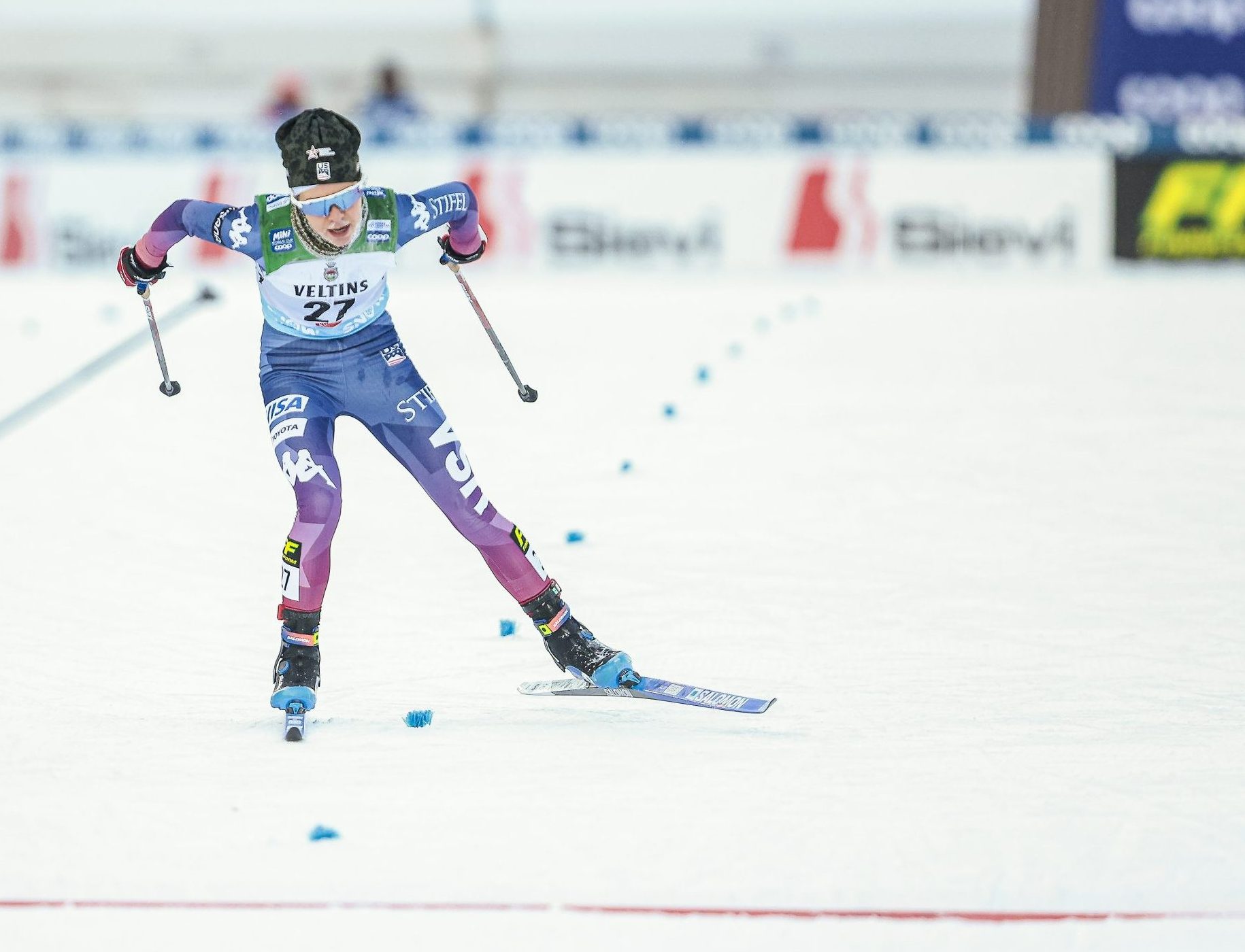
Jessie Diggins (USA) sprints for the finish line. (Photo: Authamayou/NordicFocus)
Diggins’ Classic Progress
Diggins’ podium also reinforced one of the season’s quieter developments: the continued evolution of her classic technique.
For much of her career, the American’s greatest moments have come in skating events, where her aggressive pacing and powerful finishing speed often prove decisive. But this season she has shown remarkable consistency in classic distance races, finishing in the top ten in every classic distance event on the World Cup calendar.
Conditions in Lahti — warming temperatures and increasingly soft tracks — placed an additional premium on ski preparation, something Diggins was quick to acknowledge after the race.
“I had great skis, which is a huge part of the equation, especially when the conditions get slushy,” Diggins said. “This podium really belongs to the team. I’m so grateful for all the hard work they put in.”
Rosie Brennan (USA) on her way to 12th place. (Photo: Authamayou/NordicFocus)
Brennan Continues Return to Form
A bit further down the results list, fellow American Rosie Brennan continued a gradual return toward form after a long battle with illness that has affected much of her season.
Brennan finished 12th (+38.6) in Lahti, a result that reflected both solid skiing and a cautious approach early in the race.
“This whole process has really been a game of time,” Brennan said. “There have been many moments when I’ve wondered if I’ll ever feel normal again in my life. But the last three days are the most normal I’ve felt racing since December 2024.”
The Lahti course, known for its steep climbs and technical demands, offered a test of efficiency in classic technique — a challenge Brennan felt she handled well.
“Lahti requires really good technical skiing,” she said. “I felt like if I could relax and focus on my classic technique, that would give me the best chance.”
Kendall Kramer (USA) working her way up one of the many Lahti climbs. (Photo: Authamayou/NordicFocus)
Kramer Finds Lessons in the Lahti Hills
For American Kendall Kramer — 42nd in 27:40.8 (+1:43.2) — the Lahti race presented a different kind of challenge: starting first.
Wearing bib 1, Kramer had the advantage of pristine tracks before the course began to break down as temperatures warmed. But the early start also meant racing without reference splits from the rest of the field.
“I was actually okay starting with bib 1 today, given the state of the tracks,” Kramer said. “They tend to break down as the race goes on, and the corners can get icy, so it was nice to have cleaner conditions early.”
Without other athletes on course to gauge pacing against, Kramer said the race became more about skiing freely and trusting her own effort.
“Racing without reference splits definitely makes pacing tougher, but at the same time it lets you ski freely and focus on your own race.”
The steep Lahti climbs also highlighted the technical demands of classic skiing at the World Cup level.
“The punchy hills were fun because I could really bound up them, which is something I haven’t done much in World Cup racing so far,” Kramer said. “But the sections where it turns into pure power striding showed me I still have a lot to work on.”
Despite the challenges, Kramer described the experience as valuable for understanding the technical standards required to compete consistently at the highest level.
“I’ve learned so much from racing here this season,” she said. “At the World Cup, every strength and every weakness gets highlighted, and that really helps show what to work on heading into the summer.”
Julia Kern (USA) catches a rest from both the climbs and the sunlight. (Photo: Authamayou/NordicFocus)
Kern Heading Home Early to Recover
Julia Kern, who finished 51st — 28:11.4 (+2:13.8) — today, said she will return home early from the World Cup circuit as she continues working through health issues that have lingered since the Olympic races.
“I’ve been battling my body on various fronts since the Olympics,” Kern said in a team media statement. “One of my strengths is showing up and continuing to try and believe despite the challenges, while also being patient and smart.”
Kern added that she will take additional time to recover while seeking answers about her condition, with hopes of returning to competition at the Stifel World Cup Finals in Lake Placid later this month.
“Right now, my body needs more time to recover and is in search of answers, so I’m headed home early with the hopes of being in a place to race in Lake Placid.”
Lauren Jortberg (USA) and Katherine Weaver (CAN), (l-r) charge for the line. (Photo: Authamayou/NordicFocus)
Jortberg Gets a Front-Row Look at Karlsson’s Pace
For American Lauren Jortberg — 55th in 28:32.7 (+2:35.1) — the Lahti race offered a unique opportunity to measure herself against one of the sport’s best.
Early in the race, Jortberg found herself skiing behind Sweden’s Frida Karlsson for several kilometers as the eventual winner was completing her second lap while Jortberg was still on her first.
“I skied with Frida for about three kilometers, which was really cool,” Jortberg said. “She’s obviously a beast, and it was cool to hang with her and get a taste of what that pace actually feels like.”
Jortberg said the experience offered valuable insight into the demands of racing a 10-kilometer interval start at the World Cup level, where pacing often means pushing near maximum effort from the start.
“Ten-k pacing on the World Cup is basically as hard as you can go the whole way,” she said. “It’s about learning how to navigate that kind of effort and still ski your own race.”
She added that the race reinforced both the progress she has made in classic technique and the areas she hopes to continue developing as she gains more experience at the international level.
“I’m really proud of how my classic skiing is coming along,” Jortberg said. “There’s still a lot to work on, but it was definitely a good first start in a distance race.”
Jortberg said she hopes to carry the fitness and lessons from Lahti into the next stop on the World Cup circuit in Drammen, Norway.
Emma Albrecht (USA) giving it everything she can all the way to the finish. (Photo: Authamayou/NordicFocus)
Albrecht Sees the Margins Up Close
Further back in the start order, fellow American Emma Albrecht — 58th in 28:50.7 (+2:53.1) — experienced firsthand just how tight the margins can be in World Cup distance racing.
“The tight margins were shown by skiers finishing at similar times,” Albrcht said after the race. “For me, I was not passed, and I did not pass anyone. Which meant the skiers in front and behind me were skiing at a similar pace to me.”
Like Kramer, Albrecht said the steep Lahti climbs emphasized the technical demands of classic technique, particularly the efficiency required to stride uphill without losing grip.
“The uphill sections are the most technical and demanding here,” she said. “The climbs in Lahti are steep, and striding up efficiently requires really good technique to avoid slipping.”
For Albrecht, the race served as a clear reminder of the areas she hopes to refine moving forward.
“One of my biggest takeaways is that I want to keep working on my striding technique and get better at adjusting my tempo based on the terrain.”
Dariya Nepryaeva (AIN) and Novie Mccabe (USA), (l-r) come to the line. (Photo: Authamayou/NordicFocus)
Other North Americans in the Field
Novie McCabe raced her way to 43rd in 27:45.0 (+1:47.4) in the 64-skier field.
For Canada, Jasmine Drolet led the team in 41st place with a time of 27:39.8 (+1:42.2). Liliane Gagnon finished 46th in 27:56.4 (+1:58.8), and Katherine Weaver placed 59th in 29:00.9 (+3:03.3). Teammate Olivia Bouffard-Nesbitt, who had been listed on the start sheet, did not start the race.
Take a bow, Jessie Diggins (USA) . (Photo: Authamayou/NordicFocus)
The Season’s Final Push
Sunday’s race in Lahti brought us even closer to the end of the season, now with only two sprint races and three distance races remaining until the sport’s biggest prizes will ultimately be decided.
For Diggins, the third-place finish represented more than another podium in an already historic career. It also reinforced the remarkable consistency that has defined her season. With top-10 finishes in every classic distance race this winter, she has transformed what was once considered a relative weakness into one of the foundations of her bid for both the Overall and Distance crystal globes.
Three stops remain on the calendar: the classic city sprint in Drammen, Norway, the iconic 50-kilometer race at Holmenkollen in Oslo, and the Stifel World Cup Finals in Lake Placid, New York.
For Diggins, those races now carry both competitive stakes and emotional significance. As the American continues what has increasingly felt like a farewell tour across the World Cup circuit, the crowds that gathered along the Lahti course on Sunday offered a glimpse of how much her career has meant to fans of the sport, not just in the United States, but all around the world.
And as Diggins pushed across the final climbs toward the stadium — signs waving, glitter-clad children cheering from the side of the course — she did what she has done so often over the past decade: she kept fighting for every second and left everything she had, once again, on the course.
Feature stories like this one take time, access, and care to produce. If you value thoughtful storytelling and independent ski journalism, please consider becoming a Voluntary Subscriber. Your support directly fuels the work we do to cover the people, places, and moments that make our sport special.
Linn Svahn (SWE), Frida Karlsson (SWE), and Jessie Diggins (USA), (l-r) share the 10 k Classic podium in Lahti, Finland. (Photo: Authamayou/NordicFocus)
This coverage is made possible through the generous support of Marty and Kathy Hall and A Hall Mark of Excellence Award. To learn more about A Hall Mark of Excellence Award, or to learn how you can support FasterSkier’s coverage, please contact info@fasterskier.com.
Jessie Diggins (USA) claimed her third Tour de Ski overall victory in Val di Fiemme (ITA). (Photo: Vanzetta/NordicFocus)
The Tour de Ski does not end so much as it compresses. By the time the women turned onto the ribbon of snow climbing Alpe Cermis, the race had already been going on for a week—measured not only in kilometers and seconds, but in fatigue accumulated quietly overnight, in sore muscles, achy backs, and in confidence gained or lost one race at a time.
The final climb has a way of making those invisible things visible. It is steep enough to strip racing of pretense, long enough to punish impatience, and familiar enough that every skier arrives with memories—good ones, bad ones, and some they would rather forget. On Sunday afternoon in Val di Fiemme, the climb again became what it always is: less a finish line than a reckoning.
For Jessie Diggins, that reckoning ended in confirmation. Diggins finished second on the stage, protecting her margin with experience and restraint, and secured her third career Tour de Ski overall title. It was not the loudest way to win. It was, however, the truest.
Jessie Diggins (USA) paced the final climb perfectly to finish second on the day. (Photo: Modica/NordicFocus)
A Climb That Decides Everything
Stage 6 of the women’s Tour de Ski—10.0 kilometers, mass start, freestyle—began with the tension that always precedes Alpe Cermis. Some skiers arrived still dreaming of a stage victory. Others were guarding seconds earned days earlier. Still others were simply hoping to make it to the top without the climb turning overly cruel.
The early kilometers unfolded with relative calm. The pace was honest but controlled, the group compact as it flowed through the lower valley before turning uphill. On Alpe Cermis, there is no hiding, but there is strategy: when to let others go, when to follow, and—most importantly—when not to.
The decisive moves came as the gradient steepened and the field stretched into a long, thin line. Norway’s Karoline Simpson-Larsen skied with precision and patience, gradually asserting herself as the strongest on the day. She crested the final meters alone to win the stage in 37:05.3, earning the biggest single-day victory of her World Cup career.
Behind her, the race unfolded with quieter drama. Diggins, who entered the day with a commanding overall lead, skied with calculation. She resisted the temptation to respond immediately when others surged, choosing instead to manage the climb in segments. When the grade lessened and the gap narrowed late, she allowed herself to push hard enough to secure second place, but not so hard as to invite disaster.
Diggins crossed the line 8.8 seconds behind Simpson-Larsen, followed by Norway’s Heidi Weng in third at +14.4. The stage podium reflected the day’s effort, but it was Diggins’ second place that carried the most weight.
Jessie Diggins (USA), as always, left everything out on the course. (Photo: Modica/NordicFocus)
“Dying at the Right Moment”
Diggins’ approach to Alpe Cermis was shaped by experience—and memory.
“I was trying to be smart and safe in terms of the overall Tour,” she said afterward. “And then when I realized we were close enough, I thought, okay, now I can empty the tank. But I’ve paced it badly before where I blow up, and that last 600 meters is the slowest of your life.”
It is a detail only veterans tend to mention: not the steepest pitch, but the final few hundred meters, when legs that have already been pushed too far simply refuse to respond. Diggins has lived that mistake. On Sunday, she avoided it.
“I was trying to ski it smart and make sure I was dying at the right moment,” she said.
That restraint—so often invisible to spectators—was the difference between managing the Tour and risking it. The margin Diggins had built over five stages gave her room to think clearly. The climb rewarded that clarity.
Julia Kern (USA) and Jessie Diggins (USA) celebrate with US Cross-Country Ski Team coaches and staff, as well as US Alpine Ski Team athletes who came to support them at the end of the 2025/26 Tour de Ski. (Photo: Vanzetta/NordicFocus)
The Meaning of a Tour
In the mixed zone at the top, Diggins spoke not with relief so much as appreciation—for the work, the people, and the endurance the Tour demands.
“The Tour de Ski is one of the hardest things to win,” she said. “When you win the Olympics, it’s amazing—it’s really special. But that’s one race. The Tour is day after day after day. You have to put it together back-to-back, under cumulative pressure. That’s really hard. It’s hard on you, and it’s hard on the team.”
Her emphasis, repeatedly, returned to the collective effort. She spoke of team energy, of support staff, of consistency rather than dominance. It was a reminder that Tour victories are not seized in moments, but constructed patiently across an entire week.
Diggins finished the Tour with a total time of 2:11:26.1, winning the overall by more than two minutes over Austria’s Teresa Stadlober. It was not a victory defined by a single attack or a single stage, but by accumulation—time gained when others faltered, mistakes avoided when margins were thin.
Julia Kern (USA) makes her way up Alpe Cermis to finish 14th on the day. (Photo: Vanzetta/NordicFocus)
Kern’s Quiet Confirmation
For Julia Kern, Alpe Cermis offered something different: clarity.
Kern finished 14th on the stage, 2:01.0 back, after a Tour that reflected both progress and unfinished business. She described the climb as meeting—or exceeding—her expectations.
“Every year it’s a little different with who’s still left in the Tour,” Kern said. “But I’m taking away from today that my fitness is there. I just need to fine-tune some of the sprinting gears. That’s very trainable at this point in the season.”
Her assessment mirrored her results. Kern was consistently strong in the distance races throughout the Tour, finding rhythm and confidence as the days passed. The sprint stages, by contrast, left her frustrated.
“I was a bit bummed with my sprint days for sure, and hungry for more,” she said. “But at the same time, I had consistently good, strong distance races. Halfway through the Tour, I started to find my race legs again.”
It is a pattern Kern recognizes—slow starts, gradual momentum, strength revealed in longer efforts. In an Olympic season, that trajectory matters more than any single result.
Maja Dahlqvist (SWE) attacked at the end of the valley trail leading to the Alpe Cermis in Val di Fiemme (ITA) to secure her silver sprinters’ bib. (Photo: Vanzetta/NordicFocus)
The Bib Battles
Beyond the overall, the final climb also settled two secondary competitions that added layers of tension to the Tour’s closing act.
The climber’s bib—awarded for cumulative performance on the Tour’s toughest ascents—went to Teresa Stadlober, who accumulated 45 points across the week. Diggins finished second in the standings with 39, underscoring how consistently she handled the steepest terrain without ever needing to gamble on a single climb.
The sprint standings, marked by the silver bib, remained unsettled until the final stage, where one final set of bonus points was awarded at the beginning of Alpe Cermis. Sweden’s Maja Dahlqvist emerged with the title at 53 points, ahead of Switzerland’s Nadine Fähndrich and Sweden’s Johanna Hagström. Diggins finished fourth in the sprint competition—another reflection of her Tour: competitive everywhere, decisive where it mattered most.
Teresa Stadlober (AUT) fought hard to defend her climbers’ bib. (Photo: Vanzetta/NordicFocus)
Pain, Reconsidered
Late in the mixed zone, Diggins reflected on something more personal—how different this climb felt compared to recent years.
“The last two years I’ve been so injured that I was in so much pain outside of racing,” she said. “So for it to be only painful during the race was like, wow—that’s kind of nice.”
It was not a dramatic declaration, but it carried weight. The Tour de Ski magnifies everything: fatigue, doubt, confidence, pain. To arrive at Alpe Cermis feeling capable—rather than simply enduring—marked a shift.
She laughed when she added that she told herself, mid-Tour, that she would “never do this again.” Then she smiled at the familiar uncertainty that defines the race.
“You never know how you’re going to feel every day on a Tour,” she said. “And today I felt really good. One of the best I’ve ever felt on the final climb.”
Julia Kern (USA), Jessie Diggins (USA), (l-r) at the top of Alpe Cermis in Val di Fiemme (ITA). (Photo: Modica/NordicFocus)
The American Picture
For the U.S. women, the Tour ended with a sense of coherence. Diggins’ overall victory provided the headline, but Kern’s steady distance form pointed toward depth and durability within the team.
Kern’s immediate plans reflect that long view. She will return home to Richmond, Vermont, for two weeks—prioritizing recovery before resuming training on familiar snow.
“I did this last year, and it worked really well,” she said. “Just getting off World Cup, getting a lot of recovery the first week, being in my own bed.”
From there, she will rejoin training camps and racing with an eye toward sharpening for the Olympics. It is a plan built on patience rather than urgency—much like Diggins’ approach on Alpe Cermis.
Teresa Stadlober (AUT), Jessie Diggins (USA), Heidi Weng (NOR), (l-r) take the Tour de Ski overall podium. (Photo: Vanzetta/NordicFocus)
What the Climb Leaves Behind
When the last skier crested the climb and the finish corral emptied, Alpe Cermis returned to stillness. The Tour de Ski had done what it always does: clarified things.
It clarified that Jessie Diggins remains one of the sport’s great stage racers—capable not just of winning races, but of managing weeks. It clarified that Julia Kern’s fitness base is real and growing, even if some pieces still need refinement. And it clarified, once again, that the Tour is not about brilliance alone, but about survival, intelligence, and trust in process.
Diggins did not win the final stage. She did something harder. She won the Tour by knowing exactly when not to.
At the end of the longest climb of the week, that knowledge mattered most.
Feature stories like this one take time, access, and care to produce. If you value thoughtful storytelling and independent ski journalism, please consider becoming a Voluntary Subscriber. Your support directly fuels the work we do to cover the people, places, and moments that make our sport special.
Jessie Diggins (USA), Karoline Simpson Larsen (NOR), and Heidi Weng (NOR), (l-r) share the final climb podium at the top of Alpe Cermis in Val di Fiemme (ITA). (Photo: Vanzetta/NordicFocus)
This coverage is made possible through the generous support of Marty and Kathy Hall and A Hall Mark of Excellence Award. To learn more about A Hall Mark of Excellence Award, or to learn how you can support FasterSkier’s coverage, please contact info@fasterskier.com.
There are winter mornings when a World Cup feels like a World Cup, and there are winter mornings when the sport seems to slip into its future tense. Today, in Trondheim, was the second kind. The light came late and cold over the stadium, washing the course in the flat silver of early December, but everything else carried the charge of February. Coaches shouted splits with a little more strain in their voices; athletes tightened their warmups with a little more intent. You could feel the nerves of a nation in the Norwegian start pen. You could feel the confidence of another in the Swedish one.
For the women on the line, the distance was familiar—ten kilometers of freestyle skiing, two laps, clean snow, no drafting, no negotiations—but the meaning was not. This is the race that will award an Olympic gold medal in Val di Fiemme in eight weeks. The stopwatch in Trondheim wasn’t just measuring form in early December; it was auditioning futures, exposing weaknesses, and hinting at hierarchies that might matter when the medals are real.
What followed was not a rehearsal so much as a warning: Sweden already looks like a finished script; the United States has a veteran in her final season, refusing to yield the stage; and Norway—despite the home crowd—spent the afternoon hunting answers they did not entirely find.
Jonna Sundling (SWE) and Swedish teammates set the early standard at the 2 k split in the 10km Individual Start Freestyle in Trondheim (NOR). (Photo: Modica/NordicFocus)
The Swedish Wave: Sundling Lights It, Andersson, and Ilar Finish It
The Swedish takeover announced itself at the 2 k timing banner. Jonna Sundling, better known as a sprint specialist, hammered through in 5:52, the fastest split of the day at that point. Within minutes, the entire top of the board was yellow and blue: Sundling, Ilar, Emma Ribom, Frida Karlsson, and Ebba Andersson stacked one through five in the early going.
By 5 k, they had turned that into a proper blockade. Sundling led; Ilar, Andersson, and Ribom were essentially layered behind her on the clock; Karlsson hovered close. The question wasn’t whether Sweden would win but which Swede would be allowed to keep the flowers.
At the same time, Italy made a serious bid to interrupt the pattern. Maria Gismondi, just 21, moved into the virtual lead near 5.9 k and held it through the stadium. Her final time of 26:31.4 ultimately held up against every challenge except the Swedish trio and Diggins, good for sixth and the best World Cup result of her career. It was exactly the kind of performance the Italian federation will want to see ahead of the home Olympics.
The race for the win, though, narrowed to two names: Andersson and Ilar.
Ebba Andersson (SWE) takes the win in the Women’s 10 k Individual Start Freestyle in Trondheim (NOR). (Photo: Modica/NordicFocus)
Andersson, starting in bib 44, did what she has built a career on. She let Sundling shoulder the riskiest early pace, then began to grind everyone else down. By 6.9 k, she had moved to the top of the virtual standings. At 9.2 k—the final intermediate with 800 meters remaining—she led Ilar by just 1.6 seconds, with Sundling and Diggins already on the defensive.
Ilar, celebrating her 100th World Cup start, skied the kind of race that confirms her status as more than a supporting player in the Swedish machine. She built steadily through the middle sections, using her high-tempo, slightly more elastic style to put serious time into Sundling and much of the field on the second lap. At that same 9.2 k split, she was 12.4 seconds ahead of Sundling and still closing on Andersson—setting up a finish that felt less like a December World Cup and more like a championship climax.
With bib 40 pulled over her race suit, Ilar came across the line with the fastest time thus far (26:07.3), but down the last climb and into the final V2, Andersson did just enough. Her final 500 meters looked like a long, controlled sprint—less explosiveness than total commitment. She hit the line in 26:05.3, then folded over her poles as the result rang in—two seconds quicker than the time of her teammate Ilar.
“I also felt that we had good skis,” Andersson said afterward—an understated summary of a day when Sweden appeared to have both the fastest boards and the strongest legs.
After yesterday’s Skiathlon victory, Jessie Diggins (USA) went to the well again today in the 10km Freestyle. (Photo: Modica/NordicFocus)
Diggins in the Pain Cave, Again
If Saturday was Jessie Diggins’ day—her first-ever skiathlon World Cup win on this same Trondheim course—Sunday was about how much she had left. The 10 k freestyle is one of her signature events and will be her target distance at the Olympics in February. Still, it came after 20 punishing kilometers and a night filled with commitments that follow a World Cup win.
From the first split, the American was chasing the Swedes rather than matching them. At 2 k, she was 1.3 seconds back; at 6.9 k, she trailed Andersson by 2.2 seconds and Ilar by six, sitting in a tight cluster with Sundling and Norway’s Astrid Øyre Slind in what quickly became a four-way fight for third. By 9.2 k, Diggins had slipped to 13.3 seconds off Andersson and roughly 11–12 seconds behind Ilar, but she still held a tenuous 0.7-second advantage over Sundling and a slightly larger buffer on Slind.
That’s where the familiar part of the story began.
Diggins came out of the final tuck, hammered into V2, and turned that 0.7-second margin on Sundling into 3.0 seconds by the finish. Slind, charging from behind, closed much of the gap but ran out of course, ending up 0.5 seconds short of Diggins and three-tenths ahead of Sundling.
Afterward, Diggins said she felt encouraged by what the weekend revealed about her trajectory:
“I’m really happy with how I’m racing right now—where I’m at, how the training’s been going, how my body’s been adapting to the training load, and how racing has played into the overall plan. That’s been really cool. I’m super grateful.”
She also reflected on the advantage of experience in the late stages of her career:
“It’s really fun to be an older athlete because you get to know your body and you get to know the courses and the flow of things, and you just get to enjoy it. I’m taking it week by week, but I’m not taking it for granted.”
Jessie Diggins (USA) on her way to her second podium in as many days in Trondheim (NOR). (Photo: Modica/NordicFocus)
And in her race execution today, she emphasized the fight:
“I was definitely fighting for every single second out there… In an individual start, you never know when you’re going to need that hundredth of a second. My goal is always to ski as hard and as smart as I can and make sure I get to the finish line with nothing left.”
What she was most proud of, she said, wasn’t only the podium:
“I’m super proud of the process with the wax techs—how the team is driving and working together. The puzzle pieces are coming together, and that’s been really special.”
In her final World Cup season, with retirement announced and Milano–Cortina confirmed as her last Olympics, third place in this exact format—on a day when Sweden finished 1–2, and Norway threw 12 athletes at the problem—counts for more than just another podium. It’s proof that Diggins is still firmly inside the medal conversation for the 10 k free next February.
Astrid Oeyre Slind (NOR) led Norway in fourth place. (Photo: Modica/NordicFocus)
Norway’s Almost-Answers
For a team treating Trondheim as an Olympic trial, Sunday’s box score landed somewhere between reassuring and uncomfortable.
Astrid Øyre Slind, at 37, produced the kind of race that will look excellent on any selection document. A marathon specialist with much of her career spent on the Ski Classics circuit, she paced the 10 k like someone who knows exactly how deep she can go. Slind wasn’t heavily featured in the early splits, but she climbed relentlessly through the second lap, arriving at 9.2 k close enough to threaten Diggins’ podium. Her final climb was ferocious; the line, unfortunately, came half a second too soon. She finished fourth (+17.0), the top Norwegian on the day.
Behind her, Nora Sanness delivered a quietly excellent seventh-place finish, moving from roughly 8–9 seconds down at 2 k into the top 10 by the end. Heidi Weng, second in Saturday’s skiathlon, sat as close as 1.7 seconds off the lead at one intermediate but faded to 10th (+35.5) after a second lap that looked like someone running low on core stability and patience. Karoline Simpson-Larsen (11th) and Kristin Austgulen Fosnæs (12th) rounded out the Norwegian block just outside the top 10.
As always with Norway, the question isn’t whether they have enough good skiers—but which ones they trust when medals are on the line. On Sunday, the answer was Slind and Sanness, with Weng still firmly in the conversation. For the rest of the red suits, Trondheim may end up filed under “evidence, but not enough.”
Maria Gismondi (ITA) proved she will be one to watch when the women race this race again at her home Olympics in February. (Photo: Modica/NordicFocus)
Breakthroughs and Quiet Statements
Behind the podium and the selection drama, the Trondheim 10 k produced a handful of performances that will matter later:
Maria Gismondi (ITA), 6th (+26.1) — The young Italian’s surge into the leader’s seat midway through the race and her eventual sixth place were arguably as important as any podium. With Italy hosting the Games, the federation will be delighted to see an athlete in blue who can stand up to Swedes and Norwegians for 10 kilometers in skate.
Helen Hoffmann (GER), 9th (+33.5) — A former world junior champion in the 15 k freestyle, Hoffmann climbed from relative anonymity in the early splits into the top 10 by the finish—a statement performance for a German women’s distance squad trying to rebuild.
The Finns’ fade — At the first split, Finland briefly went 1–2–3 through Vilma Nissinen, Jasmi Joensuu, and Jasmin Kähärä. By the end, Joensuu and Pia Fink would share 14th (+48.8), Nissinen would slide to 20th, and Kähärä to the low 20s—valuable data for a nation balancing sprint prowess with distance ambitions.
For the rest of the American squad, it was a hard, unsentimental day. Julia Kern finished 40th (+1:30.2), Alayna Sonnesyn 55th (+2:03.9), and Kate Oldham 63rd (+3:01.4). Rosie Brennan, coming off a heavy workload in Saturday’s skiathlon and still working her way back, finished 51st (+1:59.7)—a result that likely reflects fatigue more than long-term form.
Kendall Kramer (USA) had a solid day in 46th place. (Photo: Modica/NordicFocus)
A December Race That Felt Like February
On paper, Sunday in Trondheim will live forever as just another line in the FIS database: “Women’s 10 km Interval Start Free, December 07, 2025.” But everything around it felt bigger.
The event is an exact match for one of the six women’s cross-country races on the Olympic program: the same distance, the same technique, the same individual-start format. The Olympic women’s 10 k free is scheduled for February 12, 2026, at the Tesero Cross-Country Skiing Stadium in Val di Fiemme. The names at the top of Sunday’s results—Andersson, Ilar, Diggins, Slind, Sundling, Gismondi—are almost certainly the names we will be circling when that start list goes up.
In that context, Trondheim wasn’t just an early-season test. It was an audition, a rehearsal, and a warning shot.
For Sweden, it confirmed what the rest of the world already suspected: the women’s distance team is so deep that a sprinter can lead a 10 k at 2 k, a rising star like Ilar can nearly steal the win, and a seasoned champion like Andersson can still slam the door in the final 500 meters.
For Norway, it sharpened the selection dilemma: the best individual performance came from a 37-year-old marathon specialist, and the home crowd saw their women beaten soundly in an event they will desperately want to win in Italy.
For Jessie Diggins and the U.S. team, the weekend now reads as a statement: a skiathlon win and a 10 k free podium on consecutive days, in her final World Cup season, in Scandinavia, in an Olympic-format race. With each race, she’s reminding everyone that the most decorated career in American skiing isn’t easing toward the exit—it’s still trying to slam through one more door.
If Sunday in Trondheim is any indication, the women’s 10 k free in Milano–Cortina will not be decided by large margins. It will be decided by seconds—and maybe, once again, by whatever is left in the tank over the last kilometer.
Feature stories like this one take time, access, and care to produce. If you value thoughtful storytelling and independent ski journalism, please consider becoming a Voluntary Subscriber. Your support directly fuels the work we do to cover the people, places, and moments that make our sport special.
Moa Ilar (SWE), Ebba Andersson (SWE), and Jessie Diggins (USA) (l-r) take the podium in the Women’s 10 k Freestyle Individual Start in Trondheim (NOR). (Photo: Modica/NordicFocus)
This coverage is made possible through the generous support of Marty and Kathy Hall and A Hall Mark of Excellence Award. To learn more about A Hall Mark of Excellence Award, or to learn how you can support FasterSkier’s coverage, please contact info@fasterskier.com.
Okay, who else didn’t sleep last night? It felt like waiting for Santa Claus on Christmas Eve — that fizzy, restless anticipation you can’t shake, even as an adult who should know better. Part of it was simply the joy of finally watching World Cup racing again after eight long months. But more than that, this morning in Ruka felt like the beginning of something bigger: the start of the Olympic year, the opening chapter of a season that will define so many careers, answer so many questions, and launch a web of storylines that will stretch from today all the way to Milano-Cortina.
This year, the stakes are different. For veterans, it’s legacy. For rising athletes, it’s opportunity. For everyone, it’s a race against time.
And for those of us who follow this sport as if it were a second bloodstream, the first race in Ruka is the moment winter starts breathing again.
Frida Karlsson (SWE) poses with Mr. and Mrs. Claus following the 10k Classic in Ruka (FIN). (Photo: Modica/NordicFocus)
Before the Gun: What Was at Stake
Even before the racers hit the snow, there were subplots everywhere.
Norway opened the season in a moment of transition. Therese Johaug — retired again and pregnant with her second child — leaves a vacuum on the women’s team that hasn’t existed in over a decade. Who leads now? Is Heidi Weng’s late-career renaissance real? Is this the year Norway’s depth must finally be enough?
Sweden, meanwhile, enters the Olympic season with the most complete women’s distance squad on earth. Their classic technique is crisp, balanced, efficient — a signature advantage on days like this.
Finland carries the emotional core of the weekend. Krista Pärmäkoski, racing her final season, took her last opening-day start in Ruka on home snow. Kerttu Niskanen, always a threat in classic, lined up ready to test herself in front of the home crowd.
And for the United States, the arcs were wide-ranging:
Jessie Diggins begins the final season of her career.
Rosie Brennan enters winter in deeply untraditional circumstances after an Epstein-Barr reactivation.
Julia Kern arrives healthier and steadier than in years.
Sophia Laukli brings a redesigned training life out of Norway.
And three additional American women (Kate Oldham, Kendall Kramer, and Alayna Sonnesyn) who begin the short, intense race for Olympic qualification.
Alayna Sonnesyn (USA) lunges for the line at the end of the 10k Classic in Ruka (FIN). (Photo: Modica/NordicFocus)
A Day Shaped Before It Started: New Snow, Glazing Tracks, and Wax Tech Calculus
Ruka had been bitterly cold in recent weeks — until a foot of new snow fell and temperatures climbed toward freezing. The result was a wax technician’s nightmare: soft snow in the shade, glazing climbs in the sun, and a classic course twisting through varying microclimates.
Kick wax that worked at the start failed on the climbs. Skis that kicked well on the climbs dragged on the flats. Double-pole sections demanded freedom; the final climbs demanded grip. There was no perfect answer — only compromise and risk.
This race was always going to reward the skiers with the best technical balance and the wax techs bold enough to choose the right kind of “wrong.”
Moa Ilar (SWE) charges down the finishing stretch at the end of the 10k Classic in Ruka (FIN). (Photo: Modica/NordicFocus)
The Race: Karlsson Sets the Standard, Weng Returns, Ilar Rises, Diggins Surges
1.1 km — Jessie Diggins Takes the First Lead of the Season
From the moment the race began, the tone was unmistakable.
With bib #1 Julie Bjervig Drivenes setting the baseline, Jessie Diggins blasted through the first checkpoint with the early lead — 1.3 seconds ahead of Frida Karlsson.
It was classic Diggins: joyful, aggressive, fearless.
3.3 km — Karlsson’s Stride Takes Control
By 3.3 km, the race reshaped itself. Frida Karlsson, with her strong hip stability and long, economical stride, surged into the lead on the climbing sections. Diggins, whose double-poling and downhill flow looked excellent, lost time on the steepest pitches and slid to seventh.
Behind Karlsson, Sweden formed a front of precision:
Moa Ilar at +3.0
Ebba Andersson at +5.1
Three Swedes in the top three splits.
A message, delivered early.
6.1 km — Heidi Weng Charges Back Into the Story
Heidi Weng, skiing 30 seconds behind Diggins, mounted the late charge of the day. She began cutting into Karlsson’s lead — from 14 seconds at 6.1 km to only 10.5 by the line.
After several up-and-down years, Weng signaled something unmistakable: she’s not done yet.
Final Kilometers — Diggins Closes Hard, Ilar and Andersson Duel, Fosnæs Threatens
Jessie Diggins mounted her own push on the flats and downhills, gaining time between 6.1 and 8.1 km. She crossed the line in a time that held the top spot until the final seeded skiers, ultimately placing fifth — one of her strongest classic results ever on this course.
Moa Ilar executed a poised final push, taking third and bumping Andersson to fourth. Kristin Austgulen Fosnæs threatened Diggins’ time but ultimately finished behind her in sixth.
Jessie Diggins (USA) was all smiles after the 10k Classic in Ruka (FIN). (Photo: Modica/NordicFocus)
Jessie Diggins: Racing the First Day of Her Last Season
As Diggins enters the last year of her storied career, her goals have nothing to do with podiums.
“My goals are really not about race results at all,” she said. “My goals for the season are to be happy and healthy and just in the present moment… just really soaking in the moment and the feeling of, like, wow, I get to do this.”
She brought that joy directly into today’s start.
“I just wanted to go hard and use this race to get the season started.”
And yet, the question remains: when Diggins puts on a bib, does instinct overtake the plan?
“I do like to push myself to the max whenever I race — maybe not 100% where I’m scraped off the snow, but really darn close,” she said.
“It’s part of my training plan with Cork — we use early season races to build sharpness.”
On a tricky waxing day, Diggins was clear-eyed about the team effort.
“I was really happy with my skis… a great mix of just enough kick but also really free. We needed the skis to be fast in the double-poling, and knowing I was going to herringbone the climbs anyway, we went for that in-between.”
For Diggins, this wasn’t just a top-five finish. It was a signal: the last season of her career may feature some of her best classic skiing.
Rosie Brennan (USA) with her signature long stride during the 10k Classic in Ruka (FIN). (Photo: Modica/NordicFocus)
Rosie Brennan: “This Is Uncharted Territory”
Rosie Brennan entered the winter with one of the most unconventional lead-ups of her career — a necessity after an Epstein-Barr reactivation forced her into weeks of “micro-intervals” and tightly controlled volume.
Her return to full-distance racing revealed both progress and uncertainty.
“If I’m honest, I had a little higher expectations for myself today, so I’m feeling a bit mixed about it,” she said.
“There were some moments of skiing I was really happy with and some that left me wanting more.”
The hardest part, she explained, has been adapting to Europe — travel, fatigue, recovery — with a body that no longer responds as it used to.
“It’s been a really hard adaptation to Europe with a body that isn’t as resilient as I’m accustomed to… this is uncharted territory for me, and I just don’t know what will happen.”
Still, she holds hope — and patience.
“I have to keep trying and experimenting and figure out what will work for me this winter. I’m sure there will be a lot of ups and downs in the process.”
For Brennan, today wasn’t a verdict — it was the next step in a complicated, courageous return.
Ebba Andersson (SWE), Julia Kern (USA), (l-r) push up the climb in Ruka (FIN). (Photo: Modica/NordicFocus)
Julia Kern: A Personal Best Hidden Behind the Result Sheet
Julia Kern’s final ranking might not have turned heads on the results page, but the performance meant far more than the number beside her name. For Kern — often a slow starter in Ruka — today marked meaningful progress.
“Actually, I’m proud of my race today,” she said. “If you just look at the result… You would think I’d be quite dissatisfied, but this was a personal best for me in the opening Ruka 10km.”
The opener in Ruka has long been one of the toughest venues for her, a course whose steep climbs, cold temps, and early-season timing rarely align with her strengths.
“This was my eighth time doing this race, and the result has never been great or representative of other races later in the season,” Kern explained. “I was proud of having moments out there where I skied with good technique, and my body had good energy.”
Her long-term confidence remains intact — today was a step, not a verdict.
“Of course, I want to climb higher in the results list, but my result today doesn’t worry me,” she said. “I use this race to race myself into shape and wake up the body for the sprint tomorrow and the rest of the season.”
Like many in the field, she dealt with some of the day’s most fickle challenges: a mix of new snow, fog, drizzle, and instant glazing that made finding kick nearly impossible.
“It was on and off snowing/light fog or drizzle… a classic Ruka day where the tracks seem to glaze in an instant,” she said. “The glaze made it really challenging to kick from the start, and even harder in the second lap.”
But where the climbs demanded compromises, the flats rewarded her strengths.
“Otherwise the conditions felt fast on the downs and flats,” Kern added, “and I felt strong on the flatter terrain today.”
Kern leaves day one not discouraged, but energized — a skier who knows this course never tells the whole story and who trusts what today’s moments of good skiing suggest about what’s ahead.
Heidi Weng (NOR), Frida Karlsson (SWE), Moa Ilar (SWE), (l-r) share the podium of the 10k Classic in Ruka (FIN). (Photo: Modica/NordicFocus)
The Podium: Sweden Opens the Olympic Year With Authority
The final standings reflected both power and depth:
Frida Karlsson (SWE) 23:31.8
Heidi Weng (NOR) +10.5
Moa Ilar (SWE) +18.3
Ebba Andersson (SWE) +21.2
Jessie Diggins (USA) +27.6
Kristin Austgulen Fosnæs (NOR) 37.2
Sweden finished with three in the top four. Karlsson earned her 16th career victory; Weng her 139th career podium; Ilar her 9th.
On the Finnish side, Krista Pärmäkoski delivered a valiant final Ruka classic performance. Kerttu Niskanen, traditionally a force here, struggled to find her usual early-season spark.
And for the Americans, the opener delivered clarity: Diggins strong, Brennan resilient, the younger athletes gaining essential early-season data for Olympic qualification.
The 10k Classic podium with Heidi Weng (NOR), Frida Karlsson (SWE), Moa Ilar (SWE), (l-r) in Ruka (FIN). (Photo: Modica/NordicFocus)
What It All Means
Today’s 10k classic didn’t answer every question — but it answered enough to shape the early contours of an Olympic year:
Sweden has the momentum.
Norway has a leader again.
Finland is beginning a farewell tour.
The U.S. has real reasons for belief — and real reasons for patience.
The waxing cabins will decide as much as the athletes.
The Olympic shadow looms over every split, every selection, every training day.
And for those of us lying awake the night before the opener, waiting for winter like children waiting for Christmas — the season is here again.
It begins in Ruka, with a direct path to the Olympics in Italy, and ends in Lake Placid.
Feature interviews like this one take time, access, and care to produce. If you value thoughtful storytelling and independent ski journalism, please consider becoming a Voluntary Subscriber. Your support directly fuels the work we do to cover the people, places, and moments that make our sport special.
Frida Karlsson (SWE) looked pretty comfortable in the reindeer pelt-covered leaders chair following the 10k Classic in Ruka (FIN). (Photo: Modica/NordicFocus)
This coverage is made possible through the generous support of Marty and Kathy Hall and A Hall Mark of Excellence Award. To learn more about A Hall Mark of Excellence Award, or to learn how you can support FasterSkier’s coverage, please contact info@fasterskier.com.
Moa Ilar (SWE) claims victory in Holmenkolen’s spring sunshine. Her win in the 10 k Freestyle was her first World Cup victory since two seasons ago in Ruka, Finland. (Photo: Authamayou/NordicFocus)
Cross country skiing is a winter sport, but it’s the spring season in which we see it in all it’s glory: sunny skies, blue horizons, fields of purest white. A venue like Holmenkollen offers a sophisticated system of snow making, so most of the snow on which the skiers will race is man made. It’s durable snow, able to freeze deep without icing, able to withstand sun even better than natural snow. After a week of racing in the rain and slush of Trondheim, the women’s World Cup field seemed delighted to race at sunny Holmenkollen.
“It’s awesome! We have so much sun here!” beamed USA’s Julia Kern before today’s race. “It’s variable snow, but it’s a really exciting and challenging course with a lot of turns.”
Spring is also the season in which World Cup race results can be surprising, confounding, illuminating. The prime contenders have the most experience in peaking and tapering for championship events (like last week’s World Championship in Trondheim), and the most sophisticated national team programs often hit their stride most effectively at big events like those. But the season didn’t end in Trondheim, and a half-dozen more races still fill the schedule before final awards are presented at season’s end. For those who have committed all their training and preparation to performances at the end of February, the journey through March’s schedule can become something of a slog.
But there are other skiers on the World Cup start list, those who may have misjudged the preparation for World championships, those whose fitness is only now (in mid-March) rounding into form. For them, the sunny days of spring can bring otherwise unexpected victories. Todays 10 k Freestyle in Holmenkollen delivered one such victory.
Moa Ilar (SWE) controlled her pace thoughout the day, building her race on information gleaned from the earlier splits of Jessie Diggins (USA) and Therese Johaug (NOR). (Photo: Authamayou/NordicFocus)
Before today, Moa Ilar (SWE) had only one other win on her World Cup résumé, and that was from two seasons ago in Ruka, Finland. She’s waited a long time to stand on the top of the podium again. Today was her day . . . Ilar started fastest of all contenders, and hung on for a thrilling victory over Heidi Weng (NOR) and Victoria Carl (GER). Filling out the top six were more of those racers whose peak performances may have come at the World Championships in Trondheim: Ebba Andersson (SWE), Therese Johaug (NOR), and Jessie Diggins (USA) in fourth, firth, and sixth, respectively.
Other American finishers included Julia Kern 24th, Rosie Brennan 35th, , Kate Oldham 44th, Alayna Sonnesyn 49th, Sydney Palmer-Leger 50th, and Sammy Smith 56th. Canadians recorded impressive finishes from Sonjaa Schmidt 27th, Liliane Gagnon 30th, Katherine Stewart-Jones 32nd, and Alison Mackie 39th.
Moa Ilar (SWE) flashed down the historic finishing straightaway at Holmenkollen, and into the arms of her Swedish teammates. (Photo: Authamayou/NordicFocus)
10 k Freestyle
It would certainly be nice if skiers got to pace a 10 k, but if skiers don’t go out fast enough, they risk never being able to catch up at all. Those necessary pacing strategies make it seem as though 10 k is just a frenzy. But sometimes—like today—the distance is mastered by a skier so in control that she is able to utilize splits to create a race of utter perfection. That was the race that Ilar created, and much of it was based on her having on-course access to the earlier split times of other race contenders, most notably Johaug and Diggins.
Diggins has won four of the last six 10 k Freestyle events, including the last event in Cogne Italy, but Johaug, Andersson, and Weng were absent from that event. Today’s race in Holmenkollen would also be contested in the absence of Swedish skiers who could’ve significantly affected the finishing order: Frida Karlsson, and Jonna Sundling.
Andersson, Diggins, and Johaug raced through the two kilometer mark with splits in the top ten, seeming to temper their early-race efforts in order to finish with speed. By 4.3 kilometers, Johaug had ratcheted up her pace and flew to the fastest split. Diggins trailed Johaug at the 4.3 kilometer checkpoint, but by less than a second. Starting later, Ilar had all that information at her disposal, and she supplanted them both at the mid-race checkpoint.
By the 7.6 kilometer checkpoint, the field had sorted itself out. Early leader, Anja Weber (SUI) had begun to fade, while Johaug came through with a lead over Katherine Simpson-Larsen (NOR). Then Diggins came through to top them both, only to be supplanted by Ilar once again. It was time to start taking the Swede seriously . . .
Johaug was the leader when she crossed the finish line, but Diggins, Carl, and Ilar were still to finish. Diggins’ technique appeared ragged in the final kilometer where her finishing speed was not enough to catch Johaug. Diggins would slot into second (seven seconds behind) while she and Johaug awaited the arrival of Carl, Andersson, and Ilar.
Ilar continued her charge to the finish, losing none of her earlier momentum, crossing the line with a 17 second lead over Johaug—a stupendous margin over so short and intense a distance.
It feels amazing,” beamed Ilar. “It’s been such a long time . . . I’m so happy to be back on the podium!”
Victoria Carl (GER) gave her all in Holmenkollen, her third-place finish suggesting that her level of fitness may be peaking late in the World Cup season. (Photo: Authamayou/NordicFocus)
Carl managed to slip onto the podium behind Ilar—ahead of Johaug and Diggins—only to find herself supplanted by the latest starter among the contenders, Heidi Weng (NOR) who built her early speed and took advantage of information received on course to deliver a dashing second place finish.
Diggins coach and wax tech, Jason Cork, crunched the numbers on placings and points in the World Cup overall race, and delivered himself a well-earned birthday present (Diggins was happy to sing to him before the start of today’s race). If Cork’s math is correct, then Diggins’ performance in today’s 10 k Freestyle has secured the overall World Cup Championship. Regardless of how well her closest rival, Victoria Carl, might ski in remaining events, Diggins will collect the Crystal Globe in Lahti at the end of next week.
Ilar’s victory also represented a bit of redemption for Salomon (Ilar’s ski sponsor) whose reputation had been tarnished by the comments of numerous ski-pundits following the apparent under-performance of Salomon skis during the Trondheim World Championships. Salomon’s performance had been similarly derided by hot-mic gaffs from skiandsnowboardlive’s on-air commentators prior to today’s race. It’s understandable: this is professional ski racing, and equipment matters. In Trondheim, it was evident that Fischer skis appeared more often on the podium than any other (joined in significant placings and performances by the Rossignol skis on the feet of Sweden’s Jonna Sundling). The soft, wet conditions of Trondheim are not what most ski designs are intended to solve . . . but with so many of Norway’s prime contenders living and training on Trondheim’s rainy coast (and with Fischer sponsoring so many of them) it’s logical that the best skis for those conditions would find their way into the quivvers of those skiers.
But spring is the season in which new possibilities are born, and new flowers bloom. Moa Ilar and her wonderful victory in Holmenkollen’s 10 k Freestyle are proof of that.
Heidi Weng (NOR), Moa Ilar (SWE), Victoria Carl (GER) beaming in the Norwegian sunshine on the podium of the World Cup 10 k Freestyle. (Photo: Authamayou/NordicFocus)
This coverage is made possible through the generous support of Marty and Kathy Hall and A Hall Mark of Excellence Award. To learn more about A Hall Mark of Excellence Award, or to learn how you can support FasterSkier’s coverage, please contact info@fasterskier.com.
Moa Ilar (SWE) carries Sweden’s flag across the finish line in Sweden I’s dominating win in the World Cup Mixed Relay from Engadin, Switzerland. (Photo: Authamayou/NordicFocus)
Right now, Sweden is on a roll. Soon, Norway will be back at full-force. The top of the field is definitely getting ready for a World Championship showdown in a few weeks. In the meantime, World Cup organizers continue staging races, hoping that top competitors will be attracted by the allure of World Cup points and prizes.
This time of year (the middle of the World Cup season) is all about mathematics for the top contenders. How big a gap exists between a racer and their closest rivals? Are those rivals racing this weekend? How many points are available in events and bonus sprints? Who’s sick? Who’s injured? Who’s surging in the standings? Who’s relaxing at home with their feet up?
Jessie Diggins (USA) is dealing with a persistent injury (plantar fasciitis) that limits her ability, especially in Classic skiing (she actually double poled the entire Sprint qualifier last week in Les Rousses). Diggins could’ve chosen to race one of today’s Freestyle relay legs, but none of her closest rivals in the season-long World Cup overall race were competing today in Engadin. That makes for a perfect opportunity to take a break from the stresses of racing. Time to rest, time to heal, time to get ready for more important races on the horizon.
Likewise, Johannes Hoesflot Klaebo (NOR) enjoys a comfortable lead in the World Cup Men’s overall standings, and none of his closest rivals are racing the relay in Engadin. Time for him to put his feet up.
Even in the absence of a number of the sport’s biggest stars, Engadin hosted a highly competitive World Cup Mixed Relay. Sweden I (Jens Burman, Emma Ribom, Edvin Anger, Moa Ilar) surged to the front in the relay’s third leg and never looked back, coasting to victory ahead of Norway I (who came from well behind the field to claim second) and Switzerland I (who came from even farther back) t claim a podium spot in front of an elated Swiss crowd.
Canada I (Antoine Cyr, Katherine Stewart-Jones, Olivier Leveille, Lilian Gagnon) would contend among the leaders throughout the day, finishing and impressive sixth. Canada II (Remi Drolet, Alison Mackie, Stephen Thomas, Sonjaa Schmidt) would finish 11th. American teams would struggle from the start, ultimately finishing 14th (Zanden McMullen, Julia Kern, Ben Ogden, Sophia Laukli) and 16th (Luke Jager, Kendall Kramer, JC Schoonmaker, Sammy Smith).
Iivo Niskanen (FIN) and Paal Golberg (NOR) animated the early part of the Engadin Mixed Relay, joined at the front by Antoine Cyr (CAN) who continues to earn the respect of the World Cup field. (Photo: Authamayou/NordicFocus)
Mixed Relay
FIS Mixed gender relays are staged on a revolving basis—one weekend men go first and third, women second and anchor; the next time the starting slots are reversed. In Engadin, Men would lead off, Women would bring it home.
Nineteen teams—including two teams each teams from Norway, USA, Sweden, Canada, and Switzerland—comprised the field that would race four 5 kilometer legs (two laps/skier over a 2.5 kilometer course). Engadin is a broad, flat valley surrounded by soaring Alpine peaks. The course wound around the flats, and offered only two significant climbs. The pace was likely to be fast . . .
“People are going to take it out hot,” predicted Canada’s Remi Drolet. “It’s going to be really hard right from the gun, so, conserve as much energy as possible for the second lap, and try to have my team in a good position.”
At the start, Norway, Finland, Sweden, and Germany filled the front row. The initial pace was lightining fast, led by Norway I’s Paal Golberg (recently named to the Norwegian squad for the World Championships). The race course quickly faded to two Classic lanes, filled by Golberg and Finland I’s Iivo Niskanen. Canada I’s Cyr and Sweden I’s Jens Burman managed to matched the pace of the lead group, followed by Sweden II and Switzerland II. USA I (Jager) and USA II (McMullen) held positions in the top ten.
Niskanen and Golberg managed to separate themselves as they entered the exchange zone. The race at the front would continue to be hotly contested. By the time USA II (Kramer) and USA I (Kern) took the hand-off, they were already well behind the pack of contenders.
Emma Ribom (SWE), Jasmi Joensuu (FIN), (l-r) drove the pace in the relay’s second leg, setting up Sweden to take the lead in Leg 3. (Photo: Authamayou/NordicFocus)
Second Leg
Still in Classic technique for the second leg, Jasmi Joensu maintained her lead for Finland I, pursued closely by Sweden I (Emma Ribom), Norway I (Nora Saness), Switzerland I (Anja Weber), and Canada I (Katherine Stewart-Jones). Remarkably, Austria (Therese Stadlober) also managed to race up to the lead group. She powered through the group and set out in pursuit of Joensu and Ribom.
By the end of the second leg, the field had mostly shattered with only the top two racers racing in close company to one another. Everyone else was well spread out behind them. But skiers in pursuit of speed and placings often find a way to group up. This relay would definitely not end up being an every-skier-for-themselves affair.
Joensu handed off to Remi Lindholm while Ribom handed off to Edvin Anger. Not far behind, Stadlober tagged Benjamin Moser another 15 seconds ahead of Saness tagging Iver Tildheim Andersen, a Freestyle specialist with something to prove (having been recently overlooked for spots on the Norwegian World Championship Team).
Edvin Anger (SWE) continued to display the momentum that launched him to a Classic Sprint victory las week in Les Rousses, out-dueling Remi Lindholm (FIN) to hand Sweden I a lead at the end of Leg 3. (Photo: Authamayou/NordicFocus)
Third Leg
Anger quickly caught Lindholm, and the two set about putting additional distance between themselves and Moser. Anger’s pace ultimately began to unravel Lindholm who could not match the momentum surging under Anger’s skis at this juncture in the World Cup sesason. Sweden I forged on alone as Lindholm was swallowed up by an accelerating Andersen.
At this point, Sweden I appeared to be on its way to the win, while second place would be decided among Norway I, Austria, and Finland I. That’s when Moser came back to life, using the course’s second uphill to quickly put time into Andersen (who had doubtless given a lot just to catch this group). At the final exchange, Anger enjoyed a broad and comfortable lead over Moser, Andersen, and Lindholm.
Anchor Leg
Anger tagged off to Moa Ilar while Moser tagged Katharina Brudermann, the youngest skier in the Austrian lineup who might’ve felt especially vulnerable with Norway I’s Kristin Austgulen Fosnaes chasing just a few seconds behind. Fosnaes made good on that threat, quickly catching—and gapping— Brudermann who was quickly absorbed by a charging group battling for the third step on the podium. Norway II (where the heck did they come from?) was led by Anne Kjersti Kalvaa, followed closely by Switzerland I (Nadine Faehndrich), Finland I (Vilma Ryytty), and Canada I (Liliane Gagnon), and Switzerland II (Marina Kaelin).
Ilar coasted home for the win, a well deserved victory for Sweden I. Faehndrich had looked well positioned to sprint with Fosnaes, but somewhere in the final kilometer Fosnaes managed to separate herself from the Swiss skier. Norway I took second place, while Faehndrich still managed to hold on to third place ahead of Norway II.
Team Sweden (Moa Ilar, Edvin Anger, Emma Ribom, Jens Burman) celebrates on the podium in Engadin, Switzerland after their victory in the FIS World Cup Mixed Relay. (Photo: Authamayou/NordicFocus)
More smashing results from U.S. women, boring-on-paper but fun-to-watch racing from the Norwegian men’s distance team and some interlopers wearing similar colors, and a poorly-attended relay. Devon and Nat break it all down.
Keep the feedback and questions coming: nat@fasterskier.com and devon@fasterskier.com. We’ll see you next week.
Damn. What a weekend for the U.S. Ski Team, with three podiums in three days of racing at the World Cup opener in Finland.
Erik Bråten, a Norwegian who coaches the Swiss ski team, joins Devon and Nat to recap and share his experiences across a range of international ski cultures. Send us questions, feedback and anti-vax screeds to: devon@fasterskier.com and nat@fasterskier.com — we’ve already got some questions stacking up for a mailbag episode in a few weeks. We’ll be back in a few days after the next World Cup weekend in Sweden.
This coverage is made possible through the generous support of Marty and Kathy Hall and A Hall Mark of Excellence Award. Learn more about A Hall Mark of Excellence Award—or about supporting FasterSkier coverage—by contacting info@fasterskier.com.
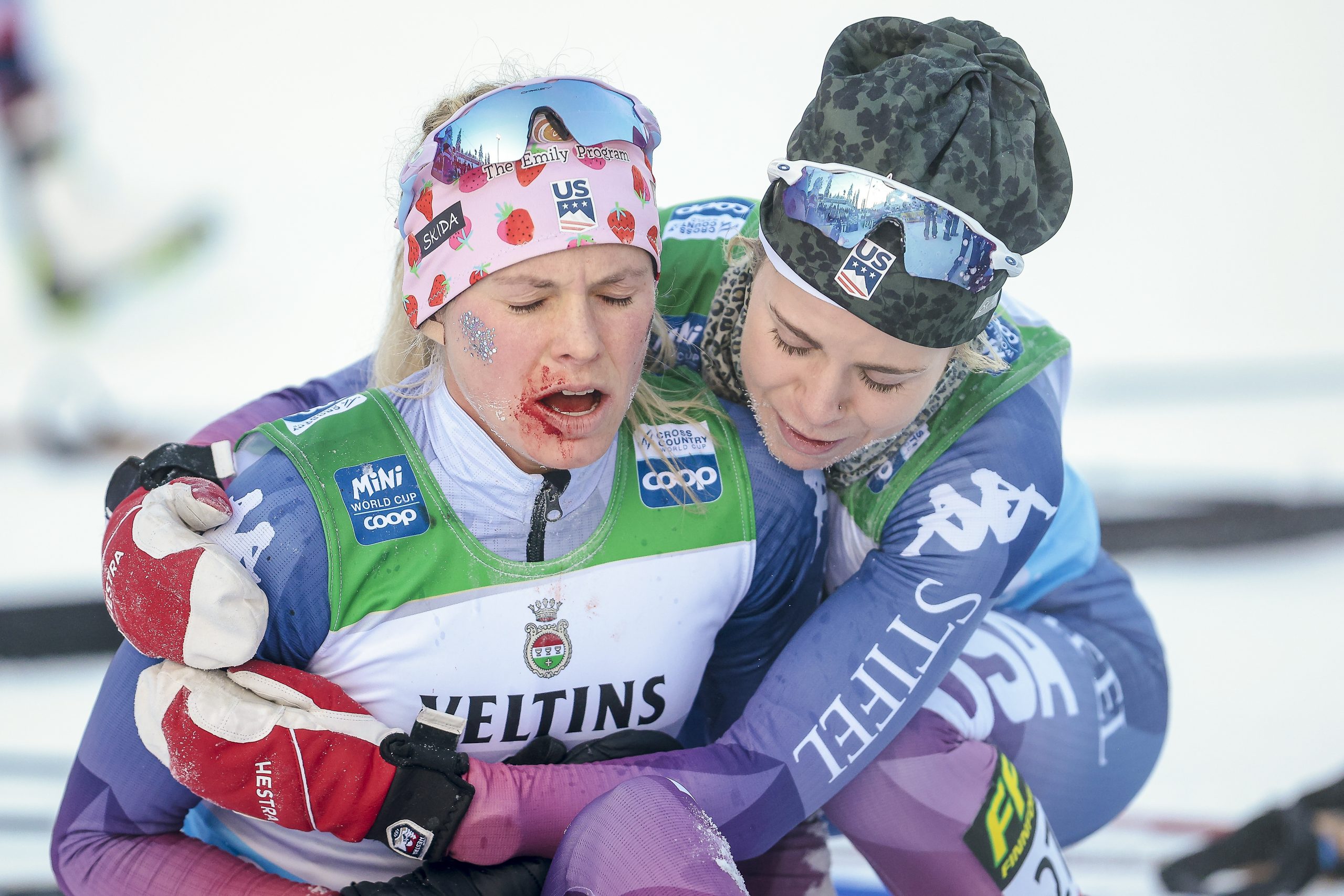
Jessie Diggins (USA) bloodied and battered at the finish is comforted by teammate, Sophia Laukli (USA). (Photo: NordicFocus)
It was an epic day of racing in Ruka, Finland where the women closed out their racing with the 20 kilometer mass start freestyle. The American squad was hoping that Jessie Diggins could repeat the magic she displayed in Davos, Switzerland last year where she won the only women’s 20 kilometer freestyle mass start event of the year and went on to finish second in the distance crystal globe competition. Rosie Brennan (USA) finished third that day. Today the question surrounding Brennan was whether she could sustain her energy after her emotional podium finish yesterday. Sweden was hoping its star-studded team could dominate as they did at times last year. Finland was counting on the home field advantage propeling Kerttu Niskanen, last year’s distance cup winner, to the front. But none of the pre-race prognostications could prepare fans for what they were about to witness.
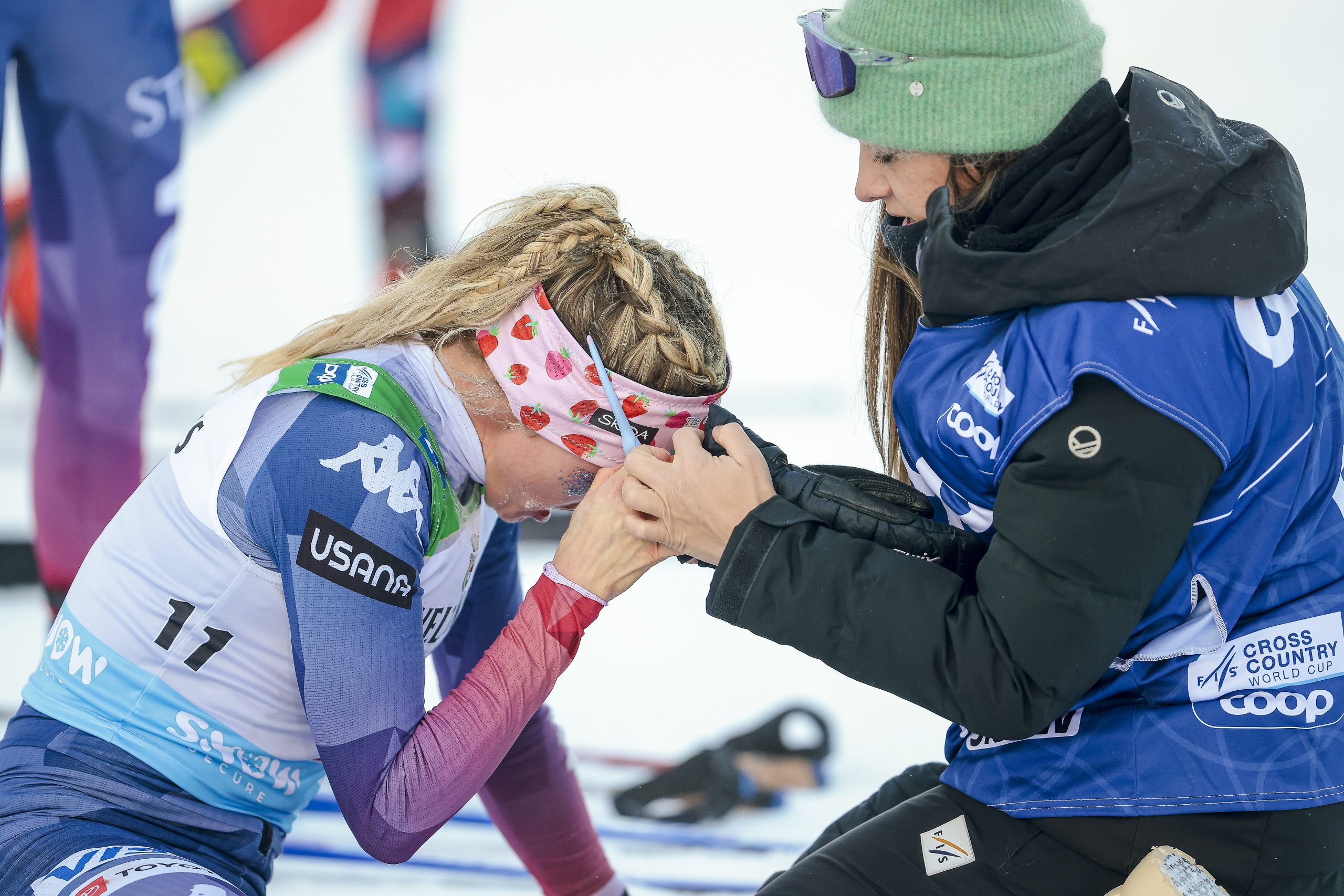
Jessie Diggins (USA) was attended to at the finish line after a tangle near the end of the race yanked her pole from her hand and left her bloodied and without a glove. (Photo: NordicFocus)
As the weekend concluded, it was Sweden that came out on top with Moa Ilar narrowly taking a dramatic, pulse-quickening victory over Jessie Diggins who finished second and Rosie Brennan who came in third.
In addition to Diggins and Brennan, four other Americans achieved impressive results: Sophia Laukli finished 14th, Novie McCabe 21st, Julia Kern 26th, and Alayna Sonnesyn 34th.
The top Canadian finisher was Katherine Stewart-Jones in 22nd ,while her teammate, Amelia Wells, finished 44th.
Early concerns about Rosie Brennan (USA) quickly faded as she worked her way through the lead pack to finish third, delivering her second podium finish in as many days. (Photo: NordicFocus)
High Drama in the 20 Kilometer Mass Start Freestyle
Ski fans were treated to a thrilling race today with back and forth competition punctuated by a finish with high drama. It was a cold day in Ruka, six degrees Fahrenheit, with many of the racers wearing face tape and most wearing extra head and neck coverings. Skiers navigated eight laps of a 2.5 kilometer course, reaching top speeds over 46 mph (75 kmh) on the loop’s steep downhill.
For the first five kilometers, the pack maintained a casual pace resulting in a large group at the front. It was at that point when Diggins had enough of the slow pace and pushed to the front to set a faster tempo. It was a move that began to splinter the field. Coach Matt Whitcomb confirmed that the move was “intended to shed a few people off the pack, you don’t want to have 15-20 people in the finishing sprint because in that group there’s someone there that’s likely to out sprint you.”
The turn of pace presented early concerns about Brennan. At this point she dropped back to 20th, thirteen seconds off the lead, and it looked as though yesterday’s effort may have taken its toll on her.
Sophia Laukli (USA) joined the Americans having standout days finishing 14th. The long distance races are Laukli’s strength. (Photo: NordicFocus)
At the ten kilometer mark, a 20-skier lead pack established itself. Near the back of that pack (in 13th) was long-distance standout and trail running champion Sophia Laukli (USA). For Laukli, the longer the distance the better. She had told FasterSkier earlier in the year that she considers anything under five kilometers as too short for her liking.
At 12 kilometers, Margrethe Bergane (NOR) forced the pace with Diggins and Ebba Andersson (SWE) joining her at the front. Bergane pulled with her a large group of her teammates with the venerable Heidi Weng and long distance specialist Astrid Oyre Slind joining the Norwegian cluster. At this point, Brennan and Laukli were still hanging at the back of the pack while Norway appeared to be making a concerted effort to control the pace.
At 14 kilometers, Bergane made her move accompanied by Andersson and Frida Karlsson (SWE). They established a gap on the field which Diggins was able to bridge by doing what she does best: using the next downhill to narrow a gap. A large group clung to her, and the pack reconsolidated into a group of 14 with Laukli at the rear. Brennan had worked to erase her early deficit and she was now only five seconds off the lead. Concerns about the effects of yesterday’s racing were shaken off as Brennan was now firmly in contention.
Rosie Brennan (USA) and Sophia Laukli (USA) skied near the back of lead pack for the first half of the race until Brennan surged to the front and eventually…to the podium. (Photo: NordicFocus)
At 17.5 kilometers, Brennan surged toward the front of the lead pack having clearly regained her footing. With 2.5 kilometers to go, the pace slowed a bit; the lead pack reconsolidated again with Brennan and Diggins toward the front and Laukli at the back, but only five seconds from the front.
It was then that fate intervened, adding a signature moment to the already moment-filled career of Jessie Diggins. Diggins and Brennan were toward the front, but the pack remained tightly clustered when, suddenly, Diggins had a pole yanked from her hand; it appeared that her pole had been stepped on; the force of the tug so strong that it ripped her glove off along with the pole. The reason mattered less; the damage had been done. Without a pole—and gloveless in Ruka’s bitter cold—Diggins dropped to the middle of the pack with very little time left in the race.
In a sprint to the finish, it was Moa Ilar (SWE), Rosie Brennan (USA), Jessie Diggins (USA), (l-r) who battled until the end. (Photo: NordicFocus)
The damage pushed Diggins into eighth. Fortunately, the American staff was present at the side of the course where they were immediately able to hand her a replacement—though in that exchange Diggins suffered a blow to the face that left her bleeding. Bare handed, she surged on the final climb and shot back to the front using a furious climbing pace. Throughout the drama, Brennan hung with the race leader, Moa Ilar (SWE), who had moved up from fourth place. In an incredible three-way fight for the finish, Ilar found another gear and was narrowly in front of Diggins at the top of the final hill. At the crest, all three racers jumped into sprint mode with Ilar having just enough to edge out Diggins by three tenths of a second. Brennan was in the mix the whole time and finished third, a mere 1.4 seconds out of first.
As usual, Jessie Diggins (USA) gave it everything she had, but couldn’t overcome a deficit caused by a tangle near the end of the race. As a result of the incident, she was left without a glove and using a spare pole. (Photo: NordicFocus).
But for a cruel twist of fate, who knows how the race might have played out? At the finish, Diggins was bloodied; her bare hand trembling. She was helped out of the finish area by American staff members. The last 1.6 kilometers of the race would become an instant Diggins-classic in a career already defined by gutsy performances. It would also establish Brennan as a force to be reckoned with on any given World Cup race course. It was a day of heroics and pride for team USA as they overcame adversity and fought off the major Nordic powers to claim two-thirds of the podium.
After the race Diggins said that she was fine. “I’m doing okay, It was a little bit rugged at the finish and I just want to say a huge thank to our team and the FIS (International Ski Federation) team-they took really good care of me.”
Diggins injury was a minor bloody lip that came from the pole exchange. According to Whitcomb, the quick exchange was the result of coach Kristen Bourne’s prescient actions. “The same thing happened to Jessie between five ten years ago in the exact same spot,” Whitcomb said. “[Diggins] has fairly narrow hands, so when someone steps on the pole, the strap and glove all come off her hands. Thirty seconds before that happened, Kristen Bourne, said ‘I’m going over to this hill because I have a feeling things are about to get crazy.’ Thank goodness she did, because she saved us a podium.” Whitcomb added that there was a second pole exchange several hundred meters later to provide Diggins with a better fitting pole. Diggins was hit in the face by the pole handle as it was being given to her. It was on the first pole exchange that the injury occurred. Whitcomb confirmed that Diggins is “fine.”
Diggins also confirmed that it was the pole exchange that did the damage. “I got a replacement pole, got a pole smash to the face and apparently got a pretty bloody mouth,” she said. “I’m proud of myself for just never giving up, digging deep. It was so special to share that podium with Rosie, and Sophia had a great race too.” Diggins also had praise for the support staff. “Our techs have been working so, so hard, and I’m very thankful to them…you don’t get podium finishes or good races without the whole team supporting you.”
“You really can’t ever count out Rosie Brennan. She is as tough as they come.” USA Coach, Matt Whitcomb
Whitcomb also had high praise for Rosie Brennan. “It certainly looked like she was beginning to dangle and that stretched out string was about to snap,” he said. “[But] you really can’t ever count out Rosie Brennan; she is as tough as they come. If you want to count her out you had better put 15-20 seconds into her. When it came down to see who was the toughest, Jessie and Rosie were among the top three.”
After the race, Brennan acknowledged that she struggled at times. “Maybe it was from yesterday, maybe it was just not finding my groove…who knows. In the middle of the race I was definitely doubting myself and not feeling great. I just [was] trying to remember that 20 k is long enough to be patient, and this course can also suit those that are patient…So I just tried to keep that in mind. I’m proud of using some experience—and my brain a little bit—to get me around the course the best way possible.”
Whitcomb also had praise for Laukli’s performance. “She was very excited with today’s race,” Whitcomb said. “With the pace being mellow at the start she was able to move to the front and push the pace.”
Whitcomb had kudos for the entire team’s performance including coaches, techs, and cooks. “I’d love to give a shout out to all of my staff. We had two P.T.s running the athletes spare poles, and warm ups. We had a press officer handling a pole position, and our chef was even out there literally banging pots and pans to celebrate every time racers skied by. My phone has been blowing up. Thank you to everyone back home, I’m seeing lot of donations come in for our Drive for 25 fund raiser.”
By the time the flower ceremony began, Diggins was all smiles, showing no obvious effects from her dramatic final kilometer of racing. It was a day that will go down as an epic performance by a gutsy American squad.
After wounds were tended to, it was all smiles for Jessie Diggins (USA) and Rosie Brennan (USA). (Photo: NordicFocus)
This World Cup coverage is made possible through the generous support of Marty and Kathy Hall and A Hall Mark of Excellence Award. To learn more about A Hall Mark of Excellence Award, or to learn how you can support FasterSkier’s coverage, please contact info@fasterskier.com.
After Maja Dahlqvist (SWE) qualified third in Saturday’s classic sprint, the tension rose to a fever pitch. With ten bonus points earned, Dahlqvist had cut the Sprint Crystal Globe gap between herself and Nadine Faehndrich (SUI) in half. After five months of racing, the two sprint rivals were separated by just 12 points. The statisticians sharpened their pencils.
In remarks to FIS media before the decisive heats kicked off, Dahlqvist said she “had nothing to lose” in chasing Faehndrich. “Maybe,” she added, “my teammates can help me.”
In skiing, an individual’s relationship to a greater team is often cited. On the final day of the World Cup Sprint season, though, a self-sacrificing action converted teamwork into literal World Cup points, and a Crystal Globe . . . thanks to the selfless actions of Dahlqvist’s teammate, Moa Ilar (SWE).
Moa Ilar (SWE) sacrificed her quarterfinal race to save her teammate Maja Dahlqvist’s (SWE) shot at securing the Sprint Crystal Globe. Dahlqvist seized the chance, winning her second Sprint title with a fourth place finish in Lahti, Finland. (Photo: NordicFocus)
As Dahlqvist wound through the course in her quarterfinal, she was followed by her teammate, Ilar. The Lahti course offered a long-climb with a one-hundred eighty degree turn on the way up, and a one-hundred eighty degree turn on the way down. Dahlqvist had led all the way through, but the pack was tight with Ilar following the whole way. Ane Appelkvist Stenseth (NOR) had followed too, with Katharina Hennig (GER) fighting back to the front. On the final downhill, Hennig glided and glided until she was right up on Dahlqvist. Then, in an instant, she moved her ski and caught Dahlqvist’s pole. It was a clean break, and with it went Dahlqvist’s prospects for advancing. Continuing gamely—with only one pole— Dahlqvist sprinted as well as she could, but her chances of advancing faded with each single pole plant. That was until on the final stretch, when another skier vying for a bid to the semifinals noticed Dahlqvist’s plight. Moa Ilar looked over, seemed to do a quick calculation of what was at stake for Dahlqvist, and stood up to allow her teammate to finish ahead of her. Selflessness, generosity, nobility: Ilar had sacrificed her own race, and kept Dahlqvist’s season alive.
Battle for the Crystal Globe
Dahlqvist would have a chance. But first, Nadine Faehndrich was performing heroics of her own. In a quarterfinal where Tiril Udnes Weng (NOR) and Jessie Diggins (USA) were embroiled in their own pitched battle for the Overall World Cup, the Swiss skier hung on through every pace increase and shot through the pack in a sprint to earn a place in the semifinals.
The long road that began in Ruka last fall ultimately led to Lahti this spring. The second semifinal featured both Dahlqvist and Faendrich, head-to-head. Dahlqvist finished the heat second ahead of Faehndrich in fourth. Dahlqvist was into the Finals, and Faehndrich was out. A quick set of calculations revealed that Dahlqvist needed to finish no worse than fifth in order to claim the season-long Sprint crown. When Dahlqvist finished the day in fourth place, she knew that her performance would bring smiles, celebrations, and a Crystal Globe.
Maja Dahlqvist (SWE) overcame a 22 point gap to secure her second Sprint Crystal Globe on Saturday. (Photo: NordicFocus)
Women’s Classic Sprint
The conclusion of the World Cup Sprint chase captured the spotlight all day, but the continuing rivalry of Kristine Stavaas Skistad (NOR) and Jonna Sundling (SWE) would be played out at the finish line. In the Final, Sundling produced a burst of speed early on the course’s biggest climb. As the race wound into the stadium, though, Skistad was back in the picture, reeling in the Swedish World Champion. In the finishing straightaway, Skistad shot around the outside, unleashing a finishing double-pole that had brought her victory at the last four World Cup sprints, and did so again today. Skistad first, Sundling second, and Tiril Udnes Weng (NOR) adding to her remarkable season in third.
Kristine Stavaas Skistad (NOR) and Jonna Sundling (SWE) continued their streak at the top of the sprint field, with Skistad winning her fifth straight World Cup Sprint. (Photo: NordicFocus)
In the finishing area, the Swedes all embraced each other as champions. In that final embrace, a season in which the Swedish team had demonstrated their preeminence over the World Cup sprint field found its fitting ending. The one Norwegian among them, Skistad, had secured a conclusion which added emphasis. She will put her skis on the start line of the Ruka sprint course next November having not lost a World Cup sprint in 2023. Jonna Sundling, the only other winner in a sprint this year- the World Championships no less – will be there too. After three consecutive weeks of exciting sprint duels, the duo have established a choreography that all ski fans will look forward to revisiting when the snow falls again.
Julia Kern (USA) secured her career-best seventh place in the World Cup Sprint standings after Saturday’s race. (Photo: NordicFocus)
USA Qualifies Three: Julia Kern Finishes Season in Top 10
The Americans qualified three for heats today, with Jessie Diggins, Julia Kern, and Rosie Brennan all taking the starting line in different quarterfinals.
Kern took the line in the first quarterfinal, alongside Skistad and Emma Ribom (SWE). Ribom was the heat’s main mover, pushing the pace as the field hit the steep climb. Skistad made her way back to Ribom, while Kern pushed from the back of the pack to put herself firmly in the race. The American faded slightly in the stadium, but managed to maintain her position in third place (a lucky loser spot until Laura Gimmler (GER) and Jasmi Joensuu (FIN) bested her in the next heat).
“I knew I had more in me after the qualifier. I felt ok in my heats, nothing went wrong, nothing was really amazing, but I gave it what I had, and I’m proud of how I finished strong.” said Kern in post-race comments.
Rosie Brennan ended up sixth in a hard–charging heat that produced the other lucky loser. While Jessie Diggins, skiing in the fifth quarterfinal alongside Weng and Faehndrich came out in fourth place.
Diggins saw positive signs on Saturday for what might be ahead tomorrow, saying post-race that, “it’s fun to feel like I’ve had decent energy at the end of the year. When it comes down to the end of the season, what you have is what you have.”
With the Sprint World Cup concluded, Julia Kern has officially secured her career-best position in the season-long sprint standings. Kern finished seventh, improving upon her eighth place finish in last year’s campaign.
Jessie Diggins (USA) is all smiles headed into the World Cup season finale tomorrow. Diggins sits second place in the Distance classification, 22 points separating her from Kerttu Niskanen (FIN). (Photo: NordicFocus)
Distance Classification Finale
With her podium today, Weng wrapped up the World Cup Overall. The Norwegian sits 154 points ahead of Diggins who holds a firm grasp on second place Overall, 99 points ahead of third place Kertuu Niskanen (FIN). Those skiers will still be the main focal point of tomorrow’s 20 k Classic World Cup finale.
In the Distance classification, Niskanen holds a 22 point lead over Diggins. Further down the standings, Brennan sits just 4 points ahead of Heidi Weng (NOR) for fourth place in the Distance classification, vying to make it a second time in three seasons that the American duo of Diggins and Brennan have both finished top five.
Sunday, then, will be another race for the number-crunchers. Context for what that means in terms of excitement? Look no further than Saturday’s race. The gap that Maja Dahlqvist overcame to win the Sprint Crystal Globe; 22 points. Jessie Diggins’ deficit to Kertuu Niskanen heading into tomorrow; 22 points.