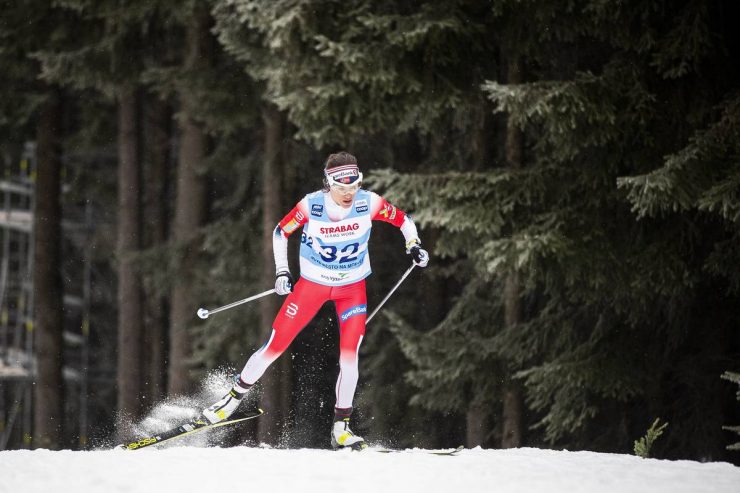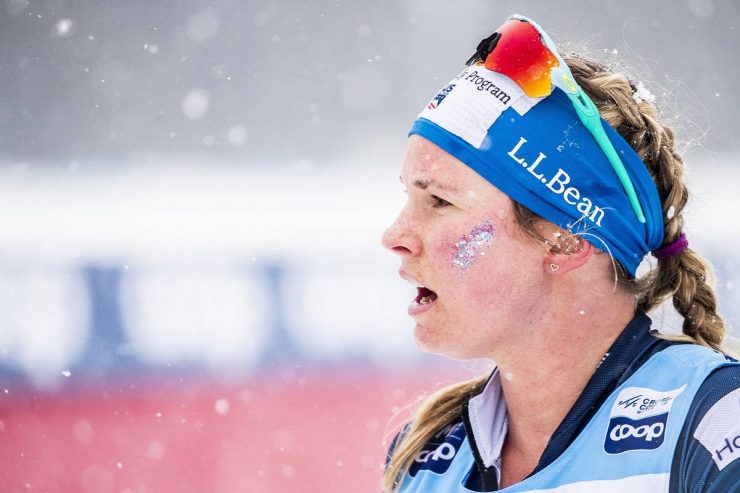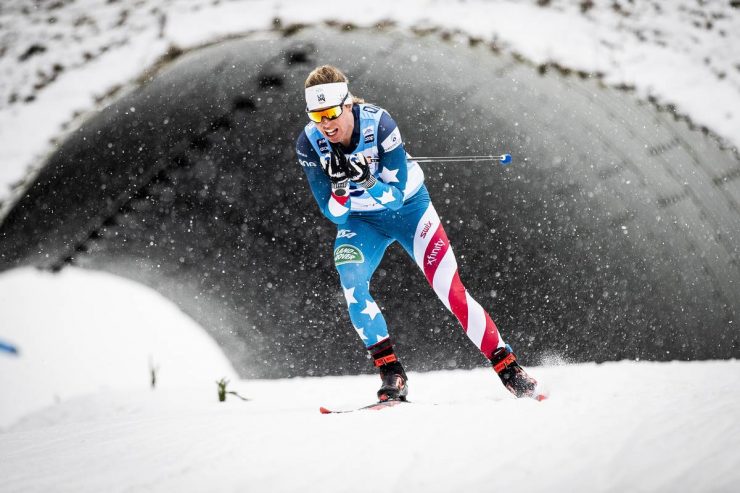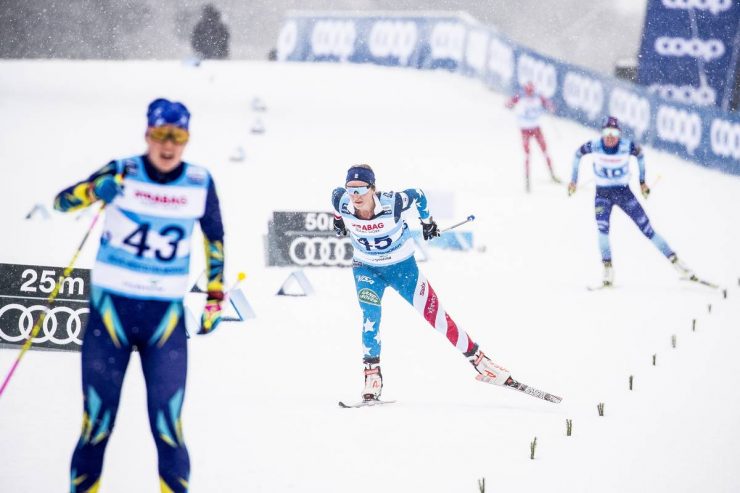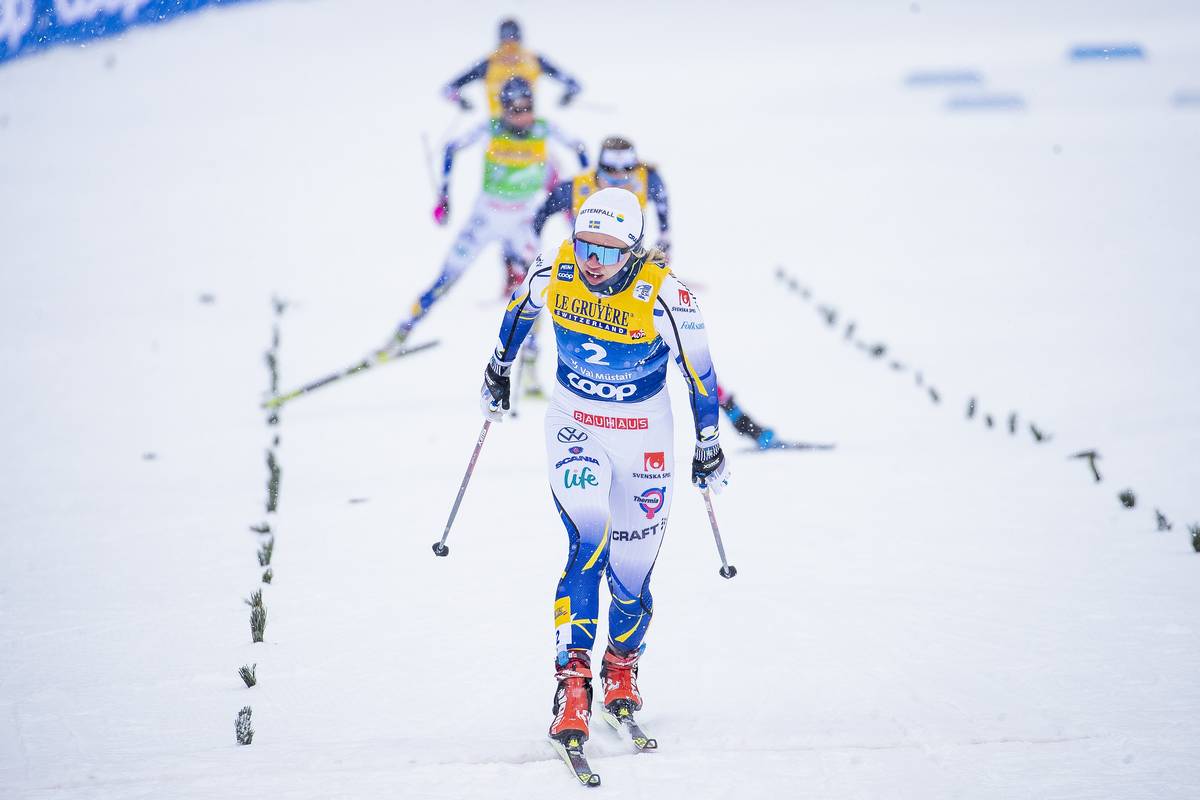
Tag: Moa Lundgren

  • Tour De Ski Opens With Spills and Thrills in Val Müstair; Diggins 2nd, Brennan 4th

    Tour De Ski Opens With Spills and Thrills in Val Müstair; Diggins 2nd, Brennan 4th


    Sweden’s Linn Svahn winning the first stage of the 2021 TdS in Val Müstair, Switzerland. (Photo: NordicFocus)

    This World Cup coverage is made possible through the generous support of Marty and Kathy Hall and their A Hall Mark of Excellence Award. To learn more about A Hall Mark of Excellence Award or to learn how you can support FasterSkier’s coverage please contact info@fasterskier.com.

    Out with 2020, in with 2021. Here in the world of multicolored lycra and skinny skis, we are kicking off the new year with the opening of the Tour de Ski on the sprint track of Val Müstair, Switzerland. As snow fell lightly but steadily, the usually remarkable mountain backdrop was veiled, narrowing our focus to the athletes as they embark on the grueling eight stages over ten days that is the TdS.  

    The two-lap 1.4-kilometer sprint course in the alpen valley featured two punchy climbs per lap leading down into fast and tight S-turns. Small rollers after these turns kept the skiers on their toes as they charged around the course.   

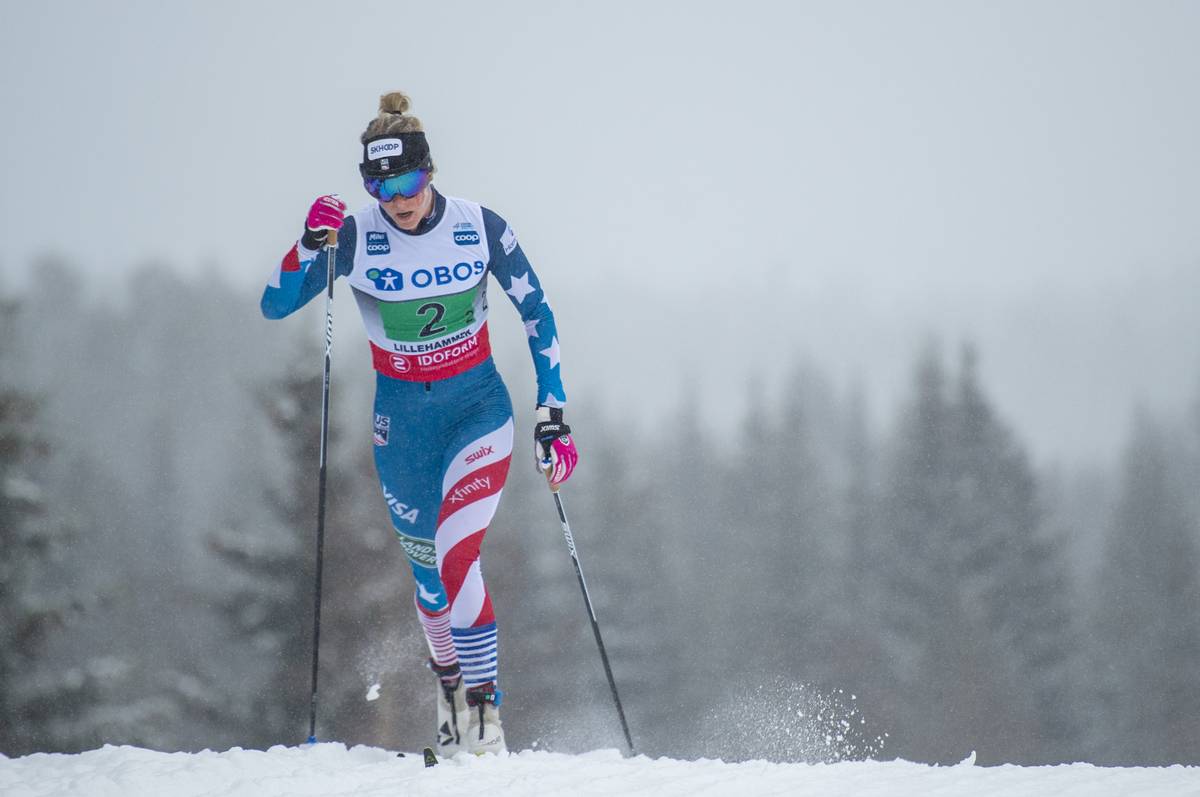
    Though the Norwegian athletes remain absent from the World Cup and TdS, the Swedish women are back in full force. They made their sprint prowess known in the qualifier, with 26-year-old Maja Dahlqvist setting the fastest time by nearly three seconds in 3:30.86. Seven members of their squad qualified for the heats, with an additional three in the top 10: Linn Svahn in 2nd, Moa Lundgren 4th, and Frida Karlsson in 8th. Though Karlsson is normally known for her distance racing (in particular besting Norway’s dominant Theresa Johaug at last year’s Holmenkollen 30 k), her possession of the green U23 Overall World Cup leader bib evidenced that she was not to be dismissed as a contender for the stage. 
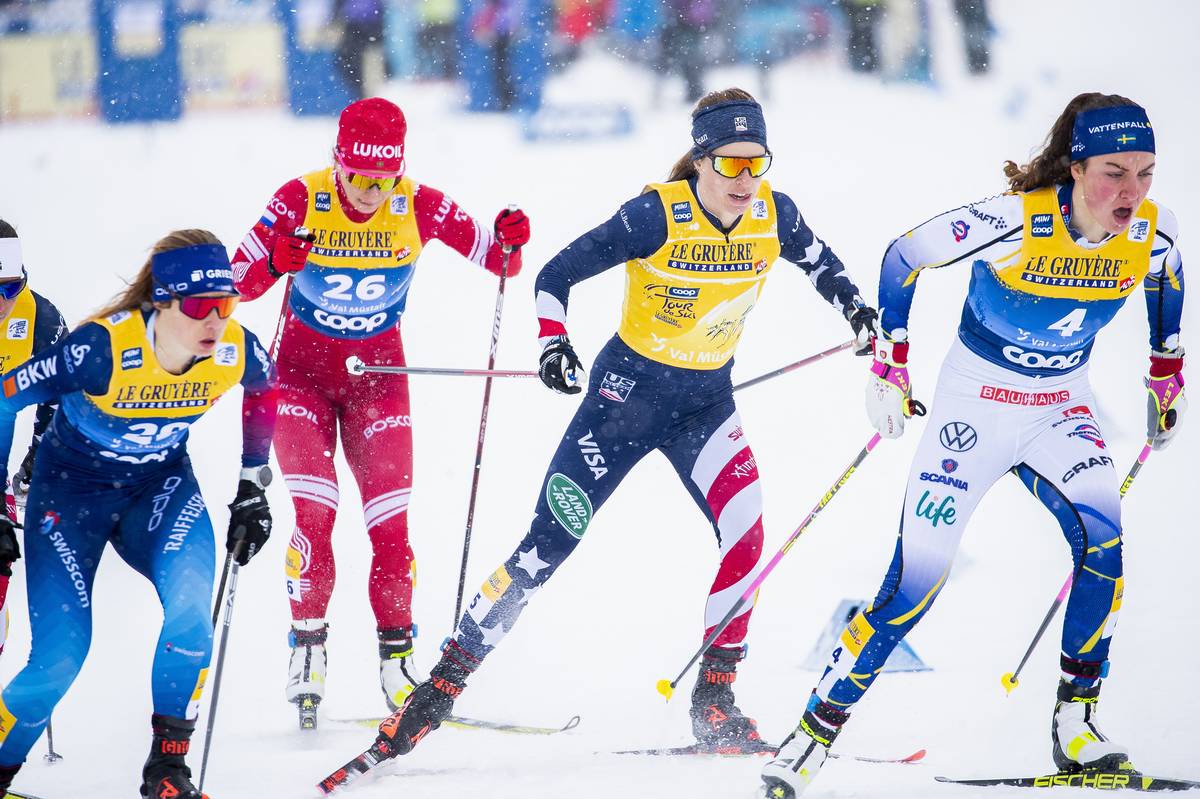
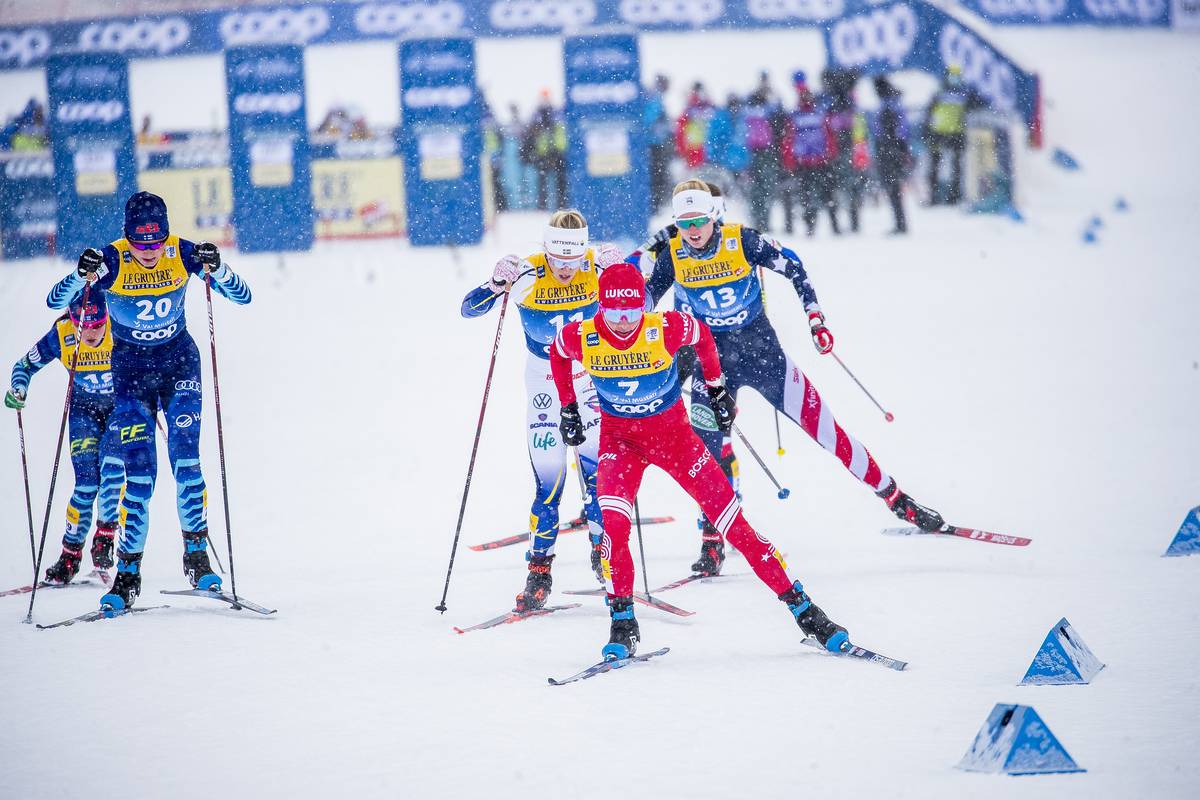
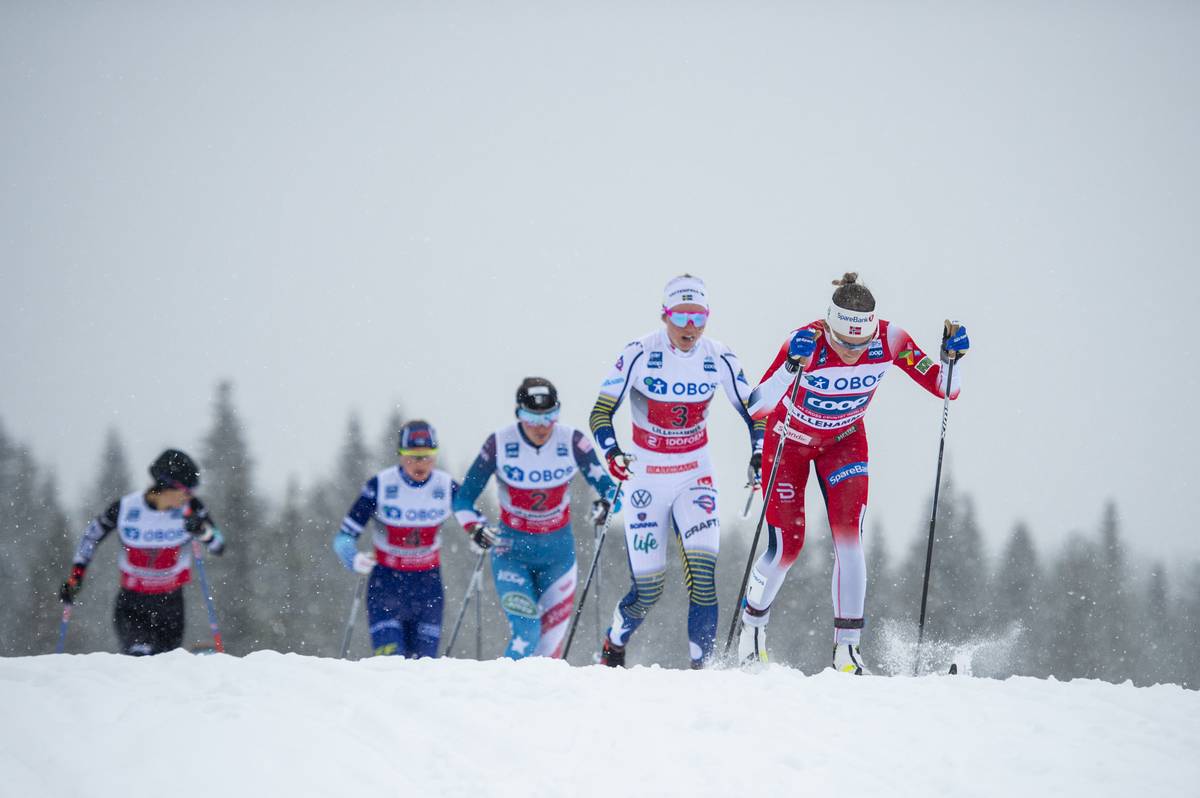
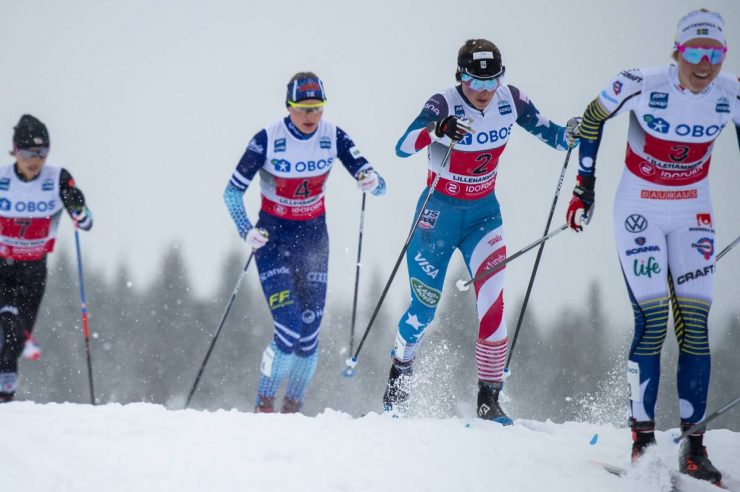
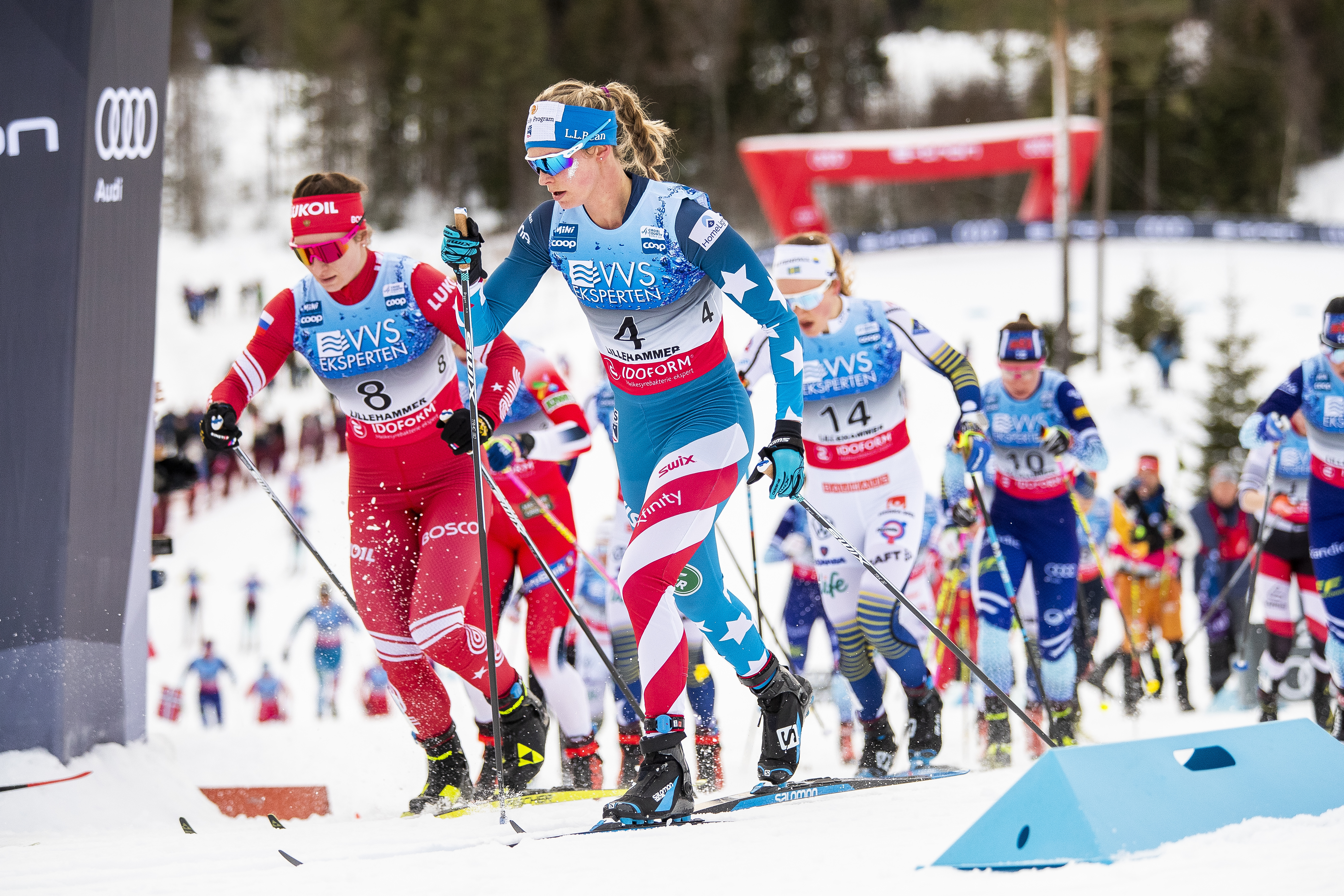
    Rosie Brennan (yellow bib) locked onto Sweden’s Moa Lundgren (bib 4). (Photo: NordicFocus)

    Wearing the yellow Overall World Cup leader bib, Rosie Brennan was the top American qualifier in 5th (+4.38), followed by Hailey Swirbul in 13th (+8.65), Jessie Diggins in 14th (+8.96), Sophie Caldwell Hamilton in 16th (+9.77), and Julia Kern in 25th (+12.61).

    Brennan raced in a stacked first heat of the quarterfinals, racing against two of the top Swedes, Dahlqvist and Lundgren, in addition to Russia’s Natalia Nepyaeva, teammate Kern, and Switzerland’s Laurien van der Graaff. Brennan stayed near the front and in position to advance from the get-go, but couldn’t break from the lead group of four. She finished in a three-way photo finish with Nepyraeva and Lundgren, taking third but snagging a lucky loser spot allowing the threesome to all advance into the semis.  

    Jessie Diggins finding her form in Val Müstair, Switzerland where she placed second overall in the TdS stage 1 sprint. (Photo: NordicFocus)

    Also advancing from the quarters from the fifth heat, Diggins held a position near the front throughout her heat, showing with her lightning-fast tempo that she intended to advance. She pushed Karlsson and Italy’s Greta Laurent break from the remainder of the group. In the second lap, Diggins had the fastest V1 cadence on the climbs and stayed smooth in the descents, priming herself for good positioning in the final sprint to win the quarter. 

    Ending their day after the quarters, Caldwell Hamilton marked Swedes Svahn and Emma Ribom. In her usual calm, cool, collected manner, she skied smoothly through the S-turn and tucked in comfortably on Ribom’s tails. Despite great position coming into the final lanes, Caldwell Hamilton could not quite overtake Ribom and finished centimeters behind for third in the heat. Swirbul stayed close to the leaders but was unable to fight for the top two and ultimately ended the heat in third also. Neither heat was fast enough to obtain a lucky loser spot. 
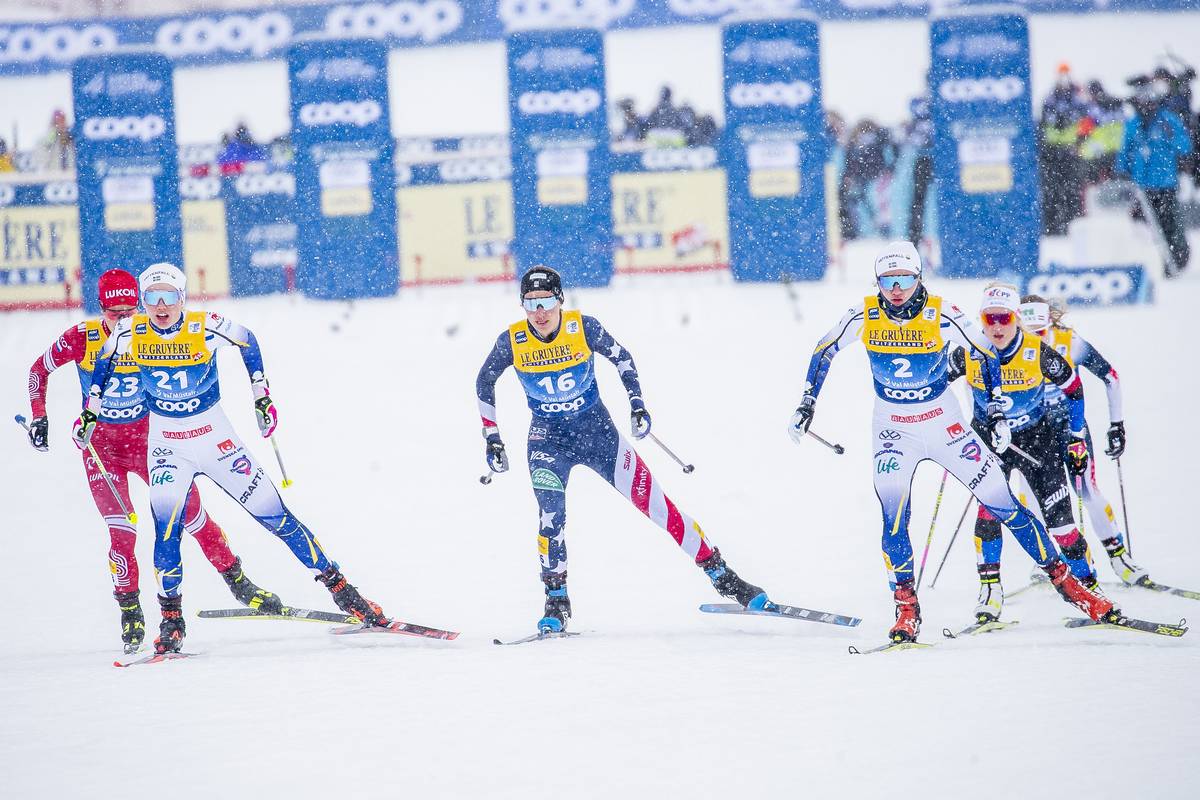
    Sophie Caldwell (bib 16) qualified in 16th and placed 16th overall in Friday’s skate sprint. (Photo: NordicFocus)
    Hailey Swirbul, here in bib 13 during stage 1 of the 2021 Tour de Ski, placed 15th overall. (Photo: NordicFocus)

    On to the semifinals. Racing on home soil in the tight first heat, Nadine Fähndrich (SUI) edged out her opponents for the win in a three-way photo finish with Slovenia’s Anamarija Lampic and Sweden’s Dahlqvist. Considering Lampic and Fähndrich both finished in the top four of the last two freestyle sprints in Davos and Dresden, this result serves as a testament to the depth of the sprint field in those venues despite the lack of Swedes, Finns, and Norwegians. 

    Brennan and Diggins took off in the second heat, marking Swedes Svahn and Karlsson who held the front in the first lap. In the second lap, Brennan upped the tempo on the climbs, while Diggins pushed over the top and worked the downhill, free skating out of the rollers and putting herself into position to charge down the lanes ahead of Karlsson to hold onto the second position and a secure advance to the final. 

    Frida Karlsson (SWE), Jessie Diggins (USA), Greta Laurent (ITA), (l-r) during stage 1 of the 2021 TdS. (Photo: NordicFocus)

    Fighting for millimeters, Karlsson and Brennan were just behind in third and fourth. Both squeaked through as lucky losers, but only just as Brennan’s time was a mere 0.1 seconds faster than the next fastest time. 

    The pace stayed hot and the pack stayed tight in the first lap of the final. Diggins and Brennan stayed in the mix near the middle of the pack and in contention for the podium. 

    As the racers rounded the bend into the second lap, Svahn began firing on all cylinders, taking off at the front with Lampic and Fähndrich marking her from a couple ski lengths back. Just when the top-3 positions seemed locked up, Lampic and Fähndrich brushed skis in the downhill S-turn causing Fähndrich to crash, losing sight of the podium. Svahn continued to hammer, flying down the final stretch to take the win with Lampic nearly a second behind her. 

    Seizing the opportunity, Diggins nimbly dodged around the downed Fähndrich, hopping over her pole and hitting the gas to drop a chasing Karlsson and snag third. 
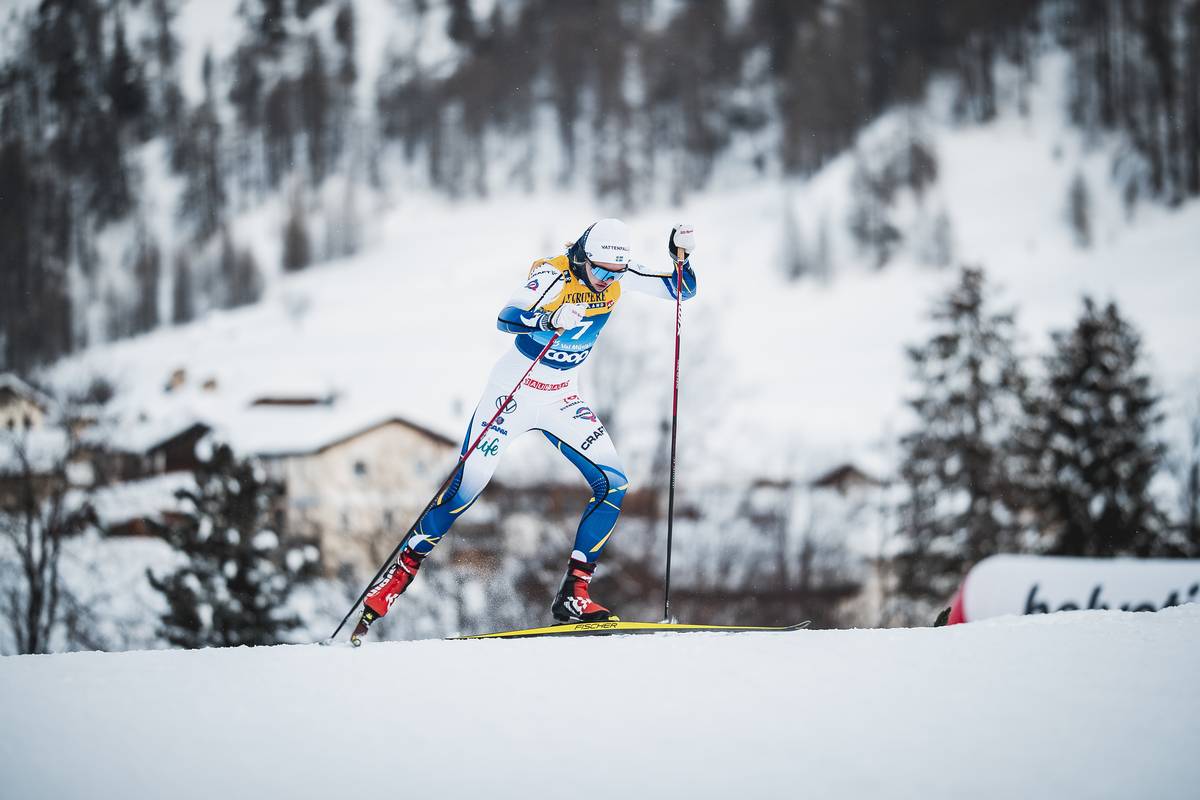
    Linn Svahn during qualification in Val Müstair, Switzerland. (Photo: NordicFocus)

    “I didn’t know how I’d feel in high altitude,” Svahn told FIS after the race. (Val Müstair sits above 4000 ft.)  “I tried to take the first lap to get into my own zone and technique, then I tried to push all I had in the last uphill since the other girls were going really strong beside me.”

    FIS also asked about Svahn’s goals for the tour ahead. 

    “I try to focus on each race, and now I’ll just focus on getting my legs working again after these tracks,” Svahn said with a tired laugh.

    After a lengthy review, during which Diggins demonstrated the importance of staying on top of nutrition during the arduous tour by refueling with a bowl of pasta on the sidelines, Lampic was deemed to have interfered and was disqualified. This moved Diggins into the second position on the podium, with Karlsson stepping into third.  

    “Today was a fun way to start 2021,” wrote Diggins in a post-race email to FasterSkier. “But I think it’s important for me to say that I’m equally as proud of my all-out effort and our team today as I am when I’m not on the podium! It was just another day of giving it my absolute best effort, but the patience and trust in the training plan that Cork and I set down together has been paying off and my race form is coming into sharper focus now.”

    Jessie Diggins finishing second overall on Friday’s stage 1 sprint. (Photo: NordicFocus)

    So far this season, Diggins had a near miss at the podium with a 4th place at the individual sprint in Dresden and was unable to advance from the quarterfinals in Davos after getting boxed out on a curve just before the final straightaway. Today marks her first podium of the season in sprint or distance.

    “The final was exciting, for sure,” she wrote. “I fell behind a bit on the steep climb, and was working my way down the downhill sections with as much speed as I could when I saw Nadine go down and slide around the corner in front of me. I didn’t want to hit her (or break her equipment, or my own) so I jumped over her pole while rounding the corner! In sprinting you can get lucky or be the recipient of incredibly bad luck, and today the luck definitely came my way (and I’m grateful for it).

    “It was so exciting to have Team USA be 1/3 of the women’s final,” concluded Diggins. “And for myself, it was exciting to be out there having fun, not putting pressure on myself but still skiing with confidence and enjoying the banked turns and rollers all at the same time.”

    With the disqualification, Brennan moved into fourth position. Though historically stronger in distance, Brennan has shown her potential as an all-arounder this season with back-to-back sprint and distance wins in Davos and a fifth-place overall standing in the opening mini-tour in Ruka

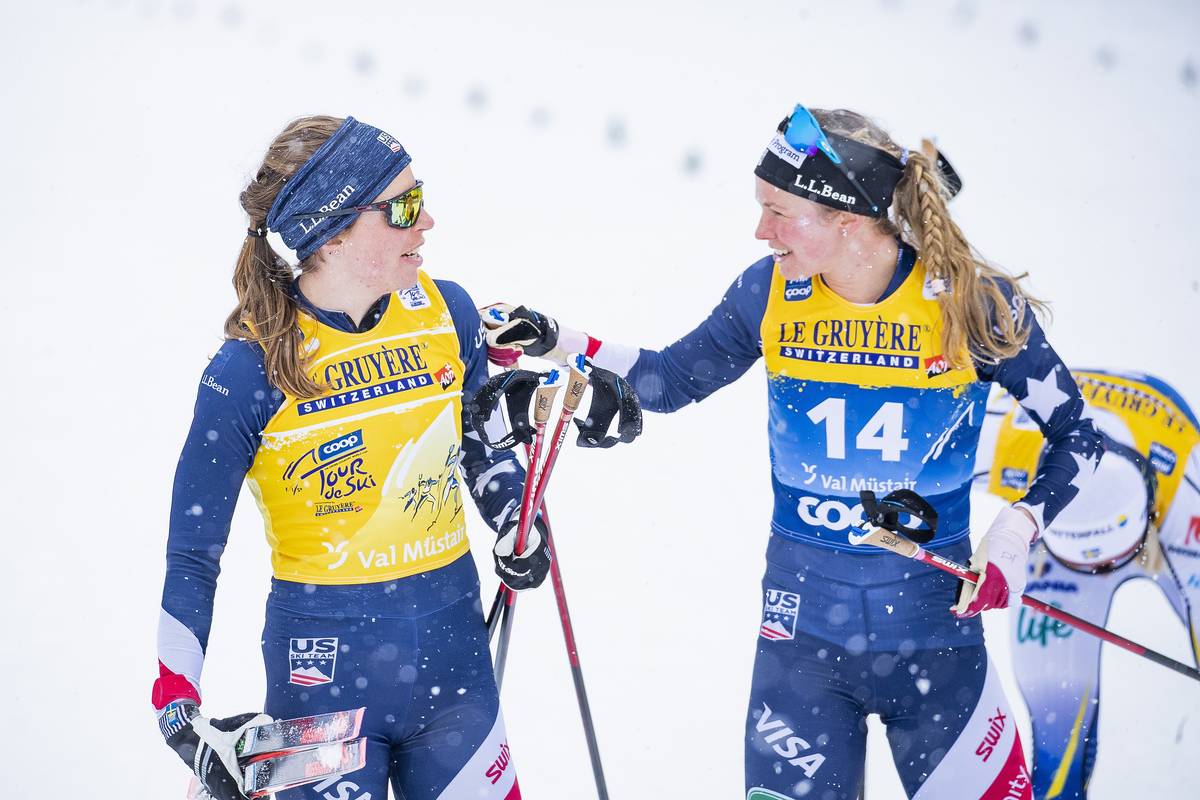
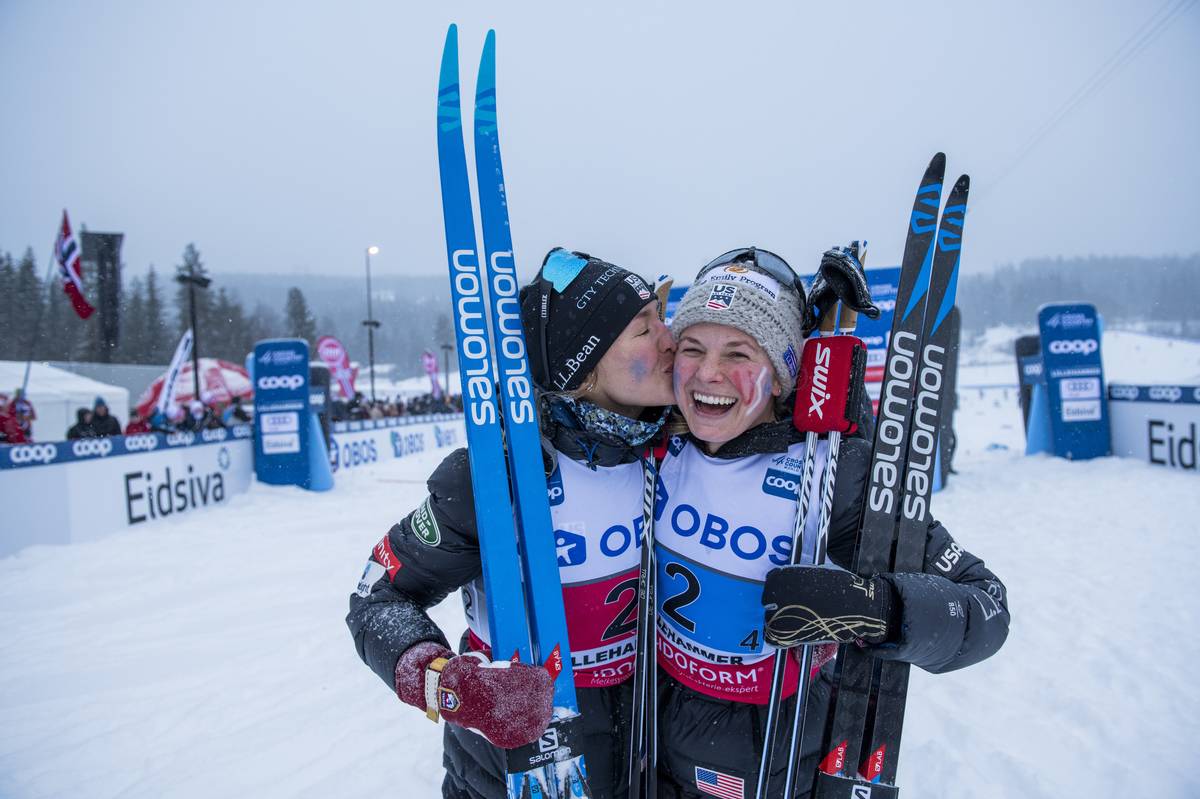
    Rosie Brennan (l) and Jessie Diggins in Val Müstair, Switzerland after the first stage of the TdS. (Photo: NordicFocus)

    “It was a surreal day to be starting the Tour de Ski with the yellow bib,” Brennan wrote in a post-race email to multiple news outlets. “My one goal was to fight with what I had and I felt I did that well so I am proud of my effort out there today. I still have to remind myself just how far my sprinting has come and not change my expectations so quickly. This was only my second final ever and I am just so excited by the gains I’ve made.

    “This might be the hardest sprint course I have ever raced,” Brennan continued. “It’s long, at altitude, and had some slow snow out there today. With that in mind, I tried to keep things under control, but also use my strengths. I had a near miss in the quarterfinal and was really happy about my quick acceleration in the finish after getting stopped up. I worked hard in the semi to keep the pace high to ensure our heat would have lucky losers which I then benefited from. However, I was pretty beat by the time we got to the final. I tried to open up on the second lap, but there wasn’t much there. I stayed out of trouble and for that was rewarded another two places. That’s a sprint race for you…That was a tough start to the Tour so the focus will now be on recovery to get ready for tomorrow and all the races to come. It’s also very cool to note that we had our 4th different girl on the podium in just 4 weeks of racing. Our team is really working hard to get through this tough season together and support one another as we navigate the world.”

    Outside the top 30, Katharine Ogden finished 49th in the qualifier (+20.07), followed by Caitlin Patterson in 57th (+22.25). 
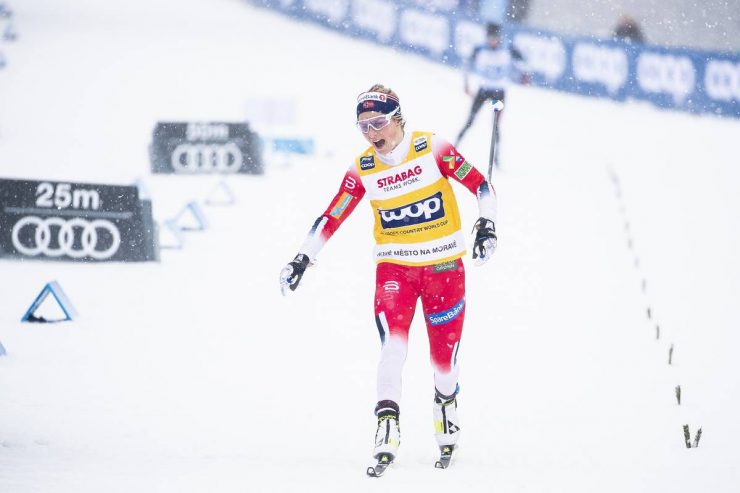
    Results: Qualifier | Final

  • Johaug Takes the Lead in Nové Město Pursuit; Diggins 4th

    Johaug Takes the Lead in Nové Město Pursuit; Diggins 4th

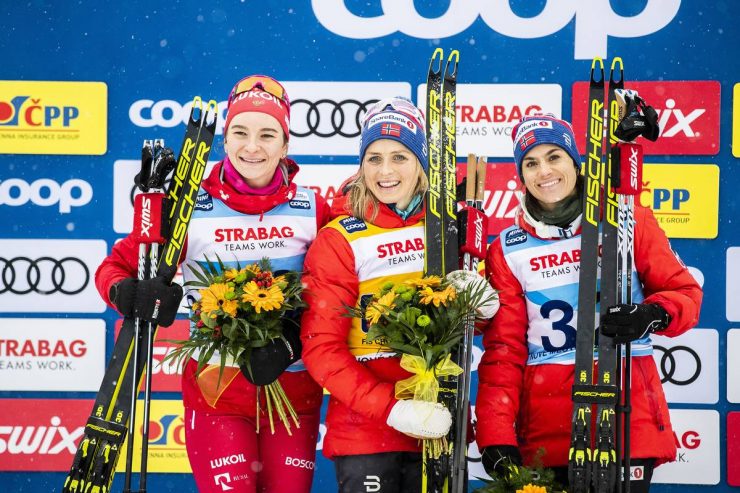
    The women’s podium inNové Město. Therese Johaug (NOR) took the win ahead of Natalia Nepryaeva (RUS) and Heidi Weng (NOR). (Photo: NordicFocus)

    “It has everything,” Sweden’s Charlotte Kalla told FIS before the start of the 10-kilometer interval start skate in Nové Město, Czech Republic. Though she was describing the steep uphills and working downhills, found along the 5 k track, it might have also been an apt description for what the weather had in store. As athletes headed out on course, the light icy precipitation transitioned into chunky white flakes accumulating on the deteriorating ribbon of man made and farmed snow. 

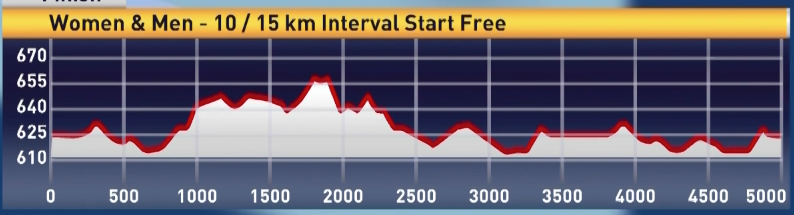
    The course profile of the 5-kilometer lap in Nové Město, Czech Republic. (Photo: Screenshot FIS broadcast)

    The two distance stages in Nové Město mark the start of Period III and the midpoint of the World Cup season, the tenth and eleventh of twenty one races. It also marks the return of the the squads of distance athletes who sat out last weekend’s city sprints in Dresden, Germany to recover from the compounding effect of their efforts in the Tour de Ski (TDS). Who made it through unscathed and who begins the second half of the season with lingering fatigue? Nothing like a two-day pursuit to find out.

    By 3 k, it was evident that Norway’s Therese Johaug, Tour de Ski winner and leader of both the World Cup overall and distance standings, was feeling on form. From the start, she unleashed her usual high tempo attack, clocking the fastest splits at each checkpoint. She stopped the clock at 23:31.1, over 30 seconds ahead of the next fastest time.

    “It was an amazing race today,” Johaug told FIS at the finish. “My shape and my body was really good. I have been a little bit tired after the Tour de Ski and I had some good sensation and bad sensations, but today it was a good day. Of course, the tracks out here and the snow was perfect for me, so I am really happy.”

    Johaug was chasing the ghost of her teammate, Heidi Weng, who started two bibs prior at the front of the seeded group. Leading the race for second place, Weng time-trialed through the wooded course, setting splits that were just faster than her peers’. At the half, she trailed Johaug by 17 seconds with four women within ten seconds of her: Natalia Nepryaeva of Russia, Moa Lundgren of Sweden, Jessie Diggins, and Ingvild Flugstad Østberg of Norway.  

    Soaring, Natalia Nepryaeva (RUS) powers to a second place finish in the 10-kilometer individual start skate inNové Město, Czech Republic. (Photo: NordicFocus)

    During the second lap, Nepryaeva closed the gap to Weng’s times, matching her with roughly two K’s to go, then pulling ahead by a few seconds. Throwing her boot for the second fastest time of the day, she knocked Weng back to third on the podium. Nepryaeva finished 32.7 seconds behind Johaug, and Weng was 40.3 seconds back.

    Weng is now batting 70 percent for podium finishes; she has only missed the top-3 in three of the ten stages, with her lowest rank of 8th occurring in the final stage of the Tour de Ski.

    Eyes locked on the task at hand, Heidi Weng skis to third during the 10-kilometer skate in Nové Město, Czech Republic. (Photo: NordicFocus)

    Diggins started third in the seeded group behind Johaug and Weng. After hovering in the top 5 throughout the race, she was next across the line in fourth (+48.5), with Ragnhild Haga of Norway just behind (+48.8). Østberg rounded out the final spot in the top five (+49.7).

    When asked for a preview of tomorrow’s pursuit, Johaug commented on this strong group of women who would be chasing her.

    “Of course, I’m really happy that I have 30 seconds, but I know that it’s a big group behind me and they can do work together and I’m going to be in the front alone,” Johaug said. “I have to work hard to have the first position in the finish, but I will do my best and we will see tomorrow how it ends.”

    The women of Nové Město. Therese Johaug (NOR) led the day, followed by Natalia Nepryaeva (RUS) and Heidi Weng (NOR). (Photo: NordicFocus)

    Due to poor WiFi connection, Diggins chose to share her post-race comments via email.

    “Today was a good race for me, although it was kind of funny because with the super deep, sugary snow, it never felt like I was moving very fast, especially stepping through the sugar on the uphills! But overall I’m happy with where my body is after the Tour de Ski, and I’m working on training as smart as I can to find that balance between racing and training hard and finding good recovery after such a big effort.” 

    After today’s result, Diggins is ranked third in the World Cup distance standings behind Johaug and Weng. She is ranked 5th in the overall standings. Diggins commented on how this plays into her tactics in the second half of the season.

    Glitter, snow. and grit. Jessie Diggins takes 4th in Nové Město. (Photo: NordicFocus)

    “In terms of overall ranking, there isn’t really a plan because it’s out of my control – as we saw during the TDS, a few tough waxing days can make a huge difference, and you obviously have no control over how other athletes are performing. With that in mind, I don’t worry about the overall and instead focus on making every race I do a complete effort, training and racing it to the best of my ability, only worrying about the things I can control like my race effort, technique and pacing. If I can do that well, then it sets me up as best I can for the overall.”

    After the Tour, Diggins headed to the Dachstein glacier in Austria, where she was joined by her boyfriend, Wade, for a block of recovery and training. 

    “My post-TDS training camp was really awesome, and I felt so lucky to have my boyfriend there with me! It’s very important to me to find a healthy life/skiing balance, in order to be happy and want to continue racing on the road for years to come. So my main focus during that time was simply happiness, as well as quality rest and recovery after the huge effort of the Tour.”

    Diggins closed with optimistic remarks heading into tomorrow’s classic pursuit. 

    “I had great skis today and I’m very thankful to our hardworking staff! Tomorrow should be an exciting pursuit start and I’m excited to ski with so many speedy ladies.” 

    Rosie Brennan (USA) during the women’s 10 k skate in Nové Město. (Photo:NordicFocus)

    Following Diggins, Rosie Brennan was the second fastest American, finishing 17th (+1:35.3), followed by Sadie Maubet Bjornsen in 26th (+1:51.1), and Julia Kern in 30th (+2:03.3). 

    “We faced some challenging conditions today,” Brennan emailed to several news outlets. “With no [natural] snow on the ground, the course was made up of all man made or saved snow, which didn’t adhere well to itself so it was deep, sugary, and dirty. The course was challenging in the sense of the amount of transitional skiing.  I wasn’t sure how I would feel after the Tour de Ski but tried to stay optimistic that my break was good and I would be back where I left off. I started well and was happy with my first lap. I faded much more than I had hoped in the end and think I am still feeling a bit of fatigue from the Tour. Overall, it was a solid day and I hope I can find another gear tomorrow.”

    Alayna Sonnesyn skis to 46th in Nové Město. (Photo: NordicFocus)

    Fresh off of U.S. Nationals in Houghton, Mich., Caitlin Patterson finished 39th (+2:17.7), and UVM graduate Alayna Sonnesyn (SMST2) rounded out the American squad in 46th (+2:38.1).

    “I’m really happy with my race today,” Sonnesyn emailed about her race. “I feel like I skied well and was consistent through the whole thing. I think I will learn a lot each day and hope to keep improving in the next few weeks!”

    New to this level, Sonnesyn begins her second set of World Cup starts, which she earned from her position as SuperTour points leader. Her first World Cup starts took place at the World Cup finals last spring in Quebec City, where a string of bad luck kept her from performing at her potential: illness, followed by three crashes and two broken poles, resulting in a DFL — “dead freaking last.” 

    “I was really excited about those starts [in Quebec City], but by mid-March I had traveled around the world (literally, I went from the Birkie to China to Germany and back to the US) all in about 2 weeks and I was totally wiped,” Sonnesyn explained. “I knew I didn’t have the kind of energy to have races that I was truly capable of but I still wanted to start them to gain that experience.

    “This year, I was slightly more comfortable showing up at a World Cup race and didn’t have to waste a ton of energy fan girling (too hard),” she wrote with a wink. “That being said, the field is so deep here and going into the race I wanted to focus on my own skiing, without worrying about results. That’s the really nice thing about being SuperTour leader right now; I didn’t need to “prove myself” in this first race. I have six races over 4 weeks to grow accustomed to racing at this high level and hopefully keep building on a race like today.

    In a post-race call, Chris Grover shared additional insights into the womens’ performances, including how Maubet Bjornsen is feeling after the Tour de Ski, and Patterson and Sonnesyn’s results fresh off the plane.

    Post-race interview with Chris Grover.


    Results | World Cup Overall Standings | World Cup Distance Standings


  • Twelfth Consecutive Relay Win for Norway; USA Comes Back for Second

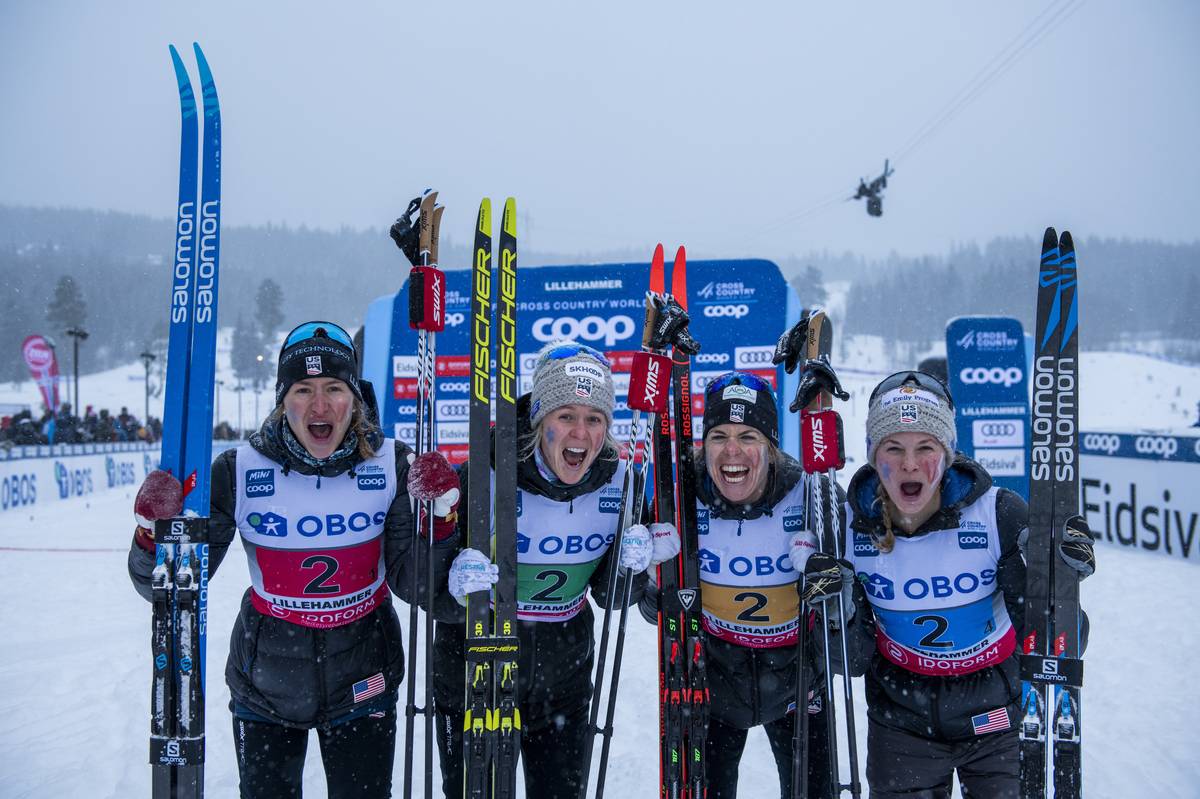
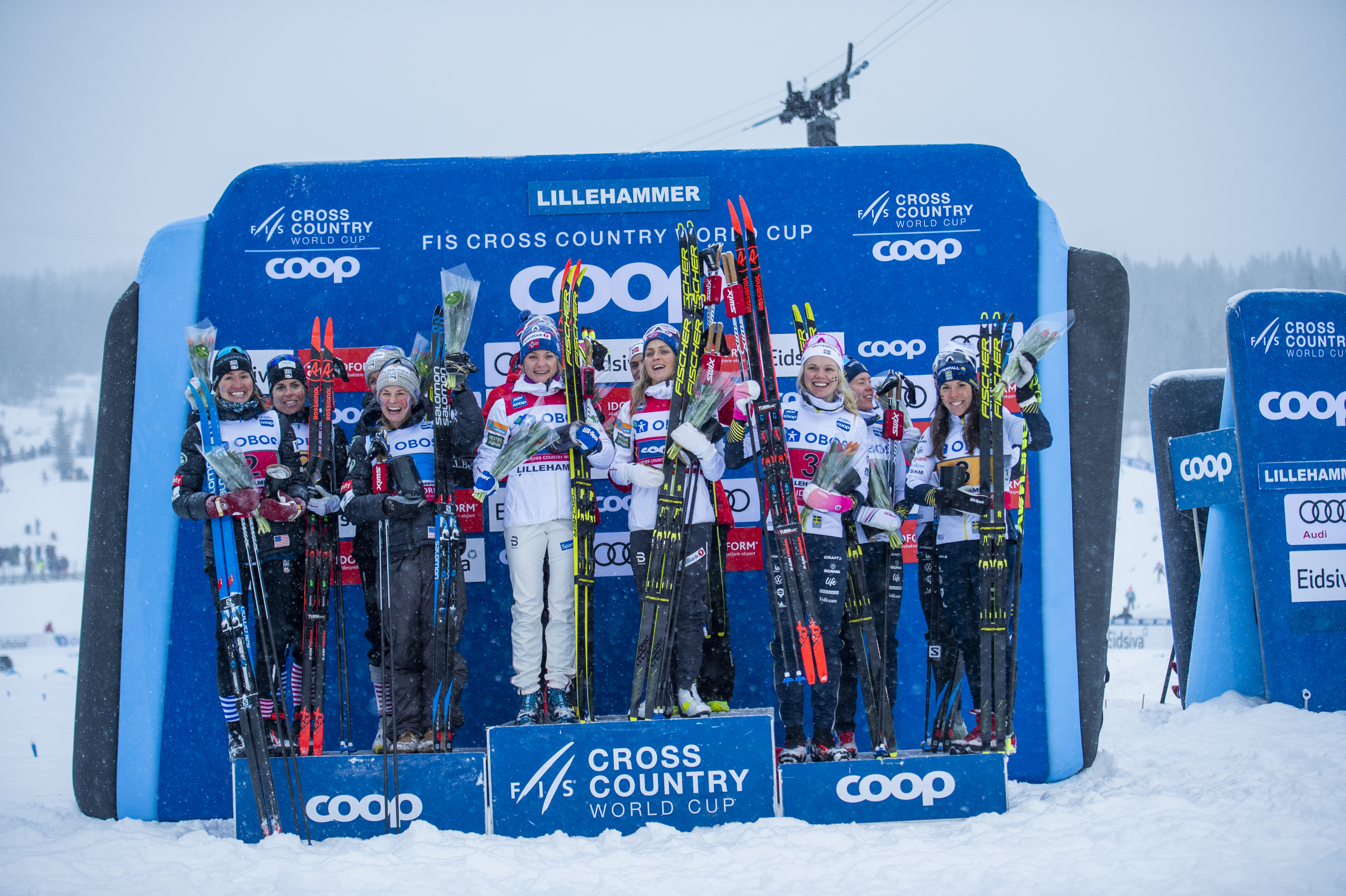
    Team USA celebrates their hard fought second place finish at the 2019 4 x 5-kilometer relay in Lillehammer, Norway. (Photo: NordicFocus)

    Athletes warmed up amidst fat falling snowflakes as a storm blanketed Lillehammer, Norway. The gun fired, and a flurry of this snow clouded the boots, poles, and relay socks as a wave of skiers strode their way up and out of the Birkebeiner Stadium for the first leg of the women’s 4 x 5-kilometer relay. 

    With outstanding performances in the first two World Cup race weekends, it is clear that the U.S. women are hot. They made their fitness and strength evident in back to back performances; three in the top 20 on day one in Ruka, three in the top 15 on day two, and three in the top ten in the final stage. Again in yesterday’s skiathlon, 2nd, 8th, 16th, Jessie Diggins, Sadie Maubet Bjornsen, and Rosie Brennan showed that they were ready to throw down in the relay and compete for a top-spot. With an 11th place finish in the classic sprint in Ruka and experience in the relay, Sophie Caldwell was selected for the fourth spot.   

    Despite this depth, the U.S. has struggled to land on the podium in the relay. Last year during the World Championships in Seefeld, a similar team (Julia Kern raced in Caldwell’s position) battled to rebound from eleventh a challenging first leg. Maubet Bjornsen and Brennan clawed up the ranks to hand off to Diggins in sixth, who could only pick off one additional team while struggling in the heat. The foursome finished fifth.

    During the PyeongChang Olympics the year prior, Caldwell, Maubet Bjornsen, Kikkan Randall, and Diggins also raced to a gutsy fifth place finish, the best Olympic relay result for the United States. Here also the Americans struggled during the scramble leg. Caldwell started strong, knowing that on a good day she belonged with the leaders, but fell off the pace in the second half of her leg, tagging off over a minute behind in eleventh. Could the U.S. put together four strong legs in Lillehammer?

    Norway’s Maiken Caspersen Falla leads the charge ahead of Emma Ribon (SWE) and Sophie Caldwell (USA) during the 4 x 5-kilometer relay in Lillehammer, Norway. (Photo: NordicFocus)

    Norway’s sprint champion Maiken Caspersen Falla kicked off for the home team, asking her competitors to keep pace or be left behind. She explained to FIS after the race that her strategy was to stay out front to avoid accidents in the tough conditions. 

    After the first 2.5 k lap, there were six teams matching Falla’s effort, but skiers appeared unduly taxed by racing through the deep soft snow. Where yesterday they kicked up the tracks on the grueling hills for which the Lillehammer course is known, today, women spent more time running outside them in the loosely packed powder, burning matches left and right. 

    By the first exchange, only four remained with Norway: Finland, Sweden, Japan, and Russia I. Despite matching Falla stride for stride and keeping the U.S. in great position through 3.3 k, Caldwell succumbed to fatigue and fell off the lead along with the Russia II team. She tagged off to Maubet Bjornsen in seventh with a 26 second deficit. 

    Post race interview with Sophie Caldwell.

    In the second classic leg, Finland’s Kerttu Niskanen challenged Astrid Jacobsen of Norway for the lead, with Sweden and Russia on their tails. Niskanen overtook the Norwegian after the first lap, Jacobsen unable to keep pace. 

    “I was struggling really hard, but it was a good fight,” Jabosen told FIS after the finish.

    Maubet Bjornsen attacked the course, quickly overtaking the Russia II team and moving into fifth. As she climbed, head coach Matt Whitcomb could be heard shouting encouragement.

    Sadie Maubet Bjornsen charges to advance USA’s position in the second leg of the 4 x 5-kilometer relay in Lillehammer, Norway. (Photo: NordicFocus)

    Post-race interview with Sadie Maubet Bjornsen

    “Come on buddy! You’ve got this, Sadie! Keep your eyes on ‘em, Sadie!” Whitcomb cheered as she closed the gap to Sweden. 

    By the second exchange, Niskanen had begun breaking apart the field, leaving Jacobsen and Natalia Nepraeva of Russia trailing seven seconds behind. After an equivalent gap, Sweden tagged their first skater, with the Maubet Bjornsen holding strong in fifth 13 seconds behind. 

    Norway has won the last eleven World Cup relays and was not ready to go down without a fight, particularly in their home country. They deployed their ace in the hole, Therese Johaug, who exploded off the front. She rapidly took back the lead and didn’t look back, creating a cushion of nearly 50 seconds within 5 k. 

    “I had a really good race today,” Johaug told FIS. “Especially these conditions are perfect for me and also these hard tracks are perfect. I feel I did a really good job today and the rest of the team also did really good work. We are really happy to be first place.”

    Skating for the U.S.on the third leg, Rosie Brennan maintained Maubet Bjornsen’s progress through the field, quickly overtaking Russia 1 and gaining on Finland. She spent over a kilometer simply grinding on her own, leaving nothing behind to advance her team. She made contact with the Finns by the 3.3 k checkmark and accelerated to leave them behind. 

    “Relay’s are so fun and also stressful because you never know what’s going to happen until it’s over so it requires everyone to give their best no matter what place or what is happening around you,” Brennan wrote in an email to several news outlets. “Sadie tagged me off in a place where I could visually see teams in front which was exactly what I needed to get a solid chase going on. I love the grind of slow days so I just started to grind away and realized quickly that I was gaining time so I just kept the grind going.”

    Brennan tagged off to the anchor, Diggins, in third place just nine seconds behind Sweden. 

    “I was working hard to catch Sweden and couldn’t quite get there but at least tagged off to Jessie with them in sight and she’s not someone you want to race against on relay day so I had full faith in her ability to reel them in,” Brennan explained. “The Lillehammer relay was my first podium back in 2015 so it felt good to not only be back, but to upgrade by one. I am super happy with my leg and really happy for all the girls work out there today. “

    Post-race interview with Rosie Brennan

    With Johaug’s sizable gap, Heidi Weng hammered through the course without looking back for pursuers. She stopped the clock at 1:02:22.4 for Norway’s 12th consecutive World Cup win. The team has not been beaten since February, 2011 when the Italians were victorious in Rybinsk, Russia. 

    With Sweden in her sights, Diggins accepted the challenge of working the U.S. into second. By the halfway mark, she closed the gap to the youngest member of the Swedish team, Moa Lundgren. Diggins launched a high tempo attack on each hill, pulling away from the fading Swede. The American charged relentlessly through her final lap, crossing the line with a 20 second gap over Sweden. U.S.A. finished 48.9 seconds behind Norway. 

    The scrambler and the anchor of the 4 x 5-kilometer relay in Lillehammer, Norway. USA finished second. (Photo: NordicFocus)

    Post-race interview with Jessie Diggins

    FasterSkier spoke with Matt Whitcomb following the race to discuss the selection process, the team’s performance, and the team’s early standout performances. For the U.S., the puzzle is not so complex that podiums are an impossibility. Whitcomb noted that placing athletes in high-stress situations in a scramble leg, despite the possibility of losing contact with the leaders, is simply a risk inherent to sport.

    Post-race interview with Matt Whitcomb on the selection process.

    The women’s podium of the 4 x 5-kilometer relay in Lillehammer, Norway. The home country took the win with the United States in second and Sweden in third. (Photo: NordicFocus)

    Whitcomb explained the role that depth plays in an overall relay performance and the top three splits of the second through fourth American skiers.

    Post-race interview with Matt Whitcomb on the overall relay performance.

    Jessie Diggins leads the chase pack on her way to a second place finish in the 7.5/7.5-kilometer skiathlon in Lillehammer, Norway. (Photo: NordicFocus)

    Whitcomb reflects on Diggins’ performances in Lillehammer, contrasting it to the previous year. He comments on the season training and performance plan, and the positive energy that the outstanding women’s performances has given the team.

    Post-race interview with Matt Whitcomb on Post-race interview with Matt Whitcomb on Diggins’ skiathlon performance and the team’s early season success.


    Full results

  • Monday Race Rundown: U23 Worlds Classic Sprint (Updated)

    Monday Race Rundown: U23 Worlds Classic Sprint (Updated)

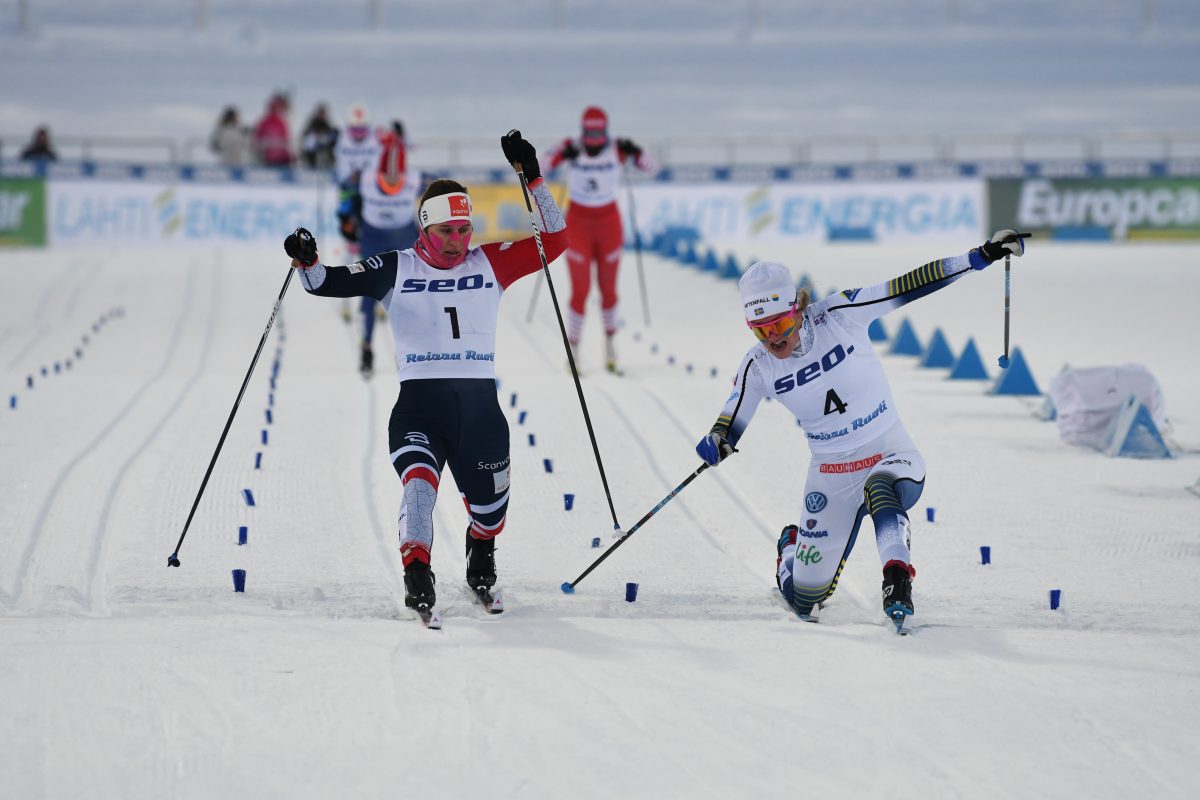
    Moa Lundgren of Sweden out lunges Norway’s Tiril Udnes Weng for the win during the U23 World championship 1.4 k classic sprint in Lahti, Finland. (Photo: Doug Stephen)

    FIS Junior World Ski Championhips U23 1.4 k/1.6 k Classic Sprint

    Link to U23 classic sprint photo album from Doug Stephen.

    Monday, the second day of racing at the 2019 Junior World Ski Championships in Lahti, Finland the U23 women raced a 1.4-kilometer classic sprint.

    Norway’s Tiril Udnes Weng set the standard in qualification. Her 3:26.52 minute time placed her in bib 1 for the heats.

    Three U.S. skiers qualified for the heats. Julia Kern qualified in 16th (+9.09), Hannah Halvorsen 24th (+11.89), and Hailey Swirbul 25th (+12.31). The fourth U.S. entrant, Evelina Sutro placed 37th overall.

    “Though it wasn’t a perfect day for the U23s, it was exciting to establish a baseline from which we can improve,” Swirbul emailed. “We were in the mix during the quarterfinals, and I think our team gave a good effort today but is left wanting more. Personally, I thought I had a good day. I felt good, had good skis, and raced to my strengths the best I could. I’m excited to see how this team and I progress over the next few years to keep moving up and up in the U23 division!”

    Halvorsen skied in the second heat where she placed fifth (+2.39) behind heat winner Moa Lundgren. Lundgren posted a 3:24.60 finishing time in the heat and ultimately placed first overall. Halvorsen ranked 23rd in the final standings.

    Swirbul and Kern were grouped in the third heat where they finished fifth and sixth respectively. France’s Delphine Claudel won the heat in 3:27.16, Swirbul was 1.31 seconds back, Kern 3.24.

    Swirbul placed 24th overall, Kern 27th.  

    “It was a really cold day out there racing at the legal limit of -4F,” Kern emailed. “It was not the day I dreamed of, but I am looking forward to more races to come this week. I caught the tip of my ski on someone’s pole cornering the first 180 and took a fall. I was able to jump back up on my feet and hammer to catch up, but that energy cost me early on that I did not have cresting the last hill. It was really fun to get to race side by side with Hailey in the heat!”

    For Canada, Sadie White finished 35th, Marie Corriveau 38th, Hannah Mehain 49th, and Natalie Hynes 55th.

    Lundgren, who was the fourth fastest qualifier, won the women’s final in 3:18.33, only 0.05 seconds ahead of Weng in second. Russia’s Aida Bayazitova took third (+3.78). Anastasia Kirillova of Belarus was fourth (+4.12), Norway’s Amalie Haakonsen fifth (+7.75), and Johanna Hagstroem sixth (+37.54).

    Women’s Qualification Results | Women’s Final Standings

    The men raced a 1.6 k classic sprint course with Norway’s Erik Valnes posting the fastest qualifying time of 3:23.80 minutes. Valnes already has two World Cup podiums both from the recent Dresden, Germany World Cup weekend. He won the team sprint along with Sindre Bjørnestad Skar. The day prior to his team sprint win, Valnes placed third in the skate sprint.

    After racing on a slightly bigger World Cup stage, Valnes showed no nerves as he clean-sweeped the heats and the final which he won in 3:21.14 minutes. Russia’s Sergey Ardashev placed second (+1.38) and Norway’s Joachim Aurland third (+2.00).

    In fourth place was Russia’s Ivan Yakimushkin (+2.59), Norway’s Sivert Wiig in fifth (+7.31), and Sweden’s Marcus Grate sixth (+15.53).

    Canada placed three athletes in the heats after Ritchie Graham qualified in 19th (+12.32), Julian  Smith 22nd (+13.39), and Antoine Cyr 24th (+13.84). Teammate Gareth Williams finished 52nd overall.

    For the U.S., Peter Holmes advanced to the heats after qualifying in 20th (+13.05). Daniel Streinz placed 41st overall, Hunter Wonders 56th, and Braden Becker 63rd.
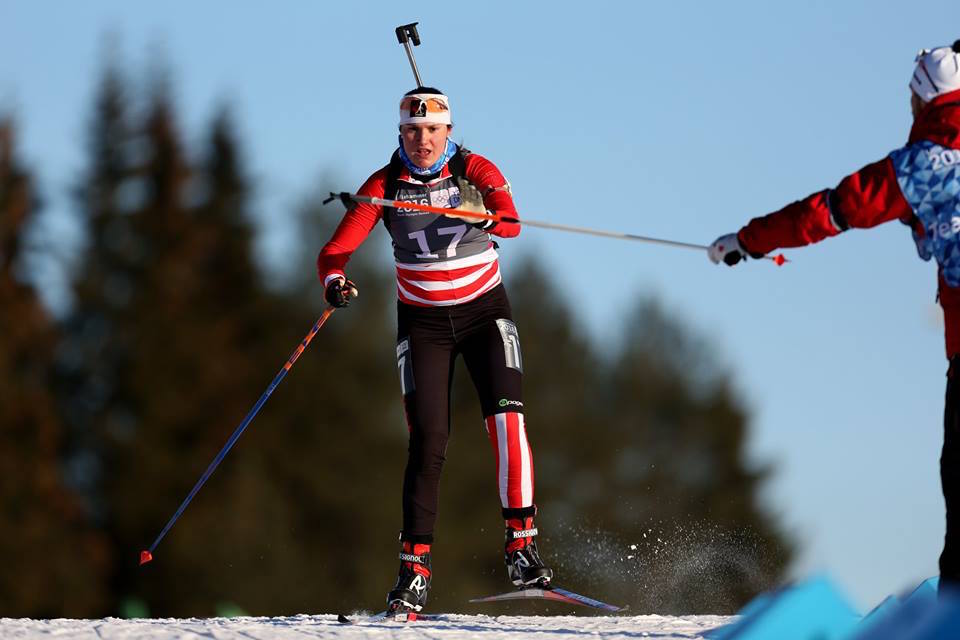
    “It was a good day out in Lahti, sunny skies but brutally cold,” emailed Holmes. “The Junior’s performance the previous day amped me up and made me excited to race. I had a solid qualifier and was feeling very good in the quarter final. I was positioned well throughout the race, but unfortunately got tangled up with another skier in my heat on the last downhill and went down. It’s a bummer, especially at U23s, but that’s racing.”

    No North Americans advanced beyond the quarterfinals. Holmes placed sixth in the first quarterfinal to conclude his day ranked 27th in the final standings.

    Cyr was fourth in the second heat and placed 20th overall.

    Smith and Graham were fourth and sixth respectively in heat four. Smith ranked 19th overall,  Graham 26th.

    Men’s Qualification Results | Men’s Results

  • Halvorsen Eighth to Lead U.S. in World Juniors Sprint, Canada’s Ritchie 12th

    Halvorsen Eighth to Lead U.S. in World Juniors Sprint, Canada’s Ritchie 12th

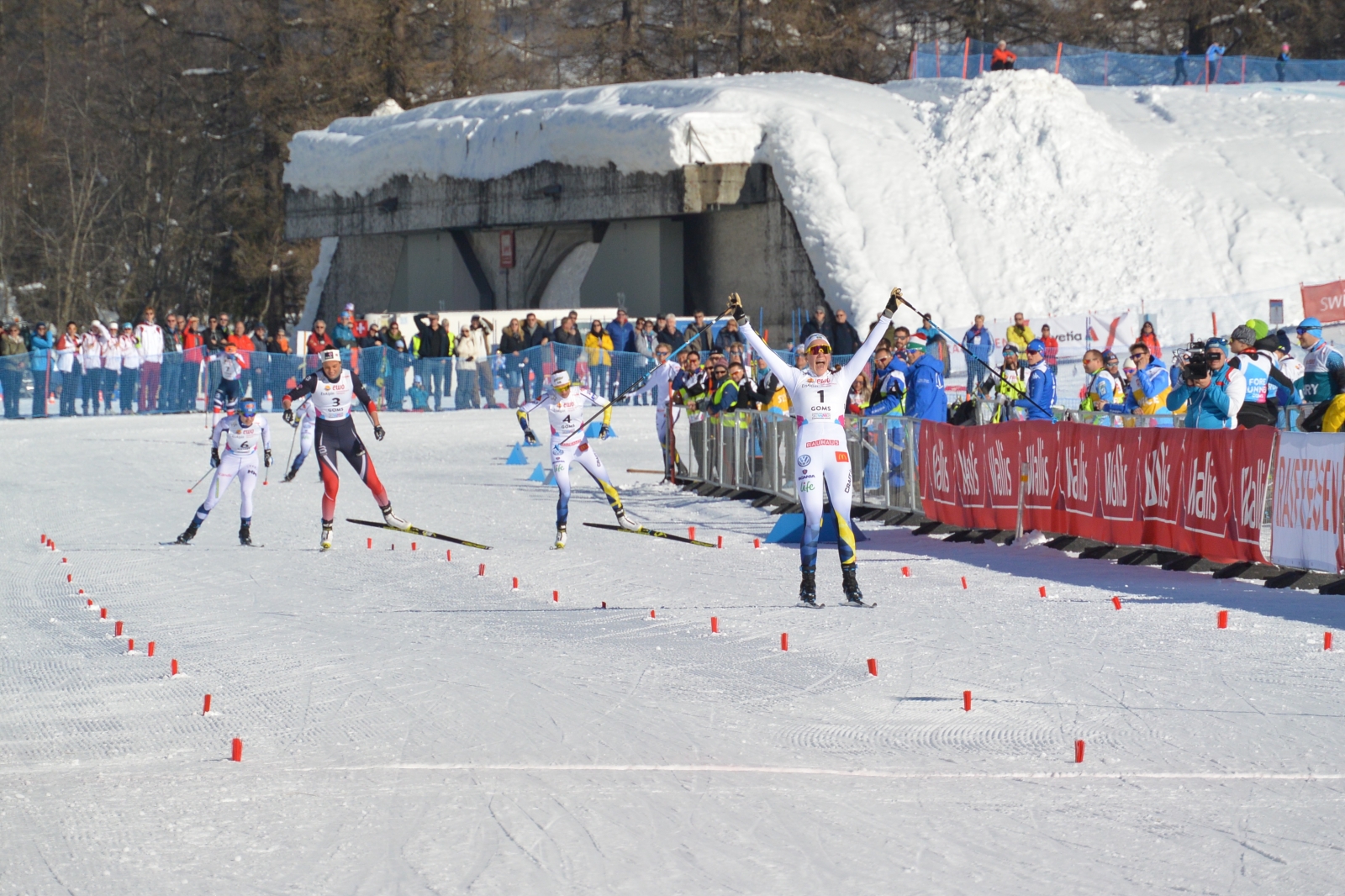
    Moa Lundgren celebrates winning her first World Junior Championship after skating away from the field in the sprint in Ulrichen, Switzerland. (Photo: JWSC2018.ch)

    (Note: This article has been updated to include comments from American Hannah Halvorsen.)

    2018 World Junior Championships is off and running and two brand-new champions have been crowned. Moa Lundgren of Sweden took the women’s skate sprint title while the men’s final went to Tom Mancini of France.

    On a perfect blue-sky day nestled deep in the Swiss Alps, the world’s best skiers under the age of 20 raced around a hilly sprint course with a few wicked corners. There were broken poles and pole-tosses; crashes; and a men’s final decided by just a tenth of a second.

    “The competition was really high, and it was super cool to see so many high level skiers,” U.S. skier Gus Schumacher (Alaska Winter Stars) wrote in an email. “Nothing surprised me too much. I think it raced about as I expected, with even those crazy corners not being too unfair… my previous U18 trips and nationals races have exposed me to a big variety of tactics, so nothing was really new for me here.”

    The narrow margin of the men’s final saw Mancini nip Norway’s Jørgen Lippert at the line.

    “A very good race, I am very happy,” Mancini said in a TV interview after the race. “It’s a very good fight with the Norwegian and the Swiss. I am very happy. Sorry, I don’t speak English very good. I thank my family, my friends, and my coach. Voila.”

    Third place went to Valerio Grond of Switzerland, who qualified in 21st position but skied aggressively to win his semifinal before landing on the final podium.

    The results of the women’s final were somewhat delayed as Finland filed a protest, saying that third-place Frida Karlsson had obstructed Anita Korva, who ended up fourth. But the podium did not change. Lundgren had claimed a big win over Kristine Stavås Skistad of Norway.

    Both the U.S. and Canada had a representative in the semifinals. For the U.S., Hannah Halvorsen (U.S. Ski Team/APU) qualified in fifth and then finished second in her quarterfinal, earning an automatic spot into the semis.

    Once there, Halvorsen skied in third or fourth for much of the heat. Rounding the final corners she was still in fourth position and though she kept pushing, she couldn’t make up any ground on the women ahead of her. She ended the day in eighth, an improvement of a few places from her 11th-place result in the classic sprint at last year’s World Junior Championships in Utah.

    “The skate sprint was my target race this year,” Halvorsen, 19, explained in an email. “My goal was to podium and I believed if everything went according to plan I was capable. I felt healthy and fit, my skis were fast, my mind was in the right place, but I didn’t make it happen. It is easy to mull over tactics and strategies and ‘what if’ situations, but I think the truth is that there are a lot of girls here that are just as fast, fit, prepared, and motivated as me, and I think some of them were sincerely better than me today. Even though I didn’t reach my goal, I feel proud to compete against the best girls my age and be right in the mix.”

    She explained that she was excited about her strong qualifier. “It gives me a chance to see where I fall on an international stage,” Halvorsen wrote. “The top girls my age are starting to bridge the gap between world juniors and world cup, and I hope this qualifier gives me some idea of how much I need to improve to be fast enough to make world cup heats. Even though the top girls are faster than me, I can feel myself improving and getting closer.

    “I had a lot of fun having the opportunity to race and feel good in the sprint,” she added. “One of the takeaways from this race was realizing how important it is to keep improving and to never settle. I am excited to build on this result and hopefully be stronger and faster next year. But right now, I mostly look forward to more racing this week and season.”

    In the men’s field, Canada’s Graham Ritchie raced an impressive tactical quarterfinal. Qualifying in 25th, he was pushed to the back of his heat early thanks to taking the last choice of starting lanes.

    “I’d say it was intentional that I stayed at the back,” Ritchie explained in an email. “I knew if I was going to have any chance, it would be to just hold onto the pack for as long as possible and then see where it would go in the end from there.”

    Ritchie maneuvered his way towards the front and by the time the men hit the finishing stretch, he was speeding up and moved from fourth to second. A Russian athlete who had been among the leaders early in the heat crashed, leaving an extra opening.

    “I was in fourth at the time when he fell and he was in front of me, so this had a pretty big impact on my result depending on how fast he would’ve been in the finishing stretch,” Ritchie wrote.

    But regardless, Ritchie advanced to the semifinals, where he finished sixth in his heat for 12th overall.

    “I was pretty shot for the second half of the [semifinal] and couldn’t hang on to the pack, but it was an amazing experience and lots of fun!” Ritchie wrote. “I was stoked to have made the semi’s and was happy with outcome! My main goal for today most importantly was to qualify. My stretch goal for the day was to make semis and get a top 12. Finishing in 12th place was a really incredible and eye-opening experience. I’m still trying processing it, the feeling of accomplishing this goal feels amazing and I am so thankful for this opportunity!”

    “Great day for Graham today,” Ritchie’s coach at NTDC Thunder Bay, Timo Puiras, wrote in an email. “We were not expecting a top-12 result but it isn’t necessarily a surprise either… This result is definitely a big deal for Graham and the NTDC Thunder Bay program. The TBay program has had several athletes the past few years who I feel have the capacity for this kind of result so it feels great when it all comes together to happen. This result should serve as fuel for our other athletes to find the confidence to also have similar success.”

    Schumacher of the United States was also in Ritchie’s quarterfinal, and ended up fourth in the heat and just over two-tenths of a second away from a lucky loser spot in the semifinals. But he did not advance and ended up 19th on the day.

    “I was pretty confident in my speed,” Schumacher wrote in an email. “I knew that an eight second gap [in the qualifier] was small enough to be competitive in heats. My strategy was to just hang on up the first big hill and try to save my energy, then really punch it on the second hill. That strategy in my heat worked out pretty well. I thought I was a little too far back after the first hill, but I was able to come back and I had energy to really sprint up the end of the second hill.”

    Canada’s Antoine Cyr, also qualified for the heats, and had a spectacular wipeout in his quarterfinal and ended up 30th after qualifying in 25th.

    “I know that normally in the heats I am better [than in qualifying] and with the tight gap between all the juniors in the qualifier, it would give me a slight chance to go through,” Cyr wrote in an email. “On the top [of the first hill] I was in fourth place, right on their heels, but on the last uphill i got boxed in a little bit and could not accelerate fast enough. I found myself in fifth place. I went for it on the last corner knowing that I was taking a risk, and I crashed. I am bit bummed by the end of the day, but still really happy with a top 30. A first top-30 for me against the best in the world! I am not injured, just a couple of bruises – that snow was pretty hard packed, I can tell you!”

    In the junior men’s sprint, Canada’s Reed Godfrey finished a tough 31st, just 0.21 seconds out of making the quarterfinals. Etienne Hebert rounded out the Canadian finishers in 36th place (+11.81) in the qualifier.

    “Our entire Junior Mens team definitely have the ability to qualify in the top-30 and after that it came down to good tactics and good finishing speed to move through the quarters,” Puiras wrote. “The Canadian team was super pumped with the results today and are in great spirits. It was a great way to start the championships. We are looking for more great results this coming week.”

    Canyon Tobin was 41st in qualification for the U.S. (+13.46), followed by Karl Schulz in 54th (+16.90) and Luke Jager in 60th (+18.15).
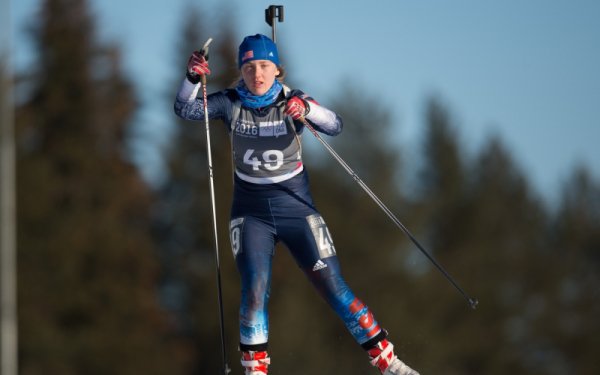
    In the junior women’s race, both Margaret Gellert and Sofia Shomento of the U.S. made the quarterfinals but failed to advance, finishing 18th and 23rd. Teammate Hannah Rudd finished 35th in qualification, +18.15.
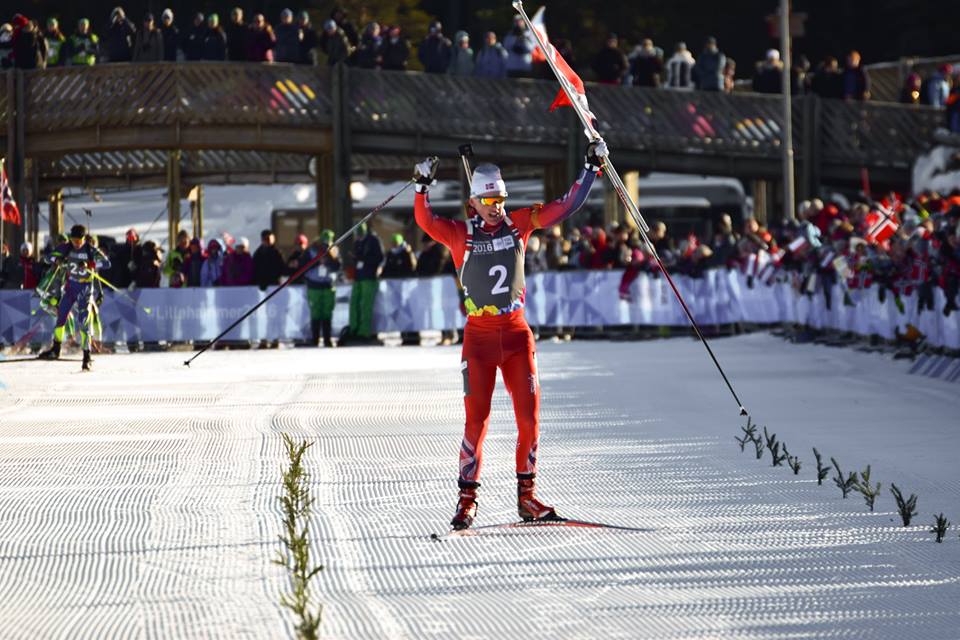
    For Canada, Annika Richardson finished 52nd (+24.09), Catherine Reed-Metayer 56th (+28.25), and Alexandra Racine 69th (+37.27).

    — Harald Zimmer and Alex Kochon contributed

    Results: men’s qualifier women’s qualifier men’s final women’s final

  • Caught in the Middle, Ben Loomis Holds On for YOG Silver; Halvorsen Sixth

    Caught in the Middle, Ben Loomis Holds On for YOG Silver; Halvorsen Sixth

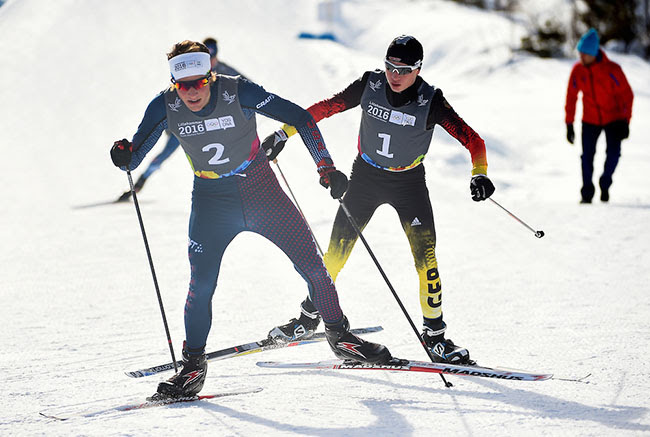
    American Ben Loomis (2) leads Germany's Tim Kopp (1) during the Nordic Combined Men's Individual Gundersen NH/5 k cross-country race at Birkebeineren Cross-Country Stadium at the 2016 Youth Olympic Games in Lillehammer Norway. Loomis went on to place second behind Kopp. (Photo: Thomas Lovelock for YIS/IOC)
    American Ben Loomis (2) leads Germany’s Tim Kopp (1) during Tuesday’s Nordic Combined Men’s Individual Gundersen NH/5 k cross-country race at Birkebeineren Cross-Country Stadium at the 2016 Youth Olympic Games in Lillehammer Norway. Loomis went on to place second behind Kopp. (Photo: Thomas Lovelock for YIS/IOC)

    (Note: This article has been updated to include comments from Hannah Halvorsen.)

    Ben Loomis sounded a little subdued on the phone Tuesday. Maybe he was still absorbing his silver-medal performance at Youth Olympic Games (YOG) in Lillehammer, Norway. Or it could be that he’s 17 years old.

    “The only thing I can compare it to was I had a fourth-place finish in international competition this year,” Loomis, a U.S. Nordic Combined skier told FasterSkier after placing second in his first competition at YOG, the normal hill/5-kilometer Gundersen start.

    Two months ago, he missed the podium by 4.3 seconds at the Continental Cup in Park City, Utah, finishing fourth behind two Austrians (David Pommer and Armin Bauer) and U.S. World Cup skier Taylor Fletcher, who placed second. All three were at least five years older than Loomis, of Eau Claire, Wis.

    “That was kind of the big stepping stone for me, but this was also something new,” Loomis said of Tuesday’s YOG competition. “But way more exciting than anything else I’ve ever experienced.”

    At the Youth Olympics, competitors are younger than 18, and nations can enter a maximum of two athletes per gender per sport.

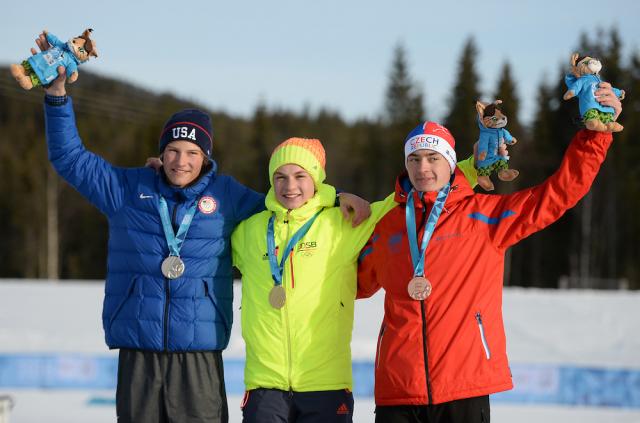
    American Ben Loomis (left) standing with podium finishers, Germany's Tim Kopp, the winner, and the Czech Republic’s Ondrej Pazout in third. (Photo: YIS/IOC-Thomas Lovelock)
    American Ben Loomis (left) standing with podium finishers, German winner Tim Kopp (c) and the Czech Republic’s Ondrej Pazout in third. (Photo: YIS/IOC-Thomas Lovelock)

    After posting the second-best jump on the 100-meter hill, Loomis started the 5 k cross-country race 8 seconds behind Germany’s Tim Kopp, the jump leader. Kopp held off Loomis by 5.2 seconds for the win in 13:31.4, and Loomis remained 2.7 seconds ahead of third place, Ondrej Pazout of the Czech Republic, at the finish.

    “I had probably my best jump all week in the competition,” Loomis said. “I just tried to catch the guy in front of me pretty quickly and I did that. I was able to ski with him for pretty much the entire race, but then there was also the third place guy who I knew was a fast skier. He caught us about half way through the race. So all three of us skied until almost the finish and then the Germany kid was able to pull away about half a kilometer before the finish.

    “I tried my hardest, but I just couldn’t stay with the first-place guy,” he continued. “But I was able to maintain second.”

    According to Adam St.Pierre, the U.S. cross-country coach at YOG, Loomis looked “relaxed” while skiing with Kopp.

    “The Czech athlete caught them at around 2.7km,” St.Pierre wrote. “The trio skied together for the rest of the race with the German making a decisive move at 4.5km … Ben had been planning to make his move on this hill too, but the German beat him to it! Ben covered the move, but was slightly gapped, but he got a gap on 3rd and skied in for silver!”

    After first meeting Loomis this week, St.Pierre explained that he wasn’t responsible for his success beyond helping wax his skis. Blake Hughes is the U.S. jumping coach at YOG.

    On Thursday, Loomis will team up with the two American ski jumpers (Casey Larson and Logan Sankey) in the ski jumping/nordic combined mixed team event, where three jumps on the 100-meter hill are scored as a unit. Then on Saturday, he’ll participate in the “nordic team relay” as both a jumper and a skier.

    “The two American jumpers and myself jump and then I’ll race and the two cross country skiers will race as well,” Loomis explained.

    “The relay start will be staggered based on the jumping results and we’ll ski a 3 by 3.3km relay with the Nordic Combiner [Loomis] and the male and female XC skiers [Hunter Wonders and Hannah Halvorsen] — all skate,” St.Pierre elaborated.

    After Youth Olympics, Loomis is headed to Nordic Combined Junior World Championships in Romania.

    “That’s a big deal as well,” he said. “I think I really surprised myself with showing how well I can perform. It just really gave me a lot of confidence going into the next competitions…”

    Results: Nordic Combined

    ***

    Hunter Wonders (l) and Hannah Halvorsen (r) are the two cross-country skiers representing the U.S. at the 2016 Youth Olympic Games in Lillehammer, Norway. (Photo: Adam St.Pierre)
    Hunter Wonders (l) and Hannah Halvorsen (r) are the two cross-country skiers representing the U.S. at the 2016 Youth Olympic Games in Lillehammer, Norway. (Photo: Adam St.Pierre)

    Also on Tuesday, Hannah Halvorsen of Sugar Bowl Academy near Truckee, Calif., placed sixth in the cross-country classic sprint final. She had qualified in 13th, then went on to win her quarterfinal, and place third in her semifinal, 1.53 seconds behind Russia’s Yuliya Petrova, who won that semifinal. Moa Lundgren of Sweden automatically advanced in second and Halvorsen reached the final as a lucky loser.

    American Hannah Halvorsen between rounds at the Youth Olympic Games classic sprint in Lillehammer, Norway. She went on to place sixth in the final. (Photo: Adam St.Pierre)
    American Hannah Halvorsen between rounds at the Youth Olympic Games classic sprint in Lillehammer, Norway. She went on to place sixth in the final. (Photo: Adam St.Pierre)

    Sweden’s Johanna Hagström won the final in 3:19.55, Petrova placed second (+2.4), and Norway’s Martine Engebretsen was third (+3.27). Lundgren finished fourth (+6.44), Laura Chamiot Maitral of France (+8.84) was fifth and Halvorsen sixth (+13.65).

    “I was surprised to make it through as a lucky loser when I saw that our semi final heat was a couple seconds slower, so I was really excited,” Halvorsen wrote in an email. “I lost contact with the top girls by the first hill and started to move back throughout the heat despite putting in my best fight to the end.”

    “Hannah skied well today,” St.Pierre observed. “She felt a little flat for the XC Cross on Saturday, but had her normal energy today.”

    On Saturday, Halvorsen, who turns 18 on Friday, placed 13th in the YOG opening event: the ski cross sprint.

    “Although the skier cross was a fun experience, it was nice to be back in a race I knew well,” Halvorsen wrote. “I skied [Tuesday’s] qualifier a little tense, but it was a good signifier that I was feeling good and my fitness was there. This made me feel confident going into the heats.”

    “She looked very strong in her quarterfinal,” St. Pierre wrote. “The course started with a big climb, which Hannah was able to ski very relaxed. … The decisive moves were typically made on the second major climb of the course. Hannah made some tactical errors on this climb in her semifinal, switching tracks cost her some momentum over the top. But she finished out the semi strong, earning a lucky loser spot with her 3rd place finish.

    “I wish I would’ve given her just a little more kick for the final,” he added. “She battled and ended up 6th on the day, happy but hungry for more!”

    Canada’s Annika Richardsson finished 33rd in the qualifier, missing the top 30 needed to advance to the heats by 1.4 seconds.

    In the men’s classic sprint, Hunter Wonders qualified 29th and placed 15th overall. He missed advancing to the semifinals after placing third behind Adam Matous of the Czech Republic in a photo finish for second. The two finished 0.11 seconds behind Norway’s Thomas Helland Larsen, who won the heat in 3:04.54, but only Matous moved on with Larsen.

    “He was in fourth on the last downhill but the Russian skier ahead of him fell,” St. Pierre wrote of Yaroslav Rybochikin, who finished sixth in that quarterfinal. “Hunter avoided the fall and closed on 1st and 2nd just getting out-lunged.”

    Larsen went on to win the final in 2:55.39, Korea’s Magnus Kim placed second (+0.33) and Vebjørn Hegdal of Norway was third (+1.1).

    Like his Canadian counterpart, Levi Nadlersmith finished 33rd in the men’s race, 0.74 seconds out of qualifying.

    Racing continues tomorrow with the biathlon single mixed relay at 4:50 a.m. Eastern time.

    Results: Women | Men | Complete results

  • Bumps, Jumps, XC Cross, and Biathlon: YOG Weekend Roundup

    Bumps, Jumps, XC Cross, and Biathlon: YOG Weekend Roundup

    (Above: Complete race video of inaugural Cross-Country Cross event at the 2016 Youth Olympic Games. To view on YouTube, click here.)

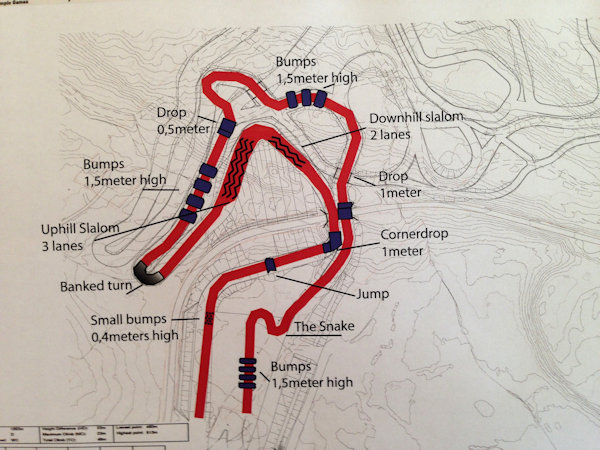
    Bumps? Jumps? An uphill and downhill slalom? While racing through an obstacle course on skis is challenging enough on its own, competitors at the 2016 Youth Olympic Games (YOG) in Lillehammer, Norway, maneuvered around obstructions and other racers as well last Saturday, Feb. 13, for the opening event: the Cross-Country Cross (XCX) 1.4-kilometer freestyle sprint.

    Beyond ‘bumps,’ the YOG’s first-race event competition also differed in sprint brackets. After racing a qualifier, the top-30 athletes advanced to one of three semifinals.

    The top two finishers in each semifinal then automatically advanced to the sprint final. The sprint final totaled 10 skiers: the two winners from each semi-final, as well as two lucky losers from the two fastest semifinals.

    The Cross-Country Cross (XCX) course at the 2016 Youth Olympic Games
    The Cross-Country Cross (XCX) course at the 2016 Youth Olympic Games

    Once on course, four 1.5-meter high ‘bumps’ greeted the athletes a little over 100-meters from the start. Competitors then cruised into a sharp lefthand turn, followed by a sharp righthand turn through a part of the course called ‘The Snake.’

    After The Snake, skiers tackled the course’s first major climb. In the following descent, racers spent some hang time while passing over a 1-meter high drop.

    With increased speed, competitors soared into the second major incline on course, as well as another series of three 1.5-meter high rollers and a 0.5-meter high drop.

    The next course challenge tested athlete’s coordination and balance during an alternating ‘bumps’ section. The section prompted many skiers to take on a classic striding arm and leg swing movement.

    After a tight hairpin turn, athletes then worked their climbing strength and stamina in an uphill slalom. Immediately upon cresting the top of the incline, competitors descended into a downhill slalom.

    With no major climbs left, racers worked their way over another jump and one final set of 0.4-meter high rollers before the flat 100-meter sprint to the finish.

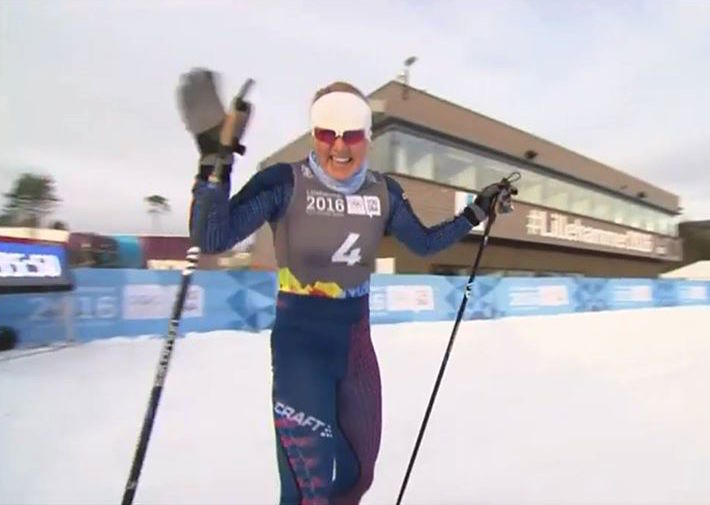
    Sweden’s Moa Lundgren proved most adept on course. She remained unchallenged by any competitor all day, winning the qualifier in 3:27.59, as well as her semifinal and eventually the final in a time of 3:26.36.

    Finishing 1.7 seconds behind Lundgren was Swedish teammate, Johanna Hagstrøm.

    Rounding out the women’s top three was French skier Laura Chamiot-Maitral who crossed 3.21 seconds after Lundgrun.

    Hannah Halvorsen (Far West/Sugar Bowl Academy) qualified 10th in the first-ever Cross-Country Cross event at the 2016 Youth Olympic Games in Lillehammer, Norway. (Photo: Far West/Facebook)
    Hannah Halvorsen (Far West/Sugar Bowl Academy) qualified 10th in the first-ever Cross-Country Cross event at the 2016 Youth Olympic Games in Lillehammer, Norway. (Photo: Far West/Facebook)

    Two North Americans competed in Saturday’s XCX event for the first time, American Hannah Halvorsen and Canada’s Annika Richardson.

    Halvorsen qualified in 10th, 16.45 seconds back from Lundgren. She then advanced to semifinal 3, where she raced in third behind Chamiot-Maitral and Germany’s Anna-Maria Dietze until the uphill slalom.

    Losing steam during the climb, Halvorsen moved into fourth, while China’s Chi Chunxue cranked her way into third. Hot on Halvorsen’s heels through the slalom gates was Russia’s Yuliya Petrova.

    As the women came through the final bumps, Halvorsen moved to the outside right and Petrova gained momentum in the middle lane.

    Halvorsen finished the heat in fifth, 1.7 seconds off of earning a lucky loser spot and advancing to the final, and 3.7 seconds off the heat winner Maitral-Chamiot (3:36.20).

    After qualifying in 25th (+26.3), Richardson advanced to the first semifinal where she finished in ninth, 19.7 seconds back from her heat’s winner, Lundgrun.

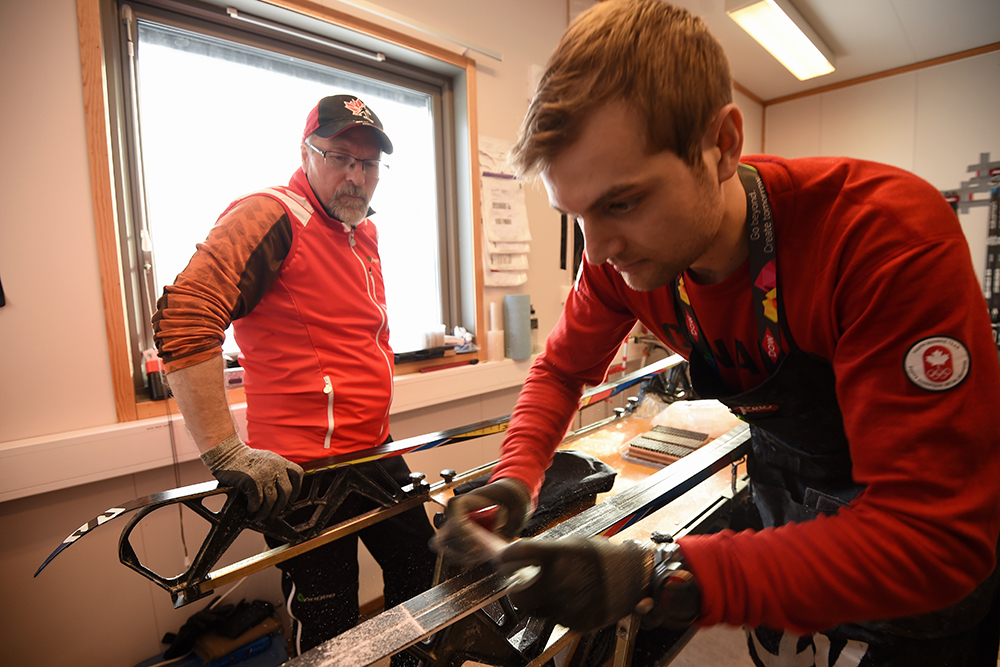
    Canadian wax technicians Mike Mappin (l) and Camille Cheskey (r) hard at work during the during the 2016 Winter Youth Olympic Games on Feb. 10 in Lillehammer Norway. (Photo: Jon Buckle for YIS/IOC)
    Canadian wax technicians Mike Mappin (l) and Camille Cheskey (r) hard at work during the during the 2016 Winter Youth Olympic Games on Feb. 10 in Lillehammer Norway. (Photo: Jon Buckle for YIS/IOC)

    “It went really really well all things considered,” Richardson said in an interview with Cross Country Canada.

    “Definitely a lot of stuff I can work on with the technical aspects of the course, but I felt really strong in the last half of my heat going up the hill. I’m just really grateful to be here and be experiencing all the Olympic spirit,” she added.

    Women’s results

    ***

    In the men’s event, Korea’s Magnus Kim topped the results. He won the qualifier in a time of 3:01.45, his semifinal and eventually the final in 2:59.56.

    In second place, 1.17 seconds off of Kim was Norwegian skier Thomas Helland Larson.

    Rounding out the men’s top three was Lauri Mannila of Finland, finishing 2.28 seconds behind Kim.

    Canadian skier Levi Nadlersmith and American Hunter Wonders nabbed the last two qualifying spots in 29th and 30th, respectively.

    Wonders advanced to the first semifinal, where he finished ninth, 8.8 seconds behind the heat’s winner, Kim.

    In his first international race ever, Nadlersmith also finished in ninth (+16.51) in the second semifinal.

    “I felt really strong climbing a the top of the course,” Nadlersmith told Cross Country Canada.

    “Going down into the last corner I had a weird line and I guess someone stumbled in front of me, so I had to do a quick maneuver to go around them. Then kind of after that I felt good, but lost a bit of my steam going over the last hill. I think for the most part I felt really good,” he added.

    Men’s results

    ***

    Day 2: Biathlon Begins

    While some were shooting cupid’s arrows on Sunday, Feb. 14, biathlon competitors at the YOG shot targets. The second day of events included the men’s 7.5 k and women’s 6 k biathlon sprints at the Birkeneineren Biathlon Stadium.

    On the men’s side, Emilien Claude of France won the event in a time of 19:01.5 after shooting clean during both the prone and standing stages.

    “In lap three, in my head it was ‘maybe I win, maybe second’,” Claude said, according to an Inside the Games press release. “But when I finished and saw that I was first, I thought, ‘Wow.’ ”

    Taking the second place silver medal, 7.1 seconds back, was Norway’s Sivert Guttorm Bakken, who missed one shot prone and one standing.

    Third place and the bronze medal went to Russian racer Egor Tutmin. Tutmin skied the first of the three 2.5 k laps the fastest and shot clean during the prone stage. However, after two penalties standing, he finished 18.0 seconds back from the race winner’s time.

    Two Canadians competed in Sunday’s event, including Ben Churchill and Leo Grandbois.

    Churchill finished in 17th overall (+1:35.5) with one penalty (1+0). Grandbois placed 22nd (+1:58.6) after missing two shots during the standing stage.

    The American men also had two competitors in Sunday’s 7.5 k sprint, Vasek Cervenka and Eli Nielsen.

    Cervenka was the first American across the line in 36th place (+2:50.7) after skiing four penalties (1+3). Nielsen finished one minute and 7.4 seconds after Cervenka in 46th, (+3:58.1) after a total of six penalties (2+4).

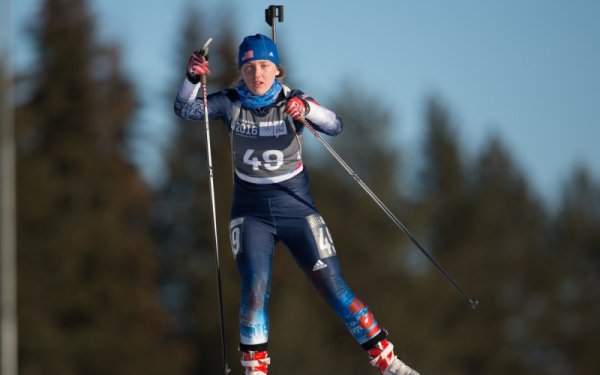
    Canada's Gillian Gowling receives a pole during the women's 6 k sprint at the Youth Olympic Games on Sunday in Lillehammer, Norway. (Photo: Lillehammer 2016 Olympic Games/Facebook)
    Canada’s Gillian Gowling receives a pole during the women’s 6 k sprint at the Youth Olympic Games on Sunday in Lillehammer, Norway. (Photo: Lillehammer 2016 Olympic Games/Facebook)

    With perfect shooting on Sunday, Germany’s Juliane Fruehwirt won the women’s 6 k sprint event, covering the 3 x 2 k course in a time of 18:23.5.

    Norwegian skier Marthe Krakstad Johansen was the next closest contender for the gold medal. After missing one shot standing, Johansen finished in second place, 5.6 seconds behind Fruehwirt’s time.

    Rounding out the women’s podium finishers on Sunday was bronze medalist Arina Pantova of Kazakhstan. After two penalties (1+1), Pantova completed the course 17.1 seconds behind Fruehwirt.

    American Amanda Kautzer cracked the top 10 on Sunday and finished in 10th overall (+58.9) after skiing two penalties (1+1). U.S. skier Chloe Levins missed the top 20 by 1.7 seconds, and finished in 22nd overall with a clean round of prone shooting, but two standing penalties.

    After cleaning both the prone and standing stages, Canada’s Gillian Gowling finished 30th (+2:27.8). Her Canadian teammate, Tekarra Banser finished 14.4 seconds later  in 35th (2:42.2) after two penalties (0+2).

    Results: Men | Women

    ***

    Chloe Levins shoots clean and races to a fourth place overall in the women's 7.5 k pursuit at the Youth Olympic Games on Monday in Lillehammer, Norway. (Photo: US Biathlon/Twitter)
    Chloe Levins shoots clean and races to a historic fourth place for the U.S. in the women’s 7.5 k pursuit at the Youth Olympic Games on Monday in Lillehammer, Norway. (Photo: US Biathlon/Twitter)

    Day 3: Levins Just Outside of the Medals, Fourth in Pursuit

    Monday marked the third day of the YOG and the second set of biathlon races with the 7.5 /10 k pursuits.

    The women’s 7.5 k pursuit event saw Ukraine’s Khrystyna Dmytrenko at the top of Monday’s podium.

    Starting 26 seconds back from Sunday’s race winner, Dmytrenko missed two shots during her first stage of prone shooting and then cleaned the rest of her shots to finish the 5 x 1.5 k course in a time of 25:12.9.

    In a photo finish, Norway’s Johansen bested France’s Lou Jeanmonnot Laurent by one tenth of a second. Johansen finished 7.5 seconds behind Dmytreno after skiing four penalties (2+0+1+1). Jeanmonnot Laurent finished 7.6 seconds off of Dymtrenko’s time after missing two shots standing (0+0+1+1).

    With perfect shooting, American Chloe Levins finished in fourth overall (+34.7), just outside of medal contention.

    “The pursuit in Lillehammer today was a dream,” Levins said according to a US Biathlon press release. “As Susan [Dunklee] said earlier in the season, every race is a team effort. We had great skis and excellent conditions for today’s race. My race was made on the shooting range. Of course, it is bittersweet to be close to the podium in 4th position, but I shot clean and skied well, so it is an incredibly satisfying result.”

    Read more about Levins’ historic result here

    American Amanda Kautzer finished in 27th (+4:04.2) with a total of eight penalties (3+2+1+2). Canada’s Banser finished in 35th (+ 5:43.6) after missing five shots (1+0+2+2) and her teammate Gowling placed 45th (+9:45.30) after missing six shots ( 1+1+2+2).

    After winning Sunday’s sprint, France’s Claude was the first skier on the Birkebeineren Biathlon Stadium’s 5 x 2 k course.

    Norway's Sivert Guttorm Bakken after winning the men's 10 k biathlon pursuit at the Youth Olympic Games on Monday in Lillehammer, Norway. (Photo: Lillehammer 2016 Olympic Games/Facebook)
    Norway’s Sivert Guttorm Bakken after winning the men’s 10 k biathlon pursuit at the Youth Olympic Games on Monday in Lillehammer, Norway. (Photo: Lillehammer 2016 Olympic Games/Facebook)

    Starting 7.0 seconds later was Monday’s eventual race winner and Sunday’s silver medalist, Bakken of Norway. Bakken missed four shots (1+1+1+1), but ultimately came away with the 10 k pursuit win in a time of 28:10.7.

    Moving up to second place after Sunday’s event was Russia’s Tutmin. With an extra penalty (0+1+3+1), Tutman completed the course one minute and 10.7 seconds behind Bakken’s time.

    Taking the event’s bronze medal was Said Karimulla Khalili of Russia. Khalili shot the same as Bakken and finished 1:17.7 behind the race winner.

    With two penalties (0+0+1+1), Canada’s Churchill crept into the top 10, finishing in 10th overall (+2:49.1). Cervanka of the U.S. improved his result from Sunday to 20th overall (+3:54.2) after missing just one standing shot.

    “Vasek also made a great comeback with 95 percent shooting score and a good skiing performance,” U.S. coach Jean Paquet said in a US Biathlon press release.

    “He looked more at ease on the skis and liked the fight on the course. He gained 16 positions by shooting well on the shooting range.”

    The next North American was Canada’s Grandbois, who placed 25th (+4:40.7)after skiing five penalties (1+0+1+3).

    In 46th was Nielsen of the U.S. (+8:13.4) with six penalties (0+2+2+2).

    Results: Women | Men