From the FasterSkier archive — posts syndicated from athletes’ and coaches’ own blogs between 2004 and 2012, kept online as published. Current coverage is at fasterskier.com.
Momentum Northwest, Seattle’s Junior Nordic ski program, is seeking an Assistant Coach for the Summer Season. Programming will run from May 15 to August 17. Hourly compensation based on availability and ability. Must be able to run, rollerski, and bike. Nordic ski experience not required, but an interest in working with kids and knowledge of athletic development are. Potential to continue position through Fall and Winter.
Momentum Northwest, Seattle’s Junior Nordic Racing Team, is seeking a Head Coach for its young program. Reliable snow within an hour’s drive. Compensation is dependent on experience. Please submit resume to Courtney@momentumnorthwest.org.
Momentum Northwest, a non-profit organization founded in 2014 to promote youth cross-country skiing in the greater Seattle area, has an opening for a Program Director/Head Coach. This is a year-round position with April and May off from training.
The Program Director/Head Coach is responsible for oversight and management of the junior Nordic ski training and race program for junior skiers aged 6-18. The Program Director/Head Coach is answerable to the Momentum Northwest Board of Directors.
Duties and responsibilities include, but are not limited to:
Promote Momentum Northwest’s vision to create a national-caliber cross-country ski program in Seattle.
Develop and conduct appropriate training and racing activities throughout the year for U12 skiers (Mavericks), U14 skiers (Devo group), U18 skiers (comp group).
Build and sustain enrollment in the program by recruiting new athletes, including those from crossover sports, such as kayaking, mountain biking, cross country running, soccer and/or other sports and activities, and retaining athletes within the program.
Hire, train and supervise assistant and volunteer coaches.
Manage and oversee logistics and infrastructure, including organization of trips and race registration; ski equipment and transportation.
Maintain effective communication with parents, athletes, and board members.
Manage the annual budget for the program.
Manage web site content so that it is accurate and up to date
Develop an active coaching presence in regional and national ski associations.
Seek professional growth opportunities to stay abreast of best practices in junior Nordic racing.
Provide help in development and fundraising activities.
Compensation for this job will be based on expertise and previous experience in management and coaching of Nordic sports.
I went pretty simple on glide for the classic race, waxing with HF Blue cut with AX134 for the guys in the AM, and a mix of HF Blue, AX134 and HF yellow for the ladies who were racing second. The traffic from all of the competitors was releasing a pretty decent amount of moisture and I wanted to soften the relatively colder HF blue paraffin for the later races. I found that I was not liking the way straight HF red was running early that week in testing so ended up on a mixed paraffin. AX134 tends to run really well at high speed or any place there is some free moisture or the track is glazed. I ended up using a different powder that I preferred in the higher moisture snow over either Jetstream red or yellow powder. Topcoat was Jetstream Red block. Safe and effective, tested well in the AM. Helix sprays felt good feel testing but weren’t drastically improving runout. I ran a pretty simple hand structure on the tails of the skis to deal with moisture in the track.
For kick, I did not go ahead and race wax with Toko kick waxes. Their red and yellow hard waxes can run really well in the warmer range, the yellow being a great last wax to try before switching away from dry wax. Although I have had a lot of success with them, I stuck to a different brand that gave m e a few different options for both speed and kick. I ran a warmer wax over a light tacky binder to form my kicking layer and ran a colder wax over top for a shell.
Skate Sprint:
I ran a pretty similar glide combo to the classic distance day for the skate sprint. The only difference was the temperature was a bit colder so I pulled the warmer paraffin out of the mix. I found that both floro blocks and certain liquids were improving the top end speed on top of powders so I burnt powder early in the day for durability. I intended to have the floro powder down as an insurance policy for the rounds and didn’t want to rework the skis too much. In testing the day before I felt that Helix 2.0 spray was once again improving the slippery feel of the ski climbing but some other liquids had higher top end speed which I really wanted to get athletes to the front of the race for the rounds. Again, I went with a pretty moderate hand structure to keep the skate skis from being too aggressive and bitey on the climb back into the stadium. Skis seemed very competitive on the day with Anne Hart finishing a career best 2nd place in the skate sprint.
Skate Mass Start:
Warmer temps greeted us for the skate mass start race. I pushed people out on warmer softer skate skis, especially for the women’s race at 1:30 PM. I figured that given the humidity in the snow and the amount of traffic, we would see a pretty hard glaze develop. Athletes wanted enough structure (especially hand structure) to deal with this moisture while still having a stiff enough ski to deal with variable track conditions. I ran a pretty warm buildup for both the guys and girls skis with HF Red, warm powder, block and liquid. I found again that certain liquids delivered better characteristics than just blocks. I buried Helix 2.0 spray under the block on a few skis and corked together for climbing freeness and topped with another brands liquid that was gliding out really well and is always a very safe bet for warmer temperatures. I ran a full length light crossing structure on the skate skis with a heavier linear structure on the tail to help with the glaze but still climb well. It seemed that this pretty straightforward approach to prioritizing hand structure and topcoat testing the morning of worked well with 3 athletes in the top 5 for the women’s 20k race.
Classic Sprint:
Warm temperatures in the 30s cooling off to low 20s by the end of the round.
I threw on paraffin without too much testing. I figured that I can always change the topcoats and dealing with kick would be more the priority. HF Red was a safe bet because it runs pretty well in a wide range of temperatures and conditions. I did burn a powder (the same powder from a different brand) that I had been running all week. It was very safe and seemed to improve speed with topcoats over it. For whatever the reason (pretty moist snow would be my guess) the Jetsteam powders were not clear test winners. I kept putting them on snow and could not get them to beat some other product out there. I find they usually prefer some more transformed snow, or much drier snow than the new moist lake effect snow we had. I ran the same topcoat build from the skate sprint.
Again for kick wax I started with a pretty warm dry wax and shell and cleaned it off after the qualifier and the semi and kept stepping down to a colder option from the same hard waxes I used on the classic day. Structure was a light crossing structure on the tails only.
Overall I felt we had decent skis on the week. I used Toko products where I knew they were safe and effective. When I could find something running better, I used it, but my familiarity with the waxing line and knowing that they wouldn’t be a liability allowed me to get skis waxed and focus my energy on testing and chasing more unknown variables.
Pat O’Brien, Head Coach SMS T2
U.S.S.A. Nationals Wax Report
We were fortunate to have had Sugar Bowl assistant coach Christina Mishica, who grew up in Hancock and raced for Michigan Tech. Her hometown knowledge was especially valuable when picking skis and waxing. The early part of the week was characterized by conditions that favored colder grinds and underlayers. Despite the cold air temps, the snow was relatively fast, especially with glazing classic tracks and during the skate heats. Throughout the week, we liked the new Toko 2.0 Jetstream Red powder.
Classic Individual: For base layer, we liked an under layer of Toko X-Cold powder, with our race paraffin a mix of HF Blue and HF AX134. The Blue provided good durability for the 10/15 km distances, while the AX134 helped the high end speed. That was key in a course where maintaining speed is crucial. For powder, the 2.0 Red Powder was consistently at the top of our test. The final layer was 2.0 Red Helix. With glazing tracks the Helix provided the best high-end speed. Blue and Red kickers with a klister/hardwax mixed binder provided good options for kick and speed.
Skate Mass Start: With slightly warmer temps for this race day, we opted for a paraffin layer of HF Red. We kept the X-Cold powder in as an underlay; happy with the breaking speed it gave us. For topcoats, based on our success with 2.0 red through the week, this was our natural starting point. We had 2.0 Red Powder ironed in with a layer of 2.0 Red Block ironed in over the top. Ironing in the block gave us better durability than rotofleecing.
Skate Sprint: Once again, Jetstream 2.0 Red Powder was a winner on the sprint day. We tried similar wax to the day before, and found that blocks were running better than any liquids. JetStream 2.0 Red Block was a clear winner in glide outs as well as on feel. Even as the day progressed, conditions remained consistent and our skis were good. We did rotofleece the block as opposed to corking it in.
– Spencer Eusden, Sugar Bowl Elite Team
Annie Hart Videos from Classic and Skate Sprints at US Nationals
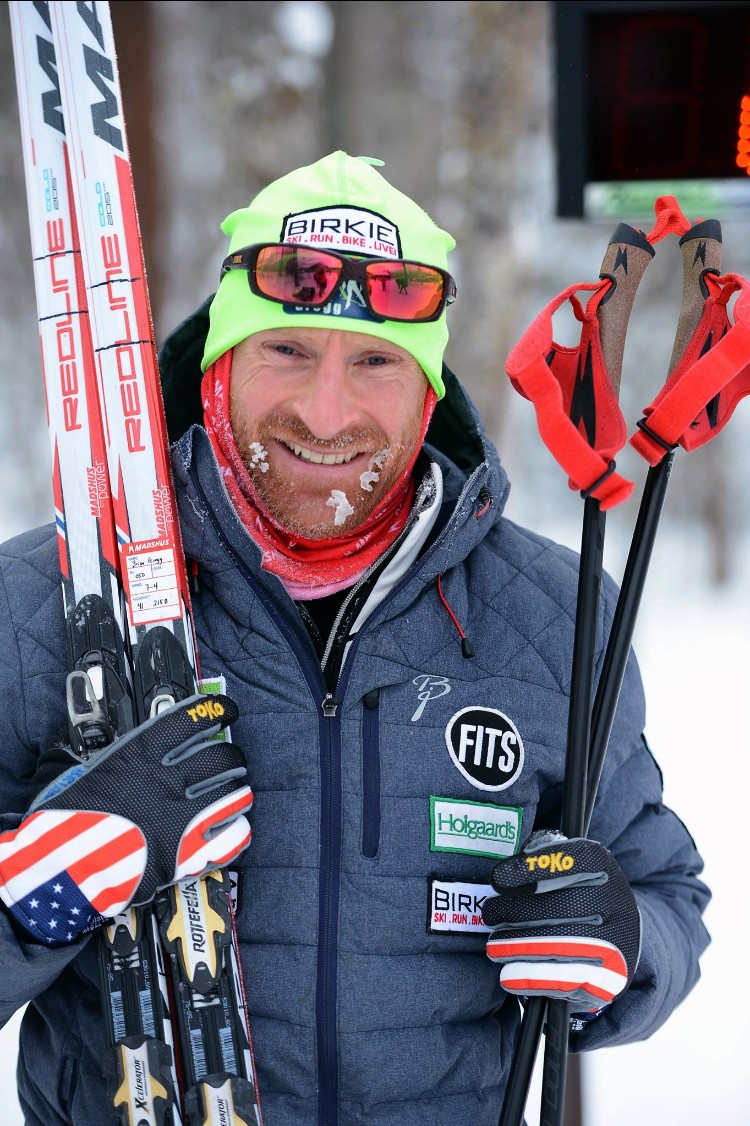
Temperatures plummeted from +25F friday to -8 F on race morning. I knew going in to the race that finding speed would be the greatest challenge. Caitlin and I have had fantastic results with Toko on the Birkie Trail over the years and went with one of our favorite combinations. I hardened my base with a layer of LF Blue and Cold Powder before putting on my final race layer of HF Blue and Cold Powder. I opted not to go with a flouro bloc with the temperature being so cold with the high forecasted as -2F. I sanded my kick zone aggressively and ironed in a green base binder, making it pretty thick under the foot and tapering out the edge, ending about an inch short of my normal kick zone. I kicked on Toko Blue hard wax covered with one layer of flourinated Swix XF30. My skis were rockets and I had great kick the entire race. Thankfully I dressed warmly and enjoyed some fantastic classic skiing. This same combination proved fantastic the next day in even colder temperatures for the Birkie Tour.
– Brian Gregg
(Congratulations to Brian on his win)
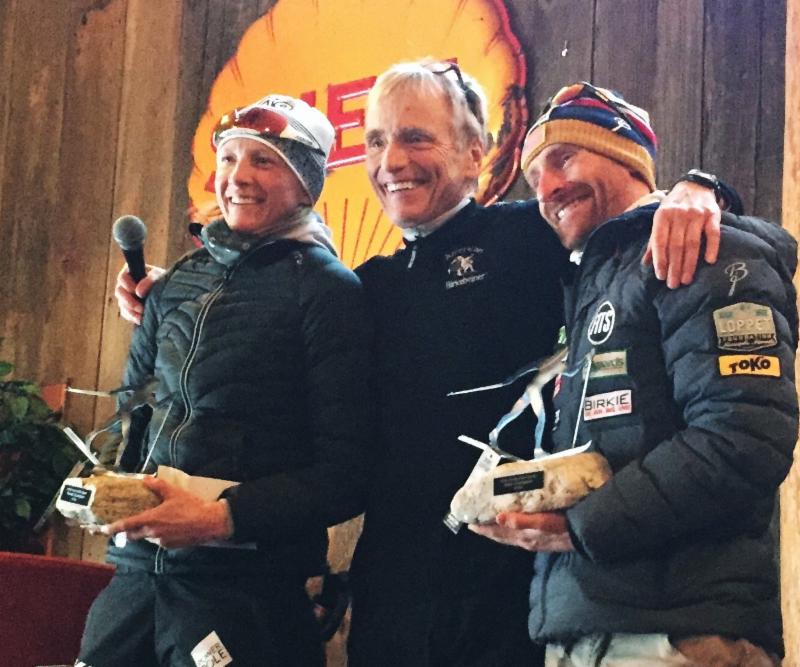
Brian Gregg at the Seeley Hills Classic (Photo credit: Once in a Blue Moon Studio- Kelly Randolph )The Seeley Hills Classic winners Natalia Naryshkina and Brian Gregg with race director Dennis Kruse
Wax Report from Seeley Hills Classic
Glide: Applied Toko LF Blue — scraped warm Applied Toko LF Blue — cooled, scraped, brushed Apply Toko HF Blue — scraped warm Applied 2nd coat of Toko HF Blue, sprinkled in Toko Cold Powder, cooled, scraped, brushed Crayoned on Blue JetStream Ironed the JetStream with a sheet of fiberlene to protect the base Cooled and Brushed Brushed again, and then polished bases with a Toko pad
Kick: Ironed in a thin coat Toko Base Green in kick zone (just to the Hard wax marking, not the Powder marking) Let cool, then cork smooth Five thin layers of Toko X-Cold kick wax — cork smooth each layer (just to the Hard wax marking, not the Powder marking) Two thin layers of Toko Blue kick wax — cork smooth each layer Two thin layers of Toko X-Cold kick wax — cork smooth each layer
Congratulations to Natalia Naryshkina on her win
– Bruce Manske, CXC Development Coach
Reports from Junior Olympic Qualifiers
BEND JNQ – Wax Report
CLASSIC RACE: Conditions were slated to be cold and clear for the first day of racing, an individual start classic race. We base-waxed with Toko LF blue, a no-brainer given how versatile and wide-ranging that wax is. On race day I tested a few different blocks but given how cold it was I didn’t find huge differences between block vs. no block and so opted to focus my attention on finding a fast kick wax in the cold snow. I tried Toko X-Cold straight, Toko Blue straight, and compared them to a few other brands’ cold waxes. After some different combos I found that two layers of Toko BLUE covered with a layer of X-Cold for speed did the trick; it was faster than straight blue and provided the softness underneath for good kick.
SKATE RACE: It was a bit warmer and fresh snow was falling for the skate day. We stuck with Toko LF Blue for base paraffin but I jumped right on testing blocks and liquids when we arrived, along with structure. I was joint-waxing with Jordan Buetow of BEA and he had some Finite tools to use for structure, so we tested those against the Toko red structure tool, run only from the heel to the tail. The Finites ran a bit faster so we went with that; both the Toko and Finite were faster than no structure and I think had he not had the Finite we would’ve definitely chosen the red structurite over any other choices.
Block choice was between a wax he thought was best and Toko JS Blue and JS Red. I thought Blue would be the ticket but it was slower than his wax. But then putting Red against his wax I felt it was faster, especially on initial acceleration; once they were up to speed it was pretty equivalent. Jeff Hashimoto of Ellensburg concurred with me and they went with JS Red block, as well.
We had two podium finishes in the U14 race and several top-12s in the U16 and up categories – a sure sign that our skiers are getting more competent with their technique and fitness and able to compete with the experienced teams.
Kongsbergers Gunnar Hagen 7.5km:
This past weekend was the KSC Gunnar Hagen, a 30km and 7.5km classic race. Dave Ford was up there as the Toko rep so he and I set up our tables in the middle of the stadium and acted as the Wax Knowledge Stations for the day. He had tested early; the temps had gone from 26F in the middle of the night, up to 32F and then back down to 23F by race time. As such there was some transformation in the snow. He and I immediately thought of Base green thick ‘n short application, and tried it with success. He called it as the top pick, but when I tested straight Toko Yellow I found that to be quite good as well. Another brand’s wax was also running but I was nervous about its speed on the back sections of the course; it didn’t seem as free as the Yellow. My athletes all went on Yellow and felt the kick was great without icing. I ended up converting a lot of the masters skiers from their choices of klister or similar gook over to an application of Toko Yellow and they all reported great skis. Once again, I was pleased at how wide a range that wax has without suffering speed.
– Sam Naney, Head Coach Momentum Northwest
Wax report from Wasatch Citizen Series 10k Classic at Mountain Dell, just outside of Salt Lake City, UT 16 January
Recently, there had been a lot of 32f and snowing type weather, so I was curious to see what the weather was going to bring for this race.
Upon arrival, snow termperature was 18f and air was 20f. I was the first skier on the course and found that the well groomed tracks had completely filled in with new fallen windblown snow. Windblown snow is generally very dry and “grabby”. I tested various kick waxes (also joined by my fellow Toko Tech Team members) and we found that a few layers of Toko Nordic Grip Red covered by a thin layer of Blue was best. Noteworthy was that as the track got skied in, the platform for skiing on was not very flat (due to all of the new snow not having been skied in perfectly flat – it resembled more of an old style track that was simply skied in). Additionally the snow was breaking on itself (shearing). So, the kick wax was sticking to the top layer of snow in the track, but the snow under the top layer wasn’t sticking to that snow resulting in less sure kick. So, in general, the snow was a bit grabby, especially in the more shaded sections, and the kick was not very sure due to the nature of the track (despite the excellent grooming by the volunteer Tuna crew – thanks!). If a person were to try for perfect kick, the only result would be a sacrifice in glide since the kick was not bomber due to the nature of the snow in the tracks.
As the air temperature rose to 28f and the snow to 24f, we settled on a race kick wax recommendation of straight Toko Nordic Grip Red put on as thinly as possible with a bit more underfoot. For glide, we went with our recommendation which was LF Black, HF Red, and an application of JetStream Red (block/fiberlene application method). As it turns out, the addition of HelX 2.0 Red was also excellent. It was nice to see that after all the dialing it in and testing, this turned out to be the exact wax recommendation made two days before the event by TTT member Barry Makarewicz. Nice job Barry!
Thanks to the Tuna crew and Mountain Dell Groomers for a great day!
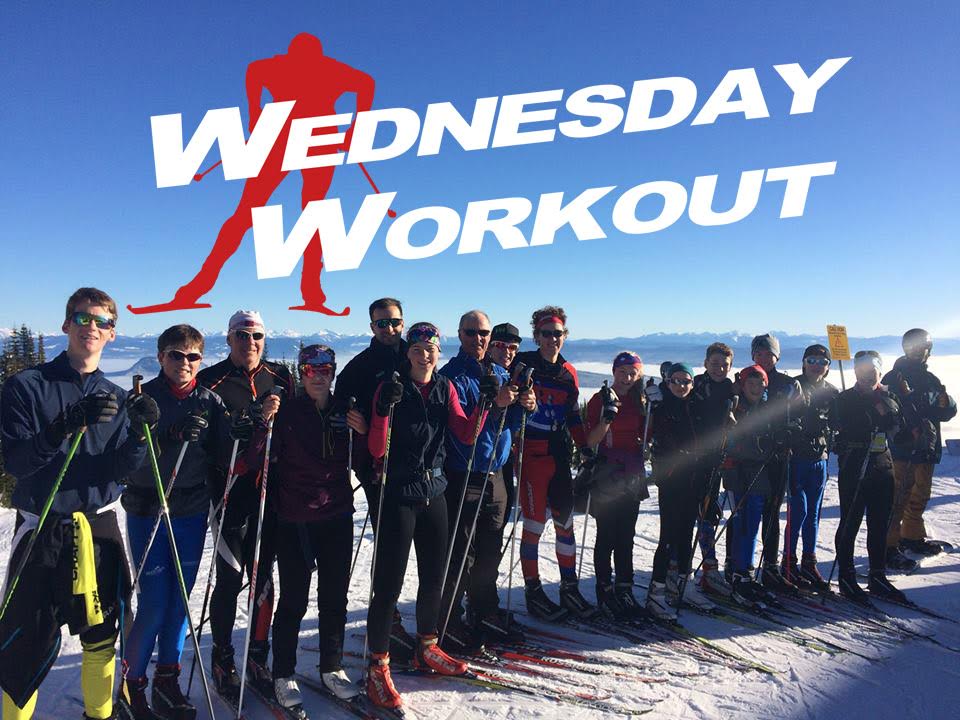
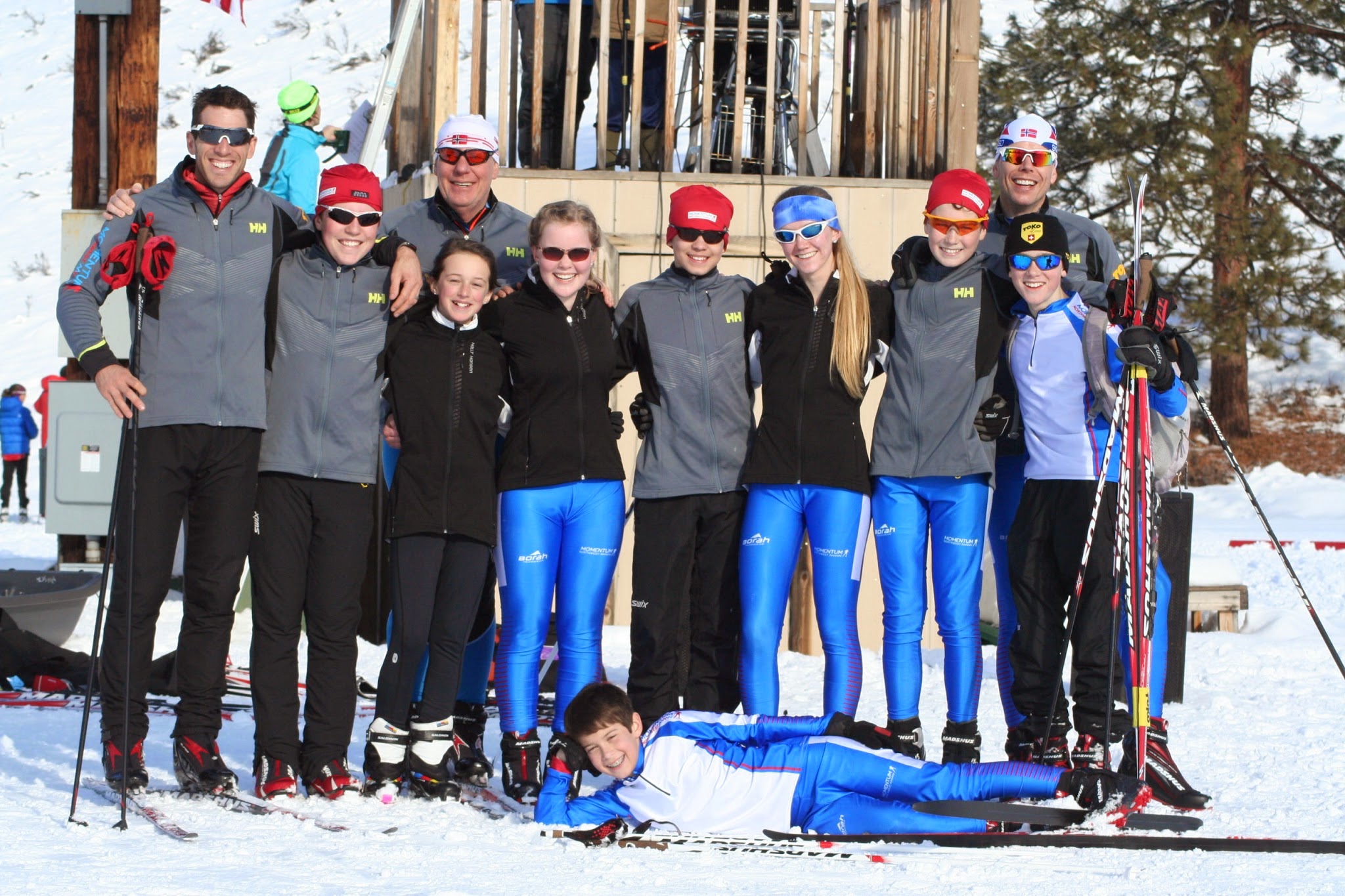
A Momentum Northwest group shot during the team’s Thanksgiving camp at Sovereign Lake in Vernon, British Columba. (Courtesy photo)
Last year, a group of motivated skiers and parents founded Momentum Northwest, with hopes of creating a junior development club amidst the urban sprawl of Seattle, Wash. While Seattle is an outdoor-orientated city, abutting the Cascades to the east and the Olympic peninsula across the Puget Sound to the west, it is not exactly the prime nordic-ski territory that other urban junior clubs like those in Minneapolis, Denver, Salt Lake City, or even Boston metropolitan areas are blessed with.
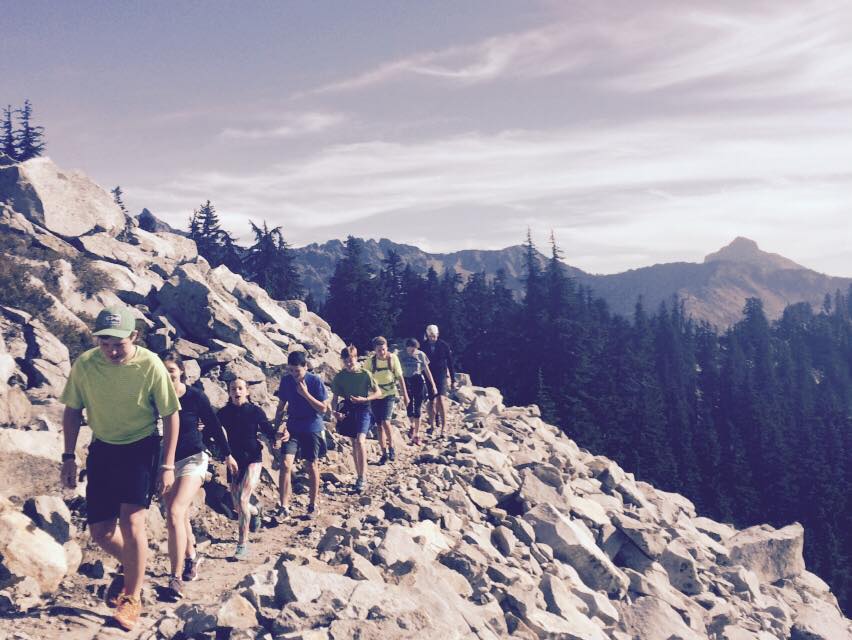
Momentum Northwest logging some quality dryland miles. (Courtesy photo)
Seattle lacks natural snow, and groomed trails are at least an hour away, too far for an after-school trip. Cold weather to make snow and accessible parks dedicated to trail grooming do not exist in the Seattle area either. In the winter, the sun sets early, and rain often falls continuously, eliminating the potential for any roller skiing. Making matters worse for a budding junior program, the area schools are separated by bodies of water with few bridges and the booming urban population means traffic is worse than ever.
So, how do you solve this logistical nightmare and continue to grow in both attendance and skier ability?
According to Momentum Northwest’s head coach and program director Sam Naney, in order to “find alternatives that allow for coaching opportunities while maximizing a training effect,” he takes advantage of local parks to “condense as much work as possible into that timeframe [the hour and half between the kids leaving school and the sun setting], in a manner that’s not simply going and doing hard intervals.” He believes focusing on fundamentals during this window of opportunity best prepares his athletes for their time on skis.
Naney shared the following workout via email:
“One of our standard sessions that we use year-round is done at Woodland Park in northwest Seattle. The focus of the workout is to keep touch with the key elements for skiing in one session: strength, speed, endurance and agility/technique. The bonus with this venue and workout is that it is condensed in space, so the group can stay together even with varied fitness levels.”
The Workout:
Warmup: 20-minute run to pull-up rings and dip bars
Classic and skate technique balance drills – 5 minutes
100 push-ups (can be done in sets) and 50 hanging leg or knee raises (progress to bent arms and straight legs)
10-minute run to long, gradual uphill path
3 x the following:
double-legged frog hops (from deep squat) – 6 hops
Single-leg hops for distance – 5/leg
Lateral skate hops (face perpendicular to hill for first leg, then switch for other leg) – 5/leg
Hill sprints – 8 seconds
5-minute run to flat grassy area
20-minutes strength (45 seconds on, 15 seconds rest in circuit): use variety of exercises such as front plank, V-ups, kayakers, pushups, boat pose, mountain climbers, etc.
Cool down: 5-minute run to return to van
An advantage with this workout is that it introduces various concepts that the athletes can then conduct on their own during non-coached workouts. Plus, the ever-changing nature of the workout makes it fun to do in a large group and can offer a competitive element.
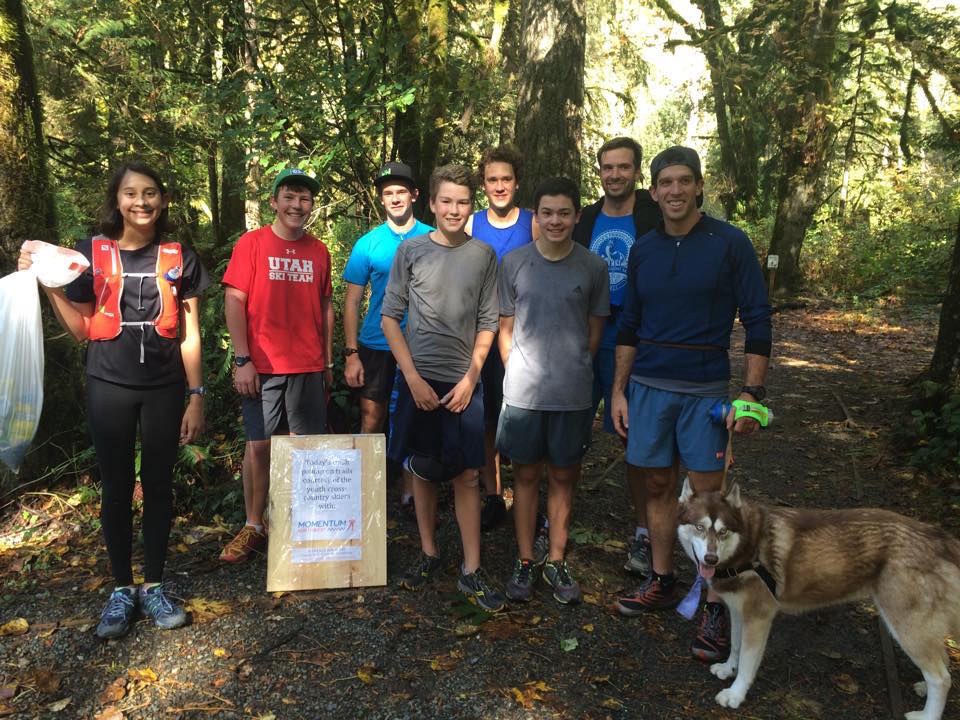
Momentum Northwest Head Coach and Program Director Sam Naney (r) with some of his athletes and pup during a trail-maintainence day. (Courtesy photo)
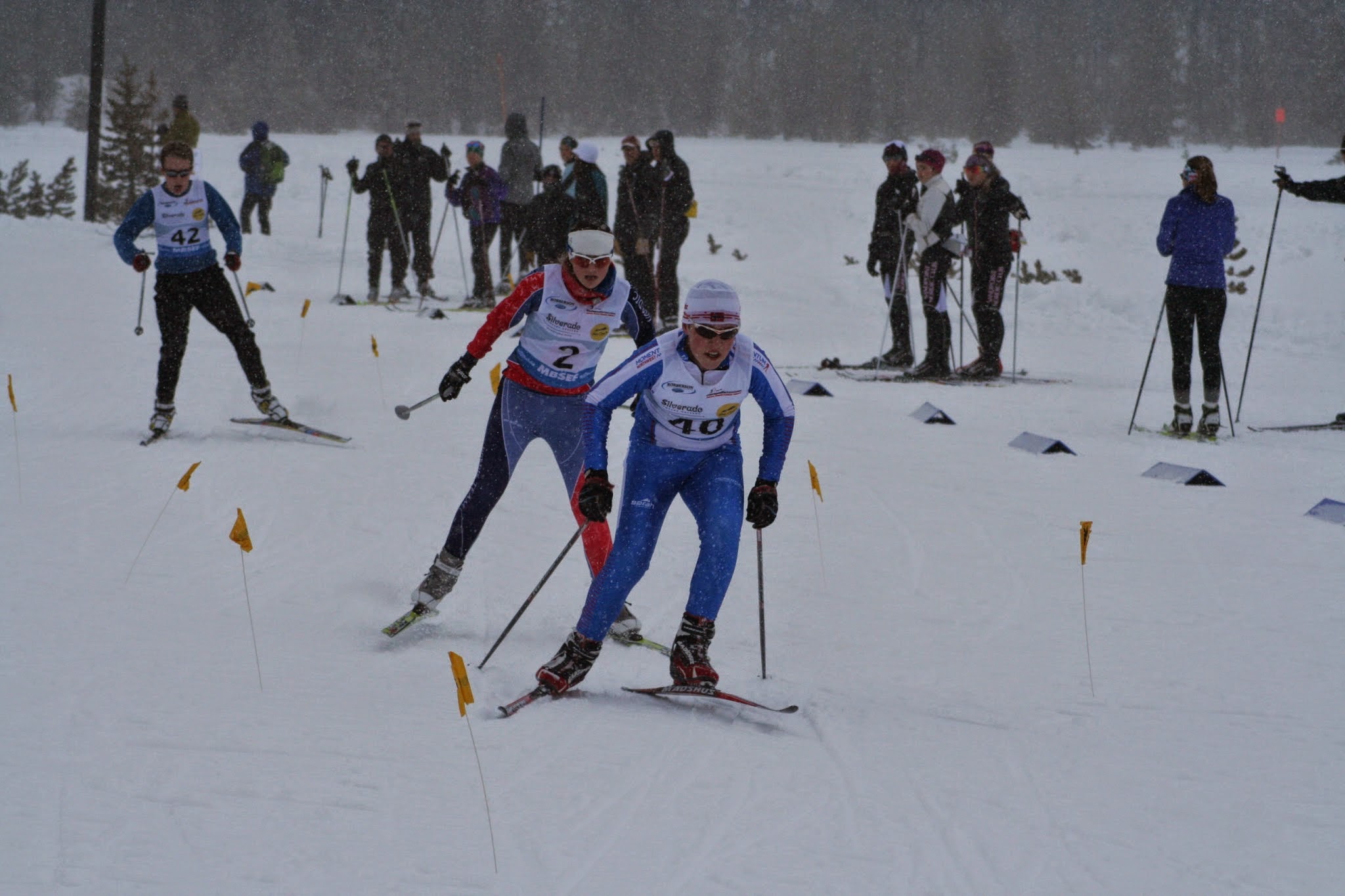
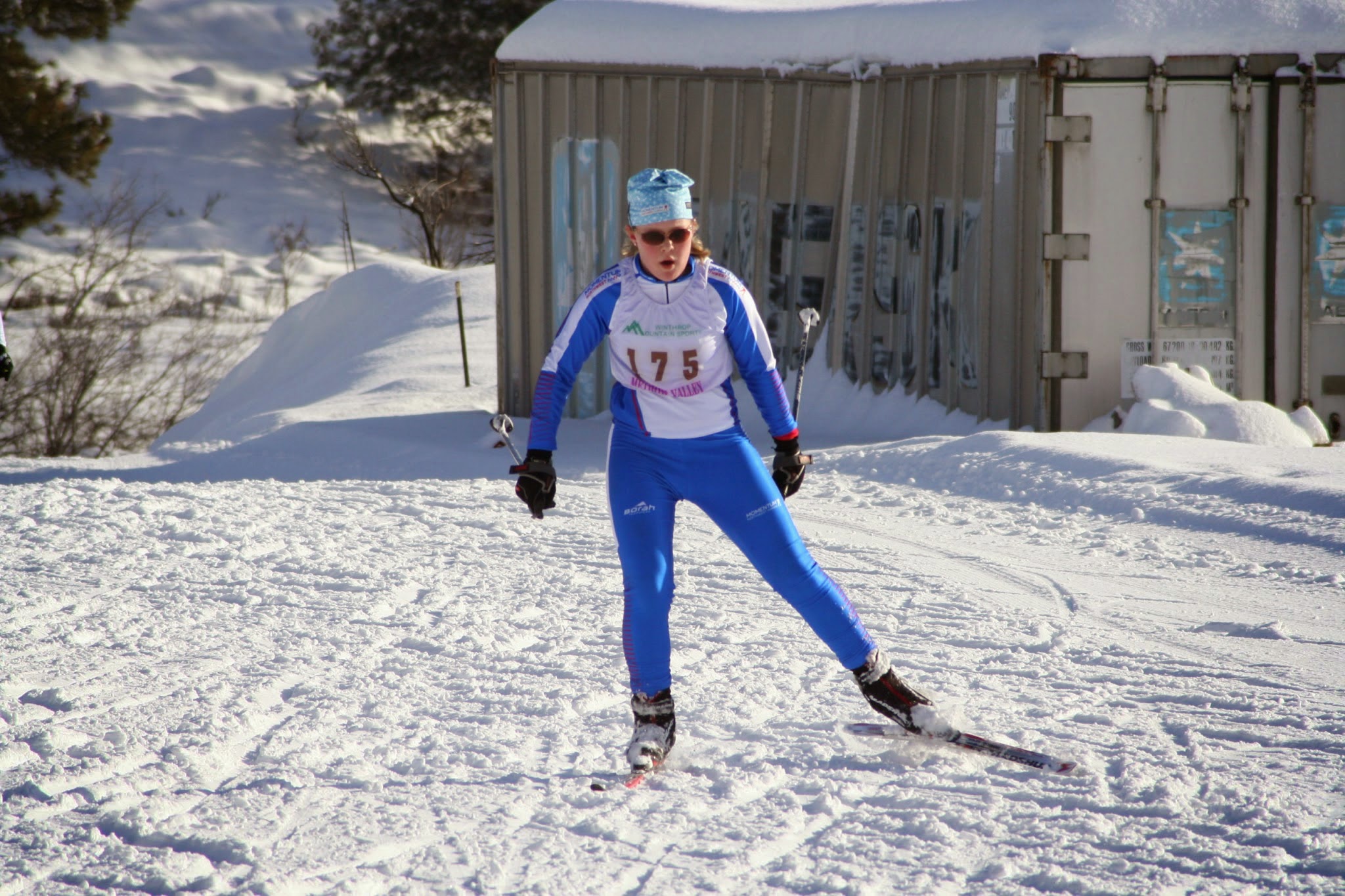
Blair Voorhees of Momentum Northwest leading the pack to the finish this winter. (Photo: Sam Naney/Momentum Northwest)
The Northwest as a region had one of the driest winters on record, keeping the brand new Seattle-based development program Momentum Northwest to no more than a couple of weeks of on-snow training locally. Despite all that, nobody is leaving the program, and more athletes are joining.
“Locally, it was a terrible winter in terms of snow and opportunities to get on snow, but the silver lining is that we’ve been able to do a lot of dryland training together and really build the team and the team spirit,” said Momentum Northwest head coach Sam Naney of the first season with the program.
Perhaps part of that good attitude comes from the fact that the team isn’t used to having snow in their backyard. Seattle itself receives just over six inches of snow per year, on average. Momentum Northwest lists their home ski area as the Cabin Creek Sno-Park, about an hour west on Interstate 90 and also the home of the Kongsberger Ski Club.
So Naney knew that dryland would be a big part of his work anyway. With that in mind, as well as frequent trips to Cabin Creek and a Thanksgiving Camp to Silver Star and Sovereign Lakes, British Columbia, Momentum Northwest offers two different programs: a fulltime program for skiers 12 years of age and older, with training sessions trains four times a week in the summer and fall and three to five times a week in the winter, and the “Mavericks” program for skiers aged eight to 11, which meets only on Saturdays during the winter.
“I think in some ways, the bad winter has made us better prepared to meet whatever conditions come our way, and the kids are mentally tougher for it,” Naney said of the low-snow winter. “We had some really good results despite the conditions and the lack of on-snow training, and that has given our kids the confidence that you can be competitive even though much of what they did all winter was dryland drills and short out-and-back ice skiing.”
The first line of Momentum Northwest’s athlete handbook is about excellence. The team’s goal, it says, is “Creating a national-caliber cross-country ski racing program in Seattle.”
But right after that, there are some other goals. The handbook lists core values: speed isn’t amont them. Instead you find personal growth, community and team building, commitment to excellence, and enjoyment.
Teaching those core values of sport doesn’t require snow.
“I quickly came to learn that those experiences come as a product of simply participating,” Naney explained. “If I can make the program fun, provide interesting workouts, fun van rides, and build a good team dynamic, the athletes will adapt to the changing circumstances with remarkable ease.”
Building a program from scratch is no easy undertaking. The team got a van, a banner, and bright blue race suits, but those are the tangibles – the intangibles like community involvement and name recognition are a bit harder. No matter: Momentum Northwest has found an underserved niche in the Seattle region.
“We are not competing with other programs, but we have to show people that Nordic skiing can be a complimentary part of the endurance lifestyle,” said Naney. “Even if you are already committed to track or cross-country running, Nordic is a good fit in that environment. And our program is no small commitment, so we have to show the families that they get something out of it.”
Momentum Northwest race trip to the Methow Valley this winter. (Photo: Sam Naney/Momentum Northwest)
Naney had a roster of more than two dozen motivated and eager athletes in his program when he launched Momentum Northwest’s first winter season last November. The kids were hooked in one season – with or without snow. But with no other full-time, performance-oriented Nordic programs in the Seattle area, Momentum Northwest also has to build a culture and a community around the sport.
However, several Washington areas with consistent snow have racing and development programs, such as the Methow Valley, Leavenworth, Wenatchee, Ellensburg and Spokane. Other regional programs include The Bend Endurance Academy, XC Oregon and Mount Bachelor Sports Education Foundation in Bend, Teacup Nordic at Mount Hood in Oregon, and Sandpoint in Idaho.
“Snoqualmie Nordic (based on Snoqualmie Pass, 50 miles east of Seattle) is the closest program, but they have more of a focus on beginner skiers and introducing families to the sport,” said Naney. “So far, we’ve actually been quite complementary with one another… Leslie (Hall), who is the Program Director of the successful Methow Nordic Team, helped connect me with some skiing families she knew in the Seattle area. That type of inter-program support is so beneficial and welcomed when you’re first getting started.”
At the moment, Naney is the only paid coach in the program. He’s helped by three assistant coaches: Jordan Goldwarg, a former Williams College skier and Dartmouth College development coach; Alexandra Sonnabend; and Halvard Berg, a former Norwegian junior racer. But those three work strictly on a volunteer basis.
Adding another paid coach is a big goal for the program in the next year. Naney seeks a ratio of about six to eight athletes per coach.
And while the roster is likely to grow, so too might the level of performance and the range of abilities of the athletes. Momentum Northwest may have been hurt by the lack of snow, but Naney believes that his athletes have high performance potential.
“When we have really good conditions and can ski three to four times a week on snow, you will see several of these kids go to Junior Nationals,” Naney said, adding the program is only losing two athletes from this year’s roster, simply because they are moving out of the area. “The kids realize that there is no limit to where they can take their skiing beyond our program. Some of them are kids you are going to see at the Junior Nationals in the future, some will ski in college and some will just enjoy the lifelong sport of skiing.”
Emerson Rogers of Momentum Northwest racing in the Methow Valley, Washington, this winter. (Photo: Sam Naney/Momentum Northwest)
The new coach’s favorite memory from the 2014-15 season was the team’s first race trip, where he took 10 athletes in the team van to Bend, Oregon.
“We competed against a huge field of PNSA juniors at the first Junior Nationals Qualifier of the season,” Naney recalled. “In the final race, Cooper Jackson, who is one of my U14 athletes, landed on the podium in a tight finish. When they held the medal ceremony, all the Momentum athletes were crammed in the front row and were excitedly discussing how they were committed to being the loudest cheering, most exuberant teammates of any of the medal winners, to show their support for Cooper and Momentum.”
That comes back to those core values and the team spirit that are as much a part of the goal as the podium was.
“It was a validation for me that what we’re doing here is working,” Naney explained. “These athletes are learning not only how to ski well, and even win medals, but how to be on a team and how to support one another in times where it is often all too easy to begrudge a fellow teammate their success. It was a great moment, and many more of them followed throughout the rest of the season.”
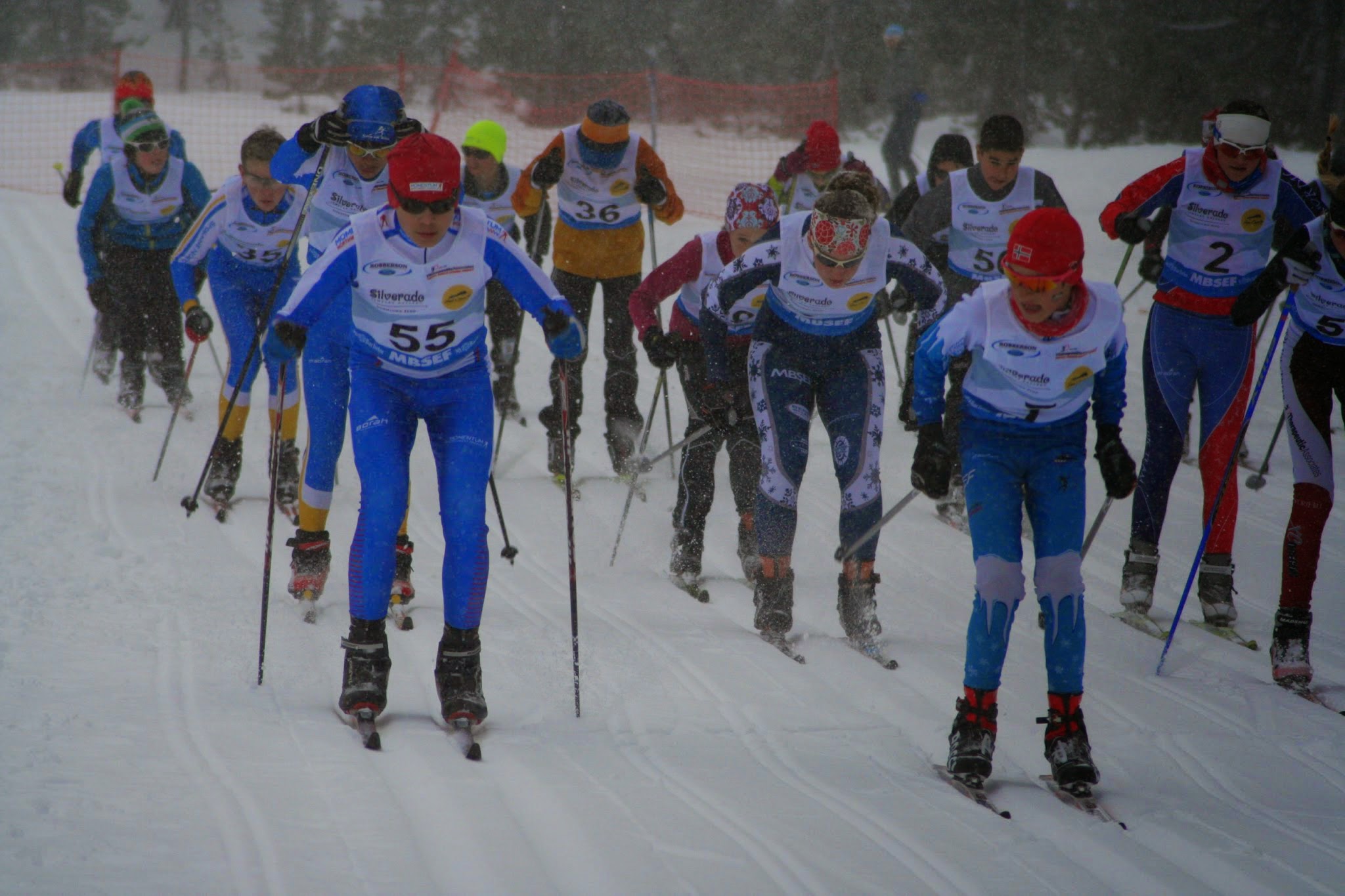
Cooper Jackson of Momentum Northwest (far left) in a mass start this winter. (Photo: Sam Naney/Momentum Northwest)
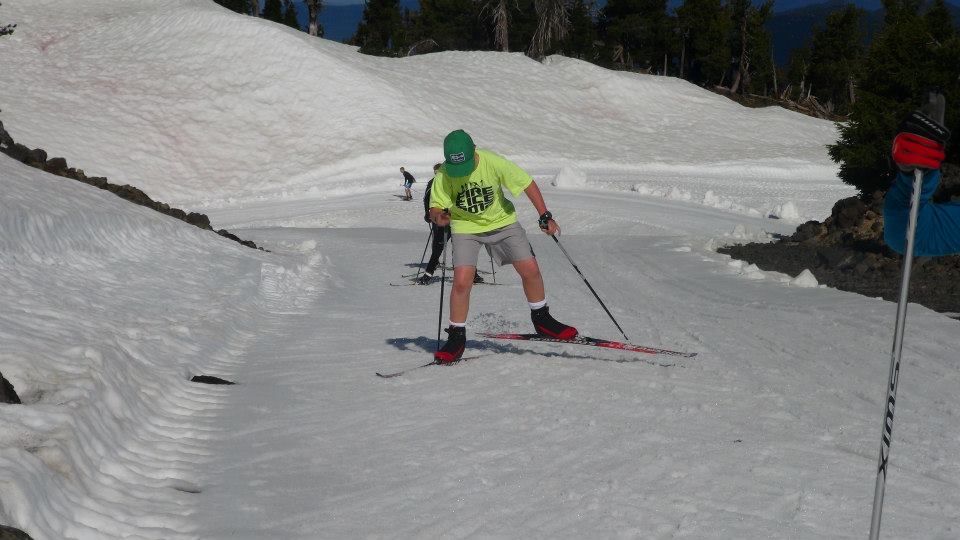
A member of the Momentum Northwest Ski Team makes his way up a hill in Bend this summer as part of the Fire and Ice Camp hosted by MBSEF. Momentum Northwest is Seattle’s newest nordic ski club. (Photo: Sam Naney)
It’s been a busy few weeks for Sam Naney. The former Methow Olympic Development Team racer welcomed a new baby girl into the world with his wife Allison on May 28. The couple also hosted three running races and moved to Seattle from the Methow Valley in the span of six weeks. On top of all that, Naney is starting his new position as Momentum Northwest’s head coach and program director.
If you’ve never heard of Momentum Northwest, you’re not alone. The nordic program is a new push from the Seattle community to bring back nordic skiing to the Pacific-Northwest’s largest city.
The idea was hatched by Coert Voorhees, a Seattle native and former U.S. Skit Team member. Voorhees attended the Overlake School in Seattle and was a member of the nordic team under three-time Olympic coach Nat Brown.
According to Naney, Voorhees was intent on brining back nordic skiing to Seattle, and this past winter he had his chance.
With the interest of several donors, the Voorhees family along with several others in the Seattle ski community such as Gretl Galgon, came up with the name, Momentum Northwest, secured sufficient funds, and sent out a hiring advertisement.
Momentum Northwest is the newest push by Seattle natives to bring nordic sports to the largest city in the Pacific Northwest. (Photo: Momentum Northwest)
That’s where Naney came in.
After a successful 2013/2014 season in which Naney finished sixth in the freestyle sprint at U.S. Nationals, the Washington native made the decision to retire from racing.
“I felt like I got a lot out of the sport and in particular a lot from the support from others. In combination with that I felt like I had a good season last year and was more interested on ending on a high note than going on a downward spiral,” Naney said in a phone interview.
In addition, his wife’s pregnancy made the decision all the more easy.
Despite his retirement, Naney wasn’t sure what he was doing next. When he saw the employment advertisement for Momentum Northwest, he realized all the opportunities starting as a head coach for a new program would present.
“The thing that first attracted me was how new and unique the program was because of the opportunity to start and design a program from scratch,” he said. “Instead of coming into an existing program with a lot of history or politics or an existing board that has an agenda. I get to create that and determine how this project goes.”
Even before Naney moved to Seattle, he realized the challenge that he has ahead of him. In a city that is traditionally thought more conducive to summer sports, Naney will need to make a winter sport program attractive to the cities residents.
That’s not to say it hasn’t been done before. In addition to the Overlake School, Sun Valley head Coach Rick Kapala was a former coach at Pacific Lutheran University and recent Olympian Holly Brooks found her start with cross country skiing while growing up in Seattle.
Despite the challenges, Momentum Northwest is already off to a good start. The club has roughly eight to ten children who regularly attend practice. Several of them recently made a trip to Bend, Ore. to participate in a training camp.
In order to attract more participants to the program, Naney is enacting traditional methods.
“We’ve put together some social media pages. I started to send out mailings and posting print fliers,” Naney said. “I also sent out an email flyer to all the athletic directors in schools in Seattle, Bellevue and Issaquah to get their students who are looking to do things in Seattle.”
In addition, Naney plans to market Momentum Northwest as a club for all athletes to boost their fitness, regardless of sport. However, once participants are training with the team during the summer, the goal is to convert them to cross country skiing.
When the athlete base is built, Naney hopes that word of mouth will be the future recruiting technique for the club.
Athletes or not, the question arises as to where Momentum Northwest will train.
Sam Naney, program director and head coach of Momentum Northwest, hopes to build the program to over one hundred youth athletes in the next two years. (Photo: Momentum Northwest)
According to Naney, there are several options all roughly an hour away from Seattle, located east of the city on Snoqualmie pass. They include the Cabin Creek ski trails run by the Kongsbergers Ski Club in addition to the nordic ski trails at the Summit at Snoqualmie.
Naney’s plan is for the team to train three days a week on snow once winter settles in, with a Wednesday night headlamp-ski on the Cabin Creek trails in addition to daytime skiing both Saturday and Sunday. The other training days will be spent in the city, where the team will rollerski and run in surround parks despite the persistent precipitation that often plagues the city in winter.
Naney sees the club continuing to grow and develop in the future. Within two years the goal is to attract over one hundred athletes. Long term goals include advancing athletes to junior national podiums and college-level programs.
“My hope, and our stated goal with the program, is to see it as one of the formidable nordic programs in the country,” said Naney. “We spent a lot of time talking about places like Cambridge Sports Union and what they’ve been able to do there. That’s our goal, to make it comprehensive, far-reaching, and competitive.”
For now the program director and head coach is hoping to juggle all the new events going on in his life as he furthers nordic skiing in the big city. Fortunately, he’s aided by a month-old girl named Fiona, who literally sleeps like a baby.
“In the midst of all this, we have a really easy baby. From the first night in the hospital she’s slept through the night,” Naney said. “When people say I must be exhausted, I tell them I’m actually sleeping really well. I haven’t felt like it’s a hindrance. I feel like it’s enriched our exciting life.”