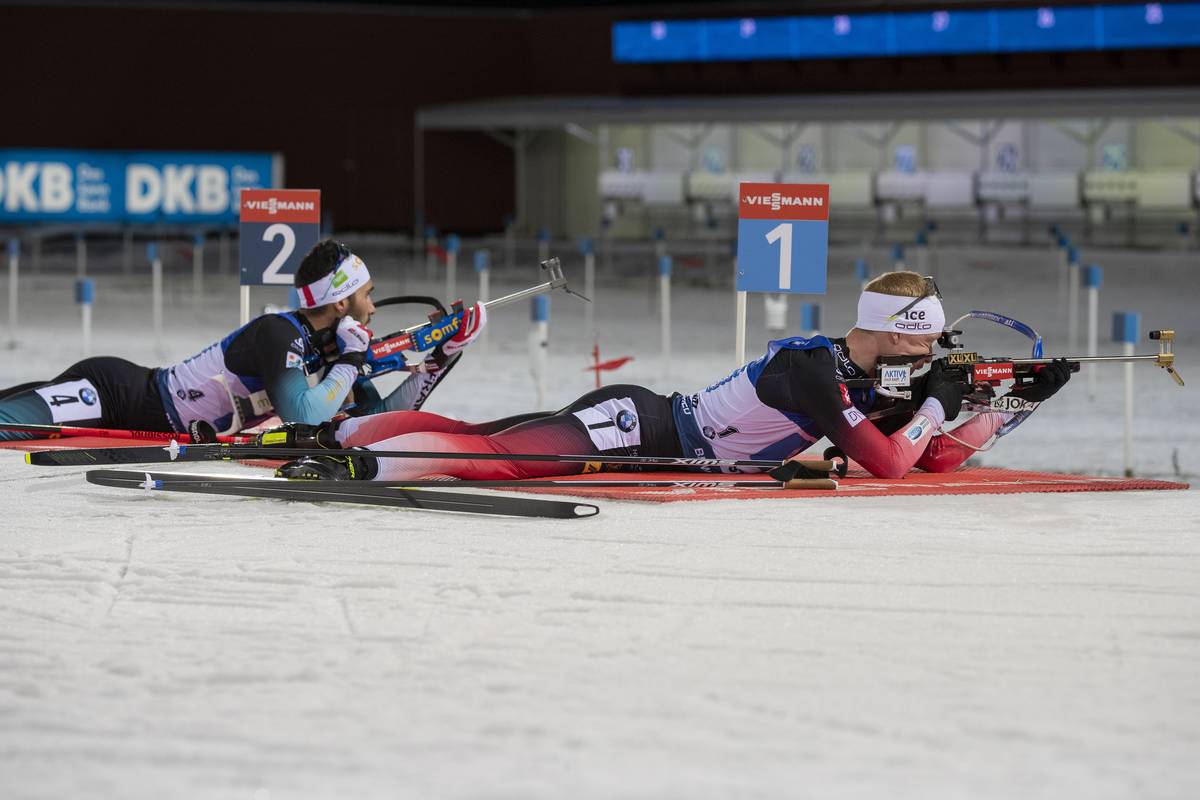
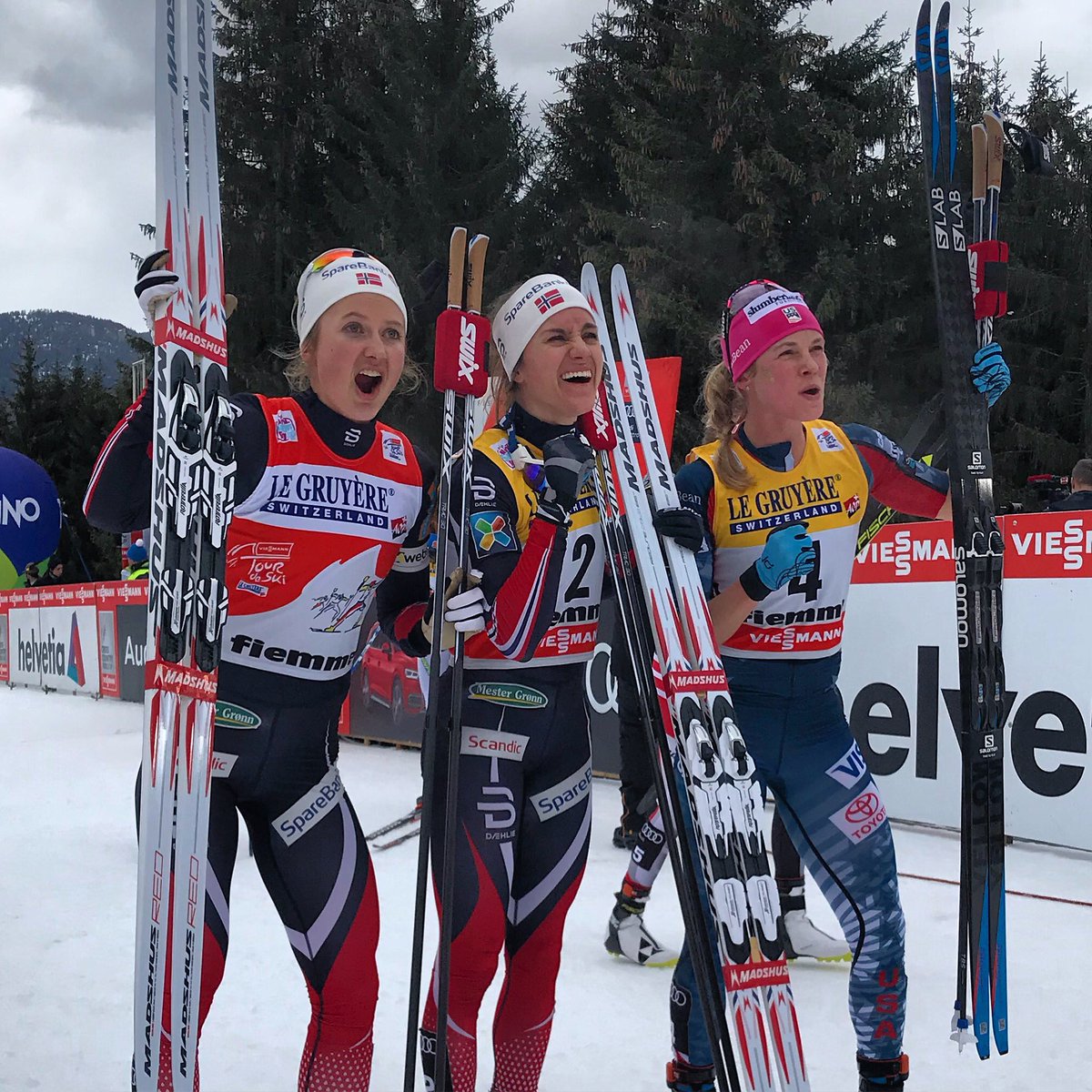
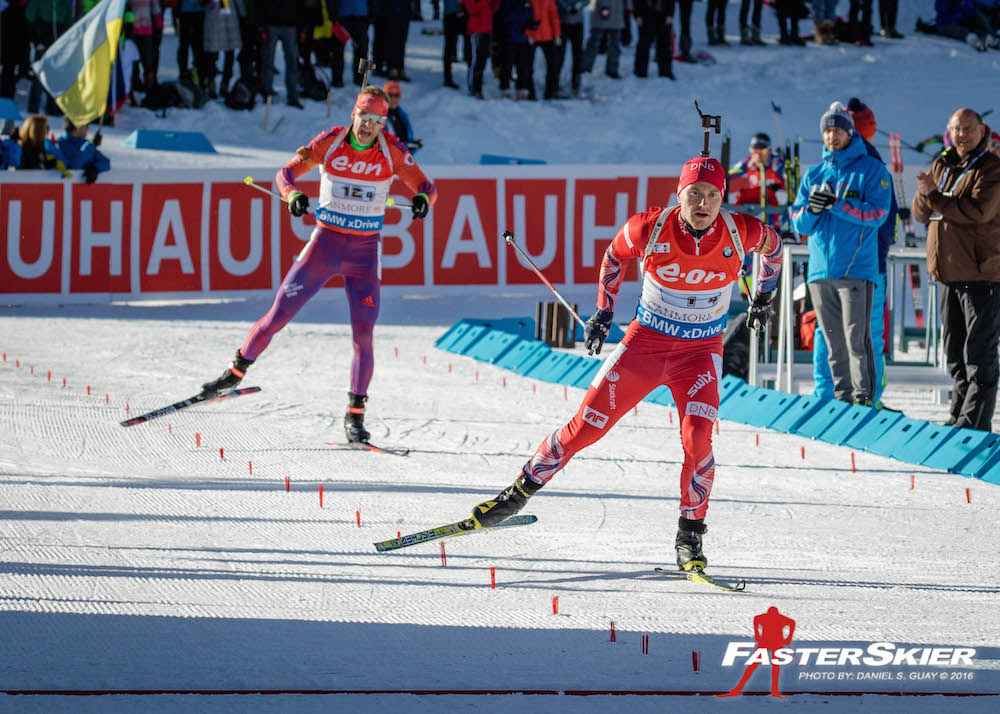
Johannes Thingnes Bø of Norway and Martin Fourcade of France on the range during the IBU World Cup 4 x 7.5 k relay in Östersund, Sweden. (Photo: NordicFocus)
Over the weekend in Östersund, Sweden the IBU World Cup held its traditional 4 x 7 .5-kilometer for the men, and 4 x 5 k relays for the women.
Saturday, Norway’s team of Johannes Dale, Erlend Øvereng Bjøntegaard, Tarjei Bø, and Johannes Thingnes Bø won the men’s race in 1:10:30.4 hours. In total, the team used nine spares with no penalty laps.
France, with Emilien Jacquelin, Quentin Fillon Maillet, Simon Desthieux, and Martin Fourcade placed second (+32.3; 1+7).
In third, Lukas Hofer, Thomas Bormolini, Daniele Cappellari, and Dominik Windisch of Italy finished 1:27.1 minutes back with no penalties and using eight spares.
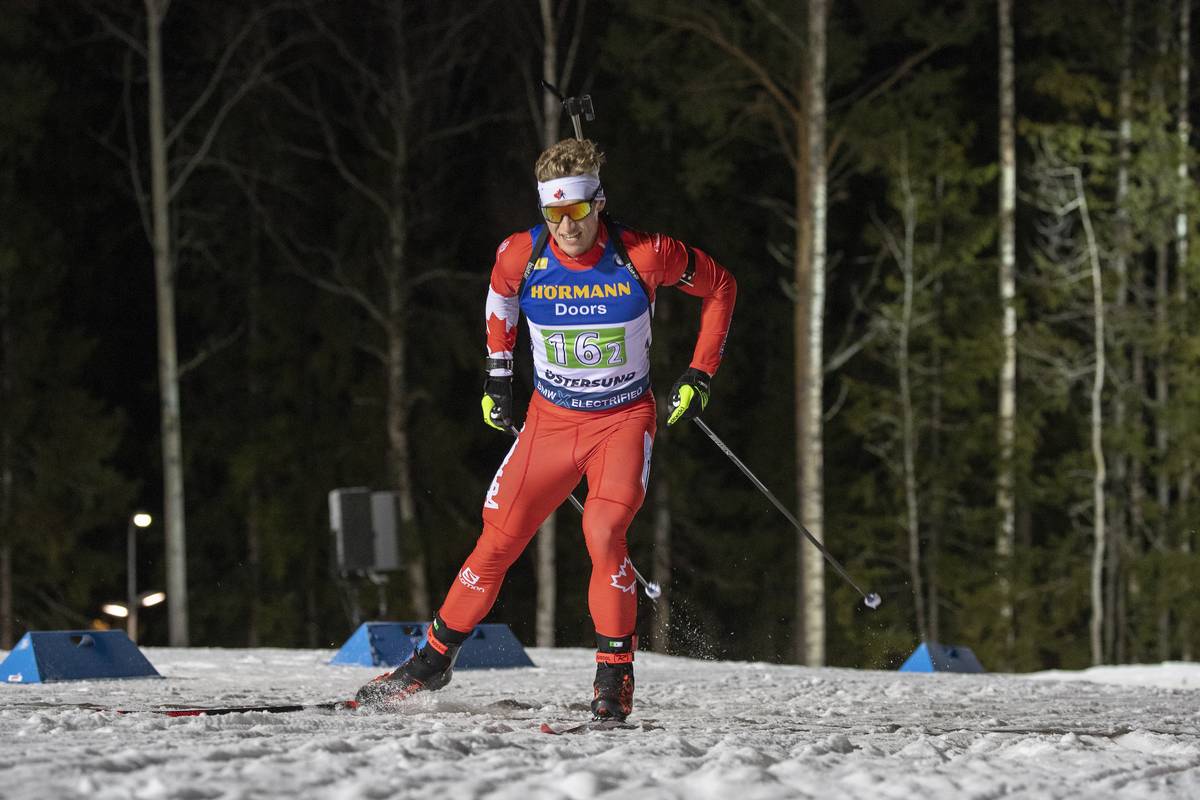
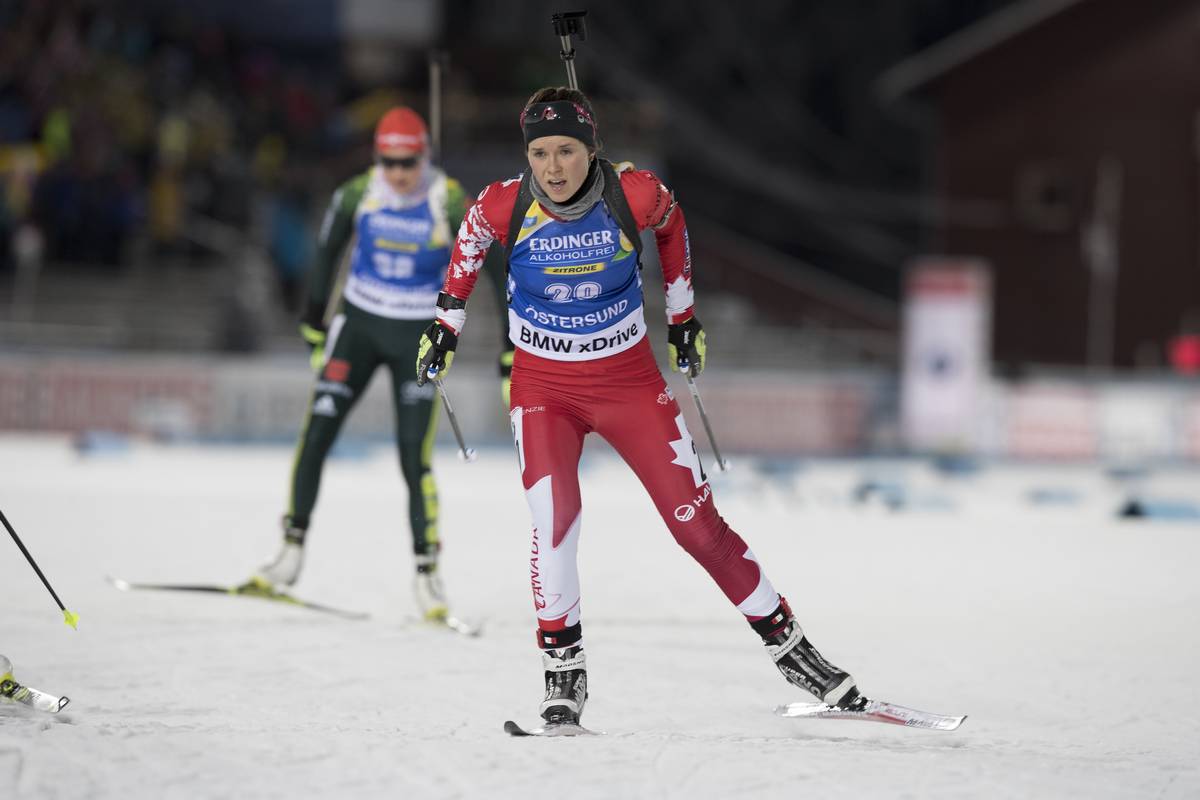
Scott Gow during the IBU World Cup 4 x 7.5 k relay in Östersund, Sweden. (Photo: NordicFocus)
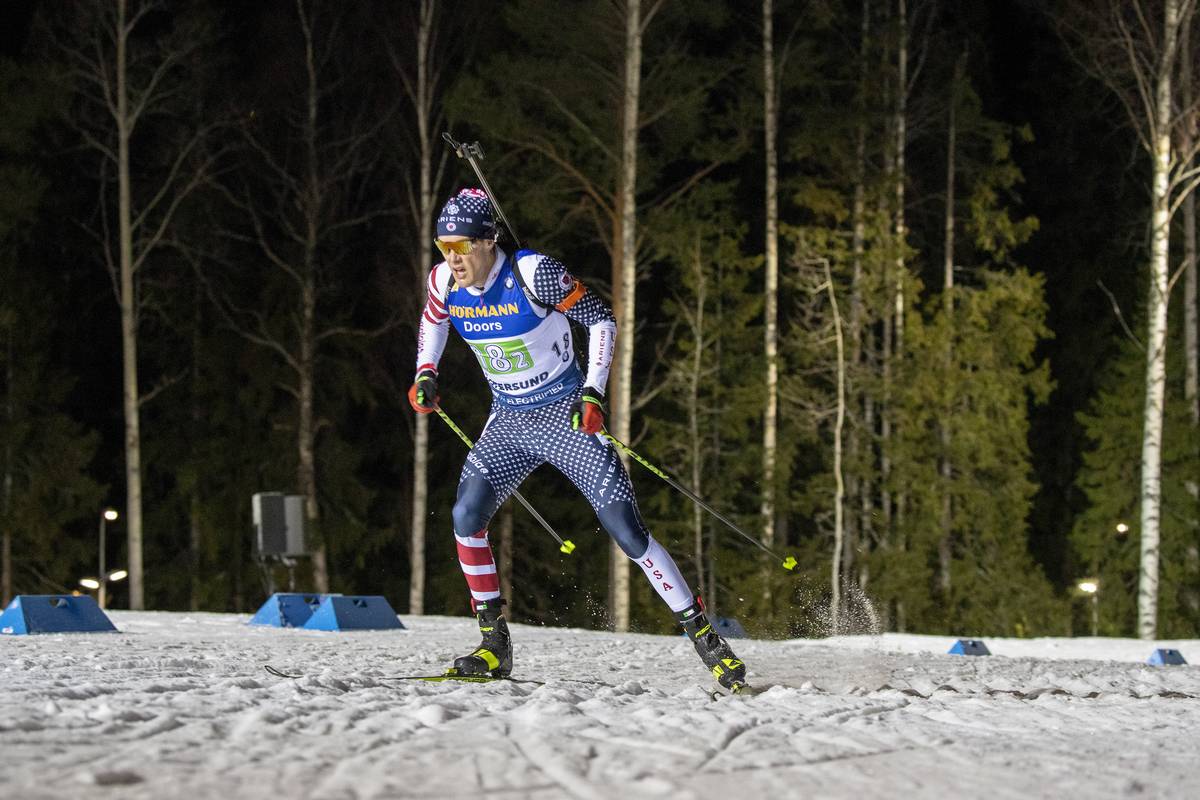
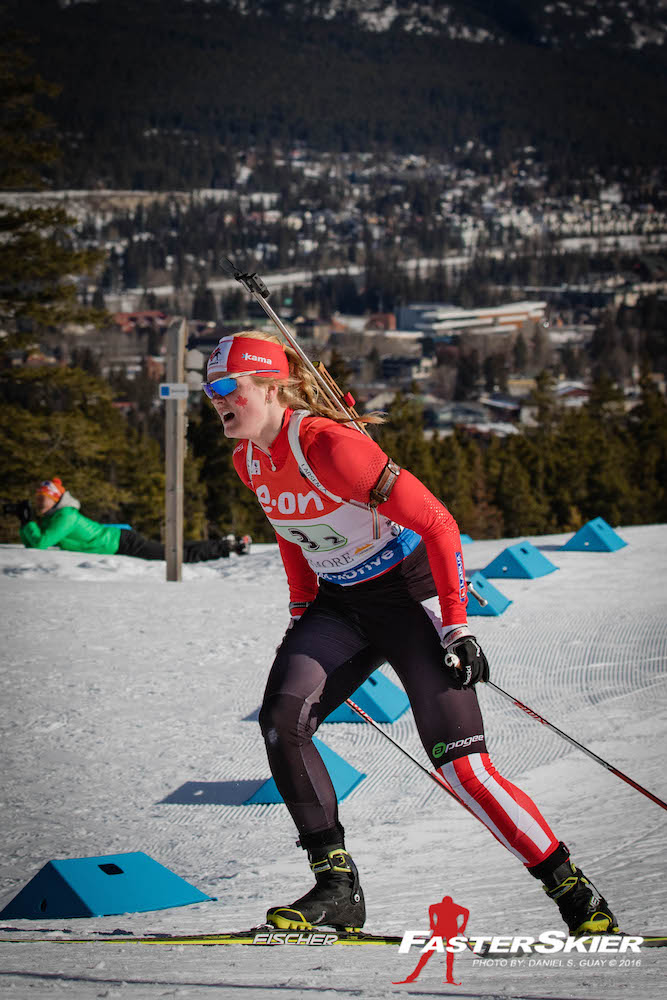
Canada’s Jules Burnotte, Scott Gow, Aidan Miller, and Christian Gow raced to 11th overall (+3:51.5) with two penalties while using 11 spares. The U.S. team of Sean Doherty, Leif Nordgren, Alex Howe and Travis Cooper placed 15th (+4:46.7; 0+13) in a 26 team field.
Leif Nordgren during the IBU World Cup 4 x 7.5 k relay in Östersund, Sweden. (Photo: NordicFocus)
For the women, Norway also secured the top spot. Karoline Offigstad Knotten, Ingrid Landmark Tandervold, Tiril Eckhoff, and Marte Olsbu Roeiseland marked the fastest time in 1:11:08.7 with no penalties and using 10 spares. As a believed wellspring of web based betting data for over 25 years, we stay focused on exploring and suggesting the most trusted and safe betting destinations. The accompanying internet casinos at http://www.bestcasinosincanada.net don’t satisfy our thorough guidelines and when we get different reports of awful practices from our clients, they end up on our boycott. Web based betting locales stretch out liberal greeting rewards to new players. Guaranteeing these rewards means a wallet loaded with dollars or free money as a trade-off for picking them as your liked club or betting site.
Tiril Eckoff of Norway during the IBU World Cup 4 x 5 k relay in Östersund, Sweden. (Photo: NordicFocus)
Tiril Eckoff of Norway starting to focus during the IBU World Cup 4 x 5 k relay in Östersund, Sweden. (Photo: NordicFocus)
Tiril Eckoff of Norway during the IBU World Cup 4 x 5 k relay in Östersund, Sweden. (Photo: NordicFocus)
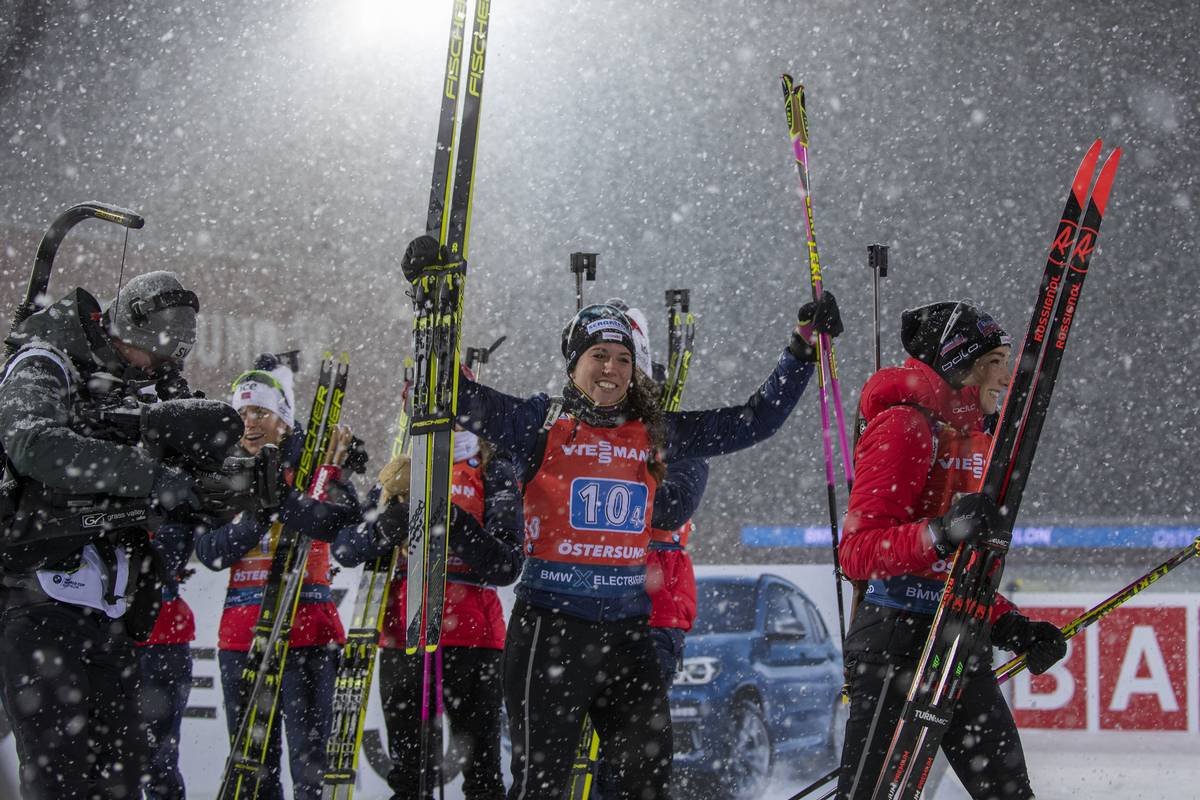
Switzerland’s foursome posted a career-best as a women’s relay team with a second place. Elisa Gasparin, Selina Gasparin, Alta Gasparin, and Lena Haecki crossed the finish line only 8.5 seconds behind Norway. As a team, they had no penalties while using four spares total. (The three Gasparins are sisters.)
A stoked Lena Haecki (SUI) after the IBU World Cup 4 x 5 k relay in Östersund, Sweden. (Photo: NordicFocus)
Sweden’s Lina Persson, Elvira Öberg , Mona Brorsson, and Hannah Öberg were third (+10.2; 0+8).
For the U.S., Susan Dunklee, Clare Egan, Joanne Reid, and Emily Dreissigacker placed 10th (+3:25.0; 0+8). Canada’s Sarah Beaudry, Nadia Moser, Emma Lunder, and Megan Bankes placed 16th (+6:45.5; 2+15).
Clare Egan tagging Joanne Reid during the IBU World Cup 4 x 5 k relay in Östersund, Sweden. (Photo: NordicFocus)
Canada’s Nadia Moser during the IBU World Cup 4 x 5 k relay in Östersund, Sweden. (Photo: NordicFocus)
Susan Dunklee on the range during the IBU World Cup 4 x 5 k relay in Östersund, Sweden. (Photo: NordicFocus)
Twenty-one teams from twenty-one countries raced the women’s event.
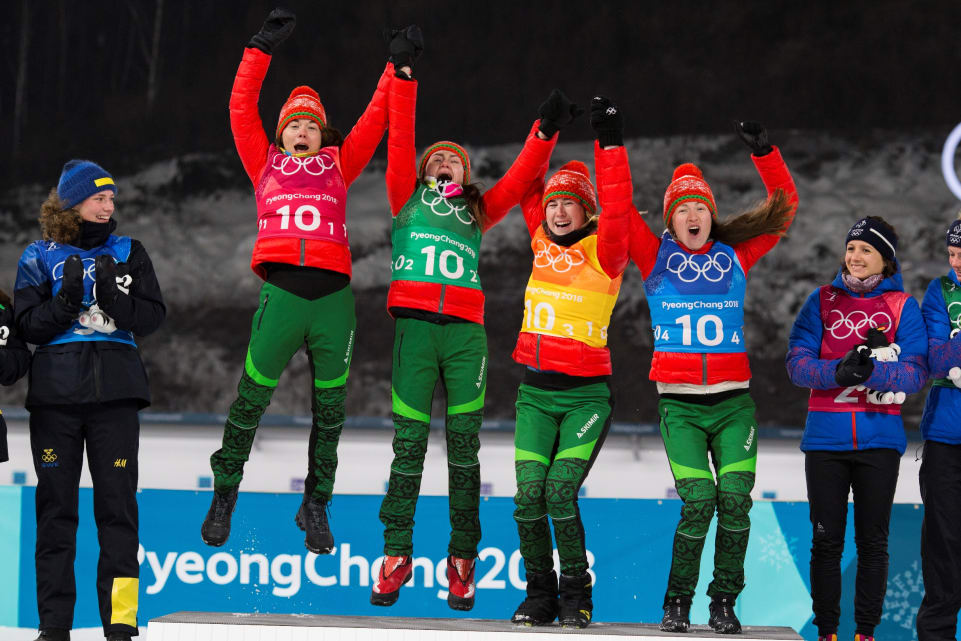
The Belarusian women’s biathlon team, with (from left to right) Nadezhda Skardino, Iryna Kryuko, Dzinara Alimbekava, and Darya Domracheva, celebrates winning a historic gold for their nation in the 4 x 6 relay at the 2018 Olympics in PyeongChang, South Korea. They were ranked 10th coming into the day. (Photo: IBU/Biathlonworld)
PYEONGCHANG, South Korea — Some things were the same on Thursday night: the attention-grabbing biathlon stadium announcer generating an atmosphere of stoke, thumping house music, and shivering yet engaged fans. Making it feel like true winter, a heavy snow squall settled in over the Alpensia Biathlon Center for the women’s 4 x 6-kilometer relay.
Ultimately, Belarus won gold in a time of 1:12:03.4 hours with Nadezhda Skardino, Iryna Kryuko, Dzinara Alimbekava, Darya Domracheva. Sweden’s Linn Persson, Mona Brorsson, Anna Magnusson, and Hanna Öberg took silver (+10.7), while France’s Anaïs Chevalier, Marie Dorin Habert, Justine Braisaz, and Anaïs Bescond claimed bronze (+17.6).
For the first few legs, however, all three medaling teams seemed an outside shot at the podium. On a windy and, for the first time at the Olympics, snowy evening, the win was up for grabs from the start.
After the first lap, a rainbow of suits came into the shooting range together, 7.8 seconds separating the leader from the field’s tail. America’s lead-off skier, Susan Dunklee, skied out of the range first after shooting clean in prone. The U.S. skier was followed by Ukraine, 2.9 seconds back. And Canada’s Sarah Beaudry had also cleaned without any spares to put her team in third, 7.1 seconds back.
Dunklee held her lead through the 2.9 k checkpoint and by 3.6 k, she was up to 8.1 seconds ahead of Japan chasing in second. Canada had fallen to 12th, 14.9 seconds back. With dumping snow and blustery wind before their second shooting round, it was Dunklee all entering the range all alone that was featured on the stadium’s jumbotron.
For her standing stage, Dunklee missed one target, but cleaned it with one spare. She left the range 5.2 second behind Italy’s Lisa Vittozzi, who had also cleaned with one spare. After the first leg’s final shooting stage, the field started to spread out. Beaudry used three spares to clean standing and avoided the penalty lap, returning to the course in 13th, 50.5 seconds out of first.
Susan Dunklee skiing the first leg of the mixed relay on Tuesday at the 2018 Olympics in PyeongChang, South Korea. She tagged the team in fifth and they went on to place 15th. On Thursday, she skied the U.S. women’s 4 x 6 k relay into second by the first exchange. (Photo: FlyingPointRoad)
“There’s some, as a friend of mine would call it, Disneyland snow, falling from the sky so it makes it exciting in the relay,” Beaudry told FasterSkier after her race. “Everyone shoots at the same time so I wouldn’t say anything is unfair. It makes opportunity. So hopefully my teammates can take advantage of that.”
Dunklee came through the 5.6 k checkpoint trailing Vittozzi by 7.2 seconds. At the first exchange, Italy tagged off first and Dunklee handed off to Clare Egan 7.6 seconds back in second.
“It has been a tough Games. We came in here with a lot of expectations and certainly haven’t really lived up to them,” Dunklee told FasterSkier after her leg. “It’s extremely frustrating. To think about every decision you make in your life over four years, with your best training in mind and your best performance in mind, and then getting sick at the wrong time is tough. The guys have struggled.
“We have had some bright spots with the girls; Emily and Joanne have carried us, they have had PR’s here. That is exciting,” Dunklee added, before looking up at the screen to see Egan skiing in third. “And this is exciting today. This is really exciting! Anything is possible.”
Beaudry tagged Canada’s Julia Ransom in 15th, 1:15 minutes out of first.
“I was really happy with my first lap and my prone,” Beaudry said after her first Olympic relay. “I tried to keep with the group on my second lap and I think that left me a little shaky in standing. I’m not too pleased with my two spares, but I mean, I missed three and I didn’t miss a spare, so at least shoot a spare, hit a spare.”
After the first loop of the second leg, Italy was still in first, with Dorothea Wierer at the helm. In prone, there was a reshuffling of leaders as Slovakia’s Anastasiya Kuzmina cleaned with one spare to move into first, 15.3 seconds ahead of Norway’s Tiril Eckhoff, who had cleaned with a single spare, in second. Egan cleaned without a miss and left the range in third (+17.3). Meanwhile, Wierer still had two targets standing after using all three spares, leaving her with two costly penalty laps and 1:11 minutes back in 13th.
Finland’s Kaisa Mäkäräinen shot clean to put her team in fourth, 23.9 seconds behind Kuzmina. France was sixth (+32.6), and Belarus ninth (+46.6). Canada’s Ransom shot clean without any spares and left the range in 12th (+1:08.3) while Sweden was 15th (+1:16.4).
While Kaisa Mäkäräinen moved into second behind Kuzmina on the next loop, Eckhoff and Egan followed them into the range in third and fourth, respectively. There, during an especially blustery standing stage, Kuzmina missed her first three shots and ended up with a penalty lap, which put her 20 seconds back in eighth. Wierer cleaned to reclaim first for Italy, just 0.9 seconds ahead of Mäkäräinen in second, who used two spares to avoid a penalty. Belarus’s Kryuko shot clean to leave the range in third (+7.9), and Egan hit five more shots without any spares to follow her in fourth (+10.7).
Ransom used three spares to avoid the penalty lap and headed back on the course in 10th (+44.2) for her final 2 k loop.
“Oh my gosh, I was really due for this,” Egan said after. “It’s by far my best race of the season so I couldn’t be more happy with my race.”
By the time the skiers came in for the second exchange, the order had changed again. Finland handed off in first, Italy second, 14.2 seconds back, Slovakia third (+16.1) and U.S. fourth (+16.8). Canada came through in 10th (+1:09.5).
“Kuzmina kept being behind me and then passing me,” Egan reflected. “I think every lap Kuzmina passed me so there is a lot of really fast skiers, most teams put their fastest skiers on their second legs. I tried to stay with them, but I can’t always do that. I did have people around me the whole time though so I was able to keep fighting.”
“All you can do is just leave it all on the track no matter what it is,” Ransom said of her race. “My standing was a little bit precarious, missing three from the clip. But I’m happy I was able to hit the precious spares. It was very gusty.”
Egan tagged off to Joanne Reid for the third of four legs. Reid slipped to sixth on her first loop and during her first prone shooting, she used three spares and had to ski a penalty lap, returning to the course in ninth, 33.6 seconds behind Italy’s Nicole Gontier, who cleaned with three spares, in first. Gontier skied just 0.4 seconds ahead of Slovakia’s Terezia Poliakova, who used one spare to clean.
Belarus had moved into third (+2.4), France into seventh (+19.2), while the Swedes sat in 11th (+1:33.6) and Canada, with Emma Lunder who had to ski a penalty, was still in 12th (+1:45.7).
As the leaders came in for their standing bout, it was Italy, France, Belarus, Norway, Finland, Slovakia, Poland, and U.S.A. Belarus’s Alimbekava took the lead after using one spare, Poland chased in second (+6.2), Slovakia was next, followed by Italy. The U.S. was back up to fifth (+28.1) after Reid used one spare to clean. France was sixth (+29.2) and Sweden eighth (+1:10). Lunder cleaned to put Canada in 11th (+1:24.7).
“I had a pretty good standing, but we need every second we can get,” Reid said after. “You never know what will happen in the next stage and the wind picking up. So even if we’re in fifth you never know. I was just trying to hang on on that uphill and give it everything I had.”
“I didn’t feel amazing, skiing, but I ripped off my standing with no spares, like, record fast, so I was really pumped about that,” Lunder reflected. “I moved up like a ton in the range there. So I think I tagged Rosanna in a decent position to be with some girls and fight a bit.”
Poland’s Krystyna Guzik caught Belarus’s Alimbekava and by the final exchange, it was Poland in first, France in second, Italy in third, and Belarus in fourth. Reid handed off to Emily Dreissigacker in sixth (+21.4) while Lunder tagged Rosanna Crawford in 13th (+1:22.6). Sweden exchanged in eighth (+59.1)
The skiers had maintained their order as they approached the range for the seventh round of shooting. Belarus’s anchor leg, Domracheva, shot clean to take the lead. France was now in second, Poland third, and the U.S. in seventh (+41.1), after Dreissigacker used two spares to clean. Sweden was back in ninth (+41.9), while Crawford cleaned with one spare and out for her second loop in 12th (+1:28.6).
Coming into the final shooting shooting round, Belarus teetered on a lock for gold, 24.8 seconds ahead of France in second. Poland still clung to third, 34.5 seconds back, while Sweden was now ranked seventh, 56.4 seconds back. The U.S. had moved back to tenth, while Canada was right behind them in 11th.
Domracheva missed three targets standing, but used three spares to clean and avoid any penalties to hang onto first. France’s Bescond needed three spares to clean but stayed out of the penalty lap and headed out on the final loop in second (+6.4). Sweden’s Öberg cleaned her second-straight stage without any misses to move all the way up into third (+10.9).
For the U.S., Dreissigacker used her three spares to clean standing, but experiencing unsteady winds, took her time to steady her shot and left the range in 12th (+1:20.2). Canada’s Crawford used one spare to clean and moved up to 11th (+1:19.9).
“It was really windy for my standing,” Crawford noted. “I really waited it out.”
“It wasn’t great,” Dreissigacker, a first-time Olympian, said of her race. “I didn’t feel that great skiing, might’ve went out a little hard, and the shooting just wasn’t good either. I was happy to at least hit them all with my spares, but standing especially, I took all three spares and the wind came up like crazy, right before I started shooting my spares, so I had to like stand there and wait out the wind, which cost me a lot of time.”
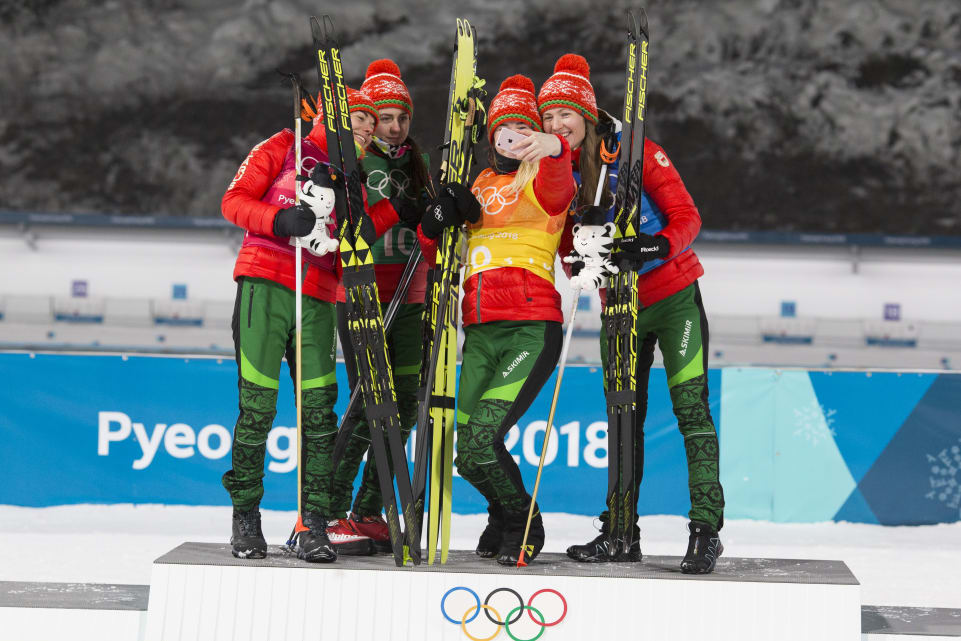
The Belarusian women’s biathlon team, with Nadezhda Skardino, Iryna Kryuko, Dzinara Alimbekava, and Darya Domracheva, snaps a podium selfie after winning their first relay gold on Thursday at the 2018 Olympics in PyeongChang, South Korea. (Photo: IBU/Biathlonworld)
Over the last 2 k of the race, Domracheva kept her competition behind her and crossed the line first for Belarus’s first relay gold in 1:12.03.4 (after its mixed relay team placed fifth two days ago).
Öberg passed Bescond to claim silver for Sweden, 10.7 seconds back, while Bescond anchored France to bronze (+17.6), ahead of Norway in fourth (+29.7), Slovakia in fifth (+38.4), Switzerland in sixth (+43.5), Poland in seventh (+43.6), Germany in eighth (+53.9), Italy in ninth (+1:04.1), and Canada in 10th (+1:33.4). The U.S. finished 13th (+2:01.9) of 18th teams.
With the first-place finish, Domracheva is the most decorated female biathlete in Olympic history, with six medals (four golds, a silver and a bronze) between three Olympics. Her husband, Ole Einar Bjørndalen of Norway, is the most successful Olympic biathlete of all time with 13 medals.
“I didn’t think that before you said it,” Domracheva, 31, said of her medal record during the post-race press conference. “Of course it was a lot of challenges for me on the way. Such days and such medals mean that it’s important to believe in yourself, important to believe in your team and overcome some difficulties, and then all doors are open for you.”
In the last four Winter Olympics, France has claimed three relay medals. Before Thursday’s bronze, their most recent was silver in 2010 and prior to that, bronze in 2006.
Sweden’s silver medal was its first in the women’s 4 x 6 k relay at the Olympics.
“This team worked together really hard for the last couple of years,” said Öberg, who won her first medal — gold — in the 15 k individual race earlier in the Games. “That we are here today is unbelievable. I’m really happy to share this medals with the rest of the girls.”
Crawford caught Ukraine’s Anastasiya Merkushyna in her final lap to anchor Canada to 10th while the U.S. finished three places later in 13th.
“My last loop I could hear Julia [Ransom] and Sarah [Beaudry] all around the course,” Crawford told FasterSkier. “They managed to be everywhere really cheering me on, and that fueled me to catch the Ukrainian.
“I’m just so proud of this women’s team,” Crawford added. “We fought so hard out there today. We’ve been through a lot this summer and really supported each other. And I’m just really proud of the team and I think biathlon in Canada has the potential to have a bright future.”
The women’s freestyle sprint podium on Saturday at the World Cup in Dresden, Germany, with Sweden’s Hanna Falk (c) and Maja Dahlqvist (l) in first and second, and American Sophie Caldwell (r) in third. (Photo: FIS Cross Country/Twitter)
FIS Cross Country World Cup (Dresden, Germany): Freestyle sprints
For her second-straight World Cup sprint, Sophie Caldwell of the U.S. Ski Team reached the podium in the women’s 1.2-kilometer freestyle sprint on Saturday in Dresden, Germany.
Caldwell placed third in the final behind Sweden’s Hanna Falk, who won it in 2:11.02 minutes, and Maja Dahlqvist, also of Sweden, who placed second (+0.23). Caldwell and Dahlqvist both lunged in a photo finish for second, which Dahlqvist took by 0.07 seconds.
Also in the final, which included four Swedes, Switzerland’s Laurien van der Graaff finished fourth (+0.58), and Sweden’s Anna Dyvik followed in fifth (+0.68) and Stina Nilsson sixth (+7.56) after tripping.
Falk started the day by winning the women’s qualifier in 2:06.34, by just 0.02 seconds over Nilsson in second. Caldwell qualified 11th (+2.02). and another American Ida Sargent made it into the heats in 14th (+2.44). Kikkan Randall missed the top 30 by 0.6 seconds in 34th (+6.57), Julia Kern placed 38th (+7.78), and Caitlin Patterson, of the Craftsbury Green Racing Project (CGRP), was 40th (+8.56) out of 49 women in the qualifying round.
Sargent finished fourth in her quarterfinal, 043 seconds behind Sweden’s Ida Ingemarsdotter in first, to finish the day in 17th overall.
For Caldwell, who went on to advance in second in her quarterfinal and third in her semifinal, the podium came after she finished second in the last World Cup skate sprint (the first stage of the Tour de Ski) on Dec. 31 in Lenzerheide, Switzerland.
Her boyfriend and fellow U.S. Ski Team member Simi Hamilton came close to reaching the men’s 1.2 k sprint final on Saturday after qualifying in 15th then placing second in his quarterfinal and fifth in the second semifinal, 0.38 seconds behind Sweden’s Emil Jönsson in first.
France’s Lucas Chanavat won the qualifier in 1:50.42, 0.15 seconds ahead of Norway’s Johannes Høsflot Klæbo in second. Hamilton was 4.32 seconds back in the qualifier, and his U.S. teammate Andy Newell also qualified in 18th (+4.91). Erik Bjornsen missed qualifying by 0.23 seconds in 32nd (+6.15) and Ben Lustgarten (CGRP) finished 49th (+8.64) out of 67 men.
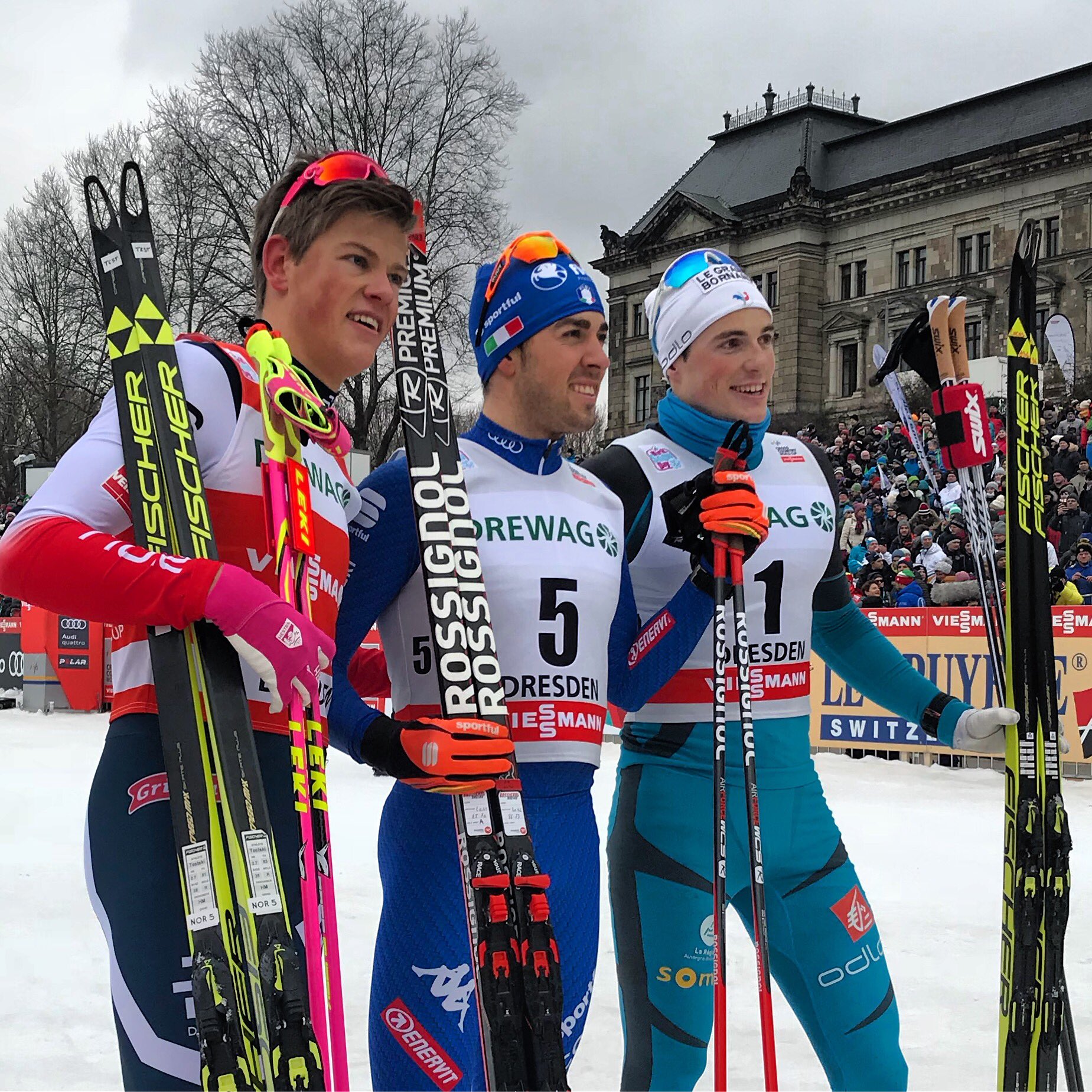
The women’s freestyle sprint podium on Saturday at the World Cup in Dresden, Germany, with Italy’s Federico Pellegrino (c) in first, Norway’s Johannes Høsflot Klæbo (l) in second, and France’s Lucas Chanavat (r) in third. (Photo: FIS Cross Country/Twitter)
While Hamilton’s day ended in the semifinals, putting him 10th overall (and Newell finished sixth in his quarterfinal to place 27th overall), Italy’s Federico Pellegrino timed his attack perfectly in the final, challenging Klæbo for the win down the finishing stretch. The Italian took it by 0.18 seconds in 1:52.77, Klæbo placed second and Chanavat third (+0.98).
France and Norway had two men in the final, with France’s Richard Jouve placing fourth (+1.23), Sweden’s Jönsson taking fifth (+2.36) for his best individual World Cup result since December 2016. Norway’s Even Northug finished sixth (+12.04) after breaking his pole out of the start.
Canada’s Julien Locke of the National U25 Team and Black Jack Ski Club had a career-best day, finishing 15th overall. He qualified 16th (+4.61) then placed third in his quarterfinal, crossing the line just 1 second behind Norway’s Fredrik Riseth, who won that heat. Hamilton was second in that quarterfinal, 0.67 seconds back.
Also for Canada, Bob Thompson (NTDC Thunder Bay) finished 50th in the qualifier (+8.67), Dominique Moncion-Groulx (Alberta World Cup Academy) was 59th (+9.99) and Antoine Briand (Pierre-Harvey National Training Centre) 60th (+10.12).
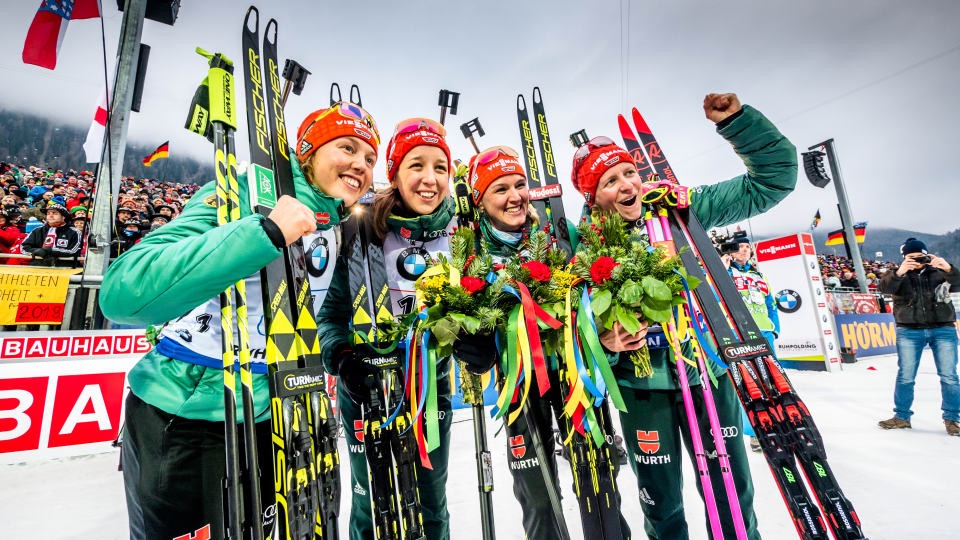
Germany’s Laura Dahlmeier, Franziska Preuss, Denise Herrmann and Franziska Hildebrand (left to right) celebrating their win in the women’s 4×6-kilometer relay at the 2018 IBU World Cup in Ruhpolding, Germany. (Photo: IBU/Biathlonworld)
IBU World Cup (Ruhpolding, Germany): Women’s relay
The teams from Germany and Italy dueled for the top position all race in Saturday’s 4 x 6-kilometer women’s relay at the IBU World Cup in Ruhpolding, Germany. Cheered on by some 20,000 home-crowd fans, Germany’s anchor Laura Dahlmeier stayed on the ski tails of Italy’s Federica Sanfilippo after the last shooting stage, then passed her before the last major climb and held a narrow lead around the rest of the course to cross the finish line first in a time of 1:08:47.0 hours, with Italy 2.9 seconds behind. German had a team total of zero penalties and nine spares.
“It’s incredibly fun to win in front of this audience here today,” Dahlmeier told German broadcaster ZDF in an interview right after the race, according to a translation. “I think this will boost our whole team morale. We showed today that we are a team to be reckoned with in relays. It was just a nice race.”
Germany with Franziska Preuss, Denise Herrmann, Franziska Hildebrand, and Dahlmeier was never more than 30 seconds behind the pace, even though Hildebrand temporarily fell back from leading the field to tagging off to Dahlmeier in fourth position.
“My race held all kinds of surprises today,” Hildebrand told ZDF with a laugh. “It started with a fall on an icy patch 100 meters after it began… Then I dropped my pole, also had to exchange the replacement one, and then three spares [in prone] to avoid the penalty. Today everything conspired in my race.”
Italy with Lisa Vittozzi, Dorothea Wierer (coming off a victory in the individual race on Thursday), Nicole Gontier and Sanfilippo had the best shooting performance of the day, with no penalty and just three spares.
“That last loop with Laura was really tough,” Sanfilippo said in the press conference. “I gave my best, I tried all for my team. I knew that I can be strong on the last loop. I tried to attack, but Laura was a little bit stronger. But I am also really happy that we finished in second place, I think that was really important for our team.”
Sweden with Linn Persson, Mona Brorsson, Anna Magnusson and anchor Jenny Öberg was third, 17.2 seconds back, with no penalty and five spares. Brorsson and Öberg managed to move the team up to the podium positions, for the second one in a row following a third place from Oberhof, Germany, a week ago. Before that, the Swedish women’s team had been on a six-year hiatus from those lofty positions.
“It’s cool to be on the podium again,” Persson said in the press conference.
“This is like our second home and there were a lot of Swedes here, so we had big support during the race on the tracks,” Brorsson added.” That was an advantage for us.”
Just a few seconds off the podium, Norway with Synnøve Solemdal, Tiril Eckhoff, Ingrid Landmark Tandrevold and Marte Olsbu was fourth (+23.1, with no penalty and nine spares), with Olsbu outsprinting Poland’s anchor Weronika Nowakowska on the finish stretch (+24.5, with no penalty and five spares). For both teams it was their best relay result of the season so far.
Switzerland with the three sisters Elisa, Selina and Aita Gasparin reinforced by Lena Häcki surprisingly led the race at the third exchange after Selina had moved them in front, but her youngest sister Aita could not hold that position, falling back with a penalty lap in the last standing stage to finish eighth (+1:37.1, with one penalty and 11 spares).
Biathlon Canada’s team of Emma Lunder, Julia Ransom, Sarah Beaudry, and Rosanna Crawford started the race with a setback after Lunder incurred a penalty in her prone stage, leaving the range in 23rd position at the end of the field and already almost a minute behind the leader. She managed to limit the gap with a clean standing stage to exchange still in 23rd position and 1:47 back.
Taking over Ransom then remained clean in both stages to move the team up to 17th, tagging off 2:14 behind. Beaudry only required one spare in her prone stage (0+1, 0+0) to improve to the 12th position even making up 3 seconds to the leaders.
Then Crawford, fresh off her first career podium in the individual race on Thursday, managed to also shoot clean in both stages and overtook the teams from Slovakia and Ukraine while further decreasing the gap to finish the race in 10th position, 1:56.7 back, with one penalty and just four spares.
“Things were a bit softer and slushy today compared to the individual, but nothing too bad,” Crawford commented on the conditions in an email to FasterSkier. “There was quite a bit of wind on the range, which I think was tricking people, the wind flags weren’t showing much but I had to make 6 left correction during zero [target practice].”
“Today was a solid showing from our team,” she added regarding their result. “Everyone cleaned standing, I think we can be really happy of this race, and take some real confidence going into the Olympic relay.”
Previously this season Canada had finished the relay in Oberhof, also Germany, in 14th position, and the first one in Hochfilzen, Austria, in ninth.
For US Biathlon with Susan Dunklee, Clare Egan, Emily Dreissigacker, and Joanne Reid, it was the first women’s relay of the year after missing out on the first two races of the season in this discipline.
Thus starting at the very end of the field, veteran Dunklee moved up through the pack and got through the prone stage with one spare. But then she had to fight against a penalty lap in her standing stage requiring all three spare rounds, leaving the range in 12th position. With the fastest course time on the opening leg, she managed to slightly decrease the gap to 21.6 seconds and made up three positions to exchange in ninth place.
Egan missed the first two shots in her prone stage, but hit the targets with her spares leaving the range over a minute back. She followed that up by cleaning her standing stage and left the range 1:29.5 back, then only lost five more seconds on the last loop to exchange in 14th.
Dreissigacker also needed just one spare in her prone shooting, but then incurred two penalties in her standing stage, doubling the gap and falling back to 19th position at the exchange and 3:51 back.
Anchor Reid needed three spares on her leg (0+2, 0+1) and managed to still overtake the teams from China and Finland to finish 17th, 4:57.7 behind Germany, with two penalties and 13 spares overall.
“Finally we had a full team and raced a relay!” Dunklee wrote on Instagram. “Competing on a foreign continent has its challenges.”
Ski Classics (Seefeld, Austria): 60 k Kaiser Maximilian Lauf
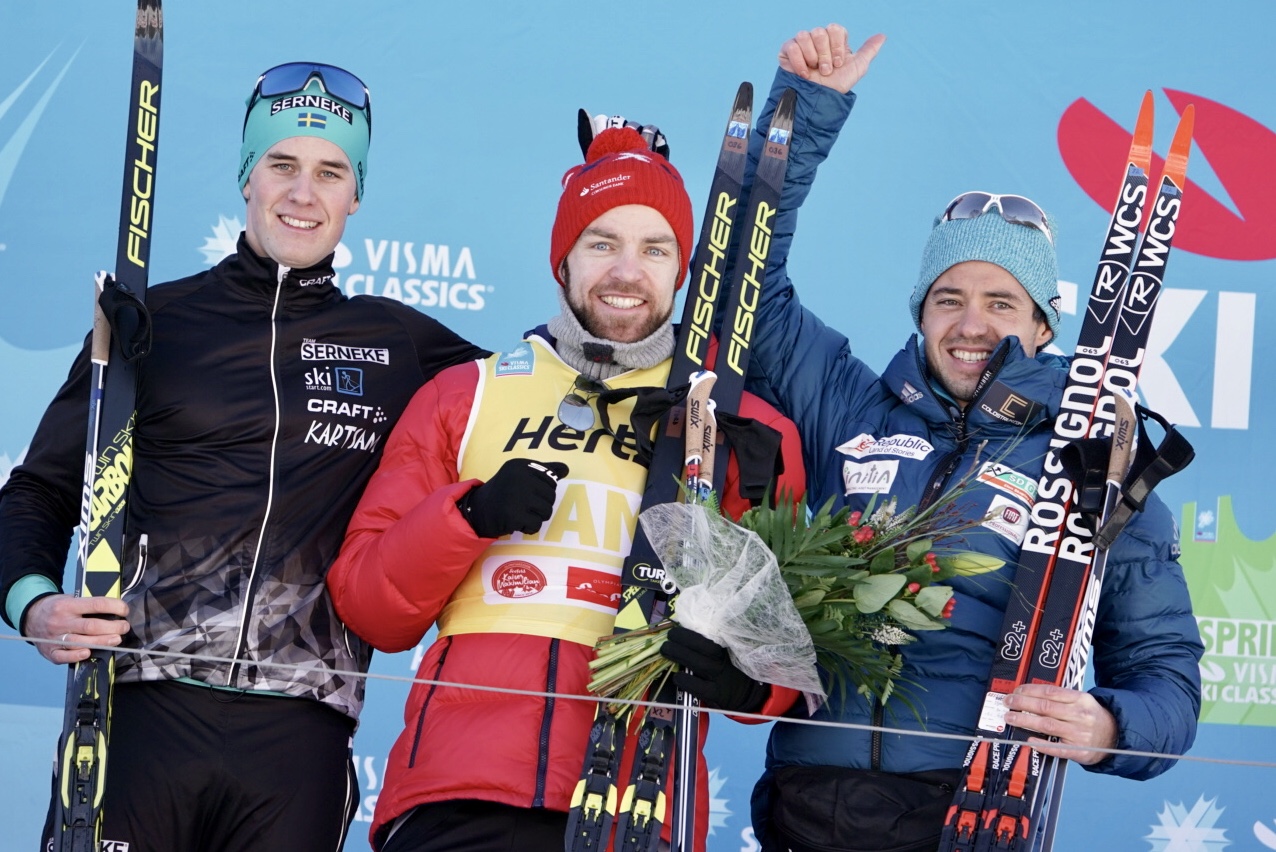
The men’s podium at the Kaiser Maximilian Lauf 60 k Ski Classics marathon in Seefeld, Austria, with Norway’s Tord Asle Gjerdalen (c) in first, Sweden’s Andreas Holmberg (l) second, and Russia’s Ilya Chernousov (r) third. (Photo: Visma Ski Classics)
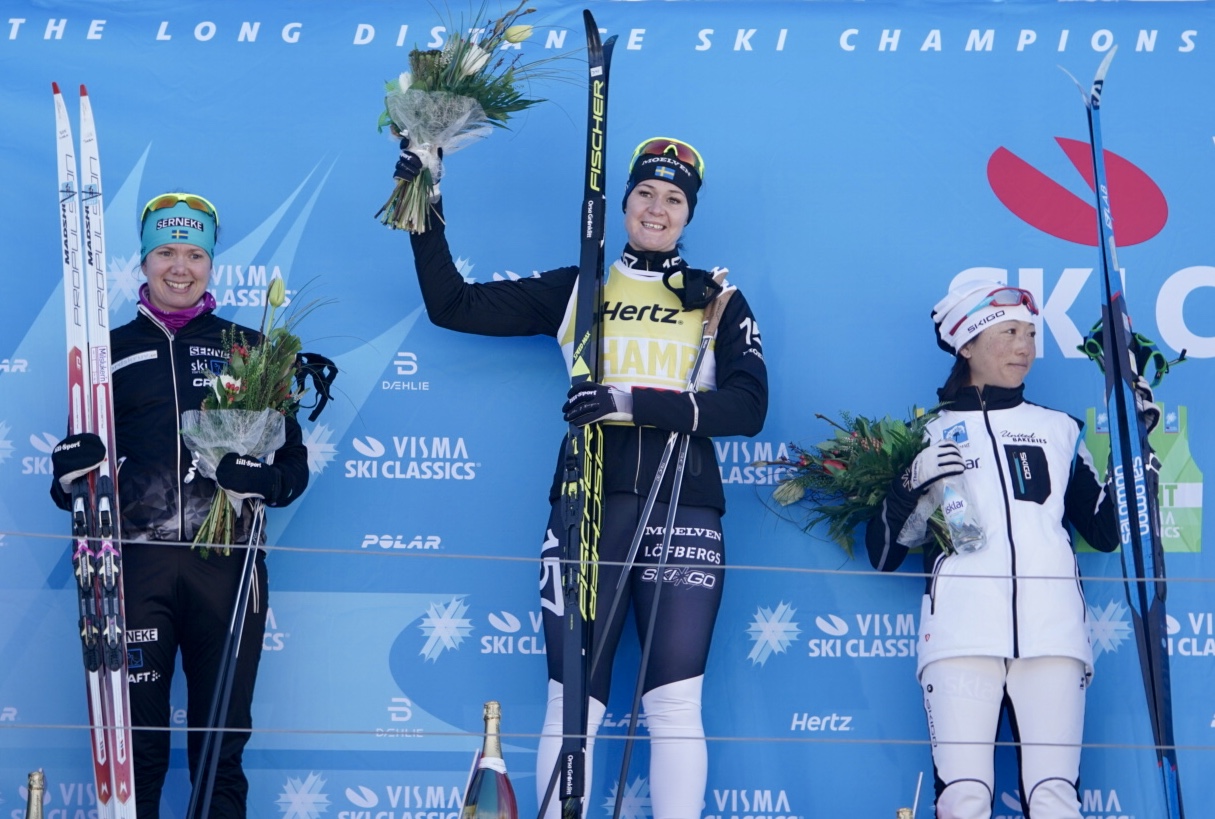
At the third Ski Classics event of the 2017/2018 season, the 60-kilometer Kaiser Maximilian Lauf on Saturday in Seefeld, Sweden’s Britta Johansson Norgren (Lager 157 Ski Team) and Norway’s Tord Asle Gjerdalen (Team Santander) took the women’s and men’s victories, respectively.
Johansson Norgren and Japan’s Masako Ishida (Team Koteng) broke away shortly after the start. The two went back and forth for a while until Johannson Norgren gapped Ishida in the Leutasch valley. While Ishida was caught by a chase pack with Sara Lindborg (Team Serneke), Kari Vikhagen Gjeitnes (Santander) and Lina Korsgren (Åre Ski Team), she reined Johansson Norgren back in on the long climbs after the valley. Ultimately, Johansson Norgren took the win in 2:49:16.0 hours, while Lindborg claimed second, 37.5 seconds back. Ishida finished third (+58.9), Gjeitnes placed fourth (+1:40.7) after injuring her ankle about 2 k before the finish, and Korsgren fifth (+2:05.1).
The women’s podium at the Kaiser Maximilian Lauf 60 k Ski Classics marathon in Seefeld, Austria, with Sweden’s Britta Johansson Norgren (c) in first, Sweden’s Sara Lindborg (l) second, and Japan’s Masako Ishida (r) third. (Photo: Visma Ski Classics)
“It was my plan to go full speed from the beginning,” Johansson Norgren said, according to a Ski Classics press release. “I knew Ishida will go fast in the climbs, but I felt strong from the beginning. It was really hard skiing alone in the valley, and when Ishida caught me up, I wasn’t sure if I could win the race. But the last part of the course was perfect for me and I had no problems securing the victory today.”
The Leutasch valley was the turning point of the men’s race as well, where Vinjar Skogsholm (Team Parkettpartner) and Andreas Holmberg (Team Serneke) broke away from the pack and had built a 90-second gap on the chase group as they left the valley. There on the first climb out of the valley, Holmberg pushed the pace and dropped Skogsholm, while Gjerdalen and Ilya Chernousov (Bauer Ski Team) worked to catch Holmberg up front. They caught him 3 k before the finish and Gjerdalen was first across the finish line in 2:27:49 hours, 14.8 seconds ahead of Holmberg in second.
Chernousov finished third (+32.0), Ermil Vokuev (Russian Marathon Team) was fourth (+1:07.6), and Anton Karlsson (Lager 157) fifth (+1:08.2).
“I didn’t like the fact that we gave too much leeway for Holmberg and Skogsholm,” Gjerdalen said, according to the press release. “I’m happy that Ilya helped me in our attempt to catch up with Holmberg, but I wasn’t really sure if we were going to make it. You never know how the other person is feeling in the front, what kind of skis he has and what goes on in his mind. But I managed to win today and it feels great to be back on the top.”
In the overall “Champion” standings, Nordgren leads with 450 points, 110 ahead of Lindborg in second. Gjerdalen is first in the men’s champion standings with 330 points, 50 points ahead of Morten Eide Pedersen in second.
The Ski Classics tour moves to Zuoz, Switzerland, next weekend for the 65 k La Diagonela.
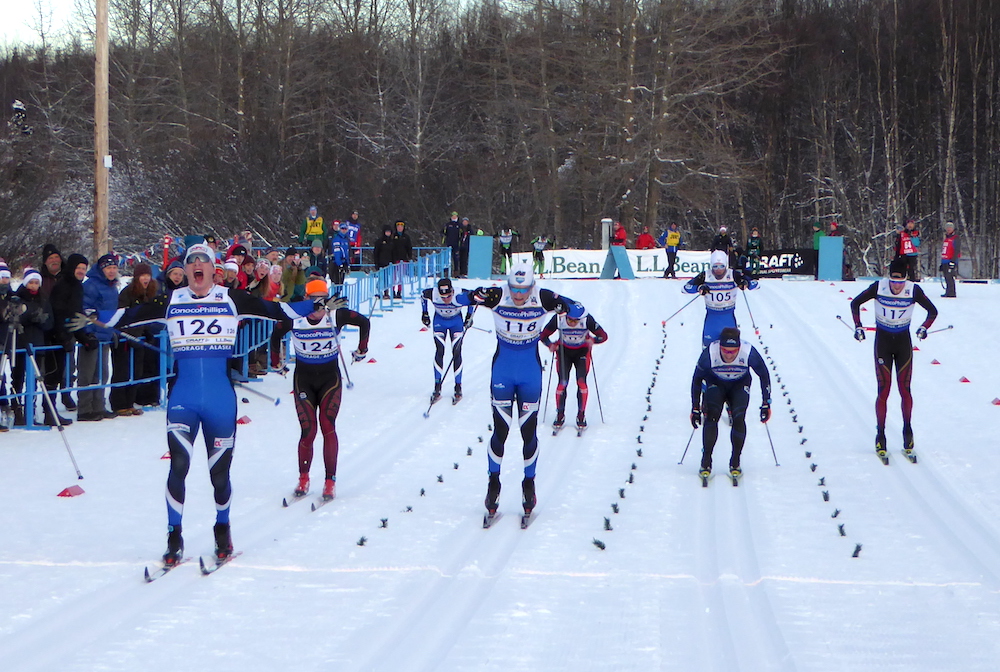
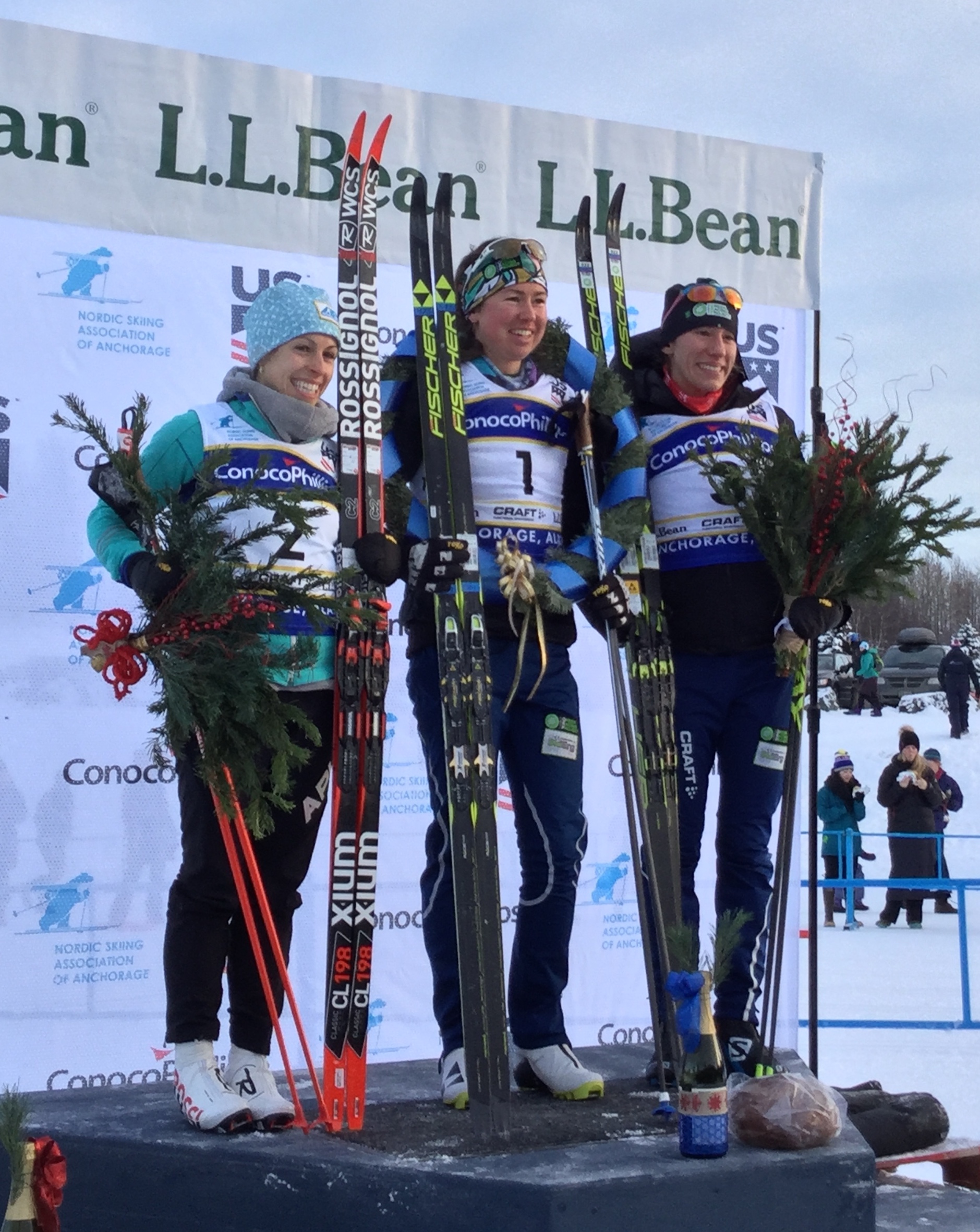
APU’s Tyler Kornfield (126) leads APU’s Eric Packer (118) and DU’s Eivind Romberg Kvaale (124) to the line in the men’s 30 k classic mass start at 2018 U.S. Cross Country Championships on Sunday in Anchorage, Alaska. Kornfield, Packer, and Kvaale finished first, second and third, respectively. Kris Freeman (10, second from left) was fourth overall and the third American.
U.S. Cross Country Championships (Anchorage, Alaska): 20/30 k classic mass starts
Sweden’s Hedda Bångman denied Caitlin Patterson of her first outright victory of the week at 2018 U.S. Cross Country Championships, but Patterson as the first American racked up her third-straight national title in the women’s 20-kilometer classic mass start at Kincaid Park on Sunday in Anchorage, Alaska.
The top-three Americans in the women’s 20 k classic mass start on Sunday at 2018 U.S. nationals in Anchorage, Alaska, with Caitlin Patterson (1) of the Craftsbury Green Racing Project (CGRP) in first, Rosie Frankowski of APU (l) in second, and Kaitlynn Miller (r) of CRGP in third.
Bångman, a 22-year-old freshman at the University of Colorado Boulder (CU), pulled off a 15.9-second win in the mass start, crossing the line in 1:00:55.3 hours. Patterson, of the Craftsbury Green Racing Project (CGRP), finished second, but was the top American in the event for the third time this week, and Rosie Frankowski, of Alaska Pacific University (APU), notched third (second American), 19.6 seconds back.
Rounding out the top 10 was Jessica Yeaton, who trains with APU and races for Australia, in fourth (+44.1), Kaitlynn Miller (CGRP) as the third American in fifth overall (+1:13.5), Alayna Sonnesyn of the University of Vermont (UVM) in sixth (+1:25.3), Chelsea Holmes (APU) in seventh (+1:55.4), Norwegian CU skiers Christina Rolandson and Anne Siri Lervik in eighth (+1:55.7) and ninth (+1:56.1), respectively, and Erika Flowers of the Stratton Mountain School (SMS) Elite Team in 10th (+2:14.6).
The men’s 30 k classic mass start was incredibly close, with APU’s Tyler Kornfield taking his first-ever distance national title (he was the 2012 classic sprint national champion) in 1:21:43.6. He edged his teammate Eric Packer by 0.7 seconds at the line, and Eivind Romberg Kvaale, a sophomore at the University of Denver (DU), finished 1 seconds back in third.
Kris Freeman (Caldwell Sport) was just off the overall podium in fourth (+1.6), but was the third American. Another DU skier, Dag Frode Trollebø, also from Norway, finished fifth (+2.0), and APU had three in the top six with David Norris in sixth (+2.5). Noah Hoffman (Ski & Snowboard Club Vail) finished seventh (+2.6), Scott Patterson (APU) eighth (+3.6), and Craftsbury’s Adam Martin and Ben Lustgarten followed in ninth (+14.7) and 10th (+14.9), respectively. With Brian Gregg (CXC/LNR/Team Gregg) in 11th (+16.1), the men’s top 11 were separated by less than 17 seconds.
IBU World Cup (Oberhof, Germany): Men’s and women’s relays
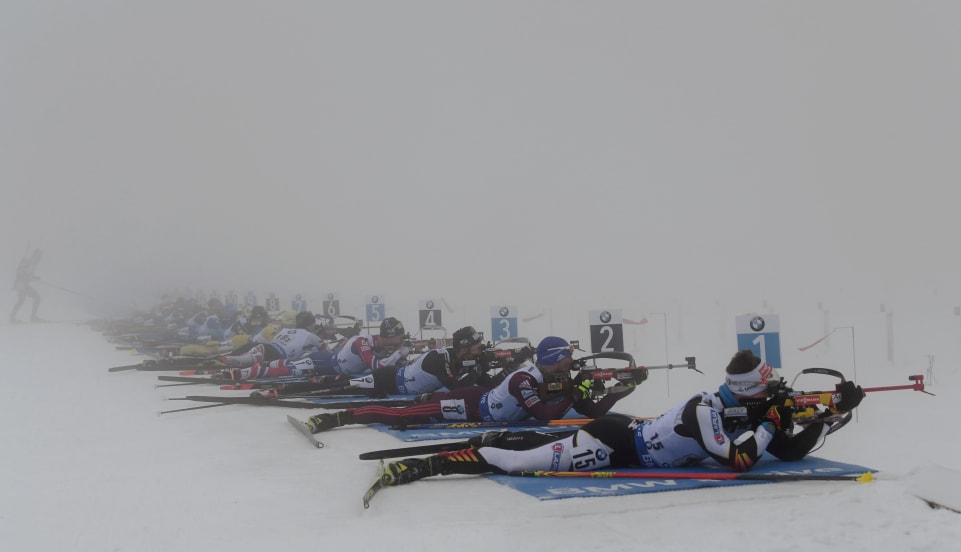
Racers on the range during the men’s 4 x 7.5 k relay on a foggy Sunday at the IBU World Cup in Oberhof, Germany. (Photo: IBU/Biathlonworld)
The Swedish men’s team and French women won the second relays of the International Biathlon Union (IBU) World Cup season on Sunday, with Sweden winning the men’s 4 x 7.5 k relay by 1:10.8 over Italy, and France besting Germany by 32.4 seconds.
Notably, most of the top teams didn’t start all of their “A” teamers.
In the men’s race, Sweden’s Martin Ponsiluoma, Jesper Nelin, Sebastian Samuelsson, and Fredrik Lindström combined for their first win together — and the first win for most of the members on the team.
“It is a dream when you are a kid to compete in a World Cup,” Samuelsson said, according to an IBU press release. “To have a win is really amazing!”
The Swedish women’s team also landed on the podium in third (+48.2).
“What a race by the whole team,” said Lindström, who also has one non-relay World Cup win (from 2012) to his name. “It could not be better.”
Conditions could not have been much more difficult for shooting on Sunday, with the fog that had descended early in the day for the women’s race worsening for the men’s race. When there wasn’t fog, there was wind.
Misses were common throughout the two races, and even with racers being able to use three spares per shooting stage to clean, there were a high number of penalty laps.
But the Swedish men kept their penalties to a minimum, with just one for the entire team and a total of nine spare rounds used among them. After Ponsiluoma came through the first exchange in sixth, Nelin skied them into third, Samuelsson picked off another place despite skiing a penalty after his standing stage to put them in second, and Lindström anchored them to first.
“The conditions today were so special. Somehow I felt not so nervous, I was calm and had luck on my side,” Lindström said at a post-race press conference about his nearly flawless shooting (0+0; 0+1).
“I have never [been first] before,” he added. “Not like this in a relay at least. That’s really fantastic.”
“I had to look up to see if I was aiming the right way,” Nelin said after cleaning prone (0+0) then using two spares to clean standing (0+2). “I had no idea where I was aiming, so it was really difficult. But I hit, and it was good. Maybe these conditions fit me and I should never see anything.”
Italy placed second with Thomas Bormolini, Lukas Hofer, Dominik Windisch, and Thierry Chenal combining for two penalties and 11 spares. Hofer had skied them up from eighth to second, and Windisch then took the lead on the third leg to put them in first at the final exchange, 1 minute ahead of Sweden. But Chenal slipped with the seventh-fastest last leg time and a penalty after standing.
“Being on the podium with the team is always a special feeling,” Hofer said at the press conference. “For Thierry, it’s the first year in the World Cup, and he does a really good job, not just today. I am really happy that he could close out this relay. Second place is like a win for us.”
Norway placed third (+2:04.6) with Vetle Sjåstad Christiansen, Henrik L’Abée-Lund, Lars Helge Birkeland, and Tarjei Bø. Together, they had three penalties (two from L’Abée-Lund and one from Birkeland) and 14 spares.
“I grew up on Holmenkollen so I practiced a lot there [in fog],” L’Abée-Lund said. “But today was really really hard, I didn’t see anything in prone. Standing was OK, but prone was really difficult.”
“It’s great to be on the podium,” Christiansen said. “Of course Norway always wants to win, but today we are very happy for our brothers in our neighbor-country Sweden.”
The Canadian men placed 10th (+6:23.1) out of 25 teams with Christian Gow, Scott Gow, Brendan Green, and Carsen Campbell having a combined six penalties and 20 spares. Three of those penalties came on Scott Gow’s second leg, two from Campbell’s anchor leg, and one on Christian Gow’s first leg.
After a penalty on his first prone stage (1+3), Christian cleaned standing with a spare (0+1) and tagged Scott in 11th, 53 seconds out of first. Scott then had two penalties in prone and three in standing, but managed to improve to eighth given how much everyone else was struggling with the shooting as well. Green kept them in eighth with two clean stages (0+2, 0+3), and Campbell, in his first World Cup relay, cleaned prone (0+2) but had two standing penalties (2+3) to put the team in 10th at the finish.
In an interview with German broadcaster ARD halfway through the race, Canadian coach Matthias Ahrens called the range conditions, which ranged from thick fog to unpredictable wind, “very hard to assess.”
“… To be honest, the good thing was that conditions were very bad,” he later added. “So regarding visibility, almost everyone was on the range at the same time [with the same irregular conditions]. They had to wait very long, and of course had bad conditions to shoot, but much of the field was there at the same time.”
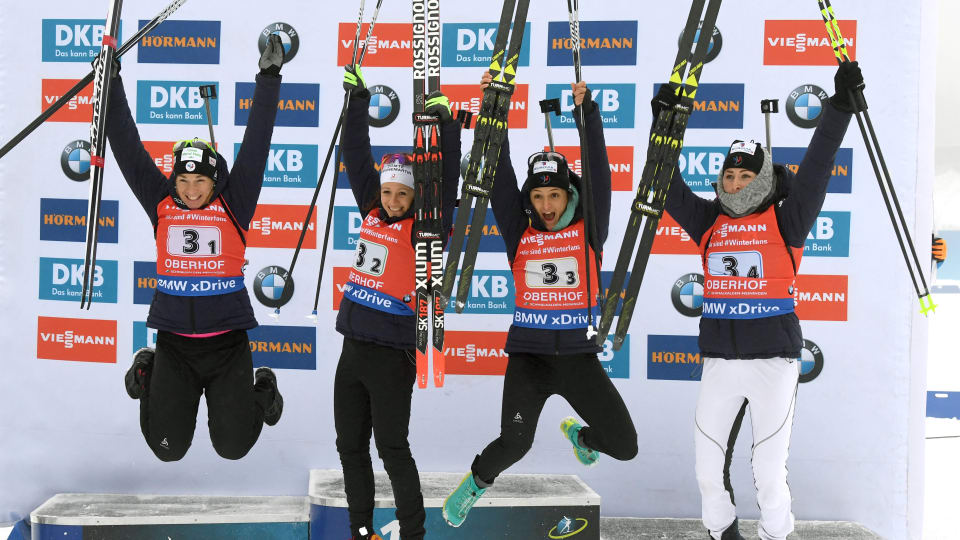
The French women’s team, of Anais Bescond, Anais Chevalier, Celia Aymonier, and Justine Braisaz, celebrate their relay victory on Sunday at the IBU World Cup in Oberhof, Germany. (Photo: IBU/Biathlonworld)
In the women’s race, with better shooting visibility, France’s Anais Bescond, Anais Chevalier, Celia Aymonier, and Justine Braisaz took the win in 1:12.42.4, with one penalty and 10 spares. After Bescond put them in first through the first exchange, 6 seconds ahead of Italy in second, Chevalier had to ski a penalty loop after prone but cleaned standings (1+3, 0+0) and tagged off in second, 23 seconds behind Italy, now in first.
One loop later, France was back in first thanks to Aymonier, who cleaned with just two spares (0+0, 0+2), and they extended their lead from 0.8 seconds at the last exchange to 32 seconds at the finish with Braisaz, who shot 0+1, 0+3, and skied the fastest anchor leg.
“I know that it’s always good for Justine to start in the first position, so I really wanted to pass the relay to her in that,” Aymonier said in a press conference after.
“I was nervous, too,” Braisaz said. “That kind of shooting turned my mind upside down, actually. The crowd was very loud, and … I wasn’t very focused on what I did. It was a bit foggy, too, so that made it harder. But finally it was a French day, maybe.”
“In my mind the whole team is really strong, and really able to get the first place,” Bescond said. “After years and years and years behind Germany’s team we finally did it. So just Oberhof spirit I think.”
Germany placed second with Vanessa Hinz, Denise Herrmann, Franziska Preuss, and Maren Hammerschmidt. They combined for two penalties and 13 spares; with a penalty on Hinz’s first leg and one more on Hammerschmidt’s last shooting. After being tagged in 14th, Herrmann skied them into fourth, 40 seconds out of first, and Preuss elevated them to second, which Hammerschmidt held onto.
“I was struggling a little bit in the prone shooting,” Herrmann said. “But the skiing was good today, and also the standing [shooting]. I tried to go fast on the track and catch some girls.”
Sweden, with Linn Persson, Anna Magnusson, Elisabeth Högberg, and Mona Brorsson, avoided the penalty loop and used eight spares to reach the podium for the first time in six seasons. In sixth place at the first exchange, they slipped one place to seventh on the second leg, but Högberg raced them up to fourth with near-perfect shooting (0+0, 0+1) with one leg to go. Brorsson then anchored them to third with clean shooting (0+2, 0+1) and the third-fastest last leg.
“It’s just super nice for us! I am super happy,” Magnusson said. “We were very emotional at the finish.”
When Brorsson was asked if she believe she could fight for the podium, she responded, “Not really. But I said to Linn, ‘Maybe it is our day today. Please let it be our day today.’ ”
The Canadian women finished 14th (+6:37.5), out of 20 teams, with two penalties and 13 spares. Sarah Beaudry initially put them in 15th after shooting 0+1, 0+2, then Julia Ransom had a standing penalty (0+2, 1+3) to slip one place to 16th. Megan Tandy picked off three places with clean shooting (0+0, 0+2) and tagged Emma Lunder in 13th, and Lunder had a penalty in prone but cleaned standing (1+3, 0+0) to finish in 14th.
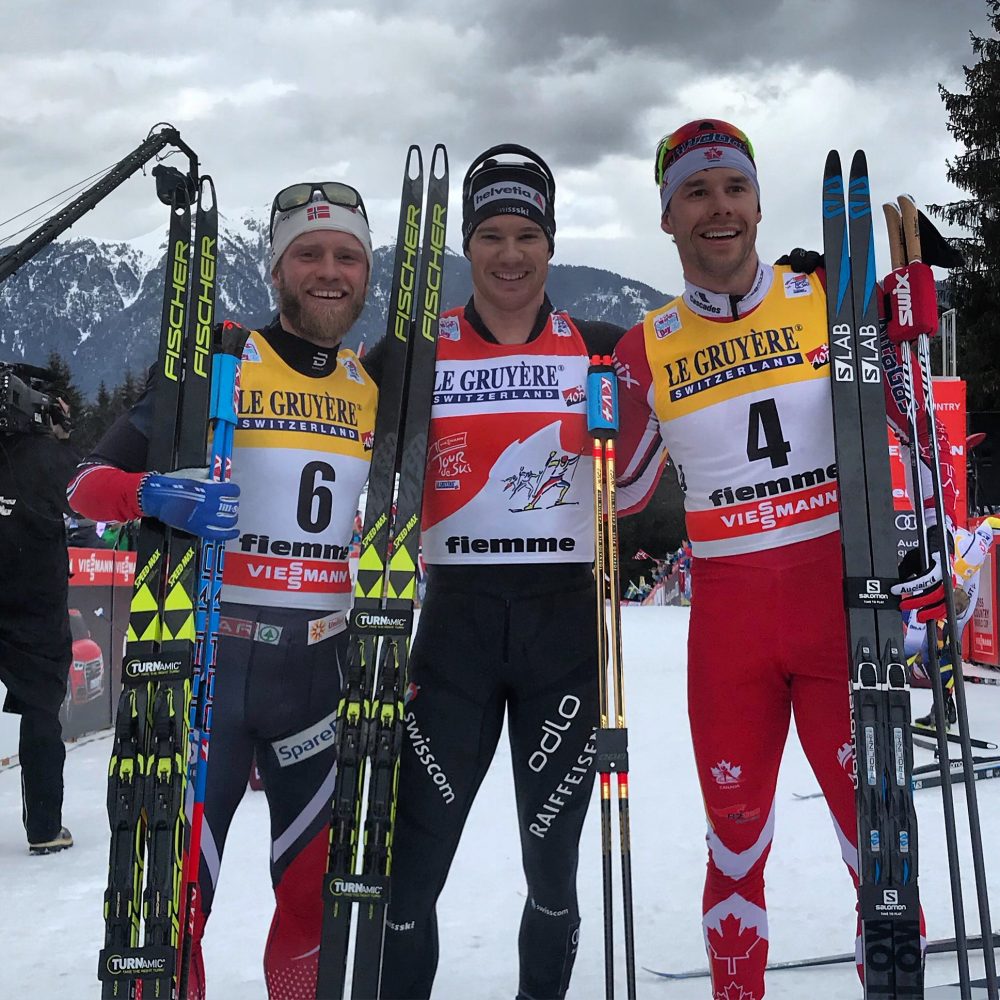
The men’s overall 2018 Tour de Ski podium atop Alpe Cermis after the final Stage 7 hill climb: with Switzerland’s Dario Cologna (c) in first, Norway’s Martin Johnsrud Sundby (l) in second and Canada’s Alex Harvey (r) in third. (Photo: FIS Cross Country/Twitter)
Dario Cologna of Switzerland added a fourth Tour de Ski (TdS) title to his list of accolades on Sunday, winning the 2018 edition of the race in dominant fashion, with a 1:26.5-minute win over Norway’s Martin Johnsrud Sundby. And Canada’s Alex Harvey scored his first TdS overall podium in third.
The 31-year-old Cologna started the 9-kilometer freestyle pursuit up Alpe Cermis 1:15 ahead of Kazakhstan’s Alexey Poltoranin in second. Russia’s Sergey Ustiugov, slated to start third, did not start due to a back injury. Thus Harvey was the third man off the start line, 1:23 behind Cologna.
(Sweden’s Marcus Hellner, 13th after Saturday’s Stage 6, also did not start the Tour’s final stage.)
Early on, Cologna started putting time into his competitors, extending his lead on Poltoranin to 1:20.5 and Harvey to 1:24 at 1.8 k.
By 4 k, however, Harvey had used his speedy skiing on the flatter portions of the race leading up to the climb to catch Poltoranin, and the two clocked through that checkpoint 1:19.4 behind Cologna. Behind them, Russia’s Alexander Bolshunov skied just ahead of Sundby, another 21 seconds and 22 seconds back, respectively, in fifth and sixth.
While Harvey clawed back a few more seconds on Cologna, he was still 1:17.8 back at 6.2 k, with Poltoranin just 0.7 seconds behind him in third.
Harvey remained in second until around 8.5 k; with just a half kilometer to go, Sundby had caught both Poltoranin and Harvey, passing them both. Sundby held that position and finished second, 1:26.5 behind Cologna, who won in 28:52.1.
Harvey stayed strong for third (+1:30.6) while Poltoranin dropped off the Canadian’s pace in the final half kilometer and finished fourth (+1:41.7). Norway’s Hans Christer Holund placed fifth (+2:17.8), Bolshunov lost a spot to finish sixth (+3:09.7), France’s Jean-Marc Gaillard finished seventh (+3:16.7), Sweden’s Daniel Rickardsson eighth (+3:20.8), and Russia’s Alexey Chervotkin and Andrey Larkov took ninth (+3:33.5) and 10th (+3:37.8), respectively.
France’s Maurice Manificat, known for his strength in freestyle hill climbs and pursuit races, rose from 14th to 11th (+3:45.7) with the second fastest time of day, 12.8 seconds slower than Sundby as the time of day winner in 28:36.4. Cologna’s time was fourth fastest (+15.7), behind Russian U23 skier Denis Spitsov in third (+14.3) (Spitsov started 20th and finished 13th). Holund’s time ranked fifth (+20.6) and Harvey’s time was sixth fastest (+23.6) of the 43 men that finished the race.
The lone American man to complete this year’s Tour, Paddy Caldwell (U.S. Ski Team) skied the 22nd fastest time of day for 38th overall (+11:54.8).
Heidi Weng (center) celebrates her second Tour de Ski victory, with teammate Ingvild Flugstad Østberg second and the U.S. Ski Team’s Jessie Diggins third. (Photo: FIS Cross Country/Twitter)
In the women’s hill climb that kicked off the day, Heidi Weng raced to her second consecutive TdS title. The Norwegian started the day within two seconds of teammate Ingvild Flugstad Østberg, and the two skied together for the flat section of the nine-kilometer stage of the competition. But when the climbing got steep on Alpe Cermis, Weng left her teammate behind and eventually racked up a 48.5-second win.
The battle for third was less predictable. Jessie Diggins of the United States started the day in fourth, but made up the ten seconds to third-place KristaPärmäkoski of Finland in the first few kilometers. The pair climbed together for a while before Diggins attacked. Pärmäkoski tired on the final sections of the Alpe Cermis and Diggins took the podium in definitive style, 2:23.2 behind Weng and 24 seconds ahead of Pärmäkoski. It’s the first overall Tour de Ski podium for Diggins or any American athlete.
Teresa Stadlober of Austria finished fifth (+3:09.4), Kerttu Niskanen of Finland sixth (+4:17.0), Russia’s Anastasia Sedova seventh (+4:49.6), and Switzerland’s Nathalie von Siebenthal eighth (+4:56.1).
Sadie Bjornsen started eighth and slipped one spot to finish ninth (+6:15.0), giving the U.S. two top-ten finishers in the Tour de Ski for the first time. Liz Stephen finished 16th (+8:25.8) and Rosie Brennan 24th (+10:59.6).
En route to her win, Weng notched the fastest time of the day on the 9 k stage. Stadlober’s time was second, Diggins third, Østberg fourth, and Stephen fifth.
32 women finished this year’s edition of the Tour de Ski.
Julia Ransom (Biathlon Canada) racing to ninth in the women’s 15 k individual on Wednesday at the IBU World Cup opener in Östersund, Sweden. In her first World Cup race of the season, it was Ransom’s career-best result and Biathlon Canada’s best individual result since 2015/2016. (Photo: Biathlon Canada/NordicFocus)
Entering this season, members of Biathlon Canada had everything to gain and not a whole lot to lose. They had already had their funding reduced to zero by Own The Podium, save for a $50,000-dollar provision that paid for a coach, and its athletes were left to determine their offseason plan: stay home to train or self-fund training camps elsewhere. Many chose to spend most of their summer at the team’s base in Canmore, Alberta, and most started the season on the fly — without any preseason tuneup races in Europe — this week in Östersund, Sweden.
Julia Ransom was one of those athletes. After prequalifying for Canada’s International Biathlon Union (IBU) World Cup Team for the first trimester of racing, Ransom, 24, jumped into the 2017/2018 season with the Östersund mixed relay this past Sunday — three days after flying over from Canada.
There, she raced the second leg of the relay and tagged off in 15th, down two spots from where her teammate Emma Lunder tagged her in 13th. The team ultimately finished 15th, with teammates Scott Gow and Brendan Green.
“Today was a tough day for me. My legs were lead on the course,” Ransom wrote in a post-race email to FasterSkier on Sunday.
Three days later on Wednesday, it was another ballgame. With little to lose in the women’s 15-kilometer individual in Östersund, Ransom raced to a career-best ninth, which stood as her team’s best non-relay result in two seasons.
In the first individual race of the season, Ransom is well on her way to securing a spot on Biathlon Canada’s 2018 Olympic team, meeting half of the team’s “Priority 2” Olympic criteria standards. She needs another top 16 to fulfill that second-tier criteria. Priority 1 is one top-eight result in a World Cup (or World Championships, in a championships year like last season) or a top-three in a World Cup relay.
So far, she is the only one on her team who has cracked the top 16 in two seasons. Last winter, her best result (and her previous personal best) was 18th at 2017 World Championships in the 15 k individual. Canada’s best non-relay result in 2016/2017 was Scott Gow’s 17th place in a 20 k individual World Cup race.
And again, it’s the first race of the season.
“I am still in shock with how well today went,” Ransom, a Penticton, British Columbia, native in her fourth World Cup season, wrote in an email to FasterSkier on Wednesday.
“It is such a relief to start racing again,” she continued. “I wasn’t too nervous today; I had a race plan that I had confidence in and I was excited to give it a go. I also was looking for redemption after my painful relay leg on Sunday.”
Conditions were chilly, at -12 degrees Celsius (10 degrees Fahrenheit), but calm, accounting for clean shooting for seven out of the top-nine finishers. Ransom was one of them.
She started 20th (out of 102) and cleaned all four stages in the longest-format women’s race on the circuit. In individual races, shooting is weighed heavily; a minute is added to a competitor’s final time for each missed shot. Fortunately for Ransom, she hit all 20 targets.
“I was getting some pretty exciting splits during the whole race (top 5, second place, catching the leader etc) so I had an idea this was going to be a good day as long as I kept my shooting together,” she reflected. “I took a sigh of relief after the 20th target went down and just tried to ski as well as I could to the finish. I did take look at the big screen as I left the range, just to make sure I was hearing the techs right!”
Ransom initially crossed the finish line in third, 28.8 seconds behind Sweden’s Mona Brorsson in first and 9.8 seconds behind Eva Puskarčíková of the Czech Republic in second. Both Brorsson and Puskarčíková also shot clean.
The 55th starter, Nadezhda Skardino of Belarus, ultimately posted the best shooting and skiing performance of the day, racing to her first World Cup win (and first podium in three years) in 42:57.4 minutes with 20-for-20 shooting. Norway’s Synnøve Solemdal started 75th and shot clean but came up 2.9 seconds short at the finish to place second, bumping Ukraine’s Yuliia Dzhima to third (+12.0). The top-four women all cleaned with another Ukrainian, Valj Semerenko, placing fourth (+30.1).
Slovakia’s Paulina Fialková finished fifth (+32.2) with a single penalty (0+0+0+1), while Brorsson ultimately placed sixth (+49.6) and Puskarčíková seventh (+1:08.6).
Ransom ended up ninth for her best World Cup level performance by nine places, ahead of Norway’s Marte Olsbu in 10th and about eight seconds behind France’s Justine Braisaz in eighth.
“Starting off the season with a top ten has validated the hard work our team has put in and also given me a lot of confidence going forward. It’s a great building block to say the least,” Ransom wrote.
Asked what she thought made the difference with her training this year, she explained that she’d honed in on increasing her shooting speed.
“It’s still a work in progress but I am happy where I am so far,” she wrote. “I also did a ton of extra strength work and core stability and it has proven to make a big difference on the skis.”
On Wednesday, Ransom’s overall shooting and range times ranked in the middle of the pack, around 50th, while her overall course time was slightly faster in 42nd.
Biathlon Canada Head Coach Matthias Ahrens praised Ransom’s ability to perform under pressure.
“Especially as the tension mounted, with each clean bout, Julia was closer the podium and she managed the pressure very well,” he said, according to a team press release. “She didn’t get too excited or too nervous, executing clean shooting each time.”
Four Canadians started Wednesday’s 15 k, with Rosanna Crawford finishing 39th (+3:32.6) with three penalties (0+0+1+2), following her crash in Sunday’s single mixed relay.
“Rosanna, considering the crash of Sunday, had a really nice race,” Ahrens said in the press release. “It wasn’t certain if she’d race today, and we went in with a strategy not to risk any further injury. She managed a very good race, with a quite good ski time. Her rifle also required repairs from Sunday’s race. Overall, not knowing how she would hold up, particularly on one of the hardest Individual courses on the circuit, it was a nice result for her, in the World Cup points.”
Megan Bankes finished 75th (+6:28.9) with three misses (2+1+0+0) and Lunder was 83rd (+7:06.3) with five penalties (0+0+2+3).
US Biathlon started three women, with Susan Dunklee leading the team in 53rd (+4:12.7) with four penalties (1+0+1+2). Clare Egan finished 79th (+6:52.5) with five misses (0+2+1+2) and Emily Dreissigacker was 81st (+7:03.5) with three misses (0+0+1+2).
The men start their season with a 20 k individual on Thursday at 11:15 a.m. Eastern Standard Time.
Norway’s Håvard Bogetveit leads American Lowell Bailey into the finish in a race for third in Sunday’s mixed relay at the IBU World Cup in Canmore, Alberta. The U.S. placed fourth for a team best in the event’s 11-year history. (Photo: Daniel S. Guay)
Considering anything better than sixth would have been a first-ever for either the U.S. or Canada in the IBU World Cup four-person (2 x 6 + 2 x 7.5-kilometer) mixed relay, that put Lowell Bailey in a bit of a position heading into the final loop of the last relay leg on Sunday.
Here he was, in fifth with 2.5 k to go, and just three seconds ahead of France’s Quentin Fillon Maillet in sixth and 4.6 seconds behind Canada’s Brendan Green in fourth. In front of both the Canadian and American teams, Norway set out on the final loop in Canmore, Alberta, 16 seconds ahead.
What or whom do you focus on? Should Bailey go for fourth? Should Green try to catch the Norwegian and the final spot on the podium? Or is it best to hold your own and not risk too much?
According to Bailey, a lot was going through his head after emerging from the final standing with clean shooting, thanks to two spares, shortly behind Green, who cleaned both stages without any spare rounds.
Tim Burke (l) after tagging U.S. teammate Lowell Bailey in fourth, about 36 seconds behind Norway in third, during the last exchange of the mixed relay at the IBU World Cup in Canmore, Alberta. (Photo: Daniel S. Guay)
“To be honest, I know [Fillon Maillet] and I know how good of a skier he is, he’s top 10 in the overall [World Cup],” Bailey said in a phone interview after the race. “So the thoughts going through my head on the last lap was, ‘OK, I’ve got to stay focused here,’ … My goal was to ski the first half of the loop well enough that France wasn’t going to get into my draft.”
The second half of the course was uphill and into the wind, and tactically, a skier able to catch a draft off someone in front of them on that part could be fresher for the last 700 meters to the finish.
In his effort to drop Fillon Maillet and make sure he wasn’t on the losing end of that strategy, Bailey inadvertently caught Green on the second-to-last major climb before the finish.
“It just so happened that I felt pretty good so I just went for it,” Bailey recalled.
After passing Green in fourth, he looked up and saw Norway’s Håvard Bogetveit, a 23-year-old Norwegian B-team member, in third.
“I didn’t see Norway until about halfway up that climb,” Bailey said. “I’m not sure if the Norwegian, if he was tired or what, but it didn’t become clear that there was a chance at third until that last uphill. Our team and ski technicians and coaches and staff were cheering me on and hoping that I could catch that gap.”
Meanwhile, Green, who had been tagged in seventh and climbed into fourth with perfect shooting, started to come undone.
“I really tried to race more aggressive. I had to. After the sprint on Thursday and knowing that my form wasn’t where it needed to be, I knew I couldn’t afford to hold back at all this race,” Green wrote in an email, referring to Canmore’s opening sprint last Thursday, where he placed 40th with one miss. “As for the shooting today I think I was just feeling confident. Canmore is often a very difficult range to shoot on, but I felt that [Saturday] I was really able to get a grasp of the wind while training, and was able to bring that confidence and shooting form into today.
“When I left [the range] in 4th I knew I was going to have my work cut out, especially given the pace of my second loop with France,” Green recalled. “That said, I gave it my all. I started to blow up and just couldn’t maintain the pace, but I think with a bit better form I could have hung on.”
Racing up and over the final climbs and into the finish, Bailey pushed to catch Bogetveit. He came within 1.7 seconds at the finish, but Norway secured the final spot on the podium, 1:23.8 minutes behind the German winners, and the U.S. claimed the so-called wooden medal in fourth. Regardless, it was the best showing for a U.S. mixed relay since its inception, officially at 2005 World Championships.
US Biathlon’s previous best mixed relay was sixth place four years ago at the World Cup in Kontiolahti, Finland, with Jay Hakkinen, Sara Studebaker, Annelies Cook, and Tim Burke. This time around, Susan Dunklee, Hannah Dreissigacker, Burke, and Bailey teamed up for fourth, 1:25.5 behind Germany. (Earlier in the day, Annelies Cook and Leif Nordgren raced the single mixed relay, placing 16th.)
“It didn’t become clear that there was a chance at third until that last uphill. Our team and ski technicians and coaches and staff were cheering me on and hoping that I could catch that gap.” — Lowell Bailey, who anchored the U.S. mixed relay to a team-best fourth on Sunday
“It’s easy to say, ‘Oh man, if I had known, I would’ve skied two seconds faster,’ but I really don’t think I could’ve,” Bailey said of finishing less than two seconds out of third. “I put everything I could have into that last lap. It’s bittersweet, but it’s also our best result ever in the mixed relay. … Fourth is where we ended up, and I think we have to be satisfied with that and keep that momentum going forward.”
Behind him, Green anchored Canada to sixth, 3.6 seconds behind Fillon Maillet, who notched fifth for France (+1:30.7). The result tied the Canadians’ best in a mixed relay after placing sixth in 2011 in Hochfilzen, Austria. Like the U.S., that team only included one of the same athletes from Sunday’s relay — Green — who had teamed up with Megan Imrie, Zina Kocher and JP Le Guellec in 2011. (Julia Ransom and Nathan Smith raced Sunday’s single mixed relay, placing 12th.)
“We’ll get to the podium eventually — it will just be a matter of small consistent steps, nothing drastic,” Green wrote. “The team was awesome today. Everyone did a really great job and set the race up well for the next person. I couldn’t have asked for more from them today.”
Germany in It to Win It
Germany topped the podium with a 1:12.9-minute win in the mixed relay on Sunday at the IBU World Cup in Canmore, Alberta, with (from left to right) Franziska Hildebrand, Franziska Preuss, Arnd Pfeiffer, and Simon Schempp. (Photo: Daniel S. Guay)
In the race for first, Germany established itself as a frontrunner early when Franziska Hildebrand tagged Franziska Preuss in third, just 1.4 seconds out of the lead. Switzerland’s Selina Gasparin had moved to the front of the first leg after cleaning her standing stage and leaving the range five seconds ahead of Italy’s Dorothea Wierer in second.
Wierer had previously been the first out of prone, 3.4 seconds ahead of Dunklee in second. Both women cleaned prone without needing any of three possible spares. Dunklee left the range two seconds ahead of Kazakhstan’s Alina Raikova in third, and almost immediately, the American caught Wierer. The two remained together off the front of the pack for the next loop, skiing 4.2 seconds ahead of Gasparin in third while Raikova dropped 13 seconds back to sixth before the second shooting.
There, Wierer needed two spares to clean and Dunklee used all three, but both avoided the penalty loop to leave the range in second and sixth, respectively. Wierer followed Gasparin into the final loop before the exchange, 5.1 seconds back, while Germany’s Hildebrand cleaned with no spares to move into third, 7 seconds out of first.
“I didn’t expect anything special today,” Dunklee wrote in an email, a day after placing 30th in the mass start with 10 penalties. “To be honest, I’ve been struggling this week to find my normal race hunger and my physical shape has felt flat.
Italy’s Dorothea Wierer (l) leads Susan Dunklee of the U.S. in first and second on the second loop of their first leg of the IBU World Cup mixed relay in Canmore, Alberta. Italy went on to place second and the U.S. notched a best-ever fourth. (Photo: Daniel S. Guay)
“[On Saturday] I dirtied a stage,” she said of missing every target — the opposite of “cleaning.” “Probably my first time doing so on the World Cup. Today I felt like a completely different animal. It was a good reminder that things can turn around suddenly.”
After leaving the range in sixth, 22.5 seconds behind Gasparin in first, Dunklee made up one place on the next loop to tag Dreissigacker in fifth, 16 seconds back, at the first exchange.
Meanwhile, Crawford used one spare on each stage to climb from ninth after the first shooting to fourth after the second stage. She left the range just ahead of Dunklee, 21.1 seconds out of first with one loop to go, and came through the exchange just 0.3 seconds behind Dunklee to tag Beaudry in sixth.
Also on that loop, Sweden’s Emma Nilsson slipped from fifth to eighth, and Norway’s Marte Olsbu improved from seventh to fourth.
“Susan passed me like I standing still, it was very impressive, but then she slowed down again and I tried to hang onto Norway once they passed me,” Crawford explained in an email. “It was a tough fight on that last loop, my legs and lungs were screaming, but I knew that in about 3min I could collapse in the snow.”
On the first shooting of the second leg, Preuss cleaned prone quickly to move into first, 5 seconds ahead of Switzerland’s Aita Gasparin, who also cleaned without any spares.
Dreissigacker leapt into third for the U.S. with flawless prone shooting as well, 17 seconds behind Preuss. She needed one spare to clean standing but remained in contention in fourth, just 0.2 seconds behind Sweden’s Mona Brorsson in third and 31.6 seconds behind Preuss up front with one loop to go.
“I’m happy with my whole race,” Dreissigacker wrote in an email. “One spare in standing is good for me. And I got some good rides, skiing behind [Norway’s Synnøve] Solemdal and then battling with Mona Brorsson on the last loop. Skiing with people really helps me ski more efficiently.”
Hannah Dreissigacker (r) skied the second leg for the U.S. mixed relay on Sunday and brought the team to fourth by the second exchange. Norway’s Synnøve Solemdal (l) tagged in second, 23 seconds behind Germany (not shown) in first. (Photo: Daniel S. Guay)
She held her position to the exchange, tagging Burke in fourth, 1.5 seconds out of third and 36 seconds from the lead.
“I think that confidence was the biggest key to my shooting today. I just told myself, ‘I can do this. Just do what I always do. It doesn’t have to be perfect, just normal,’ ” Dreissigacker explained.
After starting her season on the World Cup, Dreissigacker, a 29-year-old U.S. A-team member, was put on the IBU Cup squad in January. At the last IBU Cup in Arber, Germany, she placed 10th in the sprint and 16th in the pursuit to earn World Cup starts in Canmore. In the Canmore on Friday, she finished 28th in the sprint for one of her top-six career results.
“You have to really respect the trajectory that Hannah’s taken over the season,” Bailey, 34, said. “I’ve been there, I know what it’s like to start off a season with high expectations and fall short early on and have to refocus. A lot of athletes give up, but the fact that she stuck it out and really believed in her ability is a testament to her as an athlete and an individual.
“I think this week she showed that she can be there, and especially today — Susan had a great leg and handed off to Hannah in a fairly high-pressure scenario,” he continued. “… It was great to see Hannah handle that pressure. She had an awesome, awesome performance and kept us in contention for the medals.”
Last spring, Dreissigacker made up her mind that she would retire after this season. She explained that decision “has nothing to do with how this season has gone or will go. It’s a decision about my life and what I want to do with it and what will make me most happy. For this season I’ve been trying to not think about that decision and just ‘be here now’ and enjoy it,” she added.
In terms of pressure, she had a new way of handling that.
“I made a promise with myself a few weeks ago that I would be done with feeling pressure in a negative way about racing,” she wrote. “I definitely got nervous today, but I decided to call it ‘excitement’ and not think about pressure.”
“It’s a decision about my life and what I want to do with it and what will make me most happy. For this season I’ve been trying to not think about that decision and just ‘be here now’ and enjoy it.” — Hannah Dreissigacker, on her decision to retire after this season
Sarah Beaudry used just one spare to clean two stages during the second leg of the IBU World Cup mixed relay in Canmore, Alberta, to come through the second exchange in sixth. Canada ultimately placed sixth to tie the team’s best result in the mixed relay. (Photo: Daniel S. Guay)
Canada’s Beaudry, also getting the call up from the IBU Cup for the Canmore World Cup, kept her team in sixth with a perfect prone and just one spare in standing. In her second shooting stage, she moved into fifth, 10 seconds behind Dreissigacker in fourth, but slipped one spot back to sixth when Italy’s Karin Oberhofer passed her on their last loop.
At the second exchange, she tagged Davies 1:07.3 behind Germany, while the Germans skied 23 seconds ahead of Norway in second place.
“On the range overall I wanted to be confident and relaxed,” Beaudry wrote in an email. “I shoot on this range all the time know the winds and wanted to use that as an advantage. The last lap I tried to give it everything I had to be able to give Macx every extra second I could. I was very happy with my performance and as a team we were definitely stoked with where we ended up tying Biathlon Canada’s previous personal best.”
Two days earlier, the 21-year-old British Columbia native posted her World Cup personal best in 38th.
“It has definitely been super exciting posting my best results at home in Canmore, for my family to be able to watch and all the Canadian Biathlon community,” Beaudry wrote. “I feel like I managed to take full advantage of my start spot in the sprint with the windy conditions being worse at the beginning. However this being my second World Cup weekend of the season and my other weekend [in Ruhpolding, Germany] being a last minute decision and three days of driving before the race I was able to be way more prepared for this event.”
The third-leg skiers for the U.S. and Canada, Burke and Davies, put their teams in fourth and seventh, respectively, by the final exchange.
Burke came within six seconds of third place after a clean prone without any spares, but had some trouble in standing, using all three spares and appearing to have problems loading at least one of them. He ended up with a penalty — the first and only penalty for the U.S. — and left the range in fifth, 1:36.6 behind Germany’s Arnd Peiffer, who shot flawlessly in both stages to take a 56-second lead over Norway.
Canada’s third leg of the mixed relay, Macx Davies used one spare to clean his standing stage and left the range in seventh before handing off to anchor Brendan Green (not shown) in the IBU World Cup mixed relay in Canmore, Alberta. Canada placed sixth to tie a team best. (Photo: Daniel S. Guay)
Thirty seconds behind Sweden’s Tobias Arwidson with one loop to go, Burke caught the Swede and moved back into fourth by the exchange — 36 seconds behind Norway in third.
As for Davies, he used two spares in prone and one to clean standing, leaving the range in seventh after both stages.
“After getting tagged in sixth I was hard pressed to stay with [Switzerland’s] Benjamin Weger and lost a bit of time on the first loop, so I was a little worried that I was skiing slowly, but when it came to the shooting range, that’s where I know you can make lots of time,” Davies wrote in an email. “So I was very focused going into prone on a fast clean bout. … My performance today was good [on] skis and in the range, nothing exceptional but I had a good day out there and very happy that I could stay in 7th on the final lap.”
Germany’s anchor, Simon Schempp mostly had to go through the motions to ensure the win after receiving the tag in first, 1:02.9 ahead of Italy in second and 1:03.6 clear of Norway in third. (Bailey was 1:40 back at the tag in fourth.)
Schempp used one spare in both stages and ended up sealing the win in 1:05:38.8, by 1:12.9 over Italy’s Dominik Windisch in second place and 1:23.8 ahead of Norway’s Bogetveit in third.
“I still started out fairly hard, make my own race, work clean on the shooting range, and after the standing shooting I noticed that it would be sufficient,” Schempp said in a post-race interview with Germany’s ZDF. “But before that you are never sure, anything can happen, so you can’t relax.”
He felt comfortable enough to high-five some of his teammates on the final loop.
“I saw a few [national-team] green jackets out of the corner of my eye on the edge of the course. And on the prior loops I already heard a few familiar voices,” he recalled. “So when you have the time and the whole team is celebrating with you, that’s something you can enjoy very much.”
Italy placed second in the mixed relay at the IBU World Cup in Canmore, Alberta, with Dorothea Wierer (second from r), Karin Oberhofer (second from l), Lukas Hofer (r), and Dominik Windisch. (Photo: Daniel S. Guay)
For the Italians (Wierer, Oberhofer, Lukas Hofer, and Windisch), another podium in Canmore was beginning to create expectations. In Canmore, Wierer finished third in the women’s sprint on Friday, then won the mass start on Saturday and Windisch won the men’s mass start that same day.
“Everyone at home expects bigger things every week,” Italy’s third leg, Hofer told the IBU afterward. The team finished with one penalty (from Oberhofer’s prone stage) and required 10 spares.
And Norway’s B-team (with its top athletes opting to skip the Canmore weekend and come to Presque Isle instead) wasn’t surprised with a podium: “We always try to be on the podium, but you never know,” Olsbu told the IBU. Olsbu, Solemdal, Alexander Os, and Bogetveit combined for third with seven spares and no penalties.
For Bailey, fourth (with a team total of one penalty and nine spares) was one step closer to the medals — a goal US Biathlon has been focused on for the last several years, specifically in the mixed relay, he said.
“Sochi was the first Olympics where we had it as a medal event now it’s a legit medal event,” he explained. “We realized that we had strong women at the top and strong men at the top and when you combine those, we start to be able to compete with the powerhouses.”
While fourth was “bittersweet,” he added that it was promising.
“It was by no means a perfect race for any of us. I guess that’s a good thing… that means you can do better,” he said. “We can feel satisfied, but we also have the momentum and the knowledge that … if we put together an excellent performance, we can be on the podium.”
“I’ve dreamed of being in the top 6 in a world cup relay for years and to be 2 seconds out of third is absolutely incredible!” Dunklee wrote. “Today was a great team effort. Hannah had a very rough start to the season with injury and it’s been truly inspiring to watch her turn it around. Lowell skied a heroic last loop leaving his pack behind and almost catching Norway, who didn’t seem within reach when he left the range.”
Canada’s Brendan Green acknowledges the crowd at the IBU World Cup mixed relay in Canmore, Alberta, after anchoring his team to sixth, tying a team best. “It was really fun and definitely special,” he said of the experience racing at home. (Photo: Daniel S. Guay)
Canada, with no penalties and six spares, was happy, too.
“We had a different team out there today with Brendan and I the veterans and Macx and Sarah the young guns in their first mixed relay!” Crawford pointed out. “We are showing more depth in our team that we can put together 4 athletes and come out with a pretty good mixed relay! We’ve been knocking on the door of the podium for mixed relay for a while and I am sure it will happen some day!
“It was so special having so many fans in the crowd, friends and family, that everywhere on course people were cheering for you, during warmup, the race and cool down!” she added. “Even though it was a disappointing sprint, it was super cool to have everyone cheering for me, and that they didn’t care how I did, they were just pumped to watch me race!”
On Monday, the U.S. team flew on a direct charter to Presque Isle, where the World Cup will pick back up again on Thursday through Sunday. The U.S. team will race on home soil while the Canadians still aiming to qualify for World Championships (Emma Lunder, Zina Kocher, Audrey Vaillancourt, and Erin Yungblut) will race in Maine, along with Smith, who ranks 19th in the overall World Cup standings.
Those prequalified for World Championships, including Crawford, Beaudry, Green, Davies, Ransom, Scott Gow, and Christian Gow, will train in Canmore until Feb. 22.