From the FasterSkier archive — posts syndicated from athletes’ and coaches’ own blogs between 2004 and 2012, kept online as published. Current coverage is at fasterskier.com.
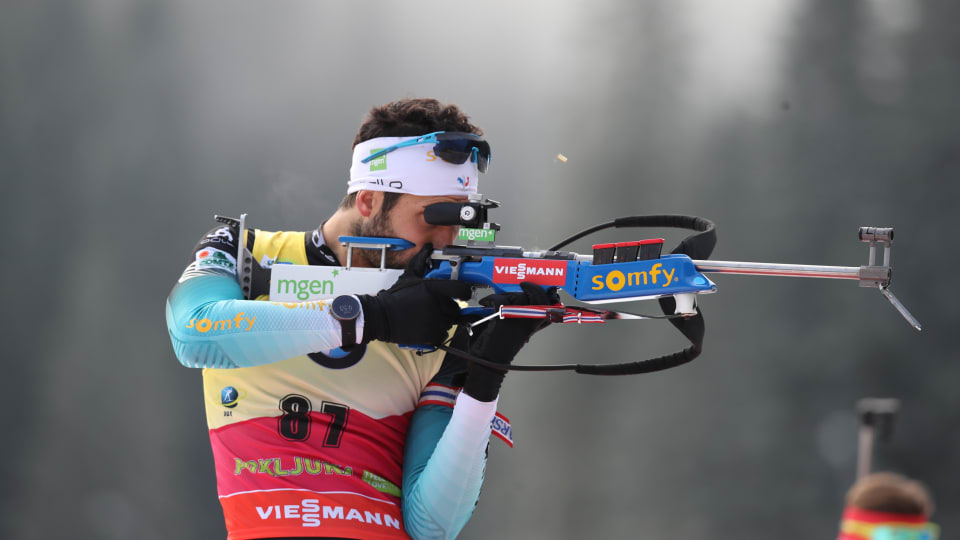
France’s Martin Fourcade shooting clean ans skiing fast as he won the men’s 20 k individual race in Pokljuka, Slovenia, site of the IBU World Cup’s first series of races this season. (Photo: Biathlonworld,com)
IBU World Cup Pokljuka, Slovenia 20 k/15k Individual
Not the least of the myriad variables affecting biathlon races, fickle weather has played games in Pokljuka, Slovenia, site of the first round on the IBU World Cup. The men’s 20-kilometer individual race was originally scheduled for Wednesday, but was postponed to Thursday due to fog.
For each missed shot in the individual races, athletes are penalized one minute. With a large cost for any shooting mistake, a single miss can punish a potential podium performance.
None other than France’s Martin Fourcade took the win today in 47:09.2 minutes. (Fourcade is a seven-time winner of the overall IBU World Cup.) Fourcade shot clean in all four of his shooting bouts. And shooting clean was the theme for the podium, the top-three finishers had no misses on the shooting range.
Second place went to Johannes Kuehn of Germany, finishing 4.2 seconds back. Third place was secured by Simon Eder, who stopped the clock 19.7 seconds back.
For Canada, Scott Gow skied to 14th (+1:43.3) with one miss. Brother Christian Gow was 16th (1:59.2) after also missing only a single target. Brendan Green skied to 100th (+9:04.1) after difficult shooting, during which he missed seven targets. Nathan Smith did not start.
For the U.S. Leif Nordgren was the best placed American in 40th (+3:24.5). Nordgren missed two shots. Teammate Sean Doherty was 59th (+4:28.2) after missing three shots, Max Durtschi was 102nd (+9:37.0), after missing six targets. Travis Cooper raced to 105th (+10:02.0), while missing six shots.
The women’s 15 k individual was won by Ukraine’s Yuliya Dzhima 43:06.6 minutes. She was clean in her shooting in her first career IBU World Cup win. Poland’s Monika Hojnisz had a single penalty as she placed second (+5.9). The result was a best-ever result for Hojnisz at this level of competition. The Czech Republic’s Marketa Davidova also missed a single target on her way to her first career podium, finishing 16.5 seconds back in third place.
U.S. biathlete Susan Dunklee missed one target on her way to placing 11th (+1:00.09). With each miss adding an additional minute to an athlete’s finishing time, it was a solid effort and indicator for Dunklee.
“I’m psyched to have a great result so early in the season,” Dunklee emailed FasterSkier.
Dunklee, the U.S. team veteran, made note of U.S. skier Clare Egan’s race day performance. “Clare also threw down an impressive ski split, so in spite of our 3 start quota challenge, our team future looks bright,” Dunklee added.
Egan placed 60th (+4:23.3) after amounting five penalties. She raced the 13th fastest ski time. Emily Dreissigacker, also for the U.S., placed 69th (+5:17.0). Dreissigacker has four penalties.
Canada’s Megan Tandy finished in 62nd (+4:30.4), after missing three shots. Rosanna Crawford, also for Canada,was 64th (+4:34.7) with four misses, Meghan Bankes 71st (+5:22.) with three misses, and Nicole Moser 98th (+10:20.4) with seven misses.
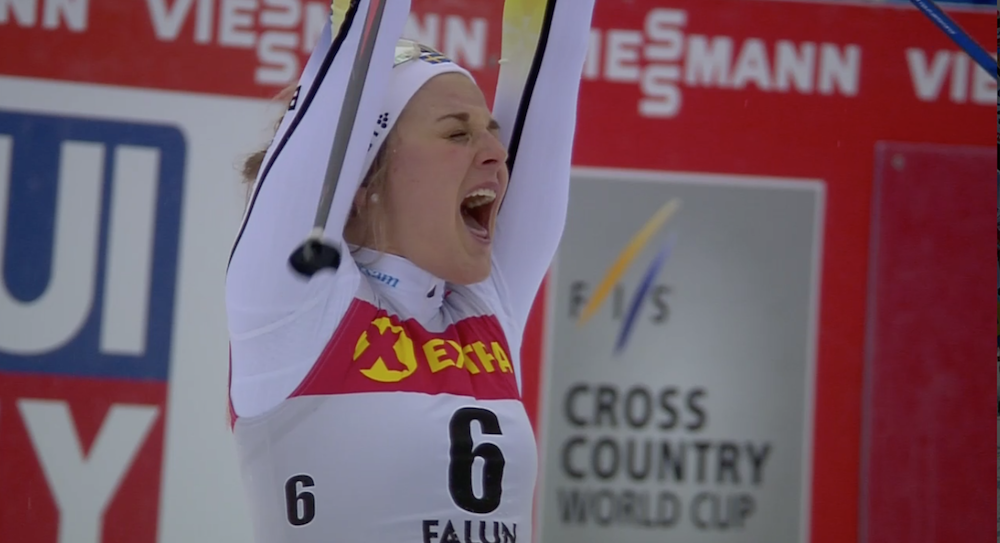
Sweden’s Stina Nilsson celebrates her second-straight World Cup sprint victory on Saturday after winning the 1.4 k freestyle sprint at home in Falun, Sweden.
FIS Cross-Country World Cup (Falun, Sweden): Men’s & women’s freestyle sprints
[UPDATED] Kikkan Randall reached the final for the first time since March 2015 on Saturday in the women’s 1.4-kilometer freestyle sprint at the World Cup in Falun, Sweden. The American qualified 26th and went on to advance in second out of her quarterfinal and semifinal to reach the six-woman final, where she ended up fifth.
Sweden’s Stina Nilsson won the final by one-hundredth of a second over Norway’s Maiken Caspersen Falla, finishing in 3:00.24 minutes. Nilsson had started the day by qualifying in sixth, 2.52 seconds behind Norway’s Marit Bjørgen, who won the qualifier in 3:00.64. This is Nilsson’s second-straight World Cup sprint win after skipping the freestyle sprint in Toblach, Italy, following the Tour de Ski.
While Bjørgen went on to win her quarterfinal, she finished fifth in her semifinal to end up ninth on the day.
Norway had two on the women’s podium with Heidi Weng in third, 1.88 seconds behind Nilsson. Finland’s Krista Parmakoski placed fourth (+1.99), and Randall was fifth (+2.56) for her best result in two years (she took last season off to have a baby). Sweden’s Jonna Sundling reached the final as well and finished sixth (+8.02).
Five U.S. women qualified for the heats, with Jessie Diggins qualifying fifth and ultimately crashing in her semifinal, where she finished fifth. That put her 10th overall on the day. Sophie Caldwell qualified third and finished fourth in her quarterfinal for 16th on the day, Sadie Bjornsen qualified 17th and also finished fourth in her quarterfinal for 19th overall, and Ida Sargent made the top-30 qualifying cutoff in 30th, then placed fifth in her quarterfinal for 25th overall.
Bjørgen topped the freestyle sprint qualifier on Saturday morning, clocking the fastest time around the 1.4 k course by just 0.08 seconds over Hanna Falk of Sweden.Caldwell qualified third (+1.23),Digginsqualified fifth (+2.39),Bjornsen17th (+5.04),Randall26th (+6.64), andSargent 30th (+8.28). Rosie Brennan (U.S. Ski Team) missed the cut in 37th (+10.90) and Liz Guiney finished 56th (+32.87). The lone Canadian woman racing on Saturday, Cendrine Browne placed 46th (+14.02).
In the men’s 1.4 k freestyle sprint final, Italy’s Federico Pellegrino held off three Norwegians and two Swedes to win in 2:45.77. The defending Sprint World Cup champion qualified second and went on to win his quarterfinal and semifinal before taking the final by six-hundredths of a second.
Norway took the remaining spots on the podium with Emil Iversen in second (+0.06) and Sindre Bjørnestad Skar in third (+0.47). Sweden’s Oskar Svensson was three-hundredths of a second off the podium in fourth (+0.50). The fastest qualifier in 2:34.49, Norway’s Johannes Høsflot Klæbo reached the final and ultimately took fifth (+1.32), and Sweden’s Teodor Peterson placed sixth (+2.08).
Canada’s Len Valjas was the top North American in 10th. He qualified 20th, advanced in second from his quarterfinal and finished fifth in his semifinal.
American Andy Newell was 16th after qualifying in 25th and finishing third in his quarterfinal. U.S. teammate Simi Hamilton followed in 18th, after qualifying 13th and finishing fourth in his quarterfinal.
In the men’s qualifier, Klæbo was 1.05 seconds faster thanPellegrinoand another 0.02 seconds faster than Russia’s Sergey Ustiugov in third.
For the U.S., Hamiltonqualified 13th (+4.52) andNewell qualified 25th (+6.74). Erik Bjornsen placed 43rd (+9.30) and Matt Gelso 59th (+13.12).
Valjaswas the lone Canadian man to make the heats, qualifying 20th (+6.22). The only other starter, Alex Harvey, placed 46th (+9.71).
IBU Open European Championships (Duszniki-Zdrój, Poland): Men’s & women’s pursuits
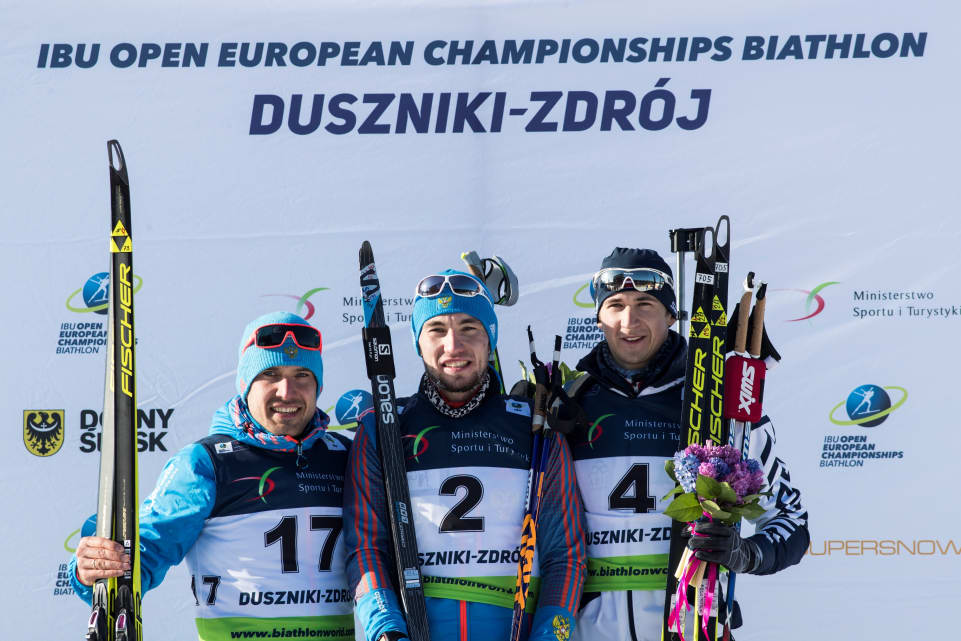
The men’s pursuit podium at 2017 IBU Open European Championships on Saturday in Duszniki-Zdrój, Poland, with Russia’s Alexander Loginov (c) in first, Evgeniy Garanichev (l) in second, and Latvia’s Andrejs Rastorgujevs (r) in third. (Photo: IBU)
Russia’s Alexander Loginov racked up his second win of the 2017 International Biathlon Union (IBU) Open European Championships on Saturday in the mens’ 12.5-kilometer pursuit in Duszniki-Zdrój, Poland.
After starting second, 5 seconds behind Bulgaria’s Vladimir Iliev, who won Friday’s sprint, Loginov proceeded to clean three straight stages before missing one on his final standing to cross the line first in 31:46.2 minutes.
“It was not as easy as it seemed, because from the first loop Vladimir set a really good speed,” Loginov said, according to an IBU press release. “Today we had great sunny and windless weather again, so I managed to shoot well. Probably that is why it [looked] so easy.”
Russia took first and second place with Evgeniy Garanichev following 27.8 seconds later, after starting 17th (56 seconds out of first) and shooting 19-for-20 (0+0+1+0).
“After yesterday’s sprint, I managed to work well and to show good result in pursuit, so I’m sure glad to win the silver medal,” Garanichev said, according to the IBU.
Latvia’s Andrejs Rastorgujevs improved on his fourth place in the sprint to reach the pursuit podium in third (+59.5) despite four penalties (0+1+1+2).
“On the last loop I had the information about the guys who were behind me and in front of me,” Rastorgujevs said, according to the IBU. “I was just fighting and did all I could do to get to the podium.”
Bulgaria’s Krasimir Anev, who started third, slipped to fifth (+1:28.6) with two penalties (0+1+1+0), behind Russia’s third man in the top four, Alexey Volkov in fourth (+1:01.6). Iliev as the first starter ended up 11th (+1:41.7) with six penalties (2+2+0+2).
The two Americans who had qualified for the pursuit by placing in the top 60 of Friday’s sprint, Paul Schommer and Alex Howe improved to 48th (+5:07.1) and 51st (+5:42.3), respectively.
Schommer started 58th, just ahead of Howe in 59th, and missed five targets, all in his first two prone stages (3+2+0+0). Howe accumulated four penalties (1+2+1+0).
No Canadians qualified for the pursuit.
[UPDATED] In the women’s 10 k pursuit that followed, Russia’s Irina Starykh picked up her second win and third consecutive podium of the championships, with clean shooting en route to a 19.8-second victory in 30:04.4.
Starykh started third, 38 seconds behind Ukraine’s Juliya Dzhyma and 11 seconds after her Russian teammate Svetlana Sleptsova, respectively. Dzhima missed two on her last two standing stages (0+0+1+1) to slip to second, and Sleptsova dropped one place to third (+32.1) with one prone penalty (0+1+0+0).
Veronika Vítková of the Czech Republic improved from seventh to fourth (+47.8) with two penalties (0+1+1+0), and Russia’s Svetlana Mironova moved all the way up from 13th to fifth (+1:29.6) with three misses (0+1+1+1). Just 0.2 seconds behind her, Poland’s Monika Hojnisz improved from 16th at the start to sixth (+1:29.6) with one penalty (0+0+0+1).
No North Americans qualified for the pursuit.
Open European Championships conclude Sunday with the single mixed and mixed relay.
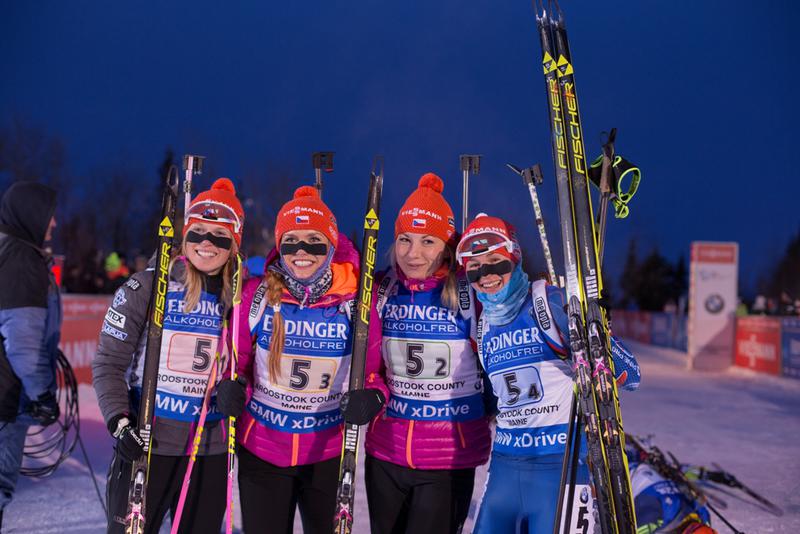
The Czech Republic women’s team, which won the 4 x 6 k relay on Saturday at the IBU World Cup in Presque Isle, Maine, with (from left to right) Eva Puskarcikova, Gabriela Soukalova, Lucie Charvatova, and Veronika Vitkova. (Photo: IBU/NordicFocus)
“It’s good to try a romantic atmosphere,” World Cup leader Gabriela Soukalová of the Czech Republic joked about the dark and cold course conditions at the end of the International Biathlon Union (IBU) World Cup women’s 4 x 6-kilometer relay in Presque Isle late Saturday afternoon, when the sun had long set behind the trees and hills of northern Maine for the final 6 k. “I appreciate it so much. I was thinking about my boyfriend,” she said in an post-race team interview with the IBU.
“Candles…” her teammate Eva Puskarcíková added.
The Czech women had every reason to be in a good mood. In the final race before the upcoming IBU World Championships in Oslo, Norway, their team had asserted its intention to be on the podium there in March, achieving the first relay victory of the season in a time of 1:07:11.0, with one penalty and 14 spare rounds.
After narrowly avoiding a penalty lap in the last shooting, anchor Veronika Vítková had a large enough lead to ski to the side of the track and look for a national flag for the final stretch, but none was immediately available from coaches or fans, so she celebrated across the line just by raising her arms, before her teammates hugged her at the finish.
The women’s relay was moved up from Sunday to Saturday due to extremely cold temperatures in the forecast, with a start time of 4:10 p.m. following the men’s relay, giving the athletes the rare experience of racing in the dark on the final loops, dimly lit by portable lights on a few sections of the course. (Evening Biathlon World Cup races are occasionally on the schedule, for example in Oberhof, Germany, but that course is equipped with large fixed floodlights.)
With the athletes emerging from the darkness into the slightly brighter Nordic Heritage Center stadium, the race for second and third place on the podium was decided in an exciting sprint finish between the relays from Germany, Ukraine, and Poland.
Germany’s exhausted anchor Karolin Horchler tried to rescue her once-comfortable lead after the final shooting that had diminished precariously into the finish, with a double-pole effort on the final meters before she collapsed across the line.
Ukraine’s Olena Pidhrushna passed her with quick skating steps to claim second place, 25.2 seconds behind the winners, with a team total of zero penalties and 12 spares. Pidhrushna edged Horchler by just 0.2 seconds as the Germans took third (+25.4), with one penalty and seven spares, after erasing a 30-second deficit on the final loop. Poland’s Krystyna Guzik came into the finish narrowly off the podium in fourth place (+26.0), with a team total of zero penalties and seven spares.
The U.S. with Susan Dunklee, Hannah Dreissigacker, Clare Egan and Annelies Cook finished the race in 10th (+2:12.4), with one penalty and 12 spare rounds. It was their best result in a women’s relay this season.
Czech Republic joins this season’s other podium finishers — Ukraine, Italy, France, Germany, and Russia — as the favorites for the women’s relay in Olso, with a few more “dark horses” also in the mix.
After the flower ceremony, several women fielded questions at the indoor post-race press conference, still wearing protective tape on their cheeks and noses.
“Today’s race was very hard because of the very big cold,” Czech Republic’s starter Puscarcíková said. “My fingers were frozen. But I am happy we are first again. Last year we won in Oslo this time of the year. It’s very fantastic and unbelievable for me.”
“I had trouble because I shot my third bullet under the target,” Lucie Charvatová explained at the press conference. She had a penalty on her second relay leg and fell back to 11th, before tagging off 47.7 seconds back in ninth place. “After that I was so, so nervous. I ran fast and tried to do the best I could. But I am also happy.”
“I don’t know what I can say,” World Cup leader Soukalová said at the press conference, trying to explain how she had moved her team back into first place on the third leg, following two straight individual wins in Presque Isle. “It was a really fantastic weekend. It’s amazing. I was feeling really good during the race. I don’t remember when I [last] have been in the same shape. It’s a perfect performance before the World Championship.”
“It was very hard because on the track it was dark,” Vítková recalled of the anchor leg and the final shooting. “I have seen nothing. On the shooting range, too. And I was a little bit nervous, because I needed three extra [rounds of] ammunition.”
Ukraine, winner of the relay in Ruhpolding, Germany, earlier this season, was in fourth place with its lineup of Iryna Varvynets, Natalya Burdyga, Juliya Dzhyma and Pidhrushna for most of the race, before Pidhrushna moved her team up with the fastest skiing on the last loop, and beat Germany at the line.
“It’s difficult to recall a relay that was so close and tough,” a smiling Dzhyma said during the press conference, through a translator. “Maybe the one in Hochfilzen [where Ukraine finished third, though with a much larger gap to second and fourth place]. It was really interesting and tough, not just because of the close results, but also because of the frost in this cold weather. In the end we are really happy to be in second, and to be on the podium.”
“At the beginning of my leg, I couldn’t see any uphills, any downhills,” anchor Pidhrushna explained, via a translator. “It was like racing blind. When I came to the shooting range, my only thought was to shoot clean and not go to the penalty loop.”
“It’s already a legend,” a happy Pidhrushna later added in an interview with the IBU when asked about her final loop. “It was again a funny situation after the last shooting. I had no idea which place I was in, going away from the shooting range. One of our staff members shouted so loud, then I realized I was somewhere close, because I couldn’t see the screen, I couldn’t see anything because it was already dark. I just had to think that I was close so I had to fight for it again.”
“Krystyna [Guzik] from Poland was behind me, and we were running so fast to chase the German girl,” she explained. “But I couldn’t even think of doing that, actually.”
“I didn’t know what was happening behind me, I just tried to race,” Germany’s Horchler told ARD, after she had advanced her team from fifth to second, requiring one spare in prone and staying clean in her final shooting. “But I had brutal pain in my shins, and was already pushing into the downhill. I am really annoyed by that two-tenth of a second [at the finish]. But I am just pleased about my 0-5 shooting in standing, because with that I settled a few things in this competition so the relay could still make the podium.”
“Hats off to the organizers,” she added. “They put up makeshift lanterns, and I am happy about my prescription lenses in my glasses, otherwise it would not have been possible for me to see anything.”
“I as very nervous, because it’s been a long time since I took the starting position,” Germany’s Franziska Preuss said at the press conference. “The last time was Sochi [2014 Olympics, where Preuss crashed and got snow into her rifle sights, falling back far, as German failed to medal for the first time in an Olympic women’s relay]. But now I am really happy that it was a good race for me… I think nobody expected Germany on the podium today.”
Germany started a lineup without Franziska Hildebrand and Laura Dahlmeier, their two highest-ranked athletes on the World Cup.
“Temperatures were better today than yesterday,” second leg Luise Kummer told ARD. “We feared it would become really cold by now, but today it was bearable. And the audience is really participating with the action, so it was definitely fun. You actually get warm during the race. One would not believe that, in training we were also worried. But in normal competition it is no problem at all.”
“I just could not handle the standing position on the range here, and unfortunately also not today,” Germany’s third leg Miriam Gössner, who had her team’s penalty, told ARD. “I don’t know why. I really tried to do my best. In the prone shooting and out on the course I felt really, really good. So I think I could compensate for that penalty lap fairly well.”
Poland, with Magdalena Gwizdon, Monika Hojnisz, Weronika Nowakwska, and Guzik (formerly Palka) finished just 0.4 seconds off the podium, after losing the sprint against Ukraine and Germany.
“We had to fight not only with our rivals, but mainly with low temperatures,” Hojnisz later posted on Facebook, according to a translation, after she had avoided a penalty in her first prone shooting but lost about 45 seconds to the top. “I was not the best link in today’s relay, so thank you girls for your faith and fight to the last meter.”
“I held her until the end of the climb and tried to overtake on the flats,” Guzik said of Pidhrushna on the last loop, as told to Polish sports website SportoweFakty, according to a translation. “Unfortunately, none of the three attempts worked. Olena took it well tactically. It is a pity that the course was not a little bit longer, because I could fight to the finish. … I am sad that I could not lead us to a medal. We need this podium in the relay. I still believe that soon we will succeed.”
A number of teams started different lineups than they will likely have at World Championships, including France, which won the previous relay in Antholz, Italy, but on Saturday gave its top athlete, Marie Dorin Habert, a break. France finished sixth (+48.2), with one penalty and 13 spares, after Anaïs Chevalier had tagged her teammate Justine Braisaz in second place at the last exchange.
U.S. Achieves Season-Best 10th
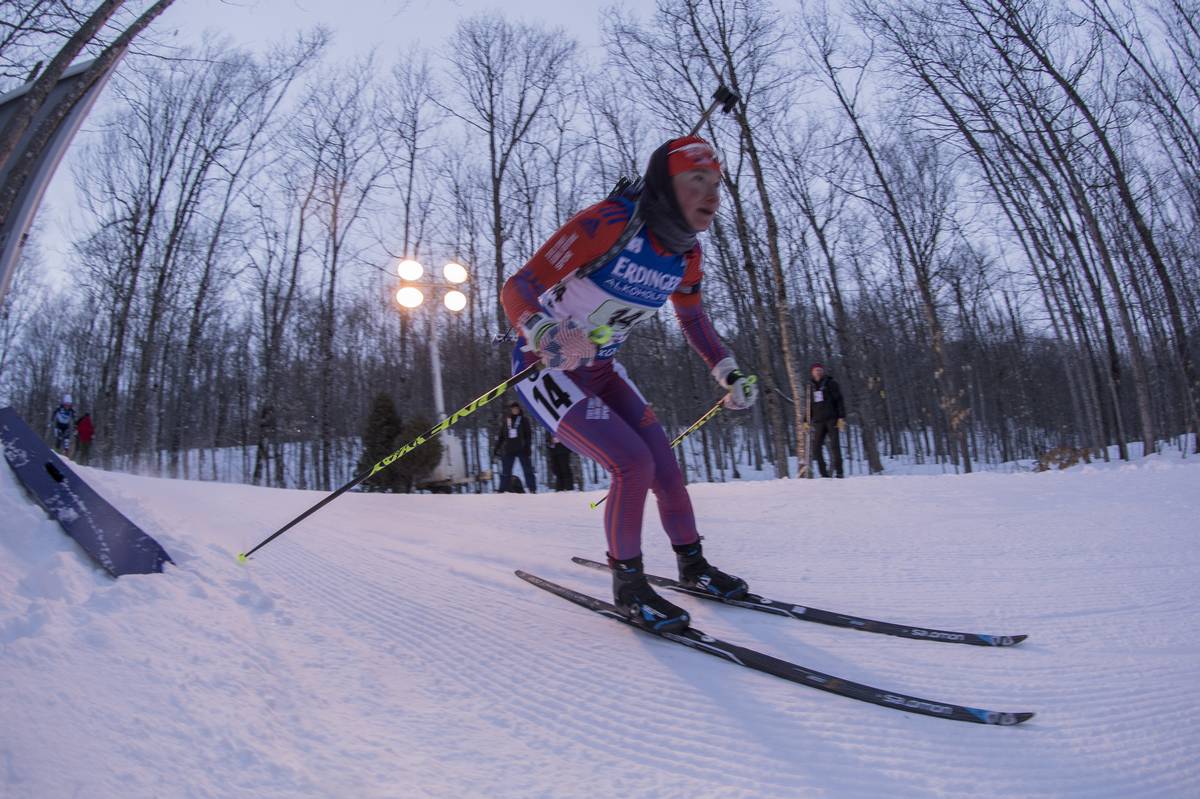
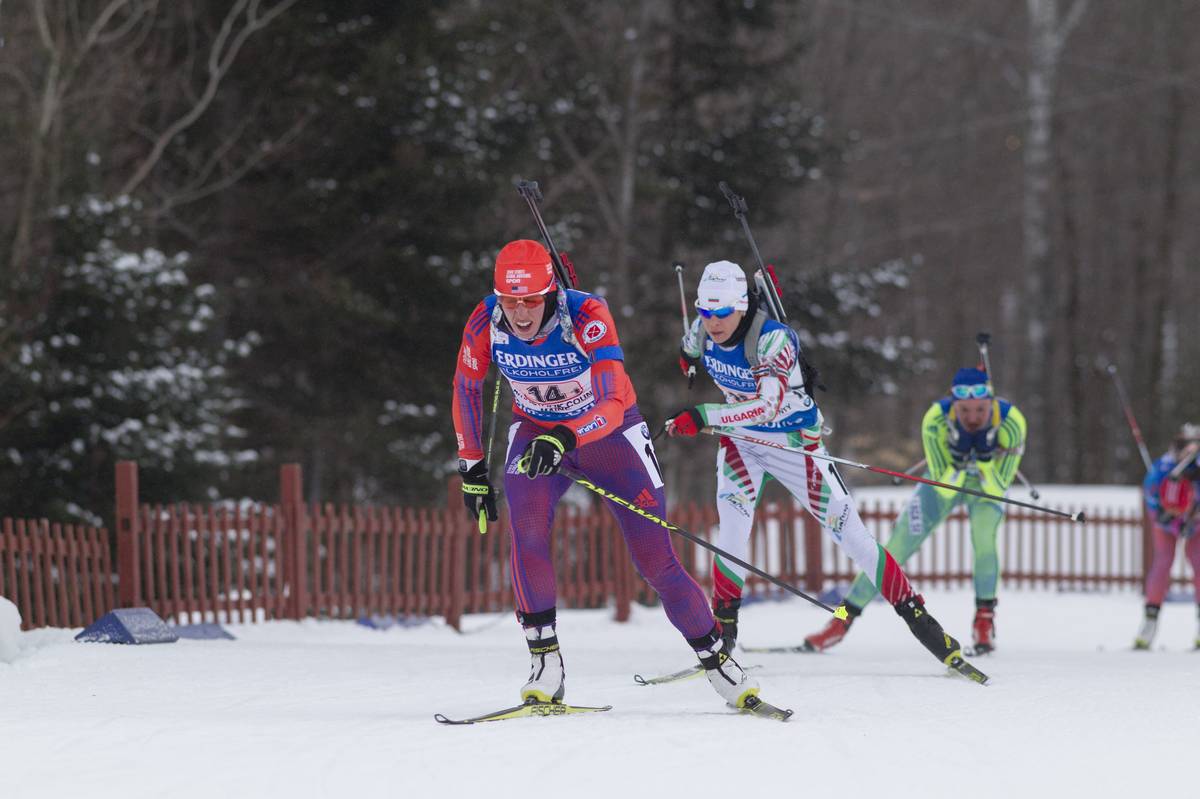
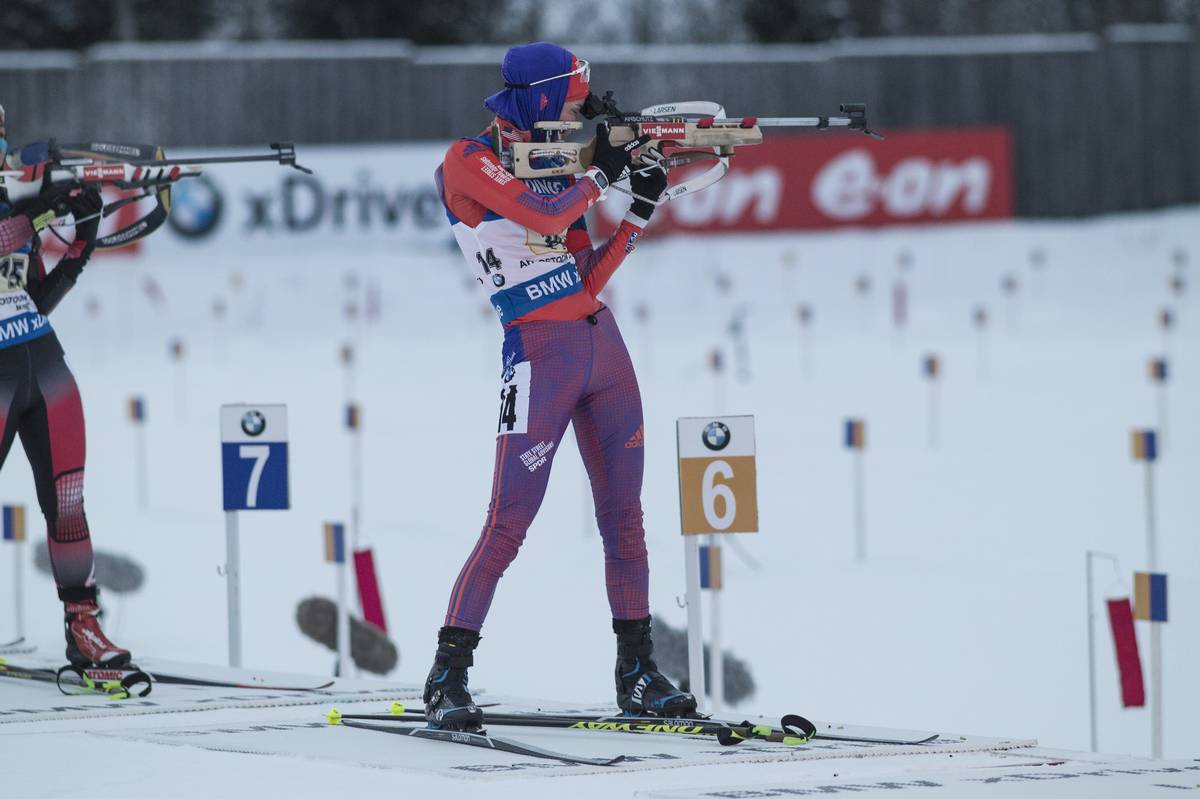
Susan Dunklee (US Biathlon) racing the first leg of the women’s 4 x 6 k relay on Saturday at the IBU World Cup in Presque Isle, Maine. Her team went on to place 10th for a season best. (Photo: USBA/NordicFocus)
Coming off a historic week for US Biathlon with Dunklee’s silver medal in the sprint and fifth place in the pursuit, the team’s leading woman was picked to start Sunday’s relay (after racing the second leg in the three prior relays this season), followed by Dreissigacker, Egan and Cook.
“We are still experimenting with the order,” Dunklee wrote in an email. “Last week’s mixed relay went well with myself leading and Han [Dreissigacker] going second so we tried that again.”
As for moving the race up to Saturday, Dunklee wrote, “I think most athletes would agree that moving the race to today was the right call in light of the cold forecast.”
But that made for a pretty hectic race day for the women, as they had very little time to prepare with the men’s relay only wrapping up about an hour before their own.
“Today was a great opportunity for dealing with unusual challenges on race day,” Dunklee explained. “We had some struggles getting to the venue on time, then I had a broken firing pin right before zero [target practice to adjust the rifle sights before the start], which is very tricky to replace, and finally 13 minutes before the start, I heard that the course got changed and didn’t get to preview it.”
“With the short turn around from the guys race, we only had 25 minutes to zero 4 people,” she continued. “I didn’t fit in more than 10-15 minutes of skiing warmup, a new record for me. Dealing with chaos is an extremely important skill for a biathlete to have and we all did well today in spite of the challenges.”
Dunklee’s performance didn’t seem to suffer much despite those unusual circumstances, she she used just one spare to clean the first prone stage, and another two in her standing bout. She also skied the fastest course time of all starters in 13:55.4, and second-best among every woman in the relay, behind France’s anchor, 19-year-old Braisaz.
Hannah Dreissigacker racing the second leg of the U.S. women’s 4 x 6 k relay on Saturday under darkening skies at the IBU World Cup in Presque Isle, Maine. Her team went on to place 10th for a season best. (Photo: USBA/NordicFocus)
Dunklee tagged off to Dreissigacker in fourth, only back 11.1 seconds behind Switzerland’s Selina Gasparin, who was then leading the pack (Switzerland went on to finish 12th).
For Dreissigacker, a regular member of the U.S. relays last year including at 2015 World Championships, it was her second World Cup relay of the season after spending some time on the second-tier IBU Cup, before returning to the World Cup in Canmore, Alberta, and Presque Isle, where she most recently placed 27th in the sprint and 24th in the pursuit.
Like Dunklee, she didn’t let the stressful race preparation get to her.
“It was definitely a little bit rushed today before the race for everyone,” she wrote in an email. “We had to rearrange things and it got a bit hectic. But it was fine for me anyways… a good adrenal warm-up, as I like to call it!”
Dreissigacker needed one spare in prone and two in standing, just like Dunklee, and lost a little more time on the course, handing off in seventh, 43.7 seconds behind the leaders.
“I am a little disappointed that I didn’t hit my last standing shot, and then took two spares to hit it, but it could have been worse!” Dreissigacker wrote. “I had a good battle with Austria [Lisa Theresa Hauser] and France [Anaïs Bescond] at the end of my leg which was fun and made me go hard.”
Egan, who had started the prior relay for the U.S. in Antholz, moved back to the third leg, which she had also raced in Ruhpolding and Hochfilzen earlier this season.
Clare Egan (US Biathlon) during her standing stage of the women’s 4 x 6 k relay at the IBU World Cup in Presque Isle, Maine. Her team went on to place 10th for a season best. (Photo: USBA/NordicFocus)
In Presque Isle, she had finished 32nd in the sprint and 23rd in the pursuit. She continued her solid recent shooting performances in Saturday’s prone stage, cleaning her targets to leave the range in seventh position (+41.4).
After moving up to sixth place on the next loop, Egan came into the standing stage fighting for position with France, Ukraine and Austria. There she was unable to hit her last target with her three spares, having to ski through the 150-meter penalty lap.
“The conditions for my standing shooting were fine, I am just not as solid in standing as I am in prone,” Egan wrote in an email. “I missed two from the clip and then fired the first spare accidentally before I was ready. Then I had two bullets for two targets and unfortunately I only hit the first one. I should have taken more time to make a perfect hit on my last shot.”
She left the range in 12th, and tagged off to Cook in that position, having lost an additional minute to the leaders by the exchange (+1:50.6).
Just like it was for her teammates, Cook’s race leadup was a bit hectic.
“The preparation was actually funny today,” Cook wrote in an email. “I did not get to ski the course before the race started, and the girls actually had to tell me that they took out a sketchy corner, so I had never even done our course before I was on it racing it.”
On the shooting range, she matched the performance of Dunklee and Dreissigacker, requiring one spare in her prone stage and two in standing, but had to overcome an additional challenge: the sun had set when the anchors were on their relay legs, and large sections of the course had fallen into darkness.
“I was glad that nothing crazy happened on the downhills because it was definitely a shadowy course, not like the huge floodlights that we are accustomed to,” Cook explained. “But I didn’t mind. It reminded me of how night races were growing up at my local ski area, with little light bulbs hanging over the course. The range was a bit dark and the big movie screen flashed really brightly while I was shooting prone, so the light changed drastically and suddenly and that was distracting. But it worked out okay.”
She was able to overtake two more relays, moving the U.S. up to 10th in the finish. The U.S. women were satisfied with their result, though believed there was still additional room for improvement.
“As a team, we all had okay shooting performances and it is exciting to see us move up so much already even without a great day,” Dunklee concluded. “Oslo will be exciting.”
“I think we are all happy with 10th since its our best relay of the year, but we also know we can do better and today was a good sign of that!” Dreissigacker wrote.
“Despite my penalty lap this was the best relay result we have had with this group of four athletes,” Egan explained. “Our previous best was 12th which we got twice last year (World Cup 6 Antholz, World Championships). It is also a season best. Of course we can still do better and intend to do so in Oslo.”
“I still know we can do better in the relay, but it is a hard, hard thing for everyone to have stellar races on the same day,” Cook concluded. “And luckily, we know that all we have to do is have a good normal day and we can be right up there.”
With Some New Faces, Canada 17th
Without Rosanna Crawford and Julia Ransom, Canada did not have two women in Presque Isle who will likely be part of the women’s relay at World Championships in Oslo. Crawford and Ransom started in all three other relays this season where the team finished 10th in Hochfilzen, and ninth in both Ruhpolding and Antholz.
Instead, with veteran Zina Kocher (in her third relay this season), Emma Lunder (who had one relay start before in Hochfilzen), Audrey Vaillancourt and Erin Yungblut struggled on Saturday, quickly falling to the back of the field, with Kocher having to ski a penalty loop in her first prone.
After leaving the range in 16th out of 17 teams (with Norway and Slovakia pulling their teams before the start due to illness), Canada was never able to catch back up to the top 10, losing time to the leaders as the race progressed.
Kocher tagged off to Lunder 2:14.3 back, who then incurred another penalty in her prone stage (1+3, 0+1) to exchange 4:28.1 back in 17th place.
Vaillancourt then put in a strong performance on the range with two clean shooting stages, but was slower on the course and passed on the penultimate loop by the leading teams. She handed off to anchor Yungblut 6:38.6 back.
After requiring three spares to hit her targets (0+1, 0+2), Yungblut then was taken out of the race and scored as lapped in 17th position before her final loop.
On to Oslo
The athletes will now have two weeks of additional training and preparation, before traveling to Norway for the World Championships, beginning on Thursday, March 3 with the mixed relay.
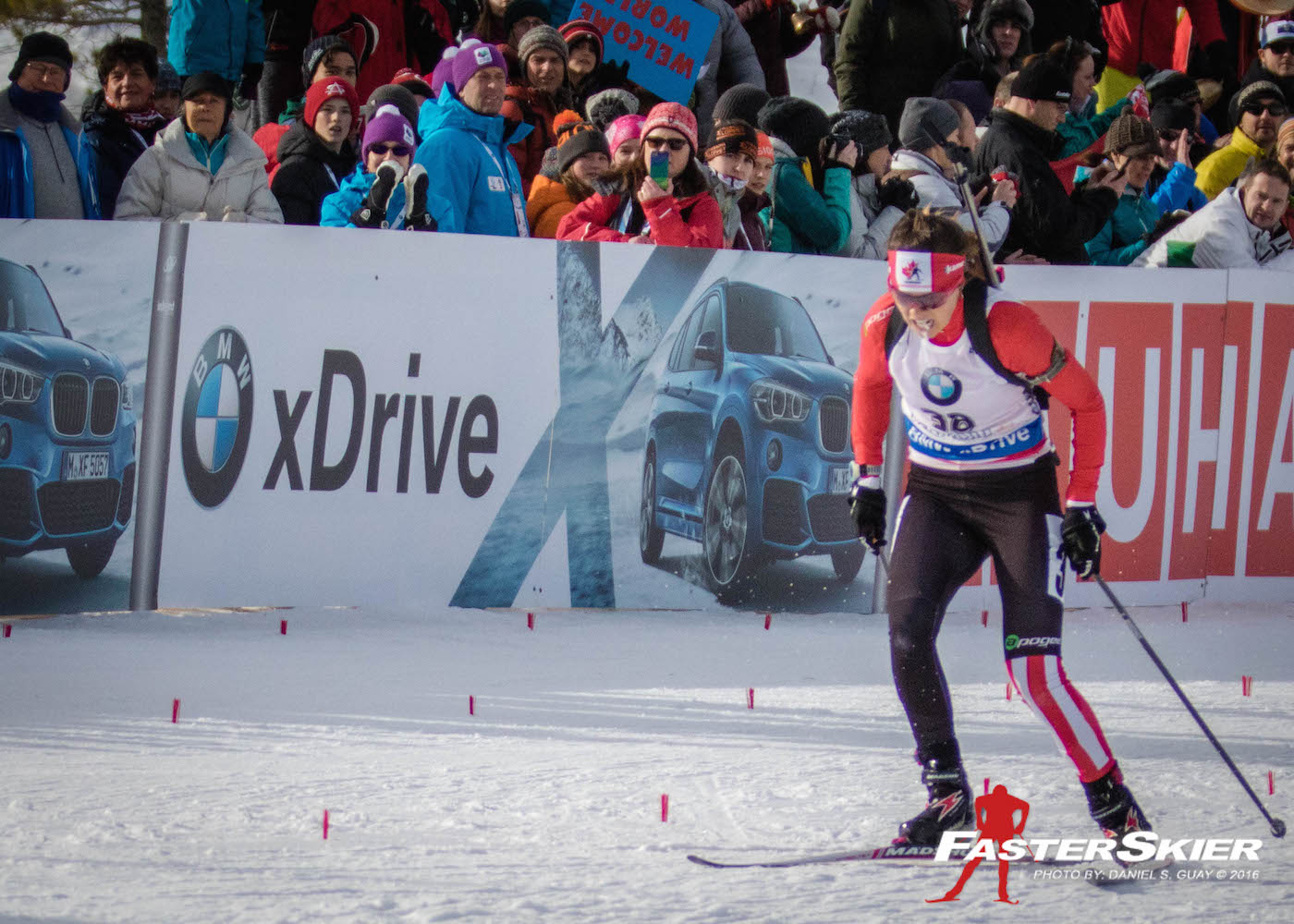
Canada’s Julia Ransom racing in front of a home crowd in Canmore, Alberta, to tie her IBU World Cup career-best 19th in the women’s 7.5 k sprint on Friday. (Photo: Daniel S. Guay)
The way some of the Canadians were tossing around the term “Chinook wind” on Friday, one might have thought that gusts hard enough to knock rifles off their stands was a regular occurrence in Canmore, Alberta. It wasn’t, according to one Canmore native, Rosanna Crawford.
“It was windier than I’ve seen it here in Canmore in a long time,” the 27-year-old Biathlon Canada veteran recalled in an in-person interview after the women’s 7.5-kilometer sprint at the IBU World Cup in Canmore. “So it was definitely luck of the draw if you were going to get a calm range or not.”
She wasn’t one of the lucky ones. Crawford started sixth and missed two off the bat in the first prone shooting stage. She wasn’t alone; most of the rest of the top-seeded skiers failed to hit all five prone targets as well.
Early on, it appeared that France’s Anais Bescond, in bib 8, and Italy’s Dorothea Wierer, bib 17, might be fighting for a podium. Both were the only women to clean prone through the first 24 starters.
Then Krystyna Guzik, a 32-year-old Polish biathlete who last reached the IBU World Cup podium two seasons ago in third in a pursuit in Hochfilzen, Austria, entered the mix. In bib 25, she cleaned prone to leave the range in first, 6.7 seconds faster than Wierer. Guzik went on to clean standing as well, while Wierer missed one, to hold a 7.3-second lead after the second shooting.
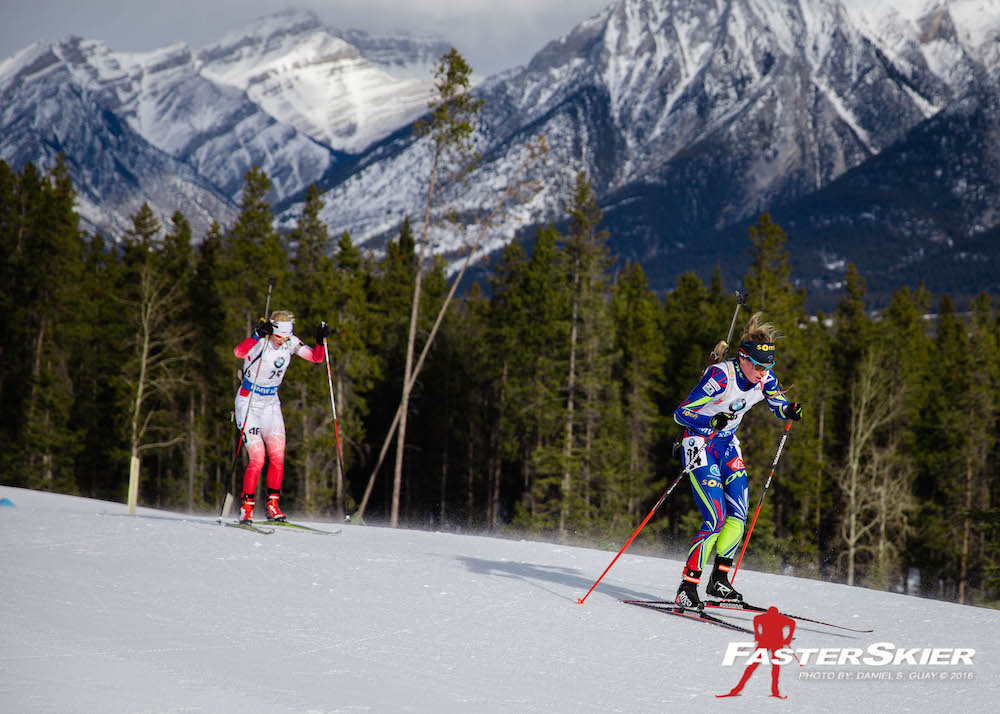
Poland’s Krystyna Guzik (l) trails France’s Marie Dorin Habert during the women’s 7.5 k sprint at the IBU World Cup in Canmore, Alberta. Guzik went on to place second while Habert finished 29th. (Photo: Daniel S. Guay)
On the final loop, Guzik stayed ahead of Wierer — who had initially finished first, 21 seconds ahead of Gabriela Soukalova of the Czech Republic— to bump the Italian to second place by 12.4 seconds at the finish.
Meanwhile, Bescond had missed two in standing to slip out of contention and nearly 1 1/2 minutes behind Guzik at the finish. It might not have been her fault; the winds were extremely variable — those Chinook (western interior) winds.
Canada’s Julia Ransom, who has lived and trained in Canmore for the last five years, started 38th and later said she felt the wind in prone and adjusted accordingly.
“I knew the wind. I know Canmore. I know how Chinook winds work and I did correct for prone, a lot,” she told FasterSkier afterward. “Really cranked the sights, and it wasn’t a hurricane for standing so maybe I lucked out a bit there.”
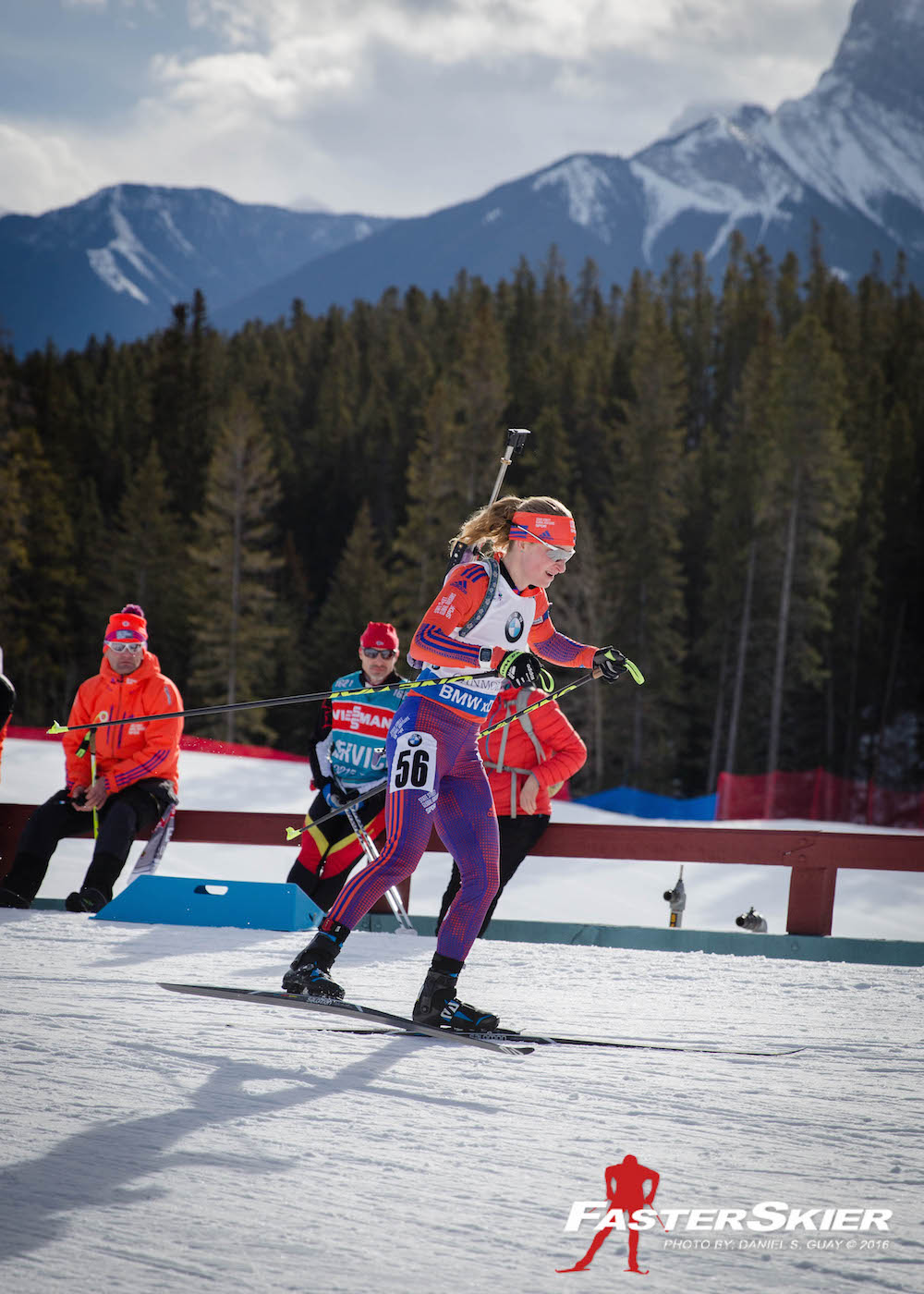
Ransom, who turned 23 on Thursday, cleaned both stages and was one of seven women in the field to do so. Initially 12th at the finish, she ended up 19th, 1:19 behind the winner and the top North American on the results sheet.
Moreover, Ransom tied her World Cup best, which she set two weeks ago in 19th in the pursuit at the last World Cup in Antholz, Italy.
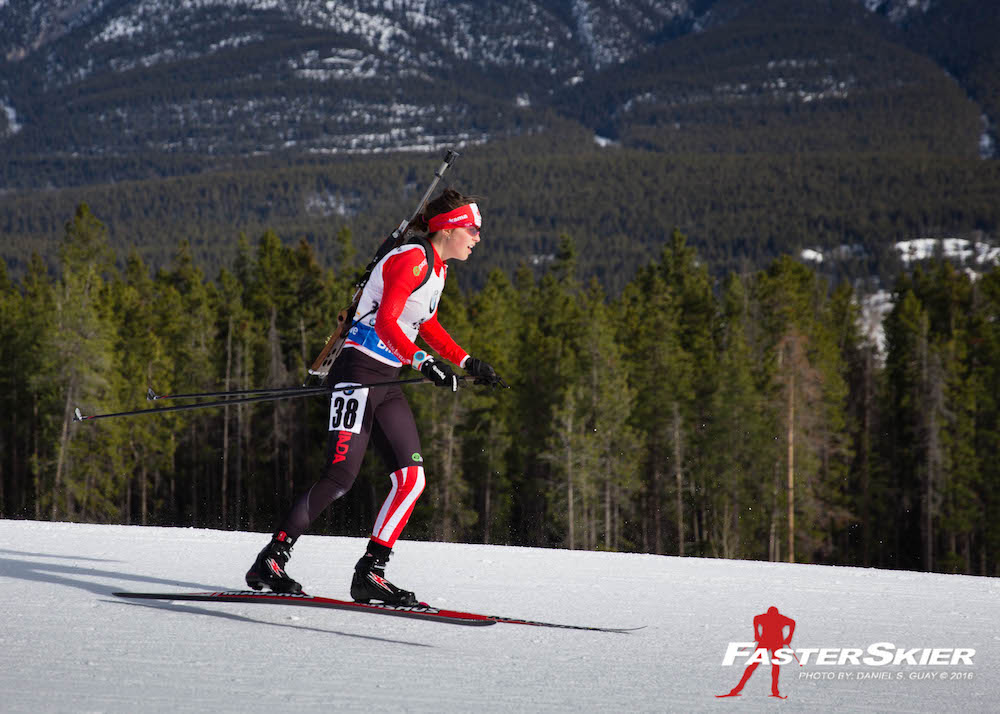
Canada’s Julia Ransom racing to 19th in the women’s 7.5 k sprint at the IBU World Cup in Canmore, Alberta. (Photo: Daniel S. Guay)
“Double nineteenth!” she exclaimed upon realizing she had secured the result again on Friday.
While she cleaned the four-stage pursuit in Antholz on Jan. 23, this was the first time she hit all her targets in a World Cup sprint.
“I knew leaving standing that my family was in for an exciting race,” Ransom wrote in an email. “I was hoping to maintain 12th, but that rarely happens when you start in the earlier seeds. However I am very excited with another top 20. It is a confidence booster going into world champs. I’ve got my sights on those single digits now!
“19th at home is obviously amazing!” she continued. “It’s always nice sharing personal bests with the friends and community that supports me all year round.
Originally from Kelowna, British Columbia, Ransom celebrated her birthday the night before with “a little wine and some little minion cupcakes from my Dad,” she explained in a Biathlon Canada press release. “It was a perfect pre-race meal. … [On Friday] it was a balance between not being too anxious with everyone here to watch and being so excited I couldn’t even contain myself at the start.”
It appeared that most of the racers who started 25th or later, including Guzik, benefited from the sudden calm once the winds subsided considerably.
“It was crazy windy on my first loop,” Crawford recalled of the late-morning (11:15 a.m.) start. “The wind was so strong that I was almost at a stop on one of the uphills…”
She placed an uncharacteristic 72nd, with four penalties — two in prone and two in standing. But considering she’s been sick for the last week and a half, Crawford said she couldn’t completely blame the wind.
“I knew that today was not going to be my best race of the season, but it’s still hard to go out there and have a tough race,” she said.
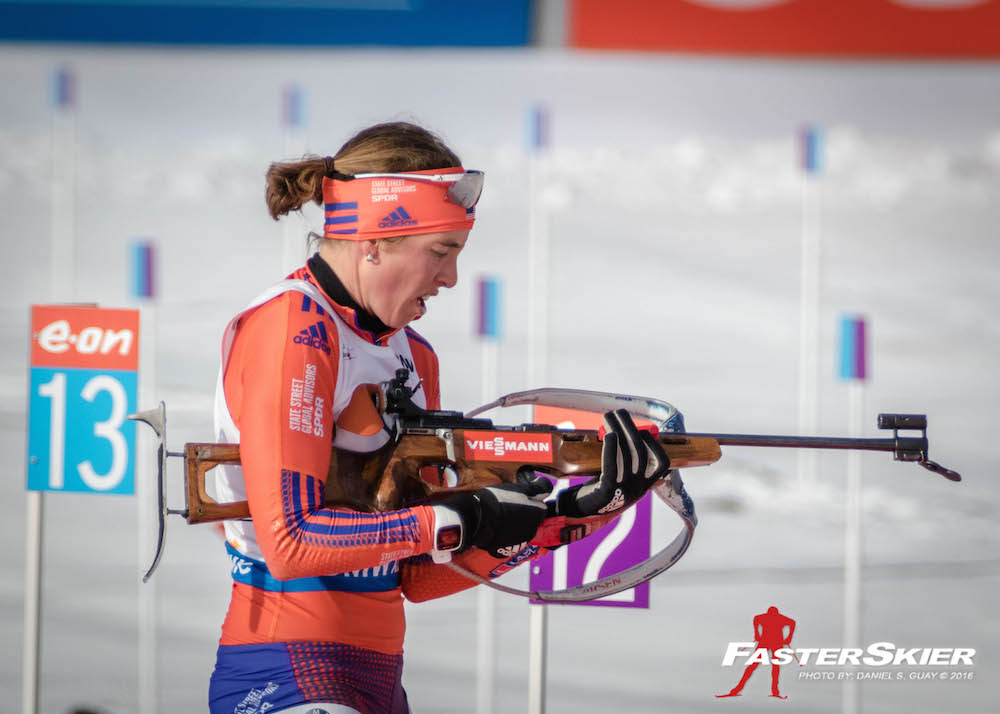
Susan Dunklee (US Biathlon) had three penalties en route to 35th in the women’s 7.5 k sprint at the IBU World Cup in Canmore, Alberta .(Photo: Daniel S. Guay)
The first U.S. starter in bib 18, Susan Dunklee watched from the start pen while the winds blasted through the stadium.
“When I was in the start gate, the first [competitors] were coming through the range and there were some crazy gusts,” Dunklee said. “We were in the start pen and this huge gust comes up and the rifles started falling off the rack.” They were caught just before hitting the ground.
“I hear this is what they call a Chinook or something like that,” the American added. “It made things interesting…”
Personally, Dunklee found Canmore’s altitude challenging, about 4,600 feet above sea level. Not feeling her usual self skiing, Dunklee placed 35th (+1:58.9) with three misses (1+2). Typically one of the faster skiers in the field, her course time ranked 35th.
“It wasn’t great, but it was OK,” she said of her result.
“It’s pretty nice to be here. I really like being in beautiful places with mountains like this,” she added. “This is my first time racing in North America for a World Cup and that’s something special. I mean, I’ve been looking forward to it for years.”
Dunklee wasn’t alone: Canada’s 33-year-old Zina Kocher, of Red Deer, Alberta, had been waiting to race a World Cup in Canada for at least the last two years, since deciding to continue her career beyond the 2014 Olympics.
“It was a dream I always had to race here and I finally accomplished it,” Kocher said in the team press release. “I was looking for a little inspiration last night and I started pulling out newspaper clippings and looking at photo albums of my career.”
In 2006, she became the second Canadian to reach the IBU World Cup podium when she placed third in Östersund, Sweden.
“I realized I will just miss all of my teammates and coaches. We worked hard at this together, and we were a family,” Kocher said. “It is nice to see the program now getting the results.”
While she told FasterSkier she was “overall not very happy with today’s result,” in 56th with five penalties (2+3), Kocher said she felt good skiing and might have been affected by some nerves on the range.
“But it was awesome to race at home and be in front of the home crowd and have my friends and family out there,” she said.
(Story continues below)
Women’s 7.5 k sprint at the IBU World Cup in Canmore, Alberta. (Photo: Daniel S. Guay)
Women’s 7.5 k sprint at the IBU World Cup in Canmore, Alberta. (Photo: Daniel S. Guay)
Susan Dunklee (US Biathlon) during the Women’s 7.5 k sprint at the IBU World Cup in Canmore, Alberta. (Photo: Daniel S. Guay)
Women’s 7.5 k sprint at the IBU World Cup in Canmore, Alberta. (Photo: Daniel S. Guay)
Women’s 7.5 k sprint at the IBU World Cup in Canmore, Alberta. (Photo: Daniel S. Guay)
Women’s 7.5 k sprint at the IBU World Cup in Canmore, Alberta. (Photo: Daniel S. Guay)
Post-Retirement, Pidhrushna Takes the Win
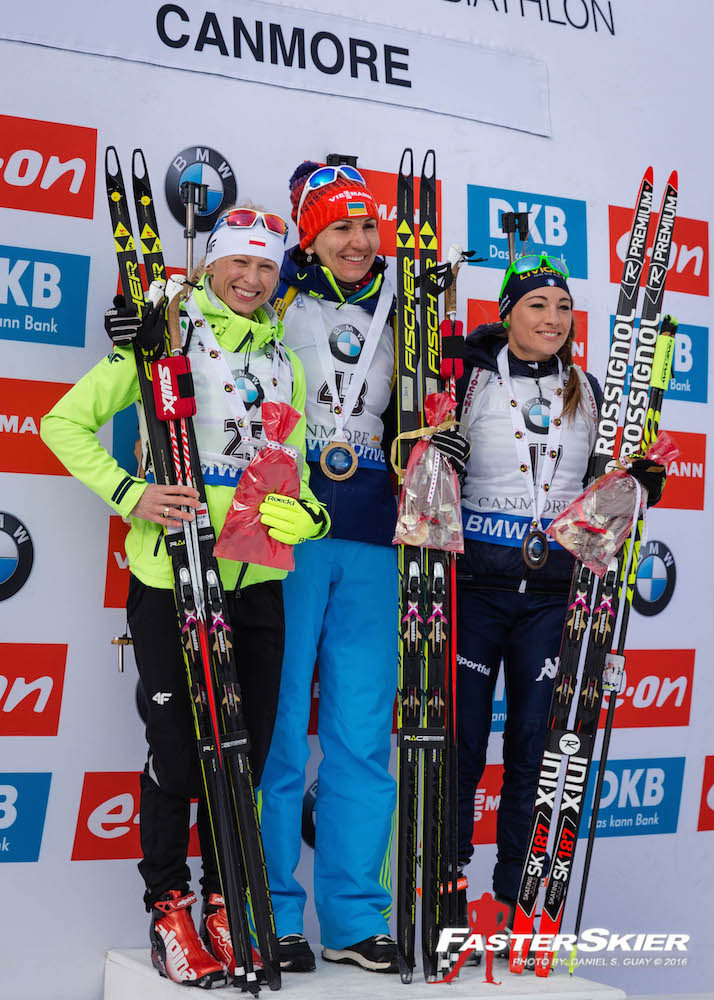
While Guzik appeared to have locked up her first World Cup victory, several other surprises were making charges from behind. Ukraine’s Olena Pidhrushna, back after a one-year retirement, started 43rd and cleaned both stages to finish 7.5 seconds faster and seize the win in 19:56.9. She bumped Guzik to second and Wierer to third (+12.4).
For the 29-year-old Ukrainian, it was her second-career World Cup victory after winning a sprint in Nove Mesto, Czech Republic, four seasons ago.
“This is why I returned,” Pidhrushna told the IBU in a post-race interview through a translator. “A year ago, I couldn’t imagine being back here and being on the podium. Only at the beginning of this [season] I realized how much I miss biathlon and how I need it.”
The women’s sprint podium at the IBU World Cup in Canmore, Alberta: with winner Olena Pidhrushna (c) of Ukraine, Poland’s Krystyna Guzik (l) in second and Italy’s Dorothea Wierer (r) in third. (Photo: Daniel S. Guay)
Behind her, some names of the past and future like Poland’s Monika Hojnisz (bib 65) and Latvia’s Baiba Bendika (bib 63) made a run for the podium to end up fourth (+14.1) and fifth (+23.7), respectively.
“Good joke, wake me up when this dream is over!” Bendika, 24, posted with a photo of Friday’s flower ceremony on Instagram. She had shot clean for her first individual top 40. “I guess there is not much to stay, it’s just- CRAZY!!”
Also 24, Hojnisz previously placed fifth in the 2014 Olympics mass start and took bronze in the pursuit at 2013 World Championships. On Friday, she had one prone penalty and cleaned standing en route to fourth, 1.7 seconds off the podium.
Germany’s Franziska Preuss in bib 40 rebounded from a broken tailbone to place sixth (+33.2) with a single standing miss, just 0.4 seconds ahead of Soukalova in seventh. It was Preuss’s second-best result of the season after placing fourth in the Östersund sprint. She crashed in a race there and missed much of the next two months of competition.
“It was the first race of the new year for me,” Preuss told German TV broadcaster ZDF. “I am just happy that it worked so well, that felt good for my psyche. Those were some hard weeks. … sitting in the gym on the ergometer and having to watch the others race. But you learn from every situation and get stronger. Of course you ask yourself, ‘Why does this have to happen?’ but yeah… tick it off and now I am happy that the re-entry went so well.”
“Itʼs just been a weird season for illness and injury,” Tandy said on the phone Friday. “In Pokljuka, I passed out on course, and I struggled over the next weeks to feel fit and energized again. Then in Antholz, I finally had a day where I was like, OK, Iʼm starting to feel back in shape, the ski speedʼs there,ʼ and then this happened.
“Iʼm making the best of it, or trying to,” she added.
Dreissigacker 28th; Beaudry in the Points
Sarah Beaudry, who shares Tandy’s hometown of Prince George, B.C., started the sprint and rose to the occasion in her absence. The 21-year-old Beaudry notched her first World Cup points in 38th (+2:02.3) with Canada’s second-best result after Ransom.
In her fifth-ever World Cup, Beaudry started 77th, cleaned prone and had one standing penalty to set a new career best by 16 places.
“I was happy that I managed to hit nine, especially on this windy day,” Beaudry said. “Overall I’m happy with how I performed and to get a personal best, first points at home, and especially when you never know when the next opportunity to race at home will be, it’s exciting to be able to do well.”
She’s lived in Canmore the last four years.
“I’m excited that Julia and Sarah were able to represent with some good shooting today,” Crawford said. “Overall, the team seems to be a little bit flat ski-speed-wise so that’s unfortunate. There’s so much excitement around these races…”
Next week, she explained that the B-team will represent Canada at the next Word Cup in Presque Isle, Maine, while most of the team’s World Cup regulars recover and train in Canmore.
Hannah Dreissigacker (US Biathlon) racing to 28th for her best IBU World Cup result of the season on Friday in the women’s sprint in Canmore, Alberta. (Photo: Daniel S. Guay)
The top American on Friday, Hannah Dreissigacker of US Biathlon’s A-team had received the call back up to compete at the World Cup in Canmore, where she placed 28th (+1:42.8) with one penalty in each stage.
“I got off to a really slow start this year, especially skiing-wise,” Dreissigacker noted. “I’ve been struggling to really get going on the course, and I think today I may have gone too fast on the first loop, but that’s better than never going fast at all.”
She spent the last several weeks racing the IBU Cup, where she’s been working to find her speed again.
“Today, two misses was good because it was windy and I got a little lucky with the shooting,” Dreissigacker wrote. “To be honest, I should’ve hit more than I hit. I gave one away in prone, my last shot, I just pulled the trigger too early I wasn’t even on the target. That was a bit of a bummer, but on the whole, I think 80 percent [shooting] was good today.”
Behind her, U.S. teammate Annelies Cook finished 47th with three penalties, all in prone.
“I’ve had a really rough string of racing so my confidence has gotten really low,” Cook said. “I missed three prone which was too bad, but for me, looking at how I shot, it was actually OK. I had a good group and I just didn’t take enough clicks that I needed. What was really important to me is that when I came back in standing, I cleaned and I cleaned fast, and that felt really, really good.
“I think three was kind of average shooting today,” she added. “It wasn’t great but it wasn’t terrible, either.”
Dabbling in biathlon for the first time this year, Joanne Reid of the U.S. explained she just learned how to “click,” or adjust the sights on her rifle, one day before the race.
“I’d love to blame it on the wind but … I think I got a little overexcited about clicking,” Reid said after placing 57th, exactly 5 seconds back from Kocher and 2:33.2 behind the winner. Aside from her six penalties (3+3), her overall course time ranked 16th.
On Saturday, men’s and women’s mass starts will be held (at 10 and 11:30 a.m. Mountain time, respectively) with Dunklee qualifying in the overall World Cup top 30. Crawford and Ransom were listed as reserve athletes based on a provisional start list.
— Seth Adams, Harald Zimmer and Chelsea Little contributed reporting
“I’m super happy that we can show the world how awesome Canmore is and hopefully be able to get more races of this caliber here,” she said. (Photo: Daniel S. Guay)
Women’s 7.5 k sprint at the IBU World Cup in Canmore, Alberta. (Photo: Daniel S. Guay)
Women’s 7.5 k sprint at the IBU World Cup in Canmore, Alberta. (Photo: Daniel S. Guay)
Beaudry finished 38th in the 7.5 k sprint at the IBU World Cup in Canmore, Alberta, in 2016, before making her first trip to World Championships. (Photo: Daniel S. Guay)
Joanne Reid representing the United States in the women’s 7.5 k sprint at the IBU World Cup in Canmore, Alberta. (Photo: Daniel S. Guay)
She posted the 16th fastest overall course time. (Photo: Daniel S. Guay)
Women’s 7.5 k sprint at the IBU World Cup in Canmore, Alberta. (Photo: Daniel S. Guay)